EP0010242B1 - 2-Benzimidazolylcarbamidsäureester, diese enthaltende Arzneimittel sowie Verfahren zur ihrer Herstellung - Google Patents
2-Benzimidazolylcarbamidsäureester, diese enthaltende Arzneimittel sowie Verfahren zur ihrer Herstellung Download PDFInfo
- Publication number
- EP0010242B1 EP0010242B1 EP79103831A EP79103831A EP0010242B1 EP 0010242 B1 EP0010242 B1 EP 0010242B1 EP 79103831 A EP79103831 A EP 79103831A EP 79103831 A EP79103831 A EP 79103831A EP 0010242 B1 EP0010242 B1 EP 0010242B1
- Authority
- EP
- European Patent Office
- Prior art keywords
- alkyl
- group
- formula
- methyl
- azabicyclo
- Prior art date
- Legal status (The legal status is an assumption and is not a legal conclusion. Google has not performed a legal analysis and makes no representation as to the accuracy of the status listed.)
- Expired
Links
- 238000000034 method Methods 0.000 title claims description 18
- 239000003814 drug Substances 0.000 title claims description 6
- 238000002360 preparation method Methods 0.000 title claims description 4
- 229940112021 centrally acting muscle relaxants carbamic acid ester Drugs 0.000 title description 5
- 229910052736 halogen Inorganic materials 0.000 claims description 21
- 125000004178 (C1-C4) alkyl group Chemical group 0.000 claims description 20
- 150000002367 halogens Chemical group 0.000 claims description 20
- 150000001875 compounds Chemical class 0.000 claims description 17
- 239000002253 acid Substances 0.000 claims description 16
- 125000000217 alkyl group Chemical group 0.000 claims description 13
- 125000001424 substituent group Chemical group 0.000 claims description 11
- 229910052760 oxygen Inorganic materials 0.000 claims description 10
- 125000004432 carbon atom Chemical group C* 0.000 claims description 9
- NINIDFKCEFEMDL-UHFFFAOYSA-N Sulfur Chemical group [S] NINIDFKCEFEMDL-UHFFFAOYSA-N 0.000 claims description 8
- 125000000449 nitro group Chemical group [O-][N+](*)=O 0.000 claims description 8
- 229910052717 sulfur Inorganic materials 0.000 claims description 8
- 125000000229 (C1-C4)alkoxy group Chemical group 0.000 claims description 7
- 125000002947 alkylene group Chemical group 0.000 claims description 7
- 125000004093 cyano group Chemical group *C#N 0.000 claims description 7
- 150000002148 esters Chemical class 0.000 claims description 7
- 150000003839 salts Chemical class 0.000 claims description 7
- 229910052799 carbon Inorganic materials 0.000 claims description 6
- 239000007800 oxidant agent Substances 0.000 claims description 6
- 239000001301 oxygen Substances 0.000 claims description 6
- 125000002023 trifluoromethyl group Chemical group FC(F)(F)* 0.000 claims description 6
- 229910052757 nitrogen Inorganic materials 0.000 claims description 5
- 125000003884 phenylalkyl group Chemical group 0.000 claims description 5
- 125000004169 (C1-C6) alkyl group Chemical group 0.000 claims description 4
- 229940124339 anthelmintic agent Drugs 0.000 claims description 4
- 239000000921 anthelmintic agent Substances 0.000 claims description 4
- QVGXLLKOCUKJST-UHFFFAOYSA-N atomic oxygen Chemical group [O] QVGXLLKOCUKJST-UHFFFAOYSA-N 0.000 claims description 4
- 125000006842 cycloalkyleneimino group Chemical group 0.000 claims description 4
- 125000004433 nitrogen atom Chemical group N* 0.000 claims description 4
- JWYUFVNJZUSCSM-UHFFFAOYSA-N 2-aminobenzimidazole Chemical class C1=CC=C2NC(N)=NC2=C1 JWYUFVNJZUSCSM-UHFFFAOYSA-N 0.000 claims description 3
- 125000000882 C2-C6 alkenyl group Chemical group 0.000 claims description 3
- 125000003545 alkoxy group Chemical group 0.000 claims description 3
- 239000007795 chemical reaction product Substances 0.000 claims description 3
- 150000004987 o-phenylenediamines Chemical class 0.000 claims description 3
- 125000001997 phenyl group Chemical group [H]C1=C([H])C([H])=C(*)C([H])=C1[H] 0.000 claims description 3
- 239000011230 binding agent Substances 0.000 claims description 2
- 150000004649 carbonic acid derivatives Chemical class 0.000 claims description 2
- 125000004430 oxygen atom Chemical group O* 0.000 claims description 2
- 239000005864 Sulphur Chemical group 0.000 claims 2
- 125000004191 (C1-C6) alkoxy group Chemical group 0.000 claims 1
- 231100000252 nontoxic Toxicity 0.000 claims 1
- 230000003000 nontoxic effect Effects 0.000 claims 1
- 239000000546 pharmaceutical excipient Substances 0.000 claims 1
- -1 2-benzimidazolyl carbamide esters Chemical class 0.000 description 119
- QTBSBXVTEAMEQO-UHFFFAOYSA-N Acetic acid Chemical compound CC(O)=O QTBSBXVTEAMEQO-UHFFFAOYSA-N 0.000 description 28
- ZMANZCXQSJIPKH-UHFFFAOYSA-N Triethylamine Chemical compound CCN(CC)CC ZMANZCXQSJIPKH-UHFFFAOYSA-N 0.000 description 21
- HEMHJVSKTPXQMS-UHFFFAOYSA-M Sodium hydroxide Chemical compound [OH-].[Na+] HEMHJVSKTPXQMS-UHFFFAOYSA-M 0.000 description 15
- XLYOFNOQVPJJNP-UHFFFAOYSA-N water Substances O XLYOFNOQVPJJNP-UHFFFAOYSA-N 0.000 description 14
- LFQSCWFLJHTTHZ-UHFFFAOYSA-N Ethanol Chemical compound CCO LFQSCWFLJHTTHZ-UHFFFAOYSA-N 0.000 description 12
- 239000000203 mixture Substances 0.000 description 12
- HEDRZPFGACZZDS-UHFFFAOYSA-N Chloroform Chemical compound ClC(Cl)Cl HEDRZPFGACZZDS-UHFFFAOYSA-N 0.000 description 10
- WFDIJRYMOXRFFG-UHFFFAOYSA-N Acetic anhydride Chemical compound CC(=O)OC(C)=O WFDIJRYMOXRFFG-UHFFFAOYSA-N 0.000 description 9
- MHAJPDPJQMAIIY-UHFFFAOYSA-N Hydrogen peroxide Chemical compound OO MHAJPDPJQMAIIY-UHFFFAOYSA-N 0.000 description 9
- 239000007858 starting material Substances 0.000 description 9
- GEGBEIWSCMJINH-UHFFFAOYSA-N 4-[2-(diethylamino)ethylsulfanyl]benzene-1,2-diamine Chemical compound CCN(CC)CCSC1=CC=C(N)C(N)=C1 GEGBEIWSCMJINH-UHFFFAOYSA-N 0.000 description 8
- WYURNTSHIVDZCO-UHFFFAOYSA-N Tetrahydrofuran Chemical compound C1CCOC1 WYURNTSHIVDZCO-UHFFFAOYSA-N 0.000 description 8
- YXFVVABEGXRONW-UHFFFAOYSA-N Toluene Chemical compound CC1=CC=CC=C1 YXFVVABEGXRONW-UHFFFAOYSA-N 0.000 description 8
- 125000002347 octyl group Chemical group [H]C([*])([H])C([H])([H])C([H])([H])C([H])([H])C([H])([H])C([H])([H])C([H])([H])C([H])([H])[H] 0.000 description 8
- UHOVQNZJYSORNB-UHFFFAOYSA-N Benzene Chemical compound C1=CC=CC=C1 UHOVQNZJYSORNB-UHFFFAOYSA-N 0.000 description 7
- 239000005977 Ethylene Substances 0.000 description 7
- 238000006243 chemical reaction Methods 0.000 description 7
- 241001465754 Metazoa Species 0.000 description 6
- OKKJLVBELUTLKV-UHFFFAOYSA-N Methanol Chemical compound OC OKKJLVBELUTLKV-UHFFFAOYSA-N 0.000 description 6
- JUJWROOIHBZHMG-UHFFFAOYSA-N Pyridine Chemical compound C1=CC=NC=C1 JUJWROOIHBZHMG-UHFFFAOYSA-N 0.000 description 6
- RWRDLPDLKQPQOW-UHFFFAOYSA-N Pyrrolidine Chemical compound C1CCNC1 RWRDLPDLKQPQOW-UHFFFAOYSA-N 0.000 description 6
- 150000003254 radicals Chemical class 0.000 description 6
- 239000000243 solution Substances 0.000 description 6
- WEYSQARHSRZNTC-UHFFFAOYSA-N 1h-benzimidazol-2-ylcarbamic acid Chemical class C1=CC=C2NC(NC(=O)O)=NC2=C1 WEYSQARHSRZNTC-UHFFFAOYSA-N 0.000 description 5
- LYCAIKOWRPUZTN-UHFFFAOYSA-N Ethylene glycol Chemical compound OCCO LYCAIKOWRPUZTN-UHFFFAOYSA-N 0.000 description 5
- 230000000507 anthelmentic effect Effects 0.000 description 5
- RTZKZFJDLAIYFH-UHFFFAOYSA-N ether Substances CCOCC RTZKZFJDLAIYFH-UHFFFAOYSA-N 0.000 description 5
- PAVDBWFMFPEZIE-UHFFFAOYSA-N methyl n-(diaminomethylidene)carbamate Chemical compound COC(=O)NC(N)=N PAVDBWFMFPEZIE-UHFFFAOYSA-N 0.000 description 5
- ZSYJMXLJNPEAGP-UHFFFAOYSA-N methyl n-cyanocarbamate Chemical compound COC(=O)NC#N ZSYJMXLJNPEAGP-UHFFFAOYSA-N 0.000 description 5
- 125000000325 methylidene group Chemical group [H]C([H])=* 0.000 description 5
- 125000001400 nonyl group Chemical group [H]C([*])([H])C([H])([H])C([H])([H])C([H])([H])C([H])([H])C([H])([H])C([H])([H])C([H])([H])C([H])([H])[H] 0.000 description 5
- 150000007524 organic acids Chemical class 0.000 description 5
- JOXIMZWYDAKGHI-UHFFFAOYSA-N toluene-4-sulfonic acid Chemical compound CC1=CC=C(S(O)(=O)=O)C=C1 JOXIMZWYDAKGHI-UHFFFAOYSA-N 0.000 description 5
- 0 ***c(cc1)cc2c1[n]c(*)n2 Chemical compound ***c(cc1)cc2c1[n]c(*)n2 0.000 description 4
- MWVURZNUDVEDJY-UHFFFAOYSA-N 6-[2-(diethylamino)ethylsulfanyl]-1h-benzimidazol-2-amine Chemical compound CCN(CC)CCSC1=CC=C2N=C(N)NC2=C1 MWVURZNUDVEDJY-UHFFFAOYSA-N 0.000 description 4
- YRWLZFXJFBZBEY-UHFFFAOYSA-N N-(6-butyl-1H-benzimidazol-2-yl)carbamic acid methyl ester Chemical compound CCCCC1=CC=C2N=C(NC(=O)OC)NC2=C1 YRWLZFXJFBZBEY-UHFFFAOYSA-N 0.000 description 4
- NQRYJNQNLNOLGT-UHFFFAOYSA-N Piperidine Chemical compound C1CCNCC1 NQRYJNQNLNOLGT-UHFFFAOYSA-N 0.000 description 4
- WQDUMFSSJAZKTM-UHFFFAOYSA-N Sodium methoxide Chemical compound [Na+].[O-]C WQDUMFSSJAZKTM-UHFFFAOYSA-N 0.000 description 4
- XSQUKJJJFZCRTK-UHFFFAOYSA-N Urea Chemical compound NC(N)=O XSQUKJJJFZCRTK-UHFFFAOYSA-N 0.000 description 4
- 239000002585 base Substances 0.000 description 4
- JVTAAEKCZFNVCJ-UHFFFAOYSA-N lactic acid Chemical compound CC(O)C(O)=O JVTAAEKCZFNVCJ-UHFFFAOYSA-N 0.000 description 4
- 150000004702 methyl esters Chemical class 0.000 description 4
- 125000002496 methyl group Chemical group [H]C([H])([H])* 0.000 description 4
- 125000001570 methylene group Chemical group [H]C([H])([*:1])[*:2] 0.000 description 4
- 150000004986 phenylenediamines Chemical class 0.000 description 4
- 239000000047 product Substances 0.000 description 4
- CDBYLPFSWZWCQE-UHFFFAOYSA-L sodium carbonate Substances [Na+].[Na+].[O-]C([O-])=O CDBYLPFSWZWCQE-UHFFFAOYSA-L 0.000 description 4
- 239000002904 solvent Substances 0.000 description 4
- YLQBMQCUIZJEEH-UHFFFAOYSA-N tetrahydrofuran Natural products C=1C=COC=1 YLQBMQCUIZJEEH-UHFFFAOYSA-N 0.000 description 4
- RYHBNJHYFVUHQT-UHFFFAOYSA-N 1,4-Dioxane Chemical compound C1COCCO1 RYHBNJHYFVUHQT-UHFFFAOYSA-N 0.000 description 3
- ZWEHNKRNPOVVGH-UHFFFAOYSA-N 2-Butanone Chemical compound CCC(C)=O ZWEHNKRNPOVVGH-UHFFFAOYSA-N 0.000 description 3
- NEHRBRDREHWRKY-UHFFFAOYSA-N 4-[2-(diethylamino)ethylsulfinyl]benzene-1,2-diamine Chemical compound CCN(CC)CCS(=O)C1=CC=C(N)C(N)=C1 NEHRBRDREHWRKY-UHFFFAOYSA-N 0.000 description 3
- CSCPPACGZOOCGX-UHFFFAOYSA-N Acetone Chemical compound CC(C)=O CSCPPACGZOOCGX-UHFFFAOYSA-N 0.000 description 3
- WEVYAHXRMPXWCK-UHFFFAOYSA-N Acetonitrile Chemical compound CC#N WEVYAHXRMPXWCK-UHFFFAOYSA-N 0.000 description 3
- XEKOWRVHYACXOJ-UHFFFAOYSA-N Ethyl acetate Chemical compound CCOC(C)=O XEKOWRVHYACXOJ-UHFFFAOYSA-N 0.000 description 3
- VEXZGXHMUGYJMC-UHFFFAOYSA-N Hydrochloric acid Chemical compound Cl VEXZGXHMUGYJMC-UHFFFAOYSA-N 0.000 description 3
- KFSLWBXXFJQRDL-UHFFFAOYSA-N Peracetic acid Chemical class CC(=O)OO KFSLWBXXFJQRDL-UHFFFAOYSA-N 0.000 description 3
- 239000004480 active ingredient Substances 0.000 description 3
- 229910052783 alkali metal Inorganic materials 0.000 description 3
- 150000001721 carbon Chemical group 0.000 description 3
- 239000000460 chlorine Substances 0.000 description 3
- 229910052801 chlorine Inorganic materials 0.000 description 3
- 230000000694 effects Effects 0.000 description 3
- 238000009472 formulation Methods 0.000 description 3
- 125000001449 isopropyl group Chemical group [H]C([H])([H])C([H])(*)C([H])([H])[H] 0.000 description 3
- BAXLBXFAUKGCDY-UHFFFAOYSA-N mebendazole Chemical compound [CH]1C2=NC(NC(=O)OC)=NC2=CC=C1C(=O)C1=CC=CC=C1 BAXLBXFAUKGCDY-UHFFFAOYSA-N 0.000 description 3
- 229960003439 mebendazole Drugs 0.000 description 3
- XMJHPCRAQCTCFT-UHFFFAOYSA-N methyl chloroformate Chemical compound COC(Cl)=O XMJHPCRAQCTCFT-UHFFFAOYSA-N 0.000 description 3
- 229950007337 parbendazole Drugs 0.000 description 3
- UMJSCPRVCHMLSP-UHFFFAOYSA-N pyridine Natural products COC1=CC=CN=C1 UMJSCPRVCHMLSP-UHFFFAOYSA-N 0.000 description 3
- 238000010992 reflux Methods 0.000 description 3
- JOYRKODLDBILNP-UHFFFAOYSA-N urethane group Chemical group NC(=O)OCC JOYRKODLDBILNP-UHFFFAOYSA-N 0.000 description 3
- TXQOKUNGRXFVCD-UHFFFAOYSA-N 1,2-dimethyl-5-methylidenepyrrolidine Chemical compound CC1CCC(=C)N1C TXQOKUNGRXFVCD-UHFFFAOYSA-N 0.000 description 2
- QTGGTOQWCRGXGV-UHFFFAOYSA-N 1-methyl-2-methylidenepiperidine Chemical compound CN1CCCCC1=C QTGGTOQWCRGXGV-UHFFFAOYSA-N 0.000 description 2
- NLECWJXOGAIPOD-UHFFFAOYSA-N 1-methyl-2-methylidenepyrrolidine Chemical compound CN1CCCC1=C NLECWJXOGAIPOD-UHFFFAOYSA-N 0.000 description 2
- PGOLKRDVZZINOZ-UHFFFAOYSA-N 2-methyl-5-methylidenepyrrolidine Chemical compound CC1CCC(=C)N1 PGOLKRDVZZINOZ-UHFFFAOYSA-N 0.000 description 2
- PXFUVDGJXKDSJD-UHFFFAOYSA-N 2-methylideneazepane Chemical compound C=C1CCCCCN1 PXFUVDGJXKDSJD-UHFFFAOYSA-N 0.000 description 2
- CLASDMKBOIFHNY-UHFFFAOYSA-N 2-methylidenepiperidine Chemical compound C=C1CCCCN1 CLASDMKBOIFHNY-UHFFFAOYSA-N 0.000 description 2
- CPHUUWJMAOTJLB-UHFFFAOYSA-N 2-methylidenepyrrolidine Chemical compound C=C1CCCN1 CPHUUWJMAOTJLB-UHFFFAOYSA-N 0.000 description 2
- YSGHVUOGCLUKGM-UHFFFAOYSA-N 5-[2-(diethylamino)ethylsulfanyl]-2-nitroaniline Chemical compound CCN(CC)CCSC1=CC=C([N+]([O-])=O)C(N)=C1 YSGHVUOGCLUKGM-UHFFFAOYSA-N 0.000 description 2
- ZCWXYZBQDNFULS-UHFFFAOYSA-N 5-chloro-2-nitroaniline Chemical compound NC1=CC(Cl)=CC=C1[N+]([O-])=O ZCWXYZBQDNFULS-UHFFFAOYSA-N 0.000 description 2
- 241000244188 Ascaris suum Species 0.000 description 2
- 241000760148 Aspiculuris tetraptera Species 0.000 description 2
- 241000931177 Bunostomum trigonocephalum Species 0.000 description 2
- 241000282465 Canis Species 0.000 description 2
- ZAMOUSCENKQFHK-UHFFFAOYSA-N Chlorine atom Chemical compound [Cl] ZAMOUSCENKQFHK-UHFFFAOYSA-N 0.000 description 2
- 241000876447 Cooperia curticei Species 0.000 description 2
- LCGLNKUTAGEVQW-UHFFFAOYSA-N Dimethyl ether Chemical compound COC LCGLNKUTAGEVQW-UHFFFAOYSA-N 0.000 description 2
- MYMOFIZGZYHOMD-UHFFFAOYSA-N Dioxygen Chemical compound O=O MYMOFIZGZYHOMD-UHFFFAOYSA-N 0.000 description 2
- 241000189163 Dipetalonema Species 0.000 description 2
- 241000243974 Haemonchus contortus Species 0.000 description 2
- 241000338991 Heterakis spumosa Species 0.000 description 2
- 241001464384 Hymenolepis nana Species 0.000 description 2
- 241000243994 Litomosoides carinii Species 0.000 description 2
- PCLIMKBDDGJMGD-UHFFFAOYSA-N N-bromosuccinimide Chemical compound BrN1C(=O)CCC1=O PCLIMKBDDGJMGD-UHFFFAOYSA-N 0.000 description 2
- JRNVZBWKYDBUCA-UHFFFAOYSA-N N-chlorosuccinimide Chemical compound ClN1C(=O)CCC1=O JRNVZBWKYDBUCA-UHFFFAOYSA-N 0.000 description 2
- 241000244206 Nematoda Species 0.000 description 2
- 241001126260 Nippostrongylus Species 0.000 description 2
- 241001673868 Oesophagostomum columbianum Species 0.000 description 2
- UIIMBOGNXHQVGW-UHFFFAOYSA-M Sodium bicarbonate Chemical compound [Na+].OC([O-])=O UIIMBOGNXHQVGW-UHFFFAOYSA-M 0.000 description 2
- 241001480236 Strongyloides ratti Species 0.000 description 2
- 241000191771 Teladorsagia circumcincta Species 0.000 description 2
- 241000607143 Toxascaris leonina Species 0.000 description 2
- 241000243796 Trichostrongylus colubriformis Species 0.000 description 2
- 241001221734 Trichuris muris Species 0.000 description 2
- 241000571980 Uncinaria stenocephala Species 0.000 description 2
- 238000010171 animal model Methods 0.000 description 2
- 125000001797 benzyl group Chemical group [H]C1=C([H])C([H])=C(C([H])=C1[H])C([H])([H])* 0.000 description 2
- 230000037396 body weight Effects 0.000 description 2
- 229910052794 bromium Inorganic materials 0.000 description 2
- 239000004202 carbamide Substances 0.000 description 2
- 235000013877 carbamide Nutrition 0.000 description 2
- MVPPADPHJFYWMZ-UHFFFAOYSA-N chlorobenzene Chemical compound ClC1=CC=CC=C1 MVPPADPHJFYWMZ-UHFFFAOYSA-N 0.000 description 2
- 238000009833 condensation Methods 0.000 description 2
- 230000005494 condensation Effects 0.000 description 2
- 125000001495 ethyl group Chemical group [H]C([H])([H])C([H])([H])* 0.000 description 2
- 125000003187 heptyl group Chemical group [H]C([*])([H])C([H])([H])C([H])([H])C([H])([H])C([H])([H])C([H])([H])C([H])([H])[H] 0.000 description 2
- 125000000623 heterocyclic group Chemical group 0.000 description 2
- 239000004310 lactic acid Substances 0.000 description 2
- 235000014655 lactic acid Nutrition 0.000 description 2
- GTCAXTIRRLKXRU-UHFFFAOYSA-N methyl carbamate Chemical compound COC(N)=O GTCAXTIRRLKXRU-UHFFFAOYSA-N 0.000 description 2
- 125000004573 morpholin-4-yl group Chemical group N1(CCOCC1)* 0.000 description 2
- VLKZOEOYAKHREP-UHFFFAOYSA-N n-Hexane Chemical compound CCCCCC VLKZOEOYAKHREP-UHFFFAOYSA-N 0.000 description 2
- 125000004123 n-propyl group Chemical group [H]C([H])([H])C([H])([H])C([H])([H])* 0.000 description 2
- 235000005985 organic acids Nutrition 0.000 description 2
- 239000003791 organic solvent mixture Substances 0.000 description 2
- JMANVNJQNLATNU-UHFFFAOYSA-N oxalonitrile Chemical compound N#CC#N JMANVNJQNLATNU-UHFFFAOYSA-N 0.000 description 2
- 238000007911 parenteral administration Methods 0.000 description 2
- 125000000587 piperidin-1-yl group Chemical group [H]C1([H])N(*)C([H])([H])C([H])([H])C([H])([H])C1([H])[H] 0.000 description 2
- 125000002112 pyrrolidino group Chemical group [*]N1C([H])([H])C([H])([H])C([H])([H])C1([H])[H] 0.000 description 2
- 229910000029 sodium carbonate Inorganic materials 0.000 description 2
- 239000000126 substance Substances 0.000 description 2
- 239000011593 sulfur Chemical group 0.000 description 2
- 125000004434 sulfur atom Chemical group 0.000 description 2
- 125000005505 thiomorpholino group Chemical group 0.000 description 2
- QBUKAFSEUHGMMX-MTJSOVHGSA-N (5z)-5-[[3-(1-hydroxyethyl)thiophen-2-yl]methylidene]-10-methoxy-2,2,4-trimethyl-1h-chromeno[3,4-f]quinolin-9-ol Chemical compound C1=CC=2NC(C)(C)C=C(C)C=2C2=C1C=1C(OC)=C(O)C=CC=1O\C2=C/C=1SC=CC=1C(C)O QBUKAFSEUHGMMX-MTJSOVHGSA-N 0.000 description 1
- VKVGRHXNGOKAQM-UHFFFAOYSA-N 2-(benzenesulfonyl)-n,n-diethylethanamine Chemical compound CCN(CC)CCS(=O)(=O)C1=CC=CC=C1 VKVGRHXNGOKAQM-UHFFFAOYSA-N 0.000 description 1
- DCVLJFICILVSCW-UHFFFAOYSA-N 2-(sulfonylamino)aniline Chemical class NC1=CC=CC=C1N=S(=O)=O DCVLJFICILVSCW-UHFFFAOYSA-N 0.000 description 1
- GLVYLTSKTCWWJR-UHFFFAOYSA-N 2-carbonoperoxoylbenzoic acid Chemical compound OOC(=O)C1=CC=CC=C1C(O)=O GLVYLTSKTCWWJR-UHFFFAOYSA-N 0.000 description 1
- IDQXZLKEWHBPCA-UHFFFAOYSA-N 2-ethyl-1-methylpyrrolidine Chemical compound CCC1CCCN1C IDQXZLKEWHBPCA-UHFFFAOYSA-N 0.000 description 1
- LJGHYPLBDBRCRZ-UHFFFAOYSA-N 3-(3-aminophenyl)sulfonylaniline Chemical compound NC1=CC=CC(S(=O)(=O)C=2C=C(N)C=CC=2)=C1 LJGHYPLBDBRCRZ-UHFFFAOYSA-N 0.000 description 1
- YNJSNEKCXVFDKW-UHFFFAOYSA-N 3-(5-amino-1h-indol-3-yl)-2-azaniumylpropanoate Chemical compound C1=C(N)C=C2C(CC(N)C(O)=O)=CNC2=C1 YNJSNEKCXVFDKW-UHFFFAOYSA-N 0.000 description 1
- NHQDETIJWKXCTC-UHFFFAOYSA-N 3-chloroperbenzoic acid Chemical compound OOC(=O)C1=CC=CC(Cl)=C1 NHQDETIJWKXCTC-UHFFFAOYSA-N 0.000 description 1
- IYECOGIZPJXOOR-UHFFFAOYSA-N 5-[2-(diethylamino)ethylsulfinyl]-2-nitroaniline Chemical compound CCN(CC)CCS(=O)C1=CC=C([N+]([O-])=O)C(N)=C1 IYECOGIZPJXOOR-UHFFFAOYSA-N 0.000 description 1
- 241001465677 Ancylostomatoidea Species 0.000 description 1
- 241000283690 Bos taurus Species 0.000 description 1
- WKBOTKDWSSQWDR-UHFFFAOYSA-N Bromine atom Chemical compound [Br] WKBOTKDWSSQWDR-UHFFFAOYSA-N 0.000 description 1
- BCEIUDAMUFAQMG-UHFFFAOYSA-M CC(C)(C)O[Cr](O)(=O)=O Chemical compound CC(C)(C)O[Cr](O)(=O)=O BCEIUDAMUFAQMG-UHFFFAOYSA-M 0.000 description 1
- 241000242722 Cestoda Species 0.000 description 1
- GZDFHIJNHHMENY-UHFFFAOYSA-N Dimethyl dicarbonate Chemical compound COC(=O)OC(=O)OC GZDFHIJNHHMENY-UHFFFAOYSA-N 0.000 description 1
- 241000498255 Enterobius vermicularis Species 0.000 description 1
- 241000239183 Filaria Species 0.000 description 1
- 241000257303 Hymenoptera Species 0.000 description 1
- DGAQECJNVWCQMB-PUAWFVPOSA-M Ilexoside XXIX Chemical compound C[C@@H]1CC[C@@]2(CC[C@@]3(C(=CC[C@H]4[C@]3(CC[C@@H]5[C@@]4(CC[C@@H](C5(C)C)OS(=O)(=O)[O-])C)C)[C@@H]2[C@]1(C)O)C)C(=O)O[C@H]6[C@@H]([C@H]([C@@H]([C@H](O6)CO)O)O)O.[Na+] DGAQECJNVWCQMB-PUAWFVPOSA-M 0.000 description 1
- GRYLNZFGIOXLOG-UHFFFAOYSA-N Nitric acid Chemical compound O[N+]([O-])=O GRYLNZFGIOXLOG-UHFFFAOYSA-N 0.000 description 1
- 229910019142 PO4 Inorganic materials 0.000 description 1
- KDLHZDBZIXYQEI-UHFFFAOYSA-N Palladium on carbon Substances [Pd] KDLHZDBZIXYQEI-UHFFFAOYSA-N 0.000 description 1
- NPXOKRUENSOPAO-UHFFFAOYSA-N Raney nickel Chemical compound [Al].[Ni] NPXOKRUENSOPAO-UHFFFAOYSA-N 0.000 description 1
- 150000001242 acetic acid derivatives Chemical class 0.000 description 1
- 150000007513 acids Chemical class 0.000 description 1
- 239000013543 active substance Substances 0.000 description 1
- 230000001476 alcoholic effect Effects 0.000 description 1
- 239000003513 alkali Substances 0.000 description 1
- 229910001854 alkali hydroxide Inorganic materials 0.000 description 1
- 150000001340 alkali metals Chemical class 0.000 description 1
- 229910052784 alkaline earth metal Inorganic materials 0.000 description 1
- 229910001860 alkaline earth metal hydroxide Inorganic materials 0.000 description 1
- 150000001342 alkaline earth metals Chemical class 0.000 description 1
- 125000003342 alkenyl group Chemical group 0.000 description 1
- 125000004414 alkyl thio group Chemical group 0.000 description 1
- 230000003444 anaesthetic effect Effects 0.000 description 1
- 150000001448 anilines Chemical class 0.000 description 1
- 239000007864 aqueous solution Substances 0.000 description 1
- 125000003785 benzimidazolyl group Chemical group N1=C(NC2=C1C=CC=C2)* 0.000 description 1
- GDTBXPJZTBHREO-UHFFFAOYSA-N bromine Substances BrBr GDTBXPJZTBHREO-UHFFFAOYSA-N 0.000 description 1
- 239000003054 catalyst Substances 0.000 description 1
- 238000009903 catalytic hydrogenation reaction Methods 0.000 description 1
- KRVSOGSZCMJSLX-UHFFFAOYSA-L chromic acid Substances O[Cr](O)(=O)=O KRVSOGSZCMJSLX-UHFFFAOYSA-L 0.000 description 1
- ATDGTVJJHBUTRL-UHFFFAOYSA-N cyanogen bromide Chemical compound BrC#N ATDGTVJJHBUTRL-UHFFFAOYSA-N 0.000 description 1
- QPJDMGCKMHUXFD-UHFFFAOYSA-N cyanogen chloride Chemical compound ClC#N QPJDMGCKMHUXFD-UHFFFAOYSA-N 0.000 description 1
- 238000000354 decomposition reaction Methods 0.000 description 1
- SBZXBUIDTXKZTM-UHFFFAOYSA-N diglyme Chemical compound COCCOCCOC SBZXBUIDTXKZTM-UHFFFAOYSA-N 0.000 description 1
- 239000003085 diluting agent Substances 0.000 description 1
- IEJIGPNLZYLLBP-UHFFFAOYSA-N dimethyl carbonate Chemical compound COC(=O)OC IEJIGPNLZYLLBP-UHFFFAOYSA-N 0.000 description 1
- 235000010300 dimethyl dicarbonate Nutrition 0.000 description 1
- 229940079593 drug Drugs 0.000 description 1
- 238000001035 drying Methods 0.000 description 1
- 230000002500 effect on skin Effects 0.000 description 1
- 206010014881 enterobiasis Diseases 0.000 description 1
- PDPLDBKFBICEFS-UHFFFAOYSA-N ethyl n-methoxycarbonyl-1-methylsulfanylmethanimidate Chemical compound CCOC(SC)=NC(=O)OC PDPLDBKFBICEFS-UHFFFAOYSA-N 0.000 description 1
- 238000001704 evaporation Methods 0.000 description 1
- 230000008020 evaporation Effects 0.000 description 1
- 238000002474 experimental method Methods 0.000 description 1
- 238000001914 filtration Methods 0.000 description 1
- 229910052731 fluorine Inorganic materials 0.000 description 1
- VZCYOOQTPOCHFL-OWOJBTEDSA-L fumarate(2-) Chemical class [O-]C(=O)\C=C\C([O-])=O VZCYOOQTPOCHFL-OWOJBTEDSA-L 0.000 description 1
- AWJWCTOOIBYHON-UHFFFAOYSA-N furo[3,4-b]pyrazine-5,7-dione Chemical compound C1=CN=C2C(=O)OC(=O)C2=N1 AWJWCTOOIBYHON-UHFFFAOYSA-N 0.000 description 1
- 238000010438 heat treatment Methods 0.000 description 1
- 244000000013 helminth Species 0.000 description 1
- 150000003840 hydrochlorides Chemical class 0.000 description 1
- WGCNASOHLSPBMP-UHFFFAOYSA-N hydroxyacetaldehyde Natural products OCC=O WGCNASOHLSPBMP-UHFFFAOYSA-N 0.000 description 1
- 239000012442 inert solvent Substances 0.000 description 1
- 150000007529 inorganic bases Chemical class 0.000 description 1
- 238000004519 manufacturing process Methods 0.000 description 1
- OPXLLQIJSORQAM-UHFFFAOYSA-N mebendazole Chemical compound C=1C=C2NC(NC(=O)OC)=NC2=CC=1C(=O)C1=CC=CC=C1 OPXLLQIJSORQAM-UHFFFAOYSA-N 0.000 description 1
- AFVFQIVMOAPDHO-UHFFFAOYSA-M methanesulfonate group Chemical class CS(=O)(=O)[O-] AFVFQIVMOAPDHO-UHFFFAOYSA-M 0.000 description 1
- DEZNOFAJXWNMHJ-UHFFFAOYSA-N methyl (ne)-n-[amino(methoxy)methylidene]carbamate Chemical compound COC(N)=NC(=O)OC DEZNOFAJXWNMHJ-UHFFFAOYSA-N 0.000 description 1
- NNBBQNFHCVVQHZ-UHFFFAOYSA-N methyl carbamimidothioate;sulfuric acid Chemical compound CSC(N)=N.OS(O)(=O)=O NNBBQNFHCVVQHZ-UHFFFAOYSA-N 0.000 description 1
- UCFFGYASXIPWPD-UHFFFAOYSA-N methyl hypochlorite Chemical compound COCl UCFFGYASXIPWPD-UHFFFAOYSA-N 0.000 description 1
- DOCOSTRMVFKIPH-UHFFFAOYSA-N methyl n-(diethoxymethylidene)carbamate Chemical compound CCOC(OCC)=NC(=O)OC DOCOSTRMVFKIPH-UHFFFAOYSA-N 0.000 description 1
- CIYMREBEJSYABA-UHFFFAOYSA-N methyl n-(dimethoxymethylidene)carbamate Chemical compound COC(=O)N=C(OC)OC CIYMREBEJSYABA-UHFFFAOYSA-N 0.000 description 1
- RDHQZYPKTAZWAX-UHFFFAOYSA-N methyl n-[chloro(methoxy)methylidene]carbamate Chemical compound COC(Cl)=NC(=O)OC RDHQZYPKTAZWAX-UHFFFAOYSA-N 0.000 description 1
- CLVFHUDVUDZVCZ-UHFFFAOYSA-N methyl n-[chloro(methylsulfanyl)methylidene]carbamate Chemical compound COC(=O)N=C(Cl)SC CLVFHUDVUDZVCZ-UHFFFAOYSA-N 0.000 description 1
- MKFSHVVOAIQUGS-UHFFFAOYSA-N methyl n-carbamothioylcarbamate Chemical compound COC(=O)NC(N)=S MKFSHVVOAIQUGS-UHFFFAOYSA-N 0.000 description 1
- 150000007522 mineralic acids Chemical class 0.000 description 1
- YZMHQCWXYHARLS-UHFFFAOYSA-N naphthalene-1,2-disulfonic acid Chemical class C1=CC=CC2=C(S(O)(=O)=O)C(S(=O)(=O)O)=CC=C21 YZMHQCWXYHARLS-UHFFFAOYSA-N 0.000 description 1
- 150000002823 nitrates Chemical class 0.000 description 1
- 229910017604 nitric acid Inorganic materials 0.000 description 1
- 150000007530 organic bases Chemical class 0.000 description 1
- 150000004967 organic peroxy acids Chemical class 0.000 description 1
- 239000003960 organic solvent Substances 0.000 description 1
- 230000003647 oxidation Effects 0.000 description 1
- 238000007254 oxidation reaction Methods 0.000 description 1
- 244000045947 parasite Species 0.000 description 1
- 150000002978 peroxides Chemical class 0.000 description 1
- 239000003208 petroleum Substances 0.000 description 1
- 235000021317 phosphate Nutrition 0.000 description 1
- 150000003013 phosphoric acid derivatives Chemical class 0.000 description 1
- 239000012286 potassium permanganate Substances 0.000 description 1
- 239000004540 pour-on Substances 0.000 description 1
- WYVAMUWZEOHJOQ-UHFFFAOYSA-N propionic anhydride Chemical compound CCC(=O)OC(=O)CC WYVAMUWZEOHJOQ-UHFFFAOYSA-N 0.000 description 1
- 229910052708 sodium Inorganic materials 0.000 description 1
- 239000011734 sodium Substances 0.000 description 1
- 229910000030 sodium bicarbonate Inorganic materials 0.000 description 1
- 235000017557 sodium bicarbonate Nutrition 0.000 description 1
- 238000007920 subcutaneous administration Methods 0.000 description 1
- 125000005415 substituted alkoxy group Chemical group 0.000 description 1
- 150000003457 sulfones Chemical class 0.000 description 1
- 150000003462 sulfoxides Chemical class 0.000 description 1
- 150000003467 sulfuric acid derivatives Chemical class 0.000 description 1
- 239000000725 suspension Substances 0.000 description 1
- IXZDIALLLMRYOU-UHFFFAOYSA-N tert-butyl hypochlorite Chemical compound CC(C)(C)OCl IXZDIALLLMRYOU-UHFFFAOYSA-N 0.000 description 1
- 150000003573 thiols Chemical class 0.000 description 1
- 125000000391 vinyl group Chemical group [H]C([*])=C([H])[H] 0.000 description 1
- 238000005406 washing Methods 0.000 description 1
Classifications
-
- C—CHEMISTRY; METALLURGY
- C07—ORGANIC CHEMISTRY
- C07D—HETEROCYCLIC COMPOUNDS
- C07D235/00—Heterocyclic compounds containing 1,3-diazole or hydrogenated 1,3-diazole rings, condensed with other rings
- C07D235/02—Heterocyclic compounds containing 1,3-diazole or hydrogenated 1,3-diazole rings, condensed with other rings condensed with carbocyclic rings or ring systems
- C07D235/04—Benzimidazoles; Hydrogenated benzimidazoles
- C07D235/24—Benzimidazoles; Hydrogenated benzimidazoles with hetero atoms or with carbon atoms having three bonds to hetero atoms with at the most one bond to halogen, e.g. ester or nitrile radicals, directly attached in position 2
- C07D235/30—Nitrogen atoms not forming part of a nitro radical
- C07D235/32—Benzimidazole-2-carbamic acids, unsubstituted or substituted; Esters thereof; Thio-analogues thereof
-
- A—HUMAN NECESSITIES
- A61—MEDICAL OR VETERINARY SCIENCE; HYGIENE
- A61P—SPECIFIC THERAPEUTIC ACTIVITY OF CHEMICAL COMPOUNDS OR MEDICINAL PREPARATIONS
- A61P33/00—Antiparasitic agents
- A61P33/10—Anthelmintics
Definitions
- the present invention relates to new 2-benzimidazolylcarbamic acid esters, processes for their preparation and medicaments containing these compounds, in particular anthelmintics.
- the corresponding physiologically acceptable acid addition salts are provided.
- the compounds according to the invention and their salts have an excellent anesthetic activity, in particular also after oral and after parental application.
- the benzimidazolylcarbamic acid esters of the formula (I) according to the invention have a pronounced anthelmintic effect, even if they are applied in the form of their water-soluble salts in aqueous solution. This is not possible with the commercial products parbendazole and mebendazole known from the prior art.
- the substances according to the invention thus represent an enrichment of pharmacy.
- the compounds of formula (I) according to the invention can exist in tautomeric forms. See the following general scheme: In these tautomeric formulas, the substituent grouping RZX is linked to the benzimidazole ring either in the 5-position (formulas C and E) or in the 6-position (formula D).
- R 1 and R 2 Possible substituents for substituted phenyl R 1 and R 2 are: (C 1 -C 4 ) alkyl, (C 1 -C 4 ) alkoxy, halogen (in particular F, CI and Br), CF 3 , NO 2 and CN.
- R 3 (C 1 -C 4 ) alkyl, methyl, ethyl, n-propyl, i-propyl, n-, i-, t.-butyl may be listed.
- 2-nitro-5-aminoalkylmercaptoanilides are oxidized with an oxidizing agent to 2-nitro-5-aminoalkylsulfinyl- or 2-nitro-5-aminoalkylsulfonylanilides, subsequently saponified to the corresponding anilines and to substituted sulfinyl- or sulfonyl-1,2-phenylenediamines, as shown in the following examples:
- 2-aminobenzimidazole derivatives of the formula (IV) are not yet known, but they can easily be prepared by reacting phenylenediamine derivatives of the formula (11) with cyanogen chloride in an inert solvent, optionally with the addition of a tertiary base, such as triethylamine or in an aqueous / alcoholic solution with the addition of a base, such as NaHCO 3 or NaOH.
- a tertiary base such as triethylamine
- a base such as NaHCO 3 or NaOH.
- the substances according to the invention can be in free form or in the form of their physiologically acceptable salts with inorganic and organic acids, for example as hydrohalides, preferably hydrochlorides, sulfates, phosphates, nitrates, maleinates, fumarates, acetates, Methanesulfonates, hydroxy acetates, or naphthalene disulfonates can be used.
- hydrohalides preferably hydrochlorides, sulfates, phosphates, nitrates, maleinates, fumarates, acetates, Methanesulfonates, hydroxy acetates, or naphthalene disulfonates
- hydrohalides preferably hydrochlorides, sulfates, phosphates, nitrates, maleinates, fumarates, acetates, Methanesulfonates, hydroxy acetates, or naphthalene disulfonates
- N - [(bis-halogen) -methylene] -carbamic acid esters are advantageously in the presence of a base such as triethylamine, pyridine, sodium hydroxide solution, sodium bicarbonate or sodium carbonate with the phenylenediamine derivatives of the formula II at 0 to 100 ° C., preferably 0 to 50 ° C. , condensed.
- a base such as triethylamine, pyridine, sodium hydroxide solution, sodium bicarbonate or sodium carbonate with the phenylenediamine derivatives of the formula II at 0 to 100 ° C., preferably 0 to 50 ° C. , condensed.
- N - [(alkoxy- (halogen) -methylene] -carbamic acid esters and N- [alkylmercapto- (halogen) -methylene] -carbamic acid esters are advantageously first reacted in the presence of a base such as triethylamine, pyridine, sodium hydroxide solution or sodium carbonate at room temperature and then by heating, preferably in a pH range from 2 to 5 by adding an organic acid, such as acetic acid or lactic acid, at 0 to 150 ° C., preferably at 20-120 ° C.
- a base such as triethylamine, pyridine, sodium hydroxide solution or sodium carbonate
- an organic acid such as acetic acid or lactic acid
- an organic base such as triethylamine, pyridine or an inorganic base, such as an alkali metal, alkaline earth metal alcoholate, for. B. sodium methylate or alkali or alkaline earth metal hydroxide, e.g. B sodium hydroxide, at temperatures between about 20 and about 150 ° C, preferably between 60 and 120 ° C, in an organic solvent which is indifferent to this reaction, such as e.g.
- reaction variant c) 1 mol of compound (VI) is set with one or at least 1 mol of the oxidizing agent according to known process conditions in an inert organic solvent or solvent mixture, for example in water, acetic acid, ants acid, acetic anhydride, propionic anhydride, at temperatures between about 0 and 100 ° C, preferably between 0 and 80 ° C.
- an inert organic solvent or solvent mixture for example in water, acetic acid, ants acid, acetic anhydride, propionic anhydride, at temperatures between about 0 and 100 ° C, preferably between 0 and 80 ° C.
- the processing takes place according to usual methods.
- Examples include:
- Organic peracids such as peracetic acid, performic acid, perbenzoic acid, m-chloroperbenzoic acid, monoperphthalic acid, inorganic peroxides, such as hydrogen peroxide, dissolved in water or optionally dilute organic acids, inorganic oxidizing agents, such as chromic acid, nitric acid, potassium permanganate, chlorine, bromine, halogen oxychloric acids, such as , chlorine, chloro- or overchloric acid, tert-butyl hypochlorite, methyl hypochlorite, tert-butyl chromate, organic N-halogen compounds, such as N-chlorosuccinimide, N-bromosuccinimide and N-halosulfonamides or N-halocarboxamides.
- inorganic oxidizing agents such as chromic acid, nitric acid, potassium permanganate, chlorine, bromine, halogen oxychloric acids, such as , chlorine,
- the oxidation potential can be set accordingly and the reaction for the production of the sulfoxides or sulfones can be controlled by a correspondingly known choice of the reaction conditions.
- the new active ingredients can be used as anthelmintics in both human and veterinary medicine.
- the new active ingredients can be converted into the customary formulations in a known manner.
- the new compounds can also be present in the formulations in mixtures with other known active compounds.
- the new active ingredients can be used in the usual way.
- Application is preferably parenteral, in particular subcutaneous, but oral or dermal (“pour-on”) application is also possible, for example.
- the 4- (2-diethylaminoethylthio) -1,2-phenylenediamine, oil used as the starting material is obtained by catalytic hydrogenation of 2-nitro-5- (2-diethylaminoethylthio) aniline.
- the 2-nitro-5- (2-diethylaminoethylthio) aniline (mp. 42-44 ° C) for its part is prepared by reacting 2-diethylaminoathanethiol in the presence of sodium methylate in alcohol with 5-chloro-2-nitroaniline.
- N-methoxycarbonyl-isothiourea methyl ether which was obtained by reacting 7.8 g of S-methylisothiourea sulfate with 4.5 g of methyl chloroformate and 17 g of 25% sodium hydroxide solution, is brought to pH 5 with acetic acid ( ⁇ 5-6) ml). 7.1 g of 4- (2-diethylaminoethylthio) -1,2-phenylenediamine, dissolved in alcohol and 3 ml of acetic acid, are added, the mixture is heated at 80-85 ° C.
- the same compound is formed by reacting 2-amino-5- (2-diethylaminoethylthio) benzimidazole with an equivalent amount of dimethyl pyrocarbonate in chloroform at 40 ° C.
- the same compound is also formed by reacting 0.1 mol of 2-amino-5- (2-diethylaminoethylthio) benzimidazole, dissolved in chloroform, with 0.1 mol of methyl chloroformate in the presence of 0.1 mol of triethylamine. After the dropping has ended, the mixture is heated under reflux for a further 5 to 6 hours. Yield: 22.6 g.
- the 2-amino-5- (2-diethylaminoethylthio) benzimidazole used as starting material is formed by reacting 4- (2-diethylaminoethylthio) -1,2-phenylenediamine with cyanogen or cyanogen bromide in tetrahydrofuran, alcohol or water.
- the 4- (2-diethylaminoethylsulfinyl) -1,2-phenylenediamine used as the starting material is obtained in the following way: 2-nitro-5- (2-diethylaminoethylthio) propionanilide is dissolved in acetic anhydride with an equivalent of H 2 0 1 oxidized to 2-nitro-5- (2-diethylaminoethylsulfinyl) propionanilide, subsequently saponified to 2-nitro-5- (2-diethylaminoethylsulfinyl) aniline and catalytically to 5- (2-diethylaminoethylsulfinyl) -1,2-phenylenediamine reduced.
Landscapes
- Organic Chemistry (AREA)
- Chemical & Material Sciences (AREA)
- Health & Medical Sciences (AREA)
- Veterinary Medicine (AREA)
- Chemical Kinetics & Catalysis (AREA)
- General Chemical & Material Sciences (AREA)
- Medicinal Chemistry (AREA)
- Nuclear Medicine, Radiotherapy & Molecular Imaging (AREA)
- Tropical Medicine & Parasitology (AREA)
- Pharmacology & Pharmacy (AREA)
- Life Sciences & Earth Sciences (AREA)
- Animal Behavior & Ethology (AREA)
- General Health & Medical Sciences (AREA)
- Public Health (AREA)
- Pharmaceuticals Containing Other Organic And Inorganic Compounds (AREA)
- Plural Heterocyclic Compounds (AREA)
Description
- Die vorliegende Erfindung betrifft neue 2-Benzimidazolylcarbamidsäureester, Verfahren zu ihrer Herstellung und diese Verbindungen enthaltende Arzneimittel, insbesondere Anthelmintika.
- Es ist bereits bekanntgeworden, dass Benzimidazolylcarbamidsäureester, die in 5(6)-Stellung entweder unsubstituiert oder mit andern als in der vorliegenden Anmeldung beschriebenen Substituenten substituiert sind, eine anthelmintische Wirkung besitzen (siehe dazu DE-OS 2 029 637, französische Patentschrift 1 556 824, DE-OS 2 164 690, P. Actor et al., Nature 215, 321 (1967) sowie die französische Patentveröffentlichung 2260333). So stellen die Benzimidazolylcarbamidsäureester Parbendazol (A) und Mebendazol (B) Handelsprodukte für die gleiche Indikation dar.

- R = C4H9 = Parbendazol (A)
- R = COC6H5 = Mebendazol (B)
- Diese Verbindungen zeigen jedoch den Nachteil, dass sie in Wasser und anderen physiologisch verträglichen Lösungsmitteln schwer löslich sind und sich daher nicht parenteral in der Praxis anwenden lassen. Es können von ihnen zwar ölige Lösungen oder Suspensionen hergestellt werden, jedoch sind diese z.B. bei parenteraler Applikation an Grosstieren nicht ausreichend wirksam und/oder lokal unverträglich.
- Die parenterale Anwendung von Anthelmintika ist jedoch für die Behandlung zahlreicher Tierspezies, besonders von Grosstieren wie Rindern, und in der humanmedizinischen Anwendung von grosser wirtschaftlicher Bedeutung.
- Durch vorliegende Erfindung werden neue 2-Benzimidazolylcarbamidester der Formel

in welcher - X für ein Schwefelatom, ein Sauerstoffatom, die SO- oder die S02-Gruppe steht,
- Z für eine Alkylengruppe mit 1 bis 6 Kohlenstoffatomen steht.
- R für die NH2, NHR1 oder die NR1R2-Gruppe steht, wobei die Substituenten R1 und R2 gleich oder verschieden sein können und für gegebenenfalls durch Halogen, Cyan, C1-C4-Alkoxy oder durch die Nitrogruppe substituiertes C1-C6-Alkyl, gegebenenfalls durch C1-C4-Alkyl, C1-C4-Alkoxy, Halogen, Trifluormethyl, Nitro oder Cyano substituiertes Phenyl oder gegebenenfalls durch C1-C4-Alkyl, C1-C4-Alkoxy, Halogen, Trifluormethyl, Nitro, Cyano substituiertes Phenylalkyl, wobei der Alkylteil des Phenylalkylrestes 1 bis 4 Kohlenstoffatome besitzt, stehen, oder wobei R' der Gruppen NHR1 oder NR1R2 mit einem Kohlenstoffatom des Substituenten Z zu einem 5- bis 7-gliedrigen gegebenenfalls durch C1-C4 Alkyl substituierten Ring verbunden sein kann, oder wobei die Reste R1 und R2 zusammen mit dem Stickstoffatom einen gegebenenfalls durch D1-C4-Alkyl substituierten Azabicycloalkylrest mit 6 bis 10 Ringgliedern bilden können oder wobei R für eine gegebenenfalls durch O, S, NH oder NR1 unterbrochene und/oder durch eine oder zwei Alkyl-Gruppen substituierte Cycloalkylenimino-, Cycloalkenylenimino- oder Cycloalkadienyleniminogruppe mit insgesamt 4 bis 7 Ringgliedern steht, und
- R3 für (C1-C4)-Alkyl oder für (C2-C6)-Alkenyl steht.
- Ausserdem werden die entsprechenden physiologisch verträglichen Säureadditionssalze bereitgestellt. Die erfindungsgemässen Verbindungen und ihre Salze weisen eine ausgezeichnete anhelmintische Wirksamkeit, insbesondere auch nach oraler und nach parentaler Applikation auf.
- Besonders bevorzugt sind Verbindungen der Formel (I), in welcher
- X für Sauerstoff oder Schwefel steht,
- Z für eine geradkettige oder verzweigte Alkylengruppe mit 1 bis 6 Kohlenstoffatomen steht,
- R für die NHR' oder die NR1R2-Gruppe steht, wobei R1 und R2 gleich oder verschieden sein können und für Alkyl (C1-C6) stehen, oder wobei R1 der Gruppen NHR1 oder NR1R2 mit einem Kohlenstoffatom der Alkylengruppe Z zu einem 5-oder 6-gliedrigen Ring verbunden ist und R2 der Gruppe NR1R2 für Alkyl (C1-C6) steht, oder wobei die Substituenten R1 und R2 zusammen mit dem durch sie eingeschlossenen Stickstoffatom einen Azabicycloalkylrest mit 6 bis 10 Ringgliedern bilden, oder wobei R für eine gegebenenfalls durch Sauerstoff, Schwefel, eine NH- oder eine NR"-Gruppe unterbrochene und gegebenenfalls durch ein oder zwei Alkyl(C1-C4)-Gruppen substituierte Cycloalkyleniminogruppe mit insgesamt 5 bis 7 Ringgliedern steht, und R4 (C1-C4)-Alkyl bedeutet und
- R3 für Alkyl (C1-C4) steht und deren physiologisch verträglichen Salze.
- Die neuen 2-Benzimidazolylcarbamidsäureester der Formel I erhält man, wenn man
- a) o-Phenylen-diaminderivate der Formel

- R, X und Z die oben angegebene Bedeutung besitzen, mit Säurederivaten der Formel

- R3 die oben angegebene Bedeutung besitzt und Y für einen der folgenden Reste steht:



umsetzt, oder dass man - R, X und Z die oben angegebene Bedeutung besitzen, mit Säurederivaten der Formel
- b) 2-Aminobenzimidazol-Derivate der Formel

- R, X und Z die oben angegebene Bedeutung besitzen, mit einem Kohlensäurederivat der Formel

- R3 die oben angegebene Bedeutung besitzt und
- A für Halogen, gegebenenfalls substituiertes Alkoxy oder den Rest OCOOR3 steht, wobei R3 wiederum die oben angegebene Bedeutung besitzt,
gegebenenfalls in Gegenwart von Säurebindemitteln umsetzt,
oder dass man zum Erhalt von Verbindungen der Formel l, bei welchen X für die SO- oder die SO2-Gruppe steht, - R, X und Z die oben angegebene Bedeutung besitzen, mit einem Kohlensäurederivat der Formel
- c) Arylthiobenzimidazolylcarbamidsäureester der Formel
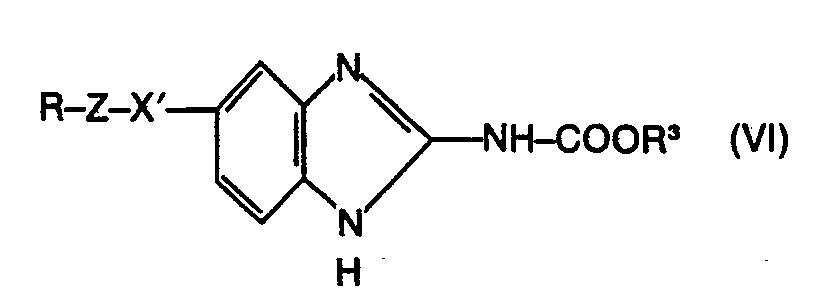
- R und Z die oben angegebene Bedeutung besitzen und
- X' für ein Schwefelatom steht,
mit einem geeigneten Oxidationsmittel umsetzt. - Überraschenderweise zeigen die erfindungsgemässen Benzimidazolylcarbamidsäureester der Formel (I) eine ausgeprägte anthelmintische Wirkung, auch wenn man sie in Form ihrer wasserlöslichen Salze in wässriger Lösung appliziert. Dieses ist nicht möglich mit den aus dem Stand der Technik bekannten Handelsprodukten Parbendazole und Mebendazole. Die erfindungsgemässen Stoffe stellen somit eine Bereicherung der Pharmazie dar.
- Die erfindungsgemässen Verbindungen der Formel (I) können in tautomeren Formen vorliegen. Siehe dazu das folgende allgemeine Schema:

- Im Anmeldungstext werden die jeweiligen Strukturformeln aus Gründen der Einheitlichkeit in allen Fällen gleichartig, nämlich entsprechend der Formel C, formuliert. Daher wird auch nomenklatorisch die Substituentengruppierung R-Z-X in dieser Anmeldung mit der 5-Stellung bezeichnet.
- Verwendet man bei der Verfahrensvariante a) 4-Diäthylaminoäthylthio-1,2-phenylendiamin und N-[(Bis-chlor)-methylen]-carbamidsäuremethyl- ester als Ausgangsstoffe, so kann der Reaktionsablauf durch das folgende Formelschema wiedergegeben werden:


- Als Substituenten für substituiertes Phenyl R1 und R2 kommen in Frage: (C1-C4)-Alkyl, (C1-C4)-Alkoxy, Halogen (insbesondere F, CI und Br), CF3, NO2 und CN.
- Substituiertes Phenylalkyl R1 und R2 steht für durch (C1-4)-Alkyl, (C1-C4)-Alkoxy, Halogen, (insbesondere F, Cl, Br), CF3, NO2 und CN substituiertes Phenylalkyl, wobei der Alkylteil des Phenylalkylrestes 1 bis 4 Kohlenstoffatome besitzt. Insbesondere seien aufgeführt:
- Benzyl, β-Phenyläthyl, a-Phenyläthyl, 4-Methylphenylmethyl, 3-Methoxyphenylmethyl, 4-Chlorphenylmethyl,
- Falls R1 der Gruppen NHR1 oder NR1R2 mit einem Kohlenstoffatom des Substituenten Z zu einem 5- bis 7-gliedrigen gegebenenfalls durch (C1-C4)-Alkyl substituierten Ring verbunden sind, entsteht dabei ein heterocyclisches Ringsystem. Typische Beispiele dafür sind:
- 1-Methyl-3-pyrrolidyl,
- 1-Methyl-3-piperidyl,
- 1-Methyl-4-piperidyl,
- 1-Methyl-3-hexanhydroazepinyl,
- 1-Methyl-4-hexahydroazepinyl.
- Solche heterocyclischen Ringe sind beispielsweise
- 2-Methylenpyrrolidin,
- 2-Methyl-,
- 3-Methyl-,
- 4-Methyl-,
- 5-Methyl-2-methylen-pyrrolidin,
- 2-Methylen-1-methyl-pyrrolidin,
- 1,2-Dimethyl-,
- 1,3-Dimethyl-,
- 1,4-Dimethyl-,
- 1,5-Dimethyl-2-methylen-pyrrolidin,
- 2-Äthyl-2-methylen-pyrrolidin,
- 2-(1-Äthylen)-pyrrolidin,
- 2-(2-Äthylen)-pyrrolidin,
- 2-(1-Äthyl)-1-methyl-pyrrolidin,
- (2-(1-Äthylen)-1-methyl-pyrrolidin,
- 2-Methylen-piperidin,
- 2-Methyl-2-methylen-piperidin,
- 2-(1-Äthylen)-piperidin,
- 2-(2-Äthylen)-piperidin,
- 2-(1-Äthylen)-2-methyl-piperidin,
- 2-(2-Äthylen)-2-methyl-piperidin,
- 1-Methyl-2-methylen-piperidin,
- 2-Methylen-hexahydroazepin,
- 2-Methyl-2-methylen-hexahydrozepin,
- 1,2-Dimethyl-2-methylen-hexahydrozepin.
- Als gegebenenfalls durch (C1-C4)-Alkyl substituierte Azabicycloalkylreste NR1R2 mit 6 bis 10 Ringgliedern seien beispielhaft die folgenden aufgeführt:
- 2-Azabicyclo[2.2.2]octyl,
- 3-Azabicyclo[3.2.1]octyl,
- 2-Methyl-3-azabicyclo[3.2.1]octyl,
- 2-Äthyl-3-azabicyclo[3.2.1]octyl,
- 2.4-Dimethyl-3-azabicyclo[3.2.1]octyl,
- 1.8.8-Trimethyl-3-azabicyclo[3.2.1]octyl,
- 1.6.6-Trimethyl-3-azabicyclo[3.2.1]octyl,
- 2.2.4.4-Tetramethyl-3-azabicyclo[3.2.1]octyl,
- 2-Azabicyclo[3.2.1]octyl,
- 6-Azabicyclo[3.2.1]octyt,
- 8-Azabicyclo[3.2.1]octyl,
- 3-Azabicyclo[4.1.1]octyl,
- 3-Azabicyclo[3.3.0]octyl,
- 3-Azabicyclo[3.3.1]nonyl,
- 6-Methyl-3-azabicyclo[3.3.1]nonyl,
- 9-Azabicyclo[3.3.1]nonyl,
- 2-Azabicyclo[3.3.1]nonyl,
- 2-Azabicyclo[3.2.2]nonyl,
- 3-Azabicyclo[3.2.2]nonyl,
- 9-Azabicyclo[4.2.1]nonyl,
- 2-Azabicyclo[4.3.0]nonyl,
- cis- und trans-8-Azabicyclo[4.3.0]nonyl,
- 1.6-Dimethyl-8-azabicyclo[4.3.0]nonyl,
- cis- und trans-7-Azabicyclo[4.3.0]nonyl,
- 3-Azabicyclo[3.2.0]heptyl,
- 2-Methyl-3-azabicyclo[3.2.0]heptyl,
- 2-Azabicyclo[2.2.1]heptyl,
- 7-Azabicyclo[2.2.1]heptyl,
- 3-Azabicyclo[3.1.1 ]heptyl,
- 6-Azabicyclo[3.1.1]heptyl,
- 6-Azabicyclo[3.3.1]heptyl,
- 3-Azabicyclo[4.1.0]heptyl,
- 3-Azabicyclo[3.1.0]hexyl,
- 1-Methyl-3-azabicyclo[3.1.0]hexyl,
- 1,5-Dimethyl-3-azabicyclo[3.1.0]hexyl.
- 3-Azabicyclo[3.1.0]hexyl.
- Als gegebenenfalls durch O, S, NH, NR' unterbrochene und/oder durch ein oder zwei (C1-C4)-Alkylgruppen substituierte Cycloalkylenimino-oder Cycloalkenylimino- oder Cycloalkadienyleniminogruppen mit 4 bis 7 Ringgliedern seien beispielshaft die olgenden aufgeführt:
- Pyrrolidino,
- 2-Methyl-,
- 3-Methyl-,
- 2,3-Dimethyl-,
- 2,4-Dimethyl-,
- 3,4-Dimethyl-pyrrolidino,
- Piperidino,
- 2-Methyl-,
- 3-Methyl-,
- 4-Methyl-,
- 2,4-Dimethyl-,
- 2,5-Dimethyl-,
- 2,6-Dimethyl-,
- 3,4-Dimethyl-,
- 4-Äthyl-piperidino,
- 1,2,3,6-Tetrahydropiperidino,
- 4-Methyl-,
- 3,4-Dimethyl-,
- 4-Äthyl-,
- 4-lsopropyl-,
- 3,5-Dimethyl-1,2,3,6-tetrahydro-piperidino,
- Hexahydroazepino,
- 2-Methyl-,
- 3-Methyl-,
- 4-Methyl-hexahydroazepino,
- Morpholino,
- Thiomorpholino,
- Piperazino,
- N-Methyl-piperazino,
- N-Äthylpiperazino,
- 2-Methyl-,
- 3-Methyl-,
- 3,5-Dimethyl-piperazino,
- 2-Methylmorpholino,
- 2,6-Dimethylenmorpholino.
- Für R3 = (C1-C4)-Alkyl seien Methyl, Äthyl, n-Propyl, i-Propyl, n-, i-, t.-Butyl aufgeführt.
- Als Alkenyl (C2-C6) R3 seien genannt:
- Äthenyl, Propenyl-(1), Propenyl-(2) und Butenyl-(3).
- Die erfindungsgemäss als Ausgangsprodukte einzusetzenden o-Phenylendiamin-Derivate der Formel (II) sind teilweise noch nicht bekannt. Sie können aber leicht, wie an folgendem Beispiel gezeigt, durch Umsetzung von gegebenenfalls substituierten Aminoalkanolen oder -thiolen zweckmässigerweise in Form ihrer Alkalisalze mit 5-Chlor-2-nitroanilin und nachfolgende Reduktion mit z. B. (Raney-Ni/H2); (Pd-C Katalysator/H2); Pt O2-Kat./H2) hergestellt werden, z. B.:

- Andere Wege zu den vorgenannten Verbindungen der Formel (II) sind ebenfalls möglich. So werden 2-Nitro-5-aminoalkylmercapto-anilide mit einem Oxidationsmittel zu 2-Nitro-5-aminoalkyl- sulfinyl- oder 2-Nitro-5-aminoalkyl-sulfonyl- aniliden oxidiert, nachfolgend zu den entsprechenden Anilinen verseift und zu substituierten Sulfinyl- oder Sulfonyl-1,2-phenylendiaminen reduziert, wie an folgenden Beispielen gezeigt sei:

- Die als Ausgangsstoffe eingesetzten Säurederivate der Formel (III) sind zum grossen Teil bekannt.
- Als Ausgangsstoffe der Formel (III) seien beispielhaft genannt:
- N-Methoxycarbonylcyanamid,
- N-Methoxycarbonylisothioharnstoffmethyläther,
- N-Methoxycarbonylisoharnstoffmethyläther,
- N-Methoxycarbonylguanidin,
- N-[(Bis-methoxy)methylen]-carbamidsäureme- thylester,
- N-[(Bis-methylmercapto)methylen]-carbamid- säuremethylester,
- N-[Methoxy-(methylmercapto)-methylenl-carb- amidsäuremethylester,
- N.N'-Bis-methoxycarbonyl-isothloharnstoff-S-me- thyläther.
- Unbekannte Ausgangsverbindungen der Formel (III) können nach an sich bekannten Verfahren hergestellt werden.
- Die 2-Aminobenzimidazol-Derivate der Formel (IV) sind teilweise noch nicht bekannt, sie können aber leicht hergestellt werden, indem man Phenylendiaminderivate der Formel (11) mit Chlorcyan in einem inerten Lösungsmittel, gegebenenfalls unter Zusatz einer tertiären Base, wie Triäthylamin oder in einer wässrig/alkoholischen Lösung unter Zusatz einer Base, wie z.B. NaHCO3 oder NaOH, miteinander umsetzt. Z. B.

- Die erfindungsgemässen Substanzen können in freier Form oder in Form ihrer physiologisch unbedenklichen Salze mit anorganischen und organischen Säuren, beispielsweise als Hydrohalogenide, vorzugsweise Hydrochloride, Sulfate, Phosphate, Nitrate, Maleinate, Fumarate, Acetate, Methansulfonate, Hydroxylacetate, oder Naphthalindisulfonate angewendet werden.
- Bei der Durchführung der Verfahrensvariante a) werden von den Säurederivaten der Formel (III) vorzugsweise
- N-Methoxycarbonylcyanamid,
- N-Methoxycarbonylisothioharnstoffalkyläther,
- N-Methoxycarbonylisoharnstoffalkyläther,
- N.N'-Bis-methoxycarbonyi-isothioharnstoff-S-me- thyläther,
- N-Methoxycarbonylguanidin,
- N-[(Bisalkoxy)methylen]-carbamidsäureester,
- N-[(Bisalkylmercapto)methylen]-carbamidsäureester und
- N-[Alkoxy-(alkylmercapto)-methylen]-carbamidsäureester
- Die N-[(Bis-halogen)-methylen]-carbamidsäureester werden vorteilhaft in Gegenwart einer Base, wie Triäthylamin, Pyridin, Natronlauge, Natriumbicarbonat oder Natriumcarbonat mit den Phenylendiaminderivaten der Formel II bei 0 bis 100°C, vorzugsweise 0 bis 50°C, kondensiert.
- Die N-[(Alkoxy-(halogen)-methylen]-carbamidsäureester und N-[Alkylmercapto-(halogen)-methylen]-carbamidsäureester werden vorteilhaft zunächst in Gegenwart einer Base, wie Triäthylamin, Pyridin, Natronlauge oder Natriumcarbonat bei Zimmertemperatur umgesetzt und anschliessend durch Erhitzen, vorzugsweise in einem pH-Bereich von 2 bis 5 durch Zusatz einer organischen Säure, wie Essigsäure oder Milchsäure, bei 0 bis 150 °C, vorzugsweise bei 20-120 °C, kondensiert.
- Bei der Verfahrensvariante b) setzt man gegebenenfalls in Anwesenheit einer organischen Base, wie Triäthylamin, Pyridin oder einer anorganischen Base, wie einem Alkali-, Erdalaklialkoholat, z. B. Natriummethylat oder Alkali- oder Erdalkalihydroxid, z. B Natriumhydroxid, bei Temperaturen zwischen etwa 20 und etwa 150 °C, vorzugsweise zwischen 60 und 120°C, in einem für diese Umsetzung indifferentem organischen Lösungsmittel, wie z.B. Tetrahydrofuran, Dioxan, Benzol, Toluol, Chlorbenzol, Acetonitril, Aceton, Methyläthylketon, Diäthylenglykoldimethyläther, Methanol und Äthanol oder Gemischen der vorgenannten Verdünnungsmittel um.
- Bei der Reaktionsvariante c) setzt man 1 Mol der Verbindung (VI) mit einem oder mindestens 1 Mol des Oxidationsmittels nach an sich bekannten Verfahrensbedingungen in einem inerten organischen Lösungsmittel oder Lösungsmittelgemisch, beispielsweise in Wasser, Essigsäure, Ameisen
säure, Acetanhydrid, Propionanhydrid, bei Temperaturen zwischen etwa 0 und 100°C, vorzugsweise zwischen 0 und 80 °C, um. Die Aufarbeitung geschieht nach üblichen Methoden. - Die bei der Verfahrensvariante c) als Ausgangsprodukte eingesetzten Oxidationsmittel sind bereits bekannt.
- Organische Persäuren, wie Peressigsäure, Perameisensäure, Perbenzoesäure, m-Chlorperbenzoesäure, Monoperphthalsäure, anorganische Peroxide, wie Wasserstoffperoxid, gelöst in Wasser oder ggf. verdünnten organischen Säuren, anorganische Oxidationsmittel, wie Chromsäure, Salpetersäure, Kaliumpermanganat, Chlor, Brom, Halogensauerstoffsäuren, wie unterchlorige, chlorige, Chlor- oder Überchlorsäure, tert.-Butylhypochlorit, Methylhypochlorit, tert.-Butylchromat, organische N-Halogenverbindungen, wie N-Chlorsuccinimid, N-Bromsuccinimid sowie N-Halogensulfonsäureamide oder N-Halogencarbonsäureamide.
- Durch entsprechend literaturbekannte Wahl der Reaktionsbedindungen kann das Oxidationspotential entsprechend eingestellt und die Reaktion zur Herstellung der Sulfoxide bzw. Sulfone gelenkt werden.
- Als erfindungsgemässe Wirkstoffe seien aufgeführt:
- 5-(2-Diäthylaminoäthylthio)-benzimidazolyl-2-carbamidsäuremethylester,
- 5-(2-Dimethylaminoäthylthio)-benzimidazolyl-2-carbamidsäuremethylester,
- 5-(3-Dimethylaminopropylthio)-benzimidazolyl-2-carbamidsäuremethylester,
- 5-(2-Dimethylaminopropylthio)-benzimidazolyl-2-carbamidsäuremethylester,
- 5-(2-Morpholinoäthylthio)-benzimidazolyl-2-carb- amidsäuremethylester,
- 5-(2-Morpholinopropylthio)-benzimidazolyl-2-carbamidsäuremethylester
- Die erfindungsgemässen Verbindungen besitzen eine ausgezeichnete Wirksamkeit gegenüber Helminthen, insbesondere eine überraschend gute und breite Wirkung gegen folgende Nematoden und Cestoden:
- 1. Hakenwürmer (z.B. Bunostomum trigonocephalum, Uncinaria stenocephala);
- 2. Trichostrongyliden (z.B. Haemonchus contortus, Trichostrongylus colubriformis, Ostertagia circumcincta, Nippostrongylus muris, Cooperia curticei);
- 3. Strongyliden (z. B. Oesophagostomum columbianum);
- 4. Rhabditiden (z. B. Strongyloides ratti);
- 5. Spulwürmer (z. B. Toxcara canis, Toxascaris leonina, Ascaris suum);
- 6. Madenwürmer (z. B. Aspiculuris tetraptera);
- 7. Heterakiden (z. B. Heterakis spumosa);
- 8. Peitschenwürmer (z. B. Trichuris muris);
- 9. Filarien (z.B. Litomosoides carinii, Dipetalonema witei);
- 10. Bandwürmer (z. B. Taenis pisiformis, Hymenolepis nana).
- Die Wirkung wurde im Tierversuch nach oraler und parenteraler Applikation bei stark mit Parasiten befallenen Versuchstieren geprüft. Die angewendeten Dosierungen wurden sehr gut von den Versuchstieren vertragen.
- Die neuen Wirkstoffe können als Anthelmintika sowohl in der Human- als auch in der Veterinärmedizin verwendet werden.
- Die neuen Wirkstoffe können in bekannter Weise in die üblichen Formulierungen übergeführt werden.
- Die neuen Verbindungen können in den Formulierungen auch in Mischungen mit anderen bekannten Wirkstoffen vorliegen.
- Die neuen Wirkstoffe können in üblicher Weise angewendet werden. Die Applikation erfolgt vorzugsweise parenteral, insbesondere subcutan, jedoch sind beispielsweise auch eine orale oder eine dermale («Pour-on») Applikation ebenfalls möglich.
- Im allgemeinen hat es sich als vorteilhaft erwiesen, Mengen von etwa 1 bis 100 mg der neuen Verbindungen je kg Körpergewicht pro Tag zur Erzielung wirksamer Ergebnisse zu verabreichen. Trotzdem kann es gegebenenfalls erforderlich sein, von den genannten Mengen abzuweichen, und zwar in Abhängigkeit von dem Körpergewicht des Versuchstieres und der Art des Applikationsweges, aber auch aufgrund der Tierart und deren individuellem Verhalten gegenüber dem Medikament bzw. der Art, von dessen Formulierung und dem Zeitpunkt bzw. Intervall, zu welchem die Verabreichung erfolgt. So kann es in einigen Fällen ausreichend sein, mit weniger als der vorgenannten Mindestmenge auszukommen, während in anderen Fällen die genannte obere Grenze überschritten werden muss. Im Fall der Applikation grösserer Mengen kann es empfehlenswert sein, diese in mehrere Einzelgaben über den Tag zu verteilen. Für die Applikation in der Human- und Veterinärmedizin ist der gleiche Dosierungsspielraum vorgesehen. Sinngemäss gelten auch die weiteren obigen Ausführungen.
- Zu 7,1 g (0,03 Mot) 4-(2-Diäthylaminoäthylthio)-1,2-phenylendiamin, gelöst in 100 ml Chloroform, werden 10 ml Triäthylamin und 5,6 g (0,031 Mol) N-[(Bis-chlor)-methylen]-carbamidsäuremethyl- ester bei 20°C zugetropft. Man erhitzt 30 Minuten unter Rückfluss. Nach dem Abdestillieren des Lösungsmittels im Vakuum wird der Rückstand mehrfach mit Wasser verrieben, abgesaugt, nochmals gut mit n-Hexan verrieben und abermals abgesaugt. Ausbeute: 7,9 g 5-(2-Diäthylamino- äthylthio)-benzimidazolyl-2-carbamidsäure-methylester. Fp. 162-164°C (Zers.), Hydrochlorid Fp. 200-201 °C (Zers.).
- Das als Ausgangsmaterial verwendete 4-(2-Di- äthylaminoäthylthio)-1,2-phenylendiamin, ÖI, wird durch katalytische Hydrierung von 2-Nitro-5-(2-di- äthylaminoäthylthio)-anilin erhalten. Das 2-Nitro-5-(2-diäthylaminoäthylthio)-anilin (Fp. 42-44°C) seinerseits wird durch Umsetzung von 2-Diäthylaminoathanthiol in Gegenwart von Natriummethylat in Alkohol mit 5-Chlor-2-nitroanilin hergestellt.
- N-Methoxycarbonyl-isothioharnstoffmethyläther, der durch Umsetzung von 7,8 g S-Methylisothioharnstoffsulfat mit 4,5 g Chlorameisensäuremethylester und 17 g 25%iger Natronlauge gewonnen wurde, wird mit Essigsäure (~5-6) ml) auf pH 5 gebracht. Man setzt 7,1 g 4-(2-Diäthylamino- äthylthio)-1,2-phenylendiamin, gelöst in Alkohol und 3 ml Essigsäure, zu, erhitzt 1 Stunde auf 80-85°C, kühlt ab, filtriert das Reaktionsprodukt ab und erhält nach Waschen mit Wasser und Alkohol 9 g 5-(2-Diäthylaminoäthylthio)-benzimid- azolyl-carbamidsäuremethylester vom Fp. 162-164 °C.
- Die gleiche Verbindung erhält man analog durch Kondensation mit N-Methoxycarbonyl-isoharnstoffmethyläther in einer Menge von 4,2 g oder durch Kondensation von 4-(2-Diäthylamino- äthylthio)-1,2-phenylendiamin.(0,03 Mol) mit 0,03 Mol N-[(Bis-äthoxy)-methylen]-carbamidsäure- methylester bei 110 bis 140°C in Glykol (Ausbeute 5,2 g) oder mit 0,03 Mol N-[(Bis-alkylmercapto)-methylen]-carbamidsäuremethylester (Ausbeute 4,9g) oder mit 0,03 Mol N-[Äthoxy-(methylmer- capto)-methylen]-carbamidsäuremethylester (Ausbeute 4,1 g) oder mit 0,03 Mol N-Methoxycarbonylguanidin bei 140 bis 160°C (Ausbeute 3,9 g) oder mit 0,03 Mol Methoxycarbonylcyanamid in Wasser bei 80 bis 100°C, wobei mit Salzsäure ein pH von 2 bis 4 eingestellt wird (Ausbeute 3,8 g), oder mit 0,03 Mol N,N'-Bis-methoxy- carbonylisothioharnstoff-S-methyläther (Ausbeute 8,3 g).
- Zu 24,8 g (0,1 Mol) 4-(2-Diäthylaminoäthylthio)-1,2-phenylendiamin und 10,1 g (0,1 Mol) Triäthylamin in 300.ml trockenem Chloroform werden unter Rühren bie 0°C 16,7 g (0,1 Mol) N-[Chlor-(methyl- mercapto)-methylen]-carbamidsäuremethylester, gelöst in wenig Chloroform, zugetropft. Man rührt 2 bis 3 Stunden bei 25 bis 30°C nach, dampft im Vakuum ein, fügt 200 ml Alkohol, 20 ml Wasser und 0,5g p-Toluolsulfonsäure zu und erhitzt 2 Stunden auf 90°C. Nach dem Eindampfen verrührt man den Rückstand mit Wasser, viltriert ab und wäscht das Reaktionsprodukt mit Alkohol. Ausbeute 26,2g 5-(2-Diäthylaminoäthylthio)-benz- imidazolyl-2-carbamidsäuremethylester. Kondensiert man analog 0,1 Mol N-[Chlor-(methoxy)methylen]-carbamidsäuremethylester mit 4-(2-Di- äthylaminoäthylthio)-1,2-phenylendiamin, so erhält man eine Ausbeute von 18,5 g.
- 27,3 g (0,1 Mol) 2-Amino-5-(2-diäthylaminoäthyl- thio)-benzimiazol fügt man zu einer Lösung von 2,4 g Natrium in 200 mi Methanol, tropft 5,6 g Kohlensäuredimethylester ein und erhitzt eine Stunde unter Rückfluss. Man dampft im Vakuum ein, wäscht den Rückstand nacheinander mit Wasser, verdünnter Essigsäure und Alkohol und erhält nach dem Trocknen 21,4 g 5-(2-Diäthylaminoäthyl- thio)-benzimidazolyl-2-carbamidsäuremethyl- ester, Fp. 162-164 °C.
- Die gleiche Verbindung entsteht durch Umsetzung von 2-Amino-5-(2-diäthylaminoäthylthio)-benzimidazol mit einer äquivalenten Menge Pyrokohlensäuredimethylester in Chloroform bei 40 °C.
- Die gleiche Verbindung entsteht ebenso durch Umsetzung von 0,1 Mol 2-Amino-5-(2-diäthyl- aminoäthylthio)-benzimidazol, gelöst in Chloroform, mit 0,1 Mol Chlorameisensäuremethylester in Gegenwart von 0,1 Mol Triäthylamin. Nach beendetem Eintropfen erhitzt man noch 5 bis 6 Stunden unter Rückfluss. Ausbeute: 22,6 g.
- Das als Ausgangsmaterial verwendete 2-Ami- no-5-(2-diäthylaminoäthylthio)-benzimidazol entsteht durch Umsetzung von 4-(2-Diäthylamino- äthylthio)-1,2-phenylendiamin mit Chlor- oder Bromcyan in Tetrahydrofuran, Alkohol oder Wasser.
- Nach der in Beispiel 1 beschriebenen Darstellung erhält man aus 7,1 g 4-(Diäthylaminoäthylsulfinyl)-1,2-phenylendiamin und 5,6 g N-[(Bis-chlor)-methylen]-carbamidsäuremethylester 7,2 g 5-(2-Di- äthylaminoäthylsulfinyl)-benzimidazolylcarb- amidsäuremethylester.
- Das als Ausgangsmaterial verwendete 4-(2-Di- äthylaminoäthylsulfinyl)-1,2-phenylendiamin wird auf solgendem Wege erhalten: 2-Nitro-5-(2-di- äthylaminoäthylthio)-propionanilid wird in Acetanhydrid mit einem Äquivalent H201 zu 2-Nitro-5-(2-diäthylaminoäthylsulfinyl)-propionanilid oxidiert, nachfolgend zum 2-Nitro-5-(2-diäthyl- aminoäthylsulfinyl)-anilin verseift und katalytisch zum 5-(2-Diäthylaminoäthylsulfinyl)-1,2-phenylendiamin reduziert.
- 12,8 g 5-(2-Diäthylaminoäthylthio)-benzimidazol-2-carbamidsäuremethylester werden in 500 ml Acetanhydrid gelöst. Dazu tropft man 4,7 g 30%iger Wasserstoffsuperoxidlösung, rührt 3 Stunden nach und dampft im Vakuum ein. Der Rückstand wird mit einem Gemisch von Petrol- äther/Essigester verrieben. Nach dem Abfiltrieren erhält man 5-(2-Diäthylaminoäthylsulfinyl)-benz- imidazolyl-2-carbamidsäuremethylester (Zersetzung).
- In entsprechender Arbeitsweise erhält man aus 12,8 g 5-(2-Diäthylaminoäthylthio)-benzimida- zolyl-2-carbamidsäuremethylester, gelöst in 250 ml Essigsäure mit 12 g 30%igem Wasserstoffperoxid 6 g 5-(2-Diäthylaminoäthylsulfonyl)-benz- imidazolyl-2-carbamidsäuremethylester.
- Nach der in Beispiel 1 beschriebenen Methode erhält man aus substituierten PhenylendiaminDerivaten folgende Benzimidazolyl-2-carbamidsäureester:


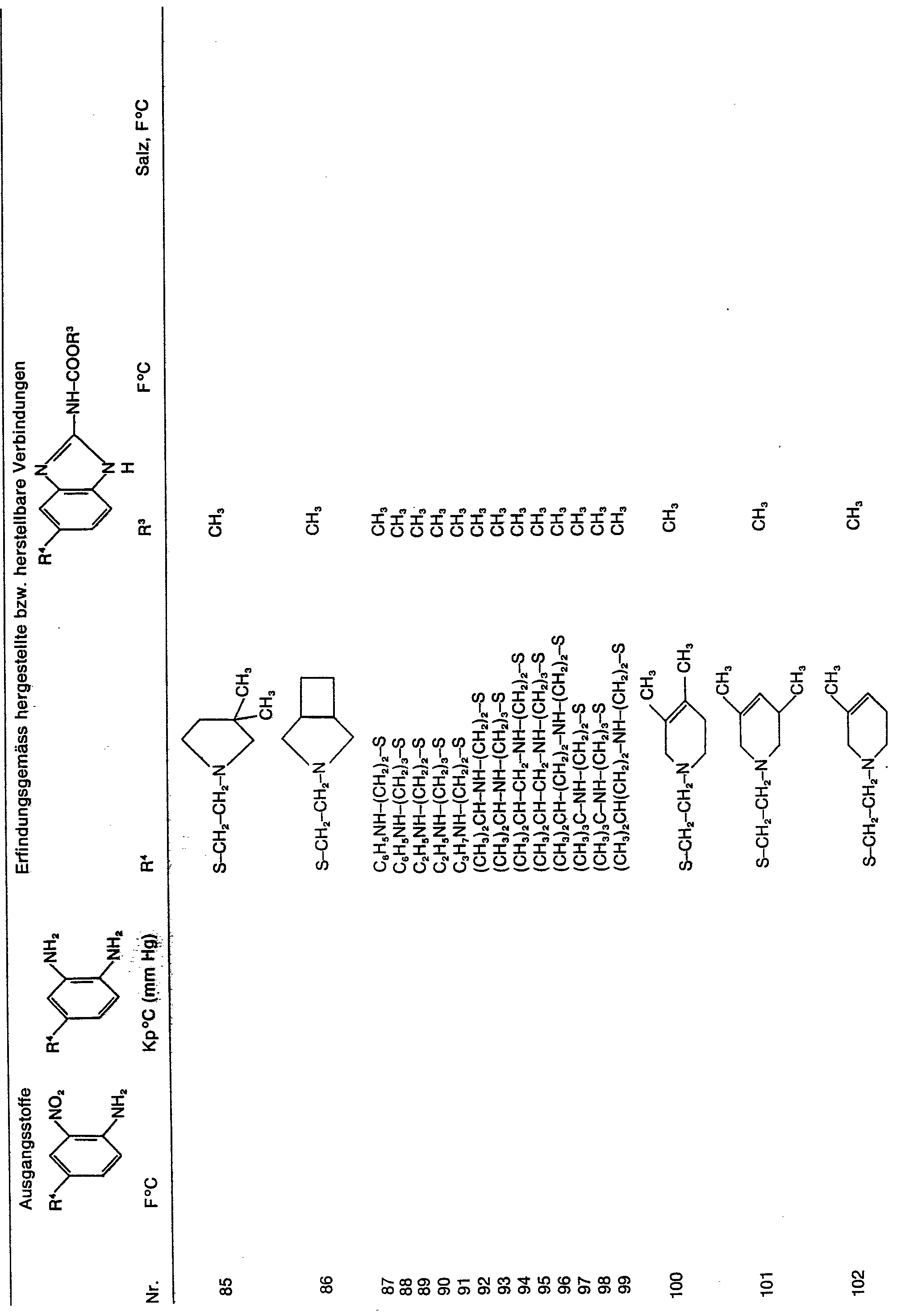


mit den Phenylendiaminderivaten der Formel (II) bei 0 bis 150 °C, vorzugsweise bei 30 bis 120 °C, gegebenenfalls in einem Lösungsmittel, wie Alkohol, verdünnte Essigsäure, Äthylenglykol, Tetrahydrofuran, Dioxan, Benzol, Toluol oder Wasser, umgesetzt. Vorteilhaft ist es, in Lösungsmitteln zu arbeiten, die Wasser enthalten und in denen ein pH-Bereich von 2 bis 7, vorzugsweise 2 bis 5, durch Zufügen einer organischen Säure, wie Essigsäure oder Milchsäure oder p-Toluolsulfonsäure oder eines Alkalisalzes einer organischen Säure eingehalten wird.
sowie die in den nachfolgenden Beispielen aufgeführten Verbindungen der allgemeinen Formel (I).
Claims (5)


X, Z, R und R3 die im Anspruch 1 angegebene Bedeutung haben, dadurch gekennzeichnet, dass man


umsetzt; oder dass man


gegebenenfalls in Gegenwart von Säurebindemitteln umsetzt
oder dass man zum Erhalt von Verbindungen der Formel (I), bei welchen X für die SO- oder SO2-Gruppe steht,

mit einem geeigneten Oxidationsmittel umsetzt, und die nach den Verfahrensvarianten a), b) oder c) erhaltenen Endprodukte nach an sich bekannten Methoden isoliert: `
Applications Claiming Priority (4)
| Application Number | Priority Date | Filing Date | Title |
|---|---|---|---|
| DE2845537 | 1978-10-19 | ||
| DE19782845537 DE2845537A1 (de) | 1978-10-19 | 1978-10-19 | Benzimidazolylcarbamidsaeureester, verfahren zu ihrer herstellung sowie ihre verwendung als arzneimittel |
| AU12079/83A AU1207983A (en) | 1978-10-19 | 1983-03-07 | Benzimidazolylcarbamic acid esters |
| AU12078/83A AU1207883A (en) | 1978-10-19 | 1983-03-07 | Benzimidazolylcarbamic acid esters |
Publications (2)
| Publication Number | Publication Date |
|---|---|
| EP0010242A1 EP0010242A1 (de) | 1980-04-30 |
| EP0010242B1 true EP0010242B1 (de) | 1982-09-29 |
Family
ID=34279107
Family Applications (1)
| Application Number | Title | Priority Date | Filing Date |
|---|---|---|---|
| EP79103831A Expired EP0010242B1 (de) | 1978-10-19 | 1979-10-08 | 2-Benzimidazolylcarbamidsäureester, diese enthaltende Arzneimittel sowie Verfahren zur ihrer Herstellung |
Country Status (11)
| Country | Link |
|---|---|
| US (2) | US4287199A (de) |
| EP (1) | EP0010242B1 (de) |
| JP (1) | JPS5557569A (de) |
| AR (2) | AR222502A1 (de) |
| AU (1) | AU535251B2 (de) |
| DE (2) | DE2845537A1 (de) |
| DK (1) | DK440279A (de) |
| ES (1) | ES485157A1 (de) |
| NO (1) | NO793202L (de) |
| NZ (1) | NZ191857A (de) |
| ZA (1) | ZA795565B (de) |
Families Citing this family (4)
| Publication number | Priority date | Publication date | Assignee | Title |
|---|---|---|---|---|
| DE3138575A1 (de) * | 1981-09-28 | 1983-04-07 | Basf Ag, 6700 Ludwigshafen | Fungizid |
| US5278181A (en) * | 1992-05-12 | 1994-01-11 | Board Of Regents Acting On Behalf Of The University Of Michigan | Soluble alkyl[5-[amino (phenyl)methyl]-1H-benzimidazol-2-yl] carbamate anthelmintics |
| PE20000728A1 (es) * | 1998-06-26 | 2000-08-21 | Cocensys Inc | Heterociclos 4-bencil piperidina alquilsulfoxido y su uso como antagonistas receptores subtipo-selectivo nmda |
| WO2012070069A2 (en) * | 2010-11-24 | 2012-05-31 | Sequent Scientific Limited | A process for preparation of albendazole |
Family Cites Families (15)
| Publication number | Priority date | Publication date | Assignee | Title |
|---|---|---|---|---|
| US3682952A (en) * | 1964-08-04 | 1972-08-08 | Smith Kline French Lab | 5(6)-n-butyl-2-carbomethoxy-benzimidazole |
| US3929821A (en) * | 1972-12-29 | 1975-12-30 | Syntex Inc | 5 (6)-Benzene ring substituted benzimidazole-2-carbamate derivatives |
| US3929824A (en) * | 1972-12-29 | 1975-12-30 | Syntex Inc | 5(6)-Benzene ring substituted benzimidazole-2-carbamate derivatives having anthelmintic activity |
| US3935209A (en) * | 1973-03-12 | 1976-01-27 | Syntex (U.S.A.) Inc. | 5(6)-Benzene ring substituted benzimidazole-2-carbamate derivatives having anthelmintic activity |
| US3969526A (en) * | 1973-05-29 | 1976-07-13 | Smithkline Corporation | Anthelmintic 5-heterocycliothio and oxy-2-carbalkoxyaminobenzimidazles |
| US3901901A (en) * | 1973-06-19 | 1975-08-26 | Syntex Inc | 5(6)-benzene ring substituted benzimidazole-2-carbamate derivatives having anthelmintic activity |
| US3929823A (en) * | 1973-11-21 | 1975-12-30 | Syntex Inc | 5(6)-Benzene ring substituted benzimidazole-2-carbamate derivatives having anthelmintic activity |
| US4025638A (en) * | 1975-03-10 | 1977-05-24 | Smithkline Corporation | Methods and compositions using 5-cycloalkylthio- and oxy-2-carbalkoxy-aminobenzimidazole |
| US4026936A (en) * | 1975-08-07 | 1977-05-31 | Hoffmann-La Roche Inc. | Anthelmintic pyridine and thiazole substituted benzimidazole carbamates |
| CA1094061A (en) * | 1976-03-19 | 1981-01-20 | Colin C. Beard | 5(6)-benzene ring substituted benzimidazole-2- carbamate derivatives having anthelmintic activity |
| US4046908A (en) * | 1976-07-16 | 1977-09-06 | E. R. Squibb & Sons, Inc. | Benzimidazole derivatives, compositions thereof and method of use as anthelmintics |
| US4093732A (en) * | 1977-02-17 | 1978-06-06 | E. R. Squibb & Sons, Inc. | Sulfoxide derivatives of benzimidazoles |
| IT1076022B (it) * | 1977-04-20 | 1985-04-22 | Montedison Spa | Benzimidazolcarbammati antielmintici |
| US4145431A (en) * | 1978-02-16 | 1979-03-20 | E. R. Squibb & Sons, Inc. | Method of treating helminthiasis by parenteral administration of sulfide- and sulfoxide-derivatives of benzimidazoles |
| US4174400A (en) * | 1978-09-13 | 1979-11-13 | Merck & Co., Inc. | Anthelmintic benzimidazoles |
-
1978
- 1978-10-19 DE DE19782845537 patent/DE2845537A1/de not_active Withdrawn
-
1979
- 1979-10-05 NO NO793202A patent/NO793202L/no unknown
- 1979-10-08 DE DE7979103831T patent/DE2963782D1/de not_active Expired
- 1979-10-08 EP EP79103831A patent/EP0010242B1/de not_active Expired
- 1979-10-11 US US06/083,883 patent/US4287199A/en not_active Expired - Lifetime
- 1979-10-15 AU AU51791/79A patent/AU535251B2/en not_active Ceased
- 1979-10-16 NZ NZ191857A patent/NZ191857A/xx unknown
- 1979-10-17 JP JP13305479A patent/JPS5557569A/ja active Pending
- 1979-10-18 ZA ZA00795565A patent/ZA795565B/xx unknown
- 1979-10-18 DK DK440279A patent/DK440279A/da not_active Application Discontinuation
- 1979-10-18 ES ES485157A patent/ES485157A1/es not_active Expired
- 1979-10-19 AR AR278569A patent/AR222502A1/es active
-
1981
- 1981-01-12 US US06/224,584 patent/US4353913A/en not_active Expired - Fee Related
- 1981-04-15 AR AR284987A patent/AR223588A1/es active
Also Published As
| Publication number | Publication date |
|---|---|
| AR222502A1 (es) | 1981-05-29 |
| AU535251B2 (en) | 1984-03-08 |
| NZ191857A (en) | 1982-05-31 |
| NO793202L (no) | 1980-04-22 |
| US4287199A (en) | 1981-09-01 |
| AU5179179A (en) | 1980-06-26 |
| DE2845537A1 (de) | 1980-04-30 |
| US4353913A (en) | 1982-10-12 |
| AR223588A1 (es) | 1981-08-31 |
| JPS5557569A (en) | 1980-04-28 |
| ZA795565B (en) | 1980-10-29 |
| DK440279A (da) | 1980-04-20 |
| ES485157A1 (es) | 1980-05-16 |
| EP0010242A1 (de) | 1980-04-30 |
| DE2963782D1 (en) | 1982-11-11 |
Similar Documents
| Publication | Publication Date | Title |
|---|---|---|
| EP0005828B1 (de) | Neue substituierte Phenylpiperazinderivate, diese enthaltende Arzneimittel und Verfahren zu deren Herstellung | |
| DE1470082B2 (de) | Verfahren zur Herstellung von in der 2-Stellung substituierten Benzimidazolen | |
| DE2454632A1 (de) | Neue 5(6)-substituierte benzimidazol- 2-carbamate und ihre herstellung | |
| DE1670772C3 (de) | 4H-3,1-Benzoxazin-Derivate, deren Salze und pharmazeutische Präparate | |
| DE2818423A1 (de) | Neue isochinolinderivate und verfahren zu ihrer herstellung | |
| EP0163260A1 (de) | Neue substituierte Pyrrolidinone, Verfahren zu ihrer Herstellung und Arzneimittel | |
| DE2818403A1 (de) | Neue isochinolinderivate und verfahren zu ihrer herstellung | |
| DE2029299C3 (de) | Neue Aminophenylamidine, Verfahren zu ihrer Herstellung und diese enthaltende Arzneimittel | |
| DE2363348A1 (de) | Neue 2-carbalkoxyaminobenzimidazolverbindungen | |
| AT339329B (de) | Verfahren zur herstellung von neuen n-(o-acylaminophenyl) -n'- acylisothioharnstoffathern | |
| DE1122541B (de) | Verfahren zur Herstellung von Sulfamyl-anthranilsaeuren | |
| DE2815675A1 (de) | Anthelmintika | |
| EP0010242A1 (de) | 2-Benzimidazolylcarbamidsäureester, diese enthaltende Arzneimittel sowie Verfahren zur ihrer Herstellung | |
| DE2651467A1 (de) | Substituierte o-phenylendiaminderivate, verfahren zu ihrer herstellung sowie ihre verwendung als arzneimittel | |
| DE1445632A1 (de) | Neue Tetrahydro-imidazole | |
| DE2405732A1 (de) | Ekto- und endoparasitenmittel | |
| EP0009174A1 (de) | Neue (5-(3,4-Dihydroisochinolin-1-yl)-1H-benzimidazol-2-yl)-carbaminsäurealkylester, Verfahren zu ihrer Herstellung, sie enthaltende Arzneimittel und Verfahren zur Herstellung von anthelmintisch wirksamen Mitteln | |
| EP0002723B1 (de) | Phosphonylureidobenzol-Derivate, Verfahren zu ihrer Herstellung und ihre Verwendung in Arzneimitteln | |
| DD159073A5 (de) | Verfahren zur herstellung neuer benzazolderivate | |
| DE2438120A1 (de) | Substituierte benzimidazolylcarbamidsaeureester, verfahren zu ihrer herstellung sowie ihre verwendung als arzneimittel | |
| DE2630847A1 (de) | Methoxycarbonyl-phenyl-guanidine, verfahren zu ihrer herstellung sowie ihre verwendung als arzneimittel | |
| DE2346937A1 (de) | N'-(aminoacylaminophenyl)-acetamidine, verfahren zu ihrer herstellung sowie ihre verwendung als arzneimittel | |
| DE2707269A1 (de) | Heterocyclische stickstoffverbindungen und verfahren zu ihrer herstellung | |
| DE2653766A1 (de) | Substituierte benzolsulfonsaeureester, verfahren zu ihrer herstellung sowie ihre verwendung als arzneimittel | |
| AT336568B (de) | Verfahren zur herstellung von neuen n'-(aminoacylaminophenyl)-acetamidinen |
Legal Events
| Date | Code | Title | Description |
|---|---|---|---|
| PUAI | Public reference made under article 153(3) epc to a published international application that has entered the european phase |
Free format text: ORIGINAL CODE: 0009012 |
|
| 17P | Request for examination filed | ||
| AK | Designated contracting states |
Designated state(s): BE CH DE FR GB IT NL SE |
|
| ITF | It: translation for a ep patent filed | ||
| GRAA | (expected) grant |
Free format text: ORIGINAL CODE: 0009210 |
|
| AK | Designated contracting states |
Designated state(s): BE CH DE FR GB IT NL SE |
|
| REF | Corresponds to: |
Ref document number: 2963782 Country of ref document: DE Date of ref document: 19821111 |
|
| PGFP | Annual fee paid to national office [announced via postgrant information from national office to epo] |
Ref country code: SE Payment date: 19830930 Year of fee payment: 5 |
|
| PGFP | Annual fee paid to national office [announced via postgrant information from national office to epo] |
Ref country code: DE Payment date: 19831001 Year of fee payment: 5 |
|
| PGFP | Annual fee paid to national office [announced via postgrant information from national office to epo] |
Ref country code: NL Payment date: 19831031 Year of fee payment: 5 |
|
| PGFP | Annual fee paid to national office [announced via postgrant information from national office to epo] |
Ref country code: FR Payment date: 19831102 Year of fee payment: 5 |
|
| PGFP | Annual fee paid to national office [announced via postgrant information from national office to epo] |
Ref country code: CH Payment date: 19831123 Year of fee payment: 5 |
|
| PGFP | Annual fee paid to national office [announced via postgrant information from national office to epo] |
Ref country code: BE Payment date: 19831130 Year of fee payment: 5 |
|
| PG25 | Lapsed in a contracting state [announced via postgrant information from national office to epo] |
Ref country code: SE Effective date: 19841009 |
|
| PG25 | Lapsed in a contracting state [announced via postgrant information from national office to epo] |
Ref country code: CH Effective date: 19841031 Ref country code: BE Effective date: 19841031 |
|
| BERE | Be: lapsed |
Owner name: BAYER A.G. Effective date: 19841008 |
|
| PG25 | Lapsed in a contracting state [announced via postgrant information from national office to epo] |
Ref country code: NL Effective date: 19850501 |
|
| GBPC | Gb: european patent ceased through non-payment of renewal fee | ||
| NLV4 | Nl: lapsed or anulled due to non-payment of the annual fee | ||
| PG25 | Lapsed in a contracting state [announced via postgrant information from national office to epo] |
Ref country code: FR Free format text: LAPSE BECAUSE OF NON-PAYMENT OF DUE FEES Effective date: 19850628 |
|
| REG | Reference to a national code |
Ref country code: CH Ref legal event code: PL |
|
| PG25 | Lapsed in a contracting state [announced via postgrant information from national office to epo] |
Ref country code: DE Effective date: 19850702 |
|
| REG | Reference to a national code |
Ref country code: FR Ref legal event code: ST |
|
| PG25 | Lapsed in a contracting state [announced via postgrant information from national office to epo] |
Ref country code: GB Effective date: 19881118 |
|
| EUG | Se: european patent has lapsed |
Ref document number: 79103831.8 Effective date: 19851007 |
|
| PLBE | No opposition filed within time limit |
Free format text: ORIGINAL CODE: 0009261 |
|
| STAA | Information on the status of an ep patent application or granted ep patent |
Free format text: STATUS: NO OPPOSITION FILED WITHIN TIME LIMIT |