WO2025104773A1 - 室内機、および空気調和機 - Google Patents
室内機、および空気調和機 Download PDFInfo
- Publication number
- WO2025104773A1 WO2025104773A1 PCT/JP2023/040707 JP2023040707W WO2025104773A1 WO 2025104773 A1 WO2025104773 A1 WO 2025104773A1 JP 2023040707 W JP2023040707 W JP 2023040707W WO 2025104773 A1 WO2025104773 A1 WO 2025104773A1
- Authority
- WO
- WIPO (PCT)
- Prior art keywords
- refrigerant
- indoor unit
- heat exchanger
- horizontal direction
- sensor
- Prior art date
- Legal status (The legal status is an assumption and is not a legal conclusion. Google has not performed a legal analysis and makes no representation as to the accuracy of the status listed.)
- Pending
Links
Images









Classifications
-
- F—MECHANICAL ENGINEERING; LIGHTING; HEATING; WEAPONS; BLASTING
- F24—HEATING; RANGES; VENTILATING
- F24F—AIR-CONDITIONING; AIR-HUMIDIFICATION; VENTILATION; USE OF AIR CURRENTS FOR SCREENING
- F24F11/00—Control or safety arrangements
- F24F11/30—Control or safety arrangements for purposes related to the operation of the system, e.g. for safety or monitoring
- F24F11/32—Responding to malfunctions or emergencies
- F24F11/36—Responding to malfunctions or emergencies to leakage of heat-exchange fluid
-
- F—MECHANICAL ENGINEERING; LIGHTING; HEATING; WEAPONS; BLASTING
- F24—HEATING; RANGES; VENTILATING
- F24F—AIR-CONDITIONING; AIR-HUMIDIFICATION; VENTILATION; USE OF AIR CURRENTS FOR SCREENING
- F24F11/00—Control or safety arrangements
- F24F11/89—Arrangement or mounting of control or safety devices
-
- F—MECHANICAL ENGINEERING; LIGHTING; HEATING; WEAPONS; BLASTING
- F24—HEATING; RANGES; VENTILATING
- F24F—AIR-CONDITIONING; AIR-HUMIDIFICATION; VENTILATION; USE OF AIR CURRENTS FOR SCREENING
- F24F2110/00—Control inputs relating to air properties
- F24F2110/50—Air quality properties
- F24F2110/65—Concentration of specific substances or contaminants
-
- F—MECHANICAL ENGINEERING; LIGHTING; HEATING; WEAPONS; BLASTING
- F24—HEATING; RANGES; VENTILATING
- F24F—AIR-CONDITIONING; AIR-HUMIDIFICATION; VENTILATION; USE OF AIR CURRENTS FOR SCREENING
- F24F2130/00—Control inputs relating to environmental factors not covered by group F24F2110/00
- F24F2130/20—Sunlight
Definitions
- This disclosure relates to indoor units and air conditioners.
- an indoor unit of an air conditioner is known that is equipped with a sensor for detecting leaking refrigerant gas.
- one of the objectives of the present disclosure is to provide an indoor unit that is attached to the ceiling and has a structure that can appropriately detect leaking refrigerant, and an air conditioner that includes such an indoor unit.
- One aspect of the indoor unit according to the present disclosure is an indoor unit for an air conditioner, which is mounted on a ceiling and includes a housing having an inlet and an outlet opening downward, a heat exchanger housed inside the housing, a blower housed inside the housing and generating an airflow that passes through the heat exchanger, and a refrigerant sensor housed inside the housing and capable of detecting refrigerant, in which air drawn into the housing from the inlet by the operation of the blower passes through the heat exchanger and then through the blower before being blown out from the outlet, and the refrigerant sensor is located above the inlet and below the upper end of the heat exchanger.
- One embodiment of an air conditioner according to the present disclosure includes the indoor unit and an outdoor unit described above.
- leaking refrigerant can be effectively detected in an indoor unit that is mounted on the ceiling.
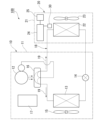
- FIG. 1 is a schematic diagram showing a general configuration of an air conditioner according to a first embodiment.
- FIG. FIG. 2 is a perspective view showing the indoor unit in the first embodiment.
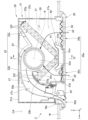
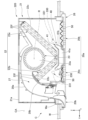
- FIG. 2 is a cross-sectional view showing the indoor unit in the first embodiment.
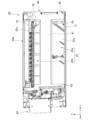
- FIG. 4 is a cross-sectional view showing the indoor unit in the first embodiment, taken along line IV-IV in FIG. 2 is a perspective view showing a part of a heat exchanger, a cover member, and a refrigerant sensor device according to the first embodiment.
- FIG. 2 is an exploded perspective view showing a part of a heat exchanger, a cover member, and a refrigerant sensor device according to the first embodiment.
- FIG. FIG. 2 is a perspective view showing a part of the indoor unit in the first embodiment.
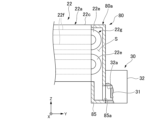
- FIG. 2 is a partial cross-sectional view showing a part of a heat exchanger, a cover member, and a refrigerant sensor device in the first embodiment.
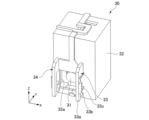
- FIG. 1 is a perspective view showing a refrigerant sensor device according to a first embodiment.
- FIG. FIG. 5 is a cross-sectional view showing a schematic view of a part of the indoor unit in the first embodiment, taken along the line XX in FIG. 4.
- FIG. 8 is a perspective view showing a part of the indoor unit in the first embodiment, as viewed from an angle different from that of FIG. 7 .
- FIG. 2 is a perspective view showing a first partition member according to the first embodiment.
- FIG. 11 is a cross-sectional view showing an indoor unit in a second embodiment.
- FIG. 14 is a cross-sectional view showing the indoor unit in embodiment 2, taken along line XIV-XIV in FIG. 13 .
- FIG. 11 is a cross-sectional view showing an indoor unit in a third embodiment.
- FIG. 13 is a perspective view showing an indoor unit in a fourth embodiment.
- FIG. 13 is a cross-sectional view showing an indoor unit in embodiment 4.
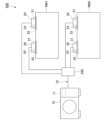
- FIG. 13 is a schematic diagram showing an air conditioner in embodiment 5.
- the drawings also show the X-axis, Y-axis, and Z-axis as appropriate.
- the X-axis indicates one of the horizontal directions.
- the Y-axis indicates the other of the horizontal directions.
- the Z-axis indicates the vertical direction.
- the horizontal direction along the X-axis is called the "first horizontal direction X”
- the horizontal direction along the Y-axis is called the “second horizontal direction Y”
- the vertical direction is called the "vertical direction Z”.
- the first horizontal direction X, the second horizontal direction Y, and the vertical direction Z are perpendicular to each other.
- the side of the vertical direction Z toward which the Z-axis arrow points (the +Z side) is the upper side, and the side of the vertical direction Z opposite to the side toward which the Z-axis arrow points (the -Z side) is the lower side.
- the side of the first horizontal direction X toward which the X-axis arrow points (+X side) is called the "first horizontal direction one side”
- the opposite side of the first horizontal direction X toward which the X-axis arrow points (-X side) is called the “first horizontal direction other side.”
- the side of the second horizontal direction Y toward which the Y-axis arrow points (+Y side) is called the "second horizontal direction one side”
- the opposite side of the second horizontal direction Y toward which the Y-axis arrow points (-Y side) is called the "second horizontal direction other side.”
- the side closer to the center of the indoor unit in the second horizontal direction Y is called the "second horizontal direction inner side”
- Fig. 1 is a schematic diagram showing a general configuration of an air conditioner 100 in embodiment 1.
- the air conditioner 100 includes an outdoor unit 10, an indoor unit 20, and a refrigerant circuit section 18 that connects the outdoor unit 10 and the indoor unit 20.
- the outdoor unit 10 is disposed outdoors.
- the indoor unit 20 is disposed indoors.
- the outdoor unit 10 and the indoor unit 20 are connected to each other by the refrigerant circuit section 18 through which refrigerant 19 circulates.
- the air conditioner 100 can adjust the temperature of the air in the room by exchanging heat between the refrigerant 19 flowing in the refrigerant circuit section 18 and the air in the room in which the indoor unit 20 is located.
- the refrigerant 19 include fluorine-based refrigerants with low global warming potential (GWP) or hydrocarbon-based refrigerants.
- GWP global warming potential
- the refrigerant 19 include a single refrigerant selected from R1234yf, R1234ze, R32, and R290, or a mixture of two or more of these, or a mixture of any of these with another refrigerant.
- Examples of the refrigerant 19 include a mixed refrigerant containing R1132(E), or a mixed refrigerant containing R1123.
- refrigerant 19 examples include a mixed refrigerant of R516A, R445A, R444A, R454C, R444B, R454A, R455A, R457A, R459B, R452B, R454B, R447B, R447A, R446A, and R459A.
- the density of the refrigerant 19 in gaseous form is greater than the density of air.
- the outdoor unit 10 has a housing 11, a compressor 12, a heat exchanger 13, a flow control valve 14, a blower 15, a four-way valve 16, and a control unit 17.
- the housing 11 houses the compressor 12, the heat exchanger 13, the flow control valve 14, the blower 15, the four-way valve 16, and the control unit 17.
- the compressor 12, heat exchanger 13, flow rate control valve 14, and four-way valve 16 are provided in a portion of the refrigerant circuit section 18 that is located inside the housing 11.
- the compressor 12, heat exchanger 13, flow rate control valve 14, and four-way valve 16 are connected by a portion of the refrigerant circuit section 18 that is located inside the housing 11.
- the four-way valve 16 is provided in a portion of the refrigerant circuit section 18 that is connected to the discharge side of the compressor 12.
- the four-way valve 16 can reverse the direction of the refrigerant 19 flowing through the refrigerant circuit section 18 by switching a portion of the paths of the refrigerant circuit section 18.
- the paths connected by the four-way valve 16 are the paths shown by solid lines on the four-way valve 16 in FIG. 1, the refrigerant 19 flows through the refrigerant circuit section 18 in the direction shown by the solid arrows in FIG. 1.
- the paths connected by the four-way valve 16 are the paths shown by dashed lines on the four-way valve 16 in FIG. 1
- the refrigerant 19 flows through the refrigerant circuit section 18 in the direction shown by the dashed arrows in FIG. 1.
- the indoor unit 20 comprises a housing 21, a heat exchanger 22, a blower 23, a control unit 24, an alarm unit 25, and a refrigerant sensor device 30.
- the housing 21 houses the heat exchanger 22, the blower 23, the control unit 24, and the refrigerant sensor device 30 inside.
- the indoor unit 20 is capable of cooling operation to cool the air in the room in which the indoor unit 20 is located, and heating operation to warm the air in the room in which the indoor unit 20 is located.
- the refrigerant 19 flowing through the refrigerant circuit section 18 flows in the direction shown by the solid arrow in Figure 1.
- the refrigerant 19 flowing through the refrigerant circuit section 18 circulates through the compressor 12, the heat exchanger 13 of the outdoor unit 10, the flow control valve 14, and the heat exchanger 22 of the indoor unit 20, in that order, before returning to the compressor 12.
- the heat exchanger 13 in the outdoor unit 10 functions as a condenser
- the heat exchanger 22 in the indoor unit 20 functions as an evaporator.
- the refrigerant 19 flowing through the refrigerant circuit section 18 flows in the direction shown by the dashed line in Figure 1.
- the refrigerant 19 flowing through the refrigerant circuit section 18 circulates through the compressor 12, the heat exchanger 22 of the indoor unit 20, the flow control valve 14, and the heat exchanger 13 of the outdoor unit 10, in that order, before returning to the compressor 12.
- the heat exchanger 13 in the outdoor unit 10 functions as an evaporator
- the heat exchanger 22 in the indoor unit 20 functions as a condenser.
- Figure 2 is a perspective view showing the indoor unit 20.
- Figure 3 is a cross-sectional view showing the indoor unit 20.
- Figure 4 is a cross-sectional view showing the indoor unit 20, taken along line IV-IV in Figure 3.
- the indoor unit 20 is an indoor unit that is attached to the ceiling C. More specifically, the indoor unit 20 is a ceiling-embedded indoor unit that is embedded in the ceiling C.
- the ceiling C is a double ceiling having a ceiling slab (not shown) and a ceiling panel W that is spaced below the ceiling slab.
- the ceiling slab is a structure such as a slab or beam on the upper floor.
- the ceiling panel W is a plate-like panel with a plate surface facing the vertical direction Z.
- the lower surface of the ceiling panel W faces the room.
- the indoor unit 20 is installed on the ceiling C with a part of it embedded in the ceiling space CA through a through hole Wa provided in the ceiling panel W.
- the ceiling space CA is a space provided between the ceiling slab (not shown) and the ceiling panel W in the vertical direction Z.
- the through hole Wa penetrates the ceiling panel W in the vertical direction Z.
- the blower 23 housed in the housing 21 of the indoor unit 20 is a cross-flow fan.
- the blower 23 has an impeller 23a that rotates around a rotation axis R extending in the second horizontal direction Y.
- the rotation axis R is a virtual axis.
- the rotation axis R is located above the center of the housing 21 in the vertical direction Z.
- the impeller 23a is substantially circular when viewed in the second horizontal direction Y.
- the impeller 23a is disposed in the center of the first horizontal direction X in the upper part of the interior of the housing 21.
- the blower 23 has a motor 23b that rotates the impeller 23a around the rotation axis R.
- the motor 23b is located on the other side (-Y side) of the impeller 23a in the second horizontal direction.
- the heat exchanger 22 of the indoor unit 20 extends in the second horizontal direction Y.
- the heat exchanger 22 of the indoor unit 20 has a first heat exchange section 22a and a second heat exchange section 22b.
- the first heat exchange section 22a is located on the other side (-X side) of the first horizontal direction of the blower 23 and diagonally below.
- the first heat exchange section 22a extends in a direction toward the other side of the first horizontal direction as it moves upward.
- the second heat exchange section 22b is located on one side (+X side) of the first heat exchange section 22a in the first horizontal direction.
- the second heat exchange section 22b is located on one side of the first horizontal direction of the blower 23 and diagonally below.
- the second heat exchange section 22b When viewed in the second horizontal direction Y, the second heat exchange section 22b extends in a direction toward the one side of the first horizontal direction as it moves upward.
- the upper end of the first heat exchange section 22a is located higher than the upper end of the second heat exchange section 22b.
- the upper end of the first heat exchange section 22a is the upper end of the heat exchanger 22.
- the upper end of the heat exchanger 22 is the part of the heat exchanger 22 that is located at the uppermost position.
- the upper part of the first heat exchange section 22a and the upper part of the second heat exchange section 22b are arranged on either side of the impeller 23a of the blower 23 in the first horizontal direction X.
- the lower end of the first heat exchange section 22a and the lower end of the second heat exchange section 22b are located below the impeller 23a of the blower 23, and are arranged adjacent to each other in the first horizontal direction X.
- the lower end of the first heat exchange section 22a and the lower end of the second heat exchange section 22b are connected to each other.
- the first heat exchange section 22a and the second heat exchange section 22b are arranged along a V-shape that opens upward when viewed in the second horizontal direction Y.
- the first heat exchange section 22a and the second heat exchange section 22b each have a heat exchanger body 22c and a refrigerant pipe 22g fixed to the heat exchanger body 22c.
- the heat exchanger body 22c of the first heat exchange section 22a extends in a direction toward the other side (-X side) of the first horizontal direction as it moves upward when viewed in the second horizontal direction Y.
- the heat exchanger body 22c of the second heat exchange section 22b extends in a direction toward the one side (+X side) of the first horizontal direction as it moves upward when viewed in the second horizontal direction Y.
- Each heat exchanger body 22c is formed, for example, by a plurality of plate members (fins) arranged with gaps in between in the second horizontal direction Y.
- the refrigerant 19 that flows from the outdoor unit 10 to the indoor unit 20 flows inside the refrigerant pipe 22g.
- FIG. 5 is a perspective view showing a part of the heat exchanger 22, a cover member 80 described later, and the refrigerant sensor device 30.
- FIG. 6 is an exploded perspective view showing a part of the heat exchanger 22, a cover member 80 described later, and the refrigerant sensor device 30.
- the refrigerant piping 22g of the first heat exchange section 22a and the refrigerant piping 22g of the second heat exchange section 22b each have a plurality of extension pipe sections 22f extending in the second horizontal direction Y and a connecting pipe section (protruding portion) 22e connecting the ends of the two extension pipe sections 22f in the second horizontal direction Y.
- the plurality of extension pipe sections 22f penetrate the heat exchanger body 22c in the second horizontal direction Y.
- connection pipe section 22e is a protruding portion that protrudes in the second horizontal direction Y beyond the heat exchanger body 22c.
- the connection pipe section 22e protrudes outward in the second horizontal direction from the heat exchanger body 22c.
- the connection pipe section 22e is a U-shaped pipe section.
- the connection pipe section 22e is a pipe section called a U-bend pipe or a hairpin pipe.
- the connection pipe section 22e includes a connection pipe section 22e that protrudes to one side (+Y side) in the second horizontal direction beyond the heat exchanger body 22c, and a connection pipe section 22e that protrudes to the other side (-Y side) in the second horizontal direction beyond the heat exchanger body 22c.
- the indoor unit 20 is equipped with a drain pan 40 located below the heat exchanger 22.
- the drain pan 40 is a member that collects condensation water that occurs on the outer surface of the heat exchanger 22 during cooling operation, etc.
- the condensation water collected by the drain pan 40 accumulates inside the drain pan 40.
- the condensation water that accumulates in the drain pan 40 is discharged to the outside of the indoor unit 20 by a drain pump (not shown).
- the drain pan 40 is located below the blower 23. As shown in FIG. 3, in the first embodiment, the drain pan 40 is located below the first heat exchange section 22a and the second heat exchange section 22b.
- FIG. 7 is a perspective view showing a part of the indoor unit 20. As shown in FIG. 7, the drain pan 40 is substantially H-shaped when viewed from below.
- the drain pan 40 has a first drain pan section 41, a second drain pan section 42, and a third drain pan section 43.
- the first drain pan portion 41 extends in the second horizontal direction Y. As shown in FIG. 3, the first drain pan portion 41 is located below the lower end of the first heat exchange portion 22a and the lower end of the second heat exchange portion 22b.
- the first drain pan portion 41 has a base portion 41a, a side wall portion 41b, and a side wall portion 41c.
- the base portion 41a is located below the lower end of the first heat exchange portion 22a and the lower end of the second heat exchange portion 22b.
- the side wall portion 41b protrudes diagonally upward to the other side in the first horizontal direction from the end of the base portion 41a on the other side in the first horizontal direction (-X side).
- the side wall portion 41c protrudes diagonally upward to one side in the first horizontal direction from the end of the base portion 41a on one side in the first horizontal direction (+X side).
- the side wall portion 41b and the side wall portion 41c are arranged to sandwich the lower end portion of the first heat exchange portion 22a and the lower end portion of the second heat exchange portion 22b in the first horizontal direction X.
- the end of the first drain pan section 41 on the other side in the first horizontal direction (-X side) is located closer to one side in the first horizontal direction (+X side) than the end of the first heat exchange section 22a on the other side in the first horizontal direction.
- the end of the first drain pan section 41 on one side in the first horizontal direction (+X side) is located closer to the other side in the first horizontal direction than the end of the second heat exchange section 22b on one side in the first horizontal direction.
- the second drain pan portion 42 is connected to an end portion of the first drain pan portion 41 on one side in the second horizontal direction (+Y side).
- the second drain pan portion 42 extends in the first horizontal direction X.
- the second drain pan portion 42 protrudes on both sides in the first horizontal direction X beyond the end portion of the first drain pan portion 41 on one side in the second horizontal direction.
- the third drain pan portion 43 is connected to an end portion of the first drain pan portion 41 on the other side in the second horizontal direction (-Y side).
- the third drain pan portion 43 extends in the first horizontal direction X.
- the third drain pan portion 43 protrudes on both sides in the first horizontal direction X beyond the end portion of the first drain pan portion 41 on the other side in the second horizontal direction.
- the second drain pan section 42 is located below the connecting pipes 22e in the first heat exchange section 22a and the second heat exchange section 22b that protrude to one side in the second horizontal direction (+Y side).
- a piping group 60 that is connected to the refrigerant piping 22g of the heat exchanger 22 is located above the second drain pan section 42.
- the piping group 60 includes a connecting pipe 61 to which a pipe extending from the outdoor unit 10 is connected.
- the third drain pan section 43 is located below the connecting pipes 22e in the first heat exchange section 22a and the second heat exchange section 22b that protrude to the other side in the second horizontal direction (-Y side).
- the housing 21 of the indoor unit 20 extends in the second horizontal direction Y.
- the dimension of the housing 21 in the second horizontal direction Y is greater than the dimension of the housing 21 in the first horizontal direction X.
- the first horizontal direction X is the short side direction
- the second horizontal direction Y is the long side direction.
- the housing 21 of the indoor unit 20 has a housing main body 21a fixed to the ceiling C and a decorative panel 26 attached to the housing main body 21a.
- the housing main body 21a is fixed to a ceiling slab (not shown) via, for example, a hanging bolt (not shown).
- the housing main body 21a is in the shape of a rectangular parallelepiped (hexahedron). More specifically, the housing main body 21a is in the shape of a substantially rectangular parallelepiped box that opens downward.
- the housing main body 21a is disposed in the ceiling CA.
- the decorative panel 26 is attached to the lower end of the housing main body 21a.
- the decorative panel 26 is a generally rectangular plate with its plate surface facing the vertical direction Z and its sides extending in the first horizontal direction X and the second horizontal direction Y.
- the decorative panel 26 is disposed inside the room.
- the outer peripheral edge of the decorative panel 26 protrudes outward beyond the housing main body 21a when viewed in the vertical direction Z.
- the outer peripheral edge of the decorative panel 26 is in contact with the underside of the ceiling board W.
- the housing 21 is formed with an intake port 20a and an exhaust port 20d that open downward.
- the intake port 20a and the exhaust port 20d open on the lower surface of the housing 21 in the vertical direction Z, i.e., on the bottom surface of the housing 21.
- the intake port 20a and the exhaust port 20d are formed in the decorative panel 26.
- the intake port 20a and the exhaust port 20d open on the bottom surface of the decorative panel 26.
- the suction port 20a and the blow-out port 20d extend in the second horizontal direction Y.
- the suction port 20a and the blow-out port 20d are generally rectangular and long in the second horizontal direction Y.
- two suction ports 20a, a first suction port 20b and a second suction port 20c are provided with a gap in the first horizontal direction X.
- the first suction port 20b and the second suction port 20c are positioned below and away from the impeller 23a of the blower 23 in the vertical direction Z.
- a lattice-shaped grill is attached to each of the first suction port 20b and the second suction port 20c.
- At least a portion of the first suction port 20b is disposed further away in the first horizontal direction X than the blower 23. At least a portion of the first suction port 20b is disposed in a position that does not overlap with the blower 23 when viewed in the vertical direction Z. In the first embodiment, the entire first suction port 20b is disposed in a position that does not overlap with the blower 23 when viewed in the vertical direction Z. The entire first suction port 20b is located on the other side (-X side) of the blower 23 in the first horizontal direction. The first suction port 20b is located below the first heat exchange section 22a. More specifically, the first suction port 20b is located below a portion of the first heat exchange section 22a that is located on the other side (-X side) in the first horizontal direction than the first drain pan section 41.
- the second suction port 20c is located away from the first suction port 20b on one side in the first horizontal direction (+X side).
- the first suction port 20b and the second suction port 20c are located at the same position in the vertical direction Z.
- At least a part of the second suction port 20c is located away from the blower 23 in the first horizontal direction X.
- At least a part of the second suction port 20c is located at a position that does not overlap with the blower 23 when viewed in the vertical direction Z.
- the end of the second suction port 20c on the other side in the first horizontal direction (-X side) overlaps with the end of the blower 23 on one side in the first horizontal direction (+X side) when viewed in the vertical direction Z.
- the part of the second suction port 20c excluding the end on the other side in the first horizontal direction is located on one side in the first horizontal direction (+X side) than the blower 23.
- the second suction port 20c is located away below the second heat exchanger 22b. More specifically, the second suction port 20c is located below a portion of the second heat exchange section 22b that is located to one side (+X side) in the first horizontal direction from the first drain pan section 41.
- the blow-out port 20d is arranged at a distance from the second suction port 20c on one side in the first horizontal direction (+X side).
- the blow-out port 20d is arranged at the same position in the vertical direction Z as the first suction port 20b and the second suction port 20c. Note that the blow-out port 20d may be arranged at a different position in the vertical direction Z from the first suction port 20b and the second suction port 20c.
- an air passage 27 is formed through which the air flow AF generated by the blower 23 flows.
- the air passage 27 has a first suction passage section 27a and a second suction passage section 27b through which the air sucked into the impeller 23a of the blower 23 flows, and a blow-out passage section 27c through which the air blown out from the impeller 23a of the blower 23 flows.
- the first suction passage section 27a, the second suction passage section 27b, and the blow-out passage section 27c are provided inside the housing 21.
- first suction passage section 27a One end of the first suction passage section 27a is the first suction port 20b and opens downward. The other end of the first suction passage section 27a is connected to the lower part of the impeller 23a of the blower 23. The first suction passage section 27a extends upward from the first suction port 20b. The first heat exchange section 22a is disposed midway along the first suction passage section 27a.
- the second suction passage section 27b is located on one side (+X side) of the first suction passage section 27a in the first horizontal direction.
- One end of the second suction passage section 27b is the second suction port 20c, which opens downward.
- the other end of the second suction passage section 27b is connected to the lower part of the impeller 23a of the blower 23.
- the second suction passage section 27b extends upward from the second suction port 20c.
- the second heat exchange section 22b is disposed midway along the second suction passage section 27b.
- blow-out flow path section 27c One end of the blow-out flow path section 27c is connected to the upper part of the impeller 23a of the blower 23.
- the other end of the blow-out flow path section 27c is the blow-out port 20d, which opens downward.
- the blow-out flow path section 27c extends downward from the impeller 23a of the blower 23 to one side in the first horizontal direction (+X side).
- the lower part of the blow-out flow path section 27c is located on one side in the first horizontal direction of the second suction flow path section 27b.
- at least a part of the blow-out flow path section 27c is composed of flow path members 28a and 28b arranged in the housing main body section 21a.
- the flow path member 28a is located above and away from the flow path member 28b.
- the flow path member 28b has a portion located on one side in the first horizontal direction of the second heat exchange section 22b and a portion located above the second heat exchange section 22b.
- the indoor unit 20 is equipped with a dust collection filter 50.
- the dust collection filter 50 is a filter through which air can pass.
- the dust collection filter 50 can capture at least a portion of the dust contained in the air passing through the dust collection filter 50.
- the dust collection filter 50 is provided for each of the first suction port 20b and the second suction port 20c.
- the air sucked into the impeller 23a from the first suction passage 27a and the second suction passage 27b is discharged from the impeller 23a into the blow-out passage 27c.
- the air discharged into the air outlet passage 27c flows downward within the air outlet passage 27c and is blown out into the room from the air outlet 20d. In this way, the air sucked into the housing 21 from the air inlet 20a in the indoor unit 20 passes through the heat exchanger 22, then through the blower 23, and is blown out from the air outlet 20d.
- the housing 21 has a first storage section 21b and a second storage section 21c.
- the first storage section 21b extends in the second horizontal direction Y.
- the impeller 23a and the heat exchanger body 22c are stored in the first storage section 21b.
- An air passage 27 is provided in the first storage section 21b.
- the second storage section 21c is disposed adjacent to the first storage section 21b in the axial direction of the rotation axis R, i.e., in the second horizontal direction Y.
- the second storage section 21c stores the connection pipe section 22e, which is a protruding portion of the refrigerant piping 22g.
- the second storage section 21c is provided with two second storage sections: a second storage section 21d located on one side (+Y side) of the first storage section 21b in the second horizontal direction, and a second storage section 21e located on the other side (-Y side) of the first storage section 21b in the second horizontal direction.
- the pair of second storage sections 21d, 21e are provided on either side of the first storage section 21b in the second horizontal direction Y.
- the second storage section 21d accommodates a piping group 60.
- the second storage section 21e accommodates a motor 23b and a control section 24.
- the second storage section 21e accommodates a terminal block 24a.
- a power line that supplies power to the indoor unit 20 is connected to the terminal block 24a.
- the internal space of the pair of second storage sections 21d, 21e is a space that is outside the air passage 27.
- the indoor unit 20 includes a cover member 80 attached to one end of the heat exchanger 22 in the second horizontal direction Y.
- the cover member 80 is attached to both ends of the heat exchanger 22 in the second horizontal direction Y.
- the cover member 80 is fixed to the first heat exchange section 22a and the second heat exchange section 22b.
- the cover member 80 holds the first heat exchange section 22a and the second heat exchange section 22b in a V-shaped shape when viewed in the second horizontal direction Y.
- the two cover members 80 are arranged symmetrically to each other in the second horizontal direction Y.
- the cover member 80 attached to the end of the heat exchanger 22 on one side (+Y side) in the second horizontal direction will be described as a representative of the two cover members 80.
- FIG. 8 is a partial cross-sectional view showing a part of the heat exchanger 22, the cover member 80, and the refrigerant sensor device 30.
- the cover member 80 covers the connection pipe portion 22e from one side (+Y side) in the second horizontal direction.
- the cover member 80 has a cover main body portion 80a.
- the cover main body portion 80a is box-shaped and opens on the side (-Y side) where the heat exchanger 22 is located in the second horizontal direction Y, that is, on the inside in the second horizontal direction.
- a plurality of connection pipe portions 22e are located inside the cover main body portion 80a.
- the cover main body portion 80a is attached to the first heat exchange portion 22a and the second heat exchange portion 22b.
- a gap is provided between the cover main body portion 80a and the heat exchanger main body 22c, and for example, the refrigerant 19 leaking from the piping group 60 can flow into the cover main body portion 80a through the gap.
- the cover body 80a has a first cover part 81, a second cover part 82, and a third cover part 83.
- the first cover part 81 extends in a direction toward the other side (-X side) of the first horizontal direction as it moves upward when viewed in the second horizontal direction Y.
- the first cover part 81 covers the first heat exchanger 22a from the outside (+Y side) in the second horizontal direction, except for the lower end of the first heat exchanger 22a.
- the second cover part 82 extends in a direction toward the one side (+X side) of the first horizontal direction as it moves upward when viewed in the second horizontal direction Y.
- the second cover part 82 covers the second heat exchanger 22b from the outside in the second horizontal direction, except for the lower end of the second heat exchanger 22b.
- the third cover part 83 extends in the first horizontal direction X.
- the third cover part 83 connects the lower end of the first cover part 81 and the lower end of the second cover part 82.
- the cover member 80 has mounting claws 84 that protrude from the cover main body 80a inward in the second horizontal direction (-Y side).
- the mounting claws 84 are claws that hook onto the heat exchanger 22 in the second horizontal direction Y.
- the mounting claws 84 are hooked onto the heat exchanger main body 22c.
- the mounting claws 84 may also be hooked onto the connecting pipe portion 22e.
- the cover member 80 is attached to the heat exchanger 22 by the mounting claws 84. Although not shown in the figure, multiple mounting claws 84 are provided.
- the cover member 80 has a sensor mounting portion 85.
- the sensor mounting portion 85 protrudes downward from the cover body portion 80a. More specifically, the sensor mounting portion 85 protrudes downward from the first cover portion 81. The sensor mounting portion 85 protrudes downward from approximately the center of the first cover portion 81 in the first horizontal direction X. As shown in FIG. 8, the sensor mounting portion 85 is a hollow portion. The inside of the sensor mounting portion 85 is connected to the inside of the cover body portion 80a.
- the sensor mounting portion 85 has a first hole portion 85a formed therein. The first hole portion 85a penetrates in the second horizontal direction Y through a wall portion that is located on the outer side (+Y side) in the second horizontal direction among the wall portions that constitute the sensor mounting portion 85.
- the sensor mounting portion 85 is formed with a pair of guide grooves 85b and a pair of engagement protrusions 85c.
- the pair of guide grooves 85b open to the outside in the second horizontal direction (+Y side) and extend in the vertical direction Z.
- the pair of guide grooves 85b are arranged at a distance in the first horizontal direction X.
- the lower ends of the pair of guide grooves 85b are connected to the first hole portion 85a.
- the pair of engagement protrusions 85c are formed on both sides of the inner edge of the first hole portion 85a in the first horizontal direction X.
- the pair of engagement protrusions 85c extend in the vertical direction Z.
- a notched groove 85d is formed in each engagement protrusion 85c, penetrating each engagement protrusion 85c in the second horizontal direction Y.
- the refrigerant sensor device 30 is accommodated inside the housing 21.
- the refrigerant sensor device 30 is provided inside each of the pair of second storage sections 21d, 21e.
- the pair of refrigerant sensor devices 30 are arranged symmetrically with respect to each other in the second horizontal direction Y.
- the refrigerant sensor device 30 arranged inside the second storage section 21d will be explained as a representative of the pair of refrigerant sensor devices 30, and an explanation of the refrigerant sensor device 30 arranged inside the second storage section 21e may be omitted.
- FIG. 9 is a perspective view showing the refrigerant sensor device 30.
- the refrigerant sensor device 30 has a refrigerant sensor 31 and a sensor case 32.
- the sensor case 32 is a member that houses the refrigerant sensor 31 inside.
- the sensor case 32 is in the shape of a substantially rectangular parallelepiped box.
- a second hole 32a is formed in the sensor case 32.
- the second hole 32a is formed in a wall portion that is located on the inner side (-Y side) in the second horizontal direction among the wall portions that constitute the sensor case 32.
- the second hole 32a is a hole that connects the inside of the sensor case 32 to the outside of the sensor case 32.
- the refrigerant sensor 31 is disposed inside the sensor case 32 at a position that faces the second hole 32a in the second horizontal direction Y.
- the second hole 32a is connected to the first hole 85a.
- the inside of the sensor case 32 is connected to the inside of the cover body 80a via the second hole 32a, the first hole 85a, and the inside of the sensor mounting portion 85.
- the inside of the cover body 80a is a space S provided between the cover member 80 and the heat exchanger body 22c.
- the connection pipe portion 22e is arranged in the space S.
- the space S is a space located in the second horizontal direction Y between the wall portion of the cover member 80 located on the second horizontal outer side (+Y side) and the heat exchanger body 22c.
- the space S is connected to the inside of the sensor case 32 via the first hole 85a and the second hole 32a.
- the sensor case 32 is formed with a pair of guide walls 33, 34.
- the pair of guide walls 33, 34 protrude inward in the second horizontal direction from the surface of the sensor case 32 on the inner side in the second horizontal direction (-Y side).
- the pair of guide walls 33, 34 are arranged with a gap in the first horizontal direction X.
- the guide wall 33 and the guide wall 34 are arranged to sandwich the second hole 32a in the first horizontal direction X.
- the guide wall 33 is located apart from the guide wall 34 on one side in the first horizontal direction (+X side).
- the pair of guide walls 33, 34 extend in the vertical direction Z.
- the pair of guide walls 33, 34 have the same shape except that they are symmetrical in the first horizontal direction X.
- the guide wall 33 will be described as a representative of the pair of guide walls 33, 34, and the description of the guide wall 34 may be omitted.
- the guide wall portion 33 has a wall main body portion 33a that protrudes from the sensor case 32 inward in the second horizontal direction (-Y side), and an engagement claw portion 33b and a protrusion portion 33c that protrude from the wall main body portion 33a to one side in the first horizontal direction (+X side).
- the engagement claw portion 33b is hooked from the inside in the second horizontal direction (-Y side) on an engagement protrusion 85c provided on the sensor mounting portion 85. This prevents the sensor case 32 from coming off in the second horizontal direction Y relative to the cover member 80.
- the protrusion portion 33c fits into a notch groove 85d formed in the engagement protrusion 85c. This prevents the sensor case 32 from moving in the vertical direction Z relative to the cover member 80.
- the worker who attaches the refrigerant sensor device 30 to the cover member 80 inserts the pair of guide wall portions 33, 34 into the pair of guide grooves 85b from the outside in the second horizontal direction (+Y side), and slides the refrigerant sensor device 30 downward.
- the refrigerant sensor 31 is attached to the cover member 80 via the sensor case 32.
- the refrigerant sensor 31 is a sensor capable of detecting the refrigerant 19.
- the refrigerant sensor 31 is, for example, an oxygen concentration type refrigerant sensor or a flammable gas detection type refrigerant sensor.
- the refrigerant sensor 31 is, for example, a semiconductor type refrigerant sensor. As shown in FIG. 3, the refrigerant sensor 31 is housed inside the housing 21.
- the refrigerant sensor 31 is located above the suction port 20a and below the upper end of the heat exchanger 22, i.e., the upper end of the first heat exchange section 22a. In the first embodiment, the refrigerant sensor 31 is located below the upper end of the second heat exchange section 22b.
- the refrigerant sensor 31 is located above the lower end of the heat exchanger 22.
- the lower end of the heat exchanger 22 is the part located at the lowest position of the heat exchanger 22.
- the lower end of the heat exchanger 22 includes the lower end of the first heat exchange section 22a and the lower end of the second heat exchange section 22b.
- the refrigerant sensor 31 is disposed at a position between the first heat exchange section 22a and the first suction port 20b in the vertical direction Z when viewed in the second horizontal direction Y.
- the refrigerant sensor 31 is located below the rotation axis R of the blower 23.
- the refrigerant sensor 31 is located on the other side (-X side) of the impeller 23a in the first horizontal direction.
- the refrigerant sensor 31 is located at the same position in the vertical direction Z as a part of the lower part of the impeller 23a. In the first embodiment, the refrigerant sensor 31 is located above the drain pan 40. The refrigerant sensor 31 is located on the other side of the first horizontal direction than the first drain pan section 41.
- FIG. 10 is a cross-sectional view showing a part of the indoor unit 20, taken along the X-X cross-sectional view in FIG. 4.
- the refrigerant sensor 31 is disposed above the second drain pan section 42 with a gap therebetween.
- the refrigerant sensor 31 is disposed at a position overlapping the drain pan 40 when viewed in the vertical direction Z. More specifically, the refrigerant sensor 31 is disposed at a position overlapping a portion of the second drain pan section 42 that protrudes further to the other side (-X side) in the first horizontal direction than the first drain pan section 41 when viewed in the vertical direction Z.
- the refrigerant sensor device 30 is provided inside each of the pair of second storage sections 21d, 21e. Therefore, as shown in FIG. 4, the refrigerant sensor 31 is provided inside each of the pair of second storage sections 21d, 21e.
- the internal space of each of the pair of second storage sections 21d, 21e is a space that is outside the air passage 27. In other words, in the first embodiment, the refrigerant sensor 31 is located outside the air passage 27.
- the refrigerant sensor 31 detects the refrigerant 19.
- a detection signal indicating that the refrigerant 19 has been detected is sent from the refrigerant sensor 31 to the control unit 24.
- the control unit 24 receives the detection signal from the refrigerant sensor 31, it executes a predetermined first operation. In other words, when the refrigerant sensor 31 detects the refrigerant 19, the control unit 24 executes the predetermined first operation.
- the predetermined first operation executed by the control unit 24 includes notifying that the refrigerant 19 has leaked, driving the blower 23 at a predetermined output, sending an operation stop command to the outdoor unit 10, and closing the flow control valve 14.
- the control unit 24 drives the blower 23 at maximum output.
- the control unit 24 sends a signal to the notification unit 25, and notifies the outside of the indoor unit 20 that the refrigerant 19 has leaked by the notification unit 25.
- the notification unit 25 may, for example, notify that the refrigerant 19 has leaked by light, may notify that the refrigerant 19 has leaked by sound such as a warning sound, or may notify that the refrigerant 19 has leaked by light and sound.
- the notification unit 25 may have a display unit, and may notify that the refrigerant 19 has leaked by displaying a warning display on the display unit.
- the notification unit 25 may be housed inside the housing 21 or may be attached to the outer surface of the housing 21.
- the control unit 24 issues a notice that refrigerant 19 has leaked, drives the blower 23 at a predetermined output, sends an operation stop command to the outdoor unit 10, and closes the flow control valve 14. In this case, the control unit 24 changes the output of the blower 23, which was rotating, to the predetermined output.
- the control unit 24 issues a notice that refrigerant 19 has leaked, drives the blower 23 at a predetermined output, and closes the flow control valve 14. In this case, the control unit 24 drives the blower 23, which has been stopped, at a predetermined output.
- FIG. 11 is a perspective view showing a part of the indoor unit 20, viewed from a different angle than in FIG. 7.
- the indoor unit 20 has a partition member 70 that separates the interior of the first storage section 21b from the interior of the second storage section 21d.
- the partition member 70 blocks at least a portion of the gap between the heat exchanger body 22c and the drain pan 40.
- two partition members 70 are provided: a first partition member 71 and a second partition member 72.
- the first partition member 71 covers almost the entire gap G1 in the vertical direction Z between the heat exchanger body 22c of the first heat exchange section 22a and the second drain pan section 42.
- Gap G1 is a substantially triangular gap when viewed in the second horizontal direction Y.
- Gap G1 is a gap surrounded by the heat exchanger body 22c of the first heat exchange section 22a, the second drain pan section 42, and the wall section 21f located on the other side (-X side) of the housing body section 21a in the first horizontal direction.
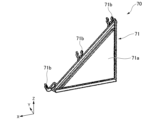
- FIG. 12 is a perspective view showing the first partition member 71.
- the first partition member 71 has a partition main body portion 71a that closes the gap G1, and multiple mounting portions 71b.
- the partition main body portion 71a is a plate-like member that is triangular when viewed in the second horizontal direction Y.
- the upper edge portion of the partition main body portion 71a extends at an angle in the vertical direction Z with respect to the first horizontal direction X.
- the upper edge portion of the partition main body portion 71a is positioned downward as it moves toward one side in the first horizontal direction (+X side).
- the partition main body portion 71a is positioned on the inside (-Y side) of the sensor mounting portion 85 in the second horizontal direction.
- the multiple mounting portions 71b are provided on the upper edge of the partition main body portion 71a. As shown in FIG. 12, the multiple mounting portions 71b are generally U-shaped and open upward when viewed in the second horizontal direction Y. The multiple mounting portions 71b are arranged at intervals along the upper edge of the partition main body portion 71a. As shown in FIG. 10, each mounting portion 71b is attached to the connecting pipe portion 22e of the first heat exchange portion 22a. In this way, the first partition member 71 is attached to the first heat exchange portion 22a.
- the second partition member 72 covers almost the entire gap G2 in the vertical direction Z between the heat exchanger body 22c of the second heat exchange section 22b and the second drain pan section 42.
- the gap G2 is a substantially triangular gap when viewed in the second horizontal direction Y.
- the gap G2 is a gap surrounded by the heat exchanger body 22c of the second heat exchange section 22b, the second drain pan section 42, and the flow path member 28b.
- the second partition member 72 has a partition main body 72a that closes the gap G2, and multiple mounting portions 72b.
- the partition main body 72a is a triangular plate-shaped member when viewed in the second horizontal direction Y.
- the upper edge of the partition main body 72a extends at an angle in the vertical direction Z with respect to the first horizontal direction X.
- the upper edge of the partition main body 72a is positioned downward as it moves toward the other side (-X side) of the first horizontal direction.
- the multiple mounting portions 72b are provided on the upper edge of the partition main body 72a.
- the multiple mounting portions 72b are approximately U-shaped and open upward when viewed in the second horizontal direction Y.
- the multiple mounting portions 72b are arranged at intervals along the upper edge of the partition main body 72a.
- Each mounting portion 72b is attached to the connection pipe portion 22e in the second heat exchange section 22b.
- the second partition member 72 is attached to the second heat exchange section 22b.
- the indoor unit 20 also includes a partition member that separates the interior of the first storage section 21b from the interior of the second storage section 21e.
- This partition member has a similar configuration to the partition member 70 described above, except that it is symmetrical in the second horizontal direction Y.
- the indoor unit 20 includes a housing 21 having an intake port 20a and an exhaust port 20d that open downward, a heat exchanger 22 housed inside the housing 21, a blower 23 housed inside the housing 21 and generating an air flow AF that passes through the heat exchanger 22, and a refrigerant sensor 31 housed inside the housing 21 and capable of detecting the refrigerant 19.
- the air sucked into the housing 21 from the intake port 20a by the operation of the blower 23 passes through the heat exchanger 22, then passes through the blower 23 and is blown out from the exhaust port 20d.
- the refrigerant sensor 31 is located above the intake port 20a and below the upper end of the heat exchanger 22.
- the refrigerant 19 that leaks from the refrigerant circuit section 18 and becomes gaseous flows downward because its density is greater than that of air.
- the refrigerant sensor 31 below the upper end of the heat exchanger 22, the refrigerant 19 that leaks and flows downward can be easily detected by the refrigerant sensor 31. Therefore, it is possible to effectively detect refrigerant 19 leaking into the indoor unit 20 that is attached to the ceiling C.
- the housing 21 is formed with an air passage 27 through which the air flow AF flows.
- the refrigerant sensor 31 is located outside the air passage 27.
- the refrigerant 19 is likely to leak from the portion of the refrigerant piping 22g in the heat exchanger 22 that is located outside the air passage 27, i.e., the connecting pipe portion 22e, and the piping group 60 located outside the air passage 27. Therefore, by arranging the refrigerant sensor 31 outside the air passage 27, it is easy to arrange the refrigerant sensor 31 at a location where the refrigerant 19 is likely to leak. As a result, when the refrigerant 19 leaks, the leaked refrigerant 19 can be quickly and appropriately detected by the refrigerant sensor 31.
- the leaked refrigerant 19 since the leaked refrigerant 19 is unlikely to mix with the air flow AF generated in the housing 21, the leaked refrigerant 19 can be prevented from diffusing inside the housing 21, and the concentration of the leaked refrigerant 19 can be prevented from becoming thin. As a result, the leaked refrigerant 19 can be more easily and appropriately detected by the refrigerant sensor 31.
- the blower 23 has an impeller 23a that rotates around a rotation axis R extending in the second horizontal direction Y.
- the heat exchanger 22 has a heat exchanger body 22c and a refrigerant pipe 22g fixed to the heat exchanger body 22c.
- the housing 21 has a first storage section 21b in which the impeller 23a and the heat exchanger body 22c are housed and in which an air passage 27 is provided, and a second storage section 21c that is arranged adjacent to the first storage section 21b in the axial direction of the rotation axis R, i.e., in the second horizontal direction Y, and that houses a connecting pipe section 22e as a protruding section of the refrigerant pipe 22g that protrudes in the second horizontal direction Y beyond the heat exchanger body 22c.
- the refrigerant sensor 31 is provided inside the second storage section 21c. Therefore, it is easy to suitably arrange the refrigerant sensor 31 outside the air passage 27. In addition, the refrigerant sensor 31 can easily detect refrigerant 19 leaking from the connecting pipe portion 22e.
- the indoor unit 20 is provided with a partition member 70 that separates the interior of the first storage section 21b from the interior of the second storage section 21c. Therefore, it is possible to prevent the refrigerant 19 that leaks in the second storage section 21c, which is outside the air passage 27, from flowing into the first storage section 21b in which the air passage 27 is provided. This prevents the leaked refrigerant 19 from flowing into the indoor space via the intake port 20a and the exhaust port 20d. Therefore, it is possible to prevent the concentration of the leaked refrigerant 19 from becoming low in the second storage section 21c, making it easier for the refrigerant sensor 31 to more suitably detect the leaked refrigerant 19.
- the partition member 70 closes at least a portion of the gaps G1, G2 between the heat exchanger body 22c and the drain pan 40 located below the heat exchanger body 22c. Therefore, the partition member 70 can effectively close the gaps G1, G2 provided below the heat exchanger body 22c. This makes it possible to more effectively prevent the leaked refrigerant 19 from flowing into the first storage section 21b even if it flows downward due to its own weight.
- the indoor unit 20 includes a cover member 80 attached to one end of the heat exchanger 22 in the second horizontal direction Y.
- the refrigerant sensor 31 is attached to the cover member 80. This makes it easy to position the refrigerant sensor 31 outside the air passage 27 easily and conveniently. Also, the refrigerant sensor 31 can be conveniently positioned near the connecting pipe portion 22e of the heat exchanger 22. This allows the refrigerant sensor 31 to more conveniently detect refrigerant 19 leaking from the connecting pipe portion 22e.
- the indoor unit 20 includes a sensor case 32 that houses the refrigerant sensor 31 inside.
- the cover member 80 covers the connection pipe 22e.
- the cover member 80 has a first hole 85a formed therein.
- the sensor case 32 has a second hole 32a formed therein.
- the space S between the cover member 80 and the heat exchanger body 22c is connected to the inside of the sensor case 32 through the first hole 85a and the second hole 32a. Therefore, the cover member 80 can suppress the diffusion of the refrigerant 19 leaking from the connection pipe 22e.
- the refrigerant 19 leaking from the connection pipe 22e into the space S can flow from the space S into the inside of the sensor case 32 through the first hole 85a and the second hole 32a. This allows the refrigerant sensor 31 in the sensor case 32 to detect the leaked refrigerant 19 in an appropriate manner.
- the second storage section 21c is provided in a pair with the first storage section 21b sandwiched between them in the second horizontal direction Y.
- the refrigerant sensor 31 is provided inside each of the pair of second storage sections 21d, 21e. Therefore, the refrigerant 19 leaked from each of the second storage sections 21d, 21e can be quickly and appropriately detected by the refrigerant sensor 31 arranged in each of the second storage sections 21d, 21e. In particular, when the dimension of the indoor unit 20 in the second horizontal direction Y is relatively large, the refrigerant 19 leaked from one of the second storage sections 21d, 21e is unlikely to flow to the other of the second storage sections 21d, 21e.
- the leaked refrigerant 19 can be quickly and appropriately detected regardless of which of the pair of second storage sections 21d, 21e the refrigerant 19 leaks from.
- the refrigerant sensor 31 is located above the lower end of the heat exchanger 22. Therefore, the position of the refrigerant sensor 31 in the vertical direction Z can be prevented from becoming too low within the housing 21. This makes it easier to shorten the time it takes for the refrigerant 19 flowing downward after leakage to reach the refrigerant sensor 31. Therefore, it is easier to detect the leakage of the refrigerant 19 more quickly. In addition, it is easier to prevent the refrigerant sensor 31 from getting too close to the drain pan 40, and it is easier to prevent the refrigerant sensor 31 from coming into contact with the condensed water accumulated in the drain pan 40.
- the refrigerant sensor 31 can be positioned at a suitable distance above the suction port 20a, which is located below the heat exchanger 22. Therefore, the refrigerant sensor 31 can easily detect the leaked refrigerant 19 before it reaches the suction port 20a or near the suction port 20a, and it is easier to prevent the refrigerant 19 from leaking into the room.
- the indoor unit 20 is provided with a drain pan 40 located below the heat exchanger 22.
- the refrigerant sensor 31 is located above the drain pan 40. This further prevents the refrigerant sensor 31 from coming into contact with condensation water accumulated in the drain pan 40.
- the above-mentioned arrangement of the refrigerant sensor 31 is an arrangement of the refrigerant sensor 31 suitable for detecting leaked refrigerant 19 in an indoor unit 20 that is attached to the ceiling C and generates an airflow AF in which air drawn into the housing 21 from the suction port 20a passes through the heat exchanger 22 before being drawn into the blower 23.
- the indoor unit 20 includes a control unit 24.
- the control unit 24 executes a predetermined first operation when the refrigerant sensor 31 detects the refrigerant 19.
- the predetermined first operation performed by the control unit 24 includes notifying the user that the refrigerant 19 has leaked. Therefore, the user can be notified promptly and appropriately that the refrigerant 19 has leaked.
- the predetermined first operation performed by the control unit 24 also includes driving the blower 23 at a predetermined output. Therefore, even if the refrigerant 19 leaked in the housing 21 flows into the room, the air blown into the room by the blower 23 can diffuse the leaked refrigerant 19 in the indoor space. This can prevent the refrigerant 19 from accumulating in the room.
- the control unit 24 drives the blower 23 at maximum output, so that the refrigerant 19 can be more effectively prevented from accumulating in the room.
- the predetermined first operation performed by the control unit 24 includes sending an operation stop command to the outdoor unit 10 of the air conditioner 100. Therefore, the outdoor unit 10 is stopped, and the refrigerant 19 can be prevented from being sent from the outdoor unit 10 to the indoor unit 20. This can further prevent the refrigerant 19 from leaking from the indoor unit 20.
- the predetermined first operation performed by the control unit 24 includes closing the flow control valve 14, which is a valve provided in the refrigerant circuit unit 18 connecting the outdoor unit 10 and the indoor unit 20. Therefore, the refrigerant 19 can be more suitably prevented from being sent from the outdoor unit 10 to the indoor unit 20. This can further prevent the refrigerant 19 from leaking from the indoor unit 20.
- FIG. 13 is a cross-sectional view showing the indoor unit 220 in embodiment 2.
- Figure 14 is a cross-sectional view showing the indoor unit 220 in embodiment 2, taken along line XIV-XIV in Figure 13.
- the same components as those in the above-mentioned embodiments may be denoted by the same reference numerals as appropriate and description thereof may be omitted.
- the dimension in the second horizontal direction Y of the indoor unit 220 in the second embodiment is smaller than the dimension in the second horizontal direction Y of the indoor unit 20 in the first embodiment.
- the dimension in the second horizontal direction Y of the first storage section 21b and each part stored in the first storage section 21b is smaller than the dimension in the second horizontal direction Y of the first storage section 21b and each part stored in the first storage section 21b in the first embodiment.
- the dimension in the second horizontal direction Y of the indoor unit 220 is, for example, larger than the dimension in the first horizontal direction X of the indoor unit 220 and is not more than three times the dimension in the first horizontal direction X of the indoor unit 220.
- the dimension in the second horizontal direction Y of the indoor unit 220 may be, for example, larger than the dimension in the first horizontal direction X of the indoor unit 220 and not more than twice the dimension in the first horizontal direction X of the indoor unit 220.
- the dimension of the indoor unit 220 in the second horizontal direction Y may be, for example, the same as the dimension of the indoor unit 220 in the first horizontal direction X, or may be smaller than the dimension of the indoor unit 220 in the first horizontal direction X.
- the refrigerant sensor device 230 having the refrigerant sensor 231 is provided only in the second storage section 21d located on one side (+Y side) in the second horizontal direction of the pair of second storage sections 21c. In other words, the refrigerant sensor 231 is not provided in the second storage section 21e located on the other side (-Y side) in the second horizontal direction of the pair of second storage sections 21c.
- the refrigerant sensor 231 is located on one side in the first horizontal direction (+X side) of the first drain pan portion 41 of the drain pan 40.
- the refrigerant sensor 231 is located on one side in the first horizontal direction of the impeller 23a.
- the refrigerant sensor 231 is disposed in a position between the second heat exchange portion 22b and the second suction port 20c in the vertical direction Z.
- the refrigerant sensor 231 is located below the center of the second heat exchange portion 22b in the first horizontal direction X.
- the refrigerant sensor 231 is located below the blower 23.
- the refrigerant sensor 231 is located above the drain pan 40.
- the refrigerant sensor 231 is positioned closer to the drain pan 40 than the impeller 23a of the blower 23.
- the refrigerant sensor 231 is located below the center in the vertical direction Z between the lower end of the impeller 23a and the drain pan 40.
- the refrigerant sensor 231 is located near the drain pan 40.
- the distance in the vertical direction Z between the upper end of the drain pan 40 and the refrigerant sensor 231 is less than the dimension in the vertical direction Z of the side wall portions 41b, 41c of the first drain pan portion 41.
- the upper end of the drain pan 40 includes the upper ends of the side wall portions 41b, 41c.
- the distance in the vertical direction Z between the upper end of the drain pan 40 and the refrigerant sensor 231 is small enough to allow the refrigerant sensor 231 to easily detect the refrigerant 19 when the leaked gaseous refrigerant 19 overflows from the drain pan 40 and accumulates above the drain pan 40, or when the leaked gaseous refrigerant 19 rises above the drain pan 40 due to the flow of the refrigerant 19.
- the distance in the vertical direction Z between the upper end of the drain pan 40 and the refrigerant sensor 231 is large enough that the condensed water accumulated in the drain pan 40 does not get on the refrigerant sensor 231 when the condensed water overflows from the drain pan 40.
- the other arrangement and configuration of the refrigerant sensor 231 are the same as those of the refrigerant sensor 31 in the first embodiment.
- the indoor unit 220 does not have a partition member 70.
- the other configurations of the indoor unit 220 are similar to the other configurations of the indoor unit 20 in embodiment 1.
- the leaked refrigerant 19 can be suitably detected by the refrigerant sensor 231. Since the dimension in the second horizontal direction Y of the indoor unit 220 in the second embodiment is smaller than the dimension in the second horizontal direction Y of the indoor unit 20 in the first embodiment, the refrigerant 19 leaking in one of the second storage sections 21c easily flows into the other second storage section 21c. In particular, since the partition member 70 is not provided in the second embodiment, the refrigerant 19 easily flows between the pair of second storage sections 21c through the first storage section 21b.
- the refrigerant sensor 231 is located below the blower 23. This makes it easier to bring the position of the refrigerant sensor 231 in the vertical direction Z close to the drain pan 40. This makes it easier for the refrigerant sensor 231 to detect the refrigerant 19 that has leaked and accumulated in the drain pan 40.
- FIG. 15 is a cross-sectional view showing an indoor unit 320 in embodiment 3.
- the same components as those in the above-mentioned embodiments may be denoted by the same reference numerals as appropriate and description thereof may be omitted.
- the indoor unit 320 of the third embodiment includes a refrigerant sensor device 230 and a refrigerant sensor device 330.
- Each of the refrigerant sensor devices 230, 330 is provided in the second storage section 21d.
- two refrigerant sensors 231, 331 are provided in the second storage section 21d.
- the refrigerant sensor 231 and the refrigerant sensor 331 are arranged at an interval in the first horizontal direction X.
- the refrigerant sensor 331 is located on the other side (-X side) of the first drain pan portion 41 of the drain pan 40 in the first horizontal direction.
- the refrigerant sensor 331 is located on the other side of the impeller 23a in the first horizontal direction.
- the refrigerant sensor 331 is located at the same position as the refrigerant sensor 231 in the vertical direction Z.
- the refrigerant sensor 331 is disposed in a position between the first heat exchange portion 22a and the first suction port 20b in the vertical direction Z when viewed in the second horizontal direction Y.
- the other arrangement and configuration of the refrigerant sensor 331 are the same as those of the refrigerant sensor 31 in embodiment 1.
- the other configurations of the indoor unit 320 are the same as those of the indoor unit 20 in embodiment 1.
- multiple refrigerant sensors 231, 331 are provided inside the second storage section 21d. Therefore, leakage of the refrigerant 19 in the second storage section 21d can be detected more quickly and more effectively. Furthermore, according to the third embodiment, even if the indoor unit 320 is enlarged in the first horizontal direction X, leakage of the refrigerant 19 can be detected effectively by the multiple refrigerant sensors 231, 331 arranged at intervals in the first horizontal direction X.
- two refrigerant sensors 231, 331 may be provided in the other second storage section 21e, as in the second storage section 21d, or no refrigerant sensor 231, 331 may be provided.
- Fig. 16 is a perspective view showing an indoor unit 420 in embodiment 4.
- Fig. 17 is a cross-sectional view showing an indoor unit 420 in embodiment 4.
- the same components as those in the above-mentioned embodiments may be denoted by the same reference numerals as appropriate and description thereof may be omitted.
- the housing 421 of the indoor unit 420 is formed with three suction ports 420a that open downward and two air outlets 420b that open downward.
- the three suction ports 420a and the two air outlets 420b are formed on the underside of the decorative panel 426.
- the three suction ports 420a and the two air outlets 420b extend in the second horizontal direction Y.
- the three suction ports 420a are arranged side by side at intervals in the first horizontal direction X.
- the dimension in the first horizontal direction X of the suction port 420a located at the center of the three suction ports 420a in the first horizontal direction X is larger than the dimensions in the first horizontal direction X of the other two suction ports 420a.
- the two air outlets 420b are arranged to sandwich the three suction ports 420a in the first horizontal direction X.
- the indoor unit 420 includes two heat exchangers 422a and 422b, two fans 423a and 423b, and two drain pans 440a and 440b.
- Two air passages 427a and 427b are formed in the housing 421.
- the configurations of the heat exchanger 422b, the fan 423b, the drain pan 440b, and the air passage 427b are the same as those of the indoor unit 20 of the first embodiment.
- the heat exchanger 422a, the fan 423a, the drain pan 440a, and the air passage 427a are arranged symmetrically in the first horizontal direction X with the heat exchanger 422b, the fan 423b, the drain pan 440b, and the air passage 427b, with the center of the first horizontal direction X in the indoor unit 420 in between.
- a portion of the air sucked into the housing 421 from the intake port 420a located at the center of the first horizontal direction X flows through the air passage 427a, passes through the first heat exchange section 22a of the heat exchanger 422a, is sucked into the blower 423a, and is blown out into the room from the outlet 420b located on the other side (-X side) of the first horizontal direction.
- two refrigerant sensors 431a, 431b are provided in each of the pair of second storage sections 21c.
- the two refrigerant sensors 431a, 431b are arranged at an interval in the first horizontal direction X in each second storage section 21c.
- the refrigerant sensor 431a is arranged in a position between the suction port 420a located at the center of the first horizontal direction X and the vertical direction Z of the first heat exchange section 22a of the heat exchanger 422a when viewed in the second horizontal direction Y.
- the refrigerant sensor 431b is arranged in a position between the suction port 420a located at the center of the first horizontal direction X and the vertical direction Z of the first heat exchange section 22a of the heat exchanger 422b when viewed in the second horizontal direction Y.
- the refrigerant sensors 431a, 431b are located below the blowers 423a, 423b and above the drain pans 440a, 440b.
- the rest of the configuration of the indoor unit 420 is the same as the rest of the configuration of the indoor unit 20 in embodiment 1.
- the leaked refrigerant 19 can be suitably detected by the multiple refrigerant sensors 431a, 431b.
- FIG. 18 is a schematic diagram showing an air conditioner 500 in embodiment 5.
- the same components as those in the above-mentioned embodiments may be denoted by the same reference numerals as appropriate and description thereof may be omitted.
- the air conditioner 500 in embodiment 5 is a multi-type air conditioner provided with multiple indoor units 20.
- four indoor units 20 are provided.
- Two indoor units 20 are attached to the ceiling of room RM1.
- the remaining two indoor units 20 are attached to the ceiling of room RM2, which is different from room RM1.
- the multiple indoor units 20 are connected to one outdoor unit 10 via a refrigerant distributor 590.
- control unit 24 of each indoor unit 20 when the control unit 24 of each indoor unit 20 detects refrigerant 19 based on the refrigerant sensor 31, it executes the first operation described in embodiment 1 and sends a signal to the control unit 24 in at least one other indoor unit 20 to execute a predetermined second operation.
- the control unit 24 sends a signal to the control units 24 of all remaining indoor units 20 to execute the second operation.
- the second operation may include one or more contents included in the first operation described in embodiment 1, or may include contents not included in the first operation.
- a signal to execute the second operation is sent from one control unit 24 to two or more control units 24, the contents of the second operation executed in the two or more control units 24 may be different for each control unit 24 or may be the same.
- control unit 24 of one indoor unit 20 installed in room RM1 detects a leak of refrigerant 19 based on the refrigerant sensor 31, the control unit 24 sends a signal to execute a second operation to the control unit 24 of the other indoor unit 20 installed in room RM1 and to the control units 24 of the two indoor units 20 installed in the other room RM2.
- the control unit 24 of the other indoor unit 20 installed in room RM1 drives the blower 23 at a predetermined output. This allows air to be sent from the blowers 23 of the two indoor units 20 into room RM1, and effectively prevents refrigerant 19 from accumulating in room RM1.
- the control units 24 of the two indoor units 20 installed in the other room RM2 execute a second operation to notify that the refrigerant 19 has leaked in the indoor unit 20 installed in room RM1. This makes it possible to notify users and others in room RM2 that the refrigerant 19 has leaked in the indoor unit 20 in room RM1.
- a plurality of indoor units 20 are provided, and when the control unit 24 detects refrigerant 19 based on the refrigerant sensor 31, it sends a signal to the control unit 24 in at least one other indoor unit 20 to execute a predetermined second operation.
- This makes it possible to operate the blowers 23 of all indoor units 20 installed in the same room at maximum output to prevent refrigerant 19 from accumulating in that room, and to notify users, etc., that refrigerant 19 has leaked in other rooms, quickly informing them of the leak.
- the number of refrigerant sensors is not particularly limited, as long as it is one or more.
- the refrigerant sensor may be provided at any position within the housing, so long as it is located above the suction port and below the upper end of the heat exchanger.
- the refrigerant sensor may be any type of sensor that can detect the refrigerant.
- the refrigerant sensor may be provided in an air passage formed within the housing.
- the refrigerant sensor may be attached to any member within the housing.
- the refrigerant sensor may be attached to the housing.
- the refrigerant sensor may be attached to the drain pan.
- the refrigerant sensor may be positioned so as not to overlap with the drain pan when viewed vertically. In this case, the refrigerant sensor can be suitably prevented from coming into contact with condensed water accumulated in the drain pan.
- the sensor case that houses the refrigerant sensor may have multiple holes formed therein that connect the inside and outside of the sensor case.
- the sensor case 32 may have a third hole formed therein that is different from the second hole 32a.
- the third hole may open to a space inside the second housing portion 21d and outside the cover main body portion 80a.
- the refrigerant 19 that leaks from the pipe group 60 housed in the second housing portion 21d can easily enter the inside of the sensor case 32 through the third hole. This makes it easier for the refrigerant sensor 31 to detect the refrigerant 19 that leaks from the pipe group 60.
- the predetermined first action that the indoor unit's control unit executes when the refrigerant sensor detects refrigerant may include at least one of the following: reporting that refrigerant has leaked, operating the blower at a predetermined output, sending an operation stop command to the outdoor unit of the air conditioner, and closing a valve provided in the refrigerant circuit connecting the outdoor unit and the indoor unit.
- the indoor unit's control unit does not have to execute the first action. For example, when the refrigerant sensor detects refrigerant, a signal may be sent to another control unit provided outside the indoor unit, and the other control unit may execute the first action.
- the other control unit may be, for example, the outdoor unit's control unit.
- connection pipe section protruding portion
- 22g ...refrigerant piping, 23, 423a, 423b...blower, 23a...impeller, 24...control unit, 27, 427a, 427b...air passage, 31, 231, 331, 431a, 431b...refrigerant sensor, 32...sensor case, 32a...second hole, 40, 440a, 440b...drain pan, 70...partition member, 80...cover member, 85a...first hole, 100, 500...air conditioner, AF...air flow, C...ceiling, R...rotation axis, S...space
Landscapes
- Engineering & Computer Science (AREA)
- Chemical & Material Sciences (AREA)
- Combustion & Propulsion (AREA)
- Mechanical Engineering (AREA)
- General Engineering & Computer Science (AREA)
- Air Filters, Heat-Exchange Apparatuses, And Housings Of Air-Conditioning Units (AREA)
Priority Applications (2)
| Application Number | Priority Date | Filing Date | Title |
|---|---|---|---|
| JP2025557357A JPWO2025104773A1 (https=) | 2023-11-13 | 2023-11-13 | |
| PCT/JP2023/040707 WO2025104773A1 (ja) | 2023-11-13 | 2023-11-13 | 室内機、および空気調和機 |
Applications Claiming Priority (1)
| Application Number | Priority Date | Filing Date | Title |
|---|---|---|---|
| PCT/JP2023/040707 WO2025104773A1 (ja) | 2023-11-13 | 2023-11-13 | 室内機、および空気調和機 |
Publications (1)
| Publication Number | Publication Date |
|---|---|
| WO2025104773A1 true WO2025104773A1 (ja) | 2025-05-22 |
Family
ID=95742193
Family Applications (1)
| Application Number | Title | Priority Date | Filing Date |
|---|---|---|---|
| PCT/JP2023/040707 Pending WO2025104773A1 (ja) | 2023-11-13 | 2023-11-13 | 室内機、および空気調和機 |
Country Status (2)
| Country | Link |
|---|---|
| JP (1) | JPWO2025104773A1 (https=) |
| WO (1) | WO2025104773A1 (https=) |
Citations (7)
| Publication number | Priority date | Publication date | Assignee | Title |
|---|---|---|---|---|
| JPH09145143A (ja) * | 1995-11-27 | 1997-06-06 | Mitsubishi Electric Corp | 天井埋込型空気調和機の室内ユニット |
| JPH1047751A (ja) * | 1996-08-02 | 1998-02-20 | Daikin Ind Ltd | 可燃性冷媒を用いた空気調和機 |
| JP2016070568A (ja) * | 2014-09-29 | 2016-05-09 | 日立アプライアンス株式会社 | 空気調和機の室内機 |
| WO2017154161A1 (ja) * | 2016-03-10 | 2017-09-14 | 三菱電機株式会社 | 冷凍サイクル装置 |
| WO2018216052A1 (ja) * | 2017-05-22 | 2018-11-29 | 三菱電機株式会社 | 冷凍サイクル装置のユニット装置 |
| JP2023030640A (ja) * | 2021-08-23 | 2023-03-08 | パナソニックIpマネジメント株式会社 | 空気調和装置 |
| JP2023106759A (ja) * | 2022-01-21 | 2023-08-02 | 三菱電機株式会社 | 空気調和機 |
-
2023
- 2023-11-13 JP JP2025557357A patent/JPWO2025104773A1/ja active Pending
- 2023-11-13 WO PCT/JP2023/040707 patent/WO2025104773A1/ja active Pending
Patent Citations (7)
| Publication number | Priority date | Publication date | Assignee | Title |
|---|---|---|---|---|
| JPH09145143A (ja) * | 1995-11-27 | 1997-06-06 | Mitsubishi Electric Corp | 天井埋込型空気調和機の室内ユニット |
| JPH1047751A (ja) * | 1996-08-02 | 1998-02-20 | Daikin Ind Ltd | 可燃性冷媒を用いた空気調和機 |
| JP2016070568A (ja) * | 2014-09-29 | 2016-05-09 | 日立アプライアンス株式会社 | 空気調和機の室内機 |
| WO2017154161A1 (ja) * | 2016-03-10 | 2017-09-14 | 三菱電機株式会社 | 冷凍サイクル装置 |
| WO2018216052A1 (ja) * | 2017-05-22 | 2018-11-29 | 三菱電機株式会社 | 冷凍サイクル装置のユニット装置 |
| JP2023030640A (ja) * | 2021-08-23 | 2023-03-08 | パナソニックIpマネジメント株式会社 | 空気調和装置 |
| JP2023106759A (ja) * | 2022-01-21 | 2023-08-02 | 三菱電機株式会社 | 空気調和機 |
Also Published As
| Publication number | Publication date |
|---|---|
| JPWO2025104773A1 (https=) | 2025-05-22 |
Similar Documents
| Publication | Publication Date | Title |
|---|---|---|
| JP5401563B2 (ja) | チリングユニット | |
| JP5668782B2 (ja) | 化粧パネル及びそれを備えた空気調和機の室内ユニット | |
| JP7738680B2 (ja) | 室内機、および空気調和機 | |
| JP2013200097A (ja) | 空気調和装置の室内機 | |
| WO2013146006A1 (ja) | 空気調和装置の熱交換器及び空気調和装置 | |
| JP2020134033A (ja) | 室内ユニット | |
| JP2020134126A (ja) | 室内ユニット | |
| JP2015087058A (ja) | 全熱交換器式換気扇 | |
| JP5123018B2 (ja) | 空調装置 | |
| JP5743685B2 (ja) | 冷凍空調システム | |
| WO2025104773A1 (ja) | 室内機、および空気調和機 | |
| WO2020226091A1 (ja) | 空調システム | |
| WO2023276597A1 (ja) | 換気装置、および換気装置の組み立て方法 | |
| JP2014240713A (ja) | 空気調和装置の室外ユニット | |
| AU2003235853B2 (en) | Indoor unit for air conditioner | |
| JP6833066B1 (ja) | 空気調和機 | |
| JP2018119718A (ja) | 天井埋込型空気調和機 | |
| WO2025215816A1 (ja) | 室内機、および空気調和機 | |
| CN212457173U (zh) | 空调一体机 | |
| CN110925888B (zh) | 空调 | |
| JP7539047B2 (ja) | 室内ユニット | |
| JP7374345B2 (ja) | 空気調和機の室内機 | |
| JP3998030B2 (ja) | 天井設置型空気調和装置 | |
| WO2024105775A1 (ja) | 空気調和機の室内機 | |
| WO2025263469A1 (ja) | 熱源システム |
Legal Events
| Date | Code | Title | Description |
|---|---|---|---|
| 121 | Ep: the epo has been informed by wipo that ep was designated in this application |
Ref document number: 23958787 Country of ref document: EP Kind code of ref document: A1 |
|
| ENP | Entry into the national phase |
Ref document number: 2025557357 Country of ref document: JP Kind code of ref document: A |
|
| WWE | Wipo information: entry into national phase |
Ref document number: 2025557357 Country of ref document: JP |