WO2024262389A1 - ジッパーテープ付き容器、ジッパーテープ付き容器の製造方法、シールバーおよびジッパーテープ - Google Patents
ジッパーテープ付き容器、ジッパーテープ付き容器の製造方法、シールバーおよびジッパーテープ Download PDFInfo
- Publication number
- WO2024262389A1 WO2024262389A1 PCT/JP2024/021251 JP2024021251W WO2024262389A1 WO 2024262389 A1 WO2024262389 A1 WO 2024262389A1 JP 2024021251 W JP2024021251 W JP 2024021251W WO 2024262389 A1 WO2024262389 A1 WO 2024262389A1
- Authority
- WO
- WIPO (PCT)
- Prior art keywords
- zipper tape
- section
- base
- container
- engagement
- Prior art date
- Legal status (The legal status is an assumption and is not a legal conclusion. Google has not performed a legal analysis and makes no representation as to the accuracy of the status listed.)
- Ceased
Links
Images



Classifications
-
- A—HUMAN NECESSITIES
- A44—HABERDASHERY; JEWELLERY
- A44B—BUTTONS, PINS, BUCKLES, SLIDE FASTENERS, OR THE LIKE
- A44B19/00—Slide fasteners
- A44B19/10—Slide fasteners with a one-piece interlocking member on each stringer tape
- A44B19/16—Interlocking member having uniform section throughout the length of the stringer
-
- B—PERFORMING OPERATIONS; TRANSPORTING
- B31—MAKING ARTICLES OF PAPER, CARDBOARD OR MATERIAL WORKED IN A MANNER ANALOGOUS TO PAPER; WORKING PAPER, CARDBOARD OR MATERIAL WORKED IN A MANNER ANALOGOUS TO PAPER
- B31B—MAKING CONTAINERS OF PAPER, CARDBOARD OR MATERIAL WORKED IN A MANNER ANALOGOUS TO PAPER
- B31B70/00—Making flexible containers, e.g. envelopes or bags
- B31B70/74—Auxiliary operations
- B31B70/81—Forming or attaching accessories, e.g. opening devices, closures or tear strings
-
- B—PERFORMING OPERATIONS; TRANSPORTING
- B65—CONVEYING; PACKING; STORING; HANDLING THIN OR FILAMENTARY MATERIAL
- B65D—CONTAINERS FOR STORAGE OR TRANSPORT OF ARTICLES OR MATERIALS, e.g. BAGS, BARRELS, BOTTLES, BOXES, CANS, CARTONS, CRATES, DRUMS, JARS, TANKS, HOPPERS, FORWARDING CONTAINERS; ACCESSORIES, CLOSURES, OR FITTINGS THEREFOR; PACKAGING ELEMENTS; PACKAGES
- B65D33/00—Details of, or accessories for, sacks or bags
- B65D33/16—End- or aperture-closing arrangements or devices
- B65D33/25—Riveting; Dovetailing; Screwing; using press buttons or slide fasteners
-
- B—PERFORMING OPERATIONS; TRANSPORTING
- B31—MAKING ARTICLES OF PAPER, CARDBOARD OR MATERIAL WORKED IN A MANNER ANALOGOUS TO PAPER; WORKING PAPER, CARDBOARD OR MATERIAL WORKED IN A MANNER ANALOGOUS TO PAPER
- B31B—MAKING CONTAINERS OF PAPER, CARDBOARD OR MATERIAL WORKED IN A MANNER ANALOGOUS TO PAPER
- B31B2160/00—Shape of flexible containers
- B31B2160/20—Shape of flexible containers with structural provision for thickness of contents
Definitions
- the present invention relates to a container with zipper tape, a method for manufacturing a container with zipper tape, a seal bar, and a zipper tape.
- Patent Document 1 a technology is known in which one base of the zipper tape is not joined to the bag body on the opening side of the bag, making it difficult to open a bag with zipper tape once it has been sealed.
- Patent Document 2 describes a technology in which one base of the zipper tape is shortened on the opening side of the bag, making it even more difficult to open.
- Patent Document 3 describes a configuration that makes it difficult to open using normal operations by setting the engagement strength of the zipper tape to a large value, such as 26 N/50 mm or more, or by not joining one base of the zipper tape to the bag body on the opening side, but makes it easy to open when the zipper tape is slid longitudinally.
- the present invention aims to provide a container with zipper tape, a manufacturing method for a container with zipper tape, a seal bar, and a zipper tape that enable the expansion of uses for containers that are difficult to open using normal operations.
- a container with zipper tape comprising: a container body; a first base and a second base attached to the container body; and a zipper tape including a first engagement portion and a second engagement portion formed on the first base and the second base, respectively, and engageable with each other, wherein a first engagement strength between the first engagement portion and the second engagement portion in a first section that is 40% or less of an effective section in the longitudinal direction of the zipper tape is lower than a second engagement strength between the first engagement portion and the second engagement portion in a second section that is the remaining part of the effective section.
- a seal bar used in the step of attaching the zipper tape to the container body includes a first pressing surface formed of a heat transfer member and a second pressing surface formed of a heat insulating member, a gap is formed between the first pressing surface and the second pressing surface, and a protruding portion is formed in which the first pressing surface protrudes into the gap toward the second pressing surface over a section of 40% or less in the longitudinal direction of the seal bar, and the protruding portions are arranged at equal intervals in the longitudinal direction.
- a seal bar including a first pressing surface formed of a heat transfer member and a second pressing surface formed of an insulating member, in which a gap is formed between the first pressing surface and the second pressing surface, wherein a protrusion portion is formed in which the first pressing surface protrudes into the gap toward the second pressing surface over a section of 40% or less of the length of the seal bar, and the protrusion portions are arranged at equal intervals in the length direction.
- a zipper tape comprising a first base and a second base, and a first engaging portion and a second engaging portion formed on the first base and the second base, respectively, and capable of engaging with each other, wherein a section of the zipper tape that accounts for 40% or less of a length of the zipper tape is processed to weaken an engagement strength between the first engaging portion and the second engaging portion, and the processed sections are arranged at equal intervals in the length direction.
- the above configuration increases the engagement strength in the second section, which occupies most of the effective section of the zipper tape, and prevents unintentional opening due to external forces.
- the engagement strength is weakened in the limited first section of the effective section, making it possible to open the zipper tape by knowing the location of the first section. In this case, opening is achieved by the normal action of pinching the end of the film, so that it can be applied to containers of various sizes and materials, and it can also be easily opened by machine, expanding the uses of the container.
- FIG. 1 is a plan view of a bag-shaped container according to a first embodiment of the present invention
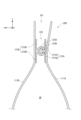
- FIG. 2 is a cross-sectional view taken along line II-II in FIG. 3 is a cross-sectional view showing a state in which an opening is formed in the example of FIG. 2.
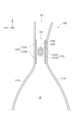
- FIG. 3 is a cross-sectional view of a modified example of FIG. 2 .
- 2 is a cross-sectional view taken along line VV in FIG. 1.
- FIG. 6 is a plan view of a bag-shaped container according to a second embodiment of the present invention.
- 7 is a cross-sectional view taken along line VII-VII in FIG. 6.
- 8 is a cross-sectional view taken along line VIII-VIII in FIG. 6.
- 7A to 7C are diagrams showing an example of the configuration of a seal bar used in manufacturing the bag-shaped container according to the second embodiment shown in FIG. 6 .
- Fig. 1 is a plan view of a bag-like container according to a first embodiment of the present invention
- Fig. 2 is a cross-sectional view taken along line II-II in Fig. 1.
- the bag-like container 100 includes a film 110 forming a container body including a first surface 111A and a second surface 111B facing each other, a zipper tape 120, and a tear strip 130.
- the zipper tape 120 includes a base portion 121 and an engagement portion 122.
- a tab 131 is formed near one end of the tear strip 130, which serves as a starting point for opening by tearing, and a cut or thinned portion 132 is formed near the other end, which serves as an end point for opening.
- the film 110 is formed, for example, of a single-layer or multi-layer thermoplastic resin. More specifically, the film 110 may be formed of low-density polyethylene (LDPE), linear low-density polyethylene (LLDPE), or polypropylene (PP).
- the PP may be homopolypropylene (HPP), random polypropylene (RPP), or block polypropylene (BPP).
- the surface substrate may be biaxially oriented polypropylene (OPP), biaxially oriented polyethylene terephthalate (OPET), or biaxially oriented nylon (ONy).
- resins derived from fossil fuels may be environmentally friendly bioplastics (polyolefin resins such as biopolyethylene and biopolypropylene derived from biomass), or may be mixtures of resins derived from fossil fuels and bioplastics, and may be polylactic acid (PLA), polybutylene succinate (PBS), poly(butylene adipate/terephthalate) (PBAT), polycaprolactone (PCL), poly(caprolactone/butylene succinate) (PCLBS), poly(butylene succinate/butylene succinate) (PBAT), poly(butylene adipate/terephthalate) (PBAT ...
- PPA polylactic acid
- PBS polybutylene succinate
- PBAT poly(butylene adipate/terephthalate)
- PCL polycaprolactone
- PCLBS poly(caprolactone/butylene succinate)
- PBAT poly(butylene succinate/butylene succinate)
- PBAT poly
- the film 110 may be a biodegradable resin such as poly(ethylene succinate/adipate) (PBSA), poly(butylene succinate/carbonate) (PEC), poly(ethylene terephthalate/succinate) (PETS), poly(tetramethylene adipate/terephthalate) (PTMAT), polyethylene succinate (PES), polyvinyl alcohol (PVA-H), polyglycolic acid (PGA), and poly(hydroxybutyrate/hydroxyhexanoate) (PHBH), or a mixture thereof.
- PBSA poly(ethylene succinate/adipate)
- PEC poly(butylene succinate/carbonate)
- PETS poly(ethylene terephthalate/succinate)
- PTMAT poly(tetramethylene adipate/terephthalate)
- PES polyethylene succinate
- PVA-H polyvinyl alcohol
- PGA polyglycolic acid
- PHBH poly(hydroxybutyrate/hydroxyhexanoate)
- the film 110 includes two films that form a first surface 111A and a second surface 111B that face each other.
- the two films are joined at a top seal portion 112, side seal portions 113A and 113B, and a bottom seal portion 114, respectively, thereby forming a storage space SP between the first surface 111A and the second surface 111B.
- the storage space SP does not necessarily have to be a space sealed by seal portions in all directions.
- the top seal portion 112 may not be formed when the bag-shaped container 100 is completed, and the top seal portion 112 may be formed after the contents are filled in the storage space SP, and the storage space SP may be sealed.
- either the bottom seal portion 114 or the side seal portions 113A and 113B may not be formed when the bag-shaped container 100 is completed.
- the bases 121A and 121B of the zipper tape 120 are both joined to the first surface 111A. This is advantageous in that the contents can be filled from above the storage space SP where no top seal is formed, without disengaging the engagement parts 122A and 122B when filling the contents, and the contents do not become caught between the engagement parts 122A and 122B.
- a gusset is formed at the bottom of the container where the bottom seal portion 114 is formed, by folding the film 110 toward the storage space SP.
- the gusset may be formed, for example, by a film different from the film forming the first surface 111A and the second surface 111B.
- a similar gusset may also be formed at the side of the container where the side seal portions 113A and 113B are formed.
- the film 110 includes another film in addition to the two films forming the first surface 111A and the second surface 111B.
- the first surface 111A and the second surface 111B are formed by joining the two films at the side seal portions 113A and 113B and the bottom seal portion 114, respectively, but the first surface 111A and the second surface 111B may also be formed by folding the film 110 at the side or bottom of the container. In this case, either or both of the side seal portions 113A and 113B, or the bottom seal portion 114, are not formed.
- the zipper tape 120 includes two opposing bases 121A, 121B and engaging portions 122A, 122B formed on the bases 121A, 121B, respectively.
- the engaging portions 122A, 122B are engageable with each other.
- the base 121B is wider than the base 121A, and the portion of the base 121B that is not overlapped with the base 121A is joined to the first surface 111A on the surface on the engaging portion 122B side.
- the base 121A is joined to the first surface 111A on the surface opposite the engaging portion 122A.
- the zipper tape 120 is disposed facing the storage space SP.
- the space between the bases 121A, 121B is connected to the storage space SP on one side of the engaging portions 122A, 122B (lower in FIG. 2).
- the engagement portions 122A and 122B On the other side of the engagement portions 122A and 122B (upper side in FIG. 2), when the first surface 111A is torn by the tear strip 130 to form an opening 101 as shown in FIG. 3, the space between the bases 121A and 121B communicates with the outside of the bag-shaped container 100 through the opening 101.
- engaging portions 122A and 122B may be composed of two or more pairs of engaging portions.
- engaging portion 122A is shown as a male type
- engaging portion 122B as a female type
- engaging portions 122A1 and 122B1 as hook-shaped engaging portions, but the genders of engaging portions 122A and 122B may be reversed, and the shapes of the engaging portions of various known zipper tapes may be adopted, without being limited to male-female or hook-shaped.
- the tear strip 130 is laminated between the base 121B and the first surface 111A of the film 110 and is bonded to the first surface 111A.
- the tear strip 130 may be laminated between the base 121A and the base 121B bonded to the first surface 111A.
- the tear strip 130 is indirectly bonded to the first surface 111A by being bonded to the base 121A.
- the tear strip 130 may be bonded to the base 121B and not directly or indirectly bonded to the first surface 111A.
- the base 121B and the tear strip 130 may or may not be bonded, but it is preferred that the base 121B is not bonded to the tear strip 130, except in the case where the tear strip 130 is not bonded to the first surface 111A.
- the base 121 and engagement portion 122 of the zipper tape 120 are formed, for example, by extrusion molding of a polyolefin resin. More specifically, the zipper tape 120 may be formed of low density polyethylene (LDPE), linear low density polyethylene (LLDPE), or polypropylene (PP).
- the PP may be homopolypropylene (HPP), random polypropylene (RPP), or block polypropylene (BPP). These may be environmentally friendly bioplastics, or a mixture of fossil fuel-derived resin and biomass plastic such as biopolyethylene may be used.
- the base 121 may be formed by extrusion molding of a biodegradable resin, such as polylactic acid (PLA), polybutylene succinate (PBS), poly(butylene adipate/terephthalate) (PBAT), polycaprolactone (PCL), poly(caprolactone/butylene succinate) (PCLBS), poly(butylene succinate/adipate) (PBSA), poly(butylene succinate/carbonate) (PEC), poly(ethylene terephthalate/succinate) (PETS), poly(tetramethylene adipate/terephthalate) (PTMAT), polyethylene succinate (PES), polyvinyl alcohol (PVA-H), polyglycolic acid (PGA), and poly(hydroxybutyrate/hydroxyhexanoate) (PHBH), in consideration of the environment.
- a biodegradable resin such as polylactic acid (PLA), polybutylene succinate (PBS), poly(butylene adipate/terephthalate) (PBAT
- the tear strip 130 is formed by extrusion molding of, for example, a polyolefin resin, in the same manner as the zipper tape 120.
- a resin that has low compatibility with the resin that forms the zipper tape 120 it is possible to achieve interfacial peeling at the joining surface between the zipper tape 120 and the tear strip 130.
- one of the zipper tape 120 or the tear strip 130 may be formed from a low-density polyethylene resin, and the other from a random polypropylene resin.
- LDPE low density polyethylene
- RPP linear low density polyethylene
- LLDPE linear low density polyethylene
- HPP linear low density polyethylene
- HPP linear low density polypropylene
- HPP linear low density polyethylene
- HPP LDPE/homopolypropylene
- PS polystyrene
- LLDPE/PS LLDPE/PS (including m-LL in part)
- RPP/PS HPP/PS
- LLDPE/PET LLDPE/PET, RPP/PET, HPP/PET, PS/PET
- LDPE/nylon (Ny) LLDPE/Ny, RPP/Ny, HPP/Ny, or PS/Ny.
- the tear strip 130 is also made of a biodegradable resin.
- the engagement strength between the engaging portions 122A, 122B is different between a first section S1 , which is a part of the effective section S0 in the length direction of the zipper tape 120, and a second section S2 , which is the remaining part of the effective section S0 .
- the engagement strength between the engaging portions 122A, 122B in the first section S1 is lower than the engagement strength between the engaging portions 122A, 122B in the second section S2 .
- the lengths of the first section S1 and the second section S2 can be set arbitrarily as long as they do not impair the effects of this embodiment as described below.
- the effective section S0 in the length direction of the zipper tape 120 corresponds to the section where the tear strip 130 tears the first surface 111A to form the opening 101 as shown in FIG. 3.
- the section where the opening can be formed i.e., the section from the tab 131 to the notch or thin section 132, corresponds to the effective section S0 .
- FIG. 5 is a cross-sectional view taken along line V-V in FIG. 1. While FIG. 2 shows a cross-section of the zipper tape 120 in the second section S 2 , FIG. 4 shows a cross-section of the zipper tape 120 in the first section S 1.
- the female engagement portion 122B is crushed in the first section S 1. In this way, by crushing at least one of the engagement portions, the hooking of the claws of the engagement portions can be weakened, and the engagement strength can be reduced.
- the engagement portion to be crushed may be either the male engagement portion 122A or the female engagement portion 122B, or both, but the female engagement portion 122B is more likely to become a starting point when opening, and has a higher effect of weakening the engagement strength.
- additional engagement portions 122A1 and 122B1 are provided as in the illustrated example, the additional engagement portions may be crushed in the same manner, or may not be crushed. In either case, the overall engagement strength of the engagement portion in the first section S1 can be reduced.
- cuts may be formed in either or both of the engaging portions 122A, 122B.
- punch holes may be formed by cutting out either or both of the engaging portions 122A, 122B together with the base portion 121A or the base portion 121B.
- the engagement strength of the engagement parts 122A, 122B themselves is set high by selecting the material and shape of the zipper tape 120.
- the engagement strength between the engagement parts 122A, 122B in the second section S2 is, for example, 26 N/50 mm or more, preferably 30 N/50 mm or more, more preferably 40 N/50 mm or more, even more preferably 50 N/50 mm or more, and particularly preferably 60 N/50 mm or more.
- the maximum value of the engagement strength is, for example, about 200 N/50 mm.
- the engagement strength can be measured as follows, for example, using a digital force gauge (manufactured by Imada Co., Ltd.). First, the male side base and the female side base are each held at a portion 2 mm from the engagement part of the zipper tape cut to 50 mm in the longitudinal direction. When measuring the engagement strength of a zipper tape already joined to the film of the container body, it is acceptable to hold the base together with the joined film. In the case of a zipper tape in which each base is joined to the film of the container body on both sides of the engagement portion, the holding position is the same side relative to the engagement portion when viewed in the width direction of the zipper tape.
- the male base is pulled up to measure the strength until the engagement portion is released, and the measurement result at the maximum load is taken as the engagement strength. If the length in the longitudinal direction is less than 50 mm, the length is taken as X mm, and the measurement result N/X mm can be multiplied by 50/X to convert it to N/50 mm.
- the difference in engagement strength between the first section S 1 and the second section S 2 is, for example, 10 N/50 mm or more, preferably 20 N/50 mm or more, more preferably 30 N/50 mm or more, and even more preferably 40 N/50 mm or more.
- the bag-shaped container 200 includes a film 110 forming a container body, as in the first embodiment described above, and a zipper tape 120.
- bases 121A and 121B of the zipper tape 120 have approximately the same width, and the base 121A is joined to the first surface 111A of the film 110, and the base 121B is joined to the second surface 111B, respectively, on the surfaces opposite to the engagement portions 122A and 122B.
- the materials of the film 110 and the zipper tape 120 are the same as those in the first embodiment described above.
- the bag-shaped container 200 does not have a top seal, and one side of the container body is opened to form the opening 101.
- a top seal may be formed, and the opening may be formed by cutting between the top seal and the zipper tape 120 afterwards.
- the bottom seal 114 may not be formed when the bag-shaped container 200 is completed, and the bottom seal 114 may be formed after the contents are filled into the storage space SP.
- the bag-shaped container 200 does not include a tear strip, but when the top seal is formed and each side of the container body is sealed, the container may be opened by providing a tear strip similar to that of the first embodiment together with the zipper tape 120.
- a gusset may be formed in the bottom or side of the container, as in the first embodiment, and the first surface 111A and the second surface 111B may be formed by folding back the film 110 at the bottom or side of the container.
- the engagement strength between the engagement parts 122A , 122B is different between a first section S1 , which is a part of the effective section S0 in the length direction of the zipper tape 120, and a second section S2 , which is the remaining part of the effective section S0 .
- the engagement strength between the engagement parts 122A, 122B in the first section S1 is lower than the engagement strength between the engagement parts 122A, 122B in the second section S2 .
- the lengths of the first section S1 and the second section S2 can be set arbitrarily within a range that does not impair the effects of this embodiment as described below.
- the effective section S0 in the length direction of the zipper tape 120 corresponds to a section in which an opening 101 is formed on one side of the width direction of the zipper tape 120.
- the section in which an opening can be formed i.e., the section between the side seal portions 113A, 113B where the base portions 121A, 121B of the zipper tape 120 are not joined, corresponds to the effective section S0 .
- the base 121A of the zipper tape 120 is joined to the first surface 111A of the film 110 at a portion 121A2 on the side of the storage space SP with respect to the engaging portion 122A, and the portion 121A1 on the opposite side to the storage space SP, i.e., the opening 101 side, is not joined to the film 110. Therefore, in the second section S2 , even if both ends of the first surface 111A and the second surface 111B are pinched and pulled at the opening 101, no force acts in the direction of pulling apart the engaging portions 122A and 122B of the zipper tape 120, and the engagement strength between the engaging portions 122A and 122B is high.
- the portion 121A1 of the base 121A on the opposite side to the storage space SP may be shortened to, for example, 3 mm or less, preferably 2 mm or less, more preferably 1 mm or less, or the portion 121A1 of the base 121A itself may not be formed.
- both of the portions 121B1 and 121B2 on both sides of the engagement portion 122B are joined to the second surface 111B.
- the engagement strength between the engagement parts 122A and 122B in the second section S2 is, for example, 26 N/50 mm or more, preferably 30 N/50 mm or more, more preferably 40 N/50 mm or more, even more preferably 50 N/50 mm or more, and particularly preferably 60 N/50 mm or more, and the maximum value is, for example, about 200 N/50 mm.
- the difference in engagement strength between the first section S1 and the second section S2 is, for example, 10 N/50 mm or more, preferably 20 N/50 mm or more, more preferably 30 N/50 mm or more, and even more preferably 40 N/50 mm or more.
- the engagement strength is measured in the same manner as described in the first embodiment, but in the case of a zipper tape in which one base is not joined to the film of the container body on the opposite side to the storage space with respect to the engagement part as in the example of FIG. 7, the holding position is the storage space side at the base on the non-joined side, and the opposite side to the storage space at the base on the other side.
- both the portion 121A2 on the storage space SP side and the portion 121A1 on the opposite side to the storage space SP with respect to the engaging portion 122A of the base 121A are joined to the first surface 111A. Therefore, in the first section S1 , if the ends of the first surface 111A and the second surface 111B are pinched and pulled at the opening 101, a force acts in a direction that pulls the engaging portions 122A, 122B of the zipper tape 120 apart. Therefore, the engagement strength between the engaging portions 122A, 122B in the first section S1 is lower than that in the second section S2 .
- the portion 121A1 of the base 121A is joined to the first surface 111A of the film 110, and the female engagement portion 122B is crushed.
- the male engagement portion 122A may be crushed.
- the engagement portion to be crushed may be either the male engagement portion 122A or the female engagement portion 122B, or both.
- the engagement strength can be reduced by crushing the engagement portion 122B, making it possible to open the package by pinching and pulling the ends of the first surface 111A and the second surface 111B.
- the engagement portions 122A and 122B do not necessarily need to be crushed.
- the seal bar 600 includes a heat transfer member 610 and a heat insulating member 620.
- the surface including the heat transfer member 610 and the heat insulating member 620 is pressed against the base 121A of the zipper tape 120 from the back side of the first surface 111A of the film 110, and the surface of the seal bar on the opposite side (not shown) made of the heat transfer member is pressed against the back side of the second surface 111B, and the bases 121A and 121B are bonded to the first surface 111A and the second surface 111B, respectively, by pressing each surface.
- the side opposite the storage space SP with respect to the engagement portion 122A is formed of the heat insulating member 620, so that the portion 121A1 of the base 121A is not bonded to the first surface 111A as shown in FIG. 7.
- the heat transfer member 610 is formed of a material with high thermal conductivity used in conventional seal bars such as metal materials, specifically, for example, aluminum alloy, brass, or cast iron.
- the heat insulating member 620 is formed of a material with lower thermal conductivity than the heat transfer member 610, specifically, for example, a material containing one or more of epoxy glass, thermosetting resin, or inorganic material blended resin.
- the thermal conductivity of the material of the heat insulating member 620 is, for example, 15 W/(m ⁇ k) or less, preferably 10 W/(m ⁇ k) or less, more preferably 7 W/(m ⁇ k) or less, even more preferably 5 W/(m ⁇ k) or less, even more preferably 2 W/(m ⁇ k) or less, and particularly preferably 1 W/(m ⁇ k) or less.
- the difference in thermal conductivity between the heat insulating member 620 and the heat transfer member 610 is preferably 15 W/(m ⁇ k) or more, more preferably 100 W/(m ⁇ k) or more, and even more preferably 200 W/(m ⁇ k) or more.
- the thermal conductivity of aluminum alloy is approximately 237 W/(m ⁇ k)
- the thermal conductivity of brass is approximately 119 W/(m ⁇ k)
- the thermal conductivity of cast iron is approximately 30 W/(m ⁇ k) to 60 W/(m ⁇ k).
- a gap 630 is formed between the pressing surface formed by the heat transfer member 610 and the pressing surface formed by the heat insulating member 620. This gap 630 is formed in order to prevent the engagement portions 122A, 122B from being crushed when the zipper tape 120 is joined to the film 110 as described above.
- overhanging portions 611 in which the pressing surface formed by the heat transfer member 610 overhangs toward the gap 630, are formed at equal intervals in the longitudinal direction. The section in which the zipper tape 120 is joined by such overhanging portions 611 corresponds to the first section S1 in the bag-shaped container 200 shown in FIG. 6.
- the protrusion 611 formed of the heat transfer member is pressed against the base 121A and the engaging portion 122A from the back side of the first surface 111A of the film 110 in an area including the engaging portions 122A, 122B, whereby the engaging portions 122A, 122B are crushed and the portion 121A1 of the base 121A on the opposite side to the storage space SP is also joined to the first surface 111A.
- the engagement strength of the engagement parts 122A, 122B themselves is increased, or one of the base parts 121A, 121B is not joined to the film 110 on the opposite side to the storage space SP, thereby increasing the engagement strength and preventing unintentional opening due to external force.
- the engagement strength is weakened by crushing one or both of the engagement parts 122A, 122B, forming a cut or punch hole, or joining to the film 110 on the storage space SP side as well, so that opening is possible if the position of the first section S1 is known.
- opening is performed by a normal operation of pinching the end of the film 110, so that it can be applied to various dimensions and materials of containers, and opening by machine is also easy, so that an automatic filling machine can also be used.
- an automatic filling machine can also be used.
- the ratio of the first section S1 to the effective section S0 of the zipper tape 120 is, for example, 40% or less, preferably 30% or less, more preferably 20% or less, and particularly preferably 10% or less. There is no particular limit to the lower limit, but it is usually 0.1%.
- One first section S1 may be arranged in the effective section S0 of the zipper tape 120, and the length of this first section S1 may be 40% or less of the length of the effective section S0 .
- first sections S1 may be arranged in the effective section S0 of the zipper tape 120, and the total length of these first sections S1 may be 40% or less of the length of the effective section S0 .
- the length of each first section S1 is, for example, 0.1 mm or more and 40 mm or less.
- the length of each portion of the first section S1 is preferably 0.5 mm or more, more preferably 1 mm or more, even more preferably 3 mm or more, and even more preferably 4 mm or more.
- the length of each portion of the first section S1 is preferably 30 mm or less, more preferably 20 mm or less, even more preferably 15 mm or less, even more preferably 10 mm or less, and particularly preferably 8 mm or less.
- the zipper tape 120 is basically attached to the container by joining the bases 121A and 121B to the first surface 111A and the second surface 111B, respectively, as in the second embodiment described above.
- opening by normal action it is also possible to join both the bases 121A and 121B to the first surface 111A, as in the first embodiment.
- by leaving the top seal portion 112 unformed when the bag-shaped container 100 is completed it is possible to use an automatic filling machine without releasing the engagement of the engagement portions 122A and 122B.
- the embodiments of the present invention can expand the uses of containers that are configured to be difficult to open by normal action.
- the engagement strength of the engagement parts 122A, 122B themselves is set high in the first embodiment, and the engagement strength of the engagement parts 122A, 122B in the second section S2 is increased by not joining either the base part 121A or 121B to the film 110 on the side opposite to the storage space SP in the second embodiment, but these are only examples and are not limiting.
- the engagement strength of the engagement parts 122A, 122B in the second section S2 may be increased by not joining the base part 121A to the first surface 111A on the side opposite to the storage space SP.
- the engagement strength of the engagement portions 122A, 122B themselves may be set high, thereby increasing the engagement strength of the engagement portions 122A, 122B in the second section S2 .
- the container with zipper tape according to the embodiment of the present invention described above is manufactured, for example, by first attaching the zipper tape 120 to the container body formed of the film 110, and then processing the zipper tape 120 attached to the film 110 in the first section S 1, such as crushing, cutting, or forming punch holes.
- the container with zipper tape may be manufactured by processing the zipper tape 120 in advance in the portion that will become the first section S 1 , and then attaching the processed zipper tape to the container body formed of the film 110.
- the zipper tape 120 is provided in a state in which a predetermined proportion of the section in the length direction has been processed to weaken the engagement strength between the engagement parts 122A and 122B.
- the processing to weaken the engagement strength is specifically the above-mentioned crushing, cutting, or forming punch holes.
- the sections processed in this way are arranged at equal intervals in the length direction of the zipper tape 120.
- a container with zipper tape may be manufactured by attaching zipper tape 120 to the container body in parallel with the process of processing zipper tape 120.
- the ratio of the processed section of the zipper tape 120 corresponds to the ratio of the first section S1 to the effective section S0 , and is specifically, for example, 40% or less, preferably 30% or less, more preferably 20% or less, and particularly preferably 10% or less.
- the lower limit is not particularly limited, but is usually 0.1%.
- the length of each processed section is the same as that of the first section S1 , and is, for example, 0.1 mm or more and 40 mm or less.
- the length of each first section S1 is preferably 0.5 mm or more, more preferably 1 mm or more, even more preferably 3 mm or more, and even more preferably 4 mm or more.
- the length of each first section S1 is preferably 30 mm or less, more preferably 20 mm or less, even more preferably 15 mm or less, even more preferably 10 mm or less, and especially preferably 8 mm or less.
- the container with zipper tape according to the embodiment of the present invention may be manufactured by, for example, a process of attaching the zipper tape 120 to the container body formed of the film 110 in different methods in the first section S1 and the second section S2 .
- the portion 121A1 of the base 121A is joined to the first surface 111A of the film 110 in the first section S1 , and the portion 121A1 is not joined to the first surface 111A in the second section S2 .
- the protruding portions 611 for joining the portion 121A1 to the first surface 111A in the first section S1 are formed at equal intervals in a section having a predetermined ratio to the length of the seal bar 600.
- the length of the seal bar 600 also includes sections such as the side seal parts 113A and 113B that are not included in the effective section S0 after the container is completed, so the ratio of the section in which the overhanging part 611 is formed is lower than the ratio of the first section S1 to the effective section S0 .
- the ratio of the section in which the overhanging part 611 is formed to the length of the seal bar 600 is, for example, 40% or less, preferably 30% or less, more preferably 20% or less, and particularly preferably 10% or less. There is no particular limit to the lower limit, but it is usually 0.1%.
- the length per section in which the overhanging part 611 is formed is, for example, 0.1 mm or more and 40 mm or less.
- the length per section in which the overhanging part 611 is formed is preferably 0.5 mm or more, more preferably 1 mm or more, even more preferably 3 mm or more, and even more preferably 4 mm or more.
- each section in which the protrusion 611 is formed is preferably 30 mm or less, more preferably 20 mm or less, even more preferably 15 mm or less, even more preferably 10 mm or less, and particularly preferably 8 mm or less.
Landscapes
- Engineering & Computer Science (AREA)
- Mechanical Engineering (AREA)
- Bag Frames (AREA)
- Package Frames And Binding Bands (AREA)
Priority Applications (2)
| Application Number | Priority Date | Filing Date | Title |
|---|---|---|---|
| KR1020257042313A KR20260027925A (ko) | 2023-06-23 | 2024-06-11 | 지퍼 테이프 부착 용기, 지퍼 테이프 부착 용기의 제조 방법, 시일 바 및 지퍼 테이프 |
| JP2025527949A JPWO2024262389A1 (https=) | 2023-06-23 | 2024-06-11 |
Applications Claiming Priority (2)
| Application Number | Priority Date | Filing Date | Title |
|---|---|---|---|
| JP2023-103508 | 2023-06-23 | ||
| JP2023103508 | 2023-06-23 |
Publications (1)
| Publication Number | Publication Date |
|---|---|
| WO2024262389A1 true WO2024262389A1 (ja) | 2024-12-26 |
Family
ID=93935296
Family Applications (1)
| Application Number | Title | Priority Date | Filing Date |
|---|---|---|---|
| PCT/JP2024/021251 Ceased WO2024262389A1 (ja) | 2023-06-23 | 2024-06-11 | ジッパーテープ付き容器、ジッパーテープ付き容器の製造方法、シールバーおよびジッパーテープ |
Country Status (4)
| Country | Link |
|---|---|
| JP (1) | JPWO2024262389A1 (https=) |
| KR (1) | KR20260027925A (https=) |
| TW (1) | TW202506508A (https=) |
| WO (1) | WO2024262389A1 (https=) |
Citations (6)
| Publication number | Priority date | Publication date | Assignee | Title |
|---|---|---|---|---|
| JP2005067712A (ja) * | 2003-08-28 | 2005-03-17 | Daiwa Gravure Co Ltd | ファスナー付き包装袋 |
| JP2006176196A (ja) * | 2004-12-24 | 2006-07-06 | Idemitsu Unitech Co Ltd | チャックテープ付き包装袋 |
| JP2008273530A (ja) * | 2007-04-25 | 2008-11-13 | Hosokawa Yoko Co Ltd | チャック付き袋体及びその製造方法 |
| JP2017052551A (ja) * | 2015-09-11 | 2017-03-16 | 中本パックス株式会社 | ジッパー付き袋体 |
| JP2021045252A (ja) * | 2019-09-17 | 2021-03-25 | 出光ユニテック株式会社 | ジッパーテープ付き容器 |
| JP2022065719A (ja) * | 2020-10-16 | 2022-04-28 | 出光ユニテック株式会社 | フィルム片の打ち抜き接合装置、フィルムの製造装置、袋状容器の製造装置、フィルム片の打ち抜き接合方法、フィルムの製造方法および袋状容器の製造方法 |
-
2024
- 2024-06-11 JP JP2025527949A patent/JPWO2024262389A1/ja active Pending
- 2024-06-11 KR KR1020257042313A patent/KR20260027925A/ko active Pending
- 2024-06-11 WO PCT/JP2024/021251 patent/WO2024262389A1/ja not_active Ceased
- 2024-06-21 TW TW113123126A patent/TW202506508A/zh unknown
Patent Citations (6)
| Publication number | Priority date | Publication date | Assignee | Title |
|---|---|---|---|---|
| JP2005067712A (ja) * | 2003-08-28 | 2005-03-17 | Daiwa Gravure Co Ltd | ファスナー付き包装袋 |
| JP2006176196A (ja) * | 2004-12-24 | 2006-07-06 | Idemitsu Unitech Co Ltd | チャックテープ付き包装袋 |
| JP2008273530A (ja) * | 2007-04-25 | 2008-11-13 | Hosokawa Yoko Co Ltd | チャック付き袋体及びその製造方法 |
| JP2017052551A (ja) * | 2015-09-11 | 2017-03-16 | 中本パックス株式会社 | ジッパー付き袋体 |
| JP2021045252A (ja) * | 2019-09-17 | 2021-03-25 | 出光ユニテック株式会社 | ジッパーテープ付き容器 |
| JP2022065719A (ja) * | 2020-10-16 | 2022-04-28 | 出光ユニテック株式会社 | フィルム片の打ち抜き接合装置、フィルムの製造装置、袋状容器の製造装置、フィルム片の打ち抜き接合方法、フィルムの製造方法および袋状容器の製造方法 |
Also Published As
| Publication number | Publication date |
|---|---|
| TW202506508A (zh) | 2025-02-16 |
| KR20260027925A (ko) | 2026-03-03 |
| JPWO2024262389A1 (https=) | 2024-12-26 |
Similar Documents
| Publication | Publication Date | Title |
|---|---|---|
| JP4898817B2 (ja) | 易裂き性チャックテープ、その製造方法、易裂き性チャックテープ付き包装袋、その製造装置および製造方法 | |
| US8789247B2 (en) | Interlock tool, bag making use thereof and process for producing them | |
| TWI392623B (zh) | 附拆封帶之夾鏈帶、其製造方法及附夾鏈帶之包裝袋 | |
| US8753011B2 (en) | Easily openable fastener tape, packaging bag with easily openable fastener tape, and method of manufacturing easily openable fastener tape | |
| EP1325872B1 (en) | Fastener bag and fastener device | |
| JP7561743B2 (ja) | テープ、ジッパーテープ、テープ付き容器およびジッパーテープ付き容器 | |
| JP2006199334A (ja) | 再封可能な袋 | |
| JP7498639B2 (ja) | フィルム片の打ち抜き接合装置、フィルムの製造装置、袋状容器の製造装置、フィルム片の打ち抜き接合方法、フィルムの製造方法および袋状容器の製造方法 | |
| JPH09216642A (ja) | 合成樹脂製チャック付の袋体及び製造方法 | |
| WO2024262389A1 (ja) | ジッパーテープ付き容器、ジッパーテープ付き容器の製造方法、シールバーおよびジッパーテープ | |
| TW202106575A (zh) | 夾鏈帶及附有夾鏈帶之容器 | |
| US20230399146A1 (en) | Container with zipper tape, method for manufacturing container with zipper tape, and device for manufacturing container with zipper tape | |
| US12122560B2 (en) | Zipper tape, bag provided with zipper tape, and method for manufacturing bag provided with zipper tape | |
| JP2010035713A (ja) | チャックテープおよびチャックテープ付き包装袋 | |
| WO2025023223A1 (ja) | ジッパーテープ、ジッパーテープ付き容器、ジッパーテープの製造方法およびジッパーテープ付き容器の製造方法 | |
| WO2024204524A1 (ja) | 容器、テープ付きフィルム、テープ部材、テープ付きフィルムの製造方法および容器の製造方法 | |
| TW202323022A (zh) | 容器、容器之製造方法、容器之製造裝置、密封棒材、及膜組裝體 | |
| WO2025115712A1 (ja) | テープおよびテープ付き容器 | |
| JP2021159240A (ja) | ジッパーテープおよびジッパーテープ付き容器 | |
| JP4801328B2 (ja) | チャックテープ、チャックテープ付き包装袋及びチャックテープ付き包装袋の製造方法 | |
| JP2025142787A (ja) | ジッパーテープおよびジッパーテープ付き容器 | |
| WO2024203573A1 (ja) | テープ、容器および容器の製造方法 | |
| JP2022143291A (ja) | テープおよびテープ付き容器 | |
| US20140233869A1 (en) | Easily openable fastener tape, packaging bag with easily openable fastener tape, and method of manufacturing easily openable fastener tape | |
| TW202333599A (zh) | 夾鏈帶、附有夾鏈帶之容器、及防止竄改方法 |
Legal Events
| Date | Code | Title | Description |
|---|---|---|---|
| 121 | Ep: the epo has been informed by wipo that ep was designated in this application |
Ref document number: 24825794 Country of ref document: EP Kind code of ref document: A1 |
|
| ENP | Entry into the national phase |
Ref document number: 2025527949 Country of ref document: JP Kind code of ref document: A |
|
| WWE | Wipo information: entry into national phase |
Ref document number: 2025527949 Country of ref document: JP |
|
| NENP | Non-entry into the national phase |
Ref country code: DE |