WO2024257742A1 - 研磨パッド、研磨方法及び半導体の製造方法 - Google Patents
研磨パッド、研磨方法及び半導体の製造方法 Download PDFInfo
- Publication number
- WO2024257742A1 WO2024257742A1 PCT/JP2024/021113 JP2024021113W WO2024257742A1 WO 2024257742 A1 WO2024257742 A1 WO 2024257742A1 JP 2024021113 W JP2024021113 W JP 2024021113W WO 2024257742 A1 WO2024257742 A1 WO 2024257742A1
- Authority
- WO
- WIPO (PCT)
- Prior art keywords
- polishing
- groove
- polishing pad
- layer
- grooves
- Prior art date
- Legal status (The legal status is an assumption and is not a legal conclusion. Google has not performed a legal analysis and makes no representation as to the accuracy of the status listed.)
- Ceased
Links
Images




Classifications
-
- B—PERFORMING OPERATIONS; TRANSPORTING
- B24—GRINDING; POLISHING
- B24B—MACHINES, DEVICES, OR PROCESSES FOR GRINDING OR POLISHING; DRESSING OR CONDITIONING OF ABRADING SURFACES; FEEDING OF GRINDING, POLISHING, OR LAPPING AGENTS
- B24B37/00—Lapping machines or devices; Accessories
- B24B37/11—Lapping tools
- B24B37/20—Lapping pads for working plane surfaces
- B24B37/24—Lapping pads for working plane surfaces characterised by the composition or properties of the pad materials
-
- B—PERFORMING OPERATIONS; TRANSPORTING
- B24—GRINDING; POLISHING
- B24B—MACHINES, DEVICES, OR PROCESSES FOR GRINDING OR POLISHING; DRESSING OR CONDITIONING OF ABRADING SURFACES; FEEDING OF GRINDING, POLISHING, OR LAPPING AGENTS
- B24B37/00—Lapping machines or devices; Accessories
- B24B37/11—Lapping tools
- B24B37/20—Lapping pads for working plane surfaces
- B24B37/26—Lapping pads for working plane surfaces characterised by the shape of the lapping pad surface, e.g. grooved
-
- B—PERFORMING OPERATIONS; TRANSPORTING
- B24—GRINDING; POLISHING
- B24B—MACHINES, DEVICES, OR PROCESSES FOR GRINDING OR POLISHING; DRESSING OR CONDITIONING OF ABRADING SURFACES; FEEDING OF GRINDING, POLISHING, OR LAPPING AGENTS
- B24B37/00—Lapping machines or devices; Accessories
- B24B37/27—Work carriers
- B24B37/30—Work carriers for single side lapping of plane surfaces
- B24B37/32—Retaining rings
-
- H—ELECTRICITY
- H10—SEMICONDUCTOR DEVICES; ELECTRIC SOLID-STATE DEVICES NOT OTHERWISE PROVIDED FOR
- H10P—GENERIC PROCESSES OR APPARATUS FOR THE MANUFACTURE OR TREATMENT OF DEVICES COVERED BY CLASS H10
- H10P52/00—Grinding, lapping or polishing of wafers, substrates or parts of devices
-
- H—ELECTRICITY
- H10—SEMICONDUCTOR DEVICES; ELECTRIC SOLID-STATE DEVICES NOT OTHERWISE PROVIDED FOR
- H10P—GENERIC PROCESSES OR APPARATUS FOR THE MANUFACTURE OR TREATMENT OF DEVICES COVERED BY CLASS H10
- H10P52/00—Grinding, lapping or polishing of wafers, substrates or parts of devices
- H10P52/40—Chemomechanical polishing [CMP]
- H10P52/403—Chemomechanical polishing [CMP] of conductive or resistive materials
Definitions
- the thickness of the cushion layer is not particularly limited, but is preferably 0.5 to 5 mm. If the thickness of the cushion layer is equal to or greater than the lower limit above, the effect of following up the overall warping, waviness, etc. of the polished surface will be sufficient, and global flatness will tend to be better. Also, if the thickness of the cushion layer is equal to or less than the upper limit above, the entire polishing pad will have an appropriate hardness, and polishing stability will tend to be better.
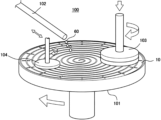
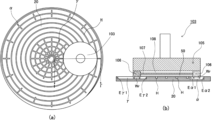
- the retainer ring 106 surrounds the outer periphery of the material to be polished 50 to prevent the material to be polished 50 from jumping out, and also presses the polishing surface of the polishing pad 20 to flatten the polishing surface of the polishing pad 20 that polishes the material to be polished 50 .
- polishing After polishing, it is preferable to thoroughly wash the workpiece with running water and then use a spin dryer or the like to remove any water droplets adhering to the workpiece and dry it. By polishing the surface to be polished with slurry in this way, a smooth surface can be obtained over the entire surface.
- the above-mentioned CMP can be suitably used for polishing various semiconductor materials such as silicon wafers.
- the polishing method of this embodiment is preferably used for polishing in the manufacturing processes of various semiconductor devices, MEMS (Micro Electro Mechanical Systems), and the like.
- materials to be polished include semiconductor substrates such as silicon, silicon carbide, gallium nitride, gallium arsenide, zinc oxide, sapphire, germanium, and diamond; insulating films such as silicon oxide films, silicon nitride films, and low-k films formed on semiconductor substrates; wiring materials such as copper, aluminum, and tungsten; glass, quartz crystal, optical substrates, and hard disks.
- the polishing pad of the present embodiment is preferably used for polishing insulating films and wiring materials formed on semiconductor substrates.
- the polymerized thermoplastic polyurethane melt was then continuously extruded into water in the form of a strand, and then chopped into pellets by a pelletizer.
- the pellets were dehumidified and dried at 70°C for 20 hours, and then fed to a single-screw extruder and extruded from a T-die to form a sheet.
- the surface of the obtained sheet was ground to obtain a uniform sheet with a thickness of 2.0 mm, and then cut into a circular shape with a diameter of 740 mm to obtain a non-foamed sheet for abrasive layer.
- the D hardness of the sheet for abrasive layer measured at a measuring temperature of 25° C. according to JIS K 7311:1995 was 62.
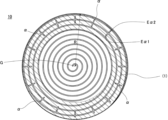
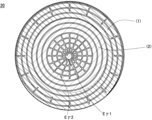
- Examples 1 to 20, Comparative Examples 1 to 4 On one surface of the sheet for polishing layer obtained in Production Example 1, which was the polishing surface, grooves having a pattern shown in Table 1 were formed by cutting.
- the positions of the ends of all grooves ⁇ were as shown in Table 1 by the positions of the first end E ⁇ 1 and the second end E ⁇ 2.
- Example 7 of the eight grooves ⁇ the position of the first end of one groove ⁇ was 0%, the positions of the first ends of the ends of seven grooves ⁇ were 5.2%, and the positions of the second ends of all eight grooves ⁇ were 51.6%.
- the arc-shaped grooves ⁇ and ⁇ were formed on the same arc connecting the center of the polishing surface and the outer periphery of the polishing surface.
- a cushion layer was attached to the back side of the polishing surface of the polishing layer with a double-sided adhesive sheet to prepare a multi-layer polishing pad.
- the cushion layer was made of "Poron H48" manufactured by Inoac Corporation, which is a polyurethane foam sheet having a thickness of 0.8 mm.
- the groove width of the grooves formed in each example was measured based on a scanning electron microscope (SEM) image at 200 times the cross section. Specifically, the cut surface of the groove of each polishing layer was photographed at 18 locations evenly, the groove width of each image was measured, and the average value was calculated.
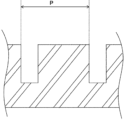
- the groove pitch P of the reference groove ⁇ 1 was measured at 8 locations evenly selected from the area of the polishing surface that contacts the silicon wafer using a scale loupe, and the average was taken as the groove pitch P.
- the depth of each groove was measured at 8 locations evenly selected from the area that contacts the silicon wafer using a depth gauge "E-DP2J" made by Nakamura Seisakusho Co., Ltd., and the measured values were averaged.
- polishing was performed in a state in which groove ⁇ was located under a retaining ring attached to the polishing head, the central end of groove ⁇ (first end E ⁇ 1) was located in the outer region of the retaining ring, and the outer peripheral end of groove ⁇ (second end E ⁇ 2) was located in the inner region of the retaining ring. Then, using a pad conditioner (A.L.M.T.
- the surface of the polishing pad was conditioned for 30 seconds while running pure water at a rate of 150 mL/min under the conditions of a dresser rotation speed of 70 rpm, a polishing pad rotation speed of 100 rpm, and a dresser load of 20 N. Then, another silicon wafer was polished again, and conditioning was performed for a further 30 seconds. Then, after polishing for 60 seconds, conditioning of the polishing pad was performed for 30 seconds. Then, another silicon wafer was polished again, and conditioning was performed for a further 30 seconds. In this manner, 10 silicon wafers were polished.
- the thickness of the silicon oxide film of the 10th polished silicon wafer was measured at 49 points on the wafer before and after polishing, and the polishing rate (nm/min) at each point was calculated. Specifically, the average value of the polishing rates at the 49 points was taken as the polishing rate.
- the silicon wafer was polished under the conditions described in the above-mentioned method for evaluating the polishing rate when the groove depth of the groove ⁇ (if the polishing layer does not have groove ⁇ and has reference groove ⁇ 1, the reference groove ⁇ 1) was reduced by 50%, and the thickness of the silicon oxide film before and after polishing was measured at 87 points on the wafer surface (edge exclusion 3 mm) to determine the polishing rate (nm/min) at each point.
- the average value and standard deviation 1 ⁇ of the polishing rates at the 87 points were then calculated, and the coefficient of variation (unit: %) was calculated from the average value and standard deviation 1 ⁇ . The smaller the coefficient of variation, the better the polishing uniformity.
- the silicon wafer was polished under the conditions described in the above method for evaluating the polishing rate when the groove depth of the groove ⁇ (if the polishing layer does not have groove ⁇ and has reference groove ⁇ 1, then reference groove ⁇ 1) was reduced by 50%, and the thickness of the silicon oxide film before and after polishing was measured at 20 points in the outer edge region 10 mm from the outside of the wafer, and the polishing rate (nm/min) at each point was determined.
- the average value and standard deviation 1 ⁇ of the polishing rates at the 20 points were then calculated, and the coefficient of variation (unit: %) was calculated from the average value and standard deviation 1 ⁇ . The smaller the coefficient of variation, the better the polishing uniformity of the outer edge region.
- the polishing pads of Examples 1 to 20 of this embodiment achieve a high degree of compatibility between the polishing speed and the polishing uniformity of the outer edge region.
- the polishing pads of Comparative Examples 1 to 4 were inferior in at least one of the polishing speed and the polishing uniformity of the outer edge region.
Landscapes
- Engineering & Computer Science (AREA)
- Mechanical Engineering (AREA)
- Mechanical Treatment Of Semiconductor (AREA)
- Finish Polishing, Edge Sharpening, And Grinding By Specific Grinding Devices (AREA)
Priority Applications (2)
| Application Number | Priority Date | Filing Date | Title |
|---|---|---|---|
| JP2025527923A JPWO2024257742A1 (https=) | 2023-06-12 | 2024-06-11 | |
| KR1020257041044A KR20260017377A (ko) | 2023-06-12 | 2024-06-11 | 연마 패드, 연마 방법 및 반도체의 제조 방법 |
Applications Claiming Priority (2)
| Application Number | Priority Date | Filing Date | Title |
|---|---|---|---|
| JP2023096439 | 2023-06-12 | ||
| JP2023-096439 | 2023-06-12 |
Publications (1)
| Publication Number | Publication Date |
|---|---|
| WO2024257742A1 true WO2024257742A1 (ja) | 2024-12-19 |
Family
ID=93852126
Family Applications (1)
| Application Number | Title | Priority Date | Filing Date |
|---|---|---|---|
| PCT/JP2024/021113 Ceased WO2024257742A1 (ja) | 2023-06-12 | 2024-06-11 | 研磨パッド、研磨方法及び半導体の製造方法 |
Country Status (4)
| Country | Link |
|---|---|
| JP (1) | JPWO2024257742A1 (https=) |
| KR (1) | KR20260017377A (https=) |
| TW (1) | TW202506328A (https=) |
| WO (1) | WO2024257742A1 (https=) |
Citations (6)
| Publication number | Priority date | Publication date | Assignee | Title |
|---|---|---|---|---|
| JP2000042901A (ja) * | 1998-07-29 | 2000-02-15 | Toshiba Ceramics Co Ltd | 研磨布およびその製造方法 |
| US6254456B1 (en) * | 1997-09-26 | 2001-07-03 | Lsi Logic Corporation | Modifying contact areas of a polishing pad to promote uniform removal rates |
| JP2006289605A (ja) * | 2005-04-12 | 2006-10-26 | Rohm & Haas Electronic Materials Cmp Holdings Inc | 半径方向の偏った研磨パッド |
| JP2007103602A (ja) * | 2005-10-03 | 2007-04-19 | Toshiba Corp | 研磨パッド及び研磨装置 |
| US20130017766A1 (en) * | 2011-07-12 | 2013-01-17 | Iv Technologies Co., Ltd. | Polishing pad, polishing method and polishing system |
| WO2023013576A1 (ja) * | 2021-08-04 | 2023-02-09 | 株式会社クラレ | 研磨パッド |
Family Cites Families (2)
| Publication number | Priority date | Publication date | Assignee | Title |
|---|---|---|---|---|
| US20060194530A1 (en) | 2005-02-25 | 2006-08-31 | Thomson Clifford O | Polishing pad for use in polishing work pieces |
| CN210982992U (zh) | 2019-12-16 | 2020-07-10 | 中强光电股份有限公司 | 背光模块 |
-
2024
- 2024-06-11 JP JP2025527923A patent/JPWO2024257742A1/ja active Pending
- 2024-06-11 KR KR1020257041044A patent/KR20260017377A/ko active Pending
- 2024-06-11 WO PCT/JP2024/021113 patent/WO2024257742A1/ja not_active Ceased
- 2024-06-12 TW TW113121613A patent/TW202506328A/zh unknown
Patent Citations (6)
| Publication number | Priority date | Publication date | Assignee | Title |
|---|---|---|---|---|
| US6254456B1 (en) * | 1997-09-26 | 2001-07-03 | Lsi Logic Corporation | Modifying contact areas of a polishing pad to promote uniform removal rates |
| JP2000042901A (ja) * | 1998-07-29 | 2000-02-15 | Toshiba Ceramics Co Ltd | 研磨布およびその製造方法 |
| JP2006289605A (ja) * | 2005-04-12 | 2006-10-26 | Rohm & Haas Electronic Materials Cmp Holdings Inc | 半径方向の偏った研磨パッド |
| JP2007103602A (ja) * | 2005-10-03 | 2007-04-19 | Toshiba Corp | 研磨パッド及び研磨装置 |
| US20130017766A1 (en) * | 2011-07-12 | 2013-01-17 | Iv Technologies Co., Ltd. | Polishing pad, polishing method and polishing system |
| WO2023013576A1 (ja) * | 2021-08-04 | 2023-02-09 | 株式会社クラレ | 研磨パッド |
Also Published As
| Publication number | Publication date |
|---|---|
| JPWO2024257742A1 (https=) | 2024-12-19 |
| KR20260017377A (ko) | 2026-02-05 |
| TW202506328A (zh) | 2025-02-16 |
Similar Documents
| Publication | Publication Date | Title |
|---|---|---|
| JP5143528B2 (ja) | 研磨パッド | |
| JP6619100B2 (ja) | 研磨パッドおよびそれを用いた研磨方法 | |
| JP5706178B2 (ja) | 研磨パッド | |
| JP6518680B2 (ja) | 研磨層用非多孔性成形体,研磨パッド及び研磨方法 | |
| JP7607780B2 (ja) | 研磨パッド | |
| KR102398128B1 (ko) | 연마층용 성형체 및 연마 패드 | |
| KR101084808B1 (ko) | 금속 막 연마용 패드 및 그것을 이용하는 금속 막의 연마 방법 | |
| KR20030005405A (ko) | 화학 기계적 평탄화용 그루브형 연마 패드 | |
| JP7514234B2 (ja) | 研磨パッド、研磨パッドの製造方法及び研磨方法 | |
| JP5997973B2 (ja) | 金属膜研磨用パッドおよびそれを用いた研磨方法 | |
| JP7431807B2 (ja) | 研磨パッド | |
| JP7611412B2 (ja) | 研磨パッド | |
| WO2010032715A1 (ja) | 研磨パッド | |
| WO2024257742A1 (ja) | 研磨パッド、研磨方法及び半導体の製造方法 | |
| JP7253475B2 (ja) | 研磨パッド及び研磨パッドをコンパクト化する方法 | |
| TW202328258A (zh) | 研磨層用熱塑性聚胺基甲酸酯、研磨層、及研磨墊 | |
| JP7014526B2 (ja) | 研磨パッド用研磨層の製造方法 | |
| KR20240144181A (ko) | 연마층, 연마 패드, 연마 패드의 제조 방법 및 연마 방법 | |
| HK1237715B (zh) | 抛光层用非多孔性成型体、抛光垫及抛光方法 |
Legal Events
| Date | Code | Title | Description |
|---|---|---|---|
| 121 | Ep: the epo has been informed by wipo that ep was designated in this application |
Ref document number: 24823358 Country of ref document: EP Kind code of ref document: A1 |
|
| ENP | Entry into the national phase |
Ref document number: 2025527923 Country of ref document: JP Kind code of ref document: A |
|
| WWE | Wipo information: entry into national phase |
Ref document number: 2025527923 Country of ref document: JP |
|
| WWE | Wipo information: entry into national phase |
Ref document number: 202547123563 Country of ref document: IN |
|
| WWE | Wipo information: entry into national phase |
Ref document number: 11202507956V Country of ref document: SG |
|
| WWP | Wipo information: published in national office |
Ref document number: 11202507956V Country of ref document: SG |