WO2024237236A1 - 毛髪用有効成分 - Google Patents
毛髪用有効成分 Download PDFInfo
- Publication number
- WO2024237236A1 WO2024237236A1 PCT/JP2024/017652 JP2024017652W WO2024237236A1 WO 2024237236 A1 WO2024237236 A1 WO 2024237236A1 JP 2024017652 W JP2024017652 W JP 2024017652W WO 2024237236 A1 WO2024237236 A1 WO 2024237236A1
- Authority
- WO
- WIPO (PCT)
- Prior art keywords
- hair
- acid
- group
- component
- active ingredient
- Prior art date
- Legal status (The legal status is an assumption and is not a legal conclusion. Google has not performed a legal analysis and makes no representation as to the accuracy of the status listed.)
- Ceased
Links
Images




Classifications
-
- A—HUMAN NECESSITIES
- A61—MEDICAL OR VETERINARY SCIENCE; HYGIENE
- A61Q—SPECIFIC USE OF COSMETICS OR SIMILAR TOILETRY PREPARATIONS
- A61Q5/00—Preparations for care of the hair
- A61Q5/06—Preparations for styling the hair, e.g. by temporary shaping or colouring
- A61Q5/065—Preparations for temporary colouring the hair, e.g. direct dyes
-
- A—HUMAN NECESSITIES
- A61—MEDICAL OR VETERINARY SCIENCE; HYGIENE
- A61K—PREPARATIONS FOR MEDICAL, DENTAL OR TOILETRY PURPOSES
- A61K8/00—Cosmetics or similar toiletry preparations
- A61K8/18—Cosmetics or similar toiletry preparations characterised by the composition
- A61K8/30—Cosmetics or similar toiletry preparations characterised by the composition containing organic compounds
- A61K8/33—Cosmetics or similar toiletry preparations characterised by the composition containing organic compounds containing oxygen
- A61K8/36—Carboxylic acids; Salts or anhydrides thereof
-
- A—HUMAN NECESSITIES
- A61—MEDICAL OR VETERINARY SCIENCE; HYGIENE
- A61K—PREPARATIONS FOR MEDICAL, DENTAL OR TOILETRY PURPOSES
- A61K8/00—Cosmetics or similar toiletry preparations
- A61K8/18—Cosmetics or similar toiletry preparations characterised by the composition
- A61K8/30—Cosmetics or similar toiletry preparations characterised by the composition containing organic compounds
- A61K8/33—Cosmetics or similar toiletry preparations characterised by the composition containing organic compounds containing oxygen
- A61K8/36—Carboxylic acids; Salts or anhydrides thereof
- A61K8/362—Polycarboxylic acids
-
- A—HUMAN NECESSITIES
- A61—MEDICAL OR VETERINARY SCIENCE; HYGIENE
- A61K—PREPARATIONS FOR MEDICAL, DENTAL OR TOILETRY PURPOSES
- A61K8/00—Cosmetics or similar toiletry preparations
- A61K8/18—Cosmetics or similar toiletry preparations characterised by the composition
- A61K8/30—Cosmetics or similar toiletry preparations characterised by the composition containing organic compounds
- A61K8/33—Cosmetics or similar toiletry preparations characterised by the composition containing organic compounds containing oxygen
- A61K8/36—Carboxylic acids; Salts or anhydrides thereof
- A61K8/365—Hydroxycarboxylic acids; Ketocarboxylic acids
-
- A—HUMAN NECESSITIES
- A61—MEDICAL OR VETERINARY SCIENCE; HYGIENE
- A61K—PREPARATIONS FOR MEDICAL, DENTAL OR TOILETRY PURPOSES
- A61K8/00—Cosmetics or similar toiletry preparations
- A61K8/18—Cosmetics or similar toiletry preparations characterised by the composition
- A61K8/30—Cosmetics or similar toiletry preparations characterised by the composition containing organic compounds
- A61K8/40—Cosmetics or similar toiletry preparations characterised by the composition containing organic compounds containing nitrogen
- A61K8/41—Amines
-
- A—HUMAN NECESSITIES
- A61—MEDICAL OR VETERINARY SCIENCE; HYGIENE
- A61K—PREPARATIONS FOR MEDICAL, DENTAL OR TOILETRY PURPOSES
- A61K8/00—Cosmetics or similar toiletry preparations
- A61K8/18—Cosmetics or similar toiletry preparations characterised by the composition
- A61K8/30—Cosmetics or similar toiletry preparations characterised by the composition containing organic compounds
- A61K8/40—Cosmetics or similar toiletry preparations characterised by the composition containing organic compounds containing nitrogen
- A61K8/41—Amines
- A61K8/416—Quaternary ammonium compounds
-
- A—HUMAN NECESSITIES
- A61—MEDICAL OR VETERINARY SCIENCE; HYGIENE
- A61K—PREPARATIONS FOR MEDICAL, DENTAL OR TOILETRY PURPOSES
- A61K8/00—Cosmetics or similar toiletry preparations
- A61K8/18—Cosmetics or similar toiletry preparations characterised by the composition
- A61K8/30—Cosmetics or similar toiletry preparations characterised by the composition containing organic compounds
- A61K8/40—Cosmetics or similar toiletry preparations characterised by the composition containing organic compounds containing nitrogen
- A61K8/44—Aminocarboxylic acids or derivatives thereof, e.g. aminocarboxylic acids containing sulfur; Salts; Esters or N-acylated derivatives thereof
-
- A—HUMAN NECESSITIES
- A61—MEDICAL OR VETERINARY SCIENCE; HYGIENE
- A61K—PREPARATIONS FOR MEDICAL, DENTAL OR TOILETRY PURPOSES
- A61K8/00—Cosmetics or similar toiletry preparations
- A61K8/18—Cosmetics or similar toiletry preparations characterised by the composition
- A61K8/30—Cosmetics or similar toiletry preparations characterised by the composition containing organic compounds
- A61K8/49—Cosmetics or similar toiletry preparations characterised by the composition containing organic compounds containing heterocyclic compounds
-
- A—HUMAN NECESSITIES
- A61—MEDICAL OR VETERINARY SCIENCE; HYGIENE
- A61K—PREPARATIONS FOR MEDICAL, DENTAL OR TOILETRY PURPOSES
- A61K8/00—Cosmetics or similar toiletry preparations
- A61K8/18—Cosmetics or similar toiletry preparations characterised by the composition
- A61K8/30—Cosmetics or similar toiletry preparations characterised by the composition containing organic compounds
- A61K8/49—Cosmetics or similar toiletry preparations characterised by the composition containing organic compounds containing heterocyclic compounds
- A61K8/4906—Cosmetics or similar toiletry preparations characterised by the composition containing organic compounds containing heterocyclic compounds with one nitrogen as the only hetero atom
- A61K8/4913—Cosmetics or similar toiletry preparations characterised by the composition containing organic compounds containing heterocyclic compounds with one nitrogen as the only hetero atom having five membered rings, e.g. pyrrolidone carboxylic acid
-
- A—HUMAN NECESSITIES
- A61—MEDICAL OR VETERINARY SCIENCE; HYGIENE
- A61K—PREPARATIONS FOR MEDICAL, DENTAL OR TOILETRY PURPOSES
- A61K8/00—Cosmetics or similar toiletry preparations
- A61K8/18—Cosmetics or similar toiletry preparations characterised by the composition
- A61K8/30—Cosmetics or similar toiletry preparations characterised by the composition containing organic compounds
- A61K8/49—Cosmetics or similar toiletry preparations characterised by the composition containing organic compounds containing heterocyclic compounds
- A61K8/494—Cosmetics or similar toiletry preparations characterised by the composition containing organic compounds containing heterocyclic compounds with more than one nitrogen as the only hetero atom
- A61K8/4946—Imidazoles or their condensed derivatives, e.g. benzimidazoles
-
- A—HUMAN NECESSITIES
- A61—MEDICAL OR VETERINARY SCIENCE; HYGIENE
- A61K—PREPARATIONS FOR MEDICAL, DENTAL OR TOILETRY PURPOSES
- A61K8/00—Cosmetics or similar toiletry preparations
- A61K8/18—Cosmetics or similar toiletry preparations characterised by the composition
- A61K8/30—Cosmetics or similar toiletry preparations characterised by the composition containing organic compounds
- A61K8/67—Vitamins
- A61K8/676—Ascorbic acid, i.e. vitamin C
-
- A—HUMAN NECESSITIES
- A61—MEDICAL OR VETERINARY SCIENCE; HYGIENE
- A61K—PREPARATIONS FOR MEDICAL, DENTAL OR TOILETRY PURPOSES
- A61K8/00—Cosmetics or similar toiletry preparations
- A61K8/18—Cosmetics or similar toiletry preparations characterised by the composition
- A61K8/72—Cosmetics or similar toiletry preparations characterised by the composition containing organic macromolecular compounds
- A61K8/84—Cosmetics or similar toiletry preparations characterised by the composition containing organic macromolecular compounds obtained by reactions otherwise than those involving only carbon-carbon unsaturated bonds
- A61K8/88—Polyamides
-
- A—HUMAN NECESSITIES
- A61—MEDICAL OR VETERINARY SCIENCE; HYGIENE
- A61Q—SPECIFIC USE OF COSMETICS OR SIMILAR TOILETRY PREPARATIONS
- A61Q5/00—Preparations for care of the hair
-
- A—HUMAN NECESSITIES
- A61—MEDICAL OR VETERINARY SCIENCE; HYGIENE
- A61Q—SPECIFIC USE OF COSMETICS OR SIMILAR TOILETRY PREPARATIONS
- A61Q5/00—Preparations for care of the hair
- A61Q5/06—Preparations for styling the hair, e.g. by temporary shaping or colouring
-
- A—HUMAN NECESSITIES
- A61—MEDICAL OR VETERINARY SCIENCE; HYGIENE
- A61Q—SPECIFIC USE OF COSMETICS OR SIMILAR TOILETRY PREPARATIONS
- A61Q5/00—Preparations for care of the hair
- A61Q5/10—Preparations for permanently dyeing the hair
-
- A—HUMAN NECESSITIES
- A61—MEDICAL OR VETERINARY SCIENCE; HYGIENE
- A61Q—SPECIFIC USE OF COSMETICS OR SIMILAR TOILETRY PREPARATIONS
- A61Q5/00—Preparations for care of the hair
- A61Q5/12—Preparations containing hair conditioners
-
- A—HUMAN NECESSITIES
- A61—MEDICAL OR VETERINARY SCIENCE; HYGIENE
- A61K—PREPARATIONS FOR MEDICAL, DENTAL OR TOILETRY PURPOSES
- A61K2800/00—Properties of cosmetic compositions or active ingredients thereof or formulation aids used therein and process related aspects
- A61K2800/40—Chemical, physico-chemical or functional or structural properties of particular ingredients
- A61K2800/42—Colour properties
- A61K2800/43—Pigments; Dyes
-
- A—HUMAN NECESSITIES
- A61—MEDICAL OR VETERINARY SCIENCE; HYGIENE
- A61K—PREPARATIONS FOR MEDICAL, DENTAL OR TOILETRY PURPOSES
- A61K2800/00—Properties of cosmetic compositions or active ingredients thereof or formulation aids used therein and process related aspects
- A61K2800/40—Chemical, physico-chemical or functional or structural properties of particular ingredients
- A61K2800/49—Solubiliser, Solubilising system
Definitions
- the present invention relates to an active ingredient for hair.
- Efficient penetration and fixation of various additives into tissues, materials, etc. is important for enhancing the effectiveness of the additives, and a wide variety of useful ingredients are used in a variety of fields, including hair, skin, textiles, paper, and wood.
- Patent Documents 4 and 5 The applicant has proposed cosmetic ingredients, skin treatment agents, and hair treatment agents that contain amine compounds or amino acids (Patent Documents 4 and 5), but has not specifically examined the improvement of the texture of hair, or the penetration and fixation of the agents into hair.
- the present invention was made in consideration of the above circumstances, and aims to provide an active ingredient for hair that efficiently penetrates and adheres to hair and has excellent repair effects on the surface and inside of hair. It also aims to provide an active ingredient for hair that has excellent solubility of hair additives and excellent penetration and fixation of hair additives, for example, penetration and fixation of colorants of hair additives in hair dyeing treatments.
- An active ingredient for hair comprising the following components (A) and (B), the molar ratio of components (A) and (B) being 0.01:1 to 10:1.
- Component (A) an amine compound or ammonium compound having a hydrogen-bonding functional group;
- Component (B) a carboxylic acid or a salt thereof
- the component (A) is represented by the following formula (1): (wherein R 1 represents a monovalent or divalent hydrocarbon group having 1 to 22 carbon atoms; R 2 each independently represents a hydrogen atom, a monovalent or divalent hydrocarbon group having 1 to 22 carbon atoms, a monovalent or divalent nitrogen-containing group, a monovalent or divalent oxygen-containing group, or a monovalent or divalent sulfur-containing group; R 3 represents a divalent hydrocarbon group having 1 to 22 carbon atoms; l is an integer from 0 to 2, m is an integer from 0 to 2, n is 0 or 1, and
- R 1 and R 2 may be joined to form a ring having 3 to 22 carbon atoms; and X represents a hydrogen atom or a monovalent cation), or a salt thereof.
- the amino acid is the following amino acid (a): Amino acid (a): The ratio of the total number of primary or secondary amino groups to the number of carboxy groups (total number of primary or secondary amino groups/number of carboxy groups) is greater than 1.
- the component (A) is represented by the following formula (2): (wherein each R 4 independently represents a hydrocarbon group having one or more hydroxyl groups, each R 5 independently represents a hydrocarbon group having 1 to 22 carbon atoms, the sum of x, y and z is 3, y represents an integer of 1 to 3, and x and z each represent an integer of 0 to 2).
- [5] The active ingredient for hair according to any one of [1] to [4], wherein the carboxylic acid or salt thereof of the component (B) has a hydrogen-bonding functional group.
- a hair composition comprising the hair active ingredient according to [1] and a hair additive.
- the hair additive is at least one additive selected from the group consisting of dyes, colorants, pigments, astringents, and reducing agents.
- a method for dyeing hair and/or inhibiting fading of hair dye comprising the steps of: [14]
- a method for dyeing hair and/or inhibiting fading of hair dye comprising the steps of:
- the active ingredient for hair of the present invention efficiently penetrates and adheres to hair, and has excellent repair effects on the surface and inside of hair. It also has excellent solubility of hair additives, and excellent penetration and fixation of hair additives, for example, in hair dyeing treatment, excellent penetration and fixation of coloring agents of hair additives.
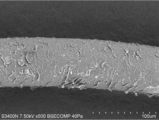
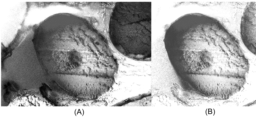
- 1 is a micrograph of the surface of damaged hair after bleaching. 1 is a micrograph of the surface of damaged hair to which active ingredient for hair 3 has been applied. This is a micrograph of the cross section of hair after dyeing in Example 17 and shampooing once. This is a micrograph of the cross section of hair after dyeing in Example 18 and shampooing once. This is a micrograph of the cross section of hair after dyeing in Example 24 and shampooing once. 1 is a micrograph of a cross section of hair after dyeing in Comparative Example 7 and after shampooing once. 1 is a micrograph of a cross section of hair after dyeing in Comparative Example 15 and after shampooing once.
- the hair active ingredient of the present invention is an active ingredient for hair that penetrates and settles into hair and has excellent repair effects on the surface and inside of hair.
- the hair includes, but is not limited to, human hair (head hair, beard, eyebrows, body hair), animal fibers, and hair (body hair, etc.).
- the repair effect on the surface and inside of hair includes, but is not limited to, for example, repairing the cuticle on the surface of hair can give a good feeling of use (ease of fingering, moist feeling, manageability, etc.), and repairing the inside of hair can give hair elasticity and strength, and can give the effect of suppressing hair wavyness. Furthermore, it can dissolve, penetrate, and settle useful hair additives in hair.
- the hair active ingredient of the present invention contains component (A): an amine compound or ammonium compound having a hydrogen-bonding functional group, and component (B): a carboxylic acid or a salt thereof, in a molar ratio of 0.01:1 to 10:1.
- component (B) has a hydrogen-bonding functional group.
- component (A) and further component (B) provides excellent affinity with hair and organic and inorganic hair additives that can bond or coordinate with various hydrogen-bonding functional groups, allowing them to penetrate and fix as active hair ingredients, or to allow hair additives to penetrate and fix in hair.
- the hydrogen-bonding functional groups contained in the components (A) and (B) are not particularly limited, but examples include oxygen-containing groups, nitrogen-containing groups, sulfur-containing groups, phosphorus-containing groups, and hydrogen atoms directly bonded to nitrogen.
- the oxygen-containing group preferably has a carbon number of 22 or less, more preferably 15 or less, and even more preferably 10 or less.
- the oxygen-containing group is not particularly limited, but examples thereof include hydroxyl group-containing groups, alkoxy group-containing groups, acetoxy group-containing groups, acetyl group-containing groups, aldehyde group-containing groups, carboxyl group-containing groups, carboxylate group-containing groups, urea group-containing groups, urethane group-containing groups, amide group-containing groups, imide group-containing groups, ether group-containing groups, carbonyl group-containing groups, ester group-containing groups, oxazole group-containing groups, morpholine group-containing groups, carbamate group-containing groups, carbamic acid group-containing groups, carbamoyl group-containing groups, polyoxyethylene group-containing groups, tocopheryl group-containing groups, chroman group-containing groups, dihydropyran group-containing groups, glyceryl group-containing groups,
- the nitrogen-containing group preferably has a carbon number of 22 or less, more preferably 15 or less, and even more preferably 10 or less.
- the nitrogen-containing group is not particularly limited, but examples thereof include a cyano group-containing group, a cyanato group-containing group, an isocyanate group-containing group, a nitro group-containing group, a nitroalkyl group-containing group, an amide group-containing group, a urea group-containing group, a urethane group-containing group, an imide group-containing group, a carbodiimide group-containing group, an azo group-containing group, a pyridyl group-containing group, an imidazole group-containing group, a pyrrolidyl group-containing group, a piperidyl group-containing group, a pyrrolyl group-containing group, a pyrazyl group-containing group, a triazole group-containing group, and the like.
- Examples of such groups include isoquinolyl group-containing groups, oxazolyl group-containing groups, thiazolyl group-containing groups, morpholyl group-containing groups, guanidyl group-containing groups, pyrimidyl group-containing groups, piperazyl group-containing groups, triazyl group-containing groups, quinolyl group-containing groups, indole group-containing groups, quinoxalyl group-containing groups, isoxazolyl group-containing groups, primary amino group-containing groups, secondary amino group-containing groups, tertiary amino group-containing groups, quaternary ammonium group-containing groups, and aminoalkyl group-containing groups.
- the sulfur-containing group preferably has a carbon number of 22 or less, more preferably 15 or less, and even more preferably 10 or less.
- the sulfur-containing group is not particularly limited, but examples thereof include sulfate group-containing groups, sulfonyl group-containing groups, sulfonic acid group-containing groups, mercapto group-containing groups, thioether group-containing groups, thiocarbonyl group-containing groups, thiourea group-containing groups, thiocarboxy group-containing groups, thiocarboxylate group-containing groups, dithiocarboxy group-containing groups, dithiocarboxylate group-containing groups, sulfate ester-containing groups, thiophene group-containing groups, thiazole group-containing groups, thiol group-containing groups, sulfo group-containing groups, sulfide group-containing groups, disulfide group-containing groups, thioester group-containing groups, thioamide group-containing groups,
- the phosphorus-containing group preferably has a carbon number of 22 or less, more preferably 15 or less, and even more preferably 10 or less.
- the phosphorus-containing group is not particularly limited, but examples thereof include phosphate group-containing groups, phosphite group-containing groups, phosphonic acid group-containing groups, phosphinic acid group-containing groups, phosphonous acid group-containing groups, phosphinic acid group-containing groups, pyrophosphate group-containing groups, phosphate ester group-containing groups, phosphite ester group-containing groups, phosphonic acid ester group-containing groups, pyrophosphate group-containing groups, and ester groups thereof.
- oxygen-containing group nitrogen-containing group, sulfur-containing group, or phosphorus-containing group contains a carbon atom, it includes, but is not limited to, for example, a hydrocarbon group.
- a hydroxyl-containing group refers to a group in which a hydroxyl group is bonded to a hydrocarbon group.
- Component (A) is an amine compound or ammonium compound having a hydrogen-bonding functional group.
- the amine compound include, but are not limited to, amino acids, amines (ammonia, primary amines, secondary amines, tertiary amines), guanidine, and cyclic amines such as imidazole, pyridine, pyrrolidine, piperidine, pyrroline, pyrazine, triazole, isoquinoline, oxazoline, thiazoline, morpholine, pyrimidine, piperazine, triazine, quinoline, indole, quinoxaline, and isoxazoline.
- component (A) is preferably an amine compound, and among the above amine compounds, amino acids and amines are more preferable, and amino acids are even more preferable.
- the hydrocarbon group is not particularly limited, but examples thereof include groups in which one or more hydrogen atoms have been removed from a hydrocarbon having 1 to 22 carbon atoms, such as saturated or unsaturated aliphatic hydrocarbon groups, saturated or unsaturated alicyclic hydrocarbon groups, aromatic hydrocarbon groups, and hydrocarbon groups that are combinations thereof.
- the monovalent saturated or unsaturated aliphatic hydrocarbon group may be monovalent or polyvalent, and examples of the monovalent saturated or unsaturated aliphatic hydrocarbon group include, but are not particularly limited to, linear or branched alkyl groups, alkenyl groups, alkynyl groups, and the like.
- Divalent hydrocarbon groups include groups in which two hydrogen atoms have been removed from a hydrocarbon.
- one or more of the sites in component (A) where a functional group can be introduced be substituted with a hydrocarbon group having a hydrogen-bonding functional group.
- a hydrogen atom directly bonded to the nitrogen constitutes the hydrogen-bonding functional group.
- amino acid A preferred embodiment of component (A) is an amino acid or a salt thereof.
- the amino acid includes a compound having an acidic carboxy group (-COOH) and a basic amino group (primary amino group, secondary amino group, tertiary amino group) in the molecule.
- Typical preferred examples include proteinogenic amino acids, free amino acids in living organisms, and artificial amino acids, with proteinogenic amino acids and free amino acids in living organisms being preferred.
- Examples of the salts of amino acids include intramolecular salts, and include carboxylates in which at least one of the carboxy groups of the amino acid is substituted with a cation (such as an alkali metal cation, an alkaline earth metal cation, or an ammonium cation).
- examples of the salts include amine salts that form a salt with an acid and one or more nitrogen atoms.
- the amino acid or a salt thereof is preferably represented by the following formula (1).
- R 1 represents a monovalent or divalent hydrocarbon group having 1 to 22 carbon atoms
- R 2 each independently represents a hydrogen atom, a monovalent or divalent hydrocarbon group having 1 to 22 carbon atoms, a monovalent or divalent nitrogen-containing group, a monovalent or divalent oxygen-containing group, or a monovalent or divalent sulfur-containing group
- R 3 represents a divalent hydrocarbon group having 1 to 22 carbon atoms
- l represents an integer of 0 to 2
- m represents an integer of 0 to 2
- n represents 0 or 1
- R 1 and R 2 may join together to form a ring having 3 to 22 carbon atoms
- X represents a hydrogen atom or a monovalent cation.
- l is preferably 0 or 1
- m is preferably 1 or 2.
- R 1 is preferably an aliphatic hydrocarbon group.
- R2 is preferably a hydrogen atom, a hydrocarbon group, a nitrogen-containing group having a hydrogen-bonding functional group, an oxygen-containing group, or a sulfur-containing group.
- the hydrogen-bonding functional group preferably has the oxygen-containing group, nitrogen-containing group, or sulfur-containing group.
- the oxygen-containing group is preferably a hydroxyl group-containing group, a carboxyl group-containing group, a carboxylate group-containing group, or an amide group-containing group.
- the nitrogen-containing group is preferably an amide group-containing group, an imidazole group-containing group, a guanidyl group-containing group, an indole group-containing group, a primary amino group-containing group, a secondary amino group-containing group, or a tertiary amino group-containing group.
- the sulfur-containing group is preferably a thioether group-containing group, a thiol group-containing group, or a sulfide group-containing group. Among these, a guanidyl group-containing group is more preferred.
- R 3 is preferably a divalent saturated aliphatic hydrocarbon group (alkylene group).
- l is 0, m is 2, n is 0, and R2 is a primary amino group or a nitrogen-containing group having two or more nitrogen atoms.
- these amino acids are not particularly limited, but include, for example, arginine, histidine, and lysine.
- At least one of R 1 and R 2 is an oxygen-containing group having a carboxy group.
- these amino acids are not particularly limited, but include glutamic acid and aspartic acid.
- R 1 or R 2 has a hydrocarbon group, an oxygen-containing group having a hydroxyl group, a nitrogen-containing group having an amide group or a secondary amino group, or a sulfur-containing group, or R 1 and R 2 together form a ring.
- amino acids include, but are not limited to, leucine, phenylalanine, proline, valine, tryptophan, serine, isoleucine, alanine, threonine, glutamine, asparagine, cysteine, methionine, etc.
- R 1 and R 2 taken together to form a ring having 3 to 22 carbon atoms means that in the unit R 1 l NH m CR 2 , R 1 and R 2 taken together form a ring containing a nitrogen atom having a total carbon number of 3 to 22, preferably 4 to 10, which forms the ring of R 1 , R 2 and C.
- R1 is a monovalent or divalent saturated aliphatic hydrocarbon group, preferably a divalent saturated aliphatic hydrocarbon group. In the case of a divalent saturated aliphatic hydrocarbon group, it is preferable that R1 and R2 together form a ring.
- the component (A) is preferably an amino acid of the above (1) in which X is a hydrogen atom.
- Amino acids include compounds having one or more amino groups (primary amino groups, secondary amino groups, tertiary amino groups) and one or more carboxy groups (-COOH) in one molecule, except for amide groups.
- Preferred embodiments of amino acids include the following from the viewpoints of the ratio of the number of amino groups to carboxy groups and the isoelectric point (amino acids (a) to (f)).
- Amino acid (a) The ratio of the total number of primary or secondary amino groups to the number of carboxy groups contained in the component (A) (total number of primary or secondary amino groups/number of carboxy groups) is greater than 1.
- These amino acids include, but are not limited to, arginine, histidine, lysine, tryptophan, and the like.
- Amino acid (b) The ratio of the total number of primary or secondary amino groups to the number of carboxy groups contained in the component (A) (total number of primary or secondary amino groups/number of carboxy groups) is 1.
- These amino acids include, but are not limited to, for example, leucine, isoleucine, phenylalanine, proline, valine, serine, alanine, threonine, glutamine, asparagine, aminobutyric acid, cysteine, glycine, methionine, and the like.
- Amino acid (c) The ratio of the total number of primary or secondary amino groups to the number of carboxy groups contained in the component (A) (total number of primary or secondary amino groups/number of carboxy groups) is less than 1.
- These amino acids are not particularly limited, but include, for example, glutamic acid, aspartic acid, and the like.
- Amino acids are classified based on their isoelectric point as having an isoelectric point greater than 7, between 4 and 7, and less than 4.
- Amino acid (d) The isoelectric point of the component (A) is greater than 7.
- These amino acids are not particularly limited, but include, for example, those classified as basic amino acids, such as arginine (10.76), histidine (7.59), lysine (9.75), aminobutyric acid (7.85), etc.
- the numbers in parentheses indicate the numerical values of the isoelectric points of each amino acid.
- Amino acid (e) The isoelectric point of component (A) is 4 or more and 7 or less.
- the amino acid having an isoelectric point of 4 or more and 7 or less is not particularly limited, but examples thereof include an amino acid having an alkyl chain as R2 , an amino acid having a hydroxyl group, an amino acid containing sulfur, an amino acid having an amide group, an amino acid having an imino group, an amino acid having an aromatic group, and ⁇ -, ⁇ -, ⁇ -, or ⁇ -amino acid.
- R2 is a hydrogen atom or a linear or branched alkyl group having 1 to 10 carbon atoms, preferably 1 to 4 carbon atoms. Specific examples include glycine (5.97), alanine (6.00), valine (5.96), leucine (5.98), isoleucine (6.02), etc.
- the numbers in parentheses indicate the numerical values of the isoelectric points of each amino acid.
- the amino acid having a hydroxy group as R2 is a linear or branched hydroxyalkyl group having 1 to 5, preferably 1 to 3, carbon atoms and 1 to 3, preferably 1, hydroxy group.
- Specific examples include serine (5.68) and threonine (6.16).
- the numbers in parentheses indicate the isoelectric point of each amino acid.
- Amino acids containing sulfur as R2 include those where R2 is: (In the formula, R 13 represents a methylene group, R 14 represents a hydrogen atom or a methyl group, a1 represents 1 to 5, preferably 1 to 3, and a2 represents 1 to 4, preferably 1 or 2. The order of a1 R 13s and a2 Ss is arbitrary.)
- cysteine (5.07) and methionine (5.74).
- methionine (5.74).
- the numbers in parentheses indicate the isoelectric point of each amino acid.
- amino acids having an amide group as R2 include those where R2 is the following: (In the formula, R 15 represents a linear or branched divalent saturated aliphatic hydrocarbon group having 1 to 5 carbon atoms, preferably 1 or 2 carbon atoms.) Specific examples include asparagine (5.41), glutamine (5.65), etc. The numbers in parentheses indicate the isoelectric point of each amino acid.
- the amino acid having an imino group as R2 includes a compound in which N and R1 together form a heterocycle.
- R1 represents a divalent saturated aliphatic hydrocarbon group having 3 or 4 carbon atoms which may have a hydroxyl group, and forms a pyrrolidine ring or a piperidine ring. Preferably, it forms a pyrrolidine ring.
- proline (6.30) can be mentioned.
- the numbers in parentheses indicate the numerical values of the isoelectric points of each amino acid.
- Amino acids having an aromatic group as R2 include those in which R2 is: (In the formula, R 16 represents a linear or branched divalent saturated aliphatic hydrocarbon group having 1 to 5 carbon atoms, preferably 1 or 2 carbon atoms, and R 17 represents an aromatic hydrocarbon group having 6 to 10 carbon atoms or a heterocyclic group having 6 to 10 carbon atoms, which may have a substituent.) R 17 preferably represents a phenyl group, a hydroxyphenyl group, an indole group, or an imidazolyl group. Specific examples include phenylalanine (5.48), tyrosine (5.66), tryptophan (5.89), etc. The numbers in parentheses indicate the numerical values of the isoelectric points of each amino acid.
- the ⁇ , ⁇ , ⁇ , or ⁇ -amino acids include those in which R 3 is a linear or branched, divalent, saturated aliphatic hydrocarbon group having 1 to 4 carbon atoms.
- Amino acid (f) The isoelectric point of the component (A) is less than 4.
- These amino acids are not particularly limited, but include, for example, those classified as acidic amino acids, and R2 is represented by the following formula: (In the formula, R 18 represents a divalent aliphatic hydrocarbon group having 1 to 10 carbon atoms.) Specific examples include glutamic acid (3.22), aspartic acid (2.77), etc. The numbers in parentheses indicate the isoelectric point of each amino acid.
- amino acids (a) to (f) from the viewpoints of penetration into hair, fixation, and hair repair effect, preferred are amino acids in which the ratio of the total number of primary or secondary amino groups to the number of carboxyl groups is 1 or more (amino acids (a) and (b)) and/or the isoelectric point is 4 or more (amino acids (d) and (e)).
- amino acids (a) and (b)) and/or the isoelectric point is 4 or more (amino acids (d) and (e)).
- Specific examples include arginine, histidine, lysine, tryptophan, proline, aminobutyric acid, and serine.
- amino acids having a ratio of the total number of primary or secondary amino groups to the number of carboxy groups of more than 1 (amino acid (a)) and/or an isoelectric point of more than 7 (amino acid (d)).
- amino acids having a ratio of the total number of primary or secondary amino groups to the number of carboxy groups of more than 1 (amino acid (a)) and/or an isoelectric point of more than 7 (amino acid (d)).
- Specific examples include arginine, histidine, lysine, and tryptophan. Among these, arginine, histidine, and lysine are preferred, and arginine and histidine are more preferred.
- component (A) is an amine or a salt thereof.
- the salt of an amine includes a salt of an amine with an organic acid or an inorganic acid, and an internal salt having an anion (carboxylate, sulfonate, phosphonate, etc.) and a cation in one molecule.
- Component (A) is preferably an amine represented by the following formula (2): (In the formula, each R 4 independently represents a hydrocarbon group having one or more hydroxy groups, each R 5 independently represents a hydrocarbon group having 1 to 22 carbon atoms, the sum of x, y, and z is 3, y represents an integer of 1 to 3, and x and z each represent an integer of 0 to 2.)
- the hydrocarbon group in R 4 of the above formula (2) includes those mentioned above, and is preferably a hydrocarbon group having 1 to 22 carbon atoms, more preferably a saturated or unsaturated aliphatic hydrocarbon group having 1 to 22 carbon atoms.
- the saturated or unsaturated aliphatic hydrocarbon group having 1 to 22 carbon atoms and having one or more hydroxyl groups has one or more hydroxyl groups, and the hydrocarbon group may be linear or branched, and preferably has 1 to 10 carbon atoms.
- the above-mentioned saturated or unsaturated aliphatic hydrocarbon group having one or more hydroxy groups and a hydrocarbon group preferably having 1 to 10 carbon atoms and being linear or branched can be exemplified by monohydroxy saturated aliphatic hydrocarbon groups (monohydroxyalkyl groups) having one hydroxy group, and polyhydroxy saturated aliphatic hydrocarbon groups (polyhydroxyalkyl groups) having two or more hydroxy groups.
- the hydrocarbon group may be linear or branched, more preferably having 1 to 6 carbon atoms, and even more preferably having 1 to 4 carbon atoms, and is preferably a saturated hydrocarbon group.
- the linear or branched monohydroxy saturated aliphatic hydrocarbon group is not particularly limited, but for example, the monohydroxyalkyl group is preferably one in which the alkyl portion has 1 to 10 carbon atoms, more preferably 1 to 6 carbon atoms, even more preferably 1 to 4 carbon atoms, and particularly preferably 1 to 3 carbon atoms.
- the linear or branched polyhydroxy saturated aliphatic hydrocarbon group is not particularly limited, but examples thereof include di-, tri-, tetra-, penta-, hexa-, hepta-, or octahydroxyalkyl groups.
- the number of hydroxy groups in the polyhydroxyalkyl group is preferably 2 to 8, more preferably 2 to 4, and even more preferably 2 to 3.
- the number of carbon atoms in the alkyl portion of the polyhydroxyalkyl group is preferably 1 to 6, and more preferably 1 to 4.
- branched polyhydroxyalkyl groups represented by the following formula are preferred examples.
- R 19 represents a hydrogen atom, a linear alkyl group having 1 to 4 carbon atoms, or a linear monohydroxyalkyl group having 1 to 4 carbon atoms.
- 2,3-dihydroxypropan-1-yl group, 1,3-dihydroxypropan-2-yl group, 1,3-dihydroxy-2-methylpropan-2-yl group, 1,3-dihydroxy-2-ethylpropan-2-yl group, 1,3-dihydroxy-2-hydroxymethylpropan-2-yl group, and pentahydroxyhexan-1-yl group are preferred, and 1,3-dihydroxy-2-hydroxymethylpropan-2-yl group is more preferred.
- the hydrocarbon group for R5 in the formula (2) includes those mentioned above, and is preferably a saturated or unsaturated aliphatic hydrocarbon group having 1 to 12 carbon atoms, more preferably a saturated aliphatic hydrocarbon group having 1 to 8 carbon atoms, still more preferably a saturated aliphatic hydrocarbon group having 1 to 4 carbon atoms, and particularly preferably a saturated aliphatic hydrocarbon group having 1 carbon atom.
- Component (B) is a carboxylic acid or a salt thereof, and carboxylic acid is preferred.
- the carboxylic acid is an organic acid having at least one or more carboxy groups (-COOH) in the molecule.
- Examples of the carboxylic acid include those having a hydrocarbon group which may have a hydrogen-bonding functional group.
- the carboxylic acid having a hydrocarbon group which may have a hydrogen-bonding functional group is not particularly limited, but examples include saturated or unsaturated aliphatic hydrocarbon groups, saturated or unsaturated alicyclic hydrocarbon groups, aromatic hydrocarbon groups, and the like, as well as those having a hydrocarbon group and a carboxy group in combination thereof, such as saturated aliphatic carboxylic acids, unsaturated aliphatic carboxylic acids, saturated or unsaturated alicyclic carboxylic acids, aromatic carboxylic acids, saturated aliphatic hydroxycarboxylic acids, unsaturated aliphatic hydroxycarboxylic acids, saturated or unsaturated alicyclic hydroxycarboxylic acids, aromatic hydroxycarboxylic acids, carbonyl carboxylic acids, alkyl ether carboxylic acids, halogen carboxylic acids, and the like (the carbon numbers of the carboxylic acids listed below include the carbons of the carboxy groups).
- the saturated aliphatic carboxylic acid is composed of a linear or branched saturated aliphatic hydrocarbon group and one or more carboxy groups, and preferably has 1 to 22 carbon atoms.
- Examples of the saturated aliphatic carboxylic acid include saturated aliphatic monocarboxylic acids having one carboxy group and saturated aliphatic dicarboxylic acids having two carboxy groups.
- the saturated aliphatic monocarboxylic acid is composed of a linear or branched saturated aliphatic hydrocarbon group and one carboxy group, and preferably has 1 to 22 carbon atoms.
- the acid include, but are not limited to, formic acid, acetic acid, propionic acid, butyric acid, valeric acid, caproic acid, enanthic acid, caprylic acid, pelargonic acid, capric acid, lauric acid, myristic acid, pentadecylic acid, palmitic acid, margaric acid, stearic acid, arachidic acid, heneicosylic acid, behenic acid, isobutyric acid, 2-methylbutyric acid, isovaleric acid, 2-ethylhexanoic acid, isononanoic acid, isopalmitic acid, and isostearic acid.
- the saturated aliphatic dicarboxylic acid is composed of a linear or branched saturated aliphatic hydrocarbon group and two carboxy groups, and preferably has 2 to 22 carbon atoms.
- a saturated aliphatic dicarboxylic acid represented by HOOC( CH2 ) qCOOH (q is an integer of 0 to 8) is preferred.
- Specific examples include, but are not limited to, oxalic acid, malonic acid, succinic acid, glutaric acid, adipic acid, pimelic acid, suberic acid, azelaic acid, sebacic acid, glutamic acid, etc.
- Unsaturated aliphatic carboxylic acids consist of a linear or branched unsaturated aliphatic hydrocarbon group and one or more carboxy groups, and preferably have 3 to 22 carbon atoms.
- unsaturated aliphatic carboxylic acids include unsaturated aliphatic monocarboxylic acids with one carboxy group and unsaturated aliphatic dicarboxylic acids with two carboxy groups.
- the unsaturated aliphatic monocarboxylic acid is preferably one having 1 to 22 carbon atoms and consisting of a straight-chain or branched-chain unsaturated aliphatic hydrocarbon group and one carboxy group.
- the unsaturated aliphatic dicarboxylic acid is preferably one having 1 to 4 carbon atoms and consisting of a straight-chain or branched-chain unsaturated aliphatic hydrocarbon group and two carboxy groups.
- Specific examples include, but are not limited to, maleic acid and fumaric acid.
- Saturated or unsaturated alicyclic carboxylic acids consist of a non-aromatic saturated or unsaturated carbon ring and one or more carboxy groups, and preferably have 6 to 20 carbon atoms. Among these, saturated alicyclic carboxylic acids having a cyclohexane ring skeleton are preferred. Examples of saturated or unsaturated alicyclic carboxylic acids include saturated or unsaturated alicyclic monocarboxylic acids with one carboxy group, and saturated or unsaturated alicyclic dicarboxylic acids with two carboxy groups.
- Saturated or unsaturated alicyclic monocarboxylic acids include, but are not limited to, cyclohexane carboxylic acid, for example.
- Saturated or unsaturated alicyclic dicarboxylic acids include, but are not limited to, cyclohexane dicarboxylic acid, for example.
- Aromatic carboxylic acids consist of a single ring or multiple rings with aromaticity and one or more carboxy groups, and preferably have 6 to 20 carbon atoms. Among these, aromatic carboxylic acids with a benzene ring skeleton are preferred. Examples of aromatic carboxylic acids include aromatic monocarboxylic acids with one carboxy group and aromatic dicarboxylic acids with two carboxy groups.
- Aromatic monocarboxylic acids are not particularly limited, but examples thereof include benzoic acid, cinnamic acid, etc.
- Aromatic dicarboxylic acids are not particularly limited, but examples thereof include phthalic acid, isophthalic acid, terephthalic acid, etc.
- the saturated aliphatic hydroxycarboxylic acid is composed of a linear or branched saturated aliphatic hydrocarbon group, one or more carboxy groups, and one or more hydroxy groups, and preferably has 2 to 24 carbon atoms. Among these, saturated aliphatic hydroxycarboxylic acids having 2 to 7 carbon atoms and 1 to 5 hydroxy groups are preferred. Examples of saturated aliphatic hydroxycarboxylic acids include saturated aliphatic hydroxymonocarboxylic acids with one carboxy group, and saturated aliphatic hydroxydi- or tricarboxylic acids with two or three carboxy groups.
- the saturated aliphatic hydroxymonocarboxylic acid preferably has 2 to 20 carbon atoms, more preferably 2 to 7 carbon atoms.
- the number of hydroxy groups is preferably 1 to 5.
- a saturated aliphatic hydroxymonocarboxylic acid represented by (R 22 ) 3 C(C(R 23 ) 2 ) s COOH (wherein s represents an integer of 1 to 4, three R 22s and 2 ⁇ s R 23s each independently represent a hydrogen atom or a hydroxy group, and the total number of hydroxy groups is 1 to 5) is preferred.
- saturated aliphatic hydroxymonocarboxylic acid examples include, but are not limited to, glycolic acid, lactic acid, glyceric acid, hydroxyacetic acid, hydroxybutyric acid, 2-hydroxydecanoic acid, 3-hydroxydecanoic acid, 12-hydroxystearic acid, dihydroxystearic acid, cerebronic acid, leucine acid, mevalonic acid, pantoic acid, gluconic acid, galactonic acid, mannonic acid, arabinonic acid, fructuronic acid, tagaturonic acid, and aldonic acid.
- the saturated aliphatic hydroxy di- or tricarboxylic acid preferably has 4 to 22 carbon atoms.
- the number of hydroxy groups is preferably 1 to 3.
- a saturated aliphatic hydroxy di- or tricarboxylic acid represented by HOOCC(R 24 R 25 )C(R 26 R 27 )C(R 28 R 29 )COOH R 24 to R 29 each independently represent a hydrogen atom, a hydroxy group, or a carboxy group, and the total number of hydroxy groups is 1 to 2, and the total number of carboxy groups is 1 to 2 is preferred.
- Specific examples include, but are not limited to, tartronic acid, malic acid, tartaric acid, citramalic acid, citric acid, and isocitric acid.
- Unsaturated aliphatic hydroxycarboxylic acids are composed of a linear or branched unsaturated aliphatic hydrocarbon group, one or more carboxy groups, and one or more hydroxy groups, and preferably have 3 to 22 carbon atoms. Specific examples include, but are not limited to, ricinoleic acid, ricinoleic acid, and ricinelaidic acid.
- the saturated or unsaturated alicyclic hydroxycarboxylic acid is composed of a saturated or unsaturated carbon ring with no aromaticity, one or more carboxy groups, and one or more hydroxy groups, and preferably has 4 to 20 carbon atoms. Among them, a saturated alicyclic hydroxycarboxylic acid with a 6-membered ring skeleton having 1 to 4 hydroxy groups is preferred.
- hydroxycyclohexanecarboxylic acid dihydroxycyclohexanecarboxylic acid, quinic acid (1,3,4,5-tetrahydroxycyclohexanecarboxylic acid), shikimic acid, glucuronic acid, galacturonic acid, mannuronic acid, iduronic acid, and guluronic acid.
- Cyclic lactones having a hydroxy group can also be preferably used, and specific examples include, but are not limited to, ascorbic acid and erythorbic acid.
- the aromatic hydroxycarboxylic acid is preferably composed of a single ring or multiple rings having aromaticity, one or more carboxyl groups, and one or more hydroxyl groups, and has 6 to 20 carbon atoms. Among them, aromatic hydroxycarboxylic acids having a benzene ring skeleton with 1 to 3 hydroxyl groups are preferred.
- Specific examples include, but are not limited to, salicylic acid, hydroxybenzoic acid, dihydroxybenzoic acid, trihydroxybenzoic acid (gallic acid), hydroxymethylbenzoic acid, vanillic acid, syringic acid, protocatechuic acid, gentisic acid, orselliic acid, mandelic acid, benzilic acid, atrolactic acid, phloretic acid, coumaric acid, umbellic acid, caffeic acid, ferulic acid, sinapic acid, etc.
- the carbonyl carboxylic acid is a carboxylic acid having 3 to 22 carbon atoms and a carbonyl group in the molecule, and is preferably a carbonyl carboxylic acid having 3 to 7 carbon atoms and 1 or 2 carbonyl groups.
- a carbonyl carboxylic acid represented by CH3 (( CH2 ) tCO ( CH2 ) u )COOH (t and u are integers of 0 to 2) is preferred.
- Specific examples include, but are not limited to, pyruvic acid.
- the alkyl ether carboxylic acid is a carboxylic acid having 2 to 22 carbon atoms and an ether group in the molecule, including polyoxyalkylene alkyl ether carboxylic acid, and is preferably an alkyl ether carboxylic acid having 2 to 12 carbon atoms and 1 to 2 ether groups.
- alkoxy carboxylic acids represented by CH3 ( CH2 ) vO ( CH2 ) wCOOH (v and w are integers of 0 to 4) and polyoxyethylene alkyl ether carboxylic acids are preferred, and alkoxy carboxylic acids are more preferred. Specific examples include, but are not limited to, methoxy acetic acid, ethoxy acetic acid, methoxy butyric acid, ethoxy butyric acid, etc.
- the halogen carboxylic acid is preferably a halogen carboxylic acid having 2 to 22 carbon atoms.
- halogen-substituted halogen carboxylic acids such as trifluoroacetic acid, trichloroacetic acid, tribromoacetic acid, pentafluoropropionic acid, pentachloropropionic acid, pentabromopropionic acid, perfluorononanoic acid, perchlorononanoic acid, and perbromononanoic acid.
- carboxylic acids listed above those having a hydrogen-bonding functional group in component (B) are preferred, as they exhibit the affinity between hair and the hair additive, which allows penetration into hair, adhesion, repair effects on the surface and inside of hair, and improves the feel of hair.
- Carboxylic acids having an oxygen-containing group are more preferred, and among these, hydroxyl groups, carboxy groups, and carboxylate groups are preferred.
- saturated aliphatic monocarboxylic acids saturated aliphatic dicarboxylic acids, unsaturated aliphatic dicarboxylic acids, saturated aliphatic hydroxymonocarboxylic acids, saturated aliphatic hydroxydi- or tricarboxylic acids, and lactones having a hydroxy group are preferred, with saturated aliphatic monocarboxylic acids and saturated aliphatic hydroxydi- or tricarboxylic acids being more preferred.
- saturated aliphatic monocarboxylic acids saturated aliphatic dicarboxylic acids, unsaturated aliphatic dicarboxylic acids, saturated aliphatic hydroxymonocarboxylic acids, saturated aliphatic hydroxydi- or tricarboxylic acids, aromatic hydroxycarboxylic acids, and lactones having a hydroxy group are preferred, saturated aliphatic hydroxymonocarboxylic acids, saturated aliphatic hydroxydi- or tricarboxylic acids are more preferred, and saturated aliphatic hydroxydi- or tricarboxylic acids are even more preferred.
- saturated aliphatic monocarboxylic acids, saturated aliphatic dicarboxylic acids, unsaturated aliphatic dicarboxylic acids, saturated aliphatic hydroxymonocarboxylic acids, saturated aliphatic hydroxydi- or tricarboxylic acids, and lactones having a hydroxy group are preferred, saturated aliphatic hydroxymonocarboxylic acids, saturated aliphatic hydroxydi- or tricarboxylic acids are more preferred, and saturated aliphatic hydroxydi- or tricarboxylic acids are even more preferred.
- the number of carbon atoms in the above carboxylic acid is preferably 1 to 12, and more preferably 1 to 8.
- the hair active ingredient of the present invention contains component (A) and component (B), and includes an organic ammonium salt formed from component (A) and component (B).
- the organic ammonium salt is formed from a cation derived from component (A) and an anion derived from component (B).
- the above cationic organic ammonium salts are easily adsorbed to the hair surface, making them ideal for improving the adhesion of active ingredients and hair additives and for repairing hair.
- the active ingredient for hair of the present invention is preferably a combination of the following components (A) and (B) in terms of penetration into hair, fixation, and repair effect on the surface and inside of hair.
- Component (A) is an amino acid
- component (B) is at least one of a saturated aliphatic monocarboxylic acid, a saturated aliphatic dicarboxylic acid, an unsaturated aliphatic dicarboxylic acid, a saturated aliphatic hydroxymonocarboxylic acid, a saturated aliphatic hydroxydi- or tricarboxylic acid, an aromatic hydroxycarboxylic acid, and a cyclic lactone having a hydroxy group.
- Component (A) is an amino acid contained in the amino acids (a) and (d), and component (B) is a saturated aliphatic hydroxymonocarboxylic acid, or a saturated aliphatic hydroxydi- or tricarboxylic acid.
- component (A) is at least one selected from arginine, lysine, and histidine, and component (B) is a saturated aliphatic hydroxymonocarboxylic acid, or a saturated aliphatic hydroxydi- or tricarboxylic acid.
- component (A) is at least one selected from arginine, lysine, and histidine
- component (B) is at least one selected from lactic acid, gluconic acid, malic acid, tartaric acid, and citric acid.
- Component (A) is an amino acid contained in the amino acids (a) and (e), and component (B) is a saturated aliphatic hydroxymonocarboxylic acid, or a saturated aliphatic hydroxydi- or tricarboxylic acid.
- component (A) is tryptophan
- component (B) is a saturated aliphatic hydroxy monocarboxylic acid, or a saturated aliphatic hydroxy di- or tricarboxylic acid.
- component (A) is tryptophan
- component (B) is at least one selected from lactic acid, gluconic acid, malic acid, tartaric acid, and citric acid.
- Component (A) is an amino acid included in the amino acids (b) and (e), and component (B) is a saturated aliphatic hydroxymonocarboxylic acid, or a saturated aliphatic hydroxydi- or tricarboxylic acid.
- component (A) is at least one selected from leucine, isoleucine, phenylalanine, proline, valine, serine, alanine, threonine, glutamine, asparagine, cysteine, glycine, and methionine
- component (B) is a saturated aliphatic hydroxymonocarboxylic acid, or a saturated aliphatic hydroxydi- or tricarboxylic acid.
- component (A) is at least one selected from leucine, isoleucine, phenylalanine, proline, valine, serine, alanine, threonine, glutamine, asparagine, cysteine, glycine, and methionine
- component (B) is at least one selected from lactic acid, gluconic acid, malic acid, tartaric acid, and citric acid.
- Component (A) is an amino acid contained in the amino acids (b) and (d), and component (B) is a hydroxycarboxylic acid.
- component (A) is aminobutyric acid
- component (B) is a saturated aliphatic hydroxy monocarboxylic acid, or a saturated aliphatic hydroxy di- or tricarboxylic acid.
- component (A) is aminobutyric acid
- component (B) is at least one selected from lactic acid, gluconic acid, malic acid, tartaric acid, and citric acid.
- Component (A) is an amino acid included in the amino acids (c) and (f), and component (B) is a saturated aliphatic hydroxymonocarboxylic acid, or a saturated aliphatic hydroxydi- or tricarboxylic acid.
- component (A) is glutamic acid or aspartic acid
- component (B) is a saturated aliphatic hydroxy monocarboxylic acid, or a saturated aliphatic hydroxy di- or tricarboxylic acid.
- component (A) is glutamic acid or aspartic acid
- component (B) is at least one selected from lactic acid, gluconic acid, malic acid, tartaric acid, and citric acid.
- the active ingredient for hair of the present invention is not particularly limited in terms of the molar ratio of the components (A) and (B) used, but from the viewpoints of penetration into hair, fixation, and repair effect on the surface and inside of hair, the molar ratio can be 0.01:1 to 10:1, preferably 0.1:1 to 2:1, more preferably 0.5:1 to 2:1, and even more preferably 0.5:1 to 1.5:1. From the viewpoint that the mixture of components (A) and (B) or the organic ammonium salt formed from components (A) and (B) has excellent fixation properties, examples of preferred combinations and molar ratios of components (A) and (B) include the following.
- the hair active ingredient of the present invention is excellent in penetration into hair, fixation, and repair effect on the surface and inside of hair due to hydrogen-bonding functional groups such as amino groups and carboxy groups of component (A) and/or component (B).
- the total number of amino groups and the total number of carboxy groups and carboxylate groups of component (A) and component (B) are equal or the total number of amino groups is larger, and it is preferable that when component (A) and component (B) form an organic salt, there are completely neutralized or unneutralized amino groups.
- the ratio of the total number of amino groups and the total number of carboxy groups and carboxylate groups of component (A) and component (B) (total number of amino groups/(total number of carboxy groups and carboxylate groups)) to the total number of amino groups and carboxylate groups of component (A) and component (B) is 1 or more.
- the properties of the hair active ingredient of the present invention are not particularly limited, but may be, for example, solid, liquid, gel, cream, etc., and are preferably liquid at 25°C in terms of penetration into hair, fixation, repair effect on the surface and inside of hair, and ability to be evenly applied and attached to the surface of the target of use.
- the hair active ingredient of the present invention is liquid at 25°C
- these liquid non-volatile hair active ingredients and their dilutions do not cause problems in use such as crystal precipitation or coagulation and solidification
- the effects of the hair active ingredient of the present invention and the effects of the dissolved hair additive can be exhibited more effectively and for a longer period of time by coating the hair surface as a liquid evenly, from immediately after use, even after the other mixed solvents and water have evaporated.
- the hair active ingredient when the hair active ingredient is liquid at 25°C, it can become a solvent for the hair additive, and has the effect of promoting penetration and fixation of the hair additive.
- the active ingredient for hair of the present invention is preferably such that the mixture of component (A) and component (B) is liquid at 25°C, and it is also preferable that the organic ammonium salt formed from component (A) and component (B) is liquid at 25°C.
- the hair active ingredient of the present invention preferably has a pH of 4 to 9, more preferably a pH of 5 to 9, from the standpoint of safety to hair and prevention of damage, for example.
- a pH of 4 to 9 more preferably a pH of 5 to 9, from the standpoint of safety to hair and prevention of damage, for example.
- the pH is 4 to 9
- the molar ratio of component (A) to component (B) is 0.1:1 to 2:1.
- the active ingredient for hair of the present invention has excellent affinity with various hair additives capable of hydrogen bonding, and in particular with proteins containing hard keratin, which has a high cysteine content. Therefore, for example, it has excellent penetration and fixation into hair, and has excellent hair repair effects, and is preferably one that has a hydrogen-bonding functional group.
- the active ingredient for hair of the present invention is excellent in its own ability to penetrate keratin, its fixation, and its hair repair effect.
- the active ingredient component (A) and/or component (B) is a useful ingredient for hair (e.g., arginine)
- the active ingredient for hair containing component (A) and component (B) is superior in its penetration, fixation, and hair repair effect to component (A) or component (B) alone, enhancing the effect of the useful ingredient.
- the subject of use of the active ingredient for hair of the present invention is not particularly limited, but it can be used for, for example, human hair, animal fibers, body hair, etc. Among these, it is suitable for materials containing keratin, and can be preferably used for, for example, human hair (head hair, beard, eyebrows, body hair), animal fibers, hair (body hair, etc.), etc.
- component (A) is an amino acid, particularly a protein-forming amino acid, or a free amino acid in the body, especially a protein-forming amino acid, it is useful in terms of the physiological activity of hair.
- the active ingredient for hair of the present invention can be used in combination with hair additives applicable to hair other than the ingredients (A) and (B).
- the hair additives are ingredients useful for hair, and are not particularly limited, and examples thereof include organic compounds such as dyes, colorants, pigments, astringents, reducing agents, and resins that are raw materials for adhesives, inorganic compounds such as carbon black and metal oxides, proteins and their derivatives (amino acids and their derivatives, protein hydrolysates, peptides, etc.), carbohydrates and their derivatives (sugars and their derivatives, fatty acid esters of sugars, etc.), lipids and their derivatives (ceramides, phospholipids and their derivatives, sterols and their derivatives, etc.), alcohols (alcohols, polyhydric alcohols, fatty acid esters of alcohols, etc.), and water.
- solvents anionic surfactants, nonionic surfactants, cationic surfactants, amphoteric surfactants, cationic polymers, water-soluble polymers, viscosity modifiers, gloss imparting agents, higher alcohols, polyhydric alcohols, higher fatty acids, amidoamines, hydrocarbons, waxes, esters, silicone derivatives, physiologically active ingredients, extracts, antioxidants, sequestering agents, preservatives, UV absorbers (including organic and inorganic), fragrances, moisturizers, carbons, minerals, salts, neutralizing agents, pH adjusters, resin particles, natural plant extract components, seaweed extract components, herbal medicine components, cooling agents, insect repellents, and enzymes.
- dyes, colorants, and pigments more preferably with dyes, and among dyes, it is preferable to use them in combination with oxidation dyes.
- the hair composition containing the active ingredient for hair of the present invention includes a hair composition containing the active ingredient for hair and an ingredient that penetrates and fixes in hair.
- the ingredient that penetrates and fixes in hair is not particularly limited, but examples thereof include those described above in (Hair Additives).
- the hair additive By dissolving the hair additive, it enhances the penetration, fixation and hair repair effect of the hair additive, enhancing the effectiveness of the hair additive.
- the hair composition containing the active ingredient for hair of the present invention may contain component (A) and component (B), and may include a method of preparing the active ingredient for hair containing component (A) and component (B) in advance and adding it to other ingredients when producing the hair composition to prepare the hair composition, as well as a method of mixing components (A) and (B) separately from other ingredients when producing the hair composition to prepare the hair composition.
- the hair composition containing the active ingredient for hair of the present invention allows the active ingredient for hair to penetrate into the interior of an object of use and thus fixes the active ingredient for hair, so that the molecular size of the active ingredient for hair is not particularly limited, but it is preferable that the total molecular weight of component (A) and component (B) is not more than 2000. In particular, from the viewpoint of penetration and fixation into hair containing hard keratin with a high cysteine content, it is preferable that the molecular weight is not more than 1000.
- the blending ratio of the active ingredient for hair to the hair additive is not particularly limited, but may be, for example, 10000:1 to 1:10000 in mass ratio, preferably 100:1 to 1:100, more preferably 10:1 to 1:10, even more preferably 5:1 to 1:5, and particularly preferably 5:1 to 1:1.
- the amount of the active ingredient for hair is calculated in terms of the mass of component (A) and component (B).
- the blending ratio of the hair active ingredient to the hair additive is preferably such that the hair active ingredient is in excess in order to allow the hair additive to penetrate and be fixed to the hair. If the hair active ingredient is in excess, the hair additive will be dissolved, and furthermore, the hydrogen-bonding functional group of the hair active ingredient will bond and coordinate to both the hair and the hair additive, allowing the hair additive to be efficiently fixed to the hair.
- the amount of the active ingredient for hair in the composition is not particularly limited, but can be, for example, 0.01% by mass or more and 50% by mass or less.
- the amount is preferably 0.1% by mass or more, more preferably 0.5% by mass or more, and even more preferably 1% by mass or more.
- the amount is preferably 20% by mass or less, and more preferably 10% by mass or less.
- the amount of the active ingredient for hair is converted into the mass of component (A) and component (B).
- the application of the hair fixing agent of the present invention is not particularly limited, but examples thereof include human hair such as head hair, beard, eyebrows, eyelashes, nose hair, ear hair, armpit hair, and body hair.
- component (A) examples include, but are not limited to, amino acids such as glycine, alanine, arginine, aspartic acid, histidine, cysteine, proline, serine, tryptophan, tyrosine, methionine, aminobutyric acid, aminohexanoic acid, cystine, glutamic acid, isoleucine, phenylalanine, threonine, tryptophan, methionine, valine, and theanine, monoethanolamine, diethanolamine, triethanolamine, 2-amino-2-hydroxymethyl-1,3-propanediol, 2-amino-2-methyl-1-propanol, 2-amino-2-methyl-1,3-propanediol, and choline. Among these, amino acids and 2-amino-2-hydroxymethyl-1,3-propanediol are preferred.
- component (B) examples include malic acid, tartaric acid, acetic acid, caprylic acid, capric acid, lauric acid, myristic acid, palmitic acid, stearic acid, oleic acid, linoleic acid, isostearic acid, hydroxystearic acid, lactic acid, glycolic acid, succinic acid, citric acid, fumaric acid, ascorbic acid, benzoic acid, nicotinic acid, and gallic acid.
- the hair active ingredient of the present invention is useful as a hair fixing agent and is suitable for fixing hair additives. It is particularly useful for hair dyeing.
- component (A) and component (B) it is possible to efficiently fix a dye to hair, and it is excellent in the effect of coloring the inside of the hair, and it is also excellent in the effect of suppressing fading after hair dyeing. Therefore, the uses of the hair active ingredient and hair composition of the present invention can be applied to human hair, animal fibers, body hair, etc., and include, but are not limited to, hair treatment agents, cosmetics, hair dyes (dyes such as oxidative dyes, acidic dyes, neutral dyes, nonionic dyes, basic dyes, etc.), paints, surface treatment agents, etc.
- hair treatment agents include, but are not limited to, hair shampoo, scalp shampoo, rinse-integrated shampoo, conditioning shampoo, color shampoo, hair soap, anti-fading shampoo, dry shampoo (leave-in shampoo), hair rinse, coloring rinse, hair cleansing, treatment, color treatment, leave-in treatment, out-bath treatment, conditioner, out-bath product, styling agent, setting lotion, hair manicure, hair oil, hair spray, hair mist, mousse, foam, hair gel, hair cream, hair milk, hair wax, hair liquid, hair tonic, hair growth agent, hair care agent, scalp treatment, mascara, eyelash cosmetics, eyebrow, eyebrow, etc.
- hair dye agents include, but are not limited to, hair coloring agent, hair manicure, hair dye, gray hair dye, fashion dye, acid color, color rinse, color treatment, color shampoo, hair mascara, hair foundation, hair color spray, color stick, etc.
- hair coloring agent hair manicure, hair dye, gray hair dye, fashion dye, acid color, color rinse, color treatment, color shampoo, hair mascara, hair foundation, hair color spray, color stick, etc.
- arginine, proline, or serine as component (A).
- the hair dye composition can be used to dye hair and/or inhibit fading of the dyed hair, and a method for this can include, for example, a step of applying the composition containing a dye as a hair additive to hair and a step of leaving the hair to which the composition has been applied for a predetermined period of time.
- the method for applying the composition to hair is not particularly limited, and examples thereof include immersion and the like.
- the hair active ingredient of the present invention can also be used as a pretreatment agent for hair dyeing, and in such a case, the hair active ingredient of the present invention can dye hair and/or suppress fading of the dyed hair.
- the method for this can include a pretreatment step of applying a composition containing the hair active ingredient to the hair, and a hair dyeing step of applying a composition containing a dye to the hair after the pretreatment step and leaving it for a predetermined time.
- the method for applying the composition containing the hair active ingredient and the composition containing a dye to the hair is not particularly limited, and examples thereof include immersion, etc.
- Arginine hydrochloride Fujifilm Wako Pure Chemical Industries, Ltd. Diethyl sebacate: Fujifilm Wako Pure Chemical Industries, Ltd.
- Benzyl alcohol Fujifilm Wako Pure Chemical Industries, Ltd.
- Tetrabutylammonium bromide Lion Akzo (Arcade 44-100)
- 1-Butyl-3-methylimidazolium hydroxide Prepared by mixing equimolar amounts of 1-butyl-3-methylimidazolium chloride (Tokyo Chemical Industry Co., Ltd.) and potassium hydroxide.
- Damaged hair was prepared by bleaching black hair.
- 1 g of the bleaching agent prepared according to the following composition was applied to 1 g of untreated black hair (10 cm, manufactured by Beaulax), and after leaving it for 30 minutes, it was thoroughly rinsed with ion-exchanged water at 40° C. This bleaching procedure was repeated five times to prepare damaged hair.
- 10.0 g of the sample was applied evenly to a bundle of about 10 g of damaged hair using a brush for 1 minute, and left for 5 minutes. After leaving for 5 minutes, the hair bundle was rinsed with 40°C ion-exchanged water for 30 seconds, and the rinsed hair bundle was towel-dried and then air-dried for 1 day. The hair that had been air-dried was evaluated in terms of firmness, lack of wavyness, finger-combability, moist feeling, and manageability in terms of superiority or inferiority to the test hair bundle to which the sample had not been applied.
- an 80% by weight aqueous solution of component (A) alone, an 80% by weight aqueous solution of component (B) alone, and water alone were used as samples and similar evaluations were performed.
- a panel of 10 people of any age and gender was randomly selected to evaluate. The evaluation was based on the following four levels. ⁇ : Excellent ⁇ : Good ⁇ : No change ⁇ : Poor
- the hair active ingredients 1 to 7 and 23 to 27 of the examples were superior in terms of firmness and elasticity, freedom from frizz, ease of running through, moisturizing feeling, and manageability after air drying compared to the comparative examples, confirming that they have a high hair repair effect. It was suggested that the active ingredient for hair of the present invention has the effect of penetrating into the hair and repairing it, and also has the treatment effect of repairing the hair surface as a useful ingredient, making it highly useful.
- Example 1 When comparing Example 1 in which component (A) is arginine with Examples 2 to 6, a better feel was obtained when component (B) was a saturated aliphatic hydroxymonocarboxylic acid, a saturated aliphatic hydroxydi- or tricarboxylic acid rather than a saturated aliphatic monocarboxylic acid.
- Example 2 in which component (B) is lactic acid is compared with Examples 7, 40, and 42 to 44
- Examples 2, 40, and 42 to 44 in which component (A) is an amino acid provided a good feel to the touch.
- Example 1 which is solid at 25°C
- Examples 2 to 6 and 40 to 44 which are liquid at 25°C imparted a good feel to the touch.
- Example 9 in which component (B) is lactic acid is compared with Example 15
- Example 9 in which component (A) is an amino acid exhibited good permeability.
- Example 9 to 14 which are liquid at 25°C provided good permeability.
- 3(A) to 7(A) were imported into Photoshop (registered trademark) (manufactured by Adobe), which is an image processing tool, and the images of the areas dyed blue by the above-mentioned hair dyeing operation extracted in the following color gamut are shown in Figs. 3(B) to 7(B) (the black areas in Figs. 3(B) to 7(B) are the areas dyed blue).
- the color difference A before and after the dyeing process of hair dye sample A was obtained as follows. Using a spectrophotometer (SD7000, manufactured by Nippon Denshoku Industries Co., Ltd.), the hue (a * 1 , b * 1 ) and lightness (L * 1 ) of the damaged hair before dyeing were measured. Similarly, the hue (a * 2 , b * 2 ) and lightness (L * 2 ) of hair dye sample A were measured. The obtained measurement results were introduced into the following formula 1 to calculate the color difference A ( ⁇ E * ab1 ).
- the color difference A was evaluated according to the following criteria. ⁇ Color difference A judgment standard> ⁇ ( ⁇ E * ab1 35 or more): Very good penetration ⁇ ( ⁇ E * ab1 30 or more and less than 35): Good penetration ⁇ ( ⁇ E * ab1 20 or more and less than 30): Penetration
- the hair compositions containing the hair active ingredients 1 to 7 and 12 to 17 of Examples 16 to 28 allowed the hair additive to penetrate well and dyed hair. From the color difference A, it was confirmed that, among the Examples, in Examples 16 to 27 in which component (A) was arginine, when component (B) was a saturated aliphatic hydroxymonocarboxylic acid or a saturated aliphatic hydroxydi- or tricarboxylic acid, the permeability was superior, and in particular, saturated aliphatic hydroxydi- or tricarboxylic acid was superior. Furthermore, Examples 17, 18, and 22 to 25, in which the active ingredient for hair was liquid at 25°C, had better penetration than Examples 16, 19 to 21, 26, and 27, in which the active ingredient for hair was solid. This suggests that the effect of the hair additive in terms of penetration is superior when the active ingredient for hair is liquid at 25°C.
- the color difference B after washing of the hair dye sample A was determined as follows. 20 g of a previously prepared shampoo concentrate (Spamin SA (manufactured by Miyoshi Oil Co., Ltd.): 11.25 parts by mass, Ampholex CB-1 (manufactured by Miyoshi Oil Co., Ltd.): 3.75 parts by mass, Catinal HC-200 (manufactured by Toho Chemical Industry Co., Ltd.): 0.5 parts by mass, citric acid (for pH adjustment: manufactured by Wako Pure Chemical Industries Co., Ltd.): appropriate amount, water: remainder) was diluted with 120 g of 40° C.
- Spamin SA manufactured by Miyoshi Oil Co., Ltd.
- Ampholex CB-1 manufactured by Miyoshi Oil Co., Ltd.
- Catinal HC-200 manufactured by Toho Chemical Industry Co., Ltd.
- citric acid for pH adjustment: manufactured by Wako Pure Chemical Industries Co., Ltd.
- water remainder
- the fixing rate A was evaluated according to the following criteria. ⁇ Retention rate A criteria> ⁇ (87% ⁇ fixation rate A): Very good fixation ⁇ (85% ⁇ fixation rate A ⁇ 87%): Good fixation ⁇ (80% ⁇ fixation rate A ⁇ 85%): ⁇ fixation (fixation rate A ⁇ 80%): Weak fixation
- the hair compositions containing the hair active ingredients 1 to 7 and 12 to 17 of Examples 16 to 28 successfully fixed the hair additives.
- Example 16 to 27 in which component (A) is arginine, it was confirmed that when component (B) is a saturated aliphatic hydroxymonocarboxylic acid or a saturated aliphatic hydroxydi- or tricarboxylic acid, the fixation of the hair additive is more excellent, and in particular, saturated aliphatic hydroxydi- or tricarboxylic acid is excellent. Furthermore, Examples 17, 18, and 22 to 25, in which the active ingredient for hair was liquid at 25°C, had better fixation properties than Examples 16, 19 to 21, 26, and 27, in which the active ingredient for hair was solid. This suggests that the effect of the active ingredient for hair being liquid at 25°C is superior in terms of fixation properties of the hair additive.
- Examples 29 to 39 and 45 to 49 had a larger color difference and better penetration than Comparative Examples 16 to 19. In other words, it was suggested that the hair additive penetrated into the hair.
- component (A) is an amino acid
- component (B) is a saturated aliphatic hydroxymonocarboxylic acid or a saturated aliphatic hydroxydi- or tricarboxylic acid
- the permeability is superior.
- Examples 30, 31, 34 to 37, and 45 to 49, in which the active ingredient for hair is liquid at 25°C had better penetration than Examples 29, 32, 33, and 38, in which the active ingredient for hair was solid. This suggests that the effect of the hair additive in terms of penetration is superior when the active ingredient for hair is liquid at 25°C.
- the fixing rate B was evaluated according to the following criteria. ⁇ Retention rate B criteria> ⁇ (97% ⁇ fixation rate B): Very good fixation ⁇ (95% ⁇ fixation rate B ⁇ 97%): Good fixation ⁇ (90% ⁇ fixation rate B ⁇ 95%): ⁇ (fixation rate B ⁇ 90%): Weak fixation
- Examples 29 to 39 and 45 to 49 were superior in terms of firmness, freedom from frizz, ease of running fingers through, moisturized feel, and manageability, compared to Comparative Examples 16 to 19. This suggests that when a hair composition containing the active ingredient for hair and the hair additive of the present invention is applied to hair, it provides an excellent hair repair effect.
- component (A) was an amino acid
- component (B) was a saturated aliphatic hydroxymonocarboxylic acid or a saturated aliphatic hydroxydi- or tricarboxylic acid.
- the active hair ingredient of the present invention when used in a hair treatment product, it has an excellent oxidative dye fixing effect, which improves hair dyeing power, inhibits fading, and improves the feel of the product (including hair repair and damage prevention), suggesting that it is highly useful in hair treatment products.
Landscapes
- Health & Medical Sciences (AREA)
- Life Sciences & Earth Sciences (AREA)
- Animal Behavior & Ethology (AREA)
- General Health & Medical Sciences (AREA)
- Public Health (AREA)
- Veterinary Medicine (AREA)
- Birds (AREA)
- Epidemiology (AREA)
- Emergency Medicine (AREA)
- Dermatology (AREA)
- Cosmetics (AREA)
Priority Applications (4)
| Application Number | Priority Date | Filing Date | Title |
|---|---|---|---|
| KR1020257038400A KR20260009834A (ko) | 2023-05-16 | 2024-05-13 | 모발용 유효 성분 |
| EP24807188.8A EP4714426A1 (en) | 2023-05-16 | 2024-05-13 | Active ingredient for hair |
| JP2025520585A JPWO2024237236A1 (https=) | 2023-05-16 | 2024-05-13 | |
| CN202480032566.4A CN121127226A (zh) | 2023-05-16 | 2024-05-13 | 毛发用活性成分 |
Applications Claiming Priority (2)
| Application Number | Priority Date | Filing Date | Title |
|---|---|---|---|
| JP2023-080877 | 2023-05-16 | ||
| JP2023080877 | 2023-05-16 |
Publications (1)
| Publication Number | Publication Date |
|---|---|
| WO2024237236A1 true WO2024237236A1 (ja) | 2024-11-21 |
Family
ID=93519670
Family Applications (1)
| Application Number | Title | Priority Date | Filing Date |
|---|---|---|---|
| PCT/JP2024/017652 Ceased WO2024237236A1 (ja) | 2023-05-16 | 2024-05-13 | 毛髪用有効成分 |
Country Status (5)
| Country | Link |
|---|---|
| EP (1) | EP4714426A1 (https=) |
| JP (1) | JPWO2024237236A1 (https=) |
| KR (1) | KR20260009834A (https=) |
| CN (1) | CN121127226A (https=) |
| WO (1) | WO2024237236A1 (https=) |
Citations (9)
| Publication number | Priority date | Publication date | Assignee | Title |
|---|---|---|---|---|
| JP2002114653A (ja) * | 2000-10-02 | 2002-04-16 | Hoyu Co Ltd | 染毛用前処理剤 |
| JP2003505405A (ja) | 1999-07-23 | 2003-02-12 | ユニリーバー・ナームローゼ・ベンノートシヤープ | 染めた毛髪からの色落ちを有機アミノ化合物を用いて低減させる方法 |
| JP2005350481A (ja) * | 2005-08-05 | 2005-12-22 | Hoyu Co Ltd | 染毛用後処理剤 |
| JP2006206488A (ja) * | 2005-01-27 | 2006-08-10 | Nuusu Fit:Kk | 染毛料 |
| JP2007246467A (ja) * | 2006-03-17 | 2007-09-27 | Yurika:Kk | 光エネルギーを利用した1剤型の染毛料 |
| JP2018070461A (ja) | 2016-10-25 | 2018-05-10 | モアコスメティックス株式会社 | 毛髪処理剤及び毛髪浸透促進剤 |
| WO2020166678A1 (ja) | 2019-02-13 | 2020-08-20 | ミヨシ油脂株式会社 | 化粧料配合剤および化粧料並びにその製造方法 |
| JP2021534103A (ja) | 2018-08-09 | 2021-12-09 | ユニベルズィダード ドゥ ミンホUniversidade Do Minho | 毛髪トリートメント組成物、方法およびその使用 |
| WO2022225048A1 (ja) | 2021-04-23 | 2022-10-27 | ミヨシ油脂株式会社 | アミノ酸とカルボン酸を用いた配合物、有機塩並びにそれらを含む組成物とその用途 |
Family Cites Families (2)
| Publication number | Priority date | Publication date | Assignee | Title |
|---|---|---|---|---|
| JP2016216457A (ja) * | 2015-05-18 | 2016-12-22 | フロムファーイースト株式会社 | 毛髪化粧料組成物、毛髪化粧料及び染毛方法 |
| JP6297527B2 (ja) * | 2015-08-22 | 2018-03-20 | 勇人 若林 | 染毛剤を用いた染毛兼パーマネント処理方法 |
-
2024
- 2024-05-13 JP JP2025520585A patent/JPWO2024237236A1/ja active Pending
- 2024-05-13 WO PCT/JP2024/017652 patent/WO2024237236A1/ja not_active Ceased
- 2024-05-13 KR KR1020257038400A patent/KR20260009834A/ko active Pending
- 2024-05-13 EP EP24807188.8A patent/EP4714426A1/en active Pending
- 2024-05-13 CN CN202480032566.4A patent/CN121127226A/zh active Pending
Patent Citations (9)
| Publication number | Priority date | Publication date | Assignee | Title |
|---|---|---|---|---|
| JP2003505405A (ja) | 1999-07-23 | 2003-02-12 | ユニリーバー・ナームローゼ・ベンノートシヤープ | 染めた毛髪からの色落ちを有機アミノ化合物を用いて低減させる方法 |
| JP2002114653A (ja) * | 2000-10-02 | 2002-04-16 | Hoyu Co Ltd | 染毛用前処理剤 |
| JP2006206488A (ja) * | 2005-01-27 | 2006-08-10 | Nuusu Fit:Kk | 染毛料 |
| JP2005350481A (ja) * | 2005-08-05 | 2005-12-22 | Hoyu Co Ltd | 染毛用後処理剤 |
| JP2007246467A (ja) * | 2006-03-17 | 2007-09-27 | Yurika:Kk | 光エネルギーを利用した1剤型の染毛料 |
| JP2018070461A (ja) | 2016-10-25 | 2018-05-10 | モアコスメティックス株式会社 | 毛髪処理剤及び毛髪浸透促進剤 |
| JP2021534103A (ja) | 2018-08-09 | 2021-12-09 | ユニベルズィダード ドゥ ミンホUniversidade Do Minho | 毛髪トリートメント組成物、方法およびその使用 |
| WO2020166678A1 (ja) | 2019-02-13 | 2020-08-20 | ミヨシ油脂株式会社 | 化粧料配合剤および化粧料並びにその製造方法 |
| WO2022225048A1 (ja) | 2021-04-23 | 2022-10-27 | ミヨシ油脂株式会社 | アミノ酸とカルボン酸を用いた配合物、有機塩並びにそれらを含む組成物とその用途 |
Also Published As
| Publication number | Publication date |
|---|---|
| EP4714426A1 (en) | 2026-03-25 |
| CN121127226A (zh) | 2025-12-12 |
| KR20260009834A (ko) | 2026-01-20 |
| JPWO2024237236A1 (https=) | 2024-11-21 |
Similar Documents
| Publication | Publication Date | Title |
|---|---|---|
| JP7490581B2 (ja) | 化粧料配合剤および化粧料並びにその製造方法 | |
| JP4964428B2 (ja) | 毛髪化粧料 | |
| WO2019016977A1 (ja) | 毛髪化粧料組成物、ヘアカラー剤組成物、ヘアカラートリートメント方法 | |
| JP4931010B2 (ja) | 毛髪処理方法 | |
| US5271926A (en) | Two-pack hair treatment composition and process for treating hair | |
| DE102013225915A1 (de) | Haarglättung mit Glyoxylsäure | |
| JP6980438B2 (ja) | ヘアカラートリートメント方法 | |
| WO2024237236A1 (ja) | 毛髪用有効成分 | |
| KR20200097284A (ko) | 헤어컬러링 방법 | |
| JP7112698B2 (ja) | ヘアカラー剤組成物 | |
| US20030082132A1 (en) | Perming compositions and perming method by using the same | |
| EP3079652B1 (de) | Haarglättung mit carbocystein | |
| JP3774165B2 (ja) | 毛髪前処理剤及び毛髪前処理方法 | |
| JP6564440B2 (ja) | 毛髪処理方法 | |
| JP7822618B2 (ja) | アイロンパーマ方法 | |
| JP7111365B2 (ja) | ヘアカラー方法 | |
| JP7288690B2 (ja) | ヘアカラー方法 | |
| JP6764648B2 (ja) | 毛髪変形処理用中間処理剤 | |
| JP2017119630A (ja) | ヘアトリートメント増強剤、毛髪化粧料キット及び毛髪処理方法 | |
| JP2002322035A (ja) | ヘアカラー用前処理剤およびヘアカラー用処理剤並びに毛髪処理方法 | |
| JP2004231517A (ja) | 毛髪処理剤 | |
| JP2020132569A (ja) | 毛髪処理剤 | |
| WO2022158525A1 (ja) | 化粧料組成物 | |
| JP2002012522A (ja) | パーマ用組成物及びそれを用いたパーマ方法 | |
| JP2025025005A (ja) | 毛髪変形用処理剤 |
Legal Events
| Date | Code | Title | Description |
|---|---|---|---|
| 121 | Ep: the epo has been informed by wipo that ep was designated in this application |
Ref document number: 24807188 Country of ref document: EP Kind code of ref document: A1 |
|
| ENP | Entry into the national phase |
Ref document number: 2025520585 Country of ref document: JP Kind code of ref document: A |
|
| WWE | Wipo information: entry into national phase |
Ref document number: 2025520585 Country of ref document: JP |
|
| WWE | Wipo information: entry into national phase |
Ref document number: 2024807188 Country of ref document: EP |
|
| NENP | Non-entry into the national phase |
Ref country code: DE |
|
| ENP | Entry into the national phase |
Ref document number: 2024807188 Country of ref document: EP Effective date: 20251216 |
|
| ENP | Entry into the national phase |
Ref document number: 2024807188 Country of ref document: EP Effective date: 20251216 |
|
| ENP | Entry into the national phase |
Ref document number: 2024807188 Country of ref document: EP Effective date: 20251216 |
|
| ENP | Entry into the national phase |
Ref document number: 2024807188 Country of ref document: EP Effective date: 20251216 |
|
| ENP | Entry into the national phase |
Ref document number: 2024807188 Country of ref document: EP Effective date: 20251216 |
|
| ENP | Entry into the national phase |
Ref document number: 2024807188 Country of ref document: EP Effective date: 20251216 |
|
| ENP | Entry into the national phase |
Ref document number: 2024807188 Country of ref document: EP Effective date: 20251216 |
|
| ENP | Entry into the national phase |
Ref document number: 2024807188 Country of ref document: EP Effective date: 20251216 |
|
| WWP | Wipo information: published in national office |
Ref document number: 2024807188 Country of ref document: EP |