WO2024180623A1 - 車載装置の取付構造 - Google Patents
車載装置の取付構造 Download PDFInfo
- Publication number
- WO2024180623A1 WO2024180623A1 PCT/JP2023/007109 JP2023007109W WO2024180623A1 WO 2024180623 A1 WO2024180623 A1 WO 2024180623A1 JP 2023007109 W JP2023007109 W JP 2023007109W WO 2024180623 A1 WO2024180623 A1 WO 2024180623A1
- Authority
- WO
- WIPO (PCT)
- Prior art keywords
- vehicle
- surface portion
- vehicle device
- mounting structure
- deformation
- Prior art date
- Legal status (The legal status is an assumption and is not a legal conclusion. Google has not performed a legal analysis and makes no representation as to the accuracy of the status listed.)
- Ceased
Links
Images



Classifications
-
- B—PERFORMING OPERATIONS; TRANSPORTING
- B62—LAND VEHICLES FOR TRAVELLING OTHERWISE THAN ON RAILS
- B62D—MOTOR VEHICLES; TRAILERS
- B62D25/00—Superstructure or monocoque structure sub-units; Parts or details thereof not otherwise provided for
- B62D25/08—Front or rear portions
-
- F—MECHANICAL ENGINEERING; LIGHTING; HEATING; WEAPONS; BLASTING
- F02—COMBUSTION ENGINES; HOT-GAS OR COMBUSTION-PRODUCT ENGINE PLANTS
- F02M—SUPPLYING COMBUSTION ENGINES IN GENERAL WITH COMBUSTIBLE MIXTURES OR CONSTITUENTS THEREOF
- F02M37/00—Apparatus or systems for feeding liquid fuel from storage containers to carburettors or fuel-injection apparatus; Arrangements for purifying liquid fuel specially adapted for, or arranged on, internal-combustion engines
- F02M37/22—Arrangements for purifying liquid fuel specially adapted for, or arranged on, internal-combustion engines, e.g. arrangements in the feeding system
Definitions
- This case concerns the mounting structure of an on-board device that is installed on the inside of a vehicle's fender panel.
- a structure for mounting an on-board device to a vehicle using mounting brackets to mount the on-board device to a vehicle compartment such as an engine compartment, motor compartment, or power unit compartment.
- a bracket is fixed to a dash panel or frame that constitutes part of the compartment, and the on-board device (such as a fuel filter) is supported by this bracket (see Patent Documents 1 to 3).
- the shape of the accommodation chamber itself may deform, causing the position of the bracket fixed to the dash panel or frame to move.
- the on-board device may move to follow the deformation of the accommodation chamber itself, raising concerns about interference with other devices placed nearby or with the vehicle structure. Therefore, it is desirable to realize a new structure that can improve the protective performance of the on-board device compared to when a simple bracket is used.
- One of the objectives of this case was devised in light of the above-mentioned problems, and is to provide a mounting structure for an on-board device that can improve the protective performance of the on-board device.
- another objective of this case is to achieve effects that cannot be obtained with conventional technology, which are derived from the configurations shown in the "Mode for carrying out the invention" described below.
- the disclosed mounting structure for an in-vehicle device can be realized as the embodiments (application examples) disclosed below, which solve at least part of the above problems.
- Each embodiment from embodiment 2 onwards is an embodiment that can be selected additionally as appropriate, and each embodiment is an embodiment that can be omitted. None of the embodiments from embodiment 2 onwards discloses an embodiment or configuration that is essential to the present case.
- the mounting structure for an on-vehicle device disclosed herein is a mounting structure for an on-vehicle device that is provided on the inside of a fender panel of a vehicle and is mounted to a fender shield that forms part of the bottom surface of a storage compartment in which the on-vehicle device is housed, surrounded by a protector.
- the protector includes a body portion that is attached to the on-vehicle device so as to cover the periphery of the on-vehicle device, and legs that are provided on the lower part of the body portion and fixed to the fender shield.
- the leg has a first surface portion fixed to the fender shield, a second surface portion formed in an upright shape relative to the first surface portion and fixed to the body portion, and a deformation inducing portion formed between the first surface portion and the second surface portion.
- the deformation inducing portion induces deformation on the first surface portion side of the ridge line that forms the boundary between the first surface portion and the second surface portion when the leg is deformed by an external force.
- the deformation inducing portion is disposed at an end of the ridge line and formed in a plane that intersects with both the first surface portion and the second surface portion.
- Aspect 3 it is preferable that the deformation inducing portion is provided on both ends of the ridge line.
- Aspect 4 In any of Aspects 1 to 3 above, it is preferable that the first surface portion is formed to be approximately flat.
- Aspect 5 In any of Aspects 1 to 4 above, it is preferable that a portion of the body portion to which the second surface portion is fixed extends to a position close to the ridge line. Aspect 6. In any of Aspects 1 to 5 above, it is preferable that the body portion has an upper buffer portion that is disposed in front of the cowl top panel in a side view and that has a shape that protrudes toward the rear of the vehicle in a top view.
- the leg portion has a shape that protrudes toward the rear of the vehicle in a top view and has a lower buffer portion that is disposed so as to overlap the upper buffer portion.
- Aspect 8 In any of Aspects 1 to 7 above, it is preferable that the in-vehicle device is disposed to the side of a drive source of the vehicle, and the body portion has an enclosing portion that separates the in-vehicle device and the drive source in a top view and that extends above an upper end of the in-vehicle device.
- the mounting structure for the vehicle-mounted device disclosed herein allows for deformation of the legs on the first surface side rather than the ridge line when an external force is applied. This reduces interference between the vehicle-mounted device and other surrounding devices or the vehicle body structure, improving the protective performance of the vehicle-mounted device.
- FIG. 2 is an exploded perspective view for explaining a mounting structure of an in-vehicle device as an embodiment.
- FIG. 2 is a perspective view of the in-vehicle device and the protector shown in FIG. 1 .
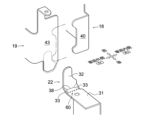
- FIG. 3 is an exploded perspective view of the protector shown in FIG. 2 .
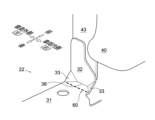
- 4 is an enlarged perspective view showing a main part of the protector shown in FIG. 3.
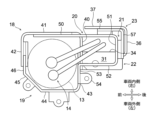
- FIG. 3 is a top view of the in-vehicle device and the protector shown in FIG. 2 . 3 is a diagram for explaining deformation of the protector and the accommodation chamber shown in FIG. 2 due to an external force.
- FIG. FIG. 7 is a perspective view for explaining the modification shown in FIG. 6 .
- the mounting structure for an on-board device disclosed herein is applied to a vehicle shown in the following embodiment.
- the on-board device relating to this mounting structure is provided inside the fender panel of the vehicle, and is mounted surrounded by a protector to the fender shield that forms part of the bottom surface of the accommodation chamber in which the on-board device is housed.
- the accommodation chamber referred to here includes, for example, an engine room, a motor room, a power unit room, etc.
- the on-board device referred to here includes the vehicle's drive-related devices (fuel filters, fuel pumps, canisters, air cleaners, various reservoir tanks, brake boosters, transformers, batteries, etc.) and other devices (air conditioning-related devices, electrical-related devices), etc.
- the definition of directions is that the front-to-rear direction (vehicle length direction) is defined based on the forward and backward direction of the vehicle, and the left-to-right direction (vehicle width direction) is defined based on the front-to-rear direction.
- the up-to-down direction is defined based on the state in which the vehicle is stopped on a flat road surface. Note that in the vehicle width direction, in the part to the left of the vehicle body centerline in a top view of the vehicle, the left is the outside of the vehicle and the right is the inside of the vehicle. Also, in the part to the right of the vehicle body centerline in a top view of the vehicle, the right is the outside of the vehicle and the left is the inside of the vehicle.
- FIG. 1 is an exploded perspective view for explaining a mounting structure of an in-vehicle device 12 as an embodiment.
- the in-vehicle device 12 is accommodated in a storage compartment 1 (power unit room) arranged at the front of the vehicle cabin where the occupants sit.
- the storage compartment 1 is a container-shaped space inside the vehicle in which at least the in-vehicle device 12 is accommodated.
- the location of the storage compartment 1 is not limited to the location shown in FIG. 1.
- the storage compartment 1 can also be arranged, for example, at the rear of the vehicle cabin.
- the mounting structure of this embodiment can be applied to a vehicle by inverting the overall shape in the left-right direction, and can also be applied to a vehicle by inverting the overall shape in the front-rear direction.
- the accommodation chamber 1 shown in FIG. 1 accommodates an engine (internal combustion engine as a drive unit) and an on-vehicle device 12 (fuel filter), not shown.
- An opening is provided at the upper end side of the accommodation chamber 1, and a bonnet hood (not shown) is attached to this opening so as to be freely opened and closed.
- the engine is disposed inside the accommodation chamber 1, for example, at a position from near the center in the left-right direction to the right side.
- the on-vehicle device 12 of this embodiment is a filter device for filtering fuel supplied to the engine, and is disposed on the left side inside the accommodation chamber 1 (to the left of the engine).
- the on-vehicle device 12 of this embodiment is also disposed in front of the cowl top panel 9.
- a pair of side members 2 are arranged below the accommodation chamber 1.
- the side members 2 are one of the skeletal members that are provided to extend in the front-to-rear direction, and are provided at a specified interval in the left-to-right direction.
- a front support member 3 (radiator core support member) is connected to the front end of each side member 2.
- the front support member 3 is a member that is provided to extend in the up-down direction, and has the function of supporting the radiator unit and headlamp unit that are attached to the front end of the vehicle.
- the front support members 3 are provided as a pair at the front end of the accommodation chamber 1, at a specified interval in the left-to-right direction.
- the lower ends of the left and right front support members 3 are connected almost horizontally by a front end cross member 4.
- the front end cross member 4 is one of the skeletal members that is arranged to extend in the left-right direction.
- the upper ends of the left and right front support members 3 are also connected almost horizontally by an upper bar 6.
- the upper bar 6 is a member for supporting the front end of the bonnet hood, and is arranged, for example, along the edge of the opening to which the bonnet hood is attached.
- the upper frame 5 is connected to both the left and right ends of the upper bar 6.
- the upper frame 5 is one of the components that extends almost horizontally forward from near the lower end of the vehicle's front pillar.
- a pair of upper frames 5 are arranged on the left and right at the top of the accommodation chamber 1.
- the front fender panel of the vehicle is attached to the outside of the upper frame 5.
- the front wheel tires and strut house (not shown) are arranged below the upper frame 5.
- the upper frame 5 and upper bar 6 function to support the portion of the bonnet hood from both the left and right end edges to the front end edge.
- the front subframe 7 is also connected to the front end of the upper frame 5.
- the front subframe 7 is a member that extends from the connection point between the upper frame 5 and the upper bar 6 toward the inside of the vehicle and toward the front and downward, and is connected near the lower end of the front support member 3.
- the front subframe 7 has the function of supporting the headlamp unit.
- the upper bar 6 and the front subframe 7 are arranged so that they branch out from the front end of the upper frame 5 and extend forward, and the headlamp unit is placed between them.
- a dash panel 8 is provided at the rear end of the accommodation compartment 1.
- the dash panel 8 is a planar member that divides the vehicle interior and the accommodation compartment 1 in the front-rear direction, and the space in front of the dash panel 8 forms the accommodation compartment 1.
- the dash panel 8 is erected to cover the rear end of the accommodation compartment 1, for example, from the upper end surface of the upper frame 5 to the upper end surface of the side member 2.
- the lower end of the dash panel 8 is provided to extend rearward in a planar manner along, for example, the upper end surface of the side member 2, and is connected to the floor panel of the vehicle interior so as to be approximately flush with the vehicle interior floor panel.
- a cowl top panel 9 is provided above the dash panel 8.
- the cowl top panel 9 is a planar member that connects the vicinity of the lower ends of the left and right front pillars in the left-right direction, and is connected to the vicinity of the upper edge of the dash panel 8.
- the cowl top panel 9 is provided to extend in the left-right direction along the rear edge of the bonnet hood (the base end for opening and closing operations). The lower edge of the vehicle's windshield (windshield) is supported by the cowl top panel 9.
- a fender shield 10 is attached inside the accommodation chamber 1.
- the fender shield 10 is a planar member that forms part of the bottom surface of the accommodation chamber 1 inside the vehicle's fender panel.
- a pair of fender shields 10 are provided on the inside of each of the left and right fender panels.
- the outer edge of the fender shield 10 on the vehicle side is connected to the upper frame 5 and the front subframe 7.
- the inner edge of the fender shield 10 on the vehicle side may be connected to the side member 2, or may be provided so as to be spaced apart above the side member 2.
- a protector 15 is fixed on top of the left fender shield 10.
- the protector 15 is a member that is attached to the vehicle-mounted device 12 so as to cover the periphery of the vehicle-mounted device 12 in order to protect the vehicle-mounted device 12.
- the protector 15 is fixed to the left fender shield 10.
- the right fender shield 10 to which the protector 15 is not fixed can be omitted.
- [B. Protector] 2 is a perspective view of the on-vehicle device 12 and the protector 15.
- the on-vehicle device 12 is provided with a filter body 13 and a pipe connection part 14.
- the filter body 13 is a cylindrical part in which a filter is built in.
- the upper surface side of the filter body 13 is releasably closed by, for example, a disk-shaped lid.
- the pipe connection part 14 is a part to which various pipe materials such as an inlet pipe for introducing fuel into the filter body 13 and an outlet pipe for discharging the fuel filtered in the filter body 13 are connected.
- the pipe connection part 14 is provided on the top surface of the filter body 13 so as to protrude upward beyond the lid.
- the protector 15 is fixed to the filter body 13 and functions to protect the filter body 13 and the pipe connection 14 from other devices and the vehicle body structure housed in the accommodation chamber 1.
- the protector 15 is provided with a body 16 and legs 17.
- the body 16 is the portion of the protector 15 that is attached to the vehicle-mounted device 12 so as to cover the periphery of the vehicle-mounted device 12.
- the legs 17 are provided on the lower part of the body 16 and are the portions that are fixed to the fender shield 10.
- a base 11 an auxiliary part included in the fender shield 10 may be provided at the fixing point of the fender shield 10 to adjust the mounting height.
- Fig. 3 is an exploded perspective view of the protector 15.
- Fig. 4 is an enlarged perspective view of the main parts of the protector 15, and
- Fig. 5 is a top view of the in-vehicle device 12 and the protector 15.
- the body 16 includes a right enclosing part 18 (enclosing part), a left enclosing part 19, an upper buffer part 20, and an auxiliary part 21.
- the legs 17 include a fixed part 22, a lower buffer part 23, a first auxiliary leg part 24, and a second auxiliary leg part 25.
- the right enclosing portion 18 is a member that is mainly disposed on the right side of the filter body portion 13.
- the right enclosing portion 18 is provided with a right rear portion 40, a right side portion 41, and a right front portion 42.
- Each of the right rear portion 40, the right side portion 41, and the right front portion 42 is disposed substantially vertically.
- the horizontal cross-sectional shape of the right enclosing portion 18 can be considered to be a shape that combines three straight portions (for example, a U-shape, a C-shape, or a channel shape).
- the right side portion 41 is a planar portion that widely covers the right side of the filter body 13.
- the right side portion 41 extends upward from the upper end of the piping connection portion 14 of the vehicle-mounted device 12.
- the right rear portion 40 is a planar portion that covers the rear side of the right side portion 41
- the right front portion 42 is a planar portion that covers the front side of the right side portion 41. Both the right rear portion 40 and the right front portion 42 are formed almost perpendicular to the right side portion 41.
- the right front portion 42 also extends upward from the upper end of the piping connection portion 14.
- the engine is disposed to the right of the right enclosing portion 18.
- the right enclosing portion 18 is disposed so as to separate the vehicle-mounted device 12 from the engine.
- the left enclosing portion 19 is a member that is mainly arranged on the left side of the filter main body portion 13.
- the right enclosing portion 18 and the left enclosing portion 19 are arranged to cover the entire outer periphery of the filter main body portion 13 when viewed from above the in-vehicle device 12.
- the left enclosing portion 19 is provided with a left rear surface portion 43, a left side surface portion 44, a left front side surface portion 45, and a left front surface portion 46.
- Each of the left rear surface portion 43, the left side surface portion 44, the left front side surface portion 45, and the left front surface portion 46 is arranged approximately vertically.
- the horizontal cross-sectional shape of the left enclosing portion 19 can be considered to be a shape formed by combining four straight line portions.
- the left side surface portion 44 is a flat portion that covers the left side of the filter body portion 13.
- the left rear surface portion 43 is a flat portion that covers the rear side of the left side surface portion 44 and is formed almost perpendicular to the left side surface portion 44.
- the left rear surface portion 43 is welded and fixed in a state of surface contact with the right rear surface portion 40 of the right enclosing portion 18.
- the left front side portion 45 and the left front portion 46 are each flat and cover the front side of the left side portion 44.
- the left front portion 46 is formed almost perpendicular to the left side portion 44, and the left front side portion 45 is formed to form a plane that intersects with the left side portion 44 and the left front portion 46.
- the left front portion 46 is welded and fixed in a state of surface contact with the right front portion 42 of the right enclosing portion 18.
- the upper end of the left rear surface portion 43 is provided with a left connecting portion 47 that is fastened to the upper buffer portion 20 described later.
- the left connecting portion 47 is formed by bending a flat portion extending upward from the left rear surface portion 43 rearward and drilling a fastening hole near the tip of the left connecting portion 47 into which a fastening tool is inserted.
- a first auxiliary leg 24 is provided at the lower end of the left side surface portion 44
- a second auxiliary leg 25 is provided at the lower end of the left front side surface portion 45.
- the first auxiliary leg 24 and the second auxiliary leg 25 are each fixed to the fender shield 10 via a fastening tool.
- the first auxiliary leg 24 and the second auxiliary leg 25 may be formed integrally with the left enclosing portion 19, or may be formed as a separate member fixed to the left enclosing portion 19.
- the upper buffer section 20 is a section that has a shape that protrudes toward the rear of the vehicle when viewed from above the on-board device 12.
- the upper buffer section 20 When viewed from the side of the on-board device 12, the upper buffer section 20 is disposed in front of the cowl top panel 9, and is the section that comes into contact with the cowl top panel 9 first if, for example, the shape of the accommodation chamber 1 itself is deformed by an external force.
- the space inside the upper buffer section 20 is used as a space for routing various piping materials (inlet pipes, exhaust pipes, etc.) that are connected to the on-board device 12.
- the upper buffer section 20 is provided with an upper right side section 50, an upper rear section 51, an upper left side section 52, and an upper extension section 53.
- Each of the upper right side section 50, the upper rear section 51, the upper left side section 52, and the upper extension section 53 is disposed substantially vertically.
- the horizontal cross-sectional shape of the upper buffer section 20 can be considered to be a shape formed by combining four straight line sections.
- the upper right side surface portion 50 is a flat portion that is welded and fixed in surface contact with the right side surface portion 41.
- the upper end of the upper right side surface portion 50 is at approximately the same height as the upper end of the right side surface portion 41.
- the upper rear portion 51 is a planar portion formed to extend leftward from the rear end of the upper right side portion 50, and is formed approximately perpendicular to the upper right side portion 50. As shown in Fig. 5, the position of the upper rear portion 51 in the front-rear direction is set to a position that is rearward of the rear end of the filter main body 13 when viewed from above the in-vehicle device 12, and that ensures a gap through which various piping materials can be easily inserted.
- the upper left side surface portion 52 is a planar portion connected to the left side of the upper rear side surface portion 51, and is formed approximately parallel to the upper right side surface portion 50. As shown in Fig. 5, the left-right position of the upper left side surface portion 52 is close to the left-right center of the filter body 13 and is set at a position that ensures sufficient clearance for various piping materials to be inserted without difficulty.
- the upper extension portion 53 is a planar portion extending leftward from the front end of the upper left surface portion 52, and is formed substantially parallel to the upper rear surface portion 51. The position of the upper extension portion 53 in the front-rear direction is set to a position adjacent to the rear end of the filter main body 13 when viewed from above the in-vehicle device 12, as shown in FIG.
- the lower end of the upper extension 53 is provided with an upper connecting portion 54 that is fastened to the left connecting portion 47 of the left enclosing portion 19.
- the upper connecting portion 54 is a planar portion that extends downward from the upper extension 53 and is bent backward, with a fastening hole drilled near its tip into which a fastener is inserted.
- the auxiliary part 21 is a member that is attached below the upper buffer part 20 to enhance the protection of various piping materials.
- the auxiliary part 21 is provided with a right auxiliary part 55, a right mounting part 56, a rear auxiliary part 57, and a rear mounting part 58.
- the horizontal cross-sectional shapes of the right auxiliary part 55 and the rear auxiliary part 57 can be considered to be two straight parts connected vertically (e.g., L-shaped, mountain-shaped, or angle-shaped).
- the right mounting portion 56 is a planar portion welded to the right surface of the upper right side portion 50 in face-to-face contact
- the rear mounting portion 58 is a planar portion welded to the rear surface of the upper rear side portion 51 in face-to-face contact
- the right auxiliary portion 55 is a planar portion having a plate surface parallel to the right mounting portion 56
- the rear auxiliary portion 57 is a planar portion having a plate surface parallel to the rear mounting portion 58. As shown in FIG.
- the right auxiliary portion 55 is disposed so as to be spaced to the right of the upper right side portion 50, and the rear auxiliary portion 57 is disposed so as to be spaced to the rear of the upper rear side portion 51.
- the fixing portion 22 is one of the legs 17 for fixing the vehicle-mounted device 12 to the fender shield 10.
- the fixing portion 22 is provided rearward of the vehicle-mounted device 12.
- the fixing portion 22 is provided with a first surface portion 31, a second surface portion 32, a deformation inducing portion 33, and a third surface portion 34.
- the fixing portion 22 is formed, for example, by press-molding a single steel plate.
- the first surface portion 31 is a portion that is fixed to the fender shield 10, and is formed in a plane that follows a portion of the fender shield 10.
- the first surface portion 31 is planar, and is fastened and fixed in a state of surface contact with the upper surface of the base portion 11.
- the first surface portion 31 is preferably disposed substantially flat and substantially horizontally.
- the left-right width of the first surface portion 31 is set so that the first surface portion 31 occupies approximately half of the area surrounded by the upper buffer portion 20 when viewed from above the in-vehicle device 12. This ensures a gap that allows various piping materials to be easily inserted on the inside (right side) of the vehicle beyond the first surface portion 31, as shown in FIG. 5.
- the second surface 32 is a portion fixed to the body 16, has a shape that stands upright relative to the first surface 31, and is formed in a plane along a part of the body 16.
- the second surface 32 is planar, formed almost perpendicular to the first surface 31, and is welded and fixed in a state of surface contact with the left rear surface 43 of the left enclosing portion 19.
- the second surface 32 in this embodiment is fixed to a portion of the protector 15 that covers the rear of the in-vehicle device 12.
- the first surface 31 connected to the second surface 32 is provided so as to extend toward the rear of the in-vehicle device 12 beyond the second surface 32.
- the ridge 38 that forms the boundary between the first surface 31 and the second surface 32 extends in an approximately straight line along the vehicle width direction.
- the deformation inducing portion 33 is a portion formed between the first surface portion 31 and the second surface portion 32, and is a portion that induces deformation on the first surface portion 31 side relative to the ridge line 38 when the leg portion 17 is deformed by an external force.
- the deformation inducing portion 33 when an external force that can deform the fixing portion 22 acts on the leg portion 17, the deformation inducing portion 33 is a portion that promotes bending deformation on the first surface portion 31 side while minimizing deformation of the second surface portion 32.
- the deformation inducing portion 33 functions as a reinforcing surface portion that reinforces the second surface portion 32 and the vicinity of the ridge line 38.
- the deformation inducing portion 33 in this embodiment is a portion formed by press molding, and is formed in a plane that intersects with both the first surface portion 31 and the second surface portion 32, and is disposed at the end (at least one end) of the ridge line 38 that forms the boundary between the first surface portion 31 and the second surface portion 32, and is preferably disposed in pairs at both ends of the ridge line 38.
- the deformation inducing portion 33 functions to impart appropriate rigidity to the ridge line 38, which is the boundary portion (bent portion) between the first surface portion 31 and the second surface portion 32.
- the deformation inducing portion 33 may be formed in a flat shape or a curved shape, or may be formed in a shape with reinforcing bumps and ribs formed on the flat surface.
- the pair of deformation inducing portions 33 are formed in a plane symmetrical shape with respect to a plane perpendicular to the first surface portion 31 and the second surface portion 32.
- the direction in which deformation is likely to occur near the ridge line 38 of the first surface portion 31 and the second surface portion 32 becomes the direction of rotation in the plane perpendicular to the first surface portion 31 and the second surface portion 32.
- the fixing portion 22 is likely to bend and deform at a bend line portion 60 located closer to the first surface portion 31 than the ridge line 38.
- This bend line portion 60 is approximately parallel to the ridge line 38.
- the axis of rotation when the fixing portion 22 bends and deforms tends to be parallel to the ridge line 38 of the first surface portion 31 and the second surface portion 32, making it easier to control the position and shape after bending and deformation.
- the third surface portion 34 is a planar portion that is provided so as to extend downward from a side edge of the first surface portion 31.
- the third surface portion 34 is formed substantially perpendicular to the first surface portion 31.
- the lower buffer section 23 is a section having a shape that protrudes toward the rear of the vehicle when viewed from above the in-vehicle device 12. As shown in Fig. 5, the lower buffer section 23 is disposed so as to overlap with the upper buffer section 20. As a result, the space inside the lower buffer section 23 is also used as a space for routing various piping materials connected to the in-vehicle device 12.
- the lower buffer section 23 is provided with a lower left surface section 35, a lower rear surface section 36, and a lower right surface section 37.
- the lower left surface section 35, the lower rear surface section 36, and the lower right surface section 37 are each disposed substantially vertically.
- the horizontal cross-sectional shape of the lower buffer section 23 can be considered to be a shape combining three linear portions (e.g., a U-shape, a C-shape, or a channel shape).
- the lower left surface portion 35 is a flat portion that is welded and fixed to the third surface portion 34 of the fixing portion 22 in surface contact therewith.
- the lower rear surface portion 36 is a planar portion formed so as to extend rightward from the rear end portion of the lower left surface portion 35, and is formed substantially perpendicular to the lower left surface portion 35.
- the position of the lower rear surface portion 36 in the front-rear direction is set rearward of the rear auxiliary portion 57 when viewed from above the in-vehicle device 12, as shown in FIG.
- the lower right surface portion 37 is a planar portion formed to extend forward from the right end portion of the lower rear surface portion 36, and is formed substantially perpendicular to the lower rear surface portion 36.
- the left-right position of the lower right surface portion 37 is set to the right of the right auxiliary portion 55 when viewed from above the in-vehicle device 12, as shown in FIG.
- the right rear surface 40 of the right enclosing portion 18 and the second surface 32 of the fixing portion 22 are welded to the left rear surface 43 of the left enclosing portion 19 so as not to overlap.
- the dashed line in FIG. 4 is the contour line of the second surface 32 fixed to the left rear surface 43
- the dashed line in FIG. 4 is the contour line of the right rear surface 40 fixed to the left rear surface 43.
- the lower end of the left rear surface 43 which is fixed to the second surface 32, extends to a position close to the ridge 38 of the first surface 31 and the second surface 32.
- the rigidity of the second surface 32 side is relatively high and the rigidity of the first surface 31 side is relatively low, with the ridge 38 of the first surface 31 and the second surface 32 as the boundary.
- the portion on the first surface 31 side is more likely to bend and deform than the ridge 38 of the first surface 31 and the second surface 32. Therefore, the bending deformation of the portion on the left rear surface 43 side to which the second surface 32 is fixed is relatively suppressed, and the protection performance of the in-vehicle device 12 is improved.
- Action 6 is a diagram for explaining the deformation of the accommodation chamber 1 and the protector 15 due to an external force indicated by a white arrow.
- these members move rearward together with the side member 2 and the front subframe 7, and the fender shield 10 may be deformed into a folded state.
- the protector 15 of the on-vehicle device 12 fixed to the fender shield 10 also moves rearward with the deformation of the fender shield 10.
- the upper buffer portion 20 of the protector 15 abuts against the cowl top panel 9.
- the cowl top panel 9 is pushed rearward and upward, and the upper buffer portion 20 itself deforms to absorb the impact, thereby effectively protecting the on-vehicle device 12.
- the protector 15 is provided with a fixing portion 22 having a first surface portion 31 and a second surface portion 32.
- the first surface portion 31 is fixed to the fender shield 10 (base portion 11), and the second surface portion 32 is fixed to the body portion 16 of the protector 15 with a shape that stands upright relative to the first surface portion 31.
- the fixing portion 22 is easier to deform so that the angle formed by the first surface portion 31 and the second surface portion 32 increases, improving the effect of suppressing the rearward tilt of the vehicle-mounted device 12.
- the fixed state of the first surface portion 31 relative to the fender shield 10 is easier to maintain, and the effect of suppressing the forward tilt of the vehicle-mounted device 12 is also improved. Therefore, the posture of the vehicle-mounted device 12 is maintained almost vertically, and it is easier to ensure a buffer space between the dash panel 8 and the vehicle-mounted device 12.
- a deformation inducer 33 is formed between the first surface 31 and the second surface 32. This ensures appropriate rigidity for the fixing portion 22, and promotes deformation in the portion closer to the first surface 31 than the ridge line 38 of the first surface 31 and the second surface 32 when the leg 17 is deformed by an external force.
- a left rear surface 43 is fixed to the back side of the second surface 32, extending to a position close to the ridge line 38 of the first surface 31 and the second surface 32. This makes the second surface 32 side closer to the ridge line 38 more rigid than the first surface 31 side. Therefore, as shown by the dashed line in FIG. 7, bending deformation is more likely to occur at the bend line portion 60 located closer to the first surface 31 than the ridge line 38, and bending deformation on the second surface 32 side is suppressed.
- the above mounting structure is a mounting structure for an on-vehicle device 12 that is mounted to the fender shield 10 while being surrounded by a protector 15.
- the protector 15 includes a body portion 16 that is attached to the on-vehicle device 12 so as to cover the periphery of the on-vehicle device 12, and a leg portion 17 that is provided on a lower portion of the body portion 16 and fixed to the fender shield 10.
- the leg portion 17 has a first surface portion 31, a second surface portion 32, and a deformation inducing portion 33.
- the first surface portion 31 is fixed to the fender shield 10.
- the second surface portion 32 is formed in a shape that stands upright relative to the first surface portion 31 and is fixed to the body portion 16.
- the deformation inducing portion 33 induces deformation on the first surface portion 31 side relative to a ridge line 38 that forms a boundary between the first surface portion 31 and the second surface portion 32 when the leg portion 17 is deformed by an external force.
- the deformation inducing portion 33 may be disposed, for example, at the end of the ridge line 38 (i.e., one end), or may be formed in a surface that intersects with both the first surface portion 31 and the second surface portion 32.
- This configuration provides a simple shape that is easy to process and form, and provides appropriate rigidity in the vicinity of the ridge line 38, and can more reliably induce deformation on the first surface portion 31 side of the ridge line 38. This improves the protective performance of the in-vehicle device 12 while stabilizing its mounting state.
- the deformation inducing portion 33 may be provided at both ends of the ridge line 38.
- the fold line portion 60 can be made approximately parallel to the ridge line 38, and bending deformation on the second surface portion 32 side can be more reliably prevented.
- the overall shape of the protector 15 can be designed after predicting the position and shape of the leg portion 17 after the fold line portion 60 is bent, making it easier to control the deformation state of the protector 15.
- the first surface 31 may be formed to be substantially flat. This configuration can create a gap in the bending rigidity of the first surface 31 relative to the second surface 32, and can promote deformation on the first surface 31 side relative to the ridge line 38. This can improve the protection performance of the in-vehicle device 12.
- a portion of the body 16 (left rear surface 43) to which the second surface 32 is fixed may be extended to a position close to the ridge line 38 of the first surface 31 and the second surface 32, as shown in FIG. 4.
- the second surface 32 side of the ridge line 38 has higher rigidity than the first surface 31 side. Therefore, as shown by the dashed line in FIG. 7, bending deformation at the fold line portion 60 on the first surface 31 side of the boundary portion between the first surface 31 and the second surface 32 can be promoted, and bending deformation on the second surface 32 side can be suppressed. Therefore, deformation or damage to the filter body 13 caused by deformation of the second surface 32 or the left rear surface 43 can be prevented, and the protective performance of the in-vehicle device 12 can be improved.
- the body 16 of the protector 15 may be disposed in front of the cowl top panel 9 in a side view and have an upper buffer section 20 that protrudes toward the rear of the vehicle in a top view.
- the upper buffer section 20 can be brought into contact with the cowl top panel 9 quickly. This prevents interference between the in-vehicle device 12 and the cowl top panel 9, and enhances the effect of suppressing the rearward tilt of the in-vehicle device 12.
- cowl top panel 9 can be pushed rearward and upward, improving the protective performance of the on-board device 12.
- deformation of the upper buffer section 20 itself can absorb the impact, improving the protective performance of the on-board device 12.
- routing the piping connection section 14 and various piping materials inside the upper buffer section 20 damage to these items can be effectively prevented.
- the legs 17 of the protector 15 may have a shape that protrudes toward the rear of the vehicle when viewed from above, and may have a lower buffer section 23 that is arranged to overlap the upper buffer section 20.
- the inside of the upper buffer section 20 and the lower buffer section 23 can be easily used as a space for routing the pipe connection section 14 and various pipe materials, and damage to these can be effectively prevented.
- the in-vehicle device 12 may be disposed to the side of the vehicle's drive source.
- the body portion 16 may have a right enclosing portion 18 (enclosing portion) that separates the in-vehicle device 12 from the drive source in a top view and extends above the upper end of the in-vehicle device 12. This configuration can prevent interference between the piping connection portion 14 and the drive source, improving the protective performance of the in-vehicle device 12.
- the components constituting the protector 15 in the above embodiment can be modified as appropriate and can be partially omitted.
- the upper buffer section 20, the lower buffer section 23, and the auxiliary section 21 can be omitted, or an integrated member corresponding to the right enclosing section 18 and the left enclosing section 19 can be provided as the body section 16.
- a protector 15 having at least the body section 16 and the legs 17 a structure that provides the same effect as the above embodiment can be realized by providing the legs 17 with the first surface section 31, the second surface section 32, and the deformation inducing section 33.
- the fender shield 10 in the above embodiment may be a planar member that forms part of the bottom surface of the accommodation chamber 1 inside the vehicle's fender panel, and may be, for example, part of the bottom surface of the rear power unit room inside the rear fender panel.
- the accommodation chamber 1 is disposed at the rear of the vehicle cabin.
- a protector 15 that is fixed to such a fender shield 10 a structure that provides the same effect as the above embodiment can be realized by providing a first surface portion 31, a second surface portion 32, and a deformation inducing portion 33 on the leg portion 17.
- This invention can be used as a mounting structure for vehicle-mounted devices, and can be used in the vehicle manufacturing industry where vehicle-mounted devices are mounted via the mounting structure.
- Reference Signs List 1 Storage compartment 2: Side member 3: Front support member 4: Front end cross member 5: Upper frame 6: Upper bar 7: Front subframe 8: Dash panel 9: Cowl top panel 10: Fender shield 11: Base 12: Vehicle-mounted device 13: Filter body 14: Pipe connection 15: Protector 16: Body 17: Leg 18: Right surrounding portion (enclosure portion) 19 Left surrounding part 20 Upper buffer part 21 Auxiliary part 22 Fixing part 23 Lower buffer part 24 First auxiliary leg part 25 Second auxiliary leg part 31 First surface part 32 Second surface part 33 Deformation inducing part 34 Third surface part 35 Lower left surface part 36 Lower rear surface part 37 Lower right surface part 38 Ridge line 40 Right rear surface part 41 Right side part 42 Right front part 43 Surface part 44 Left side part 45 Left front side part 46 Left front part 47 Left connecting part 50 Upper right side part 51 Upper rear part 52 Upper left part 53 Upper extension part 54 Upper connecting part 55 Right auxiliary part 56 Right attachment part 57 Rear auxiliary part 58 Rear attachment part 60 Broken line part
Landscapes
- Engineering & Computer Science (AREA)
- Chemical & Material Sciences (AREA)
- Combustion & Propulsion (AREA)
- Mechanical Engineering (AREA)
- General Engineering & Computer Science (AREA)
- Transportation (AREA)
- Body Structure For Vehicles (AREA)
Priority Applications (2)
| Application Number | Priority Date | Filing Date | Title |
|---|---|---|---|
| JP2025503256A JPWO2024180623A1 (https=) | 2023-02-27 | 2023-02-27 | |
| PCT/JP2023/007109 WO2024180623A1 (ja) | 2023-02-27 | 2023-02-27 | 車載装置の取付構造 |
Applications Claiming Priority (1)
| Application Number | Priority Date | Filing Date | Title |
|---|---|---|---|
| PCT/JP2023/007109 WO2024180623A1 (ja) | 2023-02-27 | 2023-02-27 | 車載装置の取付構造 |
Publications (1)
| Publication Number | Publication Date |
|---|---|
| WO2024180623A1 true WO2024180623A1 (ja) | 2024-09-06 |
Family
ID=92589524
Family Applications (1)
| Application Number | Title | Priority Date | Filing Date |
|---|---|---|---|
| PCT/JP2023/007109 Ceased WO2024180623A1 (ja) | 2023-02-27 | 2023-02-27 | 車載装置の取付構造 |
Country Status (2)
| Country | Link |
|---|---|
| JP (1) | JPWO2024180623A1 (https=) |
| WO (1) | WO2024180623A1 (https=) |
Citations (6)
| Publication number | Priority date | Publication date | Assignee | Title |
|---|---|---|---|---|
| JPH11287128A (ja) * | 1998-04-01 | 1999-10-19 | Nissan Motor Co Ltd | セジメンタの保護構造 |
| JP2006132362A (ja) * | 2004-11-04 | 2006-05-25 | Nissan Motor Co Ltd | 燃料フィルタの取り付け構造 |
| JP2006199102A (ja) * | 2005-01-19 | 2006-08-03 | Mazda Motor Corp | 車体前部構造 |
| JP2011011669A (ja) * | 2009-07-03 | 2011-01-20 | Suzuki Motor Corp | 車両用エンジンの燃料フィルタ装置 |
| JP2014008940A (ja) * | 2012-07-03 | 2014-01-20 | Mitsubishi Motors Corp | 燃料フィルターのブラケット |
| JP2015121157A (ja) * | 2013-12-24 | 2015-07-02 | 三菱自動車工業株式会社 | 燃料フィルタの保持装置 |
-
2023
- 2023-02-27 JP JP2025503256A patent/JPWO2024180623A1/ja active Pending
- 2023-02-27 WO PCT/JP2023/007109 patent/WO2024180623A1/ja not_active Ceased
Patent Citations (6)
| Publication number | Priority date | Publication date | Assignee | Title |
|---|---|---|---|---|
| JPH11287128A (ja) * | 1998-04-01 | 1999-10-19 | Nissan Motor Co Ltd | セジメンタの保護構造 |
| JP2006132362A (ja) * | 2004-11-04 | 2006-05-25 | Nissan Motor Co Ltd | 燃料フィルタの取り付け構造 |
| JP2006199102A (ja) * | 2005-01-19 | 2006-08-03 | Mazda Motor Corp | 車体前部構造 |
| JP2011011669A (ja) * | 2009-07-03 | 2011-01-20 | Suzuki Motor Corp | 車両用エンジンの燃料フィルタ装置 |
| JP2014008940A (ja) * | 2012-07-03 | 2014-01-20 | Mitsubishi Motors Corp | 燃料フィルターのブラケット |
| JP2015121157A (ja) * | 2013-12-24 | 2015-07-02 | 三菱自動車工業株式会社 | 燃料フィルタの保持装置 |
Also Published As
| Publication number | Publication date |
|---|---|
| JPWO2024180623A1 (https=) | 2024-09-06 |
Similar Documents
| Publication | Publication Date | Title |
|---|---|---|
| CN103587366B (zh) | 用于车辆的减震器外壳支撑装置 | |
| CN104245487B (zh) | 车身前部构造 | |
| JP6235622B2 (ja) | 自動車の車体構造 | |
| US6633089B2 (en) | Engine room harness routing structure | |
| JP5482482B2 (ja) | フロントウインド支持構造 | |
| JP2010105585A (ja) | 自動車のステアリング支持構造 | |
| CN115503835A (zh) | 车辆前部构造 | |
| JP4736455B2 (ja) | モータルーム内部品搭載構造およびモータルーム内衝撃吸収構造 | |
| JP5280829B2 (ja) | コンソール衝撃吸収部構造 | |
| JP4580350B2 (ja) | 車体前部構造 | |
| JP2010023661A (ja) | 車体前部構造 | |
| JP2020075657A (ja) | 車両前部構造 | |
| US12202549B2 (en) | Vehicle front part structure | |
| WO2024180623A1 (ja) | 車載装置の取付構造 | |
| JP5688394B2 (ja) | 車体前部構造 | |
| JP2003118640A (ja) | 自動車の車体前部構造 | |
| JP2002046648A (ja) | 自動車における車体前部の衝撃力吸収構造 | |
| JP7661728B2 (ja) | 車両前部構造 | |
| JP4899597B2 (ja) | 重量積載物支持構造 | |
| JP2002274433A (ja) | ステアリングコラムの支持構造 | |
| WO2024180622A1 (ja) | 車体構造 | |
| JP6460165B2 (ja) | 自動車のシュラウドパネル構造及びその組付け方法 | |
| JP6460164B2 (ja) | 自動車の前部構造 | |
| JP4471299B2 (ja) | 自動車の車体前部構造 | |
| JP6107796B2 (ja) | 自動車の前部構造 |
Legal Events
| Date | Code | Title | Description |
|---|---|---|---|
| 121 | Ep: the epo has been informed by wipo that ep was designated in this application |
Ref document number: 23925181 Country of ref document: EP Kind code of ref document: A1 |
|
| WWE | Wipo information: entry into national phase |
Ref document number: 2025503256 Country of ref document: JP |
|
| WWE | Wipo information: entry into national phase |
Ref document number: 2501005267 Country of ref document: TH |
|
| NENP | Non-entry into the national phase |
Ref country code: DE |
|
| 122 | Ep: pct application non-entry in european phase |
Ref document number: 23925181 Country of ref document: EP Kind code of ref document: A1 |