WO2024157935A1 - 積層体およびディスプレイ - Google Patents
積層体およびディスプレイ Download PDFInfo
- Publication number
- WO2024157935A1 WO2024157935A1 PCT/JP2024/001665 JP2024001665W WO2024157935A1 WO 2024157935 A1 WO2024157935 A1 WO 2024157935A1 JP 2024001665 W JP2024001665 W JP 2024001665W WO 2024157935 A1 WO2024157935 A1 WO 2024157935A1
- Authority
- WO
- WIPO (PCT)
- Prior art keywords
- film
- resin
- polyimide
- hard coat
- bis
- Prior art date
- Legal status (The legal status is an assumption and is not a legal conclusion. Google has not performed a legal analysis and makes no representation as to the accuracy of the status listed.)
- Ceased
Links
Images
Classifications
-
- B—PERFORMING OPERATIONS; TRANSPORTING
- B32—LAYERED PRODUCTS
- B32B—LAYERED PRODUCTS, i.e. PRODUCTS BUILT-UP OF STRATA OF FLAT OR NON-FLAT, e.g. CELLULAR OR HONEYCOMB, FORM
- B32B17/00—Layered products essentially comprising sheet glass, or glass, slag, or like fibres
- B32B17/06—Layered products essentially comprising sheet glass, or glass, slag, or like fibres comprising glass as the main or only constituent of a layer, next to another layer of a specific material
- B32B17/10—Layered products essentially comprising sheet glass, or glass, slag, or like fibres comprising glass as the main or only constituent of a layer, next to another layer of a specific material of synthetic resin
-
- G—PHYSICS
- G09—EDUCATION; CRYPTOGRAPHY; DISPLAY; ADVERTISING; SEALS
- G09F—DISPLAYING; ADVERTISING; SIGNS; LABELS OR NAME-PLATES; SEALS
- G09F9/00—Indicating arrangements for variable information in which the information is built-up on a support by selection or combination of individual elements
- G09F9/30—Indicating arrangements for variable information in which the information is built-up on a support by selection or combination of individual elements in which the desired character or characters are formed by combining individual elements
- G09F9/301—Indicating arrangements for variable information in which the information is built-up on a support by selection or combination of individual elements in which the desired character or characters are formed by combining individual elements flexible foldable or roll-able electronic displays, e.g. thin LCD, OLED
-
- B—PERFORMING OPERATIONS; TRANSPORTING
- B32—LAYERED PRODUCTS
- B32B—LAYERED PRODUCTS, i.e. PRODUCTS BUILT-UP OF STRATA OF FLAT OR NON-FLAT, e.g. CELLULAR OR HONEYCOMB, FORM
- B32B27/00—Layered products comprising a layer of synthetic resin
- B32B27/28—Layered products comprising a layer of synthetic resin comprising synthetic resins not wholly covered by any one of the sub-groups B32B27/30 - B32B27/42
- B32B27/281—Layered products comprising a layer of synthetic resin comprising synthetic resins not wholly covered by any one of the sub-groups B32B27/30 - B32B27/42 comprising polyimides
-
- B—PERFORMING OPERATIONS; TRANSPORTING
- B32—LAYERED PRODUCTS
- B32B—LAYERED PRODUCTS, i.e. PRODUCTS BUILT-UP OF STRATA OF FLAT OR NON-FLAT, e.g. CELLULAR OR HONEYCOMB, FORM
- B32B27/00—Layered products comprising a layer of synthetic resin
- B32B27/30—Layered products comprising a layer of synthetic resin comprising vinyl (co)polymers; comprising acrylic (co)polymers
- B32B27/308—Layered products comprising a layer of synthetic resin comprising vinyl (co)polymers; comprising acrylic (co)polymers comprising acrylic (co)polymers
-
- B—PERFORMING OPERATIONS; TRANSPORTING
- B32—LAYERED PRODUCTS
- B32B—LAYERED PRODUCTS, i.e. PRODUCTS BUILT-UP OF STRATA OF FLAT OR NON-FLAT, e.g. CELLULAR OR HONEYCOMB, FORM
- B32B27/00—Layered products comprising a layer of synthetic resin
- B32B27/34—Layered products comprising a layer of synthetic resin comprising polyamides
-
- B—PERFORMING OPERATIONS; TRANSPORTING
- B32—LAYERED PRODUCTS
- B32B—LAYERED PRODUCTS, i.e. PRODUCTS BUILT-UP OF STRATA OF FLAT OR NON-FLAT, e.g. CELLULAR OR HONEYCOMB, FORM
- B32B7/00—Layered products characterised by the relation between layers; Layered products characterised by the relative orientation of features between layers, or by the relative values of a measurable parameter between layers, i.e. products comprising layers having different physical, chemical or physicochemical properties; Layered products characterised by the interconnection of layers
- B32B7/04—Interconnection of layers
- B32B7/12—Interconnection of layers using interposed adhesives or interposed materials with bonding properties
-
- G—PHYSICS
- G02—OPTICS
- G02B—OPTICAL ELEMENTS, SYSTEMS OR APPARATUS
- G02B1/00—Optical elements characterised by the material of which they are made; Optical coatings for optical elements
- G02B1/10—Optical coatings produced by application to, or surface treatment of, optical elements
- G02B1/14—Protective coatings, e.g. hard coatings
-
- B—PERFORMING OPERATIONS; TRANSPORTING
- B32—LAYERED PRODUCTS
- B32B—LAYERED PRODUCTS, i.e. PRODUCTS BUILT-UP OF STRATA OF FLAT OR NON-FLAT, e.g. CELLULAR OR HONEYCOMB, FORM
- B32B2255/00—Coating on the layer surface
- B32B2255/10—Coating on the layer surface on synthetic resin layer or on natural or synthetic rubber layer
-
- B—PERFORMING OPERATIONS; TRANSPORTING
- B32—LAYERED PRODUCTS
- B32B—LAYERED PRODUCTS, i.e. PRODUCTS BUILT-UP OF STRATA OF FLAT OR NON-FLAT, e.g. CELLULAR OR HONEYCOMB, FORM
- B32B2255/00—Coating on the layer surface
- B32B2255/26—Polymeric coating
-
- B—PERFORMING OPERATIONS; TRANSPORTING
- B32—LAYERED PRODUCTS
- B32B—LAYERED PRODUCTS, i.e. PRODUCTS BUILT-UP OF STRATA OF FLAT OR NON-FLAT, e.g. CELLULAR OR HONEYCOMB, FORM
- B32B2307/00—Properties of the layers or laminate
- B32B2307/40—Properties of the layers or laminate having particular optical properties
- B32B2307/412—Transparent
-
- B—PERFORMING OPERATIONS; TRANSPORTING
- B32—LAYERED PRODUCTS
- B32B—LAYERED PRODUCTS, i.e. PRODUCTS BUILT-UP OF STRATA OF FLAT OR NON-FLAT, e.g. CELLULAR OR HONEYCOMB, FORM
- B32B2307/00—Properties of the layers or laminate
- B32B2307/50—Properties of the layers or laminate having particular mechanical properties
- B32B2307/514—Oriented
-
- B—PERFORMING OPERATIONS; TRANSPORTING
- B32—LAYERED PRODUCTS
- B32B—LAYERED PRODUCTS, i.e. PRODUCTS BUILT-UP OF STRATA OF FLAT OR NON-FLAT, e.g. CELLULAR OR HONEYCOMB, FORM
- B32B2307/00—Properties of the layers or laminate
- B32B2307/70—Other properties
- B32B2307/732—Dimensional properties
- B32B2307/737—Dimensions, e.g. volume or area
- B32B2307/7375—Linear, e.g. length, distance or width
- B32B2307/7376—Thickness
-
- B—PERFORMING OPERATIONS; TRANSPORTING
- B32—LAYERED PRODUCTS
- B32B—LAYERED PRODUCTS, i.e. PRODUCTS BUILT-UP OF STRATA OF FLAT OR NON-FLAT, e.g. CELLULAR OR HONEYCOMB, FORM
- B32B2379/00—Other polymers having nitrogen, with or without oxygen or carbon only, in the main chain
- B32B2379/08—Polyimides
-
- B—PERFORMING OPERATIONS; TRANSPORTING
- B32—LAYERED PRODUCTS
- B32B—LAYERED PRODUCTS, i.e. PRODUCTS BUILT-UP OF STRATA OF FLAT OR NON-FLAT, e.g. CELLULAR OR HONEYCOMB, FORM
- B32B2457/00—Electrical equipment
- B32B2457/20—Displays, e.g. liquid crystal displays, plasma displays
Definitions
- the present invention relates to a laminate in which thin glass and a transparent resin film are bonded together, and a display including the laminate.
- Thin, bendable glass is used as the cover window material for the surface of flexible displays. Although glass has high optical transparency and improves the visibility of display devices, concerns remain that thin glass, which is thin, is prone to breaking due to strong impacts or cracks on the edges.
- Patent Document 1 proposes using a laminate made by laminating thin glass and a transparent polyimide film with a hard coat as a cover window material for flexible displays. Because transparent polyimide film has good mechanical properties, a laminate made by laminating thin glass and a transparent polyimide film has excellent impact resistance and prevents glass from shattering, providing high protection for displays.
- Polyimide has a high refractive index, and the difference in refractive index between the air interface and the interface with other materials causes a lot of light reflection (high reflectance) and a low total light transmittance, so if a laminate made by bonding thin glass and transparent polyimide film is used as a cover window material, it can cause a decrease in the brightness of the display.
- transparent polyimide has an absorption band that overlaps with the short wavelength range of visible light, so it is colored slightly yellow, which can affect the hue (tone) of the display.
- Transparent polyimide film has excellent mechanical strength, and laminates made by bonding thin glass and transparent polyimide film are less likely to develop dents due to pressure from a fingernail or touch pen, or from sliding. However, once a dent occurs, it is difficult to recover over time and the dent remains, adversely affecting the visibility of the display. For this reason, there is a demand for a cover window material that will recover over time even if a dent occurs due to an external force.
- the present invention aims to provide a cover window material that has excellent transparency and dent recovery properties.
- the laminate of the present invention comprises thin glass having a thickness of 100 ⁇ m or less, and a transparent resin film laminated to one of the main surfaces of the thin glass.
- the transparent resin film contains a polyimide resin and a solvent-soluble resin other than a polyimide resin.
- the refractive index of the transparent resin film is preferably 1.600 or less.
- Acrylic resins are preferred as solvent-soluble resins, and among them, those containing methyl methacrylate as the main component are preferred.
- the polyimide-based resin is a polyimide or polyamide-imide, and contains a tetracarboxylic dianhydride-derived structure and a diamine-derived structure.
- the polyimide-based resin is preferably a polyimide.
- the polyimide-based resin preferably contains a fluorine-containing aromatic tetracarboxylic dianhydride and an alicyclic tetracarboxylic dianhydride as the tetracarboxylic dianhydride, and a fluorine-containing diamine as the diamine.
- the transparent resin film may be a stretched film.
- the transparent resin film may have a thickness of 20 to 55 ⁇ m.
- the transparent resin film may have a total light transmittance of 90.5% or more.
- the transparent resin film may have a hard coat layer on the main surface thereof. That is, the laminate of the present invention may be a transparent film (hard coat film) having a hard coat layer on the main surface thereof, laminated to thin glass. Examples of materials for the hard coat layer include acrylic hard coat materials and siloxane hard coat materials. The thickness of the hard coat layer may be 1 to 50 ⁇ m.
- the laminate of the present invention has high total light transmittance and dent recovery properties, making it suitable for use as a cover window material for displays.
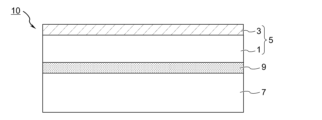
- FIG. 2 is a cross-sectional view of a laminate according to one embodiment.
- FIG. 1 is a cross-sectional view of a laminate according to one embodiment of the present invention.
- the laminate 10 comprises a transparent film 5 on one main surface of a thin glass 7.
- the thin glass 7 and the transparent film 5 may be in direct contact with each other, or may be bonded together via an appropriate transparent adhesive layer 9.
- the transparent film 5 includes a transparent resin film 1.
- the transparent film 5 may be a hard coat film comprising a hard coat layer 3 on one surface of the transparent resin film 1.
- the thin glass 7 is a glass substrate (glass film) having a thickness of 100 ⁇ m or less, and has excellent mechanical strength and transparency characteristic of glass, while having flexibility due to its small thickness.
- the glass material constituting the thin glass is not particularly limited, but chemically strengthened glass is preferable. Examples of glass constituting the chemically strengthened glass include aluminosilicate glass, soda-lime glass, borosilicate glass, lead glass, alkali barium glass, and aluminoborosilicate glass.
- Chemically strengthened glass is glass whose mechanical strength has been improved by partially exchanging the ionic species that compose the glass near the surface. By exchanging the ionic species, a strengthened layer with compressive stress is formed near the surface of the glass, resulting in thin glass that is less likely to break and has excellent mechanical properties. From the standpoint of resistance to breakage, it is preferable that chemical strengthening be applied not only to the surface of the thin glass but also to its edges.
- the thickness of the thin glass is 100 ⁇ m or less from the viewpoint of ensuring bending resistance, preferably 60 ⁇ m or less, more preferably 55 ⁇ m or less, even more preferably 50 ⁇ m or less, and may be 40 ⁇ m or less, 35 ⁇ m or less, or 30 ⁇ m or less. From the viewpoint of ensuring mechanical properties, the thickness of the thin glass is preferably 5 ⁇ m or more, more preferably 10 ⁇ m or more, even more preferably 15 ⁇ m or more, and may be 20 ⁇ m or more, or 25 ⁇ m or more.
- the elastic modulus of the thin glass is preferably 50 GPa or more, more preferably 60 GPa or more, and even more preferably 70 GPa or more. If the elastic modulus of the thin glass is high, the impact resistance of the laminate tends to improve.
- the transparent film 5 to be laminated onto the thin glass 7 includes a transparent resin film 1.
- the transparent film 5 may be made of the transparent resin film 1, or may have a functional layer such as a hard coat layer 3 on the transparent resin film 1.
- the transparent resin film 1 contains one or more polyimide-based resins selected from the group consisting of polyimide and polyamideimide, and a solvent-soluble resin other than the polyimide-based resin (hereinafter, may be referred to as "other resin").
- other resin a solvent-soluble resin other than the polyimide-based resin
- Polyimide is obtained by dehydrating and cyclizing polyamic acid obtained by the reaction of tetracarboxylic dianhydride (hereinafter sometimes referred to as "acid dianhydride") with diamine.
- Polyamideimide is obtained by replacing a part of the tetracarboxylic dianhydride of polyimide with a dicarboxylic acid derivative such as dicarboxylic acid dichloride.
- Polyimide and polyamideimide may be used together as the polyimide-based resin. In terms of compatibility with other resins, polyimide may be preferable as the polyimide-based resin.
- the polyimide resin used in this embodiment preferably contains an alicyclic tetracarboxylic dianhydride as an acid dianhydride component.
- the acid dianhydride component has an alicyclic structure, which tends to improve the compatibility of the polyimide resin with other resins such as acrylic resins.
- the alicyclic tetracarboxylic dianhydride may have at least one alicyclic structure, and may have both an alicyclic ring and an aromatic ring in one molecule.
- the alicyclic ring may be polycyclic or may have a spiro structure.
- Alicyclic tetracarboxylic dianhydrides include 1,2,3,4-cyclobutane tetracarboxylic dianhydride, 1,2,3,4-cyclopentane tetracarboxylic dianhydride, 1,3-dimethylcyclobutane-1,2,3,4-tetracarboxylic dianhydride, 1,2,3,4-tetramethyl-1,2,3,4-cyclobutane tetracarboxylic dianhydride, 1,2,4,5-cyclohexane tetracarboxylic dianhydride, 1,2,3,4-butane tetracarboxylic dianhydride, meso-butane-1,2,3,4-tetracarboxylic dianhydride, and 1,1'-bicyclohexane-3,3',4,4'-tetracarboxylic acid-3,4:3',4'-dianhydride.
- 1,2,3,4-cyclobutanetetracarboxylic dianhydride CBDA
- 1,2,3,4-cyclopentanetetracarboxylic dianhydride CPDA
- 1,2,4,5-cyclohexanetetracarboxylic dianhydride H-PMDA
- 1,1'-bicyclohexane-3,3',4,4'tetracarboxylic-3,4:3',4'-dianhydride H-BPDA
- 1,2,3,4-cyclobutanetetracarboxylic dianhydride being particularly preferred.
- the content of the alicyclic tetracarboxylic dianhydride relative to 100 mol% of the total amount of the dianhydride components is preferably 1 mol% or more, more preferably 3 mol% or more, and even more preferably 5 mol% or more, and may be 6 mol% or more, 7 mol% or more, 8 mol% or more, 9 mol% or more, 10 mol% or more, 12 mol% or more, or 15 mol% or more.
- the amount of the alicyclic tetracarboxylic dianhydride required to provide compatibility with other resins may vary depending on the type of other resin, the type of the alicyclic tetracarboxylic dianhydride amount, etc.
- the alicyclic tetracarboxylic dianhydride is 1,2,3,4-cyclobutane tetracarboxylic dianhydride (CBDA)
- CBDA 1,2,3,4-cyclobutane tetracarboxylic dianhydride
- the content of CBDA relative to 100 mol% of the total amount of the dianhydride components is preferably 6 mol% or more, more preferably 8 mol% or more, and even more preferably 10 mol% or more.
- the content of the alicyclic tetracarboxylic dianhydride relative to the total amount of the acid dianhydride components is preferably 80 mol% or less, more preferably 78 mol% or less, even more preferably 76 mol% or less, and may be 74 mol% or less, 72 mol% or less, 70 mol% or less, 65 mol% or less, 60 mol% or less, 55 mol% or less, or 50 mol% or less.
- the content of the alicyclic tetracarboxylic dianhydride is preferably 45 mol% or less, more preferably 40 mol% or less, and may be 35 mol% or less.
- the acid dianhydride component contains, in addition to the alicyclic tetracarboxylic acid dianhydride, a fluorine-containing aromatic tetracarboxylic acid dianhydride and/or a bis(trimellitic anhydride) ester.
- fluorine-containing aromatic tetracarboxylic acid dianhydrides examples include 2,2-bis(3,4-dicarboxyphenyl)-1,1,1,3,3,3-hexafluoropropane dianhydride, 2,2-bis ⁇ 4-[4-(1,2-dicarboxy)phenoxy]phenyl ⁇ -1,1,1,3,3,3-hexafluoropropane dianhydride, etc.
- bis(trimellitic anhydride) esters include bis(1,3-dioxo-1,3-dihydroisobenzofuran-5-carboxylic acid)-2,2',3,3',5,5'-hexamethylbiphenyl-4,4'-diyl (abbreviation: TAHMBP).
- the total content of the fluorine-containing aromatic tetracarboxylic acid dianhydride and the bis(trimellitic anhydride) ester relative to 100 mol% of the total amount of the dianhydride components is preferably 15 mol% or more, more preferably 20 mol% or more, even more preferably 25 mol% or more, and may be 30 mol% or more, 35 mol% or more, 40 mol% or more, 45 mol% or more, or 50 mol% or more.
- the total content of the fluorine-containing aromatic tetracarboxylic acid dianhydride and the bis(trimellitic anhydride) ester relative to 100 mol% of the total amount of the dianhydride components is preferably 99 mol% or less, more preferably 95 mol% or less, even more preferably 90 mol% or less, and may be 85 mol% or less, 80 mol% or less, 75 mol% or less, or 70 mol% or less.
- the total content of the alicyclic tetracarboxylic dianhydride, the fluorine-containing aromatic tetracarboxylic dianhydride, and the bis(trimellitic anhydride) ester relative to 100 mol% of the total amount of the acid dianhydride components is preferably 50 mol% or more, more preferably 60 mol% or more, even more preferably 65 mol% or more, and may be 70 mol% or more, 75 mol% or more, 80 mol% or more, 85 mol% or more, 90 mol% or more, or 95 mol% or more.
- Polyimide resins may contain, as the acid dianhydride component, acid dianhydrides other than alicyclic tetracarboxylic dianhydrides, fluorine-containing aromatic tetracarboxylic dianhydrides, and bis(trimellitic anhydride) esters.
- acid dianhydrides other than those mentioned above include ethylene tetracarboxylic dianhydride, butane tetracarboxylic dianhydride, 3,3',4,4'-benzophenone tetracarboxylic dianhydride, 2,2',3,3'-benzophenone tetracarboxylic dianhydride, 2,2',3,3'-biphenyl tetracarboxylic dianhydride, pyromellitic dianhydride, 3,3',4,4'-biphenyl tetracarboxylic dianhydride, 2,2-bis(3,4-dicarboxyphenyl)propane dianhydride, 2,2-bis(2,3-dicarboxyphenyl)propane dianhydride, bis(3,4-dicarboxyphenyl)ether dianhydride, bis(3,4-dicarboxyphenyl)sulfone dianhydride, 1,1-bis(2,3-dicarbox
- phenyl)ethane dianhydride bis(2,3-dicarboxyphenyl)methane dianhydride, bis(3,4-dicarboxyphenyl)methane dianhydride, 9,9-bis(3,4-dicarboxyphenyl)fluorene dianhydride, 1,3-bis[(3,4-dicarboxy)benzoyl]benzene dianhydride, 1,4-bis[(3,4-dicarboxy)benzoyl]benzene dianhydride, 2,2-bis ⁇ 4-[4-(1,2-dicarboxy)phenoxy]phenyl ⁇ propane dianhydride, 2,2-bis ⁇ 4-[4-(3,4-dicarboxy)phenoxy]phenyl ⁇ propane dianhydride, 2,2-bis ⁇ 4-[3-(1,2-dicarboxy)phenoxy]phenyl ⁇ propane dianhydride, bis ⁇ 4-[4-[3-(1,2-dicarboxy)phenoxy]phenyl
- the polyimide resin may be a polyamideimide in which a part of the tetracarboxylic dianhydride component is replaced with a dicarboxylic acid derivative.
- the dicarboxylic acid include aliphatic dicarboxylic acids such as adipic acid, suberic acid, azelaic acid, sebacic acid, and dodecanedioic acid; aromatic dicarboxylic acids such as terephthalic acid, isophthalic acid, 2-chloroterephthalic acid, 2-methylterephthalic acid, 5-methylisophthalic acid, 2,6-naphthalenedicarboxylic acid, 4,4'-oxybisbenzoic acid, 4,4'-biphenyldicarboxylic acid, and 2-fluoroterephthalic acid; alicyclic dicarboxylic acids such as 1,4-cyclohexanedicarboxylic acid, 1,3-cyclohexanedicarboxy
- aromatic dicarboxylic acids and alicyclic dicarboxylic acids are preferred as dicarboxylic acids, with aromatic dicarboxylic acids being particularly preferred.
- aromatic dicarboxylic acids terephthalic acid, isophthalic acid, 4,4'-biphenyldicarboxylic acid, and 4,4'-oxybisbenzoic acid are preferred, with terephthalic acid and isophthalic acid being particularly preferred, with terephthalic acid being particularly preferred.
- Dicarboxylic acid derivatives used as raw material monomers for polyamide-imide include dicarboxylic acid dichlorides, dicarboxylic acid esters, dicarboxylic acid anhydrides, and other dicarboxylic acid derivatives. Among these, dicarboxylic acid dichlorides are preferred due to their high reactivity.
- the ratio of the dicarboxylic acid derivative to the total of the tetracarboxylic dianhydride and the dicarboxylic acid derivative is preferably 40 mol% or less, more preferably 35 mol% or less, and even more preferably 30 mol% or less.
- the polyimide resin may be a polyimide in which the ratio of the dicarboxylic acid derivative is 0 (i.e., it does not contain a structure derived from the dicarboxylic acid derivative).
- the diamine component of the polyimide resin used in this embodiment is not particularly limited.
- the diamine of the polyimide resin is preferably one or more selected from the group consisting of a fluorine group, a trifluoromethyl group, a sulfone group, a fluorene structure, and an alicyclic structure.
- the polyimide resin contains a fluorine-containing diamine such as a fluoroalkyl-substituted benzidine as a diamine component.
- fluoroalkyl-substituted benzidines which are fluorine-containing diamines, include 2-(trifluoromethyl)benzidine, 3-(trifluoromethyl)benzidine, 2,3-bis(trifluoromethyl)benzidine, 2,5-bis(trifluoromethyl)benzidine, 2,6-bis(trifluoromethyl)benzidine, 2,3,5-tris(trifluoromethyl)benzidine, 2,3,6-tris(trifluoromethyl)benzidine, 2,3,5,6-tetrakis(trifluoromethyl)benzidine, 2,2'-bis(trifluoromethyl)benzidine, 3,3'-bis(trifluoromethyl)benzidine, 2,3'-bis( trifluoromethyl)benzidine, 2,2',3-bis(trifluoromethyl)benzidine, 2,3,3'-tris(trifluoromethyl)benzidine, 2,2',5-tris(trifluoromethyl)benzidine, 2,2',6-tris(trifluoro
- fluoroalkyl-substituted benzidines having a fluoroalkyl group at the 2-position of the biphenyl are preferred, with 2,2'-bis(trifluoromethyl)benzidine (hereinafter referred to as "TFMB”) being particularly preferred.
- TFMB 2,2'-bis(trifluoromethyl)benzidine
- the content of fluoroalkyl-substituted benzidine relative to the total amount of diamine components (100 mol%) is preferably 50 mol% or more, more preferably 60 mol% or more, even more preferably 70 mol% or more, and may be 80 mol% or more, 85 mol% or more, or 90 mol% or more.
- a high content of fluoroalkyl-substituted benzidine tends to suppress coloration of the film and increase mechanical strength such as pencil hardness and elastic modulus.
- the polyimide resin may contain a diamine other than fluoroalkyl-substituted benzidine as a diamine component.
- diamines other than fluoroalkyl-substituted benzidine include p-phenylenediamine, m-phenylenediamine, o-phenylenediamine, 3,3'-diaminodiphenyl ether, 3,4'-diaminodiphenyl ether, 4,4'-diaminodiphenyl ether, 3,3'-diaminodiphenyl sulfide, 3,4'-diaminodiphenyl sulfide, 4,4'-diaminodiphenyl sulfide, 3,3'-diaminodiphenyl Sulfone, 3,4'-diaminodiphenyl sulfone, 4,4'-diaminodiphenyl sulfone, 9,9-bis(
- diaminodiphenyl sulfone as the diamine in addition to fluoroalkyl-substituted benzidine, the solubility in solvents and transparency of the polyimide resin may be improved.
- diaminodiphenyl sulfones 3,3'-diaminodiphenyl sulfone (3,3'-DDS) and 4,4'-diaminodiphenyl sulfone (4,4'-DDS) are preferred. 3,3'-DDS and 4,4'-DDS may be used in combination.
- the content of diaminodiphenyl sulfone relative to 100 mol% of the total amount of diamines may be 1 to 40 mol%, 3 to 30 mol%, or 5 to 25 mol%.
- a polyamic acid is obtained as a polyimide precursor by the reaction of an acid dianhydride with a diamine, and a polyimide is obtained by dehydration and cyclization (imidization) of the polyamic acid.
- the method for preparing the polyamic acid is not particularly limited, and any known method can be applied.
- a polyamic acid solution is obtained by dissolving a diamine and a tetracarboxylic dianhydride in approximately equimolar amounts (molar ratio of 90:100 to 110:100) in an organic solvent and stirring the mixture.
- dicarboxylic acid or its derivative (dicarboxylic dichloride, dicarboxylic anhydride, etc.) may be used as a monomer.
- the amount of each monomer may be adjusted so that the total amount of tetracarboxylic dianhydride and dicarboxylic acid or its derivative is approximately equimolar to the diamine.
- the polyimide resin As described above, by adjusting the composition of the polyimide resin, i.e., the type and ratio of the acid dianhydride and diamine, the polyimide resin has transparency and solubility in organic solvents, and is compatible with other resins.
- the concentration of the polyamic acid solution is usually 5 to 35% by weight, and preferably 10 to 30% by weight. When the concentration is within this range, the polyamic acid obtained by polymerization has an appropriate molecular weight, and the polyamic acid solution has an appropriate viscosity.
- the diamine When polymerizing polyamic acid, it is preferable to add the diamine to the dianhydride in order to suppress ring-opening of the dianhydride.
- the diamines or multiple types of dianhydrides When adding multiple types of diamines or multiple types of dianhydrides, they may be added all at once or in multiple portions. By adjusting the order of addition of the monomers, it is also possible to control the physical properties of the polyimide resin.
- organic solvent used in the polymerization of polyamic acid is not particularly limited as long as it does not react with diamines and acid dianhydrides and can dissolve polyamic acid.
- organic solvents include urea-based solvents such as methylurea and N,N-dimethylethylurea, sulfoxide or sulfone-based solvents such as dimethyl sulfoxide, diphenyl sulfone, and tetramethyl sulfone, amide-based solvents such as N,N-dimethylacetamide (DMAc), N,N-dimethylformamide (DMF), N,N'-diethylacetamide, N-methyl-2-pyrrolidone (NMP), ⁇ -butyrolactone, and hexamethylphosphoric acid triamide, halogenated alkyl solvents such as chloroform and methylene chloride, aromatic hydrocarbon solvents such as benzene and toluene, and ether-based solvents such as
- Polyimide resins are obtained by dehydration and cyclization of polyamic acid.
- One method for preparing polyimide resins from polyamic acid solutions is to add a dehydrating agent, an imidization catalyst, etc. to the polyamic acid solution and allow imidization to proceed in the solution.
- the polyamic acid solution may be heated to promote the imidization process.
- the polyimide resin precipitates as a solid.
- isolating the polyimide resin as a solid impurities generated during the synthesis of polyamic acid, residual dehydrating agents, imidization catalysts, etc.
- a solvent suitable for film formation such as a low-boiling point solvent, can be used when preparing a solution for producing a film.
- the molecular weight of the polyimide resin (weight average molecular weight in terms of polyethylene oxide measured by gel permeation chromatography (GPC)) is preferably 10,000 to 300,000, more preferably 20,000 to 250,000, and even more preferably 40,000 to 200,000. If the molecular weight is too small, the strength of the film may be insufficient. If the molecular weight is too large, the compatibility with other resins may be poor.
- the polyimide resin is preferably soluble in a low-boiling point solvent such as a ketone solvent or an alkyl halide solvent.
- a polyimide resin is soluble in a solvent, it means that it is soluble at a concentration of 5% by weight or more.
- the polyimide resin is soluble in methylene chloride. Since methylene chloride has a low boiling point and residual solvent can be easily removed during film production, the use of a polyimide resin that is soluble in methylene chloride is expected to improve film productivity.
- the polyimide resin has low reactivity.
- the acid value of the polyimide resin is preferably 0.4 mmol/g or less, more preferably 0.3 mmol/g or less, and even more preferably 0.2 mmol/g or less.
- the acid value of the polyimide may be 0.1 mmol/g or less, 0.05 mmol/g or less, or 0.03 mmol/g or less. From the viewpoint of reducing the acid value, it is preferable that the polyimide resin has a high imidization rate. A small acid value increases the stability of the polyimide resin and tends to improve its compatibility with other resins.
- the transparent resin film 1 contains, in addition to the polyimide resin, a resin other than the polyimide resin ("other resin").
- the other resin is not particularly limited as long as it is soluble in an organic solvent and can be mixed with the polyimide resin to form a transparent film, and examples of the other resin include those that are compatible with the polyimide resin and those that form a microphase separation structure such as a sea-island structure, a cylindrical structure, or a lamellar structure.
- the other resin is preferably one that is compatible with the polyimide resin.
- the film tends to have high transparency and excellent mechanical properties such as elastic modulus and pencil hardness, regardless of the processing conditions of the film.
- the other resin is preferably a transparent resin having a lower refractive index than the polyimide resin.
- the refractive index of the other resin is preferably 1.600 or less, more preferably 1.550 or less, even more preferably 1.520 or less, and particularly preferably 1.500 or less. Since the other resin has a lower refractive index than the polyimide resin, the transparent resin film containing the polyimide resin and the other resin has a lower refractive index than a film of polyimide resin alone, and there is less reflection at the interface, so the total light transmittance tends to be higher.
- resins include acrylic resins, polycarbonate resins, polyester resins, polyamide resins, polyether resins, cellulose resins, silicone resins, and cyclic olefin resins. Multiple types of these resins may be used. As other resins, acrylic resins, polycarbonate resins, and polyester resins having a fluorene structure are preferred because of their high compatibility with polyimide resins. Among these, acrylic resins are particularly preferred because they are highly compatible with polyimide resins, have a low refractive index, and are easy to form into a film with high hardness.
- Acrylic resins include poly(meth)acrylic esters such as polymethyl methacrylate, methyl methacrylate-(meth)acrylic acid copolymers, methyl methacrylate-(meth)acrylic ester copolymers, methyl methacrylate-acrylic ester-(meth)acrylic acid copolymers, and methyl (meth)acrylate-styrene copolymers.
- Acrylic resins may be modified to introduce glutarimide structural units or lactone ring structural units.
- the acrylic resin From the viewpoints of transparency, compatibility with polyimide resins, and mechanical strength, it is preferable for the acrylic resin to have methyl methacrylate as the main structural unit.
- the amount of methyl methacrylate relative to the total amount of monomer components in the acrylic resin is preferably 60% by weight or more, and may be 70% by weight or more, 80% by weight or more, 85% by weight or more, 90% by weight or more, or 95% by weight or more.
- the acrylic resin may be a homopolymer of methyl methacrylate.
- the acrylic resin may also be an acrylic polymer having a methyl methacrylate content in the above range, into which a glutarimide structure or a lactone ring structure has been introduced.
- the glass transition temperature of the acrylic resin is preferably 100°C or higher, more preferably 110°C or higher, and may be 115°C or higher or 120°C or higher.
- the weight average molecular weight (polystyrene equivalent) of the acrylic resin is preferably 5,000 to 500,000, more preferably 10,000 to 300,000, and even more preferably 15,000 to 200,000.
- the acrylic resin has a small content of reactive functional groups such as ethylenically unsaturated groups and carboxyl groups.
- the iodine value of the acrylic resin is preferably 10.16 g/100 g (0.4 mmol/g) or less, more preferably 7.62 g/100 g (0.3 mmol/g) or less, and even more preferably 5.08 g/100 g (0.2 mmol/g) or less.
- the iodine value of the acrylic resin may be 2.54 g/100 g (0.1 mmol/g) or less or 1.27 g/100 g (0.05 mmol/g) or less.
- the acid value of the acrylic resin is preferably 0.4 mmol/g or less, more preferably 0.3 mmol/g or less, and even more preferably 0.2 mmol/g or less.
- the acid value of the acrylic resin may be 0.1 mmol/g or less, 0.05 mmol/g or less, or 0.03 mmol/g or less. A small acid value increases the stability of the acrylic resin and tends to improve compatibility with polyimide resins.
- the transparent resin film contains polyimide resin and other resin as resin components.
- the ratio of the polyimide resin to other resin in the transparent resin film is not particularly limited.
- the mixing ratio (weight ratio) of the polyimide resin to other resin may be 98:2 to 2:98, 95:5 to 10:90, 90:10 to 15:85, or 65:35 to 50:50.
- the ratio of the other resin to the total of the polyimide resin and other resins is preferably 10 to 90% by weight, more preferably 15 to 85% by weight, even more preferably 20 to 80% by weight, and may be 30 to 70% by weight, 35 to 65% by weight, or 40 to 60% by weight.
- the transparent resin film may contain organic or inorganic low molecular weight compounds in addition to the above resin components.
- the transparent resin film may contain additives such as bluing agents, ultraviolet absorbers, flame retardants, stabilizers, crosslinking agents, surfactants, leveling agents, plasticizers, and fine particles.
- the transparent resin film may contain organic fine particles such as polystyrene and crosslinked acrylic resin, and inorganic fine particles such as silica and layered silicate, for the purpose of improving blocking resistance and adjusting the refractive index.
- organic fine particles such as polystyrene and crosslinked acrylic resin
- inorganic fine particles such as silica and layered silicate
- the incorporation of fine particles may cause a decrease in the transmittance of the film and an increase in haze.
- silicon oxides such as silica are useful for lowering the refractive index of the film, but they tend to be poorly dispersed in the resin matrix, which can cause a decrease in transparency, mechanical strength, and bending resistance.
- the content of silicon oxide is preferably 5 parts by weight or less, more preferably 1 part by weight or less, and even more preferably 0.5 parts by weight or less, and may be 0.1 parts by weight or less, based on 100 parts by weight of the total resin components.
- the method for forming the transparent resin film is not particularly limited, but a solution method in which a solution containing the above-mentioned polyimide resin and other resins is applied onto a support and the solvent is then dried and removed is preferred.
- the solvent is not particularly limited as long as it is capable of dissolving both polyimide resins and other resins.
- solvents include amide solvents such as N,N-dimethylformamide, N,N-dimethylacetamide, and N-methyl-2-pyrrolidone; ether solvents such as tetrahydrofuran and 1,4-dioxane; ketone solvents such as acetone, methyl ethyl ketone, methyl propyl ketone, methyl isopropyl ketone, methyl isobutyl ketone, diethyl ketone, cyclopentanone, cyclohexanone, and methylcyclohexanone; and alkyl halide solvents such as chloroform, 1,2-dichloroethane, 1,1,2,2-tetrachloroethane, chlorobenzene, dichlorobenzene, and methylene chloride.
- the resin solution can be applied to the support by a known method using a bar coater, a comma coater, or the like.
- the support can be a glass substrate, a metal substrate such as SUS, a metal drum, a metal belt, a plastic film, or the like. From the viewpoint of improving productivity, it is preferable to use an endless support such as a metal drum or a metal belt, or a long plastic film, or the like, as the support and manufacture the film by a roll-to-roll method.
- a plastic film it is sufficient to appropriately select a material that is not dissolved in the solvent of the resin solution (dope).
- Heat is preferably applied when drying the solvent.
- the heating temperature is not particularly limited as long as it is a temperature at which the solvent can be removed and coloring of the resulting film can be suppressed, and is appropriately set between room temperature and about 250°C, with 50°C to 220°C being preferred.
- the heating temperature may be increased in stages.
- the resin film may be peeled off from the support after a certain degree of drying has progressed, and then dried. Drying may be performed in air or nitrogen. Heating may be performed under reduced pressure to promote solvent removal.
- the film may be stretched in one or more directions in order to improve its mechanical strength.
- the polymer chains are oriented in the stretching direction, which improves the strength of the film in the in-plane direction, suppresses the occurrence of breakage and cracks in the film, and tends to improve the film's ability to recover from dents.
- Films made of acrylic resin alone may have low toughness, but by using a compatible system of polyimide resin and acrylic resin, the strength of the film may be improved.
- a film made of a compatible system of polyimide resin and acrylic resin is stretched, the tensile modulus in the stretching direction increases, and this tends to improve bending resistance.
- films used as cover windows or substrate materials for foldable displays are repeatedly folded at the same location along the folding axis, and so are required to have high mechanical strength in the direction perpendicular to the folding axis. Therefore, by arranging the film so that the stretching direction is perpendicular to the folding axis, the film is less likely to break or crack at the folding location even when folded repeatedly, making it possible to provide a device with high bending resistance.
- the conditions for stretching the film are not particularly limited.
- the stretching temperature is about ⁇ 40°C of the glass transition temperature of the film, and may be about 120 to 300°C, 150 to 250°C, or 180 to 230°C.
- the stretching ratio is about 1 to 200%, and may be 5 to 150%, 10 to 120%, or 20 to 100%. The higher the stretching ratio, the higher the tensile modulus in the stretching direction tends to be. On the other hand, if the stretching ratio is too high, the mechanical strength in the direction perpendicular to the stretching direction tends to decrease, and the handling properties of the film may decrease.
- the film may be biaxially stretched to increase strength in any direction within the plane.
- Biaxial stretching may be simultaneous or sequential.
- the stretching ratio in one direction and the stretching ratio in the perpendicular direction may be the same or different.
- the mechanical strength in the direction with the larger stretching ratio tends to be relatively large.
- a biaxially stretched film with anisotropic stretching ratio is used for a foldable device, it is preferable to arrange it so that the direction with the larger stretching ratio is perpendicular to the folding axis.
- the thickness of the transparent resin film is not particularly limited and may be set appropriately depending on the application.
- the thickness of the transparent resin film is, for example, 5 to 300 ⁇ m. From the viewpoint of obtaining a film that is both self-supporting and flexible and has high transparency, the thickness of the transparent resin film is preferably 10 to 100 ⁇ m, and may be 15 to 80 ⁇ m, 20 to 55 ⁇ m, or 25 to 55 ⁇ m. When the film is stretched, it is preferable that the thickness after stretching is within the above range.
- the transparent resin film preferably has a single glass transition temperature in differential scanning calorimetry (DSC) and/or dynamic mechanical analysis (DMA).
- DSC differential scanning calorimetry
- DMA dynamic mechanical analysis
- the haze of the transparent resin film is preferably 10% or less, more preferably 5% or less, even more preferably 4% or less, and may be 3.5% or less, 3% or less, 2% or less, 1% or less, or 0.5% or less.
- a low haze can be achieved by using, as the other resin, an acrylic resin or other resin that is highly compatible with the polyimide-based resin.
- the total light transmittance of the transparent resin film is preferably 90.0% or more, more preferably 90.5% or more, even more preferably 91.0% or more, and may be 91.5% or more.
- the higher the total light transmittance the higher the white brightness of the display and the better the visibility.
- the refractive index tends to be lower and the total light transmittance tends to be higher compared to the case of using a polyimide-based resin alone.
- the yellowness index (YI) of the transparent resin film is preferably 3.0 or less, more preferably 2.0 or less, and even more preferably 1.0 or less.
- the yellowness index (YI) of the transparent resin film is preferably -3.0 or more, more preferably -2.0 or more, and even more preferably -1.0 or more.
- the refractive index of the transparent resin film is preferably 1.600 or less.
- the refractive index of the transparent resin film is more preferably 1.580 or less, even more preferably 1.560 or less, particularly preferably 1.540 or less, and may be 1.520 or less.
- the refractive index of a film containing only polyimide-based resin as a resin component is generally higher than 1.600, and light transmittance is low because there is a lot of light reflection (high reflectance) due to the difference in refractive index between the air interface and the interface with other components.
- a mixed resin system of polyimide-based resin and other resins has a lower refractive index than polyimide-based resin alone, so light reflection at the interface is reduced and the total light transmittance is high.
- acrylic resins have a low refractive index, so when acrylic resins are used as other resins, the transparent resin film tends to have a lower refractive index and a higher total light transmittance.
- the transparent resin film may have refractive index anisotropy in the plane.
- the transparent resin film may have an in-plane refractive index difference (the difference between the maximum and minimum refractive index in the plane) of 0.005 or more, 0.010 or more, 0.020 or more, or 0.030 or more.
- the transparent resin film has refractive index anisotropy, it is preferable that the average value of the maximum in-plane refractive index (generally the refractive index in the stretching direction) and the minimum in-plane refractive index is in the above range.
- the tensile modulus of the transparent resin film is preferably 3.0 GPa or more, more preferably 3.5 GPa or more, even more preferably 4.5 GPa or more, and may be 5.0 GPa or more, 5.5 GPa or more, or 6.0 GPa or more.
- the transparent resin film may have anisotropy in the tensile modulus in the plane.
- the tensile modulus in the stretching direction tends to be greater than the tensile modulus in the direction perpendicular to the stretching direction.
- the transparent resin film is a biaxially stretched film or a film uniaxially stretched at its fixed end, the tensile modulus in all directions in the plane may be greater than before stretching.
- the transparent resin film has anisotropy in the tensile modulus in the plane, it is preferable that the maximum tensile modulus in the plane (generally the tensile modulus in the stretching direction) is within the above range.
- the tensile modulus in the direction in which the tensile modulus is maximum (generally the direction in which the stretch ratio is large) may be 4.0 GPa or more, 4.5 GPa or more, or 5.0 GPa or more.
- the difference between the maximum and minimum in-plane tensile modulus may be 0.5 GPa or more, 1.0 GPa or more, or 1.3 GPa or more.
- the transparent resin film may have anisotropy in tensile modulus and a larger difference between the maximum and minimum in-plane tensile modulus, which may result in better dent recovery.
- a presumed factor for the increased dent recovery due to the large anisotropy of the tensile modulus is that the balance between the resistance to dents due to the high modulus and the flexibility due to the relatively low modulus in the direction perpendicular to that provides recovery from dents.
- the transparent film 5 may be composed of only the transparent resin film 1, or may be provided as a laminate having various functional layers on one or both main surfaces.
- the functional layers include a hard coat layer, an ultraviolet absorbing layer, an adhesive layer, a refractive index adjustment layer, and an easy-adhesion layer.
- the transparent film 5 preferably has a hard coat layer 3 on the surface of the transparent resin film 1 opposite to the thin glass 7.
- the material constituting the hard coat layer is not particularly limited as long as it has the function of preventing the occurrence of scratches, and examples thereof include polyester-based, acrylic-based, urethane-based, amide-based, siloxane-based, and epoxy-based resins.
- an acrylic hard coat layer which is a cured product of an acrylic hard coat resin composition, or a siloxane hard coat layer which is a cured product of a siloxane hard coat resin composition is preferred from the viewpoint of preventing the occurrence of scratches.
- the acrylic hard coat material contains a monomer or oligomer having a (meth)acryloyl group in the molecule as a curable resin component.
- the molecular weight of the acrylic monomer or oligomer is, for example, about 200 to 10,000.
- the acrylic hard coat material can control hardness, scratch resistance, bending resistance, optical properties, etc. by combining multiple types of monomers or oligomers having a (meth)acryloyl group. From the viewpoint of curing by photoradical polymerization, the hard coat material preferably has an acryloyl group.
- oligomers having a (meth)acryloyl group include urethane (meth)acrylate, polyester (meth)acrylate, and epoxy (meth)acrylate.
- the oligomer may have two or more (meth)acryloyl groups in one molecule.
- the molecular weight of the oligomer is preferably 10,000 or less.
- acrylic monomers include compounds with one (meth)acryloyl group, such as methyl (meth)acrylate and 2-ethylhexyl (meth)acrylate; compounds with two (meth)acryloyl groups in one molecule, such as ethylene glycol di(meth)acrylate, polyethylene glycol di(meth)acrylate, propylene glycol di(meth)acrylate, polypropylene glycol di(meth)acrylate, 1,4-butanediol di(meth)acrylate, 1,3-butylene glycol di(meth)acrylate, and 1,6-hexanediol di(meth)acrylate.
- one (meth)acryloyl group such as methyl (meth)acrylate and 2-ethylhexyl (meth)acrylate
- compounds with two (meth)acryloyl groups in one molecule such as ethylene glycol di(meth)acrylate, polyethylene glycol di(meth)acrylate, propylene glyco
- Examples of compounds having three or more (meth)acryloyl groups in one molecule include glycerin tri(meth)acrylate, trimethylolpropane tri(meth)acrylate, ditrimethylolpropane tetra(meth)acrylate, pentaerythritol tri(meth)acrylate, pentaerythritol tetra(meth)acrylate, dipentaerythritol tetra(meth)acrylate, dipentaerythritol penta(meth)acrylate, and dipentaerythritol hexa(meth)acrylate.
- the acrylic hard coat material contains a polyfunctional (meth)acrylate having three or more functional groups.
- the functional group equivalent of the (meth)acryloyl group of the polyfunctional (meth)acrylate i.e., the molecular weight per (meth)acryloyl group, is preferably 80 to 150 g/eq.
- dipentaerythritol hexa(meth)acrylate is particularly preferable.
- the siloxane-based hard coat material contains a curable compound having a siloxane bond as a curable resin component.
- the siloxane-based curable compound is preferably one having an epoxy group as a polymerizable functional group, and among them, a polyorganosiloxane compound containing an alicyclic epoxy group is preferable.
- Such siloxane-based hard coat materials are disclosed in WO2014/204010, WO2018/096729, WO2020/040209, etc., and the descriptions therein can be referred to and incorporated by reference.
- Siloxane-based hard coat materials that have alicyclic epoxy groups as polymerizable functional groups have little shrinkage during curing, so curling and cracking are unlikely to occur even if the hard coat layer is made thick.
- the ability to increase the thickness of the hard coat layer is advantageous in improving dent resistance and dent recovery.
- the polyorganosiloxane compound having an alicyclic epoxy group can be obtained by condensation of a silane compound represented by the general formula (1). [Y-Si(OR 1 ) x R 2 3-x ] (1)
- R1 is a hydrogen atom or an alkyl group having 1 to 10 carbon atoms.
- the alkyl group include a methyl group, an ethyl group, a propyl group, a butyl group, a pentyl group, a hexyl group, a heptyl group, an octyl group, a nonyl group, a decyl group, an isopropyl group, an isobutyl group, a cyclohexyl group, and an ethylhexyl group.
- the silane compound represented by the general formula (1) has two or three (-OR 1 ) in one molecule. Since Si-OR 1 is hydrolyzable, a polyorganosiloxane compound is obtained by condensation of the silane compound. From the viewpoint of hydrolysis, it is preferable that the carbon number of R 1 is 3 or less, and it is particularly preferable that R 1 is a methyl group.
- R2 is a hydrogen atom or a monovalent hydrocarbon group selected from the group consisting of an alkyl group having 1 to 10 carbon atoms, an aryl group having 6 to 25 carbon atoms, and an aralkyl group having 7 to 12 carbon atoms.
- hydrocarbon group examples include a methyl group, an ethyl group, a propyl group, a butyl group, a pentyl group, a hexyl group, a heptyl group, an octyl group, a nonyl group, a decyl group, an isopropyl group, an isobutyl group, a cyclohexyl group, an ethylhexyl group, a benzyl group, a phenyl group, a tolyl group, a xylyl group, a naphthyl group, and a phenethyl group.
- Y is a monovalent organic group containing an alicyclic epoxy group.
- examples of Y include an alicyclic epoxy group, an alkyl group having an alicyclic epoxy group as a substituent, and an alkylene glycol group having an alicyclic epoxy group as a substituent. From the viewpoint of heat resistance and bending resistance, an alkyl group having an alicyclic epoxy group as a substituent is preferred.
- alkyl groups having an alicyclic epoxy group as a substituent include (3,4-epoxycyclohexyl)methyl group, 2-(3,4-epoxycyclohexyl)ethyl group, 3-(3,4-epoxycyclohexyl)propyl group, 4-(3,4-epoxycyclohexyl)butyl group, 5-(3,4-epoxycyclohexyl)pentyl group, 6-(3,4-epoxycyclohexyl)hexyl group, 7-(3,4-epoxycyclohexyl)heptyl group, 8-(3,4-epoxycyclohexyl)octyl group, 9-(3,4-epoxycyclohexyl)nonyl group, 10-(3,4-epoxycyclohexyl)decyl group, 11-(3,4-epoxycyclohexyl)undecyl group, and 12-(
- silane compounds represented by general formula (1) include (3,4-epoxycyclohexyl)trimethoxysilane, (3,4-epoxycyclohexyl)methyldimethoxysilane, (3,4-epoxycyclohexyl)dimethylmethoxysilane, (3,4-epoxycyclohexyl)triethoxysilane, (3,4-epoxycyclohexyl)methyldiethoxysilane, (3,4-epoxycyclohexyl)dimethylethoxysilane, ⁇ (3,4-epoxycyclohexyl)methyl ⁇ trimethoxysilane, ⁇ (3,4-epoxycyclohexyl)methyl ⁇ methyldimethoxysilane, ⁇ (3,4-epoxycyclohexyl)methyl ⁇ dimethylmethoxysilane, ⁇ (3,4-epoxycyclohexyl)methyl ⁇ dimethylmethoxysilane
- the polyorganosiloxane compound as a condensation product of a silane compound may be a condensation product of the silane compound of general formula (1) with another silane compound.
- the Si- OR1 portion of the silane compound is hydrolyzed, and the hydrolyzate is condensed to form a Si-O-Si bond, thereby producing a condensate of the silane compound having an alicyclic epoxy group (a polyorganosiloxane compound).
- the weight average molecular weight of the polyorganosiloxane compound is preferably 500 or more. Also, from the viewpoint of suppressing volatilization, the weight average molecular weight of the polyorganosiloxane compound is preferably 500 or more. On the other hand, if the molecular weight is excessively large, cloudiness may occur due to reduced compatibility with other components in the composition. Therefore, the weight average molecular weight of the polyorganosiloxane compound is preferably 20,000 or less.
- the hard coat composition preferably contains a polymerization initiator in addition to the above-mentioned curable resin component.
- a photopolymerization initiator is preferable.
- An acrylic hard coat composition containing a compound having a (meth)acryloyl group as a curable resin component preferably contains a photoradical polymerization initiator that generates radicals by light.
- a siloxane-based hard coat composition containing a polyorganosiloxane compound having an epoxy group as a curable resin component preferably contains a photoacid generator (photocationic polymerization initiator) that generates acid by light.
- Photoradical polymerization initiators include 2,2-dimethoxy-2-phenylacetophenone, acetophenone, benzophenone, xanthone, 3-methylacetophenone, 4-chlorobenzophenone, 4,4'-dimethoxybenzophenone, benzoin propyl ether, benzil dimethyl ketal, N,N,N',N'-tetramethyl-4,4'-diaminobenzophenone, 1-(4-isopropylphenyl)-2-hydroxy-2-methylpropan-1-one, and other thioxanthan compounds.
- Photoacid generators include onium salts that combine anions (strong acids) such as antimony hexafluoride, boron tetrafluoride, phosphorus hexafluoride, fluoroalkyl phosphorus fluoride, and fluoroalkyl gallium fluoride with cations such as sulfonium, ammonium, phosphonium, iodonium, and selenium; iron-arene complexes; silanol-metal chelate complexes; sulfonic acid derivatives such as disulfones, disulfonyldiazomethanes, disulfonylmethanes, sulfonylbenzoylmethanes, imide sulfonates, and benzoin sulfonates; and organic halogen compounds.
- strong acids such as antimony hexafluoride, boron tetrafluoride, phosphorus hexafluoride
- the hard coat composition for forming the hard coat layer may contain a solvent and various additives in addition to the curable resin component and the polymerization initiator.
- the additives include a fluorine-based or silicone-based leveling agent, a sensitizer, a reactive diluent, fine particles, a filler, a dispersant, a plasticizer, an ultraviolet absorber, a surfactant, an antioxidant, a colorant, a viscosity adjuster, and the like.
- a hard coat composition is applied onto a transparent resin film 1, and the solvent is dried and removed as necessary, followed by curing to form a hard coat layer 3.
- Methods for applying the hard coat composition include roll coating such as bar coating, gravure coating, and comma coating, die coating such as slot die coating and fountain die coating, spin coating, spray coating, and dip coating.
- the surface of the transparent resin film 1 may be subjected to a surface treatment such as a corona treatment or a plasma treatment.
- an easy-adhesion layer or the like may be provided on the surface of the transparent resin film 1.
- the curable resin composition contains a photopolymerization initiator and is cured by irradiation with active energy rays.
- active energy rays irradiated during photocuring include visible light, ultraviolet light, infrared light, X-rays, ⁇ -rays, ⁇ -rays, ⁇ -rays, and electron beams. Since the curing reaction rate is high and the energy efficiency is excellent, ultraviolet light is preferred as the active energy ray.
- the cumulative irradiation amount of the active energy ray is, for example, about 50 to 10,000 mJ/cm 2 , and may be set according to the type and amount of the photocationic polymerization initiator, the thickness of the hard coat layer, and the like.
- the curing temperature is not particularly limited, but is usually 150°C or less.
- the thickness of the hard coat layer 3 is 1 to 50 ⁇ m, preferably 3 ⁇ m or more, and more preferably 5 ⁇ m or more.
- the thicker the hard coat layer the more the pencil hardness, dent recovery, and scratch resistance tend to improve.
- the thickness of the hard coat layer is preferably 40 ⁇ m or less, more preferably 30 ⁇ m or less, and even more preferably 25 ⁇ m or less.
- the thin glass 7 and the transparent film 5 may be in direct contact with each other, or the thin glass 7 and the transparent film 5 may be bonded together via an appropriate transparent adhesive layer 9.
- the stress relaxation effect of the transparent adhesive layer 9 tends to improve the bending resistance and flexibility when the laminate 10 is folded.
- the material constituting the transparent adhesive layer 9 is not particularly limited as long as it is transparent, and various adhesives and pressure-sensitive adhesives (pressure-sensitive adhesives) can be used.
- adhesives include solvent-type adhesives, reactive adhesives that react and harden when exposed to heat or active energy rays, and hot-melt adhesives.
- adhesive materials include (meth)acrylic resins, urethane resins, silicone resins, cross-linked rubbers, and thermoplastic elastomers. Among these, (meth)acrylic resins are preferred from the standpoint of transparency and weather resistance.
- the transparent adhesive layer 9 is preferably an adhesive layer in which an adhesive or pressure sensitive adhesive is molded into a film shape in advance, since this allows the thickness between the transparent film 5 and the thin glass 7 to be kept constant.
- a double-sided adhesive sheet is preferred, since it does not require a curing reaction and can be applied as is.
- the double-sided adhesive sheet may be an adhesive sheet with a substrate in which an adhesive layer is provided on both sides of a transparent substrate film, or a substrateless adhesive sheet consisting only of an adhesive layer. From the viewpoint of transparency and thinness, a substrateless adhesive sheet is preferred.
- An example of a substrateless adhesive sheet is an optically transparent adhesive tape called OCA (Optical Clear Adhesive).
- the thickness of the transparent adhesive layer is preferably 5 ⁇ m or more, more preferably 10 ⁇ m or more, more preferably 20 ⁇ m or more, and more preferably 500 ⁇ m or less, more preferably 100 ⁇ m or less, and more preferably 50 ⁇ m or less. If the thickness is too thin, the adhesiveness may be insufficient, and if the thickness is too thick, the bending resistance and flexibility of the laminate may be insufficient. From the viewpoint of providing stress relaxation performance when the laminate is folded, the storage modulus of the transparent adhesive layer at a temperature of 25° C. and a frequency of 1 Hz is preferably 1 ⁇ 10 4 Pa or less, more preferably 5 ⁇ 10 5 Pa or less.
- the transparent film 5 has a function of preventing glass fragments from scattering when the thin glass 7 is broken.
- the transparent film 5 transparent resin film 1 has superior bending resistance compared to glass.
- the total thickness of the laminate 10 (the sum of the thicknesses of the thin glass 7, the transparent adhesive layer 9, and the transparent film 5) is not particularly limited, but from the viewpoint of improving impact resistance and dent recovery, it is preferably 50 ⁇ m or more, more preferably 80 ⁇ m or more, even more preferably 90 ⁇ m or more, and may be 100 ⁇ m or more or 110 ⁇ m or more. From the viewpoint of foldability, the total thickness of the laminate 10 is preferably 200 ⁇ m or less, and more preferably 180 ⁇ m or less.
- the yellowness index (YI) of the laminate 10 is preferably -3.0 to 3.0, more preferably -2.0 to 2.0, and even more preferably -1.0 to 1.0.
- a small absolute value of YI is preferable in terms of improving the visibility of the display and improving the color tone.
- the haze of the laminate 10 is preferably 1% or less, more preferably 0.7% or less, and even more preferably 0.5% or less.
- the total light transmittance of the laminate 10 is preferably 90.5% or more, more preferably 90.8% or more, and even more preferably 91.0% or more, and may be 91.5% or more.
- polyimide-based transparent resin films have higher mechanical strength than transparent resin films such as polyethylene terephthalate, a laminate having a polyimide-based transparent resin film on thin glass has excellent impact resistance and dent recovery.
- transparent polyimide is slightly colored yellow, so polyimide-based transparent resin films tend to have a high YI.
- polyimide resin and other resins such as acrylic resin as the transparent resin film 1, it is possible to reduce coloration and lower the YI.
- polyimide resins have a high refractive index, and the reflectance at the interface between the film and air and at the interface between the film and the hard coat layer is high, so polyimide transparent resin films have a low total light transmittance.
- Blending polyimide resins with other resins such as acrylic resins reduces the refractive index and reduces the reflectance at the interface, thereby increasing the total light transmittance.
- Dent restoration property is evaluated by scratching the transparent film side of the laminate with a pencil of a specified hardness used in pencil hardness testing under conditions of a load of 750 gf and a speed of 60 mm/min to cause a dent, and determining whether the dent has disappeared after 24 hours. If a dent was observed immediately after the test but is no longer observed after 24 hours, it is determined that the laminate has dent restoration property for that hardness.
- the pencil hardness at which the laminate 10 has dent restoration property is preferably H or higher, more preferably 2H or higher, and may be 3H or higher or 4H or higher.
- the transparent resin film 1 constituting the transparent film 5 contains a polyimide resin
- the laminate 10 formed by laminating the transparent film 5 onto the thin glass 7 has high dent recovery due to the excellent mechanical strength derived from the polyimide.
- the transparent film 5 has a tendency to have improved dent recovery due to the hard coat layer 3 provided on the transparent resin film 1.
- the transparent resin film 1 is a blended resin film of a polyimide resin and other resins such as an acrylic resin, it tends to have better dent recovery than a transparent resin film made of polyimide resin alone.
- the other resins provide a moderate degree of flexibility, and the absorption of external forces due to intermolecular interactions between the polymers of the polyimide resin and the other resin contribute to the improved dent recovery.
- the laminate 10 is preferably flex-resistant and is less likely to break or crack when bent. It is preferable that the laminate 10 is free of breaks or cracks after being folded 180 degrees at a radius of 10 mm with the transparent film 5 facing inward and then returned to its original flat state.
- the laminate of the present invention has excellent transparency and bending resistance, and further has the ability to recover from dents caused by external forces, making it suitable for use as a cover window placed on the surface of an image display panel.
- a cover window with excellent dent recovery properties can easily recover from deformations such as dents caused by pressing with a fingernail or a touch pen in a flexible display device equipped with a touch sensor, improving the visibility of the display and contributing to improved product value.
- the flow direction during application is defined as the MD direction
- the direction perpendicular to the MD direction is defined as the TD direction.
- DMF Dimethylformamide
- tetracarboxylic dianhydride were added thereto in the ratios (mol%) shown in Table 1, and the mixture was reacted by stirring under a nitrogen atmosphere for 5 to 10 hours to obtain a polyamic acid solution with a solid content of 18% by weight.
- pyridine 5.5 g was added as an imidization catalyst to 100 g of polyamic acid solution, and after complete dispersion, 8 g of acetic anhydride was added and stirred at 90°C for 3 hours. After cooling to room temperature, 100 g of 2-propyl alcohol (IPA) was added at a rate of 2-3 drops/second while stirring the solution, causing polyimide to precipitate. Further, 150 g of IPA was added, and after stirring for about 30 minutes, suction filtration was performed using a Kiriyama funnel. The obtained solid was washed with IPA and then dried for 12 hours in a vacuum oven set at 120°C to obtain polyimide resins 1 and 2 (PI1, PI2).
- IPA 2-propyl alcohol
- This solution was applied onto an alkali-free glass plate and heated and dried in air at 60°C for 15 minutes, 90°C for 15 minutes, 120°C for 15 minutes, 150°C for 15 minutes, and 180°C for 15 minutes to obtain a blended resin film with a thickness of about 90 ⁇ m.
- the obtained film was stretched uniaxially with fixed ends at a temperature of 205°C in the TD direction at a stretching ratio of 80% (TD length 1.80 times that of the film before stretching) using a stretching machine equipped with a heating oven to obtain a stretched film with a thickness of 50 ⁇ m.
- ⁇ Film 2> In preparing the solution, 5.6 parts by weight of a triazine-based ultraviolet absorber ("ADEKA STAB LA-31RG” manufactured by ADEKA) and 0.002 parts by weight of an anthraquinone-based bluing agent ("Plast Blue 8590” manufactured by Arimoto Chemical Industry Co., Ltd.) were added to 100 parts by weight of the total of the polyimide resin and the acrylic resin, the coating thickness was changed so that the thickness after drying would be about 55 ⁇ m, and the stretching conditions were changed to a stretching temperature of 215° C. and a stretch ratio of 115%. A stretched film having a thickness of 25 ⁇ m was obtained in the same manner as in the preparation of Film 1 except for these changes.
- ADEKA STAB LA-31RG manufactured by ADEKA
- an anthraquinone-based bluing agent Plast Blue 8590 manufactured by Arimoto Chemical Industry Co., Ltd.
- PI2 polyimide resin 2
- Tinuvin 477 manufactured by BASF
- an anthraquinone-based bluing agent an anthraquinone-based bluing agent
- This solution was applied onto an alkali-free glass plate, and heated and dried in air at 40°C for 60 minutes, 80°C for 30 minutes, 150°C for 30 minutes, 170°C for 30 minutes, and 200°C for 60 minutes to obtain a transparent polyimide film having a thickness of 50 ⁇ m.
- ⁇ Film 4> As the film 4, a commercially available biaxially stretched PET film having a thickness of 50 ⁇ m ("Lumirror U48" manufactured by Toray) was used.
- ⁇ Siloxane-based hard coat composition In a reaction vessel equipped with a thermometer, a stirrer, and a reflux condenser, 66.5 g (270 mmol) of 2-(3,4-epoxycyclohexyl)ethyltrimethoxysilane ("SILQUEST A-186" manufactured by Momentive Performance Materials) and 16.5 g of 1-methoxy-2-propanol (PGME) were charged and stirred uniformly. A solution of 0.039 g (0.405 mmol) of magnesium chloride as a catalyst dissolved in a mixture of 9.7 g (539 mmol) of water and 5.8 g of methanol was dropped into this mixture over 5 minutes and stirred until it became uniform.
- SILQUEST A-186 2-(3,4-epoxycyclohexyl)ethyltrimethoxysilane
- PGME 1-methoxy-2-propanol
- the weight average molecular weight in terms of polystyrene measured using a Tosoh GPC apparatus "HLC-8220GPC" (columns: TSKgel GMH XL ⁇ 2, TSKgel G3000H XL , TSKgel G2000H XL ) was 3000.
- the residual rate of epoxy groups calculated from the 1 H-NMR spectrum measured using a Bruker 400 MHz-NMR with deuterated acetone as a solvent was 95% or more.
- Example 1 A 25 ⁇ m thick transparent adhesive sheet (3M's “8146-1”, storage modulus at 25°C and 1 Hz: 1.2 ⁇ 10 5 Pa) and the above film 1 were laminated on one side of a 32 ⁇ m thick thin glass (Nippon Electric Glass's "Dinorex UTG T2X-1", elastic modulus: 70 GPa) and pressed with a rubber roller to produce a laminate of the thin glass and film 1.
- Example 2 An acrylic hard coat composition was applied to one surface of the film 1 by a coater so as to give a dry film thickness of 5 ⁇ m, and the solvent was removed at 120° C. Thereafter, under a nitrogen atmosphere, ultraviolet rays were irradiated using a high-pressure mercury lamp so as to give an integrated light amount of 1950 mJ/cm 2 to cure the hard coat resin composition, thereby obtaining a hard coat film having an acrylic hard coat layer having a thickness of 5 ⁇ m.
- a laminate of thin glass and a hard coat film was produced in the same manner as in Example 1, except that the above hard coat film was used instead of Film 1. The side of the hard coat film that did not have a hard coat layer was attached to the thin glass.
- Example 3 A laminate of thin glass and a hard coat film was produced in the same manner as in Example 2, except that the thickness of the acrylic hard coat layer was changed to 10 ⁇ m.
- Example 4 A laminate of thin glass and a hard coat film was produced in the same manner as in Example 3, except that Film 2 was used instead of Film 1 in the production of the hard coat film.
- Example 5 A siloxane-based hard coat composition was applied to one side of the film 1 by a coater so that the dry film thickness was 20 ⁇ m, and the solvent was removed at 120° C. Then, under a nitrogen atmosphere, ultraviolet rays were irradiated using a high-pressure mercury lamp so that the cumulative light amount was 1950 mJ/cm 2 to harden the hard coat resin composition, and a hard coat film having a thickness of 20 ⁇ m was obtained. This hard coat film was attached to thin glass in the same manner as in Example 2 to prepare a laminate of thin glass and hard coat film.
- ⁇ Tensile modulus> The film was cut into strips with a width of 10 mm, and left to stand at 23°C/55% RH for one day to condition the humidity, after which a tensile test was carried out under the following conditions using a tensile tester "AUTOGRAPH AGS-X" manufactured by Shimadzu Corporation, and the tensile modulus was calculated. The tensile test was carried out in both the MD and TD directions. Distance between grippers: 100 mm Tensile speed: 20.0 mm/min Measurement temperature: 23° C.
- ⁇ Refractive index> The film was cut into 3 cm squares, and the orientation angle was measured using a retardation measuring device (Shintech's "OPTIPRO 21-255MA") to determine the direction in which the refractive index was maximum. Films 1, 2, and 4 had the maximum refractive index in the TD direction, and film 3 had the maximum refractive index in the MD direction. The refractive index nx in the direction in which the refractive index was maximum and the refractive index ny in the direction perpendicular to the direction were measured using a prism coupler (Metricon's "2010/M").
- Total Light Transmittance and Haze The total light transmittance (TT) and haze were measured using a haze meter "HZ-V3" manufactured by Suga Test Instruments Co., Ltd., in accordance with the methods described in JIS K7361-1: 1999 and JIS K7136: 2000. A D65 light source was used for the measurements.
- the yellowness index (YI) was measured according to JIS K7373 using a spectrophotometer SC-P manufactured by Suga Test Instruments Co., Ltd.
- the film surface of the laminate (the surface of the hard coat layer in the case of a hard coat film) was scratched with a pencil under the conditions of a load of 750 gf and a speed of 60 mm/min, and the presence or absence of dents in the film was observed immediately after the test and 24 hours after the test. Seventeen types of pencils from 6B to 9H were used, and the pencil was scratched in the TD direction of the transparent resin film. The presence or absence of dents was visually observed under the illumination of a three-wavelength fluorescent lamp of a straight tube type, with the transmitted light and reflected light of the illumination, and the fluorescent lamp was deemed to be distorted at the scratched area.
- Table 2 shows the configurations of the transparent resin film and hard coat layer in the laminates of the examples and comparative examples, as well as the evaluation results of the transparent resin film and the laminates.
- the laminates containing the transparent resin films of the blended resins of Examples 1 to 5 had high total light transmittance, low haze, low YI, and excellent transparency, and further had dent recovery against scratches caused by a pencil with a hardness of 2H or more.
- Comparative Example 1 which used a PET film as the transparent resin film, did not show any dent recovery even when scratched with a pencil having a hardness of 6B, and had poor dent recovery. The same was true for Comparative Example 2, which used a hard coat film with a hard coat layer on a PET film.
- Comparative Example 3 which used a hard coat film with a hard coat layer on a transparent polyimide film, had better dent recovery than Comparative Examples 1 and 2, but had inferior dent recovery to Examples 1 to 5, which used a blended resin film of transparent polyimide and acrylic resin.
- films 1 and 2 used in Examples 1 to 5 have a smaller tensile modulus than film 3 used in Comparative Example 3, the laminates of Examples 1 to 5 had better dent recovery, so it can be said that blending transparent polyimide and acrylic resin tends to improve dent recovery.
- Example 2 Comparing Example 2 with Examples 3 and 4, which used a hard coat film with a hard coat layer that was thicker than Example 2, it can be seen that the thicker the hard coat layer, the better the dent recovery.
- Example 1 which did not have a hard coat layer on the transparent resin film, had the same dent recovery as Example 2, and that Example 1 had better dent recovery than Comparative Examples 2 and 3, which had a hard coat layer, it can be said that the transparent resin film that constitutes the laminate is a blend resin film, which greatly contributes to improving dent recovery.
- Examples 1 to 5 which used a blended resin film of transparent polyimide and acrylic resin, the total light transmittance of the laminate was 91.7% or more, and was superior in light transmittance to the laminates of Comparative Examples 1 to 3.
- Films 1 and 2 used in Examples 1 to 5 had a low refractive index due to the blend of polyimide and acrylic resin, and it is believed that the total light transmittance was improved due to the reduced light reflection at the interface.
Landscapes
- Physics & Mathematics (AREA)
- General Physics & Mathematics (AREA)
- Engineering & Computer Science (AREA)
- Theoretical Computer Science (AREA)
- Optics & Photonics (AREA)
- Macromolecular Compounds Obtained By Forming Nitrogen-Containing Linkages In General (AREA)
Priority Applications (3)
| Application Number | Priority Date | Filing Date | Title |
|---|---|---|---|
| CN202480009100.2A CN120659713A (zh) | 2023-01-26 | 2024-01-22 | 层叠体和显示器 |
| JP2024573045A JPWO2024157935A1 (cg-RX-API-DMAC7.html) | 2023-01-26 | 2024-01-22 | |
| US19/279,171 US20250346020A1 (en) | 2023-01-26 | 2025-07-24 | Laminate and display |
Applications Claiming Priority (2)
| Application Number | Priority Date | Filing Date | Title |
|---|---|---|---|
| JP2023-010195 | 2023-01-26 | ||
| JP2023010195 | 2023-01-26 |
Related Child Applications (1)
| Application Number | Title | Priority Date | Filing Date |
|---|---|---|---|
| US19/279,171 Continuation US20250346020A1 (en) | 2023-01-26 | 2025-07-24 | Laminate and display |
Publications (1)
| Publication Number | Publication Date |
|---|---|
| WO2024157935A1 true WO2024157935A1 (ja) | 2024-08-02 |
Family
ID=91970695
Family Applications (1)
| Application Number | Title | Priority Date | Filing Date |
|---|---|---|---|
| PCT/JP2024/001665 Ceased WO2024157935A1 (ja) | 2023-01-26 | 2024-01-22 | 積層体およびディスプレイ |
Country Status (4)
| Country | Link |
|---|---|
| US (1) | US20250346020A1 (cg-RX-API-DMAC7.html) |
| JP (1) | JPWO2024157935A1 (cg-RX-API-DMAC7.html) |
| CN (1) | CN120659713A (cg-RX-API-DMAC7.html) |
| WO (1) | WO2024157935A1 (cg-RX-API-DMAC7.html) |
Citations (10)
| Publication number | Priority date | Publication date | Assignee | Title |
|---|---|---|---|---|
| JP2019214159A (ja) * | 2018-06-12 | 2019-12-19 | 旭化成株式会社 | ポリイミドフィルムとフレキシブルガラスとの積層体 |
| WO2020040209A1 (ja) * | 2018-08-24 | 2020-02-27 | 株式会社カネカ | ハードコート組成物、ハードコート付きポリイミドフィルムおよびその製造方法、ならびに画像表示装置 |
| JP2022035841A (ja) * | 2020-08-21 | 2022-03-04 | 太陽ホールディングス株式会社 | 積層体 |
| JP2022053257A (ja) * | 2020-09-24 | 2022-04-05 | 太陽ホールディングス株式会社 | ドライフィルムおよび積層体 |
| JP2022058298A (ja) * | 2020-09-30 | 2022-04-11 | 大日本印刷株式会社 | ガラス積層体、表示装置、電子機器および樹脂層 |
| JP2022149626A (ja) * | 2021-03-25 | 2022-10-07 | 太陽ホールディングス株式会社 | 樹脂組成物、ならびにこれを用いたドライフィルムおよび積層体 |
| JP2022181170A (ja) * | 2021-05-25 | 2022-12-07 | エスケー イノベーション カンパニー リミテッド | ガラス基板多層構造体、その製造方法、およびそれを含むフレキシブルディスプレイパネル |
| WO2023100806A1 (ja) * | 2021-11-30 | 2023-06-08 | 株式会社カネカ | フィルムおよびその製造方法、ならびに画像表示装置 |
| WO2023195525A1 (ja) * | 2022-04-08 | 2023-10-12 | 株式会社カネカ | フィルムおよびその製造方法、ならびに画像表示装置 |
| JP2023155614A (ja) * | 2022-04-11 | 2023-10-23 | 株式会社カネカ | 樹脂組成物、成形体およびフィルム |
-
2024
- 2024-01-22 JP JP2024573045A patent/JPWO2024157935A1/ja active Pending
- 2024-01-22 CN CN202480009100.2A patent/CN120659713A/zh active Pending
- 2024-01-22 WO PCT/JP2024/001665 patent/WO2024157935A1/ja not_active Ceased
-
2025
- 2025-07-24 US US19/279,171 patent/US20250346020A1/en active Pending
Patent Citations (10)
| Publication number | Priority date | Publication date | Assignee | Title |
|---|---|---|---|---|
| JP2019214159A (ja) * | 2018-06-12 | 2019-12-19 | 旭化成株式会社 | ポリイミドフィルムとフレキシブルガラスとの積層体 |
| WO2020040209A1 (ja) * | 2018-08-24 | 2020-02-27 | 株式会社カネカ | ハードコート組成物、ハードコート付きポリイミドフィルムおよびその製造方法、ならびに画像表示装置 |
| JP2022035841A (ja) * | 2020-08-21 | 2022-03-04 | 太陽ホールディングス株式会社 | 積層体 |
| JP2022053257A (ja) * | 2020-09-24 | 2022-04-05 | 太陽ホールディングス株式会社 | ドライフィルムおよび積層体 |
| JP2022058298A (ja) * | 2020-09-30 | 2022-04-11 | 大日本印刷株式会社 | ガラス積層体、表示装置、電子機器および樹脂層 |
| JP2022149626A (ja) * | 2021-03-25 | 2022-10-07 | 太陽ホールディングス株式会社 | 樹脂組成物、ならびにこれを用いたドライフィルムおよび積層体 |
| JP2022181170A (ja) * | 2021-05-25 | 2022-12-07 | エスケー イノベーション カンパニー リミテッド | ガラス基板多層構造体、その製造方法、およびそれを含むフレキシブルディスプレイパネル |
| WO2023100806A1 (ja) * | 2021-11-30 | 2023-06-08 | 株式会社カネカ | フィルムおよびその製造方法、ならびに画像表示装置 |
| WO2023195525A1 (ja) * | 2022-04-08 | 2023-10-12 | 株式会社カネカ | フィルムおよびその製造方法、ならびに画像表示装置 |
| JP2023155614A (ja) * | 2022-04-11 | 2023-10-23 | 株式会社カネカ | 樹脂組成物、成形体およびフィルム |
Non-Patent Citations (1)
| Title |
|---|
| ZHANG YUANHAO, ZHOU YUBO, WANG ZHEN, YAN JINGLING: "Colorless poly(amide‐imide) copolymers for flexible display applications", JOURNAL OF APPLIED POLYMER SCIENCE, JOHN WILEY & SONS, INC., US, vol. 139, no. 44, 20 November 2022 (2022-11-20), US , XP093195213, ISSN: 0021-8995, DOI: 10.1002/app.53082 * |
Also Published As
| Publication number | Publication date |
|---|---|
| JPWO2024157935A1 (cg-RX-API-DMAC7.html) | 2024-08-02 |
| US20250346020A1 (en) | 2025-11-13 |
| CN120659713A (zh) | 2025-09-16 |
Similar Documents
| Publication | Publication Date | Title |
|---|---|---|
| KR102475756B1 (ko) | 폴리이미드계 필름 및 적층체 | |
| JP2026053676A (ja) | 表示装置用部材、光学積層体および表示装置 | |
| CN110967786B (zh) | 光学膜 | |
| JP7817817B2 (ja) | 樹脂組成物およびフィルム | |
| JP7053904B2 (ja) | 光学積層体及び表示装置 | |
| CN110039866A (zh) | 层叠体及其制造方法 | |
| JP7584548B2 (ja) | 光学積層体及び表示装置 | |
| TW202028004A (zh) | 積層體及其製造方法 | |
| CN118339218A (zh) | 薄膜和其制造方法、以及图像显示装置 | |
| JP7649170B2 (ja) | ハードコーフィルムおよびその製造方法 | |
| CN110967780B (zh) | 光学膜 | |
| CN110039867B (zh) | 层叠体及其制造方法 | |
| US20250320338A1 (en) | Transparent film, hard coat film, and display | |
| WO2024071314A1 (ja) | ハードコートフィルムおよびディスプレイ | |
| JPWO2019054412A1 (ja) | 硬化性組成物 | |
| US20250346020A1 (en) | Laminate and display | |
| WO2024166911A1 (ja) | 積層体およびディスプレイ | |
| JP2024116015A (ja) | 保護フィルム積層体 | |
| KR20250002273A (ko) | 필름 및 그 제조 방법, 그리고 화상 표시 장치 | |
| WO2024172021A1 (ja) | ハードコートフィルムおよびその製造方法、ならびにディスプレイ | |
| WO2024143296A1 (ja) | 積層体およびディスプレイ | |
| JP2026029250A (ja) | 積層体およびディスプレイ | |
| WO2026023547A1 (ja) | 積層体およびディスプレイ | |
| JP2024115449A (ja) | 積層体およびディスプレイ | |
| JP2024113281A (ja) | 樹脂組成物、成形体および樹脂フィルム |
Legal Events
| Date | Code | Title | Description |
|---|---|---|---|
| 121 | Ep: the epo has been informed by wipo that ep was designated in this application |
Ref document number: 24747262 Country of ref document: EP Kind code of ref document: A1 |
|
| WWE | Wipo information: entry into national phase |
Ref document number: 2024573045 Country of ref document: JP |
|
| WWE | Wipo information: entry into national phase |
Ref document number: 202480009100.2 Country of ref document: CN |
|
| NENP | Non-entry into the national phase |
Ref country code: DE |
|
| WWP | Wipo information: published in national office |
Ref document number: 202480009100.2 Country of ref document: CN |
|
| 122 | Ep: pct application non-entry in european phase |
Ref document number: 24747262 Country of ref document: EP Kind code of ref document: A1 |