WO2024134938A1 - 電子部品、電子部品の実装構造体及び電子部品の分離方法 - Google Patents
電子部品、電子部品の実装構造体及び電子部品の分離方法 Download PDFInfo
- Publication number
- WO2024134938A1 WO2024134938A1 PCT/JP2023/023793 JP2023023793W WO2024134938A1 WO 2024134938 A1 WO2024134938 A1 WO 2024134938A1 JP 2023023793 W JP2023023793 W JP 2023023793W WO 2024134938 A1 WO2024134938 A1 WO 2024134938A1
- Authority
- WO
- WIPO (PCT)
- Prior art keywords
- electronic component
- microwave absorbing
- layer
- dielectric
- element body
- Prior art date
- Legal status (The legal status is an assumption and is not a legal conclusion. Google has not performed a legal analysis and makes no representation as to the accuracy of the status listed.)
- Ceased
Links
Images




Classifications
-
- H—ELECTRICITY
- H01—ELECTRIC ELEMENTS
- H01G—CAPACITORS; CAPACITORS, RECTIFIERS, DETECTORS, SWITCHING DEVICES, LIGHT-SENSITIVE OR TEMPERATURE-SENSITIVE DEVICES OF THE ELECTROLYTIC TYPE
- H01G4/00—Fixed capacitors; Processes of their manufacture
- H01G4/30—Stacked capacitors
-
- H—ELECTRICITY
- H01—ELECTRIC ELEMENTS
- H01G—CAPACITORS; CAPACITORS, RECTIFIERS, DETECTORS, SWITCHING DEVICES, LIGHT-SENSITIVE OR TEMPERATURE-SENSITIVE DEVICES OF THE ELECTROLYTIC TYPE
- H01G2/00—Details of capacitors not covered by a single one of groups H01G4/00-H01G11/00
- H01G2/02—Mountings
- H01G2/06—Mountings specially adapted for mounting on a printed-circuit support
- H01G2/065—Mountings specially adapted for mounting on a printed-circuit support for surface mounting, e.g. chip capacitors
-
- H—ELECTRICITY
- H01—ELECTRIC ELEMENTS
- H01G—CAPACITORS; CAPACITORS, RECTIFIERS, DETECTORS, SWITCHING DEVICES, LIGHT-SENSITIVE OR TEMPERATURE-SENSITIVE DEVICES OF THE ELECTROLYTIC TYPE
- H01G4/00—Fixed capacitors; Processes of their manufacture
- H01G4/002—Details
- H01G4/005—Electrodes
- H01G4/008—Selection of materials
-
- H—ELECTRICITY
- H01—ELECTRIC ELEMENTS
- H01G—CAPACITORS; CAPACITORS, RECTIFIERS, DETECTORS, SWITCHING DEVICES, LIGHT-SENSITIVE OR TEMPERATURE-SENSITIVE DEVICES OF THE ELECTROLYTIC TYPE
- H01G4/00—Fixed capacitors; Processes of their manufacture
- H01G4/002—Details
- H01G4/018—Dielectrics
- H01G4/06—Solid dielectrics
- H01G4/08—Inorganic dielectrics
- H01G4/12—Ceramic dielectrics
-
- H—ELECTRICITY
- H01—ELECTRIC ELEMENTS
- H01G—CAPACITORS; CAPACITORS, RECTIFIERS, DETECTORS, SWITCHING DEVICES, LIGHT-SENSITIVE OR TEMPERATURE-SENSITIVE DEVICES OF THE ELECTROLYTIC TYPE
- H01G4/00—Fixed capacitors; Processes of their manufacture
- H01G4/002—Details
- H01G4/228—Terminals
- H01G4/232—Terminals electrically connecting two or more layers of a stacked or rolled capacitor
Definitions
- the present invention relates to electronic components, mounting structures for electronic components, and methods for separating electronic components.
- Patent document 1 describes a technology for mounting electronic components on a substrate, in which a heating pattern on a support is selectively heated by irradiating the support with microwaves, thereby heating the solder on the substrate placed on the support in accordance with the heating pattern, and joining the electrodes of the electronic components to the electrode pattern on the substrate via the solder.
- Non-Patent Document 1 describes a method for measuring the temperature characteristics of material constants using a cavity resonator method.
- the support When attempting to use the technology described in Patent Document 1 to separate mounted electronic components, the support is provided with a heating pattern that absorbs microwaves and generates heat, making it impossible to arbitrarily select the electronic components to be separated. In addition, it is only applicable to electronic components mounted on the corresponding substrate. Furthermore, because the technology described in Patent Document 1 heats the metal parts with electromagnetic waves, there is a risk that the heating efficiency will drop drastically at the stage of separating the mounted electronic components, i.e., at the stage of disposing of the product, due to the adhesion of flux or foreign matter to the metal parts.
- the present invention has been made to solve the above problems, and aims to provide an electronic component that can be easily separated from a substrate, an electronic component mounting structure, and a method for separating electronic components.
- the present invention provides an electronic component comprising: a base body including a dielectric layer, the base body having a top surface and a bottom surface that face each other in a height direction, a first side surface and a second side surface that face each other in a length direction perpendicular to the height direction, and a third side surface and a fourth side surface that face each other in a width direction perpendicular to the height direction and the length direction; an external electrode provided on a surface of the base body; and a microwave absorbing layer that is located on the top surface and at least one of the four side surfaces and is provided so as to be in contact with the external electrode, the dielectric loss factor of the microwave absorbing layer being the product of the dielectric constant and the dielectric tangent being 10 or more.
- the present invention provides an electronic component comprising: a base body including a dielectric layer, the base body having a top surface and a bottom surface opposed to each other in a height direction, a first side surface and a second side surface opposed to each other in a length direction perpendicular to the height direction, and a third side surface and a fourth side surface opposed to each other in a width direction perpendicular to the height direction and the length direction; an external electrode provided on a surface of the base body; and a microwave absorbing layer located on at least one of the top surface and the four side surfaces and provided so as to be in contact with the external electrode, the dielectric loss factor of the microwave absorbing layer being the product of the dielectric constant and the dielectric loss tangent is at least twice the dielectric loss factor of the dielectric layer being the product of the dielectric constant and the dielectric loss tangent.
- the present invention provides an electronic component mounting structure comprising the electronic component, a mounting board including a board body having a mounting surface and a land electrode formed on the mounting surface, the external electrode of the electronic component being electrically connected to the land electrode via solder, and the electronic component being mounted on the mounting board with the top surface facing away from the mounting surface of the board body.
- the present invention is a method for separating electronic components, comprising the steps of preparing a mounting structure for the electronic components, and irradiating the microwave absorbing layer of the electronic components with microwaves to heat the layer, melt the solder, and separate the electronic components from the mounting substrate.
- the present invention provides an electronic component that can be easily separated from a substrate, an electronic component mounting structure, and a method for separating electronic components.
- FIG. 1 is a perspective view illustrating an example of an electronic component according to an embodiment of the present invention.
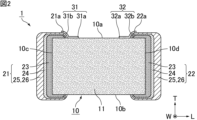
- FIG. 2 is an example of a cross-sectional view taken along line AA of the electronic component shown in FIG.
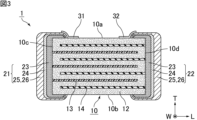
- FIG. 3 is another example of a cross-sectional view taken along line AA of the electronic component shown in FIG. 1, showing a case where the electronic component is a multilayer ceramic capacitor.
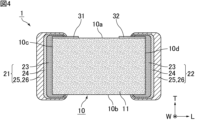
- FIG. 4 is a cross-sectional view that shows a schematic diagram of a first modified example of an electronic component body according to an embodiment of the present invention.
- FIG. 5 is a cross-sectional view that shows a schematic diagram of a second modified example of an electronic component body according to an embodiment of the present invention.
- FIG. 1 is a perspective view illustrating an example of an electronic component according to an embodiment of the present invention.
- FIG. 2 is an example of a cross-sectional view taken along line AA of the electronic component shown in FIG.
- FIG. 3 is another example of a cross-sectional view taken along line
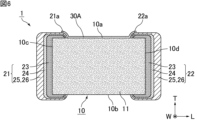
- FIG. 6 is a cross-sectional view that shows a schematic diagram of a third modified example of an electronic component body according to an embodiment of the present invention.
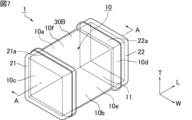
- FIG. 7 is a perspective view that typically shows a fourth modified example of an electronic component body according to an embodiment of the present invention.
- FIG. 8 is a perspective view that illustrates an example of an electronic component mounting structure according to an embodiment of the present invention.
- FIG. 9 is a cross-sectional view that illustrates an example of how microwaves are irradiated onto an electronic component in the method for separating electronic components according to an embodiment of the present invention.
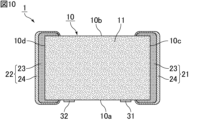
- FIG. 10 is a cross-sectional view that illustrates an example of a mode in which electronic components are separated in the electronic component separation method according to the embodiment of the present invention.
- the electronic component, the electronic component mounting structure, and the method for separating the electronic components of the present invention will be described below.
- the present invention is not limited to the following configurations, and can be modified and applied as appropriate within the scope of the present invention.
- the present invention also includes a combination of two or more of the individual desirable configurations described below.
- FIG. 1 is a perspective view showing a schematic example of an electronic component according to an embodiment of the present invention.
- the electronic component 1 shown in FIG. 1 is a chip-type electronic component (surface-mounted electronic component) and includes a base body 10, external electrodes 21, 22, and microwave absorbing layers 31, 32.
- the specific type of electronic component 1 is not particularly limited as long as it is a component that can be mounted on a mounting board by soldering.
- Specific examples include laminated ceramic electronic components such as laminated ceramic capacitors, laminated coils, laminated thermistors, laminated varistors, laminated LC filters, and laminated piezoelectric filters.
- the element body 10 is made of a laminate in which at least one of a dielectric ceramic layer, a magnetic ceramic layer, a piezoelectric ceramic layer, and a semiconductor ceramic layer is laminated with an internal electrode layer as an internal conductor.
- the electronic component 1 does not have to be a laminated component as described above.
- specific examples include, for example, a silicon capacitor, a ferrite coil, and an inductor made of a composite material of metal powder and resin.
- the element body 10 includes a dielectric layer 11 and an internal conductor (internal electrode layer, not shown in FIG. 1), and has a top surface 10a and a bottom surface 10b that face the height direction T, a first side surface 10c and a second side surface 10d that face the length direction L that is perpendicular to the height direction T, and a third side surface 10e and a fourth side surface 10f that face the width direction W that is perpendicular to the height direction T and the length direction L.
- an internal conductor internal electrode layer, not shown in FIG. 1
- the element body 10 includes a dielectric layer 11 and an internal conductor (internal electrode layer, not shown in FIG. 1), and has a top surface 10a and a bottom surface 10b that face the height direction T, a first side surface 10c and a second side surface 10d that face the length direction L that is perpendicular to the height direction T, and a third side surface 10e and a fourth side surface 10f that face the width direction W that is perpendic
- the base body 10 has a generally rectangular parallelepiped outer shape, but the corners and ridges may be rounded.
- a corner is a portion where three faces of the base body 10 intersect, and a ridge is a portion where two faces of the base body 10 intersect.
- the areas of the top surface 10a and bottom surface 10b may be substantially the same as or different from the areas of the third side surface 10e and fourth side surface 10f.
- the areas of the first side surface 10c and second side surface 10d may be substantially the same as or different from the areas of the third side surface 10e and fourth side surface 10f.
- the surface of the element body 10 is composed of a dielectric layer 11.
- the dielectric layer 11 can be formed, for example, from a dielectric material (oxide).
- the dielectric material can be appropriately selected according to the type of electronic component 1, and examples include dielectric ceramic materials, magnetic ceramic materials, piezoelectric ceramic materials, and semiconductor ceramic materials.
- the dielectric material is preferably a dielectric ceramic material containing as a main component barium titanate, calcium titanate, strontium titanate, barium calcium titanate, or calcium zirconate.
- a dielectric ceramic material containing as a main component barium titanate, calcium titanate, strontium titanate, barium calcium titanate, or calcium zirconate.
- Such materials have a low dielectric loss factor anywhere in the temperature range from room temperature to the melting point of the solder, and are unlikely to experience a temperature rise due to microwave irradiation, making it easier to obtain the effects of the microwave absorbing layers 31 and 32 described below.
- the electronic component 1 contains the above-mentioned dielectric ceramic material as a main component, it can function as a multilayer ceramic capacitor, but depending on the desired characteristics of the multilayer ceramic capacitor, it may also be possible to use a material containing a minor component such as an Mg compound, Mn compound, Si compound, Al compound, V compound, Ni compound, or rare earth compound in a content less than that of the main component.
- a material containing a minor component such as an Mg compound, Mn compound, Si compound, Al compound, V compound, Ni compound, or rare earth compound in a content less than that of the main component.
- a magnetic ceramic material containing a main component such as a ferrite ceramic material is also suitable. Such materials take time to absorb microwaves, so in this case too, the effects of the microwave absorption layers 31 and 32 described below are more likely to be obtained.
- the electronic component 1 can function as a laminated coil.
- piezoelectric ceramic materials include PZT (lead zirconate titanate) ceramic materials.
- the electronic component 1 can function as a laminated piezoelectric filter.
- semiconducting ceramic materials include spinel-based ceramic materials.
- the electronic component 1 can function as a laminated thermistor.
- the external electrodes 21 and 22 are provided on the surface of the element body 10.
- the external electrode 21 is provided on the first side surface 10c of the element body 10.
- the external electrode 21 is provided from the first side surface 10c of the element body 10 to each of the top surface 10a, the bottom surface 10b, the third side surface 10e, and the fourth side surface 10f.
- the external electrode 21 is electrically connected to the internal conductor exposed from the element body 10 at the first side surface 10c.
- the external electrode 22 is provided on the second side surface 10d of the element body 10.
- the external electrode 22 is provided from the second side surface 10d of the element body 10 to each of the top surface 10a, the bottom surface 10b, the third side surface 10e, and the fourth side surface 10f.
- the external electrode 22 is electrically connected to the internal conductor exposed from the element body 10 at the second side surface 10d.
- FIG. 2 is an example of a cross-sectional view of the electronic component shown in FIG. 1 taken along line A-A. Note that the internal conductor of the element body 10 is not shown in FIG. 2, as well as in FIGS. 4 to 6, 8, and 9, which will be described later.
- the external electrodes 21 and 22 have a resin electrode layer 23 that contains a conductive component and a resin component.
- the conductive component contains as its main component a single metal such as silver, copper, nickel, or tin, or an alloy containing at least one of these metals.
- the resin component contains as its main component an epoxy resin, a phenolic resin, or the like.
- the resin electrode layer can be formed, for example, using a conductive paste such as silver paste.
- the external electrodes 21, 22 may have a baked electrode layer of copper or silver instead of the resin electrode layer 23.
- a baked electrode layer of copper or silver is specifically an electrode formed by baking a copper or silver paste material containing a glass component.
- the external electrodes 21, 22 also have a so-called plating layer formed by a plating method on the resin electrode layer 23 (or a baked electrode layer of copper or silver; the same applies below). Specifically, they have a Ni plating layer 24 provided to cover the resin electrode layer 23, and a Sn plating layer 26 as the outermost layer 25 provided to cover the Ni plating layer 24.
- an Au plating layer may be provided as the outermost layer 25 of the external electrodes 21 and 22 instead of the Sn plating layer 26.
- the external electrodes only need to be provided on a portion of the surface of the element body, and there are no particular limitations on where they are arranged.
- they may be arranged only on the bottom surface of the element body, or they may be arranged so as to cover a portion of one of the side surfaces of the element body and extend from that side to cover a portion of the bottom surface (L-shaped in cross section), or they may be arranged so as to cover a portion or all of one of the side surfaces of the element body and extend from that side to cover a portion of the top surface and a portion of the bottom surface (C-shaped in cross section).
- the number of external electrodes is not particularly limited, and at least one external electrode may be provided for the element body.
- at least one external electrode may be provided for the element body.
- four external electrodes may be provided for the element body (four terminals), or six external electrodes may be provided for the element body (six terminals).
- six external electrodes may be provided for the element body (six terminals).
- FIG. 3 is another example of a cross-sectional view of the electronic component shown in FIG. 1 taken along line A-A, showing a case where the electronic component is a multilayer ceramic capacitor.
- the element body 10 is a laminate in which a dielectric ceramic layer 12 serving as a dielectric layer 11 and internal electrode layers 13 and 14 serving as internal conductors are stacked.
- the internal electrode layer 13 is extended to the first side surface 10c of the element body 10 and connected to the external electrode 21, and the internal electrode layer 14 is extended to the second side surface 10d of the element body 10 and connected to the external electrode 22.
- the dielectric ceramic layer 12 can be obtained by forming a dielectric slurry containing a dielectric ceramic material and an organic solvent into a sheet.
- the internal electrode layers 13 and 14 can be obtained by printing an electrode paste containing a conductive component.
- the internal electrode layers 13 and 14 are preferably Ni electrode layers that use Ni as the conductive component.
- an Ag electrode layer instead of the Ni electrode layer, an Ag electrode layer, a Pd electrode layer, or a Cu electrode layer may be used.
- the microwave absorbing layer 31 is located on the top surface 10a of the element body 10 and is provided so as to be in contact with the external electrode 21. More specifically, the microwave absorbing layer 31 is provided on the top surface 10a of the element body 10 at a position that straddles the element body 10 and the external electrode 21, and is selectively provided in a band shape in a plan view on the top surface 10a of the element body 10 and the external electrode 21 so as to cover the end portion 21a located on the top surface 10a of the external electrode 21.
- the microwave absorbing layer 32 is located on the top surface 10a of the element body 10 and is provided so as to be in contact with the external electrode 22.
- the microwave absorbing layer 32 is also provided on the top surface 10a of the element body 10 at a position spanning the element body 10 and the external electrode 22, and is selectively provided in a band shape in a plan view on the top surface 10a of the element body 10 and the external electrode 22 so as to cover the end 22a located on the top surface 10a of the external electrode 22.
- the microwave absorbing layer 31 has at least one of the following characteristics (1) and (2).
- the microwave absorbing layer 31 has a dielectric loss factor P1, which is the product of the dielectric constant and the dielectric loss tangent, of 10 or more.
- the dielectric loss factor P1, which is the product of the dielectric constant and the dielectric loss tangent of the microwave absorbing layer 31, is at least twice the dielectric loss factor P, which is the product of the dielectric constant and the dielectric loss tangent of the dielectric layer 11 of the element body 10.
- the microwave absorbing layer 32 has at least one of the following characteristics (3) and (4).
- the dielectric loss factor P2, which is the product of the dielectric constant and the dielectric loss tangent of the microwave absorbing layer 32, is 10 or more.
- the dielectric loss factor P2, which is the product of the dielectric constant and the dielectric loss tangent of the microwave absorbing layer 32, is at least twice the dielectric loss factor P, which is the product of the dielectric constant and the dielectric loss tangent of the dielectric layer 11 of the element body 10.
- microwave absorbing layers 31, 32 are provided so as to contact the external electrodes 21, 22, it is possible to selectively heat the microwave absorbing layers 31, 32 by irradiating the electronic component 1 with microwaves (particularly an electric field). Then, the solder thermally conducted via the external electrodes 21, 22 is melted, and the electronic component 1 can be easily separated from the mounting board. Therefore, the electronic component 1 can be easily rebuilt or recycled.
- microwave absorbing layers 31 and 32 are provided on the electronic component 1, it is possible to target and separate specific electronic components from the mounting board (electronic components with high resource value can be selectively separated).
- microwave absorbing layers 31, 32 are provided at positions spanning the element body 10 and the external electrodes 21, 22, there is no scattering of flux during microwave irradiation, and there is little contamination (adhesion of foreign matter) even after the electronic component 1 is used as a device, preventing a decrease in heating efficiency due to microwave irradiation.
- the dielectric loss factors P1 and P2 which are the product of the dielectric constant and dielectric tangent of the microwave absorbing layers 31 and 32, are preferably 10 or more, and more preferably 25 or more. If these dielectric loss factors P1 and P2 are less than 10, the rate at which heat is generated by microwave absorption in the microwave absorbing layers 31 and 32 is slow, and it may take a long time to melt the solder. There are no particular limitations on the upper limits of these dielectric loss factors P1 and P2, but they are preferably 200 or less, and more preferably 100 or less. If these dielectric loss factors P1 and P2 exceed 200, there is a risk that they may affect the high-frequency characteristics of the electronic component 1.
- the dielectric loss factors P1 and P2 which are the product of the dielectric constant and the dielectric loss tangent of the microwave absorbing layers 31 and 32, are preferably at least twice, and more preferably at least five times, the dielectric loss factor P, which is the product of the dielectric constant and the dielectric loss tangent of the dielectric layer 11 of the base body 10. If the ratio of these dielectric loss factors P1 and P2 to this dielectric loss factor P is less than two, the heat generation rate due to microwave absorption in the microwave absorbing layers 31 and 32 may be slow, and it may take time to melt the solder.
- the dielectric loss factors P1 and P2 are preferably at most 40 times, and more preferably at most 20 times, the dielectric loss factor P. If the ratio of these dielectric loss factors P1 and P2 to this dielectric loss factor P exceeds 40, the high-frequency characteristics of the electronic component 1 may be affected.
- the dielectric loss factor P which is the product of the dielectric constant and the dielectric tangent of the dielectric layer 11 of the element body 10, is, for example, 0.1 or more and 5 or less.
- the microwave absorbing layer in order to raise the temperature of the solder to its melting point, the microwave absorbing layer needs to maintain a high dielectric loss factor in a temperature range up to the melting point of the solder.
- the "dielectric constant" and “dielectric loss tangent" of the microwave absorbing layer and the dielectric layer of the element body are both values measured using a cavity resonator at 140°C and in the 2.45 GHz band in accordance with the measurement method described in Non-Patent Document 1.
- the reason why the measurement temperature is set at 140°C is that in the case of barium titanate, the dielectric constant drops when the temperature exceeds its Curie point, and the temperature cannot exceed the melting point of the solder. Also, although measurement becomes difficult at high temperatures, there are reports of measurement at temperatures below 150°C.
- the microwave absorbing layers 31 and 32 can be made of non-oxide ceramic materials such as aluminum nitride, silicon carbide, silicon nitride, boron nitride, etc. Such materials have a large dielectric loss factor, and therefore can instantaneously increase in temperature when irradiated with microwaves.
- the microwave absorbing layers 31, 32 can also be made of oxide-based ceramic materials. Specifically, materials such as barium dititanate, barium titanate substituted with other elements, alumina, zirconia, titanium oxide, and wollastonite have a large dielectric loss factor, and therefore can be instantaneously heated by microwave irradiation.
- Methods for forming the microwave absorbing layers 31 and 32 include, for example, deposition, sputtering, screen printing, spray coating, dispenser coating, inkjet printing, etc.
- the thickness of the microwave absorbing layers 31, 32 is preferably 0.1 ⁇ m or more and 10 ⁇ m or less, more preferably 0.5 ⁇ m or more and 5 ⁇ m or less, and even more preferably 1 ⁇ m or more and 3 ⁇ m or less. This allows the thickness to be sufficient for microwave absorption and thermal conduction while preventing any effect on the dimensions, shape, and high frequency characteristics of the electronic component 1.
- the microwave absorbing layer 31 is provided so as to be in contact with the element body 10 and the external electrode 21. This allows instantaneous heating by microwave irradiation in a shorter time (less energy is used).
- the microwave absorbing layer 32 is provided so as to be in contact with the element body 10 and the external electrode 22.
- the microwave absorbing layer 31 is provided so as to be in contact with the element body 10 and the outermost layer 25 of the external electrode 21. This allows instantaneous heating by microwave irradiation in an even shorter time (even less energy is used).
- the microwave absorbing layer 32 be provided so as to be in contact with the element body 10 and the outermost layer 25 of the external electrode 22.
- FIG. 4 is a cross-sectional view that shows a schematic diagram of a first modified example of an electronic component body according to an embodiment of the present invention.
- FIG. 4 corresponds to the cross-sectional view of FIG. 2.
- the microwave absorbing layer 31 may be provided between the element body 10 and the external electrode 21 so as to be in contact with the element body 10 and the external electrode 21. In this case, it is preferable that a portion of the microwave absorbing layer 31 is exposed from the external electrode 21.
- the microwave absorbing layer 32 may be provided between the base body 10 and the external electrode 22 so as to be in contact with the base body 10 and the external electrode 22, in which case it is preferable that a portion of the microwave absorbing layer 32 is exposed from the external electrode 22.
- the microwave absorbing layer 31 is provided so as to contact the element body 10 and the outermost layer 25 of the external electrode 22, and more preferably has at least one of an end 31a and a step 31b.
- the presence of the end 31a and the step 31b makes it easier for the microwave electric field to concentrate, making it possible to achieve instantaneous heating by microwave irradiation in a particularly short time (the energy used is particularly small).
- the microwave absorbing layer 32 is provided so as to contact the element body 10 and the outermost layer 25 of the external electrode 22, and it is further preferable that the microwave absorbing layer 32 has at least one of an end portion 32a and a step portion 32b.
- FIG. 5 is a cross-sectional view that shows a schematic diagram of a second modified example of an electronic component body according to an embodiment of the present invention.
- FIG. 5 corresponds to the cross-sectional view of FIG. 2.
- the microwave absorbing layer 31 is provided so as to contact the element body 10 and the outermost layer 25 of the external electrode 22, and may have a pointed head 31c.
- the pointed head 31c when the pointed head 31c is present, the electric field of the microwaves tends to concentrate, making it possible to achieve instantaneous heating by microwave irradiation in a particularly short time (the energy used is particularly small).
- the microwave absorbing layer 32 is provided so as to contact the element body 10 and the outermost layer 25 of the external electrode 22, and may have a pointed portion 32c.
- the pointed heads 31c and 32c can be formed, for example, by making the surfaces of the microwave absorbing layers 31 and 32 rough (uneven).
- FIG. 6 is a cross-sectional view that shows a schematic diagram of a third modified example of an electronic component body according to an embodiment of the present invention.
- FIG. 6 corresponds to the cross-sectional view of FIG. 2.
- one microwave absorbing layer 30A may be provided so as to contact both the external electrodes 21 and 22.
- the microwave absorbing layer 30A is selectively provided in a rectangular shape in a plan view on the top surface 10a of the element body 10 and the external electrodes 21 and 22 so as to cover the top surface 10a of the element body 10, the end 21a of the external electrode 21, and the end 22a of the external electrode 22.
- FIG. 7 is a perspective view that shows a fourth modified example of an electronic component body according to an embodiment of the present invention.
- FIG. 7 corresponds to the perspective view of FIG. 1.
- one microwave absorbing layer 30B may be provided so as to contact both the external electrodes 21, 22.
- the microwave absorbing layer 30B surrounds the entire body 10 between the external electrodes 21, 22. More specifically, the microwave absorbing layer 30B is provided in a ring shape (belly band shape) on the top surface 10a, bottom surface 10b, third side surface 10e, and fourth side surface 10f of the body 10 that are not covered by the external electrodes 21, 22, while overlapping the end 21a of the external electrode 21 and the end 22a of the external electrode 22.
- the microwave absorbing layer may be located on the top surface and at least one of the four side surfaces of the element body, and the location of the microwave absorbing layer is not particularly limited.
- the microwave absorbing layer may be provided so as to be in contact with the external electrodes on the top surface of the element body and on any two opposing side surfaces of the element body (preferably the third side surface 10e and the fourth side surface 10f).
- the microwave absorbing layer may be provided so as to be in contact with the external electrodes only on any two opposing side surfaces of the element body (preferably the third side surface 10e and the fourth side surface 10f).
- the microwave absorbing layer may be located on the bottom surface of the element body in addition to the top surface and at least one of the four side surfaces of the element body.
- FIG. 8 is a perspective view showing a schematic example of an electronic component mounting structure according to an embodiment of the present invention.
- the electronic component mounting structure 100 shown in FIG. 8 includes the electronic component 1 described above and a mounting substrate 110.
- the mounting board 110 comprises a board body 111 having a mounting surface 111a, and land electrodes 112, 113 formed on the mounting surface 111a.
- the board body 111 is formed of, for example, a resin such as glass epoxy, or a ceramic such as glass ceramic.
- the board body 111 may be formed of a plurality of laminated insulator layers.
- the mounting surface 111a is provided on one of the main surfaces of the board body 111.
- the land electrodes 112, 113 are, for example, electrodes having a rectangular shape in a plan view, and are disposed on the mounting surface 111a.
- the external electrodes 21, 22 of the electronic component 1 are electrically connected to the land electrodes 112, 113, respectively, via the solder 120.
- the land electrodes 112, 113 are provided corresponding to the external electrodes 21, 22, and the corresponding external electrodes 21 or 22 and the land electrodes 112 or 113 are connected and fixed to each other via the solder 120.
- the solder 120 is made of an alloy whose main component is Sn and contains flux.
- the solder 120 is joined to the outermost layers 25 of the external electrodes 21 and 22.
- the electronic component 1 is mounted on the mounting substrate 110 so that the top surface 10a of the element body 10 faces away from the mounting surface 111a of the substrate body 111. That is, the bottom surface 10b of the element body 10 faces the mounting surface 111a of the substrate body 111. Therefore, the microwave absorbing layers 31, 32 of the electronic component 1 are exposed to the outside of the mounting structure 100. Therefore, it is possible to directly irradiate the microwave absorbing layers 31, 32 with microwaves. That is, it is possible to irradiate the microwave absorbing layers 31, 32 with microwaves without reducing the heating efficiency.
- FIG. 9 is a cross-sectional view showing an example of how microwaves are irradiated onto an electronic component in a method for separating electronic components according to an embodiment of the present invention.
- FIG. 10 is a cross-sectional view showing an example of how electronic components are separated in a method for separating electronic components according to an embodiment of the present invention.
- the mounting structure 100 is placed in the microwave irradiation space so that the mounting surface 111a of the substrate body 111 faces downward.
- microwaves are irradiated to the microwave absorbing layers 31, 32 of the electronic component 1 to heat them, and as shown in FIG. 10, the solder 120 is melted and the electronic component 1 is separated from the mounting board 110.
- microwaves electric field is nearly 100%
- the microwave absorbing layers 31, 32 are selectively and instantaneously heated.
- the microwave absorbing layers 31, 32 are heated, heat is conducted from the microwave absorbing layers 31, 32 to the solder 120, and the thermally conducted solder 120 melts.
- the electronic component 1 is separated from the mounting structure 100 by free fall. In this way, the electronic component 1 can be easily separated from the mounting board 110.
- the Sn plating layer 26 When the Sn plating layer 26 is used as the outermost layer 25 of the external electrodes 21, 22, the Sn plating layer 26 also melts due to heat conduction from the microwave absorbing layers 31, 32, and the electronic component 1 is separated from the mounting board 110 with the Sn plating layer 26 removed, as shown in FIG. 10. Therefore, the separated electronic component 1 can be reused, for example, by reforming the outermost layers 25 of the external electrodes 21, 22.
- the Au plating layer when used as the outermost layer 25 of the external electrodes 21, 22, the Au plating layer does not melt even due to heat conduction from the microwave absorbing layers 31, 32, and the electronic component 1 is separated from the mounting substrate 110 with the Au plating layer still attached. Therefore, the separated electronic component 1 can be reused as it is, for example.
- Microwaves are generally electromagnetic waves with a frequency range of 300 MHz to 3 THz, and have an electric field component and a magnetic field component.
- the electric field component heats dielectric materials
- the magnetic field component heats conductors and magnetic materials.
- the output of the irradiated microwaves is preferably 0.1 kW or more and 100 kW or less.
- the frequency of the microwaves irradiated is 0.1 GHz or more and 100 GHz or less.
- the microwave irradiation time be 0.1 seconds or more and 100 seconds or less.
- a semiconductor oscillator can be used as the microwave generator.
- Semiconductor oscillators have excellent frequency controllability, and the electromagnetic field distribution of the microwaves generated by them is fixed, so that by controlling the position of the electronic component 1, the electronic component 1 can be irradiated with microwaves so that it is positioned within a space where the electric field is substantially uniform and at its maximum.
- the method of irradiating microwaves is not particularly limited.
- the microwave absorbing layers 31 and 32 may be heated by moving the tip of a probe that irradiates microwaves near the electronic component 1.
- an element body including a dielectric layer, the element body having a top surface and a bottom surface opposed to each other in a height direction, a first side surface and a second side surface opposed to each other in a length direction perpendicular to the height direction, and a third side surface and a fourth side surface opposed to each other in a width direction perpendicular to the height direction and the length direction;
- An external electrode provided on a surface of the element body;
- a microwave absorbing layer located on at least one of the top surface and the four side surfaces and provided so as to be in contact with the external electrode;
- the microwave absorbing layer has a dielectric loss factor, which is the product of the dielectric constant and the dielectric loss tangent, of 10 or more.
- an element body including a dielectric layer, the element body having a top surface and a bottom surface opposed to each other in a height direction, a first side surface and a second side surface opposed to each other in a length direction perpendicular to the height direction, and a third side surface and a fourth side surface opposed to each other in a width direction perpendicular to the height direction and the length direction;
- An external electrode provided on a surface of the element body; a microwave absorbing layer located on at least one of the top surface and the four side surfaces and provided so as to be in contact with the external electrode;
- An electronic component wherein a dielectric loss factor, which is the product of the dielectric constant and the dielectric loss tangent of the microwave absorbing layer, is at least twice as large as a dielectric loss factor, which is the product of the dielectric constant and the dielectric loss tangent of the dielectric layer.
- ⁇ 3> The electronic component according to ⁇ 1> or ⁇ 2>, wherein the microwave absorbing layer is provided so as to be in contact with the element body and the external electrodes.
- ⁇ 4> The electronic component according to ⁇ 3>, wherein the microwave absorbing layer is provided so as to be in contact with an outermost layer of the external electrode.
- ⁇ 5> The electronic component according to ⁇ 4>, wherein the microwave absorbing layer has at least one of an end portion, a step portion, and a pointed portion.
- ⁇ 6> The electronic component according to any one of ⁇ 1> to ⁇ 5>, which is an electronic component for rebuilding or recycling.
- ⁇ 7> An electronic component according to any one of ⁇ 1> to ⁇ 6>, a mounting board including a board body having a mounting surface and a land electrode formed on the mounting surface; the external electrodes of the electronic component are electrically connected to the land electrodes via solder, the electronic component is mounted on the mounting board such that the top surface faces the side opposite the mounting surface of the board body.
- ⁇ 8> A step of preparing the electronic component mounting structure according to ⁇ 7>; and a step of irradiating the microwave absorbing layer of the electronic component with microwaves to heat it and melt the solder, thereby separating the electronic component from the mounting substrate.
Landscapes
- Engineering & Computer Science (AREA)
- Power Engineering (AREA)
- Microelectronics & Electronic Packaging (AREA)
- Manufacturing & Machinery (AREA)
- Chemical & Material Sciences (AREA)
- Materials Engineering (AREA)
- Ceramic Engineering (AREA)
- Inorganic Chemistry (AREA)
- Fixed Capacitors And Capacitor Manufacturing Machines (AREA)
- Ceramic Capacitors (AREA)
- Coils Or Transformers For Communication (AREA)
Priority Applications (3)
| Application Number | Priority Date | Filing Date | Title |
|---|---|---|---|
| CN202380015615.9A CN118541765A (zh) | 2022-12-22 | 2023-06-27 | 电子部件、电子部件的安装结构体以及电子部件的分离方法 |
| JP2023579348A JP7525079B1 (ja) | 2022-12-22 | 2023-06-27 | 電子部品、電子部品の実装構造体及び電子部品の分離方法 |
| US19/172,816 US20250239409A1 (en) | 2022-12-22 | 2025-04-08 | Electronic component, mounting structure for electronic component, and separation method for electronic component |
Applications Claiming Priority (2)
| Application Number | Priority Date | Filing Date | Title |
|---|---|---|---|
| JP2022205383 | 2022-12-22 | ||
| JP2022-205383 | 2022-12-22 |
Related Child Applications (1)
| Application Number | Title | Priority Date | Filing Date |
|---|---|---|---|
| US19/172,816 Continuation US20250239409A1 (en) | 2022-12-22 | 2025-04-08 | Electronic component, mounting structure for electronic component, and separation method for electronic component |
Publications (1)
| Publication Number | Publication Date |
|---|---|
| WO2024134938A1 true WO2024134938A1 (ja) | 2024-06-27 |
Family
ID=91587915
Family Applications (1)
| Application Number | Title | Priority Date | Filing Date |
|---|---|---|---|
| PCT/JP2023/023793 Ceased WO2024134938A1 (ja) | 2022-12-22 | 2023-06-27 | 電子部品、電子部品の実装構造体及び電子部品の分離方法 |
Country Status (4)
| Country | Link |
|---|---|
| US (1) | US20250239409A1 (https=) |
| JP (1) | JP7525079B1 (https=) |
| CN (1) | CN118541765A (https=) |
| WO (1) | WO2024134938A1 (https=) |
Citations (3)
| Publication number | Priority date | Publication date | Assignee | Title |
|---|---|---|---|---|
| JPH08139446A (ja) * | 1994-11-08 | 1996-05-31 | Nec Corp | 部品を搭載したプリント基板からの部品の解体方法 |
| JPH1017948A (ja) * | 1996-06-27 | 1998-01-20 | Senju Metal Ind Co Ltd | プリント基板のはんだ除去方法およびはんだ除去装置 |
| JP2002233856A (ja) * | 2001-02-06 | 2002-08-20 | Narifumi Uemura | プリント基板からの金属類の分離方法および装置 |
-
2023
- 2023-06-27 WO PCT/JP2023/023793 patent/WO2024134938A1/ja not_active Ceased
- 2023-06-27 CN CN202380015615.9A patent/CN118541765A/zh active Pending
- 2023-06-27 JP JP2023579348A patent/JP7525079B1/ja active Active
-
2025
- 2025-04-08 US US19/172,816 patent/US20250239409A1/en active Pending
Patent Citations (3)
| Publication number | Priority date | Publication date | Assignee | Title |
|---|---|---|---|---|
| JPH08139446A (ja) * | 1994-11-08 | 1996-05-31 | Nec Corp | 部品を搭載したプリント基板からの部品の解体方法 |
| JPH1017948A (ja) * | 1996-06-27 | 1998-01-20 | Senju Metal Ind Co Ltd | プリント基板のはんだ除去方法およびはんだ除去装置 |
| JP2002233856A (ja) * | 2001-02-06 | 2002-08-20 | Narifumi Uemura | プリント基板からの金属類の分離方法および装置 |
Also Published As
| Publication number | Publication date |
|---|---|
| US20250239409A1 (en) | 2025-07-24 |
| JPWO2024134938A1 (https=) | 2024-06-27 |
| JP7525079B1 (ja) | 2024-07-30 |
| CN118541765A (zh) | 2024-08-23 |
Similar Documents
| Publication | Publication Date | Title |
|---|---|---|
| KR102565540B1 (ko) | 전자부품의 실장 구조체 및 그 제조 방법 | |
| US9881741B2 (en) | Multilayer ceramic electronic component | |
| KR100755088B1 (ko) | 다층 기판 및 그 제조방법 | |
| KR101607027B1 (ko) | 칩 전자 부품 및 칩 전자 부품의 실장 기판 | |
| JP2004235584A (ja) | インダクタンス素子と積層電子部品と積層電子部品モジュ−ルとこれらの製造方法 | |
| JP6058584B2 (ja) | 積層型電子部品及びその製造方法 | |
| KR102830161B1 (ko) | 광-대역 성능을 갖는 소형 박막 표면 실장형 커플러 | |
| JP2000164455A (ja) | チップ状電子部品とその製造方法 | |
| KR20180046278A (ko) | 적층 전자부품 및 그 제조방법 | |
| KR100417304B1 (ko) | 비환원성 유전체 세라믹 및 그를 이용한 세라믹 전자 부품 | |
| JP2020102563A (ja) | 積層セラミック電子部品およびその実装構造 | |
| KR101540007B1 (ko) | 적층 인덕터 | |
| JP2023052903A (ja) | 積層セラミック電子部品 | |
| US9837978B2 (en) | Piezoelectric component | |
| CN116959843A (zh) | 层叠型线圈部件及偏置器电路 | |
| JP2002015939A (ja) | 積層型電子部品およびその製法 | |
| JP2020173958A (ja) | マイクロ波加熱装置及びマイクロ波加熱方法 | |
| JP7525079B1 (ja) | 電子部品、電子部品の実装構造体及び電子部品の分離方法 | |
| JP2021136323A (ja) | 積層セラミック電子部品 | |
| JPH10208979A (ja) | 積層電子部品及びその製造方法 | |
| US10128051B2 (en) | Variable capacitance component | |
| CN212461290U (zh) | 层叠型线圈部件 | |
| JP4601369B2 (ja) | 配線基板 | |
| JP2002217545A (ja) | 多層配線基板 | |
| JP2003282785A (ja) | 高周波回路用多層基板 |
Legal Events
| Date | Code | Title | Description |
|---|---|---|---|
| WWE | Wipo information: entry into national phase |
Ref document number: 2023579348 Country of ref document: JP |
|
| WWE | Wipo information: entry into national phase |
Ref document number: 202380015615.9 Country of ref document: CN |
|
| 121 | Ep: the epo has been informed by wipo that ep was designated in this application |
Ref document number: 23906324 Country of ref document: EP Kind code of ref document: A1 |
|
| NENP | Non-entry into the national phase |
Ref country code: DE |
|
| 122 | Ep: pct application non-entry in european phase |
Ref document number: 23906324 Country of ref document: EP Kind code of ref document: A1 |