WO2024117155A1 - セラミックグリーンシート製造用剥離フィルム - Google Patents
セラミックグリーンシート製造用剥離フィルム Download PDFInfo
- Publication number
- WO2024117155A1 WO2024117155A1 PCT/JP2023/042668 JP2023042668W WO2024117155A1 WO 2024117155 A1 WO2024117155 A1 WO 2024117155A1 JP 2023042668 W JP2023042668 W JP 2023042668W WO 2024117155 A1 WO2024117155 A1 WO 2024117155A1
- Authority
- WO
- WIPO (PCT)
- Prior art keywords
- ceramic green
- agent layer
- substrate
- release agent
- producing
- Prior art date
- Legal status (The legal status is an assumption and is not a legal conclusion. Google has not performed a legal analysis and makes no representation as to the accuracy of the status listed.)
- Ceased
Links
Images
Classifications
-
- B—PERFORMING OPERATIONS; TRANSPORTING
- B28—WORKING CEMENT, CLAY, OR STONE
- B28B—SHAPING CLAY OR OTHER CERAMIC COMPOSITIONS; SHAPING SLAG; SHAPING MIXTURES CONTAINING CEMENTITIOUS MATERIAL, e.g. PLASTER
- B28B1/00—Producing shaped prefabricated articles from the material
- B28B1/30—Producing shaped prefabricated articles from the material by applying the material on to a core or other moulding surface to form a layer thereon
-
- B—PERFORMING OPERATIONS; TRANSPORTING
- B32—LAYERED PRODUCTS
- B32B—LAYERED PRODUCTS, i.e. PRODUCTS BUILT-UP OF STRATA OF FLAT OR NON-FLAT, e.g. CELLULAR OR HONEYCOMB, FORM
- B32B27/00—Layered products comprising a layer of synthetic resin
-
- H—ELECTRICITY
- H01—ELECTRIC ELEMENTS
- H01G—CAPACITORS; CAPACITORS, RECTIFIERS, DETECTORS, SWITCHING DEVICES, LIGHT-SENSITIVE OR TEMPERATURE-SENSITIVE DEVICES OF THE ELECTROLYTIC TYPE
- H01G13/00—Apparatus specially adapted for manufacturing capacitors; Processes specially adapted for manufacturing capacitors not provided for in groups H01G4/00 - H01G11/00
Definitions
- the present invention relates to a release film for producing ceramic green sheets, and more specifically, to a release film for producing ceramic green sheets that allows easy peeling of the green sheets, effectively prevents contamination of the green sheets, and is particularly suitable for use in the manufacture of ceramic products that require high positional accuracy in the manufacture of laminated ceramic capacitors, multilayer ceramic substrates, and the like.
- a release film for producing a ceramic green sheet has been used.
- a ceramic green sheet is formed on the release film for producing a ceramic green sheet, and a plurality of the obtained ceramic green sheets are stacked and fired.
- the miniaturization and multilayering of multilayer ceramic capacitors and multilayer ceramic substrates are progressing.
- the ceramic green sheet is required to be thin, and from the viewpoint of preventing defects such as pinholes and uneven thickness in the thinned ceramic green sheet and effectively suppressing breakage when the thinned ceramic green sheet is peeled off from the release film, a release film for producing ceramic green sheets has been proposed, which has a substrate and a release agent layer of a specific component, and the arithmetic mean roughness (Ra) and maximum protrusion height (Rp) on the surface opposite to the substrate of the release agent layer are each equal to or less than a predetermined value, and the arithmetic mean roughness (Ra) and maximum protrusion height (Rp) on the surface opposite to the substrate of the release agent layer are each within a predetermined numerical range (see, for example, Patent Document 1).
- the present invention aims to provide a release film for producing ceramic green sheets, which has a substrate and a release agent layer, and which allows easy peeling of the green sheet while effectively suppressing contamination of the green sheet.
- a release film for producing a ceramic green sheet having a substrate and a release agent layer provided on at least one side of the substrate, by setting the diiodomethane sliding angle of the surface of the release agent layer opposite the substrate to a predetermined value or less, it is possible to achieve a balance between the reduction in the migration of contaminants to the green sheet and the easy peelability of the green sheet at a high level that exceeds the limits of conventional technology, and have thus completed the present invention.
- the present invention provides: [1] A release film for producing a ceramic green sheet, comprising a substrate and a release agent layer provided on at least one side of the substrate, The release film for producing a ceramic green sheet as described above, wherein the diiodomethane sliding angle of the surface of the release agent layer opposite to the substrate is 33° or less.
- [2] to [11] are each a preferred aspect or embodiment of the present invention.
- [2] The release film for producing a ceramic green sheet according to [1], wherein the diiodomethane sliding angle of the surface of the release agent layer opposite the substrate is 10° to 33°.
- [3] The release film for producing a ceramic green sheet according to [1] or [2], wherein the water sliding angle of the surface of the release agent layer opposite the substrate is 85° or less.
- the release film for producing a ceramic green sheet according to any one of [1] to [3], characterized in that the release agent layer contains a cured product of a curable composition, the curable composition contains at least one reactive compound (a) having at least one reactive functional group selected from the group consisting of a (meth)acryloyl group, a hydroxyl group, and an epoxy group, and the total amount of the reactive compound (a) is 50% or more by mass of the release agent layer.
- the curable composition further contains a film-forming compound (a3) having two or more (meth)acryloyl groups in one molecule.
- [9] a) applying a ceramic slurry onto the release film for producing a ceramic green sheet according to any one of [1] to [7]; b) forming a ceramic green sheet from the ceramic slurry applied in the step a); and c) peeling the ceramic green sheet formed in the step b) from the release film for producing a ceramic green sheet.
- the method for producing a ceramic green sheet comprising the steps of: [10] A method for producing a ceramic product, comprising the step of producing a ceramic green sheet by the method for producing a ceramic green sheet according to [9]. [11] The method for producing a ceramic product according to [10], wherein the ceramic product is a multilayer ceramic capacitor or a multilayer ceramic substrate.
- the release film for producing ceramic green sheets of the present invention allows easy release of the ceramic green sheets formed thereon, while also effectively suppressing contamination of the ceramic green sheets, simultaneously achieving a high level of technical effects with high practical value that surpass the limits of conventional technology, and can be suitably used in the production of various ceramic products.
- it is particularly suitable for use in the production of ceramic products such as multilayer ceramic capacitors and multilayer ceramic substrates, which are made up of thin ceramic layers and require high positional precision during production.
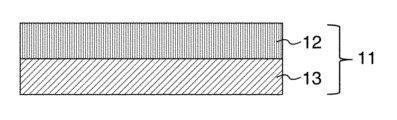
- FIG. 2 is a schematic diagram showing one embodiment of a release film for producing a ceramic green sheet.
- the present invention provides a release film for producing a ceramic green sheet, comprising a substrate and a release agent layer provided on at least one side of the substrate,
- the release film for producing a ceramic green sheet of the present invention only needs to have a substrate and a release agent layer, and may or may not have other layers. Therefore, the release film for producing a ceramic green sheet of the present invention may be composed of only a substrate and a release agent layer, or may have other layers such as an antistatic layer in addition to the substrate and the release agent layer.
- Substrate there is no particular restriction on the substrate constituting the release film for producing ceramic green sheets of the present invention, and any substrate can be appropriately selected from those conventionally known as substrates in the technical field.
- substrates include films made of plastics such as polyesters such as polyethylene terephthalate and polyethylene naphthalate, polyolefins such as polypropylene and polymethylpentene, polycarbonate, and ethylene-vinyl acetate copolymers, and may be single-layered or multi-layered of two or more layers of the same or different kinds.
- polyester films are preferred, and polyethylene terephthalate films are particularly preferred, and biaxially stretched polyethylene terephthalate films are even more preferred.
- Polyethylene terephthalate films are less likely to generate dust during processing, use, etc., and therefore, for example, ceramic slurry coating defects due to dust, etc. can be effectively prevented.
- this substrate may be subjected to a surface treatment such as an oxidation method or a primer treatment in order to improve adhesion to a release agent layer provided on at least one surface of the substrate.
- a surface treatment such as an oxidation method or a primer treatment
- the oxidation method include corona discharge treatment, plasma discharge treatment, chromium oxidation treatment (wet), flame treatment, hot air treatment, ozone treatment, and ultraviolet irradiation treatment.
- the thickness of the substrate there is no particular restriction on the thickness of the substrate, and the thickness may be appropriately set based on the mechanical strength and ease of handling during production and use, but it is usually 10 to 300 ⁇ m, preferably 12 to 200 ⁇ m, and particularly preferably 15 to 125 ⁇ m.
- the arithmetic mean roughness (Ra) of the surface of the substrate on the release agent layer side is preferably from 0.1 to 70 nm, and more preferably from 1 to 60 nm.
- the arithmetic mean roughness (Ra) of the surface on the release agent layer side of the substrate is preferably 0.1 to 70 nm in terms of handling of the substrate, suppression of poor electrical continuity, etc.
- substrates having a surface arithmetic mean roughness (Ra) of 1 to 70 nm are relatively easy and inexpensive to obtain, and are therefore also preferable in terms of availability and production costs of the release film for producing the ceramic green sheet of the present invention.
- the arithmetic mean roughness (Ra) of the surface of the substrate opposite to the release agent layer side is preferably from 5 to 70 nm, and particularly preferably from 10 to 60 nm.
- the arithmetic mean roughness (Ra) of the surface of the substrate opposite the release agent layer side is not less than the above-mentioned lower limit, blocking during winding of the release film for producing a ceramic green sheet of the present invention can be effectively suppressed, while when it is not more than the above-mentioned upper limit, it becomes easy to smooth the surface of the release agent layer.
- release agent layer there are no particular limitations on the material of the release agent layer that constitutes the release film for producing a ceramic green sheet of the present invention, and any material can be used as long as it satisfies the condition that the diiodomethane sliding angle on the surface opposite the substrate is 33° or less. From the viewpoint of ease of production of the release film for producing ceramic green sheets and appropriate control of the diiodomethane sliding angle, etc., it is preferable to form the release agent layer by applying a curable composition onto a substrate and curing it, and it is particularly preferable to form the release agent layer by applying a photocurable and/or thermosetting curable composition and curing it. That is, it is preferable that the release agent layer in the present invention contains a cured product of the curable composition.
- the curable composition preferably used for forming the release agent layer in the present invention preferably contains at least one reactive compound (a) having at least one reactive functional group selected from the group consisting of a (meth)acryloyl group, a hydroxyl group, and an epoxy group.
- a curable composition containing at least one reactive compound (a) having at least one reactive functional group selected from the group consisting of a (meth)acryloyl group, a hydroxyl group, and an epoxy group the release agent layer of the release film for producing the ceramic green sheet of this embodiment can be easily formed with good controllability of the diiodomethane sliding angle, etc.
- the curable composition may contain only one type of reactive compound (a) having at least one reactive functional group selected from the group consisting of (meth)acryloyl groups, hydroxyl groups, and epoxy groups, or may contain two or more types of reactive compounds (a) having at least one reactive functional group selected from the group consisting of (meth)acryloyl groups, hydroxyl groups, and epoxy groups. From the viewpoint of controlling various properties of the release agent layer such as curability, releasability, and sliding angle, it is preferable to use two or more types of reactive compounds (a) in combination, and it is particularly preferable to use a combination of the reactive silicone (a1) and the crosslinkable compound (a2) described below, and further preferably to combine a film-forming compound (a3).
- the curable composition may be composed only of a reactive compound (a) having at least one reactive functional group selected from the group consisting of a (meth)acryloyl group, a hydroxyl group, and an epoxy group, or may contain other components such as a solvent, a radical initiator, a cationic initiator, a leveling agent, an antistatic agent, a dye, and a pigment.
- the amount of reactive compound (a) having at least one reactive functional group selected from the group consisting of a (meth)acryloyl group, a hydroxyl group, and an epoxy group used is preferably 50 mass% or more, and particularly preferably 60 to 96 mass%, of the mass of the release agent layer.
- the reactive compound (a) preferably used for forming the release agent layer in the present invention has at least one reactive functional group selected from the group consisting of a (meth)acryloyl group, a hydroxyl group, and an epoxy group.
- a reactive functional group selected from the group consisting of a (meth)acryloyl group, a hydroxyl group, and an epoxy group it is possible to impart photocurability and/or thermosetting property to the curable composition.
- the reactive compound (a) may have one or more reactive functional groups, but from the viewpoint of photocurability and/or thermosetting property, it preferably has two or more reactive functional groups, preferably has 2 to 15 reactive functional groups, and more preferably has 2 to 10 reactive functional groups. When the reactive compound (a) has two or more reactive functional groups, it may have two or more of the same type of reactive functional groups, or may have a combination of two or more different types of reactive functional groups in total. From the viewpoint of curability, etc., when active energy rays are used, the reactive compound (a) preferably has a (meth)acryloyl group, and when heat curing is also used, a material containing a hydroxyl group or an epoxy group can be appropriately selected.
- the reactive compound (a) include a reactive silicone (a1) having at least one reactive functional group selected from the group consisting of a (meth)acryloyl group, a hydroxyl group, and an epoxy group, and a siloxane skeleton, a reactive compound (a2) having the same reactive functional group as the reactive silicone (a1), and a film-forming compound (a3) having two or more (meth)acryloyl groups in one molecule.
- a reactive silicone (a1) having at least one reactive functional group selected from the group consisting of a (meth)acryloyl group, a hydroxyl group, and an epoxy group, and a siloxane skeleton
- a reactive compound (a2) having the same reactive functional group as the reactive silicone (a1)
- a film-forming compound (a3) having two or more (meth)acryloyl groups in one molecule.
- the curable composition preferably contains, as the reactive compound (a), at least one reactive functional group selected from the group consisting of a (meth)acryloyl group, a hydroxyl group, and an epoxy group, and a reactive silicone (a1) having a siloxane skeleton.
- the reactive silicone (a1) is not limited as long as it has at least one reactive functional group selected from the group consisting of a (meth)acryloyl group, a hydroxyl group, and an epoxy group, and has a siloxane skeleton.
- the reactive functional group reacts by irradiation with active energy rays or by a separate reaction step (for example, a heating step), and the siloxane skeleton is incorporated into a crosslinked structure and fixed, which makes it possible to more effectively prevent the reactive silicone (a1) from contaminating the ceramic green sheet formed on the release agent layer.
- a separate reaction step for example, a heating step
- the reactive functional group an epoxy group is particularly preferred.
- the reactive functional group may be introduced into one end of the siloxane skeleton, may be introduced into both ends, or may be introduced into a side chain.
- At least one reactive functional group selected from the group consisting of (meth)acryloyl group, hydroxyl group, and epoxy group is preferably introduced into one molecule of the reactive silicone (a1) in an amount of two or more.
- it may have two or more of the same type of reactive functional groups, or may have a combination of two or more different reactive functional groups in total.
- the compound may further have a vinyl group, a maleimide group, a carboxyl group, an isocyanate group, or the like.
- the molecular weight of the reactive silicone (a1) is preferably 5,000 to 100,000, and particularly preferably 10,000 to 70,000.
- the reactive silicone (a1) may be used alone or in combination of two or more kinds.
- the content of the reactive silicone (a1) in the curable composition is not particularly limited, but is preferably from 0.1 to 20 mass %, and particularly preferably from 0.2 to 15 mass %, based on the total mass of the release agent layer.
- the curable composition preferably contains, as the reactive compound (a), a reactive compound (a2) having the same reactive functional group as the reactive silicone (a1) and preferably having a reactive functional group equivalent of 2000 g/mol or less. It is particularly preferred to use the reactive compound (a2) in combination with the reactive silicone (a1).
- the reactive compound (a2) functions as a crosslinking agent for the reactive silicone (a1) and the like, promotes the effect of the curable composition, and can incorporate and fix the reactive silicone (a1) and the like into a crosslinked structure. This makes it possible to more effectively suppress contamination of the ceramic green sheet.
- the reactive compound (a2) is also referred to as a "crosslinkable compound (a2)" in this specification.
- the reactive functional group equivalent of the reactive compound (a2) is preferably 2000 or less, more preferably 1000 or less, further preferably 500 or less, and particularly preferably 300 or less.
- the copolymer has a sufficient number of (meth)acryloyl groups, hydroxyl groups, and/or epoxy groups to realize an appropriate crosslinking performance.
- the reactive compound (a2) preferably has a total of 1 or more reactive functional groups ((meth)acryloyl group, hydroxyl group, and/or epoxy group), preferably has 2 to 15 reactive functional groups, and particularly preferably has 2 to 6 reactive functional groups. When the number of reactive functional groups is within the above range, more appropriate crosslinking performance can be achieved.
- the molecular weight of the crosslinkable compound (a2) is not particularly limited, but from the viewpoint of crosslinking performance, etc., it is preferably from 150 to 3,500, and particularly preferably from 150 to 1,500.
- the crosslinkable compound (a2) may have a siloxane skeleton. In this case, by introducing a sufficient amount of siloxane skeleton into the release agent layer together with the siloxane skeleton of the reactive silicone (a1), more preferable release performance can be achieved.
- the crosslinkable compound (a2) may be used alone or in combination of two or more kinds.
- the content of the crosslinkable compound (a2) in the curable composition is not particularly limited, but is preferably 0.08 to 99 mass%, particularly preferably 0.4 to 50 mass%, based on the total mass of the release agent layer.
- the amount of reactive silicone (a1) used it is preferably 81 to 9900 mass parts, particularly preferably 85 to 1000 mass parts, based on 100 mass parts of reactive silicone (a1).
- Film-forming compound (a3) It is also preferred to use a compound having excellent film-forming properties as the reactive compound (a) in the curable composition.
- the compound having excellent film-forming properties may be either a compound having a (meth)acryloyl group or a compound having a hydroxyl group, but it is preferred to use a film-forming compound (a3) having two or more (meth)acryloyl groups in one molecule. That is, the curable composition preferably contains, as the reactive compound (a), a film-forming compound (a3) having two or more (meth)acryloyl groups in one molecule.
- the curable composition can be cured by irradiation with active energy rays.
- the film-forming compound (a3) may be any of a monomer, an oligomer, or a polymer, or may be a mixture thereof.
- the film-forming compound (a3) is preferably a (meth)acrylic acid ester.
- the (meth)acrylic acid ester means both an acrylic acid ester and a methacrylic acid ester. The same applies to other similar terms.
- the (meth)acrylic acid ester is preferably at least one selected from polyfunctional (meth)acrylate monomers and (meth)acrylate oligomers, particularly at least one selected from difunctional or higher functional (meth)acrylate monomers and (meth)acrylate oligomers, and more preferably a trifunctional or higher functional (meth)acrylate monomer.
- Being trifunctional or higher results in excellent curability of the curable composition, and also in excellent release properties of the surface of the resulting release agent layer.
- polyfunctional (meth)acrylate monomers examples include 1,4-butanediol di(meth)acrylate, 1,6-hexanediol di(meth)acrylate, neopentyl glycol di(meth)acrylate, polyethylene glycol di(meth)acrylate, neopentyl glycol adipate di(meth)acrylate, hydroxypivalic acid neopentyl glycol di(meth)acrylate, dicyclopentanyl di(meth)acrylate, caprolactone-modified dicyclopentenyl di(meth)acrylate, ethylene oxide-modified phosphoric acid di(meth)acrylate, allylated cyclohexyl di(meth)acrylate, and isocyanurate di(meth)acrylate.
- acrylate trimethylolpropane tri(meth)acrylate, dipentaerythritol tri(meth)acrylate, dipentaerythritol tetra(meth)acrylate, propionic acid modified dipentaerythritol tri(meth)acrylate, pentaerythritol tri(meth)acrylate, propylene oxide modified trimethylolpropane tri(meth)acrylate, tris((meth)acryloxyethyl)isocyanurate, propionic acid modified dipentaerythritol penta(meth)acrylate, dipentaerythritol hexa(meth)acrylate, caprolactone modified dipentaerythritol hexa(meth)acrylate, and the like. These may be used alone or in combination of two or more.
- polyfunctional (meth)acrylate oligomers examples include polyester acrylate oligomers, epoxy acrylate oligomers, urethane acrylate oligomers, polyether acrylate oligomers, polybutadiene acrylate oligomers, silicone acrylate oligomers, etc.
- Polyester acrylate oligomers can be obtained, for example, by esterifying the hydroxyl groups of a polyester oligomer having hydroxyl groups at both ends, obtained by condensation of a polycarboxylic acid with a polyhydric alcohol, with (meth)acrylic acid, or by esterifying the terminal hydroxyl groups of an oligomer obtained by adding an alkylene oxide to a polycarboxylic acid, with (meth)acrylic acid.
- Epoxy acrylate oligomers can be obtained, for example, by reacting (meth)acrylic acid with the oxirane ring of a relatively low molecular weight bisphenol epoxy resin or novolac epoxy resin to esterify it. It is also possible to use a carboxyl-modified epoxy acrylate oligomer in which an epoxy acrylate oligomer is partially modified with a dibasic carboxylic acid anhydride.
- Urethane acrylate oligomers can be obtained, for example, by esterifying polyurethane oligomers obtained by reacting polyether polyol or polyester polyol with polyisocyanate with (meth)acrylic acid.
- Polyether acrylate oligomers can be obtained by esterifying the hydroxyl groups of polyether polyol with (meth)acrylic acid.
- the (meth)acryloyl group equivalent of the film-forming compound (a3) is preferably 100 to 500 g/mol, and particularly preferably 100 to 300 g/mol.
- the film-forming compound (a3) may be used alone or in combination of two or more kinds.
- the content of the film-forming compound (a3) in the curable composition is not particularly limited, but is preferably from 50 to 90 mass %, and particularly preferably from 60 to 85 mass %, based on the total mass of the release agent layer.
- the release agent layer can be formed by applying a raw material for the release agent layer, preferably the above-mentioned curable composition, to at least one surface of the substrate, followed by drying as necessary and curing by irradiation with active energy rays such as light. If the reactive functional group of the reactive compound (a) is one that reacts with heat, the drying at this time causes a reaction, and the reactive compound (a), preferably having a siloxane skeleton, can be incorporated into a crosslinked structure.
- the method for applying the curable composition and for example, gravure coating, bar coating, spray coating, spin coating, knife coating, roll coating, die coating, etc. can be used.
- the active energy ray ultraviolet rays, electron beams, etc. are usually used.
- the irradiation amount of the active energy ray varies depending on the type of energy ray, but for example, in the case of ultraviolet rays, the light amount is preferably 10 to 1000 mJ/ cm2 , and more preferably 20 to 500 mJ/ cm2 . In the case of electron beams, the amount is preferably about 0.1 to 50 kGy.
- the diiodomethane sliding angle of the surface of the release agent layer constituting the release film for producing a ceramic green sheet of the present invention opposite to the substrate is 33° or less.
- the diiodomethane sliding angle of the surface of the release agent layer opposite the substrate is 33° or less, which, in combination with other technical features of the present invention, allows the release film for producing ceramic green sheets of the present invention to achieve excellent technical effects of great practical value, such as achieving a high level of ease in peeling off the ceramic green sheet formed thereon while suppressing contamination of the ceramic green sheet.
- a diiodomethane sliding angle of 33° or less on the surface of the release agent layer opposite the substrate can achieve a higher level of compatibility between ease of peeling of the ceramic green sheet and suppression of contamination of the ceramic green sheet
- the sliding angle of the release agent layer which is an indicator of adhesion energy
- releasability which may likewise be closely related to the surface condition of the release agent layer, and contamination of the ceramic green sheet and other adherends, with the sliding angle of a specific liquid (diiodomethane) having a particularly high correlation, and therefore it is presumed that there exists an optimal value for the diiodomethane sliding angle that can achieve both releasability and contamination resistance.
- the diiodomethane sliding angle of the surface of the release agent layer opposite the substrate can be measured by a method conventionally known in the art, for example, by using a commercially available contact angle/sliding angle measuring device. More specifically, it can be measured by the method described in the examples of this specification.
- the diiodomethane sliding angle of the surface of the release agent layer opposite to the substrate is preferably from 10° to 33°, and particularly preferably from 15° to 30°.
- the diiodomethane sliding angle of the surface of the release agent layer opposite to the substrate can be appropriately adjusted by adjusting the type and amount of the material constituting the release agent layer or the coating amount of the release agent layer. In particular, it can be appropriately adjusted by adjusting the reactive functional group equivalent and the amount of use of the reactive compound (a) having at least one reactive functional group selected from the group consisting of (meth)acryloyl group, hydroxyl group, and epoxy group, especially the reactive compound (a2) having the same reactive functional group as the reactive silicone (a1) and preferably having a reactive functional group equivalent of 2000 or less.
- the release film for producing ceramic green sheets of the present invention is sufficient if the diiodomethane sliding angle of the release agent layer on the side opposite the substrate satisfies the above-mentioned condition, and no other restrictions are imposed thereon; however, the water sliding angle of the release agent layer on the side opposite the substrate is preferably 85° or less, more preferably 80° or less, and even more preferably 75° or less.
- the water sliding angle of the surface of the release agent layer opposite the substrate is 85° or less, which, in combination with the other technical features of this embodiment, allows the release film for producing ceramic green sheets of this embodiment to achieve excellent technical effects of great practical value, such as achieving a higher level of ease in peeling the ceramic green sheet formed thereon while suppressing contamination of the ceramic green sheet.
- a water sliding angle of 85° or less on the surface of the release agent layer opposite the substrate enables ease of peeling of the ceramic green sheet and suppression of contamination of the ceramic green sheet to be achieved at a higher level is not necessarily clear; however, the sliding angle of the release agent layer, which is an indicator of adhesion energy, is closely related to the surface condition of the release agent layer and is also correlated with releasability, which may likewise be closely related to the surface condition of the release agent layer, and contamination of the ceramic green sheet and other adherends, and the sliding angle of a specific liquid (water) that has hydrogen bonding strength has the second highest correlation after diiodomethane. Therefore, it is presumed that there exists an optimal value for the water sliding angle that can achieve both releasability and contamination resistance.
- the water sliding angle of the surface of the release agent layer opposite the substrate can be measured by a method conventionally known in the art, for example, by using a commercially available contact angle/sliding angle measuring device. More specifically, it can be measured by the method described in the examples of this specification.
- the water contact angle of the surface of the release agent layer opposite the substrate can be adjusted as appropriate by adjusting the type and amount of material constituting the release agent layer and the coating amount of the release agent layer.
- it can be adjusted as appropriate by adjusting the reactive functional group equivalent and amount used of reactive compound (a) having at least one reactive functional group selected from the group consisting of (meth)acryloyl group, hydroxyl group, and epoxy group, particularly reactive compound (a2) having the same reactive functional group as reactive silicone (a1) and preferably having a reactive functional group equivalent of 2000 g/mol or less.
- the thickness of the release agent layer is preferably 0.05 to 2 ⁇ m, and particularly preferably 0.2 to 1.5 ⁇ m.
- a thickness of 0.05 ⁇ m or more is preferable from the viewpoint of smoothness of the release agent layer surface and suppression of pinholes and uneven thickness of the ceramic green sheet.
- a thickness of 2 ⁇ m or less is preferable from the viewpoint of suppressing curling due to cure shrinkage of the release agent layer. It is also preferable from the viewpoint of suppressing blocking and static electricity.
- the release film for producing a ceramic green sheet of the present invention may have layers other than the above-mentioned substrate and release agent layer, such as a protective layer, an adhesive layer, an antistatic layer, etc.
- the substrate and the release agent layer may be laminated directly to each other, or may be laminated via another layer such as an adhesive layer.
- the release film for producing ceramic green sheets of the present invention allows easy release of the ceramic green sheets formed thereon and can effectively suppress contamination of the ceramic green sheets, and therefore can be suitably used in the production of ceramic green sheets for use in various ceramic products, such as multilayer ceramic capacitors or multilayer ceramic substrates.
- the release film for producing a ceramic green sheet of the present invention can be preferably used in a production method having the following steps. a) applying a ceramic slurry onto the release film for producing a ceramic green sheet of the present invention; b) forming a ceramic green sheet from the ceramic slurry applied in the a) step; and c) peeling the ceramic green sheet formed in the b) step from the release film for producing a ceramic green sheet.
- a step of printing internal electrodes on the green sheet is provided between the above steps b) and c), followed by step c) (peeling), lamination and pressure bonding, cutting and separation, firing, and external electrode formation steps to manufacture a multilayer ceramic capacitor.
- the sliding angle of diiodomethane was measured in the same manner as in the measurement of the sliding angle of water described above, except that 2.1 ⁇ L of diiodomethane was used instead of 6 ⁇ L of ultrapure water.
- Example 1 Polyfunctional acrylate 1, epoxy modified silicone 1, epoxy modified silicone 2, cationic initiator 1, and radical initiator 1 were mixed in the mass ratio shown in Table 1 to prepare a curable composition for the release agent layer.
- the curable composition prepared above was applied to one side of the substrate, dried at 100°C for 15 seconds, and then cured by irradiating with ultraviolet light using a high-pressure mercury lamp (accumulated light amount: approximately 40 mJ/ cm2 ) to form a release agent layer, thereby producing a release film having a substrate and a release agent layer provided on one side of the substrate.
- the release film produced above was evaluated for sliding angle in water and diiodomethane, back staining, and tape peeling force by the above-mentioned methods. The results are shown in Table 1.
- Examples 2 to 4 and Comparative Example 1 A release film was produced and evaluated in the same manner as in Example 1, except that the formulation of the curing agent composition for the release agent layer was changed to that shown in Table 1. The results are shown in Table 1.
- the release film for producing ceramic green sheets of the present invention allows easy release of the ceramic green sheets formed thereon, while also effectively suppressing contamination of the ceramic green sheets, simultaneously achieving technical effects of high practical value at a high level that surpasses the limits of conventional technology, and can be suitably used in the manufacture of various ceramic products, making it highly applicable in various industrial fields including the electrical and electronics industry, electronic parts industry, machinery industry, and automotive industry.
Landscapes
- Engineering & Computer Science (AREA)
- Manufacturing & Machinery (AREA)
- Power Engineering (AREA)
- Microelectronics & Electronic Packaging (AREA)
- Chemical & Material Sciences (AREA)
- Ceramic Engineering (AREA)
- Mechanical Engineering (AREA)
- Laminated Bodies (AREA)
- Producing Shaped Articles From Materials (AREA)
Priority Applications (1)
| Application Number | Priority Date | Filing Date | Title |
|---|---|---|---|
| JP2024533797A JP7783424B2 (ja) | 2022-11-30 | 2023-11-29 | セラミックグリーンシート製造用剥離フィルム |
Applications Claiming Priority (2)
| Application Number | Priority Date | Filing Date | Title |
|---|---|---|---|
| JP2022191483 | 2022-11-30 | ||
| JP2022-191483 | 2022-11-30 |
Publications (1)
| Publication Number | Publication Date |
|---|---|
| WO2024117155A1 true WO2024117155A1 (ja) | 2024-06-06 |
Family
ID=91323832
Family Applications (1)
| Application Number | Title | Priority Date | Filing Date |
|---|---|---|---|
| PCT/JP2023/042668 Ceased WO2024117155A1 (ja) | 2022-11-30 | 2023-11-29 | セラミックグリーンシート製造用剥離フィルム |
Country Status (3)
| Country | Link |
|---|---|
| JP (1) | JP7783424B2 (cg-RX-API-DMAC7.html) |
| TW (1) | TW202436057A (cg-RX-API-DMAC7.html) |
| WO (1) | WO2024117155A1 (cg-RX-API-DMAC7.html) |
Cited By (1)
| Publication number | Priority date | Publication date | Assignee | Title |
|---|---|---|---|---|
| WO2025070022A1 (ja) * | 2023-09-28 | 2025-04-03 | 富士フイルム株式会社 | ポリエステルフィルム |
Citations (7)
| Publication number | Priority date | Publication date | Assignee | Title |
|---|---|---|---|---|
| JP2002302645A (ja) * | 2001-01-31 | 2002-10-18 | Jsr Corp | コーティング用組成物、硬化体、積層体および硬化体の製造方法 |
| JP2003142332A (ja) * | 2001-11-07 | 2003-05-16 | Toyobo Co Ltd | コンデンサー用熱接着性ポリエステルフィルムおよびコンデンサー |
| WO2018179466A1 (ja) * | 2017-03-29 | 2018-10-04 | 日新製鋼株式会社 | 塗装金属板およびその製造方法 |
| JP2019072849A (ja) * | 2017-10-12 | 2019-05-16 | 東洋紡株式会社 | セラミックグリーンシート製造用離型フィルム |
| JP2019203076A (ja) * | 2018-05-23 | 2019-11-28 | Jnc株式会社 | コーティング液およびその利用品 |
| JP2020073335A (ja) * | 2017-10-12 | 2020-05-14 | 東洋紡株式会社 | セラミックグリーンシート製造用離型フィルム |
| JP2022122830A (ja) * | 2021-02-10 | 2022-08-23 | 東レ株式会社 | 積層ポリエステルフィルム、およびポリエステルフィルムの製造方法 |
Family Cites Families (4)
| Publication number | Priority date | Publication date | Assignee | Title |
|---|---|---|---|---|
| KR102204965B1 (ko) * | 2013-09-30 | 2021-01-19 | 코오롱인더스트리 주식회사 | 이형필름 및 이의 제조방법 |
| JP6619200B2 (ja) * | 2015-10-21 | 2019-12-11 | リンテック株式会社 | セラミックグリーンシート製造工程用剥離フィルム |
| LT3263666T (lt) * | 2016-06-27 | 2018-09-25 | Evonik Degussa Gmbh | Pralaidumą slopinanti atskyrimo danga |
| CN111300596B (zh) * | 2017-03-01 | 2022-01-04 | 东洋纺株式会社 | 陶瓷生片制造用脱模薄膜和其制造方法 |
-
2023
- 2023-11-29 JP JP2024533797A patent/JP7783424B2/ja active Active
- 2023-11-29 WO PCT/JP2023/042668 patent/WO2024117155A1/ja not_active Ceased
- 2023-11-29 TW TW112146383A patent/TW202436057A/zh unknown
Patent Citations (7)
| Publication number | Priority date | Publication date | Assignee | Title |
|---|---|---|---|---|
| JP2002302645A (ja) * | 2001-01-31 | 2002-10-18 | Jsr Corp | コーティング用組成物、硬化体、積層体および硬化体の製造方法 |
| JP2003142332A (ja) * | 2001-11-07 | 2003-05-16 | Toyobo Co Ltd | コンデンサー用熱接着性ポリエステルフィルムおよびコンデンサー |
| WO2018179466A1 (ja) * | 2017-03-29 | 2018-10-04 | 日新製鋼株式会社 | 塗装金属板およびその製造方法 |
| JP2019072849A (ja) * | 2017-10-12 | 2019-05-16 | 東洋紡株式会社 | セラミックグリーンシート製造用離型フィルム |
| JP2020073335A (ja) * | 2017-10-12 | 2020-05-14 | 東洋紡株式会社 | セラミックグリーンシート製造用離型フィルム |
| JP2019203076A (ja) * | 2018-05-23 | 2019-11-28 | Jnc株式会社 | コーティング液およびその利用品 |
| JP2022122830A (ja) * | 2021-02-10 | 2022-08-23 | 東レ株式会社 | 積層ポリエステルフィルム、およびポリエステルフィルムの製造方法 |
Non-Patent Citations (1)
| Title |
|---|
| MURAI MIHO: "About Wettability Assessment", AICHI CENTER FOR INDUSTRY AND SCIENCE TECHNOLOGY NEWS, vol. 122, 21 May 2012 (2012-05-21), pages 4, XP093176123 * |
Cited By (1)
| Publication number | Priority date | Publication date | Assignee | Title |
|---|---|---|---|---|
| WO2025070022A1 (ja) * | 2023-09-28 | 2025-04-03 | 富士フイルム株式会社 | ポリエステルフィルム |
Also Published As
| Publication number | Publication date |
|---|---|
| JPWO2024117155A1 (cg-RX-API-DMAC7.html) | 2024-06-06 |
| JP7783424B2 (ja) | 2025-12-09 |
| TW202436057A (zh) | 2024-09-16 |
Similar Documents
| Publication | Publication Date | Title |
|---|---|---|
| WO2024116438A1 (ja) | セラミックグリーンシートの製造方法 | |
| KR101997310B1 (ko) | 세라믹 그린 시트 제조 공정용 박리 필름 | |
| KR101997311B1 (ko) | 세라믹 그린 시트 제조 공정용 박리 필름 | |
| KR102342530B1 (ko) | 세라믹 그린 시트 제조용 이형 필름 | |
| KR20180093918A (ko) | 세라믹 그린 시트 제조 공정용 박리 필름 | |
| KR102453649B1 (ko) | 세라믹 그린 시트 제조용 이형 필름 | |
| KR102235641B1 (ko) | 캐리어용 이형필름 및 이의 제조방법 | |
| KR101483076B1 (ko) | 웨이퍼 가공용 시트 및 시트를 이용한 웨이퍼 가공방법 | |
| JP7783424B2 (ja) | セラミックグリーンシート製造用剥離フィルム | |
| WO2024116437A1 (ja) | セラミックグリーンシート製造用剥離フィルム | |
| WO2024117152A1 (ja) | セラミックグリーンシートの製造方法 | |
| JP2024078888A (ja) | セラミックグリーンシート製造用剥離フィルム | |
| JP7588283B1 (ja) | セラミックグリーンシートの製造方法 | |
| JP7588282B1 (ja) | セラミックグリーンシートの製造方法 | |
| JP2024078892A (ja) | セラミックグリーンシート製造用剥離フィルム | |
| JP7797688B2 (ja) | セラミックグリーンシート製造用剥離フィルム | |
| JP6468924B2 (ja) | セラミックグリーンシート製造工程用剥離フィルムおよびセラミックグリーンシート製造方法 | |
| JP7778959B2 (ja) | セラミックグリーンシートの製造方法 | |
| TW202436109A (zh) | 陶瓷生胚片製造用剝離膜及陶瓷生胚片的製造方法 | |
| JP7797687B2 (ja) | セラミックグリーンシート製造用剥離フィルム | |
| WO2024203947A1 (ja) | セラミックグリーンシートの製造方法 | |
| JP2020006616A (ja) | セラミックグリーンシート製造工程用剥離フィルム |
Legal Events
| Date | Code | Title | Description |
|---|---|---|---|
| WWE | Wipo information: entry into national phase |
Ref document number: 2024533797 Country of ref document: JP |
|
| 121 | Ep: the epo has been informed by wipo that ep was designated in this application |
Ref document number: 23897802 Country of ref document: EP Kind code of ref document: A1 |
|
| NENP | Non-entry into the national phase |
Ref country code: DE |
|
| 122 | Ep: pct application non-entry in european phase |
Ref document number: 23897802 Country of ref document: EP Kind code of ref document: A1 |