WO2024038725A1 - 圧延機 - Google Patents
圧延機 Download PDFInfo
- Publication number
- WO2024038725A1 WO2024038725A1 PCT/JP2023/026359 JP2023026359W WO2024038725A1 WO 2024038725 A1 WO2024038725 A1 WO 2024038725A1 JP 2023026359 W JP2023026359 W JP 2023026359W WO 2024038725 A1 WO2024038725 A1 WO 2024038725A1
- Authority
- WO
- WIPO (PCT)
- Prior art keywords
- liner
- housing
- rolling mill
- roll chock
- rolls
- Prior art date
- Legal status (The legal status is an assumption and is not a legal conclusion. Google has not performed a legal analysis and makes no representation as to the accuracy of the status listed.)
- Ceased
Links
Images



Classifications
-
- B—PERFORMING OPERATIONS; TRANSPORTING
- B21—MECHANICAL METAL-WORKING WITHOUT ESSENTIALLY REMOVING MATERIAL; PUNCHING METAL
- B21B—ROLLING OF METAL
- B21B31/00—Rolling stand structures; Mounting, adjusting, or interchanging rolls, roll mountings, or stand frames
- B21B31/02—Rolling stand frames or housings; Roll mountings ; Roll chocks
-
- B—PERFORMING OPERATIONS; TRANSPORTING
- B21—MECHANICAL METAL-WORKING WITHOUT ESSENTIALLY REMOVING MATERIAL; PUNCHING METAL
- B21B—ROLLING OF METAL
- B21B33/00—Safety devices not otherwise provided for; Breaker blocks; Devices for freeing jammed rolls for handling cobbles; Overload safety devices
-
- F—MECHANICAL ENGINEERING; LIGHTING; HEATING; WEAPONS; BLASTING
- F16—ENGINEERING ELEMENTS AND UNITS; GENERAL MEASURES FOR PRODUCING AND MAINTAINING EFFECTIVE FUNCTIONING OF MACHINES OR INSTALLATIONS; THERMAL INSULATION IN GENERAL
- F16F—SPRINGS; SHOCK-ABSORBERS; MEANS FOR DAMPING VIBRATION
- F16F15/00—Suppression of vibrations in systems; Means or arrangements for avoiding or reducing out-of-balance forces, e.g. due to motion
- F16F15/02—Suppression of vibrations of non-rotating, e.g. reciprocating systems; Suppression of vibrations of rotating systems by use of members not moving with the rotating systems
- F16F15/04—Suppression of vibrations of non-rotating, e.g. reciprocating systems; Suppression of vibrations of rotating systems by use of members not moving with the rotating systems using elastic means
-
- B—PERFORMING OPERATIONS; TRANSPORTING
- B21—MECHANICAL METAL-WORKING WITHOUT ESSENTIALLY REMOVING MATERIAL; PUNCHING METAL
- B21B—ROLLING OF METAL
- B21B13/00—Metal-rolling stands, i.e. an assembly composed of a stand frame, rolls, and accessories
- B21B13/02—Metal-rolling stands, i.e. an assembly composed of a stand frame, rolls, and accessories with axes of rolls arranged horizontally
- B21B2013/028—Sixto, six-high stands
-
- B—PERFORMING OPERATIONS; TRANSPORTING
- B21—MECHANICAL METAL-WORKING WITHOUT ESSENTIALLY REMOVING MATERIAL; PUNCHING METAL
- B21B—ROLLING OF METAL
- B21B31/00—Rolling stand structures; Mounting, adjusting, or interchanging rolls, roll mountings, or stand frames
- B21B31/02—Rolling stand frames or housings; Roll mountings ; Roll chocks
- B21B2031/021—Integral tandem mill housings
-
- B—PERFORMING OPERATIONS; TRANSPORTING
- B21—MECHANICAL METAL-WORKING WITHOUT ESSENTIALLY REMOVING MATERIAL; PUNCHING METAL
- B21B—ROLLING OF METAL
- B21B2203/00—Auxiliary arrangements, devices or methods in combination with rolling mills or rolling methods
- B21B2203/44—Vibration dampers
-
- B—PERFORMING OPERATIONS; TRANSPORTING
- B21—MECHANICAL METAL-WORKING WITHOUT ESSENTIALLY REMOVING MATERIAL; PUNCHING METAL
- B21B—ROLLING OF METAL
- B21B37/00—Control devices or methods specially adapted for metal-rolling mills or the work produced thereby
- B21B37/007—Control for preventing or reducing vibration, chatter or chatter marks
-
- F—MECHANICAL ENGINEERING; LIGHTING; HEATING; WEAPONS; BLASTING
- F16—ENGINEERING ELEMENTS AND UNITS; GENERAL MEASURES FOR PRODUCING AND MAINTAINING EFFECTIVE FUNCTIONING OF MACHINES OR INSTALLATIONS; THERMAL INSULATION IN GENERAL
- F16F—SPRINGS; SHOCK-ABSORBERS; MEANS FOR DAMPING VIBRATION
- F16F7/00—Vibration-dampers; Shock-absorbers
Definitions
- the present invention relates to a rolling mill.
- chattering occurs in the rolling mill, causing thickness defects and chatter marks in the rolled material in the strip width direction. Patterns may occur, which may have an adverse effect on quality.
- a common way to deal with chattering is to install a sensor in the rolling mill to detect vibrations, monitor the rolling mill, and then reduce the speed to a speed range where no vibrations occur.
- this method reduces production efficiency, many proposals have been made to reduce vibrations that cause chattering in rolling mills.
- Patent Document 1 discloses that, through a damping mechanism that damps vertical vibrations on opposite sides of the bearing body, an inclined sliding surface that moves away from the rolled material from the entry side to the exit side and an inclined sliding surface that moves away from the rolled material from the entry side to the exit side and A technique is disclosed in which vibration is reduced by providing a wedge-shaped member having an abutting end surface that abuts the member.
- Patent Document 2 describes an elastic beam installed between two roll chocks of a backup roll of a rolling mill or between two pressure tables, an additional mass mounted on this beam, and a method for braking the movement of the additional mass.
- a technique for reducing vibration by providing a damper has been disclosed.
- Patent Documents 1 and 2 large-scale equipment modification is essential for introduction into an existing rolling mill, which is difficult from the viewpoint of time and cost.
- the techniques disclosed in Patent Documents 1 and 2 involve processing and modification of the housing and roll chock, resulting in a production loss due to stopping the production line.
- the present invention has been made in view of the above problems, and its purpose is to provide a rolling mill that can reduce vibrations that cause chattering at low cost while suppressing production loss.
- the rolling mill according to the present invention is a rolling mill equipped with a pair of upper and lower rolls disposed in a housing and a roll chock that holds the upper and lower rolls, and the surface of the roll chock facing the housing or the housing
- the present invention is characterized in that a liner having a vibration reducing function is provided on at least one of the housing surfaces corresponding to the opposing surface.
- the rolling mill according to the present invention is characterized in that in the invention described in (1) above, the liner is constructed using a vibration damping material.
- the vibration damping material is a viscoelastic body
- the liner includes a liner main body made of a metal material and covers the liner main body.
- the device is characterized in that it is constituted by the viscoelastic body.
- the upper and lower rolls include a pair of work rolls arranged above and below with a material to be rolled in between, and It is characterized in that it is at least one of a pair of intermediate rolls that are respectively in contact with a pair of work rolls, and a pair of backup rolls that are respectively in contact with the pair of intermediate rolls.
- the rolling mill according to the present invention has the effect of being able to reduce vibrations that cause chattering at low cost while suppressing production loss.
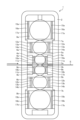
- FIG. 1 is a schematic diagram of a rolling mill according to an embodiment.
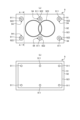
- FIG. 2(a) is a schematic diagram of the work roll chock liner viewed from the front side.
- FIG. 2(b) is a schematic diagram of the work roll chock liner seen from the back side.
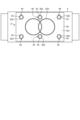
- FIG. 3 is a diagram showing the AA cross section of the work roll chock liner in FIG. 2(a).
- FIG. 4 is a diagram showing a state in which the work roll chock liner is fixed to the work roll chock with bolts.
- FIG. 5 is a schematic diagram of another example of the rolling mill according to the embodiment.
- FIG. 6(a) is a graph showing the results of FFT analysis of vibration during rolling with the rolling mill according to the embodiment.
- FIG. 6(b) is a graph showing the results of FFT analysis of vibration during rolling with a rolling mill according to a comparative example.
- FIG. 1 is a schematic diagram of a rolling mill 1 according to an embodiment.
- the rolling mill 1 according to the embodiment includes a housing 2, a pair of work rolls 3a and 3b provided on the upper and lower sides, a pair of intermediate rolls 5a and 5b, and a backup roll 7a, 7b etc.
- a pair of intermediate rolls 5a, 5b are in contact with work rolls 3a, 3b, respectively.
- Backup rolls 7a and 7b are in contact with intermediate rolls 5a and 5b, respectively.
- the rolling mill 1 according to the embodiment is a six-high rolling mill that performs a rolling process on a steel plate S, which is a material to be rolled.
- the steel type of the steel plate S is, for example, a steel plate for automobile exterior panels. Note that the present invention is not limited to a six-high rolling mill, but can also be applied to a four-high rolling mill consisting of four stages without intermediate rolls and a multi-high rolling mill having more than six stages.
- the housing 2 is provided with a work roll chock 4a, a work roll chock 4b, an intermediate roll chock 6a, an intermediate roll chock 6b, a backup roll chock 8a, and a backup roll chock 8b.
- the work roll chock 4a rotatably supports one end of the upper work roll 3a in the axial direction.
- the work roll chock 4b rotatably supports one end of the lower work roll 3b in the axial direction.
- the intermediate roll chock 6a rotatably supports one end of the upper intermediate roll 5a in the axial direction.
- the intermediate roll chock 6b rotatably supports one end of the lower intermediate roll 5b in the axial direction.
- the backup roll chock 8a rotatably supports one end of the upper backup roll 7a in the axial direction.
- the backup roll chock 8b rotatably supports one end of the lower backup roll 7b in the axial direction.
- work roll chock liners 9a, 9b are provided on the housing facing surfaces of the work roll chocks 4a, 4b, respectively.
- housing blocks 10a, 10b are provided at portions facing the work roll chocks 4a, 4b in the width direction.
- housing liners 11a, 11b are respectively provided on the surfaces facing the work roll chocks 4a, 4b.
- the surface facing the work roll chocks 4a, 4b is a housing surface corresponding to the housing facing surface of the work roll chocks 4a, 4b.
- the work roll chock liners 9a, 9b and the housing liners 11a, 11b are arranged with their opposing surfaces in contact with each other. Furthermore, lubricating oil such as grease is filled between the work roll chock liner 9a and the housing liner 11a and between the work roll chock liner 9b and the housing liner 11b.
- a work roll chock, a work roll chock liner, a housing block, and a housing liner are also arranged at the other ends of the work rolls 3a and 3b in the axial direction, respectively.
- intermediate roll chocks are also arranged at the other ends of the intermediate rolls 5a and 5b in the axial direction, respectively.
- backup roll chocks are also arranged at the other ends of the backup rolls 7a and 7b in the axial direction, respectively.
- the work rolls 3a and 3b will also be simply referred to as work rolls 3 unless they are particularly distinguished from each other.
- the work roll chocks 4a and 4b will also be simply referred to as work roll chocks 4 unless they are particularly distinguished from each other.
- the intermediate rolls 5a and 5b will also be simply referred to as intermediate roll 5 unless they are particularly distinguished from each other.
- the intermediate roll chocks 6a and 6b will also be simply referred to as intermediate roll chocks 6 unless they are particularly distinguished from each other.
- the backup rolls 7a and 7b will also be simply referred to as the backup roll 7 unless they are particularly distinguished from each other.
- the backup roll chocks 8a and 8b will also be simply referred to as backup roll chocks 8 unless they are particularly distinguished from each other.
- the work roll chock liners 9a and 9b will also be simply referred to as the work roll chock liner 9 unless they are particularly distinguished from each other.
- the housing blocks 10a and 10b will also be simply referred to as the housing block 10 unless they are particularly distinguished from each other.
- the housing liners 11a and 11b will also be simply referred to as the housing liner 11 unless they are particularly distinguished from each other.
- FIG. 2(a) is a schematic diagram of the work roll chock liner 9 viewed from the front side.
- FIG. 2(b) is a schematic diagram of the work roll chock liner 9 seen from the back side.
- FIG. 3 is a diagram showing the AA cross section of the work roll chock liner 9 in FIG. 2(a).
- the front side of the work roll chock liner 9 is the side that contacts the housing liner 11 in the thickness direction of the work roll chock liner 9 when the work roll chock liner 9 is mounted on the rolling mill 1.
- the back side of the work roll chock liner 9 is the side that comes into contact with the work roll chock 4 in the thickness direction of the work roll chock liner 9 when the work roll chock liner 9 is mounted on the rolling mill 1.
- the work roll chock liner 9 is composed of a liner main body portion 91 made of a metal material such as brass, and a viscoelastic body 92 that is a damping material as a vibration reduction means having a vibration reduction function.
- the material of the liner main body 91 is not limited to metal materials, but may be any material that has the strength to withstand fixation with bolts, such as resin materials or ceramic materials that have greater rigidity than the viscoelastic body 92. It may be.
- the liner main body part 91 is a plate-like member that is elongated in the axial direction of the work roll 3, and the edge on the back side is cut out over the entire circumference and is lowered by one step, and has a convex shape toward the work roll chock 4 side in the thickness direction. I am doing it.
- the viscoelastic body 92 is a plate-like member larger than the liner body 91 and has an internal space that follows the outer shape (convex shape) of the liner body 91 so that the liner body 91 can be contained therein. At the same time, the viscoelastic body 92 is partially opened on the back side so that the surface other than the edge on the back side of the liner main body 91 is exposed. Then, with the viscoelastic body 92 covering the liner body 91, the viscoelastic body 92 is attached to the liner body 91 so that the edge of the back side of the viscoelastic body 92 is caught on the lower edge of the back side of the liner body 91.
- a viscoelastic body 92 is pasted and fixed with an adhesive.
- the edge of the back side of the viscoelastic body 92 is hooked on the lower edge of the back side of the liner body 91, and the viscoelastic body 92 wraps around the liner body 91.
- the fixing strength can be increased compared to the case where the plate-shaped viscoelastic body 92 is attached and fixed only to the front side surface of the liner main body part 91 with an adhesive.
- the viscoelastic body 92 may be fastened and fixed to the liner body 91 using a fastening member such as a bolt.
- the viscoelastic body 92 may be fixed to the liner body 91 using an adhesive and a fastening member.
- the viscoelastic body 92 for example, vibration damping rubber with excellent heat resistance and water resistance may be used.
- the viscoelastic body 92 is heated at a working environment temperature (40 [°C] to 80 [°C] in the case of cold rolling, preferably 50 [°C] to 60 [°C]). ), it is preferable to have a loss coefficient of 0.2 or more in the frequency band (100 to 1000 Hz) to be reduced. Further, as shown in FIG.
- the upper limit of the thickness t of the viscoelastic body 92 on the housing side at least in the thickness direction is, for example, the maximum thickness of the viscoelastic body 92 that allows the work roll chock liner 9 to be attached to the rolling mill 1. It can be a value.
- the thickness t of the viscoelastic body 92 is preferably 1 [mm] or more and 15 [mm] or less.
- the liner main body portion 91 is provided with a plurality of through holes 911 that penetrate in the thickness direction.
- the viscoelastic body 92 is provided with a plurality of through holes 922 having a larger diameter than the through holes 911 of the liner body 91 and penetrating in the thickness direction so as to communicate with the through holes 911.
- the work roll chock liner 9 is provided with a plurality of bolt holes 94 that communicate with the through holes 911 of the liner main body 91 and the through holes 922 of the viscoelastic body 92 and pass through the work roll chock liner 9 in the thickness direction. ing. As shown in FIG.
- the work roll chock liner 9 is fixed to the side surface of the work roll chock 4 facing the housing liner 11 by a plurality of bolts 93 inserted into a plurality of bolt holes 94, respectively.
- the work roll chock liner 9 and the housing liner 11 are brought into contact with each other.
- the vibration damping function of the viscoelastic body 92 of the work roll chock liner 9 can reduce vibrations that cause chattering occurring within the rolling mill 1.
- the work roll chock liner 9 is constituted by a liner main body portion 91 made of a metal material and a viscoelastic body 92.
- the rigidity of the work roll chock liner 9 can be increased compared to the case where the work roll chock liner 9 is configured only with a vibration damping material such as a viscoelastic body, and the life of the work roll chock liner 9 that is exposed to vibration over a long period of time is extended. This makes it possible to achieve
- a groove 923 in the shape of two circles intersecting side by side is provided on the front surface 921 of the viscoelastic body 92.
- This groove 923 is provided so that the grease filled between the work roll chock liner 9 and the housing liner 11 can easily stay therein, but the groove is not particularly limited to this shape.
- vibrations that cause chattering can also be reduced by the vibration damping function of the grease filled between the work roll chock liner 9 and the housing liner 11.
- the depth of the groove 923 can be determined by providing the groove 923 in the viscoelastic body 92 like the work roll chock liner 9 according to the embodiment, so that the depth of the groove 923 can be determined by providing a groove for grease similar to the groove 923 in the work roll chock liner made of only a metal material. It is possible to make the depth shallower than if the
- FIG. 5 is a diagram showing another configuration example of the rolling mill 1 according to the embodiment.
- intermediate roll chock liners 12a and 12b are provided on the housing facing surfaces of intermediate roll chocks 6a and 6b, respectively, in the width direction perpendicular to the axial direction of intermediate rolls 5a and 5b.
- housing blocks 13a, 13b are provided at portions facing the intermediate roll chocks 6a, 6b in the width direction of the intermediate rolls 5a, 5b.
- housing liners 14a, 14b are provided on surfaces facing the intermediate roll chocks 6a, 6b (housing surfaces corresponding to the housing facing surfaces of the intermediate roll chocks 6a, 6b), respectively. .
- the intermediate roll chock liners 12a, 12b and the housing liners 14a, 14b are arranged with their opposing surfaces in contact with each other.
- lubricating oil such as grease is filled between the intermediate roll chock liner 12a and the housing liner 14a and between the intermediate roll chock liner 12b and the housing liner 14b.
- backup roll chock liners 15a and 15b are provided on the housing-facing surfaces of the backup roll chocks 8a and 8b, respectively, in the width direction perpendicular to the axial direction of the backup rolls 7a and 7b.
- housing blocks 16a, 16b are provided at portions facing the backup roll chocks 8a, 8b in the width direction of the backup rolls 7a, 7b.
- housing liners 17a, 17b are respectively provided on the surfaces facing the backup roll chocks 8a, 8b (housing surfaces corresponding to the housing facing surfaces of the backup roll chocks 8a, 8b).
- the backup roll chock liners 15a, 15b and the housing liners 17a, 17b are arranged with their opposing surfaces in contact with each other. Furthermore, lubricating oil such as grease is filled between the backup roll chock liner 15a and the housing liner 17a and between the backup roll chock liner 15b and the housing liner 17b.
- the intermediate roll chock liners 12a and 12b are also simply referred to as the intermediate roll chock liner 12 unless they are particularly distinguished from each other.
- the backup roll chock liners 15a and 15b will also be simply referred to as the backup roll chock liner 15 unless they are particularly distinguished from each other.
- the housing blocks 13a, 13b, 16a, and 16b will also be simply referred to as housing blocks 13 and 16 unless they are particularly distinguished from each other.
- the housing liners 14a, 14b, 17a, and 17b will also be simply referred to as housing liners 14 and 17 unless they are particularly distinguished from each other.
- an intermediate roll chock liner, a backup roll chock liner, and a housing are also provided at the other ends of the intermediate rolls 5a and 5b in the axial direction and the other ends of the backup rolls 7a and 7b in the axial direction, respectively.
- a block and housing liner are arranged. Further, the other configuration of the rolling mill 1 shown in FIG. 5 is the same as that of the rolling mill 1 shown in FIG. 1.
- one or more of the work roll chock liner 9, the intermediate roll chock liner 12, the backup roll chock liner 15, and each of the housing liners 11, 14, and 17 are provided using FIGS. 2 to 4.
- a chock liner or a housing liner provided with a vibration reduction means (viscoelastic body) having a vibration reduction function as described above is applied. Thereby, in the rolling mill 1 shown in FIG. 5, vibrations that cause chattering can be reduced.
- the magnitude of vibrations that cause chattering is greatest at locations within the rolling mill 1 that are close to the drive rolls. Therefore, in the rolling mill 1 as shown in FIG. 5, it is preferable to apply the chock liner provided with the vibration reduction means (viscoelastic body) of the present invention to the work roll chock liner 9 rather than the backup roll chock liner 15. . Further, in the rolling mill 1 as shown in FIG. 5, it is preferable to apply the housing liner provided with the vibration reduction means (viscoelastic body) of the present invention to the housing liner 11 rather than the housing liner 17. Furthermore, it is desirable to additionally apply a chock liner or housing liner provided with the vibration reduction means (viscoelastic body) of the present invention to liners at other locations. The liner at the other location is, for example, at least one of the intermediate roll chock liner 12, the backup roll chock liner 15, and the housing liners 14 and 17.
- FIG. 6(a) is a graph showing the results of FFT analysis of vibration during rolling with the rolling mill 1 according to the embodiment.
- FIG. 6(b) is a graph showing the results of FFT analysis of vibration during rolling with a rolling mill according to a comparative example.
- the rolling mill 1 according to the embodiment includes a work roll chock liner 9 that includes a metal liner main body 91 and a viscoelastic body 92. Further, in the rolling mill 1 according to the embodiment, the thickness t of the viscoelastic body 92 is 3 [mm].
- the rolling mill according to the comparative example is equipped with a metal work roll chock liner. Further, the rolling mill 1 according to the embodiment and the rolling mill according to the comparative example have the same configuration except that the work roll chock liners each have are different.
- the vibration intensity in the frequency band that affects quality is about 80% in the rolling mill 1 according to the embodiment compared to the rolling mill according to the comparative example. [%], and good vibration reduction results were obtained.
- the present invention is only applied to each liner such as the work roll chock liner 9, which is a part that is periodically replaced at the timing of replacing the work roll 3 suitable for the rolling conditions.
- the rolling mill 1 according to the embodiment can reduce vibrations that cause chattering that occur during rolling by an inexpensive means without requiring any major modification of the rolling mill 1, and can reduce the production line unnecessarily. There is no need to stop production, and production loss can be suppressed.
- the present invention can provide a rolling mill that can reduce vibrations that cause chattering at low cost while suppressing production loss.
Landscapes
- Engineering & Computer Science (AREA)
- Mechanical Engineering (AREA)
- General Engineering & Computer Science (AREA)
- Physics & Mathematics (AREA)
- Acoustics & Sound (AREA)
- Aviation & Aerospace Engineering (AREA)
- Vibration Prevention Devices (AREA)
- Crushing And Grinding (AREA)
- Metal Rolling (AREA)
- Rolling Contact Bearings (AREA)
Priority Applications (4)
| Application Number | Priority Date | Filing Date | Title |
|---|---|---|---|
| KR1020257002396A KR20250026854A (ko) | 2022-08-17 | 2023-07-19 | 압연기 |
| EP23854762.4A EP4549040A4 (en) | 2022-08-17 | 2023-07-19 | ROLLING MILL |
| CN202380056579.0A CN119654201A (zh) | 2022-08-17 | 2023-07-19 | 轧机 |
| JP2023577914A JP7495019B1 (ja) | 2022-08-17 | 2023-07-19 | 圧延機 |
Applications Claiming Priority (2)
| Application Number | Priority Date | Filing Date | Title |
|---|---|---|---|
| JP2022-129883 | 2022-08-17 | ||
| JP2022129883 | 2022-08-17 |
Publications (1)
| Publication Number | Publication Date |
|---|---|
| WO2024038725A1 true WO2024038725A1 (ja) | 2024-02-22 |
Family
ID=89941481
Family Applications (1)
| Application Number | Title | Priority Date | Filing Date |
|---|---|---|---|
| PCT/JP2023/026359 Ceased WO2024038725A1 (ja) | 2022-08-17 | 2023-07-19 | 圧延機 |
Country Status (5)
| Country | Link |
|---|---|
| EP (1) | EP4549040A4 (https=) |
| JP (1) | JP7495019B1 (https=) |
| KR (1) | KR20250026854A (https=) |
| CN (1) | CN119654201A (https=) |
| WO (1) | WO2024038725A1 (https=) |
Citations (5)
| Publication number | Priority date | Publication date | Assignee | Title |
|---|---|---|---|---|
| JPH0810807A (ja) | 1994-06-27 | 1996-01-16 | Kobe Steel Ltd | 圧延機 |
| JPH09267110A (ja) | 1995-12-28 | 1997-10-14 | Nkk Corp | 圧延機の振動防止装置 |
| JP2002096107A (ja) * | 2000-09-14 | 2002-04-02 | Mitsubishi Heavy Ind Ltd | 圧延機 |
| JP2007152352A (ja) * | 2005-11-30 | 2007-06-21 | Jfe Steel Kk | 圧延機 |
| JP2011050969A (ja) * | 2009-08-31 | 2011-03-17 | Jfe Steel Corp | 減衰強化型圧延機 |
Family Cites Families (4)
| Publication number | Priority date | Publication date | Assignee | Title |
|---|---|---|---|---|
| JPS61222615A (ja) * | 1985-03-29 | 1986-10-03 | Mitsubishi Heavy Ind Ltd | 圧延ロ−ルの制振構造 |
| JP3795030B2 (ja) * | 2003-05-21 | 2006-07-12 | スターライト工業株式会社 | 機械・装置の運動抑制材 |
| JP4962049B2 (ja) * | 2007-03-05 | 2012-06-27 | Jfeスチール株式会社 | 圧延機 |
| JP5526696B2 (ja) * | 2009-10-13 | 2014-06-18 | Jfeスチール株式会社 | 減衰強化型圧延機 |
-
2023
- 2023-07-19 CN CN202380056579.0A patent/CN119654201A/zh active Pending
- 2023-07-19 EP EP23854762.4A patent/EP4549040A4/en active Pending
- 2023-07-19 KR KR1020257002396A patent/KR20250026854A/ko active Pending
- 2023-07-19 JP JP2023577914A patent/JP7495019B1/ja active Active
- 2023-07-19 WO PCT/JP2023/026359 patent/WO2024038725A1/ja not_active Ceased
Patent Citations (5)
| Publication number | Priority date | Publication date | Assignee | Title |
|---|---|---|---|---|
| JPH0810807A (ja) | 1994-06-27 | 1996-01-16 | Kobe Steel Ltd | 圧延機 |
| JPH09267110A (ja) | 1995-12-28 | 1997-10-14 | Nkk Corp | 圧延機の振動防止装置 |
| JP2002096107A (ja) * | 2000-09-14 | 2002-04-02 | Mitsubishi Heavy Ind Ltd | 圧延機 |
| JP2007152352A (ja) * | 2005-11-30 | 2007-06-21 | Jfe Steel Kk | 圧延機 |
| JP2011050969A (ja) * | 2009-08-31 | 2011-03-17 | Jfe Steel Corp | 減衰強化型圧延機 |
Non-Patent Citations (1)
| Title |
|---|
| See also references of EP4549040A4 |
Also Published As
| Publication number | Publication date |
|---|---|
| JPWO2024038725A1 (https=) | 2024-02-22 |
| KR20250026854A (ko) | 2025-02-25 |
| CN119654201A (zh) | 2025-03-18 |
| EP4549040A4 (en) | 2025-10-08 |
| EP4549040A1 (en) | 2025-05-07 |
| JP7495019B1 (ja) | 2024-06-04 |
Similar Documents
| Publication | Publication Date | Title |
|---|---|---|
| CA2390171C (en) | Cold rolling method | |
| US3677032A (en) | Shell type needle bearing | |
| WO2024038725A1 (ja) | 圧延機 | |
| US20100054639A1 (en) | Slide bearing | |
| US4487050A (en) | Rolling mill | |
| JPH11314107A (ja) | 圧延機 | |
| US3526118A (en) | Apparatus for bending the rolls of a rolling mill and like device | |
| JPH10159853A (ja) | 耐フレッティング損傷性に優れた摺動部材、支持部材及びこれらの組合せ | |
| WO2024132883A3 (de) | Verfahren zur herstellung eines bremskörpers und bremskörper | |
| KR102777964B1 (ko) | 축방향 외측으로 돌출된 롤러 트랙을 갖는 원심 진자 및 토크 전달 장치 | |
| JP3123488B2 (ja) | 圧延用スリーブロールのシャフトの製造方法 | |
| CN116984378A (zh) | 一种偏心套组件及具有其的轧机 | |
| JPH0810807A (ja) | 圧延機 | |
| RU2629417C1 (ru) | Деформирующий инструмент ротационной вытяжки осесимметричных оболочек из высокоуглеродистых и легированных сталей | |
| RU2185909C2 (ru) | Валковый калибр стана для производства сварных прямошовных труб | |
| CN213671133U (zh) | 一种工作辊辊面限位保护装置 | |
| JP2007155021A (ja) | ころ軸受 | |
| JP3315643B2 (ja) | スクリュー式圧下装置および圧延機 | |
| JP5915172B2 (ja) | 圧延機 | |
| US11975371B2 (en) | Cold rolling of rolled stock | |
| JP5526696B2 (ja) | 減衰強化型圧延機 | |
| CN217779784U (zh) | 一种改良的倍速链机构 | |
| CN201871532U (zh) | 一种冷轧机组系统 | |
| WO2023228460A1 (ja) | 圧延機、冷間圧延方法、および鋼板の製造方法 | |
| Nagase et al. | The effect of soluble lubricant on surface imprinting in temper rolling by 4 hi rolling mill |
Legal Events
| Date | Code | Title | Description |
|---|---|---|---|
| ENP | Entry into the national phase |
Ref document number: 2023577914 Country of ref document: JP Kind code of ref document: A |
|
| 121 | Ep: the epo has been informed by wipo that ep was designated in this application |
Ref document number: 23854762 Country of ref document: EP Kind code of ref document: A1 |
|
| ENP | Entry into the national phase |
Ref document number: 20257002396 Country of ref document: KR Kind code of ref document: A |
|
| WWE | Wipo information: entry into national phase |
Ref document number: 1020257002396 Country of ref document: KR |
|
| WWE | Wipo information: entry into national phase |
Ref document number: 202380056579.0 Country of ref document: CN |
|
| WWE | Wipo information: entry into national phase |
Ref document number: 202517006837 Country of ref document: IN |
|
| WWE | Wipo information: entry into national phase |
Ref document number: 2023854762 Country of ref document: EP |
|
| ENP | Entry into the national phase |
Ref document number: 2023854762 Country of ref document: EP Effective date: 20250203 |
|
| WWE | Wipo information: entry into national phase |
Ref document number: 2501000884 Country of ref document: TH |
|
| WWP | Wipo information: published in national office |
Ref document number: 202517006837 Country of ref document: IN |
|
| WWP | Wipo information: published in national office |
Ref document number: 1020257002396 Country of ref document: KR |
|
| NENP | Non-entry into the national phase |
Ref country code: DE |
|
| WWP | Wipo information: published in national office |
Ref document number: 202380056579.0 Country of ref document: CN |
|
| WWP | Wipo information: published in national office |
Ref document number: 2023854762 Country of ref document: EP |