WO2024029602A1 - 樹脂組成物及び硬化物 - Google Patents
樹脂組成物及び硬化物 Download PDFInfo
- Publication number
- WO2024029602A1 WO2024029602A1 PCT/JP2023/028470 JP2023028470W WO2024029602A1 WO 2024029602 A1 WO2024029602 A1 WO 2024029602A1 JP 2023028470 W JP2023028470 W JP 2023028470W WO 2024029602 A1 WO2024029602 A1 WO 2024029602A1
- Authority
- WO
- WIPO (PCT)
- Prior art keywords
- resin
- resin composition
- formula
- composition according
- vinyl
- Prior art date
- Legal status (The legal status is an assumption and is not a legal conclusion. Google has not performed a legal analysis and makes no representation as to the accuracy of the status listed.)
- Ceased
Links
Images

Classifications
-
- C—CHEMISTRY; METALLURGY
- C08—ORGANIC MACROMOLECULAR COMPOUNDS; THEIR PREPARATION OR CHEMICAL WORKING-UP; COMPOSITIONS BASED THEREON
- C08L—COMPOSITIONS OF MACROMOLECULAR COMPOUNDS
- C08L63/00—Compositions of epoxy resins; Compositions of derivatives of epoxy resins
-
- C—CHEMISTRY; METALLURGY
- C08—ORGANIC MACROMOLECULAR COMPOUNDS; THEIR PREPARATION OR CHEMICAL WORKING-UP; COMPOSITIONS BASED THEREON
- C08F—MACROMOLECULAR COMPOUNDS OBTAINED BY REACTIONS ONLY INVOLVING CARBON-TO-CARBON UNSATURATED BONDS
- C08F299/00—Macromolecular compounds obtained by interreacting polymers involving only carbon-to-carbon unsaturated bond reactions, in the absence of non-macromolecular monomers
-
- C—CHEMISTRY; METALLURGY
- C08—ORGANIC MACROMOLECULAR COMPOUNDS; THEIR PREPARATION OR CHEMICAL WORKING-UP; COMPOSITIONS BASED THEREON
- C08G—MACROMOLECULAR COMPOUNDS OBTAINED OTHERWISE THAN BY REACTIONS ONLY INVOLVING UNSATURATED CARBON-TO-CARBON BONDS
- C08G59/00—Polycondensates containing more than one epoxy group per molecule; Macromolecules obtained by polymerising compounds containing more than one epoxy group per molecule using curing agents or catalysts which react with the epoxy groups
- C08G59/18—Macromolecules obtained by polymerising compounds containing more than one epoxy group per molecule using curing agents or catalysts which react with the epoxy groups ; e.g. general methods of curing
- C08G59/20—Macromolecules obtained by polymerising compounds containing more than one epoxy group per molecule using curing agents or catalysts which react with the epoxy groups ; e.g. general methods of curing characterised by the epoxy compounds used
-
- C—CHEMISTRY; METALLURGY
- C08—ORGANIC MACROMOLECULAR COMPOUNDS; THEIR PREPARATION OR CHEMICAL WORKING-UP; COMPOSITIONS BASED THEREON
- C08K—Use of inorganic or non-macromolecular organic substances as compounding ingredients
- C08K3/00—Use of inorganic substances as compounding ingredients
- C08K3/01—Use of inorganic substances as compounding ingredients characterized by their specific function
- C08K3/013—Fillers, pigments or reinforcing additives
-
- C—CHEMISTRY; METALLURGY
- C08—ORGANIC MACROMOLECULAR COMPOUNDS; THEIR PREPARATION OR CHEMICAL WORKING-UP; COMPOSITIONS BASED THEREON
- C08K—Use of inorganic or non-macromolecular organic substances as compounding ingredients
- C08K3/00—Use of inorganic substances as compounding ingredients
- C08K3/34—Silicon-containing compounds
- C08K3/346—Clay
-
- C—CHEMISTRY; METALLURGY
- C08—ORGANIC MACROMOLECULAR COMPOUNDS; THEIR PREPARATION OR CHEMICAL WORKING-UP; COMPOSITIONS BASED THEREON
- C08L—COMPOSITIONS OF MACROMOLECULAR COMPOUNDS
- C08L101/00—Compositions of unspecified macromolecular compounds
Definitions
- the present invention relates to a resin composition useful as an insulating material for electrical and electronic materials such as semiconductor encapsulation, laminates, and heat dissipating substrates with excellent reliability, and a cured product using the same.
- a sealing material consisting of an epoxy resin and a resin composition whose main components are a phenol resin as a curing agent is generally used.
- Epoxy resin compositions used to protect elements such as power devices are densely packed with inorganic fillers such as crystalline silica to cope with the large amount of heat emitted by the elements.
- Power devices include those that are composed of a single chip incorporating IC technology and those that are modularized, and further improvements in heat dissipation, heat resistance, and thermal expansion properties of sealing materials are desired. There is.
- the thermal conductivity of the inorganic filler is overwhelmingly higher than that of the matrix resin, and even if the thermal conductivity of the matrix resin itself is high, the thermal conductivity of the inorganic filler is overwhelmingly higher than that of the matrix resin.
- the reality is that they do not significantly contribute to improving thermal conductivity, and existing resins have not been able to sufficiently improve thermal conductivity.
- Layered clay minerals such as talc are generally used to improve fluidity and reduce the coefficient of linear expansion.
- a formulation in which layered clay minerals are combined with an inorganic filler having high thermal conductivity has been proposed, but the high thermal conductivity is achieved by contact between the inorganic substances and does not act on the matrix resin itself (Patent Document 7).
- Patent Document 8 discloses a tetrafunctional or higher functional vinyl resin having a biphenyl skeleton as a polyfunctional vinyl resin that has both high thermal conductivity and low dielectric loss tangent. There is no mention of the solvent solubility of the hydroxyl resin, and no mention is made of the influence of impurities such as remaining polar groups on thermal conductivity.
- an object of the present invention is to provide a resin composition and a cured product thereof that can solve the above problems.
- the epoxy resin composition according to the first embodiment described below can produce molded products that have excellent moldability, reliability, high thermal conductivity, low thermal expansion, heat resistance, moisture resistance, and flame retardancy. Furthermore, a molded article whose crystallinity can be observed by XRD is provided.
- the vinyl resin composition according to the second embodiment described below has excellent solvent solubility and moldability, heat resistance, thermal decomposition stability, thermal conductivity, low dielectric constant, low dielectric loss tangent, and low dielectric loss tangent.
- vinyl resin compositions and cured products thereof that provide cured products with excellent flammability and are useful for sealing electrical and electronic components, circuit board materials, and the like.
- a resin composition containing layered clay minerals is expected to solve the above problems, and that a cured product thereof exhibits an effect on at least thermal conductivity, and It has been found that, in some cases, it exhibits effects such as low dielectric constant and low dielectric loss tangent.
- the gist of the present invention is as follows.
- the resin composition according to [1], wherein the crystalline resin is an epoxy resin and/or a vinyl resin.
- the resin composition according to [4], wherein the crystalline resin is an epoxy resin with a melting point of more than 80°C and 180°C or less and/or a vinyl resin with a melting point of 90 to 200°C.
- the crystalline resin is an epoxy resin, contains a curing agent, and when measured by X-ray diffraction (XRD) of a cured product of the resin composition, diffraction occurs in a region with a diffraction angle 2 ⁇ of 15° or more and less than 25°.
- XRD X-ray diffraction
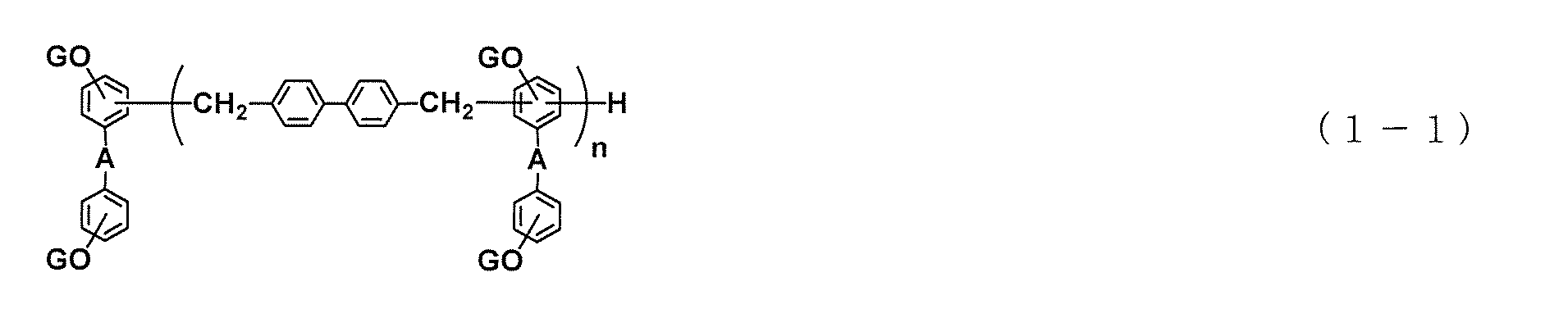
- the resin composition according to [6], wherein the epoxy resin is represented by the following general formula (1-1) or (1-2).
- G represents a glycidyl group
- A is independently a single bond, an oxygen atom, a sulfur atom, -SO 2 -, -CO-, or a divalent carbon number of 1 to 6 represents a hydrocarbon group, and n represents a number from 0 to 20.
- Y is independently a single bond, an oxygen atom, a sulfur atom, -SO 2 -, -CO-, -COO-, -CONH-, -CH 2 - or -C( CH 3 ) 2 -.
- the crystalline resin is a vinyl resin, and the vinyl resin is characterized by having a vinyl equivalent of 150 to 1000 g/eq, a hydroxyl equivalent of 5000 g/eq or more, and a total chlorine amount of 2000 ppm or less [1]
- R 1 to R 6 each independently represent a hydrogen atom or a monovalent hydrocarbon group having 1 to 6 carbon atoms.
- A independently represents a single bond, an oxygen atom, a sulfur atom, -SO 2 -, -CO-, or a divalent hydrocarbon group having 1 to 6 carbon atoms, and are independently a benzene ring, a naphthalene ring or a biphenyl ring, and n represents a number from 0 to 20.
- Y is independently a single bond, an oxygen atom, a sulfur atom, -SO 2 -, -CO-, -COO-, -CONH-, -CH 2 - or -C( CH 3 ) 2 -.
- the resin composition of the present invention provides, for example, a cured molded product with excellent moldability and reliability, as well as high thermal conductivity, low water absorption, low thermal expansion, high heat resistance, and flame retardance.
- it has excellent solvent solubility and is suitable for resin compositions and their cured products used for applications such as lamination, molding, casting, and adhesives, and this cured product has heat resistance, thermal decomposition stability, and thermal conductivity. , low dielectric constant, low dielectric loss tangent, and excellent flame retardancy.
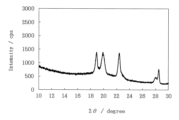
- 1 is an XRD profile of a cured molded product of the epoxy resin composition obtained in Example 1-1 in the first embodiment.
- 1 is an XRD profile of a cured molded product of an epoxy resin composition obtained in Comparative Example 1-1 in the first embodiment.
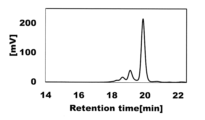
- 2 is a GPC chart of vinyl resin A obtained in Synthesis Example 2-1 in the second embodiment.
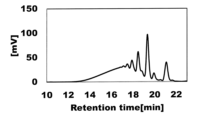
- 2 is a GPC chart of vinyl resin B obtained in Synthesis Example 2-2 in the second embodiment.
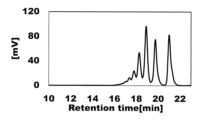
- 2 is a GPC chart of vinyl resin C obtained in Synthesis Example 2-3 in the second embodiment. It is an FD-MS spectrum of vinyl resin C obtained in Synthesis Example 2-3 in the second embodiment.
- the resin composition of the present invention is a resin composition containing at least a crystalline resin and an additive, wherein the additive is a layered clay mineral, and the layered clay mineral is added in an amount of 1 to 100 parts by weight based on 100 parts by weight of the resin component. 20 parts by weight of the crystalline resin, and the melting point of the crystalline resin is above 80°C and below 200°C.
- the resin used in the resin composition of the present invention is a crystalline resin that has crystallinity at room temperature.
- crystalline resin has the same meaning as commonly used in the art, and is a resin having a crystalline structure.
- crystalline resin refers to a resin that exhibits a clear endothermic peak in differential scanning calorimetry.
- the crystalline resin is not limited and can be appropriately selected depending on the purpose, and examples thereof include acrylic resin, styrene-acrylic resin, polyester resin, epoxy resin, and vinyl resin. These resins may be used alone or in combination of two or more. Among these crystalline resins, considering the above-mentioned properties aimed at by the present invention, moldability, reliability, high thermal conductivity, low water absorption, heat resistance, low thermal expansion, heat resistance, moisture resistance, difficulty From the viewpoint of flammability, epoxy resin is preferred. Furthermore, vinyl resin is preferred because it has excellent solvent solubility, moldability, heat resistance, thermal decomposition stability, thermal conductivity, low dielectric constant, low dielectric loss tangent, and flame retardancy.
- the crystalline resin of the present invention has a melting point. Its melting point range is more than 80°C and less than 200°C. Although it depends on the resin used, the temperature is preferably 90° C. or higher in order to improve thermal conductivity, reliability, and heat resistance.
- the melting point is the endothermic peak temperature associated with melting of the crystal in scanning differential thermal analysis. Resins with melting points higher than 200°C have strong crystallinity and tend to reduce solvent solubility and melt-kneading properties, while cured products using resins with melting points of 80°C or lower tend not to improve thermal conductivity. .
- the layered clay minerals used as additives in the resin composition of the present invention are also called tabular particles, and specifically include talc, kaolin, mica, montmorillonite, beidellite, hectorite, saponite, nontronite, and stevensite.
- smectite minerals such as vermiculite, bentonite, kanemite, kenyanite, makanite, etc.
- layered sodium silicate such as vermiculite, bentonite, kanemite, kenyanite, makanite, Na type tetrasilicic fluorinated mica, Li type tetrasilicic fluorinated mica, Na type fluorinated teniolite, Li type fluorinated teniolite, etc.
- the surface of the layered clay mineral may be modified (surface treated) with an ammonium salt or the like.
- a silicate compound containing magnesium is preferred, talc or mica is more preferred, and talc is even more preferred.
- the layered clay mineral is contained in an amount of 1 to 20 parts by weight based on 100 parts by weight of the total resin component. It is preferably contained in an amount of 5 to 15 parts by weight. If the amount of layered clay mineral in the resin composition is too small, it may be difficult to sufficiently exhibit the above-mentioned thermal conductivity. On the other hand, if the content of the layered clay mineral is higher than this, fluidity and heat resistance may decrease. In addition, when containing a highly thermally conductive inorganic filler such as alumina, if the amount of layered clay minerals is large, the content of the highly thermally conductive inorganic filler may not be sufficient and the overall thermal conductivity may decrease. be.
- a highly thermally conductive inorganic filler such as alumina
- the resin component refers to a resin and a component related to curing or modification thereof.
- the resin component refers to an epoxy resin, a curing agent, and a curing accelerator included if necessary.
- the resin component refers to a vinyl resin and a radical polymerization initiator and a modifier included as necessary.
- the resin component can be used with appropriate changes depending on the purpose.
- the resin composition of the present invention achieves the object of the present invention, except for using the crystalline resin having a melting point within the predetermined range and the layered clay mineral as an additive having a content within the predetermined range. , and there is no restriction as long as it does not impair the purpose of the present invention.
- a first embodiment using an epoxy resin as the crystalline resin and a second embodiment using a vinyl resin will be illustrated below.
- epoxy resins and vinyl resins satisfy some of the characteristics aimed at by the present invention and are preferred embodiments, but the scope of the present invention is not limited to these embodiments. Not done.
- the first embodiment of the present invention relates to an epoxy resin composition using an epoxy resin as a crystalline resin.
- the epoxy resin composition preferably contains a curing agent in addition to the above-mentioned additive (layered clay mineral) and epoxy resin.
- the curing agent will be described later.
- a diffraction peak is observed in a predetermined region in measurement (XRD) of the cured product by X-ray diffraction method, More specifically, it is preferable that the diffraction peak is detected in a region where the diffraction angle 2 ⁇ is 15° or more and less than 25°.
- the profile when XRD measurement of a cured epoxy resin consisting only of organic substances is broad, and no clear peak is detected.
- the detection range is a range in which 2 ⁇ is 15° or more and less than 25°.
- the epoxy resin composition contains an inorganic substance, a peak of the inorganic substance is detected, but the peak position differs depending on the crystal structure and can be distinguished from the peak of the organic substance.
- the additive layered clay mineral
- talc a diffraction peak is observed in the 2 ⁇ range of 28° to 29°.
- a broad peak is also called an amorphous peak, and is a peak with a peak width of 8° or more
- a sharp peak is also called a crystalline peak, and is a peak with a width of 5° or less, preferably 3°.
- the peak is within °. That is, "a diffraction peak is detected” in the first embodiment preferably means that the sharp peak (crystalline peak) is detected in a range of 2 ⁇ of 15° or more and less than 25°. means.
- the peak width can be determined by a normal peak analysis method performed by a person skilled in the art, and is usually parallel to the baseline and refers to the width between the starting point of the peak rise and the end point of the peak falling.
- the epoxy resin component of the epoxy resin composition according to the first embodiment of the present invention has a melting point of more than 80°C and less than 200°C.
- a preferable lower limit is 83°C or higher, and a more preferable lower limit is 90°C or higher.
- a preferable upper limit is 180°C or less, and a more preferable upper limit is 150°C or less.
- the epoxy resin component of the epoxy resin composition according to the first embodiment of the present invention may be any epoxy resin having two or more epoxy groups in the molecule.
- examples include bisphenol A, bisphenol F, 4,4'-dihydroxydiphenyl ether, hydroquinone, 4,4'-dihydroxybiphenyl, 3,3',5,5'-tetramethyl-4,4'-dihydroxydiphenylmethane, 4,4'-dihydroxydiphenyl sulfone, 4,4'-dihydroxydiphenyl sulfide, fluorene bisphenol, 2,2'-biphenol, resorcinol, catechol, t-butylcatechol, t-butylhydroquinone, allylated bisphenol A, allylated bisphenol F, divalent phenols such as allylated phenol novolak, or phenol novolak, bisphenol A novolak, o-cresol novolak, m-cresol novolak, p-
- epoxy resin highly thermally conductive epoxy resins having rigid structures such as 4,4'-dihydroxydiphenyl ether, hydroquinone, glycidyl ether derivatives derived from 4,4'-dihydroxybiphenyl, and mesogenic skeletons are preferred, and in particular, the above-mentioned epoxy resins are preferred.
- Epoxy resins represented by general formula (1-1) or (1-2) are more preferred.
- These highly thermally conductive epoxy resins preferably contain 50 wt% or more of the entire epoxy resin component. More preferably, it is 70 wt% or more. If the usage ratio is less than this, the effect of improving heat resistance, thermal conductivity, etc. when the epoxy resin is cured may be small.
- n is the number of repetitions (number average) and represents a number from 0 to 20. Preferably, it is a mixture of components having different values of n.
- G represents a glycidyl group
- A independently represents a single bond, an oxygen atom, a sulfur atom, -SO 2 -, -CO-, or a divalent hydrocarbon group having 1 to 6 carbon atoms. A is preferably a single bond from the viewpoint of thermal conductivity.
- p is the number of repetitions (number average) and represents a number from 0 to 15. Preferably, it is a mixture of components having different values of p.
- Y independently represents a single bond, an oxygen atom, a sulfur atom, -SO 2 -, -CO-, -COO-, -CONH-, -CH 2 - or -C(CH 3 ) 2 - . From the viewpoint of high thermal conductivity, Y preferably has a single bond biphenyl structure, -SO 2 -, -CO-, -COO-, or -CONH-, and a biphenyl structure at the 4,4' position is particularly preferred.
- Y is preferably an oxygen atom, a sulfur atom, -CH 2 -, or -C(CH 3 ) 2 -.
- B in formula (1-2) independently represents a benzonitrile structure or -(CH 2 ) q -, and q represents a number from 3 to 10.
- Preferred B has both structures in at least one molecule.
- the method for producing the epoxy resin used in the epoxy resin composition according to the first embodiment of the present invention is not particularly limited, and it can be produced by reacting a raw material phenolic compound with epichlorohydrin. This reaction can be carried out in the same manner as a normal epoxidation reaction.
- the raw material phenolic compound can be selected according to the epoxy resin to be obtained, as described above.
- the epoxy resin represented by the above formula (1-1) or (1-2) can be produced as follows.
- the epoxy resin represented by the formula (1-1) can be produced by reacting a polyhydric hydroxy resin (raw material phenolic compound) represented by the following formula (1-3) with epichlorohydrin.
- a and n in formula (1-3) are the same as in formula (1-1) above.
- This polyhydric hydroxy resin (1-3) is reacted with an aromatic crosslinking agent having a biphenyl structure represented by formula (1-4) and a bifunctional phenol compound represented by formula (1-5). It can be manufactured by
- Z in formula (1-4) represents a hydroxyl group, a halogen atom, or an alkoxy group having 1 to 6 carbon atoms.
- a in formula (1-5) is the same as in formula (1-1) above.
- Z represents a hydroxyl group, a halogen atom, or an alkoxy group having 1 to 6 carbon atoms.
- Specific examples of the aromatic crosslinking agent include 4,4'-bishydroxymethylbiphenyl, 4,4'-bischloromethylbiphenyl, 4,4'-bisbromomethylbiphenyl, and 4,4'-bismethoxymethylbiphenyl. , 4,4'-bisethoxymethylbiphenyl.
- 4,4'-bishydroxymethylbiphenyl or 4,4'-bischloromethylbiphenyl is preferable, and from the viewpoint of reducing ionic impurities, 4,4'-bishydroxymethylbiphenyl or 4,4'-bishydroxymethylbiphenyl is preferable.
- 4'-bismethoxymethylbiphenyl is preferred.
- difunctional phenol compound of formula (1-5) specifically, 2,2'-dihydroxybiphenyl, 4,4'-dihydroxydiphenyl ether, 4,4'-dihydroxydiphenyl ketone, 4,4' -dihydroxydiphenyl sulfone, 4,4'-dihydroxydiphenyl sulfide, dihydroxydiphenylmethanes, 2,2-bis(4-hydroxyphenyl)propane, especially 2,2'-dihydroxybiphenyl, 4, from the viewpoint of solvent solubility. , 4'-dihydroxydiphenyl ether, and dihydroxydiphenylmethane are preferred.
- the dihydroxydiphenylmethane may be a mixture of ortho, meta, and para, but preferably has an isomer ratio of 4,4'-dihydroxydiphenylmethane of 40% or less. If there is a large amount of 4,4'-dihydroxydiphenylmethane, the crystallinity will be strong and there is a concern that the solvent solubility will decrease.
- the molar ratio when the aromatic crosslinking agent of formula (1-4) and the phenol compound of formula (1-5) are reacted is generally 1 mole of the phenol compound to 0.00% of the aromatic crosslinking agent.
- the amount is in the range of 2 to 0.7 mol, more preferably 0.4 to 0.7 mol.
- This reaction can be carried out without a catalyst or in the presence of an acid catalyst such as an inorganic acid or an organic acid.
- an acid catalyst such as an inorganic acid or an organic acid.
- 4,4'-bischloromethylbiphenyl the reaction can be carried out without a catalyst, but in general, it is necessary to suppress side reactions such as the formation of ether bonds due to the reaction of chloromethyl groups and hydroxyl groups. It is preferable to carry out the reaction in the presence of an acidic catalyst.
- This acidic catalyst can be appropriately selected from well-known inorganic acids and organic acids, such as mineral acids such as hydrochloric acid, sulfuric acid, and phosphoric acid, formic acid, oxalic acid, trifluoroacetic acid, p-toluenesulfonic acid, and metasulfonic acid.
- mineral acids such as hydrochloric acid, sulfuric acid, and phosphoric acid
- formic acid oxalic acid
- trifluoroacetic acid trifluoroacetic acid
- p-toluenesulfonic acid p-toluenesulfonic acid
- metasulfonic acid metasulfonic acid.
- organic acids such as acids, trifluorometasulfonic acid, Lewis acids such as zinc chloride, aluminum chloride, iron chloride, and boron trifluoride, and solid acids.
- This reaction is usually carried out at 100 to 250°C for 1 to 20 hours.
- the temperature is preferably 100 to 180°C, more preferably 140 to 180°C. If the reaction temperature is low, the reactivity is poor and it takes time, and if the reaction temperature is high, there is a risk of decomposition of the resin.
- alcohols such as methanol, ethanol, propanol, butanol, ethylene glycol, methyl cellosolve, ethyl cellosolve, diethylene glycol dimethyl ether, triglyme, aromatic compounds such as benzene, toluene, chlorobenzene, dichlorobenzene, etc.
- ethyl cellosolve, diethylene glycol dimethyl ether, triglyme, etc. are particularly preferred.
- the solvent may be removed from the obtained polyhydric hydroxy resin by distillation under reduced pressure, washing with water, reprecipitation in a poor solvent, etc., but the solvent may be left as a raw material for the epoxidation reaction. May be used.
- the polyhydric hydroxy resin of formula (1-3) thus obtained can be used not only as a raw material for epoxy resin but also as an epoxy resin curing agent. Moreover, by further combining it with a curing agent such as hexamine, it can be applied as a phenolic resin molding material.
- Y, B, and p in formula (1-6) are the same as in formula (1-2) above.
- the manufacturing method for the raw material phenolic compound represented by formula (1-6) is not limited as long as it has a predetermined structure, but it can be prepared by combining either or both of a benzonitrile compound and a dihalogen alkyl compound with formula (1-6). -6) is suitably obtained by reacting with a dihydroxy compound having a Y group in the presence of a basic catalyst.
- examples of the benzonitrile compound include 2,4-dichlorobenzonitrile, 2,5-dichlorobenzonitrile, 2,6-dichlorobenzonitrile, 3,5-dichlorobenzonitrile, 2,4-dibromobenzonitrile, Examples include 2,5-dibromobenzonitrile, 2,6-dibromobenzonitrile, 3,5-dibromobenzonitrile, and examples of the dihalogen alkyl compound include 1,3-dibromopropane, 1,4-dibromobutane, Examples of the dihydroxy compound having a Y group in formula (1-6) include 1,5-dibromopentane and 1,6-dibromohexane, such as 4,4'-dihydroxybiphenyl, 4,4'- Dihydroxydiphenyl ether, 4,4'-dihydroxydiphenyl sulfide, 4,4'-dihydroxydiphenyl sulfone, 4,4
- the reaction between the above-mentioned raw material phenolic compound and epichlorohydrin can be carried out, for example, by dissolving the phenolic compound in excess epichlorohydrin, and then heating the mixture at 50 to 150°C in the presence of an alkali metal hydroxide such as sodium hydroxide or potassium hydroxide.
- an alkali metal hydroxide such as sodium hydroxide or potassium hydroxide.
- a method in which the reaction is carried out at a temperature in the range of 60 to 100°C for 1 to 10 hours is mentioned.
- the amount of alkali metal hydroxide used is in the range of 0.8 to 2.0 mol, preferably 0.9 to 1.5 mol, per 1 mol of hydroxyl group in the phenolic compound. .
- Epichlorohydrin is used in an excess amount relative to the hydroxyl groups in the phenolic compound, and is usually 1.5 to 15 moles per mole of hydroxyl groups in the phenolic compound. After the reaction, excess epichlorohydrin is distilled off, the residue is dissolved in a solvent such as toluene or methyl isobutyl ketone, filtered, washed with water to remove inorganic salts, and then the solvent is distilled off to obtain the desired epoxy. Resin can be obtained.
- a solvent such as toluene or methyl isobutyl ketone
- the purity of the epoxy resin, especially the amount of hydrolyzable chlorine, is preferably as low as possible from the viewpoint of improving the reliability of electronic components to which it is applied. Although not particularly limited, it is preferably 1000 ppm or less, more preferably 500 ppm or less.
- the term "hydrolyzable chlorine" used in the first embodiment of the present invention refers to a value measured by the following method. That is, after dissolving 0.5 g of the sample in 30 ml of dioxane, adding 10 ml of 1N-KOH and boiling and refluxing for 30 minutes, cooling to room temperature, further adding 100 ml of 80% acetone water, and increasing the potential with a 0.002N-AgNO 3 aqueous solution. This is the value obtained by titration.
- curing agent used in the epoxy resin composition according to the first embodiment of the present invention all those generally known as curing agents for epoxy resins can be used, including dicyandiamide, acid anhydrides, polyhydric phenols, These include aromatic and aliphatic amines. Among these, it is preferable to use polyhydric phenols as a curing agent in fields where high electrical insulation is required, such as semiconductor sealing materials. Specific examples of the curing agent are shown below.
- polyhydric phenols examples include bihydric phenols such as bisphenol A, bisphenol F, bisphenol S, fluorene bisphenol, 4,4'-biphenol, 2,2'-biphenol, hydroquinone, resorcinol, and naphthalene diol; , tris-(4-hydroxyphenyl)methane, 1,1,2,2-tetrakis(4-hydroxyphenyl)ethane, phenol novolak, o-cresol novolak, naphthol novolak, polyvinylphenol, etc. There are phenols.
- divalent phenols such as phenols, naphthols, bisphenol A, bisphenol F, bisphenol S, fluorene bisphenol, 4,4'-biphenol, 2,2'-biphenol, hydroquinone, resorcinol, naphthalenediol
- polyhydric phenolic compounds synthesized using condensing agents such as formaldehyde, acetaldehyde, benzaldehyde, p-hydroxybenzaldehyde, and p-xylylene glycol.
- acid anhydride curing agents examples include phthalic anhydride, tetrahydrophthalic anhydride, methyltetrahydrophthalic anhydride, hexahydrophthalic anhydride, methylhexahydrophthalic anhydride, methylhimic anhydride, dodecynylsuccinic anhydride, nadic anhydride, Examples include trimellitic anhydride.
- amine curing agent examples include aromatic amines such as 4,4'-diaminodiphenylmethane, 4,4'-diaminodiphenylpropane, 4,4'-diaminodiphenylsulfone, m-phenylenediamine, and p-xylylenediamine; Aliphatic amines include ethylenediamine, hexamethylenediamine, diethylenetriamine, and triethylenetetramine.
- aromatic amines such as 4,4'-diaminodiphenylmethane, 4,4'-diaminodiphenylpropane, 4,4'-diaminodiphenylsulfone, m-phenylenediamine, and p-xylylenediamine
- Aliphatic amines include ethylenediamine, hexamethylenediamine, diethylenetriamine, and triethylenetetramine.
- one type or a mixture of two or more of these curing agents can be used.
- the compounding ratio of the epoxy resin and the curing agent is preferably such that the equivalent ratio of the epoxy group to the functional group in the curing agent is in the range of 0.8 to 1.5. Outside this range, unreacted epoxy groups or functional groups in the curing agent may remain even after curing, resulting in a decrease in the reliability of the sealing function.
- the epoxy resin composition according to the first embodiment of the present invention contains an oligomer or polymer compound such as polyester, polyamide, polyimide, polyether, polyurethane, petroleum resin, indene resin, indene-coumarone resin, or phenoxy resin. Other modifiers and the like may be added as appropriate. The amount added is usually in the range of 1 to 30 parts by weight based on 100 parts by weight of the total resin components.
- the epoxy resin composition according to the first embodiment of the present invention includes an inorganic filler other than the above-mentioned layered clay minerals such as mica and talc, a pigment, a retardant agent, a thixotropy imparting agent, a coupling agent, and a fluidity agent.
- Additives such as improvers can be added.
- inorganic fillers include spherical or crushed fused silica, silica powder such as crystalline silica, alumina powder, glass powder, calcium carbonate, alumina, hydrated alumina, etc., and are used in semiconductor sealing materials.
- the preferred amount is 70% by weight or more, more preferably 80% by weight or more.
- the preferred blending amount is 20 to 90% by weight, more preferably 40 to 60% by weight, since fluidity is required.
- Pigments include organic or inorganic extender pigments, scaly pigments, and the like.
- examples of the thixotropy imparting agent include silicone-based, castor oil-based, aliphatic amide wax, oxidized polyethylene wax, organic bentonite-based, and the like.
- a curing accelerator can be used in the epoxy resin composition according to the first embodiment of the present invention, if necessary.
- Examples include amines, imidazoles, organic phosphines, Lewis acids, etc. Specifically, 1,8-diazabicyclo(5,4,0)undecene-7, triethylenediamine, benzyldimethylamine, Tertiary amines such as ethanolamine, dimethylaminoethanol, tris(dimethylaminomethyl)phenol, 2-methylimidazole, 2-phenylimidazole, 2-ethyl-4-methylimidazole, 2-phenyl-4-methylimidazole, 2- Imidazoles such as heptadecylimidazole, organic phosphines such as tributylphosphine, methyldiphenylphosphine, triphenylphosphine, diphenylphosphine, phenylphosphine, tetraphenylphosphonium/t
- the epoxy resin composition according to the first embodiment of the present invention may contain a mold release agent such as carnauba wax or OP wax, a coupling agent such as ⁇ -glycidoxypropyltrimethoxysilane, and carbon.
- a mold release agent such as carnauba wax or OP wax
- a coupling agent such as ⁇ -glycidoxypropyltrimethoxysilane
- Coloring agents such as black, flame retardants such as antimony trioxide, stress reducing agents such as silicone oil, lubricants such as calcium stearate, etc. can be used.
- the epoxy resin composition according to the first embodiment of the present invention is made into a varnish state in which an organic solvent is dissolved, and then impregnated into a fibrous material such as a glass cloth, an aramid nonwoven fabric, a polyester nonwoven fabric such as a liquid crystal polymer, etc. By removing the solvent, it can be made into a prepreg. Further, in some cases, it can be applied to a sheet-like material such as copper foil, stainless steel foil, polyimide film, polyester film, etc. to form a laminate.
- a cured resin product according to the first embodiment of the present invention can be obtained.
- This cured product can be obtained by molding an epoxy resin composition by methods such as casting, compression molding, and transfer molding.
- the temperature at this time is usually in the range of 120 to 220°C.
- a molded article having a crystallinity of 10% or more has high thermal conductivity and is suitable for high thermal conductive applications such as heat dissipation substrates.
- the degree of crystallinity is affected by the temperature control during molding, and if molded at a high temperature exceeding 200°C, it will become amorphous, making it difficult to obtain a molded product with an observable crystallinity, so it is necessary to heat it in stages. It is preferable. More preferably, the molding is performed by heating stepwise at a temperature in the range of 120 to 200° C. for a period of 30 seconds to 1 hour (preferably 1 minute to 30 minutes). Further, after molding, post-curing may be performed to adjust the degree of crystallinity as described above.
- the temperature of post-cure is 130°C to 250°C, and the time is in the range of 1 hour to 24 hours, but the endothermic peak temperature measured with the differential scanning calorimeter and conditions as shown in the example is It is desirable to perform post-curing at a temperature 5°C to 40°C lower for 1 to 24 hours.
- the degree of crystallinity of the molded product (cured product) can be determined based on the ratio of the crystallinity peak by the method described in Examples.
- the second embodiment of the present invention relates to a vinyl resin composition using vinyl resin as the crystalline resin.
- the vinyl resin used in the vinyl resin composition is one that is crystalline at room temperature, and has a melting point of more than 80°C and less than 200°C, as described above.
- the melting point range is 90-200°C, more preferably 110-180°C.
- the melting point is the endothermic peak temperature accompanying the melting of the crystal in scanning differential thermal analysis.
- Vinyl resins with melting points higher than 200°C have strong crystallinity and tend to reduce solvent solubility and melt-kneading properties, while cured products using vinyl resins with melting points lower than 90°C do not improve thermal conductivity. Tend.
- the vinyl resin used in the second embodiment of the present invention preferably has a vinyl equivalent weight in the range of 150 to 1000 g/eq. More preferably, it is in the range of 200 to 500 g/eq. If it is larger than this range, the reactivity tends to be low, and some components become unreacted during curing, which tends to lower heat resistance and reliability. When it is smaller than this range, solvent solubility and melt-kneading properties tend to decrease, the cured product becomes hard and brittle, and film properties tend to decrease.
- the vinyl resin used in the second embodiment of the present invention preferably has a hydroxyl equivalent of 5000 g/eq or more, and preferably has a total chlorine amount of 2000 ppm or less.
- the vinyl resin used in the second embodiment of the present invention can be obtained by reacting the hydroxyl group of a hydroxy resin with an aromatic vinylating agent such as chloromethylstyrene;
- an aromatic vinylating agent such as chloromethylstyrene
- the hydroxyl resin has many hydroxyl groups and the hydroxyl equivalent is less than 5000 g/eq, curing tends to be insufficient and thermal conductivity and heat resistance tend to decrease.
- the hydroxyl group is a polar group, its remaining tends to inhibit the reduction of the dielectric constant and dielectric loss tangent.
- the hydroxyl equivalent is more preferably 8,000 g/eq or more, still more preferably 10,000 g/eq or more.
- the chlorine component comes from chloromethylstyrene and from the crosslinking agent in the raw material for producing hydroxy resin. These are difficult to remove if the vinyl resin has low solvent solubility.
- the total amount of chlorine is more preferably 1000 ppm or less, still more preferably 800 ppm or less.
- the vinyl resin used in the second embodiment of the present invention can be suitably obtained by reacting a hydroxy resin (hydroxy compound) with an aromatic vinylating agent.
- a hydroxy resin hydroxy compound
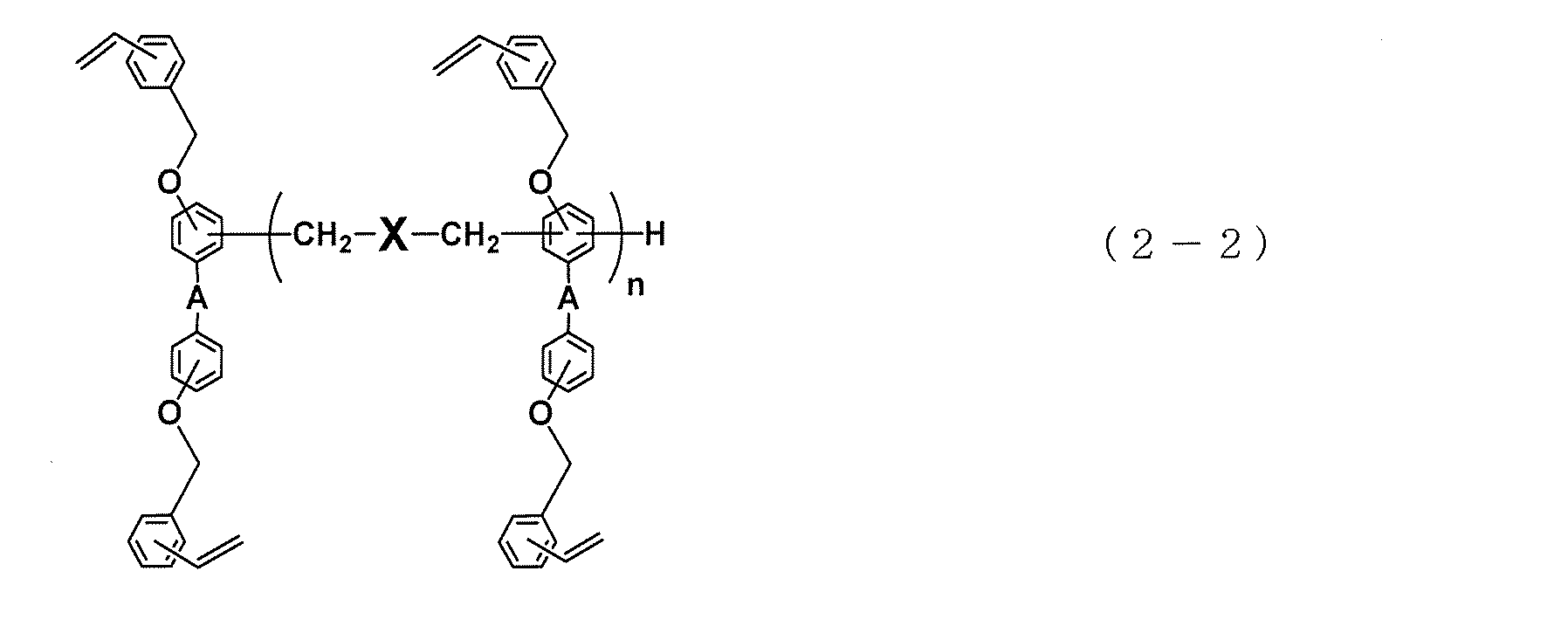
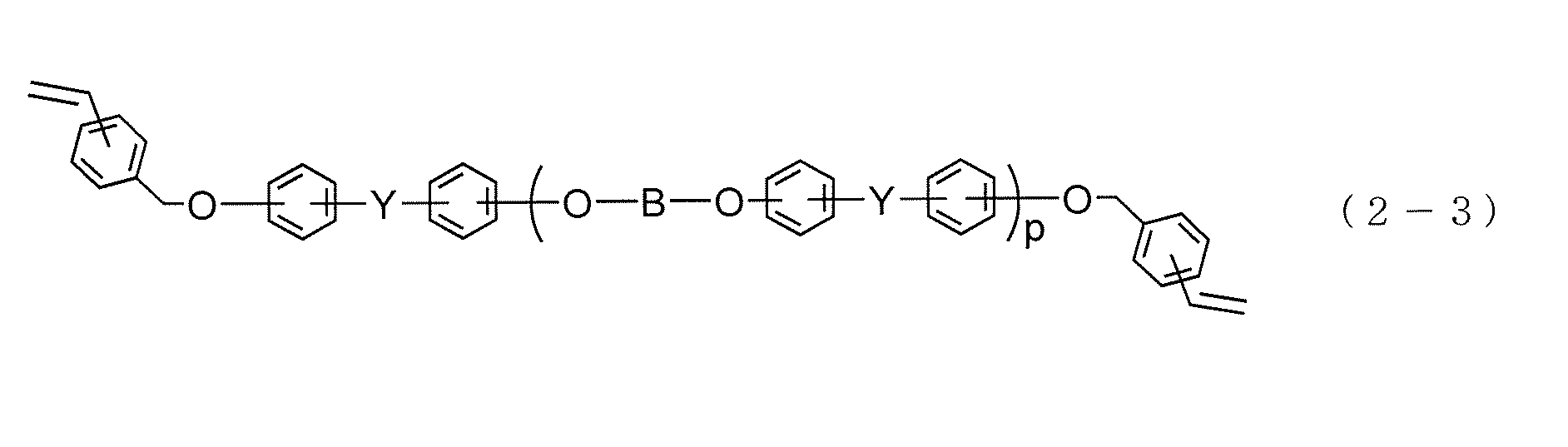
- an aromatic vinylating agent e.g., vinyl resins having structures represented by the following formulas (2-1) to (2-3) can be preferably mentioned.
- the structures of formulas (2-1) to (2-3) below are structural skeletons that can be expected to have thermal conductivity that can suppress intramolecular and intermolecular molecular mobility, and have good solvent solubility and melt-kneading properties. It is a preferred embodiment as a resin that achieves the object of the present invention because it has good properties and can be molded into a uniform cured product and exhibits thermal conductivity.
- ⁇ Vinyl resin of formula (2-1)> A vinyl resin represented by the above formula (2-1) can be obtained by reacting a hydroxy resin (hydroxy compound) represented by the general formula (2-4) with chloromethylstyrene. This reaction can be carried out in the same manner as the well-known vinylation reaction. R 1 to R 6 in formula (2-4) are the same as in formula (2-1).
- R 1 to R 6 are each independently a hydrogen atom or a monovalent hydrocarbon group having 1 to 6 carbon atoms.
- Alkyl groups are preferred from the viewpoint of solvent solubility, and aromatic groups are preferred from the viewpoints of heat resistance and high thermal conductivity.
- aromatic groups are preferred from the viewpoints of heat resistance and high thermal conductivity.
- a more preferred structure is a methyl group or a phenyl group.
- R 1 to R 6 may be a mixture of different structures.
- the substitution position of the vinyl benzyl ether in the vinyl resin of formula (2-1) is not particularly limited, but from the viewpoint of thermal conductivity and heat resistance, it is preferably the para position with respect to the methine group connecting the three aromatic rings. preferable. In particular, it is more preferable that all three vinyl benzyl ethers are at the para position.
- the number average molecular weight (Mn) of the vinyl resin of formula (2-1) is preferably 2000 or less, more preferably 1500 or less. It may also contain a multibranched product represented by the following general formula (2-5).
- the trifunctional hydroxy compound of formula (2-4) preferably has a hydroxyl equivalent of 90 to 350 g/eq, more preferably 100 to 200 g/eq.
- the trifunctional hydroxy compound of formula (2-4) can be produced by a general method, for example, by polycondensing a monovalent phenol compound and an aromatic aldehyde.
- Examples of monovalent phenol compounds include phenol, o-cresol, m-cresol, p-cresol, o-ethylphenol, m-ethylphenol, p-ethylphenol, p-octylphenol, p-t-butylphenol, - Monoalkylphenols such as cyclohexylphenol, m-cyclohexylphenol, and p-cyclohexylphenol; dialkylphenols such as 2,5-xylenol, 3,5-xylenol, 3,4-xylenol, 2,4-xylenol, and 2,6-xylenol ; Trialkylphenols such as 2,3,5-trimethylphenol and 2,3,6-trimethylphenol, furthermore, 2-phenylphenol, 4-phenylphenol, 3-benzyl-1,1'-biphenyl-2-ol, Examples include hydroxybiphenyls such as 3-benzyl-1,1'-
- aromatic aldehydes examples include 2-hydroxybenzaldehyde, 3-hydroxybenzaldehyde, 4-hydroxybenzaldehyde, 4-hydroxy-3-methylbenzaldehyde, 4-hydroxy-3,5-dimethylbenzaldehyde, 4-hydroxy-2,5 -dimethylbenzaldehyde, 3,5-diethyl-4-hydroxybenzaldehyde, and other hydroxybenzaldehydes. From the viewpoint of heat resistance and thermal conductivity, 4-hydroxybenzaldehyde is preferred.
- the polycondensation of a phenol compound and an aromatic aldehyde may be carried out using an acid catalyst, such as acetic acid, oxalic acid, sulfuric acid, hydrochloric acid, phenolsulfonic acid, p-toluenesulfonic acid, zinc acetate, manganese acetate, and the like.
- an acid catalyst such as acetic acid, oxalic acid, sulfuric acid, hydrochloric acid, phenolsulfonic acid, p-toluenesulfonic acid, zinc acetate, manganese acetate, and the like.
- These acid catalysts can be used alone or in combination of two or more.
- sulfuric acid and para-toluenesulfonic acid are preferable because of their excellent activity. Note that the acid catalyst may be added before or during the reaction.
- the polycondensation of a phenol compound and an aromatic aldehyde may be performed in the presence of a solvent to obtain a polycondensate, if necessary.
- a solvent include monoalcohols such as methanol, ethanol, and propanol; ethylene glycol, 1,2-propanediol, 1,3-propanediol, 1,4-butanediol, 1,5-pentanediol, 1,6 - Polyols such as hexanediol, 1,7-heptanediol, 1,8-octanediol, 1,9-nonanediol, trimethylene glycol, diethylene glycol, polyethylene glycol, glycerin; 2-ethoxyethanol, ethylene glycol monomethyl ether, ethylene Glycol ethers such as glycol monoethyl ether, ethylene glycol monopropyl ether, ethylene glycol monobutyl ether,
- the reaction temperature during polycondensation of the phenol compound and aromatic aldehyde is preferably in the range of 20 to 140°C, more preferably in the range of 80 to 110°C.
- the charging ratio of phenol compound/aromatic aldehyde is preferably in the range of 1/0.1 to 1/0.5 in terms of molar ratio, since the phenol compound after the reaction can be easily removed by reprecipitation, etc. It is preferably in the range of 1/0.3 to 1/0.5.
- the vinyl resin of formula (2-1) can be suitably obtained by reacting a trifunctional hydroxy compound with an aromatic vinylating agent.
- a vinyl resin suitable for the present invention represented by the above formula (2-1) can be obtained by reacting a trifunctional hydroxy compound represented by the above formula (2-4) with chloromethylstyrene. be able to. This reaction can be carried out in the same manner as the well-known vinylation reaction.
- the blending ratio is preferably 0.8 to 1.2 equivalents of the aromatic vinylating agent (for example, chloromethylstyrene) to 1.0 equivalents of hydroxyl groups, which are the functional groups of the trifunctional hydroxy compound.
- the aromatic vinylating agent for example, chloromethylstyrene
- hydroxyl groups which are the functional groups of the trifunctional hydroxy compound.
- an excess amount of the aromatic vinylating agent may be added and removed after the reaction.
- halomethylstyrene especially chloromethylstyrene is preferred.
- Other examples include bromomethylstyrene, its isomers, and those with substituents.
- substitution position of the halomethyl compound for example, in the case of halomethylstyrene, the 4-position is preferable, and the 4-position preferably accounts for 60% by weight or more of the total.
- the reaction between the trifunctional hydroxy compound and the aromatic vinylating agent can be carried out without a solvent or in the presence of a solvent.
- the reaction can be carried out by adding an aromatic vinylating agent to the hydroxy compound, adding a metal hydroxide to carry out the reaction, and removing the generated metal salt by a method such as filtration or washing with water.
- the solvent include, but are not limited to, methyl ethyl ketone, benzene, toluene, xylene, methyl isobutyl ketone, diethylene glycol dimethyl ether, cyclopentanone, and cyclohexanone. From the viewpoint of reactivity, methyl ethyl ketone is preferred.
- Specific examples of metal hydroxide include sodium hydroxide, potassium hydroxide, etc., but are not limited thereto.
- the temperature of the vinylation reaction is preferably 90°C or lower, more preferably 70°C or lower. If the temperature is higher than this, heat-induced self-polymerization of the vinylbenzyl ether group may proceed, making it difficult to control the reaction.
- polymerization inhibitors such as quinones, nitro compounds, nitrophenols, nitroso, nitrone compounds, and oxygen may be used.
- the end point of the reaction can be determined by tracking the remaining amount of halomethylstyrene as an aromatic vinylating agent using various chromatograms such as GPC, and the reaction rate can be determined depending on the type and amount of metal hydroxide, addition rate, solid It can be adjusted by adjusting the concentration etc.
- vinyl resin of formula (2-2), vinyl resin of formula (2-3) As the vinyl resin used in the second embodiment of the present invention, in addition to the vinyl resin represented by formula (2-1), those represented by formulas (2-2) and (2-3) are also suitable. These vinyl resins may be used in combination, and it is preferable that the vinyl resins represented by formulas (2-1) to (2-3) contain 50 wt% or more of the entire resin component. More preferably, it is 70 wt% or more. If the proportion used is less than this, the effect of improving heat resistance, thermal conductivity, etc. in a cured product may be small.
- n is the number of repetitions (number average) and represents a number from 0 to 20. Usually, it is a mixture of components having different repeating number (n) values, and the average value (number average) of n is preferably in the range of 0.1 to 15, more preferably in the range of 0.5 to 10.
- A independently represents a single bond, an oxygen atom, a sulfur atom, -SO 2 -, -CO-, or a divalent hydrocarbon group having 1 to 6 carbon atoms
- X independently represents a benzene ring.
- A is preferably a single bond
- X is preferably a biphenyl ring. It is desirable that the substitution positions of the two vinylbenzyl ether groups bonded to the biphenyl structure having A include at least a 2,2' form.
- the substitution positions of the two bonded vinylbenzyl ether groups are the 4,4' position and the 2,2' position. is preferable, and the ratio of biphenyl at both terminals is preferably 40 to 90 mol% of the total at the 2,2' position.
- A is other than a single bond, that is, when both ends of the vinyl resin are other than biphenyl rings, for example, a diphenylmethane structure
- the substitution positions of the two bonded vinyl benzyl ether groups are such that the 4,4' position is 30 to 100 mol%. preferable.
- the vinyl resin of formula (2-2) is preferably a polyfunctional vinyl resin represented by formula (2-6) below.
- e and f in formula (2-6) are the number of repetitions (number average) and represent a number from 0 to 20. Preferably, it is a mixture of components having different values of e and f.
- the ratio (molar ratio) of e/(e+f) is preferably 0.50 to 0.95, more preferably 0.70 to 0.95. When it is less than 0.50, the effect of heat resistance and high thermal conductivity tends to be small, and when it is more than 0.95, crystallinity tends to become strong and solvent solubility tends to decrease.
- the average value of e is preferably 0.1 to 10, more preferably 0.5 to 5.
- the average value of f is preferably 0.1 to 5, more preferably 0.1 to 2.
- A it is the same as the above-mentioned formula (2-2).
- the polyfunctional vinyl resin represented by the above formula (2-6) can be produced by reacting the polyhydric hydroxy resin represented by the formula (2-7) with chloromethylstyrene.
- the ratios of A, e, f, and e/(e+f) are the same as in the polyfunctional vinyl resin of formula (2-6) above.
- the polyhydric hydroxy resin represented by formula (2-6) preferably has a hydroxyl equivalent of 100 to 350 g/eq. When these hydroxyl groups are partially or completely vinylated, a polyfunctional vinyl resin represented by formula (2-6) is obtained.
- This polyhydric hydroxy resin of formula (2-7) is not limited, but for example, as shown in formula (2-11) below, 4,4'-dihydroxybiphenyl represented by formula (2-8) and formula ( It can be produced by reacting with an aromatic crosslinking agent having a biphenyl structure represented by formula (2-9) and then reacting with a bifunctional phenol compound represented by formula (2-10).
- Z in formula (2-9) represents a hydroxyl group, a halogen atom, or an alkoxy group having 1 to 6 carbon atoms.
- A represents a single bond, an oxygen atom, a sulfur atom, -SO 2 -, -CO-, or a divalent hydrocarbon group having 1 to 6 carbon atoms.
- the molar ratio of the synthesis raw materials 4,4'-dihydroxybiphenyl represented by formula (2-8) and the bifunctional phenol compound represented by formula (2-10) is 4,4'-dihydroxy Biphenyl is preferably 0.50 to 0.95, more preferably 0.70 to 0.95. If the ratio of 4,4'-dihydroxybiphenyl is less than this range, heat resistance and high thermal conductivity tend to be insufficient, and if it is higher, the solvent solubility tends to decrease due to strong crystallinity.
- the difunctional phenol compound of formula (2-10) includes 2,2'-dihydroxybiphenyl, 4,4'-dihydroxydiphenyl ether, 4,4'-dihydroxydiphenyl ketone, 4,4'-dihydroxy diphenyl sulfone, 4,4'-dihydroxydiphenyl sulfide, dihydroxydiphenylmethanes, 2,2-bis(4-hydroxyphenyl)propane, and especially 2,2'-dihydroxybiphenyl, 4,4 from the viewpoint of solvent solubility.
- '-dihydroxydiphenyl ether and dihydroxydiphenylmethane are preferred.
- the dihydroxydiphenylmethane may be a mixture of ortho, meta, and para, but preferably has an isomer ratio of 4,4'-dihydroxydiphenylmethane of 40% or less. If there is a large amount of 4,4'-dihydroxydiphenylmethane, the crystallinity will be strong and there is a concern that the solvent solubility will decrease.
- Z represents a hydroxyl group, a halogen atom, or an alkoxy group having 1 to 6 carbon atoms.
- Specific examples of the aromatic crosslinking agent include 4,4'-bishydroxymethylbiphenyl, 4,4'-bischloromethylbiphenyl, 4,4'-bisbromomethylbiphenyl, and 4,4'-bismethoxymethylbiphenyl. , 4,4'-bisethoxymethylbiphenyl.
- 4,4'-bishydroxymethylbiphenyl or 4,4'-bischloromethylbiphenyl is preferable, and from the viewpoint of reducing ionic impurities, 4,4'-bishydroxymethylbiphenyl, Or 4,4'-bismethoxymethylbiphenyl is preferred.
- the molar ratio when reacting a phenol and an aromatic crosslinking agent as shown in formula (2-11) is generally 0.2 to 0.00% of the aromatic crosslinking agent per mole of the phenol.
- the amount is in the range of 7 mol, more preferably in the range of 0.4 to 0.7 mol.
- the amount is more than 0.7 mol, the amount of high molecular weight components increases, and stable production may become difficult.
- the reaction between the phenols and the aromatic crosslinking agent can be carried out without a catalyst or in the presence of an acid catalyst such as an inorganic acid or an organic acid.
- an acid catalyst such as an inorganic acid or an organic acid.
- the reaction can be carried out without a catalyst, but in general, it is necessary to suppress side reactions such as the formation of ether bonds due to the reaction of chloromethyl groups and hydroxyl groups. It is preferable to carry out the reaction in the presence of an acidic catalyst.
- This acidic catalyst can be appropriately selected from well-known inorganic acids and organic acids, such as mineral acids such as hydrochloric acid, sulfuric acid, and phosphoric acid, formic acid, oxalic acid, trifluoroacetic acid, p-toluenesulfonic acid, and metasulfonic acid.
- mineral acids such as hydrochloric acid, sulfuric acid, and phosphoric acid
- formic acid oxalic acid
- trifluoroacetic acid trifluoroacetic acid
- p-toluenesulfonic acid p-toluenesulfonic acid
- metasulfonic acid metasulfonic acid.
- organic acids such as acids, trifluorometasulfonic acid, Lewis acids such as zinc chloride, aluminum chloride, iron chloride, and boron trifluoride, and solid acids.
- This reaction is usually carried out at 100 to 250°C for 1 to 20 hours.
- the temperature is preferably 100 to 180°C, more preferably 140 to 180°C. If the reaction temperature is low, the reactivity is poor and it takes time, and if the reaction temperature is high, there is a risk of decomposition of the resin.
- alcohols such as methanol, ethanol, propanol, butanol, ethylene glycol, methyl cellosolve, ethyl cellosolve, diethylene glycol dimethyl ether, triglyme, aromatic compounds such as benzene, toluene, chlorobenzene, dichlorobenzene, etc.
- ethyl cellosolve, diethylene glycol dimethyl ether, triglyme, etc. are particularly preferred.
- the solvent may be removed from the obtained polyhydric hydroxy resin by distillation under reduced pressure, washing with water, reprecipitation in a poor solvent, etc., but the resin may be used as a raw material for the vinylation reaction with the solvent remaining. May be used.
- the vinyl resin of formula (2-2), preferably the polyfunctional vinyl resin represented by formula (2-6), can be suitably obtained by reacting a polyhydric hydroxy resin with an aromatic vinylizing agent.
- a polyfunctional vinyl resin represented by the above formula (2-6) can be obtained by reacting a polyhydric hydroxy resin represented by the above formula (2-7) with chloromethylstyrene. This reaction can be carried out in the same manner as the well-known vinylation reaction. Note that the blending ratio, type of aromatic vinylating agent, reaction conditions, confirmation of the reaction end point, etc. can be the same as in the case of obtaining the vinyl resin of formula (2-1) above.
- Y independently represents a direct bond, an oxygen atom, a sulfur atom, -SO 2 -, -CO-, -COO-, -CONH-, -CH 2 - or -C (CH 3 ) 2 - is shown.
- B independently represents a benzonitrile structure or -(CH 2 ) q -, and preferably contains a benzonitrile structure in at least one molecule. More preferably, at least one molecule has both a benzonitrile structure and a -(CH 2 ) q - structure.
- q represents a number from 3 to 10.
- Y is preferably a biphenyl structure that is a direct bond, -SO 2 -, -CO-, -COO-, or -CONH-, and more preferably a biphenyl structure that is a direct bond, among which 4, A biphenyl structure at the 4' position is particularly preferred.
- oxygen atoms, sulfur atoms, -CH 2 -, and -C(CH 3 ) 2 - are preferred.
- the vinyl resin of formula (2-3) can be made into a mixture with each Y having a different structure, as shown in "independently", and the high thermal conductivity, moldability, and solvent solubility can be adjusted. is possible.
- p is the number of repetitions and represents a number from 0 to 15. Preferably, the number is 1 to 15. Preferably, it is a mixture of components having different values of p.
- the p value (average value) is preferably 1.0 to 3.0, more preferably 1.5 to 2.5.
- those with p greater than 15 have low reactivity, and if unreacted components are produced during curing, heat resistance tends to decrease.
- B represents a benzonitrile structure or an alkyl structure represented by -(CH 2 ) q -.
- at least one molecule contains a benzonitrile structure, and more preferably at least one molecule contains both a benzonitrile structure and an alkyl structure represented by -(CH 2 ) q -.
- the vinyl resin of formula (2-3) can be a mixture of B with different structures, and has high thermal conductivity, moldability, and solvent solubility. It is possible to adjust.
- B preferably contains a benzonitrile structure in an amount of 50 mol% or more, more preferably 70 mol% or more.
- the ratio of the benzonitrile structure to the alkyl structure is preferably less than 50 mol%, more preferably 10 mol% to 40 mol%, based on the mass of the raw material compound.
- the alkyl structure is more than 50 mol %, the thermal conductivity and heat resistance of the cured product tend to decrease, and when it does not contain an alkyl structure, the crystallinity tends to become strong and the solvent solubility tends to decrease.
- q is the repeating number and represents a number from 3 to 10. More preferably, the number is 4 to 8. If it is smaller than 3, flexibility tends to be low and the effect of relaxing crystallinity tends to be low. When it is larger than 10, the thermal conductivity and heat resistance of the cured product tend to decrease significantly.
- a vinyl resin represented by the following formula (2-12) can be preferably exemplified. (However, g and h each independently represent a number from 1 to 15, and q represents a number from 3 to 10.)
- the vinyl resin of formula (2-3) can be suitably obtained by reacting a hydroxy resin with an aromatic vinylating agent.
- the vinyl resin of the present invention represented by the above formula (2-3) can be obtained by reacting a hydroxy resin represented by the general formula (2-13) with chloromethylstyrene. This reaction can be carried out in the same manner as the well-known vinylation reaction. Note that the blending ratio, type of aromatic vinylating agent, reaction conditions, confirmation of the reaction end point, etc. can be the same as in the case of obtaining the vinyl resin of formula (2-1) above.
- Y independently represents a direct bond, an oxygen atom, a sulfur atom, -SO 2 -, -CO-, -COO-, -CONH-, -CH 2 - or -C(CH 3 ) 2 -
- B independently represents a benzonitrile structure or -(CH 2 ) q -, and preferably at least one contains a benzonitrile structure. More preferably, at least one molecule contains a benzonitrile structure and -( (CH 2 ) q includes both structures of the alkyl structure represented by -. p and q each independently represent a number from 0 to 15, and q represents a number from 3 to 10.
- the number average molecular weight (Mn) is preferably 350 to 800, more preferably 450 to 600.
- p has the same meaning as p in the vinyl resin of formula (2-3), is the repeating number, and represents a number from 0 to 15.
- the number is 1 to 15.
- it is a mixture of components having different values of p.
- the p value (average value) is preferably 1.0 to 3.0, more preferably 1.5 to 2.5.
- the hydroxy resin (phenolic compound) represented by formula (2-13) is not limited in its production method as long as it has a predetermined structure, but it can be produced by combining either or both of a benzonitrile compound and a dihalogen alkyl compound with a Y group. It can be suitably obtained by reacting a dihydroxy compound having the following in the presence of a basic catalyst.
- examples of the benzonitrile compound include 2,4-dichlorobenzonitrile, 2,5-dichlorobenzonitrile, 2,6-dichlorobenzonitrile, 3,5-dichlorobenzonitrile, and 2,4-dibromobenzonitrile.
- dihalogen alkyl compound examples include 1,3-dibromopropane, 1,4-dibromobutane.
- dihydroxy compounds having a Y group examples include 4,4'-dihydroxybiphenyl, 4,4'-dihydroxydiphenyl ether, 4,4' -dihydroxydiphenyl sulfide, 4,4'-dihydroxydiphenyl sulfone, 4,4'-dihydroxybenzophenone, bisphenol A, bisphenol F, and the like.
- a hydroxy resin for more detailed specific conditions, refer to, for example, WO2021/201046.
- the vinyl resin used in the second embodiment of the present invention can be cured alone, a vinyl resin composition containing various other additives in addition to the above-mentioned layered clay minerals such as talc and mica may be used. It is also suitable to use it as As one of the other additives, in particular, a radical polymerization initiator such as an azo compound or an organic peroxide can be added to accelerate curing.
- the radical polymerization initiator may be blended in an amount of, for example, 0.01 to 10 parts by weight per 100 parts by weight of the vinyl resin.
- the vinyl resin composition according to the second embodiment of the present invention has a vinyl resin and a layered clay mineral as an additive as essential components, but other vinyl compounds and other thermosetting resins can be blended, Examples include epoxy resin, oxetane resin, maleimide resin, acrylate resin, polyester resin, polyurethane resin, polyphenylene ether resin, and benzoxazine resin.
- inorganic fillers other than the above-mentioned layered clay minerals, such as glass cloth, carbon fiber, alumina, and boron nitride, may be blended.
- the higher the thermal conductivity of the inorganic filler the more preferable it is.
- it is 20 W/m ⁇ K or more, more preferably 30 W/m ⁇ K or more, and still more preferably 50 W/m ⁇ K or more.
- the average thermal conductivity of the inorganic filler as a whole increases in the order of 20 W/m ⁇ K or more, 30 W/m ⁇ K or more, and 50 W/m ⁇ K or more.
- inorganic fillers having such thermal conductivity include inorganic powder fillers such as boron nitride, aluminum nitride, silicon nitride, silicon carbide, titanium nitride, zinc oxide, tungsten carbide, alumina, and magnesium oxide. It will be done.
- the content of the inorganic filler in the vinyl resin composition according to the second embodiment of the present invention is preferably 70% by weight or more, more preferably 80% by weight or more when used in a semiconductor encapsulant. be.
- the preferred blending amount is 20 to 90% by weight, more preferably 40 to 60% by weight, since fluidity is required.
- additives include, for example, silane coupling agents, antifoaming agents, internal mold release agents, and flow control agents. Additionally, various known additives such as colorants, flame retardants, thixotropy imparting agents, etc. can be used within the scope of the present invention.
- the vinyl resin composition of the present invention can be dissolved in a solvent such as toluene, xylene, acetone, methyl ethyl ketone, methyl isobutyl ketone, or cyclohexanone, and used as a base material such as glass fiber, carbon fiber, polyester fiber, polyamide fiber, alumina fiber, or paper. It is also possible to obtain a cured product by hot press molding a prepreg obtained by impregnating a material and drying it by heating.
- a solvent such as toluene, xylene, acetone, methyl ethyl ketone, methyl isobutyl ketone, or cyclohexanone
- a laminate can be obtained by applying the vinyl resin composition according to the second embodiment of the present invention on a sheet-like material such as copper foil, stainless steel foil, polyimide film, polyester film, etc.
- a cured product can also be obtained by hot press molding a resin sheet obtained by heating and drying.
- the vinyl resin composition according to the second embodiment of the present invention is suitable for providing a cured product with high thermal conductivity, that is, providing a cured product for high thermal conductivity.
- the thermal conductivity is preferably 8 W/m ⁇ K or more, and 10 W/m ⁇ K or more. is more preferable.
- the inorganic filler is not contained, it is preferably 0.25 W/m ⁇ K or more, more preferably 0.30 W/m ⁇ K or more.
- Synthesis Example 1-1 (Production of epoxy resin A) 100.0 g of 4,4'-dihydroxydiphenyl ether was dissolved in 460 g of epichlorohydrin and 70 g of diethylene glycol dimethyl ether, and 90.8 g of a 48% aqueous sodium hydroxide solution was added dropwise at 60° C. and under reduced pressure (approximately 130 Torr) over 3 hours. During this time, the produced water was removed from the system by azeotropy with epichlorohydrin, and the distilled epichlorohydrin was returned to the system.
- Synthesis Example 1-2 (Production of epoxy resin B) 50.0 g of hydroquinone and 100.0 g of 4,4'-dihydroxybiphenyl were dissolved in 1000 g of epichlorohydrin and 150 g of diethylene glycol dimethyl ether, and 16.5 g of 48% sodium hydroxide was added at 60° C. and stirred for 1 hour. Thereafter, 148.8 g of a 48% aqueous sodium hydroxide solution was added dropwise under reduced pressure (approximately 130 Torr) over 3 hours. During this time, the produced water was removed from the system by azeotropy with epichlorohydrin, and the distilled epichlorohydrin was returned to the system.
- the epoxy equivalent was 139, the hydrolyzable chlorine was 320 ppm, the melting point was 125°C, and the viscosity at 150°C was 3.4 mPa ⁇ s.
- Synthesis Example 1-3 (Production of epoxy resin C) After dissolving 115.7 g of 4,4'-dihydroxybiphenyl in 700 g of NMP in a 2 L 4-neck separable flask, 56.7 g of potassium carbonate was added, and the temperature was raised to 120° C. with stirring under a nitrogen stream. Thereafter, 35.6 g of 2,6-dichlorobenzonitrile was added, the temperature was raised to 145°C, and the mixture was reacted for 6 hours. After neutralizing the reaction solution by adding 49.2 g of acetic acid, NMP was distilled off under reduced pressure. After adding 500 mL of MIBK to the reaction solution and dissolving the product, the formed salt was removed by washing with water.
- Synthesis Example 1-4 (Production of epoxy resin D) 77.5 g of 4,4'-dihydroxybiphenyl, 119.3 g of diethylene glycol dimethyl ether, and 41.8 g of 4,4'-bischloromethylbiphenyl were placed in a 1,000 ml four-necked flask, and the mixture was heated at 160°C under a nitrogen stream with stirring. The temperature was raised to 100 mL, and the reaction was carried out for 20 hours to produce a polyhydric hydroxy resin with an OH equivalent of 135 g/eq.
- epoxy resin D epoxy resin
- This epoxy resin D had an epoxy equivalent of 200 g/eq, a softening point of 125°C, a melting point of 120°C, a melt viscosity of 0.21 Pa ⁇ s, and a hydrolyzable chlorine content of 230 ppm.
- Examples 1-1 to 1-9, Comparative Examples 1-1 to 1-5 The epoxy resins used include the epoxy resin obtained in Synthesis Example 1-1 (Epoxy Resin A), the epoxy resin obtained in Synthesis Example 1-2 (Epoxy Resin B), and the epoxy resin obtained in Synthesis Example 1-3 (Epoxy Resin C). ), the epoxy resin obtained in Synthesis Example 1-4 (epoxy resin D) was used.
- a curing agent 4,4'-dihydroxydiphenyl ether (curing agent A, OH equivalent 101 g/eq.), phenol novolac (curing agent B: manufactured by Aica Kogyo, BRG-557, OH equivalent 105 g/eq., softening triphenylphosphine as a curing accelerator, spherical alumina (manufactured by Denka, DAW-10, average particle size 12.2 ⁇ m) as an inorganic filler, and talc (additive A) as an additive.
- Crystallinity [Crystalline peak area / (Crystalline peak area + Amorphous peak area)] * 100
- the epoxy resin compositions obtained in Examples have excellent thermal conductivity and are therefore suitable for power devices and automotive applications.
- the epoxy resin composition according to the comparative example that does not contain the predetermined layered clay mineral no crystalline peak was obtained but an amorphous peak, so the crystallinity was 0% in both cases. Ta.
- the epoxy resin composition exemplified in the first embodiment can produce cured molded products with excellent moldability, reliability, high thermal conductivity, low water absorption, low thermal expansion, high heat resistance, and flame retardancy. It is suitably applied as an insulating material for electrical and electronic materials such as semiconductor encapsulation, laminates, and heat dissipation substrates, and exhibits excellent heat dissipation, high heat resistance, flame retardancy, and high dimensional stability. The reason why such a specific effect occurs is presumed to be that the layered clay mineral enhances the orientation of a specific cured epoxy resin having a rigid structure such as a biphenyl structure.
- GPC measurement A main unit (HLC-8220GPC, manufactured by Tosoh Corporation) equipped with columns (4 TSKgel SuperMultipore HZ-N, manufactured by Tosoh Corporation) in series was used, and the column temperature was set at 40°C. Further, tetrahydrofuran (THF) was used as the eluent at a flow rate of 0.35 mL/min, and a differential refractive index detector was used as the detector. As a measurement sample, 0.1 g of the sample was dissolved in 10 mL of THF, and 50 ⁇ L of the solution was filtered with a microfilter. For data processing, GPC-8020 Model II version 6.00 manufactured by Tosoh Corporation was used.
- THF tetrahydrofuran
- Tg Glass transition point (Tg) Tg was determined using a thermomechanical measuring device (EXSTAR TMA/7100, manufactured by Hitachi High-Tech Science Co., Ltd.) at a temperature increase rate of 10° C./min.
- Td5 5% weight loss temperature (Td5), residual carbon percentage
- EXSTAR TG/DTA7300 manufactured by Hitachi High-Tech Science
- the 5% weight loss temperature (Td5) was measured.
- the weight loss at 700°C was measured and calculated as the residual carbon percentage.
- Thermal conductivity was measured by an unsteady hot wire method using a NETZSCH model LFA447 thermal conductivity meter.
- Dielectric constant and dielectric loss tangent Measured according to JIS C 2138 standard. The measurement frequency is shown as a value of 1 GHz.
- Electrodesorption ionization mass spectrometry (FD-MS) Measurement was performed using a mass spectrometer JMS-T100GCV (manufactured by JEOL Ltd.). The sample was dissolved in acetone and subjected to measurement.
- the trifunctional hydroxy compound is a compound in formula (2-4) in which R 1 to R 4 are all methyl groups and R 5 and R 6 are hydrogen atoms.
- 59.0 g (0.17 mol) of the obtained trifunctional hydroxy compound, 400 g of methyl ethyl ketone, and 91.6 g (0.60 mol) of chloromethylstyrene (Structural Formula 2-16 below) were placed in a 1000 ml four-necked flask.
- vinyl resin A vinyl resin A
- the basic structure of vinyl resin A is that in formula (2-1), R 1 to R 4 are all methyl groups, R 5 and R 6 are hydrogen, the vinyl equivalent is 225 g/eq, and the hydroxyl equivalent is 12000 g/eq. eq, total chlorine was 600 ppm, melting point was 130° C., and Mn was 780.
- a GPC chart of the obtained vinyl resin A is shown in FIG.
- Vinyl resin B had a vinyl equivalent of 275 g/eq, a hydroxyl equivalent of 15000 g/eq, a total chlorine content of 300 ppm, an Mn of 1330, and a melting point of 145°C.
- the basic structure of the polyvalent hydroxy resin and vinyl resin B is that in formulas (2-6) and (2-7), A is a -CH 2 - group, and the ratio (molar ratio) of e/(e+f) is 0. .93, e is 4.2, and f is 0.3.
- a GPC chart of the obtained vinyl resin B is shown in FIG.
- 74.3 g (0.33 mol) of the obtained hydroxy resin, 400 g of methyl ethyl ketone, and 61.0 g (0.40 mol) of chloromethylstyrene were added to a 1000 ml four-necked flask, and the temperature was raised to 60°C. 22.4 g (0.40 mol) of potassium hydroxide dissolved in 70 g was added dropwise over 3 hours, and the reaction was further continued for 6 hours.
- vinyl resin C had a vinyl equivalent of 341 g/eq, a hydroxyl equivalent of 10,000 g/eq, a total chlorine content of 900 ppm, an Mn of 710, and a melting point of 174°C.
- the basic structure of vinyl resin C is formula (2-12) and formula (2-3), where q is 5, g is 1 to 3, h is 1 to 3, and the p value (average value) is 1.8. Met.
- the GPC chart of the obtained vinyl resin C is shown in FIG. 5, and the FD-MS spectrum is shown in FIG.
- vinyl resin D was dissolved in toluene, neutralized, and washed with water to obtain a vinyl resin (vinyl resin D).
- the vinyl equivalent of the obtained vinyl resin D was 256 g/eq
- the hydroxyl equivalent was 1500 g/eq
- the total chlorine was 1270 ppm
- the Mn was 1100
- the melting point was 210°C.
- the reason why vinyl resin D has a relatively high melting point is inferred as follows. That is, since dihydroxydiphenylmethane is not used as a raw material, the melting point of the resulting hydroxy resin is lower than that in Synthesis Example 2-2 due to the higher biphenyl component content and the suppression of molecular movement by the biphenyl structure.
- Vinyl resin E had a vinyl equivalent of 217 g/eq, a hydroxyl equivalent of 17,000 g/eq, a total chlorine content of 400 ppm, an Mn of 440, and a melting point of 80°C. The reason why the melting point of vinyl resin E is relatively low is inferred as follows.
- Examples 2-1 to 2-5, Comparative Examples 2-1 to 2-4 Vinyl resins A to E obtained in Synthesis Examples 2-1 to 2-5 were used as vinyl resins, and talc (Additive A, average particle size 10 to 15 ⁇ m, manufactured by Fuji Film Wako Pure Chemical Industries, Ltd.) was used as an additive to accelerate curing.
- Perbutyl P manufactured by NOF Corporation
- ADEKA STAB AO-60 manufactured by ADEKA CORPORATION
- spherical alumina manufactured by DENKA, DAW-10, average particle
- spherical silica (FB-8S, manufactured by Denka) was mixed in the proportions shown in Table 1 and dissolved in a solvent to form a uniform composition.
- This composition was applied to a PET film and dried at 130°C for 5 minutes to obtain a resin composition (resin sheet).
- the composition taken out from the PET film was sandwiched between mirror plates and cured under reduced pressure at 130° C. for 15 minutes and at 210° C. for 80 minutes while applying a pressure of 2 MPa.
- Table 2 shows the properties of the obtained cured product.
- the cured product made of the vinyl resin composition of the example exhibited excellent physical properties such as higher thermal conductivity, lower dielectric constant, and lower dielectric loss tangent compared to the comparative example.
- the vinyl resin composition exemplified in the second embodiment has excellent solvent solubility and is suitable for vinyl resin compositions and cured products thereof used in applications such as lamination, molding, casting, and adhesion.
- This cured product has excellent heat resistance, thermal decomposition stability, thermal conductivity, low dielectric constant, low dielectric loss tangent, and flame retardancy, so it can be used as a material for encapsulating electrical and electronic components, and for circuit boards. It is suitable for The vinyl resin composition and cured product according to the second embodiment of the present invention are useful as electronic materials for high-speed communication equipment as materials that easily dissipate heat from electronic components and wiring and cause little signal loss.
Landscapes
- Chemical & Material Sciences (AREA)
- Health & Medical Sciences (AREA)
- Chemical Kinetics & Catalysis (AREA)
- Medicinal Chemistry (AREA)
- Polymers & Plastics (AREA)
- Organic Chemistry (AREA)
- Dispersion Chemistry (AREA)
- Compositions Of Macromolecular Compounds (AREA)
- Epoxy Resins (AREA)
Abstract
Description
例えば、後述の第1の実施形態に係るエポキシ樹脂組成物は、成型性、信頼性に優れ、高熱伝導性、低熱膨張性、耐熱性、耐湿性、さらには難燃性に優れた成形物を与え、更にXRDにて結晶性が観察可能な成形物が提供される。
また、例えば、後述の第2の実施形態に係るビニル樹脂組成物に関しては、溶剤溶解性、成型性に優れ、耐熱性、熱分解安定性、熱伝導性、低誘電率、低誘電正接、難燃性に優れた硬化物を与える電気・電子部品類の封止、回路基板材料等に有用なビニル樹脂組成物及びその硬化物が提供される。
[1]少なくとも結晶性樹脂と添加剤とを含む樹脂組成物であって、添加剤が層状粘土鉱物であり、樹脂成分の100重量部に対して当該層状粘土鉱物を1~20重量部含有し、
前記結晶性樹脂の融点が80℃超過200℃以下であることを特徴とする樹脂組成物。
[2]添加剤がタルク又はマイカであることを特徴とする[1]に記載の樹脂組成物。
[3]添加剤がタルクであることを特徴とする[2]に記載の樹脂組成物。
[4]結晶性樹脂がエポキシ樹脂及び/又はビニル樹脂であることを特徴とする[1]に記載の樹脂組成物。
[5]結晶性樹脂は、融点が80℃超過180℃以下のエポキシ樹脂及び/又は融点が90~200℃のビニル樹脂であることを特徴とする[4]に記載の樹脂組成物。
[6]結晶性樹脂がエポキシ樹脂であり、硬化剤を含み、当該樹脂組成物の硬化物のX線回折法(XRD)による測定において、回折角度2θが15°以上25°未満の領域に回折ピークが検出されることを特徴とする[1]~[5]のいずれかに記載の樹脂組成物。
[7]エポキシ樹脂が、下記一般式(1-1)又は(1-2)で表されることを特徴とする[6]に記載の樹脂組成物。

[8]結晶性樹脂がビニル樹脂であり、当該ビニル樹脂は、ビニル当量が150~1000g/eq、水酸基当量が5000g/eq以上、全塩素量が2000ppm以下であることを特徴とする[1]~[5]のいずれかに記載の樹脂組成物。
[9]ビニル樹脂が、下記一般式(2-1)~(2-3)のいずれか1種以上で表されることを特徴とする[8]に記載の樹脂組成物。

[10]層状粘土鉱物を除く無機充填剤を20~90wt%含有することを特徴とする[1]~[5]のいずれかに記載の樹脂組成物。
[11]高熱伝導用の硬化物を与える樹脂組成物であることを特徴とする[1]~[5]のいずれかに記載の樹脂組成物。
[12]結晶化度が10%以上である高熱伝導用の硬化物を与える樹脂組成物であることを特徴とする[6]に記載の樹脂組成物。
[13][1]~[5]のいずれかに記載の樹脂組成物を硬化させて得られる硬化物。
本発明の具体的な実施の形態を説明するために、以下において、結晶性樹脂としてエポキシ樹脂を用いた第1の実施形態と、ビニル樹脂を用いた第2の実施形態とを例示する。前述のとおり、エポキシ樹脂及びビニル樹脂は、本発明が目的とする諸特性のうちのいくつかを満足するものであって好ましい実施形態であるが、本発明の範囲はこれらの実施形態には制限されない。
以下、本発明の第1の実施形態を詳細に説明する。




式(1-6)で表されるフェノール性化合物(p=0または1の化合物との混合物である場合を含む)は、水酸基当量(g/eq)が、好ましくは150~230、より好ましくは170~220である。また、融点が、好ましくは140℃~300℃、より好ましくは150℃~250℃である。
例えば、ベンゾニトリル化合物としては、例えば、2,4-ジクロロベンゾニトリル、2,5-ジクロロベンゾニトリル、2,6-ジクロロベンゾニトリル、3,5-ジクロロベンゾニトリル、2,4-ジブロモベンゾニトリル、2,5-ジブロモベンゾニトリル、2,6-ジブロモベンゾニトリル、3,5-ジブロモベンゾニトリルなどが挙げられ、ジハロゲンアルキル化合物としては、例えば、1,3-ジブロモプロパン、1,4-ジブロモブタン、1,5-ジブロモペンタン、1,6-ジブロモヘキサンなどが挙げられ、式(1-6)中のY基を持つジヒドロキシ化合物としては、例えば、4,4’-ジヒドロキシビフェニル、4,4’-ジヒドロキシジフェニルエーテル、4,4’-ジヒドロキシジフェニルスルフィド、4,4’-ジヒドロキシジフェニルスルホン、4,4’-ジヒドロキシベンゾフェノン、ビスフェノールA、ビスフェノールFなどが挙げられる。
前記原料フェノール性化合物の製法に関しては、特に限定されるものではないが、より詳細な具体的条件は、例えば、WO2021/201046号に記載の製法を用いることができる。
以下、本発明の第2の実施形態を詳細に説明する。
一般式(2-4)で表されるヒドロキシ樹脂(ヒドロキシ化合物)とクロロメチルスチレンとの反応により、上記式(2-1)で表されるビニル樹脂を得ることができる。この反応は周知のビニル化反応と同様に行うことができる。
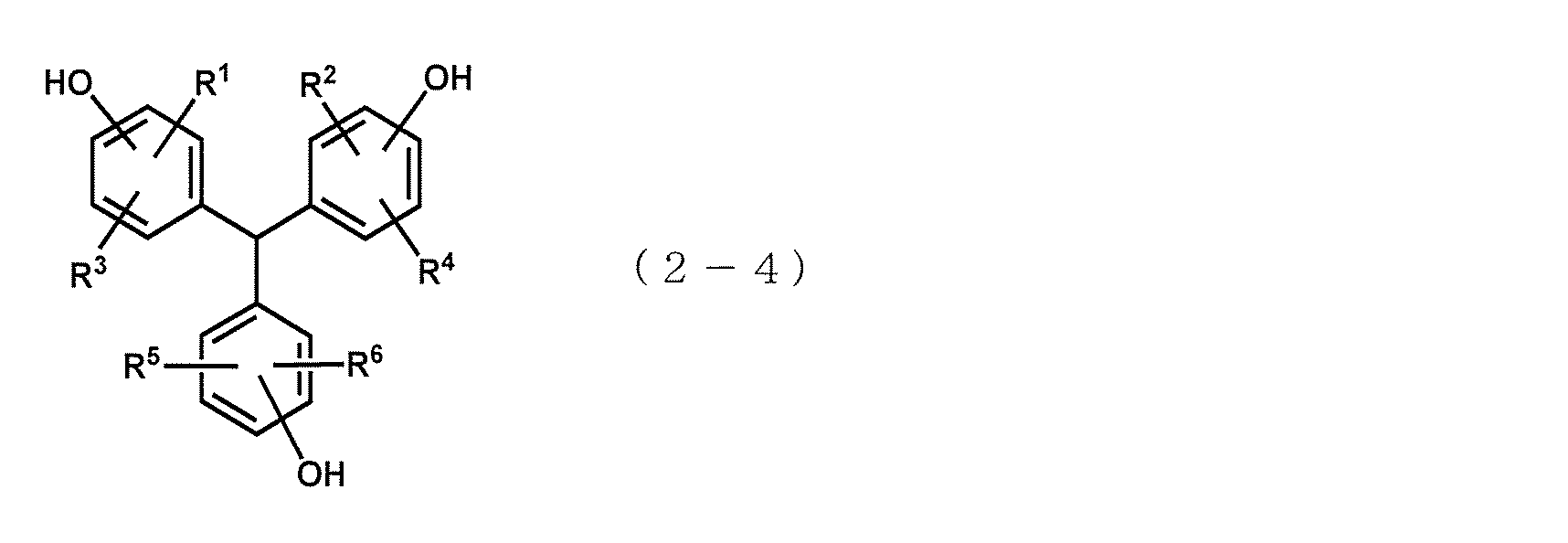
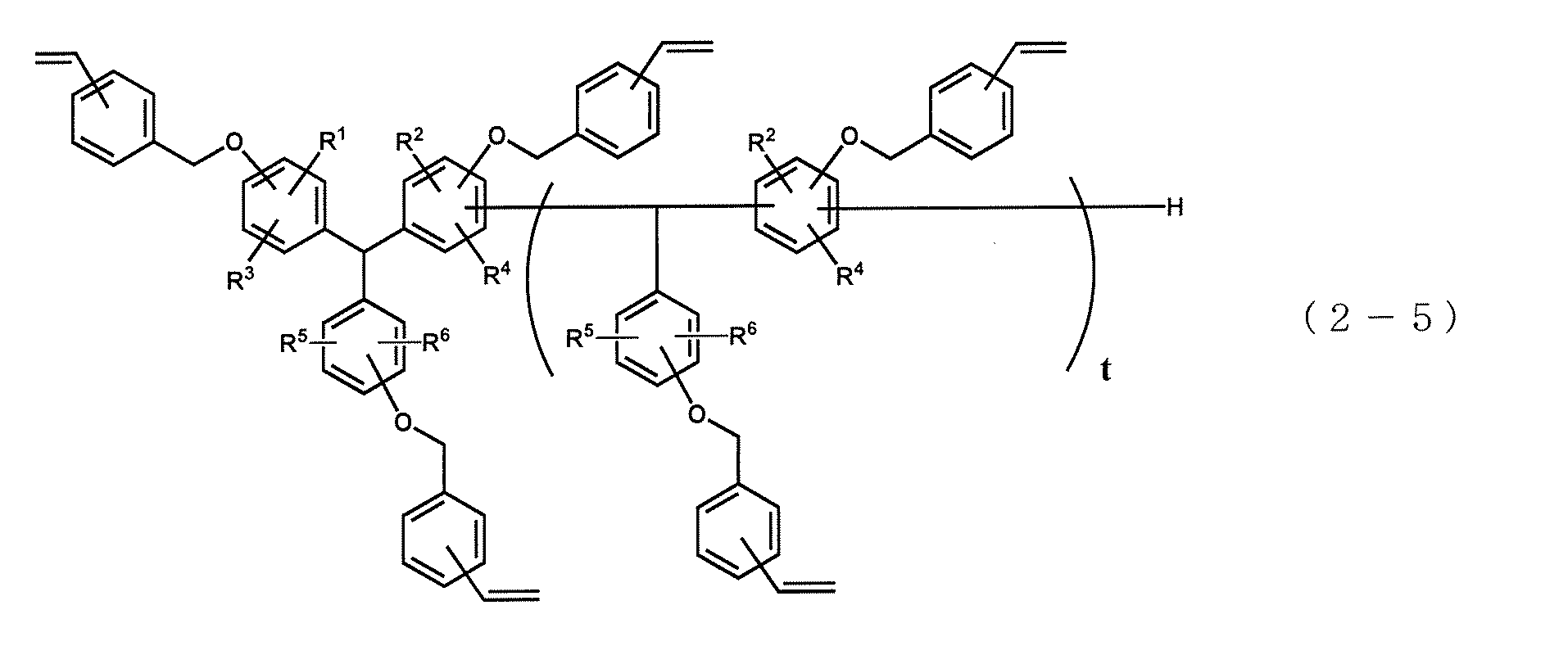
本発明の第2の実施形態に用いるビニル樹脂として、式(2-1)で表されるビニル樹脂以外に式(2-2)および(2-3)で表されるものも好適である。これらのビニル樹脂は組み合わせて使用してもよく、式(2-1)~(2-3)で表されるビニル樹脂が樹脂成分全体の50wt%以上含むことが好ましい。さらに好ましくは、70wt%以上である。使用割合がこれより少ないと硬化物とした際の耐熱性、熱伝導性等の向上効果が小さい場合がある。
上記の式(2-2)において、nは繰り返し数(数平均)であり、0~20の数を示す。通常、繰返し数(n)の値が異なる成分の混合物であり、nの平均値(数平均)が好ましくは0.1~15の範囲であり、より好ましくは0.5~10の範囲である。
Aは、独立して、単結合、酸素原子、硫黄原子、-SO2-、-CO-、または二価の炭素数1~6の炭化水素基を示し、Xは、独立して、ベンゼン環、ナフタレン環又はビフェニル環を示す。熱伝導率の観点から、Aは単結合、Xはビフェニル環が好ましい。Aを有するビフェニル構造に結合する2つのビニルベンジルエーテル基の置換位置が、少なくとも2,2’体を含むことが望ましい。式(2-2)において、Aが単結合、すなわち両末端がビフェニル環の場合、その結合する2つのビニルベンジルエーテル基の置換位置は、4,4’位と2,2’位であることが好ましく、その両末端ビフェニルの比率は2,2’位が全体の40~90モル%であることが好ましい。Aが単結合以外、すなわちビニル樹脂の両末端がビフェニル環以外、例えばジフェニルメタン構造の場合は、その結合する2つのビニルベンジルエーテル基の置換位置は、4,4’位が30~100モル%が好ましい。
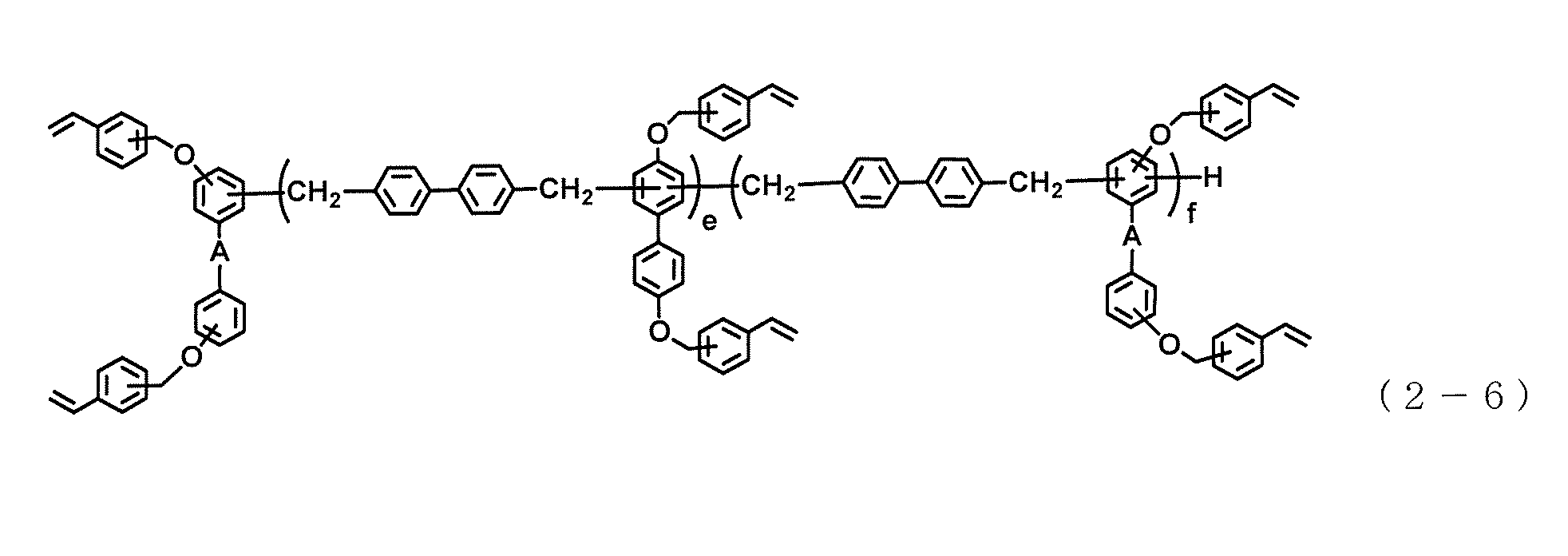
Aについては、上述した式(2-2)と同様である。

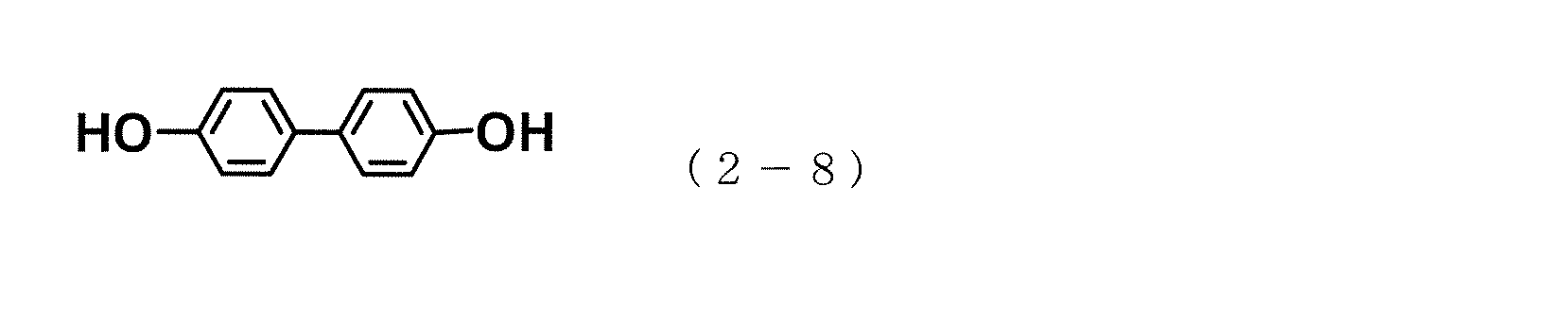
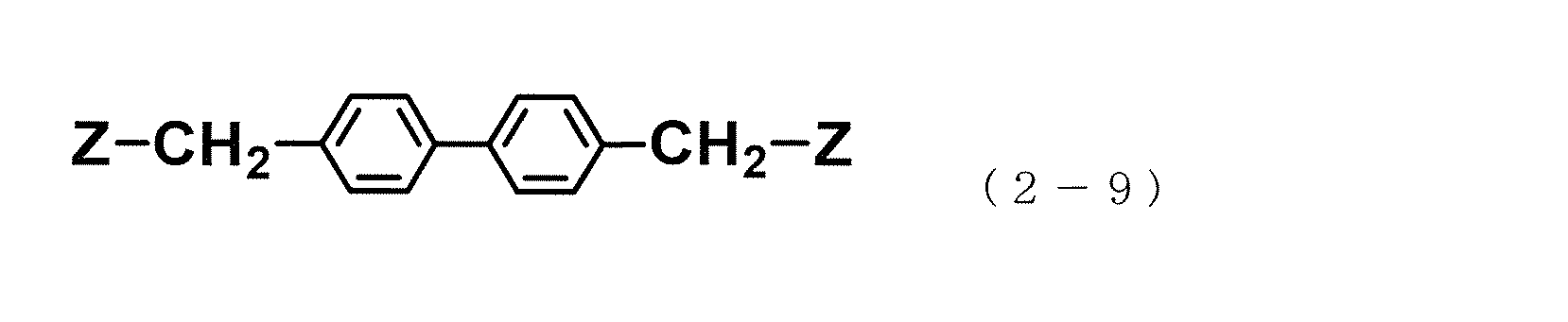

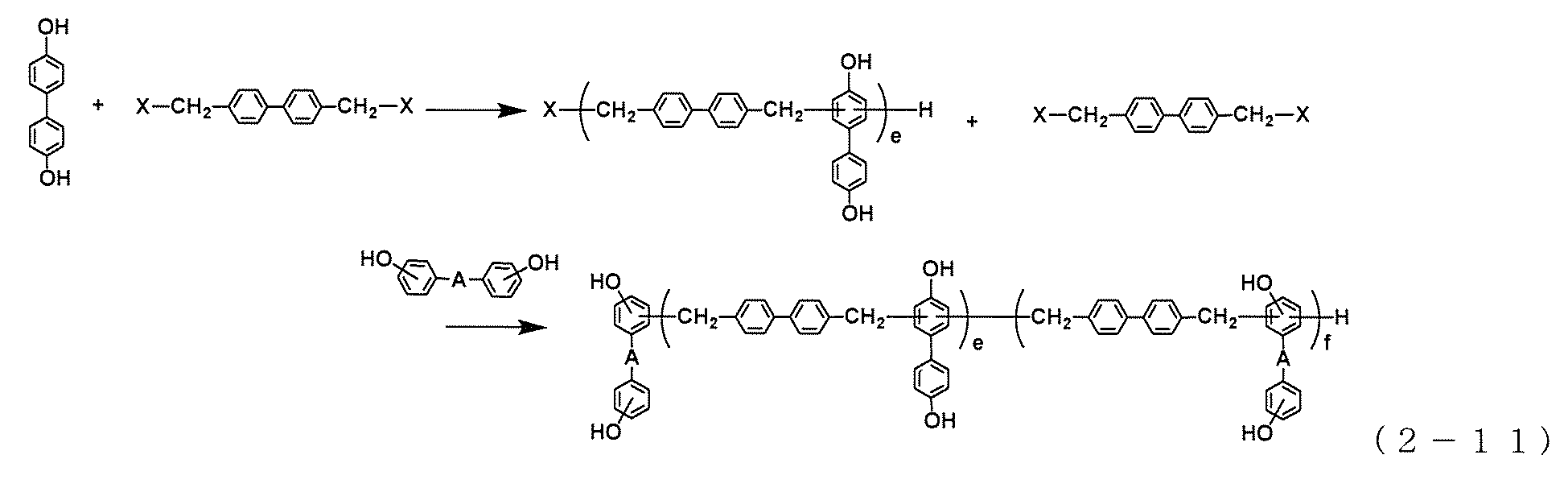
式(2-10)の二官能フェノール化合物としては、具体的には、2,2’-ジヒドロキシビフェニル、4,4’-ジヒドロキシジフェニルエーテル、4,4’-ジヒドロキシジフェニルケトン、4,4’-ジヒドロキシジフェニルスルホン、4,4’-ジヒドロキシジフェニルスルフィド、ジヒドロキシジフェニルメタン類、2,2-ビス(4-ヒドロキシフェニル)プロパンであり、特に、溶剤溶解性の点から2,2’-ジヒドロキシビフェニル、4,4’-ジヒドロキシジフェニルエーテル、ジヒドロキシジフェニルメタン類が好ましい。ジヒドロキシジフェニルメタン類はオルト、メタ、パラの混合物でもよいが、異性体比が4,4’-ジヒドロキシジフェニルメタンが40%以下であるものが好ましい。4,4’-ジヒドロキシジフェニルメタンが多いと結晶性が強く、溶剤溶解性が低下する懸念がある。
なお、これらの配合割合、芳香族ビニル化剤の種類、反応条件、反応終点確認その他については、上述の式(2-1)のビニル樹脂を得る場合と同様とすることができる。
上記の式(2-3)において、Yは、独立して、直接結合、酸素原子、硫黄原子、-SO2-、-CO-、-COO-、-CONH-、-CH2-又は-C(CH3)2-を示す。Bは、独立して、ベンゾニトリル構造又は-(CH2)q-を示し、好ましくは、少なくとも1分子中にベンゾニトリル構造を含む。より好ましくは、少なくとも1分子中に、ベンゾニトリル構造及び-(CH2)q-の両方の構造を持つ。qは3~10の数を示す。高熱伝導性の点で、Yは直接結合であるビフェニル構造、-SO2-、-CO-、-COO-又は-CONH-が好ましく、より好ましくは直接結合であるビフェニル構造であり、そのうち4,4’位のビフェニル構造が特に好ましい。一方、成型性、溶剤溶解性の点で、酸素原子、硫黄原子、-CH2-、-C(CH3)2-が好ましい。式(2-3)のビニル樹脂は、「独立して」としたように、各Yが異なる構造の混合物とすることが可能であり、高熱伝導性、成型性、溶剤溶解性を調整することが可能である。pは繰り返し数であり、0~15の数を示す。好ましくは1~15の数を示すことがよい。好ましくは、pの値が異なる成分の混合物である。p値(平均値)としては、1.0~3.0が好ましく、より好ましくは1.5~2.5である。
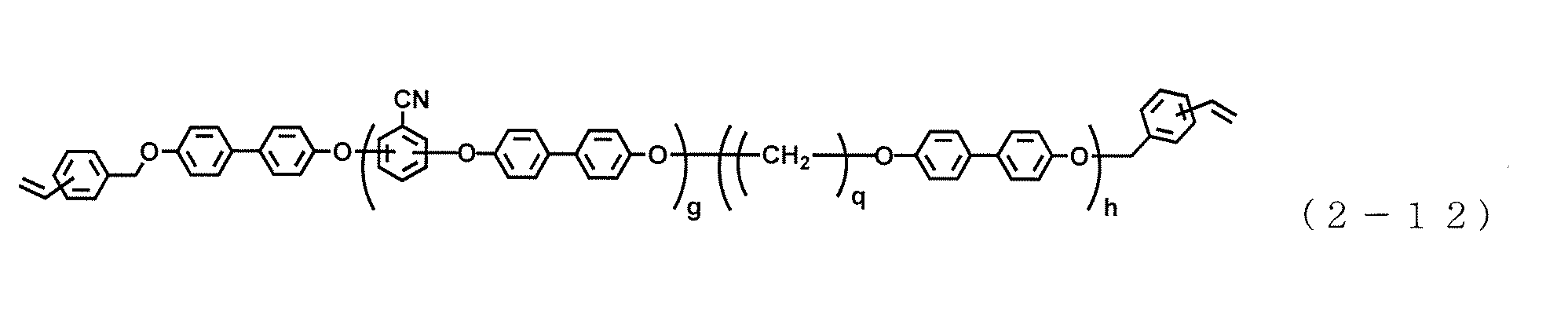
なお、これらの配合割合、芳香族ビニル化剤の種類、反応条件、反応終点確認その他については、上述の式(2-1)のビニル樹脂を得る場合と同様とすることができる。

pは、式(2-3)のビニル樹脂におけるpと同義であって、繰り返し数であり、0~15の数を示す。好ましくは1~15の数を示すことがよい。好ましくは、pの値が異なる成分の混合物である。p値(平均値)としては、好ましくは1.0~3.0、より好ましくは1.5~2.5である。
この場合、ベンゾニトリル化合物としては、例えば、2,4-ジクロロベンゾニトリル、2,5-ジクロロベンゾニトリル、2,6-ジクロロベンゾニトリル、3,5-ジクロロベンゾニトリル、2,4-ジブロモベンゾニトリル、2,5-ジブロモベンゾニトリル、2,6-ジブロモベンゾニトリル、3,5-ジブロモベンゾニトリルなどが挙げられ、ジハロゲンアルキル化合物としては、例えば、1,3-ジブロモプロパン、1,4-ジブロモブタン、1,5-ジブロモペンタン、1,6-ジブロモヘキサンなどが挙げられ、Y基を持つジヒドロキシ化合物としては、例えば、4,4’-ジヒドロキシビフェニル、4,4’-ジヒドロキシジフェニルエーテル、4,4’-ジヒドロキシジフェニルスルフィド、4,4’-ジヒドロキシジフェニルスルホン、4,4’-ジヒドロキシベンゾフェノン、ビスフェノールA、ビスフェノールFなどが挙げられる。
ヒドロキシ樹脂(フェノール性化合物)の製法に関して、より詳細な具体的条件は、例えば、WO2021/201046号を参照するとよい。
以下、実施例により本発明の第1の実施形態をさらに具体的に説明する。
4,4’-ジヒドロキシジフェニルエーテル100.0gをエピクロルヒドリン460g、ジエチレングリコールジメチルエーテル70gに溶解し、60℃、減圧下(約130Torr)、48%水酸化ナトリウム水溶液90.8gを3時間かけて滴下した。この間、生成する水はエピクロルヒドリンとの共沸により系外に除き、留出したエピクロルヒドリンは系内に戻した。滴下終了後、さらに1時間反応を継続して脱水後、エピクロルヒドリンを留去し、トルエン580gを加えた後、水洗により塩を除いた。その後、分液により水を除去後、トルエンを減圧留去し、白色結晶状のエポキシ樹脂(エポキシ樹脂A)126gを得た。エポキシ当量は163であり、加水分解性塩素は150ppm、融点は83℃であり、150℃での粘度は10mPa・sであった。GPC測定より求められた4,4’-ジヒドロキシジフェニルエーテルより得られるエポキシ樹脂のn=0(単量体)は91.2%であった。n=1以上は8.8%であった。
ヒドロキノン50.0g、4,4’-ジヒドロキシビフェニル100.0gをエピクロルヒドリン1000g、ジエチレングリコールジメチルエーテル150gに溶解し、60℃にて48%水酸化ナトリウムを16.5g加え1時間攪拌した。その後、減圧下(約130Torr)、48%水酸化ナトリウム水溶液148.8gを3時間かけて滴下した。この間、生成する水はエピクロルヒドリンとの共沸により系外に除き、留出したエピクロルヒドリンは系内に戻した。滴下終了後、さらに1時間反応を継続して脱水後、エピクロルヒドリンを留去し、メチルイソブチルケトン600gを加えた後、水洗により塩を除いた。その後、85℃にて48%水酸化ナトリウムを13.5g添加して1時間攪拌し、温水200mLで水洗した。その後、分液により水を除去後、メチルイソブチルケトンを減圧留去し、白色結晶状のエポキシ樹脂(エポキシ樹脂B)224gを得た。エポキシ当量は139であり、加水分解性塩素は320ppm、融点は125℃であり、150℃での粘度は3.4mPa・sであった。GPC測定より求められた4,4’-ジヒドロキシビフェニルより得られるエポキシ樹脂のn=0(単量体)は67.2%であった。またヒドロキノンより得られるエポキシ樹脂のn=0(単量体)は.23.1%であった。n=1以上は9.7%であった。
2Lの4口セパラブルフラスコに4,4’-ジヒドロキシビフェニル115.7gをNMP700gに溶解した後、炭酸カリウム56.7gを加え、窒素気流下、攪拌しながら120℃に昇温した。その後、2,6-ジクロロベンゾニトリル35.6gを加え、145℃に昇温し6時間反応させた。反応液に酢酸49.2gを加えて中和した後、減圧下、NMPを留去した。反応液にMIBK 500mLを加えて生成物を溶解した後、水洗により生成塩を除去した。その後、MIBKを減圧蒸留により除いて、ヒドロキシ樹脂129gを得た。得られたヒドロキシ樹脂の水酸基当量は170g/eq.、融点は272℃であった。得られたヒドロキシ樹脂50.0g、エピクロルヒドリン380g、ジエチレングリコールジメチルエーテル(ジグライム)96gを仕込み、減圧下(約130Torr)、65℃にて48.6%水酸化ナトリウム水溶液27.5gを3時間かけて滴下した。この間、生成する水はエピクロルヒドリンとの共沸により系外に除き、留出したエピクロルヒドリンは系内に戻した。滴下終了後、さらに1時間反応を継続し脱水した。その後、エピクロルヒドリン及びジグライムを減圧留去し、メチルイソブチルケトン200mLに溶解した後、濾過により生成した塩を除いた。その後、48%水酸化ナトリウム水溶液0.4gを加え、80℃で2時間反応させた。反応後、濾過、水洗を行った後、溶媒であるメチルイソブチルケトンを減圧留去し、常温固形のエポキシ樹脂43gを得た(エポキシ樹脂C)。得られたエポキシ樹脂Cの融点は139℃、エポキシ当量は226g/eq.、加水分解性塩素は80ppmであった。
1000mlの4口フラスコに、4,4’-ジヒドロキシビフェニル77.5g、ジエチレングリコールジメチルエーテル119.3g、4,4’-ビスクロロメチルビフェニル、41.8gを仕込み、窒素気流下、揖梓しながら160℃まで昇温して20時間反応させ、OH当量135g/eqの多価ヒドロキシ樹脂を生成させた。反応終了後、ジエチレングリコールジメチルエーテルを45.6g回収し、エピクロルヒドリン455.1gを加え、減圧下(約130Torr)62℃にて48%水酸化ナトリウム水溶液70.5gを4時間かけて滴下した。この間、生成する水はエピクロルヒドリンとの共沸により系外に除き、留出したエピクロルヒドリンは系内に戻した。滴下終了後、さらに1時間反応を継続した。その後、エピクロルヒドリンを留去し、メチルイソブチルケトンを加えた後、水洗により塩を除いた後、濾過、水洗を行ない、次にメチルイソブチルケトンを減圧留去し、エポキシ樹脂129gを得た(エポキシ樹脂D)。このエポキシ樹脂Dのエポキシ当量は200g/eq、軟化点は125℃、融点120℃、溶融粘度0.21Pa・s、加水分解性塩素は230ppmであった。
エポキシ樹脂として、合成例1-1で得たエポキシ樹脂(エポキシ樹脂A)、合成例1-2で得たエポキシ樹脂(エポキシ樹脂B)、合成例1-3で得たエポキシ樹脂(エポキシ樹脂C)、合成例1-4で得たエポキシ樹脂(エポキシ樹脂D)を用いた。硬化剤として、4,4’-ジヒドロキシジフェニルエーテル(硬化剤A、OH当量101 g/eq.)、フェノ-ルノボラック(硬化剤B:アイカ工業製、BRG-557、OH当量105 g/eq.、軟化点82℃)を使用し、硬化促進剤としてトリフェニルホスフィン、無機充填材として球状アルミナ(デンカ製、DAW-10、平均粒径12.2μm)を使用し、添加剤として、タルク(添加剤A、平均粒径10~15μm、富士フィルム和光純薬製)、マイカ(添加剤B、合成雲母、富士フィルム和光純薬製)、一般的な造核剤として添加剤C(1,3:2,4-ビス(3,4-ジメチルベンジリデン)-D-ソルビトール、東京化成工業製)又は添加剤D(ナトリウム2,4,8,10-テトラ-tert-ブチル-12H-ジベンゾ[d,g][1,3,2]ジオキサホスホシン-6-オラート6-オキシド、東京化成工業製)を使用した。
(1)熱伝導率
熱伝導率は、NETZSCH製LFA447型熱伝導率計を用いて非定常熱線法により測定した。
(2)融点、融解熱の測定(DSC法)
日立ハイテクサイエンス製TG/DTA7300型示差走査熱量分析装置を用い、約10mgの精秤した試料を用いて、窒素気流下、昇温速度10℃/分で測定した。なお、無機充填材を含んだ硬化物を試料とした場合、融解熱は樹脂成分のみに換算した。
(3)線膨張係数、ガラス転移温度
線膨張係数およびガラス転移温度は、日立ハイテクサイエンス製TMA7100型熱機械測定装置を用いて、昇温速度10℃/分にて測定した。
(4)吸水率
直径50mm、厚さ3mmの円盤を成形し、ポストキュア後、85℃、相対湿度85%の条件で100時間吸湿させた後の重量変化率とした。
(5)XRDの測定、結晶化度の算出
リガク社製RINT TTR3を用いて、XRD測定を行った。測定条件は下記の通りとした。回折角度2θ:10°~30°、走査速度:0.25°/min、発散スリット:1/2degree、発散縦制限スリット:10mm、散乱スリット:1/2degree、受光スリット:0.3mm。
結晶化度は、2θが28°から29°の領域に観察されるタルクの回析ピークを除き、下記の式により算出した。マイカを用いた場合は、6°から8°の領域に観察されるピークを除く。ここで、結晶性ピークとは、回折ピークの幅が5°以内、好ましくは3°以内のピークであるシャープなピークであり、非晶質ピークとは、回折ピーク幅が8°以上あるブロードなピークである。
結晶化度=〔結晶性ピーク面積/(結晶性ピーク面積+非晶質ピーク面積)〕*100
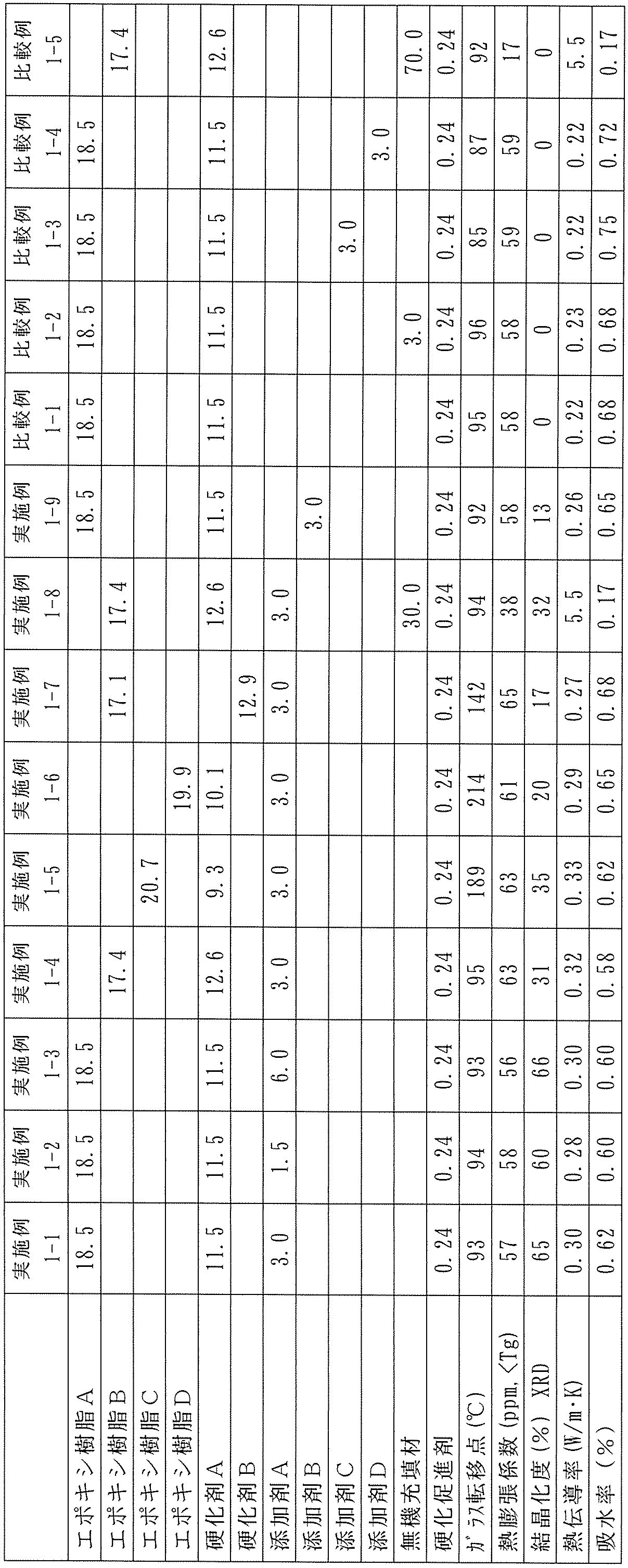
第1の実施形態で例示されるエポキシ樹脂組成物は、成形性、信頼性に優れ、かつ高熱伝導性、低吸水性、低熱膨張性、高耐熱性、難燃性に優れた硬化成形物を与え、半導体封止、積層板、放熱基板等の電気・電子材料用絶縁材料として好適に応用され、優れた高放熱性、高耐熱性、難燃性および高寸法安定性が発揮される。このような特異的な効果が生ずる理由は、層状粘土鉱物が、ビフェニル構造等の剛直構造を有する特定のエポキシ樹脂硬化物の配向性を高めるためと推測される。
以下、実施例により本発明の第2の実施形態をさらに具体的に説明する。
また、測定方法はそれぞれ以下の方法により測定した。
電位差滴定装置を用い、1,4-ジオキサンを溶媒に用い、1.5mol/L塩化アセチルでアセチル化を行い、過剰の塩化アセチルを水で分解して0.5mol/L-水酸化カリウムを使用して滴定した。
試料にウィイス液(一塩化ヨウ素溶液)を反応させ、暗所に放置し、その後、過剰の塩化ヨウ素をヨウ素に還元し、ヨウ素分をチオ硫酸ナトリウムで滴定してヨウ素価を算出した。ヨウ素価をビニル当量に換算した。
試料1.0gをブチルカルビトール25mlに溶解後、1N-KOHプロピレングリコール溶液25mlを加え10分間加熱還流した後、室温まで冷却し、さらに80%アセトン水100mlを加え、0.002N-AgNO3水溶液で電位差滴定を行うことにより測定した。
本体(東ソー株式会社製、HLC-8220GPC)にカラム(東ソー株式会社製、TSKgel SuperMultiporeHZ―N 4本)を直列に備えたものを使用し、カラム温度は40℃にした。また、溶離液にはテトラヒドロフラン(THF)を使用し、0.35mL/分の流速とし、検出器は示差屈折率検出器を使用した。測定試料はサンプル0.1gを10mLのTHFに溶解し、マイクロフィルターで濾過したものを50μL使用した。データ処理は、東ソー株式会社製GPC-8020モデルIIバージョン6.00を使用した。
日立ハイテクサイエンス製DSC7020型示差走査熱量分析装置により、約10mgを精秤した試料を用いて、窒素気流下、昇温速度10℃/分の条件で測定した。
サンプル瓶に樹脂2g、メチルエチルケトン1gを秤量し、加熱溶解させた後、恒温槽内にて徐々に温度を低下させ、樹脂が析出した槽内の温度を測定した。析出温度(℃)が高いほど、溶剤溶解性が劣る。
熱機械測定装置(株式会社日立ハイテクサイエンス製 EXSTAR TMA/7100)により、昇温速度10℃/分の条件でTgを求めた。
熱重量/示差熱分析装置(日立ハイテクサイエンス製 EXSTAR TG/DTA7300)を用いて、窒素雰囲気下、昇温速度10℃/分の条件において、5%重量減少温度(Td5)を測定した。また、700℃における重量減少を測定し、残炭率として算出した。
熱伝導率は、NETZSCH製LFA447型熱伝導率計を用いて非定常熱線法により測定した。
JIS C 2138規格に従って測定した。測定周波数は1GHzの値で示した。
質量分析計JMS-T100GCV(日本電子社製)を用いて測定した。試料をアセトンに溶解し、測定に供した。
1000mLの4口フラスコに、2,5-キシレノール(下記構造式2-14)73.6g(0.60モル)、
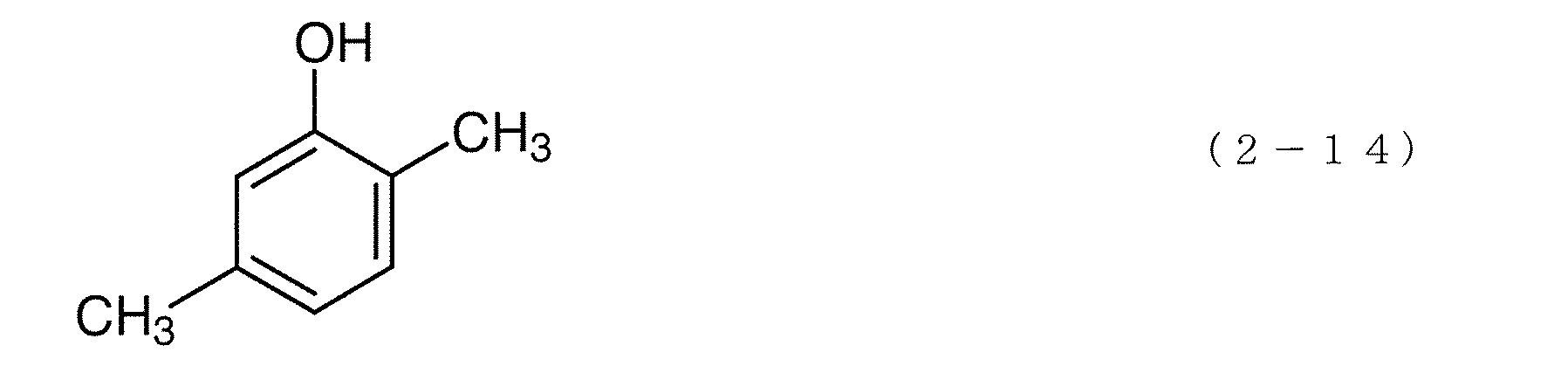
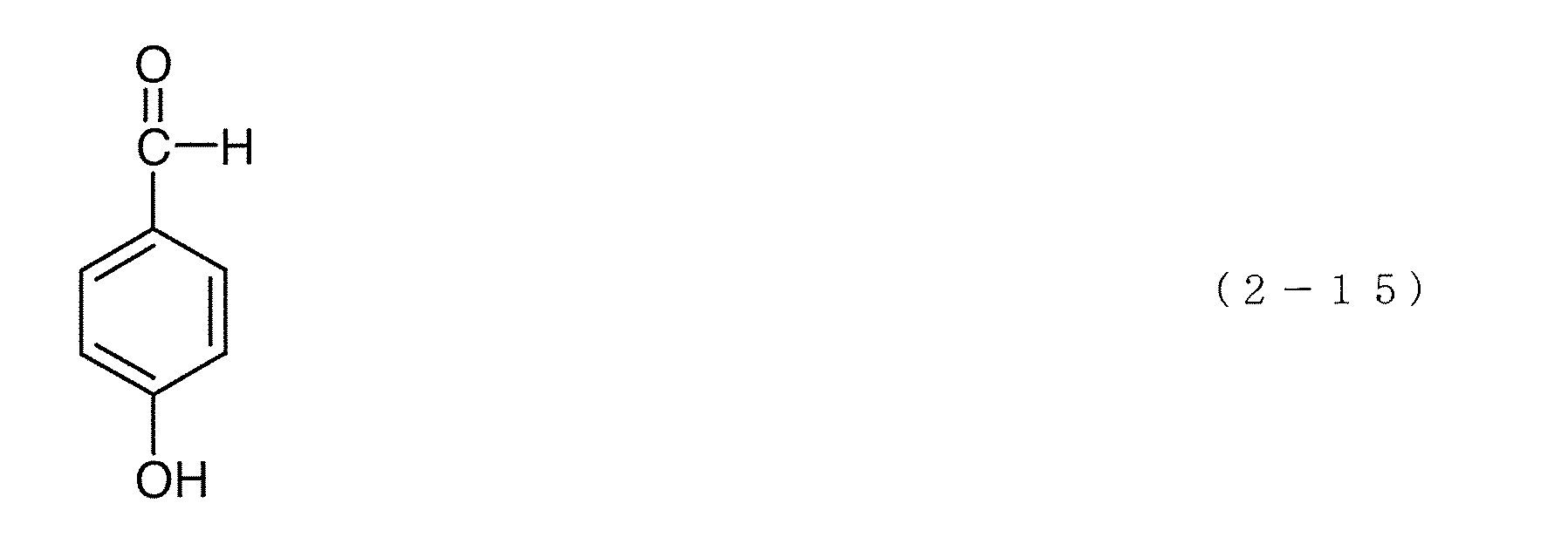
次いで、1000mlの4口フラスコに得られた三官能ヒドロキシ化合物を59.0g(0.17モル)、メチルエチルケトン400g、クロロメチルスチレン(下記構造式2-16)91.6g(0.60モル)
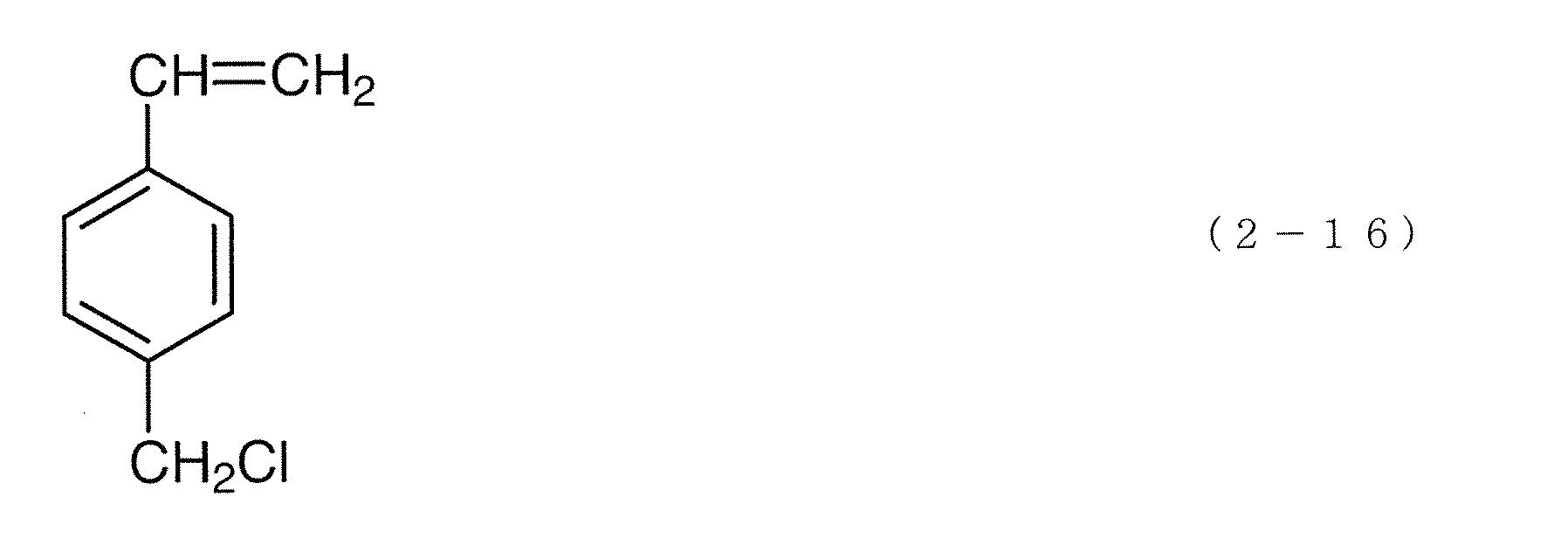
得られたビニル樹脂AのGPCチャートを図3に示す。
1000mlの4口フラスコに、4,4’-ジヒドロキシビフェニル(下記構造式2-17)65.3g(0.35モル)、


反応終了後、ジエチレングリコールジメチルエーテルを50.7g回収し、メチルエチルケトン320g、クロロメチルスチレン135.5gを加え、60℃に昇温し、メタノール150gに溶解した水酸化カリウム49.8gを3時間かけて滴下し、さらに6時間反応した。反応終了後、濾過し、溶剤を留去し、メタノールにて再沈殿し、大量の水で水洗し、減圧乾燥により、式(2-6)(すわなち、式(2-2))に係る白色固体のビニル樹脂141gを得た(ビニル樹脂B)。ビニル樹脂Bのビニル当量は275g/eq、水酸基当量は15000g/eq、全塩素は300ppm、Mn1330、融点145℃であった。多価ヒドロキシ樹脂、ビニル樹脂Bの基本構造は、式(2-6)、(2-7)において、Aは-CH2-基であり、e/(e+f)の比率(モル比)は0.93であり、eは4.2、fは0.3である。
得られたビニル樹脂BのGPCチャートを図4に示す。
2Lの4口セパラブルフラスコに4,4’-ジヒドロキシビフェニル74.5g(0.4モル)、1,5-ジブロモペンタン(下記構造式2-20)18.4g(0.08モル)を仕込み、


次いで、1000mlの4口フラスコに得られたヒドロキシ樹脂を74.3g(0.33モル)、メチルエチルケトン400g、クロロメチルスチレン61.0g(0.40モル)を加え、60℃に昇温し、メタノール70gに溶解した水酸化カリウム22.4g(0.40モル)を3時間かけて滴下し、さらに6時間反応した。反応終了後、濾過し、溶剤を留去し、メタノールにて再沈殿し、大量の水で水洗し、減圧乾燥により式(2-12)(すわなち、式(2-3))に係るビニル樹脂84.3gを得た(ビニル樹脂C)。ビニル樹脂Cのビニル当量は341g/eq、水酸基当量は10000g/eq、全塩素は900ppm、Mn710、融点174℃であった。ビニル樹脂Cの基本構造は、式(2-12)、式(2-3)において、qは5、gは1~3、hは1~3、p値(平均値)は、1.8であった。
得られたビニル樹脂CのGPCチャートを図5に示し、FD-MSスペクトルを図6に示す。
1000mlの4口フラスコに、4,4’-ビス(クロロメチル)ビフェニル40.8g、4,4’-ジヒドロキシビフェニル75.5g、ジエチレングリコールジメチルエーテル120gを仕込み、窒素気流下、攪拌しながら160℃まで昇温して10時間反応させた。続いて、70℃にし、ジエチレングリコールジメチルエーテルを280g、クロロメチルスチレンを129.5g加え、48%水酸化カリウム100.0gを滴下しながら反応を行い、ガスクロマトグラフィーにて残存クロロメチルスチレンが無いことを確認し溶剤を減圧回収した。得られた樹脂をトルエンに溶解し中和、水洗を行い、ビニル樹脂を得た(ビニル樹脂D)。得られたビニル樹脂Dのビニル当量は256g/eq、水酸基当量は1500g/eq、全塩素は1270ppmでMn1100、融点210℃であった。
ビニル樹脂Dの融点が比較的高いことについては以下のように推察される。すなわち、原料としてジヒドロキシジフェニルメタンを使用しないことから、合成例2-2と比べて、ビフェニル成分の含有量が多いことや、ビフェニル構造による分子運動の抑制に起因して、得られるヒドロキシ樹脂の融点が高くなったものと推察される。それにより、ヒドロキシ樹脂の溶剤溶解性が比較的低下することから、その後のクロロメチルスチレンとの反応において、未反応の水酸基(水素結合性を有する極性基)を多く残存することと同時に、柔軟性のあるビニルベンジルエーテル基が低減されることになったと推察される。
1000mlの4口フラスコに、ジヒドロキシジフェニルメタン(4,4’-ジヒドロキシジフェニルメタン:36.2%、2,4’-ジヒドロキシジフェニルメタン:46.6%、2,2’―ジヒドロキシジフェニルメタン:17.2%)50.0g、メチルエチルケトン400g、クロロメチルスチレン80.1gを加え、60℃に昇温し、メタノール88gに溶解した水酸化カリウム29.5gを3時間かけて滴下し、さらに6時間反応した。反応終了後、濾過し、溶剤を留去し、メタノールにて再沈殿し、大量の水で水洗し、減圧乾燥によりビニル樹脂95.4gを得た(ビニル樹脂E)。ビニル樹脂Eのビニル当量は217g/eq、水酸基当量は17000g/eq、全塩素は400ppm、Mn440、融点80℃であった。
ビニル樹脂Eの融点が比較的低いことについては以下のように推察される。すなわち、前記合成例2-4とは異なり、原料としてジヒドロキシジフェニルメタンのみを使用してクロロメチルスチレンと反応させていることから、合成例2-2と比べて、ビフェニル成分を含有しないことに起因して、得られるヒドロキシ樹脂の融点が低くなったものと推察される。
ビニル樹脂として合成例2-1~2-5で得たビニル樹脂A~Eを使用し、添加剤としてタルク(添加剤A、平均粒径10~15μm、富士フィルム和光純薬製)、硬化促進剤として有機過酸化物であるパーブチルP(日油株式会社製)、酸化防止剤としてアデカスタブAO-60(株式会社ADEKA製)、無機充填材Aとして球状アルミナ(デンカ製、DAW-10、平均粒径12.2μm)、無機充填材Bとして球状シリカ(デンカ製、FB-8S)を表1に示す配合割合で混合し、溶剤に溶解して均一な組成物とした。本組成物をPETフィルムに塗布し、130℃で5分乾燥を行い、樹脂組成物(樹脂シート)を得た。PETフィルムから取り出した組成物を鏡面板に挟み、減圧下130℃で15分及び210℃で80分2MPaの圧力をかけながら硬化した。得られた硬化物の特性を表2に示す。

第2の実施形態で例示されるビニル樹脂組成物は、溶剤溶解性に優れ、積層、成形、注型、接着等の用途に使用されるビニル樹脂組成物及びその硬化物に適する。そして、この硬化物は耐熱性、熱分解安定性、熱伝導性、低誘電率、低誘電正接、難燃性にも優れたものとなるので、電気・電子部品類の封止、回路基板材料等に好適である。
本発明の第2の実施形態に係るビニル樹脂組成物および硬化物は、高速通信機器の電子材料として電子部品や配線からの発熱を逃がしやすく信号損失か少ない材料として有用である。
Claims (13)
- 少なくとも結晶性樹脂と添加剤とを含む樹脂組成物であって、添加剤が層状粘土鉱物であり、樹脂成分の100重量部に対して当該層状粘土鉱物を1~20重量部含有し、
前記結晶性樹脂の融点が80℃超過200℃以下であることを特徴とする樹脂組成物。 - 添加剤がタルク又はマイカであることを特徴とする請求項1に記載の樹脂組成物。
- 添加剤がタルクであることを特徴とする請求項2に記載の樹脂組成物。
- 結晶性樹脂がエポキシ樹脂及び/又はビニル樹脂であることを特徴とする請求項1に記載の樹脂組成物。
- 結晶性樹脂は、融点が80℃超過180℃以下のエポキシ樹脂及び/又は融点が90~200℃のビニル樹脂であることを特徴とする請求項4に記載の樹脂組成物。
- 結晶性樹脂がエポキシ樹脂であり、硬化剤を含み、当該樹脂組成物の硬化物のX線回折法(XRD)による測定において、回折角度2θが15°以上25°未満の領域に回折ピークが検出されることを特徴とする請求項1~5のいずれかに記載の樹脂組成物。
- エポキシ樹脂が、下記一般式(1-1)又は(1-2)で表されることを特徴とする請求項6に記載の樹脂組成物。

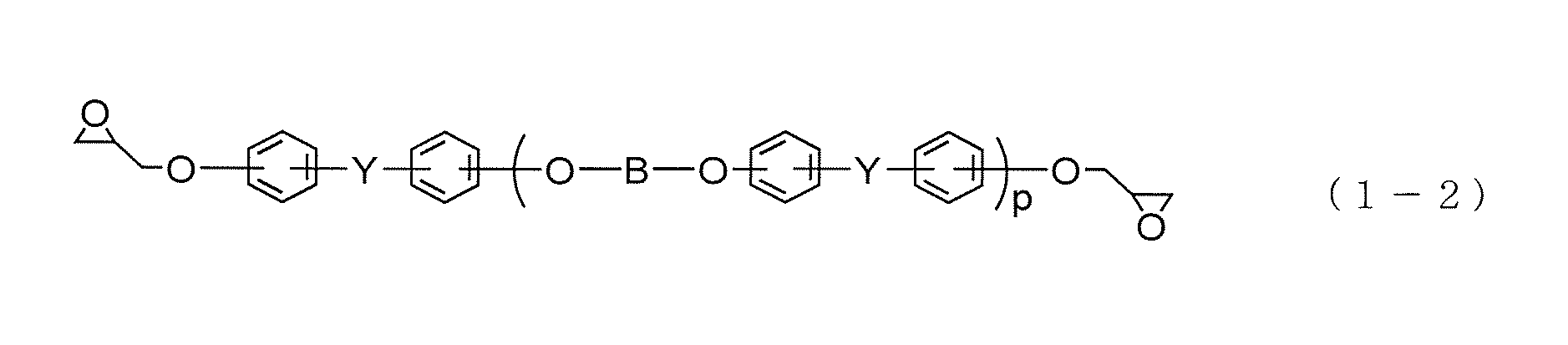
- 結晶性樹脂がビニル樹脂であり、当該ビニル樹脂は、ビニル当量が150~1000g/eq、水酸基当量が5000g/eq以上、全塩素量が2000ppm以下であることを特徴とする請求項1~5のいずれかに記載の樹脂組成物。
- ビニル樹脂が、下記一般式(2-1)~(2-3)のいずれか1種以上で表されることを特徴とする請求項8に記載の樹脂組成物。
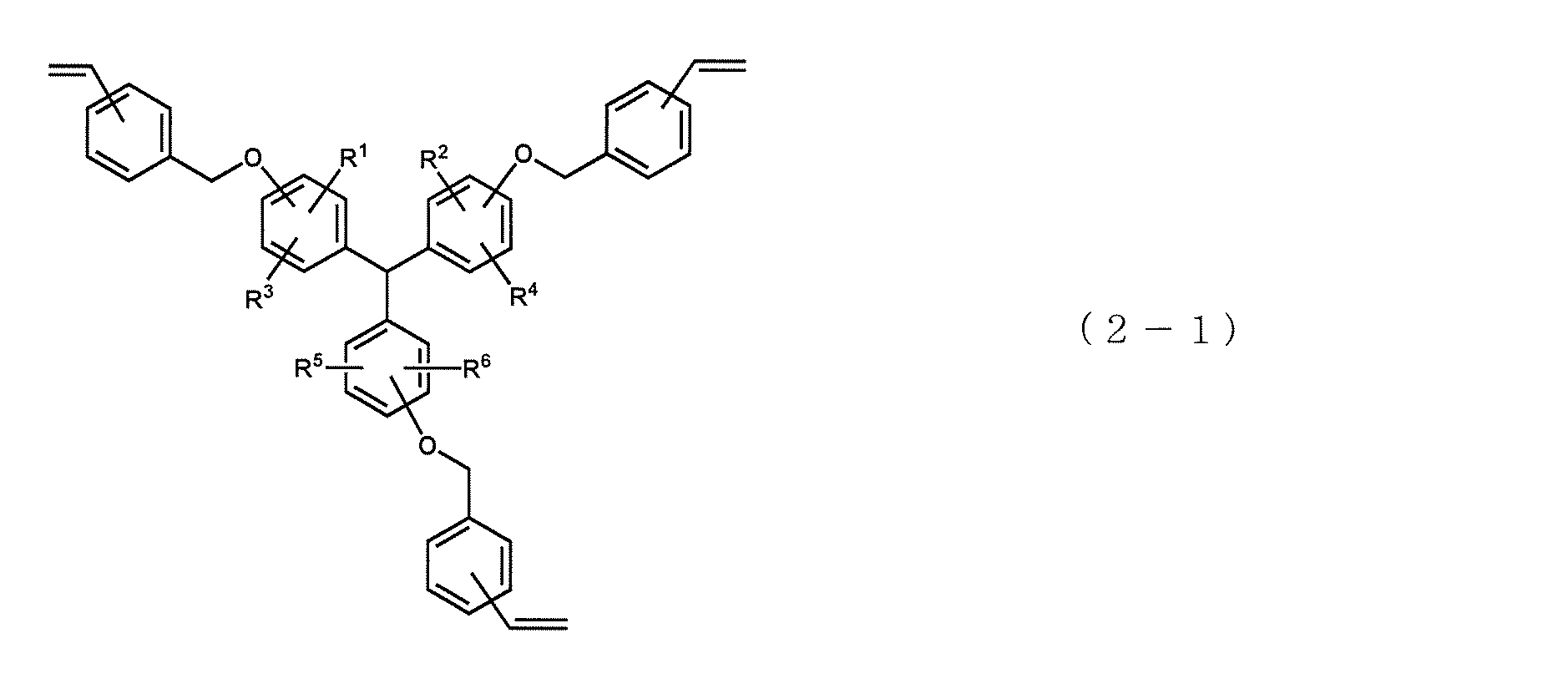
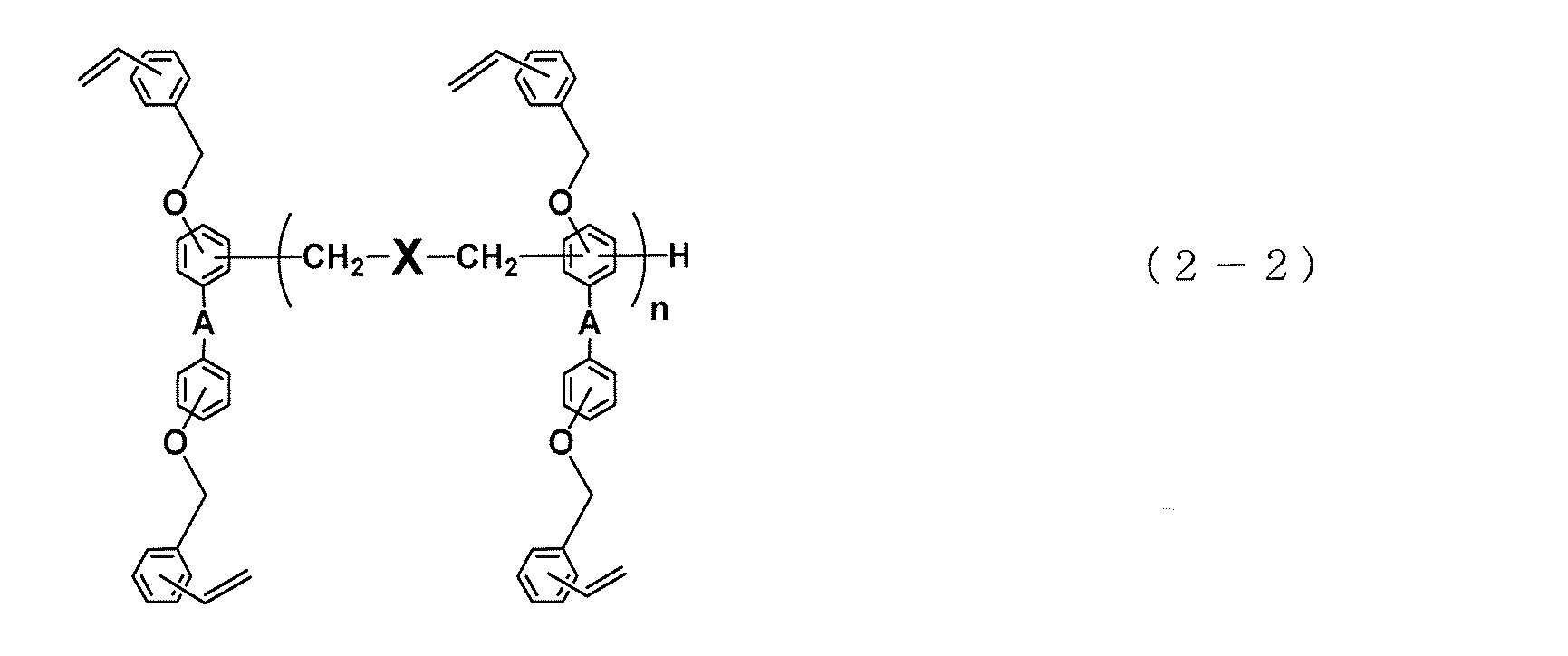

- 層状粘土鉱物を除く無機充填剤を20~90wt%含有することを特徴とする請求項1~5のいずれかに記載の樹脂組成物。
- 高熱伝導用の硬化物を与える樹脂組成物であることを特徴とする請求項1~5のいずれかに記載の樹脂組成物。
- 結晶化度が10%以上である高熱伝導用の硬化物を与える樹脂組成物であることを特徴とする請求項6に記載の樹脂組成物。
- 請求項1~5のいずれかに記載の樹脂組成物を硬化させて得られる硬化物。
Priority Applications (2)
| Application Number | Priority Date | Filing Date | Title |
|---|---|---|---|
| CN202380056676.XA CN119604586A (zh) | 2022-08-05 | 2023-08-03 | 树脂组合物和固化物 |
| KR1020257000266A KR20250047712A (ko) | 2022-08-05 | 2023-08-03 | 수지 조성물 및 경화물 |
Applications Claiming Priority (4)
| Application Number | Priority Date | Filing Date | Title |
|---|---|---|---|
| JP2022-125747 | 2022-08-05 | ||
| JP2022125747A JP2024022282A (ja) | 2022-08-05 | 2022-08-05 | エポキシ樹脂組成物および硬化物 |
| JP2023107268A JP2025006458A (ja) | 2023-06-29 | 2023-06-29 | ビニル樹脂組成物及び硬化物 |
| JP2023-107268 | 2023-06-29 |
Publications (1)
| Publication Number | Publication Date |
|---|---|
| WO2024029602A1 true WO2024029602A1 (ja) | 2024-02-08 |
Family
ID=89849492
Family Applications (1)
| Application Number | Title | Priority Date | Filing Date |
|---|---|---|---|
| PCT/JP2023/028470 Ceased WO2024029602A1 (ja) | 2022-08-05 | 2023-08-03 | 樹脂組成物及び硬化物 |
Country Status (4)
| Country | Link |
|---|---|
| KR (1) | KR20250047712A (ja) |
| CN (1) | CN119604586A (ja) |
| TW (1) | TW202419577A (ja) |
| WO (1) | WO2024029602A1 (ja) |
Cited By (1)
| Publication number | Priority date | Publication date | Assignee | Title |
|---|---|---|---|---|
| WO2025197780A1 (ja) * | 2024-03-22 | 2025-09-25 | 日鉄ケミカル&マテリアル株式会社 | 多官能ビニル化合物、その組成物、及び硬化物 |
Citations (8)
| Publication number | Priority date | Publication date | Assignee | Title |
|---|---|---|---|---|
| JP2003238771A (ja) * | 2002-02-21 | 2003-08-27 | Toshiba Corp | 注型用樹脂組成物 |
| JP2005179568A (ja) * | 2003-12-22 | 2005-07-07 | Toshiba Corp | エポキシ樹脂組成物および注型絶縁物 |
| JP2007084759A (ja) * | 2005-09-26 | 2007-04-05 | Hokko Chem Ind Co Ltd | 補強材、エポキシ樹脂組成物およびその製造方法ならびにエポキシ樹脂複合材料 |
| JP2009242657A (ja) * | 2008-03-31 | 2009-10-22 | Nippon Steel Chem Co Ltd | エポキシ樹脂組成物および成形物 |
| JP2010043245A (ja) * | 2008-07-16 | 2010-02-25 | Nippon Steel Chem Co Ltd | 結晶性変性エポキシ樹脂、エポキシ樹脂組成物及び結晶性硬化物 |
| WO2019131095A1 (ja) * | 2017-12-28 | 2019-07-04 | 日立化成株式会社 | ボールグリッドアレイパッケージ封止用エポキシ樹脂組成物、エポキシ樹脂硬化物及び電子部品装置 |
| JP2020105428A (ja) * | 2018-12-28 | 2020-07-09 | 日鉄ケミカル&マテリアル株式会社 | エポキシ樹脂、エポキシ樹脂組成物及び硬化物 |
| JP2022102293A (ja) * | 2020-12-25 | 2022-07-07 | 日鉄ケミカル&マテリアル株式会社 | 多価ヒドロキシ樹脂、エポキシ樹脂、エポキシ樹脂組成物、及びその硬化物 |
Family Cites Families (8)
| Publication number | Priority date | Publication date | Assignee | Title |
|---|---|---|---|---|
| JPH11323162A (ja) | 1998-03-19 | 1999-11-26 | Hitachi Ltd | 絶縁組成物 |
| JP2002309067A (ja) | 2001-04-16 | 2002-10-23 | Matsushita Electric Works Ltd | 封止用エポキシ樹脂組成物及び半導体装置 |
| JP5003417B2 (ja) | 2007-11-08 | 2012-08-15 | パナソニック株式会社 | 分散型電源システム |
| JP4988609B2 (ja) | 2008-01-11 | 2012-08-01 | 株式会社日立国際電気 | 配線基板 |
| JP2011147936A (ja) | 2010-09-29 | 2011-08-04 | Sintokogio Ltd | 剪断式分散装置、循環式分散システム及び循環式分散方法 |
| CN103987790A (zh) | 2011-12-27 | 2014-08-13 | 松下电器产业株式会社 | 导热性树脂组合物 |
| JP6041157B2 (ja) | 2011-12-27 | 2016-12-07 | パナソニックIpマネジメント株式会社 | 熱伝導性樹脂組成物 |
| JP7832890B2 (ja) | 2020-03-30 | 2026-03-18 | 日鉄ケミカル&マテリアル株式会社 | ビニル樹脂及びその製造方法 |
-
2023
- 2023-08-03 WO PCT/JP2023/028470 patent/WO2024029602A1/ja not_active Ceased
- 2023-08-03 CN CN202380056676.XA patent/CN119604586A/zh active Pending
- 2023-08-03 KR KR1020257000266A patent/KR20250047712A/ko active Pending
- 2023-08-04 TW TW112129427A patent/TW202419577A/zh unknown
Patent Citations (8)
| Publication number | Priority date | Publication date | Assignee | Title |
|---|---|---|---|---|
| JP2003238771A (ja) * | 2002-02-21 | 2003-08-27 | Toshiba Corp | 注型用樹脂組成物 |
| JP2005179568A (ja) * | 2003-12-22 | 2005-07-07 | Toshiba Corp | エポキシ樹脂組成物および注型絶縁物 |
| JP2007084759A (ja) * | 2005-09-26 | 2007-04-05 | Hokko Chem Ind Co Ltd | 補強材、エポキシ樹脂組成物およびその製造方法ならびにエポキシ樹脂複合材料 |
| JP2009242657A (ja) * | 2008-03-31 | 2009-10-22 | Nippon Steel Chem Co Ltd | エポキシ樹脂組成物および成形物 |
| JP2010043245A (ja) * | 2008-07-16 | 2010-02-25 | Nippon Steel Chem Co Ltd | 結晶性変性エポキシ樹脂、エポキシ樹脂組成物及び結晶性硬化物 |
| WO2019131095A1 (ja) * | 2017-12-28 | 2019-07-04 | 日立化成株式会社 | ボールグリッドアレイパッケージ封止用エポキシ樹脂組成物、エポキシ樹脂硬化物及び電子部品装置 |
| JP2020105428A (ja) * | 2018-12-28 | 2020-07-09 | 日鉄ケミカル&マテリアル株式会社 | エポキシ樹脂、エポキシ樹脂組成物及び硬化物 |
| JP2022102293A (ja) * | 2020-12-25 | 2022-07-07 | 日鉄ケミカル&マテリアル株式会社 | 多価ヒドロキシ樹脂、エポキシ樹脂、エポキシ樹脂組成物、及びその硬化物 |
Cited By (1)
| Publication number | Priority date | Publication date | Assignee | Title |
|---|---|---|---|---|
| WO2025197780A1 (ja) * | 2024-03-22 | 2025-09-25 | 日鉄ケミカル&マテリアル株式会社 | 多官能ビニル化合物、その組成物、及び硬化物 |
Also Published As
| Publication number | Publication date |
|---|---|
| CN119604586A (zh) | 2025-03-11 |
| KR20250047712A (ko) | 2025-04-04 |
| TW202419577A (zh) | 2024-05-16 |
Similar Documents
| Publication | Publication Date | Title |
|---|---|---|
| JP5166610B2 (ja) | エポキシ樹脂、その製造方法、それを用いたエポキシ樹脂組成物および硬化物 | |
| JP5330013B2 (ja) | エポキシ樹脂組成物および硬化物 | |
| JP5265461B2 (ja) | 結晶性変性エポキシ樹脂、エポキシ樹脂組成物及び結晶性硬化物 | |
| JP5548562B2 (ja) | 多価ヒドロキシ樹脂、エポキシ樹脂、それらの製造方法、エポキシ樹脂組成物及びその硬化物 | |
| CN111378093B (zh) | 环氧树脂及其制造方法、环氧树脂组合物及环氧树脂硬化物 | |
| WO2012043213A1 (ja) | 多価ヒドロキシ樹脂、エポキシ樹脂、それらの製造方法、エポキシ樹脂組成物及びその硬化物 | |
| JP5079721B2 (ja) | エポキシ樹脂組成物および成形物 | |
| JP5209556B2 (ja) | エポキシ樹脂組成物および成形物 | |
| JP7320942B2 (ja) | エポキシ樹脂、エポキシ樹脂組成物及び硬化物 | |
| JP5091052B2 (ja) | エポキシ樹脂組成物および成形物 | |
| JP7713318B2 (ja) | エポキシ樹脂組成物および硬化物 | |
| WO2024029602A1 (ja) | 樹脂組成物及び硬化物 | |
| WO2013157061A1 (ja) | エポキシ樹脂組成物及び硬化物 | |
| JP7545889B2 (ja) | 多価ヒドロキシ樹脂、エポキシ樹脂、エポキシ樹脂組成物、及びその硬化物 | |
| JP5199847B2 (ja) | エポキシ樹脂組成物および成形物 | |
| JP2022142436A (ja) | 多価ヒドロキシ樹脂、エポキシ樹脂、エポキシ樹脂組成物、及びその硬化物 | |
| TWI903049B (zh) | 環氧樹脂、其製造方法、使用該環氧樹脂之環氧樹脂組成物及硬化物 | |
| JP7824037B2 (ja) | 多価ヒドロキシ樹脂、エポキシ樹脂、それらの製造方法、それらを用いたエポキシ樹脂組成物及び硬化物 | |
| JP2024022282A (ja) | エポキシ樹脂組成物および硬化物 | |
| JP2025006458A (ja) | ビニル樹脂組成物及び硬化物 | |
| WO2025142532A1 (ja) | 多官能ビニル樹脂、多価ヒドロキシ樹脂、エポキシ樹脂、その組成物、及び硬化物 | |
| JP2008231071A (ja) | 新規多価ヒドロキシ化合物並びにエポキシ樹脂組成物及びその硬化物 | |
| WO2023276851A1 (ja) | エポキシ樹脂、エポキシ樹脂組成物、及びその硬化物 | |
| WO2023162693A1 (ja) | エポキシ樹脂、多価ヒドロキシ樹脂、エポキシ樹脂組成物、及びエポキシ樹脂硬化物並びに多価ヒドロキシ樹脂の製造方法 | |
| WO2024070773A1 (ja) | 多官能ビニル化合物、その組成物、及び硬化物 |
Legal Events
| Date | Code | Title | Description |
|---|---|---|---|
| 121 | Ep: the epo has been informed by wipo that ep was designated in this application |
Ref document number: 23850155 Country of ref document: EP Kind code of ref document: A1 |
|
| WWE | Wipo information: entry into national phase |
Ref document number: 202380056676.X Country of ref document: CN |
|
| NENP | Non-entry into the national phase |
Ref country code: DE |
|
| WWP | Wipo information: published in national office |
Ref document number: 202380056676.X Country of ref document: CN |
|
| WWP | Wipo information: published in national office |
Ref document number: 1020257000266 Country of ref document: KR |
|
| 122 | Ep: pct application non-entry in european phase |
Ref document number: 23850155 Country of ref document: EP Kind code of ref document: A1 |