WO2024024823A1 - 固体電解質組成物、固体電解質層又は電極合材、及びリチウムイオン電池 - Google Patents
固体電解質組成物、固体電解質層又は電極合材、及びリチウムイオン電池 Download PDFInfo
- Publication number
- WO2024024823A1 WO2024024823A1 PCT/JP2023/027337 JP2023027337W WO2024024823A1 WO 2024024823 A1 WO2024024823 A1 WO 2024024823A1 JP 2023027337 W JP2023027337 W JP 2023027337W WO 2024024823 A1 WO2024024823 A1 WO 2024024823A1
- Authority
- WO
- WIPO (PCT)
- Prior art keywords
- solid electrolyte
- substituted
- component
- electrolyte composition
- carbon atoms
- Prior art date
- Legal status (The legal status is an assumption and is not a legal conclusion. Google has not performed a legal analysis and makes no representation as to the accuracy of the status listed.)
- Ceased
Links
Images



Classifications
-
- H—ELECTRICITY
- H01—ELECTRIC ELEMENTS
- H01M—PROCESSES OR MEANS, e.g. BATTERIES, FOR THE DIRECT CONVERSION OF CHEMICAL ENERGY INTO ELECTRICAL ENERGY
- H01M10/00—Secondary cells; Manufacture thereof
- H01M10/05—Accumulators with non-aqueous electrolyte
- H01M10/056—Accumulators with non-aqueous electrolyte characterised by the materials used as electrolytes, e.g. mixed inorganic/organic electrolytes
- H01M10/0561—Accumulators with non-aqueous electrolyte characterised by the materials used as electrolytes, e.g. mixed inorganic/organic electrolytes the electrolyte being constituted of inorganic materials only
- H01M10/0562—Solid materials
-
- C—CHEMISTRY; METALLURGY
- C01—INORGANIC CHEMISTRY
- C01B—NON-METALLIC ELEMENTS; COMPOUNDS THEREOF; METALLOIDS OR COMPOUNDS THEREOF NOT COVERED BY SUBCLASS C01C
- C01B25/00—Phosphorus; Compounds thereof
- C01B25/16—Oxyacids of phosphorus; Salts thereof
- C01B25/26—Phosphates
- C01B25/455—Phosphates containing halogen
-
- H—ELECTRICITY
- H01—ELECTRIC ELEMENTS
- H01B—CABLES; CONDUCTORS; INSULATORS; SELECTION OF MATERIALS FOR THEIR CONDUCTIVE, INSULATING OR DIELECTRIC PROPERTIES
- H01B1/00—Conductors or conductive bodies characterised by the conductive materials; Selection of materials as conductors
- H01B1/06—Conductors or conductive bodies characterised by the conductive materials; Selection of materials as conductors mainly consisting of other non-metallic substances
-
- H—ELECTRICITY
- H01—ELECTRIC ELEMENTS
- H01B—CABLES; CONDUCTORS; INSULATORS; SELECTION OF MATERIALS FOR THEIR CONDUCTIVE, INSULATING OR DIELECTRIC PROPERTIES
- H01B1/00—Conductors or conductive bodies characterised by the conductive materials; Selection of materials as conductors
- H01B1/06—Conductors or conductive bodies characterised by the conductive materials; Selection of materials as conductors mainly consisting of other non-metallic substances
- H01B1/10—Conductors or conductive bodies characterised by the conductive materials; Selection of materials as conductors mainly consisting of other non-metallic substances sulfides
-
- H—ELECTRICITY
- H01—ELECTRIC ELEMENTS
- H01M—PROCESSES OR MEANS, e.g. BATTERIES, FOR THE DIRECT CONVERSION OF CHEMICAL ENERGY INTO ELECTRICAL ENERGY
- H01M10/00—Secondary cells; Manufacture thereof
- H01M10/05—Accumulators with non-aqueous electrolyte
- H01M10/052—Li-accumulators
-
- H—ELECTRICITY
- H01—ELECTRIC ELEMENTS
- H01M—PROCESSES OR MEANS, e.g. BATTERIES, FOR THE DIRECT CONVERSION OF CHEMICAL ENERGY INTO ELECTRICAL ENERGY
- H01M10/00—Secondary cells; Manufacture thereof
- H01M10/05—Accumulators with non-aqueous electrolyte
- H01M10/052—Li-accumulators
- H01M10/0525—Rocking-chair batteries, i.e. batteries with lithium insertion or intercalation in both electrodes; Lithium-ion batteries
-
- H—ELECTRICITY
- H01—ELECTRIC ELEMENTS
- H01M—PROCESSES OR MEANS, e.g. BATTERIES, FOR THE DIRECT CONVERSION OF CHEMICAL ENERGY INTO ELECTRICAL ENERGY
- H01M10/00—Secondary cells; Manufacture thereof
- H01M10/05—Accumulators with non-aqueous electrolyte
- H01M10/056—Accumulators with non-aqueous electrolyte characterised by the materials used as electrolytes, e.g. mixed inorganic/organic electrolytes
- H01M10/0564—Accumulators with non-aqueous electrolyte characterised by the materials used as electrolytes, e.g. mixed inorganic/organic electrolytes the electrolyte being constituted of organic materials only
- H01M10/0566—Liquid materials
- H01M10/0569—Liquid materials characterised by the solvents
-
- H—ELECTRICITY
- H01—ELECTRIC ELEMENTS
- H01M—PROCESSES OR MEANS, e.g. BATTERIES, FOR THE DIRECT CONVERSION OF CHEMICAL ENERGY INTO ELECTRICAL ENERGY
- H01M4/00—Electrodes
- H01M4/02—Electrodes composed of, or comprising, active material
- H01M4/13—Electrodes for accumulators with non-aqueous electrolyte, e.g. for lithium-accumulators; Processes of manufacture thereof
-
- H—ELECTRICITY
- H01—ELECTRIC ELEMENTS
- H01M—PROCESSES OR MEANS, e.g. BATTERIES, FOR THE DIRECT CONVERSION OF CHEMICAL ENERGY INTO ELECTRICAL ENERGY
- H01M4/00—Electrodes
- H01M4/02—Electrodes composed of, or comprising, active material
- H01M4/13—Electrodes for accumulators with non-aqueous electrolyte, e.g. for lithium-accumulators; Processes of manufacture thereof
- H01M4/139—Processes of manufacture
-
- H—ELECTRICITY
- H01—ELECTRIC ELEMENTS
- H01M—PROCESSES OR MEANS, e.g. BATTERIES, FOR THE DIRECT CONVERSION OF CHEMICAL ENERGY INTO ELECTRICAL ENERGY
- H01M4/00—Electrodes
- H01M4/02—Electrodes composed of, or comprising, active material
- H01M4/62—Selection of inactive substances as ingredients for active masses, e.g. binders, fillers
-
- H—ELECTRICITY
- H01—ELECTRIC ELEMENTS
- H01M—PROCESSES OR MEANS, e.g. BATTERIES, FOR THE DIRECT CONVERSION OF CHEMICAL ENERGY INTO ELECTRICAL ENERGY
- H01M2300/00—Electrolytes
- H01M2300/0017—Non-aqueous electrolytes
- H01M2300/0065—Solid electrolytes
- H01M2300/0068—Solid electrolytes inorganic
-
- H—ELECTRICITY
- H01—ELECTRIC ELEMENTS
- H01M—PROCESSES OR MEANS, e.g. BATTERIES, FOR THE DIRECT CONVERSION OF CHEMICAL ENERGY INTO ELECTRICAL ENERGY
- H01M2300/00—Electrolytes
- H01M2300/0017—Non-aqueous electrolytes
- H01M2300/0065—Solid electrolytes
- H01M2300/0068—Solid electrolytes inorganic
- H01M2300/008—Halides
-
- Y—GENERAL TAGGING OF NEW TECHNOLOGICAL DEVELOPMENTS; GENERAL TAGGING OF CROSS-SECTIONAL TECHNOLOGIES SPANNING OVER SEVERAL SECTIONS OF THE IPC; TECHNICAL SUBJECTS COVERED BY FORMER USPC CROSS-REFERENCE ART COLLECTIONS [XRACs] AND DIGESTS
- Y02—TECHNOLOGIES OR APPLICATIONS FOR MITIGATION OR ADAPTATION AGAINST CLIMATE CHANGE
- Y02E—REDUCTION OF GREENHOUSE GAS [GHG] EMISSIONS, RELATED TO ENERGY GENERATION, TRANSMISSION OR DISTRIBUTION
- Y02E60/00—Enabling technologies; Technologies with a potential or indirect contribution to GHG emissions mitigation
- Y02E60/10—Energy storage using batteries
Definitions
- the present invention relates to a solid electrolyte composition, a solid electrolyte layer or electrode mixture, and a lithium ion battery.
- All-solid-state lithium ion batteries are becoming more and more popular due to their high level of safety, and various studies are being conducted to improve their performance (for example, Patent Document 1).
- solid electrolytes are sometimes coated in a slurry state, but conventional solid electrolytes have a problem of poor dispersibility in various organic solvents and insufficient coatability.
- polar solvents such as butyl butyrate may be used to improve dispersibility, but since polar solvents may deteriorate the solid electrolyte, solid electrolytes with high dispersibility especially in non-polar solvents are required. It is being
- An object of the present invention is to provide a solid electrolyte composition that has excellent dispersibility in nonpolar organic solvents.
- R 11 R 12 R 13 PO (1) (NR 21 R 22 ) (NR 23 R 24 ) (NR 25 R 26 ) PO (2) (R 31 O) (R 32 O) (R 33 O) PO (3)
- R 11 to R 13 are each independently a hydrogen atom or a substituent RA, and at least one of R 11 to R 13 is a substituent RA.
- at least one set of R 21 and R 22 , R 23 and R 24 , and R 25 and R 26 combine with each other to form a substituted or unsubstituted saturated or unsaturated ring. or do not combine with each other.
- R 21 to R 26 that are not bonded to each other are each independently a hydrogen atom or a substituent RA, and at least one of R 21 to R 26 is a substituent RA.
- R 31 to R 33 are each independently a hydrogen atom or a substituent RB, and at least one of R 31 to R 33 is a substituent RB.
- the substituent RA is a substituted or unsubstituted alkyl group having 1 to 50 carbon atoms, a substituted or unsubstituted alkenyl group having 2 to 50 carbon atoms, a substituted or unsubstituted alkynyl group having 2 to 50 carbon atoms, or a substituted or unsubstituted alkynyl group having 2 to 50 carbon atoms.
- the substituent RB is a substituted or unsubstituted aryl group having 6 to 50 ring carbon atoms, or a substituted or unsubstituted monovalent heterocyclic group having 5 to 50 ring atoms.
- R 11 to R 13 are each independently a substituted or unsubstituted alkyl group having 1 to 50 carbon atoms, or a substituted or unsubstituted ring-forming alkyl group having 6 to 50 carbon atoms; 50 aryl groups, the solid electrolyte composition according to 1. 3.
- R X1 R X2 R X3 P (X1) (In formula (X1), R X1 to R X3 are each independently a hydrogen atom or a substituent RA, and at least one of R X1 to R X3 is a substituent RA.) 8.
- 9. The solid electrolyte composition according to any one of 1 to 8, wherein the proportion of each of the components (B) is more than 5% by volume based on the entire solid electrolyte composition. 10. 10.
- the solid electrolyte composition according to any one of 1 to 10 wherein the component (A) contains one or more elements selected from the group consisting of chlorine (Cl), bromine (Br), and iodine (I). 12.
- a lithium ion battery comprising the solid electrolyte layer or electrode mixture described in 20. 22. At least one of the electrode and the solid electrolyte layer is made of (A) a sulfide solid electrolyte containing lithium, phosphorus, and sulfur, and (B) one or more compounds selected from the following formulas (1) to (3).
- R 11 R 12 R 13 PO (1) (NR 21 R 22 ) (NR 23 R 24 ) (NR 25 R 26 ) PO (2) (R 31 O) (R 32 O) (R 33 O) PO (3)
- R 11 to R 13 are each independently a hydrogen atom or a substituent RA, and at least one of R 11 to R 13 is a substituent RA.
- R 21 and R 22 , R 23 and R 24 , and R 25 and R 26 combine with each other to form a substituted or unsubstituted saturated or unsaturated ring. or do not combine with each other.
- R 21 to R 26 that are not bonded to each other are each independently a hydrogen atom or a substituent RA, and at least one of R 21 to R 26 is a substituent RA.
- R 31 to R 33 are each independently a hydrogen atom or a substituent RB, and at least one of R 31 to R 33 is a substituent RB.
- the substituent RA is a substituted or unsubstituted alkyl group having 1 to 50 carbon atoms, a substituted or unsubstituted alkenyl group having 2 to 50 carbon atoms, a substituted or unsubstituted alkynyl group having 2 to 50 carbon atoms, or a substituted or unsubstituted alkynyl group having 2 to 50 carbon atoms.
- the substituent RB is a substituted or unsubstituted aryl group having 6 to 50 ring carbon atoms, or a substituted or unsubstituted monovalent heterocyclic group having 5 to 50 ring atoms.
- a solid electrolyte composition with excellent dispersibility in nonpolar organic solvents can be provided.
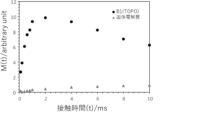
- FIG. 3 is a diagram showing the contact time dependence of each peak in the solid-state 31 PNMR spectrum measured for the solid electrolyte composition of Example 3.
- FIG. 2 is a diagram in which the 1 HNMR spectrum measured for component B1 (TOPO) and the 1 HNMR spectrum measured for the solid electrolyte composition of Example 3 are arranged vertically.
- x to y represents a numerical range of "x to y”.
- the upper limit and lower limit may be arbitrarily selected and combined. shall be able to do so.
- a solid electrolyte composition according to one embodiment of the present invention includes the following component (A) and component (B).
- R 11 to R 13 are each independently a hydrogen atom or a substituent RA, and at least one of R 11 to R 13 is a substituent RA.
- R 21 and R 22 , R 23 and R 24 , and R 25 and R 26 combine with each other to form a substituted or unsubstituted saturated or unsaturated ring. or do not combine with each other.
- R 21 to R 26 that are not bonded to each other are each independently a hydrogen atom or a substituent RA, and at least one of R 21 to R 26 is a substituent RA.
- R 31 to R 33 are each independently a hydrogen atom or a substituent RB, and at least one of R 31 to R 33 is a substituent RB.
- the substituent RA is a substituted or unsubstituted alkyl group having 1 to 50 carbon atoms, a substituted or unsubstituted alkenyl group having 2 to 50 carbon atoms, a substituted or unsubstituted alkynyl group having 2 to 50 carbon atoms, or a substituted or unsubstituted alkynyl group having 2 to 50 carbon atoms.
- the substituent RB is a substituted or unsubstituted aryl group having 6 to 50 ring carbon atoms, or a substituted or unsubstituted monovalent heterocyclic group having 5 to 50 ring atoms.
- the above solid electrolyte composition By containing component (B) in addition to the solid electrolyte, the above solid electrolyte composition exhibits high dispersibility in various organic solvents, and in particular has excellent dispersibility in nonpolar solvents such as toluene and xylene. and can maintain its dispersed state for a long time. This is expected to improve coating properties during the production of all-solid-state lithium-ion batteries, and is also expected to have the effect of suppressing deterioration of the solid electrolyte while maximizing battery performance. Although the mechanism of the above effect is not necessarily clear, the particle surface of the solid electrolyte is modified by the modifying action of component (B) having a specific structure, improving its affinity with non-polar organic solvents, and improving the uniformity of the solid electrolyte.
- Component (A) may be any solid electrolyte without any other limitations as long as it is a sulfide solid electrolyte containing a specific element.
- the sulfide solid electrolyte is a solid electrolyte that contains at least a sulfur atom and exhibits ionic conductivity due to the metal atoms contained.In addition to the sulfur atom, it preferably contains a lithium atom and a phosphorus atom, and more preferably a lithium atom.
- the sulfide solid electrolyte may be an amorphous sulfide solid electrolyte or a crystalline sulfide solid electrolyte.
- An amorphous sulfide solid electrolyte is one whose X-ray diffraction pattern is a halo pattern in which no peaks other than peaks derived from the material are observed in X-ray diffraction measurements, and the presence or absence of peaks derived from solid raw materials is It doesn't matter.
- any material that contains at least a sulfur atom and exhibits ionic conductivity due to the metal atoms contained can be used without any particular restriction, and representative examples include, for example: , Li 2 S-P 2 S 5 (Li 3 PS 4 ), etc., a solid electrolyte composed of lithium sulfide and phosphorus sulfide and containing sulfur atoms, lithium atoms, and phosphorus atoms; Li 2 S-P 2 S 5 - Lithium sulfide, phosphorus sulfide, and lithium halide, such as LiI, Li 2 SP 2 S 5 -LiCl, Li 2 SP 2 S 5 -LiBr, Li 2 SP 2 S 5 -LiI-LiBr, etc.
- the types of elements constituting the amorphous sulfide solid electrolyte can be identified using, for example, an ICP emission spectrometer.
- the amorphous sulfide solid electrolyte has at least Li 2 SP 2 S 5
- the molar ratio of Li 2 S and P 2 S 5 is 65 from the viewpoint of obtaining higher ionic conductivity. -85: 15-35 is preferred, 70-80: 20-30 is more preferred, and 72-78: 22-28 is even more preferred.
- the amorphous sulfide solid electrolyte is, for example, Li 2 SP 2 S 5 -LiI-LiBr
- the total content of lithium sulfide and diphosphorus pentasulfide is preferably 60 to 95 mol%, and 65 It is more preferably 90 mol%, and even more preferably 70 to 85 mol%.
- the ratio of lithium bromide to the total of lithium bromide and lithium iodide is preferably 1 to 99 mol%, more preferably 20 to 90 mol%, even more preferably 40 to 80 mol%, and even more preferably 50 to 70 mol%. % is particularly preferred.
- the blending ratio (molar ratio) of these atoms is 1.0 to 1.8:1.0 to 2. 0:0.1 ⁇ 0.8:0.01 ⁇ 0.6 is preferable, 1.1 ⁇ 1.7:1.2 ⁇ 1.8:0.2 ⁇ 0.6:0.05 ⁇ 0. 5 is more preferred, and 1.2-1.6: 1.3-1.7: 0.25-0.5: 0.08-0.4 is even more preferred.
- the blending ratio (molar ratio) of lithium atoms, sulfur atoms, phosphorus atoms, bromine atoms, and iodine atoms is 1.0-1.8:1.0- 2.0:0.1 ⁇ 0.8:0.01 ⁇ 0.3:0.01 ⁇ 0.3 is preferable, 1.1 ⁇ 1.7:1.2 ⁇ 1.8:0.2 ⁇ 0.6:0.02 ⁇ 0.25:0.02 ⁇ 0.25 is more preferable, 1.2 ⁇ 1.6:1.3 ⁇ 1.7:0.25 ⁇ 0.5:0.03 ⁇ 0.2:0.03 ⁇ 0.2 is more preferable, 1.35 ⁇ 1.45:1.4 ⁇ 1.7:0.3 ⁇ 0.45:0.04 ⁇ 0.18:0. 04 to 0.18 is more preferable.
- the shape of the amorphous sulfide solid electrolyte is not particularly limited, but may be, for example, particulate.
- the average particle diameter (D 50 ) of the particulate amorphous sulfide solid electrolyte can be, for example, within the range of 0.01 ⁇ m to 500 ⁇ m, or 0.1 to 200 ⁇ m.
- the average particle diameter (D 50 ) is the particle diameter that reaches 50% of the total when a particle diameter distribution integration curve is drawn, and is accumulated sequentially from the smallest particle diameter
- the volume distribution is , for example, is an average particle size that can be measured using a laser diffraction/scattering particle size distribution measuring device.
- a crystalline sulfide solid electrolyte is a solid electrolyte in which peaks derived from the solid electrolyte are observed in the X-ray diffraction pattern in X-ray diffraction measurements, and it does not matter whether or not there are peaks derived from the solid raw material. .
- a crystalline sulfide solid electrolyte includes a crystal structure derived from a solid electrolyte, and even if part of it is a crystal structure derived from the solid electrolyte, the entire crystal structure is not derived from the solid electrolyte. It's okay.
- a part of the crystalline sulfide solid electrolyte may include an amorphous solid electrolyte.
- the crystalline sulfide solid electrolyte may be, for example, a so-called glass ceramic obtained by heating the above-mentioned amorphous sulfide solid electrolyte above the crystallization temperature, and a sulfide solid electrolyte having the following crystal structure: can be adopted.
- a crystal structure that a crystalline sulfide solid electrolyte containing lithium atoms, sulfur atoms, phosphorus atoms, and halogen atoms can have, Li 4-x Ge 1-x P x S 4- based thio-silicone region II (thio- LISICON Region II) type crystal structure (see Kanno et al., Journal of The Electrochemical Society, 148(7) A742-746 (2001)), Li 4-x Ge 1 -x P hio- LISICON Region II) type (see Solid State Ionics, 177 (2006), 2721-2725), and the like.
- thio-LISICON Region II type crystal structure refers to Li 4-x Ge 1-x P x S 4 -based thio-LISICON Region II (thio-LISICON Region II) type crystal structure, Li 4-x Ge 1-x Indicates that it has a crystal structure similar to P x S 4 -based thio-LISICON Region II (thio-LISICON Region II) type.
- Li 4-x Ge 1-x P x S 4- based thiolysicone region II The diffraction peaks of the (thio-LISICON Region II ) type crystal structure
- the crystal structure of the crystalline sulfide solid electrolyte includes an argyrodite crystal structure.
- the argyrodite type crystal structure include a Li 7 PS 6 crystal structure; a composition formula Li 7-x P 1-y Si y having a structural skeleton of Li 7 PS 6 and partially replacing P with Si; Crystal structure shown by S 6 and Li 7+x P 1-y Si y S 6 (x is -0.6 to 0.6, y is 0.1 to 0.6); Li 7-x-2y PS 6- Crystal structure shown by x-y Cl x (0.8 ⁇ x ⁇ 1.7, 0 ⁇ y ⁇ -0.25x+0.5); Li 7-x PS 6-x Ha x (Ha is Cl or Br, Examples include a crystal structure in which x is preferably 0.2 to 1.8).
- preferred crystal structures of the crystalline sulfide solid electrolyte include Li 3 PS 4 crystal structure, thiolisicone region II type crystal structure, and argyrodite type crystal structure.
- the shape of the crystalline sulfide solid electrolyte is not particularly limited, but may be, for example, particulate.
- the average particle size (D 50 ) of the particulate crystalline sulfide solid electrolyte is similar to the average particle size (D 50 ) of the amorphous sulfide solid electrolyte described above, for example, from 0.01 ⁇ m to 500 ⁇ m, 0. An example is a range of .1 to 200 ⁇ m.
- Component (B) compound represented by formulas (1) to (3)
- component (B) one or more compounds selected from compounds represented by formulas (1) to (3) are used. One type of these may be used alone, or two or more types may be used in combination. Note that impurities that are generated during the manufacturing process of component (B) and cannot be substantially removed or purified may be included.
- the molecular weight of component (B) is 1 to 10,000, 1 to 5,000, 1 to 3,000, or 1 to 1,000.
- the substituent RA in formulas (1) and (2) is a substituted or unsubstituted alkyl group having 1 to 50 carbon atoms, a substituted or unsubstituted alkenyl group having 2 to 50 carbon atoms, or a substituted or unsubstituted carbon alkyl group having 2 to 50 carbon atoms.
- the substituent RB in formula (3) is a substituted or unsubstituted aryl group having 6 to 50 ring atoms, or a substituted or unsubstituted monovalent heterocyclic group having 5 to 50 ring atoms; When a plurality of RBs are present in the compound, the plurality of RBs may be the same or different.
- substituents include an alkyl group having 1 to 50 carbon atoms, an alkenyl group having 2 to 50 carbon atoms, an alkynyl group having 2 to 50 carbon atoms, and a ring having 3 to 50 carbon atoms.
- substituent RA is an unsubstituted group.
- substituent RB is an unsubstituted group.
- R 11 R 12 R 13 PO (1) (Compound represented by formula (1)) R 11 R 12 R 13 PO (1)
- R 11 to R 13 are each independently a hydrogen atom or a substituent RA, and at least one of R 11 to R 13 is a substituent RA.
- R 11 to R 13 are each independently a substituted or unsubstituted alkyl group having 1 to 50 carbon atoms.
- the number of carbon atoms may be, for example, 1 to 30, 1 to 20, or 1 to 15.
- R 11 to R 13 are each independently a substituted or unsubstituted alkyl group having 4 to 20 carbon atoms. In this case, the total carbon number of R 11 to R 13 may be 12 to 60, 12 to 50, or 12 to 40.
- R 11 to R 13 are each independently a substituted or unsubstituted aryl group having 6 to 50 ring carbon atoms.
- the number of carbon atoms may be, for example, 6 to 20, 6 to 15, or 6 to 10.
- the ring to be formed is, for example, a ring containing 3 to 10 carbon atoms.
- nitrogen ring structures such as pyrrolidine skeleton-containing structures.
- R 23 and R 24 and R 25 and R 26 may also form a ring in the same manner as R 21 and R 22 .
- R 21 to R 26 are each independently a substituted or unsubstituted alkyl group having 1 to 50 carbon atoms.
- the number of carbon atoms may be, for example, 1 to 30, 1 to 20, or 1 to 15.
- R 31 to R 33 are each independently a hydrogen atom or a substituent RB, and at least one of R 31 to R 33 is a substituent RB.
- R 31 to R 33 are each independently a substituted or unsubstituted aryl group having 6 to 50 ring carbon atoms.
- the number of carbon atoms may be, for example, 6 to 20, 6 to 15, or 6 to 10.
- the solid electrolyte composition according to one embodiment of the present invention may contain component (A) and component (B), and is not particularly limited.
- the proportion of component (B) (if multiple components (B) are included, the total amount) is 0.1 to 20% by mass based on the total of component (A) and component (B). , 1 to 20% by weight, 2 to 15% by weight, or 3 to 10% by weight.
- the proportion of each component (B) is greater than 5% by volume, greater than or equal to 10% by volume, greater than or equal to 15% by volume, or greater than or equal to 20% by volume relative to the entire solid electrolyte composition.
- the ionic conductivity of the solid electrolyte composition is 1.40 mS/cm or more, for example, 1.50 mS/cm or more, 2.00 mS/cm or more, 3.00 mS/cm or more, 4. It may be 00 mS/cm or more, or 5.00 mS/cm or more. Ionic conductivity is measured by the method described in Examples.
- a compound represented by the following formula (X1) (hereinafter sometimes referred to as component (B ⁇ )) may be included.
- R X1 to R X3 are each independently a hydrogen atom or a substituent RA, and at least one of R X1 to R X3 is a substituent RA.
- the substituent RA is as described above.
- R X1 to R X3 are each independently a substituted or unsubstituted alkyl group having 1 to 50 carbon atoms.
- the number of carbon atoms may be, for example, 1 to 30, 1 to 20, or 1 to 15.
- R X1 to R X3 are each independently a substituted or unsubstituted alkyl group having 4 to 20 carbon atoms.
- the total carbon number of R 11 to R 13 may be 12 to 60, 12 to 50, or 12 to 40.
- a compound represented by formula (1) is used as component (B), and further component (B ⁇ ) is used.
- the mass ratio of component (B) to component (B ⁇ ) is, for example, 1:9 to 9:1 or 2:8 to 8:2.
- the solid electrolyte composition according to one embodiment of the present invention may contain, substantially do not contain, or may not contain (C) a solvent.
- substantially not containing means, for example, that a trace amount of solvent is contained that cannot be completely removed even if a solvent removal operation is performed. Any known solvent can be used as the solvent.
- the solid electrolyte composition according to one embodiment of the present invention may include (D) an electrode active material.
- the electrode active material will be described later.
- 80% by mass or more, 90% by mass or more, 95% by mass or more, 99% by mass or more, 99.5% by mass or more, 99.9% by mass or more, or 100% by mass of the solid electrolyte composition Components (A) and (B), Components (A), (B), and component (B ⁇ ) Components (A), (B) and (C), Components (A), (B), components (B ⁇ ) and (C), Components (A), (B) and (D), Components (A), (B), components (B ⁇ ) and (D), Components (A), (B), (C) and (D), or components (A), (B), components (B ⁇ ), (C) and (D).
- the proportion of compounds with a molecular weight of 10,000 or less in all components other than component (A) in the solid electrolyte composition is 80% by mass or more, 90% by mass or more, 95% by mass or more, 99% by mass or more, 99. It is 5% by mass or more, 99.9% by mass or more, or 100% by mass.
- the proportion of the compound having a molecular weight of more than 10,000 in the solid electrolyte composition is 20% by mass or less, 10% by mass or less, 5% by mass or less, 1% by mass or less, 0.5% by mass or less, 0.1% by mass % or less, or 0 mass.
- the molecular weight of the high molecular weight component is the number average molecular weight (Mn) measured by GPC (Gel Permeation Chromatography).
- Solid electrolyte layer or electrode mixture The solid electrolyte composition according to one embodiment of the present invention can be used for a solid electrolyte layer, a positive electrode, a negative electrode, etc. of a lithium ion secondary battery, etc.
- a solid electrolyte layer according to one embodiment of the present invention includes the solid electrolyte composition described above or is manufactured from the solid electrolyte composition described above.
- the solid electrolyte layer may contain only the solid electrolyte composition described above, or may be manufactured from only the solid electrolyte composition described above, or may further contain a binder.
- the binder the same binder as described in the negative electrode composite material described below can be used.
- Other configurations of the solid electrolyte layer described above are as explained in the solid electrolyte layer of a lithium ion battery described later.
- An electrode composite material includes the above-described solid electrolyte composition and active material, or is produced from a composition including the above-described solid electrolyte composition and active material.
- a negative electrode active material is used as an active material, it becomes a negative electrode composite material
- a positive electrode active material is used as an active material, it becomes a positive electrode composite material.
- the negative electrode active material used in the negative electrode composite material for example, carbon materials, metal materials, etc. can be used. A composite consisting of two or more of these can also be used. Further, negative electrode active materials that will be developed in the future can also be used. Moreover, it is preferable that the negative electrode active material has electronic conductivity.
- carbon materials include graphite (for example, artificial graphite), graphite carbon fiber, resin-sintered carbon, pyrolyzed vapor-grown carbon, coke, mesocarbon microbeads (MCMB), furfuryl alcohol resin-sintered carbon, polyacene, and pitch-based carbon.
- Examples include fibers, vapor-grown carbon fibers, natural graphite, and non-graphitizable carbon.
- the metal material include simple metals, alloys, and metal compounds.
- Examples of the metal element include metal silicon, metal tin, metal lithium, metal indium, and metal aluminum.
- Examples of the alloy include alloys containing at least one of silicon, tin, lithium, indium, and aluminum.
- Examples of the metal compound include metal oxides. Examples of metal oxides include silicon oxide, tin oxide, and aluminum oxide.
- the negative electrode composite material may further contain a conductive additive.
- a conductive additive When the negative electrode active material has low electronic conductivity, it is preferable to add a conductive additive.
- the conductive aid only needs to have electrical conductivity, and its electronic conductivity is preferably 1 ⁇ 10 3 S/cm or more, more preferably 1 ⁇ 10 5 S/cm or more.
- the conductive additive preferably include carbon materials, nickel, copper, aluminum, indium, silver, cobalt, magnesium, lithium, chromium, gold, ruthenium, platinum, beryllium, iridium, molybdenum, niobium, osmium, rhodium, A substance containing at least one element selected from the group consisting of tungsten and zinc, preferably a highly conductive elemental carbon or a carbon material other than elemental carbon; nickel, copper, silver, cobalt, magnesium, lithium, ruthenium , gold, platinum, niobium, osnium, or rhodium.
- carbon materials include carbon blacks such as Ketjen black, acetylene black, Denka black, thermal black, and channel black; graphite, carbon fiber, and activated carbon; these may be used alone or in combination of two or more. It is possible. Among these, acetylene black, Denka black, and Ketjen black, which have high electronic conductivity, are preferred.
- the content of the conductive additive in the composite material is preferably 1 to 40% by mass, more preferably 2 to 20% by mass.
- a binder may be further included in order to tightly bind the negative electrode active material and the solid electrolyte composition to each other.
- fluorine-containing resins such as polytetrafluoroethylene (PTFE), polyvinylidene fluoride (PVDF), and fluororubber, thermoplastic resins such as polypropylene and polyethylene, ethylene-propylene-diene rubber (EPDM), and sulfonated resins can be used.
- PTFE polytetrafluoroethylene
- PVDF polyvinylidene fluoride
- EPDM ethylene-propylene-diene rubber
- sulfonated resins can be used.
- EPDM, natural butyl rubber (NBR), etc. can be used alone or as a mixture of two or more.
- an aqueous binder such as a cellulose binder or an aqueous dispersion of styrene-butadiene rubber (SBR) can also be used.
- the negative electrode composite material can be produced by mixing a solid electrolyte composition and a negative electrode active material, or a solid electrolyte composition, a negative electrode active material, and any conductive aid and/or binder.
- the mixing method is not particularly limited, but for example, dry mixing using a mortar, ball mill, bead mill, jet mill, planetary ball mill, vibrating ball mill, sand mill, cutter mill; and after dispersing the raw materials in an organic solvent, Wet mixing can be applied in which mixing is performed using a mortar, ball mill, bead mill, planetary ball mill, vibrating ball mill, sand mill, or film mix, and then the solvent is removed. Among these, wet mixing is preferred in order not to destroy the negative electrode active material particles.
- the positive electrode active material used in the positive electrode composite material is a material capable of intercalating and deintercalating lithium ions, and those known as positive electrode active materials in the battery field can be used. Further, cathode active materials that will be developed in the future can also be used.
- the positive electrode active material examples include metal oxides, sulfides, and the like. Sulfides include metal sulfides and non-metal sulfides.
- the metal oxide is, for example, a transition metal oxide.
- metal sulfides include titanium sulfide (TiS 2 ), molybdenum sulfide (MoS 2 ), iron sulfide (FeS, FeS 2 ), copper sulfide (CuS), and nickel sulfide (Ni 3 S 2 ).
- Other metal oxides include bismuth oxide (Bi 2 O 3 ), bismuth leadate (Bi 2 Pb 2 O 5 ), and the like.
- the nonmetal sulfide include organic disulfide compounds, carbon sulfide compounds, and the like.
- niobium selenide (NbSe 3 ), metallic indium, and sulfur can also be used as positive electrode active materials.
- the positive electrode composite material may further contain a conductive additive.
- the conductive aid is the same as that described for the negative electrode composite material.
- the mixing ratio of the solid electrolyte composition and the positive electrode active material in the positive electrode composite material is the same as the mixing ratio of the solid electrolyte composition and the negative electrode active material described above.
- the content of the conductive additive in the positive electrode composite material is the same as the content of the conductive additive in the negative electrode composite material described above.
- the method for manufacturing the positive electrode composite material is the same as the method for manufacturing the negative electrode composite material described above.
- the lithium ion battery (first lithium ion battery) according to one aspect of the present invention includes one or more selected from the group consisting of the above-mentioned solid electrolyte layer, negative electrode composite material, and positive electrode composite material, or Alternatively, it includes one or more selected from the group consisting of the solid electrolyte layer described above, a negative electrode layer manufactured from the negative electrode mixture described above, and a positive electrode layer manufactured from the positive electrode mixture described above.
- a lithium ion battery usually has a structure in which a negative electrode layer, an electrolyte layer, and a positive electrode layer are laminated in this order.
- the negative electrode composite material When using the negative electrode composite material according to one embodiment of the present invention as the negative electrode layer, the negative electrode composite material is as described above. When using a material other than the negative electrode composite material according to one embodiment of the present invention as the negative electrode layer, a known structure may be adopted.
- the thickness of the negative electrode layer is, for example, 100 nm or more and 5 mm or less, 1 ⁇ m or more and 3 mm or less, or 5 ⁇ m or more and 1 mm or less.
- the negative electrode layer can be manufactured by a known method, for example, by a coating method or an electrostatic method (electrostatic spray method, electrostatic screen method, etc.).
- electrolyte layer When the solid electrolyte layer according to one embodiment of the present invention is used as the electrolyte layer, the solid electrolyte layer is as described above. When using a layer other than the solid electrolyte layer according to one embodiment of the present invention as the electrolyte layer, a known structure may be employed.
- the thickness of the electrolyte layer is, for example, 0.001 mm or more and 1 mm or less.
- the solid electrolyte of the electrolyte layer may be fused. Fusion means that a portion of the solid electrolyte particles is dissolved and the dissolved portion is integrated with other solid electrolyte particles.
- the electrolyte layer may be a plate-like body of solid electrolyte, and the plate-like body includes cases in which some or all of the solid electrolyte particles are dissolved to form a plate-like body.
- the electrolyte layer can be manufactured by a known method, for example, by a coating method or an electrostatic method (electrostatic spray method, electrostatic screen method, etc.).
- the positive electrode composite material When using the positive electrode composite material according to one embodiment of the present invention as the positive electrode layer, the positive electrode composite material is as described above. When using a material other than the positive electrode composite material according to one embodiment of the present invention as the positive electrode layer, a known structure may be adopted. The thickness of the positive electrode layer is, for example, 0.01 mm or more and 10 mm or less.
- the positive electrode layer can be manufactured by a known method, for example, by a coating method or an electrostatic method (electrostatic spray method, electrostatic screen method, etc.).
- the lithium ion battery includes a current collector.
- the negative electrode current collector is provided on the side of the negative electrode layer opposite to the electrolyte layer side
- the positive electrode current collector is provided on the side of the positive electrode layer opposite to the electrolyte layer side.
- a plate or foil made of copper, magnesium, stainless steel, titanium, iron, cobalt, nickel, zinc, aluminum, germanium, indium, lithium, or an alloy thereof can be used.
- the above-mentioned lithium ion battery can be manufactured by laminating and joining each of the above-mentioned members.
- methods for joining there are a method of laminating each member and pressurizing and crimping them, a method of applying pressure between two rolls (roll to roll), and the like. They may be bonded via an active material having ion conductivity or an adhesive material that does not inhibit ion conductivity on the bonding surface. In joining, heat fusion may be performed within a range where the crystal structure of the solid electrolyte does not change.
- the above lithium ion battery can also be manufactured by sequentially forming each of the above members. It can be manufactured by a known method, for example, by a coating method or an electrostatic method (electrostatic spray method, electrostatic screen method, etc.).
- At least one of the electrodes (negative electrode layer and positive electrode layer) and solid electrolyte layer contains the following components (A) and (B). including.
- Component (A) and component (B) are as explained in the solid electrolyte composition according to one embodiment of the present invention.
- the second lithium ion battery is one that contains one or more selected from the group consisting of the solid electrolyte layer, the negative electrode composite material, and the positive electrode composite material, or the solid electrolyte layer described above in the first lithium ion battery. , a negative electrode layer manufactured from the above-mentioned negative electrode composite material, and a positive electrode layer manufactured from the above-mentioned positive electrode composite material.''
- the second lithium ion battery is the same as the first lithium ion battery except that at least one of the components includes the following components (A) and (B), and each structure can be applied as appropriate.
- each layer of the second lithium ion battery contains component (A) and component (B)
- the content ratio of component (A) and component (B) in the solid electrolyte composition according to one embodiment of the present invention is As explained.
- B1 Tri-n-octylphosphine oxide (TOPO)
- TPPO Triphenylphosphine oxide
- TpydPO Tripyrrolidinophosphine oxide
- HMPA Tris(diethylamino)phosphine oxide
- B5 Triphenyl phosphate (PhPho)
- B'1 Triethyl phosphate (TEPho)
- Ionic conductivity measurement A sample of the solid electrolyte or solid electrolyte composition is filled into a tablet molding machine, a pressure of 400 MPa is applied, and a molded body (also called a "pellet", diameter of about 10 mm, thickness of about 0.1 to 0.0 .2 cm). Carbon was placed on both sides of the compact as electrodes, and pressure was applied again using the tablet molding machine to produce a compact for measurement. The ionic conductivity of this measurement molded object was measured by AC impedance measurement. The value of conductivity was taken at 25°C.
- Ionic conductivity maintenance rate The degree of change in ionic conductivity due to the addition of component (B) was measured. Specifically, in Examples 1 to 12 and Comparative Example 2, the rate of change in ionic conductivity was calculated based on the ionic conductivity in Comparative Example 1 using only the same component (A). In Example 13, the rate of change in ionic conductivity was calculated based on the ionic conductivity in Comparative Example 3 using only the same component (A).
- Dispersibility evaluation The dispersibility of the solid electrolyte composition was evaluated by measuring the transmittance of a pulsed light source with a wavelength of 850 nm using "TURBISCAN CLASSIC (MA2000)" manufactured by Formulation. Specifically, 0.015 g of the solid electrolyte composition and 6 ml of p-xylene were mixed in a transparent screw tube (8 ml) and stirred for 10 seconds using an ultrasonic device to obtain a mixed solution. The entire amount of the mixed liquid was transferred to a dedicated glass cell with a cap, and measurements were taken at 1 minute intervals for 30 minutes using the MA2000 mentioned above to observe changes over time (the height from the bottom of the glass cell to the liquid level was approximately 6 cm). Ta).
- the liquid surface and the vicinity of the bottom are strongly affected by disturbance factors such as adhesion to the glass cell and convection due to sample settling, it is difficult to evaluate samples with widely different dispersions using uniform measurement and analysis conditions. Have difficulty. Therefore, uniform evaluation was performed by using the average transmittance at a position of 30 to 35 mm from the bottom of the glass cell at 15 minutes from the start of measurement as a value representative of the dispersibility of the entire sample. If the dispersibility is high, the pulsed light source will be scattered by the solid electrolyte composition, resulting in a decrease in transmittance; if the dispersibility is low, the solid electrolyte composition will settle, allowing the pulsed light source to pass through the glass cell, increasing the transmittance. . At this time, the transmittance of the device internal standard is set to 100%.
- the roughly mixed raw materials are dispersed in a mixed solvent of dehydrated toluene (manufactured by Fuji Film Wako Pure Chemical Industries, Ltd.) and dehydrated isobutyronitrile (manufactured by Kishida Chemical Co., Ltd.) under a nitrogen atmosphere to form a raw material mixture of about 10% by mass. It was made into a slurry.
- the raw material mixture slurry was mixed and pulverized using a bead mill (LMZ015, manufactured by Ashizawa Finetech) while maintaining a nitrogen atmosphere.
- the treated slurry was placed in a Schlenk bottle purged with nitrogen, and then dried under reduced pressure to prepare a raw material mixture.
- (B) Firing Step The raw material mixture obtained in (A) above was heated in an electric furnace (F-1404-A, manufactured by Tokyo Glass Kikai Co., Ltd.) in a glove box under a nitrogen atmosphere. Specifically, the raw material mixture was placed in an Al 2 O 3 sagger pot (999-60S, manufactured by Tokyo Glass Equipment Co., Ltd.), and heat-treated at 430° C. for 1 hour or more in an electric furnace. Thereafter, the sagger was taken out of the electric furnace and slowly cooled to obtain an argyrodite solid electrolyte.
- F-1404-A manufactured by Tokyo Glass Kikai Co., Ltd.
- (C) Micronization step The obtained argyrodite solid electrolyte is dispersed in a mixed solvent of dehydrated toluene (manufactured by Fuji Film Wako Pure Chemical Industries, Ltd.) and dehydrated isobutyronitrile (manufactured by Kishida Chemical Co., Ltd.) under a nitrogen atmosphere.
- a solid electrolyte slurry was prepared. The slurry was mixed and pulverized using a bead mill (LMZ015, manufactured by Ashizawa Finetech Co., Ltd.) while maintaining the slurry in a nitrogen atmosphere.
- the treated solid electrolyte slurry was placed in a Schlenk bottle purged with nitrogen, and then dried under reduced pressure to obtain a micronized argyrodite solid electrolyte (component (A): hereinafter also referred to as "A1").
- a complex was obtained. Next, the complex powder was heated at 120° C. for 2 hours under vacuum to obtain an amorphous sulfide solid electrolyte. Further, the amorphous sulfide solid electrolyte was heated under vacuum at 140° C. for 2 hours to obtain a crystalline sulfide solid electrolyte A2.
- Example 1 (Preparation and evaluation of solid electrolyte composition)
- A1 and B1 TOPO
- TOPO TOPO
- a 50 mL Schlenk tube containing a stirrer chip in an amount such that the amount of B1 is 1% by mass with respect to the total amount of A1 and B1, and a total of 1.5 g. 15.5 mL of toluene was added to form a mixture (slurry).
- the mixture was stirred at 60° C. for 1 hour while maintaining the nitrogen atmosphere. Thereafter, it was vacuum-dried at room temperature until it became a dry powder, and then vacuum-dried at 80° C. for 1 hour to obtain a powder solid electrolyte composition.
- Table 1 shows the evaluation results of the obtained solid electrolyte composition. Note that the volume ratio (volume %) of B1 to the total volume of A1 and B1 is also listed in Table 1 (the same applies to the following Examples and Comparative Examples).
- Examples 2 and 3 A solid electrolyte composition was produced and evaluated in the same manner as in Example 1, except that A1 and B1 were set in amounts such that the amount of B1 was 3% by mass or 10% by mass relative to the total amount of A1 and B1. The results are shown in Table 1.
- Examples 4-6 A solid electrolyte composition was produced and evaluated in the same manner as in Example 1, except that B1 (TOPO) was used as component (B) and tri-n-octylphosphine (TOP) was further added. The results are shown in Table 1. The amounts of B1 (TOPO) and TOP were 0.5% by mass, 1.5% by mass, or 5% by mass, respectively, relative to the total amount of A1, B1, and TOP.
- B1 TOPO
- TOP tri-n-octylphosphine
- Example 7 Example 1 except that the amount of B1 was 3% by mass relative to the total amount of A1, B1, and TOP, and the amount of TOP was 7% by mass relative to the total amount of A1, B1, and TOP.
- a solid electrolyte composition was manufactured and evaluated in the same manner. The results are shown in Table 1.
- Examples 8-12 The procedure was carried out except that the component (B) shown in Table 1 was used instead of B1, and the amount of component (B) relative to the total amount of A1 and component (B) was the amount shown in Table 1.
- a solid electrolyte composition was produced and evaluated in the same manner as in Example 1. The results are shown in Table 1.
- Example 13 A solid electrolyte composition was prepared in the same manner as in Example 1, except that A2 was used instead of A1, and A2 and B1 (TOPO) were adjusted to amounts such that the amount of B1 was 9% by mass with respect to the total amount of A2 and B1. was manufactured and evaluated. The results are shown in Table 1.
- Comparative example 1 A solid electrolyte composition was produced and evaluated in the same manner as in Example 1, except that component (B) was not used. The results are shown in Table 1.
- Comparative example 2 Same method as Example 1 except that component (B') shown in Table 1 was used instead of B1, and the amount of component (B') was changed to the amount shown in Table 1 relative to the total amount of A1 and component (B'). A solid electrolyte composition was manufactured and evaluated. The results are shown in Table 1.
- Comparative example 3 A solid electrolyte composition was produced and evaluated in the same manner as in Example 13, except that component (B) was not used. The results are shown in Table 1.
- Example 13 In a comparison between Example 13 and Comparative Example 3, which are systems using A2 as component (A), the relative superiority of dispersibility in Example 13 was confirmed.
- Example 3 From Figure 1, a new peak was confirmed around 65 ppm in Example 3 compared to Comparative Example 1, and this peak shifted to the lower magnetic field side than the peak obtained when measuring component B1 (TOPO) alone. I know what you did. This suggests that in Example 3, the electronic state around the P atom of B1 (TOPO) was changed by mixing B1 (TOPO) and the solid electrolyte. (3) The contact time dependence of each peak in the solid 31 PNMR spectrum (CP/MAS method) measured for the solid electrolyte composition of Example 3 is shown in FIG.
- the peak of component B1 (TOPO) once increases and then attenuates, but this is because the intensity increases due to the magnetization transfer from the hydrogen atom contained in the alkyl group of component B1 (TOPO) to the P atom, and then It is thought that the attenuation is due to the spin-lattice relaxation behavior of 1H.
- the intensity of the solid electrolyte peak increases monotonically with increasing contact time. This suggests that the atoms are arranged in this order: the alkyl group of component B1 (TOPO), the P atom of component B1 (TOPO), and the P atom of the solid electrolyte.
- Figure 4 shows the solid state 6 Li NMR spectrum (single pulse method) measured for the solid electrolyte composition of Example 3 and the solid state 6 Li NMR spectrum (CP/MAS method) measured for the solid electrolyte composition of Example 3. show.
- Example 3 a new peak was observed on the high magnetic field side of Li atoms contained in the solid electrolyte.
- the high ionic conductivity maintenance rates of B1 (TOPO) and B5 (PhPho) are particularly remarkable, indicating that they can exhibit the two effects of improving dispersibility and maintaining ionic conductivity at a high level.
- the ionic conductivity decreased to 1.38 mS/cm, indicating that the decrease in ionic conductivity due to triethyl phosphate (TEPho) was large.
Landscapes
- Chemical & Material Sciences (AREA)
- Engineering & Computer Science (AREA)
- Electrochemistry (AREA)
- General Chemical & Material Sciences (AREA)
- Chemical Kinetics & Catalysis (AREA)
- Manufacturing & Machinery (AREA)
- Materials Engineering (AREA)
- Inorganic Chemistry (AREA)
- Physics & Mathematics (AREA)
- Condensed Matter Physics & Semiconductors (AREA)
- General Physics & Mathematics (AREA)
- Organic Chemistry (AREA)
- Conductive Materials (AREA)
- Secondary Cells (AREA)
Priority Applications (4)
| Application Number | Priority Date | Filing Date | Title |
|---|---|---|---|
| CN202380047130.8A CN119365937A (zh) | 2022-07-27 | 2023-07-26 | 固体电解质组合物、固体电解质层或电极复合材料、以及锂离子电池 |
| KR1020247035386A KR20250038196A (ko) | 2022-07-27 | 2023-07-26 | 고체 전해질 조성물, 고체 전해질층 또는 전극 합재, 및 리튬 이온 전지 |
| US18/995,258 US20260018661A1 (en) | 2022-07-27 | 2023-07-26 | Solid electrolyte composition, solid electrolyte layer or electrode mixture, and lithium ion battery |
| JP2024537776A JPWO2024024823A1 (https=) | 2022-07-27 | 2023-07-26 |
Applications Claiming Priority (2)
| Application Number | Priority Date | Filing Date | Title |
|---|---|---|---|
| JP2022119987 | 2022-07-27 | ||
| JP2022-119987 | 2022-07-27 |
Publications (1)
| Publication Number | Publication Date |
|---|---|
| WO2024024823A1 true WO2024024823A1 (ja) | 2024-02-01 |
Family
ID=89706480
Family Applications (1)
| Application Number | Title | Priority Date | Filing Date |
|---|---|---|---|
| PCT/JP2023/027337 Ceased WO2024024823A1 (ja) | 2022-07-27 | 2023-07-26 | 固体電解質組成物、固体電解質層又は電極合材、及びリチウムイオン電池 |
Country Status (5)
| Country | Link |
|---|---|
| US (1) | US20260018661A1 (https=) |
| JP (1) | JPWO2024024823A1 (https=) |
| KR (1) | KR20250038196A (https=) |
| CN (1) | CN119365937A (https=) |
| WO (1) | WO2024024823A1 (https=) |
Citations (2)
| Publication number | Priority date | Publication date | Assignee | Title |
|---|---|---|---|---|
| JP2019061952A (ja) * | 2017-09-25 | 2019-04-18 | パナソニックIpマネジメント株式会社 | 電池 |
| JP2021144822A (ja) * | 2020-03-11 | 2021-09-24 | トヨタ自動車株式会社 | リチウム固体電池 |
Family Cites Families (1)
| Publication number | Priority date | Publication date | Assignee | Title |
|---|---|---|---|---|
| JP7277213B2 (ja) | 2019-03-28 | 2023-05-18 | Ube株式会社 | 固体電解質組成物、それを用いた成形体、及び全固体二次電池 |
-
2023
- 2023-07-26 KR KR1020247035386A patent/KR20250038196A/ko active Pending
- 2023-07-26 US US18/995,258 patent/US20260018661A1/en active Pending
- 2023-07-26 WO PCT/JP2023/027337 patent/WO2024024823A1/ja not_active Ceased
- 2023-07-26 CN CN202380047130.8A patent/CN119365937A/zh active Pending
- 2023-07-26 JP JP2024537776A patent/JPWO2024024823A1/ja active Pending
Patent Citations (2)
| Publication number | Priority date | Publication date | Assignee | Title |
|---|---|---|---|---|
| JP2019061952A (ja) * | 2017-09-25 | 2019-04-18 | パナソニックIpマネジメント株式会社 | 電池 |
| JP2021144822A (ja) * | 2020-03-11 | 2021-09-24 | トヨタ自動車株式会社 | リチウム固体電池 |
Also Published As
| Publication number | Publication date |
|---|---|
| US20260018661A1 (en) | 2026-01-15 |
| CN119365937A (zh) | 2025-01-24 |
| KR20250038196A (ko) | 2025-03-19 |
| JPWO2024024823A1 (https=) | 2024-02-01 |
Similar Documents
| Publication | Publication Date | Title |
|---|---|---|
| KR102419231B1 (ko) | 황화물 고체 전해질 | |
| CN105098229B (zh) | 硫化物固体电解质材料、电池以及硫化物固体电解质材料的制造方法 | |
| JP7182633B2 (ja) | リチウムイオン電気化学セル用の固体電解質 | |
| DE102015111373B4 (de) | Sulfidfestelektrolytmaterial, batterie und verfahren zum herstellen des sulfidfestelektrolytmaterials | |
| DE102016107183B4 (de) | Anodenaktivmaterial und Festkörper-Sekundärbatterie | |
| CN106537678A (zh) | 硫化物固体电解质材料、电池和硫化物固体电解质材料的制造方法 | |
| DE102015107400A1 (de) | Sulfidfestelektrolytmaterial, batterie und verfahren zum herstellen des sulfidfestelektrolytmaterials | |
| WO2019039567A1 (ja) | 非水系電解質二次電池用正極活物質とその製造方法、非水系電解質二次電池用正極合材ペーストおよび非水系電解質二次電池 | |
| DE112014004476B4 (de) | Sulfidfestelektrolytmaterial, Batterie und Herstellungsverfahren für Sulfidfestelektrolytmaterial | |
| DE112013006405T5 (de) | Sulfidfestelektrolytmaterial, Batterie und Verfahren zum Herstellen des Sulfidfestelektrolytmaterials | |
| CN105453324A (zh) | 硫化物固体电解质材料、电池和硫化物固体电解质材料的制造方法 | |
| DE102019111405A1 (de) | Sulfid- und oxysulfidglas und glaskeramische festkörperelektrolyte für elektrochemische zellen | |
| CN111406332A (zh) | 非水类电解质二次电池用正极活性物质、非水类电解质二次电池用正极活性物质的制造方法 | |
| JP2012199234A (ja) | リチウムイオン電池及びその負極材料 | |
| JP7476867B2 (ja) | 硫化物固体電解質、電池および硫化物固体電解質の製造方法 | |
| DE102015112479B4 (de) | Gesamtfeststoffzustandsbatteriesystem | |
| Chen et al. | Preparation of LiNi0. 5Mn1. 5O4 cathode materials by using different-sized Mn3O4 nanocrystals as precursors | |
| JP7301005B2 (ja) | 硫化物系固体電解質及び全固体リチウムイオン電池 | |
| WO2024024827A1 (ja) | 固体電解質組成物、固体電解質層又は電極合材、及びリチウムイオン電池 | |
| WO2024024823A1 (ja) | 固体電解質組成物、固体電解質層又は電極合材、及びリチウムイオン電池 | |
| JP7677259B2 (ja) | 硫化物固体電解質および固体電池 | |
| JP2025532415A (ja) | リチウム二次電池 | |
| JP2023043881A (ja) | 硫化物系固体電解質、その製造方法及びこれを含む全固体電池 | |
| CN115244005A (zh) | 固溶体、电极活性物质、电极及二次电池 | |
| WO2018215124A1 (de) | Hybridsuperkondensator für hochtemperaturanwendungen |
Legal Events
| Date | Code | Title | Description |
|---|---|---|---|
| 121 | Ep: the epo has been informed by wipo that ep was designated in this application |
Ref document number: 23846553 Country of ref document: EP Kind code of ref document: A1 |
|
| ENP | Entry into the national phase |
Ref document number: 2024537776 Country of ref document: JP Kind code of ref document: A |
|
| WWE | Wipo information: entry into national phase |
Ref document number: 202380047130.8 Country of ref document: CN |
|
| WWE | Wipo information: entry into national phase |
Ref document number: 18995258 Country of ref document: US |
|
| WWP | Wipo information: published in national office |
Ref document number: 202380047130.8 Country of ref document: CN |
|
| NENP | Non-entry into the national phase |
Ref country code: DE |
|
| WWP | Wipo information: published in national office |
Ref document number: 1020247035386 Country of ref document: KR |
|
| 122 | Ep: pct application non-entry in european phase |
Ref document number: 23846553 Country of ref document: EP Kind code of ref document: A1 |
|
| WWP | Wipo information: published in national office |
Ref document number: 18995258 Country of ref document: US |