WO2024024331A1 - 樹脂組成物 - Google Patents
樹脂組成物 Download PDFInfo
- Publication number
- WO2024024331A1 WO2024024331A1 PCT/JP2023/022554 JP2023022554W WO2024024331A1 WO 2024024331 A1 WO2024024331 A1 WO 2024024331A1 JP 2023022554 W JP2023022554 W JP 2023022554W WO 2024024331 A1 WO2024024331 A1 WO 2024024331A1
- Authority
- WO
- WIPO (PCT)
- Prior art keywords
- resin composition
- mass
- composition according
- less
- cured product
- Prior art date
- Legal status (The legal status is an assumption and is not a legal conclusion. Google has not performed a legal analysis and makes no representation as to the accuracy of the status listed.)
- Ceased
Links
Images




Classifications
-
- C—CHEMISTRY; METALLURGY
- C08—ORGANIC MACROMOLECULAR COMPOUNDS; THEIR PREPARATION OR CHEMICAL WORKING-UP; COMPOSITIONS BASED THEREON
- C08L—COMPOSITIONS OF MACROMOLECULAR COMPOUNDS
- C08L63/00—Compositions of epoxy resins; Compositions of derivatives of epoxy resins
-
- C—CHEMISTRY; METALLURGY
- C08—ORGANIC MACROMOLECULAR COMPOUNDS; THEIR PREPARATION OR CHEMICAL WORKING-UP; COMPOSITIONS BASED THEREON
- C08F—MACROMOLECULAR COMPOUNDS OBTAINED BY REACTIONS ONLY INVOLVING CARBON-TO-CARBON UNSATURATED BONDS
- C08F2/00—Processes of polymerisation
- C08F2/44—Polymerisation in the presence of compounding ingredients, e.g. plasticisers, dyestuffs, fillers
-
- C—CHEMISTRY; METALLURGY
- C08—ORGANIC MACROMOLECULAR COMPOUNDS; THEIR PREPARATION OR CHEMICAL WORKING-UP; COMPOSITIONS BASED THEREON
- C08F—MACROMOLECULAR COMPOUNDS OBTAINED BY REACTIONS ONLY INVOLVING CARBON-TO-CARBON UNSATURATED BONDS
- C08F283/00—Macromolecular compounds obtained by polymerising monomers on to polymers provided for in subclass C08G
- C08F283/10—Macromolecular compounds obtained by polymerising monomers on to polymers provided for in subclass C08G on to polymers containing more than one epoxy radical per molecule
-
- C—CHEMISTRY; METALLURGY
- C08—ORGANIC MACROMOLECULAR COMPOUNDS; THEIR PREPARATION OR CHEMICAL WORKING-UP; COMPOSITIONS BASED THEREON
- C08F—MACROMOLECULAR COMPOUNDS OBTAINED BY REACTIONS ONLY INVOLVING CARBON-TO-CARBON UNSATURATED BONDS
- C08F290/00—Macromolecular compounds obtained by polymerising monomers on to polymers modified by introduction of aliphatic unsaturated end or side groups
- C08F290/02—Macromolecular compounds obtained by polymerising monomers on to polymers modified by introduction of aliphatic unsaturated end or side groups on to polymers modified by introduction of unsaturated end groups
- C08F290/06—Polymers provided for in subclass C08G
-
- C—CHEMISTRY; METALLURGY
- C08—ORGANIC MACROMOLECULAR COMPOUNDS; THEIR PREPARATION OR CHEMICAL WORKING-UP; COMPOSITIONS BASED THEREON
- C08F—MACROMOLECULAR COMPOUNDS OBTAINED BY REACTIONS ONLY INVOLVING CARBON-TO-CARBON UNSATURATED BONDS
- C08F299/00—Macromolecular compounds obtained by interreacting polymers involving only carbon-to-carbon unsaturated bond reactions, in the absence of non-macromolecular monomers
- C08F299/02—Macromolecular compounds obtained by interreacting polymers involving only carbon-to-carbon unsaturated bond reactions, in the absence of non-macromolecular monomers from unsaturated polycondensates
-
- C—CHEMISTRY; METALLURGY
- C08—ORGANIC MACROMOLECULAR COMPOUNDS; THEIR PREPARATION OR CHEMICAL WORKING-UP; COMPOSITIONS BASED THEREON
- C08G—MACROMOLECULAR COMPOUNDS OBTAINED OTHERWISE THAN BY REACTIONS ONLY INVOLVING UNSATURATED CARBON-TO-CARBON BONDS
- C08G59/00—Polycondensates containing more than one epoxy group per molecule; Macromolecules obtained by polymerising compounds containing more than one epoxy group per molecule using curing agents or catalysts which react with the epoxy groups
-
- C—CHEMISTRY; METALLURGY
- C08—ORGANIC MACROMOLECULAR COMPOUNDS; THEIR PREPARATION OR CHEMICAL WORKING-UP; COMPOSITIONS BASED THEREON
- C08G—MACROMOLECULAR COMPOUNDS OBTAINED OTHERWISE THAN BY REACTIONS ONLY INVOLVING UNSATURATED CARBON-TO-CARBON BONDS
- C08G59/00—Polycondensates containing more than one epoxy group per molecule; Macromolecules obtained by polymerising compounds containing more than one epoxy group per molecule using curing agents or catalysts which react with the epoxy groups
- C08G59/18—Macromolecules obtained by polymerising compounds containing more than one epoxy group per molecule using curing agents or catalysts which react with the epoxy groups ; e.g. general methods of curing
- C08G59/40—Macromolecules obtained by polymerising compounds containing more than one epoxy group per molecule using curing agents or catalysts which react with the epoxy groups ; e.g. general methods of curing characterised by the curing agents used
- C08G59/42—Polycarboxylic acids; Anhydrides, halides or low molecular weight esters thereof
-
- C—CHEMISTRY; METALLURGY
- C08—ORGANIC MACROMOLECULAR COMPOUNDS; THEIR PREPARATION OR CHEMICAL WORKING-UP; COMPOSITIONS BASED THEREON
- C08K—Use of inorganic or non-macromolecular organic substances as compounding ingredients
- C08K3/00—Use of inorganic substances as compounding ingredients
- C08K3/34—Silicon-containing compounds
- C08K3/36—Silica
-
- H—ELECTRICITY
- H10—SEMICONDUCTOR DEVICES; ELECTRIC SOLID-STATE DEVICES NOT OTHERWISE PROVIDED FOR
- H10W—GENERIC PACKAGES, INTERCONNECTIONS, CONNECTORS OR OTHER CONSTRUCTIONAL DETAILS OF DEVICES COVERED BY CLASS H10
- H10W74/00—Encapsulations, e.g. protective coatings
- H10W74/40—Encapsulations, e.g. protective coatings characterised by their materials
- H10W74/47—Encapsulations, e.g. protective coatings characterised by their materials comprising organic materials, e.g. plastics or resins
- H10W74/473—Encapsulations, e.g. protective coatings characterised by their materials comprising organic materials, e.g. plastics or resins containing a filler
Definitions
- the present invention relates to a resin composition.
- the present invention also relates to a cured product of the resin composition, a semiconductor chip package, and a semiconductor device containing the cured product.
- Low-viscosity resin compositions containing epoxy resins are used for high-performance organic-inorganic composite materials that require high inorganic filler filling and impregnability into fiber materials (e.g., glass fibers, carbon fibers). And it's in high demand. Therefore, various resin compositions that can reduce the viscosity have been studied (Patent Documents 1 and 2).
- an inorganic filler may be blended into the resin composition.
- fluidity tends to decrease as the content of inorganic filler in a resin composition increases, but when a low viscosity resin composition is used, the decrease in fluidity is relatively suppressed. becomes possible.
- the cured product has a high glass transition temperature.
- cured products obtained by curing resin compositions that can be made to have a low viscosity tend to have a low glass transition point.
- the present invention was devised in view of the above-mentioned problems, and provides a resin composition capable of obtaining a cured product having a high glass transition temperature and a low viscosity; a cured product of the resin composition; and
- An object of the present invention is to provide a semiconductor chip package and a semiconductor device including the cured product.
- the present inventor conducted extensive studies to solve the above problems. As a result, the present inventor discovered that (A-1) an epoxy resin containing two or more epoxy groups in one molecule and which is liquid at 25°C, and (B) methacrylic anhydride. It has been discovered that a resin composition containing a combination of the following can solve the above-mentioned problems, and the present invention has been completed. In addition, the present inventor has found that with such a resin composition, it is possible to obtain good fluidity even when an inorganic filler is blended from the viewpoint of obtaining a cured product with a low dielectric loss tangent. It has also been discovered that a cured product with particularly excellent dielectric properties can be achieved by incorporating a high proportion of components such as fillers. The present invention originates from this finding. That is, the present invention includes the following.
- a resin composition that is liquid at 25°C The resin composition includes (A) an epoxy resin and (B) methacrylic anhydride, (A) A resin composition in which the epoxy resin contains (A-1) an epoxy resin that contains two or more epoxy groups in one molecule and is liquid at 25°C. [2] The resin composition according to [1], wherein the amount of component (A-1) based on 100% by mass of component (A) is 10% by mass to 100% by mass. [3] The resin composition according to [1] or [2], wherein the viscosity of component (A-1) at 25° C. is 100,000 mPa ⁇ s or less.
- a cured product When a cured product is obtained by curing the resin composition at 100°C for 5 hours, The cured product has a glass transition temperature Tg of 220°C or less, The average linear thermal expansion coefficient CTE ⁇ 1 of the cured product in the first measurement range of 40°C to 60°C is less than 50 ppm/°C, The resin composition according to any one of [1] to [15], wherein the cured product has an average linear thermal expansion coefficient CTE ⁇ 2 of less than 100 ppm/° C. in the second measurement range of Tg+40° C. to 260° C.
- the semiconductor chip package according to [20] including a substrate, a semiconductor chip provided on the substrate with a gap therebetween, and the cured product filling the gap.
- a semiconductor device comprising the semiconductor chip package according to [20] or [21].
- a cured product of the resin composition according to any one of [1] to [19].
- a low-viscosity resin composition capable of obtaining a cured product with a high glass transition temperature
- a cured product of the resin composition a semiconductor chip package and a semiconductor device containing the cured product.
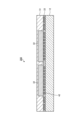
- FIG. 1 is a cross-sectional view schematically showing a semiconductor chip package according to a first example of the present invention.
- FIG. 2 is a cross-sectional view schematically showing a semiconductor chip package according to a second example of the present invention.
- FIG. 3 is a cross-sectional view schematically showing a semiconductor chip package according to a third example of the present invention.
- FIG. 4 is a cross-sectional view schematically showing a semiconductor chip package according to a fourth example of the present invention.
- FIG. 5 is a cross-sectional view schematically showing a semiconductor chip package according to a fifth example of the present invention.
- FIG. 6 is a cross-sectional view schematically showing a semiconductor chip package according to a sixth example of the present invention.
- (meth)acrylic acid includes acrylic acid and methacrylic acid, unless otherwise specified.
- (meth)acrylate includes acrylate and methacrylate unless otherwise specified.
- (meth)acryloyl group includes acryloyl and methacryloyl groups, unless otherwise specified.
- the resin composition according to one embodiment of the present invention is liquid at 25°C.
- the resin composition according to the present embodiment includes (A) an epoxy resin and (B) methacrylic anhydride.
- the epoxy resin (A) includes (A-1) an epoxy resin that contains two or more epoxy groups in one molecule and is liquid at 25°C.
- (A-1) Multifunctional liquid epoxy resin is referred to as "(A-1) Multifunctional liquid epoxy resin.”
- the resin composition according to this embodiment can have a low viscosity.
- (A-1) the polyfunctional liquid epoxy resin is liquid at 25°C
- (B) methacrylic anhydride is a low-viscosity liquid compound, so resin compositions containing them can be easily prepared. It can be made into a low viscosity liquid.
- conventional cured products obtained by combining (A-1) a multifunctional liquid epoxy resin with an epoxy curing agent other than methacrylic anhydride tended to have a low glass transition temperature.
- the cured product obtained by combining (A-1) a multifunctional liquid epoxy resin and (B) methacrylic anhydride as in the present embodiment has a low viscosity before curing, but a high It can have a glass transition temperature Tg.
- Tg glass transition temperature
- the effect of increasing the glass transition temperature Tg after curing while lowering the viscosity before curing is when using an epoxy curing agent with a chemical structure similar to methacrylic anhydride, such as acrylic anhydride. Therefore, it is a specific effect obtained by the combination of (A-1) multifunctional liquid epoxy resin and (B) methacrylic anhydride.
- a cured product having a high glass transition temperature can be obtained, so that both low viscosity and high glass transition temperature can be achieved.
- the resin composition according to the present embodiment a cured product with low thermal expansion can usually be obtained. Furthermore, the resin composition according to the present embodiment preferably exhibits little increase in viscosity over time.
- the resin composition according to this embodiment includes (A) an epoxy resin as the (A) component.
- the epoxy resin may be a curable resin containing an epoxy group.
- Epoxy resin includes (A-1) multifunctional liquid epoxy resin.
- the multifunctional liquid epoxy resin contains two or more epoxy groups in one molecule.
- the number of epoxy groups contained in one molecule of the multifunctional liquid epoxy resin is usually 2 or more, preferably 10 or less, more preferably 5 or less, and even more preferably 4 or less. be.
- the multifunctional liquid epoxy resin (A-1) containing two or more epoxy groups in one molecule can form a complex crosslinked network during curing, resulting in a cured product with excellent mechanical strength and thermal stability. For example, a cured product with low thermal expansion can be obtained.
- the multifunctional liquid epoxy resin is liquid at 25°C.
- (A-1) that the multifunctional liquid epoxy resin is "liquid” means that the multifunctional liquid epoxy resin (A-1) has fluidity.
- the viscosity range of (A-1) multifunctional liquid epoxy resin at 25°C is preferably 100,000 mPa ⁇ s or less, more preferably 70,000 mPa ⁇ s or less, and even more preferably 50,000 mPa ⁇ s. s or less.
- the lower limit of the viscosity of the multifunctional liquid epoxy resin at 25° C. may be, for example, 1 mPa ⁇ s or more, 5 mPa ⁇ s or more, 10 mPa ⁇ s or more.
- the viscosity can be measured using a vibrating viscometer (for example, "VM-10A-L” manufactured by Sekonic Corporation). As a specific method for measuring viscosity, the method described in Examples can be adopted.
- the multifunctional liquid epoxy resin (A-1) preferably contains an aromatic structure in the molecule.
- the aromatic structure is a chemical structure that is generally defined as aromatic, and also includes polycyclic aromatics and aromatic heterocycles.
- Examples of the multifunctional liquid epoxy resin include bisphenol A epoxy resin, bisphenol F epoxy resin, bisphenol AF epoxy resin, hydrogenated bisphenol A epoxy resin, naphthalene epoxy resin, and glycidyl ester epoxy resin. resins, glycidylamine type epoxy resins, phenol novolak type epoxy resins, alicyclic epoxy resins having an ester skeleton, cyclohexane type epoxy resins, and cyclohexanedimethanol type epoxy resins. Among these, bisphenol A type epoxy resin, bisphenol F type epoxy resin, naphthalene type epoxy resin and glycidylamine type epoxy resin are preferred.
- multifunctional liquid epoxy resins include "HP-4032”, “HP-4032D”, “HP-4032SS” (naphthalene type epoxy resin) manufactured by DIC; “HP-4032SS” manufactured by Mitsubishi Chemical Corporation; 828US”, “828EL”, “jER828EL”, “825", (bisphenol A type epoxy resin); Mitsubishi Chemical's “jER807”, “1750” (bisphenol F type epoxy resin); Mitsubishi Chemical's “jER152” ” (phenol novolak type epoxy resin); “630”, “630LSD”, “604”, “JER-604” manufactured by Mitsubishi Chemical Corporation (glycidylamine type epoxy resin); “ED-523T” manufactured by ADEKA (glycilol type epoxy resin); ADEKA's "EP-3950L”, "EP-3980S” (glycidylamine type epoxy resin); ADEKA's "EP-4088S” (dicyclopentadiene type epoxy resin); Nippon Steel Chemical & “ZX-1059” manufactured by Material Co.
- the polyfunctional liquid epoxy resin may be used alone or in combination of two or more.
- the range of epoxy equivalent of the multifunctional liquid epoxy resin is preferably 50 g/eq. ⁇ 300g/eq. It is. The upper limit of this range is more preferably 250 g/eq. Below, more preferably 240g/eq. Below, more preferably 220g/eq. Below, more preferably 200g/eq. Below, more preferably 180g/eq. It is as follows.
- Epoxy equivalent represents the mass of resin per equivalent of epoxy group. This epoxy equivalent can be measured according to JIS K7236.
- the weight average molecular weight (Mw) of the multifunctional liquid epoxy resin is preferably 100 to 5,000, more preferably 250 to 3,000, and even more preferably 400 to 1,500.
- the weight average molecular weight of the resin is a polystyrene equivalent weight average molecular weight measured by gel permeation chromatography (GPC).
- the range of the amount of multifunctional liquid epoxy resin is preferably 10% by mass or more, more preferably 30% by mass or more, and even more preferably 50% by mass or more, based on 100% by mass of (A) epoxy resin. and is usually 100% by mass or less.
- A-1) When the amount of the multifunctional liquid epoxy resin is within the above range, it is possible to lower the viscosity of the resin composition and increase the glass transition temperature of the cured product at a high level, and furthermore, usually Thermal expansion of the cured product can be effectively reduced.
- the amount of the polyfunctional liquid epoxy resin is preferably 1% by mass or more, more preferably 2% by mass or more, and even more preferably 3% by mass, based on 100% by mass of the nonvolatile components in the resin composition. % or more, preferably 70% by mass or less, more preferably 65% by mass or less, particularly preferably 60% by mass or less.
- the nonvolatile components in the resin composition refer to components other than the organic solvent (I) in the resin composition.
- the amount of the polyfunctional liquid epoxy resin is preferably 1% by mass or more, more preferably 5% by mass or more, and even more preferably 10% by mass, based on 100% by mass of the resin component in the resin composition. % or more, preferably 70% by mass or less, more preferably 65% by mass or less, particularly preferably 60% by mass or less.
- the resin component in the resin composition refers to components other than the (F) inorganic filler among the nonvolatile components in the resin composition.
- Epoxy resin may contain any epoxy resin (A-2) other than (A-1) multifunctional liquid epoxy resin.
- A-2) examples of the arbitrary epoxy resin include epoxy resins containing one epoxy group in one molecule, and epoxy resins that are solid at 25°C.
- Examples of the arbitrary epoxy resin include bixylenol type epoxy resin, naphthalene type epoxy resin, naphthalene type tetrafunctional epoxy resin, naphthol novolac type epoxy resin, cresol novolac type epoxy resin, dicyclopentadiene type epoxy resin , trisphenol type epoxy resin, naphthol type epoxy resin, naphthol aralkyl type epoxy resin, biphenyl type epoxy resin, naphthylene ether type epoxy resin, anthracene type epoxy resin, bisphenol A type epoxy resin, bisphenol AF type epoxy resin, phenol aralkyl type Examples include epoxy resin, tetraphenylethane type epoxy resin, and phenolphthalimidine type epoxy resin.
- A-2 One type of arbitrary epoxy resin may be used alone, or two or more types may be used in combination.
- the range of epoxy equivalent of any epoxy resin is preferably 50 g/eq. ⁇ 5,000g/eq. , more preferably 60g/eq. ⁇ 3,000g/eq. , more preferably 80g/eq. ⁇ 2,000g/eq. , particularly preferably 110 g/eq. ⁇ 1,000g/eq. It is.
- the weight average molecular weight range of any epoxy resin may be the same as the weight average molecular weight (Mw) range of (A-1) the multifunctional liquid epoxy resin.
- (A) epoxy resins such as (A-1) multifunctional liquid epoxy resin and (A-2) any epoxy resin do not contain ethylenically unsaturated bonds. It is preferable.
- the epoxy resin is preferably liquid at 25°C. Therefore, the epoxy resin (A) may include a solid epoxy resin as the optional epoxy resin (A-2), but it is preferable that the epoxy resin (A) as a whole is liquid at 25°C.
- (A) epoxy resin is "liquid” means that (A) epoxy resin has fluidity.
- the viscosity range of the epoxy resin (A) at 25° C. is preferably 100,000 mPa ⁇ s or less, more preferably 70,000 mPa ⁇ s or less, and still more preferably 50,000 mPa ⁇ s or less. The lower limit of the viscosity of the epoxy resin (A) at 25° C.
- the viscosity can be measured using a vibrating viscometer (for example, "VM-10A-L" manufactured by Sekonic Corporation). As a specific method for measuring viscosity, the method described in Examples can be adopted.
- the amount of the epoxy resin is preferably 1% by mass or more, more preferably 2% by mass or more, and even more preferably 3% by mass or more, based on 100% by mass of the nonvolatile components in the resin composition. Preferably it is 70% by mass or less, more preferably 65% by mass or less, particularly preferably 60% by mass or less.
- the amount of epoxy resin is within the above range, it is possible to lower the viscosity of the resin composition and increase the glass transition temperature of the cured product at a high level, and furthermore, the thermal expansion of the cured product is usually can be effectively reduced.
- the amount of the epoxy resin is preferably 1% by mass or more, more preferably 5% by mass or more, even more preferably 10% by mass or more, based on 100% by mass of the resin component in the resin composition. Preferably it is 70% by mass or less, more preferably 65% by mass or less, particularly preferably 60% by mass or less.
- the amount of epoxy resin is within the above range, it is possible to lower the viscosity of the resin composition and increase the glass transition temperature of the cured product at a high level, and furthermore, the thermal expansion of the cured product is usually can be effectively reduced.
- the resin composition according to this embodiment contains (B) methacrylic anhydride as the (B) component.
- (B) Methacrylic anhydride can react with the epoxy group of the epoxy resin (A) to form a bond, so that the resin composition can be cured.
- (B) methacrylic anhydride has a low viscosity, the viscosity of the resin composition can be reduced.
- the cured product obtained by a curing reaction including reacting (A) an epoxy resin containing (A-1) a multifunctional liquid epoxy resin with (B) methacrylic anhydride has a high glass transition temperature Tg. Can be done.
- the mass ratio represented by "(A) epoxy resin/(B) methacrylic anhydride” is preferably within a specific range. Specifically, the range of the mass ratio of (A) epoxy resin/(B) methacrylic anhydride is preferably 20/80 or more, more preferably 25/75 or more, and particularly preferably 30/70 or more. , preferably 80/20 or less, more preferably 70/30 or less, still more preferably 60/40 or less.
- the mass ratio of (A) epoxy resin/(B) methacrylic anhydride is within the above range, it is possible to lower the viscosity of the resin composition and increase the glass transition temperature of the cured product at a high level, Furthermore, the thermal expansion of the cured product can usually be effectively reduced.
- the amount of methacrylic anhydride is preferably 1% by mass or more, more preferably 3% by mass or more, even more preferably 5% by mass or more, based on 100% by mass of the nonvolatile components in the resin composition. , preferably 70% by mass or less, more preferably 60% by mass or less, particularly preferably 50% by mass or less.
- the amount of methacrylic anhydride is within the above range, it is possible to lower the viscosity of the resin composition and increase the glass transition temperature of the cured product at a high level; Expansion can be effectively reduced.
- the amount of methacrylic anhydride is preferably 5% by mass or more, more preferably 10% by mass or more, even more preferably 20% by mass or more, based on 100% by mass of the resin component in the resin composition. , preferably 70% by mass or less, more preferably 60% by mass or less, particularly preferably 50% by mass or less.
- the amount of methacrylic anhydride is within the above range, it is possible to lower the viscosity of the resin composition and increase the glass transition temperature of the cured product at a high level; Expansion can be effectively reduced.
- the resin composition according to the present embodiment may include (C) a compound containing 1 to 3 ethylenically unsaturated bonds as an optional component.
- the "(C) compound containing 1 to 3 ethylenically unsaturated bonds" as component (C) may hereinafter be referred to as "(C) ethylenically unsaturated compound.”
- the ethylenically unsaturated compound (C) does not include the above-mentioned components (A) and (B). Since ethylenically unsaturated bonds as non-aromatic carbon-carbon unsaturated bonds can undergo radical polymerization, (C) ethylenically unsaturated compounds react to form bonds during curing of the resin composition. be able to.
- the ethylenically unsaturated compound (C) contains an ethylenically unsaturated bond in the molecule. Therefore, (C) the ethylenically unsaturated compound usually contains an ethylenically unsaturated group.
- the ethylenically unsaturated group refers to a group containing an ethylenically unsaturated bond.
- the ethylenically unsaturated group is usually a monovalent group, and examples thereof include a vinyl group, an allyl group, a butenyl group, a maleimide group, a nadimide group, and a (meth)acryloyl group.
- the (meth)acryloyl group includes a methacryloyl group, an acryloyl group, and a combination thereof. Among these, from the viewpoint of significantly obtaining the effects of the present invention, (meth)acryloyl groups and vinyl groups are preferred, and (meth)acryloyl groups are more preferred.
- the ethylene contained in one molecule of the (C) ethylenically unsaturated compound is The number of sexually unsaturated groups may be 1 or more and 3 or less.
- the ethylenically unsaturated compound contains a plurality of ethylenically unsaturated groups in one molecule, the ethylenically unsaturated groups may be the same or different.
- the ethylenically unsaturated compound may contain a functional group that can react with the epoxy group of (A) the epoxy resin or the acid anhydride group of (B) methacrylic anhydride.
- the functional group include an epoxy group, an acid anhydride group, a carboxyl group, a hydroxy group, an amino group, and an isocyanate group.
- the number of functional groups contained in one molecule of the ethylenically unsaturated compound may be one, or two or more. When one molecule has two or more functional groups, the functional groups may be the same or different.
- Examples of the ethylenically unsaturated compound (C) that does not contain a functional group include methyl (meth)acrylate, ethyl (meth)acrylate, propyl (meth)acrylate, butyl (meth)acrylate, and (meth)acrylate.
- Examples of the ethylenically unsaturated compound (C) containing an epoxy group include glycidyl (meth)acrylate, 4-hydroxybutyl (meth)acrylate glycidyl ether, allyl glycidyl ether, and the like.
- Examples of the ethylenically unsaturated compound (C) containing an acid anhydride group include acrylic anhydride, maleic anhydride, succinic anhydride, itaconic anhydride, phthalic anhydride, tetrahydrophthalic anhydride, and hexahydrophthalic anhydride. , trimellitic anhydride, pyromellitic anhydride, benzophenonetetracarboxylic dianhydride, and the like.
- Examples of the (C) ethylenically unsaturated compound containing a carboxyl group include (meth)acrylic acid, succinic acid, cinnamic acid, and crotonic acid.
- Examples of the ethylenically unsaturated compound (C) containing a hydroxy group include 2-hydroxyethyl (meth)acrylate, 4-hydroxybutyl (meth)acrylate, 5-hydroxypentyl (meth)acrylate, and ) 6-hydroxyhexyl acrylate, 8-hydroxyoctyl (meth)acrylate, 10-hydroxydecyl (meth)acrylate, (4-hydroxymethyl)cyclohexylmethyl (meth)acrylate, 2-(meth)acrylate Hydroxypropyl, 2-hydroxybutyl (meth)acrylate, 2-hydroxy-3-phenoxypropyl (meth)acrylate, 3-chloro-2-hydroxypropyl (meth)acrylate, 2-hydroxy- (meth)acrylate Examples include 3-phenoxypropyl, 2,2-dimethyl-2-hydroxyethyl (meth)acrylate, N-methylol (meth)acrylamide, and N-hydroxyethyl (meth)acrylamide.
- Examples of the ethylenically unsaturated compound (C) containing an amino group include dimethylaminoethyl (meth)acrylate, diethylaminoethyl (meth)acrylate, and the like.
- Examples of the ethylenically unsaturated compound (C) containing an isocyanate group include 2-(meth)acryloyloxyethyl isocyanate.
- (C) ethylenically unsaturated compounds described above (C) ethylenically unsaturated compounds containing a (meth)acryloyl group are preferable, and (C) ethylenically unsaturated compounds containing a functional group and a (meth)acryloyl group are preferable.
- (C) ethylenically unsaturated compounds containing an epoxy group and (meth)acryloyl group are even more preferred, glycidyl (meth)acrylate and 4-hydroxybutyl (meth)acrylate glycidyl ether are even more preferred, glycidyl methacrylate and 4-hydroxybutyl acrylate glycidyl ether are particularly preferred.
- (C) Ethylenically unsaturated compounds may be used alone or in combination of two or more.
- the ethylenically unsaturated compound is preferably liquid at 25°C.
- the ethylenically unsaturated compound being "liquid” means that the ethylenically unsaturated compound (C) has fluidity.
- the viscosity of the ethylenically unsaturated compound (C) at 25°C is preferably 100,000 mPa or less.
- the viscosity of the ethylenically unsaturated compound (C) at 25°C is preferably low, specifically preferably 30 mPa ⁇ s or less, more preferably 20 mPa ⁇ s or less, still more preferably 10 mPa ⁇ s or less. .
- the lower limit of the viscosity of the ethylenically unsaturated compound (C) at 25° C. is not particularly limited, and may be, for example, 0.1 mPa ⁇ s or more, 0.3 mPa ⁇ s or more, 1 mPa ⁇ s or more.
- the viscosity can be measured using a vibrating viscometer (for example, "VM-10A-L" manufactured by Sekonic Corporation). As a specific method for measuring viscosity, the method described in Examples can be adopted.
- the ethylenically unsaturated compound (C) having such a low viscosity the viscosity of the resin composition can be effectively lowered. Furthermore, even when the viscosity of the resin composition is lowered by using the ethylenically unsaturated compound (C), it is possible to increase the glass transition temperature Tg of the cured product obtained from the resin composition.
- the weight average molecular weight (Mw) of the ethylenically unsaturated compound (C) is preferably 10 to 10,000, more preferably 20 to 5,000, even more preferably 30 to 1,000, even more preferably 50 to 500. be.
- the mass ratio represented by " ⁇ (A) epoxy resin + (B) methacrylic anhydride ⁇ /(C) ethylenically unsaturated compound” is preferably within a specific range.
- the range of the mass ratio of " ⁇ (A) epoxy resin + (B) methacrylic anhydride ⁇ /(C) ethylenically unsaturated compound” is preferably 30/70 or more, more preferably 40 /60 or more, more preferably 50/50 or more, preferably 95/5 or less, more preferably 85/15 or less, even more preferably 75/25 or less.
- the viscosity of the resin composition may be lowered and the glass transition of the cured product may be reduced.
- the temperature can be increased to a high level, and the thermal expansion of the cured product can usually be effectively reduced.
- the range of the amount of the ethylenically unsaturated compound (C) is preferably 1% by mass or more, more preferably 2% by mass or more, even more preferably 3% by mass or more, based on 100% by mass of the nonvolatile components in the resin composition.
- the content is preferably 70% by mass or less, more preferably 60% by mass or less, particularly preferably 50% by mass or less.
- (C) When the amount of the ethylenically unsaturated compound is within the above range, it is possible to lower the viscosity of the resin composition and increase the glass transition temperature of the cured product at a high level, and furthermore, the cured product is usually Thermal expansion of can be effectively reduced.
- the range of the amount of the ethylenically unsaturated compound (C) is preferably 5% by mass or more, more preferably 10% by mass or more, even more preferably 20% by mass or more, based on 100% by mass of the resin component in the resin composition.
- the content is preferably 70% by mass or less, more preferably 60% by mass or less, particularly preferably 50% by mass or less.
- (C) When the amount of the ethylenically unsaturated compound is within the above range, it is possible to lower the viscosity of the resin composition and increase the glass transition temperature of the cured product at a high level, and furthermore, the cured product is usually Thermal expansion of can be effectively reduced.
- the resin composition according to the present embodiment may include (D) an epoxy polymerization accelerator as an optional component.
- the (D) epoxy polymerization accelerator as component (D) does not include the above-mentioned components (A) to (C).
- the epoxy polymerization accelerator can function as a catalyst for the reaction between the epoxy groups of (A) the epoxy resin and (B) the epoxy curing agent such as methacrylic anhydride, thereby promoting the curing of the resin composition. .
- epoxy polymerization accelerator examples include imidazole polymerization accelerators, organophosphorus polymerization accelerators, urea polymerization accelerators, guanidine polymerization accelerators, metal polymerization accelerators, and amine polymerization accelerators. Can be mentioned.
- imidazole-based polymerization accelerators include 2-methylimidazole, 2-undecylimidazole, 2-heptadecyl imidazole, 1,2-dimethylimidazole, 2-ethyl-4-methylimidazole, 1,2-dimethylimidazole, 2-ethyl-4-methylimidazole, 2-phenylimidazole, 2-phenyl-4-methylimidazole, 1-benzyl-2-methylimidazole, 1-benzyl-2-phenylimidazole, 1-cyanoethyl-2-methylimidazole, 1-cyanoethyl-2-undecylimidazole, 1-cyanoethyl-2-ethyl-4-methylimidazole, 1-cyanoethyl-2-phenylimidazole, 1-cyanoethyl-2-undecylimidazolium trimellitate, 1-cyanoethyl- 2-Phenylimidazolium trimellitate, 1-
- Examples of the organic phosphorus polymerization accelerator include phosphonium salts and phosphine.
- Examples of phosphonium salts include tetrabutylphosphonium bromide, tetrabutylphosphonium chloride, tetrabutylphosphonium acetate, tetrabutylphosphonium decanoate, tetrabutylphosphonium laurate, bis(tetrabutylphosphonium)pyromellitate, and tetrabutylphosphonium hydrogen hexahydro.
- Aliphatic phosphonium salts such as phthalate, tetrabutylphosphonium 2,6-bis[(2-hydroxy-5-methylphenyl)methyl]-4-methylphenolate, di-tert-butylmethylphosphonium tetraphenylborate; methyltriphenyl Phosphonium bromide, ethyltriphenylphosphonium bromide, propyltriphenylphosphonium bromide, butyltriphenylphosphonium bromide, benzyltriphenylphosphonium chloride, tetraphenylphosphonium bromide, p-tolyltriphenylphosphonium tetra-p-tolylborate, tetraphenylphosphonium tetraphenyl Borate, tetraphenylphosphonium tetrap-tolylborate, triphenylethylphosphonium tetraphenylborate, tris(3-methylphenyl)e
- examples of the phosphine include tributylphosphine, tri-tert-butylphosphine, trioctylphosphine, di-tert-butyl (2-butenyl) phosphine, di-tert-butyl (3-methyl-2-butenyl) phosphine, Aliphatic phosphine such as tricyclohexylphosphine; dibutylphenylphosphine, di-tert-butylphenylphosphine, methyldiphenylphosphine, ethyldiphenylphosphine, butyldiphenylphosphine, diphenylcyclohexylphosphine, triphenylphosphine, tri-o-tolylphosphine, tri- m-Tolylphosphine, tri-p-tolylphosphine, tris(4-ethylphenyl)phosphine
- urea-based polymerization accelerators include 1,1-dimethylurea; 1,1,3-trimethylurea, 3-ethyl-1,1-dimethylurea, 3-cyclohexyl-1,1-dimethylurea, 3- Aliphatic dimethylurea such as cyclooctyl-1,1-dimethylurea; 3-phenyl-1,1-dimethylurea, 3-(4-chlorophenyl)-1,1-dimethylurea, 3-(3,4-dichlorophenyl) )-1,1-dimethylurea, 3-(3-chloro-4-methylphenyl)-1,1-dimethylurea, 3-(2-methylphenyl)-1,1-dimethylurea, 3-(4- methylphenyl)-1,1-dimethylurea, 3-(3,4-dimethylphenyl)-1,1-dimethylurea, 3-(4-isopropylphenyl)-1,1-dimethylure
- guanidine-based polymerization accelerator examples include dicyandiamide, 1-methylguanidine, 1-ethylguanidine, 1-cyclohexylguanidine, 1-phenylguanidine, 1-(o-tolyl)guanidine, dimethylguanidine, diphenylguanidine, trimethylguanidine, Tetramethylguanidine, pentamethylguanidine, 1,5,7-triazabicyclo[4.4.0]dec-5-ene, 7-methyl-1,5,7-triazabicyclo[4.4.0] Dec-5-ene, 1-methylbiguanide, 1-ethylbiguanide, 1-n-butylbiguanide, 1-n-octadecylbiguanide, 1,1-dimethylbiguanide, 1,1-diethylbiguanide, 1-cyclohexylbiguanide, 1 -allyl biguanide, 1-phenyl biguanide, 1-(o-tolyl) biguanide,
- the metal polymerization accelerator examples include organometallic complexes or organometallic salts of metals such as cobalt, copper, zinc, iron, nickel, manganese, and tin.
- organometallic complexes include organic cobalt complexes such as cobalt (II) acetylacetonate and cobalt (III) acetylacetonate, organic copper complexes such as copper (II) acetylacetonate, and zinc (II) acetylacetonate.
- Examples include organic zinc complexes such as , organic iron complexes such as iron (III) acetylacetonate, organic nickel complexes such as nickel (II) acetylacetonate, and organic manganese complexes such as manganese (II) acetylacetonate.
- organic metal salt include zinc octylate, tin octylate, zinc naphthenate, cobalt naphthenate, tin stearate, and zinc stearate.
- amine polymerization accelerator examples include trialkylamines such as triethylamine and tributylamine, 4-dimethylaminopyridine, benzyldimethylamine, 2,4,6-tris(dimethylaminomethyl)phenol, and 1,8-diazabicyclo. Examples include (5,4,0)-undecene and the like.
- epoxy polymerization promoters organic bases are preferred, imidazole polymerization promoters, organic phosphorus polymerization promoters, and amine polymerization promoters are more preferred, and imidazole polymerization promoters are even more preferred.
- the epoxy polymerization accelerator may be used alone or in combination of two or more.
- the range of the amount of the epoxy polymerization accelerator is preferably 0.01% by mass or more, more preferably 0.05% by mass or more, and even more preferably 0.01% by mass or more, based on 100% by mass of the nonvolatile components in the resin composition. .1% by mass or more, preferably 20% by mass or less, more preferably 10% by mass or less, particularly preferably 3% by mass or less.
- the amount of the epoxy polymerization accelerator is within the above range, it is possible to lower the viscosity of the resin composition and increase the glass transition temperature of the cured product at a high level, and furthermore, it is usually possible to lower the viscosity of the resin composition and increase the glass transition temperature of the cured product. Thermal expansion can be effectively reduced.
- the range of the amount of the epoxy polymerization accelerator is preferably 0.01% by mass or more, more preferably 0.1% by mass or more, still more preferably 1% by mass, based on 100% by mass of the resin component in the resin composition. It is at least 20% by mass, more preferably at most 10% by mass, particularly preferably at most 5% by mass.
- the amount of the epoxy polymerization accelerator is within the above range, it is possible to lower the viscosity of the resin composition and increase the glass transition temperature of the cured product at a high level, and furthermore, it is usually possible to lower the viscosity of the resin composition and increase the glass transition temperature of the cured product. Thermal expansion can be effectively reduced.
- the resin composition according to the present embodiment may include (E) a radical polymerization initiator as an optional component.
- the radical polymerization initiator (E) as the component (E) does not include the components (A) to (D) described above.
- the radical polymerization initiator can accelerate the radical polymerization reaction when curing the resin composition, the curing time and curing temperature can be effectively adjusted.
- thermo radical polymerization initiator a thermal radical polymerization initiator that can generate radicals by applying thermal energy is preferable.
- examples of the thermal radical polymerization initiator include peroxide-based polymerization initiators and azo compound-based polymerization initiators.
- peroxide-based polymerization initiators include dialkyl peroxide compounds such as di-t-butyl peroxide, dicumyl peroxide, and t-hexyl peroxy-2-ethylhexanoate; lauroyl peroxide, benzoyl Diacyl peroxide compounds such as peroxide, benzoyl toluyl peroxide, and tolyl peroxide; peracid ester compounds such as t-butyl peracetate, t-butyl peroxyoctoate, and t-butyl peroxybenzoate; ketone peroxide compounds; Peroxycarbonate compounds; peroxyketal compounds such as 1,1-di(t-amylperoxy)cyclohexane; and the like.
- dialkyl peroxide compounds such as di-t-butyl peroxide, dicumyl peroxide, and t-hexyl peroxy-2-ethylhexanoate
- azo compound polymerization initiators examples include 2,2'-azobis(2,4-dimethylvaleronitrile), 2,2'-azobis(isobutyronitrile), 2,2'-azobis(2-methyl butyronitrile), 2,2'-azobis(4-methoxy-2,4-dimethylvaleronitrile); 2,2'-azobis ⁇ 2-methyl-N-[1,1-bis(hydroxy Azoamide compounds such as methyl)-2-hydroxyethyl]propionamide; 2,2'-azobis(2-amidinopropane) dihydrochloride, 2,2'-azobis[2-(2-imidazolin-2-yl) azoamidine compounds such as propane dihydrochloride; azoalkane compounds such as 2,2'-azobis(2,4,4-trimethylpentane) and 4,4'-azobis(4-cyanopentanoic acid); 2,2'- Examples include azo compounds having an oxime skeleton such as azobis(2-methylpropionamide oxime
- radical polymerization initiators (E) above peroxide-based polymerization initiators are preferred.
- one type of radical polymerization initiator may be used alone, or two or more types may be used in combination.
- the amount of the radical polymerization initiator is preferably 0.01% by mass or more, more preferably 0.02% by mass or more, and still more preferably 0.01% by mass or more, more preferably 0.02% by mass or more, based on 100% by mass of the nonvolatile components in the resin composition.
- the content is .05% by weight or more, preferably 5% by weight or less, more preferably 2% by weight or less, particularly preferably 1% by weight or less.
- the range of the amount of the radical polymerization initiator is preferably 0.01% by mass or more, more preferably 0.1% by mass or more, and still more preferably 0.01% by mass or more, based on 100% by mass of the resin component in the resin composition. .2% by mass or more, preferably 10% by mass or less, more preferably 6% by mass or less, particularly preferably 3% by mass or less.
- the amount of the radical polymerization initiator is within the above range, it is possible to lower the viscosity of the resin composition and increase the glass transition temperature of the cured product at a high level, and in addition, Thermal expansion can be effectively reduced.
- the resin composition according to the present embodiment may include (F) an inorganic filler as an optional component.
- the inorganic filler (F) as the component (F) does not include the components (A) to (E) described above.
- the inorganic filler is usually contained in the resin composition in the form of particles.
- the linear thermal expansion coefficient of the cured product of the resin composition can be suppressed, so thermal expansion can be effectively suppressed. Further, the resin composition according to the present embodiment can obtain a low viscosity even when containing the inorganic filler (F).
- the resin component of the resin composition according to the present embodiment can have a low viscosity
- the resin composition can have a low viscosity even if it contains a large amount of (F) inorganic filler. Therefore, even when containing a large amount of the inorganic filler (F), low viscosity and high glass transition temperature can be achieved at high levels.
- An inorganic compound can be used as the material for the inorganic filler.
- Materials for the inorganic filler include, for example, silica, alumina, glass, cordierite, silicon oxide, barium sulfate, barium carbonate, talc, clay, mica powder, zinc oxide, hydrotalcite, boehmite, and water.
- silica is preferred.
- examples of silica include amorphous silica, fused silica, crystalline silica, synthetic silica, and hollow silica. Further, as the silica, spherical silica is preferable.
- inorganic fillers include "SP60-05” and “SP507-05” manufactured by Nippon Steel Chemical &Materials; "YC100C”, “YA050C” and “YA050C-” manufactured by Admatex.
- the range of the average particle size of the inorganic filler is preferably 0.01 ⁇ m or more, more preferably 0.1 ⁇ m or more, and even more preferably 1 ⁇ m or more, from the viewpoint of significantly obtaining the desired effects of the present invention. Preferably it is 20 ⁇ m or less, more preferably 15 ⁇ m or less, even more preferably 10 ⁇ m or less.
- the average particle size of the inorganic filler can be measured by a laser diffraction/scattering method based on Mie scattering theory. Specifically, it can be measured by creating the particle size distribution of the inorganic filler on a volume basis using a laser diffraction scattering type particle size distribution measuring device, and using the median diameter as the average particle size.
- the measurement sample can be obtained by weighing 100 mg of the inorganic filler and 10 g of methyl ethyl ketone into a vial and dispersing them using ultrasonic waves for 10 minutes.
- the measurement sample was measured using a laser diffraction particle size distribution measuring device using a light source wavelength of blue and red, and the volume-based particle size distribution of the inorganic filler was measured using a flow cell method.
- the average particle size can be calculated as the median diameter.
- Examples of the laser diffraction particle size distribution measuring device include "LA-960" manufactured by Horiba, Ltd.
- the range of the maximum particle size of the inorganic filler is preferably 0.01 ⁇ m or more, more preferably 0.1 ⁇ m or more, and even more preferably 1 ⁇ m or more, from the viewpoint of significantly obtaining the desired effects of the present invention. Preferably it is 100 ⁇ m or less, more preferably 50 ⁇ m or less, even more preferably 30 ⁇ m or less.
- the maximum particle size of the inorganic filler can be measured from the particle size distribution obtained by the laser diffraction/scattering method described above.
- the range of the specific surface area of the inorganic filler is preferably 0.1 m 2 /g or more, more preferably 0.5 m 2 /g or more, and even more preferably 1 m 2 /g or more, particularly preferably 3 m 2 /g or more, preferably 100 m 2 /g or less, more preferably 70 m 2 /g or less, even more preferably 50 m 2 /g or less, particularly preferably 40 m 2 /g It is as follows.
- the specific surface area of the inorganic filler is determined by adsorbing nitrogen gas onto the sample surface using a specific surface area measuring device (Macsorb HM-1210 manufactured by Mountec) according to the BET method, and calculating the specific surface area using the BET multipoint method. It can be measured by
- the inorganic filler is preferably treated with a surface treatment agent from the viewpoint of improving moisture resistance and dispersibility.
- surface treatment agents include aminosilane coupling agents, ureidosilane coupling agents, epoxysilane coupling agents, mercaptosilane coupling agents, vinylsilane coupling agents, styrylsilane coupling agents, and acrylate silanes. coupling agents, isocyanate silane coupling agents, sulfide silane coupling agents, organosilazane compounds, titanate coupling agents, alkoxysilanes, and the like.
- surface treatment agents include, for example, "KBM22” (dimethyldimethoxysilane) manufactured by Shin-Etsu Chemical, "KBM403” (3-glycidoxypropyltrimethoxysilane) manufactured by Shin-Etsu Chemical, and “KBM403” (3-glycidoxypropyltrimethoxysilane) manufactured by Shin-Etsu Chemical.
- KBM803 (3-mercaptopropyltrimethoxysilane), “KBE903” (3-aminopropyltriethoxysilane) manufactured by Shin-Etsu Chemical
- KBM573 N-phenyl-3-aminopropyltrimethoxysilane manufactured by Shin-Etsu Chemical silane
- Shin-Etsu Chemical Co., Ltd. "KBM5783” (N-phenyl-3-aminooctyltrimethoxysilane), Shin-Etsu Chemical Co., Ltd.
- SZ-31 (hexamethyldisilazane), Shin-Etsu Chemical Co., Ltd.
- KBM103 phenyltrimethoxysilane
- KBM-4803 long chain epoxy type silane coupling agent manufactured by Shin-Etsu Chemical Co., Ltd., and the like.
- One type of surface treatment agent may be used alone, or two or more types may be used in any combination.
- the degree of surface treatment with the surface treatment agent is preferably within a specific range from the viewpoint of improving the dispersibility of the inorganic filler.
- 100% by mass of the inorganic filler is preferably surface-treated with 0.2% by mass to 5% by mass of a surface treatment agent, and preferably 0.2% by mass to 3% by mass of a surface treatment agent. It is more preferable that the surface be treated, and it is even more preferable that the surface be treated with 0.3% by mass to 2% by mass of a surface treatment agent.
- the degree of surface treatment by the surface treatment agent can be evaluated by the amount of carbon per unit surface area of the inorganic filler.
- the amount of carbon per unit surface area of the inorganic filler is preferably 0.02 mg/m 2 or more, more preferably 0.1 mg/m 2 or more, and 0.2 mg/m 2 from the viewpoint of improving the dispersibility of the inorganic filler.
- the above is more preferable, and 1.0 mg/m 2 or less is preferable, 0.8 mg/m 2 or less is more preferable, and even more preferably 0.5 mg/m 2 or less.
- the amount of carbon per unit surface area of the inorganic filler can be measured after cleaning the surface-treated inorganic filler with a solvent (for example, methyl ethyl ketone (MEK)). Specifically, a sufficient amount of MEK as a solvent is added to the inorganic filler whose surface has been treated with a surface treatment agent, and the mixture is subjected to ultrasonic cleaning at 25° C. for 5 minutes. After removing the supernatant liquid and drying the solid content, the amount of carbon per unit surface area of the inorganic filler can be measured using a carbon analyzer. As the carbon analyzer, "EMIA-320V" manufactured by Horiba, Ltd., etc. can be used.
- EMIA-320V manufactured by Horiba, Ltd., etc.
- the range of the amount of the inorganic filler is preferably 40% by mass or more, more preferably 50% by mass or more, particularly preferably 60% by mass or more, based on 100% by mass of the nonvolatile components of the resin composition. Preferably it is 95% by mass or less, more preferably 92% by mass or less, still more preferably 90% by mass or less.
- the amount of the inorganic filler is within the above range, it is possible to lower the viscosity of the resin composition and increase the glass transition temperature of the cured product at a high level; Expansion can be effectively reduced.
- the resin composition according to this embodiment may include (G) an organic filler as an optional component.
- the organic filler (G) as the component (G) does not include the components (A) to (F) described above.
- (G) According to the organic filler, mechanical strength such as toughness of the cured product can be increased.
- the organic filler exists in a particulate form in the resin composition, and is usually included in the cured product while maintaining its particulate form.
- organic fillers organic fillers that can be used in forming insulating materials for electronic components such as semiconductor chip packages and printed wiring boards may be used.
- examples of the organic filler include rubber particles, polyamide fine particles, silicone particles, liquid crystal polymer powder (LCP powder), polyphenylene sulfide powder (PPS powder), and the like. Among these, silicone particles are preferred.
- silicone material contained in the silicone particles include polysiloxane compounds.
- the polysiloxane compound include polydialkylsiloxanes such as polydimethylsiloxane; polydiarylsiloxanes such as polydiphenylsiloxane; polyalkylarylsiloxanes such as polymethylphenylsiloxane; polydialkyl-diarylsiloxanes such as polydimethyl-diphenylsiloxane; Polydialkyl-alkylarylsiloxanes such as polydimethyl-methylphenylsiloxane; polydiaryl-alkylarylsiloxanes such as polydiphenyl-methylphenylsiloxane; and the like.
- the polysiloxane compound may have a crosslinked structure.
- Commercially available silicone particles include, for example, “KMP-600”, “KMP-601", “KMP-602”, “KMP-605", and “X-52-7030” (silicone resin) manufactured by Shin-Etsu Chemical Co., Ltd.
- the organic filler may be used alone or in combination of two or more.
- the average particle size of the organic filler is preferably 0.005 ⁇ m or more, more preferably 0.2 ⁇ m or more, and preferably 100 ⁇ m or less, more preferably It is 15 ⁇ m or less.
- the average particle size of the organic filler can be measured using a dynamic light scattering method. For example, the organic filler is uniformly dispersed in an appropriate organic solvent using ultrasonic waves, and the particle size distribution of the organic filler is created on a mass basis using a concentrated particle size analyzer (FPAR-1000 manufactured by Otsuka Electronics). It can be measured by taking the median diameter as the average particle diameter.
- FPAR-1000 manufactured by Otsuka Electronics
- the amount of the organic filler is preferably 0.01% by mass or more, more preferably 0.1% by mass or more, and even more preferably 1% by mass, based on 100% by mass of the nonvolatile components in the resin composition. % or more, preferably 30% by mass or less, more preferably 20% by mass or less, particularly preferably 10% by mass or less.
- the amount of the organic filler is preferably 1% by mass or more, more preferably 5% by mass or more, and even more preferably 10% by mass or more, based on 100% by mass of the resin component in the resin composition. , preferably 40% by mass or less, more preferably 30% by mass or less, particularly preferably 20% by mass or less.
- the resin composition according to the present embodiment may further contain (H) any additive as an optional component, as long as the effects of the present invention are not significantly impaired.
- Optional additives include, for example, thermoplastic resins; epoxy curing agents such as phenolic curing agents, benzoxazine curing agents, acid anhydride curing agents, cyanate ester curing agents, and active ester curing agents; ; Organometallic compounds such as organocopper compounds, organozinc compounds, and organocobalt compounds; Colorants such as phthalocyanine blue, phthalocyanine green, iodine green, diazo yellow, crystal violet, titanium oxide, and carbon black; hydroquinone, catechol, pyrogallol, Polymerization inhibitors such as phenothiazine; Leveling agents such as silicone leveling agents and acrylic polymer leveling agents; Thickeners such as bentone and montmorillonite; Silicone antifoaming agents, acrylic antifoaming agents,
- phosphoric acid ester compounds phosphazene compounds, phosphinic acid compounds, red phosphorus
- nitrogen-based flame retardants e.g. melamine sulfate
- halogen-based flame retardants inorganic flame retardants (e.g. antimony trioxide)
- Dispersants such as phosphate ester dispersants, polyoxyalkylene dispersants, acetylene dispersants, silicone dispersants, anionic dispersants, cationic dispersants; borate stabilizers, titanate stabilizers, aluminates
- stabilizers include system stabilizers, zirconate stabilizers, isocyanate stabilizers, carboxylic acid stabilizers, and carboxylic acid anhydride stabilizers.
- the resin composition according to the present embodiment may contain (I) an organic solvent as an optional component, or may not contain (I) an organic solvent.
- Organic solvent refers to a compound having a boiling point of 250° C. or less under 1 atm, which has no radical polymerizability and has no reactivity with non-volatile components in the resin composition. Conventionally, organic solvents have often been used to lower the viscosity of resin compositions. In contrast, the resin composition according to the present embodiment is a liquid resin composition with low viscosity even when (I) it does not contain an organic solvent and (I) it contains a small amount of organic solvent. Can be done.
- the amount of (I) organic solvent is small.
- the specific range of the amount of organic solvent is preferably less than 3% by mass, more preferably less than 2% by mass, even more preferably less than 1% by mass, based on 100% by mass of the resin composition. % by weight is particularly preferred.
- the resin composition according to this embodiment is liquid at 25°C.
- the viscosity range of the resin composition at 25° C. is usually 100,000 mPa ⁇ s or less, preferably 1,000 mPa ⁇ s or less.
- the viscosity of the resin composition at 25° C. can preferably be even smaller.
- the viscosity of a resin composition can vary greatly depending on the presence or absence of (F) an inorganic filler. Therefore, the viscosity range of the resin composition will be explained below depending on the presence or absence of (F) the inorganic filler.
- the range of viscosity at 25° C. of the resin composition containing no inorganic filler is preferably 30 mPa ⁇ s or less, more preferably 25 mPa ⁇ s or less, even more preferably 20 mPa ⁇ s or less.
- the lower limit is not particularly limited, and may be, for example, 1 mPa ⁇ s or more, 3 mPa ⁇ s or more, 5 mPa ⁇ s or more.
- the viscosity range at 25°C of the resin component of the resin composition that does not contain (F) inorganic filler is the same as that of (F) inorganic filler.
- the range of viscosity at 25° C. may be the same as that of the resin composition containing no resin.
- the viscosity range at 25°C of the resin composition containing the inorganic filler is preferably 1,000 mPa ⁇ s or less, more preferably 700 mPa ⁇ s or less, even more preferably 500 mPa ⁇ s or less, particularly preferably 200 mPa ⁇ s. less than s.
- the lower limit is not particularly limited, and may be, for example, 1 mPa ⁇ s or more, 3 mPa ⁇ s or more, 5 mPa ⁇ s or more.
- the range of viscosity at 25°C of the resin component of the resin composition containing (F) inorganic filler i.e., the component obtained by removing (F) inorganic filler and (I) organic solvent from the resin composition
- the range of viscosity at 25° C. of the resin composition (F) not containing an inorganic filler may be the same as that of (F).
- the viscosity range at 25°C of the component (F) excluding the inorganic filler from the resin composition containing the (F) inorganic filler is the same as that of the resin composition not containing the (F) inorganic filler described above. may be the same as the range of viscosities in
- the viscosity of the resin composition, the resin component, and the components excluding (F) the inorganic filler from the resin composition is measured using a vibratory viscometer (for example, "VM-10A-L" manufactured by Sekonic Corporation). can.
- a vibratory viscometer for example, "VM-10A-L” manufactured by Sekonic Corporation.
- the resin composition according to the present embodiment can reduce the amount of (I) organic solvent, and preferably does not contain (I) organic solvent. Therefore, it is usually possible to suppress the increase in viscosity due to the volatilization of (I) the organic solvent.
- the ability to suppress the increase in viscosity can be expressed by the rate of increase in viscosity.
- the viscosity ⁇ 0 of the resin composition is measured at 25°C. Thereafter, the resin composition is left at 25° C. for 1 hour.
- the viscosity ⁇ 1 of the resin composition after standing is measured at a temperature of 25°C.
- the viscosity ⁇ 1 after standing is divided by the viscosity ⁇ 0 before standing to determine the viscosity increase rate ⁇ 1/ ⁇ 0.
- This viscosity increase rate ⁇ 1/ ⁇ 0 is preferably less than 200%, more preferably 160% or less, still more preferably 130% or less, and preferably 100% or more.
- the rate of viscosity increase the method described in Examples can be adopted.
- a cured product is obtained by curing the resin composition according to this embodiment.
- heat is usually applied to the resin composition. Therefore, among the components contained in the resin composition, the organic solvent (I) as a volatile component can be volatilized by heat during curing. Therefore, the cured product of the resin composition may contain the nonvolatile components of the resin composition or a reaction product thereof.
- the cured product of the resin composition according to this embodiment can have a high glass transition temperature Tg.
- the specific range of the glass transition temperature Tg of the cured product is preferably 150°C or higher, more preferably 160°C or higher, still more preferably 170°C or higher.
- the glass transition temperature of the cured product of the resin composition can be measured using a viscoelasticity measuring device (“DMA7100” manufactured by Hitachi). During this measurement, the tensile conditions may be a strain amplitude of 10 ⁇ m, a minimum tension of 0 mN, a tension gain of 1.5, an initial force amplitude of 10 mN, and 1 Hz. Further, when curing the resin composition in order to measure the glass transition temperature of the cured product, the curing conditions may be a curing temperature of 100° C. and a curing time of 5 hours. As a specific method for measuring the glass transition temperature Tg, the method described in Examples can be adopted.
- the cured product of the resin composition according to this embodiment can have low thermal expansion.
- the details are as follows.
- the temperature range below the glass transition temperature Tg of the cured product is the "low temperature range”
- the temperature range above the glass transition temperature Tg is the "low temperature range”. This is called the "high temperature range.”
- the linear thermal expansion coefficient of a cured product of a resin composition is relatively small in a low temperature range below the glass transition temperature, and relatively large in a high temperature range above the glass transition temperature.
- a cured product having a high glass transition temperature Tg can narrow the high temperature range in which the coefficient of linear thermal expansion is relatively large, and therefore can reduce thermal expansion over the entire service temperature range. Since the cured product of the resin composition according to the present embodiment can have a high glass transition temperature Tg as described above, it is usually possible to reduce thermal expansion. Since thermal expansion can be reduced in this way, cracking and peeling of the cured product can be suppressed.
- the cured product of the resin composition according to the present embodiment can have a small average linear thermal expansion coefficient in the low temperature range and high temperature range. Furthermore, since the resin component of the resin composition can usually have a low viscosity, the resin composition can have a low viscosity even when it contains the (F) inorganic filler. Therefore, while the resin composition containing the inorganic filler (F) has a low viscosity, the inorganic filler (F) can further reduce the average linear thermal expansion coefficient of the cured product.
- the average linear thermal expansion coefficient CTE ⁇ 1 of the cured product measured in the first measurement range of 40°C to 60°C is preferably less than 50 ppm/°C, more preferably 40 ppm/°C or less, and still more preferably 30 ppm/°C or less.
- the lower limit is not particularly limited, and may be, for example, 1 ppm/°C or more, 5 ppm/°C or more, etc.
- the average linear thermal expansion coefficient CTE ⁇ 2 of the cured product in the second measurement range of Tg + 40°C to 260°C is preferably less than 100 ppm/°C, more preferably is 80 ppm/°C or less, more preferably 60 ppm/°C or less.
- the lower limit is not particularly limited, and may be, for example, 1 ppm/°C or more, 10 ppm/°C or more, etc.
- the average linear thermal expansion coefficient of the cured product of the resin composition can be measured by thermomechanical analysis using a tensile loading method. This measurement is performed twice consecutively under the measurement conditions of a load of 1 g and a temperature increase rate of 5° C./min, and the average linear thermal expansion coefficient can be measured from the second measurement. Further, when curing the resin composition in order to measure the average linear thermal expansion coefficient of the cured product, the curing conditions may be a curing temperature of 100° C. and a curing time of 5 hours. As a specific method for measuring the average linear thermal expansion coefficient, the method described in Examples can be adopted.
- the resin composition can be manufactured by a method including mixing necessary components among the components described above.
- kneading or stirring may be performed using a kneading device such as a three-roll mill, a ball mill, a bead mill, or a sand mill; or a stirring device such as a super mixer or a planetary mixer.
- a kneading device such as a three-roll mill, a ball mill, a bead mill, or a sand mill
- a stirring device such as a super mixer or a planetary mixer.
- all or part of the above-mentioned components may be mixed at the same time, or may be mixed in order.
- cooling or heating may be performed during the process of mixing each component.
- the resin composition according to the present embodiment can be used for various purposes such as a laminate forming material, a casting material forming material, a film forming material, an adhesive, a prepreg forming material, and the like.
- a prepreg can be obtained by impregnating a fiber base material with the resin composition and curing the impregnated resin composition.
- the fiber base material for example, carbon fiber, glass fiber, aramid fiber, boron fiber, alumina fiber, silicon carbide fiber, etc. can be used.
- the resin composition according to this embodiment may be used as a forming material for a circuit board.
- Examples of specific uses include materials for forming insulating layers of circuit boards; solder resists, buffer coat films, underfill materials, die bonding materials, semiconductor sealing materials, hole filling resins, component embedding resins, etc.
- Examples of circuit boards include semiconductor chip packages such as multi-chip packages, package-on-packages, wafer-level packages, panel-level packages, and system-in-packages; rigid boards, flexible boards, single-sided multilayer boards, thin boards, component-embedded boards, etc. , printed wiring boards; etc. According to these uses, a circuit board containing a cured product of the resin composition can be obtained.
- the resin composition according to the present embodiment is preferable to use the resin composition as an underfill material.
- Underfill materials are typically used to fill gaps between a substrate and a semiconductor chip.
- the resin composition according to the present embodiment can be suitably used as an underfill material used in a post-coating method (capillary underfill method).
- the resin composition according to the present embodiment can be used as an underfill material for filling a gap between a rewiring layer and a semiconductor chip, and as an underfill material for filling a gap between a substrate and a rewiring layer.
- Underfill materials for semiconductor devices including multi-die packages underfill materials used in semiconductor devices including multi-die packages
- underfill materials for semiconductor devices including fan-out packages fan-out packages
- underfill material used in semiconductor devices including silicon interposers underfill materials used in semiconductor devices including silicon interposers
- underfill materials used in semiconductor devices including silicon interposers underfill materials used in semiconductor devices including silicon interposers
- through silicon vias in the thickness direction It can be used as an underfill material for semiconductor devices that include two or more semiconductor chips that overlap in the thickness direction (an underfill material that is used for semiconductor devices that include semiconductor chip packages that include two or more semiconductor chips that overlap in the thickness direction through through silicon vias), etc. .
- a semiconductor chip package can be manufactured using the resin composition according to this embodiment.
- This semiconductor chip package includes a cured resin composition.
- a semiconductor chip package includes a substrate, a semiconductor chip provided on the substrate with a gap therebetween, and a cured resin composition that fills the gap.
- An example of this semiconductor chip package will be described below with reference to the drawings.
- FIG. 1 is a cross-sectional view schematically showing a semiconductor chip package 1 according to a first example of the present invention.
- the semiconductor chip package 1 according to the first example includes a substrate 10, a semiconductor chip 30 provided with a gap on the substrate 10, and a structure between the substrate 10 and the semiconductor chip 30.
- This semiconductor chip package can be manufactured, for example, by a method including the following steps (1) to (3) using the above-mentioned resin composition as an underfill material. Steps (1) to (3) are preferably performed in the order of step (1), step (2), and step (3).
- Steps (1) to (3) are preferably performed in the order of step (1), step (2), and step (3).
- a semiconductor chip is placed on the substrate.
- the substrate can be any of a variety of substrates that can be used to form semiconductor chip packages.
- the substrate includes circuit wiring, and terminal electrodes of the semiconductor chip are connected to the circuit wiring.
- the substrate may have one or both of a conductive layer and an insulating layer on one or both surfaces thereof. Furthermore, the conductive layer and the insulating layer may be patterned.
- a method for installing the semiconductor chip on the substrate for example, a method of forming bumps on the substrate or the semiconductor chip can be adopted.
- the method of forming the bumps may be carried out according to methods used in the manufacture of semiconductor chip packages and known to those skilled in the art.
- a semiconductor chip is usually installed on a substrate so that terminal electrodes of the semiconductor chip and circuit wiring on the substrate can be electrically connected. For example, installation may be performed under conditions used in flip-chip mounting of semiconductor chips.
- An example of the installation method is a method of press-bonding the semiconductor chip to the substrate.
- the compression temperature is usually in the range of 120°C to 240°C (preferably in the range of 130°C to 200°C, more preferably in the range of 140°C to 180°C).
- the pressure bonding time is usually in the range of 1 second to 60 seconds (preferably 5 seconds to 30 seconds).
- a method of mounting a semiconductor chip on a substrate and reflowing the semiconductor chip may be used as an installation method. Reflow conditions may range from 120°C to 300°C.
- a gap is formed between the substrate and the semiconductor chip.
- the thickness of this gap is preferably 600 ⁇ m or less, more preferably 200 ⁇ m or less, and still more preferably 100 ⁇ m or less.
- the lower limit is not particularly limited, but may be 1 ⁇ m or more.
- step (2) the gap between the substrate and the semiconductor chip is filled with a resin composition.
- the resin composition according to this embodiment can have a low viscosity, it can be quickly filled with the resin composition.
- Examples of the method for filling the resin composition include a method in which the resin composition is supplied near the side edges of the semiconductor chip and the gaps are filled with the resin composition using capillary action.
- step (3) the resin composition is cured to obtain a cured product of the resin composition within the gap.
- the curing conditions of the resin composition are not particularly limited, and, for example, conditions employed when forming an insulating layer of a printed wiring board may be used.
- the specific curing conditions for the resin composition may vary depending on the type of resin composition.
- the curing temperature is preferably 50°C to 250°C, more preferably 60°C to 240°C, even more preferably 100°C to 200°C.
- the curing time is preferably 5 minutes to 600 minutes, more preferably 10 minutes to 500 minutes, even more preferably 15 minutes to 400 minutes.
- the resin composition Before curing the resin composition, the resin composition may be preheated at a temperature lower than the curing temperature. For example, prior to curing the resin composition, preheating may be performed at a temperature of usually 40°C to 120°C, preferably 50°C to 115°C, more preferably 60°C to 110°C.
- the preheating time is usually 5 minutes or more, preferably 5 minutes to 150 minutes, more preferably 15 minutes to 120 minutes, and still more preferably 15 minutes to 100 minutes.
- FIG. 2 is a cross-sectional view schematically showing a semiconductor chip package 100 according to a second example of the present invention.
- the semiconductor chip package 100 according to the second example includes a substrate 11, a plurality of semiconductor chips 31 provided on the substrate 11 via bumps 41, and a substrate 11 and a plurality of semiconductor chips. 31, and a cured product 21 of a resin composition filling the gap between the hardened resin composition and the hardened resin composition 21. Since the resin composition according to the present embodiment can have a low viscosity, the resin composition can quickly fill gaps even in a multi-die package having a plurality of semiconductor chips.
- the semiconductor chip package 100 according to the second example can be manufactured by a method including steps (1) to (3) similarly to the semiconductor package according to the first example.
- FIG. 3 is a cross-sectional view schematically showing a semiconductor chip package 200 according to a third example of the present invention.
- the semiconductor chip package 200 according to the third example is a fan-out type package, and as shown in FIG. 32, a cured resin composition 22 that fills the gap between the substrate 12 and the semiconductor chip 32, and a sealing layer 51 formed to cover the periphery of the semiconductor chip 32. Since the resin composition according to the present embodiment can be made to have a low viscosity, the resin composition can quickly fill the gaps even in the large fan-out package 200.
- the semiconductor chip package 200 according to the third example can be manufactured by a method including the steps (1) to (3) described above and the step of forming a sealing layer.
- the resin composition according to this embodiment may be used, or other sealing materials may be used.
- the sealing material used for the sealing layer contains a large amount of inorganic filler.
- the resin composition according to the present embodiment can contain a large amount of inorganic filler while maintaining a low viscosity. Therefore, both the sealing layer and the cured product of the resin composition as the underfill material can contain a large amount of inorganic filler. In this case, since the degree of thermal expansion of the sealing layer and the underfill material can be made to be the same, it is possible to suppress the occurrence of cracks at the interface between the two.
- FIG. 4 is a cross-sectional view schematically showing a semiconductor chip package 300 according to a fourth example of the present invention.
- the semiconductor chip package 300 according to the fourth example includes a substrate 13, a rewiring layer 61 installed on the substrate 13 via bumps 43, and a bump 43 on the rewiring layer 61. 44, and cured resin compositions 23a and 23b.
- a gap between the substrate 13 and the rewiring layer 61 and a gap between the rewiring layer 61 and the semiconductor chip 33 are formed between the substrate 13 and the semiconductor chip 33. ing.
- the semiconductor chip package 300 may include a plurality of semiconductor chips 33, as shown in FIG. Furthermore, as shown in FIG. 4, the semiconductor chip package 300 may have bumps 49 on the surface of the substrate 13 opposite to the surface on the semiconductor chip 33 side.
- the cured product 23a and the cured product 23b may be cured products of the same resin composition, or may be cured products of different resin compositions.
- the rewiring layer may include, for example, a first resin layer, a conductor layer, and a second resin layer in this order from the substrate side.
- the first resin layer and the second resin layer may contain polyimide resin, or may contain only polyimide resin.
- the material of the conductor layer is, for example, one or more metals selected from the group consisting of gold, platinum, palladium, silver, copper, aluminum, cobalt, chromium, zinc, nickel, titanium, tungsten, iron, tin, and indium. include.
- the conductor layer may be a single metal layer or an alloy layer.
- the alloy layer examples include a layer formed from an alloy of two or more metals selected from the above group (for example, a nickel-chromium alloy, a copper-nickel alloy, and a copper-titanium alloy).
- a nickel-chromium alloy for example, a nickel-chromium alloy, a copper-nickel alloy, and a copper-titanium alloy.
- An alloy layer of nickel alloy or copper/titanium alloy is preferable, a single metal layer of chromium, nickel, titanium, aluminum, zinc, gold, palladium, silver or copper, or an alloy layer of nickel/chromium alloy is more preferable, and a single metal layer of chromium, nickel, titanium, aluminum, zinc, gold, palladium, silver or copper is more preferable. More preferred is a metal layer.
- via holes may be provided in the first resin layer and the second resin layer, and the semiconductor chip and the circuit wiring of the substrate may be electrically connected through the via holes. .
- the semiconductor chip package according to the fourth example can be manufactured by a method including the steps (1) to (3) described above and the step of forming a rewiring layer. According to the semiconductor chip package according to the fourth example, the same advantages as the semiconductor chip packages according to the first to third examples can be obtained.
- FIG. 5 is a cross-sectional view schematically showing a semiconductor chip package 400 according to a fifth example of the present invention.
- a semiconductor chip package 400 according to a fifth example includes a substrate 14, a silicon interposer 80 installed on the substrate 14 via bumps 45, and a bump 46 on the silicon interposer 80. It includes a semiconductor chip 34 installed through the semiconductor chip 34, and cured products 24a and 24b of the resin composition.
- a gap between the substrate 14 and the silicon interposer 80 and a gap between the silicon interposer 80 and the semiconductor chip 34 are formed between the substrate 14 and the semiconductor chip 34. .
- the gap between the circuit board 14 and the silicone interposer 80 is filled with the cured product 24a of the resin composition, and the gap between the silicone interposer 80 and the semiconductor chip 34 is filled with the cured product 24b of the resin composition. , the gaps formed between the substrate 14 and the semiconductor chip 34 are filled with cured materials 24a and 24b.
- a via hole 71 may be formed in the silicon interposer 80 from the viewpoint of electrically connecting the substrate 14 and the semiconductor chip 34.
- the semiconductor chip package 400 may include a plurality of semiconductor chips 34, as shown in FIG. Further, the cured product 24a and the cured product 24b may be cured products of the same resin composition, or may be cured products of different resin compositions.
- the semiconductor chip package according to the fifth example can be manufactured by a method including the steps (1) to (3) described above and the step of forming a silicon interposer. According to the semiconductor chip package according to the fifth example, the same advantages as the semiconductor chip packages according to the first to fourth examples can be obtained.
- FIG. 6 is a schematic cross-sectional view of a semiconductor chip package 500 according to a sixth example of the present invention.
- a semiconductor chip package 500 according to a sixth example includes a substrate 15, a silicon interposer 81 installed on the substrate 15 via bumps 47, and a bump 48 on the silicon interposer 81. It includes a semiconductor chip 35 and a chip laminate 36 installed via the semiconductor chip 35 and a chip stack 36, and cured products 25a and 25b of the resin composition.
- this semiconductor chip package 500 there is a gap between the substrate 15 and the silicon interposer 81, and a gap between the silicon interposer 81 and the semiconductor chip 35 and the chip stack 36. A gap is formed between.
- a gap between the substrate 15 and the silicon interposer 81 is filled with a cured product 25a of the resin composition, and a gap between the silicon interposer 81 and the semiconductor chip 35 and the chip stack 36 is filled with a cured product 25b of the resin composition.
- the chip stack 36 includes two or more semiconductor chips stacked in the thickness direction, and the stacked semiconductor chips are electrically connected through the through silicon pillars 37.
- the silicon interposer 81 may have a via hole 72 formed therein from the viewpoint of electrically connecting the substrate 15, the semiconductor chip 35, and the chip stack 36.
- the cured product 25a and the cured product 25b may be cured products of the same resin composition, or may be cured products of different resin compositions.
- the semiconductor chip package according to the sixth example can be manufactured by a method including the steps (1) to (3) described above, the step of forming a silicon interposer, and the step of installing a chip stack. According to the semiconductor chip package according to the sixth example, the same advantages as the semiconductor chip packages according to the first to fifth examples can be obtained.
- the semiconductor chip package described above can be used for manufacturing semiconductor devices.
- the semiconductor device includes a semiconductor chip package.
- semiconductor devices include various semiconductor devices used in electrical products (e.g., computers, mobile phones, digital cameras, televisions, etc.) and vehicles (e.g., motorcycles, automobiles, trains, ships, aircraft, etc.). It will be done.
- Example 1 Production of resin composition 1> Mixed resin of bisphenol A type epoxy resin and bisphenol F type epoxy resin (“ZX-1059” manufactured by Nippon Steel Chemical & Materials, epoxy equivalent: approximately 160 g/eq. to 170 g/eq.), 52.0 parts, and methacrylic acid 48.0 parts of anhydride was mixed and stirred. There, 2.0 parts of an organic base (2-ethyl-4-methylimidazole, "2E4MZ” manufactured by Shikoku Kasei Kogyo Co., Ltd.) as an epoxy polymerization accelerator, and a radical polymerization initiator ("Perhexyl O” manufactured by NOF Corporation) were added. ) was added and uniformly dispersed using a high-speed rotating mixer to produce Resin Composition 1. This resin composition 1 was liquid at 25°C.
- Examples 2 to 15 and Comparative Examples 1 to 3 Production of resin compositions 2 to 18> Resin compositions 2 to 18 were produced in the same manner as in Example 1, except that the types and blending ratios of the materials of the resin compositions were changed as shown in Tables 1 and 2 below. Resin compositions 2-15 and 17-18 were liquid at 25°C. Further, although resin composition 16 was liquid at 25°C, it had a relatively high viscosity.
- the initial viscosity of only resin composition 16 was measured at 25° C. and 2 rpm using a viscosity/viscoelasticity measuring device (“HAAKE Rheo Stress 6000” manufactured by Thermo Scientific).
- the viscosities ⁇ 1 of resin compositions 1 to 15 and 18 produced in Examples 1 to 15 and Comparative Example 3 were measured using a vibrating viscometer (Sekonic Co., Ltd.) while keeping the temperature at 25 ⁇ 2 °C. VM-10A-L (manufactured by Manufacturer, Inc.).
- the viscosity ⁇ 1 of the resin composition after being left as measured in this manner may be hereinafter referred to as "viscosity after being left to stand.”
- Resin compositions 16 and 17 produced in Comparative Examples 1 and 2 had high viscosities, so they were tested at 25°C and 2 rpm using a viscosity/viscoelasticity measuring device ("HAAKE Rheo Stress 6000" manufactured by Thermo Scientific). The viscosity ⁇ 1 was measured after standing under the following conditions.
- the viscosity increase rate ( ⁇ 1/ ⁇ 0) was calculated by dividing the viscosity ⁇ 1 after standing by the initial viscosity ⁇ 0. This viscosity increase rate was evaluated based on the following criteria. The closer the viscosity increase rate is to 100%, the more preferable it is. “ ⁇ ”: Viscosity increase rate is less than 200%. “ ⁇ ”: Weight reduction rate is 200% or more.
- a silicone tube was placed as a spacer on an aluminum plate coated with a mold release agent. Another aluminum plate coated with a mold release agent was placed on top of this silicone tube to form a gap between the two aluminum plates. As a result, a casting plate having a gap of 1 mm in thickness formed between two aluminum plates was obtained. Resin compositions 1 to 18 were each injected into the gap between the casting plates using a syringe and thermally cured at 100° C. for 5 hours to obtain cured products.
- ⁇ Measurement of average linear thermal expansion coefficient (CTE ⁇ 1 and CTE ⁇ 2)> The cured product was cut to obtain a test piece with a width of 0.8 mm and a length of 15 mm.
- Thermomechanical analysis was performed on this test piece by a tensile loading method using a thermomechanical analyzer ("TMA7100" manufactured by Hitachi High-Tech Science Co., Ltd.). Specifically, after the test piece was mounted on the device, it was measured twice continuously under the measurement conditions of a load of 1 g and a temperature increase rate of 5° C./min.
- the average coefficient of linear thermal expansion (CTE ⁇ 1: ppm/°C) in the first measurement range from 40°C to 60°C in the second measurement
- the average coefficient of linear thermal expansion (CTE ⁇ 2) in the second measurement range from Tg + 40°C to 260°C. :ppm/°C) and evaluated based on the following evaluation criteria.
- Evaluation criteria for average linear thermal expansion coefficient CTE ⁇ 1 in the first measurement range “ ⁇ ”: Average linear thermal expansion coefficient CTE ⁇ 1 is less than 20 ppm/°C. " ⁇ ”: Average linear thermal expansion coefficient CTE ⁇ 1 is 20 ppm/°C or more and less than 50 ppm/°C. "x”: Average linear thermal expansion coefficient CTE ⁇ 1 is 50 ppm/°C or more.
- Evaluation criteria for average linear thermal expansion coefficient CTE ⁇ 2 in the second measurement range “ ⁇ ”: Average linear thermal expansion coefficient CTE ⁇ 2 is less than 50 ppm/°C. " ⁇ ”: Average linear thermal expansion coefficient CTE ⁇ 2 is 50 ppm/°C or more and less than 100 ppm/°C. “x”: Average linear thermal expansion coefficient CTE ⁇ 2 is 100 ppm/°C or more.
- Epoxy resin "ZX-1059”: Manufactured by Nippon Steel Chemical & Materials, a mixture of bisphenol A type epoxy resin and bisphenol F type epoxy resin, epoxy resin that is liquid at 25°C, number of epoxy groups in one molecule: 2, viscosity 2130 mPa ⁇ s, epoxy equivalent 160g/eq. ⁇ 170g/eq. .
- "JER-604" manufactured by Mitsubishi Chemical Corporation, glycidylamine type epoxy resin, epoxy resin liquid at 25°C, number of epoxy groups in one molecule: 4, viscosity 8000 mPa ⁇ s, epoxy equivalent 110 g/eq. ⁇ 130g/eq. .
- HP-4032SS Manufactured by DIC, naphthalene type epoxy resin, epoxy resin liquid at 25°C, number of epoxy groups in one molecule: 2, viscosity 39780 mPa ⁇ s, epoxy equivalent 136 g/eq. ⁇ 148g/eq. .
- 630 manufactured by Mitsubishi Chemical Corporation, glycidylamine type epoxy resin, epoxy resin liquid at 25°C, number of epoxy groups in one molecule: 3, viscosity 980 mPa ⁇ s, epoxy equivalent 90 g/eq. ⁇ 105g/eq. .
- Methacrylic anhydride "Methacrylic anhydride”: manufactured by Tokyo Kasei Co., Ltd., acid anhydride group equivalent: 154 g/eq.
- Ethylenically unsaturated compound "GMA”: Glycidyl methacrylate, manufactured by Mitsubishi Gas Chemical Co., Ltd., epoxy equivalent: 142 g/eq. Viscosity 2.0mPa. s.
- NPG Neopentyl glycol dimethacrylate, manufactured by Shin Nakamura Chemical Co., Ltd., viscosity 5.0 mPa. s
- PHE-1G Phenoxyethylene glycol methacrylate, manufactured by Shin Nakamura Chemical Co., Ltd., viscosity 7.0 mPa. s.
- Epoxy polymerization accelerator "2E4MZ”: Organic base, 2-ethyl-4-methylimidazole, manufactured by Shikoku Kasei Kogyo Co., Ltd.
- Inorganic filler 1 Silica particles with an average particle size of 8 ⁇ m and a maximum particle size of 25 ⁇ m.
- HN-2200 3or4-methyl-1,2,3,6-tetrahydrophthalic anhydride (acid anhydride curing agent), manufactured by Showa Denko Materials, acid anhydride equivalent 166 g/eq. .
Landscapes
- Chemical & Material Sciences (AREA)
- Health & Medical Sciences (AREA)
- Chemical Kinetics & Catalysis (AREA)
- Medicinal Chemistry (AREA)
- Polymers & Plastics (AREA)
- Organic Chemistry (AREA)
- Epoxy Resins (AREA)
Abstract
Description
すなわち、本発明は、下記のものを含む。
樹脂組成物が、(A)エポキシ樹脂及び(B)無水メタクリル酸を含み、
(A)エポキシ樹脂が、(A-1)1分子中に2個以上のエポキシ基を含有しかつ25℃において液状のエポキシ樹脂を含む、樹脂組成物。
[2] (A)成分100質量%に対する(A-1)成分の量が、10質量%~100質量%である、[1]に記載の樹脂組成物。
[3] (A-1)成分の25℃における粘度が、100000mPa・s以下である、[1]又は[2]に記載の樹脂組成物。
[4] (A)成分の25℃における粘度が、100000mPa・s以下である、[1]~[3]のいずれか一項に記載の樹脂組成物。
[5] (A)成分/(B)成分の質量比が、20/80~80/20である、[1]~[4]のいずれか一項に記載の樹脂組成物。
[6] (B)成分以外に、(C)エチレン性不飽和結合を1個~3個含有する化合物を更に含む、[1]~[5]のいずれか一項に記載の樹脂組成物。
[7] (C)成分の25℃における粘度が、30mPa.s以下である、[6]に記載の樹脂組成物。
[8] ((A)成分+(B)成分)/(C)成分の質量比が、30/70~95/5である、[6]又は[7]に記載の樹脂組成物。
[9] (D)エポキシ重合促進剤を更に含む、[1]~[8]のいずれか一項に記載の樹脂組成物。
[10] (E)ラジカル重合開始剤を更に含む、[1]~[9]のいずれか一項に記載の樹脂組成物。
[11] (F)無機充填材を更に含む、[1]~[10]のいずれか一項に記載の樹脂組成物。
[12] (F)成分が、シリカである、[11]に記載の樹脂組成物。
[13] 樹脂組成物の不揮発成分100質量%に対する(F)成分の量が、40質量%~95質量%である、[11]又は[12]に記載の樹脂組成物。
[14] 樹脂組成物の25℃における粘度が、1000mPa.s以下であり、
樹脂組成物の樹脂成分の25℃における粘度が、30mPa.s以下である、[11]~[13]のいずれか一項に記載の樹脂組成物。
[15] 有機溶剤を含まないか、又は、有機溶剤を3質量%未満で含む、[1]~[14]のいずれか一項に記載の樹脂組成物。
[16] 樹脂組成物を100℃5時間の条件で硬化して硬化物を得た場合に、
硬化物が、220℃以下のガラス転移温度Tgを有し、
40℃~60℃の第一測定範囲における硬化物の平均線熱膨張係数CTEα1が、50ppm/℃未満であり、
Tg+40℃~260℃の第二測定範囲における硬化物の平均線熱膨張係数CTEα2が、100ppm/℃未満である、[1]~[15]のいずれか一項に記載の樹脂組成物。
[17] 樹脂組成物を100℃5時間の条件で硬化して硬化物を得た場合に、
硬化物が、150℃以上のガラス転移温度Tgを有する、[1]~[16]のいずれか一項に記載の樹脂組成物。
[18] (C)成分が、グリシジルメタクリレート又は4-ヒドロキシブチルアクリレートグリシジルエーテルを含む、[6]~[8]のいずれか一項に記載の樹脂組成物。
[19] アンダーフィル材である、[1]~[18]のいずれか一項に記載の樹脂組成物。
[20] [1]~[19]のいずれか一項に記載の樹脂組成物の硬化物を含む、半導体チップパッケージ。
[21] 基板と、前記基板上にギャップを空けて設けられた半導体チップと、ギャップを充填する前記硬化物と、を含む、[20]に記載の半導体チップパッケージ。
[22] [20]又は[21]に記載の半導体チップパッケージを備える、半導体装置。
[23] [1]~[19]のいずれか一項に記載の樹脂組成物の硬化物。
本発明の一実施形態に係る樹脂組成物は、25℃において液状である。また、本実施形態に係る樹脂組成物は、(A)エポキシ樹脂及び(B)無水メタクリル酸を含む。そして、(A)エポキシ樹脂が、(A-1)1分子中に2個以上のエポキシ基を含有しかつ25℃で液状のエポキシ樹脂を含む。以下の説明では、「(A-1)1分子中に2個以上のエポキシ基を含有しかつ25℃で液状のエポキシ樹脂」を、「(A-1)多官能液状エポキシ樹脂」ということがある。
本実施形態に係る樹脂組成物は、(A)成分としての(A)エポキシ樹脂を含む。(A)エポキシ樹脂は、エポキシ基を含有する硬化性樹脂でありうる。(A)エポキシ樹脂は、(A-1)多官能液状エポキシ樹脂を含む。
本実施形態に係る樹脂組成物は、(B)成分としての(B)無水メタクリル酸を含む。(B)無水メタクリル酸は、(A)エポキシ樹脂のエポキシ基と反応して結合を形成できるので、樹脂組成物を硬化させることができる。また、(B)無水メタクリル酸は、低い粘度を有するので、樹脂組成物の粘度を低くできる。さらに、(A-1)多官能液状エポキシ樹脂を含む(A)エポキシ樹脂と(B)無水メタクリル酸とを反応させることを含む硬化反応によって得られる硬化物は、高いガラス転移温度Tgを有することができる。
本実施形態に係る樹脂組成物は、任意の成分として、(C)エチレン性不飽和結合を1個~3個含有する化合物を含んでいてもよい。(C)成分としての「(C)エチレン性不飽和結合を1個~3個含有する化合物」を、以下、「(C)エチレン性不飽和化合物」ということがある。ただし、(C)エチレン性不飽和化合物には、上述した(A)成分及び(B)成分を含めない。非芳香族性の炭素-炭素不飽和結合としてのエチレン性不飽和結合がラジカル重合を生じることができるので、(C)エチレン性不飽和化合物は樹脂組成物の硬化時に反応して結合を形成することができる。
本実施形態に係る樹脂組成物は、任意の成分として、(D)エポキシ重合促進剤を含んでいてもよい。(D)成分としての(D)エポキシ重合促進剤には、上述した(A)~(C)成分を含めない。(D)エポキシ重合促進剤は、(A)エポキシ樹脂のエポキシ基と(B)無水メタクリル酸等のエポキシ硬化剤との反応の触媒として機能して、樹脂組成物の硬化を促進することができる。
本実施形態に係る樹脂組成物は、任意の成分として、(E)ラジカル重合開始剤を含んでいてもよい。(E)成分としての(E)ラジカル重合開始剤には、上述した(A)~(D)成分を含めない。(E)ラジカル重合開始剤によれば、樹脂組成物を硬化させる際のラジカル重合反応を促進できるので、硬化時間及び硬化温度を効果的に調整することができる。
本実施形態に係る樹脂組成物は、任意の成分として、(F)無機充填材を含んでいてもよい。(F)成分としての(F)無機充填材には、上述した(A)~(E)成分は含めない。(F)無機充填材は、通常、粒子の状態で樹脂組成物に含まれる。(F)無機充填材によれば、樹脂組成物の硬化物の線熱膨張係数を抑制できるので、熱膨張の効果的な抑制が可能である。また、本実施形態に係る樹脂組成物は、(F)無機充填材を含む場合であっても低い粘度を得ることができる。特に、本実施形態に係る樹脂組成物の樹脂成分が低い粘度を有することができるので、(F)無機充填材を多く含む場合であっても、樹脂組成物は低い粘度を有することができる。よって、(F)無機充填材を多く含む場合であっても、低粘度と高いガラス転移温度とを高い水準で達成することができる。
(F)無機充填材の最大粒径は、前記のレーザー回折・散乱法により得られる粒径分布から測定できる。
本実施形態に係る樹脂組成物は、任意の成分として、(G)有機充填材を含んでいてもよい。(G)成分としての(G)有機充填材には、上述した(A)~(F)成分は含めない。(G)有機充填材によれば、硬化物の靭性等の機械的強度を高めることができる。
本実施形態に係る樹脂組成物は、本発明の効果を著しく損なわない限り、任意の成分として、更に(H)任意の添加剤を含んでもよい。(H)任意の添加剤としては、例えば、熱可塑性樹脂;フェノール系硬化剤、ベンゾオキサジン系硬化剤、酸無水物系硬化剤、シアネートエステル系硬化剤、活性エステル系硬化剤等のエポキシ硬化剤;有機銅化合物、有機亜鉛化合物、有機コバルト化合物等の有機金属化合物;フタロシアニンブルー、フタロシアニングリーン、アイオディングリーン、ジアゾイエロー、クリスタルバイオレット、酸化チタン、カーボンブラック等の着色剤;ハイドロキノン、カテコール、ピロガロール、フェノチアジン等の重合禁止剤;シリコーン系レベリング剤、アクリルポリマー系レベリング剤等のレベリング剤;ベントン、モンモリロナイト等の増粘剤;シリコーン系消泡剤、アクリル系消泡剤、フッ素系消泡剤、ビニル樹脂系消泡剤等の消泡剤;ベンゾトリアゾール系紫外線吸収剤等の紫外線吸収剤;尿素シラン等の接着性向上剤;トリアゾール系密着性付与剤、テトラゾール系密着性付与剤、トリアジン系密着性付与剤等の密着性付与剤;ヒンダードフェノール系酸化防止剤等の酸化防止剤;スチルベン誘導体等の蛍光増白剤;フッ素系界面活性剤、シリコーン系界面活性剤等の界面活性剤;リン系難燃剤(例えばリン酸エステル化合物、ホスファゼン化合物、ホスフィン酸化合物、赤リン)、窒素系難燃剤(例えば硫酸メラミン)、ハロゲン系難燃剤、無機系難燃剤(例えば三酸化アンチモン)等の難燃剤;リン酸エステル系分散剤、ポリオキシアルキレン系分散剤、アセチレン系分散剤、シリコーン系分散剤、アニオン性分散剤、カチオン性分散剤等の分散剤;ボレート系安定剤、チタネート系安定剤、アルミネート系安定剤、ジルコネート系安定剤、イソシアネート系安定剤、カルボン酸系安定剤、カルボン酸無水物系安定剤等の安定剤等が挙げられる。
本実施形態に係る樹脂組成物は、任意の成分として、(I)有機溶剤を含んでいてもよく、(I)有機溶剤を含んでいなくてもよい。(I)有機溶剤とは、1気圧下において沸点が250℃以下の化合物であって、ラジカル重合性が無く、かつ、樹脂組成物中の不揮発成分との反応性を有さない化合物を表す。従来、樹脂組成物の粘度を下げるために有機溶剤を使用することがしばしばなされてきた。これに対し、本実施形態に係る樹脂組成物は、(I)有機溶剤を含んでいない場合及び(I)有機溶剤が少量である場合であっても、低粘度の液状樹脂組成物であることができる。
本実施形態に係る樹脂組成物は、25℃において液状である。本明細書において、樹脂組成物が「液状」とは、樹脂組成物が流動性を有することをいう。具体的には、樹脂組成物の25℃における粘度の範囲は、通常100,000mPa・s以下、好ましくは1,000mPa・s以下である。本実施形態に係る樹脂組成物によれば、粘度を低くすることが可能であるので、その樹脂組成物の25℃における粘度は、好ましくは、更に小さいものであることができる。一般に、樹脂組成物の粘度は(F)無機充填材の有無によって大きく変動しうる。よって、以下、(F)無機充填材の有無に応じて樹脂組成物の粘度の範囲を説明する。
樹脂組成物は、上述した成分のうち必要な成分を混合することを含む方法によって製造できる。混合の際、三本ロール、ボールミル、ビーズミル、サンドミル等の混練装置;あるいはスーパーミキサー、プラネタリーミキサー等の撹拌装置によって、混練又は攪拌を行ってもよい。また、上述した成分は、全部又は一部を同時に混合してもよく、順に混合してもよい。さらに、各成分を混合する過程で、冷却又は加熱を行ってもよい。
本実施形態に係る樹脂組成物は、積層物形成材料、注型物形成材料、フィルム形成材料、接着剤、プリプレグ形成材料など、様々な用途に用いうる。例えば、樹脂組成物をプリプレグ形成材料として用いる場合、繊維基材に樹脂組成物を含侵させ、その含侵させた樹脂組成物を硬化させることにより、プリプレグを得ることができる。繊維基材としては、例えば、炭素繊維、ガラス繊維、アラミド繊維、ボロン繊維、アルミナ繊維、炭化ケイ素繊維などを用いうる。
本実施形態に係る樹脂組成物を用いて、半導体チップパッケージを製造することができる。この半導体チップパッケージは、樹脂組成物の硬化物を含む。通常、半導体チップパッケージは、基板と、前記基板上にギャップを空けて設けられた半導体チップと、ギャップを充填する樹脂組成物の硬化物と、を含む。以下、この半導体チップパッケージの例について、図面を示して説明する。
(1)基板上に半導体チップを設置する工程、
(2)基板と半導体チップとの間のギャップに、樹脂組成物を充填する工程、及び
(3)樹脂組成物を硬化させる工程
上述した半導体チップパッケージは、半導体装置の製造に用いうる。半導体装置は、半導体チップパッケージを備える。半導体装置としては、例えば、電気製品(例えば、コンピューター、携帯電話、デジタルカメラ及びテレビ等)及び乗物(例えば、自動二輪車、自動車、電車、船舶及び航空機等)等に供される各種半導体装置が挙げられる。
ビスフェノールA型エポキシ樹脂とビスフェノールF型エポキシ樹脂の混合樹脂(日鉄ケミカル&マテリアル社製「ZX-1059」、エポキシ当量約160g/eq.~170g/eq.)52.0部、及び、メタクリル酸無水物48.0部を混合して撹拌した。そこに、エポキシ重合促進剤としての有機塩基(2-エチル-4-メチルイミダゾール、四国化成工業社製「2E4MZ」)2.0部、及びラジカル重合開始剤(日油社製、「パーヘキシルO」)0.5部を加え、高速回転ミキサーで均一に分散して、樹脂組成物1を製造した。この樹脂組成物1は、25℃において液状であった。
樹脂組成物の材料の種類及び配合割合を下記表1及び表2に示すように変更したこと以外は実施例1と同様にして、樹脂組成物2~18を製造した。樹脂組成物2~15及び17~18は25℃において液状であった。また、樹脂組成物16は25℃において液状だが相対的に高粘度であった。
実施例1~15及び比較例2~3で製造した直後に、樹脂組成物1~15及び17~18の粘度を、温度を25℃±2℃に保ち、振動式粘度計(セコニック社製「VM-10A-L」)を用いて測定した。このように測定された製造直後の樹脂組成物の粘度を、以下「イニシャル粘度」ということがある。
樹脂組成物を、それぞれアルミカップに精密天秤(メドラー・トレド製「XS225DUV」)で1g計りとり、25℃に調温したホットプレート上で1時間放置した。
「〇」:粘度上昇率が200%未満。
「×」:重量減少率が200%以上。
離型剤を塗布したアルミニウム板上に、スペーサーとしてシリコンチューブを置いた。このシリコンチューブ上に、離型剤を塗布した別のアルミニウム板を置いて、2枚のアルミニウム板の間に間隙を形成した。これにより、2枚のアルミニウム板の間に形成された厚み1mmの間隙を有する注型板を得た。この注型板の間隙に、樹脂組成物1~18をそれぞれシリンジで注入し、100℃5時間で熱硬化させて、硬化物を得た。
得られた硬化物について、粘弾性測定装置(日立社製「DMA7100」)を用いて、引張条件(歪振幅10μm、最小張力0mN、張力ゲイン1.5、力振幅初期値10mN、1Hz)で硬化物のガラス転移温度Tgを測定し、以下の基準で評価した。
「◎」:Tgが170℃以上。
「〇」:Tgが150℃以上170℃未満。
「×」:Tgが150℃未満。
硬化物を切断して、幅0.8mm、長さ15mmの試験片を得た。この試験片について、熱機械分析装置(日立ハイテクサイエンス社製「TMA7100」)を使用して、引張加重法で熱機械分析を行った。具体的には、試験片を前記装置に装着後、荷重1g、昇温速度5℃/分の測定条件にて、連続して2回測定した。2回目の測定における40℃から60℃までの第一測定範囲における平均線熱膨張係数(CTEα1:ppm/℃)と、Tg+40℃から260℃までの第二測定範囲における平均線熱膨張係数(CTEα2:ppm/℃)とを算出し、以下の評価基準で評価した。
「◎」:平均線熱膨張係数CTEα1が、20ppm/℃未満。
「〇」:平均線熱膨張係数CTEα1が、20ppm/℃以上50ppm/℃未満。
「×」:平均線熱膨張係数CTEα1が、50ppm/℃以上。
「◎」:平均線熱膨張係数CTEα2が、50ppm/℃未満。
「〇」:平均線熱膨張係数CTEα2が、50ppm/℃以上100ppm/℃未満。
「×」:平均線熱膨張係数CTEα2が、100ppm/℃以上。
上述した実施例及び比較例の結果を、下記の表に示す。下記の表において、略語の意味は以下のとおりである。なお、各材料の粘度は、温度を25℃±2℃に保ち、振動式粘度計(セコニック社製「VM-10A-L」)を用いて測定した。また、下記表の「(C)粘度」の欄の数値は、使用された(C)エチレン性不飽和化合物のうち、最も粘度が大きいものの粘度を表す。
「ZX-1059」:日鉄ケミカル&マテリアル社製、ビスフェノールA型エポキシ樹脂とビスフェノールF型エポキシ樹脂の混合品、25℃において液状のエポキシ樹脂、1分子中のエポキシ基の数2個、粘度2130mPa・s、エポキシ当量160g/eq.~170g/eq.。
「JER-604」:三菱ケミカル社製、グリシジルアミン型エポキシ樹脂、25℃において液状のエポキシ樹脂、1分子中のエポキシ基の数4個、粘度8000mPa・s、エポキシ当量110g/eq.~130g/eq.。
「HP-4032SS」:DIC社製、ナフタレン型エポキシ樹脂、25℃において液状のエポキシ樹脂、1分子中のエポキシ基の数2個、粘度39780mPa・s、エポキシ当量136g/eq.~148g/eq.。
「630」:三菱ケミカル社製、グリシジルアミン型エポキシ樹脂、25℃において液状のエポキシ樹脂、1分子中のエポキシ基の数3個、粘度980mPa・s、エポキシ当量90g/eq.~105g/eq.。
「メタクリル酸無水物」:東京化成社製、酸無水物基当量154g/eq.
「GMA」:グリシジルメタアクリレート、三菱ガス化学社製、エポキシ当量142g/eq.粘度2.0mPa.s。
「NPG」:ネオペンチルグリコールジメタクリレート、新中村化学工業社製、粘度5.0mPa.s、
「PHE-1G」:フェノキシエチレングリコールメタクリレート、新中村化学工業社製、粘度7.0mPa.s。
「2E4MZ」:有機塩基、2-エチル-4-メチルイミダゾール、四国化成工業社製
「パーヘキシルO」:ラジカル重合開始剤、日油社製。
「無機充填材1」:平均粒径8μm、最大粒径25μmのシリカ粒子。
「KMP-600」:シリコーン複合パウダー、平均粒径5μm、信越シリコーン社製
「HN-2200」:3or4-メチル-1,2,3,6-テトラヒドロ無水フタル酸(酸無水物系硬化剤)、昭和電工マテリアルズ社製、酸無水当量166g/eq.。
2-ブタノン

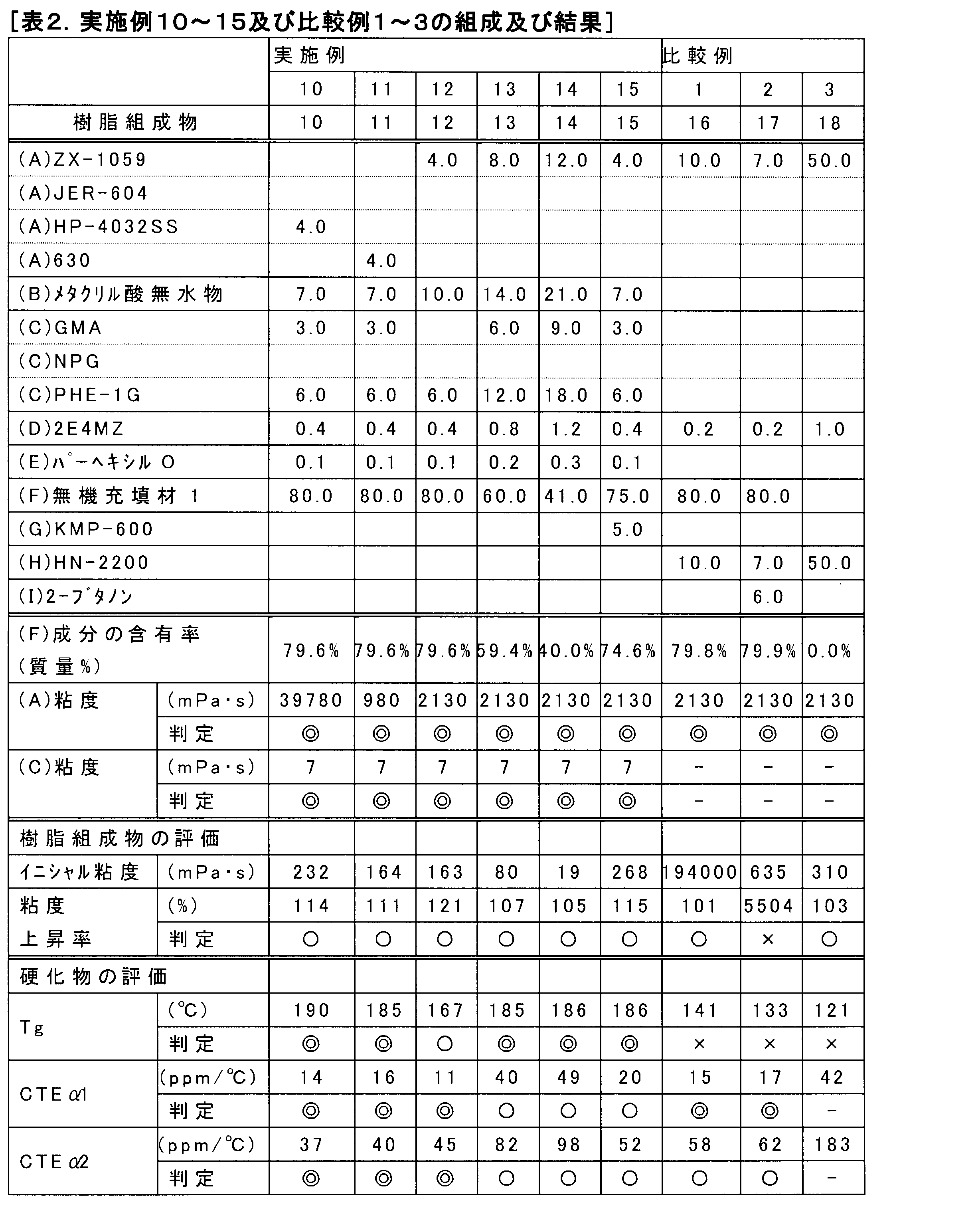
10、11、12、13、14、15、 基板
20、21、22、23a、23b、24a、24b、25a、25b 樹脂組成物の硬化物
30、31、32、33、34、35 半導体チップ
36 チップ積層体
37 スルーシリコンピラー
41、42、43、44、45、46、47、48、49 バンプ
51 封止層
61 再配線層
71、72 ビアホール
80、81 シリコンインターポーザ
Claims (23)
- 25℃で液状の樹脂組成物であって、
樹脂組成物が、(A)エポキシ樹脂及び(B)無水メタクリル酸を含み、
(A)エポキシ樹脂が、(A-1)1分子中に2個以上のエポキシ基を含有しかつ25℃において液状のエポキシ樹脂を含む、樹脂組成物。 - (A)成分100質量%に対する(A-1)成分の量が、10質量%~100質量%である、請求項1に記載の樹脂組成物。
- (A-1)成分の25℃における粘度が、100000mPa・s以下である、請求項1に記載の樹脂組成物。
- (A)成分の25℃における粘度が、100000mPa・s以下である、請求項1に記載の樹脂組成物。
- (A)成分/(B)成分の質量比が、20/80~80/20である、請求項1に記載の樹脂組成物。
- (B)成分以外に、(C)エチレン性不飽和結合を1個~3個含有する化合物を更に含む、請求項1に記載の樹脂組成物。
- (C)成分の25℃における粘度が、30mPa.s以下である、請求項6に記載の樹脂組成物。
- ((A)成分+(B)成分)/(C)成分の質量比が、30/70~95/5である、請求項6に記載の樹脂組成物。
- (D)エポキシ重合促進剤を更に含む、請求項1に記載の樹脂組成物。
- (E)ラジカル重合開始剤を更に含む、請求項1に記載の樹脂組成物。
- (F)無機充填材を更に含む、請求項1に記載の樹脂組成物。
- (F)成分が、シリカである、請求項11に記載の樹脂組成物。
- 樹脂組成物の不揮発成分100質量%に対する(F)成分の量が、40質量%~95質量%である、請求項11に記載の樹脂組成物。
- 樹脂組成物の25℃における粘度が、1000mPa.s以下であり、
樹脂組成物の樹脂成分の25℃における粘度が、30mPa.s以下である、請求項11に記載の樹脂組成物。 - 有機溶剤を含まないか、又は、有機溶剤を3質量%未満で含む、請求項1に記載の樹脂組成物。
- 樹脂組成物を100℃5時間の条件で硬化して硬化物を得た場合に、
硬化物が、220℃以下のガラス転移温度Tgを有し、
40℃~60℃の第一測定範囲における硬化物の平均線熱膨張係数CTEα1が、50ppm/℃未満であり、
Tg+40℃~260℃の第二測定範囲における硬化物の平均線熱膨張係数CTEα2が、100ppm/℃未満である、請求項1に記載の樹脂組成物。 - 樹脂組成物を100℃5時間の条件で硬化して硬化物を得た場合に、
硬化物が、150℃以上のガラス転移温度Tgを有する、請求項1に記載の樹脂組成物。 - (C)成分が、グリシジルメタクリレート又は4-ヒドロキシブチルアクリレートグリシジルエーテルを含む、請求項6に記載の樹脂組成物。
- アンダーフィル材である、請求項1に記載の樹脂組成物。
- 請求項1~19のいずれか一項に記載の樹脂組成物の硬化物を含む、半導体チップパッケージ。
- 基板と、前記基板上にギャップを空けて設けられた半導体チップと、ギャップを充填する前記硬化物と、を含む、請求項20に記載の半導体チップパッケージ。
- 請求項20に記載の半導体チップパッケージを備える、半導体装置。
- 請求項1~19のいずれか一項に記載の樹脂組成物の硬化物。
Priority Applications (3)
| Application Number | Priority Date | Filing Date | Title |
|---|---|---|---|
| CN202380054987.2A CN119585335A (zh) | 2022-07-26 | 2023-06-19 | 树脂组合物 |
| KR1020257001852A KR20250040948A (ko) | 2022-07-26 | 2023-06-19 | 수지 조성물 |
| JP2024536848A JPWO2024024331A1 (ja) | 2022-07-26 | 2023-06-19 |
Applications Claiming Priority (2)
| Application Number | Priority Date | Filing Date | Title |
|---|---|---|---|
| JP2022-118675 | 2022-07-26 | ||
| JP2022118675 | 2022-07-26 |
Publications (1)
| Publication Number | Publication Date |
|---|---|
| WO2024024331A1 true WO2024024331A1 (ja) | 2024-02-01 |
Family
ID=89706036
Family Applications (1)
| Application Number | Title | Priority Date | Filing Date |
|---|---|---|---|
| PCT/JP2023/022554 Ceased WO2024024331A1 (ja) | 2022-07-26 | 2023-06-19 | 樹脂組成物 |
Country Status (5)
| Country | Link |
|---|---|
| JP (1) | JPWO2024024331A1 (ja) |
| KR (1) | KR20250040948A (ja) |
| CN (1) | CN119585335A (ja) |
| TW (1) | TW202432656A (ja) |
| WO (1) | WO2024024331A1 (ja) |
Citations (8)
| Publication number | Priority date | Publication date | Assignee | Title |
|---|---|---|---|---|
| JPS60255860A (ja) * | 1984-05-31 | 1985-12-17 | Sumitomo Bakelite Co Ltd | 絶縁樹脂ペ−スト |
| JPS63145322A (ja) * | 1986-12-05 | 1988-06-17 | ローム・アンド・ハース・カンパニー | B段階となし得るエポキシ系熱硬化性組成物 |
| JP2008038029A (ja) * | 2006-08-07 | 2008-02-21 | Kyoeisha Chem Co Ltd | エポキシ基含有硬化性樹脂成分 |
| JP2008150520A (ja) * | 2006-12-19 | 2008-07-03 | Dic Corp | エポキシ樹脂組成物、その硬化物、ビルドアップフィルム絶縁層用樹脂組成物、及び新規エポキシ樹脂 |
| JP2018172484A (ja) * | 2017-03-31 | 2018-11-08 | 協立化学産業株式会社 | 変性樹脂及びそれを含む硬化性樹脂組成物 |
| JP2018189756A (ja) * | 2017-04-28 | 2018-11-29 | 四国化成工業株式会社 | 感光性樹脂組成物及び感光性フィルム |
| CN109486264A (zh) * | 2018-11-29 | 2019-03-19 | 安徽牡东通讯光缆有限公司 | 一种耐腐蚀光缆用环氧树脂涂层材料 |
| JP2019112548A (ja) * | 2017-12-25 | 2019-07-11 | Dic株式会社 | (メタ)アクリレート樹脂及び光学部材 |
Family Cites Families (2)
| Publication number | Priority date | Publication date | Assignee | Title |
|---|---|---|---|---|
| JPS6340762U (ja) | 1986-09-02 | 1988-03-16 | ||
| JP2010070605A (ja) | 2008-09-17 | 2010-04-02 | Dic Corp | 液状エポキシ樹脂組成物、硬化物、その製造方法、及びプリント配線基板用樹脂組成物 |
-
2023
- 2023-06-19 JP JP2024536848A patent/JPWO2024024331A1/ja active Pending
- 2023-06-19 KR KR1020257001852A patent/KR20250040948A/ko active Pending
- 2023-06-19 WO PCT/JP2023/022554 patent/WO2024024331A1/ja not_active Ceased
- 2023-06-19 CN CN202380054987.2A patent/CN119585335A/zh active Pending
- 2023-07-05 TW TW112125045A patent/TW202432656A/zh unknown
Patent Citations (8)
| Publication number | Priority date | Publication date | Assignee | Title |
|---|---|---|---|---|
| JPS60255860A (ja) * | 1984-05-31 | 1985-12-17 | Sumitomo Bakelite Co Ltd | 絶縁樹脂ペ−スト |
| JPS63145322A (ja) * | 1986-12-05 | 1988-06-17 | ローム・アンド・ハース・カンパニー | B段階となし得るエポキシ系熱硬化性組成物 |
| JP2008038029A (ja) * | 2006-08-07 | 2008-02-21 | Kyoeisha Chem Co Ltd | エポキシ基含有硬化性樹脂成分 |
| JP2008150520A (ja) * | 2006-12-19 | 2008-07-03 | Dic Corp | エポキシ樹脂組成物、その硬化物、ビルドアップフィルム絶縁層用樹脂組成物、及び新規エポキシ樹脂 |
| JP2018172484A (ja) * | 2017-03-31 | 2018-11-08 | 協立化学産業株式会社 | 変性樹脂及びそれを含む硬化性樹脂組成物 |
| JP2018189756A (ja) * | 2017-04-28 | 2018-11-29 | 四国化成工業株式会社 | 感光性樹脂組成物及び感光性フィルム |
| JP2019112548A (ja) * | 2017-12-25 | 2019-07-11 | Dic株式会社 | (メタ)アクリレート樹脂及び光学部材 |
| CN109486264A (zh) * | 2018-11-29 | 2019-03-19 | 安徽牡东通讯光缆有限公司 | 一种耐腐蚀光缆用环氧树脂涂层材料 |
Also Published As
| Publication number | Publication date |
|---|---|
| TW202432656A (zh) | 2024-08-16 |
| CN119585335A (zh) | 2025-03-07 |
| JPWO2024024331A1 (ja) | 2024-02-01 |
| KR20250040948A (ko) | 2025-03-25 |
Similar Documents
| Publication | Publication Date | Title |
|---|---|---|
| JP3736611B2 (ja) | フリップチップ型半導体装置用封止材及びフリップチップ型半導体装置 | |
| JP3876965B2 (ja) | 液状エポキシ樹脂組成物及び半導体装置 | |
| JP5736776B2 (ja) | ビニル重合体粉体、硬化性樹脂組成物及び硬化物 | |
| JP4213767B2 (ja) | 電子部品用接着剤 | |
| JPWO2013094759A1 (ja) | 重合体粉体、硬化性樹脂組成物及びその硬化物 | |
| US20190338171A1 (en) | Thermally conductive paste and electronic device | |
| KR101995601B1 (ko) | 수지 조성물 및 반도체 장치 | |
| JP7582065B2 (ja) | 樹脂組成物 | |
| JP4656269B2 (ja) | 液状エポキシ樹脂組成物及び半導体装置 | |
| JP5273745B2 (ja) | オーバーコート材及びそれを用いた半導体装置 | |
| JP3695521B2 (ja) | 液状エポキシ樹脂組成物及び半導体装置 | |
| JP2026034602A (ja) | 硬化性組成物 | |
| JP5118956B2 (ja) | 電子部品用接着剤 | |
| JP4176619B2 (ja) | フリップチップ実装用サイドフィル材及び半導体装置 | |
| JP2018039992A (ja) | 樹脂組成物および該樹脂組成物を用いた三次元積層型半導体装置 | |
| JP3925803B2 (ja) | フリップチップ実装用サイドフィル材及び半導体装置 | |
| JP5971609B2 (ja) | 硬化性樹脂組成物及びこれを硬化した硬化物 | |
| JP2012216836A (ja) | 三次元集積回路積層体 | |
| US20190264070A1 (en) | Thermally conductive paste and electronic device | |
| WO2024024331A1 (ja) | 樹脂組成物 | |
| JP7673842B2 (ja) | アンダーフィル材 | |
| JP2023079035A (ja) | 樹脂組成物 | |
| JP2024007477A (ja) | 樹脂組成物 | |
| WO2014046128A1 (ja) | 電子部品用接着剤及び半導体チップ実装体の製造方法 | |
| JP2006016433A (ja) | 半導体封止用液状エポキシ樹脂組成物及びフリップチップ型半導体装置 |
Legal Events
| Date | Code | Title | Description |
|---|---|---|---|
| 121 | Ep: the epo has been informed by wipo that ep was designated in this application |
Ref document number: 23846065 Country of ref document: EP Kind code of ref document: A1 |
|
| WWE | Wipo information: entry into national phase |
Ref document number: 2024536848 Country of ref document: JP |
|
| WWE | Wipo information: entry into national phase |
Ref document number: 202380054987.2 Country of ref document: CN |
|
| NENP | Non-entry into the national phase |
Ref country code: DE |
|
| WWP | Wipo information: published in national office |
Ref document number: 202380054987.2 Country of ref document: CN |
|
| WWP | Wipo information: published in national office |
Ref document number: 1020257001852 Country of ref document: KR |
|
| 122 | Ep: pct application non-entry in european phase |
Ref document number: 23846065 Country of ref document: EP Kind code of ref document: A1 |