WO2024024154A1 - 電気光学ポリマー - Google Patents
電気光学ポリマー Download PDFInfo
- Publication number
- WO2024024154A1 WO2024024154A1 PCT/JP2023/007984 JP2023007984W WO2024024154A1 WO 2024024154 A1 WO2024024154 A1 WO 2024024154A1 JP 2023007984 W JP2023007984 W JP 2023007984W WO 2024024154 A1 WO2024024154 A1 WO 2024024154A1
- Authority
- WO
- WIPO (PCT)
- Prior art keywords
- group
- electro
- optic
- general formula
- formula
- Prior art date
- Legal status (The legal status is an assumption and is not a legal conclusion. Google has not performed a legal analysis and makes no representation as to the accuracy of the status listed.)
- Ceased
Links
Images

Classifications
-
- C—CHEMISTRY; METALLURGY
- C08—ORGANIC MACROMOLECULAR COMPOUNDS; THEIR PREPARATION OR CHEMICAL WORKING-UP; COMPOSITIONS BASED THEREON
- C08F—MACROMOLECULAR COMPOUNDS OBTAINED BY REACTIONS ONLY INVOLVING CARBON-TO-CARBON UNSATURATED BONDS
- C08F32/00—Homopolymers and copolymers of cyclic compounds having no unsaturated aliphatic radicals in a side chain, and having one or more carbon-to-carbon double bonds in a carbocyclic ring system
- C08F32/08—Homopolymers and copolymers of cyclic compounds having no unsaturated aliphatic radicals in a side chain, and having one or more carbon-to-carbon double bonds in a carbocyclic ring system having two condensed rings
-
- C—CHEMISTRY; METALLURGY
- C08—ORGANIC MACROMOLECULAR COMPOUNDS; THEIR PREPARATION OR CHEMICAL WORKING-UP; COMPOSITIONS BASED THEREON
- C08F—MACROMOLECULAR COMPOUNDS OBTAINED BY REACTIONS ONLY INVOLVING CARBON-TO-CARBON UNSATURATED BONDS
- C08F220/00—Copolymers of compounds having one or more unsaturated aliphatic radicals, each having only one carbon-to-carbon double bond, and only one being terminated by only one carboxyl radical or a salt, anhydride ester, amide, imide or nitrile thereof
- C08F220/02—Monocarboxylic acids having less than ten carbon atoms; Derivatives thereof
- C08F220/10—Esters
- C08F220/34—Esters containing nitrogen, e.g. N,N-dimethylaminoethyl (meth)acrylate
- C08F220/36—Esters containing nitrogen, e.g. N,N-dimethylaminoethyl (meth)acrylate containing oxygen in addition to the carboxy oxygen, e.g. 2-N-morpholinoethyl (meth)acrylate or 2-isocyanatoethyl (meth)acrylate
-
- C—CHEMISTRY; METALLURGY
- C08—ORGANIC MACROMOLECULAR COMPOUNDS; THEIR PREPARATION OR CHEMICAL WORKING-UP; COMPOSITIONS BASED THEREON
- C08F—MACROMOLECULAR COMPOUNDS OBTAINED BY REACTIONS ONLY INVOLVING CARBON-TO-CARBON UNSATURATED BONDS
- C08F222/00—Copolymers of compounds having one or more unsaturated aliphatic radicals, each having only one carbon-to-carbon double bond, and at least one being terminated by a carboxyl radical and containing at least one other carboxyl radical in the molecule; Salts, anhydrides, esters, amides, imides, or nitriles thereof
- C08F222/04—Anhydrides, e.g. cyclic anhydrides
-
- C—CHEMISTRY; METALLURGY
- C08—ORGANIC MACROMOLECULAR COMPOUNDS; THEIR PREPARATION OR CHEMICAL WORKING-UP; COMPOSITIONS BASED THEREON
- C08F—MACROMOLECULAR COMPOUNDS OBTAINED BY REACTIONS ONLY INVOLVING CARBON-TO-CARBON UNSATURATED BONDS
- C08F232/00—Copolymers of cyclic compounds containing no unsaturated aliphatic radicals in a side chain, and having one or more carbon-to-carbon double bonds in a carbocyclic ring system
- C08F232/08—Copolymers of cyclic compounds containing no unsaturated aliphatic radicals in a side chain, and having one or more carbon-to-carbon double bonds in a carbocyclic ring system having condensed rings
-
- C—CHEMISTRY; METALLURGY
- C08—ORGANIC MACROMOLECULAR COMPOUNDS; THEIR PREPARATION OR CHEMICAL WORKING-UP; COMPOSITIONS BASED THEREON
- C08F—MACROMOLECULAR COMPOUNDS OBTAINED BY REACTIONS ONLY INVOLVING CARBON-TO-CARBON UNSATURATED BONDS
- C08F32/00—Homopolymers and copolymers of cyclic compounds having no unsaturated aliphatic radicals in a side chain, and having one or more carbon-to-carbon double bonds in a carbocyclic ring system
- C08F32/02—Homopolymers and copolymers of cyclic compounds having no unsaturated aliphatic radicals in a side chain, and having one or more carbon-to-carbon double bonds in a carbocyclic ring system having no condensed rings
- C08F32/04—Homopolymers and copolymers of cyclic compounds having no unsaturated aliphatic radicals in a side chain, and having one or more carbon-to-carbon double bonds in a carbocyclic ring system having no condensed rings having one carbon-to-carbon double bond
-
- C—CHEMISTRY; METALLURGY
- C08—ORGANIC MACROMOLECULAR COMPOUNDS; THEIR PREPARATION OR CHEMICAL WORKING-UP; COMPOSITIONS BASED THEREON
- C08F—MACROMOLECULAR COMPOUNDS OBTAINED BY REACTIONS ONLY INVOLVING CARBON-TO-CARBON UNSATURATED BONDS
- C08F8/00—Chemical modification by after-treatment
- C08F8/30—Introducing nitrogen atoms or nitrogen-containing groups
-
- C—CHEMISTRY; METALLURGY
- C08—ORGANIC MACROMOLECULAR COMPOUNDS; THEIR PREPARATION OR CHEMICAL WORKING-UP; COMPOSITIONS BASED THEREON
- C08F—MACROMOLECULAR COMPOUNDS OBTAINED BY REACTIONS ONLY INVOLVING CARBON-TO-CARBON UNSATURATED BONDS
- C08F8/00—Chemical modification by after-treatment
- C08F8/34—Introducing sulfur atoms or sulfur-containing groups
-
- C—CHEMISTRY; METALLURGY
- C08—ORGANIC MACROMOLECULAR COMPOUNDS; THEIR PREPARATION OR CHEMICAL WORKING-UP; COMPOSITIONS BASED THEREON
- C08G—MACROMOLECULAR COMPOUNDS OBTAINED OTHERWISE THAN BY REACTIONS ONLY INVOLVING UNSATURATED CARBON-TO-CARBON BONDS
- C08G73/00—Macromolecular compounds obtained by reactions forming a linkage containing nitrogen with or without oxygen or carbon in the main chain of the macromolecule, not provided for in groups C08G12/00 - C08G71/00
- C08G73/06—Polycondensates having nitrogen-containing heterocyclic rings in the main chain of the macromolecule
-
- C—CHEMISTRY; METALLURGY
- C08—ORGANIC MACROMOLECULAR COMPOUNDS; THEIR PREPARATION OR CHEMICAL WORKING-UP; COMPOSITIONS BASED THEREON
- C08G—MACROMOLECULAR COMPOUNDS OBTAINED OTHERWISE THAN BY REACTIONS ONLY INVOLVING UNSATURATED CARBON-TO-CARBON BONDS
- C08G73/00—Macromolecular compounds obtained by reactions forming a linkage containing nitrogen with or without oxygen or carbon in the main chain of the macromolecule, not provided for in groups C08G12/00 - C08G71/00
- C08G73/06—Polycondensates having nitrogen-containing heterocyclic rings in the main chain of the macromolecule
- C08G73/10—Polyimides; Polyester-imides; Polyamide-imides; Polyamide acids or similar polyimide precursors
Definitions
- the present invention relates to electro-optic polymers.
- Electro-optic polymers are attracting attention as materials that will play a role in next-generation optical communications, wireless communications, etc. Electro-optic polymers are known as optical materials that can exhibit second-order nonlinear optical effects. The second-order nonlinear optical effect of electro-optic polymers makes it possible to convert the frequency of electromagnetic waves in various frequency bands and to control the phase of electromagnetic waves using an electric field.
- Patent Document 1 An example of such an electro-optic polymer is disclosed in Patent Document 1.
- next-generation optical communication and wireless communication devices include in-vehicle devices used for applications such as autonomous driving.
- In-vehicle devices require higher heat resistance than communication devices used for other purposes.
- the required degree of heat resistance varies, but one example is that it is stable in a continuous use test at 120°C and can withstand temporary use at 150°C. It is also necessary to temporarily withstand the temperature of solder reflow (for example, 260° C.) during device manufacturing.
- Patent Document 1 heat resistance is recognized as an issue in electro-optic polymers, and electro-optic polymers are required to have a high Tg. Therefore, in Patent Document 1, ⁇ a base polymer (a) having a reactive group (A) and an electro-optic molecule (b) having a plurality of reactive groups (B) are combined with a plurality of reactive groups (A). A polymer in which a bond (C) is formed by reaction with a reactive group (B) of a (thio)ester bond, a (thio)urethane bond, a (thio)urea bond, and a (thio)urea bond. thio)amide bond.
- the heat resistance of the above-described polymers is not sufficient to meet future demands for high heat resistance, and electro-optic polymers with even higher heat resistance have been desired.
- the present invention was made to solve the above problems, and an object of the present invention is to provide an electro-optic polymer having high heat resistance.
- the first aspect of the electro-optic polymer of the present invention is characterized by having an electro-optic structure in the side chain of the main chain, which is a polynorbornene chain.
- a second aspect of the electro-optic polymer of the present invention is provided with an electro-optic structure in the side chain of the main chain, which is a (meth)acrylic chain having a structural unit represented by the following general formula (B1), and further comprises: It is characterized by having a structural unit represented by the following general formula (B2) that becomes a crosslinking site by copolymerizing with a monomer that becomes a structural unit represented by general formula (B1).
- X 3 is a bonding site between the (meth)acrylic chain and the electro-optic structure.
- R 2 is a hydrogen atom or a methyl group.
- n B1 is an integer of 1 or more.
- R 3 and R 4 are a hydrogen atom or a methyl group.
- n B2 is an integer of 1 or more.
- a third aspect of the electro-optic polymer of the present invention is characterized by having an electro-optic structure in the side chain of the main chain, which is a polyimide chain.
- a fourth aspect of the electro-optic polymer of the present invention is characterized by having an electro-optic structure in the side chain of the main chain having a triazine ring.
- an electro-optic polymer having high heat resistance can be provided.
- FIG. 1 is a schematic perspective view showing an example of an optical laminate, which is an example of a device using an electro-optic polymer.
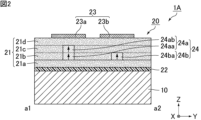
- FIG. 2 is a schematic cross-sectional view showing an example of a cross section of the optical laminate shown in FIG. 1 along line segment a1-a2.
- the electro-optic polymer of the present invention will be explained. Note that the present invention is not limited to the following configuration, and may be modified as appropriate without departing from the gist of the present invention. Furthermore, the present invention also includes a combination of a plurality of individual preferred configurations described below.
- the electro-optic polymer of the present invention will simply be referred to as "the electro-optic polymer of the present invention.”
- All of the electro-optic polymers of the present invention have a main chain having a structure having high heat resistance and an electro-optic structure being a side chain. Further, any of the electro-optic polymers of the present invention can be used for devices such as optical communication and wireless communication.
- an example of a device in which an electro-optic polymer is used will be described as common to each embodiment.
- the electro-optic structure will be explained. Thereafter, the structure of the main chain of each embodiment and the structure of the entire electro-optic polymer will be explained.
- a formula defined as a "general formula" may be simply written as a "formula.”
- FIG. 1 is a schematic perspective view showing an example of an optical laminate, which is an example of a device using an electro-optic polymer.
- FIG. 2 is a schematic cross-sectional view showing an example of a cross section of the optical laminate shown in FIG. 1 along line segment a1-a2.
- the optical laminate 1A shown in FIGS. 1 and 2 has a support 10 and an electro-optical section 20 in the Z direction (stacking direction).
- the Z direction is also referred to as the stacking direction Z. Note that the X direction, Y direction, and Z direction are orthogonal to each other.
- Examples of the constituent material of the support 10 include silicon, glass, polynorbornene, transparent polyimide, (meth)acrylic polymer, cycloolefin polymer, cycloolefin copolymer, cyanate ester polymer, and the like.
- the support body 10 may contain only one kind of these materials, and may contain multiple kinds.
- the constituent material of the support body 10 it is preferable to use a material that has a low absorption rate of terahertz waves due to its characteristics.
- a material is preferably a material that can ensure surface smoothness and adhesion.
- terahertz waves mean electromagnetic waves in a frequency band of 0.1 THz or more and 10 THz or less, and include microwaves, millimeter waves, infrared light, etc.
- a signal obtained by converting a terahertz wave will be referred to as a terahertz signal.
- the electro-optical section 20 is provided on the main surface of the support 10. In other words, the electro-optical section 20 is in contact with the support 10 in the stacking direction Z.
- the electro-optic section 20 includes a cladding layer 21, a lower electrode 22, an upper electrode 23, and an electro-optic polymer layer 24.
- the cladding layer 21 is provided to prevent electromagnetic waves (for example, light) transmitted through the electro-optic polymer layer 24 from leaking to the outside from unintended locations.
- the cladding layer 21 is composed of a first cladding layer 21a, a second cladding layer 21b, a third cladding layer 21c, and a fourth cladding layer 21d.
- the first cladding layer 21a, the second cladding layer 21b, the third cladding layer 21c, and the fourth cladding layer 21d are stacked in order from the support body 10 side in the stacking direction Z.
- the constituent materials of the cladding layer 21, here, the first cladding layer 21a, the second cladding layer 21b, the third cladding layer 21c, and the fourth cladding layer 21d include, for example, silica, silicon dioxide, and titanium oxide. , magnesium oxide, and the like.
- Each cladding layer may contain only one type of these materials, or may contain multiple types of these materials.
- the lower electrode 22 is provided on the support 10 side with respect to the cladding layer 21 in the stacking direction Z. That is, the lower electrode 22 is provided between the support body 10 and the cladding layer 21 in the stacking direction Z.
- the lower electrode 22 is provided between the support 10 and the first cladding layer 21a in the stacking direction Z. Further, the lower electrode 22 is in contact with the support 10 and the first cladding layer 21a in the stacking direction Z.
- Examples of the constituent material of the lower electrode 22 include gold, silver, copper, tin, chromium, aluminum, titanium, alloys containing at least one of these metals, and oxides containing at least one of these metals. Examples include indium tin oxide, indium zinc oxide, aluminum doped zinc oxide, etc. Among these, gold, silver, copper, aluminum, etc. are preferable because they have low loss with respect to high frequencies including terahertz waves.
- the lower electrode 22 may contain only one kind of these materials, or may contain a plurality of kinds.
- the upper electrode 23 is provided on the opposite side of the support 10 in the lamination direction Z with respect to the cladding layer 21 so as to face the lower electrode 22 in the lamination direction Z.
- the upper electrode 23 is in contact with the fourth cladding layer 21d in the stacking direction Z.
- the upper electrode 23 is composed of a first upper electrode 23a and a second upper electrode 23b.
- the first upper electrode 23a and the second upper electrode 23b are lined up in the Y direction, and four of each are lined up in the X direction.
- the first upper electrode 23a and the second upper electrode 23b are separated from each other in the Y direction, the first upper electrodes 23a are separated from each other in the X direction, and the second upper electrode 23b are separated from each other in the X direction.
- the upper electrode 23 is composed of eight electrodes.
- the first upper electrode 23a and the second upper electrode 23b are each in contact with the fourth cladding layer 21d in the stacking direction Z.
- the constituent material of the upper electrode 23, here, the constituent material of the first upper electrode 23a and the second upper electrode 23b, includes, for example, gold, silver, copper, tin, chromium, aluminum, titanium, and at least one of these metals. and oxides containing at least one of these metals (for example, indium tin oxide, indium zinc oxide, aluminum-doped zinc oxide, etc.).
- gold, silver, copper, aluminum, etc. are preferable because they have low loss with respect to high frequencies including terahertz waves.
- Each upper electrode may contain only one type of these materials, or may contain multiple types of these materials.
- the electro-optic polymer layer 24 is composed of a first electro-optic polymer layer 24a and a second electro-optic polymer layer 24b.
- the first electro-optic polymer layer 24a and the second electro-optic polymer layer 24b may be composed of only one layer, or may be composed of a plurality of layers.
- the first electro-optic polymer layer 24a is composed of a first layer 24aa and a second layer 24ab.
- the first layer 24aa and the second layer 24ab are laminated in order from the support 10 side in the lamination direction Z. That is, the first layer 24aa and the second layer 24ab are in contact with each other in the stacking direction Z.
- the second electro-optic polymer layer 24b is composed of only the first layer 24ba.
- the electro-optic polymer layer 24 is composed of an electro-optic polymer containing an electro-optic structure.
- An electro-optic polymer is a polymer that can exhibit a second-order nonlinear optical effect.
- second-order nonlinear optical effects include second-order harmonic generation, optical rectification, harmonic wave generation, difference frequency generation, optical parametric oscillation, optical parametric amplification, electro-optic effect (Pockels effect), and the like.
- FIG. 2 the polarization direction of the electro-optic molecules contained in the electro-optic polymer layer 24 is shown in the direction of the solid arrow.
- the electro-optic polymer (electro-optic molecule) constituting the electro-optic polymer layer 24 exhibits a second-order nonlinear optical effect, thereby converting the frequency of electromagnetic waves in various frequency bands and controlling the phase of electromagnetic waves using an electric field. It becomes possible to do the following.
- terahertz waves can be generated by converting the frequency of a laser beam containing two or more frequencies using a second-order nonlinear optical effect.
- the frequency of the laser beam changes, and furthermore, by detecting the frequency-changed laser beam, , can detect terahertz waves.
- the terahertz wave and the electric field can be detected.
- the refractive index change due to the electro-optic effect included in the second-order nonlinear optical effect it is possible to perform phase modulation of electromagnetic waves.
- Optical laminates are used as converters that directly convert optical signals into terahertz signals. Furthermore, the optical laminate is also used as a transmitter that transmits a terahertz signal converted from an optical signal to an integrated circuit.
- optical laminates are used as converters that directly convert terahertz signals received by antennas into optical signals. Furthermore, the optical laminate is also used as a transmitter that transmits optical signals converted from terahertz signals to various devices.
- Electro-optical structure As the electro-optic structure, the same structure as the electro-optic molecule (EO molecule) mentioned in Patent Document 1 can be used. For example, a structure represented by a donor structure - a bridge structure - an acceptor structure (a structure in which a donor structure and an acceptor structure are coupled via a bridge structure) is exemplified.
- the donor structure is a site having an electron-donating group, and examples of the electron-donating group include an amino group, an alkoxy group, an aryloxy group, a thioether group, etc., which may be substituted with an alkyl group, an aryl group, or an acyl group. can be mentioned.
- the acceptor structure is a part having an electron-withdrawing group, and examples of the electron-withdrawing group include a nitro group, a cyano group, a dicyanovinyl group, a tricyanovinyl group, a halogen atom, a carbonyl group, a sulfone group, and a perfluoroalkyl group. , tricyanovinylfuranyl group, tricyanofuranyl group, and the like.
- the bridge structure part is a part having a conjugated chemical structure
- the conjugated chemical structure include aromatic compounds such as benzene, naphthalene, anthracene, perylene, biphenyl, indene, and stilbene, furan, pyran, pyrrole, Heterocyclic compounds such as imidazole, pyrazole, thiophene, thiazole, pyridine, pyridazine, pyrimidine, pyrazine, quinoline, and coumarin, structures in which these compounds form carbon-carbon unsaturated bonds or nitrogen-nitrogen unsaturated bonds, etc. Can be mentioned.
- the end of the electro-optic structure has a bonding site with the main chain.
- the electro-optical structure and the main chain are bonded by a bonding site consisting of at least one selected from the group consisting of a (thio)ester bond, a (thio)urethane bond, a (thio)urea bond, and a (thio)amide bond.
- the binding site of the electro-optic structure and the binding site of the main chain combine to form at least one selected from the group consisting of a (thio)ester bond, a (thio)urethane bond, a (thio)urea bond, and a (thio)amide bond.
- a binding site consisting of a species occurs.
- the bonding site of the electro-optic structure in the electro-optic polymer and the bonding site of the main chain are the substituent located at the bonding site of the electro-optic molecule that becomes the electro-optic structure and the substituent located at the bonding site of the main chain. are the respective residues of
- electro-optical structure for example, a structure represented by the following general formula (Ea) is preferably mentioned.
- At least one of R D 4a and R D 5a has a structure containing a bonding site with the main chain, and includes an acyloxyalkyl group, a silyloxyalkyl group, -Rd 1 -OH (wherein Rd 1 is a hydrocarbon group) , -Rd 4 -NH 2 (in the formula, Rd 4 is a hydrocarbon group), -Rd 5 -SH (in the formula, Rd 5 is a hydrocarbon group) or -Rd 6 -NCO (in the formula, Rd 6 is a hydrocarbon group) , hydrocarbon group) indicates a residue bonded to a binding site on the main chain.
- R D 4a and R D 5a the structures that are not bonded to the main chain are alkyl groups, haloalkyl groups, acyloxyalkyl groups, silyloxyalkyl groups, -Rd 1 -OH (wherein Rd 1 is hydrocarbon group), -Rd 4 -NH 2 (in the formula, Rd 4 is a hydrocarbon group), aryl group, -Rd 5 -SH (in the formula, Rd 5 is a hydrocarbon group) or -Rd 6 -NCO (wherein Rd 6 is a hydrocarbon group).
- R A 1a and R A 2a each independently represent a hydrogen atom, an alkyl group, an alkenyl group, a cycloalkyl group, a cycloalkenyl group, an alkoxy group, a halogenated hydrocarbon group, an aryl group.
- Ra 1 is a hydrocarbon group
- -ORa 2 -OH in the formula, Ra 2 is a hydrocarbon group
- amino group -Ra 4 -NH 2
- Ra 4 is a hydrocarbon group
- thiol group in the formula, Ra 4 is a hydrocarbon group
- -Ra 5 -SH in the formula, Ra 5 is a hydrocarbon group
- -NCO or -Ra 6 -NCO in the formula, Ra 6 is a hydrocarbon group) hydrogen group).
- R A 1a and R A 2a are halogenated hydrocarbon groups
- the halogen is preferably fluorine
- R A 1a and R A 2a are preferably trifluoromethyl groups.
- At least one of R D 4a and R D 5a has a structure including a binding site to the main chain, and represents a residue bound to the binding site of the main chain.
- the terminal of the structure containing the bonding site with the main chain is an OH group
- the structure of the residue becomes an -O- group
- the terminal of the structure containing the bonding site with the main chain is an NH2 group
- the residue When the structure of is an -NH- group and the terminal of R D 4a is an SH group, the structure of the residue is an -S- group.
- examples of B include those forming a conjugated system and those forming a direct bond (-).
- an example of a structure forming a conjugated system is a structure represented by the following general formula (Ba).
- ⁇ 1 and ⁇ 2 each independently represent the same or different carbon-carbon conjugated ⁇ bonds, and may each have the same or different substituents;
- R B 1 and R B 2 are each independently a hydrogen atom, an alkyl group, an alkoxy group, an aryl group, an alkenyl group, a cycloalkyl group, a cycloalkenyl group, a haloalkyl group, an aralkyl group, an aryloxy group, an aralkyloxy group, a hydroxy group, -Rb 1 -OH (in the formula, Rb 1 is a hydrocarbon group), -ORb 2 -OH (in the formula, Rb 2 is a hydrocarbon group), amino group, -Rb 4 -NH 2 (in the formula, Rb 4 is a hydrocarbon group), a thiol
- the position of the bonding site with the main chain is not particularly limited.
- the position of the binding site may be, for example, in any of the donor structure, the bridge structure, and the acceptor structure in a compound having a structure represented by donor structure - bridge structure - acceptor structure. It is preferable that the structural part has two or more.
- the position of the binding site is not particularly limited.
- the electro-optical structure represented by the above general formula (E-a) has binding sites such as R D 1a , R D 2a , R D 3a , R D 4a , R D 5a , R A 1a and R A 2a , and preferably in at least two of R D 1a , R D 2a , R D 3a , R D 4a and R D 5a . It is also preferable that at least one of R A 1a and R A 2a has a binding site.
- the terminal of the bonding site is selected from the group consisting of OH group, -R B1 -OH, amino group, and -R B4 -NH 2
- the group may have two or more residues bonded to the main chain (in the formula, R B1 and R B4 are hydrocarbon groups).
- R D 4a and/or R D 5a are residues in which a group selected from the group consisting of OH group, -R B1 -OH, amino group, and -R B4 -NH 2 is bonded to the main chain. It's okay.
- R D 4a and R D 5a are bonding sites [e.g., hydroxyalkyl groups (e.g., hydroxyC 1-10 alkyl groups such as hydroxymethyl, hydroxyethyl, hydroxypropyl, hydroxybutyl, etc.), aminoalkyl groups ( For example, residues of amino C 1-10 alkyl groups such as aminomethyl group, aminoethyl group, aminopropyl group, aminobutyl group, etc.)
- hydroxyalkyl groups e.g., hydroxyC 1-10 alkyl groups such as hydroxymethyl, hydroxyethyl, hydroxypropyl, hydroxybutyl, etc.
- aminoalkyl groups For example, residues of amino C 1-10 alkyl groups such as aminomethyl group, aminoethyl group, aminopropyl group, aminobutyl group, etc.
- R D 1a , R D 2a , R D 3a , R D 4a , R D 5a , R A 1a , and R A 2a are not binding sites (that is, when they are non-reactive groups)
- the groups are Not particularly limited. When these are non-reactive groups, specific examples include the following groups.
- R D 1a hydrogen atom, alkoxy group (e.g., C 1-10 alkoxy group such as methoxy group, ethoxy group, butoxy group), aryloxy group (e.g., C 6-10 aryloxy group such as phenoxy group), aralkyl Oxy group (for example, C 6-10 aryl C 1-10 alkyloxy group such as benzyloxy group and phenethyloxy group), etc.
- alkoxy group e.g., C 1-10 alkoxy group such as methoxy group, ethoxy group, butoxy group
- aryloxy group e.g., C 6-10 aryloxy group such as phenoxy group
- aralkyl Oxy group for example, C 6-10 aryl C 1-10 alkyloxy group such as benzyloxy group and phenethyloxy group
- R D 2a and R D 3a hydrogen atom, etc.
- R D 4a and R D 5a alkyl group (for example, C 1-10 alkyl group such as methyl group, ethyl group, butyl group), aryl group (for example, C 6-10 aryl group such as phenyl group), aralkyl group (For example, C 6-10 aryl C 1-10 alkyloxy groups such as benzyl group and phenethyl group), etc.
- alkyl group for example, C 1-10 alkyl group such as methyl group, ethyl group, butyl group
- aryl group for example, C 6-10 aryl group such as phenyl group
- aralkyl group for example, C 6-10 aryl C 1-10 alkyloxy groups such as benzyl group and phenethyl group
- R A 1a and R A 2a alkyl group (e.g., C 1-10 alkyl group such as methyl group, ethyl group, butyl group), aryl group (e.g., C 6-10 aryl group such as phenyl group), cycloalkyl Aryl groups (e.g. C 3-10 cycloalkyl C 6-10 aryl groups such as cyclohexylphenyl group), arylaryl groups (e.g.
- alkyl group e.g., C 1-10 alkyl group such as methyl group, ethyl group, butyl group
- aryl group e.g., C 6-10 aryl group such as phenyl group
- cycloalkyl Aryl groups e.g. C 3-10 cycloalkyl C 6-10 aryl groups such as cyclohexylphenyl group
- arylaryl groups e.g.
- C 6-10 aryl C 6-10 aryl groups such as biphenylyl group
- aralkyl groups For example, C 6-10 aryl C 1-10 alkyloxy groups such as benzyl group and phenethyl group
- halogenated hydrocarbon groups e.g. haloalkyl group (e.g. halo C 1-10 alkyl group such as trifluoromethyl group)]
- haloaryl group for example, halo C 6-10 aryl group such as pentafluorophenyl group, etc.
- electro-optic molecules used to form the electro-optic structure represented by (E-a) above include molecules (E1) to (E4) below.
- the OH group located at the left end of formulas (E1) to (E3) and the NH 2 group located at the left end of formula (E4) are the ends of the bonding site with the main chain.
- the structure of the residue is -O- group
- the structure of the residue is -O- group.
- electro-optical structure for example, a structure represented by the following general formula (Eb) is preferably mentioned.
- R D 4b is a main This is a structure that includes a binding site for the chain.
- the structure containing the bonding site with the main chain each independently includes a hydroxy group, -Rd 1 -OH (in the formula, Rd 1 is a hydrocarbon group), an amino group, -Rd 4 -NH 2 (in the formula, Rd 4 is a hydrocarbon group), thiol group, -Rd 5 -SH (in the formula, Rd 5 is a hydrocarbon group), -NCO or -Rd 6 -NCO (in the formula, Rd 6 is a hydrocarbon group) indicates the residue bound to the main chain binding site.
- Structures that are not bonded to the main chain are each independently a hydrogen atom, a hydrocarbon group, a hydroxy group, -Rd 1 -OH (in the formula, Rd 1 is a hydrocarbon group), an amino group, -Rd 4 -NH 2 (in the formula, Rd 4 is a hydrocarbon group), thiol group, -Rd 5 -SH (in the formula, Rd 5 is a hydrocarbon group), -NCO or -Rd 6 -NCO (in the formula, Rd 5 is a hydrocarbon group) Among them, Rd 6 is a hydrocarbon group).
- R D 4b , R D 5b , R 7a , R 7b , R 7c , R 7d , R 8a , R 8b , R 8c and R 8d is a hydroxy group, -Rd 1 -OH (in the formula, Rd 1 is a hydrocarbon group), an amino group, -Rd 4 -NH 2 (in the formula, Rd 4 is a hydrocarbon group), a thiol group, -Rd 5 -SH (in the formula, Rd 5 is a hydrocarbon group), -NCO or -Rd 6 -NCO (in the formula, Rd 6 is a hydrocarbon group), or structures that are residues of these groups are also preferably mentioned. .
- examples of the hydrocarbon group include an aliphatic group [ e.g.
- alkyl group for example, methyl group, ethyl group, propyl group, butyl group, etc.
- C 2-10 alkenyl group for example, ethenyl group, propenyl group, butenyl group, etc.
- alicyclic group e.g., C 3-12 cycloalkyl group (e.g., cyclopropyl group, cyclobutyl group, cyclopentyl group, cyclohexyl group, etc.), preferably C 3-7 cycloalkyl group group, etc.]
- aromatic group ⁇ e.g., C 6-20 aromatic group [e.g., C 6-20 aryl group (e.g., phenyl group, tolyl group, xylyl group, naphthyl group, etc.), C 7-20 aralkyl group ( For example, benzyl group, etc.)] ⁇
- the electro-optical structure preferably includes at least a structure represented by the above general formula (Ea).
- the weight ratio of the structure represented by formula (Eb) is, for example, 3/1 to 1/1, preferably 2/1 to 1/1.
- the molar ratio of the structure represented by general formula (E-a)/the structure represented by general formula (E-b) is, for example, 3/1 to 1/1, preferably 2/1 to 1/1. It is 1.
- the structure represented by general formula (E-a) is obtained.
- the refractive index and electro-optic constant can be increased without lowering the resistivity of the electro-optic polymer.
- a compound having an electro-optic structure can be produced by a method known per se.
- the binding site may be introduced in the process of producing a compound that becomes an electro-optic structure.
- the first aspect of the electro-optic polymer of the present invention has an electro-optic structure in the side chain of the main chain, which is a polynorbornene chain.
- the polynorbornene chain has a molecular structure with high heat resistance (high Tg). Therefore, by making the main chain of the electro-optic polymer a polynorbornene chain, an electro-optic polymer with high heat resistance can be obtained.
- the main chain which is a polynorbornene chain
- the electro-optic structure are at least one selected from the group consisting of (thio)ester bonds, (thio)urethane bonds, (thio)urea bonds, and (thio)amide bonds. It is preferable that they are bound by a binding site.
- the polynorbornene chain has a structural unit represented by the following general formula (A1).
- X 1 is a bonding site between the polynorbornene chain and the electro-optic structure.
- n A1 is an integer of 1 or more.
- X 1 is a substituent located at the binding site of the electro-optic structure and at least one selected from the group consisting of a (thio)ester bond, a (thio)urethane bond, a (thio)urea bond, and a (thio)amide bond.
- it is the residue of a substituent that produces a binding site consisting of a species.
- _ It is a residue.
- R is an alkylene group which may have a substituent.
- substituents include halogen, alkyl group, and aryl group.
- the number of carbon atoms in the alkylene group is not limited, but is preferably 2 or more and 8 or less, more preferably 2 or 3, and even more preferably 2.
- R 1 is an alkyl group which may have a substituent.
- the alkyl group preferably has 1 to 10 carbon atoms.
- the alkyl group may be linear or branched, and examples of substituents include halogen and aryl groups.
- the number of carbon atoms in the alkyl group of R 1 is preferably 1 or more and 12 or less, more preferably 1 or more and 4 or less.
- methyl group, ethyl group, propyl group, isopropyl group, n-butyl group, i-butyl group, t-butyl group, n-pentyl group, n-hexyl group, n-heptyl group, n- Examples include octyl group, 2-ethylhexyl group, and the like.
- a methyl group is preferred as R 1 .
- R is an ethylene group and R 1 is a methyl group
- X 1 is -COO-C 2 H 4 -NCO, -COO-C 2 H 4 -NHCOOCH 3 , -C 2 H 4 -COOCH 3 , or -C 2 H 4 -COOH, the terminal of which is preferably a residue bonded to a binding site of an electro-optic structure.
- the NCO terminus or the NHCOOR 1 terminus is the OH group of the binding site of the electro-optic structure. Reacts with (thio)urethane bond.
- X 1 is a residue that reacts with the OH group of the binding site of the electro-optic structure to form a (thio)urethane bond.
- X 1 is a residue of -R-COOR 1 , -COOR 1 , -R-COOH or -COOH
- the COOR 1 terminus or COOH terminus is the binding site with the electro-optic structure
- X 1 is the electro-optic structure. It may also be a residue that reacts with an OH group at a binding site of a chemical structure to form a (thio)ester bond.
- X 1 reacts with the NH 2 group at the binding site of the electro-optic structure (thio). It may also be a residue that forms an amide bond.
- the polynorbornene chain may have only the structural unit represented by the above general formula (A1). Further, an electro-optic structure may be bonded to the terminals of a plurality of X 1s , or an electro-optic structure may be bonded to only a part of a plurality of X 1s . Moreover, all of the structures of multiple X 1 may be the same, or some may be different.
- the polynorbornene chain has a structural unit represented by the following general formula (A2).
- A2 At least one of X 1 and X 2 is a bonding site between a polynorbornene chain and an electro-optic structure.
- X 1 When X 1 is a binding site, X 2 may be -O- or -NH- instead of being a binding site.
- X 2 When X 2 is a bonding site, X 1 may be a hydrogen atom or an alkyl group which may have a substituent.
- n A2 is an integer of 1 or more.
- X 1 is a binding site, for example, -COO-R-NCO, -COO-R-NHCOOR 1 , -R-COOR 1 , -COOR 1 , -R-COOH or Preferably, it is a residue bound to a binding site of an optical structure.
- X 2 is a bonding site
- X 2 is a substituent located at the bonding site of the electro-optic structure, an imide bond, a (thio)ester bond, a (thio)urethane bond, a (thio)urea bond
- it is a residue of a substituent that produces a binding site consisting of at least one type selected from the group consisting of (thio)amide bonds.
- X 2 is, for example, -N(-)-, -CH(-)-COO-R-NCO, -CH(-)-COO-R-NHCOOR 1 , -CH(-)-R-COOR 1 , - CH(-)-COOR 1 , -CH(-)-R-COOH, -CH(-)-COOH, -N(-)-COO-R-NCO, -N(-)-COO-R-NHCOOR 1 , -N(-)-R-COOR 1 , -N(-)-COOR 1 , -N(-)-COOH, or -N(-)-COOH is the binding site of the electro-optic structure. Preferably, it is a bonded residue.
- X 2 When X 2 is a residue of an imide bond, X 2 is -N(-)-.
- the starting structure of X 2 is a maleic anhydride group and an imidization reaction is carried out with the terminal NH 2 group of the electro-optic molecule, X 2 becomes a residue of an imide bond.
- R and R 1 contained in X 1 and X 2 in general formula (A2) can have the same structure as the structure exemplified as R and R 1 contained in . Moreover, all of the structures of a plurality of X 1 and X 2 may be the same, or some of them may be different.
- X 1 or X 2 is a residue that reacts with the OH group at the binding site of the electro-optic structure to form a (thio)urethane bond.
- X 1 or X 2 before bonding to the electro-optic structure is the COOR 1 terminal or COOH terminal
- X 1 or It may also be a residue that forms a (thio)ester bond.
- X 1 or It may also be a residue that forms a (thio)amide bond.
- the polynorbornene chain may have only the structural unit represented by the above general formula (A2). Further, an electro-optic structure may be bonded to the terminals of a plurality of X 1 and X 2 , or an electro-optic structure may be bonded to only a part of a plurality of X 1 and X 2 . Furthermore, the structures of multiple X 1 and X 2 may all be the same, or some of them may be different.
- the polynorbornene chain may be a copolymer having a constitutional unit represented by the above general formula (A1) and a constitutional unit represented by the above general formula (A2).
- the composition ratio of the structural unit represented by the general formula (A1) and the structural unit represented by the general formula (A2) is not particularly limited.
- the polynorbornene chain further includes a structural unit represented by the following general formula (A3) in addition to the structural unit represented by the above general formula (A1) or general formula (A2).
- Z is a hydrogen atom or an alkyl group which may have a substituent.
- n A3 is an integer of 1 or more.
- Z in general formula (A3) is an alkyl group which may have a substituent.
- the alkyl group may be linear or branched, and examples of substituents include halogen and aryl groups.
- Z since Z does not serve as a bonding site with the electro-optical structure, it must not have a substituent with an active hydrogen that can serve as a bonding site (OH group, NH2 group, NCO group, COOH group, SH group, etc.). is preferred.
- the number of carbon atoms in the alkyl group of Z is preferably 1 or more and 12 or less, more preferably 4 or more and 8 or less.
- methyl group, ethyl group, propyl group, isopropyl group, n-butyl group, i-butyl group, t-butyl group, n-pentyl group, n-hexyl group, n-heptyl group, n- Examples include octyl group, 2-ethylhexyl group, and the like. Among these, n-butyl group or 2-ethylhexyl group is preferred.
- the physical properties of the electro-optic polymer can be adjusted.
- An electro-optic polymer whose polynorbornene chain has only the constituent units represented by the general formula (A1) or the general formula (A2) may be a rigid and difficult to handle material.
- the electro-optic polymer becomes a flexible material and becomes an easy-to-handle material.
- the polynorbornene chain has a structural unit represented by the above general formula (A1) and a structural unit represented by the above general formula (A3).
- polynorbornene chain having a structural unit represented by the above general formula (A1) and a structural unit represented by the above general formula (A3) include the following structures.
- Polymerized portion of the structural unit represented by general formula (A1) [ ]n A1 and polymerized portion of the structural unit represented by general formula (A3) [ ]n A3 may be block polymerization or random polymerization.
- a molecule of formula (E3) or (E4) is used as an electro-optic molecule having an electro-optic structure is exemplified.
- the terminal of the binding site before bonding to the electro-optic structure is an NCO group or one NHCOOR group, and a molecule of formula (E3) is used as an electro-optic molecule forming an electro-optic structure.
- the binding site is a urethane bond.
- the terminal of the binding site before bonding to the electro-optic structure is a COOR group or a COOH group, and a molecule of formula (E4) is used as an electro-optic molecule forming an electro-optic structure.
- the binding site is an amide bond.
- the polynorbornene chain has a structural unit represented by the above general formula (A2) and a structural unit represented by the above general formula (A3).
- electro-optic polymers in which the polynorbornene chain has a constitutional unit represented by the above general formula (A2) and a constitutional unit represented by the above general formula (A3) include the following structures. .
- Polymerized portion of the structural unit represented by general formula (A2) [ ]n A2 and polymerized portion of the structural unit represented by general formula (A3) [ ]n A3 is either block polymerization or random polymerization.
- a molecule of formula (E3) or (E4) is used as an electro-optic molecule having an electro-optic structure is exemplified.
- the terminal of the binding site before bonding to the electro-optic structure is an NCO group or one NHCOOR group, and a molecule of formula (E3) is used as an electro-optic molecule forming an electro-optic structure.
- the binding site is a urethane bond.
- X 2 is an example of -O- rather than a binding site.
- the terminal of the bonding site before bonding to the electro-optic structure is a COOR group or a COOH group, and a molecule of formula (E4) is used as an electro-optic molecule forming an electro-optic structure.
- the binding site is an amide bond.
- X 2 is an example of -O- rather than a binding site.
- the polynorbornene chain has a structural unit represented by the above general formula (A1), a structural unit represented by the above general formula (A2), and a structural unit represented by the above general formula (A3).
- polynorbornene chain has a constitutional unit represented by the above general formula (A1), a constitutional unit represented by the above general formula (A2), and a constitutional unit represented by the above general formula (A3) are: , the following structures can be mentioned.
- Polymerized portion of the structural unit represented by general formula (A1) [ ]n A1 Polymerized portion of the structural unit represented by general formula (A2) [ ]n A2 and of the structural unit represented by general formula (A3)
- the polymerization portion [ ]n A3 may be block polymerized or random polymerized.
- a molecule of formula (E3) or (E4) is used as an electro-optic molecule having an electro-optic structure is exemplified.
- the terminal of the binding site before bonding to the electro-optic structure is an NCO group or one NHCOOR group, and a molecule of formula (E3) is used as an electro-optic molecule forming an electro-optic structure.
- the binding site is a urethane bond.
- X 2 is an example of -O- rather than a binding site.
- the terminal of the bonding site before bonding to the electro-optic structure is a COOR group or a COOH group, and a molecule of formula (E4) is used as an electro-optic molecule forming an electro-optic structure.
- the binding site is an amide bond.
- X 2 is an example of -O- rather than a binding site.
- the electro-optic polymer according to the first aspect preferably has a glass transition temperature (hereinafter also referred to as Tg) of 210°C or higher, more preferably 230°C or higher, and even more preferably 250°C or higher. preferable.
- Tg glass transition temperature
- the Tg of the electro-optic polymer is determined using a differential scanning calorimetry device (Rigaku Thermo plus DSC 8230, manufactured by Rigaku Co., Ltd.), using a measurement sample of 10 mg, a reference sample in an Al empty container, temperature rising under a nitrogen atmosphere. It can be determined by measuring at a rate of 10° C./min.
- the electro-optic polymer according to the first aspect can be manufactured by the following procedure. (1) Production of norbornene monomer with binding site (2) Production of polynorbornene chain (3) Introduction of electro-optic structure
- a second aspect of the electro-optic polymer of the present invention is provided with an electro-optic structure in the side chain of the main chain, which is a (meth)acrylic chain having a structural unit represented by the following general formula (B1), and further comprises: It has a structural unit represented by the following general formula (B2) that becomes a crosslinking site by copolymerizing with a monomer that becomes a structural unit represented by general formula (B1).
- X 3 is a bonding site between the (meth)acrylic chain and the electro-optic structure.
- R 2 is a hydrogen atom or a methyl group.
- n B1 is an integer of 1 or more.
- R 3 and R 4 are a hydrogen atom or a methyl group.
- n B2 is an integer of 1 or more.
- a (meth)acrylic chain means an acrylic chain or a methacrylic chain.
- (meth)acrylate means acrylate (acrylic acid ester) or methacrylate (methacrylic acid ester).
- the main chain of the second embodiment of the electro-optic polymer has a crosslinked structure in which (meth)acrylic chains are crosslinked at a crosslinking site due to the structure represented by general formula (B2). Having a crosslinking site provides a molecular structure with high heat resistance. Therefore, an electro-optic polymer with high heat resistance can be obtained.
- the main chain which is a (meth)acrylic chain
- the electro-optical structure are at least one member selected from the group consisting of a (thio)ester bond, a (thio)urethane bond, a (thio)urea bond, and a (thio)amide bond.
- they are bound by a binding site consisting of a species.
- X 3 is a substituent located at the binding site of the electro-optic structure and at least one selected from the group consisting of a (thio)ester bond, a (thio)urethane bond, a (thio)urea bond, and a (thio)amide bond.
- a (thio)ester bond a (thio)urethane bond
- a (thio)urea bond a (thio)amide bond.
- it is the residue of a substituent that produces a binding site consisting of a species.
- X 3 is, for example, a hydrogen atom, -R-NCO, -R-NHCOOR 1 , -R-COOR 1 , -COOR 1 , -R-COOH, or a residue in which the terminal of COOH is bonded to the binding site of the electro-optic structure. It is preferable that it is a group.
- R is an alkylene group which may have a substituent. Examples of the substituent include halogen, alkyl group, and aryl group. The number of carbon atoms in the alkylene group is not limited, but is preferably 2 or more and 8 or less, more preferably 2 or 3, and even more preferably 2.
- R 1 is an alkyl group which may have a substituent.
- the alkyl group preferably has 1 to 10 carbon atoms.
- the alkyl group may be linear or branched, and examples of substituents include halogen and aryl groups.
- the number of carbon atoms in the alkyl group of R 1 is preferably 1 or more and 12 or less, more preferably 1 or more and 4 or less.
- methyl group, ethyl group, propyl group, isopropyl group, n-butyl group, i-butyl group, t-butyl group, n-pentyl group, n-hexyl group, n-heptyl group, n- Examples include octyl group, 2-ethylhexyl group, and the like.
- a methyl group is preferred as R 1 .
- R is an ethylene group and R 1 is a methyl group
- X 3 is -C 2 H 4 -NCO, -C 2 H 4 -NHCOOCH 3 , -C 2 H 4 -COOCH 3 , or -C
- the terminal end of 2 H 4 -COOH is a residue bound to the binding site of the electro-optic structure.
- R 2 in general formula (B1) is a hydrogen atom or a methyl group, preferably a methyl group.
- Examples of monomers serving as structural units represented by the general formula (B1) include 2-isocyanatoethyl (meth)acrylate represented by the following general formula (B1-a) (trade name such as Karenz (registered trademark)). ) MOI or AOI (manufactured by Resonac Co., Ltd.).
- R 3 and R 4 in general formula (B2) are a hydrogen atom or a methyl group, preferably a methyl group.
- An example of a monomer serving as a structural unit represented by general formula (B2) is isosorbide (meth)acrylate.
- the main chain has a structural unit represented by general formula (B1) and a structural unit represented by general formula (B2).
- the ratio may be 1:2 or 2:1.
- electro-optic polymers having a structural unit represented by general formula (B1) and a structural unit represented by general formula (B2) include the following structures.
- Polymerization portion [ ]n of the structural unit represented by general formula (B1) B1 and polymerization portion [ ]n B2 of the structural unit represented by general formula (B2) may be block polymerization or random polymerization.
- An example is shown below in which the terminal of the binding site before bonding to the electro-optic structure is an NCO group or one NHCOOR group, and a molecule of formula (E3) is used as an electro-optic molecule forming an electro-optic structure.
- the binding site is a urethane bond.
- the main chain further has a structural unit represented by the following general formula (B3).
- R 5 is a hydrogen atom or a methyl group
- R 6 is a hydrogen atom, an alkyl group that may have a substituent, -COOR 7 group, or -COO-R 8 -NHCOOR
- R 7 and R 9 are each independently an alkyl group which may have a substituent.
- R 8 is an alkylene group which may have a substituent.
- n B3 is an integer of 1 or more.
- R 5 in general formula (B3) is a hydrogen atom or a methyl group, preferably a methyl group.
- R 6 in the general formula (B3) is a hydrogen atom, an alkyl group which may have a substituent, a -COOR 7 group, or a -COO-R 8 -NHCOOR 9 group.
- R 6 is an alkyl group which may have a substituent, the alkyl group may be linear or branched, and examples of the substituent include halogen and aryl group.
- the number of carbon atoms in the alkyl group of R 6 is preferably 1 or more and 12 or less, more preferably 1 or more and 4 or less.
- methyl group, ethyl group, propyl group, isopropyl group, n-butyl group, i-butyl group, t-butyl group, n-pentyl group, n-hexyl group, n-heptyl group, n- Examples include octyl group, 2-ethylhexyl group, and the like.
- R 6 is an alkyl group which may have a substituent, R 6 is preferably a methyl group.
- R 8 is an alkylene group which may have a substituent.
- substituents include halogen, alkyl group, and aryl group.
- the number of carbon atoms in the alkylene group is not limited, but is preferably 2 or more and 8 or less, more preferably 2 or 3, and even more preferably 2.
- R 7 and R 9 are each independently an alkyl group which may have a substituent.
- the alkyl group may be linear or branched, and examples of substituents include halogen and aryl groups.
- substituents include halogen and aryl groups.
- it since it does not serve as a bonding site with an electro-optical structure, it is preferable not to have a substituent having an active hydrogen that can serve as a bonding site (OH group, NH2 group, NCO group, COOH group, SH group, etc.).
- the number of carbon atoms in the alkyl group of R 7 and R 9 is preferably 1 or more and 12 or less, more preferably 1 or more and 4 or less.
- methyl group, ethyl group, propyl group, isopropyl group, n-butyl group, i-butyl group, t-butyl group, n-pentyl group, n-hexyl group, n-heptyl group, n- Examples include octyl group, 2-ethylhexyl group, and the like.
- R 7 and R 9 are preferably methyl groups.
- R 6 is a -COO-R 8 -NHCOOR 9 group
- R 6 is preferably -COO-C 2 H 4 -NHCOOCH 3 .
- the physical properties of the electro-optic polymer can be adjusted.
- An electro-optic polymer having only the structural unit represented by the general formula (B1) or (B2) may be a rigid and difficult to handle material.
- the electro-optic polymer becomes a flexible material and becomes an easy-to-handle material.
- Examples of the monomer serving as the structural unit represented by the general formula (B3) include an alkyl carbamate of 2-isocyanatoethyl (meth)acrylate shown by the following general formula (B3-a).
- R 5 is a hydrogen atom or a methyl group
- R 8 is an alkylene group that may have a substituent
- R 9 is an optionally substituted alkylene group. It is an alkyl group.
- the main chain preferably has a structural unit represented by general formula (B1), a structural unit represented by general formula (B2), and a structural unit represented by general formula (B3).
- the ratio (molar ratio) of the structural unit represented by the general formula (B1), the structural unit represented by the general formula (B2), and the structural unit represented by the general formula (B3) is not particularly limited, but For example, (B1):(B2):(B3) may be 1:1:1, or (B1):(B2):(B3) may be 1:2:1.
- electro-optic polymers having a structural unit represented by general formula (B1), a structural unit represented by general formula (B2), and a structural unit represented by general formula (B3) are as follows. Examples of such structures include: Polymerized portion of the structural unit represented by general formula (B1) [ ]n B1, polymerized portion of the structural unit represented by general formula (B2) [ ]n B2 and the polymerized portion of the structural unit represented by general formula (B3) The polymerization portion [ ]n B3 may be block polymerized or random polymerized.
- the terminal of the binding site before bonding to the electro-optic structure is an NCO group or one NHCOOR group, and a molecule of formula (E3) is used as an electro-optic molecule forming an electro-optic structure.
- the binding site is a urethane bond.
- the electro-optic polymer according to the second aspect preferably has a glass transition temperature (hereinafter also referred to as Tg) of 230°C or higher, more preferably 250°C or higher.
- Tg glass transition temperature
- the electro-optic polymer according to the second aspect can be manufactured by the following procedure. (1) Preparation of material to become copolymer (2) Production of copolymer (3) Introduction of electro-optic structure
- a copolymer having a (meth)acrylic chain is produced.
- the method for producing the copolymer is not particularly limited as long as it is a method of polymerizing a (meth)acrylic material, and any conventionally known production method may be used.
- a third aspect of the electro-optic polymer of the present invention has an electro-optic structure in the side chain of the main chain, which is a polyimide chain.
- the polyimide chain has a molecular structure with high heat resistance (high Tg). Therefore, by making the main chain of the electro-optic polymer a polyimide chain, an electro-optic polymer with high heat resistance can be obtained.
- the polyimide constituting the polyimide chain is preferably transparent polyimide. Since transparent polyimide does not absorb visible light, it can be suitably used as an electro-optic polymer. As an indicator of transparency, the total light transmittance is preferably 85% or more, more preferably 88% or more, and even more preferably 90% or more.
- the polyimide chain may be aromatic polyimide or aliphatic polyimide. From the viewpoint of forming a transparent polyimide, an aliphatic polyimide is preferable.
- the polyimide chain has a structural unit represented by the following general formula (C1).
- G is a tetravalent organic group
- A is a divalent organic group.
- G and/or A have a binding site with an electro-optic structure.
- n c1 is an integer of 1 or more.
- the polyimide chain has a structural unit represented by the following general formula (C2).
- C2 general formula (C2)
- G 1 is a tetravalent organic group
- a 1 is a divalent organic group
- T is the binding site of the electro-optic structure.
- n c2 is an integer of 1 or more.
- the polyimide chain further contains any one or more of repeating units represented by general formula (C3), general formula (C4), and general formula (C5) within a range that does not impair various physical properties of the electro-optic polymer obtained. It's okay to stay.
- n c3 in general formula (C3), n c4 in general formula (C4), and n c5 in general formula (C5) are integers of 1 or more.
- G and G1 represent a tetravalent organic group, preferably substituted with a hydrocarbon group or a fluorine-substituted hydrocarbon group. Represents a good organic group.
- Examples of G and G 1 include formula (C6), formula (C7), formula (C8), formula (C9), formula (C10), formula (C11), general formula (C12), formula (C13), Examples include groups represented by formula (C14) and formula (C15), and a tetravalent chain hydrocarbon group having 6 or less carbon atoms.
- G 4 in general formula (C12) is a single bond, -O-, -CH 2 -, -CH 2 -CH 2 -, - CH(CH 3 )-, -C(CH 3 ) 2 -, -C(CF 3 ) 2 -, -Ar-, -SO 2 -, -CO-, -O-Ar-O-, -Ar-O -Ar-, -Ar-CH 2 -Ar-, -Ar-C(CH 3 ) 2 -Ar- or -Ar-SO 2 -Ar-.
- Ar represents an arylene group having 6 to 20 carbon atoms (more specifically, a phenylene group, etc.) which may be substituted with a fluorine atom.
- G and G 1 preferably represent groups represented by formulas (C6) to (C13). Particularly preferred is a structure in which G 4 in general formula (C12) is -C(CF 3 ) 2 -.
- G 2 represents a trivalent organic group, preferably an organic group optionally substituted with a hydrocarbon group or a fluorine-substituted hydrocarbon group.
- Examples of the trivalent organic group represented by G2 include formula (C6), formula (C7), formula (C8), formula (C9), formula (C10), formula (C11), general formula (C12), A group in which one of the bonding hands of the group represented by formula (C13), formula (C14) and formula (C15) is replaced with a hydrogen atom, and a trivalent chain hydrocarbon group having 6 or less carbon atoms. Can be mentioned.
- G 3 represents a divalent organic group, preferably an organic group optionally substituted with a hydrocarbon group or a fluorine-substituted hydrocarbon group.
- Examples of the divalent organic group represented by G3 include formula (C6), formula (C7), formula (C8), formula (C9), formula (C10), formula (C11), general formula (C12), A group in which two non-adjacent bonds of the groups represented by formula (C13), formula (C14), and formula (C15) are each replaced with a hydrogen atom, and a divalent chain carbon having 6 or less carbon atoms. Examples include hydrogen groups.
- A, A 1 , A 2 and A 3 each represent a divalent organic group, preferably substituted with a hydrocarbon group or a fluorine-substituted hydrocarbon group. Represents an optionally organic group.
- A, A 1 , A 2 , and A 3 are, for example, formula (C16), formula (C17), formula (C18), formula (C19), general formula (C20), general formula (C21), general formula Groups represented by (C22), formula (C23), and formula (C24); groups substituted with a methyl group, fluoro group, chloro group, or trifluoromethyl group; and chain formulas having 6 or less carbon atoms Examples include hydrocarbon groups.
- a 4 , A 5 and A 6 in general formulas (C20) to (C22) each independently represent a single bond, -O -, -CH 2 -, -CH 2 -CH 2 -, -CH(CH 3 )-, -C(CH 3 ) 2 -, -C(CF 3 ) 2 -, -SO 2 - or -CO- represent.
- a 4 and A 6 are -O- and A 5 is -CH 2 -, -C(CH 3 ) 2 -, -C(CF 3 ) 2 - or -SO 2 -. represent.
- a 4 and A 5 and A 5 and A 6 are each preferably in the meta or para position with respect to each ring.
- a structure in which A 4 is -CH 2 - in general formula (C20) and the bond to the aromatic ring is at the para position is preferred.
- the repeating units represented by general formula (C1), general formula (C2), and general formula (C3) are usually derived from diamine and tetracarboxylic acid compounds.
- the repeating unit represented by general formula (C4) is usually derived from a diamine and a tricarboxylic acid compound.
- the repeating unit represented by general formula (C5) is usually derived from a diamine and a dicarboxylic acid compound.
- These carboxylic acid compounds may be carboxylic acid compound analogs (more specifically, carboxylic acid anhydrides, halogenated alkanoyls, etc.).
- the tetracarboxylic acid compound is preferably an alicyclic tetracarboxylic dianhydride or a non-fused polycyclic aromatic tetracarboxylic dianhydride, and 3,3' , 4,4'-biphenyltetracarboxylic dianhydride, 2,2',3,3'-biphenyltetracarboxylic dianhydride, 2,2-bis(3,4-dicarboxyphenyl)propane dianhydride , 4,4'-(hexafluoroisopropylidene) diphthalic dianhydride (6FDA) is more preferred.
- These suitable tetracarboxylic acid compounds may be used alone or in combination of two or more.
- tricarboxylic acid compound examples include aromatic tricarboxylic acids, aliphatic tricarboxylic acids, and their analogous acid chloride compounds and acid anhydrides. These tricarboxylic acid compounds may be used alone or in combination of two or more.
- tricarboxylic acid compounds include 1,2,4-benzenetricarboxylic anhydride; 2,3,6-naphthalenetricarboxylic acid-2,3-anhydride; phthalic anhydride and benzoic acid forming a single bond; Examples thereof include compounds linked by -CH 2 -, -C(CH 3 ) 2 -, -C(CF 3 ) 2 -, -SO 2 - or a phenylene group.
- dicarboxylic acid compounds include aromatic dicarboxylic acids, aliphatic dicarboxylic acids, and their analogous acid chloride compounds and acid anhydrides. These dicarboxylic acid compounds may be used alone or in combination of two or more.
- dicarboxylic acid compounds include terephthalic acid; isophthalic acid; naphthalene dicarboxylic acid; 4,4'-biphenyldicarboxylic acid; 3,3'-biphenyldicarboxylic acid; chain hydrocarbon dicarboxylic acid having 8 or less carbon atoms.
- examples include compounds in which two benzoic acids are linked by -CH 2 -, -C(CH 3 ) 2 -, -C(CF 3 ) 2 -, -SO 2 - or a phenylene group.
- diamines examples include aliphatic diamines, aromatic diamines, and mixtures thereof.
- aromatic diamine refers to a diamine in which an amino group is directly bonded to an aromatic ring, and may include an aliphatic group or other substituent as part of its structure.
- the aromatic ring may be a single ring or a fused ring.
- aromatic rings include, but are not limited to, benzene rings, naphthalene rings, anthracene rings, and fluorene rings. Among aromatic rings, a benzene ring is preferred.
- aliphatic diamine refers to a diamine in which an amino group is directly bonded to an aliphatic group, and may include an aromatic ring or other substituents as part of its structure. .
- diamines from the viewpoint of high transparency and low coloration, it is preferable to use one or more selected from the group consisting of aromatic diamines having a biphenyl structure.
- One or more selected from the group consisting of 2,2'-dimethylbenzidine, 2,2'-bis(trifluoromethyl)benzidine (TFMB) derivatives, and 4,4'-bis(4-aminophenoxy)biphenyl is used. It is even more preferable.
- the diamine is preferably a diamine having a biphenyl structure and a fluorine substituent. Examples of diamines having a biphenyl structure and a fluorine substituent include 2,2'-bis(trifluoromethyl)benzidine (TFMB) derivatives.
- a diphenylmethanediamine derivative is preferable, and a derivative having a substituent on diphenylmethanediamine that becomes a bonding site with an electro-optic structure is preferable.
- derivatives include 5,5'-methylenebis(2-aminobenzoic acid) (MBAA), which has a COOH group on each of the two aromatic rings of diphenylmethanediamine.
- the structure shown in general formula (C2) is a structure in which the COOH group end of polyamic acid, which is a precursor of the imide structure, serves as a bonding site with an electro-optic structure.
- Polyimide chains also include main chains having such sites.
- an imide ring is formed by the imidization reaction at the location where the COOH group end of the polyamic acid is not bonded to the electro-optic structure, so the entire main chain is can be considered to be a polyimide chain.
- the bonding site with the electro-optic structure in the polyimide chain will be explained.
- the site that is not a bond is bonded to the electro-optic structure.
- An example is a structure that is a part.
- the structure of the binding site the same structure (hereinafter referred to as X 4 ) as X 1 explained in the general formula (A1) of the first embodiment of the electro-optic polymer can be used.
- the bonding site is a residue of a substituent that produces a bonding site consisting of at least one selected from the group consisting of a (thio)ester bond, a (thio)urethane bond, a (thio)urea bond, and a (thio)amide bond. It is preferable that The number of bonding sites that G and G1 as a tetravalent organic group have may be one or two or more.
- R is an alkylene group which may have a substituent.
- substituents include halogen, alkyl group, and aryl group.
- the number of carbon atoms in the alkylene group is not limited, but is preferably 2 or more and 8 or less, more preferably 2 or 3, and even more preferably 2.
- R 1 is an alkyl group which may have a substituent.
- the alkyl group preferably has 1 to 10 carbon atoms.
- the alkyl group may be linear or branched, and examples of substituents include halogen and aryl groups.
- the number of carbon atoms in the alkyl group of R 1 is preferably 1 or more and 12 or less, more preferably 1 or more and 4 or less.
- methyl group, ethyl group, propyl group, isopropyl group, n-butyl group, i-butyl group, t-butyl group, n-pentyl group, n-hexyl group, n-heptyl group, n- Examples include octyl group, 2-ethylhexyl group, and the like.
- a methyl group is preferred as R 1 .
- R is an ethylene group and R 1 is a methyl group
- X 4 is -COO-C 2 H 4 -NCO, -COO-C 2 H 4 -NHCOOCH 3 , -C 2 H 4 -COOCH 3
- the terminal of -C 2 H 4 -COOH is preferably a residue bonded to a binding site of an electro-optic structure.
- X 4 is preferably a residue whose -COOR 1 terminus or -COOH terminus is bonded to a binding site of an electro-optic structure.
- the NCO terminus or the NHCOOR 1 terminus is the OH group of the binding site of the electro-optic structure. Reacts with (thio)urethane bond.
- X 4 is a residue that reacts with the OH group of the binding site of the electro-optic structure to form a (thio)urethane bond.
- the COOR 1 terminus or COOH terminus is the binding site with the electro-optic structure, and It may also be a residue that reacts with an OH group at a binding site of a chemical structure to form a (thio)ester bond.
- X 4 reacts with the NH 2 group at the binding site of the electro-optic structure (thio). It may also be a residue that forms an amide bond.
- Examples of the polyimide chain of (Form A) include the following structures.
- each benzene ring constituting the tetravalent organic group G has a substituent X 4 '.
- the substituent X 4 ' is the structure of X 4 before bonding to the electro-optic structure.
- Examples of structures in which an electro-optic molecule forming an electro-optic structure is bonded to this structure and reacted with a diamine to form a polyimide include the following structures.
- An example is shown below in which the terminal of the binding site before binding to the electro-optic structure is a COOR group or a COOH group, and a molecule of formula (E3) is used as an electro-optic molecule forming an electro-optic structure.
- the binding site is an ester bond.
- examples include structures in which the site that is not a bond among A and A1 shown in formulas (C16) to (C24) above is a bonding site with an electro-optic structure. .
- the structure of the binding site the same structure as X 4 explained in (Form A) can be used.
- Examples of the polyimide chain of (Form B) include the following structures.
- the structure of a diamine, which is a precursor, is shown below, in which the divalent organic group A has the general formula (C20), A 4 is -CH 2 -, and the bond to the aromatic ring is in the para position.
- each benzene ring constituting the divalent organic group A has a substituent X 4 '.
- the substituent X 4 ' is the structure of X 4 before bonding to the electro-optic structure.
- Examples of structures in which an electro-optic molecule forming an electro-optic structure is bonded to this structure and reacted with a tetracarboxylic acid to form a polyimide include the following structures.
- An example is shown below in which the terminal of the binding site before binding to the electro-optic structure is a COOR group or a COOH group, and a molecule of formula (E3) is used as an electro-optic molecule forming an electro-optic structure.
- the binding site is an ester bond.
- Examples of the polyimide chain of (Form C) include the following structures. A case is illustrated in which a molecule of formula (E3) is used as an electro-optic molecule having an electro-optic structure.
- the bonding site with the electro-optic structure may be any one of (Form A), (Form B), and (Form C), and any two of them may be present. It may be one way or three ways.
- the ratios of the structures of (Form A), (Form B), and (Form C) are also not particularly limited.
- the electro-optic polymer according to the third aspect preferably has a glass transition temperature (hereinafter also referred to as Tg) of 230°C or higher, more preferably 250°C or higher.
- Tg glass transition temperature
- the electro-optic polymer according to the third aspect can be produced by the following procedure in the case of (Form A) or (Form B). (1) Preparation of polyimide precursor material (2) Introduction of electro-optic structure (3) Production of copolymer
- polyimide precursor material A diamine and a tetracarboxylic acid compound, which are polyimide precursor materials, are prepared. If necessary, a dicarboxylic acid compound and a tricarboxylic acid compound may be used in combination.
- a substituent that becomes a bonding site with an electro-optical structure is introduced into the tetracarboxylic acid compound.
- a substituent that becomes a bonding site with an electro-optical structure is introduced into the diamine.
- the polyimide precursor material is polymerized in a solvent to form a polyimide chain precursor. Subsequently, an imidization step is performed to form an imide ring and obtain a polyimide chain.
- the electro-optic polymer according to the third aspect can be produced by the following procedure. (1) Preparation of polyimide precursor material (2) Formation of polyimide chain precursor (3) Introduction of electro-optic structure (4) Imidization step
- polyimide precursor material A diamine and a tetracarboxylic acid compound, which are polyimide precursor materials, are prepared. If necessary, a dicarboxylic acid compound and a tricarboxylic acid compound may be used in combination.
- a polyimide precursor material is polymerized in a solvent to form polyamic acid, which is a polyimide chain precursor.
- Imidization step An imidization step is performed on the COOH group that is not used as a bonding site with an electro-optic structure.
- the group serving as the bonding site with the electro-optic structure is not ring-closed.
- the formation of the copolymer precursor and the imidization step may be performed according to conventionally known manufacturing methods.
- an electro-optic polymer having an electro-optic structure in the side chain of the main chain, which is a polyimide chain can be obtained.
- An electro-optic structure is introduced by reacting an electro-optic molecule with the COOH group of the tetracarboxylic acid compound.
- the case where a molecule of formula (E3) is used as an electro-optic molecule having an electro-optic structure is illustrated below.
- the binding site is an ester bond.
- Process (3) The tetracarboxylic acid compound prepared in step (2) is reacted with a diamine and polymerized in a solvent to form a polyimide chain precursor. Subsequently, an imidization step is performed to form an imide ring to obtain a polyimide chain having the structure shown below.
- An electro-optic structure is introduced by reacting an electro-optic molecule with the COOH group of the diamine.
- the case where a molecule of formula (E3) is used as an electro-optic molecule having an electro-optic structure is illustrated below.
- the binding site is an ester bond.
- Process (3) The diamine prepared in step (2) is reacted with a tetracarboxylic acid compound and polymerized in a solvent to form a polyimide chain precursor. Subsequently, an imidization step is performed to form an imide ring to obtain a polyimide chain having the structure shown below.
- Process (3) An electro-optic molecule is reacted with the COOH group of the polyamic acid prepared in step (2) to introduce an electro-optic structure.
- a molecule of formula (E3) is used as an electro-optic molecule having an electro-optic structure is illustrated below.
- the binding site is an ester bond.
- Process (4) An imidization step is performed on the COOH group that is not used as a bonding site with the electro-optic structure.
- the group serving as the bonding site with the electro-optic structure is not ring-closed.
- a fourth aspect of the electro-optic polymer of the present invention has an electro-optic structure in the side chain of the main chain having a triazine ring.
- the main chain having a triazine ring has a molecular structure with high heat resistance (high Tg). Therefore, by making the main chain of the electro-optic polymer a main chain having a triazine ring, an electro-optic polymer with high heat resistance can be obtained.
- the main chain having a triazine ring has a structure in which structural units represented by the following general formula (D1) are polymerized to form a triazine ring, and some OCN terminals are bonding sites with the electro-optical structure. is preferred.
- Ar 2 represents a phenylene group, a naphthylene group, or a biphenylene group.
- Ar 1 represents a naphthylene group or a biphenylene group
- Ar 1 represents a phenylene group, a naphthylene group or a biphenylene group.
- R x is all the substituents of Ar 1 and each independently may be the same group or different groups.
- R x represents hydrogen, an alkyl group, or an aryl group.
- R y is all the substituents of Ar 2 and each independently may be the same group or different groups.
- R y represents a hydrogen atom, an alkyl group, or an aryl group.
- n D1 is an integer of 1 or more.
- the OCN terminal of the structure represented by general formula (D1) is the bonding site with the electro-optic structure, and reacts with the OH group of the bonding site of the electro-optic structure to produce a cyanate ester bond.
- the main chain having a triazine ring further has a constituent unit having an epoxy group.
- the structural unit having an epoxy group may be part of the epoxy resin exemplified below.
- epoxy resin exemplified below.
- bisphenol A type epoxy resin bisphenol F type epoxy resin, biphenyl type epoxy resin, phenol novolak type epoxy resin, cresol novolak type epoxy resin, xylene novolac type epoxy resin, triglycidyl isocyanurate, alicyclic epoxy resin, dicyclo
- examples include pentadiene novolac type epoxy resin, biphenyl novolak type epoxy resin, phenol aralkyl novolac type epoxy resin, naphthol aralkyl novolac type epoxy resin, and the like.
- An epoxy resin curing agent can be used when introducing a structural unit having an epoxy group into the main chain having a triazine ring.
- the epoxy resin curing agent generally known ones can be used, such as 2-methylimidazole, 2-ethyl-4-methylimidazole, 2-phenylimidazole, 1-cyanoethyl-2-phenylimidazole, 1-cyanoethyl- Imidazole derivatives such as 2-ethyl-4-methylimidazole, 2-phenyl-4,5-dihydroxymethylimidazole, 2-phenyl-4-methyl-5-hydroxymethylimidazole, dicyandiamide, benzyldimethylamine, 4-methyl-N , N-dimethylbenzylamine, etc., and the phosphine type includes phosphonium type phosphorus compounds.
- electro-optic polymers having a structural unit represented by general formula (D1) include the following structures.
- the mark * in the structure below is a bond, which may be a site to which an electro-optic structure is bonded, as in the structure on the lower right, or a site to which an electro-optic structure is not bonded.
- the electro-optic polymer according to the fourth aspect preferably has a glass transition temperature (hereinafter also referred to as Tg) of 230°C or higher, more preferably 250°C or higher.
- Tg glass transition temperature
- the electro-optic polymer according to the fourth aspect can be manufactured by the following procedure. (1) Preparation of cyanate monomer (2) Introduction of electro-optic structure (3) Production of cyanate ester resin having triazine ring
- cyanate monomer having an OCN group at the end is prepared.
- monomers such as those manufactured by Mitsubishi Gas Chemical Co., Ltd. (CYTESTER (registered trademark)) can be used.
- a cyanate monomer and an electro-optic molecule forming an electro-optic structure are reacted in the presence of a solvent.
- the reaction may be carried out under heating (eg, internal temperature of 50 to 100°C).
- the reaction may be performed in the presence of a catalyst.
- cyanate ester resin having a triazine ring The cyanate monomer partially introduced with an electro-optic structure prepared in (2) is mixed with a curing catalyst to prepare a curable resin composition.
- Other resins such as epoxy resins may be added to the curable resin composition as needed.
- the curing catalyst include metal salts such as zinc octylate, zinc naphthenate, cobalt naphthenate, copper naphthenate, iron acetylacetonate, and compounds having active hydroxyl groups such as phenol, alcohol, and amine.
- An electro-optic polymer can be obtained by curing the curable resin composition with heat. If the curing temperature is too low, curing will not proceed, and if it is too high, the cured product will deteriorate, so it is preferably within the range of 150°C to 300°C.
- the present disclosure (1) is an electro-optic polymer having an electro-optic structure in the side chain of the main chain which is a polynorbornene chain.
- the present disclosure (2) provides that the main chain that is the polynorbornene chain and the electro-optical structure are composed of a (thio)ester bond, a (thio)urethane bond, a (thio)urea bond, and a (thio)amide bond.
- the electro-optic polymer according to the present disclosure (1) wherein the electro-optic polymer is bound by a binding site consisting of at least one member selected from the group consisting of:
- the present disclosure (3) is the electro-optic polymer according to the present disclosure (1) or (2), which has a structural unit represented by the following general formula (A2).
- A2 At least one of X 1 and X 2 is a bonding site between a polynorbornene chain and an electro-optic structure.
- X 1 When X 1 is a binding site, X 2 may be -O- or -NH- instead of being a binding site.
- X 1 When X 2 is a bonding site, X 1 may be a hydrogen atom or an alkyl group which may have a substituent.
- n A2 is an integer of 1 or more.
- the present disclosure (4) is the electro-optic polymer according to any one of the present disclosure (1) to (3), which has a structural unit represented by the following general formula (A3).
- Z is a hydrogen atom or an alkyl group which may have a substituent.
- n A3 is an integer of 1 or more.
- the present disclosure (5) provides an electro-optic structure in the side chain of the main chain, which is a (meth)acrylic chain having a structural unit represented by the following general formula (B1), Furthermore, it is an electro-optic polymer having a structural unit represented by the following general formula (B2) which becomes a crosslinking site by copolymerizing with a monomer which becomes a structural unit represented by the general formula (B1). .
- X 3 is a bonding site between the (meth)acrylic chain and the electro-optic structure.
- R 2 is a hydrogen atom or a methyl group.
- n B1 is an integer of 1 or more.
- R 3 and R 4 are a hydrogen atom or a methyl group.
- n B2 is an integer of 1 or more.
- the present disclosure (6) is an electro-optic polymer having an electro-optic structure in the side chain of the main chain which is a polyimide chain.
- the present disclosure (7) is the electro-optic polymer according to the present disclosure (6), in which the polyimide chain has a constitutional unit represented by the following general formula (C1).
- C1 In general formula (C1), G is a tetravalent organic group, and A is a divalent organic group. G and/or A have a binding site with an electro-optic structure.
- n c1 is an integer of 1 or more.
- the present disclosure (8) is an electro-optic polymer having an electro-optic structure in the side chain of the main chain having a triazine ring.
- the main chain having the triazine ring has a structure in which structural units represented by the following general formula (D1) are polymerized to form a triazine ring, and some OCN terminals have an electro-optical property.
- the electro-optic polymer according to the present disclosure (8) is a bonding site with a structure.
- Ar 2 represents a phenylene group, a naphthylene group, or a biphenylene group.
- Ar 1 When Ar 2 is a phenylene group, Ar 1 represents a naphthylene group or a biphenylene group, and when Ar 2 is a naphthylene group or a biphenylene group, Ar 1 represents a phenylene group, a naphthylene group or a biphenylene group.
- R x is all the substituents of Ar 1 and each independently may be the same group or different groups.
- R x represents hydrogen, an alkyl group, or an aryl group.
- R y is all the substituents of Ar 2 and each independently may be the same group or different groups.
- R y represents a hydrogen atom, an alkyl group, or an aryl group.
- n D1 is an integer of 1 or more.
- the present disclosure (10) provides the electro-optic polymer according to any one of the present disclosure (1) to (9), wherein the electro-optic structure is a structure represented by a donor structure - a bridge structure - an acceptor structure. It is.
- the present disclosure (11) is the electro-optic polymer according to any one of the present disclosure (1) to (10), wherein the electro-optic structure is a structure represented by the following formula (E-a).
- At least one of R D 4a and R D 5a has a structure containing a bonding site with the main chain, and includes an acyloxyalkyl group, a silyloxyalkyl group, -Rd 1 -OH (wherein Rd 1 is a hydrocarbon group) , -Rd 4 -NH 2 (in the formula, Rd 4 is a hydrocarbon group), -Rd 5 -SH (in the formula, Rd 5 is a hydrocarbon group) or -Rd 6 -NCO (in the formula, Rd 6 is a hydrocarbon group) , hydrocarbon group) indicates a residue bonded to a binding site on the main chain.
- R D 4a and R D 5a the structures that are not bonded to the main chain are alkyl groups, haloalkyl groups, acyloxyalkyl groups, silyloxyalkyl groups, -Rd 1 -OH (wherein Rd 1 is hydrocarbon group), -Rd 4 -NH 2 (in the formula, Rd 4 is a hydrocarbon group), aryl group, -Rd 5 -SH (in the formula, Rd 5 is a hydrocarbon group) or -Rd 6 -NCO (wherein Rd 6 is a hydrocarbon group).
- R A 1a and R A 2a each independently represent a hydrogen atom, an alkyl group, an alkenyl group, a cycloalkyl group, a cycloalkenyl group, an alkoxy group, a halogenated hydrocarbon group, an aryl group.
- Ra 1 is a hydrocarbon group
- -ORa 2 -OH in the formula, Ra 2 is a hydrocarbon group
- amino group -Ra 4 -NH 2
- Ra 4 is a hydrocarbon group
- thiol group in the formula, Ra 5 is a hydrocarbon group
- -NCO or -Ra 6 -NCO in the formula, Ra 6 is a hydrocarbon group
- Tg of the electro-optic polymer synthesized in each example was determined using a differential scanning calorimeter (Rigaku Thermo plus DSC 8230, manufactured by Rigaku Co., Ltd.) using a 10 mg measurement sample, an Al empty container as a reference sample, and a nitrogen atmosphere. Measurement was performed at a temperature increase rate of 10° C./min.
- Example of first embodiment of electro-optic polymer (Example of first embodiment of electro-optic polymer) (Examples 1-1 to 1-8) An electro-optic polymer having a structural unit represented by general formula (A1) and a structural unit represented by general formula (A3) as a polynorbornene chain was synthesized. The composition of the electro-optic polymer is shown in Table 1.
- the electro-optic structure is a structure using a molecule of formula (E3) as an electro-optic molecule.
- the electro-optic structure is a structure using a molecule of formula (E4) as an electro-optic molecule.
- the electro-optic polymers synthesized in each example all had high Tg.
- Example of second embodiment of electro-optic polymer (Examples 2-1 to 2-3) An electro-optic polymer having a structural unit represented by general formula (B1) and a structural unit represented by general formula (B2) as a main chain (meth)acrylic chain was synthesized. In Example 2-2 and Example 2-3, a structural unit represented by general formula (B3) was further used.
- the electro-optic structure is a structure using a molecule of formula (E3) as an electro-optic molecule.
- the composition of the electro-optic polymer is shown in Table 2.
- X 3 is -C 2 H 4 -NCO
- R 2 is a methyl group.
- R 3 and R 4 in general formula (B2) are methyl groups.
- R 6 in general formula (B3) is -COO-C 2 H 4 -NHCOOCH 3
- R 5 is a methyl group.
- the ratio of each structural unit in Table 2 is a molar ratio
- the electro-optic polymers synthesized in each example all had high Tg.
- Example of third embodiment of electro-optic polymer (Example of third embodiment of electro-optic polymer) (Example 3-1)
- This example is an example of a method for producing an electro-optic polymer according to the example of (Form B).
- 4,4'-(hexafluoroisopropylidene) diphthalic dianhydride (6FDA) was prepared as a tetracarboxylic acid compound.
- 5,5′-methylenebis(2-aminobenzoic acid) (MBAA) was prepared as a diamine.
- the COOH group of the side chain of MBAA was reacted with an electro-optic molecule of formula (E3) that forms an electro-optic structure to obtain MBAA in which an electro-optic structure was introduced into the side chain.
- a copolymer precursor was prepared by reacting 6FDA with MBAA into which an electro-optic structure was introduced, and then an imidization step was performed to form an imide ring to obtain a polyimide chain.
- the polyimide chain synthesis reaction was performed according to the conditions described in JP-A-2019-174801.
- the electro-optic polymer synthesized in Example 3-1 had a high Tg.
- Example of the fourth aspect of electro-optic polymer (Example of the fourth aspect of electro-optic polymer) (Examples 4-1 to 4-4, Comparative Example 4-1)
- an electro-optical structure was introduced into a cyanate monomer having an OCN group at the end, and a main chain having a triazine ring was synthesized by polymerization.
- an epoxy resin was further added.
- As the electro-optic structure a structure using an electro-optic molecule of formula (E3) was used.
- Comparative Example 4-1 a main chain having a triazine ring was synthesized by polymerizing the cyanate monomer without introducing an electro-optic structure.
- the composition of the electro-optic polymer is shown in Table 4.
- cyanate monomer bisphenol cyanate (CYTESTER TA, manufactured by Mitsubishi Gas Chemical Co., Ltd.) was used.
- epoxy resin a biphenylaralkyl epoxy resin (NC-3000H manufactured by Nippon Kayaku Co., Ltd.) was used.
- the polymer of Comparative Example 4-1 which did not have an electro-optic structure, had the highest Tg. Although the Tg tends to decrease as the proportion of electro-optic molecules increases, the electro-optic polymers synthesized in each example still have a sufficiently high Tg.
- Electro-optical laminate 10 Support 20 Electro-optical section 21 Cladding layer 21a First cladding layer 21b Second cladding layer 21c Third cladding layer 21d Fourth cladding layer 22 Lower electrode 23 Upper electrode 23a First upper electrode 23b Second upper part Electrode 24 Electro-optic polymer layer 24a First electro-optic polymer layer 24aa First layer of first electro-optic polymer layer 24ab Second layer of first electro-optic polymer layer 24b Second electro-optic polymer layer 24ba Second electro-optic polymer layer 1st layer
Landscapes
- Chemical & Material Sciences (AREA)
- Health & Medical Sciences (AREA)
- Chemical Kinetics & Catalysis (AREA)
- Medicinal Chemistry (AREA)
- Polymers & Plastics (AREA)
- Organic Chemistry (AREA)
- General Chemical & Material Sciences (AREA)
- Addition Polymer Or Copolymer, Post-Treatments, Or Chemical Modifications (AREA)
Priority Applications (4)
| Application Number | Priority Date | Filing Date | Title |
|---|---|---|---|
| CN202380013752.9A CN117980350A (zh) | 2022-07-28 | 2023-03-03 | 电光学聚合物 |
| JP2023568030A JP7775895B2 (ja) | 2022-07-28 | 2023-03-03 | 電気光学ポリマー |
| DE112023000118.9T DE112023000118T5 (de) | 2022-07-28 | 2023-03-03 | Elektrooptisches polymer |
| US18/416,307 US20240182607A1 (en) | 2022-07-28 | 2024-01-18 | Electro-optic polymer |
Applications Claiming Priority (2)
| Application Number | Priority Date | Filing Date | Title |
|---|---|---|---|
| JP2022-120782 | 2022-07-28 | ||
| JP2022120782 | 2022-07-28 |
Related Child Applications (1)
| Application Number | Title | Priority Date | Filing Date |
|---|---|---|---|
| US18/416,307 Continuation US20240182607A1 (en) | 2022-07-28 | 2024-01-18 | Electro-optic polymer |
Publications (1)
| Publication Number | Publication Date |
|---|---|
| WO2024024154A1 true WO2024024154A1 (ja) | 2024-02-01 |
Family
ID=89705954
Family Applications (1)
| Application Number | Title | Priority Date | Filing Date |
|---|---|---|---|
| PCT/JP2023/007984 Ceased WO2024024154A1 (ja) | 2022-07-28 | 2023-03-03 | 電気光学ポリマー |
Country Status (5)
| Country | Link |
|---|---|
| US (1) | US20240182607A1 (https=) |
| JP (1) | JP7775895B2 (https=) |
| CN (1) | CN117980350A (https=) |
| DE (1) | DE112023000118T5 (https=) |
| WO (1) | WO2024024154A1 (https=) |
Citations (13)
| Publication number | Priority date | Publication date | Assignee | Title |
|---|---|---|---|---|
| JPH0347812A (ja) * | 1989-04-21 | 1991-02-28 | Minnesota Mining & Mfg Co <3M> | 線状有機ポリマー及びその製造方法 |
| JPH04229838A (ja) * | 1990-05-18 | 1992-08-19 | American Teleph & Telegr Co <Att> | 非線形光デバイス及びその製造方法 |
| JPH05202134A (ja) * | 1991-09-06 | 1993-08-10 | Hoechst Celanese Corp | 非線形光学応答を示すビニルポリマー |
| JPH0688977A (ja) * | 1992-05-18 | 1994-03-29 | Nippon Telegr & Teleph Corp <Ntt> | 2次非線形光学材料およびその製造方法 |
| JPH06175172A (ja) * | 1992-07-13 | 1994-06-24 | Fujitsu Ltd | 非線形光学材料、その製造方法並びにそれを用いた非線形光学デバイス及び方向性結合型光スイッチ |
| JPH07224162A (ja) * | 1994-02-14 | 1995-08-22 | Hoechst Japan Ltd | トリアジンポリマー |
| US6661942B1 (en) * | 1998-07-20 | 2003-12-09 | Trans Photonics, Llc | Multi-functional optical switch (optical wavelength division multiplexer/demultiplexer, add-drop multiplexer and inter-connect device) and its methods of manufacture |
| JP2006527765A (ja) * | 2003-06-18 | 2006-12-07 | インダストリアル リサーチ リミティド | 双性イオン性非線形オプトフォアおよびそれらが組み込まれているデバイス |
| JP2008191500A (ja) * | 2007-02-06 | 2008-08-21 | Toshiba Corp | 有機非線形光学材料、非線形光学ポリマー膜の形成方法、および光変調素子 |
| WO2011024774A1 (ja) * | 2009-08-24 | 2011-03-03 | 独立行政法人情報通信研究機構 | 2次非線形光学化合物及びそれを含む非線形光学素子 |
| CN103304721A (zh) * | 2012-03-16 | 2013-09-18 | 中国科学院理化技术研究所 | 聚甲基丙烯酸酯可交联电光聚合物体系及其合成方法和用途 |
| JP2014044272A (ja) * | 2012-08-24 | 2014-03-13 | National Institute Of Information & Communication Technology | 光導波路及びその製造方法 |
| JP2015178544A (ja) * | 2014-03-18 | 2015-10-08 | 国立研究開発法人情報通信研究機構 | 有機電気光学ポリマーとして有用な、ガラス転移温度調整可能な共重合体、及び該共重合体を用いた有機電気光学素子 |
Family Cites Families (2)
| Publication number | Priority date | Publication date | Assignee | Title |
|---|---|---|---|---|
| WO2018003842A1 (ja) | 2016-06-29 | 2018-01-04 | 国立研究開発法人情報通信研究機構 | 電気光学ポリマー |
| JP7361479B2 (ja) | 2018-03-28 | 2023-10-16 | 住友化学株式会社 | 透明ポリイミド系高分子を含む光学フィルム |
-
2023
- 2023-03-03 WO PCT/JP2023/007984 patent/WO2024024154A1/ja not_active Ceased
- 2023-03-03 JP JP2023568030A patent/JP7775895B2/ja active Active
- 2023-03-03 DE DE112023000118.9T patent/DE112023000118T5/de active Pending
- 2023-03-03 CN CN202380013752.9A patent/CN117980350A/zh active Pending
-
2024
- 2024-01-18 US US18/416,307 patent/US20240182607A1/en active Pending
Patent Citations (13)
| Publication number | Priority date | Publication date | Assignee | Title |
|---|---|---|---|---|
| JPH0347812A (ja) * | 1989-04-21 | 1991-02-28 | Minnesota Mining & Mfg Co <3M> | 線状有機ポリマー及びその製造方法 |
| JPH04229838A (ja) * | 1990-05-18 | 1992-08-19 | American Teleph & Telegr Co <Att> | 非線形光デバイス及びその製造方法 |
| JPH05202134A (ja) * | 1991-09-06 | 1993-08-10 | Hoechst Celanese Corp | 非線形光学応答を示すビニルポリマー |
| JPH0688977A (ja) * | 1992-05-18 | 1994-03-29 | Nippon Telegr & Teleph Corp <Ntt> | 2次非線形光学材料およびその製造方法 |
| JPH06175172A (ja) * | 1992-07-13 | 1994-06-24 | Fujitsu Ltd | 非線形光学材料、その製造方法並びにそれを用いた非線形光学デバイス及び方向性結合型光スイッチ |
| JPH07224162A (ja) * | 1994-02-14 | 1995-08-22 | Hoechst Japan Ltd | トリアジンポリマー |
| US6661942B1 (en) * | 1998-07-20 | 2003-12-09 | Trans Photonics, Llc | Multi-functional optical switch (optical wavelength division multiplexer/demultiplexer, add-drop multiplexer and inter-connect device) and its methods of manufacture |
| JP2006527765A (ja) * | 2003-06-18 | 2006-12-07 | インダストリアル リサーチ リミティド | 双性イオン性非線形オプトフォアおよびそれらが組み込まれているデバイス |
| JP2008191500A (ja) * | 2007-02-06 | 2008-08-21 | Toshiba Corp | 有機非線形光学材料、非線形光学ポリマー膜の形成方法、および光変調素子 |
| WO2011024774A1 (ja) * | 2009-08-24 | 2011-03-03 | 独立行政法人情報通信研究機構 | 2次非線形光学化合物及びそれを含む非線形光学素子 |
| CN103304721A (zh) * | 2012-03-16 | 2013-09-18 | 中国科学院理化技术研究所 | 聚甲基丙烯酸酯可交联电光聚合物体系及其合成方法和用途 |
| JP2014044272A (ja) * | 2012-08-24 | 2014-03-13 | National Institute Of Information & Communication Technology | 光導波路及びその製造方法 |
| JP2015178544A (ja) * | 2014-03-18 | 2015-10-08 | 国立研究開発法人情報通信研究機構 | 有機電気光学ポリマーとして有用な、ガラス転移温度調整可能な共重合体、及び該共重合体を用いた有機電気光学素子 |
Also Published As
| Publication number | Publication date |
|---|---|
| CN117980350A (zh) | 2024-05-03 |
| JPWO2024024154A1 (https=) | 2024-02-01 |
| JP7775895B2 (ja) | 2025-11-26 |
| DE112023000118T5 (de) | 2024-08-22 |
| US20240182607A1 (en) | 2024-06-06 |
Similar Documents
| Publication | Publication Date | Title |
|---|---|---|
| Tapaswi et al. | Recent trends on transparent colorless polyimides with balanced thermal and optical properties: Design and synthesis | |
| CN110684195B (zh) | 聚酰亚胺膜、聚酰亚胺前体和聚酰亚胺 | |
| KR102281153B1 (ko) | 폴리이미드 전구체 조성물, 폴리이미드의 제조 방법, 폴리이미드, 폴리이미드 필름, 및 기판 | |
| JP6916189B2 (ja) | ポリイミド、ポリアミド酸、それらの溶液及びポリイミドを用いたフィルム | |
| JP5139986B2 (ja) | ポリイミド系樹脂組成物及びその製造方法、ならびに金属積層体 | |
| KR20070017001A (ko) | 광학 타입 분야에 유용한 저색상 폴리이미드 조성물 및이와 관련된 방법 및 조성물 | |
| US6389215B1 (en) | Low birefringent polyimides for optical waveguides statement regarding federally sponsored research or development | |
| JPH07292105A (ja) | ポリイミド | |
| CN110183658B (zh) | 聚合物、包括所述聚合物的膜、和包括所述膜的显示设备 | |
| JP5229719B2 (ja) | 新規ジアミン化合物、それを使用して製造されるポリアミック酸及びイミド化重合体 | |
| WO2009116500A1 (ja) | ポリイミド系材料、ポリイミドフィルム及びそれらの製造方法 | |
| JP7775895B2 (ja) | 電気光学ポリマー | |
| CN101146848B (zh) | 聚酰胺酸、聚酰亚胺及其制备方法 | |
| KR20190014481A (ko) | 모노머, 중합체, 보상 필름, 광학 필름 및 표시 장치 | |
| KR102450354B1 (ko) | 디아민 화합물, 산무수물 화합물, 이를 이용한 폴리이미드계 고분자, 고분자 필름, 디스플레이 장치용 기판 및 광학 장치 | |
| JP2011148901A (ja) | リン含有ジアミンおよびこれより得られるリン含有ポリイミド | |
| JP2010116476A (ja) | ポリイミド系材料、フィルム及びその製造方法 | |
| JP5636314B2 (ja) | エステル結合を有するテトラカルボン酸類、それを用いたポリエステルイミド前駆体およびポリエステルイミド、ならびにこれらの製造法 | |
| JP5252338B2 (ja) | ジアミン化合物、それを使用して製造されるポリアミック酸及びイミド化重合体 | |
| JP4931007B2 (ja) | ポリアミック酸及びイミド化重合体 | |
| CN116144023B (zh) | 聚酰亚胺及其制备方法和应用 | |
| CN116239773B (zh) | 一种部分亚胺化的聚酰胺酸及其制备方法、透明聚酰亚胺 | |
| JP2009067745A (ja) | 新規ジアミン化合物、それを使用して製造されるポリアミック酸及びイミド化重合体 | |
| JP2009067938A (ja) | 新規テトラカルボン酸二無水物、それを使用して製造されるポリアミック酸及びイミド化重合体 | |
| KR102581352B1 (ko) | 디아민 화합물, 이를 이용한 폴리이미드계 고분자, 고분자 필름, 디스플레이 장치용 기판 및 광학 장치 |
Legal Events
| Date | Code | Title | Description |
|---|---|---|---|
| WWE | Wipo information: entry into national phase |
Ref document number: 2023568030 Country of ref document: JP |
|
| WWE | Wipo information: entry into national phase |
Ref document number: 112023000118 Country of ref document: DE |
|
| 121 | Ep: the epo has been informed by wipo that ep was designated in this application |
Ref document number: 23845894 Country of ref document: EP Kind code of ref document: A1 |
|
| WWE | Wipo information: entry into national phase |
Ref document number: 202380013752.9 Country of ref document: CN |
|
| 122 | Ep: pct application non-entry in european phase |
Ref document number: 23845894 Country of ref document: EP Kind code of ref document: A1 |