WO2024014100A1 - 磁気粘弾性エラストマー組成物およびその製造方法 - Google Patents
磁気粘弾性エラストマー組成物およびその製造方法 Download PDFInfo
- Publication number
- WO2024014100A1 WO2024014100A1 PCT/JP2023/017760 JP2023017760W WO2024014100A1 WO 2024014100 A1 WO2024014100 A1 WO 2024014100A1 JP 2023017760 W JP2023017760 W JP 2023017760W WO 2024014100 A1 WO2024014100 A1 WO 2024014100A1
- Authority
- WO
- WIPO (PCT)
- Prior art keywords
- polyol
- elastomer composition
- magnetic field
- mass
- triol
- Prior art date
- Legal status (The legal status is an assumption and is not a legal conclusion. Google has not performed a legal analysis and makes no representation as to the accuracy of the status listed.)
- Ceased
Links
Classifications
-
- H—ELECTRICITY
- H01—ELECTRIC ELEMENTS
- H01F—MAGNETS; INDUCTANCES; TRANSFORMERS; SELECTION OF MATERIALS FOR THEIR MAGNETIC PROPERTIES
- H01F1/00—Magnets or magnetic bodies characterised by the magnetic materials therefor; Selection of materials for their magnetic properties
- H01F1/44—Magnets or magnetic bodies characterised by the magnetic materials therefor; Selection of materials for their magnetic properties of magnetic liquids, e.g. ferrofluids
- H01F1/447—Magnets or magnetic bodies characterised by the magnetic materials therefor; Selection of materials for their magnetic properties of magnetic liquids, e.g. ferrofluids characterised by magnetoviscosity, e.g. magnetorheological, magnetothixotropic, magnetodilatant liquids
-
- C—CHEMISTRY; METALLURGY
- C08—ORGANIC MACROMOLECULAR COMPOUNDS; THEIR PREPARATION OR CHEMICAL WORKING-UP; COMPOSITIONS BASED THEREON
- C08G—MACROMOLECULAR COMPOUNDS OBTAINED OTHERWISE THAN BY REACTIONS ONLY INVOLVING UNSATURATED CARBON-TO-CARBON BONDS
- C08G18/00—Polymeric products of isocyanates or isothiocyanates
- C08G18/06—Polymeric products of isocyanates or isothiocyanates with compounds having active hydrogen
- C08G18/28—Polymeric products of isocyanates or isothiocyanates with compounds having active hydrogen characterised by the compounds used containing active hydrogen
- C08G18/40—High-molecular-weight compounds
- C08G18/48—Polyethers
- C08G18/4804—Two or more polyethers of different physical or chemical nature
- C08G18/4812—Mixtures of polyetherdiols with polyetherpolyols having at least three hydroxy groups
-
- C—CHEMISTRY; METALLURGY
- C08—ORGANIC MACROMOLECULAR COMPOUNDS; THEIR PREPARATION OR CHEMICAL WORKING-UP; COMPOSITIONS BASED THEREON
- C08G—MACROMOLECULAR COMPOUNDS OBTAINED OTHERWISE THAN BY REACTIONS ONLY INVOLVING UNSATURATED CARBON-TO-CARBON BONDS
- C08G18/00—Polymeric products of isocyanates or isothiocyanates
- C08G18/06—Polymeric products of isocyanates or isothiocyanates with compounds having active hydrogen
- C08G18/28—Polymeric products of isocyanates or isothiocyanates with compounds having active hydrogen characterised by the compounds used containing active hydrogen
- C08G18/40—High-molecular-weight compounds
- C08G18/48—Polyethers
- C08G18/4825—Polyethers containing two hydroxy groups
-
- C—CHEMISTRY; METALLURGY
- C08—ORGANIC MACROMOLECULAR COMPOUNDS; THEIR PREPARATION OR CHEMICAL WORKING-UP; COMPOSITIONS BASED THEREON
- C08G—MACROMOLECULAR COMPOUNDS OBTAINED OTHERWISE THAN BY REACTIONS ONLY INVOLVING UNSATURATED CARBON-TO-CARBON BONDS
- C08G18/00—Polymeric products of isocyanates or isothiocyanates
- C08G18/06—Polymeric products of isocyanates or isothiocyanates with compounds having active hydrogen
- C08G18/28—Polymeric products of isocyanates or isothiocyanates with compounds having active hydrogen characterised by the compounds used containing active hydrogen
- C08G18/40—High-molecular-weight compounds
- C08G18/48—Polyethers
- C08G18/4829—Polyethers containing at least three hydroxy groups
-
- C—CHEMISTRY; METALLURGY
- C08—ORGANIC MACROMOLECULAR COMPOUNDS; THEIR PREPARATION OR CHEMICAL WORKING-UP; COMPOSITIONS BASED THEREON
- C08G—MACROMOLECULAR COMPOUNDS OBTAINED OTHERWISE THAN BY REACTIONS ONLY INVOLVING UNSATURATED CARBON-TO-CARBON BONDS
- C08G18/00—Polymeric products of isocyanates or isothiocyanates
- C08G18/06—Polymeric products of isocyanates or isothiocyanates with compounds having active hydrogen
- C08G18/70—Polymeric products of isocyanates or isothiocyanates with compounds having active hydrogen characterised by the isocyanates or isothiocyanates used
- C08G18/72—Polyisocyanates or polyisothiocyanates
- C08G18/74—Polyisocyanates or polyisothiocyanates cyclic
- C08G18/76—Polyisocyanates or polyisothiocyanates cyclic aromatic
- C08G18/7614—Polyisocyanates or polyisothiocyanates cyclic aromatic containing only one aromatic ring
-
- C—CHEMISTRY; METALLURGY
- C08—ORGANIC MACROMOLECULAR COMPOUNDS; THEIR PREPARATION OR CHEMICAL WORKING-UP; COMPOSITIONS BASED THEREON
- C08G—MACROMOLECULAR COMPOUNDS OBTAINED OTHERWISE THAN BY REACTIONS ONLY INVOLVING UNSATURATED CARBON-TO-CARBON BONDS
- C08G18/00—Polymeric products of isocyanates or isothiocyanates
- C08G18/06—Polymeric products of isocyanates or isothiocyanates with compounds having active hydrogen
- C08G18/70—Polymeric products of isocyanates or isothiocyanates with compounds having active hydrogen characterised by the isocyanates or isothiocyanates used
- C08G18/72—Polyisocyanates or polyisothiocyanates
- C08G18/74—Polyisocyanates or polyisothiocyanates cyclic
- C08G18/76—Polyisocyanates or polyisothiocyanates cyclic aromatic
- C08G18/7614—Polyisocyanates or polyisothiocyanates cyclic aromatic containing only one aromatic ring
- C08G18/7621—Polyisocyanates or polyisothiocyanates cyclic aromatic containing only one aromatic ring being toluene diisocyanate including isomer mixtures
-
- C—CHEMISTRY; METALLURGY
- C08—ORGANIC MACROMOLECULAR COMPOUNDS; THEIR PREPARATION OR CHEMICAL WORKING-UP; COMPOSITIONS BASED THEREON
- C08K—Use of inorganic or non-macromolecular organic substances as compounding ingredients
- C08K3/00—Use of inorganic substances as compounding ingredients
- C08K3/02—Elements
- C08K3/08—Metals
-
- C—CHEMISTRY; METALLURGY
- C08—ORGANIC MACROMOLECULAR COMPOUNDS; THEIR PREPARATION OR CHEMICAL WORKING-UP; COMPOSITIONS BASED THEREON
- C08K—Use of inorganic or non-macromolecular organic substances as compounding ingredients
- C08K5/00—Use of organic ingredients
- C08K5/04—Oxygen-containing compounds
- C08K5/10—Esters; Ether-esters
- C08K5/12—Esters; Ether-esters of cyclic polycarboxylic acids
-
- C—CHEMISTRY; METALLURGY
- C08—ORGANIC MACROMOLECULAR COMPOUNDS; THEIR PREPARATION OR CHEMICAL WORKING-UP; COMPOSITIONS BASED THEREON
- C08L—COMPOSITIONS OF MACROMOLECULAR COMPOUNDS
- C08L75/00—Compositions of polyureas or polyurethanes; Compositions of derivatives of such polymers
- C08L75/04—Polyurethanes
- C08L75/08—Polyurethanes from polyethers
-
- C—CHEMISTRY; METALLURGY
- C08—ORGANIC MACROMOLECULAR COMPOUNDS; THEIR PREPARATION OR CHEMICAL WORKING-UP; COMPOSITIONS BASED THEREON
- C08K—Use of inorganic or non-macromolecular organic substances as compounding ingredients
- C08K3/00—Use of inorganic substances as compounding ingredients
- C08K3/02—Elements
- C08K3/08—Metals
- C08K2003/0856—Iron
-
- C—CHEMISTRY; METALLURGY
- C08—ORGANIC MACROMOLECULAR COMPOUNDS; THEIR PREPARATION OR CHEMICAL WORKING-UP; COMPOSITIONS BASED THEREON
- C08K—Use of inorganic or non-macromolecular organic substances as compounding ingredients
- C08K2201/00—Specific properties of additives
- C08K2201/01—Magnetic additives
Definitions
- the present disclosure relates to magnetorheological elastomer compositions.
- a magnetically responsive material in which a magnetic material is dispersed in a resin material is known as a material that can be used for vibration isolation/damping materials and energy transmission materials.
- Patent Document 1 describes a polyurethane elastomer composition containing a reaction product of a polyol compound and a polyisocyanate compound and magnetic particles, and uses a propylene oxide adduct of bisphenol A as the polyol compound. etc. are listed.
- the present disclosure aims to provide a magnetorheological elastomer composition in which the storage modulus changes more when a magnetic field is applied than when no magnetic field is applied.
- the magnetorheological elastomer composition of the present disclosure includes: Contains resin (A) and magnetic powder (B),
- the resin (A) includes a urethane resin (A1),
- the urethane resin (A1) contains a reaction product of polyol (x) and polyisocyanate (y),
- the polyol (x) includes a triol (x1) having a number average molecular weight of 4,000 or more.
- the magnetorheological elastomer composition of the present disclosure includes: Contains resin (A) and magnetic powder (B),
- the resin (A) includes a urethane resin (A1),
- the urethane resin (A1) contains a reaction product of polyol (x) and polyisocyanate (y),
- the polyol (x) includes a triol (x1) having a number average molecular weight of 4,000 or more.
- the magnetorheological elastomer composition of the present disclosure has a large change in storage modulus when a magnetic field is applied, compared to the storage modulus when no magnetic field is applied. That is, for the magnetorheological elastomer composition of the present disclosure, the elastic modulus measured under a magnetic field is the rate of change ( (hereinafter also referred to as "rate of change in elastic modulus under magnetic field") is large.
- rate of change in elastic modulus under magnetic field is large.
- a viscoelastic elastomer can be understood as a material that has both elasticity and viscosity. It is believed that elasticity may originate from crosslinking points (branching points), and viscosity may originate from molecular chains between two adjacent crosslinking points.
- the magnetorheological elastomer composition of the present disclosure contains a urethane resin (A1) using a triol (x1) having a number average molecular weight of a certain number or more as a raw material
- the triol (x1) makes the magnetorheological elastomer composition
- a crosslinking point is introduced into the crosslinking point, and the molecular weight of the molecular chain bonded to the crosslinking point is controlled to be above a certain level. Therefore, when a magnetic field is applied, the orientation of the magnetic powder (B) contained in the magnetorheological elastomer composition can be changed without restriction, and it is considered that a good change in elastic modulus can be obtained.
- a viscoelastic elastomer refers to a material that has both viscosity and elasticity, and can be determined based on the relaxation time of stress relaxation (time change in stress) when a certain strain is applied. If the relaxation time is sufficiently short relative to the observation time scale, it is understood to be a viscous body, if it is long, it is an elastic body, and if the relaxation time is on the same scale, it is understood to be a viscoelastic body.
- a magnetorheological elastomer refers to a viscoelastic elastomer containing magnetic particles, and preferably refers to a composite material in which magnetic particles are dispersed and fixed inside a viscoelastic elastomer. Magnetorheological elastomers reversibly change their apparent elastic modulus and damping properties in response to an external magnetic field.
- a magnetorheological elastomer means a viscoelastic elastomer containing magnetic powder.
- the storage elastic modulus measured at a magnetic field strength of 0 A/m is defined as G' 0
- the storage modulus measured at a magnetic field strength greater than 0 A/m with the direction of the magnetic field and the rotation axis of the rotational viscoelasticity measuring device parallel to each other.
- G'1 the modulus of elasticity
- a magnetorheological elastomer can be understood as a material in which G'1 is at least greater than G'0 .
- Resin (A) contains urethane resin (A1).
- the urethane resin (A1) contains a reaction product of polyol (x) and polyisocyanate (y). When the hydroxyl group contained in the polyol (x) and the isocyanate group contained in the polyisocyanate (y) react, a urethane bond is formed and a urethane resin can be obtained.
- the urethane resin (A1) may be a reaction product of a polyol (x) and a polyisocyanate (y), and a chain extender (z1) and/or a terminal terminator (z2), and these All the reactants are included in the technical scope of the urethane resin (A1).
- the above polyol (x) means a compound having two or more hydroxyl groups in one molecule, and includes a triol (x1) having a number average molecular weight of 4,000 or more.
- the triol (x1) has three hydroxyl groups in one molecule. Each hydroxyl group contained in the triol (x1) reacts with the isocyanate group of the diisocyanate (y) described below to form a urethane bond, so the triol (x1) has three molecular chains bonded to one atom. This includes branch points (crosslinking points).
- the crosslinking point (branch point) in the above triol (x1) can be introduced by a compound (initiator) having three or more active hydrogen atoms, and examples of such initiators include glycerin, trimethylolethane, trimethylolpropane, trimellit Examples include acids, diethylenetriamine, and the like.
- the above triol (x1) has a number average molecular weight of 4,000 or more, preferably 4,000 or more and 15,000 or less, more preferably 4,000 or more and 10,000 or less, and even more preferably 4,000 or more and 8,000 or more. 000 or less.
- the number average molecular weight of the triol (x1) is within the above range, the molecular weight of the molecular chain bonded to the crosslinking point can be greater than a certain level.
- the orientation of the magnetic powder (B) can be changed without restriction, and it is considered that the change in the elastic modulus of the magnetorheological elastomer composition is improved.
- the number average molecular weight can be measured as a converted value using polystyrene as a standard sample by gel permeation chromatography.
- the triol (x1) may be, for example, a polyether triol, a polyester triol, a polycarbonate triol, a polyolefin triol, a polyacrylic triol, etc., and is preferably a polyether triol.
- the above-mentioned polyether triol can typically be understood as a polymeric triol having as a repeating unit a unit containing an ether bond, and the repeating unit preferably includes an oxyalkylene unit.
- units containing such an ether bond include oxyalkylene units having 2 to 4 carbon atoms such as oxyethylene units, oxypropylene units, and oxytetramethylene units, particularly oxypropylene units, oxytetramethylene units, etc. .
- the polyether polyol may be a homopolymer containing one type of oxyalkylene unit, or a copolymer containing two or more types of oxyalkylene units. Examples of the polyether polyol include polyethylene triol, polypropylene triol, polytetramethylene ether triol, polyoxyethylene-polyoxypropylene triol, and the like.
- the above oxyalkylene unit can be formed by ring-opening polymerization of cyclic ethers such as ethylene oxide, propylene oxide, and tetrahydrofuran.
- the above-mentioned polyester triol can typically be understood as a polymer triol having a unit containing an ester bond as a repeating unit.
- the above unit containing an ester bond can be formed by a reaction between a diol and a dicarboxylic acid, or by ring-opening polymerization of a cyclic ester compound.
- the polyester polyol may be a homopolymer containing one type of repeating unit, or a copolymer containing two or more types of repeating units.
- a low molecular weight diol having a molecular weight of 50 to 300 may be used, and specifically, ethylene glycol, propylene glycol, 1,3-butanediol, Linear or branched such as 1,4-butanediol, neopentyl glycol, 1,6-hexanediol, 3-methylpentane-1,5-diol, diethylene glycol, triethylene glycol, dipropylene glycol, tripropylene glycol, etc.
- Examples include chain aliphatic diols; bisphenol compounds such as bisphenol A and bisphenol F; alkylene oxide adducts of the bisphenol compounds; and alicyclic diols such as cyclohexanedimethanol.
- the alkylene oxide adduct of the bisphenol compound can be formed by ring-opening polymerization of a cyclic ether to the bisphenol compound, and such cyclic ethers include ethylene oxide, propylene oxide, tetrahydrofuran, and the like.
- the dicarboxylic acids that are raw materials for the polyester triol include aliphatic dicarboxylic acids such as succinic acid, adipic acid, sebacic acid, and dodecanedicarboxylic acid; aromatic dicarboxylic acids such as phthalic acid, isophthalic acid, terephthalic acid, and naphthalene dicarboxylic acid; Examples include anhydrides of the aliphatic dicarboxylic acids or aromatic dicarboxylic acids; esterification products of aliphatic dicarboxylic acids or aromatic dicarboxylic acids.
- the esterified product of aliphatic dicarboxylic acid or aromatic dicarboxylic acid can be formed by reacting an aliphatic dicarboxylic acid or aromatic dicarboxylic acid with an alcohol, and examples of such alcohol include carbon esters such as methanol, ethanol, propanol, butanol, etc. Examples include aliphatic alcohols of numbers 1 to 4.
- the above-mentioned polycarbonate triol can be understood as a polymer triol having a unit containing a carbonate bond (-O-CO-O-) as a repeating unit.
- the unit containing the carbonate bond (-O-CO-O-) can be formed by a reaction between a carbonate ester and a diol, a reaction between phosgene and a diol, or the like.
- the polycarbonate polyol may be a homopolymer containing one type of repeating unit, or a copolymer containing two or more types of repeating units.
- the diol that is the raw material for the polycarbonate triol typically a low molecular weight diol with a molecular weight of 50 or more and 300 or less, or a high molecular weight diol with a number average molecular weight of more than 300 may be used.
- low molecular weight diols examples include ethylene glycol, propylene glycol, 1,3-butanediol, 1,4-butanediol, neopentyl glycol, 1,6-hexanediol, 3-methylpentane-1,5-diol, Linear or branched aliphatic diols such as diethylene glycol, triethylene glycol, dipropylene glycol, and tripropylene glycol; Bisphenol compounds such as bisphenol A and bisphenol F; Alkylene oxide adducts of the bisphenol compounds; cyclohexanedimethanol Examples include alicyclic diols such as.
- the alkylene oxide adduct of the bisphenol compound can be formed by ring-opening polymerization of a cyclic ether to the bisphenol compound, and such cyclic ethers include ethylene oxide, propylene oxide, tetrahydrofuran, and the like.
- the high molecular weight diols include polyether diols such as polyethylene glycol and polypropylene glycol; polyester diols such as polyhexamethylene adipate.
- the number average molecular weight of the high molecular weight diol is more than 300, preferably 400 or more and 5,000 or less, more preferably 400 or more and 2,000 or less.
- the above-mentioned polyolefin triol can be understood as a polymer triol having repeating units consisting of divalent hydrocarbon groups.
- the above-mentioned unit consisting of a divalent hydrocarbon group can be formed by polymerizing an alkene or a diene.
- the polyolefin triol may be a homopolymer containing one type of repeating unit, or a copolymer containing two or more types of repeating units.
- alkenes that are raw materials for the polyolefin triol include ethylene, propylene, isobutene, and the like
- dienes that are raw materials for the polyolefin triol include butadiene, isoprene, and the like.
- the above polyacrylic triol can be understood as a polymeric triol having repeating units derived from (meth)acrylic monomers.
- the polyacryltriol may be a homopolymer containing one type of repeating unit, or a copolymer containing two or more types of repeating units.
- the above (meth)acrylic monomer may include a (meth)acrylic monomer having a hydroxyl group, and other (meth)acrylic monomers and/or other vinyl monomers.
- Examples of the (meth)acrylic monomer having a hydroxyl group include hydroxyethyl (meth)acrylate, hydroxypropyl (meth)acrylate, and hydroxybutyl (meth)acrylate.
- Other (meth)acrylic monomers mentioned above include methyl (meth)acrylate, ethyl (meth)acrylate, propyl (meth)acrylate, butyl (meth)acrylate, pentyl (meth)acrylate, and (meth)acrylate.
- the content of the triol (x1) in the polyol (x) is, for example, 3% by mass or more, preferably 3% by mass or more and 70% by mass or less, more preferably 5% by mass or more and 60% by mass or less, even more preferably is 7% by mass or more and 55% by mass or less.
- the polyol (x) contains a diol (x2).
- Diol (x2) means a compound having two hydroxyl groups in one molecule. By including a diol as the polyol (x), it may be easier to control the molecular weight of the molecular chain bonded to the crosslinking point.
- the diol (x2) may be a low molecular weight diol with a molecular weight of 50 or more and 300 or less, or may be a high molecular weight diol with a number average molecular weight of more than 300, and in one embodiment, a high molecular weight diol is preferred, More preferred is polyether diol.
- low molecular weight diols examples include ethylene glycol, propylene glycol, 1,3-butanediol, 1,4-butanediol, neopentyl glycol, 1,6-hexanediol, 3-methylpentane-1,5-diol, Linear or branched aliphatic diols such as diethylene glycol, triethylene glycol, dipropylene glycol, and tripropylene glycol; Bisphenol compounds such as bisphenol A and bisphenol F; cyclic ether adducts of the bisphenol compounds; cyclohexanedimethanol Examples include alicyclic diols such as.
- the alkylene oxide adduct of the bisphenol compound can be formed by ring-opening polymerization of a cyclic ether to the bisphenol compound, and such cyclic ethers include ethylene oxide, propylene oxide, tetrahydrofuran, and the like.
- high molecular weight diol examples include polyether diol, polyester diol, polycarbonate diol, polyolefin diol, polyacrylic diol, and the like.
- the above-mentioned polyether diol can typically be understood as a polymer diol having the above-mentioned ether bond-containing unit as a repeating unit, and the repeating unit preferably includes an oxyalkylene unit.
- oxyalkylene units include oxyalkylene units having 2 to 4 carbon atoms such as oxyethylene units, oxypropylene units, and oxytetramethylene units, and particularly oxypropylene units and oxytetramethylene units.
- the polyether polyol may be a homopolymer containing one type of oxyalkylene unit, or a copolymer containing two or more types of oxyalkylene units. Examples of the polyether polyol include polyethylene triol, polypropylene triol, polytetramethylene ether triol, polyoxyethylene-polyoxypropylene triol, and the like.
- the above oxyalkylene unit can be formed by ring-opening polymerization of cyclic ethers such as ethylene oxide, propylene oxide, and tetrahydrofuran.
- the above-mentioned polyester diol can typically be understood as a polymer diol having the above-mentioned ester bond-containing unit as a repeating unit.
- the above polycarbonate diol can typically be understood as a polymer diol having as a repeating unit a unit containing the above carbonate bond (-O-CO-O-).
- the above-mentioned polyolefin diol can typically be understood as a polymer diol having the above-mentioned divalent hydrocarbon group as a repeating unit.
- the above-mentioned polyacrylic diol can typically be understood as a polymer diol having as a repeating unit a unit derived from the above-mentioned (meth)acrylic monomer.
- the number average molecular weight of the high molecular weight diol is more than 300, preferably 400 or more and 5,000 or less, more preferably 400 or more and 3,000 or less.
- the content of the diol (x2) is preferably 50 parts by mass or more and 2,000 parts by mass or less, more preferably 60 parts by mass or more and 1,500 parts by mass or less, based on 100 parts by mass of the triol (x1). Preferably it is 70 parts by mass or more and 1,200 parts by mass or less.
- the polyol (x) includes a triol (x1) and a diol (x2).
- the total content of the triol (x1) and the diol (x2) in 100% by mass of the polyol (x) is, for example, 80% by mass or more and 100% by mass or less, preferably 90% by mass or more and 100% by mass or less, or more. Preferably it is 95% by mass or more and 100% by mass or less.
- the above polyol (x) may contain other polyol (x3) in addition to the above triol (x1) and the above diol (x2).
- Such other polyols (x3) may include triols having a molecular weight of less than 4,000, triols having four or more hydroxyl groups in one molecule, and the like.
- polyisocyanate (y) represents a compound having two or more isocyanate groups in one molecule.
- the number of isocyanate groups contained in one molecule of polyisocyanate (y) is typically 2 to 4, particularly 2 to 3.
- polyisocyanate (y) examples include aliphatic polyisocyanates, aromatic polyisocyanates, alicyclic polyisocyanates, and the like.
- aliphatic polyisocyanate examples include tetramethylene diisocyanate, 1,6-hexamethylene diisocyanate, dodecamethylene diisocyanate, trimethylhexamethylene diisocyanate, and the like.
- aromatic polyisocyanate examples include 1,3- and 1,4-phenylene diisocyanate, 1-methyl-2,4-phenylene diisocyanate, 1-methyl-2,6-phenylene diisocyanate, and 1-methyl-2,5-phenylene diisocyanate.
- the molar ratio [NCO/OH] between the isocyanate groups contained in the polyisocyanate (y) and the hydroxyl groups contained in the polyol (x) is preferably 0.1 or more and 5 or less, for example. may be 0.3 or more and 3 or less, more preferably 0.4 or more and 1.5 or less.
- the chain extender (z1) is a compound having two or more active hydrogen atoms in one molecule, and is typically used to further react with the reaction product of the polyol (x) and polyisocyanate (y). used for. By further reacting the chain extender (z1) with the reaction product of polyol (x) and polyisocyanate (y), it becomes easy to obtain a high molecular weight urethane resin.
- Examples of the chain extender (z1) include a chain extender having an amino group and a chain extender having a hydroxyl group.
- chain extender having an amino group examples include ethylenediamine, 1,2-propanediamine, 1,6-hexamethylenediamine, piperazine, 2-methylpiperazine, 2,5-dimethylpiperazine, isophoronediamine, 4,4'- Examples include dicyclohexylmethanediamine, 3,3'-dimethyl-4,4'-dicyclohexylmethanediamine, 1,2-cyclohexanediamine, 1,4-cyclohexanediamine, aminoethylethanolamine, hydrazine, diethylenetriamine, triethylenetetramine, etc. .
- chain extender having a hydroxyl group examples include ethylene glycol, diethylene glycol, triethylene glycol, propylene glycol, 1,3-propanediol, 1,3-butanediol, 1,4-butanediol, hexamethylene glycol, sucrose, Aliphatic polyols such as methylene glycol, glycerin, and sorbitol; aromatic polyols such as bisphenol A, 4,4'-dihydroxydiphenyl, 4,4'-dihydroxydiphenyl ether, 4,4'-dihydroxydiphenyl sulfone, hydrogenated bisphenol A, and hydroquinone Polyol; water etc. are mentioned.
- NCO/(H+OH) may be, for example, 0.1 or more and 5 or less, preferably 0.3 or more and 3 or less, and more preferably 0.4 or more and 1 or less.
- the terminal capping agent (z2) is a compound having one active hydrogen atom in one molecule, and typically includes the polyol (x), polyisocyanate (y), and a chain extender used as necessary. It is used to further react the reactant with (z1).
- terminal capping agent examples include alcohols such as hexanol, heptanol, octanol, nonanol, and undecanol; and amines such as dibutylamine.
- the terminal capping agent (z1) is preferably 0.01 parts by mass or more and 20 parts by mass or less, more preferably 0.1 parts by mass, based on 100 parts by mass of the reactants of the polyol (x) and the polyisocyanate (y).
- the amount may be 10 parts by mass or more and 10 parts by mass or less.
- the average molecular weight between crosslinking points of the urethane resin (A1) is preferably 9,300 or more and 30,000 or less, more preferably 9,500 or more and 27,000 or less, even more preferably 9,500 or more and 20,000 or less, and even more preferably 9,500 or more and 27,000 or less. Preferably, it may be 9,500 or more and 12,000 or less.
- the average molecular weight between crosslinking points can be understood as the average value of the molecular weights of molecular chains between two adjacent crosslinking points (branch points).
- the average molecular weight between crosslinking points is the number average molecular weight of the triol (x1), the number average molecular weight of the diol (x2) when the diol (x2) is used, and the amount of the triol (x1) and the diol (x2) used. etc. can be controlled by
- the above-mentioned average molecular weight between crosslinking points is such that the number average molecular weight of the i-functional polyol contained in the polyol (x) is M i , and the molar fraction of the i-functional polyol in the total amount of the polyol (x) is C i In this case, it can be calculated based on the following equation (1).
- the length of one polyol molecule is assumed to be twice the number obtained by dividing the number average molecular weight of the polyol by the number of functional groups in the polyol, and the value obtained by subtracting 2 from the number of functional groups in the polyol is the crosslinking point contained in the polyol.
- the total length of the polyol is divided by the total number of crosslinking points.
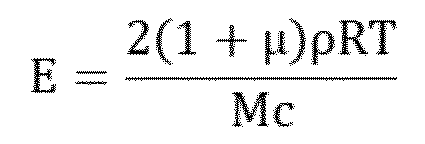
- the molecular weight between crosslinking points of the crosslinked rubber is considered to be correlated with the elastic modulus of the crosslinked rubber. That is, the molecular weight between crosslinking points of the crosslinked rubber is Mc, the Poisson's ratio of the crosslinked rubber is ⁇ , the density of the crosslinked rubber is ⁇ (g/m 3 ), the gas constant is R (J/(K ⁇ mol)), and the temperature is T. (K), the elastic modulus E (Pa) of the crosslinked rubber is expressed by the following formula.
- the magnetorheological elastomer composition of the present disclosure contains a magnetic powder (B) in addition to the urethane resin (A1), and has an average molecular weight between crosslinking points of the urethane resin (A1) and an elastic modulus of the magnetorheological elastomer composition.
- the urethane resin (A1) can be produced by reacting the polyol (x), the polyisocyanate (y), and the chain extender (z1) and terminal capper (z2) used as necessary. Such reactions can be carried out without solvent or in the presence of a reaction solvent.
- the reaction temperature may be 50-150°C.
- the reaction solvent include ketone solvents such as acetone and methyl ethyl ketone; ether solvents such as tetrahydrofuran and dioxane; acetate ester solvents such as ethyl acetate and butyl acetate; nitrile solvents such as acetonitrile; amide solvents such as dimethylformamide and N-methylpyrrolidone. etc.
- the content of the urethane resin (A1) contained in the resin (A) is preferably 80% by mass or more and 100% by mass or less, more preferably 90% by mass or more and 100% by mass or less, even more preferably 95% by mass or more and 100% by mass. It can be:
- the content of the urethane resin (A1) contained in the magnetorheological elastomer composition is, for example, 1% by mass or more and 50% by mass or less, preferably 2% by mass or more and 30% by mass or less, more preferably may be 3% by mass or more and 20% by mass or less.
- the resin (A) may further contain another resin (A2) in addition to the urethane resin (A1).
- Such resins (A2) include acrylic resins, polyester resins, polyamide resins, polycarbonate resins, silicone resins, and the like.
- Magnetic powder (B) represents a magnetic powder whose magnetic moment can change its direction or magnitude in response to a change in an external magnetic field.
- the magnetic material may typically be a ferromagnetic material, preferably a soft magnetic material.
- the magnetic material may be, for example, Fe or an alloy or oxide containing Fe; preferably Fe or Fe and B, C, N, O, Na, Mg, Al, Si, P, selected from the group consisting of S, Cl, K, Ti, V, Cr, Mn, Co, Ni, Cu, Zn, As, Sr, Zr, Nb, Mo, Pd, Sn, Ba, La, Ta and Bi more preferably Fe, or an alloy containing Fe and at least one selected from the group consisting of B, Al, Si, Cr, Co, and Ni. It can be.
- Such magnetic materials include Fe; soft ferrites such as manganese zinc ferrite, nickel zinc ferrite, copper zinc ferrite, and sodium ferrite; and alloys such as FeNi alloy, FeCo alloy, FeSi alloy, FeSiCr alloy, FeSiAl alloy, and FeSiBCr alloy. .
- the coercive force of the magnetic material is preferably 100 A/m or less, and the lower limit may be 0 A/m or more.
- the saturation magnetic flux density of the magnetic material may be preferably 0.1 T or more and 3 T or less, more preferably 0.5 T or more and 2.5 T or less, and still more preferably 0.7 T or more and 2.3 T or less.
- the magnetic permeability of the magnetic body measured under a magnetic field of 0.002 T is preferably 0.0001 H/m or more and 1 H/m or less, more preferably 0.0005 H/m or more and 0.1 H/m or less, and even more preferably 0. It may be .001 H/m or more and 0.01 H/m or less.
- the coercive force, saturation magnetic flux density, and magnetic permeability of the above-mentioned magnetic material represent the coercive force, saturation magnetic flux density, and magnetic permeability measured as a bulk, and can typically be measured using a sample vibrating magnetometer.
- the shape of the magnetic powder (B) may be, for example, spherical, flat, acicular, etc., and typically spherical.
- the magnetic powder (B) may be a powder having an insulating coating on its surface.
- insulating coatings include inorganic glass coatings, organic polymer coatings, organic-inorganic hybrid coatings, and inorganic insulating coatings formed by sol-gel reaction of metal alkoxides.
- the content of the magnetic powder (B) is preferably 25% by volume or more and 55% by volume or less out of the total 100% by volume of the resin (A) and magnetic powder (B). More preferably, it is 35 volume% or more and 50 volume% or less, and even more preferably 40 volume% or more and 45 volume% or less.
- the content of the magnetic powder (B) can be measured by applying heat (500° C. or higher) to the magnetorheological elastomer to drive off the organic components and measuring the weight of the remaining magnetic powder.
- the total content of the resin (A) and magnetic powder (B) is preferably 60% by mass or more and 100% by mass or less, more preferably 70% by mass or more and 100% by mass.
- the content is preferably 75% by mass or more and 100% by mass or less.
- the magnetorheological elastomer composition of the present disclosure may further contain a plasticizer (C) in addition to the resin (A) and the magnetic powder (B).
- plasticizer (C) examples include aromatic dicarboxylic acid plasticizers, aliphatic dicarboxylic acid plasticizers, phosphoric acid plasticizers, trimellitic acid plasticizers, and the like.
- aromatic dicarboxylic acid plasticizers examples include phthalic acid diesters such as dibutyl phthalate, dioctyl phthalate, di-2-ethylhexyl phthalate, diisononyl phthalate, diisodecyl phthalate, diundecyl phthalate, and ditridecyl phthalate; isophthalic acid Examples include isophthalic acid diesters such as dioctyl and di-2-ethylhexyl isophthalate; and terephthalic acid diesters such as dioctyl terephthalate and di-2-ethylhexyl terephthalate.
- aliphatic dicarboxylic acid plasticizers examples include adipic acid diesters such as dioctyl adipate, di-2-ethylhexyl adipate, isononyl adipate, and diisodecyl adipate; dioctyl sebacate, di-2-ethylhexyl sebacate, and sebacic acid.
- sebacic acid diesters such as diisononyl.
- phosphoric acid plasticizer examples include phosphoric acid esters such as trioctyl phosphate, tri-2-ethylhexyl phosphate, and tricresyl phosphate.
- trimellitic acid plasticizers include trimellitic acid triesters such as trioctyl trimellitate and tri-2-ethylhexyl trimellitate; pyromellitic acids such as tetraoctyl pyromellitate and tetra-2-ethylhexyl pyromellitate. Examples include tetraester.
- the plasticizer (C) preferably includes an aromatic dicarboxylic acid plasticizer, more preferably a phthalic acid diester, and particularly preferably dioctyl phthalate or di-2-ethylhexyl phthalate.
- the content of the plasticizer (C) in the magnetorheological elastomer composition of the present disclosure is preferably 0 parts by mass or more and 40 parts by mass or less, based on a total of 100 parts by mass of the resin (A) and magnetic powder (B). , more preferably 5 parts by mass or more and 35 parts by mass or less, still more preferably 10 parts by mass or more and 33 parts by mass or less.
- the magnetorheological elastomer composition has appropriate viscosity, and the orientation change of the magnetic powder (B) in response to changes in the magnetic field can be improved.
- the total content of the resin (A), magnetic powder (B), and plasticizer (C) is preferably 80% by mass or more and 100% by mass or less, more preferably 90% by mass or more.
- the content is at least 95% by mass and at most 100% by mass, more preferably at least 95% by mass and at most 100% by mass.
- the magnetorheological elastomer composition of the present disclosure may contain other additives (D) in addition to the resin (A), magnetic powder (B), and optionally used plasticizer (C).
- additives (D) include urethanization catalysts, antioxidants, light stabilizers, impact-resistant agents, antistatic agents, flame retardants, preservatives, ultraviolet absorbers, viscosity modifiers, colorants, and the like.
- the above urethanation catalyst is used in the reaction of polyol (x) and polyisocyanate (y), and includes tin-based compounds such as tin octylate, dibutyltin dichloride, dibutyltin oxide, and dibutyltin dilaurate; dibutyltitanium dichloride, and tetrabutyltitanate.
- titanium compounds such as butoxytitanium trichloride
- zinc compounds such as zinc naphthenate and zinc 2-ethylhexanoate
- triethylamine triethylenediamine, 1,8-diazabicyclo-(5,4,0)-undecene-7, etc.
- tertiary amines such as
- the urethanization catalyst may be used in an amount of 1 part by mass or more and 10 parts by mass or less based on 100 parts by mass of the urethane resin (A1).
- the magnetorheological elastomer composition of the present disclosure can be manufactured by mixing resin (A) and magnetic powder (B).
- Mixing the resin (A) and the magnetic powder (B) may include, for example, mixing the resin (A) and the magnetic powder (B) as they are, and after mixing the raw material of the resin (A) and the magnetic powder. , it may also include reacting the raw materials of the resin (A) to form the resin (A).
- a urethanization catalyst, a plasticizer (C), and an additive (D) may be appropriately used as necessary.
- the magnetorheological elastomer composition of the present disclosure is prepared by mixing the polyol (x), polyisocyanate (y) and magnetic powder (B), and then heating the mixture to form the polyol (x) and polyisocyanate (y). ) can be produced by obtaining a reaction product with The heating temperature may be 50 to 150°C, and the heating time may be 30 minutes to 20 hours. Further, the above heating may be performed without a solvent or in the presence of a reaction solvent.
- reaction solvents include toluene, acetone, n-methylpyrrolidone, and the like.
- the mixing order of polyol (x), polyisocyanate (y), and magnetic powder (B) is not particularly limited.
- polyol (x), polyisocyanate (y) and magnetic powder (B) may be mixed simultaneously, and after mixing polyol (x) and magnetic powder (B), such a mixture and polyisocyanate (y) may be mixed together. You may also mix them.
- the urethanization catalyst, resin (A2), plasticizer (C) and additive (D) to be used as necessary are allowed to coexist as appropriate. It's okay.
- the method for producing the magnetorheological elastomer composition of the present disclosure comprises: Reacting polyol (x) and polyisocyanate (y) in the presence of magnetic powder (B) to obtain a magnetorheological elastomer composition,
- the reaction between the polyol (x) and polyisocyanate (y) is carried out under a magnetic field with a magnetic field strength of more than 0 mT,
- the polyol (x) contains a triol (x1) having a number average molecular weight of 4,000 or more.
- the magnetorheological elastomer composition obtained has no magnetic properties.
- the powder (B) may be aligned along the magnetic field lines of the applied magnetic field. The orientation of the magnetic powder (B) can be maintained even if the magnetic field is removed after forming the magnetorheological elastomer composition. Then, when a magnetic field is applied again along the direction in which the magnetic particles (B) are arranged, the interaction of the magnetic particles (B) can be strengthened and more It is thought that a high elastic modulus can be obtained.
- the magnetic field strength when the polyol (x) and polyisocyanate (y) are reacted is preferably 10 mT or more, more preferably 10 mT or more and 400 mT or less, even more preferably 20 mT or more and 350 mT or less, even more preferably 100 mT or more and 350 mT or less. It can be:
- a magnetorheological elastomer composition has viscosity and elasticity.
- the storage modulus G' 0 of the magnetorheological elastomer composition measured under zero magnetic field is preferably 1,000 Pa or more and 20,000 Pa or less, more preferably 1,000 Pa or more and 10,000 Pa or less, and even more preferably 1, It can be 000 Pa or more and 5,000 Pa or less.
- the storage modulus of the magnetorheological elastomer composition is within this range, the change in elastic modulus upon application of a magnetic field can be improved.
- the magnetorheological elastomer composition of the present disclosure can have an increased storage modulus when a magnetic field is applied, compared to when no magnetic field is applied.
- the storage elastic modulus G' 1 is measured under conditions of a magnetic field strength of 120,000 A/m so that the direction of the magnetic field is parallel to the rotation axis of the rotational viscoelasticity measuring device.
- the storage modulus G′ 1 measured under the condition of a magnetic field strength of 120,000 A/m with the direction of the magnetic field and the rotation axis of the rotational viscoelasticity measurement device being parallel is preferably It may be 40,000 Pa or more, more preferably 80,000 Pa or more, even more preferably 100,000 Pa or more.
- the propagation speed of compressional waves, particularly acoustic waves and ultrasonic waves, passing through the magnetorheological elastomer composition can be increased.
- the storage elastic modulus change rate is preferably 5 or more, more preferably 20 or more, even more preferably 40 or more, and may be, for example, 300 or less, further 200 or less, or 150 or less.
- rate of change in storage elastic modulus due to the magnetic field is within this range, compression waves, particularly sound waves and ultrasonic waves, passing through the magnetorheological elastomer composition can be highly deflected.
- the storage modulus of the magnetorheological elastomer composition is within the above range and the rate of change in storage modulus due to the magnetic field is within this range, it is possible to reproduce a wide range of elastic modulus depending on the strength of the applied magnetic field. can be preferably used to modify sound waves or ultrasound waves.
- the magnetorheological elastomer composition of the present disclosure can increase its storage modulus by applying a magnetic field, and is suitable for changing the propagation direction of compressional waves such as sound waves, ultrasonic waves, and vibration waves (deflecting compressional waves). It can be used for
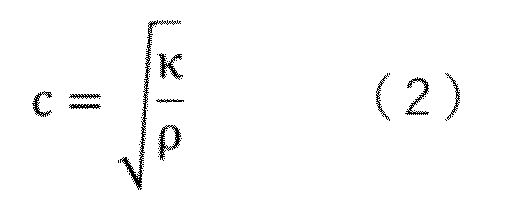
- the propagation speed c (m/s) of compressional waves is proportional to the square root of the elastic modulus of the propagation medium, specifically, when the density is ⁇ (kg/m 3 ) and the bulk modulus is ⁇ (Pa). , is expressed by the following equation (2).
- the elastic modulus when the elastic modulus is high, the propagation speed of compression waves is high, and when the elastic modulus is low, the propagation speed of compression waves is low.
- the increase in storage modulus correlates with the orientation of the magnetic field;
- the storage modulus in the direction parallel to the direction increases. Therefore, it is thought that the application of a magnetic field causes anisotropy in the storage modulus, and as a result, the propagation direction of compressional waves can change.
- the magnetorheological elastomer composition of the present disclosure is preferably used for deflecting sound waves or ultrasonic waves, and is particularly suitable for use in acoustic devices such as speakers; and ultrasonic devices such as ultrasonic sensors. Furthermore, the magnetorheological elastomer composition of the present disclosure can be used in a tactile feedback device that utilizes changes in elastic modulus.
- the resin (A) includes a urethane resin (A1),
- the urethane resin (A1) contains a reaction product of polyol (x) and polyisocyanate (y)
- the polyol (x) is a magnetorheological elastomer composition containing a triol (x1) having a number average molecular weight of 4,000 or more.
- the polyol (x) is a magnetorheological elastomer composition containing a triol (x1) having a number average molecular weight of 4,000 or more.
- Example 1 In a reaction vessel, 1.64 parts by mass of polypropylene triol with a number average molecular weight of 3,000, 3.39 parts by mass of polypropylene diol with a number average molecular weight of 3,000, and 0.45 parts of tolylene diisocyanate as polyisocyanate (y). 70.9 parts by mass of FeSiCr powder with a particle size of 3 ⁇ m was added as the magnetic powder (B), and 22.8 parts by mass of dioctyl phthalate was added as the plasticizer (C) and mixed.
- tin octylate 0.4 parts by mass of tin octylate was added as a urethanization catalyst to the mixture, and after further mixing, the mixture was stirred at 2,000 rpm for 390 seconds using a defoaming stirrer to obtain a paste.
- the obtained paste was heated at 75° C. for 2 hours using a hot plate to thermally cure it to obtain a magnetorheological elastomer (MRE) composition.
- MRE magnetorheological elastomer
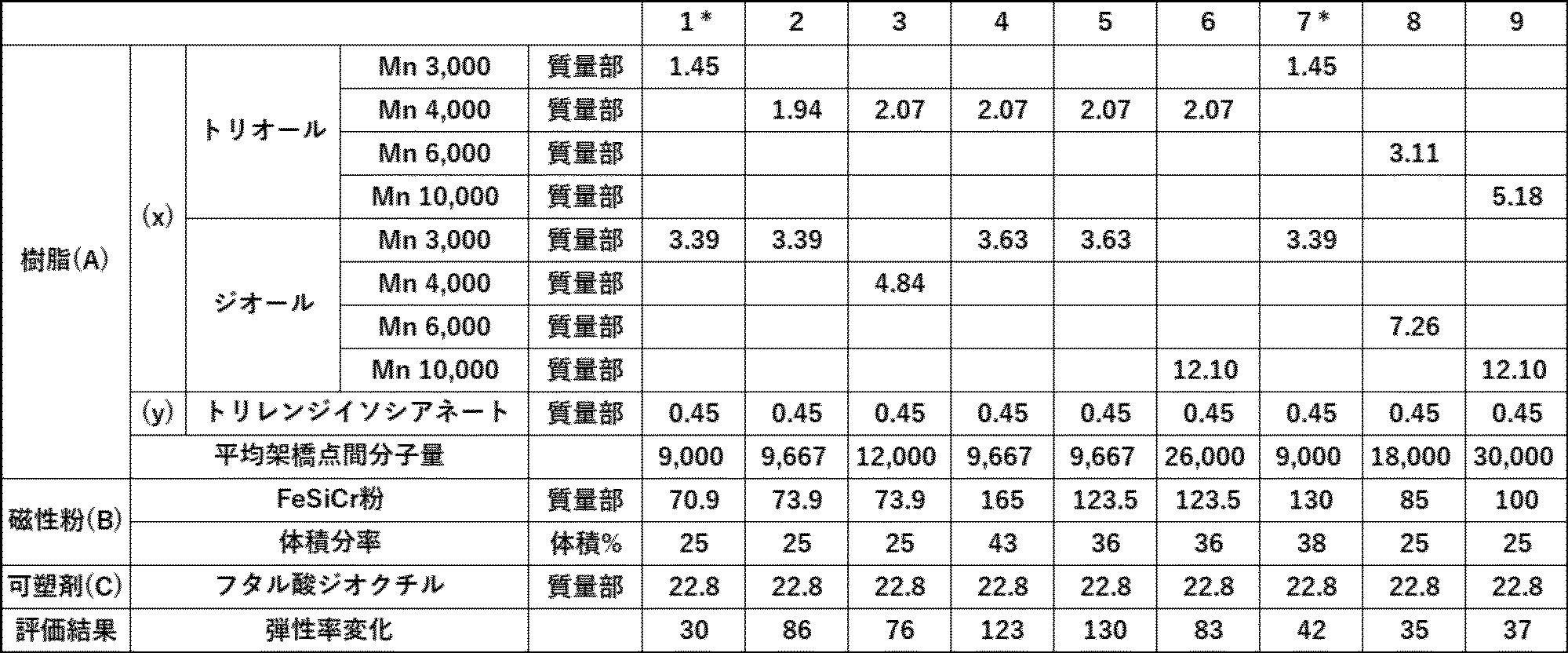
- Experimental Examples 2 to 6 and 8 to 9 are examples of the present disclosure, and the change in storage modulus when a magnetic field was applied was larger compared to the storage modulus when no magnetic field was applied.
- Experimental Examples 1 and 7 are examples that do not contain a triol having a number average molecular weight of 4,000 or more, and the change in storage modulus when a magnetic field is applied was not completely satisfactory.
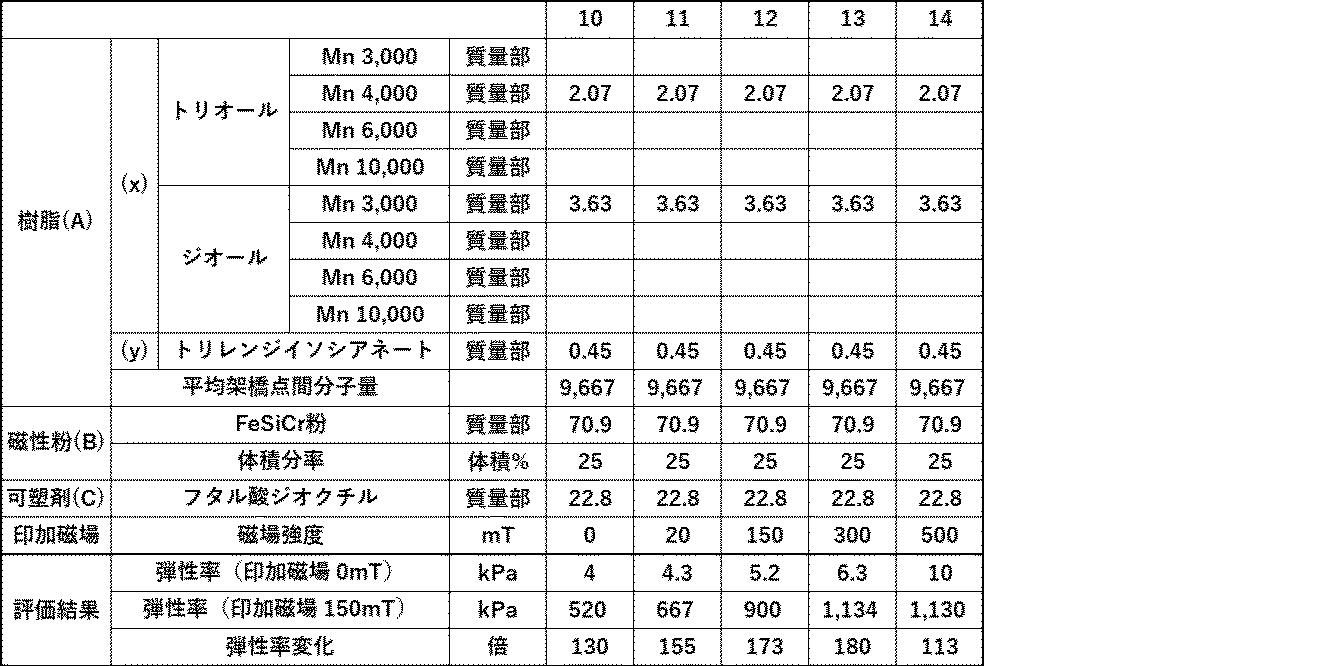
- Examples 10 to 14 are examples in which the reaction between polyol (x) and polyisocyanate (y) was carried out under a magnetic field with a magnetic field strength of 20 to 500 mT, and the obtained magnetorheological elastomer compositions
- the storage modulus was high and the change in elastic modulus was good.
- the storage modulus of the resin (A) alone is 3.0 kPa, and since the magnetorheological elastomer composition of the present disclosure contains such a highly flexible resin (A), the arrangement of the magnetic powder (B) does not change. It is thought that it is difficult to be disturbed and a high change in elastic modulus can be obtained.
Landscapes
- Chemical & Material Sciences (AREA)
- Health & Medical Sciences (AREA)
- Chemical Kinetics & Catalysis (AREA)
- Medicinal Chemistry (AREA)
- Polymers & Plastics (AREA)
- Organic Chemistry (AREA)
- Engineering & Computer Science (AREA)
- Power Engineering (AREA)
- Polyurethanes Or Polyureas (AREA)
- Compositions Of Macromolecular Compounds (AREA)
Abstract
Description
樹脂(A)および磁性粉(B)を含み、
前記樹脂(A)は、ウレタン樹脂(A1)を含み、
前記ウレタン樹脂(A1)は、ポリオール(x)とポリイソシアネート(y)との反応物を含み、
前記ポリオール(x)は、数平均分子量4,000以上のトリオール(x1)を含む。
樹脂(A)および磁性粉(B)を含み、
前記樹脂(A)は、ウレタン樹脂(A1)を含み、
前記ウレタン樹脂(A1)は、ポリオール(x)とポリイソシアネート(y)との反応物を含み、
前記ポリオール(x)は、数平均分子量4,000以上のトリオール(x1)を含む。
また、本開示において、磁気粘弾性エラストマーは、磁性粒子を含む粘弾性エラストマーを表し、好ましくは、粘弾性エラストマー内部に磁性粒子を分散固定した複合材料を表す。磁気粘弾性エラストマーは、外部磁場に応答して、見掛けの弾性率や減衰特性が可逆に変化する。
樹脂(A)は、ウレタン樹脂(A1)を含む。
上記ウレタン樹脂(A1)は、ポリオール(x)とポリイソシアネート(y)との反応物を含む。ポリオール(x)に含まれる水酸基と、ポリイソシアネート(y)に含まれるイソシアネート基とが反応することにより、ウレタン結合が形成され、ウレタン樹脂となりうる。上記ウレタン樹脂(A1)は、ポリオール(x)とポリイソシアネート(y)の反応物と、鎖伸長剤(z1)および/または末端停止剤(z2)との反応物であってもよく、これらの反応物は全てウレタン樹脂(A1)の技術的範囲に含まれる。
上記その他の(メタ)アクリル単量体としては、(メタ)アクリル酸メチル、(メタ)アクリル酸エチル、(メタ)アクリル酸プロピル、(メタ)アクリル酸ブチル、(メタ)アクリル酸ペンチル、(メタ)アクリル酸ヘキシル、(メタ)アクリル酸ヘプチル、(メタ)アクリル酸オクチル、(メタ)アクリル酸ノニル、(メタ)アクリル酸デシル、(メタ)アクリル酸ウンデシル、(メタ)アクリル酸ドデシル等の(メタ)アクリル酸エステル;(メタ)アクリル酸、マレイン酸、イタコン酸等の不飽和カルボン酸;無置換の(メタ)アクリルアミド、ジメチル(メタ)アクリルアミド、N,N-メチレンビス(メタ)アクリルアミド、ダイアセトン(メタ)アクリルアミド等の(メタ)アクリルアミド単量体等が挙げられる。
上記その他のビニル単量体としては、スチレン、メチルスチレン等が挙げられる。

上記樹脂(A)は、上記ウレタン樹脂(A1)に加えて、その他の樹脂(A2)をさらに含んでいてもよい。かかる樹脂(A2)としては、アクリル樹脂、ポリエステル樹脂、ポリアミド樹脂、ポリカーボネート樹脂、シリコーン樹脂等が挙げられる。
上記磁性粉(B)は、外部磁場の変化に応答して、その磁気モーメントの向き又は大きさが変化し得る磁性体の粉末を表す。上記磁性体は、代表的には、強磁性体であり得、好ましくは、軟磁性体であり得る。
磁性粉(B)の含有率は、磁気粘弾性エラストマに熱(500℃以上)をかけて有機成分を飛ばし、残った磁性粉の重量を測定することにより測定できる。
本開示の磁気粘弾性エラストマー組成物は、上記樹脂(A)および上記磁性粉(B)に加えて、可塑剤(C)をさらに含んでいてもよい。
上記脂肪族ジカルボン酸系可塑剤としては、アジピン酸ジオクチル、アジピン酸ジ-2-エチルヘキシル、アジピン酸イソノニル、アジピン酸ジイソデシル等のアジピン酸ジエステル;セバシン酸ジオクチル、セバシン酸ジ-2-エチルヘキシル、セバシン酸ジイソノニル等のセバシン酸ジエステル等が挙げられる。
上記リン酸系可塑剤としては、リン酸トリオクチル、リン酸トリ-2-エチルヘキシル、リン酸トリクレジル等のリン酸エステ等が挙げられる。
上記トリメリット酸系可塑剤としては、トリメリット酸トリオクチル、トリメリット酸トリ-2-エチルヘキシル等のトリメリット酸トリエステル;ピロメリット酸テトラオクチル、ピロメリット酸テトラ-2-エチルヘキシル等のピロメリット酸テトラエステル等が挙げられる。
本開示の磁気粘弾性エラストマー組成物は、上記樹脂(A)、磁性粉(B)および必要に応じて用いる可塑剤(C)に加えて、その他の添加剤(D)を含んでいてもよい。かかる添加剤(D)としては、ウレタン化触媒、酸化防止剤、光安定剤、耐衝撃剤、帯電防止剤、難燃剤、防腐剤、紫外線吸収剤、粘度調整剤、着色剤等が挙げられる。
上記ウレタン化触媒は、上記ウレタン樹脂(A1)100質量部に対して、1質量部以上10質量部以下であってよい。
本開示の磁気粘弾性エラストマー組成物は、樹脂(A)および磁性粉(B)を混合することにより製造され得る。樹脂(A)および磁性粉(B)の混合は、例えば、樹脂(A)と磁性粉(B)とをそのまま混合することを含み得、樹脂(A)の原料と磁性粉とを混合した後、樹脂(A)の原料を反応させて樹脂(A)とすることも含み得る。樹脂(A)及び磁性粉(B)を混合するに際し、必要に応じて用いるウレタン化触媒、可塑剤(C)および添加剤(D)を適宜共存させてよい。
磁性粉(B)の共存下、ポリオール(x)とポリイソシアネート(y)とを反応させて、磁気粘弾性エラストマー組成物を得ることを含み、
上記ポリオール(x)とポリイソシアネート(y)との反応は、磁場強度0mT超の磁場下で実施され、
上記ポリオール(x)は、数平均分子量4,000以上のトリオール(x1)を含む。
磁気粘弾性エラストマー組成物は、粘性と弾性とを有する。
ゼロ磁場下で測定した、磁気粘弾性エラストマー組成物の貯蔵弾性率G’0は、好ましくは1,000Pa以上20,000Pa以下、より好ましくは1,000Pa以上10,000Pa以下、さらに好ましくは1,000Pa以上5,000Pa以下であり得る。磁気粘弾性エラストマー組成物の貯蔵弾性率がかかる範囲にあることで、磁場印加時の弾性率変化が良好になり得る。
[1]
樹脂(A)および磁性粉(B)を含み、
前記樹脂(A)は、ウレタン樹脂(A1)を含み、
前記ウレタン樹脂(A1)は、ポリオール(x)とポリイソシアネート(y)との反応物を含み、
前記ポリオール(x)は、数平均分子量4,000以上のトリオール(x1)を含む、磁気粘弾性エラストマー組成物。
[2]
前記ウレタン樹脂(A1)の平均架橋点間分子量は、9,500以上27,000以下である、[1]に記載の磁気粘弾性エラストマー組成物。
[3]
前記磁性粉(B)の含有率は、前記樹脂(A)と前記磁性粉(B)の合計100体積%中、25体積%以上55体積%以下である、[1]または[2]に記載の磁気粘弾性エラストマー組成物。
[4]
可塑剤(C)をさらに含み、前記可塑剤(C)は、芳香族ジカルボン酸系可塑剤を含む、[1]~[3]のいずれか1つに記載の磁気粘弾性エラストマー組成物。
[5]
磁性粉(B)の共存下、ポリオール(x)とポリイソシアネート(y)とを反応させて、磁気粘弾性エラストマー組成物を得ることを含み、
前記ポリオール(x)とポリイソシアネート(y)との反応は、磁場強度0mT超の磁場下で実施され、
前記ポリオール(x)は、数平均分子量4,000以上のトリオール(x1)を含む、磁気粘弾性エラストマー組成物の製造方法。
[6]
磁性粉(B)の共存下、ポリオール(x)とポリイソシアネート(y)とを反応させて得られ、
前記ポリオール(x)とポリイソシアネート(y)との反応は、磁場強度0mT超の磁場下で実施され、
前記ポリオール(x)は、数平均分子量4,000以上のトリオール(x1)を含む、磁気粘弾性エラストマー組成物。
反応容器に、数平均分子量3,000のポリプロピレントリオールを1.64質量部、数平均分子量3,000のポリプロピレンジオールを3.39質量部、ポリイソシアネート(y)として、トリレンジイソシアネートを0.45質量部、磁性粉(B)として、粒径3μmのFeSiCr粉を70.9質量部、可塑剤(C)として、フタル酸ジオクチルを22.8質量部入れ、混合した。次いで、該混合物にウレタン化触媒として、オクチル酸スズを0.4質量部添加し、さらに混合した後、脱泡撹拌機を用い、2,000rpmで390秒間撹拌して、ペーストを得た。ホットプレートを用い、得られたペーストを75℃で2時間加熱し、熱硬化させて、磁気粘弾性エラストマー(MRE)組成物を得た。
トリオールおよびジオールの数平均分子量(Mn)および使用量、磁性粉(B)および可塑剤(C)の使用量を、表1、2に示す通りに変更したこと以外は、実験例1と同様にして、磁気粘弾性エラストマー組成物を得た。
反応容器に、数平均分子量4,000のポリプロピレントリオールを2.07質量部、数平均分子量3,000のポリプロピレンジオールを3.63質量部、ポリイソシアネート(y)として、トリレンジイソシアネートを0.45質量部、磁性粉(B)として、粒径3μmのFeSiCr粉を70.9質量部、可塑剤(C)として、フタル酸ジオクチルを22.8質量部入れ、混合した。次いで、該混合物にウレタン化触媒として、オクチル酸スズを0.4質量部添加し、さらに混合した後、脱泡撹拌機を用い、2,000rpmで390秒間撹拌して、ペーストを得た。ホットプレートを用い、表2に示す条件で磁場を印加しながら、得られたペーストを75℃で2時間加熱し、熱硬化させて、磁気粘弾性エラストマー(MRE)組成物を得た。
磁気粘弾性エラストマー組成物を直径2cm、厚さ1mmの円盤状に成形し、試料とした。次いで、粘弾性測定装置(Anton Paar社製、型式:MCR301)に試料をセットし、磁場発生装置(Anton Paar社製、型式:PS-MRD)を用いて、磁場を印加しない場合及び磁場を印加した場合の貯蔵弾性率を測定した。粘弾性測定装置の回転軸と、磁場の向きとは、平行となるようにして、測定を実施した。
(粘弾性測定時の条件)
測定温度:25℃
端子から試料に加えられる荷重:0.3N
周波数:1Hz
ひずみ:0.01%
磁場を印加する際の磁場強度:150mT
実験例1、7は、数平均分子量4,000以上のトリオールを含まない例であり、磁場を印加した場合の貯蔵弾性率の変化が、十分に満足できるものではなかった。
Claims (5)
- 樹脂(A)および磁性粉(B)を含み、
前記樹脂(A)は、ウレタン樹脂(A1)を含み、
前記ウレタン樹脂(A1)は、ポリオール(x)とポリイソシアネート(y)との反応物を含み、
前記ポリオール(x)は、数平均分子量4,000以上のトリオール(x1)を含む、磁気粘弾性エラストマー組成物。 - 前記ウレタン樹脂(A1)の平均架橋点間分子量は、9,500以上27,000以下である、請求項1に記載の磁気粘弾性エラストマー組成物。
- 前記磁性粉(B)の含有率は、前記樹脂(A)と前記磁性粉(B)の合計100体積%中、25体積%以上55体積%以下である、請求項1または2に記載の磁気粘弾性エラストマー組成物。
- 可塑剤(C)をさらに含み、前記可塑剤(C)は、芳香族ジカルボン酸系可塑剤を含む、請求項1~3のいずれか1項に記載の磁気粘弾性エラストマー組成物。
- 磁性粉(B)の共存下、ポリオール(x)とポリイソシアネート(y)とを反応させて、磁気粘弾性エラストマー組成物を得ることを含み、
前記ポリオール(x)とポリイソシアネート(y)との反応は、磁場強度0mT超の磁場下で実施され、
前記ポリオール(x)は、数平均分子量4,000以上のトリオール(x1)を含む、磁気粘弾性エラストマー組成物の製造方法。
Priority Applications (3)
| Application Number | Priority Date | Filing Date | Title |
|---|---|---|---|
| JP2023577249A JP7571901B2 (ja) | 2022-07-12 | 2023-05-11 | 磁気粘弾性エラストマー組成物およびその製造方法 |
| CN202380053144.0A CN119546704A (zh) | 2022-07-12 | 2023-05-11 | 磁粘弹性弹性体组合物及其制造方法 |
| US19/014,563 US20250149214A1 (en) | 2022-07-12 | 2025-01-09 | Magnetorheological elastomer composition and method for producing the same |
Applications Claiming Priority (2)
| Application Number | Priority Date | Filing Date | Title |
|---|---|---|---|
| JP2022111738 | 2022-07-12 | ||
| JP2022-111738 | 2022-07-12 |
Related Child Applications (1)
| Application Number | Title | Priority Date | Filing Date |
|---|---|---|---|
| US19/014,563 Continuation US20250149214A1 (en) | 2022-07-12 | 2025-01-09 | Magnetorheological elastomer composition and method for producing the same |
Publications (1)
| Publication Number | Publication Date |
|---|---|
| WO2024014100A1 true WO2024014100A1 (ja) | 2024-01-18 |
Family
ID=89536376
Family Applications (1)
| Application Number | Title | Priority Date | Filing Date |
|---|---|---|---|
| PCT/JP2023/017760 Ceased WO2024014100A1 (ja) | 2022-07-12 | 2023-05-11 | 磁気粘弾性エラストマー組成物およびその製造方法 |
Country Status (4)
| Country | Link |
|---|---|
| US (1) | US20250149214A1 (ja) |
| JP (1) | JP7571901B2 (ja) |
| CN (1) | CN119546704A (ja) |
| WO (1) | WO2024014100A1 (ja) |
Citations (3)
| Publication number | Priority date | Publication date | Assignee | Title |
|---|---|---|---|---|
| JPH04198292A (ja) * | 1990-11-26 | 1992-07-17 | Japan Synthetic Rubber Co Ltd | ウレタン系接着剤組成物 |
| WO2014112216A1 (ja) * | 2013-01-15 | 2014-07-24 | 東洋ゴム工業株式会社 | センサとその製造方法 |
| JP2019210311A (ja) * | 2018-05-31 | 2019-12-12 | 哲 三俣 | 水系ポリウレタン樹脂組成物、及び当該ポリウレタンエラストマー組成物からなる高弾性磁場応答性ソフトマテリアル |
-
2023
- 2023-05-11 WO PCT/JP2023/017760 patent/WO2024014100A1/ja not_active Ceased
- 2023-05-11 JP JP2023577249A patent/JP7571901B2/ja active Active
- 2023-05-11 CN CN202380053144.0A patent/CN119546704A/zh active Pending
-
2025
- 2025-01-09 US US19/014,563 patent/US20250149214A1/en active Pending
Patent Citations (3)
| Publication number | Priority date | Publication date | Assignee | Title |
|---|---|---|---|---|
| JPH04198292A (ja) * | 1990-11-26 | 1992-07-17 | Japan Synthetic Rubber Co Ltd | ウレタン系接着剤組成物 |
| WO2014112216A1 (ja) * | 2013-01-15 | 2014-07-24 | 東洋ゴム工業株式会社 | センサとその製造方法 |
| JP2019210311A (ja) * | 2018-05-31 | 2019-12-12 | 哲 三俣 | 水系ポリウレタン樹脂組成物、及び当該ポリウレタンエラストマー組成物からなる高弾性磁場応答性ソフトマテリアル |
Non-Patent Citations (1)
| Title |
|---|
| KIMURA YUKIO, KANAUCHI SHUNTA, KAWAI MIKA, MITSUMATA TETSU, TAMESUE SHINGO, YAMAUCHI TAKESHI: "Effect of Plasticizer on the Magnetoelastic Behavior for Magnetic Polyurethane Elastomers", CHEMISTRY LETTERS, CHEMICAL SOCIETY OF JAPAN,NIPPON KAGAKUKAI, JP, vol. 44, no. 2, 5 February 2015 (2015-02-05), JP , pages 177 - 178, XP093128464, ISSN: 0366-7022, DOI: 10.1246/cl.140932 * |
Also Published As
| Publication number | Publication date |
|---|---|
| CN119546704A (zh) | 2025-02-28 |
| JPWO2024014100A1 (ja) | 2024-01-18 |
| JP7571901B2 (ja) | 2024-10-23 |
| US20250149214A1 (en) | 2025-05-08 |
Similar Documents
| Publication | Publication Date | Title |
|---|---|---|
| KR20070068413A (ko) | 지방산으로부터 유도된 히드록시메틸-함유 폴리에스테르폴리올로부터 제조된 수성 폴리우레탄 분산액 | |
| WO2021132094A1 (ja) | 構造用ポリウレタン接着剤 | |
| KR20120104138A (ko) | 천연 오일 기재 중합체 폴리올 및 이로부터 제조된 폴리우레탄 제품 | |
| CN105315949B (zh) | 一种具有很短开放时间和高弹性的聚氨酯胶黏剂及其应用 | |
| JP7571901B2 (ja) | 磁気粘弾性エラストマー組成物およびその製造方法 | |
| WO2023204068A1 (ja) | 接着剤組成物、当該接着剤組成物の硬化物及び当該接着剤組成物の製造方法 | |
| JP6754449B2 (ja) | 二液硬化型接着剤組成物、ラミネートフィルムおよびその製造方法 | |
| JP6334091B2 (ja) | エラストマー及びトランスデューサ素子 | |
| JP2010177066A (ja) | 電気・電子部品の電気絶縁用ポリウレタン樹脂形成性組成物 | |
| CN113366062B (zh) | 固化性组合物 | |
| WO2024232139A1 (ja) | 磁気粘弾性エラストマー組成物 | |
| WO2025150345A1 (ja) | 磁気粘弾性エラストマー組成物および磁気粘弾性エラストマー組成物の製造方法 | |
| WO2024256403A1 (en) | Thermally conductive two component adhesives | |
| JP7295933B2 (ja) | 硬化性ウレタン組成物 | |
| WO2025004439A1 (ja) | 磁気粘弾性エラストマー組成物および磁気粘弾性エラストマー組成物の製造方法 | |
| JP7698861B2 (ja) | 二液型硬化性組成物 | |
| JP7375034B2 (ja) | 構造用ポリウレタン接着剤 | |
| JP5756678B2 (ja) | 導光性ポリウレタン樹脂および導光部材 | |
| WO2023008478A1 (ja) | 二液型接着剤組成物及び硬化物 | |
| JP2026082512A (ja) | 励磁摩擦材、励磁ブレーキパッド及び励磁ブレーキ装置 | |
| WO2025177755A1 (ja) | 磁気粘弾性エラストマー組成物および磁気粘弾性エラストマー組成物の製造方法 | |
| WO2022190996A1 (ja) | ウレタン接着剤組成物 | |
| JP2012097200A (ja) | ポリウレタン樹脂組成物 | |
| JP2022161606A (ja) | ポリウレタンウレア樹脂 | |
| JP3939973B2 (ja) | スキン付ポリウレタンフォーム用スキン形成剤 |
Legal Events
| Date | Code | Title | Description |
|---|---|---|---|
| WWE | Wipo information: entry into national phase |
Ref document number: 2023577249 Country of ref document: JP |
|
| 121 | Ep: the epo has been informed by wipo that ep was designated in this application |
Ref document number: 23839278 Country of ref document: EP Kind code of ref document: A1 |
|
| WWE | Wipo information: entry into national phase |
Ref document number: 202380053144.0 Country of ref document: CN |
|
| NENP | Non-entry into the national phase |
Ref country code: DE |
|
| WWP | Wipo information: published in national office |
Ref document number: 202380053144.0 Country of ref document: CN |
|
| 122 | Ep: pct application non-entry in european phase |
Ref document number: 23839278 Country of ref document: EP Kind code of ref document: A1 |