WO2023277016A1 - 光導波路形成用組成物 - Google Patents
光導波路形成用組成物 Download PDFInfo
- Publication number
- WO2023277016A1 WO2023277016A1 PCT/JP2022/025764 JP2022025764W WO2023277016A1 WO 2023277016 A1 WO2023277016 A1 WO 2023277016A1 JP 2022025764 W JP2022025764 W JP 2022025764W WO 2023277016 A1 WO2023277016 A1 WO 2023277016A1
- Authority
- WO
- WIPO (PCT)
- Prior art keywords
- epoxy compound
- optical waveguide
- composition
- forming
- compound
- Prior art date
- Legal status (The legal status is an assumption and is not a legal conclusion. Google has not performed a legal analysis and makes no representation as to the accuracy of the status listed.)
- Ceased
Links
Images
Classifications
-
- G—PHYSICS
- G02—OPTICS
- G02B—OPTICAL ELEMENTS, SYSTEMS OR APPARATUS
- G02B6/00—Light guides; Structural details of arrangements comprising light guides and other optical elements, e.g. couplings
- G02B6/10—Light guides; Structural details of arrangements comprising light guides and other optical elements, e.g. couplings of the optical waveguide type
- G02B6/12—Light guides; Structural details of arrangements comprising light guides and other optical elements, e.g. couplings of the optical waveguide type of the integrated circuit kind
-
- C—CHEMISTRY; METALLURGY
- C08—ORGANIC MACROMOLECULAR COMPOUNDS; THEIR PREPARATION OR CHEMICAL WORKING-UP; COMPOSITIONS BASED THEREON
- C08G—MACROMOLECULAR COMPOUNDS OBTAINED OTHERWISE THAN BY REACTIONS ONLY INVOLVING UNSATURATED CARBON-TO-CARBON BONDS
- C08G59/00—Polycondensates containing more than one epoxy group per molecule; Macromolecules obtained by polymerising compounds containing more than one epoxy group per molecule using curing agents or catalysts which react with the epoxy groups
- C08G59/18—Macromolecules obtained by polymerising compounds containing more than one epoxy group per molecule using curing agents or catalysts which react with the epoxy groups ; e.g. general methods of curing
- C08G59/20—Macromolecules obtained by polymerising compounds containing more than one epoxy group per molecule using curing agents or catalysts which react with the epoxy groups ; e.g. general methods of curing characterised by the epoxy compounds used
- C08G59/22—Di-epoxy compounds
- C08G59/24—Di-epoxy compounds carbocyclic
- C08G59/245—Di-epoxy compounds carbocyclic aromatic
-
- C—CHEMISTRY; METALLURGY
- C08—ORGANIC MACROMOLECULAR COMPOUNDS; THEIR PREPARATION OR CHEMICAL WORKING-UP; COMPOSITIONS BASED THEREON
- C08G—MACROMOLECULAR COMPOUNDS OBTAINED OTHERWISE THAN BY REACTIONS ONLY INVOLVING UNSATURATED CARBON-TO-CARBON BONDS
- C08G59/00—Polycondensates containing more than one epoxy group per molecule; Macromolecules obtained by polymerising compounds containing more than one epoxy group per molecule using curing agents or catalysts which react with the epoxy groups
- C08G59/18—Macromolecules obtained by polymerising compounds containing more than one epoxy group per molecule using curing agents or catalysts which react with the epoxy groups ; e.g. general methods of curing
- C08G59/20—Macromolecules obtained by polymerising compounds containing more than one epoxy group per molecule using curing agents or catalysts which react with the epoxy groups ; e.g. general methods of curing characterised by the epoxy compounds used
- C08G59/22—Di-epoxy compounds
- C08G59/223—Di-epoxy compounds together with monoepoxy compounds
-
- C—CHEMISTRY; METALLURGY
- C08—ORGANIC MACROMOLECULAR COMPOUNDS; THEIR PREPARATION OR CHEMICAL WORKING-UP; COMPOSITIONS BASED THEREON
- C08G—MACROMOLECULAR COMPOUNDS OBTAINED OTHERWISE THAN BY REACTIONS ONLY INVOLVING UNSATURATED CARBON-TO-CARBON BONDS
- C08G59/00—Polycondensates containing more than one epoxy group per molecule; Macromolecules obtained by polymerising compounds containing more than one epoxy group per molecule using curing agents or catalysts which react with the epoxy groups
- C08G59/18—Macromolecules obtained by polymerising compounds containing more than one epoxy group per molecule using curing agents or catalysts which react with the epoxy groups ; e.g. general methods of curing
- C08G59/20—Macromolecules obtained by polymerising compounds containing more than one epoxy group per molecule using curing agents or catalysts which react with the epoxy groups ; e.g. general methods of curing characterised by the epoxy compounds used
- C08G59/22—Di-epoxy compounds
- C08G59/226—Mixtures of di-epoxy compounds
-
- C—CHEMISTRY; METALLURGY
- C08—ORGANIC MACROMOLECULAR COMPOUNDS; THEIR PREPARATION OR CHEMICAL WORKING-UP; COMPOSITIONS BASED THEREON
- C08G—MACROMOLECULAR COMPOUNDS OBTAINED OTHERWISE THAN BY REACTIONS ONLY INVOLVING UNSATURATED CARBON-TO-CARBON BONDS
- C08G59/00—Polycondensates containing more than one epoxy group per molecule; Macromolecules obtained by polymerising compounds containing more than one epoxy group per molecule using curing agents or catalysts which react with the epoxy groups
- C08G59/18—Macromolecules obtained by polymerising compounds containing more than one epoxy group per molecule using curing agents or catalysts which react with the epoxy groups ; e.g. general methods of curing
- C08G59/20—Macromolecules obtained by polymerising compounds containing more than one epoxy group per molecule using curing agents or catalysts which react with the epoxy groups ; e.g. general methods of curing characterised by the epoxy compounds used
- C08G59/22—Di-epoxy compounds
- C08G59/24—Di-epoxy compounds carbocyclic
-
- C—CHEMISTRY; METALLURGY
- C08—ORGANIC MACROMOLECULAR COMPOUNDS; THEIR PREPARATION OR CHEMICAL WORKING-UP; COMPOSITIONS BASED THEREON
- C08G—MACROMOLECULAR COMPOUNDS OBTAINED OTHERWISE THAN BY REACTIONS ONLY INVOLVING UNSATURATED CARBON-TO-CARBON BONDS
- C08G59/00—Polycondensates containing more than one epoxy group per molecule; Macromolecules obtained by polymerising compounds containing more than one epoxy group per molecule using curing agents or catalysts which react with the epoxy groups
- C08G59/18—Macromolecules obtained by polymerising compounds containing more than one epoxy group per molecule using curing agents or catalysts which react with the epoxy groups ; e.g. general methods of curing
- C08G59/68—Macromolecules obtained by polymerising compounds containing more than one epoxy group per molecule using curing agents or catalysts which react with the epoxy groups ; e.g. general methods of curing characterised by the catalysts used
- C08G59/687—Macromolecules obtained by polymerising compounds containing more than one epoxy group per molecule using curing agents or catalysts which react with the epoxy groups ; e.g. general methods of curing characterised by the catalysts used containing sulfur
-
- G—PHYSICS
- G02—OPTICS
- G02B—OPTICAL ELEMENTS, SYSTEMS OR APPARATUS
- G02B1/00—Optical elements characterised by the material of which they are made; Optical coatings for optical elements
- G02B1/04—Optical elements characterised by the material of which they are made; Optical coatings for optical elements made of organic materials, e.g. plastics
- G02B1/045—Light guides
- G02B1/048—Light guides characterised by the cladding material
-
- G—PHYSICS
- G02—OPTICS
- G02B—OPTICAL ELEMENTS, SYSTEMS OR APPARATUS
- G02B6/00—Light guides; Structural details of arrangements comprising light guides and other optical elements, e.g. couplings
- G02B6/10—Light guides; Structural details of arrangements comprising light guides and other optical elements, e.g. couplings of the optical waveguide type
- G02B6/12—Light guides; Structural details of arrangements comprising light guides and other optical elements, e.g. couplings of the optical waveguide type of the integrated circuit kind
- G02B6/122—Basic optical elements, e.g. light-guiding paths
- G02B6/1221—Basic optical elements, e.g. light-guiding paths made from organic materials
-
- G—PHYSICS
- G02—OPTICS
- G02B—OPTICAL ELEMENTS, SYSTEMS OR APPARATUS
- G02B6/00—Light guides; Structural details of arrangements comprising light guides and other optical elements, e.g. couplings
- G02B6/10—Light guides; Structural details of arrangements comprising light guides and other optical elements, e.g. couplings of the optical waveguide type
- G02B6/12—Light guides; Structural details of arrangements comprising light guides and other optical elements, e.g. couplings of the optical waveguide type of the integrated circuit kind
- G02B6/13—Integrated optical circuits characterised by the manufacturing method
- G02B6/138—Integrated optical circuits characterised by the manufacturing method by using polymerisation
Definitions
- the present invention relates to a composition for forming an optical waveguide, particularly an epoxy resin composition, and an optical waveguide formed from the composition.
- an optical waveguide is a transmission line that uses light for communication.
- optical fibers made of quartz glass or plastic have already been put into practical use as transmission lines for transmitting light over long distances. It is indispensable for high-speed, high-precision transmission.
- a transmission line that transmits light inside an optical circuit and is formed on a substrate using microfabrication technology is customarily called an optical waveguide and research is progressing (hereinafter referred to as this in the present specification). is called an optical waveguide).
- an optical waveguide a transmission line that transmits light inside an optical circuit and is formed on a substrate using microfabrication technology
- metal wiring transmission lines which has been used for relatively short-distance transmission within package substrates or between devices, has been changed to optical signals directly from CPUs and LSIs.
- a photosensitive material for forming the optical waveguide As the photosensitive material for forming the optical waveguide, a polyfunctional epoxy resin having a bisphenol A skeleton, a solid semi-aliphatic bifunctional epoxy resin, or other bifunctional epoxy resin is used as a resin component, and a photocationic polymerization initiator is contained.
- a photosensitive epoxy resin composition for forming an optical waveguide has been proposed (see, for example, Patent Document 1).
- the photosensitive material for forming an optical waveguide is required to have patterning properties, film-forming properties, and a high refractive index, but it is difficult to satisfy these properties at the same time.
- a polyfunctional resin or compound when used to improve patterning properties, the molecular weight increases and the viscosity of the material increases significantly, which can impede film forming properties and film planarization properties.
- a bifunctional or less functional resin or compound, a low-molecular-weight compound, or the like is used to reduce the viscosity of the material in order to improve the film formability, the refractive index and patterning properties may be lowered.
- Patent Document 1 When a high-density compound, such as a compound containing an aromatic ring, is used to achieve a high refractive index, its rigidity and high density cause deterioration in compatibility with components such as other resins and compounds. Precipitates can form and adversely affect film formability.
- Patent Document 1 also evaluates patterning properties and mentions increasing the refractive index. However, it seems that they have not reached the point of resolving all contradictory relationships. As described above, the improvement of patterning property, the improvement of film forming property, and the enhancement of refractive index are in a trade-off relationship with each other. There have been no reports to date.
- An object of the present invention is to eliminate the contradictory relationship among the patterning property, film forming property, and high refractive index required for a composition for forming an optical waveguide, and to provide a composition that satisfies these performances.
- the present invention relates to a composition for forming an optical waveguide containing a photoacid generator (D).
- L 1 and L 2 each independently represent an optionally substituted naphthalene diyl group, m and n each independently represent an integer of 0 to 10; )
- the alicyclic epoxy compound (B) is a liquid alicyclic epoxy compound.
- the aromatic epoxy compound (C) is a bifunctional aromatic epoxy compound.
- the alicyclic epoxy compound (B) is a bifunctional alicyclic epoxy compound
- the aromatic epoxy compound (C) is a bifunctional aromatic epoxy compound
- the composition for forming an optical waveguide according to any one of the first to fourth aspects wherein the alicyclic epoxy compound (B) is a compound represented by the following formula [2]. .
- R 1 and R 2 are each independently a hydrogen atom, a linear or branched alkyl group having 1 to 6 carbon atoms which may have an ester group or an ether group, or a represents a cyclic alkyl group or a combination of the linear or branched alkyl group and the cyclic alkyl group, wherein the linear alkyl group having 2 or more carbon atoms, the branched alkyl group having 3 or more carbon atoms, Alternatively, the cyclic alkyl group may form an epoxy ring together with adjacent carbon atoms, Alternatively, R 1 and R 2 may combine with each other to form a ring having 4 to 6 carbon atoms, in which case the adjacent carbon atoms constituting the ring together form an epoxy ring.
- the composition for forming an optical waveguide according to any one of the first to fifth aspects wherein the aromatic epoxy compound (C) is an epoxy compound having a bisphenol A-type skeleton or a bisphenol F-type skeleton. about things.
- the present invention relates to the composition for forming an optical waveguide according to any one of the first to sixth aspects, wherein the fluorene skeleton-containing epoxy compound (A) is a compound represented by formula [3].
- the alicyclic epoxy compound (B) is at least one compound represented by the following formulas [4], [5], and [6], out of the first to seventh aspects It relates to the composition for forming an optical waveguide according to any one of the above.
- a ninth aspect relates to a cured product, which is a polymer of the optical waveguide forming composition according to any one of the first to eighth aspects.
- a tenth aspect relates to an optical waveguide comprising a cured product of the optical waveguide forming composition according to any one of the first to eighth aspects.
- the optical waveguide according to claim 10 comprising, as an eleventh aspect, a clad layer made of a cured product of the optical waveguide forming composition according to any one of the first to eighth aspects.
- the optical waveguide-forming composition of the present invention has a high refractive index of 1.54 or more, good film-forming properties without unevenness, phase separation, and aggregates, high patterning properties, and high storage stability.
- a cured product useful as a material for forming can be created.
- the composition for forming an optical waveguide of the present invention has a viscosity that can be handled sufficiently even in a solvent-free form, it is possible to add a process by adding a solvent, damage health and corrode peripheral equipment due to the solvent. It can be provided as a material for forming an optical waveguide without such concerns.
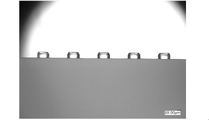
- FIG. 1 is a view showing a photograph of a cured film after photolithography using the composition of Example 1, observed with a microscope from the end face direction.
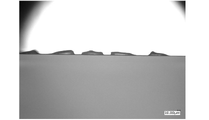
- FIG. 2 is a view showing a photograph of a cured film after photolithography using the composition of Comparative Example 2, observed with a microscope from the end face direction.
- composition for forming an optical waveguide of the present invention comprises a fluorene skeleton-containing epoxy compound (A), a monofunctional or bifunctional alicyclic epoxy compound (B), and a monofunctional or bifunctional compound different from the compound (A). and an aromatic epoxy compound (C) and a photoacid generator (D).
- the above epoxy compounds (A) to (C) and other epoxy compounds described later are referred to as "resin component", and "monofunctional or difunctional” means epoxy as a functional group. It is meant to contain one or two groups.
- the fluorene skeleton-containing epoxy compound (A) used in the present invention is a compound represented by the following formula [1].
- L 1 and L 2 each independently represent a naphthalenediyl group which may have a substituent, and m and n each independently represent an integer of 0 to 10. show.
- the substituent of the naphthalenediyl group (on the naphthalene ring) in L 1 and L 2 is an alkyl group having 1 to 6 carbon atoms such as methyl group, ethyl group, propyl group, isopropyl group, butyl group and t-butyl group. etc.
- the number of substituents of the naphthalenediyl group in L 1 and L 2 is each independently 0 to 6, preferably 0 to 2, more preferably 0 or 1, and most preferably 0. .
- the types of substituents in L 1 and L 2 may be the same or different. When the same naphthalene ring has two or more substituents, they may be the same or different.
- the fluorene skeleton-containing epoxy compound (A) is preferably a compound represented by the following formula [3].
- a commercially available product can be used as the fluorene skeleton-containing epoxy compound (A).
- examples thereof include Ogsol (registered trademark) CG-500 and Ogsol EG-280 (manufactured by Osaka Gas Chemicals Co., Ltd.).
- Ogsol registered trademark
- CG-500 manufactured by Osaka Gas Chemicals Co., Ltd.
- Such epoxy compounds containing a fluorene skeleton having a naphthalene ring can be used alone or in combination of two or more.
- CG-500 can be used alone.
- the fluorene skeleton-containing epoxy compound (A) is preferably contained in a proportion of, for example, 5 parts by mass to 50 parts by mass, more preferably 10 parts by mass to the total amount of epoxy compounds (100 parts by mass in total). 40 parts by mass. If the amount of the fluorene skeleton-containing epoxy compound (A) is too small, it will be difficult to obtain a sufficient refractive index.
- the monofunctional or bifunctional alicyclic epoxy compound (B) used in the present invention is not particularly limited as long as it is a compound having one or two alicyclic epoxy groups.
- the alicyclic epoxy compound (B) is in a liquid form, and from the viewpoint of patterning properties (exposure sensitivity), a compound having two epoxy groups introduced into the alicyclic skeleton can be mentioned. can.
- Examples of the alicyclic epoxy compound (B) include compounds represented by the following formula [2].
- R 1 and R 2 are each independently a hydrogen atom, a linear or branched alkyl group having 1 to 6 carbon atoms which may have an ester group or an ether group, or carbon represents a cyclic alkyl group having 3 to 6 atoms, or a combination of the linear or branched alkyl group and the cyclic alkyl group, wherein the linear alkyl group having 2 or more carbon atoms, the linear alkyl group having 3 or more carbon atoms, The branched-chain alkyl group or the cyclic alkyl group may form an epoxy ring together with adjacent carbon atoms, or R 1 and R 2 are bonded to each other and have 4 to 6 carbon atoms. It may form a ring, and at this time, together with adjacent carbon atoms constituting the ring, it may form an epoxy ring.
- linear or branched alkyl group having 1 to 6 carbon atoms examples include methyl group, ethyl group, n-propyl group, isopropyl group, n-butyl group, isobutyl group, sec-butyl group, tert-butyl group, n-pentyl group, 1-methylbutyl group, 2-methylbutyl group, 3-methylbutyl group, 1,1-dimethylpropyl group, 1,2-dimethylpropyl group, 2,2-dimethylpropyl group, 1-ethylpropyl group, n-hexyl group, 1-methylpentyl group, 2-methylpentyl group, 3-methylpentyl group, 4-methylpentyl group, 1,1-dimethylbutyl group, 1,2-dimethylbutyl group, 1,3-dimethyl butyl group, 2,2-dimethylbutyl group, 2,3-dimethylbutyl group, 3,3-dimethylbutyl group, 1-
- examples of the alicyclic epoxy compound (B) include compounds represented by the following formulas [4], [5], and [6]. These compounds have a low molecular weight and are liquid compounds, and are suitable not only from the viewpoint of patterning properties but also from the viewpoint of adjusting the viscosity of the composition.
- a commercially available product can be used as the alicyclic epoxy compound (B).
- the bifunctional alicyclic epoxy compound (B) include diepoxybicyclohexyl (eg, Celloxide (registered trademark) 8000 and 8010 manufactured by Daicel Corporation), 3,4-epoxycyclohexylmethyl-3′, 4′-epoxycyclohexene carboxylate (for example, Celoxide (registered trademark) 2021P manufactured by Daicel Corporation), epsilon-caprolactone-modified 3,4-epoxycyclohexylmethyl 3′,4′ epoxycyclohexane carboxylate (for example, Daicel Corporation ), Celoxide (registered trademark) 2081), bis (3,4-epoxycyclohexylmethyl) adipate, diepoxidized tetrahydroindene (for example, ENEOS Co., Ltd., Epocalic (registered trademark) THI-DE), etc.
- monofunctional alicyclic epoxy compounds include 3,4-epoxycyclohexylmethyl methacrylate (eg, Cychromer (registered trademark) M-100 manufactured by Daicel Corporation), 3,4-epoxycyclohexylmethyl methacrylate, 1,2-epoxy-4-vinylcyclohexane (for example, Daicel Corporation, Celoxide (registered trademark) 2000), 1,2,8,9-diepoxylimonene (for example, Daicel Corporation, Celoxide (registered trademark) Trademark) 3000) and the like can be used.
- 3,4-epoxycyclohexylmethyl methacrylate eg, Cychromer (registered trademark) M-100 manufactured by Daicel Corporation
- 3,4-epoxycyclohexylmethyl methacrylate 1,2-epoxy-4-vinylcyclohexane (for example, Daicel Corporation, Celoxide (registered trademark) 2000), 1,2,8,9-diepoxylimonene
- the alicyclic epoxy compound (B) is preferably contained in an amount of, for example, 10 parts by mass to 80 parts by mass, more preferably 20 parts by mass to 70 parts by mass, based on the total amount of epoxy compounds (100 parts by mass in total). . If the amount of the alicyclic epoxy compound (B) is too small, it will be difficult to obtain sufficient patterning properties, and if it is too large, it will be difficult to obtain a sufficient refractive index.
- the present invention also includes a monofunctional or difunctional aromatic epoxy compound (C) different from the epoxy compound (A).
- the aromatic epoxy compound (C) is preferably a compound having two epoxy groups.
- an epoxy compound having a bisphenol A-type skeleton or a bisphenol F-type skeleton is preferable.
- Aromatic epoxy compound (C) can use a commercial item.
- Examples of the bifunctional aromatic epoxy compound (C) include jER (registered trademark) 806 manufactured by Mitsubishi Chemical Corporation, which is a bisphenol F type epoxy compound, and jER manufactured by Mitsubishi Chemical Corporation, which is a bisphenol A type epoxy compound. (registered trademark) 828 can be mentioned.
- the monofunctional aromatic epoxy compound (C) phenyl glycidyl ether (eg, Denacol (registered trademark) EX-141 manufactured by Nagase ChemteX Corporation), phenol (EO) 5 glycidyl ether (eg, Nagase ChemteX Co., Ltd.) Ltd., Denacol (registered trademark) EX-145), p-tert-butylphenyl glycidyl ether (eg, Nagase ChemteX Corporation, Denacol (registered trademark) EX-146), and the like.
- phenyl glycidyl ether eg, Denacol (registered trademark) EX-141 manufactured by Nagase ChemteX Corporation
- phenol (EO) 5 glycidyl ether eg, Nagase ChemteX Co., Ltd.
- the aromatic epoxy compound (C) is preferably contained, for example, in an amount of 5 to 60 parts by mass, more preferably 10 to 50 parts by mass, relative to the total amount (100 parts by mass) of the epoxy compound. If the blending amount of the aromatic epoxy compound (C) is too small, it will be difficult to obtain a sufficient refractive index and a uniform film.
- the optical waveguide-forming composition of the present invention may contain other epoxy compounds other than the epoxy compounds (A) to (C) as long as the effects of the present invention are not impaired.
- examples thereof include heterocyclic epoxy compounds such as triglycidyl isocyanurate and aliphatic epoxy compounds.
- Specific examples of the above aliphatic epoxy compounds include monofunctional epoxy compounds such as glycidyl ether of aliphatic alcohols and glycidyl esters of alkylcarboxylic acids, and polyglycidyl ethers of aliphatic polyhydric alcohols or their alkylene oxide adducts. mentioned.
- Representative specific compounds thereof include allyl glycidyl ether; glycidyl ethers of monoalcohols such as butyl glycidyl ether, 2-ethylhexyl glycidyl ether, C12-13 mixed alcohol glycidyl ether; 1,4-butanediol diglycidyl ether; ,6-hexanediol diglycidyl ether, triglycidyl ether of glycerin, triglycidyl ether of trimethylolpropane, tetraglycidyl ether of sorbitol, hexaglycidyl ether of dipentaerythritol, diglycidyl ether of polyethylene glycol, diglycidyl ether of polypropylene glycol.
- monoalcohols such as butyl glycidyl ether, 2-ethylhexyl glycidyl
- polyether polyols which are one or more alkylene oxide adducts of aliphatic polyhydric alcohols such as propylene glycol, trimethylolpropane, and glycerin.
- These other epoxy compounds can be contained, for example, at a ratio of 0 to 20 parts by mass with respect to the total amount of epoxy compounds (100 parts by mass).
- the composition for forming an optical waveguide of the present invention contains a photoacid generator (D).
- a photoacid generator (D) include onium salts such as iodonium salts, sulfonium salts, phosphonium salts, selenium salts, metallocene complex compounds, iron arene complex compounds, disulfone compounds, sulfonic acid derivative compounds, and triazine compounds. , acetophenone derivative compounds, diazomethane compounds, and the like.
- iodonium salts include, for example, diphenyliodonium, 4,4′-dichlorodiphenyliodonium, 4,4′-dimethoxydiphenyliodonium, 4,4′-di-tert-butyldiphenyliodonium, 4-methyl Phenyl (4-(2-methylpropyl) phenyl) iodonium, 3,3′-dinitrophenyl iodonium, 4-(1-ethoxycarbonylethoxy) phenyl (2,4,6-trimethylphenyl) iodonium, 4-methoxyphenyl ( Diaryliodonium such as chloride, bromide, mesylate, tosylate, trifluoromethanesulfonate, tetrafluoroborate, tetrakis(pentafluorophenyl)borate, hexafluorophosphate, hexafluoroarsen
- sulfonium salts include triphenylsulfonium, diphenyl(4-tert-butylphenyl)sulfonium, tris(4-tert-butylphenyl)sulfonium, diphenyl(4-methoxyphenyl)sulfonium, tris(4-methylphenyl) chloride of triarylsulfonium such as sulfonium, tris(4-methoxyphenyl)sulfonium, tris(4-ethoxyphenyl)sulfonium, diphenyl(4-(phenylthio)phenyl)sulfonium, tris(4-(phenylthio)phenyl)sulfonium; triarylsulfonium salts such as bromide, trifluoromethanesulfonate, tetrafluoroborate, hexafluorophosphate, hexafluoroarsenate
- Examples of the phosphonium salts include triarylphosphonium such as tetraphenylphosphonium, ethyltriphenylphosphonium, tetra(p-methoxyphenyl)phosphonium, ethyltri(p-methoxyphenyl)phosphonium, and benzyltriphenylphosphonium, or tetraarylphosphonium, Aryl phosphonium salts such as chloride, bromide, tetrafluoroborate, hexafluorophosphate, hexafluoroantimonate and the like.
- selenium salts examples include triarylselenium salts such as triphenylselenium hexafluorophosphate.
- iron arene complex compounds include bis( ⁇ 5-cyclopentadienyl)( ⁇ 6-isopropylbenzene)iron(II) hexafluorophosphate and the like.
- iodonium salts sulfonium salts, and the like can be suitably used as photoacid generators.
- Commercial products can be used as these, and examples thereof include triarylsulfonium salts such as CPI-310FG and CPI-101A.
- photoacid generators (D) can be used alone or in combination of two or more.
- the photoacid generator (D) is usually contained in an amount of, for example, 0.1 to 10 parts by mass, preferably 0.1 to 10 parts by mass, with respect to 100 parts by mass of the total mass of the epoxy compound (resin component). 2 parts by mass to 5 parts by mass. If the amount of the photoacid generator (D) is less than 0.1 parts by mass, the photocuring reaction may not proceed sufficiently. On the other hand, when the amount exceeds 10 parts by mass, the degree of polymerization of the polymer is lowered, and there is a possibility that the polymer is brittle and cracks are likely to occur.
- the composition for forming an optical waveguide of the present invention may contain an organic solvent.
- an organic solvent When the prepared composition has a low viscosity, it is not necessary to add an organic solvent, and good film formation is possible. It is also advantageous in that it does not require a process to In addition, by not containing an organic solvent, concerns such as health hazards due to inhalation by workers and corrosion of peripheral equipment, which may occur when the organic solvent evaporates, are remarkably reduced. Since the composition for forming an optical waveguide of the present invention has a relatively low viscosity, it is not essential to add an organic solvent. It can be added in any proportion.
- the organic solvent that can be used in the present invention is not particularly limited as long as it is a commonly used organic solvent in the technical field.
- a solvent it is desirable to refrain from using it because it may cause generation of precipitates, phase separation, and the like. Also, if a large amount of organic solvent is added, there is a possibility that a sufficient film thickness cannot be secured during film formation, so care must be taken.
- the optical waveguide-forming composition of the present invention may contain other additives commonly used in the technical field as long as the effects of the present invention are not impaired.
- Other additives include, for example, antireflection agents, ultraviolet absorbers, antioxidants, light stabilizers, sensitizers, surfactants, cross-linking agents, leveling agents, silane coupling agents and the like. When these other additives are used, they can be blended at a ratio of 10 parts by mass or less to 100 parts by mass of the total mass of the epoxy compound (resin component).
- composition for forming an optical waveguide of the present invention can be suitably used as a material for forming an optical waveguide, and in particular can be suitably used as a material for forming a clad layer of an optical waveguide.
- the method for preparing the optical waveguide forming composition of the present embodiment is not particularly limited. As a preparation method, for example, (A) component, (B) component, (C) component and (D) component, and if necessary, other epoxy compounds and other additives are further added and mixed to obtain a uniform solution or a method of using a conventional organic solvent in addition to these components.
- the blending amount of each component is, for example, when the total mass of the epoxy compounds is 100 parts by mass, 10 to 40 parts by mass of the fluorene skeleton-containing epoxy compound (A), and 10 to 40 parts by mass of the alicyclic 20 to 70 parts by mass of the epoxy compound (B), 10 to 50 parts by mass of the aromatic epoxy compound (C), and 0 to 20 parts by mass of the other epoxy compound, and the epoxy compound (resin (Components) can be 0.2 to 5 parts by mass of the photoacid generator (D) and 0 to 10 parts by mass of the other additives per 100 parts by mass of the total mass of the components).
- the proportion of solids in the optical waveguide-forming composition is not particularly limited as long as each component is uniformly dissolved in the organic solvent. Or it is 70% by mass or more. Preferably, the proportion of solids in the composition can be, for example, 75% to 100% by weight.
- the solid content is the total components of the optical waveguide-forming composition excluding the organic solvent component.
- the optical waveguide-forming composition after filtering using a filter having a pore size of 0.05 to 5 ⁇ m.
- the composition for forming an optical waveguide of the present invention preferably has a viscosity that is excellent in workability in forming an optical waveguide.
- the viscosity of the optical waveguide-forming composition can be 100 to 10,000 mPa ⁇ s at 25°C.
- the optical waveguide of the present invention includes a cured product of the optical waveguide-forming composition, and preferably includes a clad layer made of the cured optical waveguide-forming composition.
- the optical waveguide of the present invention is an optical waveguide comprising a core and a clad layer surrounding the entire outer periphery thereof and having a smaller refractive index than the core, wherein the clad layer is the optical waveguide-forming composition.
- the core may be made of a material having a higher refractive index than the formed clad layer.
- the optical waveguide of the present invention is a graded index (GI) type in which the refractive index of the core changes continuously in the radial direction, and a multi-step type in which the refractive index of the core changes stepwise in the radial direction. It may be either an index (MI) type or a step index (SI) type in which the refractive index changes discontinuously only at the interface between the core and the clad.
- GI graded index
- MI index
- SI step index
- CG-500 Ogsol (registered trademark) CG-500, manufactured by Osaka Gas Chemicals Co., Ltd.
- PG-100 Ogsol (registered trademark) PG-100, manufactured by Osaka Gas Chemicals Co., Ltd.
- CEL-8010 Celoxide (registered trademark) 8010, manufactured by Daicel Corporation THI-DE: Epocalic (registered trademark) THI-DE, manufactured by ENEOS Corporation
- CEL-2021P Celoxide (registered trademark) 2021P (3′, 4′) -epoxycyclohexylmethyl 3,4-epoxycyclohexanecarboxylate), manufactured by Daicel Corporation
- jER806 jER (registered trademark) bisphenol F type epoxy resin, manufactured by Mitsubishi Chemical Corporation jER828: jER (registered trademark) bisphenol A type epoxy resin, manufactured by Mitsubishi Chemical Corporation [bifunctional other epoxy compounds]
- YX-8000 hydrogenated bisphenol A type epoxy resin, manufactured by Mitsubishi Chemical Corporation [Monofunctional alicyclic epoxy compound]
- M-100 Cychromer (registered trademark) M-100 (3,4-epoxycyclohexylmethyl methacrylate
- Examples 1 to 5 Comparative Examples 1 to 7
- various epoxy compounds, a photoacid generator for the epoxy compound (100 parts by mass), and optionally an organic solvent are placed in a flask, and stirred under heating at 110° C. or less to solidify. The ingredients were completely dissolved. After cooling this to room temperature, it was pressurized and filtered using a 3 ⁇ m diameter SUS filter in a clean room to prepare each liquid composition.
- a 4 inch diameter round silicon wafer substrate was cleaned with a UV/ozone irradiator.
- the composition was dropped on the substrate after cleaning, and a film was formed by spin coating so as to have a thickness of 20 ⁇ m.
- the resulting film was subjected to photolithography to obtain a patterned cured film.
- the film formed above was subjected to mask exposure, and only the light-irradiated portion was exposed.
- the film was baked at 60° C. for 1 minute, and then developed with an organic solvent using PGMEA/IPA (2-propanol) (50/50 vol/vol %) for 3 minutes. Finally, a patterned cured film was obtained by post-baking at 100° C. for 2 minutes.
- the film formation properties during spin coating, the patterning properties of the cured film, the refractive index of the composition, and the storage stability of the composition were evaluated according to the following procedure.
- each composition of Examples 1 to 5 has excellent film-forming properties, and as also shown in FIG. A result was obtained that it has a high yield and is excellent in storage stability.
Landscapes
- Chemical & Material Sciences (AREA)
- Health & Medical Sciences (AREA)
- Chemical Kinetics & Catalysis (AREA)
- Medicinal Chemistry (AREA)
- Polymers & Plastics (AREA)
- Organic Chemistry (AREA)
- Physics & Mathematics (AREA)
- General Physics & Mathematics (AREA)
- Optics & Photonics (AREA)
- Engineering & Computer Science (AREA)
- Microelectronics & Electronic Packaging (AREA)
- Epoxy Resins (AREA)
Priority Applications (5)
| Application Number | Priority Date | Filing Date | Title |
|---|---|---|---|
| US18/575,497 US20240317928A1 (en) | 2021-06-30 | 2022-06-28 | Composition for forming optical waveguide |
| JP2023531979A JP7862778B2 (ja) | 2021-06-30 | 2022-06-28 | 光導波路形成用組成物 |
| CN202280046237.6A CN117581131A (zh) | 2021-06-30 | 2022-06-28 | 光波导形成用组合物 |
| EP22833163.3A EP4365646A4 (en) | 2021-06-30 | 2022-06-28 | COMPOSITION FOR THE FORMATION OF AN OPTICAL WAVEGUIDE |
| KR1020237044003A KR20240026933A (ko) | 2021-06-30 | 2022-06-28 | 광도파로 형성용 조성물 |
Applications Claiming Priority (2)
| Application Number | Priority Date | Filing Date | Title |
|---|---|---|---|
| JP2021-109192 | 2021-06-30 | ||
| JP2021109192 | 2021-06-30 |
Publications (1)
| Publication Number | Publication Date |
|---|---|
| WO2023277016A1 true WO2023277016A1 (ja) | 2023-01-05 |
Family
ID=84689981
Family Applications (1)
| Application Number | Title | Priority Date | Filing Date |
|---|---|---|---|
| PCT/JP2022/025764 Ceased WO2023277016A1 (ja) | 2021-06-30 | 2022-06-28 | 光導波路形成用組成物 |
Country Status (6)
| Country | Link |
|---|---|
| US (1) | US20240317928A1 (cg-RX-API-DMAC7.html) |
| EP (1) | EP4365646A4 (cg-RX-API-DMAC7.html) |
| JP (1) | JP7862778B2 (cg-RX-API-DMAC7.html) |
| KR (1) | KR20240026933A (cg-RX-API-DMAC7.html) |
| CN (1) | CN117581131A (cg-RX-API-DMAC7.html) |
| WO (1) | WO2023277016A1 (cg-RX-API-DMAC7.html) |
Cited By (2)
| Publication number | Priority date | Publication date | Assignee | Title |
|---|---|---|---|---|
| WO2024090531A1 (ja) * | 2022-10-28 | 2024-05-02 | 日産化学株式会社 | カチオン硬化性組成物 |
| WO2025047282A1 (ja) * | 2023-08-31 | 2025-03-06 | 日産化学株式会社 | 光導波路及び光導波路の製造方法 |
Citations (7)
| Publication number | Priority date | Publication date | Assignee | Title |
|---|---|---|---|---|
| JP2012102228A (ja) * | 2010-11-10 | 2012-05-31 | Osaka Gas Chem Kk | フルオレン骨格を有するエポキシ樹脂組成物およびその硬化物 |
| WO2013047524A1 (ja) * | 2011-09-27 | 2013-04-04 | 丸善石油化学株式会社 | 光学素子材料、及びその製造方法 |
| JP2019065175A (ja) * | 2017-09-29 | 2019-04-25 | 東京応化工業株式会社 | 硬化性組成物、硬化膜、及び硬化物の製造方法 |
| CN110066391A (zh) * | 2018-01-24 | 2019-07-30 | 常州强力先端电子材料有限公司 | 改性感光树脂及其应用 |
| JP2019172846A (ja) * | 2018-03-28 | 2019-10-10 | 日産化学株式会社 | 重合体及びそれを含む樹脂組成物 |
| JP2020020927A (ja) | 2018-07-31 | 2020-02-06 | 日東電工株式会社 | 光導波路形成用感光性エポキシ樹脂組成物、光導波路形成用感光性フィルムおよびそれを用いた光導波路、光・電気伝送用混載フレキシブルプリント配線板 |
| JP2020094095A (ja) * | 2018-12-11 | 2020-06-18 | 日東電工株式会社 | 光導波路用エポキシ樹脂感光性組成物、光導波路用感光性フィルム、光導波路、および、光電気混載基板 |
Family Cites Families (2)
| Publication number | Priority date | Publication date | Assignee | Title |
|---|---|---|---|---|
| JP6830808B2 (ja) * | 2016-12-21 | 2021-02-17 | 日東電工株式会社 | 光導波路形成用感光性エポキシ樹脂組成物、光導波路形成用硬化性フィルムおよびそれを用いた光導波路、光・電気伝送用混載フレキシブルプリント配線板 |
| JP7557262B2 (ja) * | 2019-09-02 | 2024-09-27 | 味の素株式会社 | 感光性樹脂組成物 |
-
2022
- 2022-06-28 KR KR1020237044003A patent/KR20240026933A/ko active Pending
- 2022-06-28 WO PCT/JP2022/025764 patent/WO2023277016A1/ja not_active Ceased
- 2022-06-28 US US18/575,497 patent/US20240317928A1/en active Pending
- 2022-06-28 CN CN202280046237.6A patent/CN117581131A/zh active Pending
- 2022-06-28 JP JP2023531979A patent/JP7862778B2/ja active Active
- 2022-06-28 EP EP22833163.3A patent/EP4365646A4/en active Pending
Patent Citations (7)
| Publication number | Priority date | Publication date | Assignee | Title |
|---|---|---|---|---|
| JP2012102228A (ja) * | 2010-11-10 | 2012-05-31 | Osaka Gas Chem Kk | フルオレン骨格を有するエポキシ樹脂組成物およびその硬化物 |
| WO2013047524A1 (ja) * | 2011-09-27 | 2013-04-04 | 丸善石油化学株式会社 | 光学素子材料、及びその製造方法 |
| JP2019065175A (ja) * | 2017-09-29 | 2019-04-25 | 東京応化工業株式会社 | 硬化性組成物、硬化膜、及び硬化物の製造方法 |
| CN110066391A (zh) * | 2018-01-24 | 2019-07-30 | 常州强力先端电子材料有限公司 | 改性感光树脂及其应用 |
| JP2019172846A (ja) * | 2018-03-28 | 2019-10-10 | 日産化学株式会社 | 重合体及びそれを含む樹脂組成物 |
| JP2020020927A (ja) | 2018-07-31 | 2020-02-06 | 日東電工株式会社 | 光導波路形成用感光性エポキシ樹脂組成物、光導波路形成用感光性フィルムおよびそれを用いた光導波路、光・電気伝送用混載フレキシブルプリント配線板 |
| JP2020094095A (ja) * | 2018-12-11 | 2020-06-18 | 日東電工株式会社 | 光導波路用エポキシ樹脂感光性組成物、光導波路用感光性フィルム、光導波路、および、光電気混載基板 |
Non-Patent Citations (1)
| Title |
|---|
| See also references of EP4365646A4 |
Cited By (2)
| Publication number | Priority date | Publication date | Assignee | Title |
|---|---|---|---|---|
| WO2024090531A1 (ja) * | 2022-10-28 | 2024-05-02 | 日産化学株式会社 | カチオン硬化性組成物 |
| WO2025047282A1 (ja) * | 2023-08-31 | 2025-03-06 | 日産化学株式会社 | 光導波路及び光導波路の製造方法 |
Also Published As
| Publication number | Publication date |
|---|---|
| EP4365646A4 (en) | 2025-05-21 |
| TW202311338A (zh) | 2023-03-16 |
| JP7862778B2 (ja) | 2026-05-20 |
| EP4365646A1 (en) | 2024-05-08 |
| CN117581131A (zh) | 2024-02-20 |
| US20240317928A1 (en) | 2024-09-26 |
| KR20240026933A (ko) | 2024-02-29 |
| JPWO2023277016A1 (cg-RX-API-DMAC7.html) | 2023-01-05 |
Similar Documents
| Publication | Publication Date | Title |
|---|---|---|
| KR101821573B1 (ko) | 장쇄 알킬렌기 함유하는 경화성 에폭시 수지 조성물 | |
| US8409715B2 (en) | Cation-polymerizable resin composition containing multi-branched polyether polyol, adhesive agent comprising the composition, and laminate and polarizing plate using the adhesive agent | |
| KR101258036B1 (ko) | 광 도파로 및 그의 제조방법 | |
| TW201038609A (en) | Optical waveguide-forming epoxy resin composition, optical waveguide-forming curable film, optical-transmitting flexible printed circuit, and electronic information device | |
| WO2008044618A1 (en) | Curable resin composition, optical material, and method of regulating optical material | |
| JP7862778B2 (ja) | 光導波路形成用組成物 | |
| JP6931199B2 (ja) | 長鎖アルキレン基含有エポキシ樹脂組成物 | |
| TWI743055B (zh) | 多官能環氧化合物及含有其之硬化性組合物 | |
| JP2002071987A (ja) | 光導波路の作製方法 | |
| JP5102671B2 (ja) | 硬化性樹脂組成物、その硬化物、光学部材及び光学ユニット | |
| TWI688561B (zh) | 高溶解性參-(2,3-環氧基丙基)-三聚異氰酸酯及製造方法 | |
| TWI691785B (zh) | 光波導用感光性樹脂組成物及光波導芯層形成用光硬化性薄膜、以及使用其之光波導、光電傳輸用混合撓性印刷配線板 | |
| JPWO2023277016A5 (cg-RX-API-DMAC7.html) | ||
| JP5448358B2 (ja) | 樹脂組成物、光学材料、及び、光学部材 | |
| KR20010050159A (ko) | 캐스팅용 에폭시 수지 조성물 | |
| WO2022014552A1 (ja) | 組成物、硬化物及び硬化物の製造方法 | |
| JP2020094095A (ja) | 光導波路用エポキシ樹脂感光性組成物、光導波路用感光性フィルム、光導波路、および、光電気混載基板 | |
| JP2017165705A (ja) | エポキシ化合物、硬化性組成物、硬化物、エポキシ化合物の製造方法および反応性希釈剤 | |
| TW201623453A (zh) | 光學零件用樹脂組成物 | |
| WO2024095904A1 (ja) | 光学結像装置用接着剤、樹脂硬化物、光学素子および光学結像装置 | |
| WO2024090531A1 (ja) | カチオン硬化性組成物 | |
| WO2025142521A1 (ja) | カチオン硬化性組成物 | |
| JP2020083954A (ja) | ジエポキシ化合物、これを含む硬化性組成物および硬化性組成物を硬化させた硬化物 | |
| JP2021084986A (ja) | 光硬化性樹脂組成物 | |
| JP2007163571A (ja) | 光導波路用感光性樹脂組成物および光導波路 |
Legal Events
| Date | Code | Title | Description |
|---|---|---|---|
| 121 | Ep: the epo has been informed by wipo that ep was designated in this application |
Ref document number: 22833163 Country of ref document: EP Kind code of ref document: A1 |
|
| WWE | Wipo information: entry into national phase |
Ref document number: 2023531979 Country of ref document: JP |
|
| WWE | Wipo information: entry into national phase |
Ref document number: 202280046237.6 Country of ref document: CN |
|
| WWE | Wipo information: entry into national phase |
Ref document number: 18575497 Country of ref document: US |
|
| WWE | Wipo information: entry into national phase |
Ref document number: 2022833163 Country of ref document: EP |
|
| NENP | Non-entry into the national phase |
Ref country code: DE |
|
| ENP | Entry into the national phase |
Ref document number: 2022833163 Country of ref document: EP Effective date: 20240130 |