WO2023188067A1 - エレベータの脱レール検出システム - Google Patents
エレベータの脱レール検出システム Download PDFInfo
- Publication number
- WO2023188067A1 WO2023188067A1 PCT/JP2022/015832 JP2022015832W WO2023188067A1 WO 2023188067 A1 WO2023188067 A1 WO 2023188067A1 JP 2022015832 W JP2022015832 W JP 2022015832W WO 2023188067 A1 WO2023188067 A1 WO 2023188067A1
- Authority
- WO
- WIPO (PCT)
- Prior art keywords
- distance
- counterweight
- rail
- elevator
- hoistway
- Prior art date
- Legal status (The legal status is an assumption and is not a legal conclusion. Google has not performed a legal analysis and makes no representation as to the accuracy of the status listed.)
- Ceased
Links
Images



Classifications
-
- B—PERFORMING OPERATIONS; TRANSPORTING
- B66—HOISTING; LIFTING; HAULING
- B66B—ELEVATORS; ESCALATORS OR MOVING WALKWAYS
- B66B5/00—Applications of checking, fault-correcting, or safety devices in elevators
- B66B5/02—Applications of checking, fault-correcting, or safety devices in elevators responsive to abnormal operating conditions
Definitions
- the present disclosure relates to an elevator off-rail detection system that detects when an elevator counterweight has come off the rail due to an earthquake or the like.
- a conventional elevator off-rail detection system uses a photoelectric sensor to measure the distance to a detected object at the lower end of a wire suspended parallel to the counterweight rail.
- the method of detecting off-rails using a photoelectric sensor detects that when the counterweight comes off and the wire is pulled, the distance to the object to be detected connected to the lower end of the wire changes (for example, Patent Document 1).
- the present disclosure has been made in order to solve the above-mentioned problems, and there is a possibility of interference with lifting objects such as cars and counterweights moving in the hoistway, and there is a possibility of interference with lifting objects such as cars and counterweights that move in the hoistway, and parallel to the rail of the counterweight.
- An elevator off-rail detection system includes a counterweight that moves up and down along a rail installed in an elevator hoistway, and a counterweight that is installed on the counterweight and that is connected between a wall surface of the hoistway and the counterweight.
- the distance measuring means detects at least one of the distance and the distance between the rail and the counterweight, and the distance determining means outputs a distance detection signal based on the distance transmitted from the distance measuring means.
- the distance determining means outputs ON as a distance detection signal when the distance is a first distance or more and less than a second distance larger than the first distance, and when the distance is less than the first distance or more than a second distance, It is characterized by outputting OFF as a distance detection signal.
- FIG. 1 is an overall configuration diagram of a general elevator.
- FIG. 3 is a view of a counterweight viewed from the upper side of the hoisting path of the elevator in Embodiment 1.
- 1 is a block diagram of an elevator derailment detection system in Embodiment 1.
- FIG. 2 is a flowchart of the elevator derailment detection system in the first embodiment.
- FIG. 3 is a configuration diagram in which the height of the counterweight from the bottom of the hoistway and the wall distance in the first embodiment are stored.
- FIG. 1 is an overall configuration diagram of a general elevator.
- the elevator includes a car 1, a main rope 2, a counterweight 3, a hoist 4, a rotation detector 5, a control panel 7, and a communication cable 8.
- a main rope 2 is connected to the upper end of the car 1, and a counterweight 3 is connected to the other end of the main rope 2.
- the hoist 4 is installed in the middle of the main rope 2 so that the car 1 and the counterweight 3 move up and down in opposite directions.
- the counterweight 3 moves along the hoistway wall 12 of the hoistway.
- the hoistway wall 12 is defined as a wall surface of the hoistway.
- the control panel 7 drives the hoisting machine 4 to control the raising and lowering of the car 1, and also controls the movement of the car 1 and the counterweight 3 based on a signal from a rotation detector 5 attached to the rotating shaft of the hoisting machine 4. Calculate the position (height) from the bottom of the hoistway in the hoistway.
- the control panel 7 receives signals from devices installed on the counterweight 3 via a communication cable 8.
- FIG. 2 is a view of the counterweight viewed from the upper side of the hoistway of the elevator according to the first embodiment.
- the counterweight 3 moves up and down in the hoistway along the rails 13, 13a. Further, the counterweight 3 includes distance measuring means 21 and 21a.
- the distance measuring means 21 measures the left wall surface distance (D1 in FIG. 2), which is the distance to the hoistway wall 12, and the left rail distance (L1 in FIG. 2), which is the distance to the rail 13, and connects the communication cable 8. The left wall distance and left rail distance are sent to the control panel 7 via.
- the distance measuring means 21a measures the right wall surface distance (D2 in FIG. 2), which is the distance to the hoistway wall 12, and the right rail distance (L2 in FIG. 2), which is the distance to the rail 13a. The right wall distance and the right rail distance are transmitted to the control panel 7 via the communication cable 8.
- a distance measuring means 21, 21a a distance meter, such as a laser distance meter or an ultrasonic distance meter, is used, which utilizes the time it takes for light, sound, etc. to reflect from an object and return.
- the distance measuring means 21 and 21a are shown installed at the top of the counterweight 3, they may be installed at the bottom of the counterweight 3, or at two locations on the top and two locations on the bottom of the counterweight 3. They may be installed at different locations.
- FIG. 3 is a block diagram of the elevator derailment detection system according to the first embodiment.
- the control panel 7 of the elevator derailment detection system includes an I/F means 31, a CPU 32, a storage means 33, and an elevation control means 34.
- the I/F means 31 of the control panel 7 receives the left wall distance, right wall distance, left rail distance, and right rail distance transmitted from the distance measuring means 21 and 21a installed on the counterweight 3, and The received distance information of each distance is transmitted to the CPU 32.
- the CPU 32 receives a rotation detection signal from the rotation detector 5 attached to the hoisting machine 4 via the lift control means 34, and determines the height of the counterweight 3 from the floor of the hoistway. calculate.
- the CPU 32 receives the distance information from the distance measuring means 21, 21a and the rotation detection signal from the rotation detector 5 via the elevation control means 34, and detects when the counterweight 3 comes off the rails 13, 13a. Determine whether or not.
- the CPU 32 has a function of distance determining means.
- the storage means 33 stores the control program for the CPU section 32, the data of control calculations, and the values that associate the height of the counterweight with the determination value of the distance information.
- the storage means 32 may be any means that can store data and read the stored data, such as SRAM (Static Random Access Memory) or EEPROM (Electrically Erasable Programmable Read Only Memory). .
- the lift control means 34 receives a signal transmitted from the CPU 32 and operates and stops the car 1.
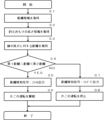
- FIG. 4 is a flowchart of the elevator derailment detection system according to the first embodiment.
- FIG. 5 is a configuration diagram in which the height of the counterweight of the rail derailment detection system and the first distance and second distance between the wall and the rail are stored.
- step S1 the CPU 32 of the elevator control panel 7 receives the left wall distance, right wall distance, left rail distance, and right rail distance transmitted from the distance measuring means 21 and 21a.
- step S2 the CPU 32 receives a rotation detection signal from the rotation detector 5 attached to the hoisting machine 4 via the lift control means 34, and adjusts the balance of the counterweight 3 from the floor in the hoistway. Calculate the weight height.
- step S3 the CPU 32 controls the first and second left wall distances, the first and second right wall distances, and the first and second left rail distances associated with the height of the counterweight 3.
- the first distance, the second distance, and the first distance and the second distance of the right rail distance are read from the storage means 33.
- FIG. 5 a configuration diagram in which the height of the counterweight 3 of the rail derailment detection system, distance information to the hoistway wall 12, and distance information to the rail are stored will be described using FIG.
- the first distance and the second distance of the left wall surface distance are stored in the storage means 33 as 240 mm and 260 mm, respectively.
- the first distance and the second distance of the right wall surface distance are stored in the storage means 33 as 490 mm and 510 mm, respectively.
- the first distance and the second distance of the left rail distance are stored in the storage means 33 as 90 mm and 110 mm, respectively.
- the first distance and the second distance of the right rail distance are stored in the storage means 33 as 100 mm and 120 mm, respectively.
- the difference between the left wall surface distance and the right wall surface distance depends on the case where the shaft wall 12 of the shaft has irregularities or a building beam protrudes.
- the difference between the left rail distance and the right rail distance is due to the unevenness of the rail clip used when fixing the device to the rail 13 via the mounting arm.
- the counterweight height may be set in 100 mm steps over the entire length of the hoistway.
- the left wall distance, right wall distance, left rail distance, and right rail distance with respect to the height of the counterweight are set in advance using information on the structure of the building where elevator car 1 is installed, the hoistway, etc.
- the left wall distance, right wall distance, left rail distance, and right rail distance with respect to the height of the counterweight may be determined.
- the first distance and the second distance may be stored in the storage means 33.
- step S4 the CPU 32 determines whether the left wall distance, right wall distance, left rail distance, and right rail distance are all greater than or equal to the first distance and less than a second distance that is greater than the first distance. If the left wall distance, right wall distance, left rail distance, and right rail distance are all greater than or equal to the first distance and less than the second distance, which is greater than the first distance, the CPU 32 moves to step S5 (step S4 YES). On the other hand, if at least one of the left wall distance, right wall distance, left rail distance, and right rail distance is less than the first distance or greater than or equal to the second distance, the process moves to step S7 (NO in step S4). ).
- step S5 the CPU 32 outputs the distance detection signal as ON.
- step S6 the lift control means 34 receives the ON distance detection signal transmitted from the CPU 32, and causes the car 1 to continue operating.
- step S7 the CPU 32 outputs that the distance detection signal is OFF.
- step S8 the lift control means 34 receives the OFF of the distance detection signal transmitted from the CPU 32, and stops the operation of the car 1.
- the first and second left wall distances, the first and second right wall distances, and the first left rail distance are related to the height of the counterweight.
- the distance and the second distance, and the first and second distances of the right rail distance are read out from the storage means 33, if there is no change in the distance to the hoistway wall 12 or the rail, the first distance and the second distance are read out from the storage means 33.
- the distance may be a constant value regardless of the height of the counterweight.
- the balance weight 3 has been described as having two distance measuring means 21 and 21a, one distance measuring means 21 may be provided.
- the distance measuring means 21 has been described as measuring the wall distance to the hoistway wall 12 and the rail distance to the rail 13, it may measure at least one of the wall distance and the rail distance. Installing a plurality of distance measuring means 21 improves the reliability of rail deviation detection.
- the elevator off-rail detection system of the present disclosure configured as described above includes a counterweight 3 that moves up and down along the rails 13 and 13a installed in the hoistway of the elevator, and a counterweight 3 that is installed in the counterweight 3 and that moves up and down.
- the distance measuring means 21 detects at least one of the distance between the road wall surface and the counterweight 3, and the distance between the rails 13, 13a and the counterweight 3; distance determination means for outputting a distance detection signal based on the distance determined, the distance determination means turning ON as the distance detection signal when the distance is greater than or equal to the first distance and less than a second distance greater than the first distance. When the distance is less than the first distance or greater than or equal to the second distance, OFF is output as the distance detection signal.
- the elevator derailment detection system also includes a lift control means 34 in which the car 1 and the counterweight 3 are connected by the main rope 2, and controls the car 1 and the counterweight 3 to move up and down in opposite directions.
- the elevator control means 34 is characterized in that it stops the car 1 and the counterweight 3 when receiving the OFF state of the distance detection signal.
Landscapes
- Maintenance And Inspection Apparatuses For Elevators (AREA)
- Lift-Guide Devices, And Elevator Ropes And Cables (AREA)
Priority Applications (2)
| Application Number | Priority Date | Filing Date | Title |
|---|---|---|---|
| JP2024510852A JP7568167B2 (ja) | 2022-03-30 | 2022-03-30 | エレベータの脱レール検出システム |
| PCT/JP2022/015832 WO2023188067A1 (ja) | 2022-03-30 | 2022-03-30 | エレベータの脱レール検出システム |
Applications Claiming Priority (1)
| Application Number | Priority Date | Filing Date | Title |
|---|---|---|---|
| PCT/JP2022/015832 WO2023188067A1 (ja) | 2022-03-30 | 2022-03-30 | エレベータの脱レール検出システム |
Publications (1)
| Publication Number | Publication Date |
|---|---|
| WO2023188067A1 true WO2023188067A1 (ja) | 2023-10-05 |
Family
ID=88200284
Family Applications (1)
| Application Number | Title | Priority Date | Filing Date |
|---|---|---|---|
| PCT/JP2022/015832 Ceased WO2023188067A1 (ja) | 2022-03-30 | 2022-03-30 | エレベータの脱レール検出システム |
Country Status (2)
| Country | Link |
|---|---|
| JP (1) | JP7568167B2 (https=) |
| WO (1) | WO2023188067A1 (https=) |
Citations (5)
| Publication number | Priority date | Publication date | Assignee | Title |
|---|---|---|---|---|
| JPS62168418U (https=) * | 1986-04-16 | 1987-10-26 | ||
| US20130206515A1 (en) * | 2012-02-14 | 2013-08-15 | Daniel Quinn | Movable body derailment detection system |
| WO2017183084A1 (ja) * | 2016-04-18 | 2017-10-26 | 三菱電機株式会社 | エレベータの脱レール検出装置 |
| WO2018198243A1 (ja) * | 2017-04-26 | 2018-11-01 | 三菱電機株式会社 | エレベータの釣合おもりの脱レール検出装置 |
| JP2022036525A (ja) * | 2020-08-24 | 2022-03-08 | 東芝エレベータ株式会社 | エレベータの脱レール検出装置 |
-
2022
- 2022-03-30 WO PCT/JP2022/015832 patent/WO2023188067A1/ja not_active Ceased
- 2022-03-30 JP JP2024510852A patent/JP7568167B2/ja active Active
Patent Citations (5)
| Publication number | Priority date | Publication date | Assignee | Title |
|---|---|---|---|---|
| JPS62168418U (https=) * | 1986-04-16 | 1987-10-26 | ||
| US20130206515A1 (en) * | 2012-02-14 | 2013-08-15 | Daniel Quinn | Movable body derailment detection system |
| WO2017183084A1 (ja) * | 2016-04-18 | 2017-10-26 | 三菱電機株式会社 | エレベータの脱レール検出装置 |
| WO2018198243A1 (ja) * | 2017-04-26 | 2018-11-01 | 三菱電機株式会社 | エレベータの釣合おもりの脱レール検出装置 |
| JP2022036525A (ja) * | 2020-08-24 | 2022-03-08 | 東芝エレベータ株式会社 | エレベータの脱レール検出装置 |
Also Published As
| Publication number | Publication date |
|---|---|
| JPWO2023188067A1 (https=) | 2023-10-05 |
| JP7568167B2 (ja) | 2024-10-16 |
Similar Documents
| Publication | Publication Date | Title |
|---|---|---|
| CN103402900B (zh) | 电梯绳索摆动检测装置 | |
| US12421081B2 (en) | Method and an elevator system for defining an elongation of an elevator car suspension device | |
| CN106429679B (zh) | 用于测量安装平台在电梯竖井内的位置的设备和方法 | |
| JP5354575B2 (ja) | エレベータおよびエレベータの制御方法 | |
| CN101456506A (zh) | 电梯装置 | |
| CN107555271A (zh) | 电梯装置和程序 | |
| JP6683184B2 (ja) | エレベータ | |
| WO2020031284A1 (ja) | エレベータ診断システム | |
| CN111717764A (zh) | 电梯装置 | |
| JP6358117B2 (ja) | ダブルデッキエレベータ | |
| JP2008179432A (ja) | エレベータの位置検出装置 | |
| WO2022190343A1 (ja) | エレベータシステム | |
| JP4869790B2 (ja) | エレベータのかご位置検出装置 | |
| WO2023188067A1 (ja) | エレベータの脱レール検出システム | |
| JP7281482B2 (ja) | エレベーター装置 | |
| KR102706973B1 (ko) | 자기센서를 이용한 위치 검출 시스템 및 방법 | |
| WO2025186505A1 (en) | A method and an elevator rope elongation determination system for generating elongation data of an elevator hoisting rope arrangement | |
| JP2014088242A (ja) | エレベータ用長周期振動検出装置およびエレベータ用長周期振動検出方法 | |
| JP2008280101A (ja) | エレベータ釣合い錘・調速機ロープ張り車のクリアランス管理測定装置及びその方法 | |
| WO2020217352A1 (ja) | エレベーターの滑り検出システム | |
| WO2020026439A1 (ja) | 健全性診断装置 | |
| JP4844165B2 (ja) | エレベータの異常検出装置 | |
| KR102182981B1 (ko) | 엘리베이터 카 위치 검출 시스템 | |
| CN117320993A (zh) | 电梯导轨对齐方法和装置 | |
| JP6806108B2 (ja) | ダブルデッキエレベータ |
Legal Events
| Date | Code | Title | Description |
|---|---|---|---|
| 121 | Ep: the epo has been informed by wipo that ep was designated in this application |
Ref document number: 22935213 Country of ref document: EP Kind code of ref document: A1 |
|
| WWE | Wipo information: entry into national phase |
Ref document number: 2024510852 Country of ref document: JP |
|
| NENP | Non-entry into the national phase |
Ref country code: DE |
|
| 122 | Ep: pct application non-entry in european phase |
Ref document number: 22935213 Country of ref document: EP Kind code of ref document: A1 |