WO2023153265A1 - 被加熱調理食材用加工液組成物 - Google Patents
被加熱調理食材用加工液組成物 Download PDFInfo
- Publication number
- WO2023153265A1 WO2023153265A1 PCT/JP2023/002959 JP2023002959W WO2023153265A1 WO 2023153265 A1 WO2023153265 A1 WO 2023153265A1 JP 2023002959 W JP2023002959 W JP 2023002959W WO 2023153265 A1 WO2023153265 A1 WO 2023153265A1
- Authority
- WO
- WIPO (PCT)
- Prior art keywords
- cooked
- mass
- oil
- heat
- food
- Prior art date
- Legal status (The legal status is an assumption and is not a legal conclusion. Google has not performed a legal analysis and makes no representation as to the accuracy of the status listed.)
- Ceased
Links
Classifications
-
- A—HUMAN NECESSITIES
- A23—FOODS OR FOODSTUFFS; TREATMENT THEREOF, NOT COVERED BY OTHER CLASSES
- A23D—EDIBLE OILS OR FATS, e.g. MARGARINES, SHORTENINGS OR COOKING OILS
- A23D7/00—Edible oil or fat compositions containing an aqueous phase, e.g. margarines
-
- A—HUMAN NECESSITIES
- A23—FOODS OR FOODSTUFFS; TREATMENT THEREOF, NOT COVERED BY OTHER CLASSES
- A23D—EDIBLE OILS OR FATS, e.g. MARGARINES, SHORTENINGS OR COOKING OILS
- A23D9/00—Other edible oils or fats, e.g. shortenings or cooking oils
-
- A—HUMAN NECESSITIES
- A23—FOODS OR FOODSTUFFS; TREATMENT THEREOF, NOT COVERED BY OTHER CLASSES
- A23L—FOODS, FOODSTUFFS OR NON-ALCOHOLIC BEVERAGES, NOT OTHERWISE PROVIDED FOR; PREPARATION OR TREATMENT THEREOF
- A23L13/00—Meat products; Meat meal; Preparation or treatment thereof
-
- A—HUMAN NECESSITIES
- A23—FOODS OR FOODSTUFFS; TREATMENT THEREOF, NOT COVERED BY OTHER CLASSES
- A23L—FOODS, FOODSTUFFS OR NON-ALCOHOLIC BEVERAGES, NOT OTHERWISE PROVIDED FOR; PREPARATION OR TREATMENT THEREOF
- A23L13/00—Meat products; Meat meal; Preparation or treatment thereof
- A23L13/70—Tenderised or flavoured meat pieces; Macerating or marinating solutions specially adapted therefor
-
- A—HUMAN NECESSITIES
- A23—FOODS OR FOODSTUFFS; TREATMENT THEREOF, NOT COVERED BY OTHER CLASSES
- A23L—FOODS, FOODSTUFFS OR NON-ALCOHOLIC BEVERAGES, NOT OTHERWISE PROVIDED FOR; PREPARATION OR TREATMENT THEREOF
- A23L17/00—Food-from-the-sea products; Fish products; Fish meal; Fish-egg substitutes; Preparation or treatment thereof
Definitions
- the present invention relates to a processing liquid composition for foods to be cooked with heat, and the like.
- Heat-cooked foods typified by fried chicken, are cooked using oil, which improves the palatability of the food, but sometimes the heat-cooked food feels oily. Therefore, conventionally, methods for reducing the oiliness of heat-cooked foods have been studied.
- Patent Document 1 describes an invention related to a fat and oil composition for cooking with heat.
- the oil and fat composition for cooking with heat comprises an n-3 edible oil containing a predetermined amount of n-3 fatty acid, and a base oil made of an edible oil other than the n-3 edible oil. It is stated to contain
- Patent Document 1 describes that the oil and fat composition for cooking with heat has an excellent effect of suppressing the negative aspects caused by using edible oil and fat for cooking with heat.
- the present invention provides a processing liquid composition for foods to be cooked by heating that can reduce the oiliness of foods to be cooked by heating.
- the present invention has, for example, the following aspects.
- a processing fluid composition for foodstuffs to be cooked containing an n-3 edible oil whose n-3 fatty acid content in the total amount of constituent fatty acids is 30% by mass or more and 80% by mass or less, A processing liquid composition for foods to be cooked, wherein the content of the n-3 edible oil is 0.001% by mass or more and 10% by mass or less with respect to the total mass of the processing liquid composition for foods to be cooked. thing.
- the n-3 edible oil contains at least one selected from the group consisting of perilla oil, linseed oil, perilla oil, oil containing DHA, and oil containing EPA.
- the content of the n-3 fatty acid in the total amount of constituent fatty acids of the n-3 edible oil is 45% by mass or more and 75% by mass or less to be heated according to the above [1] or [2]
- a processing liquid composition for cooking ingredients [4] The processing liquid composition for foods to be cooked with heat according to any one of [1] to [3] above, wherein the n-3 fatty acid contains ⁇ -linolenic acid. [5] The processing liquid for foods to be cooked with heat according to [4] above, wherein the content of ⁇ -linolenic acid is 80% by mass or more and 100% by mass or less with respect to the total mass of n-3 fatty acids. Composition.
- the total content of the n-3 edible oil and the edible oil other than the n-3 edible oil is 0.1% by mass with respect to the total mass of the processing liquid composition for foods to be cooked with heat.
- the processing liquid composition for foods to be cooked with heat according to [6] above which is not less than 10% by mass or less.
- a method for producing heat-cooked food including [10] The production according to [9] above, wherein the content of the n-3 edible oil in the heat-cooked food is 0.00002% by mass or more and 5% by mass or less with respect to the total mass of the heat-cooked food. Method. [11] The method according to [9] or [10] above, wherein the n-3 edible oil is used in an amount of 0.00002 g or more and 5 g or less per 100 g of the food material to be cooked.
- An agent for reducing the oiliness of heat-cooked foods containing as an active ingredient an n-3 edible oil whose content of n-3 fatty acids in the total amount of constituent fatty acids is 30% by mass or more and 80% by mass or less.
- the amount of the n-3 edible oil to be added is 0.5% with respect to the total mass of the processing liquid composition for foods to be cooked by heating. 001% by mass or more and 10% by mass or less of the oiliness reducing agent.
- the oiliness of heat-cooked food can be reduced.
- the processing liquid composition for foodstuffs to be cooked with heat contains n-3 edible oils and fats in which the content of n-3 fatty acids in the total amount of constituent fatty acids is 30% by mass or more and 80% by mass or less. At this time, the content of the n-3 edible oil is 0.001% by mass or more and 10% by mass or less with respect to the total mass of the processing liquid composition for foods to be cooked with heat.
- the oiliness of food to be cooked can be reduced by applying the processing liquid composition for food to be cooked by heating to the food to be cooked.
- at least one effect can be exhibited, such as an increase in yield and an improvement in juicy feeling due to the improvement in the water retention of the heat-cooked food to be obtained.
- the term “oiliness” means a combination of the lingering feeling of oil remaining in the mouth and the unpleasant oily flavor felt when eating a heat-cooked food. . If there is an aftertaste that leaves oil in the mouth, the food cooked under heat will lose its dryness. Also, when there is an unpleasant oily flavor, the food cooked with heat has a negative oily flavor.
- the n-3 edible oil has the function of reducing the oiliness of heat-cooked foods, the function of improving the yield of heat-cooked foods, and the juiciness of heat-cooked foods. It has the function of imparting feeling.
- the n-3 edible oil means an edible oil containing a predetermined amount of n-3 fatty acid as a constituent fatty acid.
- n-3 fatty acids include, but are not limited to, ⁇ -linolenic acid, eicosapentaenoic acid (EPA), docosahexaenoic acid (DHA), and the like.
- the n-3 fatty acid may be contained singly or in combination of two or more.
- the n-3 fatty acid preferably contains ⁇ -linolenic acid from the viewpoint that it has a relatively small number of unsaturated double bonds and is difficult to be oxidized.
- the content of the n-3 fatty acid in the total amount of constituent fatty acids of the n-3 edible oil is 30% by mass or more and 80% by mass or less, preferably 45% by mass or more and 80% by mass or less, and more preferably 45% by mass. It is from 50% by mass to 75% by mass, and preferably from 50% by mass to 70% by mass. When two or more n-3 fatty acids are included, the total value is preferably within the above range.
- the "n-3 fatty acid content in the total amount of constituent fatty acids” is measured according to the standard oil analysis test method 2.4.1.4-2013 (Japan Oil Chemistry Society). can be done. At this time, the analysis conditions are as follows.
- the content of ⁇ -linolenic acid is preferably 80% by mass or more and 100% by mass or less with respect to the total mass of n-3 fatty acids, 85% by mass or more and 100% by mass or less, 90 More preferably, the content is not less than 100% by mass and not more than 100% by mass.
- the content of ⁇ -linolenic acid is within the above range, it is possible to easily obtain heat-cooked food with effectively reduced oiliness and excellent flavor.
- the n-3 edible oil may further contain a fatty acid other than the n-3 fatty acid.
- fatty acids other than n-3 fatty acids include n-6 fatty acids such as linoleic acid, ⁇ -linolenic acid and arachidonic acid; n-7 fatty acids such as palmitoleic acid; -9 fatty acids: saturated fatty acids such as caprylic acid, capric acid, lauric acid, myristic acid, palmitic acid, stearic acid, arachidic acid, behenic acid and lignoceric acid.
- Fatty acids other than these n-3 fatty acids may be used alone or in combination of two or more.
- n-3 edible oil may further contain fatty acid esters, minerals, vitamins, dietary fiber, and the like.
- n-3 edible oils examples include linseed oil, perilla oil, perilla oil, oils and fats containing DHA (docosahexaenoic acid) (fish oils), oils and fats containing EPA (eicosapentaenoic acid) (fish oils), chia seed oils, algae oils, Examples include microbial oils.
- the n-3 edible oil preferably contains at least one selected from the group consisting of perilla oil, linseed oil, perilla oil, oil containing DHA, and oil containing EPA. From the viewpoint that the content of ⁇ -linolenic acid in the total amount is 30% by mass or more, it is more preferable to include at least one selected from the group consisting of perilla oil, linseed oil, and perilla oil.
- the content of the n-3 edible oil is 0.001% by mass or more and 10% by mass or less, preferably 0.001% by mass or more and 9% by mass, relative to the total mass of the processing liquid composition for foods to be cooked with heat. %, more preferably 0.03 to 8.5 mass %, still more preferably 0.03 to 8 mass %, particularly preferably 0.05 to 8.5 mass %. It is 5 mass % or less, and most preferably 0.05 mass % or more and 7 mass % or less.
- the content of the n-3 edible fat is 0.001% by mass or more, the oiliness of the heat-cooked food can be reduced, which is preferable.
- the content of the n-3 edible oil is 10% by mass or less, it is possible to prevent the occurrence of an unpleasant oily flavor due to oxidative deterioration of the n-3 edible oil, which is preferable.
- the content of the n-3 edible oil is 0.07% by mass or more and 7% by mass or less, or 0.3% by mass with respect to the total mass of the processing liquid composition for foods to be cooked with heat. It is preferably 7% by mass or more, preferably 1.5% by mass or more and 7% by mass or less.
- the total value is preferably within the above range.
- the processing liquid composition for foods to be cooked with heat may further contain an edible oil other than the n-3 edible oil.
- the edible oil other than the n-3 edible oil has the function of adjusting the total amount of edible oils and fats in the processing liquid composition for foods to be cooked with heat. It has the function of improving the yield and the function of imparting juiciness to heat-cooked foods.
- "edible fat other than n-3 edible fat” means edible fat in which the content of n-3 fatty acid in the total amount of constituent fatty acids is less than 30% by mass.
- Edible oils and fats other than n-3 edible oils and fats contain fatty acids other than n-3 fatty acids.
- Fatty acids other than the n-3 fatty acids include those mentioned above.
- Fatty acids other than these n-3 fatty acids may be used alone or in combination of two or more.
- Edible oils and fats other than n-3 edible oils and fats may further contain fatty acid esters, minerals, vitamins, dietary fiber, and the like.
- Edible oils other than n-3 edible oils are not particularly limited, but can be rapeseed oil, corn oil, soybean oil, palm olein, sesame oil, peanut oil, safflower oil, sunflower oil, cottonseed oil, sesame oil, grape seed oil, and macadamia nut oil. , hazelnut oil, walnut oil, pumpkin seed oil, camellia oil, tea seed oil, olive oil, rice bran oil, wheat germ oil, palm oil, palm kernel oil, coconut oil, cocoa butter, beef tallow, lard, chicken oil, and milk fat, and transesterified oils, hydrogenated oils, fractionated oils, etc. of these edible oils and fats. These edible oils and fats other than the n-3 edible oils and fats may be used alone or in combination of two or more.
- the edible oil other than the n-3 edible oil preferably contains at least one selected from the group consisting of rapeseed oil, corn oil, soybean oil, and palm olein, and may contain rapeseed oil. more preferred.
- the content of edible oils and fats other than n-3 edible oils and fats is preferably 20% by mass or less, more preferably 15% by mass or less, relative to the total mass of the processing liquid composition for foods to be cooked with heat, More preferably, it is 0% by mass or more and 10% by mass or less. It is preferable that the content of the edible oil other than the n-3 edible oil is 20% by mass or less, because the yield can be improved without causing discomfort in the texture. When two or more edible oils other than n-3 edible oils are included, the total value is preferably within the above range.
- total content of n-3 edible oils and edible oils other than n-3 edible oils is based on the total mass of the processing liquid composition for foods to be cooked with heat. , preferably 0.1% by mass or more and 10% by mass or less, more preferably 0.1% by mass or more and 8% by mass or less, and still more preferably 0.1% by mass or more and 4% by mass or less.
- total content is within the above range, while the effect of reducing the oiliness of the heat-cooked food is obtained, the n-3 edible oil and / or the edible oil other than the n-3 edible oil is oxidatively deteriorated. It is preferable because it can prevent the occurrence of oily flavor.
- the processing liquid composition for foods to be cooked with heat may further contain starch.
- starch has a function of increasing the water retention of food cooked with heat by gelatinization, thereby improving yield, and a function of imparting a juicy feeling to food cooked with heat. .
- starch examples include, but are not limited to, corn starch, waxy corn starch, high amylose corn starch, potato starch, tapioca starch, rice starch, wheat starch, pea starch, and modified starches thereof.
- modified starch include unprocessed starch selected from the group consisting of corn starch, waxy corn starch, high amylose corn starch, potato starch, tapioca starch, rice starch, wheat starch and pea starch; Esterification treatment; cross-linking treatment such as phosphoric acid cross-linking and adipic acid cross-linking; etherification treatment such as hydroxypropylation; oxidation treatment; acid treatment; ; ball mill treatment; and starch that has been subjected to one or more processing treatments such as pulverization treatment. These starches may be used alone or in combination of two or more.
- the content of starch is preferably 0.5% by mass or more and 35% by mass or less, more preferably 1% by mass or more and 30% by mass or less, relative to the total mass of the processing liquid composition for foods to be cooked. , more preferably 2% by mass or more and 22% by mass or less.
- a starch content of 0.5% by mass or more is preferable because the juicy texture of the processed meat food can be improved.
- the starch content is 35% by mass or less, workability can be improved, which is preferable.
- the total value is preferably within the above range.
- the processing liquid composition for foods to be cooked with heat may further contain a seasoning.
- Seasonings have functions such as adjusting the taste of heat-cooked foods.
- Seasonings include, but are not limited to, sugar, salt, vinegar, soy sauce, miso, pepper, mirin, sauce, ketchup, oyster sauce, mayonnaise, mustard, glutamic acid and its salts, inosinic acid and its salts. These seasonings may be used alone or in combination of two or more.
- the content of the seasoning is preferably 0.5% by mass or more and 20% by mass or less, more preferably 1% by mass or more and 15% by mass or less, relative to the total mass of the processing liquid composition for foods to be cooked with heat. more preferably 2% by mass or more and 12% by mass or less. It is preferable that the content of the seasoning is within the above range, since a preferable flavor can be imparted. In addition, when two or more kinds of seasonings are included, the total value is preferably within the above range.
- the processing liquid composition for foods to be cooked with heat may further contain a solvent.
- the solvent has a function of dispersing the components in the processing liquid composition for foodstuffs to be cooked by heating.
- the solvent is not particularly limited, but includes water and ethanol. Among these, the solvent is preferably water.
- the content of the solvent is preferably 30% by mass or more and less than 100% by mass, more preferably 40% by mass or more and 95% by mass or less, and further It is preferably 50% by mass or more and 90% by mass or less.
- a solvent content of 30% by mass or more is preferable because the yield can be improved.
- the total value is preferably within the above range.
- the processing liquid composition for foods to be cooked with heat may further contain additives.
- additives include, but are not particularly limited to, emulsifiers, preservatives, coloring agents, fragrances, antifoaming agents, and the like. These additives may be used alone or in combination of two or more.
- the processing liquid composition for foods to be cooked with heat is used to reduce the oiliness of foods cooked with heat. Specifically, as will be described later, the food to be cooked by heating is applied with the processing liquid composition for the food to be cooked by heating, and then the food is cooked, whereby the oiliness of the food to be cooked by heating can be reduced. .
- a method for producing a food to be cooked by heating includes a step (1) of applying the above-described processing liquid composition for a food to be cooked by heating to a food to be cooked by heating, and a food to be cooked by heating to which the processing liquid composition for a food to be cooked by heating is applied. and a step (2) of cooking with oil.
- Step (1) is a step of applying a processing liquid composition for foods to be cooked by heating to foods to be cooked by heating.
- Foods to be cooked with heat include, but are not limited to, livestock meat, fish meat, seafood, and the like.
- livestock meat examples include chicken, pork, beef, mutton, and horse meat.
- fish meat examples include tuna, cod, bonito, and salmon.
- Examples of the seafood include shrimp, crab, squid, octopus, and scallops.
- the food material to be heated and cooked preferably contains at least one selected from the group consisting of livestock meat, fish meat, and seafood, more preferably contains livestock meat, and is selected from the group consisting of chicken, pork, and beef. It is more preferable to contain at least one kind of chicken, and it is particularly preferable to contain chicken.
- the shape of the food material to be heated and cooked is not particularly limited, and may be any of fillet, mince, paste, etc., but fillet is preferred.
- processing liquid composition for foods to be cooked with heat As the processing liquid composition for foods to be cooked with heat, those described above are used.
- the amount of the processing liquid composition for foods to be cooked is preferably 5% by mass or more and 150% by mass or less, and 10% by mass or more and 100% by mass or less, relative to the total mass of the foods to be cooked by heating. is more preferred.
- the amount of n-3 edible oil used is preferably 0.00002 g or more and 5 g or less, more preferably 0.00002 g or more and 2.5 g or less, per 100 g of the food to be cooked with heat. 0.0010 g to 2.5 g, more preferably 0.0050 g to 2 g, 0.0075 g to 1 g, 0.0500 g to 1 g, 0.1 g to 1 g, 0.1 g to 0.5 g is particularly preferred.
- the amount of the n-3 edible oil used is 0.00002 g or more, the effect of reducing the oiliness of heat-cooked foods is preferably obtained.
- n-3 edible oil used when the amount of the n-3 edible oil used is 5 g or less, it is possible to prevent the generation of an unpleasant oily flavor due to the oxidative deterioration of the n-3 fatty acid, which is preferable. Since the processing liquid composition for foods to be cooked with heat comes into contact with the foods to be cooked with heat by tumbling, n-3 edible fats and oils can exhibit a high effect even when used in a small amount.
- the method of applying the processing liquid composition for foods to be cooked by heating is not particularly limited, but includes tumbling (including injection), immersion, application, kneading, and the like. These methods of applying the processing liquid composition for foods to be cooked by heating may be performed singly or in combination of two or more. Among these, the method of applying the processing liquid composition for foods to be cooked by heating preferably includes tumbling.
- the processing liquid composition for food to be cooked by heating is tumbled on the food to be cooked by heating.
- tumbling means impregnating the food material to be cooked with the working liquid composition for the food material to be cooked by heating before cooking the food material to be cooked by heating.
- the above-mentioned "tumbling” includes so-called “injection” in which a pickle injector or the like is used to pierce the food to be cooked with a needle, and the processing liquid composition for the food to be cooked is injected from the tip of the needle. .
- the method of tumbling is not particularly limited, and includes a method of mixing the food to be cooked with heat and the processing liquid composition for food to be cooked with heat and imparting a physical impact.
- the mixing method is not particularly limited. It may be injected into the food to be heated and cooked.
- the conditions for imparting physical impact are not particularly limited, either pressurization, decompression, or a combination of pressurization and decompression may be used. Moreover, you may change temperature suitably.
- the processing liquid composition for food to be cooked by heating is immersed in the food to be cooked by heating.
- immersion means submerging the food to be cooked in the liquid processing liquid composition for the food to be cooked for a predetermined period of time. It means that the composition is impregnated into the foodstuff to be cooked by heating. At this time, the immersion time, the immersion temperature, and the like can be appropriately set.
- the processing liquid composition for food to be cooked by heating is applied to the food to be cooked by heating.
- coating means to apply the working liquid composition for a food to be cooked by heating partially or entirely on the surface of the food to be cooked by heating. At this time, the coating amount, coating conditions, and the like can be appropriately set.
- the processing liquid composition for foods to be cooked by heating is kneaded into foods to be cooked by heating.
- the term "kneading” means mixing the minced or paste-like food material to be cooked with the processing liquid composition for the food material to be cooked by heating into a mixture. At this time, the kneading ratio and kneading conditions can be appropriately set.
- Step (2) is a step of heating and cooking the food to be cooked with oil to which the processing liquid composition for food to be cooked is applied.
- the food to be cooked by heating to which the processing liquid composition for food to be cooked by heating is applied is usually in a state in which the processing liquid composition for food to be cooked by heating is permeated or mixed into the inside of the food to be cooked by heating.
- oil is not particularly limited as long as it is an edible oil, and known oils can be used.
- the oil may further contain emulsifiers, antioxidants, silicones, colorants, and the like.
- the edible fats and oils are not particularly limited, but include n-3 edible fats and edible fats other than n-3 edible fats.
- the n-3 edible oils and fats other than the n-3 edible oils are as described above. These edible fats and oils may be used alone or in combination of two or more.
- the edible oils and fats preferably include edible oils and fats other than n-3 edible oils and fats from the viewpoint of production costs, and include rapeseed oil, soybean oil, corn oil, sunflower oil, cottonseed oil, sesame oil, olive oil, and rice bran oil. More preferably, it contains at least one selected from the group consisting of, more preferably rapeseed oil.
- the acid value of the oil is preferably 0.1 or less.
- an oil having an acid value of 0.1 or less may be referred to as "virgin oil”.
- the value of acid value is measured in accordance with the Japan Oil Chemistry Society establishment/standard oil analysis test method (2.3.1-2013 acid value).
- the oil may be a used oil whose acid value has been increased by frying at least once or more.
- the acid value of the oil used is preferably more than 0.1 and 10 or less, more preferably more than 0.1 and 5 or less, and even more preferably more than 0.1 and 2 or less.
- the acid value of oil tends to increase with use or with the passage of time, and heat-cooked foods cooked using oil having a high acid value tend to feel more oily. According to a preferred embodiment, even in the case of using an oil having such a high acid value, the food to be cooked by heating to which the above-described working liquid composition for food to be cooked by heating is applied is used. Poorness can be reduced.
- an oil having an acid value of more than 0.1 is sometimes referred to as "used oil”.
- the acid value of the used oil can be adjusted by adding virgin oil or used oil having a relatively low acid value to the used oil, so-called “adding oil”.
- heat cooking examples include, but are not limited to, frying, stir-frying, steaming, boiling, and the like. Among these, frying and stir-frying are preferable, and frying is more preferable.
- the cooking temperature is not particularly limited, but is preferably 80°C or higher and 220°C or lower, more preferably 100°C or higher and 200°C or lower, and even more preferably 170°C or higher and 180°C or lower.
- the heat-cooked food produced by heat cooking has reduced oiliness.
- the heat-cooked food can have a dry feeling with a reduced aftertaste that leaves oil in the mouth.
- the heat-cooked food may have an unpleasant negative oily flavor.
- the heat-cooked food further has at least one effect such as a higher yield due to improved water retention and an improved juiciness.
- the content of the n-3 edible fat in the heat-cooked food is preferably 0.00002% by mass or more and 5% by mass or less with respect to the total mass of the heat-cooked food, and is preferably 0.00002% by mass or more. It is more preferably 5% by mass or less, 0.001% by mass or more and 2.5% by mass or less, 0.01% by mass or more and 2.5% by mass or less, 0.01% by mass or more and 1% by mass or less, 0.01% by mass or more and 2.5% by mass or less. More preferably, it is 01% by mass or more and 0.1% by mass or less.
- the content of the n-3 edible oil is 0.00002% by mass or more, the effect of reducing the oiliness of heat-cooked foods is preferably obtained.
- the content of the n-3 edible oil is 5% by mass or less, it is possible to prevent the generation of an unpleasant oily flavor due to oxidative deterioration of the n-3 fatty acid, which is preferable.
- the n-3 edible oil can penetrate into the food to be cooked by applying the above-mentioned processing liquid composition for food to be cooked with heat, so that it can exhibit a high effect even in a small amount.
- the n-3 edible oil in the heat-cooked food can be efficiently contained in the heat-cooked food by being added to the food to be cooked before heat cooking, so that the oil remains in the mouth. It is highly effective in suppressing the feeling of pulling afterward and improving the smooth feeling.
- n-3 edible oils and fats contained in the heat-cooked foods include n-3 edible oils and fats derived from the processing liquid composition for heat-cooked foodstuffs, as well as n-3 derived from oils used for heat-cooking. edible oils and fats.
- the method for producing food cooked under heat may further include step (3) of freezing the food cooked under heat obtained in step (2).
- the heat-cooked food can be made into a frozen food by the step (3).
- the frying performed in the step (2) is a pre-frying step.
- pre-frying refers to pre-frying so that the final cook can shorten the heat cooking time such as stir-frying or frying, and the final cook can cook with a microwave oven or an oven toaster. This means pre-frying.
- the freezing method includes, for example, an air blast method, a brine method, a contact method, a liquefied gas freezing method, and combinations thereof.
- n-3 edible oils and fats in frozen foods is the same as the content of n-3 fatty acids in heat-cooked foods before freezing.
- the method for producing heat-cooked food may further include step (4) of reheating the frozen food obtained in step (3).
- the step (4) enables the frozen food to be edible.
- the reheat cooking method is not particularly limited, but includes the heat cooking described in step (2), the heat cooking using a microwave oven, the heat cooking using an oven toaster, and the like. These reheating cooking methods may be used alone or in combination of two or more.
- step (4) is the heat cooking described in step (2), for example, frying
- step (4) is a re-frying step. Even when the re-frying process is performed, the effect of reducing oiliness based on the processing liquid composition for foods to be cooked can be exhibited.
- the content of n-3 edible fats and oils in the heat-cooked food after re-frying is the content of n-3 edible fats and oils in the heat-cooked food before freezing, and the n-3 edible fats and oils in frozen food may be decreased by cooking and/or increased by n-3 edible oils derived from the oil used for cooking.
- a method for reducing oiliness is provided.
- the above-described processing liquid composition for food to be cooked is applied to the food to be cooked by heating before cooking the food to be cooked by heating.
- the method of applying the processing liquid composition for foods to be cooked by heating can be performed by the method described above.
- the oiliness reduction method preferably includes a step of cooking the food to be cooked with oil to which the processing liquid composition for food to be cooked is applied.
- the oiliness reduction method may further include the steps of freezing the cooked food and reheating the frozen food. These steps can be performed by the methods described above.
- the oiliness reduction method can reduce the oiliness of heat-cooked foods.
- an oiliness reducing agent for heat-cooked foods contains, as an active ingredient, an n-3 edible oil whose content of n-3 fatty acids in the total amount of constituent fatty acids is 30% by mass or more and 80% by mass or less.
- the amount of the n-3 edible oil added is It is used in an amount of 0.001% by mass or more and 10% by mass or less with respect to the total mass of the liquid composition.
- n-3 edible oil As the n-3 edible fats and oils, those mentioned above are used.
- the amount of the n-3 edible oil added is the amount of the food to be cooked. It is used in an amount of 0.001% by mass or more and 10% by mass or less with respect to the total mass of the liquid composition.
- the processing liquid composition for foods to be cooked by heating is applied to foods to be cooked by heating, the processing liquid composition for foods to be cooked by heating is produced using the oiliness reducing agent for foods to be cooked by heating. .
- n-3 edible oils and fats other than n-3 edible oils and fats, starches, seasonings, solvents, additives, etc. are appropriately combined to form a processing liquid composition for foods to be cooked with heat. is manufactured.
- the amount of n-3 edible oil added is 0.001% by mass or more and 10% by mass or less with respect to the total mass of the processing liquid composition for food to be cooked.
- a thickness reducing agent is used.
- edible fats other than n-3 edible fats starches, seasonings, solvents, additives, etc. that can be used together with the oiliness reducing agent for heat-cooked foods, those mentioned above are used.
- the method for producing the processing liquid composition for foods to be cooked with heat is not particularly limited.
- a method of mixing agents and the like can be mentioned.
- the mixing order, mixing conditions (temperature, pressure, stirring conditions) and the like are not particularly limited and can be set as appropriate.
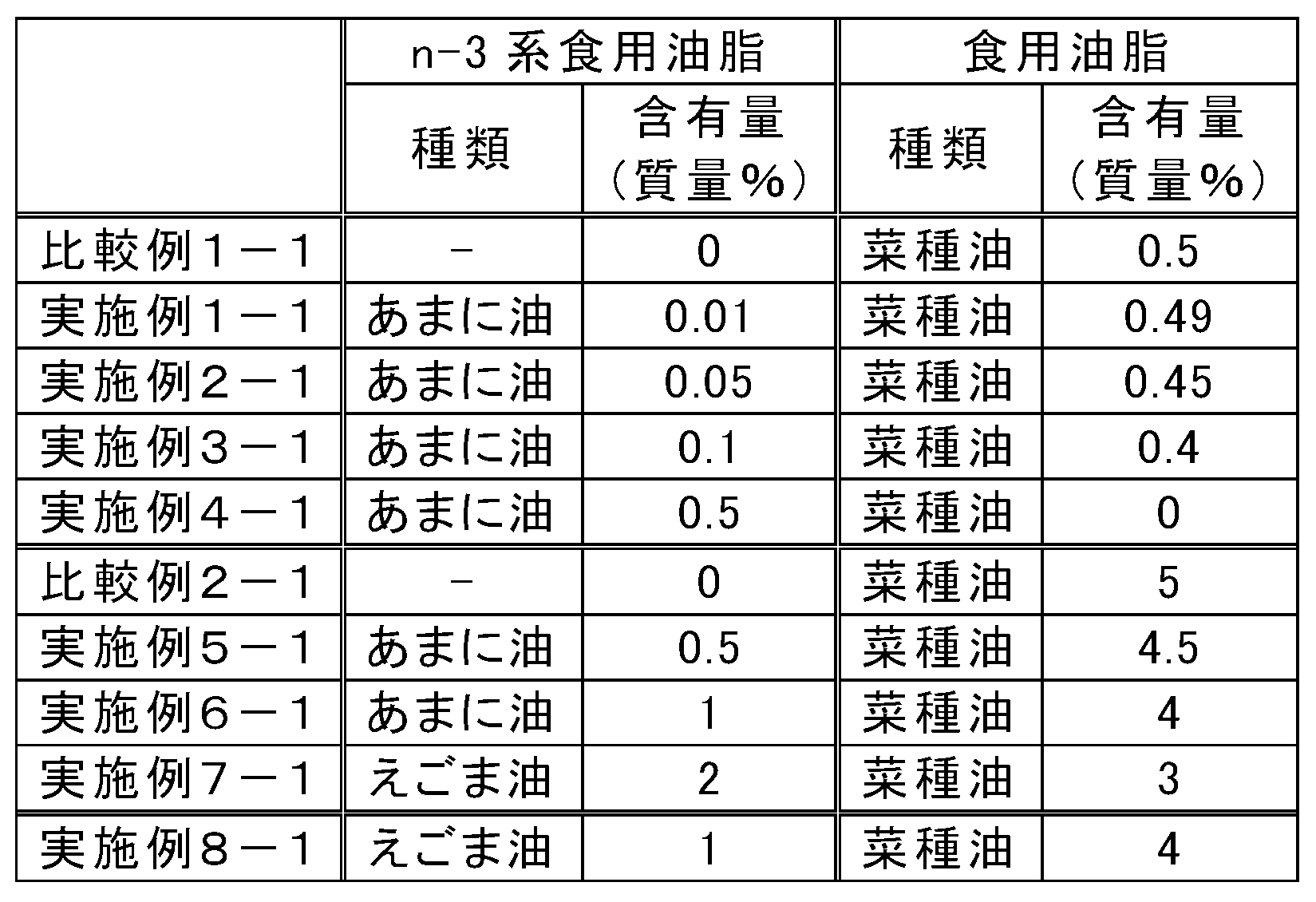
- Example 1-1 0.5 parts by mass of rapeseed oil, linseed oil (content of n-3 fatty acids in the total amount of constituent fatty acids: 54.5% by mass, content of ⁇ -linolenic acid in the total amount of constituent fatty acids: 54.5% by mass ) was changed to 0.01 parts by mass and 0.49 parts by mass of rapeseed oil, in the same manner as in Comparative Example 1-1 to produce a processing liquid composition for foodstuffs to be cooked with heat.
- Example 2-1 Except that 0.5 parts by mass of rapeseed oil was changed to 0.05 parts by mass of linseed oil and 0.45 parts by mass of rapeseed oil, the same method as in Comparative Example 1-1 was used to prepare a working liquid composition for foods to be cooked with heat. manufactured things.
- Example 3-1 Except that 0.5 parts by mass of rapeseed oil was changed to 0.1 parts by mass of linseed oil and 0.4 parts by mass of rapeseed oil, the same method as in Comparative Example 1-1 was used to prepare a processing liquid composition for foods to be cooked with heat. manufactured things.
- Example 4-1 A processing liquid composition for foods to be cooked with heat was produced in the same manner as in Comparative Example 1-1, except that 0.5 parts by mass of rapeseed oil was changed to 0.5 parts by mass of linseed oil.
- Comparative Example 2-1 Heated cooking was performed in the same manner as in Comparative Example 1-1, except that the added amounts of 0.5 parts by mass of rapeseed oil and 79.7 parts by mass of ice water were changed to 5 parts by mass and 75.2 parts by mass, respectively. A food processing liquid composition was produced (100 parts by mass in total).
- Example 5-1 A processing liquid composition for food materials to be cooked was produced in the same manner as in Comparative Example 2-1, except that 0.5 parts by mass of linseed oil and 4.5 parts by mass of rapeseed oil were used instead of 5 parts by mass of rapeseed oil. .
- Example 6-1 A processing liquid composition for food materials to be cooked was produced in the same manner as in Comparative Example 2-1, except that 5 parts by mass of rapeseed oil was changed to 1 part by mass of linseed oil and 4 parts by mass of rapeseed oil.
- Example 7-1 5 parts by mass of rapeseed oil, 2 parts by mass of perilla oil (content of n-3 fatty acids in the total amount of constituent fatty acids: 58% by mass, content of ⁇ -linolenic acid in the total amount of constituent fatty acids: 58% by mass) and 3 parts by mass of rapeseed oil
- a processing liquid composition for foods to be cooked with heat was produced in the same manner as in Comparative Example 2-1, except that the parts were changed to parts by mass.
- Example 8-1 A processing liquid composition for foodstuffs to be cooked was produced in the same manner as in Comparative Example 2-1, except that 5 parts by mass of rapeseed oil was changed to 1 part by mass of perilla oil and 4 parts by mass of rapeseed oil.
- Table 2 below shows the processing liquid compositions for foods to be cooked with heat produced in Examples 1-1 to 8-1 and Comparative Examples 1-1 to 2-1.
- Step (1) The processing liquid composition for foods to be cooked with heat produced in Comparative Example 1-1 was homogenized at 3000 rpm for 3 minutes. Next, 150 g of chicken thigh meat (25 g per piece) was blended with 63 g of the processing liquid composition for foodstuffs to be cooked with heat, and tumbled at 12 rpm for 1 hour using a rotary tumbler (manufactured by Daido Sangyo Co., Ltd.).
- Step (2) After dusting the tumbled chicken thigh with 3% by mass of Act Body (registered trademark) KT-10 ((modified starch, manufactured by J-Oil Mills Co., Ltd.), batter (made by Daisho Co., Ltd. “Chubo O Karaage Powder (including wheat flour, cornstarch, salt, powdered starch syrup, etc.) dissolved in an equal amount of cold water), and super canola oil (rapeseed oil with high oleic acid content, manufactured by J-Oil Mills Co., Ltd.) to 170 °C for 2 minutes to obtain fried chicken.
- Act Body registered trademark
- KT-10 modified starch, manufactured by J-Oil Mills Co., Ltd.
- batter made by Daisho Co., Ltd. “Chubo O Karaage Powder (including wheat flour, cornstarch, salt, powdered starch syrup, etc.) dissolved in an equal amount of cold water), and super canola oil (rapeseed oil with high oleic acid content, manufactured by
- Step (3) The pre-fried fried chicken was frozen at -20°C to produce frozen fried chicken.
- Step (4) Three days after freezing, 600 g of soybean oil (acid value: 0.02) was added, heated to 180°C, and frozen fried chicken was added and re-fried. After heating for 3 minutes and 30 seconds, it was stored at room temperature (25° C.) for 30 minutes to produce cooked fried chicken (28 g per piece).
- Examples 1-2 to 7-2, Comparative Example 2-2 instead of the processing liquid composition for foods to be cooked with heat produced in Comparative Example 1-1, the processing liquid compositions for foods to be cooked with heat produced in Examples 1-1 to 7-1 and Comparative Example 2-1 were used. Cooked fried chicken was produced in the same manner as in Comparative Example 1-2, except that it was cooked.
- Example 8-2 instead of the processing liquid composition for foods to be cooked with heat produced in Comparative Example 1-1, the processing liquid composition for foods to be cooked with heat produced in Example 8-1 was used, and 600 g of soybean oil was replaced with degraded soybean oil. Cooked fried chicken was produced in the same manner as in Comparative Example 1-2, except that 700 g was used.
- the degraded soybean oil was prepared as follows. Specifically, 700 g of soybean oil was poured, 100 g of French fries (Hokkaido shoestring potatoes, manufactured by Nosui Co., Ltd.) were heated for 7 minutes, and the French fries were taken out. After 15 minutes, the potato fries were cooked again under the same conditions. Degraded soybean oil was prepared by repeating this process and cooking the potato fries seven times in total.
- French fries Hokkaido shoestring potatoes, manufactured by Nosui Co., Ltd.
- the oil has a fairly strong unpleasant flavor 6: The oil has a strong unpleasant flavor 5: The oil has a slightly strong unpleasant flavor 4: Standard 3: The oil has a slightly weak unpleasant flavor 2: The oil has an unpleasant flavor Weak 1: The unpleasant flavor of the oil is fairly weak.
- Examples 1-2 to 8-2 and Comparative Examples 1-2 to 2-2 40% of the processing liquid composition for foods to be cooked was used for one chicken thigh (25 g). At this time, 15% of the used processing liquid composition for foods to be cooked by heating was actually blended into chicken thigh meat by tumbling. Therefore, the amount of the processing liquid composition for foods to be cooked with heat (25 g ⁇ 40% ⁇ 15%) actually blended in the chicken thigh contains the n-3 edible oil in the processing liquid composition for foods to be cooked with heat. By multiplying the amount (% by mass), the amount of n-3 edible oil used (mg/25 g) per chicken thigh (25 g) can be calculated. Table 4 below shows the results of converting this into the amount (g/100 g) of n-3 edible oil used per 100 g of chicken thigh meat (food to be cooked with heat).
- fried chicken ( 28g)
- the content of n-3 edible oil contained in one (food cooked with heat) is 0.052% by mass (28g x 6.6% by mass x 0.8% by mass / 28g x 100). be. Since the processing liquid composition for foods to be cooked with heat can permeate into the food to be cooked with heat, it can be seen that a high effect was obtained with a small amount used.
Landscapes
- Chemical & Material Sciences (AREA)
- Life Sciences & Earth Sciences (AREA)
- Engineering & Computer Science (AREA)
- Food Science & Technology (AREA)
- Polymers & Plastics (AREA)
- Health & Medical Sciences (AREA)
- Nutrition Science (AREA)
- Oil, Petroleum & Natural Gas (AREA)
- Marine Sciences & Fisheries (AREA)
- Zoology (AREA)
- General Preparation And Processing Of Foods (AREA)
- Edible Oils And Fats (AREA)
Abstract
本発明は、加熱調理食品の油っぽさを低減できる被加熱調理食材用加工液組成物を提供する。本発明は、構成脂肪酸総量に占めるn-3系脂肪酸の含有量が30質量%以上80質量%以下であるn-3系食用油脂を含む、被加熱調理食材用加工液組成物であって、前記n-3系食用油脂の含有量が、前記被加熱調理食材用加工液組成物の全質量に対して、0.001質量%以上10質量%以下である、被加熱調理食材用加工液組成物。
Description
本発明は、被加熱調理食材用加工液組成物等に関する。
唐揚げに代表される加熱調理食品では、油を用いて加熱調理されるため、食品の嗜好性が向上する一方、加熱調理食品に対して油っぽさを感じることがあった。そこで、従来、加熱調理食品の油っぽさを低減する方法が検討されている。
例えば、特許文献1には、加熱調理用油脂組成物に係る発明が記載されている。特許文献1には、前記加熱調理用油脂組成物は、所定量のn-3系脂肪酸を含有するn-3系食用油脂と、前記n-3系食用油脂以外の食用油脂からなるベース油脂とを含むことが記載されている。
特許文献1には、前記加熱調理用油脂組成物が、食用油脂を加熱調理に使用することにより生じるネガティブ面を抑制する効果に優れることが記載されている。
このような中、加熱調理食品の油っぽさを低減する新たな方法が求められている。本発明者らが検討したところ、加熱調理前の被加熱調理食材に所定の被加熱調理食材用加工液組成物を付与することで、加熱調理食品の油っぽさが低減できることを見出した。そこで、本発明は、加熱調理食品の油っぽさを低減できる被加熱調理食材用加工液組成物を提供する。
本発明は、例えば以下の態様を有する。
[1]構成脂肪酸総量に占めるn-3系脂肪酸の含有量が30質量%以上80質量%以下であるn-3系食用油脂を含む、被加熱調理食材用加工液組成物であって、
前記n-3系食用油脂の含有量が、前記被加熱調理食材用加工液組成物の全質量に対して、0.001質量%以上10質量%以下である、被加熱調理食材用加工液組成物。
[2]前記n-3系食用油脂が、えごま油、あまに油、しそ油、DHAを含む油、およびEPAを含む油からなる群から選択される少なくとも1種を含む、上記[1]に記載の被加熱調理食材用加工液組成物。
[3]前記n-3系食用油脂の構成脂肪酸総量に占めるn-3系脂肪酸の含有量が、45質量%以上75質量%以下である、上記[1]または[2]に記載の被加熱調理食材用加工液組成物。
[4]前記n-3系脂肪酸が、α-リノレン酸を含む、上記[1]~[3]のいずれかに記載の被加熱調理食材用加工液組成物。
[5]前記α-リノレン酸の含有量が、n-3系脂肪酸の全質量に対して、80質量%以上100質量%以下である、上記[4]に記載の被加熱調理食材用加工液組成物。
[6]n-3系食用油脂以外の食用油脂をさらに含む、上記[1]~[5]のいずれかに記載の被加熱調理食材用加工液組成物。
[7]前記n-3系食用油脂および前記n-3系食用油脂以外の食用油脂の総含有量が、前記被加熱調理食材用加工液組成物の全質量に対して、0.1質量%以上10質量%以下である、上記[6]に記載の被加熱調理食材用加工液組成物。
[8]加熱調理食品の油っぽさの低減に用いられる、上記[1]~[7]のいずれかに記載の被加熱調理食材用加工液組成物。
[9]被加熱調理食材に上記[1]~[8]のいずれかに記載の被加熱調理食材用加工液組成物を付与する工程(1)と、
被加熱調理食材用加工液組成物が付与された被加熱調理食材を、油を用いて加熱調理する工程(2)と、
を含む、加熱調理食品の製造方法。
[10]加熱調理食品中のn-3系食用油脂の含有量が、加熱調理食品の全質量に対して、0.00002質量%以上5質量%以下である、上記[9]に記載の製造方法。
[11]前記n-3系食用油脂の使用量が、前記被加熱調理食材100gに対して、0.00002g以上5g以下である、上記[9]または[10]に記載の製造方法。
[12]前記油の酸価が、0.110以下である、上記[9]~[11]のいずれかに記載の製造方法。
[13]前記被加熱調理食材が、畜肉、魚肉および魚介類からなる群から選ばれる少なくとも1種を含む、上記[9]~[12]のいずれかに記載の製造方法。
[14]加熱調理食品を加熱調理する前に被加熱調理食材に上記[1]~[8]のいずれかに記載の被加熱調理食材用加工液組成物を付与する、加熱調理食品の油っぽさ低減方法。
[15]加熱調理食品中のn-3系食用油脂の含有量が、加熱調理食品の全質量に対して、0.00002質量%以上5質量%以下である、上記[14]に記載の方法。
[16]前記n-3系食用油脂の使用量が、前記被加熱調理食材100gに対して、0.00002g以上5g以下である、上記[14]または[15]に記載の方法。
[17]前記油の酸価が、0.1超10以下である、上記[14]~[16]のいずれかに記載の方法。
[18]構成脂肪酸総量に占めるn-3系脂肪酸の含有量が30質量%以上80質量%以下であるn-3系食用油脂を有効成分とする、加熱調理食品の油っぽさ低減剤であって、
被加熱調理食材に被加熱調理食材用加工液組成物を付与する場合、前記n-3系食用油脂の添加量が、前記被加熱調理食材用加工液組成物の全質量に対して、0.001質量%以上10質量%以下となるように用いる、前記油っぽさ低減剤。
前記n-3系食用油脂の含有量が、前記被加熱調理食材用加工液組成物の全質量に対して、0.001質量%以上10質量%以下である、被加熱調理食材用加工液組成物。
[2]前記n-3系食用油脂が、えごま油、あまに油、しそ油、DHAを含む油、およびEPAを含む油からなる群から選択される少なくとも1種を含む、上記[1]に記載の被加熱調理食材用加工液組成物。
[3]前記n-3系食用油脂の構成脂肪酸総量に占めるn-3系脂肪酸の含有量が、45質量%以上75質量%以下である、上記[1]または[2]に記載の被加熱調理食材用加工液組成物。
[4]前記n-3系脂肪酸が、α-リノレン酸を含む、上記[1]~[3]のいずれかに記載の被加熱調理食材用加工液組成物。
[5]前記α-リノレン酸の含有量が、n-3系脂肪酸の全質量に対して、80質量%以上100質量%以下である、上記[4]に記載の被加熱調理食材用加工液組成物。
[6]n-3系食用油脂以外の食用油脂をさらに含む、上記[1]~[5]のいずれかに記載の被加熱調理食材用加工液組成物。
[7]前記n-3系食用油脂および前記n-3系食用油脂以外の食用油脂の総含有量が、前記被加熱調理食材用加工液組成物の全質量に対して、0.1質量%以上10質量%以下である、上記[6]に記載の被加熱調理食材用加工液組成物。
[8]加熱調理食品の油っぽさの低減に用いられる、上記[1]~[7]のいずれかに記載の被加熱調理食材用加工液組成物。
[9]被加熱調理食材に上記[1]~[8]のいずれかに記載の被加熱調理食材用加工液組成物を付与する工程(1)と、
被加熱調理食材用加工液組成物が付与された被加熱調理食材を、油を用いて加熱調理する工程(2)と、
を含む、加熱調理食品の製造方法。
[10]加熱調理食品中のn-3系食用油脂の含有量が、加熱調理食品の全質量に対して、0.00002質量%以上5質量%以下である、上記[9]に記載の製造方法。
[11]前記n-3系食用油脂の使用量が、前記被加熱調理食材100gに対して、0.00002g以上5g以下である、上記[9]または[10]に記載の製造方法。
[12]前記油の酸価が、0.110以下である、上記[9]~[11]のいずれかに記載の製造方法。
[13]前記被加熱調理食材が、畜肉、魚肉および魚介類からなる群から選ばれる少なくとも1種を含む、上記[9]~[12]のいずれかに記載の製造方法。
[14]加熱調理食品を加熱調理する前に被加熱調理食材に上記[1]~[8]のいずれかに記載の被加熱調理食材用加工液組成物を付与する、加熱調理食品の油っぽさ低減方法。
[15]加熱調理食品中のn-3系食用油脂の含有量が、加熱調理食品の全質量に対して、0.00002質量%以上5質量%以下である、上記[14]に記載の方法。
[16]前記n-3系食用油脂の使用量が、前記被加熱調理食材100gに対して、0.00002g以上5g以下である、上記[14]または[15]に記載の方法。
[17]前記油の酸価が、0.1超10以下である、上記[14]~[16]のいずれかに記載の方法。
[18]構成脂肪酸総量に占めるn-3系脂肪酸の含有量が30質量%以上80質量%以下であるn-3系食用油脂を有効成分とする、加熱調理食品の油っぽさ低減剤であって、
被加熱調理食材に被加熱調理食材用加工液組成物を付与する場合、前記n-3系食用油脂の添加量が、前記被加熱調理食材用加工液組成物の全質量に対して、0.001質量%以上10質量%以下となるように用いる、前記油っぽさ低減剤。
本発明によれば、加熱調理食品の油っぽさを低減できる。
以下、本発明を実施するための形態について詳細に説明する。
<被加熱調理食材用加工液組成物>
本発明に係る被加熱調理食材用加工液組成物は、構成脂肪酸総量に占めるn-3系脂肪酸の含有量が30質量%以上80質量%以下であるn-3系食用油脂を含む。この際、前記n-3系食用油脂の含有量は、前記被加熱調理食材用加工液組成物の全質量に対して、0.001質量%以上10質量%以下である。
本発明に係る被加熱調理食材用加工液組成物は、構成脂肪酸総量に占めるn-3系脂肪酸の含有量が30質量%以上80質量%以下であるn-3系食用油脂を含む。この際、前記n-3系食用油脂の含有量は、前記被加熱調理食材用加工液組成物の全質量に対して、0.001質量%以上10質量%以下である。
本発明によれば、被加熱調理食材に被加熱調理食材用加工液組成物を付与することにより、加熱調理食品の油っぽさを低減できる。また、本発明の好ましい形態によれば、得られる加熱調理食品の保水性が向上することで歩留まりが高くなる、ジューシー感が向上する等の少なくとも1つの効果を奏することができる。なお、本明細書において、「油っぽさ」とは、加熱調理食品を食したときに感じる、油が口に残るような後引き感および不快な油の風味が合わさって生ずるものを意味する。油が口に残るような後引き感がある場合、加熱調理食品のさらっと感が損なわれる。また、不快な油の風味がある場合、加熱調理食品に油のネガティブ風味を感じる。
[n-3系食用油脂]
本発明の被加熱調理食材用加工液組成物において、n-3系食用油脂は、加熱調理食品の油っぽさを低減する機能、加熱調理食品の歩留まりを向上させる機能、加熱調理食品のジューシー感を付与する機能等を有する。
本発明の被加熱調理食材用加工液組成物において、n-3系食用油脂は、加熱調理食品の油っぽさを低減する機能、加熱調理食品の歩留まりを向上させる機能、加熱調理食品のジューシー感を付与する機能等を有する。
n-3系食用油脂とは、構成脂肪酸にn-3系脂肪酸を所定量含有する食用油脂を意味する。
n-3系脂肪酸としては、特に制限されないが、α-リノレン酸、エイコサペンタエン酸(EPA)、ドコサヘキサエン酸(DHA)等が挙げられる。n-3系脂肪酸は単独で含まれていても、2種以上が混合して含まれていてもよい。これらのうち、n-3系脂肪酸は、相対的に不飽和二重結合の数が少なく酸化されにくい観点から、α-リノレン酸を含むことが好ましい。
n-3系食用油脂の構成脂肪酸総量に占めるn-3系脂肪酸の含有量は、30質量%以上80質量%以下であり、好ましくは45質量%以上80質量%以下であり、さらに好ましくは45質量%以上75質量%以下であり、特に好ましくは50質量%以上70質量%以下である。なお、n-3系脂肪酸を2種以上含む場合には、その合計値が上記範囲となることが好ましい。また、本明細書において、「構成脂肪酸総量に占めるn-3系脂肪酸の含有量」は、基準油脂分析試験法2.4.1.4-2013(日本油化学協会)に準じて測定することができる。この際、分析条件は以下のとおりである。
(分析条件)
機器名:GC-2010 plus(株式会社島津製作所製)
カラム:TC-70(長さ30m、内径0.25mm、液相膜厚0.25μm、ジーエルサイエンス株式会社製)
カラム昇温条件:下記表1参照
カラム圧力:79.7kPa/min
キャリアガス:N2
気化室温度:230℃
FID温度:240℃
スプリット比:1:50
注入量:1μL
機器名:GC-2010 plus(株式会社島津製作所製)
カラム:TC-70(長さ30m、内径0.25mm、液相膜厚0.25μm、ジーエルサイエンス株式会社製)
カラム昇温条件:下記表1参照
カラム圧力:79.7kPa/min
キャリアガス:N2
気化室温度:230℃
FID温度:240℃
スプリット比:1:50
注入量:1μL

一実施形態において、α-リノレン酸の含有量が、n-3系脂肪酸の全質量に対して、80質量%以上100質量%以下であることが好ましく、85質量%以上100質量%以下、90質量%以上100質量%以下であることがより好ましい。α-リノレン酸の含有量が上記範囲であると、効果的に油っぽさを低減し風味に優れた加熱調理食品を容易に得ることができる。
n-3系食用油脂は、n-3系脂肪酸以外の脂肪酸をさらに含んでいてもよい。n-3系脂肪酸以外の脂肪酸としては、リノール酸、γ-リノレン酸、アラキドン酸等のn-6系脂肪酸;パルミトレイン酸等のn-7系脂肪酸;オレイン酸、エイコセン酸、エルカ酸等のn-9系脂肪酸;カプリル酸、カプリン酸、ラウリン酸、ミリスチン酸、パルミチン酸、ステアリン酸、アラキジン酸、ベヘン酸、リグノセリン酸等の飽和脂肪酸が挙げられる。これらのn-3系脂肪酸以外の脂肪酸は、単独で用いても、2種以上を組み合わせて用いてもよい。
また、n-3系食用油脂は、脂肪酸エステル、ミネラル、ビタミン、食物繊維等をさらに含んでいてもよい。
n-3系食用油脂としては、あまに油、えごま油、しそ油、DHA(ドコサヘキサエン酸)を含む油脂(魚油)、EPA(エイコサペンタエン酸)を含む油脂(魚油)、チアシード油、藻類油、微生物油等が挙げられる。これらのうち、n-3系食用油脂は、えごま油、あまに油、しそ油、DHAを含む油、およびEPAを含む油からなる群から選択される少なくとも1種を含むことが好ましく、構成脂肪酸総量に占めるα-リノレン酸の含有量が30質量%以上となる観点から、えごま油、あまに油、およびしそ油からなる群から選択される少なくとも1種を含むことがより好ましい。
n-3系食用油脂の含有量は、被加熱調理食材用加工液組成物の全質量に対して、0.001質量%以上10質量%以下であり、好ましくは0.001質量%以上9質量%以下であり、より好ましくは0.03質量%以上8.5質量%以下であり、さらに好ましくは0.03質量%以上8質量%以下であり、特に好ましくは0.05質量%以上7.5質量%以下であり、最も好ましくは0.05質量%以上7質量%以下である。n-3系食用油脂の含有量が0.001質量%以上であると、加熱調理食品の油っぽさを低減することができることから好ましい。一方、n-3系食用油脂の含有量が10質量%以下であると、n-3系食用油脂の酸化劣化による不快な油の風味の発生を防止できることから好ましい。また、一実施形態において、n-3系食用油脂の含有量は、被加熱調理食材用加工液組成物の全質量に対して、0.07質量%以上7質量%以下、0.3質量%以上7質量%以下、1.5質量%以上7質量%以下であることが好ましい。なお、n-3系食用油脂を2種以上含む場合には、その合計値が上記範囲となることが好ましい。
[n-3系食用油脂以外の食用油脂]
被加熱調理食材用加工液組成物は、n-3系食用油脂以外の食用油脂をさらに含んでいてもよい。本発明の被加熱調理食材用加工液組成物において、n-3系食用油脂以外の食用油脂は、被加熱調理食材用加工液組成物中の食用油脂の総量を調整する機能、加熱調理食品の歩留まりを向上させる機能、加熱調理食品のジューシー感を付与する機能等を有する。なお、本明細書において、「n-3系食用油脂以外の食用油脂」とは、構成脂肪酸総量に占めるn-3系脂肪酸の含有量が30質量%未満である食用油脂を意味する。
被加熱調理食材用加工液組成物は、n-3系食用油脂以外の食用油脂をさらに含んでいてもよい。本発明の被加熱調理食材用加工液組成物において、n-3系食用油脂以外の食用油脂は、被加熱調理食材用加工液組成物中の食用油脂の総量を調整する機能、加熱調理食品の歩留まりを向上させる機能、加熱調理食品のジューシー感を付与する機能等を有する。なお、本明細書において、「n-3系食用油脂以外の食用油脂」とは、構成脂肪酸総量に占めるn-3系脂肪酸の含有量が30質量%未満である食用油脂を意味する。
n-3系食用油脂以外の食用油脂は、n-3系脂肪酸以外の脂肪酸を含む。前記n-3系脂肪酸以外の脂肪酸としては、上述したものが挙げられる。これらのn-3系脂肪酸以外の脂肪酸は、単独で用いても、2種以上を組み合わせて用いてもよい。
また、n-3系食用油脂以外の食用油脂は、脂肪酸エステル、ミネラル、ビタミン、食物繊維等をさらに含んでいてもよい。
n-3系食用油脂以外の食用油脂としては、特に制限されないが、菜種油、コーン油、大豆油、パームオレイン、ゴマ油、落花生油、紅花油、ひまわり油、綿実油、ゴマ油、ぶどう種子油、マカデミアナッツ油、ヘーゼルナッツ油、胡桃油、カボチャ種子油、椿油、茶実油、オリーブ油、米ぬか油、小麦胚芽油、パーム油、パーム核油、ヤシ油、カカオ脂、牛脂、豚脂、鶏油、および乳脂、並びにこれら食用油脂のエステル交換油、水素添加油、分別油等が挙げられる。これらのn-3系食用油脂以外の食用油脂は、単独で用いても、2種以上を組み合わせて用いてもよい。
一実施形態において、n-3系食用油脂以外の食用油脂としては、菜種油、コーン油、大豆油、およびパームオレインからなる群から選択される少なくとも1種を含むことが好ましく、菜種油を含むことがより好ましい。
n-3系食用油脂以外の食用油脂の含有量は、被加熱調理食材用加工液組成物の全質量に対して、好ましくは20質量%以下であり、より好ましくは15質量%以下であり、さらに好ましくは0質量%以上10質量%以下である。n-3系食用油脂以外の食用油脂の含有量が20質量%以下であると、食感に違和感なく歩留まりを向上できることから好ましい。なお、n-3系食用油脂以外の食用油脂を2種以上含む場合には、その合計値が上記範囲となることが好ましい。
n-3系食用油脂およびn-3系食用油脂以外の食用油脂の総含有量(以下、単に「総含有量」とも称する)は、被加熱調理食材用加工液組成物の全質量に対して、好ましくは0.1質量%以上10質量%以下であり、より好ましくは0.1質量%以上8質量%以下であり、さらに好ましくは0.1質量%以上4質量%以下である。総含有量が上記範囲であると、加熱調理食品の油っぽさ低減効果が得られつつ、n-3系食用油脂および/またはn-3系食用油脂以外の食用油脂の酸化劣化による不快な油の風味の発生を防止できることから好ましい。
[澱粉]
被加熱調理食材用加工液組成物は、澱粉をさらに含んでいてもよい。本発明の被加熱調理食材用加工液組成物において、澱粉は、糊化により加熱調理食品の保水性を高くすることで歩留まりを向上させる機能、加熱調理食品のジューシー感を付与する機能等を有する。
被加熱調理食材用加工液組成物は、澱粉をさらに含んでいてもよい。本発明の被加熱調理食材用加工液組成物において、澱粉は、糊化により加熱調理食品の保水性を高くすることで歩留まりを向上させる機能、加熱調理食品のジューシー感を付与する機能等を有する。
澱粉としては、特に制限されないが、コーンスターチ、ワキシーコーンスターチ、ハイアミロースコーンスターチ、馬鈴薯澱粉、タピオカ澱粉、米澱粉、小麦澱粉、エンドウ澱粉、およびこれらの加工澱粉等が挙げられる。前記加工澱粉としては、コーンスターチ、ワキシーコーンスターチ、ハイアミロースコーンスターチ、馬鈴薯澱粉、タピオカ澱粉、米澱粉、小麦澱粉およびエンドウ澱粉からなる群より選ばれる未加工澱粉に、アセチル化、リン酸モノエステル化等のエステル化処理;リン酸架橋、アジピン酸架橋等の架橋処理;ヒドロキシプロピル化等のエーテル化処理;酸化処理;酸処理;アルカリ処理;酵素処理;油脂加工処理;加熱処理;α化処理;湿熱処理;ボールミル処理;微粉砕処理等の加工処理を1種または2種以上施してなる澱粉が挙げられる。
これらの澱粉は単独で用いても、2種以上を組み合わせて用いてもよい。
これらの澱粉は単独で用いても、2種以上を組み合わせて用いてもよい。
澱粉の含有量は、被加熱調理食材用加工液組成物の全質量に対して、好ましくは0.5質量%以上35質量%以下であり、より好ましくは1質量%以上30質量%以下であり、さらに好ましくは2質量%以上22質量%以下である。澱粉の含有量が0.5質量%以上であると、食肉加工食品のジューシーな食感を向上できることから好ましい。一方、澱粉の含有量が35質量%以下であると、作業性を高める事ができることから好ましい。なお、澱粉を2種以上含む場合には、その合計値が上記範囲となることが好ましい。
[調味料]
被加熱調理食材用加工液組成物は、調味料をさらに含んでいてもよい。調味料は、加熱調理食品の味を調整する機能等を有する。
被加熱調理食材用加工液組成物は、調味料をさらに含んでいてもよい。調味料は、加熱調理食品の味を調整する機能等を有する。
調味料としては、特に制限されないが、砂糖、食塩、酢、醤油、味噌、胡椒、みりん、ソース、ケチャップ、オイスターソース、マヨネーズ、マスタード、グルタミン酸およびその塩、イノシン酸およびその塩等が挙げられる。これらの調味料は単独で用いても、2種以上を組み合わせて用いてもよい。
調味料の含有量は、被加熱調理食材用加工液組成物の全質量に対して、好ましくは0.5質量%以上20質量%以下であり、より好ましくは1質量%以上15質量%以下であり、さらに好ましくは2質量%以上12質量%以下である。調味料の含有量が上記範囲であると、好ましい風味を付与できることから好ましい。なお、調味料を2種以上含む場合には、その合計値が上記範囲となることが好ましい。
[溶媒]
被加熱調理食材用加工液組成物は、溶媒をさらに含んでいてもよい。溶媒は、被加熱調理食材用加工液組成物中の成分を分散させる機能を有する。
被加熱調理食材用加工液組成物は、溶媒をさらに含んでいてもよい。溶媒は、被加熱調理食材用加工液組成物中の成分を分散させる機能を有する。
溶媒としては、特に制限されないが、水、エタノールが挙げられる。このうち、溶媒は水であることが好ましい。
溶媒の含有量は、被加熱調理食材用加工液組成物の全質量に対して、好ましくは30質量%以上100質量%未満であり、より好ましくは40質量%以上95質量%以下であり、さらに好ましくは50質量%以上90質量%以下である。溶媒の含有量が30質量%以上であると、歩留まりを向上できることから好ましい。なお、溶媒を2種以上含む場合には、その合計値が上記範囲となることが好ましい。
[添加剤]
被加熱調理食材用加工液組成物は、添加剤をさらに含んでいてもよい。添加剤としては、特に制限されないが、乳化剤、保存剤、着色料、香料、消泡剤等が挙げられる。これらの添加剤は単独で用いても、2種以上を組み合わせて用いてもよい。
被加熱調理食材用加工液組成物は、添加剤をさらに含んでいてもよい。添加剤としては、特に制限されないが、乳化剤、保存剤、着色料、香料、消泡剤等が挙げられる。これらの添加剤は単独で用いても、2種以上を組み合わせて用いてもよい。
[用途]
被加熱調理食材用加工液組成物は、加熱調理食品の油っぽさの低減に用いられる。具体的には、後述するように被加熱調理食材に被加熱調理食材用加工液組成物を付与し、その後に加熱調理をすることで、加熱調理食品の油っぽさを低減することができる。
被加熱調理食材用加工液組成物は、加熱調理食品の油っぽさの低減に用いられる。具体的には、後述するように被加熱調理食材に被加熱調理食材用加工液組成物を付与し、その後に加熱調理をすることで、加熱調理食品の油っぽさを低減することができる。
<加熱調理食品の製造方法>
本発明の一形態によれば、加熱調理食品の製造方法が提供される。加熱調理食品の製造方法は、被加熱調理食材に上述の被加熱調理食材用加工液組成物を付与する工程(1)と、被加熱調理食材用加工液組成物が付与された被加熱調理食材を、油を用いて加熱調理する工程(2)と、を含む。
本発明の一形態によれば、加熱調理食品の製造方法が提供される。加熱調理食品の製造方法は、被加熱調理食材に上述の被加熱調理食材用加工液組成物を付与する工程(1)と、被加熱調理食材用加工液組成物が付与された被加熱調理食材を、油を用いて加熱調理する工程(2)と、を含む。
[工程(1)]
工程(1)は、被加熱調理食材に被加熱調理食材用加工液組成物を付与する工程である。
工程(1)は、被加熱調理食材に被加熱調理食材用加工液組成物を付与する工程である。
(被加熱調理食材)
被加熱調理食材としては、特に制限されないが、畜肉、魚肉、および魚介類などが挙げられる。
被加熱調理食材としては、特に制限されないが、畜肉、魚肉、および魚介類などが挙げられる。
前記畜肉としては、鶏肉、豚肉、牛肉、羊肉、馬肉等が挙げられる。
前記魚肉としては、マグロ、タラ、カツオ、サーモン等が挙げられる。
前記魚介類としては、エビ、カニ、イカ、タコ、ホタテ等が挙げられる。
これらの被加熱調理食材は単独で用いても、2種以上を組み合わせて用いてもよい。また、被加熱調理食材は、畜肉、魚肉、および魚介類からなる群から選択される少なくとも1種を含むことが好ましく、畜肉を含むことがより好ましく、鶏肉、豚肉、および牛肉からなる群から選択される少なくとも1種を含むことがさらに好ましく、鶏肉を含むことが特に好ましい。
なお、被加熱調理食材の形状は、特に制限はなく、切り身、ミンチ、ペースト等のいずれであってもよいが、切り身であることが好ましい。
(被加熱調理食材用加工液組成物)
被加熱調理食材用加工液組成物としては、上述したものが用いられる。
被加熱調理食材用加工液組成物としては、上述したものが用いられる。
被加熱調理食材用加工液組成物の使用量は、被加熱調理食材の全質量に対して、5質量%以上150質量%以下であることが好ましく、10質量%以上100質量%以下であることがより好ましい。
また、n-3系食用油脂の使用量は、被加熱調理食材100gに対して、0.00002g以上5g以下であることが好ましく、0.00002g以上2.5g以下であることがより好ましく、0.0010g以上2.5g以下であることがさらに好ましく、0.0050g以上2g以下、0.0075g以上1g以下、0.0500g以上1g以下、0.1g以上1g以下、0.1g以上0.5g以下であることが特に好ましい。n-3系食用油脂の使用量が0.00002g以上であると、加熱調理食品の油っぽさ低減効果が好適に得られることから好ましい。一方、n-3系食用油脂の使用量が5g以下であると、n-3系脂肪酸の酸化劣化による不快な油の風味の発生を防止できることから好ましい。なお、被加熱調理食材用加工液組成物は、タンブリングによって被加熱調理食材に接触することから、n-3系食用油脂は少量の使用量で高い効果を発揮しうる。
(被加熱調理食材用加工液組成物の付与方法)
被加熱調理食材に被加熱調理食材用加工液組成物を付与する方法としては、特に制限されないが、タンブリング(インジェクションを含む)、浸漬、塗布、練り込み等が挙げられる。これらの被加熱調理食材用加工液組成物の付与方法は、単独で行っても、2種以上を組み合わせて行ってもよい。これらのうち、被加熱調理食材用加工液組成物の付与方法は、タンブリングを含むことが好ましい。
被加熱調理食材に被加熱調理食材用加工液組成物を付与する方法としては、特に制限されないが、タンブリング(インジェクションを含む)、浸漬、塗布、練り込み等が挙げられる。これらの被加熱調理食材用加工液組成物の付与方法は、単独で行っても、2種以上を組み合わせて行ってもよい。これらのうち、被加熱調理食材用加工液組成物の付与方法は、タンブリングを含むことが好ましい。
(タンブリング)
被加熱調理食材用加工液組成物は、被加熱調理食材にタンブリングされる。なお、本明細書において、「タンブリング」とは、被加熱調理食材の加熱調理前に、被加熱調理食材用加工液組成物を被加熱調理食材に浸み込ませることを意味する。この際、前記「タンブリング」には、ピックルインジェクター等により被加熱調理食材に針を穿刺し、当該針の先から被加熱調理食材用加工液組成物の注入を行う、いわゆる「インジェクション」が含まれる。
被加熱調理食材用加工液組成物は、被加熱調理食材にタンブリングされる。なお、本明細書において、「タンブリング」とは、被加熱調理食材の加熱調理前に、被加熱調理食材用加工液組成物を被加熱調理食材に浸み込ませることを意味する。この際、前記「タンブリング」には、ピックルインジェクター等により被加熱調理食材に針を穿刺し、当該針の先から被加熱調理食材用加工液組成物の注入を行う、いわゆる「インジェクション」が含まれる。
タンブリングの方法は、特に制限されず、被加熱調理食材と被加熱調理食材用加工液組成物を混合して物理的衝撃を付与する方法が挙げられる。この際、前記混合方法は特に制限されず、被加熱調理食材用加工液組成物中に被加熱調理食材を浸漬してもよいし、ピックルインジェクター等により被加熱調理食材用加工液組成物を針から被加熱調理食材に注入してもよい。
物理的衝撃を付与する条件についても特に制限されず、加圧してもよいし、減圧してもよいし、加圧および減圧を組み合わせてもよい。また、温度を適宜変更してもよい。
(浸漬)
被加熱調理食材用加工液組成物は、被加熱調理食材に浸漬される。なお、本明細書において、「浸漬」とは、液体状の被加熱調理食材用加工液組成物中に被加熱調理食材を所定時間の間、沈めておくことで、被加熱調理食材用加工液組成物を被加熱調理食材に浸み込ませることを意味する。この際、浸漬時間、浸漬温度等は適宜設定されうる。
被加熱調理食材用加工液組成物は、被加熱調理食材に浸漬される。なお、本明細書において、「浸漬」とは、液体状の被加熱調理食材用加工液組成物中に被加熱調理食材を所定時間の間、沈めておくことで、被加熱調理食材用加工液組成物を被加熱調理食材に浸み込ませることを意味する。この際、浸漬時間、浸漬温度等は適宜設定されうる。
(塗布)
被加熱調理食材用加工液組成物は、被加熱調理食材に塗布される。なお、本明細書において、「塗布」とは、被加熱調理食材の表面の一部または全体に、被加熱調理食材用加工液組成物を塗り付けることを意味する。この際、塗布量、塗布条件等は適宜設定されうる。
被加熱調理食材用加工液組成物は、被加熱調理食材に塗布される。なお、本明細書において、「塗布」とは、被加熱調理食材の表面の一部または全体に、被加熱調理食材用加工液組成物を塗り付けることを意味する。この際、塗布量、塗布条件等は適宜設定されうる。
(練り込み)
被加熱調理食材用加工液組成物は、被加熱調理食材に練り込みがされる。なお、本明細書において、「練り込み」とは、ミンチまたはペースト状の被加熱調理食材に被加熱調理食材用加工液組成物を混ぜ込んで混然一体とすることを意味する。この際、練り込み比率、練り込み条件は適宜設定されうる。
被加熱調理食材用加工液組成物は、被加熱調理食材に練り込みがされる。なお、本明細書において、「練り込み」とは、ミンチまたはペースト状の被加熱調理食材に被加熱調理食材用加工液組成物を混ぜ込んで混然一体とすることを意味する。この際、練り込み比率、練り込み条件は適宜設定されうる。
[工程(2)]
工程(2)は、被加熱調理食材用加工液組成物が付与された被加熱調理食材を、油を用いて加熱調理する工程である。
工程(2)は、被加熱調理食材用加工液組成物が付与された被加熱調理食材を、油を用いて加熱調理する工程である。
(被加熱調理食材用加工液組成物が付与された被加熱調理食材)
被加熱調理食材用加工液組成物が付与された被加熱調理食材は、通常、被加熱調理食材の内部に被加熱調理食材用加工液組成物が浸透もしくは混ぜ込まれた状態となっている。
被加熱調理食材用加工液組成物が付与された被加熱調理食材は、通常、被加熱調理食材の内部に被加熱調理食材用加工液組成物が浸透もしくは混ぜ込まれた状態となっている。
(油)
油は食用油脂であれば特に制限されず、公知のものを使用することができる。
油は食用油脂であれば特に制限されず、公知のものを使用することができる。
一実施形態において、前記油は、乳化剤、酸化防止剤、シリコーン、着色剤等をさらに含んでいてもよい。
前記食用油脂としては、特に制限されないが、n-3系食用油脂およびn-3系食用油脂以外の食用油脂が挙げられる。n-3系食用油脂およびn-3系食用油脂以外の食用油脂は上述のとおりである。これらの食用油脂は単独で用いても、2種以上を組み合わせて用いてもよい。このうち、前記食用油脂は、製造コストの観点から、n-3系食用油脂以外の食用油脂を含むことが好ましく、菜種油、大豆油、コーン油、ひまわり油、綿実油、ゴマ油、オリーブ油、および米ぬか油からなる群から選択される少なくとも1種を含むことがより好ましく、菜種油を含むことがさらに好ましい。
一実施形態において、油の酸価は、0.1以下であることが好ましい。なお、本明細書において、酸価が0.1以下の油を「未使用油」と称することがある。また、本明細書において、酸価の値は、社団法人日本油化学会制定・基準油脂分析試験法(2.3.1-2013酸価)に準じて測定される。
また、別の一実施形態において、前記油は、少なくとも1回以上フライ調理に供するなどして酸価が上昇した使用油であってもよい。使用油の酸価は、0.1超10以下であることが好ましく、0.1超5以下であることがより好ましく、0.1超2以下であることがさらに好ましい。油の酸価は、使用により、または時間の経過により高くなる傾向があり、高い酸価を有する油を使用して加熱調理された加熱調理食品はより油っぽさを感じる傾向がある。好ましい一実施形態によれば、このような高い酸価を有する油を用いる場合であっても、上述の被加熱調理食材用加工液組成物が付与された被加熱調理食材を用いることで油っぽさを低減できる。なお、本明細書において、酸価が0.1超の油を「使用油」と称することがある。また、使用油の酸価は、使用油に対して未使用油または酸価が相対的に低い使用油を加える、いわゆる「差し油」により調整することができる。
(加熱調理)
加熱調理としては、特に制限されないが、フライ、炒め、蒸し、茹で等が挙げられる。これらのうち、加熱調理は、フライ、炒めが好ましく、フライがさらに好ましい。
加熱調理としては、特に制限されないが、フライ、炒め、蒸し、茹で等が挙げられる。これらのうち、加熱調理は、フライ、炒めが好ましく、フライがさらに好ましい。
加熱調理の温度は、特に制限されないが、80℃以上220℃以下であることが好ましく、100℃以上200℃以下であることがより好ましく、170℃以上180℃以下であることがさらに好ましい。
(加熱調理食品)
本発明において、加熱調理によって製造される加熱調理食品は、油っぽさが低減されている。具体的には、前記加熱調理食品は、油が口に残るような後引き感が抑えられた、さらっと感を有しうる。また、前記加熱調理食品は、不快な油のネガティブ風味が抑制されうる。また、好ましい一実施形態では、前記加熱調理食品は、保水性が向上することで歩留まりが高くなる、ジューシー感が向上する等の少なくとも1つの効果をさらに有する。
本発明において、加熱調理によって製造される加熱調理食品は、油っぽさが低減されている。具体的には、前記加熱調理食品は、油が口に残るような後引き感が抑えられた、さらっと感を有しうる。また、前記加熱調理食品は、不快な油のネガティブ風味が抑制されうる。また、好ましい一実施形態では、前記加熱調理食品は、保水性が向上することで歩留まりが高くなる、ジューシー感が向上する等の少なくとも1つの効果をさらに有する。
加熱調理食品中のn-3系食用油脂の含有量は、加熱調理食品の全質量に対して、0.00002質量%以上5質量%以下であることが好ましく、0.00002質量%以上2.5質量%以下であることがより好ましく、0.001質量%以上2.5質量%以下、0.01質量%以上2.5質量%以下、0.01質量%以上1質量%以下、0.01質量%以上0.1質量%以下であることがさらに好ましい。n-3系食用油脂の含有量が0.00002質量%以上であると、加熱調理食品の油っぽさ低減効果が好適に得られることから好ましい。一方、n-3系食用油脂の含有量が5質量%以下であると、n-3系脂肪酸の酸化劣化による不快な油の風味の発生を防止できることから好ましい。なお、n-3系食用油脂は、上記被加熱調理食材用加工液組成物の付与方法により加熱調理食品の内部に浸透しうることから、少ない使用量で高い効果を発揮しうる。また、加熱調理食品中におけるn-3系食用油脂は、加熱調理前に被加熱調理食材に付与されることで、効率的に加熱調理食品中に含有させることができ、油が口に残るような後引き感の抑制や、さらっと感を向上させる効果が高い。なお、加熱調理食品に含まれるn-3系食用油脂は、被加熱調理食材用加工液組成物に由来するn-3系食用油脂の他、加熱調理に用いられる油等に由来するn-3系食用油脂が含まれうる。
[工程(3)]
一実施形態において、加熱調理食品の製造方法は、工程(2)で得られる加熱調理食品を冷凍する工程(3)をさらに含んでいてもよい。工程(3)により、加熱調理食品を冷凍食品とすることができる。
一実施形態において、加熱調理食品の製造方法は、工程(2)で得られる加熱調理食品を冷凍する工程(3)をさらに含んでいてもよい。工程(3)により、加熱調理食品を冷凍食品とすることができる。
なお、工程(3)を行う場合、例えば、工程(2)において行われるフライは、プリフライ工程となる。また、本明細書において、「プリフライ」とは、最終調理者が炒めやフライ等の加熱調理時間を短縮できるよう予めフライをすること、最終調理者が電子レンジやオーブントースター等による加熱調理ができるよう予めフライをすることを意味する。
(冷凍)
冷凍は、特に制限されず、公知の方法で行うことができる。冷凍の方法としては、例えばエアブラスト法、ブライン法、コンタクト法、液化ガス凍結法、これらの組み合わせが挙げられる。
冷凍は、特に制限されず、公知の方法で行うことができる。冷凍の方法としては、例えばエアブラスト法、ブライン法、コンタクト法、液化ガス凍結法、これらの組み合わせが挙げられる。
なお、冷凍食品中のn-3系食用油脂の含有量は、原則として冷凍前の加熱調理食品中のn-3系脂肪酸の含有量と同じである。
[工程(4)]
一実施形態において、加熱調理食品の製造方法は、工程(3)で得られる冷凍食品を再加熱調理する工程(4)をさらに含んでいてもよい。工程(4)により、冷凍食品を食用に適した状態とすることができる。
一実施形態において、加熱調理食品の製造方法は、工程(3)で得られる冷凍食品を再加熱調理する工程(4)をさらに含んでいてもよい。工程(4)により、冷凍食品を食用に適した状態とすることができる。
再加熱調理の方法としては、特に制限されないが、工程(2)に記載の加熱調理、電子レンジによる加熱調理、オーブントースターによる加熱調理等が挙げられる。これらの再加熱調理方法は単独で用いても、2種以上を組み合わせて用いてもよい。
なお、工程(4)が工程(2)に記載の加熱調理、例えば、フライを行う場合、工程(4)は再フライ工程となる。当該再フライ工程を行う場合においても被加熱調理食材用加工液組成物に基づく油っぽさの低減効果が発揮されうる。なお、再フライ後の加熱調理食品中のn-3系食用油脂の含有量は、冷凍前の加熱調理食品中のn-3系食用油脂の含有量、冷凍食品中のn-3系食用油脂の含有量と比べて、加熱調理によって減少し、および/または加熱調理に使用される油に由来するn-3系食用油脂によって増加することがある。
<油っぽさ低減方法>
本発明の一形態によれば、油っぽさ低減方法が提供される。油っぽさ低減方法は、加熱調理食品を加熱調理する前に被加熱調理食材に上述の被加熱調理食材用加工液組成物を付与する。被加熱調理食材用加工液組成物の付与方法は上述した方法により行うことができる。
本発明の一形態によれば、油っぽさ低減方法が提供される。油っぽさ低減方法は、加熱調理食品を加熱調理する前に被加熱調理食材に上述の被加熱調理食材用加工液組成物を付与する。被加熱調理食材用加工液組成物の付与方法は上述した方法により行うことができる。
また、油っぽさ低減方法は、被加熱調理食材用加工液組成物が付与された被加熱調理食材を、油を用いて加熱調理する工程を含むことが好ましい。また、油っぽさ低減方法は、加熱調理食品を冷凍する工程、冷凍食品を再加熱調理する工程をさらに含んでいてもよい。これらの工程は、上述の方法により行うことができる。
油っぽさ低減方法により、加熱調理食品の油っぽさを低減することができる。
<加熱調理食品の油っぽさ低減剤>
本発明の一形態によれば、加熱調理食品の油っぽさ低減剤が提供される。加熱調理食品の油っぽさ低減剤は、構成脂肪酸総量に占めるn-3系脂肪酸の含有量が30質量%以上80質量%以下であるn-3系食用油脂を有効成分とする。この際、前記油っぽさ低減剤は、被加熱調理食材に被加熱調理食材用加工液組成物を付与する場合、前記n-3系食用油脂の添加量が、前記被加熱調理食材用加工液組成物の全質量に対して、0.001質量%以上10質量%以下となるように用いられる。
本発明の一形態によれば、加熱調理食品の油っぽさ低減剤が提供される。加熱調理食品の油っぽさ低減剤は、構成脂肪酸総量に占めるn-3系脂肪酸の含有量が30質量%以上80質量%以下であるn-3系食用油脂を有効成分とする。この際、前記油っぽさ低減剤は、被加熱調理食材に被加熱調理食材用加工液組成物を付与する場合、前記n-3系食用油脂の添加量が、前記被加熱調理食材用加工液組成物の全質量に対して、0.001質量%以上10質量%以下となるように用いられる。
[n-3系食用油脂]
n-3系食用油脂としては、上述したものが使用される。
n-3系食用油脂としては、上述したものが使用される。
[加熱調理食品の油っぽさ低減剤の使用態様]
加熱調理食品の油っぽさ低減剤は、被加熱調理食材に被加熱調理食材用加工液組成物を付与する場合、前記n-3系食用油脂の添加量が、前記被加熱調理食材用加工液組成物の全質量に対して、0.001質量%以上10質量%以下となるように用いられる。
具体的には、被加熱調理食材に被加熱調理食材用加工液組成物を付与する場合、加熱調理食品の油っぽさ低減剤を用いて被加熱調理食材用加工液組成物が製造される。この際、加熱調理食品の油っぽさ低減剤とともに、n-3系食用油脂以外の食用油脂、澱粉、調味料、溶媒、添加剤等が適宜組み合わせられて被加熱調理食材用加工液組成物が製造される。また、n-3系食用油脂の添加量が、被加熱調理食材用加工液組成物の全質量に対して、0.001質量%以上10質量%以下となるように加熱調理食品の油っぽさ低減剤は用いられる。
加熱調理食品の油っぽさ低減剤は、被加熱調理食材に被加熱調理食材用加工液組成物を付与する場合、前記n-3系食用油脂の添加量が、前記被加熱調理食材用加工液組成物の全質量に対して、0.001質量%以上10質量%以下となるように用いられる。
具体的には、被加熱調理食材に被加熱調理食材用加工液組成物を付与する場合、加熱調理食品の油っぽさ低減剤を用いて被加熱調理食材用加工液組成物が製造される。この際、加熱調理食品の油っぽさ低減剤とともに、n-3系食用油脂以外の食用油脂、澱粉、調味料、溶媒、添加剤等が適宜組み合わせられて被加熱調理食材用加工液組成物が製造される。また、n-3系食用油脂の添加量が、被加熱調理食材用加工液組成物の全質量に対して、0.001質量%以上10質量%以下となるように加熱調理食品の油っぽさ低減剤は用いられる。
加熱調理食品の油っぽさ低減剤とともに使用されうるn-3系食用油脂以外の食用油脂、澱粉、調味料、溶媒、添加剤等としては、上述したものが使用される。
被加熱調理食材用加工液組成物の製造方法は特に制限されず、例えば加熱調理食品の油っぽさ低減剤、およびn-3系食用油脂以外の食用油脂、澱粉、調味料、溶媒、添加剤等を混合する方法が挙げられる。この際、混合順序、混合条件(温度、圧力、撹拌条件)等も特に制限されず、適宜設定されうる。
以下、実施例を挙げて本発明を具体的に説明するが、本発明はこれらに限定されるものではない。
1.被加熱調理食材用加工液組成物の製造
[比較例1-1]
ハイトラスト(登録商標)TC-200(スターチ素材、株式会社J-オイルミルズ製)10質量部と、上白糖2質量部と、食塩2質量部と、グルタミン酸ナトリウム0.7質量部と、白コショウ0.1質量部と、醤油5質量部と、菜種油0.5質量部と、氷水79.7質量部と、を混合して被加熱調理食材用加工液組成物を製造した(合計100質量部)。
[比較例1-1]
ハイトラスト(登録商標)TC-200(スターチ素材、株式会社J-オイルミルズ製)10質量部と、上白糖2質量部と、食塩2質量部と、グルタミン酸ナトリウム0.7質量部と、白コショウ0.1質量部と、醤油5質量部と、菜種油0.5質量部と、氷水79.7質量部と、を混合して被加熱調理食材用加工液組成物を製造した(合計100質量部)。
[実施例1-1]
菜種油0.5質量部を、あまに油(構成脂肪酸総量に占めるn-3系脂肪酸の含有量:54.5質量%、構成脂肪酸総量に占めるα-リノレン酸の含有量:54.5質量%)0.01質量部および菜種油0.49質量部に変更したことを除いては、比較例1-1と同様の方法で被加熱調理食材用加工液組成物を製造した。
菜種油0.5質量部を、あまに油(構成脂肪酸総量に占めるn-3系脂肪酸の含有量:54.5質量%、構成脂肪酸総量に占めるα-リノレン酸の含有量:54.5質量%)0.01質量部および菜種油0.49質量部に変更したことを除いては、比較例1-1と同様の方法で被加熱調理食材用加工液組成物を製造した。
[実施例2-1]
菜種油0.5質量部を、あまに油0.05質量部および菜種油0.45質量部に変更したことを除いては、比較例1-1と同様の方法で被加熱調理食材用加工液組成物を製造した。
菜種油0.5質量部を、あまに油0.05質量部および菜種油0.45質量部に変更したことを除いては、比較例1-1と同様の方法で被加熱調理食材用加工液組成物を製造した。
[実施例3-1]
菜種油0.5質量部を、あまに油0.1質量部および菜種油0.4質量部に変更したことを除いては、比較例1-1と同様の方法で被加熱調理食材用加工液組成物を製造した。
菜種油0.5質量部を、あまに油0.1質量部および菜種油0.4質量部に変更したことを除いては、比較例1-1と同様の方法で被加熱調理食材用加工液組成物を製造した。
[実施例4-1]
菜種油0.5質量部を、あまに油0.5質量部に変更したことを除いては、比較例1-1と同様の方法で被加熱調理食材用加工液組成物を製造した。
菜種油0.5質量部を、あまに油0.5質量部に変更したことを除いては、比較例1-1と同様の方法で被加熱調理食材用加工液組成物を製造した。
[比較例2-1]
菜種油0.5質量部および氷水79.7質量部の添加量を、それぞれ5質量部および75.2質量部に変更したことを除いては、比較例1-1と同様の方法で被加熱調理食材用加工液組成物を製造した(合計100質量部)。
菜種油0.5質量部および氷水79.7質量部の添加量を、それぞれ5質量部および75.2質量部に変更したことを除いては、比較例1-1と同様の方法で被加熱調理食材用加工液組成物を製造した(合計100質量部)。
[実施例5-1]
菜種油5質量部を、あまに油0.5質量部および菜種油4.5に変更したことを除いては、比較例2-1と同様の方法で被加熱調理食材用加工液組成物を製造した。
菜種油5質量部を、あまに油0.5質量部および菜種油4.5に変更したことを除いては、比較例2-1と同様の方法で被加熱調理食材用加工液組成物を製造した。
[実施例6-1]
菜種油5質量部を、あまに油1質量部および菜種油4質量部に変更したことを除いては、比較例2-1と同様の方法で被加熱調理食材用加工液組成物を製造した。
菜種油5質量部を、あまに油1質量部および菜種油4質量部に変更したことを除いては、比較例2-1と同様の方法で被加熱調理食材用加工液組成物を製造した。
[実施例7-1]
菜種油5質量部を、えごま油(構成脂肪酸総量に占めるn-3系脂肪酸の含有量:58質量%、構成脂肪酸総量に占めるα-リノレン酸の含有量:58質量%)2質量部および菜種油3質量部に変更したことを除いては、比較例2-1と同様の方法で被加熱調理食材用加工液組成物を製造した。
菜種油5質量部を、えごま油(構成脂肪酸総量に占めるn-3系脂肪酸の含有量:58質量%、構成脂肪酸総量に占めるα-リノレン酸の含有量:58質量%)2質量部および菜種油3質量部に変更したことを除いては、比較例2-1と同様の方法で被加熱調理食材用加工液組成物を製造した。
[実施例8-1]
菜種油5質量部を、えごま油1質量部および菜種油4質量部に変更したことを除いては、比較例2-1と同様の方法で被加熱調理食材用加工液組成物を製造した。
菜種油5質量部を、えごま油1質量部および菜種油4質量部に変更したことを除いては、比較例2-1と同様の方法で被加熱調理食材用加工液組成物を製造した。
実施例1-1~8-1および比較例1-1~2-1で製造した被加熱調理食材用加工液組成物を下記表2に示す。
2.加熱調理食品の製造
[比較例1-2]
(工程(1))
比較例1-1で製造した被加熱調理食材用加工液組成物を3000rpmで3分間ホモジナイズした。次いで、150gの鶏モモ肉(1個あたり25g)に、前記被加熱調理食材用加工液組成物を63g配合し、ロータリータンブラー(株式会社大道産業製)用いて、12rpmで1時間タンブリングした。
[比較例1-2]
(工程(1))
比較例1-1で製造した被加熱調理食材用加工液組成物を3000rpmで3分間ホモジナイズした。次いで、150gの鶏モモ肉(1個あたり25g)に、前記被加熱調理食材用加工液組成物を63g配合し、ロータリータンブラー(株式会社大道産業製)用いて、12rpmで1時間タンブリングした。
(工程(2))
タンブリングした鶏モモ肉を、3質量%のアクトボディー(登録商標)KT-10((加工でん粉、株式会社J-オイルミルズ製)で打ち粉した後、バッター(株式会社ダイショー製「厨房王 から揚げ粉」(小麦粉、コーンスターチ、食塩、粉末水あめ等を含む)を等量の冷水で溶いたもの)をつけ、スーパーキャノーラ油(オレイン酸高含有菜種油、株式会社J-オイルミルズ製)を用いて170℃、2分でプリフライして唐揚げを得た。
タンブリングした鶏モモ肉を、3質量%のアクトボディー(登録商標)KT-10((加工でん粉、株式会社J-オイルミルズ製)で打ち粉した後、バッター(株式会社ダイショー製「厨房王 から揚げ粉」(小麦粉、コーンスターチ、食塩、粉末水あめ等を含む)を等量の冷水で溶いたもの)をつけ、スーパーキャノーラ油(オレイン酸高含有菜種油、株式会社J-オイルミルズ製)を用いて170℃、2分でプリフライして唐揚げを得た。
(工程(3))
プリフライした唐揚げを-20℃で冷凍し、冷凍唐揚げを製造した。
プリフライした唐揚げを-20℃で冷凍し、冷凍唐揚げを製造した。
(工程(4))
冷凍から3日後、大豆油(酸価:0.02)600gを張り込み、180℃に加熱して冷凍唐揚げを投入し、再フライした。3分30秒加熱した後、30分常温(25℃)で保管することで、加熱調理された唐揚げ(1個あたり28g)を製造した。
冷凍から3日後、大豆油(酸価:0.02)600gを張り込み、180℃に加熱して冷凍唐揚げを投入し、再フライした。3分30秒加熱した後、30分常温(25℃)で保管することで、加熱調理された唐揚げ(1個あたり28g)を製造した。
[実施例1-2~7-2、比較例2-2]
比較例1-1で製造した被加熱調理食材用加工液組成物に代えて、実施例1-1~7-1、比較例2-1で製造した被加熱調理食材用加工液組成物を用いたことを除いては、比較例1-2と同様の方法で加熱調理された唐揚げを製造した。
比較例1-1で製造した被加熱調理食材用加工液組成物に代えて、実施例1-1~7-1、比較例2-1で製造した被加熱調理食材用加工液組成物を用いたことを除いては、比較例1-2と同様の方法で加熱調理された唐揚げを製造した。
[実施例8-2]
比較例1-1で製造した被加熱調理食材用加工液組成物に代えて、実施例8-1で製造した被加熱調理食材用加工液組成物を用い、大豆油600gに代えて劣化大豆油700gを用いたことを除いては、比較例1-2と同様の方法で加熱調理された唐揚げを製造した。
比較例1-1で製造した被加熱調理食材用加工液組成物に代えて、実施例8-1で製造した被加熱調理食材用加工液組成物を用い、大豆油600gに代えて劣化大豆油700gを用いたことを除いては、比較例1-2と同様の方法で加熱調理された唐揚げを製造した。
なお、劣化大豆油は以下のように調製した。具体的には、大豆油700gを張り込み、ポテトフライ(北海道産シューストリングポテト、株式会社ノースイ製)100gを7分間加熱し、ポテトフライを取り出した。15分後、再度、ポテトフライを同条件で加熱調理した。これを繰り返して、合計7回ポテトフライを加熱調理することで、劣化大豆油を調製した。
3.評価
実施例1-2~8-2、比較例1-2~2-2で製造した唐揚げの評価を行った。
実施例1-2~8-2、比較例1-2~2-2で製造した唐揚げの評価を行った。
[さらっと感]
実施例1-2~8-2、比較例1-2~2-2で製造した唐揚げを6名の評価者が試食し、以下の基準でさらっと感を評価した。
実施例1-2~8-2、比較例1-2~2-2で製造した唐揚げを6名の評価者が試食し、以下の基準でさらっと感を評価した。
7:油が全く口に残らない感じ
6:油が口に残らない感じ
5:油がやや口に残らない感じ
4:基準
3:油がやや口に残り続ける感じ
2:油が口に残り続ける感じ
1:油がかなり口に残り続ける感じ
6:油が口に残らない感じ
5:油がやや口に残らない感じ
4:基準
3:油がやや口に残り続ける感じ
2:油が口に残り続ける感じ
1:油がかなり口に残り続ける感じ
6名の評価者の評価結果の平均値を算出し、当該平均値から以下の基準で最終評価を行った。得られた結果を下記表3に示す。
S:平均値が0超2.5以下
A:平均値が2.5超3以下
B:平均値が3超3.5以下
C:平均値が3.5超4未満
D:平均値が4
E:平均値が4超
A:平均値が2.5超3以下
B:平均値が3超3.5以下
C:平均値が3.5超4未満
D:平均値が4
E:平均値が4超
[油のネガティブ風味]
実施例1-2~8-2、比較例1-2~2-2で製造した唐揚げを6名の評価者が試食し、以下の基準で油のネガティブ風味を評価した。
実施例1-2~8-2、比較例1-2~2-2で製造した唐揚げを6名の評価者が試食し、以下の基準で油のネガティブ風味を評価した。
7:油の不快な風味がかなり強い
6:油の不快な風味が強い
5:油の不快な風味がやや強い
4:基準
3:油の不快な風味がやや弱い
2:油の不快な風味が弱い
1:油の不快な風味がかなり弱い
6:油の不快な風味が強い
5:油の不快な風味がやや強い
4:基準
3:油の不快な風味がやや弱い
2:油の不快な風味が弱い
1:油の不快な風味がかなり弱い
6名の評価者の評価結果の平均値を算出し、当該平均値から以下の基準で最終評価を行った。得られた結果を下記表3に示す。
S:平均値が6以上
A:平均値が5.5以上6未満
B:平均値が5以上5.5未満
C:平均値が4.5以上5未満
D:平均値が4超4.5未満
E:平均値が4以下
A:平均値が5.5以上6未満
B:平均値が5以上5.5未満
C:平均値が4.5以上5未満
D:平均値が4超4.5未満
E:平均値が4以下

表3の結果から、n-3系食用油脂を含む被加熱調理食材用加工液組成物を用いた実施例1-2~8-2は、唐揚げの油っぽさが低減されていることが分かる。他方、n-3系食用油脂を含まない被加熱調理食材用加工液組成物を用いた比較例1-2および2-2は、唐揚げに油っぽさを感じる結果となった。
[被加熱調理食材100gに対するn-3系食用油脂の使用量]
実施例1-2~8-2、比較例1-2~2-2において、被加熱調理食材100gに対するn-3系食用油脂の使用量を算出した。
実施例1-2~8-2、比較例1-2~2-2において、被加熱調理食材100gに対するn-3系食用油脂の使用量を算出した。
実施例1-2~8-2、比較例1-2~2-2では、鶏モモ肉1個(25g)に対して、40%被加熱調理食材用加工液組成物を使用した。この際、使用した被加熱調理食材用加工液組成物のうち、タンブリングにより実際に鶏モモ肉に配合された被加熱調理食材用加工液組成物は15%であった。よって、鶏モモ肉に実際に配合された被加熱調理食材用加工液組成物量(25g×40%×15%)に、被加熱調理食材用加工液組成物中のn-3系食用油脂の含有量(質量%)を乗じることで、鶏モモ肉1個(25g)に対するn-3系食用油脂の使用量(mg/25g)が算出できる。これを鶏モモ肉(被加熱調理食材)100gに対するn-3系食用油脂の使用量(g/100g)に換算した結果を下記表4に示す。
[加熱調理食品中のn-3系食用油脂の含有量]
実施例1-2~8-2で製造された加熱調理食品中のn-3系食用油脂の含有量を算出した。
実施例1-2~8-2で製造された加熱調理食品中のn-3系食用油脂の含有量を算出した。
実施例1-2~8-2で製造された唐揚げのうち、油分を6.6質量%、油分中のn-3系食用油脂の割合を0.8質量%とした場合、唐揚げ(28g)1個あたり(加熱調理食品)に含まれるn-3系食用油脂の含有量は0.052質量%(28g×6.6質量%×0.8質量%/28g×100)と算出される。被加熱調理食材用加工液組成物が加熱調理食品の内部に浸透しうることから、少ない使用量で高い効果が得られたことが分かる。
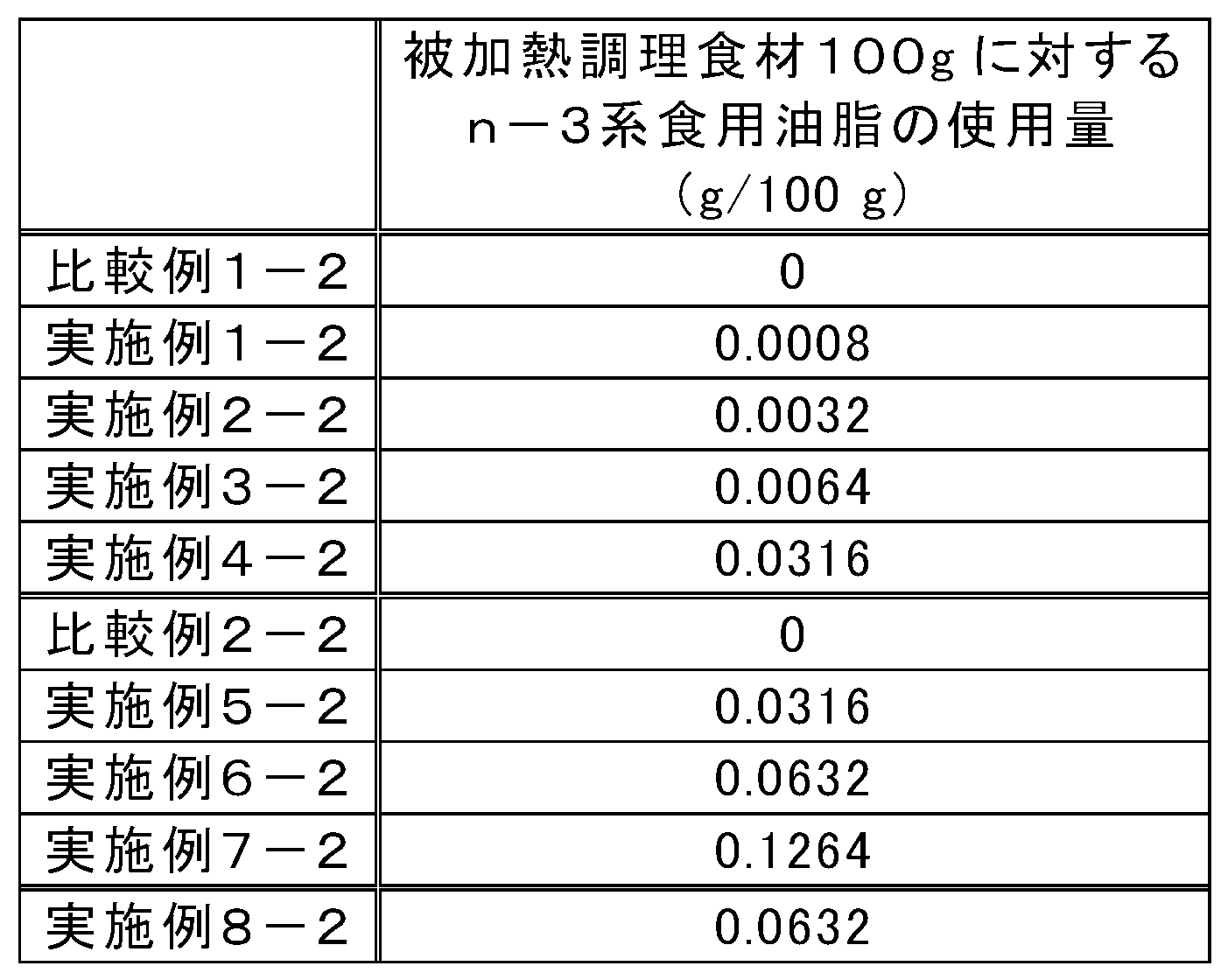
本発明によれば、被加熱調理食材100gに対するn-3系食用油脂の使用量および加熱調理食品中のn-3系食用油脂の含有量が少量であっても、油っぽさの低減効果を好適に発揮することが分かる。
Claims (18)
- 構成脂肪酸総量に占めるn-3系脂肪酸の含有量が30質量%以上80質量%以下であるn-3系食用油脂を含む、被加熱調理食材用加工液組成物であって、
前記n-3系食用油脂の含有量が、前記被加熱調理食材用加工液組成物の全質量に対して、0.001質量%以上10質量%以下である、被加熱調理食材用加工液組成物。 - 前記n-3系食用油脂が、えごま油、あまに油、しそ油、DHAを含む油、およびEPAを含む油からなる群から選択される少なくとも1種を含む、請求項1に記載の被加熱調理食材用加工液組成物。
- 前記n-3系食用油脂の構成脂肪酸総量に占めるn-3系脂肪酸の含有量が、45質量%以上75質量%以下である、請求項1または2に記載の被加熱調理食材用加工液組成物。
- 前記n-3系脂肪酸が、α-リノレン酸を含む、請求項1~3のいずれか1項に記載の被加熱調理食材用加工液組成物。
- 前記α-リノレン酸の含有量が、n-3系脂肪酸の全質量に対して、80質量%以上100質量%以下である、請求項4に記載の被加熱調理食材用加工液組成物。
- n-3系食用油脂以外の食用油脂をさらに含む、請求項1~5のいずれか1項に記載の被加熱調理食材用加工液組成物。
- 前記n-3系食用油脂および前記n-3系食用油脂以外の食用油脂の総含有量が、前記被加熱調理食材用加工液組成物の全質量に対して、0.1質量%以上10質量%以下である、請求項6に記載の被加熱調理食材用加工液組成物。
- 加熱調理食品の油っぽさの低減に用いられる、請求項1~7のいずれか1項に記載の被加熱調理食材用加工液組成物。
- 被加熱調理食材に請求項1~8のいずれか1項に記載の被加熱調理食材用加工液組成物を付与する工程(1)と、
被加熱調理食材用加工液組成物が付与された被加熱調理食材を、油を用いて加熱調理する工程(2)と、
を含む、加熱調理食品の製造方法。 - 加熱調理食品中のn-3系食用油脂の含有量が、加熱調理食品の全質量に対して、0.00002質量%以上5質量%以下である、請求項9に記載の製造方法。
- 前記n-3系食用油脂の使用量が、前記被加熱調理食材100gに対して、0.00002g以上5g以下である、請求項9または10に記載の製造方法。
- 前記油の酸価が、0.110以下である、請求項9~11のいずれか1項に記載の製造方法。
- 前記被加熱調理食材が、畜肉、魚肉および魚介類からなる群から選ばれる少なくとも1種を含む、請求項9~12のいずれか1項に記載の製造方法。
- 加熱調理食品を加熱調理する前に被加熱調理食材に請求項1~8のいずれか1項に記載の被加熱調理食材用加工液組成物を付与する、加熱調理食品の油っぽさ低減方法。
- 加熱調理食品中のn-3系食用油脂の含有量が、加熱調理食品の全質量に対して、0.00002質量%以上5質量%以下である、請求項14に記載の方法。
- 前記n-3系食用油脂の使用量が、前記被加熱調理食材100gに対して、0.00002g以上5g以下である、請求項14または15に記載の方法。
- 前記油の酸価が、0.1超10以下である、請求項14~16のいずれか1項に記載の方法。
- 構成脂肪酸総量に占めるn-3系脂肪酸の含有量が30質量%以上80質量%以下であるn-3系食用油脂を有効成分とする、加熱調理食品の油っぽさ低減剤であって、
被加熱調理食材に被加熱調理食材用加工液組成物を付与する場合、前記n-3系食用油脂の添加量が、前記被加熱調理食材用加工液組成物の全質量に対して、0.001質量%以上10質量%以下となるように用いる、前記油っぽさ低減剤。
Priority Applications (1)
| Application Number | Priority Date | Filing Date | Title |
|---|---|---|---|
| JP2023580181A JPWO2023153265A1 (ja) | 2022-02-10 | 2023-01-31 |
Applications Claiming Priority (2)
| Application Number | Priority Date | Filing Date | Title |
|---|---|---|---|
| JP2022019500 | 2022-02-10 | ||
| JP2022-019500 | 2022-02-10 |
Publications (1)
| Publication Number | Publication Date |
|---|---|
| WO2023153265A1 true WO2023153265A1 (ja) | 2023-08-17 |
Family
ID=87564196
Family Applications (1)
| Application Number | Title | Priority Date | Filing Date |
|---|---|---|---|
| PCT/JP2023/002959 Ceased WO2023153265A1 (ja) | 2022-02-10 | 2023-01-31 | 被加熱調理食材用加工液組成物 |
Country Status (3)
| Country | Link |
|---|---|
| JP (1) | JPWO2023153265A1 (ja) |
| TW (1) | TW202341869A (ja) |
| WO (1) | WO2023153265A1 (ja) |
Citations (8)
| Publication number | Priority date | Publication date | Assignee | Title |
|---|---|---|---|---|
| JPH10108641A (ja) * | 1996-10-01 | 1998-04-28 | Riken Vitamin Co Ltd | 魚肉練り製品用乳化調味料組成物及びその製造方法並びに魚肉練り製品 |
| KR20120055287A (ko) * | 2010-11-23 | 2012-05-31 | 허현석 | 염지양념 및 이를 이용한 오리목살 조리방법 |
| JP2014079217A (ja) * | 2012-10-18 | 2014-05-08 | J-Oil Mills Inc | 畜肉加工品の製造方法 |
| CN107736571A (zh) * | 2017-11-14 | 2018-02-27 | 河南伊赛牛肉股份有限公司 | 一种牛肉风味甜不辣的加工方法 |
| JP2020043811A (ja) * | 2018-09-19 | 2020-03-26 | 日清オイリオグループ株式会社 | 食肉軟化剤 |
| JP2020103266A (ja) * | 2018-11-06 | 2020-07-09 | 株式会社J−オイルミルズ | 加熱調理用油脂組成物 |
| JP2020137434A (ja) * | 2019-02-27 | 2020-09-03 | 株式会社J−オイルミルズ | 炊飯用油脂組成物の改良 |
| KR102242379B1 (ko) * | 2020-05-21 | 2021-04-19 | 정지상 | 오메가-3가 함유된 치킨의 제조 방법 |
-
2023
- 2023-01-31 WO PCT/JP2023/002959 patent/WO2023153265A1/ja not_active Ceased
- 2023-01-31 JP JP2023580181A patent/JPWO2023153265A1/ja active Pending
- 2023-01-31 TW TW112103205A patent/TW202341869A/zh unknown
Patent Citations (8)
| Publication number | Priority date | Publication date | Assignee | Title |
|---|---|---|---|---|
| JPH10108641A (ja) * | 1996-10-01 | 1998-04-28 | Riken Vitamin Co Ltd | 魚肉練り製品用乳化調味料組成物及びその製造方法並びに魚肉練り製品 |
| KR20120055287A (ko) * | 2010-11-23 | 2012-05-31 | 허현석 | 염지양념 및 이를 이용한 오리목살 조리방법 |
| JP2014079217A (ja) * | 2012-10-18 | 2014-05-08 | J-Oil Mills Inc | 畜肉加工品の製造方法 |
| CN107736571A (zh) * | 2017-11-14 | 2018-02-27 | 河南伊赛牛肉股份有限公司 | 一种牛肉风味甜不辣的加工方法 |
| JP2020043811A (ja) * | 2018-09-19 | 2020-03-26 | 日清オイリオグループ株式会社 | 食肉軟化剤 |
| JP2020103266A (ja) * | 2018-11-06 | 2020-07-09 | 株式会社J−オイルミルズ | 加熱調理用油脂組成物 |
| JP2020137434A (ja) * | 2019-02-27 | 2020-09-03 | 株式会社J−オイルミルズ | 炊飯用油脂組成物の改良 |
| KR102242379B1 (ko) * | 2020-05-21 | 2021-04-19 | 정지상 | 오메가-3가 함유된 치킨의 제조 방법 |
Also Published As
| Publication number | Publication date |
|---|---|
| TW202341869A (zh) | 2023-11-01 |
| JPWO2023153265A1 (ja) | 2023-08-17 |
Similar Documents
| Publication | Publication Date | Title |
|---|---|---|
| JP4361589B2 (ja) | 長鎖高度不飽和脂肪酸及び/又はそのエステル体を含むコク味向上剤 | |
| JP6419120B2 (ja) | フライ風味増強剤 | |
| JP7312017B2 (ja) | 加熱調理用油脂組成物 | |
| JP4657924B2 (ja) | 長鎖高度不飽和脂肪酸及び/又はそのエステル体から成るコク味向上剤の利用方法 | |
| JP7227734B2 (ja) | 餃子の羽根形成用組成物及び羽根付き餃子の製造方法 | |
| JP7311980B2 (ja) | 炊飯用油脂組成物の改良 | |
| WO2023153265A1 (ja) | 被加熱調理食材用加工液組成物 | |
| JP2020137502A (ja) | ペースト状調味組成物 | |
| JP3506063B2 (ja) | 煮物用油脂組成物 | |
| JPWO2018037928A1 (ja) | 揚げ物用油脂組成物、揚げ物用油脂組成物の製造方法、揚げ物の製造方法、及び揚げ物にチーズ風味を付与する方法 | |
| WO2022158297A1 (ja) | 食用油脂組成物、食品、食用油脂組成物の製造方法、食品の製造方法、食品の風味付与剤、食品の風味付与方法、及び風味油の風味維持方法 | |
| JP4603235B2 (ja) | 肉質改良剤およびこれを用いた調理加工法 | |
| JP7826461B2 (ja) | 水添臭付与剤、油脂組成物、油脂組成物の製造方法、食品に水添臭を付与する方法、及びフライ食品の製造方法 | |
| JP3823839B2 (ja) | 水産練り製品の製造法 | |
| JP2020000220A (ja) | 炒め物用調味料 | |
| TWI837250B (zh) | 加熱烹調用油脂組成物 | |
| JP2010081802A (ja) | 水中油型乳化組成物 | |
| JP7055676B2 (ja) | 加熱調理用油脂組成物 | |
| WO2020137516A1 (ja) | 加熱調理用油脂組成物 | |
| JP7000071B2 (ja) | 加熱調理用油脂組成物 | |
| JPH0443626B2 (ja) | ||
| JP2025118274A (ja) | 食肉用液体組成物 | |
| JP2023135880A (ja) | 澱粉含有食品用品質改良剤 | |
| JP2009213429A (ja) | 小麦粉加工食品の製造法 | |
| MXPA06005369A (es) | Mejorador de sabor y cuerpo que contiene un acido graso de cadena larga con alto grado de insaturacion y/o un ester del mismo |
Legal Events
| Date | Code | Title | Description |
|---|---|---|---|
| 121 | Ep: the epo has been informed by wipo that ep was designated in this application |
Ref document number: 23752730 Country of ref document: EP Kind code of ref document: A1 |
|
| ENP | Entry into the national phase |
Ref document number: 2023580181 Country of ref document: JP Kind code of ref document: A |
|
| NENP | Non-entry into the national phase |
Ref country code: DE |
|
| 122 | Ep: pct application non-entry in european phase |
Ref document number: 23752730 Country of ref document: EP Kind code of ref document: A1 |