WO2023136103A1 - 基板分割治具 - Google Patents
基板分割治具 Download PDFInfo
- Publication number
- WO2023136103A1 WO2023136103A1 PCT/JP2022/047700 JP2022047700W WO2023136103A1 WO 2023136103 A1 WO2023136103 A1 WO 2023136103A1 JP 2022047700 W JP2022047700 W JP 2022047700W WO 2023136103 A1 WO2023136103 A1 WO 2023136103A1
- Authority
- WO
- WIPO (PCT)
- Prior art keywords
- substrate
- base plate
- recess
- dividing
- boundary
- Prior art date
- Legal status (The legal status is an assumption and is not a legal conclusion. Google has not performed a legal analysis and makes no representation as to the accuracy of the status listed.)
- Ceased
Links
Images



Classifications
-
- B—PERFORMING OPERATIONS; TRANSPORTING
- B26—HAND CUTTING TOOLS; CUTTING; SEVERING
- B26F—PERFORATING; PUNCHING; CUTTING-OUT; STAMPING-OUT; SEVERING BY MEANS OTHER THAN CUTTING
- B26F3/00—Severing by means other than cutting; Apparatus therefor
-
- H—ELECTRICITY
- H05—ELECTRIC TECHNIQUES NOT OTHERWISE PROVIDED FOR
- H05K—PRINTED CIRCUITS; CASINGS OR CONSTRUCTIONAL DETAILS OF ELECTRIC APPARATUS; MANUFACTURE OF ASSEMBLAGES OF ELECTRICAL COMPONENTS
- H05K3/00—Apparatus or processes for manufacturing printed circuits
Definitions
- the present disclosure relates to a substrate dividing jig.
- Patent Document 1 Japanese Patent Application Laid-Open No. 63-191599 (Patent Document 1) describes a device for dividing a substrate.
- a substrate dividing device described in Patent Document 1 has a base and a slide plate.
- the base has vertical walls.
- the slide plate is arranged on the base so as to face the vertical wall.
- a printed circuit board is sandwiched between the vertical wall portion and the slide plate.
- a printed circuit board contains multiple circuit boards.
- a V-groove is formed between adjacent circuit boards. The extending direction of the V-groove is along the upper end of the vertical wall portion and the upper end of the slide plate.
- the printed circuit board is split along the V-grooves by laying down the portion of the printed circuit board that is not sandwiched between the vertical wall and the slide plate.
- the present disclosure has been made in view of the problems of the prior art as described above. More specifically, the present disclosure provides a substrate dividing jig capable of suppressing damage to the substrate or components mounted on the substrate during division.
- a substrate dividing jig of the present disclosure is a jig for dividing a substrate having a first dividing line.
- the substrate dividing jig includes a base plate unit having a first base plate and a second base plate arranged adjacent to each other in a first direction, and a first substrate holding unit and a second substrate holding unit.
- a first boundary which is a boundary between the first base plate and the second base plate, extends along a second direction orthogonal to the first direction.
- the first baseplate includes a first side and a second side opposite the first side.
- the second baseplate includes a third surface and a fourth surface opposite the third surface. Substrates are arranged on the first surface and the third surface such that the first parting line faces the first boundary.
- the first baseplate is rotatably connected to the second baseplate about a first rotation axis along the second direction.
- the first substrate holding unit and the second substrate holding unit hold the substrate between the first surface and the third surface, respectively.
- the substrate dividing jig of the present disclosure damage to the substrate or components mounted on the substrate during division can be suppressed.
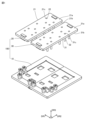
- FIG. 3 is an exploded perspective view of the substrate dividing jig 100;
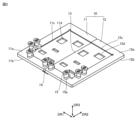
- FIG. 3 is a perspective view of the base plate unit 10;
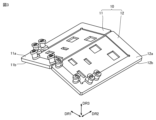
- FIG. FIG. 4 is a perspective view of the base plate unit 10 when the first base plate 11 is rotated with respect to the second base plate 12;
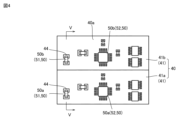
- 4 is a plan view of a substrate 40;
- FIG. FIG. 5 is a cross-sectional view along VV in FIG. 4;
- 4 is a perspective view of the base plate unit 10 with the substrate 40 arranged.
- FIG. FIG. 3 is a perspective view of the substrate dividing jig 100 with substrates 40 arranged thereon;
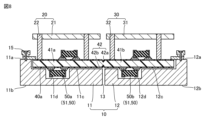
- FIG. 8 is a cross-sectional view along VIII-VIII in FIG. 7;
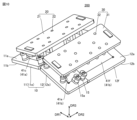
- FIG. 4 is a perspective view of the substrate dividing jig 100 when the first base plate 11 is rotated with respect to the second base plate 12 with the substrate 40 arranged thereon.
- FIG. 4 is a perspective view of the substrate dividing jig 200 when the first base plate 11 is rotated with respect to the second base plate 12 with the substrate 40 arranged thereon.
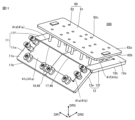
- FIG. 11 is a perspective view of the substrate dividing jig 200 when the first portion 11e and the third portion 12e are rotated with respect to the second portion 11f and the fourth portion 12f, respectively;
- Embodiment 1 A substrate dividing jig according to Embodiment 1 will be described.
- a substrate dividing jig according to the first embodiment is referred to as a substrate dividing jig 100 .
- FIG. 1 is an exploded perspective view of the substrate dividing jig 100.
- the substrate dividing jig 100 has a base plate unit 10 , a first substrate holding unit 20 and a second substrate holding unit 30 .
- FIG. 2 is a perspective view of the base plate unit 10.
- the baseplate unit 10 has a first baseplate 11 and a second baseplate 12 .
- the first base plate 11 and the second base plate 12 are flat members.
- the first base plate 11 and the second base plate 12 are made of a heat resistant material.
- the first base plate 11 and the second base plate 12 are made of, for example, a resin material impregnated with glass cloth woven with filler and glass fibers.
- the first base plate 11 and the second base plate 12 are arranged adjacent to each other in the first direction DR1.
- a first boundary 13 between the first base plate 11 and the second base plate 12 extends along the second direction DR2.
- the second direction DR2 is a direction orthogonal to the first direction DR1.
- a direction perpendicular to the first direction DR1 and the second direction DR2 is defined as a third direction DR3.
- the first base plate 11 has a first surface 11a and a second surface 11b.
- the first surface 11a and the second surface 11b are end surfaces of the first base plate 11 in the third direction DR3.
- the second surface 11b is the opposite surface of the first surface 11a.
- the second base plate 12 has a third surface 12a and a fourth surface 12b.
- the third surface 12a and the fourth surface 12b are end surfaces of the second base plate 12 in the third direction DR3.
- the fourth surface 12b is the opposite surface of the third surface 12a.
- a first concave portion 11c is formed on the first surface 11a.
- the first surface 11a is recessed toward the second surface 11b in the first concave portion 11c.
- the first concave portion 11c is formed, for example, by pocketing the first surface 11a.
- a second recess 12c is formed in the third surface 12a.
- the third surface 12a is recessed toward the fourth surface 12b in the second recess 12c.
- the second concave portion 12c is formed, for example, by pocketing the third surface 12a.
- the shape obtained by combining the outer shape of the first recess 11c and the outer shape of the second recess 12c is a rectangular shape.
- a plurality of third recesses 11d are formed on the bottom surface of the first recess 11c.
- the bottom surface of the first recess 11c is recessed toward the second surface 11b in the third recess 11d.
- the third recess 11d is formed, for example, by spot facing the bottom surface of the first recess 11c.
- a plurality of fourth recesses 12d are formed on the bottom surface of the second recess 12c.
- the bottom surface of the fourth recess 12d is recessed toward the fourth surface 12b in the fourth recess 12d.
- the fourth recess 12d is formed by spot facing the bottom surface of the second recess 12c.
- FIG. 3 is a perspective view of the base plate unit 10 when the first base plate 11 is rotated with respect to the second base plate 12.
- FIG. 3 the first base plate 11 is coupled to the second base plate 12 so as to be rotatable around a first rotation axis along the second direction DR2.
- the connection between the first base plate 11 and the second base plate 12 is performed by, for example, a hinge 14 (see FIG. 2).
- the base plate unit 10 further has a plurality of pressing members 15.
- a retainer 15 is mounted on the portion of the first surface 11a surrounding the first recess 11c and on the portion of the third surface 12a surrounding the second recess 12c.
- the pressing member 15 is rotatable around a rotation axis along the third direction DR3.
- the presser 15 has a presser plate 15a. By rotating the pressing member 15 about the rotation axis along the third direction DR3, the pressing plate 15a can be positioned above the bottom surface of the first recess 11c or above the bottom surface of the second recess 12c.
- the first board holding unit 20 has a first top plate 21 and a plurality of first pins 22 .
- the first top plate 21 is a flat member.
- the first top plate 21 has a main surface 21a and a main surface 21b.
- the main surface 21a and the main surface 21b are end surfaces of the first top plate 21 in the thickness direction.
- the main surface 21b is the opposite surface of the main surface 21a.
- a plurality of through holes 21 c are formed in the first top plate 21 .
- the through hole 21c penetrates the first top plate 21 along the thickness direction.
- the number of through holes 21 c is equal to the number of first pins 22 .
- the shape of the through hole 21c in plan view is, for example, circular.
- the first pin 22 is inserted into the through hole 21c. Thereby, the first pin 22 is attached to the first top plate 21 .
- the first pin 22 is, for example, cylindrical.
- the first pin 22 protrudes from the main surface 21b.
- the distance between the other end of the first pin 22 and the main surface 21b is constant for the plurality of first pins 22. As shown in FIG.
- the distance between two adjacent first pins 22 is preferably 30 mm or less.
- the second board holding unit 30 has a second top plate 31 and a plurality of second pins 32 .
- the second top plate 31 is a flat member.
- the second top plate 31 has a main surface 31a and a main surface 31b.
- the main surface 31a and the main surface 31b are end surfaces of the second top plate 31 in the thickness direction.
- the main surface 31b is the opposite surface of the main surface 31a.
- a plurality of through holes 31 c are formed in the second top plate 31 .
- the through hole 31c penetrates the second top plate 31 along the thickness direction.
- the number of through holes 31 c is equal to the number of second pins 32 .
- the shape of the through hole 31c in plan view is, for example, circular.
- the second pin 32 is, for example, cylindrical.
- the second pin 32 protrudes from the main surface 31b.
- the distance between the other end of the second pin 32 and the main surface 31b is constant for the plurality of second pins 32 .
- the distance between two adjacent second pins 32 is preferably 30 mm or less.
- the first top plate 21 and the second top plate 31 are made of, for example, a metal material. Specific examples of metal materials include iron alloys such as stainless steel, copper alloys, and aluminum alloys. However, the first top plate 21 and the second top plate 31 may be made of materials other than metal. The first top plate 21 and the second top plate 31 may be made of, for example, tempered glass or a resin material impregnated with a metal filler. That is, the first top plate 21 and the second top plate 31 may be made of rigid material.
- the first pin 22 and the second pin 32 are made of resin material such as epoxy resin, for example.
- substrate 40 includes a plurality of substrates 41 .
- substrate 40 includes two substrates 41 . These two substrates 41 may be referred to as substrate 41a and substrate 41b, respectively.
- the substrate 40 has a principal surface 40a and a principal surface 40b.
- the main surface 40a and the main surface 40b are end surfaces of the substrate 40 in the thickness direction.
- the principal surface 40b is the opposite surface of the principal surface 40a.
- a first parting line 42 is formed on the substrate 40 .
- the first dividing line 42 is composed of a groove 42a and a groove 42b.
- the grooves 42a and 42b are formed in the principal surfaces 40a and 40b, respectively.
- the grooves 42 a and 42 b are V-shaped in cross-section and face each other in the thickness direction of the substrate 40 .
- the grooves 42a and 42b are formed, for example, by a splitter slicer having a pair of blades facing each other.
- the first dividing line 42 is not limited to this.
- the first dividing line 42 may be, for example, a perforation formed by a router.
- the substrate 40 has a base material 43 , conductor patterns 44 and 45 , and solder resists 46 and 47 .
- the base material 43 is, for example, a core material of glass cloth impregnated with a flame-retardant epoxy resin and arranged on both main surfaces of the core material, and is formed of glass cloth impregnated with an epoxy resin.
- CEM-3 substrate which is a laminate having a reinforcing layer with a
- the base material 43 is not limited to this.
- the base material 43 may be, for example, an FR-4 base material, which is glass cloth impregnated with epoxy resin, or a paper phenol base material, which is insulating paper impregnated with phenol resin.
- the base material 43 has a principal surface 43a and a principal surface 43b.
- the main surface 43a and the main surface 43b are end surfaces of the base material 43 in the thickness direction.
- the principal surface 43a and the principal surface 43b are on the principal surface 40a side and the principal surface 40b side, respectively.
- the principal surface 43b is the opposite surface of the principal surface 43a.
- the conductor pattern 44 and the conductor pattern 45 are arranged on the main surface 43a and the main surface 43b, respectively.
- the conductor pattern 44 and the conductor pattern 45 are formed, for example, by patterning a copper foil by etching.
- a solder resist 46 is arranged on the main surface 43 a so as to cover the conductor pattern 44 .
- the solder resist 46 has openings for exposing the electrode pads of the conductor pattern 44 .
- a solder resist 47 is arranged on the main surface 43 b so as to cover the conductor pattern 45 .
- the solder resist 47 has openings for exposing the electrode pads of the conductor pattern 45 .
- a plurality of components 50 are mounted on the board 40 .
- Components 50 are, for example, ceramic capacitors 51 and semiconductor packages 52 . However, the component 50 is not limited to these.
- Some of the components 50 are joined to electrode pads of the conductor pattern 44 by joints 53 .
- the rest of the plurality of components 50 are joined to the electrode pads of the conductor pattern 45 by joints 53 .
- the joint portion 53 is made of, for example, a solder alloy. Solder alloys include, for example, Sn (tin)-3.0Ag (silver)-0.5Cu (copper) solder alloy, Sn-Ag solder alloy, Sn-Cu solder alloy, Sn-Zn (zinc) solder alloy , Sn—Sb (antimony) alloys.
- the joint portion 53 is formed by, for example, a flow method or a reflow method.
- the component 50 joined to the electrode pad of the conductor pattern 44 on the substrate 41a and the component 50 joined to the electrode pad of the conductor pattern 44 on the substrate 41b may be referred to as the component 50a and the component 50b, respectively. .
- FIG. 6 is a perspective view of the base plate unit 10 with the board 40 arranged.
- FIG. 7 is a perspective view of the substrate dividing jig 100 in which the substrate 40 is arranged.
- FIG. 8 is a cross-sectional view along VIII-VIII in FIG.
- the substrate 40 is placed on the first surface 11a and the third surface 12a. More specifically, the substrate 40 is arranged in the first recess 11c and the second recess 12c.
- the main surface 40a faces the bottom surface of the first recess 11c and the bottom surface of the second recess 12c.
- the part 50a and the part 50b are arranged in the third recess 11d and the fourth recess 12d, respectively.
- the first boundary 13 faces the first dividing line 42 in a state in which the substrate 40 is arranged on the first surface 11a and the third surface 12a.
- the first substrate holding unit 20 is arranged so as to sandwich the substrate 40 with the first surface 11a. More specifically, the plurality of first pins 22 sandwich the substrate 40 with the bottom surface of the first recess 11c. However, the plurality of first pins 22 preferably sandwich the substrate 40 with the bottom surface of the first recess 11c where the third recess 11d is not formed.
- the second substrate holding unit 30 is arranged to sandwich the substrate 40 with the third surface 12a. More specifically, the plurality of second pins 32 sandwich the substrate 40 with the bottom surface of the second recess 12c. However, the plurality of second pins 32 preferably sandwich the substrate 40 with the bottom surface of the second recess 12c where the fourth recess 12d is not formed.
- the substrate dividing jig 100 and the substrate 40 are prepared.
- the substrate 40 is positioned between the bottom surface of the first recess 11c and the bottom surface of the second recess 12c. It is arranged on the second recess 12c.
- the substrate 40 is fixed to the base plate unit 10 by rotating the pressing member 15 so that the pressing plate 15a is positioned above the bottom surface of the first recess 11c and above the bottom surface of the second recess 12c.
- the first substrate holding unit 20 is arranged so as to sandwich the substrate 40 between itself and the bottom surface of the first concave portion 11c.
- the second substrate holding unit 30 is arranged so as to sandwich the substrate 40 with the bottom surface of the recess 12c.
- FIG. 9 is a perspective view of the substrate dividing jig 100 when the first base plate 11 is rotated with respect to the second base plate 12 with the substrate 40 arranged.
- the first base plate 11 is rotated with respect to the second base plate 12 about the first rotation axis so that the second surface 11b approaches the fourth surface 12b (that is, the base plate unit 10 is folded into a mountain).
- the substrate 40 is split along the first split lines 42 to obtain a plurality of substrates 41 .
- the substrates 41a and 41b and the components 50 mounted thereon will be damaged. may occur. Such damage is particularly likely to occur when the component 50 is a ceramic capacitor 51 formed by laminating fragile ceramics.
- the portion of the substrate 40 that will become the substrate 41a is held between the first surface 11a and the first substrate holding unit 20, and the portion of the substrate 40 that will become the substrate 41b. Since the portion is sandwiched between the second surface 11b and the second substrate holding unit 30, the entire substrate 40 is fully supported when the substrate 40 is divided using the substrate dividing jig 100, and the substrate 41a Local strain is less likely to be applied to the portion of the substrate 40 that becomes the substrate 41b and the portion of the substrate 40 that becomes the substrate 41b. Therefore, according to the substrate dividing jig 100, it is possible to suppress damage to the substrates 41a, 41b, and the components 50 mounted thereon.
- first recess 11c and the second recess 12c are formed on the first surface 11a and the third surface 12a, respectively, by placing the substrate 40 on the bottom surface of the first recess 11c and the bottom surface of the second recess 12c, It is possible to easily position the substrate 40 .
- the bottom surface of the first recess portion 11c and the bottom surface of the second recess portion 12c are formed with the third recess portion 11d and the fourth recess portion 12d, respectively, interference between the component 50a and the first base plate 11 and interference between the component 50b and the second base plate 12 may occur. interference can be avoided.
- the plurality of first pins 22 are arranged so as to sandwich the substrate 40 with the bottom surface of the first recess 11c where the third recess 11d is not formed, and the plurality of second pins 32 are arranged to hold the fourth recess 12d.
- the portion of the substrate 40 where the main surface 40a is not supported by the first base plate 11 is the first base plate 11. It is avoided that the pin 22 presses down, and the second pin 32 also avoids pressing the portion of the main surface 40 a that is not supported by the second base plate 12 .
- the portion of the substrate 40 that becomes the substrate 41a and the portion of the substrate 40 that becomes the substrate 41b are less likely to be locally strained, and the substrates 41a and 41b and the components 50 mounted thereon are less likely to be locally strained. It is possible to further suppress the occurrence of damage.
- the first board holding unit 20 may not have the first pins 22
- the second board holding unit 30 may not have the second pins 32 .
- the substrate dividing jig 100 can be used without changing even if the other points of the substrate 40 are different. Further, in this case, since the degree of freedom of the position of the component 50 on the board 40 is improved, restrictions on the design of the board 40 are reduced.
- a substrate dividing jig according to Embodiment 2 will be described.
- a substrate dividing jig according to the first embodiment is referred to as a substrate dividing jig 200 .
- differences from the substrate dividing jig 100 will be mainly described, and redundant description will not be repeated.
- FIG. 10 is a perspective view of the substrate dividing jig 200 when the first base plate 11 is rotated with respect to the second base plate 12 with the substrate 40 arranged.
- FIG. 11 is a perspective view of the substrate dividing jig 200 when the first portion 11e and the third portion 12e are rotated with respect to the second portion 11f and the fourth portion 12f, respectively.
- the substrate dividing jig 200 has a base plate unit 10, a first substrate holding unit 20, and a second substrate holding unit 30.
- the configuration of the substrate dividing jig 200 is common to the configuration of the substrate dividing jig 100 .
- the first base plate 11 has a first portion 11e and a second portion 11f
- the second base plate 12 has a third portion 12e and a fourth portion 12f.
- the first portion 11e and the third portion 12e are arranged adjacent to each other in the first direction DR1.
- the second portion 11f and the fourth portion 12f are arranged adjacent to each other in the first direction DR1.
- a second boundary 16 between the first portion 11e and the second portion 11f extends along the first direction DR1.
- a third boundary 17 between the third portion 12e and the fourth portion 12f extends along the first direction DR1 and on an extension of the second boundary 16.
- the first portion 11e is connected to the second portion 11f by, for example, a hinge (not shown) so as to be rotatable about a second rotation axis along the first direction DR1.
- the third portion 12e is connected to the fourth portion 12f by, for example, a hinge (not shown) so as to be rotatable about the second rotation axis.
- the substrate 40 is formed with a second dividing line 48 perpendicular to the first dividing line 42 .
- the second parting line 48 is composed of, for example, grooves formed in the principal surface 40a and grooves formed in the principal surface 40b. These grooves are V-shaped in cross section and face each other in the thickness direction of the substrate 40 .
- the substrate 40 is arranged such that the second dividing line 48 faces the second boundary 16 and the third boundary 17 .
- substrate 40 includes four substrates 41 . These four substrates may be referred to as substrate 41c, substrate 41d, substrate 41e and substrate 41f.
- the board dividing jig 200 may further have a third board holding unit 60 .
- the third board holding unit 60 has a third top plate 61 and a plurality of third pins 32 .
- the third top plate 61 is a flat member.
- the third top plate 61 has a main surface 61a and a main surface 61b.
- the main surface 61a and the main surface 61b are end surfaces of the third top plate 61 in the thickness direction.
- the principal surface 61b is the opposite surface of the principal surface 61a.
- a plurality of through holes 61 c are formed in the third top plate 61 .
- the through hole 61c penetrates the third top plate 61 along the thickness direction.
- the number of through holes 61 c is equal to the number of third pins 62 .
- the shape of the through hole 61c in plan view is, for example, circular.
- the third pin 62 is, for example, cylindrical.
- the third pin 62 protrudes from the main surface 61b. The distance between the other end of the third pin 62 and the main surface 61b is constant for the plurality of third pins 62 .
- the third top plate 61 is made of, for example, a metal material. Specific examples of metal materials include iron alloys such as stainless steel, copper alloys, and aluminum alloys. However, the third top plate 61 may be made of a material other than metal. The third top plate 61 may be made of, for example, tempered glass or a resin material impregnated with a metal filler. That is, the third top plate 61 may be made of rigid material.
- the third pin 62 is made of, for example, a resin material such as epoxy resin. Regarding these points, the configuration of the substrate dividing jig 200 is different from the configuration of the substrate dividing jig 100 .
- the substrate dividing jig 200 and the substrate 40 are prepared.
- the substrate 40 is positioned between the bottom surface of the first recess 11c and the bottom surface of the second recess 12c. It is arranged on the second recess 12c.
- the substrate 40 is fixed to the base plate unit 10 by rotating the pressing member 15 so that the pressing plate 15a is positioned above the bottom surface of the first recess 11c and above the bottom surface of the second recess 12c.
- the first substrate holding unit 20 is arranged so as to sandwich the substrate 40 between itself and the bottom surface of the first concave portion 11c.
- the second substrate holding unit 30 is arranged so as to sandwich the substrate 40 with the bottom surface of the recess 12c.
- the second surface 11b is the fourth surface while the base plate unit 10, the first substrate holding unit 20, and the second substrate holding unit 30 are held. 12b (that is, the base plate unit 10 is folded into a mountain), the first base plate 11 is rotated with respect to the second base plate 12 around the first rotation axis. Thereby, the substrate 40 is divided along the first dividing line 42 to obtain the substrates 41a and 41b.
- the substrate 41a is sandwiched between the bottom surface of the first recess 11c and the substrate 41b is sandwiched between the bottom surface of the second recess 12c.
- the third substrate holding unit 60 is arranged so as to
- the second surface 11b of the first portion 11e faces the second portion 11f while the base plate unit 10 and the third substrate holding unit 60 are held.
- the first portion 11e is rotated with respect to the second portion 11f around the second rotation axis so as to approach the second surface 11b at the top (that is, the first base plate 11 is folded into a mountain).
- the third portion 12e is folded so that the fourth surface 12b on the third portion 12e approaches the fourth surface 12b on the fourth portion 12f (that is, the second base plate 12 is folded into a mountain). It is rotated with respect to the fourth portion 12f around the rotation axis.
- the substrates 41a and 41b are divided along the second dividing line 48 to obtain the substrates 41c, 41d, 41e and 41f.
- the substrate 40 can be divided multiple times by setting the substrate 40 on the substrate dividing jig 200 once. Therefore, the substrate 40 can be divided efficiently. .
Landscapes
- Engineering & Computer Science (AREA)
- Manufacturing & Machinery (AREA)
- Microelectronics & Electronic Packaging (AREA)
- Life Sciences & Earth Sciences (AREA)
- Forests & Forestry (AREA)
- Mechanical Engineering (AREA)
- Processing Of Stones Or Stones Resemblance Materials (AREA)
Priority Applications (1)
| Application Number | Priority Date | Filing Date | Title |
|---|---|---|---|
| JP2023573955A JP7603853B2 (ja) | 2022-01-11 | 2022-12-23 | 基板分割治具 |
Applications Claiming Priority (2)
| Application Number | Priority Date | Filing Date | Title |
|---|---|---|---|
| JP2022-002423 | 2022-01-11 | ||
| JP2022002423 | 2022-01-11 |
Publications (1)
| Publication Number | Publication Date |
|---|---|
| WO2023136103A1 true WO2023136103A1 (ja) | 2023-07-20 |
Family
ID=87278990
Family Applications (1)
| Application Number | Title | Priority Date | Filing Date |
|---|---|---|---|
| PCT/JP2022/047700 Ceased WO2023136103A1 (ja) | 2022-01-11 | 2022-12-23 | 基板分割治具 |
Country Status (2)
| Country | Link |
|---|---|
| JP (1) | JP7603853B2 (https=) |
| WO (1) | WO2023136103A1 (https=) |
Citations (6)
| Publication number | Priority date | Publication date | Assignee | Title |
|---|---|---|---|---|
| JPS6334103A (ja) * | 1986-07-29 | 1988-02-13 | 松下電器産業株式会社 | 基板分割装置 |
| JPH0278504A (ja) * | 1988-06-16 | 1990-03-19 | Aisa Spa | セラミック基板自動分離装置 |
| JPH0330395A (ja) * | 1989-06-27 | 1991-02-08 | Nec Gumma Ltd | プリント配線基板分断装置 |
| JPH03221400A (ja) * | 1990-01-23 | 1991-09-30 | Oki Electric Ind Co Ltd | プリント基板の分割方法 |
| JPH0740296A (ja) * | 1993-08-04 | 1995-02-10 | Sumitomo Kinzoku Ceramics:Kk | セラミック基板の分割方法と分割用治具 |
| JPH0843282A (ja) * | 1994-07-27 | 1996-02-16 | Nippondenso Co Ltd | 板材の折り曲げ応力測定装置 |
-
2022
- 2022-12-23 JP JP2023573955A patent/JP7603853B2/ja active Active
- 2022-12-23 WO PCT/JP2022/047700 patent/WO2023136103A1/ja not_active Ceased
Patent Citations (6)
| Publication number | Priority date | Publication date | Assignee | Title |
|---|---|---|---|---|
| JPS6334103A (ja) * | 1986-07-29 | 1988-02-13 | 松下電器産業株式会社 | 基板分割装置 |
| JPH0278504A (ja) * | 1988-06-16 | 1990-03-19 | Aisa Spa | セラミック基板自動分離装置 |
| JPH0330395A (ja) * | 1989-06-27 | 1991-02-08 | Nec Gumma Ltd | プリント配線基板分断装置 |
| JPH03221400A (ja) * | 1990-01-23 | 1991-09-30 | Oki Electric Ind Co Ltd | プリント基板の分割方法 |
| JPH0740296A (ja) * | 1993-08-04 | 1995-02-10 | Sumitomo Kinzoku Ceramics:Kk | セラミック基板の分割方法と分割用治具 |
| JPH0843282A (ja) * | 1994-07-27 | 1996-02-16 | Nippondenso Co Ltd | 板材の折り曲げ応力測定装置 |
Also Published As
| Publication number | Publication date |
|---|---|
| JPWO2023136103A1 (https=) | 2023-07-20 |
| JP7603853B2 (ja) | 2024-12-20 |
Similar Documents
| Publication | Publication Date | Title |
|---|---|---|
| CA2073211C (en) | Method of manufacturing a rigid-flex printed wiring board | |
| JP4113679B2 (ja) | 三次元実装パッケージの製造方法 | |
| CN102598877B (zh) | 多片基板及其制造方法 | |
| US7921552B2 (en) | Method of manufacturing a small form factor PCBA | |
| JPH04212494A (ja) | 剛性/可撓性プリント回路構造体の製作方法とこの方法により製作された多層可撓性回路基板 | |
| US8677618B2 (en) | Method of manufacturing substrate using a carrier | |
| US20140055961A1 (en) | Printed Circuit Boards with Recesses | |
| CN114286494A (zh) | 一种pcb结构及其制作方法,以及一种电子设备 | |
| WO2023136103A1 (ja) | 基板分割治具 | |
| JP2009231635A (ja) | 配線基板及びその製造方法、及び半導体装置及びその製造方法 | |
| JPS61148706A (ja) | フレキシブル・ケーブルを有するディスプレイ組立体 | |
| JP3056931B2 (ja) | プリント基板分割装置 | |
| JP6866229B2 (ja) | リジッド・フレックス多層プリント配線板 | |
| CN113365427B (zh) | 不对称板的制作方法 | |
| JPH0936499A (ja) | エポキシ系フレキシブルプリント配線基板 | |
| JPH0217955B2 (https=) | ||
| JPH03157986A (ja) | 部品実装用金属基板 | |
| TWI878701B (zh) | 帶有銅柱的印刷電路板的製備方法及銅柱 | |
| US12581960B2 (en) | Highly integrated power electronics and methods of manufacturing the same | |
| TWI898501B (zh) | 電路板及其製造方法 | |
| JP2024172402A (ja) | 部品内蔵基板及びその製造方法 | |
| JPH03157985A (ja) | 部品実装用金属基板 | |
| KR20050045652A (ko) | 리지드 플렉시블 인쇄회로기판의 외형 가공 방법 | |
| JPH08213720A (ja) | 配線基板 | |
| JP2018190765A (ja) | リジッド・フレックス多層プリント配線板 |
Legal Events
| Date | Code | Title | Description |
|---|---|---|---|
| 121 | Ep: the epo has been informed by wipo that ep was designated in this application |
Ref document number: 22920620 Country of ref document: EP Kind code of ref document: A1 |
|
| WWE | Wipo information: entry into national phase |
Ref document number: 2023573955 Country of ref document: JP |
|
| NENP | Non-entry into the national phase |
Ref country code: DE |
|
| 122 | Ep: pct application non-entry in european phase |
Ref document number: 22920620 Country of ref document: EP Kind code of ref document: A1 |