WO2023119644A1 - 熱交換器 - Google Patents
熱交換器 Download PDFInfo
- Publication number
- WO2023119644A1 WO2023119644A1 PCT/JP2021/048292 JP2021048292W WO2023119644A1 WO 2023119644 A1 WO2023119644 A1 WO 2023119644A1 JP 2021048292 W JP2021048292 W JP 2021048292W WO 2023119644 A1 WO2023119644 A1 WO 2023119644A1
- Authority
- WO
- WIPO (PCT)
- Prior art keywords
- vertex
- line
- adhesive
- heat exchange
- heat exchanger
- Prior art date
- Legal status (The legal status is an assumption and is not a legal conclusion. Google has not performed a legal analysis and makes no representation as to the accuracy of the status listed.)
- Ceased
Links
Images

















Classifications
-
- F—MECHANICAL ENGINEERING; LIGHTING; HEATING; WEAPONS; BLASTING
- F28—HEAT EXCHANGE IN GENERAL
- F28F—DETAILS OF HEAT-EXCHANGE AND HEAT-TRANSFER APPARATUS, OF GENERAL APPLICATION
- F28F3/00—Plate-like or laminated elements; Assemblies of plate-like or laminated elements
- F28F3/08—Elements constructed for building-up into stacks, e.g. capable of being taken apart for cleaning
Definitions
- the present disclosure relates to a heat exchanger that exchanges heat between two different airflows.
- a heat exchange ventilator is known that exchanges heat between an air supply flow from the outside to the room and an exhaust air flow from the room to the outside.
- a heat exchange ventilator has a heat exchanger that exchanges heat.
- a heat exchanger is constructed by attaching a casing including a top plate, a bottom plate, and the like to a heat exchange laminate composed of a laminate of two types of heat transfer sheets.
- Patent Document 1 a leak prevention member is filled between the heat exchange laminate and the top plate and between the heat exchange laminate and the bottom plate, and then rubber paint is applied to the filled portions, and the temperature is 20 to 30 at room temperature. The coating is left for 10 minutes and held at 200° C. for 1 hour to cure the paint, thereby increasing the effect of maintaining airtightness between the heat exchange laminate and the top plate and between the heat exchange laminate and the bottom plate.
- Patent Document 1 if the rubber coating protrudes outward when the rubber coating is applied as an adhesive, the rubber coating blocks the air flow inlet and outlet of the heat exchange laminate.
- the protruding part becomes a hindrance and installation becomes difficult.
- an operation of wiping off the protruding rubber paint before curing occurs.
- the effect of airtightness is reduced in areas where the rubber coating is not applied, it is necessary to apply the rubber coating evenly to the outer edge, which makes it difficult to prevent unnecessary protrusions.
- there are a plurality of work steps from filling the leak prevention member to curing the rubber paint there are problems in terms of productivity and cost.
- the present disclosure has been made in view of the above, and prevents the adhesive from protruding outside while ensuring airtightness, eliminates the work of wiping off the adhesive after adhesive assembly, and improves productivity. It is an object of the present invention to obtain a heat exchanger that realizes cost reduction.
- the heat exchanger in the present disclosure is formed by laminating a plurality of heat transfer sheets, and exchanges heat between the first air flow and the second air flow. and an end plate covering the end surface of the heat exchange element in the stacking direction, the end plate and the heat exchange element are adhered with an adhesive, and an elastic member having elasticity is provided outside the adhesive. It is characterized by
- the adhesive is prevented from leaking out while airtightness is ensured, eliminating the work of wiping off the adhesive after adhesive assembly, improving productivity and reducing costs. is realized.
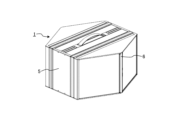
- FIG. 1 is a perspective view showing the overall configuration of a heat exchanger according to Embodiment 1.
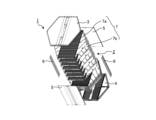
- FIG. 1 is an exploded perspective view showing the overall configuration of a heat exchanger according to Embodiment 1.
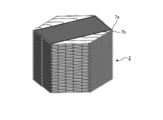
- FIG. 1 is a perspective view showing the overall configuration of a heat exchange element according to Embodiment 1.
- FIG. 3 is a perspective view showing the first heat transfer sheet of the two types of heat transfer sheets of the heat exchange element according to Embodiment 1.
- FIG. 4 is a perspective view showing the second heat transfer sheet of the two types of heat transfer sheets of the heat exchange element according to Embodiment 1.
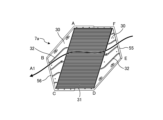
- FIG. FIG. 2 is a plan view for explaining air flow in the heat exchange element according to Embodiment 1;
- FIG. 1 is an exploded perspective view showing the overall configuration of a heat exchanger according to Embodiment 1.
- FIG. 1 is a perspective view showing the overall configuration of a heat exchange element according to Embodiment 1.
- FIG. 3 is a perspective view showing the first heat transfer sheet of the
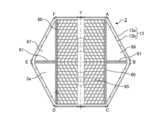
- FIG. 2 is a plan view of the top plate according to Embodiment 1 as seen from the back surface where the top plate is joined to the heat exchange element; A plan view showing a state in which an adhesive is applied to the top plate according to the first embodiment shown in FIG. 7 and a cushion is arranged.
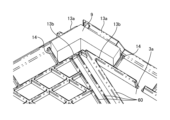
- An enlarged perspective view showing the vicinity of the vertex B of the top plate according to the first embodiment shown in FIG. An enlarged perspective view showing the vicinity of the vertex A of the top plate according to the first embodiment shown in FIG.
- FIG. 13 An enlarged plan view showing the vicinity of the vertex A of the top plate according to the first embodiment shown in FIG.
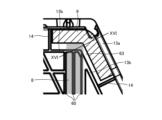
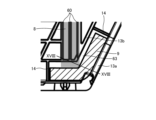
- Cross-sectional view of the top plate according to the first embodiment shown in FIG. 13 cut along line XVI-XVI Cross-sectional view of the top plate according to the first embodiment shown in FIG. 14 taken along line XVII-XVII Cross-sectional view of the top plate according to the first embodiment shown in FIG. 15 cut along line XVIII-XVIII
- FIG. 13 Cut along line XVI-XVI Cross-sectional view of the top plate according to the first embodiment shown in FIG. 13 cut along line XVI-XVI Cross-sectional view of the top plate according to the first embodiment shown in FIG. 14 taken along line XVII-XVII Cross-sectional view of the top plate
- FIG. 4 is a front view showing a state in which an adhesive is applied to the side plate according to Embodiment 1;
- FIG. 2 is a front view showing a state in which an adhesive is applied to the post according to Embodiment 1;
- FIG. 5 is a plan view showing a second application pattern of the adhesive on the top plate according to the first embodiment;
- FIG. 11 is a plan view showing a third application pattern of the adhesive on the top plate according to the first embodiment;
- FIG. 10 is a plan view showing a fourth application pattern of the adhesive on the top plate according to the first embodiment;
- FIG. 11 is a plan view showing a fifth application pattern of the adhesive on the top plate according to the first embodiment;
- FIG. 2 is a perspective view showing the overall configuration of a heat exchanger according to Embodiment 2;
- FIG. 2 is an exploded perspective view showing the overall configuration of a heat exchanger according to Embodiment 2;
- FIG. 11 is a plan view for explaining air flow in the heat exchanger according to the second embodiment;
- FIG. 11 is a conceptual plan view of the top plate of the heat exchanger according to the second embodiment, viewed from the back surface where the top plate is joined to the heat exchange element;
- FIG. 11 is a plan view showing a second application pattern of the adhesive on the top plate according to the second embodiment;
- FIG. 11 is a plan view showing a third application pattern of the adhesive on the top plate according to the second embodiment;
- FIG. 11 is a plan view showing a fourth application pattern of the adhesive on the top plate according to the second embodiment;
- FIG. 11 is a plan view showing a fifth application pattern of the adhesive on the top plate according to the second embodiment;
- FIG. 11 is a plan view showing a sixth application pattern of the adhesive on the top plate according to the second embodiment;
- FIG. 11 is a plan view showing a seventh application pattern of the adhesive on the top plate according to the second embodiment;
- the top view which shows the 8th application pattern of the adhesive agent with respect to the top plate which concerns on Embodiment 2.
- FIG. 11 is a plan view showing a ninth application pattern of the adhesive on the top plate according to the second embodiment;
- FIG. 1 is a perspective view showing the overall configuration of a heat exchanger 1 according to Embodiment 1.
- FIG. 2 is an exploded perspective view showing the overall configuration of the heat exchanger 1 according to Embodiment 1.
- FIG. 3 is a perspective view showing the overall configuration of the heat exchange element 2 according to Embodiment 1.
- FIG. 4 is a perspective view showing the first heat transfer sheet 7a of the two types of heat transfer sheets of the heat exchange element 2 according to Embodiment 1.
- FIG. 5 is a perspective view showing the second heat transfer sheet 7b of the two types of heat transfer sheets of the heat exchange element 2 according to Embodiment 1.
- FIG. 1 is a perspective view showing the overall configuration of a heat exchanger 1 according to Embodiment 1.
- FIG. 2 is an exploded perspective view showing the overall configuration of the heat exchanger 1 according to Embodiment 1.
- FIG. 3 is a perspective view showing the overall configuration of the heat exchange element 2 according to Embodiment 1.
- FIG. 4 is a perspective view showing the
- the heat exchanger 1 is composed of a heat exchange element 2, a top plate 3 as an end plate, a bottom plate 4 as an end plate, a side plate 5, and a column 6.
- a top plate 3 is adhesively fixed to the upper surface of the heat exchange elements 2 in the stacking direction.
- a bottom plate 4 is adhesively fixed to the lower surface of the heat exchange element 2 in the stacking direction.
- Side plates 5 are adhesively fixed to two opposing sides of the six sides of the heat exchange element 2 .
- Struts 6 are adhesively fixed to opposing two of the six ridges on the sides of the heat exchange element 2 .
- the heat exchange element 2 has a hexagonal shape in plan view. As shown in FIGS. 2 and 3, the heat exchange element 2 is constructed by alternately laminating two types of first heat transfer sheets 7a and second heat transfer sheets 7b that are mirror images of each other.
- the first heat transfer sheet 7 a has two triangular header portions 30 and a heat exchange portion 31 arranged between the two header portions 30 , as shown in FIG. 4 .
- One header portion 30 has an inlet 55 into which air flows.
- a plurality of ribs 32 are provided to guide air from the inlet 55 toward the heat exchanging portion 31 .
- the other header portion 30 has an outlet 56 through which air flows.
- a plurality of ribs 32 are provided to guide air from the heat exchange portion 31 toward the outlet 56 .
- the heat exchange section 31 has a plurality of flow paths (not shown) connecting the two header sections 30 .
- a first air flow A1 is formed by the first heat transfer sheet 7a.
- the second heat transfer sheet 7b has two triangular header portions 35 and a heat exchange portion 36 arranged between the two header portions 35.
- One header portion 35 has an inlet 53 into which air flows.
- a plurality of ribs 37 are provided to guide air from the inlet 53 toward the heat exchanging portion 36 .
- the other header portion 35 has an outlet 54 through which air flows out.
- a plurality of ribs 37 are provided to guide air from the heat exchange portion 36 toward the outlet 54 .
- the heat exchange section 36 has a plurality of flow paths (not shown) connecting the two header sections 35 .
- a second air flow A2 is formed by the second heat transfer sheet 7b.
- FIG. 6 is a plan view for explaining air flow in the heat exchange element 2 according to Embodiment 1.
- FIG. 6 the vertices A to F of the hexagon are attached.
- the vertices A to F attached in FIG. 6 correspond to the vertices A to F attached in FIGS.
- a first header portion 50 indicated by a triangle ABC is formed by the left header portion 30 of the first heat transfer sheet 7a shown in FIG. 4 and the left header portion 35 of the second heat transfer sheet 7b shown in FIG. Corresponds to stacked regions.
- a second header portion 51 indicated by a triangle DEF is formed by combining the right header portion 30 of the first heat transfer sheet 7a shown in FIG. 4 and the right header portion 35 of the second heat transfer sheet 7b shown in FIG. Corresponds to stacked regions.
- the heat exchange portion 52 indicated by a square ACDF is formed by stacking the heat exchange portion 31 of the first heat transfer sheet 7a shown in FIG. 4 and the heat exchange portion 36 of the second heat transfer sheet 7b shown in FIG. correspond to the area.
- the side AB corresponds to the inlet 53 of the second airflow A2
- the side DE corresponds to the outlet 54 of the second airflow
- the side EF corresponds to the inlet 55 of the first airflow A1
- the side BC It corresponds to the outlet 56 of the first airflow A1.
- the heat exchange element 2 is formed by alternately stacking two kinds of the first heat transfer sheet 7a and the second heat transfer sheet 7b, which are in a mirror image relationship, one by one, thereby generating the first air flow A1.
- the layers through which the second air flow A2 passes are alternately arranged in layers. Air paths of the first air flow A1 and the second air flow A2 are completely independent of each other. and the second air flow A2.
- the heat exchange section 52 constitutes a counterflow heat exchanger in which the first airflow A1 and the second airflow A2 are substantially parallel and flow in opposite directions so as to face each other.
- FIG. 7 is a plan view of the top plate 3 according to Embodiment 1, viewed from the back surface where the heat exchange element 2 is joined.
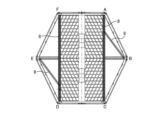
- FIG. 8 is a plan view showing a state in which adhesive 8 is applied to top plate 3 according to Embodiment 1 shown in FIG. 7 and cushions 9 are arranged.
- FIG. 8 shows the state before the top plate 3 is attached to the heat exchange element 2 .
- FIG. 9 is an enlarged perspective view showing the vicinity of the vertex B of the top plate 3 according to Embodiment 1 shown in FIG.
- FIG. 10 is an enlarged perspective view showing the vicinity of the vertex A of the top plate 3 according to Embodiment 1 shown in FIG. FIG.
- FIG. 11 is an enlarged perspective view showing the vicinity of the vertex B of the top plate 3 according to Embodiment 1 shown in FIG. FIG. 11 shows the state after the cushion 9 has been placed.
- FIG. 12 is an enlarged perspective view showing the vicinity of the vertex A of the top plate 3 according to Embodiment 1 shown in FIG. FIG. 12 shows the state after the cushion 9 has been placed.
- FIG. 13 is an enlarged plan view showing the vicinity of the vertex A of the top plate 3 according to Embodiment 1 shown in FIG.
- FIG. 14 is an enlarged plan view showing the vicinity of the vertex B of the top plate 3 according to Embodiment 1 shown in FIG.
- FIG. 15 is an enlarged plan view showing the vicinity of the vertex C of the top plate 3 according to Embodiment 1 shown in FIG.
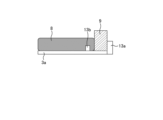
- FIG. 16 is a cross-sectional view of the top plate 3 according to Embodiment 1 shown in FIG. 13 taken along line XVI-XVI.
- FIG. 17 is a cross-sectional view of the top plate 3 according to Embodiment 1 shown in FIG. 14 taken along line XVII-XVII.
- FIG. 18 is a cross-sectional view of the top plate 3 according to Embodiment 1 shown in FIG. 15 taken along line XVIII-XVIII.
- the top plate 3 has a hexagonal top surface portion 3a, and a large number of walled ribs are formed on the top surface portion 3a.
- a heat exchanging portion protection portion 65 for protecting the heat exchanging portion 52 of the heat exchanging element 2 is provided in the central portion of the back surface of the top plate 3 .
- a first header protection portion 66 that protects the first header portion 50 shown in FIG. 6 is provided on the right side of the heat exchange protection portion 65 .
- a second header protection portion 67 that protects the second header portion 51 shown in FIG. 6 is provided to the left of the heat exchange protection portion 65 .
- the heat exchanging part protection part 65 has a quadrangular shape with vertices A, C, D, and F as four vertices.
- the hexagonal top surface portion 3a has a symmetrical shape with respect to the center axis Y of a quadrangle having vertices A, C, D, and F as four vertices.
- the structures near the vertex A, the vertex B, and the vertex C will be mainly described, and the structure near the vertex F, the vertex E, and the vertex D will be omitted.
- Vertex F has the same structure as vertex A
- vertex E has the same structure as vertex B
- vertex D has the same structure as vertex C.
- a plurality of parallel walls extending between the vertex A and the vertex C are spaced apart from each other.
- ribs 60 are formed.
- a plurality of similar ribs 60 are formed between the vertex F and the vertex D as well.
- the rib 60 extends between the heat exchanging portion protection portion 65 and the apex B so as to bisect the rib 60, and is spaced apart.
- a plurality of parallel ribs 61 are formed.
- a plurality of similar ribs 61 are formed between the heat exchanging part protection part 65 and the apex E as well.
- side walls 13 are erected on the peripheral edges of the hexagonal top surface portion 3a.
- Sidewall 13 has an outer wall 13a and an inner wall 13b which extend along the peripheral edge of the hexagon and are spaced and parallel to each other. Therefore, as shown in FIGS. 9 to 18, side walls 13 including an outer side wall 13a and an inner side wall 13b are formed near the apex A, the apex B, and the apex C. As shown in FIGS. Near the apex A, the apex B, and the apex C, the inner wall 13b, the ribs 60 and the ribs 61 are substantially the same height.
- the inner wall 13b of the vertex A and the inner wall 13b of the vertex C and the rib 60 are formed to be connected.
- the inner wall 13b of the vertex B and the rib 61 are formed to be connected.
- the outer wall 13a is formed higher than the inner wall 13b.
- two ribs 14 as connecting walls are provided in the vicinity of the apex A and are spaced apart from each other with the apex A therebetween.
- the rib 14 is formed so as to be connected to the outer wall 13a and the inner wall 13b, and at the vertex A, a partition portion 63 surrounded by the outer wall 13a, the inner wall 13b and the rib 14 is formed.
- a similar partition 63 surrounded by the outer wall 13a, the inner wall 13b and the ribs 14 is also formed at the vertex C, as shown in FIG.
- two ribs 14 as connecting walls are provided in the vicinity of the vertex B and spaced from each other with the vertex B interposed therebetween.
- the rib 14 is formed so as to be connected to the outer wall 13a and the inner wall 13b, and at the vertex B, a partition portion 64 surrounded by the outer wall 13a, the inner wall 13b and the rib 14 is formed.
- a cushion 9 as an elastic elastic member is installed in the partition 63 at the vertex A.
- the cushion 9 has a shape corresponding to the partition portion 63 and is made of a cushioning material such as a foamed material. Since the cushion 9 is intended to ensure airtightness, it can be replaced with a soft elastic member such as a rubber material or an elastomer in addition to the foam material. Before the top plate 3 is attached to the heat exchange element 2, the cushion 9 is higher than the ribs 60, the outer wall 13a and the inner wall 13b.
- a similar cushion 9 is installed in the partition 63 at the vertex C as well.
- the partition 64 at the vertex B is also provided with a cushion 9.
- FIGS. 8-11 the partition 64 at the vertex B is also provided with a cushion 9.
- the adhesive 8 is applied in the first application pattern. As shown in FIGS. 8 and 13 to 18, the adhesive 8 is applied without gaps between the three ribs 60 connecting the vertex A and the vertex C and between the cushion 9 at the vertex A and the cushion 9 at the vertex C. is filled and applied.
- the adhesive 8 is, for example, silicone sealant. Also, the adhesive 8 is filled and applied between the three ribs 61 extending from the vertex B and between the cushion 9 of the vertex B and the rib 60 without gaps. As shown in FIGS. 16 to 18, before the top plate 3 is assembled to the heat exchange element 2, the adhesive 8 is applied so that the applied height of the adhesive 8 is lower than the height of the cushion 9. there is
- the bottom plate 4 has the same configuration as the top plate 3, although illustration and description are omitted.
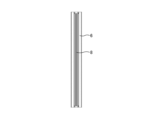
- FIG. 19 is a front view showing a state in which the adhesive 8 is applied to the side plate 5 according to Embodiment 1.
- the adhesive 8 is applied in the vicinity of the upper end and the lower end of the side plate 5 in a line over substantially the entire width. Also, the adhesive 8 is applied in a vertical line near the center so as to connect the adhesive 8 near the upper end and the adhesive 8 near the lower end.
- FIG. 20 is a front view showing a state in which the adhesive 8 is applied to the post 6 according to Embodiment 1.
- FIG. The adhesive 8 is applied near the center of the column 6 in the left-right direction in a vertical line between the vicinity of the upper end and the vicinity of the lower end.
- a top plate 3 coated with an adhesive 8 is arranged and adhered to the upper surface side of the heat exchange element 2 shown in FIG.
- the bottom plate 4 coated with the adhesive 8 is arranged and adhered
- the side plates 5 coated with the adhesive 8 are arranged and adhered to the side surfaces forming the side CD and the side surface forming the side AF
- the vertex B and the ridgeline including the vertex E the post 6 coated with the adhesive 8 is arranged and adhered.
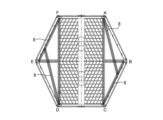
- FIG. 21 is a plan view showing a second application pattern of the adhesive 8 on the top plate 3 according to Embodiment 1.
- FIG. 22 is a plan view showing a third application pattern of the adhesive 8 on the top plate 3 according to Embodiment 1.
- FIG. 23 is a plan view showing a fourth application pattern of the adhesive 8 on the top plate 3 according to Embodiment 1.
- FIG. 24 is a plan view showing a fifth application pattern of the adhesive 8 on the top plate 3 according to Embodiment 1.
- FIG. 21 is a plan view showing a second application pattern of the adhesive 8 on the top plate 3 according to Embodiment 1.
- FIG. 22 is a plan view showing a third application pattern of the adhesive 8 on the top plate 3 according to Embodiment 1.
- FIG. 23 is a plan view showing a fourth application pattern of the adhesive 8 on the top plate 3 according to Embodiment 1.
- FIG. 24 is a plan view showing a fifth application pattern of the adhesive 8 on the top plate 3 according to Embodiment 1.
- the adhesive 8 is placed on the rib connecting the vertex A and the vertex B, on the rib connecting the vertex D and the vertex E, and on the rib connecting the position between the vertex A and the vertex B and the vertex C. It is coated on the top and on the rib connecting the point F to the position between the point D and the point E.
- the adhesive 8 is applied on the rib connecting the vertex A and the vertex C, on the rib connecting the vertex D and the vertex F, and on the rib connecting the position between the vertex A and the vertex C and the vertex B. It is coated on the top and on the rib connecting the position between the vertex D and the vertex F and the vertex E.
- the adhesive 8 is applied on the rib connecting the vertex A and the vertex C, on the rib connecting the vertex D and the vertex F, and on the rib connecting the position between the vertex A and the vertex C and the vertex B. It is coated on the top and on the rib connecting the position between the vertex D and the vertex F and the vertex E.
- the adhesive 8 is placed on the rib connecting the vertex B and the vertex C, on the rib connecting the vertex E and the vertex F, and on the rib connecting the position between the vertex B and the vertex C and the vertex A. It is coated on the top and on the rib connecting the position between the vertex E and the vertex F and the vertex D.
- the first to fifth application patterns shown in FIGS. 8 and 21 to 24 are the inlet 53 (side AB) of the second air flow A2 and the first air
- the first header portion 50 composed of a triangle ABC having an outlet 56 (side BC) for the flow A1
- the first to fifth application patterns shown in FIGS. In the second header portion 51 formed of a triangle DEF having an inlet 55 (edge EF) of and a second line where the adhesive 8 is applied in a line shape so as to intersect the first line with the third vertex, which is the remaining one vertex. and
- the cushions 9 are arranged outside at each vertex of the top plate 3, and the adhesive 8 is applied from the inside of the cushions 9 so as to extend further inside. Therefore, even if the adhesive 8 is crushed during assembly, the cushion 9 functions as a weir and the adhesive 8 is not pushed out of the top plate 3. - ⁇ Therefore, it is not necessary to wipe off the adhesive 8 while maintaining airtightness up to the outer end of the heat exchanger 1. is not blocked, and the protruding adhesive 8 does not hinder the mounting of the heat exchanger 1 on a heat exchange ventilator or the like. Also, even if the applied amount of the adhesive 8 is somewhat large, it can be blocked by the cushion 9, so that the amount of application can be controlled in a wider range, and the work can be easily managed.
- the outer wall 13a is provided along the peripheral edge of each vertex of the top plate 3, it is possible to prevent the cushion 9 from buckling and protruding outside when the top plate 3 or the bottom plate 4 is assembled. can be done.
- the outer wall 13a, the inner wall 13b, and the rib 14 are provided so as to surround the partitions 63, 64 in the partitions 63, 64 where the cushion 9 is arranged, the positioning of the cushion 9 is facilitated. can do
- a plurality of ribs 60 and 61 are arranged with an interval between them and the adhesive 8 is applied between them, it can be used as a reference for the application position of the adhesive 8, and before the top plate 3 or the bottom plate 4 is assembled. In addition, it can act as a weir to prevent the adhesive 8 from flowing out of the desired line location.
- the first line is applied in a line shape so as to connect the first and second vertices, which are two vertices of the three vertices, and the remaining Since the application pattern of the adhesive 8 is configured to have the third vertex, which is one vertex, and the second line applied in a linear manner so as to intersect the first line, the first air flow A1 and the It is possible to minimize the amount of the adhesive 8 required for airtightness while ensuring the airtightness with the second airflow A2, thereby realizing simplification of workability and cost reduction.
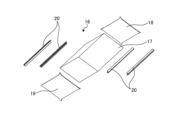
- FIG. 25 is a perspective view showing the overall configuration of heat exchanger 16 according to the second embodiment.
- FIG. 26 is an exploded perspective view showing the overall configuration of heat exchanger 16 according to the second embodiment.
- FIG. 27 is a plan view for explaining air flow in heat exchanger 16 according to the second embodiment.
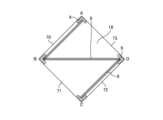
- FIG. 28 is a conceptual plan view of the top plate 18 of the heat exchanger 16 according to Embodiment 2, viewed from the back surface where the heat exchange element 17 is joined.
- FIG. 28 shows a first application pattern of the adhesive 8 on the top plate 18 according to the second embodiment.
- the cross-flow heat exchanger 16 is composed of a heat exchange element 17, a top plate 18, a bottom plate 19, and pillars 20.
- a top plate 18 is adhesively fixed to the top surface of the heat exchange elements 17 in the stacking direction.
- a bottom plate 19 is adhesively fixed to the lower surface of the heat exchange element 17 in the stacking direction.
- Supports 20 are adhesively fixed to the four ridges on the sides of the heat exchange element 17 .
- the heat exchange element 17 is configured by alternately laminating two types of first heat transfer sheets and second heat transfer sheets that are mirror images of each other.
- Air passages in which the first air flow B1 flows and air passages in which the second air flow B2 flows are alternately formed independently of each other.
- Side AB is an inlet 70 for the first air flow B1
- side BC is an outlet 71 for the second air flow B2
- side CD is an outlet 72 for the first air flow B1
- side AD is an inlet for the second air flow B2.
- the heat exchange element 17 exchanges heat between the first air stream B1 and the second air stream B2.
- the top plate 18 and the bottom plate 19 are provided with ribs similar to the ribs 60 or 61 of the first embodiment. They are formed on a line connecting vertex A and diagonal vertex C, and on a line connecting vertex B and diagonal vertex D. Further, as shown in FIG. 28, at the vertices A, B, C, and D of the top plate 18 and the bottom plate 19, partition portions 63 surrounded by the outer wall 13a, the inner wall 13b, and the ribs 14 of the first embodiment are provided. , 64 are formed (not shown), and cushions 9 are placed in these compartments. Further, as shown in FIG.
- adhesive 8 is applied to a line connecting vertex A and vertex C, a line connecting vertex A and vertex B, and a line connecting vertex C and vertex D.
- the adhesive 8 is placed inside the cushions 9 provided at the vertices A, B, C, and D, and is lower in height than the cushions 9, as in the first embodiment.
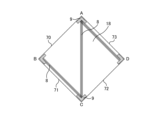
- FIG. 29 is a plan view showing a second application pattern of adhesive 8 on top plate 18 according to the second embodiment.
- FIG. 30 is a plan view showing a third application pattern of adhesive 8 on top plate 18 according to the second embodiment.
- FIG. 31 is a plan view showing a fourth application pattern of adhesive 8 on top plate 18 according to the second embodiment.
- FIG. 32 is a plan view showing a fifth application pattern of adhesive 8 on top plate 18 according to the second embodiment.
- FIG. 33 is a plan view showing a sixth application pattern of adhesive 8 on top plate 18 according to the second embodiment.
- FIG. 34 is a plan view showing a seventh application pattern of adhesive 8 on top plate 18 according to the second embodiment.
- FIG. 35 is a plan view showing an eighth application pattern of adhesive 8 on top plate 18 according to the second embodiment.
- FIG. 36 is a plan view showing a ninth application pattern of adhesive 8 on top plate 18 according to the second embodiment.
- the adhesive 8 is applied on the rib connecting the vertex A and the vertex C and on the rib connecting the vertex B and the vertex D.
- the adhesive 8 is applied on the rib connecting the vertex B and the vertex D, on the rib connecting the vertex A and the vertex D, and on the rib connecting the vertex B and the vertex C. .
- the adhesive 8 is applied on the rib connecting the vertex A and the vertex C, on the rib connecting the vertex A and the vertex D, and on the rib connecting the vertex B and the vertex C. .
- the adhesive 8 is applied on the rib connecting the vertex B and the vertex D, on the rib connecting the vertex A and the vertex B, and on the rib connecting the vertex B and the vertex C. .
- the adhesive 8 is applied on the rib connecting vertex A and vertex C, on the rib connecting vertex A and vertex D, and on the rib connecting vertex A and vertex B. .
- the adhesive 8 is applied on the rib connecting vertex B and vertex D, on the rib connecting vertex A and vertex B, and on the rib connecting vertex C and vertex D. .
- the adhesive 8 is applied on the rib connecting the vertex B and the vertex D, on the rib connecting the vertex A and the vertex D, and on the rib connecting the vertex C and the vertex D. .
- the adhesive 8 is applied on the rib connecting vertex A and vertex C, on the rib connecting vertex B and vertex C, and on the rib connecting vertex C and vertex D. .
- the coating patterns shown in FIGS. 28, 29, 31, 33, and 36 are formed by a triangle ABC formed by an inlet 70 for the first airflow B1 and an outlet 71 for the second airflow B2.
- a first line is applied with the adhesive 8 so as to connect the two vertices AC, and the adhesive 8 is applied in a line so as to intersect the remaining one vertex B and the first line. and a second line.
- the adhesive 8 is applied in a line to connect the two vertices AC. and a second line on which the adhesive 8 is applied in a line shape so as to intersect the remaining vertex D and the first line. Since the triangle ABC and the triangle ACD are in contact with each other and have a common side AC, the first line is the common line of the triangle ABC and the triangle ACD.
- the application patterns shown in FIGS. 28 to 36 are the first and second vertices of the four vertices A, B, C, and D, which are two vertices, and are applied in a line to connect the first and second vertices. 1 line, the second line applied in a line so as to intersect the third vertex, which is one of the remaining two vertices, and the first line, and the remaining one vertex, the fourth and a third line applied in a line shape so as to intersect the vertex and the first line.
- the cross-flow type heat exchanger 16 can also obtain the same effect as the first embodiment.
- the top plates 3 and 18 and the bottom plates 4 and 19, which are the end plates, are polygonal and have the same size and shape as the heat exchange elements 2 and 17.
- the cushions may be larger than the exchange elements 2 and 17 and placed on the end plates at positions corresponding to the vertices of the polygons of the heat exchange elements 2 and 17 .
- the configuration shown in the above embodiment shows an example of the content of the present disclosure, and can be combined with another known technology. It is also possible to omit or change the part.
Landscapes
- Engineering & Computer Science (AREA)
- Physics & Mathematics (AREA)
- Thermal Sciences (AREA)
- Mechanical Engineering (AREA)
- General Engineering & Computer Science (AREA)
- Heat-Exchange Devices With Radiators And Conduit Assemblies (AREA)
Priority Applications (2)
| Application Number | Priority Date | Filing Date | Title |
|---|---|---|---|
| JP2023569006A JP7675853B2 (ja) | 2021-12-24 | 2021-12-24 | 熱交換器 |
| PCT/JP2021/048292 WO2023119644A1 (ja) | 2021-12-24 | 2021-12-24 | 熱交換器 |
Applications Claiming Priority (1)
| Application Number | Priority Date | Filing Date | Title |
|---|---|---|---|
| PCT/JP2021/048292 WO2023119644A1 (ja) | 2021-12-24 | 2021-12-24 | 熱交換器 |
Publications (1)
| Publication Number | Publication Date |
|---|---|
| WO2023119644A1 true WO2023119644A1 (ja) | 2023-06-29 |
Family
ID=86901931
Family Applications (1)
| Application Number | Title | Priority Date | Filing Date |
|---|---|---|---|
| PCT/JP2021/048292 Ceased WO2023119644A1 (ja) | 2021-12-24 | 2021-12-24 | 熱交換器 |
Country Status (2)
| Country | Link |
|---|---|
| JP (1) | JP7675853B2 (https=) |
| WO (1) | WO2023119644A1 (https=) |
Citations (4)
| Publication number | Priority date | Publication date | Assignee | Title |
|---|---|---|---|---|
| JPH05118784A (ja) * | 1991-10-29 | 1993-05-14 | Mitsubishi Electric Corp | 熱交換器 |
| JPH05248782A (ja) * | 1992-03-06 | 1993-09-24 | Mitsubishi Electric Corp | 熱交換器 |
| JPH07294177A (ja) * | 1994-04-27 | 1995-11-10 | Toyo Radiator Co Ltd | 積層型熱交換器 |
| WO2019229966A1 (ja) * | 2018-06-01 | 2019-12-05 | 三菱電機株式会社 | 熱交換素子および熱交換換気装置 |
Family Cites Families (6)
| Publication number | Priority date | Publication date | Assignee | Title |
|---|---|---|---|---|
| JP2001241878A (ja) | 2000-02-25 | 2001-09-07 | Matsushita Seiko Co Ltd | 熱交換素子とその製造方法 |
| JP2006097958A (ja) | 2004-09-29 | 2006-04-13 | Matsushita Electric Ind Co Ltd | 熱交換器 |
| JP2008070070A (ja) | 2006-09-15 | 2008-03-27 | Techno Frontier:Kk | 全熱交換器 |
| EP3276292A1 (en) | 2016-07-25 | 2018-01-31 | Zehnder Group International AG | Enthalpy exchanger element, enthalpy exchanger comprising such elements and method for their production |
| WO2018193849A1 (ja) | 2017-04-21 | 2018-10-25 | 三菱電機株式会社 | 流路板、熱交換素子、熱交換換気装置、及び流路板の製造方法 |
| KR102223356B1 (ko) | 2020-07-13 | 2021-03-05 | 송길섭 | 대향류 전열교환기의 제조방법 |
-
2021
- 2021-12-24 WO PCT/JP2021/048292 patent/WO2023119644A1/ja not_active Ceased
- 2021-12-24 JP JP2023569006A patent/JP7675853B2/ja active Active
Patent Citations (4)
| Publication number | Priority date | Publication date | Assignee | Title |
|---|---|---|---|---|
| JPH05118784A (ja) * | 1991-10-29 | 1993-05-14 | Mitsubishi Electric Corp | 熱交換器 |
| JPH05248782A (ja) * | 1992-03-06 | 1993-09-24 | Mitsubishi Electric Corp | 熱交換器 |
| JPH07294177A (ja) * | 1994-04-27 | 1995-11-10 | Toyo Radiator Co Ltd | 積層型熱交換器 |
| WO2019229966A1 (ja) * | 2018-06-01 | 2019-12-05 | 三菱電機株式会社 | 熱交換素子および熱交換換気装置 |
Also Published As
| Publication number | Publication date |
|---|---|
| JP7675853B2 (ja) | 2025-05-13 |
| JPWO2023119644A1 (https=) | 2023-06-29 |
Similar Documents
| Publication | Publication Date | Title |
|---|---|---|
| CN100402936C (zh) | 除湿单元以及该除湿单元采用的吸附用元件 | |
| JP4906129B2 (ja) | リブプレート式熱交換器 | |
| JP6584502B2 (ja) | 熱交換型換気装置 | |
| JP6482741B1 (ja) | 熱交換素子および熱交換換気装置 | |
| CN102414534A (zh) | 全热交换元件 | |
| JP7333875B2 (ja) | 全熱交換素子および換気装置 | |
| CN115885148A (zh) | 热交换器和热交换器的制造方法 | |
| JP7684578B2 (ja) | 熱交換器および換気装置 | |
| WO2023119644A1 (ja) | 熱交換器 | |
| JPH0842988A (ja) | 熱交換エレメント | |
| JP6801734B2 (ja) | 熱交換器 | |
| US9863710B2 (en) | Laminated total heat exchange element | |
| JP2011137573A (ja) | 熱交換素子および熱交換ユニット | |
| JP2005282904A (ja) | 熱交換器 | |
| JP6509338B2 (ja) | 熱交換型換気装置 | |
| JP2005291618A (ja) | 全熱交換素子及び全熱交換器 | |
| JP2005282907A (ja) | 熱交換器 | |
| JP2017062094A (ja) | 熱交換素子 | |
| JP5797163B2 (ja) | 全熱交換素子および全熱交換器 | |
| JP6537760B1 (ja) | 熱交換素子及び熱交換換気装置 | |
| WO2016194085A1 (ja) | 熱交換型換気装置 | |
| WO2014109184A1 (ja) | 全熱交換器 | |
| JP2006071149A (ja) | 熱交換素子 | |
| JP2006064342A (ja) | 熱交換素子 | |
| KR101536076B1 (ko) | 조인트 부재를 갖는 공기대 공기 열교환기의 프레임 구조 |
Legal Events
| Date | Code | Title | Description |
|---|---|---|---|
| 121 | Ep: the epo has been informed by wipo that ep was designated in this application |
Ref document number: 21969075 Country of ref document: EP Kind code of ref document: A1 |
|
| WWE | Wipo information: entry into national phase |
Ref document number: 2023569006 Country of ref document: JP |
|
| NENP | Non-entry into the national phase |
Ref country code: DE |
|
| 122 | Ep: pct application non-entry in european phase |
Ref document number: 21969075 Country of ref document: EP Kind code of ref document: A1 |