WO2023047702A1 - 液状コンプレッションモールド材、電子部品、半導体装置、および半導体装置の製造方法 - Google Patents
液状コンプレッションモールド材、電子部品、半導体装置、および半導体装置の製造方法 Download PDFInfo
- Publication number
- WO2023047702A1 WO2023047702A1 PCT/JP2022/021246 JP2022021246W WO2023047702A1 WO 2023047702 A1 WO2023047702 A1 WO 2023047702A1 JP 2022021246 W JP2022021246 W JP 2022021246W WO 2023047702 A1 WO2023047702 A1 WO 2023047702A1
- Authority
- WO
- WIPO (PCT)
- Prior art keywords
- compression molding
- epoxy resin
- liquid compression
- mass
- filler
- Prior art date
- Legal status (The legal status is an assumption and is not a legal conclusion. Google has not performed a legal analysis and makes no representation as to the accuracy of the status listed.)
- Ceased
Links
Images

Classifications
-
- B—PERFORMING OPERATIONS; TRANSPORTING
- B29—WORKING OF PLASTICS; WORKING OF SUBSTANCES IN A PLASTIC STATE IN GENERAL
- B29C—SHAPING OR JOINING OF PLASTICS; SHAPING OF MATERIAL IN A PLASTIC STATE, NOT OTHERWISE PROVIDED FOR; AFTER-TREATMENT OF THE SHAPED PRODUCTS, e.g. REPAIRING
- B29C43/00—Compression moulding, i.e. applying external pressure to flow the moulding material; Apparatus therefor
- B29C43/003—Compression moulding, i.e. applying external pressure to flow the moulding material; Apparatus therefor characterised by the choice of material
-
- H—ELECTRICITY
- H10—SEMICONDUCTOR DEVICES; ELECTRIC SOLID-STATE DEVICES NOT OTHERWISE PROVIDED FOR
- H10W—GENERIC PACKAGES, INTERCONNECTIONS, CONNECTORS OR OTHER CONSTRUCTIONAL DETAILS OF DEVICES COVERED BY CLASS H10
- H10W74/00—Encapsulations, e.g. protective coatings
- H10W74/40—Encapsulations, e.g. protective coatings characterised by their materials
- H10W74/47—Encapsulations, e.g. protective coatings characterised by their materials comprising organic materials, e.g. plastics or resins
-
- B—PERFORMING OPERATIONS; TRANSPORTING
- B29—WORKING OF PLASTICS; WORKING OF SUBSTANCES IN A PLASTIC STATE IN GENERAL
- B29C—SHAPING OR JOINING OF PLASTICS; SHAPING OF MATERIAL IN A PLASTIC STATE, NOT OTHERWISE PROVIDED FOR; AFTER-TREATMENT OF THE SHAPED PRODUCTS, e.g. REPAIRING
- B29C43/00—Compression moulding, i.e. applying external pressure to flow the moulding material; Apparatus therefor
- B29C43/02—Compression moulding, i.e. applying external pressure to flow the moulding material; Apparatus therefor of articles of definite length, i.e. discrete articles
- B29C43/18—Compression moulding, i.e. applying external pressure to flow the moulding material; Apparatus therefor of articles of definite length, i.e. discrete articles incorporating preformed parts or layers, e.g. compression moulding around inserts or for coating articles
-
- B—PERFORMING OPERATIONS; TRANSPORTING
- B29—WORKING OF PLASTICS; WORKING OF SUBSTANCES IN A PLASTIC STATE IN GENERAL
- B29C—SHAPING OR JOINING OF PLASTICS; SHAPING OF MATERIAL IN A PLASTIC STATE, NOT OTHERWISE PROVIDED FOR; AFTER-TREATMENT OF THE SHAPED PRODUCTS, e.g. REPAIRING
- B29C43/00—Compression moulding, i.e. applying external pressure to flow the moulding material; Apparatus therefor
- B29C43/32—Component parts, details or accessories; Auxiliary operations
- B29C43/34—Feeding the material to the mould or the compression means
-
- B—PERFORMING OPERATIONS; TRANSPORTING
- B29—WORKING OF PLASTICS; WORKING OF SUBSTANCES IN A PLASTIC STATE IN GENERAL
- B29C—SHAPING OR JOINING OF PLASTICS; SHAPING OF MATERIAL IN A PLASTIC STATE, NOT OTHERWISE PROVIDED FOR; AFTER-TREATMENT OF THE SHAPED PRODUCTS, e.g. REPAIRING
- B29C43/00—Compression moulding, i.e. applying external pressure to flow the moulding material; Apparatus therefor
- B29C43/32—Component parts, details or accessories; Auxiliary operations
- B29C43/36—Moulds for making articles of definite length, i.e. discrete articles
-
- C—CHEMISTRY; METALLURGY
- C08—ORGANIC MACROMOLECULAR COMPOUNDS; THEIR PREPARATION OR CHEMICAL WORKING-UP; COMPOSITIONS BASED THEREON
- C08G—MACROMOLECULAR COMPOUNDS OBTAINED OTHERWISE THAN BY REACTIONS ONLY INVOLVING UNSATURATED CARBON-TO-CARBON BONDS
- C08G59/00—Polycondensates containing more than one epoxy group per molecule; Macromolecules obtained by polymerising compounds containing more than one epoxy group per molecule using curing agents or catalysts which react with the epoxy groups
- C08G59/18—Macromolecules obtained by polymerising compounds containing more than one epoxy group per molecule using curing agents or catalysts which react with the epoxy groups ; e.g. general methods of curing
- C08G59/20—Macromolecules obtained by polymerising compounds containing more than one epoxy group per molecule using curing agents or catalysts which react with the epoxy groups ; e.g. general methods of curing characterised by the epoxy compounds used
- C08G59/22—Di-epoxy compounds
- C08G59/226—Mixtures of di-epoxy compounds
-
- C—CHEMISTRY; METALLURGY
- C08—ORGANIC MACROMOLECULAR COMPOUNDS; THEIR PREPARATION OR CHEMICAL WORKING-UP; COMPOSITIONS BASED THEREON
- C08G—MACROMOLECULAR COMPOUNDS OBTAINED OTHERWISE THAN BY REACTIONS ONLY INVOLVING UNSATURATED CARBON-TO-CARBON BONDS
- C08G59/00—Polycondensates containing more than one epoxy group per molecule; Macromolecules obtained by polymerising compounds containing more than one epoxy group per molecule using curing agents or catalysts which react with the epoxy groups
- C08G59/18—Macromolecules obtained by polymerising compounds containing more than one epoxy group per molecule using curing agents or catalysts which react with the epoxy groups ; e.g. general methods of curing
- C08G59/20—Macromolecules obtained by polymerising compounds containing more than one epoxy group per molecule using curing agents or catalysts which react with the epoxy groups ; e.g. general methods of curing characterised by the epoxy compounds used
- C08G59/22—Di-epoxy compounds
- C08G59/28—Di-epoxy compounds containing acyclic nitrogen atoms
-
- C—CHEMISTRY; METALLURGY
- C08—ORGANIC MACROMOLECULAR COMPOUNDS; THEIR PREPARATION OR CHEMICAL WORKING-UP; COMPOSITIONS BASED THEREON
- C08G—MACROMOLECULAR COMPOUNDS OBTAINED OTHERWISE THAN BY REACTIONS ONLY INVOLVING UNSATURATED CARBON-TO-CARBON BONDS
- C08G59/00—Polycondensates containing more than one epoxy group per molecule; Macromolecules obtained by polymerising compounds containing more than one epoxy group per molecule using curing agents or catalysts which react with the epoxy groups
- C08G59/18—Macromolecules obtained by polymerising compounds containing more than one epoxy group per molecule using curing agents or catalysts which react with the epoxy groups ; e.g. general methods of curing
- C08G59/40—Macromolecules obtained by polymerising compounds containing more than one epoxy group per molecule using curing agents or catalysts which react with the epoxy groups ; e.g. general methods of curing characterised by the curing agents used
- C08G59/42—Polycarboxylic acids; Anhydrides, halides or low molecular weight esters thereof
-
- C—CHEMISTRY; METALLURGY
- C08—ORGANIC MACROMOLECULAR COMPOUNDS; THEIR PREPARATION OR CHEMICAL WORKING-UP; COMPOSITIONS BASED THEREON
- C08G—MACROMOLECULAR COMPOUNDS OBTAINED OTHERWISE THAN BY REACTIONS ONLY INVOLVING UNSATURATED CARBON-TO-CARBON BONDS
- C08G59/00—Polycondensates containing more than one epoxy group per molecule; Macromolecules obtained by polymerising compounds containing more than one epoxy group per molecule using curing agents or catalysts which react with the epoxy groups
- C08G59/18—Macromolecules obtained by polymerising compounds containing more than one epoxy group per molecule using curing agents or catalysts which react with the epoxy groups ; e.g. general methods of curing
- C08G59/40—Macromolecules obtained by polymerising compounds containing more than one epoxy group per molecule using curing agents or catalysts which react with the epoxy groups ; e.g. general methods of curing characterised by the curing agents used
- C08G59/50—Amines
-
- C—CHEMISTRY; METALLURGY
- C08—ORGANIC MACROMOLECULAR COMPOUNDS; THEIR PREPARATION OR CHEMICAL WORKING-UP; COMPOSITIONS BASED THEREON
- C08G—MACROMOLECULAR COMPOUNDS OBTAINED OTHERWISE THAN BY REACTIONS ONLY INVOLVING UNSATURATED CARBON-TO-CARBON BONDS
- C08G59/00—Polycondensates containing more than one epoxy group per molecule; Macromolecules obtained by polymerising compounds containing more than one epoxy group per molecule using curing agents or catalysts which react with the epoxy groups
- C08G59/18—Macromolecules obtained by polymerising compounds containing more than one epoxy group per molecule using curing agents or catalysts which react with the epoxy groups ; e.g. general methods of curing
- C08G59/40—Macromolecules obtained by polymerising compounds containing more than one epoxy group per molecule using curing agents or catalysts which react with the epoxy groups ; e.g. general methods of curing characterised by the curing agents used
- C08G59/62—Alcohols or phenols
- C08G59/621—Phenols
-
- C—CHEMISTRY; METALLURGY
- C08—ORGANIC MACROMOLECULAR COMPOUNDS; THEIR PREPARATION OR CHEMICAL WORKING-UP; COMPOSITIONS BASED THEREON
- C08G—MACROMOLECULAR COMPOUNDS OBTAINED OTHERWISE THAN BY REACTIONS ONLY INVOLVING UNSATURATED CARBON-TO-CARBON BONDS
- C08G59/00—Polycondensates containing more than one epoxy group per molecule; Macromolecules obtained by polymerising compounds containing more than one epoxy group per molecule using curing agents or catalysts which react with the epoxy groups
- C08G59/18—Macromolecules obtained by polymerising compounds containing more than one epoxy group per molecule using curing agents or catalysts which react with the epoxy groups ; e.g. general methods of curing
- C08G59/68—Macromolecules obtained by polymerising compounds containing more than one epoxy group per molecule using curing agents or catalysts which react with the epoxy groups ; e.g. general methods of curing characterised by the catalysts used
- C08G59/686—Macromolecules obtained by polymerising compounds containing more than one epoxy group per molecule using curing agents or catalysts which react with the epoxy groups ; e.g. general methods of curing characterised by the catalysts used containing nitrogen
-
- C—CHEMISTRY; METALLURGY
- C08—ORGANIC MACROMOLECULAR COMPOUNDS; THEIR PREPARATION OR CHEMICAL WORKING-UP; COMPOSITIONS BASED THEREON
- C08K—Use of inorganic or non-macromolecular organic substances as compounding ingredients
- C08K3/00—Use of inorganic substances as compounding ingredients
- C08K3/34—Silicon-containing compounds
- C08K3/36—Silica
-
- C—CHEMISTRY; METALLURGY
- C08—ORGANIC MACROMOLECULAR COMPOUNDS; THEIR PREPARATION OR CHEMICAL WORKING-UP; COMPOSITIONS BASED THEREON
- C08L—COMPOSITIONS OF MACROMOLECULAR COMPOUNDS
- C08L63/00—Compositions of epoxy resins; Compositions of derivatives of epoxy resins
-
- C—CHEMISTRY; METALLURGY
- C08—ORGANIC MACROMOLECULAR COMPOUNDS; THEIR PREPARATION OR CHEMICAL WORKING-UP; COMPOSITIONS BASED THEREON
- C08L—COMPOSITIONS OF MACROMOLECULAR COMPOUNDS
- C08L9/00—Compositions of homopolymers or copolymers of conjugated diene hydrocarbons
- C08L9/06—Copolymers with styrene
-
- H—ELECTRICITY
- H10—SEMICONDUCTOR DEVICES; ELECTRIC SOLID-STATE DEVICES NOT OTHERWISE PROVIDED FOR
- H10W—GENERIC PACKAGES, INTERCONNECTIONS, CONNECTORS OR OTHER CONSTRUCTIONAL DETAILS OF DEVICES COVERED BY CLASS H10
- H10W74/00—Encapsulations, e.g. protective coatings
- H10W74/01—Manufacture or treatment
- H10W74/016—Manufacture or treatment using moulds
-
- H—ELECTRICITY
- H10—SEMICONDUCTOR DEVICES; ELECTRIC SOLID-STATE DEVICES NOT OTHERWISE PROVIDED FOR
- H10W—GENERIC PACKAGES, INTERCONNECTIONS, CONNECTORS OR OTHER CONSTRUCTIONAL DETAILS OF DEVICES COVERED BY CLASS H10
- H10W74/00—Encapsulations, e.g. protective coatings
- H10W74/10—Encapsulations, e.g. protective coatings characterised by their shape or disposition
- H10W74/111—Encapsulations, e.g. protective coatings characterised by their shape or disposition the semiconductor body being completely enclosed
- H10W74/114—Encapsulations, e.g. protective coatings characterised by their shape or disposition the semiconductor body being completely enclosed by a substrate and the encapsulations
-
- H—ELECTRICITY
- H10—SEMICONDUCTOR DEVICES; ELECTRIC SOLID-STATE DEVICES NOT OTHERWISE PROVIDED FOR
- H10W—GENERIC PACKAGES, INTERCONNECTIONS, CONNECTORS OR OTHER CONSTRUCTIONAL DETAILS OF DEVICES COVERED BY CLASS H10
- H10W74/00—Encapsulations, e.g. protective coatings
- H10W74/40—Encapsulations, e.g. protective coatings characterised by their materials
- H10W74/47—Encapsulations, e.g. protective coatings characterised by their materials comprising organic materials, e.g. plastics or resins
- H10W74/473—Encapsulations, e.g. protective coatings characterised by their materials comprising organic materials, e.g. plastics or resins containing a filler
-
- B—PERFORMING OPERATIONS; TRANSPORTING
- B29—WORKING OF PLASTICS; WORKING OF SUBSTANCES IN A PLASTIC STATE IN GENERAL
- B29C—SHAPING OR JOINING OF PLASTICS; SHAPING OF MATERIAL IN A PLASTIC STATE, NOT OTHERWISE PROVIDED FOR; AFTER-TREATMENT OF THE SHAPED PRODUCTS, e.g. REPAIRING
- B29C43/00—Compression moulding, i.e. applying external pressure to flow the moulding material; Apparatus therefor
- B29C43/02—Compression moulding, i.e. applying external pressure to flow the moulding material; Apparatus therefor of articles of definite length, i.e. discrete articles
- B29C43/18—Compression moulding, i.e. applying external pressure to flow the moulding material; Apparatus therefor of articles of definite length, i.e. discrete articles incorporating preformed parts or layers, e.g. compression moulding around inserts or for coating articles
- B29C2043/181—Compression moulding, i.e. applying external pressure to flow the moulding material; Apparatus therefor of articles of definite length, i.e. discrete articles incorporating preformed parts or layers, e.g. compression moulding around inserts or for coating articles encapsulated
- B29C2043/182—Compression moulding, i.e. applying external pressure to flow the moulding material; Apparatus therefor of articles of definite length, i.e. discrete articles incorporating preformed parts or layers, e.g. compression moulding around inserts or for coating articles encapsulated completely
-
- B—PERFORMING OPERATIONS; TRANSPORTING
- B29—WORKING OF PLASTICS; WORKING OF SUBSTANCES IN A PLASTIC STATE IN GENERAL
- B29C—SHAPING OR JOINING OF PLASTICS; SHAPING OF MATERIAL IN A PLASTIC STATE, NOT OTHERWISE PROVIDED FOR; AFTER-TREATMENT OF THE SHAPED PRODUCTS, e.g. REPAIRING
- B29C43/00—Compression moulding, i.e. applying external pressure to flow the moulding material; Apparatus therefor
- B29C43/32—Component parts, details or accessories; Auxiliary operations
- B29C43/36—Moulds for making articles of definite length, i.e. discrete articles
- B29C2043/3602—Moulds for making articles of definite length, i.e. discrete articles with means for positioning, fastening or clamping the material to be formed or preforms inside the mould
-
- B—PERFORMING OPERATIONS; TRANSPORTING
- B29—WORKING OF PLASTICS; WORKING OF SUBSTANCES IN A PLASTIC STATE IN GENERAL
- B29K—INDEXING SCHEME ASSOCIATED WITH SUBCLASSES B29B, B29C OR B29D, RELATING TO MOULDING MATERIALS OR TO MATERIALS FOR MOULDS, REINFORCEMENTS, FILLERS OR PREFORMED PARTS, e.g. INSERTS
- B29K2021/00—Use of unspecified rubbers as moulding material
-
- B—PERFORMING OPERATIONS; TRANSPORTING
- B29—WORKING OF PLASTICS; WORKING OF SUBSTANCES IN A PLASTIC STATE IN GENERAL
- B29K—INDEXING SCHEME ASSOCIATED WITH SUBCLASSES B29B, B29C OR B29D, RELATING TO MOULDING MATERIALS OR TO MATERIALS FOR MOULDS, REINFORCEMENTS, FILLERS OR PREFORMED PARTS, e.g. INSERTS
- B29K2063/00—Use of EP, i.e. epoxy resins or derivatives thereof, as moulding material
-
- B—PERFORMING OPERATIONS; TRANSPORTING
- B29—WORKING OF PLASTICS; WORKING OF SUBSTANCES IN A PLASTIC STATE IN GENERAL
- B29K—INDEXING SCHEME ASSOCIATED WITH SUBCLASSES B29B, B29C OR B29D, RELATING TO MOULDING MATERIALS OR TO MATERIALS FOR MOULDS, REINFORCEMENTS, FILLERS OR PREFORMED PARTS, e.g. INSERTS
- B29K2105/00—Condition, form or state of moulded material or of the material to be shaped
- B29K2105/0088—Blends of polymers
-
- B—PERFORMING OPERATIONS; TRANSPORTING
- B29—WORKING OF PLASTICS; WORKING OF SUBSTANCES IN A PLASTIC STATE IN GENERAL
- B29K—INDEXING SCHEME ASSOCIATED WITH SUBCLASSES B29B, B29C OR B29D, RELATING TO MOULDING MATERIALS OR TO MATERIALS FOR MOULDS, REINFORCEMENTS, FILLERS OR PREFORMED PARTS, e.g. INSERTS
- B29K2105/00—Condition, form or state of moulded material or of the material to be shaped
- B29K2105/0094—Condition, form or state of moulded material or of the material to be shaped having particular viscosity
-
- B—PERFORMING OPERATIONS; TRANSPORTING
- B29—WORKING OF PLASTICS; WORKING OF SUBSTANCES IN A PLASTIC STATE IN GENERAL
- B29K—INDEXING SCHEME ASSOCIATED WITH SUBCLASSES B29B, B29C OR B29D, RELATING TO MOULDING MATERIALS OR TO MATERIALS FOR MOULDS, REINFORCEMENTS, FILLERS OR PREFORMED PARTS, e.g. INSERTS
- B29K2105/00—Condition, form or state of moulded material or of the material to be shaped
- B29K2105/06—Condition, form or state of moulded material or of the material to be shaped containing reinforcements, fillers or inserts
- B29K2105/16—Fillers
-
- B—PERFORMING OPERATIONS; TRANSPORTING
- B29—WORKING OF PLASTICS; WORKING OF SUBSTANCES IN A PLASTIC STATE IN GENERAL
- B29K—INDEXING SCHEME ASSOCIATED WITH SUBCLASSES B29B, B29C OR B29D, RELATING TO MOULDING MATERIALS OR TO MATERIALS FOR MOULDS, REINFORCEMENTS, FILLERS OR PREFORMED PARTS, e.g. INSERTS
- B29K2995/00—Properties of moulding materials, reinforcements, fillers, preformed parts or moulds
- B29K2995/0037—Other properties
- B29K2995/0046—Elastic
-
- B—PERFORMING OPERATIONS; TRANSPORTING
- B29—WORKING OF PLASTICS; WORKING OF SUBSTANCES IN A PLASTIC STATE IN GENERAL
- B29L—INDEXING SCHEME ASSOCIATED WITH SUBCLASS B29C, RELATING TO PARTICULAR ARTICLES
- B29L2031/00—Other particular articles
- B29L2031/34—Electrical apparatus, e.g. sparking plugs or parts thereof
- B29L2031/3481—Housings or casings incorporating or embedding electric or electronic elements
-
- C—CHEMISTRY; METALLURGY
- C08—ORGANIC MACROMOLECULAR COMPOUNDS; THEIR PREPARATION OR CHEMICAL WORKING-UP; COMPOSITIONS BASED THEREON
- C08L—COMPOSITIONS OF MACROMOLECULAR COMPOUNDS
- C08L2205/00—Polymer mixtures characterised by other features
- C08L2205/02—Polymer mixtures characterised by other features containing two or more polymers of the same C08L -group
-
- C—CHEMISTRY; METALLURGY
- C08—ORGANIC MACROMOLECULAR COMPOUNDS; THEIR PREPARATION OR CHEMICAL WORKING-UP; COMPOSITIONS BASED THEREON
- C08L—COMPOSITIONS OF MACROMOLECULAR COMPOUNDS
- C08L2205/00—Polymer mixtures characterised by other features
- C08L2205/03—Polymer mixtures characterised by other features containing three or more polymers in a blend
-
- H—ELECTRICITY
- H10—SEMICONDUCTOR DEVICES; ELECTRIC SOLID-STATE DEVICES NOT OTHERWISE PROVIDED FOR
- H10W—GENERIC PACKAGES, INTERCONNECTIONS, CONNECTORS OR OTHER CONSTRUCTIONAL DETAILS OF DEVICES COVERED BY CLASS H10
- H10W74/00—Encapsulations, e.g. protective coatings
- H10W74/01—Manufacture or treatment
- H10W74/012—Manufacture or treatment of encapsulations on active surfaces of flip-chip devices, e.g. forming underfills
-
- H—ELECTRICITY
- H10—SEMICONDUCTOR DEVICES; ELECTRIC SOLID-STATE DEVICES NOT OTHERWISE PROVIDED FOR
- H10W—GENERIC PACKAGES, INTERCONNECTIONS, CONNECTORS OR OTHER CONSTRUCTIONAL DETAILS OF DEVICES COVERED BY CLASS H10
- H10W74/00—Encapsulations, e.g. protective coatings
- H10W74/10—Encapsulations, e.g. protective coatings characterised by their shape or disposition
- H10W74/15—Encapsulations, e.g. protective coatings characterised by their shape or disposition on active surfaces of flip-chip devices, e.g. underfills
Definitions
- the present disclosure relates to liquid compression molding materials, electronic components, semiconductor devices, and methods of manufacturing semiconductor devices.
- liquid compression molding material Liquid Compression molding
- Liquid epoxy resin compositions are often used as LCM materials, for example, from the viewpoint of ensuring well-balanced electrical properties, moisture resistance, heat resistance, mechanical properties, and adhesive properties.
- LCM material for example, liquid epoxy resin compositions described in Patent Documents 1 and 2 have been proposed.
- the LCM material includes as major components a resin matrix precursor component (epoxy resin, hardener, etc.) that forms a resin matrix upon curing of the LCM material, and a large amount of filler. That is, after said curing, the resin matrix comprises cured resin matrix precursor components.
- a resin matrix precursor component epoxy resin, hardener, etc.
- the sealing material (cured product of the LCM material) that covers the vicinity of the side surface of an electronic element such as a semiconductor element is a resin matrix that contains almost no filler (hereinafter referred to as "A phenomenon consisting only of a resin-rich matrix may occur.
- a resin-rich matrix is formed in the encapsulant, a problem arises in terms of reliability of electronic devices such as semiconductor devices.
- the liquid compression molding material according to the present embodiment has been realized in view of the above circumstances. That is, an object of the present embodiment is to provide a liquid compression molding material capable of suppressing generation of a resin-rich matrix in a sealing material obtained by curing the liquid compression molding material by compression molding. Another object of the present embodiment is to provide an electronic component and a semiconductor device using this liquid compression molding material. A further object of the present embodiment is to provide a method of manufacturing a semiconductor device using this liquid compression molding material.
- the liquid compression molding material according to one embodiment of the present disclosure is an epoxy resin composition containing (A) an epoxy resin, (B) a curing accelerator, (C) a filler, and (D) an elastomer.
- the ratio of the (C) filler to the epoxy resin composition is 73.0% by mass or more, and the (D) elastomer to the total of the components of the epoxy resin composition excluding the (C) filler is 7.0% by mass or more.
- the (D) elastomer is preferably selected from the group consisting of a solid substance and a liquid substance having a viscosity of 110 Pa ⁇ s or more at room temperature. is at least one substance that
- the compounding ratio of the (D) elastomer to the components of the epoxy resin composition excluding the (C) filler is 7.0% by mass to 16.0% by mass. 5% by mass.
- the mixing ratio of the (C) filler to the epoxy resin composition is preferably 73.0% by mass to 87.5% by mass.
- a liquid compression molding material according to another embodiment of the present disclosure preferably has a viscosity of 0.5 Pa ⁇ s to 40.0 Pa ⁇ s at 120°C.
- the curing accelerator (B) preferably contains a nitrogen-containing heterocyclic compound.
- a liquid compression molding material according to another embodiment of the present disclosure preferably further contains a curing agent (E).
- the (E) curing agent contains at least one selected from the group consisting of a phenol-based curing agent, an amine-based curing agent, and an acid anhydride-based curing agent. is preferred.
- the (A) epoxy resin preferably contains at least one selected from the group consisting of aliphatic epoxy resins and aromatic epoxy resins.
- An electronic component according to an embodiment of the present disclosure includes a sealing material made of a cured product of the liquid compression molding material of the present invention.
- a semiconductor device includes a substrate, a semiconductor element arranged on the substrate, and a liquid crystal according to the embodiment of the present disclosure, which seals a gap between the semiconductor element and the substrate. and a cured product of the compression molding material.
- a method for manufacturing a semiconductor device uses a compression molding method to fill a gap between a substrate and a semiconductor element arranged on the substrate with a liquid compression molding material according to an embodiment of the present disclosure. press clamping; and curing the liquid compression mold material.
- liquid compression molding material it is possible to suppress the occurrence of a resin-rich matrix in the sealing material containing the liquid compression molding material hardened by compression molding. Further, it is possible to provide an electronic component, a semiconductor device, and a method for manufacturing a semiconductor device using this LCM material.
- FIG. 1 is a schematic diagram for explaining a method for evaluating a resin-rich matrix.
- the left side of FIG. 1 is a schematic plan view showing the arrangement positions of the silicon chips on the surface of the silicon wafer in the molded article including the sealing layer (cured layer of LCM material). This sealing layer resin-seals the silicon chips arranged on the silicon wafer via spacers.
- the right side of FIG. 1 is an enlarged view of the area surrounded by the dotted line on the left side of FIG.
- the diagram shown in the upper right part of FIG. 1 is an enlarged plan view showing the arrangement positions of the spacers with respect to the planar direction of the silicon chip.
- FIG. 1 is an enlarged cross-sectional view showing a cut surface of the molded product at a position corresponding to AA in the schematic plan view shown on the upper right side of FIG.
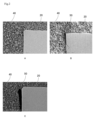
- Figures 2A, 2B, and 2C are SEM images showing observation examples of resin-rich matrices.
- FIG. 2A is an SEM image showing an example in which no resin-rich matrix is observed on the side surface of the silicon chip.
- FIG. 2B is an SEM image showing an example in which a resin-rich matrix with a maximum thickness of less than 2 ⁇ m was observed on the side surface of the silicon chip.
- FIG. 2C is an SEM image showing an example in which a resin-rich matrix with a maximum thickness of 2 ⁇ m or more was observed on the side surface of the silicon chip.
- the LCM material according to this embodiment consists of an epoxy resin composition containing (A) an epoxy resin, (B) a curing accelerator, (C) a filler, and (D) an elastomer.
- the blending ratio of the (C) filler to the epoxy resin composition is 73.0% by mass or more.
- the blending ratio of (D) the elastomer to the total of the components of the LCM material excluding the (C) filler is 7.0% by mass or more.
- the inventors presume the reason as follows.
- the present inventors investigated the cause of generation of the resin-rich matrix.
- the resin-rich matrix is caused by the phenomenon (1) and the phenomenon (2) below occurring in succession.
- the present inventors have found that the compounding ratio of the curable component contained in the LCM material (the component whose volume shrinks when the LCM material is cured) is suppressed as low as possible. I considered. For this purpose, it is considered important to maximize the compounding ratio of the non-curing component (the component whose volume does not shrink during curing) consisting of a combination of (C) a filler and (D) an elastomer. . As a result of trial and error, it was found that the resin-rich matrix can be effectively suppressed when the following conditions (i) and (ii) are satisfied.
- the mixing ratio of (C) the filler to the epoxy resin composition contained in the LCM material is 73.0% by mass or more.
- the blending ratio of (D) elastomer to the total of components excluding (C) filler from the epoxy resin composition contained in the LCM material is 7.0% by mass or more.
- Both (C) the filler and (D) the elastomer are non-curing components that do not cause the volume shrinkage when cured. Therefore, it is conceivable to suppress the resin-rich matrix by using a large amount of either one of the filler and the elastomer. However, in this embodiment, it is extremely important to use a combination of both so as to satisfy the above conditions (i) and (ii). First, when only a large amount of (D) elastomer is used without using (C) filler, the thickening effect resulting from the addition of (C) filler cannot be obtained at all. Therefore, a viscosity suitable for compression molding cannot be secured.
- (C) an epoxy resin composition containing no filler cannot be used as an LCM material in the first place.
- the larger the amount of (C) filler added the more (A) the LCM material of the curable component made of epoxy resin or the like. ratio in the composition is relatively small. Therefore, the volume shrinkage in the resin matrix can be made smaller when the LCM material is cured.
- the amount of volumetric shrinkage at the time of curing can only be made smaller, and the occurrence of volumetric shrinkage itself cannot be suppressed. For this reason, it is difficult to avoid the occurrence of a peeling phenomenon due to the volume shrinkage. Therefore, as a result, it is difficult to suppress the generation of the resin-rich matrix only by increasing the amount of the filler (C) added.
- the organic component (D) elastomer and the organic component (A) curable component such as epoxy resin react and bond to each other. For this reason, it is considered that the resin matrix containing the cured curable component is deformed after curing. Then, it is considered that the elastomer matrix ((D) elastomer contained in the cured LCM material) bonded to the resin matrix is also deformed along with this. That is, it is believed that during curing of the LCM material, the resin matrix deforms so that its volume shrinks more than before curing. On the other hand, the easily deformable elastomeric matrix is considered to expand and deform so as to counteract the volumetric contraction in the resin matrix.
- the elastomer matrix is present in a sufficient amount to cancel the volumetric shrinkage in the resin matrix after the LCM material is cured, the peeling phenomenon (phenomenon described in (1) above) is unlikely to occur. . And, as a result, it is thought that generation of a resin-rich matrix can also be suppressed.
- condition (i) the proportion of the resin matrix that has shrunk in volume contained in the cured product of the LCM material is a certain amount or less. For this reason, it is presumed that condition (i) contributes to more effectively exhibiting the action of canceling out the volumetric shrinkage in the resin matrix due to the addition of (D) elastomer. Moreover, it is presumed that condition (ii) contributes to securing a sufficient amount of elastomer matrix to absorb the volumetric shrinkage in the resin matrix to the extent that the occurrence of the delamination phenomenon can be suppressed.
- the (D) elastomer compounded in the LCM material is a liquid substance having a viscosity of 110 Pa ⁇ s or more at room temperature
- the elastomer molecules are converted into the (A) epoxy resin or the like when the LCM material is cured. It is believed that it is incorporated into the crosslinked structure formed by the curable component. In this case, an elastic resin matrix is formed. Therefore, even in such a case, if a sufficient amount of (D) elastomer is blended with the LCM material, the volume shrinkage in the resin matrix due to the curing reaction is canceled by the elasticity of the resin matrix itself. It is thought that It is considered that this can suppress the occurrence of the peeling phenomenon and further the occurrence of the resin-rich matrix.
- liquid compression molding material refers to a cured liquid that has a viscosity of 2000 Pa s or less at room temperature (25° C.) and that can be used in compression molding processes. means a flexible resin composition. Therefore, the viscosity at room temperature of the liquid compression molding material of the present embodiment is not particularly limited as long as it is 2000 Pa ⁇ s or less. However, the viscosity is preferably 1000 Pa ⁇ s or less, more preferably 700 Pa ⁇ s or less, and still more preferably 500 Pa ⁇ s or less from the viewpoint of workability in manufacturing the liquid compression molding material.
- the lower limit of the viscosity at room temperature is not particularly limited. However, from the viewpoint of handleability, etc., the lower limit is 50 Pa ⁇ s, more preferably 100 Pa ⁇ s.
- the viscosity range of the liquid compression molding material at 120° C. is preferably 0.5 Pa ⁇ s to 40.0 Pa ⁇ s, more preferably 0.5 Pa ⁇ s to 20.0 Pa ⁇ s, still more preferably 0.8 Pa. ⁇ s to 8.0 Pa ⁇ s.
- the viscosity at 120° C. is 0.5 Pa ⁇ s or more, it is possible to easily suppress the liquid compression molding material from flowing out of the mold when compression molding the LCM material according to the present embodiment.
- the viscosity at 120° C. is 40.0 Pa ⁇ s or less, it is possible to easily suppress filling failure of the liquid compression molding material due to the high viscosity during the compression molding. The details of the method for measuring the viscosity at room temperature and 120°C will be described later.
- the (A) epoxy resin that can be used in the LCM material according to the present embodiment is not particularly limited as long as it is a variety of epoxy resins that are generally used for semiconductor encapsulation. However, from the viewpoint of reliability (thermal cycle resistance), etc., it is preferable to use a polyfunctional type epoxy resin (an epoxy resin having two or more epoxy groups in one molecule) as the epoxy resin. Also, as the epoxy resin used for the LCM material according to this embodiment, only one type of epoxy resin may be used. Alternatively, two or more epoxy resins appropriately combined may be used. At least one epoxy group should be contained in one epoxy resin molecule. The preferred number of epoxy groups is usually 2 or more. In addition, the upper limit of the number of epoxy groups is not particularly limited.
- the upper limit of the preferable number of epoxy groups is usually 5 or less.
- the epoxy group is not particularly limited as long as it is various epoxy resins generally used for semiconductor encapsulation.
- the epoxy resin is not particularly limited as long as it is a variety of epoxy resins generally used for semiconductor encapsulation.
- a single epoxy resin can be used as a raw material for the preparation of the LCM material.
- a mixed composition obtained by blending and dispersing core-shell type rubber particles as an elastomer at a high concentration in an epoxy resin can also be used. Details of the masterbatch will be described later.
- the epoxy resin is not particularly limited as long as it is a variety of epoxy resins generally used for semiconductor encapsulation.
- the epoxy resin is not particularly limited as long as it is a variety of epoxy resins generally used for semiconductor encapsulation.
- As the epoxy resin an aliphatic epoxy resin and/or an aromatic epoxy resin can be used. Both are preferably used in combination.
- aromatic epoxy resins include bisphenol A type epoxy resins such as p-glycidyloxyphenyldimethyltrisbisphenol A diglycidyl ether; bisphenol F type epoxy resins; novolac type epoxy resins; fluorene type epoxy resins; diepoxy resins such as p-tert-butylphenyl glycidyl ether and 1,4-phenyldimethanol diglycidyl ether; 3,3′,5,5′-tetramethyl-4,4′-diglycidyloxybiphenyl; biphenyl-type epoxy resins such as; aminophenol-type epoxy resins such as diglycidylaniline, diglycidyltoluidine, triglycidyl-p-aminophenol, and tetraglycidyl-m-xylylenediamine; and naphthalene-type epoxy resins. . Epoxy resins that can be used are not limited to these.
- bisphenol F type epoxy resin bisphenol A type epoxy resin, biphenyl type epoxy resin, aminophenol type epoxy resin, and naphthalene type epoxy resin are preferably used.
- aliphatic epoxy resins examples include polytetramethylene glycol diglycidyl ether, (poly)propylene glycol diglycidyl ether, butanediol diglycidyl ether, neopentyl glycol diglycidyl ether, 1,6-hexanediol diglycidyl ether.
- trimethylolpropane diglycidyl ether trimethylolpropane diglycidyl ether, polytetramethylene ether glycol diglycidyl ether, glycerol diglycidyl ether, and neopentyl glycol diglycidyl ether; triepoxy resins; vinyl(3,4-cyclohexene)dioxide and cycloaliphatic such as 2-(3,4-epoxycyclohexyl)-5,1-spiro-(3,4-epoxycyclohexyl)-m-dioxane Epoxy resins; glycidylamine-type epoxy resins such as tetraglycidylbis(aminomethyl)cyclohexane; hydantoin-type epoxy resins such as 1,3-diglycidyl-5-methyl-5-ethylhydantoin; and 1,3-bis(3 -glycidoxypropyl)-1,1,3,
- polytetramethylene glycol diglycidyl ether polytetramethylene glycol diglycidyl ether, (poly)propylene glycol diglycidyl ether, 1,4-hexanediol diglycidyl ether, 1,4-butanediol diglycidyl ether, (poly)ethylene glycol diglycidyl ether, and pentaerythritol diglycidyl ether are suitable examples.
- the (B) curing accelerator is not particularly limited as long as it is a commonly used various curing accelerator.
- Examples of curing accelerators include nitrogen-containing heterocyclic curing accelerators such as imidazole compounds (including types adducted or microencapsulated with epoxy resins or isocyanate resins), tertiary amine curing Accelerators, and phosphorus compound-based curing accelerators.
- a nitrogen-containing heterocyclic curing accelerator is preferable from the viewpoint of reliability (thermal cycle resistance).
- Only one type of curing accelerator can be used as the curing accelerator compounded in the LCM material.
- two or more curing accelerators may be used in combination.
- the mixing ratio of the curing accelerator is not particularly limited. A preferable blending ratio is 2.0% by mass to 8.0% by mass, and a more preferable blending ratio is 2.5% by mass to 6.0% by mass, based on the total of the components of the LCM material excluding the filler. be.
- nitrogen-containing heterocyclic curing accelerators include 2-methylimidazole, 2-undecylimidazole, 2-heptadecylimidazole, 2-ethyl-4-methylimidazole, 2-phenyl imidazole, 2-phenyl-4-methylimidazole, 2-phenyl-4,5-dihydroxymethylimidazole, 2-phenyl-4-methyl-5-hydroxymethylimidazole, 1-cyanoethyl-2-undecylimidazole, 1-cyanoethyl -2-ethyl-4-imidazole, 2-phenylimidazole, 1-benzyl-2-phenylimidazole, benzimidazole, 2,4-diamino-6-[2'-methylimidazolyl-(1')]ethyl-s- Imidazole compounds such as triazine, 2-phenyl-4,5-dihydroxymethylimidazole, and 2,3
- nitrogen-containing heterocyclic curing accelerators other than imidazole compounds include diazabicycloundecene (DBU), DBU-phenol salt, DBU-octylate, DBU-p-toluenesulfonate, DBU- Formate, DBU-orthophthalate, DBU-phenol novolak resin salt, DBU tetraphenylborate salt, diazabicyclononene (DBN), DBN-phenol novolak resin salt, diazabicyclooctane, pyrazole, oxazole, thiazole, imidazoline , pyrazine, morpholine, thiazine, indole, isoindole, purine, quinoline, isoquinoline, quinoxaline, cinnoline,
- encapsulated imidazole called microcapsule imidazole or epoxy adduct imidazole can also be used. That is, an encapsulated imidazole-based latent curing agent obtained by adducting an imidazole compound with urea or an isocyanate compound and further blocking the surface with an isocyanate compound can also be used.
- an encapsulated imidazole-based latent curing agent obtained by blocking the surface of an imidazole compound adducted with an epoxy compound with an isocyanate compound can also be used.
- HX3941HP ⁇ HXA3042HP ⁇ HXA3922HP ⁇ HXA3792 ⁇ HX3748 ⁇ HX3721 ⁇ HX3722 ⁇ HX3088 ⁇ HX3741 ⁇ HX3742 ⁇ HX3613( ⁇ ) amicure PN-23J, and Amicure PN-40J (both manufactured by Ajinomoto Fine-Techno Co., Ltd., trade names), and Fujicure FXR-1121 (manufactured by T&K TOKA Co., Ltd., trade names).
- (C) Filler is added to the LCM material to reduce the linear expansion coefficient of the cured LCM material (sealing material) and to suppress volumetric shrinkage in the resin matrix caused by the curing reaction of the LCM material.
- (C) fillers include various inorganic particles including silica fillers and alumina fillers.
- a silica filler is preferable because the filling amount can be increased.
- the surface of the (C) filler may be treated with, for example, a silane coupling agent.
- the (C) filler may further have other functions such as coloring properties in addition to the functions described above.
- Examples of such (C) fillers include inorganic pigments such as white pigments.
- examples of such inorganic pigments include magnesia, titania, zirconia, boron nitride, aluminum nitride, titanium oxide, magnesium oxide, zinc oxide, diamond, potassium titanate, magnesium sulfate, sepiolite, xonolite, aluminum borate, calcium carbonate.
- titanium oxide, barium sulfate, zinc oxide, magnesium hydroxide, barium titanate, and zirconia oxide examples include magnesia, titania, zirconia, boron nitride, aluminum nitride, titanium oxide, magnesium oxide, zinc oxide, diamond, potassium titanate, magnesium sulfate, sepiolite, xonolite, aluminum borate, calcium carbonate.
- titanium oxide, barium sulfate, zinc oxide, magnesium hydroxide, barium titanate, and zirconia oxide examples of such (C) fillers.
- the average particle size of the filler is not particularly limited.
- a preferred average particle size is 0.1 ⁇ m to 15.0 ⁇ m.
- a more preferable average particle size is 0.3 ⁇ m to 10.0 ⁇ m.
- the shape of the filler is not particularly limited.
- any of spherical, amorphous, and scaly fillers can be used.
- the average particle diameter of the (C) filler is the volume average particle diameter D50 (small diameter in particle size distribution It means the particle diameter) value at which the cumulative distribution rate from the side is 50%.
- a sample for measurement can be prepared by dispersing 5 mg of filler blended in 50 mg of dispersant using an ultrasonic disperser for 10 minutes. The prepared sample was measured under conditions of a flow rate of 50 ml/second, a measurement time of 90 seconds, pure water as the solvent, and a solvent refractive index of 1.333.
- the blending ratio of the filler is 73.0% by mass or more, more preferably 77.5% by mass or more, and still more preferably 79.0% by mass, based on the epoxy resin composition constituting the LCM material (100% by mass). It is at least 80.0% by mass, particularly preferably at least 80.0% by mass.
- the blending ratio of (D) the elastomer to the total of the components of the epoxy resin composition excluding the filler is 7.0% by mass or more
- the blending ratio of the (C) filler to the LCM material is 73.0% by mass. By doing so, it is possible to suppress the generation of a resin-rich matrix.
- the upper limit of the mixing ratio of (C) the filler is not particularly limited.
- the upper limit is preferably 87.5% by mass or less, or more. Preferably, it is 86.0% by mass or less.
- thermosetting elastomer any known thermosetting elastomer can be used as long as it has elasticity at least after the LCM material is cured.
- examples of elastomers include core-shell rubber particles, silicone resins, and butadiene-acrylonitrile copolymers. Among these elastomers, in addition to the effect of suppressing the generation of a resin-rich matrix, it is possible to impart injectability to LCM materials, suppress peeling of LCM materials (sealing materials) from electronic devices after curing, and prevent migration. From the viewpoint of suppression, core-shell type rubber particles are preferably used.
- the properties of the (D) elastomer before curing the LCM material are not particularly limited.
- Any substance can be used as long as it is a solid substance or a liquid substance having a viscosity of 110 Pa ⁇ s or more at room temperature. It is presumed that the liquid substance changes to a solid substance when the LCM material is cured, and that the elastomer molecules are incorporated into the crosslinked structure of the epoxy resin after curing.
- core, shell (polybutadiene resin, acrylic copolymer) because it has a low elastic modulus in the operating temperature range of the LCM material, so that the shrinkage stress during curing of the LCM material can be reduced. ) is preferably used.
- a mixed composition can also be used as the raw material used for preparing the LCM material.
- This masterbatch can be prepared by a masterbatch process of blending and dispersing core-shell type rubber particles in an epoxy resin.
- a curing agent such as an acid anhydride can also be used in combination as a component other than the core-shell type rubber particles and the epoxy resin, if necessary.
- the epoxy resin used for masterbatch processing is not particularly limited.
- a bisphenol type epoxy resin is preferably used.
- Examples of bisphenol type epoxy resins include bisphenol A type epoxy resins and bisphenol F type epoxy resins. Among these, bisphenol F type epoxy resins are more preferably used.
- the blending ratio of the elastomer is 7.0% by mass or more, preferably 7.0% by mass or more, based on the total of the components (C) excluding the filler from the epoxy resin composition constituting the LCM material (100% by mass). It is 8.0% by mass or more, more preferably 11.0% by mass or more.
- the blending ratio of the (C) filler to the epoxy resin composition is 73.0% by mass or more, and the blending ratio of the (D) elastomer is 7.0% by mass or more, the resin-rich matrix can be suppressed.
- the upper limit of the mixing ratio of (D) the elastomer is not particularly limited. From the viewpoint of suppressing volumetric shrinkage in the resin matrix during curing of the LCM material and improving workability in adjusting the LCM material, the upper limit is preferably 16.5% by mass or less, more preferably 15% by mass. 0% by mass or less.
- the LCM material of the present embodiment may optionally contain other components other than components A to D and the solvent. No solvent is used in the LCM material of this embodiment. Other components are not particularly limited.
- a curing agent can be preferably used.
- components ((F) other additives) other than (E) the curing agent include coupling agents, ion trapping agents, leveling agents, antioxidants, antifoaming agents, flame retardants, colorants ( provided, however, that (C) inorganic pigments that also function as fillers are excluded), and reactive diluents.
- the type and blending amount of other additives can be determined according to a conventional method.
- the total content of (F) other additives contained in the LCM material of the present embodiment is generally more than 0% by mass and 3.5% by mass or less. .
- the (E) curing agent is not particularly limited as long as it is a commonly used various curing agent.
- curing agents that can be used include amine-based curing agents, acid anhydride-based curing agents, and phenol-based curing agents.
- the blending amount of the curing agent is preferably determined so that the stoichiometric equivalent ratio (curing agent equivalent/epoxy group equivalent) to the epoxy resin is 0.01 to 1.00. A more preferable equivalent ratio is 0.01 to 0.50. A more preferable equivalent ratio is 0.08 to 0.30.
- amine curing agents include aliphatic polyamines such as triethylenetetramine, tetraethylenepentamine, m-xylenediamine, trimethylhexamethylenediamine, and 2-methylpentamethylenediamine, isophorone diamine, 1, Alicyclic polyamines such as 3-bisaminomethylcyclohexane, bis(4-aminocyclohexyl)methane, norbornenediamine, and 1,2-diaminocyclohexane, N-aminoethylpiperazine, and 1,4-bis(2-amino -2-methylpropyl)piperazine, as well as piperazine-type polyamines such as diethyltoluenediamine, dimethylthiotoluenediamine, 4,4′-diamino-3,3′-diethyldiphenylmethane, bis(methylthio)toluenediamine, diaminodiphenylmethane.
- m-phenylenediamine diaminodiphenylsulfone, diethyltoluenediamine, trimethylenebis(4-aminobenzoate), and polytetramethyleneoxide-di-p-aminobenzoate.
- Examples of commercially available products include Epicure-W and Epicure-Z (trade name of Yuka Shell Epoxy Co., Ltd.), jER Cure (registered trademark)-W, and jER Cure (registered trademark)-Z (Mitsubishi Chemical Corporation Company, trade name), Kayahard AA, Kayahard AB, and Kayahard AS (Nippon Kayaku Co., Ltd., trade name), Thothamine HM-205 (Nippon Steel & Sumikin Chemical Co., Ltd., trade name), Adeka Hardener EH-101 (ADEKA Co., Ltd., trade name), Epomic Q-640, Epomic Q-643 (Mitsui Chemicals, trade name), DETDA80 (Lonza, trade name), and Thothamine HM-205 (Nippon Steel & Sumikin Chemical Co., Ltd., trade name).
- acid anhydride curing agents include alkylated tetrahydrophthalic anhydrides such as methyltetrahydrophthalic anhydride, methylhexahydrophthalic anhydride, and methyltetrahydrophthalic anhydride, hexahydrophthalic anhydride , methylhymic anhydride, alkenyl-substituted succinic anhydride, methyl nadic anhydride, and glutaric anhydride.
- alkylated tetrahydrophthalic anhydrides such as methyltetrahydrophthalic anhydride, methylhexahydrophthalic anhydride, and methyltetrahydrophthalic anhydride, hexahydrophthalic anhydride , methylhymic anhydride, alkenyl-substituted succinic anhydride, methyl nadic anhydride, and glutaric anhydride.
- phenolic curing agents include monomers, oligomers, and polymers having phenolic hydroxyl groups. More specific examples include phenol novolac resins, alkylated and allylated products thereof, cresol novolak resins, phenol aralkyl (including phenylene and biphenylene skeletons) resins, naphthol aralkyl resins, triphenolmethane resins, and dicyclopentadiene type phenol resins. are mentioned.
- the LCM material of this embodiment is prepared by mixing and agitating each component as a raw material.
- the method of mixing and stirring is not particularly limited. A known method can be used. For example, a roll mill can be used.
- the (A) epoxy resin used as a raw material is solid, the (A) epoxy resin is liquefied by, for example, heat treatment before mixing with other components.
- all the raw materials can be mixed at once.
- the rest of the ingredients may be mixed with a primary mixture prepared by mixing some ingredients selected from all the ingredients as raw materials. For example, if it is difficult to uniformly disperse (A) the epoxy resin and (C) the filler, for the primary mixture prepared by mixing the (A) epoxy resin and (C) the filler, and the remaining ingredients may be mixed.
- the LCM material of this embodiment can be widely applied to resin sealing of various electronic components such as semiconductor elements or LED packages.
- the LCM material of the present embodiment can be used for resin sealing of electronic components by compression molding.
- compression molding the inside of a mold is filled in advance with a liquid epoxy resin composition (LCM material).
- a member to be resin-sealed is placed in the mold. Press mold clamping is then performed.
- compression molding does not require flow paths (gates, runners, etc.) for supplying resin.
- compression molding is characterized by a usage efficiency of the epoxy resin composition that is close to 100%.
- An electronic component manufactured using the LCM material of the present embodiment comprises a cured product of the LCM material of the present embodiment.
- the electronic member also includes an electronic element such as a semiconductor element or a light-emitting element, or a substrate, depending on the type of electronic component.
- the electronic component is a semiconductor device
- the semiconductor device includes a substrate, a semiconductor element arranged on the substrate, and the LCM material of the present embodiment that seals the gap between the semiconductor element and the substrate. and at least a cured product of
- Such a semiconductor device can be manufactured by a compression molding method, a step of filling the gap between the substrate and the semiconductor element arranged on the substrate with the LCM material of the present embodiment, and then clamping the LCM material.
- the LCM material of the present embodiment is a material normally used for manufacturing various electronic components using compression molding. However, if necessary, it can also be used for manufacturing various electronic components using molding methods other than compression molding. [Example]
- Curing accelerator 2P4MZ (2-phenyl-4-methylimidazole, manufactured by Shikoku Chemical Industry Co., Ltd.) ⁇ 2MZA (2,4-diamino-6-[2′-methylimidazolyl-(1′)]-ethyl-s-triazine, manufactured by Shikoku Chemical Industry Co., Ltd.) ⁇ 2P4MHZ (imidazole compound, manufactured by Shikoku Kasei Kogyo Co., Ltd.)
- Elastomer KMP605 silicone composite powder, manufactured by Shin-Etsu Chemical Co., Ltd., elastomer component 100% by mass
- CTBN1008SP carboxyl group-terminated butadiene-acrylonitrile copolymer, manufactured by Chori GLEX, elastomer component 100% by mass
- KMP605 is a solid elastomer
- CTBN1008SP is a liquid elastomer with a viscosity of 110 to 160 Pa ⁇ s at room temperature.
- Masterbatch (mixed composition of (A) component and (D) component) ⁇ MX-137 (core-shell type butadiene rubber particles, manufactured by Kaneka Corporation, elastomer component 33% by mass + epoxy resin component 67% by mass) ⁇ MX-965 (core-shell type silicone rubber particles, manufactured by Kaneka Corporation, elastomer component 25% by mass + epoxy resin component 75% by mass) *1
- the masterbatch is listed in the column of (D) elastomer in Tables 1 to 3. *2 Core-shell type butadiene rubber particles and core-shell type silicone rubber particles are solid elastomers.
- a silicon wafer 10 (diameter of 12 inches, thickness of 760 ⁇ m) was prepared as a member to be resin-sealed (a member to be resin-sealed).
- silicon chips 20 (length: 18 mm, width: 18 mm, height: 300 ⁇ m) are arranged on the upper surface of the silicon wafer 10 .
- the silicon chips 20 were arranged along the periphery of the silicon wafer 10 at regular intervals (every 90 degrees) in the circumferential direction. Between the silicon wafer 10 and the silicon chip 20, as shown on the right side of FIG.
- a sealing layer 40 (cured layer of LCM material) having a thickness of 500 ⁇ m was formed on the molded product thus obtained, which resin-sealed the silicon chips 20 arranged on the silicon wafer 10 .
- a resin-rich matrix with a maximum thickness of less than 2 ⁇ m was observed on the side surface of the silicon chip 20 .
- C As illustrated in FIG. 2C, a resin-rich matrix with a maximum thickness of 2 ⁇ m or more was observed on the side surface of the silicon chip 20 .
- Viscosity (viscosity at 25°C) The 25° C. viscosity was measured using a Brookfield HB-DV viscometer (model number: HB-DV1) at a liquid temperature of 25° C. and 10 rpm for the LCM material immediately after preparation.
- the evaluation criteria for the "25° C. viscosity determination" shown in the table are as follows. A: Viscosity at 25°C is less than 1000 Pa s B: Viscosity at 25°C is 1000 Pa s or more
- silicon wafer 10 silicon wafer 20 silicon chip 30 spacer 40 sealing layer 50 resin rich matrix
Landscapes
- Chemical & Material Sciences (AREA)
- Health & Medical Sciences (AREA)
- Chemical Kinetics & Catalysis (AREA)
- Medicinal Chemistry (AREA)
- Polymers & Plastics (AREA)
- Organic Chemistry (AREA)
- Engineering & Computer Science (AREA)
- Mechanical Engineering (AREA)
- Epoxy Resins (AREA)
- Structures Or Materials For Encapsulating Or Coating Semiconductor Devices Or Solid State Devices (AREA)
- Compositions Of Macromolecular Compounds (AREA)
- Microelectronics & Electronic Packaging (AREA)
Priority Applications (5)
| Application Number | Priority Date | Filing Date | Title |
|---|---|---|---|
| US18/291,755 US20250178245A1 (en) | 2021-09-22 | 2022-05-24 | Liquid compression molding material, electronic component, semiconductor device and method for producing semiconductor device |
| KR1020237041986A KR20240058048A (ko) | 2021-09-22 | 2022-05-24 | 액상 컴프레션 몰드재, 전자 부품, 반도체 장치, 및 반도체 장치의 제조 방법 |
| CN202280041249.XA CN117461127A (zh) | 2021-09-22 | 2022-05-24 | 液状压缩成型材料、电子部件、半导体装置以及半导体装置的制造方法 |
| EP22872460.5A EP4407673A4 (en) | 2021-09-22 | 2022-05-24 | LIQUID COMPRESSION MOLDING MATERIAL, ELECTRONIC COMPONENT, SEMICONDUCTOR DEVICE AND METHOD FOR PRODUCING SEMICONDUCTOR DEVICE |
| JP2023549366A JPWO2023047702A1 (https=) | 2021-09-22 | 2022-05-24 |
Applications Claiming Priority (2)
| Application Number | Priority Date | Filing Date | Title |
|---|---|---|---|
| JP2021154478 | 2021-09-22 | ||
| JP2021-154478 | 2021-09-22 |
Publications (1)
| Publication Number | Publication Date |
|---|---|
| WO2023047702A1 true WO2023047702A1 (ja) | 2023-03-30 |
Family
ID=85720383
Family Applications (1)
| Application Number | Title | Priority Date | Filing Date |
|---|---|---|---|
| PCT/JP2022/021246 Ceased WO2023047702A1 (ja) | 2021-09-22 | 2022-05-24 | 液状コンプレッションモールド材、電子部品、半導体装置、および半導体装置の製造方法 |
Country Status (7)
| Country | Link |
|---|---|
| US (1) | US20250178245A1 (https=) |
| EP (1) | EP4407673A4 (https=) |
| JP (1) | JPWO2023047702A1 (https=) |
| KR (1) | KR20240058048A (https=) |
| CN (1) | CN117461127A (https=) |
| TW (1) | TWI912528B (https=) |
| WO (1) | WO2023047702A1 (https=) |
Cited By (4)
| Publication number | Priority date | Publication date | Assignee | Title |
|---|---|---|---|---|
| WO2024202136A1 (ja) * | 2023-03-28 | 2024-10-03 | ナミックス株式会社 | エポキシ樹脂組成物、電子部品、半導体装置、半導体装置の製造方法 |
| JP7671555B1 (ja) * | 2023-11-24 | 2025-05-02 | ナミックス株式会社 | 半導体装置の製造方法及び封止体 |
| WO2025109864A1 (ja) * | 2023-11-24 | 2025-05-30 | ナミックス株式会社 | 半導体装置の製造方法及び封止体 |
| WO2026034370A1 (ja) * | 2024-08-07 | 2026-02-12 | ナミックス株式会社 | エポキシ樹脂組成物、硬化物、及び半導体装置 |
Citations (3)
| Publication number | Priority date | Publication date | Assignee | Title |
|---|---|---|---|---|
| JP2008274083A (ja) * | 2007-04-27 | 2008-11-13 | Shin Etsu Chem Co Ltd | 液状エポキシ樹脂組成物及び半導体装置 |
| JP2009155431A (ja) * | 2007-12-26 | 2009-07-16 | Sumitomo Bakelite Co Ltd | 液状封止樹脂組成物、半導体装置および半導体装置の製造方法 |
| WO2018221682A1 (ja) * | 2017-05-31 | 2018-12-06 | 日立化成株式会社 | 圧縮成型用液状樹脂組成物及び電子部品装置 |
Family Cites Families (8)
| Publication number | Priority date | Publication date | Assignee | Title |
|---|---|---|---|---|
| JP2015166403A (ja) * | 2012-06-29 | 2015-09-24 | 太陽ホールディングス株式会社 | 熱硬化型樹脂組成物および熱硬化型樹脂フィルム |
| JP6456027B2 (ja) * | 2013-03-27 | 2019-01-23 | 日東電工株式会社 | 封止シート、封止シートの製造方法及び電子部品パッケージの製造方法 |
| JP6196138B2 (ja) | 2013-11-29 | 2017-09-13 | ナミックス株式会社 | 半導体封止剤および半導体装置 |
| JP6749887B2 (ja) * | 2015-02-26 | 2020-09-02 | 日立化成株式会社 | 封止用フィルム及びそれを用いた電子部品装置 |
| CN108137793B (zh) * | 2015-08-03 | 2021-12-24 | 昭和电工材料株式会社 | 环氧树脂组合物、膜状环氧树脂组合物及电子装置 |
| EP3620481B1 (en) | 2017-05-31 | 2024-03-27 | Resonac Corporation | Liquid resin composition for sealing and electronic component apparatus |
| JP7424743B2 (ja) * | 2018-09-04 | 2024-01-30 | 味の素株式会社 | 樹脂組成物、樹脂インク、樹脂インク層、樹脂シート及び半導体チップパッケージ |
| CN111763403A (zh) * | 2020-07-15 | 2020-10-13 | 深圳先进电子材料国际创新研究院 | 一种液体环氧树脂组合物及其制备方法和应用 |
-
2022
- 2022-05-24 WO PCT/JP2022/021246 patent/WO2023047702A1/ja not_active Ceased
- 2022-05-24 CN CN202280041249.XA patent/CN117461127A/zh active Pending
- 2022-05-24 JP JP2023549366A patent/JPWO2023047702A1/ja active Pending
- 2022-05-24 EP EP22872460.5A patent/EP4407673A4/en active Pending
- 2022-05-24 KR KR1020237041986A patent/KR20240058048A/ko active Pending
- 2022-05-24 US US18/291,755 patent/US20250178245A1/en active Pending
- 2022-05-27 TW TW111119826A patent/TWI912528B/zh active
Patent Citations (3)
| Publication number | Priority date | Publication date | Assignee | Title |
|---|---|---|---|---|
| JP2008274083A (ja) * | 2007-04-27 | 2008-11-13 | Shin Etsu Chem Co Ltd | 液状エポキシ樹脂組成物及び半導体装置 |
| JP2009155431A (ja) * | 2007-12-26 | 2009-07-16 | Sumitomo Bakelite Co Ltd | 液状封止樹脂組成物、半導体装置および半導体装置の製造方法 |
| WO2018221682A1 (ja) * | 2017-05-31 | 2018-12-06 | 日立化成株式会社 | 圧縮成型用液状樹脂組成物及び電子部品装置 |
Non-Patent Citations (1)
| Title |
|---|
| See also references of EP4407673A4 * |
Cited By (4)
| Publication number | Priority date | Publication date | Assignee | Title |
|---|---|---|---|---|
| WO2024202136A1 (ja) * | 2023-03-28 | 2024-10-03 | ナミックス株式会社 | エポキシ樹脂組成物、電子部品、半導体装置、半導体装置の製造方法 |
| JP7671555B1 (ja) * | 2023-11-24 | 2025-05-02 | ナミックス株式会社 | 半導体装置の製造方法及び封止体 |
| WO2025109864A1 (ja) * | 2023-11-24 | 2025-05-30 | ナミックス株式会社 | 半導体装置の製造方法及び封止体 |
| WO2026034370A1 (ja) * | 2024-08-07 | 2026-02-12 | ナミックス株式会社 | エポキシ樹脂組成物、硬化物、及び半導体装置 |
Also Published As
| Publication number | Publication date |
|---|---|
| EP4407673A1 (en) | 2024-07-31 |
| KR20240058048A (ko) | 2024-05-03 |
| EP4407673A4 (en) | 2025-09-17 |
| US20250178245A1 (en) | 2025-06-05 |
| TWI912528B (zh) | 2026-01-21 |
| TW202313836A (zh) | 2023-04-01 |
| CN117461127A (zh) | 2024-01-26 |
| JPWO2023047702A1 (https=) | 2023-03-30 |
Similar Documents
| Publication | Publication Date | Title |
|---|---|---|
| WO2023047702A1 (ja) | 液状コンプレッションモールド材、電子部品、半導体装置、および半導体装置の製造方法 | |
| WO2012105071A1 (ja) | 半導体樹脂封止材 | |
| US9805998B2 (en) | Liquid sealing material and electronic component using same | |
| JP2017031402A (ja) | 熱硬化性エポキシ樹脂組成物 | |
| TW201727848A (zh) | 環氧樹脂組成物 | |
| TWI763877B (zh) | 半導體密封用熱硬化性環氧樹脂薄片、半導體裝置及其製造方法 | |
| JPWO2019146617A1 (ja) | 封止用樹脂組成物 | |
| CN106905658A (zh) | 液态环氧树脂组合物 | |
| WO2023089878A1 (ja) | エポキシ樹脂組成物、液状コンプレッションモールド材、グラブトップ材および半導体装置 | |
| JPWO2010029726A1 (ja) | 半導体装置および半導体装置に用いる樹脂組成物 | |
| TWI892106B (zh) | 密封方法、半導體裝置的製造方法及密封用材料 | |
| JP2017190396A (ja) | 封止用樹脂シート及び電子部品装置の製造方法 | |
| JP2021098786A (ja) | 液状エポキシ樹脂組成物 | |
| JP2015117361A (ja) | 半導体封止用樹脂組成物 | |
| TWI685537B (zh) | 樹脂組成物、及使用其的銅凸塊用液狀密封劑 | |
| JP2014227465A (ja) | 射出成形用液状樹脂組成物および半導体装置 | |
| WO2023062877A1 (ja) | 液状封止剤、電子部品及びその製造方法、並びに半導体装置 | |
| JP2010053164A (ja) | 封止用樹脂組成物および樹脂封止型半導体装置 | |
| WO2024075342A1 (ja) | エポキシ樹脂組成物、半導体装置、及び半導体装置の製造方法 | |
| JP2019167434A (ja) | 樹脂組成物、半導体装置及び半導体装置の製造方法 | |
| WO2025126777A1 (ja) | エポキシ樹脂組成物、硬化物、及び半導体装置 | |
| JP2025005765A (ja) | エポキシ樹脂組成物、硬化物、及び半導体装置 | |
| WO2025254026A1 (ja) | エポキシ樹脂組成物、硬化物、及び半導体装置 | |
| JP2024109390A (ja) | 硬化性組成物及び液状封止材 | |
| JP2016102221A (ja) | 液状封止材、それを用いた電子部品 |
Legal Events
| Date | Code | Title | Description |
|---|---|---|---|
| 121 | Ep: the epo has been informed by wipo that ep was designated in this application |
Ref document number: 22872460 Country of ref document: EP Kind code of ref document: A1 |
|
| WWE | Wipo information: entry into national phase |
Ref document number: 2023549366 Country of ref document: JP |
|
| WWE | Wipo information: entry into national phase |
Ref document number: 202280041249.X Country of ref document: CN |
|
| WWE | Wipo information: entry into national phase |
Ref document number: 2022872460 Country of ref document: EP |
|
| NENP | Non-entry into the national phase |
Ref country code: DE |
|
| ENP | Entry into the national phase |
Ref document number: 2022872460 Country of ref document: EP Effective date: 20240422 |
|
| WWP | Wipo information: published in national office |
Ref document number: 18291755 Country of ref document: US |