WO2023022151A1 - 成形物の製造方法 - Google Patents
成形物の製造方法 Download PDFInfo
- Publication number
- WO2023022151A1 WO2023022151A1 PCT/JP2022/030959 JP2022030959W WO2023022151A1 WO 2023022151 A1 WO2023022151 A1 WO 2023022151A1 JP 2022030959 W JP2022030959 W JP 2022030959W WO 2023022151 A1 WO2023022151 A1 WO 2023022151A1
- Authority
- WO
- WIPO (PCT)
- Prior art keywords
- resin composition
- epoxy resin
- thermoplastic resin
- producing
- molding
- Prior art date
- Legal status (The legal status is an assumption and is not a legal conclusion. Google has not performed a legal analysis and makes no representation as to the accuracy of the status listed.)
- Ceased
Links
Classifications
-
- B—PERFORMING OPERATIONS; TRANSPORTING
- B29—WORKING OF PLASTICS; WORKING OF SUBSTANCES IN A PLASTIC STATE IN GENERAL
- B29C—SHAPING OR JOINING OF PLASTICS; SHAPING OF MATERIAL IN A PLASTIC STATE, NOT OTHERWISE PROVIDED FOR; AFTER-TREATMENT OF THE SHAPED PRODUCTS, e.g. REPAIRING
- B29C45/00—Injection moulding, i.e. forcing the required volume of moulding material through a nozzle into a closed mould; Apparatus therefor
- B29C45/14—Injection moulding, i.e. forcing the required volume of moulding material through a nozzle into a closed mould; Apparatus therefor incorporating preformed parts or layers, e.g. injection moulding around inserts or for coating articles
Definitions
- the present invention relates to a method for manufacturing a molding.
- Patent Document 1 a pre-gelled epoxy resin adhesive layer is formed in advance on the front surface of a member made of metal or ceramics that is in contact with a thermoplastic resin, and then the thermoplastic resin is molded integrally with the member and epoxy resin is bonded. It is described that by curing the agent, a molding having excellent adhesion between the thermoplastic resin and the member and excellent stress relaxation at the interface between the two can be obtained.
- the pre-gelled epoxy resin adhesive flows out due to the temperature and pressure during insert molding, and the adhesion and airtightness between the member and the thermoplastic resin may be impaired. There was a problem of insufficient product reliability. Thus, there is still room for improvement in the adhesion and airtightness between the member and the thermoplastic resin.
- the present invention provides a molded article in which outflow of a pre-gelled epoxy resin composition due to temperature and pressure during insert molding is greatly suppressed, and excellent adhesion and airtightness between a member made of metal or ceramics and a thermoplastic resin composition.
- the object is to provide a method for manufacturing a
- the present inventors found that by using an epoxy resin composition containing a specific amount of a pregelling agent as an epoxy resin composition, pregelation occurs due to temperature and pressure during insert molding.
- the outflow of the epoxy resin composition is greatly suppressed, and the adhesiveness and airtightness between the member made of metal or ceramics and the thermoplastic resin composition are excellent, and it is possible to manufacture a molded product with high product reliability. , completed the present invention.
- the present invention (1) A step of applying an epoxy resin composition to the surface of an insert member made of metal or ceramics to form an epoxy resin composition layer; (2) heating the insert member obtained in step (1) to pregel the epoxy resin composition; (3) Molding including a step of placing the insert member obtained in step (2) in a mold, insert-molding a thermoplastic resin composition on the epoxy resin composition layer, and curing the epoxy resin composition.
- the epoxy resin composition relates to a method for producing a molded article containing 1 to 80 parts by mass of a pregelling agent with respect to 100 parts by mass of the epoxy resin.
- the thermoplastic resin composition comprises a crystalline thermoplastic resin
- the epoxy resin composition was applied to a copper plate in a thickness of 100 ⁇ m, heated at 100° C. for 4 minutes to pre-gel, and then heated at a cylinder temperature of +50° C., a mold temperature of 150° C., and a mold temperature of 150° C.
- the flow width is 0 to 8 mm, or
- the thermoplastic resin composition contains an amorphous thermoplastic resin
- the epoxy resin composition was applied to a copper plate in a thickness of 100 ⁇ m, heated at 100° C. for 4 minutes to pre-gel, and then the cylinder temperature was +120° C.
- the flow width is preferably 0 to 8 mm when the amorphous thermoplastic resin is injection molded.
- the epoxy resin composition has a tensile shear bond strength of 200 N at 125° C. measured in accordance with JIS K6850-1999 using a test piece made of the material for the insert member and a test piece of the thermoplastic resin composition. /cm 2 or more.
- the particle size of the pregelling agent at 25° C. is preferably 1 to 100 ⁇ m.
- the epoxy resin composition contains a silane coupling agent.
- the epoxy resin composition contains a thixotropic agent.
- the epoxy resin composition preferably contains an amine-based curing agent and a dicyandiamide-based curing agent.
- the thermoplastic resin is preferably at least one selected from the group consisting of polyphenylene sulfide, polybutylene terephthalate, liquid crystal polymer, polyamide, cyclic olefin polymer, polycarbonate and polyethylene terephthalate.
- the present invention also relates to a molded article produced by the method for producing a molded article of the present invention.
- Busbars or metal terminals are preferred.
- the temperature and pressure during insert molding pregelatinize the epoxy resin composition.
- Outflow is greatly suppressed, and a molded article with excellent product reliability can be produced, which has excellent adhesiveness and airtightness between a member made of metal or ceramics and the thermoplastic resin composition.
- the method for producing a molded product of the present invention comprises: (1) A step of applying an epoxy resin composition to the surface of an insert member made of metal or ceramics to form an epoxy resin composition layer; (2) heating the insert member obtained in step (1) to pregel the epoxy resin composition; (3) Molding including a step of placing the insert member obtained in step (2) in a mold, insert-molding a thermoplastic resin composition on the epoxy resin composition layer, and curing the epoxy resin composition.
- the epoxy resin composition relates to a method for producing a molded article containing 1 to 80 parts by mass of a pregelling agent with respect to 100 parts by mass of the epoxy resin.
- step (1) an epoxy resin composition is applied to the surface of an insert member made of metal or ceramics to form an epoxy resin composition layer.
- the material of the insert member is metal or ceramics.
- metals include, but are not particularly limited to, copper, silver, and aluminum.
- ceramics include, but are not particularly limited to, fine ceramics.
- the insert member may be made of a single material, or may be a combination of two or more materials.
- the shape of the insert member is not particularly limited as long as it can be placed in the mold, and any shape suitable for the molded article to be manufactured can be adopted.
- Epoxy resin composition The epoxy resin contained in the epoxy resin composition is not particularly limited.
- bifunctional epoxy resins such as formula epoxy resins, polyether-modified epoxy resins, silicone-modified epoxy resins, glycidyl ester-type epoxy resins, phenol novolac-type epoxy resins, biphenyl-type epoxy resins, naphthalene-type epoxy resins, dicyclopentadiene-type epoxy resins, Polyfunctional epoxy resins such as xylylene-type epoxy resins, cresol novolac-type epoxy resins, tetrakisphenolethane-type epoxy resins, and the like are included. These may be used independently and may use 2 or more types together.
- the content ratio (mass ratio) of bisphenol A type epoxy resin and bisphenol F type epoxy resin is preferably 5:95 to 95:5, and 20:80 to 80:20 is more preferred.
- the content ratio (mass ratio) of the bisphenol A type epoxy resin and/or bisphenol F type epoxy resin to the glycidylamine type epoxy resin is preferably 1:99 to 90:10, more preferably 10:90 to 80:20. preferable.
- the epoxy equivalent of the epoxy resin is not particularly limited, it is preferably 50 to 1000 g/eq, more preferably 100 to 300 g/eq.
- the epoxy equivalent is less than 50 g/eq, the heat resistance and moisture resistance may deteriorate, and when it exceeds 1000 g/eq, the viscosity may become too high, and the handleability during application may deteriorate.
- the content of the epoxy resin is preferably 10 to 90% by mass, more preferably 10 to 60% by mass in the epoxy resin composition. If it is less than 10% by mass, the heat resistance and the like may deteriorate, and if it exceeds 90% by mass, the content of other components described later will be relatively decreased, and the fluidity (viscosity) and adhesion of the epoxy resin composition will be reduced. It may be inferior in terms of sex, etc.
- the epoxy resin composition contains 1 to 80 parts by mass of the pregelling agent with respect to 100 parts by mass of the epoxy resin, the particles of the pregelling agent expand by heating in step (2), and the fluidity of the epoxy resin composition increases.
- the viscosity increasing the viscosity
- the shape of the epoxy resin composition parangation
- the flow width can be within a specific range.
- the pregelling agent include, but are not limited to, (meth)acrylic resins, acrylonitrile resins, and the like. These may be used alone or in combination of two or more.
- epoxy group-containing polymethyl methacrylate is preferred.
- the particle size of the pregelling agent at 25° C. is not particularly limited, but is preferably 1 to 100 ⁇ m, more preferably 1 to 50 ⁇ m. If the particle size is less than 1 ⁇ m, a sufficient pregelation effect may not be obtained, and if it exceeds 100 ⁇ m, it may be difficult to adjust the thickness of the epoxy resin composition layer.
- the particle size can be measured with a laser particle size distribution meter.
- the number average molecular weight of the pregelling agent is not particularly limited, but is preferably 10,000 to 1,000,000, more preferably 100,000 to 5,000,000, from the viewpoint of the pregelling effect. If the number average molecular weight is less than 10,000, a sufficient pregelation effect may not be obtained, and if it exceeds 10,000,000, the viscosity may excessively increase.
- the content of the pregelling agent is not particularly limited as long as it is 1 to 80 parts by mass with respect to 100 parts by mass of the epoxy resin, but 1 to 60 parts by mass is preferable. If the content of the pregelling agent is less than 1 part by mass, the effect of reducing the fluidity of the epoxy resin composition may not be sufficiently obtained, and if it exceeds 80 parts by mass, the adhesiveness may decrease. .
- the epoxy resin composition may optionally contain other components such as curing agents, curing accelerators, silane coupling agents, thixotropic agents, fillers, thermoplastic resins, solvents, reactive diluents and the like. These optional components may be used alone or in combination of two or more.
- the curing agent is not particularly limited, but for example, diaminodiphenylmethane, imidazole, 2-methylimidazole, 2-phenylimidazole/isocyanuric acid adduct, amine curing agent, dicyandiamide curing agent, triphenylphosphine, tetraphenylphosphonium.
- Phenolic curing agents such as tetraphenylborate, acid anhydrides such as tetrahydrophthalic anhydride, diazabicycloundecene, N-8-benzyl-1,8-diazabicyclo(5,4,0)-undecene-7 ⁇ Chloride, 1,8-diazabicyclo(5,4,0)-undecene-7.phenol salt and the like can be mentioned. These may be used alone or in combination of two or more. Among these, amine-based curing agents and dicyandiamide-based curing agents are preferred from the viewpoint of adhesiveness and curability.
- the average particle size of the curing agent is not particularly limited, it is preferably 0.1 to 100 ⁇ m, more preferably 1 to 50 ⁇ m. If the average particle size of the curing agent is less than 0.1 ⁇ m, the viscosity may increase significantly, and if it exceeds 100 ⁇ m, the coating thickness may be limited.
- the content of the curing agent is not particularly limited, but is preferably 1 to 50 parts by mass, more preferably 1 to 30 parts by mass, based on 100 parts by mass of the epoxy resin. If the content of the curing agent is less than 1 part by mass, the curability may be remarkably lowered, and if it exceeds 50 parts by mass, the heat resistance may be lowered.
- the content ratio (mass ratio) thereof is preferably 1:5 to 5:1, more preferably 1:1 to 1:3.
- the epoxy resin composition preferably contains a silane coupling agent.
- silane coupling agent include, but are not particularly limited to, epoxysilane, mercaptosilane, and the like. These may be used alone or in combination of two or more.
- the content of the silane coupling agent is not particularly limited, it is preferably 0.1 to 10 parts by mass, more preferably 0.1 to 5 parts by mass, based on 100 parts by mass of the epoxy resin. If the content of the silane coupling agent is less than 0.1 parts by mass, a sufficient effect of improving adhesion may not be obtained, and if it exceeds 10 parts by mass, the reactivity may decrease.
- the epoxy resin composition preferably contains a thixotropic agent from the viewpoint of suppressing outflow of the epoxy resin composition due to temperature and pressure during insert molding.
- a thixotropic agent examples include, but are not particularly limited to, finely divided silica having a primary particle size of 100 nm or less, bentonite, and the like. These may be used alone or in combination of two or more.
- the content of the thixotropic agent is not particularly limited, it is preferably 0.1 to 10 parts by mass, more preferably 0.1 to 5 parts by mass, based on 100 parts by mass of the epoxy resin. If the content of the thixotropic agent is less than 0.1 parts by mass, the effect of suppressing the outflow may not be sufficiently obtained, and if it exceeds 10 parts by mass, the viscosity may excessively increase.
- fillers include, but are not limited to, silica, alumina, calcium carbonate, talc, mica, wollastonite, aluminum hydroxide, magnesium hydroxide, ferrite, boron nitride, aluminum nitride, silicon carbide, silicon nitride, kaolin, Examples include magnesium oxide, zirconium oxide, and titanium oxide. These may be used alone or in combination of two or more.
- the particle size of the filler is not particularly limited, but is preferably 0.2 to 150 ⁇ m, more preferably 1 to 50 ⁇ m.
- the content of the filler is not particularly limited, but is preferably 10 to 1,000 parts by mass, more preferably 20 to 500 parts by mass, and even more preferably 30 to 300 parts by mass, based on 100 parts by mass of the epoxy resin. If the filler content is less than 10 parts by mass, the effect of the filler may not be sufficiently obtained, and if it exceeds 1000 parts by mass, the viscosity may excessively increase.
- thermoplastic resin optionally contained in the epoxy resin composition is not particularly limited, but examples include acrylic resin, polyamide resin, polyacetal resin, polyvinyl butyral resin, polyethersulfone, polyimide resin, polyetherimide resin, polyester resin, Amorphous polyesters, polyether resins (for example, phenoxy resins (polyhydroxy polyethers), etc.), polyamideimide resins, polycarbodiimides, polycaprolactones, polyphenylene ethers, and the like.
- Thermoplastic elastomers such as styrene-butadiene copolymers, polyamide block copolymers, polyester elastomers, polyurethane elastomers and silicone elastomers are also included. These may be used alone or in combination of two or more.
- solvents include, but are not limited to, ethylene glycol monomethyl ether, diethylene glycol monomethyl ether, cyclohexanone, cyclopentanone, dimethylacetamide, N-methyl-2-pyrrolidone, methyl ethyl ketone, ethyl acetate, propylene glycol monoethyl ether acetate, and isophorone. , ethylene glycol monomethyl ether acetate, methyl isobutyl ketone, butyl acetate, dimethylformamide, ethylene glycol monobutyl ether, ethylene glycol monobutyl ether acetate and the like. These may be used alone or in combination of two or more.
- reactive diluents include, but are not limited to, limonene dioxide, p-tert-butylphenyl glycidyl ether, and the like. These may be used independently and may use 2 or more types together.
- the content of the reactive diluent is not particularly limited, but is preferably 0.1 to 50 parts by mass, more preferably 1 to 30 parts by mass, based on 100 parts by mass of the epoxy resin. If the content of the reactive diluent exceeds 50 parts by mass, the glass transition point may be significantly lowered.
- the epoxy resin composition used for insert molding in step (3) contains a crystalline thermoplastic resin
- the epoxy resin composition is applied to a copper plate in a thickness of 100 ⁇ m and heated at 100° C. for 4 minutes to pregel. After curing, the flow width is 0 to 8 mm when the crystalline thermoplastic resin is injection molded under the conditions of a cylinder temperature of 50 ° C., a mold temperature of 150 ° C., and a holding pressure of 70 MPa. is preferred.
- the thermoplastic resin composition contains an amorphous thermoplastic resin
- the epoxy resin composition is applied to a copper plate in a thickness of 100 ⁇ m, heated at 100° C.
- the flow width mentioned above is more preferably 1 to 7 mm, more preferably 2 to 5 mm in any case. If it is within the above range, the epoxy resin composition is sufficiently spread over the interface between the thermoplastic resin composition and the insert member, which is preferable in that it is easy to ensure airtightness.
- the flow width of the epoxy resin composition can be measured by the method described in Examples.
- the above flow width measurement conditions are such that the volume ratio is larger. It can be set based on the thermoplastic resin, and if the volume ratio of the crystalline thermoplastic resin and the amorphous thermoplastic resin is the same, the melting point of the crystalline thermoplastic resin or the glass transition temperature of the amorphous thermoplastic resin should be set based on a thermoplastic resin with a higher value.
- the epoxy resin composition has a tensile shear bond strength of 100 N at 125° C. measured in accordance with JIS K6850-1999 using a test piece made of the material for the insert member and a test piece of the thermoplastic resin composition. /cm 2 or more is preferable, and 200 N/cm 2 or more is more preferable. If the tensile shear adhesive strength is less than 100 N/cm 2 , the adhesiveness to the insert member or the thermoplastic resin composition is insufficient, and product reliability may be poor.
- the thickness of the epoxy resin composition layer is not particularly limited, it is preferably 5 to 1000 ⁇ m, more preferably 50 to 300 ⁇ m. If the thickness is less than 5 ⁇ m, the adhesion may be insufficient, and if it exceeds 1000 ⁇ m, the pre-gelled epoxy resin composition may significantly flow out due to the temperature and pressure during insert molding.
- step (2) the insert member obtained in step (1) is heated to pregel the epoxy resin composition.
- the heating temperature is not particularly limited, but is preferably 60 to 150°C, more preferably 80 to 120°C.
- the heating time is not particularly limited, but is preferably 0.5 to 10 minutes, more preferably 1 to 5 minutes.
- the term “pregelation” refers to the fluidity of the epoxy resin composition to such an extent that the shape of the epoxy resin composition can be maintained at room temperature (25° C.), regardless of whether the epoxy resin reacts or not. (viscosity) is reduced. Whether or not the epoxy resin composition is pregelatinized can be confirmed by the presence or absence of tackiness on the surface.
- step (3) the insert member obtained in step (2) is placed in a mold, a thermoplastic resin composition is insert-molded on the epoxy resin composition layer, and the epoxy resin composition is cured.
- "on the epoxy resin composition layer” means a state in which at least a part of the epoxy resin composition layer is covered.
- thermoplastic resin composition As the thermoplastic resin contained in the thermoplastic resin composition, a crystalline thermoplastic resin, an amorphous thermoplastic resin, or an alloy material containing a crystalline thermoplastic resin and an amorphous thermoplastic resin can be used.
- the crystalline thermoplastic resin include, but are not particularly limited to, polyphenylene sulfide, polybutylene terephthalate, liquid crystal polymer, polyamide, polyethylene terephthalate, polyacetal, and the like.
- amorphous thermoplastic resins include, but are not limited to, polyhydroxypolyethers, polyethersulfones, cyclic olefin polymers, and polycarbonates. These may be used independently and may use 2 or more types together.
- thermoplastic resin composition may optionally contain other components such as fillers, crystal nucleating agents, impact modifiers, antioxidants, lubricants, release agents, colorants, and compatibilizers. These optional components may be used alone or in combination of two or more.
- Molding conditions in insert molding can be appropriately set according to the type of thermoplastic resin and the like.
- the molding resin temperature is 150 to 400°C, preferably 200 to 400°C, more preferably 250 to 400°C.
- the molding cycle time is 1 second to 5 minutes, preferably 1 second to 4 minutes, more preferably 1 second to 3 minutes.
- the thermoplastic resin composition heated to the molding resin temperature described above is injected into the mold and brought into contact with the epoxy resin composition layer to obtain the epoxy resin composition. to cure. Therefore, it is preferable that the molding conditions described above be set more specifically, taking into consideration not only the conditions necessary for insert molding of the thermoplastic resin composition but also the conditions necessary for curing the epoxy resin composition.
- the molding resin temperature is preferably 290 to 350° C.
- the molding cycle time is 5 seconds to 3 minutes. preferable.
- the molding resin temperature is preferably 220 to 300° C., and the molding cycle time is 5 seconds to 3 minutes. is preferred.
- the molding resin temperature is preferably 290 to 400° C., and the molding cycle time is 1 second to 3 minutes. preferable.
- An injection molding apparatus for example, can be used to inject the thermoplastic resin composition into the mold.
- Molding conditions when using an injection molding apparatus include a mold temperature of 60 to 180° C., a thermoplastic resin composition injection temperature of 180 to 400° C., and a molding cycle time of 1 second to 3 minutes. be able to. More specifically, for example, when polyphenylene sulfide is used as the thermoplastic resin and an epoxy resin composition containing an amine curing agent is used, for example, the mold temperature is 150° C., the resin injection temperature is 330° C., and the molding is performed. A cycle time of 40 seconds is preferably implemented.
- the mold temperature is 80° C.
- the resin injection temperature is 260° C.
- the molding cycle time is 90 seconds. It is preferably implemented.
- a liquid crystal polymer is used as the thermoplastic resin and an epoxy resin composition containing an amine curing agent is used, for example, a mold temperature of 80° C., a resin injection temperature of 350° C., and a molding cycle time of 90 seconds are suitable. will be implemented.
- the molded article obtained by the method for producing a molded article of the present invention has excellent adhesion and airtightness between a member made of metal or ceramics and a thermoplastic resin composition, so that the product reliability is high and it is highly suitable for in-vehicle use. It can be suitably used for applications that require airtightness.
- molded products include, but are not limited to, bus bars, metal terminals, and the like. Among these, a bus bar is preferable from the viewpoint of expandability to in-vehicle conductive parts.
- Tensile shear bond strength A copper plate (C1100) was used as a test piece made from the material of the insert member, and a polyphenylene sulfide (manufactured by Polyplastics Co., Ltd., DURAFIDE (registered trademark) 6150T73) molding was used as a thermoplastic resin test piece, and JIS K6850 was used. -1999, the tensile shear bond strength at 25°C and 125°C was measured and evaluated according to the following criteria. The reason for evaluating the tensile shear adhesive strength under the conditions of 25°C (normal temperature) and 125°C (high temperature) is to confirm whether the desired adhesive strength can be maintained when performing the process of curing the epoxy resin composition. It's for.
- Example 1-3 Comparative Examples 1-3
- Each component was mixed so as to have the mass ratio (solid content ratio) shown in Table 2 to obtain an epoxy resin composition.
- the flow width of the obtained epoxy resin composition was evaluated by the following method. Table 2 shows the results.
- the obtained insert member is placed in a mold, and the thermoplastic resin (polyphenylene sulfide) is insert-molded at the molding resin temperature shown in Table 2 and the molding cycle time is 40 seconds. After curing, a molding was obtained. A He leak test was performed on the obtained molded product by the following method. Table 2 shows the results.
- an epoxy resin composition was applied to a thickness of 100 ⁇ m on the outer periphery of a copper (C1100) plate having a length of 34 mm, a width of 2.3 mm, and a thickness of 1.2 mm. It was heated for 1 minute to pre-gel. After that, on the copper plate coated with the epoxy resin composition, on the outer periphery of the central part 12 mm in the longitudinal direction, the inner dimension was extended so that the thickness of the thermoplastic resin composition in contact with each surface of the copper plate was 1.5 mm. A cavity measuring 12 mm high by 5.3 mm wide by 4.2 mm thick was provided.
- Thermoplastic resin was applied from one end to the other end of the epoxy resin composition coated portion under conditions of cylinder temperature of 330°C, mold temperature of 150°C, injection speed of 22 mm, holding pressure of 70 MPa, and holding pressure time of 20 seconds.
- the flow width of the epoxy resin composition flowing out onto a 11 mm copper plate protruding from the edge of the thermoplastic resin composition was measured and evaluated according to the following criteria. ⁇ : flow width: 0 mm or more and less than 8 mm ⁇ : flow width: less than 0 mm, or 8 mm or more
- the epoxy resin composition is applied to the central portion 10 mm of the copper plate, and the thermoplastic resin composition is molded to the central portion 12 mm of the copper plate so as to cover the epoxy resin composition. If it is not flowing, the end of the epoxy resin composition is located 1 mm inside from the end of the thermoplastic resin composition.
- the flow width was defined as 0 mm when the composition flowed out, and less than 0 mm when the epoxy resin composition did not flow outward from the end of the thermoplastic resin composition.
- He leak test vacuum method
- a structure having an upper chamber, a lower chamber, and an intermediate portion was prepared as a structure for leak testing.
- the moldings obtained in Examples 1 to 3 and Comparative Examples 1 to 3 were set in an airtight state in the intermediate portion of the structure.
- Soapy water was placed in the upper chamber and pressurized air was introduced into the lower chamber.
- the pressure of the pressurized air was 500 kPa in total, including 400 kPa for He pressure and 100 kPa for vacuum pressure.
- the leak amount of He was measured using a leak tester (G-Fine, manufactured by Cosmo Keiki Co., Ltd.) and evaluated according to the following criteria.
- ⁇ Less than 1.0 ⁇ 10 ⁇ 10 Pa ⁇ m 3 /s
- the molded bodies obtained in Examples 1 to 3 did not leak He and were excellent in airtightness.
Landscapes
- Engineering & Computer Science (AREA)
- Manufacturing & Machinery (AREA)
- Mechanical Engineering (AREA)
- Injection Moulding Of Plastics Or The Like (AREA)
- Compositions Of Macromolecular Compounds (AREA)
Abstract
Description
(1)金属またはセラミックスからなるインサート部材の表面に、エポキシ樹脂組成物を塗布し、エポキシ樹脂組成物層を形成する工程、
(2)工程(1)で得られたインサート部材を加熱して、エポキシ樹脂組成物をプレゲル化させる工程、
(3)工程(2)で得られたインサート部材を金型内に配置し、エポキシ樹脂組成物層上に、熱可塑性樹脂組成物をインサート成形し、エポキシ樹脂組成物を硬化させる工程
を含む成形物の製造方法であって、
エポキシ樹脂組成物は、エポキシ樹脂100質量部に対してプレゲル化剤を1~80質量部含む、成形物の製造方法に関する。
エポキシ樹脂組成物は、銅板上に100μmの厚みで塗布し、100℃で4分間加熱してプレゲル化させた後、シリンダー温度が結晶性熱可塑性樹脂の融点+50℃、金型温度150℃、保圧70MPaの条件下で結晶性熱可塑性樹脂を射出成形した場合の流れ幅が0~8mmであるか、又は、
熱可塑性樹脂組成物は非晶性熱可塑性樹脂を含み、
エポキシ樹脂組成物は、銅板上に100μmの厚みで塗布し、100℃で4分間加熱してプレゲル化させた後、シリンダー温度が非晶性熱可塑性樹脂のガラス転移温度+120℃、金型温度100℃、保圧70MPaの条件下で非晶性熱可塑性樹脂を射出成形した場合の流れ幅が0~8mmであることが好ましい。
本発明の成形物の製造方法は、
(1)金属またはセラミックスからなるインサート部材の表面に、エポキシ樹脂組成物を塗布し、エポキシ樹脂組成物層を形成する工程、
(2)工程(1)で得られたインサート部材を加熱して、エポキシ樹脂組成物をプレゲル化させる工程、
(3)工程(2)で得られたインサート部材を金型内に配置し、エポキシ樹脂組成物層上に、熱可塑性樹脂組成物をインサート成形し、エポキシ樹脂組成物を硬化させる工程
を含む成形物の製造方法であって、
エポキシ樹脂組成物は、エポキシ樹脂100質量部に対してプレゲル化剤を1~80質量部含む、成形物の製造方法に関する。
工程(1)では、金属またはセラミックスからなるインサート部材の表面に、エポキシ樹脂組成物を塗布し、エポキシ樹脂組成物層を形成する。
インサート部材の材質は、金属またはセラミックスである。金属としては、特に限定されないが、例えば、銅、銀、アルミニウム等が挙げられる。セラミックスとしては、特に限定されないが、例えば、ファインセラミックス等が挙げられる。インサート部材は、単独の材質からなるものでもよいし、2種以上の材質を組み合わせたものでもよい。インサート部材の形状は、金型内に配置できる限り特に限定されず、製造目的の成形物に応じた形状を採用することができる。
エポキシ樹脂組成物が含有するエポキシ樹脂としては、特に限定されず、例えば、ビスフェノールA型エポキシ樹脂、ビスフェノールF型エポキシ樹脂、ビスフェノールAD型エポキシ樹脂、ナフタレン型エポキシ樹脂、グリシジルアミン型エポキシ樹脂、脂環式エポキシ樹脂、ポリエーテル変性エポキシ樹脂、シリコーン変性エポキシ樹脂、グリシジルエステル型エポキシ樹脂等の2官能エポキシ樹脂、フェノールノボラック型エポキシ樹脂、ビフェニル型エポキシ樹脂、ナフタレン型エポキシ樹脂、ジシクロペンタジエン型エポキシ樹脂、キシリレン型エポキシ樹脂、クレゾールノボラック型エポキシ樹脂、テトラキスフェノールエタン型エポキシ樹脂等の多官能エポキシ樹脂等が挙げられる。これらは単独で用いてもよいし、2種以上を併用してもよい。
工程(2)では、工程(1)で得られたインサート部材を加熱して、エポキシ樹脂組成物をプレゲル化させる。加熱温度は、特に限定されないが、60~150℃が好ましく、80~120℃がより好ましい。加熱時間は、特に限定されないが、0.5~10分間が好ましく、1~5分間がより好ましい。
工程(3)では、工程(2)で得られたインサート部材を金型内に配置し、エポキシ樹脂組成物層上に、熱可塑性樹脂組成物をインサート成形し、エポキシ樹脂組成物を硬化させる。ここでエポキシ樹脂組成物層上とは、エポキシ樹脂組成物層の少なくとも一部を覆う状態を意味する。
熱可塑性樹脂組成物に含まれる熱可塑性樹脂としては、結晶性熱可塑性樹脂、非晶性熱可塑性樹脂、または結晶性熱可塑性樹脂と非晶性熱可塑性樹脂とを含むアロイ材を用いることができる。結晶性熱可塑性樹脂としては、特に限定されないが、例えば、ポリフェニレンスルフィド、ポリブチレンテレフタレート、液晶ポリマー、ポリアミド、ポリエチレンテレフタレート、ポリアセタール等が挙げられる。非晶性熱可塑性樹脂としては、特に限定されないが、例えば、ポリヒドロキシポリエーテル、ポリエーテルスルホン、環状オレフィン系ポリマー、ポリカーボネート等が挙げられる。これらは単独で用いてもよいし、2種以上を併用してもよい。これらの中では、ポリフェニレンスルフィド、ポリブチレンテレフタレート、液晶ポリマー、ポリアミド、環状オレフィン系ポリマー、ポリカーボネートおよびポリエチレンテレフタレートからなる群より選択される少なくとも1種であることが好ましく、ポリフェニレンスルフィドであることがより好ましい。
・エポキシ樹脂
ビスフェノールA/F型エポキシ樹脂(ビスフェノールA型エポキシ樹脂とビスフェノールF型エポキシ樹脂の含有比率(質量比)50:50、エポキシ当量156~170g/eq)
ポリサルファイド変性エポキシ樹脂(エポキシ当量280g/eq)
芳香族グリシジルエーテル型エポキシ樹脂(エポキシ当量400g/eq)
グリシジルアミン型エポキシ樹脂(エポキシ当量100~120g/eq)
・プレゲル化剤
エポキシ基含有ポリメチルメタクリレート(粒子径(25℃):2μm)
・硬化剤
アミン系硬化剤(平均粒子径:6μm)
ジシアンジアミド系硬化剤(平均粒子径:4μm)
・シランカップリング剤
エポキシシラン化合物
・チクソ性付与剤
微粉シリカ(平均粒子径:12nm)
・フィラー
シリカ(溶融シリカ、平均粒子径:7μm)
アルミナ(平均粒子径:12μm)
・反応性希釈剤
リモネンジオキサイド
・インサート部材
タフピッチ銅(C1100)製端子(株式会社スタンダードテストピース製、34.5×2.5×1.2mm)
・熱可塑性樹脂
ポリフェニレンスルフィド(ポリプラスチックス株式会社製、DURAFIDE(登録商標) 6150T73、融点280℃)
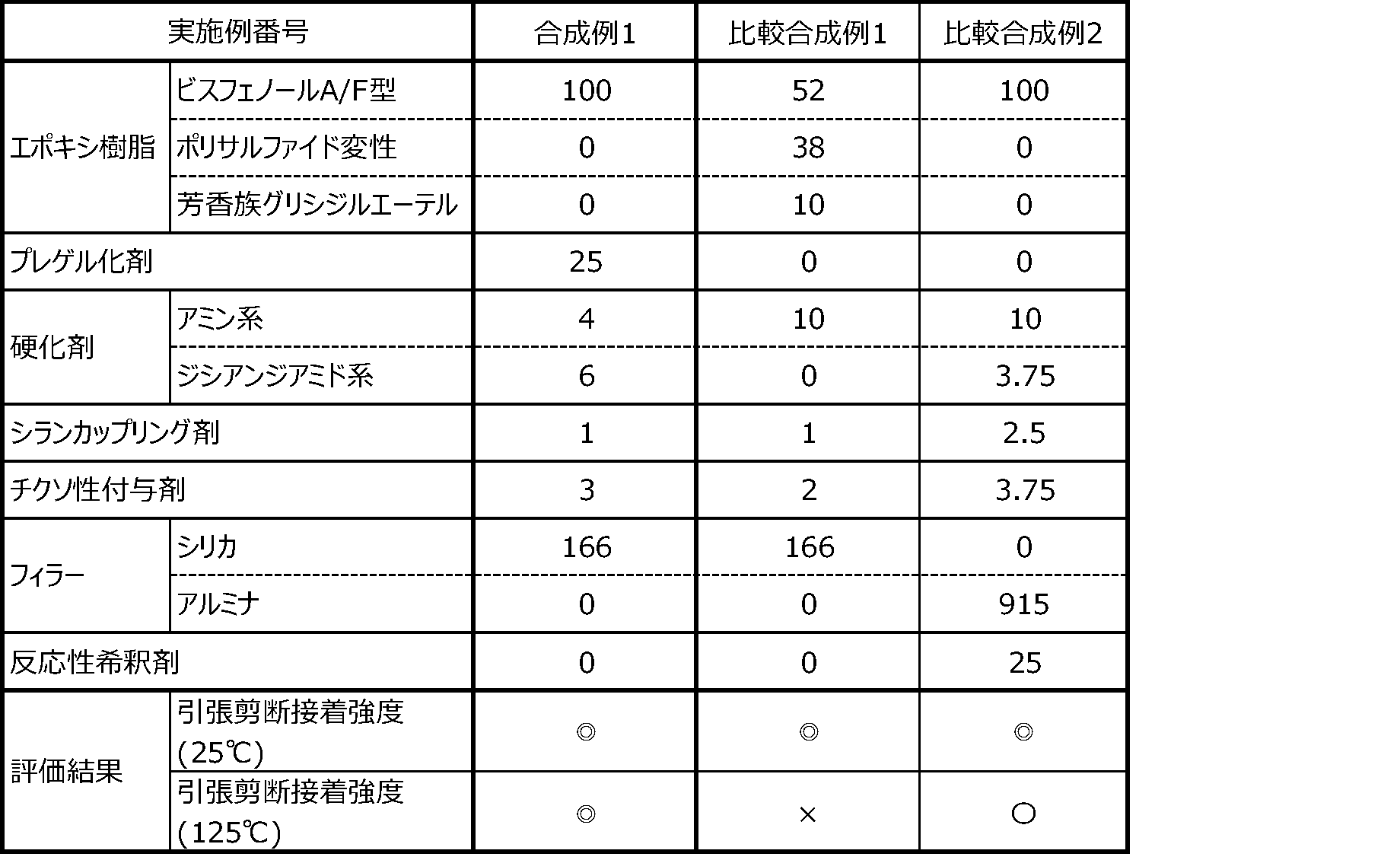
各成分を表1に記載の質量比(固形分比)となるよう混合し、エポキシ樹脂組成物を得た。得られたエポキシ樹脂組成物について、下記の方法により、引張剪断接着強度を評価した。結果を表1に示す。
インサート部材の材料で作製した試験片として銅板(C1100)を用い、熱可塑性樹脂の試験片として ポリフェニレンスルフィド(ポリプラスチックス株式会社製、DURAFIDE(登録商標) 6150T73)の成形物を用いて、JIS K6850-1999に準拠して、25℃および125℃における引張剪断接着強度を測定し、下記の基準で評価した。なお、25℃(常温)および125℃(高温)条件下で引張剪断接着強度を評価した理由としては、エポキシ樹脂組成物を硬化させるプロセスを行う際に、望ましい接着強度を維持できるか確認を行うためである。
◎:引張剪断接着強度:200N/cm2以上
○:引張剪断接着強度:100N/cm2以上200N/cm2未満
×:引張剪断接着強度:100N/cm2未満
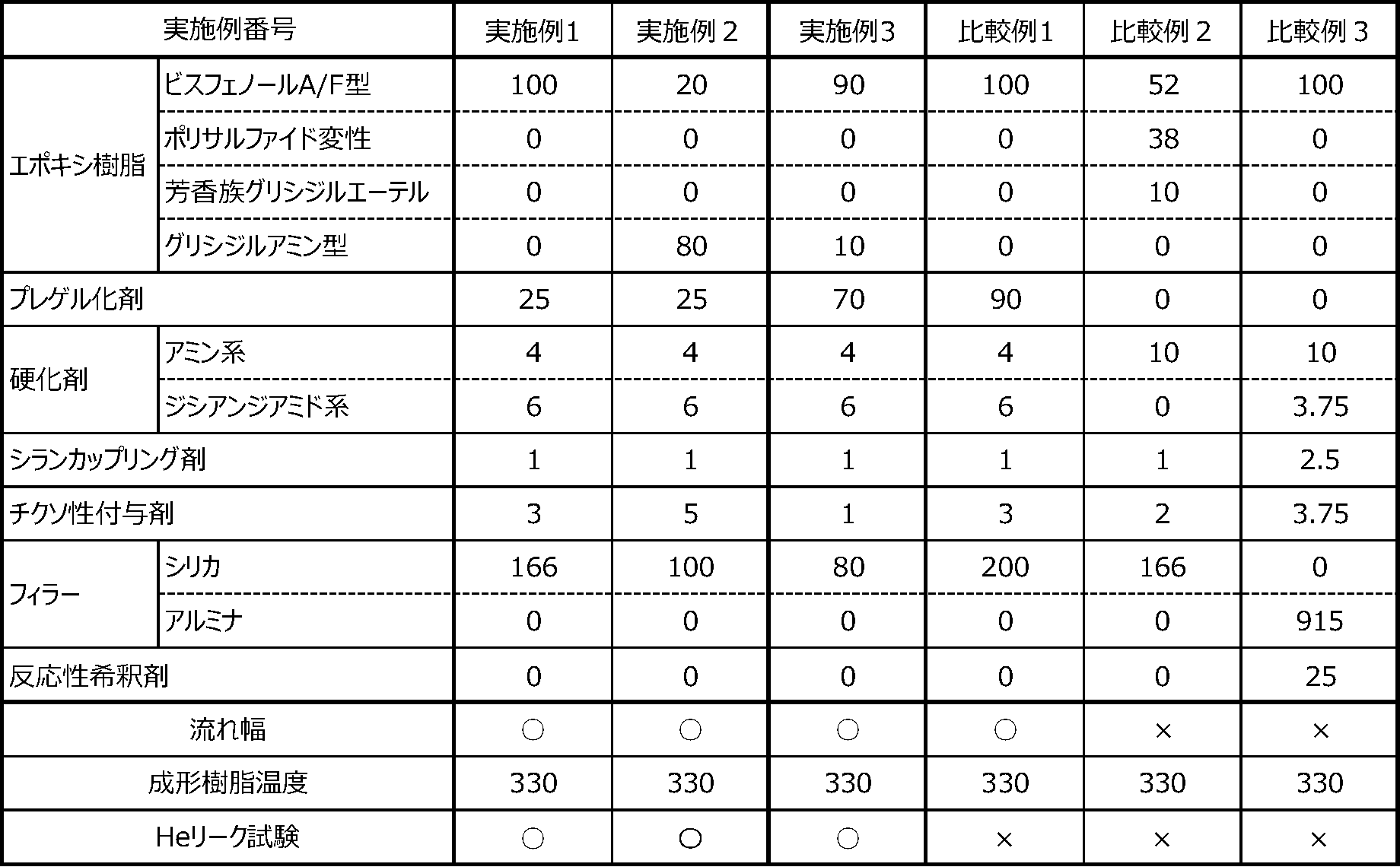
各成分を表2に記載の質量比(固形分比)となるよう混合し、エポキシ樹脂組成物を得た。得られたエポキシ樹脂組成物について、下記の方法により、流れ幅を評価した。結果を表2に示す。
得られたインサート部材を金型内に配置し、表2に記載の成形樹脂温度にて、成形サイクル時間を40秒として、熱可塑性樹脂(ポリフェニレンスルフィド)をインサート成形すると同時に、エポキシ樹脂組成物を硬化させて、成形物を得た。得られた成形物について、下記の方法によりHeリーク試験を行った。結果を表2に示す。
長さ34mm×幅2.3mm×厚み1.2mmの銅(C1100)板の長手方向中央部10mmの外周上に、ディスペンサを用いて、エポキシ樹脂組成物を厚み100μmで塗布し、100℃で4分間加熱してプレゲル化させた。その後、エポキシ樹脂組成物が塗布された銅板の、長手方向中央部12mmの外周上に、銅板の各面に接する熱可塑性樹脂組成物の肉厚が1.5mmになる様に、内寸が長さ12mm×幅5.3mm×厚み4.2mmのキャビティを設けた。シリンダー温度330℃、金型温度150℃、射出速度22mm、保圧70MPa、保圧時間20秒の条件下で、エポキシ樹脂組成物の塗布部の一端側から他端側に向けて熱可塑性樹脂を注入し射出成形した際に、熱可塑性樹脂組成物の端部から突出した11mmの銅板上に流れ出たエポキシ樹脂組成物の流れ幅を測定し、下記の基準で評価した。
○:流れ幅:0mm以上8mm未満
×:流れ幅:0mm未満、または、8mm以上
リーク試験用の構造体として、上部チャンバー、下部チャンバー、および中間部を備えた構造体を作成した。該構造体の中間部に、実施例1~3および比較例1~3で得られた成形物を気密状態にセットした。上部チャンバーに石鹸水を入れ、下部チャンバーに加圧エアーを導入した。加圧エアーの圧力は、He加圧400kPaおよび真空圧100kPaの合計500kPaとした。リーク試験機(株式会社コスモ計器製、G-Fine)を用いてHeのリーク量を測定し、下記の基準で評価した。
○:1.0×10⁻¹⁰Pa・m3/s未満
×:1.0×10⁻¹⁰Pa・m3/s以上
Claims (10)
- (1)金属またはセラミックスからなるインサート部材の表面に、エポキシ樹脂組成物を塗布し、エポキシ樹脂組成物層を形成する工程、
(2)工程(1)で得られたインサート部材を加熱して、エポキシ樹脂組成物をプレゲル化させる工程、
(3)工程(2)で得られたインサート部材を金型内に配置し、エポキシ樹脂組成物層上に、熱可塑性樹脂組成物をインサート成形し、エポキシ樹脂組成物を硬化させる工程
を含む成形物の製造方法であって、
エポキシ樹脂組成物は、エポキシ樹脂100質量部に対してプレゲル化剤を1~80質量部含む、成形物の製造方法。 - 熱可塑性樹脂組成物は結晶性熱可塑性樹脂を含み、
エポキシ樹脂組成物は、銅板上に100μmの厚みで塗布し、100℃で4分間加熱してプレゲル化させた後、シリンダー温度が結晶性熱可塑性樹脂の融点+50℃、金型温度150℃、保圧70MPaの条件下で結晶性熱可塑性樹脂を射出成形した場合の流れ幅が0~8mmであるか、又は、
熱可塑性樹脂組成物は非晶性熱可塑性樹脂を含み、
エポキシ樹脂組成物は、銅板上に100μmの厚みで塗布し、100℃で4分間加熱してプレゲル化させた後、シリンダー温度が非晶性熱可塑性樹脂のガラス転移温度+120℃、金型温度100℃、保圧70MPaの条件下で非晶性熱可塑性樹脂を射出成形した場合の流れ幅が0~8mmである、請求項1に記載の成形物の製造方法。 - エポキシ樹脂組成物は、インサート部材の材料で作製した試験片と熱可塑性樹脂組成物の試験片を用いて、JIS K6850-1999に準拠して測定される125℃での引張剪断接着強度が、200N/cm2以上である、請求項1又は2に記載の成形物の製造方法。
- プレゲル化剤の25℃での粒子径は1~100μmである、請求項1~3のいずれか1項に記載の成形物の製造方法。
- エポキシ樹脂組成物がシランカップリング剤を含む、請求項1~4のいずれか1項に記載の成形物の製造方法。
- エポキシ樹脂組成物がチクソ性付与剤を含む、請求項1~5のいずれか1項に記載の成形物の製造方法。
- エポキシ樹脂組成物がアミン系硬化剤およびジシアンジアミド系硬化剤を含む、請求項1~6のいずれか1項に記載の成形物の製造方法。
- 熱可塑性樹脂が、ポリフェニレンスルフィド、ポリブチレンテレフタレート、液晶ポリマー、ポリアミド、環状オレフィン系ポリマー、ポリカーボネートおよびポリエチレンテレフタレートからなる群より選択される少なくとも1種である、請求項1~7のいずれか1項に記載の成形物の製造方法。
- 請求項1~8のいずれか1項に記載の成形物の製造方法により製造された成形物。
- バスバーまたは金属端子である、請求項9に記載の成形物。
Priority Applications (3)
| Application Number | Priority Date | Filing Date | Title |
|---|---|---|---|
| JP2023542410A JP7656710B2 (ja) | 2021-08-19 | 2022-08-16 | 成形物の製造方法 |
| CN202280056102.8A CN117836111A (zh) | 2021-08-19 | 2022-08-16 | 成型物的制造方法 |
| JP2024223949A JP2025032374A (ja) | 2021-08-19 | 2024-12-19 | 成形物の製造方法 |
Applications Claiming Priority (2)
| Application Number | Priority Date | Filing Date | Title |
|---|---|---|---|
| JP2021134080 | 2021-08-19 | ||
| JP2021-134080 | 2021-08-19 |
Publications (1)
| Publication Number | Publication Date |
|---|---|
| WO2023022151A1 true WO2023022151A1 (ja) | 2023-02-23 |
Family
ID=85239819
Family Applications (1)
| Application Number | Title | Priority Date | Filing Date |
|---|---|---|---|
| PCT/JP2022/030959 Ceased WO2023022151A1 (ja) | 2021-08-19 | 2022-08-16 | 成形物の製造方法 |
Country Status (3)
| Country | Link |
|---|---|
| JP (2) | JP7656710B2 (ja) |
| CN (1) | CN117836111A (ja) |
| WO (1) | WO2023022151A1 (ja) |
Citations (2)
| Publication number | Priority date | Publication date | Assignee | Title |
|---|---|---|---|---|
| JP2014168940A (ja) * | 2013-03-05 | 2014-09-18 | Kuraray Co Ltd | 接着体の製造方法 |
| JP2015066846A (ja) * | 2013-09-30 | 2015-04-13 | Dic株式会社 | 構造体および電池蓋体の製造方法 |
Family Cites Families (2)
| Publication number | Priority date | Publication date | Assignee | Title |
|---|---|---|---|---|
| JP2014173063A (ja) | 2013-03-12 | 2014-09-22 | Kyocera Chemical Corp | 電子・電気部品の製造方法および電子・電気部品 |
| WO2016002777A1 (ja) | 2014-06-30 | 2016-01-07 | 三菱レイヨン株式会社 | トウプリプレグ、及び複合材料圧力容器とその製造方法 |
-
2022
- 2022-08-16 CN CN202280056102.8A patent/CN117836111A/zh active Pending
- 2022-08-16 JP JP2023542410A patent/JP7656710B2/ja active Active
- 2022-08-16 WO PCT/JP2022/030959 patent/WO2023022151A1/ja not_active Ceased
-
2024
- 2024-12-19 JP JP2024223949A patent/JP2025032374A/ja active Pending
Patent Citations (2)
| Publication number | Priority date | Publication date | Assignee | Title |
|---|---|---|---|---|
| JP2014168940A (ja) * | 2013-03-05 | 2014-09-18 | Kuraray Co Ltd | 接着体の製造方法 |
| JP2015066846A (ja) * | 2013-09-30 | 2015-04-13 | Dic株式会社 | 構造体および電池蓋体の製造方法 |
Also Published As
| Publication number | Publication date |
|---|---|
| CN117836111A (zh) | 2024-04-05 |
| JPWO2023022151A1 (ja) | 2023-02-23 |
| JP7656710B2 (ja) | 2025-04-03 |
| JP2025032374A (ja) | 2025-03-11 |
Similar Documents
| Publication | Publication Date | Title |
|---|---|---|
| KR101271962B1 (ko) | 접착제 조성물 및 접착 필름 | |
| US8110066B2 (en) | Adhesive composition suitable to be applied by screen printing | |
| EP2550310B1 (en) | Epoxy resin compositions comprising poly(propylene oxide) polyol as toughening agent | |
| KR102295921B1 (ko) | 수지 조성물, 수지 필름 및 반도체 장치와 그 제조 방법 | |
| JP5019363B2 (ja) | エポキシ樹脂接着剤組成物 | |
| JP6098470B2 (ja) | スクリーン印刷用導電性エポキシ樹脂組成物、それを用いたダイアタッチ方法および該組成物の硬化物を有する半導体装置 | |
| KR20100130966A (ko) | 반도체 밀봉용 에폭시 수지 조성물 및 이를 이용한 반도체 장치 | |
| TWI801488B (zh) | 樹脂組成物及其硬化物、電子零件用接著劑、半導體裝置,以及電子零件 | |
| JP2016113483A (ja) | シート状樹脂組成物、シート状樹脂組成物を用いた接着方法、およびその方法により接着されてなる接着体 | |
| JPH0459819A (ja) | エポキシ樹脂組成物 | |
| WO2023022151A1 (ja) | 成形物の製造方法 | |
| JPWO2016204183A1 (ja) | フィルム形成用樹脂組成物及びこれを用いた封止フィルム、支持体付き封止フィルム、半導体装置 | |
| JP2016117869A (ja) | 半導体接着用樹脂組成物及び半導体装置 | |
| JP2018002923A (ja) | 電子・電気部品の製造方法、射出成形用エポキシ樹脂組成物、および電子・電気部品 | |
| TWI625227B (zh) | 金屬樹脂複合成形體及其製造方法 | |
| JP2017088736A (ja) | 鋼材とfrp材の接着方法 | |
| JP2017082144A (ja) | 熱硬化性多層接着シート、および接着方法 | |
| JP7282011B2 (ja) | 硬化性組成物及び硬化物 | |
| JP2020069720A (ja) | 封止用シート及びそれを用いた電子部品の製造方法 | |
| JP6160431B2 (ja) | エポキシ樹脂組成物、それを用いたダイアタッチ方法及び該組成物の硬化物を有する半導体装置 | |
| JP2018080310A (ja) | エポキシ樹脂組成物、硬化物およびリレー | |
| JP2017088718A (ja) | 電子・電気部品の製造方法及びエポキシ樹脂組成物 | |
| JP6852622B2 (ja) | 熱硬化性エポキシ樹脂組成物 | |
| JP2009062413A (ja) | 接着剤組成物及びダイボンドフィルム | |
| JP5283234B2 (ja) | 導電性樹脂組成物及びそれを用いた半導体装置 |
Legal Events
| Date | Code | Title | Description |
|---|---|---|---|
| 121 | Ep: the epo has been informed by wipo that ep was designated in this application |
Ref document number: 22858469 Country of ref document: EP Kind code of ref document: A1 |
|
| WWE | Wipo information: entry into national phase |
Ref document number: 202280056102.8 Country of ref document: CN Ref document number: 2023542410 Country of ref document: JP |
|
| NENP | Non-entry into the national phase |
Ref country code: DE |
|
| 122 | Ep: pct application non-entry in european phase |
Ref document number: 22858469 Country of ref document: EP Kind code of ref document: A1 |