WO2022264681A1 - コンピュータプログラム、それに用いるゲームシステム、及び制御方法 - Google Patents
コンピュータプログラム、それに用いるゲームシステム、及び制御方法 Download PDFInfo
- Publication number
- WO2022264681A1 WO2022264681A1 PCT/JP2022/018152 JP2022018152W WO2022264681A1 WO 2022264681 A1 WO2022264681 A1 WO 2022264681A1 JP 2022018152 W JP2022018152 W JP 2022018152W WO 2022264681 A1 WO2022264681 A1 WO 2022264681A1
- Authority
- WO
- WIPO (PCT)
- Prior art keywords
- user
- character
- movement
- action
- game
- Prior art date
- Legal status (The legal status is an assumption and is not a legal conclusion. Google has not performed a legal analysis and makes no representation as to the accuracy of the status listed.)
- Ceased
Links
Images

Classifications
-
- A—HUMAN NECESSITIES
- A63—SPORTS; GAMES; AMUSEMENTS
- A63F—CARD, BOARD, OR ROULETTE GAMES; INDOOR GAMES USING SMALL MOVING PLAYING BODIES; VIDEO GAMES; GAMES NOT OTHERWISE PROVIDED FOR
- A63F13/00—Video games, i.e. games using an electronically generated display having two or more dimensions
- A63F13/20—Input arrangements for video game devices
- A63F13/23—Input arrangements for video game devices for interfacing with the game device, e.g. specific interfaces between game controller and console
-
- A—HUMAN NECESSITIES
- A63—SPORTS; GAMES; AMUSEMENTS
- A63F—CARD, BOARD, OR ROULETTE GAMES; INDOOR GAMES USING SMALL MOVING PLAYING BODIES; VIDEO GAMES; GAMES NOT OTHERWISE PROVIDED FOR
- A63F13/00—Video games, i.e. games using an electronically generated display having two or more dimensions
- A63F13/40—Processing input control signals of video game devices, e.g. signals generated by the player or derived from the environment
- A63F13/42—Processing input control signals of video game devices, e.g. signals generated by the player or derived from the environment by mapping the input signals into game commands, e.g. mapping the displacement of a stylus on a touch screen to the steering angle of a virtual vehicle
- A63F13/422—Processing input control signals of video game devices, e.g. signals generated by the player or derived from the environment by mapping the input signals into game commands, e.g. mapping the displacement of a stylus on a touch screen to the steering angle of a virtual vehicle automatically for the purpose of assisting the player, e.g. automatic braking in a driving game
-
- A—HUMAN NECESSITIES
- A63—SPORTS; GAMES; AMUSEMENTS
- A63F—CARD, BOARD, OR ROULETTE GAMES; INDOOR GAMES USING SMALL MOVING PLAYING BODIES; VIDEO GAMES; GAMES NOT OTHERWISE PROVIDED FOR
- A63F13/00—Video games, i.e. games using an electronically generated display having two or more dimensions
- A63F13/55—Controlling game characters or game objects based on the game progress
-
- A—HUMAN NECESSITIES
- A63—SPORTS; GAMES; AMUSEMENTS
- A63F—CARD, BOARD, OR ROULETTE GAMES; INDOOR GAMES USING SMALL MOVING PLAYING BODIES; VIDEO GAMES; GAMES NOT OTHERWISE PROVIDED FOR
- A63F13/00—Video games, i.e. games using an electronically generated display having two or more dimensions
- A63F13/80—Special adaptations for executing a specific game genre or game mode
- A63F13/812—Ball games, e.g. soccer or baseball
Definitions
- the present invention is connected to an input device for inputting a user's play action, and a display device for displaying a game screen including a user character as a character associated with the user and a field as an area in which the user character operates.
- the present invention relates to a computer program and the like applied to a computer incorporated in a game system that provides a game that progresses through actions of user characters including actions that are automatically controlled according to predetermined rules.
- Gaming systems exist that provide a game that progresses through the actions of a user character, including actions that are automatically controlled according to rules.
- a video game machine that provides a soccer game including players as user characters (see, for example, Patent Document 1).
- a computer program of the present invention is a display for displaying a game screen including an input device for inputting a user's play action, a user character as a character associated with the user, and a field as an area in which the user character operates.
- the user character moves under the automatic control of a computer that is connected to a device and incorporated in a game system that provides a game that progresses through the actions of the user character, including actions automatically controlled according to predetermined rules.
- a target calculation means for calculating an initial position of a target position to be a destination of the movement of the user character based on the reference position set in the field; and instructing the movement of the user character in the automatic control.
- target correction means for correcting the initial position to a post-correction position based on the movement instruction act when a movement instruction act is executed as the play action; and the automatic control toward the post-correction position as the target position. It functions as character control means for controlling the motion of the user character so as to move with the .
- the game system of the present invention displays a game screen including an input device for inputting a user's play action, a user character as a character associated with the user, and a field as an area in which the user character operates.
- a game system that provides a game that progresses through actions of the user character including actions that are automatically controlled according to a predetermined rule, wherein the user character moves under the automatic control a target calculation means for calculating an initial position of a target position to be a destination of the movement of the user character based on the reference position set in the field; and instructing the movement of the user character in the automatic control.
- target correction means for correcting the initial position to a post-correction position based on the movement instruction act when a movement instruction act is executed as the play act; and character control means for controlling the motion of the user character so as to move under control.
- the control method of the present invention displays a game screen including an input device for inputting a user's play action, a user character as a character associated with the user, and a field as an area in which the user character operates.
- the user character moves under the automatic control in a computer that is connected to a display device and incorporated in a game system that provides a game that progresses through the actions of the user character, including actions that are automatically controlled according to predetermined rules.
- a target calculation procedure for calculating an initial position of a target position to be a destination of movement of the user character based on a reference position set in the field; and movement of the user character in the automatic control.
- a target correction procedure for correcting the initial position to a post-correction position based on the play action; and a target position toward the post-correction position as the target position.
- a character control procedure for controlling the motion of the user character so that it moves under the automatic control.
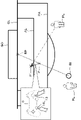
- FIG. 5 is an explanatory diagram for explaining an example of correction of an initial target position based on user's operation
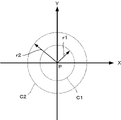
- FIG. 5 is an explanatory diagram for explaining an example of the relationship between the operation direction and amount of operation by a user and correction of the initial target position
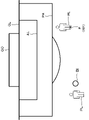
- FIG. 10 is an explanatory diagram for explaining an example of a target position that is set when no user's operation is performed
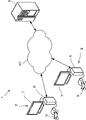
- FIG. 1 shows an example of the overall configuration of a game system 1 according to one embodiment of the present invention.
- the game system 1 is configured as a client-server system including a plurality of game devices 2 as clients and a server 3 connected to the game devices 2 via a network NT (the Internet as an example).
- NT the Internet as an example
- the game device 2 is a device used by users to play games, and is a type of information communication terminal device equipped with information communication functions via the network NT.
- an appropriate computer device that provides games may be used.
- a commercial game device (often installed in a predetermined facility) is used as the game device 2 to allow the user to play a game within a range corresponding to the playing fee.
- the user terminal device is used as the game device 2 in the example of FIG.
- a user terminal device is a computer device that can be connected to a network and is used for personal use by the user.
- such computer devices include stationary or book-type personal computers, or mobile terminal devices such as mobile phones (including smartphones), portable game machines, and portable tablet terminal devices.
- Such various computer devices may be used as the game device 2 as appropriate, but in the example of FIG. 1, a stationary home-use game machine is used.
- a game device 2 may be configured appropriately, but as an example, a stationary game machine main body 5, a controller 6 as an example of an input device connected to the game machine main body 5, and a controller 6 as an example of an output device monitor 7.
- the game machine main body 5 is configured with the main purpose of providing games, and is sometimes called a consumer game machine or a game console.
- the input device is not limited to the controller 6, and may be an appropriate input device for inputting various play behaviors, such as a camera for inputting motions as the user's play behaviors.
- the output device may include a speaker unit for audio output in addition to the monitor 7, but illustration thereof is omitted.
- a plurality of monitors 7 may be connected to the game machine body 5 .
- the server 3 may be configured by appropriately combining a plurality of server units, or may be configured by a single server unit.
- the server 3 may be configured as a cloud server using cloud computing technology.
- the server 3 provides the game device 2 with various services related to the game, such as a service of matching players to compete in the game, a service of relaying game information to be shared between the game devices 2, and the like.
- Various information communication terminal devices such as mobile phones, smart phones, and commercial game machines may be added to the game system 1 as appropriate.
- an arcade game machine may be used as a client that provides a game linked to the game provided by the game device 2 .
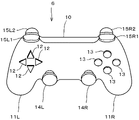
- FIG. 2 shows an example of a specific configuration of the controller 6.
- the controller 6 has a body housing 10 whose shape and size are selected assuming that the user will hold it with both hands.
- the body housing 10 is provided with grips 11L and 11R for gripping with left and right hands.
- Four directional keys 12 are provided on the front upper portion of the left grip 11L
- four operation buttons 13 are provided on the front upper portion of the right grip 11R
- a pair of sticks 14L and 14R are provided between the grips 11L and 11R. is provided.
- the sticks 14L and 14R are operable in all directions from the neutral position, that is, in any direction of 360°.
- buttons 15L1 and 15L2 are provided on the upper end surface of the left grip 11L
- two operation buttons 15R1 and 15R2 are provided on the upper end surface of the right grip 11R.
- the left stick 14L will be called the L stick 14L
- the right stick 14R will be called the R stick 14R
- the left operation buttons 15L1 and 15L2 will be called the L1 button 15L1 and the L2 button 15L2 in order from the front side of the controller 6.
- R1 button 15R1 and an R2 button 15R2 in order from the front side of the controller 6 to distinguish them.
- the sticks 14L and 14R may be collectively called the stick 14
- the operation buttons 15L1, 15L2, 15R1 and 15R2 may be collectively called the operation button 15.
- the direction key 12, operation button 13, stick 14, and operation button 15 of the controller 6 each function as an example of the operation section of the input device.
- these operation units at least some of the operation units are provided as operation amount detection type operation units in which the amount of operation by the user is to be detected, and the output signal changes according to the amount of operation.
- a stick 14 and an operation button 15 are provided as such an operation unit. Therefore, regarding the operation of the stick 14, the operation direction and the operation amount (angle of inclination from the neutral position) are detected and reflected in the output signal.
- the operation of the operation button 15 the amount of pressing operation is detected and reflected in the output signal.
- the direction keys 12 and the operation buttons 13 are provided as on/off type operation units whose presence or absence of a pressing operation is detected, and the presence or absence of the operation is reflected in an output signal.
- the distinction between them is an example, and appropriate settings are possible. Even if it is an operation amount detection type operation unit, for example, it may be switchable on software so that it functions as an on/off type operation unit in which only the presence or absence of an operation is detected by user settings.
- FIG. 1 of this embodiment a competitive soccer game is provided in which the user of the game device 2 competes with the user of the opponent (opponent) through soccer.
- the opponent may be a real user using one of the game devices 2 or a virtual entity controlled by the computer of the game device 2 or the server 3 .
- Matches don't necessarily have to be one-on-one.
- soccer may be played in a so-called group battle format in which a group including at least one user competes against another group.
- FIG. 3 is a diagram schematically showing an example of the entire screen.
- the full screen 50 is a game screen for displaying the entire field of the soccer game.
- the viewpoint is automatically switched to the optimum position according to the situation of the competition, and the game screen corresponding to the viewpoint can be displayed on the monitor 7, but the whole screen 50 is the entire field. is observed from a predetermined viewpoint where In this case, as shown in FIG. 3, the overall screen 50 includes players (only some players are given reference characters) PL, balls BI, and fields FD.
- Both the player PL and the ball BI are examples of objects that operate within the virtual space of the game, but the player PL corresponds to each player that makes up the soccer team.
- Each team includes a plurality of players PL, forming a user team associated with the user and an opponent team associated with the opponent. Therefore, the soccer game is configured as a team competition type game in which the user team and the opposing team compete against each other.
- the ball BI is an object equivalent to the ball in soccer, and is manipulated so as to move according to the actions of the player PL.
- the field FD is an area corresponding to a soccer field (pitch), and is the main activity range of the player PL.
- the field FD is divided by various lines such as touch lines and goal lines.
- the player PL may act outside these lines, but in many cases the field FD is used as the range of activity.
- the match progresses as the user and the opponent's players PL act in the virtual field FD in the same way as in real soccer.
- the ball BI functions as the moving object of the present invention.
- Some of the players on the field FD are set as players PL to be operated by the user.
- One player PL is selected as an operation target for one user. For example, if the user is on the offensive side, the player PL who should dominate the ball BI is set as the user's operation target, and for the user on the defensive side, the user should be in charge of defense against the player PL who should dominate the ball BI.
- a player PL is set as an operation target. Also, the player PL to be operated is appropriately switched according to the user's operation (instruction to change the target).
- the operation of the player PL to be operated may include various operations on an appropriate operation unit, and one example includes an operation using the stick 14L.
- the player PL to be operated moves in the direction in which the stick 14L is operated on the entire screen 50 .
- the player PL to be operated can be identified by a cursor 52, for example.
- the operation on the stick 14L on the entire screen 50 functions as the operation instruction act of the present invention.
- the cursor 52 may be displayed only on the player PL that is currently being operated, but as an example, it is displayed on the player PL that is currently being operated and the player PL that is scheduled to be changed to the next operation subject by an instruction to change the target.
- These cursors 52 may be appropriately identified, but in the example of FIG. 3, the cursor 52 of the player PL currently being operated is painted white, and the cursor 52 indicating the player PL scheduled to be changed to the next operation subject is painted black. is displayed. That is, these cursors 52 are displayed so as to be identifiable by the difference in coloration.
- an information section 53 indicating the name of the player PL to be operated, etc. may be added to the entire screen 50 .
- the operation target player PL is controlled in motion based on the user's operation on the controller 6 . On the other hand, the actions of the players PL not to be operated are automatically controlled according to the situation of the game.
- the entire screen 50 may include various other objects or information as appropriate, but includes a map 54 in the example of FIG.
- the map 54 is an image (information) indicating the positions of the players PL in the entire field FD.
- the map 54 may be arranged at an appropriate position on the entire screen 50, but is arranged at the bottom center in the example of FIG.
- the overall screen 50 may display information indicating the status of the match, such as the team names of the user and the opponent, the score, and the elapsed time, at appropriate positions.
- FIG. 4 is a diagram schematically showing an example of a matchup screen.
- the match-up screen 60 is a game screen for displaying an appearance as if an offense (attacking side) and a defense (defensive type) are competing one-on-one.
- the matchup screen 60 may be provided as appropriate, for example, may be automatically provided based on the development of the game, etc. However, as an example, it is provided when a predetermined switching operation (switching instruction) is performed. As such a switching operation, an operation on an appropriate operation unit of the controller 6 can be used. , the lower operation button 13) is used. That is, the whole screen 50 is switched to the matchup screen 60 in accordance with the holding operation on the lower operation button 13 . In this example, the holding operation on the lower operation button 13 functions as the switching instruction action of the present invention.
- an instruction to switch to the matchup screen 60 may be appropriately given to both offensive and defensive users, or to either one of the users.
- switching to the matchup screen 60 may be executed based on, as an example, only the user on the defense side is permitted to switch to the matchup screen 60 . That is, the game screen is switched from the full screen 50 to the matchup screen 60 when the user on the defense side performs a holding operation on the lower operation button 13 .
- the example of FIG. 4 shows a matchup screen 60 provided to the user on the defense side in such a case. In this case, as shown in FIG. 4, in the matchup screen 60, the two players, the offensive side player PL and the defensive side player PL, who are the targets of the matchup (competition), are enlarged compared to the full screen 50. displayed as
- the player PL on the offense side is the player PL currently being operated by the opponent (the player PL to be operated by the opponent).
- the player PL who dominates (operates) the ball BI as described above is the object of operation. Therefore, in the match-up screen 60, the player PL who is in control of the ball BI among the offensive team (opponent team) is enlarged and displayed as the offensive player PL.
- a player PL on the defense side is a player PL belonging to the user team. Appropriate players PL belonging to the user team may be displayed on the match-up screen 60.
- the player PL who is closest to the player PL who controls the ball BI at the time of the switching instruction is matched.
- the operation target player PL is matched up with the offense side player PL as the defense side player PL. That is, the player PL being operated at the time of the switching instruction is enlarged and displayed on the match-up screen 60 as the player PL on the defense side.
- the player PL on the offense side and the player PL on the defense side may operate appropriately. may operate under different automatic controls (computer control). Alternatively, the offense side player PL and the defense side player PL may move by a combination of actions based on the user's operation and automatic control actions. In this way, the offense side player PL and the defense side player PL may operate appropriately on the matchup screen 60, but as an example, the offense side player PL may operate based on the opponent's operation in the same way as the overall screen 50. works. In other words, the offensive player PL is manipulated by the opponent to perform various actions such as shooting, passing, or dribbling. In this example, the player PL on the offensive side functions as the opponent character of the present invention.
- the players PL on the defense side operate under automatic control according to predetermined rules.
- the soccer game is provided with an overall screen 50 on which the player PL on the defense side operates based on the user's operation, and a matchup screen 60 that operates under automatic control.
- Predetermined rules for realizing automatic control may be set as appropriate, but as an example, they are set so as to execute a predetermined defensive action. Further, the predetermined defensive action may appropriately include various actions, and one example includes a moving action of automatically moving toward a target position.
- the movement operation may be realized according to an appropriate rule, but as an example, while maintaining a certain distance from the offense side player PL, the defense side player PL is moved in accordance with the movement of the offense side player PL. is realized as follows. Details of the movement operation will be described later.
- the player PL on the defense side functions as the user character of the present invention and the operating user character.
- the full screen 50 and matchup screen 60 function as the operation mode and automatic mode of the present invention, respectively.
- automatic control defensive actions include, for example, other blocking actions.
- a blocking action is an action for blocking a pass or a shot.
- the blocking action may be executed based on the user's operation, but as an example, it is executed by automatic control in accordance with the pass or shoot action of the offensive player PL so as to counter the pass or the like. For this reason, for example, even if the player PL on the defense side is executing a moving motion, if the player PL on the offense side passes or shoots, the player PL on the defense side will block the pass or the like. block operation is executed automatically. However, the player PL on the offense side may perform a feint such as a pass, for example, by performing an operation to cancel the motion such as a pass. executed.
- the offensive player PL can use feints to create room for overtaking the defensive player PL by dribbling or the like.
- the pass or shoot motion of the offensive player PL functions as the event motion of the present invention
- the blocking motion of the defensive player PL functions as the counter motion of the present invention.
- the player PL on the defense side may perform not only automatic actions, but also actions according to the user's operation as appropriate.
- Such actions include tackle actions, for example.
- a tackling motion is a motion of approaching the player PL on the offensive side and actively trying to steal the ball BI.
- the tackling action may be instructed by an appropriate operation, but as an example, it is realized by operating the lower operation button 13 in the same manner as the switching instruction.
- an appropriate operation on the lower operation button 13 may function as an instruction for a tackle motion, but as an example, an operation of pressing the lower operation button 13 twice in succession (double hit) functions as an instruction for a tackle motion.
- the matchup screen 60 may be terminated based on an appropriate termination condition and switched to the original full screen 50 or the like. and may return to the full screen 50 .
- the match-up screen 60 can be terminated as appropriate in this manner, as an example, even when the holding operation on the lower operation button 13 is terminated, the termination condition is satisfied and the game screen returns to the full screen 50 . In this case, since the instruction of the tackling motion corresponds to the end of the holding operation, the matchup screen 60 ends after the execution of the tackling motion regardless of whether or not the player PL on the defense side has captured the ball BI.
- the moving operation may be realized by completely automatic control that leaves no room for the user's instructions to be reflected, but as an example, it is realized so that the user's instructions are reflected.
- the initial target position is set as the movement destination of the player PL on the defense side. is modified to reflect its initial target position.
- the position after the correction is set as the movement destination of the player PL on the defense side, and the player PL on the defense side actually executes the movement motion with the corrected position as the target position.
- the movement operation is executed in such a flow.
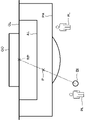
- FIG. 5 is an explanatory diagram for explaining an example of a reference position and an initial target position based on the reference position.
- an initial target position P is set at a predetermined position between the reference position RP (the position of the goal GO) and the ball BI (near the center of the ball BI as an example).
- the reference position RP may be set arbitrarily, but in the example of FIG. 5, it is set near the center of the goal line GL as a position indicating the goal GO to be defended by the player PL on the defense side.
- the position of the goal GO may be appropriately set, for example, inside the goal GO. In that case, the position inside the goal GO or the like functions as the reference position RP.
- the initial target position P as the initial position of the target position may be set as appropriate.
- an absolute position in this case, These positions function as reference positions of the present invention, but in the example of FIG. 5, they are set to relative positions according to the position of the ball BI.
- an appropriate position between the reference position RP (the position of the goal GO) and the ball BI may be used as the predetermined position, but as an example, a position a certain distance away from the ball BI is used. That is, the initial target position P is a constant distance from the ball BI on the straight line connecting the reference position RP and the ball BI so that a constant distance is formed between the offensive player PL and the defensive player PL. set at a distance. Also, the certain distance may be set appropriately, for example, it may be a position near the center of the straight line connecting the reference position RP and the ball BI. It is set in a position suitable for operation.
- FIG. 6 is an explanatory diagram for explaining an example of correction of the initial target position P based on the user's operation (operation for instructing movement).
- An operation to instruct movement (in other words, an instruction to correct the initial target position P) may be appropriately realized through various operation units of the controller 6, but in the example of FIG. It shows a case where it functions as an operation for instructing the movement of the player PL on the side.
- the down operation button 13 is held for switching to the match-up screen 60 (in other words, realization of automatic movement movement).
- the initial target position P moves (changes) to the corrected position P' based on the operation.
- the post-correction position P' functions as the post-correction position of the present invention.
- the L stick 14L is configured to be able to detect the operation direction and the operation amount as described above, and these operation direction and operation amount may be used to correct the initial target position P as appropriate.
- the correction of the initial target position P may be performed such that the initial target position P moves in that operation direction by a constant amount regardless of the amount of operation.
- the correction is executed so that the initial target position P moves in a predetermined direction such as backward or forward along a straight line connecting the reference position RP and the ball BI according to the amount of operation. good too. In this way, the initial target position P may be appropriately corrected in accordance with the operation of the L stick 14L.
- the correction is performed by moving in the direction corresponding to the operation direction by an amount corresponding to the operation amount. be done. That is, the correction of the initial target position P reflects both the operation direction and the operation amount of the operation on the L stick 14L.
- the operation of the L stick 14L on the matchup screen 60 functions as the movement instruction action of the present invention.
- the player PL on the defense side performs a movement operation so as to move toward the corrected position P' with the corrected position P' as the target position.
- the initial target position P is set relative to the position of the ball BI. Therefore, if the position of the ball BI changes, the initial target position P also changes, and the corrected position P' based on the L stick 14L similarly changes. Specifically, when the position of the ball BI changes, a new initial target position P is set according to that position. At this time, if the L stick 14L is operated in the same direction and amount as before the position of the ball BI changes (the same operation as before the change is maintained), the position of the ball BI changes to The same corrections as before the change are performed. That is, the corrected position P' also changes so as to slide along with the change in the position of the ball BI.
- the corrected position P' is set so as to reflect the correction. That is, when the operation of the L stick 14L changes, the initial target position P is corrected again so as to reflect the operation after the change, and a new position P' after correction is set. In this way, the setting of the initial target position P and its correction are repeatedly executed each time the position of the ball BI or the operation of the L stick 14L changes. Therefore, there is a possibility that the destination (target position) when the player PL on the defense side starts the movement action and the position that the player PL on the defense side actually reaches by the movement action are different.
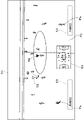
- FIG. 7 is an explanatory diagram for explaining an example of the relationship between the operation direction and amount of operation of the L stick 14L and the correction of the initial target position P.
- FIG. 7 Although only the operation on the L stick 14L may be reflected in the correction of the initial target position P, as an example, a case is shown in which operations on other operation units are also reflected.
- An appropriate operation unit may be used as such an operation unit, and as an example, the R2 button 15R2 is used. That is, the operation of the R2 button 15R2 is also reflected in the correction of the initial target position P.
- Various operations are included in the operation to the player PL on the overall screen 50 and the like.
- the R2 button 15R2 is operated to instruct a dash to increase the movement speed of the player PL.
- the movement action is also configured such that the movement speed increases based on such a dash instruction, and the movement range of the initial target position P changes so as to reflect the increase in movement speed.
- FIG. 7 shows the relationship between each operation and the correction of the initial target position P in such a case.
- the X-axis extending in the left-right direction is the left-right direction in the example of FIG.
- the intersection of the X-axis and the Y-axis corresponds to the initial target position P, respectively, in the long side direction in which the FD touch line or the like extends. In this case, as shown in FIG.
- the R2 button 15R2 Correction is performed so that the movement range C2 of the initial target position P (hereinafter, sometimes referred to as the second movement range C2) when the operation A of pushing is made larger.
- the L stick 14L is formed in a stick shape, and a tilting operation is performed in all directions (360 degrees).
- the direction in which the L stick 14L is tilted (operation direction) is directly reflected in the movement direction of the initial target position P in the field FD. Therefore, both the first movement range C1 and the second movement range C2 are formed in circular shapes corresponding to all directions.
- the operation amount (inclination angle of the L stick 14L) with respect to the operation direction (inclination operation direction) is reflected in the movement amount of the initial target position P in that operation direction.
- the operation amount may be appropriately converted into a movement amount based on a coefficient or the like that takes into consideration the influence of the block operation. may be changed). Therefore, the position corresponding to the radius r1 of the first movement range C1 and the position corresponding to the radius r2 of the second movement range C2 are both the movement positions of the initial target position P corresponding to the maximum operation amount (after correction position P').
- the position on the circumference of the first movement range C1 or the second movement range C2 corresponding to the tilting direction is the movement position of the initial target position P ( It is calculated as the corrected position P').
- the operation amount is less than the maximum operation amount
- the coordinate position corresponding to the operation direction and operation amount inside each of the movement ranges C1 and C2 is calculated as the movement position of the initial target position P (corrected position P').
- parameters of each player PL may be appropriately reflected in the amount of movement, for example.
- the R2 button 15R2 since the R2 button 15R2 is configured to be able to detect whether or not it is operated, the amount of movement of the initial target position P changes depending on whether or not it is operated.
- the change in the amount of movement may be set as appropriate, but is set to double as an example. That is, when the R2 button 15R2 is operated, a value obtained by multiplying the operation amount of the L stick 14L by the coefficient 2 is calculated as the movement amount (or operation amount).
- the radius r2 of the second range of motion C2 corresponds to twice the radius r1 of the first range of motion C1.
- the operation of the L stick 14L or the like is reflected in the movement (correction) of the initial target position P in this manner.
- the L stick 14L functions as the directional control part of the present invention.
- FIG. 8 is an explanatory diagram for explaining an example of the target position that is set when no operation is performed on the L stick 14L.
- the initial target position P when the L stick 14L is not manipulated may be set in the same manner as when the L stick 14L is manipulated, but is set to a different position as an example.
- the initial target position P set in the example of FIG. 5 is highly likely to be a favorable position for restraining the action of the player PL on the offensive side. If the player PL on the defense side is placed at such a position by automatic control without intervention of the user's operation, there is a possibility that the defense will become relatively easy. Therefore, when the L stick 14L is not manipulated, the initial target position P is set based on a different reference position RP than when the L stick 14L is manipulated.
- FIG. 8 shows the target position set as the movement destination of the player PL on the defense side in the case described above.
- the current position of the defending player PL functions as the reference position RP, and the initial target position P is set at the current position.
- the initial target position P is not corrected.
- the current position of the player PL on the defense side functions as it is as the target position of the movement motion.
- the defending player PL operates to stop moving at the current position as the target position.
- such an action of stopping movement at the current position may include an action of returning to the target position after passing the target position so that the action of the player PL on the defense side does not become unnatural.
- the difference between the current position when set as the target position and the current position when the movement is actually stopped is allowed, and when such a difference occurs, the player PL on the defense side stops moving.
- An operation to return from the actual current position to the target position may be executed.
- the operation of stopping the movement may include an appropriate deceleration operation according to the movement speed. That is, the player PL may perform an action of gradually decelerating the moving speed as the player approaches the target position so as to stop at the target position so as not to stop unnaturally.
- such an action of stopping movement at the current position includes an action of wandering or wandering within a predetermined range from the target position within a range in which the action of the player PL on the defense side does not become unnatural.
- the player PL does not necessarily stop at the target position (does not set the movement speed to zero), and may perform actions such as overshooting the target position and then returning.
- the movement operation described above is executed. Therefore, the user is required to perform an appropriate operation even for the automatically controlled player PL.
- the player PL on the defense side is positioned relatively far from the initial target position P, even if the operation direction and the operation amount are large, the movement destination from the initial target position P to the corrected position P' The movement direction in the movement operation is relatively little affected by a change in .
- the change to the post-correction position P' has a relatively large effect on the movement direction in the movement motion. For this reason, in order to place the player PL on the defense side relatively close to the initial target position P in the example of FIG.
- an operation of tilting the L stick 14L in an appropriate direction such as forward/backward, left/right, or the like by an appropriate amount in accordance with the movement of the ball BI is also required at any time.
- an operation is also required to appropriately stop the action of the defensive player PL by stopping the operation of the L stick 14L.
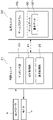
- the game device 2 is provided with a control unit 21 as a computer and a storage section 22 as storage means.
- the control unit 21 is configured as a computer that combines a CPU, which is an example of a processor that executes various processes according to a predetermined computer program, and an internal memory and other peripheral devices required for its operation.
- the control unit 21 is provided with various logical devices realized by combining the hardware resources of the control unit 21 and the game program PG as software resources.
- a controller 24 and a display controller 25 are shown.
- the matching unit 23 is a logical device that executes various processes related to matching between the user and the opponent. For example, when a user uses another game device 2 to play against another user (opponent) who plays a soccer game, matching via the server 3 is required. perform various well-known operations to
- the progress control unit 24 is a logical device that executes various processes for controlling the progress of the game. Such processing includes processing for appropriately switching between various game screens for playing a soccer game, measuring various times, and executing judgments on various rules and the like. For example, the progress control unit 24 executes mode switching processing as an example of processing for switching the game screen displayed on the monitor 7 for play. Details of the procedure of the mode switching process will be described later.
- the display control unit 25 is a logical device that executes various processes for controlling the display of various objects included in the game screen. Such processing includes, for example, causing the player PL to be operated by the user to perform an action corresponding to the user's operation result on the entire screen 50, or obtaining the opponent's operation result via the server 3 and displaying the operation result. This includes a process of causing the player PL to be operated by the opponent to perform an action based on the command.
- the processing executed by the display control unit 25 also includes processing for automatically controlling the player PL to operate according to various rules on the match-up screen 60 or the like in which the player PL operates under automatic control.
- the display control unit 25 also executes various kinds of processing for causing the player PL on the defense side to execute an automatic control operation such as a movement operation or a block operation.
- the display control unit 25 executes matchup processing as an example of such processing. The details of the matchup processing procedure will be described later.
- the storage unit 22 is an external storage device realized by a storage unit including a non-volatile storage medium (computer-readable storage medium) such as a hard disk or semiconductor storage device.
- Various data are recorded in the storage unit 22 together with the above-described game program PG, and game data GD is shown in the example of FIG.
- the game data GD is data for allowing the user to play a soccer game according to the game program PG.
- the game data GD may include various data such as image data for displaying various images for a soccer game and BGM data for reproducing various BGM. It is shown.
- the player data GD1 is data for defining various characters included in the soccer game.
- Players PL are included in such characters, and various parameters defining each player PL are recorded in the player data GD1 as an example. Also, such parameters include, for example, name, image, running power, or kicking power.
- various data such as play data or ID data may be stored as appropriate.
- the play data is data describing information about the past play performance of each user.
- the play data is used, for example, to hand over the play results (past achievements) up to the last time, or to hand over the settings unique to each user.
- the parameter information for that growth may be managed as appropriate, but as an example, it is managed by play data as past achievements.
- the parameters of each player PL are reproduced by a combination of play data (variation) and player data GD1 (initial value).
- the ID data is data for managing various IDs. Such data includes a user ID for identifying each user.
- the play data is managed through the user ID, the user ID is used for generating or acquiring play data.
- the play data, ID data, and the like may be stored in the storage unit 22 as appropriate, but as an example, they are provided from the server 3 so as to include necessary portions.
- the monitor 7 is a well-known display device for displaying various game screens for a soccer game, such as the full screen 50 or the matchup screen 60 .
- the monitor 7 displays various game screens (images) for providing a soccer game according to the output signal from the control unit 21 .
- the controller 6 is a well-known input device provided with various operation units. The controller 6 outputs signals to the control unit 21 according to various operations to each operation section.
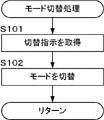
- the mode switching process is a process for switching modes in playing a soccer game.
- a soccer game may include appropriate modes, but one example is an operation mode in which a user directly operates a player PL through an instruction such as the direction of movement, and an operation mode in which a player PL automatically performs the above-described movement and other actions. Includes automatic mode to run.
- the example of FIG. 10 shows the mode switching process when the operation mode is switched to the automatic mode.
- the operation mode is provided on the general screen 50 and the automatic mode is provided on the matchup screen 60, respectively, as described above. Therefore, the mode switching process also functions as a process for switching the game screen from the full screen 50 to the matchup screen 60 .
- the progress control unit 24 starts the mode switching process of FIG. An instruction is obtained (step S101).
- the progress control unit 24 switches the mode from the operation mode to the automatic mode (step S102).
- an operational mode and an automatic mode are provided on the general screen 50 and the matchup screen 60, respectively. Therefore, mode switching is realized by switching the game screen from the full screen 50 to the matchup screen 60, for example.
- the progress control unit 24 controls the display of the monitor 7 so that the matchup screen 60 is displayed instead of the full screen 50 .
- the progress control unit 24 terminates the current mode switching process.
- the mode of the soccer game is switched from the operation mode to the automatic mode based on the switching instruction. That is, switching from the operation mode to the automatic mode is realized based on the switching instruction.
- the game screen is switched from the full screen 50 to the matchup screen 60 so that the operation mode is switched to the automatic mode. That is, switching from the full screen 50 to the matchup screen 60 is realized based on the switching instruction.
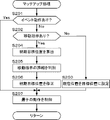
- the matchup process is a process for realizing automatic control of the player PL on the defense side on the matchup screen 60 .
- Various automatic controls can be executed on the matchup screen 60, and the example of FIG. 11 shows an example of matchup processing when a move action and a block action are executed.
- the display control unit 25 repeatedly starts the matchup process of FIG. It is determined whether or not (step S201).
- the offensive player PL may perform various event actions, and the event action includes, for example, a pass or a shoot action. Also, since the player PL on the offense side is operated by the opponent, an event action such as a pass is executed by the opponent's operation of instructing the pass or the like.
- step S201 the display control unit 25 determines whether or not the opponent has performed an operation of instructing a pass or the like as the presence or absence of an event action. As described above, the instruction to pass or the like can be canceled for a certain period of time.
- step S207 If there is an event action, that is, if there is an instruction such as a pass from the opponent, the display control unit 25 skips the subsequent processing and proceeds to step S207. On the other hand, if there is no action of the event, that is, if there is no instruction to pass or the like from the opponent, the display control unit 25 determines whether or not there is an instruction for movement from the user (step S202).
- the user's movement instruction is realized by operating the L stick 14L, for example. Therefore, in step S202, the display control unit 25 determines whether or not the L stick 14L is being operated as a movement instruction.
- the display control unit 25 acquires the current position of the defense side player PL, and functions as the movement destination of the defense side player PL. A target position is set (step S203). After the setting, the display control unit 25 proceeds to step S207.
- the display control unit 25 calculates the initial target position P (step S204).
- Calculation of the initial target position P can be appropriately realized by the reference position RP or the like. For example, when the initial target position P in the example of FIG. A reference position RP is obtained as a position. Subsequently, the display control unit 25 calculates, as an initial target position P, a position a certain distance away from the ball BI on a straight line connecting the position of the ball BI and the reference position RP. As an example, the display control unit 25 calculates the initial target position P in this manner.
- the display control unit 25 determines the details of the movement instruction (step S205). For example, when an operation on the L stick 14L is used as a movement instruction, the display control unit 25 determines the direction and amount of operation of the L stick 14L as details of the movement instruction. Further, when the R2 button 15R2 is used as part of the movement instruction, the display control unit 25 also determines whether or not the R2 button 15R2 has been operated as details of the movement instruction.
- the display control unit 25 corrects the initial target position P calculated in step S204 based on the user's movement instruction (step S206). For example, this correction is realized according to the relationship between the operation and the amount of movement as shown in the example of FIG. Specifically, the display control unit 25 moves the initial target position P in a direction corresponding to the operation direction of the L stick 14L by a movement amount according to the operation amount in that direction. Further, when the R2 button 15R2 is operated, the display control unit 25 multiplies the movement amount by a predetermined coefficient (for example, 2 in the case of double), and then calculates the initial target position P with the movement amount after the integration. to move. As an example, the display control unit 25 corrects the position of the initial target position P through such movement, and acquires the corrected position P'.
- a predetermined coefficient for example, 2 in the case of double
- step S201 when there is an instruction for an event action (step S201: Yes), the display control unit 25 sets the current position as the target position in step S203, or after acquiring the corrected position P′ in step S206, The action of the defending player PL (character) displayed on the matchup screen 60 is controlled (step S207). Specifically, when there is an instruction for an event action, the display control unit 25 controls the action of the player PL on the defense side so as to execute a block action against the event action. Further, when the current position is set as the target position, the display control unit 25 controls the action of the player PL on the defense side so as to stop the movement at the target position.
- the action of moving to the target position is included in the action of stopping movement at the target position.
- the action of stopping the movement includes the deceleration action of gradually decelerating the movement speed, or the action of wandering around the target position without stopping.
- the display control unit 25 acquires the corrected position P', the display control unit 25 controls the action of the player PL on the defense side to move toward the corrected position P'. In this case, the operation is controlled so that the movement speed of the player PL on the defense side changes depending on the presence or absence of the R2 button 15R2. After such control, the display control unit 25 terminates the current matchup process.
- the movement operation is executed by automatic control on the match-up screen 60, but the user cannot set the target position as the movement destination of the player PL on the defense side in the movement operation or stop the movement operation.
- operation instruction
- a block action is executed to counter the action such as the pass even during the movement (during the movement action).
- the player PL on the defense side operates under automatic control so as to do so.
- the overall screen 50 on which each player PL is directly operated by the user and the match-up screen 60 on which the player PL on the defense side operates under automatic control are provided.
- the match-up screen 60 unlike the play on the full screen 50, it is possible to realize a situation as if the player PL on the offensive side and the player PL on the defensive side are in a one-on-one match. . Accordingly, it is possible to provide different types of play through the full screen 50 and the matchup screen 60 .
- the initial target position P based on the reference position RP is calculated as the target position of the movement. movement instruction) is executed by the user, the initial target position P is corrected to the post-correction position P' based on the operation direction and the operation amount. That is, the operation to the L stick 14L is reflected in the movement destination of the player PL on the defense side. Then, the player PL on the defense side moves toward the corrected position P', that is, the position where the operation of the L stick 14L is reflected. Therefore, even when the defense side player PL moves under the same automatic control, the destination to which the defense side player PL actually moves can be made different according to the operation of the L stick 14L. As a result, the user's skill difference can be reflected in the action of the player PL on the defense side by automatic control through the operation of the L stick 14L.
- the current position (at the time of execution of processing) of the player PL on the defense side is set as the target position, and the player PL on the defense side is set at the current position. stops moving.
- a predetermined position between the reference position RP and the ball BI in the example of FIG. 5 may function as the most effective position as a destination.
- the offense side player PL performs a dribble or the like toward his own side (opposite side of the goal GO of the defense side player PL), the offense side player PL and A very effective operation of interrupting the ball BI is also realized by automatic control.
- the most effective position is used as the initial target position P, it may be possible to arrange the player PL on the defense side in a preferable position without operating the L stick 14L (or rather not operating it). unknown.
- the operation of the L stick 14L will be degraded, and there will be less room for reflecting differences in skill of the user.
- Such a decrease can be suppressed by using the current position of the player PL on the defense side as the initial target position P when the L stick 14L is not operated. As a result, it is possible to improve the interest of the game.
- the progress control unit 24 of the game device 2 functions as mode switching means of the present invention by executing step S102 of the procedure of FIG.
- the display control unit 25 of the game device 2 functions as target calculation means, target correction means, and character control means of the present invention by executing the procedure of FIG. Specifically, the display control unit 25 performs step S207 in FIG. 11 as target calculation means by performing step S204 in FIG. 11 and as target correction means by performing step S206 in FIG. function as character control means.
- the present invention is not limited to the form described above, and may be implemented in a form with appropriate modifications or changes.
- a soccer game is provided.
- the game device 2 may appropriately provide various games such as simulation games, role-playing games, and action games as long as characters that operate under automatic control are included.
- actions such as movement actions by automatic control are executed on the matchup screen 60 .
- Automatic control may be appropriately provided in various situations of the soccer game, for example, on the full screen 50 based on a predetermined switching instruction.
- the operation mode in which the user directly operates by designating the movement direction of the player PL, and the automatic mode in which the player PL performs the above-described movement actions, etc. under automatic control are both displayed on the same overall screen 50. may be formed.
- the automatic mode in which the above-described movement motions and the like are executed is not limited to the matchup screen 60, and may be appropriately formed in a part of the soccer game.
- the game device 2 executes the processes of FIGS. 10-11.
- the single game device 2 (or the single control unit 21 of the game device 2) functions as the game system of the present invention.
- the present invention is not limited to such forms.
- the server 3 may perform all or part of the role of the game device 2 (for example, the processes of FIGS. 10 and 11). For this reason, for example, when the server 3 executes all of the processes shown in FIGS. good.
- the game device 2 may perform all or part of the roles of the server 3 . In this case, the server 3 may be omitted.
- the computer program (PG) of the present invention includes an input device (6) for inputting a user's play action, a user character as a character (PL) associated with the user, and an area in which the user character operates
- a game system connected to a display device (7) for displaying a game screen (60) including a field (FD) and providing a game progressing through actions of the user character including actions automatically controlled according to predetermined rules.
- the initial position is calculated based on the reference position as the target position when the user character moves by automatic control. Based on this, the initial position is corrected to the post-correction position. In other words, the movement instructing action of the user is reflected in the movement destination of the user character. Then, the user character moves toward the corrected position, that is, the position where the user's action of instructing movement is reflected. Therefore, even when the user character moves under the same automatic control, the destination to which the user character actually moves can be made different according to the user's movement instruction act. As a result, it is possible to reflect the skill difference of the user in the movement of the user character by automatic control through such a movement instructing action.
- the user character may act appropriately in the game.
- the motion of the user character may or may not include a motion that is directly operated according to the user's manipulation act.
- the user character may perform only automatic control actions, or may be directly operated in accordance with the user's operation act as appropriate.
- the computer is operated in an operation mode (50) for moving the user character according to the operation action executed as the play action, and the automatic control causes the user character to It further functions as mode switching means for switching the operation mode to the automatic mode when a switching instruction action is executed as the play action in the operation mode so that an automatic mode (60) that operates is executed in the game. You may let
- the reference position may be set at an appropriate position in the field.
- the reference position may be a relative position such as the current position that changes according to the position of the user character, or may be an absolute position that is not affected by the position of the user character.
- the initial position of the target position may also be calculated appropriately based on such a reference position.
- the initial position may be calculated based only on the reference position, or may be calculated based on the reference position and various other information. In other words, various kinds of information other than the reference position may be considered in calculating the initial position.
- various types of information for example, if a game includes an object that moves appropriately during play like a user character, such as an opponent's character in a battle-type game, the position of such an object is used.
- the game screen further includes a moving object (BI) as an object that moves separately from the user character, and the target calculation means calculates the reference
- BI moving object
- the target calculation means calculates the reference
- a predetermined position between the reference position and the current position of the moving object may be calculated as the initial position based on the position and the current position of the moving object.
- the target calculation means may set the user character so that the current position of the user character functions as the reference position when the movement instructing action is not executed in the automatic mode.
- the current position of the character may be calculated as the initial position.
- the target position is set while the user character is moving, there may be a difference between the current position set as the target position and the current position where the user character is actually positioned as the user character moves.
- the user character can be made to perform an action to return to the target position.
- a predetermined position between the reference position and the current position of the moving object may function as the most effective position as the movement destination. is used as the initial position, it may lead to a decline in the action of instructing movement, and as a result, there is a possibility that there will be less room to reflect the skill difference of the user. Such a decrease can be suppressed by using the current position of the user character as the initial position.
- the game may be configured as a simulation game or the like in which the user character acts alone.
- an appropriate character appearing in the role-playing game may function as the user character.
- the game may be configured as a cooperative or competitive game between multiple users.
- the game screen further includes an opponent character as a character (PL) associated with the opponent of the user, and the game includes the user character and the opponent character.
- the game may be configured as a battle-type game in which an attacking side that executes an action to move the moving object and a defending side that executes an action to prevent the movement of the moving object fight against each other.
- the user character may perform only the movement motion to move to the target position under automatic control, or may perform other appropriate motions under automatic control.
- the user character may perform only the movement motion to move to the target position under automatic control, or may perform other appropriate motions under automatic control.
- the action is preferable to the moving action.
- such preferred operations may be performed under automatic control as appropriate.
- the character control means moves to the post-correction position when the opponent character performs a predetermined event action on the moving object as the attacker.
- the action of the user character may be controlled so that a counter action against the event action is executed as the defender under the automatic control.
- a battle-type game may be configured such that two characters compete one-on-one, or may be configured as a team battle.
- both the operation mode and the automatic mode may be provided in the same team battle format, or an appropriate one may be provided in a one-on-one format.
- the battle-type game is a team battle-type game in which a user team as a plurality of user characters competes with an opponent team as a plurality of opponent characters.
- the mode switching means is configured as a game, wherein the mode switching means includes a user character being operated at the time of the switching instruction action among the plurality of user characters, and a player associated with the movement of the moving object among the plurality of player characters.
- the operating mode may be switched to the automatic mode such that the automatic mode is provided as a one-on-one match with a character. In this case, different types of play can be offered through operational and automatic modes.
- Various actions such as operations on the operation unit or user's actions may be used as play actions such as movement instruction actions or switching instruction actions.
- a camera that detects the user's actions may be provided as an input device, and a predetermined action such as raising the right arm may be used as a play action such as a movement instruction action (in this case, the direction in which the right arm is raised and the right arm may function as the operation direction and the operation amount, respectively).
- the input device may be provided with various operation units operated by the user, and operations on the operation units may be used as play actions such as movement instruction actions.
- the input device is provided with a direction operation section (14L) operated by the user to indicate a direction as the movement instruction action, and the target correction means is , the target position may be corrected such that the direction indicated by operating the direction operation unit is reflected in the corrected position.
- the input device is provided with a direction operation section (14L) operated by the user to indicate a direction as the movement instruction action, and the target correction means is The target position may be corrected based on the amount of operation of the direction operation section such that the post-correction position changes according to the amount of operation of the direction operation section.
- the game system of the present invention includes an input device (6) for inputting a user's play action, a user character as a character (PL) associated with the user, and a field as an area in which the user character operates.
- a game system that is connected to a display device (7) that displays a game screen (60) including (FD) and that provides a game that progresses through the actions of the user character including actions automatically controlled according to predetermined rules ( 2) wherein, when the user character is moved by the automatic control, the initial position (P) of the target position to be the destination of the movement of the user character is set to the reference position set in the field; a target calculation means (25) for calculating based on (RP); Target correction means (25) for correcting the initial position to the corrected position (P'), and controlling the motion of the user character so as to move toward the corrected position as the target position by the automatic control.
- Character control means 25).
- control method of the present invention includes an input device (6) for inputting a user's play action, a user character as a character (PL) associated with the user, and a field as an area in which the user character operates.
- a game system that is connected to a display device (7) that displays a game screen (60) including (FD) and that provides a game that progresses through the actions of the user character including actions automatically controlled according to predetermined rules ( 2), when the user character moves under the automatic control, the initial position (P) of the target position to be the movement destination of the user character is set in the field; a target calculation procedure for calculating based on a set reference position (RP); a target correction procedure for correcting the initial position to a post-correction position (P′) by pressing the target position; A control procedure and a thing to be executed.
- the game system of the present invention can be realized by executing the computer program or control method of the present invention.
- Game Device Game System
- Controller input device
- monitor display device
- control unit computer
- progression control unit mode switching means
- Display control unit target calculation means, target correction means, character control means
- Whole screen operation mode
- 60 match-up screen game screen, automatic mode
- P initial target position initial position
- P' position after correction position after correction
- BI ball moving object
- FD field PG game program
- PL player character
Landscapes
- Engineering & Computer Science (AREA)
- Multimedia (AREA)
- Human Computer Interaction (AREA)
- User Interface Of Digital Computer (AREA)
- Processing Or Creating Images (AREA)
Priority Applications (2)
| Application Number | Priority Date | Filing Date | Title |
|---|---|---|---|
| CN202280042438.9A CN117479985A (zh) | 2021-06-18 | 2022-04-19 | 计算机程序、用于该计算机程序的游戏系统和控制方法 |
| KR1020237035414A KR102880607B1 (ko) | 2021-06-18 | 2022-04-19 | 컴퓨터 프로그램, 그것에 사용하는 게임 시스템 및 제어 방법 |
Applications Claiming Priority (2)
| Application Number | Priority Date | Filing Date | Title |
|---|---|---|---|
| JP2021-101538 | 2021-06-18 | ||
| JP2021101538A JP7080524B1 (ja) | 2021-06-18 | 2021-06-18 | コンピュータプログラム、それに用いるゲームシステム、及び制御方法 |
Publications (1)
| Publication Number | Publication Date |
|---|---|
| WO2022264681A1 true WO2022264681A1 (ja) | 2022-12-22 |
Family
ID=81892178
Family Applications (1)
| Application Number | Title | Priority Date | Filing Date |
|---|---|---|---|
| PCT/JP2022/018152 Ceased WO2022264681A1 (ja) | 2021-06-18 | 2022-04-19 | コンピュータプログラム、それに用いるゲームシステム、及び制御方法 |
Country Status (4)
| Country | Link |
|---|---|
| JP (3) | JP7080524B1 (enExample) |
| KR (1) | KR102880607B1 (enExample) |
| CN (1) | CN117479985A (enExample) |
| WO (1) | WO2022264681A1 (enExample) |
Families Citing this family (1)
| Publication number | Priority date | Publication date | Assignee | Title |
|---|---|---|---|---|
| JP7762923B1 (ja) | 2024-08-30 | 2025-11-04 | 株式会社レベルファイブ | ゲームプログラム、ゲーム処理方法、情報処理装置 |
Citations (4)
| Publication number | Priority date | Publication date | Assignee | Title |
|---|---|---|---|---|
| JPH10113471A (ja) * | 1996-08-21 | 1998-05-06 | Konami Co Ltd | ビデオゲーム機及びビデオゲームプログラムを記録した媒体 |
| JP2014068727A (ja) * | 2012-09-28 | 2014-04-21 | Konami Digital Entertainment Co Ltd | ゲーム装置、ゲーム装置の制御方法、及びプログラム |
| JP2014233536A (ja) * | 2013-06-04 | 2014-12-15 | 任天堂株式会社 | 情報処理プログラム、情報処理装置の制御方法、情報処理装置および情報処理システム |
| JP2017158681A (ja) * | 2016-03-08 | 2017-09-14 | 株式会社コロプラ | ゲーム制御方法、および、ゲームプログラム |
Family Cites Families (2)
| Publication number | Priority date | Publication date | Assignee | Title |
|---|---|---|---|---|
| JP4199140B2 (ja) * | 2004-02-19 | 2008-12-17 | 株式会社バンダイナムコゲームス | プログラム、情報記憶媒体及びゲーム装置 |
| JP5469276B1 (ja) * | 2013-10-10 | 2014-04-16 | 株式会社 ディー・エヌ・エー | マニュアルモードとオートモードとの間で切替可能なゲームを提供するゲームシステム、ゲームプログラム及びゲーム提供方法 |
-
2021
- 2021-06-18 JP JP2021101538A patent/JP7080524B1/ja active Active
-
2022
- 2022-04-19 CN CN202280042438.9A patent/CN117479985A/zh active Pending
- 2022-04-19 WO PCT/JP2022/018152 patent/WO2022264681A1/ja not_active Ceased
- 2022-04-19 KR KR1020237035414A patent/KR102880607B1/ko active Active
- 2022-05-16 JP JP2022080057A patent/JP7749225B2/ja active Active
-
2025
- 2025-09-12 JP JP2025152518A patent/JP2025178306A/ja active Pending
Patent Citations (4)
| Publication number | Priority date | Publication date | Assignee | Title |
|---|---|---|---|---|
| JPH10113471A (ja) * | 1996-08-21 | 1998-05-06 | Konami Co Ltd | ビデオゲーム機及びビデオゲームプログラムを記録した媒体 |
| JP2014068727A (ja) * | 2012-09-28 | 2014-04-21 | Konami Digital Entertainment Co Ltd | ゲーム装置、ゲーム装置の制御方法、及びプログラム |
| JP2014233536A (ja) * | 2013-06-04 | 2014-12-15 | 任天堂株式会社 | 情報処理プログラム、情報処理装置の制御方法、情報処理装置および情報処理システム |
| JP2017158681A (ja) * | 2016-03-08 | 2017-09-14 | 株式会社コロプラ | ゲーム制御方法、および、ゲームプログラム |
Also Published As
| Publication number | Publication date |
|---|---|
| KR20230158075A (ko) | 2023-11-17 |
| JP2025178306A (ja) | 2025-12-05 |
| JP7080524B1 (ja) | 2022-06-06 |
| KR102880607B1 (ko) | 2025-11-04 |
| JP2023000608A (ja) | 2023-01-04 |
| JP2023001039A (ja) | 2023-01-04 |
| JP7749225B2 (ja) | 2025-10-06 |
| CN117479985A (zh) | 2024-01-30 |
Similar Documents
| Publication | Publication Date | Title |
|---|---|---|
| US20070054716A1 (en) | Network game system, client device and server apparatus | |
| CN113713377A (zh) | 投射类游戏控制方法、装置、电子设备及存储介质 | |
| US8241120B2 (en) | Game program, game apparatus and game control method | |
| JP4792878B2 (ja) | 対戦ビデオゲーム制御プログラム | |
| CN101410156B (zh) | 游戏装置和游戏装置的控制方法 | |
| JP2025178306A (ja) | コンピュータプログラム、それに用いるゲームシステム、及び制御方法 | |
| JP5758078B2 (ja) | ゲームシステム、このゲームシステムを実現するためのプログラム | |
| US11298617B2 (en) | Game program, game processing method, and information processing device | |
| JP2026063268A (ja) | コンピュータプログラム、それに用いるゲームシステム、及び制御方法 | |
| WO2010095549A1 (ja) | ゲーム装置、ゲーム制御方法、情報記録媒体、及び、プログラム | |
| JP2025123400A (ja) | コンピュータプログラム、それに用いるゲームシステム、及び制御方法 | |
| JP5044129B2 (ja) | ゲーム装置、ゲーム装置の制御方法及びプログラム | |
| JP2006268676A (ja) | プログラム、情報記憶媒体、及び画像生成システム | |
| US12458883B2 (en) | Game processing method and recording medium | |
| JP2017158681A (ja) | ゲーム制御方法、および、ゲームプログラム | |
| JP2007160006A (ja) | プログラム、情報記憶媒体及びゲーム装置 | |
| JP7644869B1 (ja) | 情報処理システム、情報処理方法、及びプログラム | |
| JP3653062B2 (ja) | キャラクタ移動速度制御プログラム | |
| KR102831251B1 (ko) | 게임 프로그램, 게임 처리 방법 및 게임 장치 | |
| JP2025043091A (ja) | プログラム、情報処理装置、及び情報処理方法 | |
| WO2017154700A1 (ja) | ゲーム制御方法、および、ゲームプログラム |
Legal Events
| Date | Code | Title | Description |
|---|---|---|---|
| 121 | Ep: the epo has been informed by wipo that ep was designated in this application |
Ref document number: 22824676 Country of ref document: EP Kind code of ref document: A1 |
|
| ENP | Entry into the national phase |
Ref document number: 20237035414 Country of ref document: KR Kind code of ref document: A |
|
| WWE | Wipo information: entry into national phase |
Ref document number: 1020237035414 Country of ref document: KR |
|
| WWE | Wipo information: entry into national phase |
Ref document number: 202280042438.9 Country of ref document: CN |
|
| NENP | Non-entry into the national phase |
Ref country code: DE |
|
| 122 | Ep: pct application non-entry in european phase |
Ref document number: 22824676 Country of ref document: EP Kind code of ref document: A1 |