WO2022255282A1 - 動体視力向上用組成物 - Google Patents
動体視力向上用組成物 Download PDFInfo
- Publication number
- WO2022255282A1 WO2022255282A1 PCT/JP2022/021855 JP2022021855W WO2022255282A1 WO 2022255282 A1 WO2022255282 A1 WO 2022255282A1 JP 2022021855 W JP2022021855 W JP 2022021855W WO 2022255282 A1 WO2022255282 A1 WO 2022255282A1
- Authority
- WO
- WIPO (PCT)
- Prior art keywords
- eugenol
- visual acuity
- dynamic visual
- composition
- group
- Prior art date
- Legal status (The legal status is an assumption and is not a legal conclusion. Google has not performed a legal analysis and makes no representation as to the accuracy of the status listed.)
- Ceased
Links
Images



Classifications
-
- A—HUMAN NECESSITIES
- A23—FOODS OR FOODSTUFFS; TREATMENT THEREOF, NOT COVERED BY OTHER CLASSES
- A23F—COFFEE; TEA; THEIR SUBSTITUTES; MANUFACTURE, PREPARATION, OR INFUSION THEREOF
- A23F3/00—Tea; Tea substitutes; Preparations thereof
- A23F3/16—Tea extraction; Tea extracts; Treating tea extract; Making instant tea
-
- A—HUMAN NECESSITIES
- A23—FOODS OR FOODSTUFFS; TREATMENT THEREOF, NOT COVERED BY OTHER CLASSES
- A23L—FOODS, FOODSTUFFS OR NON-ALCOHOLIC BEVERAGES, NOT OTHERWISE PROVIDED FOR; PREPARATION OR TREATMENT THEREOF
- A23L2/00—Non-alcoholic beverages; Dry compositions or concentrates therefor; Preparation or treatment thereof
- A23L2/52—Adding ingredients
-
- A—HUMAN NECESSITIES
- A23—FOODS OR FOODSTUFFS; TREATMENT THEREOF, NOT COVERED BY OTHER CLASSES
- A23L—FOODS, FOODSTUFFS OR NON-ALCOHOLIC BEVERAGES, NOT OTHERWISE PROVIDED FOR; PREPARATION OR TREATMENT THEREOF
- A23L33/00—Modifying nutritive qualities of foods; Dietetic products; Preparation or treatment thereof
- A23L33/10—Modifying nutritive qualities of foods; Dietetic products; Preparation or treatment thereof using additives
- A23L33/105—Plant extracts, their artificial duplicates or their derivatives
-
- A—HUMAN NECESSITIES
- A61—MEDICAL OR VETERINARY SCIENCE; HYGIENE
- A61K—PREPARATIONS FOR MEDICAL, DENTAL OR TOILETRY PURPOSES
- A61K31/00—Medicinal preparations containing organic active ingredients
- A61K31/075—Ethers or acetals
- A61K31/085—Ethers or acetals having an ether linkage to aromatic ring nuclear carbon
-
- A—HUMAN NECESSITIES
- A61—MEDICAL OR VETERINARY SCIENCE; HYGIENE
- A61K—PREPARATIONS FOR MEDICAL, DENTAL OR TOILETRY PURPOSES
- A61K31/00—Medicinal preparations containing organic active ingredients
- A61K31/33—Heterocyclic compounds
- A61K31/335—Heterocyclic compounds having oxygen as the only ring hetero atom, e.g. fungichromin
- A61K31/35—Heterocyclic compounds having oxygen as the only ring hetero atom, e.g. fungichromin having six-membered rings with one oxygen as the only ring hetero atom
- A61K31/352—Heterocyclic compounds having oxygen as the only ring hetero atom, e.g. fungichromin having six-membered rings with one oxygen as the only ring hetero atom condensed with carbocyclic rings, e.g. methantheline
- A61K31/353—3,4-Dihydrobenzopyrans, e.g. chroman, catechin
-
- A—HUMAN NECESSITIES
- A61—MEDICAL OR VETERINARY SCIENCE; HYGIENE
- A61K—PREPARATIONS FOR MEDICAL, DENTAL OR TOILETRY PURPOSES
- A61K36/00—Medicinal preparations of undetermined constitution containing material from algae, lichens, fungi or plants, or derivatives thereof, e.g. traditional herbal medicines
- A61K36/18—Magnoliophyta (angiosperms)
- A61K36/185—Magnoliopsida (dicotyledons)
- A61K36/82—Theaceae (Tea family), e.g. camellia
-
- A—HUMAN NECESSITIES
- A61—MEDICAL OR VETERINARY SCIENCE; HYGIENE
- A61P—SPECIFIC THERAPEUTIC ACTIVITY OF CHEMICAL COMPOUNDS OR MEDICINAL PREPARATIONS
- A61P27/00—Drugs for disorders of the senses
- A61P27/02—Ophthalmic agents
-
- A—HUMAN NECESSITIES
- A61—MEDICAL OR VETERINARY SCIENCE; HYGIENE
- A61P—SPECIFIC THERAPEUTIC ACTIVITY OF CHEMICAL COMPOUNDS OR MEDICINAL PREPARATIONS
- A61P43/00—Drugs for specific purposes, not provided for in groups A61P1/00-A61P41/00
Definitions
- the present invention relates to a composition for improving dynamic vision.
- Dynamic visual acuity varies depending on the daily environment and growth process, and people who play sports in particular tend to have higher dynamic visual acuity than ordinary people.
- dynamic visual acuity is closely related to the improvement of sports performance, which requires instant recognition of movement, and is an essential factor for improving sports performance. It is reported that dynamic visual acuity develops with growth, peaks at the age of 20, and then declines. In addition, they are deeply involved in the driving of automobiles and motorcycles, and deterioration of dynamic visual acuity is one of the causes of the failure of traffic lights and the delay in response, which are often seen by elderly drivers. Maintaining dynamic visual acuity is indispensable not only in the sports world but also in daily life.
- Non-Patent Document 1 In the process of conducting retinal vision research, the present inventors improved the dynamic visual function analysis method that has been used in humans, monkeys, etc., and objectively and quantitatively analyzed the dynamic visual acuity (spatial discrimination ability, speed discrimination ability) of mice. , contrast discrimination ability) has been established (Non-Patent Document 1). Using this measurement technology, we are searching for food components and substances that enhance human dynamic vision and improve people's lives and sports performance. The present inventors have found that administration of a tea leaf extract containing epigallocatechin gallate to mice improves dynamic visual acuity, and have filed a patent application (Patent Document 1).
- An object of the present invention is to provide a composition for improving dynamic visual acuity, a composition for suppressing deterioration of dynamic visual acuity in the elderly, and a pharmaceutical for improving dynamic visual acuity.
- the present invention includes the following inventions in order to solve the above problems.
- the tea leaf extract contains epigallocatechin gallate.
- the present invention can provide a novel composition for improving dynamic visual acuity and a novel pharmaceutical for improving dynamic visual acuity.
- the composition and medicament of the present invention can particularly maintain or enhance moving body velocity discrimination ability.
- the present invention provides a composition for suppressing deterioration of dynamic visual acuity in the elderly.
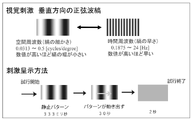
- FIG. 2 is a diagram of the apparatus used for optomotor response measurements. It is an explanatory diagram of the visual stimuli used in the optomotor response measurement, the upper diagram is an explanatory diagram of the spatial frequency and temporal frequency of the vertical sinusoidal fringes used, and the lower diagram is the time from the start of the stimulus to the end of the stimulus in one trial. It is an explanatory diagram.
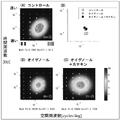
- FIG. 2 is a diagram showing the results of fitting the average velocity magnitude of the optomotor response of each group in Example 1 with a Gaussian function, (A) is the control group, (B) is the eugenol group, (C) is eugenol + Catechin group, (D) is a plot of the optimal spatiotemporal frequencies for each mouse.
- FIG. 1 is a diagram showing the results of optomotor response measurement in Example 1, (A) is the optimum spatial frequency [cycles/deg], (B) is the optimum temporal frequency [Hz], and (C) is the optimum velocity [deg/deg]. s].
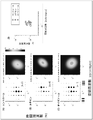
- FIG. 3 is a diagram showing the results of fitting the average velocity magnitude of the optomotor response of each group in Example 2 with a Gaussian function, where (A) is the control group, (B) is the catechin group, and (C) is the eugenol group. , (D) is a plot of the optimal spatiotemporal frequencies for each mouse.
- the present invention provides a composition for improving dynamic vision (hereinafter referred to as "first composition of the present invention”).
- the first composition of the present invention may contain eugenol as an active ingredient.
- Eugenol is a phenolic compound that is abundantly contained in essential oils such as clove, pimento, laurel, and cinnamon, and is used in perfumes, fragrances, and the like.
- Known actions of eugenol include, for example, antibacterial action, antiviral action, analgesic action, insect repellent action, immunostimulatory action, antispasmodic action, and antihistaminic action.
- the eugenol used in the composition of the present invention may be a synthetic product or a natural extract.
- Eugenol can be produced, for example, by pulverizing dried cloves, extracting from clove oil, clove essential oil extraction lees (JP-A-7-155152, etc.).
- eugenol-containing essential oils such as clove, pimento, laurel, and cinnamon may be used, and eugenol-containing cloves, pimento, laurel, cinnamon, etc. may be used as they are after being finely chopped or powdered.
- clove powder commercially available products such as clove powder (Nippon Powder Chemical Co., Ltd.) and clove extract powder H (Nippon Powder Chemical Co., Ltd.) may be used.
- composition of the present invention may further contain tea leaves or tea leaf extracts as active ingredients.
- Tea leaves refer to leaves of Camellia sinensis, an evergreen tree of the Camellia family, and may include buds and stems.
- the tea leaves may be fresh tea leaves or may be processed for beverage use. Tea leaves may be treated by non-fermentation, semi-fermentation, or high fermentation, and any of these treatments may be used.
- Non-fermented teas include green tea (sencha, gyokuro, kabusecha, sayha, gyokuryokucha, matcha, hojicha, kamairicha, tencha, etc.); semi-fermented teas include oolong tea and parocheng tea; fermented teas include black tea and pu-erh Tea is mentioned.
- the tea leaves may be used after being cut into small pieces, or may be used after being powdered.
- the tea leaf or tea leaf extract is preferably green tea leaf or green tea leaf extract.
- the tea leaf extract contains epigallocatechin gallate.
- a tea leaf extract can be obtained by extracting tea leaves with a solvent, and conventionally known methods can be employed.
- the tea leaves may be pulverized before extraction.
- Extraction solvents include water, hydrophilic solvents or mixtures thereof.
- hydrophilic solvents include lower alcohols such as methanol, ethanol, propyl alcohol and isopropyl alcohol; lower aliphatic ketones such as acetone and methyl ethyl ketone; and polyhydric alcohols such as 1,3-butylene glycol, propylene glycol and glycerin. be able to.
- the extraction solvent may be water or an aqueous ethanol solution, or may be water.
- the concentration of ethanol in the aqueous ethanol solution is not particularly limited, it may be 70% by weight or less.
- the extraction temperature may be 60 to 100°C, 65 to 95°C, or 70 to 80°C.
- the extraction time may be 5-60 minutes.
- the weight ratio of water to tea leaves may be 10 times or more the dry weight of tea leaves, or 10 to 100 times the dry weight of tea leaves.
- the tea leaf extract may be subjected to filtration, centrifugation or the like to remove solids after extraction. Furthermore, a treatment such as concentration or drying may be performed.
- the composition of the present invention can be used for improving dynamic vision.
- Dynamic visual acuity is the visual acuity that enables us to continuously distinguish moving objects without taking our eyes off our eyes. ), contrast discrimination ability for moving objects (contrast discrimination ability), and the like.
- the first composition of the present invention can improve the ability to discriminate the speed of a moving object among dynamic visual acuity, and can improve the speed (optimal speed) of the most easily discriminated moving object.
- the present invention provides a composition for suppressing deterioration of dynamic visual acuity in the elderly (hereinafter referred to as "second composition of the present invention").
- the second composition of the present invention may contain eugenol as an active ingredient, may contain tea leaves or a tea leaf extract as active ingredients, or may contain eugenol and tea leaves as active ingredients. It may contain eugenol and a tea leaf extract as active ingredients. When a tea leaf extract is used as an active ingredient, the tea leaf extract preferably contains epigallocatechin gallate. The same eugenol, tea leaves and tea leaf extract as in the first composition of the present invention can be used.
- the second composition of the present invention can suppress deterioration of dynamic visual acuity by ingestion by elderly people (for example, 65 years old or older).
- dynamic visual acuity it is possible to suppress a decrease in the ability to discriminate the speed of a moving object, and it is possible to suppress a decrease in the speed of eyes following a moving object (intensity of reaction).
- the first composition and second composition of the present invention can be suitably implemented as food and drink.
- Food and drink include health foods, foods with function claims, foods for specified health uses, foods for the sick, nutrient-enriched foods, and supplements.
- the form of the food and drink is not particularly limited.
- forms such as tablets, granules, powders, drinks; beverages such as tea drinks, soft drinks, carbonated drinks, nutritional drinks, fruit drinks, milk, lactic acid drinks; candies, gums, tablets, gummy jelly, chocolate, snacks , biscuits, jellies, jams, sweet bean jelly, senbei, rice crackers, steamed buns, pancake mixes, and other confectionery and confectionery foods; processed seafood such as kamaboko and chikuwa; processed livestock foods such as ham and sausages; processed milk, fermented milk, etc.
- beverages such as tea drinks, soft drinks, carbonated drinks, nutritional drinks, fruit drinks, milk, lactic acid drinks
- processed seafood such as kamaboko and chikuwa
- processed livestock foods such as ham and sausages
- oils and fats and processed foods such as salad oil, tempura oil, margarine, mayonnaise, shortening, whipped cream, and dressings; seasonings such as sauces, spices, and sauces; retort pouch foods such as curry, stew, porridge, and porridge side dishes; breads; frozen desserts such as ice cream, sherbet, and shaved ice.
- seasonings such as sauces, spices, and sauces
- retort pouch foods such as curry, stew, porridge, and porridge side dishes
- breads frozen desserts such as ice cream, sherbet, and shaved ice.
- the method for producing these foods and drinks is not particularly limited as long as it does not impair the effects of the present invention, and may follow methods used by those skilled in the art for each application.
- the composition of the present invention may be used alone or in combination.
- the content of the active ingredient in the composition of the present invention is not particularly limited, and may be 0.01 to 99% (w/w), or may be 0.1 to 95% (w/w). .
- the present invention provides a dynamic visual acuity improving drug containing eugenol as an active ingredient.
- Eugenol can be produced, for example, by pulverizing dried cloves, extracting from clove oil, clove essential oil extraction lees (JP-A-7-155152, etc.).
- the medicament of the present invention can be formulated by appropriately blending the active ingredient eugenol with a pharmaceutically acceptable carrier or additive.
- a pharmaceutically acceptable carrier or additive such as tablets, coated tablets, pills, powders, granules, capsules, liquid agents, suspensions, emulsions; injections, infusions, suppositories, ointments, patches, enteral nutrition agents, etc.
- oral agents such as tablets, coated tablets, pills, powders, granules, capsules, liquid agents, suspensions, emulsions; injections, infusions, suppositories, ointments, patches, enteral nutrition agents, etc.
- the blending ratio of the carrier or additive may be appropriately set based on the range normally employed in the pharmaceutical field.
- Carriers or additives that can be blended are not particularly limited, but for example, various carriers such as water, physiological saline, other aqueous solvents, aqueous or oily bases; excipients, binders, pH adjusters, disintegrants, absorption Various additives such as accelerators, lubricants, coloring agents, corrigents, and perfumes are included.
- excipients examples include binders such as gelatin, cornstarch, tragacanth and gum arabic, excipients such as crystalline cellulose, cornstarch, gelatin, alginic acid and the like. Raising agents, lubricants such as magnesium stearate, sweetening agents such as sucrose, lactose or saccharin, flavoring agents such as peppermint, redwood oil or cherries, and the like may be used.
- the dosage unit form is a capsule, the above type of material may further contain a liquid carrier such as oil.
- Sterile compositions for injection can be prepared according to conventional formulation procedures (eg, dissolving or suspending the active ingredient in a solvent such as water for injection, natural vegetable oil, etc.).
- Aqueous solutions for injection include, for example, physiological saline, isotonic solutions containing glucose and other adjuvants (e.g., D-sorbitol, D-mannitol, sodium chloride, etc.).
- isotonic solutions containing glucose and other adjuvants e.g., D-sorbitol, D-mannitol, sodium chloride, etc.
- alcohols eg, ethanol
- polyalcohols eg, propylene glycol, polyethylene glycol
- nonionic surfactants eg, polysorbate 80, HCO-50
- oily liquid for example, sesame oil, soybean oil and the like are used, and they may be used in combination with dissolution aids such as benzyl benzoate and benzyl alcohol.
- dissolution aids such as benzyl benzoate and benzyl alcohol.
- buffers e.g., phosphate buffer, sodium acetate buffer
- soothing agents e.g., benzalkonium chloride, procaine hydrochloride, etc.
- stabilizers e.g., human serum albumin, polyethylene glycol, etc.
- preservatives agents eg, benzyl alcohol, phenol, etc.
- the dose of eugenol depends on the dosage form and age of the patient, but may be in the range of 0.1 ⁇ g to 100 mg per day, and 1 ⁇ g to 50 mg per day. may be within the range of
- the medicament of the present invention is useful as a medicament for improving dynamic visual acuity.
- the present inventors have confirmed that the medicament of the present invention improves the ability to discriminate the speed of a moving object among dynamic visual acuity, and further improves the speed (optimal speed) of a moving object that is most easily discriminated.
- Example 1 Effect of eugenol, eugenol + catechin on visual function
- Materials and Methods (1) Experimental Animals Six C57/BL6J young mice (2 months old, male, body weight 20-30 g) were used. Mice were housed in an animal room maintained at a room temperature of 20-26° C., humidity of 30-70%, and a 12 hour cycle of dark and light. Feed and water were allowed ad libitum. Experiments were conducted in accordance with the Osaka University Animal Experiment Regulations.
- the eye position data was obtained by analyzing the mouse eye image with software (GetEye).
- the position of the center of gravity of the pupil is calculated from the time-lapse image of the mouse eye.
- the position of the eye was calculated based on the position of the center of gravity of the pupil.
- Calibration of the eyeball position was performed as follows.
- a mouse eyeball model (Remtulla S, Hallett PE. A schematic eye for the mouse, and comparisons with the rat. Vision Res 1985; The position on the image of the center of gravity of the pupil when rotated by 2 degrees in each direction up to 10 degrees was recorded.
- a stationary fringe stimulus pattern was presented on the monitor at the beginning of each trial. After a static pattern was presented for 333 ms, the pattern moved either to the left or to the right for 30 seconds. After the pattern moved, the screen changed to a solid gray screen and the trial was terminated. After 2 seconds the next trial started.
- Each trial stimulation condition was randomly selected from 62 kinds (31 kinds ⁇ 2 directions) of stimulation conditions (see FIG. 2).
- FIG. 3 shows the magnitude of the average velocity of optomotor responses in each group fitted with a Gaussian function.
- A is the control group
- B is the eugenol group
- C is the eugenol + catechin group.
- the vertical axis indicates temporal frequency
- the horizontal axis indicates spatial frequency.
- a plot of the optimal spatiotemporal frequencies for each mouse is shown in the upper right (D).
- the response was weak whether the spatial frequency or temporal frequency was too low or too high. It was found that the optimal temporal frequency was higher in the eugenol group and the eugenol + catechin group than in the control group.
- the largest eye movement response was observed in the control group when the spatial frequency was 0.159 ⁇ 0.003 [cycles/deg] and the temporal frequency was 1.06 ⁇ 0.01 [Hz]. was done.
- the optimal frequency was 0.141 ⁇ 0.010 [cycles/deg] spatial frequency and 1.58 ⁇ 0.08 [Hz] temporal frequency.
- the optimum spatial frequency was 0.135 ⁇ 0.010 [cycles/deg] and the temporal frequency was 1.76 ⁇ 0.04 [Hz]. This result suggested that there was an optimal spatiotemporal frequency for evoking optomotor responses in each group.
- Fig. 4 shows the results of (A) optimal spatial frequency [cycles/deg], (B) optimal temporal frequency [Hz], and (C) optimal speed [deg/s] for each group.
- (A) is the ability to discriminate fineness of a moving object
- (B) is the ability to discriminate the speed of a moving object
- (C) is the speed of a moving object that is most easily discriminated.
- the eugenol group and the eugenol + catechin group showed significantly higher optimal temporal frequencies than the control group.
- the optimum speed was significantly higher, and it became clear that the response to fast-moving objects was large.
- the optimal temporal frequency and optimal velocity increased more than when eugenol alone was given.
- the optimal temporal frequency was 1.42 in the ratio of the eugenol group to the control group, and 1.62 in the eugenol+catechin group.
- the optimal rate was 1.77 for the eugenol + catechin group compared to 1.54 for the ratio of the eugenol group to the control group. From this result, it was clarified that when eugenol + catechin was given, the temporal frequency and optimal velocity increased more than when only eugenol was given.
- Example 2 Effects of eugenol and epigallocatechin gallate (EGCG) on visual function of aged mice]
- Materials and Methods (1) Experimental Animals Fourteen C57/BL6J aged mice (18-21 months old, male, weight 33-38 g) were used. Mice were housed in an animal room maintained at a room temperature of 20-26° C., humidity of 30-70%, and a 12 hour cycle of dark and light. Feed and water were allowed ad libitum. Experiments were conducted in accordance with the Osaka University Animal Experiment Regulations.
- FIG. 5 shows the magnitudes of the average velocities of the optomotor responses of the control group, the catechin group, and the eugenol group fitted with a Gaussian function.
- the vertical axis indicates temporal frequency
- the horizontal axis indicates spatial frequency.
- the optimal spatiotemporal frequency for each mouse is shown in the upper right. It was found that the optimal temporal frequencies were higher in the catechin group and the eugenol group than in the control group.
- the Gaussian function that best fits the control group and the eugenol group from the data of 5 animals, and the catechin group from the data of 4 animals was obtained.
- the optimal frequency was 0.170 ⁇ 0.060 [cycles/deg] spatial frequency and 1.93 ⁇ 0.08 [Hz] temporal frequency.
- the optimal frequency was 0.155 ⁇ 0.010 [cycles/deg] spatial frequency and 1.35 ⁇ 0.09 [Hz] temporal frequency.
- Figure 6 shows (A) optimal spatial frequency [cycles/deg], (B) optimal temporal frequency [Hz], and (C) intensity of response (how much the eye moves per second) of the control group, catechin group, and eugenol group ) [deg/s], (D) optimum velocity [deg/s], and (E) gain.
- the optimal temporal frequencies were significantly higher in the catechin and eugenol groups than in the control group.
- the strength of the response was significantly higher, and it was clarified that the response to fast-moving objects was large.
Landscapes
- Health & Medical Sciences (AREA)
- Life Sciences & Earth Sciences (AREA)
- Chemical & Material Sciences (AREA)
- Engineering & Computer Science (AREA)
- Veterinary Medicine (AREA)
- Pharmacology & Pharmacy (AREA)
- Public Health (AREA)
- Medicinal Chemistry (AREA)
- General Health & Medical Sciences (AREA)
- Animal Behavior & Ethology (AREA)
- Natural Medicines & Medicinal Plants (AREA)
- Food Science & Technology (AREA)
- Polymers & Plastics (AREA)
- Epidemiology (AREA)
- Mycology (AREA)
- Nutrition Science (AREA)
- Nuclear Medicine, Radiotherapy & Molecular Imaging (AREA)
- General Chemical & Material Sciences (AREA)
- Chemical Kinetics & Catalysis (AREA)
- Bioinformatics & Cheminformatics (AREA)
- Botany (AREA)
- Organic Chemistry (AREA)
- Ophthalmology & Optometry (AREA)
- Alternative & Traditional Medicine (AREA)
- Biotechnology (AREA)
- Medical Informatics (AREA)
- Microbiology (AREA)
- Pharmaceuticals Containing Other Organic And Inorganic Compounds (AREA)
Abstract
本発明は、オイゲノールを有効成分として含有する動体視力向上用組成物、オイゲノールおよび/または茶葉もしくは茶葉抽出物を有効成分として含有する高齢者の動体視力低下抑制用組成物、ならびにオイゲノールを有効成分として含有する動体視力向上用医薬を提供する。
Description
本発明は、動体視力向上用組成物に関するものである。
人の視覚は感覚の中でも外界情報の8割以上を担うといわれ、最も重要な感覚である。良い視覚を維持することは、超高齢化社会において極めて重要な課題である。特に最近は、高齢者ドライバーによる交通事故が急増していることも大きな社会問題になっている。一般的に、視力検査で測定するのは静止時視力であるが、自動車の運転や、スポーツ、ゲームなどを行っているときには、静止時視力と共に、動く対象を瞬時に追跡して見る視覚機能が必要であり、これは動体視力(動体視覚機能)と呼ばれる。
動体視力は、日々の環境や成長過程によって能力の差が生じ、特にスポーツをする人は普通の人よりも動体視力が高い傾向がある。特に、動きを瞬時に認識する必要があるスポーツのパフォーマンスの向上には動体視力が深く関係し、スポーツ上達には欠かせない要素となっている。動体視力は成長するにつれて発達し、20歳でピークとなり、その後は低下すると報告されている。また、自動車やバイクの運転にも深く関わり、高齢者ドライバーに多く見られる、信号器の見落としや、反応の遅れ等は動体視力の低下も原因のひとつとなっている。動体視力を維持することはスポーツ界だけでなく、日常生活にも欠かせないものとなっている。
本発明者らは、網膜視覚研究を行う過程で、ヒト、サルなどで用いられてきた動体視覚機能解析法を改良し、客観的かつ定量的にマウスの動体視力(空間分別能、速度分別能、コントラスト分別能)を測定できる技術を確立した(非特許文献1)。この測定技術を用いて、人の動体視力を亢進し、人々の生活やスポーツ能力を向上させるような食品成分や物質の探索を行っている。本発明者らは、エピガロカテキンガレートを含む茶葉抽出物をマウスに投与すると動体視力が向上することを見出し、特許出願している(特許文献1)。
Sugita Y, Miura K, Araki F, Furukawa T, Kawano K. Contributions of retinal direction-selective ganglion cells to optokinetic responses in mice. Eur J Neurosci. 2013, 38(6): 2823-31.
本発明は、動体視力向上用組成物、高齢者の動体視力低下抑制用組成物および動体視力向上用医薬を提供することを課題とする。
本発明は、上記の課題を解決するために以下の各発明を包含する。
[1]オイゲノールを有効成分として含有する動体視力向上用組成物。
[2]さらに、茶葉または茶葉抽出物を有効成分として含有する、前記[1]に記載の組成物。
[3]茶葉抽出物がエピガロカテキンガレートを含む、前記[2]に記載の組成物。
[4]動体視力向上が動体速度分別能の向上である、前記[1]~[3]のいずれかに記載の組成物。
[5]オイゲノールおよび/または茶葉もしくは茶葉抽出物を有効成分として含有する、高齢者の動体視力低下抑制用組成物。
[6]茶葉抽出物がエピガロカテキンガレートを含む、前記[5]に記載の組成物。
[7]動体視力低下が動体速度分別能の低下である、前記[5]または[6]に記載の組成物。
[8]飲食品である前記[1]~[7]のいずれかに記載の組成物。
[9]オイゲノールを有効成分として含有する動体視力向上用医薬。
[10]動体視力向上が動体速度分別能の向上である、前記[9]に記載の医薬。
[1]オイゲノールを有効成分として含有する動体視力向上用組成物。
[2]さらに、茶葉または茶葉抽出物を有効成分として含有する、前記[1]に記載の組成物。
[3]茶葉抽出物がエピガロカテキンガレートを含む、前記[2]に記載の組成物。
[4]動体視力向上が動体速度分別能の向上である、前記[1]~[3]のいずれかに記載の組成物。
[5]オイゲノールおよび/または茶葉もしくは茶葉抽出物を有効成分として含有する、高齢者の動体視力低下抑制用組成物。
[6]茶葉抽出物がエピガロカテキンガレートを含む、前記[5]に記載の組成物。
[7]動体視力低下が動体速度分別能の低下である、前記[5]または[6]に記載の組成物。
[8]飲食品である前記[1]~[7]のいずれかに記載の組成物。
[9]オイゲノールを有効成分として含有する動体視力向上用医薬。
[10]動体視力向上が動体速度分別能の向上である、前記[9]に記載の医薬。
本発明は、新規な動体視力向上用組成物および動体視力向上用医薬を提供することができる。本発明の組成物および医薬は、特に動体速度分別能を維持または亢進させることができる。さらに本発明は、高齢者の動体視力低下抑制用組成物を提供する。
本発明は、動体視力向上用組成物を提供する(以下、「本発明の第一の組成物」と記す)。本発明の第一の組成物は、オイゲノールを有効成分とするものであればよい。オイゲノールは、クローブ、ピメント、ローレル、シナモンなどの精油に多く含有されているフェノール系化合物であり、香水、香料などに使用される。オイゲノールの作用としては、例えば、抗菌作用、抗ウイルス作用、鎮痛作用、防虫作用、免疫賦活作用、鎮痙作用、抗ヒスタミン作用などが知られている。
本発明の組成物に使用されるオイゲノールは、合成品でもよく天然抽出物でもよい。オイゲノールは、例えば、乾燥クローブの粉砕、クローブ油、クローブ精油抽出滓から抽出することにより製造することができる(特開平7-155152等)。あるいは、オイゲノールを含有するクローブ、ピメント、ローレル、シナモンなどの精油を用いてもよく、オイゲノールを含有するクローブ、ピメント、ローレル、シナモンなどを、そのまま細切、粉末化等して使用してもよい。クローブの粉末として、チョウジ末(日本粉末薬品株式会社)、チョウジエキスパウダーH(日本粉末薬品株式会社)等の市販品を使用してもよい。
本発明の組成物は、さらに、茶葉または茶葉抽出物を有効成分として含有するものであってもよい。茶葉はツバキ科の常緑樹であるチャノキ(Camellia sinensis)の葉を意味し、芽、茎を含むものであってもよい。茶葉は、生の茶葉でもよく、飲料用に処理を施したものでもよい。茶葉の処理には、不発酵、半発酵、高発酵があるが、いずれの処理を施したものでもよい。不発酵茶としては緑茶(煎茶、玉露、かぶせ茶、番茶、玉緑茶、抹茶、ほうじ茶、釜炒り茶、てん茶等)、半発酵茶としてはウーロン茶、包種茶、発酵茶としては紅茶、プーアール茶が挙げられる。茶葉は、細切して用いてもよく、粉末にして用いてもよい。茶葉または茶葉抽出物は、緑茶の茶葉または緑茶の茶葉抽出物であることが好ましい。茶葉抽出物はエピガロカテキンガレートを含むことが好ましい。
茶葉抽出物は、茶葉を溶媒で抽出処理して得ることができ、従来公知の方法を採用可能である。茶葉は抽出前に粉砕処理を行ってもよい。抽出溶媒としては、水、親水性溶媒またはこれらの混合物が挙げられる。親水性溶媒としては、例えば、メタノール、エタノール、プロピルアルコール、イソプロピルアルコール等の低級アルコール、アセトン、メチルエチルケトン等の低級脂肪族ケトン、1,3-ブチレングリコール、プロピレングリコール、グリセリン等の多価アルコールを挙げることができる。抽出溶媒は、水またはエタノール水溶液であってもよく、水であってもよい。エタノール水溶液におけるエタノールの濃度は特に限定されないが、70重量%以下であってもよい。水で抽出する場合、抽出温度は60~100℃であってもよく、65~95℃であってもよく、70~80℃であってもよい。抽出時間は5~60分であってもよい。水と茶葉との重量比は、茶葉1に対し、茶葉乾燥重量の10倍以上の水を用いてもよく、茶葉乾燥重量の10倍~100倍量の水を用いてもよい。茶葉抽出物は、抽出処理後、ろ過、遠心分離等の処理により固形分を除去してもよい。さらに、濃縮、乾燥等の処理を行ってもよい。
本発明の組成物は、動体視力を向上させる用途に使用することができる。動体視力とは、視線を外さずに動いている物体を持続して分別することができる視力であり、動体の速度の分別能(速度分別能)、動体の細かさの分別能(空間分別能)、動体のコントラストの分別能(コントラスト分別能)等が含まれる。本発明の第一の組成物は、動体視力のなかでも動体速度分別能が向上し、さらに最も分別しやすい動体の速度(最適速度)が向上することができる。
本発明は、高齢者の動体視力低下抑制用組成物を提供する(以下、「本発明の第二の組成物」と記す)。本発明の第二の組成物は、オイゲノールを有効成分とするものであってもよく、茶葉または茶葉抽出物を有効成分とするものであってもよく、オイゲノールと茶葉を有効成分とするものであってもよく、オイゲノールと茶葉抽出物を有効成分とするものであってもよい。茶葉抽出物を有効成分とする場合、茶葉抽出物はエピガロカテキンガレートを含むことが好ましい。オイゲノール、茶葉および茶葉抽出物は、上記本発明の第一の組成物と同じものを使用することができる。
本発明者らは、老齢マウス(21~24か月齢)は、若齢マウス(2~3か月齢)と比較して、最適空間周波数[cycles/deg]、最適時間周波数[Hz]および反応の強さ[deg/s]が有意に低下し、細かいものや動きの速いものが見え難くなっていることを報告している(Sugita et al., Frontiers in Neuroscience, December 2020, Volume 14, Article 586013)。本発明の第二の組成物は、高齢者(例えば、65歳以上)に摂取させることにより、動体視力低下を抑制することができる。動体視力のなかでも、動体速度分別能の低下を抑制することができ、さらに動体を追う眼の速さ(反応の強さ)の低下を抑制することができる。
本発明の第一の組成物および第二の組成物は、飲食品として好適に実施することができる。飲食品には、健康食品、機能性表示食品、特定保健用食品、病者用食品、栄養強化食品、サプリメント等が含まれる。飲食品の形態は特に限定されない。例えば、錠剤、顆粒剤、散剤、ドリンク剤等の形態;茶飲料、清涼飲料、炭酸飲料、栄養飲料、果実飲料、牛乳、乳酸飲料等の飲料;キャンディー、ガム、錠菓、グミゼリー、チョコレート、スナック、ビスケット、ゼリー、ジャム、羊羹、せんべい、あられ、まんじゅう、ホットケーキミックス等の菓子および製菓用食品;かまぼこ、ちくわ等の水産加工食品、ハム、ソーセージ等の畜産加工食品;加工乳、発酵乳等の乳製品;サラダ油、てんぷら油、マーガリン、マヨネーズ、ショートニング、ホイップクリーム、ドレッシング等の油脂および油脂加工食品;ソース、香辛料、たれ等の調味料;カレー、シチュー、お粥、雑炊等のレトルトパウチ食品;惣菜類;パン類;アイスクリーム、シャーベット、かき氷等の冷菓などを挙げることができる。これらの飲食品の製造方法は、本発明の効果を損なわないものであれば特に限定されず、各用途で当業者によって使用されている方法に従えばよい。本発明の組成物は単独で使用しても良く、組み合わせて使用しても良い。
本発明の組成物中の有効成分の含量は特に限定されず、0.01~99%(w/w)であってもよく、0.1~95%(w/w)であってもよい。
本発明は、オイゲノールを有効成分として含有する動体視力向上用医薬を提供する。オイゲノールは、例えば、乾燥クローブの粉砕、クローブ油、クローブ精油抽出滓から抽出することにより製造することができる(特開平7-155152等)。
本発明の医薬は、有効成分であるオイゲノールに、薬学的に許容される担体または添加剤を適宜配合して製剤化することができる。具体的には錠剤、被覆錠剤、丸剤、散剤、顆粒剤、カプセル剤、液剤、懸濁剤、乳剤等の経口剤;注射剤、輸液、坐剤、軟膏、パッチ剤、経腸栄養剤等の非経口剤とすることができる。担体または添加剤の配合割合については、医薬品分野において通常採用されている範囲に基づいて適宜設定すればよい。配合できる担体または添加剤は特に制限されないが、例えば、水、生理食塩水、その他の水性溶媒、水性または油性基剤等の各種担体;賦形剤、結合剤、pH調整剤、崩壊剤、吸収促進剤、滑沢剤、着色剤、矯味剤、香料等の各種添加剤が挙げられる。
錠剤、カプセル剤などに混和することができる添加剤としては、例えば、ゼラチン、コーンスターチ、トラガント、アラビアゴムのような結合剤、結晶性セルロースのような賦形剤、コーンスターチ、ゼラチン、アルギン酸などのような膨化剤、ステアリン酸マグネシウムのような潤滑剤、ショ糖、乳糖またはサッカリンのような甘味剤、ペパーミント、アカモノ油またはチェリーのような香味剤などが用いられる。調剤単位形態がカプセルである場合には、上記タイプの材料にさらに油脂のような液状担体を含有することができる。注射のための無菌組成物は通常の製剤手順(例えば有効成分を注射用水、天然植物油等の溶媒に溶解または懸濁させる等)に従って調製することができる。注射用の水性液としては、例えば、生理食塩水、ブドウ糖やその他の補助薬を含む等張液(例えば、D-ソルビトール、D-マンニトール、塩化ナトリウムなど)などが用いられ、適当な溶解補助剤、例えば、アルコール(例、エタノール)、ポリアルコール(例、プロピレングリコール、ポリエチレングリコール)、非イオン性界面活性剤(例、ポリソルベート80、HCO-50)などと併用してもよい。油性液としては、例えば、ゴマ油、大豆油などが用いられ、溶解補助剤である安息香酸ベンジル、ベンジルアルコールなどと併用してもよい。また、緩衝剤(例えば、リン酸塩緩衝液、酢酸ナトリウム緩衝液)、無痛化剤(例えば、塩化ベンザルコニウム、塩酸プロカインなど)、安定剤(例えば、ヒト血清アルブミン、ポリエチレングリコールなど)、保存剤(例えば、ベンジルアルコール、フェノールなど)、酸化防止剤などと配合してもよい。
本発明の医薬をヒトに投与する場合における、オイゲノールの用量は、剤型や患者の年齢などに依存するが、1日当たり0.1μg~100mgの範囲内であってもよく、一日当たり1μg~50mgの範囲内であってもよい。
本発明の医薬は、動体視力向上用医薬として有用である。本発明の医薬は、動体視力のなかでも動体速度分別能が向上し、さらに最も識別しやすい動体の速度(最適速度)が向上することが、本発明者らにより確認されている。
以下、実施例により本発明を詳細に説明するが、本発明はこれらに限定されるものではない。
〔実施例1:オイゲノール、オイゲノール+カテキンが視覚機能に与える影響〕
1.材料および方法
(1)実験動物
6匹のC57/BL6J若齢マウス(2か月齢、雄、体重20~30g)を使用した。マウスは室温20~26℃、湿度30~70%、12時間サイクルの暗明で維持された動物室で飼育した。飼料および水は自由摂取とした。実験は大阪大学動物実験規程に沿って行った。
1.材料および方法
(1)実験動物
6匹のC57/BL6J若齢マウス(2か月齢、雄、体重20~30g)を使用した。マウスは室温20~26℃、湿度30~70%、12時間サイクルの暗明で維持された動物室で飼育した。飼料および水は自由摂取とした。実験は大阪大学動物実験規程に沿って行った。
(2)実験群
・コントロール群(n=2):生理食塩水 50 mg/kgの用量で4日間腹腔内投与をした。
・オイゲノール群(n=2): オイゲノール(丁字油、ナカライテスク株式会社)を界面活性剤(Tween 80、東京化成工業株式会社)で懸濁し、オイゲノール0.1 ml/kgの用量で4日間腹腔内投与をした。
・オイゲノール+カテキン群(n=2):EGCG(エピガロカテキンガレート、長良サイエンス株式会社)を10 mg/mlの濃度で生理食塩水に溶解し、EGCG 50 mg/kgとオイゲノール0.1 ml/kgの用量で4日間腹腔内投与をした。
オイゲノールまたはオイゲノールとエピガロカテキンガレートの混合物を4日間腹腔内投与した後に視運動性応答を測定した。
・コントロール群(n=2):生理食塩水 50 mg/kgの用量で4日間腹腔内投与をした。
・オイゲノール群(n=2): オイゲノール(丁字油、ナカライテスク株式会社)を界面活性剤(Tween 80、東京化成工業株式会社)で懸濁し、オイゲノール0.1 ml/kgの用量で4日間腹腔内投与をした。
・オイゲノール+カテキン群(n=2):EGCG(エピガロカテキンガレート、長良サイエンス株式会社)を10 mg/mlの濃度で生理食塩水に溶解し、EGCG 50 mg/kgとオイゲノール0.1 ml/kgの用量で4日間腹腔内投与をした。
オイゲノールまたはオイゲノールとエピガロカテキンガレートの混合物を4日間腹腔内投与した後に視運動性応答を測定した。
(3)視運動性応答測定
動く視覚刺激を呈示している間のマウスの右眼の眼球運動を計測した。マウスにはケタミン麻酔のもと、ヘッドホルダーを頭蓋骨に歯科用セメントで接着した。実験中、マウスの動きが最小限になるように、ヘッドホルダーをステンレス棒にネジで止めることにより頭部を固定し、胴体も小型ケースで固定した。赤外線ライトをマウスの右眼に照らし、マウスの体軸から60degの位置にホットミラーを設置した(図1参照)。ホットミラーで反射したマウスの右眼の像を、赤外線を感知するカメラ(CCDカメラ)で5ミリ秒ごと記録した(サンプリングレート: 200Hz)。ホットミラーは赤外線を反射するが、可視光は通すので、マウスはホットミラーの後ろにあるモニタ上の視覚刺激をみることができる。
動く視覚刺激を呈示している間のマウスの右眼の眼球運動を計測した。マウスにはケタミン麻酔のもと、ヘッドホルダーを頭蓋骨に歯科用セメントで接着した。実験中、マウスの動きが最小限になるように、ヘッドホルダーをステンレス棒にネジで止めることにより頭部を固定し、胴体も小型ケースで固定した。赤外線ライトをマウスの右眼に照らし、マウスの体軸から60degの位置にホットミラーを設置した(図1参照)。ホットミラーで反射したマウスの右眼の像を、赤外線を感知するカメラ(CCDカメラ)で5ミリ秒ごと記録した(サンプリングレート: 200Hz)。ホットミラーは赤外線を反射するが、可視光は通すので、マウスはホットミラーの後ろにあるモニタ上の視覚刺激をみることができる。
眼の位置のデータは、マウスの眼の画像をソフトウェア(GetEye)で解析することで求めた。時々刻々のマウスの眼の画像から、瞳孔の重心の位置を計算する。その瞳孔重心位置をもとに眼の位置(視線の向き)を計算した。眼球位置のキャリブレーションは次のように行った。マウスの眼球のモデル(Remtulla S, Hallett PE. A schematic eye for the mouse, and comparisons with the rat. Vision Res 1985; 25: 21-31.)を実験中のマウスの眼球と同じ位置に置き、左右それぞれの方向に2degずつ10degまで回転したときの瞳孔重心の画像上の位置を記録した。このデータに基づいて、瞳孔重心の画像上の位置とマウスの眼の位置(視線の向き)の対応関係を求め、マウスの眼の位置を算出した。その後、眼の位置のデータを微分して眼球速度を計算した。試行ごとに刺激開始後30秒間の眼球速度の平均を測り、これを誘発された眼球運動反応の大きさとした。データ解析は、MATLAB(MathWorks, MA)を用いて行った。
視覚刺激はMATLAB/Psychtoolbox(Brainard DH. The Psychophysics Toolbox. Spatial Vision. 1997; 10: 433-36.)により作成し、マウスの周り三面に設置したモニタに呈示した。視覚刺激は正弦波縞を用いた。正弦波縞刺激のパラメータを空間周波数と時間周波数を変えていき、時空間特性を調べた。空間周波数は視覚刺激の刺激が動く時の縞の細かさ、時間周波数は縞が動く速さである。空間周波数はSF=0.0313、0.0625、0.125、0.25、0.5 cycles/degreeの5種類、時間周波数はTF=0.1875、0.375、0.75、1.5、3、6、12、24 Hzの8種類で変化させた(図2参照)。
各試行の最初に静止した縞刺激パターンがモニタに呈示された。静止パターンが333ミリ秒間呈示された後、そのパターンが左方向あるいは右方向のいずれかに30秒間動いた。パターンが動いた後に、灰色の一様な画面に変り、試行が終了した。2秒後に次の試行が開始された。各試行刺激条件は62種類(31種類×2方向)の刺激条件の中からランダムに選ばれた(図2参照)。
2.結果
図3に、各群の視運動性応答の平均速度の大きさをガウス関数でフィットしたものを示した。(A)はコントロール群、(B)はオイゲノール群、(C)はオイゲノール+カテキン群である。縦軸は時間周波数、横軸は空間周波数を示す。各マウスの最適時空間周波数のプロットを右上(D)に示した。全ての実験群で空間周波数、時間周波数が低すぎても高すぎても反応は弱かった。コントロール群に比べ、オイゲノール群、オイゲノール+カテキン群のマウスは最適時間周波数が高いことがわかった。それぞれ2匹のデータから最も良くフィットするガウス関数を求めた結果、コントロール群では、空間周波数0.159±0.003[cycles/deg]、時間周波数1.06±0.01[Hz]のとき、最も大きい眼球運動反応が観測された。オイゲノール群では、空間周波数0.141±0.010 [cycles/deg]、時間周波数1.58±0.08 [Hz] が最適周波数であった。オイゲノール+カテキン群では、空間周波数0.135±0.010 [cycles/deg]、時間周波数1.76±0.04[Hz]が最適周波数であった。この結果から、各群において、視運動性応答を誘発するのに最適な時空間周波数があることが示唆された。
図3に、各群の視運動性応答の平均速度の大きさをガウス関数でフィットしたものを示した。(A)はコントロール群、(B)はオイゲノール群、(C)はオイゲノール+カテキン群である。縦軸は時間周波数、横軸は空間周波数を示す。各マウスの最適時空間周波数のプロットを右上(D)に示した。全ての実験群で空間周波数、時間周波数が低すぎても高すぎても反応は弱かった。コントロール群に比べ、オイゲノール群、オイゲノール+カテキン群のマウスは最適時間周波数が高いことがわかった。それぞれ2匹のデータから最も良くフィットするガウス関数を求めた結果、コントロール群では、空間周波数0.159±0.003[cycles/deg]、時間周波数1.06±0.01[Hz]のとき、最も大きい眼球運動反応が観測された。オイゲノール群では、空間周波数0.141±0.010 [cycles/deg]、時間周波数1.58±0.08 [Hz] が最適周波数であった。オイゲノール+カテキン群では、空間周波数0.135±0.010 [cycles/deg]、時間周波数1.76±0.04[Hz]が最適周波数であった。この結果から、各群において、視運動性応答を誘発するのに最適な時空間周波数があることが示唆された。
図4に、各群の(A)最適空間周波数[cycles/deg]、(B)最適時間周波数[Hz]、(C)最適速度 [deg/s]の結果を示した。(A)は動体の細かさの分別能であり、(B)は動体の速度の分別能であり、(C)は最も識別しやすい動体の速度である。オイゲノール群、オイゲノール+カテキン群では、コントロール群に比べて最適時間周波数が有意に高いことが示された。また、最適速度も有意に高く、早いスピードで動くものに対する反応が大きいことが明らかになった。オイゲノール+カテキンを与えた場合、オイゲノールのみを与えた場合よりも最適時間周波数、最適速度がさらに上昇した。最適時間周波数は、コントロール群に対するオイゲノール群の比率1.42に対し、オイゲノール+カテキン群の比率は1.62であった。最適速度は、コントロール群に対するオイゲノール群の比率は1.54に対し、オイゲノール+カテキン群は1.77であった。この結果から、オイゲノール+カテキンを与えた場合、オイゲノールのみを与えた場合よりも時間周波数、最適速度がさらに上昇することが明らかとなった。また、カテキンのみを与えた場合(今回の実験と別実験)の結果から、コントロール群に対するカテキン群の最適時間周波数の比率は1.22、最適速度の比率は1.16であった。これに対し、コントロール群に対するオイゲノール+カテキン群の最適時間周波数の比率は、1.62、最適速度の比率は1.77であった。この結果から、カテキンのみよりもオイゲノール+カテキンを与えた方が、最適時間周波数および最適速度がさらに上昇することが明らかになった。
〔実施例2:オイゲノール、エピガロカテキンガレート(EGCG)が老齢マウス視覚機能に与える影響〕
1.材料および方法
(1)実験動物
14匹のC57/BL6J老齢マウス(18~21か月齢、雄、体重33~38g)を使用した。マウスは室温20~26℃、湿度30~70%、12時間サイクルの暗明で維持された動物室で飼育した。飼料および水は自由摂取とした。実験は大阪大学動物実験規程に沿って行った。
1.材料および方法
(1)実験動物
14匹のC57/BL6J老齢マウス(18~21か月齢、雄、体重33~38g)を使用した。マウスは室温20~26℃、湿度30~70%、12時間サイクルの暗明で維持された動物室で飼育した。飼料および水は自由摂取とした。実験は大阪大学動物実験規程に沿って行った。
(2)実験群
・コントロール群 (n=5): 生理食塩水 50 mg/kgの用量で2日間腹腔内投与をした。
・オイゲノール群 (n=5):オイゲノール(丁字油)を界面活性剤(Tween 80)で懸濁し、0.1ml/kgの用量で2日間腹腔内投与をした。
・カテキン群 (n=4):EGCGを10mg/mlの濃度で生理食塩水に溶解し、50mg/kgの用量で、2日間腹腔内投与した。
それぞれの群で2日間の投与の後に、実施例1と同じ方法で視運動性応答を測定した。
・コントロール群 (n=5): 生理食塩水 50 mg/kgの用量で2日間腹腔内投与をした。
・オイゲノール群 (n=5):オイゲノール(丁字油)を界面活性剤(Tween 80)で懸濁し、0.1ml/kgの用量で2日間腹腔内投与をした。
・カテキン群 (n=4):EGCGを10mg/mlの濃度で生理食塩水に溶解し、50mg/kgの用量で、2日間腹腔内投与した。
それぞれの群で2日間の投与の後に、実施例1と同じ方法で視運動性応答を測定した。
2.結果
図5に、コントロール群、カテキン群、オイゲノール群の視運動性応答の平均速度の大きさをガウス関数でフィットしたものを示した。縦軸は時間周波数、横軸は空間周波数に示す。実施例1と同じように、全ての群で空間周波数、時間周波数が低すぎても高すぎても反応は弱かった。各マウスの最適時空間周波数を右上に示した。コントロール群に比べ、カテキン群、オイゲノール群のマウスは最適時間周波数が高いことがわかった。コントロール群とオイゲノール群は5匹のデータ、カテキン群は4匹のデータから最も良くフィットするガウス関数を求めた結果、コントロール群では、空間周波数0.123±0.040[cycles/deg]、時間周波数0.995±0.040[Hz]のとき、最も大きい眼球運動反応が観測された。カテキン群では、空間周波数0.170±0.060[cycles/deg]、時間周波数1.93±0.08[Hz]が最適周波数であった。オイゲノール群では、空間周波数0.155±0.010[cycles/deg]、時間周波数1.35±0.09[Hz]が最適周波数であった。
図5に、コントロール群、カテキン群、オイゲノール群の視運動性応答の平均速度の大きさをガウス関数でフィットしたものを示した。縦軸は時間周波数、横軸は空間周波数に示す。実施例1と同じように、全ての群で空間周波数、時間周波数が低すぎても高すぎても反応は弱かった。各マウスの最適時空間周波数を右上に示した。コントロール群に比べ、カテキン群、オイゲノール群のマウスは最適時間周波数が高いことがわかった。コントロール群とオイゲノール群は5匹のデータ、カテキン群は4匹のデータから最も良くフィットするガウス関数を求めた結果、コントロール群では、空間周波数0.123±0.040[cycles/deg]、時間周波数0.995±0.040[Hz]のとき、最も大きい眼球運動反応が観測された。カテキン群では、空間周波数0.170±0.060[cycles/deg]、時間周波数1.93±0.08[Hz]が最適周波数であった。オイゲノール群では、空間周波数0.155±0.010[cycles/deg]、時間周波数1.35±0.09[Hz]が最適周波数であった。
図6に、コントロール群、カテキン群、オイゲノール群の(A)最適空間周波数[cycles/deg]、(B)最適時間周波数[Hz]、(C)反応の強さ(1秒間にどのくらい眼が動くのか)[deg/s]、(D)最適速度 [deg/s]、(E)ゲインの結果を示した。カテキン群とオイゲノール群では、コントロール群に比べて最適時間周波数が有意に高いことが示された。また、反応の強さも有意に高く、早いスピードで動くものに対する反応が大きいことが明らかになった。
なお本発明は上述した各実施形態および実施例に限定されるものではなく、請求項に示した範囲で種々の変更が可能であり、異なる実施形態にそれぞれ開示された技術的手段を適宜組み合わせて得られる実施形態についても本発明の技術的範囲に含まれる。また、本明細書中に記載された学術文献および特許文献の全てが、本明細書中において参考として援用される。
Claims (10)
- オイゲノールを有効成分として含有する動体視力向上用組成物。
- さらに、茶葉または茶葉抽出物を有効成分として含有する、請求項1に記載の組成物。
- 茶葉抽出物がエピガロカテキンガレートを含む、請求項2に記載の組成物。
- 動体視力向上が動体速度分別能の向上である、請求項1に記載の組成物。
- オイゲノールおよび/または茶葉もしくは茶葉抽出物を有効成分として含有する、高齢者の動体視力低下抑制用組成物。
- 茶葉抽出物がエピガロカテキンガレートを含む、請求項5に記載の組成物。
- 動体視力低下が動体速度分別能の低下である、請求項5に記載の組成物。
- 飲食品である請求項1~7のいずれか1項に記載の組成物。
- オイゲノールを有効成分として含有する動体視力向上用医薬。
- 動体視力向上が動体速度分別能の向上である、請求項9に記載の医薬。
Applications Claiming Priority (2)
| Application Number | Priority Date | Filing Date | Title |
|---|---|---|---|
| JP2021091450 | 2021-05-31 | ||
| JP2021-091450 | 2021-05-31 |
Publications (1)
| Publication Number | Publication Date |
|---|---|
| WO2022255282A1 true WO2022255282A1 (ja) | 2022-12-08 |
Family
ID=84323217
Family Applications (1)
| Application Number | Title | Priority Date | Filing Date |
|---|---|---|---|
| PCT/JP2022/021855 Ceased WO2022255282A1 (ja) | 2021-05-31 | 2022-05-30 | 動体視力向上用組成物 |
Country Status (1)
| Country | Link |
|---|---|
| WO (1) | WO2022255282A1 (ja) |
Citations (6)
| Publication number | Priority date | Publication date | Assignee | Title |
|---|---|---|---|---|
| JPH10287563A (ja) * | 1997-02-17 | 1998-10-27 | Sagami Chem Res Center | 動体視力改善剤 |
| WO2005070435A1 (ja) * | 2004-01-22 | 2005-08-04 | Otsuka Pharmaceutical Co., Ltd. | 動体視力改善剤 |
| JP2010184927A (ja) * | 2003-04-18 | 2010-08-26 | Saisentan Igaku Kenkyusho:Kk | 眼に適用する疾患治療剤 |
| WO2020175579A1 (ja) * | 2019-02-27 | 2020-09-03 | 大塚製薬株式会社 | 植物由来エキス及び/又は植物由来加工品含有組成物 |
| JP2021011449A (ja) * | 2019-07-05 | 2021-02-04 | 国立大学法人大阪大学 | 動体視力向上用組成物 |
| CN112402326A (zh) * | 2020-12-18 | 2021-02-26 | 南京天香菊生物技术有限公司 | 一种天香菊纯露及制备方法 |
-
2022
- 2022-05-30 WO PCT/JP2022/021855 patent/WO2022255282A1/ja not_active Ceased
Patent Citations (6)
| Publication number | Priority date | Publication date | Assignee | Title |
|---|---|---|---|---|
| JPH10287563A (ja) * | 1997-02-17 | 1998-10-27 | Sagami Chem Res Center | 動体視力改善剤 |
| JP2010184927A (ja) * | 2003-04-18 | 2010-08-26 | Saisentan Igaku Kenkyusho:Kk | 眼に適用する疾患治療剤 |
| WO2005070435A1 (ja) * | 2004-01-22 | 2005-08-04 | Otsuka Pharmaceutical Co., Ltd. | 動体視力改善剤 |
| WO2020175579A1 (ja) * | 2019-02-27 | 2020-09-03 | 大塚製薬株式会社 | 植物由来エキス及び/又は植物由来加工品含有組成物 |
| JP2021011449A (ja) * | 2019-07-05 | 2021-02-04 | 国立大学法人大阪大学 | 動体視力向上用組成物 |
| CN112402326A (zh) * | 2020-12-18 | 2021-02-26 | 南京天香菊生物技术有限公司 | 一种天香菊纯露及制备方法 |
Similar Documents
| Publication | Publication Date | Title |
|---|---|---|
| JP4961087B2 (ja) | 睡眠促進用組成物 | |
| WO2012165406A1 (ja) | 精神高揚剤および精神高揚用組成物 | |
| JP2023171487A (ja) | 動体視力向上用組成物 | |
| CN112384216A (zh) | 用于增强生物利用度和电压门控钾离子通道开放暴露的方法 | |
| JP5005879B2 (ja) | 抗ストレス及びリラックス用組成物 | |
| JP7685633B2 (ja) | 疲労感、意欲低下または眠気の改善剤 | |
| WO2006042479A9 (en) | Pharmaceutical composition and non dependence coffee comprising edible carboxylic acid and/or its acid salt and coffeine | |
| KR101509061B1 (ko) | 노루궁뎅이버섯 유래 물질을 포함하는 치매 예방 또는 치료용 약학적 조성물 | |
| KR101468551B1 (ko) | 황칠나무 추출물을 유효성분으로 포함하는 불면증 치료 또는 개선용 조성물 | |
| US20230124668A1 (en) | Psychological fatigue preventer or improver | |
| WO2022255282A1 (ja) | 動体視力向上用組成物 | |
| JP7304585B2 (ja) | 後眼部異常の予防及び/又はリスク軽減用食品組成物 | |
| DE69724490T2 (de) | Substanz zur Behandlung der Alopezie | |
| JP2006328072A (ja) | 誘導型一酸化窒素合成酵素の阻害剤及び飲食品 | |
| JP2010111608A (ja) | 筋損傷抑制剤 | |
| JP2012095616A (ja) | 苦味抑制剤 | |
| KR101610894B1 (ko) | 맛이 차폐된 비타민 c 과립 | |
| JP2020089318A (ja) | 認知機能改善剤 | |
| JP4963528B2 (ja) | 体脂肪の燃焼のための健康食品 | |
| JP7337363B2 (ja) | 睡眠を改善するための経口摂取用組成物 | |
| JP2011006355A (ja) | 骨密度改善組成物及び飲食物 | |
| JP2005206462A (ja) | 不安障害の緩和用又は消失用組成物 | |
| JP7805234B2 (ja) | オルニチン血中濃度向上剤 | |
| JP2013163669A (ja) | 可視光誘発網膜障害抑制剤及びそれを用いた眼疾患予防・治療剤 | |
| JP7530200B2 (ja) | 皮膚における赤み改善剤 |
Legal Events
| Date | Code | Title | Description |
|---|---|---|---|
| 121 | Ep: the epo has been informed by wipo that ep was designated in this application |
Ref document number: 22816030 Country of ref document: EP Kind code of ref document: A1 |
|
| NENP | Non-entry into the national phase |
Ref country code: DE |
|
| 122 | Ep: pct application non-entry in european phase |
Ref document number: 22816030 Country of ref document: EP Kind code of ref document: A1 |
|
| NENP | Non-entry into the national phase |
Ref country code: JP |