WO2022254986A1 - 光ファイバの製造方法、光ファイバ、光ファイバリボンの製造方法、光ファイバリボン、光ファイバの製造装置、及び、光ファイバリボンの製造装置 - Google Patents
光ファイバの製造方法、光ファイバ、光ファイバリボンの製造方法、光ファイバリボン、光ファイバの製造装置、及び、光ファイバリボンの製造装置 Download PDFInfo
- Publication number
- WO2022254986A1 WO2022254986A1 PCT/JP2022/018193 JP2022018193W WO2022254986A1 WO 2022254986 A1 WO2022254986 A1 WO 2022254986A1 JP 2022018193 W JP2022018193 W JP 2022018193W WO 2022254986 A1 WO2022254986 A1 WO 2022254986A1
- Authority
- WO
- WIPO (PCT)
- Prior art keywords
- optical fiber
- optical fibers
- optical
- glass fiber
- manufacturing
- Prior art date
- Legal status (The legal status is an assumption and is not a legal conclusion. Google has not performed a legal analysis and makes no representation as to the accuracy of the status listed.)
- Ceased
Links
Images






Classifications
-
- C—CHEMISTRY; METALLURGY
- C03—GLASS; MINERAL OR SLAG WOOL
- C03B—MANUFACTURE, SHAPING, OR SUPPLEMENTARY PROCESSES
- C03B37/00—Manufacture or treatment of flakes, fibres, or filaments from softened glass, minerals, or slags
- C03B37/01—Manufacture of glass fibres or filaments
- C03B37/02—Manufacture of glass fibres or filaments by drawing or extruding, e.g. direct drawing of molten glass from nozzles; Cooling fins therefor
- C03B37/025—Manufacture of glass fibres or filaments by drawing or extruding, e.g. direct drawing of molten glass from nozzles; Cooling fins therefor from reheated softened tubes, rods, fibres or filaments, e.g. drawing fibres from preforms
- C03B37/0253—Controlling or regulating
-
- C—CHEMISTRY; METALLURGY
- C03—GLASS; MINERAL OR SLAG WOOL
- C03B—MANUFACTURE, SHAPING, OR SUPPLEMENTARY PROCESSES
- C03B37/00—Manufacture or treatment of flakes, fibres, or filaments from softened glass, minerals, or slags
- C03B37/01—Manufacture of glass fibres or filaments
- C03B37/02—Manufacture of glass fibres or filaments by drawing or extruding, e.g. direct drawing of molten glass from nozzles; Cooling fins therefor
- C03B37/025—Manufacture of glass fibres or filaments by drawing or extruding, e.g. direct drawing of molten glass from nozzles; Cooling fins therefor from reheated softened tubes, rods, fibres or filaments, e.g. drawing fibres from preforms
- C03B37/027—Fibres composed of different sorts of glass, e.g. glass optical fibres
-
- C—CHEMISTRY; METALLURGY
- C03—GLASS; MINERAL OR SLAG WOOL
- C03B—MANUFACTURE, SHAPING, OR SUPPLEMENTARY PROCESSES
- C03B37/00—Manufacture or treatment of flakes, fibres, or filaments from softened glass, minerals, or slags
- C03B37/01—Manufacture of glass fibres or filaments
- C03B37/02—Manufacture of glass fibres or filaments by drawing or extruding, e.g. direct drawing of molten glass from nozzles; Cooling fins therefor
- C03B37/025—Manufacture of glass fibres or filaments by drawing or extruding, e.g. direct drawing of molten glass from nozzles; Cooling fins therefor from reheated softened tubes, rods, fibres or filaments, e.g. drawing fibres from preforms
- C03B37/029—Furnaces therefor
-
- C—CHEMISTRY; METALLURGY
- C03—GLASS; MINERAL OR SLAG WOOL
- C03C—CHEMICAL COMPOSITION OF GLASSES, GLAZES OR VITREOUS ENAMELS; SURFACE TREATMENT OF GLASS; SURFACE TREATMENT OF FIBRES OR FILAMENTS MADE FROM GLASS, MINERALS OR SLAGS; JOINING GLASS TO GLASS OR OTHER MATERIALS
- C03C25/00—Surface treatment of fibres or filaments made from glass, minerals or slags
- C03C25/10—Coating
- C03C25/104—Coating to obtain optical fibres
- C03C25/106—Single coatings
-
- G—PHYSICS
- G01—MEASURING; TESTING
- G01M—TESTING STATIC OR DYNAMIC BALANCE OF MACHINES OR STRUCTURES; TESTING OF STRUCTURES OR APPARATUS, NOT OTHERWISE PROVIDED FOR
- G01M11/00—Testing of optical apparatus; Testing structures by optical methods not otherwise provided for
- G01M11/30—Testing of optical devices, constituted by fibre optics or optical waveguides
- G01M11/33—Testing of optical devices, constituted by fibre optics or optical waveguides with a light emitter being disposed at one fibre or waveguide end-face, and a light receiver at the other end-face
-
- G—PHYSICS
- G01—MEASURING; TESTING
- G01M—TESTING STATIC OR DYNAMIC BALANCE OF MACHINES OR STRUCTURES; TESTING OF STRUCTURES OR APPARATUS, NOT OTHERWISE PROVIDED FOR
- G01M11/00—Testing of optical apparatus; Testing structures by optical methods not otherwise provided for
- G01M11/30—Testing of optical devices, constituted by fibre optics or optical waveguides
- G01M11/37—Testing of optical devices, constituted by fibre optics or optical waveguides in which light is projected perpendicularly to the axis of the fibre or waveguide for monitoring a section thereof
-
- G—PHYSICS
- G02—OPTICS
- G02B—OPTICAL ELEMENTS, SYSTEMS OR APPARATUS
- G02B6/00—Light guides; Structural details of arrangements comprising light guides and other optical elements, e.g. couplings
- G02B6/02—Optical fibres with cladding with or without a coating
-
- G—PHYSICS
- G02—OPTICS
- G02B—OPTICAL ELEMENTS, SYSTEMS OR APPARATUS
- G02B6/00—Light guides; Structural details of arrangements comprising light guides and other optical elements, e.g. couplings
- G02B6/02—Optical fibres with cladding with or without a coating
- G02B6/024—Optical fibres with cladding with or without a coating with polarisation maintaining properties
-
- G—PHYSICS
- G02—OPTICS
- G02B—OPTICAL ELEMENTS, SYSTEMS OR APPARATUS
- G02B6/00—Light guides; Structural details of arrangements comprising light guides and other optical elements, e.g. couplings
- G02B6/44—Mechanical structures for providing tensile strength and external protection for fibres, e.g. optical transmission cables
-
- G—PHYSICS
- G02—OPTICS
- G02B—OPTICAL ELEMENTS, SYSTEMS OR APPARATUS
- G02B6/00—Light guides; Structural details of arrangements comprising light guides and other optical elements, e.g. couplings
- G02B6/44—Mechanical structures for providing tensile strength and external protection for fibres, e.g. optical transmission cables
- G02B6/4479—Manufacturing methods of optical cables
- G02B6/448—Ribbon cables
-
- C—CHEMISTRY; METALLURGY
- C03—GLASS; MINERAL OR SLAG WOOL
- C03B—MANUFACTURE, SHAPING, OR SUPPLEMENTARY PROCESSES
- C03B2205/00—Fibre drawing or extruding details
- C03B2205/06—Rotating the fibre fibre about its longitudinal axis
Definitions
- the present disclosure relates to an optical fiber manufacturing method, an optical fiber, an optical fiber ribbon manufacturing method, an optical fiber ribbon, an optical fiber manufacturing apparatus, and an optical fiber ribbon manufacturing apparatus.
- twist occurs in the entire optical fiber, and the azimuth angle around the central axis of the optical fiber varies depending on the position in the longitudinal direction. For this reason, when a normal drawing process is applied to the drawing of a multi-core optical fiber (MCF), rotational angle deviations occur in the multiple cores with respect to the longitudinal direction. Therefore, it takes time and effort to align the optical fibers when joining the optical fibers.
- MCF multi-core optical fiber
- Patent Document 1 by inclining a guide roller, a torque is applied to an optical fiber during the drawing process, and the optical fiber is alternately twisted clockwise and counterclockwise when viewed from the longitudinal direction, thereby reducing polarization mode dispersion (A method for manufacturing an optical fiber that suppresses PMD is described.
- Patent Document 2 in a method for manufacturing an optical fiber having at least one hole, in order to control the hole diameter, the optical fiber being drawn is irradiated with illumination light, and the hole shadow of the hole is obtained from the transmitted light. is detected, and feedback control is performed on the pressurizing force of the pressurizing device against the pores of the optical fiber according to the width of the shadow of the pores, thereby controlling the diameter of the pores to be uniform over the entire length in the longitudinal direction. ing.
- Non-Patent Document 1 describes MCFs with non-circular clad structures such as square, barrel, and D shapes that facilitate rotational alignment during connection.
- a method for manufacturing an optical fiber according to the present disclosure is a method for manufacturing an optical fiber including a glass fiber, and includes heating and melting an optical fiber preform in a heating furnace, drawing the glass fiber, and observing the side of the glass fiber. acquiring an image at the viewing position; calculating a variable related to the azimuth angle about the central axis of the glass fiber based on the side view image; and imparting a rotation about the central axis to the glass fiber based on the variable.
- the optical fiber of the present disclosure is an optical fiber that includes a glass fiber, and is wound on a bobbin so that the amount of variation in the azimuth angle around the central axis of the glass fiber is 180° or less over the entire length.
- a method for manufacturing an optical fiber ribbon according to the present disclosure is a method for manufacturing an optical fiber ribbon including a plurality of optical fibers arranged in parallel and a coating that collectively covers the plurality of optical fibers. Drawing out the fibers, concentrating a plurality of optical fibers with a concentrating roller and arranging the plurality of optical fibers in parallel, obtaining a side observation image of the plurality of optical fibers at the observation position, Based on the side observation image, Calculating a variable related to an azimuth angle about a central axis of each of the plurality of optical fibers; and imparting a rotation to each of the plurality of optical fibers based on the variables.
- the optical fiber ribbon of the present disclosure includes a plurality of optical fibers arranged in parallel and a resin that collectively covers the plurality of optical fibers, and the amount of change in the azimuth angle around the central axis of each of the plurality of optical fibers is is 180° or less over.
- An optical fiber manufacturing apparatus of the present disclosure is an optical fiber manufacturing apparatus including a glass fiber, and includes a heating furnace for heating and melting an optical fiber preform, and a glass fiber drawn from the melted optical fiber preform.
- an imaging device that obtains a side observation image of the above; a calculation unit that calculates variables related to the azimuth angle around the central axis of the glass fiber based on the side observation image; and a rotation control that imparts rotation to the glass fiber based on the variables.
- An optical fiber ribbon manufacturing apparatus of the present disclosure is an optical fiber ribbon manufacturing apparatus including a plurality of optical fibers arranged in parallel and a coating that collectively covers the plurality of optical fibers.
- a feeding device for supplying, an imaging device for acquiring side observation images of the plurality of optical fibers, and a variable related to the azimuth angle around the central axis of each of the plurality of optical fibers is calculated based on the side observation images.
- a calculation unit and a plurality of rotation control units for imparting rotation to each of the plurality of optical fibers based on variables.
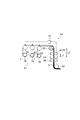
- FIG. 1 is a schematic diagram of an optical fiber manufacturing apparatus according to the first embodiment.
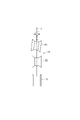
- FIG. 2 is a schematic diagram showing the configuration of the imaging device.
- FIG. 3 is a schematic diagram showing the configuration of the guide roller section.
- FIG. 4 is a schematic diagram showing the configuration of the guide roller section.
- FIG. 5 is a flow chart showing feedback control.
- FIG. 6 is a graph showing the relationship between the azimuth angle of the glass fiber and the position in the longitudinal direction.
- FIG. 7 is a graph showing the relationship between the amount of change in the azimuth angle of the optical fiber wound on the bobbin and L1/L2.
- FIG. 8 is a schematic diagram of an optical fiber ribbon manufacturing apparatus according to the second embodiment.
- FIG. 9 is a schematic diagram showing the configuration of a guide roller portion according to a modification.
- FIG. 10 is a top view of the third guide roller and the fourth guide roller.
- the present disclosure provides an optical fiber manufacturing method, an optical fiber, an optical fiber ribbon manufacturing method, an optical fiber ribbon, an optical fiber manufacturing apparatus, and an optical fiber ribbon capable of suppressing variations in azimuth angle around a central axis.
- the purpose is to provide a manufacturing apparatus for
- an optical fiber manufacturing method an optical fiber, an optical fiber ribbon manufacturing method, an optical fiber ribbon, an optical fiber manufacturing apparatus, and an optical A fiber ribbon manufacturing apparatus can be provided.
- a method for manufacturing an optical fiber according to an embodiment of the present disclosure is a method for manufacturing an optical fiber including a glass fiber, comprising heating and melting an optical fiber preform in a heating furnace to draw the glass fiber; obtaining a side view image of the fiber at an observation position; calculating a variable related to the azimuth angle around the central axis of the glass fiber based on the side view image; and imparting rotation.
- the azimuth angle about the central axis of the glass fiber is the angle between a straight line connecting the center of the cross section of the glass fiber and a specific point and a predetermined straight line passing through the center.
- the method for manufacturing an optical fiber further includes applying a coating resin to the surface of the glass fiber using a die, and the observation position is between the die and the optical fiber preform, and between the observation position and the die.
- the distance L1 and the distance L2 between the die and the center of the furnace may satisfy L1/L2 ⁇ 0.2. In this case, since the side surface of the glass fiber is observed in the position range where the amount of axis deviation of the glass fiber is the minimum, deterioration of observation accuracy can be suppressed.
- the variable may be a correlation coefficient between the luminance profile of the side observation image acquired at the first time and the luminance profile of the side observation image acquired at the second time after the lapse of a predetermined time from the first time. .
- the azimuth angle around the central axis of the glass fiber can be adjusted with high accuracy.
- the variables are the luminance value of the characteristic peak of the luminance profile of the side observation image acquired at the first time, and the characteristic peak of the luminance profile of the side observation image acquired at the second time after the lapse of a predetermined time from the first time. It may be a luminance value. In this case, the azimuth angle around the central axis of the glass fiber can be adjusted with high accuracy.
- the variable may be the azimuth angle calculated from the intensity profile of the side view image using regression analysis results based on multivariate analysis performed on the intensity profile of previously acquired training data.
- the azimuth angle around the central axis of the glass fiber can be adjusted with high accuracy.
- Giving rotation may include giving rotation to the glass fiber by a swinging guide roller. In this case, rotation can be easily imparted to the optical fiber with a simple configuration.
- the above optical fiber manufacturing method may further include winding the optical fiber around a bobbin so that the amount of azimuth angle variation is 180° or less over the entire length.
- the azimuth angle of the optical fiber wound on the bobbin means the distance between the straight line connecting the center of the cross section of the optical fiber and a specific point and the straight line passing through the center and parallel to the axis of the bobbin. is the angle between In this case, the optical fiber wound around the bobbin can be manufactured while the fluctuation of the azimuth angle around the central axis is suppressed.
- An optical fiber according to an embodiment of the present disclosure is an optical fiber that includes a glass fiber, and is wound on a bobbin so that the amount of azimuth angle variation around the central axis of the glass fiber is 180° or less over the entire length. .
- fluctuations in the azimuth angle around the central axis are suppressed.
- the optical fiber may be MCF. In this case, rotational misalignment of the cores is suppressed.
- the optical fiber may be a polarization maintaining optical fiber. In this case, rotational deviation of the principal axis of the refractive index is suppressed.
- a method for manufacturing an optical fiber ribbon is a method for manufacturing an optical fiber ribbon including a plurality of optical fibers arranged in parallel and a coating collectively covering the plurality of optical fibers, the method comprising: pulling out a plurality of optical fibers from the optical fiber, concentrating the plurality of optical fibers with a concentrating roller and arranging the plurality of optical fibers in parallel, obtaining a side observation image of the plurality of optical fibers at an observation position, and observing the side. Based on the images, calculating a variable related to an azimuth angle about the central axis of each of the plurality of optical fibers; and imparting a rotation to each of the plurality of optical fibers based on the variables.
- the method for manufacturing an optical fiber ribbon further includes applying the coating resin to the surfaces of the plurality of optical fibers collectively with a die, the observation position being closer to the feeding device than the die, and the observation position and the die
- a distance L1 between and a distance L2 between the die and the center of the concentrator roller may satisfy L1/L2 ⁇ 0.2.
- the payout device may include a plurality of bobbins around which a plurality of optical fibers are wound such that the amount of variation in azimuth angle around the central axis of each fiber is 180° or less over the entire length.
- the optical fiber having a plurality of optical fibers having the same azimuth angle around the central axis can be provided only by fine adjustment. Ribbons can be easily manufactured.
- An optical fiber ribbon includes a plurality of optical fibers arranged in parallel and a resin that collectively covers the plurality of optical fibers, and the azimuth angle around the central axis of each of the plurality of optical fibers The amount of variation is 180° or less over the entire length. In the above optical fiber ribbon, variations in azimuth angle around the central axis of the plurality of optical fibers are suppressed.
- the plurality of optical fibers are MCFs and may be arranged in parallel so that the center values of the orientations of the cores are aligned with each other. In this case, rotational misalignment of the cores is suppressed.
- the plurality of optical fibers are polarization-maintaining optical fibers, and may be arranged in parallel so that the central values of the orientations of the principal axes of the respective refractive indices match each other. In this case, rotational deviation of the principal axis of the refractive index is suppressed.
- An optical fiber manufacturing apparatus is an optical fiber manufacturing apparatus including a glass fiber, comprising: a heating furnace for heating and melting an optical fiber preform; an imaging device for obtaining a side observation image of the glass fiber obtained by the observation; a calculation unit for calculating a variable related to the azimuth angle around the central axis of the glass fiber based on the side observation image; and a rotation of the glass fiber based on the variable. and a rotation control unit that provides the rotation.
- An optical fiber ribbon manufacturing apparatus is an optical fiber ribbon manufacturing apparatus including a plurality of optical fibers arranged in parallel and a coating collectively covering the plurality of optical fibers, , an imaging device for acquiring side observation images of the plurality of optical fibers, and an azimuth angle around the central axis of each of the plurality of optical fibers based on the side observation images
- the optical fiber ribbon manufacturing apparatus described above can manufacture an optical fiber ribbon including a plurality of optical fibers having the same azimuth angle around the central axis.
- the imaging device includes a light source for irradiating light on the side surfaces of the plurality of optical fibers and a detection device for detecting transmitted light transmitted through the plurality of optical fibers.
- You may have a vessel and. In this case, a side observation image of the optical fiber can be obtained.
- FIG. 1 is a schematic diagram of an optical fiber manufacturing apparatus 10 according to the first embodiment.
- the optical fiber 1 according to the first embodiment includes, for example, a glass fiber 2 having a circular cross section and a refractive index changing portion provided inside the glass fiber 2, and a center axis C (see FIG. 6) It has a structure with a degree of freedom in the position of the refractive index changing portion in the surrounding orientation.
- Such optical fibers 1 include, for example, MCF and polarization-maintaining optical fibers.
- the glass fiber 2 may be non-circular in cross section instead of being axially symmetrical. MCF will be described below as an example.
- the optical fiber 1 has a coating (not shown) covering the outer surface of the glass fiber 2 .
- the glass fiber 2 has multiple cores 3 (see FIG. 2) and a clad 4 (see FIG. 2) surrounding the multiple cores 3.
- the core 3 and the clad 4 have different refractive indices, light refraction occurs between the core 3 and the clad 4 .
- Glass fiber 2 has four cores 3 .
- the side observation image of the glass fiber 2 changes according to the azimuth angle (rotation angle) ⁇ (see FIG. 6) around the central axis C of the glass fiber 2 due to light refraction at the refractive index changing portion in the glass fiber 2. do.
- the units of the azimuth angle ⁇ and the rotation angle are degrees.
- the manufacturing apparatus 10 for the optical fiber 1 manufactures the optical fiber 1 including the glass fiber 2 from the optical fiber preform 5 .
- the manufacturing apparatus 10 includes a heating furnace 11 , an imaging device 12 , a die 13 , an ultraviolet irradiation section 14 , a guide roller section 15 , a bobbin 16 and a calculation section 17 .
- the heating furnace 11 heats and melts the optical fiber preform 5 .
- a glass fiber 2 is drawn vertically downward from the lower end of the optical fiber preform 5 melted in the heating furnace 11 .
- the imaging device 12 acquires a side observation image of the glass fiber 2 at an observation position P closer to the optical fiber preform 5 than the die 13 .
- a distance L1 between the observation position P and the die 13 and a distance L2 between the die 13 and the center of the heating furnace 11 satisfy L1/L2 ⁇ 0.2. All of these distances are distances along the length direction of the glass fiber 2 .
- the center of the heating furnace 11 is the central position of the heating furnace 11 in the vertical direction.
- the observation position P may be downstream of the die 13 , that is, on the opposite side of the optical fiber preform 5 with respect to the die 13 . Also in this case, L1/L2 ⁇ 0.2 is satisfied.
- the imaging device 12 is communicably connected to the calculation unit 17 and transmits the side observation image to the calculation unit 17 .
- FIG. 2 is a schematic diagram showing the configuration of the imaging device 12.
- the imaging device 12 has a light source 21 and a detector 22 arranged to face each other with the glass fiber 2 interposed therebetween.
- the light source 21 irradiates the side surface of the glass fiber 2 with light.
- a detector 22 detects the transmitted light that has passed through the glass fiber 2 .
- Detector 22 includes, for example, an optical sensor (CCD array, camera, etc.).
- the imaging device 12 acquires a side observation image of the glass fiber 2 by detecting light emitted from the light source 21 of the irradiation device with the detector 22 .
- one polarizer is arranged between the glass fiber 2 and the light source 21, and another polarizer is arranged between the glass fiber 2 and the detector 22, so that a total of two polarizers are arranged in a mutually orthogonal relationship.
- a side observation image of the optical fiber may be acquired in a crossed Nicols state. In that case, since birefringence occurs in the glass fiber due to strain due to residual stress, the polarization state of light passing through the glass fiber changes. Therefore, the transmitted light that passes through the glass fiber passes between the orthogonal polarizers and can be detected with high accuracy by the detector, while the light that does not pass through the glass fiber cannot be detected much. As described above, a side observation image with clear contrast can be obtained by using crossed Nicols.
- the die 13 is a metal jig having a hole for passing the glass fiber 2 in the center.
- a die 13 is installed to apply a coating resin to the outer surface of the drawn glass fiber 2 .
- the coating resin is an ultraviolet curable resin.
- the vicinities of the dice 13 are places where positional fluctuations of the glass fiber 2 are small, and when lateral observation is performed by the imaging device 12, defocusing can be suppressed most effectively. Therefore, the observation position P by the imaging device 12 is provided in the immediate vicinity of the dice 13 .
- the ultraviolet irradiation unit 14 is arranged on the downstream side of the die 13 and irradiates the ultraviolet curing resin applied to the glass fiber 2 by the die 13 with ultraviolet rays.
- the UV curable resin is cured by being irradiated with UV rays and constitutes a coating that covers the outer surface of the glass fiber 2 . Thereby, an optical fiber 1 comprising a glass fiber 2 and a coating is formed.
- the guide roller section 15 is arranged between the ultraviolet irradiation section 14 and the bobbin 16 and guides the optical fiber 1 to the bobbin 16 .
- FIG. 1 omits and shows only one guide roller, the guide roller section 15 actually has two or more guide rollers.
- FIG. 3 and 4 are schematic diagrams showing the configuration of the guide roller portion 15.
- the guide roller portion 15 of the first embodiment includes a first guide roller 31 provided on the upstream side (the ultraviolet irradiation portion 14 side) and a second guide roller 32 provided on the downstream side (the bobbin 16 side). have.
- the guide roller portion 15 includes one swinging guide roller.
- the first guide roller 31 is a swing guide roller in the first embodiment, the second guide roller 32 may be a swing guide roller.
- the first guide roller 31 rotates (twists) the optical fiber 1 (glass fiber 2) around the central axis C by tilting the rotation axis direction of the first guide roller 31 with respect to the central axis C of the optical fiber 1.
- It is a rotation control unit for giving.
- the rotation control unit controls the azimuth angle ⁇ of the optical fiber 1 around the central axis C by performing a physical operation on the optical fiber 1 being drawn.
- the swing guide roller is an example of a rotation control section. In the manufacturing apparatus 10, rotation may be imparted to the optical fiber 1 by a configuration other than the swing guide roller.
- the first guide roller 31 vibrates (oscillates) alternately with respect to the central axis C of the optical fiber 1 .
- the first guide roller 31 alternately swings within a range of ⁇ formed by the central axis C of the optical fiber 1 and the plane perpendicular to the rotation axis direction of the first guide roller 31 .
- the direction of twist imparted to the optical fiber 1 is opposite between when the first guide roller 31 is tilted at a positive angle and when it is tilted at a negative angle. Therefore, clockwise and counterclockwise torques are alternately generated on the optical fiber 1 being drawn, and rotation (twist) is imparted to the optical fiber 1 .
- the first guide roller 31 is communicably connected to the calculator 17 and receives control signals from the calculator 17 .
- the first guide roller 31 is tilted based on the control signal received from the calculation unit 17 and imparts rotation to the optical fiber 1 .
- Japanese Unexamined Patent Application Publication No. 2002-200001 also discloses a method of imparting twist to a fiber by means of guide rollers.
- Patent Document 1 does not assume a feedback function.
- the bobbin 16 winds the optical fiber 1.
- the optical fiber 1 (glass fiber 2) is arranged such that the amount of variation in the azimuth angle ⁇ around the central axis C is 180° or less, preferably 120° or less, more preferably 90° or less, and still more preferably 60° or less over the entire length. is wound on the bobbin 16.
- the total length is at least 100 m or longer, preferably 1 km or longer, more preferably 5 km or longer, particularly preferably 10 km or longer.
- the calculation unit 17 is communicably connected to the imaging device 12 and the first guide roller 31 .
- the calculation unit 17 receives the side observation image from the imaging device 12 .
- the calculator 17 calculates a variable related to the azimuth angle ⁇ about the central axis C of the glass fiber 2 based on the obtained side observation image.
- the calculation unit 17 performs feedback control on the first guide roller 31 during drawing based on the calculation result.
- the calculator 17 transmits a control signal according to the calculation result to the first guide roller 31 .
- the calculation unit 17 extracts a brightness profile from the side observation image, and performs calculations such as correlation coefficients and multivariate analysis.
- the variables calculated by the calculation unit 17 are, for example, the luminance profile L 1i (i is a symbol representing a pixel of the sensor) of the side observation image acquired at the first time, and the second Correlation coefficient s 12 / (s 1 ⁇ s 2 ) with the luminance profile L 2i of the side observation image acquired at the time (s 1 is the standard deviation of L 1i , s 2 is the standard deviation of L 2i , s 12 is , the covariance of L 1i and L 2i ).
- the variables are, for example, the luminance value of the characteristic peak of the luminance profile of the side observation image acquired at the first time, and the characteristic of the luminance profile of the side observation image acquired at the second time after the lapse of a predetermined time from the first time. It may be a peak luminance value.
- a characteristic peak is a maximum value or a minimum value of a luminance profile, for example, a peak with a maximum luminance value.
- the calculation unit 17 may calculate regression analysis based on multivariate analysis of the brightness profile of learning data acquired in advance and the brightness profile of the lateral observation image acquired at a certain time.
- the variable is the azimuth angle ⁇ calculated from the intensity profile of the lateral view using regression analysis results based on multivariate analysis performed on intensity profiles of previously acquired training data.
- the calculation unit 17 includes, for example, a processor such as a CPU (Central Processing Unit), memories such as RAM (Random Access Memory) and ROM (Read Only Memory), input/output devices such as a touch panel, mouse, keyboard, and display, It may be configured as a computer system including a communication device such as a network card.
- the calculation unit 17 realizes the function of the calculation unit 17 by operating each piece of hardware under the control of the processor based on the computer program stored in the memory.
- the manufacturing method of the optical fiber 1 according to the first embodiment includes a drawing process, a coating process, an ultraviolet irradiation process, and a winding process.
- the optical fiber 1 including the glass fiber 2 is manufactured.
- the drawing step is a step of heating and melting the optical fiber preform 5 in the heating furnace 11 to draw the glass fiber 2 .
- the coating step is a step of coating the surface of the glass fiber 2 with the coating resin using the die 13 .
- the ultraviolet irradiation step is a step of irradiating the coating resin on the surface of the glass fiber 2 with ultraviolet rays by the ultraviolet irradiation unit 14 .
- the winding process is a process of winding the optical fiber 1 on the bobbin 16 .
- FIG. 5 is a flowchart showing feedback control.
- the method for manufacturing the optical fiber 1 in addition to the above steps, in order to feedback-control (feedback operation) the azimuth angle ⁇ around the central axis C of the optical fiber 1 during the drawing of the optical fiber 1, an obtaining step S1 and It includes a calculation step S2 and a rotation step S3.
- the acquisition step S1 is a step of acquiring a side observation image of the glass fiber 2 using the imaging device 12 .
- Acquisition step S1 is a light quantity measurement step of irradiating the glass fiber 2 with light from the light source 21 and detecting the transmitted light with the detector 22 to acquire a side observation image.
- the calculation step S2 is a step of calculating variables related to the azimuth angle ⁇ about the central axis C of the glass fiber 2 based on the side observation image by the calculation unit 17 .
- the calculation step S2 is a calculation step in which the calculation unit 17 extracts a luminance profile from the side observation image and performs calculation using the luminance profile.
- the rotation step S3 is a step of giving rotation around the central axis C to the glass fiber 2 by the first guide roller 31 .
- the first guide roller 31 feedback-controls the azimuth angle ⁇ of the glass fiber 2 around the central axis C based on a control signal according to the calculation result of the calculator 17 .
- the rotation step S3 imparts rotation to the glass fiber 2 based on a variable related to the azimuth angle ⁇ about the central axis C of the glass fiber 2 . For example, if the variable is the correlation coefficient mentioned above, a rotation is imparted to the glass fiber 2 so that the value of the correlation coefficient increases.
- the rotation step S3 is a processing step for performing rotational alignment of the optical fiber 1 by providing feedback to the manufacturing apparatus 10 during wire drawing based on the result of the calculation step.
- FIG. 6 is a graph showing the relationship between the azimuth angle ⁇ about the central axis C of the glass fiber and the position in the longitudinal direction.
- the vertical axis indicates the azimuth angle ⁇ of the glass fiber 2 .
- the clockwise azimuth angle ⁇ is indicated by a negative value
- the counterclockwise azimuth angle ⁇ is indicated by a positive value.
- the horizontal axis indicates the longitudinal position of the optical fiber 1 wound on the bobbin 16 .
- the optical fiber 1 is wound on the bobbin 16 by feedback control so that the fluctuation of the clockwise/counterclockwise azimuth angle ⁇ approaches zero over the entire length of the fiber. Therefore, fluctuations in the azimuth angle ⁇ about the central axis C of the optical fiber 1 are suppressed.
- the optical fiber 1 has a variation of 180° or less, preferably 120° or less, more preferably 90° or less, more preferably 90° or less over the entire length of the optical fiber 1 around the central axis C. It is wound on the bobbin 16 so as to be 60° or less.
- a side observation image is acquired at an observation position P closer to the optical fiber preform 5 than the die 13 is.
- a distance L1 between the observation position P and the die 13 and a distance L2 between the die 13 and the center of the heating furnace 11 satisfy L1/L2 ⁇ 0.2. Since the side surface of the glass fiber 2 is observed in the position range where the amount of axis deviation of the glass fiber 2 is the smallest, deterioration of observation accuracy can be suppressed.
- the variable calculated in the calculation step S2 is the correlation between the luminance profile of the side observation image acquired at the first time and the luminance profile of the side observation image acquired at the second time after the lapse of a predetermined time from the first time. It can be a number.
- the variables are the luminance value of the characteristic peak of the luminance profile of the side observation image acquired at the first time and the characteristic of the luminance profile of the side observation image acquired at the second time after the lapse of a predetermined time from the first time. It may be a peak luminance value.
- the calculation step S2 may also include calculating a regression analysis based on a multivariate analysis of the brightness profile of learning data acquired in advance and the brightness profile of the lateral observation image acquired at a certain time. In either case, the azimuth angle ⁇ around the central axis C of the glass fiber 2 can be adjusted with high accuracy.
- FIG. 7 is a graph showing the relationship between the amount of variation in the azimuth angle ⁇ of the optical fiber wound on the bobbin and L1/L2.
- the vertical axis represents the amount of variation in the azimuth angle ⁇ of the optical fiber wound on the bobbin.
- the horizontal axis indicates L1/L2.
- FIG. 7 shows the method of calculating the luminance value of the characteristic peak, the method of calculating the correlation function between luminance profiles, and the method of calculating regression analysis based on multivariate analysis in the calculation step S2.
- the result of examining the relationship between the amount of variation in the azimuth angle ⁇ of the optical fiber and L1/L2 is shown. In any method, it can be confirmed that the fluctuation amount is suppressed when L1/L2 ⁇ 0.2.
- the method of calculating the regression analysis based on multivariate analysis is the one that suppresses the amount of variation the most.
- the next way to reduce the amount of variation is the method of calculating the correlation coefficient between luminance profiles.
- rotation step S3 rotation is imparted to the glass fiber 2 by the first guide roller 31, which is a swinging guide roller. Therefore, it is possible to easily impart rotation to the optical fiber 1 with a simple configuration.
- the optical fiber 1 is wound around the bobbin so that the variation of the azimuth angle ⁇ is 180° or less, preferably 120° or less, more preferably 90° or less, and even more preferably 60° or less over the entire length. Therefore, the optical fiber 1 wound around the bobbin 16 can be manufactured in a state in which the fluctuation of the azimuth angle ⁇ about the central axis C is suppressed.
- the optical fiber 1 includes a glass fiber 2, and the amount of variation in the azimuth angle ⁇ around the central axis C of the glass fiber 2 is 180° or less, preferably 120° or less, more preferably 90° or less, and still more preferably 60° over the entire length. ° or less.
- the optical fiber 1 fluctuations in the azimuth angle ⁇ around the central axis C are suppressed.
- the optical fiber 1 is MCF, the rotational displacement of the multiple cores 3 is suppressed.
- the optical fiber 1 is a polarization-maintaining optical fiber, rotational deviation of the principal axis of the refractive index is suppressed.
- the manufacturing apparatus 10 obtains a variable related to the azimuth angle ⁇ of the glass fiber 2 around the central axis C while drawing, and gives rotation to the glass fiber 2 based on this variable. Therefore, fluctuations in the azimuth angle ⁇ around the central axis C of the optical fiber 1 can be suppressed.
- the imaging device 12 includes a light source 21 that irradiates the side surface of the glass fiber 2 with light, and a detector 22 that detects the transmitted light that has passed through the glass fiber 2 . Therefore, a side observation image of the glass fiber 2 can be obtained.
- FIG. 8 is a schematic diagram of an optical fiber ribbon manufacturing apparatus 50 according to the second embodiment.
- An optical fiber ribbon 6 according to the second embodiment includes a plurality of optical fibers 1 arranged in parallel.
- the optical fiber 1 is, for example, the optical fiber 1 according to the first embodiment.
- the optical fiber ribbon 6 has a coating (not shown) that collectively covers the plurality of optical fibers 1 . That is, the optical fiber ribbon 6 includes a coating that individually covers each optical fiber 1 and a coating that collectively covers a plurality of optical fibers 1 .
- a manufacturing apparatus 50 manufactures optical fiber ribbons 6 from a plurality of optical fibers 1 .
- the manufacturing apparatus 50 includes a feeding device 51 , a guide roller section 52 , a line concentrating roller 53 , an imaging device 54 , a die 55 , an ultraviolet irradiation section 56 , a guide roller 57 and a calculation section 58 .
- the amount of variation in the azimuth angle ⁇ around the central axis C of the optical fiber 1 is 180° or less, preferably 120° or less, more preferably 90° or less, and still more preferably 60° or less over the entire length.
- It includes a plurality of bobbins 16 wound in such a manner as to supply a plurality of optical fibers 1 . Although only three bobbins 16 are shown in FIG. 8 for simplicity, more bobbins 16 are actually provided.
- the guide roller part 52 is arranged between the delivery device 51 and the line collecting roller 53 and guides the plurality of optical fibers 1 to the line collecting roller 53 .
- the guide roller portion 52 has the same configuration as the guide roller portion 15 shown in FIG. That is, although only one guide roller is shown for one guide roller portion 52 in FIG. 8, each guide roller portion 52 actually has two or more guide rollers. ing.
- each guide roller portion 52 includes a first guide roller 31 provided on the upstream side (the feeding device 51 side) and a second guide roller 32 provided on the downstream side (the line concentrating roller 53 side). have.
- the first guide roller 31 is a swinging guide roller, and is a rotation control section that imparts rotation (twist) around the central axis C to each of the plurality of optical fibers 1 .
- the first guide roller 31 is communicably connected to the calculator 58 and receives control signals from the calculator 58 .
- the first guide roller 31 is tilted based on the control signal received from the calculator 58 and imparts rotation to the optical fiber 1 .
- the line concentrating roller 53 converges the plurality of optical fibers 1 and arranges the plurality of optical fibers 1 in parallel.
- the imaging device 54 is provided between the wire collecting roller 53 and the die 55 .
- the imaging device 54 has the same configuration as the imaging device 12 shown in FIG. That is, imaging device 54 has light source 21 and detector 22 .
- the imaging device 54 acquires a side observation image of the optical fiber 1 by detecting light emitted from the light source 21 of the irradiation device with the detector 22 .
- the imaging device 54 acquires side observation images of the plurality of optical fibers 1 at the observation position P on the feeding device 51 side of the dice 55 .
- a distance L1 between the observation position P and the die 55 and a distance L2 between the die 55 and the center of the condensing roller 53 satisfy L1/L2 ⁇ 0.2. All of these distances are distances along the length direction of the optical fiber 1 .
- the observation position P may be on the downstream side of the die 55 , that is, on the side opposite to the feeding device 51 with respect to the die 55 . Also in this case, L1/L2 ⁇ 0.2 is satisfied.
- the die 55 is a metal jig having a hole in the center for passing a plurality of optical fibers 1.
- the die 55 is installed to apply a coating resin to the outer surface of the optical fiber 1 pulled out from the bobbin 16 of the feeding device 51 .
- the coating resin is an ultraviolet curable resin.
- the vicinity of the die 55 is a portion where the amount of deviation of the central axis C of the optical fiber 1 is small, and when lateral observation is performed by the imaging device 54, defocusing can be suppressed most effectively. Therefore, the observation position P by the imaging device 54 is provided in the immediate vicinity of the dice 55 .
- the ultraviolet irradiation section 56 has the same configuration as the ultraviolet irradiation section 14 shown in FIG.
- the ultraviolet irradiation unit 56 irradiates the ultraviolet curing resin applied to the plurality of optical fibers 1 by the die 55 with ultraviolet rays.
- the UV curable resin is cured by being irradiated with UV rays, and constitutes a coating that collectively covers the plurality of optical fibers 1 .
- An optical fiber ribbon 6 comprising a plurality of optical fibers 1 and a coating is thereby formed.
- a guide roller 57 guides the optical fiber ribbon 6 to the next step.
- the calculation unit 58 has the same configuration as the calculation unit 17 shown in FIG.
- the calculator 58 is communicably connected to the imaging device 54 and the first guide roller 31 .
- the calculator 58 receives a plurality of side observation images from the imaging device 54 .
- the calculator 58 calculates a variable related to the azimuth angle ⁇ about the central axis C of each of the plurality of optical fibers 1 based on the obtained plurality of side observation images.
- the calculator 58 performs feedback control on the first guide roller 31 based on the calculation result.
- the calculator 58 transmits a control signal according to the calculation result to the first guide roller 31 .
- the amount of variation in the azimuth angle ⁇ around the central axis C of each optical fiber 1 is 180° or less, preferably 120° or less, more preferably 90° or less over the entire length. It is preferably 60° or less.
- the total length is at least 100 m or longer, preferably 1 km or longer, more preferably 5 km or longer, particularly preferably 10 km or longer.
- the cores 3 are arranged in parallel such that the center values of the orientations of the respective cores 3 match each other.
- the optical fiber ribbons 6 are arranged in parallel so that the central values of the orientations of the principal axes of the refractive indices of the optical fibers 1 are aligned with each other.
- a method for manufacturing the optical fiber ribbon 6 according to the second embodiment includes a drawing process, a coating process, and an ultraviolet irradiation process.
- the drawing process is a process of drawing out the plurality of optical fibers 1 supplied from the drawing device 51 .
- the application step is a step of applying the coating resin to the surfaces of the plurality of optical fibers 1 at once using the die 55 .
- the ultraviolet irradiation step is a step of irradiating the coating resin with ultraviolet rays by the ultraviolet irradiation unit 56 .
- the method for manufacturing the optical fiber ribbon 6 further includes an acquisition step S1 and a calculation step S2 in addition to the above steps in order to feedback-control (feedback operation) the azimuth angle ⁇ around the central axis C of the optical fiber 1. , and a rotation step S3.
- the acquisition step S ⁇ b>1 is a step of acquiring side observation images of the plurality of optical fibers 1 using the imaging device 54 .
- the calculation step S2 is a step of calculating a variable related to the azimuth angle ⁇ about the central axis C of each of the plurality of optical fibers 1 based on the side observation image by the calculation unit 58 .
- the rotation step S ⁇ b>3 is a step of applying rotation to each of the plurality of optical fibers 1 by the first guide rollers 31 .
- the method of manufacturing the optical fiber ribbon 6 a plurality of optical fibers 1 are pulled out from the feeding device 51, and while forming a tape, a variable related to the azimuth angle ⁇ of the optical fiber 1 around the central axis C is obtained. Rotation is imparted to the optical fiber 1 based on the variables. Therefore, fluctuations in the azimuth angle ⁇ about the central axis C can be suppressed. As a result, an optical fiber ribbon 6 having a plurality of optical fibers 1 with uniform azimuth angles ⁇ around the central axis C can be manufactured.
- side observation images of the plurality of optical fibers 1 are acquired at an observation position P on the feeding device 51 side of the die 55.
- a distance L1 between the observation position P and the die 55 and a distance L2 between the die 55 and the center of the condensing roller 53 satisfy L1/L2 ⁇ 0.2. Since the side surface of the optical fiber 1 is observed in the position range where the amount of axis deviation of the optical fiber 1 is the smallest, deterioration in observation accuracy can be suppressed.
- the amount of variation in the azimuth angle ⁇ around the central axis C of each of the plurality of optical fibers 1 is 180° or less, preferably 120° or less, more preferably 90° or less, and still more preferably 60° or less over the entire length. It includes a plurality of bobbins 18 wound so as to be Since the optical fiber 1 in which the fluctuation of the azimuth angle ⁇ about the central axis C is suppressed in this way is supplied from the feeding device 51, the rotational alignment at the time of forming the tape can be simplified. In other words, the optical fiber ribbon 6 having a plurality of optical fibers 1 having the same azimuth angle ⁇ around the central axis C can be easily manufactured simply by performing fine adjustment.
- the amount of variation in the azimuth angle ⁇ around the central axis C of each of the plurality of optical fibers 1 is 180° or less, preferably 120° or less, more preferably 90° or less, and still more preferably 60° or less over the entire length. is. Therefore, in the optical fiber ribbon 6, fluctuations in the azimuth angle ⁇ about the central axis C of each of the plurality of optical fibers 1 are suppressed.
- optical fiber ribbon 6 When a plurality of optical fibers 1 are MCFs and are arranged in parallel so that the center values of the orientations of the respective cores 3 match each other, in the optical fiber ribbon 6, the rotational deviation of the plurality of cores 3 is suppressed. ing.
- a plurality of optical fibers 1 are polarization-maintaining optical fibers and are arranged in parallel so that the central values of the orientations of the principal axes of the refractive indices of the optical fibers 1 coincide with each other, the optical fiber ribbon 6 rotates the principal axis of the refractive index. Displacement is suppressed.
- a plurality of optical fibers 1 are pulled out from a feeding device 51, and a variable relating to the azimuth angle ⁇ around the central axis C of the optical fiber 1 is obtained while forming a tape, and the optical fiber 1 is rotated based on this variable.
- a variable relating to the azimuth angle ⁇ around the central axis C of the optical fiber 1 is obtained while forming a tape, and the optical fiber 1 is rotated based on this variable.
- the imaging device 54 has a light source 21 that irradiates the side surfaces of the plurality of optical fibers 1 with light, and a detector 22 that detects the light transmitted through the plurality of optical fibers 1 . Therefore, a side observation image of the optical fiber 1 can be obtained.
- FIG. 9 is a schematic diagram showing the configuration of a guide roller portion 15A according to a modification.
- FIG. 10 is a top view of the third guide roller 35 and the fourth guide roller 36.
- the guide roller portion 15A according to the modification has a first guide roller 33, a second guide roller 34, a third guide roller 35, and a fourth guide roller .
- the first guide roller 33 is provided on the upstream side (the ultraviolet irradiation section 14 side).
- the second guide roller 34 is provided on the downstream side (bobbin 16 side).
- the third guide roller 35 and the fourth guide roller 36 are provided between the first guide roller 33 and the second guide roller 34 and face each other with the optical fiber 1 interposed therebetween.
- the third guide roller 35 is a swinging guide roller, and the angle ( (referred to as “first angle”) is within a range of ⁇ .
- the fourth guide roller 36 is a swinging guide roller, and the angle between the surface perpendicular to the rotation axis of the fourth guide roller 36 and the central axis C of the optical fiber 1 (referred to as "second angle") is ⁇ It oscillates in the range of The third guide roller 35 and the fourth guide roller 36 swing in phases opposite to each other. That is, while the third guide roller 35 changes the first angle from - ⁇ to ⁇ , the fourth guide roller 36 changes the second angle from ⁇ to - ⁇ . Thereby, clockwise and counterclockwise torques can be alternately applied to the optical fiber 1 .
- the third guide roller 35 and the fourth guide roller 36 function as a rotation control section that controls the azimuth angle ⁇ of the optical fiber 1 around the central axis C. As shown in FIG.
Landscapes
- Chemical & Material Sciences (AREA)
- Engineering & Computer Science (AREA)
- Physics & Mathematics (AREA)
- Life Sciences & Earth Sciences (AREA)
- Materials Engineering (AREA)
- Manufacturing & Machinery (AREA)
- General Life Sciences & Earth Sciences (AREA)
- Geochemistry & Mineralogy (AREA)
- Organic Chemistry (AREA)
- General Physics & Mathematics (AREA)
- Optics & Photonics (AREA)
- Analytical Chemistry (AREA)
- Chemical Kinetics & Catalysis (AREA)
- General Chemical & Material Sciences (AREA)
- Investigating Or Analysing Materials By Optical Means (AREA)
- Manufacture, Treatment Of Glass Fibers (AREA)
- Optical Fibers, Optical Fiber Cores, And Optical Fiber Bundles (AREA)
Priority Applications (8)
| Application Number | Priority Date | Filing Date | Title |
|---|---|---|---|
| JP2023525655A JPWO2022254986A1 (https=) | 2021-06-04 | 2022-04-19 | |
| US18/564,647 US20240254032A1 (en) | 2021-06-04 | 2022-04-19 | Optical fiber production method, optical fiber, optical fiber ribbon production method, optical fiber ribbon, optical fiber production device, and optical fiber ribbon production device |
| CN202280019200.4A CN116917244A (zh) | 2021-06-04 | 2022-04-19 | 光纤的制造方法、光纤、光纤带的制造方法、光纤带、光纤的制造装置以及光纤带的制造装置 |
| EP23791769.5A EP4512785A4 (en) | 2021-06-04 | 2023-04-12 | METHOD AND DEVICE FOR MEASURING POSITION OF REFRACTIVE INDEX VARIATION OF OPTICAL FIBER PREFORM AND OPTICAL FIBER |
| PCT/JP2023/014897 WO2023204121A1 (ja) | 2021-06-04 | 2023-04-12 | 光ファイバ母材および光ファイバの屈折率変化位置の測定方法および測定装置 |
| CN202380034552.1A CN119137078A (zh) | 2021-06-04 | 2023-04-12 | 光纤母材及光纤的折射率变化位置的测定方法及测定装置 |
| US18/855,123 US20250251303A1 (en) | 2021-06-04 | 2023-04-12 | Optical fiber preform and method of measuring and measurement device for refractive index change position of optical fiber |
| JP2024516220A JPWO2023204121A1 (https=) | 2021-06-04 | 2023-04-12 |
Applications Claiming Priority (2)
| Application Number | Priority Date | Filing Date | Title |
|---|---|---|---|
| JP2021094105 | 2021-06-04 | ||
| JP2021-094105 | 2021-06-04 |
Publications (1)
| Publication Number | Publication Date |
|---|---|
| WO2022254986A1 true WO2022254986A1 (ja) | 2022-12-08 |
Family
ID=84323110
Family Applications (2)
| Application Number | Title | Priority Date | Filing Date |
|---|---|---|---|
| PCT/JP2022/018193 Ceased WO2022254986A1 (ja) | 2021-06-04 | 2022-04-19 | 光ファイバの製造方法、光ファイバ、光ファイバリボンの製造方法、光ファイバリボン、光ファイバの製造装置、及び、光ファイバリボンの製造装置 |
| PCT/JP2023/014897 Ceased WO2023204121A1 (ja) | 2021-06-04 | 2023-04-12 | 光ファイバ母材および光ファイバの屈折率変化位置の測定方法および測定装置 |
Family Applications After (1)
| Application Number | Title | Priority Date | Filing Date |
|---|---|---|---|
| PCT/JP2023/014897 Ceased WO2023204121A1 (ja) | 2021-06-04 | 2023-04-12 | 光ファイバ母材および光ファイバの屈折率変化位置の測定方法および測定装置 |
Country Status (5)
| Country | Link |
|---|---|
| US (2) | US20240254032A1 (https=) |
| EP (1) | EP4512785A4 (https=) |
| JP (2) | JPWO2022254986A1 (https=) |
| CN (2) | CN116917244A (https=) |
| WO (2) | WO2022254986A1 (https=) |
Cited By (4)
| Publication number | Priority date | Publication date | Assignee | Title |
|---|---|---|---|---|
| JP2025004752A (ja) * | 2023-06-26 | 2025-01-15 | ヘレーウス クオーツ ノース アメリカ エルエルシー | 非対称ガラスファイバプリフォーム及びファイバ自体の改良された断層撮影屈折率プロファイル評価 |
| WO2025023257A1 (ja) * | 2023-07-25 | 2025-01-30 | 住友電気工業株式会社 | 光ファイバテープ心線および光ファイバテープ心線の製造方法 |
| WO2025023306A1 (ja) * | 2023-07-25 | 2025-01-30 | 住友電気工業株式会社 | 光ファイバテープ心線および光ファイバテープ心線の製造方法 |
| US12298580B2 (en) | 2023-02-21 | 2025-05-13 | Honeywell International Inc. | Techniques for azimuthally aligning a cross-section of an anti-resonant hollow core fiber when winding such fiber into a coil |
Citations (5)
| Publication number | Priority date | Publication date | Assignee | Title |
|---|---|---|---|---|
| JPS6414126A (en) * | 1987-07-06 | 1989-01-18 | Hitachi Cable | Optical fiber drawing device |
| JPH02196204A (ja) * | 1989-01-26 | 1990-08-02 | Fujikura Ltd | 定偏波光フアイバの軸合せ方法 |
| JPH08277139A (ja) * | 1995-04-03 | 1996-10-22 | Sumitomo Electric Ind Ltd | ガラス繊維の製造方法および製造装置 |
| WO2016047669A1 (ja) * | 2014-09-24 | 2016-03-31 | 古河電気工業株式会社 | 光ファイバおよび光ファイバの製造方法 |
| JP2020020998A (ja) * | 2018-08-02 | 2020-02-06 | 古河電気工業株式会社 | 融着接続システム、融着接続機及び光ファイバの回転角判定方法 |
Family Cites Families (14)
| Publication number | Priority date | Publication date | Assignee | Title |
|---|---|---|---|---|
| AU585728B2 (en) * | 1986-08-15 | 1989-06-22 | Sumitomo Electric Industries, Ltd. | Method and apparatus of measuring outer diameter and structure of optical fiber |
| JP3053509B2 (ja) * | 1992-08-27 | 2000-06-19 | 信越化学工業株式会社 | 光ファイバ母材の検査装置および検査方法 |
| US5408309A (en) * | 1992-08-27 | 1995-04-18 | Shin-Etsu Chemical Co., Ltd. | Apparatus and method for inspecting elliplicity and eccentricity of optical fiber preforms |
| JPH1020142A (ja) * | 1996-07-05 | 1998-01-23 | Furukawa Electric Co Ltd:The | 光ファイバの観測系およびその観測系を用いた光ファイバ観測方法および光ファイバの軸合わせ方法 |
| JP2000213912A (ja) | 1999-01-25 | 2000-08-04 | Mitsubishi Cable Ind Ltd | 光ファイバ母材のコア部偏心量測定装置 |
| JP2001004486A (ja) * | 1999-06-23 | 2001-01-12 | Fujikura Ltd | 光ファイバ母材の検査方法と連続検査装置 |
| JP4234280B2 (ja) * | 1999-09-30 | 2009-03-04 | 古河電気工業株式会社 | 透光性物体の延伸方法及び延伸装置 |
| KR100350458B1 (ko) * | 2001-01-16 | 2002-08-29 | 삼성전자 주식회사 | 광섬유 잔여 응력 및 포토일래스틱 효과를 측정하기 위한장치 및 그 방법 |
| CN1289422C (zh) * | 2001-11-20 | 2006-12-13 | 王胜国 | 光纤抽丝过程中鲁棒直径控制的光纤 |
| CN102889862A (zh) * | 2012-10-09 | 2013-01-23 | 中天科技精密材料有限公司 | 一种大直径光纤预制棒偏心率测试设备及其测试方法 |
| JP6036386B2 (ja) | 2013-02-20 | 2016-11-30 | 住友電気工業株式会社 | マルチコア光ファイバ母材製造方法 |
| JP2020125961A (ja) * | 2019-02-04 | 2020-08-20 | 日東電工株式会社 | プラスチック光ファイバのコア径計測方法およびそれに用いるプラスチック光ファイバのコア径計測装置 |
| CN210089976U (zh) * | 2019-03-29 | 2020-02-18 | 北京交通大学 | 基于qpm和bkc技术的光纤折射率与内应力测量装置 |
| JP7216042B2 (ja) | 2020-03-27 | 2023-01-31 | Kddi株式会社 | 光ファイバの屈折率分布の測定装置及び当該測定装置の処理装置 |
-
2022
- 2022-04-19 JP JP2023525655A patent/JPWO2022254986A1/ja active Pending
- 2022-04-19 WO PCT/JP2022/018193 patent/WO2022254986A1/ja not_active Ceased
- 2022-04-19 CN CN202280019200.4A patent/CN116917244A/zh active Pending
- 2022-04-19 US US18/564,647 patent/US20240254032A1/en active Pending
-
2023
- 2023-04-12 CN CN202380034552.1A patent/CN119137078A/zh active Pending
- 2023-04-12 JP JP2024516220A patent/JPWO2023204121A1/ja active Pending
- 2023-04-12 WO PCT/JP2023/014897 patent/WO2023204121A1/ja not_active Ceased
- 2023-04-12 US US18/855,123 patent/US20250251303A1/en active Pending
- 2023-04-12 EP EP23791769.5A patent/EP4512785A4/en active Pending
Patent Citations (5)
| Publication number | Priority date | Publication date | Assignee | Title |
|---|---|---|---|---|
| JPS6414126A (en) * | 1987-07-06 | 1989-01-18 | Hitachi Cable | Optical fiber drawing device |
| JPH02196204A (ja) * | 1989-01-26 | 1990-08-02 | Fujikura Ltd | 定偏波光フアイバの軸合せ方法 |
| JPH08277139A (ja) * | 1995-04-03 | 1996-10-22 | Sumitomo Electric Ind Ltd | ガラス繊維の製造方法および製造装置 |
| WO2016047669A1 (ja) * | 2014-09-24 | 2016-03-31 | 古河電気工業株式会社 | 光ファイバおよび光ファイバの製造方法 |
| JP2020020998A (ja) * | 2018-08-02 | 2020-02-06 | 古河電気工業株式会社 | 融着接続システム、融着接続機及び光ファイバの回転角判定方法 |
Cited By (6)
| Publication number | Priority date | Publication date | Assignee | Title |
|---|---|---|---|---|
| US12298580B2 (en) | 2023-02-21 | 2025-05-13 | Honeywell International Inc. | Techniques for azimuthally aligning a cross-section of an anti-resonant hollow core fiber when winding such fiber into a coil |
| JP2025004752A (ja) * | 2023-06-26 | 2025-01-15 | ヘレーウス クオーツ ノース アメリカ エルエルシー | 非対称ガラスファイバプリフォーム及びファイバ自体の改良された断層撮影屈折率プロファイル評価 |
| JP7710568B2 (ja) | 2023-06-26 | 2025-07-18 | ヘレーウス クオーツ ノース アメリカ エルエルシー | 非対称ガラスファイバプリフォーム及びファイバ自体の改良された断層撮影屈折率プロファイル評価 |
| US12422359B2 (en) | 2023-06-26 | 2025-09-23 | Heraeus Quartz North America Llc | Tomographic refractive index profile evaluation of non-symmetrical glass fiber preforms and fibers themselves |
| WO2025023257A1 (ja) * | 2023-07-25 | 2025-01-30 | 住友電気工業株式会社 | 光ファイバテープ心線および光ファイバテープ心線の製造方法 |
| WO2025023306A1 (ja) * | 2023-07-25 | 2025-01-30 | 住友電気工業株式会社 | 光ファイバテープ心線および光ファイバテープ心線の製造方法 |
Also Published As
| Publication number | Publication date |
|---|---|
| WO2023204121A1 (ja) | 2023-10-26 |
| EP4512785A1 (en) | 2025-02-26 |
| US20240254032A1 (en) | 2024-08-01 |
| JPWO2022254986A1 (https=) | 2022-12-08 |
| CN116917244A (zh) | 2023-10-20 |
| CN119137078A (zh) | 2024-12-13 |
| JPWO2023204121A1 (https=) | 2023-10-26 |
| US20250251303A1 (en) | 2025-08-07 |
| EP4512785A4 (en) | 2025-08-20 |
Similar Documents
| Publication | Publication Date | Title |
|---|---|---|
| WO2022254986A1 (ja) | 光ファイバの製造方法、光ファイバ、光ファイバリボンの製造方法、光ファイバリボン、光ファイバの製造装置、及び、光ファイバリボンの製造装置 | |
| CN102187256B (zh) | 光纤的制造方法及制造装置 | |
| DE69327823T2 (de) | Verfahren zum Ziehen einer optischen Faser und die so hergestellte Faser | |
| CN103592722B (zh) | 一种熊猫型保偏光纤侧视对轴装置及方法 | |
| US9958604B2 (en) | Optical fiber, and optical-fiber production method | |
| JPWO2022254986A5 (https=) | ||
| CN101259986B (zh) | 光纤的制造方法 | |
| JP2003192374A (ja) | 低偏光モード分散のための装置 | |
| US8282291B2 (en) | Automatic alignment for splicing of non-circular fiber | |
| US7016576B2 (en) | Method for producing an optical fibre telecommunications cable with reduced polarization mode dispersion | |
| JP2012027392A (ja) | 光ファイバテープ心線の製造方法および製造装置 | |
| CN107346046A (zh) | 具有侧面识别标记的非圆对称光纤 | |
| JP3777627B2 (ja) | ガラス繊維の製造方法および製造装置 | |
| CN114315125A (zh) | 一种无扭保偏光纤的制备工艺 | |
| JP7778248B2 (ja) | マルチコア光ファイバの調心装置、マルチコア光ファイバリボンの製造装置、マルチコア光ファイバユニットの製造装置、マルチコア光ファイバの調心方法、マルチコア光ファイバリボンの製造方法、マルチコア光ファイバユニットの製造方法、マルチコア光ファイバリボンの検査装置、及びマルチコア光ファイバリボンの検査方法 | |
| JPWO2024095531A5 (https=) | ||
| US20040050115A1 (en) | Optical fiber drawing apparatus for decreasing an optical fiber break and impressing a spin to an optical fiber | |
| JP5212331B2 (ja) | 光ファイバの製造方法および製造装置 | |
| JP2004175611A (ja) | 光ファイバの製造方法及び製造装置 | |
| US20140328565A1 (en) | Multimode optical fiber and method of manufacturing the same | |
| JP4495029B2 (ja) | 被覆光ファイバの製造方法 | |
| US20250314817A1 (en) | Optical fibers with non-circular coating | |
| JP4234280B2 (ja) | 透光性物体の延伸方法及び延伸装置 | |
| CN111458820A (zh) | 一种松套管内光纤余长调整系统及方法 | |
| JP2005195399A (ja) | 偏波面保持光ファイバの偏波面光学主軸決定方法及び光ファイバ融着接続装置 |
Legal Events
| Date | Code | Title | Description |
|---|---|---|---|
| 121 | Ep: the epo has been informed by wipo that ep was designated in this application |
Ref document number: 22815742 Country of ref document: EP Kind code of ref document: A1 |
|
| WWE | Wipo information: entry into national phase |
Ref document number: 202280019200.4 Country of ref document: CN Ref document number: 2023525655 Country of ref document: JP |
|
| WWE | Wipo information: entry into national phase |
Ref document number: 18564647 Country of ref document: US |
|
| NENP | Non-entry into the national phase |
Ref country code: DE |
|
| 122 | Ep: pct application non-entry in european phase |
Ref document number: 22815742 Country of ref document: EP Kind code of ref document: A1 |