WO2022249906A1 - チーズ様食品 - Google Patents
チーズ様食品 Download PDFInfo
- Publication number
- WO2022249906A1 WO2022249906A1 PCT/JP2022/020280 JP2022020280W WO2022249906A1 WO 2022249906 A1 WO2022249906 A1 WO 2022249906A1 JP 2022020280 W JP2022020280 W JP 2022020280W WO 2022249906 A1 WO2022249906 A1 WO 2022249906A1
- Authority
- WO
- WIPO (PCT)
- Prior art keywords
- cheese
- food
- starch
- mass
- texture
- Prior art date
- Legal status (The legal status is an assumption and is not a legal conclusion. Google has not performed a legal analysis and makes no representation as to the accuracy of the status listed.)
- Ceased
Links
Images


Classifications
-
- A—HUMAN NECESSITIES
- A23—FOODS OR FOODSTUFFS; TREATMENT THEREOF, NOT COVERED BY OTHER CLASSES
- A23C—DAIRY PRODUCTS, e.g. MILK, BUTTER OR CHEESE; MILK OR CHEESE SUBSTITUTES; PREPARATION THEREOF
- A23C19/00—Cheese; Cheese preparations; Making thereof
- A23C19/06—Treating cheese curd after whey separation; Products obtained thereby
- A23C19/09—Other cheese preparations; Mixtures of cheese with other foodstuffs
- A23C19/093—Addition of non-milk fats or non-milk proteins
-
- A—HUMAN NECESSITIES
- A23—FOODS OR FOODSTUFFS; TREATMENT THEREOF, NOT COVERED BY OTHER CLASSES
- A23C—DAIRY PRODUCTS, e.g. MILK, BUTTER OR CHEESE; MILK OR CHEESE SUBSTITUTES; PREPARATION THEREOF
- A23C20/00—Cheese substitutes
-
- A—HUMAN NECESSITIES
- A23—FOODS OR FOODSTUFFS; TREATMENT THEREOF, NOT COVERED BY OTHER CLASSES
- A23L—FOODS, FOODSTUFFS OR NON-ALCOHOLIC BEVERAGES, NOT OTHERWISE PROVIDED FOR; PREPARATION OR TREATMENT THEREOF
- A23L29/00—Foods or foodstuffs containing additives; Preparation or treatment thereof
- A23L29/20—Foods or foodstuffs containing additives; Preparation or treatment thereof containing gelling or thickening agents
- A23L29/206—Foods or foodstuffs containing additives; Preparation or treatment thereof containing gelling or thickening agents of vegetable origin
- A23L29/212—Starch; Modified starch; Starch derivatives, e.g. esters or ethers
Definitions
- the present invention provides a cheese-like food, an agent for improving the spread of cheese using the same, a method for improving the spread of cheese, an agent for imparting a cheese-like texture, a method for imparting a cheese-like texture to a food, and a cheese-like food. It relates to food etc. with a feeling.
- Cheese is a type of food (dairy product) made from milk obtained from cows, buffaloes, sheep, goats, yaks, etc., and processed through coagulation and fermentation. It is often used in combination with For example, cheese that melts by heating and has a stringy elongation is used in various dishes such as pizza, pasta, gratin, risotto, and cheese fondue. Such cheese for cooking with heat has a property that it stretches supplely immediately after being heated, but becomes hard when the temperature is lowered. Foods such as lunch boxes and side dishes for take-out provided at retail stores such as convenience stores are warmed at the store, but the temperature drops when eaten. Therefore, when cheese is used in such foods, the cheese-like spreadability and mouthfeel are lost when eaten.
- Patent Document 1 describes that a cheese-like food having a flavor and texture similar to cheese can be obtained by heating and mixing acetylated starch or hydroxypropylated starch with raw cheeses and fats and oils and then cooling. ing.
- starch materials such as acetylated starch and hydroxypropylated starch tend to develop a gel-like texture when the temperature is lowered, which affects melting in the mouth, making it difficult to obtain a cheese-like texture. I have a problem. Under these circumstances, it is desirable to be able to provide a cheese-like food that has cheese-like spreadability and texture even after the temperature is lowered.
- the present invention provides the following cheese-like food, cheese spread improving agent, method for improving cheese spread, cheese-like texture imparting agent, method for imparting cheese-like texture to food, and cheese-like texture imparting It relates to starch compositions and the like.
- (a) One or more selected from the group consisting of raw potato starch and modified starch of the raw potato starch, and a polyglycerin fatty acid ester are heat-treated under a pressure condition of 0 MPa or more and less than 100 MPa.
- a cheese-like food comprising a food-grade starch composition, said food-grade starch composition comprising a starch-lipid complex, and (b) water.
- a method for improving the elongation of cheese comprising adding the cheese elongation improving agent according to [9] in a quantity ratio of 5 parts by mass or more and 4000 parts by mass or less with respect to 100 parts by mass of cheese. .
- a cheese-like texture-imparting agent comprising the cheese-like food according to any one of [1] to [8].
- Cheese-like food to food comprising adding the cheese-like texture imparting agent according to [11] in an amount ratio of 5 parts by mass or more and 4000 parts by mass or less with respect to 100 parts by mass of food How to give a feeling.
- a starch composition for imparting a cheese-like texture to foods containing water to impart a cheese-like texture (a) Food starch obtained by heat-treating one or more selected from the group consisting of raw potato starch and modified starch of the raw potato starch, and polyglycerin fatty acid ester under pressure conditions of 0 MPa or more and less than 100 MPa.
- a starch composition that imparts a cheese-like texture comprising said food starch composition comprising a starch-lipid complex.
- a method for imparting a cheese-like texture to a food which comprises adding the starch composition for imparting a cheese-like texture according to [13] to a moisture-containing food.
- a food having a cheese-like texture comprising the cheese-like texture imparting agent according to [11] or the starch composition imparting cheese-like texture according to [13].
- the cheese-like food of the present invention has a cheese-like stretch and texture not only immediately after heating but also after the temperature is lowered. It can give a different texture.
- the cheese-like food of the present invention can also be used in combination with cheese. By blending the cheese-like food of the present invention with cheese, the spreadability of the cheese in the food can be improved. Moreover, according to a preferred embodiment of the present invention, it is possible to provide a cheese-like food excellent in shape retention while maintaining a natural cheese-like texture and melting in the mouth even after the temperature is lowered.
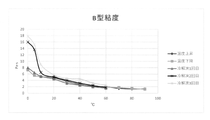
- the change in viscosity characteristics when the slurry containing the food starch composition of Production Example 1-2 (food starch composition: edible oil: water 1: 2: 7) was subjected to three cold-thaw cycles It is a graph showing.
- the cheese-like food of the present invention comprises: (a) one or more selected from the group consisting of raw potato starch and modified starch of the raw potato starch; (b) water.
- the cheese-like food of the present invention can achieve cheese-like spreadability and texture not only at high temperatures immediately after heating but also at low temperatures after cooling. .
- high temperature means over 50° C.
- low temperature means 1° C. or more and 50° C. or less.
- the term "cheese-like food” refers to a food having properties similar to cheese, produced without using cheese as a raw material or with a reduced cheese content. Properties similar to those of cheese include, for example, spreadability, texture, flavor and body, and it is preferable to have one or more of these properties.
- the food starch composition used in the present invention contains at least one selected from the group consisting of raw potato starch and modified starch of the raw potato starch, and polyglycerol fatty acid ester at a pressure of 0 MPa or more.
- pressure means gauge pressure.
- starch-lipid complex means a complex formed by the interaction of at least one selected from the group consisting of raw potato starch and modified starch of the raw potato starch with a polyglycerin fatty acid ester.
- a polyglycerin fatty acid ester means Although it is not easy to specifically specify its structure and there are many parts that have not yet been elucidated, for example, one or more starches selected from the group consisting of raw potato starch and modified starch of the raw potato starch It is thought that polyglycerol fatty acid esters are included in the helical structure of amylose molecules. Alternatively, polyglycerin fatty acid ester may be attached to the surface of the helical structure of the amylose molecule.
- polyglycerol fatty acid ester may interact with a portion other than the amylose molecule.
- the starch may be low-molecular-weight by cutting the starch chains, or may be high-molecular-weight by polymerizing the starch chains, or may contain both.
- the starch-lipid complex should be formed at least partially.
- Other ingredients in the food starch composition are ingredients derived from raw materials including one or more selected from the group consisting of raw potato starch and modified starch of the raw potato starch, and polyglycerin fatty acid ester.
- the modified raw potato starch is preferably a modified raw potato starch obtained by subjecting the raw potato starch to one or more chemical treatments selected from the group consisting of cross-linking, etherification and esterification.
- the chemical treatment include: crosslinking such as phosphoric acid crosslinking and adipic acid crosslinking; etherification such as hydroxypropylation; monoesterification such as acetylation and phosphoric acid monoesterification; mentioned.
- the modified starch is preferably phosphate-crosslinked potato starch or etherified phosphate-crosslinked potato starch, and particularly preferably phosphate-crosslinked potato starch.
- Fatty acids constituting the polyglycerol fatty acid ester are not particularly limited, but are preferably one or more selected from myristic acid, palmitic acid, stearic acid, oleic acid and behenic acid, and palmitic acid and stearic acid. More preferably, one or two selected from the group consisting of
- the polyglycerol fatty acid ester preferably has an HLB value of 1 or more and 13 or less and an average degree of polymerization of 2 or more and 9 or less.
- the HLB value is more preferably 1 or more and 11 or less, more preferably 3 or more and 10 or less
- the average degree of polymerization is more preferably 2 or more and 7 or less, and 2 or more and 5 or less. is more preferred.
- the average degree of polymerization of polyglycerol is calculated from the hydroxyl value, or by gas chromatography, liquid chromatography, thin layer chromatography, gas chromatograph mass spectrometry, liquid chromatograph mass spectrometry, or the like. It is measured by a method of determining the composition of polyglycerin and calculating the average degree of polymerization.
- the mass ratio of the polyglycerin fatty acid ester to 100 parts by mass of the raw material starch of at least one kind selected from the group consisting of the raw potato starch and the modified starch of the raw potato starch is not particularly limited, but is 0.01 part by mass or more4. It is preferably 8 parts by mass or less, more preferably 0.1 to 4.5 parts by mass, and even more preferably 1.0 to 4.0 parts by mass. In this specification, when a numerical range is indicated, the upper limit value and the lower limit value can be appropriately combined, and the numerical range obtained thereby is also disclosed.
- the food starch composition is, for example, a raw material mixture consisting of one or more selected from the group consisting of raw potato starch and modified starch of the raw potato starch and a polyglycerol fatty acid ester using an extruder or a drum dryer. It is obtained by adding water to and heat-treating.
- Heat treatment using an extruder For example, when heat treatment is performed using an extruder, water is added to a raw material mixture consisting of one or more selected from the group consisting of raw potato starch and modified starch of the raw potato starch, and polyglycerin fatty acid ester, After adjusting the water content to about 10% by mass or more and 60% by mass or less based on the mass of the composition containing the raw material mixture and water, for example, the barrel temperature is 30°C or more and 200°C or less, and the outlet temperature is 80°C or more and 180°C or less.
- the target food starch composition can be obtained by heating and expanding the raw material mixture under the conditions of a screw rotation speed of 100 rpm to 1000 rpm and a heat treatment time of 5 seconds to 60 seconds.
- the temperature conditions are more preferably a barrel temperature of 30° C. or higher and 170° C. or lower and an outlet temperature of 100° C. or higher and 160° C. or lower, and a barrel temperature of 30° C. or higher and 140° C. or lower and an outlet temperature of 110° C. or higher and 145° C. or lower. is more preferred.
- the water content is more preferably adjusted to 15% by mass or more and 40% by mass or less, more preferably 20% by mass or more and 30% by mass or less, based on the mass of the composition containing the raw material mixture and water. is more preferred.
- the screw rotation speed is more preferably 150 rpm or more and 900 rpm or less, and further preferably 200 rpm or more and 850 rpm or less.
- the pressure condition is preferably 0.5 MPa or more and less than 100 MPa, more preferably 0.5 MPa or more and 80 MPa or less, further preferably 0.5 MPa or more and 50 MPa or less, particularly preferably 0.5 MPa or more and 30 MPa or less, and 0.5 MPa or more and 20 MPa or less.
- the heat treatment time is more preferably 7 seconds or more and 50 seconds or less, and still more preferably 10 seconds or more and 45 seconds or less.
- Heat treatment using a drum dryer water is added to a raw material mixture composed of one or more selected from the group consisting of raw potato starch and modified starch of the raw potato starch, and a polyglycerin fatty acid ester to obtain the raw material mixture.
- a slurry having a concentration of 20% w/w or more and 45% w/w or less (heavy Baume degree of about 10 or more and 22 or less) is prepared, and this slurry is passed through an onator under a pressure condition of 0 MPa or more and 0.5 MPa or less, It is preferable to heat the outlet temperature to about 90° C. or higher and 140° C.
- the outlet temperature is more preferably 95° C. or higher and 140° C. or lower, more preferably 100° C. or higher and 130° C. or lower, and the temperature of the drum dryer is 110° C. or higher and 190° C. or lower. is more preferably 120° C. or higher and 180° C. or lower.
- the concentration of the raw material mixture in the slurry is more preferably in the range of 22% w / w concentration or more and 40% w / w concentration or less (heavy Baume degree of about 10.5 or more and 20 or less), 24% w It is more preferable that the concentration is in a range of from 11 to 19, inclusive.
- the pressure condition is more preferably 0.05 MPa or more and 0.48 MPa or less, and further preferably 0.07 MPa or more and 0.45 MPa or less.
- water is added to a raw material mixture containing one or more selected from the group consisting of raw potato starch and modified starch of the raw potato starch, and polyglycerol fatty acid ester, and the water content is adjusted to that of the raw material mixture.
- gelatinizing by heating under atmospheric pressure, and drying to obtain the desired starch composition for food. good too.
- the temperature for heat gelatinization is preferably 90° C. or higher and 100° C. or lower, more preferably 95° C. or higher and 100° C. or lower, and even more preferably 100° C. (boiling state).
- drying means for example, a drum dryer, a hot plate, or the like can be used.
- the target food starch composition can be obtained by heat-treating the raw material mixture, preferably in the presence of water.
- high-pressure treatment is not necessary when any heat treatment method is used, and is less than 100 MPa, preferably 80 MPa or less, more preferably 50 MPa or less, still more preferably 30 MPa or less, particularly preferably 20 MPa or less, for example, 18 MPa.
- the target food starch composition can be obtained under pressure conditions of 15 MPa or less.
- the food starch composition has the following characteristic properties.
- the food starch composition is prepared by mixing twice the amount of edible oil and 7 times the amount of water in this order on a mass basis with respect to the food starch composition at 20 ° C., and slurry without heating. can be formed.
- the slurry is in a completely emulsified state without separation of the water phase and the oil phase.
- the edible oil is not particularly limited as long as it is used for food.
- Vegetable oils and fats such as oil; animal oils and fats such as fish oil, lard, beef tallow, and milk fat; medium-chain fatty acid triglycerides; One or two or more selected from the group consisting of processed oils and fats can be mentioned.
- the edible oil is one selected from the group consisting of soybean oil, rapeseed oil, corn oil, cottonseed oil, rice oil, sunflower oil, safflower oil, sesame oil, olive oil, linseed oil, perilla oil and coconut oil.
- soybean oil, rapeseed oil, corn oil, sunflower oil, olive oil and coconut oil are more preferred, and one or more selected from the group consisting of rapeseed oil, olive oil and coconut oil are particularly preferred.
- the food starch composition may be any one that exhibits the viscosity characteristics described above when using one or more of the above edible oils and fats.
- the slurry has rice cake-like viscoelasticity as one of its characteristic properties.
- the term "rice cake-like viscoelasticity” means that when a portion of the slurry is scooped up, it exhibits a rice cake-like physical property that stretches continuously due to its own viscoelasticity.
- the slurry can take the form of a viscous fluid under certain conditions.
- the starch composition for food can be blended with water or with edible oil and water to impart good meltability in the mouth and a rich and smooth texture.
- the slurry has a B-type viscosity (Pa s) value of 2 Pa s measured under the conditions of 30 rotations for 30 seconds (that is, 30 seconds at 30 rpm) in an unheated state (about 20 ° C.). s or more and 100 Pa s or less, and the B-type viscosity (Pa s) value measured under the conditions of 30 rotations and 30 seconds after cooling or heating the slurry is the following conditions: "The value of the B-type viscosity at 0°C is 2 to 30 times, preferably 2 to 20 times the value of the B-type viscosity at 90°C.” is preferably satisfied.
- the B-type viscosity of the slurry has a characteristic property that the viscosity is lower at high temperatures and higher at low temperatures depending on the temperature. is preferred, and due to this feature, it is easy to handle at high temperatures by blending with water or with edible fats and water, while at low temperatures it gives an elastic and chewy cheese-like texture. be able to. In addition, when eaten, it is warmed in the mouth and melts well in the mouth, giving you a rich and rich taste.
- the B-type viscosity (Pa s) value of the slurry in an unheated state is preferably 2.5 Pa s or more and 100 Pa s or less, and more preferably 2.5 Pa s or more and 95 Pa s or less. It is preferably 2.5 Pa ⁇ s or more and 85 Pa ⁇ s or less.
- the B-type viscosity of the slurry at 0°C is preferably 2 to 18 times, more preferably 2 to 15 times, the B-type viscosity of the slurry at 90°C.
- the value of the B-type viscosity (Pa s) of the slurry at 0 ° C. is preferably 5 Pa s or more and 300 Pa s or less, more preferably 5 Pa s or more and 250 Pa s or less, and 5 Pa s. s or more and 200 Pa ⁇ s or less is more preferable.
- the value of the B-type viscosity of the slurry at 0 ° C. is in the above range, it is possible to impart a cheese-like texture with moderate elasticity even at low temperatures, and the melting in the mouth is smooth when eaten. So, you can feel the rich richness more.
- the slurry preferably has cold-thaw cycle resistance.
- a cold-thaw cycle under the following conditions: "(Conditions of the cooling and thawing cycle)
- the slurry prepared at room temperature is cooled to -10°C at a cooling rate of -1°C/min, maintained in that state for 15 hours or longer, and then heated at a rate of 45°C/min to reach 60°C. After that, it is cooled again to -10°C at a cooling rate of -1°C/min, and this state is maintained for 15 hours or longer.
- the slurry after the first time is heated at a temperature rising rate of 45 ° C./min until it reaches 60 ° C., and then cooled again to -10 ° C. at a cooling rate of -1 ° C./min. Hold for 15 hours or longer.
- the difference from the value of viscosity (Pa ⁇ s) is within 10.0 Pa ⁇ s. This difference is more preferably within 8 Pa ⁇ s, further preferably within 5 Pa ⁇ s.
- the viscosity characteristics of the slurry do not change significantly in the eating temperature range of 20°C to 60°C even if the cooling and thawing cycle is repeated three times under the above conditions. It is possible to ensure the stability of product quality against expected temperature changes.
- the B-type viscosity of the slurry is measured by a B-type viscometer No. It is a value measured at 30 rotations for 30 seconds using 4 rotors (i.e., 30 seconds at 30 rpm).
- the container is covered with plastic wrap to prevent moisture from evaporating, and measurement is performed immediately after reaching a predetermined temperature. may occur.
- the value of the B-type viscosity when the temperature reaches 0° C. or 90° C. for the first time after preparing the slurry satisfies the above conditions.
- the physical properties of the slurry obtained by mixing the starch composition for food with edible oil and water at a predetermined ratio are described.
- the mixing ratio of edible oil and water to the food starch composition is not limited to the above.
- these physical properties are largely due to the properties of the food starch composition, and the case where only water is mixed with the food starch composition is similarly different from the case where water is mixed with a commonly used starch material. can exhibit different properties.
- the content of the food starch composition of component (a) is preferably 0.1% by mass or more and 40% by mass or less based on the total amount of the cheese-like food, more preferably 0.3% by mass or more and 35% by mass or less, more preferably 0.5% by mass or more and 30% by mass or less, and particularly preferably 0.8% by mass or more and 25% by mass or less.
- the water used in the present invention is not particularly limited as long as it is used for food, and includes natural water and tap water.
- Animal milks such as cow's milk; vegetable milks such as soy milk and almond milk; water-containing liquids such as vegetable juices such as fruit juices and vegetable juices may also be used.
- the content of water in component (b) is preferably 1 to 30 times the mass of component (a), more preferably 1 to 28 times. , more preferably 1 to 25 times.
- the amount of water contained in the liquid should satisfy the above content.
- the cheese-like food of the present invention may further contain edible oil.
- edible fats and oils By including edible fats and oils, the cheese-like food of the present invention can be imparted with cheese-like flavor and rich body.
- the edible fats and oils may be either liquid or solid at room temperature (20° C.), and are not particularly limited as long as they are used for foods.
- the edible oil is one selected from the group consisting of soybean oil, rapeseed oil, corn oil, cottonseed oil, rice oil, sunflower oil, safflower oil, sesame oil, olive oil, linseed oil, perilla oil and coconut oil.
- soybean oil, rapeseed oil, corn oil, sunflower oil, olive oil and coconut oil are more preferred, and one or more selected from the group consisting of rapeseed oil, olive oil and coconut oil are particularly preferred.
- the edible fats and oils can be appropriately selected according to the purpose, application, and the like.
- the content of the component (c) edible oil is preferably 0.1% by mass or more and 40% by mass or less, more preferably 0.3% by mass, based on the total amount of the cheese-like food. % by mass or more and 35% by mass or less, more preferably 0.5% by mass or more and 30% by mass or less, and particularly preferably 0.8% by mass or more and 25% by mass or less.
- the cheese-like food of the present invention may contain one or more modified starches selected from the group consisting of hydroxypropylated starch and acetylated starch. By further including these modified starches, it is possible to provide a cheese-like food excellent in shape retention while maintaining a natural cheese-like texture and melting in the mouth even after the temperature is lowered.
- the acetylated starch may be further subjected to acid treatment (acid denaturation treatment), phosphoric acid cross-linking, adipic acid cross-linking, or the like.
- the starch raw material for the modified starch is not particularly limited.
- plant-derived starch is preferred, regular corn, glutinous corn (waxy corn), high amylose corn, nonglutinous rice, glutinous rice, wheat, potato and cassava are more preferred, and potato and cassava are particularly preferred.
- the modified starch used in the present invention includes hydroxypropylated potato starch, hydroxypropylated tapioca starch, acetylated potato starch, acetylated tapioca starch, acetylated acid-treated potato starch, acetylated acid-treated tapioca starch, Acetylated phosphate crosslinked potato starch, acetylated phosphate crosslinked tapioca starch, acetylated adipic acid crosslinked potato starch, acetylated adipic acid crosslinked tapioca starch, or a combination of two or more thereof are preferred.
- the content of the modified starch as the component (d) is preferably 0.1% by mass or more and 40% by mass or less, more preferably 0.3% by mass, based on the total amount of the cheese-like food. % by mass or more and 35% by mass or less, more preferably 0.5% by mass or more and 30% by mass or less, and particularly preferably 0.8% by mass or more and 25% by mass or less.
- the cheese-like food of the present invention has cheese-like spreadability and texture even if it does not contain cheese, but may further contain cheese in order to enhance cheese-like flavor and richness.
- the cheese used in the present invention is not particularly limited, and includes natural cheese, processed cheese, and the like, and may be appropriately selected according to the purpose, application, and the like.
- the content of the cheese of the component (e) is preferably 1% by mass or more and 90% by mass or less, more preferably 5% by mass, based on the total amount of the cheese-like food.
- % or more and 90 mass % or less more preferably 7 mass % or more and 80 mass % or less, still more preferably 7 mass % or more and 70 mass % or less, still more preferably 10 mass % or more and 80 mass % or less, particularly preferably 10 mass % It is more than 70 mass % or less.
- the total amount thereof should be within the above range.
- the cheese-like food of the present invention further contains emulsifiers, antioxidants, pH adjusters, polysaccharide thickeners, proteins, seasonings, flavorings, etc., which are generally used in the food field, if necessary.
- a protein such as gelatin, the shape retention of the cheese-like food can be enhanced, and the suitability for cutting can be improved.
- Proteins include gelatin, milk protein, soybean protein, wheat protein, whole milk powder, skimmed milk powder, whey powder, buttermilk powder, collagen, and decomposition products of these proteins.
- the total content of the components (a) and (b), and the components (c), (d) and (e) used as necessary is Based on mass, it is preferably 70% by mass or more, more preferably 80% by mass or more, still more preferably 90% by mass or more, particularly preferably 95% by mass or more, and even more preferably 99% by mass or more.
- the cheese-like food of the present invention is obtained by mixing the components (a) and (b), and optionally (c), (d), (e) and (f) to obtain a mixture (mixing step) It may be manufactured through Moreover, you may perform the process (heat stirring process) of heating and stirring the obtained mixture as needed.
- component (d) it is preferable to carry out a heating and stirring step in order to gelatinize component (d).
- component (e) is used, a uniform mixture may be obtained through a heating and stirring step, or the component (e) may be dissolved in advance and then mixed with other components without the heating and stirring step. A homogeneous mixture can also be obtained.
- the mixing step all of the components used may be mixed simultaneously, or any two or more components may be premixed and then mixed with the other components.
- heating and stirring step when component (d) is used, heating and stirring can be performed until component (d) is gelatinized, and when component (e) is used, until component (e) becomes uniform in the mixture.
- the mixture is heated to, for example, 60°C or higher and lower than 100°C, more preferably 65°C or higher and 100°C or lower, still more preferably 70°C or higher and 100°C or lower.
- the component (d) is used, the mixture is heated and stirred to turn the mixture into a paste liquid, which can impart cheese-like spreadability and texture.
- the stirring method may be any method as long as it can be uniformly mixed, and manual stirring may be used. Stirring may be performed using a stirrer such as an emulsifier. After the heating and stirring step, the product can be stably stored for a long period of time by cooling as necessary.
- the cooling temperature is preferably above 0° C. and 10° C. or less, for example.
- INDUSTRIAL APPLICABILITY The cheese-like food of the present invention can maintain quality stability without greatly impairing cheese-like spreadability and texture in the temperature range at the time of eating even after cold storage.
- the cheese-like food of the present invention obtained in this way has a cheese-like spreadability and texture not only immediately after heating but also after the temperature is lowered, and is suitable for foods such as take-out boxed lunches and side dishes.
- the cheese-like food of the present invention can impart cheese flavor and richness by further containing edible fats and oils in addition to the food starch composition and water.
- the cheese-like food of the present invention further contains the modified starch of the component (d), so that it has high shape retention while maintaining the natural cheese-like texture and melting in the mouth even after the temperature is lowered. can.
- the cheese-like food of the present invention further contains cheese as a raw material, so that the flavor and richness of the cheese can be enhanced.
- the cheese-like food of the present invention can be suitably used as a substitute for cheese.
- the cheese-like food of the present invention can be used as a food in combination with other ingredients, and is suitable as a topping or filling for heat-cooked food.
- Specific examples of such foods include toast, pizza, gratin, doria, lasagna, hamburger, risotto and the like.
- the cheese-like food of the present invention has excellent heat-meltability, and when used as a topping or filling for a heat-cooked food, it has a cheese-like texture and a cheese-like stickiness when heated. It is particularly useful as a substitute for cheese for cooking because it can be felt and has cheese-like spreadability and texture even after the temperature is lowered.
- the present invention it is possible to provide a cheese-like food having a cheese-like texture and spread while not using milk-derived ingredients such as cheese or reducing the amount used. According to a preferred embodiment of the present invention, it is possible to meet the diversification of food needs due to growing health consciousness and allergies, and to reduce raw material costs.
- the cheese-like food of the present invention can be stably stored for a long period of time even at freezing temperatures.
- the cheese-like food of the present invention can be used as a cheese spread improving agent. That is, by mixing cheese or cheese-containing food with the cheese-like food of the present invention, the spreadability of cheese can be improved.
- the cheese elongation improving agent of the present invention is highly effective in improving the elongation of cheese not only immediately after heating but also after the temperature is lowered.
- the type of cheese is not particularly limited, and includes natural cheese, processed cheese, and the like.
- the cheese-like food of the present invention is particularly suitable for improving the spreadability of cheese for cooking with heat.
- the elongation of cheese can be evaluated, for example, by the elongation when an appropriate amount of a mixture obtained by mixing cheese or a food containing cheese with the cheese-like food of the present invention is scooped up with a spoon and lifted.
- the cheese spreadability can be improved by adding the cheese spreadability improving agent to the cheese.
- the amount of the cheese growth improving agent may be appropriately selected according to the desired cheese growth and application, and is not particularly limited. More preferably 10 parts by mass or more, still more preferably 50 parts by mass or more, the effect of improving the spreadability of cheese is likely to be obtained.
- the upper limit is not particularly limited as long as the elongation of the cheese is improved, it is preferably 4000 parts by mass or less, more preferably 3000 parts by mass or less, and still more preferably 2000 parts by mass or less.
- the cheese-like food of the present invention can be used as a cheese-like texture-imparting agent. That is, by mixing the cheese-like food of the present invention, it is possible to impart a cheese-like texture to the food.
- the food may be cheese-containing food or cheese-free food.
- the expression "provides a cheese-like texture” means that the addition of the cheese-like texture-imparting agent enhances the cheese-like texture of the food. means.
- the type of cheese is not particularly limited, and includes natural cheese, processed cheese, and the like.
- the cheese-like texture-imparting agent of the present invention is highly effective in imparting a cheese-like texture even after the temperature is lowered. Therefore, the cheese-like texture-imparting agent of the present invention is particularly suitable for foods to be cooked with heat. By using the cheese-like texture-imparting agent of the present invention, it is possible to impart a cheese-like texture to food not only immediately after heating but also after the temperature is lowered.
- the cheese-like texture can be evaluated, for example, by judging whether or not it melts in the mouth and does not have a gel-like texture, and whether or not the cheese-like texture can be felt.
- the cheese-like texture-imparting agent by adding the cheese-like texture-imparting agent to the food, it is possible to impart a cheese-like texture to the food.
- the amount of the cheese-like texture imparting agent to be added may be appropriately selected according to the desired texture and application of the food, and is not particularly limited. is preferable, more preferably 10 parts by mass or more, and still more preferably 50 parts by mass or more, the effect of imparting a cheese-like texture is high.
- the upper limit is not particularly limited as long as the cheese-like texture can be imparted.
- the present invention also provides a starch composition for imparting cheese-like texture and a method for imparting texture of cheese to food products.
- the starch composition imparting cheese-like texture of the present invention comprises: (a) one or more selected from the group consisting of raw potato starch and modified starch of the raw potato starch; A food starch composition heat-treated under pressure conditions, wherein the food starch composition comprises a starch-lipid complex.
- the starch composition for food absorbs water and the cheese-like food of the present invention is produced.
- the starch composition for food absorbs water and the cheese-like food of the present invention is produced.
- Foods containing water include soups such as cream stew, tomato stew, beef stew, instant noodle soup, sauces such as white sauce, pasta sauce, mapo tofu, curry, and hayashi sauce, gratin, and risotto. mentioned.
- the addition of the cheese-like texture-imparting starch composition of the present invention can impart the effect of improving the spreadability of the cheese.
- the food starch composition (component (a)) used in this embodiment is the same as the food starch composition (component (a)) in "1. Cheese-like food”, and Foodstuff”, as described in the food starch composition (ingredient (a)).
- the amount of the starch composition that imparts a cheese-like texture to a water-containing food is not particularly limited. can be determined as appropriate.
- the food starch composition is preferably 0.01% by mass or more and 30% by mass or less, more preferably 0.01% by mass or more, based on the total amount of water contained in the food starch composition and the food. 25 parts by mass or less, more preferably 0.01 to 20 parts by mass, particularly preferably 0.02 to 15 parts by mass.
- the present invention also provides a food having cheese-like texture, containing the cheese-like texture-imparting agent or the cheese-like texture-imparting starch composition.
- the food having a cheese-like texture preferably contains 0.05% by mass or more and 90% by mass or less of the cheese-like texture imparting agent, more preferably 0.5% by mass or more and 85% by mass or less. It is more preferable to contain at least 80% by mass.
- the food having a cheese-like texture preferably contains 0.01% by mass or more and 30% by mass or less of the starch composition imparting a cheese-like texture, and may contain 0.01% by mass or more and 25% by mass or less.
- the content is 0.01% by mass or more and 20% by mass or less.
- the cheese-like texture-imparting agent or the cheese-like texture-imparting agent can be used even in foods containing no cheese or containing only a very small amount of cheese.
- the starch composition it is possible to provide a food having an excellent cheese-like texture from high temperature to low temperature.
- the food having a cheese-like texture is not particularly limited as long as it has a cheese-like texture.
- Examples include toast, pizza, gratin, doria, lasagna, hamburger, risotto; cream stew; stews such as tomato stew and beef stew; soups such as instant noodle soup; sauces such as white sauce, pasta sauce, mapo tofu, curry, and hayashi sauce;
- Production example 1 11.5% by mass (50 g / min ), heat treatment was performed with a twin-screw extruder ("KEI-45-15" manufactured by Kowa Kogyo Co., Ltd.) to obtain a starch composition for food of Production Example 1.
- the conditions for the twin-screw extruder (“KEI-45-15” manufactured by Kowa Kogyo Co., Ltd.) are as follows: barrel temperature 30° C. to 170° C., outlet temperature 100° C. to 170° C., pressure condition 5 MPa or less, screw rotation speed 230 rpm. and
- Production example 2 11.5% by mass of powder (50 g /min) while adding water, heat treatment was performed with a twin-screw extruder to obtain a food starch composition of Production Example 2.
- the conditions for the twin-screw extruder (“KEI-45-15” manufactured by Kowa Kogyo Co., Ltd.) are as follows: barrel temperature 30° C. to 170° C., outlet temperature 100° C. to 170° C., pressure condition 5 MPa or less, screw rotation speed 230 rpm. and
- Production example 3 2 kg of hydroxypropylated phosphate cross-linked potato starch and 40 g of polyglycerol fatty acid ester (stearic acid) (addition amount of 2 parts by mass with respect to 100 parts by mass of starch raw material) mixed with raw material mixture, 11.5 mass of powder % (50 g/min) while adding water at a rate of 50 g/min.
- the conditions for the twin-screw extruder were a barrel temperature of 30° C. to 170° C., an outlet temperature of 100° C. to 170° C., a pressure condition of 5 MPa or less, and a screw rotation speed of 230 rpm.
- Production example 4 11.5% by mass (50 g / min ), heat treatment was performed with a twin-screw extruder (“KEI-45-15” manufactured by Kowa Kogyo Co., Ltd.) while adding water, to obtain a food starch composition of Production Example 4.
- the conditions for the twin-screw extruder were a barrel temperature of 30° C. to 170° C., an outlet temperature of 100° C. to 170° C., a pressure condition of 5 MPa or less, and a screw rotation speed of 230 rpm.
- Viscosity characteristics of slurry (B-type viscosity) (reference example)
- edible starch composition: edible oil: water The starch composition for food was mixed with edible fats and oils to absorb the oil, and then water was added thereto and stirred to obtain a slurry.
- a portion of the slurry (unheated state) containing the starch composition for food of Production Example 1-2 was scooped up, it exhibited rice cake-like viscoelasticity due to its own viscoelasticity as shown in FIG. Production Examples 2 to 4 also showed similar physical properties.
- Table 3 shows the results of the above physical properties of the production example.
- the food starch composition used in the present invention and the slurry containing 2 times the amount of edible oil and 7 times the amount of water with respect to the food starch composition each have rice cake-like viscoelasticity.
- Table 3 after preparing the slurry, it has the desired B-type viscosity (Pa s) in an unheated state (20 ° C.), and "B-type viscosity at 0 ° C. is 2 times or more and 30 times or less, preferably 2 times or more and 20 times or less, the B-type viscosity value at 90°C.
- the above freezing and thawing cycle satisfies the following conditions.
- the slurry prepared at room temperature is cooled to -10°C at a cooling rate of -1°C/min, maintained in that state for 15 hours or longer, and then heated at a rate of 45°C/min to reach 60°C. After that, it is cooled again to -10°C at a cooling rate of -1°C/min, and this state is maintained for 15 hours or more.
- the slurry after the first time is heated at a temperature rising rate of 45 ° C./min until it reaches 60 ° C., and then cooled again to -10 ° C. at a cooling rate of -1 ° C./min. Hold for 15 hours or longer. ”
- FIG. 2 is a graph showing changes in viscosity characteristics when cooling and thawing cycles are performed three times.
- FIG. 3 is a photograph showing the properties of each slurry at 20° C. after (a) the first cooling and thawing, (b) the second cooling and thawing, and (c) the third cooling and thawing.
- Table 6 and FIGS. 2 and 3 the food starch composition used in the present invention, 2 times the amount of edible oil and fat for the food starch composition, and 7 times the amount of the food starch composition
- the slurry containing water showed little change in viscosity characteristics even after three cold-thaw cycles, indicating cold-thaw resistance.
- ⁇ Method for preparing cheese-like food> Food starch composition 1, milk and edible oil, and when modified starch was used, the modified starch was further mixed to obtain a mixture. 2.
- the cheese was shredded in a food processor. Shredding was performed by operating a food processor (“MK-K48P” manufactured by Panasonic) for 3 seconds 10 times. Sodium tripolyphosphate was put into the cheese of 3.2 as a molten salt, and mixed by shredding again with a food processor. The shredding was performed by adding the molten salt in two batches, the first batch being operated in a food processor for 3 seconds for 5 times, and the second batch being operated for 3 seconds for 10 cycles. 4.
- the mixture of 1 and the mixture of 3 into a pot, and heat at 70 ⁇ 20 ° C. for 15 to 20 minutes while stirring with a wooden spatula until the mixture becomes uniform and the total amount of the mixture reaches 200 g. to obtain a cheese-like food. 5.
- the resulting cheese-like food was stored in a freezer (approximately -20°C) for one week, and then heated in a microwave oven (500 W, approximately 2 minutes) before being eaten, and tasted and evaluated.
- step 4 of the cheese-like food preparation method the mixture is heated until the total amount is 200 g to evaporate the moisture, so the amount of ingredients is adjusted in advance in anticipation of the loss of 20 g (10%) of the raw materials. .
- Table 9 The same applies to Table 9 as well.
- Comparative Examples 1-1 to 1-11 A cheese-like food was prepared and evaluated in the same manner as in the example except that the food starch composition was not used and only the modified starch was used with the composition shown in Table 9, and compared with the example. Table 10 shows the results.
- the cheese-like food of the present invention had cheese-like spreadability, texture, flavor and richness not only immediately after heating but also after the temperature was lowered.
- the oil content did not separate, and it had a cheese-like appearance. Since good physical properties are exhibited not only immediately after preparation but also after storage in a freezer, it is considered that good physical properties are exhibited even after refrigerated storage.
- the cheese-like food of the present invention is resistant to refrigeration and freezing, so it can be suitably used as take-out food provided at retail stores and the like.
- the texture such as melting in the mouth is further improved.
- Example 2 A risotto containing cheese sauce was prepared according to the following method with the composition shown in Table 11, and spread, texture, flavor and richness were evaluated by discussion of two expert panelists. Food starch composition 1 was obtained by the method of Production Example 1-2 described above.
- Example 2 a cheese risotto was prepared in the same manner as in Example 2 except that only the commercially available cup soup base was used instead of the mixture in 1 above, and the cheese risotto was tasted.
- the cheese risotto of Example 2 was evaluated by comparison.
- the cheese risotto of Example 2 had a rich feeling of cheese, melted well in the mouth, spread like cheese, and had an enhanced cheese-like texture.
- the control sample did not contain the starch composition for food, so although the cheese flavor was strong, it was sticky and had an insufficient cheese-like texture.
- ⁇ Method for preparing cheese carbonara> 15 g of salt was added to 1500 g of hot water and boiled. 2. 100 g of dried pasta was added to boiling water and boiled for 10 minutes. The pasta boiled in 3.2 was drained 10 times with a colander. 4. Commercially available retort packed carbonara pasta sauce (“TOPVALU pasta sauce” 3 kinds of cheese carbonara (AEON Co., Ltd.)) was immersed in boiling water for 5 minutes and heated. 5. Carbonara pasta sauce and food starch composition 1 were placed in a bowl and mixed with a whipper about 20 times (about 20 seconds). 6. The pasta drained in 3 was put in the bowl containing the sauce mixed in 5, mixed with tongs for 5 seconds, and served on a vessel to obtain cheese carbonara.
- TOPVALU pasta sauce 3 kinds of cheese carbonara (AEON Co., Ltd.)
- Example 3 ⁇ Evaluation method and evaluation result of cheese carbonara>
- cheese carbonara was prepared in the same manner as in Example 3 except that only the carbonara pasta sauce was put in the bowl in 5 above, and the cheese carbonara was tasted. of cheese carbonara.
- the cheese carbonara of Example 3 had a sticky, cheese-like spreadability and richness, good meltability in the mouth, and a natural cheese texture.
- the aroma of cheese was enhanced, and the aroma and taste were felt to be cohesive.
- the control sample was watery, had a smell peculiar to retort pouches, had a sharp taste, and was perceived as lacking consistency.
- Example 4 A cheese-like food was prepared according to the following method with the composition shown in Table 13, and the cutability, spreadability and texture were evaluated through discussion by two expert panelists. Food starch composition 1 was obtained by the method of Production Example 1-2 described above.
- ⁇ Method for preparing cheese-like food 2> Red cheddar and molten salt were shredded in a food processor. Shredding was performed by operating a food processor (“MK-K48P” manufactured by Panasonic) for 3 seconds 10 times. 2. The remaining ingredients were added to the food processor in 1, chopped and mixed in the same manner as in 1 to obtain a mixture. 3. Put the mixture of 2 in a pot and stir with a wooden spatula at 70 ⁇ 20 ° C. for 15 to 20 minutes until the mixture becomes uniform and 10% of the water content in the mixture evaporates (Example 4 Cheese-like food 2 was obtained by heating until the total amount of the mixture was 100 g for Example 4-2, and until the total amount of the mixture was 101 g for Example 4-2. 4.
- the obtained cheese-like food 2 was subjected to a cut test, and was heated in a microwave oven (500 W, about 2 minutes) before being eaten for evaluation.
- the cheese-like food of the present invention had cheese-like spreadability and texture even when solid fat was used.
- the cut aptitude was improved by combining gelatin.
- cheese-like foods containing gelatin also had cheese-like spreadability and texture.
- the cheese-like food of the present invention not only has cheese-like spreadability and texture, but also can be sliced at refrigerated temperatures, so that it can be processed into various thicknesses and shapes for use.
Landscapes
- Chemical & Material Sciences (AREA)
- Life Sciences & Earth Sciences (AREA)
- Engineering & Computer Science (AREA)
- Food Science & Technology (AREA)
- Polymers & Plastics (AREA)
- Dispersion Chemistry (AREA)
- Health & Medical Sciences (AREA)
- Nutrition Science (AREA)
- Dairy Products (AREA)
Priority Applications (1)
| Application Number | Priority Date | Filing Date | Title |
|---|---|---|---|
| JP2023523416A JP7693800B2 (ja) | 2021-05-27 | 2022-05-13 | チーズ様食品 |
Applications Claiming Priority (4)
| Application Number | Priority Date | Filing Date | Title |
|---|---|---|---|
| JP2021089113 | 2021-05-27 | ||
| JP2021-089113 | 2021-05-27 | ||
| JP2021-113679 | 2021-07-08 | ||
| JP2021113679 | 2021-07-08 |
Publications (1)
| Publication Number | Publication Date |
|---|---|
| WO2022249906A1 true WO2022249906A1 (ja) | 2022-12-01 |
Family
ID=84229993
Family Applications (1)
| Application Number | Title | Priority Date | Filing Date |
|---|---|---|---|
| PCT/JP2022/020280 Ceased WO2022249906A1 (ja) | 2021-05-27 | 2022-05-13 | チーズ様食品 |
Country Status (2)
| Country | Link |
|---|---|
| JP (1) | JP7693800B2 (https=) |
| WO (1) | WO2022249906A1 (https=) |
Cited By (1)
| Publication number | Priority date | Publication date | Assignee | Title |
|---|---|---|---|---|
| WO2025013935A1 (ja) * | 2023-07-12 | 2025-01-16 | 株式会社Two | チーズ様食品、及びチーズ様食品の製造方法 |
Citations (6)
| Publication number | Priority date | Publication date | Assignee | Title |
|---|---|---|---|---|
| JP2006254742A (ja) * | 2005-03-16 | 2006-09-28 | Fuji Oil Co Ltd | チーズ類及び/又はチーズ様食品 |
| JP2010142181A (ja) * | 2008-12-19 | 2010-07-01 | Sanei Gen Ffi Inc | 低タンパク質チーズ様食品 |
| WO2012070599A1 (ja) * | 2010-11-25 | 2012-05-31 | 株式会社明治 | チーズおよびそれを用いたレトルト食品 |
| JP2018174712A (ja) * | 2017-04-03 | 2018-11-15 | 植田製油株式会社 | 曳糸性チーズ様加工食品 |
| WO2020218428A1 (ja) * | 2019-04-24 | 2020-10-29 | 株式会社明治 | チーズ様食品およびその製造方法 |
| JP2020202820A (ja) * | 2018-10-25 | 2020-12-24 | 王子ホールディングス株式会社 | チーズ様食品 |
-
2022
- 2022-05-13 JP JP2023523416A patent/JP7693800B2/ja active Active
- 2022-05-13 WO PCT/JP2022/020280 patent/WO2022249906A1/ja not_active Ceased
Patent Citations (6)
| Publication number | Priority date | Publication date | Assignee | Title |
|---|---|---|---|---|
| JP2006254742A (ja) * | 2005-03-16 | 2006-09-28 | Fuji Oil Co Ltd | チーズ類及び/又はチーズ様食品 |
| JP2010142181A (ja) * | 2008-12-19 | 2010-07-01 | Sanei Gen Ffi Inc | 低タンパク質チーズ様食品 |
| WO2012070599A1 (ja) * | 2010-11-25 | 2012-05-31 | 株式会社明治 | チーズおよびそれを用いたレトルト食品 |
| JP2018174712A (ja) * | 2017-04-03 | 2018-11-15 | 植田製油株式会社 | 曳糸性チーズ様加工食品 |
| JP2020202820A (ja) * | 2018-10-25 | 2020-12-24 | 王子ホールディングス株式会社 | チーズ様食品 |
| WO2020218428A1 (ja) * | 2019-04-24 | 2020-10-29 | 株式会社明治 | チーズ様食品およびその製造方法 |
Cited By (1)
| Publication number | Priority date | Publication date | Assignee | Title |
|---|---|---|---|---|
| WO2025013935A1 (ja) * | 2023-07-12 | 2025-01-16 | 株式会社Two | チーズ様食品、及びチーズ様食品の製造方法 |
Also Published As
| Publication number | Publication date |
|---|---|
| JP7693800B2 (ja) | 2025-06-17 |
| JPWO2022249906A1 (https=) | 2022-12-01 |
Similar Documents
| Publication | Publication Date | Title |
|---|---|---|
| JP4950105B2 (ja) | 加工食品及び加工食品の食感改良方法 | |
| JP6287828B2 (ja) | チーズ様食品 | |
| JP7407715B2 (ja) | チーズ様食品 | |
| JP5344085B2 (ja) | 焼成用チーズ様食品 | |
| JP7813715B2 (ja) | 食品用澱粉組成物およびその製造方法 | |
| JP5271827B2 (ja) | チーズ様食品組成物及びその製造方法 | |
| JP7636709B2 (ja) | 水中油型乳化油脂組成物、植物原料含有代替肉加工食品 | |
| JP6225617B2 (ja) | 成形チーズ様食品 | |
| JP7693800B2 (ja) | チーズ様食品 | |
| JP6365527B2 (ja) | チーズ様食品 | |
| JP5862107B2 (ja) | 液状組成物 | |
| JP7497594B2 (ja) | チーズ様食品 | |
| JP2021129559A (ja) | チーズ含有組成物及びその製造方法 | |
| JP2017035061A (ja) | 冷蔵調理済み生パスタ類の製造方法 | |
| JP7773332B2 (ja) | チーズ類およびチーズ類の製造方法 | |
| JP2024063757A (ja) | チーズ様食品 | |
| JP7728659B2 (ja) | チーズ類およびチーズ類の製造方法 | |
| JP4312417B2 (ja) | 固形状マヨネーズ様食品の製造方法及びその固形状マヨネーズ様食品 | |
| WO2022264978A1 (ja) | 動物脂様食品素材の製造方法 | |
| JP7501997B2 (ja) | ルウ及びソース | |
| JP7835394B2 (ja) | 半固体状乳化食品およびその製造方法 | |
| WO2023008384A1 (ja) | ベーカリー食品の食感改良剤および食感改良方法 | |
| WO2023008535A1 (ja) | 焼成菓子の膨化つぶれ抑制剤および抑制方法 | |
| WO2024111472A1 (ja) | チーズ様食品用組成物、チーズ様食品の伸び性向上剤、チーズ様食品、チーズ様食品の製造方法および、チーズ様食品の伸びを向上させる方法 | |
| JP2023013416A (ja) | プロセスチーズ様食品、プロセスチーズ様食品の製造方法、及び食品 |
Legal Events
| Date | Code | Title | Description |
|---|---|---|---|
| 121 | Ep: the epo has been informed by wipo that ep was designated in this application |
Ref document number: 22811179 Country of ref document: EP Kind code of ref document: A1 |
|
| WWE | Wipo information: entry into national phase |
Ref document number: 2023523416 Country of ref document: JP |
|
| WWE | Wipo information: entry into national phase |
Ref document number: 2301007524 Country of ref document: TH |
|
| NENP | Non-entry into the national phase |
Ref country code: DE |
|
| WWE | Wipo information: entry into national phase |
Ref document number: 11202308723U Country of ref document: SG |
|
| 122 | Ep: pct application non-entry in european phase |
Ref document number: 22811179 Country of ref document: EP Kind code of ref document: A1 |