WO2022239744A1 - 誘電体セラミック形成用組成物及び誘電体セラミック材料 - Google Patents
誘電体セラミック形成用組成物及び誘電体セラミック材料 Download PDFInfo
- Publication number
- WO2022239744A1 WO2022239744A1 PCT/JP2022/019706 JP2022019706W WO2022239744A1 WO 2022239744 A1 WO2022239744 A1 WO 2022239744A1 JP 2022019706 W JP2022019706 W JP 2022019706W WO 2022239744 A1 WO2022239744 A1 WO 2022239744A1
- Authority
- WO
- WIPO (PCT)
- Prior art keywords
- dielectric ceramic
- acid
- composition
- forming
- perovskite
- Prior art date
- Legal status (The legal status is an assumption and is not a legal conclusion. Google has not performed a legal analysis and makes no representation as to the accuracy of the status listed.)
- Ceased
Links
Images


Classifications
-
- C—CHEMISTRY; METALLURGY
- C04—CEMENTS; CONCRETE; ARTIFICIAL STONE; CERAMICS; REFRACTORIES
- C04B—LIME, MAGNESIA; SLAG; CEMENTS; COMPOSITIONS THEREOF, e.g. MORTARS, CONCRETE OR LIKE BUILDING MATERIALS; ARTIFICIAL STONE; CERAMICS; REFRACTORIES; TREATMENT OF NATURAL STONE
- C04B35/00—Shaped ceramic products characterised by their composition; Ceramics compositions; Processing powders of inorganic compounds preparatory to the manufacturing of ceramic products
- C04B35/622—Forming processes; Processing powders of inorganic compounds preparatory to the manufacturing of ceramic products
- C04B35/626—Preparing or treating the powders individually or as batches ; preparing or treating macroscopic reinforcing agents for ceramic products, e.g. fibres; mechanical aspects section B
- C04B35/63—Preparing or treating the powders individually or as batches ; preparing or treating macroscopic reinforcing agents for ceramic products, e.g. fibres; mechanical aspects section B using additives specially adapted for forming the products, e.g.. binder binders
- C04B35/632—Organic additives
-
- C—CHEMISTRY; METALLURGY
- C01—INORGANIC CHEMISTRY
- C01G—COMPOUNDS CONTAINING METALS NOT COVERED BY SUBCLASSES C01D OR C01F
- C01G23/00—Compounds of titanium
-
- C—CHEMISTRY; METALLURGY
- C04—CEMENTS; CONCRETE; ARTIFICIAL STONE; CERAMICS; REFRACTORIES
- C04B—LIME, MAGNESIA; SLAG; CEMENTS; COMPOSITIONS THEREOF, e.g. MORTARS, CONCRETE OR LIKE BUILDING MATERIALS; ARTIFICIAL STONE; CERAMICS; REFRACTORIES; TREATMENT OF NATURAL STONE
- C04B35/00—Shaped ceramic products characterised by their composition; Ceramics compositions; Processing powders of inorganic compounds preparatory to the manufacturing of ceramic products
- C04B35/01—Shaped ceramic products characterised by their composition; Ceramics compositions; Processing powders of inorganic compounds preparatory to the manufacturing of ceramic products based on oxide ceramics
- C04B35/46—Shaped ceramic products characterised by their composition; Ceramics compositions; Processing powders of inorganic compounds preparatory to the manufacturing of ceramic products based on oxide ceramics based on titanium oxides or titanates
- C04B35/462—Shaped ceramic products characterised by their composition; Ceramics compositions; Processing powders of inorganic compounds preparatory to the manufacturing of ceramic products based on oxide ceramics based on titanium oxides or titanates based on titanates
- C04B35/465—Shaped ceramic products characterised by their composition; Ceramics compositions; Processing powders of inorganic compounds preparatory to the manufacturing of ceramic products based on oxide ceramics based on titanium oxides or titanates based on titanates based on alkaline earth metal titanates
- C04B35/468—Shaped ceramic products characterised by their composition; Ceramics compositions; Processing powders of inorganic compounds preparatory to the manufacturing of ceramic products based on oxide ceramics based on titanium oxides or titanates based on titanates based on alkaline earth metal titanates based on barium titanates
-
- H—ELECTRICITY
- H01—ELECTRIC ELEMENTS
- H01B—CABLES; CONDUCTORS; INSULATORS; SELECTION OF MATERIALS FOR THEIR CONDUCTIVE, INSULATING OR DIELECTRIC PROPERTIES
- H01B3/00—Insulators or insulating bodies characterised by the insulating materials; Selection of materials for their insulating or dielectric properties
- H01B3/02—Insulators or insulating bodies characterised by the insulating materials; Selection of materials for their insulating or dielectric properties mainly consisting of inorganic substances
- H01B3/12—Insulators or insulating bodies characterised by the insulating materials; Selection of materials for their insulating or dielectric properties mainly consisting of inorganic substances ceramics
Definitions
- the present invention relates to a composition for forming a dielectric ceramic containing a perovskite-type composite oxide useful as a raw material for functional ceramics such as dielectrics, optoelectronic materials, piezoelectrics, semiconductors, and sensors, and a composition obtained by sintering the same. It relates to dielectric ceramic materials.
- Perovskite-type composite oxides represented by barium titanate have conventionally been used as raw materials for functional ceramics such as piezoelectrics and laminated ceramic capacitors.
- functional ceramics such as piezoelectrics and laminated ceramic capacitors.
- multilayer ceramic capacitors have been required to have an increased number of layers and a higher dielectric constant in order to achieve higher capacitance. is desired.
- a representative example of perovskite-type composite oxides is barium titanate, and methods for producing this barium titanate include solid-phase methods, hydrothermal synthesis methods, alkoxide methods, oxalate methods, and the like.
- barium titanate is obtained by reacting raw materials such as a titanium source and a barium source, but in general, the final reaction is carried out by applying heat energy by firing or the like. , it is necessary to apply more thermal energy in order to achieve high crystallization.
- the application of thermal energy for high crystallization can be obtained by increasing the firing temperature. There is a problem that the purpose of obtaining such a fine raw material cannot be achieved.
- Patent Document 1 in the process of mixing barium carbonate and titanium oxide as raw materials and calcining, an auxiliary agent consisting of an amide compound, an amino acid or a peptide is added before calcining. It is described that barium titanate having a narrow particle size distribution and a small average particle size can be obtained by calcining after heating.
- Patent Document 2 discloses a method for producing barium carbonate, which is a raw material for perovskite-type composite oxides. It is described that fine barium carbonate can be obtained by adding and reacting, and that it can be suitably used for electronic materials such as laminated ceramic capacitors obtained using the barium carbonate as a raw material.
- Patent Document 3 describes that barium titanate obtained by adding a nitrogen-containing additive such as ammonia to crystals of barium titanyl oxalate, pulverizing the crystals, and then thermally decomposing the crystals has excellent dielectric properties.
- the invention disclosed in the above patent document is that by adding an auxiliary agent at the raw material stage, the decomposition of the barium compound is promoted in the subsequent firing, or grain growth is suppressed, and the specific surface area is increased, resulting in fine grains. barium titanate is produced.
- the barium titanate obtained by this method cannot be highly crystalline unless the sintering temperature is raised to some extent. Therefore, methods for obtaining fine and highly crystalline barium titanate even at low temperature sintering have been sought. .
- an object of the present invention is to provide a dielectric ceramic-forming composition capable of obtaining a perovskite-type composite oxide having a small particle size and high crystallinity, and to provide a dielectric ceramic material using the same. That's what it is.
- the present inventors have made intensive studies in view of the above-mentioned actual situation, and as a result, by adding a specific compound to the raw material perovskite-type composite oxide and sintering it, a perovskite-type composite oxide can be obtained at a lower temperature than before. Therefore, the present inventors have found that high crystallization is possible while suppressing grain growth, and have completed the present invention.
- the present invention provides a perovskite (ABO 3 ) type composite oxide and the following formula (1):
- the present invention also provides a dielectric ceramic material obtained by firing the dielectric ceramic-forming composition.
- a composition for forming a dielectric ceramic is capable of obtaining a perovskite-type composite oxide having a smaller grain size and higher crystallinity than conventional perovskite-type composite oxides when fired at the same temperature. and a dielectric ceramic material using the same.
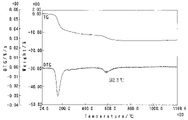
- FIG. 1 is a DTG curve obtained by thermogravimetric analysis of the dielectric ceramic-forming composition of Example 1.
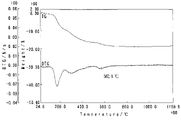
- FIG. 4 is a DTG curve obtained by thermogravimetric analysis of the dielectric ceramic-forming composition of Example 2.
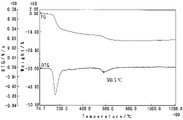
- FIG. 4 is a DTG curve obtained by thermogravimetric analysis of the dielectric ceramic-forming composition of Example 3.
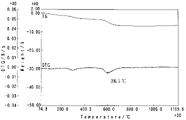
- FIG. 1 is a DTG curve obtained by thermogravimetric analysis of dry powder of Comparative Example 1.
- FIG. 4 is a DTG curve obtained by thermogravimetric analysis of the dielectric ceramic-forming composition of Comparative Example 2.
- FIG. 2 is a diagram showing the relationship between the BET specific surface area and c/a in Table 2.
- the dielectric ceramic-forming composition of the present invention comprises a starting material perovskite (ABO 3 ) type composite oxide and the following formula (1):
- a composition for forming a dielectric ceramic characterized by:
- the dielectric ceramic-forming composition of the present invention contains a starting perovskite (ABO 3 ) type composite oxide.
- the raw material perovskite (ABO 3 ) type composite oxide contained in the dielectric ceramic forming composition of the present invention is sintered by firing the dielectric ceramic forming composition to form a perovskite (ABO 3 ) type composite. It is a sintered body of an oxide, that is, a raw composite oxide forming a dielectric ceramic material.
- the starting perovskite (ABO 3 ) type composite oxide for the dielectric ceramic-forming composition of the present invention is not particularly limited as long as it is a perovskite type composite oxide having an ABO 3 type structure.
- Ba, Ca, Mg and Sr, and the B-site element is at least one selected from Ti and Zr.
- Perovskite (ABO 3 ) type composite oxides include barium titanate, calcium titanate, magnesium titanate, strontium titanate, barium calcium titanate zirconate, barium titanate zirconate, barium strontium titanate, barium zirconate, and zirconate. Calcium, strontium zirconate, barium calcium zirconate, barium strontium zirconate, calcium strontium zirconate.
- the perovskite (ABO 3 ) type composite oxide may be used singly or in combination of two or more.
- barium titanate is particularly preferable as the raw material perovskite (ABO 3 ) type composite oxide because a perovskite type composite oxide having a higher degree of crystallinity can be obtained by low-temperature firing.
- the average particle size of the starting perovskite (ABO 3 ) type composite oxide is preferably 0.010 to 10 ⁇ m, more preferably 0.020 to 1.0 ⁇ m.
- the average particle size of the raw material perovskite (ABO 3 ) type composite oxide is within the above range, the electrical properties, sintering properties and handling properties of the perovskite type composite oxide are improved.
- the average particle size of the raw material perovskite (ABO 3 )-type composite oxide is obtained by measuring the particle sizes of 200 particles arbitrarily from a scanning electron microscope (SEM) photograph, and averaging the average value. Particle size.
- the BET specific surface area of the starting perovskite (ABO 3 ) type composite oxide is preferably 0.10 m 2 /g or more, more preferably 1.0 to 50 m 2 /g.
- the BET specific surface area of the raw material perovskite (ABO 3 ) type composite oxide is within the above range, sinterability and handling properties are improved, and a perovskite type composite oxide having a small particle size and high crystallinity can be obtained, which is preferable. .
- the method for preparing the raw material perovskite-type composite oxide is not particularly limited, and examples thereof include the oxalate method, coprecipitation method, hydrolysis method, hydrothermal synthesis method, and solid-phase method.
- a commercially available perovskite-type composite oxide can also be used.
- the dielectric ceramic forming composition of the present invention has the following formula (1):
- Contains a compound having a bond represented by A compound having a bond represented by general formula (1) has at least one bond represented by general formula (1) in the molecule.
- the compound having the bond represented by the general formula (1) is such that the dielectric ceramic material obtained by firing the dielectric ceramic-forming composition has a small particle size. It is also necessary for obtaining a highly crystalline perovskite-type composite oxide. In the absence of a compound having a bond represented by general formula (1), it is necessary to increase the firing temperature and apply heat energy in order to increase the crystallinity of the starting perovskite-type composite oxide.
- the presence of the compound having the bond represented by the general formula (1) has the effect of facilitating the crystallization of the starting perovskite-type composite oxide.
- the starting perovskite-type composite oxide contains an A-site element of the starting perovskite-type composite oxide, such as a hydroxide, chloride, nitrate, acetate, oxide or carbonate of Ba, Ca, Mg or Sr.
- the containing compound adheres to the particle surface of the raw material perovskite type composite oxide, or the compound containing the A-site element is subjected to the raw material perovskite type composite oxide for the purpose of increasing the crystallinity in the present invention as described later.
- the presence of the compound having the bond represented by the general formula (1) accelerates the decomposition of the compound containing the A-site element, and the A-site element and the raw material perovskite-type composite oxide. The present inventors believe that this is because the reaction proceeds more easily.
- the carbon atom in the general formula (1) is, in addition to the oxygen atom and the nitrogen atom in the general formula (1), one other atom
- the nitrogen atom in general formula (1) is bonded to two other atoms in addition to the carbon atom in general formula (1).
- An amide compound represented by is mentioned.
- R 1 , R 2 and R 3 are H or an organic group and are each independently selected. Examples of organic groups related to R 1 , R 2 and R 3 in formula (2) include alkyl groups, alkenyl groups, aromatic groups and the like, and these groups are substituents such as alkyl groups and halogens. may have
- a urea compound represented by is mentioned.
- R 1 , R 2 , R 3 and R 4 are H or an organic group and are each independently selected. Examples of organic groups related to R 1 , R 2 , R 3 and R 4 in formula (3) include alkyl groups, alkenyl groups, aromatic groups, etc. These groups include alkyl groups, halogens, etc. may have a substituent of
- An imide compound represented by is mentioned.
- R 1 , R 2 and R 3 are H or an organic group and are each independently selected. Examples of organic groups for R 1 , R 2 and R 3 in formula (4) include alkyl groups, alkenyl groups, aromatic groups and the like, and these groups are substituents such as alkyl groups and halogens. may have
- Amide compounds related to compounds having a bond represented by general formula (1) include acetamide, formamide, propionamide, butyramide, diacetamide, succinamide, ⁇ -caprolactam, acrylamide, acetanilide, nicotinamide, and olein. acid amides, stearic acid amides, and the like.
- Urea compounds related to compounds having a bond represented by general formula (1) include urea, methylurea, ethylurea, butylurea, and acetylurea.
- imide compounds related to compounds having a bond represented by general formula (1) include phthalimide, succinimide, hydantoin, barbituric acid, isocyanuric acid, and the like.
- urea compounds such as urea, methylurea, ethylurea, butylurea, and acetylurea are preferred as compounds having a bond represented by general formula (1) because of their high reactivity and low cost. Preferred, urea being particularly preferred.
- the compound having a bond represented by general formula (1) may be used singly or in combination of two or more.
- the content of the compound having the bond represented by the general formula ( 1 ) in the dielectric ceramic-forming composition is 0.40 to 80 mol%, preferably 0.80 to 60 mol %, particularly preferably 2.0 to 40 mol %.
- the content of the compound having the bond represented by the general formula (1) in the composition for forming the dielectric ceramic is within the above range, the crystallization of the perovskite-type composite oxide proceeds even when fired at a low temperature. Since grain growth is suppressed, it is possible to obtain a dielectric ceramic material comprising a sintered body of a perovskite-type composite oxide having a small grain size and high crystallinity.
- the content of the compound having the bond represented by the general formula (1) in the dielectric ceramic-forming composition is less than the above range, when the dielectric ceramic-forming composition is fired, the compound represented by the general formula (1) ), high-temperature sintering is required, resulting in grain growth.
- the content of the compound having the bond represented by the general formula (1) in the composition for forming the dielectric ceramic exceeds the above range, the physical properties and reactivity of the product, and adverse effects on the working environment and production. lead to increased costs.
- the effect of including the compound having the bond represented by the general formula (1) in the composition for forming a dielectric ceramic of the present invention is that when the composition for forming a dielectric ceramic of the present invention is heated, It can be evaluated using a differential curve (DTG curve) of a thermogravimetric curve (TG curve) obtained by thermogravimetric analysis of weight change. That is, when a thermogravimetric analysis of the composition for forming a dielectric ceramic of the present invention is carried out, the minimum value of the peak derived from the thermal decomposition reaction of the compound containing the A-site element of the starting perovskite-type composite oxide in the DTG curve is preferably observed between 500 and 595°C, particularly preferably between 510 and 590°C.
- the raw material perovskite-type composite oxide and the A-site element can react at a lower temperature, so that the raw material perovskite-type composite oxide is highly crystallized while suppressing grain growth. be able to.
- the dielectric ceramic-forming composition of the present invention can contain a hydroxy acid in addition to the starting perovskite (ABO 3 ) type composite oxide and the compound having a bond represented by general formula (1).
- hydroxy acid used in the dielectric ceramic-forming composition of the present invention examples include citric acid, tartaric acid, malic acid, glycolic acid, lactic acid, glyceric acid, hydroxybutyric acid, isocitric acid, leucic acid, mevalonic acid, pantoic acid, ricinoleic acid and salicylic acid.
- the hydroxy acid is preferably citric acid, tartaric acid, malic acid, glycolic acid, lactic acid, glyceric acid, or isocitric acid, and particularly preferably citric acid or tartaric acid, from the viewpoint of reactivity and cost. Hydroxy acids may be used singly or in combination of two or more.
- the content of hydroxy acid in the dielectric ceramic-forming composition of the present invention is 0.010 to 20 mol %, preferably 0.020 to 10 mol %, relative to the starting perovskite (ABO 3 ) type composite oxide. More preferably, it is 0.030 to 5.0 mol %.
- the content of the hydroxy acid in the dielectric ceramic-forming composition of the present invention is within the above range, grain growth of the starting material perovskite (ABO 3 ) type composite oxide due to firing can be suppressed. It becomes easier to obtain a small perovskite-type composite oxide.
- the dielectric ceramic-forming composition of the present invention can further contain a compound containing an A-site element of the starting perovskite (ABO 3 ) type composite oxide.
- the content of the compound containing the A-site element in the dielectric ceramic-forming composition of the present invention is preferably 0.10 to 20 mol %, more preferably 0.20 to 15 mol %.
- the compound containing the A-site element of the starting perovskite (ABO 3 ) type composite oxide is selected from hydroxides, chlorides, nitrates, acetates, oxides and carbonates of Ba, Ca, Mg or Sr. At least one is preferred.
- Examples of compounds containing such an A-site element include barium hydroxide, barium chloride, barium nitrate, barium acetate, barium oxide, and carbonate when the raw perovskite (ABO 3 )-type composite oxide is barium titanate.
- the raw material perovskite (ABO 3 )-type composite oxide is calcium titanate, calcium hydroxide, calcium chloride, calcium nitrate, calcium acetate, calcium oxide, calcium carbonate, and the like;
- the raw material perovskite (ABO 3 ) type composite oxide is magnesium titanate, magnesium hydroxide, magnesium chloride, magnesium nitrate, magnesium acetate, magnesium oxide, magnesium carbonate, and raw material perovskite (ABO 3 ) type
- the composite oxide is strontium titanate, it includes strontium hydroxide, strontium chloride, strontium nitrate, strontium acetate, strontium oxide, strontium carbonate, and the like.
- the dielectric ceramic forming composition of the present invention further contains Sc, Y, La, Ce, Pr, Nd, Sm, Eu, Gd, Tb and Dy for the purpose of correcting various characteristics of the dielectric ceramic material.
- Sc, Y, La, Ce, Pr, Nd, Sm, Eu, Gd, Tb and Dy for the purpose of correcting various characteristics of the dielectric ceramic material.
- Ho, Er, Tm, Yb, Lu, Hf, V, Nb, Ta, Mn, Cr, Mo and W. can do.
- subcomponent element-containing compounds include oxides, hydroxides, carbonates, sulfates, nitrates, chlorides, carboxylates, ammonium salts and organic acid salts containing subcomponent elements. These may be used singly or in combination of two or more.
- the average particle size of the subcomponent element-containing compound powder is preferably 0.010 ⁇ m to 5.0 ⁇ m, more preferably 0.020 ⁇ m to 3.0 ⁇ m.
- the average particle size of the subcomponent element-containing compound powder in the present invention is a value determined from the D50 particle size in volume distribution measurement by a laser diffraction scattering method.
- the BET specific surface area of the subcomponent element-containing compound powder is preferably 2.0 m 2 /g or more, more preferably 2.0 to 200 m 2 /g.
- the BET specific surface area of the subcomponent element-containing compound powder is within the above range, the contact with the raw material perovskite (ABO 3 ) type composite oxide is improved, and the homogeneity of the resulting dielectric ceramic material can be improved. Therefore, it is preferable.
- the dielectric ceramic-forming composition of the present invention comprises a starting perovskite (ABO 3 )-type composite oxide, a compound having a bond represented by general formula (1), a hydroxy acid used as necessary, and a starting perovskite.
- a compound containing the A-site element of the (ABO 3 )-type composite oxide and/or powders of the subcomponent element-containing compound are mixed and prepared in a desired mixing ratio.
- a mixing method is not particularly limited, and includes a wet method, a dry method, and the like.
- known devices such as ball mills, bead mills, disper mills, homogenizers, vibration mills, sand grind mills, attritors, and powerful stirrers can be used.
- known devices such as a high speed mixer, a super mixer, a turbosphere mixer, a Henschel mixer, a Nauta mixer, and a ribbon blender can be used for the dry method.
- the composition for forming a dielectric ceramic of the present invention is preferably prepared by a wet method.
- Solvents used for wet mixing include, for example, water, methanol, ethanol, propanol, butanol, toluene, xylene, acetone, methylene chloride, ethyl acetate, dimethylformaldehyde, and diethyl ether.
- alcohols such as methanol, ethanol, propanol, and butanol are used to obtain a more uniform composition, so that the electrical properties of the dielectric ceramic material obtained by firing can be further improved.
- the dielectric ceramic material of the present invention is obtained by firing the dielectric ceramic-forming composition of the present invention, that is, a fired product of the dielectric ceramic-forming composition of the present invention.
- the dielectric ceramic material of the present invention is a sintered compact of a perovskite (ABO 3 ) type composite oxide with small grain size and high crystallinity.
- the firing temperature for firing the dielectric ceramic forming composition of the present invention is not particularly limited as long as it is a temperature at which the dielectric ceramic forming composition can be sintered, but considering the advantages of the present invention. , preferably 1000°C or less, more preferably 300 to 970°C, and particularly preferably 400 to 950°C.
- the firing time for firing the dielectric ceramic-forming composition of the present invention is preferably 1 hour or more, particularly preferably 1 to 48 hours.
- the atmosphere in which the dielectric ceramic-forming composition of the present invention is fired may be an air atmosphere, an oxygen atmosphere, or an inert atmosphere, and is not particularly limited. Moreover, the firing of the composition for forming a dielectric ceramic of the present invention may be performed multiple times, if necessary.
- the composition for forming the dielectric ceramic of the present invention or the dielectric ceramic material of the present invention is mixed and dispersed with additives, organic binders, plasticizers, dispersants, and other conventionally known compounding agents for manufacturing multilayer ceramic capacitors. Then, slurry is formed and sheet forming is performed to obtain a ceramic sheet. Then, a conductive paste for forming internal electrodes is printed on one surface of this ceramic sheet, dried, and then laminated with a plurality of ceramic sheets. A laminated body is formed by pressure bonding in the thickness direction, and the laminated body is heat-treated to remove the binder and fired to obtain a fired body. , a nickel alloy paste, a copper paste, a copper alloy paste, or the like is applied and baked to form a multilayer capacitor.
- resin sheets, resin films, printed wiring boards, adhesives, etc. obtained by blending the dielectric ceramic forming composition or dielectric ceramic material of the present invention with resins such as epoxy resins, polyester resins, polyimide resins, etc.
- resins such as epoxy resins, polyester resins, polyimide resins, etc.
- Materials such as multilayer printed wiring boards, common materials for suppressing the difference in shrinkage between internal electrodes and dielectric layers, substrates and circuit peripheral materials for electrode ceramics circuit boards, glass ceramics circuit boards, exhaust gas removal and chemical synthesis, etc. It can also be used as a catalyst used during the reaction and as a material for imparting an antistatic or cleaning effect by adding it as a surface modifier for printing toner.
- thermogravimetric analysis Using a thermogravimetric analyzer TGA/DSC 1 manufactured by Mettler Toledo Co., Ltd., a 30 mg sample is heated from 30 ° C. to 1200 ° C. in an air flow of 50 mL / min at a heating rate of 10 ° C. / min. As conditions, a thermogravimetric curve (TG curve) and a differential curve (DTG curve) in the TG curve were measured.
- TG curve thermogravimetric curve
- TMG curve differential curve
- Average Particle Diameter The particle diameters of 200 particles were arbitrarily measured from a scanning electron microscope (SEM) photograph, and the average value was taken as the average particle diameter.
- Example 1 After adding 50 g of raw material barium titanate (manufactured by Nippon Kagaku Kogyo Co., Ltd.) with the physical properties shown in Table 1 to 450 ml of pure water, urea (manufactured by Nacalai Tesque Co., Ltd.) and barium carbonate (manufactured by Nippon Kagaku Kogyo Co., Ltd.) were used as a formulation. was added to the raw material barium titanate in the ratio shown in Table 1 and wet-mixed in a ball mill. Then, it was dried at 115° C. to obtain a dry powder, thereby obtaining a dielectric ceramic-forming composition comprising barium titanate, urea and barium carbonate.
- urea manufactured by Nacalai Tesque Co., Ltd.
- barium carbonate manufactured by Nippon Kagaku Kogyo Co., Ltd.
- thermogravimetric analysis of this composition are shown in FIG. From this analysis result, the decomposition temperature of the barium carbonate was 582.3° C. according to the DTG curve.
- the composition for forming a dielectric ceramic obtained above was fired in an air atmosphere at the temperature shown in Table 2 for 10 hours to obtain a barium titanate after firing.
- Table 2 shows the physical properties of the obtained barium titanate.
- Example 2 After adding 50 g of the same raw material barium titanate as in Example 1 to 450 ml of pure water, urea (manufactured by Nacalai Tesque Co., Ltd.), citric acid (manufactured by Nacalai Tesque Co., Ltd.), tartaric acid (manufactured by Kanto Chemical Co., Ltd.) and Barium carbonate (manufactured by Nippon Kagaku Kogyo Co., Ltd.) was added to the raw material barium titanate at the ratio shown in Table 1 and wet-mixed in a ball mill. Then, it was dried at 115° C.
- urea manufactured by Nacalai Tesque Co., Ltd.
- citric acid manufactured by Nacalai Tesque Co., Ltd.
- tartaric acid manufactured by Kanto Chemical Co., Ltd.
- Barium carbonate manufactured by Nippon Kagaku Kogyo Co., Ltd.
- a dielectric ceramic-forming composition comprising barium titanate, urea, citric acid, tartaric acid and barium carbonate.
- the results of thermogravimetric analysis of this composition are shown in FIG. From this analysis result, the decomposition temperature of the barium carbonate was 562.8° C. according to the DTG curve.
- the dielectric ceramic-forming composition obtained above was sintered under the same conditions as in Example 1 to obtain sintered barium titanate. Table 2 shows the physical properties of the obtained barium titanate.
- Example 3 After adding 50 g of the same raw material barium titanate as in Example 1 to 450 ml of pure water, urea (manufactured by Nacalai Tesque Co., Ltd.) was added to the raw material barium titanate in the ratio shown in Table 1 as a compound, and wet-mixed in a ball mill. . Then, it was dried at 115° C. to obtain a dry powder, thereby obtaining a dielectric ceramic-forming composition comprising barium titanate and urea. The results of thermogravimetric analysis of this composition are shown in FIG. From this analysis result, the decomposition temperature of the barium compound in the mixture was 580.5° C. according to the DTG curve. The dielectric ceramic-forming composition obtained above was sintered under the same conditions as in Example 1 to obtain sintered barium titanate. Table 2 shows the physical properties of the obtained barium titanate.
- the vertical axis is c/a and the horizontal axis is the specific surface area (SSA), and the results of Table 2 are plotted in a graph.
- the plots for each example and comparative example are data for firing temperatures of 800° C., 850° C., and 900° C. from the right.
- Example 3 in which only urea was added, had a higher c/a value than Comparative Example 2, in which only barium carbonate was added, at the same firing temperature, indicating that crystallization was promoted.
Landscapes
- Chemical & Material Sciences (AREA)
- Engineering & Computer Science (AREA)
- Ceramic Engineering (AREA)
- Organic Chemistry (AREA)
- Manufacturing & Machinery (AREA)
- Inorganic Chemistry (AREA)
- Materials Engineering (AREA)
- Structural Engineering (AREA)
- Life Sciences & Earth Sciences (AREA)
- Environmental & Geological Engineering (AREA)
- General Life Sciences & Earth Sciences (AREA)
- Geology (AREA)
- Compositions Of Oxide Ceramics (AREA)
- Inorganic Insulating Materials (AREA)
- Inorganic Compounds Of Heavy Metals (AREA)
Abstract
粒径が小さく且つ高結晶のペロブスカイト型複合酸化物を得ることができる誘電体セラミック形成用組成物を提供すること、及びそれを用いた誘電体セラミック材料を提供すること。 原料ペロブスカイト(ABO3)型複合酸化物と、下記式(1):で表される結合を有する化合物と、を含有し、前記一般式(1)で表される結合を有する化合物の含有量が、該原料ペロブスカイト(ABO3)型複合酸化物に対し、0.40~80モル%であること、を特徴とする誘電体セラミック形成用組成物。
Description
本発明は、誘電体、オプトエレクトロニクス材、圧電体、半導体、センサー等の機能性セラミックの原料として有用なペロブスカイト型複合酸化物を含有する誘電体セラミック形成用組成物及びこれを焼成して得られる誘電体セラミック材料に関するものである。
チタン酸バリウムに代表されるペロブスカイト型複合酸化物は、従来、圧電体、積層セラミックコンデンサ等の機能性セラミックの原料として用いられてきた。ところが、近年、積層セラミックコンデンサは、高容量化のために積層数の増加や高誘電率化が求められており、このため、ペロブスカイト型複合酸化物には、微細で高い正方晶性を持つことが要望されている。
ペロブスカイト型複合酸化物の代表例としてチタン酸バリウムが挙げられるが、このチタン酸バリウムを製造する方法としては固相法、水熱合成法、アルコキシド法、シュウ酸塩法等の方法が挙げられる。これらの方法の何れも原料のチタン源及びバリウム源を反応させることによりチタン酸バリウムを得るものであるが、一般的には焼成等による熱エネルギーの付与による反応が最終的には行われており、高結晶化するために、より多くの熱エネルギーを付与することが必要である。
この高結晶化のための熱エネルギーの付与は、焼成温度を高めれば得られるものであるが、得られるペロブスカイト型複合酸化物の高結晶化をもたらす半面、粒成長を促してしまうので、上記したような微細な原料を得る目的を達成できないという問題があった。
この問題を解決するために、例えば、特許文献1では、原料となる炭酸バリウムと酸化チタンを混合して仮焼する過程において、アミド化合物、アミノ酸またはペプチドから成る助剤を仮焼前までに添加してから仮焼することにより、粒度分布が狭小で、且つ、平均粒径の小さいチタン酸バリウムが得られることが記載されている。また、特許文献2では、ペロブスカイト型複合酸化物の原料となる炭酸バリウムの製法が開示されており、水酸化バリウム、塩化バリウム等のバリウム化合物に対して、クエン酸及び酒石酸等の多塩基カルボン酸を加えて反応させることで微細な炭酸バリウムが得られるため、該炭酸バリウムを原料として得られる積層セラミックコンデンサなどの電子材料に好適に使用できることが記載されている。特許文献3では、バリウムチタニルシュウ酸塩の結晶にアンモニア等の窒素含有添加剤を加えて粉砕後、熱分解して得られるチタン酸バリウムは、誘電特性に優れることが記載されている。
上記特許文献により開示された発明は、原料の段階で助剤を加えることにより、その後の焼成で主にバリウム化合物の分解が促進される又は粒成長が抑えられて比表面積が高くなることで微細なチタン酸バリウムが生成されるものである。しかしながら、この方法により得られるチタン酸バリウムは、焼成温度をある程度高くしないと高結晶なものが得られないため、低温焼成でも微細で高結晶なチタン酸バリウムを得るための方法が模索されている。
従って、本発明の目的は、粒径が小さく且つ高結晶のペロブスカイト型複合酸化物を得ることができる誘電体セラミック形成用組成物を提供すること、及びそれを用いた誘電体セラミック材料を提供することにある。
本発明者らは、上記実情に鑑み鋭意研究を重ねた結果、原料となるペロブスカイト型複合酸化物に、特定の化合物を加えて焼成することにより、従来よりも低温でペロブスカイト型複合酸化物が得られるため、粒成長が抑えられつつ高結晶化が可能であることを見出し、本発明を完成するに至った。
すなわち、本発明は、ペロブスカイト(ABO3)型複合酸化物と、下記式(1):
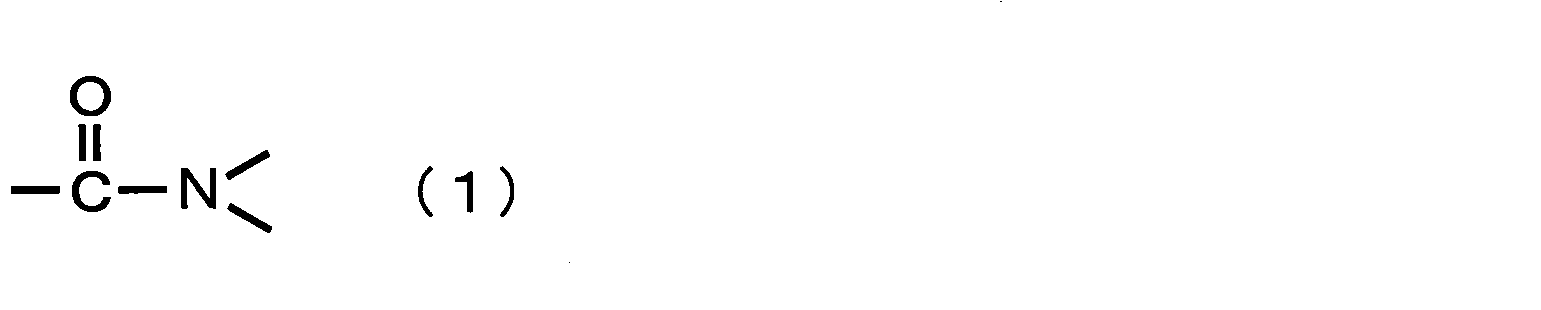
で表される結合を有する化合物と、を含有し、
前記一般式(1)で表される結合を有する化合物の含有量が、該ペロブスカイト(ABO3)型複合酸化物に対し、0.40~80モル%であること、
を特徴とする誘電体セラミック形成用組成物を提供するものである。
また、本発明は、上記誘電体セラミック形成用組成物を焼成して得られる誘電体セラミック材料を提供するものである。
前記一般式(1)で表される結合を有する化合物の含有量が、該ペロブスカイト(ABO3)型複合酸化物に対し、0.40~80モル%であること、
を特徴とする誘電体セラミック形成用組成物を提供するものである。
また、本発明は、上記誘電体セラミック形成用組成物を焼成して得られる誘電体セラミック材料を提供するものである。
本発明によれば、同じ温度で焼成した場合に、従来のペロブスカイト型複合酸化物に比べて、粒径が小さく且つ高結晶のペロブスカイト型複合酸化物を得ることができる誘電体セラミック形成用組成物を提供すること、及びそれを用いた誘電体セラミック材料を提供することができる。
以下、本発明をその好ましい実施形態に基づき説明する。
本発明の誘電体セラミック形成用組成物は、原料ペロブスカイト(ABO3)型複合酸化物と、下記式(1):
本発明の誘電体セラミック形成用組成物は、原料ペロブスカイト(ABO3)型複合酸化物と、下記式(1):

で表される結合を有する化合物と、を含有し、
前記一般式(1)で表される結合を有する化合物の含有量が、該原料ペロブスカイト(ABO3)型複合酸化物に対し、0.40~80モル%であること、
を特徴とする誘電体セラミック形成用組成物である。
前記一般式(1)で表される結合を有する化合物の含有量が、該原料ペロブスカイト(ABO3)型複合酸化物に対し、0.40~80モル%であること、
を特徴とする誘電体セラミック形成用組成物である。
本発明の誘電体セラミック形成用組成物は、原料ペロブスカイト(ABO3)型複合酸化物を含有する。本発明の誘電体セラミック形成用組成物に含有されている原料ペロブスカイト(ABO3)型複合酸化物は、誘電体セラミック形成用組成物の焼成により、焼結して、ペロブスカイト(ABO3)型複合酸化物の焼結体、すなわち、誘電体セラミック材料を形成する原料複合酸化物である。
本発明の誘電体セラミック形成用組成物に係る原料ペロブスカイト(ABO3)型複合酸化物は、ABO3型の構造を有するペロブスカイト型の複合酸化物であれば、特に制限されないが、Aサイト元素が、Ba、Ca、Mg及びSrから選択される少なくとも1種であり、且つ、Bサイト元素が、Ti及びZrから選択される少なくとも1種であるペロブスカイト型複合酸化物が好ましい。このような、Aサイト元素が、Ba、Ca、Mg及びSrから選択される少なくとも1種であり、且つ、Bサイト元素が、Ti及びZrから選択される少なくとも1種であるペロブスカイト型複合酸化物ペロブスカイト(ABO3)型複合酸化物としては、チタン酸バリウム、チタン酸カルシウム、チタン酸マグネシウム、チタン酸ストロンチウム、チタンジルコン酸バリウムカルシウム、チタンジルコン酸バリウム、チタン酸バリウムストロンチウム、ジルコン酸バリウム、ジルコン酸カルシウム、ジルコン酸ストロンチウム、ジルコン酸バリウムカルシウム、ジルコン酸バリウムストロンチウム、ジルコン酸カルシウムストロンチウムが挙げられる。ペロブスカイト(ABO3)型複合酸化物は、1種単独であってもよいし、2種以上の組み合わせであってもよい。これらの中、原料ペロブスカイト(ABO3)型複合酸化物としては、低温焼成でより高い結晶化度を有するペロブスカイト型複合酸化物を得ることができる点で、チタン酸バリウムが特に好ましい。
原料ペロブスカイト(ABO3)型複合酸化物の平均粒子径は、好ましくは0.010~10μm、より好ましくは0.020~1.0μmである。原料ペロブスカイト(ABO3)型複合酸化物の平均粒子径が、上記範囲にあることにより、ペロブスカイト型複合酸化物の電気的特性、焼結諸特性、ハンドリング特性が良好となる。なお、本発明において、原料ペロブスカイト(ABO3)型複合酸化物の平均粒子径は、走査型電子顕微鏡(SEM)写真により、任意に200個の粒子の粒径を測定し、その平均値を平均粒子径とする。
原料ペロブスカイト(ABO3)型複合酸化物のBET比表面積は、好ましくは0.10m2/g以上、より好ましくは1.0~50m2/gである。原料ペロブスカイト(ABO3)型複合酸化物のBET比表面積が、上記範囲にあることにより、焼結性及びハンドリング性が良好となり、粒径が小さく高結晶なペロブスカイト型複合酸化物が得られるので好ましい。
原料ペロブスカイト型複合酸化物の調製方法は、特に限定されるものではなく、例えば、シュウ酸塩法、共沈法、加水分解法、水熱合成法、固相法等が挙げられる。また、市販のペロブスカイト型複合酸化物を用いることもできる。
本発明の誘電体セラミック形成用組成物は、下記式(1):

で表される結合を有する化合物を含有する。一般式(1)で表される結合を有する化合物は、分子中に、少なくとも1つ一般式(1)で表される結合を有している。本発明の誘電体セラミック形成用組成物において、一般式(1)で表される結合を有する化合物は、誘電体セラミック形成用組成物を焼成して得られる誘電体セラミック材料が、粒径が小さく且つ高結晶のペロブスカイト型複合酸化物となるために必要なものである。一般式(1)で表される結合を有する化合物が存在しない場合、原料ペロブスカイト型複合酸化物の結晶化度を高くするためには、焼成温度を高くして熱エネルギーを付与する必要がある。それに対して、一般式(1)で表される結合を有する化合物が存在することにより、原料ペロブスカイト型複合酸化物の結晶化を進み易くする効果が得られるため、焼成温度を上げなくても結晶化度が高くなり、また、焼成温度を上げる必要がないため粒成長が抑えられるものとなる。この理由として、原料ペロブスカイト型複合酸化物には、Ba、Ca、Mg又はSrの水酸化物、塩化物、硝酸塩、酢酸塩、酸化物又は炭酸塩といった原料ペロブスカイト型複合酸化物のAサイト元素を含有する化合物が、原料ペロブスカイト型複合酸化物の粒子表面に付着していたり、或いは、後述するように本発明において結晶化度を上げる目的で前記Aサイト元素を含有する化合物を原料ペロブスカイト型複合酸化物に加えるが、前記一般式(1)で表される結合を有する化合物が存在することにより、前記Aサイト元素を含有する化合物の分解が促進され、Aサイト元素と原料ペロブスカイト型複合酸化物の反応が進み易くなるためであると本発明者らは考えている。なお、一般式(1)で表される結合を有する化合物中で、一般式(1)中の炭素原子は、一般式(1)中の酸素原子及び窒素原子以外に、他の1つの原子と結合しており、また、一般式(1)中の窒素原子は、一般式(1)中の炭素原子以外に、他の2つの原子と結合している。
一般式(1)で表される結合を有する化合物としては、下記一般式(2):

で表されるアミド化合物が挙げられる。アミド化合物は、分子中に、アミド骨格(-C(=O)-N-)を有する化合物である。式(2)中、R1、R2及びR3は、H又は有機基であり、それぞれ独立に選択される。式(2)中のR1、R2及びR3に係る有機基としては、例えば、アルキル基、アルケニル基、芳香族基等が挙げられ、それらの基は、アルキル基、ハロゲン等の置換基を有していてもよい。
また、一般式(1)で表される結合を有する化合物としては、下記一般式(3):

で表される尿素化合物が挙げられる。尿素化合物は、分子中に、尿素骨格(-N-C(=O)-N-)を有する化合物である。式(3)中、R1、R2、R3及びR4は、H又は有機基であり、それぞれ独立に選択される。式(3)中のR1、R2、R3及びR4に係る有機基としては、例えば、アルキル基、アルケニル基、芳香族基等が挙げられ、それらの基は、アルキル基、ハロゲン等の置換基を有していてもよい。
また、一般式(1)で表される結合を有する化合物としては、下記一般式(4):
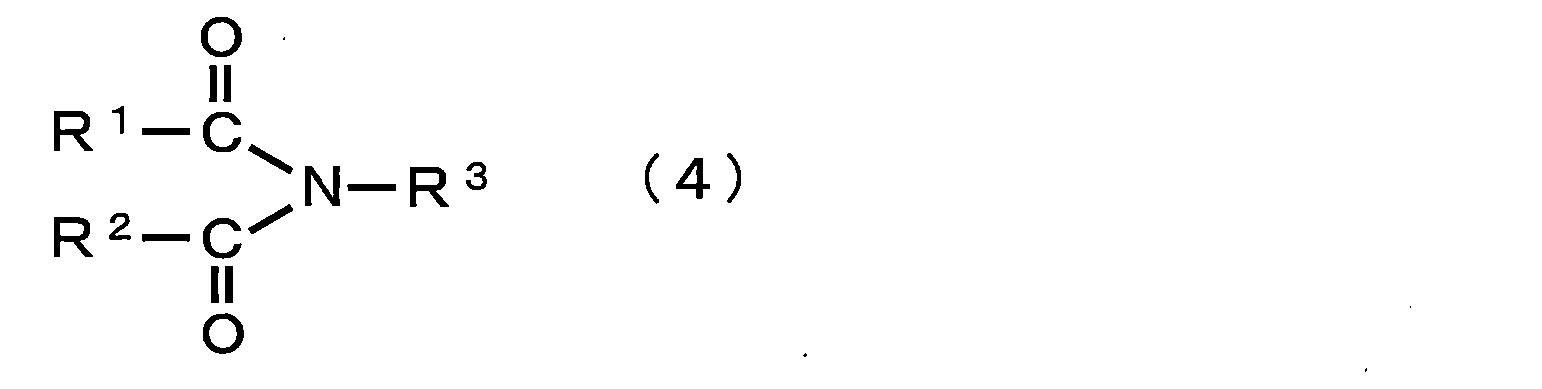
で表されるイミド化合物が挙げられる。イミド化合物は、分子中に、イミド骨格(-C(=O)-N-C(=O)-)を有する化合物である。式(4)中、R1、R2及びR3は、H又は有機基であり、それぞれ独立に選択される。式(4)中のR1、R2及びR3に係る有機基としては、例えば、アルキル基、アルケニル基、芳香族基等が挙げられ、それらの基は、アルキル基、ハロゲン等の置換基を有していてもよい。
一般式(1)で表される結合を有する化合物に係るアミド化合物としては、アセトアミド、ホルムアミド、プロピオン酸アミド、ブチルアミド、ジアセトアミド、コハク酸アミド、ε-カプロラクタム、アクリルアミド、アセトアニリド、ニコチン酸アミド、オレイン酸アミド、ステアリン酸アミド等が挙げられる。
また、一般式(1)で表される結合を有する化合物に係る尿素化合物としては、尿素、メチル尿素、エチル尿素、ブチル尿素、アセチル尿素等が挙げられる。
また、一般式(1)で表される結合を有する化合物に係るイミド化合物としては、フタルイミド、スクシンイミド、ヒダントイン、バルビツール酸、イソシアヌル酸等が挙げられる。
これらのうち、一般式(1)で表される結合を有する化合物としては、反応性が高く、低コストである点で、尿素、メチル尿素、エチル尿素、ブチル尿素、アセチル尿素等の尿素化合物が好ましく、尿素が特に好ましい。
一般式(1)で表される結合を有する化合物は、1種単独であってもよいし、2種以上の組み合わせであってもよい。
誘電体セラミック形成用組成物中、一般式(1)で表される結合を有する化合物の含有量は、原料ペロブスカイト(ABO3)型複合酸化物に対し、0.40~80モル%、好ましくは0.80~60モル%、特に好ましくは2.0~40モル%である。誘電体セラミック形成用組成物中の一般式(1)で表される結合を有する化合物の含有量が上記範囲にあることにより、低温で焼成してもペロブスカイト型複合酸化物の結晶化が進みつつ粒成長が抑えられるため、粒径が小さく且つ高結晶のペロブスカイト型複合酸化物の焼結体からなる誘電体セラミック材料を得ることができる。一方、誘電体セラミック形成用組成物中の一般式(1)で表される結合を有する化合物の含有量が、上記範囲未満だと誘電体セラミック形成用組成物を焼成したときに一般式(1)で表される結合を有する化合物の添加の効果が得られないため、高温焼成が必要となり、その結果、粒成長を起こしてしまう。また、誘電体セラミック形成用組成物中の一般式(1)で表される結合を有する化合物の含有量が、上記範囲を超えると、生成物の物性、反応性、作業環境への悪影響や製造コストの増大につながる。
本発明の誘電体セラミック形成用組成物に、一般式(1)で表される結合を有する化合物が含まれることの効果は、本発明の誘電体セラミック形成用組成物を昇温加熱したときの重量変化を熱重量分析して得られる熱重量曲線(TG曲線)の微分曲線(DTG曲線)を用いて評価することができる。すなわち、本発明の誘電体セラミック形成用組成物の熱重量分析を実施したとき、DTG曲線において、原料ペロブスカイト型複合酸化物のAサイト元素を含有する化合物の熱分解反応に由来するピークの極小値が、好ましくは500~595℃、特に好ましくは510~590℃に観察される。DTG曲線におけるピークの極小値が前記範囲にあることにより、より低温で原料ペロブスカイト型複合酸化物とAサイト元素の反応が行えるため、原料ペロブスカイト型複合酸化物の粒子成長を抑えつつ高結晶化することができる。
本発明の誘電体セラミック形成用組成物は、原料ペロブスカイト(ABO3)型複合酸化物及び一般式(1)で表される結合を有する化合物以外に、ヒドロキシ酸を含有することができる。
本発明の誘電体セラミック形成用組成物に係るヒドロキシ酸としては、例えば、クエン酸、酒石酸、リンゴ酸、グリコール酸、乳酸、グリセリン酸、ヒドロキシ酪酸、イソクエン酸、ロイシン酸、メバロン酸、パントイン酸、リシノール酸、サリチル酸が挙げられる。これらの中、ヒドロキシ酸としては、反応性及びコスト面の観点からクエン酸、酒石酸、リンゴ酸、グリコール酸、乳酸、グリセリン酸、イソクエン酸が好ましく、クエン酸、酒石酸であることが特に好ましい。ヒドロキシ酸は、1種単独であってもよいし、2種以上の組み合わせであってもよい。
本発明の誘電体セラミック形成用組成物中、ヒドロキシ酸の含有量は、原料ペロブスカイト(ABO3)型複合酸化物に対し、0.010~20モル%、好ましくは0.020~10モル%、より好ましくは0.030~5.0モル%である。本発明の誘電体セラミック形成用組成物中のヒドロキシ酸の含有量が上記範囲にあることにより、焼成による原料ペロブスカイト(ABO3)型複合酸化物の粒成長を抑えることができるため、粒径が小さいペロブスカイト型複合酸化物を得易くなる。
本発明の誘電体セラミック形成用組成物は、更に、原料ペロブスカイト(ABO3)型複合酸化物のAサイト元素を含有する化合物を含有することができる。本発明の誘電体セラミック形成用組成物中、Aサイト元素を含有する化合物の含有量は、好ましくは0.10~20モル%、より好ましくは0.20~15モル%である。誘電体セラミック形成用組成物中のAサイト元素を含有する化合物の含有量が、上記範囲にあることにより、高結晶なペロブスカイト型複合酸化物を得ることができる。
原料ペロブスカイト(ABO3)型複合酸化物のAサイト元素を含有する化合物としては、Ba、Ca、Mg又はSrの水酸化物、塩化物、硝酸塩、酢酸塩、酸化物及び炭酸塩から選択される少なくとも1種が好ましい。このようなAサイト元素を含有する化合物としては、例えば、原料ペロブスカイト(ABO3)型複合酸化物がチタン酸バリウムである場合、水酸化バリウム、塩化バリウム、硝酸バリウム、酢酸バリウム、酸化バリウム、炭酸バリウム等が挙げられ、また、原料ペロブスカイト(ABO3)型複合酸化物がチタン酸カルシウムである場合、水酸化カルシウム、塩化カルシウム、硝酸カルシウム、酢酸カルシウム、酸化カルシウム、炭酸カルシウム等が挙げられ、また、原料ペロブスカイト(ABO3)型複合酸化物がチタン酸マグネシウムである場合、水酸化マグネシウム、塩化マグネシウム、硝酸マグネシウム、酢酸マグネシウム、酸化マグネシウム、炭酸マグネシウムが挙げられ、また、原料ペロブスカイト(ABO3)型複合酸化物がチタン酸ストロンチウムである場合、水酸化ストロンチウム、塩化ストロンチウム、硝酸ストロンチウム、酢酸ストロンチウム、酸化ストロンチウム、炭酸ストロンチウム等が挙げられる。
また、本発明の誘電体セラミック形成用組成物は、更に、誘電体セラミック材料の諸特性を補正する目的で、Sc、Y、La、Ce、Pr、Nd、Sm、Eu、Gd、Tb、Dy、Ho、Er、Tm、Yb、Lu、Hf、V、Nb、Ta、Mn、Cr、Mo及びWからなる群から選ばれる少なくとも1種の副成分元素を含有する副成分元素含有化合物粉末を含有することができる。副成分元素含有化合物としては、副成分元素を含有する酸化物、水酸化物、炭酸塩、硫酸塩、硝酸塩、塩化物、カルボン酸塩、アンモニウム塩及び有機酸塩等が挙げられる。これらは1種単独であってもよいし、2種以上の組み合わせであってもよい。
副成分元素含有化合物粉末の平均粒子径は、好ましくは0.010μm~5.0μmであり、より好ましくは0.020μm~3.0μmである。副成分元素含有化合物粉末の平均粒子径が上記範囲にあることにより、原料ペロブスカイト(ABO3)型複合酸化物との接触が良好になり、得られる誘電体セラミック材料の均質配合性の向上が図れるので好ましい。なお、本発明における副成分元素含有化合物粉末の平均粒子径は、レーザー回折散乱法による体積分布計測におけるD50粒径により求められる値である。
副成分元素含有化合物粉末のBET比表面積は、好ましくは2.0m2/g以上であり、より好ましくは2.0~200m2/gである。副成分元素含有化合物粉末のBET比表面積が上記範囲にあることにより、原料ペロブスカイト(ABO3)型複合酸化物との接触が良好になり、得られる誘電体セラミック材料の均質配合性の向上が図れるので好ましい。
本発明の誘電体セラミック形成用組成物は、原料ペロブスカイト(ABO3)型複合酸化物及び一般式(1)で表される結合を有する化合物、また、必要に応じて用いられるヒドロキシ酸、原料ペロブスカイト(ABO3)型複合酸化物のAサイト元素を含有する化合物及び/又は副成分元素含有化合物粉末が、所望の配合割合となるように混合され、調製される。混合方法は、特に限定されるものではなく、湿式法、乾式法等が挙げられる。
湿式法には、ボールミル、ビーズミル、ディスパーミル、ホモジナイザー、振動ミル、サンドグラインドミル、アトライター、強力撹拌機等の公知の装置を用いることができる。また、乾式法には、ハイスピードミキサー、スーパーミキサー、ターボスフェアミキサーヘンシェルミキサー、ナウターミキサー、リボンブレンダー等の公知の装置を用いることができる。
より均一な組成物とし、より高性能な誘電体セラミック材料を得る観点から、本発明の誘電体セラミック形成用組成物は、湿式法により調製されたものであることが好ましい。湿式混合に用いる溶媒としては、例えば、水、メタノール、エタノール、プロパノール、ブタノール、トルエン、キシレン、アセトン、塩化メチレン、酢酸エチル、ジメチルホルムアルデヒド、ジエチルエーテル等が挙げられる。これらの中でも、メタノール、エタノール、プロパノール、ブタノール等のアルコールを用いると、より均一な組成物が得られるので、焼成により得られる誘電体セラミック材料の電気特性をより向上させることができる。
本発明の誘電体セラミック材料は、上記した本発明の誘電体セラミック形成用組成物を焼成して得られるもの、すなわち、本発明の誘電体セラミック形成用組成物の焼成物である。本発明の誘電体セラミック材料は、粒径が小さく且つ高結晶なペロブスカイト(ABO3)型複合酸化物の焼結体である。本発明の誘電体セラミック形成用組成物を焼成する際の焼成温度は、誘電体セラミック形成用組成物が焼結できる温度であれば特に制限されるものではないが、本発明の利点を考えれば、好ましくは1000℃以下、より好ましくは300~970℃、特に好ましくは400~950℃である。本発明の誘電体セラミック形成用組成物を焼成する際の焼成時間は、好ましくは1時間以上、特に好ましくは1~48時間である。本発明の誘電体セラミック形成用組成物を焼成する際の雰囲気は、大気雰囲気、酸素雰囲気又は不活性雰囲気のいずれで行ってもよく、特に制限されるものではない。また、本発明の誘電体セラミック形成用組成物の焼成は、必要に応じて、複数回行われてもよい。
本発明の誘電体セラミック形成用組成物又は本発明の誘電体セラミック材料に、添加剤、有機系バインダ、可塑剤、分散剤等の積層セラミックコンデンサを製造する上で従来公知の配合剤を混合分散して、スラリー化し、シート成形を行って、セラミックシートを得、次に、このセラミックシートの一面に内部電極形成用導電ペーストを印刷し、乾燥後、複数枚のセラミックシートを積層し、次に厚み方向に圧着することにより積層体として、この積層体を加熱処理して脱バインダ処理を行い、焼成して焼成体を得、次に、この燒結体にIn-Gaペースト、Niペースト、Agペースト、ニッケル合金ペースト、銅ペースト、銅合金ペースト等を塗布して焼き付けることにより積層コンデンサとすることができる。
また、例えば、エポキシ樹脂、ポリエステル樹脂、ポリイミド樹脂等の樹脂に本発明の誘電体セラミック形成用組成物又は誘電体セラミック材料を配合し、樹脂シート、樹脂フィルム、接着剤等として用いるプリント配線板や多層プリント配線板等の材料、内部電極と誘電体層との収縮差を抑制するための共材、電極セラミックス回路基板、ガラスセラミックス回路基板の基材及び回路周辺材料、排ガス除去及び化学合成等の反応時に使用される触媒、及び印刷トナーの表面改質材として添加し、帯電防止あるいはクリーニング効果を付与する材料としても用いることもできる。
以下、本発明を実施例により詳細に説明するが、本発明はこれらの実施例に限定されるものではない。
(1)熱重量分析
メトラー・トレド株式会社製熱重量測定装置TGA/DSC 1を用いて、30mgの試料を50mL/minの空気気流中、30℃から1200℃まで昇温速度10℃/minの条件とし、熱重量曲線(TG曲線)及びTG曲線における微分曲線(DTG曲線)を測定した。
(2)平均粒子径
走査型電子顕微鏡(SEM)写真により、任意に200個の粒子の粒径を測定し、その平均値を平均粒子径とした。
(3)比表面積
BET法により求めた。
(4)c/a値
線源としてCu-Kα線を用いてX線回折装置(Bruker社製、D8 ADVANCE)により、c軸とa軸の比c/aを測定した。
(1)熱重量分析
メトラー・トレド株式会社製熱重量測定装置TGA/DSC 1を用いて、30mgの試料を50mL/minの空気気流中、30℃から1200℃まで昇温速度10℃/minの条件とし、熱重量曲線(TG曲線)及びTG曲線における微分曲線(DTG曲線)を測定した。
(2)平均粒子径
走査型電子顕微鏡(SEM)写真により、任意に200個の粒子の粒径を測定し、その平均値を平均粒子径とした。
(3)比表面積
BET法により求めた。
(4)c/a値
線源としてCu-Kα線を用いてX線回折装置(Bruker社製、D8 ADVANCE)により、c軸とa軸の比c/aを測定した。
(実施例1)
表1に示す物性の原料チタン酸バリウム(日本化学工業株式会社製)50gを純水450mlに入れた後、配合物として尿素(ナカライテスク株式会社製)及び炭酸バリウム(日本化学工業株式会社製)を原料チタン酸バリウムに対して表1の割合で加えてボールミルで湿式混合した。その後、115℃で乾燥して乾粉とし、チタン酸バリウム、尿素及び炭酸バリウムからなる誘電体セラミック形成用組成物を得た。この組成物を熱重量分析した結果を図1に示す。この分析結果から、DTG曲線による前記炭酸バリウムの分解温度は582.3℃であった。
上記で得られた誘電体セラミック形成用組成物を大気雰囲気下、表2に示す温度で10時間焼成して焼成後のチタン酸バリウムを得た。得られたチタン酸バリウムの物性値は表2の通りであった。
表1に示す物性の原料チタン酸バリウム(日本化学工業株式会社製)50gを純水450mlに入れた後、配合物として尿素(ナカライテスク株式会社製)及び炭酸バリウム(日本化学工業株式会社製)を原料チタン酸バリウムに対して表1の割合で加えてボールミルで湿式混合した。その後、115℃で乾燥して乾粉とし、チタン酸バリウム、尿素及び炭酸バリウムからなる誘電体セラミック形成用組成物を得た。この組成物を熱重量分析した結果を図1に示す。この分析結果から、DTG曲線による前記炭酸バリウムの分解温度は582.3℃であった。
上記で得られた誘電体セラミック形成用組成物を大気雰囲気下、表2に示す温度で10時間焼成して焼成後のチタン酸バリウムを得た。得られたチタン酸バリウムの物性値は表2の通りであった。
(実施例2)
実施例1と同じ原料チタン酸バリウム50gを純水450mlに入れた後、配合物として尿素(ナカライテスク株式会社製)、クエン酸(ナカライテスク株式会社製)、酒石酸(関東化学株式会社製)及び炭酸バリウム(日本化学工業株式会社製)を原料チタン酸バリウムに対して表1の割合で加えてボールミルで湿式混合した。その後、115℃で乾燥して乾粉とし、チタン酸バリウム、尿素、クエン酸、酒石酸及び炭酸バリウムからなる誘電体セラミック形成用組成物を得た。この組成物を熱重量分析した結果を図2に示す。この分析結果から、DTG曲線による前記炭酸バリウムの分解温度は562.8℃であった。
上記で得られた誘電体セラミック形成用組成物を実施例1と同じ条件で焼成して焼成後のチタン酸バリウムを得た。得られたチタン酸バリウムの物性値は表2の通りであった。
実施例1と同じ原料チタン酸バリウム50gを純水450mlに入れた後、配合物として尿素(ナカライテスク株式会社製)、クエン酸(ナカライテスク株式会社製)、酒石酸(関東化学株式会社製)及び炭酸バリウム(日本化学工業株式会社製)を原料チタン酸バリウムに対して表1の割合で加えてボールミルで湿式混合した。その後、115℃で乾燥して乾粉とし、チタン酸バリウム、尿素、クエン酸、酒石酸及び炭酸バリウムからなる誘電体セラミック形成用組成物を得た。この組成物を熱重量分析した結果を図2に示す。この分析結果から、DTG曲線による前記炭酸バリウムの分解温度は562.8℃であった。
上記で得られた誘電体セラミック形成用組成物を実施例1と同じ条件で焼成して焼成後のチタン酸バリウムを得た。得られたチタン酸バリウムの物性値は表2の通りであった。
(実施例3)
実施例1と同じ原料チタン酸バリウム50gを純水450mlに入れた後、配合物として尿素(ナカライテスク株式会社製)を原料チタン酸バリウムに対して表1の割合で加えてボールミルで湿式混合した。その後、115℃で乾燥して乾粉とし、チタン酸バリウム及び尿素からなる誘電体セラミック形成用組成物を得た。この組成物を熱重量分析した結果を図3に示す。この分析結果から、DTG曲線による混合物中のバリウム化合物の分解温度は580.5℃であった。
上記で得られた誘電体セラミック形成用組成物を実施例1と同じ条件で焼成して焼成後のチタン酸バリウムを得た。得られたチタン酸バリウムの物性値は表2の通りであった。
実施例1と同じ原料チタン酸バリウム50gを純水450mlに入れた後、配合物として尿素(ナカライテスク株式会社製)を原料チタン酸バリウムに対して表1の割合で加えてボールミルで湿式混合した。その後、115℃で乾燥して乾粉とし、チタン酸バリウム及び尿素からなる誘電体セラミック形成用組成物を得た。この組成物を熱重量分析した結果を図3に示す。この分析結果から、DTG曲線による混合物中のバリウム化合物の分解温度は580.5℃であった。
上記で得られた誘電体セラミック形成用組成物を実施例1と同じ条件で焼成して焼成後のチタン酸バリウムを得た。得られたチタン酸バリウムの物性値は表2の通りであった。
(比較例1)
実施例1と同じ原料チタン酸バリウム50gを純水450mlに入れた後、ボールミルで湿式混合した。その後、115℃で乾燥して乾粉とした。この乾粉を熱重量分析した。その結果を図4に示す。この分析結果から、DTG曲線による乾粉中のバリウム化合物の分解温度は603.8℃であった。また、このチタン酸バリウムを実施例1と同じ条件で焼成して焼成後のチタン酸バリウムを得た。得られたチタン酸バリウムの物性値は表2の通りであった。
実施例1と同じ原料チタン酸バリウム50gを純水450mlに入れた後、ボールミルで湿式混合した。その後、115℃で乾燥して乾粉とした。この乾粉を熱重量分析した。その結果を図4に示す。この分析結果から、DTG曲線による乾粉中のバリウム化合物の分解温度は603.8℃であった。また、このチタン酸バリウムを実施例1と同じ条件で焼成して焼成後のチタン酸バリウムを得た。得られたチタン酸バリウムの物性値は表2の通りであった。
(比較例2)
実施例1と同じ原料チタン酸バリウム50gを純水450mlに入れた後、炭酸バリウム(日本化学工業株式会社製)を原料チタン酸バリウムに対して表1の割合で加えてボールミルで湿式混合した。その後、115℃で乾燥して乾粉とし、チタン酸バリウム及び炭酸バリウムからなる誘電体セラミック形成用組成物を得た。この組成物を熱重量分析した結果を図5に示す。この分析結果から、DTG曲線による前記炭酸バリウムの分解温度は596.5℃であった。
上記で得られた誘電体セラミック形成用組成物を実施例1と同じ条件で焼成して焼成後のチタン酸バリウムを得た。得られたチタン酸バリウムの物性値は表2の通りであった。
実施例1と同じ原料チタン酸バリウム50gを純水450mlに入れた後、炭酸バリウム(日本化学工業株式会社製)を原料チタン酸バリウムに対して表1の割合で加えてボールミルで湿式混合した。その後、115℃で乾燥して乾粉とし、チタン酸バリウム及び炭酸バリウムからなる誘電体セラミック形成用組成物を得た。この組成物を熱重量分析した結果を図5に示す。この分析結果から、DTG曲線による前記炭酸バリウムの分解温度は596.5℃であった。
上記で得られた誘電体セラミック形成用組成物を実施例1と同じ条件で焼成して焼成後のチタン酸バリウムを得た。得られたチタン酸バリウムの物性値は表2の通りであった。
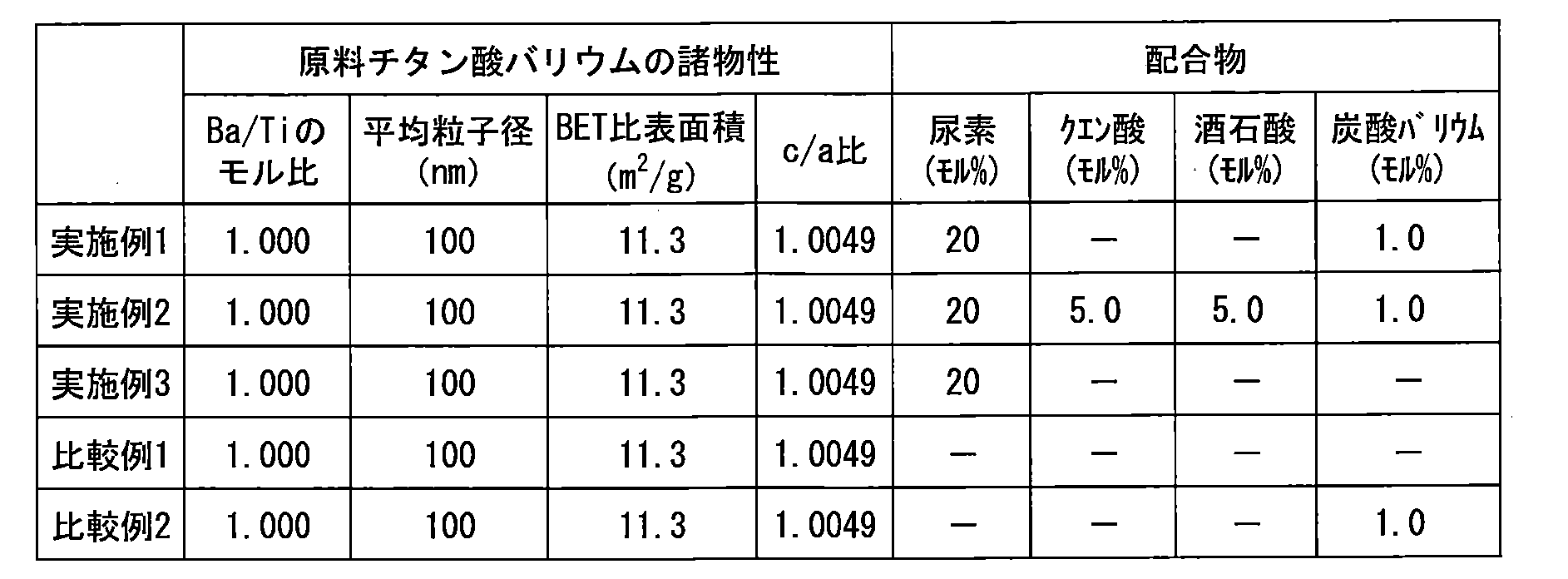
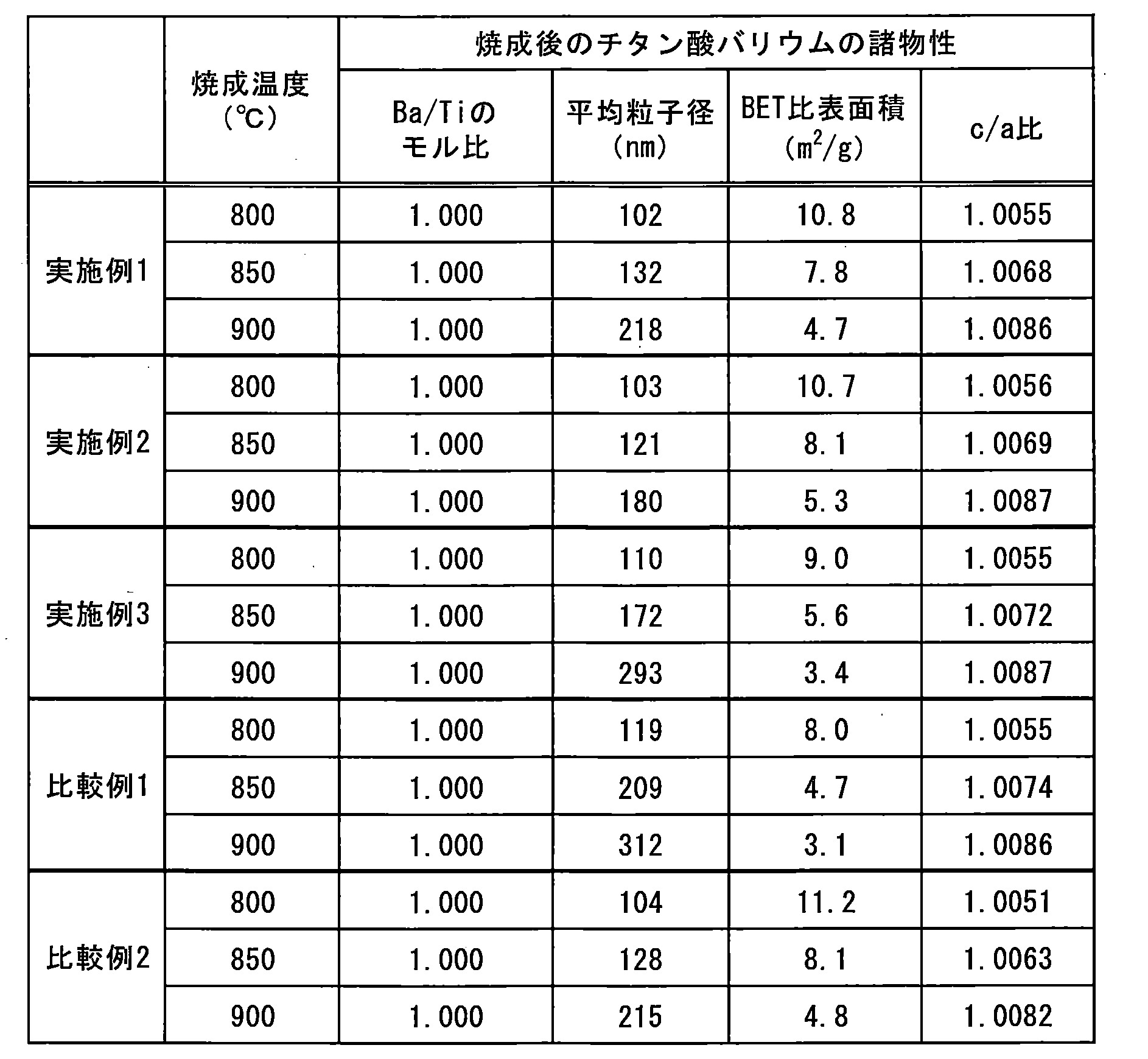
図6に、縦軸をc/aとし、横軸を比表面積(SSA)として、表2の結果を、プロットしたグラフで示す。なお、図6中、各実施例及び比較例のプロットは、右から焼成温度が、800℃、850℃、900℃のデータである。
以上の結果から、実施例1及び2の誘電体セラミック形成用組成物では、比較例1及び2と比べてチタン酸バリウムは粒成長し難く、粒径が小さく且つ高結晶なものが得られることが判る。また、尿素のみを加えた実施例3は、炭酸バリウムのみを加えた比較例2と比べて、同じ焼成温度で比べるとc/a値が高く、結晶化が促進されていることが判る。
Claims (10)
- 原料ペロブスカイト(ABO3)型複合酸化物と、下記式(1):

前記一般式(1)で表される結合を有する化合物の含有量が、該原料ペロブスカイト(ABO3)型複合酸化物に対し、0.40~80モル%であること、
を特徴とする誘電体セラミック形成用組成物。 - 前記一般式(1)で表される結合を有する化合物が、アミド化合物、尿素化合物及びイミド化合物から選択される少なくとも1種であることを特徴とする請求項1記載の誘電体セラミック形成用組成物。
- 更に、ヒドロキシ酸を含有し、
該ヒドロキシ酸の含有量が、前記原料ペロブスカイト(ABO3)型複合酸化物に対し、0.010~20モル%であることを特徴とする請求項1又は2記載の誘電体セラミック形成用組成物。 - 更に、前記原料ペロブスカイト(ABO3)型複合酸化物のAサイト元素を含有する化合物を含有し、
該Aサイト元素を含有する化合物の含有量が、前記原料ペロブスカイト(ABO3)型複合酸化物に対し、0.10~20モル%であることを特徴とする請求項1又は2記載の誘電体セラミック形成用組成物。 - 前記Aサイト元素を含有する化合物が、Ba、Ca、Mg又はSrの水酸化物、塩化物、硝酸塩、酢酸塩、酸化物及び炭酸塩から選択される少なくとも1種であることを特徴とする請求項4記載の誘電体セラミック形成用組成物。
- 前記原料ペロブスカイト(ABO3)型複合酸化物のAサイト元素が、Ba、Ca、Mg及びSrから選択される少なくとも1種であり、且つ、Bサイト元素がTi及びZrから選択される少なくとも1種であることを特徴とする請求項1又は2記載の誘電体セラミック形成用組成物。
- 前記一般式(1)で表される結合を有する化合物が、尿素、メチル尿素、エチル尿素、ブチル尿素、アセチル尿素、アセトアミド、ホルムアミド、プロピオン酸アミド、ブチルアミド、ジアセトアミド、コハク酸アミド、ε-カプロラクタム、アクリルアミド、アセトアニリド、ニコチン酸アミド、オレイン酸アミド及びステアリン酸アミドから選択される少なくとも1種であることを特徴とする請求項1又は2記載の誘電体セラミック形成用組成物。
- 前記ヒドロキシ酸が、クエン酸、酒石酸、リンゴ酸、グリコール酸、乳酸、グリセリン酸、ヒドロキシ酪酸、イソクエン酸、ロイシン酸、メバロン酸、パントイン酸、リシノール酸及びサリチル酸から選択される少なくとも1種であることを特徴とする請求項3記載の誘電体セラミック形成用組成物。
- 請求項1又は2記載の誘電体セラミック形成用組成物の焼成物であることを特徴とする誘電体セラミック材料。
- 前記誘電体セラミック形成用組成物の焼成温度が1000℃以下であることを特徴とする請求項9記載の誘電体セラミック材料。
Priority Applications (2)
| Application Number | Priority Date | Filing Date | Title |
|---|---|---|---|
| KR1020237039322A KR20240007166A (ko) | 2021-05-13 | 2022-05-09 | 유전체 세라믹 형성용 조성물 및 유전체 세라믹 재료 |
| CN202280034789.5A CN117295688A (zh) | 2021-05-13 | 2022-05-09 | 电介质陶瓷形成用组合物和电介质陶瓷材料 |
Applications Claiming Priority (2)
| Application Number | Priority Date | Filing Date | Title |
|---|---|---|---|
| JP2021-081483 | 2021-05-13 | ||
| JP2021081483A JP7524129B2 (ja) | 2021-05-13 | 2021-05-13 | 誘電体セラミック形成用組成物及び誘電体セラミック材料 |
Publications (1)
| Publication Number | Publication Date |
|---|---|
| WO2022239744A1 true WO2022239744A1 (ja) | 2022-11-17 |
Family
ID=84029598
Family Applications (1)
| Application Number | Title | Priority Date | Filing Date |
|---|---|---|---|
| PCT/JP2022/019706 Ceased WO2022239744A1 (ja) | 2021-05-13 | 2022-05-09 | 誘電体セラミック形成用組成物及び誘電体セラミック材料 |
Country Status (5)
| Country | Link |
|---|---|
| JP (1) | JP7524129B2 (ja) |
| KR (1) | KR20240007166A (ja) |
| CN (1) | CN117295688A (ja) |
| TW (1) | TW202311203A (ja) |
| WO (1) | WO2022239744A1 (ja) |
Cited By (1)
| Publication number | Priority date | Publication date | Assignee | Title |
|---|---|---|---|---|
| CN116375464A (zh) * | 2023-03-27 | 2023-07-04 | 哈尔滨工业大学 | 温度稳定型中介电常数微波介质陶瓷材料及其制备方法 |
Citations (7)
| Publication number | Priority date | Publication date | Assignee | Title |
|---|---|---|---|---|
| JP2006111524A (ja) * | 2004-09-15 | 2006-04-27 | Taiyo Yuden Co Ltd | セラミック粉末の製造方法 |
| JP2007099541A (ja) * | 2005-09-30 | 2007-04-19 | Nippon Chemicon Corp | 誘電体磁器組成物の製造方法および製造された誘電体磁器組成物を用いたセラミックコンデンサ |
| JP2010120802A (ja) * | 2008-11-19 | 2010-06-03 | Panasonic Corp | チタン酸バリウム粉末の製造方法 |
| WO2011046205A1 (ja) * | 2009-10-16 | 2011-04-21 | 日本化学工業株式会社 | 誘電体セラミック形成用組成物及び誘電体セラミック材料 |
| JP2011178643A (ja) * | 2010-03-03 | 2011-09-15 | Yamagata Univ | 表面改質セラミック粉末の製造方法 |
| JP2012206885A (ja) * | 2011-03-29 | 2012-10-25 | Tdk Corp | 誘電体磁器組成物の製造方法及び電子部品 |
| JP2015067519A (ja) * | 2013-09-30 | 2015-04-13 | 株式会社ノリタケカンパニーリミテド | チタン酸バリウム微粒子、チタン酸バリウム微粒子粉体およびそれらの製造方法 |
Family Cites Families (5)
| Publication number | Priority date | Publication date | Assignee | Title |
|---|---|---|---|---|
| KR100434883B1 (ko) | 2001-08-14 | 2004-06-07 | 삼성전기주식회사 | 티탄산바륨계 파우더의 제조방법 |
| KR101158953B1 (ko) * | 2005-02-25 | 2012-06-21 | 사까이가가꾸고오교가부시끼가이샤 | 조성물의 제조 방법 |
| JP5774510B2 (ja) * | 2012-01-30 | 2015-09-09 | 日本化学工業株式会社 | 誘電体セラミック材料及びそれに用いるペロブスカイト型複合酸化物粗粒子の製造方法 |
| JP6047252B2 (ja) * | 2015-04-07 | 2016-12-21 | 日本化学工業株式会社 | 誘電体セラミック材料、その製造方法及び複合誘電体材料 |
| JP6658792B2 (ja) | 2018-04-26 | 2020-03-04 | 堺化学工業株式会社 | 炭酸バリウムの製造方法 |
-
2021
- 2021-05-13 JP JP2021081483A patent/JP7524129B2/ja active Active
-
2022
- 2022-05-09 WO PCT/JP2022/019706 patent/WO2022239744A1/ja not_active Ceased
- 2022-05-09 KR KR1020237039322A patent/KR20240007166A/ko active Pending
- 2022-05-09 CN CN202280034789.5A patent/CN117295688A/zh active Pending
- 2022-05-11 TW TW111117596A patent/TW202311203A/zh unknown
Patent Citations (7)
| Publication number | Priority date | Publication date | Assignee | Title |
|---|---|---|---|---|
| JP2006111524A (ja) * | 2004-09-15 | 2006-04-27 | Taiyo Yuden Co Ltd | セラミック粉末の製造方法 |
| JP2007099541A (ja) * | 2005-09-30 | 2007-04-19 | Nippon Chemicon Corp | 誘電体磁器組成物の製造方法および製造された誘電体磁器組成物を用いたセラミックコンデンサ |
| JP2010120802A (ja) * | 2008-11-19 | 2010-06-03 | Panasonic Corp | チタン酸バリウム粉末の製造方法 |
| WO2011046205A1 (ja) * | 2009-10-16 | 2011-04-21 | 日本化学工業株式会社 | 誘電体セラミック形成用組成物及び誘電体セラミック材料 |
| JP2011178643A (ja) * | 2010-03-03 | 2011-09-15 | Yamagata Univ | 表面改質セラミック粉末の製造方法 |
| JP2012206885A (ja) * | 2011-03-29 | 2012-10-25 | Tdk Corp | 誘電体磁器組成物の製造方法及び電子部品 |
| JP2015067519A (ja) * | 2013-09-30 | 2015-04-13 | 株式会社ノリタケカンパニーリミテド | チタン酸バリウム微粒子、チタン酸バリウム微粒子粉体およびそれらの製造方法 |
Cited By (1)
| Publication number | Priority date | Publication date | Assignee | Title |
|---|---|---|---|---|
| CN116375464A (zh) * | 2023-03-27 | 2023-07-04 | 哈尔滨工业大学 | 温度稳定型中介电常数微波介质陶瓷材料及其制备方法 |
Also Published As
| Publication number | Publication date |
|---|---|
| CN117295688A (zh) | 2023-12-26 |
| KR20240007166A (ko) | 2024-01-16 |
| JP7524129B2 (ja) | 2024-07-29 |
| TW202311203A (zh) | 2023-03-16 |
| JP2022175238A (ja) | 2022-11-25 |
Similar Documents
| Publication | Publication Date | Title |
|---|---|---|
| TWI290539B (en) | Barium titanate and capacitor | |
| KR101539118B1 (ko) | 탄산바륨 입자 분말, 그의 제조 방법 및 페로브스카이트형 티탄산바륨의 제조 방법 | |
| TWI228493B (en) | Barium titanate and electronic parts using the same | |
| TWI694979B (zh) | 鈦酸鋇粉末的製造方法 | |
| JP3751304B2 (ja) | チタン酸バリウムおよびそれを用いた電子部品 | |
| WO2019111586A1 (ja) | ペロブスカイト型チタン酸バリウム粉末の製造方法 | |
| JP7110306B2 (ja) | シュウ酸バリウムチタニルの製造方法及びチタン酸バリウムの製造方法 | |
| JP7524129B2 (ja) | 誘電体セラミック形成用組成物及び誘電体セラミック材料 | |
| TWI902974B (zh) | 草酸鈦氧基鋇的製造方法及鈦酸鋇的製造方法 | |
| JP5119008B2 (ja) | ペロブスカイト型チタン酸バリウム粉末の製造方法 | |
| JP2017071537A (ja) | チタン酸バリウム粉末の製造方法 | |
| JP7110305B2 (ja) | シュウ酸バリウムチタニルの製造方法及びチタン酸バリウムの製造方法 | |
| JP4671946B2 (ja) | チタン酸バリウムカルシウム粉末およびその製法 | |
| CN101014539A (zh) | 钛酸钙钡、其制造方法及电容器 | |
| JP6580932B2 (ja) | チタン酸バリウム粉末の製造方法 | |
| KR20020094623A (ko) | 에틸렌 글리콜을 이용한 티타네이트 분말의 제조방법 | |
| JP2006199578A (ja) | ペロブスカイト型チタン含有複合酸化物およびその製造方法並びにコンデンサ | |
| CN1800099B (zh) | 草酸氧钛钡粉末和钛类钙钛矿型陶瓷原料粉末的制造方法 | |
| JP5119007B2 (ja) | ペロブスカイト型チタン酸バリウム粉末の製造方法 | |
| TWI888577B (zh) | 草酸鈦氧基鋇、其製造方法及鈦酸鋇的製造方法 | |
| JP4956265B2 (ja) | 板状結晶のBaTiO3を含むグリーンシート及びその製造方法 | |
| WO2021010368A1 (ja) | Me元素置換有機酸バリウムチタニル、その製造方法及びチタン系ペロブスカイト型セラミック原料粉末の製造方法 | |
| JP5142468B2 (ja) | チタン酸バリウム粉末の製造方法 | |
| CN100341789C (zh) | 钛酸钡和使用该材料的电子元件 | |
| CN116507588B (zh) | 草酸氧钛钡的制造方法和钛酸钡的制造方法 |
Legal Events
| Date | Code | Title | Description |
|---|---|---|---|
| 121 | Ep: the epo has been informed by wipo that ep was designated in this application |
Ref document number: 22807445 Country of ref document: EP Kind code of ref document: A1 |
|
| WWE | Wipo information: entry into national phase |
Ref document number: 202280034789.5 Country of ref document: CN |
|
| NENP | Non-entry into the national phase |
Ref country code: DE |
|
| 122 | Ep: pct application non-entry in european phase |
Ref document number: 22807445 Country of ref document: EP Kind code of ref document: A1 |