WO2022220116A1 - 溶着用ポリアミド樹脂組成物およびその製造方法ならびに該ポリアミド樹脂組成物を含む成形体 - Google Patents
溶着用ポリアミド樹脂組成物およびその製造方法ならびに該ポリアミド樹脂組成物を含む成形体 Download PDFInfo
- Publication number
- WO2022220116A1 WO2022220116A1 PCT/JP2022/015650 JP2022015650W WO2022220116A1 WO 2022220116 A1 WO2022220116 A1 WO 2022220116A1 JP 2022015650 W JP2022015650 W JP 2022015650W WO 2022220116 A1 WO2022220116 A1 WO 2022220116A1
- Authority
- WO
- WIPO (PCT)
- Prior art keywords
- polyamide resin
- resin composition
- polyamide
- cellulose fibers
- welding
- Prior art date
- Legal status (The legal status is an assumption and is not a legal conclusion. Google has not performed a legal analysis and makes no representation as to the accuracy of the status listed.)
- Ceased
Links
Classifications
-
- C—CHEMISTRY; METALLURGY
- C08—ORGANIC MACROMOLECULAR COMPOUNDS; THEIR PREPARATION OR CHEMICAL WORKING-UP; COMPOSITIONS BASED THEREON
- C08K—Use of inorganic or non-macromolecular organic substances as compounding ingredients
- C08K3/00—Use of inorganic substances as compounding ingredients
- C08K3/40—Glass
-
- C—CHEMISTRY; METALLURGY
- C08—ORGANIC MACROMOLECULAR COMPOUNDS; THEIR PREPARATION OR CHEMICAL WORKING-UP; COMPOSITIONS BASED THEREON
- C08L—COMPOSITIONS OF MACROMOLECULAR COMPOUNDS
- C08L1/00—Compositions of cellulose, modified cellulose or cellulose derivatives
- C08L1/02—Cellulose; Modified cellulose
-
- C—CHEMISTRY; METALLURGY
- C08—ORGANIC MACROMOLECULAR COMPOUNDS; THEIR PREPARATION OR CHEMICAL WORKING-UP; COMPOSITIONS BASED THEREON
- C08L—COMPOSITIONS OF MACROMOLECULAR COMPOUNDS
- C08L77/00—Compositions of polyamides obtained by reactions forming a carboxylic amide link in the main chain; Compositions of derivatives of such polymers
Definitions
- the present invention relates to a polyamide resin composition for welding, a method for producing the same, and a molded article containing the polyamide resin composition.
- Polyamide resin has excellent mechanical properties, heat resistance, and chemical resistance, and is used in a wide range of fields such as automobiles and electrical and electronic component materials.
- polyamide resins have begun to be applied to parts with complex shapes as products become more sophisticated and smaller.
- the molding of complex shapes requires not only advanced molding technology, but also complicated molds, and therefore molding is often difficult with simple molding methods. In such a case, a method of manufacturing a plurality of molded bodies and joining them together is used.
- Patent Document 1 by using a polyamide resin composition consisting of a crystalline polyamide having a specific amino terminal group concentration and an inorganic filler, excellent fluidity and high cycle performance during molding, and excellent welding strength It is disclosed that a polyamide resin composition can be obtained by
- Patent Document 2 describes a thermoplastic resin composition that is excellent in surface appearance when formed into a welded molded product by using a graft copolymer and/or a copolymer in which a polyfunctional monomer is copolymerized. It is disclosed that an object can be obtained.
- Patent Documents 1 and 2 have the following problems (1) and/or (2): (1) The welding strength of the welded portion was not sufficient; (2) The warpage of the weld molded body obtained by welding was large. That is, when moldings manufactured from a resin composition according to the prior art are joined together by a welding method, it is possible to sufficiently suppress warpage of the welded molded body and sufficiently improve the strength of the welded portion at the same time. I could't.
- a burr is a resin protruding from a welded portion, and is often generated when, for example, the viscosity of a resin when melted is low.
- the present invention provides a polyamide resin composition and a molded article containing the resin composition, which can form a molded article having sufficiently excellent welding strength between molded articles and sufficiently suppressed warpage of the welded molded article. It is intended to
- the present invention also provides a polyamide resin composition and a molded article containing the resin composition, which can constitute a molded article having sufficiently excellent welding strength between molded articles and sufficiently suppressing warpage and burrs of the welded molded article. It is intended to provide
- the inventors of the present invention have made intensive studies to solve the above problems, and found that the above objects can be achieved by using a resin composition containing a specific cellulose fiber when polymerizing a polyamide resin. arrived at the invention.
- the gist of the present invention is as follows.
- the welding strength of the weld molded body obtained by the welding is 40 MPa or more
- the polyamide resin composition, wherein the weld molded body has a warp amount of less than 1.5 mm.
- the polyamide resin composition has a complex elastic modulus in dynamic viscoelasticity measurement at a melting point of +30 ° C.
- the polyamide resin composition further contains or does not contain an amorphous polyamide (C), and the content of the amorphous polyamide (C) is based on 100 parts by mass of the polyamide resin (A)
- the polyamide resin composition according to any one of ⁇ 1> to ⁇ 3>, which is 0 to 50 parts by mass.
- the amorphous polyamide resin (C) has a heat of crystal fusion of 1 cal/g or less as measured using a differential scanning calorimeter (DSC) at a heating rate of 16°C/min.
- DSC differential scanning calorimeter
- the polyamide resin composition further contains or does not contain a reinforcing material (D) other than cellulose fibers, and the content of the other reinforcing material (D) is the polyamide resin (A)
- ⁇ 8> The polyamide resin composition according to any one of ⁇ 1> to ⁇ 7>, wherein the cellulose fibers (B) have an average fiber diameter of 10 to 500 nm.
- the cellulose fiber (B) is an unmodified cellulose fiber, or a modified cellulose fiber in which a cellulose-derived hydroxyl group is modified with a hydrophobic substituent,
- the cellulose fibers (B) are unmodified cellulose fibers, The cellulose fibers (B) have an average fiber diameter of 10 to 100 nm, The content of the cellulose fiber (B) is 3 to 35 parts by mass,
- the polyamide resin composition has a relative viscosity of 1.7 to 2.8, When the complex elastic modulus of the polyamide resin composition is G * [Pa] and the loss tangent is tan ⁇ [-], the following relational expression: 50000 ⁇ G * /(1+tan 2 ⁇ ) 1/2 ⁇ 13000
- the polyamide resin composition according to any one of ⁇ 1> to ⁇ 9>, which satisfies ⁇ 11> A method for producing the polyamide resin composition according to any one of ⁇ 1> to ⁇ 10>, A method for producing a polyamide resin composition, wherein cellulose fibers are added during polymerization of the polyamide resin.
- a welded molded article having a welded portion comprising the polyamide resin composition according to any one of ⁇ 1> to ⁇ 10>.
- a plurality of molded bodies composed of the polyamide resin composition according to any one of ⁇ 1> to ⁇ 10> are subjected to an infrared/vibration welding method, an infrared welding method, a vibration welding method, a hot plate welding method, a laser A method for producing welded compacts, wherein the welded compacts are welded together by a method selected from the group consisting of a welding method and an ultrasonic welding method.
- the molded article composed of the polyamide resin composition of the present invention warping of the welded molded article after welding is sufficiently suppressed, and the welded molded article has sufficiently excellent weld strength (especially tensile strength) at the welded portion. can be provided. According to the molded article composed of the polyamide resin composition of the present invention, it is possible to provide a welded molded article in which burrs generated during welding are sufficiently suppressed.
- the polyamide resin composition of the present invention (hereinafter sometimes simply referred to as a resin composition) is a polyamide resin composition used for welding molded bodies to each other, and is a polyamide resin for constituting these molded bodies. composition.
- the polyamide resin composition of the present invention is, in detail, a polyamide resin composition for forming molded articles to be welded together.
- welding refers to melting and pressure bonding of the joint surfaces of a plurality of resin moldings to join and integrate them.
- the molded article having the welded portion thus obtained is defined as "welded molded article”.
- the polyamide resin composition for welding of the present invention (hereinafter sometimes simply referred to as "resin composition") contains cellulose fibers having an average fiber diameter of 10 ⁇ m or less with respect to the polyamide resin.
- polyamide resin (A) used in the present invention is a polymer having an amide bond formed from an amino acid, a lactam or a diamine and a dicarboxylic acid.
- amino acids examples include 6-aminocaproic acid, 11-aminoundecanoic acid, 12-aminododecanoic acid, and para-aminomethylbenzoic acid.
- Lactams include, for example, ⁇ -caprolactam and ⁇ -laurolactam.
- diamines examples include tetramethylenediamine, hexamethylenediamine, nonamethylenediamine, decamethylenediamine, undecamethylenediamine, dodecamethylenediamine, 2,2,4-/2,4,4-trimethylhexamethylenediamine, -methylnonamethylenediamine, 2,4-dimethyloctamethylenediamine, meta-xylylenediamine, para-xylylenediamine, 1,3-bis(aminomethyl)cyclohexane, 1-amino-3-aminomethyl-3,5,5 -trimethylcyclohexane, 3,8-bis(aminomethyl)tricyclodecane, bis(4-aminocyclohexyl)methane, bis(3-methyl-4-aminocyclohexyl)methane, 2,2-bis(4-aminocyclohexyl) propane, bis(aminopropyl)piperazine.
- dicarboxylic acids examples include adipic acid, suberic acid, azelaic acid, sebacic acid, dodecanedioic acid, terephthalic acid, isophthalic acid, naphthalenedicarboxylic acid, 2-chloroterephthalic acid, 2-methylterephthalic acid, and 5-methylisophthalic acid. , 5-sodium sulfoisophthalic acid, hexahydroterephthalic acid, hexahydroisophthalic acid, and diglycolic acid.
- polyamide resin (A) used in the present invention examples include polycaproamide (polyamide 6), polytetramethylene adipamide (polyamide 46), polyhexamethylene adipamide (polyamide 66), and polyhexamethylene sevaca.
- polyamide 610 polyhexamethylenedodecanamide
- polyamide 612 polyundecanamide
- polyamide 116 polyundecaneamide
- polyamide 11 polydodecanamide
- polyamide 12 polytrimethylhexamethylene terephthalamide
- polyamide TMHT polyhexamethylene terephthalamide
- polyamide 6T polyhexamethylene isophthalamide
- polyamide 6I polyhexamethylene terephthalamide/isophthalamide
- polyamide PACM12 polybis(3-methyl-4-aminocyclohexyl)methandodedecamide
- polyamide MXD6 polymetaxylylene adipamide
- polyamide 9T polynonamethylene terephthalamide
- polyamide 10T polymetaxylylene adipamide
- polyamide 6, polyamide 66, polyamide 11, polyamide 12, and copolymers and mixtures thereof are preferable from the viewpoint of further improving the welding strength.
- Polyamide resin (A) is preferably polyamide 6, polyamide 66, and copolymers or mixtures thereof, more preferably polyamide 6, from the viewpoint of further improving welding strength and further suppressing warpage and burrs.
- Polyamide resin (A) usually has crystallinity, for example, the heat of crystal fusion measured under the conditions of a temperature increase rate of 16 ° C. / min using a differential scanning calorimeter (DSC) in a nitrogen atmosphere is more than 1 cal / g. (particularly 10 cal/g or more).
- DSC differential scanning calorimeter
- the polyamide resin (A) can be produced by a melt polymerization method, a solid phase polymerization method, or a combination thereof, which will be described later.
- the molecular weight of the polyamide resin (A) is not particularly limited, and may be, for example, such a molecular weight that the resin composition has a specific relative viscosity as described below.
- Cellulose fibers used in the present invention include those derived from plants such as wood, rice, cotton, hemp, and kenaf, as well as bacterial cellulose, valonia cellulose, and sea squirt. Biological materials such as cellulose are also included. Also included are regenerated cellulose and cellulose derivatives. Commercially available plant-derived cellulose fibers include, for example, "Celish” manufactured by Daicel Finechem.
- the average fiber diameter of the cellulose fibers (B) is as small as possible.
- the cellulose fibers (B) contained in the polyamide resin composition of the present invention must have an average fiber diameter of 10 ⁇ m or less, and from the viewpoint of further suppressing burrs and warping and further improving welding strength, Among them, the average fiber diameter is preferably 500 nm or less, more preferably 300 nm or less, even more preferably 150 nm or less, particularly preferably 100 nm or less, and fully preferably 80 nm or less. Cellulose fibers having an average fiber diameter of more than 10 ⁇ m greatly impair the weld strength of the weld molded article.
- the lower limit of the average fiber diameter is not particularly limited, it is preferably 3 nm or more (particularly 10 nm or more), and preferably 20 nm or more, in consideration of the productivity of cellulose fibers and the weld strength and warpage of the weld molded product. is more preferable, and 30 nm or more is even more preferable.
- the average fiber diameter of the cellulose fibers (B) in the polyamide resin composition the average fiber diameter measured by the following method is used. From the injection-molded piece obtained using the polyamide resin composition, a section with a thickness of 100 nm was collected using a frozen ultramicrotome, and after staining the section, a transmission electron microscope (JEM-1230 manufactured by JEOL Ltd.) was observed. Observation using From an electron microscope image, the length in the direction perpendicular to the longitudinal direction of any 10 cellulose fibers (single fibers) is measured, and the average value of these is taken as the average fiber diameter.
- JEM-1230 manufactured by JEOL Ltd.
- the average fiber diameter of the cellulose fibers (B) in the polyamide resin composition of the present invention 10 ⁇ m or less
- the cellulose fibers (B) having an average fiber diameter of 10 ⁇ m or less are preferably microfibrillated by tearing the cellulose fibers.
- various pulverizing devices such as ball mills, stone mills, high-pressure homogenizers, high-pressure pulverizers and mixers can be used.
- the cellulose fiber (B) for example, "Celish” manufactured by Daicel Finechem Co., Ltd. can be used as a commercially available one.
- cellulose fibers (B) having an average fiber diameter of 10 ⁇ m or less aggregates of cellulose fibers produced as waste threads in the manufacturing process of textile products using cellulose fibers can also be used.
- the manufacturing process of textile products includes the time of spinning, the time of weaving, the time of manufacturing nonwoven fabrics, and the time of processing of other textile products. These aggregates of cellulose fibers are fine cellulose fibers because the cellulose fibers become waste yarns after passing through these steps.
- bacterial cellulose fibers produced by bacteria can be used.
- those produced by Acetobacter acetic acid bacteria can be used.
- Cellulose fibers from plants are converged molecular chains of cellulose, and are formed by bundles of very fine microfibrils. It is ribbon-like with a diameter of 50 nm, and forms an extremely fine network compared to plant cellulose fibers.
- the cellulose fiber (B) may be an unmodified cellulose fiber in which the cellulose-derived hydroxyl groups are not modified (or substituted) with any substituent, or the cellulose-derived hydroxyl groups (especially part thereof) may be modified. (or substituted) modified cellulose fibers.
- the substituent to be introduced into the cellulose-derived hydroxyl group is not particularly limited, and examples thereof include hydrophilic substituents and hydrophobic substituents.
- the hydroxyl groups modified (or substituted) by the substituents are part of the hydroxyl groups derived from cellulose, and the degree of substitution (out of all the hydroxyl groups in the cellulose fiber modified by the substituents
- the ratio of the number of hydroxyl groups) is, for example, preferably 0.05 to 2.0, more preferably 0.1 to 1.0, and even more preferably 0.1 to 0.8.
- Hydrophilic substituents include, for example, a carboxyl group, a carboxymethyl group, a phosphate ester group, and the like.
- Hydrophobic substituents include, for example, silyl ether groups, alkyl ether groups, alkyl ester groups and the like.
- the cellulose fibers (B) are unmodified cellulose fibers, or cellulose-derived hydroxyl groups (especially part thereof) are hydrophilic or hydrophobic, from the viewpoint of further improving welding strength and further suppressing burrs and warpage. It is preferably a modified cellulose fiber modified with a substituent, more preferably an unmodified cellulose fiber, or a cellulose-derived hydroxyl group (especially a part thereof) modified with a hydrophobic substituent It is a modified cellulose fiber, more preferably the unmodified cellulose fiber.
- cellulose fibers (B) having an average fiber diameter of 10 ⁇ m or less in which the cellulose-derived hydroxyl groups are modified with hydrophilic substituents for example, the cellulose fibers are oxidized in the presence of an N-oxyl compound, washed with water, and subjected to physical treatment. Refined cellulose fibers obtained through a defibration step may also be used.
- N-oxyl compounds for example, 2,2,6,6-tetramethylpiperidine-1-oxyl radical (2,2,6 , 6-Tetramethylpiperidine-1-oxyl radical) (hereinafter abbreviated as "TEMPO") and the like are preferable.
- TEMPO replaces hydroxyl groups with carboxyl groups.
- cellulose fibers (B) in which cellulose-derived hydroxyl groups are modified with hydrophobic substituents for example, cellulose fibers obtained by reacting cellulose fibers with a silyl etherifying agent at 35 to 50° C. in a solvent are used. good too.
- silyl etherifying agents for example, hexamethyldisilazane and the like are preferable. Hexamethyldisilazane replaces hydroxyl groups with silyl ether groups.
- the cellulose fiber (B) in the polyamide resin composition of the present invention has an aspect ratio (average fiber length /average fiber diameter) is preferably 10 or more, more preferably 31 or more, still more preferably 50 or more, and particularly preferably 100 or more.
- the aspect ratio is usually 300 or less, especially 200 or less.
- the average fiber length of the cellulose fibers (B) in the polyamide resin composition can be measured by the same method as the method for measuring the average fiber diameter described above. Specifically, the average fiber length is observed using a transmission electron microscope (JEM-1230 manufactured by JEOL Ltd.) in the same manner as the method for measuring the average fiber diameter described above, and any 10 fibers are selected from the electron microscope image. The total length in the longitudinal direction of the cellulose fiber (single fiber) is measured, and the average value of these is taken as the average fiber length.
- the content of the cellulose fiber (B) constituting the polyamide resin composition of the present invention must be 0.1 to 50 parts by mass with respect to 100 parts by mass of the polyamide resin (A). from the viewpoint of further suppressing the above and further improving the weld strength of the welded compact, it is preferably 0.1 to 40 parts by mass (for example, a combined range of 0.1 to 30 parts by mass and 30 to 40 parts by mass).
- 1 to 35 parts by mass eg, a combined range of 1 to 25 parts by mass and 25 to 35 parts by mass
- 3 to 35 parts by mass e.g, 3 to 25 parts by mass and 25 to 35 parts by mass
- 4 to 32 parts by mass for example, a combined range of 4 to 22 parts by mass and 22 to 32 parts by mass
- 5 to 30 parts by mass e.g., a combined range of 5 to 20 parts by weight and 20 to 30 parts by weight
- a combined range of 5 to 20 parts by weight and 20 to 30 parts by weight is most preferred. If the content of the cellulose fibers (B) is less than 0.1 parts by mass with respect to 100 parts by mass of the polyamide resin (A), burrs and warpage will occur, and sufficient welding strength cannot be obtained.
- the content of the cellulose fiber (B) exceeds 50 parts by mass with respect to 100 parts by mass of the polyamide resin (A), it becomes difficult to incorporate the cellulose fiber into the resin composition, and the flow of the molten resin Since the moldability of the resin composition deteriorates, the moldability of the resin composition may deteriorate.
- the polyamide resin composition for welding in the present invention may further contain amorphous polyamide (hereinafter sometimes referred to as amorphous polyamide (C)). Specifically, the polyamide resin composition for welding in the present invention may or may not contain an amorphous polyamide.
- the amorphous polyamide resin (C) used in the present invention has a heat of crystal fusion of 1 cal/g or less measured under a nitrogen atmosphere using a differential scanning calorimeter (DSC) at a heating rate of 16° C./min. Polyamide resin.
- composition of such amorphous polyamide (C) is not particularly limited.
- these polyamide resins can be used in combination of two or more.
- isophthalic acid/adipic acid/1,6-hexamethylenediamine/bis(3-methyl-4-aminocyclohexyl)methane polycondensate isophthalic acid/terephthalic acid/hexamethylenediamine polycondensate
- the glass transition temperature thereof is preferably 200° C. or less from the viewpoint of further suppressing burrs and warpage and further improving welding strength. , more preferably 150° C. or lower, more preferably 100° C. or lower, particularly preferably 80° C. or lower, and most preferably 60° C. or lower. If the glass transition temperature exceeds 200° C., not only is the moldability deteriorated, but also appearance defects such as flow marks are likely to occur.
- the content of the amorphous polyamide resin (C) is 0 with respect to 100 parts by mass of the polyamide resin (A) from the viewpoint of further suppressing burrs and warping and further improving the welding strength. It is preferably from 0 to 100 parts by mass, more preferably from 0 to 50 parts by mass, and even more preferably from 0 to 20 parts by mass. Two or more kinds of amorphous polyamide resins may be contained, and in that case, the total amount thereof should be within the above range.
- the fact that the content of the amorphous polyamide (C) is 0 parts by mass means that the polyamide resin composition of the present invention does not contain the amorphous polyamide (C).
- the polyamide resin composition for welding in the present invention may further contain a reinforcing material (D) other than cellulose fibers (hereinafter sometimes simply referred to as "another reinforcing material (D)").
- a reinforcing material (D) other than cellulose fibers
- the polyamide resin composition for welding in the present invention may or may not contain another reinforcing material (D).
- Other reinforcing materials (D) include fibrous reinforcing materials and particulate reinforcing materials.
- fibrous reinforcing materials include glass fiber, carbon fiber, boron fiber, asbestos fiber, polyvinyl alcohol fiber, polyester fiber, acrylic fiber, wholly aromatic polyamide fiber, polybenzoxazole fiber, kenaf fiber, bamboo fiber, and hemp fiber. , bagasse fiber, high-strength polyethylene fiber, alumina fiber, silicon carbide fiber, potassium titanate fiber, brass fiber, stainless fiber, steel fiber, ceramic fiber, basalt fiber.
- glass fiber, carbon fiber, and metal fiber are more effective in improving mechanical properties (especially bending properties), have heat resistance that can withstand the heating temperature during melt-kneading with polyamide resin, and are easy to obtain.
- metal fibers include potassium titanate fibers, brass fibers, stainless steel fibers, and steel fibers.
- Silane coupling agents include, for example, vinylsilane-based, acrylsilane-based, epoxysilane-based, and aminosilane-based agents. Among them, an aminosilane-based coupling agent is preferable because it has a high adhesion effect with the polyamide resin.
- the fiber length of the reinforcing material (D) (especially fibrous reinforcing material) other than cellulose fibers is preferably 0.1 to 10 mm from the viewpoint of further improving the weld strength of the weld molded product and improving the moldability. It is preferably 0.5 to 8 mm, more preferably 0.5 to 8 mm.
- the fiber diameter of the reinforcing material (D) is preferably 3 to 20 ⁇ m, more preferably 5 to 13 ⁇ m, from the viewpoints of further improving welding strength and preventing breakage during melt-kneading.
- the cross-sectional shape of the reinforcing material (D) may be circular, rectangular, elliptical, or other irregular cross-sections, with circular cross-section being preferred.
- the fiber length of the fibrous reinforcing material (D) uses the average fiber length measured by the following method. Observe the length of the fiber by optical microscopy and measure the length of the fiber. Then, this measurement is performed for 100 fibers, and the average value is taken as the average fiber length of the fiber reinforcing material.
- the fiber diameter of the fibrous reinforcing material (D) is the average value of the maximum length in the cross-sectional shape, and the average fiber diameter measured by the following method is used. A cross section orthogonal to the length direction of the fiber is observed with an optical microscope to measure the diameter of the fiber. Then, this measurement is performed for 100 fibers, and the average value is taken as the average fiber diameter of the fiber reinforcing material.
- particulate reinforcing agents include talc, mica, layered silicate, calcium carbonate, zinc carbonate, wollastonite, silica, calcium silicate, graphite, sodium aluminate, calcium aluminate, sodium aluminosilicate, magnesium silicate, glass balloons, antimony trioxide, zeolite, hydrotalcite.
- talc, mica, and layered silicate are preferable from the viewpoint of further improving the welding strength of the welded molded body and improving the heat resistance.
- the particle size of the particulate reinforcing material is preferably 0.1 to 100 ⁇ m, more preferably 0.5 to 80 ⁇ m, more preferably 0.5 to 10 ⁇ m, from the viewpoint of further improving the weld strength of the welded compact. is more preferable.
- the average particle size measured by the following method is used as the particle size of the particulate reinforcing material.
- the specific surface area value per 1 g of particles is obtained using a Shimadzu Corporation powder specific surface area measuring device SS-100 type (constant pressure air permeation method), and from the measurement results of the specific surface area by the air permeation method according to JIS M-8511, Calculate the average particle size of the particulate reinforcement by the following formula.
- Average particle size 6 x 10,000/(specific gravity x specific gravity area)
- the other reinforcing material (D) is one or more reinforcing materials selected from the group consisting of glass fiber, carbon fiber, talc and mica, from the viewpoint of further improving the welding strength of the welded molded product and further suppressing burrs and warpage. It preferably contains material.
- the content of the reinforcing material (D) other than the cellulose fiber is the polyamide resin (A) from the viewpoint of further improving the welding strength of the weld molded body and further suppressing burrs and warping. It is preferably from 0 to 50 parts by mass, more preferably from 0 to 30 parts by mass, and even more preferably from 0 to 20 parts by mass with respect to 100 parts by mass. Two or more reinforcing materials other than cellulose fibers may be contained, and in that case, the total amount thereof may be within the above range.
- the fact that the content of the other reinforcing material (D) is 0 parts by mass means that the polyamide resin composition of the present invention does not contain the other reinforcing material (D).
- the polyamide resin composition of the present invention exhibits the effect of improving the welding strength and the effect of suppressing warpage, it does not necessarily have to exhibit the effect of suppressing burrs. It works together with the improvement effect and the warpage suppressing effect.
- the method for producing the polyamide resin composition of the present invention is not particularly limited, but for example, it can be produced by adding cellulose fibers during polymerization of polyamide.
- the method for producing the polyamide resin composition of the present invention in detail, monomers constituting the polyamide and an aqueous dispersion of cellulose fibers are mixed, a catalyst is added as necessary, and polymerization (for example, melt polymerization) is performed. to produce a polyamide containing cellulose fibers.
- the resin composition may have the form of so-called pellets.
- Polymerization of polyamide includes not only polymerization using monomers constituting polyamide but also polymerization using prepolymer capable of constituting polyamide.
- the monomers to be polymerized may be prepolymers.
- a prepolymer is an intermediate product during the polymerization of a monomer.
- the resin composition also includes the additive.
- Polymerization may be carried out, for example, by a so-called “melt polymerization method” in which the polymerization temperature is relatively high, or by a so-called “low-temperature polymerization method” in which the polymerization temperature is relatively low, as will be described later in detail. good too.
- Cellulose fibers have a very high affinity for water, and the smaller the average fiber diameter, the better the dispersion in water.
- the cellulose fibers are strongly aggregated by hydrogen bonding, and once aggregated, it becomes difficult to obtain the same dispersed state as before aggregation. In particular, this tendency becomes more pronounced as the average fiber diameter of the cellulose fibers becomes smaller. Therefore, it is preferable to mix the cellulose fiber with the polyamide resin in a state of containing water. Therefore, in the present invention, it is preferable to adopt a method of obtaining a resin composition containing cellulose fibers by conducting a polymerization reaction of monomers constituting a polyamide resin in the presence of cellulose fibers containing water. . Such a manufacturing method makes it possible to uniformly disperse the cellulose fibers in the polyamide resin without aggregating them.
- the aqueous dispersion of cellulose fibers is obtained by dispersing cellulose fibers having an average fiber diameter of 10 ⁇ m or less in water, and the content of cellulose fibers in the aqueous dispersion is 0.01 to 50% relative to the total amount of the aqueous dispersion. % by mass, preferably 1 to 30% by mass.
- the aqueous dispersion of cellulose fibers can be obtained by stirring purified water and cellulose fibers with a mixer or the like. Then, the aqueous dispersion of the cellulose fibers and the monomer constituting the polyamide resin are mixed and stirred with a mixer or the like to form a uniform dispersion. After that, the dispersion is heated to 150 to 270° C.
- the aqueous dispersion of the cellulose fiber may be obtained by immersing the bacterial cellulose in purified water to replace the solvent.
- the cellulose fibers having an average fiber diameter of 10 ⁇ m or less are subjected to the polymerization reaction as they are in the aqueous dispersion, so the cellulose fibers can be subjected to the polymerization reaction in a state of good dispersibility. Furthermore, the cellulose fibers subjected to the polymerization reaction are improved in dispersibility due to the interaction with the monomers and water during the polymerization reaction and by stirring under the above temperature conditions, and the fibers are aggregated. It is possible to obtain a resin composition in which cellulose fibers having a small average fiber diameter are well dispersed. According to the above method, the average fiber diameter of the cellulose fibers contained in the resin composition after the completion of the polymerization reaction may be smaller than that of the cellulose fibers added before the polymerization reaction.
- the process of drying the cellulose fibers is not required, and production is possible without going through a process that causes fine cellulose fibers to scatter, so it is possible to obtain a resin composition with good workability.
- it is not necessary to replace water with an organic solvent for the purpose of uniformly dispersing the monomer and the cellulose fibers it is possible to suppress the discharge of chemical substances during the manufacturing process while being excellent in handling.
- the melt polymerization method is a method of obtaining a polyamide resin in a molten state by sufficiently performing polymerization by heating without using a solvent. Therefore, the polymerization temperature in the melt polymerization method is higher than the melting point of the obtained polyamide resin (A).
- the "melting point of the polyamide resin (A)” is the "target melting point of the polyamide resin (A)".
- the monomer or prepolymer of the polyamide resin (A) constituting the polyamide resin composition of the present invention is It is the melting point of the polyamide resin (A) obtained by sufficiently polymerizing by a melt polymerization method using only.
- the polymerization temperature in such a melt polymerization method is, for example, 230 to 270° C. (especially 240° C.) for polyamide 6, and 250 to 290° C. (especially 280° C.) for polyamide 66, for example.
- the polymerization time in the melt polymerization method may usually be 0.5 to 2 hours, especially 1 hour.
- the polyamide resin ( A) (more specifically, “desired polyamide resin (A)" is obtained.
- the melting point of the obtained polyamide resin (A) is measured.
- the “target polyamide resin (A)” is polyamide 6
- the “target polyamide resin (A) melting point” is usually 220°C.
- the “target polyamide resin (A) melting point” is usually 270°C.
- a method for measuring the melting point is not particularly limited, and for example, it can be measured by a differential scanning calorimeter. After that, the mixed dispersion containing the monomer (or prepolymer) and the cellulose fiber aqueous dispersion is subjected to a polymerization reaction at a temperature higher than the "melting point", thereby producing the polyamide resin composition of the present invention. .
- the polyamide resin composition of the present invention obtained is preferably discharged and then cut into pellets.
- the size of the pellet is not particularly limited, it is preferably 2 to 5 mm in diameter and 3 to 6 mm in length, and 3 to 4 mm in diameter and 4 to 5 mm in length, from the viewpoint of handling and the efficiency of scouring, which will be described later. is more preferable.
- the polyamide resin composition of the present invention after melt polymerization, or the polyamide resin composition of the present invention after scouring, which will be described later if necessary, is subjected to an inert gas flow or under reduced pressure in order to further increase the degree of polymerization.
- Solid phase polymerization may be performed by heating at a temperature below the melting point of the polyamide resin composition of the present invention for 30 minutes or more. If the heating temperature is less than (the melting point of the polyamide resin composition of the present invention -75°C), the reaction rate may slow down, and the polyamide will not fuse near the melting point of the polyamide resin composition of the present invention. or coloration may occur.
- the polyamide resin composition of the present invention can also be produced by adding cellulose fibers during polymerization of the polyamide resin and performing the polymerization reaction at a temperature lower than the "melting point of the polyamide resin (A)". can be done.
- the "melting point of the polyamide resin (A)" in the low-temperature polymerization method is the same as the "melting point of the polyamide resin (A)" described above in the explanation of the melt polymerization method.
- a mixed dispersion obtained by uniformly mixing a monomer constituting a polyamide resin, an aqueous dispersion of cellulose fibers, and, if necessary, a catalyst is heated to a temperature lower than the "melting point of the polyamide resin".
- Polyamide containing cellulose fibers can be produced by heating to a temperature of .
- water vapor in the aqueous dispersion of cellulose fibers can be discharged by gradually discharging water vapor when heating the dispersion.
- the polymerization reaction may be carried out while standing still, or may be carried out while stirring.
- the resin composition may have the form of so-called pellets.
- the polymerization of the polyamide resin includes not only the polymerization using the monomers constituting the polyamide resin (A) but also the polymerization using a prepolymer capable of constituting the polyamide resin.
- the monomers to be polymerized may be prepolymers.
- a prepolymer is an intermediate product during the polymerization of a monomer.
- the polyamide resin composition of the present invention can be prepared, for example, by stirring a mixture of a monomer or prepolymer constituting the polyamide resin (A) and an aqueous dispersion of cellulose fibers with a mixer or the like to obtain a uniform dispersion, It can be obtained by heating to a temperature below the "melting point of the polyamide resin (A)" for polymerization reaction.
- the polyamide resin composition of the present invention when producing the polyamide resin composition of the present invention by a low-temperature polymerization method, first, using only the monomer or prepolymer as the raw material to be used, sufficient polymerization is performed by the above-described melt polymerization method, and the polyamide resin ( A) (more specifically, “desired polyamide resin (A)") is obtained. Then, the melting point of the obtained polyamide resin (A) is measured by the same method as described above. When the "target polyamide resin (A)" is polyamide 6 and polyamide 66, the “melting point of the target polyamide resin (A)" is the same temperature as described above.
- the mixed dispersion containing the monomer (or prepolymer) and the cellulose fiber aqueous dispersion is subjected to a polymerization reaction at a temperature below the "melting point" to produce the polyamide resin composition of the present invention.
- polymerization is performed at a lower temperature than the melt polymerization method, so such polymerization can be called "low temperature polymerization".
- the polyamide resin composition of the present invention obtained by low-temperature polymerization is obtained in a solid state (or solid phase state).
- an aqueous dispersion of cellulose fibers can also be obtained by stirring purified water and cellulose fibers with a mixer or the like.
- the content of cellulose fibers in the aqueous dispersion is preferably 0.01 to 50% by mass, more preferably 1 to 30% by mass.
- a polymerization catalyst may be added as necessary during the low-temperature polymerization for obtaining the polyamide resin composition of the present invention.
- the polymerization catalyst is not particularly limited as long as it is commonly used for melt polymerization of polyamide. Among them, phosphorus compounds are preferable, and phosphorous acid or sodium hypophosphite is preferably used.
- the polymerization temperature is Mp-75 (° C.), where Mp (° C.) is the “melting point of the desired polyamide resin (A)”.
- Mp melting point of the desired polyamide resin
- the polymerization temperature is higher than Mp
- the produced polymer melts, and the resulting increase in viscosity may reduce the workability or cause coloration.
- the cellulose fibers are thermally degraded, the weld strength of the obtained polyamide resin composition of the present invention is not sufficiently improved.
- the polymerization time is usually such that the polyamide resin (A) constituting the polyamide resin composition of the present invention reaches the "target melting point of the polyamide resin (A)".
- it is 8 hours or more (especially 8 to 24 hours), preferably 10 to 20 hours, more preferably 10 to 14 hours.
- the low-temperature polymerization may be carried out under an inert gas flow, or may be carried out in an air atmosphere without an inert gas flow. preferably done.
- the resulting polyamide does not melt and may shift to solid phase polymerization. If necessary, the resulting polyamide resin composition of the present invention may be pulverized and/or scouring, and then solid-phase polymerized to further increase the molecular weight.
- the polyamide resin composition of the present invention produced here includes intermediate products in the course of polymerization of monomers, ie oligomers and low polymers.
- the polyamide resin composition of the present invention obtained by the low-temperature polymerization method can be pulverized into powder (or flakes).
- the polyamide resin composition of the present invention may be supplied to an extruder and pelletized by a strand cutter.
- the size of the pellet is not particularly limited, it is preferably 2 to 5 mm in diameter and 3 to 6 mm in length, and 3 to 4 mm in diameter and 4 to 5 mm in length, from the viewpoint of handling and the efficiency of scouring, which will be described later. is more preferable.
- Solid state polymerization which may be carried out after low-temperature polymerization, is performed by subjecting the polyamide resin composition of the present invention, or the polyamide resin composition of the present invention after crushing and/or scouring as necessary, to an inert gas flow or Under reduced pressure, it is preferably carried out by heating at a temperature below the "melting point of the polyamide resin composition of the present invention” for 30 minutes or more, and preferably carried out by heating for 1 hour or more (for example, 1 to 10 hours).
- the "melting point of the polyamide resin composition of the present invention” can be measured by the same method as the method for measuring the melting point described above, except that the polyamide resin composition of the present invention is used.
- the heating temperature during solid phase polymerization is usually Mp'-75 (° C.) or more and less than Mp', where "the melting point of the polyamide resin composition of the present invention” is Mp' (° C.), and Mp'-55 (° C.) or more and Mp′-15 (° C.) or less, more preferably Mp′-45 (° C.) or more and Mp′-25 (° C.) or less, Mp′-35 (° C.) More preferably, Mp′ ⁇ 25 (° C.) or less. If the heating temperature is lower than Mp'-75 (°C), the reaction rate may become slow. On the other hand, if the heating temperature is higher than Mp', the polymer constituting the polyamide resin composition of the present invention (that is, the polyamide resin (A)) may be fused or colored.
- a polymerization catalyst may be used in the polyamide resin composition of the present invention in order to increase the polymerization efficiency.
- the polymerization catalyst may be added before polymerization, during polymerization, before scouring, during scouring, or after scouring, but is preferably added before polymerization.
- the polymerization catalyst is not particularly limited as long as it is commonly used for melt polymerization of polyamide. If necessary, a catalyst such as phosphoric acid or phosphorous acid may be added during the polymerization of the polyamide resin.
- the polyamide resin composition of the present invention is preferably scouring by immersing it in water at 90 to 100°C in order to remove unreacted monomers and oligomers.
- the resin composition of the present invention may contain additives other than the above-described additives as long as they do not significantly impair its properties.
- Other additives may be blended during polymerization of the polyamide resin, or may be blended during melt-kneading with the polyamide resin after polymerization.
- Other additives include, for example, other polymers different from polyamide resins, pigments, heat stabilizers, antioxidants, weathering agents, plasticizers, lubricants, release agents, antistatic agents, impact-resistant agents, A retardant, a compatibilizer, and a crystal nucleating agent can be mentioned.
- the relative viscosity of the resin composition of the present invention is measured using 96% sulfuric acid as a solvent at a temperature of 25° C. and a concentration of 1 g/100 mL, from the viewpoint of further improving the welding strength of the weld molded product and further suppressing burrs and warpage. , preferably 1.5 to 5.0, more preferably 1.5 to 4.0, even more preferably 1.5 to 2.8, and 1.6 to 2 0.8 is particularly preferred, and 1.7 to 2.8 is most preferred.
- the relative viscosity of the resin composition can be controlled by adjusting the polymerization conditions of the polyamide resin. For example, the relative viscosity of the resin composition can be increased by increasing the polymerization conditions (eg, polymerization time) of the polyamide resin. Further, for example, by weakening the polymerization conditions (for example, polymerization time) of the polyamide resin, the relative viscosity of the resin composition can be lowered.
- the resin composition of the present invention has a complex elastic modulus G * [Pa] and a loss tangent tan ⁇ [-] in dynamic viscoelasticity measurement at a melting point of +30°C and a frequency of 0.1 Hz.
- G * /(1+tan 2 ⁇ ) 1/2 ⁇ 1000 meet.
- the value of G * /(1+tan 2 ⁇ ) 1/2 should be 1000 Pa or more from the viewpoint of further suppressing burrs generated during welding and warping of the molded body and further improving the welding strength of the welded molded body. is preferably 5000 Pa or more, more preferably 10000 Pa or more, and particularly preferably 13000 Pa or more.
- G * /(1+tan 2 ⁇ ) 1/2 When the value of G * /(1+tan 2 ⁇ ) 1/2 is within the above range, it is possible to weld while maintaining the orientation of the cellulose fibers even when the resin molding is melted during welding. The reinforcing effect of the cellulose fibers is maintained even at the welded portion, leading to suppression of warpage of the molded body and improvement of weld strength. Furthermore, since dripping is less likely to occur during welding, burrs can be suppressed.
- the upper limit of the value of G * /(1+tan 2 ⁇ ) 1/2 is not particularly limited, and the value of G * /(1+tan 2 ⁇ ) 1/2 is usually 80000 Pa or less, particularly 50000 Pa or less. is.
- the melting point of the resin composition uses the value measured by the following measuring method.
- the melting peak temperature when the temperature was raised at a temperature elevation rate of 20° C./min in a nitrogen atmosphere by a differential scanning calorimeter (DSC) was defined as the melting point of the resin composition.
- the melting point is an average value of 10 measured values.
- the resin composition of the present invention usually has a melting point of 200-280°C, especially 210-270°C.
- the melting point is usually 210-230° C. (eg, 220° C.)
- the melting point is usually 260-280° C. (eg, 270° C.).
- the value of G * / (1 + tan 2 ⁇ ) 1/2 of the resin composition depends on the polymerization conditions of the polyamide resin, additives (particularly cellulose fiber (B), amorphous polyamide (C) and other reinforcing materials (D )) and/or the average fiber diameter of the cellulose fibers (B).
- the value of G * /(1+tan 2 ⁇ ) 1/2 can be increased by increasing the polymerization conditions (eg, polymerization time) of the polyamide resin.
- the value of G * /(1+tan 2 ⁇ ) 1/2 can be lowered by weakening the polymerization conditions (eg, polymerization time) of the polyamide resin.
- the value of G * /(1+tan 2 ⁇ ) 1/2 can be increased. can do.
- lowering the amorphous polyamide (C) and other reinforcing materials (D) can lower the value of G * /(1+tan 2 ⁇ ) 1/2 .
- the value of G * /(1+tan 2 ⁇ ) 1/2 can be increased by decreasing the average fiber diameter of the cellulose fibers (B).
- the value of G * /(1+tan 2 ⁇ ) 1/2 can be lowered by increasing the average fiber diameter of the cellulose fibers (B).
- the complex elastic modulus G * and tan ⁇ of the resin composition were measured using a sample having a diameter of 25 mm and a thickness of 2.0 mm, which was composed of the resin composition, at a strain of 1%, a measured melting point of +30°C and a frequency of 0.1.
- the values of the complex elastic modulus G * and tan ⁇ at a frequency of 0.1 Hz when the dynamic viscoelasticity measurement was performed under the condition of ⁇ 100 Hz are used.
- the average value of 10 measured values is used for both the complex elastic modulus G * and tan ⁇ .
- a molded article can be obtained by a known molding method.
- known molding methods include injection molding, extrusion, and blow molding.
- the injection molding method can be preferably used.
- injection molding machines include, but are not limited to, screw in-line injection molding machines and plunger injection molding machines. The resin composition heated and melted in the cylinder of the injection molding machine is weighed for each shot, injected into the mold in a molten state, cooled and solidified in a predetermined shape, and then removed from the mold as a molded product.
- the resin temperature at the time of injection molding is preferably higher than the melting point of the resin composition to be obtained, and preferably lower than "melting point + 100°C".
- the resin composition when heated and melted, it is preferable to use a sufficiently dried resin composition. If the amount of water contained is large, the resin may foam in the cylinder of the injection molding machine, making it difficult to obtain an optimum molded product.
- the moisture content of the resin composition used for injection molding is preferably less than 0.3% by mass, more preferably less than 0.1% by mass.
- the welded molded article of the present invention includes two or more molded articles made of the above-described polyamide resin composition of the present invention, and the welded parts welded to each other between the two or more molded articles. have. More specifically, the welding part is a connecting part that joins the two or more molded bodies between the two or more molded bodies, and is formed by solidifying a part of each molded body after melting.
- the polyamide resin compositions constituting two or more molded articles contained in the welded molded article of the present invention do not necessarily have to have the same composition, and each independently has a different composition within the above range. may have.
- Welding methods include infrared/vibration welding, infrared welding, vibration welding, hot plate welding, laser welding, and ultrasonic welding. Among these, it is preferable to use the infrared/vibration welding method from the viewpoint of further improving the welding strength of the welded compact and further suppressing burrs and warpage.
- the infrared/vibration welding method is a method in which the welding surfaces of a plurality of polyamide resin composition moldings are heated with infrared rays, and then both are welded by the vibration welding method described later.
- the welding surface is a surface (or a portion thereof) on which welding is achieved, and may also be referred to as a joint surface.
- the infrared welding method is a method in which the surfaces to be welded of a plurality of polyamide resin composition moldings are heated with infrared rays, and then both are welded together by pressure.
- Vibration welding is a method in which a plurality of polyamide resin composition moldings are superimposed and the contact surfaces formed by the superposition are pressed up and down, and in this state, vibration is applied in the lateral direction to generate frictional heat.
- the hot plate welding method is a method in which the surfaces to be welded of a plurality of polyamide resin composition moldings are heated with a hot plate, and then both are welded by pressure.
- the laser welding method is a method in which a plurality of polyamide resin composition molded bodies are superimposed, the contact surfaces formed by the superposition are pressed vertically, and in this state, the polyamide resin composition molded body on the laser light transmitting side is welded.
- the ultrasonic welding method is a state in which a plurality of polyamide resin composition molded bodies are superimposed and the contact surfaces formed by the superposition are pressed vertically. This is a method in which vibration is generated and the frictional heat is used to weld the two together.
- the welding strength of the welded molded article obtained by welding the molded article produced from the polyamide resin composition of the present invention is usually 40 MPa or higher, preferably 60 MPa or higher, more preferably 80 MPa or higher.
- the upper limit of the welding strength is not particularly limited.
- the welding strength is usually 120 MPa or less, particularly 100 MPa or less.
- the welding strength of a welded molded body is measured by subjecting the polyamide resin composition of the present invention to the injection molding method described below, and measuring the multipurpose test piece A type in the longitudinal direction (hereinafter referred to as "longitudinal direction x").
- the weld strength of the welded part in a welded molded body containing two molded pieces cut in the center and bisected in half is used.
- the welding strength is the average value of the welding strengths of ten welded compacts.
- Polyamide resin compositions constituting two molded bodies included in the weld molded body for measuring the welding strength usually have the same composition.
- Injection molding method Injection molding machine (NEX110-12E manufactured by Nissei Plastic Industry Co., Ltd.); The molded specimen is a multi-purpose test specimen type A as described in ISO Standard 3167. The length direction of the molded piece is parallel to the injection direction.
- the welded molded body for measuring the weld strength of the welded molded body is a welded molded body obtained by welding two molded pieces by an infrared/vibration welding method. Specifically, the welded molded body is obtained by heating the cut surface (10 mm wide ⁇ 4 mm thick) of each of the two molded pieces with infrared rays (current value 13.5 A) for 25 seconds, and then applying an amplitude of 0.5 mm and a pressure of : Molded body obtained by mutually pressing while vibrating under welding conditions of 0.24 MPa and welding time of 2 seconds. More specifically, the molded body is obtained by standing and cooling at room temperature (23° C.) after vibration and pressurization.
- the pressurization is performed in such a state that the two molded pieces are arranged such that the length direction x of the two molded pieces is aligned and the pressurization direction is parallel to the straight line.
- the standing cooling is appropriately carried out until the molded body is completely cooled while the above arrangement state is maintained.
- the welding strength may be tensile strength, and a value measured according to ISO standard 527 is used.
- a tensile tester “AG-10kNX, manufactured by Shimadzu Corporation” may be used, and the measurement conditions may be a test atmosphere of 23° C., 50% RH, and a tensile speed of 10 mm/min.
- the amount of warpage of the welded molded body obtained by welding the molded body produced from the polyamide resin composition of the present invention is usually less than 1.5 mm, preferably less than 1.0 mm, more preferably less than 0.5 mm. be.
- the lower limit of the amount of warp is not particularly limited, and for example, the amount of warp may normally be 0.1 mm or more.
- the warp amount of the welded molded product is obtained by cutting the multi-purpose test piece A type obtained by subjecting the polyamide resin composition of the present invention to the above-mentioned injection molding method at the center in the length direction,
- the amount of warpage of a fused compact comprising two separate molded pieces is used.
- the amount of warpage is the average value of the amounts of warp of 10 welded molded bodies.
- the weld molded body for measuring the amount of warp of the weld molded body is a weld molded body obtained by the same method as the weld molded body for measuring the weld strength of the weld molded body.
- the amount of warpage is the distance (maximum value of the gap distance) at which the other molded piece is most raised from the horizontal surface when one of the molded pieces constituting the welded molded body is placed on the bottom surface and placed on a horizontal surface. be.
- the amount (parts) of the cellulose fiber (B) in the table is the amount (parts) of the cellulose fiber alone.
- ⁇ B-1 KY100G (Celish KY100G manufactured by Daicel Finechem, containing 10% by mass of unmodified cellulose fibers with an average fiber diameter of 125 nm.)
- ⁇ B-2 KY100S (Celish KY100S manufactured by Daicel Finechem Co., Ltd., containing 25% by mass of unmodified cellulose fibers with an average fiber diameter of 140 nm.)
- ⁇ B-4 Bacterial cellulose fiber (undenatured cellulose fiber): Dispense 50 mL of a medium having a composition of 0.5% by mass glucose, 0.5% by mass polypeptone, 0.5% by mass yeast extract, and 0.1% by mass magnesium sulfate heptahydrate into a 200 mL Erlenmeyer flask, It was steam sterilized in an autoclave at 120°C for 20 minutes.
- One platinum loop of Gluconacetobacter xylinus (NBRC 16670) grown on a test tube slant agar medium was inoculated into this, and statically cultured at 30° C. for 7 days.
- Waste thread unmodified cellulose fiber
- Purified water was added to an aggregate of cellulose fibers produced as waste threads in the nonwoven fabric manufacturing process, and the mixture was stirred with a mixer to prepare an aqueous dispersion containing 6% by mass of unmodified cellulose fibers with an average fiber diameter of 3240 nm. did.
- B-6 TEMPO catalyst oxidized cellulose fiber (cellulose fiber in which some of the hydroxyl groups derived from cellulose are modified with hydrophilic substituents): 500 g (absolute dry) of unbeaten kraft pulp (whiteness of 85%) derived from bleached softwood was added to 500 mL of an aqueous solution of 780 mg of TEMPO and 75.5 g of sodium bromide, and stirred until the pulp was uniformly dispersed. . An oxidation reaction was initiated by adding an aqueous solution of sodium hypochlorite to the solution so as to have a concentration of 6.0 mmol/g.
- the pH in the system decreased during the reaction, the pH was adjusted to 10 by successively adding 3M sodium hydroxide aqueous solution.
- the reaction was terminated when the sodium hypochlorite was consumed and the pH in the system stopped changing.
- the mixture after the reaction was filtered through a glass filter to separate the pulp, which was thoroughly washed with water to obtain an oxidized pulp.
- the oxidized pulp obtained in the above step was adjusted to 1.0% (w/v) with water and treated three times with an ultrahigh pressure homogenizer (20 ° C., 150 MPa) to obtain a TEMPO catalytic oxidation with an average fiber diameter of 10 nm.
- An aqueous dispersion containing 1.0% by mass of cellulose fibers was prepared.
- Ether-modified cellulose fiber (cellulose fiber in which some of the hydroxyl groups derived from cellulose are modified with hydrophobic substituents): 19.94 kg of water was added to 600 g of softwood bleached kraft pulp (manufactured by Oji Paper Co., Ltd., solid content 25%) to prepare an aqueous suspension having a solid content concentration of 0.75% by mass. The resulting slurry was subjected to mechanical fibrillation treatment using a bead mill (NVM-2 manufactured by Aimex) to obtain cellulose fibers (zirconia beads diameter 1 mm, bead filling amount 70%, number of rotations 2000 rpm, number of treatments 2 times).
- NVM-2 manufactured by Aimex
- the obtained cellulose fiber acetone slurry was put into a four-necked 1 L flask equipped with a stirring blade so that the solid content of the cellulose fibers was 5 g. 500 mL of N-methyl-2-pyrrolidone (NMP) and 250 mL of toluene were added, and the cellulose fibers were dispersed in NMP/toluene with stirring. A cooler was attached, the dispersion was heated to 150° C. in a nitrogen atmosphere, and acetone and water contained in the dispersion were distilled off together with toluene.
- NMP N-methyl-2-pyrrolidone
- the dispersion was cooled to 40° C., 15 mL of pyridine and 25 g of hexamethyldisilazane (silyl etherification agent) were added and reacted for 90 minutes under a nitrogen atmosphere to prepare an NMP dispersion of ether-modified cellulose fibers.
- the resulting NMP dispersion of ether-modified cellulose fibers was centrifuged to precipitate the cellulose fibers and replace with water. This was repeated three times, and water was used to prepare an aqueous dispersion containing 1.0% by mass of ether-modified cellulose fibers having an average fiber diameter of 100 nm.
- Analysis of ether-modified cellulose fibers by 1H-NMR, 13C-NMR, and FT-IR revealed that some of the hydroxyl groups derived from cellulose were substituted with hydrophobic silyl ether groups, and the degree of substitution was 0.3. It was confirmed that
- amorphous polyamide (C) ⁇ C-1 Polycondensate of isophthalic acid/adipic acid/1,6-hexamethylenediamine/bis(3-methyl-4-aminocyclohexyl)methane (CX1004 manufactured by Unitika Ltd.), glass transition temperature 55°C, heat of fusion : ⁇ 0.1 cal/g
- BRANSON VIBRATION WELDER Model 2406 manufactured by Emerson Japan was used to perform vibration welding under welding conditions of amplitude: 0.5 mm, pressure: 0.24 MPa, and welding time: 2 seconds. did.
- Vibration Welding Method A sufficiently dried resin composition was injection molded using an injection molding machine (manufactured by Nissei Plastic Industry Co., Ltd., NEX110-12E) to obtain a multi-purpose test piece A type described in ISO Standard 3167.
- the resulting multi-purpose specimen type A was cut at the center in the length direction to form two molded pieces.
- welding is performed by vibrating and pressurizing so that the cut surface (surface of width 10 mm ⁇ thickness 4 mm) of each of the molded pieces becomes the joint surface, and the welded molded body is obtained. Obtained.
- vibration welding was performed under welding conditions of amplitude: 0.5 mm, pressure: 0.24 MPa, and welding time: 2 seconds.
- Hot plate welding method A sufficiently dried resin composition was injection molded using an injection molding machine (manufactured by Nissei Plastic Industry Co., Ltd., NEX110-12E) to obtain a multi-purpose test piece A type described in ISO Standard 3167. .
- the resulting multi-purpose specimen type A was cut at the center in the length direction to form two molded pieces.
- the cut surface (10 mm wide ⁇ 4 mm thick surface) (joint surface) of each molded piece is heated by bringing it into contact with a hot plate at 260 ° C. were pressurized and welded to obtain a welded compact.
- a sufficiently dried resin composition was injection molded using an injection molding machine (manufactured by Nissei Plastic Industry Co., Ltd., NEX110-12E) to obtain a multi-purpose test piece A type described in ISO Standard 3167.
- the obtained multi-purpose test piece A type was cut at the center in the length direction to obtain a molded piece on the laser light transmission side.
- a material obtained by blending 0.4 parts by weight of carbon black with 100 parts by weight of a sufficiently dried resin composition is injection molded using an injection molding machine (NEX110-12E manufactured by Nissei Plastic Industry Co., Ltd.), ISO standard 3167.
- a multi-purpose test piece A type described in was obtained.
- the obtained multi-purpose test piece A type was cut at the center in the length direction to obtain a molded piece on the laser light absorption side.
- a cut surface (10 mm wide x 4 mm thick surface) of each molded piece is joined.
- Welding was performed by irradiating laser light to obtain a welded compact.
- a galvanometer scanner type laser device manufactured by Fine Devices
- welding was performed under the conditions of a laser output of 180 W and a speed of 900 mm/s with a wavelength of 1070 nm and a spot diameter of 2.0 mm.
- Ultrasonic welding method A sufficiently dried resin composition was injection molded using an injection molding machine (manufactured by Nissei Plastic Industry Co., Ltd., NEX110-12E) to obtain a multipurpose test piece A type described in ISO Standard 3167. .
- the resulting multi-purpose specimen type A was cut at the center in the length direction to form two molded pieces.
- welding is performed with an ultrasonic welding machine so that the cut surface (10 mm wide ⁇ 4 mm thick surface) of each molded piece becomes the joint surface, and the welded molded body is obtained. Obtained.
- an ultrasonic welder (“BRANSON 8700” manufactured by Branson, output 1500 W, 20 kHz) was used, and welding was performed at an air cylinder pressure of 20 kPa and a welding time of 0.2 seconds.
- the fiber diameters of 10 arbitrary cellulose fibers were measured, and the average value of the 10 fibers was calculated as the average fiber diameter.
- a section of 10 ⁇ m thickness is cut out with a microtome, or the resin composition as it is is examined with a stereoscopic microscope ( Observation was performed using OLYMPUS SZ-40), the fiber diameter was measured from the obtained image in the same manner as described above, and the average fiber diameter was obtained.
- Viscoelastic properties of resin composition A resin composition (treated with hot water at 95°C, scouring, and dried) was treated with a hot plate press (manufactured by Shindo Kinzoku Kogyosho) at a temperature of : A disk-shaped sample with a diameter of 25 mm and a thickness of 2.1 mm was prepared by melt-pressing under the conditions of the melting point of the resin composition +50°C for 6.5 minutes. Next, the sample is set on the plate of the viscoelasticity measuring device heated to the measurement start temperature (melting point of the resin composition + 30 ° C.), crushed by a parallel plate with a diameter of 25 mm to a distance of 2.0 mm, and the sample protrudes from the plate. The melt was removed.
- a hot plate press manufactured by Shindo Kinzoku Kogyosho
- Amount of Warpage The welded molded bodies obtained by the various molding methods described above were placed on a horizontal table. The distance of the most floating point from the horizontal plane was measured and evaluated according to the following criteria. Weld molded products with a warpage amount of less than 1.5 mm ( ⁇ or ⁇ or ⁇ ) were judged to be acceptable. ⁇ : less than 0.5 mm; ⁇ : 0.5 mm or more and less than 1.0 mm; ⁇ : 1.0 mm or more and less than 1.5 mm; x: 1.5 mm or more.
- Example 1 Celish KY100G was used as an aqueous dispersion of cellulose fibers, purified water was added thereto, and the mixture was stirred with a mixer to prepare an aqueous dispersion having a cellulose fiber content of 3% by mass. 66.67 parts by mass of this cellulose fiber aqueous dispersion and 100 parts by mass of ⁇ -caprolactam were further stirred and mixed in a mixer until a uniform dispersion was obtained. Subsequently, after the mixed dispersion was put into a polymerization apparatus, it was heated to 240° C. while stirring, and the pressure was increased from 0 MPa to 0.5 MPa while gradually releasing water vapor.
- the pressure was released to atmospheric pressure, and a polymerization reaction was carried out at 240° C. for 1 hour.
- the resin composition was dispensed in strands and cut to obtain pellets of the resin composition. After the obtained pellets were scoured with hot water at 95° C., they were dried to obtain dried pellets of the resin composition, and each property was evaluated.
- Examples 2-4 and 19 Except for changing the blending amount of Celish KY100G so that the cellulose fiber content becomes the value shown in Table 1, the same operation as in Example 1 was performed to obtain dried pellets of the resin composition. was evaluated.
- Examples 5-6 Except for adjusting the polymerization time and changing the relative viscosity of the polyamide resin composition as shown in Table 1, the same operation as in Example 2 was performed to obtain pellets of the dried resin composition, and each characteristic was measured. made an evaluation.
- Example 7 Except for adjusting the polymerization time and changing the relative viscosity of the polyamide resin composition as shown in Table 1, the same operation as in Example 4 was performed to obtain pellets of the dried resin composition. made an evaluation.
- Example 8 166.67 parts by mass of the aqueous dispersion having a cellulose fiber content of 3% by mass obtained in Example 1 and 100 parts by mass of polyamide 66 salt (prepolymer) were stirred with a mixer until a uniform solution was obtained. Mixed. Subsequently, while stirring this mixed solution at 230° C., it was heated until the internal pressure reached 1.5 MPa. After reaching that pressure, the pressure was maintained by continuing heating while gradually releasing water vapor. When the temperature reached 280° C., the pressure was released to normal pressure, and polymerization was further carried out for 1 hour. When the polymerization was completed, the resin composition was dispensed in strands and cut to obtain pellets of the resin composition. After the obtained pellets were scoured with hot water at 95° C., they were dried to obtain dried pellets of the resin composition, and each property was evaluated.
- polyamide 66 salt prepolymer
- Examples 9-14 As shown in Table 1, the same operation as in Example 1 was performed except for changing the cellulose fiber dispersion and changing the blending amount of the cellulose fiber to obtain dried pellets of the resin composition. Each characteristic was evaluated.
- Example 15 Celish KY100G was used as an aqueous dispersion of cellulose fibers. 200 parts by mass of this aqueous dispersion of cellulose fibers and 100 parts by mass of ⁇ -caprolactam were further stirred and mixed with a mixer until a uniform dispersion was obtained to obtain a paste mixed dispersion. This mixed dispersion was gradually heated under a nitrogen stream, the temperature was raised to 190° C. while steam was discharged during heating, and the polymerization reaction was carried out by standing at 190° C. for 12 hours ( low temperature polymerization). No stirring was performed at this time. The resulting polymerized reaction product was pulverized to obtain polyamide X pellets in which flake-like cellulose fibers were blended with the polyamide resin. After the obtained pellets were scoured with hot water at 95° C., they were dried to obtain dried pellets of the resin composition, and each property was evaluated.
- Example 16 Except for changing the blending amount of Celish KY100G so that the content of cellulose fibers becomes the value shown in Table 1, the same operation as in Example 15 was performed to obtain dried pellets of the resin composition. was evaluated.
- Example 17 105 parts by mass of the resin obtained in Example 2 and 10 parts by mass of the amorphous polyamide shown in Table 1 were supplied to the main hopper of a twin-screw extruder (TEM26SS manufactured by Toshiba Machine Co., Ltd., screw diameter 26 mm). The mixture was thoroughly melt-kneaded at 260° C., discharged into strands, and cut to obtain pellets of the resin composition, and each property was evaluated.
- TEM26SS manufactured by Toshiba Machine Co., Ltd., screw diameter 26 mm
- Example 18 105 parts by mass of the resin obtained in Example 2 was supplied to the main hopper of the twin-screw extruder, and 10 parts by mass of the reinforcing material shown in Table 1 was supplied from the side feeder on the way. The mixture was thoroughly melt-kneaded at 260° C., discharged into strands, and cut to obtain pellets of the resin composition, and each property was evaluated.
- Comparative Example 1 and Comparative Example 6 After the ⁇ -caprolactam was put into the polymerization apparatus, it was heated to 240° C. with stirring, and the pressure was increased from 0 MPa to 0.5 MPa while gradually releasing water vapor. After that, the pressure was released to atmospheric pressure, and a polymerization reaction was carried out at 240° C. for 1 hour. When the polymerization was completed, the resin was discharged in strands and cut to obtain pellets of polyamide 6 resin (PA6 resin). After scouring the obtained pellets with hot water at 95° C., they were dried to obtain dried PA6 resin pellets, and each property was evaluated.
- PA6 resin polyamide 6 resin
- Comparative example 2 The polyamide 66 salt was heated at 230° C. with stirring until the internal pressure reached 1.5 MPa. After reaching that pressure, the pressure was maintained by continuing heating while gradually releasing water vapor. When the temperature reached 280° C., the pressure was released to normal pressure, and polymerization was further carried out for 1 hour. When the polymerization was completed, the resin was dispensed in strands and cut to obtain pellets of polyamide 66 resin. After scouring the obtained pellets with hot water at 95° C., they were dried to obtain dried pellets of polyamide 66 resin, and each property was evaluated.
- Comparative example 3 100 parts by weight of the dry PA6 resin obtained in Comparative Example 1 and 10 parts by weight of the amorphous polyamide shown in Table 1 were fed to the main hopper of a twin-screw extruder. The mixture was thoroughly melt-kneaded at 260° C., discharged into strands, and cut to obtain pellets of the resin composition, and each property was evaluated.
- Comparative example 4 100 parts by mass of the dried PA6 resin obtained in Comparative Example 1 was supplied to the main hopper of the twin-screw extruder, and 10 parts by mass of the reinforcing material shown in Table 1 was supplied from the side feeder on the way. The mixture was thoroughly melt-kneaded at 260° C., discharged into strands, and cut to obtain pellets of the resin composition, and each property was evaluated.
- Comparative example 5 The cellulose fiber dispersion was freeze-dried at ⁇ 45° C. using a shelf-type freeze dryer, Tokyo Rika Kikai FD550, and pulverized using a grinder. 5 parts by mass of the obtained cellulose fiber powder and 100 parts by mass of the dried PA6 resin obtained in Comparative Example 1 were dry-blended and supplied to the main hopper of the twin-screw extruder. The mixture was thoroughly melt-kneaded at 260° C., discharged into strands, and cut to obtain pellets of the resin composition, and each property was evaluated.
- Tables 1 to 3 show the resin compositions of the resin compositions used and the evaluation results of the welded moldings.
- Example 1 to 19 the blending amount of cellulose fibers and the average fiber diameter of the cellulose fibers in the polyamide resin composition were within a predetermined range. Therefore, the tensile strength was high, the amount of warpage was small, and the burrs were small.
- Comparative Examples 1 to 4 and 6 had low tensile strength and/or large amount of warpage because the polyamide resin did not contain cellulose fiber.
- Comparative Example 5 the cellulose fiber was blended with the polyamide resin by melt-kneading, and the average fiber diameter of the cellulose fiber was too large, so the tensile strength was not judged to be acceptable.
- the polyamide resin composition of the present invention is excellent in welding strength by various welding methods (e.g., infrared/vibration welding method, infrared welding method, vibration welding method, hot plate welding method, laser welding method, and ultrasonic welding method). Since there is little burr and warp in the molded product, it is suitable for application to products that need to be joined and integrated by various welding methods.
- various welding methods e.g., infrared/vibration welding method, infrared welding method, vibration welding method, hot plate welding method, laser welding method, and ultrasonic welding method. Since there is little burr and warp in the molded product, it is suitable for application to products that need to be joined and integrated by various welding methods.
Landscapes
- Chemical & Material Sciences (AREA)
- Health & Medical Sciences (AREA)
- Chemical Kinetics & Catalysis (AREA)
- Medicinal Chemistry (AREA)
- Polymers & Plastics (AREA)
- Organic Chemistry (AREA)
- Compositions Of Macromolecular Compounds (AREA)
Abstract
本発明は、成形体間の溶着強度が十分に優れ、溶着成形体の反りが十分に抑制される成形体を構成することができるポリアミド樹脂組成物を提供する。本発明は、成形体と成形体の溶着に用いるポリアミド樹脂組成物であって、ポリアミド樹脂(A)100質量部に対して、平均繊維径が10μm以下のセルロース繊維(B)を0.1~50質量部含有し、前記溶着により得られる溶着成形体の溶着強度が40MPa以上であり、前記溶着成形体の反り量が1.5mm未満である、ポリアミド樹脂組成物に関する。
Description
本発明は、溶着用ポリアミド樹脂組成物およびその製造方法ならびに該ポリアミド樹脂組成物を含む成形体に関する。
ポリアミド樹脂は、機械的特性、耐熱性、耐薬品性に優れ、自動車や電気電子部品材料など広い分野で使用されている。近年では、製品の高性能化や小型化等に伴って、複雑形状な部品へもポリアミド樹脂が適用され始めてきた。しかし、複雑形状の成形には、高度な成形加工技術に加え、複雑な金型も必要であるため、単純な成形加工法では成形が困難となる場合が多い。そのような場合、複数個の成形体を製造し、それらを接合一体化させる方法が用いられる。
従来、このような部品同士の接合には機械的接合や接着接合が用いられていた。しかし、機械的接合では、ネジやリベットなどの締結要素が必要であり、それに伴いコストが増加したり、および/または接合部の小型化が困難であったりする。また、接着接合では接着剤が用いられるが、接着工程やその管理が煩雑なうえ、溶剤による環境汚染が問題となる。一方で、溶着による接合は、締結要素や接着剤が不要なため、コスト削減、工程簡略化および低環境負荷を実現できる。
しかし、溶着による接合においても、溶着方法によっては、溶着部に反りが発生するという問題があった。また、溶着部における溶着強度も実用上、十分ではなかった。さらに溶着部にバリが発生するという問題もあった。
特許文献1には、特定のアミノ末端基濃度を有する結晶性ポリアミドと無機充填剤からなるポリアミド樹脂組成物を用いることで、成形時の流動性とハイサイクル性に優れ、さらには溶着強度に優れたポリアミド樹脂組成物を得られることが開示されている。また、特許文献2には、多官能性単量体が共重合しているグラフト共重合体および/または共重合体を用いることで、溶着成形体としたときの表面外観に優れる熱可塑性樹脂組成物を得られることが開示されている。
しかしながら、特許文献1および2に記載の方法では、以下の(1)および/または(2)の問題が生じた:
(1)溶着部の溶着強度は十分ではなかった;
(2)溶着により得られる溶着成形体の反りが大きかった。
すなわち、従来の技術における樹脂組成物から製造された成形体同士を溶着法により接合すると、溶着成形体の反りの十分な抑制と、溶着部の強度の十分な向上との両方を同時に達成することはできなかった。
(1)溶着部の溶着強度は十分ではなかった;
(2)溶着により得られる溶着成形体の反りが大きかった。
すなわち、従来の技術における樹脂組成物から製造された成形体同士を溶着法により接合すると、溶着成形体の反りの十分な抑制と、溶着部の強度の十分な向上との両方を同時に達成することはできなかった。
一方、溶着時において、成形体と成形体との間にバリが発生することが新たな問題となっている。バリとは、溶着部からはみ出した樹脂のことを指し、例えば、溶融時の樹脂粘度が低いと、多く発生するものである。
本発明は、成形体間の溶着強度が十分に優れ、溶着成形体の反りが十分に抑制される成形体を構成することができるポリアミド樹脂組成物およびその樹脂組成物を含む成形体を提供することを目的とするものである。
本発明はまた、成形体間の溶着強度が十分に優れ、溶着成形体の反りおよびバリが十分に抑制される成形体を構成することができるポリアミド樹脂組成物およびその樹脂組成物を含む成形体を提供することを目的とするものである。
本発明者らは、前記課題を解決するために鋭意研究を重ねた結果、ポリアミド樹脂の重合時に特定のセルロース繊維を配合した樹脂組成物を用いることにより上記目的が達成されることを見出し、本発明に到達した。
すなわち、本発明の要旨は、下記の通りである。
<1> 成形体と成形体の溶着に用いるポリアミド樹脂組成物であって、
ポリアミド樹脂(A)100質量部に対して、平均繊維径が10μm以下のセルロース繊維(B)を0.1~50質量部含有し、
前記溶着により得られる溶着成形体の溶着強度が40MPa以上であり、
前記溶着成形体の反り量が1.5mm未満である、ポリアミド樹脂組成物。
<2> 前記ポリアミド樹脂組成物が、融点+30℃および周波数0.1Hzでの動的粘弾性測定における複素弾性率をG*[Pa]、損失正接をtanδ[-]としたときに、下記関係式:
G*/(1+tan2δ)1/2≧1000
を満たす、<1>に記載のポリアミド樹脂組成物。
<3> 前記セルロース繊維(B)が、未変性のセルロース繊維であるか、またはセルロース由来の水酸基が親水性または疎水性の置換基で変性された変性セルロース繊維である、<1>または<2>に記載のポリアミド樹脂組成物。
<4> 前記ポリアミド樹脂組成物は、非晶性ポリアミド(C)をさらに含有するか、または含有せず、該非晶性ポリアミド(C)の含有量が、ポリアミド樹脂(A)100質量部に対して、0~50質量部である、<1>~<3>のいずれかに記載のポリアミド樹脂組成物。
<5> 前記非晶性ポリアミド樹脂(C)は、示差走査熱量計(DSC)を用い昇温速度16℃/分の条件で測定される結晶融解熱量が1cal/g以下である、<4>に記載のポリアミド樹脂組成物。
<6> 前記ポリアミド樹脂組成物は、セルロース繊維以外の他の強化材(D)をさらに含有するか、または含有せず、該他の強化材(D)の含有量が、ポリアミド樹脂(A)100質量部に対して、0~50質量部である、<1>~<5>のいずれかに記載のポリアミド樹脂組成物。
<7> 前記他の強化材(D)が、ガラス繊維である、<6>に記載のポリアミド樹脂組成物。
<8> 前記セルロース繊維(B)の平均繊維径が10~500nmである、<1>~<7>のいずれかに記載のポリアミド樹脂組成物。
<9> 前記セルロース繊維(B)が、未変性のセルロース繊維であるか、またはセルロース由来の水酸基が疎水性の置換基で変性された変性セルロース繊維であり、
前記セルロース繊維(B)の平均繊維径が10~500nmである、<1>~<8>のいずれかに記載のポリアミド樹脂組成物。
<10> 前記セルロース繊維(B)が未変性のセルロース繊維であり、
前記セルロース繊維(B)の平均繊維径が10~100nmであり、
前記セルロース繊維(B)の含有量が3~35質量部であり、
前記ポリアミド樹脂組成物の相対粘度が1.7~2.8であり、
前記ポリアミド樹脂組成物が、融点+30℃および周波数0.1Hzでの動的粘弾性測定における複素弾性率をG*[Pa]、損失正接をtanδ[-]としたときに、下記関係式:
50000≧G*/(1+tan2δ)1/2≧13000
を満たす、<1>~<9>のいずれかに記載のポリアミド樹脂組成物。
<11> <1>~<10>のいずれかに記載のポリアミド樹脂組成物を製造するための方法であって、
ポリアミド樹脂の重合時にセルロース繊維を添加する、ポリアミド樹脂組成物の製造方法。
<12><1>~<10>のいずれかに記載のポリアミド樹脂組成物からなる、溶着部を有する溶着成形体。
<13> <1>~<10>のいずれかに記載のポリアミド樹脂組成物から構成される複数の成形体を、赤外線/振動溶着法、赤外線溶着法、振動溶着法、熱板溶着法、レーザー溶着法、および超音波溶着法からなる群から選択される方法により、相互に溶着させる、溶着成形体の製造方法。
<1> 成形体と成形体の溶着に用いるポリアミド樹脂組成物であって、
ポリアミド樹脂(A)100質量部に対して、平均繊維径が10μm以下のセルロース繊維(B)を0.1~50質量部含有し、
前記溶着により得られる溶着成形体の溶着強度が40MPa以上であり、
前記溶着成形体の反り量が1.5mm未満である、ポリアミド樹脂組成物。
<2> 前記ポリアミド樹脂組成物が、融点+30℃および周波数0.1Hzでの動的粘弾性測定における複素弾性率をG*[Pa]、損失正接をtanδ[-]としたときに、下記関係式:
G*/(1+tan2δ)1/2≧1000
を満たす、<1>に記載のポリアミド樹脂組成物。
<3> 前記セルロース繊維(B)が、未変性のセルロース繊維であるか、またはセルロース由来の水酸基が親水性または疎水性の置換基で変性された変性セルロース繊維である、<1>または<2>に記載のポリアミド樹脂組成物。
<4> 前記ポリアミド樹脂組成物は、非晶性ポリアミド(C)をさらに含有するか、または含有せず、該非晶性ポリアミド(C)の含有量が、ポリアミド樹脂(A)100質量部に対して、0~50質量部である、<1>~<3>のいずれかに記載のポリアミド樹脂組成物。
<5> 前記非晶性ポリアミド樹脂(C)は、示差走査熱量計(DSC)を用い昇温速度16℃/分の条件で測定される結晶融解熱量が1cal/g以下である、<4>に記載のポリアミド樹脂組成物。
<6> 前記ポリアミド樹脂組成物は、セルロース繊維以外の他の強化材(D)をさらに含有するか、または含有せず、該他の強化材(D)の含有量が、ポリアミド樹脂(A)100質量部に対して、0~50質量部である、<1>~<5>のいずれかに記載のポリアミド樹脂組成物。
<7> 前記他の強化材(D)が、ガラス繊維である、<6>に記載のポリアミド樹脂組成物。
<8> 前記セルロース繊維(B)の平均繊維径が10~500nmである、<1>~<7>のいずれかに記載のポリアミド樹脂組成物。
<9> 前記セルロース繊維(B)が、未変性のセルロース繊維であるか、またはセルロース由来の水酸基が疎水性の置換基で変性された変性セルロース繊維であり、
前記セルロース繊維(B)の平均繊維径が10~500nmである、<1>~<8>のいずれかに記載のポリアミド樹脂組成物。
<10> 前記セルロース繊維(B)が未変性のセルロース繊維であり、
前記セルロース繊維(B)の平均繊維径が10~100nmであり、
前記セルロース繊維(B)の含有量が3~35質量部であり、
前記ポリアミド樹脂組成物の相対粘度が1.7~2.8であり、
前記ポリアミド樹脂組成物が、融点+30℃および周波数0.1Hzでの動的粘弾性測定における複素弾性率をG*[Pa]、損失正接をtanδ[-]としたときに、下記関係式:
50000≧G*/(1+tan2δ)1/2≧13000
を満たす、<1>~<9>のいずれかに記載のポリアミド樹脂組成物。
<11> <1>~<10>のいずれかに記載のポリアミド樹脂組成物を製造するための方法であって、
ポリアミド樹脂の重合時にセルロース繊維を添加する、ポリアミド樹脂組成物の製造方法。
<12><1>~<10>のいずれかに記載のポリアミド樹脂組成物からなる、溶着部を有する溶着成形体。
<13> <1>~<10>のいずれかに記載のポリアミド樹脂組成物から構成される複数の成形体を、赤外線/振動溶着法、赤外線溶着法、振動溶着法、熱板溶着法、レーザー溶着法、および超音波溶着法からなる群から選択される方法により、相互に溶着させる、溶着成形体の製造方法。
本発明のポリアミド樹脂組成物から構成される成形体によれば、溶着後の溶着成形体の反りが十分に抑制され、さらには溶着部における溶着強度(特に引張強度)が十分に優れる溶着成形体を提供することができる。
本発明のポリアミド樹脂組成物から構成される成形体によれば、溶着時に発生するバリが十分に抑制される溶着成形体を提供することができる。
本発明のポリアミド樹脂組成物から構成される成形体によれば、溶着時に発生するバリが十分に抑制される溶着成形体を提供することができる。
[ポリアミド樹脂組成物]
本発明のポリアミド樹脂組成物(以下、単に樹脂組成物ということがある)は、成形体と成形体の溶着に用いられるポリアミド樹脂組成物であって、これらの成形体を構成するためのポリアミド樹脂組成物である。本発明のポリアミド樹脂組成物は、詳しくは、相互に溶着される成形体を構成するためのポリアミド樹脂組成物である。本発明において、「溶着」とは、複数の樹脂成形体の接合面を溶融および圧着し、接合および一体化させることをいう。また、そのようにして得られた、溶着部を有する成形体のことを「溶着成形体」と定義する。
本発明のポリアミド樹脂組成物(以下、単に樹脂組成物ということがある)は、成形体と成形体の溶着に用いられるポリアミド樹脂組成物であって、これらの成形体を構成するためのポリアミド樹脂組成物である。本発明のポリアミド樹脂組成物は、詳しくは、相互に溶着される成形体を構成するためのポリアミド樹脂組成物である。本発明において、「溶着」とは、複数の樹脂成形体の接合面を溶融および圧着し、接合および一体化させることをいう。また、そのようにして得られた、溶着部を有する成形体のことを「溶着成形体」と定義する。
本発明の溶着用ポリアミド樹脂組成物(以下、単に「樹脂組成物」ということがある)は、ポリアミド樹脂に対して、平均繊維径が10μm以下であるセルロース繊維を含有する。
本発明に用いるポリアミド樹脂(以下、「ポリアミド樹脂(A)」ということがある)とは、アミノ酸、ラクタムまたはジアミンとジカルボン酸とから形成されるアミド結合を有する重合体のことである。
アミノ酸としては、例えば、6-アミノカプロン酸、11-アミノウンデカン酸、12-アミノドデカン酸、パラアミノメチル安息香酸が挙げられる。
ラクタムとしては、例えば、ε-カプロラクタム、ω-ラウロラクタムが挙げられる。
ジアミンとしては、例えば、テトラメチレンジアミン、ヘキサメチレンジアミン、ノナメチレンジアミン、デカメチレンジアミン、ウンデカメチレンジアミン、ドデカメチレンジアミン、2,2,4-/2,4,4-トリメチルヘキサメチレンジアミン、5-メチルノナメチレンジアミン、2,4-ジメチルオクタメチレンジアミン、メタキシリレンジアミン、パラキシリレンジアミン、1,3-ビス(アミノメチル)シクロヘキサン、1-アミノ-3-アミノメチル-3,5,5-トリメチルシクロヘキサン、3,8-ビス(アミノメチル)トリシクロデカン、ビス(4-アミノシクロヘキシル)メタン、ビス(3-メチル-4-アミノシクロヘキシル)メタン、2,2-ビス(4-アミノシクロヘキシル)プロパン、ビス(アミノプロピル)ピペラジンが挙げられる。
ジカルボン酸としては、例えば、アジピン酸、スベリン酸、アゼライン酸、セバシン酸、ドデカン二酸、テレフタル酸、イソフタル酸、ナフタレンジカルボン酸、2-クロロテレフタル酸、2-メチルテレフタル酸、5-メチルイソフタル酸、5-ナトリウムスルホイソフタル酸、ヘキサヒドロテレフタル酸、ヘキサヒドロイソフタル酸、ジグリコール酸が挙げられる。
本発明で用いるポリアミド樹脂(A)の具体例としては、ポリカプロアミド(ポリアミド6)、ポリテトラメチレンアジパミド(ポリアミド46)、ポリヘキサメチレンアジパミド(ポリアミド66)、ポリヘキサメチレンセバカミド(ポリアミド610)、ポリヘキサメチレンドデカミド(ポリアミド612)、ポリウンデカメチレンアジパミド(ポリアミド116)、ポリウンデカンアミド(ポリアミド11)、ポリドデカンアミド(ポリアミド12)、ポリトリメチルヘキサメチレンテレフタルアミド(ポリアミドTMHT)、ポリヘキサメチレンテレフタルアミド(ポリアミド6T)、ポリヘキサメチレンイソフタルアミド(ポリアミド6I)、ポリヘキサメチレンテレフタル/イソフタルアミド(ポリアミド6T/6I)、ポリビス(4-アミノシクロヘキシル)メタンドデカミド(ポリアミドPACM12)、ポリビス(3-メチル-4-アミノシクロヘキシル)メタンドデカミド(ポリアミドジメチルPACM12)、ポリメタキシリレンアジパミド(ポリアミドMXD6)、ポリノナメチレンテレフタルアミド(ポリアミド9T)、ポリデカメチレンテレフタルアミド(ポリアミド10T)、ポリウンデカメチレンテレフタルアミド(ポリアミド11T)、ポリウンデカメチレンヘキサヒドロテレフタルアミド(ポリアミド11T(H))が挙げられ、これらの共重合体や混合物であってもよい。中でも、溶着強度のさらなる向上の観点から、ポリアミド6、ポリアミド66、ポリアミド11、ポリアミド12、およびこれらの共重合体や混合物が好ましい。ポリアミド樹脂(A)は、溶着強度のさらなる向上ならびに反りおよびバリのさらなる抑制の観点から、ポリアミド6、ポリアミド66およびこれらの共重合体や混合物が好ましく、ポリアミド6がより好ましい。
ポリアミド樹脂(A)は通常、結晶性を有し、例えば、示差走査熱量計(DSC)を用い窒素雰囲気下、昇温速度16℃/分の条件で測定される結晶融解熱量が1cal/g超(特に10cal/g以上)であるポリアミド樹脂である。ポリアミド樹脂(A)が結晶性を有することは、得られるポリアミド樹脂組成物の結晶融解熱量が1cal/g超(特に10cal/g以上)であることより、明らかである。
上記ポリアミド樹脂(A)は、後述する溶融重合法、固相重合法およびそれらを併用することで製造することができる。ポリアミド樹脂(A)の分子量は特に限定されず、例えば、後述のように樹脂組成物が特定の相対粘度を有するような分子量であってよい。
本発明に用いるセルロース繊維(以下、単にセルロース繊維(B)ということがある)としては、例えば、木材、稲、綿、麻、ケナフ等の植物に由来するものの他にバクテリアセルロース、バロニアセルロース、ホヤセルロース等の生物由来のものも含まれる。また、再生セルロース、セルロース誘導体も含まれる。植物由来のセルロース繊維の市販品として、例えば、ダイセルファインケム社製の「セリッシュ」が挙げられる。
本発明において、セルロース繊維(B)の平均繊維径はできる限り小さい方が望ましい。セルロース繊維の平均繊維径が小さいほど、溶着部がセルロース繊維によって補強されることになり、溶着成形体の溶着強度も高くなる。
本発明のポリアミド樹脂組成物中に含有されるセルロース繊維(B)は、平均繊維径が10μm以下であることが必要であり、バリおよび反りのさらなる抑制、および溶着強度のさらなる向上の観点から、中でも平均繊維径は500nm以下であることが好ましく、300nm以下であることがより好ましく、150nm以下であることがさらに好ましく、100nm以下であることが特に好ましく、80nm以下であることが十分に好ましい。平均繊維径が10μmを超えるセルロース繊維では、溶着成形体の溶着強度が大きく損なわれてしまう。平均繊維径の下限は特に限定するものではないが、セルロース繊維の生産性ならびに溶着成形体の溶着強度および反りを考慮すると、3nm以上(特に10nm以上)とすることが好ましく、20nm以上とすることがより好ましく、30nm以上とすることがさらに好ましい。
ポリアミド樹脂組成物中のセルロース繊維(B)の平均繊維径は、以下の方法で測定された平均繊維径を用いている。
ポリアミド樹脂組成物を用いて得られた射出成形片から、凍結ウルトラミクロトームを用いて厚さ100nmの切片を採取し、切片染色を実施後、透過型電子顕微鏡(日本電子社製JEM-1230)を用いて観察をおこなう。電子顕微鏡画像から任意の10本のセルロース繊維(単繊維)の長手方向に対する垂直方向の長さを測定し、これらの平均値を平均繊維径とする。
ポリアミド樹脂組成物を用いて得られた射出成形片から、凍結ウルトラミクロトームを用いて厚さ100nmの切片を採取し、切片染色を実施後、透過型電子顕微鏡(日本電子社製JEM-1230)を用いて観察をおこなう。電子顕微鏡画像から任意の10本のセルロース繊維(単繊維)の長手方向に対する垂直方向の長さを測定し、これらの平均値を平均繊維径とする。
本発明のポリアミド樹脂組成物中のセルロース繊維(B)の平均繊維径を10μm以下とするためには、ポリアミド樹脂に配合するセルロース繊維として、平均繊維径が10μm以下のものを用いることが好ましい。このような平均繊維径が10μm以下のセルロース繊維(B)としては、セルロース繊維を引き裂くことによってミクロフィブリル化したものが好ましい。ミクロフィブリル化する手段としては、ボールミル、石臼粉砕機、高圧ホモジナイザー、高圧粉砕装置、ミキサー等の各種粉砕装置を用いることができる。セルロース繊維(B)としては、市販されているものとして、例えば、ダイセルファインケム社製の「セリッシュ」を用いることができる。
平均繊維径が10μm以下のセルロース繊維(B)として、セルロース繊維を用いた繊維製品の製造工程において、屑糸として出されたセルロース繊維の集合体を用いることもできる。繊維製品の製造工程とは紡績時、織布時、不織布製造時、その他、繊維製品の加工時等が挙げられる。これらのセルロース繊維の集合体は、セルロース繊維がこれらの工程を経た後に屑糸となったものであるため、セルロース繊維が微細化したものとなっている。
また、平均繊維径が10μm以下のセルロース繊維(B)として、バクテリアが産出するバクテリアセルロース繊維を用いることもでき、例えば、アセトバクター族の酢酸菌を生産菌として産出されたものを用いることができる。植物のセルロース繊維は、セルロースの分子鎖が収束したもので、非常に細いミクロフィブリルが束になって形成されているものであるのに対し、酢酸菌より産出されたセルロース繊維はもともと幅20~50nmのリボン状であり、植物のセルロース繊維と比較すると極めて細い網目状を形成している。
セルロース繊維(B)は、セルロース由来の水酸基がいかなる置換基によっても変性(または置換)されていない未変性のセルロース繊維であってもよいし、またはセルロース由来の水酸基(特にその一部)が変性(または置換)された変性セルロース繊維であってもよい。セルロース由来の水酸基に導入される置換基としては特に限定されず、例えば、親水性の置換基、疎水性の置換基が挙げられる。変性セルロース繊維において、置換基により変性(または置換)される水酸基は、セルロース由来の水酸基のうちの一部であり、その置換度(セルロース繊維中の全体の水酸基のうち、置換基により変性される水酸基の個数の割合)としては、例えば、0.05~2.0が好ましく、0.1~1.0がより好ましく、0.1~0.8がさらに好ましい。親水性の置換基としては、例えば、カルボキシル基、カルボキシメチル基、リン酸エステル基等が挙げられる。疎水性の置換基としては、例えば、シリルエーテル基、アルキルエーテル基、アルキルエステル基等が挙げられる。
セルロース繊維(B)は、溶着強度のさらなる向上ならびにバリおよび反りのさらなる抑制の観点から、未変性のセルロース繊維であるか、または、セルロース由来の水酸基(特にその一部)が親水性または疎水性の置換基で変性された変性セルロース繊維であることが好ましく、より好ましくは未変性のセルロース繊維であるか、または、セルロース由来の水酸基(特にその一部)が疎水性の置換基で変性された変性セルロース繊維であり、さらに好ましくは当該未変性のセルロース繊維である。
セルロース由来の水酸基が親水性の置換基で変性された、平均繊維径が10μm以下のセルロース繊維(B)として、例えば、N-オキシル化合物の存在下にセルロース繊維を酸化させた後に、水洗、物理的解繊工程を経ることにより得られる、微細化されたセルロース繊維を用いてもよい。N-オキシル化合物としては各種あるが、例えば、Cellulose(1998)5,153-164に記載されているような2,2,6,6-テトラメチルピペリジン-1-オキシルラジカル(2,2,6,6-Tetramethylpiperidine-1-oxyl radical)(以下、「TEMPO」と略称する。)等が好ましい。TEMPOにより、水酸基がカルボキシル基により置換される。
セルロース由来の水酸基が疎水性の置換基で変性されたセルロース繊維(B)として、例えば、溶媒中、セルロース繊維にシリルエーテル化剤を35~50℃で反応させることにより得られるセルロース繊維を用いてもよい。シリルエーテル化剤としては各種あるが、例えば、ヘキサメチルジシラザン等が好ましい。ヘキサメチルジシラザンにより、水酸基がシリルエーテル基により置換される。
本発明のポリアミド樹脂組成物中のセルロース繊維(B)は、溶着強度のさらなる向上ならびにバリおよび反りのさらなる抑制の観点から、平均繊維径と平均繊維長との比であるアスペクト比(平均繊維長/平均繊維径)が10以上であることが好ましく、31以上であることがより好ましく、50以上であることがさらに好ましく、100以上であることが特に好ましい。アスペクト比が10以上であることにより、得られる溶着成形体の溶着強度はより一層高くなる。当該アスペクト比は通常、300以下、特に200以下である。
ポリアミド樹脂組成物中のセルロース繊維(B)の平均繊維長は、上記した平均繊維径の測定方法と同様の方法により測定することができる。詳しくは、平均繊維長は、上記した平均繊維径の測定方法と同様の方法により、透過型電子顕微鏡(日本電子社製JEM-1230)を用いて観察をおこない、電子顕微鏡画像から任意の10本のセルロース繊維(単繊維)の長手方向における全長を測定し、これらの平均値を平均繊維長とする。
本発明のポリアミド樹脂組成物を構成するセルロース繊維(B)の含有量は、ポリアミド樹脂(A)100質量部に対して、0.1~50質量部であることが必要であり、バリおよび反りのさらなる抑制、および溶着成形体の溶着強度のさらなる向上の観点から、0.1~40質量部(例えば、0.1~30質量部と30~40質量部との複合範囲)であることが好ましく、1~35質量部(例えば、1~25質量部と25~35質量部との複合範囲)であることがより好ましく、3~35質量部(例えば、3~25質量部と25~35質量部との複合範囲)であることがさらに好ましく、4~32質量部(例えば、4~22質量部と22~32質量部との複合範囲)であることが特に好ましく、5~30質量部(例えば、5~20質量部と20~30質量部との複合範囲)であることが最も好ましい。セルロース繊維(B)の含有量がポリアミド樹脂(A)100質量部に対して0.1質量部未満である場合、バリおよび反りが生じ、また十分な溶着強度を得ることができない。一方、セルロース繊維(B)の含有量がポリアミド樹脂(A)100質量部に対して50質量部を超える場合は、セルロース繊維を樹脂組成物中に含有させることが困難となり、また溶融樹脂の流動性が悪化するため樹脂組成物の成形性が低下する場合がある。
本発明における溶着用ポリアミド樹脂組成物は、さらに非晶性ポリアミド(以下、非晶性ポリアミド(C)ということがある)を含有してもよい。詳しくは、本発明における溶着用ポリアミド樹脂組成物は、非晶性ポリアミドを含有してもよいし、または含有しなくてもよい。本発明で用いる非晶性ポリアミド樹脂(C)は、示差走査熱量計(DSC)を用い窒素雰囲気下、昇温速度16℃/分の条件で測定される結晶融解熱量が1cal/g以下であるポリアミド樹脂である。
そのような非晶性ポリアミド(C)の組成としては特に制限はないが、例えば、イソフタル酸/アジピン酸/1,6-ヘキサメチレンジアミン/ビス(3-メチル-4-アミノシクロヘキシル)メタンの重縮合体、イソフタル酸/テレフタル酸/ヘキサメチレンジアミン/ビス(3-メチル-4-アミノシクロヘキシル)メタンの重縮合体、テレフタル酸/2,2,4-トリメチルヘキサメチレンジアミン/2,4,4-トリメチルヘキサメチレンジアミンの重縮合体、イソフタル酸/ビス(3-メチル-4-アミノシクロヘキシル)メタン/ω-ラウロラクタムの重縮合体、イソフタル酸/テレフタル酸/ヘキサメチレンジアミンの重縮合体、イソフタル酸/2,2,4-トリメチルヘキサメチレンジアミン/2,4,4-トリメチルヘキサメチレンジアミンの重縮合体、イソフタル酸/テレフタル酸/2,2,4-トリメチルヘキサメチレンジアミン/2,4,4-トリメチルヘキサメチレンジアミンの重縮合体、イソフタル酸/ビス(3-メチル-4-アミノシクロヘキシル)メタン/ω-ラウロラクタムの重縮合体等が挙げられる。また、これらの重縮合体を構成するテレフタル酸成分および/またはイソフタル酸成分のベンゼン環が、アルキル基やハロゲン原子で置換されたものも含まれる。さらに、これらのポリアミド樹脂は2種以上併用することもできる。中でも、イソフタル酸/アジピン酸/1,6-ヘキサメチレンジアミン/ビス(3-メチル-4-アミノシクロヘキシル)メタンの重縮合体、イソフタル酸/テレフタル酸/ヘキサメチレンジアミンの重縮合体、イソフタル酸/テレフタル酸/ヘキサメチレンジアミン/ビス(3-メチル-4-アミノシクロヘキシル)メタンの重縮合体、テレフタル酸/2,2,4-トリメチルヘキサメチレンジアミン/2,4,4-トリメチルヘキサメチレンジアミンの重縮合体、イソフタル酸/テレフタル酸/ヘキサメチレンジアミン/ビス(3-メチル-4-アミノシクロヘキシル)メタンの重縮合体、テレフタル酸/2,2,4-トリメチルヘキサメチレンジアミン/2,4,4-トリメチルヘキサメチレンジアミンの重縮合体、イソフタル酸/テレフタル酸/ヘキサメチレンジアミンの重縮合体、イソフタル酸/テレフタル酸/ヘキサメチレンジアミン/ビス(3-メチル-4-アミノシクロヘキシル)メタンの重縮合体またはそれらの混合物がさらに好ましく用いられる。
本発明の樹脂組成物において、非晶性ポリアミド樹脂(C)を用いる場合、そのガラス転移温度は、バリおよび反りのさらなる抑制、および溶着強度のさらなる向上の観点から200℃以下であることが好ましく、150℃以下であることがより好ましく、100℃以下であることがさらに好ましく、80℃以下であることが特に好ましく、60℃以下であることが最も好ましい。ガラス転移温度が200℃を超えると、成形加工性が悪くなるばかりか、フローマークなどの外観不良が発生しやすくなる。
本発明の樹脂組成物において、非晶性ポリアミド樹脂(C)の含有量は、バリおよび反りのさらなる抑制、および溶着強度のさらなる向上の観点から、ポリアミド樹脂(A)100質量部に対して0~100質量部とすることが好ましく、0~50質量部とすることがより好ましく、0~20質量部とすることがさらに好ましい。非晶性ポリアミド樹脂は2種以上含有されてもよく、その場合、それらの合計量が上記範囲内であればよい。非晶性ポリアミド(C)の含有量が0質量部であることは、本発明のポリアミド樹脂組成物が非晶性ポリアミド(C)を含有しないことを意味する。
本発明における溶着用ポリアミド樹脂組成物は、さらにセルロース繊維以外の他の強化材(D)(以下、単に「他の強化材(D)」ということがある)を含有してもよい。詳しくは、本発明における溶着用ポリアミド樹脂組成物は、他の強化材(D)を含有してもよいし、または含有しなくてもよい。他の強化材(D)としては、繊維状強化材や粒子状強化材が挙げられる。
繊維状強化材としては、例えば、ガラス繊維、炭素繊維、ボロン繊維、アスベスト繊維、ポリビニルアルコール繊維、ポリエステル繊維、アクリル繊維、全芳香族ポリアミド繊維、ポリベンズオキサゾール繊維、ケナフ繊維、竹繊維、麻繊維、バガス繊維、高強度ポリエチレン繊維、アルミナ繊維、炭化ケイ素繊維、チタン酸カリウム繊維、黄銅繊維、ステンレス繊維、スチール繊維、セラミックス繊維、玄武岩繊維が挙げられる。中でも、機械特性(特に曲げ特性)の向上効果がより高く、ポリアミド樹脂との溶融混練時の加熱温度に耐え得る耐熱性を有し、入手しやすいことから、ガラス繊維、炭素繊維、金属繊維が好ましい。金属繊維としては、例えば、チタン酸カリウム繊維、黄銅繊維、ステンレス繊維、スチール繊維が挙げられる。
ガラス繊維、炭素繊維を用いる場合、シランカップリング剤で表面処理されていることが好ましい。シランカップリング剤としては、例えば、ビニルシラン系、アクリルシラン系、エポキシシラン系、アミノシラン系が挙げられる。中でも、ポリアミド樹脂との密着効果が高いことから、アミノシラン系カップリング剤が好ましい。
セルロース繊維以外の他の強化材(D)(特に繊維状強化材)の繊維長は、溶着成形体の溶着強度のさらなる向上ならびに成形性の向上の観点から、0.1~10mmであることが好ましく、0.5~8mmであることがより好ましい。また、前記強化材(D)の繊維径は、溶着強度のさらなる向上、ならびに溶融混練時の破損の防止の観点から、3~20μmであることが好ましく、5~13μmであることがより好ましい。前記強化材(D)の断面形状は、円形断面、長方形、楕円、その他の異形断面いずれであってもよいが、中でも、円形断面が好ましい。
繊維状強化材(D)の繊維長は、以下の方法で測定された平均繊維長を用いている。繊維の長さを光学顕微鏡によって観察し、繊維の長さを測定する。そして、この測定を繊維100本について行い、その平均値を繊維強化材の平均繊維長とする。
繊維状強化材(D)の繊維径は、断面形状における最大長の平均値であり、以下の方法で測定された平均繊維径を用いている。繊維の長さ方向に直交する断面を光学顕微鏡によって観察し、繊維の直径を測定する。そして、この測定を繊維100本について行い、その平均値を繊維強化材の平均繊維径とする。
繊維状強化材(D)の繊維径は、断面形状における最大長の平均値であり、以下の方法で測定された平均繊維径を用いている。繊維の長さ方向に直交する断面を光学顕微鏡によって観察し、繊維の直径を測定する。そして、この測定を繊維100本について行い、その平均値を繊維強化材の平均繊維径とする。
粒子状強化材としては、例えば、タルク、マイカ、層状珪酸塩、炭酸カルシウム、炭酸亜鉛、ワラストナイト、シリカ、ケイ酸カルシウム、黒鉛、アルミン酸ナトリウム、アルミン酸カルシウム、アルミノ珪酸ナトリウム、珪酸マグネシウム、ガラスバルーン、三酸化アンチモン、ゼオライト、ハイドロタルサイトが挙げられる。中でも、溶着成形体の溶着強度のさらなる向上、ならびに耐熱性の向上の観点から、タルク、マイカ、層状珪酸塩が好ましい。
粒子状強化材の粒子径は、溶着成形体の溶着強度のさらなる向上の観点から、0.1~100μmであることが好ましく、0.5~80μmであることがより好ましく、0.5~10μmであることがさらに好ましい。
粒子状強化材の粒子径は、以下の方法で測定された平均粒子径を用いている。島津製作所製粉体比表面積測定装置SS-100型(恒圧式空気透過法)を用いて粒子1gあたりの比表面積値を求め、JIS M-8511に準じた空気透過法による比表面積の測定結果から、下記式により粒子状強化材の平均粒子径を計算する。
平均粒子径=6×10,000/(比重×比重面積)
平均粒子径=6×10,000/(比重×比重面積)
他の強化材(D)は、溶着成形体の溶着強度のさらなる向上ならびにバリおよび反りのさらなる抑制の観点から、ガラス繊維、炭素繊維、タルクおよびマイカからなる群から選択される1種以上の強化材を含むことが好ましい。
本発明のポリアミド樹脂組成物において、セルロース繊維以外の他の強化材(D)の含有量は、溶着成形体の溶着強度のさらなる向上ならびにバリおよび反りのさらなる抑制の観点から、ポリアミド樹脂(A)100質量部に対して0~50質量部とすることが好ましく、0~30質量部とすることがより好ましく、0~20質量部とすることがさらに好ましい。セルロース繊維以外の他の強化材は2種以上含有されてもよく、その場合、それらの合計量が上記範囲内であればよい。他の強化材(D)の含有量が0質量部であることは、本発明のポリアミド樹脂組成物が他の強化材(D)を含有しないことを意味する。
本発明のポリアミド樹脂組成物は、溶着強度の向上効果および反りの抑制効果を奏する限り、バリの抑制効果を必ずしも奏さなければならないというわけではないが、通常はバリの抑制効果を、溶着強度の向上効果および反りの抑制効果とともに奏する。
[ポリアミド樹脂組成物の製造方法]
本発明のポリアミド樹脂組成物の製造方法は特に限定されないが、例えば、ポリアミドの重合時にセルロース繊維を添加することにより製造することができる。本発明のポリアミド樹脂組成物の製造方法において、詳しくは、ポリアミドを構成するモノマーとセルロース繊維の水分散液とを混合し、必要に応じて触媒を添加して、重合(例えば、溶融重合)をおこない、セルロース繊維を含有したポリアミドを製造することができる。樹脂組成物は、いわゆるペレットの形態を有していてもよい。ポリアミドの重合時とは、ポリアミドを構成するモノマーを用いた重合時だけでなく、ポリアミドを構成し得るプレポリマーを用いた重合時も包含する。従って、重合させるモノマーは、プレポリマーであってもよい。プレポリマーとは、モノマーがポリマー化する途中の中間生成物のことである。なお、重合反応時に、後述する樹脂組成物中に添加することができる添加剤を加えた場合は、樹脂組成物は該添加剤も含むものをいう。
本発明のポリアミド樹脂組成物の製造方法は特に限定されないが、例えば、ポリアミドの重合時にセルロース繊維を添加することにより製造することができる。本発明のポリアミド樹脂組成物の製造方法において、詳しくは、ポリアミドを構成するモノマーとセルロース繊維の水分散液とを混合し、必要に応じて触媒を添加して、重合(例えば、溶融重合)をおこない、セルロース繊維を含有したポリアミドを製造することができる。樹脂組成物は、いわゆるペレットの形態を有していてもよい。ポリアミドの重合時とは、ポリアミドを構成するモノマーを用いた重合時だけでなく、ポリアミドを構成し得るプレポリマーを用いた重合時も包含する。従って、重合させるモノマーは、プレポリマーであってもよい。プレポリマーとは、モノマーがポリマー化する途中の中間生成物のことである。なお、重合反応時に、後述する樹脂組成物中に添加することができる添加剤を加えた場合は、樹脂組成物は該添加剤も含むものをいう。
重合は、例えば、後で詳述するように、重合温度が比較的高い、いわゆる「溶融重合法」により行ってもよいし、または重合温度が比較的低い、いわゆる「低温重合法」により行ってもよい。
セルロース繊維は水との親和性が非常に高く、平均繊維径が小さいほど水に対して良好な分散状態を保つことができる。また、水を失うと水素結合により強固にセルロース繊維同士が凝集し、一旦凝集すると凝集前と同様の分散状態をとることが困難となる。特にセルロース繊維の平均繊維径が小さくなるほどこの傾向は顕著となる。したがって、セルロース繊維は水を含んだ状態でポリアミド樹脂に配合することが好ましい。そこで、本発明においては、水を含んだ状態のセルロース繊維の存在下に、ポリアミド樹脂を構成するモノマーの重合反応をおこなうことにより、セルロース繊維を含有する樹脂組成物を得る方法を採ることが好ましい。このような製造法により、ポリアミド樹脂中にセルロース繊維を凝集させずに均一に分散させることが可能となる。
セルロース繊維の水分散液は、平均繊維径が10μm以下のセルロース繊維を水に分散させたものであり、水分散液中におけるセルロース繊維の含有量は水分散液全量に対して0.01~50質量%、特に1~30質量%とすることが好ましい。セルロース繊維の水分散液は、精製水とセルロース繊維とをミキサー等で撹拌することにより得ることができる。そして、セルロース繊維の水分散液とポリアミド樹脂を構成するモノマーとを混合しミキサー等で撹拌することにより、均一な分散液とする。その後、分散液を加熱し、150~270℃まで昇温させて撹拌することにより重合反応させる。このとき、分散液を加熱する際に徐々に水蒸気を排出することにより、セルロース繊維の水分散液中の水分を排出することができる。なお、上記ポリアミド樹脂の重合時においては、必要に応じてリン酸や亜リン酸等の触媒を添加してもよい。そして、重合反応終了後は、得られた樹脂組成物を払い出した後、切断してペレットとすることが好ましい。
セルロース繊維としてバクテリアセルロースを用いる場合においては、セルロース繊維の水分散液として、バクテリアセルロースを精製水に浸して溶媒置換したものを用いてもよい。バクテリアセルロースの溶媒置換したものを用いる際には、溶媒置換後、所定の濃度に調整したものを、ポリアミド樹脂を構成するモノマーに混合し、上記と同様に重合反応を進行させることが好ましい。
上記方法においては、平均繊維径が10μm以下のセルロース繊維を水分散液のまま重合反応に供することになるため、セルロース繊維を分散性が良好な状態で重合反応に供することができる。さらに、重合反応に供されたセルロース繊維は、重合反応中のモノマーや水との相互作用により、また上記のような温度条件で撹拌することにより、分散性が向上し、繊維同士が凝集することがなく、平均繊維径が小さいセルロース繊維が良好に分散した樹脂組成物を得ることが可能となる。なお、上記方法によれば、重合反応前に添加したセルロース繊維よりも、重合反応終了後に樹脂組成物中に含有されているセルロース繊維の方が、平均繊維径が小さくなることがある。
さらに上記方法においては、セルロース繊維を乾燥させる工程が不要となり、微細なセルロース繊維の飛散が生じる工程を経ずに製造が可能であるため、操業性よく樹脂組成物を得ることが可能となる。またモノマーとセルロース繊維を均一に分散させる目的として水を有機溶媒に置換する必要がないため、ハンドリングに優れるとともに製造工程中において化学物質の排出を抑制することが可能となる。
(i)溶融重合法
溶融重合法とは、溶媒を用いることなく、加熱により重合を十分に行い、溶融状態でポリアミド樹脂を得る方法である。従って、当該溶融重合法における重合温度は、得られるポリアミド樹脂(A)の融点よりも高い。「ポリアミド樹脂(A)の融点」とは「目的とするポリアミド樹脂(A)の融点」のことであり、詳しくは本発明のポリアミド樹脂組成物を構成するポリアミド樹脂(A)のモノマーまたはプレポリマーのみを用いて溶融重合法により十分に重合を行って得られるポリアミド樹脂(A)の融点である。このような溶融重合法における重合温度は、例えば、ポリアミド6の場合、230~270℃(特に240℃)であり、また例えば、ポリアミド66の場合、250~290℃(特に280℃)である。当該溶融重合法における重合時間は通常、0.5~2時間であってもよく、特に1時間である。
溶融重合法とは、溶媒を用いることなく、加熱により重合を十分に行い、溶融状態でポリアミド樹脂を得る方法である。従って、当該溶融重合法における重合温度は、得られるポリアミド樹脂(A)の融点よりも高い。「ポリアミド樹脂(A)の融点」とは「目的とするポリアミド樹脂(A)の融点」のことであり、詳しくは本発明のポリアミド樹脂組成物を構成するポリアミド樹脂(A)のモノマーまたはプレポリマーのみを用いて溶融重合法により十分に重合を行って得られるポリアミド樹脂(A)の融点である。このような溶融重合法における重合温度は、例えば、ポリアミド6の場合、230~270℃(特に240℃)であり、また例えば、ポリアミド66の場合、250~290℃(特に280℃)である。当該溶融重合法における重合時間は通常、0.5~2時間であってもよく、特に1時間である。
従って、本発明のポリアミド樹脂組成物を溶融重合法により製造するに際しては、まず、使用される原料としてのモノマーまたはプレポリマーのみを用いて上記した溶融重合法により十分に重合を行い、ポリアミド樹脂(A)(詳しくは「目的とするポリアミド樹脂(A)」)を得る。次いで、得られたポリアミド樹脂(A)の融点を測定する。例えば、「目的とするポリアミド樹脂(A)」がポリアミド6の場合、「目的とするポリアミド樹脂(A)の融点」は通常、220℃である。また例えば、「目的とするポリアミド樹脂(A)」がポリアミド66の場合、「目的とするポリアミド樹脂(A)の融点」は通常、270℃である。融点の測定方法は特に限定されず、例えば、示差走査型熱量計により測定することができる。その後、モノマー(またはプレポリマー)およびセルロース繊維水分散液を含む混合分散液を、当該「融点」よりも高い温度で重合反応に供することにより、本発明のポリアミド樹脂組成物を製造することができる。
溶融重合終了後、得られた本発明のポリアミド樹脂組成物は、払い出した後、切断してペレットとすることが好ましい。ペレットのサイズは特に限定されないが、ハンドリングの観点や後述する精練の効率の観点から、直径2~5mm、長さ3~6mmとすることが好ましく、直径3~4mm、長さ4~5mmとすることがより好ましい。
溶融重合後の本発明のポリアミド樹脂組成物、または必要に応じて後述する精練をした後の本発明のポリアミド樹脂組成物は、さらに重合度を上げるため、不活性ガス流通下または減圧下で、本発明のポリアミド樹脂組成物の融点未満の温度で30分以上加熱して固相重合してもよい。なお、加熱温度が、(本発明のポリアミド樹脂組成物の融点-75℃)未満の場合、反応速度が遅くなる場合があり、本発明のポリアミド樹脂組成物の融点付近では、ポリアミドが融着したり、着色が生じたりする場合がある。
(ii)低温重合法
本発明のポリアミド樹脂組成物は、ポリアミド樹脂の重合時にセルロース繊維を添加するとともに、重合反応を「ポリアミド樹脂(A)の融点」未満の温度で行うことによっても製造することができる。低温重合法における「ポリアミド樹脂(A)の融点」は、溶融重合法の説明で上記した「ポリアミド樹脂(A)の融点」と同様である。本発明のポリアミド樹脂組成物の製造方法において、ポリアミド樹脂を構成するモノマーと、セルロース繊維の水分散液と、必要に応じて触媒を均一に混合した混合分散液を、「ポリアミド樹脂の融点」未満の温度に加熱して重合反応することにより、セルロース繊維を含有したポリアミドを製造することができる。このとき、分散液を加熱する際に徐々に水蒸気を排出することにより、セルロース繊維の水分散液中の水分を排出することができる。また、重合反応は静置しておこなってもよく、攪拌しながらおこなってもよい。樹脂組成物は、いわゆるペレットの形態を有していてもよい。ポリアミド樹脂の重合時とは、ポリアミド樹脂(A)を構成するモノマーを用いた重合時だけでなく、ポリアミド樹脂を構成し得るプレポリマーを用いた重合時も包含する。重合させるモノマーは、プレポリマーであってもよい。プレポリマーとは、モノマーがポリマー化する途中の中間生成物のことである。
本発明のポリアミド樹脂組成物は、ポリアミド樹脂の重合時にセルロース繊維を添加するとともに、重合反応を「ポリアミド樹脂(A)の融点」未満の温度で行うことによっても製造することができる。低温重合法における「ポリアミド樹脂(A)の融点」は、溶融重合法の説明で上記した「ポリアミド樹脂(A)の融点」と同様である。本発明のポリアミド樹脂組成物の製造方法において、ポリアミド樹脂を構成するモノマーと、セルロース繊維の水分散液と、必要に応じて触媒を均一に混合した混合分散液を、「ポリアミド樹脂の融点」未満の温度に加熱して重合反応することにより、セルロース繊維を含有したポリアミドを製造することができる。このとき、分散液を加熱する際に徐々に水蒸気を排出することにより、セルロース繊維の水分散液中の水分を排出することができる。また、重合反応は静置しておこなってもよく、攪拌しながらおこなってもよい。樹脂組成物は、いわゆるペレットの形態を有していてもよい。ポリアミド樹脂の重合時とは、ポリアミド樹脂(A)を構成するモノマーを用いた重合時だけでなく、ポリアミド樹脂を構成し得るプレポリマーを用いた重合時も包含する。重合させるモノマーは、プレポリマーであってもよい。プレポリマーとは、モノマーがポリマー化する途中の中間生成物のことである。
本発明のポリアミド樹脂組成物は、例えば、ポリアミド樹脂(A)を構成するモノマーまたはプレポリマーとセルロース繊維の水分散液との混合液を、ミキサー等で攪拌することにより均一な分散液とし、「ポリアミド樹脂(A)の融点」未満の温度に加熱して重合反応することにより得ることができる。
従って、本発明のポリアミド樹脂組成物を低温重合法により製造するに際しては、まず、使用される原料としてのモノマーまたはプレポリマーのみを用いて上記した溶融重合法により十分に重合を行い、ポリアミド樹脂(A)(詳しくは「目的とするポリアミド樹脂(A)」)を得る。次いで、得られたポリアミド樹脂(A)の融点を、上記した同様の方法により測定する。「目的とするポリアミド樹脂(A)」がポリアミド6およびポリアミド66それぞれの場合、「目的とするポリアミド樹脂(A)の融点」は上記した同様の温度である。その後、モノマー(またはプレポリマー)およびセルロース繊維水分散液を含む混合分散液を、当該「融点」未満の温度で重合反応に供することにより、本発明のポリアミド樹脂組成物を製造することができる。
低温重合法による本発明のポリアミド樹脂組成物の製造方法においては、上記のように、溶融重合法よりも低温にて重合を行うため、このような重合を「低温重合」と称することができる。低温重合により得られる本発明のポリアミド樹脂組成物は固形状態(または固相状態)で得られる。
低温重合法においてセルロース繊維の水分散液は、精製水とセルロース繊維とをミキサー等で攪拌することにより得ることもできる。水分散液中のセルロース繊維の含有量は0.01~50質量%、特に1~30質量%であることが好ましい。
本発明のポリアミド樹脂組成物を得るための低温重合時において、必要に応じて重合触媒を添加してもよい。重合触媒としては、ポリアミドの溶融重合に通常用いられるものであれば特に限定されない。中でも、リン系化合物が好ましく、亜リン酸または次亜リン酸ナトリウムを用いることが好ましい。
本発明のポリアミド樹脂組成物を得るための低温重合時において、重合温度は、詳しくは、「目的とするポリアミド樹脂(A)の融点」をMp(℃)としたとき、Mp-75(℃)以上、Mp未満であることが必要であり、Mp-55(℃)以上、Mp-15(℃)以下であることが好ましく、Mp-45(℃)以上、Mp-25(℃)以下であることがさらに好ましく、Mp-35(℃)以上、Mp-25(℃)以下であることがさらに好ましい。重合温度がMp-75(℃)未満であると、反応速度が遅くなり、実用上必要な重合度に達するまでの時間が長くなる。一方、重合温度がMp以上では、生成したポリマーが溶融し、それに伴う粘度上昇によって操業性が低下したり、着色が生じたりする場合がある。さらには、セルロース繊維の熱劣化が起こるため、得られる本発明のポリアミド樹脂組成物の溶着強度が十分に向上しない。
本発明のポリアミド樹脂組成物を得るための低温重合時において、重合時間は通常、本発明のポリアミド樹脂組成物を構成するポリアミド樹脂(A)が「目的とするポリアミド樹脂(A)の融点」を有するようになる時間であり、例えば、8時間以上(特に8~24時間)であり、好ましくは10~20時間、より好ましくは10~14時間である。
低温重合は、不活性ガス流通下で行われても、または不活性ガスを流通させることなく、空気雰囲気下で行われてもよいが、溶着強度のさらなる向上の観点から不活性ガス流通下で行われることが好ましい。
低温重合法によれば、Mp未満の温度で重合するため、生成したポリアミドは溶融せず、固相重合へと移行してもよい。なお、必要に応じて、生成した本発明のポリアミド樹脂組成物の破砕および/または精練をおこなった後に、固相重合によりさらに高分子量化してもよい。ここでいう生成した本発明のポリアミド樹脂組成物には、モノマーがポリマー化する途中の中間生成物、すなわちオリゴマーや低重合体も含む。
低温重合法により、得られた本発明のポリアミド樹脂組成物は、破砕することにより粉末形状(またはフレーク形状)にすることができる。また、本発明のポリアミド樹脂組成物を押出機に供給し、ストランドカッターによりペレット状にすることもできる。ペレットのサイズは特に限定されないが、ハンドリングの観点や後述する精練の効率の観点から、直径2~5mm、長さ3~6mmとすることが好ましく、直径3~4mm、長さ4~5mmとすることがより好ましい。
低温重合の後に行われてもよい固相重合は、本発明のポリアミド樹脂組成物、または必要に応じて破砕および/または精練した後の本発明のポリアミド樹脂組成物を、不活性ガス流通下または減圧下で、「本発明のポリアミド樹脂組成物の融点」未満の温度で30分以上加熱することにより行うことが好ましく、1時間以上(例えば1~10時間)加熱することにより行うことが好ましい。「本発明のポリアミド樹脂組成物の融点」は、本発明のポリアミド樹脂組成物を用いること以外、上記した融点の測定方法と同様の方法により測定することができる。固相重合時の加熱温度は通常、「本発明のポリアミド樹脂組成物の融点」をMp’(℃)としたとき、Mp’-75(℃)以上、Mp’未満であり、Mp’-55(℃)以上、Mp’-15(℃)以下であることが好ましく、Mp’-45(℃)以上、Mp’-25(℃)以下であることがさらに好ましく、Mp’-35(℃)以上、Mp’-25(℃)以下であることがさらに好ましい。当該加熱温度が、Mp’-75(℃)未満であると、反応速度が遅くなることがある。一方、加熱温度がMp’以上では、本発明のポリアミド樹脂組成物を構成するポリマー(すなわちポリアミド樹脂(A))が融着したり、着色が生じたりする場合がある。
(iii)溶融重合法および低温重合法において共通
本発明のポリアミド樹脂組成物には、重合効率を高めるため、重合触媒を用いてもよい。重合触媒は、重合前、重合中、精練前、精練中、精練後いずれの工程で添加してもよいが、重合前に添加することが好ましい。重合触媒としては、ポリアミドの溶融重合に通常用いられるものであれば特に限定されない。ポリアミド樹脂の重合時においては必要に応じてリン酸や亜リン酸等の触媒を添加しても良い。
本発明のポリアミド樹脂組成物には、重合効率を高めるため、重合触媒を用いてもよい。重合触媒は、重合前、重合中、精練前、精練中、精練後いずれの工程で添加してもよいが、重合前に添加することが好ましい。重合触媒としては、ポリアミドの溶融重合に通常用いられるものであれば特に限定されない。ポリアミド樹脂の重合時においては必要に応じてリン酸や亜リン酸等の触媒を添加しても良い。
本発明のポリアミド樹脂組成物は、未反応のモノマーやオリゴマーを除去するため、90~100℃の水に浸漬して、精練することが好ましい。
本発明の樹脂組成物には、その特性を大きく損なわない限りにおいて、上記した添加剤以外の他の添加剤を配合してもよい。他の添加剤は、ポリアミド樹脂の重合時に配合してもよいし、重合後のポリアミド樹脂に対して溶融混練時等に配合してもよい。他の添加剤としては、例えば、ポリアミド樹脂とは異なる他の重合体、顔料、熱安定剤、酸化防止剤、耐候剤、可塑剤、滑剤、離型剤、帯電防止剤、耐衝撃剤、難燃剤、相溶化剤、結晶核剤が挙げられる。
本発明の樹脂組成物の相対粘度は、溶着成形体の溶着強度のさらなる向上ならびにバリおよび反りのさらなる抑制の観点から、溶媒として96%硫酸を用いて、温度25℃、濃度1g/100mLで測定した場合において、1.5~5.0であることが好ましく、1.5~4.0であることがより好ましく、1.5~2.8であることがさらに好ましく、1.6~2.8であることが特に好ましく、1.7~2.8であることが最も好ましい。樹脂組成物の相対粘度はポリアミド樹脂の重合条件を調整することにより制御することができる。例えば、ポリアミド樹脂の重合条件(例えば、重合時間)を強めることにより、樹脂組成物の相対粘度を高くすることができる。また例えば、ポリアミド樹脂の重合条件(例えば、重合時間)を弱めることにより、樹脂組成物の相対粘度を低くすることができる。
本発明の樹脂組成物は、当該樹脂組成物の融点+30℃および周波数0.1Hzでの動的粘弾性測定における複素弾性率をG*[Pa]、損失正接をtanδ[-]としたときに下記関係式:
G*/(1+tan2δ)1/2≧1000
を満たす。溶着時に発生するバリおよび成形体の反りのさらなる抑制や、溶着成形体の溶着強度のさらなる向上の観点から、G*/(1+tan2δ)1/2の値は、1000Pa以上であることが好ましく、5000Pa以上であることがより好ましく、10000Pa以上であることがさらに好ましく、13000Pa以上であることが特に好ましい。G*/(1+tan2δ)1/2の値が上記の範囲にあることによって、溶着時に樹脂成形体を溶融させた際にも、セルロース繊維の配向性を維持したまま溶着できるため、溶着部においてもセルロース繊維による補強効果が保持され、成形体の反りの抑制および溶着強度の向上につながる。さらに、溶着時に液だれも生じにくいため、バリの抑制にもつながる。G*/(1+tan2δ)1/2の値の上限値は特に限定されず、G*/(1+tan2δ)1/2の値は通常、80000Pa以下であり、特に50000Pa以下である。
G*/(1+tan2δ)1/2≧1000
を満たす。溶着時に発生するバリおよび成形体の反りのさらなる抑制や、溶着成形体の溶着強度のさらなる向上の観点から、G*/(1+tan2δ)1/2の値は、1000Pa以上であることが好ましく、5000Pa以上であることがより好ましく、10000Pa以上であることがさらに好ましく、13000Pa以上であることが特に好ましい。G*/(1+tan2δ)1/2の値が上記の範囲にあることによって、溶着時に樹脂成形体を溶融させた際にも、セルロース繊維の配向性を維持したまま溶着できるため、溶着部においてもセルロース繊維による補強効果が保持され、成形体の反りの抑制および溶着強度の向上につながる。さらに、溶着時に液だれも生じにくいため、バリの抑制にもつながる。G*/(1+tan2δ)1/2の値の上限値は特に限定されず、G*/(1+tan2δ)1/2の値は通常、80000Pa以下であり、特に50000Pa以下である。
樹脂組成物の融点は以下の測定方法により測定された値を用いている。
示差走査熱量計(DSC)により、窒素雰囲気下、昇温速度20℃/分で昇温した時の融解ピーク温度を樹脂組成物の融点とした。融点は詳しくは10個の測定値の平均値を用いている。
示差走査熱量計(DSC)により、窒素雰囲気下、昇温速度20℃/分で昇温した時の融解ピーク温度を樹脂組成物の融点とした。融点は詳しくは10個の測定値の平均値を用いている。
本発明の樹脂組成物は通常、200~280℃、特に210~270℃の融点を有している。ポリアミド樹脂(A)がポリアミド6の場合、融点は通常210~230℃(例えば220℃)、ポリアミド66の場合、融点は通常260~280℃(例えば270℃)である。
樹脂組成物のG*/(1+tan2δ)1/2の値はポリアミド樹脂の重合条件、添加剤(特にセルロース繊維(B)、非晶性ポリアミド(C)および他の強化材(D))の含有量および/またはセルロース繊維(B)の平均繊維径を調整することにより制御することができる。
例えば、ポリアミド樹脂の重合条件(例えば、重合時間)を強めることにより、G*/(1+tan2δ)1/2の値を高くすることができる。他方、ポリアミド樹脂の重合条件(例えば、重合時間)を弱めることにより、G*/(1+tan2δ)1/2の値を低くすることができる。
また例えば、セルロース繊維(B)、非晶性ポリアミド(C)および他の強化材(D)の含有量を高くすることにより、G*/(1+tan2δ)1/2の値を高くすることができる。他方、非晶性ポリアミド(C)および他の強化材(D)を低くすることにより、G*/(1+tan2δ)1/2の値を低くすることができる。
また例えば、セルロース繊維(B)の平均繊維径を小さくすることにより、G*/(1+tan2δ)1/2の値を高くすることができる。他方、セルロース繊維(B)の平均繊維径を大きくすることにより、G*/(1+tan2δ)1/2の値を低くすることができる。
例えば、ポリアミド樹脂の重合条件(例えば、重合時間)を強めることにより、G*/(1+tan2δ)1/2の値を高くすることができる。他方、ポリアミド樹脂の重合条件(例えば、重合時間)を弱めることにより、G*/(1+tan2δ)1/2の値を低くすることができる。
また例えば、セルロース繊維(B)、非晶性ポリアミド(C)および他の強化材(D)の含有量を高くすることにより、G*/(1+tan2δ)1/2の値を高くすることができる。他方、非晶性ポリアミド(C)および他の強化材(D)を低くすることにより、G*/(1+tan2δ)1/2の値を低くすることができる。
また例えば、セルロース繊維(B)の平均繊維径を小さくすることにより、G*/(1+tan2δ)1/2の値を高くすることができる。他方、セルロース繊維(B)の平均繊維径を大きくすることにより、G*/(1+tan2δ)1/2の値を低くすることができる。
樹脂組成物の複素弾性率G*およびtanδは、当該樹脂組成物から構成された、直径25mm、厚さ2.0mmのサンプルを用いて、ひずみ1%、測定温度融点+30℃および周波数0.1~100Hzの条件下にて動的粘弾性測定を行ったときの、周波数0.1Hzでの複素弾性率G*およびtanδの値を用いている。複素弾性率G*およびtanδはいずれも、詳しくは10個の測定値の平均値を用いている。
[溶着成形体の製造方法]
本発明のポリアミド樹脂組成物を用い、公知の成形方法により成形体を得ることができる。公知の成形方法としては、例えば、射出成形法、押出成形法、ブロー成形法が挙げられる。中でも、射出成形法を好ましく用いることができる。射出成形機としては、特に限定されないが、例えば、スクリューインライン式射出成形機、プランジャ式射出成形機が挙げられる。射出成形機のシリンダ内で加熱溶融された樹脂組成物は、ショットごとに計量され、金型内に溶融状態で射出され、所定の形状で冷却、固化された後、成形体として金型から取り出される。射出成形時の樹脂温度は、得られる樹脂組成物の融点以上とすることが好ましく、「融点+100℃」未満とすることが好ましい。なお、樹脂組成物の加熱溶融時には、用いる樹脂組成物は十分に乾燥されたものを用いることが好ましい。含有する水分量が多いと、射出成形機のシリンダ内で樹脂が発泡し、最適な成形体を得ることが困難となることがある。射出成形に用いる樹脂組成物の水分率は、0.3質量%未満であることが好ましく、0.1質量%未満であることがより好ましい。
本発明のポリアミド樹脂組成物を用い、公知の成形方法により成形体を得ることができる。公知の成形方法としては、例えば、射出成形法、押出成形法、ブロー成形法が挙げられる。中でも、射出成形法を好ましく用いることができる。射出成形機としては、特に限定されないが、例えば、スクリューインライン式射出成形機、プランジャ式射出成形機が挙げられる。射出成形機のシリンダ内で加熱溶融された樹脂組成物は、ショットごとに計量され、金型内に溶融状態で射出され、所定の形状で冷却、固化された後、成形体として金型から取り出される。射出成形時の樹脂温度は、得られる樹脂組成物の融点以上とすることが好ましく、「融点+100℃」未満とすることが好ましい。なお、樹脂組成物の加熱溶融時には、用いる樹脂組成物は十分に乾燥されたものを用いることが好ましい。含有する水分量が多いと、射出成形機のシリンダ内で樹脂が発泡し、最適な成形体を得ることが困難となることがある。射出成形に用いる樹脂組成物の水分率は、0.3質量%未満であることが好ましく、0.1質量%未満であることがより好ましい。
このようにして得られた2つ以上の成形体を相互に溶着することにより溶着成形体を得ることができる。従って、本発明の溶着成形体は、上記した本発明のポリアミド樹脂組成物から構成された2つ以上の成形体を含み、当該2つ以上の成形体間において相互に溶着されている溶着部を有する。溶着部は、詳しくは、当該2つ以上の成形体間において当該2つ以上の成形体を結合する結合部のことであり、各成形体の一部が溶融後、固化されてなっている。本発明の溶着成形体に含まれる2つ以上の成形体を構成するポリアミド樹脂組成物は必ずしも同一組成を有さなければならないというわけではなく、それぞれ独立して、上記した範囲内で異なる組成を有していてもよい。
溶着方法としては、赤外線/振動溶着法、赤外線溶着法、振動溶着法、熱板溶着法、レーザー溶着法および超音波溶着法等が挙げられる。これらの中でも、溶着成形体の溶着強度のさらなる向上ならびにバリおよび反りのさらなる抑制の観点から、赤外線/振動溶着法を用いることが好ましい。
赤外線/振動溶着法とは、複数のポリアミド樹脂組成物成形体の溶着面を赤外線で加熱した後、双方を後述する振動溶着法により溶着させる方法である。なお、溶着面とは、溶着が達成される面(またはその部位)のことであり、接合面とも称され得る。
赤外線溶着法とは、複数のポリアミド樹脂組成物成形体の溶着面を赤外線で加熱した後、双方を圧により溶着させる方法である。
振動溶着法とは、複数のポリアミド樹脂組成物成形体を重ね合わせ、重ね合わせにより形成される当接面を上下に圧接させた状態とし、この状態で横方向に振動を与えて発生する摩擦熱によって、双方を溶着させる方法である。
熱板溶着法とは、複数のポリアミド樹脂組成物成形体の溶着面を熱板で加熱した後、双方を圧により溶着させる方法である。
レーザー溶着法とは、複数のポリアミド樹脂組成物成形体を重ね合わせ、重ね合わせにより形成される当接面を上下に圧接させた状態とし、この状態でレーザー光透過側のポリアミド樹脂組成物成形体からレーザー光を照射することにより、レーザー光透過側樹脂部材を通過したレーザー光が、他方のレーザー光吸収側樹脂部材との接触面を加熱し、そのときに発生した熱によって双方を溶着させる方法である。
超音波溶着法とは、複数のポリアミド樹脂組成物成形体を重ね合わせ、重ね合わせにより形成される当接面を上下に圧接させた状態とし、この状態で、超音波により当接面に縦方向の振動を発生させ、その摩擦熱によって双方を溶着させる方法である。
赤外線溶着法とは、複数のポリアミド樹脂組成物成形体の溶着面を赤外線で加熱した後、双方を圧により溶着させる方法である。
振動溶着法とは、複数のポリアミド樹脂組成物成形体を重ね合わせ、重ね合わせにより形成される当接面を上下に圧接させた状態とし、この状態で横方向に振動を与えて発生する摩擦熱によって、双方を溶着させる方法である。
熱板溶着法とは、複数のポリアミド樹脂組成物成形体の溶着面を熱板で加熱した後、双方を圧により溶着させる方法である。
レーザー溶着法とは、複数のポリアミド樹脂組成物成形体を重ね合わせ、重ね合わせにより形成される当接面を上下に圧接させた状態とし、この状態でレーザー光透過側のポリアミド樹脂組成物成形体からレーザー光を照射することにより、レーザー光透過側樹脂部材を通過したレーザー光が、他方のレーザー光吸収側樹脂部材との接触面を加熱し、そのときに発生した熱によって双方を溶着させる方法である。
超音波溶着法とは、複数のポリアミド樹脂組成物成形体を重ね合わせ、重ね合わせにより形成される当接面を上下に圧接させた状態とし、この状態で、超音波により当接面に縦方向の振動を発生させ、その摩擦熱によって双方を溶着させる方法である。
本発明のポリアミド樹脂組成物から製造された成形体を溶着して得られる溶着成形体の溶着強度は通常、40MPa以上であり、好ましくは60MPa以上、より好ましくは80MPa以上である。溶着強度の上限値は特に限定されず、例えば、溶着強度は通常、120MPa以下、特に100MPa以下である。
本明細書中、溶着成形体の溶着強度は、本発明のポリアミド樹脂組成物を以下の射出成形法に供して得られた多目的試験片A型を長さ方向(以下、「長さ方向x」ということがある)の中心部で切断し、二等分された2つの成形片を含む溶着成形体における溶着部の溶着強度を用いている。溶着強度は詳しくは10個の溶着成形体の溶着強度の平均値を用いている。溶着強度を測定するための溶着成形体に含まれる2つの成形体を構成するポリアミド樹脂組成物は通常、相互に同一の組成を有している。
射出成形法:
射出成形機(日精樹脂工業社製 NEX110-12E);
成形片はISO規格3167に記載の多目的試験片A型である。
成形片の長さ方向は射出方向に平行である。
射出成形法:
射出成形機(日精樹脂工業社製 NEX110-12E);
成形片はISO規格3167に記載の多目的試験片A型である。
成形片の長さ方向は射出方向に平行である。
溶着成形体の溶着強度を測定するための溶着成形体は、特記しない限り、2つの成形片を赤外線/振動溶着法により溶着して得られた溶着成形体である。当該溶着成形体は、詳しくは、2つの成形片それぞれの切断面(幅10mm×厚さ4mmの面)を赤外線(電流値13.5A)で25秒間加熱した後、振幅:0.5mm、圧力:0.24MPaおよび溶着時間2秒の溶着条件で振動させつつ相互に加圧して得られた成形体である。なお、成形体は、より詳しくは振動および加圧後、室温(23℃)にて放置冷却して得られる。加圧は、2つの成形片の長さ方向xが一直線になるような当該2つの成形片の配置状態および加圧方向が当該一直線と平行になるような加圧状態で行う。放置冷却は、上記配置状態が保持された状態で適宜、成形体が完全に冷却するまで行う。
溶着強度は引張強度であってもよく、ISO規格527に準拠して測定された値を用いている。例えば、引張試験機「AG-10kNX、島津製作所製」を用いて、測定条件として、試験雰囲気:23℃、50%RH、引張速度:10mm/分としてもよい。
本発明のポリアミド樹脂組成物から製造された成形体を溶着して得られる溶着成形体の反り量は通常、1.5mm未満であり、好ましくは1.0mm未満、より好ましくは0.5mm未満である。反り量の下限値は特に限定されず、例えば、反り量は通常、0.1mm以上であってもよい。
本明細書中、溶着成形体の反り量は、本発明のポリアミド樹脂組成物を上述の射出成形法に供して得られた多目的試験片A型を長さ方向の中心部で切断し、二等分された2つの成形片を含む溶着成形体の反り量を用いている。反り量は詳しくは10個の溶着成形体の反り量の平均値を用いている。
溶着成形体の反り量を測定するための溶着成形体は、溶着成形体の溶着強度を測定するための溶着成形体と同様の方法により得られた溶着成形体である。
反り量は、溶着成形体を構成する一方の成形片を底面にして水平面に静置したとき、他方の成形片において当該水平面から最も浮いている箇所の距離(間隙距離の最大値)のことである。
以下、本発明を実施例によって具体的に説明するが、本発明はこれらによって限定されるものではない。なお、ポリアミド樹脂組成物およびその樹脂組成物からなる溶着成形体の評価は以下の方法によりおこなった。
I.樹脂組成物の原料
(1)ポリアミド樹脂モノマー成分
・ε-カプロラクタム(宇部興産社製)
・ポリアミド66塩(ヘキサメチレンジアミン-アジピン酸の等モル塩、ポリアミドプレポリマー)
(1)ポリアミド樹脂モノマー成分
・ε-カプロラクタム(宇部興産社製)
・ポリアミド66塩(ヘキサメチレンジアミン-アジピン酸の等モル塩、ポリアミドプレポリマー)
(2)セルロース繊維(B)
表中におけるセルロース繊維(B)の量(部)は、セルロース繊維単独の量(部)である。
・B-1:KY100G(ダイセルファインケム社製 セリッシュKY100G、平均繊維径が125nmの未変性のセルロース繊維が10質量%含有されたもの。)
・B-2:KY100S(ダイセルファインケム社製 セリッシュKY100S、平均繊維径が140nmの未変性のセルロース繊維が25質量%含有されたもの。)
・B-3:KY110N(ダイセルファインケム社製 セリッシュKY110N、平均繊維径が100nmの未変性のセルロース繊維が15質量%含有されたもの。)
表中におけるセルロース繊維(B)の量(部)は、セルロース繊維単独の量(部)である。
・B-1:KY100G(ダイセルファインケム社製 セリッシュKY100G、平均繊維径が125nmの未変性のセルロース繊維が10質量%含有されたもの。)
・B-2:KY100S(ダイセルファインケム社製 セリッシュKY100S、平均繊維径が140nmの未変性のセルロース繊維が25質量%含有されたもの。)
・B-3:KY110N(ダイセルファインケム社製 セリッシュKY110N、平均繊維径が100nmの未変性のセルロース繊維が15質量%含有されたもの。)
・B-4:バクテリアセルロース繊維(未変性のセルロース繊維):
0.5質量%グルコース、0.5質量%ポリペプトン、0.5質量%酵母エキス、0.1質量%硫酸マグネシウム7水和物からなる組成の培地50mLを、200mL容三角フラスコに分注し、オートクレーブで120℃、20分間蒸気滅菌した。これに試験管斜面寒天培地で生育させたGluconacetobacter xylinus(NBRC 16670)を1白金耳接種し、30℃で7日間静置培養した。7日後、培養液の上層に白色のゲル膜状のバクテリアセルロース繊維が生成した。
得られたバクテリアセルロース繊維をミキサーで破砕後、水で浸漬、洗浄を繰り返すことにより、水置換をおこない、平均繊維径が60nmのバクテリアセルロース繊維が4.1質量%含有された水分散液を調製した。
0.5質量%グルコース、0.5質量%ポリペプトン、0.5質量%酵母エキス、0.1質量%硫酸マグネシウム7水和物からなる組成の培地50mLを、200mL容三角フラスコに分注し、オートクレーブで120℃、20分間蒸気滅菌した。これに試験管斜面寒天培地で生育させたGluconacetobacter xylinus(NBRC 16670)を1白金耳接種し、30℃で7日間静置培養した。7日後、培養液の上層に白色のゲル膜状のバクテリアセルロース繊維が生成した。
得られたバクテリアセルロース繊維をミキサーで破砕後、水で浸漬、洗浄を繰り返すことにより、水置換をおこない、平均繊維径が60nmのバクテリアセルロース繊維が4.1質量%含有された水分散液を調製した。
・B-5:屑糸(未変性のセルロース繊維):
不織布の製造工程において屑糸として出されたセルロース繊維の集合体に、精製水を加えてミキサーで撹拌し、平均繊維径が3240nmの未変性のセルロース繊維が6質量%含有された水分散液を調製した。
不織布の製造工程において屑糸として出されたセルロース繊維の集合体に、精製水を加えてミキサーで撹拌し、平均繊維径が3240nmの未変性のセルロース繊維が6質量%含有された水分散液を調製した。
・B-6:TEMPO触媒酸化セルロース繊維(セルロース由来の水酸基の一部が親水性の置換基で変性されたセルロース繊維):
漂白後の針葉樹由来の未叩解クラフトパルプ(白色度85%)500g(絶乾)を、TEMPO 780mgおよび臭化ナトリウム75.5gを溶解した水溶液500mLに添加し、パルプが均一に分散するまで撹拌した。そこに次亜塩素酸ナトリウム水溶液を6.0mmol/gになるように加えることで酸化反応を開始した。反応中は系内のpHが低下するため、3M水酸化ナトリウム水溶液を逐次添加し、pH10に調整した。次亜塩素酸ナトリウムを消費し、系内のpHが変化しなくなった時点で反応を終了した。反応後の混合物をガラスフィルターにより濾過してパルプを分離し、十分に水洗することで酸化されたパルプを得た。上記の工程で得られた酸化パルプを水で1.0%(w/v)に調整し、超高圧ホモジナイザー(20℃、150MPa)で3回処理して、平均繊維径が10nmのTEMPO触媒酸化セルロース繊維が1.0質量%含有された水分散液を調製した。
なお、TEMPO触媒酸化セルロース繊維を1H-NMR、13C-NMR、FT-IR、中和滴定で分析したところ、セルロース由来の水酸基の一部がカルボキシル基で置換されており、その置換度は0.3であることを確認した。
漂白後の針葉樹由来の未叩解クラフトパルプ(白色度85%)500g(絶乾)を、TEMPO 780mgおよび臭化ナトリウム75.5gを溶解した水溶液500mLに添加し、パルプが均一に分散するまで撹拌した。そこに次亜塩素酸ナトリウム水溶液を6.0mmol/gになるように加えることで酸化反応を開始した。反応中は系内のpHが低下するため、3M水酸化ナトリウム水溶液を逐次添加し、pH10に調整した。次亜塩素酸ナトリウムを消費し、系内のpHが変化しなくなった時点で反応を終了した。反応後の混合物をガラスフィルターにより濾過してパルプを分離し、十分に水洗することで酸化されたパルプを得た。上記の工程で得られた酸化パルプを水で1.0%(w/v)に調整し、超高圧ホモジナイザー(20℃、150MPa)で3回処理して、平均繊維径が10nmのTEMPO触媒酸化セルロース繊維が1.0質量%含有された水分散液を調製した。
なお、TEMPO触媒酸化セルロース繊維を1H-NMR、13C-NMR、FT-IR、中和滴定で分析したところ、セルロース由来の水酸基の一部がカルボキシル基で置換されており、その置換度は0.3であることを確認した。
・B-7:エーテル変性セルロース繊維(セルロース由来の水酸基の一部が疎水性の置換基で変性されたセルロース繊維):
針葉樹漂白クラフトパルプ(王子製紙社製、固形分25%)600gに水19.94kg添加し、固形分濃度が0.75質量%の水懸濁液を調製した。得られたスラリーの機械的解繊処理を、ビーズミル(アイメックス社製 NVM-2)を用いておこない、セルロース繊維を得た(ジルコニアビーズ直径1mm、ビーズ充填量70%、回転数2000rpm、処理回数2回)。遠心分離管一本あたりに、得られたセルロース繊維水分散液100gを入れ、遠心分離(7000rpm、20分)をおこない、上澄み液を除去し、沈殿物を取り出した。遠心分離管一本あたりに、アセトン100gを加えて、よく撹拌し、アセトン中に分散させ、遠心分離をおこない、上澄み液を除去し、沈殿物を取り出した。上記の操作をさらに二回繰り返し、固形分5質量%のセルロース繊維アセトンスラリーを得た。
針葉樹漂白クラフトパルプ(王子製紙社製、固形分25%)600gに水19.94kg添加し、固形分濃度が0.75質量%の水懸濁液を調製した。得られたスラリーの機械的解繊処理を、ビーズミル(アイメックス社製 NVM-2)を用いておこない、セルロース繊維を得た(ジルコニアビーズ直径1mm、ビーズ充填量70%、回転数2000rpm、処理回数2回)。遠心分離管一本あたりに、得られたセルロース繊維水分散液100gを入れ、遠心分離(7000rpm、20分)をおこない、上澄み液を除去し、沈殿物を取り出した。遠心分離管一本あたりに、アセトン100gを加えて、よく撹拌し、アセトン中に分散させ、遠心分離をおこない、上澄み液を除去し、沈殿物を取り出した。上記の操作をさらに二回繰り返し、固形分5質量%のセルロース繊維アセトンスラリーを得た。
撹拌羽根を備えた四つ口1Lフラスコに、得られたセルロース繊維アセトンスラリーをセルロース繊維の固形分が5gになるように投入した。N-メチル-2-ピロリドン(NMP)を500mL、トルエンを250mL加え、撹拌しながらセルロース繊維をNMP/トルエン中に分散させた。冷却器を取り付け、窒素雰囲気下、分散液を150℃に加熱し、分散液中に含まれるアセトン、水分をトルエンとともに留去した。その後分散液を40℃まで冷却し、ピリジン15mL、ヘキサメチルジシラザン(シリルエーテル化剤)25gを添加して窒素雰囲気下90分反応させ、エーテル変性セルロース繊維のNMP分散液を調製した。
得られたエーテル変性セルロース繊維のNMP分散液を遠心分離機によりセルロース繊維を沈殿させ水置換した。これを3回繰り返し、水で調製し、平均繊維径が100nmのエーテル変性セルロース繊維が1.0質量%含有された水分散液を調製した。
なお、エーテル変性セルロース繊維を1H-NMR、13C-NMR、FT-IRで分析したところ、セルロース由来の水酸基の一部が疎水性のシリルエーテル基で置換されており、その置換度は0.3であることを確認した。
なお、エーテル変性セルロース繊維を1H-NMR、13C-NMR、FT-IRで分析したところ、セルロース由来の水酸基の一部が疎水性のシリルエーテル基で置換されており、その置換度は0.3であることを確認した。
(3)非晶性ポリアミド(C)
・C-1:イソフタル酸/アジピン酸/1,6-ヘキサメチレンジアミン/ビス(3-メチル-4-アミノシクロヘキシル)メタンの重縮合体(ユニチカ社製CX1004)、ガラス転移温度55℃、融解熱量:<0.1cal/g
・C-1:イソフタル酸/アジピン酸/1,6-ヘキサメチレンジアミン/ビス(3-メチル-4-アミノシクロヘキシル)メタンの重縮合体(ユニチカ社製CX1004)、ガラス転移温度55℃、融解熱量:<0.1cal/g
(4)セルロース繊維以外の強化材(D)
・D-1:ガラス繊維(日本電気硝子社製、T-262H、平均繊維径10.5μm、平均繊維長3mm、酸共重合物を含んだ被膜形成剤を使用)
・D-1:ガラス繊維(日本電気硝子社製、T-262H、平均繊維径10.5μm、平均繊維長3mm、酸共重合物を含んだ被膜形成剤を使用)
II.溶着強度測定用の溶着成形体の製造方法
(1)赤外線/振動溶着法
十分に乾燥した樹脂組成物を、射出成形機(日精樹脂工業社製 NEX110-12E)を用いて射出成形し、ISO規格3167に記載の多目的試験片A型を得た。得られた多目的試験片A型を長さ方向の中心部で切断し、2個の成形片とした。これらの二等分された成形片を用いて、当該成形片それぞれの切断面(幅10mm×厚さ4mmの面)(接合面)を赤外線で25秒間加熱した後、振動および加圧して溶着を行い、溶着成形体を得た。具体的には、赤外線で接合面を加熱後、BRANSON VIBRATION WELDER 2406型(日本エマソン社製)を使用して、振幅:0.5mm、圧力0.24MPaおよび溶着時間2秒の溶着条件で振動溶着した。
(1)赤外線/振動溶着法
十分に乾燥した樹脂組成物を、射出成形機(日精樹脂工業社製 NEX110-12E)を用いて射出成形し、ISO規格3167に記載の多目的試験片A型を得た。得られた多目的試験片A型を長さ方向の中心部で切断し、2個の成形片とした。これらの二等分された成形片を用いて、当該成形片それぞれの切断面(幅10mm×厚さ4mmの面)(接合面)を赤外線で25秒間加熱した後、振動および加圧して溶着を行い、溶着成形体を得た。具体的には、赤外線で接合面を加熱後、BRANSON VIBRATION WELDER 2406型(日本エマソン社製)を使用して、振幅:0.5mm、圧力0.24MPaおよび溶着時間2秒の溶着条件で振動溶着した。
(2)赤外線溶着法
十分に乾燥した樹脂組成物を、射出成形機(日精樹脂工業社製 NEX110-12E)を用いて射出成形し、ISO規格3167に記載の多目的試験片A型を得た。得られた多目的試験片A型を長さ方向の中心部で切断し、2個の成形片とした。これらの二等分された成形片を用いて、当該成形片それぞれの切断面(幅10mm×厚さ4mmの面)(接合面)を赤外線(電流値13.5A)で25秒間加熱した後、圧力2.0MPaおよび溶着時間5秒の条件で加圧して溶着を行い、溶着成形体を得た。
十分に乾燥した樹脂組成物を、射出成形機(日精樹脂工業社製 NEX110-12E)を用いて射出成形し、ISO規格3167に記載の多目的試験片A型を得た。得られた多目的試験片A型を長さ方向の中心部で切断し、2個の成形片とした。これらの二等分された成形片を用いて、当該成形片それぞれの切断面(幅10mm×厚さ4mmの面)(接合面)を赤外線(電流値13.5A)で25秒間加熱した後、圧力2.0MPaおよび溶着時間5秒の条件で加圧して溶着を行い、溶着成形体を得た。
(3)振動溶着法
十分に乾燥した樹脂組成物を、射出成形機(日精樹脂工業社製 NEX110-12E)を用いて射出成形し、ISO規格3167に記載の多目的試験片A型を得た。得られた多目的試験片A型を長さ方向の中心部で切断し、2個の成形片とした。これらの二等分された成形片を用いて、当該成形片それぞれの切断面(幅10mm×厚さ4mmの面)が接合面となるよう、振動および加圧して溶着を行い、溶着成形体を得た。具体的には、BRANSON VIBRATION WELDER 2406型(日本エマソン社製)を使用して、振幅:0.5mm、圧力0.24MPaおよび溶着時間2秒の溶着条件で振動溶着した。
十分に乾燥した樹脂組成物を、射出成形機(日精樹脂工業社製 NEX110-12E)を用いて射出成形し、ISO規格3167に記載の多目的試験片A型を得た。得られた多目的試験片A型を長さ方向の中心部で切断し、2個の成形片とした。これらの二等分された成形片を用いて、当該成形片それぞれの切断面(幅10mm×厚さ4mmの面)が接合面となるよう、振動および加圧して溶着を行い、溶着成形体を得た。具体的には、BRANSON VIBRATION WELDER 2406型(日本エマソン社製)を使用して、振幅:0.5mm、圧力0.24MPaおよび溶着時間2秒の溶着条件で振動溶着した。
(4)熱板溶着法
十分に乾燥した樹脂組成物を、射出成形機(日精樹脂工業社製 NEX110-12E)を用いて射出成形し、ISO規格3167に記載の多目的試験片A型を得た。得られた多目的試験片A型を長さ方向の中心部で切断し、2個の成形片とした。これらの二等分された成形片を用いて、当該成形片それぞれの切断面(幅10mm×厚さ4mmの面)(接合面)を260℃の熱板に接触させることで加熱した後、両者を加圧して溶着を行い、溶着成形体を得た。
十分に乾燥した樹脂組成物を、射出成形機(日精樹脂工業社製 NEX110-12E)を用いて射出成形し、ISO規格3167に記載の多目的試験片A型を得た。得られた多目的試験片A型を長さ方向の中心部で切断し、2個の成形片とした。これらの二等分された成形片を用いて、当該成形片それぞれの切断面(幅10mm×厚さ4mmの面)(接合面)を260℃の熱板に接触させることで加熱した後、両者を加圧して溶着を行い、溶着成形体を得た。
(5)レーザー溶着法
十分に乾燥した樹脂組成物を、射出成形機(日精樹脂工業社製 NEX110-12E)を用いて射出成形し、ISO規格3167に記載の多目的試験片A型を得た。得られた多目的試験片A型を長さ方向の中心部で切断し、レーザー光透過側の成形片を得た。また、十分に乾燥した樹脂組成物100重量部に、カーボンブラックを0.4重量部配合した材料を、射出成形機(日精樹脂工業社製 NEX110-12E)を用いて射出成形し、ISO規格3167に記載の多目的試験片A型を得た。得られた多目的試験片A型を長さ方向の中心部で切断し、レーザー光吸収側の成形片を得た。得られたレーザー光透過側の成形片、レーザー光吸収側の成形片、各1個を用いて、当該成形片それぞれの切断面(幅10mm×厚さ4mmの面)が接合面となるよう、レーザー光を照射して溶着を行い、溶着成形体を得た。具体的にはガルバノスキャナ式レーザー装置(ファインディバイス社製)を使用して、波長1070nm、スポット径2.0mmのレーザーを出力180W、速度900mm/sの条件で溶着を行った。
十分に乾燥した樹脂組成物を、射出成形機(日精樹脂工業社製 NEX110-12E)を用いて射出成形し、ISO規格3167に記載の多目的試験片A型を得た。得られた多目的試験片A型を長さ方向の中心部で切断し、レーザー光透過側の成形片を得た。また、十分に乾燥した樹脂組成物100重量部に、カーボンブラックを0.4重量部配合した材料を、射出成形機(日精樹脂工業社製 NEX110-12E)を用いて射出成形し、ISO規格3167に記載の多目的試験片A型を得た。得られた多目的試験片A型を長さ方向の中心部で切断し、レーザー光吸収側の成形片を得た。得られたレーザー光透過側の成形片、レーザー光吸収側の成形片、各1個を用いて、当該成形片それぞれの切断面(幅10mm×厚さ4mmの面)が接合面となるよう、レーザー光を照射して溶着を行い、溶着成形体を得た。具体的にはガルバノスキャナ式レーザー装置(ファインディバイス社製)を使用して、波長1070nm、スポット径2.0mmのレーザーを出力180W、速度900mm/sの条件で溶着を行った。
(6)超音波溶着法
十分に乾燥した樹脂組成物を、射出成形機(日精樹脂工業社製 NEX110-12E)を用いて射出成形し、ISO規格3167に記載の多目的試験片A型を得た。得られた多目的試験片A型を長さ方向の中心部で切断し、2個の成形片とした。これらの二等分された成形片を用いて、当該成形片それぞれの切断面(幅10mm×厚さ4mmの面)が接合面となるよう、超音波溶着機で溶着を行い、溶着成形体を得た。具体的な溶着条件としては、超音波溶着機(ブランソン社製「BRANSON 8700」、出力1500W、20kHz)を用い、エアシリンダー圧力20kPa、溶着時間0.2秒で溶着を行った。
十分に乾燥した樹脂組成物を、射出成形機(日精樹脂工業社製 NEX110-12E)を用いて射出成形し、ISO規格3167に記載の多目的試験片A型を得た。得られた多目的試験片A型を長さ方向の中心部で切断し、2個の成形片とした。これらの二等分された成形片を用いて、当該成形片それぞれの切断面(幅10mm×厚さ4mmの面)が接合面となるよう、超音波溶着機で溶着を行い、溶着成形体を得た。具体的な溶着条件としては、超音波溶着機(ブランソン社製「BRANSON 8700」、出力1500W、20kHz)を用い、エアシリンダー圧力20kPa、溶着時間0.2秒で溶着を行った。
III.評価方法
(1)樹脂組成物中のセルロース繊維の平均繊維径
十分に乾燥した樹脂組成物を、射出成形機(日精樹脂工業社製 NEX110-12E)を用いて射出成形し、ISO規格3167に記載の多目的試験片A型を得た。この試験片を射出成形片として用いた。
凍結ウルトラミクロトームを用いて射出成形片から厚さ100nmの切片を採取し、切片染色を実施後、透過型電子顕微鏡(日本電子社製JEM-1230)を用いて観察をおこなった。電子顕微鏡画像からセルロース繊維(単繊維)の長手方向に対する垂直方向の長さを測定した。このとき、垂直方向の長さのうち最大のものを繊維径とした。同様にして、任意の10本のセルロース繊維(単繊維)の繊維径を測定し、10本の平均値を算出したものを平均繊維径とした。
なお、セルロース繊維の繊維径が大きいもの(例えば平均繊維径が1μm以上のもの)については、ミクロトームにて厚さ10μmの切片を切り出したものか、樹脂組成物をそのままの状態で、実体顕微鏡(OLYMPUS社製 SZ-40)を用いて観察をおこない、得られた画像から上記と同様にして繊維径を測定し、平均繊維径を求めた。
(1)樹脂組成物中のセルロース繊維の平均繊維径
十分に乾燥した樹脂組成物を、射出成形機(日精樹脂工業社製 NEX110-12E)を用いて射出成形し、ISO規格3167に記載の多目的試験片A型を得た。この試験片を射出成形片として用いた。
凍結ウルトラミクロトームを用いて射出成形片から厚さ100nmの切片を採取し、切片染色を実施後、透過型電子顕微鏡(日本電子社製JEM-1230)を用いて観察をおこなった。電子顕微鏡画像からセルロース繊維(単繊維)の長手方向に対する垂直方向の長さを測定した。このとき、垂直方向の長さのうち最大のものを繊維径とした。同様にして、任意の10本のセルロース繊維(単繊維)の繊維径を測定し、10本の平均値を算出したものを平均繊維径とした。
なお、セルロース繊維の繊維径が大きいもの(例えば平均繊維径が1μm以上のもの)については、ミクロトームにて厚さ10μmの切片を切り出したものか、樹脂組成物をそのままの状態で、実体顕微鏡(OLYMPUS社製 SZ-40)を用いて観察をおこない、得られた画像から上記と同様にして繊維径を測定し、平均繊維径を求めた。
(2)相対粘度
樹脂組成物を、96%硫酸に、セルロースを除去後のポリアミドの濃度が1g/dLになるように溶解し、ウベローデ型粘度計を用いて、25℃で測定した。
樹脂組成物を、96%硫酸に、セルロースを除去後のポリアミドの濃度が1g/dLになるように溶解し、ウベローデ型粘度計を用いて、25℃で測定した。
(3)溶着強度
前述した種々の成形方法で得られた溶着成形体の溶着強度は、引張強度として評価した。引張強度は、引張試験機(「AG-10kNX、島津製作所製」)を用いて、ISO規格527に準拠して測定した。測定条件は、試験雰囲気:23℃、50%RH、引張速度:10mm/分とした。
溶着成形体の引張強度が、40MPa未満の場合を「×」、40MPa以上かつ60MPa未満の場合を「△」、60MPa以上かつ80MPa未満の場合を「○」、80MPa以上を「◎」とそれぞれ評価した。溶着成形体の引張強度が40MPa以上(△または○または◎)の溶着成形体を合格と判断した。
前述した種々の成形方法で得られた溶着成形体の溶着強度は、引張強度として評価した。引張強度は、引張試験機(「AG-10kNX、島津製作所製」)を用いて、ISO規格527に準拠して測定した。測定条件は、試験雰囲気:23℃、50%RH、引張速度:10mm/分とした。
溶着成形体の引張強度が、40MPa未満の場合を「×」、40MPa以上かつ60MPa未満の場合を「△」、60MPa以上かつ80MPa未満の場合を「○」、80MPa以上を「◎」とそれぞれ評価した。溶着成形体の引張強度が40MPa以上(△または○または◎)の溶着成形体を合格と判断した。
(4)樹脂組成物の粘弾性特性
樹脂組成物(95℃の熱水で処理し、精練をおこない、乾燥させたもの)を、熱板プレス機(神藤金属工業所製)を用いて、温度:樹脂組成物の融点+50℃、時間6.5分間の条件下で溶融プレスすることで、直径25mm、厚さ2.1mmの円盤状のサンプルを作製した。次に、サンプルを、測定開始温度(樹脂組成物の融点+30℃)に加熱した粘弾性測定装置のプレート上にセットし、直径25mmのパラレルプレートにて間隔を2.0mmまで押しつぶし、プレートからはみ出した溶融物を取り除いた。続いて、TA Instruments社製のレオメータ ARESを用いて、ひずみ1%、測定温度:樹脂組成物の融点+30℃、周波数0.1~100Hzの条件下にて動的粘弾性測定をおこない、周波数が0.1Hzの場合の複素弾性率G*およびtanδの値を読み取った。
樹脂組成物(95℃の熱水で処理し、精練をおこない、乾燥させたもの)を、熱板プレス機(神藤金属工業所製)を用いて、温度:樹脂組成物の融点+50℃、時間6.5分間の条件下で溶融プレスすることで、直径25mm、厚さ2.1mmの円盤状のサンプルを作製した。次に、サンプルを、測定開始温度(樹脂組成物の融点+30℃)に加熱した粘弾性測定装置のプレート上にセットし、直径25mmのパラレルプレートにて間隔を2.0mmまで押しつぶし、プレートからはみ出した溶融物を取り除いた。続いて、TA Instruments社製のレオメータ ARESを用いて、ひずみ1%、測定温度:樹脂組成物の融点+30℃、周波数0.1~100Hzの条件下にて動的粘弾性測定をおこない、周波数が0.1Hzの場合の複素弾性率G*およびtanδの値を読み取った。
(5)樹脂組成物の結晶融解熱量
示差走査熱量計(DSC)を用いて、窒素雰囲気下、昇温速度16℃/分の条件における樹脂組成物(95℃の熱水で処理し、精練をおこない、乾燥させたもの)の結晶融解熱量を測定した。
示差走査熱量計(DSC)を用いて、窒素雰囲気下、昇温速度16℃/分の条件における樹脂組成物(95℃の熱水で処理し、精練をおこない、乾燥させたもの)の結晶融解熱量を測定した。
(6)樹脂組成物の融点
示差走査熱量計(DSC)を用いて、窒素雰囲気下、昇温速度20℃/分の条件における樹脂組成物(95℃の熱水で処理し、精練をおこない、乾燥させたもの)の融解ピーク温度を測定し、当該樹脂組成物の融点とした。
実施例8以外の実施例および比較例2以外の比較例で得られた樹脂組成物の融点は220℃であった。
実施例8および比較例2で得られた樹脂組成物の融点は270℃であった。
示差走査熱量計(DSC)を用いて、窒素雰囲気下、昇温速度20℃/分の条件における樹脂組成物(95℃の熱水で処理し、精練をおこない、乾燥させたもの)の融解ピーク温度を測定し、当該樹脂組成物の融点とした。
実施例8以外の実施例および比較例2以外の比較例で得られた樹脂組成物の融点は220℃であった。
実施例8および比較例2で得られた樹脂組成物の融点は270℃であった。
(7)反り量
前述した種々の成形方法で得られた溶着成形体を水平な台に置いた。水平面から最も浮いている箇所の距離を測定し、以下の基準にしたがって評価した。反り量が1.5mm未満(△または○または◎)の溶着成形体を合格と判断した。
◎:0.5mm未満;
○:0.5mm以上1.0mm未満;
△:1.0mm以上1.5mm未満;
×:1.5mm以上。
前述した種々の成形方法で得られた溶着成形体を水平な台に置いた。水平面から最も浮いている箇所の距離を測定し、以下の基準にしたがって評価した。反り量が1.5mm未満(△または○または◎)の溶着成形体を合格と判断した。
◎:0.5mm未満;
○:0.5mm以上1.0mm未満;
△:1.0mm以上1.5mm未満;
×:1.5mm以上。
(8)バリの評価
前述した種々の成形方法で得られた溶着成形体の溶着部のバリの広がりを目視により下記の基準で評価した。バリの評価が△または○の溶着成形体を合格と判断した。
○:バリはまったくなかった;
△:バリは少しだけ発生した;
×:バリは多かった。
前述した種々の成形方法で得られた溶着成形体の溶着部のバリの広がりを目視により下記の基準で評価した。バリの評価が△または○の溶着成形体を合格と判断した。
○:バリはまったくなかった;
△:バリは少しだけ発生した;
×:バリは多かった。
(9)総合評価
溶着強度および反り量の評価結果について、総合的に評価した。
◎:溶着強度および反り量の評価結果の両方が◎であった。
○:溶着強度および反り量の評価結果のうち最低の評価結果が○であった。
△:溶着強度および反り量の評価結果のうち最低の評価結果が△であった。
×:溶着強度および反り量の評価結果のうち最低の評価結果が×であった。
溶着強度および反り量の評価結果について、総合的に評価した。
◎:溶着強度および反り量の評価結果の両方が◎であった。
○:溶着強度および反り量の評価結果のうち最低の評価結果が○であった。
△:溶着強度および反り量の評価結果のうち最低の評価結果が△であった。
×:溶着強度および反り量の評価結果のうち最低の評価結果が×であった。
実施例1
セルロース繊維の水分散液として、セリッシュKY100Gを用いて、これに精製水を加えてミキサーで撹拌し、セルロース繊維の含有量が3質量%の水分散液を調製した。
このセルロース繊維の水分散液66.67質量部と、ε-カプロラクタム100質量部とを、均一な分散液となるまでさらにミキサーで撹拌、混合した。続いて、この混合分散液を重合装置に投入後、撹拌しながら240℃に加熱し、徐々に水蒸気を放出しつつ、0MPaから0.5MPaの圧力まで昇圧した。そののち大気圧まで放圧し、240℃で1時間重合反応をおこなった。重合が終了した時点で樹脂組成物をストランド状に払い出し、切断して、樹脂組成物のペレットを得た。
得られたペレットを95℃の熱水で精練した後、乾燥して、乾燥した樹脂組成物のペレットを得て、各特性の評価を行った。
セルロース繊維の水分散液として、セリッシュKY100Gを用いて、これに精製水を加えてミキサーで撹拌し、セルロース繊維の含有量が3質量%の水分散液を調製した。
このセルロース繊維の水分散液66.67質量部と、ε-カプロラクタム100質量部とを、均一な分散液となるまでさらにミキサーで撹拌、混合した。続いて、この混合分散液を重合装置に投入後、撹拌しながら240℃に加熱し、徐々に水蒸気を放出しつつ、0MPaから0.5MPaの圧力まで昇圧した。そののち大気圧まで放圧し、240℃で1時間重合反応をおこなった。重合が終了した時点で樹脂組成物をストランド状に払い出し、切断して、樹脂組成物のペレットを得た。
得られたペレットを95℃の熱水で精練した後、乾燥して、乾燥した樹脂組成物のペレットを得て、各特性の評価を行った。
実施例2~4および19
セルロース繊維の含有量が表1に示す値になるように、セリッシュKY100Gの配合量を変更する以外は、実施例1と同様の操作をおこない、乾燥した樹脂組成物のペレットを得て、各特性の評価を行った。
セルロース繊維の含有量が表1に示す値になるように、セリッシュKY100Gの配合量を変更する以外は、実施例1と同様の操作をおこない、乾燥した樹脂組成物のペレットを得て、各特性の評価を行った。
実施例5~6
重合時間を調整して、表1のように、ポリアミド樹脂組成物の相対粘度を変更する以外は、実施例2と同様の操作をおこない、乾燥した樹脂組成物のペレットを得て、各特性の評価を行った。
重合時間を調整して、表1のように、ポリアミド樹脂組成物の相対粘度を変更する以外は、実施例2と同様の操作をおこない、乾燥した樹脂組成物のペレットを得て、各特性の評価を行った。
実施例7
重合時間を調整して、表1のように、ポリアミド樹脂組成物の相対粘度を変更する以外は、実施例4と同様の操作をおこない、乾燥した樹脂組成物のペレットを得て、各特性の評価を行った。
重合時間を調整して、表1のように、ポリアミド樹脂組成物の相対粘度を変更する以外は、実施例4と同様の操作をおこない、乾燥した樹脂組成物のペレットを得て、各特性の評価を行った。
実施例8
実施例1で得られたセルロース繊維の含有量が3質量%の水分散液166.67質量部と、ポリアミド66塩(プレポリマー)100質量部とを、均一な溶液となるまでミキサーで撹拌、混合した。続いて、この混合溶液を230℃で撹拌しながら、内圧が1.5MPaになるまで加熱した。その圧力に到達後、徐々に水蒸気を放出しつつ、加熱を続けてその圧力を保持した。280℃に達した時点で、常圧まで放圧し、さらに1時間重合をおこなった。重合が終了した時点で樹脂組成物をストランド状に払い出し、切断して、樹脂組成物のペレットを得た。
得られたペレットを95℃の熱水で精練した後、乾燥して、乾燥した樹脂組成物のペレットを得て、各特性の評価を行った。
実施例1で得られたセルロース繊維の含有量が3質量%の水分散液166.67質量部と、ポリアミド66塩(プレポリマー)100質量部とを、均一な溶液となるまでミキサーで撹拌、混合した。続いて、この混合溶液を230℃で撹拌しながら、内圧が1.5MPaになるまで加熱した。その圧力に到達後、徐々に水蒸気を放出しつつ、加熱を続けてその圧力を保持した。280℃に達した時点で、常圧まで放圧し、さらに1時間重合をおこなった。重合が終了した時点で樹脂組成物をストランド状に払い出し、切断して、樹脂組成物のペレットを得た。
得られたペレットを95℃の熱水で精練した後、乾燥して、乾燥した樹脂組成物のペレットを得て、各特性の評価を行った。
実施例9~14
表1のように、セルロース繊維の分散液を変更すること、およびセルロース繊維の配合量を変更すること以外は、実施例1と同様の操作をおこない、乾燥した樹脂組成物のペレットを得て、各特性の評価を行った。
表1のように、セルロース繊維の分散液を変更すること、およびセルロース繊維の配合量を変更すること以外は、実施例1と同様の操作をおこない、乾燥した樹脂組成物のペレットを得て、各特性の評価を行った。
実施例15
セルロース繊維の水分散液として、セリッシュKY100Gを用いた。このセルロース繊維の水分散液200質量部と、ε-カプロラクタム100質量部とを、均一な分散液となるまでさらにミキサーで撹拌、混合し、ペースト状の混合分散液を得た。この混合分散液を、窒素気流下において、徐々に加熱し、加熱の途中において水蒸気を排出しながら、190℃まで温度を上げ、190℃にて12時間静置することにより重合反応をおこなった(低温重合)。このとき撹拌は行わなかった。得られた重合反応物を粉砕し、フレーク状のセルロース繊維をポリアミド樹脂に配合したポリアミドXのペレットを得た。得られたペレットを95℃の熱水で精練した後、乾燥して、乾燥した樹脂組成物のペレットを得て、各特性の評価を行った。
セルロース繊維の水分散液として、セリッシュKY100Gを用いた。このセルロース繊維の水分散液200質量部と、ε-カプロラクタム100質量部とを、均一な分散液となるまでさらにミキサーで撹拌、混合し、ペースト状の混合分散液を得た。この混合分散液を、窒素気流下において、徐々に加熱し、加熱の途中において水蒸気を排出しながら、190℃まで温度を上げ、190℃にて12時間静置することにより重合反応をおこなった(低温重合)。このとき撹拌は行わなかった。得られた重合反応物を粉砕し、フレーク状のセルロース繊維をポリアミド樹脂に配合したポリアミドXのペレットを得た。得られたペレットを95℃の熱水で精練した後、乾燥して、乾燥した樹脂組成物のペレットを得て、各特性の評価を行った。
実施例16
セルロース繊維の含有量が表1に示す値になるように、セリッシュKY100Gの配合量を変更する以外は、実施例15と同様の操作をおこない、乾燥した樹脂組成物のペレットを得て、各特性の評価を行った。
セルロース繊維の含有量が表1に示す値になるように、セリッシュKY100Gの配合量を変更する以外は、実施例15と同様の操作をおこない、乾燥した樹脂組成物のペレットを得て、各特性の評価を行った。
実施例17
二軸押出機(東芝機械社製TEM26SS、スクリュー径26mm)の主ホッパーに実施例2で得られた樹脂105質量部および表1に記載の非晶性ポリアミド10質量部を供給した。260℃で十分に溶融混練し、ストランド状に払い出し、切断して、樹脂組成物のペレットを得て、各特性の評価を行った。
二軸押出機(東芝機械社製TEM26SS、スクリュー径26mm)の主ホッパーに実施例2で得られた樹脂105質量部および表1に記載の非晶性ポリアミド10質量部を供給した。260℃で十分に溶融混練し、ストランド状に払い出し、切断して、樹脂組成物のペレットを得て、各特性の評価を行った。
実施例18
二軸押出機の主ホッパーに実施例2で得られた樹脂105質量部を供給し、途中、サイドフィーダーより表1に記載の強化材10質量部を供給した。260℃で十分に溶融混練し、ストランド状に払い出し、切断して、樹脂組成物のペレットを得て、各特性の評価を行った。
二軸押出機の主ホッパーに実施例2で得られた樹脂105質量部を供給し、途中、サイドフィーダーより表1に記載の強化材10質量部を供給した。260℃で十分に溶融混練し、ストランド状に払い出し、切断して、樹脂組成物のペレットを得て、各特性の評価を行った。
比較例1および比較例6
ε-カプロラクタムを重合装置に投入後、撹拌しながら240℃に加熱し、徐々に水蒸気を放出しつつ、0MPaから0.5MPaの圧力まで昇圧した。そののち大気圧まで放圧し、240℃で1時間重合反応をおこなった。重合が終了した時点で樹脂をストランド状に払い出し、切断して、ポリアミド6樹脂(PA6樹脂)のペレットを得た。
得られたペレットを95℃の熱水で精練した後、乾燥して、乾燥したPA6樹脂のペレットを得て、各特性の評価を行った。
ε-カプロラクタムを重合装置に投入後、撹拌しながら240℃に加熱し、徐々に水蒸気を放出しつつ、0MPaから0.5MPaの圧力まで昇圧した。そののち大気圧まで放圧し、240℃で1時間重合反応をおこなった。重合が終了した時点で樹脂をストランド状に払い出し、切断して、ポリアミド6樹脂(PA6樹脂)のペレットを得た。
得られたペレットを95℃の熱水で精練した後、乾燥して、乾燥したPA6樹脂のペレットを得て、各特性の評価を行った。
比較例2
ポリアミド66塩を230℃で撹拌しながら、内圧が1.5MPaになるまで加熱した。その圧力に到達後、徐々に水蒸気を放出しつつ、加熱を続けてその圧力を保持した。280℃に達した時点で、常圧まで放圧し、さらに1時間重合をおこなった。重合が終了した時点で樹脂をストランド状に払い出し、切断して、ポリアミド66樹脂のペレットを得た。得られたペレットを95℃の熱水で精練した後、乾燥して、乾燥したポリアミド66樹脂のペレットを得て、各特性の評価を行った。
ポリアミド66塩を230℃で撹拌しながら、内圧が1.5MPaになるまで加熱した。その圧力に到達後、徐々に水蒸気を放出しつつ、加熱を続けてその圧力を保持した。280℃に達した時点で、常圧まで放圧し、さらに1時間重合をおこなった。重合が終了した時点で樹脂をストランド状に払い出し、切断して、ポリアミド66樹脂のペレットを得た。得られたペレットを95℃の熱水で精練した後、乾燥して、乾燥したポリアミド66樹脂のペレットを得て、各特性の評価を行った。
比較例3
比較例1で得られた乾燥したPA6樹脂100質量部および表1に記載の非晶性ポリアミド10質量部を二軸押出機の主ホッパーに供給した。260℃で十分に溶融混練し、ストランド状に払い出し、切断して、樹脂組成物のペレットを得て、各特性の評価を行った。
比較例1で得られた乾燥したPA6樹脂100質量部および表1に記載の非晶性ポリアミド10質量部を二軸押出機の主ホッパーに供給した。260℃で十分に溶融混練し、ストランド状に払い出し、切断して、樹脂組成物のペレットを得て、各特性の評価を行った。
比較例4
比較例1で得られた乾燥したPA6樹脂100質量部を二軸押出機の主ホッパーに供給し、途中、サイドフィーダーより表1に記載の強化材10質量部を供給した。260℃で十分に溶融混練し、ストランド状に払い出し、切断して、樹脂組成物のペレットを得て、各特性の評価を行った。
比較例1で得られた乾燥したPA6樹脂100質量部を二軸押出機の主ホッパーに供給し、途中、サイドフィーダーより表1に記載の強化材10質量部を供給した。260℃で十分に溶融混練し、ストランド状に払い出し、切断して、樹脂組成物のペレットを得て、各特性の評価を行った。
比較例5
セルロース繊維の分散液を、棚式凍結乾燥機として東京理化器械FD550を使用して-45℃にて凍結乾燥し、粉砕機を用いて粉末状にした。
得られたセルロース繊維の粉末5質量部と比較例1で得られた乾燥したPA6樹脂100質量部をドライブレンドし、二軸押出機の主ホッパーに供給した。260℃で十分に溶融混練し、ストランド状に払い出し、切断して、樹脂組成物のペレットを得て、各特性の評価を行った。
セルロース繊維の分散液を、棚式凍結乾燥機として東京理化器械FD550を使用して-45℃にて凍結乾燥し、粉砕機を用いて粉末状にした。
得られたセルロース繊維の粉末5質量部と比較例1で得られた乾燥したPA6樹脂100質量部をドライブレンドし、二軸押出機の主ホッパーに供給した。260℃で十分に溶融混練し、ストランド状に払い出し、切断して、樹脂組成物のペレットを得て、各特性の評価を行った。
表1~表3に、用いる樹脂組成物の樹脂組成および溶着成形体の評価結果を示す。
実施例1~19では、セルロース繊維の配合量およびポリアミド樹脂組成物中のセルロース繊維の平均繊維径が所定の範囲内であった。このため、引張強度は高く、反り量は小さく、バリは少なかった。
比較例1~4および6は、ポリアミド樹脂に、セルロース繊維を配合していないため、引張強度が低く、かつ/または反り量が大きかった。
比較例5は、ポリアミド樹脂にセルロース繊維を溶融混練により配合し、セルロース繊維の平均繊維径が大きすぎたため、引張強度が合格判定とならなかった。

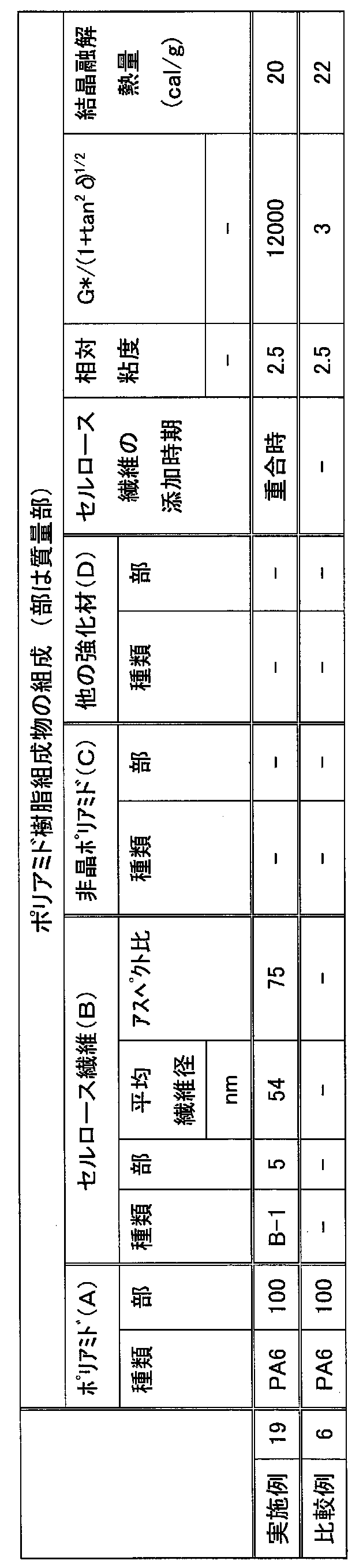
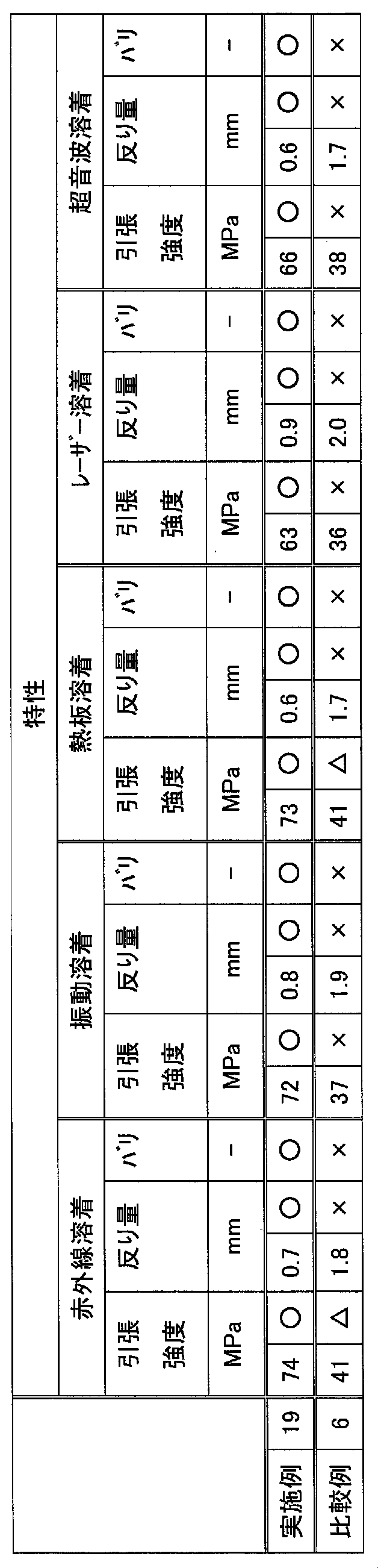
本発明のポリアミド樹脂組成物は、各種溶着法(例えば赤外線/振動溶着法、赤外線溶着法、振動溶着法、熱板溶着法、レーザー溶着法、および超音波溶着法)による溶着強度に優れるだけでなく、成形品のバリおよび反りが少ないため、各種溶着法によって接合一体化する必要のある製品への適用として好適である。
Claims (13)
- 成形体と成形体の溶着に用いるポリアミド樹脂組成物であって、
ポリアミド樹脂(A)100質量部に対して、平均繊維径が10μm以下のセルロース繊維(B)を0.1~50質量部含有し、
前記溶着により得られる溶着成形体の溶着強度が40MPa以上であり、
前記溶着成形体の反り量が1.5mm未満である、ポリアミド樹脂組成物。 - 前記ポリアミド樹脂組成物が、融点+30℃および周波数0.1Hzでの動的粘弾性測定における複素弾性率をG*[Pa]、損失正接をtanδ[-]としたときに、下記関係式:
G*/(1+tan2δ)1/2≧1000
を満たす、請求項1に記載のポリアミド樹脂組成物。 - 前記セルロース繊維(B)が、未変性のセルロース繊維であるか、またはセルロース由来の水酸基が親水性または疎水性の置換基で変性された変性セルロース繊維である、請求項1または2に記載のポリアミド樹脂組成物。
- 前記ポリアミド樹脂組成物は、非晶性ポリアミド(C)をさらに含有するか、または含有せず、該非晶性ポリアミド(C)の含有量が、ポリアミド樹脂(A)100質量部に対して、0~50質量部である、請求項1~3のいずれかに記載のポリアミド樹脂組成物。
- 前記非晶性ポリアミド樹脂(C)は、示差走査熱量計(DSC)を用い昇温速度16℃/分の条件で測定される結晶融解熱量が1cal/g以下である、請求項4に記載のポリアミド樹脂組成物。
- 前記ポリアミド樹脂組成物は、セルロース繊維以外の他の強化材(D)をさらに含有するか、または含有せず、該他の強化材(D)の含有量が、ポリアミド樹脂(A)100質量部に対して、0~50質量部である、請求項1~5のいずれかに記載のポリアミド樹脂組成物。
- 前記他の強化材(D)が、ガラス繊維である、請求項6に記載のポリアミド樹脂組成物。
- 前記セルロース繊維(B)の平均繊維径が10~500nmである、請求項1~7のいずれかに記載のポリアミド樹脂組成物。
- 前記セルロース繊維(B)が、未変性のセルロース繊維であるか、またはセルロース由来の水酸基が疎水性の置換基で変性された変性セルロース繊維であり、
前記セルロース繊維(B)の平均繊維径が10~500nmである、請求項1~8のいずれかに記載のポリアミド樹脂組成物。 - 前記セルロース繊維(B)が未変性のセルロース繊維であり、
前記セルロース繊維(B)の平均繊維径が10~100nmであり、
前記セルロース繊維(B)の含有量が3~35質量部であり、
前記ポリアミド樹脂組成物の相対粘度が1.7~2.8であり、
前記ポリアミド樹脂組成物が、融点+30℃および周波数0.1Hzでの動的粘弾性測定における複素弾性率をG*[Pa]、損失正接をtanδ[-]としたときに、下記関係式:
50000≧G*/(1+tan2δ)1/2≧13000
を満たす、請求項1~9のいずれかに記載のポリアミド樹脂組成物。 - 請求項1~10のいずれかに記載のポリアミド樹脂組成物を製造するための方法であって、
ポリアミド樹脂の重合時にセルロース繊維を添加する、ポリアミド樹脂組成物の製造方法。 - 請求項1~10のいずれかに記載のポリアミド樹脂組成物からなる、溶着部を有する溶着成形体。
- 請求項1~10のいずれかに記載のポリアミド樹脂組成物から構成される複数の成形体を、赤外線/振動溶着法、赤外線溶着法、振動溶着法、熱板溶着法、レーザー溶着法、および超音波溶着法からなる群から選択される方法により、相互に溶着させる、溶着成形体の製造方法。
Priority Applications (1)
| Application Number | Priority Date | Filing Date | Title |
|---|---|---|---|
| JP2023514584A JPWO2022220116A1 (ja) | 2021-04-15 | 2022-03-29 |
Applications Claiming Priority (2)
| Application Number | Priority Date | Filing Date | Title |
|---|---|---|---|
| JP2021-069288 | 2021-04-15 | ||
| JP2021069288 | 2021-04-15 |
Publications (1)
| Publication Number | Publication Date |
|---|---|
| WO2022220116A1 true WO2022220116A1 (ja) | 2022-10-20 |
Family
ID=83640639
Family Applications (1)
| Application Number | Title | Priority Date | Filing Date |
|---|---|---|---|
| PCT/JP2022/015650 Ceased WO2022220116A1 (ja) | 2021-04-15 | 2022-03-29 | 溶着用ポリアミド樹脂組成物およびその製造方法ならびに該ポリアミド樹脂組成物を含む成形体 |
Country Status (2)
| Country | Link |
|---|---|
| JP (1) | JPWO2022220116A1 (ja) |
| WO (1) | WO2022220116A1 (ja) |
Citations (7)
| Publication number | Priority date | Publication date | Assignee | Title |
|---|---|---|---|---|
| JP2005305949A (ja) * | 2004-04-26 | 2005-11-04 | Koji Tomota | ポリアミド樹脂一体成形物およびその製造方法ならびにポリアミド樹脂の接合助剤 |
| JP2018103387A (ja) * | 2016-12-22 | 2018-07-05 | ユニチカ株式会社 | 表面にメッキ層を有した成形体 |
| JP2019014228A (ja) * | 2017-07-05 | 2019-01-31 | 東レ株式会社 | 溶着部を有する樹脂からなる中空成形品の製造方法 |
| WO2019088014A1 (ja) * | 2017-10-31 | 2019-05-09 | ユニチカ株式会社 | 熱溶解積層法3dプリンターの造形材料用樹脂組成物およびそのフィラメント状成形体 |
| WO2019098210A1 (ja) * | 2017-11-16 | 2019-05-23 | ユニチカ株式会社 | 摺動部材 |
| WO2020203006A1 (ja) * | 2019-04-05 | 2020-10-08 | 三菱瓦斯化学株式会社 | 多層体および多層体の製造方法 |
| JP2021066877A (ja) * | 2019-10-21 | 2021-04-30 | ユニチカ株式会社 | 金属との接合用ポリアミド樹脂組成物およびその製造方法ならびに該ポリアミド樹脂組成物を含む成形体と金属からなる異種複合成形体 |
-
2022
- 2022-03-29 WO PCT/JP2022/015650 patent/WO2022220116A1/ja not_active Ceased
- 2022-03-29 JP JP2023514584A patent/JPWO2022220116A1/ja active Pending
Patent Citations (7)
| Publication number | Priority date | Publication date | Assignee | Title |
|---|---|---|---|---|
| JP2005305949A (ja) * | 2004-04-26 | 2005-11-04 | Koji Tomota | ポリアミド樹脂一体成形物およびその製造方法ならびにポリアミド樹脂の接合助剤 |
| JP2018103387A (ja) * | 2016-12-22 | 2018-07-05 | ユニチカ株式会社 | 表面にメッキ層を有した成形体 |
| JP2019014228A (ja) * | 2017-07-05 | 2019-01-31 | 東レ株式会社 | 溶着部を有する樹脂からなる中空成形品の製造方法 |
| WO2019088014A1 (ja) * | 2017-10-31 | 2019-05-09 | ユニチカ株式会社 | 熱溶解積層法3dプリンターの造形材料用樹脂組成物およびそのフィラメント状成形体 |
| WO2019098210A1 (ja) * | 2017-11-16 | 2019-05-23 | ユニチカ株式会社 | 摺動部材 |
| WO2020203006A1 (ja) * | 2019-04-05 | 2020-10-08 | 三菱瓦斯化学株式会社 | 多層体および多層体の製造方法 |
| JP2021066877A (ja) * | 2019-10-21 | 2021-04-30 | ユニチカ株式会社 | 金属との接合用ポリアミド樹脂組成物およびその製造方法ならびに該ポリアミド樹脂組成物を含む成形体と金属からなる異種複合成形体 |
Also Published As
| Publication number | Publication date |
|---|---|
| JPWO2022220116A1 (ja) | 2022-10-20 |
Similar Documents
| Publication | Publication Date | Title |
|---|---|---|
| JP7425509B2 (ja) | 摺動部材 | |
| JP6911665B2 (ja) | 樹脂組成物、成形品および成形品の製造方法 | |
| JP7398095B2 (ja) | ポリアミド樹脂組成物およびそれからなる成形体 | |
| KR102010199B1 (ko) | 유리섬유 강화 폴리프로필렌 수지 조성물 | |
| US20090283202A1 (en) | Process for the welding of two polyamide parts | |
| JP6796107B2 (ja) | セルロース含有樹脂組成物の製造方法 | |
| KR100859066B1 (ko) | 사슬 가지화제 및 이를 포함하는 폴리아미드 조성물 | |
| JP5313521B2 (ja) | 樹脂組成物およびそれを成形してなる成形体 | |
| TW200804514A (en) | Polyamide resin composition | |
| WO2022220116A1 (ja) | 溶着用ポリアミド樹脂組成物およびその製造方法ならびに該ポリアミド樹脂組成物を含む成形体 | |
| JP7477873B2 (ja) | 金属との接合用ポリアミド樹脂組成物およびその製造方法ならびに該ポリアミド樹脂組成物を含む成形体と金属からなる異種複合成形体 | |
| JP7164861B2 (ja) | ポリアミド樹脂組成物 | |
| JP7542933B2 (ja) | 溶着用ポリアミド樹脂組成物およびそれを用いた成形品 | |
| JP2022531950A (ja) | ポリアミド組成物 | |
| JP7236189B2 (ja) | ポリアミド樹脂組成物およびポリアミド樹脂組成物の製造方法 | |
| JP6886219B1 (ja) | ポリアミド樹脂組成物およびそれからなる成形体 | |
| JP2023016029A (ja) | ポリアミド樹脂組成物及びその製造法 | |
| JP2023013994A (ja) | 筐体 | |
| JP6964646B2 (ja) | セルロース含有樹脂組成物の製造方法 | |
| CN110791084A (zh) | 一种聚酰胺组合物及其制备方法 | |
| JP7294715B1 (ja) | ポリアミド樹脂組成物およびポリアミド樹脂組成物の製造方法 | |
| JP2023014006A (ja) | チェーンおよび搬送コンベア | |
| JP7127926B1 (ja) | 金属との接合用ポリアミド樹脂組成物およびその製造方法ならびに該ポリアミド樹脂組成物を含む成形体と金属からなる異種複合成形体 | |
| JP2022162383A (ja) | ポリアミド樹脂組成物およびそれからなる成形体 | |
| JP2023019943A (ja) | バイオマスナノファイバー添加剤及び樹脂組成物 |
Legal Events
| Date | Code | Title | Description |
|---|---|---|---|
| 121 | Ep: the epo has been informed by wipo that ep was designated in this application |
Ref document number: 22788041 Country of ref document: EP Kind code of ref document: A1 |
|
| ENP | Entry into the national phase |
Ref document number: 2023514584 Country of ref document: JP Kind code of ref document: A |
|
| NENP | Non-entry into the national phase |
Ref country code: DE |
|
| 122 | Ep: pct application non-entry in european phase |
Ref document number: 22788041 Country of ref document: EP Kind code of ref document: A1 |