WO2022202372A1 - 植物性ミルク発酵液の製造方法 - Google Patents
植物性ミルク発酵液の製造方法 Download PDFInfo
- Publication number
- WO2022202372A1 WO2022202372A1 PCT/JP2022/010661 JP2022010661W WO2022202372A1 WO 2022202372 A1 WO2022202372 A1 WO 2022202372A1 JP 2022010661 W JP2022010661 W JP 2022010661W WO 2022202372 A1 WO2022202372 A1 WO 2022202372A1
- Authority
- WO
- WIPO (PCT)
- Prior art keywords
- strain
- lactic acid
- milk
- vegetable milk
- lactobacillus
- Prior art date
- Legal status (The legal status is an assumption and is not a legal conclusion. Google has not performed a legal analysis and makes no representation as to the accuracy of the status listed.)
- Ceased
Links
Images




Classifications
-
- A—HUMAN NECESSITIES
- A23—FOODS OR FOODSTUFFS; TREATMENT THEREOF, NOT COVERED BY OTHER CLASSES
- A23L—FOODS, FOODSTUFFS OR NON-ALCOHOLIC BEVERAGES, NOT OTHERWISE PROVIDED FOR; PREPARATION OR TREATMENT THEREOF
- A23L2/00—Non-alcoholic beverages; Dry compositions or concentrates therefor; Preparation or treatment thereof
- A23L2/38—Other non-alcoholic beverages
- A23L2/382—Other non-alcoholic beverages fermented
-
- A—HUMAN NECESSITIES
- A23—FOODS OR FOODSTUFFS; TREATMENT THEREOF, NOT COVERED BY OTHER CLASSES
- A23C—DAIRY PRODUCTS, e.g. MILK, BUTTER OR CHEESE; MILK OR CHEESE SUBSTITUTES; PREPARATION THEREOF
- A23C11/00—Milk substitutes, e.g. coffee whitener compositions
- A23C11/02—Milk substitutes, e.g. coffee whitener compositions containing at least one non-milk component as source of fats or proteins
- A23C11/10—Milk substitutes, e.g. coffee whitener compositions containing at least one non-milk component as source of fats or proteins containing or not lactose but no other milk components as source of fats, carbohydrates or proteins
-
- A—HUMAN NECESSITIES
- A23—FOODS OR FOODSTUFFS; TREATMENT THEREOF, NOT COVERED BY OTHER CLASSES
- A23C—DAIRY PRODUCTS, e.g. MILK, BUTTER OR CHEESE; MILK OR CHEESE SUBSTITUTES; PREPARATION THEREOF
- A23C11/00—Milk substitutes, e.g. coffee whitener compositions
- A23C11/02—Milk substitutes, e.g. coffee whitener compositions containing at least one non-milk component as source of fats or proteins
- A23C11/10—Milk substitutes, e.g. coffee whitener compositions containing at least one non-milk component as source of fats or proteins containing or not lactose but no other milk components as source of fats, carbohydrates or proteins
- A23C11/103—Milk substitutes, e.g. coffee whitener compositions containing at least one non-milk component as source of fats or proteins containing or not lactose but no other milk components as source of fats, carbohydrates or proteins containing only proteins from pulses, oilseeds or nuts, e.g. nut milk
- A23C11/106—Addition of, or treatment with, microorganisms
-
- A—HUMAN NECESSITIES
- A23—FOODS OR FOODSTUFFS; TREATMENT THEREOF, NOT COVERED BY OTHER CLASSES
- A23L—FOODS, FOODSTUFFS OR NON-ALCOHOLIC BEVERAGES, NOT OTHERWISE PROVIDED FOR; PREPARATION OR TREATMENT THEREOF
- A23L5/00—Preparation or treatment of foods or foodstuffs, in general; Food or foodstuffs obtained thereby; Materials therefor
- A23L5/20—Removal of unwanted matter, e.g. deodorisation or detoxification
- A23L5/28—Removal of unwanted matter, e.g. deodorisation or detoxification using microorganisms
-
- A—HUMAN NECESSITIES
- A23—FOODS OR FOODSTUFFS; TREATMENT THEREOF, NOT COVERED BY OTHER CLASSES
- A23L—FOODS, FOODSTUFFS OR NON-ALCOHOLIC BEVERAGES, NOT OTHERWISE PROVIDED FOR; PREPARATION OR TREATMENT THEREOF
- A23L7/00—Cereal-derived products; Malt products; Preparation or treatment thereof
- A23L7/10—Cereal-derived products
- A23L7/104—Fermentation of farinaceous cereal or cereal material; Addition of enzymes or microorganisms
-
- C—CHEMISTRY; METALLURGY
- C12—BIOCHEMISTRY; BEER; SPIRITS; WINE; VINEGAR; MICROBIOLOGY; ENZYMOLOGY; MUTATION OR GENETIC ENGINEERING
- C12N—MICROORGANISMS OR ENZYMES; COMPOSITIONS THEREOF; PROPAGATING, PRESERVING, OR MAINTAINING MICROORGANISMS; MUTATION OR GENETIC ENGINEERING; CULTURE MEDIA
- C12N1/00—Microorganisms; Compositions thereof; Processes of propagating, maintaining or preserving microorganisms or compositions thereof; Processes of preparing or isolating a composition containing a microorganism; Culture media therefor
- C12N1/20—Bacteria; Culture media therefor
- C12N1/205—Bacterial isolates
-
- C—CHEMISTRY; METALLURGY
- C12—BIOCHEMISTRY; BEER; SPIRITS; WINE; VINEGAR; MICROBIOLOGY; ENZYMOLOGY; MUTATION OR GENETIC ENGINEERING
- C12R—INDEXING SCHEME ASSOCIATED WITH SUBCLASSES C12C - C12Q, RELATING TO MICROORGANISMS
- C12R2001/00—Microorganisms ; Processes using microorganisms
- C12R2001/01—Bacteria or Actinomycetales ; using bacteria or Actinomycetales
- C12R2001/225—Lactobacillus
Definitions
- the present invention relates to a method for producing a vegetable milk fermented liquid.
- Plant-based milk is made by subdividing and liquefying plant raw materials such as rice, wheat, and soybeans (see, for example, J. Food Sci. Technol (September 2016) 53 (9): 3408-3423).
- vegetable milk include rice milk, which is a milk-like food obtained by adding vegetable oil or the like to saccharify rice with enzymes, koji, etc. and seasoning it.
- plant-based milk contains aldehydes as aroma components.
- Aldehydes can be a preferable flavor component in a beverage having a plant flavor.
- aldehydes are known to cause unpleasant plant odors in beverages having a fermented milk-like flavor.
- Methods for reducing aldehydes contained in vegetable milk include, for example, the following methods.
- Japanese Patent Laid-Open No. 9-205999 discloses that medium-chain aldehydes are produced by contacting a food containing medium-chain aldehydes with lactic acid bacterium Leuconostoc mesenteroides or lactic acid bacterium Lactobacillus brevis while preventing the growth of lactic acid bacteria. methods for reducing alcohols to alcohols.
- Japanese Patent Application Laid-Open No. 2020-17 discloses that vegetable milk, which is a raw material of rice, is mixed with lactic acid bacterium Lactobacillus salmoni strain No. 7 or lactic acid bacteria Lactobacillus salmoni strain No.
- a lactic acid-fermented beverage obtained by lactic acid fermentation using 16 is described, and it is described that the contents of diacetyl and hexanal are reduced.
- An object of the present invention is to provide a method for producing a vegetable milk fermented liquid with reduced plant odor.
- the present invention provides a lactic acid bacteria strain containing at least one selected from the group consisting of Lactobacillus fermentum CP1299 strain, Lactobacillus fermentum CP3024 strain, Lactobacillus reuteri strain CP3017 strain and Lactobacillus reuteri CP3019 strain, and a plant To provide a method for producing a vegetable milk fermented liquid comprising contacting with sexual milk.
- the vegetable milk in the production method may be derived from cereals. In one certain aspect, the vegetable milk in the production method may be derived from rice. In one embodiment, the plant milk in the production method may be saccharified plant milk. In one embodiment, contacting the lactic acid bacteria strain with plant milk in the production method may involve fermentation of the plant milk by the lactic acid bacteria strain.
- the present invention also provides a lactic acid bacteria strain containing at least one selected from the group consisting of Lactobacillus fermentum CP1299 strain, Lactobacillus fermentum CP3024 strain, Lactobacillus reuteri strain CP3017 strain and Lactobacillus reuteri CP3019 strain.
- a method of reducing aldehydes in a plant milk comprising contacting with a plant milk containing aldehydes.
- the vegetable milk in the reduction method may be derived from grains.
- the plant milk in the reduction method may be derived from rice.
- the plant milk in the reduction method may be saccharified plant milk.
- contacting the lactic acid bacteria strain with plant milk in the reduction method may involve fermentation of the plant milk by the lactic acid bacteria strain.
- the present invention provides the Lactobacillus fermentum CP3024 strain of NITE BP-3428, the Lactobacillus reuteri CP3017 strain of NITE BP-3426, and the Lactobacillus reuteri CP3019 strain of NITE BP-3427. provide respectively.
- 1 is a graph showing the ability of lactic acid bacteria to reduce benzaldehyde contained in brown rice-derived vegetable milk.
- 2 is a graph showing the ability of lactic acid bacteria to reduce 2,4-decadienal contained in brown rice-derived vegetable milk.
- 1 is a graph showing the ability of lactic acid bacteria to reduce 2-methylbutanal contained in brown rice-derived vegetable milk.
- 2 is a graph showing the ability of lactic acid bacteria to reduce 2-methylpropanal contained in brown rice-derived vegetable milk.
- 1 is a graph showing the ability of lactic acid bacteria to reduce 3-methylbutanal contained in brown rice-derived vegetable milk.
- 1 is a graph showing the ability of lactic acid bacteria to reduce hexanal contained in brown rice-derived vegetable milk.
- 1 is a graph showing the ability of lactic acid bacteria to reduce benzaldehyde contained in polished rice-derived vegetable milk.
- 1 is a graph showing the ability of lactic acid bacteria to reduce hexanal contained in polished rice-derived vegetable milk.
- 1 is a graph showing the ability of lactic acid bacteria to reduce benzaldehyde contained in barley-derived vegetable milk.
- 2 is a graph showing the ability of lactic acid bacteria to reduce 2,4-decadienal contained in barley-derived vegetable milk.
- the term "process” is not only an independent process, but even if it cannot be clearly distinguished from other processes, it is included in this term as long as the intended purpose of the process is achieved.
- the content of each component in the composition means the total amount of the plurality of substances present in the composition unless otherwise specified when there are multiple substances corresponding to each component in the composition.
- the upper and lower limits of the numerical ranges described herein can be combined by arbitrarily selecting the numerical values exemplified as the numerical ranges.
- embodiments of the present invention will be described in detail. However, the embodiments shown below are examples of the method for producing a fermented vegetable milk liquid for embodying the technical idea of the present invention, and the present invention is the fermented vegetable milk liquid shown below. It is not limited to the manufacturing method.
- a method for producing vegetable milk fermented liquid is a group consisting of Lactobacillus fermentum CP1299 strain, Lactobacillus fermentum CP3024 strain, Lactobacillus reuteri strain CP3017 and Lactobacillus reuteri CP3019 strain and contacting a lactic acid bacteria strain comprising at least one selected from with plant milk.
- a vegetable milk fermented liquid with excellent The produced vegetable milk fermented liquid has an excellent balance of sweetness and sourness, and has an improved mellow fermented milk feeling.
- the specific lactic acid bacteria strain is excellent in the activity of reducing aldehydes contained in vegetable milk.
- the content of aldehydes contained in the vegetable milk is reduced by bringing specific lactic acid bacteria into contact with the vegetable milk. That is, the method for producing a vegetable milk fermented liquid may be a method for reducing aldehydes in vegetable milk.
- Lactic Acid Bacteria Strains are used in the method for producing a vegetable milk fermentation liquor.
- Specific lactic acid bacteria strains include at least one selected from the group consisting of Lactobacillus fermentum CP1299 strain, Lactobacillus fermentum CP3024 strain, Lactobacillus reuteri strain CP3017 and Lactobacillus reuteri CP3019 strain.
- the Lactobacillus fermentum CP1299 strain is a type of lactic acid bacteria belonging to Lactobacillus fermentum, and is an international depository organization based on the provisions of the Budapest Treaty.
- Lactobacillus fermentum CP3024 strain is a kind of lactic acid bacteria belonging to Lactobacillus fermentum, and has been internationally deposited as of March 1, 2021 under accession number: NITE BP-03428.
- the Lactobacillus reuteri strain CP3017 is a lactic acid bacterium belonging to Lactobacillus reuteri, and has been internationally deposited on March 1, 2021 under the accession number: NITE BP-03426.
- Lactobacillus reuteri strain CP3019 is a lactic acid bacterium belonging to Lactobacillus reuteri, and has been internationally deposited as of March 1, 2021 under accession number: NITE BP-03427.
- lactic acid bacteria other lactic acid bacteria, bifidobacteria, etc. may be used in addition to specific lactic acid bacteria in the method for producing the fermented liquid of vegetable milk.
- lactic acid bacteria other than specific lactic acid bacteria include Lactobacillus fermentum other than CP1299 strain and CP3024 strain (e.g., JCM1173 strain), Lactobacillus reuteri other than CP3017 strain and CP3019 strain (e.g., JCM1112 strain), Lactobacillus ⁇ Gazelli, Lactobacillus oris, Lactobacillus mucosae, Lactobacillus fructivorans, Lactobacillus casei, Lactobacillus delbruecki, Lactobacillus bulgaricus, Lactobacillus helveticus, Lactobacillus brevis, Lactobacillus plantarum, Lactobacillus lactis, Lactobacillus acidophilus, Lactobacillus am
- Bifidobacterium also includes Bifidobacterium longum, Bifidobacterium bifidum, Bifidobacterium breve, Bifidobacterium adolescentis, Bifidobacterium infantis, Bifidobacterium Animalis etc. are included.
- the content of lactic acid bacteria and bifidobacteria may be 50% or less of the total lactic acid bacteria and bifidobacteria. , preferably less than or equal to 10%, or less than 5%.
- the content of lactic acid bacteria and bifidobacteria may be obtained from the number of bacteria of at least one of lactic acid bacteria and bifidobacteria used, and when using a preculture solution as at least one of lactic acid bacteria and bifidobacteria, You can ask for it as a standard.
- Plant-based milk may be obtained by liquefying plant raw materials by physically crushing them, enzymatically saccharifying them, or the like.
- Vegetable milk may be obtained by liquefying plant raw materials by a known method, or may be appropriately selected from commercially available products.
- plant materials include grains such as rice, barley, wheat, oats, rye, soybeans, and peanuts; nuts and seeds such as almonds, coconuts, cashew nuts, macadamia nuts, and walnuts; carrots, potatoes, sweet potatoes, cassava, tomatoes, and the like; Vegetables can be mentioned.
- the plant material preferably contains grains because it contains a large amount of carbohydrates, more preferably at least one selected from the group consisting of rice and barley, and further preferably at least rice or barley. preferable.
- rice When rice is used as a plant raw material, it may be at least one selected from the group consisting of unhulled rice, brown rice (including germinated brown rice), polished rice, red rice bran, medium rice bran, white rice bran and white rice bran. Note that rice polishing includes 3 minutes, 5 minutes, 7 minutes, polished rice, etc. depending on the degree of rice polishing, and the germ may remain.
- Rice as a plant raw material is preferably at least one selected from the group consisting of unpolished rice, polished rice, medium bran and white rice bran, more preferably at least one selected from the group consisting of brown rice, polished rice and white rice bran. Yes, and more preferably brown rice or white rice.
- Rice as a plant raw material may be pulverized to a predetermined grain size by a known method, or may be left as it is without being pulverized. It may also be in a state of being saccharified by microorganisms, enzyme treatment, or the like. Rice is classified into non-glutinous rice, glutinous rice, etc. according to the difference in starch content, and any of these types may be used.
- the plant raw material contains rice, it may further contain plant raw materials other than rice.
- Plant raw materials may include, for example, other than rice, other grains such as barley, wheat, oats, rye, soybeans, and peanuts, and nuts and seeds such as almonds, coconuts, cashews, macadamia nuts, and walnuts.
- the content of other grains and the like contained in the plant material including rice may be, for example, 30% by mass or less, 20% by mass or less, or 10% by mass or less.
- the lower limit of the content of other grains and the like contained in plant raw materials including rice may be, for example, 0.1% by mass or more, or 1% by mass or more.
- barley When barley is used as a plant raw material, it may be at least one selected from the group consisting of two-rowed barley, four-rowed barley, six-rowed barley, bare barley and wild barley, and at least one selected from the group consisting of two-rowed barley and six-rowed barley.
- Barley as a plant raw material may be pulverized to a predetermined particle size by a known method, or may be left as it is without being pulverized. It may also be in a state of being saccharified by microorganisms, enzyme treatment, or the like.
- the plant raw material contains barley, it may further contain a plant raw material other than barley.
- the plant material may include, for example, other grains besides barley such as rice, wheat, oats, rye, soybeans, peanuts, and nuts such as almonds, coconuts, cashews, macadamia nuts, walnuts.
- the content of other grains and the like contained in the plant material containing barley may be, for example, 30% by mass or less, 20% by mass or less, or 10% by mass or less.
- the lower limit of the content of other grains and the like contained in the plant material including barley may be, for example, 0.1% by mass or more, or 1% by mass or more.
- Plant milk may be prepared, for example, by subjecting the starch contained in plant raw materials (preferably grains) to saccharification, which hydrolyzes it using an appropriate enzyme. That is, the plant milk may be a saccharified plant milk, and the plant milk using rice as a plant raw material is preferably a saccharified plant milk because it contains a large amount of monosaccharides. It is more preferable to use vegetable milk obtained by saccharifying vegetable milk using brown rice or white rice as a plant raw material. For example, ⁇ -amylase (EC 3.2.1.1) can be used as the enzyme in the saccharification treatment. The amount of enzyme added can be, for example, 0.01% or more and 1% or less with respect to the mass of the plant raw material.
- ⁇ -amylase EC 3.2.1.1
- Conditions for the hydrolysis reaction may be appropriately selected according to the enzymes, plant raw materials, and the like used.
- the reaction temperature may be, for example, 40° C. or higher and 100° C. or lower, preferably 50° C. or higher and 70° C. or lower.
- the reaction time may be, for example, 1 hour or more and 24 hours or less, preferably 2 hours or more and 12 hours or less.
- the vegetable milk in the preparation of vegetable milk by saccharification, it can also be prepared by hydrolyzing with ⁇ -amylase and then further saccharifying with glucoamylase (EC 3.2.1.3). Also, the vegetable milk may be obtained by a saccharification treatment in which koji or the like is applied to the plant raw material.
- Vegetable milk prepared by saccharification treatment contains various sugars such as monosaccharides such as glucose, disaccharides such as maltose, trisaccharides such as maltotriose, and tetrasaccharides and higher.
- monosaccharides such as glucose
- disaccharides such as maltose
- trisaccharides such as maltotriose
- tetrasaccharides and higher.
- glucose be abundantly contained because glucose is degraded by lactic acid bacteria in the fermentation process described later and ultimately becomes a main source of sweetness.
- the content of monosaccharides such as glucose may be, for example, 30% by mass or more, preferably 50% by mass or more, more preferably 70% by mass or more, relative to the total sugars contained in the plant milk. .
- the properties of the vegetable milk may be, for example, a milk-like emulsion.
- plant-based milk can be seasoned with vegetable oil, animal oil, salt, sugar, amino acid, flavor, paste, thickener, emulsifier, pH adjuster, etc. after the plant raw material is subdivided and liquefied. good.
- Aldehydes Plant-based milk contains aldehydes derived from plant sources. Aldehydes may have, for example, a plant-like flavor. Examples of aldehydes include aliphatic aldehydes such as short-chain aliphatic aldehydes, medium-chain aliphatic aldehydes and long-chain aliphatic aldehydes, and aromatic aldehydes. Short chain aliphatic aldehydes have 5 or less carbon atoms, medium chain aliphatic aldehydes have 6 to 12 carbon atoms, and long chain aliphatic aldehydes have 13 or more carbon atoms.
- aliphatic aldehydes include acetaldehyde, malondialdehyde, butanal, 2-methylpropanal, pentanal, 2-methylbutanal, 3-methylbutanal, hexanal, crotonaldehyde, 4-hydroxy-2-hexenal, 4-hydroxy-2-nonenal, 2,4-nonadienal, heptanal, octanal, nonanal, decanal, 2,4-decadienal, tetradecanal and the like.
- aromatic aldehydes include benzaldehyde, anisaldehyde, and cuminaldehyde.
- the aldehydes whose content is reduced by the method for producing the vegetable milk fermented liquid may be aliphatic aldehydes and aromatic aldehydes, the group consisting of short-chain aliphatic aldehydes, medium-chain aliphatic aldehydes and aromatic aldehydes.
- It may be at least one selected from acetaldehyde, malondialdehyde, butanal, 2-methylpropanal, pentanal, 2-methylbutanal, 3-methylbutanal, hexanal, crotonaldehyde, 4-hydroxy-2 -hexenal, 4-hydroxy-2-nonenal, 2,4-nonadienal, heptanal, octanal, nonanal, decanal, 2,4-decadienal and benzaldehyde.
- the method for producing the fermented liquid of vegetable milk includes the step of contacting specific lactic acid bacteria with vegetable milk.
- the step of bringing the specific lactic acid bacteria into contact with the plant milk may be a fermentation step of adding the specific lactic acid bacteria to the plant milk and performing lactic acid fermentation.
- the desired vegetable milk fermented liquid is obtained by maintaining the vegetable milk at a predetermined fermentation temperature, adding a predetermined amount of lactic acid bacteria culture solution, and performing lactic acid fermentation for a predetermined fermentation time. can be done.
- the lactic acid bacteria used for contact with the vegetable milk may be a preculture cultured in advance in an appropriate medium, or may be a frozen product obtained by mixing the preculture with a cryoprotectant and freezing.
- the pre-culture solution may be freeze-dried and powdered.
- the medium used for preparing the pre-culture solution may be appropriately selected from media commonly used for culturing lactic acid bacteria. Examples of the medium include MRS medium (manufactured by BD Japan).
- the culture conditions can be, for example, stationary or anaerobic conditions, at 30° C. or higher and 40° C. or lower for 12 hours or longer and 32 hours or shorter.
- the amount of the lactic acid bacteria preculture added to the vegetable milk may be, for example, 0.1% by volume or more and 30% by volume or less, preferably 0.5% by volume or more, relative to the liquid amount of the vegetable milk. It may be 20 volume % or less, more preferably 1 volume % or more and 10 volume % or less.
- the fermentation temperature and fermentation time should be appropriately selected according to the culture conditions, the lactic acid strain to be added, etc.
- the fermentation temperature may be, for example, 10°C or higher and 45°C or lower, preferably 20°C or higher and 40°C or lower, more preferably 30°C or higher and 40°C or lower.
- the fermentation time may be, for example, 1 hour or more and 72 hours or less, preferably 6 hours or more and 48 hours or less, more preferably 12 hours or more and 32 hours or less.
- the content of aldehydes contained in the vegetable milk is reduced by the fermentation process.
- (%) for example, in the case of aromatic aldehyde, is 85% or less, preferably 70% or less, more preferably 60% or less, and still more preferably 50% or less.
- the lower limit of the residual rate (%) is not particularly limited, it may be, for example, 1% or more, preferably 5% or more.
- the residual rate (%) of aldehydes for example, in the case of aliphatic aldehydes, is 55% or less, preferably 45% or less, more preferably 40% or less, and still more preferably 35% or less. Yes, and more preferably 30% or less, or 20% or less.
- the lower limit of the residual rate (%) is not particularly limited, it may be, for example, 0% or more, preferably 1% or more, or 2% or more.
- the lactic acid bacteria contained in the fermented liquid of vegetable milk obtained in the fermentation process may be kept in a viable state, or may be killed by high-temperature treatment.
- the high-temperature treatment may be performed, for example, by treating the obtained vegetable milk fermented liquid at a high temperature of 63° C. or higher for a predetermined period of time.
- the fermented vegetable milk liquid obtained by the production method may be used as it is as a lactic acid fermented beverage, or the fermented vegetable milk liquid may be subjected to a predetermined post-treatment to obtain a desired form of lactic acid fermented beverage or lactic acid fermented food.
- post-treatments include a concentration step for making syrup, a step of adding desired additives (such as flavor), a step of mixing with carbonated beverages, fruit juice beverages, alcoholic beverages, etc., and a food processing step.
- Additives in the post-treatment process include sugar alcohols such as sorbitol, erythritol, maltitol and xylitol; high intensity sweeteners such as aspartame, stevioside, sucralose and acesulfame K; Organic acids such as lactic acid; vitamins such as L-ascorbic acid, dl- ⁇ -tocopherol, B vitamins, nicotinamide, calcium pantothenate; glycerin fatty acid esters, polyglycerin fatty acid esters, sucrose fatty acid esters, sorbitan fatty acid esters , Surfactants such as propylene glycol fatty acid esters; Thickeners such as gum arabic, carrageenan, pectin, agar; Stabilizers such as casein and gelatin; Minerals such as amino acids and calcium salts; Sodium ascorbate, sodium erythorbate , glycerin, propylene glycol and other additives
- Examples of lactic acid-fermented beverages obtained through the post-treatment process include carbonated beverages, fruit juice beverages, alcoholic beverages, syrups, and fruit-flavored beverages. Other beverages such as soymilk can be mixed with the lactic acid-fermented beverage to the extent that the effects of the present invention are not impaired.
- Lactic acid-fermented foods obtained by the post-treatment process include frozen desserts such as jelly, yogurt, pudding, and ice cream, candy, soft candy, gum, jam, and the like.
- Reference example 1 As lactic acid bacteria, strains shown in Table 1 were prepared. All strains prepared are type strains. Lactic acid bacteria were cultured under anaerobic conditions at 37° C. for 16 hours using a medium in which 0.05% by mass of cysteine hydrochloride was added to MRS medium (manufactured by BD Japan) to prepare a preculture solution for each lactic acid bacterium. Next, after adding 0.05% by mass of cysteine hydrochloride and 0.05% by volume of acetaldehyde to MRS medium (manufactured by BD Japan), 5% by volume of lactic acid bacteria pre-culture solution was added, and under a 37° C. environment, Cultured for 16 hours under anaerobic conditions.
- MRS medium manufactured by BD Japan
- the culture solution was centrifuged to remove the cells to obtain a culture supernatant.
- the acetaldehyde concentration contained in this culture supernatant was quantified using F-kit acetaldehyde (manufactured by JK International).
- the acetaldehyde residual rate (%) was calculated by dividing the acetaldehyde concentration in each culture supernatant by the average value of the acetaldehyde concentration in the non-inoculated medium and multiplying by 100.
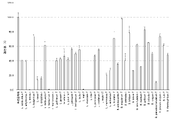
- the number of sample data (n number) was 3. The results are shown in Table 1 and FIG.
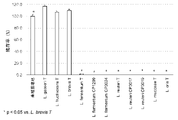
- Reference example 2 The ability of each lactic acid bacterium to reduce acetaldehyde was evaluated in the same manner as in Reference Example 1, except that the strains shown in Table 2 were used and the concentration of added acetaldehyde was 0.2% by volume. The results are shown in Table 2 and FIG. For statistical processing, a Student t-test was used, and a test was performed in comparison with the survival rate in the case of Lactobacillus brevis T. Differences were considered significant at a level of P ⁇ 0.05. The number of sample data (n number) was set to three.
- Reference example 3 As lactic acid bacteria, strains shown in Table 3 were prepared. All strains prepared are type strains. Lactic acid bacteria were cultured under anaerobic conditions at 37° C. for 16 hours using a medium in which 0.05% by mass of cysteine hydrochloride was added to MRS medium (manufactured by BD Japan) to prepare a preculture solution for each lactic acid bacterium. Next, after adding 0.05% by mass of cysteine hydrochloride and 0.05% by volume of hexanal to MRS medium (manufactured by BD Japan), 5% by volume of lactic acid bacteria pre-culture solution was added, and under a 37 ° C. environment, Cultured for 16 hours under anaerobic conditions.
- MRS medium manufactured by BD Japan
- the concentration of hexanal contained in this culture supernatant was quantified by modifying the LC-MS/MS method described in Drug Test. Analysis, 8, 458-464 (2016). Details of the quantification method will be described later.
- the hexanal residual ratio (%) was calculated by dividing the hexanal concentration in each culture supernatant by the average value of the hexanal concentration in the uninoculated medium and multiplying by 100. The number of sample data (n number) was 3. The results are shown in Table 3 and FIG.
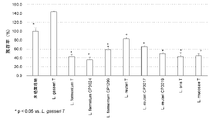
- Reference example 4 The ability of each lactic acid bacterium to reduce hexanal was evaluated in the same manner as in Reference Example 3, except that the strains shown in Table 4 were used and the concentration of added hexanal was 0.2% by volume. The results are shown in Table 4 and FIG. For statistical processing, a Student t-test was used, and a test was performed in comparison with the survival rate in the case of Lactobacillus brevis T. Differences were considered significant at a level of P ⁇ 0.05. The number of sample data (n number) was set to three.
- Reference example 5 As lactic acid bacteria, strains shown in Table 5 were prepared. All strains prepared are type strains. Lactic acid bacteria were cultured under anaerobic conditions at 37° C. for 16 hours using a medium in which 0.05% by mass of cysteine hydrochloride was added to MRS medium (manufactured by BD Japan) to prepare a preculture solution for each lactic acid bacterium. Next, after adding 0.05% by mass of cysteine hydrochloride and 0.05% by volume of benzaldehyde to MRS medium (manufactured by BD Japan), 5% by volume of lactic acid bacteria pre-culture solution was added, and under a 37° C. environment, Cultured for 16 hours under anaerobic conditions.
- MRS medium manufactured by BD Japan
- the concentration of benzaldehyde contained in this culture supernatant was quantified by modifying the LC-MS/MS method described in Drug Test. Analysis, 8, 458-464 (2016). Details of the quantification method will be described later.
- the benzaldehyde concentration (%) was calculated by dividing the benzaldehyde concentration in each culture supernatant by the average benzaldehyde concentration in the uninoculated medium and multiplying by 100. The number of sample data (n number) was 3. The results are shown in Table 5 and FIG.
- Reference example 6 The ability of each lactic acid bacterium to reduce benzaldehyde was evaluated in the same manner as in Reference Example 5, except that the strains shown in Table 6 were used and the added benzaldehyde concentration was 0.2% by volume. The results are shown in Table 6 and FIG. For statistical processing, a Student t-test was used, and a test was performed in comparison with the survival rate in the case of Lactobacillus brevis T. Differences were considered significant at a level of P ⁇ 0.05. The number of sample data (n number) was set to three.
- Example 1 Strains shown in Tables 7 to 12 were prepared as lactic acid bacteria. Each lactic acid bacterium was cultured under anaerobic conditions at 37° C. for 16 hours using MRS medium (manufactured by BD Japan) supplemented with 0.05 mass % cysteine hydrochloride to prepare a preculture solution for each lactic acid bacterium strain. Concentrated rice milk (manufactured by Kikkoman, raw material: processed brown rice) was diluted 1.67 times with pure water and sterilized at 95° C. for 15 minutes to prepare a brown rice milk medium. 5% by volume of the pre-culture solution of lactic acid bacteria was added to the brown rice milk medium, and the mixture was cultured at rest in an environment of 37° C.
- MRS medium manufactured by BD Japan
- cysteine hydrochloride to prepare a preculture solution for each lactic acid bacterium strain.
- Concentrated rice milk manufactured by Kikkoman, raw material: processed brown rice
- Example 2 Strains shown in Tables 13 and 14 were prepared as lactic acid bacteria. Each lactic acid bacterium was cultured under anaerobic conditions at 37° C. for 16 hours using MRS medium (manufactured by BD Japan) supplemented with 0.05 mass % cysteine hydrochloride to prepare a preculture solution for each lactic acid bacterium strain.
- MRS medium manufactured by BD Japan
- cysteine hydrochloride 0.05 mass % cysteine hydrochloride
- the residual rate (%) of each aldehyde was calculated by dividing the concentration of each aldehyde in each culture medium by the average concentration of each aldehyde in the non-inoculated medium and multiplying by 100. The results are shown in Tables 13-14 and Figures 13-14. For statistical processing, a Student t-test was used, and a test was performed in comparison with the survival rate in the case of Lactobacillus gazelli T. The number of sample data (n number) was 3. Differences were considered significant at a level of P ⁇ 0.05.
- Example 3 As lactic acid bacteria, strains shown in Tables 15 and 16 were prepared. Each lactic acid bacterium was cultured under anaerobic conditions at 37° C. for 16 hours using MRS medium (manufactured by BD Japan) supplemented with 0.05 mass % cysteine hydrochloride to prepare a preculture solution for each lactic acid bacterium strain.
- MRS medium manufactured by BD Japan
- cysteine hydrochloride 0.05 mass % cysteine hydrochloride
- Commercially available barley flour (Omugi Club Co., Ltd., raw material: whole wheat flour) and pure water were mixed at a weight ratio of 2:8, and amylase (BAN480L manufactured by Novozymes) was added in an amount of 0.02% by volume.
- the mixture was reacted at 60°C for 6 hours while stirring, and then sterilized at 95°C for 15 minutes to obtain a barley milk medium.
- 5% by volume of a preculture solution of lactic acid bacteria was added to a barley milk medium, and the mixture was cultured in a static environment at 37° C. for 16 hours to obtain a culture solution as a vegetable milk fermented solution.
- Concentrations of benzaldehyde and 2,4-decadienal contained in the resulting culture medium were quantified by modifying the LC-MS/MS method described in Drug Test. Analysis, 8, 458-464 (2016). . Details of the quantification method will be described later.
- the residual rate (%) of each aldehyde was calculated by dividing the concentration of each aldehyde in each culture medium by the average concentration of each aldehyde in the non-inoculated medium and multiplying by 100. The results are shown in Tables 15 and 16 and Figures 15 and 16. For statistical processing, a Student t-test was used, and a test was performed in comparison with the survival rate in the case of Lactobacillus gazelli T. The number of sample data (n number) was 3. Differences were considered significant at a level of P ⁇ 0.05.
- hexanal d-12 manufactured by Sigma-Aldrich
- hexanal d-12 was dissolved at a concentration of 25 ng/ ⁇ l in a 50% by volume ethanol aqueous solution to prepare an internal standard solution.
- the resulting solution was subjected to high performance liquid chromatography (HPLC) as a derivatized sample.
- HPLC high performance liquid chromatography
- the HPLC column and guard column are Waters Atlantis T3 C18 column (3 ⁇ m, 2.1 x 150 mm) and Waters Atlantis guard column T3 C18 ( 3 ⁇ m, 2.1x10mm) was used.
- Shimadzu Corporation's Nextera HPLC system (communication bus module: CBM-20A; pump: LC-30AD; autosampler: SIL-30AC) was added to the high-performance liquid chromatography (HPLC) system.
- Sciex Triple quad 6500+ manufactured by AB SCIEX was used as a tandem mass spectrometry (MS/MS) system.
- mobile phase A uses 0.03 vol% acetic acid aqueous solution
- mobile phase B uses 100 vol% acetonitrile
- the injection amount of the sample to the HPLC was set to 1 ⁇ l.
- Table 17 below shows modification conditions common to compounds
- Table 18 below shows modification conditions unique to compounds.
- benzaldehyde manufactured by Tokyo Chemical Industry Co., Ltd.
- hexanal manufactured by Tokyo Chemical Industry Co., Ltd.
- 2-methylpropanal manufactured by Tokyo Chemical Industry Co., Ltd.
- 3-methylbutanal manufactured by Tokyo Chemical Industry Co., Ltd.
- 2,4- Decadienal manufactured by Tokyo Chemical Industry Co., Ltd.
- 2-methylbutanal manufactured by Tokyo Chemical Industry Co., Ltd.
- 2,4-nonadienal manufactured by Tokyo Chemical Industry Co., Ltd.
- the aldehydes contained in the culture medium or the culture supernatant are derivatized, and the concentration of the aldehydes contained in the culture supernatant (Reference Examples 3 to 6) and the culture medium (Examples 1 to 3) was quantified.
Landscapes
- Life Sciences & Earth Sciences (AREA)
- Engineering & Computer Science (AREA)
- Chemical & Material Sciences (AREA)
- Health & Medical Sciences (AREA)
- Polymers & Plastics (AREA)
- Food Science & Technology (AREA)
- Microbiology (AREA)
- Biotechnology (AREA)
- Nutrition Science (AREA)
- Organic Chemistry (AREA)
- Zoology (AREA)
- Wood Science & Technology (AREA)
- Bioinformatics & Cheminformatics (AREA)
- Genetics & Genomics (AREA)
- Biomedical Technology (AREA)
- Virology (AREA)
- Tropical Medicine & Parasitology (AREA)
- Biochemistry (AREA)
- General Engineering & Computer Science (AREA)
- General Health & Medical Sciences (AREA)
- Medicinal Chemistry (AREA)
- Oil, Petroleum & Natural Gas (AREA)
- Micro-Organisms Or Cultivation Processes Thereof (AREA)
- Dairy Products (AREA)
Priority Applications (4)
| Application Number | Priority Date | Filing Date | Title |
|---|---|---|---|
| AU2022244668A AU2022244668A1 (en) | 2021-03-25 | 2022-03-10 | Method for producing plant milk-fermented liquid |
| EP22775164.1A EP4317412A4 (en) | 2021-03-25 | 2022-03-10 | METHOD FOR PRODUCING A PLANT MILK FERMENTED LIQUID |
| JP2023508995A JP7759378B2 (ja) | 2021-03-25 | 2022-03-10 | 植物性ミルク発酵液の製造方法 |
| US18/283,335 US12616220B2 (en) | 2021-03-25 | 2022-03-10 | Method for producing plant-based milk-fermented liquid |
Applications Claiming Priority (2)
| Application Number | Priority Date | Filing Date | Title |
|---|---|---|---|
| JP2021052277 | 2021-03-25 | ||
| JP2021-052277 | 2021-03-25 |
Publications (1)
| Publication Number | Publication Date |
|---|---|
| WO2022202372A1 true WO2022202372A1 (ja) | 2022-09-29 |
Family
ID=83395680
Family Applications (1)
| Application Number | Title | Priority Date | Filing Date |
|---|---|---|---|
| PCT/JP2022/010661 Ceased WO2022202372A1 (ja) | 2021-03-25 | 2022-03-10 | 植物性ミルク発酵液の製造方法 |
Country Status (4)
| Country | Link |
|---|---|
| EP (1) | EP4317412A4 (https=) |
| JP (1) | JP7759378B2 (https=) |
| AU (1) | AU2022244668A1 (https=) |
| WO (1) | WO2022202372A1 (https=) |
Cited By (2)
| Publication number | Priority date | Publication date | Assignee | Title |
|---|---|---|---|---|
| CN116333910A (zh) * | 2022-09-23 | 2023-06-27 | 华中农业大学 | 一种促进罗伊氏乳杆菌生长的培养基及方法 |
| WO2025097234A1 (en) * | 2023-11-08 | 2025-05-15 | Daiya Foods Inc. | Plant-based food product |
Citations (8)
| Publication number | Priority date | Publication date | Assignee | Title |
|---|---|---|---|---|
| JPH07255438A (ja) * | 1994-03-16 | 1995-10-09 | Soken Kk | 米を原料とする飲料の製造方法 |
| JPH09205999A (ja) | 1996-02-05 | 1997-08-12 | Kagome Co Ltd | 食品の香味の改良方法 |
| JP2010142214A (ja) * | 2008-12-22 | 2010-07-01 | Fukui Prefecture | 米乳酸発酵飲食品及びその製造方法 |
| JP2011004723A (ja) * | 2009-06-29 | 2011-01-13 | Satake Corp | γ−アミノ酪酸高生産能を有する乳酸菌並びにそれを使用しγ−アミノ酪酸富化した食品及び該食品の製造方法 |
| JP2014217372A (ja) * | 2013-04-11 | 2014-11-20 | カルピス株式会社 | 免疫調節作用を有する乳酸菌のスクリーニング方法 |
| JP2015188332A (ja) * | 2014-03-27 | 2015-11-02 | 三和油脂株式会社 | 米糠麹穀物粉糖化物ないし米糠麹糖化物の乳酸菌発酵物およびその製造方法 |
| JP2020000017A (ja) | 2018-06-25 | 2020-01-09 | 群栄化学工業株式会社 | 乳酸発酵飲料又は食品、及びその製造方法 |
| JP2021052277A (ja) | 2019-09-24 | 2021-04-01 | 株式会社Jvcケンウッド | 送信装置、プログラム |
Family Cites Families (4)
| Publication number | Priority date | Publication date | Assignee | Title |
|---|---|---|---|---|
| CN101868152A (zh) * | 2007-11-23 | 2010-10-20 | 荷兰联合利华有限公司 | 发酵的大豆基饮料 |
| CN102458137A (zh) * | 2009-05-25 | 2012-05-16 | 荷兰联合利华有限公司 | 制备基于大豆的发酵产品的方法 |
| CN107118975B (zh) * | 2017-03-30 | 2020-08-11 | 杭州娃哈哈科技有限公司 | 一株室温下长货架期存活的罗伊氏乳杆菌 |
| KR101880651B1 (ko) * | 2017-12-29 | 2018-07-20 | 주식회사 메디톡스 | 에탄올 및 아세트알데히드 분해능을 가진 미생물, 그를 포함하는 조성물 및 키트 |
-
2022
- 2022-03-10 EP EP22775164.1A patent/EP4317412A4/en active Pending
- 2022-03-10 AU AU2022244668A patent/AU2022244668A1/en active Pending
- 2022-03-10 JP JP2023508995A patent/JP7759378B2/ja active Active
- 2022-03-10 WO PCT/JP2022/010661 patent/WO2022202372A1/ja not_active Ceased
Patent Citations (8)
| Publication number | Priority date | Publication date | Assignee | Title |
|---|---|---|---|---|
| JPH07255438A (ja) * | 1994-03-16 | 1995-10-09 | Soken Kk | 米を原料とする飲料の製造方法 |
| JPH09205999A (ja) | 1996-02-05 | 1997-08-12 | Kagome Co Ltd | 食品の香味の改良方法 |
| JP2010142214A (ja) * | 2008-12-22 | 2010-07-01 | Fukui Prefecture | 米乳酸発酵飲食品及びその製造方法 |
| JP2011004723A (ja) * | 2009-06-29 | 2011-01-13 | Satake Corp | γ−アミノ酪酸高生産能を有する乳酸菌並びにそれを使用しγ−アミノ酪酸富化した食品及び該食品の製造方法 |
| JP2014217372A (ja) * | 2013-04-11 | 2014-11-20 | カルピス株式会社 | 免疫調節作用を有する乳酸菌のスクリーニング方法 |
| JP2015188332A (ja) * | 2014-03-27 | 2015-11-02 | 三和油脂株式会社 | 米糠麹穀物粉糖化物ないし米糠麹糖化物の乳酸菌発酵物およびその製造方法 |
| JP2020000017A (ja) | 2018-06-25 | 2020-01-09 | 群栄化学工業株式会社 | 乳酸発酵飲料又は食品、及びその製造方法 |
| JP2021052277A (ja) | 2019-09-24 | 2021-04-01 | 株式会社Jvcケンウッド | 送信装置、プログラム |
Non-Patent Citations (3)
| Title |
|---|
| DRUG TEST. ANALYSIS, vol. 8, 2016, pages 458 - 464 |
| J. FOOD SCI. TECHNOL, vol. 53, no. 9, September 2016 (2016-09-01), pages 3408 - 3423 |
| See also references of EP4317412A4 |
Cited By (3)
| Publication number | Priority date | Publication date | Assignee | Title |
|---|---|---|---|---|
| CN116333910A (zh) * | 2022-09-23 | 2023-06-27 | 华中农业大学 | 一种促进罗伊氏乳杆菌生长的培养基及方法 |
| CN116333910B (zh) * | 2022-09-23 | 2024-09-20 | 华中农业大学 | 一种促进罗伊氏乳杆菌生长的培养基及方法 |
| WO2025097234A1 (en) * | 2023-11-08 | 2025-05-15 | Daiya Foods Inc. | Plant-based food product |
Also Published As
| Publication number | Publication date |
|---|---|
| JP7759378B2 (ja) | 2025-10-23 |
| AU2022244668A1 (en) | 2023-10-05 |
| EP4317412A1 (en) | 2024-02-07 |
| US20240172767A1 (en) | 2024-05-30 |
| EP4317412A4 (en) | 2025-04-23 |
| JPWO2022202372A1 (https=) | 2022-09-29 |
Similar Documents
| Publication | Publication Date | Title |
|---|---|---|
| Liptáková et al. | Lactic Acid Bacteria and Fermentation of Cereals and | |
| EP1884566A1 (en) | Lactic acid bacteria fermented substance and fermented milk food product containing the same | |
| EP1900285B1 (en) | Fermented food containing bifidobacterium bacteria and method for producing the same | |
| EP2219465B1 (en) | Fermented soy-based beverage | |
| TWI757448B (zh) | 含有乳酸菌粉末與高甜度甜味料之飲料、該飲料之製造方法、改善該飲料之風味之方法、及該飲料用風味改善劑 | |
| JP7759378B2 (ja) | 植物性ミルク発酵液の製造方法 | |
| JP2026010175A (ja) | 植物性ミルク発酵液の製造方法 | |
| TWI696425B (zh) | 發酵乳食品之製造方法及發酵乳食品 | |
| JP7092572B2 (ja) | 乳酸発酵飲料又は食品、及びその製造方法 | |
| Gutiérrez-Nava et al. | Fermentation of barley wort with Saccharomyces boulardii to generate a beverage with probiotic potential | |
| Constantin et al. | Biochemical and microbiological characterization of traditional romanian fermented drinks-socata and borș-a review | |
| WO2007052806A1 (ja) | Gaba含有発酵物の製造方法 | |
| US12616220B2 (en) | Method for producing plant-based milk-fermented liquid | |
| KR20170097248A (ko) | 발효 조성물, 이를 포함하는 발효 음료 및 이의 제조 방법 | |
| CA2383021C (en) | Cereal .beta. glucan - probiotic compositions | |
| JP7394537B2 (ja) | 飲料 | |
| JP4838628B2 (ja) | γ−アミノ酪酸高含有組成物の製造方法 | |
| KR102282725B1 (ko) | 노화 및 부패 억제활성을 갖는 웨이셀라 사이베리아 균주 및 이의 용도 | |
| JP4647933B2 (ja) | 整腸作用を有する組成物 | |
| JP4803971B2 (ja) | 脂質代謝改善組成物 | |
| Constantin et al. | Yeast Strains from Sourdough as Potential Clean-Label Starters for Fermentation Processes | |
| JP2025127599A (ja) | 新規ラクチプランチバチルス・プランタルム及びその利用 | |
| Annan | Development of starter culture for the fermentation of dehulled maize into nsiho (white kenkey) | |
| JP2003325193A (ja) | 抗菌活性物質の製造方法 | |
| WO2025057484A1 (ja) | 乳酸菌含有飲料、当該飲料の製造方法、及び当該飲料の風味改善方法 |
Legal Events
| Date | Code | Title | Description |
|---|---|---|---|
| 121 | Ep: the epo has been informed by wipo that ep was designated in this application |
Ref document number: 22775164 Country of ref document: EP Kind code of ref document: A1 |
|
| WWE | Wipo information: entry into national phase |
Ref document number: 2023508995 Country of ref document: JP |
|
| WWE | Wipo information: entry into national phase |
Ref document number: 18283335 Country of ref document: US Ref document number: 2022244668 Country of ref document: AU Ref document number: AU2022244668 Country of ref document: AU |
|
| ENP | Entry into the national phase |
Ref document number: 2022244668 Country of ref document: AU Date of ref document: 20220310 Kind code of ref document: A |
|
| WWE | Wipo information: entry into national phase |
Ref document number: 2022775164 Country of ref document: EP |
|
| NENP | Non-entry into the national phase |
Ref country code: DE |
|
| ENP | Entry into the national phase |
Ref document number: 2022775164 Country of ref document: EP Effective date: 20231025 |