WO2022196533A1 - ゼータ電位測定方法及び測定装置 - Google Patents
ゼータ電位測定方法及び測定装置 Download PDFInfo
- Publication number
- WO2022196533A1 WO2022196533A1 PCT/JP2022/010701 JP2022010701W WO2022196533A1 WO 2022196533 A1 WO2022196533 A1 WO 2022196533A1 JP 2022010701 W JP2022010701 W JP 2022010701W WO 2022196533 A1 WO2022196533 A1 WO 2022196533A1
- Authority
- WO
- WIPO (PCT)
- Prior art keywords
- pressure
- potential
- time
- zeta potential
- streaming
- Prior art date
- Legal status (The legal status is an assumption and is not a legal conclusion. Google has not performed a legal analysis and makes no representation as to the accuracy of the status listed.)
- Ceased
Links
Images








Classifications
-
- G—PHYSICS
- G01—MEASURING; TESTING
- G01N—INVESTIGATING OR ANALYSING MATERIALS BY DETERMINING THEIR CHEMICAL OR PHYSICAL PROPERTIES
- G01N27/00—Investigating or analysing materials by the use of electric, electrochemical, or magnetic means
- G01N27/60—Investigating or analysing materials by the use of electric, electrochemical, or magnetic means by investigating electrostatic variables, e.g. electrographic flaw testing
Definitions
- the present invention relates to a method for measuring the zeta potential of a solid surface in contact with a medium and an apparatus for performing the measurement.
- an electric double layer model can be given as a model representing the state of distribution of ion species at this time.
- the structure of the electric double layer model is well known as the Stern model, which consists of a fixed layer in which adsorbed ions are in contact with a solid surface and a diffusion layer located outside the fixed layer.
- the surface potential generated at the solid-liquid interface is measured as the zeta potential on the slip plane slightly outside the Stern plane present at the interface between the fixed layer and the diffusion layer.
- Electrophoresis and the like are mainly used to measure the zeta potential of the surfaces of dispersed particles such as colloids that exist in a relatively stably dispersed state in a liquid.
- dispersed particles such as colloids that exist in a relatively stably dispersed state in a liquid.
- zeta potential measurement by electrophoresis cannot be used, such as in dense systems, coarse particles, fibrous substances, or flat samples, streaming potential method, electroosmotic flow method, etc. are used. Both are for observing the same physical phenomenon. Since the speed of permeation flow varies depending on the distance, it is necessary to add monitor particles and measure the relationship between the distance from the cell surface and the movement speed of the particles. be.
- the streaming potential method is a method of determining the zeta potential of the solid sample inside the cell by measuring the potential or current generated when a pressure difference is applied across the cell.
- This is an extremely simple measuring method because it can be used for general purpose measurement of the zeta potential of a solid surface having the shape of , and the parameter to be measured is the potential difference or current value generated by the applied pressure.
- Non-Patent Document 1 describes various zeta potential measurement methods and the relationship between the measurement results obtained thereby and the properties of the solid-liquid interface.
- the Helmholtz-Smoluchowski equation which will be described later, is widely used to calculate the zeta potential, but the viscosity of the fluid, the electrical conductivity, and the dielectric constant of the solvent affect the value and accuracy of the calculation.
- the solvent to be used is limited to water.
- the device configuration is optimized for the conditions. Not only are the physical properties of non-aqueous solvents over a wide range of parameters, but mixed solvents containing water are often used, so it is difficult to design an apparatus with these parameters in mind.
- the materials used in the cells and fluid flow areas are optimized for each, it is difficult to limit the measurement methods and numerical analyzes that depend on the materials. has been sought.
- Non-Patent Document 2 R. Kobayashi, who greatly contributed to the development of the streaming potential measurement method, A. Gortner reported zeta potential measurements of cellulose membranes or aluminum oxide surfaces in various organic solvents. These zeta potential values show remarkable changes depending on the length of the alkyl chain in various aliphatic alcohols, carboxylic acids, and their esters used as organic solvents. Since the zeta potential values of the groups change systematically, it has been shown that the behavior of adsorption between organic compound molecules and solid surfaces can be clarified by performing zeta potential measurements.
- the conventional theory of the electric double layer is based on the static distribution of ions placed in a thermodynamically steady state. It has been measured and interpreted without consideration.
- the properties of the solid-liquid interface change dynamically due to external electric field fluctuations and changes in shear stress, and a transient state exists before reaching a steady state.
- the ions in the diffuse double layer are viscoelastic due to interaction with the solid in the solution. It is thought that the zeta potential is influenced by the dynamic relaxation phenomenon of ions in the viscoelastic medium because it is in the surface layer that shows the change in the thickness of the diffusion layer, which is a factor of the electrical behavior and the electric double layer. Not limited to this, the properties of the electric double layer change sharply in response to changes in external pressure and potential due to various factors.
- Non-Patent Document 3 shows a method of continuously changing the pressure and acquiring the responding potential when measuring the zeta potential of the solid-liquid interface using the streaming potential method.
- the streaming potential is measured while the pressure continuously rises or falls, the streaming potential does not immediately follow the change in pressure, so it is strongly affected by the hysteresis of pressure change. Therefore, there is a problem that it is unclear what the numerical value of the apparent zeta potential obtained means.
- the zeta potential is obtained using the following formula from the rate of change of the streaming potential with respect to the rate of change of the pressure by continuously changing the pressure in the same manner.
- Ustr represents the measured streaming potential as the pressure is varied continuously, and ⁇ p represents the change in pressure.
- ⁇ rel and ⁇ 0 represent the relative permittivity and vacuum permittivity, respectively.
- L is the length of the cell, and A is the cross-sectional area of the cell.
- R represents the resistance value of the fluid.
- the present invention aims to provide a reproducible, highly reliable, and highly accurate zeta potential measuring method and measuring apparatus by predicting an equilibrium value from changes in streaming potential over time.
- the zeta potential measurement method of the present invention is a method for measuring the zeta potential of a sample surface using a streaming potential method, wherein the relaxation time ⁇ required for responding to changes in streaming potential accompanying changes in external pressure
- the external pressure is stepped along a pressure change profile that has a shorter rise or fall time and a steady state portion that holds the pressure steady state for a time longer than the relaxation time ⁇ .
- the zeta potential is calculated using the asymptotic value of the streaming potential regressed from the transient response of the streaming potential generated from the pressure change profile.
- a feature of the present invention is the artificial creation of transient streaming potential changes.
- the process (step) of the zeta potential measuring method of the present invention can be executed by a computer by means of a program.
- the zeta potential measuring device of the present invention is a device that measures the zeta potential of a sample surface using the streaming potential method, and the rising time is shorter than the relaxation time ⁇ required for responding to changes in streaming potential accompanying changes in external pressure. resulting from a pressure modulation portion that steps the external pressure along a pressure change profile that has a trough or trailing portion and a steady portion that holds the pressure steady state for a time longer than the relaxation time ⁇ , and the pressure change profile
- a zeta potential calculator for calculating the zeta potential using the asymptotic value of the streaming potential that is regressed from the transient response of the streaming potential is provided.
- the pressure change profile has a rising or falling time t1, a steady state holding time t2, and a relaxation time ⁇ : At least two steps may have profiles where 0 ⁇ t 1 ⁇ and ⁇ t 2 ⁇ 10 ⁇ . Also, the fluctuation width of the pressure in the steady portion may be suppressed within a range of ⁇ 5% with respect to the central value. Furthermore, the transient response of the streaming potential may be approximated by the least-squares method using an exponential function, and the zeta potential may be calculated using the estimated value of the streaming potential at infinite time.
- FIG. 2 is a processing flow chart for streaming potential measurement of the present invention.
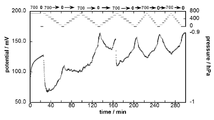
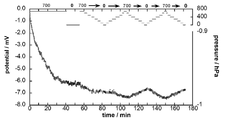
- FIG. 3 is a graph showing the pH dependence of the zeta potential of lithium cobalt oxide films obtained in Examples 1 to 3; Change image of streaming potential in zeta potential measurement of lithium cobalt oxide film surface in non-aqueous medium in Example 4 A diagram showing the relationship between pressure and streaming potential obtained in Example 4.
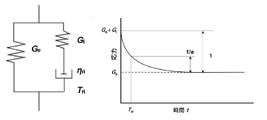
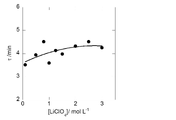
- Maxwell model (left) and Voigt model (right) as viscoelastic models Mechanical equivalent model (left) and relaxation process (right) for expressing the relaxation phenomenon of streaming potential A Generalized Maxwell Model for Analyzing Streaming Potential Relaxation Phenomena Graph showing time course of normalized potential difference in LiClO 4 -PC/solution (1 mol/L) at 700 mPa Graph showing the relationship between the zeta potential of the lithium cobaltate powder surface and the concentration of lithium perchlorate in the non-aqueous medium of Example 5 Graph showing the zeta potential dependence of the lithium cobaltate film surface when the lithium perchlorate salt concentration in the non-aqueous medium of Example 6 is changed
- a feature of the present invention is that in streaming potential measurement, the pressure applied to the sample liquid introduced into the cell is changed stepwise, and the pressure is maintained in a steady state for a certain period of time.
- the relaxation time is generally defined as the physical property value at an arbitrary point before reaching the equilibrium state from the physical property value in the equilibrium state for any physical property value that transitions from the non-equilibrium state to the equilibrium state.
- the rate of change of the streaming potential with respect to time is regarded as a relaxation process, and as shown in Examples described later, the rate of change of the streaming potential with respect to time is proportional to the difference between parallel and parallel. It was clarified that the relaxation time for In this case, the difference of the streaming potential from the equilibrium value at any time varies exponentially, and the relaxation time ⁇ in that case is defined as 1/e of the equilibrium value, ie, the time to reach about 37%.
- FIG . 1 shows the relationship between the relaxation time ⁇ of the streaming potential due to the application of pressure, the rise time t1 of the pressurized pressure, and the holding time t2, along with a stepwise pressure change profile applied to the fluid for measuring streaming potential.
- FIG. 2 shows a stepwise pressure change profile for decompressing a fluid for measuring streaming potential in a pressurized state. t2 relationship was shown.
- t1 be a time shorter than ⁇ and t2 be a time longer than ⁇ with respect to the relaxation time ⁇ . If t1 exceeds ⁇ , the measured streaming potential may not converge to a steady-state value. If t 2 is equal to or shorter than ⁇ , similarly steady-state values of streaming potential may not be observed.
- the upper limit of t 2 is less than 10 ⁇ , which is 10 times ⁇ It is preferably 5 ⁇ or less, and particularly preferably 5 ⁇ or less.
- the relaxation time that reaches about 37% of the difference between the initial value and the equilibrium value of the streaming potential is actually several seconds to several seconds. relaxation times of the order of minutes or even longer.
- the condition ⁇ >>t1 is established.
- FIG. 1 An example of a schematic diagram of a measuring device that can be used to implement the present invention is shown in FIG.
- the pressure is changed stepwise. Unlike conventional syringes, continuous pressure changes due to piston movement within the syringe are not provided.
- it is preferable to adjust the pressure by adding the pressure of pressurized gas to the liquid used for measurement. It is preferable to have The rate of change in pressure is adjusted to a time shorter than the relaxation time ⁇ of the streaming potential, which will be described later.
- the liquid can be sent while being pressurized using various liquid-sending pumps.
- the pressure adjusting valve is preferably a mechanism such as an electromagnetic valve that is instantaneously actuated by an electrical signal in order to minimize the delay in response speed due to friction and weight.
- the flow rate of the liquid sent by pressurization is arbitrarily adjusted. can be set to either laminar or turbulent flow.
- cells having various shapes such as a cylindrical tube, a right-angled tube, and a flat plate can be used according to the shape of the sample to be measured.
- Various plastics, ceramics, and metals can be used for the cell material. It may be configured.
- the cell for measuring streaming potential by using an organic polymer material instead of an inorganic material that is generally used in an aqueous solution system.
- Cells made of various resin materials such as acrylic resins, styrene resins, polyester resins, polycarbonate resins, polyurea resins, polyether resins, polyethylene resins, and polypropylene resins are also preferably used. More preferably, in order to check the state inside the cell, it should have translucency, chemical resistance to various acids and alkalis, and good solvent resistance to various organic solvents. It is preferable to indicate Preferred resins that can be used for such purposes include polypropylene-based resins. However, since the solubility in each solvent should be appropriately selected, the propriety of the material should be judged based on the solubility in the solvent, and the material is not limited by this case.
- the pressure is held at an arbitrarily set value for a certain period of time.
- the object is achieved by constantly applying the gas pressure described above to the liquid. It is preferable to suppress pressure fluctuations within ⁇ 5%, preferably within 1%, and more preferably within ⁇ 0.1% using a pressure regulator or the like.
- a pressure regulator or the like When using a method in which the liquid used for measurement is sent by various fluid pumps, pulsating flow is prevented, and the range of pressure fluctuation in the steady state is maintained within a range of ⁇ 5% with respect to the central value. This gives a more accurate streaming potential value. If the pressure fluctuation exceeds ⁇ 5% during measurement, the measured value of the streaming potential may not be stable and an accurate value may not be obtained.
- FIG. 4 shows a processing flow from the start of measurement to determination of zeta potential in the measurement method for carrying out the present invention. Wait until the charge between the electrodes by the electrometer connection converges to a constant potential (step S101), apply a differential pressure (step S102), measure the streaming potential (step S103), and confirm the transient response of the streaming potential. (Step S104). A transient response curve approximation function is selected (step S105). It is determined whether or not there is a change indicating the relaxation process of the streaming potential (step S106), and if there is a change indicating the relaxation process, the time constant in the longest relaxation process is confirmed (step S107). An estimated streaming potential is calculated using Gauss-newton nonlinear approximation (step S108).
- the potential is compared with the previously measured potential (step S109), and if it is determined that they match, the values of the time constant and the streaming potential are determined (step S110). Then, the zeta potential is calculated using linear approximation based on the Helmholtz-Smoluchowski equation (step S111). In order to improve the measurement accuracy, a comparison with the calculated value of the zeta potential of the previous measurement is performed (step S112). As a result, if four or more measurement points match, the measured value of the zeta potential is determined and the measurement is completed.
- step S102 the process returns to the step before differential pressure application.
- step S103 the process returns to before the measurement of the streaming potential. Details of the measuring method for carrying out the present invention will be described in detail using the following examples, but the present invention is not limited to the components shown in the following examples.
- a dispersion of lithium cobalt oxide (LiCoO 2 ) in NMP (N-methylpyrrolidone) was prepared by using polyvinylidene fluoride as a binder, and the surface of the support was coated with the dispersion and dried to form a LiCoO 2 film.
- the cells were prepared by arranging polypropylene sheets of 20 mm in length and 10 mm in width in parallel with each other with a gap between them.
- An aqueous solution in which lithium perchlorate was dissolved at a concentration of 10 mmol/L was used as the electrolyte solution. The pH of the aqueous solution was adjusted to 5.86.
- a schematic diagram of the measuring apparatus is shown in FIG.
- the aqueous solution introduced into the reservoir 17 is pushed up into the flow path by gas pressure from a dry nitrogen gas cylinder 13 equipped with a pressure gauge 12 and a pressure reducing valve 11, and introduced into a cell 19 by a three-way cock 14. be.
- the aqueous solution that has passed through the cell 19 is sent through the three-way cock 14 into the collection container.
- the flow rate of the aqueous solution within the cell 19 was changed by the gas pressure.
- Applied pressure is a parameter that changes the output voltage and affects its accuracy.
- the pressure regulator connected to the gas cylinder 13 on the upstream side is adjusted to 0.1 MPa, and the pressure regulator (Kofloc pressure regulator 6600A) having reproducibility within ⁇ 1% regardless of the pressure fluctuation on the upstream side was used to suppress pressure fluctuations to ⁇ 0.1% or less. Measurements in a non-aqueous medium, which will be described later, were also carried out in the same manner.
- the valve of the dry nitrogen gas cylinder 13 is opened, pressure is applied to the aqueous solution in the reservoir 17, the pressure on the side flowing into the cell is increased to 700 hPa, the cock is opened, and the cell is The flow rate inside was set to 90 mL/min.
- the pressurization was continued for about 30 minutes, and the aqueous solution was continued to flow. After that, the pressure was reduced stepwise.
- the stepped pattern shown at the top of the graph shown in FIG. 5 shows the pressure change profile when the fluid inside the cell is pressurized.
- the pressure applied inside the cell was measured by installing a pressure sensor 20 just above the upstream side of the cell.
- the time t1 to reach the set pressure in each step is 1 second or less, and the measured value during the measurement time t2 after reaching the set point is ⁇ 0.1 against the set value under any conditions. was kept below 10%.
- the pressure was reduced at intervals of 100 hPa, and the streaming potential was measured while reducing the pressure stepwise while maintaining the pressure for two and a half minutes at each step. After reaching 0 hPa, the pressure was changed to increase, and similarly, the pressure was increased stepwise up to 700 hPa while providing a holding time of 2.5 minutes every 100 hPa.
- FIG. 6 shows how the streaming potential changes due to the depressurization step after pressurization to 700 hPa about 275 minutes after the start of measurement.
- the numerical value of the streaming potential at each pressure step is approximated by an exponential function and shown as an approximate curve in the figure.
- FIG. 8 shows the results of plotting the relationship between the pressure and the streaming potential in the portion where the pressure step of 700->0 hPa was repeated four times. 20.5 mV was obtained.
- the results of Examples 1 to 3 are collectively shown in FIG. From this figure, the value of the zeta potential of the LiCoO2 film surface in the lithium perchlorate aqueous solution changes linearly from a positive value to a negative value with an increase in pH, and exhibits an isoelectric point at a pH of about 3. It became clear.
- Example of Zeta Potential Measurement of Lithium Cobaltate Film Surface in Non-Aqueous Medium Using the LiCoO 2 film prepared in Example 1, the solvent for dissolving lithium perchlorate was changed from water to propylene carbonate (PC), and the concentration of lithium perchlorate was set to 1.0 mol/L. I did an experiment.
- the PC solution had an electrical conductivity of 611 mS/m, a viscosity of 7.85 ⁇ 10 ⁇ 2 Pa/s, and a dielectric constant of 64.92.
- FIG. 10 shows the deviation of the output value from the electrometer from the start of the experiment to the measurement of the streaming potential.
- Equation 3 t represents the time from the start of measurement, and V0 represents the initial value of streaming potential at the start of measurement. V ⁇ represents the steady-state value of the streaming potential at time infinity when the pressure is kept constant at each pressure change step.
- the first possibility is ruled out because the response speed of the electrometer is also fast.
- the transient process when the measurement system is regarded as an RC series circuit is considered by replacing the pressure application with voltage application to the RC series circuit, and the relaxation time ⁇ in this case is expressed by the following equation.
- the value of the relaxation time (time constant) ⁇ is 9.40 ⁇ 10 ⁇ 4 seconds. Therefore, since the relaxation time due to the electrochemical causes of the measurement system is estimated to be around 1 millisecond at most, it is difficult to attribute the minute-order relaxation time observed in this example and the like to this.
- the form of the sample in this example is a thin film-like substance facing each other, and the fluid flows through the gap, so an interpretation method related to viscous flow is illustrated.
- the Reynolds number Re of the fluid flowing through the cell is calculated according to the following equation.
- ⁇ is the density of the fluid
- U is the representative flow velocity
- L is the representative length
- ⁇ is the viscosity coefficient of the fluid.
- the fluid flows into the cell with a maximum pressure of 700 hPa as pressure from the nitrogen gas cylinder, but if the difference between the inner diameter of the pipe and the inner diameter of the cell is large, the pressure is considerably higher than this and is installed on the wall surface of the cell.
- the fluid is incompressible, it takes a relatively long time to adsorb and diffuse ions in a non-aqueous medium with a high dielectric constant, such as the lithium-ion battery exemplified above, or when there is a polymer dissolved in the medium. It is conceivable that there is time. Furthermore, when a higher-order structure is formed by interaction between dipoles or in the case of a polymer solution, it has been found that the viscosity of the solvent increases extremely near the solid phase, and compressive stress and shear stress are applied. is known to exhibit relaxation behavior in response to For example, the reference "M.
- ethanol molecules are selectively adsorbed to the surface of silica glass in an ethanol/cyclohexane mixed solvent through hydrogen bonding. It has been clarified that it forms an adsorption layer ranging from nanometers to several tens of nanometers. It has been shown that the adsorption layer in this case exists substantially as a polymer in which a cluster structure is formed through hydrogen bonding and ethanol molecules are connected to each other by hydrogen bonding.
- the Maxwell model and the Voigt model shown in FIG. 12 are taken up as common models expressing such various relaxation processes.
- the Maxwell model describes stress relaxation and the Voigt model describes creep.
- the relaxation phenomenon will be explained below as stress relaxation when a strain is applied to the mechanical equivalent model.
- the stress relaxation phenomenon when the strain is constant is expressed using a deformed Maxwell model in which springs are combined in parallel as shown in FIG.
- the left side shows a deformed Maxwell model composed of a spring and a dashpot
- the right side shows how the stress relaxes over time.
- the external force corresponding to the stress is the pressure applied to the fluid inside the cell.
- the spring component is stretched by the strain ⁇ and the stress increases by an amount corresponding to (Ge+Gi), but the stress is relieved by the gradual extension of the dashpot component, and the stress G(t) is expressed by the following equation.
- the relaxation time ⁇ is expressed by the following formula.
- the relaxation time ⁇ varies from a short time to a relatively long time in various cases, such as electrolyte solutions that exhibit structural viscous behavior and electrode materials with a surface polymer layer. It is thought that it changes exponentially with the relaxation time. Therefore, in the present invention, the relaxation phenomenon of the streaming potential provides a means for directly observing the strain of the electric double layer model and the mode of its relaxation, which has hitherto been unknown.
- the measured value of V(t) is exponentially approximated using the Gauss-Newton approximation method as described in Example 1 above, and the measured value during the transient response is preferably analyzed using V ⁇ inductively estimated by a predetermined algorithm.
- a method of estimating V ⁇ with a measurement time about five times as long as the relaxation time ⁇ is adopted.
- Equation 5 Equation 5
- Equations 6 and 7 Equations 6 and 7 below are obtained.
- V(t) ⁇ C i exp(a i t)
- the term corresponding to V ⁇ can be automatically calculated as a term in which a i is infinitely close to zero.
- the sample measured by the streaming potential method is often measured by flowing through the pores of porous materials such as powder and fiber.
- the pore diameters are known to exhibit various distributions ranging from nano-order to millimeter-order.
- the shape of the gas-liquid interface changes due to the interface with the gas component remaining in the pores. The resulting potential fluctuation is not necessarily the cause of the relaxation phenomenon, and an unexpected transient response is expected.
- This patent describes not only the relaxation change that has a single relaxation time and is exponential, but also that the transient response is expressed in multiple exponential terms according to the concept of the embodiment, and is expressed in some mathematical formula, such as each If the relaxation time in the term can be empirically attributed to the factor of each assumed relaxation phenomenon, it is applicable.
- FIG. 15 shows the potential transient response in a PC solution of 1 mol/L LiClO 4 .
- the method of obtaining the value during normal measurement of the streaming potential is to set the pressure on the electrolyte solution flowing through the cell, wait until the potential becomes constant, and then continue the value until it can be confirmed that it is constant. It is common to use the average value. That is, as shown in FIG. 15, after confirming that the potential becomes substantially constant around 4 ⁇ with respect to the time-dependent change of the potential that changes exponentially, it is confirmed that the value becomes constant.
- the measurement is continued until 6 ⁇ , and the average value of the potentials obtained during that period is obtained.
- the value up to the relaxation time is used to calculate the zeta potential from the potential under each predetermined pressure.
- the method of obtaining data is that the average value of the zeta potential is obtained from the time point when it becomes constant over time without using the regression curve represented by the exponential function. is completely different from this patent.
- Example 4 As a result, in the semilogarithmic diagram of FIG. 15, the approximations of the values are different under each pressure, and from any result, the correlation of the data collected in Example 4, which has a high correlation in the measurement up to the relaxation time was found to be significantly superior. Therefore, the potential measurement under each pressure can not only shorten the measurement time from 5 ⁇ to ⁇ , but also the reproducibility of the value is 0.98 or less in Comparative Example 1, which is a significant figure of one digit. On the other hand, in Example 4, R was 0.999 or more, and the accuracy was improved to three significant digits. This is because even though it is a converged value, the value slightly fluctuates, and the dispersion of the value due to the noise in the measured value is recognized from the change over time. That is, it shows that the zeta potential value calculated using the value up to ⁇ , which is relatively accurate in a short time, is significantly more accurate than when the measured value is obtained by the conventional method.
- LiCoO 2 powder was dispersed in PC, and the streaming potential was measured using a system in which the concentration of lithium perchlorate in the PC solution was varied. Effect on the zeta potential when the salt concentration was changed investigated.
- FIG. 16 shows that the relaxation time ⁇ obtained by exponential approximation using the displacement under constant pressure after changing the pressure from 600 hPa to 700 hPa when measuring the streaming potential at each salt concentration is about 4 minutes. It was found that the concentration of salt was about
- Example 4 ⁇ Example of Zeta Potential Measurement of Lithium Cobaltate Film Surface When Lithium Perchlorate Salt Concentration in Non-Aqueous Medium Is Changed>
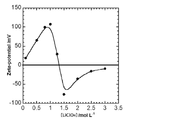
- the streaming potential was measured by varying the concentration of lithium perchlorate dissolved in PC in the range of 0.1 mol/L to 3.0 mol/L, and the surface zeta potential for each salt concentration was measured.
- FIG. 17 shows the results of examining the influence on
- the potential on the LiCoO 2 film in an aprotic solvent depends on the amount of Li ions or ClO 4 ions adsorbed.
- the rise in potential is a result suggesting that adsorption of Li ions occurs preferentially.
- Li ions show a solvated structure with respect to the PC solvent, which is consistent with Raman measurements and the like showing that the interaction with the solid phase is relatively strong.
- the concentration region exceeding 1 mol/L the region partially forms ion pairs, and ClO 4 ions excessively coordinate with Li, weakening the interaction between Li ions and the solid. It is suggested. This is considered to be a phenomenon related to the sudden drop in electric conductivity from around 1.2M.
- the reason why the zeta potential shows a large negative value on the high salt concentration side (up to 1.5 M) may be due to the intrinsic properties of the LiCoO 2 particles.
- the present invention can accurately and dramatically improve the zeta potential in various electrolyte solutions that exhibit a wide range of physical properties such as dielectric constant, electrical conductivity, and viscosity, regardless of whether they are aqueous or non-aqueous. Since it can be measured in a short time, it is useful for analysis of various solid surfaces. It is also useful for analyzing the viscoelastic properties of solid-liquid interfaces.
- Reference Signs List 1 zeta potential measuring device 10 pressure regulator 11 pressure reducing valve 12 pressure gauge 13 dry nitrogen gas cylinder 14 three-way cock 15 platinum wire 16 gasket 17, 18 reservoir 19 cell 20 pressure sensor 21 electrometer
Landscapes
- Chemical & Material Sciences (AREA)
- Chemical Kinetics & Catalysis (AREA)
- Electrochemistry (AREA)
- Physics & Mathematics (AREA)
- Health & Medical Sciences (AREA)
- Life Sciences & Earth Sciences (AREA)
- Analytical Chemistry (AREA)
- Biochemistry (AREA)
- General Health & Medical Sciences (AREA)
- General Physics & Mathematics (AREA)
- Immunology (AREA)
- Pathology (AREA)
- Investigating Or Analyzing Materials By The Use Of Electric Means (AREA)
Priority Applications (3)
| Application Number | Priority Date | Filing Date | Title |
|---|---|---|---|
| JP2023507051A JP7496979B2 (ja) | 2021-03-13 | 2022-03-10 | ゼータ電位測定方法及び測定装置 |
| CN202280018597.5A CN116964443B (zh) | 2021-03-13 | 2022-03-10 | Zeta电位测量方法以及测量装置 |
| US18/240,220 US12313590B2 (en) | 2021-03-13 | 2023-08-30 | Zeta potential measurement method and measurement device |
Applications Claiming Priority (2)
| Application Number | Priority Date | Filing Date | Title |
|---|---|---|---|
| JP2021040878 | 2021-03-13 | ||
| JP2021-040878 | 2021-03-13 |
Related Child Applications (1)
| Application Number | Title | Priority Date | Filing Date |
|---|---|---|---|
| US18/240,220 Continuation US12313590B2 (en) | 2021-03-13 | 2023-08-30 | Zeta potential measurement method and measurement device |
Publications (1)
| Publication Number | Publication Date |
|---|---|
| WO2022196533A1 true WO2022196533A1 (ja) | 2022-09-22 |
Family
ID=83320638
Family Applications (1)
| Application Number | Title | Priority Date | Filing Date |
|---|---|---|---|
| PCT/JP2022/010701 Ceased WO2022196533A1 (ja) | 2021-03-13 | 2022-03-10 | ゼータ電位測定方法及び測定装置 |
Country Status (4)
| Country | Link |
|---|---|
| US (1) | US12313590B2 (https=) |
| JP (1) | JP7496979B2 (https=) |
| CN (1) | CN116964443B (https=) |
| WO (1) | WO2022196533A1 (https=) |
Families Citing this family (1)
| Publication number | Priority date | Publication date | Assignee | Title |
|---|---|---|---|---|
| CN116587320A (zh) * | 2023-05-08 | 2023-08-15 | 西安交通大学 | 一种静电黏附装置 |
Citations (8)
| Publication number | Priority date | Publication date | Assignee | Title |
|---|---|---|---|---|
| JPS5818157A (ja) * | 1981-07-24 | 1983-02-02 | Shimadzu Corp | ゼ−タ電位測定装置 |
| WO1988003265A1 (en) * | 1986-10-28 | 1988-05-05 | Mta Kutatási Eszközöket Kivitelezo^" Vállalat | Process for measuring and determining zeta-potential in a laminarly flowing medium for practical purposes |
| JPH07198655A (ja) * | 1993-12-28 | 1995-08-01 | Shimadzu Corp | 流動電位測定装置 |
| JPH07286984A (ja) * | 1994-04-20 | 1995-10-31 | Nippon Paper Ind Co Ltd | ゼータ電位測定方法及びパルプスラリーの調製方法 |
| JPH0968514A (ja) * | 1995-08-31 | 1997-03-11 | Shimadzu Corp | 流動電位測定装置 |
| JPH09257739A (ja) * | 1996-03-19 | 1997-10-03 | Shimadzu Corp | ゼータ電位測定方法および装置 |
| JPH1038835A (ja) * | 1996-07-18 | 1998-02-13 | Shimadzu Corp | ゼータ電位測定方法および装置 |
| JP2000019144A (ja) * | 1998-06-30 | 2000-01-21 | Shimadzu Corp | ゼータ電位測定方法および測定装置 |
Family Cites Families (13)
| Publication number | Priority date | Publication date | Assignee | Title |
|---|---|---|---|---|
| JPH08101158A (ja) | 1994-09-30 | 1996-04-16 | Shimadzu Corp | 流動電位測定法 |
| JP3376721B2 (ja) | 1994-10-31 | 2003-02-10 | 株式会社島津製作所 | 流動電位測定法 |
| JP3367234B2 (ja) | 1994-11-11 | 2003-01-14 | 株式会社島津製作所 | 流動電位測定法 |
| JP2957509B2 (ja) * | 1997-03-07 | 1999-10-04 | 新潟日本電気株式会社 | インクジェット記録装置 |
| WO2002021517A1 (en) * | 2000-09-04 | 2002-03-14 | Zeon Corporation | Magnetic disk substrate and magnetic disk |
| CN1808149B (zh) * | 2006-02-24 | 2010-12-22 | 国家海洋局杭州水处理技术研究开发中心 | 平流式膜表面电位测定仪 |
| CA2857307A1 (en) * | 2011-12-01 | 2013-06-06 | Barofold, Inc. | Methods and systems for protein refolding |
| GB2501530A (en) * | 2012-04-29 | 2013-10-30 | Univ Sheffield | Rheometer and rheometric method |
| CN103954657A (zh) * | 2013-06-24 | 2014-07-30 | 浙江赛特膜技术有限公司 | 流动电位和ZeTa电位测定方法及测定仪器 |
| CN105705934B (zh) * | 2013-09-03 | 2019-01-08 | Izon科技有限公司 | 用于确定测量颗粒的电荷的方法和设备 |
| AT515744B1 (de) * | 2014-05-13 | 2016-08-15 | Anton Paar Gmbh | Verfahren und Vorrichtung zum Ermitteln des Zetapotenzials zum Charakterisieren einer Fest-Flüssig-Phasengrenze mit gesteuerter Druckprofilbeaufschlagung |
| US10493172B2 (en) * | 2016-06-02 | 2019-12-03 | California Institute Of Technology | Gas-filled structures and related compositions, methods and systems to image a target site |
| CN109507264B (zh) * | 2018-11-14 | 2022-11-01 | 南京工业大学 | 膜表面Zeta电位自动检测仪 |
-
2022
- 2022-03-10 JP JP2023507051A patent/JP7496979B2/ja active Active
- 2022-03-10 CN CN202280018597.5A patent/CN116964443B/zh active Active
- 2022-03-10 WO PCT/JP2022/010701 patent/WO2022196533A1/ja not_active Ceased
-
2023
- 2023-08-30 US US18/240,220 patent/US12313590B2/en active Active
Patent Citations (8)
| Publication number | Priority date | Publication date | Assignee | Title |
|---|---|---|---|---|
| JPS5818157A (ja) * | 1981-07-24 | 1983-02-02 | Shimadzu Corp | ゼ−タ電位測定装置 |
| WO1988003265A1 (en) * | 1986-10-28 | 1988-05-05 | Mta Kutatási Eszközöket Kivitelezo^" Vállalat | Process for measuring and determining zeta-potential in a laminarly flowing medium for practical purposes |
| JPH07198655A (ja) * | 1993-12-28 | 1995-08-01 | Shimadzu Corp | 流動電位測定装置 |
| JPH07286984A (ja) * | 1994-04-20 | 1995-10-31 | Nippon Paper Ind Co Ltd | ゼータ電位測定方法及びパルプスラリーの調製方法 |
| JPH0968514A (ja) * | 1995-08-31 | 1997-03-11 | Shimadzu Corp | 流動電位測定装置 |
| JPH09257739A (ja) * | 1996-03-19 | 1997-10-03 | Shimadzu Corp | ゼータ電位測定方法および装置 |
| JPH1038835A (ja) * | 1996-07-18 | 1998-02-13 | Shimadzu Corp | ゼータ電位測定方法および装置 |
| JP2000019144A (ja) * | 1998-06-30 | 2000-01-21 | Shimadzu Corp | ゼータ電位測定方法および測定装置 |
Also Published As
| Publication number | Publication date |
|---|---|
| JPWO2022196533A1 (https=) | 2022-09-22 |
| JP7496979B2 (ja) | 2024-06-10 |
| CN116964443A (zh) | 2023-10-27 |
| US20230408445A1 (en) | 2023-12-21 |
| CN116964443B (zh) | 2026-02-17 |
| US12313590B2 (en) | 2025-05-27 |
Similar Documents
| Publication | Publication Date | Title |
|---|---|---|
| Lan et al. | Pressure-driven nanoparticle transport across glass membranes containing a conical-shaped nanopore | |
| Sa et al. | Reversible cobalt ion binding to imidazole-modified nanopipettes | |
| Farquhar et al. | Understanding and correcting unwanted influences on the signal from electrochemical gas sensors | |
| Wang et al. | Experimental investigation on the physical parameters of ionic polymer metal composites sensors for humidity perception | |
| Zeng et al. | Stable Pb2+ ion-selective electrodes based on polyaniline-TiO2 solid contacts | |
| US20140111224A1 (en) | Probe | |
| CN108779926A (zh) | 空气净化器及空气净化方法 | |
| CN103954657A (zh) | 流动电位和ZeTa电位测定方法及测定仪器 | |
| CN111638259B (zh) | 一种液流电池电极活性面积的检测方法及装置 | |
| Bae et al. | Diffuse layer effect on electron-transfer kinetics measured by scanning electrochemical microscopy (SECM) | |
| US12313590B2 (en) | Zeta potential measurement method and measurement device | |
| Saito et al. | Factors determining ionic mobility in ion migration pathways of polypropylene (pp) separator for lithium secondary batteries | |
| CN109507252B (zh) | 纳米氧化锌棒掺杂的聚合物分散液晶的气体传感器 | |
| Cai et al. | Ion current rectification behavior of conical nanopores filled with spatially distributed fixed charges | |
| Gonçalves et al. | Review on the use of impedance spectroscopy for IPMC-like devices: application, models, and a new approach to data treatment | |
| Yaroshchuk et al. | Electrochemical and other transport properties of nanoporous track-etched membranes studied by the current switch-off technique | |
| Hernández et al. | Crossover critical phenomena in an aqueous electrolyte solution: Light scattering, density and viscosity of the 3-methylpyridine+ water+ NaBr system | |
| CN103163198B (zh) | 一种液体浓度检测装置及使用其检测液体浓度的方法 | |
| Suzuki et al. | Predictive zeta potential measurement method applicable to nonaqueous solvents in high-concentration dispersion systems for the system of LiClO4–propylene carbonate solution and LiCoO2 powder sheet | |
| Lin et al. | Characterization of the ionic liquid/electrode interfacial relaxation processes under potential polarization for ionic liquid amperometric gas sensor method development | |
| El Kaddouri et al. | Impact of a compressive stress on water sorption and diffusion in ionomer membranes for fuel cells. A 1H NMR study in vapor-equilibrated Nafion | |
| RU2548614C1 (ru) | Способ определения коэффициента диффузии горючих газов в азоте | |
| CN106908485A (zh) | 一种无损检测分离膜水通量的方法 | |
| Takeda et al. | Effect of cross-sectional shape of pathway on ion migration in polyethylene separators for lithium-ion batteries | |
| Kabir et al. | Applications of electrochemical impedance spectroscopy (EIS) for various electrode pattern in a microfluidic channel with different electrolyte solutions |
Legal Events
| Date | Code | Title | Description |
|---|---|---|---|
| 121 | Ep: the epo has been informed by wipo that ep was designated in this application |
Ref document number: 22771283 Country of ref document: EP Kind code of ref document: A1 |
|
| WWE | Wipo information: entry into national phase |
Ref document number: 2023507051 Country of ref document: JP |
|
| WWE | Wipo information: entry into national phase |
Ref document number: 202280018597.5 Country of ref document: CN |
|
| NENP | Non-entry into the national phase |
Ref country code: DE |
|
| 122 | Ep: pct application non-entry in european phase |
Ref document number: 22771283 Country of ref document: EP Kind code of ref document: A1 |