WO2022168924A1 - インダクタ、個片化インダクタおよびその製造方法 - Google Patents
インダクタ、個片化インダクタおよびその製造方法 Download PDFInfo
- Publication number
- WO2022168924A1 WO2022168924A1 PCT/JP2022/004314 JP2022004314W WO2022168924A1 WO 2022168924 A1 WO2022168924 A1 WO 2022168924A1 JP 2022004314 W JP2022004314 W JP 2022004314W WO 2022168924 A1 WO2022168924 A1 WO 2022168924A1
- Authority
- WO
- WIPO (PCT)
- Prior art keywords
- inductor
- wiring
- singulated
- magnetic layer
- parallel
- Prior art date
- Legal status (The legal status is an assumption and is not a legal conclusion. Google has not performed a legal analysis and makes no representation as to the accuracy of the status listed.)
- Ceased
Links
Images


Classifications
-
- H—ELECTRICITY
- H01—ELECTRIC ELEMENTS
- H01F—MAGNETS; INDUCTANCES; TRANSFORMERS; SELECTION OF MATERIALS FOR THEIR MAGNETIC PROPERTIES
- H01F27/00—Details of transformers or inductances, in general
- H01F27/28—Coils; Windings; Conductive connections
- H01F27/2823—Wires
-
- H—ELECTRICITY
- H01—ELECTRIC ELEMENTS
- H01F—MAGNETS; INDUCTANCES; TRANSFORMERS; SELECTION OF MATERIALS FOR THEIR MAGNETIC PROPERTIES
- H01F17/00—Fixed inductances of the signal type
- H01F17/04—Fixed inductances of the signal type with magnetic core
- H01F17/06—Fixed inductances of the signal type with magnetic core with core substantially closed in itself, e.g. toroid
-
- H—ELECTRICITY
- H01—ELECTRIC ELEMENTS
- H01F—MAGNETS; INDUCTANCES; TRANSFORMERS; SELECTION OF MATERIALS FOR THEIR MAGNETIC PROPERTIES
- H01F17/00—Fixed inductances of the signal type
- H01F17/04—Fixed inductances of the signal type with magnetic core
-
- H—ELECTRICITY
- H01—ELECTRIC ELEMENTS
- H01F—MAGNETS; INDUCTANCES; TRANSFORMERS; SELECTION OF MATERIALS FOR THEIR MAGNETIC PROPERTIES
- H01F41/00—Apparatus or processes specially adapted for manufacturing or assembling magnets, inductances or transformers; Apparatus or processes specially adapted for manufacturing materials characterised by their magnetic properties
-
- H—ELECTRICITY
- H01—ELECTRIC ELEMENTS
- H01F—MAGNETS; INDUCTANCES; TRANSFORMERS; SELECTION OF MATERIALS FOR THEIR MAGNETIC PROPERTIES
- H01F41/00—Apparatus or processes specially adapted for manufacturing or assembling magnets, inductances or transformers; Apparatus or processes specially adapted for manufacturing materials characterised by their magnetic properties
- H01F41/02—Apparatus or processes specially adapted for manufacturing or assembling magnets, inductances or transformers; Apparatus or processes specially adapted for manufacturing materials characterised by their magnetic properties for manufacturing cores, coils, or magnets
- H01F41/04—Apparatus or processes specially adapted for manufacturing or assembling magnets, inductances or transformers; Apparatus or processes specially adapted for manufacturing materials characterised by their magnetic properties for manufacturing cores, coils, or magnets for manufacturing coils
Definitions
- the present invention relates to inductors, singulated inductors, and manufacturing methods thereof.
- Patent Document 1 An inductor including a magnetic layer and a plurality of wirings embedded in the magnetic layer is known (see, for example, Patent Document 1 below).
- the plurality of wirings are arranged in parallel at equal intervals in the horizontal direction.
- the magnetic layer contains magnetic particles.
- the magnetic layer between adjacent wires may be cut in the thickness direction to manufacture individualized inductors smaller in size than inductors.
- the present invention provides a singulated inductor that suppresses a decrease in inductance and is miniaturized, a manufacturing method thereof, and an inductor used therefor.
- the present invention (1) comprises a magnetic layer, and a plurality of wires embedded in the magnetic layer and extending in a longitudinal direction, the plurality of wires being arranged in parallel at predetermined intervals in a direction orthogonal to the longitudinal direction.
- the magnetic layer includes a plurality of wiring arrangement portions in which the wirings are regularly arranged in parallel, and a margin portion arranged between the wiring arrangement portions adjacent in the parallel direction of the wirings and omitting the wirings. and inductors.
- wiring arrangement part wiring is regularly arranged in parallel. Therefore, wiring can be arranged compactly in the singulated inductor. As a result, it is possible to reduce the size of the singulated inductor after cutting.
- this inductor it is possible to suppress a decrease in the inductance of the singulated inductor after cutting, and to reduce the size of the singulated inductor.
- the present invention (2) includes the inductor according to (1), wherein the plurality of wirings are arranged in parallel at equal intervals in the wiring arrangement portion.
- the wiring arrangement portion of this inductor multiple wirings are arranged in parallel at equal intervals. Therefore, the wiring can be arranged more compactly in the wiring arrangement portion. Also, the inductance of each wiring can be made equal. As a result, the inductance of each wiring can be made equal while the individualized inductor after cutting can be further miniaturized.
- the present invention (3) includes a method of manufacturing a singulated inductor comprising a first step of preparing the inductor according to (1) or (2) and a second step of cutting the margin portion.
- the margin portion is cut, a sufficient distance can be secured between the cut side end surface of the magnetic layer and the wiring adjacent to the cut side end surface. Therefore, a sufficient amount of the magnetic component exists between the cut side facet and the wiring in the magnetic layer. As a result, it is possible to suppress the decrease in the inductance of the singulated inductor after the second step.
- wiring arrangement part wiring is regularly arranged in parallel. Therefore, wiring can be arranged compactly in the singulated inductor. As a result, miniaturization of the singulated inductor after the second step can be achieved.
- the present invention (4) comprises a magnetic layer, and a plurality of wires embedded in the magnetic layer and extending in a longitudinal direction, the plurality of wires being arranged in parallel at predetermined intervals in a direction orthogonal to the longitudinal direction.
- the magnetic layer includes a wiring arrangement portion in which the wiring is regularly arranged in parallel, the wiring includes an end wiring arranged at one end of the wiring arrangement portion in the parallel direction of the wiring;
- the singulated inductor has a distance from one side end face of the magnetic layer to the end wiring of 0.2 mm or more and 7 mm or less.
- the distance from one side end surface of the magnetic layer to the end wiring is 7 mm or less, so the singulated inductor can be miniaturized.
- this singulated inductor is miniaturized while suppressing a decrease in inductance.
- the present invention (5) includes the singulated inductor according to (4), wherein the end face of the wiring in the longitudinal direction has an exposed portion exposed from the magnetic layer.
- the present invention (6) includes the singulated inductor according to (4) or (5), wherein the end face of the wiring in the longitudinal direction has a covered portion covered with the magnetic layer.
- the present invention (7) includes the singulated inductor according to any one of (4) to (6), which has a rectangular shape including curved corners in plan view.
- the present invention (8) is the singulated inductor according to (7), wherein the curve is a curved line with a curvature radius of 0.1 mm or more and 5 mm or less.
- the impact resistance of the inductor can be improved.
- the area near the corner can be widened, and the mark can be placed in the empty space.
- the manufacturing method of the singulated inductor of the present invention using the inductor of the present invention can manufacture a singulated inductor that suppresses a decrease in inductance and is miniaturized.
- the singulated inductor of the present invention is designed to suppress a decrease in inductance and to be miniaturized.
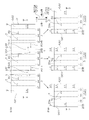
- FIG. 1A and 1B are plan views of inductors and singulated inductors of the present invention, respectively.
- FIG. 1A is an inductor.
- FIG. 1B is a plurality of singulated inductors.
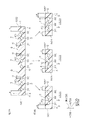
- 2A and 2B are cross-sectional views corresponding to FIGS. 1A and 1B, respectively.
- FIG. 2A is an inductor.
- FIG. 2B is a plurality of singulated inductors.
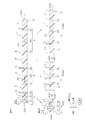
- 3A and 3B are cross-sectional views of variations of inductors and singulated inductors, respectively.
- FIG. 3A is an inductor.
- FIG. 3B is a plurality of singulated inductors.
- 4A and 4B are cross-sectional views of variations of inductors and singulated inductors, respectively.
- FIG. 1A is an inductor.
- FIG. 1B is a plurality of singulated inductors.
- 4A and 4B are cross-sectional views of variations of in
- FIG. 4A is an inductor.
- FIG. 4B is a plurality of singulated inductors.
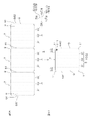
- 5A and 5B are plan views of variations of inductors and singulated inductors, respectively.
- FIG. 5A is an inductor.
- FIG. 4B is a second singulated inductor.
- FIG. 6 is a front view of an end face of the singulated inductor in the longitudinal direction in the modified example.
- FIGS. 1A to 2B An embodiment of the inductor and singulated inductor of the present invention will be described with reference to FIGS. 1A to 2B.
- inductor 1 extends in a plane direction orthogonal to the thickness direction.
- the thickness direction is the depth direction of the paper in FIG. 1A.
- the thickness direction is the vertical direction in FIG. 2A.
- the planar direction includes a first direction and a second direction orthogonal to the first direction.
- the first direction is the vertical direction in FIG. 1A.
- the first direction is the depth direction of the paper in FIG. 2A.
- the second direction is the horizontal direction in each of FIGS. 1A and 2A.
- the inductor 1 is a substantially rectangular sheet in plan view.
- the inductor 1 includes a magnetic layer 2 and multiple wires 3 .
- the magnetic layer 2 has the same outer shape as the inductor 1 .
- the magnetic layer 2 has two main surfaces 4 facing in the thickness direction, two first side end surfaces 20A and 20B (see FIG. 1A) facing in the first direction, and two second sides facing in the second direction. It has an end face 6 continuously.
- the first side end surfaces 20A and 20B (see FIG. 1A) extend along the second direction.
- the second side end surface 6 extends along the first direction.
- the two second side end faces 6 include a second one side end face 61 arranged on one side in the second direction and a second other side end face 62 arranged on the other side in the second direction.
- Examples of the material of the magnetic layer 2 include a magnetic composition containing magnetic particles as a magnetic component.
- the thickness of the magnetic layer 2 is, for example, 1 ⁇ m or more and, for example, 5000 ⁇ m or less.
- the thickness of the magnetic layer 2 is the distance between the two main surfaces 4 .
- the magnetic layer 2 includes a wiring arrangement portion 7, which will be described later, a margin portion 8, which will be described later, and a second margin portion 9, which will be described later.
- the wiring 3 extends along the first direction.
- the first direction corresponds to the longitudinal direction of the wiring 3 .
- a plurality of wirings 3 are arranged in parallel at predetermined intervals in a cross section along the thickness direction and the second direction.
- the cross section along the thickness direction and the second direction is the cross section drawn in FIG. 2A. Therefore, the second direction corresponds to the parallel direction in which the wirings 3 are arranged in parallel.
- the wiring 3 is embedded in the magnetic layer 2 .
- the configuration and dimensions of each of the plurality of wirings 3 are described, for example, in Japanese Unexamined Patent Application Publication No. 2020-150057.
- the radius R of the wiring 3 is, for example, 25 ⁇ m or more and, for example, 2000 ⁇ m or less.
- a plurality of (three in the present embodiment) wiring arrangement portions 7 are included in the magnetic layer 2 .
- the plurality of wiring arrangement portions 7 are spaced apart in the second direction.
- Each of the plurality of wiring arrangement portions 7 is arranged over the first direction in the inductor 1 .
- the wirings 3 are regularly arranged in parallel in the wiring arrangement portion 7 .
- a plurality of (three in this embodiment) wirings 3 are arranged in parallel at regular intervals P0.
- the dimensions of the wiring 3 and the spacing P0 between two adjacent wirings 3 are not limited. They are described, for example, in JP-A-2020-150057.
- a plurality of wirings 3 are arranged in the wiring arrangement portion 7 .
- the multiple wirings 3 include a first end wiring 31 , a second end wiring 32 and an intermediate wiring 33 .
- the first end wiring 31 is arranged at one end in the second direction of the wiring arrangement portion 7 .
- the second end wiring 32 is arranged at the other end in the second direction of the wiring arrangement portion 7 .
- the intermediate wiring 33 is arranged between the first end wiring 31 and the second end wiring 32 . Therefore, in the wiring arrangement portion 7, the first end wiring 31, the intermediate wiring 33, and the second end wiring 32 are arranged in order toward the other side in the second direction.
- Margin portions 8 are arranged between adjacent wiring placement portions 7 . Specifically, the margin portion 8 connects two wiring placement portions 7 adjacent to each other in the second direction. A plurality of (two in this embodiment) margin portions 8 are included in the magnetic layer 2 . The number of wiring placement portions 7 is one more than the number of margin portions 8 . Each of the plurality of margin portions 8 is arranged over the first direction in the inductor 1 .
- the wiring 3 is omitted. Specifically, in the inductor 1 in which all the wirings 3 are arranged in parallel with equal intervals P0 in the second direction, one wiring 3 is provided for every predetermined plurality of wirings 3 (four in this embodiment). An area (and the vicinity thereof) of the magnetic layer 2 where the wiring 3 is removed (eliminated) becomes the margin portion 8 , and the area of the magnetic layer 2 other than the margin portion 8 becomes the wiring arrangement portion 7 . becomes.
- the wiring 3 is not arranged in the margin portion 8, and only the magnetic layer 2 is arranged. Also, the margin portion 8 has a length in the second direction that ensures a distance L0, which will be described later.
- the second margin portion 9 is arranged outside the wiring arrangement portion 7 located on the outermost side in the second direction. That is, the second margin portions 9 are arranged at both ends of the inductor 1 in the second direction. Specifically, the second margin portion 9 includes one side of the wiring arrangement portion 7 located on the most side in the second direction, the other side of the wiring arrangement portion 7 located on the side with the largest number of wirings in the second direction, placed in The number of second margin portions 9 is two in this embodiment.
- the wiring 3 is not arranged in the second margin portion 9, and only the magnetic layer 2 is arranged.
- This manufacturing method includes a first step and a second step.
- the first step is to prepare the inductor 1 shown in FIGS. 1A and 2A.
- a method of preparing the inductor 1 is not limited. A method of preparing the inductor 1 is described, for example, in Japanese Patent Application Laid-Open No. 2020-150057.
- the margin portion 8 is cut. Specifically, the second direction approximate center portion 81 of the margin portion 8 is cut along the first direction. Specifically, in the magnetic layer 2, the second direction central portion 81 between the second end wiring 32 and the first end wiring 31 facing the second end wiring 32 in the second direction is cut. More specifically, the point advanced from the second end wiring 32 to the other side in the second direction by the total length (P0+R) of the length equal to the interval P0 of the wiring 3 and the radius R of the wiring 3 The magnetic layer 2 is cut through. In addition, from the first end wiring 31, the total length (P0+R) of the length equal to the interval P0 of the wiring 3 and the radius R of the wiring 3 passes through a point advanced in the second direction one side. , cut the magnetic layer 2 .
- the cutting of the margin portion 8 includes, for example, non-contact cutting such as laser.
- the wiring 3 may be cut by, for example, punching using a die, or contact cutting such as dicing using a rotary cutter. From the viewpoint of shortening the time of the second step, contact cutting is preferred, and from the viewpoint of improving product quality, punching is more preferred.
- one margin portion 8 is divided into two.
- three singulated inductors 10 are manufactured by cutting each of the two margin portions 8 .
- the three singulated inductors 10 include a first singulated inductor 21 , a second singulated inductor 22 , and a third singulated inductor 23 .
- the first singulated inductor 21 includes a wiring arrangement portion 7 arranged on the farthest side of the inductor 1 in the second direction.
- the third singulated inductor 23 includes a wiring arrangement portion 7 arranged on the farthest side of the inductor 1 in the second direction.
- the second singulated inductor 22 includes a wiring arrangement portion 7 arranged in the middle portion in the second direction. The second singulated inductor 22, the first singulated inductor 21, and the third singulated inductor 23 will be described in order.
- the second singulated inductor 22 will be described in detail, and then the first singulated inductor 21 and the third singulated inductor 23 will be briefly described.
- the explanation of the first singulated inductor 21 and the third singulated inductor 23 the explanation of the members and the like common to the second singulated inductor 22 will be omitted.
- members other than those specifically mentioned are the same as the members in the inductor 1 described above.
- the second singulated inductor 22 is a sheet that is approximately rectangular in plan view.
- the second singulated inductor 22 has a length in the second direction shorter than that of the inductor 1 .
- the second singulated inductor 22 includes a magnetic layer 2 and wiring 3 .
- the wiring 3 is embedded in the magnetic layer 2 .
- the magnetic layer 2 in the second singulated inductor 22 has the same outer shape as the second singulated inductor 22 .
- the magnetic layer 2 has two main surfaces 4 , two first side surfaces 20A and 20B (see FIG. 1A), and two second side surfaces 6 .
- Principal surface 4 and first side end surfaces 20A and 20B are similar to those of inductor 1 .
- Both of the two second side end surfaces 6 are cut surfaces (cut side end surfaces) formed by cutting the margin portion 8 .
- the two second side end faces 6 include a second one side end face 61 and a second other side end face 62 .
- the magnetic layer 2 includes a wiring arrangement portion 7 .
- One wiring arrangement portion 7 is provided for one second singulated inductor 22 .
- a first end wiring 31 , a second end wiring 32 , and an intermediate wiring 33 are arranged in the wiring arrangement portion 7 .
- the distance L0 from the second one-side end face 61 of the magnetic layer 2 to the first end wiring 31 is 0.2 mm or more and 7 mm or less. If the distance L0 is less than 0.2 mm, the amount of magnetic particles existing between the second one-side end face 61 and the first end wiring 31 in the magnetic layer 2 becomes excessively small, so the second singulation is performed. A decrease in the inductance of the inductor 22 cannot be suppressed. If the distance L0 exceeds 7 mm, the size of the second singulated inductor 22 cannot be reduced.
- the distance L0 is preferably 0.4 mm or more and preferably 5 mm or less.
- the distance L0 from the second other-side end face 62 of the magnetic layer 2 to the second end wiring 32 is 0.2 mm or more and 7 mm or less. If the distance L0 is less than 0.2 mm, the amount of magnetic particles existing between the second other-side end face 62 and the second end wiring 32 in the magnetic layer 2 becomes excessively small, so the second singulation is performed. A decrease in the inductance of the inductor 22 cannot be suppressed. If the distance L0 exceeds 7 mm, the size of the second singulated inductor 22 cannot be reduced.
- the distance L0 is preferably 0.4 mm or more and preferably 5 mm or less.
- first point P1, the second point P2, and the third point P3, which are spaced apart from each other in the first direction on the second other-side end surface 62 of the magnetic layer 2, are connected to the second end wiring 32 from each of the first point P1, the second point P2, and the third point P3.
- L2 and L3 the difference between the maximum value and the minimum value is, for example, 2 mm or less, preferably 1 mm or less. If the above-described difference is equal to or less than the above-described upper limit, it is possible to reduce variations in the inductance of the second singulated inductors 22 in the first direction.
- the first singulated inductor 21 includes a magnetic layer 2 and wiring 3 .
- the magnetic layer 2 has two main surfaces 4 , two first side surfaces 20A and 20B (see FIG. 1A), and two second side surfaces 6 .
- Principal surface 4 , first side end surfaces 20 A and 20 B (see FIG. 1A), and second one side end surface 61 are the same as those of inductor 1 .
- the second other-side end surface 62 is a cut surface (cut-side end surface) formed by cutting the margin portion 8 .
- the magnetic layer 2 includes a wiring arrangement portion 7 .
- the distance L0 from the second other-side end surface 62 to the second end wiring 32 is the same as described above.
- a distance L4 from the second one-side end surface 61 to the first end wiring 31 is the same as the distance L0 described above.
- the distance L4 in the second singulated inductor 22 shown in FIGS. 1B and 2B is the same as the distance L4 in the inductor 1 shown in FIGS. 1A and 2A.
- the distance L4 is also the width of the second margin portion 9. As shown in FIG.
- the third singulated inductor 23 includes a magnetic layer 2 and wiring 3 .
- the magnetic layer 2 has two main surfaces 4 , two first side surfaces 20A and 20B (see FIG. 1A), and two second side surfaces 6 .
- Principal surface 4 , first side end surfaces 20 A and 20 B (see FIG. 1A), and second other side end surface 62 are the same as those of inductor 1 .
- the second one-side end surface 61 is a cut surface (cut-side end surface) formed by cutting the margin portion 8 .
- the magnetic layer 2 includes a wiring arrangement portion 7 .
- the distance L0 from the second one-side end surface 61 to the first end wiring 31 is the same as described above.
- a distance L5 from the second other-side end surface 62 to the second end wiring 32 is the same as the distance L0 described above.
- the distance L5 in the third singulated inductor 23 shown in FIGS. 1B and 2B is the same as the distance L5 in the inductor 1 shown in FIGS. 1A and 2A.
- the distance L5 is also the width of the second margin portion 9 .
- the wiring 3 is omitted in the margin portion 8 of the magnetic layer 2 . Therefore, if the margin portion 8 is cut along the first direction, the second one-side end surface 61 of the magnetic layer 2 and the first end wiring 31 in the second inductor piece 22 and the third inductor piece 23 are cut. can sufficiently secure the distance L0. Therefore, a sufficient amount of magnetic particles exists between the second one-side end surface 61 and the first end wiring 31 in the magnetic layer 2 . Further, the distance L0 between the second end surface 62 of the magnetic layer 2 and the second end wiring 32 in the second singulated inductor 22 and the first singulated inductor 21 can be sufficiently secured.
- the wirings 3 are regularly arranged in parallel. Therefore, the wiring 3 can be arranged compactly in the wiring arrangement portion 7 . As a result, it is possible to reduce the size of the singulated inductor 10 after cutting.
- this inductor 1 it is possible to suppress a decrease in the inductance of the singulated inductor 10 after cutting, and to reduce the size of the singulated inductor 10.
- the margin portion 8 is cut. Therefore, the distance L0 between the second one-side end surface 61 of the magnetic layer 2 and the first end wiring 31 in the second singulated inductor 22 and the third singulated inductor 23 can be sufficiently secured. A sufficient distance L0 between the second end face 62 of the magnetic layer 2 of the second singulated inductor 22 and the first singulated inductor 21 and the second end wiring 32 can be ensured. Therefore, it is possible to suppress the decrease in the inductance of the singulated inductor 10 after the second step.
- the wirings 3 are regularly arranged in parallel. Therefore, in the singulated inductor 10, the wiring 3 can be arranged compactly. As a result, miniaturization of the singulated inductor 10 after the second step can be achieved.
- the distance L0 from the second one-side end surface 61 to the first end wiring 31 and the distance L0 from the second other-side end surface 62 to the second end wiring 32 are , 0.2 mm or more.
- the amount of magnetic particles is sufficient. Therefore, the decrease in the inductance of the second singulated inductor 22 can be suppressed.
- the second singulated inductor 22 can be miniaturized while suppressing a decrease in inductance.
- the first singulated inductor 21 and the third singulated inductor 23 also have the same effects as the second singulated inductor 22 .
- the intermediate wiring 33 is singular. In a modified example, the number of intermediate wirings 33 is plural. In one wiring arrangement portion 7, a plurality of intermediate wirings 33 are arranged in parallel at regular intervals P0 in the second direction.
- the plurality of wirings 3 are not equidistantly spaced P0, but are spaced at a first space P1 and a second space P2 longer than the first space P1.
- one wiring arrangement portion 7 has a plurality of wirings 3 arranged at different intervals P1 and P2.
- the first intervals P1 and the second intervals P2 are alternately arranged in the second direction.
- the second spacing P2 is shorter than the length of the margin portion 8 in the second direction, for example.
- One embodiment is preferable to the modified example.
- a plurality of wirings 3 are arranged in parallel at regular intervals P0. Therefore, the wiring 3 can be arranged in the wiring arrangement portion 7 more compactly. Also, the inductance of each wiring 3 can be made equal. As a result, the inductance of each wiring 3 can be made equal while the singulated inductor 10 can be further miniaturized.
- the number of margin portions 8 in the inductor 1 may be one.
- one inductor 1 can be cut to manufacture a plurality of second singulated inductors 22 .
- the inductor 1 comprises four or more wiring portions 7 and three or more margin portions 8 .
- Three or more margin portions 8 are cut to manufacture two or more second singulated inductors 22 .
- the wiring intervals P1, P2, and P3 in the singulated inductors 10 are different. Specifically, the first spacing P1 between adjacent wirings 3 in the first singulated inductor 21, the second spacing P2 between adjacent wirings 3 in the second singulated inductor 22, and the third singulation The third spacing P3 between the adjacent wirings 3 in the inductor 23 is different.
- the plurality of wirings 3 are arranged in parallel at equal intervals P1.
- the distance L1 between the second other-side end surface 62 and the second end wiring 32 is 0.2 mm or more and 7 mm or less. is identical to Also, the distance L1 between the second other-side end surface 62 and the second end wiring 32 is the same as the distance L4 from the second one-side end surface 61 to the first end wiring 31 .
- the plurality of wirings 3 are arranged in parallel at regular intervals P2.
- the distance L2 between the second other-side end surface 62 and the second end wiring 32 is 0.2 mm or more and 7 mm or less, and is, for example, equal to the above-described second distance P2. is identical to Also, the distance L2 between the second other-side end face 62 and the second end wiring 32 is the same as the distance L2 from the second one-side end face 61 to the first end wiring 31 .
- the plurality of wirings 3 are arranged in parallel at regular intervals P3.
- the distance L3 from the second one-side end face 61 to the first end wiring 31 is 0.2 mm or more and 7 mm or less. is identical to Also, the distance L3 between the second other-side end face 62 and the second end wiring 32 is the same as the distance L5 between the second other-side end face 62 and the second end wiring 32 .
- the inductor 1 prepared in the first step includes a wiring arrangement portion 7 corresponding to the first singulated inductor 21, a wiring arrangement portion 7 corresponding to the second singulated inductor 22, A wiring arrangement portion 7 corresponding to the third singulated inductor 23 is provided with a margin portion 8 therebetween.
- the middle portion between the second end wiring 32 and the first end wiring 31 facing the second end wiring 32 in the second direction is cut. More specifically, the point advanced from the second end wiring 32 to the other side in the second direction by the total length of the length equal to the first spacing P1 or the second spacing P2 and the radius R of the wiring 3
- the magnetic layer 2 is cut so as to pass through .
- the total length of the length equal to the second spacing P2 or the third spacing P3 and the radius R of the wiring 3 passes through a point advanced in the second direction to one side. Then, the magnetic layer 2 is cut.
- the magnetic layer 2 and the plurality of wirings 3 are cut along the second direction (parallel direction).
- the inductor 1 is cut into a rectangular shape in plan view.
- the singulated inductor 10 having a rectangular shape in plan view is obtained.
- the end surface (first side end surface and/or second side end surface) of the wiring 3 in the longitudinal direction includes an exposed portion 35 and a covered portion 36.
- the exposed portion 35 is a portion exposed from the magnetic layer 2 on the end surface of the wiring 3 .
- the covered portion 36 is a portion of the end surface of the wiring 3 covered with the magnetic layer 2 (deposits upon cutting).
- the inductor 1 shown in FIG. 5A is cut along each of the first direction and the second direction.
- Cutting preferably uses punching and dicing. In punching, a die having four curved corners (curved lines) is used.
- the magnetic layer 2 and the wiring 3 in the inductor 1 are cut so that one end and the other end in the first direction remain.
- the magnetic layer 2 is cut so that the central portion 81 of the margin portion 8 remains in the second direction.
- the second margin portion 9 is also cut.
- a second margin portion 9 is cut along the first direction. This leaves the outer edge of the second margin portion 9 in the second direction.
- the singulated inductor 10 obtained as described above has, for example, a substantially rectangular shape in a plan view in which each of the four corners 11 has a curved line (curved line).
- the radius of curvature of the corner portion 11 is, for example, 0.1 mm or more, preferably 0.2 mm or more.
- the curvature radius of the corner portion 11 is, for example, 5 mm or less, preferably 4 mm or less.
- the impact resistance of the inductor 1 can be improved.
- the radius of curvature of the corner portion 11 is equal to or less than the above upper limit, the area near the corner portion 11 can be widened, and the mark (including the alignment mark 111) can be placed in the empty space.
- Inductors are used as electronic components in electric circuits.
Landscapes
- Engineering & Computer Science (AREA)
- Power Engineering (AREA)
- Microelectronics & Electronic Packaging (AREA)
- Manufacturing & Machinery (AREA)
- Coils Or Transformers For Communication (AREA)
Priority Applications (4)
| Application Number | Priority Date | Filing Date | Title |
|---|---|---|---|
| CN202280012644.5A CN116830222A (zh) | 2021-02-04 | 2022-02-03 | 电感器、单片化电感器和其制造方法 |
| US18/264,208 US20240087794A1 (en) | 2021-02-04 | 2022-02-03 | Inductor, singulated inductor, and method for producing singulated inductor |
| KR1020237025902A KR20230141778A (ko) | 2021-02-04 | 2022-02-03 | 인덕터, 개편화 인덕터 및 그 제조 방법 |
| JP2022579607A JPWO2022168924A1 (https=) | 2021-02-04 | 2022-02-03 |
Applications Claiming Priority (2)
| Application Number | Priority Date | Filing Date | Title |
|---|---|---|---|
| JP2021-016897 | 2021-02-04 | ||
| JP2021016897 | 2021-02-04 |
Publications (1)
| Publication Number | Publication Date |
|---|---|
| WO2022168924A1 true WO2022168924A1 (ja) | 2022-08-11 |
Family
ID=82742137
Family Applications (1)
| Application Number | Title | Priority Date | Filing Date |
|---|---|---|---|
| PCT/JP2022/004314 Ceased WO2022168924A1 (ja) | 2021-02-04 | 2022-02-03 | インダクタ、個片化インダクタおよびその製造方法 |
Country Status (6)
| Country | Link |
|---|---|
| US (1) | US20240087794A1 (https=) |
| JP (1) | JPWO2022168924A1 (https=) |
| KR (1) | KR20230141778A (https=) |
| CN (1) | CN116830222A (https=) |
| TW (1) | TW202236317A (https=) |
| WO (1) | WO2022168924A1 (https=) |
Citations (4)
| Publication number | Priority date | Publication date | Assignee | Title |
|---|---|---|---|---|
| JPH02177404A (ja) * | 1988-12-28 | 1990-07-10 | Tokin Corp | 同相型インピーダンス素子とその製造装置 |
| JPH0737722A (ja) * | 1993-07-23 | 1995-02-07 | Murata Mfg Co Ltd | 電子部品 |
| KR100578295B1 (ko) * | 2005-05-13 | 2006-05-11 | 주식회사 이노칩테크놀로지 | 저항-인덕터-커패시터 복합 적층 칩 소자 |
| JP2020150059A (ja) * | 2019-03-12 | 2020-09-17 | 日東電工株式会社 | インダクタ |
Family Cites Families (1)
| Publication number | Priority date | Publication date | Assignee | Title |
|---|---|---|---|---|
| JP7286354B2 (ja) | 2019-03-12 | 2023-06-05 | 日東電工株式会社 | インダクタ |
-
2022
- 2022-02-03 JP JP2022579607A patent/JPWO2022168924A1/ja active Pending
- 2022-02-03 KR KR1020237025902A patent/KR20230141778A/ko active Pending
- 2022-02-03 CN CN202280012644.5A patent/CN116830222A/zh active Pending
- 2022-02-03 US US18/264,208 patent/US20240087794A1/en active Pending
- 2022-02-03 WO PCT/JP2022/004314 patent/WO2022168924A1/ja not_active Ceased
- 2022-02-07 TW TW111104349A patent/TW202236317A/zh unknown
Patent Citations (4)
| Publication number | Priority date | Publication date | Assignee | Title |
|---|---|---|---|---|
| JPH02177404A (ja) * | 1988-12-28 | 1990-07-10 | Tokin Corp | 同相型インピーダンス素子とその製造装置 |
| JPH0737722A (ja) * | 1993-07-23 | 1995-02-07 | Murata Mfg Co Ltd | 電子部品 |
| KR100578295B1 (ko) * | 2005-05-13 | 2006-05-11 | 주식회사 이노칩테크놀로지 | 저항-인덕터-커패시터 복합 적층 칩 소자 |
| JP2020150059A (ja) * | 2019-03-12 | 2020-09-17 | 日東電工株式会社 | インダクタ |
Also Published As
| Publication number | Publication date |
|---|---|
| CN116830222A (zh) | 2023-09-29 |
| TW202236317A (zh) | 2022-09-16 |
| US20240087794A1 (en) | 2024-03-14 |
| JPWO2022168924A1 (https=) | 2022-08-11 |
| KR20230141778A (ko) | 2023-10-10 |
Similar Documents
| Publication | Publication Date | Title |
|---|---|---|
| JP5543883B2 (ja) | コモンモードノイズフィルタ | |
| US20160247625A1 (en) | Common mode filter | |
| JP7251243B2 (ja) | 積層コイル部品 | |
| JP2004253425A (ja) | 積層コンデンサ | |
| US2628273A (en) | Magnetic core | |
| JP2010074825A (ja) | 積層デバイスと、これを用いた電子機器 | |
| CN113808828A (zh) | 共模滤波器 | |
| JP7852025B2 (ja) | 積層コイル部品 | |
| JP2024163341A (ja) | コイル部品 | |
| US9406438B2 (en) | Stack-type inductor element and method of manufacturing the same | |
| WO2022168924A1 (ja) | インダクタ、個片化インダクタおよびその製造方法 | |
| JP2009130325A (ja) | 積層型電子部品 | |
| JP5609225B2 (ja) | フェライト基板 | |
| US10985309B2 (en) | Multilayer ceramic electronic component and method for manufacturing same | |
| JP2006351962A (ja) | コモンモードフィルタアレイ | |
| US11508513B2 (en) | Coil-embedded ceramic substrate | |
| CN111902896A (zh) | 线圈装置和包括线圈装置的无线电力传送系统 | |
| US9058923B2 (en) | Electronic component and manufacturing method thereof | |
| JP4748315B2 (ja) | フェライトシート | |
| CN106663522A (zh) | 卷绕铁心以及卷绕铁心的制造方法 | |
| WO2019058967A1 (ja) | インダクタおよびその製造方法 | |
| JP5891342B2 (ja) | チップ抵抗器の製造方法 | |
| CN104167576B (zh) | 一种大带宽小尺寸周期单元频率选择表面结构 | |
| JP2017224677A (ja) | チップ抵抗器およびその製造方法 | |
| JP6226450B2 (ja) | 静電気防止素子及びこれを含む複合電子部品 |
Legal Events
| Date | Code | Title | Description |
|---|---|---|---|
| 121 | Ep: the epo has been informed by wipo that ep was designated in this application |
Ref document number: 22749795 Country of ref document: EP Kind code of ref document: A1 |
|
| ENP | Entry into the national phase |
Ref document number: 2022579607 Country of ref document: JP Kind code of ref document: A |
|
| WWE | Wipo information: entry into national phase |
Ref document number: 202280012644.5 Country of ref document: CN |
|
| WWE | Wipo information: entry into national phase |
Ref document number: 18264208 Country of ref document: US |
|
| NENP | Non-entry into the national phase |
Ref country code: DE |
|
| 122 | Ep: pct application non-entry in european phase |
Ref document number: 22749795 Country of ref document: EP Kind code of ref document: A1 |