WO2022163232A1 - 画像表示装置用粘着シート、離型フィルム付き粘着シート、画像表示装置用積層体および画像表示装置 - Google Patents
画像表示装置用粘着シート、離型フィルム付き粘着シート、画像表示装置用積層体および画像表示装置 Download PDFInfo
- Publication number
- WO2022163232A1 WO2022163232A1 PCT/JP2021/047566 JP2021047566W WO2022163232A1 WO 2022163232 A1 WO2022163232 A1 WO 2022163232A1 JP 2021047566 W JP2021047566 W JP 2021047566W WO 2022163232 A1 WO2022163232 A1 WO 2022163232A1
- Authority
- WO
- WIPO (PCT)
- Prior art keywords
- adhesive sheet
- pressure
- sensitive adhesive
- image display
- meth
- Prior art date
- Legal status (The legal status is an assumption and is not a legal conclusion. Google has not performed a legal analysis and makes no representation as to the accuracy of the status listed.)
- Ceased
Links
Images


Classifications
-
- C—CHEMISTRY; METALLURGY
- C09—DYES; PAINTS; POLISHES; NATURAL RESINS; ADHESIVES; COMPOSITIONS NOT OTHERWISE PROVIDED FOR; APPLICATIONS OF MATERIALS NOT OTHERWISE PROVIDED FOR
- C09J—ADHESIVES; NON-MECHANICAL ASPECTS OF ADHESIVE PROCESSES IN GENERAL; ADHESIVE PROCESSES NOT PROVIDED FOR ELSEWHERE; USE OF MATERIALS AS ADHESIVES
- C09J7/00—Adhesives in the form of films or foils
- C09J7/30—Adhesives in the form of films or foils characterised by the adhesive composition
- C09J7/38—Pressure-sensitive adhesives [PSA]
- C09J7/381—Pressure-sensitive adhesives [PSA] based on macromolecular compounds obtained by reactions involving only carbon-to-carbon unsaturated bonds
- C09J7/385—Acrylic polymers
-
- C—CHEMISTRY; METALLURGY
- C09—DYES; PAINTS; POLISHES; NATURAL RESINS; ADHESIVES; COMPOSITIONS NOT OTHERWISE PROVIDED FOR; APPLICATIONS OF MATERIALS NOT OTHERWISE PROVIDED FOR
- C09J—ADHESIVES; NON-MECHANICAL ASPECTS OF ADHESIVE PROCESSES IN GENERAL; ADHESIVE PROCESSES NOT PROVIDED FOR ELSEWHERE; USE OF MATERIALS AS ADHESIVES
- C09J11/00—Features of adhesives not provided for in group C09J9/00, e.g. additives
- C09J11/02—Non-macromolecular additives
- C09J11/06—Non-macromolecular additives organic
-
- C—CHEMISTRY; METALLURGY
- C09—DYES; PAINTS; POLISHES; NATURAL RESINS; ADHESIVES; COMPOSITIONS NOT OTHERWISE PROVIDED FOR; APPLICATIONS OF MATERIALS NOT OTHERWISE PROVIDED FOR
- C09J—ADHESIVES; NON-MECHANICAL ASPECTS OF ADHESIVE PROCESSES IN GENERAL; ADHESIVE PROCESSES NOT PROVIDED FOR ELSEWHERE; USE OF MATERIALS AS ADHESIVES
- C09J133/00—Adhesives based on homopolymers or copolymers of compounds having one or more unsaturated aliphatic radicals, each having only one carbon-to-carbon double bond, and at least one being terminated by only one carboxyl radical, or of salts, anhydrides, esters, amides, imides, or nitriles thereof; Adhesives based on derivatives of such polymers
- C09J133/04—Homopolymers or copolymers of esters
-
- C—CHEMISTRY; METALLURGY
- C09—DYES; PAINTS; POLISHES; NATURAL RESINS; ADHESIVES; COMPOSITIONS NOT OTHERWISE PROVIDED FOR; APPLICATIONS OF MATERIALS NOT OTHERWISE PROVIDED FOR
- C09J—ADHESIVES; NON-MECHANICAL ASPECTS OF ADHESIVE PROCESSES IN GENERAL; ADHESIVE PROCESSES NOT PROVIDED FOR ELSEWHERE; USE OF MATERIALS AS ADHESIVES
- C09J7/00—Adhesives in the form of films or foils
-
- G—PHYSICS
- G09—EDUCATION; CRYPTOGRAPHY; DISPLAY; ADVERTISING; SEALS
- G09F—DISPLAYING; ADVERTISING; SIGNS; LABELS OR NAME-PLATES; SEALS
- G09F9/00—Indicating arrangements for variable information in which the information is built-up on a support by selection or combination of individual elements
-
- B—PERFORMING OPERATIONS; TRANSPORTING
- B32—LAYERED PRODUCTS
- B32B—LAYERED PRODUCTS, i.e. PRODUCTS BUILT-UP OF STRATA OF FLAT OR NON-FLAT, e.g. CELLULAR OR HONEYCOMB, FORM
- B32B7/00—Layered products characterised by the relation between layers; Layered products characterised by the relative orientation of features between layers, or by the relative values of a measurable parameter between layers, i.e. products comprising layers having different physical, chemical or physicochemical properties; Layered products characterised by the interconnection of layers
- B32B7/04—Interconnection of layers
- B32B7/12—Interconnection of layers using interposed adhesives or interposed materials with bonding properties
-
- C—CHEMISTRY; METALLURGY
- C09—DYES; PAINTS; POLISHES; NATURAL RESINS; ADHESIVES; COMPOSITIONS NOT OTHERWISE PROVIDED FOR; APPLICATIONS OF MATERIALS NOT OTHERWISE PROVIDED FOR
- C09J—ADHESIVES; NON-MECHANICAL ASPECTS OF ADHESIVE PROCESSES IN GENERAL; ADHESIVE PROCESSES NOT PROVIDED FOR ELSEWHERE; USE OF MATERIALS AS ADHESIVES
- C09J2203/00—Applications of adhesives in processes or use of adhesives in the form of films or foils
- C09J2203/318—Applications of adhesives in processes or use of adhesives in the form of films or foils for the production of liquid crystal displays
-
- C—CHEMISTRY; METALLURGY
- C09—DYES; PAINTS; POLISHES; NATURAL RESINS; ADHESIVES; COMPOSITIONS NOT OTHERWISE PROVIDED FOR; APPLICATIONS OF MATERIALS NOT OTHERWISE PROVIDED FOR
- C09J—ADHESIVES; NON-MECHANICAL ASPECTS OF ADHESIVE PROCESSES IN GENERAL; ADHESIVE PROCESSES NOT PROVIDED FOR ELSEWHERE; USE OF MATERIALS AS ADHESIVES
- C09J2301/00—Additional features of adhesives in the form of films or foils
- C09J2301/20—Additional features of adhesives in the form of films or foils characterized by the structural features of the adhesive itself
- C09J2301/208—Additional features of adhesives in the form of films or foils characterized by the structural features of the adhesive itself the adhesive layer being constituted by at least two or more adjacent or superposed adhesive layers, e.g. multilayer adhesive
-
- C—CHEMISTRY; METALLURGY
- C09—DYES; PAINTS; POLISHES; NATURAL RESINS; ADHESIVES; COMPOSITIONS NOT OTHERWISE PROVIDED FOR; APPLICATIONS OF MATERIALS NOT OTHERWISE PROVIDED FOR
- C09J—ADHESIVES; NON-MECHANICAL ASPECTS OF ADHESIVE PROCESSES IN GENERAL; ADHESIVE PROCESSES NOT PROVIDED FOR ELSEWHERE; USE OF MATERIALS AS ADHESIVES
- C09J2301/00—Additional features of adhesives in the form of films or foils
- C09J2301/30—Additional features of adhesives in the form of films or foils characterized by the chemical, physicochemical or physical properties of the adhesive or the carrier
- C09J2301/312—Additional features of adhesives in the form of films or foils characterized by the chemical, physicochemical or physical properties of the adhesive or the carrier parameters being the characterizing feature
-
- C—CHEMISTRY; METALLURGY
- C09—DYES; PAINTS; POLISHES; NATURAL RESINS; ADHESIVES; COMPOSITIONS NOT OTHERWISE PROVIDED FOR; APPLICATIONS OF MATERIALS NOT OTHERWISE PROVIDED FOR
- C09J—ADHESIVES; NON-MECHANICAL ASPECTS OF ADHESIVE PROCESSES IN GENERAL; ADHESIVE PROCESSES NOT PROVIDED FOR ELSEWHERE; USE OF MATERIALS AS ADHESIVES
- C09J2301/00—Additional features of adhesives in the form of films or foils
- C09J2301/40—Additional features of adhesives in the form of films or foils characterized by the presence of essential components
- C09J2301/416—Additional features of adhesives in the form of films or foils characterized by the presence of essential components use of irradiation
-
- G—PHYSICS
- G02—OPTICS
- G02F—OPTICAL DEVICES OR ARRANGEMENTS FOR THE CONTROL OF LIGHT BY MODIFICATION OF THE OPTICAL PROPERTIES OF THE MEDIA OF THE ELEMENTS INVOLVED THEREIN; NON-LINEAR OPTICS; FREQUENCY-CHANGING OF LIGHT; OPTICAL LOGIC ELEMENTS; OPTICAL ANALOGUE/DIGITAL CONVERTERS
- G02F1/00—Devices or arrangements for the control of the intensity, colour, phase, polarisation or direction of light arriving from an independent light source, e.g. switching, gating or modulating; Non-linear optics
- G02F1/01—Devices or arrangements for the control of the intensity, colour, phase, polarisation or direction of light arriving from an independent light source, e.g. switching, gating or modulating; Non-linear optics for the control of the intensity, phase, polarisation or colour
- G02F1/13—Devices or arrangements for the control of the intensity, colour, phase, polarisation or direction of light arriving from an independent light source, e.g. switching, gating or modulating; Non-linear optics for the control of the intensity, phase, polarisation or colour based on liquid crystals, e.g. single liquid crystal display cells
- G02F1/133—Constructional arrangements; Operation of liquid crystal cells; Circuit arrangements
- G02F1/1333—Constructional arrangements; Manufacturing methods
-
- G—PHYSICS
- G02—OPTICS
- G02F—OPTICAL DEVICES OR ARRANGEMENTS FOR THE CONTROL OF LIGHT BY MODIFICATION OF THE OPTICAL PROPERTIES OF THE MEDIA OF THE ELEMENTS INVOLVED THEREIN; NON-LINEAR OPTICS; FREQUENCY-CHANGING OF LIGHT; OPTICAL LOGIC ELEMENTS; OPTICAL ANALOGUE/DIGITAL CONVERTERS
- G02F2202/00—Materials and properties
- G02F2202/28—Adhesive materials or arrangements
Definitions
- the present invention relates to an adhesive sheet for image display devices, an adhesive sheet with a release film, a laminate for image display devices, and an image display device.
- an image display panel such as a liquid crystal display (LCD), a plasma display (PDP) or an electroluminescence display (ELD), and a protective panel arranged on the front side (visible side),
- LCD liquid crystal display
- PDP plasma display
- ELD electroluminescence display
- a gap between the touch panel member and the touch panel member is filled with a resin such as an adhesive or an adhesive to suppress reflection of incident light or emitted light from a display image at the interface of the air layer.
- Patent Document 1 discloses a method for manufacturing a laminate for an image display device, which has a structure in which constituent members for an image display device are laminated on at least one side of a transparent double-sided pressure-sensitive adhesive sheet.
- a method is disclosed in which, after bonding a sheet to a constituent member of an image display device, the pressure-sensitive adhesive sheet is irradiated with ultraviolet rays through the constituent member of the image display device for secondary curing.
- Patent Document 2 discloses a pressure-sensitive adhesive sheet containing a (meth)acrylic copolymer having an ultraviolet crosslinkable site as an adhesive sheet useful for displays and touch panels.
- Patent Documents 1 and 2 were studied for a laminated structure using a conventional flat image display device constituent member, and the bonding reliability to a curved surface member having a curved portion was not considered. I didn't.
- a curved surface member having a curved portion is required to have a higher level of adhesion reliability and step followability than conventional ones.
- the problem to be solved by the present invention is to provide a pressure-sensitive adhesive sheet which is excellent in the durability after bonding to a curved surface member, which can be bonded to a curved surface member having a curved portion without air bubbles. to do.
- the gist of the present invention is the following [1] to [15].
- [1] A pressure-sensitive adhesive sheet for use in laminating two constituent members of an image display device, having an adhesive strength of 2 N/cm or more to soda lime glass at a temperature of 23°C and a peeling speed of 300 mm/min, and conforming to JIS Z 0237, the temperature is 70 ° C., the load is 0.5 kg, the measurement time is 30 minutes.
- a pressure-sensitive adhesive sheet for image display devices having a peel distance of 20 mm or less in a peel test.
- the pressure-sensitive adhesive sheet has a thickness of 0.6 to 0.8 mm, a pressure of 1 kPa is applied at a temperature of 25 ° C. for 180 seconds, and the residual creep strain is 20% or less when the pressure is released and 180 seconds have passed.
- Loss tangent (Tan ⁇ ) obtained by dynamic viscoelasticity measurement in tension mode at a frequency of 1 Hz has two maximum values (peak temperatures), and the difference between them is 5 to 50 ° C.
- a pressure-sensitive adhesive sheet comprising at least three layers, an outermost layer, an outermost layer and an intermediate layer, wherein the outermost layer, the outermost layer and the intermediate layer contain a (meth)acrylic polymer having a different composition.
- the pressure-sensitive adhesive sheet was irradiated with an active energy ray having a wavelength of 365 nm and cured by irradiating the adhesive sheet with an accumulated light amount of 3000 mJ/cm 2 , then the thickness was adjusted to 0.6 to 0.8 mm, and a temperature of 25° C. and a pressure of 1 kPa were applied for 10 seconds.
- the pressure-sensitive adhesive sheet for image display devices according to [8] which has a strain (creep strain) of 3% or less.
- the thickness is set to 0.6 to 0.8 mm, and dynamic viscoelasticity measurement in shear mode at a frequency of 1 Hz is performed.
- a pressure-sensitive adhesive sheet with a release film, comprising a structure in which the pressure-sensitive adhesive sheet for image display device according to any one of [1] to [12] and a release film are laminated.
- [14] A structure in which two image display device constituent members are laminated via the pressure-sensitive adhesive sheet for image display device according to any one of [1] to [12], wherein the two image display device constituent members are laminated.
- one is a cover glass having a curved shape
- the other is a touch sensor, an image display panel, a surface protective film, an antireflection film, a color filter, a polarizing film, and a retardation film.
- a laminate for an image display device which is a member composed of a combination of two or more types.
- this pressure-sensitive adhesive sheet even if it is a member having a curved surface, it can be attached to a curved surface without air bubbles, and is excellent in durability after being attached to a curved surface member. It can be suitably used as an adhesive sheet for
- (meth)acryl means “acryl” and “methacryl”
- (meth)acrylate means “acrylate” and “methacrylate”, respectively.
- the pressure-sensitive adhesive sheet for an image display device of the present invention (referred to as “the present pressure-sensitive adhesive sheet”) is usually a double-sided pressure-sensitive adhesive sheet having pressure-sensitive adhesive layers on both sides, and is used for laminating two constituent members of an image display device.
- the pressure-sensitive adhesive sheet can be suitably used when the constituent member of the image display device has a curved shape.
- the pressure-sensitive adhesive sheet preferably has an active energy ray curability that is cured by irradiation with an active energy ray such as ultraviolet rays.
- This adhesive sheet has an adhesive strength of 2 N/cm or more to soda lime glass at a temperature of 23° C. and a peeling speed of 300 mm/min.
- the adhesive strength is 2 N/cm or more, peeling does not occur even when bonded to a curved surface member, and excellent curved surface bonding properties can be exhibited.
- the adhesive strength is preferably 3 N/cm or more, more preferably 4 N/cm or more, and even more preferably 5 N/cm or more.
- the upper limit of the adhesive strength is usually 50 N/cm, preferably 30 N/cm, from the viewpoint of suppressing the elastic modulus in order to balance the step absorbability and the roll bonding property.
- the pressure-sensitive adhesive sheet after curing preferably has an adhesive strength of 2 N/cm or more to soda lime glass at a temperature of 23°C and a peeling speed of 300 mm/min.
- the adhesive strength is 2 N/cm or more, excellent durability can be exhibited when used as a laminate for an image display device.
- the adhesive strength after curing is preferably 3 N/cm or more, more preferably 4 N/cm or more, and even more preferably 5 N/cm or more.
- the upper limit of adhesive strength is usually 50 N/cm, preferably 30 N/cm.
- the adhesive strength is measured by the following method.
- a polyethylene terephthalate (PET) film manufactured by Toyobo Co., Ltd., Cosmoshine A4300
- PET polyethylene terephthalate
- the above laminated article was subjected to an autoclave treatment (temperature of 60° C., gauge pressure of 0.2 MPa, 20 minutes), and the finished pasted product was used as a sample for adhesive strength measurement.
- the peel force (N/cm) when peeled off at a peel angle of 180° and a peel speed of 300 mm/min under an environment of a temperature of 23° C. and a humidity of 50% RH is defined as adhesive strength.
- the adhesive strength after curing was evaluated by irradiating the PET film surface of the sample for adhesive strength measurement with ultraviolet rays of 365 nm using a high-pressure mercury lamp so that the integrated light amount was 3000 mJ/cm 2 , and then measuring the temperature at 23°C.
- a sample cured for 12 hours in an environment with a humidity of 50% RH is used as a sample for adhesive strength measurement, and the peel strength can be measured in the same manner as described above.
- this pressure-sensitive adhesive sheet has a displacement length of 10 mm as measured by a holding force test on an adhesive surface having a width of 20 mm and a length of 20 mm at a temperature of 70 ° C., a load of 0.5 kg, a measurement time of 30 minutes, and a length of 10 mm. It is below.
- the displacement length is 10 mm or less, the pressure-sensitive adhesive sheet does not cause cohesive failure over time even when it is attached to a curved surface member, and excellent curved surface attachment properties can be exhibited. From this point of view, the deviation length is more preferably 8 mm or less, and even more preferably 5 mm or less.
- the adhesive sheet after curing conforms to JIS Z 0237 at a temperature of 70°C, a load of 0.5 kg, a measurement time of 30 minutes, and an adhesion of 20 mm width x 20 mm length. It is preferable that the displacement length measured by the holding force test on the surface is 5 mm or less. When the shift length is 5 mm or less, excellent durability can be exhibited when used as a laminate for an image display device. From this point of view, the deviation length is more preferably 1 mm or less, more preferably 0.5 mm or less.
- the holding power is measured by the following method.
- a polyethylene terephthalate (PET) film manufactured by Mitsubishi Chemical Corporation, Diafoil S100
- PET polyethylene terephthalate
- SUS304 polished stainless steel plate
- the holding power after curing was obtained by irradiating the adhesive sheet with light from a high-pressure mercury lamp so that the integrated amount of light at a wavelength of 365 nm was 3000 mJ/cm 2 , and photocuring the adhesive sheet after curing. , using this, the length of deviation may be measured in the same manner as described above.
- this pressure-sensitive adhesive sheet has a peel distance of 20 mm or less in the following constant load peel test.
- the peel distance in the constant load peel test is preferably 15 mm or less, more preferably 12 mm or less, and even more preferably 8 mm or less.
- the constant load peel test is measured by the following method.
- a polyethylene terephthalate (PET) film manufactured by Toyobo Co., Ltd., Cosmoshine A4300
- This is cut into a width of 10 mm and a length of 150 mm, and a region of 10 mm in width and 100 mm in length is roll-bonded to soda-lime glass to obtain a laminated product.
- the region bonded with the soda lime glass is defined as a bonded region, and the region other than the bonded region is defined as a non-bonded region.
- the pasted product was cured at a temperature of 40° C. for 30 minutes, and then finished and pasted to obtain a sample for constant load peeling test.
- the soda-lime glass is horizontally fixed in an environment of a temperature of 23° C. and a humidity of 50% RH so that the non-bonded region of the adhesive sheet hangs down.
- a load of 0.45 N is applied to the length direction end of the non-bonded area of the adhesive sheet for 30 minutes, and the distance that the bonded area of the adhesive sheet is peeled from the soda lime glass during this time is measured as the constant load peeling distance. .
- the pressure-sensitive adhesive sheet having adhesive strength, holding power, and constant-load peeling properties within the above ranges can be excellent in curved-surface lamination properties and durability.
- the PSA sheet preferably has a ball number of 5 to 25, more preferably 8 to 20, in an inclined ball tack test.
- the above ball number is determined based on the inclined ball tack specified in JIS Z 0237:2009 under conditions of a temperature of 23° C. and an inclination angle of 30°.
- the pressure-sensitive adhesive sheet has a thickness of 0.6 to 0.8 mm, and a residual creep strain of 20% or less when a pressure of 1 kPa is applied at a temperature of 25° C. for 180 seconds and the pressure is released for 180 seconds. is preferred.
- the residual creep strain is 20% or less, it is possible to obtain a laminate for an image display device which does not cause glue crushing during lamination and does not cause glue to ooze out. From this point of view, the residual creep strain is more preferably 10% or less, more preferably 7% or less, even more preferably 5% or less, and particularly preferably 2% or less.
- the residual creep strain in the pressure-sensitive adhesive sheet after curing is preferably 5% or less.
- the image display device Stress may be applied locally to the structural laminate, and the pressure-sensitive adhesive sheet may be dented, impairing the appearance and visibility of the image display device.
- the pressure-sensitive adhesive sheet has a residual creep strain of 5% or less after curing, it is possible to obtain a laminate for an image display device having excellent resistance to dents.
- the residual creep strain of the adhesive sheet after curing is preferably 3% or less, more preferably 1% or less, and even more preferably 0.5% or less.
- the residual creep strain in the adhesive sheet after curing is obtained by irradiating the adhesive sheet with light from a high-pressure mercury lamp so that the integrated amount of light at a wavelength of 365 nm is 3000 mJ/cm 2 . obtained by
- the residual creep strain is a numerical value when the thickness of the adhesive sheet is 0.6 to 0.8 mm. This is because, in order to accurately measure the residual creep strain of the PSA sheet, it is necessary to avoid fluctuations in the measurement results due to the influence of the measuring jig due to insufficient thickness of the PSA sheet. Therefore, in order to measure the residual creep strain, it is necessary to adjust the thickness of the pressure-sensitive adhesive sheet to a certain range. By measuring the residual creep strain after preliminarily adjusting the thickness of the pressure-sensitive adhesive sheet within the above range, it is possible to accurately grasp the residual creep strain of the pressure-sensitive adhesive sheet without being affected by the measuring jig. .
- the pressure-sensitive adhesive sheet preferably has a thickness of 0.6 to 0.8 mm and a creep strain of 10% or less when a pressure of 1 kPa is applied at a temperature of 25° C. for 10 seconds.
- the creep strain is 10% or less, it is possible to obtain a PSA sheet having excellent resistance to crushing of the glue. From this point of view, the creep strain is more preferably 7% or less, more preferably 5% or less, and even more preferably 3% or less.
- the creep strain of the pressure-sensitive adhesive sheet after curing is preferably 7% or less.
- the pressure-sensitive adhesive sheet after curing has a creep strain of 7% or less, it is possible to obtain a laminate for an image display device having excellent resistance to indentation.
- the residual creep strain of the adhesive sheet after curing is preferably 7% or less, more preferably 5% or less, and even more preferably 3% or less.
- the creep strain of the adhesive sheet after curing should be determined by irradiating the adhesive sheet with light from a high-pressure mercury lamp so that the integrated amount of light at a wavelength of 365 nm is 3000 mJ/cm 2 . is obtained by
- the creep strain is a numerical value when the present adhesive sheet has a thickness of 0.6 to 0.8 mm. This is because, in order to accurately measure the creep strain of the PSA sheet, it is necessary to avoid fluctuations in the measurement results due to the influence of the measurement jig due to insufficient thickness of the PSA sheet. Therefore, in order to measure the creep strain, it is necessary to adjust the thickness of the pressure-sensitive adhesive sheet to a certain range. By measuring the creep strain after adjusting the thickness of the present pressure-sensitive adhesive sheet in advance within the above range, it is possible to accurately grasp the creep strain of the present pressure-sensitive adhesive sheet without being affected by the measuring jig.
- the ratio (E'/G') of the tensile storage modulus (E') to the shear storage modulus (G') obtained by dynamic viscoelasticity measurement of the PSA sheet is preferably 5.0 or more, and more It is preferably 6.0 or higher, more preferably 7.0 or higher, and particularly preferably 8.0 or higher. Also, it is preferably 100 or less, more preferably 50 or less, still more preferably 30 or less. That is, the fact that the E'/G' ratio of the present pressure-sensitive adhesive sheet is 5.0 or more means that the present pressure-sensitive adhesive sheet "has at least two layers with different glass transition temperatures" or "the glass transition temperature is It has a layer that seems to be tilted in the direction.
- the pressure-sensitive adhesive sheet has a high level of lamination suitability and durability, such as lamination property on curved surfaces, lamination property with rolls, resistance to glue crushing, absorbency against unevenness, and resistance to dents. can be done.
- the tensile storage modulus (E') and the shear storage modulus (G') are obtained by the following methods.
- the shear storage modulus (G') is a numerical value when the thickness of the adhesive sheet is 0.6 to 0.8 mm. This is because in order to accurately measure the shear storage modulus (G') of the PSA sheet, it is necessary to avoid fluctuations in the measurement results due to the influence of the measuring jig due to insufficient thickness of the PSA sheet. is. Therefore, in order to measure the shear storage modulus (G'), it is necessary to adjust the thickness of the pressure-sensitive adhesive sheet to a certain range. By measuring the shear storage elastic modulus (G') after adjusting the thickness of the adhesive sheet in advance within the above range, the shear storage elastic modulus (G ') can be accurately grasped.
- the sample used in the tensile storage modulus (E') measurement and shear storage modulus (G') measurement may be before curing, It may be after curing.
- the cured pressure-sensitive adhesive sheet is obtained by irradiating the present pressure-sensitive adhesive sheet with light from a high-pressure mercury lamp so that the integrated amount of light at a wavelength of 365 nm is 3000 mJ/cm 2 for photo-curing.
- the loss tangent (Tan ⁇ ) obtained by dynamic viscoelasticity measurement in tensile mode of the pressure-sensitive adhesive sheet preferably has two maximum values (peak temperatures: (T1) and (T2)). Also, the difference between the two peak temperatures (T1) and (T2) is preferably 5 to 50°C, more preferably 10 to 40°C, and particularly preferably 15 to 30°C. When the content is within the above range, bonding suitability and reliability such as curved surface bonding property, roll bonding property, resistance to glue crushing, step absorbability, and resistance to dents can be achieved at a high level.
- the loss tangent peak temperatures (T1) and (T2) are obtained from the dynamic viscoelastic spectrum data in the tensile mode obtained in the same manner as the tensile storage modulus (E') measurement described above. It is obtained by reading the temperature at which the maximum value is obtained, that is, the peak temperature.
- the shear storage modulus (G′) of the present pressure-sensitive adhesive sheet is not particularly limited, but from the viewpoint of achieving a high level of both step absorbability and curved surface bonding properties, it is preferably 50 to 400 kPa at 25 ° C., and 60 It is more preferably ⁇ 300 kPa, and even more preferably 100 to 200 kPa. Also, the shear storage modulus (G') at 65°C is preferably 5 to 60 kPa, more preferably 10 to 50 kPa, even more preferably 20 to 45 kPa.
- the shear storage modulus (G') at 85°C is preferably 1 to 40 kPa, more preferably 5 to 35 kPa, even more preferably 10 to 30 kPa.
- the shear storage modulus (G′) of the cured pressure-sensitive adhesive sheet is not particularly limited, but is preferably 50 to 500 kPa at 25° C., more preferably 60 to 400 kPa. is more preferable, and 100 to 300 kPa is even more preferable.
- the shear storage modulus (G') at 65°C is preferably 10 to 100 kPa, more preferably 15 to 90 kPa, even more preferably 20 to 55 kPa.
- the shear storage modulus (G') at 85°C is preferably 1 to 90 kPa, more preferably 5 to 80 kPa, even more preferably 10 to 50 kPa.
- the shear storage modulus (G′) at 65° C. and 85° C. was 65 from the dynamic viscoelastic spectrum data in shear mode obtained in the same manner as the shear storage modulus (G′) measurement described above. obtained by reading the shear storage modulus (G') at °C and 85 °C.
- the maximum value (peak temperature) of the loss tangent (Tan ⁇ ) obtained by dynamic viscoelasticity measurement in the shear mode of the pressure-sensitive adhesive sheet is not particularly limited, but is preferably 0° C. or less, more preferably 0° C. or less. -10°C or lower, more preferably -15°C or lower, particularly preferably -20°C or lower.
- the lower limit is usually -100°C. By setting it as the said range, it can be set as the adhesive sheet excellent in level
- the maximum value (peak temperature) of the loss tangent (Tan ⁇ ) obtained by dynamic viscoelasticity measurement in shear mode of the cured adhesive sheet, that is, the glass transition temperature is It is preferably 0°C or lower, more preferably -10°C or lower, still more preferably -15°C or lower, and particularly preferably -20°C or lower.
- the lower limit is usually -100°C.
- the glass transition temperature (Tg) is obtained from the dynamic viscoelastic spectrum data in the shear mode obtained by the same method as the storage modulus (G') measurement in the shear mode described above, and the loss tangent (Tan ⁇ ) is the maximum value. It can be obtained by reading the temperature, ie, the peak temperature.
- the adhesive sheet preferably has a gel fraction of 10% or more and 90% or less.
- the gel fraction is 10% or more, the pressure-sensitive adhesive sheet does not cause cohesive failure over time even when attached to a curved surface member, and can exhibit excellent curved surface attachment properties.
- the gel fraction is preferably 20% or more, more preferably 40% or more, and even more preferably 60% or more.
- the gel fraction is preferably 90% or less, more preferably 80% or less, and even more preferably 75% or less.
- the present pressure-sensitive adhesive sheet has active energy ray curability, and when cured by irradiating an active energy ray with a wavelength of 365 nm in an integrated light amount of 3000 mJ/cm 2 , the gel fraction increases compared to before curing, and the gel The fraction is preferably 70% or more and 95% or less, more preferably 73% or more and 90% or less, and even more preferably 78% or more and 85% or less.
- the gel fraction after active energy ray curing is within the above range, the shape stability of the pressure-sensitive adhesive sheet and the durability when used as a laminate for an image display device can be imparted.
- the gel fraction after curing is preferably increased by 2% or more, more preferably by 3% or more, and more preferably by 5% or more as a difference in gel fraction compared to before curing. More preferably.
- the difference between the gel fractions before and after curing is within the above range, there is a tendency that it is possible to impart step followability and durability when used as an image display device.
- the composition and molecular weight of the (meth)acrylic polymer described later may be adjusted, or the type of cross-linking agent (B) and photopolymerization initiator (C) may be adjusted. It is preferable to adjust the addition amount of the active energy ray, and to adjust the intensity of the active energy ray to be irradiated and the integrated amount of light. However, it is not limited to this means.
- the pressure-sensitive adhesive sheet may have a single-layer structure or a multi-layer structure, but preferably has at least three layers, more preferably at least three layers consisting of an outermost layer, an outermost layer and an intermediate layer, and particularly preferably an outermost layer. It is preferable to have at least three layers, and the backmost layer is an acrylic pressure-sensitive adhesive layer. With such a layer structure, it is possible to obtain a pressure-sensitive adhesive sheet having excellent lamination suitability such as lamination properties on curved surfaces and conformability to irregularities.
- the outermost layer, the innermost layer and the intermediate layer, the outermost layer, the innermost layer and the intermediate layer (the layer sandwiched between the outermost layer and the innermost layer) have the composition It is preferably formed from a resin composition containing a different (meth)acrylic polymer, especially as a main component. By setting it as such a layer structure, the wet heat whitening of an adhesive sheet can be suppressed effectively.
- the outermost layer and the innermost layer may be formed from a resin composition containing (meth)acrylic polymers having different compositions, particularly as main components, but preferably (meth)acrylic polymers having the same composition. It is formed from a resin composition containing a system polymer.
- the outermost layer and the outermost layer (attached to the image display device constituent members) surface) is preferably a low Tg layer.
- the intermediate layer sandwiched between the outermost surface and the outermost surface is preferably a high Tg layer.
- the low Tg layers used for the outermost layer and the innermost layer may have different glass transition temperatures (Tg), but the outermost layer and the outermost layer preferably have the same glass transition temperature, It is particularly preferable that the outermost layer and the outermost layer are the same acrylic pressure-sensitive adhesive layer.
- the low Tg layer has a maximum value (glass transition temperature) of the loss tangent (Tan ⁇ ) obtained by the dynamic viscoelasticity measurement in the shear mode described above is usually ⁇ 10° C. or less, preferably ⁇ 100 to ⁇ 15° C. , particularly preferably -50 to -20°C.
- the high Tg layer has a maximum value (glass transition temperature) of the loss tangent (Tan ⁇ ) obtained by the dynamic viscoelasticity measurement in the shear mode described above, which is usually higher than -10 ° C., preferably -5 It refers to a layer having a temperature of up to 20°C, particularly preferably from 0 to 15°C.
- the present pressure-sensitive adhesive sheet has at least three layers in which the outermost layer and the outermost layer are acrylic pressure-sensitive adhesive layers
- the ratio of the total thickness of the outermost layer and the outermost layer to the total thickness is 5 to 70%. preferably 10 to 60%, particularly preferably 20 to 45%.
- the thickness of the adhesive sheet is preferably 50-1000 ⁇ m, more preferably 60-500 ⁇ m, and particularly preferably 75-300 ⁇ m.
- This pressure-sensitive adhesive sheet is used for bonding two components of an image display device. It is used for bonding constituent members of an image display device such as a liquid crystal display (LCD), a plasma display (PDP) or an electroluminescence display (ELD).
- LCD liquid crystal display
- PDP plasma display
- ELD electroluminescence display
- one of the two constituent members of the image display device is preferably glass, and the other is a film.
- the glass is tempered glass and the film is However, it is a laminate consisting of one of the group consisting of a touch sensor, an image display panel, a surface protection panel, a polarizing film and a retardation film, or a combination of two or more.
- image display panels such as liquid crystal displays (LCDs), plasma displays (PDPs), and electroluminescence displays (ELDs)
- cover glasses having a curved surface shape are often used. Such a cover glass is expensive, and it is desired to suppress a decrease in yield due to bonding errors. can be done.
- the film examples include polyester-based resins, polyolefin-based resins, (meth)acrylic-based resins, polyurethane-based resins, polyethersulfone-based resins, polycarbonate-based resins, polysulfone-based resins, polyether-based resins, and polyetherketone-based resins.
- resins (meth)acrylonitrile-based resins, cycloolefin-based resins, epoxy resins, polyimide resins, cellulose resins, and the like, resin films containing one or more resins as a main component can be mentioned.
- the main component resin means a resin having the highest mass ratio among the resins constituting the resin film, and is 50% by mass or more, especially 60% by mass or more, of the resins constituting the resin film. Among them, the resin accounts for 70% by mass or more, 80% by mass or more, 90% by mass or more, and 95% by mass or more (including 100% by mass).
- the resin film or the like When the image display device constituent member made of the above resin film or the like is attached to a cover glass having a curved surface shape via an adhesive sheet, the resin film or the like is curved along the curved surface shape of the cover glass, Bending stress corresponding to the curved shape continues to be applied to the resin film. For this reason, the pressure-sensitive adhesive sheet continues to receive a force that causes the resin film to flatten, that is, a repulsive force, making it difficult to make the pressure-sensitive adhesive sheet follow the curved portion. Therefore, increasing the adhesive strength, holding power, and peel resistance when a constant load is continuously applied to the adhesive sheet, that is, increasing the constant load peel strength, is the key to providing curved surface lamination properties and durability after lamination. .
- the pressure-sensitive adhesive sheet having the above properties preferably has an acrylic pressure-sensitive adhesive layer as described above, and the acrylic pressure-sensitive adhesive layer is preferably formed from a resin composition containing an acrylic polymer. preferable.
- the intermediate layer is also formed from a resin composition containing an acrylic polymer. The resin composition forming the acrylic pressure-sensitive adhesive layer and the intermediate layer will be described below.
- the resin composition contains a (meth)acrylic polymer, preferably as a main component, and further comprises a cross-linking agent (B), a photopolymerization initiator (C), and a silane coupling agent (D). , corrosion inhibitor (E), and other additives.
- a cross-linking agent B
- C photopolymerization initiator
- D silane coupling agent
- E corrosion inhibitor
- main component means that the (meth)acrylic polymer is contained in an amount of 50% by mass or more, preferably 70% by mass or more, more preferably 80% by mass or more, based on the entire resin composition.
- (meth)acrylic polymer examples include those obtained by copolymerizing an alkyl (meth)acrylate monomer having an alkyl group with 4 to 18 carbon atoms and a monomer component copolymerizable therewith.
- alkyl (meth)acrylate monomers having 4 to 18 carbon atoms in the alkyl group examples include n-butyl (meth)acrylate, pentyl (meth)acrylate, hexyl (meth)acrylate, heptyl (meth)acrylate, n- Octyl (meth)acrylate, nonyl (meth)acrylate, decyl (meth)acrylate, undecyl (meth)acrylate, lauryl (meth)acrylate, tridecyl (meth)acrylate, tetradecyl (meth)acrylate, cetyl (meth)acrylate, stearyl ( Linear alkyl (meth)acrylates such as meth)acrylate, isobutyl (meth)acrylate, sec-butyl (meth)acrylate, t-butyl (meth)acrylate, isopentyl (meth)acrylate, neopentyl (meth)acrylate, 2-
- Examples of monomer components copolymerizable with alkyl (meth)acrylate monomers having alkyl groups of 4 to 18 carbon atoms include hydroxyl group-containing monomers, nitrogen atom-containing monomers, carboxy group-containing monomers, epoxy group-containing monomers, and vinyl monomers. , alkyl (meth)acrylate monomers having 1 to 3 carbon atoms in the alkyl group, and other copolymerizable monomers.
- hydroxyl group-containing monomer examples include 2-hydroxyethyl (meth)acrylate, 2-hydroxypropyl (meth)acrylate, 2-hydroxy-1-methylethyl (meth)acrylate, 3-hydroxypropyl (meth)acrylate, 2 - hydroxybutyl (meth)acrylate, 4-hydroxybutyl (meth)acrylate, glycerin mono(meth)acrylate, polyethylene glycol mono(meth)acrylate, polypropylene glycol mono(meth)acrylate, polyethylene glycol polypropylene glycol mono(meth)acrylate, polyethylene glycol polybutylene glycol mono(meth)acrylate, polypropylene glycol polybutylene glycol mono(meth)acrylate, hydroxyphenyl(meth)acrylate and the like. These may be used singly or in combination of two or more.
- nitrogen atom-containing monomer examples include aminoalkyl (meth)acrylates such as aminomethyl (meth)acrylate, aminoethyl (meth)acrylate, aminopropyl (meth)acrylate, aminoisopropyl (meth)acrylate, N-alkylamino Amino group-containing (meth)acrylate monomers such as alkyl (meth)acrylates, N,N-dimethylaminoethyl (meth)acrylate, N,N-dimethylaminopropyl (meth)acrylate, (meth)acrylamide, N,N-dimethyl (Meth)acrylamide, N-butyl (meth)acrylamide, N-methylol (meth)acrylamide, N-methylolpropane (meth)acrylamide, N-methoxymethyl (meth)acrylamide, N-butoxymethyl (meth)acrylamide, diacetone Amide group-containing (meth)acrylate monomers such as (meth)acrylamide, maleic acid
- carboxy group-containing monomer examples include (meth)acrylic acid, (meth)acrylic acid dimer, and the like. These may be used singly or in combination of two or more.
- epoxy group-containing monomer examples include glycidyl (meth)acrylate, methylglycidyl (meth)acrylate, 3,4-epoxycyclohexylmethyl (meth)acrylate, 4-hydroxybutyl (meth)acrylate glycidyl ether, and the like. These may be used singly or in combination of two or more.
- vinyl monomer examples include (meth)acrylic acid alkyl esters in which the alkyl group has 1 to 12 carbon atoms, and functional monomers having a functional group such as a hydroxy group, an amide group and an alkoxyalkyl group in the molecule. and polyalkylene glycol di(meth)acrylates and vinyl ester monomers such as vinyl acetate, vinyl propionate and vinyl laurate and aromatic vinyls such as styrene, chlorostyrene, chloromethylstyrene, ⁇ -methylstyrene and other substituted styrenes. monomers. These may be used singly or in combination of two or more.
- alkyl (meth)acrylate monomers having 1 to 3 carbon atoms in the alkyl group include methyl (meth)acrylate, ethyl (meth)acrylate, n-propyl (meth)acrylate, i-propyl (meth)acrylate, and the like. is mentioned. These may be used singly or in combination of two or more.
- Examples of other copolymerizable monomers include acid anhydride group-containing monomers such as maleic anhydride and itaconic anhydride; heterocyclic basic monomers such as vinylpyrrolidone, vinylpyridine and vinylcarbazole; and macromonomers. be done. These may be used singly or in combination of two or more.
- a (meth)acrylic polymer obtained by copolymerizing the above-mentioned various monomer components may be used so that the pressure-sensitive adhesive sheet has specific physical properties. It may be carried out according to radical polymerization, suspension polymerization, bulk polymerization, emulsion polymerization, or the like.
- the present pressure-sensitive adhesive sheet has at least three layers in which the outermost layer and the outermost layer are acrylic pressure-sensitive adhesive layers, the outermost layer and the outermost layer of the acrylic pressure-sensitive adhesive layer have a glass transition temperature of ⁇ 10° C. or less. It is preferably formed from a resin composition containing the (meth)acrylic polymer (A) of, more preferably, the (meth)acrylic polymer contained in the resin composition is a (meth)acrylic polymer It consists only of (A).
- the (meth)acrylic polymer (A) having a glass transition temperature of ⁇ 10° C. or lower contains substantially no constituent units derived from a carboxy group-containing monomer, and the (meth)acrylic polymer (A ), at least one polar group-containing monomer (a2) selected from the group consisting of a hydroxyl group-containing monomer and a nitrogen atom-containing monomer, and a monomer other than the above (a2), which is homogenized from the monomer components and a (meth)acrylate monomer (a1) having a glass transition temperature (Tg) of ⁇ 30° C. or less when forming a polymer.
- Tg glass transition temperature
- substantially free of structural units derived from carboxy group-containing monomers means not only the case of complete absence, but also the case where the (meth)acrylic polymer contains 0.5 mass of carboxy group-containing monomers. % or less, preferably 0.1 mass % or less.
- Tg glass transition temperature
- alkyl (meth)acrylate monomers having 4 to 18 carbon atoms in the alkyl group those having a glass transition temperature of ⁇ 30° C. or lower can be mentioned.
- linear alkyl (meth)acrylate monomers branched alkyl (meth)acrylate monomers such as 2-ethylhexyl acrylate, isononyl acrylate and isodecyl acrylate; These may be used singly or in combination of two or more. Among them, branched alkyl (meth)acrylates are preferred, and 2-ethylhexyl acrylate is particularly preferred.
- Examples of the polar group-containing monomer (a2) include the aforementioned hydroxyl group-containing monomers and nitrogen atom-containing monomers. Among them, hydroxyl group-containing monomers are preferred, and 2-hydroxyethyl acrylate and 4-hydroxybutyl acrylate are particularly preferred.
- monomers other than the above monomers (a1) and (a2) can be used as the copolymerization component of the (meth)acrylic polymer (A).
- the various monomers described above can be used.
- the glass transition temperature of the (meth)acrylic polymer (A) obtained by copolymerizing these is preferably ⁇ 10° C. or less, more preferably ⁇ 100 to ⁇ from the viewpoint of step absorbability and bonding reliability. 15°C, particularly preferably -50 to -20°C.
- the weight average molecular weight of the (meth)acrylic polymer (A) is preferably 50,000 or more and 1,500,000 or less, more preferably 100,000 or more and 700,000 or less, and particularly preferably 150,000 or more and 600,000 or less. .
- the weight average molecular weight is measured by the following method.
- (Meth)Acrylic polymer 4 mg dissolved in THF 12 mL was used as a measurement sample, and a gel permeation chromatography (GPC) analyzer (manufactured by Tosoh Corporation, HLC-8320GPC) was used under the following conditions.
- GPC gel permeation chromatography
- a molecular weight distribution curve is measured to determine the weight average molecular weight (Mw).
- Mw weight average molecular weight
- the hydroxyl value of the (meth)acrylic polymer (A) is usually 20-150 mgKOH/g, preferably 30-100 mgKOH/g, more preferably 40-80 mgKOH/g.
- the outermost layer, the outermost layer, and the intermediate layer (sandwiched between the outermost layer and the innermost layer) layer) is preferably formed from a resin composition containing a (meth)acrylic polymer having a different composition, preferably as a main component.
- the intermediate layer is preferably formed from a resin composition containing an acrylic polymer (A′) having a glass transition temperature higher than ⁇ 10° C., more preferably contained in the resin composition (meta )
- the acrylic polymer consists of (meth)acrylic polymer (A′) only.
- the (meth)acrylic polymer (A′) having a glass transition temperature higher than ⁇ 10° C. contains a hydroxyl group-containing monomer and a nitrogen atom as monomer components constituting the (meth)acrylic polymer (A′). It preferably contains at least one polar group-containing monomer (a2) selected from the group consisting of monomers and an alkyl (meth)acrylate monomer (a3) having an alkyl group with 1 to 18 carbon atoms.
- Examples of the polar group-containing monomer (a2) include the aforementioned hydroxyl group-containing monomers and nitrogen atom-containing monomers. Among them, nitrogen atom-containing monomers are preferable, amide group-containing monomers are more preferable, and (meth)acrylamide is particularly preferable. is.
- alkyl (meth)acrylate monomer (a3) having an alkyl group having 1 to 18 carbon atoms the above-mentioned alkyl (meth)acrylate monomer having an alkyl group having 4 to 18 carbon atoms and an alkyl group having 1 to 1 carbon atoms 3 alkyl (meth)acrylate monomers, among them methyl (meth)acrylate, ethyl (meth)acrylate, n-propyl (meth)acrylate, isopropyl (meth)acrylate, n-butyl (meth)acrylate, isobutyl (meth)acrylate, isobutyl (meth)acrylate, ) acrylate, t-butyl (meth)acrylate, 2-ethylhexyl (meth)acrylate, lauryl (meth)acrylate, tridecyl (meth)acrylate, isobornyl (meth)acrylate are particularly preferred.
- methyl (meth)acrylate, ethyl methacrylate, t-butyl (meth)acrylate, isobutyl methacrylate , and isobornyl (meth)acrylate are more preferred.
- monomers other than the above monomers (a2) and (a3) can be used as the copolymer component of the (meth)acrylate polymer (A').
- the various monomers described above can be used as the monomers other than the monomers (a2) and (a3).
- the glass transition temperature of the (meth)acrylic polymer (A′) obtained by copolymerizing these is preferably higher than ⁇ 10° C., more preferably ⁇ 5 to 20° C., from the viewpoint of reworkability. Especially preferred is 0 to 15°C.
- the (meth)acrylic polymer (A') preferably has a weight average molecular weight of 50,000 to 1,000,000, more preferably 70,000 to 700,000, more preferably 100,000 to 500,000.
- the resin composition forming each layer may contain a cross-linking agent (B) in addition to the (meth)acrylic polymer.
- a cross-linking agent (B) in addition to the (meth)acrylic polymer.
- cross-linking agent (B) a cross-linking agent having at least double bond cross-linking is preferable.
- At least one crosslinkable functional group selected from, for example, (meth)acryloyl groups, epoxy groups, isocyanate groups, carboxy groups, hydroxyl groups, carbodiimide groups, oxazoline groups, aziridine groups, vinyl groups, amino groups, imino groups, and amide groups and may be used alone or in combination of two or more.
- the crosslinking agent (B) chemically bonded with the said (meth)acrylic-type polymer is also included.
- a cross-linking agent having a (meth)acryloyl group is preferable, and a polyfunctional (meth)acrylate is particularly preferable in terms of bonding suitability and reliability.
- polyfunctional refers to those having two or more crosslinkable functional groups.
- the crosslinkable functional group may be protected with a deprotectable protecting group.
- polyfunctional (meth)acrylate examples include 1,4-butanediol di(meth)acrylate, glycerin di(meth)acrylate, neopentyl glycol di(meth)acrylate, glycerin glycidyl ether di(meth)acrylate, 1 ,6-hexanediol di(meth)acrylate, 1,9-nonanediol di(meth)acrylate, tricyclodecane dimethacrylate, tricyclodecanedimethanol di(meth)acrylate, bisphenol A polyethoxydi(meth)acrylate, bisphenol A Polypropoxy di (meth) acrylate, bisphenol F polyethoxy di (meth) acrylate, ethylene glycol di (meth) acrylate, neopentyl glycol di (meth) acrylate, trimethylolpropane trioxyethyl (meth) acrylate, ⁇ -caprolact
- the content of the cross-linking agent (B) is usually 0.5 to 50 parts by mass, preferably 1 to 40 parts by mass, particularly preferably 5 to 30 parts by mass, relative to 100 parts by mass of the (meth)acrylic polymer. is. If the content is within the above range, it is preferable because lamination suitability and reliability can be easily obtained.
- the resin composition preferably contains a photopolymerization initiator (C).
- a photopolymerization initiator As the photopolymerization initiator (C), currently known ones can be used as appropriate, and among them, a photopolymerization initiator that is sensitive to ultraviolet rays having a wavelength of 380 nm or less is preferred from the viewpoint of ease of control of the cross-linking reaction. preferable.
- the photopolymerization initiator (C) is roughly classified into two groups according to the mechanism of radical generation.
- a photopolymerization initiator and a hydrogen donor in the system form an exciplex, and are roughly classified into hydrogen abstraction type photopolymerization initiators capable of transferring hydrogen from the hydrogen donor.
- the cleavage-type photopolymerization initiator decomposes into a different compound when radicals are generated by light irradiation, and once excited, it loses its function as a reaction initiator. Therefore, it is preferable because it does not remain as an active species in a cured product such as an adhesive after completion of the cross-linking reaction, and there is no possibility that the cured product is unexpectedly deteriorated by light.
- hydrogen abstraction type photopolymerization initiators do not produce decomposed products like cleavage type photopolymerization initiators during the radical generation reaction due to irradiation of active energy rays such as ultraviolet rays, so they are less likely to become volatile components after the reaction, and adhesion It is useful in that damage to the body can be reduced.
- cleavage-type photopolymerization initiator examples include 2,2-dimethoxy-1,2-diphenylethan-1-one, 1-hydroxycyclohexylphenylketone, 2-hydroxy-2-methyl-1-phenyl-propane- 1-one, 1-(4-(2-hydroxyethoxy)phenyl)-2-hydroxy-2-methyl-1-propan-1-one, 2-hydroxy-1-[4- ⁇ 4-(2-hydroxy -2-methyl-propionyl)benzyl ⁇ phenyl]-2-methyl-propan-1-one, oligo(2-hydroxy-2-methyl-1-(4-(1-methylvinyl)phenyl)propanone), phenylgly Methyl oxylic acid, 2-benzyl-2-dimethylamino-1-(4-morpholinophenyl)butan-1-one, 2-methyl-1-[4-(methylthio)phenyl]-2-morpholinopropane- 1-one, 2-(dimethylamino)-2-[(4-[
- Examples of the hydrogen abstraction type photopolymerization initiator include benzophenone, 4-methylbenzophenone, 2,4,6-trimethylbenzophenone, 4-phenylbenzophenone, 3,3′-dimethyl-4-methoxybenzophenone, and 2-benzoylbenzophenone.
- methyl acid methyl benzoylformate, bis(2-phenyl-2-oxoacetic acid)oxybisethylene, 4-(1,3-acryloyl-1,4,7,10,13-pentoxotridecyl)benzophenone, thioxanthone , 2-chlorothioxanthone, 3-methylthioxanthone, 2,4-dimethylthioxanthone, 2-methylanthraquinone, 2-ethylanthraquinone, 2-tert-butylanthraquinone, 2-aminoanthraquinone and derivatives thereof.
- 4-methylbenzophenone and 2,4,6-trimethylbenzophenone are preferred.
- the photopolymerization initiator (C) is not limited to the substances listed above.
- the photopolymerization initiator (C) either one of a cleavage-type photopolymerization initiator and a hydrogen abstraction-type photopolymerization initiator may be used, or both may be used in combination.
- the content of the photopolymerization initiator (C) is not particularly limited, but it is usually 0.1 to 10 parts by weight, preferably 0.2 parts per 100 parts by weight of the (meth)acrylic polymer. to 5 parts by mass, particularly preferably 0.3 to 3 parts by mass. By setting the content of the photopolymerization initiator (C) within the above range, appropriate reaction sensitivity to active energy rays can be obtained.
- silane coupling agent (D) it is preferable to add a silane coupling agent (D) to the resin composition in order to enhance the adhesion to image display device constituent members, particularly to glass.
- the silane coupling agent (D) is preferably contained in the resin composition forming the acrylic pressure-sensitive adhesive layer of the double-sided pressure-sensitive adhesive sheet which is in contact with the image display device constituent member.
- silane coupling agent (D) examples include compounds having a hydrolyzable functional group such as an alkoxy group together with an unsaturated group such as a vinyl group, an acryloxy group and a methacryloxy group, an amino group, an epoxy group, and the like. can be mentioned.
- silane coupling agent (D) examples include N-(2-aminoethyl)-3-aminopropyltrimethoxysilane, N-(2-aminoethyl)-3-aminopropylmethyldimethoxysilane, 3-amino Examples include propyltriethoxysilane, 3-glycidoxypropyltrimethoxysilane, 3-methacryloxypropyltrimethoxysilane and the like. These may be used alone or in combination of two or more. Among them, 3-glycidoxypropyltrimethoxysilane is preferable because it has good adhesiveness to the constituent members of the image display device and causes little discoloration such as yellowing.
- the content of the silane coupling agent (D) is preferably 0.01 to 5 parts by mass, particularly preferably 0.2 to 3 parts by mass, relative to 100 parts by mass of the (meth)acrylic polymer. .
- a coupling agent such as an organic titanate compound can also be effectively used in the same manner as the silane coupling agent (D).
- the resin composition contains a metal corrosion inhibitor (E).
- the metal corrosion inhibitor (E) is preferably contained in the resin composition forming the acrylic pressure-sensitive adhesive layer of the double-sided pressure-sensitive adhesive sheet which is in contact with the image display device constituent member.
- metal corrosion inhibitor (E) examples include benzotriazole compounds, benzimidazole compounds, benzothiazole compounds, and other triazole derivatives.
- the metal corrosion inhibitor (E) is preferably one or more selected from benzotriazole compounds, 1,2,3-triazole and 1,2,4-triazole.
- benzotriazole compounds 1,2,3-triazole and 1,2,4-triazole.
- triazole derivatives such as 1,2,3-triazole and 1,2,4-triazole are preferable, particularly 1,2,3-triazole, because they are excellent in reliability as a double-sided PSA sheet in addition to metal corrosion prevention properties. is preferred.
- the content of the metal corrosion inhibitor (E) is 0.01 to 5 parts by mass with respect to 100 parts by mass of the (meth)acrylic polymer from the viewpoint of bleeding out of the metal corrosion inhibitor and the effect of preventing metal corrosion. part, more preferably 0.03 to 1 part by mass, and particularly preferably 0.05 to 0.5 part by mass.
- the resin composition may contain other additives in addition to the above components.
- the other additives include light stabilizers, ultraviolet absorbers, metal deactivators, anti-aging agents, antistatic agents, moisture absorbers, foaming agents, antifoaming agents, inorganic particles, viscosity modifiers, Various additives such as tackifying resins, photosensitizers, and fluorescent agents, and reaction catalysts (tertiary amine compounds, quaternary ammonium compounds, tin laurate compounds, etc.) can be used. These may be used alone or in combination of two or more.
- reaction catalysts tertiary amine compounds, quaternary ammonium compounds, tin laurate compounds, etc.
- other known components that are usually blended in a resin composition forming an adhesive may be appropriately contained.
- the resin composition comprises a (meth)acrylic polymer, optionally a crosslinking agent (B), a photopolymerization initiator (C), a silane coupling agent (D), a metal corrosion inhibitor (E), and other obtained by mixing predetermined amounts of each additive.
- the mixing method of these components is not particularly limited, and the mixing order of each component is also not particularly limited.
- a heat treatment step may be added during the production of the resin composition, and in this case, it is desirable to mix the components of the resin composition in advance and then perform the heat treatment. In the above mixing, a masterbatch obtained by concentrating various mixed components may be used.
- the mixing method is not particularly limited, and for example, a universal kneader, a planetary mixer, a Banbury mixer, a kneader, a gate mixer, a pressure kneader, a triple roll, a double roll, etc. can be used.
- a solvent may be used for mixing, if necessary.
- the resin composition can also be used as a solventless system containing no solvent. When used as a solvent-free system, no solvent remains and the advantage of improved heat resistance and light resistance can be provided.
- the pressure-sensitive adhesive sheet may be a single layer or multiple layers, but preferably has a multilayer structure, more preferably at least three layers in which the outermost layer and the outermost layer are acrylic pressure-sensitive adhesive layers. It has The present pressure-sensitive adhesive sheet is preferably produced as a release-film-attached pressure-sensitive adhesive sheet having a configuration in which the present pressure-sensitive adhesive sheet and a release film are laminated, typically by the following steps. Note that the preliminary curing in the following steps may be omitted. Moreover, the release film may be laminated only on one side of the pressure-sensitive adhesive sheet, or may be laminated on both sides.
- a known release film As a material for such a release film, a known release film can be appropriately used.
- Materials for the release film include, for example, polyester film, polyolefin film, polycarbonate film, polystyrene film, acrylic film, triacetylcellulose film, and fluororesin film, which are coated with silicone resin for release treatment, A release paper or the like can be appropriately selected and used.
- the release film may have other layers such as an antistatic layer, a hard coat layer, and an anchor layer, if necessary.
- one release film When releasing films are laminated on both sides of the pressure-sensitive adhesive sheet, one release film may have the same lamination structure or material as the other release film, or may have a different lamination structure or material. good. Also, the thickness may be the same or may be different. In addition, release films with different peel strengths and release films with different thicknesses can be laminated on both sides of the pressure-sensitive adhesive sheet.
- the thickness of the release film is not particularly limited. Among them, for example, from the viewpoint of workability and handleability, the thickness is preferably 10 to 250 ⁇ m, more preferably 25 to 200 ⁇ m, and more preferably 35 to 190 ⁇ m.
- the present pressure-sensitive adhesive sheet As a method for producing the present pressure-sensitive adhesive sheet, when the present pressure-sensitive adhesive sheet is a single layer, for example, the resin composition obtained by heating and melting (hot melt) is coated on a release film, and then another layer is applied. A pressure-sensitive adhesive sheet with a release film can be obtained by sandwiching with a release film and heating. In addition, when the present pressure-sensitive adhesive sheet is multi-layered, the pressure-sensitive adhesive sheet with a release film is prepared according to the number of layers required by the pressure-sensitive adhesive sheet by the above method, the release film is peeled off, and the pressure-sensitive adhesive sheet is By laminating the above, a pressure-sensitive adhesive sheet having a multilayer structure can be obtained.
- the present pressure-sensitive adhesive sheet has a multilayer structure
- the above resin composition is applied onto a release sheet to form a pressure-sensitive adhesive layer
- another resin composition is further applied onto the formed pressure-sensitive adhesive layer.
- a pressure-sensitive adhesive sheet having a multi-layer structure can also be produced by repeating the process of forming a resin layer.
- a pressure-sensitive adhesive sheet may be formed by applying a resin composition onto an adherend.
- the present pressure-sensitive adhesive sheet can also be produced by a method of simultaneously forming a plurality of layers by multi-layer coating or co-extrusion molding of the resin composition.
- the pressure-sensitive adhesive sheet can also be molded by, for example, injecting a resin composition into a mold without using a release film or an adherend as described above. Furthermore, the pressure-sensitive adhesive sheet of the present invention can be obtained by directly filling the resin composition between the constituent members of the image display device, which are adherends.
- the obtained pressure-sensitive adhesive sheet is preferably crosslinked with active energy rays and pre-cured so that it has latent reactivity with active energy rays, in other words, so that the reactivity with active energy rays remains.
- each layer may be cross-linked by irradiating active energy rays through the release film.
- the adhesive sheet thus obtained is an optically transparent transparent adhesive sheet.
- optically transparent means that the total light transmittance is 80% or more, preferably 85% or more, more preferably 90% or more.
- the haze value of the adhesive sheet is preferably 10% or less, more preferably 5% or less, and particularly preferably 3% or less.
- This pressure-sensitive adhesive sheet is usually distributed in the form of a pressure-sensitive adhesive sheet with a release film, in which the acrylic pressure-sensitive adhesive layers on both sides are sandwiched between release films.
- the release film may be peeled off from the acrylic pressure-sensitive adhesive layer, and the acrylic pressure-sensitive adhesive layer may be adhered to the image display component.
- An image display device constituting laminate (referred to as “the present image display device laminate") as an example of an embodiment of the present invention is formed by laminating two image display device constituent members via the present pressure-sensitive adhesive sheet. It has a configuration.
- the two image display device components one is a cover glass having a curved surface shape, the other is a touch sensor, an image display panel, a surface protective film, an antireflection film, a color filter, a polarizing film and a retardation film
- the member consists of one of the groups or a combination of two or more kinds. If it is the said structure, the effect of this invention can be enjoyed especially.
- An image display device is an image display device using the laminate for an image display device.
- An example of the present image display device is an image display device having a structure in which the present image display device laminate and other image display device constituent members are combined.
- “other image display device constituent members” include, for example, FPC cables, reflective sheets, light guide plates and light sources, diffusion films, prism sheets, liquid crystal panels, organic EL panels, antireflection films, color filters, polarizing plates, Examples include a retardation plate, a glass substrate, a surface protection film, and a composite and integrated product of these members.
- this image display device includes, for example, personal computers, mobile terminals (PDA), game machines, televisions (TV), car navigation systems, touch panels, liquid crystal displays used in pen tablets, organic EL displays, inorganic EL displays, Electronic paper, plasma displays and microelectromechanical system (MEMS) displays, etc., can be mentioned.
- PDA mobile terminals
- TV televisions
- TV car navigation systems
- touch panels liquid crystal displays used in pen tablets
- organic EL displays organic EL displays
- inorganic EL displays inorganic EL displays
- Electronic paper plasma displays and microelectromechanical system (MEMS) displays, etc.
- sheet is defined in JIS as a thin, flat product whose thickness is smaller than its length and width.
- JIS K6900 Japanese Industrial Standard JIS K6900
- the boundary between a sheet and a film is not clear, and there is no need to distinguish between the two in the present invention.
- “Film” shall be included even in cases where
- the expression "panel” such as an image display panel, a protective panel, etc. includes a plate, a sheet and a film.
- the weight average molecular weight, glass transition temperature (Tg) and hydroxyl value of the (meth)acrylic polymer were measured by the following methods.
- the weight average molecular weight of the (meth)acrylic polymer was measured using a Gel Permeation Chromatography (GPC) analyzer (manufactured by Tosoh Corporation, HLC-8320GPC). Specifically, 4 mg of (meth)acrylic polymer was dissolved in 12 mL of THF as a measurement sample, and the molecular weight distribution curve was measured under the following conditions to obtain the weight average molecular weight (Mw). rice field.
- GPC Gel Permeation Chromatography
- Glass transition temperature (Tg) The glass transition temperature (Tg) of the (meth)acrylic polymer was measured using a rheometer (manufactured by TA Instruments, Discovery HR2). Specifically, for a (meth)acrylic polymer having a thickness of 0.6 to 0.8 mm, a jig: ⁇ 8 mm parallel plate, strain: 0.1%, frequency: 1 Hz, temperature: -120 to 200 ° C., The dynamic viscoelasticity spectrum is measured in the temperature range of -120 to 200 ° C. under the conditions of a heating rate of 5 ° C./min, and the temperature at which the loss tangent (Tan ⁇ ) becomes the maximum value is read from the obtained data. A glass transition temperature (Tg) was determined.
- Acid value (mgKOH/g) X x (f x M x 56.1)/Y (2) ⁇ f: factor of KOH solution ⁇ M: molarity (mol/L) ⁇ X: KOH solution amount (mL) ⁇ Y: sample amount (g) When the acid value was low, a 0.01 mol/L KOH solution was used in order to improve accuracy.
- ⁇ Crosslinking agent (B)> ⁇ Crosslinking agent (B-1): propoxylated pentaerythritol triacrylate
- Photopolymerization initiator (C)> Photopolymerization initiator (C-1): a mixture of 2,4,6-trimethylbenzophenone and 4-methylbenzophenone ("Esacure TZT" manufactured by IGM)
- Example 1 (Meth)acrylic polymer (A′-1) 1 kg, crosslinking agent (B-1) 100 g, and photopolymerization initiator (C-1) 5 g are uniformly melt-kneaded to form resin composition 1. made.
- the resin composition 1 was applied to two release-treated polyethylene terephthalate films (“Diafoil MRF (thickness 75 ⁇ m)” manufactured by Mitsubishi Chemical Corporation / “Diafoil MRT (thickness 38 ⁇ m)” manufactured by Mitsubishi Chemical Corporation), that is, 2 It was sandwiched between two pieces of release films and formed into a sheet at a temperature of 80° C. to a thickness of 67 ⁇ m to prepare an intermediate layer sheet (1-1).
- the intermediate layer sheet (1-1) from which the release films have been peeled off on both sides is laminated to the adhesive surface of the outermost back layer pressure-sensitive adhesive sheet (2-1) from which the release film has been peeled off on one side, and (2-1 )/(1-1)/(2-1).
- light is irradiated from a high-pressure mercury lamp so that the integrated amount of light at a wavelength of 365 nm is 1000 mJ/cm 2 to pre-cure.
- a pressure-sensitive adhesive sheet (pre-cured product) with a release film of Example 1 was produced.
- the pressure-sensitive adhesive sheet of Example 1 was a sheet having active energy ray-curability, leaving room for photocuring by light irradiation.
- Examples 2 and 3 PSA sheets with release films (precured products) of Examples 2 and 3 were produced in the same manner as in Example 1, except that the composition, thickness composition and precuring conditions shown in Table 1 were used.
- the pressure-sensitive adhesive sheets of Examples 2 and 3 had room for photocuring by light irradiation, and were sheets having active energy ray curability.
- Example 4 (Meth)acrylic polymer (A'-2) 1 kg, cross-linking agent (B-2) 80 g, photopolymerization initiator (C-1) 10 g and silane coupling agent (D-1) 1 g are uniformly melted and mixed.
- a resin composition 5 was produced.
- the resin composition 5 was applied to two release-treated polyethylene terephthalate films (“Diafoil MRF (thickness 75 ⁇ m)” manufactured by Mitsubishi Chemical Corporation / “Diafoil MRT (thickness 38 ⁇ m)” manufactured by Mitsubishi Chemical Corporation), that is, 2 It was sandwiched between release films and shaped into a sheet at a temperature of 80° C.
- the pressure -sensitive adhesive sheet with a release film of Example 4 (preliminary A cured product) was produced.
- the pressure-sensitive adhesive sheet of Example 4 was a sheet having active energy ray-curability, leaving room for photocuring by light irradiation.
- the adhesive surface exposed by peeling off the remaining release film is reciprocated with a hand roller to soda lime glass, and the adhesive sheet is roll-bonded and autoclaved (temperatur of 60°C, gauge pressure of 0.2 MPa, 20 minutes), followed by irradiating ultraviolet rays of 365 nm from the backing film surface using a high-pressure mercury lamp so that the integrated light amount becomes 3000 mJ/cm 2 . , a temperature of 23° C. and a humidity of 50% RH for 12 hours to prepare a sample for adhesive strength measurement after curing.
- the adhesive force measurement sample after curing was peeled off at a peeling angle of 180° and a peeling speed of 300 mm/min in an environment of a temperature of 23°C and a humidity of 50% RH, and the peeling force (N/cm) to the glass was measured. did.
- the pressure-sensitive adhesive sheets with release films of Examples 1 to 4 and Comparative Examples 1 to 3 were irradiated with light from a high-pressure mercury lamp through the release films so that the integrated amount of light at a wavelength of 365 nm was 3000 mJ/cm 2 . was irradiated and photocured to prepare a post-curing pressure-sensitive adhesive sheet.
- a release film on one side of the cured pressure-sensitive adhesive sheet was peeled off, and a polyethylene terephthalate (PET) film (Mitsubishi Chemical Co., Ltd., Diafoil S100) with a thickness of 38 ⁇ m was laminated as a backing film to prepare a laminate.
- PET polyethylene terephthalate
- the remaining release film is peeled off and the exposed adhesive surface is attached to a polished stainless steel plate (SUS304) so that the adhesion area is 20 mm ⁇ 20 mm. It was used as a sample for measuring holding power after curing. After preheating this post-curing holding force measurement sample at a temperature of 70° C. for 15 minutes, a weight of 0.5 kg is applied, the temperature is maintained at 70° C. for 30 minutes, and the displacement length (mm) of the adhesive sheet is measured. did.
- This ball tack measurement sample is set in a tester with an inclination angle of 30° at a position 10 cm from the starting point of rolling the ball to the sample, and after peeling off the release film on the other side of the adhesive sheet, the size of the ball (ball The ball was rolled on the adhesive surface (10 cm in length) while changing the number), and the ball number of the ball that landed on the adhesive surface was taken as the ball tack value.
- the pressure-sensitive adhesive sheets with release films of Examples 1 to 4 and Comparative Examples 1 to 3 were irradiated with light from a high-pressure mercury lamp through the release films so that the integrated amount of light at a wavelength of 365 nm was 3000 mJ/cm 2 . was irradiated and photocured to prepare a post-curing pressure-sensitive adhesive sheet.
- the pressure-sensitive adhesive sheet after curing was laminated to a thickness of 0.6 to 0.8 mm and punched out into a circle with a diameter of 8 mm as a measurement sample, and the measurement conditions were the same as for the pressure-sensitive adhesive sheet before curing (pre-cured product).
- the dynamic viscoelasticity spectrum was measured by the shear method at , and the storage modulus (G') of the adhesive sheet after curing at temperatures of 25°C, 65°C and 85°C was determined from the obtained data. Also, the maximum value of the loss tangent (Tan ⁇ ), that is, the glass transition temperature (Tg) was read from the dynamic viscoelasticity spectrum data.
- the pressure-sensitive adhesive sheets with release films of Examples 1 to 4 and Comparative Examples 1 to 3 were irradiated with a high-pressure mercury lamp through the release films so that the integrated amount of light at a wavelength of 365 nm was 3000 mJ/cm 2 .
- a post-curing adhesive sheet is prepared by irradiating it with light and photocuring it, and the post-curing adhesive sheet is laminated so that the thickness is 0.6 to 0.8 mm, and a circle with a diameter of 8 mm is punched out for measurement.
- the pressure-sensitive adhesive sheets with release films of Examples 1 to 4 and Comparative Examples 1 to 3 were irradiated with a high-pressure mercury lamp through the release films so that the integrated amount of light at a wavelength of 365 nm was 3000 mJ/cm 2 .
- a post-curing pressure-sensitive adhesive sheet was prepared by irradiating light to photo-cure.
- a circle having a diameter of 8 mm was punched out from a laminate of adhesive sheets having a thickness of 0.6 to 0.8 mm after curing to obtain a measurement sample.
- a rheometer manufactured by TA Instruments, Discovery HR2
- the creep strain amount (%) of this measurement sample was read when a pressure of 1 kPa was applied for 10 seconds at a temperature of 25°C.
- the adhesive sheets of Examples 1 to 4 and Comparative Examples 1 to 3 were irradiated with light through a release film using a high-pressure mercury lamp so that the integrated amount of light at 365 nm was 3000 mJ/cm 2 .
- a cured adhesive sheet was prepared.
- the gel fraction of the cured pressure-sensitive adhesive sheet was obtained in the same manner as the gel fraction evaluation procedure described above.
- a glass plate (cover glass having a curved surface shape) having a size of 156 mm ⁇ 73 mm ⁇ 0.5 mm in thickness and curved with a radius of curvature of 3 mm at the end on the long side was prepared as a component of the image display device.
- This member had a print with a width of 2 mm and a thickness of 10 ⁇ m along the circumference of the inner curved surface. Peel off the release film on one side of the adhesive sheets with release films of Examples 1 to 4 and Comparative Examples 1 to 3, and attach a 125 ⁇ m thick polyethylene terephthalate film (manufactured by Toyobo Co., Ltd., Cosmo Shine A4100) to the exposed adhesive surface.
- a laminate was prepared.
- the temperature is 30 ° C.
- the pressure is 0.1 MPa
- Bonding was performed under the condition of a pressurization time of 60 seconds to prepare a laminate for an image display device.
- the laminate for an image display device was stored for 200 hours at a temperature of 23 ° C. and a humidity of 50%, and then visually observed. , and the pressure-sensitive adhesive sheet did not cause peeling or cohesive failure and maintained a good appearance.
- the failure mode of "x (poor)" is described in (Table 1).
- Step absorbency The pressure-sensitive adhesive sheets with release films of Examples 1 to 4 and Comparative Examples 1 to 3 were cut to 52 mm ⁇ 80 mm using a Thomson punching machine while the release films were laminated. Peel off the release film on one side, and apply the exposed adhesive surface to the printed surface of soda lime glass (82 mm ⁇ 54 mm ⁇ thickness 0.5 mm, printing thickness: 8 to 40 ⁇ m) printed with different thicknesses on the peripheral edge 5 mm. , four sides of the pressure-sensitive adhesive sheet were press-bonded using a vacuum press (temperature: 25°C, press pressure: 0.1 MPa).
- Step thickness ( ⁇ m) / adhesive sheet thickness ( ⁇ m) that can be laminated with good appearance is 20% or more, "Excellent", 10% or more, “Good”, less than 10% was determined as "x (poor)".
- the pressure-sensitive adhesive sheet and the base film were roll-bonded under the following conditions via an adsorption stage to prepare a laminate for evaluation of roll-bonding properties.
- the surface After irradiating the soda-lime glass surface with ultraviolet rays of 365 nm using a high-pressure mercury lamp so that the integrated light amount is 3000 mJ/cm 2 , the surface is cured for 12 hours at a temperature of 23 ° C and a humidity of 50% RH to improve the indentation resistance.
- a sample for evaluation was produced.
- a polyimide film (Upilex-S, manufactured by Ube Industries, Ltd.) with a width of 20 mm, a length of 30 mm, and a thickness of 125 ⁇ m is placed on the copper foil surface of the sample, and a press is used at a temperature of 25 ° C. and a press pressure of 0.3 MPa. The pressure was applied under the condition that the treatment time was 10 seconds.
- the pressed sample was allowed to stand at room temperature (23° C.) for 12 hours. Visually observe the sample after pressing, "Excellent” if the impression cannot be visually observed, and " ⁇ ” if the uneven shape due to the transfer of the edge part of the polyimide film is partially observed. (good)”, and those in which the uneven shape was clearly confirmed were judged as "x (poor)”.
- the adhesive surface exposed by peeling off the remaining release film is reciprocated with a hand roller to soda lime glass, and the adhesive sheet is roll-bonded and autoclaved (temperatur of 60°C, gauge pressure of 0.2 MPa, 20 minutes), followed by irradiating ultraviolet rays of 365 nm from the backing film surface using a high-pressure mercury lamp so that the integrated light amount becomes 3000 mJ/cm 2 . , a temperature of 23° C. and a humidity of 50% RH for 12 hours to prepare a sample for adhesive force measurement after curing.
- the adhesive force measurement sample after curing was peeled off at a peel angle of 180° at a temperature of 0° C. and a peel speed of 300 mm/min, and the peel force (N/cm) to glass was measured.
- the pressure-sensitive adhesive sheets of Examples 1 to 4 have an adhesive strength to soda lime glass of 2 N/cm or more, a displacement length measured by a holding force test of 10 mm or less, and a peel distance of 20 mm in a constant load peel test. Therefore, it was excellent in foaming resistance and peeling property in the curved surface bonding property and the durability test.
- the pressure-sensitive adhesive sheets of Examples 1 to 3 had a ratio of tensile storage modulus (E') to shear storage modulus (G') of 5.0 or more, and satisfies lamination suitability with high quality. rice field.
- the pressure-sensitive adhesive sheets of Examples 1 to 3 had a glass transition temperature of 0° C.
- the pressure-sensitive adhesive sheets of Examples 1 and 2 are pressure-sensitive adhesive sheets composed of three layers, an outermost layer, an outermost layer and an intermediate layer, and the outermost layer, the outermost layer and the intermediate layer have different compositions ( Since it was formed from a resin composition containing a meth)acrylic polymer as a main component resin, it was particularly excellent in wet heat whitening resistance in reliability evaluation.
- the pressure-sensitive adhesive sheet of Comparative Example 1 has a deviation length of 10 mm or more in the holding force test, so that when used for bonding curved surface members, the pressure-sensitive adhesive sheet causes cohesive failure and is inferior in curved surface bonding properties.
- the pressure-sensitive adhesive sheet of Comparative Example 2 and the pressure-sensitive adhesive sheet of Comparative Example 3 have a peel length of 20 mm or more or an adhesive strength of 2 N/cm or less in a constant load peel test, so peeling occurs when bonded to a curved surface member. , was inferior in curved surface bonding properties.
- the pressure-sensitive adhesive sheet for an image display device of the present invention has a curved surface bonding property that enables bonding to a curved surface member having a curved portion without air bubbles, and is excellent in durability after being bonded to a curved surface member. It can be used for laminating members, and can be suitably used for laminating image display constituent members having curved surfaces in particular.
Landscapes
- Chemical & Material Sciences (AREA)
- Organic Chemistry (AREA)
- Physics & Mathematics (AREA)
- General Physics & Mathematics (AREA)
- Engineering & Computer Science (AREA)
- Theoretical Computer Science (AREA)
- Chemical Kinetics & Catalysis (AREA)
- Adhesives Or Adhesive Processes (AREA)
- Adhesive Tapes (AREA)
- Nonlinear Science (AREA)
- Mathematical Physics (AREA)
- Crystallography & Structural Chemistry (AREA)
- Optics & Photonics (AREA)
- Laminated Bodies (AREA)
Abstract
Description
[1] 2つの画像表示装置構成部材の貼合に使用するための粘着シートであって、温度23℃、剥離速度300mm/minにおけるソーダライムガラスに対する接着力が2N/cm以上であり、JIS Z 0237に準拠した、温度70℃、荷重0.5kg、測定時間30分、幅20mm×長さ20mmの接着面における保持力試験で測定されるズレ長さが10mm以下であり、かつ以下の定荷重剥離試験において、剥離距離が20mm以下である画像表示装置用粘着シート。
(測定条件)
1)幅10mm、長さ150mmの大きさの粘着シートのうち幅10mm、長さ100mmの領域を被着体に貼合し貼合領域とし、前記粘着シートの貼合領域以外の領域を非貼合領域として、前記粘着シートの非貼合領域が下方に垂れ下がるように被着体を水平方向に固定する。
2)粘着シートの非貼合領域の長さ方向端部に0.45Nの荷重を30分間かけ、この間に粘着剤層の貼合領域が被着体から剥離した距離を定荷重剥離距離として測定する。
[2] 傾斜式ボールタック試験(傾斜角:30°)におけるボールナンバーが5~25である、[1]記載の画像表示装置用粘着シート。
[3] 上記粘着シートを厚み0.6~0.8mmとし、温度25℃にて1kPaの圧力を180秒印加した後、圧力を解放して180秒経過したときの残留クリープ歪が20%以下である、[1]または[2]記載の画像表示装置用粘着シート。
[4] 引張貯蔵弾性率(E')と剪断貯蔵弾性率(G')の比(E'/G')が、5.0以上である、[1]~[3]のいずれかに記載の画像表示装置用粘着シート。
[5] 周波数1Hzの引張モードの動的粘弾性測定により得られる損失正接(Tanδ)が2つ極大値(ピーク温度)を有し、その差が5~50℃である[1]~[4]のいずれかに記載の画像表示装置用粘着シート。
[6] 最表層および最裏層をアクリル系粘着剤層とする少なくとも3層を有する粘着シートであって、全体の厚みに対して、最表層および最裏層の厚みの合計の割合が、5~70%である[1]~[5]のいずれかに記載の画像表示装置用粘着シート。
[7] 最表層、最裏層および中間層の少なくとも3層からなる粘着シートであって、最表層および最裏層と、中間層とが、組成の異なる(メタ)アクリル系重合体を含む樹脂組成物から形成される、[1]~[6]のいずれかに記載の画像表示装置用粘着シート。
[8] 活性エネルギー線硬化性を有する、請求項[1]~[7]のいずれかに記載の画像表示装置用粘着シート。
[9] 前記粘着シートに波長365nmの活性エネルギー線を積算光量3000mJ/cm2照射して硬化させた後、厚み0.6~0.8mmとし、温度25℃、1kPaの圧力を10秒印加したときの歪み(クリープ歪)が3%以下となる[8]記載の画像表示装置用粘着シート。
[10] 前記粘着シートに波長365nmの活性エネルギー線を積算光量3000mJ/cm2照射して硬化させた後、厚み0.6~0.8mmとし、周波数1Hzの剪断モードの動的粘弾性測定により得られる損失正接の極大値(ガラス転移温度)が0℃以下である、[8]または[9]記載の画像表示装置用粘着シート。
[11] 前記粘着シートが、(メタ)アクリル系樹脂、架橋剤(B)および光重合開始剤(C)を含む樹脂組成物から形成される、[1]~[10]のいずれかに記載の画像表示装置用粘着シート。
[12] 前記架橋剤(B)の含有質量は、(メタ)アクリル系重合体100質量部に対して、0.5~50質量部である、[11]記載の画像表示装置用粘着シート。
[13] [1]~[12]のいずれかに記載の画像表示装置用粘着シートと、離型フィルムとが積層してなる構成を備えた離型フィルム付き粘着シート。
[14] 2つの画像表示装置構成部材が、[1]~[12]のいずれかに記載の画像表示装置用粘着シートを介して積層してなる構成を備え、前記2つの画像表示装置構成部材のうち、一方は曲面形状を有するカバーガラスであり、もう一方は、タッチセンサー、画像表示パネル、表面保護フィルム、反射防止フィルム、カラーフィルター、偏光フィルムおよび位相差フィルムからなる群のうちのいずれかまたは2種類以上の組み合わせからなる部材である画像表示装置用積層体。
[15] [14]記載の画像表示装置用積層体を用いた画像表示装置。
なお、本明細書において、「(メタ)アクリル」とは、「アクリル」および「メタクリル」を、「(メタ)アクリレート」とは、「アクリレート」および「メタクリレート」をそれぞれ包括する意味である。
また、本粘着シートは、信頼性を高める観点から、紫外線等の活性エネルギー線を照射することにより硬化する活性エネルギー線硬化性を有することが好ましい。
本粘着シートは、温度23℃、剥離速度300mm/minにおけるソーダライムガラスに対する接着力が2N/cm以上である。接着力が2N/cm以上であることで、曲面部材に貼合したときでも剥がれが生じず、優れた曲面貼合性を発揮することができる。かかる観点から、接着力は、3N/cm以上であるのが好ましく、4N/cm以上であるのがより好ましく、5N/cm以上であるのがさらに好ましい。なお、段差吸収性やロール貼合性とバランス化するために弾性率を抑える点から接着力の上限は通常50N/cm、好ましくは30N/cmである。
上記接着力は、以下の方法により測定される。
厚み100μmのポリエチレンテレフタレート(PET)フィルム(東洋紡社製、コスモシャインA4300)と本粘着シートの一方の面とを貼合し、もう一方の面をソーダライムガラスにロール圧着させ貼合品とする。その後、上記貼合品を、オートクレーブ処理(温度60℃、ゲージ圧0.2MPa、20分)を行い仕上げ貼着したものを接着力測定用のサンプルとする。このサンプルを用いて、温度23℃、湿度50%RHの環境下で、剥離角180°、剥離速度300mm/分で引き剥がした時の剥離力(N/cm)を接着力とする。
また、硬化後接着力は、上記接着力測定用のサンプルのPETフィルム面から、高圧水銀ランプを用いて365nmの紫外線を積算光量が3000mJ/cm2となるように照射した後、温度23℃、湿度50%RHの環境下で12時間養生させたものを硬化後接着力測定用のサンプルとし、上記と同様の方法で剥離力を測定すればよい。
また、本粘着シートは、JIS Z 0237に準拠した、温度70℃、荷重0.5kg、測定時間30分、幅20mm×長さ20mmの接着面における保持力試験で測定されるズレ長さが10mm以下である。ズレ長さが10mm以下であることで、曲面部材に貼合したときでも経時で粘着シートが凝集破壊を起こさず、優れた曲面貼合性を発揮することができる。かかる観点からズレ長さは、8mm以下であるのがより好ましく、5mm以下であるのがさらに好ましい。
上記保持力は、以下の方法により測定される。
厚み38μmのポリエチレンテレフタレート(PET)フィルム(三菱ケミカル社製、ダイアホイルS100)と本粘着シートの一方の面とを貼合して20mm幅に裁断し、もう一方の面を研磨したステンレス板(SUS304)に貼着面積が20mm×20mmとなるように貼り付け、保持力測定用のサンプルとする。このサンプルを用いて、荷重0.5kg、温度70℃の条件下で30分間保持し、粘着シートのズレ長さ(mm)を測定する。
また、硬化後保持力は、本粘着シートに、波長365nmの積算光量が3000mJ/cm2となるように、高圧水銀ランプにて光を照射し光硬化させて、硬化後の粘着シートを作製し、これを用いて、上記と同様の方法でズレ長さを測定すればよい。
さらに本粘着シートは、以下の定荷重剥離試験において、剥離距離が20mm以下である。剥離距離が20mm以下であることで、曲面部材に貼合した場合でも経時的な浮きの発生を抑えることができ、優れた曲面貼合性を発揮することができる。かかる観点から定荷重剥離試験における剥離距離は、15mm以下であるのが好ましく、12mm以下であるのがより好ましく、8mm以下がさらに好ましい。
上記定荷重剥離試験は、以下の方法により測定される。
厚み100μmのポリエチレンテレフタレート(PET)フィルム(東洋紡社製、コスモシャインA4300)と粘着シートの一方の面とを貼合する。これを、幅10mm、長さ150mmに裁断し、幅10mm、長さ100mmの領域をソーダライムガラスにロール圧着させ貼合品とする。この際、ソーダライムガラスと貼合した領域を貼合領域とし、貼合領域以外の領域を非貼合領域とする。上記貼合品を、オートクレーブ処理(温度50℃、ゲージ圧0.2MPa、20分)の後、温度40℃で30分間養生して仕上げ貼着したものを定荷重剥離試験用のサンプルとする。このサンプルを用いて、温度23℃、湿度50%RHの環境下で、粘着シートの非貼合領域が下方に垂れ下がるようにソーダライムガラスを水平方向に固定する。その後、粘着シートの非貼合領域の長さ方向端部に0.45Nの荷重を30分間かけ、この間に粘着シートの貼合領域がソーダライムガラスから剥離した距離を定荷重剥離距離として測定する。
本粘着シートは、傾斜式ボールタック試験におけるボールナンバーが5~25であるのが好ましく、8~20であるのがより好ましい。傾斜式ボールタック試験におけるボールナンバーが上記範囲であることで、本粘着シートを画像表示装置構成部材にロール貼合する際の位置ズレが起こらず、ロール貼合性に優れたものとすることができる。上記ボールナンバーは、JIS Z 0237:2009に規定された傾斜式ボールタックに基づいて、温度23℃、傾斜角30°の条件で求められる。
本粘着シートは、厚み0.6~0.8mmとし、温度25℃にて1kPaの圧力を180秒印加した後、圧力を解放して180秒経過したときの残留クリープ歪が20%以下であるのが好ましい。残留クリープ歪が20%以下であることで、貼合時に糊潰れを起こさず、糊はみだしのない画像表示装置用積層体を得ることができる。かかる観点から残留クリープ歪は、10%以下であるのがより好ましく、中でも7%以下であるのが好ましく、5%以下であるのがさらに好ましく、2%以下であるのが特に好ましい。
一般的に粘着シートを介して2つの画像表示装置構成部材を貼り合わせて画像表示装置用積層体とした後、該画像表示装置構成用積層体を用いて画像表示装置とする際、画像表示装置構成用積層体に局所的に応力がかかり、粘着シートに押し痕がついて画像表示装置の外観や視認性を損ねる場合がある。硬化後粘着シートの残留クリープ歪が5%以下であることで、押し痕への耐性に優れた画像表示装置用積層体を得ることができる。かかる観点から硬化後粘着シートの残留クリープ歪は、3%以下であるのがより好ましく、1%以下であるのがより好ましく、0.5%以下であるのがさらに好ましい。
なお、硬化後の粘着シートにおける残留クリープ歪みは、本粘着シートに、波長365nmの積算光量が3000mJ/cm2となるように、高圧水銀ランプにて光を照射し、光硬化させたものを用いることで得られる。
本粘着シートの厚みを上記範囲内に予め調整した上で残留クリープ歪を測定することにより、測定治具の影響を受けることなく、本粘着シートが有する残留クリープ歪を正確に把握することができる。
本粘着シートは、厚み0.6~0.8mmとし、温度25℃にて1kPaの圧力を10秒印加したときのクリープ歪が10%以下であるのが好ましい。クリープ歪が10%以下であることで、糊潰れ耐性に優れた粘着シートを得ることができる。かかる観点からクリープ歪は、7%以下であるのがより好ましく、中でも5%以下であるのが好ましく、3%以下であるのがさらに好ましい。
なお、硬化後の粘着シートにおけるクリープ歪みは、本粘着シートに、波長365nmの積算光量が3000mJ/cm2となるように、高圧水銀ランプにて光を照射し、光硬化させたものを用いることで得られる。
本粘着シートの厚みを上記範囲内に予め調整した上でクリープ歪を測定することにより、測定治具の影響を受けることなく、本粘着シートが有するクリープ歪を正確に把握することができる。
本粘着シートの動的粘弾性測定で得られる引張貯蔵弾性率(E')と剪断貯蔵弾性率(G')の比(E'/G')は5.0以上であるのが好ましく、より好ましくは6.0以上、さらに好ましくは7.0以上、特に好ましくは8.0以上である。また、好ましくは100以下であり、より好ましくは50以下、さらに好ましくは30以下である。
すなわち、本粘着シートの、E'/G'の比が5.0以上であるということは、本粘着シートが、「ガラス転移温度の異なる層を少なくとも2層有する」あるいは「ガラス転移温度が厚み方向に傾斜されたような層を有する」と判断できる。本粘着シートが、このような層構成を有することにより曲面貼合性やロール貼合性、糊潰れ耐性、段差吸収性、押し痕耐性等の貼合適正や耐久性を高い水準で兼備することができる。
なお、引張貯蔵弾性率(E')と剪断貯蔵弾性率(G')は以下の方法により得られる。
本粘着シートを幅4mm×長さ15mmに裁断し、動的粘弾性測定装置(アイティ計測制御社製、「itkDVA-200」)を用いて、引張モード:振動周波数1Hz、昇温速度:3℃/分、温度範囲:-120~80℃で、引張モードでの動的粘弾性スペクトルを測定し、得られたデータから、25℃における引張貯蔵弾性率(E')を読み取る。
本粘着シートを厚み0.6~0.8mmになるように積層したものを、直径8mmの円状に打ち抜き測定試料とする。この測定試料をレオメータ(TA Instruments社製、「DiscoveryHR2」)を用いて、下記の測定条件で剪断モードでの動的粘弾性スペクトルを測定し、得られたデータから、25℃における剪断貯蔵弾性率(G')を読み取る。
[測定条件]
粘着治具:Φ8mmパラレルプレート
歪み:0.1%
周波数:1Hz
温度:-120~200℃
昇温速度:5℃/min
本粘着シートの厚みを上記範囲内に予め調整した上で剪断貯蔵弾性率(G')を測定することにより、測定治具の影響を受けることなく、本粘着シートが有する剪断貯蔵弾性率(G')を正確に把握することができる。
損失正接のピーク温度(T1)および(T2)は、上述した引張貯蔵弾性率(E')測定と同様の方法で得た引張モードでの動的粘弾性スペクトルデータから、損失正接(Tanδ)が極大値となる温度、すなわちピーク温度を読み取ることで得られる。
また、65℃における剪断貯蔵弾性率(G')は5~60kPaであるのが好ましく、10~50kPaであるのがより好ましく、20~45kPaであるのがさらに好ましい。
さらに、85℃における剪断貯蔵弾性率(G')は1~40kPaであるのが好ましく、5~35kPaであるのがより好ましく、10~30kPaであるのがさらに好ましい。
本粘着シートの剪断貯蔵弾性率(G')をこのような範囲とすることで、より優れた段差吸収性を備えた粘着シートとすることができる。
また、65℃における剪断貯蔵弾性率(G')は10~100kPaであるのが好ましく、15~90kPaであるのがより好ましく、20~55kPaであるのがさらに好ましい。
さらに、85℃における剪断貯蔵弾性率(G')は1~90kPaであるのが好ましく、5~80kPaであるのがより好ましく、10~50kPaであるのがさらに好ましい。
硬化後粘着シートの剪断貯蔵弾性率(G')をこのような範囲とすることで、押し痕耐性や耐久性に優れた粘着シートとすることができる。
本粘着シートは、ゲル分率が10%以上90%以下の状態であるのが好ましい。
ゲル分率が10%以上であることで、曲面部材に貼合したときでも経時で粘着シートが凝集破壊を起こさず、優れた曲面貼合性を発揮することができる。かかる観点からゲル分率は20%以上であるのが好ましく、40%以上であるのがより好ましく、60%以上であるのがさらに好ましい。
一方、曲面貼合時の段差追従性の観点からは、ゲル分率が90%以下であるのが好ましく、80%以下であるのがさらに好ましく、75%以下であるのがより好ましい。
活性エネルギー線硬化後のゲル分率が上記範囲であることで、粘着シートの形状安定性や、画像表示装置用積層体としたときの耐久性を付与することができる。
また、該硬化後のゲル分率は、硬化前に比べてゲル分率の差として2%以上上昇しているのが好ましく、3%以上上昇しているのがより好ましく、5%以上上昇しているのがさらに好ましい。硬化前後のゲル分率の差分が上記範囲であることで、段差追従性や、画像表示装置としたときの耐久性を付与することができる傾向がある。
また、前記高Tg層とは、前述の剪断モードでの動的粘弾性測定により得られる損失正接(Tanδ)の極大値(ガラス転移温度)が、通常-10℃よりも高く、好ましくは-5~20℃、特に好ましくは0~15℃である層をいう。
なお、本粘着シートの厚みは、50~1000μmであることが好ましく、より好ましくは60~500μmであり、特に好ましくは75~300μmである。
近年では、液晶ディスプレイ(LCD)、プラズマディスプレイ(PDP)またはエレクトロルミネッセンスディスプレイ(ELD)等の画像表示パネルにおいては、意匠性の観点から、曲面形状を有するカバーガラスを用いることが多くなっているが、かかるカバーガラスは高価であり、貼合ミスによる歩留まり低下を抑えたいところ、本粘着シートを用いることで、曲面貼合性に優れているため、曲面形状を有するカバーガラスにも有効に用いることができる。
以下、アクリル系粘着剤層および中間層を形成する樹脂組成物について説明する。
上記(メタ)アクリル系重合体としては、例えば、アルキル基の炭素数が4~18のアルキル(メタ)アクリレートモノマーと、これと共重合可能なモノマー成分とを共重合したものが挙げられる。
上記ガラス転移温度が-10℃以下の(メタ)アクリル系重合体(A)は、カルボキシ基含有モノマーに由来する構成単位を実質的に含まず、かつ、上記(メタ)アクリル系重合体(A)を構成するモノマー成分として、水酸基含有モノマーおよび窒素原子含有モノマーからなる群から選択される少なくとも1つの極性基含有モノマー(a2)と、上記(a2)以外のモノマーであって、モノマー成分からホモポリマーを形成した際のガラス転移温度(Tg)が-30℃以下である(メタ)アクリレートモノマー(a1)と、を含むことが好ましい。
(メタ)アクリル系重合体4mgをTHF12mLに溶解させたものを測定試料とし、ゲル浸透クロマトグラフィー(Gel Permeation Chromatography:GPC)分析装置(東ソー社製、HLC-8320GPC)を用いて、下記の条件で分子量分布曲線を測定し、重量平均分子量(Mw)を求める。
・ガードカラム:TSKguardcolumnHXL
・分離カラム:TSKgelGMHXL(4本)
・温度:40℃
・注入量:100μL
・ポリスチレン換算
・溶媒:THF
・流速:1.0mL/min
その中でも、中間層は、ガラス転移温度が-10℃よりも高いアクリル系重合体(A')を含む樹脂組成物から形成されることが好ましく、より好ましくは、樹脂組成物に含まれる(メタ)アクリル系重合体が、(メタ)アクリル系重合体(A')のみからなることである。
上記ガラス転移温度が-10℃よりも高い(メタ)アクリル系重合体(A')は、上記(メタ)アクリル系重合体(A')を構成するモノマー成分として、水酸基含有モノマーおよび窒素原子含有モノマーからなる群から選択される少なくとも1つ以上の極性基含有モノマー(a2)と、アルキル基の炭素数が1~18のアルキル(メタ)アクリレートモノマー(a3)と、を含むことが好ましい。
各層を形成する樹脂組成物には、上記(メタ)アクリル系重合体の他、架橋剤(B)を含有してもよい。特に粘着シートの中間層を形成する樹脂組成物には架橋剤(B)を配合させることが好ましい。
樹脂組成物には、光重合開始剤(C)を含有することが好ましい。上記光重合開始剤(C)としては、現在公知のものを適宜使用することができ、中でも、波長380nm以下の紫外線に感応する光重合開始剤が、架橋反応の制御のしやすさの観点から好ましい。
他方、水素引抜型光重合開始剤は、紫外線等の活性エネルギー線照射によるラジカル発生反応時に、開裂型光重合開始剤のような分解物を生じないので、反応終了後に揮発成分となりにくく、被着体へのダメージを低減させることができる点で有用である。
光重合開始剤(C)の含有量を上記範囲とすることで、活性エネルギー線に対する適度な反応感度を得ることができる。
また、樹脂組成物には、画像表示装置構成部材、特にはガラスとの接着性を高めるためにシランカップリング剤(D)を配合することが好ましい。中でもシランカップリング剤(D)は、両面粘着シートの画像表示装置構成部材と接するアクリル系粘着剤層を形成する樹脂組成物に含まれることが好ましい。
樹脂組成物には金属腐食防止剤(E)を含有することも好ましい。中でも金属腐食防止剤(E)は、両面粘着シートの画像表示装置構成部材と接するアクリル系粘着剤層を形成する樹脂組成物に含まれることが好ましい。
樹脂組成物には、上記の成分以外に、その他の添加剤が含まれていてもよい。上記その他の添加剤としては、例えば、光安定化剤、紫外線吸収剤、金属不活性化剤、老化防止剤、帯電防止剤、吸湿剤、発泡剤、消泡剤、無機粒子、粘度調整剤、粘着付与樹脂、光増感剤、蛍光剤等の各種の添加剤、反応触媒(三級アミン系化合物、四級アンモニウム系化合物、ラウリル酸スズ化合物等)等を挙げることができる。これらは単独でもしくは2種以上を併せて用いてもよい。
また、その他、通常、粘着剤を形成する樹脂組成物に配合される公知の成分を適宜含有してもよい。
以下、本粘着シートの製造方法を記載するが、この方法に限られるものではない。本粘着シートは単層であっても複層であってもよいが、好ましくは複層構成を有するものであり、より好ましくは最表層および最裏層をアクリル系粘着剤層とする少なくとも3層を有するものである。本粘着シートは、典型的には下記の工程により、本粘着シートと、離型フィルムとが積層してなる構成を備えた離型フィルム付き粘着シートとして製造されることが好ましい。なお、下記工程の予備硬化は、省略してもかまわない。
また、前記離型フィルムは、粘着シートの片側にのみ積層されていてもよく、両側に積層されていてもよい。
離型フィルムの材質としては、例えばポリエステルフィルム、ポリオレフィンフィルム、ポリカーボネートフィルム、ポリスチレンフィルム、アクリルフィルム、トリアセチルセルロースフィルム、フッ素樹脂フィルム等のフィルムに、シリコーン樹脂を塗布して離型処理したものや、離型紙等を適宜選択して用いることができる。
上記離型フィルムは、帯電防止層やハードコート層、アンカー層等、必要に応じて他の層を有していてもよい。
また、剥離力の異なる離型フィルムや厚みの異なる離型フィルムを本粘着シートの両側に積層することができる。
さらには、被着体である画像表示装置構成部材間に樹脂組成物を直接充填することによって、本粘着シートの態様とすることもできる。
また、粘着シートのヘイズ値は10%以下であるのが好ましく、5%以下であるのがより好ましく、3%以下であるのが特に好ましい。
本発明の実施形態の一例としての画像表示装置構成用積層体(「本画像表示装置用積層体」と称する)は、2つの画像表示装置構成部材が、本粘着シートを介して積層してなる構成を備えたものである。
前記2つの画像表示装置構成部材は、一方は曲面形状を有するカバーガラスであり、もう一方は、タッチセンサー、画像表示パネル、表面保護フィルム、反射防止フィルム、カラーフィルター、偏光フィルムおよび位相差フィルムからなる群のうちのいずれかまたは2種類以上の組み合わせからなる部材であるのが好ましい。上記構成であれば、特に本発明の効果を享受することができる。
本発明の実施形態の一例に係る画像表示装置は、本画像表示装置用積層体を用いた画像表示装置である。
本画像表示装置の一例として、本画像表示装置用積層体と、他の画像表示装置構成部材とを組み合わせてなる構造を備えた画像表示装置を挙げることができる。
この際、「他の画像表示装置構成部材」とは、例えばFPCケーブル、反射シート、導光板と光源、拡散フィルム、プリズムシート、液晶パネル、有機ELパネル、反射防止フィルム、カラーフィルター、偏光板、位相差板、ガラス基板、表面保護フィルムおよび、これら部材を複合一体化したもの等を挙げることができる。
なお、一般的に「シート」とは、JISにおける定義上、薄く、その厚みが長さと幅のわりには小さく平らな製品をいい、一般的に「フィルム」とは、長さおよび幅に比べて厚みが極めて小さく、最大厚みが任意に限定されている薄い平らな製品で、通常、ロールの形で供給されるものをいう(日本工業規格JISK6900)。しかし、シートとフィルムの境界は定かでなく、本発明において文言上両者を区別する必要がないので、本発明においては、「フィルム」と称する場合でも「シート」を含むものとし、「シート」と称する場合でも「フィルム」を含むものとする。
また、画像表示パネル、保護パネル等のように「パネル」と表現する場合、板体、シートおよびフィルムを包含するものである。
また、「x以上」(xは任意の数字)と記載した場合、特にことわらない限り「x以上」の意とともに、「好ましくはxより大きい」の意を包含し、「y以下」(yは任意の数字)と記載した場合、特にことわらない限り「y以下」の意とともに、「好ましくはyより小さい」の意も包含するものである。
・(メタ)アクリル系重合体(A-1):2-エチルヘキシルアクリレート/メチルアクリレート/2-ヒドロキシエチルアクリレートからなるアクリル系重合体(重量平均分子量:43万、Tg:-25℃、水酸基価:67mgKOH/g)
・(メタ)アクリル系重合体(A'-1):2-エチルヘキシルアクリレート/メチルアクリレート/アクリルアミド/メチルメタクリレート/イソボルニルメタクリレートからなる(メタ)アクリル系重合体(重量平均分子量:25万、Tg:4℃)
・(メタ)アクリル系重合体(A'-2):メチルアクリレート/エチルアクリレート/2-エチルヘキシルアクリレート/2-ヒドロキシエチルアクリレートからなるアクリル系重合体(重量平均分子量:54万、Tg:1℃、水酸基価:62mgKOH/g)
(メタ)アクリル系重合体の重量平均分子量はゲル浸透クロマトグラフィー(Gel Permeation Chromatography:GPC)分析装置(東ソー社製、HLC-8320GPC)を用いて測定した。具体的には、4mgの(メタ)アクリル系重合体に対して、THF12mLを用いて溶解させたものを測定試料とし、下記の条件で分子量分布曲線を測定し、重量平均分子量(Mw)を求めた。
・ガードカラム:TSKguardcolumnHXL
・分離カラム:TSKgelGMHXL(4本)
・温度:40℃
・注入量:100μL
・ポリスチレン換算
・溶媒:THF
・流速:1.0mL/min
(メタ)アクリル系重合体のガラス転移温度(Tg)は、レオメータ(TA Instruments社製、DiscoveryHR2)を用いて測定した。具体的には、厚み0.6~0.8mmとした(メタ)アクリル系重合体について、治具:Φ8mmパラレルプレート、歪み:0.1%、周波数:1Hz、温度:-120~200℃、昇温速度:5℃/minの条件で、温度範囲-120~200℃の動的粘弾性スペクトルを測定し、得られたデータから、損失正接(Tanδ)が極大値となる温度を読み取ることでガラス転移温度(Tg)を求めた。
(メタ)アクリル系重合体の水酸基価は中和滴定法にて測定を行った。
三角フラスコにサンプルを2g採取し、無水酢酸:ピリジン=1:13混合溶液をホールピペットで10mL添加し、さらにトルエン10mLを添加した。三角フラスコの上部に空冷管を付け、温度95℃で90分間加熱した。加熱後、トルエン10mLと純水10mLを加え、撹拌しながら放冷し、室温(23℃)まで冷却した。その後、フェノールフタレイン溶液を数滴加え、0.1mol/L水酸化カリウム(KOH)溶液で滴定を行った。また空試験として、三角フラスコにサンプルを採取せずに、上記と同様の作業を実施した。以下計算式(1)に基づき、水酸基価を算出した。
(計算式)
水酸基価=5.611×(空試験に用いた水酸化カリウム溶液量(mL)-滴定に用いた水酸化カリウム溶液量(mL))×f/採取したサンプル量(g)+酸価・・・(1)
・f:0.1mol/L水酸化カリウム溶液のファクター
上記酸価は、以下の方法にて測定を行った。ビーカーにアクリル系共重合体をYg採取し、トルエン:メタノール=7:3の混合溶媒中に溶解させた。その後、溶解後フェノールフタレインを適量加え、スターラーで撹拌しながら、0.1mol/LのKOH溶液で滴定を行い、溶液が薄いピンク色となった時点のKOH溶液量XmLを終点として読み取り、以下計算式(2)に基づき、酸価を算出した。
(計算式)
酸価(mgKOH/g)=X×(f×M×56.1)/Y・・・(2)
・f:KOH溶液のファクター
・M:モル濃度(mol/L)
・X:KOH溶液量(mL)
・Y:サンプル量(g)
なお酸価が低い場合には精度を上げるため、0.01mol/LのKOH溶液を使用した。
・架橋剤(B-1):プロポキシ化ペンタエリスリトールトリアクリレート
・架橋剤(B-2):ポリプロピレングリコール#400ジアクリレート
・光重合開始剤(C-1):2,4,6-トリメチルベンゾフェノンおよび4-メチルベンゾフェノンの混合物(IGM社製「Esacure TZT」)
・シランカップリング剤(D-1):3-グリシドキシプロピルトリメトキシシラン
(メタ)アクリル系重合体(A'-1)1kgと、架橋剤(B-1)100gと、光重合開始剤(C-1)5gとを均一に溶融混錬し、樹脂組成物1を作製した。
上記樹脂組成物1を、離型処理された2枚のポリエチレンテレフタレートフィルム(三菱ケミカル社製「ダイアホイルMRF(厚み75μm)」/三菱ケミカル社製「ダイアホイルMRT(厚み38μm)」)、すなわち2枚の離型フィルムで挟み、厚み67μmとなるように、温度80℃でシート状に賦形し、中間層用シート(1-1)を作製した。
上記樹脂組成物2を、離型処理した2枚のポリエチレンテレフタレートフィルム(三菱ケミカル社製「ダイアホイルMRF(厚み75μm)」/三菱ケミカル社製「ダイアホイルMRT(厚み38μm)」)、すなわち2枚の離型フィルムで挟み、厚み16.5μmとなるように、温度80℃でシート状に賦形し、最表層および最裏層(最表裏層)用粘着シート(2-1)を2枚作製した。
上記最表裏層用粘着シート(2-1)の表面に残る離型フィルムを介して、波長365nmの積算光量が1000mJ/cm2となるように高圧水銀ランプにて光を照射し、予備硬化させて、実施例1の離型フィルム付き粘着シート(予備硬化品)を作製した。
なお、実施例1の粘着シートは、光照射により光硬化する余地が残されており、活性エネルギー線硬化性を有するシートであった。
表1に示した配合、厚み構成および予備硬化条件とした以外、実施例1と同様にして、実施例2および3の離型フィルム付き粘着シート(予備硬化品)を作製した。
なお、実施例2および3の粘着シートは、光照射により光硬化する余地が残されており、活性エネルギー線硬化性を有するシートであった。
(メタ)アクリル系重合体(A'-2)1kg、架橋剤(B-2)80g、光重合開始剤(C-1)10gおよびシランカップリング剤(D-1)1gを均一に溶融混錬し、樹脂組成物5を作製した。
上記樹脂組成物5を、離型処理された2枚のポリエチレンテレフタレートフィルム(三菱ケミカル社製「ダイアホイルMRF(厚み75μm)」/三菱ケミカル社製「ダイアホイルMRT(厚み38μm)」)、すなわち2枚の離型フィルムで挟み、厚み100μmとなるように、温度80℃でシート状に賦形した。
表面の離型フィルムを介して、波長365nmの積算光量が1000mJ/cm2となるように高圧水銀ランプにて光を照射し、予備硬化させて、実施例4の離型フィルム付き粘着シート(予備硬化品)を作製した。
なお、実施例4の粘着シートは、光照射により光硬化する余地が残されており、活性エネルギー線硬化性を有するシートであった。
表1に示した配合とした以外、実施例1と同様にして、比較例1~3の離型フィルム付き粘着シートを作製した。
なお、比較例1~3の粘着シートは、光照射により光硬化する余地が残されており、活性エネルギー線硬化性を有するシートであった。
前記で得られた実施例1~4、および比較例1~3の粘着シートの物性を、次のようにして測定した。
実施例1~4、および比較例1~3の離型フィルム付き粘着シートの一方の離型フィルムを剥がし、裏打ちフィルムとして厚み100μmのポリエチレンテレフタレートフィルム(東洋紡社製、コスモシャインA4300)を貼合して積層品を準備した。
上記積層品を長さ150mm、幅10mmに裁断した後、残る離型フィルムを剥がして露出した粘着面を、ソーダライムガラスにハンドローラーを1往復させて前記粘着シートをロール圧着し、オートクレーブ処理(温度60℃、ゲージ圧0.2MPa、20分)を施して仕上げ貼着した。
この粘着力測定サンプルを、温度23℃、湿度50%RHの環境下にて剥離角180°、剥離速度300mm/分で引き剥がしたときのガラスへの剥離力(N/cm)を測定した。
実施例1~4、および比較例1~3の離型フィルム付き粘着シートの一方の離型フィルムを剥がし、裏打ちフィルムとして厚み100μmのポリエチレンテレフタレートフィルム(東洋紡社製、コスモシャインA4300)を貼合して積層品を準備した。
上記積層品を長さ150mm、幅10mmに裁断した後、残る離型フィルムを剥がして露出した粘着面を、ソーダライムガラスにハンドローラーを1往復させて前記粘着シートをロール圧着し、オートクレーブ処理(温度60℃、ゲージ圧0.2MPa、20分)を施して仕上げ貼着し、裏打ちフィルム面から、高圧水銀ランプを用いて365nmの紫外線を積算光量が3000mJ/cm2となるように照射した後、温度23℃、湿度50%RHで12時間養生することで、硬化後接着力測定用サンプルを作製した。
この硬化後粘着力測定サンプルを、温度23℃、湿度50%RHの環境下にて剥離角180°、剥離速度300mm/分で引き剥がしたときのガラスへの剥離力(N/cm)を測定した。
実施例1~4、および比較例1~3の離型フィルム付き粘着シートの一方の離型フィルムを剥がし、裏打ちフィルムとして厚み38μmのポリエチレンテレフタレート(PET)フィルム(三菱ケミカル社製、ダイアホイルS100)を貼合して積層品を準備した。
上記積層品を長さ150mm、幅20mmに裁断した後、残る離型フィルムを剥がして露出した粘着面を、研磨したステンレス板(SUS304)に貼着面積が20mm×20mmとなるように貼り付け、保持力測定用のサンプルとした。
この保持力測定サンプルを、温度70℃で15分予熱した後に荷重0.5kgのおもりをかけ、温度70℃の条件下で30分間保持し、粘着シートのズレ長さ(mm)を測定した。
実施例1~4、および比較例1~3の離型フィルム付き粘着シートに、波長365nmの積算光量が3000mJ/cm2となるように、高圧水銀ランプにて離型フィルム越しに粘着シートに光を照射し光硬化させることで、硬化後粘着シートを準備した。
作成した硬化後粘着シートの一方の離型フィルムを剥がし、裏打ちフィルムとして厚み38μmのポリエチレンテレフタレート(PET)フィルム(三菱ケミカル社製、ダイアホイルS100)を貼合して積層品を準備した。
上記積層品を長さ150mm、幅20mmに裁断した後、残る離型フィルムを剥がして露出した粘着面を、研磨したステンレス板(SUS304)に貼着面積が20mm×20mmとなるように貼り付け、硬化後保持力測定用のサンプルとした。
この硬化後保持力測定サンプルを、温度70℃で15分予熱した後に荷重0.5kgのおもりをかけ、温度70℃の条件下で30分間保持し、粘着シートのズレ長さ(mm)を測定した。
実施例1~4、および比較例1~3の離型フィルム付き粘着シートの一方の離型フィルムを剥がし、裏打ちフィルムとして厚み100μmのポリエチレンテレフタレートフィルム(東洋紡社製、コスモシャインA4300)を貼合して積層品を準備した。
上記積層品を長さ150mm、幅10mmに裁断した後、残る離型フィルムを剥がして露出した粘着面のうち幅10mm、長さ100mmの領域をソーダライムガラスにハンドローラーを1往復させてロール圧着させて貼合領域とし、粘着シートの貼合領域以外の領域を非貼合領域とした。その後、オートクレーブ処理(温度50℃、ゲージ圧0.2MPa、20分)を行い、温度40℃で30分間養生して仕上げ貼着したものを定荷重剥離試験用のサンプルとした。
このサンプルを用いて、温度23℃、湿度50%RHの環境下で、粘着シートの非貼合領域が下方に垂れ下がるようにソーダライムガラスを水平方向に固定し、粘着シートの非貼合領域の長さ方向端部に0.45Nの荷重を30分間かけ、この間に粘着シートの貼合領域がソーダライムガラスから剥離した距離を定荷重剥離距離として測定した(図1参照)。
JIS Z 0237:2009に規定された傾斜式ボールタックに基づいて、温度23℃、傾斜角30°の条件で測定した。
具体的には、実施例1~4、および比較例1~3の離型フィルム付き粘着シートを、長さ10cm、幅2.5cmに裁断したのち、一方の離型フィルムを剥がし、裏打ちフィルムとして厚み25μmのポリエチレンテレフタレートフィルム(三菱ケミカル社製、ダイアホイルS100)を貼合して積層品を準備した。このボールタック測定サンプルを、傾斜角30°の試験機に、ボールを転がす始点からサンプルまで10cmの位置にセットし、粘着シートのもう一方の離型フィルムを剥離したのち、ボールの大きさ(ボールナンバー)を変えながら、粘着面(長さ10cm)にボールを転がし、粘着面に止まったボールのボールナンバーをボールタックの値とした。
実施例1~4、および比較例1~3の離型フィルム付き粘着シートを幅4mm×長さ15mmに裁断し、動的粘弾性測定装置(アイティ計測制御社製、itkDVA-200)を用いて、引張モード:振動周波数1Hz、昇温速度:3℃/分の速度で、温度範囲:-120~80℃で、引張モードでの動的粘弾性スペクトルを測定し、得られたデータから、25℃における引張貯蔵弾性率(E')を読み取った。
また、上記動的粘弾性スペクトルデータから、損失正接(Tanδ)の極大値すなわちピーク温度(T1)および(T2)を読み取った。
実施例および比較例で作成した離型フィルム付き粘着シートに、波長365nmの積算光量が3000mJ/cm2となるように、高圧水銀ランプにて離型フィルム越しに粘着シートに光を照射し光硬化させることで、硬化後粘着シートを準備した。
硬化後の粘着シートについて、硬化前の粘着シート(予備硬化品)と同様の測定条件で引張モードでの動的粘弾性スペクトルを測定し、得られたデータから、温度25℃における、硬化後粘着シートの引張貯蔵弾性率(E')を求めた。
また、上記動的粘弾性スペクトルデータから、損失正接(Tanδ)の極大値すなわちピーク温度(T1)および(T2)を読み取った。
実施例1~4、および比較例1~3の粘着シートを厚み0.6~0.8mmになるように積層したものを、直径8mmの円状に打ち抜き測定試料とした。この測定試料をレオメータ(TA Instruments社製、DiscoveryHR2)を用いて、下記の測定条件で動的粘弾性スペクトルを測定した。測定により得られたデータから、25℃、65℃および85℃における剪断貯蔵弾性率(G')を読み取った。
また、上記動的粘弾性スペクトルデータから、損失正接(Tanδ)の極大値すなわちガラス転移温度(Tg)を読み取った。
(測定条件)
粘着治具:Φ8mmパラレルプレート
歪み:0.1%
周波数:1Hz
温度:-120~200℃
昇温速度:5℃/min
実施例1~4、および比較例1~3の離型フィルム付き粘着シートに、波長365nmの積算光量が3000mJ/cm2となるように、高圧水銀ランプにて離型フィルム越しに粘着シートに光を照射し光硬化させることで、硬化後粘着シートを準備した。
硬化後の粘着シートについて、厚み0.6~0.8mmになるように積層したものを、直径8mmの円状に打ち抜き測定試料とし、硬化前の粘着シート(予備硬化品)と同様の測定条件で剪断法による動的粘弾性スペクトルを測定し、得られたデータから、温度25℃、65℃、および85℃における、硬化後粘着シートの貯蔵弾性率(G')を求めた。
また、上記動的粘弾性スペクトルデータから、損失正接(Tanδ)の極大値すなわちガラス転移温度(Tg)を読み取った。
実施例1~4、および比較例1~3の粘着シートを厚み0.6~0.8mmになるように積層したものを、直径8mmの円状に打ち抜き測定試料とした。この測定試料をレオメータ(TA Instruments社製、DiscoveryHR2)を用いて、温度25℃にて1kPaの圧力を180秒印加した後、圧力を解放して180秒経過したときの歪み量(%)すなわち残留クリープ歪(%)を読み取った。
また、実施例1~4、および比較例1~3の離型フィルム付き粘着シートに、波長365nmの積算光量が3000mJ/cm2となるように、高圧水銀ランプにて離型フィルム越しに粘着シートに光を照射し光硬化させることで、硬化後粘着シートを準備し、硬化後粘着シートを厚み0.6~0.8mmになるように積層したものを、直径8mmの円状に打ち抜き測定試料とした。この測定試料をレオメータ(TA Instruments社製、DiscoveryHR2)を用いて、温度25℃にて1kPaの圧力を180秒印加した後、圧力を解放して180秒経過したときの歪み量、すなわち残留クリープ歪(%)を読み取った。
実施例1~4、および比較例1~3の粘着シートを厚み0.6~0.8mmになるように積層したものを、直径8mmの円状に打ち抜き測定試料とした。この測定試料をレオメータ(TA Instruments社製、DiscoveryHR2)を用いて、温度25℃にて1kPaの圧力を10秒印加したときのクリープ歪み量(%)を読み取った。
また、実施例1~4、および比較例1~3の離型フィルム付き粘着シートに、波長365nmの積算光量が3000mJ/cm2となるように、高圧水銀ランプにて離型フィルム越しに粘着シートに光を照射し光硬化させることで、硬化後粘着シートを準備した。
硬化後の粘着シートを厚み0.6~0.8mmになるように積層したものを、直径8mmの円状に打ち抜き測定試料とした。この測定試料をレオメータ(TA Instruments社製、DiscoveryHR2)を用いて、温度25℃にて1kPaの圧力を10秒印加したときのクリープ歪み量(%)を読み取った。
実施例1~4、および比較例1~3の離型フィルム付き粘着シートから離型フィルムを剥がし、約0.1gの粘着シート片を採取した。
採取した粘着シート片は、あらかじめ袋状にした質量(X)のSUSメッシュ(#150)に包み、袋の口を閉じてサンプルを作成して、当該サンプルの質量(Y)を測定した。前記サンプルを酢酸エチルに浸漬させた状態で、温度23℃、24時間暗所保管したのち、前記サンプルを取り出して、温度70℃で4.5時間加熱することで酢酸エチルを蒸発させ、乾燥させたサンプルの質量(Z)を測定した。測定したそれぞれの質量を下記式によって、ゲル分率を算出した。
ゲル分率(%)=[(Z-X)/(Y-X)] ×100
実施例1~4、および比較例1~3の粘着シートについて、貼合適性を次のようにして評価した。
画像表示装置構成部材として、156mm×73mm×厚み0.5mmで、長辺側端部が曲率半径3mmに湾曲したガラス板(曲面形状を有するカバーガラス)を準備した。本部材は、内側湾曲面の周囲に沿って、幅2mm、厚み10μmの印刷を施したものであった。
実施例1~4、および比較例1~3の離型フィルム付き粘着シートの一方の離型フィルムを剥がし、露出した粘着面に厚み125μmのポリエチレンテレフタレートフィルム(東洋紡社製、コスモシャインA4100)を貼合して積層品を準備した。
積層品に残る離型フィルムを剥がして露出した粘着面と、前記カバーガラスの内側湾曲面が対向するよう配置した後、ダイヤフラム式真空貼合装置を用いて、温度30℃、圧力0.1MPa、加圧時間60秒の条件にて貼り合わせを行い、画像表示装置用積層体を作成した。
実施例1~4、および比較例1~3の離型フィルム付き粘着シートについて、離型フィルムを積層したままトムソン打抜機を用いて52mm×80mmにカットした。
片側の離型フィルムを剥離し、露出した粘着面を、周縁部5mmに厚みの異なる印刷を施したソーダライムガラス(82mm×54mm×厚み0.5mm、印刷厚み:8~40μm)の印刷面に、粘着シートの4辺が印刷段差にかかるようにして、真空プレス機を用いてプレス圧着した(温度25℃、プレス圧0.1MPa)。
次いで残る離型フィルムを剥がし、印刷段差のないソーダライムガラス(82mm×54mm×厚み0.5mm)をプレス貼合した後、オートクレーブ処理(温度60℃、ゲージ圧0.2MPa、20分)を施して仕上げ貼着し、段差付ガラス/両面粘着シート/ガラス積層体を作製した。
作製した積層体を目視観察し、印刷段差近傍で気泡なく外観良好に貼合できる印刷厚みを確認した。外観良好に貼合できる段差厚み(μm)/粘着シート厚み(μm)が20%以上であるものを「◎(excellent)」、10%以上であるものを「○(good)」、10%未満であるものを「×(poor)」と判定した。
実施例1~4、および比較例1~3の離型フィルム付き粘着シートについて、一方の離型フィルムを剥がし、10mm×10mmにハーフカットした。露出した粘着表面と厚み0.6mmのソーダライムガラスを対向させ、真空貼合機を用いて、温度23℃、ゲージ圧0.4MPa、加圧時間60秒にて粘着シートとガラスとを圧着した。
粘着シートの各辺の中央部について、ハーフカット標線から糊はみだしした距離測定し、4辺の平均値を糊はみだし距離(μm)とした。糊はみだし距離が300μm以下であるものを「◎(excellent)」、500μm以下であるものを「○(good)」、500μmを超えるものを「×(poor)」と判定した。
実施例1~4、および比較例1~3の離型フィルム付き粘着シートについて、2枚の板状吸着ステージを介したロール貼合装置を用いて貼合作業を行い、ロール貼合作業時の位置ズレを評価した。
具体的には、実施例および比較例で作成した離型フィルム付き粘着シートを70mm×100mmに裁断し、ロール貼合装置の第一の吸着ステージに固定した。一方の離型フィルムを剥がして露出した粘着面と、第2の吸着ステージに固定した基材フィルム(厚み100μmのポリエチレンテレフタレートフィルム(東洋紡社製、コスモシャインA4300)とを対向させた(図2参照)。
吸着ステージを介して以下の条件で粘着シートと基材フィルムとをロール貼合し、ロール貼合性評価用積層体を作製した。
(ロール貼合装置条件)
・ロール径:12mm
・送り速度:25mm/秒
・ロール圧力:0.2MPa
・ロールゴム硬度:70(アスカーA)
・ステージ吸着圧:0.05MPa
・温度:23℃
前記積層体を30枚作製し、外観を目視観察した。30枚全てにおいて、ロール貼合起点側の端部にて位置ズレなく貼合できたものを「◎(excellent)」、1mm以上の位置ズレが発生した積層体が30枚中1~3枚(歩留90%以上)であれば「○(good)」、4枚以上であれば「×(poor)」と判定した。
実施例1~4、および比較例1~3の離型フィルム付き粘着シートについて、片側の離型フィルムを剥離し、厚み50μmの銅箔を貼合した。残る離型フィルムを剥がして露出した粘着面を、ソーダライムガラス(82mm×54mm×厚み0.5mm)の全面にハンドローラーを1往復させて前記粘着シートをロール圧着し、オートクレーブ処理(温度60℃、ゲージ圧0.2MPa、20分)を施して仕上げ貼着した。ソーダライムガラス面から、高圧水銀ランプを用いて365nmの紫外線を積算光量が3000mJ/cm2となるように照射した後、温度23℃、湿度50%RHで12時間養生することで、押し痕耐性評価用サンプルを作製した。
前記サンプルの銅箔面上に、幅20mm、長さ30mm、厚み125μmのポリイミドフィルム(宇部興産社製、ユーピレックス-S)を置き、プレス機を用いて、温度25℃、プレス圧0.3MPa、処理時間10秒の条件で押圧した。プレス後のサンプルを室温(23℃)で12時間静置した。
押圧後のサンプルを目視観察し、押し痕が目視で観察できないものを「◎(excellent)」、ポリイミドフィルムの縁部分が転写したことによる凹凸形状が部分的に僅かに観察されるものを「○(good)」、凹凸形状がくっきりと確認されるものを「×(poor)」と判定した。
実施例1~4、および比較例1~3の粘着シートについて、貼合後の信頼性を次のようにして評価した。
実施例1~4、および比較例1~3の離型フィルム付き粘着シートの一方の離型フィルムを剥がし、裏打ちフィルムとして厚み100μmのポリエチレンテレフタレートフィルム(東洋紡社製、コスモシャインA4300)を貼合して積層品を準備した。
上記積層品を長さ150mm、幅10mmに裁断した後、残る離型フィルムを剥がして露出した粘着面を、ソーダライムガラスにハンドローラーを1往復させて前記粘着シートをロール圧着し、オートクレーブ処理(温度60℃、ゲージ圧0.2MPa、20分)を施して仕上げ貼着し、裏打ちフィルム面から、高圧水銀ランプを用いて365nmの紫外線を積算光量が3000mJ/cm2となるように照射した後、温度23℃、湿度50%RHで12時間養生することで、硬化後接着力測定用サンプルを作製した。
この硬化後粘着力測定サンプルを、温度0℃にて剥離角180°、剥離速度300mm/分で引き剥がしたときのガラスへの剥離力(N/cm)を測定した。
実施例1~4、および比較例1~3の離型フィルム付き粘着シートについて、一方の離型フィルムを剥離し、ソーダライムガラス(82mm×54mm×厚み0.5mm)をハンドローラーを1往復させてロール貼合した。残る離型フィルムを剥がして露出した粘着面を、もう1枚のソーダライムガラス(82mm×54mm×厚み0.5mm)にハンドローラーを1往復させてロール貼合し、オートクレーブ処理(温度60℃、ゲージ圧0.2MPa、20分)を施して仕上げ貼着した。一方のガラス面から、高圧水銀ランプを用いて365nmの紫外線を積算光量が3000mJ/cm2となるように照射した後、温度23℃、50%RHで12時間養生することで、湿熱ヘイズ評価用サンプルを作製した。
上記サンプルを、温度85℃、湿度85%RHの環境試験機で500時間保管し、保管後のサンプルについて、ヘイズメーター(日本電色工業社製、NDH5000)を用いて、JIS K7136に準じたヘイズ値を求めた。
実施例1~4、および比較例1~3の粘着シートを用いて、前述の方法にて画像表示装置用積層体を作製した。該積層体の曲面形状を有するカバーガラス面から、高圧水銀ランプを用いて365nmの積算光量が3000mJ/cm2となるように光照射した後、温度23℃、湿度50%RHで12時間養生することで、耐久性評価用サンプルを作製した。
上記サンプルを温度85℃、湿度85%RHの環境試験下で1000時間保管した後サンプルを目視観察し、粘着シートに発泡や剥がれがみられたものを「×(poor)」、発泡や剥離なきものを「○(good)」と判定した。
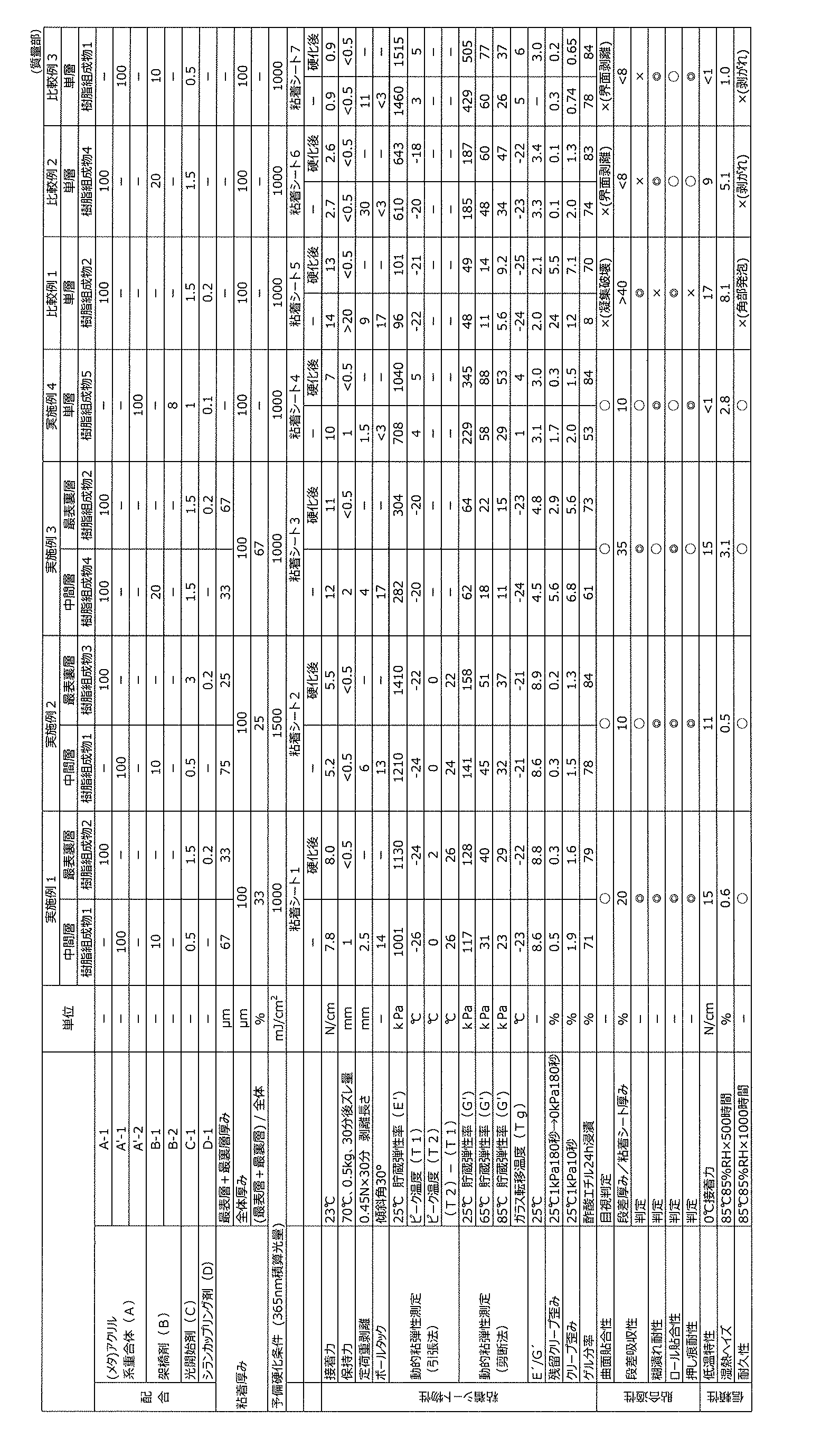
中でも、実施例1~3の粘着シートは引張貯蔵弾性率(E')と剪断貯蔵弾性率(G')の比が5.0以上であり、貼合適正を高品位で満足するものであった。また、実施例1~3の粘着シートは硬化後粘着シートのガラス転移温度が0℃以下であり、低温特性に優れたものであった。
さらにその中でも、実施例1および2の粘着シートは、最表層、最裏層および中間層の3層からなる粘着シートであって、最表層および最裏層と中間層とが、組成の異なる(メタ)アクリル系重合体を主成分樹脂として含む樹脂組成物から形成されたものであるから、信頼性評価における耐湿熱白化性に特に優れたものであった。
Claims (15)
- 2つの画像表示装置構成部材の貼合に使用するための粘着シートであって、
温度23℃、剥離速度300mm/minにおけるソーダライムガラスに対する接着力が2N/cm以上であり、
JIS Z 0237に準拠した、温度70℃、荷重0.5kg、測定時間30分、幅20mm×長さ20mmの接着面における保持力試験で測定されるズレ長さが10mm以下であり、かつ
以下の定荷重剥離試験において、剥離距離が20mm以下である画像表示装置用粘着シート。
(測定条件)
1)幅10mm、長さ150mmの大きさの粘着シートのうち幅10mm、長さ100mmの領域を被着体に貼合し貼合領域とし、前記粘着シートの貼合領域以外の領域を非貼合領域として、前記粘着シートの非貼合領域が下方に垂れ下がるように被着体を水平方向に固定する。
2)粘着シートの非貼合領域の長さ方向端部に0.45Nの荷重を30分間かけ、この間に粘着剤層の貼合領域が被着体から剥離した距離を定荷重剥離距離として測定する。 - 傾斜式ボールタック試験(傾斜角:30°)におけるボールナンバーが5~25である、請求項1記載の画像表示装置用粘着シート。
- 上記粘着シートを厚み0.6~0.8mmとし、温度25℃にて1kPaの圧力を180秒印加した後、圧力を解放して180秒経過したときの残留クリープ歪が20%以下である請求項1または2記載の画像表示装置用粘着シート。
- 引張貯蔵弾性率(E')と剪断貯蔵弾性率(G')の比(E'/G')が、5.0以上である、請求項1~3のいずれか一項に記載の画像表示装置用粘着シート。
- 周波数1Hzの引張モードの動的粘弾性測定により得られる損失正接(Tanδ)が2つ極大値(ピーク温度)を有し、その差が5~50℃である、請求項1~4のいずれか一項に記載の画像表示装置用粘着シート。
- 最表層および最裏層をアクリル系粘着剤層とする少なくとも3層を有する粘着シートであって、全体の厚みに対して、最表層および最裏層の厚みの合計の割合が、5~70%である、請求項1~5のいずれか一項に記載の画像表示装置用粘着シート。
- 最表層、最裏層および中間層の少なくとも3層からなる粘着シートであって、最表層および最裏層と、中間層とが、組成の異なる(メタ)アクリル系重合体を含む樹脂組成物から形成される、請求項1~6のいずれか一項に記載の画像表示装置用粘着シート。
- 活性エネルギー線硬化性を有する、請求項1~7のいずれか一項に記載の画像表示装置用粘着シート。
- 前記粘着シートに波長365nmの活性エネルギー線を積算光量3000mJ/cm2照射して硬化させた後、厚み0.6~0.8mmとし、温度25℃、1kPaの圧力を10秒印加したときの歪み(クリープ歪)が3%以下となる、請求項8に記載の画像表示装置用粘着シート。
- 前記粘着シートに波長365nmの活性エネルギー線を積算光量3000mJ/cm2照射して硬化させた後、厚み0.6~0.8mmとし、周波数1Hzの剪断モードの動的粘弾性測定により得られる損失正接の極大値(ガラス転移温度)が0℃以下である、請求項8または9記載の画像表示装置用粘着シート。
- 前記粘着シートが、(メタ)アクリル系重合体、架橋剤(B)および光重合開始剤(C)を含む樹脂組成物から形成される、請求項1~10のいずれか一項に記載の画像表示装置用粘着シート。
- 前記架橋剤(B)の含有質量は、(メタ)アクリル系重合体100質量部に対して、0.5~50質量部である、請求項11記載の画像表示装置用粘着シート。
- 請求項1~12のいずれか一項に記載の画像表示装置用粘着シートと、離型フィルムとが積層してなる構成を備えた離型フィルム付き粘着シート。
- 2つの画像表示装置構成部材が、請求項1~12のいずれか一項に記載の画像表示装置用粘着シートを介して積層してなる構成を備え、前記2つの画像表示装置構成部材のうち、一方は曲面形状を有するカバーガラスであり、もう一方は、タッチセンサー、画像表示パネル、表面保護フィルム、反射防止フィルム、カラーフィルター、偏光フィルムおよび位相差フィルムからなる群のうちのいずれかまたは2種類以上の組み合わせからなる部材である画像表示装置用積層体。
- 請求項14記載の画像表示装置用積層体を用いた画像表示装置。
Priority Applications (3)
| Application Number | Priority Date | Filing Date | Title |
|---|---|---|---|
| JP2022578161A JP7800451B2 (ja) | 2021-01-28 | 2021-12-22 | 画像表示装置用粘着シート、離型フィルム付き粘着シート、画像表示装置用積層体および画像表示装置 |
| CN202180090779.9A CN116761860A (zh) | 2021-01-28 | 2021-12-22 | 图像显示装置用粘合片、带脱模薄膜的粘合片、图像显示装置用层叠体和图像显示装置 |
| KR1020237024267A KR102982357B1 (ko) | 2021-01-28 | 2021-12-22 | 화상 표시 장치용 점착 시트, 이형 필름을 가지는 점착 시트, 화상 표시 장치용 적층체 및 화상 표시 장치 |
Applications Claiming Priority (2)
| Application Number | Priority Date | Filing Date | Title |
|---|---|---|---|
| JP2021012500 | 2021-01-28 | ||
| JP2021-012500 | 2021-01-28 |
Publications (1)
| Publication Number | Publication Date |
|---|---|
| WO2022163232A1 true WO2022163232A1 (ja) | 2022-08-04 |
Family
ID=82654503
Family Applications (1)
| Application Number | Title | Priority Date | Filing Date |
|---|---|---|---|
| PCT/JP2021/047566 Ceased WO2022163232A1 (ja) | 2021-01-28 | 2021-12-22 | 画像表示装置用粘着シート、離型フィルム付き粘着シート、画像表示装置用積層体および画像表示装置 |
Country Status (5)
| Country | Link |
|---|---|
| JP (1) | JP7800451B2 (ja) |
| KR (1) | KR102982357B1 (ja) |
| CN (1) | CN116761860A (ja) |
| TW (1) | TW202231463A (ja) |
| WO (1) | WO2022163232A1 (ja) |
Cited By (2)
| Publication number | Priority date | Publication date | Assignee | Title |
|---|---|---|---|---|
| JP2023121122A (ja) * | 2022-02-18 | 2023-08-30 | 王子ホールディングス株式会社 | 両面粘着シート、積層体および積層体の製造方法 |
| JP2023121121A (ja) * | 2022-02-18 | 2023-08-30 | 王子ホールディングス株式会社 | 両面粘着シート、積層体および積層体の製造方法 |
Families Citing this family (1)
| Publication number | Priority date | Publication date | Assignee | Title |
|---|---|---|---|---|
| CN115420678B (zh) * | 2022-08-31 | 2024-11-26 | 中国路桥工程有限责任公司 | 一种硬质沥青界面粘附性的定量测试装置 |
Citations (8)
| Publication number | Priority date | Publication date | Assignee | Title |
|---|---|---|---|---|
| WO2015079902A1 (ja) * | 2013-11-26 | 2015-06-04 | リンテック株式会社 | 両面粘着シートおよび両面粘着シートの製造方法 |
| JP2017040904A (ja) * | 2015-08-18 | 2017-02-23 | 住友化学株式会社 | 曲面画像表示パネル用偏光板 |
| JP2019104804A (ja) * | 2017-12-12 | 2019-06-27 | 東洋インキScホールディングス株式会社 | 粘着剤組成物および粘着シート |
| JP2019156959A (ja) * | 2018-03-13 | 2019-09-19 | アイカ工業株式会社 | 光硬化性粘着樹脂組成物 |
| JP2020045416A (ja) * | 2018-09-19 | 2020-03-26 | アイカ工業株式会社 | 光硬化性粘着樹脂組成物 |
| JP2020125370A (ja) * | 2019-02-01 | 2020-08-20 | 三菱ケミカル株式会社 | 光硬化性粘着シート、剥離シート付き光硬化性粘着シート、光硬化性粘着シート付き光学フィルム、画像表示装置構成用積層体及び画像表示装置 |
| JP2020164575A (ja) * | 2019-03-28 | 2020-10-08 | 三菱ケミカル株式会社 | 両面粘着シート、離型フィルム付積層体及び画像表示装置用積層体 |
| JP2020530521A (ja) * | 2017-09-29 | 2020-10-22 | エルジー・ケム・リミテッド | 粘着組成物および粘着フィルム |
Family Cites Families (8)
| Publication number | Priority date | Publication date | Assignee | Title |
|---|---|---|---|---|
| JPS5138898Y2 (ja) | 1972-10-11 | 1976-09-24 | ||
| JPS6062740U (ja) | 1983-10-06 | 1985-05-02 | ホシデン株式会社 | スライドスイツチ |
| JP2009013361A (ja) | 2007-07-09 | 2009-01-22 | Soken Chem & Eng Co Ltd | 両面粘着テープ |
| JP2011006624A (ja) * | 2009-06-29 | 2011-01-13 | Dainippon Printing Co Ltd | 粘着積層体の製造方法 |
| JP2017160417A (ja) | 2016-03-02 | 2017-09-14 | 日東電工株式会社 | 粘着シート |
| WO2018101252A1 (ja) * | 2016-12-02 | 2018-06-07 | 三菱ケミカル株式会社 | 光硬化性組成物、粘着シート、粘着シート積層体、硬化物、画像表示装置構成用積層体及び画像表示装置 |
| JP6902377B2 (ja) * | 2017-03-30 | 2021-07-14 | アイカ工業株式会社 | 3層型粘着剤シートの製造方法 |
| JP6979322B2 (ja) * | 2017-10-16 | 2021-12-08 | アイカ工業株式会社 | 3層型粘着剤シート |
-
2021
- 2021-12-22 JP JP2022578161A patent/JP7800451B2/ja active Active
- 2021-12-22 KR KR1020237024267A patent/KR102982357B1/ko active Active
- 2021-12-22 TW TW110148139A patent/TW202231463A/zh unknown
- 2021-12-22 CN CN202180090779.9A patent/CN116761860A/zh active Pending
- 2021-12-22 WO PCT/JP2021/047566 patent/WO2022163232A1/ja not_active Ceased
Patent Citations (8)
| Publication number | Priority date | Publication date | Assignee | Title |
|---|---|---|---|---|
| WO2015079902A1 (ja) * | 2013-11-26 | 2015-06-04 | リンテック株式会社 | 両面粘着シートおよび両面粘着シートの製造方法 |
| JP2017040904A (ja) * | 2015-08-18 | 2017-02-23 | 住友化学株式会社 | 曲面画像表示パネル用偏光板 |
| JP2020530521A (ja) * | 2017-09-29 | 2020-10-22 | エルジー・ケム・リミテッド | 粘着組成物および粘着フィルム |
| JP2019104804A (ja) * | 2017-12-12 | 2019-06-27 | 東洋インキScホールディングス株式会社 | 粘着剤組成物および粘着シート |
| JP2019156959A (ja) * | 2018-03-13 | 2019-09-19 | アイカ工業株式会社 | 光硬化性粘着樹脂組成物 |
| JP2020045416A (ja) * | 2018-09-19 | 2020-03-26 | アイカ工業株式会社 | 光硬化性粘着樹脂組成物 |
| JP2020125370A (ja) * | 2019-02-01 | 2020-08-20 | 三菱ケミカル株式会社 | 光硬化性粘着シート、剥離シート付き光硬化性粘着シート、光硬化性粘着シート付き光学フィルム、画像表示装置構成用積層体及び画像表示装置 |
| JP2020164575A (ja) * | 2019-03-28 | 2020-10-08 | 三菱ケミカル株式会社 | 両面粘着シート、離型フィルム付積層体及び画像表示装置用積層体 |
Cited By (4)
| Publication number | Priority date | Publication date | Assignee | Title |
|---|---|---|---|---|
| JP2023121122A (ja) * | 2022-02-18 | 2023-08-30 | 王子ホールディングス株式会社 | 両面粘着シート、積層体および積層体の製造方法 |
| JP2023121121A (ja) * | 2022-02-18 | 2023-08-30 | 王子ホールディングス株式会社 | 両面粘着シート、積層体および積層体の製造方法 |
| JP7524934B2 (ja) | 2022-02-18 | 2024-07-30 | 王子ホールディングス株式会社 | 両面粘着シート、積層体および積層体の製造方法 |
| JP7524933B2 (ja) | 2022-02-18 | 2024-07-30 | 王子ホールディングス株式会社 | 両面粘着シート、積層体および積層体の製造方法 |
Also Published As
| Publication number | Publication date |
|---|---|
| JP7800451B2 (ja) | 2026-01-16 |
| KR20230133296A (ko) | 2023-09-19 |
| TW202231463A (zh) | 2022-08-16 |
| KR102982357B1 (ko) | 2026-06-25 |
| CN116761860A (zh) | 2023-09-15 |
| JPWO2022163232A1 (ja) | 2022-08-04 |
Similar Documents
| Publication | Publication Date | Title |
|---|---|---|
| JP4971529B2 (ja) | 画像表示装置構成用積層体の製造方法、及びこの積層体を用いてなる画像表示装置 | |
| TWI781992B (zh) | 雙面黏著片材、含圖像顯示裝置構成用構件之積層體、積層體形成套組及雙面黏著片材之用途 | |
| JP6904448B2 (ja) | 光硬化型粘着シート、粘着シート及び画像表示装置 | |
| JP6866956B2 (ja) | 光硬化性粘着シート積層体、光硬化性粘着シート積層体の製造方法及び画像表示パネル積層体の製造方法 | |
| JP7151518B2 (ja) | 光硬化性粘着シート、剥離シート付き光硬化性粘着シート、光硬化性粘着シート付き光学フィルム、画像表示装置構成用積層体及び画像表示装置 | |
| KR102627869B1 (ko) | 광경화성 점착 시트, 화상 표시 장치용 적층체 및 화상 표시 장치 | |
| JP6866880B2 (ja) | 光硬化性粘着シート | |
| JP6252625B2 (ja) | 粘着シート及びこれを用いた画像表示装置 | |
| JP7745834B2 (ja) | 離型フィルム付き粘着シート、離型フィルム付き画像表示装置用積層体および画像表示装置用積層体の製造方法 | |
| JP7415366B2 (ja) | 光硬化性粘着シート、粘着シート積層体、画像表示装置用積層体及び画像表示装置 | |
| JP7800451B2 (ja) | 画像表示装置用粘着シート、離型フィルム付き粘着シート、画像表示装置用積層体および画像表示装置 | |
| JP7767920B2 (ja) | 両面粘着シート、画像表示装置用積層体及び画像表示装置 | |
| JP2024139739A (ja) | 粘着シート、離型フィルム付き粘着シート、画像表示装置用積層体、画像表示装置、画像表示装置構成部材用粘着シート |
Legal Events
| Date | Code | Title | Description |
|---|---|---|---|
| 121 | Ep: the epo has been informed by wipo that ep was designated in this application |
Ref document number: 21923235 Country of ref document: EP Kind code of ref document: A1 |
|
| ENP | Entry into the national phase |
Ref document number: 2022578161 Country of ref document: JP Kind code of ref document: A |
|
| WWE | Wipo information: entry into national phase |
Ref document number: 202180090779.9 Country of ref document: CN |
|
| NENP | Non-entry into the national phase |
Ref country code: DE |
|
| 122 | Ep: pct application non-entry in european phase |
Ref document number: 21923235 Country of ref document: EP Kind code of ref document: A1 |