WO2022131127A1 - 中空樹脂粒子、その製造方法、およびその用途 - Google Patents
中空樹脂粒子、その製造方法、およびその用途 Download PDFInfo
- Publication number
- WO2022131127A1 WO2022131127A1 PCT/JP2021/045347 JP2021045347W WO2022131127A1 WO 2022131127 A1 WO2022131127 A1 WO 2022131127A1 JP 2021045347 W JP2021045347 W JP 2021045347W WO 2022131127 A1 WO2022131127 A1 WO 2022131127A1
- Authority
- WO
- WIPO (PCT)
- Prior art keywords
- resin particles
- hollow
- hollow resin
- weight
- particles
- Prior art date
- Legal status (The legal status is an assumption and is not a legal conclusion. Google has not performed a legal analysis and makes no representation as to the accuracy of the status listed.)
- Ceased
Links
Images







Classifications
-
- C—CHEMISTRY; METALLURGY
- C08—ORGANIC MACROMOLECULAR COMPOUNDS; THEIR PREPARATION OR CHEMICAL WORKING-UP; COMPOSITIONS BASED THEREON
- C08F—MACROMOLECULAR COMPOUNDS OBTAINED BY REACTIONS ONLY INVOLVING CARBON-TO-CARBON UNSATURATED BONDS
- C08F12/00—Homopolymers and copolymers of compounds having one or more unsaturated aliphatic radicals, each having only one carbon-to-carbon double bond, and at least one being terminated by an aromatic carbocyclic ring
- C08F12/34—Monomers containing two or more unsaturated aliphatic radicals
- C08F12/36—Divinylbenzene
-
- C—CHEMISTRY; METALLURGY
- C08—ORGANIC MACROMOLECULAR COMPOUNDS; THEIR PREPARATION OR CHEMICAL WORKING-UP; COMPOSITIONS BASED THEREON
- C08F—MACROMOLECULAR COMPOUNDS OBTAINED BY REACTIONS ONLY INVOLVING CARBON-TO-CARBON UNSATURATED BONDS
- C08F290/00—Macromolecular compounds obtained by polymerising monomers on to polymers modified by introduction of aliphatic unsaturated end or side groups
- C08F290/02—Macromolecular compounds obtained by polymerising monomers on to polymers modified by introduction of aliphatic unsaturated end or side groups on to polymers modified by introduction of unsaturated end groups
- C08F290/06—Polymers provided for in subclass C08G
- C08F290/062—Polyethers
-
- B—PERFORMING OPERATIONS; TRANSPORTING
- B01—PHYSICAL OR CHEMICAL PROCESSES OR APPARATUS IN GENERAL
- B01J—CHEMICAL OR PHYSICAL PROCESSES, e.g. CATALYSIS OR COLLOID CHEMISTRY; THEIR RELEVANT APPARATUS
- B01J13/00—Colloid chemistry, e.g. the production of colloidal materials or their solutions, not otherwise provided for; Making microcapsules or microballoons
- B01J13/02—Making microcapsules or microballoons
- B01J13/06—Making microcapsules or microballoons by phase separation
- B01J13/14—Polymerisation; cross-linking
- B01J13/18—In situ polymerisation with all reactants being present in the same phase
- B01J13/185—In situ polymerisation with all reactants being present in the same phase in an organic phase
-
- C—CHEMISTRY; METALLURGY
- C08—ORGANIC MACROMOLECULAR COMPOUNDS; THEIR PREPARATION OR CHEMICAL WORKING-UP; COMPOSITIONS BASED THEREON
- C08F—MACROMOLECULAR COMPOUNDS OBTAINED BY REACTIONS ONLY INVOLVING CARBON-TO-CARBON UNSATURATED BONDS
- C08F2/00—Processes of polymerisation
- C08F2/44—Polymerisation in the presence of compounding ingredients, e.g. plasticisers, dyestuffs, fillers
-
- C—CHEMISTRY; METALLURGY
- C08—ORGANIC MACROMOLECULAR COMPOUNDS; THEIR PREPARATION OR CHEMICAL WORKING-UP; COMPOSITIONS BASED THEREON
- C08F—MACROMOLECULAR COMPOUNDS OBTAINED BY REACTIONS ONLY INVOLVING CARBON-TO-CARBON UNSATURATED BONDS
- C08F212/00—Copolymers of compounds having one or more unsaturated aliphatic radicals, each having only one carbon-to-carbon double bond, and at least one being terminated by an aromatic carbocyclic ring
- C08F212/02—Monomers containing only one unsaturated aliphatic radical
- C08F212/04—Monomers containing only one unsaturated aliphatic radical containing one ring
- C08F212/06—Hydrocarbons
- C08F212/12—Monomers containing a branched unsaturated aliphatic radical or a ring substituted by an alkyl radical
-
- C—CHEMISTRY; METALLURGY
- C09—DYES; PAINTS; POLISHES; NATURAL RESINS; ADHESIVES; COMPOSITIONS NOT OTHERWISE PROVIDED FOR; APPLICATIONS OF MATERIALS NOT OTHERWISE PROVIDED FOR
- C09D—COATING COMPOSITIONS, e.g. PAINTS, VARNISHES OR LACQUERS; FILLING PASTES; CHEMICAL PAINT OR INK REMOVERS; INKS; CORRECTING FLUIDS; WOODSTAINS; PASTES OR SOLIDS FOR COLOURING OR PRINTING; USE OF MATERIALS THEREFOR
- C09D125/00—Coating compositions based on homopolymers or copolymers of compounds having one or more unsaturated aliphatic radicals, each having only one carbon-to-carbon double bond, and at least one being terminated by an aromatic carbocyclic ring; Coating compositions based on derivatives of such polymers
- C09D125/02—Homopolymers or copolymers of hydrocarbons
- C09D125/16—Homopolymers or copolymers of alkyl-substituted styrenes
-
- C—CHEMISTRY; METALLURGY
- C09—DYES; PAINTS; POLISHES; NATURAL RESINS; ADHESIVES; COMPOSITIONS NOT OTHERWISE PROVIDED FOR; APPLICATIONS OF MATERIALS NOT OTHERWISE PROVIDED FOR
- C09D—COATING COMPOSITIONS, e.g. PAINTS, VARNISHES OR LACQUERS; FILLING PASTES; CHEMICAL PAINT OR INK REMOVERS; INKS; CORRECTING FLUIDS; WOODSTAINS; PASTES OR SOLIDS FOR COLOURING OR PRINTING; USE OF MATERIALS THEREFOR
- C09D5/00—Coating compositions, e.g. paints, varnishes or lacquers, characterised by their physical nature or the effects produced; Filling pastes
-
- C—CHEMISTRY; METALLURGY
- C09—DYES; PAINTS; POLISHES; NATURAL RESINS; ADHESIVES; COMPOSITIONS NOT OTHERWISE PROVIDED FOR; APPLICATIONS OF MATERIALS NOT OTHERWISE PROVIDED FOR
- C09D—COATING COMPOSITIONS, e.g. PAINTS, VARNISHES OR LACQUERS; FILLING PASTES; CHEMICAL PAINT OR INK REMOVERS; INKS; CORRECTING FLUIDS; WOODSTAINS; PASTES OR SOLIDS FOR COLOURING OR PRINTING; USE OF MATERIALS THEREFOR
- C09D5/00—Coating compositions, e.g. paints, varnishes or lacquers, characterised by their physical nature or the effects produced; Filling pastes
- C09D5/24—Electrically-conducting paints
-
- G—PHYSICS
- G02—OPTICS
- G02B—OPTICAL ELEMENTS, SYSTEMS OR APPARATUS
- G02B5/00—Optical elements other than lenses
- G02B5/02—Diffusing elements; Afocal elements
- G02B5/0205—Diffusing elements; Afocal elements characterised by the diffusing properties
- G02B5/021—Diffusing elements; Afocal elements characterised by the diffusing properties the diffusion taking place at the element's surface, e.g. by means of surface roughening or microprismatic structures
-
- C—CHEMISTRY; METALLURGY
- C08—ORGANIC MACROMOLECULAR COMPOUNDS; THEIR PREPARATION OR CHEMICAL WORKING-UP; COMPOSITIONS BASED THEREON
- C08F—MACROMOLECULAR COMPOUNDS OBTAINED BY REACTIONS ONLY INVOLVING CARBON-TO-CARBON UNSATURATED BONDS
- C08F212/00—Copolymers of compounds having one or more unsaturated aliphatic radicals, each having only one carbon-to-carbon double bond, and at least one being terminated by an aromatic carbocyclic ring
- C08F212/34—Monomers containing two or more unsaturated aliphatic radicals
- C08F212/36—Divinylbenzene
-
- H—ELECTRICITY
- H01—ELECTRIC ELEMENTS
- H01B—CABLES; CONDUCTORS; INSULATORS; SELECTION OF MATERIALS FOR THEIR CONDUCTIVE, INSULATING OR DIELECTRIC PROPERTIES
- H01B3/00—Insulators or insulating bodies characterised by the insulating materials; Selection of materials for their insulating or dielectric properties
- H01B3/18—Insulators or insulating bodies characterised by the insulating materials; Selection of materials for their insulating or dielectric properties mainly consisting of organic substances
- H01B3/30—Insulators or insulating bodies characterised by the insulating materials; Selection of materials for their insulating or dielectric properties mainly consisting of organic substances plastics; resins; waxes
Definitions
- the present invention relates to hollow resin particles, a method for producing the same, and an application thereof.
- the hollow resin particles used for such applications are, for example, substantially in the hollow resin particles even when heated when molding a thermosetting resin in which the hollow resin particles are mixed or when using solder. High heat resistance is required so that no change occurs.
- the hollow resin particles used for such applications are required to have a low water absorption rate.
- acrylic hollow resin particles are obtained by suspend-polymerizing a monomer containing an acrylic polyfunctional monomer such as trimethylolpropane tri (meth) acrylate or dipentaerythritol hexaacrylate as a main component together with a hydrophobic solvent.
- an acrylic polyfunctional monomer such as trimethylolpropane tri (meth) acrylate or dipentaerythritol hexaacrylate as a main component together with a hydrophobic solvent.
- Patent Document 1 has been reported to be obtained.
- an acrylic polyfunctional monomer such as trimethyl propanetri (meth) acrylate and a monomer mainly composed of an acrylic monofunctional monomer such as methyl methacrylate are suspended and polymerized together with a hydrophobic solvent. It has been reported that a hollow resin particle having a plurality of hollow regions can be obtained in the hollow surrounded by the shell (Patent Document 2).
- styrene-based hollow resin particles can be obtained by suspend-polymerizing divinylbenzene together with saturated hydrocarbons having 8 to 18 carbon atoms (more specifically, hexadecane) as hollow resin particles (more specifically, hexadecane).
- Patent Document 3 It has been reported that styrene-based hollow resin particles can be obtained by suspend-polymerizing divinylbenzene together with saturated hydrocarbons having 8 to 18 carbon atoms (more specifically, hexadecane) as hollow resin particles (more specifically, hexadecane).
- the shell is either a polymer and a copolymer of a crosslinkable monomer or a copolymer of the crosslinkable monomer and a monofunctional monomer, and has a monophasic structure, typically.
- Styrene-based hollow resin particles obtained by suspend-polymerizing divinylbenzene together with saturated hydrocarbons having 8 to 18 carbon atoms (more specifically, hexadecane) have been reported, and the hollow resin particles and thermosetting properties have been reported. It has been reported that a resin composition containing a resin is suitable for producing a multilayer printed substrate used for electronic devices and the like (Patent Document 5).
- acrylic resins have high values of dielectric constant and dielectric loss tangent, insufficient heat resistance, and high water absorption.
- the acrylic hollow resin particles described in Patent Documents 1 and 2 have the purpose of lowering the dielectric and low dielectric loss tangent of the resin layer, the purpose of imparting high heat resistance to the resin layer, and the purpose of imparting high heat resistance to the resin layer. It is not suitable for the purpose of suppressing water absorption.
- the styrene-based hollow resin particles described in Patent Document 3 are made of a material (crosslinkable polystyrene) having a lower relative permittivity and dielectric loss tangent than the acrylic hollow resin particles. Therefore, it can be said that the particles are effective for the purpose of reducing the dielectric and the low dielectric loss tangent of the resin layer.
- saturated hydrocarbons having 8 to 18 carbon atoms specifically, hexadecane
- Patent Document 4 Since the hollow resin particles described in Patent Document 4 use a styrene-based monomer and an acrylic monomer having a high dielectric constant and a high dielectric loss tangent value in combination, the resin layer is not sufficiently made to have low dielectric constant and low dielectric loss tangent. be. Further, Patent Document 4 indicates a 10% weight loss temperature by TG-DTA measurement under a nitrogen atmosphere and a temperature rise condition of 10 ° C./min as a guideline for heat resistance, but the heat resistance is insufficient. Is.
- the hollow resin particles described in Patent Document 5 use saturated hydrocarbons (more specifically, hexadecane) having 8 to 18 carbon atoms for their production. Therefore, it is difficult to remove the solvent from the hollow portion by distillation or the like, and saturated hydrocarbons having 8 to 18 carbon atoms remain in the obtained styrene-based hollow resin particles, and the hollow portion is completely replaced with air. It is difficult to obtain styrene-based hollow resin particles. Further, in order to obtain styrene-based hollow resin particles in which the hollow portion is completely replaced with air, the manufacturing cost is high due to the removal of the solvent as described above. Further, the styrene-based hollow resin particles described in Patent Document 5 have insufficient heat resistance.
- the present invention has been made to solve the above-mentioned conventional problems, and the main object thereof is a hollow resin particle having a shell portion and a hollow portion surrounded by the shell portion, and has low dielectric constant and low dielectric constant. It is an object of the present invention to provide hollow resin particles which can achieve direct contact and can exhibit excellent heat resistance. Another object of the present invention is to provide a method for easily producing such hollow resin particles. Further, it is to provide the use of such hollow resin particles.
- the hollow resin particles according to the embodiment of the present invention are Hollow resin particles having a shell portion and a hollow portion surrounded by the shell portion.
- the shell portion has an ether structure represented by the formula (1).
- the hollow resin particles according to the embodiment of the present invention have an average particle diameter of 0.1 ⁇ m to 50.0 ⁇ m.
- the hollow portion comprises one hollow region.
- the hollow portion is composed of a plurality of hollow regions.
- the hollow portion has a porous structure.
- the 5% thermogravimetric reduction temperature when the hollow resin particles are heated at 10 ° C./min under a nitrogen atmosphere is 300 ° C. or higher.
- the hollow resin particles according to the embodiment of the present invention are used in the resin composition for semiconductor members.
- the hollow resin particles according to the embodiment of the present invention are used in the coating composition.
- the hollow resin particles according to the embodiment of the present invention are used in the heat insulating resin composition.
- the hollow resin particles according to the embodiment of the present invention are used in the light diffusing resin composition.
- the hollow resin particles according to the embodiment of the present invention are used for the light diffusion film.
- the resin composition for a semiconductor member according to the embodiment of the present invention contains hollow resin particles according to the embodiment of the present invention.
- the coating composition according to the embodiment of the present invention contains hollow resin particles according to the embodiment of the present invention.
- the heat insulating resin composition according to the embodiment of the present invention contains hollow resin particles according to the embodiment of the present invention.
- the light diffusible resin composition according to the embodiment of the present invention contains hollow resin particles according to the embodiment of the present invention.
- the light diffusion film according to the embodiment of the present invention contains hollow resin particles according to the embodiment of the present invention.
- the manufacturing method according to the embodiment of the present invention A method for producing hollow resin particles according to an embodiment of the present invention. 20 parts by weight to 80 parts by weight of the compound (A) having an ether structure represented by the formula (1) and a monomer (B) that reacts with the compound (A) 80 parts by weight to 20 parts by weight (compound (A) and a monomer) The total amount of (B) is 100 parts by weight) is reacted in an aqueous medium in the presence of a non-reactive solvent.
- the hollow resin particles have a shell portion and a hollow portion surrounded by the shell portion, and can achieve low dielectric constant and low dielectric loss tangent, and can exhibit excellent heat resistance.
- Hollow resin particles can be provided. Further, it is possible to provide a method for easily producing such hollow resin particles. Further, it is possible to provide the use of such hollow resin particles.
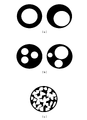
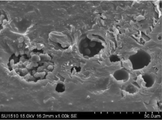
- FIG. 1 It is a schematic sectional drawing explaining the structure of a hollow part. It is sectional drawing of the hollow resin particle (1) obtained in Example 1.
- FIG. 2 It is sectional drawing of the hollow resin particle (2) obtained in Example 2.
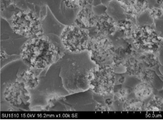
- FIG. It is sectional drawing of the hollow resin particle (3) obtained in Example 3.
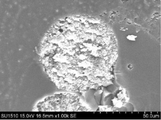
- FIG. It is sectional drawing of the hollow resin particle (4) obtained in Example 4.
- FIG. It is sectional drawing of the hollow resin particle (5) obtained in Example 5.
- FIG. It is sectional drawing of the hollow resin particle (6) obtained in Example 6.
- FIG. It is sectional drawing of the hollow resin particle (7) obtained in Example 7.
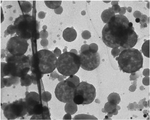
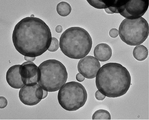
- FIG. It is a TEM photograph figure of the hollow resin particle (8) obtained in Example 8.
- FIG. 9 It is a schematic sectional drawing explaining the structure of a hollow part. It is sectional drawing of the hollow resin particle (1) obtained in Example 1.
- FIG. It is sectional drawing of the hollow resin particle (2) obtained in Example 2.
- FIG. 10 It is sectional drawing of the hollow resin particle (10) obtained in Example 10.
- FIG. 10 It is sectional drawing of the hollow resin particle (11) obtained in Example 11.
- FIG. It is sectional drawing of the particle (C1) obtained in the comparative example 1.
- FIG. It is a TEM photograph figure of the particle (C2) obtained in the comparative example 2.
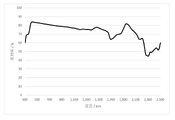
- FIG. It is an ultraviolet-visible-near-infrared spectroscopic reflection spectrum diagram of the hollow resin particle (1) obtained in Example 1.
- the hollow resin particles according to the embodiment of the present invention are hollow resin particles having a shell portion and a hollow portion surrounded by the shell portion.
- the term "hollow” as used herein means a state in which the inside is filled with a substance other than a resin, for example, a gas or a liquid, and is preferably filled with a gas in that the effects of the present invention can be further exhibited. It means the state of being.
- the shell portion and the hollow portion surrounded by the shell portion may be composed of one hollow region as shown in the schematic cross-sectional view of FIG. 1 (a), or the hollow portion may be composed of one hollow region, or the schematic cross section of FIG. 1 (b). As shown in the figure, it may consist of a plurality of hollow regions.
- the shell portion and the hollow portion surrounded by the shell portion may have a porous structure as shown in the schematic cross-sectional view of FIG. 1 (c).
- the hollow portion may consist of one hollow region (continuous pores), a plurality of hollow regions (independent pores), or a mixed form thereof. ..
- the average particle size of the hollow resin particles according to the embodiment of the present invention is preferably 0.1 ⁇ m to 50.0 ⁇ m, more preferably 0.1 ⁇ m to 40.0 ⁇ m, and further preferably 0.2 ⁇ m to 30.0 ⁇ m. It is particularly preferably 0.3 ⁇ m to 20.0 ⁇ m. If the average particle size of the hollow resin particles is within the above range, the effect of the present invention can be more exhibited. If the average particle size of the hollow resin particles according to the embodiment of the present invention is out of the above range and is too small, the thickness of the shell portion becomes relatively thin, so that the hollow resin particles may not have sufficient strength.
- the average particle size of the hollow resin particles according to the embodiment of the present invention is too large outside the above range, phase separation between the polymer and the solvent generated by the polymerization of the monomer components during suspension polymerization may be difficult to occur. This may make it difficult to form the shell portion.
- the hollow resin particles according to the embodiment of the present invention have a 5% thermogravimetric reduction temperature of preferably 300 ° C. or higher, more preferably 320 ° C. or higher when the temperature is raised at 10 ° C./min under a nitrogen atmosphere. It is more preferably 340 ° C. or higher, and particularly preferably 360 ° C. or higher.
- the upper limit of the 5% thermogravimetric reduction temperature is practically preferably 500 ° C. or lower. If the 5% thermogravimetric reduction temperature of the hollow resin particles according to the embodiment of the present invention when the temperature is raised at 10 ° C./min under a nitrogen atmosphere is within the above range, the hollow resin particles according to the embodiment of the present invention are excellent. Can develop heat resistance.
- the hollow resin particles are thermoset.
- the particles When mixed with a sex resin, the particles are deformed by heating for the curing reaction, and the hollow portion is lost, which may reduce the low dielectric effect and the low dielectric positive contact effect.
- the hollow resin particles according to the embodiment of the present invention have a water content of preferably 0.50% by weight or less after the hollow resin particles are allowed to stand at 40 ° C. and 95% RH for 96 hours. It is more preferably 0.45% by weight or less, further preferably 0.40% by weight or less, and particularly preferably 0.35% by weight or less. The lower the water content, the better, preferably 0% by weight or more. If the water content of the hollow resin particles after being allowed to stand in an atmosphere of 40 ° C. and 95% RH for 96 hours is within the above range, the effect of the present invention can be more exhibited. If the water content of the hollow resin particles is too large outside the above range after being allowed to stand at 40 ° C. and 95% RH for 96 hours, the water absorption rate of the hollow resin particles may increase.
- Shell part ⁇ has an ether structure represented by the formula (1).
- the shell portion preferably contains a polymer (P) having an ether structure represented by the formula (1).
- a polymer (P) having an ether structure represented by the formula (1).
- the polymer (P) may be only one kind or two or more kinds.
- the content of the polymer (P) in the shell portion is preferably 60% by weight to 100% by weight, more preferably 70% by weight to 100% by weight, in that the effect of the present invention can be more exhibited. It is more preferably 80% by weight to 100% by weight, and particularly preferably 90% by weight to 100% by weight.
- the shell portion may contain any suitable other component as long as the effect of the present invention is not impaired.
- any suitable polymer can be adopted as long as it has an ether structure represented by the formula (1), as long as the effect of the present invention is not impaired.
- Such a polymer (P) preferably reacts with the compound (A) having an ether structure represented by the formula (1) and the compound (A) in that the effects of the present invention can be more exhibited. Examples include the polymer obtained by the reaction of the monomer (B).
- the compound (A) having an ether structure represented by the formula (1) may be only one kind or two or more kinds.
- the monomer (B) that reacts with the compound having an ether structure represented by the formula (1) may be only one kind or two or more kinds.
- the ratio of the compound (A) to the monomer (B) is preferably a parts by weight (compound (A): monomer (B)) when the total amount of the compound (A) and the monomer (B) is 100 parts by weight. Is (20 parts by weight to 80 parts by weight): (80 parts by weight to 20 parts by weight).
- One embodiment of the above preferred ratio is more preferably (50 parts by weight to 80 parts by weight) :( 50 parts by weight to 20 parts by weight), and further preferably (55 parts by weight to 75 parts by weight) :( 45 parts by weight to 25 parts by weight), and particularly preferably (60 parts by weight to 70 parts by weight) :( 40 parts by weight to 30 parts by weight).
- Another embodiment of the above preferred ratio is more preferably (30 parts by weight to 70 parts by weight) :( 70 parts by weight to 30 parts by weight), and still more preferably (35 parts by weight to 65 parts by weight). : (65 parts by weight to 35 parts by weight), particularly preferably (40 parts by weight to 60 parts by weight) :( 60 parts by weight to 40 parts by weight).
- any suitable compound can be adopted as long as it has an ether structure represented by the formula (1), as long as the effect of the present invention is not impaired.
- Preferred examples of such compound (A) include polyphenylene ether in that the effects of the present invention can be further exhibited.
- Commercially available products of polyphenylene ether include, for example, the product name "Noril” (manufactured by SABIC Co., Ltd.), the product name "Yupiace” (manufactured by Mitsubishi Chemical Corporation), the product name "Zylon” (manufactured by Asahi Kasei Co., Ltd.), and the product name "OPE-2St” (manufactured by Mitsubishi Gas Chemical Corporation) can be mentioned.
- the polyphenylene ether is preferably an oligomer and has a number average molecular weight (Mn) of 500 because of its compatibility with a non-reactive solvent described later and the fact that hollow resin particles having excellent heat resistance can be more easily produced. It is preferably ⁇ 3500.
- Examples of the monomer (B) include a crosslinkable monomer and a monofunctional monomer.
- a monomer that reacts with the terminal group of compound (A) is preferable in that the effects of the present invention can be further exhibited.
- crosslinkable monomer examples include polyfunctional (meth) acrylic acid esters such as ethylene glycol di (meth) acrylate, polyethylene glycol di (meth) acrylate, and glycerin tri (meth) acrylate; N, N'-methylenebis (meth).
- Polyfunctional acrylamide derivatives such as acrylamide, N, N'-ethylenebis (meth) acrylamide;
- Polyfunctional allyl derivatives such as diallylamine and tetraallyloxyetane;
- Aromatic crosslinkable monomers such as divinylbenzene, divinylnaphthalene and diallylphthalate; Can be mentioned.
- an aromatic crosslinkable monomer is preferable, and divinylbenzene is more preferable, in that the effect of the present invention can be more exhibited.
- the crosslinkable monomer may be only one kind or two or more kinds.
- Examples of the monofunctional monomer include alkyl (meth) acrylic acid esters having 1 to 16 carbon atoms such as methyl (meth) acrylate, ethyl (meth) acrylate, butyl (meth) acrylate, and cetyl (meth) acrylate; styrene, ⁇ .
- -Aromatic monofunctional monomers such as methylstyrene, ethylvinylbenzene, vinyltoluene, o-chlorostyrene, m-chlorostyrene, p-chlorostyrene, vinylbiphenyl, vinylnaphthalene; dimethylmaleate, diethylfumarate, dimethylfuma Examples thereof include dicarboxylic acid ester-based monomers such as rate and diethyl fumarate; maleic anhydride; N-vinylcarbazole; and (meth) acrylonitrile;
- the monofunctional monomer an aromatic monofunctional monomer is preferable, and styrene and ethylvinylbenzene are more preferable, in that the effect of the present invention can be more exhibited.
- the monofunctional monomer may be only one kind or two or more kinds.
- the polymer (P) can be typically formed by the reaction of the compound (A) and the monomer (B).
- the reaction between the compound (A) and the monomer (B) can be carried out by any appropriate reaction as long as the effects of the present invention are not impaired.
- a reaction is preferably a suspension polymerization reaction.
- an oil phase is added to an aqueous phase and suspended to carry out the polymerization reaction.
- the aqueous phase and the oil phase may contain any suitable solvent as long as the effects of the present invention are not impaired.
- a solvent include an aqueous medium and a non-reactive solvent as described later.
- the solvent may be only one kind or two or more kinds.
- any suitable additive (C) that does not fall under any of the compound (A) and the monomer (B) as long as the effect of the present invention is not impaired.
- the additive (C) may be only one kind or two or more kinds.
- the additive referred to here does not include a solvent such as an aqueous medium or a non-reactive solvent as described later.
- the content ratio of the additive (C) is preferably 0% by weight to 40% by weight, more preferably 0% by weight to 30% by weight, based on the total amount of the compound (A) and the monomer (B). Yes, more preferably 0% by weight to 20% by weight, and particularly preferably 0% by weight to 10% by weight.
- any appropriate additive can be adopted as long as the effect of the present invention is not impaired.
- examples of such an additive (C) include a non-crosslinking polymer, a dispersion stabilizer, a surfactant, and a polymerization initiator.
- the phase separation between the polymer (P) produced as the reaction proceeds and the solvent can be promoted, and shell formation can be promoted.
- non-crosslinkable polymer examples include at least one selected from the group consisting of polyolefins, styrene-based polymers, (meth) acrylic acid-based polymers, and styrene- (meth) acrylic acid-based polymers.
- polystyrene resin examples include polyethylene, polypropylene, poly ⁇ -olefin and the like. From the viewpoint of solubility in the monomer composition, it is preferable to use a side chain crystalline polyolefin using a long-chain ⁇ -olefin as a raw material, a low molecular weight polyolefin produced by a metallocene catalyst, or an olefin oligomer.
- styrene polymer examples include polystyrene, styrene-acrylonitrile copolymer, acrylonitrile-butadiene-styrene copolymer and the like.
- Examples of the (meth) acrylic acid-based polymer include polymethyl (meth) acrylate, polyethyl (meth) acrylate, polybutyl (meth) acrylate, and polypropyl (meth) acrylate.
- styrene- (meth) acrylic acid-based polymer examples include a styrene-methyl (meth) acrylate copolymer, a styrene-ethyl (meth) acrylate copolymer, a styrene-butyl (meth) acrylate copolymer, and a styrene-propyl. Examples thereof include (meth) acrylate copolymers.
- the relative permittivity of the hollow resin particles according to the embodiment of the present invention is preferably 1.0 to 2.5, more preferably 1.0 to 2.4, and further preferably 1.0 to 2.3. Is. If the relative permittivity of the hollow resin particles according to the embodiment of the present invention is within the above range, the effect of the present invention can be more exhibited. When the relative permittivity of the hollow resin particles according to the embodiment of the present invention exceeds 2.5, even if the hollow resin particles are mixed with the thermosetting resin, for example, a sufficient low dielectric constant effect cannot be obtained.
- the relative permittivity of the hollow resin particles according to the embodiment of the present invention can be calculated with reference to, for example, "dielectric constant of the mixed system" (Applied Physics, Vol. 27, No. 8 (1958)).
- the relative permittivity of the mixed system of the dispersion medium and the hollow resin particles is ⁇
- the relative permittivity of the base material for example, a resin composition such as polyimide or epoxy
- the relative permittivity of the hollow resin particles is ⁇ 1.
- the volume fraction ⁇ of the hollow resin particles in the mixed system of the dispersion medium and the hollow resin particles can be obtained as follows.
- the density of hollow resin particles use a pycnometer (TQC 50 mL specific gravity bottle manufactured by Cortec Co., Ltd.) and the product name "ARUFON (trademark) UP-1080" (manufactured by Toa Synthetic Co., Ltd., density 1.05 g / cm 3 ), which is a liquid polymer. It can be obtained experimentally by using it.
- the hollow resin particles and ARUFON UP-1080 are defoamed using a planetary stirring defoaming machine (KURABO Industries, Ltd., "Mazelstar KK-250") so that the ratio of the hollow resin particles is 10% by weight. Stir to make an evaluation mixture.
- the evaluation mixture is filled in a pycnometer having a capacity of 50 mL, and the weight of the filled evaluation mixture is calculated by subtracting the weight of the empty pycnometer from the weight of the pycnometer filled with the mixture. From this value, the density of the hollow resin particles can be calculated using the following formula.
- the hollow resin particles according to the embodiment of the present invention can be used for various purposes.
- the hollow resin particles according to the embodiment of the present invention are suitable for semiconductor members, and can be typically used for resin compositions for semiconductor members, in that the effects of the present invention can be further utilized.
- the hollow resin particles according to the embodiment of the present invention are, for example, a coating composition, a cosmetic, a paper coating composition, a heat insulating composition, and a light diffusing property. It can also be applied to applications such as compositions and light diffusing films.
- the hollow resin particles according to the embodiment of the present invention can achieve low dielectric and low dielectric loss tangent and can exhibit excellent heat resistance, they can be suitably used for resin compositions for semiconductor members.
- the resin composition for a semiconductor member according to the embodiment of the present invention contains hollow resin particles according to the embodiment of the present invention.
- the semiconductor member means a member constituting a semiconductor, and examples thereof include a semiconductor package and a semiconductor module.
- the resin composition for a semiconductor member means a resin composition used for a semiconductor member.
- a semiconductor package is an IC chip as an essential component, and is a mold resin, an underfill material, a mold underfill material, a die bond material, a prepreg for a semiconductor package substrate, a metal-clad laminate for a semiconductor package substrate, and a printed circuit board for a semiconductor package. It is constructed using at least one member selected from the build-up materials of.
- a semiconductor module is a prepreg for a printed circuit board, a metal-clad laminate for a printed circuit board, a build-up material for a printed circuit board, a solder resist material, a coverlay film, an electromagnetic wave shielding film, and a print, with a semiconductor package as an essential component. It is configured by using at least one member selected from the adhesive sheet for a circuit board.
- the hollow resin particles according to the embodiment of the present invention can give an excellent appearance to the coating film containing the hollow resin particles, they can be suitably used for a coating composition.
- the coating composition according to the embodiment of the present invention contains hollow resin particles according to the embodiment of the present invention.
- the coating composition according to the embodiment of the present invention preferably contains at least one selected from a binder resin and a UV curable resin.
- the binder resin may be only one kind or two or more kinds.
- the UV curable resin may be only one kind or two or more kinds.
- any suitable binder resin can be used as long as the effects of the present invention are not impaired.
- a binder resin include an organic solvent or a resin soluble in water, and an emulsion-type aqueous resin that can be dispersed in water.
- Specific examples of the binder resin include acrylic resin, alkyd resin, polyester resin, polyurethane resin, chlorinated polyolefin resin, and amorphous polyolefin resin.
- any suitable UV curable resin can be adopted as long as the effect of the present invention is not impaired.
- examples of such a UV curable resin include polyfunctional (meth) acrylate resin and polyfunctional urethane acrylate resin, and polyfunctional (meth) acrylate resin is preferable, and three or more (meth) in one molecule.
- a polyfunctional (meth) acrylate resin having an acryloyl group is more preferable.
- Specific examples of the polyfunctional (meth) acrylate resin having three or more (meth) acryloyl groups in one molecule include trimethylolpropantri (meth) acrylate and trimethylol ethanetri (meth) acrylate.
- examples thereof include (meth) acrylate, dipentaerythritol hexa (meth) acrylate, tripentaerythritol triacrylate, and tripentaerythritol hexaacrylate.
- the content ratio thereof may be any appropriate content ratio depending on the purpose.
- the present invention is based on the total amount of at least one selected from the binder resin (in the case of an emulsion type aqueous resin, solid content equivalent) and the UV curable resin and the hollow resin particles according to the embodiment of the present invention.
- the hollow resin particles according to the embodiment of the invention are preferably 5% by weight to 50% by weight, more preferably 10% by weight to 50% by weight, still more preferably 20% by weight to 40% by weight.
- a photopolymerization initiator is preferably used in combination.
- the photopolymerization initiator any suitable photopolymerization initiator can be adopted as long as the effects of the present invention are not impaired.
- photopolymerization initiators include acetophenones, benzoins, benzophenones, phosphine oxides, ketals, ⁇ -hydroxyalkylphenones, ⁇ -aminoalkylphenones, anthraquinones, thioxanthones, and azo compounds.
- Peroxides (described in JP-A-2001-139663, etc.), 2,3-dialkyldione compounds, disulfide compounds, fluoroamine compounds, aromatic sulfoniums, onium salts, borate salts, active halogen compounds, Examples include ⁇ -acyloxym ester.
- the coating composition according to the embodiment of the present invention may contain a solvent.
- the solvent may be only one kind or two or more kinds.
- any appropriate content ratio may be adopted depending on the purpose.
- any suitable solvent can be adopted as long as the effect of the present invention is not impaired.
- a solvent is preferably a solvent capable of dissolving or dispersing a binder resin or a UV curable resin.
- examples of such a solvent include hydrocarbon solvents such as toluene and xylene; ketone solvents such as methyl ethyl ketone and methyl isobutyl ketone; ester solvents such as ethyl acetate and butyl acetate; dioxane, Ether-based solvents such as ethylene glycol diethyl ether and ethylene glycol monobutyl ether; and examples of water-based paints include water and alcohols.
- the coating composition according to the embodiment of the present invention may be diluted in order to adjust the viscosity, if necessary.
- the diluent any suitable diluent may be adopted depending on the purpose. Examples of such a diluent include the above-mentioned solvent.
- the diluent may be only one kind or two or more kinds.
- the coating composition according to the embodiment of the present invention has other components such as a coating surface adjusting agent, a fluidity adjusting agent, an ultraviolet absorber, a light stabilizer, a curing catalyst, an extender pigment, a coloring pigment, and a metal, if necessary. Pigments, mica powder pigments and dyes may be included.
- any appropriate coating method may be adopted as the coating method depending on the purpose.
- a coating method include a spray coating method, a roll coating method, a brush coating method, a coating reverse roll coating method, a gravure coating method, a die coating method, a comma coating method, and a spray coating method.
- any appropriate forming method can be adopted as the forming method depending on the purpose.
- a forming method for example, an arbitrary coated surface of a base material is coated to prepare a coated film, the coated film is dried, and then the coated film is cured as necessary.
- a method of forming a coating film may be mentioned.
- the base material include metal, wood, glass, and plastic (PET (polyethylene terephthalate), PC (polycarbonate), acrylic resin, TAC (triacetyl cellulose), and the like).
- the hollow resin particles according to the embodiment of the present invention can impart excellent heat insulating properties to the coating film containing the hollow resin particles, they can be suitably used for a heat insulating resin composition.
- the coating film containing hollow resin particles according to the embodiment of the present invention can exhibit excellent reflectance in the wavelength range from ultraviolet light to near infrared light.
- the heat insulating resin composition according to the embodiment of the present invention contains hollow resin particles according to the embodiment of the present invention.
- the heat insulating resin composition according to the embodiment of the present invention preferably contains at least one selected from a binder resin and a UV curable resin.
- a binder resin and a UV curable resin the above-mentioned description of the coating composition can be referred to.
- the heat insulating resin composition according to the embodiment of the present invention may contain a solvent.
- the solvent the above description of the coating composition may be incorporated.
- the heat insulating resin composition according to the embodiment of the present invention may be diluted in order to adjust the viscosity, if necessary.
- the above description of the coating composition may be incorporated.
- the heat insulating resin composition according to the embodiment of the present invention has other components such as a coating surface adjusting agent, a fluidity adjusting agent, an ultraviolet absorber, a light stabilizer, a curing catalyst, an extender pigment, and a coloring pigment, if necessary. , Metal pigments, mica powder pigments, dyes may be contained.
- the above-mentioned description of the coating composition can be referred to.
- the hollow resin particles according to the embodiment of the present invention can impart excellent light diffusivity to the coating film containing the hollow resin particles, they can be suitably used for a light diffusible resin composition.
- the light diffusible resin composition according to the embodiment of the present invention contains hollow resin particles according to the embodiment of the present invention.
- the light diffusible resin composition according to the embodiment of the present invention preferably contains at least one selected from a binder resin and a UV curable resin.
- a binder resin and a UV curable resin the above-mentioned description of the coating composition can be referred to.
- the light diffusible resin composition according to the embodiment of the present invention may contain a solvent.
- the solvent the above description of the coating composition may be incorporated.
- the light diffusible resin composition according to the embodiment of the present invention may be diluted in order to adjust the viscosity, if necessary.
- the above description of the coating composition may be incorporated.
- the light diffusing resin composition according to the embodiment of the present invention has other components such as a coating surface adjusting agent, a fluidity adjusting agent, an ultraviolet absorber, a light stabilizer, a curing catalyst, an extender pigment, and a coloring, if necessary. Pigments, metal pigments, mica powder pigments, and dyes may be contained.
- the above-mentioned description of the coating composition can be referred to.
- the hollow resin particles according to the embodiment of the present invention can impart excellent light diffusivity to a film having a coating film containing the hollow resin particles, they can also be suitably used for a light diffusing film.
- the light diffusion film according to the embodiment of the present invention contains hollow resin particles according to the embodiment of the present invention.
- the light diffusing film according to the embodiment of the present invention includes a light diffusing layer and a base material formed from the light diffusing resin composition according to the embodiment of the present invention.
- the light diffusing layer may or may not be the outermost layer of the light diffusing film.
- the light diffusing film according to the embodiment of the present invention may contain any suitable other layer depending on the purpose. Examples of such other layers include a protective layer, a hard coat layer, a flattening layer, a high refractive index layer, an insulating layer, a conductive resin layer, a conductive metal fine particle layer, a conductive metal oxide fine particle layer, and a primer. Layers are mentioned.
- Examples of the base material include metal, wood, glass, plastic film, plastic sheet, plastic lens, plastic panel, cathode line tube, fluorescent display tube, and liquid crystal display board.
- Examples of the plastic constituting the plastic film, the plastic sheet, the plastic lens, and the plastic panel include PET (polyethylene terephthalate), PC (polycarbonate), acrylic resin, and TAC (triacetyl cellulose).
- the method for producing hollow resin particles according to the embodiment of the present invention is a method of producing 20 parts by weight to 80 parts by weight of a compound (A) having an ether structure represented by the formula (1) and a monomer (B) that reacts with the compound (A). 20 parts by weight to 80 parts by weight (the total amount of the compound (A) and the monomer (B) is 100 parts by weight) is reacted in an aqueous medium in the presence of a non-reactive solvent.
- hollow resin particles according to the embodiment of the present invention can be easily manufactured.
- hollow resin particles according to the embodiment of the present invention By reacting the compound (A) and the monomer (B) in an aqueous medium in the presence of a non-reactive solvent, hollow resin particles according to the embodiment of the present invention can be obtained.
- the hollow resin particles according to the embodiment of the present invention can be produced by subjecting the compound (A) and the monomer (B) to a suspension polymerization reaction.
- the suspension polymerization is typically a suspension polymerization using an aqueous phase containing an aqueous medium and an oil phase containing the compound (A), the monomer (B) and a non-reactive solvent, and is preferably aqueous.
- a suspension polymerization is carried out by adding an oil phase containing a compound (A), a monomer (B) and a non-reactive solvent to an aqueous phase containing a medium, dispersing the mixture, and heating the phase.
- any appropriate dispersion method can be adopted as long as the oil phase can be present in the aqueous phase in the form of droplets, as long as the effect of the present invention is not impaired.
- a dispersion method is typically a dispersion method using a homomixer or a homogenizer, and examples thereof include a polytron homogenizer, an ultrasonic homogenizer, and a high-pressure homogenizer.
- any appropriate polymerization temperature can be adopted as long as it is suitable for suspension polymerization, as long as the effect of the present invention is not impaired.
- the polymerization temperature is preferably 30 ° C to 80 ° C.
- any appropriate polymerization time can be adopted as long as it is suitable for suspension polymerization, as long as the effect of the present invention is not impaired.
- the polymerization time is preferably 1 hour to 48 hours.
- Post-heating which is preferably performed after polymerization, is a suitable treatment for obtaining hollow resin particles having a high degree of perfection.
- any appropriate temperature can be adopted as long as the effect of the present invention is not impaired.
- the temperature for such post-heating is preferably 70 ° C to 120 ° C.
- any appropriate time can be adopted as long as the effect of the present invention is not impaired.
- the time for such post-heating is preferably 1 hour to 24 hours.
- the content ratio of compound (A) and monomer (B) is ⁇ 1.
- aqueous medium examples include water, a mixed medium of water and a lower alcohol (methanol, ethanol, etc.).
- any appropriate amount can be adopted as long as the effect of the present invention is not impaired.
- the amount of such an aqueous medium used is typically an amount at which the reaction appropriately proceeds in a suspension polymerization reaction carried out by adding an oil phase to an aqueous phase and suspending the mixture, and the compound (A) and the monomer are used.
- the total amount of (B) and the non-reactive solvent is preferably 100 parts by weight to 5000 parts by weight, and more preferably 150 parts by weight to 2000 parts by weight with respect to 100 parts by weight.
- the non-reactive solvent is a solvent that does not cause a chemical reaction with either the compound (A) having an ether structure represented by the formula (1) and the monomer (B) that reacts with the compound (A), and is preferable.
- the non-reactive solvent typically acts as a hollowing agent that provides airspace to the particles. Examples of the non-reactive solvent include heptane, hexane, toluene, cyclohexane, methyl acetate, ethyl acetate, methyl ethyl ketone, chloroform and carbon tetrachloride.
- the boiling point of the non-reactive solvent is preferably less than 100 ° C. because it can be easily removed from the hollow resin particles.
- the non-reactive solvent as the hollowing agent may be a single solvent or a mixed solvent.
- the amount of the non-reactive solvent added is preferably 20 parts by weight to 250 parts by weight with respect to 100 parts by weight of the total amount of the compound (A) and the monomer (B).
- any suitable additive (C) that does not fall under any of the compound (A) and the monomer (B) as long as the effect of the present invention is not impaired. ) May be used.
- the additive (C) may be only one kind or two or more kinds.
- the additive referred to here does not include a solvent such as an aqueous medium or a non-reactive solvent.
- the content ratio of the additive (C) is preferably 0% by weight to 40% by weight, more preferably 0% by weight to 30% by weight, based on the total amount of the compound (A) and the monomer (B). Yes, more preferably 0% by weight to 20% by weight, and particularly preferably 0% by weight to 10% by weight.
- any appropriate additive can be adopted as long as the effect of the present invention is not impaired.
- examples of such an additive (C) include a non-crosslinking polymer, a dispersion stabilizer, a surfactant, and a polymerization initiator.
- dispersion stabilizer examples include polyvinyl alcohol, polycarboxylic acid, celluloses (hydroxyethyl cellulose, carboxymethyl cellulose, etc.), polyvinylpyrrolidone and the like.
- Inorganic water-soluble polymer compounds such as sodium tripolyphosphate can also be used.
- phosphates such as calcium phosphate, magnesium phosphate, aluminum phosphate, zinc phosphate
- pyrophosphates such as calcium pyrophosphate, magnesium pyrophosphate, aluminum pyrophosphate, zinc pyrophosphate
- calcium carbonate, magnesium carbonate, calcium hydroxide examples of the dispersion stabilizer.
- Magnesium hydroxide, aluminum hydroxide, calcium metasilicate, calcium sulfate, barium sulfate, colloidal silica and other sparingly water-soluble inorganic compounds; and the like can also be used.
- Magnesium pyrophosphate is preferred because it is relatively easy to remove from the hollow resin particles and does not easily remain on the surface of the hollow resin particles.
- the amount of the dispersion stabilizer added is preferably 0.5 part by weight to 10 parts by weight with respect to 100 parts by weight of the aqueous medium.
- the dispersion stabilizer may be only one kind or two or more kinds.
- surfactant examples include anionic surfactants, cationic surfactants, amphoteric ionic surfactants, nonionic surfactants and the like.
- anionic surfactant examples include an alkyl sulfate ester salt, an alkyl phosphate ester salt, an alkylbenzene sulfonate, an alkylnaphthalene sulfonate, an alkane sulfonate, an alkyldiphenyl ether sulfonate, a dialkyl sulfosuccinate, and a monoalkyl.
- Non-reactive anionic surfactants such as sulfosuccinate, polyoxyethylene alkylphenyl ether phosphate, polyoxyethylene-1- (allyloxymethyl) alkyl ether sulfate ester ammonium salt, polyoxyethylene alkylpropenylphenyl ether
- reactive anionic surfactants such as ammonium sulfate ester ammonium salts and polyoxyalkylene alkenyl ether ammonium sulfate.
- the surfactant is not limited to the salt structure, and for example, an alkyl sulfate ester or an alkyl phosphoric acid ester can also be used. Specific examples thereof include lauryl sulfate and lauryl phosphoric acid.
- cationic surfactant examples include cationicity such as alkyltrimethylammonium salt, alkyltriethylammonium salt, dialkyldimethylammonium salt, dialkyldiethylammonium salt, and N-polyoxyalkylene-N, N, N-trialkylammonium salt.
- surfactants include surfactants.
- amphoteric ionic surfactant examples include lauryldimethylamine oxide, phosphoric acid ester salt, and phosphite ester-based surfactant.
- nonionic surfactant examples include polyoxyethylene alkyl ether, polyoxyethylene alkyl phenyl ether, polyoxyethylene fatty acid ester, sorbitan fatty acid ester, polysorbitan fatty acid ester, polyoxyethylene alkylamine, glycerin fatty acid ester, and oxyethylene.
- examples include oxypropylene block polymer.
- the amount of the surfactant added is preferably 0.01% by weight to 5% by weight with respect to the total amount of the compound (A), the monomer (B) and the non-reactive solvent.
- the surfactant may be only one kind or two or more kinds.
- any suitable polymerization initiator can be adopted as long as the effect of the present invention is not impaired.
- examples of such a polymerization initiator include lauroyl peroxide, benzoyl peroxide, benzoyl peroxide, orthomethoxybenzoyl peroxide, 3,5,5-trimethylhexanoyl peroxide, and t-butylperoxy-2-.
- Organic peroxides such as ethyl hexanoate and di-t-butyl peroxide; 2,2'-azobisisobutyronitrile, 1,1'-azobiscyclohexanecarbonitrile, 2,2'-azobis (2) , 4-Dimethylvaleronitrile) and other azo compounds;
- the content ratio of the polymerization initiator is preferably in the range of 0.1% by weight to 5% by weight with respect to the total amount of the compound (A) and the monomer (B).
- the polymerization initiator may be only one kind or two or more kinds.
- part means “part by weight”
- % means “% by weight”.
- volume average particle size of the particles was measured by the Coulter method as follows.
- the volume average particle diameter of the particles was measured by Coulter Multisizer (registered trademark) 3 (measuring device manufactured by Beckman Coulter Co., Ltd.). Measurements were performed using apertures calibrated according to the Multisizer® 3 User's Manual published by Beckman Coulter, Inc.
- the aperture used for measurement if the assumed volume average particle diameter of the particles to be measured is 1 ⁇ m or more and 10 ⁇ m or less, an aperture having a size of 50 ⁇ m is selected, and the assumed volume average particle diameter of the particles to be measured is larger than 10 ⁇ m.
- the Current (aperture current) is set to -800
- the Gain (gain) is set to 4
- the Current (aperture current) is-. 1600
- Gain was set to 2
- 0.1 g of particles were placed in 10 ml of a 0.1 wt% nonionic surfactant aqueous solution in a touch mixer (manufactured by Yamato Scientific Co., Ltd., "TOUCHMIXER MT-31") and an ultrasonic cleaner (Vell Co., Ltd.).
- a dispersion liquid was used, which was dispersed using "ULTRASONIC CLEANER VS-150" manufactured by Vokuria.
- the inside of the beaker was gently stirred so as not to allow air bubbles to enter, and the measurement was completed when 100,000 particles were measured.
- the volume average particle diameter of the particles was taken as the arithmetic mean in the volume-based particle size distribution of 100,000 particles.
- Examples 8 and 9, Comparative Example 2 The Z average particle size of the hollow resin particles or particles was measured by using a dynamic light scattering method, and the measured Z average particle size was used as the obtained average particle size of the hollow resin particles or particles. That is, first, the obtained slurry-shaped hollow resin particles or particles are diluted with ion-exchanged water, and the aqueous dispersion adjusted to 0.1% by weight is irradiated with laser light and scattered from the hollow resin particles or particles. The scattered light intensity was measured over time in microseconds.
- the scattering intensity distribution caused by the detected hollow resin particles or particles was applied to the normal distribution, and the Z average particle size of the hollow resin particles or particles was obtained by a cumulant analysis method for calculating the average particle size.
- the measurement of the Z average particle size can be easily carried out with a commercially available particle size measuring device.
- the Z average particle size was measured using a particle size measuring device (“Zetasizer Nano ZS” manufactured by Malvern).
- a commercially available particle size measuring device is equipped with data analysis software, and the data analysis software can automatically analyze the measurement data to calculate the Z average particle size.
- ⁇ Cross section observation> The dried particles were mixed with a photocurable resin D-800 (manufactured by JEOL Ltd.) and irradiated with ultraviolet light to obtain a cured product. Then, the cured product was cut with nippers, the cross-sectional portion was smoothed using a cutter, and the sample was coated using an "Auto Fine Coater JFC-1300" sputtering device manufactured by JEOL Ltd. Next, a cross section of the sample was photographed using a secondary electron detector of a "SU1510" scanning electron microscope manufactured by Hitachi High-Technologies Corporation.
- ⁇ TEM measurement Observation of hollow resin particles or hollow particles and their shape> Hollow resin particles or particles as dry powder were surface-treated (10 Pa, 5 mA, 10 seconds) using a "Osmium Coater Neoc-Pro" coating device manufactured by Meiwaforsis Co., Ltd. Next, the hollow resin particles or particles were observed with a TEM (transmission electron microscope, "H-7600” manufactured by Hitachi High-Technologies Corporation) to confirm the presence or absence of hollowness and the shape of the hollow resin particles or particles. At this time, the acceleration voltage was set to 80 kV, and the magnification was set to 5000 times or 10,000 times.
- thermogravimetric reduction temperature when the temperature is raised at 10 ° C / min in a nitrogen atmosphere
- the 5% thermogravimetric reduction temperature was measured using a "TG / DTA6200, AST-2" differential thermal thermogravimetric simultaneous measuring device manufactured by SII Nanotechnology Co., Ltd.
- the sampling method and temperature conditions were as follows. The bottom of the platinum measuring container was filled with 10.5 ⁇ 0.5 mg of the sample so as not to have a gap, and used as a sample for measurement.
- a 5% thermogravimetric reduction temperature was measured using alumina as a reference substance under a nitrogen gas flow rate of 230 mL / min.
- the TG / DTA curve was obtained by heating the sample from 30 ° C. to 500 ° C. at a heating rate of 10 ° C./min. From this obtained curve, the temperature at the time of 5% weight loss was calculated using the analysis software attached to the device, and the temperature was taken as the 5% thermogravimetric loss temperature.
- Bifunctional polyphenylene ether oligomer (trade name "OPE-2St 1200", manufactured by Mitsubishi Gas Chemicals Co., Ltd.) as a compound having an ether structure represented by the formula (1), 2.5 g, divinylbenzene (DVB) 810 (Nittetsu) Made by Chemical & Materials Co., Ltd., 81% content, 19% ethylvinylbenzene (EVB) 2.5 g, heptane 5.0 g, 2,2'-azobis (2,4-dimethylvaleronitrile) as a polymerization initiator ) (Product name "V-65”, manufactured by Fuji Film Wako Pure Chemical Industries, Ltd.) 0.05 g and 0.004 g of lauryl phosphate were mixed to prepare an oil phase.
- the obtained particles (1) were a mixture of hollow resin particles in which the hollow surrounded by the shell was composed of one hollow region and hollow resin particles in which the hollow surrounded by the shell was composed of a porous structure. did it.
- the average particle size of the obtained particles (1) was 16.3 ⁇ m.
- the 5% thermogravimetric reduction temperature of the obtained particles (1) when the temperature was raised at 10 ° C./min under a nitrogen atmosphere was 306 ° C. Table 1 shows the blending amount and the like.
- Example 2 3.0 g of bifunctional polyphenylene ether oligomer (trade name "OPE-2St 1200", manufactured by Mitsubishi Gas Chemicals Corporation) as a compound having an ether structure represented by the formula (1), divinylbenzene (DVB) 810 (Japan).
- the same procedure as in Example 1 was carried out in the same manner as in Example 1 except that the product was manufactured by Iron Chemical & Materials Co., Ltd., containing 81%, and 19% was ethylvinylbenzene (EVB)) to obtain particles (2).
- a cross-sectional photograph of the obtained particles (2) is shown in FIG. It was confirmed that the obtained particles (2) were hollow resin particles in which the hollow surrounded by the shell was composed of one hollow region.
- the average particle size of the obtained particles (2) was 15.2 ⁇ m.
- the 5% thermogravimetric reduction temperature of the obtained particles (2) when the temperature was raised at 10 ° C./min under a nitrogen atmosphere was 320 ° C.
- Table 1 shows the blending amount and the like.
- Example 3 3.5 g of bifunctional polyphenylene ether oligomer (trade name "OPE-2St 1200", manufactured by Mitsubishi Gas Chemicals Corporation) as a compound having an ether structure represented by the formula (1), divinylbenzene (DVB) 810 (Japan).
- the same procedure as in Example 1 was carried out in the same manner as in Example 1 except that the content was 81% and 19% was ethylvinylbenzene (EVB) manufactured by Iron Chemical & Materials Co., Ltd. to obtain particles (3).
- a cross-sectional photograph of the obtained particles (3) is shown in FIG. It was confirmed that the obtained particles (3) were hollow resin particles in which the hollow surrounded by the shell was composed of one hollow region.
- the average particle size of the obtained particles (3) was 13.9 ⁇ m.
- the 5% thermogravimetric reduction temperature of the obtained particles (3) when the temperature was raised at 10 ° C./min under a nitrogen atmosphere was 309 ° C.
- Table 1 shows the blending amount and the like.
- Example 4 Instead of 2.5 g of a bifunctional polyphenylene ether oligomer (trade name "OPE-2St 1200", manufactured by Mitsubishi Gas Chemicals Co., Ltd.) as a compound having an ether structure represented by the formula (1), the table is represented by the formula (1). Similar to Example 1 except that 2.5 g of reactive low molecular weight polyphenylene ether (trade name "Noryl (registered trademark) SA9000-111 resin", manufactured by SABIC Co., Ltd.) as a compound having an ether structure is used. This was performed to obtain particles (4). A cross-sectional photograph of the obtained particles (4) is shown in FIG. It was confirmed that the obtained particles (4) were hollow resin particles having a porous structure in the hollow surrounded by the shell.
- a bifunctional polyphenylene ether oligomer trade name "OPE-2St 1200", manufactured by Mitsubishi Gas Chemicals Co., Ltd.
- the table is represented by the formula (1). Similar to Example 1 except that 2.5 g of reactive low molecular weight polyphen
- the average particle size of the obtained particles (4) was 16.5 ⁇ m.
- the 5% thermogravimetric reduction temperature of the obtained particles (4) when the temperature was raised at 10 ° C./min under a nitrogen atmosphere was 373 ° C.
- Table 1 shows the blending amount and the like.
- Example 5 The bifunctional polyphenylene ether oligomer (trade name "OPE-2St 1200", manufactured by Mitsubishi Gas Chemicals Co., Ltd.) as a compound having an ether structure represented by the formula (1) is replaced with 3.0 g by the formula (1). Same as Example 2 except that 3.0 g of reactive low molecular weight polyphenylene ether (trade name "Noryl (registered trademark) SA9000-111 resin", manufactured by SABIC Co., Ltd.) as a compound having an ether structure represented by the present invention was used. To obtain the particles (5). A cross-sectional photograph of the obtained particles (5) is shown in FIG. It was confirmed that the obtained particles (5) were hollow resin particles having a porous structure in the hollow surrounded by the shell.
- OPE-2St 1200 manufactured by Mitsubishi Gas Chemicals Co., Ltd.
- the average particle size of the obtained particles (5) was 15.6 ⁇ m.
- the 5% thermogravimetric reduction temperature of the obtained particles (5) when the temperature was raised at 10 ° C./min under a nitrogen atmosphere was 420 ° C.
- Table 1 shows the blending amount and the like.
- Bifunctional polyphenylene ether oligomer (trade name "OPE-2St 1200", manufactured by Mitsubishi Gas Chemicals Co., Ltd.) as a compound having an ether structure represented by the formula (1), 2.5 g, divinylbenzene (DVB) 810 (Nittetsu). Reaction as a compound having an ether structure represented by the formula (1) instead of 2.5 g of ethylvinylbenzene (EVB) and 5.0 g of heptane, manufactured by Chemical & Materials Co., Ltd., containing 81%.
- OPE-2St 1200 manufactured by Mitsubishi Gas Chemicals Co., Ltd.
- Low molecular weight polyphenylene ether (trade name "Noryl (registered trademark) SA9000-111 resin", manufactured by SABIC Co., Ltd.) 1.8 g, divinylbenzene (DVB) 810 (manufactured by Nittetsu Chemical & Materials Co., Ltd., 81% containing product, 19% was carried out in the same manner as in Example 1 except that 1.2 g of ethylvinylbenzene (EVB), 5.0 g of heptane and 2.0 g of toluene were used to obtain particles (6). A cross-sectional photograph of the obtained particles (6) is shown in FIG.
- EVB ethylvinylbenzene
- the obtained particles (6) were hollow resin particles having a porous structure in the hollow surrounded by the shell.
- the average particle size of the obtained particles (6) was 15.1 ⁇ m.
- the 5% thermogravimetric reduction temperature of the obtained particles (6) when the temperature was raised at 10 ° C./min under a nitrogen atmosphere was 415 ° C. Table 1 shows the blending amount and the like.
- Bifunctional polyphenylene ether oligomer (trade name "OPE-2St 1200", manufactured by Mitsubishi Gas Chemicals Co., Ltd.) as a compound having an ether structure represented by the formula (1), 2.5 g, divinylbenzene (DVB) 810 (Nittetsu). Reaction as a compound having an ether structure represented by the formula (1) instead of 2.5 g of ethylvinylbenzene (EVB) and 5.0 g of heptane, manufactured by Chemical & Materials Co., Ltd., containing 81%.
- OPE-2St 1200 manufactured by Mitsubishi Gas Chemicals Co., Ltd.
- Low molecular weight polyphenylene ether (trade name "Noryl (registered trademark) SA9000-111 resin", manufactured by SABIC Co., Ltd.) 4.0 g, divinylbenzene (DVB) 810 (manufactured by Nittetsu Chemical & Materials Co., Ltd., 81% containing product, 19% was carried out in the same manner as in Example 1 except that 1.0 g of ethylvinylbenzene (EVB), 4.0 g of heptane and 1.0 g of cyclohexane were used to obtain particles (7). A cross-sectional photograph of the obtained particles (7) is shown in FIG.
- the obtained particles (7) were hollow resin particles having a porous structure in the hollow surrounded by the shell.
- the average particle size of the obtained particles (7) was 13.1 ⁇ m.
- the 5% thermogravimetric reduction temperature of the obtained particles (7) when the temperature was raised at 10 ° C./min under a nitrogen atmosphere was 428 ° C. Table 1 shows the blending amount and the like.
- Bifunctional polyphenylene ether oligomer (trade name "OPE-2St 1200", manufactured by Mitsubishi Gas Chemicals Co., Ltd.) as a compound having an ether structure represented by the formula (1), 1.5 g, divinylbenzene (DVB) 810 (Nittetsu) Chemical & Material Co., Ltd., 81% content product, 19% is a mixture of 1.5 g of ethylvinylbenzene (EVB), 3.0 g of heptane, and 0.09 g of parloyl L (manufactured by Nichiyu Co., Ltd.) as a polymerization initiator. Then, an oil phase was prepared.
- DVD divinylbenzene
- EVB ethylvinylbenzene
- heptane ethylvinylbenzene
- parloyl L manufactured by Nichiyu Co., Ltd.
- the average particle size of the obtained particles (8) was 320 nm.
- the 5% thermogravimetric reduction temperature of the obtained particles (8) when the temperature was raised at 10 ° C./min under a nitrogen atmosphere was 315 ° C.
- Table 1 shows the blending amount and the like.
- Example 9 Reactive low molecular weight polyphenylene ether as a compound having an ether structure represented by the formula (1) (trade name "Toluene (registered trademark) SA9000-111 resin", manufactured by SABIC Co., Ltd.) 1.08 g, divinylbenzene (DVB) 810 (manufactured by Nittetsu Chemical & Materials Co., Ltd., 81% containing product, 19% is ethylvinylbenzene (EVB)) 0.72 g, heptane 3.0 g, toluene 1.2 g, parloyl L (Nichiyu) as a polymerization initiator (Manufactured by Co., Ltd.) 0.03 g was mixed to prepare an oil phase.
- Toluene (registered trademark) SA9000-111 resin", manufactured by SABIC Co., Ltd. 1.08 g
- divinylbenzene (DVB) 810 manufactured by Nittetsu
- the average particle size of the obtained particles (9) was 379 nm.
- the 5% thermogravimetric reduction temperature of the obtained particles (9) when the temperature was raised at 10 ° C./min under a nitrogen atmosphere was 399 ° C.
- Table 1 shows the blending amount and the like.
- Example 10 2.0 g of bifunctional polyphenylene ether oligomer (trade name "OPE-2St 1200", manufactured by Mitsubishi Gas Chemicals Corporation) as a compound having an ether structure represented by the formula (1), divinylbenzene (DVB) 810 (Japan).
- the same procedure as in Example 1 was carried out in the same manner as in Example 1 except that the content was 81% and 19% was ethylvinylbenzene (EVB) manufactured by Iron Chemical & Materials Co., Ltd. to obtain particles (10).
- a cross-sectional photograph of the obtained particles (10) is shown in FIG. It was confirmed that the obtained particles (10) were hollow resin particles having a porous structure in the hollow surrounded by the shell.
- the average particle size of the obtained particles (10) was 14.4 ⁇ m.
- the 5% thermogravimetric reduction temperature of the obtained particles (10) when the temperature was raised at 10 ° C./min under a nitrogen atmosphere was 312 ° C.
- Table 1 shows the blending amount and the like.
- Bifunctional polyphenylene ether oligomer (trade name "OPE-2St 1200", manufactured by Mitsubishi Gas Chemicals Co., Ltd.) as a compound having an ether structure represented by the formula (1), 2.5 g, divinylbenzene (DVB) 810 (Nittetsu) Reactive low molecular weight polyphenylene ether as a compound having an ether structure represented by the formula (1) in place of 2.5 g of ethylvinylbenzene (EVB), which is manufactured by Chemical & Materials Co., Ltd. and contains 81%.
- OPE-2St 1200 manufactured by Mitsubishi Gas Chemicals Co., Ltd.
- Example 1 Provides a product name "Noryl (registered trademark) SA9000-111 resin", manufactured by SABIC Co., Ltd.) 2.0 g, divinylbenzene (DVB) 810 (manufactured by Nittetsu Chemical & Materials Co., Ltd., 81% containing product, 19% ethylvinyl)
- EVB divinylbenzene
- a cross-sectional photograph of the obtained particles (11) is shown in FIG. It was confirmed that the obtained particles (11) were hollow resin particles having a porous structure in the hollow surrounded by the shell. The average particle size of the obtained particles (11) was 12.7 ⁇ m.
- the 5% thermogravimetric reduction temperature of the obtained particles (11) when the temperature was raised at 10 ° C./min under a nitrogen atmosphere was 366 ° C. Table 1 shows the blending amount and the like.
- the obtained particles (C1) were hollow resin particles in which the hollow surrounded by the shell was composed of one hollow region.
- the average particle size of the obtained particles (C1) was 8.3 ⁇ m.
- the 5% thermogravimetric reduction temperature of the obtained particles (C1) when the temperature was raised at 10 ° C./min under a nitrogen atmosphere was 245 ° C. Table 1 shows the blending amount and the like.
- MMA Methyl methacrylate
- ADPH dipentaerythritol hexaacrylate
- toluene 2.4 g
- polystyrene non-crosslinked, weight average molecular weight 300,000
- pearloyle 0.104 g of L polymerization initiator, Nichiyu Co., Ltd.
- 34 g of ion-exchanged water and 0.034 g of Lapizol A-80 surfactant, NOF CORPORATION
- the obtained suspension was heated at 70 ° C. for 4 hours to carry out polymerization to obtain a slurry.
- the obtained slurry was heated at 100 ° C. for 24 hours to obtain particles (C2) as a dry powder.
- a TEM photograph of the obtained particles (C2) is shown in FIG. It was confirmed that the obtained particles (C2) were hollow resin particles in which the hollow surrounded by the shell was composed of one hollow region.
- the average particle size of the obtained particles (C2) was 478 nm, and the particle density was 0.614 g / cm 3 .
- the 5% thermogravimetric reduction temperature of the obtained particles (C2) when the temperature was raised at 10 ° C./min under a nitrogen atmosphere was 327 ° C. Table 1 shows the blending amount and the like.
- ⁇ Performance evaluation 1 Relative permittivity / dielectric loss tangent evaluation 1> 0.4 g of particles obtained in each example and comparative example and 10 g of ultra-high heat resistant polyimide varnish (trade name "SPIXAREA HR (registered trademark) 002", manufactured by SOMAR Corporation) were added to a planetary stirring defoamer (KURABO stock). A mixture for evaluation was prepared by defoaming and stirring using "Mazelstar KK-250") manufactured by the company. The evaluation mixture is applied to a glass plate having a thickness of 5 mm using an applicator set to a wet thickness of 250 ⁇ m, and then heated at 120 ° C. for 10 minutes, 180 ° C.
- the hollow resin particles provided by the present invention have the effect of lowering the relative permittivity and the dielectric loss tangent of the base material, and the purpose is to reduce the dielectric constant and the dielectric loss tangent of the semiconductor material. It turns out that it is effective against.
- ⁇ Permittivity evaluation 2 Relative permittivity / dielectric loss tangent evaluation 2> 0.425 g of particles obtained in Examples and Comparative Examples, 12.1 g of ethyl acetate, and 1.7 g of solvent-soluble polyimide KPI-MX300F (manufactured by Kawamura Sangyo Co., Ltd.) were added to a planetary stirring defoamer (KURABO). A mixture for evaluation was prepared by defoaming and stirring using "Mazelstar KK-250") manufactured by Co., Ltd. After applying the evaluation mixture to a glass plate having a thickness of 5 mm using an applicator set to a wet thickness of 250 ⁇ m, the mixture is applied at 60 ° C.
- the hollow resin particles provided by the present invention have the effect of lowering the relative permittivity and the dielectric loss tangent of the base material, and the purpose is to reduce the dielectric constant and the dielectric loss tangent of the semiconductor material. It turns out that it is effective against.
- ⁇ Performance evaluation 3 Moisture content evaluation> The particles obtained in each Example and Comparative Example were subjected to moisture absorption treatment under the following conditions. The particles obtained in each Example and Comparative Example were placed in a constant temperature and humidity chamber having a temperature of 40 ⁇ 1 ° C. and a relative humidity of 95%, and taken out after 96 hours (temperature 20 ⁇ 1 ° C., humidity 65 ⁇ 5). %) was cooled for 30 minutes. After cooling, the water content was measured.
- the hollow resin particles provided by the present invention have a lower water content after the moisture absorption treatment than the conventional hollow resin particles, and aim to reduce the dielectric property and the low dielectric loss tangent of the semiconductor material. It turns out that it is suitable for the purpose.
- ⁇ Performance evaluation 4 Insulation evaluation> 2.5 g of the particles (1) obtained in Example 1 was added to 10 g of a commercially available water-based paint (manufactured by Asahipen Co., Ltd., trade name "water-based versatile color clear"), and a planetary stirring defoamer (KURABO Ltd.) A paint for evaluation was prepared by defoaming and stirring using "Mazelstar KK-250"). The evaluation paint was applied to the black side of the concealment rate test paper with an applicator set to a wet thickness of 250 ⁇ m, and then sufficiently dried at room temperature to obtain a sample plate for light reflectivity evaluation.
- the reflectance of the sample plate for light reflectance evaluation with respect to ultraviolet light, visible light, and near-infrared light was evaluated in the following point order.
- An ultraviolet-visible near-infrared spectrophotometer (“Solid Spec3700” manufactured by Shimadzu Corporation) is used as a reflectance measuring device, and the ultraviolet light to near-infrared light (wavelength) of the coated surface of the sample plate for light reflectivity evaluation is used.
- the reflection characteristics 300 nm to 2500 nm
- the measurement was performed using a 60 mm ⁇ integrating sphere and Spectralon as a standard white plate. The obtained results are shown in FIG. As shown in FIG. 15, it was found that the reflectance was as high as 40% or more at almost all wavelengths from ultraviolet light to near infrared light.
- ⁇ Performance evaluation 5 Coating film appearance evaluation> 2 parts by weight of the particles (1) obtained in Example 1 and 20 parts by weight of a commercially available acrylic water-based glossy paint (manufactured by Campe Papio Co., Ltd., trade name "Super Hit") are mixed with a stirring defoaming device.
- the paint composition was obtained by mixing for 3 minutes and defoaming for 1 minute.
- the obtained coating composition was applied onto an ABS resin (acrylonitrile-butadiene-styrene resin) plate using a coating device set with a blade having a clearance of 75 ⁇ m, and then dried to obtain a coating film. Further, the obtained coating composition was spray-coated on an acrylic plate having a thickness of 3 mm to prepare a matte coating film having a thickness of 50 ⁇ m.
- the obtained coating film had no bumps (protrusions) and had good matting properties.
- ⁇ Performance evaluation 6 Light diffusivity evaluation> Particles (1) obtained in Example 1 7.5 parts by weight, acrylic resin (manufactured by DIC Corporation, trade name "Acrydic A811") 30 parts by weight, cross-linking agent (manufactured by DIC Corporation, trade name “VM-” D ”) 10 parts by weight and 50 parts by weight of butyl acetate as a solvent were mixed for 3 minutes using a stirring defoaming device and defoamed for 1 minute to obtain a light diffusible resin composition.
- the obtained light diffusing resin composition was applied onto a PET film having a thickness of 125 ⁇ m using a coating device set with a blade having a clearance of 50 ⁇ m, and then dried at 70 ° C.
- the hollow resin particles according to the embodiment of the present invention and the hollow resin particles obtained by the production method according to the embodiment of the present invention can be used as semiconductor materials and the like.
- the hollow resin particles according to the embodiment of the present invention and the hollow resin particles obtained by the production method according to the embodiment of the present invention are, for example, resin compositions for semiconductor members, coating compositions, heat insulating compositions, light diffusing compositions, and the like. It can be applied to applications of light diffusing films.
Landscapes
- Chemical & Material Sciences (AREA)
- Organic Chemistry (AREA)
- Chemical Kinetics & Catalysis (AREA)
- Polymers & Plastics (AREA)
- Health & Medical Sciences (AREA)
- Medicinal Chemistry (AREA)
- Wood Science & Technology (AREA)
- Engineering & Computer Science (AREA)
- Materials Engineering (AREA)
- Life Sciences & Earth Sciences (AREA)
- Physics & Mathematics (AREA)
- Optics & Photonics (AREA)
- General Physics & Mathematics (AREA)
- Dispersion Chemistry (AREA)
- Manufacturing Of Micro-Capsules (AREA)
- Compositions Of Macromolecular Compounds (AREA)
- Polymerisation Methods In General (AREA)
- Addition Polymer Or Copolymer, Post-Treatments, Or Chemical Modifications (AREA)
- Graft Or Block Polymers (AREA)
- Paints Or Removers (AREA)
- Processes Of Treating Macromolecular Substances (AREA)
- Manufacture Of Porous Articles, And Recovery And Treatment Of Waste Products (AREA)
Priority Applications (8)
| Application Number | Priority Date | Filing Date | Title |
|---|---|---|---|
| EP21906490.4A EP4265647A4 (en) | 2020-12-17 | 2021-12-09 | HOLLOW RESIN PARTICLES, PROCESS FOR PRODUCING HOLLOW RESIN PARTICLES AND USE OF HOLLOW RESIN PARTICLES |
| US18/267,285 US20230391900A1 (en) | 2020-12-17 | 2021-12-09 | Hollow resin particles, method for producing hollow resin particles, and use of hollow resin particles |
| JP2022532085A JP7175447B1 (ja) | 2020-12-17 | 2021-12-09 | 中空樹脂粒子、その製造方法、およびその用途 |
| CN202180084265.2A CN116583544A (zh) | 2020-12-17 | 2021-12-09 | 中空树脂颗粒、其制造方法和其用途 |
| KR1020237019183A KR102896987B1 (ko) | 2020-12-17 | 2021-12-09 | 중공 수지 입자, 그 제조 방법, 및 그 용도 |
| JP2022167432A JP2023021971A (ja) | 2020-12-17 | 2022-10-19 | 中空樹脂粒子、その製造方法、およびその用途 |
| JP2024077052A JP7656123B2 (ja) | 2020-12-17 | 2024-05-10 | 中空樹脂粒子、その製造方法、およびその用途 |
| JP2025046397A JP2025094149A (ja) | 2020-12-17 | 2025-03-21 | 中空樹脂粒子、その製造方法、およびその用途 |
Applications Claiming Priority (2)
| Application Number | Priority Date | Filing Date | Title |
|---|---|---|---|
| JP2020209335 | 2020-12-17 | ||
| JP2020-209335 | 2020-12-17 |
Publications (1)
| Publication Number | Publication Date |
|---|---|
| WO2022131127A1 true WO2022131127A1 (ja) | 2022-06-23 |
Family
ID=82059152
Family Applications (1)
| Application Number | Title | Priority Date | Filing Date |
|---|---|---|---|
| PCT/JP2021/045347 Ceased WO2022131127A1 (ja) | 2020-12-17 | 2021-12-09 | 中空樹脂粒子、その製造方法、およびその用途 |
Country Status (6)
| Country | Link |
|---|---|
| US (1) | US20230391900A1 (https=) |
| EP (1) | EP4265647A4 (https=) |
| JP (4) | JP7175447B1 (https=) |
| KR (1) | KR102896987B1 (https=) |
| CN (1) | CN116583544A (https=) |
| WO (1) | WO2022131127A1 (https=) |
Cited By (6)
| Publication number | Priority date | Publication date | Assignee | Title |
|---|---|---|---|---|
| WO2023157597A1 (ja) * | 2022-02-18 | 2023-08-24 | 積水化成品工業株式会社 | 中空樹脂粒子、その製造方法、およびその用途 |
| WO2024172129A1 (ja) * | 2023-02-17 | 2024-08-22 | 積水化成品工業株式会社 | 潤滑剤内包樹脂粒子、潤滑剤内包樹脂粒子の製造方法、樹脂組成物、成形体、および摺動部材 |
| WO2025023151A1 (ja) * | 2023-07-21 | 2025-01-30 | 積水化成品工業株式会社 | 樹脂粒子および半導体部材用樹脂組成物 |
| WO2025053095A1 (ja) * | 2023-09-08 | 2025-03-13 | 積水化成品工業株式会社 | 中空樹脂粒子、その製造方法、およびその用途 |
| WO2025135137A1 (ja) * | 2023-12-21 | 2025-06-26 | 積水化成品工業株式会社 | 中空樹脂粒子、その製造方法、およびその用途 |
| WO2026070397A1 (ja) * | 2024-09-30 | 2026-04-02 | 積水化成品工業株式会社 | 中空樹脂粒子、その製造方法、およびその用途 |
Families Citing this family (3)
| Publication number | Priority date | Publication date | Assignee | Title |
|---|---|---|---|---|
| US20240059847A1 (en) * | 2020-12-17 | 2024-02-22 | Sekisui Kasei Co., Ltd. | Hollow resin particles, production method therefor, and use thereof |
| JP7396735B1 (ja) * | 2022-11-25 | 2023-12-12 | 三水株式会社 | 中空粒子の製造方法 |
| WO2024203876A1 (ja) * | 2023-03-24 | 2024-10-03 | 積水化成品工業株式会社 | 中空樹脂粒子、その製造方法、およびその用途 |
Citations (10)
| Publication number | Priority date | Publication date | Assignee | Title |
|---|---|---|---|---|
| JPS6465140A (en) * | 1987-06-12 | 1989-03-10 | Gen Electric | Foamable thermoplastic resin beads |
| JPH0213273B2 (https=) | 1979-05-07 | 1990-04-03 | Tokyo Keiki Kk | |
| JP2000313818A (ja) | 1999-03-03 | 2000-11-14 | Jsr Corp | 架橋樹脂粒子、有機絶縁材用組成物、有機絶縁材、封止材、および回路基板 |
| JP2001139663A (ja) | 1999-11-12 | 2001-05-22 | Daicel Chem Ind Ltd | 光学的造形用樹脂組成物、その製造方法及び光学的造形物 |
| JP2002080503A (ja) | 2000-09-04 | 2002-03-19 | New Industry Research Organization | 中空高分子微粒子及びその製造法 |
| JP4171489B2 (ja) | 2003-01-28 | 2008-10-22 | 松下電工株式会社 | 中空粒子を含有する樹脂組成物、同組成物を含むプリプレグおよび積層板 |
| JP4445495B2 (ja) | 2006-08-17 | 2010-04-07 | 積水化学工業株式会社 | 多孔質中空ポリマー粒子、多孔質中空ポリマー粒子の製造方法、多孔質セラミックフィルタおよび多孔質セラミックフィルタの製造方法 |
| JP2014529672A (ja) * | 2011-09-09 | 2014-11-13 | サウディ ベーシック インダストリーズ コーポレイション | 水膨張性ポリマービーズ |
| WO2014203511A1 (ja) * | 2013-06-18 | 2014-12-24 | パナソニックIpマネジメント株式会社 | ポリフェニレンエーテル樹脂組成物、プリプレグ、金属張積層板及びプリント配線板 |
| JP2017160399A (ja) * | 2016-03-11 | 2017-09-14 | 旭化成株式会社 | 微少空隙を有するポリフェニレンエーテル紛体と製造方法 |
Family Cites Families (12)
| Publication number | Priority date | Publication date | Assignee | Title |
|---|---|---|---|---|
| NL8900497A (nl) * | 1989-03-01 | 1990-10-01 | Gen Electric | Werkwijze voor het bereiden van korrels polyfenyleentherpolystyreen, gevormde korrels. |
| JPH10279725A (ja) * | 1997-04-04 | 1998-10-20 | Achilles Corp | 耐熱性発泡樹脂粒子およびその製造方法 |
| JP2008266504A (ja) * | 2007-04-24 | 2008-11-06 | Konica Minolta Business Technologies Inc | 中空粒子の製造方法 |
| JP5255340B2 (ja) * | 2007-10-22 | 2013-08-07 | 積水化学工業株式会社 | 多孔質中空ポリマー粒子、多孔質中空ポリマー粒子の製造方法、香料担持ポリマー粒子、及び、香料担持ポリマー粒子の製造方法 |
| KR101294925B1 (ko) * | 2008-05-21 | 2013-08-08 | 도레이 카부시키가이샤 | 중합체 미립자의 제조 방법 |
| JP6423707B2 (ja) * | 2013-12-18 | 2018-11-14 | 株式会社エフコンサルタント | 被覆材及び被膜形成方法 |
| KR102019707B1 (ko) * | 2015-01-08 | 2019-09-09 | 세키스이가세이힝코교가부시키가이샤 | 중공 입자, 그 제조 방법, 그 용도 및 마이크로 캡슐 입자의 제조 방법 |
| CN106750297B (zh) * | 2016-12-09 | 2019-02-26 | 苏州大学 | 一种低介电双马来酰亚胺树脂体系及其制备方法 |
| JP2018115305A (ja) * | 2017-01-20 | 2018-07-26 | 旭化成株式会社 | ポリフェニレンエーテル系樹脂組成物の製造方法、ポリフェニレンエーテル系樹脂粒子の製造方法、及びポリスチレン系樹脂粒子の製造方法 |
| US11883790B2 (en) * | 2018-03-14 | 2024-01-30 | Sekisui Kasei Co., Ltd. | Hollow particles, method for producing same, and usage of same |
| JP6513273B1 (ja) | 2018-08-31 | 2019-05-15 | 三井化学株式会社 | 樹脂粒子 |
| CN109836631A (zh) * | 2019-02-02 | 2019-06-04 | 广东生益科技股份有限公司 | 乙烯基热固性树脂组合物、预浸料、层压板和印制电路板 |
-
2021
- 2021-12-09 US US18/267,285 patent/US20230391900A1/en active Pending
- 2021-12-09 JP JP2022532085A patent/JP7175447B1/ja active Active
- 2021-12-09 EP EP21906490.4A patent/EP4265647A4/en active Pending
- 2021-12-09 CN CN202180084265.2A patent/CN116583544A/zh active Pending
- 2021-12-09 KR KR1020237019183A patent/KR102896987B1/ko active Active
- 2021-12-09 WO PCT/JP2021/045347 patent/WO2022131127A1/ja not_active Ceased
-
2022
- 2022-10-19 JP JP2022167432A patent/JP2023021971A/ja active Pending
-
2024
- 2024-05-10 JP JP2024077052A patent/JP7656123B2/ja active Active
-
2025
- 2025-03-21 JP JP2025046397A patent/JP2025094149A/ja active Pending
Patent Citations (10)
| Publication number | Priority date | Publication date | Assignee | Title |
|---|---|---|---|---|
| JPH0213273B2 (https=) | 1979-05-07 | 1990-04-03 | Tokyo Keiki Kk | |
| JPS6465140A (en) * | 1987-06-12 | 1989-03-10 | Gen Electric | Foamable thermoplastic resin beads |
| JP2000313818A (ja) | 1999-03-03 | 2000-11-14 | Jsr Corp | 架橋樹脂粒子、有機絶縁材用組成物、有機絶縁材、封止材、および回路基板 |
| JP2001139663A (ja) | 1999-11-12 | 2001-05-22 | Daicel Chem Ind Ltd | 光学的造形用樹脂組成物、その製造方法及び光学的造形物 |
| JP2002080503A (ja) | 2000-09-04 | 2002-03-19 | New Industry Research Organization | 中空高分子微粒子及びその製造法 |
| JP4171489B2 (ja) | 2003-01-28 | 2008-10-22 | 松下電工株式会社 | 中空粒子を含有する樹脂組成物、同組成物を含むプリプレグおよび積層板 |
| JP4445495B2 (ja) | 2006-08-17 | 2010-04-07 | 積水化学工業株式会社 | 多孔質中空ポリマー粒子、多孔質中空ポリマー粒子の製造方法、多孔質セラミックフィルタおよび多孔質セラミックフィルタの製造方法 |
| JP2014529672A (ja) * | 2011-09-09 | 2014-11-13 | サウディ ベーシック インダストリーズ コーポレイション | 水膨張性ポリマービーズ |
| WO2014203511A1 (ja) * | 2013-06-18 | 2014-12-24 | パナソニックIpマネジメント株式会社 | ポリフェニレンエーテル樹脂組成物、プリプレグ、金属張積層板及びプリント配線板 |
| JP2017160399A (ja) * | 2016-03-11 | 2017-09-14 | 旭化成株式会社 | 微少空隙を有するポリフェニレンエーテル紛体と製造方法 |
Non-Patent Citations (2)
| Title |
|---|
| OYO BUTURI, DIELECTRIC CONSTANT OF MIXED SYSTEMS, vol. 27, 1958 |
| See also references of EP4265647A4 |
Cited By (6)
| Publication number | Priority date | Publication date | Assignee | Title |
|---|---|---|---|---|
| WO2023157597A1 (ja) * | 2022-02-18 | 2023-08-24 | 積水化成品工業株式会社 | 中空樹脂粒子、その製造方法、およびその用途 |
| WO2024172129A1 (ja) * | 2023-02-17 | 2024-08-22 | 積水化成品工業株式会社 | 潤滑剤内包樹脂粒子、潤滑剤内包樹脂粒子の製造方法、樹脂組成物、成形体、および摺動部材 |
| WO2025023151A1 (ja) * | 2023-07-21 | 2025-01-30 | 積水化成品工業株式会社 | 樹脂粒子および半導体部材用樹脂組成物 |
| WO2025053095A1 (ja) * | 2023-09-08 | 2025-03-13 | 積水化成品工業株式会社 | 中空樹脂粒子、その製造方法、およびその用途 |
| WO2025135137A1 (ja) * | 2023-12-21 | 2025-06-26 | 積水化成品工業株式会社 | 中空樹脂粒子、その製造方法、およびその用途 |
| WO2026070397A1 (ja) * | 2024-09-30 | 2026-04-02 | 積水化成品工業株式会社 | 中空樹脂粒子、その製造方法、およびその用途 |
Also Published As
| Publication number | Publication date |
|---|---|
| JPWO2022131127A1 (https=) | 2022-06-23 |
| JP7175447B1 (ja) | 2022-11-21 |
| KR20230104260A (ko) | 2023-07-07 |
| EP4265647A4 (en) | 2024-11-20 |
| CN116583544A (zh) | 2023-08-11 |
| KR102896987B1 (ko) | 2025-12-05 |
| US20230391900A1 (en) | 2023-12-07 |
| JP7656123B2 (ja) | 2025-04-02 |
| EP4265647A1 (en) | 2023-10-25 |
| JP2024109662A (ja) | 2024-08-14 |
| JP2023021971A (ja) | 2023-02-14 |
| TW202231714A (zh) | 2022-08-16 |
| JP2025094149A (ja) | 2025-06-24 |
Similar Documents
| Publication | Publication Date | Title |
|---|---|---|
| JP7175447B1 (ja) | 中空樹脂粒子、その製造方法、およびその用途 | |
| JP7586964B2 (ja) | 中空樹脂粒子およびその製造方法 | |
| KR102940057B1 (ko) | 중공 수지 입자, 그 제조 방법, 및 그 용도 | |
| JP7583832B2 (ja) | 中空樹脂粒子、その製造方法、およびその用途 | |
| TWI891295B (zh) | 中空樹脂粒子、其製造方法、及其用途 | |
| TWI915467B (zh) | 中空樹脂粒子、其製造方法、及其用途 | |
| WO2025033521A1 (ja) | 中空樹脂粒子、その製造方法、およびその用途 | |
| JP2024044239A (ja) | 中空樹脂粒子および中空樹脂粒子の製造方法 | |
| WO2025135137A1 (ja) | 中空樹脂粒子、その製造方法、およびその用途 | |
| KR20260027346A (ko) | 중공 수지 입자, 그 용도, 및 그 제조 방법 | |
| CN118715257A (zh) | 中空树脂颗粒、其制造方法及其用途 | |
| WO2025053095A1 (ja) | 中空樹脂粒子、その製造方法、およびその用途 |
Legal Events
| Date | Code | Title | Description |
|---|---|---|---|
| ENP | Entry into the national phase |
Ref document number: 2022532085 Country of ref document: JP Kind code of ref document: A |
|
| 121 | Ep: the epo has been informed by wipo that ep was designated in this application |
Ref document number: 21906490 Country of ref document: EP Kind code of ref document: A1 |
|
| ENP | Entry into the national phase |
Ref document number: 20237019183 Country of ref document: KR Kind code of ref document: A |
|
| WWE | Wipo information: entry into national phase |
Ref document number: 18267285 Country of ref document: US Ref document number: 202180084265.2 Country of ref document: CN |
|
| NENP | Non-entry into the national phase |
Ref country code: DE |
|
| ENP | Entry into the national phase |
Ref document number: 2021906490 Country of ref document: EP Effective date: 20230717 |