WO2022124202A1 - 組成物、硬化性組成物、及び硬化物 - Google Patents
組成物、硬化性組成物、及び硬化物 Download PDFInfo
- Publication number
- WO2022124202A1 WO2022124202A1 PCT/JP2021/044350 JP2021044350W WO2022124202A1 WO 2022124202 A1 WO2022124202 A1 WO 2022124202A1 JP 2021044350 W JP2021044350 W JP 2021044350W WO 2022124202 A1 WO2022124202 A1 WO 2022124202A1
- Authority
- WO
- WIPO (PCT)
- Prior art keywords
- group
- meth
- formula
- particles
- composition
- Prior art date
- Legal status (The legal status is an assumption and is not a legal conclusion. Google has not performed a legal analysis and makes no representation as to the accuracy of the status listed.)
- Ceased
Links
Classifications
-
- C—CHEMISTRY; METALLURGY
- C08—ORGANIC MACROMOLECULAR COMPOUNDS; THEIR PREPARATION OR CHEMICAL WORKING-UP; COMPOSITIONS BASED THEREON
- C08F—MACROMOLECULAR COMPOUNDS OBTAINED BY REACTIONS ONLY INVOLVING CARBON-TO-CARBON UNSATURATED BONDS
- C08F2/00—Processes of polymerisation
- C08F2/44—Polymerisation in the presence of compounding ingredients, e.g. plasticisers, dyestuffs, fillers
-
- C—CHEMISTRY; METALLURGY
- C08—ORGANIC MACROMOLECULAR COMPOUNDS; THEIR PREPARATION OR CHEMICAL WORKING-UP; COMPOSITIONS BASED THEREON
- C08F—MACROMOLECULAR COMPOUNDS OBTAINED BY REACTIONS ONLY INVOLVING CARBON-TO-CARBON UNSATURATED BONDS
- C08F220/00—Copolymers of compounds having one or more unsaturated aliphatic radicals, each having only one carbon-to-carbon double bond, and only one being terminated by only one carboxyl radical or a salt, anhydride ester, amide, imide or nitrile thereof
- C08F220/02—Monocarboxylic acids having less than ten carbon atoms; Derivatives thereof
- C08F220/10—Esters
-
- C—CHEMISTRY; METALLURGY
- C08—ORGANIC MACROMOLECULAR COMPOUNDS; THEIR PREPARATION OR CHEMICAL WORKING-UP; COMPOSITIONS BASED THEREON
- C08L—COMPOSITIONS OF MACROMOLECULAR COMPOUNDS
- C08L33/00—Compositions of homopolymers or copolymers of compounds having one or more unsaturated aliphatic radicals, each having only one carbon-to-carbon double bond, and only one being terminated by only one carboxyl radical, or of salts, anhydrides, esters, amides, imides or nitriles thereof; Compositions of derivatives of such polymers
- C08L33/04—Homopolymers or copolymers of esters
Definitions
- the present invention relates to a composition containing a copolymer having an unsaturated double bond, a curable composition containing the above composition, and a cured product obtained by curing the above curable composition.
- Various fine particles may be added to the coating agent forming the coating film in order to impart the desired function and design to the base material. Therefore, the coating agent needs to disperse the fine particles well and stabilize the dispersed state.
- a method for dispersing the fine particles a method of surface-treating the fine particles with a reactive silane coupling agent (see Patent Document 1), a method of using a dispersant (see Patent Document 2), and the like are known.
- the method of surface-treating the fine particles with a reactive silane coupling agent can improve the dispersibility of the fine particles, and can improve the hardness, scratch resistance, and transparency of the cured product.
- this method has a problem that the surface treatment step and the steps such as distillation of by-products and solvent replacement after the treatment are complicated.
- the method using a dispersant has a problem that bleed-out of the dispersant is likely to occur after curing, and bleed-out causes deterioration of physical properties such as hardness, scratch resistance, transparency, solvent resistance, and water resistance. rice field.
- Patent Document 3 describes a reactive dispersant for metal oxide fine particles obtained by adding a carboxyl group-containing (meth) acrylic compound to a vinyl compound polymer having an epoxy group.
- Patent Document 4 describes a reactive dispersant for a non-aqueous dispersion medium having a polymerizable unsaturated functional group at one end of an oxyalkylene chain and an acidic polar functional group at the other end.
- Patent Document 5 describes a phosphoric acid ester having a (meth) acryloyl group as an inorganic fine particle dispersant.
- the gelation of the composition proceeds by the cross-linking reaction of the polymerizable group.
- the gelation it is necessary to blow air, add a polymerization inhibitor, etc. in the post-denaturation reaction step, and as a result, there is a problem that the step becomes complicated.
- the present invention contains a dispersant that suppresses gelation during preparation and has excellent polymerization stability, and is a composition capable of giving a cured product having excellent particle dispersibility and excellent hardness and solvent resistance. It is an object of the present invention to provide a composition as well as a cured product.
- the present inventors have found that a copolymer containing a specific structure having an unsaturated double bond is excellent in polymerization stability because gelation is suppressed during preparation.
- a composition showing excellent particle dispersibility can be obtained, and when the curable composition containing the above composition is cured, the cured product has excellent hardness and solvent resistance. , which led to the present invention. That is, the present invention is as follows.
- R 1 is selected from the group consisting of a hydrogen atom, an alkyl group having 1 to 18 carbon atoms, an alkenyl group having 2 to 18 carbon atoms, and an aralkyl group having 7 to 18 carbon atoms.
- R 2 represents a hydrogen atom or a methyl group.
- n is an arbitrary integer from 1 to 5.
- X represents any one selected from the group consisting of the formula (x1), the formula (x2), and the formula ( x3 ) shown below, and R3 represents a hydrogen atom or a methyl group.
- Y is an amino group, a quaternary ammonium salt, a carboxy group, a carboxylate, a hydroxy group, a sulfo group, a sulfonate, a sulfate ester group, a sulfate ester salt, and a phosphoric acid.
- Z represents O (oxygen atom) or NH (amino group).
- R4 represents a linking group consisting of an aliphatic hydrocarbon having 1 to 10 carbon atoms, and the linking group may be branched, and any carbon atom is a phosphate ester salt, a quaternary ammonium salt, and a hydroxyl group. It may be substituted with any of the group consisting of bonded carbon atoms.
- m and p independently represent 0 or 1, respectively.
- q represents any integer from 5 to 30.
- ⁇ represents a joint.
- [2] The composition according to [1], further comprising a solvent.
- [3] The composition according to [1] or [2], wherein R 1 is a methyl group and n is 1 in the general formula (I).
- X is the formula (x1) in the general formula (II).
- R4 is a linking group composed of an aliphatic hydrocarbon having 1 to 5 carbon atoms in the above formula (x1).
- Z is O (oxygen atom) in the above formula (x1).
- Y is a carboxylate or a quaternary ammonium salt in the formulas (x1) and (x2).
- a curable composition comprising the composition according to any one of [1] to [9], a radical polymerization initiator, and a polyfunctional radically polymerizable compound.
- a composition and curing which contain a dispersant which suppresses gelation at the time of preparation and has excellent polymerization stability can give a cured product having excellent particle dispersibility, hardness and solvent resistance.
- a sex composition as well as a cured product can be provided.
- composition of this embodiment contains a copolymer and particles (hereinafter, also simply referred to as “composition”).
- the copolymer contained in the composition of the present embodiment is excellent in polymerization stability because gelation is suppressed at the time of preparation.
- a reactive dispersant hereinafter, also simply referred to as “dispersant”
- the composition of the present embodiment is a fine particle dispersion liquid containing a copolymer and fine particles which are particularly fine particles.
- the copolymer is a structural unit represented by the following general formula (I) (hereinafter, also referred to as “structural unit (I)”) and a structural unit represented by the following general formula (II) (hereinafter, “structural unit (hereinafter,“ structural unit (I) ”). II) ”is also included. Since the copolymer contains the structural unit (I), gelation is suppressed when the copolymer is prepared, and the polymerization stability is excellent. When the copolymer contains the structural unit (II), a composition having excellent particle dispersibility can be obtained. Further, since the copolymer has a polymerizable group, the cured product described later has excellent hardness and solvent resistance.
- the structural unit (I) contributes to the formation of a uniform cured product, and the structural unit (II) disperses the particles well. Therefore, when the composition is used as a coating agent, the desired function and design property of the substrate can be obtained. It is expected that a cured film that imparts the above can be formed. Therefore, the copolymer is suitable as a dispersant used in a fine particle dispersion such as a coating agent.
- R 1 represents any one selected from the group consisting of a hydrogen atom, an alkyl group having 1 to 18 carbon atoms, an alkenyl group having 2 to 18 carbon atoms, and an aralkyl group having 7 to 18 carbon atoms. ..
- the alkyl group having 1 to 18 carbon atoms represented by R 1 is preferably an alkyl group having 1 to 10 carbon atoms, and more preferably an alkyl group having 1 to 6 carbon atoms.
- the alkenyl group having 2 to 18 carbon atoms represented by R 1 is preferably an alkenyl group having 2 to 10 carbon atoms, and more preferably an alkenyl group having 2 to 6 carbon atoms.
- Specific examples thereof include a vinyl group, an allyl group, a propenyl group, an isopropenyl group, a butenyl group, an isobutenyl group, a pentenyl group, a hexenyl group (cis-3-hexenyl group and the like), a cyclohexenyl group and the like.
- the aralkyl group having 7 to 18 carbon atoms represented by R 1 is preferably an aralkyl group having 7 to 14 carbon atoms. Specific examples thereof include a benzyl group, a 2-phenylethyl group, a 2-naphthylethyl group, a diphenylmethyl group and the like.
- R 1 is selected from the group of a hydrogen atom, an alkyl group having 1 to 6 carbon atoms, and an alkenyl group having 2 to 6 carbon atoms. Is preferable, it is more preferably a hydrogen atom or an alkyl group having 1 to 3 carbon atoms, further preferably a hydrogen atom or a methyl group, and even more preferably a methyl group.
- R 2 represents a hydrogen atom or a methyl group. From the viewpoint of improving the hardness of the obtained cured product, R2 is preferably a methyl group.
- n is an arbitrary integer from 1 to 5. From the viewpoint of improving the hardness of the obtained cured product, n is preferably 1 to 3, more preferably 1 or 2, and even more preferably 1.
- the structural unit (I) uses, for example, a compound obtained by reacting (meth) acrylic acid with an alcohol having a corresponding unsaturated double bond in a known esterification reaction as a monomer, and polymerizes the compound.
- a compound obtained by reacting (meth) acrylic acid with an alcohol having a corresponding unsaturated double bond in a known esterification reaction as a monomer, and polymerizes the compound.
- the ratio of the structural unit (I) in the copolymer is preferably 1 to 40 mol%, more preferably 3 to 25 mol%, and 5 to 15 mol%. % Is more preferable.
- X represents any one selected from the group consisting of the following formula (x1), formula (x2), and formula (x3). From the viewpoint of improving the dispersibility of the particles, X is preferably the formula (x1) or the formula (x2), and more preferably the formula (x1).
- Y is an amino group, a quaternary ammonium salt, a carboxy group, a carboxylate, a hydroxy group, a sulfo group, a sulfonate, a sulfate ester group, a sulfate ester salt, and a phosphoric acid.
- Y is one selected from the group consisting of a quaternary ammonium salt, a carboxylate, a sulfonate, a sulfate ester salt, a phosphate salt, and a phosphate ester salt. Is preferable, and a quaternary ammonium salt or a carboxylate is more preferable.
- Z represents O (oxygen atom) or NH (amino group), and is preferably O (oxygen atom).
- R4 represents a linking group composed of an aliphatic hydrocarbon having 1 to 10 carbon atoms.
- the linking group may be branched, and any carbon atom may be substituted with any one of a group consisting of a phosphate ester salt, a quaternary ammonium salt, and a carbon atom to which a hydroxyl group is bonded.
- R4 is preferably a linking group composed of an aliphatic hydrocarbon having 1 to 5 carbon atoms.
- m and p independently represent 0 or 1, respectively. It is preferable that m and p are both 0 and both are 1.
- q represents an arbitrary integer of 5 to 30, and is preferably 8 to 22.
- ⁇ represents a joint.
- the structural unit (II) is, for example, quaternary ammonium salt-containing (meth) acrylates, (meth) acrylic acids, (meth) acrylamides, betaine monomers, hydroxy group-containing (meth) acrylates, styrenes, and polyethylene. It can be obtained by polymerizing glycol (meth) acrylates and the like. From the viewpoint of particle dispersibility, a group consisting of quaternary ammonium salt-containing (meth) acrylates, (meth) acrylic acids, (meth) acrylamides, betaine monomers, hydroxy group-containing (meth) acrylates, and styrenes. It is preferable to use any one selected from the above, and it is more preferable to use quaternary ammonium salt-containing (meth) acrylates or (meth) acrylic acids.
- Examples of quaternary ammonium salt-containing (meth) acrylates include methacryloylcholine chloride, 2-hydroxy-3 (meth) acryloyloxypropyltrimethylammonium chloride, 2-hydroxy-3 (meth) acryloyloxypropyltriethanolammonium chloride, and 2-. Examples thereof include hydroxy-3 (meth) acryloyloxypropyldimethylbenzylammonium chloride and 2-hydroxy-3 (meth) acryloyloxypropyldimethylphenylammonium chloride.
- the quaternary ammonium salt-containing (meth) acrylates those having a chloride ion as a counter ion are mentioned above, but the counter ion is a bromide ion, an iodide ion, a fluoride ion, a sulfate ion, a hydrogen sulfate ion, and the like. It may be another ion such as nitrate ion, phosphate ion, hydrogen phosphate ion, dihydrogen phosphate ion, benzenesulfonic acid ion, and hydroxide ion.
- (meth) acrylic acids examples include ammonium methacrylic acid, ammonium acrylate and the like.
- the (meth) acrylic acids those having an ammonium ion as a counterion are mentioned above, but they may be other ions such as alkanolammonium ion, sodium ion, and potassium ion.
- Examples of (meth) acrylamides include acrylamide, methacrylamide, 3- (acrylamide propyl) trimethylammonium chloride, 3-[(3-acrylamide propyl) (dimethyl) ammonio] propan-1-sulfonate, N, N-dimethylacrylamide, Examples thereof include N, N-dimethylaminopropylacrylamide, acryloylmorpholine, N-isopropylacrylamide, N, N-diethylacrylamide, N-hydroxyethylacrylamide, N-hydroxyethylmethacrylate and the like.
- betaine monomers include N, N-dimethyl-N- (2-methacryloxyethyl) -N- (3-sulfopropyl) ammonium betaine, 2-methacryloyloxyethyl phosphorylcholine, 2-[2- (methacryloxy).
- hydroxy group-containing (meth) acrylates examples include 2-hydroxyethyl methacrylate, 2-hydroxyethyl acrylate, 3-hydroxypropyl methacrylate, 3-hydroxypropyl methacrylate, 4-hydroxybutyl methacrylate, 4-hydroxybutyl acrylate and the like.
- styrenes examples include sodium p-styrene sulfonate, p-vinylbenzoic acid, p-vinylaniline and the like.
- the ratio of the structural unit (II) in the copolymer is preferably 1 to 80 mol%, more preferably 3 to 60 mol%, and 5 to 30. It is more preferably mol%, and even more preferably 10 to 20 mol%.
- the copolymer may contain structural units derived from other radically polymerizable monomers other than the structural unit (I) and the structural unit (II).
- the structural unit derived from the monomer constituting the copolymer is a copolymer composed of the structural unit (I), the structural unit (II), and the structural unit derived from the radically polymerizable monomer. It is one of the embodiments.
- Examples of the vinyl monomer include styrene, 2-methylstyrene, vinyl acetate, vinyl chloride and the like.
- Examples of the alkyl (meth) acrylate include methyl (meth) acrylate, propyl (meth) acrylate, butyl (meth) acrylate, pentyl (meth) acrylate, hexyl (meth) acrylate, and 2-ethylhexyl (meth) acrylate.
- Examples of the (meth) acrylic acid ester having a cyclic structure include cyclohexyl (meth) acrylate, dicyclopentanyl (meth) acrylate, dicyclopentenyl (meth) acrylate, dicyclopentenyloxyethyl (meth) acrylate, and adamantyl (meth). Examples thereof include acrylate, 3-hydroxyadamantyl (meth) acrylate, 2-methyl-2-adamantyl (meth) acrylate and the like.
- Examples of the (meth) acrylate at the end of the silane or silyl group include 2-trimethylsilyloxyethyl (meth) acrylate.
- Examples of the unsaturated dicarboxylic acid include maleic anhydride and its derivatives.
- a hydroxyl group-containing polyvalent (meth) acrylic acid ester may be used as the radically polymerizable monomer.
- the hydroxyl group-containing polyvalent (meth) acrylic acid ester include glycerol di (meth) acrylate, trimethylolpropane di (meth) acrylate, pentaerythritol tri (meth) acrylate, pentaerythritol di (meth) acrylate, and dipentaerythritol. Examples thereof include monohydroxypenta (meth) acrylate.
- the copolymer further contains a structural unit derived from an alkyl (meth) acrylate.
- the radically polymerizable monomer is preferably methyl (meth) acrylate and butyl (meth) acrylate, and more preferably methyl methacrylate.
- One type of these radically polymerizable monomers may be used alone, or two or more types may be used in combination.
- the ratio of the above other structural units in the copolymer can be appropriately determined according to the ratio of the structural units (I) and the structural units (II).
- the ratio of the other structural units may be the value obtained by subtracting the total ratio (mol%) of the structural units (I) and the structural units (II) from the total structural units (mol%) in the copolymer. can.
- the ratio of other structural units in the copolymer is preferably 20 to 95 mol%, more preferably 40 to 90 mol%. It is preferably 65 to 85 mol%, more preferably 65 to 85 mol%.
- the method for producing the copolymer is not particularly limited, and the monomer forming the structural unit (I) and the structural unit (II) by a known polymerization method, and optionally other structural units. Can be produced by copolymerizing. Further, in the production of the copolymer, a polymerization initiator, a chain transfer agent, a polymerization terminator and the like may be used, if necessary.
- the content ratio of the copolymer in the composition is not particularly limited, but is usually 0.1 to 15% by mass with respect to 100% by mass of the total of the copolymer, the particles, and the solvent described later. Further, from the viewpoint of further improving the dispersibility, the hardness of the cured product and the solvent resistance, the content ratio of the copolymer is 0.5 to 100% by mass of the total of the copolymer, the particles and the solvent described later. It is preferably 10% by mass, more preferably 0.5 to 5% by mass.
- the particles contained in the composition of the present embodiment are at least one selected from the group consisting of inorganic particles and organic pigment particles.
- the particles may be appropriately selected according to the function desired for the use of the curable composition, but are preferably inorganic particles from the viewpoints of dispersibility, hardness of the cured product, chemical resistance and the like, and are inorganic. More preferably, it is at least one selected from the group consisting of compound particles, metal particles, and carbon particles.
- the inorganic particles include calcium carbonate, magnesium carbonate, barium sulfate, titanium oxide, magnesium oxide, zinc oxide, zirconium oxide, aluminum oxide, antimony oxide, tin oxide, cerium oxide, indium oxide, aluminum hydroxide and silica (silicon dioxide).
- the inorganic particles may be surface-treated with a silane coupling agent, a titanate-based coupling agent, or the like.
- the organic pigment particles include phthalocyanine pigments and azo facial amounts. The particles may be contained alone or in combination of two or more.
- the average primary particle size of the particles is not particularly limited, but if it is too small, the thickening tends to be large, and if it is too large, the dispersibility in the composition may be lowered.
- the average primary particle diameter of the particles is preferably 100 ⁇ m or less, more preferably 50 ⁇ m or less, further preferably 10 ⁇ m or less, and 1 ⁇ m or less. It is even more preferable to have. Further, the lower limit is not limited as long as the effect of the present invention is not impaired, and the average primary particle diameter of the particles may be, for example, 0.1 nm or more.
- the average primary particle size of the particles can be determined, for example, by a laser diffraction / scattering method and electron microscope observation.
- the content ratio of the particles in the composition is not particularly limited, but is usually 0.1 to 20% by mass with respect to 100% by mass of the total of the copolymer, the particles, and the solvent described later. Further, from the viewpoint of further improving dispersibility and handleability, the content ratio of the particles is preferably 0.1 to 15% by mass with respect to 100% by mass of the total of the copolymer, the particles, and the solvent described later. , 0.5 to 15% by mass, more preferably 1 to 15% by mass.
- the composition of the present embodiment preferably contains a solvent from the viewpoint of dispersibility and handleability.
- the "solvent” means a substance that can be used in producing a composition containing a copolymer and particles, and can be included in the composition. Further, the “solvent” is literally distinguished from the “solvent” that can be used in producing the curable composition described later. On the other hand, the “solvent” and the “solvent” can use the same substance, or different substances can be used. In addition, a “solvent” can be included in the curable composition.
- esters examples include methyl acetate, ethyl acetate, butyl acetate, ⁇ -butyrolactone, propylene glycol monomethyl ether acetate and the like.
- aromatic hydrocarbons examples include toluene, xylene and the like.
- amides include N, N-dimethylformamide, N, N-dimethylacetamide, N-methylpyrrolidone and the like.
- the above-mentioned radically polymerizable monomer can also be used as the solvent as long as the effect of the present invention is not impaired. That is, it may be a composition containing a copolymer containing the structural unit (I) and the structural unit (II), particles, and a radically polymerizable monomer.
- the solvent may be contained alone or in combination of two or more.
- the content ratio of the solvent in the composition is not particularly limited, but is usually 50 to 99% by mass with respect to 100% by mass of the total of the copolymer, the particles, and the solvent described later. Further, from the viewpoint of further improving the dispersibility and handleability, the content ratio of the solvent is preferably 75 to 95% by mass, preferably 80% by mass, based on 100% by mass of the total of the copolymer, the particles, and the solvent described later. More preferably, it is ⁇ 90% by mass.
- the method for producing the composition of the embodiment is not particularly limited, and can be obtained, for example, by mixing a copolymer, particles, and if necessary, a solvent by a known method.
- the curable composition of this embodiment contains the above-mentioned composition, a radical polymerization initiator, and a polyfunctional radically polymerizable compound.
- the content ratio of the composition in the curable composition is not particularly limited, but is 10 to 99% by mass with respect to 100% by mass of the total of the composition, the radical polymerization initiator, the polyfunctional radical polymerization compound and the solvent described later. Is more preferable, 20 to 60% by mass is more preferable, and 30 to 50% by mass is further preferable. When the content of the composition is within the above range, a cured product having excellent hardness and solvent resistance can be efficiently obtained.
- radical polymerization initiator As the radical polymerization initiator, a thermal radical polymerization initiator that generates radicals by heat and a photoradical polymerization initiator that generates radicals by light are preferable from the viewpoint of further improving the curability of the cured product.
- thermal radical polymerization initiator include azo compound systems such as 2,2'-azobisisobutyronitrile (AIBN) and 2,2'-azobis (2,4-dimethylvalero) nitrile (ADVN); benzoyl.
- Diacyl peroxides such as peroxides; Peroxyesters such as t-butylperoxybenzoate; Hydroperoxides such as cumenehydroperoxides; Dialkyl peroxides such as dicumyl peroxides; Ketone peroxides such as methylethyl ketone peroxides and acetylacetone peroxides; Peroxyketals; Alkyl peroxide type; Examples thereof include organic peroxides such as percarbonate type.
- the photoradical polymerization initiator a commercially available product can be used.
- Irgacure registered trademark, the same shall apply hereinafter
- Irgacure184 Irgacure2959
- Irgacure127 Irgacure907
- Irgacure369 Irgacure379
- Irgacure819 Irgacure784, Irgacure784, Irgacure784, Irgacure784, Irgacure784, Irgacure.
- the radical polymerization initiator may be used alone or in combination of two or more.
- the content of the radical polymerization initiator in the curable composition is preferably 0.001 part by mass or more, preferably 0.01 part by mass with respect to 100 parts by mass of the composition.
- the amount is more preferably 0.1 parts by mass or more, and further preferably 0.1 part by mass or more.
- the content of the radical polymerization initiator in the curable composition is preferably 5 parts by mass or less, and more preferably 3 parts by mass or less with respect to 100 parts by mass of the composition.
- the curable composition can be a cured product having excellent hardness by containing a polyfunctional radically polymerizable compound.
- examples of the polyfunctional radically polymerizable compound include trimethyl propanetri (meth) acrylate, tripropylene glycol di (meth) acrylate, diethylene glycol di (meth) acrylate, dipropylene glycol di (meth) acrylate, and pentaerythritol tri (meth).
- A-DPH polyfunctional acrylate, manufactured by Shin-Nakamura Chemical Industry Co., Ltd.
- AH-600 UA-306H, UA-306T, UA-306I, UA-510H, etc.
- urethane acrylate manufactured by Kyoeisha Chemical Co., Ltd.
- One type of the polyfunctional radically polymerizable compound may be used alone, or two or more types may be used in combination.
- compositions fine particle dispersion
- ⁇ 1-methoxy-2-propanol manufactured by Fujifilm Wako Pure Chemical Industries, Ltd.
- the copolymers (A-1) and (A-2) obtained in Production Examples 1 and 2 are derived from the structural unit (I) derived from compound 1 and the structural unit (II) derived from methacryloylcholine chloride or MAA. It has a structural unit (II).
- the copolymers (B-1) to (B-5) obtained in Production Examples 3 to 7 do not have either the structural unit (I) or the structural unit (II).
- Example 2 and 3 Comparative Examples 1 to 3
- Preparation of Compositions (C-2, C-3, D-1 to D-3) The same method as in Example 1 except that the formulations shown in Table 2 were used.
- the composition (C-2, C-3, D-1 to D-3) which is a fine particle dispersion was obtained.
- the coating film is partially or wholly peeled off along the edge of the cut, and / or some eyes are partially or wholly peeled off.
- the cross-cut area is clearly affected by more than 35% but not more than 65%.
- ⁇ Solvent resistance> The cured film on the PET film was wiped off using 0.5 g of cotton impregnated with 1 mL of acetone, and the state after wiping was evaluated according to the following criteria. Evaluation Criteria A: The cured film was not wiped off after 10 times. B: The cured film was not wiped off once, but was wiped off within 10 times. C: The cured film was wiped off once.
Landscapes
- Chemical & Material Sciences (AREA)
- Health & Medical Sciences (AREA)
- Chemical Kinetics & Catalysis (AREA)
- Medicinal Chemistry (AREA)
- Polymers & Plastics (AREA)
- Organic Chemistry (AREA)
- Addition Polymer Or Copolymer, Post-Treatments, Or Chemical Modifications (AREA)
- Compositions Of Macromolecular Compounds (AREA)
Abstract
下記一般式(I)で表される構造単位及び下記一般式(II)で表される構造単位を含む共重合体と、無機粒子及び有機顔料粒子からなる群より選ばれる少なくとも1種の粒子とを含む組成物、上記組成物を含む硬化性組成物、及び上記硬化性組成物からなる硬化物。
Description
本発明は、不飽和二重結合を有する共重合体を含む組成物、上記組成物を含む硬化性組成物、及び上記硬化性組成物を硬化してなる硬化物に関する。
基材に所望の機能や意匠性を付与するために、コーティング膜を形成するコーティング剤には、様々な微粒子が添加されることがある。そのため、コーティング剤は、微粒子を良好に分散させ、かつその分散状態を安定化させる必要がある。微粒子を分散させる方法としては、微粒子を反応性シランカップリング剤で表面処理する方法(特許文献1参照)や、分散剤を使用する方法(特許文献2参照)等が知られている。
反応性シランカップリング剤により微粒子を表面処理する方法は、微粒子の分散性に優れさせることができ、硬化物の硬度、耐擦傷性、透明性に優れさせることができる。しかし、当該方法は、表面処理工程及び処理後の副生成物の留去や溶剤置換等の工程が煩雑であるという問題があった。
分散剤を使用する方法は、硬化後に分散剤のブリードアウトが生じ易く、更にブリードアウトは、硬度、耐擦傷性、透明性、耐溶剤性、耐水性等の物性の低下を引き起こすという問題があった。
反応性シランカップリング剤により微粒子を表面処理する方法は、微粒子の分散性に優れさせることができ、硬化物の硬度、耐擦傷性、透明性に優れさせることができる。しかし、当該方法は、表面処理工程及び処理後の副生成物の留去や溶剤置換等の工程が煩雑であるという問題があった。
分散剤を使用する方法は、硬化後に分散剤のブリードアウトが生じ易く、更にブリードアウトは、硬度、耐擦傷性、透明性、耐溶剤性、耐水性等の物性の低下を引き起こすという問題があった。
また、微粒子を分散させる方法として、反応性分散剤を使用する方法が知られている。反応性分散剤は、骨格に重合性の反応基を有するため、硬化時に硬化主剤と架橋反応をすることで、物性低下の抑制や耐ブリードアウト性が向上することが知られている。
例えば、特許文献3には、エポキシ基を有するビニル化合物重合体にカルボキシル基含有(メタ)アクリル化合物を付加反応させて得られる、金属酸化物微粒子用反応性分散剤が記載されている。また、特許文献4には、オキシアルキレン鎖の片方の末端に重合性不飽和官能基、もう片方の末端に酸性の極性官能基を有する非水分散媒用反応性分散剤が記載されている。また、特許文献5には、(メタ)アクリロイル基を有するリン酸エステルが、無機微粒子分散剤として記載されている。
例えば、特許文献3には、エポキシ基を有するビニル化合物重合体にカルボキシル基含有(メタ)アクリル化合物を付加反応させて得られる、金属酸化物微粒子用反応性分散剤が記載されている。また、特許文献4には、オキシアルキレン鎖の片方の末端に重合性不飽和官能基、もう片方の末端に酸性の極性官能基を有する非水分散媒用反応性分散剤が記載されている。また、特許文献5には、(メタ)アクリロイル基を有するリン酸エステルが、無機微粒子分散剤として記載されている。
しかしながら、反応性分散剤の調製時、硬化工程で利用する重合性基を高分子骨格に導入する、後変性反応の工程で、その重合性基の架橋反応によって、組成物のゲル化が進行することがある。ゲル化を抑制するため、後変性反応の工程で、エアーの吹込みや、重合禁止剤の添加等を行う必要があり、結果、工程が煩雑になるという課題があった。
そこで本発明は、調製時にゲル化が抑制されて重合安定性に優れる分散剤を含み、粒子の分散性に優れ、かつ硬度及び耐溶剤性に優れる硬化物を与えることができる組成物、硬化性組成物、並びに、硬化物を提供することを目的とする。
本発明者らは、上記課題を解決すべく鋭意検討した結果、不飽和二重結合を有する特定の構造を含む共重合体は調製時にゲル化が抑制されて重合安定性に優れること、上記共重合体を反応性分散剤として用いることにより優れた粒子の分散性を示す組成物が得られること、上記組成物を含む硬化性組成物を硬化させると硬化物は硬度及び耐溶剤性に優れること、を見出し本発明に至った。
すなわち、本発明は下記のとおりである。
すなわち、本発明は下記のとおりである。
[1] 下記一般式(I)で表される構造単位及び下記一般式(II)で表される構造単位を含む共重合体と、無機粒子及び有機顔料粒子からなる群より選ばれる少なくとも1種の粒子とを含む組成物。

[一般式(I)中、R1は水素原子、炭素数1~18のアルキル基、炭素数2~18のアルケニル基、及び炭素数7~18のアラルキル基からなる群より選ばれるいずれかを表し、R2は水素原子又はメチル基を表す。nは1~5の任意の整数である。]

[一般式(II)中、Xは以下に示す式(x1)、式(x2)、及び式(x3)からなる群より選ばれるいずれかを表し、R3は水素原子又はメチル基を表す。]

[式(x1)及び式(x2)中、Yはアミノ基、第4級アンモニウム塩、カルボキシ基、カルボン酸塩、ヒドロキシ基、スルホ基、スルホン酸塩、硫酸エステル基、硫酸エステル塩、リン酸基、リン酸塩、リン酸エステル基、及びリン酸エステル塩からなる群より選ばれるいずれかを表す。式(x1)中、ZはO(酸素原子)又はNH(アミノ基)を表す。R4は炭素数1~10の脂肪族炭化水素からなる連結基を表し、前記連結基は分岐していてもよく、任意の炭素原子がリン酸エステル塩、第4級アンモニウム塩、及び水酸基が結合した炭素原子からなる群のいずれかに置換されていてもよい。m及びpはそれぞれ独立して0又は1を表す。式(x3)中、qは5~30の任意の整数を表す。●は結合部を表す。]
[2] 更に溶媒を含む、[1]に記載の組成物。
[3] 前記一般式(I)において、R1がメチル基であり、nが1である、[1]又は[2]に記載の組成物。
[4] 前記共重合体が、更にアルキル(メタ)アクリレート由来の構造単位を含む共重合体である、[1]~[3]のいずれかに記載の組成物。
[5] 前記一般式(II)において、Xが式(x1)である、[1]~[4]のいずれかに記載の組成物。
[6] 前記式(x1)において、R4が炭素数1~5の脂肪族炭化水素からなる連結基である、[1]~[5]のいずれかに記載の組成物。
[7] 前記式(x1)において、ZがO(酸素原子)である、[1]~[6]のいずれかに記載の組成物。
[8] 前記式(x1)及び式(x2)において、Yがカルボン酸塩又は第4級アンモニウム塩である、[1]~[7]のいずれかに記載の組成物。
[9] 前記粒子が、無機化合物粒子、金属粒子、及び炭素粒子からなる群より選ばれる少なくとも1種である、[1]~[8]のいずれかに記載の組成物。
[10] [1]~[9]のいずれかに記載の組成物、ラジカル重合開始剤、及び多官能ラジカル重合性化合物を含む、硬化性組成物。
[11] [10]に記載の硬化性組成物を硬化してなる、硬化物。
[2] 更に溶媒を含む、[1]に記載の組成物。
[3] 前記一般式(I)において、R1がメチル基であり、nが1である、[1]又は[2]に記載の組成物。
[4] 前記共重合体が、更にアルキル(メタ)アクリレート由来の構造単位を含む共重合体である、[1]~[3]のいずれかに記載の組成物。
[5] 前記一般式(II)において、Xが式(x1)である、[1]~[4]のいずれかに記載の組成物。
[6] 前記式(x1)において、R4が炭素数1~5の脂肪族炭化水素からなる連結基である、[1]~[5]のいずれかに記載の組成物。
[7] 前記式(x1)において、ZがO(酸素原子)である、[1]~[6]のいずれかに記載の組成物。
[8] 前記式(x1)及び式(x2)において、Yがカルボン酸塩又は第4級アンモニウム塩である、[1]~[7]のいずれかに記載の組成物。
[9] 前記粒子が、無機化合物粒子、金属粒子、及び炭素粒子からなる群より選ばれる少なくとも1種である、[1]~[8]のいずれかに記載の組成物。
[10] [1]~[9]のいずれかに記載の組成物、ラジカル重合開始剤、及び多官能ラジカル重合性化合物を含む、硬化性組成物。
[11] [10]に記載の硬化性組成物を硬化してなる、硬化物。
本発明によれば、調製時にゲル化が抑制されて重合安定性に優れる分散剤を含み、粒子の分散性に優れ、かつ硬度及び耐溶剤性に優れる硬化物を与えることができる組成物、硬化性組成物、並びに、硬化物を提供することができる。
以下、本発明の実施態様の一例に基づいて説明する。ただし、以下に示す実施態様は、本発明の技術思想を具体化するための例示であって、本発明は以下の記載に限定されない。
また本明細書において、実施態様の好ましい形態を示すが、個々の好ましい形態を2つ以上組み合わせたものもまた、好ましい形態である。数値範囲で示した事項について、いくつかの数値範囲がある場合、それらの下限値と上限値とを選択的に組み合わせて好ましい形態とすることができる。
なお、本明細書において、「XX~YY」との数値範囲の記載がある場合、「XX以上YY以下」を意味する。また、本明細書において「(メタ)アクリレート」は、メタクリレート及びアクリレートを意味する。
また本明細書において、実施態様の好ましい形態を示すが、個々の好ましい形態を2つ以上組み合わせたものもまた、好ましい形態である。数値範囲で示した事項について、いくつかの数値範囲がある場合、それらの下限値と上限値とを選択的に組み合わせて好ましい形態とすることができる。
なお、本明細書において、「XX~YY」との数値範囲の記載がある場合、「XX以上YY以下」を意味する。また、本明細書において「(メタ)アクリレート」は、メタクリレート及びアクリレートを意味する。
<組成物>
本実施態様の組成物は、共重合体及び粒子を含む(以下、単に「組成物」ともいう)。
本実施態様の組成物に含まれる共重合体は、調製時にゲル化が抑制されて重合安定性に優れる。上記共重合体を反応性分散剤(以下、単に「分散剤」ともいう)として用いることにより、粒子の分散性に優れ、硬度及び耐溶剤性に優れる硬化物を与える組成物を得ることができる。したがって本実施態様の組成物は、共重合体と、特に非常に細かな粒子である微粒子とを含む微粒子分散液であることが、好ましい実施態様の一つである。
本実施態様の組成物は、共重合体及び粒子を含む(以下、単に「組成物」ともいう)。
本実施態様の組成物に含まれる共重合体は、調製時にゲル化が抑制されて重合安定性に優れる。上記共重合体を反応性分散剤(以下、単に「分散剤」ともいう)として用いることにより、粒子の分散性に優れ、硬度及び耐溶剤性に優れる硬化物を与える組成物を得ることができる。したがって本実施態様の組成物は、共重合体と、特に非常に細かな粒子である微粒子とを含む微粒子分散液であることが、好ましい実施態様の一つである。
[共重合体]
共重合体は、下記一般式(I)で表される構造単位(以下、「構造単位(I)」ともいう)及び下記一般式(II)で表される構造単位(以下、「構造単位(II)」ともいう)を含む。共重合体が構造単位(I)を含むことにより、共重合体の調整時にゲル化が抑制され重合安定性に優れる。共重合体が構造単位(II)を含むことにより、粒子の分散性に優れる組成物とすることができる。また、共重合体は重合性基を有するので、後述する硬化物は硬度及び耐溶剤性に優れる。更に、構造単位(I)は均一な硬化物の形成に寄与し、構造単位(II)は粒子を良好に分散させるので、組成物をコーティング剤に使用すると、基材に所望の機能や意匠性を付与する硬化膜を形成できることが期待される。
したがって、共重合体は、コーティング剤等の微粒子分散液に用いられる、分散剤として好適である。
共重合体は、下記一般式(I)で表される構造単位(以下、「構造単位(I)」ともいう)及び下記一般式(II)で表される構造単位(以下、「構造単位(II)」ともいう)を含む。共重合体が構造単位(I)を含むことにより、共重合体の調整時にゲル化が抑制され重合安定性に優れる。共重合体が構造単位(II)を含むことにより、粒子の分散性に優れる組成物とすることができる。また、共重合体は重合性基を有するので、後述する硬化物は硬度及び耐溶剤性に優れる。更に、構造単位(I)は均一な硬化物の形成に寄与し、構造単位(II)は粒子を良好に分散させるので、組成物をコーティング剤に使用すると、基材に所望の機能や意匠性を付与する硬化膜を形成できることが期待される。
したがって、共重合体は、コーティング剤等の微粒子分散液に用いられる、分散剤として好適である。
〈構造単位(I)〉

一般式(I)中、R1は水素原子、炭素数1~18のアルキル基、炭素数2~18のアルケニル基、及び炭素数7~18のアラルキル基からなる群より選ばれるいずれかを表す。
R1が表す炭素数1~18のアルキル基は、好ましくは炭素数1~10のアルキル基であり、より好ましくは炭素数1~6のアルキル基である。具体的には、メチル基、エチル基、n-プロピル基、イソプロピル基、n-ブチル基、イソブチル基、sec-ブチル基、tert-ブチル基、n-ペンチル基、イソペンチル基、ネオペンチル基、n-ヘキシル基、シクロプロピル基、シクロブチル基、シクロペンチル基、シクロヘキシル基等が挙げられる。
R1が表す炭素数1~18のアルキル基は、好ましくは炭素数1~10のアルキル基であり、より好ましくは炭素数1~6のアルキル基である。具体的には、メチル基、エチル基、n-プロピル基、イソプロピル基、n-ブチル基、イソブチル基、sec-ブチル基、tert-ブチル基、n-ペンチル基、イソペンチル基、ネオペンチル基、n-ヘキシル基、シクロプロピル基、シクロブチル基、シクロペンチル基、シクロヘキシル基等が挙げられる。
R1が表す炭素数2~18のアルケニル基は、好ましくは炭素数2~10のアルケニル基であり、より好ましくは炭素数2~6のアルケニル基である。具体的には、ビニル基、アリル基、プロペニル基、イソプロペニル基、ブテニル基、イソブテニル基、ペンテニル基、ヘキセニル基(cis-3-ヘキセニル基等)、シクロヘキセニル基等が挙げられる。
R1が表す炭素数7~18のアラルキル基は、好ましくは炭素数7~14のアラルキル基である。具体的には、ベンジル基、2-フェニルエチル基、2-ナフチルエチル基、ジフェニルメチル基等が挙げられる。
これらの中でも、得られる硬化物の硬度を向上させる観点から、R1は水素原子、炭素数1~6のアルキル基、及び炭素数2~6のアルケニル基の群から選ばれるいずれかであることが好ましく、水素原子又は炭素数1~3のアルキル基であることがより好ましく、水素原子又はメチル基であることが更に好ましく、メチル基であることがより更に好ましい。
一般式(I)中、R2は水素原子又はメチル基を表す。得られる硬化物の硬度を向上させる観点から、R2はメチル基であることが好ましい。
一般式(I)中、nは1~5の任意の整数である。得られる硬化物の硬度を向上させる観点から、nは1~3であることが好ましく、1又は2であることがより好ましく、1であることが更に好ましい。
構造単位(I)は、例えば、(メタ)アクリル酸と、対応する不飽和二重結合を有するアルコールとを公知のエステル化反応で反応させることにより得られる化合物をモノマーとし、これを重合することにより得ることができる。
重合安定性をより一層高める観点から、共重合体における構造単位(I)の割合は、1~40モル%であることが好ましく、3~25モル%であることがより好ましく、5~15モル%であることが更に好ましい。
〈構造単位(II)〉

一般式(II)中、Xは下記式(x1)、式(x2)、及び式(x3)からなる群より選ばれるいずれかを表す。Xは、粒子の分散性向上の観点から、式(x1)又は式(x2)であることが好ましく、式(x1)であることが更に好ましい。

式(x1)及び式(x2)中、Yは、アミノ基、第4級アンモニウム塩、カルボキシ基、カルボン酸塩、ヒドロキシ基、スルホ基、スルホン酸塩、硫酸エステル基、硫酸エステル塩、リン酸基、リン酸塩、リン酸エステル基、及びリン酸エステル塩からなる群より選ばれるいずれかを表す。粒子の分散性向上の観点から、Yは、第4級アンモニウム塩、カルボン酸塩、スルホン酸塩、硫酸エステル塩、リン酸塩、及びリン酸エステル塩からなる群より選ばれるいずれかであることが好ましく、第4級アンモニウム塩又はカルボン酸塩であることがより好ましい。
式(x1)中、Zは、O(酸素原子)又はNH(アミノ基)を表し、O(酸素原子)であることが好ましい。
式(x1)中、R4は、炭素数1~10の脂肪族炭化水素からなる連結基を表す。上記連結基は、分岐していてもよく、任意の炭素原子がリン酸エステル塩、第4級アンモニウム塩、及び水酸基が結合した炭素原子からなる群のいずれかに置換されていてもよい。粒子の分散性向上の観点から、R4は、炭素数1~5の脂肪族炭化水素からなる連結基であることが好ましい。具体的には、メチレン基、1,2-ジメチレン基、1,3-トリメチレン基、1,4-テトラメチレン基、1,5-ペンタメチレン基等が挙げられる。なお、R4の好ましい態様である、上記炭素数1~5の脂肪族炭化水素からなる連結基は、分岐していてもよく、任意の炭素原子がリン酸エステル塩、第4級アンモニウム塩、及び水酸基が結合した炭素原子からなる群のいずれかに置換されていてもよい。
式(x1)中、m及びpはそれぞれ独立して0又は1を表す。m及びpは、共に0であること、並びに、共に1であることが好ましい。
式(x3)中、qは5~30の任意の整数を表し、8~22であることが好ましい。
式(x1)、式(x2)、及び式(x3)中、●は結合部を表す。
式(x1)中、R4は、炭素数1~10の脂肪族炭化水素からなる連結基を表す。上記連結基は、分岐していてもよく、任意の炭素原子がリン酸エステル塩、第4級アンモニウム塩、及び水酸基が結合した炭素原子からなる群のいずれかに置換されていてもよい。粒子の分散性向上の観点から、R4は、炭素数1~5の脂肪族炭化水素からなる連結基であることが好ましい。具体的には、メチレン基、1,2-ジメチレン基、1,3-トリメチレン基、1,4-テトラメチレン基、1,5-ペンタメチレン基等が挙げられる。なお、R4の好ましい態様である、上記炭素数1~5の脂肪族炭化水素からなる連結基は、分岐していてもよく、任意の炭素原子がリン酸エステル塩、第4級アンモニウム塩、及び水酸基が結合した炭素原子からなる群のいずれかに置換されていてもよい。
式(x1)中、m及びpはそれぞれ独立して0又は1を表す。m及びpは、共に0であること、並びに、共に1であることが好ましい。
式(x3)中、qは5~30の任意の整数を表し、8~22であることが好ましい。
式(x1)、式(x2)、及び式(x3)中、●は結合部を表す。
一般式(II)中、R3は、水素原子又はメチル基を表し、得られる硬化物の硬度を向上させる観点から、メチル基であることが好ましい。
構造単位(II)は、例えば、4級アンモニウム塩含有(メタ)アクリレート類、(メタ)アクリル酸類、(メタ)アクリルアミド類、ベタインモノマー類、ヒドロキシ基含有(メタ)アクリレート類、スチレン類、及びポリエチレングリコール(メタ)アクリレート類等を、重合することにより得ることができる。粒子の分散性の観点から、4級アンモニウム塩含有(メタ)アクリレート類、(メタ)アクリル酸類、(メタ)アクリルアミド類、ベタインモノマー類、ヒドロキシ基含有(メタ)アクリレート類、及びスチレン類からなる群より選ばれるいずれかを用いることが好ましく、4級アンモニウム塩含有(メタ)アクリレート類又は(メタ)アクリル酸類を用いることが更に好ましい。
4級アンモニウム塩含有(メタ)アクリレート類としては、メタクリロイルコリンクロリド、2-ヒドロキシ-3(メタ)アクリロイルオキシプロピルトリメチルアンモニウムクロリド、2-ヒドロキシ-3(メタ)アクリロイルオキシプロピルトリエタノールアンモニウムクロリド、2-ヒドロキシ-3(メタ)アクリロイルオキシプロピルジメチルベンジルアンモニウムクロライド、2-ヒドロキシ-3(メタ)アクリロイルオキシプロピルジメチルフェニルアンモニウムクロライド等が挙げられる。なお、4級アンモニウム塩含有(メタ)アクリレート類として、上記に対イオンが塩化物イオンのものを挙げたが、対イオンが臭化物イオン、ヨウ化物イオン、フッ化物イオン、硫酸イオン、硫酸水素イオン、硝酸イオン、リン酸イオン、リン酸水素イオン、リン酸二水素イオン、ベンゼンスルホン酸イオン、水酸化物イオンのような別なイオンであるものであってもよい。
(メタ)アクリル酸類としては、メタアクリル酸アンモニウム、アクリル酸アンモニウム等が挙げられる。なお(メタ)アクリル酸類として、上記に対イオンがアンモニウムイオンのものを挙げたが、アルカノールアンモニウムイオン、ナトリウムイオン、カリウムイオンのような別なイオンであるものであってもよい。
(メタ)アクリルアミド類としては、アクリルアミド、メタクリルアミド、3-(アクリルアミドプロピル)トリメチルアンモニウムクロリド、3-[(3-アクリルアミドプロピル)(ジメチル)アンモニオ]プロパン-1-スルホナート、N,N-ジメチルアクリルアミド、N,N-ジメチルアミノプロピルアクリルアミド、アクリロイルモルフォリン、N-イソプロピルアクリルアミド、N,N-ジエチルアクリルアミド、N-ヒドロキシエチルアクリルアミド、N-ヒドロキシエチルメタクリルアミド等が挙げられる。
ベタインモノマー類としては、N,N-ジメチル-N-(2-メタクリロキシエチル)-N-(3―スルホプロピル)アンモニウムベタイン、2-メタクリロイルオキシエチルホスホリルコリン、2-[[2-(メタクリロイルオキシ)エチル]ジメチルアンモニオ]アセタート、3-[[2-(メタクリロイルオキシ)エチル]ジメチルアンモニオ]プロピオナート、3-[(3-アクリロイルアミノプロピル)ジメチルアンモニオ]プロパノアート、3-[[3-(メタクリロイルアミノ)プロピル](ジメチル)アンモニオ]-1-プロパンスルホン酸、3-[[3-(アクリロイルアミノ)プロピル](ジメチル)アンモニオ]-1-プロパンスルホン酸等が挙げられる。
ヒドロキシ基含有(メタ)アクリレート類としては、2-ヒドロキシエチルメタクリレート、2-ヒドロキシエチルアクリレート、3-ヒドロキシプロピルメタクリレート、3-ヒドロキシプロピルメタクリレート、4-ヒドロキシブチルメタクリレート、4-ヒドロキシブチルアクリレート等が挙げられる。
スチレン類としては、p-スチレンスルホン酸ナトリウム、p-ビニル安息香酸、p-ビニルアニリン等が挙げられる。
スチレン類としては、p-スチレンスルホン酸ナトリウム、p-ビニル安息香酸、p-ビニルアニリン等が挙げられる。
ポリエチレングリコール(メタ)アクリレート類としては、例えば、下記化合物が挙げられる。
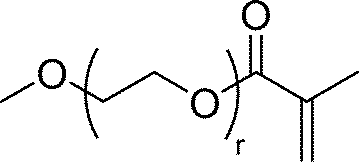
[rは5~30の任意の整数を表す。]
粒子の分散性をより一層高める観点から、共重合体における構造単位(II)の割合は、1~80モル%であることが好ましく、3~60モル%であることがより好ましく、5~30モル%であることが更に好ましく、10~20モル%であることがより更に好ましい。
〈その他の構造単位〉
本実施態様の組成物において、共重合体は、構造単位(I)及び構造単位(II)以外のその他のラジカル重合性単量体に由来する構造単位を含んでもよい。例えば、共重合体を構成するモノマー由来の構成単位が、構造単位(I)、構造単位(II)、及びラジカル重合性単量体に由来する構造単位からなる共重合体であることが、好ましい実施態様の一つである。
本実施態様の組成物において、共重合体は、構造単位(I)及び構造単位(II)以外のその他のラジカル重合性単量体に由来する構造単位を含んでもよい。例えば、共重合体を構成するモノマー由来の構成単位が、構造単位(I)、構造単位(II)、及びラジカル重合性単量体に由来する構造単位からなる共重合体であることが、好ましい実施態様の一つである。
ラジカル重合性単量体としては、ビニル単量体、アルキル(メタ)アクリレート、(メタ)アクリル酸エステル、(メタ)アクリレート、不飽和ジカルボン酸等が挙げられる。(メタ)アクリル酸エステルとしては、例えば、環状構造、水酸基、又は末端にエポキシ基を有するものを用いることができる。また、(メタ)アクリレートとしては、例えば、アルキレングリコール構造やシラン又はシリル基末端を有するものを用いることができる。
ビニル単量体としては、スチレン、2-メチルスチレン、酢酸ビニル、塩化ビニル等が挙げられる。
アルキル(メタ)アクリレートとしては、メチル(メタ)アクリレート、プロピル(メタ)アクリレート、ブチル(メタ)アクリレート、ペンチル(メタ)アクリレート、ヘキシル(メタ)アクリレート、2-エチルヘキシル(メタ)アクリレート等が挙げられる。
アルキル(メタ)アクリレートとしては、メチル(メタ)アクリレート、プロピル(メタ)アクリレート、ブチル(メタ)アクリレート、ペンチル(メタ)アクリレート、ヘキシル(メタ)アクリレート、2-エチルヘキシル(メタ)アクリレート等が挙げられる。
環状構造を有する(メタ)アクリル酸エステルとしては、シクロヘキシル(メタ)アクリレート、ジシクロペンタニル(メタ)アクリレート、ジシクロペンテニル(メタ)アクリレート、ジシクロペンテニルオキシエチル(メタ)アクリレート、アダマンチル(メタ)アクリレート、3-ヒドロキシアダマンチル(メタ)アクリレート、2-メチル-2-アダマンチル(メタ)アクリレート等が挙げられる。
末端にエポキシ基を有する(メタ)アクリル酸エステルとしては、グリシジル(メタ)アクリレート、3、4-エポキシシクロヘキシルメチル(メタ)アクリレート等が挙げられる。
シラン又はシリル基末端の(メタ)アクリレートとしては、2-トリメチルシリロキシエチル(メタ)アクリレート等が挙げられる。
不飽和ジカルボン酸としては、無水マレイン酸やその誘導体等が挙げられる。
不飽和ジカルボン酸としては、無水マレイン酸やその誘導体等が挙げられる。
また、ラジカル重合性単量体として、分子内に2つ以上の重合性基を有する化合物を用いてもよい。分子内に2つ以上の重合性基を有する化合物としては、例えば、エチレングリコールジ(メタ)アクリレート、ジエチレングリコールジ(メタ)アクリレート、ジプロピレングリコールジ(メタ)アクリレート、トリプロピレングリコールジ(メタ)アクリレート、1,3-ブタンジオールジ(メタ)アクリレート、1,4-ブタンジオールジ(メタ)アクリレート、1,6-ヘキサメチレンジ(メタ)アクリレート、ネオペンチルグリコールジ(メタ)アクリレート、1,9-ノナンジオールジ(メタ)アクリレート、1,10-デカンジオールジ(メタ)アクリレート、トリシクロデカンジメタノールジ(メタ)アクリレート、グリセリンジ(メタ)アクリレート、水添ビスフェノールA又は水添ビスフェノールFのジ(メタ)アクリレート、ポリエチレングリコールジ(メタ)アクリレート、ポリプロピレングリコールジ(メタ)アクリレート、ペンタエリスリトールテトラ(メタ)アクリレート、ジペンタエリスリトールヘキサ(メタ)アクリレート、トリメチロールプロパントリ(メタ)アクリレート等が挙げられる。
また、ラジカル重合性単量体として、水酸基含有多価(メタ)アクリル酸エステルを用いてもよい。水酸基含有多価(メタ)アクリル酸エステルとしては、例えば、グリセロールジ(メタ)アクリレート、トリメチロールプロパンジ(メタ)アクリレート、ペンタエリスリトールトリ(メタ)アクリレート、ペンタエリスリトールジ(メタ)アクリレート、ジペンタエリスリトールモノヒドロキシペンタ(メタ)アクリレート等が挙げられる。
中でも、共重合体は、アルキル(メタ)アクリレート由来の構造単位を更に含むことが好ましい。硬化物の硬度及び耐薬品性の向上の観点から、上記ラジカル重合性単量体は、メチル(メタ)アクリレート、及びブチル(メタ)アクリレートが好ましく、メチルメタクリレートがより好ましい。
これらラジカル重合性単量体は、1種類を単独で使用してもよいし、2種類以上を併用してもよい。
これらラジカル重合性単量体は、1種類を単独で使用してもよいし、2種類以上を併用してもよい。
共重合体における上記その他の構造単位の割合は、構造単位(I)及び構造単位(II)の割合に応じて適宜決定することができる。例えば、上記その他の構造単位の割合は、共重合体における全構造単位(モル%)から、構造単位(I)及び構造単位(II)の合計割合(モル%)を差し引いた値とすることもできる。
また、硬化物の硬度及び耐溶剤性をより一層高める観点から、共重合体におけるその他の構造単位の割合は、20~95モル%であることが好ましく、40~90モル%であることがより好ましく、65~85モル%であることが更に好ましい。
また、硬化物の硬度及び耐溶剤性をより一層高める観点から、共重合体におけるその他の構造単位の割合は、20~95モル%であることが好ましく、40~90モル%であることがより好ましく、65~85モル%であることが更に好ましい。
共重合体の製造方法は、特に制限されるものではなく、公知の重合方法により上記構造単位(I)及び構造単位(II)を形成するモノマー、並びに、任意にその他の構造単位を形成するモノマーを共重合することにより製造することができる。また、共重合体の製造において、必要に応じて重合開始剤、連鎖移動剤、及び重合停止剤等を用いてもよい。
組成物における共重合体の含有割合は特に限定されないが、共重合体、粒子、及び後述する溶媒の合計100質量%に対し、通常、0.1~15質量%である。また、分散性、硬化物の硬度及び耐溶剤性をより一層向上させる観点から、共重合体、粒子、及び後述する溶媒の合計100質量%に対し、共重合体の含有割合は0.5~10質量%であることが好ましく、0.5~5質量%であることがより好ましい。
[粒子]
本実施態様の組成物に含まれる粒子は、無機粒子及び有機顔料粒子からなる群より選ばれる少なくとも1種である。粒子は、硬化性組成物の用途に所望される機能に応じて適宜選択すればよいが、分散性、硬化物の硬度、及び耐薬品性等の観点から、無機粒子であることが好ましく、無機化合物粒子、金属粒子、及び炭素粒子からなる群より選ばれる少なくとも1種であることがより好ましい。
無機粒子としては、例えば、炭酸カルシウム、炭酸マグネシウム、硫酸バリウム、酸化チタン、酸化マグネシウム、酸化亜鉛、酸化ジルコニウム、酸化アルミニウム、酸化アンチモン、酸化スズ、酸化セリウム、酸化インジウム、水酸化アルミニウム、シリカ(二酸化珪素)、焼成珪酸カルシウム、焼成カオリン、水和珪酸カルシウム、珪酸アルミニウム、珪酸マグネシウム、リン酸カルシウム、ガラス、タルク、クレイ、マイカ、カーボンブラック、及びホワイトカーボン等が挙げられる。無機粒子は、必要に応じ、シランカップリング剤やチタネート系カップリング剤等により表面処理が施されていてもよい。
有機顔料粒子としては、例えば、フタロシアニン系顔料、及びアゾ系顔量等が挙げられる。
上記粒子は、1種単独で含まれていてもよく、2種類以上含まれていてもよい。
本実施態様の組成物に含まれる粒子は、無機粒子及び有機顔料粒子からなる群より選ばれる少なくとも1種である。粒子は、硬化性組成物の用途に所望される機能に応じて適宜選択すればよいが、分散性、硬化物の硬度、及び耐薬品性等の観点から、無機粒子であることが好ましく、無機化合物粒子、金属粒子、及び炭素粒子からなる群より選ばれる少なくとも1種であることがより好ましい。
無機粒子としては、例えば、炭酸カルシウム、炭酸マグネシウム、硫酸バリウム、酸化チタン、酸化マグネシウム、酸化亜鉛、酸化ジルコニウム、酸化アルミニウム、酸化アンチモン、酸化スズ、酸化セリウム、酸化インジウム、水酸化アルミニウム、シリカ(二酸化珪素)、焼成珪酸カルシウム、焼成カオリン、水和珪酸カルシウム、珪酸アルミニウム、珪酸マグネシウム、リン酸カルシウム、ガラス、タルク、クレイ、マイカ、カーボンブラック、及びホワイトカーボン等が挙げられる。無機粒子は、必要に応じ、シランカップリング剤やチタネート系カップリング剤等により表面処理が施されていてもよい。
有機顔料粒子としては、例えば、フタロシアニン系顔料、及びアゾ系顔量等が挙げられる。
上記粒子は、1種単独で含まれていてもよく、2種類以上含まれていてもよい。
粒子の平均一次粒子径に特に制限はないが、小さ過ぎると増粘性が大きくなる傾向があり、また大き過ぎると組成物中の分散性が低下するおそれが生じる。硬化物の硬化性及び意匠性等を考慮すると、粒子の平均一次粒子径は、100μm以下であることが好ましく、50μm以下であることがより好ましく、10μm以下であることが更に好ましく、1μm以下であることがより更に好ましい。また、本発明の効果を損なわない限りにおいて下限値に制限はなく、粒子の平均一次粒子径は例えば0.1nm以上としてもよい。
粒子の平均一次粒子径は、例えば、レーザー回折散乱法及び電子顕微鏡観察により求めることができる。
粒子の平均一次粒子径は、例えば、レーザー回折散乱法及び電子顕微鏡観察により求めることができる。
組成物における粒子の含有割合は特に限定されないが、共重合体、粒子、及び後述する溶媒の合計100質量%に対し、通常、0.1~20質量%である。また、分散性及び取扱性をより一層向上させる観点から、共重合体、粒子、及び後述する溶媒の合計100質量%に対し、粒子の含有割合は0.1~15質量%であることが好ましく、0.5~15質量%であることがより好ましく、1~15質量%であることがより好ましい。
[溶媒]
本実施態様の組成物は、分散性及び取扱性の観点から、溶媒を含むことが好ましい。ここで本発明において、「溶媒」とは共重合体及び粒子を含む組成物を製造する際に用い得る物質を意味し、当該組成物に含むことができる。また、「溶媒」は、後述する硬化性組成物を製造する際に用い得る「溶剤」とは、文言上区別される。一方で、「溶媒」と「溶剤」とは同一物質を用いることができ、異なる物質を用いることもできる。また、「溶媒」を硬化性組成物に含むことができる。
溶媒は分散媒であり、アルコール類、多価アルコール類、ケトン類、エステル類、芳香族炭化水素類、アミド類、及び水が挙げられ、分散液の安定性の観点から、アルコール類であることが好ましい。
アルコール類としては、例えば、メタノール、エタノール、1-プロパノール、イソプロピルアルコール、t-ブタノール、及び1-メトキシ-2-プロパノール等が挙げられる。
多価アルコール類としては、例えば、エチレングリコール、及びグリセリン等が挙げられる。
ケトン類としては、例えば、アセトン、メチルエチルケトン、メチルイソブチルケトン、及びシクロヘキサノン等が挙げられる。
エステル類としては、例えば、酢酸メチル、酢酸エチル、酢酸ブチル、γ-ブチロラクトン、及びプロピレングリコールモノメチルエーテルアセテート等が挙げられる。
芳香族炭化水素類としては、例えば、トルエン、及びキシレン等が挙げられる。
アミド類としては、例えば、N,N-ジメチルホルムアミド、N,N-ジメチルアセトアミド、及びN-メチルピロリドン等が挙げられる。
本実施態様の組成物は、分散性及び取扱性の観点から、溶媒を含むことが好ましい。ここで本発明において、「溶媒」とは共重合体及び粒子を含む組成物を製造する際に用い得る物質を意味し、当該組成物に含むことができる。また、「溶媒」は、後述する硬化性組成物を製造する際に用い得る「溶剤」とは、文言上区別される。一方で、「溶媒」と「溶剤」とは同一物質を用いることができ、異なる物質を用いることもできる。また、「溶媒」を硬化性組成物に含むことができる。
溶媒は分散媒であり、アルコール類、多価アルコール類、ケトン類、エステル類、芳香族炭化水素類、アミド類、及び水が挙げられ、分散液の安定性の観点から、アルコール類であることが好ましい。
アルコール類としては、例えば、メタノール、エタノール、1-プロパノール、イソプロピルアルコール、t-ブタノール、及び1-メトキシ-2-プロパノール等が挙げられる。
多価アルコール類としては、例えば、エチレングリコール、及びグリセリン等が挙げられる。
ケトン類としては、例えば、アセトン、メチルエチルケトン、メチルイソブチルケトン、及びシクロヘキサノン等が挙げられる。
エステル類としては、例えば、酢酸メチル、酢酸エチル、酢酸ブチル、γ-ブチロラクトン、及びプロピレングリコールモノメチルエーテルアセテート等が挙げられる。
芳香族炭化水素類としては、例えば、トルエン、及びキシレン等が挙げられる。
アミド類としては、例えば、N,N-ジメチルホルムアミド、N,N-ジメチルアセトアミド、及びN-メチルピロリドン等が挙げられる。
また、本発明の効果を損なわない限りにおいて、溶媒として上述したラジカル重合性単量体を用いることもできる。すなわち、構造単位(I)及び構造単位(II)を含む共重合体、粒子、及びラジカル重合性単量体を含む組成物であってもよい。
溶媒は、1種単独で含まれていてもよく、2種類以上含まれていてもよい。
溶媒は、1種単独で含まれていてもよく、2種類以上含まれていてもよい。
組成物における溶媒の含有割合は特に限定されないが、共重合体、粒子、及び後述する溶媒の合計100質量%に対し、通常、50~99質量%である。また、分散性及び取扱性をより一層向上させる観点から、共重合体、粒子、及び後述する溶媒の合計100質量%に対し、溶媒の含有割合は75~95質量%であることが好ましく、80~90質量%であることがより好ましい。
[組成物の製造方法]
実施態様の組成物の製造方法は、特に制限されるものではなく、例えば、共重合体、粒子、必要に応じて溶媒を公知の方法で混合することにより得ることができる。
実施態様の組成物の製造方法は、特に制限されるものではなく、例えば、共重合体、粒子、必要に応じて溶媒を公知の方法で混合することにより得ることができる。
<硬化性組成物>
本実施態様の硬化性組成物は、上述の組成物、ラジカル重合開始剤、及び多官能ラジカル重合性化合物を含む。
硬化性組成物における組成物の含有割合は特に限定されないが、組成物、ラジカル重合開始剤、多官能ラジカル重合性化合物及び後述する溶剤の合計100質量%に対し、10~99質量%であることが好ましく、20~60質量%であることがより好ましく、30~50質量%であることが更に好ましい。組成物の含有量が上記範囲であれば、優れた硬度及び耐溶剤性を有する硬化物を効率的に得ることができる。
本実施態様の硬化性組成物は、上述の組成物、ラジカル重合開始剤、及び多官能ラジカル重合性化合物を含む。
硬化性組成物における組成物の含有割合は特に限定されないが、組成物、ラジカル重合開始剤、多官能ラジカル重合性化合物及び後述する溶剤の合計100質量%に対し、10~99質量%であることが好ましく、20~60質量%であることがより好ましく、30~50質量%であることが更に好ましい。組成物の含有量が上記範囲であれば、優れた硬度及び耐溶剤性を有する硬化物を効率的に得ることができる。
[ラジカル重合開始剤]
ラジカル重合開始剤としては、硬化物の硬化性をより向上させる観点から、熱でラジカルを発生する熱ラジカル重合開始剤、光でラジカルを発生する光ラジカル重合開始剤が好ましい。
熱ラジカル重合開始剤としては、例えば、2,2’-アゾビスイソブチロニトリル(AIBN)、2,2’-アゾビス(2,4-ジメチルバレロ)ニトリル(ADVN)等のアゾ化合物系;ベンゾイルペルオキシド等のジアシルペルオキシド系;t-ブチルペルオキシベンゾエート等のペルオキシエステル系;クメンヒドロペルオキシド等のヒドロペルオキシド系;ジクミルペルオキシド等ジアルキルペルオキシド系;メチルエチルケトンペルオキシド、アセチルアセトンペルオキシド等のケトンペルオキシド系;ペルオキシケタール系;アルキルペルエステル系;ペルカーボネート系等の有機過酸化物等が挙げられる。
ラジカル重合開始剤としては、硬化物の硬化性をより向上させる観点から、熱でラジカルを発生する熱ラジカル重合開始剤、光でラジカルを発生する光ラジカル重合開始剤が好ましい。
熱ラジカル重合開始剤としては、例えば、2,2’-アゾビスイソブチロニトリル(AIBN)、2,2’-アゾビス(2,4-ジメチルバレロ)ニトリル(ADVN)等のアゾ化合物系;ベンゾイルペルオキシド等のジアシルペルオキシド系;t-ブチルペルオキシベンゾエート等のペルオキシエステル系;クメンヒドロペルオキシド等のヒドロペルオキシド系;ジクミルペルオキシド等ジアルキルペルオキシド系;メチルエチルケトンペルオキシド、アセチルアセトンペルオキシド等のケトンペルオキシド系;ペルオキシケタール系;アルキルペルエステル系;ペルカーボネート系等の有機過酸化物等が挙げられる。
光ラジカル重合開始剤としては、市販品を用いることができる。例えば、Irgacure(登録商標、以下同じ)651、Irgacure184、Irgacure2959、Irgacure127、Irgacure907、Irgacure369、Irgacure379、Irgacure819、Irgacure784、IrgacureOXE01、IrgacureOXE02、Irgacure754(以上、BASF社製)等が挙げられる。
ラジカル重合開始剤は、1種を単独で使用してもよいし、2種以上を併用してもよい。
ラジカル重合開始剤は、1種を単独で使用してもよいし、2種以上を併用してもよい。
硬化性組成物におけるラジカル重合開始剤の含有量に特に制限はない。一方で、効率的に重合を行う観点から、硬化性組成物におけるラジカル重合開始剤の含有量は、組成物100質量部に対して0.001質量部以上であることが好ましく、0.01質量部以上であることがより好ましく、0.1質量部以上であることが更に好ましい。また、硬化性組成物におけるラジカル重合開始剤の含有量は、組成物100質量部に対して5質量部以下であることが好ましく、3質量部以下であることがより好ましい。
[多官能ラジカル重合性化合物]
硬化性組成物は、多官能ラジカル重合性化合物を含有することにより、硬度に優れた硬化物とすることができる。
多官能ラジカル重合性化合物としては、例えば、トリメチロールプロパントリ(メタ)アクリレート、トリプロピレングリコールジ(メタ)アクリレート、ジエチレングリコールジ(メタ)アクリレート、ジプロピレングリコールジ(メタ)アクリレート、ペンタエリスリトールトリ(メタ)アクリレート、ペンタエリスリトールテトラ(メタ)アクリレート、ジペンタエリスリトールヘキサ(メタ)アクリレート、1,6-ヘキサンジオールジ(メタ)アクリレート、ネオペンチルグリコールジ(メタ)アクリレート、トリメチロールプロパントリ(メタ)アクリレート、ジトリメチロールプロパンテトラ(メタ)アクリレート、ジペンタエリスリトールペンタ(メタ)アクリレート、トリペンタエリスリトールオクタ(メタ)アクリレート、テトラペンタエリスリトールデカ(メタ)アクリレート、イソシアヌル酸トリ(メタ)アクリレート、イソシアヌル酸ジ(メタ)アクリレート、ビスフェノールジ(メタ)アクリレート、ジグリセリンテトラ(メタ)アクリレート、アダマンチルジ(メタ)アクリレート、イソボルニルジ(メタ)アクリレート、ジシクロペンタンジ(メタ)アクリレート、トリシクロデカンジ(メタ)アクリレート、ジトリメチロールプロパンテトラ(メタ)アクリレート等
また、多官能ラジカル重合性化合物としては、市販品を用いることができる。例えば、A-DPH(多官能アクリレート、新中村化学工業株式会社製);AH-600、UA-306H、UA-306T、UA-306I、UA-510H等(ウレタンアクリレート、共栄社化学株式会社製)等が挙げられる。
多官能ラジカル重合性化合物は、1種を単独で使用してもよいし、2種以上を併用してもよい。
硬化性組成物は、多官能ラジカル重合性化合物を含有することにより、硬度に優れた硬化物とすることができる。
多官能ラジカル重合性化合物としては、例えば、トリメチロールプロパントリ(メタ)アクリレート、トリプロピレングリコールジ(メタ)アクリレート、ジエチレングリコールジ(メタ)アクリレート、ジプロピレングリコールジ(メタ)アクリレート、ペンタエリスリトールトリ(メタ)アクリレート、ペンタエリスリトールテトラ(メタ)アクリレート、ジペンタエリスリトールヘキサ(メタ)アクリレート、1,6-ヘキサンジオールジ(メタ)アクリレート、ネオペンチルグリコールジ(メタ)アクリレート、トリメチロールプロパントリ(メタ)アクリレート、ジトリメチロールプロパンテトラ(メタ)アクリレート、ジペンタエリスリトールペンタ(メタ)アクリレート、トリペンタエリスリトールオクタ(メタ)アクリレート、テトラペンタエリスリトールデカ(メタ)アクリレート、イソシアヌル酸トリ(メタ)アクリレート、イソシアヌル酸ジ(メタ)アクリレート、ビスフェノールジ(メタ)アクリレート、ジグリセリンテトラ(メタ)アクリレート、アダマンチルジ(メタ)アクリレート、イソボルニルジ(メタ)アクリレート、ジシクロペンタンジ(メタ)アクリレート、トリシクロデカンジ(メタ)アクリレート、ジトリメチロールプロパンテトラ(メタ)アクリレート等
また、多官能ラジカル重合性化合物としては、市販品を用いることができる。例えば、A-DPH(多官能アクリレート、新中村化学工業株式会社製);AH-600、UA-306H、UA-306T、UA-306I、UA-510H等(ウレタンアクリレート、共栄社化学株式会社製)等が挙げられる。
多官能ラジカル重合性化合物は、1種を単独で使用してもよいし、2種以上を併用してもよい。
硬化性組成物における多官能ラジカル重合性化合物の含有量に特に制限はない。一方で、硬度をより向上させやすくする観点から、硬化性組成物における多官能ラジカル重合性化合物の含有量は、組成物100質量部に対して10質量部以上であることが好ましく、20質量部以上であることがより好ましく、30質量部以上であることが更に好ましい。また、本発明の効果を損なわない限りにおいて上限値に制限はなく、硬化性組成物における多官能ラジカル重合性化合物の含有量は、組成物100質量部に対して70質量部以下としてもよい。
[溶剤]
本実施態様の硬化性組成物は、適用する用途に応じて、更に溶剤を含んでもよい。溶剤を含むことにより各成分を均一にさせることが可能になり、取り扱い性が向上する。ここで本発明において、「溶剤」とは上述の組成物、ラジカル重合開始剤、及び多官能ラジカル重合性化合物を含む硬化性組成物を製造する際に用い得る物質を意味し、当該硬化性組成物に含むことができる。また、「溶剤」は、上述のとおり「溶剤」とは、文言上区別される。一方で、「溶媒」と「溶剤」とは同一物質を用いることができ、異なる物質を用いることもできる。
溶剤としては、アルコール類、芳香族炭化水素類、脂環式炭化水素類、脂肪族炭化水素類、ケトン類、エステル類、及びアミド類等が挙げられ、アルコール類であることが好ましい。
本実施態様の硬化性組成物は、適用する用途に応じて、更に溶剤を含んでもよい。溶剤を含むことにより各成分を均一にさせることが可能になり、取り扱い性が向上する。ここで本発明において、「溶剤」とは上述の組成物、ラジカル重合開始剤、及び多官能ラジカル重合性化合物を含む硬化性組成物を製造する際に用い得る物質を意味し、当該硬化性組成物に含むことができる。また、「溶剤」は、上述のとおり「溶剤」とは、文言上区別される。一方で、「溶媒」と「溶剤」とは同一物質を用いることができ、異なる物質を用いることもできる。
溶剤としては、アルコール類、芳香族炭化水素類、脂環式炭化水素類、脂肪族炭化水素類、ケトン類、エステル類、及びアミド類等が挙げられ、アルコール類であることが好ましい。
アルコール類としては、例えば、メタノール、エタノール、1-プロパノール、イソプロピルアルコール、t-ブタノール、及び1-メトキシ-2-プロパノール等が挙げられる。
芳香族炭化水素類としては、例えば、トルエン、キシレン、及びエチルベンゼン等が挙げられる。
脂環式炭化水素類としては、例えば、シクロペンタン、シクロヘキサン、メチルシクロヘキサン、デカリン、及びテトラリン等が挙げられる。
脂肪族炭化水素類としては、例えば、ペンタン、ヘキサン、ヘプタン、及びオクタン等が挙げられる。
ケトン類としては、例えば、アセトン、メチルエチルケトン、メチルイソブチルケトン、及びシクロヘキサノン等が挙げられる。
エステル類としては、例えば、酢酸メチル、酢酸エチル、酢酸ブチル、γ-ブチロラクトン、及びプロピレングリコールモノメチルエーテルアセテート等が挙げられる。
アミド類としては、例えば、N,N-ジメチルホルムアミド、N,N-ジメチルアセトアミド、及びN-メチルピロリドン等が挙げられる。
溶剤は、1種を単独で使用してもよいし、2種以上を併用してもよい。
芳香族炭化水素類としては、例えば、トルエン、キシレン、及びエチルベンゼン等が挙げられる。
脂環式炭化水素類としては、例えば、シクロペンタン、シクロヘキサン、メチルシクロヘキサン、デカリン、及びテトラリン等が挙げられる。
脂肪族炭化水素類としては、例えば、ペンタン、ヘキサン、ヘプタン、及びオクタン等が挙げられる。
ケトン類としては、例えば、アセトン、メチルエチルケトン、メチルイソブチルケトン、及びシクロヘキサノン等が挙げられる。
エステル類としては、例えば、酢酸メチル、酢酸エチル、酢酸ブチル、γ-ブチロラクトン、及びプロピレングリコールモノメチルエーテルアセテート等が挙げられる。
アミド類としては、例えば、N,N-ジメチルホルムアミド、N,N-ジメチルアセトアミド、及びN-メチルピロリドン等が挙げられる。
溶剤は、1種を単独で使用してもよいし、2種以上を併用してもよい。
硬化性組成物が溶剤を含有する場合、溶剤の含有割合は、組成物、ラジカル重合開始剤、多官能ラジカル重合性化合物及び溶剤の合計100質量%に対し、10~70質量%であることが好ましく、20~60質量%であることがより好ましく、30~55質量%であることが更に好ましい。なお、溶剤の上記含有割合に、組成物中の溶媒の含有割合は含まれない。
[その他の成分]
硬化性組成物は、顔料、染料、充填剤、紫外線吸収剤、増粘剤、低収縮化剤、老化防止剤、可塑剤、骨材、難燃剤、安定剤、繊維強化材、酸化防止剤、レベリング剤、及びたれ止め剤等のその他の成分を更に含んでもよい。
硬化性組成物は、顔料、染料、充填剤、紫外線吸収剤、増粘剤、低収縮化剤、老化防止剤、可塑剤、骨材、難燃剤、安定剤、繊維強化材、酸化防止剤、レベリング剤、及びたれ止め剤等のその他の成分を更に含んでもよい。
[硬化性組成物の製造方法]
硬化性組成物の製造方法は特に制限されるものではなく、例えば、組成物、ラジカル重合開始剤、多官能ラジカル重合性化合物、必要に応じて、溶剤、及びその他の成分を、公知の方法で混合することにより得ることができる。
硬化性組成物の製造方法は特に制限されるものではなく、例えば、組成物、ラジカル重合開始剤、多官能ラジカル重合性化合物、必要に応じて、溶剤、及びその他の成分を、公知の方法で混合することにより得ることができる。
<硬化物>
本実施態様の硬化物は、上述の硬化性組成物を硬化してなるものであり、優れた硬度及び耐溶剤性を有するものである。
硬化物の製造方法に特に制限はなく、硬化性組成物やラジカル重合開始剤の種類等に応じて適宜選択することができる。例えば、硬化性組成物が熱ラジカル重合開始剤を含む場合は、加熱して硬化させる方法が挙げられ、光ラジカル重合開始剤を含む場合は、UV等の活性エネルギーを照射して硬化させる方法が挙げられる。
本実施態様の硬化物は、上述の硬化性組成物を硬化してなるものであり、優れた硬度及び耐溶剤性を有するものである。
硬化物の製造方法に特に制限はなく、硬化性組成物やラジカル重合開始剤の種類等に応じて適宜選択することができる。例えば、硬化性組成物が熱ラジカル重合開始剤を含む場合は、加熱して硬化させる方法が挙げられ、光ラジカル重合開始剤を含む場合は、UV等の活性エネルギーを照射して硬化させる方法が挙げられる。
<硬化性組成物及び硬化物の用途>
本実施態様の硬化性組成物及び硬化物の用途に特に制限はない。本実施態様の硬化物は、優れた硬度及び耐溶剤性を有していることから、例えば、塗料(UV塗料やUVインキ等)、接着剤、コーティング剤等に好ましく用いることができ、これにより、物性や外観に優れる塗膜、接着層、コーティング層等の硬化物を得ることができる。なお、塗膜やコーティング層等の比較的薄い硬化物を「硬化膜」ということもある。
本実施態様の硬化性組成物及び硬化物の用途に特に制限はない。本実施態様の硬化物は、優れた硬度及び耐溶剤性を有していることから、例えば、塗料(UV塗料やUVインキ等)、接着剤、コーティング剤等に好ましく用いることができ、これにより、物性や外観に優れる塗膜、接着層、コーティング層等の硬化物を得ることができる。なお、塗膜やコーティング層等の比較的薄い硬化物を「硬化膜」ということもある。
以下、本発明を実施例及び比較例により具体的に説明するが、本発明はこれらに限定されるものではない。
[各成分]
〈1〉共重合体(分散剤)の製造例において使用した成分は、以下のとおりである。
<モノマー(A)>
・メチルメタクリレート(以下、MMA):株式会社クラレ製
<モノマー(B)>
・メタクリロイルコリンクロリドの80質量%水溶液:東京化成工業株式会社製
・メタアクリル酸(以下、MAA):株式会社クラレ製
〈1〉共重合体(分散剤)の製造例において使用した成分は、以下のとおりである。
<モノマー(A)>
・メチルメタクリレート(以下、MMA):株式会社クラレ製
<モノマー(B)>
・メタクリロイルコリンクロリドの80質量%水溶液:東京化成工業株式会社製
・メタアクリル酸(以下、MAA):株式会社クラレ製
<モノマー(C)>
・下記式(i)で表される化合物1:株式会社クラレ製

・アリルメタクリレート(以下、AMA):富士フイルム和光純薬株式会社製
・下記式(ii)で表される化合物2:株式会社クラレ製

・FA-512M(商品名):ジシクロペンタニルアクリレート、昭和電工マテリアルズ株式会社製
・下記式(i)で表される化合物1:株式会社クラレ製
・アリルメタクリレート(以下、AMA):富士フイルム和光純薬株式会社製
・下記式(ii)で表される化合物2:株式会社クラレ製
・FA-512M(商品名):ジシクロペンタニルアクリレート、昭和電工マテリアルズ株式会社製
<中和剤>
・アンモニアの25質量%水溶液:富士フイルム和光純薬株式会社製
<連鎖移動剤>
・α-メチルスチレンダイマー:東京化成工業株式会社製
<重合開始剤>
・2,2’-アゾビス(イソブチロニトリル)(以下、AIBN):富士フイルム和光純薬株式会社製
<反応溶媒>
・メタノール:富士フイルム和光純薬株式会社製
・1-メトキシ-2-プロパノール:富士フイルム和光純薬株式会社製
・アンモニアの25質量%水溶液:富士フイルム和光純薬株式会社製
<連鎖移動剤>
・α-メチルスチレンダイマー:東京化成工業株式会社製
<重合開始剤>
・2,2’-アゾビス(イソブチロニトリル)(以下、AIBN):富士フイルム和光純薬株式会社製
<反応溶媒>
・メタノール:富士フイルム和光純薬株式会社製
・1-メトキシ-2-プロパノール:富士フイルム和光純薬株式会社製
〈2〉組成物(微粒子分散液)に関する実施例及び比較例において使用した成分は、以下のとおりである。
<粒子>
・酸化アルミニウム:商品名AEROXIDE(登録商標) AluC、平均一次粒子径13nm、EVONIK社製
・酸化チタン:商品名MT-100SA、平均一次粒子径15nm、テイカ株式会社製
<溶媒(分散媒)>
・メタノール:富士フイルム和光純薬株式会社製
・1-メトキシ-2-プロパノール:富士フイルム和光純薬株式会社製
<粒子>
・酸化アルミニウム:商品名AEROXIDE(登録商標) AluC、平均一次粒子径13nm、EVONIK社製
・酸化チタン:商品名MT-100SA、平均一次粒子径15nm、テイカ株式会社製
<溶媒(分散媒)>
・メタノール:富士フイルム和光純薬株式会社製
・1-メトキシ-2-プロパノール:富士フイルム和光純薬株式会社製
〈3〉硬化性組成物及び硬化膜に関する実施例及び比較例において使用した成分は以下のとおりである。
<多官能モノマー(多官能ラジカル重合性化合物)>
・A-DPH(商品名):ジペンタエルスリトールヘキサアクリレート、新中村化学工業株式会社製
・UA-306H(商品名):ペンタエリスリトールトリアクリレートヘキサメチレンジイソシアネート ウレタンプレポリマー、共栄社化学株式会社製
<溶剤>
・メタノール:富士フイルム和光純薬株式会社製
・1-メトキシ-2-プロパノール:富士フイルム和光純薬株式会社製
<光重合開始剤(ラジカル重合開始剤)>
・Irgacure184(商品名):1-ヒドロキシシクロヘキシルフェニルケトン、IGM Resins B.V.社製
<多官能モノマー(多官能ラジカル重合性化合物)>
・A-DPH(商品名):ジペンタエルスリトールヘキサアクリレート、新中村化学工業株式会社製
・UA-306H(商品名):ペンタエリスリトールトリアクリレートヘキサメチレンジイソシアネート ウレタンプレポリマー、共栄社化学株式会社製
<溶剤>
・メタノール:富士フイルム和光純薬株式会社製
・1-メトキシ-2-プロパノール:富士フイルム和光純薬株式会社製
<光重合開始剤(ラジカル重合開始剤)>
・Irgacure184(商品名):1-ヒドロキシシクロヘキシルフェニルケトン、IGM Resins B.V.社製
≪共重合体≫
[製造例1]共重合体(A-1)の合成
撹拌機、温度計及び還流管を備えた反応器に、窒素気流下、メタノールを50.0g、1-メトキシ-2-プロパノールを50.0g入れ80℃に昇温した。コンデンサーの還流下で、メタノールを20.0g、1-メトキシ-2-プロパノールを20.0g、MMAを52.6g、メタクリロイルコリンクロリドの80重量%水溶液を27.3g、化合物1を10.8g、α-メチルスチレンダイマーを1.4g及びAIBNを0.85g混合した物を、180分かけて滴下した。その後、AIBNを0.85g添加し、180分間80℃で熟成した。その後、冷却し、得られた溶液をヘキサンで10倍に希釈し共重合体を再沈殿させ、乾燥することにより共重合体(A-1)を得た。
[製造例1]共重合体(A-1)の合成
撹拌機、温度計及び還流管を備えた反応器に、窒素気流下、メタノールを50.0g、1-メトキシ-2-プロパノールを50.0g入れ80℃に昇温した。コンデンサーの還流下で、メタノールを20.0g、1-メトキシ-2-プロパノールを20.0g、MMAを52.6g、メタクリロイルコリンクロリドの80重量%水溶液を27.3g、化合物1を10.8g、α-メチルスチレンダイマーを1.4g及びAIBNを0.85g混合した物を、180分かけて滴下した。その後、AIBNを0.85g添加し、180分間80℃で熟成した。その後、冷却し、得られた溶液をヘキサンで10倍に希釈し共重合体を再沈殿させ、乾燥することにより共重合体(A-1)を得た。
[製造例2]共重合体(A-2)の合成
製造例1において、メタクリロイルコリンクロリドの80質量%水溶液の代わりにMAAを9.0g用いたこと、及び冷却後にアンモニアの25質量%水溶液を5.0g添加したこと以外は製造例1と同様の方法で、共重合体(A-2)を得た。
製造例1において、メタクリロイルコリンクロリドの80質量%水溶液の代わりにMAAを9.0g用いたこと、及び冷却後にアンモニアの25質量%水溶液を5.0g添加したこと以外は製造例1と同様の方法で、共重合体(A-2)を得た。
[製造例3~7]共重合体(B-1~B-5)の合成
表1に示す処方とした以外は製造例1と同様の方法で、共重合体(B-1~B-5)を得た。
表1に示す処方とした以外は製造例1と同様の方法で、共重合体(B-1~B-5)を得た。
製造例1,2で得られた共重合体(A-1)及び(A-2)は、化合物1由来の構造単位(I)、及びメタクリロイルコリンクロリド由来の構造単位(II)又はMAA由来の構造単位(II)を有する。
製造例3~7で得られた共重合体(B-1)~(B-5)は、構造単位(I)及び構造単位(II)のうちいずれか一方を有さない。
製造例3~7で得られた共重合体(B-1)~(B-5)は、構造単位(I)及び構造単位(II)のうちいずれか一方を有さない。
[評価]
共重合体(分散剤)の評価方法を以下に示す。
<重合安定性>
上記製造例において、共重合体の製造の際、重合反応の様子を目視で観察し、以下の基準で評価した。
なお、本評価が「B」となった共重合体は、以降の実施例及び比較例に用いなかった。
評価基準
A:問題なく重合が終了し、均質な共重合体を含有する溶液が得られる。
B:重合反応の途中で著しく増粘又はゲル化し、均質な共重合体を含有する溶液が得られない。
共重合体(分散剤)の評価方法を以下に示す。
<重合安定性>
上記製造例において、共重合体の製造の際、重合反応の様子を目視で観察し、以下の基準で評価した。
なお、本評価が「B」となった共重合体は、以降の実施例及び比較例に用いなかった。
評価基準
A:問題なく重合が終了し、均質な共重合体を含有する溶液が得られる。
B:重合反応の途中で著しく増粘又はゲル化し、均質な共重合体を含有する溶液が得られない。

モノマー(C)として化合物1を用いた製造例1,2では、ゲル化することなく均質な共重合体を含有する溶液が得られた。
モノマー(C)としてAMAを用いた製造例3、及び化合物2を用いた製造例4では、ゲル化し均質な共重合体を含有する溶液が得られなかった。この結果は、モノマー(C)の有する二重結合の反応性に起因すると考えられる。すなわち、化合物1は重合時にメタアクリロイル基のみが反応し、ほとんど架橋反応が進行しないため、重合安定性に優れると考えられる。AMA及び化合物2は、重合時にメタアクリロイル基と、反応性の高いアリル基及びメタリル基が架橋反応しゲル化することで、均質な共重合体を含有する溶液が得られなかったと考えられる。
モノマー(C)としてAMAを用いた製造例3、及び化合物2を用いた製造例4では、ゲル化し均質な共重合体を含有する溶液が得られなかった。この結果は、モノマー(C)の有する二重結合の反応性に起因すると考えられる。すなわち、化合物1は重合時にメタアクリロイル基のみが反応し、ほとんど架橋反応が進行しないため、重合安定性に優れると考えられる。AMA及び化合物2は、重合時にメタアクリロイル基と、反応性の高いアリル基及びメタリル基が架橋反応しゲル化することで、均質な共重合体を含有する溶液が得られなかったと考えられる。
≪組成物≫
[実施例1]組成物(C―1)の調製
分散剤として製造例1で得られた共重合体(A-1)を1.25g、粒子として酸化アルミニウムを3.75g、分散媒としてメタノールを20.0g、1-メトキシ-2-プロパノールを20.0g、100mLフラスコに入れ、攪拌機(ZZ-2220、東京理化器械株式会社製)を用いて600rpmで4時間撹拌し、分散させることにより微粒子分散液である組成物(C-1)を得た。
[実施例1]組成物(C―1)の調製
分散剤として製造例1で得られた共重合体(A-1)を1.25g、粒子として酸化アルミニウムを3.75g、分散媒としてメタノールを20.0g、1-メトキシ-2-プロパノールを20.0g、100mLフラスコに入れ、攪拌機(ZZ-2220、東京理化器械株式会社製)を用いて600rpmで4時間撹拌し、分散させることにより微粒子分散液である組成物(C-1)を得た。
[実施例2,3、比較例1~3]組成物(C-2、C-3、D-1~D-3)の調製
表2に示す処方とした以外は実施例1と同様の方法で、微粒子分散液である組成物(C-2、C-3、D-1~D-3)を得た。
表2に示す処方とした以外は実施例1と同様の方法で、微粒子分散液である組成物(C-2、C-3、D-1~D-3)を得た。
[評価]
実施例及び比較例で得られた組成物(微粒子分散液)の評価方法を以下に示す。
<分散性>
分散後の組成物を透明なサンプル瓶に移し、25℃において1ヶ月静置し、目視にて観察することによって以下の基準で評価した。
なお、本評価にて「D」となった組成物については、以降の実施例及び比較例に用いなかった。
評価基準
A:1ヶ月後にも、容器の底部に沈降物は見られない。
B:1週間後には沈降物が確認されなかったが、1ヶ月後には、容器の底部に少しの沈降物が確認された。
C:1日後には沈降物が確認されなかったが、1週間後には、容器の底部に少しの沈降物が確認された。
D:1日後に、容器の底部に沈降物が確認された。
実施例及び比較例で得られた組成物(微粒子分散液)の評価方法を以下に示す。
<分散性>
分散後の組成物を透明なサンプル瓶に移し、25℃において1ヶ月静置し、目視にて観察することによって以下の基準で評価した。
なお、本評価にて「D」となった組成物については、以降の実施例及び比較例に用いなかった。
評価基準
A:1ヶ月後にも、容器の底部に沈降物は見られない。
B:1週間後には沈降物が確認されなかったが、1ヶ月後には、容器の底部に少しの沈降物が確認された。
C:1日後には沈降物が確認されなかったが、1週間後には、容器の底部に少しの沈降物が確認された。
D:1日後に、容器の底部に沈降物が確認された。

分散剤として共重合体(A-1)及び(A-2)を用いた実施例1~3では、粒子の分散性に優れた組成物が得られた。
分散剤として共重合体(B-5)を用いた比較例3では、粒子が翌日には沈降し、分散性の優れた組成物が得られなかった。この結果は、共重合体の組成のモノマー(B)に起因すると考えられる。すなわち、共重合体(A-1)及び(A-2)は、モノマー(B)由来の極性官能基を有するため、共重合体が粒子に効率良く吸着し、優れた分散性を示すと考えられる。
分散剤として共重合体(B-5)を用いた比較例3では、粒子が翌日には沈降し、分散性の優れた組成物が得られなかった。この結果は、共重合体の組成のモノマー(B)に起因すると考えられる。すなわち、共重合体(A-1)及び(A-2)は、モノマー(B)由来の極性官能基を有するため、共重合体が粒子に効率良く吸着し、優れた分散性を示すと考えられる。
≪硬化性組成物及び硬化物≫
[実施例4]硬化膜の調製
実施例1で得られた微粒子分散液である組成物(C-1)を20.0g、多官能モノマーとしてA-DPHを9.5g、溶剤としてメタノールを8.5g、1-メトキシ-2-プロパノールを8.5g、100mLフラスコに入れ、攪拌機(ZZ-2220、東京理化器械株式会社製)を用いて600rpmで4時間撹拌し、光重合開始剤としてIrgacure184を0.3g入れ、硬化性組成物を調製し、塗工液とした。
得られた塗工液を、ブリキ鋼板(アズワン株式会社製)又はPETフィルム(商品名A4300、東洋紡株式会社製)に、アプリケーター(TP技研株式会社製)を用いて膜厚100μmで塗工し、80℃で1分間の予備乾燥を行った。次に、空気下でUV露光機(LIGHTNINGCURE LC-L1V5、浜松ホトニクス株式会社製)を用いて365nmでの積算光量2000mW/cm2(照射強度50mW/cm2、照射時間40秒)で露光して、硬化膜を得た。
[実施例4]硬化膜の調製
実施例1で得られた微粒子分散液である組成物(C-1)を20.0g、多官能モノマーとしてA-DPHを9.5g、溶剤としてメタノールを8.5g、1-メトキシ-2-プロパノールを8.5g、100mLフラスコに入れ、攪拌機(ZZ-2220、東京理化器械株式会社製)を用いて600rpmで4時間撹拌し、光重合開始剤としてIrgacure184を0.3g入れ、硬化性組成物を調製し、塗工液とした。
得られた塗工液を、ブリキ鋼板(アズワン株式会社製)又はPETフィルム(商品名A4300、東洋紡株式会社製)に、アプリケーター(TP技研株式会社製)を用いて膜厚100μmで塗工し、80℃で1分間の予備乾燥を行った。次に、空気下でUV露光機(LIGHTNINGCURE LC-L1V5、浜松ホトニクス株式会社製)を用いて365nmでの積算光量2000mW/cm2(照射強度50mW/cm2、照射時間40秒)で露光して、硬化膜を得た。
[実施例5~7、比較例4,5]硬化膜の調製
表3に示す処方とした以外は実施例4と同様の方法で、硬化膜を得た。
表3に示す処方とした以外は実施例4と同様の方法で、硬化膜を得た。
[評価]
実施例及び比較例で得られた硬化膜が形成されたブリキ鋼板及びPETフィルムについて、硬化膜の評価方法を以下に示す。
<表面硬度>
JIS-K5600-5-4に準拠して行い、傷が付く鉛筆の芯の硬度で評価した。鉛筆硬度が高いほど塗膜表面の硬度が高く傷に強い。
<付着性>
JIS-K5600-5-6に準拠して行い、試験後の塗膜の剥がれをルーペにより観察して以下の基準で評価した。数字が小さいほど付着性に優れている。
評価基準
0:カットの縁が完全に滑らかで、どの格子の目にも剥がれがない。
1:カットの交差点における塗膜の小さな剥がれを生じている。クロスカット部分で影響を受けるのは、明確に5%を上回ることはない。
2:塗膜がカットの縁に沿って、及び/又は交差点において剥がれている。クロスカット部分で影響を受けるのは、明確に5%を超えるが15%を上回ることはない。
3:塗膜がカットの縁に沿って、部分的又は全面的に大剥がれを生じており、及び/又は目のいろいろな部分が、部分的又は全面的に剥がれている。クロスカット部分で影響を受けるのは、明確に15%を超えるが35%を上回ることはない。
4:塗膜がカットの縁に沿って、部分的又は全面的に大剥がれを生じており、及び/又は数か所の目が部分的又は全面的に剥がれている。クロスカット部分で影響を受けるのは、明確に35%を超えるが65%を上回ることはない。
5:剥がれの程度が4を超える。
<耐溶剤性>
0.5gのコットンを1mLのアセトンに含浸したものを用いて、PETフィルム上の硬化膜を拭き取り、拭き取り後の状態を下記基準にしたがって評価した。
評価基準
A:硬化膜が10回で拭き取られなかった。
B:硬化膜が1回では拭き取られなかったが、10回以内に拭き取られた。
C:硬化膜が1回で拭き取られた。
実施例及び比較例で得られた硬化膜が形成されたブリキ鋼板及びPETフィルムについて、硬化膜の評価方法を以下に示す。
<表面硬度>
JIS-K5600-5-4に準拠して行い、傷が付く鉛筆の芯の硬度で評価した。鉛筆硬度が高いほど塗膜表面の硬度が高く傷に強い。
<付着性>
JIS-K5600-5-6に準拠して行い、試験後の塗膜の剥がれをルーペにより観察して以下の基準で評価した。数字が小さいほど付着性に優れている。
評価基準
0:カットの縁が完全に滑らかで、どの格子の目にも剥がれがない。
1:カットの交差点における塗膜の小さな剥がれを生じている。クロスカット部分で影響を受けるのは、明確に5%を上回ることはない。
2:塗膜がカットの縁に沿って、及び/又は交差点において剥がれている。クロスカット部分で影響を受けるのは、明確に5%を超えるが15%を上回ることはない。
3:塗膜がカットの縁に沿って、部分的又は全面的に大剥がれを生じており、及び/又は目のいろいろな部分が、部分的又は全面的に剥がれている。クロスカット部分で影響を受けるのは、明確に15%を超えるが35%を上回ることはない。
4:塗膜がカットの縁に沿って、部分的又は全面的に大剥がれを生じており、及び/又は数か所の目が部分的又は全面的に剥がれている。クロスカット部分で影響を受けるのは、明確に35%を超えるが65%を上回ることはない。
5:剥がれの程度が4を超える。
<耐溶剤性>
0.5gのコットンを1mLのアセトンに含浸したものを用いて、PETフィルム上の硬化膜を拭き取り、拭き取り後の状態を下記基準にしたがって評価した。
評価基準
A:硬化膜が10回で拭き取られなかった。
B:硬化膜が1回では拭き取られなかったが、10回以内に拭き取られた。
C:硬化膜が1回で拭き取られた。
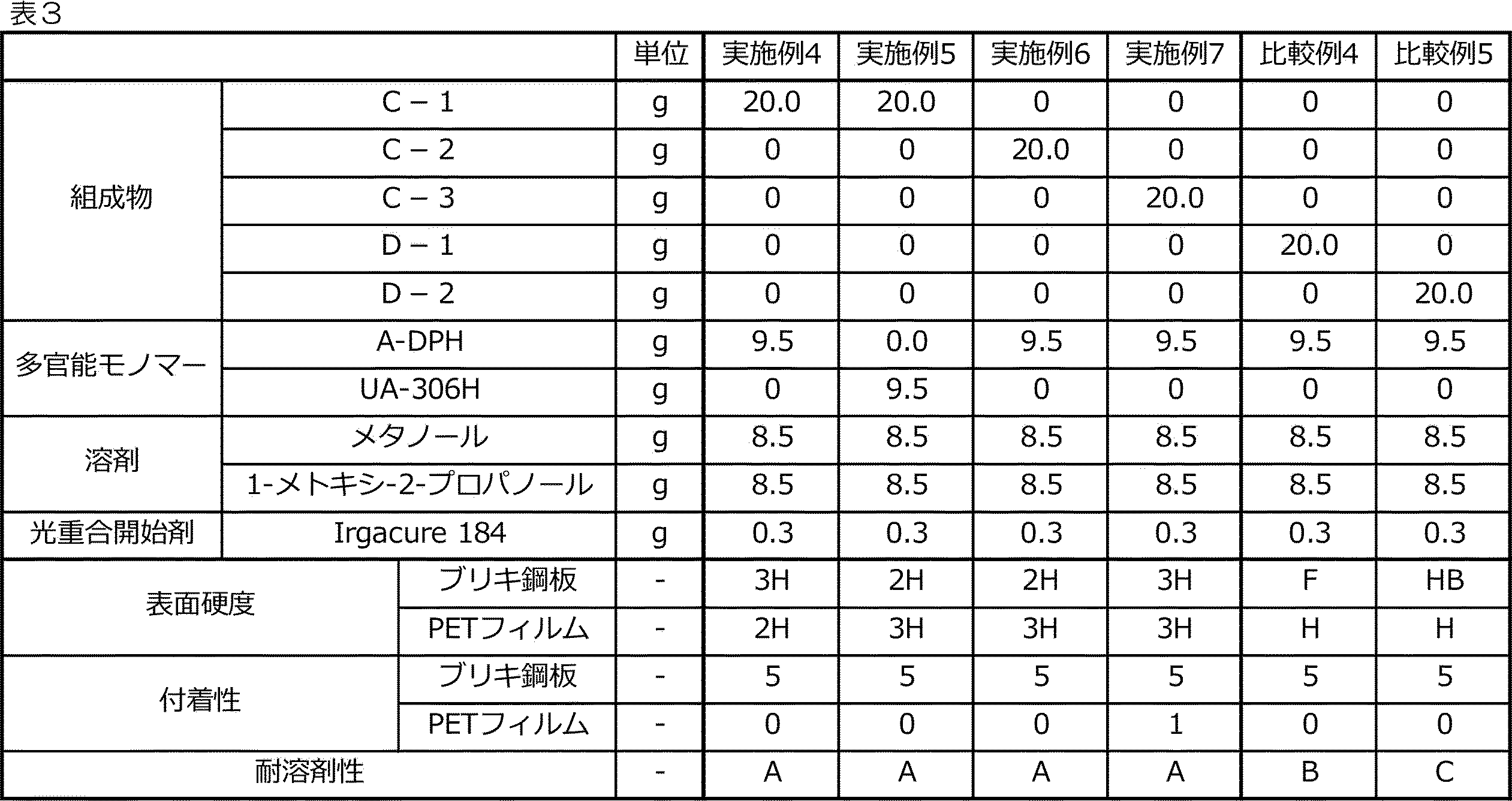
微粒子分散液として組成物(C-1)~(C-3)を用いた実施例4~7では、硬度及び耐溶剤性に優れた硬化膜が得られた。
微粒子分散液として組成物(D-1)、(D-2)を用いた比較例4,5では、硬度及び耐溶剤性が不十分な硬化膜が得られた。この結果は、分散剤として用いた重合体の残存二重結合に起因すると考えられる。すなわち、共重合体(A-1)及び(A-2)は、重合体の合成時に反応しなかった二重結合が、硬化膜の調製時には多官能モノマーの官能基と架橋反応し、硬度及び耐溶剤性に優れた硬化膜を形成すると考えられる。共重合体(B-3)は重合体の合成時に反応しなかった二重結合が、反応性が低いため、硬化膜の調製時にも多官能モノマーの官能基と架橋反応せず、硬度及び耐溶剤性が不十分な硬化膜が得られたと考えられる。共重合体(B-4)は二重結合をほとんど含まないため、多官能モノマーの官能基と架橋反応できず、硬度及び耐溶剤性が不十分な硬化膜が得られたと考えられる。
微粒子分散液として組成物(D-1)、(D-2)を用いた比較例4,5では、硬度及び耐溶剤性が不十分な硬化膜が得られた。この結果は、分散剤として用いた重合体の残存二重結合に起因すると考えられる。すなわち、共重合体(A-1)及び(A-2)は、重合体の合成時に反応しなかった二重結合が、硬化膜の調製時には多官能モノマーの官能基と架橋反応し、硬度及び耐溶剤性に優れた硬化膜を形成すると考えられる。共重合体(B-3)は重合体の合成時に反応しなかった二重結合が、反応性が低いため、硬化膜の調製時にも多官能モノマーの官能基と架橋反応せず、硬度及び耐溶剤性が不十分な硬化膜が得られたと考えられる。共重合体(B-4)は二重結合をほとんど含まないため、多官能モノマーの官能基と架橋反応できず、硬度及び耐溶剤性が不十分な硬化膜が得られたと考えられる。
本発明の組成物は分散安定性に優れており、上記組成物を含む硬化性組成物は硬度及び耐溶剤性に優れた硬化物を与えることができる。したがって、本発明の組成物及び硬化性組成物は、例えば、塗料(UV塗料やUVインキ等)、接着剤、コーティング剤等に好適である。
Claims (11)
- 下記一般式(I)で表される構造単位及び下記一般式(II)で表される構造単位を含む共重合体と、無機粒子及び有機顔料粒子からなる群より選ばれる少なくとも1種の粒子とを含む組成物。

[一般式(I)中、R1は水素原子、炭素数1~18のアルキル基、炭素数2~18のアルケニル基、及び炭素数7~18のアラルキル基からなる群より選ばれるいずれかを表し、R2は水素原子又はメチル基を表す。nは1~5の任意の整数である。]

[一般式(II)中、Xは以下に示す式(x1)、式(x2)、及び式(x3)からなる群より選ばれるいずれかを表し、R3は水素原子又はメチル基を表す。]

[式(x1)及び式(x2)中、Yはアミノ基、第4級アンモニウム塩、カルボキシ基、カルボン酸塩、ヒドロキシ基、スルホ基、スルホン酸塩、硫酸エステル基、硫酸エステル塩、リン酸基、リン酸塩、リン酸エステル基、及びリン酸エステル塩からなる群より選ばれるいずれかを表す。式(x1)中、ZはO(酸素原子)又はNH(アミノ基)を表す。R4は炭素数1~10の脂肪族炭化水素からなる連結基を表し、前記連結基は分岐していてもよく、任意の炭素原子がリン酸エステル塩、第4級アンモニウム塩、及び水酸基が結合した炭素原子からなる群のいずれかに置換されていてもよい。m及びpはそれぞれ独立して0又は1を表す。式(x3)中、qは5~30の任意の整数を表す。●は結合部を表す。] - 更に溶媒を含む、請求項1に記載の組成物。
- 前記一般式(I)において、R1がメチル基であり、nが1である、請求項1又は2に記載の組成物。
- 前記共重合体が、更にアルキル(メタ)アクリレート由来の構造単位を含む共重合体である、請求項1~3のいずれかに記載の組成物。
- 前記一般式(II)において、Xが式(x1)である、請求項1~4のいずれかに記載の組成物。
- 前記式(x1)において、R4が炭素数1~5の脂肪族炭化水素からなる連結基である、請求項1~5のいずれかに記載の組成物。
- 前記式(x1)において、ZがO(酸素原子)である、請求項1~6のいずれかに記載の組成物。
- 前記式(x1)及び式(x2)において、Yがカルボン酸塩又は第4級アンモニウム塩である、請求項1~7のいずれかに記載の組成物。
- 前記粒子が、無機化合物粒子、金属粒子、及び炭素粒子からなる群より選ばれる少なくとも1種である、請求項1~8のいずれかに記載の組成物。
- 請求項1~9のいずれかに記載の組成物、ラジカル重合開始剤、及び多官能ラジカル重合性化合物を含む、硬化性組成物。
- 請求項10に記載の硬化性組成物を硬化してなる、硬化物。
Priority Applications (1)
| Application Number | Priority Date | Filing Date | Title |
|---|---|---|---|
| JP2022568237A JP7840271B2 (ja) | 2020-12-08 | 2021-12-02 | 組成物、硬化性組成物、及び硬化物 |
Applications Claiming Priority (2)
| Application Number | Priority Date | Filing Date | Title |
|---|---|---|---|
| JP2020-203700 | 2020-12-08 | ||
| JP2020203700 | 2020-12-08 |
Publications (1)
| Publication Number | Publication Date |
|---|---|
| WO2022124202A1 true WO2022124202A1 (ja) | 2022-06-16 |
Family
ID=81974452
Family Applications (1)
| Application Number | Title | Priority Date | Filing Date |
|---|---|---|---|
| PCT/JP2021/044350 Ceased WO2022124202A1 (ja) | 2020-12-08 | 2021-12-02 | 組成物、硬化性組成物、及び硬化物 |
Country Status (3)
| Country | Link |
|---|---|
| JP (1) | JP7840271B2 (ja) |
| TW (1) | TW202231801A (ja) |
| WO (1) | WO2022124202A1 (ja) |
Cited By (2)
| Publication number | Priority date | Publication date | Assignee | Title |
|---|---|---|---|---|
| JPWO2019208353A1 (ja) * | 2018-04-23 | 2021-04-22 | 株式会社クラレ | 硬化性に優れる組成物 |
| WO2025047700A1 (ja) * | 2023-08-30 | 2025-03-06 | 日産化学株式会社 | 波長変換膜形成用組成物及びその用途 |
Citations (7)
| Publication number | Priority date | Publication date | Assignee | Title |
|---|---|---|---|---|
| JPS6218410A (ja) * | 1985-07-17 | 1987-01-27 | Ricoh Co Ltd | 非水系樹脂分散液 |
| JPH0258513A (ja) * | 1988-08-25 | 1990-02-27 | Ricoh Co Ltd | 含弗素グラフト共重合体 |
| JP2009063985A (ja) * | 2006-12-27 | 2009-03-26 | Fujifilm Corp | 顔料分散組成物、硬化性組成物、並びにカラーフィルタ及びその製造方法 |
| CN102452936A (zh) * | 2010-10-18 | 2012-05-16 | 中国石油化工股份有限公司 | 一种丙烯酸酯化合物和聚合物及其制备方法和应用 |
| JP2015010168A (ja) * | 2013-06-28 | 2015-01-19 | 東洋インキScホールディングス株式会社 | 光学的立体造形用樹脂組成物、及び立体造形物 |
| WO2016052141A1 (ja) * | 2014-09-29 | 2016-04-07 | 富士フイルム株式会社 | 活性エネルギー線硬化性組成物および帯電防止フィルム |
| JP2020007503A (ja) * | 2018-07-11 | 2020-01-16 | 株式会社クラレ | 活性エネルギー線硬化性組成物 |
-
2021
- 2021-12-02 JP JP2022568237A patent/JP7840271B2/ja active Active
- 2021-12-02 WO PCT/JP2021/044350 patent/WO2022124202A1/ja not_active Ceased
- 2021-12-07 TW TW110145612A patent/TW202231801A/zh unknown
Patent Citations (7)
| Publication number | Priority date | Publication date | Assignee | Title |
|---|---|---|---|---|
| JPS6218410A (ja) * | 1985-07-17 | 1987-01-27 | Ricoh Co Ltd | 非水系樹脂分散液 |
| JPH0258513A (ja) * | 1988-08-25 | 1990-02-27 | Ricoh Co Ltd | 含弗素グラフト共重合体 |
| JP2009063985A (ja) * | 2006-12-27 | 2009-03-26 | Fujifilm Corp | 顔料分散組成物、硬化性組成物、並びにカラーフィルタ及びその製造方法 |
| CN102452936A (zh) * | 2010-10-18 | 2012-05-16 | 中国石油化工股份有限公司 | 一种丙烯酸酯化合物和聚合物及其制备方法和应用 |
| JP2015010168A (ja) * | 2013-06-28 | 2015-01-19 | 東洋インキScホールディングス株式会社 | 光学的立体造形用樹脂組成物、及び立体造形物 |
| WO2016052141A1 (ja) * | 2014-09-29 | 2016-04-07 | 富士フイルム株式会社 | 活性エネルギー線硬化性組成物および帯電防止フィルム |
| JP2020007503A (ja) * | 2018-07-11 | 2020-01-16 | 株式会社クラレ | 活性エネルギー線硬化性組成物 |
Cited By (3)
| Publication number | Priority date | Publication date | Assignee | Title |
|---|---|---|---|---|
| JPWO2019208353A1 (ja) * | 2018-04-23 | 2021-04-22 | 株式会社クラレ | 硬化性に優れる組成物 |
| JP7194176B2 (ja) | 2018-04-23 | 2022-12-21 | 株式会社クラレ | 硬化性に優れる組成物 |
| WO2025047700A1 (ja) * | 2023-08-30 | 2025-03-06 | 日産化学株式会社 | 波長変換膜形成用組成物及びその用途 |
Also Published As
| Publication number | Publication date |
|---|---|
| JPWO2022124202A1 (ja) | 2022-06-16 |
| TW202231801A (zh) | 2022-08-16 |
| JP7840271B2 (ja) | 2026-04-03 |
Similar Documents
| Publication | Publication Date | Title |
|---|---|---|
| JP5483810B2 (ja) | 樹脂組成物 | |
| JP4614813B2 (ja) | 低屈折率膜形成用組成物およびその硬化膜付基材 | |
| WO2002102907A1 (en) | Coating composition and article coated with the composition | |
| TWI815807B (zh) | 活性能量線硬化型硬塗劑、硬化塗膜、積層薄膜 | |
| KR20160063334A (ko) | 무기 입자 분산액, 무기 입자 함유 조성물, 도막, 도막 부착 플라스틱 기재, 표시 장치 | |
| WO2015152171A1 (ja) | 透明被膜形成用の塗布液及びその製造法、有機樹脂分散ゾル、ならびに透明被膜付基材及びその製造方法 | |
| CN101600738B (zh) | 反应性单体分散硅溶胶、其制备方法、固化用组合物及其固化体 | |
| JP7840271B2 (ja) | 組成物、硬化性組成物、及び硬化物 | |
| CN104744639A (zh) | 一种有机硅改性常温多重自交联环氧树脂乳液的制备方法 | |
| JP6295652B2 (ja) | 光硬化性重合体、光硬化性樹脂組成物、その硬化物、及び硬化塗膜 | |
| JP2009035595A (ja) | ハードコート膜付基材およびハードコート膜形成用塗布液 | |
| JP7786160B2 (ja) | 活性エネルギー線硬化性組成物及び硬化物 | |
| JP7153114B2 (ja) | 透明被膜形成用の塗布液及び透明被膜付基材 | |
| JP5885500B2 (ja) | 透明被膜形成用塗料および透明被膜付基材 | |
| JPWO2016009962A1 (ja) | 酸化ジルコニウム、酸化ジルコニウム分散液、酸化ジルコニウム含有組成物、塗膜、および表示装置 | |
| JP6703828B2 (ja) | 光硬化性防眩樹脂組成物 | |
| JP2009256577A (ja) | コート剤およびクリアコートフィルム | |
| JP2005297414A (ja) | プライマー用組成物及びこれを用いたガスバリア性積層フィルム | |
| JP2015193756A (ja) | 有機樹脂分散ゾル、透明被膜形成用塗布液および透明被膜形成用塗布液の製造法ならびに透明被膜付基材 | |
| JP2005298754A (ja) | 活性エネルギー線硬化性コーティング用組成物および保護被膜形成方法 | |
| JP2013194091A (ja) | 活性エネルギー線硬化性樹脂組成物およびその製造方法、ならびにコーティング剤、積層体 | |
| TW201716491A (zh) | 導電性層疊體及金屬氧化物組成物 | |
| JP2023058077A (ja) | 樹脂改質用モノマー組成物 | |
| JP2008248098A (ja) | 液状硬化性組成物、硬化膜及び帯電防止用積層体 | |
| JP5245190B2 (ja) | 液状硬化性組成物及び硬化膜 |
Legal Events
| Date | Code | Title | Description |
|---|---|---|---|
| 121 | Ep: the epo has been informed by wipo that ep was designated in this application |
Ref document number: 21903306 Country of ref document: EP Kind code of ref document: A1 |
|
| ENP | Entry into the national phase |
Ref document number: 2022568237 Country of ref document: JP Kind code of ref document: A |
|
| NENP | Non-entry into the national phase |
Ref country code: DE |
|
| 122 | Ep: pct application non-entry in european phase |
Ref document number: 21903306 Country of ref document: EP Kind code of ref document: A1 |