WO2022124074A1 - 個装箱 - Google Patents
個装箱 Download PDFInfo
- Publication number
- WO2022124074A1 WO2022124074A1 PCT/JP2021/042968 JP2021042968W WO2022124074A1 WO 2022124074 A1 WO2022124074 A1 WO 2022124074A1 JP 2021042968 W JP2021042968 W JP 2021042968W WO 2022124074 A1 WO2022124074 A1 WO 2022124074A1
- Authority
- WO
- WIPO (PCT)
- Prior art keywords
- bent portion
- main body
- bent
- opening
- top plate
- Prior art date
- Legal status (The legal status is an assumption and is not a legal conclusion. Google has not performed a legal analysis and makes no representation as to the accuracy of the status listed.)
- Ceased
Links
Images






Classifications
-
- B—PERFORMING OPERATIONS; TRANSPORTING
- B65—CONVEYING; PACKING; STORING; HANDLING THIN OR FILAMENTARY MATERIAL
- B65D—CONTAINERS FOR STORAGE OR TRANSPORT OF ARTICLES OR MATERIALS, e.g. BAGS, BARRELS, BOTTLES, BOXES, CANS, CARTONS, CRATES, DRUMS, JARS, TANKS, HOPPERS, FORWARDING CONTAINERS; ACCESSORIES, CLOSURES, OR FITTINGS THEREFOR; PACKAGING ELEMENTS; PACKAGES
- B65D5/00—Rigid or semi-rigid containers of polygonal cross-section, e.g. boxes, cartons or trays, formed by folding or erecting one or more blanks made of paper
- B65D5/02—Rigid or semi-rigid containers of polygonal cross-section, e.g. boxes, cartons or trays, formed by folding or erecting one or more blanks made of paper by folding or erecting a single blank to form a tubular body with or without subsequent folding operations, or the addition of separate elements, to close the ends of the body
- B65D5/10—Rigid or semi-rigid containers of polygonal cross-section, e.g. boxes, cartons or trays, formed by folding or erecting one or more blanks made of paper by folding or erecting a single blank to form a tubular body with or without subsequent folding operations, or the addition of separate elements, to close the ends of the body with end closures formed by inward-folding of self-locking flaps hinged to tubular body
-
- B—PERFORMING OPERATIONS; TRANSPORTING
- B65—CONVEYING; PACKING; STORING; HANDLING THIN OR FILAMENTARY MATERIAL
- B65D—CONTAINERS FOR STORAGE OR TRANSPORT OF ARTICLES OR MATERIALS, e.g. BAGS, BARRELS, BOTTLES, BOXES, CANS, CARTONS, CRATES, DRUMS, JARS, TANKS, HOPPERS, FORWARDING CONTAINERS; ACCESSORIES, CLOSURES, OR FITTINGS THEREFOR; PACKAGING ELEMENTS; PACKAGES
- B65D5/00—Rigid or semi-rigid containers of polygonal cross-section, e.g. boxes, cartons or trays, formed by folding or erecting one or more blanks made of paper
- B65D5/42—Details of containers or of foldable or erectable container blanks
-
- B—PERFORMING OPERATIONS; TRANSPORTING
- B65—CONVEYING; PACKING; STORING; HANDLING THIN OR FILAMENTARY MATERIAL
- B65D—CONTAINERS FOR STORAGE OR TRANSPORT OF ARTICLES OR MATERIALS, e.g. BAGS, BARRELS, BOTTLES, BOXES, CANS, CARTONS, CRATES, DRUMS, JARS, TANKS, HOPPERS, FORWARDING CONTAINERS; ACCESSORIES, CLOSURES, OR FITTINGS THEREFOR; PACKAGING ELEMENTS; PACKAGES
- B65D5/00—Rigid or semi-rigid containers of polygonal cross-section, e.g. boxes, cartons or trays, formed by folding or erecting one or more blanks made of paper
- B65D5/42—Details of containers or of foldable or erectable container blanks
- B65D5/64—Lids
- B65D5/66—Hinged lids
-
- Y—GENERAL TAGGING OF NEW TECHNOLOGICAL DEVELOPMENTS; GENERAL TAGGING OF CROSS-SECTIONAL TECHNOLOGIES SPANNING OVER SEVERAL SECTIONS OF THE IPC; TECHNICAL SUBJECTS COVERED BY FORMER USPC CROSS-REFERENCE ART COLLECTIONS [XRACs] AND DIGESTS
- Y02—TECHNOLOGIES OR APPLICATIONS FOR MITIGATION OR ADAPTATION AGAINST CLIMATE CHANGE
- Y02W—CLIMATE CHANGE MITIGATION TECHNOLOGIES RELATED TO WASTEWATER TREATMENT OR WASTE MANAGEMENT
- Y02W30/00—Technologies for solid waste management
- Y02W30/50—Reuse, recycling or recovery technologies
- Y02W30/80—Packaging reuse or recycling, e.g. of multilayer packaging
Definitions
- the present invention relates to an individual packaging box.
- Patent Document 1 describes an individual packaging box in which once a folded locking piece is inserted into an insertion hole, it cannot be pulled back from the insertion hole and the lid flap is fixed. In the individual packaging box described in Patent Document 1, when a part of the lid flap is cut, the locking by the locking piece can be released, and the lid flap can be opened.
- Patent Document 1 The individual packaging box described in Patent Document 1 must be damaged in order to take out the product from the individual packaging box for the purpose of inspection or repair of the product (object to be stored) stored in the individual packaging box. Therefore, the individual packaging box cannot be opened in a reusable state.
- One or more embodiments may prevent unauthorized opening without using an opening prevention seal, store the items to be stored, close the individual packaging box, and then open the individual packaging box in a reusable state.
- the purpose is to provide an individual packaging box that can be used.
- a main body portion having first and second side plates facing each other and having an opening for inserting and removing an object to be stored, and the first side plate.
- a top plate that is connected to the end on the opening side and rotates with respect to the first side plate to open and close the opening, and a top plate that is connected to the top plate and rotates with respect to the top plate. Then, with the top plate closing the opening, the inner flap located on the inner surface side of the second side plate is connected to the second side plate and rotates with respect to the second side plate.
- a base a first bent portion connected to the base and rotated with respect to the base, and a second bent portion connected to the first bent portion and rotated with respect to the first bent portion.
- the inner flap is provided with an outer flap having the bent portion of the above, and a linear slit is formed in the inner flap, and the width in the direction orthogonal to the longitudinal direction of the slit is the first bent portion and the first.
- the first bent portion is wider than the thickness of the two bent portions, with the top plate closing the opening and the inner flap located on the inner surface side of the second side plate.
- the second bent portion are overlapped with each other and passed through the slit to enter the inside of the main body portion, the second bent portion is separated from the first bent portion, and the said The first and second bent portions cannot be pulled out from the inside of the main body portion through the slit to the outside of the main body portion, so that the top plate maintains the state in which the opening is closed.
- the second bent portion separated from the first bent portion inside the main body portion is pushed against the top plate to bring the first and second bent portions into contact with each other.
- An individual packaging box is provided in which a through hole is formed for inserting an opening tool for inserting into the inside of the main body portion.
- unauthorized opening is prevented without using an opening prevention seal, and the individual packaging box is stored and then reused.
- the packaging box can be opened.
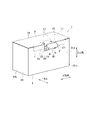
- FIG. 1 is an individual packaging box according to one or more embodiments, and is a perspective view showing a state in which an opening is open.
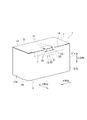
- FIG. 2 is an individual packaging box according to one or more embodiments, and is a perspective view showing a state before the opening is closed and the outer flap is inserted into the main body portion.
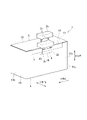
- FIG. 3 is an individual packaging box according to one or more embodiments, and is a perspective view showing a state in which the opening is closed and the outer flap is inserted into the main body portion.
- FIG. 4 is a perspective view showing a state in which an individual packaging box according to one or more embodiments of the state shown in FIG. 3 is to be opened by using an opening tool.
- FIG. 1 is an individual packaging box according to one or more embodiments, and is a perspective view showing a state in which an opening is open.
- FIG. 2 is an individual packaging box according to one or more embodiments, and is a perspective view showing a state before the opening is closed and the outer flap is inserted into the main body portion.
- FIG. 5 is a partial cross-sectional view of an individual packaging box according to one or more embodiments in which the opening is not closed, cut along a plane orthogonal to the X direction.
- FIG. 6 is a partial cross-sectional view of the individual packaging box according to one or more embodiments in which the opening is closed and the outer flap is inserted into the main body, cut along a plane orthogonal to the X direction.
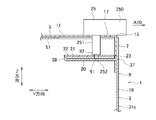
- FIG. 7 is a partial cross-sectional view of an individual packaging box according to one or more embodiments in which an opening tool is used, cut along a plane orthogonal to the X direction.
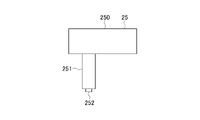
- FIG. 8A is a side view showing the opening tool.
- FIG. 8B is a plan view of the opening tool as viewed from the lower surface.
- FIG. 9 is a partial cross-sectional view of the individual packaging box according to the first modification of the embodiment in which the opening is closed and the outer flap is inserted into the main body portion, cut in a plane orthogonal to the X direction.
- FIG. 10 is a partial cross-sectional view of the individual packaging box according to the first modification of one or more embodiments in which the opening tool is used, cut along a plane orthogonal to the X direction.
- FIG. 11 is a partial cross-sectional view of an individual packaging box according to a second modification of one or more embodiments in which an opening tool is used, cut along a plane orthogonal to the X direction.
- the individual packaging box 1 accommodates an electric device such as headphones or any other device as an example of the stored object.
- the individual packaging box 1 includes a main body portion 3, a top plate 5, an inner flap 7, an outer flap 9, a pair of side flaps 45, and a top flap 51.
- the main body 3 is formed in the shape of a rectangular parallelepiped box.
- the top plate 5 has a rectangular shape.
- the longitudinal direction of the main body 3 is the X direction (horizontal direction)
- the lateral direction of the main body 3 orthogonal to the X direction is the Y direction (depth direction)
- the X direction and the direction orthogonal to the Y direction are the Z direction (height direction). ).
- the main body 3 includes a bottom plate 29 and four side plates 31a to 31d.
- the side plate 31a (first side plate) and the side plate 31c (second side plate) face each other, and the side plate 31b and the side plate 31d face each other.
- the main body portion 3 has an opening 11 at the upper end portion (end portion in the Z direction) for inserting and removing the stored object.
- the individual packaging box 1 is formed symmetrically when the individual packaging box 1 is viewed from the side plate 31c side.
- the individual packaging box 1 is made of a material such as paper having a predetermined thickness. It is assumed that the material forming the individual packaging box 1 is paper.
- the top plate 5 is connected to the upper end of the side plate 31a.
- the top plate 5 is rotatable with respect to the side plate 31a with the boundary portion 13 with the side plate 31a as the center of rotation. Rotation means rotating in both directions within an angle range of less than 360 degrees.
- the inner flap 7 is connected to an end portion of the top plate 5 opposite to the boundary portion 13.
- the inner flap 7 is rotatable with respect to the top plate 5 with the boundary portion 15 with the top plate 5 as the center of rotation.
- the top plate 5 is provided with two oblong-shaped through holes 17 in the vicinity of the inner flap 7.
- An oval is a shape in which two semicircular arcs with the same radius are connected by a common circumscribed line.
- the shape of the through hole 17 is not limited to an oval shape.
- the two through holes 17 are arranged in the X direction with a predetermined interval.
- the through hole 17 has a size that does not allow a human finger to enter.
- the inner flap 7 is formed with a linear slit 23 penetrating the inner flap 7.
- the two through holes 17 are provided in the vicinity of the boundary portion 15 so as to be located within the range of both ends of the slit 23 in the X direction.
- the outer flap 9 is provided near the upper end portion of the side plate 31c. As shown in FIG. 1 or 3, two notches 33 having a predetermined length are formed from the end portion (upper end portion of the main body portion 3) of the side plate 31c on the top flap 51 side. The line segment connecting the ends of the two notches 33 on the side away from the top flap 51 is the connecting portion 35 between the outer flap 9 and the side plate 31c.
- the outer flap 9 is formed by cutting a part of the region straddling the side plate 31c and the top flap 51, bending the cut region outward at the connecting portion 35 with the side plate 31c, and further bending the cut region at two points. There is.
- the outer flap 9 includes a base portion 19 connected to the side plate 31c by the connecting portion 35, a first bent portion 20 connected to the base portion 19, and a second bent portion 21 connected to the first bent portion 20.
- the base 19, the first bent portion 20, and the second bent portion 21 have a rectangular shape.
- the first bent portion 20 is an intermediate portion of the entire outer flap 9, and the second bent portion 21 is a tip portion of the entire outer flap 9.
- the outer flap 9 is rotatable with respect to the side plate 31c with the connecting portion 35 as the center of rotation.
- the first bent portion 20 and the second bent portion 21 are rotatable about the boundary portion 37 shown in FIG. 5 as the center of rotation.
- the second bent portion 21 is rotatable about the boundary portion 38 shown in FIG. 5 as the center of rotation.
- the first bent portion 20 may also rotate around the boundary portion 37.
- the connecting portion 35 and the boundary portions 37 and 38 are parallel to each other.
- the distance from the boundary portion 38, which is the length of the second bent portion 21, to the tip of the second bent portion 21 is from the boundary portion 37, which is the length of the first bent portion 20, to the boundary portion. Shorter than the distance to 38.
- Circular through holes 91 are formed at both ends of the second bent portion 21 in the width direction.
- the pair of through holes 91 are preferably provided on the tip side of the range from the boundary portion 38 of the second bent portion 21 to the tip end rather than the central position.
- the length of the slit 23 formed in the inner flap 7 in the X direction is slightly longer than the width of the outer flap 9 in the X direction.
- the width of the slit 23 in the direction orthogonal to the X direction is slightly wider than the thickness of the first bent portion 20 and the second bent portion 21 overlapped with each other. Therefore, as will be described later, the first bent portion 20 and the second bent portion 21 that are overlapped with each other can be inserted into the slit 23.
- the individual packaging box 1 configured as described above has an opening 11 as shown in FIG. 1 in the initial state.
- the pair of side flaps 45 is rotated to cover the left and right ends of the opening 11, and the top flap 51 is further rotated with respect to the side plate 31c, the top flap 51 becomes ,
- the opening 11 is largely closed inside the top plate 5.
- the top plate 5 is rotated so as to approach the top flap 51, and the left and right ends of the inner flap 7 are inserted into the gaps 52 formed on both outer sides of the outer flap 9 between the side plate 31c and the top flap 51.
- the state shown in 2 is obtained.
- the inner flap 7 is located on the inner surface side of the side plate 31c and closes the opening formed by cutting the outer flap 9 at the upper end of the side plate 31c.
- the inner flap 7 comes into contact with the inner surface of the side plate 31c.
- the top plate 5 closes the opening formed by cutting the outer flap 9 of the top flap 51, and covers the entire top flap 51.
- the top plate 5 closes the opening 11 via the pair of side flaps 45 and the top flap 51.
- the second bent portion 21 is pressed to superimpose the first bent portion 20 and the second bent portion 21, and the first bent portion 20 and the second folded portion 20 are superposed.
- the bent portion 21 of No. 21 is rotated around the connecting portion 35 and the boundary portion 37 and inserted into the slit 23
- the state shown in FIG. 3 is obtained.
- the second bent portion 21 rotates around the boundary portion 38. And rotate to separate from the first bent portion 20.
- the base portion 19 is pulled outward to move the outer flap 9 in the direction indicated by the arrow A6 in FIG. Even if it is attempted to rotate, the second bent portion 21 comes into contact with the inner surface of the inner flap 7, so that the outer flap 9 cannot be pulled out to the outside of the main body portion 3.
- the top plate 5 maintains a state in which the opening 11 of the main body 3 is closed via the pair of side flaps 45 and the top flap 51.
- the top plate 5 closes the opening 11. It acts as a closed state maintenance part that maintains the state of being.
- the outer flap 9 cannot be pulled out and the top plate 5 cannot be opened.
- the individual packaging box 1 can prevent unauthorized opening without using an opening prevention seal.
- the individual packaging box 1 is configured so that after the individual packaging box 1 is closed, it can be opened in a reusable state by using a dedicated opening tool. By opening the individual packaging box 1 with the opening tool, the top plate 5, the inner flap 7, or the outer flap 9 will not be damaged or the main body 3 will not be deformed. No need to replace.
- the opening tool 25 has a rectangular parallelepiped tool body 250 and a pair of columnar legs 251 protruding from the tool body 250. At the tip of each leg portion 251 is provided with a columnar protruding portion 252 having a diameter smaller than the diameter of the leg portion 251.
- the opening tool 25 having the tool body 250 and the pair of legs 251 having the protrusions 252 can be formed, for example, by integrally molding a synthetic resin.
- the distance between the pair of legs 251 is the same as the distance between the pair of through holes 17.
- the diameter of the leg 251 is slightly smaller than the distance between the two common circumscribed lines of the through hole 17. Therefore, the pair of leg portions 251 can be inserted into the pair of through holes 17. Since the through hole 17 has an oblong shape, the pair of legs 251 can be moved in the pair of through holes 17.
- the through hole 17 may be elliptical in order to move the leg portion 251 within the through hole 17.
- the diameter of the protrusion 252 is slightly smaller than the diameter of the through hole 91.
- the length (protrusion amount) of the protrusion 252 is preferably equal to or greater than the plate thickness of the second bent portion 21.
- the opening tool 25 is lowered from above the individual packaging box 1 until the tool body 250 comes into contact with the top plate 5, and the pair of legs 251 are inserted into the pair of through holes 17.
- the leg portion 251 protruding portion 252 pushes the second bent portion 21 in the first bent portion 20 and the second bent portion 21 in a state of being separated from each other as shown in FIG.
- the second bent portion 21 rotates around the boundary portion 38 and comes into contact with the first bent portion 20, and the first bent portion 20 and the first bent portion 20 come into contact with each other.
- the bent portion 21 of 2 is overlapped with each other.
- the length of the leg portion 251 is such that the second bent portion 21 can be brought into contact with the first bent portion 20.
- the pair of protrusions 252 can be inserted into the pair of through holes 91.
- the leg portion 251 is inserted into the through hole 17 and the second bent portion 21 is brought into contact with the first bent portion 20, the protruding portion 252 is displaced from the through hole 91 and is not inserted into the through hole 91. There is. Even in such a case, the pair of protrusions 252 can be inserted into the pair of through holes 91 by moving the opening tool 25.
- the protrusion 252 functions as an engaging portion that engages with the through hole 91, and the through hole 91 functions as an engaged portion with which the protrusion 252 engages.
- the individual packaging box 1 When the outer flap 9 is pulled out to the outside of the main body 3, the individual packaging box 1 returns to the state shown in FIG. In FIG. 2, when the inner flap 7 is removed from the gap 52, the top plate 5 is lifted, and the pair of side flaps 45 and the top flap 51 are opened, the individual packaging box 1 can be returned to the state shown in FIG.
- the individual packaging box 1 can be reused by using the dedicated opening tool 25. Can be opened and the items to be stored can be taken out. At this time, the top plate 5, the inner flap 7, or the outer flap 9 is not damaged or the main body portion 3 is not deformed. After the inspection or repair of the stored object is completed, the stored object can be stored in the main body 3 again and the individual packaging box 1 can be closed. When it becomes necessary to take out the items to be stored from the individual packaging box 1 before shipping the product, the items to be stored can be taken out by using the opening tool 25. Unauthorized opening can be prevented at stores and the like after the product has been shipped.
- the outer flap 9 shown in FIG. 9 further has a third bent portion 22 connected to the second bent portion 21.
- the third bent portion 22 has a rectangular shape.
- the third bent portion 22 is rotatable with respect to the second bent portion 21 with the boundary portion 39 as the center of rotation.
- Circular through holes 92 are formed at both ends of the third bent portion 22 in the width direction. In a state where the second bent portion 21 and the third bent portion 22 are overlapped with each other, the through hole 91 and the through hole 92 are in the plane direction of the second bent portion 21 and the third bent portion 22. Will be in the same position.
- the width of the slit 23 in the direction orthogonal to the X direction (width in the direction orthogonal to the longitudinal direction) in the first modification is larger than the thickness of the first bent portion 20 to the third bent portion 22 overlapped. Slightly wide. Therefore, the first bent portion 20 to the third bent portion 22 that overlap each other can be inserted into the slit 23. As shown in FIG. 9, the overlapped first bent portion 20 to the third bent portion 22 are inserted into the slit 23, and the first bent portion 20 to the third bent portion 22 is the main body portion. When entering the inside of 3, the first bent portion 20 to the third bent portion 22 are separated from each other. Since the third bent portion 22 comes into contact with the inner surface of the top plate 5, the pair of through holes 17 are closed from the inner surface side.
- the top plate 5 maintains a state in which the opening 11 of the main body 3 is closed via the pair of side flaps 45 and the top flap 51.
- the opening tool 25 used in the first modification has the same configuration as the opening tool 25 shown in FIGS. 8A and 8B.
- the length (protruding amount) of the protruding portion 252 in the opening tool 25 used in the first modification is set to be equal to or larger than the combined plate thickness of the second bent portion 21 and the third bent portion 22. Is good.
- the first bent portion 20 to the third bent portion 22 overlap each other.
- the protrusion 252 can be inserted into the through holes 91 and 92.
- the through holes 91 and 92 function as engaged portions with which the protrusions 252 engage.
- the length of the leg portion 251 is such that the third bent portion 22 can be brought into contact with the second bent portion 21 and the second bent portion 21 can be brought into contact with the first bent portion 20. Is.
- the opening tool 25 can be slid in the direction of the arrow A10 to pull out the outer flap 9 to the outside of the main body 3.
- the third bent portion 22 closes the through hole 17 from the inner surface side of the top plate 5, so that the individual packaging box 1 is used. It looks good in the closed state and prevents foreign matter from entering the inside of the main body 3.
- the second modification will be described with reference to FIG.
- the outer flap 9 in the second modification has a base 19, a first bent portion 20, and a second bent portion 21, similar to the outer flap 9 shown in FIG.
- the through hole 91 is not formed in the second bent portion 21 of the second modification.
- the protrusion 252 in the opening tool 25 shown in FIGS. 8A and 8B has been deleted.
- the through hole 17 has a circular shape having a diameter into which the leg portion 251 can be inserted.
- the leg portions 251 When the pair of leg portions 251 are inserted into the pair of through holes 17, the leg portions 251 push the first bent portion 20 and the second bent portion 21 in the second bent portion 21 in a state of being separated from each other. The first bent portion 20 and the second bent portion 21 are in an overlapping state. By pulling the base portion 19 outward and rotating the outer flap 9, the outer flap 9 can be pulled out to the outside of the main body portion 3.
- the through holes 91 and 92 are deleted in the outer flap 9 having the base 19, the first bent portion 20, the second bent portion 21, and the third bent portion 22. May be good.
Landscapes
- Engineering & Computer Science (AREA)
- Mechanical Engineering (AREA)
- Cartons (AREA)
Priority Applications (2)
| Application Number | Priority Date | Filing Date | Title |
|---|---|---|---|
| JP2022568169A JPWO2022124074A1 (https=) | 2020-12-09 | 2021-11-24 | |
| CN202180070586.7A CN116323408B (zh) | 2020-12-09 | 2021-11-24 | 独立包装箱 |
Applications Claiming Priority (2)
| Application Number | Priority Date | Filing Date | Title |
|---|---|---|---|
| JP2020-203970 | 2020-12-09 | ||
| JP2020203970 | 2020-12-09 |
Publications (1)
| Publication Number | Publication Date |
|---|---|
| WO2022124074A1 true WO2022124074A1 (ja) | 2022-06-16 |
Family
ID=81974424
Family Applications (1)
| Application Number | Title | Priority Date | Filing Date |
|---|---|---|---|
| PCT/JP2021/042968 Ceased WO2022124074A1 (ja) | 2020-12-09 | 2021-11-24 | 個装箱 |
Country Status (3)
| Country | Link |
|---|---|
| JP (1) | JPWO2022124074A1 (https=) |
| CN (1) | CN116323408B (https=) |
| WO (1) | WO2022124074A1 (https=) |
Citations (4)
| Publication number | Priority date | Publication date | Assignee | Title |
|---|---|---|---|---|
| US5350108A (en) * | 1992-10-14 | 1994-09-27 | Why Wrap? Incorporated | Self-locking box |
| JP3216513U (ja) * | 2018-03-23 | 2018-05-31 | 富山スガキ株式会社 | ロック機能付き包装箱 |
| JP2020169044A (ja) * | 2019-04-04 | 2020-10-15 | 王子ホールディングス株式会社 | 包装箱および鍵付き包装箱 |
| JP2020169043A (ja) * | 2019-04-04 | 2020-10-15 | 王子ホールディングス株式会社 | 包装箱及び鍵付き包装箱 |
Family Cites Families (8)
| Publication number | Priority date | Publication date | Assignee | Title |
|---|---|---|---|---|
| JPH0442449Y2 (https=) * | 1986-11-07 | 1992-10-07 | ||
| US5803345A (en) * | 1996-02-02 | 1998-09-08 | Why Wrap? Incorporated | Self-locking box with opening device |
| JP4536881B2 (ja) * | 2000-07-19 | 2010-09-01 | ザ・パック株式会社 | 蓋付き包装用紙箱 |
| JP4493201B2 (ja) * | 2000-11-14 | 2010-06-30 | 大日本印刷株式会社 | カートン |
| JP4819451B2 (ja) * | 2005-09-09 | 2011-11-24 | ローム株式会社 | 段ボール箱 |
| DE202005017363U1 (de) * | 2005-11-07 | 2007-03-15 | Gustav Stabernack Gmbh | Verpackungsbehälter, insbesondere kindersicherer Verpackungsbehälter |
| JP3223268U (ja) * | 2019-07-17 | 2019-09-26 | ミネベアミツミ株式会社 | 不正開封防止包装箱及びブランク |
| CN110817035B (zh) * | 2019-12-19 | 2025-06-13 | 美盈森集团股份有限公司 | 一种纸盒 |
-
2021
- 2021-11-24 JP JP2022568169A patent/JPWO2022124074A1/ja active Pending
- 2021-11-24 CN CN202180070586.7A patent/CN116323408B/zh active Active
- 2021-11-24 WO PCT/JP2021/042968 patent/WO2022124074A1/ja not_active Ceased
Patent Citations (4)
| Publication number | Priority date | Publication date | Assignee | Title |
|---|---|---|---|---|
| US5350108A (en) * | 1992-10-14 | 1994-09-27 | Why Wrap? Incorporated | Self-locking box |
| JP3216513U (ja) * | 2018-03-23 | 2018-05-31 | 富山スガキ株式会社 | ロック機能付き包装箱 |
| JP2020169044A (ja) * | 2019-04-04 | 2020-10-15 | 王子ホールディングス株式会社 | 包装箱および鍵付き包装箱 |
| JP2020169043A (ja) * | 2019-04-04 | 2020-10-15 | 王子ホールディングス株式会社 | 包装箱及び鍵付き包装箱 |
Also Published As
| Publication number | Publication date |
|---|---|
| CN116323408B (zh) | 2026-02-27 |
| CN116323408A (zh) | 2023-06-23 |
| JPWO2022124074A1 (https=) | 2022-06-16 |
Similar Documents
| Publication | Publication Date | Title |
|---|---|---|
| KR20120068262A (ko) | 포장박스 | |
| WO2006059499A1 (ja) | プラスチック箱 | |
| JP2021113063A (ja) | 包装用止め具およびそれを用いて連結された包装箱 | |
| GB2251600A (en) | Packages | |
| WO2022124074A1 (ja) | 個装箱 | |
| JP7786393B2 (ja) | 個装箱 | |
| JP6776644B2 (ja) | 箱および梱包体 | |
| JP2020196505A (ja) | 包装箱 | |
| JP4238650B2 (ja) | 包装箱 | |
| JP2007513029A (ja) | 抜き取り防止組立体を有するパッケージ | |
| JP3177596U (ja) | 包装箱 | |
| JP4921800B2 (ja) | 不正開封防止箱 | |
| JP6513936B2 (ja) | 包装用箱 | |
| JP3183806U (ja) | 包装用容器 | |
| JP7169635B2 (ja) | 包装材 | |
| JP7059804B2 (ja) | 包装用止め具及びそれを用いて連結された包装箱 | |
| JP7600054B2 (ja) | 改ざん防止開梱痕跡機能付き包装箱 | |
| JP3211982U (ja) | 改ざん防止型ヘッダー付き包装箱 | |
| JP3235080U (ja) | 化粧品用包装箱 | |
| JP6760021B2 (ja) | 梱包材 | |
| JP3250331U (ja) | 不正混入防止機能を有する包装用箱 | |
| JP7627609B2 (ja) | 包装用箱 | |
| JP3131342U (ja) | 包装梱包箱 | |
| JP5020014B2 (ja) | シート材のロック機構 | |
| US405443A (en) | August stamm |
Legal Events
| Date | Code | Title | Description |
|---|---|---|---|
| 121 | Ep: the epo has been informed by wipo that ep was designated in this application |
Ref document number: 21903178 Country of ref document: EP Kind code of ref document: A1 |
|
| ENP | Entry into the national phase |
Ref document number: 2022568169 Country of ref document: JP Kind code of ref document: A |
|
| NENP | Non-entry into the national phase |
Ref country code: DE |
|
| 122 | Ep: pct application non-entry in european phase |
Ref document number: 21903178 Country of ref document: EP Kind code of ref document: A1 |