WO2022102489A1 - 樹脂組成物、硬化物、半導体封止材、及び、半導体装置 - Google Patents
樹脂組成物、硬化物、半導体封止材、及び、半導体装置 Download PDFInfo
- Publication number
- WO2022102489A1 WO2022102489A1 PCT/JP2021/040509 JP2021040509W WO2022102489A1 WO 2022102489 A1 WO2022102489 A1 WO 2022102489A1 JP 2021040509 W JP2021040509 W JP 2021040509W WO 2022102489 A1 WO2022102489 A1 WO 2022102489A1
- Authority
- WO
- WIPO (PCT)
- Prior art keywords
- resin
- resin composition
- phenol
- epoxy resin
- compound
- Prior art date
- Legal status (The legal status is an assumption and is not a legal conclusion. Google has not performed a legal analysis and makes no representation as to the accuracy of the status listed.)
- Ceased
Links
Images


Classifications
-
- C—CHEMISTRY; METALLURGY
- C08—ORGANIC MACROMOLECULAR COMPOUNDS; THEIR PREPARATION OR CHEMICAL WORKING-UP; COMPOSITIONS BASED THEREON
- C08G—MACROMOLECULAR COMPOUNDS OBTAINED OTHERWISE THAN BY REACTIONS ONLY INVOLVING UNSATURATED CARBON-TO-CARBON BONDS
- C08G59/00—Polycondensates containing more than one epoxy group per molecule; Macromolecules obtained by polymerising compounds containing more than one epoxy group per molecule using curing agents or catalysts which react with the epoxy groups
- C08G59/18—Macromolecules obtained by polymerising compounds containing more than one epoxy group per molecule using curing agents or catalysts which react with the epoxy groups ; e.g. general methods of curing
- C08G59/40—Macromolecules obtained by polymerising compounds containing more than one epoxy group per molecule using curing agents or catalysts which react with the epoxy groups ; e.g. general methods of curing characterised by the curing agents used
- C08G59/62—Alcohols or phenols
-
- C—CHEMISTRY; METALLURGY
- C08—ORGANIC MACROMOLECULAR COMPOUNDS; THEIR PREPARATION OR CHEMICAL WORKING-UP; COMPOSITIONS BASED THEREON
- C08K—Use of inorganic or non-macromolecular organic substances as compounding ingredients
- C08K3/00—Use of inorganic substances as compounding ingredients
- C08K3/01—Use of inorganic substances as compounding ingredients characterized by their specific function
- C08K3/013—Fillers, pigments or reinforcing additives
-
- C—CHEMISTRY; METALLURGY
- C08—ORGANIC MACROMOLECULAR COMPOUNDS; THEIR PREPARATION OR CHEMICAL WORKING-UP; COMPOSITIONS BASED THEREON
- C08L—COMPOSITIONS OF MACROMOLECULAR COMPOUNDS
- C08L61/00—Compositions of condensation polymers of aldehydes or ketones; Compositions of derivatives of such polymers
- C08L61/04—Condensation polymers of aldehydes or ketones with phenols only
- C08L61/06—Condensation polymers of aldehydes or ketones with phenols only of aldehydes with phenols
-
- C—CHEMISTRY; METALLURGY
- C08—ORGANIC MACROMOLECULAR COMPOUNDS; THEIR PREPARATION OR CHEMICAL WORKING-UP; COMPOSITIONS BASED THEREON
- C08L—COMPOSITIONS OF MACROMOLECULAR COMPOUNDS
- C08L63/00—Compositions of epoxy resins; Compositions of derivatives of epoxy resins
-
- H—ELECTRICITY
- H10—SEMICONDUCTOR DEVICES; ELECTRIC SOLID-STATE DEVICES NOT OTHERWISE PROVIDED FOR
- H10W—GENERIC PACKAGES, INTERCONNECTIONS, CONNECTORS OR OTHER CONSTRUCTIONAL DETAILS OF DEVICES COVERED BY CLASS H10
- H10W74/00—Encapsulations, e.g. protective coatings
- H10W74/10—Encapsulations, e.g. protective coatings characterised by their shape or disposition
-
- H—ELECTRICITY
- H10—SEMICONDUCTOR DEVICES; ELECTRIC SOLID-STATE DEVICES NOT OTHERWISE PROVIDED FOR
- H10W—GENERIC PACKAGES, INTERCONNECTIONS, CONNECTORS OR OTHER CONSTRUCTIONAL DETAILS OF DEVICES COVERED BY CLASS H10
- H10W74/00—Encapsulations, e.g. protective coatings
- H10W74/40—Encapsulations, e.g. protective coatings characterised by their materials
Definitions
- the present invention relates to a resin composition, a cured product, a semiconductor encapsulant, and a semiconductor device.
- Epoxy resins and epoxy resin compositions containing the curing agent as essential components are excellent in various physical properties such as high heat resistance and moisture resistance, and thus are in the field of electronic parts and electronic parts such as semiconductor encapsulants and printed circuit boards.
- Conductive adhesives such as conductive pastes, other adhesives, matrices for composite materials, paints, photoresist materials, color-developing materials and the like.
- wafer level packaging technology is one of the mounting technologies that meet these demands.
- the above-mentioned wafer level packaging technology is a mounting technology for manufacturing a semiconductor package by performing resin encapsulation, rewiring, and electrode formation in the wafer state and disassembling them by dicing. Since the encapsulation resin is used for batch encapsulation, warpage and cracks are likely to occur due to the shrinkage during resin curing and the difference in shrinkage amount due to the linear expansion coefficient of the chip and the linear expansion coefficient of the encapsulating resin. Since the warp and cracks significantly reduce the reliability of the package, it is strongly required to increase the toughness of the sealing resin composition for the purpose of suppressing the warp and to lower the elastic modulus for the purpose of suppressing the cracks. ..
- Patent Documents As conventionally known resin compositions for encapsulating semiconductors, for example, those using a polyfunctional epoxy compound having a triazine skeleton and a phenol resin having a dicyclopentadiene skeleton are disclosed (for example, Patent Documents). See 1.).
- Patent Document 1 Although the resin composition for semiconductor encapsulation described in Patent Document 1 has a feature of being excellent in tracking resistance, it does not have the performance such as high toughness and low elasticity in a cured product which is required in recent years. There wasn't.
- the problem to be solved by the present invention is a resin composition that can contribute to obtaining a cured product having a low elastic modulus and excellent toughness, a cured product obtained by using the resin composition, and the resin composition. It is an object of the present invention to provide a semiconductor device containing a semiconductor encapsulant contained therein and a cured product obtained by using the semiconductor encapsulant.
- the present inventors have obtained a low cured product by using a phenol novolac resin having a specific structure and a resin composition containing a phenol resin. It has been found that it can exhibit high toughness and elasticity, and can be particularly suitably used for semiconductor encapsulant applications, and has completed the present invention.
- the present invention relates to a resin composition
- a resin composition comprising a paratertiary butylphenol novolak resin (A) and a phenol resin (B) having a dicyclopentadiene skeleton.
- the content ratio of the dikaryon component in the paratertiary butylphenol novolak resin (A) is preferably 30% or more in terms of the area ratio calculated from the GPC chart.
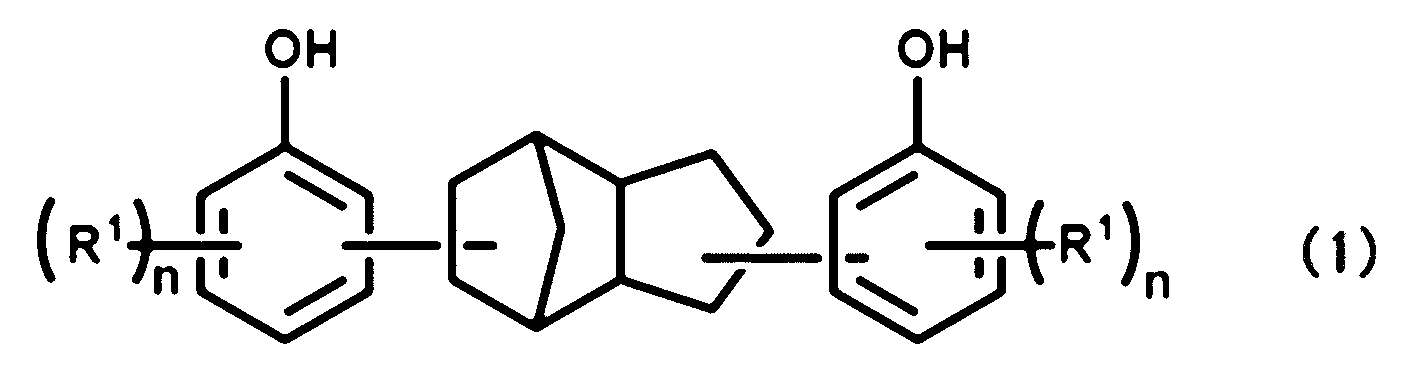
- the phenol resin (B) having the dicyclopentadiene skeleton contains the compound (b1) represented by the following general formula (1) in an area ratio of 30% or more calculated from the GPC chart. It is preferable to contain it.
- R 1 is independently represented by a halogen atom or an alkyl group having 1 to 4 carbon atoms, and n represents 0, 1, or 2.
- the blending ratio (A) / (B) shown by the mass ratio of the paratertiary butylphenol novolak resin (A) and the phenol resin (B) having a dicyclopentadiene skeleton is It is preferably 15/85 to 85/15.
- the resin composition of the present invention can contain an epoxy resin.
- the resin composition of the present invention can contain an inorganic filler.
- the present invention relates to a cured product obtained by curing the resin composition.
- the present invention relates to a semiconductor encapsulant comprising the resin composition.
- the present invention relates to a semiconductor device characterized by containing a cured product of the semiconductor encapsulant.
- a cured product obtained by using a phenol novolak resin having a specific structure capable of contributing to high toughness and having a low elastic modulus and a resin composition containing the phenol resin has low elastic modulus.
- Phenol excellent toughness and useful. In particular, it can be suitably used for semiconductor encapsulant applications.
- 6 is a GPC chart of the paratertiary butylphenol novolak resin (A-1) obtained in Synthesis Example 1.
- 6 is a GPC chart of the phenol resin (B-1) having a dicyclopentadiene skeleton obtained in Synthesis Example 2.
- the present invention relates to a paratertiary butylphenol novolak resin (A) (hereinafter, may be simply referred to as “resin (A)”) and a phenol resin (B) having a dicyclopentadiene skeleton (hereinafter, simply “resin”). (B) ”).
- resin (A) paratertiary butylphenol novolak resin
- B phenol resin having a dicyclopentadiene skeleton
- the resin composition can exhibit a low elastic modulus and high toughness in the obtained cured product, and in particular, It is suitable for semiconductor encapsulant applications and is useful.
- the paratershary butylphenol novolak resin (A) is specifically a novolak-type resin in which paratertiary butylphenol is used as a raw material for a phenol compound and the reaction material is a reaction material thereof. Since the resin (A) obtained by using the paratertiary butylphenol has a bulky structure, the heat shrinkage rate is suppressed to a low level, and when it is made into a cured product, it is less likely to warp or crack, and it is a raw material. Is preferable because it is easily available.
- the resin (A) uses paratertiary butylphenol as a raw material for the phenol compound, but other phenolic compounds may be used in combination as necessary.
- the other phenol compounds include phenol, cresol, xylenol, and naphthol.
- the mass ratio of the paratertiary butyl phenol in the raw material of the phenol compound constituting the resin (A) is preferably 90% by mass or more, more preferably 95% by mass or more. Further, it is particularly preferable that the total amount of the phenol compound raw material is paratertiary butylphenol.
- the aldehyde compound may be any compound that can form a phenol novolac resin by condensation reaction with paratertiary butylphenol.
- Formaldehyde may be used as formalin in an aqueous solution state or as paraformaldehyde in a solid state.
- the paratertiary butylphenol novolak resin (A) preferably contains a dikaryon component.
- the dinuclear component is, for example, a compound represented by the following general formula (2), that is, two molecules of the phenol compound raw material of the resin (A) via a structural site derived from the aldehyde compound. A bound compound.
- the content ratio of the dikaryon component in the paratertiary butylphenol novolak resin (A) is preferably 30% or more, more preferably 30% or more in terms of the area ratio calculated from the gel permeation chromatography (GPC) chart. It is 50 to 99%, more preferably 60 to 95%.
- GPC gel permeation chromatography
- the content of the monomer component which is the raw material of the phenol compound in the resin (A) is calculated from the chart diagram of gel permeation chromatography (GPC).
- the area ratio is preferably less than 10%. The GPC was measured under the measurement conditions described in the examples.
- the softening point of the resin (A) is preferably 50 to 180 ° C, more preferably 50 to 150 ° C. When the softening point is within the above range, the moldability is improved, which is preferable.
- the softening point can be measured in accordance with JIS K7234.
- the hydroxyl group equivalent of the resin (A) is preferably 150 to 200 g / equivalent, and more preferably 150 to 180 g / equivalent. When the hydroxyl group equivalent is within the above range, the curability is good, which is preferable.
- the melt viscosity (150 ° C.) of the resin (A) is preferably 0.1 to 10 dPa ⁇ s, and more preferably 0.1 to 5 dPa ⁇ s. When the melt viscosity is within the above range, the moldability is improved, which is preferable.
- the melt viscosity (150 ° C.) can be measured with an ICI viscometer in accordance with the melt viscosity measurement method ASTM D4287.
- the resin (A) can be produced under acidic catalytic conditions like other phenol novolac resins.
- the acidic catalyst include inorganic acids such as hydrochloric acid, sulfuric acid and phosphoric acid, organic acids such as methanesulfonic acid, paratoluenesulfonic acid and oxalic acid, and Lewis acids such as boron trifluoride, anhydrous aluminum chloride and zinc chloride. And so on. These may be used alone or in combination of two or more.
- the resin (A) for example, a method in which the phenol compound raw material and the aldehyde compound are reacted in the presence of the acidic catalyst under a temperature condition of 50 to 180 ° C. for 1 to 20 hours. Can be mentioned.
- the reaction ratio between the phenol compound raw material and the aldehyde compound and the amount of the catalyst added can be appropriately adjusted according to the desired resin performance. Above all, the ratio of the aldehyde compound to 1 mol of the phenol compound raw material is preferably in the range of 0.05 to 0.5 mol because the binuclear component is easily generated.
- the amount of the acidic catalyst added is preferably in the range of 0.01 to 5.0 parts by mass with respect to 100 parts by mass of the total mass of the reaction raw material.
- the reaction between the phenol compound raw material and the aldehyde compound may be carried out in a solvent, if necessary.
- the solvent used here is, for example, water; methanol, ethanol, propanol, ethyl lactate, ethylene glycol, 1,2-propanediol, 1,3-propanediol, 1,4-butanediol, 1,5-pentanediol, and the like.
- a step of distilling off unreacted raw materials, a solvent, etc., a step of purifying by washing with water, reprecipitation, etc. may be performed.
- the resin (B) having a dicyclopentadiene skeleton has an alicyclic structure derived from dicyclopentadiene in the resin structure, it can particularly contribute to the effect of increasing the toughness of the cured product.
- the resin (B) may be a phenol resin having a dicyclopentadiene skeleton and a phenolic hydroxyl group in the resin structure, and other specific structures are not particularly limited.
- the phenol resin (B) having the dicyclopentadiene skeleton preferably contains the compound (b1) represented by the following general formula (1).
- the resin (B) contains the compound (b1), an increase in the viscosity of the resin composition can be suppressed, the resin composition having excellent workability can be obtained, and the toughness of the cured product can be enhanced. Therefore, it is preferable.
- R 1 independently represents a halogen atom or an alkyl group having 1 to 4 carbon atoms.
- the halogen atom include a fluorine atom, a chlorine atom, a bromine atom and the like.
- the alkyl group having 1 to 4 carbon atoms include a methyl group, an ethyl group, an n-propyl group, an isopropyl group, an n-butyl group, a sec-butyl group, an isobutyl group, a tert-butyl group and the like. ..
- n in the formula (1) represents 0, 1, or 2, but it is preferable that n is 0 because it is excellent in curability and the like.
- the content of the compound (b1) in the resin (B) is preferably 30% or more, more preferably 40 to 99% in terms of the area ratio calculated from the gel permeation chromatography (GPC) chart. It is more preferably 50 to 99%.
- the GPC was measured under the measurement conditions described in the examples.
- Examples of the resin (B) include a condensation reaction product of a dicyclopentadiene compound and a phenol compound.
- the dicyclopentadiene compound is not particularly limited, and is, for example, dicyclopentadiene, 4-vinyl-1-cyclohexene, 5-vinylcyclo [2.2.1] hepta-2-ene, 3a, 4,7,7a-.
- Tetrahydroindene, ⁇ -pinene, limonene and the like are not mentioned, among which dicyclopentadiene, 4-vinyl-1-cyclohexene, 5-vinylcyclo [2.2.1] hepta-2-ene, and 3a, 4,7,7a-tetrahydroindene is preferred, dicyclopentadiene and 3a, 4,7,7a-tetrahydroindene are more preferred, and dicyclopentadiene is even more preferred. These may be used alone or in combination of two or more.
- the phenol compound is not particularly limited as long as it is a compound having a phenolic hydroxyl group, but for example, a halogen atom is attached to phenol, naphthalene-1-ol, naphthalene-2-ol, and a hydrogen atom directly bonded to these aromatic rings. And compounds substituted with an alkyl group. From the viewpoint of reactivity with the dicyclopentadiene compound, the number of the substituents is preferably 0, 1, or 2. Further, the number of carbon atoms of the alkyl group is preferably in the range of 1 to 4. Of these, phenol, naphthalene-1-ol, and naphthalene-2-ol are preferable. As the phenol compound, these may be used alone or in combination of two or more.
- Examples of the condensation reaction between the dicyclopentadiene compound and the phenol compound include a method of reacting the dicyclopentadiene compound with the phenol compound under acidic catalytic conditions.
- the acidic catalyst is not particularly limited, and Lewis acid, protonic acid and the like can be used.
- Lewis acid examples include boron trifluoride, boron trifluoride phenol complex, and boron trifluoride ether complex in terms of excellent reaction rate, and among them, boron trifluoride phenol complex and trifluoride. Boron trifluoride ether complexes are preferred, and boron trifluoride phenol complexes are more preferred.
- Examples of the protonic acid include sulfuric acid, hydrochloric acid, p-toluenesulfonic acid and the like, among which sulfuric acid and p-toluenesulfonic acid are preferable, and p-toluenesulfonic acid is more preferable.
- the reaction ratio between the dicyclopentadiene compound and the phenol compound and the amount of the catalyst added can be appropriately adjusted according to the desired resin performance.
- the ratio of the phenol compound to 1 mol of the dicyclopentadiene is preferably in the range of 0.05 to 0.5 mol.
- the amount of the acidic catalyst added is preferably in the range of 0.01 to 10 parts by mass with respect to 100 parts by mass of the total mass of the reaction raw material.
- the acidic catalyst can be neutralized using an alkaline catalyst neutralizer. After neutralizing the acidic catalyst, it is preferable to perform filtration in order to remove the neutralizing agent and the catalyst residue. Further, the purified dicyclopentadienephenol condensate can be recovered by distilling the filtrate under reduced pressure to remove unreacted phenol compounds and the like.
- the components other than the compound (b1) in the resin are represented by, for example, the following general formula (3). Compounds and the like can be mentioned.
- R 1 independently represents a halogen atom or an alkyl group having 1 to 4 carbon atoms, and n represents 0, 1, or 2.
- m is an integer of 1 or more.
- R1 and n in the general formula (3) have the same meaning as R1 and n in the general formula (1), and the preferred ones thereof are the same as those in the general formula (1).
- the resin (B) is a condensation reaction product of the dicyclopentadiene compound and the phenol compound
- a part of a component having a molecular weight smaller than that of the compound (b1) such as a phenol compound remains in the resin. May be.
- the content of the component having a molecular weight smaller than that of the compound (b1) in the resin (B) is a chart diagram of gel permeation chromatography (GPC).
- the area ratio calculated from the above is preferably less than 10%.
- the GPC was measured under the measurement conditions described in the examples.
- the softening point of the resin (B) is preferably 50 to 180 ° C, more preferably 50 to 150 ° C. When the softening point is within the above range, the moldability is improved, which is preferable.
- the softening point can be measured in accordance with JIS K7234.
- the hydroxyl group equivalent of the resin (B) is preferably 140 to 250 g / equivalent, and more preferably 150 to 200 g / equivalent. When the softening point is within the above range, the curability is good, which is preferable.
- the melt viscosity (150 ° C.) of the resin (B) is preferably 0.1 to 10 dPa ⁇ s, and more preferably 0.1 to 5 dPa ⁇ s. When the melt viscosity is within the above range, the moldability is improved, which is preferable.
- the melt viscosity (150 ° C.) can be measured with an ICI viscometer in accordance with the melt viscosity measurement method ASTM D4287.
- the blending ratio (A) / (B) shown by the mass ratio of the paratertiary butylphenol novolak resin (A) and the phenol resin (B) having a dicyclopentadiene skeleton is It is preferably 15/85 to 85/15, and more preferably 40/60 to 60/40.
- the above-mentioned compounding ratio is preferable because the elastic modulus of the cured product, which is the effect of the present invention, is lower, and the effect of being more excellent in toughness is more remarkably exhibited.
- both the resin (A) and the resin (B) contained in the resin composition of the present invention have a phenolic hydroxyl group, they can be cured by using this in combination with a compound capable of causing a curing reaction. It can be used as a sex composition.
- the compound that can cause a curing reaction with the resin (A) and the resin (B) include an epoxy resin and the like. That is, the resin (A) and the resin (B) of the present invention can be used as a curing agent for an epoxy resin.
- the epoxy resin is not particularly limited, but is not particularly limited.
- Novorak type epoxy resin such as resin; Phenolic aralkyl type epoxy resin, naphthol aralkyl type epoxy resin, phenol biphenyl aralkyl type epoxy resin and other aralkyl type epoxy resins; Bisphenol A type epoxy resin, bisphenol AP type epoxy resin, bisphenol AF type epoxy resin, bisphenol B type epoxy resin, bisphenol BP type epoxy resin, bisphenol C type epoxy resin, bisphenol E type epoxy resin, bisphenol F type epoxy resin, bisphenol S Bisphenol type epoxy resin such as type epoxy resin, tetrabromobisphenol A type epoxy resin; Biphenyl type epoxy resin such as biphenyl type epoxy resin, tetramethyl biphenyl type epoxy resin, epoxy resin having biphenyl skeleton and diglycidyl oxybenzene skeleton; Naphthalene type epoxy resin; Vinaftor type epoxy resin; Vinaftil type epoxy resin; Dicyclopent
- epoxy resins phenol novolac type epoxy resin, cresol novolac type epoxy resin, aralkyl type epoxy resin, naphthylene ether type epoxy resin, bisphenol A type epoxy resin, and bisphenol F type epoxy resin are preferable.
- the epoxy resin may be used alone or in combination of two or more.
- the number average molecular weight (Mn) of the epoxy resin is preferably 200 to 1500, more preferably 200 to 1000. When it is within the above range, it becomes a low molecular weight epoxy resin and tends to have high fluidity, which is preferable.
- the number average molecular weight is a value measured by gel permeation chromatography (GPC) under the conditions described in Examples.
- the softening point of the epoxy resin is preferably 50 to 150 ° C, more preferably 50 to 120 ° C. When the softening point is within the above range, the moldability is improved, which is preferable.
- the softening point can be measured in accordance with JIS K7234.
- the epoxy equivalent of the epoxy resin is preferably 120 to 400 g / equivalent, and more preferably 130 to 300 g / equivalent.
- the curability is excellent, and the balance between heat resistance and high toughness of the obtained cured product, low coefficient of thermal expansion, adhesion to the substrate, and the like is excellent. ..
- the melt viscosity of the epoxy resin is preferably 0.1 to 10 dPa ⁇ s, and more preferably 0.1 to 5 dPa ⁇ s.
- the melt viscosity (150 ° C.) can be measured with an ICI viscometer in accordance with the melt viscosity measurement method ASTM D4287.
- a curing agent for epoxy resin may be used.
- other curing agents for epoxy resins include the resin (A) and other phenolic resins other than the resin (B), amine compounds, acid anhydrides, active ester resins, cyanate ester resins, and amideimides. Examples thereof include a resin, a maleimide resin, and a benzoxazine resin.
- phenol resins examples include various bisphenol resins, phenol novolac resins, cresol novolak resins, naphthol novolak resins, novolak resins such as bisphenol novolak resins, phenol aralkyl resins (Zyroc resins), naphthol aralkyl resins, and birds.
- phenol resins examples include phenylol methane resin, polyphenylene ether type resin, and polynaphthylene ether type resin. These may be used alone or in combination of two or more.
- the resin composition of the present invention contains the other curing agent for epoxy resin, the resin (A) and the resin (A) with respect to the total mass of components (curing agent for epoxy resin) functioning as a curing agent for epoxy resin.
- the ratio (% by mass) of the total mass of B) is preferably 50% by mass or more because the elastic coefficient of the cured product, which is the effect of the present invention, is lower and the effect of superior toughness is more remarkable. 70% by mass or more is more preferable, and 90% by mass or more is particularly preferable.
- the resin composition of the present invention can contain an inorganic filler.
- the thermal expansion property can be suppressed, and the occurrence of warpage and cracks due to the difference in shrinkage amount due to the coefficient of linear expansion can be suppressed, which is preferable.
- the inorganic filler is not particularly limited, but is silica, alumina, glass, cordierite, silicon oxide, barium sulfate, barium carbonate, aluminum hydroxide, magnesium hydroxide, calcium carbonate, magnesium carbonate, magnesium oxide, and nitrided material.
- silica amorphous silica, fused silica, crystalline silica, synthetic silica, hollow silica and the like can be used.
- the molten silica is preferable because it is possible to blend a larger amount of the inorganic filler.
- the molten silica can be used in either a crushed form or a spherical shape, but in order to increase the blending amount of the fused silica and suppress the increase in the melt viscosity of the resin composition, a spherical one is mainly used. Is preferable. Further, in order to increase the blending amount of spherical silica, it is preferable to appropriately adjust the particle size distribution of spherical silica.
- the inorganic filler may be used alone or in combination of two or more.
- the inorganic filler may be surface-treated if necessary.
- the surface treatment agent that can be used is not particularly limited, but is an aminosilane-based coupling agent, an epoxysilane-based coupling agent, a mercaptosilane-based coupling agent, a silane-based coupling agent, an organosilazane compound, and a titanate-based cup. Ring agents and the like can be used.
- the surface treatment agent examples include 3-glycidoxypropyltrimethoxysilane, 3-mercaptopropyltrimethoxysilane, 3-aminopropyltriethoxysilane, N-phenyl-3-aminopropyltrimethoxysilane, and hexamethyldi. Shirazan and the like can be mentioned.
- organic filler can be blended in addition to the inorganic filler as long as the characteristics of the present invention are not impaired.
- examples of the organic filler include polyamide particles and the like.
- the amount of the inorganic filler used is 100 to 2000 with respect to 100 parts by mass of the total amount of the resin components (the resin (A), the resin (B), the epoxy resin, the curing agent, etc.) in the resin composition. It is preferably parts by mass, more preferably 400 to 1800 parts by mass. When the amount of the inorganic filler used is within the above range, it is preferable because it is excellent in low thermal expansion, flame retardancy, and insulation reliability.
- the resin composition of the present invention further contains a solvent, an additive, and the like as long as the effects of the present invention are not impaired. It may be included.
- the resin composition of the present invention may be prepared without a solvent, or may contain a solvent.
- the solvent are not particularly limited, but are ketone solvents such as acetone, methyl ethyl ketone, methyl isobutyl ketone and cyclohexanone; ether solvents such as diethyl ether and tetrahydrofuran; ethyl acetate, butyl acetate, cellosolve acetate and propylene glycol monomethyl.
- ketone solvents such as acetone, methyl ethyl ketone, methyl isobutyl ketone and cyclohexanone
- ether solvents such as diethyl ether and tetrahydrofuran
- Ester-based solvents such as ether acetate and carbitol acetate; carbitol compounds such as cellosolve and butyl carbitol, toluene, xylene, ethylbenzene, mecitylene, 1,2,3-trimethylbenzene, 1,2,4-trimethylbenzene and the like.
- Examples thereof include amide-based solvents such as aromatic hydrocarbons, dimethylformamide, dimethylacetamide, and N-methylpyrrolidone. These solvents may be used alone or in combination of two or more.
- the amount of the solvent used is appropriately adjusted according to the intended use and is not particularly limited. Specifically, it is preferably 10 to 90% by mass, more preferably 20 to 80% by mass, based on the total mass of the resin composition.
- the resin composition of the present invention may contain various additives such as a curing accelerator, a mold release agent, a pigment, a colorant, an emulsifier, and a flame retardant, if necessary.
- the curing accelerator is not particularly limited, and examples thereof include a phosphorus-based curing accelerator, an amine-based curing accelerator, an imidazole-based curing accelerator, a guanidine-based curing accelerator, and a urea-based curing accelerator.
- Examples of the phosphorus-based curing accelerator include organic phosphine compounds such as triphenylphosphine, tributylphosphine, triparatrilphosphine, diphenylcyclohexylphosphine and tricyclohexylphosphine; organic phosphite compounds such as trimethylphosphine and triethylphosphine; ethyltriphenyl.
- organic phosphine compounds such as triphenylphosphine, tributylphosphine, triparatrilphosphine, diphenylcyclohexylphosphine and tricyclohexylphosphine
- organic phosphite compounds such as trimethylphosphine and triethylphosphine
- ethyltriphenyl ethyltriphenyl.
- Phosphornium bromide benzyltriphenylphosphonium chloride, butylphosphonium tetraphenylborate, tetraphenylphosphonium tetraphenylborate, tetraphenylphosphonium tetra-p-trilborate, triphenylphosphine triphenylboran, tetraphenylphosphonium thiocyanate, tetraphenylphosphonium disianamide, Examples thereof include phosphonium salts such as butylphenylphosphonium dicyanamide and tetrabutylphosphonium decanoate.
- Examples of the amine-based curing accelerator include triethylamine, tributylamine, N, N-dimethyl-4-aminopyridine (4-dimethylaminopyridine, DMAP), 2,4,6-tris (dimethylaminomethyl) phenol, 1, Examples thereof include 8-diazabicyclo [5.4.0] -undecene-7 (DBU) and 1,5-diazabicyclo [4.3.0] -Nonen-5 (DBN).
- DBU 8-diazabicyclo [5.4.0] -undecene-7
- DBN 1,5-diazabicyclo [4.3.0] -Nonen-5
- imidazole-based curing accelerator examples include 2-methylimidazole, 2-undecylimidazole, 2-heptadecylimidazole, 1,2-dimethylimidazole, 2-ethyl-4-methylimidazole, 2-phenylimidazole, and 2-phenyl.
- Examples of the guanidine-based curing accelerator include dicyandiamide, 1-methylguanidine, 1-ethylguanidine, 1-cyclohexylguanidine, 1-phenylguanidine, dimethylguanidine, diphenylguanidine, trimethylguanidine, tetramethylguanidine, pentamethylguanidine, 1, 5,7-Triazabicyclo [4.4.0] deca-5-ene, 7-methyl-1,5,7-triazabicyclo [4.4.0] deca-5-ene, 1-methylbiguanide , 1-ethylbiguanide, 1-butylbiguanide, 1-cyclohexylbiguanide, 1-allylbiguanide, 1-phenylbiguanide and the like.
- urea-based curing accelerator examples include 3-phenyl-1,1-dimethylurea, 3- (4-methylphenyl) -1,1-dimethylurea, chlorophenylurea, and 3- (4-chlorophenyl) -1,1. -Dimethylurea, 3- (3,4-dichlorophenyl) -1,1-dimethylurea and the like can be mentioned.
- a phosphorus-based curing accelerator or an imidazole-based curing accelerator from the viewpoint of curability, and a phosphorus-based curing accelerator is preferable from the viewpoint of insulation reliability.
- the curing accelerator may be used alone or in combination of two or more.
- the amount of the curing accelerator used can be appropriately adjusted in order to obtain the desired curability, and the resin components in the resin composition (epoxy resin, the resin (A) as a curing agent, the resin (B), etc.) can be adjusted.
- the resin components in the resin composition epoxy resin, the resin (A) as a curing agent, the resin (B), etc.
- the amount of the curing accelerator used is within the above range, it is preferable because the curing property and the insulation reliability are excellent.
- the flame retardant is not particularly limited, and examples thereof include an inorganic phosphorus flame retardant, an organic phosphorus flame retardant, and a halogen flame retardant. These flame retardants may be used alone or in combination of two or more.
- the resin composition can be obtained by uniformly mixing each component such as the above-mentioned curing agent in addition to the epoxy resin, and can be easily made into a cured product by the same method as a conventionally known method. can.
- the present invention relates to a cured product obtained by curing the resin composition. Since the cured product is obtained by using the resin composition, it is useful because it has a low elastic modulus and excellent toughness. In particular, since the resin composition contains the resin (A) and the resin (B), the viscosity is low and the workability is excellent. Therefore, the cured product is suitably used for semiconductor encapsulant applications and the like. Can be done.
- Examples of the cured product include molded products such as laminates, cast products, adhesive layers, coating films, and films.
- the curing reaction examples include thermal curing and ultraviolet curing reaction.
- the thermal curing reaction is easily carried out even under a non-catalyst, but if a faster reaction is desired, an organic peroxide or an azo compound is used.
- a polymerization initiator such as, a phosphine compound, or a basic catalyst such as a tertiary amine.
- benzoyl peroxide, dicumyl peroxide, azobisisobutyronitrile, triphenylphosphine, triethylamine, imidazole compound and the like can be mentioned.
- the heating temperature at the time of heat curing is not particularly limited, but is usually 100 to 300 ° C., and the heating time is 1 to 1 to 1. 24 hours.
- the cured product of the present invention preferably has an elastic modulus (storage elastic modulus) at 40 ° C. of 3200 MPa or less, more preferably 3000 MPa or less, and particularly preferably 2800 MPa or less. Further, the elastic modulus (storage elastic modulus) at 260 ° C. is preferably 20 MPa or less, and more preferably 10 MPa or less.
- the method for measuring the elastic modulus is the same as the evaluation method in the examples.
- the cured product of the present invention preferably has a Charpy impact strength of 2 J / cm 2 or more, more preferably 2.5 J / cm 2 or more, and particularly preferably 3 J / cm 2 or more. ..
- the method for measuring the Charpy impact strength is the same as the evaluation method in the examples.
- the present invention relates to a semiconductor encapsulant containing the resin composition.
- the semiconductor encapsulant obtained by using the resin composition is preferably used for semiconductor encapsulant applications because it is excellent in low elastic modulus and high toughness in the obtained cured product by using the resin composition. Can be done.
- the resin composition is sufficiently melt-mixed with an additive, which is an optional component, by using an extruder, a kneader, a roll or the like until it becomes uniform.
- an additive which is an optional component
- the present invention relates to a semiconductor device containing a cured product of the semiconductor encapsulant.
- the cured product of the semiconductor encapsulant has a low elastic modulus and excellent toughness, and is preferable because it can suppress the occurrence of warpage and cracks due to the difference in shrinkage amount due to the linear expansion coefficient.
- the semiconductor encapsulant is cast or molded using a transfer molding machine, an injection molding machine, or the like, and further, in a temperature range of room temperature (20 ° C.) to 250 ° C., 1 to 1 to Examples thereof include a method of heat-curing for 10 hours.
- the cured product obtained by the resin composition of the present invention is excellent in low elastic modulus and high toughness, it is not only a semiconductor encapsulant and a semiconductor device, but also a prepreg, a circuit board, a build-up film, and a build-up board. , Can be suitably used for adhesives, resist materials and the like. Further, it can be suitably used for various uses such as a matrix resin of a fiber reinforced resin, and the use is not limited to these.
- the mixture was aged at 140 ° C. for 2 hours.
- 10.0 g of hydrotalcite was added to the contents of the reaction vessel, and the mixture was stirred for 30 minutes to neutralize and adsorb the catalyst.
- the reaction mixture in the reaction vessel was filtered to remove the neutralized product, and the filtrate was collected.
- the recovered filtrate was placed in a flask, heated to 220 ° C., subjected to atmospheric distillation and vacuum distillation, and unreacted phenol was distilled off to remove the unreacted phenol.
- ⁇ Elastic modulus (storage elastic modulus)> The resin composition obtained above is cured in a normal pressure press at 150 ° C. for 10 minutes so that the thickness of the cured product is 2.4 mm, and then aftercure is performed at 175 ° C. for 5 hours. As a result, a cured product for evaluation was obtained.
- the obtained cured product was cut into a size of 5 mm ⁇ 54 mm to obtain a test piece, and 40 by DMA (dynamic viscoelastic) measurement by a rectangular tension method using a “solid viscoelastic modulus measuring device RSAII” manufactured by Leometric Co., Ltd.
- the storage elastic modulus (MPa) at ° C. and 260 ° C. was measured, and the elastic modulus was evaluated.
Landscapes
- Chemical & Material Sciences (AREA)
- Health & Medical Sciences (AREA)
- Chemical Kinetics & Catalysis (AREA)
- Medicinal Chemistry (AREA)
- Polymers & Plastics (AREA)
- Organic Chemistry (AREA)
- Compositions Of Macromolecular Compounds (AREA)
- Structures Or Materials For Encapsulating Or Coating Semiconductor Devices Or Solid State Devices (AREA)
- Epoxy Resins (AREA)
Abstract
本発明は、パラターシャリーブチルフェノールノボラック樹脂(A)、及び、ジシクロペンタジエン骨格を有するフェノール樹脂(B)を含有する樹脂組成物、前記樹脂組成物の硬化物、半導体封止材、及び、半導体装置に関するものである。前記樹脂組成物は、低弾性率や高靱性に優れる硬化物を得ることができることから、前記樹脂組成物を含有する半導体封止材を提供することができ、さらには前記半導体封止材を用いて得られた硬化物を含む半導体装置を提供することができる。
Description
本発明は、樹脂組成物、硬化物、半導体封止材、及び、半導体装置に関するものである。
エポキシ樹脂、及び、その硬化剤を必須成分とするエポキシ樹脂組成物は、高耐熱性、耐湿性等の諸物性に優れる点から、半導体封止材やプリント回路基板等の電子部品、電子部品分野、導電ペースト等の導電性接着剤、その他接着剤、複合材料用マトリックス、塗料、フォトレジスト材料、顕色材料等で広く用いられている。
これらの各種用途のうち、電気・電子分野では薄型化・軽量化の要求が強く、これらの要求に応える実装技術の1つとして、ウエハレベルパッケージング技術がある。
上記ウエハレベルパッケージング技術は、ウエハの状態で樹脂封止や再配線、電極形成を行ない、ダイシングによって個片化することで、半導体パッケージを製造する実装技術である。封止樹脂による一括封止を行うため、樹脂硬化時の収縮と、チップの線膨張係数と封止樹脂の線膨張係数に起因した収縮量差により反りやクラックが生じやすい。この反りやクラックがパッケージの信頼性を著しく低下させるため、反りを抑える目的で、封止用樹脂組成物に対して高靭性化、クラックを抑える目的で、低弾性率化が強く要求されている。
従来知られている半導体封止用樹脂組成物としては、例えば、トリアジン骨格を有する多官能エポキシ化合物と、ジシクロペンタジエン骨格を有するフェノール樹脂とを用いたものが開示されている(例えば、特許文献1参照。)。
しかしながら、特許文献1に記載された半導体封止用樹脂組成物は、耐トラッキング性能に優れるという特徴を有するものの、昨今求められる硬化物における高靱性や低弾性等の性能までをも具備するものではなかった。
このように、半導体封止材料の分野において、低弾性率で高靭性を十分に具備した樹脂材料が得られていないのが現状であった。
従って、本発明が解決しようとする課題は、低弾性率で高靱性に優れる硬化物を得るために寄与できる樹脂組成物、前記樹脂組成物を用いて得られる硬化物や、前記樹脂組成物を含有する半導体封止材、前記半導体封止材を用いて得られる硬化物を含む半導体装置を提供することにある。
本発明者らは、上述した課題を解決すべく鋭意研究を重ねた結果、特定構造を有するフェノールノボラック樹脂、及び、フェノール樹脂を含有する樹脂組成物を用いることで、得られる硬化物が、低弾性率で、かつ、高靭性を発揮することができ、特に、半導体封止材用途に好適に用いることができることを見いだし、本発明を完成するに至った。
すなわち、本発明は、パラターシャリーブチルフェノールノボラック樹脂(A)、及び、ジシクロペンタジエン骨格を有するフェノール樹脂(B)を含有することを特徴とする樹脂組成物に関する。
本発明の樹脂組成物は、前記パラターシャリーブチルフェノールノボラック樹脂(A)中の二核体成分の含有割合が、GPCチャート図から算出される面積比率で30%以上、であることが好ましい。
本発明の樹脂組成物は、前記ジシクロペンタジエン骨格を有するフェノール樹脂(B)が、下記一般式(1)で表される化合物(b1)をGPCチャート図から算出される面積比率で30%以上含有することが好ましい。
本発明の樹脂組成物は、前記パラターシャリーブチルフェノールノボラック樹脂(A)、及び、前記ジシクロペンタジエン骨格を有するフェノール樹脂(B)の質量比で示される配合割合(A)/(B)が、15/85~85/15であることが好ましい。
本発明の樹脂組成物は、エポキシ樹脂を含有することができる。
本発明の樹脂組成物は、無機充填材を含有することができる。
本発明は、前記樹脂組成物を硬化させて得られることを特徴とする硬化物に関する。
本発明は、前記樹脂組成物を含有することを特徴とする半導体封止材に関する。
本発明は、前記半導体封止材の硬化物を含有することを特徴とする半導体装置に関する。
本発明は、低弾性率で、かつ、高靭性に寄与することができる特定構造を有するフェノールノボラック樹脂、及び、フェノール樹脂を含有する樹脂組成物を用いることで、得られる硬化物が、低弾性率で、高靭性に優れ、有用である。特に、半導体封止材用途に好適に用いることができる。
<樹脂組成物>
本発明は、パラターシャリーブチルフェノールノボラック樹脂(A)(以下、単に「樹脂(A)」と称する場合がある。)、及び、ジシクロペンタジエン骨格を有するフェノール樹脂(B)(以下、単に「樹脂(B)」と称する場合がある。)を含有することを特徴とする樹脂組成物に関する。前記樹脂組成物は、前記樹脂(A)、及び、前記樹脂(B)を含有する樹脂組成物を用いることで、得られる硬化物における低弾性率で、かつ、高靭性を発揮でき、特に、半導体封止材用途に適しており、有用となる。
本発明は、パラターシャリーブチルフェノールノボラック樹脂(A)(以下、単に「樹脂(A)」と称する場合がある。)、及び、ジシクロペンタジエン骨格を有するフェノール樹脂(B)(以下、単に「樹脂(B)」と称する場合がある。)を含有することを特徴とする樹脂組成物に関する。前記樹脂組成物は、前記樹脂(A)、及び、前記樹脂(B)を含有する樹脂組成物を用いることで、得られる硬化物における低弾性率で、かつ、高靭性を発揮でき、特に、半導体封止材用途に適しており、有用となる。
<パラターシャリーブチルフェノールノボラック樹脂(A)>
前記パラターシャリーブチルフェノールノボラック樹脂(A)は、具体的には、フェノール化合物原料としてパラターシャリーブチルフェノールを用い、これとアルデヒド化合物とを反応原料とするノボラック型樹脂のことである。パラターシャリーブチルフェノールを用いて得られる前記樹脂(A)は、嵩高い構造を有しているため、加熱収縮率が低く抑えられ、硬化物とした場合に、反りやクラックが生じにくく、さらに原料の入手も容易であるため好ましい。
前記パラターシャリーブチルフェノールノボラック樹脂(A)は、具体的には、フェノール化合物原料としてパラターシャリーブチルフェノールを用い、これとアルデヒド化合物とを反応原料とするノボラック型樹脂のことである。パラターシャリーブチルフェノールを用いて得られる前記樹脂(A)は、嵩高い構造を有しているため、加熱収縮率が低く抑えられ、硬化物とした場合に、反りやクラックが生じにくく、さらに原料の入手も容易であるため好ましい。
前記樹脂(A)は、フェノール化合物原料として、パラターシャリーブチルフェノールを用いるものであるが、必要に応じて、これ以外のその他のフェノール化合物を併用してもよい。前記その他のフェノール化合物としては、例えば、フェノール、クレゾール、キシレノール、及び、ナフトール等が挙げられる。これらを用いる場合、前記樹脂(A)を構成するフェノール化合物原料中のパラターシャリーブチルフェノールの質量割合が、90質量%以上であることが好ましく、95質量%以上であることがより好ましい。更に、フェノール化合物原料の全量が、パラターシャリーブチルフェノールであることが特に好ましい。
前記アルデヒド化合物としては、パラターシャリーブチルフェノールと縮合反応することで、フェノールノボラック樹脂を形成しうるものであれば良く、例えば、ホルムアルデヒド、トリオキサン、アセトアルデヒド、プロピオンアルデヒド、テトラオキシメチレン、ポリオキシメチレン、クロラール、ヘキサメチレンテトラミン、ベンズアルデヒド等が挙げられる。これらはそれぞれ単独で用いてもよいし、2種類以上を併用してもよい。中でも、反応性に優れることから、ホルムアルデヒドを用いることが好ましい。ホルムアルデヒドは水溶液の状態であるホルマリンとして用いても、固形の状態であるパラホルムアルデヒドとして用いても、いずれであってもよい。
前記パラターシャリーブチルフェノールノボラック樹脂(A)は、二核体成分を含有することが好ましい。前記樹脂(A)が前記二核体成分を含有することにより、樹脂組成物の粘度上昇が抑えられ、作業性に優れる樹脂組成物となると共に、硬化物における靱性が向上する効果を奏するため好ましい。なお、前記二核体成分とは、例えば、下記一般式(2)で表されるような化合物、すなわち、前記樹脂(A)のフェノール化合物原料2分子が前記アルデヒド化合物由来の構造部位を介して結合した化合物をいう。

前記パラターシャリーブチルフェノールノボラック樹脂(A)中の二核体成分の含有割合は、ゲル浸透クロマトグラフィー(GPC)のチャート図から算出される面積比率で30%以上であることが好ましく、より好ましくは50~99%であり、更に好ましくは、60~95%である。なお、前記GPCは、実施例に記載の測定条件にて測定したものである。
前記樹脂(A)は、パラターシャリーブチルフェノール等のフェノール化合物原料であるモノマー成分が一部残存していてもよい。中でも、硬化物における耐熱性により優れる樹脂組成物となることから、前記樹脂(A)中のフェノール化合物原料であるモノマー成分の含有量は、ゲル浸透クロマトグラフィー(GPC)のチャート図から算出される面積比率で10%未満であることが好ましい。なお、前記GPCは、実施例に記載の測定条件にて測定したものである。
前記樹脂(A)の軟化点としては、50~180℃であることが好ましく、50~150℃であることがより好ましい。前記軟化点が前記範囲内であることにより、成形性が良好となるため好ましい。なお、前記軟化点は、JIS K7234に準拠して、測定することができる。
前記樹脂(A)の水酸基当量としては、150~200g/当量であることが好ましく、150~180g/当量であることがより好ましい。前記水酸基当量が前記範囲内であることにより、硬化性が良好となるため好ましい。
前記樹脂(A)の溶融粘度(150℃)としては、0.1~10dPa・sであることが好ましく、0.1~5dPa・sであることがより好ましい。前記溶融粘度が前記範囲内であることにより、成形性が良好となるため好ましい。なお、前記溶融粘度(150℃)は、溶融粘度測定法ASTM D4287に準拠し、ICI粘度計にて測定することができる。
前記樹脂(A)は、他のフェノールノボラック樹脂と同様、酸性触媒条件下で製造することができる。前記酸性触媒としては、例えば、塩酸、硫酸、リン酸などの無機酸、メタンスルホン酸、パラトルエンスルホン酸、シュウ酸などの有機酸、三フッ化ホウ素、無水塩化アルミニウム、塩化亜鉛などのルイス酸などが挙げられる。これらは単独で用いてもよいし、2種類以上を併用してもよい。
前記樹脂(A)を効率よく得る方法としては、例えば、前記フェノール化合物原料と前記アルデヒド化合物とを、前記酸性触媒の存在下、50~180℃の温度条件下で、1~20時間反応させる方法が挙げられる。前記フェノール化合物原料と前記アルデヒド化合物との反応比率や、触媒の添加量は、所望の樹脂性能に応じて、適宜調整することができる。中でも、前記二核体成分が生成しやすくなることから、前記フェノール化合物原料1モルに対する前記アルデヒド化合物の割合は0.05~0.5モルの範囲であることが好ましい。また、前記酸性触媒の添加量は、反応原料の総質量100質量部に対して、0.01~5.0質量部の範囲であることが好ましい。
前記フェノール化合物原料と前記アルデヒド化合物との反応は、必要に応じて溶媒中で行っても良い。ここで用いる溶媒は、例えば、水;メタノール、エタノール、プロパノール、乳酸エチル、エチレングリコール、1,2-プロパンジオール、1,3-プロパンジオール、1,4-ブタンジオール、1,5-ペンタンジオール、1,6-ヘキサンジオール、1,7-ヘプタンジオール、1,8-オクタンジオール、1,9-ノナンジオール、トリメチレングリコール、ジエチレングリコール、ポリエチレングリコール、グリセリン、2-エトキシエタノール、エチレングリコールモノメチルエーテル、エチレングリコールモノエチルエーテル、エチレングリコールモノプロピルエーテル、エチレングリコールモノブチルエーテル、エチレングリコールモノペンチルエーテル、エチレングリコールジメチルエーテル、エチレングリコールエチルメチルエーテル、エチレングリコールモノフェニルエーテル、ジエチレングリコールエチルメチルエーテル、プロピレングリコールモノメチルエーテル、1,3-ジオキサン、1,4-ジオキサン、テトラヒドロフラン、エチレングリコールアセテート、アセトン、メチルエチルケトン、メチルイソブチルケトン、シクロヘキサノン、N-メチルピロリドン、ジメチルホルムアミド、ジメチルスルホキシド等が挙げられる。これらの溶媒は、それぞれ単独で用いても良いし、2種類以上の混合溶媒として用いても良い。
反応終了後は、必要に応じて未反応原料や溶媒等を留去する工程、水洗あるいは再沈殿等にて精製する工程等を行っても良い。
<ジシクロペンタジエン骨格を有するフェノール樹脂(B)>
前記ジシクロペンタジエン骨格を有するフェノール樹脂(B)は、樹脂構造中にジシクロペンタジエン由来の脂環構造を有することから、特に硬化物の靱性を高める効果に寄与することができる。前記樹脂(B)は、樹脂構造中にジシクロペンタジエン骨格とフェノール性水酸基とを有するフェノール樹脂であればよく、その他の具体的な構造は特に制限されない。
前記ジシクロペンタジエン骨格を有するフェノール樹脂(B)は、樹脂構造中にジシクロペンタジエン由来の脂環構造を有することから、特に硬化物の靱性を高める効果に寄与することができる。前記樹脂(B)は、樹脂構造中にジシクロペンタジエン骨格とフェノール性水酸基とを有するフェノール樹脂であればよく、その他の具体的な構造は特に制限されない。
前記ジシクロペンタジエン骨格を有するフェノール樹脂(B)は、下記一般式(1)で表される化合物(b1)を含有することが好ましい。前記樹脂(B)が前記化合物(b1)を含有することにより、樹脂組成物の粘度上昇が抑えられ、作業性に優れる樹脂組成物となると共に、硬化物における靱性が高まる効果を奏することができるため好ましい。
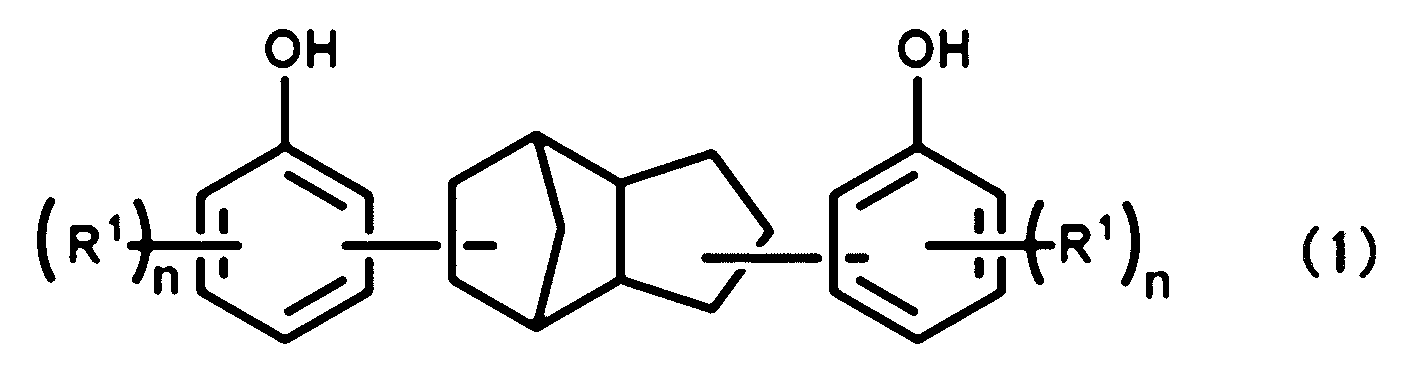
上記式(1)中、R1は、それぞれ独立に、ハロゲン原子又は炭素原子数1~4のアルキル基を表す。前記ハロゲン原子としては、例えば、フッ素原子、塩素原子、臭素原子等が挙げられる。前記炭素原子数1~4のアルキル基としては、例えば、メチル基、エチル基、n-プロピル基、イソプロピル基、n-ブチル基、sec-ブチル基、イソブチル基、tert-ブチル基等が挙げられる。また、前記式(1)中のnは0、1、又は2を表すが、中でも、硬化性等に優れることから、nが0であることが好ましい。
前記樹脂(B)中の前記化合物(b1)の含有量は、ゲル浸透クロマトグラフィー(GPC)のチャート図から算出される面積比率で30%以上であることが好ましく、より好ましくは40~99%であり、更に好ましくは、50~99%である。なお、前記GPCは、実施例に記載の測定条件で測定したものである。
前記樹脂(B)の一例としては、例えば、ジシクロペンタジエン化合物とフェノール化合物との縮合反応物等が挙げられる。
前記ジシクロペンタジエン化合物は、特に限定されないが、例えば、ジシクロペンタジエン、4-ビニル-1-シクロヘキセン、5-ビニルシクロ[2.2.1]ヘプタ-2-エン、3a,4,7,7a-テトラヒドロインデン、α-ピネン、及び、リモネン等が挙げられない、中でも、ジシクロペンタジエン、4-ビニル-1-シクロヘキセン、5-ビニルシクロ[2.2.1]ヘプタ-2-エン、及び、3a,4,7,7a-テトラヒドロインデンが好ましく、ジシクロペンタジエン、及び、3a,4,7,7a-テトラヒドロインデンがより好ましく、ジシクロペンタジエンが更に好ましい。これらは単独で用いても良く、2種類以上を組み合わせて用いることもできる。
前記フェノール化合物は、フェノール性水酸基を有する化合物であれば、特に限定されないが、例えば、フェノール、ナフタレン-1-オール、ナフタレン-2オール、及び、これらの芳香環に直接結合する水素原子にハロゲン原子やアルキル基が置換した化合物などが挙げられる。前記ジシクロペンタジエン化合物との反応性の観点から、前記置換基の数は0、1、又は、2であることが好ましい。また、前記アルキル基の炭素原子数は1~4の範囲であることが好ましい。中でも、フェノール、ナフタレン-1-オール、及び、ナフタレン-2-オールが好ましい。前記フェノール化合物としては、これらは単独で用いても良く、2種類以上を組み合わせて用いることもできる。
前記ジシクロペンタジエン化合物と前記フェノール化合物との縮合反応は、例えば、前記ジシクロペンタジエン化合物と前記フェノール化合物とを酸性触媒条件下で反応させる方法等が挙げられる。
前記酸性触媒としては、特に限定されず、ルイス酸、及び、プロトン酸等を用いることができる。
前記ルイス酸としては、反応速度に優れる点で、三フッ化ホウ素、三フッ化ホウ素フェノール錯体、及び、三フッ化ホウ素エーテル錯体などが挙げられ、中でも、三フッ化ホウ素フェノール錯体、及び、三フッ化ホウ素エーテル錯体が好ましく、三フッ化ホウ素フェノール錯体がより好ましい。
前記プロトン酸としては、硫酸、塩酸、及び、p-トルエンスルホン酸等が挙げられ、中でも、硫酸、及び、p-トルエンスルホン酸が好ましく、p-トルエンスルホン酸がより好ましい。
前記ジシクロペンタジエン化合物と前記フェノール化合物との反応比率や触媒の添加量は、所望の樹脂性能に応じて、適宜調整することができる。中でも、前記化合物(b1)が生成しやすくなることから、前記ジシクロペンタジエン1モルに対する前記フェノール化合物の割合は、0.05~0.5モルの範囲であることが好ましい。また、前記酸性触媒の添加量は、反応原料の総質量100質量部に対して、0.01~10質量部の範囲であることが好ましい。
反応終了後は、アルカリ性の触媒中和剤を用いて、前記酸性触媒を中和することができる。酸性触媒を中和した後には、中和剤および触媒残渣を除去するために、ろ過を行うことが好ましい。更に、ろ液を減圧蒸留して、未反応フェノール化合物等を除去することにより、精製されたジシクロペンタジエンフェノール縮合物を回収することができる。
前記樹脂(B)が、前記ジシクロペンタジエン化合物と前記フェノール化合物との縮合反応物である場合、樹脂中の前記化合物(b1)以外の成分としては、例えば、下記一般式(3)で表される化合物等が挙げられる。

上記式(3)中、R1は、それぞれ独立に、ハロゲン原子又は炭素原子数1~4のアルキル基を表し、nは0、1、又は、2を表す。mは1以上の整数である。
前記一般式(3)中のR1及びnは、前記一般式(1)中のR1及びnと同義であり、また、その好ましいものも前記一般式(1)と同様である。
また、前記樹脂(B)が、前記ジシクロペンタジエン化合物と前記フェノール化合物との縮合反応物である場合、樹脂中にフェノール化合物等の前記化合物(b1)よりも分子量の小さい成分が一部残存していてもよい。中でも、硬化物における耐熱性により優れる樹脂組成物となることから、前記樹脂(B)中の前記化合物(b1)よりも分子量の小さい成分の含有量は、ゲル浸透クロマトグラフィー(GPC)のチャート図から算出される面積比率で、10%未満であることが好ましい。なお、前記GPCは、実施例に記載の測定条件で測定したものである。
前記樹脂(B)の軟化点としては、50~180℃であることが好ましく、50~150℃であることがより好ましい。前記軟化点が前記範囲内であることにより、成形性が良好となるため好ましい。なお、前記軟化点は、JIS K7234に準拠して、測定することができる。
前記樹脂(B)の水酸基当量としては、140~250g/当量であることが好ましく、150~200g/当量であることがより好ましい。前記軟化点が前記範囲内であることにより、硬化性が良好となるため好ましい。
前記樹脂(B)の溶融粘度(150℃)としては、0.1~10dPa・sであることが好ましく、0.1~5dPa・sであることがより好ましい。前記溶融粘度が前記範囲内であることにより、成形性が良好となるため好ましい。なお、前記溶融粘度(150℃)は、溶融粘度測定法ASTM D4287に準拠し、ICI粘度計にて測定することができる。
本発明の樹脂組成物は、前記パラターシャリーブチルフェノールノボラック樹脂(A)、及び、前記ジシクロペンタジエン骨格を有するフェノール樹脂(B)の質量比で示される配合割合(A)/(B)が、15/85~85/15であることが好ましく、40/60~60/40であることがより好ましい。前記配合割合であることにより、本発明の効果である硬化物の弾性率がより低く、靱性により優れる効果が一層顕著に発揮されるため好ましい。
本発明の樹脂組成物が含有する前記樹脂(A)、及び、前記樹脂(B)は、いずれもフェノール性水酸基を有することから、これと硬化反応を生じ得る化合物と合わせて用いることにより、硬化性組成物として用いることができる。前記樹脂(A)、及び、前記樹脂(B)と硬化反応を生じ得る化合物としては、エポキシ樹脂等が挙げられる。すなわち、本願発明の前記樹脂(A)及び前記樹脂(B)は、エポキシ樹脂用硬化剤として利用することができる。
<エポキシ樹脂>
前記エポキシ樹脂としては、特に制限されないが、フェノールノボラック型エポキシ樹脂、クレゾールノボラック型エポキシ樹脂、α-ナフトールノボラック型エポキシ樹脂、β-ナフトールノボラック型エポキシ樹脂、ビスフェノールAノボラック型エポキシ樹脂、ビフェニルノボラック型エポキシ樹脂等のノボラック型エポキシ樹脂;
フェノールアラルキル型エポキシ樹脂、ナフトールアラルキル型エポキシ樹脂、フェノールビフェニルアラルキル型エポキシ樹脂等のアラルキル型エポキシ樹脂;
ビスフェノールA型エポキシ樹脂、ビスフェノールAP型エポキシ樹脂、ビスフェノールAF型エポキシ樹脂、ビスフェノールB型エポキシ樹脂、ビスフェノールBP型エポキシ樹脂、ビスフェノールC型エポキシ樹脂、ビスフェノールE型エポキシ樹脂、ビスフェノールF型エポキシ樹脂、ビスフェノールS型エポキシ樹脂、テトラブロモビスフェノールA型エポキシ樹脂等のビスフェノール型エポキシ樹脂;
ビフェニル型エポキシ樹脂、テトラメチルビフェニル型エポキシ樹脂、ビフェニル骨格およびジグリシジルオキシベンゼン骨格を有するエポキシ樹脂等のビフェニル型エポキシ樹脂;
ナフタレン型エポキシ樹脂;
ビナフトール型エポキシ樹脂;ビナフチル型エポキシ樹脂;
ジシクロペンタジエンフェノール型エポキシ樹脂等のジシクロペンタジエン型エポキシ樹脂;ナフチレンエーテル型エポキシ樹脂;
テトラグリシジルジアミノジフェニルメタン型エポキシ樹脂、トリグリシジル-p-アミノフェノール型エポキシ樹脂、ジアミノジフェニルスルホンのグリシジルアミン型エポキシ樹脂等のグリシジルアミン型エポキシ樹脂;
2,6-ナフタレンジカルボン酸ジグリシジルエステル型エポキシ樹脂、ヘキサヒドロ無水フタル酸のグリシジルエステル型エポキシ樹脂等のジグリシジルエステル型エポキシ樹脂;
ジベンゾピラン、ヘキサメチルジベンゾピラン、7-フェニルヘキサメチルジベンゾピラン等のベンゾピラン型エポキシ樹脂等が挙げられる。
前記エポキシ樹脂としては、特に制限されないが、フェノールノボラック型エポキシ樹脂、クレゾールノボラック型エポキシ樹脂、α-ナフトールノボラック型エポキシ樹脂、β-ナフトールノボラック型エポキシ樹脂、ビスフェノールAノボラック型エポキシ樹脂、ビフェニルノボラック型エポキシ樹脂等のノボラック型エポキシ樹脂;
フェノールアラルキル型エポキシ樹脂、ナフトールアラルキル型エポキシ樹脂、フェノールビフェニルアラルキル型エポキシ樹脂等のアラルキル型エポキシ樹脂;
ビスフェノールA型エポキシ樹脂、ビスフェノールAP型エポキシ樹脂、ビスフェノールAF型エポキシ樹脂、ビスフェノールB型エポキシ樹脂、ビスフェノールBP型エポキシ樹脂、ビスフェノールC型エポキシ樹脂、ビスフェノールE型エポキシ樹脂、ビスフェノールF型エポキシ樹脂、ビスフェノールS型エポキシ樹脂、テトラブロモビスフェノールA型エポキシ樹脂等のビスフェノール型エポキシ樹脂;
ビフェニル型エポキシ樹脂、テトラメチルビフェニル型エポキシ樹脂、ビフェニル骨格およびジグリシジルオキシベンゼン骨格を有するエポキシ樹脂等のビフェニル型エポキシ樹脂;
ナフタレン型エポキシ樹脂;
ビナフトール型エポキシ樹脂;ビナフチル型エポキシ樹脂;
ジシクロペンタジエンフェノール型エポキシ樹脂等のジシクロペンタジエン型エポキシ樹脂;ナフチレンエーテル型エポキシ樹脂;
テトラグリシジルジアミノジフェニルメタン型エポキシ樹脂、トリグリシジル-p-アミノフェノール型エポキシ樹脂、ジアミノジフェニルスルホンのグリシジルアミン型エポキシ樹脂等のグリシジルアミン型エポキシ樹脂;
2,6-ナフタレンジカルボン酸ジグリシジルエステル型エポキシ樹脂、ヘキサヒドロ無水フタル酸のグリシジルエステル型エポキシ樹脂等のジグリシジルエステル型エポキシ樹脂;
ジベンゾピラン、ヘキサメチルジベンゾピラン、7-フェニルヘキサメチルジベンゾピラン等のベンゾピラン型エポキシ樹脂等が挙げられる。
これらのエポキシ樹脂のうち、フェノールノボラック型エポキシ樹脂、クレゾールノボラック型エポキシ樹脂、アラルキル型エポキシ樹脂、ナフチレンエーテル型エポキシ樹脂、ビスフェノールA型エポキシ樹脂、ビスフェノールF型エポキシ樹脂が好ましい。なお、前記エポキシ樹脂は、単独で用いても、2種以上を組み合わせて用いてもよい。
前記エポキシ樹脂の数平均分子量(Mn)としては、200~1500であることが好ましく、200~1000であることがより好ましい。前記範囲内であることにより、低分子量のエポキシ樹脂となり、高流動性になり易いことから好ましい。なお、前記数平均分子量は、ゲル浸透クロマトグラフィー(GPC)により、実施例に記載の条件にて測定される値である。
前記エポキシ樹脂の軟化点としては、50~150℃であることが好ましく、50~120℃であることがより好ましい。前記軟化点が前記範囲内であることにより、成形性が良好となるため好ましい。なお、前記軟化点は、JIS K7234に準拠して、測定することができる。
前記エポキシ樹脂のエポキシ当量としては、120~400g/当量であることが好ましく、130~300g/当量であることがより好ましい。前記エポキシ樹脂のエポキシ当量が前記範囲内にあると、硬化性に優れ、また、得られる硬化物の耐熱性と高靭性、低熱膨張係数、基材との密着性などのバランスに優れることから好ましい。
前記エポキシ樹脂の溶融粘度としては、0.1~10dPa・sであることが好ましく、0.1~5dPa・sであることがより好ましい。前記エポキシ樹脂のエポキシ当量が前記範囲内にあると、硬化性に優れ、また、得られる硬化物の耐熱性と高靭性、低熱膨張係数、基材との密着性などのバランスに優れることから好ましい。なお、前記溶融粘度(150℃)は、溶融粘度測定法ASTM D4287に準拠し、ICI粘度計にて測定することができる。
<その他のエポキシ樹脂用硬化剤>
本発明の樹脂組成物が、前記エポキシ樹脂を含有する場合、本発明の特性を損なわない範囲であれば、前記樹脂(A)、及び、前記樹脂(B)に加えて、これら以外のその他のエポキシ樹脂用硬化剤を使用してもよい。その他のエポキシ樹脂用硬化剤の一例としては、例えば、前記樹脂(A)、及び、前記樹脂(B)以外のその他のフェノール樹脂、アミン化合物、酸無水物、活性エステル樹脂、シアネートエステル樹脂、アミドイミド樹脂、マレイミド樹脂、及び、ベンゾオキサジン樹脂等を挙げることができる。これらのその他のエポキシ樹脂用硬化剤については、単独で用いてもよいし、複数種を併用してもよい。前記その他のフェノール樹脂の一例としては、例えば、各種のビスフェノール樹脂、フェノールノボラック樹脂、クレゾールノボラック樹脂、ナフトールノボラック樹脂、ビスフェノールノボラック樹脂等のノボラック樹脂、フェノールアラルキル樹脂(ザイロック樹脂)、ナフトールアラルキル樹脂、トリフェニロールメタン樹脂、ポリフェニレンエーテル型樹脂、ポリナフチレンエーテル型樹脂等が挙げられる。これらはそれぞれ単独で用いてもよいし、複数種を併用してもよい。
本発明の樹脂組成物が、前記エポキシ樹脂を含有する場合、本発明の特性を損なわない範囲であれば、前記樹脂(A)、及び、前記樹脂(B)に加えて、これら以外のその他のエポキシ樹脂用硬化剤を使用してもよい。その他のエポキシ樹脂用硬化剤の一例としては、例えば、前記樹脂(A)、及び、前記樹脂(B)以外のその他のフェノール樹脂、アミン化合物、酸無水物、活性エステル樹脂、シアネートエステル樹脂、アミドイミド樹脂、マレイミド樹脂、及び、ベンゾオキサジン樹脂等を挙げることができる。これらのその他のエポキシ樹脂用硬化剤については、単独で用いてもよいし、複数種を併用してもよい。前記その他のフェノール樹脂の一例としては、例えば、各種のビスフェノール樹脂、フェノールノボラック樹脂、クレゾールノボラック樹脂、ナフトールノボラック樹脂、ビスフェノールノボラック樹脂等のノボラック樹脂、フェノールアラルキル樹脂(ザイロック樹脂)、ナフトールアラルキル樹脂、トリフェニロールメタン樹脂、ポリフェニレンエーテル型樹脂、ポリナフチレンエーテル型樹脂等が挙げられる。これらはそれぞれ単独で用いてもよいし、複数種を併用してもよい。
また、本発明の樹脂組成物が、前記その他のエポキシ樹脂用硬化剤を含有する場合、エポキシ樹脂の硬化剤として機能する成分(エポキシ樹脂用硬化剤)の合計質量に対する前記樹脂(A)と前記樹脂(B)との合計質量の割合、すなわち、前記樹脂(A)、前記樹脂(B)、及び、前記その他のエポキシ樹脂用硬化剤の合計質量に対する前記樹脂(A)、及び、前記樹脂(B)の合計質量の割合(質量%)としては、本発明の効果である硬化物の弾性率がより低く、靱性により優れる効果が一層顕著に発揮されることから、50質量%以上が好ましく、70質量%以上がより好ましく、90質量%以上が特に好ましい。
<無機充填材>
本発明の樹脂組成物は、無機充填材を含有することができる。前記無機充填材を含有することで、熱膨張性が抑えられ、線膨張係数に起因した収縮量差による反りやクラックの発生を抑えることができるため好ましい。
本発明の樹脂組成物は、無機充填材を含有することができる。前記無機充填材を含有することで、熱膨張性が抑えられ、線膨張係数に起因した収縮量差による反りやクラックの発生を抑えることができるため好ましい。
前記無機充填材としては、特に制限されないが、シリカ、アルミナ、ガラス、コーディエライト、シリコン酸化物、硫酸バリウム、炭酸バリウム、水酸化アルミニウム、水酸化マグネシウム、炭酸カルシウム、炭酸マグネシウム、酸化マグネシウム、窒化ホウ素、窒化アルミニウム、窒化マンガン、ホウ酸アルミニウム、炭酸ストロンチウム、チタン酸ストロンチウム、チタン酸カルシウム、チタン酸マグネシウム、チタン酸ビスマス、酸化チタン、酸化ジルコニウム、チタン酸バリウム、チタン酸ジルコン酸バリウム、ジルコン酸バリウム、ジルコン酸カルシウム、リン酸ジルコニウム、リン酸タングステン酸ジルコニウム、タルク、クレー、雲母粉、酸化亜鉛、ハイドロタルサイト、ベーマイト、カーボンブラック等が挙げられる。これらのうち、シリカを用いることが好ましい。この際、シリカとしては、無定形シリカ、溶融シリカ、結晶シリカ、合成シリカ、中空シリカ等が用いられうる。中でも、無機質充填材をより多く配合することが可能となることから、前記溶融シリカが好ましい。前記溶融シリカは破砕状、球状のいずれでも使用可能であるが、溶融シリカの配合量を高め、かつ、樹脂組成物の溶融粘度の上昇を抑制するためには、球状のものを主に用いることが好ましい。更に、球状シリカの配合量を高めるためには、球状シリカの粒度分布を適当に調整することが好ましい。なお、前記無機充填材は、単独で用いても、2種以上を組み合わせて用いてもよい。
また、前記無機充填材は、必要に応じて表面処理されていてもよい。この際、使用されうる表面処理剤としては、特に制限されないが、アミノシラン系カップリング剤、エポキシシラン系カップリング剤、メルカプトシラン系カップリング剤、シラン系カップリング剤、オルガノシラザン化合物、チタネート系カップリング剤等が使用されうる。表面処理剤の具体例としては、3-グリシドキシプロピルトリメトキシシラン、3-メルカプトプロピルトリメトキシシラン、3-アミノプロピルトリエトキシシラン、N-フェニル-3-アミノプロピルトリメトキシシラン、ヘキサメチルジシラザン等が挙げられる。
また、本発明の特性を損なわない範囲であれば、前記無機充填材に加えて、有機充填材を配合することができる。前記有機充填材としては、例えば、ポリアミド粒子等が挙げられる。
前記無機充填材の使用量は、前記樹脂組成物中の樹脂成分(前記樹脂(A)や前記樹脂(B)、エポキシ樹脂や硬化剤など)の合計量100質量部に対して、100~2000質量部であることが好ましく、400~1800質量部であることがより好ましい。無機充填材の使用量が前記範囲内にあると、低熱膨張性、難燃性、及び、絶縁信頼性に優れるため好ましい。
本発明の樹脂組成物は、前記樹脂(A)、前記樹脂(B)、前記エポキシ樹脂、前記無機充填材など以外にも、本発明の効果を損なわない範囲において、溶媒、添加剤等をさらに含んでいてもよい。
<溶媒>
本発明の樹脂組成物は、無溶剤で調製しても構わないし、溶媒を含んでいてもよい。
本発明の樹脂組成物は、無溶剤で調製しても構わないし、溶媒を含んでいてもよい。
前記溶媒の具体例としては、特に制限されないが、アセトン、メチルエチルケトン、メチルイソブチルケトン、シクロヘキサノン等のケトン系溶剤;ジエチルエーテル、テトラヒドロフラン等のエーテル系溶剤;酢酸エチル、酢酸ブチル、セロソルブアセテート、プロピレングリコールモノメチルエーテルアセテート、カルビトールアセテート等のエステル系溶剤;セロソルブ、ブチルカルビトール等のカルビトール化合物、トルエン、キシレン、エチルベンゼン、メシチレン、1,2,3-トリメチルベンゼン、1,2,4-トリメチルベンゼン等の芳香族炭化水素、ジメチルホルムアミド、ジメチルアセトアミド、N-メチルピロリドン等のアミド系溶剤等が挙げられる。これらの溶媒は単独で用いても、2種以上を組み合わせて用いてもよい。
前記溶媒の使用量は、目的の用途に応じて適宜調整され、特に限定されない。具体的には、前記樹脂組成物の全質量に対して、10~90質量%であることが好ましく、20~80質量%であることがより好ましい。
<添加剤>
本発明の樹脂組成物は、必要に応じて、硬化促進剤、離型剤、顔料、着色剤、乳化剤、難燃剤等の種々の添加剤を配合することができる。
本発明の樹脂組成物は、必要に応じて、硬化促進剤、離型剤、顔料、着色剤、乳化剤、難燃剤等の種々の添加剤を配合することができる。
<硬化促進剤>
前記硬化促進剤としては、特に制限されないが、リン系硬化促進剤、アミン系硬化促進剤、イミダゾール系硬化促進剤、グアニジン系硬化促進剤、尿素系硬化促進剤等が挙げられる。
前記硬化促進剤としては、特に制限されないが、リン系硬化促進剤、アミン系硬化促進剤、イミダゾール系硬化促進剤、グアニジン系硬化促進剤、尿素系硬化促進剤等が挙げられる。
前記リン系硬化促進剤としては、トリフェニルホスフィン、トリブチルホスフィン、トリパラトリルホスフィン、ジフェニルシクロヘキシルホスフィン、トリシクロヘキシルホスフィン等の有機ホスフィン化合物;トリメチルホスファイト、トリエチルホスファイト等の有機ホスファイト化合物;エチルトリフェニルホスホニウムブロミド、ベンジルトリフェニルホスホニウムクロリド、ブチルホスホニウムテトラフェニルボレート、テトラフェニルホスホニウムテトラフェニルボレート、テトラフェニルホスホニウムテトラ-p-トリルボレート、トリフェニルホスフィントリフェニルボラン、テトラフェニルホスホニウムチオシアネート、テトラフェニルホスホニウムジシアナミド、ブチルフェニルホスホニウムジシアナミド、テトラブチルホスホニウムデカン酸塩等のホスホニウム塩等が挙げられる。
前記アミン系硬化促進剤としては、トリエチルアミン、トリブチルアミン、N,N-ジメチル-4-アミノピリジン(4-ジメチルアミノピリジン、DMAP)、2,4,6-トリス(ジメチルアミノメチル)フェノール、1,8-ジアザビシクロ[5.4.0]-ウンデセン-7(DBU)、1,5-ジアザビシクロ[4.3.0]-ノネン-5(DBN)等が挙げられる。
前記イミダゾール系硬化促進剤としては、2-メチルイミダゾール、2-ウンデシルイミダゾール、2-ヘプタデシルイミダゾール、1,2-ジメチルイミダゾール、2-エチル-4-メチルイミダゾール、2-フェニルイミダゾール、2-フェニル-4-メチルイミダゾール、1-ベンジル-2-メチルイミダゾール、1-ベンジル-2-フェニルイミダゾール、1-シアノエチル-2-メチルイミダゾール、1-シアノエチル-2-ウンデシルイミダゾール、1-シアノエチル-2-エチル-4-メチルイミダゾール、1-シアノエチル-2-フェニルイミダゾール、1-シアノエチル-2-ウンデシルイミダゾリウムトリメリテート、1-シアノエチル-2-フェニルイミダゾリウムトリメリテート、2-フェニルイミダゾールイソシアヌル酸付加物、2-フェニル-4,5-ジヒドロキシメチルイミダゾール、2-フェニル-4-メチル-5ヒドロキシメチルイミダゾール、2,3-ジヒドロ-1H-ピロロ[1,2-a]ベンズイミダゾール、1-ドデシル-2-メチル-3-ベンジルイミダゾリウムクロライド、2-メチルイミダゾリン等が挙げられる。
前記グアニジン系硬化促進剤としては、ジシアンジアミド、1-メチルグアニジン、1-エチルグアニジン、1-シクロヘキシルグアニジン、1-フェニルグアニジン、ジメチルグアニジン、ジフェニルグアニジン、トリメチルグアニジン、テトラメチルグアニジン、ペンタメチルグアニジン、1,5,7-トリアザビシクロ[4.4.0]デカ-5-エン、7-メチル-1,5,7-トリアザビシクロ[4.4.0]デカ-5-エン、1-メチルビグアニド、1-エチルビグアニド、1-ブチルビグアニド、1-シクロヘキシルビグアニド、1-アリルビグアニド、1-フェニルビグアニド等が挙げられる。
前記尿素系硬化促進剤としては、3-フェニル-1,1-ジメチル尿素、3-(4-メチルフェニル)-1,1-ジメチル尿素、クロロフェニル尿素、3-(4-クロロフェニル)-1,1-ジメチル尿素、3-(3,4-ジクロルフェニル)-1,1-ジメチル尿素等が挙げられる。
上述の硬化促進剤のうち、リン系硬化促進剤、イミダゾール系硬化促進剤を用いることが硬化性の観点から好ましく、絶縁信頼性の観点から、リン系硬化促進剤が好ましい。なお、前記硬化促進剤は、単独で用いても、2種以上を組み合わせて用いてもよい。
前記硬化促進剤の使用量は、所望の硬化性を得るために適宜調整できるが、前記樹脂組成物中の樹脂成分(エポキシ樹脂、硬化剤である前記樹脂(A)及び前記樹脂(B)など)の合計量100質量部に対して、0.01~10質量部であることが好ましく、0.1~5質量部であることがより好ましい。硬化促進剤の使用量が前記範囲内にあると、硬化性、及び、絶縁信頼性に優れるため好ましい。
<難燃剤>
前記難燃剤としては、特に制限されないが、無機リン系難燃剤、有機リン系難燃剤、ハロゲン系難燃剤等が挙げられる。これら難燃剤は、単独で用いても、2種以上を組み合わせて用いてもよい。
前記難燃剤としては、特に制限されないが、無機リン系難燃剤、有機リン系難燃剤、ハロゲン系難燃剤等が挙げられる。これら難燃剤は、単独で用いても、2種以上を組み合わせて用いてもよい。
前記樹脂組成物は、前記エポキシ樹脂に加えて、上述した硬化剤などの各成分を均一に混合することにより得られ、従来知られている方法と同様の方法で容易に硬化物とすることができる。
<硬化物>
本発明は、前記樹脂組成物を硬化させて得られることを特徴とする硬化物に関する。前記硬化物は、前記樹脂組成物を用いて得られるため、低弾性率で高靱性に優れ、有用である。特に、前記樹脂組成物は、前記樹脂(A)及び前記樹脂(B)を含むことで、低粘度で、作業性に優れるため、前記硬化物は、半導体封止材用途などに好適に用いることができる。
本発明は、前記樹脂組成物を硬化させて得られることを特徴とする硬化物に関する。前記硬化物は、前記樹脂組成物を用いて得られるため、低弾性率で高靱性に優れ、有用である。特に、前記樹脂組成物は、前記樹脂(A)及び前記樹脂(B)を含むことで、低粘度で、作業性に優れるため、前記硬化物は、半導体封止材用途などに好適に用いることができる。
前記硬化物としては、積層物、注型物、接着層、塗膜、フィルム等の成形硬化物が挙げられる。
前記硬化反応としては、熱硬化や紫外線硬化反応などが挙げられ、中でも熱硬化反応としては、無触媒下でも容易に行われるが、さらに速く反応させたい場合には、有機過酸化物、アゾ化合物のような重合開始剤やホスフィン系化合物、第3級アミンの様な塩基性触媒の添加が効果的である。例えば、ベンゾイルパーオキシド、ジクミルパーオキシド、アゾビスイソブチロニトリル、トリフェニルホスフィン、トリエチルアミン、イミダゾール化合物等が挙げられる。
前記硬化性組成物を硬化反応させた硬化物を得る方法としては、例えば、加熱硬化する際の加熱温度は、特に制限されないが、通常、100~300℃であり、加熱時間としては、1~24時間である。
本発明の硬化物は、40℃での弾性率(貯蔵弾性率)が、3200MPa以下であることが好ましく、3000MPa以下であることがより好ましく、2800MPa以下であることが特に好ましい。また、260℃での弾性率(貯蔵弾性率)が、20MPa以下であることが好ましく、10MPa以下であることがより好ましい。前記弾性率の測定方法は、実施例における評価方法と同様である。
また、本発明の硬化物は、シャルピー衝撃強度が、2J/cm2以上であることが好ましく、2.5J/cm2以上であることがより好ましく、3J/cm2以上であることが特に好ましい。前記シャルピー衝撃強度の測定方法は、実施例における評価方法と同様である。
<半導体封止材>
本発明は、前記樹脂組成物を含有することを特徴とする半導体封止材に関する。前記樹脂組成物を用いて得られる半導体封止材は、前記樹脂組成物を使用することで、得られる硬化物における低弾性率で高靱性に優れることから、半導体封止材用途に好ましく用いることができる。
本発明は、前記樹脂組成物を含有することを特徴とする半導体封止材に関する。前記樹脂組成物を用いて得られる半導体封止材は、前記樹脂組成物を使用することで、得られる硬化物における低弾性率で高靱性に優れることから、半導体封止材用途に好ましく用いることができる。
前記半導体封止材を得る方法としては、前記樹脂組成物に、更に任意成分である添加剤とを必要に応じて、押出機、ニーダ、ロール等を用いて均一になるまで充分に溶融混合する方法などが挙げられる。
<半導体装置>
本発明は、前記半導体封止材の硬化物を含む半導体装置に関する。前記半導体封止材の硬化物は、低弾性率で高靱性に優れるため、線膨張係数に起因した収縮量差による反りやクラックの発生を抑えることができるため好ましい。
本発明は、前記半導体封止材の硬化物を含む半導体装置に関する。前記半導体封止材の硬化物は、低弾性率で高靱性に優れるため、線膨張係数に起因した収縮量差による反りやクラックの発生を抑えることができるため好ましい。
前記半導体装置を得る方法としては、前記半導体封止材を注型、または、トランスファー成形機、射出成形機などを用いて成形し、さらに室温(20℃)~250℃の温度範囲で、1~10時間の間、加熱硬化する方法等が挙げられる。
<その他の用途>
本発明の樹脂組成物により得られる硬化物は、低弾性率、及び、高靭性などに優れることから、半導体封止材や半導体装置だけでなく、プリプレグ、回路基板、ビルドアップフィルム、ビルドアップ基板、接着剤やレジスト材料などに好適に使用できる。また、繊維強化樹脂のマトリクス樹脂など、各種用途にも好適に使用可能であり、用途においては、これらに限定されるものではない。
本発明の樹脂組成物により得られる硬化物は、低弾性率、及び、高靭性などに優れることから、半導体封止材や半導体装置だけでなく、プリプレグ、回路基板、ビルドアップフィルム、ビルドアップ基板、接着剤やレジスト材料などに好適に使用できる。また、繊維強化樹脂のマトリクス樹脂など、各種用途にも好適に使用可能であり、用途においては、これらに限定されるものではない。
以下に実施例を用いて、本発明を更に詳細に説明するが、本発明は、これらの範囲に限定されるものではない。
<ゲル浸透クロマトグラフィー(GPC)の測定条件>
測定装置:東ソー株式会社製「HLC-8320 GPC」
カラム:東ソー株式会社製ガードカラム「HXL-L」+東ソー株式会社製「TSK-GEL G2000HXL」+東ソー株式会社製「TSK-GEL G2000HXL」+東ソー株式会社製「TSK-GEL G3000HXL」+東ソー株式会社製「TSK-GEL G4000HXL」
検出器:RI(示差屈折計)
データ処理:東ソー株式会社製「GPCワークステーション EcoSEC-WorkStation」
測定条件:カラム温度 40℃
展開溶媒 テトラヒドロフラン
流速 1.0ml/分
標準:前記「GPCワークステーション EcoSEC-WorkStation」の測定マニュアルに準拠して、分子量が既知の下記の単分散ポリスチレンを用いた。
(使用ポリスチレン)
東ソー株式会社製「A-500」
東ソー株式会社製「A-1000」
東ソー株式会社製「A-2500」
東ソー株式会社製「A-5000」
東ソー株式会社製「F-1」
東ソー株式会社製「F-2」
東ソー株式会社製「F-4」
東ソー株式会社製「F-10」
東ソー株式会社製「F-20」
東ソー株式会社製「F-40」
東ソー株式会社製「F-80」
東ソー株式会社製「F-128」
試料:以下に示す合成例1及び合成例2で得られた樹脂の固形分換算で1.0質量%のテトラヒドロフラン溶液をマイクロフィルターでろ過したもの(50μl)
測定装置:東ソー株式会社製「HLC-8320 GPC」
カラム:東ソー株式会社製ガードカラム「HXL-L」+東ソー株式会社製「TSK-GEL G2000HXL」+東ソー株式会社製「TSK-GEL G2000HXL」+東ソー株式会社製「TSK-GEL G3000HXL」+東ソー株式会社製「TSK-GEL G4000HXL」
検出器:RI(示差屈折計)
データ処理:東ソー株式会社製「GPCワークステーション EcoSEC-WorkStation」
測定条件:カラム温度 40℃
展開溶媒 テトラヒドロフラン
流速 1.0ml/分
標準:前記「GPCワークステーション EcoSEC-WorkStation」の測定マニュアルに準拠して、分子量が既知の下記の単分散ポリスチレンを用いた。
(使用ポリスチレン)
東ソー株式会社製「A-500」
東ソー株式会社製「A-1000」
東ソー株式会社製「A-2500」
東ソー株式会社製「A-5000」
東ソー株式会社製「F-1」
東ソー株式会社製「F-2」
東ソー株式会社製「F-4」
東ソー株式会社製「F-10」
東ソー株式会社製「F-20」
東ソー株式会社製「F-40」
東ソー株式会社製「F-80」
東ソー株式会社製「F-128」
試料:以下に示す合成例1及び合成例2で得られた樹脂の固形分換算で1.0質量%のテトラヒドロフラン溶液をマイクロフィルターでろ過したもの(50μl)
<溶融粘度>
溶融粘度(150℃)は、溶融粘度測定法ASTM D4287に準拠し、ICI粘度計にて測定(dPa・s)した。
溶融粘度(150℃)は、溶融粘度測定法ASTM D4287に準拠し、ICI粘度計にて測定(dPa・s)した。
[合成例1]
<パラターシャリーブチルフェノールノボラック樹脂(A-1)の合成>
攪拌装置、温度計、還流装置、不活性ガス導入管およびオイルバスを備えたフラスコにパラターシャリーブチルフェノール1500.0g(10.0モル)とシュウ酸7.5gを仕込み、105℃まで昇温し溶解させた。ホルマリン(37%)101.4g(1.25モル)を1時間かけて滴下し、そのまま105℃で4時間反応させた。
反応終了後、190℃に昇温して、常圧蒸留および減圧蒸留を行い、未反応のパラターシャリーブチルフェノールと水を蒸留除去し、パラターシャリーブチルフェノールノボラック樹脂(A-1)350.0gを得た。その外観は固形であり、軟化点は70℃、溶融粘度(測定法:ICI粘度計法、測定温度:150℃)は0.1dPa・s、水酸基当量は156g/当量であった。GPCチャート図の面積比率から算出される二核体成分の含有量は80.6%であった。パラターシャリーブチルフェノールノボラック樹脂(A-1)のGPCチャートを図1に示した。
<パラターシャリーブチルフェノールノボラック樹脂(A-1)の合成>
攪拌装置、温度計、還流装置、不活性ガス導入管およびオイルバスを備えたフラスコにパラターシャリーブチルフェノール1500.0g(10.0モル)とシュウ酸7.5gを仕込み、105℃まで昇温し溶解させた。ホルマリン(37%)101.4g(1.25モル)を1時間かけて滴下し、そのまま105℃で4時間反応させた。
反応終了後、190℃に昇温して、常圧蒸留および減圧蒸留を行い、未反応のパラターシャリーブチルフェノールと水を蒸留除去し、パラターシャリーブチルフェノールノボラック樹脂(A-1)350.0gを得た。その外観は固形であり、軟化点は70℃、溶融粘度(測定法:ICI粘度計法、測定温度:150℃)は0.1dPa・s、水酸基当量は156g/当量であった。GPCチャート図の面積比率から算出される二核体成分の含有量は80.6%であった。パラターシャリーブチルフェノールノボラック樹脂(A-1)のGPCチャートを図1に示した。
[合成例2]
<ジシクロペンタジエン骨格を有するフェノール樹脂(B-1)の合成>
攪拌装置、温度計、還流装置、不活性ガス導入管およびオイルバスを備えたフラスコに、フェノール2224g(23.2mol)を仕込んで80℃に加熱した。80℃に到達後、反応容器内のフェノールに、三フッ化ホウ素フェノール錯体2.5gを添加した。反応容器内の内容物の温度を140℃に昇温して、ジシクロペンタジエン254g(1.93mol)を、2時間かけて、徐々に添加した。フェノールとジシクロペンタジエンの仕込み比はフェノール:ジシクロペンタジエン=12:1(モル比)とした。添加終了後、140℃で2時間熟成させた。熟成後、反応容器の内容物にハイドロタルサイト10.0gを添加し、30分攪拌して、触媒を中和、吸着させた。
攪拌終了後、反応容器内の反応混合物をろ過して、中和物を除去し、ろ液を回収した。回収したろ液をフラスコに入れ、220℃に昇温して、常圧蒸留および減圧蒸留を行ない、未反応のフェノールを蒸留除去し、ジシクロペンタジエン骨格を有するフェノール樹脂(B-1)585.8gを得た。その外観は固形であり、軟化点は85℃、溶融粘度(測定法:ICI粘度計法、測定温度:150℃)は0.7dPa・s、水酸基当量は165g/当量であった。GPCチャート図の面積比率から算出される化合物(b1)の含有量は78.5%であった。ジシクロペンタジエン骨格を有するフェノール樹脂(B-1)のGPCチャートを図2に示した。
<ジシクロペンタジエン骨格を有するフェノール樹脂(B-1)の合成>
攪拌装置、温度計、還流装置、不活性ガス導入管およびオイルバスを備えたフラスコに、フェノール2224g(23.2mol)を仕込んで80℃に加熱した。80℃に到達後、反応容器内のフェノールに、三フッ化ホウ素フェノール錯体2.5gを添加した。反応容器内の内容物の温度を140℃に昇温して、ジシクロペンタジエン254g(1.93mol)を、2時間かけて、徐々に添加した。フェノールとジシクロペンタジエンの仕込み比はフェノール:ジシクロペンタジエン=12:1(モル比)とした。添加終了後、140℃で2時間熟成させた。熟成後、反応容器の内容物にハイドロタルサイト10.0gを添加し、30分攪拌して、触媒を中和、吸着させた。
攪拌終了後、反応容器内の反応混合物をろ過して、中和物を除去し、ろ液を回収した。回収したろ液をフラスコに入れ、220℃に昇温して、常圧蒸留および減圧蒸留を行ない、未反応のフェノールを蒸留除去し、ジシクロペンタジエン骨格を有するフェノール樹脂(B-1)585.8gを得た。その外観は固形であり、軟化点は85℃、溶融粘度(測定法:ICI粘度計法、測定温度:150℃)は0.7dPa・s、水酸基当量は165g/当量であった。GPCチャート図の面積比率から算出される化合物(b1)の含有量は78.5%であった。ジシクロペンタジエン骨格を有するフェノール樹脂(B-1)のGPCチャートを図2に示した。
樹脂組成物の配合成分として、下記表1に示す原料を用いた。


<樹脂組成物の調製>
上記表1に示した原材料を用いて、上記表2に示した組成で配合し、溶融混練をすることで樹脂組成物を調製した。これらの樹脂組成物について、半導体封止に係わる性能を以下に示す方法で評価した。それらの評価結果を下記表3に示した。
上記表1に示した原材料を用いて、上記表2に示した組成で配合し、溶融混練をすることで樹脂組成物を調製した。これらの樹脂組成物について、半導体封止に係わる性能を以下に示す方法で評価した。それらの評価結果を下記表3に示した。
<弾性率(貯蔵弾性率)>
上記で得られた樹脂組成物を、硬化物の厚さが2.4mmになるように常圧プレス中で150℃、10分間の条件で硬化させた後、アフターキュアを175℃、5時間することで評価用の硬化物を得た。
得られた前記硬化物を5mm×54mmの大きさに切り出して試験片とし、レオメトリック社製「固体粘弾性測定装置RSAII」を用い、レクタンギュラーテンション法によるDMA(動的粘弾性)測定により、40℃、及び、260℃の貯蔵弾性率(MPa)を測定し、弾性率を評価した。
上記で得られた樹脂組成物を、硬化物の厚さが2.4mmになるように常圧プレス中で150℃、10分間の条件で硬化させた後、アフターキュアを175℃、5時間することで評価用の硬化物を得た。
得られた前記硬化物を5mm×54mmの大きさに切り出して試験片とし、レオメトリック社製「固体粘弾性測定装置RSAII」を用い、レクタンギュラーテンション法によるDMA(動的粘弾性)測定により、40℃、及び、260℃の貯蔵弾性率(MPa)を測定し、弾性率を評価した。
<シャルピー衝撃強度試験>
JIS K 6911に準拠し、上記で得られた樹脂組成物を、175℃で120秒間、成形圧6.9MPaの条件で、トランスファー成形し、更にポストキュアとして、175℃で5時間の処理を行い、シャルピー衝撃強度試験用の試験片(成形物)を作成した。
得られた試験片をZwick Roell社製「Pendulum Impact Tester Zwick 5102」を用いて、シャルピー衝撃強度(J/cm2)を測定し、靭性を評価した。
JIS K 6911に準拠し、上記で得られた樹脂組成物を、175℃で120秒間、成形圧6.9MPaの条件で、トランスファー成形し、更にポストキュアとして、175℃で5時間の処理を行い、シャルピー衝撃強度試験用の試験片(成形物)を作成した。
得られた試験片をZwick Roell社製「Pendulum Impact Tester Zwick 5102」を用いて、シャルピー衝撃強度(J/cm2)を測定し、靭性を評価した。
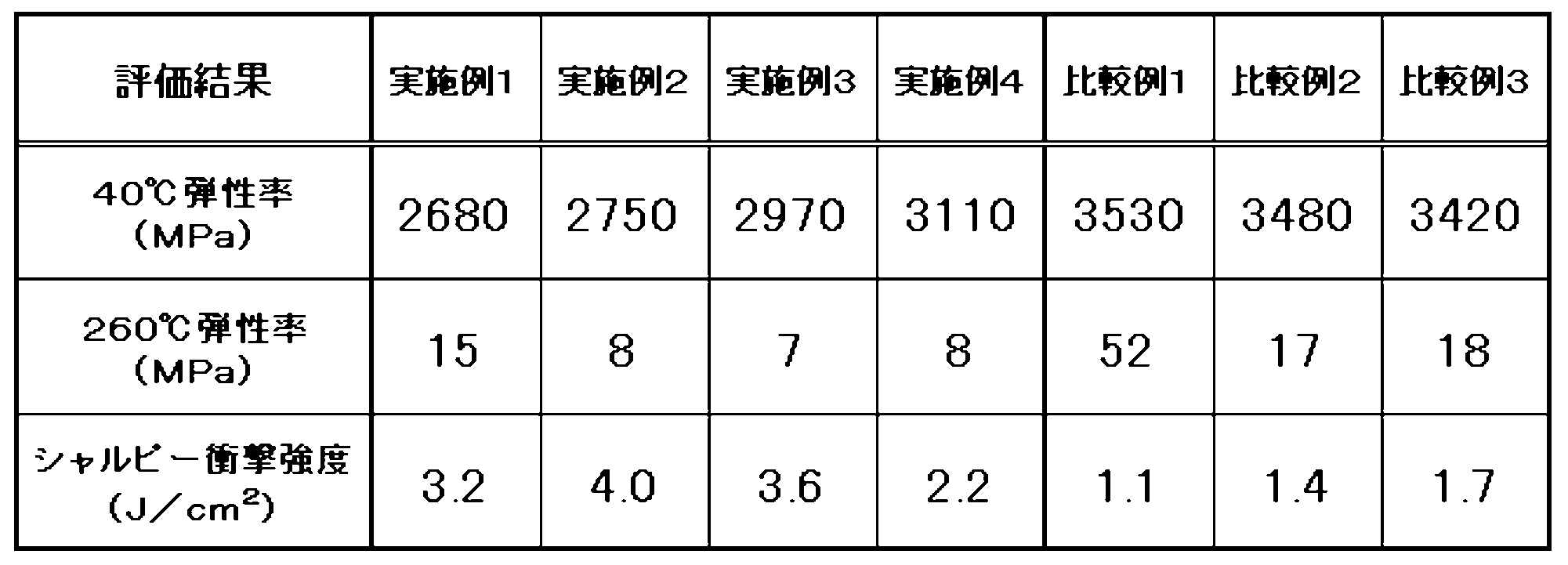
上記表3の評価結果より、全ての実施例において、低弾性率で高靭性に優れた硬化物を得ることができ、半導体封止用途に適していることが確認できた。
一方、上記表3の評価結果より、比較例1においては、前記樹脂(A)及び前記樹脂(B)を一切使用せずに硬化物を製造したため、弾性率が高くなり、靭性に劣る結果となった。比較例2及び比較例3においては、前記樹脂(A)及び前記樹脂(B)のいずれかを使用しなかったため、得られた硬化物は、40℃における弾性率を低く抑えることができず、靭性にも劣ることが確認できた。
Claims (9)
- パラターシャリーブチルフェノールノボラック樹脂(A)、及び、ジシクロペンタジエン骨格を有するフェノール樹脂(B)を含有する樹脂組成物。
- 前記パラターシャリーブチルフェノールノボラック樹脂(A)中の二核体成分の含有割合が、GPCチャート図から算出される面積比率で30%以上である請求項1に記載の樹脂組成物。
- 前記ジシクロペンタジエン骨格を有するフェノール樹脂(B)が、下記一般式(1)で表される化合物(b1)をGPCチャート図から算出される面積比率で30%以上含有する請求項1又は2記載の樹脂組成物。

- 前記パラターシャリーブチルフェノールノボラック樹脂(A)、及び、前記ジシクロペンタジエン骨格を有するフェノール樹脂(B)の質量比で示される配合割合(A)/(B)が、15/85~85/15である請求項1~3のいずれか1項に記載の樹脂組成物。
- さらにエポキシ樹脂を含有する請求項1~4のいずれか1項に記載の樹脂組成物。
- さらに無機充填材を含有する請求項1~5のいずれか1項に記載の樹脂組成物。
- 請求項1~6のいずれか1項に記載の樹脂組成物の硬化物。
- 請求項1~6のいずれか1項に記載の樹脂組成物を含有する半導体封止材。
- 請求項8に記載の半導体封止材の硬化物を含む半導体装置。
Priority Applications (1)
| Application Number | Priority Date | Filing Date | Title |
|---|---|---|---|
| JP2022544339A JP7205673B2 (ja) | 2020-11-16 | 2021-11-04 | 樹脂組成物、硬化物、半導体封止材、及び、半導体装置 |
Applications Claiming Priority (2)
| Application Number | Priority Date | Filing Date | Title |
|---|---|---|---|
| JP2020-190382 | 2020-11-16 | ||
| JP2020190382 | 2020-11-16 |
Publications (1)
| Publication Number | Publication Date |
|---|---|
| WO2022102489A1 true WO2022102489A1 (ja) | 2022-05-19 |
Family
ID=81601242
Family Applications (1)
| Application Number | Title | Priority Date | Filing Date |
|---|---|---|---|
| PCT/JP2021/040509 Ceased WO2022102489A1 (ja) | 2020-11-16 | 2021-11-04 | 樹脂組成物、硬化物、半導体封止材、及び、半導体装置 |
Country Status (3)
| Country | Link |
|---|---|
| JP (1) | JP7205673B2 (ja) |
| TW (1) | TW202225229A (ja) |
| WO (1) | WO2022102489A1 (ja) |
Cited By (1)
| Publication number | Priority date | Publication date | Assignee | Title |
|---|---|---|---|---|
| JP2022151177A (ja) * | 2021-03-26 | 2022-10-07 | 住友ベークライト株式会社 | 封止用樹脂組成物および半導体素子の製造方法 |
Citations (7)
| Publication number | Priority date | Publication date | Assignee | Title |
|---|---|---|---|---|
| JPH07196767A (ja) * | 1993-12-28 | 1995-08-01 | Nippon Kayaku Co Ltd | エポキシ樹脂組成物およびその硬化物 |
| JPH11199648A (ja) * | 1998-01-19 | 1999-07-27 | Dainippon Ink & Chem Inc | エポキシ樹脂組成物 |
| WO2005019299A1 (ja) * | 2003-08-21 | 2005-03-03 | Asahi Kasei Chemicals Corporation | 感光性組成物およびその硬化物 |
| JP2010222390A (ja) * | 2009-03-19 | 2010-10-07 | Lintec Corp | 接着剤組成物、接着シートおよび半導体装置の製造方法 |
| US20140228483A1 (en) * | 2013-02-13 | 2014-08-14 | Momentive Specialty Chemicals Inc. | Compositions useful for preparing composites and composites produced therewith |
| WO2015152037A1 (ja) * | 2014-03-31 | 2015-10-08 | 明和化成株式会社 | フェノール樹脂、該フェノール樹脂を含むエポキシ樹脂組成物、該エポキシ樹脂組成物の硬化物、及び該硬化物を有する半導体装置 |
| WO2018003513A1 (ja) * | 2016-06-29 | 2018-01-04 | Dic株式会社 | フェノールノボラック樹脂、硬化性樹脂組成物及びその硬化物 |
-
2021
- 2021-11-04 JP JP2022544339A patent/JP7205673B2/ja active Active
- 2021-11-04 TW TW110141096A patent/TW202225229A/zh unknown
- 2021-11-04 WO PCT/JP2021/040509 patent/WO2022102489A1/ja not_active Ceased
Patent Citations (7)
| Publication number | Priority date | Publication date | Assignee | Title |
|---|---|---|---|---|
| JPH07196767A (ja) * | 1993-12-28 | 1995-08-01 | Nippon Kayaku Co Ltd | エポキシ樹脂組成物およびその硬化物 |
| JPH11199648A (ja) * | 1998-01-19 | 1999-07-27 | Dainippon Ink & Chem Inc | エポキシ樹脂組成物 |
| WO2005019299A1 (ja) * | 2003-08-21 | 2005-03-03 | Asahi Kasei Chemicals Corporation | 感光性組成物およびその硬化物 |
| JP2010222390A (ja) * | 2009-03-19 | 2010-10-07 | Lintec Corp | 接着剤組成物、接着シートおよび半導体装置の製造方法 |
| US20140228483A1 (en) * | 2013-02-13 | 2014-08-14 | Momentive Specialty Chemicals Inc. | Compositions useful for preparing composites and composites produced therewith |
| WO2015152037A1 (ja) * | 2014-03-31 | 2015-10-08 | 明和化成株式会社 | フェノール樹脂、該フェノール樹脂を含むエポキシ樹脂組成物、該エポキシ樹脂組成物の硬化物、及び該硬化物を有する半導体装置 |
| WO2018003513A1 (ja) * | 2016-06-29 | 2018-01-04 | Dic株式会社 | フェノールノボラック樹脂、硬化性樹脂組成物及びその硬化物 |
Cited By (1)
| Publication number | Priority date | Publication date | Assignee | Title |
|---|---|---|---|---|
| JP2022151177A (ja) * | 2021-03-26 | 2022-10-07 | 住友ベークライト株式会社 | 封止用樹脂組成物および半導体素子の製造方法 |
Also Published As
| Publication number | Publication date |
|---|---|
| JPWO2022102489A1 (ja) | 2022-05-19 |
| TW202225229A (zh) | 2022-07-01 |
| JP7205673B2 (ja) | 2023-01-17 |
Similar Documents
| Publication | Publication Date | Title |
|---|---|---|
| CN104470965B (zh) | 环氧树脂、环氧树脂组合物及固化物 | |
| CN105531297A (zh) | 环氧树脂混合物、环氧树脂组合物、固化物和半导体装置 | |
| JP5796502B2 (ja) | エポキシ樹脂、エポキシ樹脂の製造方法及びエポキシ樹脂組成物 | |
| JP2015000952A (ja) | エポキシ樹脂組成物およびその硬化物 | |
| CN101679600B (zh) | 液态环氧树脂、环氧树脂组合物及固化物 | |
| TWI903003B (zh) | 聚酯樹脂、硬化性組合物、硬化物、預浸體、印刷配線基板、增層膜、半導體密封材料及半導體裝置 | |
| CN101522747B (zh) | 变性液性环氧树脂、以及使用该树脂的环氧树脂组成物及其硬化物 | |
| CN105555827B (zh) | 环氧树脂混合物、环氧树脂组合物、固化物和半导体装置 | |
| JP7444068B2 (ja) | 硬化性樹脂組成物、硬化物及びシート状成形体 | |
| JP4655490B2 (ja) | エポキシ樹脂組成物及びその硬化体 | |
| JP7205673B2 (ja) | 樹脂組成物、硬化物、半導体封止材、及び、半導体装置 | |
| CN105980440A (zh) | 环氧树脂、固化性树脂组合物及其固化物 | |
| JP6620981B2 (ja) | 熱硬化性成形材料、その製造方法および半導体封止材 | |
| TWI478955B (zh) | 環氧樹脂組成物、該環氧樹脂組成物的製造方法及其硬化物 | |
| JP2022175821A (ja) | 樹脂組成物、硬化物、半導体封止材、及び、半導体装置 | |
| JP3722427B2 (ja) | エポキシ樹脂組成物 | |
| CN104769000B (zh) | 环氧树脂混合物、环氧树脂组合物及其固化物 | |
| KR20160125347A (ko) | 에폭시 수지, 에폭시 수지 조성물 및 그 경화물 | |
| JP7739969B2 (ja) | エポキシ樹脂組成物及びその製造方法、硬化性組成物、硬化物、半導体封止材料、半導体装置、プリプレグ、回路基板、並びに、ビルドアップフィルム | |
| TW202231706A (zh) | 環氧樹脂、硬化性組成物、硬化物、半導體封裝材料、半導體裝置、預浸漬物、電路基板、及增層薄膜 | |
| JP2023074977A (ja) | 半導体封止用樹脂組成物、半導体封止材料及び半導体装置 | |
| JP2023074975A (ja) | 半導体封止用樹脂組成物、半導体封止材料及び半導体装置 | |
| JP6241186B2 (ja) | フェノール樹脂、エポキシ樹脂、これらの製造方法、硬化性組成物、その硬化物、半導体封止材料、及びプリント配線基板 | |
| JP7848449B2 (ja) | エポキシ樹脂及び当該エポキシ樹脂を含有する硬化性組成物 | |
| KR102871799B1 (ko) | 에폭시 수지, 경화성 조성물, 경화물, 반도체 봉지 재료, 반도체 장치, 프리프레그, 회로 기판, 및, 빌드업 필름 |
Legal Events
| Date | Code | Title | Description |
|---|---|---|---|
| 121 | Ep: the epo has been informed by wipo that ep was designated in this application |
Ref document number: 21891735 Country of ref document: EP Kind code of ref document: A1 |
|
| ENP | Entry into the national phase |
Ref document number: 2022544339 Country of ref document: JP Kind code of ref document: A |
|
| NENP | Non-entry into the national phase |
Ref country code: DE |
|
| 122 | Ep: pct application non-entry in european phase |
Ref document number: 21891735 Country of ref document: EP Kind code of ref document: A1 |