WO2022091978A1 - 粒子組成物及び成形体 - Google Patents
粒子組成物及び成形体 Download PDFInfo
- Publication number
- WO2022091978A1 WO2022091978A1 PCT/JP2021/039127 JP2021039127W WO2022091978A1 WO 2022091978 A1 WO2022091978 A1 WO 2022091978A1 JP 2021039127 W JP2021039127 W JP 2021039127W WO 2022091978 A1 WO2022091978 A1 WO 2022091978A1
- Authority
- WO
- WIPO (PCT)
- Prior art keywords
- mass
- alumina particles
- water
- particles
- alumina
- Prior art date
- Legal status (The legal status is an assumption and is not a legal conclusion. Google has not performed a legal analysis and makes no representation as to the accuracy of the status listed.)
- Ceased
Links
Images



Classifications
-
- C—CHEMISTRY; METALLURGY
- C08—ORGANIC MACROMOLECULAR COMPOUNDS; THEIR PREPARATION OR CHEMICAL WORKING-UP; COMPOSITIONS BASED THEREON
- C08K—Use of inorganic or non-macromolecular organic substances as compounding ingredients
- C08K7/00—Use of ingredients characterised by shape
- C08K7/16—Solid spheres
- C08K7/18—Solid spheres inorganic
-
- C—CHEMISTRY; METALLURGY
- C08—ORGANIC MACROMOLECULAR COMPOUNDS; THEIR PREPARATION OR CHEMICAL WORKING-UP; COMPOSITIONS BASED THEREON
- C08L—COMPOSITIONS OF MACROMOLECULAR COMPOUNDS
- C08L101/00—Compositions of unspecified macromolecular compounds
- C08L101/12—Compositions of unspecified macromolecular compounds characterised by physical features, e.g. anisotropy, viscosity or electrical conductivity
- C08L101/14—Compositions of unspecified macromolecular compounds characterised by physical features, e.g. anisotropy, viscosity or electrical conductivity the macromolecular compounds being water soluble or water swellable, e.g. aqueous gels
-
- B—PERFORMING OPERATIONS; TRANSPORTING
- B33—ADDITIVE MANUFACTURING TECHNOLOGY
- B33Y—ADDITIVE MANUFACTURING, i.e. MANUFACTURING OF THREE-DIMENSIONAL [3D] OBJECTS BY ADDITIVE DEPOSITION, ADDITIVE AGGLOMERATION OR ADDITIVE LAYERING, e.g. BY 3D PRINTING, STEREOLITHOGRAPHY OR SELECTIVE LASER SINTERING
- B33Y70/00—Materials specially adapted for additive manufacturing
-
- C—CHEMISTRY; METALLURGY
- C01—INORGANIC CHEMISTRY
- C01F—COMPOUNDS OF THE METALS BERYLLIUM, MAGNESIUM, ALUMINIUM, CALCIUM, STRONTIUM, BARIUM, RADIUM, THORIUM, OR OF THE RARE-EARTH METALS
- C01F7/00—Compounds of aluminium
- C01F7/02—Aluminium oxide; Aluminium hydroxide; Aluminates
-
- C—CHEMISTRY; METALLURGY
- C01—INORGANIC CHEMISTRY
- C01F—COMPOUNDS OF THE METALS BERYLLIUM, MAGNESIUM, ALUMINIUM, CALCIUM, STRONTIUM, BARIUM, RADIUM, THORIUM, OR OF THE RARE-EARTH METALS
- C01F7/00—Compounds of aluminium
- C01F7/02—Aluminium oxide; Aluminium hydroxide; Aluminates
- C01F7/021—After-treatment of oxides or hydroxides
-
- C—CHEMISTRY; METALLURGY
- C04—CEMENTS; CONCRETE; ARTIFICIAL STONE; CERAMICS; REFRACTORIES
- C04B—LIME, MAGNESIA; SLAG; CEMENTS; COMPOSITIONS THEREOF, e.g. MORTARS, CONCRETE OR LIKE BUILDING MATERIALS; ARTIFICIAL STONE; CERAMICS; REFRACTORIES; TREATMENT OF NATURAL STONE
- C04B35/00—Shaped ceramic products characterised by their composition; Ceramics compositions; Processing powders of inorganic compounds preparatory to the manufacturing of ceramic products
- C04B35/01—Shaped ceramic products characterised by their composition; Ceramics compositions; Processing powders of inorganic compounds preparatory to the manufacturing of ceramic products based on oxide ceramics
- C04B35/10—Shaped ceramic products characterised by their composition; Ceramics compositions; Processing powders of inorganic compounds preparatory to the manufacturing of ceramic products based on oxide ceramics based on aluminium oxide
- C04B35/111—Fine ceramics
-
- C—CHEMISTRY; METALLURGY
- C04—CEMENTS; CONCRETE; ARTIFICIAL STONE; CERAMICS; REFRACTORIES
- C04B—LIME, MAGNESIA; SLAG; CEMENTS; COMPOSITIONS THEREOF, e.g. MORTARS, CONCRETE OR LIKE BUILDING MATERIALS; ARTIFICIAL STONE; CERAMICS; REFRACTORIES; TREATMENT OF NATURAL STONE
- C04B35/00—Shaped ceramic products characterised by their composition; Ceramics compositions; Processing powders of inorganic compounds preparatory to the manufacturing of ceramic products
- C04B35/622—Forming processes; Processing powders of inorganic compounds preparatory to the manufacturing of ceramic products
- C04B35/626—Preparing or treating the powders individually or as batches ; preparing or treating macroscopic reinforcing agents for ceramic products, e.g. fibres; mechanical aspects section B
- C04B35/62605—Treating the starting powders individually or as mixtures
- C04B35/6261—Milling
-
- C—CHEMISTRY; METALLURGY
- C04—CEMENTS; CONCRETE; ARTIFICIAL STONE; CERAMICS; REFRACTORIES
- C04B—LIME, MAGNESIA; SLAG; CEMENTS; COMPOSITIONS THEREOF, e.g. MORTARS, CONCRETE OR LIKE BUILDING MATERIALS; ARTIFICIAL STONE; CERAMICS; REFRACTORIES; TREATMENT OF NATURAL STONE
- C04B35/00—Shaped ceramic products characterised by their composition; Ceramics compositions; Processing powders of inorganic compounds preparatory to the manufacturing of ceramic products
- C04B35/622—Forming processes; Processing powders of inorganic compounds preparatory to the manufacturing of ceramic products
- C04B35/626—Preparing or treating the powders individually or as batches ; preparing or treating macroscopic reinforcing agents for ceramic products, e.g. fibres; mechanical aspects section B
- C04B35/62605—Treating the starting powders individually or as mixtures
- C04B35/62625—Wet mixtures
-
- C—CHEMISTRY; METALLURGY
- C04—CEMENTS; CONCRETE; ARTIFICIAL STONE; CERAMICS; REFRACTORIES
- C04B—LIME, MAGNESIA; SLAG; CEMENTS; COMPOSITIONS THEREOF, e.g. MORTARS, CONCRETE OR LIKE BUILDING MATERIALS; ARTIFICIAL STONE; CERAMICS; REFRACTORIES; TREATMENT OF NATURAL STONE
- C04B35/00—Shaped ceramic products characterised by their composition; Ceramics compositions; Processing powders of inorganic compounds preparatory to the manufacturing of ceramic products
- C04B35/622—Forming processes; Processing powders of inorganic compounds preparatory to the manufacturing of ceramic products
- C04B35/626—Preparing or treating the powders individually or as batches ; preparing or treating macroscopic reinforcing agents for ceramic products, e.g. fibres; mechanical aspects section B
- C04B35/63—Preparing or treating the powders individually or as batches ; preparing or treating macroscopic reinforcing agents for ceramic products, e.g. fibres; mechanical aspects section B using additives specially adapted for forming the products, e.g.. binder binders
- C04B35/632—Organic additives
- C04B35/634—Polymers
-
- C—CHEMISTRY; METALLURGY
- C04—CEMENTS; CONCRETE; ARTIFICIAL STONE; CERAMICS; REFRACTORIES
- C04B—LIME, MAGNESIA; SLAG; CEMENTS; COMPOSITIONS THEREOF, e.g. MORTARS, CONCRETE OR LIKE BUILDING MATERIALS; ARTIFICIAL STONE; CERAMICS; REFRACTORIES; TREATMENT OF NATURAL STONE
- C04B35/00—Shaped ceramic products characterised by their composition; Ceramics compositions; Processing powders of inorganic compounds preparatory to the manufacturing of ceramic products
- C04B35/622—Forming processes; Processing powders of inorganic compounds preparatory to the manufacturing of ceramic products
- C04B35/626—Preparing or treating the powders individually or as batches ; preparing or treating macroscopic reinforcing agents for ceramic products, e.g. fibres; mechanical aspects section B
- C04B35/63—Preparing or treating the powders individually or as batches ; preparing or treating macroscopic reinforcing agents for ceramic products, e.g. fibres; mechanical aspects section B using additives specially adapted for forming the products, e.g.. binder binders
- C04B35/632—Organic additives
- C04B35/634—Polymers
- C04B35/63404—Polymers obtained by reactions only involving carbon-to-carbon unsaturated bonds
- C04B35/63416—Polyvinylalcohols [PVA]; Polyvinylacetates
-
- C—CHEMISTRY; METALLURGY
- C04—CEMENTS; CONCRETE; ARTIFICIAL STONE; CERAMICS; REFRACTORIES
- C04B—LIME, MAGNESIA; SLAG; CEMENTS; COMPOSITIONS THEREOF, e.g. MORTARS, CONCRETE OR LIKE BUILDING MATERIALS; ARTIFICIAL STONE; CERAMICS; REFRACTORIES; TREATMENT OF NATURAL STONE
- C04B35/00—Shaped ceramic products characterised by their composition; Ceramics compositions; Processing powders of inorganic compounds preparatory to the manufacturing of ceramic products
- C04B35/622—Forming processes; Processing powders of inorganic compounds preparatory to the manufacturing of ceramic products
- C04B35/626—Preparing or treating the powders individually or as batches ; preparing or treating macroscopic reinforcing agents for ceramic products, e.g. fibres; mechanical aspects section B
- C04B35/63—Preparing or treating the powders individually or as batches ; preparing or treating macroscopic reinforcing agents for ceramic products, e.g. fibres; mechanical aspects section B using additives specially adapted for forming the products, e.g.. binder binders
- C04B35/632—Organic additives
- C04B35/634—Polymers
- C04B35/63404—Polymers obtained by reactions only involving carbon-to-carbon unsaturated bonds
- C04B35/63424—Polyacrylates; Polymethacrylates
-
- C—CHEMISTRY; METALLURGY
- C04—CEMENTS; CONCRETE; ARTIFICIAL STONE; CERAMICS; REFRACTORIES
- C04B—LIME, MAGNESIA; SLAG; CEMENTS; COMPOSITIONS THEREOF, e.g. MORTARS, CONCRETE OR LIKE BUILDING MATERIALS; ARTIFICIAL STONE; CERAMICS; REFRACTORIES; TREATMENT OF NATURAL STONE
- C04B35/00—Shaped ceramic products characterised by their composition; Ceramics compositions; Processing powders of inorganic compounds preparatory to the manufacturing of ceramic products
- C04B35/622—Forming processes; Processing powders of inorganic compounds preparatory to the manufacturing of ceramic products
- C04B35/626—Preparing or treating the powders individually or as batches ; preparing or treating macroscopic reinforcing agents for ceramic products, e.g. fibres; mechanical aspects section B
- C04B35/63—Preparing or treating the powders individually or as batches ; preparing or treating macroscopic reinforcing agents for ceramic products, e.g. fibres; mechanical aspects section B using additives specially adapted for forming the products, e.g.. binder binders
- C04B35/632—Organic additives
- C04B35/634—Polymers
- C04B35/63404—Polymers obtained by reactions only involving carbon-to-carbon unsaturated bonds
- C04B35/63444—Nitrogen-containing polymers, e.g. polyacrylamides, polyacrylonitriles, polyvinylpyrrolidone [PVP], polyethylenimine [PEI]
-
- C—CHEMISTRY; METALLURGY
- C04—CEMENTS; CONCRETE; ARTIFICIAL STONE; CERAMICS; REFRACTORIES
- C04B—LIME, MAGNESIA; SLAG; CEMENTS; COMPOSITIONS THEREOF, e.g. MORTARS, CONCRETE OR LIKE BUILDING MATERIALS; ARTIFICIAL STONE; CERAMICS; REFRACTORIES; TREATMENT OF NATURAL STONE
- C04B35/00—Shaped ceramic products characterised by their composition; Ceramics compositions; Processing powders of inorganic compounds preparatory to the manufacturing of ceramic products
- C04B35/622—Forming processes; Processing powders of inorganic compounds preparatory to the manufacturing of ceramic products
- C04B35/64—Burning or sintering processes
-
- B—PERFORMING OPERATIONS; TRANSPORTING
- B29—WORKING OF PLASTICS; WORKING OF SUBSTANCES IN A PLASTIC STATE IN GENERAL
- B29C—SHAPING OR JOINING OF PLASTICS; SHAPING OF MATERIAL IN A PLASTIC STATE, NOT OTHERWISE PROVIDED FOR; AFTER-TREATMENT OF THE SHAPED PRODUCTS, e.g. REPAIRING
- B29C64/00—Additive manufacturing, i.e. manufacturing of three-dimensional [3D] objects by additive deposition, additive agglomeration or additive layering, e.g. by 3D printing, stereolithography or selective laser sintering
- B29C64/10—Processes of additive manufacturing
- B29C64/165—Processes of additive manufacturing using a combination of solid and fluid materials, e.g. a powder selectively bound by a liquid binder, catalyst, inhibitor or energy absorber
-
- B—PERFORMING OPERATIONS; TRANSPORTING
- B33—ADDITIVE MANUFACTURING TECHNOLOGY
- B33Y—ADDITIVE MANUFACTURING, i.e. MANUFACTURING OF THREE-DIMENSIONAL [3D] OBJECTS BY ADDITIVE DEPOSITION, ADDITIVE AGGLOMERATION OR ADDITIVE LAYERING, e.g. BY 3D PRINTING, STEREOLITHOGRAPHY OR SELECTIVE LASER SINTERING
- B33Y10/00—Processes of additive manufacturing
-
- C—CHEMISTRY; METALLURGY
- C01—INORGANIC CHEMISTRY
- C01P—INDEXING SCHEME RELATING TO STRUCTURAL AND PHYSICAL ASPECTS OF SOLID INORGANIC COMPOUNDS
- C01P2004/00—Particle morphology
- C01P2004/30—Particle morphology extending in three dimensions
- C01P2004/32—Spheres
-
- C—CHEMISTRY; METALLURGY
- C01—INORGANIC CHEMISTRY
- C01P—INDEXING SCHEME RELATING TO STRUCTURAL AND PHYSICAL ASPECTS OF SOLID INORGANIC COMPOUNDS
- C01P2004/00—Particle morphology
- C01P2004/60—Particles characterised by their size
- C01P2004/61—Micrometer sized, i.e. from 1-100 micrometer
-
- C—CHEMISTRY; METALLURGY
- C01—INORGANIC CHEMISTRY
- C01P—INDEXING SCHEME RELATING TO STRUCTURAL AND PHYSICAL ASPECTS OF SOLID INORGANIC COMPOUNDS
- C01P2004/00—Particle morphology
- C01P2004/60—Particles characterised by their size
- C01P2004/62—Submicrometer sized, i.e. from 0.1-1 micrometer
-
- C—CHEMISTRY; METALLURGY
- C04—CEMENTS; CONCRETE; ARTIFICIAL STONE; CERAMICS; REFRACTORIES
- C04B—LIME, MAGNESIA; SLAG; CEMENTS; COMPOSITIONS THEREOF, e.g. MORTARS, CONCRETE OR LIKE BUILDING MATERIALS; ARTIFICIAL STONE; CERAMICS; REFRACTORIES; TREATMENT OF NATURAL STONE
- C04B2235/00—Aspects relating to ceramic starting mixtures or sintered ceramic products
- C04B2235/02—Composition of constituents of the starting material or of secondary phases of the final product
- C04B2235/30—Constituents and secondary phases not being of a fibrous nature
- C04B2235/32—Metal oxides, mixed metal oxides, or oxide-forming salts thereof, e.g. carbonates, nitrates, (oxy)hydroxides, chlorides
- C04B2235/3217—Aluminum oxide or oxide forming salts thereof, e.g. bauxite, alpha-alumina
-
- C—CHEMISTRY; METALLURGY
- C04—CEMENTS; CONCRETE; ARTIFICIAL STONE; CERAMICS; REFRACTORIES
- C04B—LIME, MAGNESIA; SLAG; CEMENTS; COMPOSITIONS THEREOF, e.g. MORTARS, CONCRETE OR LIKE BUILDING MATERIALS; ARTIFICIAL STONE; CERAMICS; REFRACTORIES; TREATMENT OF NATURAL STONE
- C04B2235/00—Aspects relating to ceramic starting mixtures or sintered ceramic products
- C04B2235/02—Composition of constituents of the starting material or of secondary phases of the final product
- C04B2235/50—Constituents or additives of the starting mixture chosen for their shape or used because of their shape or their physical appearance
- C04B2235/54—Particle size related information
- C04B2235/5418—Particle size related information expressed by the size of the particles or aggregates thereof
- C04B2235/5436—Particle size related information expressed by the size of the particles or aggregates thereof micrometer sized, i.e. from 1 to 100 micron
-
- C—CHEMISTRY; METALLURGY
- C04—CEMENTS; CONCRETE; ARTIFICIAL STONE; CERAMICS; REFRACTORIES
- C04B—LIME, MAGNESIA; SLAG; CEMENTS; COMPOSITIONS THEREOF, e.g. MORTARS, CONCRETE OR LIKE BUILDING MATERIALS; ARTIFICIAL STONE; CERAMICS; REFRACTORIES; TREATMENT OF NATURAL STONE
- C04B2235/00—Aspects relating to ceramic starting mixtures or sintered ceramic products
- C04B2235/02—Composition of constituents of the starting material or of secondary phases of the final product
- C04B2235/50—Constituents or additives of the starting mixture chosen for their shape or used because of their shape or their physical appearance
- C04B2235/54—Particle size related information
- C04B2235/5418—Particle size related information expressed by the size of the particles or aggregates thereof
- C04B2235/5445—Particle size related information expressed by the size of the particles or aggregates thereof submicron sized, i.e. from 0,1 to 1 micron
-
- C—CHEMISTRY; METALLURGY
- C04—CEMENTS; CONCRETE; ARTIFICIAL STONE; CERAMICS; REFRACTORIES
- C04B—LIME, MAGNESIA; SLAG; CEMENTS; COMPOSITIONS THEREOF, e.g. MORTARS, CONCRETE OR LIKE BUILDING MATERIALS; ARTIFICIAL STONE; CERAMICS; REFRACTORIES; TREATMENT OF NATURAL STONE
- C04B2235/00—Aspects relating to ceramic starting mixtures or sintered ceramic products
- C04B2235/02—Composition of constituents of the starting material or of secondary phases of the final product
- C04B2235/50—Constituents or additives of the starting mixture chosen for their shape or used because of their shape or their physical appearance
- C04B2235/54—Particle size related information
- C04B2235/5463—Particle size distributions
-
- C—CHEMISTRY; METALLURGY
- C04—CEMENTS; CONCRETE; ARTIFICIAL STONE; CERAMICS; REFRACTORIES
- C04B—LIME, MAGNESIA; SLAG; CEMENTS; COMPOSITIONS THEREOF, e.g. MORTARS, CONCRETE OR LIKE BUILDING MATERIALS; ARTIFICIAL STONE; CERAMICS; REFRACTORIES; TREATMENT OF NATURAL STONE
- C04B2235/00—Aspects relating to ceramic starting mixtures or sintered ceramic products
- C04B2235/02—Composition of constituents of the starting material or of secondary phases of the final product
- C04B2235/50—Constituents or additives of the starting mixture chosen for their shape or used because of their shape or their physical appearance
- C04B2235/54—Particle size related information
- C04B2235/5463—Particle size distributions
- C04B2235/5472—Bimodal, multi-modal or multi-fraction
-
- C—CHEMISTRY; METALLURGY
- C04—CEMENTS; CONCRETE; ARTIFICIAL STONE; CERAMICS; REFRACTORIES
- C04B—LIME, MAGNESIA; SLAG; CEMENTS; COMPOSITIONS THEREOF, e.g. MORTARS, CONCRETE OR LIKE BUILDING MATERIALS; ARTIFICIAL STONE; CERAMICS; REFRACTORIES; TREATMENT OF NATURAL STONE
- C04B2235/00—Aspects relating to ceramic starting mixtures or sintered ceramic products
- C04B2235/60—Aspects relating to the preparation, properties or mechanical treatment of green bodies or pre-forms
- C04B2235/602—Making the green bodies or pre-forms by moulding
- C04B2235/6026—Computer aided shaping, e.g. rapid prototyping
-
- C—CHEMISTRY; METALLURGY
- C04—CEMENTS; CONCRETE; ARTIFICIAL STONE; CERAMICS; REFRACTORIES
- C04B—LIME, MAGNESIA; SLAG; CEMENTS; COMPOSITIONS THEREOF, e.g. MORTARS, CONCRETE OR LIKE BUILDING MATERIALS; ARTIFICIAL STONE; CERAMICS; REFRACTORIES; TREATMENT OF NATURAL STONE
- C04B2235/00—Aspects relating to ceramic starting mixtures or sintered ceramic products
- C04B2235/65—Aspects relating to heat treatments of ceramic bodies such as green ceramics or pre-sintered ceramics, e.g. burning, sintering or melting processes
- C04B2235/656—Aspects relating to heat treatments of ceramic bodies such as green ceramics or pre-sintered ceramics, e.g. burning, sintering or melting processes characterised by specific heating conditions during heat treatment
- C04B2235/6567—Treatment time
-
- C—CHEMISTRY; METALLURGY
- C04—CEMENTS; CONCRETE; ARTIFICIAL STONE; CERAMICS; REFRACTORIES
- C04B—LIME, MAGNESIA; SLAG; CEMENTS; COMPOSITIONS THEREOF, e.g. MORTARS, CONCRETE OR LIKE BUILDING MATERIALS; ARTIFICIAL STONE; CERAMICS; REFRACTORIES; TREATMENT OF NATURAL STONE
- C04B2235/00—Aspects relating to ceramic starting mixtures or sintered ceramic products
- C04B2235/70—Aspects relating to sintered or melt-casted ceramic products
- C04B2235/96—Properties of ceramic products, e.g. mechanical properties such as strength, toughness, wear resistance
- C04B2235/9607—Thermal properties, e.g. thermal expansion coefficient
- C04B2235/9615—Linear firing shrinkage
-
- C—CHEMISTRY; METALLURGY
- C08—ORGANIC MACROMOLECULAR COMPOUNDS; THEIR PREPARATION OR CHEMICAL WORKING-UP; COMPOSITIONS BASED THEREON
- C08K—Use of inorganic or non-macromolecular organic substances as compounding ingredients
- C08K3/00—Use of inorganic substances as compounding ingredients
- C08K3/18—Oxygen-containing compounds, e.g. metal carbonyls
- C08K3/20—Oxides; Hydroxides
- C08K3/22—Oxides; Hydroxides of metals
- C08K2003/2227—Oxides; Hydroxides of metals of aluminium
-
- C—CHEMISTRY; METALLURGY
- C08—ORGANIC MACROMOLECULAR COMPOUNDS; THEIR PREPARATION OR CHEMICAL WORKING-UP; COMPOSITIONS BASED THEREON
- C08K—Use of inorganic or non-macromolecular organic substances as compounding ingredients
- C08K2201/00—Specific properties of additives
- C08K2201/002—Physical properties
- C08K2201/005—Additives being defined by their particle size in general
Definitions
- the present invention relates to a particle composition and a molded product.
- the apparent volume in the process of sintering the alumina molded body to obtain the sintered body, the apparent volume (outer shape) may be significantly shrunk, or the strength of the molded body may not be sufficient. there were.
- the present invention has been made against the background of the above circumstances, and provides a particle composition and a molded product capable of reducing the shrinkage of the apparent volume before and after sintering and sufficiently increasing the strength of the molded product.
- the purpose is to do.
- the particle composition according to the present invention is a particle composition comprising ⁇ -alumina particles and water-absorbent polymer particles.
- the content of the water-absorbent polymer particles is 2 parts by mass or more and 60 parts by mass or less with respect to 100 parts by mass of the ⁇ -alumina particles, and the content of the ⁇ -alumina particles in the particle composition is 50% by mass or more. ..
- the molded product according to the present invention is a molded product including ⁇ -alumina particles and a water-absorbent polymer.
- the content of the water-absorbent polymer is 2 parts by mass or more and 60 parts by mass or less with respect to 100 parts by mass of the ⁇ -alumina particles, and the content of the ⁇ -alumina particles in the molded body is 50% by mass or more.
- the ⁇ -alumina particles have one or a plurality of first peaks having vertices between 10 and 100 ⁇ m, and one or a plurality of vertices having vertices between 0.1 and 10 ⁇ m. It can have a particle size distribution with a second peak.
- the alumina particles have at least two second peaks, one second peak has a vertex between 1 and 10 ⁇ m, and the other second peak is 0. It can have vertices between 1 and 1 ⁇ m.
- the one or more first peaks can have vertices between 10 and 30 ⁇ m.
- the ⁇ -alumina particles can contain 80% by mass or more of single crystal ⁇ -alumina particles having substantially no crushed surface.
- a molded product of alumina powder capable of reducing the shrinkage of the apparent volume due to sintering and sufficiently increasing the strength of the sintered body.
- FIG. 1 (a) is a schematic cross-sectional view of a particle composition according to one embodiment of the present invention
- FIG. 1 (b) is a schematic cross-sectional view of a molded body according to one embodiment of the present invention
- FIG. 1 (c). ) Is a schematic cross-sectional view of the sintered body according to one embodiment of the present invention.
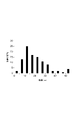
- FIG. 2 is a graph showing the particle size distribution of the water-absorbent polymer particles (RP-500S) used in the examples.
- FIG. 3 is a graph showing the particle size distribution of the water-absorbent polymer particles (RP-100S) used in the comparative example.
- FIG. 4 is a diagram showing the particle size distribution of each ⁇ -alumina particle used in Example and the mixed ⁇ -alumina particle of Example 1.
- the particle composition contains ⁇ -alumina particles and water-absorbent polymer particles, and the content of the water-absorbent polymer particles is 2 parts by mass or more and 60 parts by mass or less with respect to 100 parts by mass of the ⁇ -alumina particles.
- the content of ⁇ -alumina particles in the particle is 50% by mass or more.
- the ⁇ -alumina particles are particles containing 70% by mass or more of ⁇ -alumina, and may contain 80% by mass or more of ⁇ -alumina, 90% by mass or more, or 95% by mass or more.
- the ⁇ -alumina particles have a particle size distribution having one or more first peaks with vertices between 10 and 100 ⁇ m and one or more second peaks with vertices between 0.1 and 10 ⁇ m. Can be done.
- the particle size distribution is a volume-based particle size distribution by a laser diffraction method.
- the vertices of one or more first peaks are in the range of 10-100 ⁇ m.
- the preferred range of the vertices of one or more first peaks is 10 to 30 ⁇ m, and the more preferred range is 15 to 25 ⁇ m.
- the D90 / D10 at each of the first peaks is preferably 3 or less, and may be 2 or less.
- D90 is a particle size of 90% cumulative from the smaller one in the particle size distribution expressed on a volume basis
- D10 is a particle size of 10% cumulative from the smaller one in the particle size distribution.
- the portion of the ⁇ -alumina particles constituting the first peak may contain 80% by mass or more of single crystal ⁇ -alumina particles having substantially no fracture surface.
- the portion preferably contains 90% by mass or more of single crystal ⁇ -alumina particles having substantially no crushed surface, further preferably 95% by mass or more, and particularly preferably 99% by mass or more. ..
- substantially having no crushed surface means that the particles have a polyhedral shape when each particle is observed with a scanning electron microscope (SEM), and the particles are specified in terms of crystal structure such as r-plane. It shows that it is composed only of possible surfaces.
- a crushed surface having an indefinite shape for which the surface index cannot be specified is generated, for example, by performing processing such as crushing in order to obtain a required particle size.
- the single crystal ⁇ -alumina particles having substantially no crushed surface are, specifically, 100 particles observed by SEM, and the number of particles having a crushed surface is a specific number (for example, 20) or less. Alumina particles.
- the portions constituting the one or a plurality of first peaks are the first peak (if there are a plurality of first peaks, the peak having the smallest particle size among them) and the second peak described later in the curve of the particle size distribution. It is a portion above the minimum value between (when there are a plurality of second peaks, the peak having the maximum particle size among them). If there is another peak on the larger particle size side than the first peak, the first peak (if there are multiple first peaks, the peak with the largest particle size among them) and the other peak (the other peak). If there is more than one, it is up to the minimum value between the peak of the smallest particle size).
- the single crystal ⁇ -alumina particles having substantially no crushed surface can be homogeneous and have no crystal species inside, and can have a polyhedral shape having eight or more surfaces. Further, the alumina particles have a D / H ratio of 0.5 when the maximum particle diameter parallel to the hexagonal lattice plane of ⁇ -alumina, which is the hexagonal close-packed lattice, is D, and the particle diameter perpendicular to the hexagonal lattice plane is H. It can be 3.0 or more and 3.0 or less. Further, the ⁇ -alumina particles can have a sodium content of less than 0.05% by weight in terms of Na 2O and an alumina purity of 99.90% by weight or more.
- the vertices of one or more second peaks are between 0.1 and 10 ⁇ m.
- the preferred range for the positions of the vertices of one or more second peaks is 0.2 to 5 ⁇ m, and the more preferred range is 0.3 to 4 ⁇ m.
- one vertex of the second peak can be between 1 and 10 ⁇ m and the other vertex of the second peak can be between 0.1 and 1 ⁇ m.
- the tensile strength of the sintered body can be increased.
- the portion constituting the second peak (if there are a plurality of second peaks, all of them) may be single crystal ⁇ -alumina particles or polycrystalline ⁇ -alumina particles.
- the portion constituting the second peak (if there are a plurality of second peaks, all of them) is 80% by mass or more (more preferably 90% by mass or more, further preferably 95% by mass or more, and particularly preferably 99% by mass or more). It is preferable to contain single crystal ⁇ -alumina particles having substantially no crushed surface.
- the single crystal ⁇ -alumina particles having substantially no crushed surface can be homogeneous and have no crystal species inside, and can have a polyhedral shape having eight or more surfaces.
- the single crystal ⁇ -alumina particles having substantially no crushed surface have a maximum particle size D parallel to the hexagonal lattice plane of ⁇ -alumina, which is a hexagonal close-packed lattice, and a particle size perpendicular to the hexagonal lattice plane.
- D / H ratio can be 0.5 or more and 3.0 or less.
- the ⁇ -alumina particles can have a sodium content of less than 0.05% by weight in terms of Na 2O and an alumina purity of 99.90% by weight or more.
- the portions constituting the one or a plurality of second peaks are the first peak (if there are a plurality of first peaks, the peak having the smallest particle size among them) and the second peak in the curve of the particle size distribution. It is a portion below the minimum value between (when there are a plurality of second peaks, the peak having the maximum particle size among them). If there is another peak on the smaller particle size side than the second peak, the second peak (if there are multiple second peaks, the peak with the smallest particle size) and the other peak (the other peak). If there is more than one, it is up to the minimum value between the peak of the maximum particle size).
- Each second peak may be broad, but it can also be a sharp peak.
- D90 / D10 at each second peak can be 20 or less, preferably 15 or less, more preferably 10 or less, still more preferably 5 or less.
- the mass of the portion constituting one or a plurality of first peaks is 100 parts by mass
- one or a plurality of second peaks when there are a plurality of second peaks.
- the mass of the portion constituting the whole can be 20 to 500 parts by mass, preferably 25 to 100 parts by mass, and more preferably 30 to 60 parts by mass.
- one of the second peaks is between 1 and 10 ⁇ m
- the other (small second peak) of the second peak is the apex.
- the “part constituting one or a plurality of second peaks (all of them if there are a plurality of second peaks)” in the particle size distribution curve further increases the second peak size. It can be divided into a constituent part and a constituent portion of the second peak small. Here, the portion constituting the second peak large and the portion constituting the second peak small are separated from each other by the minimum value between these peaks.
- the mass of the portion constituting one or a plurality of first peaks is 100 parts by mass
- the mass of the portion constituting the second peak is 10 to 100 parts by mass. It can be preferably 15 to 80 parts by mass, more preferably 30 to 50 parts by mass.
- the mass of the portion constituting the small second peak is 5 to 100 parts by mass. It can be preferably 5 to 70 parts by mass, more preferably 5 to 50 parts by mass, and further preferably 10 to 20 parts by mass.
- the particle size distribution of the ⁇ -alumina particles may or may not have an additional peak in the portion over 100 ⁇ m and / or in the portion less than 0.1 ⁇ m.
- the mass of the portion constituting the additional peak can be 5 parts by mass or less, respectively, when the total mass of the ⁇ -alumina particles is 100 parts by mass.
- Such ⁇ -alumina particles can be easily obtained by mixing ⁇ -alumina particles having a peak of a particle size distribution of 10 to 100 ⁇ m and ⁇ -alumina particles having a peak of a particle size distribution of 0.1 to 10 ⁇ m. Obtainable.
- the alumina particles constituting each peak can be produced, for example, by the methods described in JP-A-6-191836 and JP-A-7-206430, and are commercially available from Sumitomo Chemical Co., Ltd. as advanced alumina. Has been done.
- Sumitomo Chemical Advanced Alumina AA-18 is an example of particles constituting the first peak.
- Sumitomo Chemical Advanced Alumina AA-3 and AA-03 are examples of particles constituting the second peak.
- the apex of the peak of the particle size distribution of AA-18 is 20 ⁇ m
- the apex of the peak of the particle size distribution of AA-3 is 4 ⁇ m
- the apex of the peak of the particle size distribution of AA-03 is 0.5 ⁇ m.
- ⁇ -Alumina particles having an apex between 10 and 100 ⁇ m of the particle size distribution have necking growth at the contact points between the alumina particles during firing, but the grain growth does not progress, and as a result, sintering is performed while maintaining the fine structure of the molded body. Therefore, it tends to be easy to suppress shrinkage during sintering.
- the presence of ⁇ -alumina particles with an apex between 0.1 and 10 ⁇ m in the particle size distribution suppresses the growth of large particles, but also plays a role in supplying alumina to the necking portion, so that large particles are baked together. The knotting is promoted, and the strength of the sintered body tends to be improved.
- a water-absorbent polymer is a polymer material that absorbs water in a short time when it comes into contact with water and has the property of gelling.
- examples of such polymer materials include starch, sodium alginate, gum arabic, gelatin, casein, dextrin, methyl cellulose, hydroxyethyl cellulose, carboxymethyl cellulose, cellulose sulfate, cyanoethyl cellulose, polyvinyl alcohol, acrylic acid-polyvinyl alcohol copolymer, and the like.
- water-absorbent polymers a polymer that can be re-emulsified when mixed with water to form an oil-in-water emulsion is preferable.
- a water-absorbent polymer examples include vinyl acetate-based copolymers such as vinyl acetate-methyl acrylate copolymers, ethylene-vinyl acetate copolymers, and acrylic copolymers such as acrylic acid ester copolymers. ..
- the average particle size of the absorbent polymer particles can be 5 to 50 ⁇ m, preferably 5 to 30 ⁇ m, and particularly preferably 10 to 20 ⁇ m.
- the average particle size of the absorbent polymer particles can be obtained by measuring the feret diameter using a scanning electron microscope. For example, the average particle size can be calculated by measuring the length of 100 particles and arithmetically averaging them under the conditions that the acceleration voltage of the scanning electron microscope is 5 kV and the observation magnification is 300 times.
- the content of the water-absorbent polymer particles in the particle composition needs to be 2 parts by mass or more and 60 parts by mass or less with respect to 100 parts by mass of the ⁇ -alumina particles from the viewpoint of exhibiting sufficient strength of the molded body.
- the content of the water-absorbent polymer particles may be 3 parts by mass or more or 5 parts by mass or more with respect to 100 parts by mass of the ⁇ -alumina particles.
- the content of the water-absorbent polymer particles may be 50 parts by mass or less, 40 parts by mass or less, 35 parts by mass or less, and 30 parts by mass or less with respect to 100 parts by mass of the ⁇ -alumina particles.
- the content of ⁇ -alumina particles in the particle composition may occupy 50% by mass or more, may be 60% by mass or more, may be 70% by mass or more, or may be 80% by mass or more. good.
- the particle composition may contain hydraulic alumina particles, but it is preferable that the particle composition does not contain hydraulic alumina particles.
- FIG. 1A is a schematic cross-sectional view of the particle composition 30 according to the embodiment of the present invention.
- the ⁇ -alumina particles 10 having a small particle size may be attached to the surface of the ⁇ -alumina particles 10 having a large particle size, and the ⁇ -alumina particles having a small particle size may absorb water. It may be attached to the surface of the sex polymer particles 20.
- the ⁇ -alumina particles 10 are not bonded to each other by the water-absorbent polymer, and the particle composition 30 can flow without retaining its shape.
- the above-mentioned particle composition can be obtained by mixing ⁇ -alumina particles and water-absorbent polymer particles by any method.
- the water-absorbent polymer particles In the dry state, the water-absorbent polymer particles usually take the form of aggregates. Therefore, from the viewpoint of efficiently dispersing the water-absorbent polymer particles in the particle composition, it is preferable to crush and disperse the aggregates of the water-absorbent polymer particles and mix them with the ⁇ -alumina particles.
- the method of mixing while crushing is not particularly limited, but for example, an air flow type crusher (jet mill), a medium type crusher (vibration mill, ball mill), etc., in which ⁇ -alumina particles and water-absorbent polymer particles are mixed. It can be carried out by supplying it to the crusher. In particular, it is preferable to use a jet mill to prevent chipping and the like from being mixed in from the medium.
- the above particle composition is suitable for laminated molding applications.
- a laminated modeling method using the above particle composition will be described.
- a layer of the above particle composition is formed on the substrate.
- the thickness of the layer is not limited, but can be, for example, 30 to 200 ⁇ m.
- the layer forming method is not particularly limited, and a squeegee method or the like can be applied.
- the water-based ink contains water as a main component (for example, 50% by mass or more), but may contain an antifoaming agent such as an acetylene compound; a lubricant such as glycerin or diethylene glycol; and an additive such as a surfactant.
- an antifoaming agent such as an acetylene compound
- a lubricant such as glycerin or diethylene glycol
- an additive such as a surfactant.
- the water-based ink does not need to contain a binder such as polyallylamine or a water-absorbent polymer, but may contain a certain amount.
- the above-mentioned water-based ink is supplied to a desired region (region to be molded) of the layer of the particle composition.
- the water-based ink can be supplied in an environment of 20 to 50 ° C.
- the supply method is not particularly limited, but a known method such as an inkjet method can be applied.
- the water-based ink is supplied only to a specific part of the layer of the particle composition, and the water-absorbent polymer in the particle composition absorbs water and swells / gels, for example, as shown in FIG. 1 (b). , ⁇ Alumina particles 10 are bonded to each other.
- the amount of water-based ink can be 10 to 50 parts by volume, with the apparent volume of the part to be molded as 100 parts by volume.
- the temperature of the water-based ink to be supplied is not particularly limited, but is preferably 20 to 50 ° C.
- the ⁇ -alumina particles are bonded to each other by the water-absorbent polymer only in a specific part in the laminated structure of the layers of a large number of particle compositions. That is, in a laminated structure of layers of a large number of particle compositions, ⁇ -alumina particles are bonded to each other in a region to which water-based ink is supplied to form a molded body of ⁇ -alumina particles, while ⁇ is formed in a region to which water-based ink is not supplied. The alumina particles remain unbonded.
- a molded body having a three-dimensional shape in which the ⁇ -alumina particles are bonded to each other can be obtained.
- the portions to which the water-based ink is supplied are in contact with each other, the portions are also bonded to each other, so that a molded product having a height larger than the height of each layer can be obtained.
- a step of heating the molded product in the particle composition after the supply of the water-based ink can be appropriately added.
- the heating temperature can be, for example, 30 to 100 ° C.
- the heating may be performed after the water-based ink is supplied to a specific portion of the layer of the particle composition and before the layer of the next particle composition is laminated on the layer to which the water-based ink is supplied. After forming a layer of the particle composition and supplying water to the last layer of the particle composition, heating may be performed once at a time.
- the above laminated modeling method can be carried out using a commercially available 3D printer.
- the molded body according to the embodiment of the present invention can be manufactured by the above-mentioned laminated molding method.
- This molded body contains the above-mentioned ⁇ -alumina particles and the water-absorbent polymer, and the content of the water-absorbent polymer is 2 parts by mass or more with respect to 100 parts by mass of the ⁇ -alumina particles.
- ⁇ -alumina particles are bonded to each other by a water-absorbent polymer.
- the water-absorbent polymer contains water and can be swollen or gelled and exhibits adhesiveness.
- FIG. 1B is a schematic cross-sectional view of a molded body according to an embodiment of the present invention, in which ⁇ -alumina particles are bonded to each other by a water-absorbent polymer 20 containing water, and the shape can be maintained.
- the content of the water-absorbent polymer in the molded product may be 3 parts by mass or more or 5 parts by mass or more with respect to 100 parts by mass of the ⁇ -alumina particles. There is no upper limit to the content of the water-absorbent polymer, but it is preferably 45% by mass or less, and may be 40% by mass or less and 35% by mass or less.
- the content of ⁇ -alumina particles in the molded product is not particularly limited, but it is preferable to occupy 60% by mass or more in the molded product, and it may be 70% by mass or more, or 80% by mass or more. good.
- the particle composition may contain hydraulic alumina particles and a cured product thereof, but it is preferable not to contain them.
- the molded product can contain various additives in addition to the alumina-based particles and the water-absorbent polymer.
- the molded product may contain an organic substance (for example, a flocculant) other than the water-absorbent polymer.
- the molded product can also contain an antifoaming agent such as an acetylene compound; a lubricant such as glycerin or diethylene glycol; and an additive such as a surfactant.
- an antifoaming agent such as an acetylene compound
- a lubricant such as glycerin or diethylene glycol
- an additive such as a surfactant.
- the molded body can take any shape. For example, it has a plate shape, a columnar shape, a honeycomb shape, or the like.
- the molded product obtained by the above-mentioned laminated molding is fired.
- the firing conditions are not particularly limited, but it is preferable to fire at 1300 to 1800 ° C. for about 1 to 100 hours in an oxygen-containing atmosphere such as an atmospheric atmosphere.
- an oxygen-containing atmosphere such as an atmospheric atmosphere.
- the water-absorbent polymer disappears, and the ⁇ -alumina particles are sintered together to obtain an ⁇ -alumina sintered body having a three-dimensional shape.
- FIG. 1 (c) is a schematic cross-sectional view showing a part of the sintered body 100 according to the embodiment of the present invention.
- the ⁇ -alumina particles 10 are sintered.
- the water-absorbent polymer particles are contained in the particle composition instead of the ink. Therefore, the molded product can contain a sufficient amount of the water-absorbent polymer with respect to the ⁇ -alumina particles, and the strength of the molded product is increased. On the other hand, if the water-absorbent polymer is contained in the ink at a high concentration, the viscosity becomes too high and it becomes difficult to eject the ink, while the concentration of the water-absorbent polymer in the ink is such that the ink can be ejected.
- the particle composition contains the same ⁇ -alumina particles as the components after sintering, it is possible to suppress the shrinkage of the apparent volume before and after sintering. If the particle composition mainly contains hydraulic alumina or the like instead of ⁇ -alumina, the volume shrinkage before and after sintering becomes large, and it becomes difficult to produce a modeled product with high accuracy.
- This particle composition is particularly easy to adapt to a commercially available inkjet powder laminating method (powder fixing type laminating method) 3D printer.
- ⁇ -alumina particles and water-absorbent polymer particles were prepared.
- ( ⁇ -alumina particles) Advanced alumina particles AA-18, AA-3, and AA-03 manufactured by Sumitomo Chemical Co., Ltd. were prepared.
- the peak peaks (hereinafter sometimes referred to as average particle size) in the volume-based particle size distribution of AA-18, AA-3, and AA-03 by the laser diffraction method are 20 ⁇ m, 4 ⁇ m, and 0.5 ⁇ m, respectively. there were.
- the D90 / D10 of each alumina particle was 2.0, 3.2, and 14.9.
- Each alumina particle is a single crystal ⁇ -alumina particle having substantially no crushed surface.
- Water-absorbent polymer particles Ethylene-vinyl acetate copolymer resin powder RP-500S manufactured by Sumika Chemtex Co., Ltd. was prepared.
- the water-absorbent polymer particles contain 80% by mass or more of an ethylene-vinyl acetate copolymer resin, have an apparent density of 0.5 g / ml, and have an average particle size of 17 ⁇ m.
- Example 1 Particle mixing
- a jet mill crusher Nippon Pneumatic Industries (Nippon Pneumatic Industries)
- PJM-280NP horizontal jet mill crusher
- the alumina particles AA-03 were attached to the surfaces of the alumina particles AA-18 and the water-absorbent polymer particles.
- Alumina particles AA-3 are further added to the obtained mixed particles and simply mixed, and the weight ratio of AA-18, AA-3, AA-03 and the water-absorbent polymer particles becomes 63:27:10:10. A particle composition was obtained.
- FIG. 2 shows the particle size distribution of the water-absorbent polymer particles (RP-500S)
- FIG. 3 shows the particle size distribution of the water-absorbent polymer particles (RP-100S)
- FIG. 4 shows ⁇ -alumina particles and ⁇ -alumina mixed in Example 1. The particle size distribution of the particles is shown.
- the compressive strength of the molded product and the sintered body was measured by the compressive strength test.
- the texture analyzer TA. XTPlus was used.
- the compressive strength test is the value obtained by dividing the maximum load that the sample can withstand when a compressive load is applied to the columnar sample in the height direction by the cross-sectional area perpendicular to the load direction of the sample before the test. be. Due to the compression load, the compact is largely broken into two or more pieces, or is broken into a large number of small pieces or powders, and the compression load becomes unloaded or the load is significantly reduced. The compressive strength is obtained from the maximum load at that time.
- Example 2 (Example 2) AA-18 and AA-03 were further added to the mixed particles in addition to AA-3, and all were the same as in Example 1 except that the ratio of the particle composition was 63:27: 10: 5.
- Example 3 In addition to AA-3, water-absorbent polymer particles were further added to the mixed particles, and the ratio of the particle composition was 63:27:10:15, all of which were the same as in Example 1.
- Example 4 All were the same as in Example 1 except that the mixed powder was further added with water-absorbent polymer particles in addition to AA-3 and the ratio of the particle composition was set to 63:27:10:30.
- Example 5 All were the same as in Example 1 except that the mixed particles were further added with water-absorbent polymer particles in addition to AA-3 and the ratio of the particle composition was 63:27:10:50.
- Example 6 All were the same as in Example 1 except that the amount of ink supplied by the 3D printer was 24% by volume.
- Example 7 All were the same as in Example 1 except that the amount of ink supplied by the 3D printer was 35% by volume.
- Example 8 All were the same as in Example 1 except that polyallylamine hydrochloride (PAA) (weight average molecular weight 17,500, manufactured by Sigma-Aldrich) was added to the ink of the 3D printer at a concentration of 2.0 wt%. In the molded product, the amount of PAA with respect to alumina was 0.48% by mass.
- PAA polyallylamine hydrochloride
- Example 1 The same procedure as in Example 8 was carried out except that the particle composition was obtained without mixing the water-absorbent polymer with the mixed particles, and the supply amount of the water-based ink was 24 vol% with respect to the apparent volume of the molded product. In the molded product, the amount of PAA with respect to alumina was 0.48% by mass as in Example 8.
- Comparative Example 2 The same procedure as in Comparative Example 1 was used except that ethylene-vinyl acetate copolymer resin powder (RP-100S manufactured by Sumika Chemtex Co., Ltd.) was dissolved in ink and used instead of PAA.
- ethylene-vinyl acetate copolymer resin powder RP-100S manufactured by Sumika Chemtex Co., Ltd.
- the low shrinkage before and after sintering and the strength of the molded body could not be compatible with each other, but in the example, the low shrinkage before and after sintering and the strength of the molded body were not compatible. It was possible to achieve both size and strength, and the strength of the sintered body was also sufficiently increased.
Landscapes
- Chemical & Material Sciences (AREA)
- Engineering & Computer Science (AREA)
- Organic Chemistry (AREA)
- Ceramic Engineering (AREA)
- Manufacturing & Machinery (AREA)
- Inorganic Chemistry (AREA)
- Materials Engineering (AREA)
- Structural Engineering (AREA)
- Chemical Kinetics & Catalysis (AREA)
- Life Sciences & Earth Sciences (AREA)
- Geology (AREA)
- Health & Medical Sciences (AREA)
- Medicinal Chemistry (AREA)
- Polymers & Plastics (AREA)
- Dispersion Chemistry (AREA)
- Compositions Of Macromolecular Compounds (AREA)
- Compositions Of Oxide Ceramics (AREA)
- Compounds Of Alkaline-Earth Elements, Aluminum Or Rare-Earth Metals (AREA)
Priority Applications (2)
| Application Number | Priority Date | Filing Date | Title |
|---|---|---|---|
| EP21886096.3A EP4215587A4 (en) | 2020-10-27 | 2021-10-22 | PARTICLE COMPOSITION AND MOLDED BODIES |
| US18/033,766 US20230312880A1 (en) | 2020-10-27 | 2021-10-22 | Particulate composition and molded object |
Applications Claiming Priority (2)
| Application Number | Priority Date | Filing Date | Title |
|---|---|---|---|
| JP2020179603A JP2022070506A (ja) | 2020-10-27 | 2020-10-27 | 粒子組成物及び成形体 |
| JP2020-179603 | 2020-10-27 |
Publications (1)
| Publication Number | Publication Date |
|---|---|
| WO2022091978A1 true WO2022091978A1 (ja) | 2022-05-05 |
Family
ID=81383910
Family Applications (1)
| Application Number | Title | Priority Date | Filing Date |
|---|---|---|---|
| PCT/JP2021/039127 Ceased WO2022091978A1 (ja) | 2020-10-27 | 2021-10-22 | 粒子組成物及び成形体 |
Country Status (4)
| Country | Link |
|---|---|
| US (1) | US20230312880A1 (https=) |
| EP (1) | EP4215587A4 (https=) |
| JP (1) | JP2022070506A (https=) |
| WO (1) | WO2022091978A1 (https=) |
Cited By (1)
| Publication number | Priority date | Publication date | Assignee | Title |
|---|---|---|---|---|
| WO2024143081A1 (ja) * | 2022-12-26 | 2024-07-04 | 株式会社レゾナック | 無機酸化物粒子 |
Citations (9)
| Publication number | Priority date | Publication date | Assignee | Title |
|---|---|---|---|---|
| JPH06191836A (ja) | 1992-06-02 | 1994-07-12 | Sumitomo Chem Co Ltd | α−アルミナ |
| JPH07206430A (ja) | 1993-04-13 | 1995-08-08 | Sumitomo Chem Co Ltd | α−アルミナ粉末およびその製造方法 |
| JP2000044330A (ja) * | 1998-07-29 | 2000-02-15 | Sumitomo Chem Co Ltd | アルミナ焼結体およびその製造方法 |
| JP2000509331A (ja) * | 1997-11-05 | 2000-07-25 | ネーデルランドセ・オルガニザテイエ・フール・テゲパスト−ナトウールベテンシヤツペリーク・オンデルツエク・テイエヌオー | 微小濾過、限外濾過又は気体の分離のための中空繊維膜の製法 |
| JP2001213665A (ja) * | 1999-09-06 | 2001-08-07 | Nippon Shokubai Co Ltd | セラミックス体、触媒用担体、それらの製造方法、該担体を用いてなる酸化エチレン製造用触媒、その製造方法および酸化エチレンの製造方法 |
| JP2017154967A (ja) | 2016-02-26 | 2017-09-07 | 住友化学株式会社 | 成形体、及び、成形体の製造方法 |
| JP2018140908A (ja) | 2017-02-28 | 2018-09-13 | 住友化学株式会社 | 積層造形用粒子、成形体、及び、成形体の製造方法 |
| JP2018140907A (ja) | 2017-02-28 | 2018-09-13 | 住友化学株式会社 | 積層造形用粒子、成形体、及び、成形体の製造方法 |
| WO2019167898A1 (ja) | 2018-02-28 | 2019-09-06 | 住友化学株式会社 | 粒子組成物 |
-
2020
- 2020-10-27 JP JP2020179603A patent/JP2022070506A/ja active Pending
-
2021
- 2021-10-22 EP EP21886096.3A patent/EP4215587A4/en not_active Withdrawn
- 2021-10-22 WO PCT/JP2021/039127 patent/WO2022091978A1/ja not_active Ceased
- 2021-10-22 US US18/033,766 patent/US20230312880A1/en active Pending
Patent Citations (9)
| Publication number | Priority date | Publication date | Assignee | Title |
|---|---|---|---|---|
| JPH06191836A (ja) | 1992-06-02 | 1994-07-12 | Sumitomo Chem Co Ltd | α−アルミナ |
| JPH07206430A (ja) | 1993-04-13 | 1995-08-08 | Sumitomo Chem Co Ltd | α−アルミナ粉末およびその製造方法 |
| JP2000509331A (ja) * | 1997-11-05 | 2000-07-25 | ネーデルランドセ・オルガニザテイエ・フール・テゲパスト−ナトウールベテンシヤツペリーク・オンデルツエク・テイエヌオー | 微小濾過、限外濾過又は気体の分離のための中空繊維膜の製法 |
| JP2000044330A (ja) * | 1998-07-29 | 2000-02-15 | Sumitomo Chem Co Ltd | アルミナ焼結体およびその製造方法 |
| JP2001213665A (ja) * | 1999-09-06 | 2001-08-07 | Nippon Shokubai Co Ltd | セラミックス体、触媒用担体、それらの製造方法、該担体を用いてなる酸化エチレン製造用触媒、その製造方法および酸化エチレンの製造方法 |
| JP2017154967A (ja) | 2016-02-26 | 2017-09-07 | 住友化学株式会社 | 成形体、及び、成形体の製造方法 |
| JP2018140908A (ja) | 2017-02-28 | 2018-09-13 | 住友化学株式会社 | 積層造形用粒子、成形体、及び、成形体の製造方法 |
| JP2018140907A (ja) | 2017-02-28 | 2018-09-13 | 住友化学株式会社 | 積層造形用粒子、成形体、及び、成形体の製造方法 |
| WO2019167898A1 (ja) | 2018-02-28 | 2019-09-06 | 住友化学株式会社 | 粒子組成物 |
Non-Patent Citations (1)
| Title |
|---|
| See also references of EP4215587A4 |
Cited By (6)
| Publication number | Priority date | Publication date | Assignee | Title |
|---|---|---|---|---|
| WO2024143081A1 (ja) * | 2022-12-26 | 2024-07-04 | 株式会社レゾナック | 無機酸化物粒子 |
| WO2024143099A1 (ja) * | 2022-12-26 | 2024-07-04 | 株式会社レゾナック | 積層造形用粉末 |
| JP7533819B1 (ja) * | 2022-12-26 | 2024-08-14 | 株式会社レゾナック | 無機酸化物粒子 |
| JP7560000B1 (ja) * | 2022-12-26 | 2024-10-02 | 株式会社レゾナック | 積層造形用粉末 |
| US12595184B2 (en) | 2022-12-26 | 2026-04-07 | Resonac Corporation | Inorganic oxide particles |
| US12600643B2 (en) | 2022-12-26 | 2026-04-14 | Resonac Corporation | Powder for additive manufacturing |
Also Published As
| Publication number | Publication date |
|---|---|
| JP2022070506A (ja) | 2022-05-13 |
| EP4215587A4 (en) | 2024-10-30 |
| US20230312880A1 (en) | 2023-10-05 |
| EP4215587A1 (en) | 2023-07-26 |
Similar Documents
| Publication | Publication Date | Title |
|---|---|---|
| JP6770437B2 (ja) | 結晶性無機繊維材料を含むセメント外皮組成物を備えたハニカム構造体 | |
| CN110563450A (zh) | 一种氧化铝陶瓷及其制备方法 | |
| EP3075719B1 (en) | Porous material and heat insulating film | |
| WO2013108715A1 (ja) | セラミックス円筒形スパッタリングターゲット材およびその製造方法 | |
| JP6373220B2 (ja) | 三次元立体造形用粉体および三次元立体造形物 | |
| WO2015119302A1 (ja) | 多孔質板状フィラー集合体及びその製造方法、並びに多孔質板状フィラー集合体を含む断熱膜 | |
| WO2022091978A1 (ja) | 粒子組成物及び成形体 | |
| JP7261413B2 (ja) | 粒子組成物 | |
| JP6864457B2 (ja) | 積層造形焼成用粉体、積層造形焼成体ならびに積層造形焼成体の製造方法 | |
| JP5207344B2 (ja) | ダイレクトライティング用コロイドゲル材料 | |
| JP5767319B2 (ja) | 押出工程品質改善のためのコージエライト組成物 | |
| US8425809B2 (en) | Deformable granule production | |
| KR20020083504A (ko) | 페라이트 성형용 과립 제조용 조성물, 성형용 과립의 제조방법 및 그 성형용 과립, 성형체 및 소결체 | |
| JP2006027914A (ja) | プレス成形用セラミックス顆粒 | |
| JP6985675B2 (ja) | 成形体、及び、成形体の製造方法 | |
| KR20030046531A (ko) | Pvp와 pva가 결합제로 사용된 수계 세라믹 슬러리및 이를 이용한 세라믹 테이프의 제조방법 | |
| JP2015189625A (ja) | 多孔質セラミックス製の熱処理用部材 | |
| Hamano et al. | Preparation of α-alumina powder and binder For 3D printer | |
| KR100420930B1 (ko) | Pvp와 젤라틴이 결합제로 사용된 수계 세라믹 슬러리 및 이를 이용한 세라믹 테이프의 제조방법 | |
| KR100454716B1 (ko) | 아크릴계 결합제를 사용한 수계 세라믹 슬러리 및 이를이용한 세라믹테이프의 제조방법 | |
| US20170349497A1 (en) | Porous ceramic structure and method of manufacturing the same | |
| JP6924433B2 (ja) | 積層造形用粒子、成形体、及び、成形体の製造方法 | |
| JP4812462B2 (ja) | 炭化硼素質焼結体およびこれを用いた防護部材 | |
| JP6614992B2 (ja) | 窯業原料、成形体の製造方法、及び成形体 | |
| JP2008019124A (ja) | セラミックグリーンシートの製造方法 |
Legal Events
| Date | Code | Title | Description |
|---|---|---|---|
| 121 | Ep: the epo has been informed by wipo that ep was designated in this application |
Ref document number: 21886096 Country of ref document: EP Kind code of ref document: A1 |
|
| ENP | Entry into the national phase |
Ref document number: 2021886096 Country of ref document: EP Effective date: 20230418 |
|
| NENP | Non-entry into the national phase |
Ref country code: DE |
|
| WWW | Wipo information: withdrawn in national office |
Ref document number: 2021886096 Country of ref document: EP |