WO2022085519A1 - 鋼材用水性被覆剤、被膜、鋼材の被覆方法、及び鋼材 - Google Patents
鋼材用水性被覆剤、被膜、鋼材の被覆方法、及び鋼材 Download PDFInfo
- Publication number
- WO2022085519A1 WO2022085519A1 PCT/JP2021/037749 JP2021037749W WO2022085519A1 WO 2022085519 A1 WO2022085519 A1 WO 2022085519A1 JP 2021037749 W JP2021037749 W JP 2021037749W WO 2022085519 A1 WO2022085519 A1 WO 2022085519A1
- Authority
- WO
- WIPO (PCT)
- Prior art keywords
- mass
- steel material
- coating agent
- resin particles
- resin
- Prior art date
- Legal status (The legal status is an assumption and is not a legal conclusion. Google has not performed a legal analysis and makes no representation as to the accuracy of the status listed.)
- Ceased
Links
Classifications
-
- B—PERFORMING OPERATIONS; TRANSPORTING
- B05—SPRAYING OR ATOMISING IN GENERAL; APPLYING FLUENT MATERIALS TO SURFACES, IN GENERAL
- B05D—PROCESSES FOR APPLYING FLUENT MATERIALS TO SURFACES, IN GENERAL
- B05D7/00—Processes, other than flocking, specially adapted for applying liquids or other fluent materials to particular surfaces or for applying particular liquids or other fluent materials
- B05D7/14—Processes, other than flocking, specially adapted for applying liquids or other fluent materials to particular surfaces or for applying particular liquids or other fluent materials to metal, e.g. car bodies
-
- C—CHEMISTRY; METALLURGY
- C08—ORGANIC MACROMOLECULAR COMPOUNDS; THEIR PREPARATION OR CHEMICAL WORKING-UP; COMPOSITIONS BASED THEREON
- C08K—Use of inorganic or non-macromolecular organic substances as compounding ingredients
- C08K3/00—Use of inorganic substances as compounding ingredients
- C08K3/34—Silicon-containing compounds
- C08K3/36—Silica
-
- C—CHEMISTRY; METALLURGY
- C08—ORGANIC MACROMOLECULAR COMPOUNDS; THEIR PREPARATION OR CHEMICAL WORKING-UP; COMPOSITIONS BASED THEREON
- C08K—Use of inorganic or non-macromolecular organic substances as compounding ingredients
- C08K5/00—Use of organic ingredients
- C08K5/56—Organo-metallic compounds, i.e. organic compounds containing a metal-to-carbon bond
-
- C—CHEMISTRY; METALLURGY
- C08—ORGANIC MACROMOLECULAR COMPOUNDS; THEIR PREPARATION OR CHEMICAL WORKING-UP; COMPOSITIONS BASED THEREON
- C08L—COMPOSITIONS OF MACROMOLECULAR COMPOUNDS
- C08L23/00—Compositions of homopolymers or copolymers of unsaturated aliphatic hydrocarbons having only one carbon-to-carbon double bond; Compositions of derivatives of such polymers
- C08L23/02—Compositions of homopolymers or copolymers of unsaturated aliphatic hydrocarbons having only one carbon-to-carbon double bond; Compositions of derivatives of such polymers not modified by chemical after-treatment
- C08L23/04—Homopolymers or copolymers of ethene
- C08L23/08—Copolymers of ethene
-
- C—CHEMISTRY; METALLURGY
- C08—ORGANIC MACROMOLECULAR COMPOUNDS; THEIR PREPARATION OR CHEMICAL WORKING-UP; COMPOSITIONS BASED THEREON
- C08L—COMPOSITIONS OF MACROMOLECULAR COMPOUNDS
- C08L75/00—Compositions of polyureas or polyurethanes; Compositions of derivatives of such polymers
- C08L75/04—Polyurethanes
-
- C—CHEMISTRY; METALLURGY
- C09—DYES; PAINTS; POLISHES; NATURAL RESINS; ADHESIVES; COMPOSITIONS NOT OTHERWISE PROVIDED FOR; APPLICATIONS OF MATERIALS NOT OTHERWISE PROVIDED FOR
- C09D—COATING COMPOSITIONS, e.g. PAINTS, VARNISHES OR LACQUERS; FILLING PASTES; CHEMICAL PAINT OR INK REMOVERS; INKS; CORRECTING FLUIDS; WOODSTAINS; PASTES OR SOLIDS FOR COLOURING OR PRINTING; USE OF MATERIALS THEREFOR
- C09D123/00—Coating compositions based on homopolymers or copolymers of unsaturated aliphatic hydrocarbons having only one carbon-to-carbon double bond; Coating compositions based on derivatives of such polymers
- C09D123/02—Coating compositions based on homopolymers or copolymers of unsaturated aliphatic hydrocarbons having only one carbon-to-carbon double bond; Coating compositions based on derivatives of such polymers not modified by chemical after-treatment
- C09D123/04—Homopolymers or copolymers of ethene
- C09D123/08—Copolymers of ethene
-
- C—CHEMISTRY; METALLURGY
- C09—DYES; PAINTS; POLISHES; NATURAL RESINS; ADHESIVES; COMPOSITIONS NOT OTHERWISE PROVIDED FOR; APPLICATIONS OF MATERIALS NOT OTHERWISE PROVIDED FOR
- C09D—COATING COMPOSITIONS, e.g. PAINTS, VARNISHES OR LACQUERS; FILLING PASTES; CHEMICAL PAINT OR INK REMOVERS; INKS; CORRECTING FLUIDS; WOODSTAINS; PASTES OR SOLIDS FOR COLOURING OR PRINTING; USE OF MATERIALS THEREFOR
- C09D133/00—Coating compositions based on homopolymers or copolymers of compounds having one or more unsaturated aliphatic radicals, each having only one carbon-to-carbon double bond, and at least one being terminated by only one carboxyl radical, or of salts, anhydrides, esters, amides, imides, or nitriles thereof; Coating compositions based on derivatives of such polymers
- C09D133/02—Homopolymers or copolymers of acids; Metal or ammonium salts thereof
-
- C—CHEMISTRY; METALLURGY
- C09—DYES; PAINTS; POLISHES; NATURAL RESINS; ADHESIVES; COMPOSITIONS NOT OTHERWISE PROVIDED FOR; APPLICATIONS OF MATERIALS NOT OTHERWISE PROVIDED FOR
- C09D—COATING COMPOSITIONS, e.g. PAINTS, VARNISHES OR LACQUERS; FILLING PASTES; CHEMICAL PAINT OR INK REMOVERS; INKS; CORRECTING FLUIDS; WOODSTAINS; PASTES OR SOLIDS FOR COLOURING OR PRINTING; USE OF MATERIALS THEREFOR
- C09D175/00—Coating compositions based on polyureas or polyurethanes; Coating compositions based on derivatives of such polymers
- C09D175/04—Polyurethanes
-
- C—CHEMISTRY; METALLURGY
- C09—DYES; PAINTS; POLISHES; NATURAL RESINS; ADHESIVES; COMPOSITIONS NOT OTHERWISE PROVIDED FOR; APPLICATIONS OF MATERIALS NOT OTHERWISE PROVIDED FOR
- C09D—COATING COMPOSITIONS, e.g. PAINTS, VARNISHES OR LACQUERS; FILLING PASTES; CHEMICAL PAINT OR INK REMOVERS; INKS; CORRECTING FLUIDS; WOODSTAINS; PASTES OR SOLIDS FOR COLOURING OR PRINTING; USE OF MATERIALS THEREFOR
- C09D5/00—Coating compositions, e.g. paints, varnishes or lacquers, characterised by their physical nature or the effects produced; Filling pastes
- C09D5/02—Emulsion paints including aerosols
-
- C—CHEMISTRY; METALLURGY
- C09—DYES; PAINTS; POLISHES; NATURAL RESINS; ADHESIVES; COMPOSITIONS NOT OTHERWISE PROVIDED FOR; APPLICATIONS OF MATERIALS NOT OTHERWISE PROVIDED FOR
- C09D—COATING COMPOSITIONS, e.g. PAINTS, VARNISHES OR LACQUERS; FILLING PASTES; CHEMICAL PAINT OR INK REMOVERS; INKS; CORRECTING FLUIDS; WOODSTAINS; PASTES OR SOLIDS FOR COLOURING OR PRINTING; USE OF MATERIALS THEREFOR
- C09D5/00—Coating compositions, e.g. paints, varnishes or lacquers, characterised by their physical nature or the effects produced; Filling pastes
- C09D5/08—Anti-corrosive paints
-
- C—CHEMISTRY; METALLURGY
- C09—DYES; PAINTS; POLISHES; NATURAL RESINS; ADHESIVES; COMPOSITIONS NOT OTHERWISE PROVIDED FOR; APPLICATIONS OF MATERIALS NOT OTHERWISE PROVIDED FOR
- C09D—COATING COMPOSITIONS, e.g. PAINTS, VARNISHES OR LACQUERS; FILLING PASTES; CHEMICAL PAINT OR INK REMOVERS; INKS; CORRECTING FLUIDS; WOODSTAINS; PASTES OR SOLIDS FOR COLOURING OR PRINTING; USE OF MATERIALS THEREFOR
- C09D7/00—Features of coating compositions, not provided for in group C09D5/00; Processes for incorporating ingredients in coating compositions
- C09D7/40—Additives
- C09D7/41—Organic pigments; Organic dyes
-
- C—CHEMISTRY; METALLURGY
- C09—DYES; PAINTS; POLISHES; NATURAL RESINS; ADHESIVES; COMPOSITIONS NOT OTHERWISE PROVIDED FOR; APPLICATIONS OF MATERIALS NOT OTHERWISE PROVIDED FOR
- C09D—COATING COMPOSITIONS, e.g. PAINTS, VARNISHES OR LACQUERS; FILLING PASTES; CHEMICAL PAINT OR INK REMOVERS; INKS; CORRECTING FLUIDS; WOODSTAINS; PASTES OR SOLIDS FOR COLOURING OR PRINTING; USE OF MATERIALS THEREFOR
- C09D7/00—Features of coating compositions, not provided for in group C09D5/00; Processes for incorporating ingredients in coating compositions
- C09D7/40—Additives
- C09D7/60—Additives non-macromolecular
- C09D7/61—Additives non-macromolecular inorganic
-
- C—CHEMISTRY; METALLURGY
- C09—DYES; PAINTS; POLISHES; NATURAL RESINS; ADHESIVES; COMPOSITIONS NOT OTHERWISE PROVIDED FOR; APPLICATIONS OF MATERIALS NOT OTHERWISE PROVIDED FOR
- C09D—COATING COMPOSITIONS, e.g. PAINTS, VARNISHES OR LACQUERS; FILLING PASTES; CHEMICAL PAINT OR INK REMOVERS; INKS; CORRECTING FLUIDS; WOODSTAINS; PASTES OR SOLIDS FOR COLOURING OR PRINTING; USE OF MATERIALS THEREFOR
- C09D7/00—Features of coating compositions, not provided for in group C09D5/00; Processes for incorporating ingredients in coating compositions
- C09D7/40—Additives
- C09D7/60—Additives non-macromolecular
- C09D7/63—Additives non-macromolecular organic
-
- C—CHEMISTRY; METALLURGY
- C23—COATING METALLIC MATERIAL; COATING MATERIAL WITH METALLIC MATERIAL; CHEMICAL SURFACE TREATMENT; DIFFUSION TREATMENT OF METALLIC MATERIAL; COATING BY VACUUM EVAPORATION, BY SPUTTERING, BY ION IMPLANTATION OR BY CHEMICAL VAPOUR DEPOSITION, IN GENERAL; INHIBITING CORROSION OF METALLIC MATERIAL OR INCRUSTATION IN GENERAL
- C23C—COATING METALLIC MATERIAL; COATING MATERIAL WITH METALLIC MATERIAL; SURFACE TREATMENT OF METALLIC MATERIAL BY DIFFUSION INTO THE SURFACE, BY CHEMICAL CONVERSION OR SUBSTITUTION; COATING BY VACUUM EVAPORATION, BY SPUTTERING, BY ION IMPLANTATION OR BY CHEMICAL VAPOUR DEPOSITION, IN GENERAL
- C23C26/00—Coating not provided for in groups C23C2/00 - C23C24/00
Definitions
- the present invention relates to a water-based coating agent for steel materials, a coating film, a method for coating a steel material, and a steel material.
- chromate treatment is known as a treatment for imparting corrosion resistance to steel materials and plated steel materials.
- the surface of the steel material after the treatment is yellowish while maintaining the metallic luster.
- hexavalent chromium used for chromate treatment is toxic, non-chromium treatment containing no chromium has also been used in recent years (see, for example, Patent Document 1).
- the surface of the non-chrome treated steel is not colored like chromate treatment and is colorless and transparent, so it is difficult to visually determine the presence or absence of treatment.
- the surface of the non-chrome treated steel material it is preferable that the surface of the steel material can be given an appearance having a vivid color tone and excellent design while maintaining the metallic luster peculiar to the steel material with respect to the steel material.
- the steel material is colored in the non-chromium treatment, there is a problem that the performance such as corrosion resistance and weather resistance of the formed film is deteriorated by simply adding the pigment to the treatment agent. Further, there is a problem that the pigment is aggregated in the coating film, the color is not clear, and the appearance is poor in metallic luster.
- the present invention has been made in view of the above, and is a water-based coating agent for steel materials, a coating film, and a method for coating a steel material, which can maintain the corrosion resistance and weather resistance of the formed coating film and can impart a preferable design property to a metal surface.
- Another object of the present invention is to provide a coating film for a steel material, a method for coating the steel material, and a steel material capable of maintaining corrosion resistance and weather resistance and imparting a preferable design property to a metal surface.
- both the polyurethane resin particles (A-1) and the ethylene-unsaturated carboxylic acid each having a median diameter of 20 to 100 nm and having at least one of a silanol group and an alkoxysilyl group.
- It has a pigment (F)
- the content of the phthalocyanine pigment (F) is the polyurethane resin particles (A-1) and the ethylene-unsaturated carboxylic acid copolymer resin particles (A-2).
- the present invention relates to an aqueous coating agent for steel materials, which is 0.01 to 10 parts by mass and has a primary particle size of 0.01 to 1.0 ⁇ m with respect to 100 parts by mass in total.
- the phthalocyanine in the phthalocyanine pigment (F) is at least one of metallic phthalocyanine and non-metal phthalocyanine, and the metal of the metallic phthalocyanine is Ca, Ba, Cd, Na, Cu, Ni, Co, Fe,
- the water-based coating agent for steel materials according to (1) which is any one of Mg, Zn, Al, Mn, V, Ti and Sn.
- the effect of maintaining the corrosion resistance and the weather resistance of the formed film can be more preferably obtained, and the preferable design property imparted to the metal surface can be maintained.
- a preferable coating property of a water-based coating agent for steel materials can be obtained, coating unevenness can be eliminated, and a preferable design property can be imparted to a metal surface.
- a film having excellent solvent resistance and alkali resistance can be formed.
- the hardness of the formed film can be improved and the coefficient of friction can be adjusted in a suitable range, so that the ablation resistance of the film can be improved.
- a coating formed by a water-based coating agent for steel materials can impart favorable design properties to steel materials.
- a method for coating a steel material wherein the aqueous coating agent for steel material according to any one of (1) to (5) is applied to the surface of the steel material to form a film.
- the aqueous coating agent for steel materials is a copolymerization of polyurethane resin particles (A-1) (hereinafter, may be simply referred to as “resin particles (A-1)”) and ethylene-unsaturated carboxylic acid.
- Resin particles (A-2) hereinafter, may be simply referred to as "resin particles (A-2)"
- silicon oxide particles (B) silicon oxide particles (B)
- organic titanium compound (C) an organic titanium compound
- F a phthalocyanine pigment
- W phthalocyanine pigment
- wax particles (D) and silicon oxide particles (E) may be contained.
- the polyurethane resin particles (A-1) have a median diameter of 20 to 100 nm and have at least one of a silanol group and an alkoxysilyl group.
- the resin particles (A-1) are not particularly limited, but for example, polycarbonate-based polyurethane is preferable in that it has excellent solvent resistance and alkali resistance.
- the polycarbonate-based polyurethane resin particles can be obtained, for example, by the following method. First, a polyurethane prepolymer is produced by reacting an isocyanate group-containing compound, a polycarbonate polyol, a low molecular weight polyol, and a compound having an active hydrogen group and a hydrophilic group. Next, the hydrophilic group is neutralized with a neutralizing agent.
- the neutralized prepolymer is dispersed in water containing alkoxysilanes and amines containing active hydrogen groups, and the chain is extended to extend the chain to at least one of the silanol group and the alkoxysilyl group.
- Polykoxy-based polyurethane resin particles having the above can be obtained.
- the isocyanate group-containing compound is not particularly limited, and is, for example, an aliphatic diisocyanate such as hexamethylene diisocyanate, 1,3-cyclohexanediisocyanate, isophorone diisocyanate, 4,4-methylenebis (cyclohexylisocyanate), and methyl-2,4-.
- an aliphatic diisocyanate such as hexamethylene diisocyanate, 1,3-cyclohexanediisocyanate, isophorone diisocyanate, 4,4-methylenebis (cyclohexylisocyanate), and methyl-2,4-.
- Alicyclic diisocyanates such as cyclohexane diisocyanate, methyl-2,6-cyclohexane diisocyanate, 1,3-bis (isocyanatemethyl) cyclohexane, m-phenylenedi isocyanate, p-phenylenedi isocyanate, 1,5-naphthalenedi isocyanate, 4,4- Examples thereof include diphenylmethane diisocyanate, 2,4- or 2,6-tolylene diisocyanate or a mixture thereof, and aromatic diisocyanates such as 4,4-toluidine diisocyanate.
- the polycarbonate polyol is not particularly limited, and for example, ethylene glycol, propylene glycol, 1,3-propanediol, 1,4-butanediol, 1,5-pentanediol, 1,6-hexanediol, and 3-methyl. Selected from the group consisting of -1,5-pentanediol, neopentyl glycol, diethylene glycol, dipropylene glycol, 1,4-cyclohexanediol, 1,4-cyclohexanedimethanol, bisphenol-A, and hydrogenated bisphenol-A. Examples thereof include those obtained by reacting one or more kinds of glycols with dimethyl carbonate, diphenyl carbonate, ethylene carbonate, phosgen and the like.
- the low molecular weight polyol is not particularly limited, and for example, ethylene glycol, propylene glycol, 1,3-propanediol, 1,4-butanediol, 1,6-hexanediol, neopentyl glycol, diethylene glycol, and dipropylene glycol. , 1,4-Cyclohexanediol, glycols such as 1,4-cyclohexanedimethanol, glycerin, trimethylolpropane, pentaerythritol and the like.
- the compound having the active hydrogen group and the hydrophilic group is not particularly limited, but for example, a sulfonic acid group-containing compound such as 2-hydroxyethanesulfonic acid, a derivative thereof, or 2,2-dimethylolpropionic acid. , 2,2-Dimethylol Butyric acid and other carboxy group-containing compounds, or derivatives thereof.
- a sulfonic acid group-containing compound such as 2-hydroxyethanesulfonic acid, a derivative thereof, or 2,2-dimethylolpropionic acid. , 2,2-Dimethylol Butyric acid and other carboxy group-containing compounds, or derivatives thereof.
- these compounds may be used alone or in combination of two or more.
- the hydrophilic groups such as the carboxy group and the sulfonic acid group are preferably neutralized with a neutralizing agent in order to satisfactorily disperse the polyurethane prepolymer in water.
- the neutralizing agent is not particularly limited, and examples thereof include tertiary amines such as ammonia, triethylamine and dimethylethanolamine, and hydroxides of alkali metals such as sodium hydroxide and potassium hydroxide. These may be used alone or in combination of two or more.
- the alkoxysilanes containing the active hydrogen group are not particularly limited, but are, for example, ⁇ - (2-aminoethyl) aminopropyltrimethoxysilane, ⁇ - (2-aminoethyl) aminopropyltriethoxysilane, and ⁇ -.
- Amino group-containing silanes such as (2-aminoethyl) aminopropylmethyldimethoxysilane, ⁇ - (2-aminoethyl) aminopropylmethyldiethoxysilane, ⁇ -aminopropyltrimethoxysilane, ⁇ -aminopropyltriethoxysilane, etc.
- Examples thereof include mercapto group-containing silanes such as ⁇ -mercaptopropyltrimethoxysilane, ⁇ -mercaptopropylmethyldimethoxysilane, ⁇ -mercaptopropyltriethoxysilane, and ⁇ -mercaptopropylmethyldiethoxysilane.
- the amines used for the chain extension are not particularly limited, but for example, diamines such as ethylenediamine, 1,2-propanediamine, 1,6-hexamethylenediamine and piperazine, diethylenetriamine, dipropylenetriamine, triethylenetetramine and the like. Examples thereof include polyamines and hydrazines. These may be used alone or in combination of two or more.
- the reaction for obtaining a polyurethane prepolymer from the isocyanate group-containing compound and an active hydrogen compound such as a polyol is preferably carried out, for example, at a reaction temperature of 30 to 100 ° C.
- the above reaction may be carried out in the presence or absence of an organic solvent.
- an organic solvent having a relatively high solubility in water is preferable, and examples thereof include acetone, methyl ethyl ketone, acetonitrile, N-methylpyrrolidone and the like.
- the method for dispersing the neutralized neutralized prepolymer in water is not particularly limited, and examples thereof include a method using a homogenizer, a mixer, and the like.
- the temperature is preferably, for example, room temperature or higher and 70 ° C. or lower.
- the organic solvent may be distilled under reduced pressure to remove it, if necessary.
- the ethylene-unsaturated carboxylic acid copolymer resin particles (A-2) have a median diameter of 20 to 100 nm and have at least one of a silanol group and an alkoxysilyl group.
- the resin particles (A-2) are not particularly limited, but for example, an ethylene-methacrylic acid copolymer resin is neutralized and water-dispersed with at least one of an alkali metal hydroxide, ammonia, and an amine.
- the resin particles obtained by reacting the treated resin solution with epoxy group-containing alkoxysilanes are preferable in that they can form a high-performance film with fine particles.
- the ethylene-methacrylic acid copolymer resin is not particularly limited, but is preferably, for example, an ethylene content of 70 to 90% by mass and a methacrylic acid content of 10 to 30% by mass.
- the ethylene-methacrylic acid copolymer resin may contain other monomers other than ethylene and methacrylic acid, but the content of the other monomers is preferably 10% by mass or less. ..
- the method for producing the ethylene-methacrylic acid copolymer resin is not particularly limited, and for example, it can be produced by a known method such as polymerization using a high-pressure method low-density polyethylene production apparatus.
- the epoxy group-containing alkoxysilanes are not particularly limited, but are, for example, ⁇ -glycidoxypropyltrimethoxysilane, ⁇ -glycidoxypropylmethyldimethoxysilane, ⁇ -glycidoxypropyltriethoxysilane, and ⁇ -glycid. Examples thereof include xypropylmethyldiethoxysilane and 2- (3,4-epoxycyclohexyl) ethyltrimethoxysilane. These may be used alone or in combination of two or more.
- the epoxy group-containing alkoxysilanes are preferably reacted with 100 parts by mass of the solid content of the water-dispersed ethylene-methacrylic acid copolymer resin using 0.1 to 20 parts by mass. It is more preferable to use 10 parts by mass.
- the epoxy group-containing alkoxysilanes are used in an amount of less than 0.1 parts by mass, the alkali resistance of the coating film formed on the surface of the steel material and the adhesion to a curable resin such as a paint are lowered.
- the bath stability of the aqueous coating agent for steel materials may decrease.
- a polyfunctional epoxy compound may be used in combination in the reaction between the water-dispersed ethylene-methacrylic acid copolymer resin and the epoxy group-containing alkoxysilanes.
- the polyfunctional epoxy compound is not particularly limited, and for example, sorbitol polyglycidyl ether, pentaerythritol polyglycidyl ether, glucerol polyglycidyl ether, diglycerol polyglycidyl ether, propylene glycol diglycidyl ether, and triglycidyl tris (2).
- -Hydroxyethyl) isocyanurate, bisphenol A diglycidyl ether, hydrided bisphenol A diglycidyl ether and the like. These may be used alone or in combination of two or more.
- the reaction of the water-dispersed ethylene-methacrylic acid copolymer resin with the epoxy group-containing alkoxysilanes and the polyfunctional epoxy compound is carried out under a temperature condition of 50 to 100 ° C. for 0.5 to 12 hours. Is preferable.
- the amount of the resin particles (A-1) is less than 20 parts by mass with respect to a total of 100 parts by mass of the resin particles (A-1) and the resin particles (A-2)
- the hydrophobicity of the coating film becomes high and the resistance to the film becomes high.
- the tape peelability may decrease, or the solvent resistance to a highly hydrophobic solvent such as white gas may decrease.
- the resin particles (A-1) exceed 90 parts by mass the hydrophilicity of the coating becomes high, the alkali resistance is lowered, the solvent resistance to a highly hydrophilic solvent such as ethanol is lowered, or the coating becomes brittle. Deterioration of corrosion resistance may occur.
- the resin particles (A-1) and the resin particles (A-2) have at least one of a silanol group and an alkoxysilyl group, they react with the silicon oxide particles (B) and the organic titanium compound (C). , A composite film is formed. This makes it possible to improve the solvent resistance, alkali resistance, and the like of the film formed by the water-based coating agent for steel materials.
- the particle diameters of the resin particles (A-1) and the resin particles (A-2) are both 20 to 100 nm.
- the particle diameter is a median diameter (D50) measured by a dynamic light scattering method.
- D50 median diameter measured by a dynamic light scattering method.
- the particle size of the resin particles (A-1) is a hydrophilic functional group for obtaining water dispersibility, for example, the amount of carboxy group, sulfonic acid group, etc. introduced, and the neutralization of the hydrophilic functional group. It can be adjusted by changing the type and amount of Japanese agent.
- the particle size of the resin particles (A-2) is adjusted by changing the type of neutralizing agent, the conditions for water dispersion, the type and amount of epoxy group-containing alkoxysilanes, and the type and amount of the polyfunctional epoxy compound. be able to.
- the silicon oxide particles (B) have a particle diameter of 5 to 20 nm.
- the particle diameter is a mode diameter (most frequent particle diameter) measured by a dynamic light scattering method. When the particle size is in this range, light is transmitted, so that preferable designability (gloss / saturation) can be obtained.
- the silicon oxide particles (B) are not particularly limited, but for example, colloidal silica, fumed silica, and the like can be used. Specific examples thereof include Snowtex N, Snowtex C (Nissan Chemical Industries), Adeleite AT-20N, AT-20A (Asahi Denka Kogyo), Cataloid S-20L, and Cataloid SA (Catalyst Chemical Industries). These may be used alone or in combination of two or more.
- the content of the silicon oxide particles (B) is preferably 5 to 100 parts by mass with respect to 100 parts by mass in total of the resin particles (A-1) and the resin particles (A-2), and is preferably 10 to 50 parts. It is more preferably by mass.
- the content of the silicon oxide particles (B) is less than 5 parts by mass, the hardness and corrosion resistance of the coating film formed by the water-based coating material for steel materials may decrease. If it exceeds 100 parts by mass, the film-forming property and water resistance of the coating film may decrease.
- the organic titanium compound (C) is not particularly limited, and is, for example, dipropoxybis (triethanol aminato) titanium, dipropoxybis (diethanol aminato) titanium, dibutoxybis (triethanol aminato) titanium, and dibutoxybis (diethanol aminato) titanium.
- the content of the organic titanium compound (C) shall be 0.05 to 3 parts by mass in terms of titanium atoms with respect to 100 parts by mass in total of the resin particles (A-1) and the resin particles (A-2). Is preferable, and 0.1 to 2 parts by mass is more preferable.
- the content of the organic titanium compound (C) is less than 0.05 parts by mass, the compounding of each component in the coating film formed by the aqueous coating agent for steel materials may be insufficient, and the performance of the coating film may deteriorate. be. If it exceeds 3 parts by mass, the hydrophilicity of the coating becomes too high and the performance of the coating deteriorates, and the bath stability of the aqueous coating agent for steel materials may decrease.
- Wax particles (D) may be added in order to reduce the dynamic friction coefficient of the coating film formed by the water-based coating agent for steel materials and improve the lubricity of the coating film surface. In that case, it is preferable that the particle size is 0.5 to 4 ⁇ m and the softening point is 100 to 140 ° C.
- the wax particles (D) are not particularly limited, but the polyolefin wax particles (D) are preferable from the viewpoint of improving the design (gloss / saturation).
- the polyolefin wax particles (D) are not particularly limited, and examples thereof include hydrocarbon waxes such as paraffin, microcrystallin, and polyethylene, and derivatives thereof.
- the derivative is not particularly limited, and examples thereof include carboxylated polyolefin and chlorinated polyolefin.
- the particle size is not particularly limited, but is preferably 0.5 to 4 ⁇ m.
- the particle diameter is a median diameter (D50) measured by a dynamic light scattering method. If the particle size is less than 0.5 ⁇ m, the lubricity of the formed film may be insufficient. If the particle size exceeds 4 ⁇ m, problems such as non-uniform distribution of the wax particles (D) and dropout from the coating film may occur.
- silicon oxide particles (E) having a particle diameter (mode diameter) of 70 to 200 nm are used in addition to the silicon oxide particles (B) having a particle diameter (mode diameter) of 5 to 20 nm. It may be contained. The particle diameter is a mode diameter (most frequent particle diameter) measured by a dynamic light scattering method.
- the particle size of the silicon oxide particles (E) By setting the particle size of the silicon oxide particles (E) to 70 nm or more, the hardness and friction coefficient of the coating film can be improved. Further, by setting the particle diameter to 200 nm or less, the silicon oxide particles (E) are less likely to settle in the aqueous coating agent for steel materials, and the dispersibility can be ensured.
- the silicon oxide particles (E) have a larger particle diameter (mode diameter) than the silicon oxide particles (B).
- the silicon oxide particles (E) are not particularly limited, and known ones can be used. For example, ST-ZL, MP-1040 (manufactured by Nissan Chemical Industries, Ltd.), PL-7 (manufactured by Fuso Chemical Industries, Ltd.), SI-80P (manufactured by Catalyst Chemical Industries, Ltd.) and the like can be mentioned. These may be used alone or in combination of two or more.
- the content of the silicon oxide particles (E) is preferably 1 to 20 parts by mass with respect to 100 parts by mass in total of the resin particles (A-1) and the resin particles (A-2). It is more preferably by mass.
- the content of the silicon oxide particles (E) is less than 1 part by mass, it is difficult to obtain the effect of adjusting the friction coefficient, so it is preferable to contain 1 part by mass or more. Further, if the content of the silicon oxide particles (E) exceeds 20 parts by mass, the film-forming property and water resistance of the coating film may deteriorate.
- the phthalocyanine pigment (F) imparts a preferable saturation C * to the formed film while maintaining the glossiness of the coated steel material.
- the phthalocyanine in the phthalocyanine pigment (F) is preferably at least one of metallic phthalocyanine and non-metal phthalocyanine.
- the metal of the metal phthalocyanine is preferably any one of Ca, Ba, Cd, Na, Cu, Ni, Co, Fe, Mg, Zn, Al, Mn, V, Ti and Sn, for example.
- the phthalocyanine is more preferably a metal phthalocyanine in which the metal is either Cu or Sn.
- the crystal structure of phthalocyanine is not particularly limited, and generally used ⁇ -type and ⁇ -type may be used, or those having other crystal structures may be used.
- the method for obtaining the phthalocyanine is not particularly limited, but for example, the method for obtaining copper phthalocyanine is urea in which phthalic acid or a derivative thereof, urea or a derivative thereof is heated and reacted in an organic solvent in the presence of a copper compound and a catalyst.
- Known methods include a method (Wyler method) and a phthalodinitrile method in which a phthalocyanine is heated and reacted in an organic solvent in the presence of a copper compound.
- the primary particle size is very large by a known method such as an acid pacing method or a solvent salt milling method as a miniaturization method. It is possible to obtain phthalocyanine particles having a fine particle size distribution, a narrow distribution width, and a sharp particle size distribution. Further, in order to prevent the reaggregation of the phthalocyanine particles, a resin and / or a surfactant may be added. Coating gives a phthalocyanine dispersion.
- the method for coating the phthalocyanine with a resin or a surfactant is not particularly limited, but for example, in the solvent salt milling method, the phthalocyanine, the resin and / or the surfactant, the water-soluble inorganic salt, and the water-soluble organic solvent are kneaded. By kneading using an extruder or the like, phthalocyanine can be made finer and the surface of phthalocyanine can be uniformly coated with a resin or a surfactant.
- a resin and / or a surfactant may be added to coat the surface of the phthalocyanine, or a resin and / or a surfactant may be added after the refinement.
- the surface of the phthalocyanine may be coated.
- a preferable dispersibility of phthalocyanine (F) in the water-based coating agent for steel materials is obtained, and as a result, a coating formed by the water-based coating agent for steel materials and a preferable saturation and gloss of the steel material coated with the coating material are obtained. Is obtained.
- the resin has a pigment-affinitive moiety having a property of adsorbing to the pigment and a moiety compatible with the colorant carrier, and has a function of adsorbing to the pigment and stabilizing the dispersion of the pigment on the colorant carrier. Is to do.
- the present invention is not particularly limited, and synthetic resins such as natural resins, modified natural resins and acrylic resins, synthetic resins modified with natural resins and the like can be used.
- a rosin is a typical natural resin, and a rosin derivative, a fibrous derivative, a rubber derivative, a protein derivative and their oligomers are used as the modified natural resin.
- Examples of the synthetic resin include epoxy resin, acrylic resin, maleic acid resin, butyral resin, polyester resin, melamine resin, phenol resin, polyurethane resin, polyamide resin and the like.
- Examples of the synthetic resin modified with a natural resin include a rosin-modified maleic acid resin, a rosin-modified fumaric acid resin, and a rosin-modified phenol resin.
- polycarboxylic acid esters such as polyurethane and polyacrylate, unsaturated polyamides, polycarboxylic acids, polycarboxylic acid (partial) amine salts, polycarboxylic acid ammonium salts, polycarboxylic acid alkylamine salts, polysiloxanes, and lengths.
- Oil-based dispersants such as chain polyaminoamide phosphates, hydroxyl group-containing polycarboxylic acid esters, modified products thereof, amides formed by the reaction of poly (lower alkyleneimine) with polyesters having free carboxyl groups, and salts thereof.
- the surfactant is not particularly limited, and conventionally known anionic surfactants, nonionic surfactants, cationic surfactants, amphoteric surfactants and the like can be used.
- anionic surfactant examples include sodium lauryl sulfate, polyoxyethylene alkyl ether sulfate, sodium dodecylbenzene sulfonate, alkali salt of styrene-acrylic acid copolymer, sodium stearate, and alkylnaphthalinsulfonic acid.
- Sodium, Alkyldiphenyl Ether Sodium Disulfonate Sodium Lauryl Sulfate Monoethanolamine, Triethanolamine Lauryl Sulfate, Ammonium Lauryl Sulfate, Monoethanolamine Stearate, Sodium Stearate, Sodium Lauryl Sulfate, Monoethanolamine Polyethanolamine of styrene-acrylic acid copolymer, Poly Examples thereof include oxyethylene alkyl ether phosphate ester.
- the nonionic surfactant include polyoxyethylene oleyl ether, polyoxyethylene lauryl ether, polyoxyethylene nonylphenyl ether, polyoxyethylene alkyl ether phosphoric acid ester, polyoxyethylene sorbitan monostearate, and polyethylene glycol monolaurate.
- Examples thereof include acetylene glycol and polyoxyethylene acetylene glycol.
- Examples of the chaotic surfactant include alkyl quaternary ammonium salts and ethylene oxide adducts thereof.
- Examples of the amphoteric tenside include alkyl betaine such as alkyldimethylaminoacetic acid betaine and alkyl imidazoline. These can be used alone or in admixture of two or more.
- the content of the phthalocyanine pigment (F) is 0.01 to 10 parts by mass with respect to 100 parts by mass in total of the resin particles (A-1) and the resin particles (A-2).
- the content of the phthalocyanine pigment (F) is preferably 0.05 to 5 parts by mass.
- the content of the phthalocyanine pigment (F) is less than 0.01 parts by mass, the desired saturation of the formed film may not be obtained. If it exceeds 10 parts by mass, the glossiness of the steel material on which the film is formed may be low.
- the particle size of the phthalocyanine pigment (F) is 0.01 to 1.0 ⁇ m.
- the particle size is a primary particle size measured by an electron microscope.
- the primary particle diameter is preferably 0.05 to 1.0 ⁇ m.
- the primary particle size of the phthalocyanine pigment (F) is less than 0.01 ⁇ m, preferable dispersibility in the aqueous coating agent for steel materials may not be obtained, and saturation and gloss may not be obtained. If the primary particle size exceeds 1.0 ⁇ m, diffuse reflection of light may occur in the coating film, and the desired saturation of the coating film may not be obtained. In addition, the desired glossiness of the steel material on which the film is formed may not be obtained.
- the aqueous coating agent for steel materials according to the present embodiment further contains at least one rust preventive agent selected from the group consisting of a phosphoric acid compound, a thiocarbonyl compound, niobium oxide and a guanidine compound.
- at least one rust preventive agent selected from the group consisting of a phosphoric acid compound, a thiocarbonyl compound, niobium oxide and a guanidine compound.
- Examples of the phosphoric acid compound include phosphoric acids such as orthophosphoric acid, metaphosphoric acid, pyrophosphoric acid, triphosphoric acid, and tetraphosphoric acid, triammonium phosphate, diammonium hydrogen phosphate, trisodium phosphate, and disodium hydrogen phosphate. Phosphates and the like can be mentioned. These may be used alone or in combination of two or more.
- phosphate ions form a phosphate layer on the surface of the steel material to immobilize it, and the rust resistance of the steel material can be improved.
- the content of the phosphoric acid compound is preferably 0.01 to 5 parts by mass in terms of phosphoric acid root with respect to 100 parts by mass in total of the resin particles (A-1) and the resin particles (A-2). , 0.05 to 3 parts by mass, more preferably. If it is less than 0.01 parts by mass, the corrosion resistance becomes insufficient, and if it exceeds 5 parts by mass, it may gel and cannot be applied depending on the aqueous dispersion resin used.
- the above-mentioned thiocarbonyl compound, niobium oxide, and guanidine compound are particularly effective in preventing white rust on zinc steel materials and the like, similar to the chromium compound that has been conventionally used for imparting corrosion resistance.
- the thiocarbonyl compound is a compound having a thiocarbonyl group, and is represented by, for example, the following general formula (1).
- X and Y have H, OH, SH or NH 2 and OH, SH or NH 2 as a substituent, or -O-, -NH- and -S- as a substituent. , -CO- or -CS-, indicating a hydrocarbon group having 1 to 15 carbon atoms.
- X and Y may be combined to form a ring.
- the thiocarbonyl compound represented by the above formula (1) preferably has a nitrogen atom or an oxygen atom.
- thiocarbonyl compound in addition to the above, a compound capable of forming a thiocarbonyl group-containing compound in an aqueous solution or in the presence of an acid or an alkali may be used.
- thiourea and its derivatives such as methylthiourea, dimethylthiourea, trimethylthiourea, ethylthiourea, diethylthiourea, 1,3-dibutylthiourea, phenylthiourea, diphenylthiourea, 1,3-bis (dimethylaminopropyl).
- -2-thiourea, ethylenethiourea, propylenethiourea and the like can be mentioned.
- thiocarbonyl compound carbothioic acids and salts thereof may be used in addition to the above.
- examples thereof include potassium ethylxanthogenate.
- thiocarbonyl compounds may be used alone or in combination of two or more.
- those having low solubility in water can be dissolved in a solvent such as an alkaline solution and then blended in an aqueous coating agent for steel materials.
- the content of the thiocarbonyl compound is preferably 0.1 to 10 parts by mass, preferably 0.2 parts by mass, based on 100 parts by mass of the total of the resin particles (A-1) and the resin particles (A-2). It is more preferably to 5 parts by mass. If it is less than 0.1 part by mass, the corrosion resistance becomes insufficient, and if it exceeds 10 parts by mass, not only the corrosion resistance is saturated and it becomes uneconomical, but also it gels depending on the aqueous dispersion resin used and cannot be applied. There is.
- the niobium oxide is preferably niobium oxide colloidal particles. Thereby, the corrosion resistance of the formed film can be further improved.
- the niobium oxide colloidal particles have a particle diameter of 100 nm or less from the viewpoint of forming a more stable and dense film containing niobium oxide and stably imparting rust prevention to the object to be treated. preferable.
- the particle size is a mode diameter (most frequent particle size) measured by a dynamic light scattering method.
- the particle size is more preferably 2 to 50 nm, and even more preferably 2 to 20 nm.
- niobium oxide colloidal particles indicate that niobium oxide is dispersed in water in the form of fine particles.
- the above includes, for example, those in which niobium oxide is not strictly formed and is in an amorphous state in the intermediate state between niobium hydroxide and niobium oxide.
- the niobium oxide colloidal particles are not particularly limited, and niobium oxide sol produced by a known method can be used.
- the content of the niobium oxide is 0.1 to 5 parts by mass in terms of Nb 2 O 5 with respect to 100 parts by mass in total of the resin particles (A-1) and the resin particles (A-2). It is preferably 0.2 to 3 parts by mass, more preferably 0.2 to 3 parts by mass. If it is less than 0.1 part by mass, sufficient rust prevention property cannot be obtained, which is not preferable. Even if it exceeds 5% by mass, the effect is not improved and it may not be economical.
- the guanidine compound is not particularly limited, and examples thereof include guanidine, aminoguanidine, guanylthiourea, 1,3-di-o-tolylguanidine, 1-o-tolylbiguanide, and 1,3-diphenylguanidine.
- the above guanidine compound may be used alone or in combination of two or more.
- the content of the guanidine compound is preferably 0.1 to 5 parts by mass, preferably 0.2 to 5 parts by mass, based on 100 parts by mass of the total of the resin particles (A-1) and the resin particles (A-2). It is more preferably 3 parts by mass. If it is less than 0.1 part by mass, the corrosion resistance becomes insufficient, and if it exceeds 5 parts by mass, not only the corrosion resistance is saturated and it becomes uneconomical, but also it gels and cannot be applied depending on the aqueous dispersion resin used. There is.
- the aqueous coating agent for steel materials according to the present embodiment may contain components other than the above as long as the effects of the present invention are not impaired.
- an antifoaming agent, an organic solvent, a leveling agent and the like may be contained.
- the organic solvent is not particularly limited as long as it is generally used for paints, and examples thereof include alcohol-based, ketone-based, ester-based, and ether-based hydrophilic solvents.
- the leveling agent is not particularly limited, and examples thereof include silicone-based and fluorine-based leveling agents.
- a mixture of water, water and various alcohols can be used.
- the aqueous coating agent for steel materials preferably has a viscosity at 20 ° C. of 100 mPa ⁇ s or less.
- the viscosity of the aqueous coating agent for steel materials is more preferably 50 mPa ⁇ s or less.
- the lower limit of the viscosity of the aqueous coating agent for steel materials is not particularly limited, but may be, for example, 3 mPa ⁇ s or more, or 5 mPa ⁇ s or more.
- the coating film formed by the aqueous coating agent for steel materials according to the present embodiment (hereinafter, may be simply referred to as “coating”) is made of a composite resin in which each of the above components is composited. That is, the functional groups of each component form a bond and are in a complexed state.
- the bond is mainly formed by at least one of the Si—OH group and the Si—OR group of the resin particles (A-1) and (A-2), and the Si—OH on the surface of the silicon oxide particles (B) and (E).
- the above-mentioned bond is considered to be, for example, a Si—O—Si bond, a Si—O—Ti—O—Si bond, or the like, and the organic resin particles and the inorganic particles form a chemically strong bond.
- the coating film of the present embodiment contains a resin containing polyurethane resin particles and ethylene-unsaturated carboxylic acid copolymer resin particles, silicon oxide particles, Ti, and a phthalocyanine pigment, and the content of the phthalocyanine pigment is the polyurethane resin particles. It is 0.01 to 10 parts by mass with respect to 100 parts by mass of the total of the ethylene-unsaturated carboxylic acid copolymer resin particles, and the particle size (primary particle size) of the phthalocyanine pigment is 0.01 to 1.0 ⁇ m. It is a film.
- the silicon oxide particles include those having a particle diameter (mode diameter) of 5 to 20 nm, and may further include silicon oxide particles having a particle diameter (mode diameter) of 70 to 200 nm.
- Ti is derived from the above-mentioned organic titanium compound (C). That is, the coating film of this embodiment contains Ti as an element. Further, the phthalocyanine pigment can be confirmed to contain phthalocyanine by confirming that the film contains phthalocyanine. Further, the coating film may contain the above-mentioned rust preventive and other additive components.
- the film has a saturation C * of 2.0 or more and 50 or less.
- the saturation C * of the film is 2.0 or more, the color tone of the film is clear and the color development is good, which is preferable. It is more preferable that the saturation C * is 5.0 or more.
- the saturation C * is 50 or less. It is more preferable that the saturation C * is less than 50. If the saturation C * is less than 2.0, the color development of the film may be inferior.
- the saturation C * can be measured using a commercially available color difference meter, for example, a spectral colorimeter SE6000 manufactured by Nippon Denshoku Industries Co., Ltd. can be used. Saturation C * is calculated by the following formula.
- a * and b * are the hues of L * a * b * , where a * is in the red direction, -a * is in the green direction, b * is in the yellow direction, and -b * is in the blue direction. show.
- the coating amount is preferably 0.5 to 3 g / m 2 , more preferably 0.5 to 2 g / m 2 . If the coating amount is less than 0.5 g / m 2 , the corrosion resistance and the alkali resistance may decrease. On the other hand, if the amount of the film is too large, not only the adhesion to the base material is lowered, but also it is uneconomical.
- the method for coating a steel material is to apply the above-mentioned water-based coating agent for steel materials to a metal surface to form a film, and includes a coating step and a heat curing step.
- the above-mentioned water-based coating agent for steel materials is uniformly applied to the metal surface.
- the coating method is not particularly limited, and generally used roll coats, air sprays, airless sprays, dipping and the like can be appropriately adopted.
- the steel material to be coated may be heated in advance.
- the steel material coated with the above-mentioned water-based coating agent for steel materials is heated to form a film on the surface of the steel materials.
- the heating temperature of the steel material to be coated is 50 to 250 ° C, preferably 70 to 220 ° C. If the heating temperature is less than 50 ° C., the evaporation rate of water is slow and sufficient film forming property cannot be obtained, so that the solvent resistance and the alkali resistance are lowered. On the other hand, if the temperature exceeds 250 ° C., thermal decomposition of the resin occurs, the physical characteristics of the film deteriorate, various performances deteriorate, and the appearance such as yellowing deteriorates.
- the heat curing time is preferably 1 second to 5 minutes.
- the method for coating the steel material may include a topcoat coating step of applying a topcoat paint on the coating.
- the topcoat paint used in the topcoat coating process include paints made of acrylic resin, acrylic modified alkyd resin, epoxy resin, urethane resin, melamine resin, phthalic acid resin, amino resin, polyester resin, vinyl chloride resin and the like. Be done.
- the film thickness of the coating film of the topcoat paint is appropriately determined depending on the use of the rust-preventive metal product, the type of the topcoat paint to be used, and the like, and is not particularly limited. It is usually about 5 to 300 ⁇ m, more preferably about 10 to 200 ⁇ m.
- the coating film of the topcoat paint can be formed by applying the topcoat paint on the film formed by the above-mentioned water-based coating agent for steel materials, heating, drying and curing.
- the heating temperature can be, for example, 50 to 250 ° C., and the heating time can be 5 minutes to 1 hour.
- the steel material according to the present embodiment includes a steel material (base material), a plating layer arranged on the steel material (base material), and a coating film arranged on the surface of the plating layer.
- the coating film contains a resin containing polyurethane resin particles and ethylene-unsaturated carboxylic acid copolymer resin particles, silicon oxide particles, Ti, and a phthalocyanine pigment.
- the content of the phthalocyanine pigment is 0.01 to 10 parts by mass with respect to 100 parts by mass in total of the polyurethane resin particles and the ethylene-unsaturated carboxylic acid copolymer resin particles.
- the primary particle size of the phthalocyanine pigment is 0.01 to 1.0 ⁇ m.
- the steel material on which a coating film is formed on the surface by the water-based coating agent for steel materials according to the present embodiment is not particularly limited, and for example, aluminum-containing zinc-plated steel material, zinc-plated steel material, zinc-nickel-plated steel material, and zinc-iron-plated steel material. , Zinc-chrome plated steel, zinc-titanium plated steel, zinc-magnesium plated steel, zinc-manganese plated steel, zinc-aluminum-magnesium plated steel, zinc-aluminum-magnesium-silicon plated steel, etc.
- the plating method is not particularly limited, and any known electroplating method, hot-dip plating method, thin-film deposition plating method, dispersion plating method, vacuum plating method, or the like may be used.
- the steel material is preferably an aluminum-containing galvanized steel material.
- the steel material on which the coating film according to the present embodiment is formed preferably has a 60 ° glossiness of 50% or more.
- the 60 ° glossiness is more preferably 50 to 200%, further preferably 60 to 150%. If the 60 ° gloss is less than 50%, the desired appearance of the steel is not obtained. Further, the more preferable 60 ° glossiness was set to 200% or less from the upper limit of the 60 ° glossiness of a general plated steel material. However, it is possible to exceed 200% by applying a special manufacturing method or post-manufacturing polishing to the steel material, and it may be more than 200%.
- the 60 ° glossiness can be measured based on the method specified in JIS Z8741, and can be measured using, for example, a commercially available gloss meter (VG2000 manufactured by Nippon Denshoku Industries Co., Ltd.).
- the steel material on which the coating film according to the present embodiment is formed has corrosion resistance and accelerated weather resistance, and has preferable glossiness and saturation, and an appearance excellent in design can be obtained.
- the polyurethane prepolymer solution obtained by the above reaction was dispersed in water containing hydrazine and ⁇ - (2-aminoethyl) aminopropyltriethoxysilane using a homodisper to obtain a silanol group and / or.
- An aqueous dispersion of polycarbonate-based polyurethane resin particles containing an ethoxysilyl group was obtained.
- the solid content concentration was 30% by mass, and the median diameter measured by the dynamic light scattering method was 39 nm.
- the polyurethane prepolymer solution obtained by the above reaction was homodispersed in water containing dimethylethanolamine, ⁇ - (2-aminoethyl) aminopropyltriethoxysilane, and 2- (2-aminoethylamino) ethanol. And distilling off acetone under heating to obtain an aqueous dispersion of polyester-based polyurethane resin particles containing a silanol group and / or an ethoxysilyl group.
- the solid content concentration was 30% by mass, and the median diameter was 32 nm.
- aqueous dispersion resin solution 0.8% by mass of ⁇ -glycidoxypropyltrimethoxysilane and 0.8% by mass of glycerol polyglycidyl ether were further added, and the mixture was reacted at 85 ° C. for 2 hours.
- An aqueous dispersion of ethylene-methacrylic acid copolymer resin particles having a silanol group and / or a methoxysilyl group was obtained.
- the solid content concentration was 21% by mass, and the median diameter was 50 nm.
- Ethylene-methacrylic acid copolymer resin (methacrylic acid content is 20% by mass), 3.7% by mass of sodium hydroxide, 6.3% by mass of ammonia water, and deionized water with respect to the resin are placed in the reaction vessel.
- the mixture was stirred at 95 ° C. for 6 hours to obtain an aqueous dispersion resin solution having a solid content of 20% by mass.
- aqueous dispersion resin solution 1.2% by mass of ⁇ -glycidoxypropyltriethoxysilane and 0.6% by mass of pentaerythritol polyglycidyl ether were further added, and the mixture was reacted at 85 ° C. for 2 hours.
- An aqueous dispersion of ethylene-methacrylic acid copolymer resin particles having a silanol group and / or a methoxysilyl group was obtained.
- the solid content concentration was 21% by mass, and the median diameter was 100 nm.
- Ethylene-methacrylic acid copolymer resin (methacrylic acid content is 20% by mass), sodium hydroxide equivalent to 4.7% by mass with respect to the resin and deionized water are added to the reaction vessel, and the mixture is stirred at 95 ° C. for 2 hours. As a result, an aqueous dispersion resin liquid having a solid content of 20% by mass was obtained. To this aqueous dispersion resin solution, 1.2% by mass of ⁇ -glycidoxypropyltrimethoxysilane and 1.2% by mass of hydrogenated bisphenol A diglycidyl ether are further added, and the mixture is reacted at 85 ° C. for 2 hours.
- the solid content concentration was 21% by mass, and the median diameter was 70 nm.
- Ethylene-methacrylic acid copolymer resin (methacrylic acid content: 20% by mass), 21.0% by mass of ammonia water and deionized water with respect to the resin are added to the reaction vessel, and the mixture is stirred at 95 ° C. for 2 hours. Obtained an aqueous dispersion resin liquid having a solid content of 20% by mass. To this aqueous dispersion resin solution, 1.2% by mass of ⁇ -glycidoxypropyltrimethoxysilane and 1.2% by mass of hydrogenated bisphenol A diglycidyl ether are further added, and the mixture is reacted at 85 ° C. for 2 hours.
- the solid content concentration was 21% by mass, and the median diameter was 150 nm.
- Ethylene-methacrylic acid copolymer resin (methacrylic acid content is 27% by mass), 28.0% by mass of ammonia water and deionized water with respect to the resin are added to the reaction vessel, and the mixture is stirred at 95 ° C. for 2 hours. An aqueous dispersion resin liquid having a solid content of 20% by mass was obtained. To this aqueous dispersion resin solution, 1.6% by mass of ⁇ -glycidoxypropyltrimethoxysilane and 1.6% by mass of hydrogenated bisphenol A diglycidyl ether are further added, and the mixture is reacted at 85 ° C. for 2 hours.
- the solid content concentration was 21% by mass, and the median diameter was 14 nm.
- the parts by mass were mixed and reacted at 80 ° C. for 3 hours under a nitrogen atmosphere to obtain a half-blocked polyisocyanate having a solid content concentration of 70% and an NCO% of 20%.
- a half-blocked polyisocyanate having a solid content concentration of 70% and an NCO% of 20%.
- the solid content concentration was 25% by mass, and the median diameter was 600 nm.
- Example 1 ⁇ Preparation of water-based coating agent for steel materials according to Examples and Comparative Examples> (Example 1)
- the aqueous dispersion of the resin particles (A-1) of Production Example 1 is 80 parts by mass in terms of solid content
- the aqueous dispersion of the resin particles (A-2) of Production Example 4 is 20 parts by mass in terms of solid content.
- the silicon oxide particles (B) those having a particle diameter (mode diameter) of 15 nm were used.
- the organic titanium compound (C) dipropoxybis (triethanolamineat) titanium was used.
- wax particles (D) polyethylene particles having a particle diameter (median diameter) of 1.0 ⁇ m and a softening point of 115 ° C. were used.
- the silicon oxide particles (E) those having a particle diameter (mode diameter) of 100 nm were used.
- the phthalocyanine pigment (F) Cu phthalocyanine (primary particle diameter 0.26 ⁇ m) using a surfactant as a coating agent was used.
- the content of each component is the amount shown in Table 6 as a mass part with respect to a total of 100 parts by mass of the resin particles (A-1) and the resin particles (A-2), and the coating adjustment for steel materials according to Example 1 is used.
- the agent was prepared.
- the content of the organic titanium compound (C) shown in Table 6 is a part by mass in terms of titanium atom.
- Example 2 to 18 and Comparative Examples 1 to 21 The coating modifiers for steel materials according to Examples 2 to 18 and Comparative Examples 1 to 20 were prepared in the same manner as in Example 1 except that the raw materials shown in Table 6 were used. Further, Comparative Example 12 was adjusted to have a high viscosity by aging at 60 ° C. as Comparative Example 21.
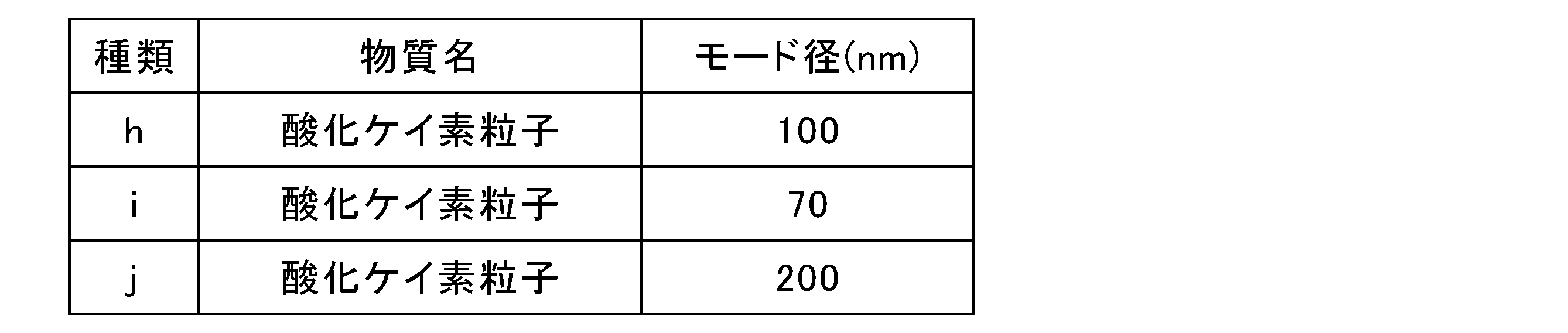
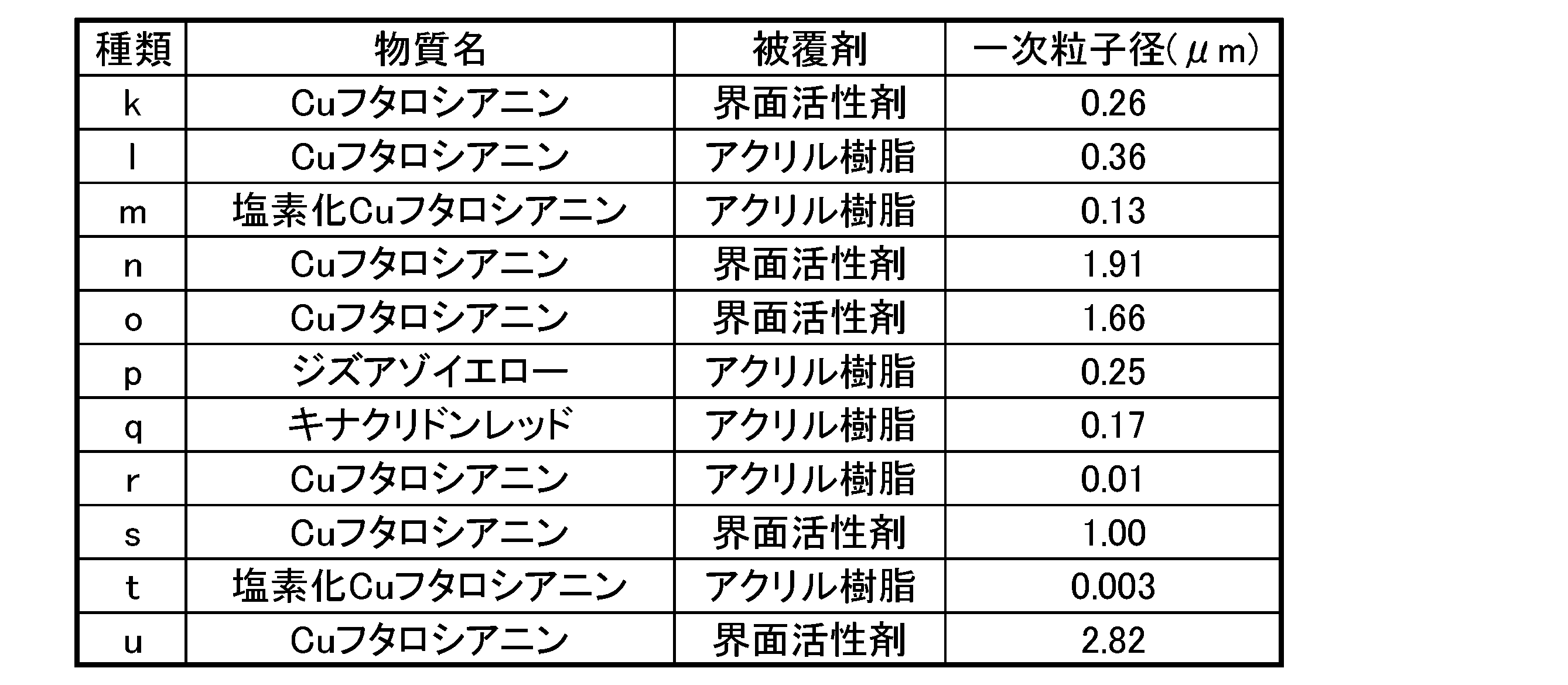
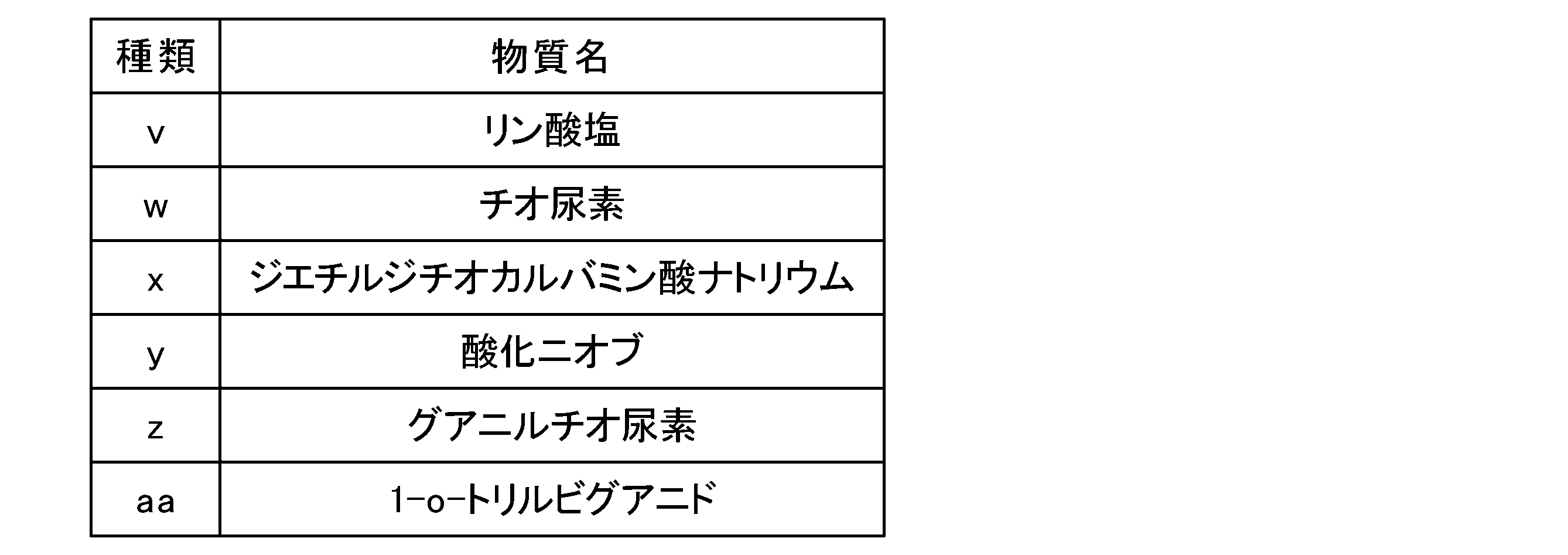
- the types of silicon oxide particles (B), organic titanium compound (C), silicon oxide particles (E), phthalocyanine pigment (F) and rust preventive agent (G) shown in Table 6 and the symbols shown in Table 6 are used. The correspondence is shown in Tables 1 to 5 below.
- Type k "SA Blue 5204" manufactured by Mikuni Color Co., Ltd.
- Type l Toyo Color Co., Ltd.
- Type m "SA Blue 5205" manufactured by Mikuni Color Co., Ltd.
- Type n "DP Color 1737 Blue” manufactured by Dainichiseika Kogyo Co., Ltd.
- Type o "DP Color 1534 Blue” manufactured by Dainichiseika Kogyo Co., Ltd.
- Type p "DP-1957 Yellow” manufactured by Dainichiseika Kogyo Co., Ltd.
- Type q "NAF Color NAF1032 Red” manufactured by Dainichiseika Kogyo Co., Ltd.
- Type r "LIOFAST BLUE G227” manufactured by Toyo Color Co., Ltd.
- Type s Toyo Color Co., Ltd.
- EMF BLUE HG Toyo Color Co., Ltd.
- Type t "PSM Sky Blue FG” manufactured by Mikuni Color Co., Ltd.
- Type u "TB Color TB-700 Blue GA” manufactured by Dainichiseika Kogyo Co., Ltd.
- ⁇ Creation of coated steel sheet for evaluation> Using the aqueous coating agents for steel materials of Examples 1 to 18 and Comparative Examples 1 to 21, a film was formed on the surfaces of the hot-dip galvanized steel sheet and the aluminum-containing galvanized steel material to prepare an evaluation sample.
- the water-based coating agent for steel materials was applied with a bar coater so that the dry film amount was 1 g / m 2 , and the test plate was prepared by baking to a reached plate temperature of 150 ° C using a hot air drying oven with an atmospheric temperature of 500 ° C. ..
- the test plate was placed in a sunshine weather meter tester, an accelerated weather resistance test was carried out for 500 hours, and the initial value and the amount of change in saturation after the test were measured.
- the saturation was calculated as the saturation C * by the same method as the saturation measurement shown below.
- the amount of change in saturation C * was calculated by the following formula (2), evaluated according to the following criteria, and 3 was accepted.
- the testing machine used was a sunshine weather meter manufactured by Suga Test Instruments Co., Ltd. The results are shown in Table 7.
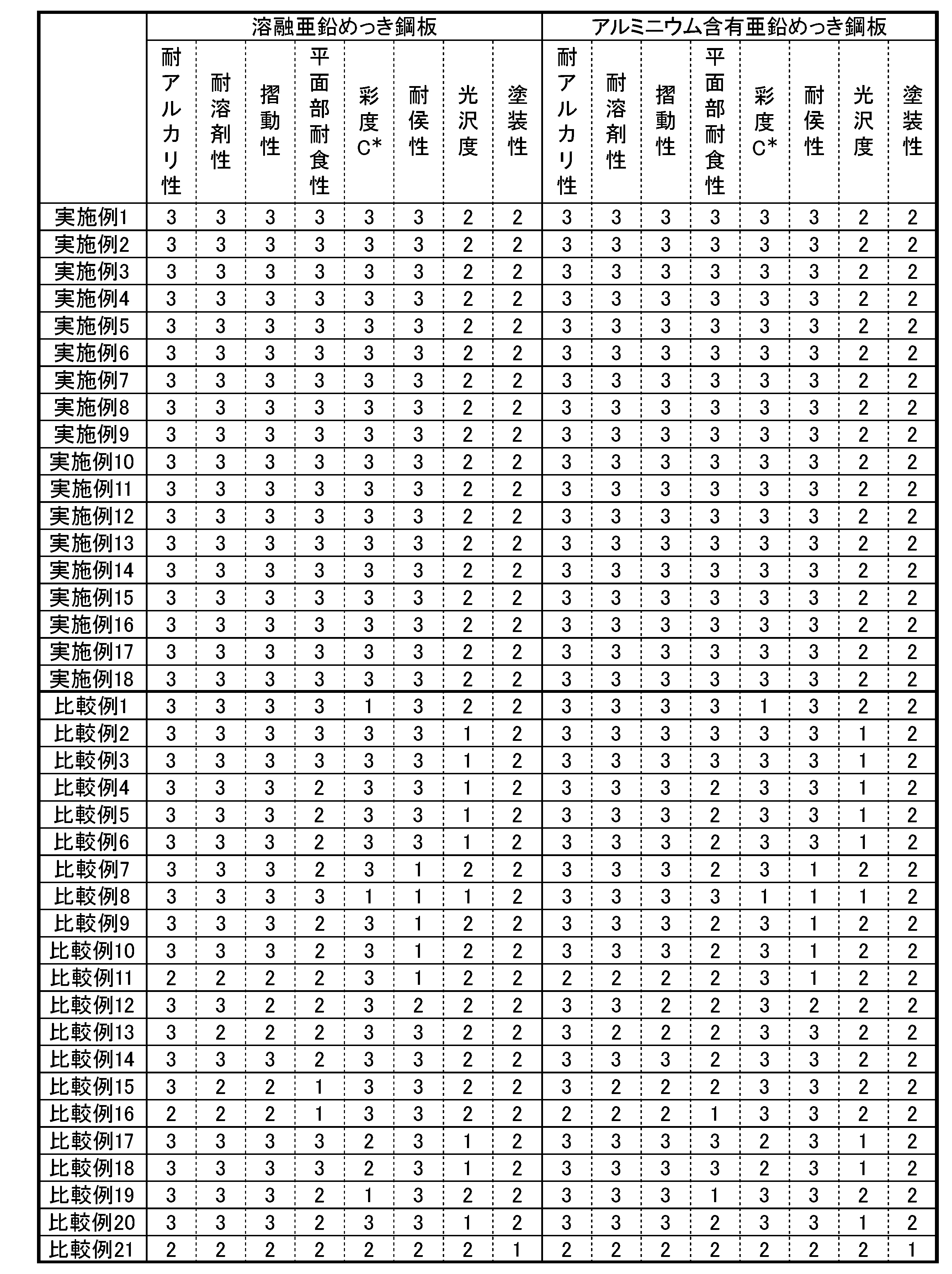
- the steel sheet coated with the water-based coating agent for steel materials of Examples 1 to 18 is glossier than the steel sheet coated with the water-based coating agent for steel materials of Comparative Examples 1 to 21. It was confirmed that both the degree and the saturation were excellent, and the design was excellent.
- the steel sheets coated with the water-based coating agents for steel materials of Examples 1 to 18 were shown to be excellent in alkali resistance, solvent resistance, slidability, corrosion resistance on flat surfaces, weather resistance, and paintability. rice field.
Landscapes
- Chemical & Material Sciences (AREA)
- Organic Chemistry (AREA)
- Engineering & Computer Science (AREA)
- Life Sciences & Earth Sciences (AREA)
- Materials Engineering (AREA)
- Wood Science & Technology (AREA)
- Chemical Kinetics & Catalysis (AREA)
- Health & Medical Sciences (AREA)
- Medicinal Chemistry (AREA)
- Polymers & Plastics (AREA)
- Inorganic Chemistry (AREA)
- Dispersion Chemistry (AREA)
- Mechanical Engineering (AREA)
- Metallurgy (AREA)
- Paints Or Removers (AREA)
- Other Surface Treatments For Metallic Materials (AREA)
- Application Of Or Painting With Fluid Materials (AREA)
Abstract
Description
本願は、2020年10月20日に、日本に出願された特願2020-176150号に基づき優先権を主張し、その内容をここに援用する。
また、本発明は、耐食性及び耐候性を維持し、かつ、金属表面に好ましい意匠性を付与できる鋼材用の被膜、鋼材の被覆方法及び鋼材を提供することを目的とする。
本実施形態に係る鋼材用水性被覆剤は、ポリウレタン樹脂粒子(A-1)(以下、単に「樹脂粒子(A-1)」と記載する場合がある)と、エチレン-不飽和カルボン酸共重合樹脂粒子(A-2)(以下、単に「樹脂粒子(A-2)」と記載する場合がある)と、酸化ケイ素粒子(B)と、有機チタン化合物(C)と、フタロシアニン顔料(F)と、を有する。また、ワックス粒子(D)と、酸化ケイ素粒子(E)と、を含んでいてもよい。

本実施形態に係る鋼材用水性被覆剤により形成される被膜(以下、単に「被膜」と記載する場合がある)は、上記各成分が複合化した複合化樹脂からなる。即ち、各成分の官能基が結合を形成し、複合化された状態である。上記結合は、主に樹脂粒子(A-1)及び(A-2)のSi-OH基、及びSi-OR基の少なくともいずれか、酸化ケイ素粒子(B)、(E)表面のSi-OH基、有機チタン化合物(C)のTi-OH及びTi-OR’基の少なくともいずれか等が反応することによって形成される結合である。上記結合は、例えば、Si-O-Si結合、Si-O-Ti-O-Si結合等であると考えられ、有機樹脂粒子と無機粒子とが化学的に強固な結合を形成する。

本実施形態に係る鋼材は、鋼材(基材)と、鋼材(基材)上に配置されためっき層と、めっき層の表面に配置された被膜とを備える。被膜は、上述したように、ポリウレタン樹脂粒子及びエチレン-不飽和カルボン酸共重合樹脂粒子を含む樹脂と、酸化ケイ素粒子と、Tiと、フタロシアニン顔料とを含む。フタロシアニン顔料の含有量は、ポリウレタン樹脂粒子とエチレン-不飽和カルボン酸共重合樹脂粒子との合計100質量部に対して、0.01~10質量部である。また、フタロシアニン顔料の一次粒子径は0.01~1.0μmである。
(製造例1)
反応容器に4,4-メチレンビス(シクロヘキシルイソシアネート)、分子量2000のポリカーボネートジオール、ネオペンチルグリコール、ジメチロールプロピオン酸、及び溶剤としてN-メチルピロリドンを仕込み、80℃において6時間撹拌後、ジメチルエタノールアミンで中和してポリウレタンプレポリマー溶液を得た。次に、ヒドラジン及びγ-(2-アミノエチル)アミノプロピルトリエトキシシランを含有する水中に、上記反応により得られたポリウレタンプレポリマー溶液をホモディスパーを用いて分散させることにより、シラノール基及び/又はエトキシシリル基を含有するポリカーボネート系ポリウレタン樹脂粒子の水分散液を得た。固形分濃度は30質量%、動的光散乱法によって測定したメジアン径は39nmであった。
上記製造例1と同様にして得られたポリウレタンプレポリマーを、ホモディスパーを用いて、ヒドラジン及びγ-(2-アミノエチル)アミノプロピルメチルジメトキシシランを含有する水中に、上記反応により得られたポリウレタンプレポリマー溶液をホモディスパーを用いて分散させることにより、シラノール基及び/又はエトキシシリル基を含有するポリカーボネート系ポリウレタン樹脂粒子の水分散液を得た。固形分濃度は30質量%、動的光散乱法によって測定したメジアン径は20nmであった。
反応容器に4,4-メチレンビス(シクロヘキシルイソシアネート)、ジメチロールプロピオン酸、及びアセトンを加え、攪拌下50℃に加熱して反応させたのち、更に、アジピン酸、ネオペンチルグリコール、及びエチレングリコールとの反応により得られた分子量2000のポリエステルポリオールを加えて反応させてポリウレタンプレポリマー溶液を得た。次いで、ジメチルエタノールアミン、γ-(2-アミノエチル)アミノプロピルトリエトキシシラン、及び2-(2-アミノエチルアミノ)エタノールを含有する水中に、上記反応により得られたポリウレタンプレポリマー溶液をホモディスパーを用いて分散させ、加熱下にアセトンを留去することにより、シラノール基及び/又はエトキシシリル基を含有するポリエステル系ポリウレタン樹脂粒子の水分散液を得た。固形分濃度は30質量%、メジアン径は32nmであった。
(製造例4)
反応容器にエチレン-メタクリル酸共重合樹脂(メタクリル酸の含有量が20質量%)、樹脂に対して5.6質量%相当の水酸化ナトリウム及び脱イオン水を加え、95℃で6時間攪拌することにより固形分20質量%の水分散樹脂液を得た。この水分散樹脂液に対して、更にγ-グリシドキシプロピルトリメトキシシランを0.8質量%、グリセロールポリグリシジルエーテルを0.8質量%を加えて、85℃で2時間反応させることによって、シラノール基及び/又はメトキシシリル基を有するエチレン-メタクリル酸共重合樹脂粒子の水分散液を得た。固形分濃度は21質量%、メジアン径は50nmであった。
反応容器にエチレン-メタクリル酸共重合樹脂(メタクリル酸の含有量が20質量%)、樹脂に対して3.7質量%の水酸化ナトリウム、6.3質量%のアンモニア水、及び脱イオン水を加え、95℃で6時間攪拌することにより固形分20質量%の水分散樹脂液を得た。この水分散樹脂液に対して、更にγ-グリシドキシプロピルトリエトキシシランを1.2質量%、ペンタエリスリトールポリグリシジルエーテルを0.6質量%を加えて、85℃で2時間反応させることによって、シラノール基及び/又はメトキシシリル基を有するエチレン-メタクリル酸共重合樹脂粒子の水分散液を得た。固形分濃度は21質量%、メジアン径は100nmであった。
反応容器にエチレン-メタクリル酸共重合樹脂(メタクリル酸の含有量が20質量%)、樹脂に対して4.7質量%相当の水酸化ナトリウム及び脱イオン水を加え、95℃で2時間攪拌することにより固形分20質量%の水分散樹脂液を得た。この水分散樹脂液に対して、更にγ-グリシドキシプロピルトリメトキシシランを1.2質量%、水添ビスフェノールAジグリシジルエーテルを1.2質量%加えて、85℃で2時間反応させることによって、シラノール基及び/又はメトキシシリル基を有するエチレン-メタクリル酸共重合樹脂粒子の水分散液を得た。固形分濃度は21質量%、メジアン径は70nmであった。
反応容器にエチレン-メタクリル酸共重合樹脂(メタクリル酸の含有量が20質量%)、樹脂に対して21.0質量%のアンモニア水、及び脱イオン水を加え、95℃で2時間攪拌することにより固形分20質量%の水分散樹脂液を得た。この水分散樹脂液に対して、更にγ-グリシドキシプロピルトリメトキシシランを1.2質量%、水添ビスフェノールAジグリシジルエーテルを1.2質量%加えて、85℃で2時間反応させることによって、シラノール基及び/又はメトキシシリル基を有するエチレン-メタクリル酸共重合樹脂粒子の水分散液を得た。固形分濃度は21質量%、メジアン径は150nmであった。
反応容器にエチレン-メタクリル酸共重合樹脂(メタクリル酸の含有量が27質量%)、樹脂に対して28.0質量%のアンモニア水及び脱イオン水を加え、95℃で2時間攪拌することにより固形分20質量%の水分散樹脂液を得た。この水分散樹脂液に対して、さらにγ-グリシドキシプロピルトリメトキシシランを1.6質量%、水添ビスフェノールA ジグリシジルエーテルを1.6質量%加えて、85℃で2時間反応させることによって、シラノール基及び/又はメトキシシリル基を有するエチレン-メタクリル酸共重合樹脂粒子の水分散液を得た。固形分濃度は21質量% 、メジアン径は14nmであった。
反応容器にエポキシ当量190のビスフェノールFエピクロルヒドリン型エポキシ樹脂190質量部にジエタノールアミン30質量部、プロピレングリコールモノメチルエーテルアセテート110質量部を加え、100℃で2時間反応させ、固形分濃度70%の変性エポキシ樹脂を得た。反応容器にNCOが13.3%、不揮発分75%のトリメチロールプロパンの2,4-トルエンジイソシアネートプレポリマーを100質量部、ノニルフェノール44質量部、ジメチルベンジルアミン5質量部、プロピレングリコールモノメチルエーテルアセテート65質量部を混合し、窒素雰囲気下80℃で3時間、反応させ、固形分濃度70%、NCO%が20%のハーフブロック化ポリイソシアネートを得た。上記変性エポキシ樹脂70質量部と上記ハーフブロック化ポリイソシアネート30質量部を混合し、80℃で4時間攪拌して反応させた後、赤外線分光分析でNCO基の吸収が完全になくなることを確認した。その後、イオン交換水で希釈して水性エポキシ樹脂を得た。固形分濃度は25質量%、メジアン径は600nmであった。
(実施例1)
上記製造例1の樹脂粒子(A-1)の水分散液を固形分換算で80質量部と、上記製造例4の樹脂粒子(A-2)の水分散液を固形分換算で20質量部用いた。酸化ケイ素粒子(B)としては、粒子径(モード径)が15nmのものを用いた。有機チタン化合物(C)としては、ジプロポキシビス(トリエタノールアミナト)チタンを用いた。ワックス粒子(D)としては、粒子径(メジアン径)1.0μm、軟化点115℃のポリエチレン粒子を用いた。酸化ケイ素粒子(E)としては、粒子径(モード径)100nmのものを用いた。フタロシアニン顔料(F)としては、被覆剤として界面活性剤を用いたCuフタロシアニン(一次粒子径0.26μm)を用いた。防錆剤(G)としては、リン酸塩及びチオ尿素を用いた。各成分の含有量は、樹脂粒子(A-1)と樹脂粒子(A-2)の合計100質量部に対する質量部として、表6に示す量を用いて、実施例1に係る鋼材用被覆調整剤を調製した。なお、表6に示す有機チタン化合物(C)の含有量は、チタン原子換算の質量部である。
それぞれ表6に示す原料を用いたこと以外は、実施例1と同様として、実施例2~18、及び比較例1~20に係る鋼材用被覆調整剤を調製した。また比較例12を60℃で経時させて高粘度に調整したものを比較例21とした。なお、表6に示す酸化ケイ素粒子(B)、有機チタン化合物(C)、酸化ケイ素粒子(E)、フタロシアニン顔料(F)及び防錆剤(G)の種類と、表6に示す記号との対応は、以下の表1~表5に示した。
種類k:御国色素株式会社製 「SAブルー 5204」
種類l:トーヨーカラー株式会社製 「LIOFAST SF670ブルー」
種類m:御国色素株式会社製 「SAブルー 5205」
種類n:大日精化工業株式会社社製 「DPカラー 1737 Blue」
種類o:大日精化工業株式会社社製 「DPカラー 1534 Blue」
種類p:大日精化工業株式会社社製 「DP-1957 Yellow」
種類q:大日精化工業株式会社社製 「NAF カラー NAF1032レッド」
種類r:トーヨーカラー株式会社製 「LIOFAST BLUE G227」
種類s:トーヨーカラー株式会社製 「EMF BLUE HG」
種類t:御国色素株式会社製 「PSMスカイブルー FG」
種類u:大日精化工業株式会社社製 「TBカラー TB-700 Blue GA」



上記実施例1~18、比較例1~21の鋼材用水性被覆剤を用い、溶融亜鉛めっき鋼板及びアルミニウム含有亜鉛めっき鋼材の表面に被膜を形成し、評価用サンプルを作成した。鋼材用水性被覆剤の塗布はバーコーターで、乾燥皮膜量1g/m2になるように塗布し、雰囲気温度500℃の熱風乾燥炉を用いて到達板温150℃まで焼き付けて試験板を作成した。
上記作製した実施例及び比較例に係る試験板を用い、耐アルカリ性、耐溶剤性、耐アブレージョン性、平面耐食性、耐候性(彩度変化量)、光沢度、彩度、塗装性について以下の条件で評価を行った。結果を表7に示した。
試験板を55℃のアルカリ脱脂剤(サーフクリーナー53、日本ペイント社製)2質量%水溶液(pH12.5)に攪拌しながら2分間浸漬した後、試験板のエッジと裏面をテープシールし、塩水噴霧試験(JIS-Z-2371)を行った。72時間後の白錆発生状況を観察し下記基準で評価を行い、3を合格とした。結果を表7に示す。
3:白錆ほとんどなし
2:白錆面積30%未満
1:白錆面積30%以上
試験板をラビングテスターに設置後、エタノール、メチルエチルケトン(MEK)又はホワイトガソリンを含浸させた脱脂綿を0.5kgf/cm2の荷重で5回(往復)、擦った後、試験板のエッジと裏面をテープシールし、塩水噴霧試験(JIS-Z-2371)を行った。72時間後の白錆発生状況を観察し下記基準で評価を行い、3を合格とした。結果を表7に示す。
3:白錆ほとんどなし
2:白錆面積30%未満
1:白錆面積30%以上
試験板に、段ボール紙を介して10g/cm2の荷重をかけ、360回/minの楕円運動を加えて摺動部にアブレージョン(摩耗傷)を発生させた。10分間試験を行った後の試験板表面の状態を観察し下記基準で評価を行い、3を合格とした。結果を表7に示す。
3:黒化ほとんどなし
2:摺動部の50%未満の面積が黒化
1:摺動部の50%以上の面積が黒化
試験板を、試験板のエッジと裏面をテープシールし、塩水噴霧試験SST(JIS-Z-2371)を行った。溶融亜鉛めっきの試験片では72時間後、アルミニウム含有亜鉛めっきの試験片は120時間後の白錆発生状況を観察し下記基準で評価を行い、3を合格とした。結果を表7に示す。
3:白錆ほとんどなし
2:白錆面積30%未満
1:白錆面積30%以上
試験板をサンシャインウェザーメーター試験機にいれ、促進耐候試験500時間を実施し、初期値と試験後の彩度の変化量を測定した。彩度は以下に示す彩度測定と同様の方法で、彩度C*として算出した。彩度C*の変化量は以下式(2)にて算定し、以下の基準で評価を行い、3を合格とした。試験機はスガ試験機株式会社製サンシャインウェザーメーターを用いた。結果を表7に示す。
変化量(%)=試験後彩度C*/初期値彩度C*×100 …(2)
3:変化量(%)=95%~100%
2:変化量(%)=90%~95%未満
1:変化量(%)=80%~90%未満
光沢計(日本電色工業株式会社製 VG2000)を用い、JIS Z 8741に規定される方法に基づいて試験板表面の60°光沢度(%)を測定した。以下の基準で評価を行い、2を合格とした。結果を表7に示す。
2:50~200%
1:50%未満
分光色差計(日本電色工業株式会社製 SE6000)を用い、試験板表面のL*a*b*値を測定し、以下の式により彩度C*を算出した。以下の基準で評価を行い、3を合格とした。結果を表7に示す。
3:C*=2.0~50
2:C*=50超、100未満
1:C*=2.0未満

自動バーコーター(安田精機製作所製 No 542-AB)を用い、鋼材用水性被覆剤を塗布し、塗装外観ムラを以下の基準で評価を行い、2を合格とした。結果を表7に示す。
2:ムラなし
1:ムラあり
Claims (9)
- それぞれ、メジアン径が20~100nmであり、かつ、シラノール基及びアルコキシシリル基のうち少なくともいずれかを有する、ポリウレタン樹脂粒子(A-1)及びエチレン-不飽和カルボン酸共重合樹脂粒子(A-2)と、
モード径が5~20nmである酸化ケイ素粒子(B)と、
有機チタン化合物(C)と、
樹脂及び界面活性剤のうち、少なくともいずれかで被覆されたフタロシアニン顔料(F)と、を有し、
前記フタロシアニン顔料(F)の含有量は、前記ポリウレタン樹脂粒子(A-1)と、前記エチレン-不飽和カルボン酸共重合樹脂粒子(A-2)との合計100質量部に対して、0.01~10質量部であり、一次粒子径は、0.01~1.0μmである、鋼材用水性被覆剤。 - 前記フタロシアニン顔料(F)におけるフタロシアニンは、金属フタロシアニン及び無金属フタロシアニンのうち少なくともいずれかであり、
前記金属フタロシアニンの金属は、Ca、Ba、Cd、Na、Cu、Ni、Co、Fe、Mg、Zn、Al、Mn、V、Ti及びSnのうちいずれかである、請求項1に記載の鋼材用水性被覆剤。 - 20℃粘度が100mPa・s以下である、請求項1又は2に記載の鋼材用水性被覆剤。
- 前記ポリウレタン樹脂粒子(A-1)と、前記エチレン-不飽和カルボン酸共重合樹脂粒子(A-2)との質量比は、(A-1):(A-2)=20:80~90:10である、請求項1~3のいずれか一項に記載の鋼材用水性被覆剤。
- モード径が70~200nmである酸化ケイ素粒子(E)を更に有する、請求項1~4のいずれか一項に記載の鋼材用水性被覆剤。
- 請求項1~5のいずれか一項に記載の鋼材用水性被覆剤により形成され、彩度C*が2.0以上50以下である、被膜。
- 請求項1~5のいずれか一項に記載の鋼材用水性被覆剤を鋼材表面に塗布して被膜を形成する、鋼材の被覆方法。
- 請求項1~5のいずれかに記載の鋼材用水性被覆剤により、表面に被膜が形成され、60°光沢度が50%以上である、鋼材。
- 前記鋼材は、溶融亜鉛めっき鋼及びアルミニウム含有亜鉛めっき鋼のうちいずれかである、請求項8に記載の鋼材。
Priority Applications (3)
| Application Number | Priority Date | Filing Date | Title |
|---|---|---|---|
| KR1020237017049A KR20230119114A (ko) | 2020-10-20 | 2021-10-12 | 강재용 수성 피복제, 피막, 강재의 피복 방법 및 강재 |
| PH1/2023/551030A PH12023551030A1 (en) | 2020-10-20 | 2021-10-12 | Aqueous coating agent for steel material, coating film, steel material coating method, and steel material |
| CN202180070889.9A CN116529325A (zh) | 2020-10-20 | 2021-10-12 | 钢材用水性覆盖剂、被膜、钢材的覆盖方法及钢材 |
Applications Claiming Priority (2)
| Application Number | Priority Date | Filing Date | Title |
|---|---|---|---|
| JP2020176150A JP7438078B2 (ja) | 2020-10-20 | 2020-10-20 | 鋼材用水性被覆剤、被膜、鋼材の被覆方法、及び鋼材 |
| JP2020-176150 | 2020-10-20 |
Publications (1)
| Publication Number | Publication Date |
|---|---|
| WO2022085519A1 true WO2022085519A1 (ja) | 2022-04-28 |
Family
ID=81290739
Family Applications (1)
| Application Number | Title | Priority Date | Filing Date |
|---|---|---|---|
| PCT/JP2021/037749 Ceased WO2022085519A1 (ja) | 2020-10-20 | 2021-10-12 | 鋼材用水性被覆剤、被膜、鋼材の被覆方法、及び鋼材 |
Country Status (6)
| Country | Link |
|---|---|
| JP (1) | JP7438078B2 (ja) |
| KR (1) | KR20230119114A (ja) |
| CN (1) | CN116529325A (ja) |
| PH (1) | PH12023551030A1 (ja) |
| TW (1) | TWI807447B (ja) |
| WO (1) | WO2022085519A1 (ja) |
Citations (6)
| Publication number | Priority date | Publication date | Assignee | Title |
|---|---|---|---|---|
| WO2007144951A1 (ja) * | 2006-06-15 | 2007-12-21 | Nippon Steel Corporation | 被覆鋼板 |
| JP2009144208A (ja) * | 2007-12-14 | 2009-07-02 | Nippon Steel Corp | 被覆鋼板 |
| JP2012057179A (ja) * | 2006-01-20 | 2012-03-22 | Ppg Industries Ohio Inc | ポリマー被覆粒子の水性分散物、関連するコーティング組成物、およびコーティングされた支持体 |
| JP2012117108A (ja) * | 2010-11-30 | 2012-06-21 | Nippon Steel Corp | 塗装亜鉛系めっき鋼板 |
| JP2013136710A (ja) * | 2011-12-28 | 2013-07-11 | Jgc Catalysts & Chemicals Ltd | 透明性着色膜付基材および透明着色膜形成用塗布液 |
| WO2015152187A1 (ja) * | 2014-04-04 | 2015-10-08 | 日本ペイント・サーフケミカルズ株式会社 | 亜鉛めっき鋼材用の金属表面処理剤、被覆方法及び被覆鋼材 |
Family Cites Families (12)
| Publication number | Priority date | Publication date | Assignee | Title |
|---|---|---|---|---|
| JP4052369B2 (ja) * | 2001-07-11 | 2008-02-27 | 平岡織染株式会社 | 環境汚れ防止性の高い積層シート |
| JP3893481B2 (ja) * | 2002-02-07 | 2007-03-14 | 平岡織染株式会社 | 両面描画用シート |
| JP4205939B2 (ja) | 2002-12-13 | 2009-01-07 | 日本パーカライジング株式会社 | 金属の表面処理方法 |
| JP5878854B2 (ja) * | 2012-03-01 | 2016-03-08 | 株式会社神戸製鋼所 | 着色樹脂塗装金属板 |
| JP5798510B2 (ja) * | 2012-03-01 | 2015-10-21 | 株式会社神戸製鋼所 | 着色樹脂塗装金属板 |
| JP6082333B2 (ja) * | 2012-10-16 | 2017-02-15 | 株式会社神戸製鋼所 | 水系樹脂塗膜積層金属板 |
| JP6140586B2 (ja) * | 2013-02-22 | 2017-05-31 | 株式会社神戸製鋼所 | 水系樹脂塗膜積層金属板 |
| JP2014181321A (ja) * | 2013-03-21 | 2014-09-29 | Dic Corp | インクジェット記録用水性インク調製のための水性顔料分散液及びインクジェット記録水性インク |
| KR20190113873A (ko) * | 2017-03-27 | 2019-10-08 | 닛폰세이테츠 가부시키가이샤 | Al계 도금 강판 |
| JP6932025B2 (ja) * | 2017-05-11 | 2021-09-08 | 日本パーカライジング株式会社 | 水系金属表面処理剤ならびに皮膜を有する金属材料およびその製造方法 |
| CN109054509A (zh) * | 2018-08-06 | 2018-12-21 | 浩力森涂料(上海)有限公司 | 一种高透型纳米酞菁颜料分散体及其制备方法 |
| CN111675938B (zh) * | 2020-08-05 | 2022-11-25 | 常熟世名化工科技有限公司 | 一种酞菁颜料色浆及其制备方法和应用 |
-
2020
- 2020-10-20 JP JP2020176150A patent/JP7438078B2/ja active Active
-
2021
- 2021-10-12 PH PH1/2023/551030A patent/PH12023551030A1/en unknown
- 2021-10-12 CN CN202180070889.9A patent/CN116529325A/zh active Pending
- 2021-10-12 WO PCT/JP2021/037749 patent/WO2022085519A1/ja not_active Ceased
- 2021-10-12 KR KR1020237017049A patent/KR20230119114A/ko active Pending
- 2021-10-14 TW TW110138135A patent/TWI807447B/zh active
Patent Citations (6)
| Publication number | Priority date | Publication date | Assignee | Title |
|---|---|---|---|---|
| JP2012057179A (ja) * | 2006-01-20 | 2012-03-22 | Ppg Industries Ohio Inc | ポリマー被覆粒子の水性分散物、関連するコーティング組成物、およびコーティングされた支持体 |
| WO2007144951A1 (ja) * | 2006-06-15 | 2007-12-21 | Nippon Steel Corporation | 被覆鋼板 |
| JP2009144208A (ja) * | 2007-12-14 | 2009-07-02 | Nippon Steel Corp | 被覆鋼板 |
| JP2012117108A (ja) * | 2010-11-30 | 2012-06-21 | Nippon Steel Corp | 塗装亜鉛系めっき鋼板 |
| JP2013136710A (ja) * | 2011-12-28 | 2013-07-11 | Jgc Catalysts & Chemicals Ltd | 透明性着色膜付基材および透明着色膜形成用塗布液 |
| WO2015152187A1 (ja) * | 2014-04-04 | 2015-10-08 | 日本ペイント・サーフケミカルズ株式会社 | 亜鉛めっき鋼材用の金属表面処理剤、被覆方法及び被覆鋼材 |
Also Published As
| Publication number | Publication date |
|---|---|
| TWI807447B (zh) | 2023-07-01 |
| KR20230119114A (ko) | 2023-08-16 |
| JP2022067441A (ja) | 2022-05-06 |
| CN116529325A (zh) | 2023-08-01 |
| TW202225207A (zh) | 2022-07-01 |
| JP7438078B2 (ja) | 2024-02-26 |
| PH12023551030A1 (en) | 2023-11-20 |
Similar Documents
| Publication | Publication Date | Title |
|---|---|---|
| US8241742B2 (en) | Coated steel sheet comprising a composite coat containing compounded resin particles | |
| JP5546097B2 (ja) | 表面処理金属材及び金属表面処理剤 | |
| AU2012330587B2 (en) | Chromate-free coated metal sheet having metallic appearance and water-based coating composition used in the same | |
| US20090264574A1 (en) | Superprimer | |
| WO2004009870A1 (ja) | 耐白錆性に優れた表面処理鋼板及びその製造方法 | |
| WO2015152187A1 (ja) | 亜鉛めっき鋼材用の金属表面処理剤、被覆方法及び被覆鋼材 | |
| JP2009179859A (ja) | 複層塗膜形成方法 | |
| JP5235397B2 (ja) | 被覆鋼板 | |
| EP2037003B1 (en) | Coated steel sheet | |
| JP4180270B2 (ja) | 鋼材用水性被覆剤、被覆方法及び被覆鋼材 | |
| JP7230356B2 (ja) | 表面処理鋼板及び表面処理鋼板の製造方法 | |
| JP7438078B2 (ja) | 鋼材用水性被覆剤、被膜、鋼材の被覆方法、及び鋼材 | |
| US20250145853A1 (en) | Protection coating composition, treating method using the same and article thereof | |
| JP2000273659A (ja) | 金属表面用防錆処理剤および表面処理金属製品 | |
| JP2023146317A (ja) | 鋼板及び自動車部品 | |
| JP2024092632A (ja) | 複層塗膜の製造方法 | |
| HK1135150B (en) | Coated steel sheet | |
| Van Ooij | A Chromium-Free Coating System for DoD Applications |
Legal Events
| Date | Code | Title | Description |
|---|---|---|---|
| 121 | Ep: the epo has been informed by wipo that ep was designated in this application |
Ref document number: 21882660 Country of ref document: EP Kind code of ref document: A1 |
|
| WWE | Wipo information: entry into national phase |
Ref document number: 202180070889.9 Country of ref document: CN |
|
| WWE | Wipo information: entry into national phase |
Ref document number: 202317032433 Country of ref document: IN |
|
| NENP | Non-entry into the national phase |
Ref country code: DE |
|
| 122 | Ep: pct application non-entry in european phase |
Ref document number: 21882660 Country of ref document: EP Kind code of ref document: A1 |