WO2022080314A1 - 複層ポリイミドフィルム、金属張積層板、及び複層ポリイミドフィルムの製造方法 - Google Patents
複層ポリイミドフィルム、金属張積層板、及び複層ポリイミドフィルムの製造方法 Download PDFInfo
- Publication number
- WO2022080314A1 WO2022080314A1 PCT/JP2021/037569 JP2021037569W WO2022080314A1 WO 2022080314 A1 WO2022080314 A1 WO 2022080314A1 JP 2021037569 W JP2021037569 W JP 2021037569W WO 2022080314 A1 WO2022080314 A1 WO 2022080314A1
- Authority
- WO
- WIPO (PCT)
- Prior art keywords
- layer
- residue
- polyimide
- adhesive layer
- residues
- Prior art date
- Legal status (The legal status is an assumption and is not a legal conclusion. Google has not performed a legal analysis and makes no representation as to the accuracy of the status listed.)
- Ceased
Links
Images

Classifications
-
- C—CHEMISTRY; METALLURGY
- C09—DYES; PAINTS; POLISHES; NATURAL RESINS; ADHESIVES; COMPOSITIONS NOT OTHERWISE PROVIDED FOR; APPLICATIONS OF MATERIALS NOT OTHERWISE PROVIDED FOR
- C09J—ADHESIVES; NON-MECHANICAL ASPECTS OF ADHESIVE PROCESSES IN GENERAL; ADHESIVE PROCESSES NOT PROVIDED FOR ELSEWHERE; USE OF MATERIALS AS ADHESIVES
- C09J7/00—Adhesives in the form of films or foils
- C09J7/30—Adhesives in the form of films or foils characterised by the adhesive composition
- C09J7/38—Pressure-sensitive adhesives [PSA]
-
- B—PERFORMING OPERATIONS; TRANSPORTING
- B32—LAYERED PRODUCTS
- B32B—LAYERED PRODUCTS, i.e. PRODUCTS BUILT-UP OF STRATA OF FLAT OR NON-FLAT, e.g. CELLULAR OR HONEYCOMB, FORM
- B32B15/00—Layered products comprising a layer of metal
- B32B15/04—Layered products comprising a layer of metal comprising metal as the main or only constituent of a layer, which is next to another layer of the same or of a different material
- B32B15/08—Layered products comprising a layer of metal comprising metal as the main or only constituent of a layer, which is next to another layer of the same or of a different material of synthetic resin
-
- B—PERFORMING OPERATIONS; TRANSPORTING
- B32—LAYERED PRODUCTS
- B32B—LAYERED PRODUCTS, i.e. PRODUCTS BUILT-UP OF STRATA OF FLAT OR NON-FLAT, e.g. CELLULAR OR HONEYCOMB, FORM
- B32B15/00—Layered products comprising a layer of metal
- B32B15/04—Layered products comprising a layer of metal comprising metal as the main or only constituent of a layer, which is next to another layer of the same or of a different material
- B32B15/08—Layered products comprising a layer of metal comprising metal as the main or only constituent of a layer, which is next to another layer of the same or of a different material of synthetic resin
- B32B15/088—Layered products comprising a layer of metal comprising metal as the main or only constituent of a layer, which is next to another layer of the same or of a different material of synthetic resin comprising polyamides
-
- B—PERFORMING OPERATIONS; TRANSPORTING
- B32—LAYERED PRODUCTS
- B32B—LAYERED PRODUCTS, i.e. PRODUCTS BUILT-UP OF STRATA OF FLAT OR NON-FLAT, e.g. CELLULAR OR HONEYCOMB, FORM
- B32B27/00—Layered products comprising a layer of synthetic resin
- B32B27/28—Layered products comprising a layer of synthetic resin comprising synthetic resins not wholly covered by any one of the sub-groups B32B27/30 - B32B27/42
- B32B27/281—Layered products comprising a layer of synthetic resin comprising synthetic resins not wholly covered by any one of the sub-groups B32B27/30 - B32B27/42 comprising polyimides
-
- B—PERFORMING OPERATIONS; TRANSPORTING
- B32—LAYERED PRODUCTS
- B32B—LAYERED PRODUCTS, i.e. PRODUCTS BUILT-UP OF STRATA OF FLAT OR NON-FLAT, e.g. CELLULAR OR HONEYCOMB, FORM
- B32B27/00—Layered products comprising a layer of synthetic resin
- B32B27/34—Layered products comprising a layer of synthetic resin comprising polyamides
-
- B—PERFORMING OPERATIONS; TRANSPORTING
- B32—LAYERED PRODUCTS
- B32B—LAYERED PRODUCTS, i.e. PRODUCTS BUILT-UP OF STRATA OF FLAT OR NON-FLAT, e.g. CELLULAR OR HONEYCOMB, FORM
- B32B7/00—Layered products characterised by the relation between layers; Layered products characterised by the relative orientation of features between layers, or by the relative values of a measurable parameter between layers, i.e. products comprising layers having different physical, chemical or physicochemical properties; Layered products characterised by the interconnection of layers
- B32B7/02—Physical, chemical or physicochemical properties
- B32B7/025—Electric or magnetic properties
-
- C—CHEMISTRY; METALLURGY
- C08—ORGANIC MACROMOLECULAR COMPOUNDS; THEIR PREPARATION OR CHEMICAL WORKING-UP; COMPOSITIONS BASED THEREON
- C08G—MACROMOLECULAR COMPOUNDS OBTAINED OTHERWISE THAN BY REACTIONS ONLY INVOLVING UNSATURATED CARBON-TO-CARBON BONDS
- C08G73/00—Macromolecular compounds obtained by reactions forming a linkage containing nitrogen with or without oxygen or carbon in the main chain of the macromolecule, not provided for in groups C08G12/00 - C08G71/00
- C08G73/06—Polycondensates having nitrogen-containing heterocyclic rings in the main chain of the macromolecule
- C08G73/10—Polyimides; Polyester-imides; Polyamide-imides; Polyamide acids or similar polyimide precursors
-
- C—CHEMISTRY; METALLURGY
- C09—DYES; PAINTS; POLISHES; NATURAL RESINS; ADHESIVES; COMPOSITIONS NOT OTHERWISE PROVIDED FOR; APPLICATIONS OF MATERIALS NOT OTHERWISE PROVIDED FOR
- C09J—ADHESIVES; NON-MECHANICAL ASPECTS OF ADHESIVE PROCESSES IN GENERAL; ADHESIVE PROCESSES NOT PROVIDED FOR ELSEWHERE; USE OF MATERIALS AS ADHESIVES
- C09J179/00—Adhesives based on macromolecular compounds obtained by reactions forming in the main chain of the macromolecule a linkage containing nitrogen, with or without oxygen, or carbon only, not provided for in groups C09J161/00 - C09J177/00
- C09J179/04—Polycondensates having nitrogen-containing heterocyclic rings in the main chain; Polyhydrazides; Polyamide acids or similar polyimide precursors
- C09J179/08—Polyimides; Polyester-imides; Polyamide-imides; Polyamide acids or similar polyimide precursors
-
- C—CHEMISTRY; METALLURGY
- C09—DYES; PAINTS; POLISHES; NATURAL RESINS; ADHESIVES; COMPOSITIONS NOT OTHERWISE PROVIDED FOR; APPLICATIONS OF MATERIALS NOT OTHERWISE PROVIDED FOR
- C09J—ADHESIVES; NON-MECHANICAL ASPECTS OF ADHESIVE PROCESSES IN GENERAL; ADHESIVE PROCESSES NOT PROVIDED FOR ELSEWHERE; USE OF MATERIALS AS ADHESIVES
- C09J7/00—Adhesives in the form of films or foils
- C09J7/20—Adhesives in the form of films or foils characterised by their carriers
- C09J7/22—Plastics; Metallised plastics
- C09J7/25—Plastics; Metallised plastics based on macromolecular compounds obtained otherwise than by reactions involving only carbon-to-carbon unsaturated bonds
-
- C—CHEMISTRY; METALLURGY
- C09—DYES; PAINTS; POLISHES; NATURAL RESINS; ADHESIVES; COMPOSITIONS NOT OTHERWISE PROVIDED FOR; APPLICATIONS OF MATERIALS NOT OTHERWISE PROVIDED FOR
- C09J—ADHESIVES; NON-MECHANICAL ASPECTS OF ADHESIVE PROCESSES IN GENERAL; ADHESIVE PROCESSES NOT PROVIDED FOR ELSEWHERE; USE OF MATERIALS AS ADHESIVES
- C09J7/00—Adhesives in the form of films or foils
- C09J7/30—Adhesives in the form of films or foils characterised by the adhesive composition
-
- H—ELECTRICITY
- H05—ELECTRIC TECHNIQUES NOT OTHERWISE PROVIDED FOR
- H05K—PRINTED CIRCUITS; CASINGS OR CONSTRUCTIONAL DETAILS OF ELECTRIC APPARATUS; MANUFACTURE OF ASSEMBLAGES OF ELECTRICAL COMPONENTS
- H05K1/00—Printed circuits
- H05K1/02—Details
- H05K1/03—Use of materials for the substrate
-
- H—ELECTRICITY
- H05—ELECTRIC TECHNIQUES NOT OTHERWISE PROVIDED FOR
- H05K—PRINTED CIRCUITS; CASINGS OR CONSTRUCTIONAL DETAILS OF ELECTRIC APPARATUS; MANUFACTURE OF ASSEMBLAGES OF ELECTRICAL COMPONENTS
- H05K1/00—Printed circuits
- H05K1/02—Details
- H05K1/03—Use of materials for the substrate
- H05K1/0313—Organic insulating material
- H05K1/032—Organic insulating material consisting of one material
- H05K1/0346—Organic insulating material consisting of one material containing N
-
- H—ELECTRICITY
- H05—ELECTRIC TECHNIQUES NOT OTHERWISE PROVIDED FOR
- H05K—PRINTED CIRCUITS; CASINGS OR CONSTRUCTIONAL DETAILS OF ELECTRIC APPARATUS; MANUFACTURE OF ASSEMBLAGES OF ELECTRICAL COMPONENTS
- H05K1/00—Printed circuits
- H05K1/02—Details
- H05K1/03—Use of materials for the substrate
- H05K1/0313—Organic insulating material
- H05K1/0353—Organic insulating material consisting of two or more materials, e.g. two or more polymers, polymer + filler, + reinforcement
- H05K1/036—Multilayers with layers of different types
-
- H—ELECTRICITY
- H05—ELECTRIC TECHNIQUES NOT OTHERWISE PROVIDED FOR
- H05K—PRINTED CIRCUITS; CASINGS OR CONSTRUCTIONAL DETAILS OF ELECTRIC APPARATUS; MANUFACTURE OF ASSEMBLAGES OF ELECTRICAL COMPONENTS
- H05K1/00—Printed circuits
- H05K1/02—Details
- H05K1/03—Use of materials for the substrate
- H05K1/0393—Flexible materials
-
- H—ELECTRICITY
- H05—ELECTRIC TECHNIQUES NOT OTHERWISE PROVIDED FOR
- H05K—PRINTED CIRCUITS; CASINGS OR CONSTRUCTIONAL DETAILS OF ELECTRIC APPARATUS; MANUFACTURE OF ASSEMBLAGES OF ELECTRICAL COMPONENTS
- H05K3/00—Apparatus or processes for manufacturing printed circuits
- H05K3/38—Improvement of the adhesion between the insulating substrate and the metal
- H05K3/386—Improvement of the adhesion between the insulating substrate and the metal by the use of an organic polymeric bonding layer, e.g. adhesive
-
- C—CHEMISTRY; METALLURGY
- C09—DYES; PAINTS; POLISHES; NATURAL RESINS; ADHESIVES; COMPOSITIONS NOT OTHERWISE PROVIDED FOR; APPLICATIONS OF MATERIALS NOT OTHERWISE PROVIDED FOR
- C09J—ADHESIVES; NON-MECHANICAL ASPECTS OF ADHESIVE PROCESSES IN GENERAL; ADHESIVE PROCESSES NOT PROVIDED FOR ELSEWHERE; USE OF MATERIALS AS ADHESIVES
- C09J2203/00—Applications of adhesives in processes or use of adhesives in the form of films or foils
- C09J2203/326—Applications of adhesives in processes or use of adhesives in the form of films or foils for bonding electronic components such as wafers, chips or semiconductors
-
- C—CHEMISTRY; METALLURGY
- C09—DYES; PAINTS; POLISHES; NATURAL RESINS; ADHESIVES; COMPOSITIONS NOT OTHERWISE PROVIDED FOR; APPLICATIONS OF MATERIALS NOT OTHERWISE PROVIDED FOR
- C09J—ADHESIVES; NON-MECHANICAL ASPECTS OF ADHESIVE PROCESSES IN GENERAL; ADHESIVE PROCESSES NOT PROVIDED FOR ELSEWHERE; USE OF MATERIALS AS ADHESIVES
- C09J2301/00—Additional features of adhesives in the form of films or foils
- C09J2301/30—Additional features of adhesives in the form of films or foils characterized by the chemical, physicochemical or physical properties of the adhesive or the carrier
- C09J2301/312—Additional features of adhesives in the form of films or foils characterized by the chemical, physicochemical or physical properties of the adhesive or the carrier parameters being the characterizing feature
-
- C—CHEMISTRY; METALLURGY
- C09—DYES; PAINTS; POLISHES; NATURAL RESINS; ADHESIVES; COMPOSITIONS NOT OTHERWISE PROVIDED FOR; APPLICATIONS OF MATERIALS NOT OTHERWISE PROVIDED FOR
- C09J—ADHESIVES; NON-MECHANICAL ASPECTS OF ADHESIVE PROCESSES IN GENERAL; ADHESIVE PROCESSES NOT PROVIDED FOR ELSEWHERE; USE OF MATERIALS AS ADHESIVES
- C09J2479/00—Presence of polyamine or polyimide
- C09J2479/08—Presence of polyamine or polyimide polyimide
-
- C—CHEMISTRY; METALLURGY
- C09—DYES; PAINTS; POLISHES; NATURAL RESINS; ADHESIVES; COMPOSITIONS NOT OTHERWISE PROVIDED FOR; APPLICATIONS OF MATERIALS NOT OTHERWISE PROVIDED FOR
- C09J—ADHESIVES; NON-MECHANICAL ASPECTS OF ADHESIVE PROCESSES IN GENERAL; ADHESIVE PROCESSES NOT PROVIDED FOR ELSEWHERE; USE OF MATERIALS AS ADHESIVES
- C09J2479/00—Presence of polyamine or polyimide
- C09J2479/08—Presence of polyamine or polyimide polyimide
- C09J2479/086—Presence of polyamine or polyimide polyimide in the substrate
-
- H—ELECTRICITY
- H05—ELECTRIC TECHNIQUES NOT OTHERWISE PROVIDED FOR
- H05K—PRINTED CIRCUITS; CASINGS OR CONSTRUCTIONAL DETAILS OF ELECTRIC APPARATUS; MANUFACTURE OF ASSEMBLAGES OF ELECTRICAL COMPONENTS
- H05K2201/00—Indexing scheme relating to printed circuits covered by H05K1/00
- H05K2201/01—Dielectrics
- H05K2201/0137—Materials
- H05K2201/0154—Polyimide
Definitions
- the present invention relates to a multi-layer polyimide film, a metal-clad laminate, and a method for manufacturing a multi-layer polyimide film.
- FPC flexible printed wiring boards
- Patent Document 1 discloses a multilayer layer having a non-thermoplastic polyimide layer exhibiting a low dielectric loss tangent.
- Polyimide films are disclosed.
- Patent Document 2 discloses a multilayer polyimide film having a thermoplastic polyimide layer on at least one side of the non-thermoplastic polyimide layer and having a dielectric loss tangent of 0.004 or less at 10 GHz.
- Patent Document 1 and Patent Document 2 can reduce the dielectric positive contact while ensuring the adhesive property with the metal layer (specifically, the adhesion with the metal layer, the embedding property in the metal layer, etc.). In addition, it is difficult to obtain a multi-layer polyimide film with excellent productivity.
- the present invention has been made in view of these problems, and an object of the present invention is to obtain a multilayer polyimide film having excellent productivity while ensuring adhesive properties with a metal layer and reducing dielectric constant contact, and a method for producing the same. Another object of the present invention is to provide a metal-clad laminate using the multi-layer polyimide film.
- the multilayer polyimide film according to the present invention has a non-thermoplastic polyimide layer and an adhesive layer containing polyimide arranged on at least one surface of the non-thermoplastic polyimide layer.
- the dielectric loss tangent of the non-thermoplastic polyimide layer at a frequency of 10 GHz, a temperature of 23 ° C., and a relative humidity of 50% is 0.0030 or less.
- the adhesive layer has no melting peak or has a melting heat of 1.0 J / g or less in the temperature range of 100 ° C. or higher and 420 ° C. or lower.
- the polyimide contained in the adhesive layer is one or more tetracarboxylic acids selected from the group consisting of pyromellitic acid dianhydride residues and 3,3', 4,4'-biphenyltetracarboxylic acid dianhydride residues.
- One or more diamines selected from the group consisting of acid dianhydride residues, 1,3-bis (4-aminophenoxy) benzene residues and 4,4'-diamino-2,2'-dimethylbiphenyl residues. Has a residue.
- the adhesive layer is arranged on both sides of the non-thermoplastic polyimide layer.
- the adhesive layer contains a tertiary amine in a content of 1 mass ppm or more.
- the non-thermoplastic polyimide layer contains a tertiary amine in a content of 1 mass ppm or more.
- the non-thermoplastic polyimide contained in the non-thermoplastic polyimide layer contains 3,3', 4,4'-biphenyltetracarboxylic acid dianhydride residue and 4 , 4'-One or more tetracarboxylic acid dianhydride residues selected from the group consisting of oxydiphthalic acid anhydride residues, p-phenylenediamine residues and 1,3-bis (4-aminophenoxy) benzene residues. It has one or more diamine residues selected from the group consisting of groups.
- the non-thermoplastic polyimide contained in the non-thermoplastic polyimide layer has a p-phenylenediamine residue, and the polyimide contained in the adhesive layer is p-. Has no phenylenediamine residue.
- the adhesive layer does not have a melting peak in the temperature range of 100 ° C. or higher and 420 ° C. or lower.
- the metal-clad laminate according to the present invention has a multi-layer polyimide film according to the present invention and a metal layer arranged on the main surface of at least one of the adhesive layers of the multi-layer polyimide film.
- the method for producing a multilayer polyimide film according to the present invention is a method for producing a multilayer polyimide film having a non-thermoplastic polyimide layer and an adhesive layer containing polyimide arranged on at least one surface of the non-thermoplastic polyimide layer. It includes a coating step, a gel film forming step, and an imidization step. In the coating step, a solution for forming a non-thermoplastic polyimide layer containing polyamic acid, acetic anhydride and a tertiary amine and a solution for forming an adhesive layer containing polyamic acid are applied onto a support by a coextrusion-casting coating method. Apply to.
- the coating film obtained in the coating step is dried to form a gel film having self-supporting property.
- the imidization step the gel film obtained in the gel film forming step is heated under the condition of a maximum temperature of 360 ° C. or higher, and the polyamic acid and the adhesive layer in the non-thermoplastic polyimide layer forming solution are heated.
- the polyamic acid in the forming solution is imidized.
- the polyamic acid contained in the adhesive layer forming solution contains a pyromellitic acid dianhydride residue, a 3,3', 4,4'-biphenyltetracarboxylic acid dianhydride residue, and the residue.
- the polyamic acid contained in the non-thermoplastic polyimide layer forming solution is 3,3', 4,4'-biphenyltetracarboxylic acid dianhydride residue and 4,4'-oxydiphthalic acid anhydride.
- the polyamic acid contained in the solution for forming a non-thermoplastic polyimide layer has a p-phenylenediamine residue and is adhered.
- the polyamic acid contained in the layer forming solution does not have a p-phenylenediamine residue.
- the heating time of the gel film at the maximum temperature is 10 seconds or more and 300 seconds or less in the imidization step.
- the adhesive layer has no melting peak in the temperature range of 100 ° C. or higher and 420 ° C. or lower, or the melting heat of the melting peak is 1.0 J. It is less than / g.
- the adhesive layer does not have a melting peak in the temperature range of 100 ° C. or higher and 420 ° C. or lower.
- the dielectric loss tangent of the non-thermoplastic polyimide layer at a frequency of 10 GHz, a temperature of 23 ° C., and a relative humidity of 50% is 0.0030 or less.
- a multilayer polyimide film having excellent productivity as well as being able to reduce dielectric loss tangent while ensuring adhesive properties with a metal layer, a method for producing the same, and a metal-clad laminate using the multilayer polyimide film are provided. Can be provided.
- the "structural unit” means a repeating unit constituting the polymer.
- the "polyimide” is a polymer containing a structural unit represented by the following general formula (1) (hereinafter, may be referred to as “structural unit (1)").
- X 1 represents a tetracarboxylic acid dianhydride residue (a tetravalent organic group derived from tetracarboxylic acid dianhydride), and X 2 is a diamine residue (divalent derived from diamine). Represents an organic group).
- the content of the structural unit (1) with respect to all the structural units constituting the polyimide is, for example, 50 mol% or more and 100 mol% or less, preferably 60 mol% or more and 100 mol% or less, and more preferably 70 mol% or more. It is 100 mol% or less, more preferably 80 mol% or more and 100 mol% or less, still more preferably 90 mol% or more and 100 mol% or less, and may be 100 mol%.
- Polyamide acid is a polymer containing a structural unit represented by the following general formula (2) (hereinafter, may be referred to as “structural unit (2)").
- a 1 represents a tetracarboxylic acid dianhydride residue (a tetravalent organic group derived from tetracarboxylic acid dianhydride), and A 2 is a diamine residue (divalent derived from diamine). Represents an organic group).
- the content of the structural unit (2) with respect to all the structural units constituting the polyamic acid is, for example, 50 mol% or more and 100 mol% or less, preferably 60 mol% or more and 100 mol% or less, and more preferably 70 mol% or less. It is 100 mol% or less, more preferably 80 mol% or more and 100 mol% or less, still more preferably 90 mol% or more and 100 mol% or less, and may be 100 mol%.
- Polyimide is an imidized polyamic acid. Therefore, when the content of the structural unit (2) with respect to all the structural units constituting the polyamic acid is 100 mol%, the polyimide which is an imidized product of the polyamic acid is a general formula as X 1 in the general formula (1). It has a residue represented by A 1 in (2) and has a residue represented by A 2 in the general formula (2) as X 2 in the general formula (1).
- Dissipation factor is a dielectric loss tangent at a frequency of 10 GHz, a temperature of 23 ° C., and a relative humidity of 50%.
- the method for measuring the dielectric loss tangent is the same as or similar to the embodiment described later.
- Non-thermoplastic polyimide is a polyimide that retains its film shape (flat film shape) when it is fixed to a metal fixing frame in the state of a film and heated for 2 minutes under the condition of a heating temperature of 380 ° C. To say.
- the "main surface" of a layered material refers to a surface orthogonal to the thickness direction of the layered material.
- Tetracarboxylic dianhydride may be referred to as "acid dianhydride”.
- the adhesive property with the metal layer may be simply referred to as "adhesive property”.
- the method for producing a multilayer polyimide film according to the first embodiment of the present invention is a multilayer polyimide film having a non-thermoplastic polyimide layer and an adhesive layer containing polyimide arranged on at least one surface of the non-thermoplastic polyimide layer.
- the production method includes a coating step, a gel film forming step, and an imidization step.
- a solution for forming a non-thermoplastic polyimide layer containing polyamic acid, acetic anhydride and a tertiary amine and a solution for forming an adhesive layer containing polyamic acid are placed on a support by a coextrusion-casting coating method. Apply.
- the coating film obtained in the coating step is dried to form a gel film having self-supporting property.
- the imidization step the gel film obtained in the gel film forming step is heated under the condition of a maximum temperature of 360 ° C. or higher, and the polyamic acid in the non-thermoplastic polyimide layer forming solution and the polyamide in the adhesive layer forming solution are heated. Imidize the acid.
- the polyamic acid contained in the adhesive layer forming solution includes pyromellitic acid dianhydride residue, 3,3', 4,4'-biphenyltetracarboxylic acid dianhydride residue, and 1,3. It has a -bis (4-aminophenoxy) benzene residue and a 4,4'-diamino-2,2'-dimethylbiphenyl residue.
- the polyamic acid contained in the non-thermoplastic polyimide layer forming solution is 3,3', 4,4'-biphenyltetracarboxylic acid dianhydride residue and 4,4'-oxydiphthalic acid anhydride residue.
- the above-mentioned "coextrusion-casting coating method” is a method of forming a coating film using an extrusion molding machine having two or more layers of extrusion molding dies. Specifically, in the coextrusion-casting coating method, a solution for forming a non-thermoplastic polyimide layer and a solution for forming an adhesive layer are extruded into a thin film of two or more layers from the lip opening of the die for extrusion molding to support the solution. This is a method of forming a coating film having a layer structure of two or more layers on the body.
- a gel film having self-supporting property may be simply referred to as "gel film”.
- Pyromellitic acid dianhydride may be referred to as "PMDA”.
- 3,3', 4,4'-biphenyltetracarboxylic dianhydride may be referred to as "BPDA”.
- 1,3-Bis (4-aminophenoxy) benzene may be referred to as "TPE-R”.
- 4,4'-diamino-2,2'-dimethylbiphenyl may be referred to as "m-TB”.
- P-phenylenediamine may be referred to as "PDA”.
- 4,4'-Oxydiphthalic anhydride may be referred to as "ODPA”.
- the non-thermoplastic polyimide contained in the non-thermoplastic polyimide layer may be simply referred to as "non-thermoplastic polyimide”.
- the method for producing a multilayer polyimide film according to the first embodiment it is possible to produce a multilayer polyimide film capable of increasing productivity and reducing dielectric loss tangent while ensuring adhesion characteristics with a metal layer. The reason is presumed as follows.
- a coextrusion-casting coating method is adopted, and a method of promoting imidization by using acetic anhydride and a tertiary amine (chemical imidization method) is adopted.
- the film forming process can be simplified and the imidization time can be shortened. Therefore, according to the method for producing a multilayer polyimide film according to the first embodiment, productivity can be improved.
- the polyamic acid contained in the non-thermoplastic polyimide layer forming solution is one or more acid dianhydride residues selected from the group consisting of BPDA residues and ODPA residues, and the PDA residue. It has one or more diamine residues selected from the group consisting of a group and a TPE-R residue, and the above polyamic acid is imidized by a chemical imidization method under the condition of a maximum temperature of 360 ° C. or higher. When the chemical imidization method is adopted, the imidization reaction is carried out more rapidly than the thermal imidization method. Therefore, in the first embodiment, the imidization reaction of the polyamic acid is carried out in a state where the amount of the solvent is relatively large.
- the polyamic acid having the specific residue is imidized by a chemical imidization method under the condition of a maximum temperature of 360 ° C. or higher, so that the packing property of the obtained non-thermoplastic polyimide is improved.
- the non-thermoplastic polyimide layer obtained by the production method according to the first embodiment tends to have a low dielectric loss tangent. Therefore, according to the method for manufacturing a multilayer polyimide film according to the first embodiment, the dielectric loss tangent of the multilayer polyimide film can be reduced.
- the polyamic acid contained in the adhesive layer forming solution has a PMDA residue, a BPDA residue, a TPE-R residue and an m-TB residue
- the maximum temperature is 360 ° C. or higher.
- the shape of the film containing polyamic acid in the adhesive layer forming solution can be kept good without deteriorating the adhesive properties of the obtained adhesive layer. Therefore, according to the method for producing a multi-layer polyimide film according to the first embodiment, the adhesive property with the metal layer can be ensured.
- the polyamic acid contained in the non-thermoplastic polyimide layer forming solution has a PDA residue. Moreover, it is preferable that the polyamic acid contained in the adhesive layer forming solution does not have a PDA residue.
- the solution for forming a non-thermoplastic polyimide layer is a solution for forming a non-thermoplastic polyimide layer which is a core layer of a multi-layer polyimide film.
- the solution for forming a non-thermoplastic polyimide layer contains polyamic acid, acetic anhydride and a tertiary amine.
- non-thermoplastic polyamic acid is one or more acids selected from the group consisting of BPDA residues and ODPA residues. It has a dianhydride residue and one or more diamine residues selected from the group consisting of PDA residues and TPE-R residues.
- the non-thermoplastic polyamic acid may contain one or more polyamic acids, but is preferably composed of one or more polyamic acids.
- the non-thermoplastic polyamic acid may have other acid dianhydride residues in addition to one or more acid dianhydride residues selected from the group consisting of BPDA residues and ODPA residues.
- acid dianhydride (monomer) for forming other acid dianhydride residues include PMDA, 2,3,6.
- PMDA residues are preferable as other acid dianhydride residues.
- the total content of the BPDA residue and the ODPA residue with respect to the total acid dianhydride residue constituting the non-thermoplastic polyamic acid is 50 mol%.
- the above is preferable, 70 mol% or more is more preferable, 80 mol% or more is further preferable, 90 mol% or more is further more preferable, and 100 mol% may be used.
- the total content of the BPDA residue, the ODPA residue and the PMDA residue with respect to the anhydride residue is preferably 50 mol% or more, more preferably 70 mol% or more, and more preferably 80 mol% or more. It is even more preferably 90 mol% or more, particularly preferably 95 mol% or more, and may be 100 mol% or more.
- the non-thermoplastic polyamic acid preferably has two kinds of acid dianhydride residues, a BPDA residue and an ODPA residue.
- the non-thermoplastic polyamic acid contains three kinds of acid dianhydride residues, BPDA residue, ODPA residue and PMDA residue. It is preferable to have.
- the content of the BPDA residue with respect to the total acid dianhydride residue constituting the non-thermoplastic polyamic acid is 40 mol% or more and 80 mol% or less. It is preferable, and it is more preferable that it is 50 mol% or more and 70 mol% or less.
- the content of the ODPA residue with respect to the total acid dianhydride residue constituting the non-thermoplastic polyamic acid is 10 mol% or more and 50 mol% or less. It is preferable, and it is more preferable that it is 20 mol% or more and 40 mol% or less.
- the content of PMDA residue to the total acid dianhydride residue constituting the non-thermoplastic polyamic acid is 1 mol% or more. It is preferably 10 mol% or less, and more preferably 2 mol% or more and 8 mol% or less.
- the non-thermoplastic polyamic acid has one or more diamine residues selected from the group consisting of PDA residues and TPE-R residues in addition to the acid dianhydride residues described above.
- the non-thermoplastic polyamic acid may have other diamine residues in addition to one or more diamine residues selected from the group consisting of PDA residues and TPE-R residues.
- diamine (monomer) for forming other diamine residues include 1,4-bis (4-aminophenoxy) benzene, 4, 4'-diaminodiphenylpropane, 4,4'-diaminodiphenylmethane, 4,4'-diaminodiphenylsulfide, 3,3'-diaminodiphenylsulfone, 4,4'-diaminodiphenylsulfone, 3,3'-diaminodiphenyl ether, 3,4'-Diaminodiphenyl ether, 1,5-diaminonaphthalene, 4,4'-diaminodiphenyldiethylsilane, 4,4
- the total content of the PDA residue and the TPE-R residue with respect to all the diamine residues constituting the non-thermoplastic polyamic acid is 50 mol% or more. It is more preferably 70 mol% or more, further preferably 80 mol% or more, further preferably 90 mol% or more, and particularly preferably 95 mol% or more. , 100 mol% may be used.
- the non-thermoplastic polyamic acid preferably has two types of diamine residues, a PDA residue and a TPE-R residue.
- the content of PDA residues with respect to all diamine residues constituting the non-thermoplastic polyamic acid is preferably 60 mol% or more and 95 mol% or less. , 70 mol% or more and 90 mol% or less is more preferable.
- the content of TPE-R residues with respect to all diamine residues constituting the non-thermoplastic polyamic acid should be 5 mol% or more and 40 mol% or less. It is preferable, and it is more preferable that it is 10 mol% or more and 30 mol% or less.
- any known method or a method in which they are combined can be used.
- Specific examples of the method for producing a non-thermoplastic polyamic acid (synthesis method) include a method of reacting a diamine with a tetracarboxylic dianhydride in an organic solvent. It is preferable that the amount of substance of diamine and the amount of substance of tetracarboxylic acid dianhydride in the reaction are substantially the same.
- the amount of diamine when using multiple diamines, the amount of each diamine
- the amount of each diamine By adjusting the amount of the substance (in the case of using a plurality of tetracarboxylic acid dianhydrides, the amount of each tetracarboxylic acid dianhydride), the desired polyamic acid (diamine and tetracarboxylic acid dianhydride) can be obtained. (Polymer of) can be obtained.
- the mole fraction of each residue in the non-thermoplastic polyamic acid is consistent with, for example, the mole fraction of each monomer (diamine and tetracarboxylic acid dianhydride) used in the synthesis of the non-thermoplastic polyamic acid.
- the temperature condition of the reaction between the diamine and the tetracarboxylic acid dianhydride, that is, the synthesis reaction of the non-thermoplastic polyamic acid is not particularly limited, but is, for example, in the range of 10 ° C. or higher and 150 ° C. or lower.
- the reaction time of the synthetic reaction of the non-thermoplastic polyamic acid is, for example, in the range of 10 minutes or more and 30 hours or less. Any method of adding a monomer may be used for the synthesis of the non-thermoplastic polyamic acid.
- the solution for forming a non-thermoplastic polyimide layer contains acetic anhydride as a dehydration ring-closing agent and a tertiary amine as a catalyst in addition to the non-thermoplastic polyamic acid.
- the imidization is promoted by the solution for forming the non-thermoplastic polyimide layer containing acetic anhydride and a tertiary amine.
- the tertiary amine include an aliphatic tertiary amine, an aromatic tertiary amine, and a heterocyclic tertiary amine.
- the tertiary amine is preferably a heterocyclic tertiary amine, and a pyridine compound having an alkyl group introduced at the ⁇ -position and / or the ⁇ -position (more specifically). , ⁇ -Picoline, ⁇ -picoline, 3,5-dimethylpyridine, etc.), pyridine and isoquinoline.
- the amount of the tertiary amine added is preferably 0.5-fold molar equivalent or more and 5.0-fold molar equivalent or less, and 0.7-fold molar equivalent or more and 2.5-fold with respect to the amide group of the non-thermoplastic polyamic acid. More preferably, the molar equivalent or less is more preferable, and more preferably 0.8 times molar equivalent or more and 2.0 times molar equivalent or less.
- the amount of acetic anhydride added is preferably 0.5 times molar equivalent or more and 10.0 times molar equivalent or less, and 0.7 times molar equivalent or more and 5.0 times or more with respect to the amide group of non-thermoplastic polyamic acid.
- the molar equivalent or less is more preferable, and more preferably 0.8 times molar equivalent or more and 3.0 times molar equivalent or less.
- the "amide group of non-thermoplastic polyamic acid” refers to an amide group generated by the polymerization reaction of diamine and tetracarboxylic acid dianhydride.
- the tertiary amine and acetic anhydride may be added directly without being dissolved in an organic solvent, or those dissolved in an organic solvent may be added.
- the reaction may proceed rapidly before the tertiary amine and acetic anhydride are diffused, and a gel may be formed. Therefore, it is preferable to add a solution (imidization accelerator) obtained by dissolving a tertiary amine and acetic anhydride in an organic solvent to the polyamic acid solution.
- the solution for forming a non-thermoplastic polyimide layer is obtained, for example, by adding a tertiary amine and anhydrous acetic acid to a polyamic acid solution containing a non-thermoplastic polyamic acid and an organic solvent.
- organic solvent that can be used in the polyamic acid solution include urea-based solvents such as tetramethylurea and N, N-dimethylethylurea; sulfoxide-based solvents such as dimethylsulfoxide; and diphenylsulfones and tetramethylsulfones.
- N N-dimethylacetamide
- N N-dimethylformamide
- N N-diethylacetamide
- N-methyl-2-pyrrolidone hexamethylphosphate
- Amid solvents such as triamide; ester solvents such as ⁇ -butyrolactone; alkyl halide solvents such as chloroform and methylene chloride; aromatic hydrocarbon solvents such as benzene and toluene; phenol solvents such as phenol and cresol; cyclo Ketone-based solvents such as pentanone; ether-based solvents such as tetrahydrofuran, 1,3-dioxolane, 1,4-dioxane, dimethyl ether, diethyl ether, diethylene glycol diethyl ether, diethylene glycol dimethyl ether, and p-cresol methyl ether can be mentioned.
- the non-thermoplastic polyamic acid is obtained by the above-mentioned polymerization method
- the reaction solution (solution after the reaction) itself may be used as the polyamic acid solution.
- the organic solvent in the polyamic acid solution is the organic solvent used in the reaction in the above polymerization method.
- a solid non-thermoplastic polyamic acid obtained by removing the solvent from the reaction solution may be dissolved in an organic solvent to prepare a polyamic acid solution.
- Additives such as dyes, surfactants, leveling agents, plasticizers, silicones, and sensitizers may be added to the polyamic acid solution.
- a filler can be added to the polyamic acid solution for the purpose of improving various properties of the film such as slidability, thermal conductivity, conductivity, corona resistance, and loop stiffness.
- Any filler may be used, and preferred examples thereof include fillers made of silica, titanium oxide, alumina, silicon nitride, boron nitride, calcium hydrogen phosphate, calcium phosphate, mica and the like.
- the concentration of the non-thermoplastic polyamic acid in the polyamic acid solution is not particularly limited, and is, for example, 5% by weight or more and 35% by weight or less, preferably 8% by weight or more and 30% by weight or less, based on the total amount of the polyamic acid solution. be.
- the adhesive layer forming solution is a solution for forming an adhesive layer to be adhered to the metal layer.
- the adhesive layer forming solution contains polyamic acid.
- the solution for forming an adhesive layer may contain the above-mentioned acetic anhydride and tertiary amine in addition to the polyamic acid.
- the range of preferable addition amounts of acetic anhydride and tertiary amine is the range of the preferable addition amount in the above-mentioned solution for forming a non-thermoplastic polyimide layer. Is the same as.
- the solution for forming a non-thermoplastic polyimide layer contains anhydrous acetic acid and tertiary amine, even if the solution for forming an adhesive layer does not contain anhydrous acetic acid and tertiary amine, anhydrous acetic acid is used in the imidization step. And since the tertiary amine diffuses from the non-thermoplastic polyimide layer forming solution to the adhesive layer forming solution, the polyamic acid in the adhesive layer forming solution can be imidized by the chemical imidization method.
- the polyamic acid contained in the adhesive layer forming solution (hereinafter, may be referred to as “adhesive polyamic acid”) has a PMDA residue, a BPDA residue, a TPE-R residue, and an m-TB residue. ..
- the adhesive polyamic acid may contain one kind or two or more kinds of polyamic acids, but is preferably composed of one kind of polyamic acid.
- Adhesive polyamic acid may have other acid dianhydride residues in addition to PMDA and BPDA residues.
- the acid dianhydride (monomer) for forming other acid dianhydride residues for example, the above-mentioned non-thermoplastic polyamic acid is used. Examples thereof include the same acid dianhydrides exemplified as the acid dianhydrides for formation.
- the total content of PMDA residues and BPDA residues with respect to the total acid dianhydride residues constituting the adhesive polyamic acid is , 50 mol% or more, more preferably 70 mol% or more, further preferably 80 mol% or more, further preferably 90 mol% or more, and 95 mol% or more. It is particularly preferable to have 100 mol%.
- the content of PMDA residues in the total acid dianhydride residues constituting the adhesive polyamic acid is 20 mol% or more and 80 mol. % Or less, more preferably 30 mol% or more and 70 mol% or less.
- the content of BPDA residue with respect to the total acid dianhydride residue constituting the adhesive polyamic acid is 20 mol% or more and 80 mol. % Or less, more preferably 30 mol% or more and 70 mol% or less.
- Adhesive polyamic acid has TPE-R residue and m-TB residue as diamine residues in addition to the acid dianhydride residue described above.
- the adhesive polyamic acid may have other diamine residues in addition to the TPE-R residue and m-TB residue.
- the diamine (monomer) for forming other diamine residues for example, the diamine for forming the above-mentioned non-thermoplastic polyamic acid.
- the total content of TPE-R residues and m-TB residues with respect to all diamine residues constituting the adhesive polyamic acid Is preferably 50 mol% or more, more preferably 70 mol% or more, further preferably 80 mol% or more, further preferably 90 mol% or more, and 95 mol% or more. Is particularly preferable, and 100 mol% may be used.
- the content of TPE-R residues with respect to all diamine residues constituting the adhesive polyamic acid is 50 mol% or more and 95 mol% or more. It is preferably 60 mol% or more and 95 mol% or less, more preferably 60 mol% or more.
- the content of m-TB residues with respect to all diamine residues constituting the adhesive polyamic acid is 5 mol% or more and 50 mol%. It is preferably 5 mol% or more and 40 mol% or less, more preferably 5 mol% or more.
- Additives such as dyes, surfactants, leveling agents, plasticizers, silicones, and sensitizers may be added to the adhesive layer forming solution.
- a filler can be added to the adhesive layer forming solution for the purpose of improving various properties of the film such as slidability, thermal conductivity, conductivity, corona resistance, and loop stiffness. Any filler may be used, and preferred examples thereof include fillers made of silica, titanium oxide, alumina, silicon nitride, boron nitride, calcium hydrogen phosphate, calcium phosphate, mica and the like.
- the method for obtaining the adhesive layer forming solution (polyamide acid solution) is described above except that the adhesive polyamic acid is synthesized instead of the non-thermoplastic polyamic acid (a monomer for synthesizing the adhesive polyamic acid is used). It is the same as the method for obtaining the solution for forming the non-thermoplastic polyimide layer.
- the concentration of the adhesive polyamic acid in the adhesive layer forming solution is not particularly limited, and is, for example, 5% by weight or more and 35% by weight or less, preferably 8% by weight, based on the total amount of the adhesive layer forming solution. It is 50% by weight or more and 30% by weight or less.
- the method for producing a multi-layer polyimide film according to the first embodiment preferably satisfies the following condition 1, and the following condition 1 and It is more preferable to satisfy 2, and it is further preferable to satisfy the following conditions 1, 2 and 3.
- Condition 1 Adhesive polyamic acid has only PMDA residue and BPDA residue as acid dianhydride residue, and has only TPE-R residue and m-TB residue as diamine residue.
- Condition 2 The non-thermoplastic polyamic acid has only BPDA residue, ODPA residue and PMDA residue as acid dianhydride residue, and has only TPE-R residue and PDA residue as diamine residue. ..
- Condition 3 In the adhesive polyamic acid, the value obtained by dividing the amount of substance of PMDA residue by the amount of substance of BPDA residue is 0.8 or more and 1.2 or less, and the amount of substance of TPE-R residue is m-. The value divided by the amount of substance of the TB residue is 2.0 or more and 2.5 or less.
- both the polyimide contained in the non-thermoplastic polyimide layer and the polyimide contained in the adhesive layer have TPE-R residues, PMDA residues, and BPDA residues, and thus the non-thermoplastic polyimide.
- a multi-layer polyimide film having excellent adhesion between the layer and the adhesive layer can be obtained.
- the coating method in the coating step is not particularly limited as long as the non-thermoplastic polyimide layer forming solution and the adhesive layer forming solution are coated on the support by the coextrusion-casting coating method.
- the solution for forming a non-thermoplastic polyimide layer and the solution for forming an adhesive layer are extruded into a thin film of two or more layers from the lip opening of the die for extrusion molding.
- a coating film having a layer structure of two or more layers can be formed on the body.
- a glass plate, aluminum foil, an endless belt made of stainless steel, a drum made of stainless steel, or the like is preferably used.
- the coating film obtained in the coating step is dried to form a gel film having self-supporting property.
- the coating film can be dried, for example, on a support.
- the drying temperature for drying the coating film is, for example, 50 ° C. or higher and 200 ° C. or lower.
- the drying time for drying the coating film is, for example, 1 minute or more and 100 minutes or less.
- a multi-step drying step may be provided, such as heating the coating film at a temperature of 50 ° C. for 10 minutes and then heating it at a temperature of 100 ° C. for 10 minutes.
- the gel film obtained in the gel film forming step is heated under the condition of a maximum temperature of 360 ° C. or higher, and the polyamic acid in the non-thermoplastic polyimide layer forming solution and the polyamide in the adhesive layer forming solution are heated. Imidize the acid.
- the maximum temperature in the imidization step is preferably 380 ° C. or higher.
- the upper limit of the maximum temperature in the imidization step is, for example, 500 ° C, preferably 450 ° C.
- the heating time of the gel film at the maximum temperature is preferably 10 seconds or more and 300 seconds or less, and 20 seconds or more and 200 seconds or less. It is more preferably 30 seconds or more and 150 seconds or less, and it may be 60 seconds or more and 100 seconds or less. Further, it may be held at an arbitrary temperature for an arbitrary time until the maximum temperature is reached.
- the imidization step can be performed under air, under reduced pressure, or in an inert gas such as nitrogen. Further, in the imidization step, in order to avoid shrinkage during curing of the film, it is preferable to peel off the gel film from the support and heat the gel film in a fixed state. Further, in the imidization step, the gel film may be heated while being stretched in the transport direction or in a direction orthogonal to the transport direction.
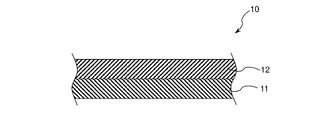
- FIG. 1 is a cross-sectional view showing an example of a multilayer polyimide film obtained by the manufacturing method according to the first embodiment.
- the multilayer polyimide film 10 has a non-thermoplastic polyimide layer 11 and an adhesive layer 12 arranged on at least one side (one main surface) of the non-thermoplastic polyimide layer 11.
- the adhesive layer 12 is provided only on one side of the non-thermoplastic polyimide layer 11, but it is non-thermal like the multilayer polyimide film produced in Examples described later.
- Adhesive layers 12 may be provided on both sides (both main surfaces) of the plastic polyimide layer 11.
- the two adhesive layers 12 may contain the same type of polyimide or may contain different types of polyimide. Further, the thicknesses of the two adhesive layers 12 may be the same or different. Further, in the present invention, both the non-thermoplastic polyimide layer 11 and the adhesive layer 12 may be provided in two or more layers.
- the "multi-layer polyimide film 10" is provided with a film in which the adhesive layer 12 is provided on only one side of the non-thermoplastic polyimide layer 11 and an adhesive layer 12 on both sides of the non-thermoplastic polyimide layer 11.
- a film provided with two or more layers of both the non-thermoplastic polyimide layer 11 and the adhesive layer 12 is included.
- the thickness of the multilayer polyimide film 10 (total thickness of each layer) is, for example, 6 ⁇ m or more and 60 ⁇ m or less.
- the thickness of the multilayer polyimide film 10 is preferably 7 ⁇ m or more and 60 ⁇ m or less, and 10 ⁇ m or more and 60 ⁇ m or less. Is more preferable.
- the thickness of the multilayer polyimide film 10 can be measured using a laser holo gauge.
- the thickness of the adhesive layer 12 (when two or more adhesive layers 12 are provided, the thickness of each adhesive layer 12). ) Is preferably 1 ⁇ m or more and 15 ⁇ m or less. Further, in order to easily adjust the linear expansion coefficient of the multilayer polyimide film 10, the thickness ratio between the non-thermoplastic polyimide layer 11 and the adhesive layer 12 (thickness of the non-thermoplastic polyimide layer 11 / thickness of the adhesive layer 12). Is preferably 55/45 or more and 95/5 or less. When a plurality of layers each of the non-thermoplastic polyimide layer 11 and the adhesive layer 12 are provided, the thickness ratio is the ratio of the total thickness of each. Even if the number of layers of the adhesive layer 12 is increased, it is preferable that the total thickness of the adhesive layer 12 does not exceed the total thickness of the non-thermoplastic polyimide layer 11.
- the adhesive layers 12 are provided on both sides of the non-thermoplastic polyimide layer 11, and the same type of polyimide is contained on both sides of the non-thermoplastic polyimide layer 11. It is more preferable that the adhesive layer 12 is provided.
- the thicknesses of the two adhesive layers 12 are the same in order to suppress the warp of the multilayer polyimide film 10.
- the thickness of the other adhesive layer 12 is in the range of 40% or more and less than 100% when the thickness of the thicker adhesive layer 12 is used as a reference. , The warp of the multi-layer polyimide film 10 can be suppressed.
- the dielectric loss tangent of the non-thermoplastic polyimide layer 11 is preferably 0.0030 or less.
- the dielectric loss tangent of the non-thermoplastic polyimide layer 11 can be adjusted, for example, by changing the content of each residue constituting the non-thermoplastic polyamic acid and at least one of the maximum temperature in the imidization step.
- the dielectric loss tangent of the non-thermoplastic polyimide layer 11 can be set to 0.0040 or less.
- the lower limit of the dielectric loss tangent of the non-thermoplastic polyimide layer 11 is not particularly limited, but is, for example, 0.0001.
- the adhesive layer 12 has no melting peak or has a melting peak in the temperature range of 100 ° C. or higher and 420 ° C. or lower.
- the heat of fusion is preferably 1.0 J / g or less.
- the melting peak in the temperature range of 100 ° C. or higher and 420 ° C. or lower may be simply referred to as “melting peak”.
- the method for measuring the heat of fusion of the melting peak is the same as or similar to the example described later.
- the shape of the film containing the polyamic acid in the solution for forming the adhesive layer is good in the imidization step. Can be kept. Therefore, the shape of the adhesive layer 12 suitable for adhesion to the metal layer can be maintained while making the multilayer polyimide film 10 low dielectric loss tangent by heating at a maximum temperature of 360 ° C. or higher in the imidization step.
- the heat of fusion of the melting peak of the adhesive layer 12 tends to be low when imidized by the chemical imidization method. Further, the heat of fusion of the melting peak of the adhesive layer 12 can be adjusted by changing, for example, the content of each residue constituting the adhesive polyamic acid and at least one of the maximum temperature in the imidization step.
- the adhesive layer 12 does not have a melting peak.
- the adhesive layer 12 preferably has a storage elastic modulus of 20.0 MPa or more at a temperature of 400 ° C. and a loss elastic modulus of 4.0 MPa or more at a temperature of 400 ° C.
- the adhesive layer 12 can withstand heating at a high temperature.
- the storage elastic modulus is 30.0 MPa or more
- the loss elastic modulus is 5.0 MPa or more.
- the storage elastic modulus of the adhesive layer 12 at a temperature of 360 ° C. is preferably 1.0 GPa or less, and more preferably 0.1 GPa or less.
- the storage elastic modulus of the adhesive layer 12 at a temperature of 360 ° C. is 1.0 GPa or less when the adhesive layer 12 and the metal foil are bonded together.
- the adhesive layer 12 having excellent adhesion can be obtained.
- the method for measuring the storage elastic modulus and the loss elastic modulus of the adhesive layer 12 is the same as or similar to that of the examples described later.
- the adhesion strength described in Examples described later can be mentioned.
- the adhesion strength described in Examples described later is 10 N / cm or more.
- the non-thermoplastic polyimide layer 11 may contain components (additives) other than the non-thermoplastic polyimide.
- a dye, a surfactant, a leveling agent, a plasticizer, a silicone, a filler, a sensitizer and the like can be used as the additive.
- the content of the non-thermoplastic polyimide in the non-thermoplastic polyimide layer 11 is, for example, 70% by weight or more, preferably 80% by weight or more, preferably 90% by weight, based on the total amount of the non-thermoplastic polyimide layer 11. The above is more preferable, and it may be 100% by weight.
- the adhesive layer 12 may contain components (additives) other than polyimide.
- additive for example, a dye, a surfactant, a leveling agent, a plasticizer, a silicone, a filler, a sensitizer and the like can be used.
- the content of the polyimide in the adhesive layer 12 is, for example, 70% by weight or more, preferably 80% by weight or more, more preferably 90% by weight or more, and more preferably 100% by weight, based on the total amount of the adhesive layer 12. It may be% by weight.
- the non-thermoplastic polyimide layer 11 and the adhesive layer 12 contain, for example, a tertiary amine used as a catalyst in a content of 1 mass ppm or more and 1000 mass ppm or less, respectively.
- the multilayer polyimide film according to the second embodiment of the present invention has a non-thermoplastic polyimide layer and an adhesive layer containing polyimide arranged on at least one surface of the non-thermoplastic polyimide layer.
- the dielectric loss tangent of the non-thermoplastic polyimide layer at a frequency of 10 GHz, a temperature of 23 ° C., and a relative humidity of 50% is 0.0030 or less.
- the adhesive layer has no melting peak or has a melting heat of 1.0 J / g or less in the temperature range of 100 ° C. or higher and 420 ° C. or lower.
- the polyimide contained in the adhesive layer is composed of one or more tetracarboxylic acid dianhydride residues selected from the group consisting of PMDA residues and BPDA residues, and the group consisting of TPE-R residues and m-TB residues. It has one or more selected diamine residues.
- the multilayer polyimide film according to the second embodiment can be produced by the method for producing a multilayer polyimide film according to the first embodiment described above. Therefore, in the following description, the description of the content overlapping with the first embodiment may be omitted. Hereinafter, the points different from those of the first embodiment will be mainly described.
- the non-thermoplastic polyimide layer is not particularly limited as long as the dielectric loss tangent is 0.0030 or less.
- the non-thermoplastic polyimide contained in the non-thermoplastic polyimide layer is selected from the group consisting of BPDA residues and ODPA residues. It is preferable to have one or more tetracarboxylic acid dianhydride residues and one or more diamine residues selected from the group consisting of PDA residues and TPE-R residues.
- the adhesive layer is not particularly limited as long as the following conditions A and B are satisfied.
- Condition A In the temperature range of 100 ° C. or higher and 420 ° C. or lower, there is no melting peak, or the melting heat of the melting peak is 1.0 J / g or less.
- Condition B The polyimide contained in the adhesive layer is composed of one or more tetracarboxylic acid dianhydride residues selected from the group consisting of PMDA residues and BPDA residues, and TPE-R residues and m-TB residues. It has one or more diamine residues selected from the group.
- the adhesive layer has a PMDA residue, a BPDA residue, a TPE-R residue, and an m-TB residue. Is preferable.
- the non-thermoplastic polyimide layer in order to easily obtain an adhesive layer satisfying the above condition A while easily adjusting the dielectric loss tangent of the non-thermoplastic polyimide layer to 0.0030 or less, it is included in the non-thermoplastic polyimide layer. It is preferable that the non-thermoplastic polyimide having a PDA residue and the polyimide contained in the adhesive layer do not have a PDA residue.
- the metal-clad laminate according to the third embodiment has a multilayer polyimide film according to the second embodiment and a metal layer arranged on the main surface of at least one adhesive layer of the multilayer polyimide film.
- the metal-clad laminate according to the third embodiment can be manufactured by using the multilayer polyimide film according to the second embodiment described above as a material. Therefore, in the following description, the description of the contents overlapping with the first embodiment and the second embodiment may be omitted.
- FIG. 2 is a cross-sectional view showing an example of a metal-clad laminate according to the third embodiment.
- the metal-clad laminate 20 has a multi-layer polyimide film 10 and a metal layer 13 (metal foil) arranged on the main surface 12a of the adhesive layer 12 of the multi-layer polyimide film 10.
- the metal-clad laminate 20 is manufactured using the multi-layer polyimide film 10, at least one side of the multi-layer polyimide film 10 (for example, in the case of FIG. 2, the side opposite to the non-thermoplastic polyimide layer 11 side of the adhesive layer 12).
- a metal foil to be a metal layer 13 is attached to the main surface 12a).
- the method of adhering the metal foil to the main surface 12a of the adhesive layer 12 is not particularly limited, and various known methods can be adopted.
- a thermal roll laminating device having a pair or more of metal rolls or a continuous processing method using a double belt press (DBP) can be adopted.
- the specific configuration of the means for performing the thermal roll laminating is not particularly limited, but in order to improve the appearance of the obtained metal-clad laminate 20, protection is provided between the pressure surface and the metal foil. It is preferable to arrange the material.
- the metal foil to be the metal layer 13 is not particularly limited, and any metal foil can be used.
- a metal foil made of copper, stainless steel, nickel, aluminum, an alloy of these metals, or the like is preferably used.
- copper foil such as rolled copper foil and electrolytic copper foil is often used, but the copper foil is also preferably used in the third embodiment.
- the metal foil one that has been subjected to surface treatment or the like according to the purpose and whose surface roughness or the like has been adjusted can be used. Further, a rust preventive layer, a heat resistant layer, an adhesive layer and the like may be formed on the surface of the metal foil.
- the thickness of the metal foil is not particularly limited, and may be any thickness as long as it can exhibit sufficient functions depending on the intended use. The thickness of the metal foil is preferably 5 ⁇ m or more and 50 ⁇ m or less in order to easily realize the thinning of the FPC while suppressing the generation of wrinkles when the multi-layer polyimide film 10 is bonded.
- the obtained adhesive layer forming solution was extruded from the T-die of the film-forming device while stirring with a mixer, and cast-coated on an endless belt made of stainless steel to form a coating film.
- the obtained coating film was dried at a temperature of 130 ° C. for 100 seconds, and then the obtained gel film was peeled off from the endless belt and fixed to the tenter clip.
- the gel film was then heated at a temperature of 250 ° C. for 17 seconds and then at a temperature of 300 ° C. for 137 seconds to imidize the polyamic acid in the gel film.
- the temperature of the peak of the endothermic chart when the temperature was raised for the second time was defined as the melting temperature.
- the heat of fusion (unit: J / g) was obtained from the area of the peak of the endothermic chart. If there is no melting peak in the temperature range of 100 ° C. or higher and 420 ° C. or lower in the endothermic chart, that is, if the adhesive layer to be measured does not have a melting peak in the temperature range of 100 ° C. or higher and 420 ° C. or lower, the heat of fusion is It was set to 0 J / g.
- [Content rate of tertiary amine] Pyrolysis gas chromatograph using a measurement sample (mass: 0.5 mg) sampled from each layer (specifically, an adhesive layer and a non-thermoplastic polyimide layer) of the multi-layer polyimide film obtained in Examples and Comparative Examples described later.
- the content of tertiary amine in each layer was measured by a tograph / mass spectrometer (“Py-GC / MS” manufactured by Agilent Technologies) under the condition of a heating temperature of 350 ° C.
- Each polyimide film (all layers) is used as a measurement sample, and is dielectrically connected by a network analyzer (“N5224B” manufactured by KeySight Technology Co., Ltd.) and a cavity resonator perturbation method dielectric constant measuring device (“CP531” manufactured by EM Lab Co., Ltd.). was measured. Specifically, the sample was left to stand in an atmosphere with a temperature of 23 ° C.
- the temperature was 23 ° C. and the relative humidity was 50%.
- the dielectric positive contact was measured under the condition of the measurement frequency of 10 GHz.
- the dielectric loss tangent of the multi-layer polyimide film (all layers) was 0.0040 or less, it was evaluated as "the dielectric loss tangent could be reduced”.
- the dielectric loss tangent of the multi-layer polyimide film (all layers) exceeds 0.0040, it was evaluated that "the dielectric loss tangent could not be reduced”.
- the non-thermoplastic polyimide layer obtained by sanding each of the adhesive layers on both sides of the multi-layer polyimide film obtained in Examples and Comparative Examples described later with sandpaper (# 600). A single-layer film composed of was used as a sample for measurement.
- An electrolytic copper foil (“CF-T49A-HD2” manufactured by Fukuda Metal Leaf Powder Industry Co., Ltd.) having a thickness of 12 ⁇ m is applied to both sides of a multi-layer polyimide film (one of the multi-layer polyimide films obtained in Examples and Comparative Examples described later).
- a protective film (“Apical (registered trademark) 125 NPI” manufactured by Kaneka Co., Ltd., thickness: 125 ⁇ m) is placed on the outer surface of each electrolytic copper foil, and the laminating temperature is 360 ° C. using a thermal roll laminating machine.
- Laminating was performed under the conditions of a laminating pressure of 314 N / cm (32 kgf / cm) and a laminating speed of 1.0 m / min to obtain a flexible copper-clad laminate.
- the obtained flexible copper-clad laminate was analyzed according to "6.5 Peeling Strength" of JIS C6471-1995. Specifically, one of the electrolytic copper foils of each flexible copper-clad laminate is peeled off under the conditions of a peeling angle of 90 °, a tensile speed of 100 mm / min, and a measurement width of 1 mm, and the load (unit: N / cm) is adhered. It was made strong. When the adhesion strength was 10 N / cm or more, it was evaluated as “excellent in adhesion”. On the other hand, when the adhesion strength was less than 10 N / cm, it was evaluated as "not excellent in adhesion”.
- the polyimide obtained from the polyamic acid in the obtained polyamic acid solution P1 was non-thermoplastic by the method shown below.
- a solution for forming a plastic polyimide layer was prepared.
- the obtained solution for forming a non-thermoplastic polyimide layer was extruded from the T-die of the film-forming device while stirring with a mixer, and cast-coated on an endless belt made of stainless steel to form a coating film.
- the obtained coating film was dried at a temperature of 100 ° C. for 380 seconds, and then the obtained gel film was peeled off from the endless belt and fixed to the tenter clip. Next, the gel film was heated at a temperature of 300 ° C. for 110 seconds and then heated at a temperature of 380 ° C. for 97 seconds to imidize the polyamic acid in the gel film to obtain a polyimide film having a thickness of 34 ⁇ m.
- the obtained polyimide film was fixed to a fixed frame made of metal and heated at a heating temperature of 380 ° C. for 2 minutes, the shape (film shape) of the polyimide film was maintained.
- the polyimide obtained from the polyamic acid in the polyamic acid solution P1 was a non-thermoplastic polyimide.
- the polyimide film obtained by the same method as the film forming method using the polyamic acid solution P1 is fixed to a metal fixing frame and the heating temperature is 380.
- the shape of the polyimide film (film shape) was maintained. Therefore, the polyimides obtained from the polyamic acids in the polyamic acid solutions P2 and P3 were all non-thermoplastic polyimides.
- a PMDA solution (solvent: DMF, dissolution amount of PMDA: 3.15 kg, concentration of PMDA: 7.2% by weight) prepared in advance was added to the contents of the reaction tank. The addition was continued for a predetermined time in the reaction vessel at an addition rate such that the viscosity did not increase sharply. Then, when the viscosity of the contents of the reaction tank at the temperature of 23 ° C. reached 1000 poise, the addition of the PMDA solution and the stirring of the contents of the reaction tank were stopped to obtain a polyamic acid solution P4.
- a PMDA solution (solvent: DMF, dissolution amount of PMDA: 3.19 kg, concentration of PMDA: 7.2% by weight) prepared in advance was added to the contents of the reaction tank. The addition was continued for a predetermined time in the reaction vessel at an addition rate such that the viscosity did not increase sharply. Then, when the viscosity of the contents of the reaction tank at the temperature of 23 ° C. reached 1000 poise, the addition of the PMDA solution and the stirring of the contents of the reaction tank were stopped to obtain a polyamic acid solution P6.
- solvent solvent: DMF, dissolution amount of PMDA: 3.19 kg, concentration of PMDA: 7.2% by weight
- the addition was continued to the reaction tank for a predetermined time at an addition rate such that the viscosity of the contents of the tank did not increase sharply. Then, when the viscosity of the contents of the reaction tank at the temperature of 23 ° C. reached 1000 poise, the addition of the m-TB solution and the stirring of the contents of the reaction tank were stopped to obtain a polyamic acid solution P7.
- the addition was continued to the reaction tank for a predetermined time at an addition rate such that the viscosity of the contents of the tank did not increase sharply. Then, when the viscosity of the contents of the reaction tank at the temperature of 23 ° C. reached 1000 poise, the addition of the m-TB solution and the stirring of the contents of the reaction tank were stopped to obtain a polyamic acid solution P8.
- Table 1 shows the materials used for each of the polyamic acid solutions P1 to P13 and their ratios.
- the mole fraction of each residue in the polyamic acid contained in each of the polyamic acid solutions P1 to P13 was consistent with the mole fraction of each of the monomers (diamine and tetracarboxylic acid dianhydride) used.
- Table 2 shows the results of measurement and evaluation of the single-layer films obtained by using each of the polyamic acid solutions P4 to P13 by the above-mentioned method.
- "-" means that the said component was not used.
- the numerical value in the column of "acid dianhydride” is the content ratio (unit: mol%) of each acid dianhydride with respect to the total amount of acid dianhydride used.
- the numerical value in the column of "diamine” is the content ratio (unit: mol%) of each diamine with respect to the total amount of diamines used. Further, in Table 2, "-" means that the measurement was not performed.
- Example 1 As an imidization accelerator, a mixture of 144 kg of DMF, 153 kg of isoquinoline and 303 kg of acetic anhydride was prepared. This imidization accelerator was added to the polyamic acid solution P1 and stirred with a mixer to obtain a solution for forming a non-thermoplastic polyimide layer. The amount of the imidization accelerator added was 40 parts by weight with respect to 100 parts by weight of the polyamic acid solution P1. Further, a polyamic acid solution P4 was prepared as a solution for forming an adhesive layer.
- a non-thermoplastic polyimide layer forming solution and an adhesive layer forming solution are transferred to stainless steel as a support by a coextrusion-casting coating method. It was applied on an endless belt made of steel. Specifically, first, the non-thermoplastic polyimide layer forming solution is supplied to the central layer of the extrusion die, and the adhesive layer forming solution is supplied to two layers (on both sides) adjacent to the central layer of the extrusion die. bottom. Further, the opening width of the lip opening of the extrusion molding die (the length of the lip opening in the lateral direction) was adjusted to 1.3 mm.
- a non-thermoplastic polyimide layer forming solution and an adhesive layer forming solution are extruded from the lip opening of the extrusion molding die by a coextrusion-casting coating method, and a coating film (on a stainless steel endless belt) is used.
- a coating film consisting of three layers of a solution for forming an adhesive layer / a solution for forming a non-thermoplastic polyimide layer / a solution for forming an adhesive layer) was formed.
- the obtained coating film was dried on a stainless steel endless belt at a temperature of 100 ° C. for 380 seconds to obtain a gel film. After peeling off this gel film from the stainless steel endless belt, both ends in the longitudinal direction are fixed with pins, heated at a temperature of 300 ° C.
- a measurement sample (mass: 0.5 mg) sampled from the adhesive layer and the non-thermoplastic polyimide layer, respectively, was used, and the tertiary amine (mass: 0.5 mg) of each layer was used by the above-mentioned method.
- isoquinolin was detected at a content of 1% by mass or more in both the adhesive layer and the non-thermoplastic polyimide layer.
- the content of the tertiary amine (isoquinoline) in each layer was measured by the same method as in Example 1, and the adhesive layer and the non-heated layer were measured. Isoquinoline was detected in each of the plastic polyimide layers at a content of 1 mass ppm or more.
- Examples 2 to 5 and Comparative Examples 1 to 5 Except that the types of the polyamic acid solution for preparing the non-thermoplastic polyimide layer forming solution and the types of the polyamic acid solution used as the adhesive layer forming solution are as shown in Table 3 described later, the above The multilayer polyimide films of Examples 2 to 5 and Comparative Examples 1 to 5 were obtained by the same method as in Example 1, respectively.
- a multilayer polyimide film may be obtained by the same method as in Example 1 above, except that the polyamic acid solution P1 is used as a solution for forming a non-thermoplastic polyimide layer without adding an imidization accelerator to the polyamic acid solution P1.
- the film was wrinkled and a good film could not be obtained.
- the content of the tertiary amine was measured by the above-mentioned method using a measurement sample (mass: 0.5 mg) sampled from a wrinkle-free portion on the film surface (adhesive layer), the tertiary amine was measured. Was not detected.
- the content of the tertiary amine in the adhesive layer was less than the lower limit of detection (1 mass ppm). Further, when the melting temperature and the heat of fusion were measured by the above-mentioned method using a measurement sample (mass: 8 mg) sampled from a place where the film surface (adhesive layer) had no wrinkles, the melting temperature and the heat of fusion were measured. , 333 ° C. and 2.3 J / g, respectively.
- a single-layer polyimide film was produced.
- the polyamic acid solution P4 was used as the dope solution without adding the imidization accelerator to the polyamic acid solution P4.
- the polyamic acid solution P4 was applied to one side of an electrolytic copper foil (“CF-T49A-HD2” manufactured by Fukuda Metal Foil Powder Industry Co., Ltd.) having a thickness of 12 ⁇ m using a comma coater (registered trademark) to form a coating film. ..
- the coating film was dried at a temperature of 130 ° C. for 120 seconds to obtain a gel film.
- the obtained gel film is heated at a temperature of 120 ° C. for 5 minutes, then heated to 350 ° C. under the condition of a temperature rising rate of 5 ° C./min, and further heated at a temperature of 350 ° C. for 30 minutes to obtain the polyamide in the coating film.
- the acid was imidized to obtain a polyimide film having a thickness of 12 ⁇ m.
- the content of the tertiary amine in the polyimide film was less than the lower limit of detection (1 mass ppm). Further, when the melting temperature and the heat of fusion were measured by the above-mentioned method using a measurement sample (mass: 8 mg) sampled from the polyimide film of the reference example, the melting temperature and the heat of fusion were 333 ° C. and 2.3 J, respectively. It was / g.
- adhesive solution means a polyamic acid solution used as a solution for forming an adhesive layer.
- no peak means that the temperature did not have a melting peak in the range of 100 ° C. or higher and 420 ° C. or lower.
- the polyamic acid contained in the adhesive layer forming solution used in producing the multilayer polyimide film of Examples 1 to 5 contains PMDA residue, BPDA residue, TPE-R residue and m-TB residue. Had had.
- the polyamic acid contained in the non-thermoplastic polyimide layer forming solution used in producing the multilayer polyimide films of Examples 1 to 5 is one or more tetras selected from the group consisting of BPDA residues and ODPA residues. It had a carboxylic acid dianhydride residue and one or more diamine residues selected from the group consisting of PDA residues and TPE-R residues.
- the dielectric loss tangent of the non-thermoplastic polyimide layer of the multilayer polyimide films of Examples 1 to 5 was 0.0030 or less.
- the adhesive layer of the multilayer polyimide films of Examples 1 to 5 did not have a melting peak in the temperature range of 100 ° C. or higher and 420 ° C. or lower.
- the adhesion strength was 10 N / cm or more. Therefore, the multilayer polyimide films of Examples 1 to 5 were excellent in adhesion.
- the embedding property was evaluated as A. Therefore, the multilayer polyimide films of Examples 1 to 5 were excellent in embedding property.
- the dielectric loss tangent of all the layers was 0.0040 or less. Therefore, the multilayer polyimide films of Examples 1 to 5 were able to reduce the dielectric loss tangent.
- the polyamic acid contained in the adhesive layer forming solution used in producing the multilayer polyimide film of Comparative Examples 1 to 3 did not have a PMDA residue.
- the polyamic acid contained in the adhesive layer forming solution used for producing the multilayer polyimide film of Comparative Example 3 did not have an m-TB residue.
- the polyamic acid contained in the adhesive layer forming solution used in producing the multilayer polyimide film of Comparative Example 4 did not have TPE-R residues and m-TB residues.
- the polyamic acid contained in the non-thermoplastic polyimide layer forming solution used in producing the multilayer polyimide film of Comparative Example 5 is one or more tetracarboxylic acids selected from the group consisting of BPDA residues and ODPA residues.
- the dielectric loss tangent of the non-thermoplastic polyimide layer of the multilayer polyimide film of Comparative Example 5 exceeded 0.0030.
- the adhesive layer of the multilayer polyimide films of Comparative Examples 1 to 4 had a melting heat of more than 1.0 J / g at the melting peak.
- the adhesion strength was less than 10 N / cm. Therefore, the multilayer polyimide films of Comparative Examples 1 to 4 were not excellent in adhesion.
- the embedding property was evaluated as B. Therefore, the multilayer polyimide films of Comparative Examples 1 to 3 were not excellent in embedding property.
- the dielectric loss tangent of all the layers exceeded 0.0040. Therefore, the multilayer polyimide film of Comparative Example 5 could not reduce the dielectric loss tangent.
- Multi-layer polyimide film 11 Non-thermoplastic polyimide layer 12: Adhesive layer 13: Metal layer 20: Metal-clad laminate
Landscapes
- Chemical & Material Sciences (AREA)
- Organic Chemistry (AREA)
- Engineering & Computer Science (AREA)
- Microelectronics & Electronic Packaging (AREA)
- Chemical Kinetics & Catalysis (AREA)
- Manufacturing & Machinery (AREA)
- Health & Medical Sciences (AREA)
- Medicinal Chemistry (AREA)
- Polymers & Plastics (AREA)
- Laminated Bodies (AREA)
- Macromolecular Compounds Obtained By Forming Nitrogen-Containing Linkages In General (AREA)
Priority Applications (4)
| Application Number | Priority Date | Filing Date | Title |
|---|---|---|---|
| KR1020237014947A KR20230086706A (ko) | 2020-10-14 | 2021-10-11 | 복층 폴리이미드 필름, 금속 피복 적층판 및 복층 폴리이미드 필름의 제조 방법 |
| CN202180070660.5A CN116507667B (zh) | 2020-10-14 | 2021-10-11 | 多层聚酰亚胺薄膜、覆金属箔层压板和多层聚酰亚胺薄膜的制造方法 |
| JP2022556968A JP7825567B2 (ja) | 2020-10-14 | 2021-10-11 | 複層ポリイミドフィルム、金属張積層板、及び複層ポリイミドフィルムの製造方法 |
| US18/133,393 US12552969B2 (en) | 2020-10-14 | 2023-04-11 | Multi-layered polyimide film, metal-clad laminate, and method for producing multi-layered polyimide film |
Applications Claiming Priority (4)
| Application Number | Priority Date | Filing Date | Title |
|---|---|---|---|
| JP2020-173047 | 2020-10-14 | ||
| JP2020173047 | 2020-10-14 | ||
| JP2021-110117 | 2021-07-01 | ||
| JP2021110117 | 2021-07-01 |
Related Child Applications (1)
| Application Number | Title | Priority Date | Filing Date |
|---|---|---|---|
| US18/133,393 Continuation US12552969B2 (en) | 2020-10-14 | 2023-04-11 | Multi-layered polyimide film, metal-clad laminate, and method for producing multi-layered polyimide film |
Publications (1)
| Publication Number | Publication Date |
|---|---|
| WO2022080314A1 true WO2022080314A1 (ja) | 2022-04-21 |
Family
ID=81209129
Family Applications (1)
| Application Number | Title | Priority Date | Filing Date |
|---|---|---|---|
| PCT/JP2021/037569 Ceased WO2022080314A1 (ja) | 2020-10-14 | 2021-10-11 | 複層ポリイミドフィルム、金属張積層板、及び複層ポリイミドフィルムの製造方法 |
Country Status (6)
| Country | Link |
|---|---|
| US (1) | US12552969B2 (https=) |
| JP (1) | JP7825567B2 (https=) |
| KR (1) | KR20230086706A (https=) |
| CN (1) | CN116507667B (https=) |
| TW (1) | TWI904257B (https=) |
| WO (1) | WO2022080314A1 (https=) |
Cited By (2)
| Publication number | Priority date | Publication date | Assignee | Title |
|---|---|---|---|---|
| WO2024085047A1 (ja) * | 2022-10-19 | 2024-04-25 | 株式会社カネカ | 複層ポリイミドフィルム |
| JP7519509B1 (ja) | 2023-02-28 | 2024-07-19 | 住友化学株式会社 | ポリイミド系フィルム |
Families Citing this family (1)
| Publication number | Priority date | Publication date | Assignee | Title |
|---|---|---|---|---|
| KR102809318B1 (ko) * | 2022-11-30 | 2025-05-19 | 피아이첨단소재 주식회사 | 다층 폴리이미드 필름 및 이의 제조방법 |
Citations (3)
| Publication number | Priority date | Publication date | Assignee | Title |
|---|---|---|---|---|
| WO2018061727A1 (ja) * | 2016-09-29 | 2018-04-05 | 新日鉄住金化学株式会社 | ポリイミドフィルム、銅張積層板及び回路基板 |
| JP2018145303A (ja) * | 2017-03-06 | 2018-09-20 | 株式会社カネカ | 多層ポリイミドフィルム |
| JP2019014062A (ja) * | 2017-07-04 | 2019-01-31 | 株式会社カネカ | 積層体、フレキシブル金属張積層板、およびフレキシブルプリント回路基板 |
Family Cites Families (3)
| Publication number | Priority date | Publication date | Assignee | Title |
|---|---|---|---|---|
| EP1707590B1 (en) * | 2003-12-26 | 2008-12-10 | Toyo Boseki Kabushiki Kaisha | Polyimide film |
| US20130011687A1 (en) * | 2010-01-18 | 2013-01-10 | Kaneka Corporation | Multilayer polymide film and flexible metal laminated board |
| CN106661197B (zh) * | 2014-08-15 | 2020-05-12 | 尤尼吉可株式会社 | 树脂组合物和使用该树脂组合物的层叠体 |
-
2021
- 2021-10-11 WO PCT/JP2021/037569 patent/WO2022080314A1/ja not_active Ceased
- 2021-10-11 KR KR1020237014947A patent/KR20230086706A/ko active Pending
- 2021-10-11 CN CN202180070660.5A patent/CN116507667B/zh active Active
- 2021-10-11 JP JP2022556968A patent/JP7825567B2/ja active Active
- 2021-10-14 TW TW110138126A patent/TWI904257B/zh active
-
2023
- 2023-04-11 US US18/133,393 patent/US12552969B2/en active Active
Patent Citations (3)
| Publication number | Priority date | Publication date | Assignee | Title |
|---|---|---|---|---|
| WO2018061727A1 (ja) * | 2016-09-29 | 2018-04-05 | 新日鉄住金化学株式会社 | ポリイミドフィルム、銅張積層板及び回路基板 |
| JP2018145303A (ja) * | 2017-03-06 | 2018-09-20 | 株式会社カネカ | 多層ポリイミドフィルム |
| JP2019014062A (ja) * | 2017-07-04 | 2019-01-31 | 株式会社カネカ | 積層体、フレキシブル金属張積層板、およびフレキシブルプリント回路基板 |
Cited By (3)
| Publication number | Priority date | Publication date | Assignee | Title |
|---|---|---|---|---|
| WO2024085047A1 (ja) * | 2022-10-19 | 2024-04-25 | 株式会社カネカ | 複層ポリイミドフィルム |
| JP7519509B1 (ja) | 2023-02-28 | 2024-07-19 | 住友化学株式会社 | ポリイミド系フィルム |
| JP2024122827A (ja) * | 2023-02-28 | 2024-09-09 | 住友化学株式会社 | ポリイミド系フィルム |
Also Published As
| Publication number | Publication date |
|---|---|
| JP7825567B2 (ja) | 2026-03-06 |
| TW202227531A (zh) | 2022-07-16 |
| CN116507667A (zh) | 2023-07-28 |
| KR20230086706A (ko) | 2023-06-15 |
| JPWO2022080314A1 (https=) | 2022-04-21 |
| US12552969B2 (en) | 2026-02-17 |
| TWI904257B (zh) | 2025-11-11 |
| CN116507667B (zh) | 2025-02-14 |
| US20230250317A1 (en) | 2023-08-10 |
Similar Documents
| Publication | Publication Date | Title |
|---|---|---|
| KR101299310B1 (ko) | 접착 필름 | |
| CN103502006B (zh) | 聚酰亚胺膜和使用其的金属层压体 | |
| JP6788357B2 (ja) | ポリイミドフィルム、多層ポリイミドフィルム、カバーレイ、及びフレキシブルプリント配線板 | |
| US12552969B2 (en) | Multi-layered polyimide film, metal-clad laminate, and method for producing multi-layered polyimide film | |
| JP6936639B2 (ja) | 積層体、フレキシブル金属張積層板、およびフレキシブルプリント回路基板 | |
| TW202208513A (zh) | 多層聚醯亞胺膜 | |
| WO2022085619A1 (ja) | 非熱可塑性ポリイミドフィルム、複層ポリイミドフィルム、及び金属張積層板 | |
| KR101076505B1 (ko) | 접착 필름 및 그의 이용 | |
| CN103889710A (zh) | 制备聚酰亚胺金属层压体的方法 | |
| KR101290933B1 (ko) | 폴리이미드 필름 | |
| TW202417547A (zh) | 多層聚醯亞胺膜 | |
| KR20080044330A (ko) | 내열성 접착 시트 | |
| JP2023121512A (ja) | 非熱可塑性ポリイミドフィルム、複層ポリイミドフィルム、及び金属張積層板 | |
| KR20070094810A (ko) | 접착성이 개량된 신규 폴리이미드 필름 | |
| JP2023149882A (ja) | 多層ポリイミドフィルム | |
| JP2025152703A (ja) | 熱可塑性ポリイミドフィルム、多層ポリイミドフィルム、およびフレキシブル金属張積層板 | |
| JP2026051602A (ja) | 多層ポリイミドフィルム、カバーレイフィルム、並びに多層ポリイミドフィルムの製造方法 | |
| JP5069844B2 (ja) | プリント配線板用絶縁フィルムの製造方法、ポリイミド/銅積層体及びプリント配線板 | |
| WO2023162745A1 (ja) | ポリアミド酸、ポリイミド、非熱可塑性ポリイミドフィルム、複層ポリイミドフィルム及び金属張積層板 | |
| WO2023157789A1 (ja) | ポリアミド酸、ポリイミド、非熱可塑性ポリイミドフィルム、複層ポリイミドフィルム及び金属張積層板 | |
| JP5355993B2 (ja) | 接着フィルム | |
| JP2023136376A (ja) | ポリイミド前駆体及びポリイミド | |
| JP2007313854A (ja) | 銅張積層板 | |
| KR20070021263A (ko) | 접착 필름의 제조 방법 | |
| JP2006160957A (ja) | 接着フィルム |
Legal Events
| Date | Code | Title | Description |
|---|---|---|---|
| 121 | Ep: the epo has been informed by wipo that ep was designated in this application |
Ref document number: 21880053 Country of ref document: EP Kind code of ref document: A1 |
|
| ENP | Entry into the national phase |
Ref document number: 2022556968 Country of ref document: JP Kind code of ref document: A |
|
| WWE | Wipo information: entry into national phase |
Ref document number: 202180070660.5 Country of ref document: CN |
|
| ENP | Entry into the national phase |
Ref document number: 20237014947 Country of ref document: KR Kind code of ref document: A |
|
| NENP | Non-entry into the national phase |
Ref country code: DE |
|
| 122 | Ep: pct application non-entry in european phase |
Ref document number: 21880053 Country of ref document: EP Kind code of ref document: A1 |
|
| WWG | Wipo information: grant in national office |
Ref document number: 202180070660.5 Country of ref document: CN |