WO2022044451A1 - 緩衝器および緩衝器の製造方法 - Google Patents
緩衝器および緩衝器の製造方法 Download PDFInfo
- Publication number
- WO2022044451A1 WO2022044451A1 PCT/JP2021/019224 JP2021019224W WO2022044451A1 WO 2022044451 A1 WO2022044451 A1 WO 2022044451A1 JP 2021019224 W JP2021019224 W JP 2021019224W WO 2022044451 A1 WO2022044451 A1 WO 2022044451A1
- Authority
- WO
- WIPO (PCT)
- Prior art keywords
- shock absorber
- piston rod
- plating film
- cylinder
- chromium
- Prior art date
- Legal status (The legal status is an assumption and is not a legal conclusion. Google has not performed a legal analysis and makes no representation as to the accuracy of the status listed.)
- Ceased
Links
Images


Classifications
-
- C—CHEMISTRY; METALLURGY
- C25—ELECTROLYTIC OR ELECTROPHORETIC PROCESSES; APPARATUS THEREFOR
- C25D—PROCESSES FOR THE ELECTROLYTIC OR ELECTROPHORETIC PRODUCTION OF COATINGS; ELECTROFORMING; APPARATUS THEREFOR
- C25D5/00—Electroplating characterised by the process; Pretreatment or after-treatment of workpieces
- C25D5/60—Electroplating characterised by the structure or texture of the layers
- C25D5/605—Surface topography of the layers, e.g. rough, dendritic or nodular layers
- C25D5/611—Smooth layers
-
- C—CHEMISTRY; METALLURGY
- C25—ELECTROLYTIC OR ELECTROPHORETIC PROCESSES; APPARATUS THEREFOR
- C25D—PROCESSES FOR THE ELECTROLYTIC OR ELECTROPHORETIC PRODUCTION OF COATINGS; ELECTROFORMING; APPARATUS THEREFOR
- C25D3/00—Electroplating: Baths therefor
- C25D3/02—Electroplating: Baths therefor from solutions
- C25D3/04—Electroplating: Baths therefor from solutions of chromium
- C25D3/06—Electroplating: Baths therefor from solutions of chromium from solutions of trivalent chromium
-
- C—CHEMISTRY; METALLURGY
- C25—ELECTROLYTIC OR ELECTROPHORETIC PROCESSES; APPARATUS THEREFOR
- C25D—PROCESSES FOR THE ELECTROLYTIC OR ELECTROPHORETIC PRODUCTION OF COATINGS; ELECTROFORMING; APPARATUS THEREFOR
- C25D5/00—Electroplating characterised by the process; Pretreatment or after-treatment of workpieces
- C25D5/18—Electroplating using modulated, pulsed or reversing current
-
- C—CHEMISTRY; METALLURGY
- C25—ELECTROLYTIC OR ELECTROPHORETIC PROCESSES; APPARATUS THEREFOR
- C25D—PROCESSES FOR THE ELECTROLYTIC OR ELECTROPHORETIC PRODUCTION OF COATINGS; ELECTROFORMING; APPARATUS THEREFOR
- C25D5/00—Electroplating characterised by the process; Pretreatment or after-treatment of workpieces
- C25D5/48—After-treatment of electroplated surfaces
-
- C—CHEMISTRY; METALLURGY
- C25—ELECTROLYTIC OR ELECTROPHORETIC PROCESSES; APPARATUS THEREFOR
- C25D—PROCESSES FOR THE ELECTROLYTIC OR ELECTROPHORETIC PRODUCTION OF COATINGS; ELECTROFORMING; APPARATUS THEREFOR
- C25D5/00—Electroplating characterised by the process; Pretreatment or after-treatment of workpieces
- C25D5/60—Electroplating characterised by the structure or texture of the layers
- C25D5/615—Microstructure of the layers, e.g. mixed structure
-
- C—CHEMISTRY; METALLURGY
- C25—ELECTROLYTIC OR ELECTROPHORETIC PROCESSES; APPARATUS THEREFOR
- C25D—PROCESSES FOR THE ELECTROLYTIC OR ELECTROPHORETIC PRODUCTION OF COATINGS; ELECTROFORMING; APPARATUS THEREFOR
- C25D7/00—Electroplating characterised by the article coated
-
- F—MECHANICAL ENGINEERING; LIGHTING; HEATING; WEAPONS; BLASTING
- F16—ENGINEERING ELEMENTS AND UNITS; GENERAL MEASURES FOR PRODUCING AND MAINTAINING EFFECTIVE FUNCTIONING OF MACHINES OR INSTALLATIONS; THERMAL INSULATION IN GENERAL
- F16F—SPRINGS; SHOCK-ABSORBERS; MEANS FOR DAMPING VIBRATION
- F16F9/00—Springs, vibration-dampers, shock-absorbers, or similarly-constructed movement-dampers using a fluid or the equivalent as damping medium
- F16F9/10—Springs, vibration-dampers, shock-absorbers, or similarly-constructed movement-dampers using a fluid or the equivalent as damping medium using liquid only; using a fluid of which the nature is immaterial
- F16F9/14—Devices with one or more members, e.g. pistons, vanes, moving to and fro in chambers and using throttling effect
- F16F9/16—Devices with one or more members, e.g. pistons, vanes, moving to and fro in chambers and using throttling effect involving only straight-line movement of the effective parts
- F16F9/18—Devices with one or more members, e.g. pistons, vanes, moving to and fro in chambers and using throttling effect involving only straight-line movement of the effective parts with a closed cylinder and a piston separating two or more working spaces therein
- F16F9/19—Devices with one or more members, e.g. pistons, vanes, moving to and fro in chambers and using throttling effect involving only straight-line movement of the effective parts with a closed cylinder and a piston separating two or more working spaces therein with a single cylinder and of single-tube type
-
- F—MECHANICAL ENGINEERING; LIGHTING; HEATING; WEAPONS; BLASTING
- F16—ENGINEERING ELEMENTS AND UNITS; GENERAL MEASURES FOR PRODUCING AND MAINTAINING EFFECTIVE FUNCTIONING OF MACHINES OR INSTALLATIONS; THERMAL INSULATION IN GENERAL
- F16F—SPRINGS; SHOCK-ABSORBERS; MEANS FOR DAMPING VIBRATION
- F16F9/00—Springs, vibration-dampers, shock-absorbers, or similarly-constructed movement-dampers using a fluid or the equivalent as damping medium
- F16F9/32—Details
- F16F9/3207—Constructional features
- F16F9/3221—Constructional features of piston rods
-
- B—PERFORMING OPERATIONS; TRANSPORTING
- B60—VEHICLES IN GENERAL
- B60G—VEHICLE SUSPENSION ARRANGEMENTS
- B60G13/00—Resilient suspensions characterised by arrangement, location or type of vibration dampers
- B60G13/02—Resilient suspensions characterised by arrangement, location or type of vibration dampers having dampers dissipating energy, e.g. frictionally
- B60G13/06—Resilient suspensions characterised by arrangement, location or type of vibration dampers having dampers dissipating energy, e.g. frictionally of fluid type
- B60G13/08—Resilient suspensions characterised by arrangement, location or type of vibration dampers having dampers dissipating energy, e.g. frictionally of fluid type hydraulic
-
- B—PERFORMING OPERATIONS; TRANSPORTING
- B60—VEHICLES IN GENERAL
- B60G—VEHICLE SUSPENSION ARRANGEMENTS
- B60G2202/00—Indexing codes relating to the type of spring, damper or actuator
- B60G2202/20—Type of damper
- B60G2202/24—Fluid damper
-
- B—PERFORMING OPERATIONS; TRANSPORTING
- B60—VEHICLES IN GENERAL
- B60G—VEHICLE SUSPENSION ARRANGEMENTS
- B60G2206/00—Indexing codes related to the manufacturing of suspensions: constructional features, the materials used, procedures or tools
- B60G2206/01—Constructional features of suspension elements, e.g. arms, dampers, springs
- B60G2206/40—Constructional features of dampers and/or springs
- B60G2206/41—Dampers
-
- B—PERFORMING OPERATIONS; TRANSPORTING
- B60—VEHICLES IN GENERAL
- B60G—VEHICLE SUSPENSION ARRANGEMENTS
- B60G2206/00—Indexing codes related to the manufacturing of suspensions: constructional features, the materials used, procedures or tools
- B60G2206/01—Constructional features of suspension elements, e.g. arms, dampers, springs
- B60G2206/70—Materials used in suspensions
-
- B—PERFORMING OPERATIONS; TRANSPORTING
- B60—VEHICLES IN GENERAL
- B60G—VEHICLE SUSPENSION ARRANGEMENTS
- B60G2206/00—Indexing codes related to the manufacturing of suspensions: constructional features, the materials used, procedures or tools
- B60G2206/01—Constructional features of suspension elements, e.g. arms, dampers, springs
- B60G2206/80—Manufacturing procedures
-
- B—PERFORMING OPERATIONS; TRANSPORTING
- B60—VEHICLES IN GENERAL
- B60G—VEHICLE SUSPENSION ARRANGEMENTS
- B60G2800/00—Indexing codes relating to the type of movement or to the condition of the vehicle and to the end result to be achieved by the control action
- B60G2800/16—Running
- B60G2800/162—Reducing road induced vibrations
-
- C—CHEMISTRY; METALLURGY
- C25—ELECTROLYTIC OR ELECTROPHORETIC PROCESSES; APPARATUS THEREFOR
- C25D—PROCESSES FOR THE ELECTROLYTIC OR ELECTROPHORETIC PRODUCTION OF COATINGS; ELECTROFORMING; APPARATUS THEREFOR
- C25D5/00—Electroplating characterised by the process; Pretreatment or after-treatment of workpieces
- C25D5/10—Electroplating with more than one layer of the same or of different metals
- C25D5/12—Electroplating with more than one layer of the same or of different metals at least one layer being of nickel or chromium
- C25D5/14—Electroplating with more than one layer of the same or of different metals at least one layer being of nickel or chromium two or more layers being of nickel or chromium, e.g. duplex or triplex layers
-
- F—MECHANICAL ENGINEERING; LIGHTING; HEATING; WEAPONS; BLASTING
- F16—ENGINEERING ELEMENTS AND UNITS; GENERAL MEASURES FOR PRODUCING AND MAINTAINING EFFECTIVE FUNCTIONING OF MACHINES OR INSTALLATIONS; THERMAL INSULATION IN GENERAL
- F16F—SPRINGS; SHOCK-ABSORBERS; MEANS FOR DAMPING VIBRATION
- F16F2222/00—Special physical effects, e.g. nature of damping effects
- F16F2222/12—Fluid damping
-
- F—MECHANICAL ENGINEERING; LIGHTING; HEATING; WEAPONS; BLASTING
- F16—ENGINEERING ELEMENTS AND UNITS; GENERAL MEASURES FOR PRODUCING AND MAINTAINING EFFECTIVE FUNCTIONING OF MACHINES OR INSTALLATIONS; THERMAL INSULATION IN GENERAL
- F16F—SPRINGS; SHOCK-ABSORBERS; MEANS FOR DAMPING VIBRATION
- F16F2224/00—Materials; Material properties
- F16F2224/02—Materials; Material properties solids
- F16F2224/0208—Alloys
-
- F—MECHANICAL ENGINEERING; LIGHTING; HEATING; WEAPONS; BLASTING
- F16—ENGINEERING ELEMENTS AND UNITS; GENERAL MEASURES FOR PRODUCING AND MAINTAINING EFFECTIVE FUNCTIONING OF MACHINES OR INSTALLATIONS; THERMAL INSULATION IN GENERAL
- F16F—SPRINGS; SHOCK-ABSORBERS; MEANS FOR DAMPING VIBRATION
- F16F2226/00—Manufacturing; Treatments
- F16F2226/02—Surface treatments
-
- F—MECHANICAL ENGINEERING; LIGHTING; HEATING; WEAPONS; BLASTING
- F16—ENGINEERING ELEMENTS AND UNITS; GENERAL MEASURES FOR PRODUCING AND MAINTAINING EFFECTIVE FUNCTIONING OF MACHINES OR INSTALLATIONS; THERMAL INSULATION IN GENERAL
- F16F—SPRINGS; SHOCK-ABSORBERS; MEANS FOR DAMPING VIBRATION
- F16F2228/00—Functional characteristics, e.g. variability, frequency-dependence
- F16F2228/001—Specific functional characteristics in numerical form or in the form of equations
- F16F2228/005—Material properties, e.g. moduli
- F16F2228/007—Material properties, e.g. moduli of solids, e.g. hardness
-
- F—MECHANICAL ENGINEERING; LIGHTING; HEATING; WEAPONS; BLASTING
- F16—ENGINEERING ELEMENTS AND UNITS; GENERAL MEASURES FOR PRODUCING AND MAINTAINING EFFECTIVE FUNCTIONING OF MACHINES OR INSTALLATIONS; THERMAL INSULATION IN GENERAL
- F16F—SPRINGS; SHOCK-ABSORBERS; MEANS FOR DAMPING VIBRATION
- F16F2230/00—Purpose; Design features
- F16F2230/0023—Purpose; Design features protective
-
- F—MECHANICAL ENGINEERING; LIGHTING; HEATING; WEAPONS; BLASTING
- F16—ENGINEERING ELEMENTS AND UNITS; GENERAL MEASURES FOR PRODUCING AND MAINTAINING EFFECTIVE FUNCTIONING OF MACHINES OR INSTALLATIONS; THERMAL INSULATION IN GENERAL
- F16F—SPRINGS; SHOCK-ABSORBERS; MEANS FOR DAMPING VIBRATION
- F16F2230/00—Purpose; Design features
- F16F2230/02—Surface features, e.g. notches or protuberances
Definitions
- the present invention relates to a shock absorber and a method for manufacturing the shock absorber.
- Patent Document 1 discloses a shock absorber in which a surface hard layer such as a chrome plating film or a nickel plating film is provided on a peripheral surface without a cylinder member for the purpose of stabilizing the frictional resistance of the shock absorber.
- hexavalent chromium plating bath using hexavalent chromium as a chromium component has been used for forming a hard chromium plating film.
- hexavalent chromium has been designated as a substance of very high concern in environmental regulations and wastewater regulations such as REACH (Regation, Assessment, Evaluation, Restriction of Chemicals) regulation, and its use reduction is desired worldwide.
- REACH Regulation, Assessment, Evaluation, Restriction of Chemicals
- Patent Document 2 discloses a hard trivalent chromium plating film that can obtain hardness and wear resistance equivalent to those of a hard hexavalent chromium plating film for the purpose of substituting a hexavalent chromium plating bath.
- the hard trivalent chromium plating film can obtain 800 HV or more even after plating, which is equivalent to hard hexavalent chromium plating, and 1000 HV or more can be obtained because chromium carbide is formed by further heat treatment.
- properties other than hardness and wear resistance have not been evaluated so far, and further studies are required to improve the slidability such as frictional force required for sliding parts such as suspension rods. be.
- an object of the present invention is to use trivalent chromium instead of hexavalent chromium, which may affect the human body and the environment, to provide a buffer that achieves both high hardness and low frictional force at a high level.
- One aspect of the present invention for achieving the above object is a cylinder filled with hydraulic oil, a piston rod that can move inside the cylinder, and an oil seal that is fixed to the cylinder and slides on the piston rod.
- the piston rod has a hard layer containing chromium obtained from a trivalent chrome plating bath as a main component on the surface of the piston rod, and the hard layer contains both crystalline and amorphous substances and has an addition other than chromium. It is a shock absorber characterized by containing an object.
- a plating film made of a hard layer containing trivalent chromium as a main component is formed on the surface of the piston rod. It has a plating step of forming, the plating step having a cathode current density of 100 A / in a plating bath containing a trivalent chromium salt, a carboxylic acid, a pH buffer and a conductive salt and having a pH of ⁇ 0.1. It is a method of manufacturing a shock absorber characterized by carrying out as dm 2 or more.
- a shock absorber and a shock absorber that achieve both high hardness and low frictional force at a high level by using trivalent chromium without using hexavalent chromium, which may affect the human body and the environment.
- a manufacturing method can be provided.
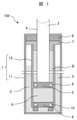
- FIG. 1 Schematic cross-sectional view showing an example of the shock absorber of the present invention.
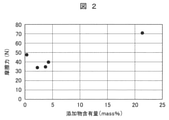
- a graph showing the relationship between the frictional force of the test pieces of Examples 1 to 3 and Comparative Examples 1 and 2 and the content of the additive in the chromium plating film.
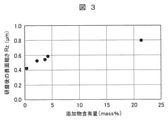
- a graph showing the relationship between the surface roughness Rz of the test pieces of Examples 1 to 3 and Comparative Examples 1 and 2 and the additive content in the chromium plating film.
- the shock absorber and the method for manufacturing the shock absorber according to the embodiment of the present invention will be described. It should be noted that the present invention is not limited to this and can be improved based on the knowledge and knowledge of those skilled in the art as long as it does not deviate from the scope of the present invention.
- the hexavalent chromium plating film used as a hard layer does not contain much additives other than the chromium metal salt in the plating bath component, so that the content of additives in the plating film is small and it tends to be crystalline. Further, since the coefficient of friction as a chromium metal is small, it has been widely used as a hard plating film having high hardness and excellent wear resistance.
- the trivalent chromium plating film which is being studied as an alternative technology to the hard hexavalent chromium plating film, is used as a plating bath component in order to improve the precipitation stability and film hardness of the plating bath, in addition to the trivalent chromium compound.
- various additives such as complexing agents, conductive salts, pH buffers and crystallization agents. Therefore, unlike the hexavalent chromium plating film which is crystalline, since the plating film contains many additives such as carbon, nitrogen, oxygen and hydrogen other than chromium, it is basically amorphous.
- the trivalent chromium plating film it is difficult for the trivalent chromium plating film to improve the smoothness by polishing after plating as compared with the hexavalent chromium plating film, and the frictional force is higher than that of the hard hexavalent chromium plating film. It has been found.
- the present inventor has been diligently researching a trivalent chromium-plated film with the aim of achieving both high hardness and low frictional force at a high level.
- the ratio of the amorphous component and the crystalline component is adjusted, and by containing additives other than chromium, the surface roughness and frictional force of the plating film are reduced, and the shock absorber. It has been found that a plating film suitable for the above can be obtained.
- the present invention is based on this finding.
- shock absorber of the present invention will be described in detail.
- FIG. 1 is a schematic cross-sectional view showing an example of the shock absorber of the present invention.
- FIG. 1 exemplifies a hydraulic shock absorber for an automobile as a shock absorber.
- the shock absorber 100 of the present invention is a double-cylinder type, and has a tubular outer cylinder 11 having a bottom and an inner cylinder 12 provided inside the outer cylinder 11 coaxially with the outer cylinder 11.
- the cylinder 1 is provided with a cylinder 1, a piston rod 2 that is relatively movable with respect to the cylinder 1, and an oil seal 8 that is fixed to the cylinder 1 and slides on the piston rod 2.
- the hydraulic oil 3 for the hydraulic device and the gas for volume compensation are injected into the inside of the inner cylinder 12 and the reservoir chamber C between the inner cylinder 12 and the outer cylinder 11.
- a hard layer 4 is provided on the surface of the piston rod 2, a piston 5 is fixed to one end side thereof inserted into the inner cylinder 12, and the other end is arranged so as to protrude from the cylinder 1.
- the outer peripheral portion of the piston 5 is slidably fitted to the inner surface of the inner cylinder 12.
- a bottom valve 6 is fixed to the lower end of the inner cylinder 12, and a rod guide 7 that slidably guides the piston rod 2 is fixed to the upper end of the inner cylinder 12.
- a through hole is provided in the center of the rod guide 7, and the piston rod 2 is inserted into this through hole.
- An oil seal 8 is fixed to the upper part of the outer cylinder 11, and the inside of the outer cylinder 11 is sealed via the oil seal 8.
- the oil seal 8 and the piston rod 2 are fitted so that the oil seal 8 prevents the hydraulic oil 3 for the hydraulic system from leaking to the outside of the cylinder 1 through the gap between the piston rod 2 and the rod guide 7. ..
- the piston 5 separates the inside of the inner cylinder 12 into the oil chamber A and the oil chamber B. Further, the bottom valve 6 separates the reservoir chamber C and the oil chamber A between the inner cylinder 12 and the outer cylinder 11.
- the piston 5 is provided with a damping force generating mechanism 9 provided with a valve.
- the damping force generation mechanism 9 when the piston rod 2 moves to the extension side (the piston rod 2 moves upward in FIG. 1), the valve opens and the cross-sectional area between the oil chamber A and the oil chamber B is small. A predetermined damping force is generated by forming a flow path and limiting the flow of the hydraulic oil 3 for the hydraulic device.
- the bottom valve 6 is provided with a damping force generation mechanism 10.
- the damping force generation mechanism 10 is composed of a flow path having a small cross-sectional area formed in the bottom valve 6.
- the hydraulic oil 3 for the hydraulic device in the oil chamber A flows to the reservoir chamber C through a flow path having a small cross-sectional area. By doing so, a damping force is generated.
- the hard layer 4 of the present invention is a plating film containing trivalent chromium as a main component, containing both crystalline and amorphous substances, and containing additives other than chromium.
- a chrome plating film quality it is possible to reduce the surface roughness in the polishing process after plating, and it is possible to reduce the coefficient of friction with oil. That is, by providing the surface of the piston rod 2 with a hard layer 4 made of a smooth and low friction coefficient hard trivalent chrome plating film, it is possible to realize a hydraulic shock absorber 100 for automobiles having a low friction force.
- the hard trivalent chromium plating film contains hydrogen, carbon, nitrogen, oxygen and the like as additives. It is presumed that these are derived from organic components such as carboxylates, pH buffers and conductive salts contained in the plating bath. It was also confirmed that the additive content differs depending on the plating treatment conditions and particularly contributes significantly to the pH and current density conditions. It is presumed that this is because the uptake of additives when chromium is deposited affects the current density (reduction rate) and pH (complex formation).
- the content of the additive contained in the plating film is preferably 2.3% by mass or more and 4.3% by mass or less.
- the content of the additive contained in the plating film is preferably 2.3% by mass or more and 4.3% by mass or less.
- the additive causes chemisorption with the oil in the shock absorber and the oil retention on the surface of the plating film is improved.
- the surface roughness Rz after the polishing process after plating tends to increase as the additive content increases. It is presumed that the cause of this is that the additives contained in the plating film hinder the polishing process and reduce the smoothness. Therefore, the additive content of the rigid trivalent chromium plating film of the present invention is preferably 2.3% by mass or more and 4.3% by mass or less.
- the crystallization rate of the hard trivalent chromium plating film obtained by the following formula is preferably 5 to 26%.
- a correlation was found with the additive content of the plating film, and it was confirmed that the crystallization rate tended to decrease as the additive content increased. It is presumed that the cause of this is that the additive lowers the crystallinity.
- the crystal in the additive content of 2.3% by mass or more and 4.3% by mass or less of the hard trivalent chromium plating film capable of obtaining the above-mentioned low frictional force.
- the conversion rate was 5 to 26%.
- Crystallization rate (peak integrated intensity ratio) (crystalline / (crystalline + amorphous)) ⁇ 100% ...
- the integrated intensity ratio of the above (Equation 1) is an XRD (X-ray diffraction) analysis. In, 2 ⁇ : 30 to 140 °, the half price width of crystalline material: ⁇ 3, and the half price width of amorphous material: ⁇ 3.
- the hardness of the hard trivalent chromium plating film is preferably 750 HV or more, which is equivalent to that of industrial hexavalent chromium (JIS (Japanese Industrial Standards) H8615), but 800 HV or more is preferable in order to improve the wear resistance of the piston rod. Is.
- the hard trivalent chromium plating film of the present invention can be further increased in hardness by subjecting it to heat treatment after plating.
- the surface roughness (Rz) of the hard trivalent chromium plating film is preferably 0.6 ⁇ m or less.
- the hard trivalent chromium plating film of the present invention can reduce the frictional force to hard hexavalent chromium or less by setting the surface roughness Rz after polishing to 0.6 or less.
- the polishing method is not particularly limited, but super finish processing using a polishing film is preferable.
- the piston rod 2 of the shock absorber is plated with the hard layer 4 made of the above-mentioned hard trivalent chromium plating film.
- the plating bath for the hard trivalent chromium plating film contains a trivalent chromium salt as a main component, and components such as a complexing agent, a pH buffer and a conduction salt as additives.
- a trivalent chromium salt chromium chloride, chromium sulfate, basic chromium sulfate and the like can be used, but chromium chloride is particularly preferable.
- carboxylates such as glycine, formic acid, oxalic acid and acetic acid can be used, but glycine is particularly preferable.
- pH buffer boric acid, citric acid and the like can be used, but boric acid is particularly preferable.
- conductive salt ammonium chloride, ammonium sulfate, ammonium sulfamic acid and the like can be used, but ammonium chloride is particularly preferable.
- the pH of the plating bath is preferably strong acid, and is preferably pH 0.1 or less.
- the pH is 4.0 or higher, a plating film containing both crystalline and amorphous cannot be obtained.
- the current density is 50 A / dm 2 or less, a plating film containing both crystalline and amorphous cannot be obtained even if the pH is 0.1. The reason for this is presumed to be that the crystallization rate is affected by the current density (reduction rate) and pH (complex formation), as described above.
- the plating bath temperature and the stirring method are not particularly limited, and the temperature can be 10 to 90 ° C., and the stirring method can be air or a stirrer. Further, the anode material has good insolubility, and Pt, Ti, Ir, carbon and the like can be used.
- the hydraulic shock absorber for automobiles provided with a hard trivalent chrome-plated film on the surface of the piston rod 2 has been described, but the piston rod 2 is used according to the corrosion resistance specifications required for the product. It is also possible to have a two-layer structure in which a nickel plating film is provided in the intermediate layer of the hard trivalent chrome plating film. Further, the rigid trivalent chromium plating film of the present invention can be provided on a sliding portion other than the surface of the piston rod 2. For example, it may be provided on the surface of the cylinder inner cylinder 21 which is a sliding surface with respect to the piston 5.
- Examples 1 to 3 In Examples 1 to 3, test pieces in which 20 ⁇ m of hard trivalent chromium was formed on the surface of a copper plate were prepared for additive analysis and crystallization rate measurement. In addition, a nickel plating film with a thickness of 10 ⁇ m is formed on the surface of a carbon steel pist rod for hardness measurement, surface roughness measurement after polishing, and frictional force evaluation, and hard trivalent chrome plating is performed on the nickel plating film. A test piece having a film having a thickness of 10 ⁇ m was prepared.
- a watt bath was used to form the nickel plating film.
- a plating bath containing a trivalent chromium salt, a complexing agent, a pH buffering agent and a conductive salt as main components was used to form a hard trivalent chromium plating film.
- the plating treatment conditions were pH 0.1, a current density of 100 to 400 A / dm2, and a temperature of 50 ° C. Pt / Ti was used as the anode material.
- the piston rod test piece was subjected to super finish processing with a polishing film after plating processing.
- a test piece was prepared by using carbon steel as a base material and forming a hard hexavalent chromium plating film on the surface of this base material.
- a test piece in which 20 ⁇ m of hard trivalent chromium was formed on the surface of a copper plate was prepared.
- a test piece having a hard hexavalent chromium plating film having a thickness of 20 ⁇ m formed on the surface of a carbon steel pist rod was prepared for hardness measurement, surface roughness measurement after polishing, and frictional force evaluation.
- a HEEF bath was used to form a hard hexavalent chromium plating film.
- the plating treatment conditions were a current density of 60 A / dm 2 and a temperature of 60 ° C.
- a lead alloy was used as the anode material.
- the piston rod test piece was subjected to super finish processing with a polishing film after plating processing.
- Comparative Example 2 a conventional hard trivalent chromium plating film was used to prepare a test piece in the same manner as in Example 1.
- a plating bath containing a trivalent chromium salt, a complexing agent, a pH buffering agent and a conductive salt as main components was used for the formation of the conventional hard trivalent chromium plating film.
- the plating treatment conditions were pH 5.5, a current density of 40 A / dm 2 , and a temperature of 50 ° C. Pt / Ti was used as the anode material.
- the piston rod test piece was subjected to super finish processing with a polishing film after plating processing.
- GD-OES glow discharge emission spectroscopy
- a surface roughness measuring machine manufactured by Tides Co., Ltd., product name: Surfcom 1500 DX was used to measure the surface roughness of the plating film after the polishing process.
- the measurement conditions were a measurement distance of 4 mm according to JIS B0633.
- Hardness measurement A Vickers hardness tester was used for hardness measurement. The measurement conditions were a load of 25 gf and a load holding time of 15 s.
- Table 1 shows the additive content, crystallization rate, hardness, surface roughness and frictional force after polishing of Examples 1 to 3 and Comparative Examples 1 and 2.
- the main additive components of Examples 1 to 3 are hydrogen (H), carbon (C), nitrogen (N) and oxygen (O), and the additive content is 2.3 to 4.3 mass (). It was mass)%.
- the main additive components of Comparative Examples 1 and 2 contained hydrogen (S) in addition to hydrogen, carbon, nitrogen and oxygen, and the additive content was 0.4% by mass in Comparative Example 1 and Comparative Example. 2 was 21.4% by mass.
- the additive content of the hard trivalent chromium plating film of the present invention was higher than that of the hard hexavalent chromium plating film and lower than that of the conventional trivalent chromium plating film.
- the additive component of the hard trivalent chromium plating film of the present invention does not contain a sulfur component unlike the hard hexavalent chromium plating film and the conventional hard trivalent chromium plating film.
- FIG. 5 is a graph showing the XRD analysis results of Example 2 and Comparative Examples 1 and 2.
- Comparative Example 1 only sharp peaks derived from chromium are detected, so that it is presumed to be crystalline. Since the (222) peak is prominent, it is presumed that the orientation has an orientation with the priority direction as (111). In Comparative Example 2, since it has only a broad peak, it is presumed to be amorphous. In Example 2, since a sharp peak derived from chromium was detected in addition to the broad peak, it is presumed that both crystalline and amorphous were contained.
- the hard trivalent chromium plating film of the present invention is different from the hard hexavalent chromium plating film and the conventional hard trivalent chromium plating film, and is a plating film containing both crystalline and amorphous. There was found.
- the surface roughness (R z ) after the polishing process was 0.52 to 0.58 ⁇ m in Examples 1 to 3, 0.42 ⁇ m in Comparative Example 1, and 0.79 ⁇ m in Comparative Example 2.
- the surface roughness ( Rz ) of the hard trivalent chromium plating film of the present invention after polishing is higher than that of the hard hexavalent chromium plating film, but lower than that of the conventional hard trivalent chromium plating film. found.
- the hardness was 827 to 894 HV in Examples 1 to 3, 974 HV in Comparative Example 1, and 919 HV in Comparative Example 2.
- the hardness of the hard trivalent chromium plating film of the present invention is slightly lower than that of the hard hexavalent chromium plating film and the conventional hard trivalent chromium plating film, but it is 800 HV or more which can secure the wear resistance of the piston rod. It was confirmed.
- FIG. 2 is a graph showing the relationship between the frictional force and the content of additives in the chromium plating film. As a result, it can be confirmed that the frictional force correlates with the additive content and shows the lowest value when the additive content is around about 2 to 3% by mass. That is, it is suggested that there is an optimum value for the additive content in order to obtain a low frictional force.
- FIG. 3 is a graph showing the relationship between the surface roughness Rz after polishing of the shock absorber and the additive content in the chromium plating film.
- the cause of the reduction in frictional force due to the inclusion of the additive is that the additive causes chemical adsorption with the oil and the oil retention on the surface of the plating film is improved. Further, it is presumed that the cause of the decrease in surface roughness after the polishing process due to the increase in the additive content is that the additive inhibits the polishing process and reduces the smoothness.
- FIG. 4 is a graph showing the relationship between the crystallization rate of the chromium plating film and the additive content. From this result, it was found that the crystallization rate decreased as the additive content increased, and became amorphous when the additive content exceeded about 5% by mass. That is, it is presumed that there is a correlation between the crystallization rate and the additive content in the range of the additive content of 5% by mass or less. From this result, the crystallization rate in a hard trivalent chromium plating film (additive content 2.3 to 4.3% by mass) that can obtain a lower frictional force than the conventional hard hexavalent chromium is calculated to be 5 to 26%. It can be confirmed that. It is presumed that the cause of the correlation between the crystallization rate and the content of the additive is that the additive reduces the crystallinity.
- Example 4 to 5 and Comparative Examples 3 to 6 In this example, the crystallinity of the plating film was examined when the current densities were changed by using two types of hard trivalent chromium plating baths having different pH.
- Table 2 shows the plating treatment conditions of Examples 4 to 5 and Comparative Examples 3 to 6.
- a plating bath having a pH of 0.1 containing glycine was used, and the current density was 40 to 400 A / dm 2 .
- Comparative Examples 4 to 6 a plating bath having a pH of 5.5 containing formic acid was used, and the current density was 40 to 400 A / dm 2 .
- a copper plate was used as the base material. The results are shown in Table 2.
- shock absorber and a method for manufacturing a shock absorber can be provided.
- the present invention is not limited to the above-described embodiment, and includes various modifications.
- the above-described embodiment describes the present invention in an easy-to-understand manner, and is not necessarily limited to the one having all the configurations described. Further, it is possible to replace a part of the configuration of one embodiment with the configuration of another embodiment, and it is also possible to add the configuration of another embodiment to the configuration of one embodiment. It is also possible to add / delete / replace a part of the configuration of each embodiment with another configuration.
- shock absorber 1 ... cylinder, 2 ... piston rod, 3 ... hydraulic oil for hydraulic system, 4 ... Hard layer, 5 ... Piston, 6 ... Bottom valve, 7 ... Rod guide, 8 ... Oil seal, 9, 10 ... Damping force generation mechanism, 11 ... Outer cylinder, 12 ... Inner cylinder, A, B ... Oil chamber, C ... Reservoir chamber.
Landscapes
- Chemical & Material Sciences (AREA)
- Engineering & Computer Science (AREA)
- Organic Chemistry (AREA)
- Electrochemistry (AREA)
- Materials Engineering (AREA)
- Metallurgy (AREA)
- Chemical Kinetics & Catalysis (AREA)
- General Engineering & Computer Science (AREA)
- Mechanical Engineering (AREA)
- Crystallography & Structural Chemistry (AREA)
- Electroplating Methods And Accessories (AREA)
- Fluid-Damping Devices (AREA)
- Electroplating And Plating Baths Therefor (AREA)
Abstract
Description
一般的に、硬質層として使用される6価クロムめっき膜は、めっき浴成分にクロム金属塩以外に添加剤をあまり含まないため、めっき膜中の添加物含有量も少なく結晶質となりやすい。また、クロム金属としての摩擦係数も小さいことから、高硬度で耐摩耗性に優れた硬質めっき膜として広く利用されてきた。
図1は本発明の緩衝器の一例を示す概略断面図である。図1は緩衝器として、自動車用油圧緩衝器を例にしている。図1に示すように、本発明の緩衝器100は、複筒式であって、底部を有する筒状の外筒11と外筒11の内部に外筒11と同軸に設けられた内筒12とからなるシリンダ1と、シリンダ1に対して相対的に移動可能なピストンロッド2と、シリンダ1に固定され、ピストンロッド2と摺動するオイルシール8とを備える。内筒12の内部および内筒12と外筒11との間のリザーバ室Cには、油圧装置用作動油3と体積補償のためのガスが注入されている。
本発明の硬質層4としては、3価のクロムを主成分とし、結晶質と非晶質の両方を含み、且つ、クロム以外の添加物を含有することを特徴とするめっき膜である。このようなクロムめっき膜質とすることで、めっき後の研磨加工における表面粗さを低減することが可能となり、オイルとの摩擦係数を小さくすることが可能となる。すなわち、平滑で低摩擦係数の硬質3価クロムめっき膜からなる硬質層4をピストンロッド2の表面に備えることで、低摩擦力の自動車用油圧緩衝器100を実現することができる。
硬質3価クロムめっき膜は、添加物として、水素、炭素、窒素および酸素などを含む。
これらは、めっき浴に含まれるカルボン酸塩、pH緩衝剤および伝導塩などの有機成分に由来と推察される。また、添加物含有量は、めっき処理条件で異なり、特にpHと電流密度条件に大きく寄与していることが確認された。この原因は、クロムが析出する際の添加物の取込み性が、電流密度(還元速度)とpH(錯体形成)に影響しているためと推察される。
硬質3価クロムめっき膜の下記式で求められる結晶化率は、5~26%であることが好ましい。めっき膜の添加物含有量と相関性が見られ、添加物含有量の増加に伴い結晶化率は低下する傾向が確認された。この原因は、添加物が結晶性を低下させるためと推察される。実験の結果、添加物含有量と結晶化率の相関性から、上述した低摩擦力を得られる硬質3価クロムめっき膜の添加物含有量2.3質量%以上4.3質量%以下における結晶化率は、5~26%であった。
結晶化率(ピーク積分強度比)=(結晶質/(結晶質+非晶質))×100%…(式1) 上記(式1)の積分強度比は、XRD(X‐ray diffraction)分析において、2θ:30~140°、結晶質の半値幅:<3、非晶質の半値幅:≧3として求めた値である。
硬質3価クロムめっき膜の硬度は、工業用6価クロム(JIS(Japanese Industrial Standards) H8615)同等の750HV以上が良好であるが、ピストンロッドの耐摩耗性を向上させるためには800HV以上が好適である。なお、本発明の硬質3価クロムめっき膜は、めっき後に熱処理を施すことで更なる高硬度化も可能である。
硬質3価クロムめっき膜の表面粗さ(Rz)については、0.6μm以下が好ましい。
本発明の硬質3価クロムめっき膜は、研磨加工後の表面粗さRzを0.6以下とすることで摩擦力を硬質6価クロム以下に低減することが可能である。なお、研磨加工法に特に限定は無いが、研磨フィルムを用いたスーパーフィニュッシュ加工が好適である。
本発明の緩衝器の製造方法は、緩衝器のピストンロッド2に上述した硬質3価クロムめっき膜からなる硬質層4をめっきする。硬質3価クロムめっき膜のめっき浴としては、上述したように、主成分となる3価クロム塩、添加剤として錯化剤、pH緩衝剤および伝導塩などの成分を含む。3価クロム塩としては、塩化クロム、硫酸クロムおよび塩基性硫酸クロムなどが使用できるが、塩化クロムが特に好ましい。錯化剤としては、カルボン酸塩であるグリシン、ギ酸、シュウ酸および酢酸などが使用できるが、グリシンが特に好ましい。pH緩衝剤としては、ホウ酸およびクエン酸などが使用できるが、ホウ酸が特に好ましい。伝導塩としては、塩化アンモニウム、硫酸アンモニウムおよびスルファミン酸アンモニウムなどを使用できるが、塩化アンモニウムが特に好ましい。
実施例1~3では、添加物分析および結晶化率測定用に、銅板の表面に硬質3価クロムを20μm形成した試験片を作製した。また、硬度測定、研磨加工後の表面粗さ測定および摩擦力評価用に、炭素鋼材のピストロッドの表面にニッケルめっき膜を厚さ10μm形成し、そのニッケルめっき膜の上に硬質3価クロムめっき膜を厚さ10μm形成した試験片を作製した。
炭素鋼を基材とし、この基材の表面に硬質6価クロムめっき膜を形成した試験片を作製した。添加物分析および結晶化率測定用に、銅板の表面に硬質3価クロムを20μm形成した試験片を作製した。また、硬度測定、研磨加工後の表面粗さ測定および摩擦力評価用に、炭素鋼材のピストロッドの表面に硬質6価クロムめっき膜を厚さ20μm形成した試験片を作製した。
比較例2は、従来の硬質3価クロムめっき膜を実施例1と同様に試験片を作製した。従来の硬質3価クロムめっき膜の形成には、3価クロム塩、錯化剤、pH緩衝剤および伝導塩を主成分としためっき浴を用いた。めっき処理条件としては、pH5.5とし、電流密度40A/dm2、温度50℃とした。陽極材にはPt/Tiを用いた。なお、ピストンロッド試験片は、めっき加工後に研磨フィルムによるスーパーフィニュッシュ加工を施した。
硬質クロムめっき膜の結晶化率測定には、XRD分析を用いた。測定条件は、X線源Cu、回折角度20≦2θ≦140°とした。結晶化率の算出法は、30≦2θ≦140°の範囲で求めたピーク積分強度比で、全ピークの積分強度総和に対する結晶質ピークの積分強度総和の割合として求めた(式1参照)。なお、結晶質と非晶質の判別はピークの半値幅で行い、半値幅<3を結晶質、半値幅≧3を非晶質とした。
結晶化率(ピーク積分強度比)=(結晶質/(結晶質+非晶質))×100…(式1)
クロムめっき膜中の添加物分析には、グロー放電発光分光分析法(GD-OES)による半定量分析を用いた。分析条件は、高周波電力35W、パルス周波数100Hz、ガス種Arとした。
研磨加工後のめっき膜の表面粗さ測定には、表面触診式の表面粗さ測定機(ティディエス株式会社製、製品名:サーフコム1500 DX)を用いた。測定条件は、JIS B0633に従い測定距離4mmとした。
硬度測定には、ビッカース硬度計を用いた。計測条件は、荷重25gf、荷重保持時間15sとした。
ピストンロッドとオイルシールとの摩擦力評価には、微振幅加振器試験を用いた。試験構成は、ピストンロッドとオイルシールのみとし、正立状態とした。試験条件は、ガス及びオイル有、摺動幅±1mm、周波数10Hzとした。
表1に実施例1~3および比較例1、2の添加物含有量、結晶化率、硬度、研磨加工後の表面粗さおよび摩擦力を示す。

実施例1~3の主な添加物成分は、水素(H)、炭素(C)、窒素(N)および酸素(O)であり、添加物含有量は、2.3~4.3質量(mass)%であった。一方、比較例1および2の主な添加物成分は、水素、炭素、窒素、酸素の他に硫黄(S)を含み、添加物含有量は、比較例1は0.4質量%、比較例2は21.4質量%であった。この結果、本発明の硬質3価クロムめっき膜の添加物含有量は、硬質6価クロムめっき膜より多く、従来の3価クロムめっき膜より少ないことが判明した。また、本発明の硬質3価クロムめっき膜の添加物成分は、硬質6価クロムめっき膜と従来の硬質3価クロムめっき膜とは異なり、硫黄成分を含んでいないことが判明した。
図5は実施例2および比較例1~2のXRD分析結果を示すグラフである。図5に示す通り、比較例1ではクロム由来のシャープなピークのみ検出されていることから結晶質であると推察される。なお、(222)ピークが顕著となっていることから、優先方位を(111)とした配向性を持つと推察される。比較例2では、ブロードなピークのみとなっていることから、非晶質であると推察される。実施例2では、ブロードなピーク以外にクロム由来のシャープなピークが検出されたことから、結晶質と非晶質の両方が含まれていると推察される。また、結晶化率は、実施例1~3は5~26%、比較例1は100%、比較例2は0%であった。これらの結果、本発明の硬質3価クロムめっき膜は、硬質6価クロムめっき膜と従来の硬質3価クロムめっき膜とは異なり、結晶質と非晶質の両方を含んだめっき膜であることが判明した。
研磨加工後の表面粗さ(Rz)は、実施例1~3は0.52~0.58μm、比較例1は0.42μm、比較例2は0.79μmであった。この結果、本発明の硬質3価クロムめっき膜の研磨加工後の表面粗さ(Rz)は、硬質6価クロムめっき膜よりは高くなるものの、従来の硬質3価クロムめっき膜より低いことが判明した。
硬度は、実施例1~3は827~894HV、比較例1は974HV、比較例2は919HVであった。この結果、本発明の硬質3価クロムめっき膜の硬度は、硬質6価クロムめっき膜と従来の硬質3価クロムめっき膜よりはやや低いが、ピストンロッドの耐摩耗性を確保できる800HV以上であることを確認した。
摩擦力は、実施例1~3は33.4~39.5N、比較例1は47.3N、比較例2は70.6Nであった。この結果、本発明の硬質3価クロムめっき膜の摩擦力は、硬質6価クロムめっき膜と従来の硬質3価クロムめっき膜よりも低い値であることが判明した。
実施例1~3および比較例1、2の各種特性評価の結果について考察する。図2は摩擦力とクロムめっき膜中の添加物の含有量の関係を示すグラフである。この結果、摩擦力は添加物含有量と相関性が見られ、添加物含有量が約2~3質量%付近で最低値を示していることが確認できる。すなわち、低摩擦力を得るためには添加物含有量に最適値が存在することを示唆している。
本実施例では、pHの異なる2種類の硬質3価クロムめっき浴を用いて、電流密度を変えた場合のめっき膜の結晶性を検討した。表2に実施例4~5および比較例3~6のめっき処理条件を示す。実施例4、5、比較例3は、グリシンを含むpH0.1のめっき浴とし、電流密度は、40~400A/dm2とした。比較例4~6は、ギ酸を含むpH5.5のめっき浴とし、電流密度は、40~400A/dm2とした。なお、本実験では、基材に銅板を用いた。表2に結果を示す。

上記した実施例は本発明を分かりやすく説明したものであり、必ずしも説明した全ての構成を備えるものに限定されるものではない。また、ある実施例の構成の一部を他の実施例の構成に置き換えることも可能であり、ある実施例の構成に他の実施例の構成を加えることも可能である。また、各実施例の構成の一部について、他の構成の追加・削除・置換をすることも可能である。
4…硬質層、5…ピストン、6…ボトムバルブ、7…ロッドガイド、8…オイルシール、9,10…減衰力発生機構、11…外筒、12…内筒、A,B…油室、C…リザーバ室。
Claims (6)
- 作動油が封入されたシリンダと、
前記シリンダの内部を移動可能なピストンロッドと、
前記シリンダに固定され、前記ピストンロッドと摺動するオイルシールと、を備え、
前記ピストンロッドの表面に3価クロムめっき浴から得られたクロムを主成分とする硬質層を有し、
前記硬質層は、結晶質と非晶質の両方を含み、かつ、前記クロム以外の添加物を含むことを特徴とする緩衝器。 - 前記硬質層は、X線回折測定の測定値のピーク積分強度比と下記(式1)から算出した結晶化率が5~99%であることを特徴とする請求項1に記載の緩衝器。
結晶化率(ピーク積分強度比%)=(結晶質/(結晶質+非晶質))×100…(式1) - 前記添加物は、水素、炭素、窒素および酸素のうちの少なくとも1つの元素を含み、前記添加物の含有量が0.5質量%以上4.3質量%以下であることを特徴とする請求項1または2に記載の緩衝器。
- 前記硬質層のビッカース固さHVが800HV以上で、かつ、摩擦力が47.3N未満であることを特徴とする請求項1から3のいずれか1項に記載の緩衝器。
- 前記硬質層の表面粗さRzが0.6μm以下であることを特徴とする請求項1から4のいずれか1項に記載の緩衝器。
- 作動油が封入されたシリンダと、
前記シリンダの内部を移動可能なピストンロッドと、
前記シリンダに固定され、前記ピストンロッドと摺動するオイルシールと、を備える緩衝器の製造方法において、
前記ピストンロッドの表面に3価のクロムを主成分とする硬質層からなるめっき膜を形成するめっき工程を有し、
前記めっき工程は、3価クロム塩、カルボン酸、pH緩衝剤および伝導塩を含み、かつ、pH≦0.1であるめっき浴中において、陰極電流密度を100A/dm2以上として実施することを特徴とする緩衝器の製造方法。
Priority Applications (7)
| Application Number | Priority Date | Filing Date | Title |
|---|---|---|---|
| DE112021003528.2T DE112021003528T5 (de) | 2020-08-27 | 2021-05-20 | Stossdämpfer und Verfahren zum Herstellen eines Stossdämpfers |
| MX2023002153A MX2023002153A (es) | 2020-08-27 | 2021-05-20 | Amortiguador y metodo para fabricar amortiguador. |
| KR1020257038904A KR20250172706A (ko) | 2020-08-27 | 2021-05-20 | 완충기 |
| US18/022,730 US12553143B2 (en) | 2020-08-27 | 2021-05-20 | Shock absorber and method for manufacturing shock absorber |
| KR1020237004209A KR102890539B1 (ko) | 2020-08-27 | 2021-05-20 | 완충기 및 완충기의 제조 방법 |
| CN202180061143.1A CN116234943A (zh) | 2020-08-27 | 2021-05-20 | 缓冲器以及缓冲器的制造方法 |
| US19/454,139 US20260146357A1 (en) | 2020-08-27 | 2026-01-20 | Shock absorber and method for manufacturing shock absorber |
Applications Claiming Priority (2)
| Application Number | Priority Date | Filing Date | Title |
|---|---|---|---|
| JP2020-143519 | 2020-08-27 | ||
| JP2020143519A JP7409998B2 (ja) | 2020-08-27 | 2020-08-27 | 緩衝器および緩衝器の製造方法 |
Related Child Applications (2)
| Application Number | Title | Priority Date | Filing Date |
|---|---|---|---|
| US18/022,730 A-371-Of-International US12553143B2 (en) | 2020-08-27 | 2021-05-20 | Shock absorber and method for manufacturing shock absorber |
| US19/454,139 Continuation US20260146357A1 (en) | 2020-08-27 | 2026-01-20 | Shock absorber and method for manufacturing shock absorber |
Publications (1)
| Publication Number | Publication Date |
|---|---|
| WO2022044451A1 true WO2022044451A1 (ja) | 2022-03-03 |
Family
ID=80353073
Family Applications (1)
| Application Number | Title | Priority Date | Filing Date |
|---|---|---|---|
| PCT/JP2021/019224 Ceased WO2022044451A1 (ja) | 2020-08-27 | 2021-05-20 | 緩衝器および緩衝器の製造方法 |
Country Status (8)
| Country | Link |
|---|---|
| US (2) | US12553143B2 (ja) |
| JP (4) | JP7409998B2 (ja) |
| KR (2) | KR20250172706A (ja) |
| CN (1) | CN116234943A (ja) |
| CZ (1) | CZ202316A3 (ja) |
| DE (1) | DE112021003528T5 (ja) |
| MX (1) | MX2023002153A (ja) |
| WO (1) | WO2022044451A1 (ja) |
Cited By (2)
| Publication number | Priority date | Publication date | Assignee | Title |
|---|---|---|---|---|
| WO2024053668A1 (ja) * | 2022-09-07 | 2024-03-14 | 日立Astemo株式会社 | めっき部材およびその製造方法 |
| JPWO2024053640A1 (ja) * | 2022-09-07 | 2024-03-14 |
Families Citing this family (1)
| Publication number | Priority date | Publication date | Assignee | Title |
|---|---|---|---|---|
| JP7409998B2 (ja) * | 2020-08-27 | 2024-01-09 | 日立Astemo株式会社 | 緩衝器および緩衝器の製造方法 |
Citations (4)
| Publication number | Priority date | Publication date | Assignee | Title |
|---|---|---|---|---|
| JP2000001789A (ja) * | 1998-06-16 | 2000-01-07 | Kawasaki Steel Corp | 熱可塑性樹脂被覆鋼板およびその製造方法 |
| WO2006043507A1 (ja) * | 2004-10-18 | 2006-04-27 | Yamaha Hatsudoki Kabushiki Kaisha | エンジン用部品 |
| WO2012133613A1 (ja) * | 2011-03-31 | 2012-10-04 | 日本化学工業株式会社 | 三価クロムめっき液 |
| WO2018003247A1 (ja) * | 2016-06-30 | 2018-01-04 | 日立オートモティブシステムズ株式会社 | 油圧装置用作動油およびその油圧装置用作動油を用いた油圧装置 |
Family Cites Families (25)
| Publication number | Priority date | Publication date | Assignee | Title |
|---|---|---|---|---|
| JPS6121439A (ja) | 1984-07-10 | 1986-01-30 | Taiho Kogyo Co Ltd | シヨツクアブソ−バ |
| EP0456834B1 (en) | 1989-12-12 | 1996-06-12 | Nippon Steel Corporation | Galvanized steel plate having excellent capability of press working, chemical conversion and the like, and production of said plate |
| JPH0610183A (ja) * | 1992-06-24 | 1994-01-18 | Komatsu Zenoah Co | ピストンロッドの耐食性向上処理方法 |
| US6189663B1 (en) * | 1998-06-08 | 2001-02-20 | General Motors Corporation | Spray coatings for suspension damper rods |
| JP3918142B2 (ja) | 1998-11-06 | 2007-05-23 | 株式会社日立製作所 | クロムめっき部品、クロムめっき方法およびクロムめっき部品の製造方法 |
| SE526501C2 (sv) * | 2003-01-13 | 2005-09-27 | Sandvik Intellectual Property | Metod för att ytmodifiera ett utskiljningshärdat rostfritt stål |
| JP2005213564A (ja) | 2004-01-29 | 2005-08-11 | Hitachi Ltd | シリンダ装置用ロッド、該ロッドを用いたシリンダ装置、該ロッドの製造方法及びめっき処理装置 |
| CN101849041B (zh) * | 2007-10-02 | 2013-01-23 | 爱托特奇德国股份有限公司 | 结晶态铬合金沉积层 |
| JP5199740B2 (ja) * | 2008-06-09 | 2013-05-15 | 本田技研工業株式会社 | 可変減衰力ダンパ及びその製造方法 |
| JP2009216235A (ja) * | 2008-02-12 | 2009-09-24 | Honda Motor Co Ltd | 可変減衰力ダンパ及びその製造方法 |
| CN102317504B (zh) | 2009-02-13 | 2014-01-15 | 日产自动车株式会社 | 镀铬部件及其制造方法 |
| JP5424666B2 (ja) * | 2009-02-17 | 2014-02-26 | 学校法人早稲田大学 | 微細結晶−アモルファス混在金合金およびめっき皮膜、そのためのめっき液およびめっき皮膜形成方法 |
| CN104039480B (zh) * | 2011-11-11 | 2016-04-06 | 科卢斯博知识产权有限公司 | 用于注塑系统中受控输送的双柱塞杆 |
| WO2014126067A1 (ja) * | 2013-02-13 | 2014-08-21 | 日本化学工業株式会社 | 三価クロムめっき液 |
| CN204026118U (zh) * | 2014-03-28 | 2014-12-17 | 王梁 | 一种旋转或伸缩的耐磨杆 |
| CN104480463B (zh) * | 2014-12-16 | 2017-04-19 | 山东建筑大学 | 一种激光增材制造非晶‑纳米晶增强叠层复合材料的方法 |
| WO2017042420A1 (en) * | 2015-09-09 | 2017-03-16 | Savroc Ltd | Chromium-based coating, a method for producing a chromium-based coating and a coated object |
| JP6715657B2 (ja) * | 2016-04-07 | 2020-07-01 | ジャパンライフ株式会社 | インサート |
| JP6650332B2 (ja) * | 2016-04-15 | 2020-02-19 | 日本特殊陶業株式会社 | 基板保持装置及びその製造方法 |
| WO2018018149A1 (en) * | 2016-07-29 | 2018-02-01 | Industries Mailhot Inc. | A cylinder piston rod and method of fabrication thereof |
| JP6774728B2 (ja) * | 2016-09-09 | 2020-10-28 | 株式会社タムラ製作所 | 端子台及びリアクトル |
| WO2018185144A1 (en) | 2017-04-04 | 2018-10-11 | Atotech Deutschland Gmbh | Controlled method for depositing a chromium or chromium alloy layer on at least one substrate |
| CN108203824B (zh) * | 2017-12-29 | 2019-12-03 | 常州力安液压设备有限公司 | 一种激光增材制造活塞杆耐磨耐蚀表层方法 |
| US20200224325A1 (en) | 2019-01-10 | 2020-07-16 | Purity (Xiamen) Sanitary Ware Co., Ltd. | Surface treatment method |
| JP7409998B2 (ja) * | 2020-08-27 | 2024-01-09 | 日立Astemo株式会社 | 緩衝器および緩衝器の製造方法 |
-
2020
- 2020-08-27 JP JP2020143519A patent/JP7409998B2/ja active Active
-
2021
- 2021-05-20 KR KR1020257038904A patent/KR20250172706A/ko active Pending
- 2021-05-20 DE DE112021003528.2T patent/DE112021003528T5/de active Pending
- 2021-05-20 WO PCT/JP2021/019224 patent/WO2022044451A1/ja not_active Ceased
- 2021-05-20 CZ CZ2023-16A patent/CZ202316A3/cs unknown
- 2021-05-20 MX MX2023002153A patent/MX2023002153A/es unknown
- 2021-05-20 KR KR1020237004209A patent/KR102890539B1/ko active Active
- 2021-05-20 US US18/022,730 patent/US12553143B2/en active Active
- 2021-05-20 CN CN202180061143.1A patent/CN116234943A/zh active Pending
-
2023
- 2023-12-21 JP JP2023216129A patent/JP7646798B2/ja active Active
-
2025
- 2025-03-05 JP JP2025034623A patent/JP7867582B2/ja active Active
-
2026
- 2026-01-20 US US19/454,139 patent/US20260146357A1/en active Pending
- 2026-05-19 JP JP2026083996A patent/JP2026119391A/ja active Pending
Patent Citations (4)
| Publication number | Priority date | Publication date | Assignee | Title |
|---|---|---|---|---|
| JP2000001789A (ja) * | 1998-06-16 | 2000-01-07 | Kawasaki Steel Corp | 熱可塑性樹脂被覆鋼板およびその製造方法 |
| WO2006043507A1 (ja) * | 2004-10-18 | 2006-04-27 | Yamaha Hatsudoki Kabushiki Kaisha | エンジン用部品 |
| WO2012133613A1 (ja) * | 2011-03-31 | 2012-10-04 | 日本化学工業株式会社 | 三価クロムめっき液 |
| WO2018003247A1 (ja) * | 2016-06-30 | 2018-01-04 | 日立オートモティブシステムズ株式会社 | 油圧装置用作動油およびその油圧装置用作動油を用いた油圧装置 |
Cited By (5)
| Publication number | Priority date | Publication date | Assignee | Title |
|---|---|---|---|---|
| WO2024053668A1 (ja) * | 2022-09-07 | 2024-03-14 | 日立Astemo株式会社 | めっき部材およびその製造方法 |
| JPWO2024053640A1 (ja) * | 2022-09-07 | 2024-03-14 | ||
| JPWO2024053668A1 (ja) * | 2022-09-07 | 2024-03-14 | ||
| WO2024053640A1 (ja) * | 2022-09-07 | 2024-03-14 | 日立Astemo株式会社 | めっき部材およびその製造方法 |
| JP7835870B2 (ja) | 2022-09-07 | 2026-03-25 | Astemo株式会社 | めっき部材およびその製造方法 |
Also Published As
| Publication number | Publication date |
|---|---|
| JP7867582B2 (ja) | 2026-05-29 |
| JP2025074318A (ja) | 2025-05-13 |
| DE112021003528T5 (de) | 2023-04-20 |
| KR102890539B1 (ko) | 2025-11-26 |
| JP2026119391A (ja) | 2026-07-16 |
| JP2022038836A (ja) | 2022-03-10 |
| CZ202316A3 (cs) | 2023-02-08 |
| US20260146357A1 (en) | 2026-05-28 |
| CN116234943A (zh) | 2023-06-06 |
| KR20230035611A (ko) | 2023-03-14 |
| MX2023002153A (es) | 2023-03-01 |
| JP7409998B2 (ja) | 2024-01-09 |
| KR20250172706A (ko) | 2025-12-09 |
| US12553143B2 (en) | 2026-02-17 |
| JP2024026471A (ja) | 2024-02-28 |
| JP7646798B2 (ja) | 2025-03-17 |
| US20230313403A1 (en) | 2023-10-05 |
Similar Documents
| Publication | Publication Date | Title |
|---|---|---|
| JP7646798B2 (ja) | 緩衝器 | |
| Dolati et al. | The electrodeposition of quaternary Fe–Cr–Ni–Mo alloys from the chloride-complexing agents electrolyte. Part I. Processing | |
| Waware et al. | Mechanical properties, thermal stability and corrosion behavior of electrodeposited Ni-B/AlN nanocomposite coating | |
| Huang et al. | Preparation and tribological research of the electrodeposited NiW alloy coatings for piston ring application | |
| Sheu et al. | Effects of alumina addition and heat treatment on the behavior of Cr coatings electroplated from a trivalent chromium bath | |
| EP2957660A1 (en) | Piston ring and method for producing same | |
| HUP0103906A2 (hu) | Alakíthatóságot javító szerek nikkel-wolfram ötvözetekhez | |
| US20260071345A1 (en) | Plated member and manufacturing method thereof | |
| MS et al. | Properties of Zinc alloy electrodeposits produced from acid and alkaline electrolytes | |
| Bobanova et al. | The effect of the pH on the composition and properties of Co-W alloys manufactured from gluconate electrolyte | |
| Ortiz-Aparicio et al. | Effect of aromatic aldehydes on the electrodeposition of ZnCo alloy from cyanide-free alkaline-gluconate electrolytes | |
| CN1040398A (zh) | 化学镀覆高耐蚀性非晶态镍磷合金的溶液及方法 | |
| Szeptycka et al. | The influence of the structure of the nanocomposite Ni-PTFE coatings on the corrosion properties | |
| Zhang et al. | The influence of directly plating time on the structure of electroless nickel on AZ91 | |
| KR101138427B1 (ko) | 니켈-인-텅스텐 3원계 무전해 합금 도금액 및 이를 이용한 도금방법 | |
| US20260085439A1 (en) | Plated member and manufacturing method thereof | |
| JP7791488B2 (ja) | 摺動部材 | |
| US8226809B2 (en) | Anodized substrate layer with solid lubricant | |
| JP6615543B2 (ja) | ニッケル−タングステン合金めっき液及びニッケル−タングステン合金めっき方法 | |
| US20250207285A1 (en) | Additive for acidic zinc alloy plating bath, acidic zinc alloy plating bath and zinc alloy plating film | |
| Xue et al. | The electrodeposition of a copper/nickel multilayer alloy on beryllium bronze substrate | |
| KR101386019B1 (ko) | 니켈-인-텅스텐-지르코늄 합금 무전해 도금액을 이용한 무전해 도금 방법 | |
| JP2025135478A (ja) | めっき部材およびその製造方法 | |
| JP2000045096A (ja) | 自己潤滑性アルマイト皮膜の製造方法 | |
| Xu et al. | The influence of multiple complexing agents on the optimized performance of Zn-Ni pulse electrodeposition |
Legal Events
| Date | Code | Title | Description |
|---|---|---|---|
| 121 | Ep: the epo has been informed by wipo that ep was designated in this application |
Ref document number: 21860882 Country of ref document: EP Kind code of ref document: A1 |
|
| ENP | Entry into the national phase |
Ref document number: 20237004209 Country of ref document: KR Kind code of ref document: A |
|
| 122 | Ep: pct application non-entry in european phase |
Ref document number: 21860882 Country of ref document: EP Kind code of ref document: A1 |
|
| WWE | Wipo information: entry into national phase |
Ref document number: PV2025-381 Country of ref document: CZ |
|
| WWG | Wipo information: grant in national office |
Ref document number: 18022730 Country of ref document: US |