WO2022024519A1 - 管更生工法 - Google Patents
管更生工法 Download PDFInfo
- Publication number
- WO2022024519A1 WO2022024519A1 PCT/JP2021/019440 JP2021019440W WO2022024519A1 WO 2022024519 A1 WO2022024519 A1 WO 2022024519A1 JP 2021019440 W JP2021019440 W JP 2021019440W WO 2022024519 A1 WO2022024519 A1 WO 2022024519A1
- Authority
- WO
- WIPO (PCT)
- Prior art keywords
- segment
- clamp member
- pipe
- end plate
- connecting pin
- Prior art date
- Legal status (The legal status is an assumption and is not a legal conclusion. Google has not performed a legal analysis and makes no representation as to the accuracy of the status listed.)
- Ceased
Links
Images









Classifications
-
- E—FIXED CONSTRUCTIONS
- E03—WATER SUPPLY; SEWERAGE
- E03F—SEWERS; CESSPOOLS
- E03F3/00—Sewer pipe-line systems
- E03F3/04—Pipes or fittings specially adapted to sewers
-
- E—FIXED CONSTRUCTIONS
- E03—WATER SUPPLY; SEWERAGE
- E03F—SEWERS; CESSPOOLS
- E03F3/00—Sewer pipe-line systems
- E03F3/06—Methods of, or installations for, laying sewer pipes
-
- F—MECHANICAL ENGINEERING; LIGHTING; HEATING; WEAPONS; BLASTING
- F16—ENGINEERING ELEMENTS AND UNITS; GENERAL MEASURES FOR PRODUCING AND MAINTAINING EFFECTIVE FUNCTIONING OF MACHINES OR INSTALLATIONS; THERMAL INSULATION IN GENERAL
- F16B—DEVICES FOR FASTENING OR SECURING CONSTRUCTIONAL ELEMENTS OR MACHINE PARTS TOGETHER, e.g. NAILS, BOLTS, CIRCLIPS, CLAMPS, CLIPS OR WEDGES; JOINTS OR JOINTING
- F16B19/00—Bolts without screw-thread; Pins, including deformable elements; Rivets
- F16B19/02—Bolts or sleeves for positioning of machine parts, e.g. notched taper pins, fitting pins, sleeves, eccentric positioning rings
-
- F—MECHANICAL ENGINEERING; LIGHTING; HEATING; WEAPONS; BLASTING
- F16—ENGINEERING ELEMENTS AND UNITS; GENERAL MEASURES FOR PRODUCING AND MAINTAINING EFFECTIVE FUNCTIONING OF MACHINES OR INSTALLATIONS; THERMAL INSULATION IN GENERAL
- F16B—DEVICES FOR FASTENING OR SECURING CONSTRUCTIONAL ELEMENTS OR MACHINE PARTS TOGETHER, e.g. NAILS, BOLTS, CIRCLIPS, CLAMPS, CLIPS OR WEDGES; JOINTS OR JOINTING
- F16B2/00—Friction-grip releasable fastenings
- F16B2/02—Clamps, i.e. with gripping action effected by positive means other than the inherent resistance to deformation of the material of the fastening
- F16B2/14—Clamps, i.e. with gripping action effected by positive means other than the inherent resistance to deformation of the material of the fastening using wedges
-
- F—MECHANICAL ENGINEERING; LIGHTING; HEATING; WEAPONS; BLASTING
- F16—ENGINEERING ELEMENTS AND UNITS; GENERAL MEASURES FOR PRODUCING AND MAINTAINING EFFECTIVE FUNCTIONING OF MACHINES OR INSTALLATIONS; THERMAL INSULATION IN GENERAL
- F16B—DEVICES FOR FASTENING OR SECURING CONSTRUCTIONAL ELEMENTS OR MACHINE PARTS TOGETHER, e.g. NAILS, BOLTS, CIRCLIPS, CLAMPS, CLIPS OR WEDGES; JOINTS OR JOINTING
- F16B21/00—Means for preventing relative axial movement of a pin, spigot, shaft or the like and a member surrounding it; Stud-and-socket releasable fastenings
- F16B21/10—Means for preventing relative axial movement of a pin, spigot, shaft or the like and a member surrounding it; Stud-and-socket releasable fastenings by separate parts
- F16B21/16—Means for preventing relative axial movement of a pin, spigot, shaft or the like and a member surrounding it; Stud-and-socket releasable fastenings by separate parts with grooves or notches in the pin or shaft
-
- F—MECHANICAL ENGINEERING; LIGHTING; HEATING; WEAPONS; BLASTING
- F16—ENGINEERING ELEMENTS AND UNITS; GENERAL MEASURES FOR PRODUCING AND MAINTAINING EFFECTIVE FUNCTIONING OF MACHINES OR INSTALLATIONS; THERMAL INSULATION IN GENERAL
- F16L—PIPES; JOINTS OR FITTINGS FOR PIPES; SUPPORTS FOR PIPES, CABLES OR PROTECTIVE TUBING; MEANS FOR THERMAL INSULATION IN GENERAL
- F16L55/00—Devices or appurtenances for use in, or in connection with, pipes or pipe systems
- F16L55/16—Devices for covering leaks in pipes or hoses, e.g. hose-menders
- F16L55/162—Devices for covering leaks in pipes or hoses, e.g. hose-menders from inside the pipe
- F16L55/165—Devices for covering leaks in pipes or hoses, e.g. hose-menders from inside the pipe a pipe or flexible liner being inserted in the damaged section
-
- F—MECHANICAL ENGINEERING; LIGHTING; HEATING; WEAPONS; BLASTING
- F16—ENGINEERING ELEMENTS AND UNITS; GENERAL MEASURES FOR PRODUCING AND MAINTAINING EFFECTIVE FUNCTIONING OF MACHINES OR INSTALLATIONS; THERMAL INSULATION IN GENERAL
- F16L—PIPES; JOINTS OR FITTINGS FOR PIPES; SUPPORTS FOR PIPES, CABLES OR PROTECTIVE TUBING; MEANS FOR THERMAL INSULATION IN GENERAL
- F16L55/00—Devices or appurtenances for use in, or in connection with, pipes or pipe systems
- F16L55/16—Devices for covering leaks in pipes or hoses, e.g. hose-menders
- F16L55/162—Devices for covering leaks in pipes or hoses, e.g. hose-menders from inside the pipe
- F16L55/165—Devices for covering leaks in pipes or hoses, e.g. hose-menders from inside the pipe a pipe or flexible liner being inserted in the damaged section
- F16L55/1657—Devices for covering leaks in pipes or hoses, e.g. hose-menders from inside the pipe a pipe or flexible liner being inserted in the damaged section lengths of rigid pipe being inserted
-
- F—MECHANICAL ENGINEERING; LIGHTING; HEATING; WEAPONS; BLASTING
- F16—ENGINEERING ELEMENTS AND UNITS; GENERAL MEASURES FOR PRODUCING AND MAINTAINING EFFECTIVE FUNCTIONING OF MACHINES OR INSTALLATIONS; THERMAL INSULATION IN GENERAL
- F16L—PIPES; JOINTS OR FITTINGS FOR PIPES; SUPPORTS FOR PIPES, CABLES OR PROTECTIVE TUBING; MEANS FOR THERMAL INSULATION IN GENERAL
- F16L9/00—Rigid pipes
- F16L9/22—Pipes composed of a plurality of segments
-
- E—FIXED CONSTRUCTIONS
- E03—WATER SUPPLY; SEWERAGE
- E03F—SEWERS; CESSPOOLS
- E03F3/00—Sewer pipe-line systems
- E03F3/06—Methods of, or installations for, laying sewer pipes
- E03F2003/065—Refurbishing of sewer pipes, e.g. by coating, lining
-
- F—MECHANICAL ENGINEERING; LIGHTING; HEATING; WEAPONS; BLASTING
- F16—ENGINEERING ELEMENTS AND UNITS; GENERAL MEASURES FOR PRODUCING AND MAINTAINING EFFECTIVE FUNCTIONING OF MACHINES OR INSTALLATIONS; THERMAL INSULATION IN GENERAL
- F16B—DEVICES FOR FASTENING OR SECURING CONSTRUCTIONAL ELEMENTS OR MACHINE PARTS TOGETHER, e.g. NAILS, BOLTS, CIRCLIPS, CLAMPS, CLIPS OR WEDGES; JOINTS OR JOINTING
- F16B2200/00—Constructional details of connections not covered for in other groups of this subclass
- F16B2200/50—Flanged connections
- F16B2200/509—Flanged connections clamped
Definitions
- the inner surface plate constituting the inner peripheral surface and the segment of the integrally formed member made of plastic composed of the side plate and the end plate erected on the peripheral edge of the inner surface plate are connected in the circumferential direction and the pipe length direction.
- the end plate of the segment is aligned with the end plate of the other segment, and both segments are connected in the circumferential direction by passing a bolt through the insertion hole formed in each end plate and screwing it with the nut and tightening both end plates.
- a ring-shaped tube unit is assembled (Patent Documents 1 and 2 below).
- the pipe unit assembled in this way can be threaded with other pipe units and pipe lengths by passing connecting bolts through the insertion holes formed in the side plates and inner plates of the segment and screwing them into the nuts fixed to the other segments. Connected in the direction.
- An object of the present invention has been made to solve such a problem, and to provide a pipe rehabilitation method capable of easily connecting segments in the circumferential direction without using bolts or nuts. Is.
- the present invention The inner surface plate, the side plates erected on both sides of the inner surface plate, and the segment having the end plates erected at both ends of the inner surface plate are connected in the circumferential direction and the pipe length direction to assemble the rehabilitation pipe in the existing pipe. It is a rehabilitation method for existing pipes that rehabilitate A step of aligning the end plate of one segment and the end plate of the other segment connected to the segment in the circumferential direction so that the insertion holes for connection formed in each end plate match. It has a head that cannot pass through the insertion hole and a cylindrical portion that can pass through the insertion hole, and has notches of the same shape in which inclined surfaces inclined toward the tip end side of the cylindrical portion are formed on both sides of the cylindrical portion in the circumferential direction.
- the process of preparing a clamp member with a part and The clamp member is arranged at a position where the inclined surface of the leg portion faces the inclined surface of the notch portion, and each leg portion of the clamp member is brought into surface contact with the inclined surface of the notched portion.
- the process of press-fitting into each notch and A process of tightening the end plates of both segments by moving the clamp member in the direction of the segment end plate generated by the press-fitting and connecting both segments in the circumferential direction is characterized by having.
- the inclined leg portion of the clamp member is press-fitted into the notch so that the inclined surface thereof and the inclined surface of the notch portion of the connecting pin are in surface contact with each other, and the segment of the clamp member generated by the press-fitting is performed. Since the end plates of both segments are tightened by moving in the direction of the end plate, the tightening force of the end plates of both segments increases by strengthening the press-fitting, and the segments can be firmly connected in the circumferential direction. become.
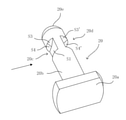
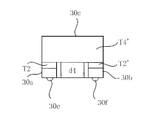
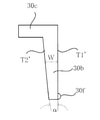
- FIG. 3a It is a perspective view which showed the structure of the segment used for assembling a rehabilitation tube. It is a perspective view which showed the connecting pin for connecting a segment in the circumferential direction. It is a front view of the connecting pin seen from the arrow direction of FIG. 2a. It is a top view of the connecting pin seen from the arrow direction of FIG. 2a. It is a perspective view which showed the clamp member used together with the connecting pin when connecting a segment in the circumferential direction. It is a bottom view of the clamp member seen from the arrow direction of FIG. 3a. It is a rear view of the clamp member seen from the arrow direction of FIG. 3a. It is a right side view of the clamp member seen from the arrow direction of FIG. 3a.
- the present invention is suitable for rehabilitating or repairing existing large diameter pipes such as sewers, water pipes, tunnels, or agricultural canals.
- the rehabilitated pipe is described as having a circular cross-sectional shape orthogonal to the pipe length direction, but it is needless to say that the present invention can be applied to a rehabilitated pipe having a shape other than a circular shape such as a rectangle. Further, the present invention can be applied even when the cross-sectional shape is not a closed shape as a pipe but a shape with one side open such as a horseshoe shape, a semicircular shape, or a concave shape.
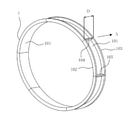
- the pipe length direction is the direction indicated by the arrow X extending in the pipe length direction of the pipe unit 10 in FIG. 8, and the circumferential direction is the circumferential direction of the circle of the pipe unit 10.
- FIG. 1 illustrates the structure of the rehabilitation tube segment 1 (hereinafter, simply referred to as a segment).
- the segment 1 includes an inner surface plate 101 constituting the inner peripheral surface of the rehabilitation pipe, side plates 102 and 103 having the same plate thickness vertically erected on both sides extending in the circumferential direction of the inner surface plate 101, and the pipe length of the inner surface plate 101. It is an integrally molded block-shaped member made of plastic composed of end plates 104 and 105 erected vertically at both ends extending in the direction.
- a plurality of inner plates 106, 107 having the same thickness as the side plates 102, 103 and having the same shape are arranged inside the side plates 102, 103. , 103 are erected at equal intervals in parallel.
- the segment 1 has a shape curved in an arc shape of 60 degrees which divides the circumference into a plurality of equal parts, for example, 6 equal parts, but the cross-sectional shape of the existing pipe, its size, or the repair of the existing pipe. Depending on the location, it can be a rectangular parallelepiped or a bent shape with a rounded shape at a right angle.
- a plurality of circular insertion holes 102a and 103a for passing the connecting bolt 11 and the nut 12 are formed at equal intervals in the circumferential direction. ..
- the inner plate 106 is also formed with a plurality of circular insertion holes 106a for passing the connecting bolts 11 at equal intervals, and the inner plate 107 is provided with a plurality of notches 107a at which the connecting bolts can be inserted and function as insertion holes. It is formed.
- the insertion holes 102a, 103a, 106a, and the notch 107a have the same positions in the circumferential direction.
- the inner plate 101, side plates 102, 103, end plates 104, 105, and inner plates 106, 107 are all made of the same transparent, translucent, or opaque plastic, and are integrally molded using a known molding technique. ..
- the end plates 104 and 105 are members arranged at both ends of the segment when viewed in the circumferential direction between the side plates 102 and the side plates 103, and the end plates 104 and 105 are provided with a connecting tool for connecting the segment 1 in the circumferential direction.
- a plurality of circular insertion holes 104a and 105a for passing are formed. As shown in FIGS. 4 and 7, the width (plate thickness) in the circumferential direction of the end plates 104 and 105 is w1, and the diameters of the insertion holes 104a and 105a are d1.
- FIGS. 2b and 2c are front views of the connecting pin 20 as seen from the arrow direction of FIG. 2a, respectively. It is a top view.
- the connecting pin 20 is made of plastic such as rigid vinyl chloride (PVC), and has a flat head portion 20a curved on both sides and a cylindrical portion 20b integrally molded with the flat head portion 20a.
- the end opposite to the head 20a is an inclined portion 20e.
- the diameter d2 of the cylindrical portion 20b is smaller than the diameter d1 of the insertion holes 104a and 105a of the end plates 104 and 105, and the cylindrical portion 20b can pass through the insertion holes 104a and 105a, but the head portion 20a is the insertion hole 104a.
- the size is such that it cannot pass through 105a.
- the cutout portion 20c has a vertical surface S1 parallel to the symmetrical surface and a rear surface S2 orthogonal to the vertical surface S1 on the head surface 20a side, and the surface facing the rear surface S2 is inclined toward the tip end side of the cylindrical portion.
- the surfaces are S3 and S4.
- the inclined surfaces S3 and S4 are plane-symmetrical with respect to a plane that passes through the central axis 20f of the cylindrical portion 20b and is orthogonal to the paper surface as seen in FIG. 2b, and comes into surface contact with the inclined surfaces of both legs of the clamp member described later. It is inclined toward the tip of the cylinder at an angle of ⁇ with respect to the orthogonal plane S5 orthogonal to the plane of symmetry.
- the notch portion 20d is plane-symmetrical with the notch portion 20c
- the vertical surface S1'and the rear surface S2' are plane-symmetrical with the vertical surface S1, the rear surface S2, the inclined surface S3, and S4 of the notch portion 20c, respectively.
- the vertical surfaces S1 and S1'of the notches 20c and 20d are parallel, and the distance d3 between the vertical surfaces S1 and S1'is such that the legs of the clamp member described later can be inserted into the notches 20c and 20d. ing.
- the distance t1 between the rear surfaces S2 and S2'of the notches 20c and 20d and the head portion 20a is the end of the segment so that the back surface of the clamp member described later can contact the end plate of the segment. It is shorter than twice the plate thickness w1 of the plate.
- the width t2 at the uppermost portions of the notches 20c and 20d is such that the tip of the leg portion of the clamp member can be inserted into the notches 20c and 20d.
- the vertical surfaces S1 and S1'of the notch portions 20c and 20d are parallel to the side plate 102 and the inner plate 106.
- the width h1 and the height h2 are different, and in the embodiment, h1> h2.
- FIG. 3a is a perspective view showing the clamp member 30 for tightening the end plate of the segment
- FIGS. 3b, 3c, and 3d are a bottom view, a rear view, and a right side of the clamp member 30 as seen from the arrow direction of FIG. 3a, respectively. It is a top view.
- the clamp member 30 has two legs 30a and 30b having the same shape and a pressing portion 30c on the upper portion, and is integrally formed of the same plastic as the connecting pin 20.
- One of the legs 30a and 30b forms the back surfaces T1 and T1', respectively, and the other surface becomes the inclined surfaces T2 and T2'inclined at the same inclination angle ⁇ as the inclined surfaces S3 and S3'of the notch 20c. ing.
- the facing surfaces of the legs 30a and 30b of the clamp member 30 are parallel vertical surfaces T3 and T3', and the distance d4 between the vertical surfaces T3 and T3'of the legs is the notch 20c and 20d.
- the distance W between the vertical surfaces S1 and S1' is the same as or slightly larger than the distance d3, and the distance W between the back surfaces T1 and T1'of the legs 30a and 30b and the inclined surfaces T2 and T2'is the inclination angle of the legs 30a and 30b.
- the lower portion is shorter than the upper portion according to ⁇ , and the tips of the legs 30a and 30b are large enough to be inserted into the notches 20c and 20d.
- the upper portions of the legs 30a and 30b are curved portions 30d according to the shape of the cylindrical portion 20b of the connecting pin 20.
- the pressing portion 30c of the clamp member 30 can press the clamp member 30 into the connecting pin 20 by hitting the upper surface T4 by hand or with a hammer. Further, a gap S (FIG. 7) is formed between the lower surface T4'of the pressing portion 30c and the cylindrical portion 20b of the connecting pin 20, and a clamp is applied by applying a force to the lower surface of the pressing portion 30c through the gap S. The member 30 can be removed from the connecting pin 20.
- Small protrusions 30e and 30f are integrally formed with the legs 30a and 30b in the lower portions of the legs 30a and 30b.
- the protrusions 30e and 30f are strongly pressed against the end plate of the segment to prevent the clamp member 30 from coming off the connecting pin 20 due to friction with the end plate.
- the protrusions 30e and 30f are hemispherical, but other shapes such as a rectangular shape can be used.
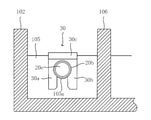
- the segment is carried into the manhole 40 (FIG. 10), and as shown in FIG. 4, the end plate 104 of one segment 1a and the end plate 105 of the other segment 1b connected in the circumferential direction to the segment 1a are hit. They are brought into contact with each other and aligned so that the insertion holes 104a and 105a for connection formed in the end plates 104 and 105 of the segments 1a and 1b are aligned.
- the connecting pin 20 is inserted into the insertion holes 104a and 105a of the segments 1a and 1b so that the symmetrical planes of the notches 20c and 20d are parallel to the side plates 102 and the inner plate 106 of the segment.
- the head portion 20a of the connecting pin 20 abuts on the end plate 104 of the segment 1a, and the inclined surfaces S3 and S3'of the notches 20c and 20d are the other segments. This is done until it protrudes from the end plate 105 of 1b.
- the clamp member 30 is provided so that the inclined surfaces T2 and T2'of the legs 30a and 30b face the inclined surfaces S3 and S3'of the notches 20c and 20d. Deploy. Subsequently, as shown in the lower part of FIG. 7, the inclined surfaces T2 and T2'of the legs 30a and 30b of the clamp member 30 and the inclined surfaces S3 and S3'of the notched portions 20c and 20d are in surface contact with each other. Is inserted into the notches 20c and 20d.
- each leg of the clamp member 30 is in a state where the inclined surfaces T2 and T2'of the legs 30a and 30b and the inclined surfaces S3 and S3' of the notches 20c and 20d are in surface contact with each other.
- the clamp member 30 moves in the direction of the segment end plate according to the inclination angle of the inclined surface of the leg portions 30a and 30b, so that the tightening force according to the pressure input is obtained.
- the end plates 104 and 105 of both segments 1a and 1b can be tightened with.
- the legs 30a and 30b of the clamp member 30 have inclined surfaces T2 and T2'on one side thereof and have a wedge shape that narrows downward. Therefore, the legs 30a and 30b are used. Press-fitting into the notches 20c and 20d has the same effect as driving a wedge into the gap between the notch and the end plate of the segment, and can strengthen the connection of the end plates of the segment. Further, since the inclined surfaces S3 and S3'of the notches 20c and 20d and the inclined surfaces T2 and T2'of the legs 30a and 30b come into contact with each other at the same inclination angle and the contact area becomes large, a wide range is applied to the end plate of the segment. Tightening force can be generated.
- Protrusions 30e and 30f are provided in the lower portions of the legs 30a and 30b, and the protrusions 30e and 30f are strongly pressed against the end plate 105 of the segment 1b when the clamp member 30 is press-fitted into the connecting pin 20. It is possible to prevent the clamp member 30 from coming off the connecting pin 20 due to friction with the end plate 105.
- the inclined surfaces S3 and S4 (S3', S4') of the cutout portions 20c and 20d pass through the central axis f of the connecting pin 20 and are orthogonal to the press-fitting direction (central axis 20f as seen in FIG. 2b). It is plane-symmetrical with respect to a plane that passes through and is orthogonal to the paper surface. Therefore, when the connecting pin 20 is turned upside down and the clamp member 30 is press-fitted into the connecting pin 20, the inclined surfaces T2 and T2'of the legs 30a and 30b and the inclined surfaces S4 of the notches 20c and 20d are formed.
- S4' have the same inclination angle and come into surface contact with each other, so that the same effect as when the connecting pin 20 is not turned upside down can be obtained, and the degree of freedom of the insertion posture of the connecting pin 20 into the end plate is increased. be able to.
- the segments are connected in the circumferential direction by connecting the two end plates 104 and 105 between the side plate 102 (103) and the inner plate 106 adjacent to the side plate 102 (103).
- the end plates 104 and 105 between the inner plate 106 and the inner plate 107 or between the inner plates 107 may also be connected.
- such pipe units 10 are sequentially connected in the pipe length direction.
- a plurality of metal nuts 12 are fixed to the inner plates 106 of the segments of the pipe units 10a, 10b, and 10c by using connecting bolts 13.
- the length of the nut 12 in the pipe length direction is longer than the distance between the side plate 102 and the inner plate 106, and is equal to or greater than the thickness of the other side plate 103 of the segment protruding from the side plate 102.
- the connecting bolt 11 is a columnar elongated bolt in which a screw portion 11a screwed with a nut 12 is formed at one end and a head 14 having a brim 14a at the other end is fixed.
- FIG. 9 shows a state in which the segments of the pipe units 10b and 10c are connected in the pipe length direction, and the segments of the pipe unit 10a are connected to the segments of the pipe unit 10b.
- the nut 12 protruding from the side plate 102 of the segment of the pipe unit 10b is passed through the insertion hole 103a of the side plate 103 of the segment of the pipe unit 10a, and both pipes are connected.
- the side plates 103 and 102 of the segments of the units 10a and 10b are butted against each other.
- the connecting bolt 11 is passed through the insertion hole 102a of the side plate 102, the insertion hole 106a of the inner plate 106, and the notch 107a of the inner plate 107, and the screw portion 11a is screwed into the nut 12 fixed to the segment 1b.
- the connecting bolt 11 and the nut 12 are connected.
- the connecting bolt 11 is screwed into the nut 12 until the brim 14a of the head portion 14 is in pressure contact with the inner plate 106 at the leftmost end of the segment 1a, and the segments of the pipe units 10a and 1b are bolted and connected in the pipe length direction.
- the pipe unit can be connected to any length in the pipe length direction.
- a filler such as a grout material is used in the gap between the rehabilitation pipe 42 and the existing pipe 41. Fill (shown) to solidify the filler.
- solidifying the filler it is possible to construct a composite pipe composed of an existing pipe, a filler and a rehabilitation pipe.
Landscapes
- Engineering & Computer Science (AREA)
- General Engineering & Computer Science (AREA)
- Mechanical Engineering (AREA)
- Health & Medical Sciences (AREA)
- Life Sciences & Earth Sciences (AREA)
- Hydrology & Water Resources (AREA)
- Public Health (AREA)
- Water Supply & Treatment (AREA)
- Lining And Supports For Tunnels (AREA)
- Pipe Accessories (AREA)
- Conveying And Assembling Of Building Elements In Situ (AREA)
- Lining Or Joining Of Plastics Or The Like (AREA)
Priority Applications (6)
| Application Number | Priority Date | Filing Date | Title |
|---|---|---|---|
| KR1020227040147A KR20230002809A (ko) | 2020-07-27 | 2021-05-21 | 관 갱생 공법 |
| CN202180041910.2A CN115698571A (zh) | 2020-07-27 | 2021-05-21 | 管修复施工方法 |
| AU2021315123A AU2021315123A1 (en) | 2020-07-27 | 2021-05-21 | Pipe rehabilitation construction method |
| EP21849534.9A EP4137730A4 (en) | 2020-07-27 | 2021-05-21 | METHOD FOR REHABILITATION CONSTRUCTION OF PIPES |
| JP2022540032A JPWO2022024519A1 (https=) | 2020-07-27 | 2021-05-21 | |
| US18/009,769 US20240035608A1 (en) | 2020-07-27 | 2021-05-21 | Pipe rehabilitation construction method |
Applications Claiming Priority (2)
| Application Number | Priority Date | Filing Date | Title |
|---|---|---|---|
| JP2020-126405 | 2020-07-27 | ||
| JP2020126405 | 2020-07-27 |
Publications (1)
| Publication Number | Publication Date |
|---|---|
| WO2022024519A1 true WO2022024519A1 (ja) | 2022-02-03 |
Family
ID=80037965
Family Applications (1)
| Application Number | Title | Priority Date | Filing Date |
|---|---|---|---|
| PCT/JP2021/019440 Ceased WO2022024519A1 (ja) | 2020-07-27 | 2021-05-21 | 管更生工法 |
Country Status (8)
| Country | Link |
|---|---|
| US (1) | US20240035608A1 (https=) |
| EP (1) | EP4137730A4 (https=) |
| JP (1) | JPWO2022024519A1 (https=) |
| KR (1) | KR20230002809A (https=) |
| CN (1) | CN115698571A (https=) |
| AU (1) | AU2021315123A1 (https=) |
| TW (1) | TW202217179A (https=) |
| WO (1) | WO2022024519A1 (https=) |
Citations (6)
| Publication number | Priority date | Publication date | Assignee | Title |
|---|---|---|---|---|
| JPH0198300U (https=) * | 1987-12-16 | 1989-06-30 | ||
| JPH0893392A (ja) * | 1994-09-27 | 1996-04-09 | Dainippon Doboku Kk | セグメント継手 |
| JP2001073694A (ja) * | 1999-09-08 | 2001-03-21 | Housing Tamura:Kk | セグメントの継手構造 |
| JP2005264635A (ja) * | 2004-03-22 | 2005-09-29 | Shonan Plastic Mfg Co Ltd | 更生管用セグメント部材 |
| JP2011012803A (ja) | 2009-06-03 | 2011-01-20 | Shonan Plastic Mfg Co Ltd | 既設管の更生工法 |
| JP2016176571A (ja) | 2015-03-20 | 2016-10-06 | 株式会社湘南合成樹脂製作所 | 更生管の位置調整用スペーサ及びこれを用いた位置調整方法 |
Family Cites Families (20)
| Publication number | Priority date | Publication date | Assignee | Title |
|---|---|---|---|---|
| US352398A (en) * | 1886-11-09 | Geoeges couloe | ||
| US1185402A (en) * | 1916-02-11 | 1916-05-30 | Frank H Hopkins | Collar-lock. |
| US1446080A (en) * | 1922-03-24 | 1923-02-20 | Zilliox John | Method of making key bolts |
| US1519308A (en) * | 1924-02-23 | 1924-12-16 | Andrew W Hood | Bolt |
| US1776007A (en) * | 1927-08-20 | 1930-09-16 | Keybolt Appliance Co | Key bolt |
| US1843925A (en) * | 1927-11-18 | 1932-02-09 | Karl F W Kempf | Key-bolt |
| US1815098A (en) * | 1931-01-03 | 1931-07-21 | Albert C Earhart | Bolt substitute |
| US2094779A (en) * | 1936-02-28 | 1937-10-05 | Vernon H Donaldson | Clamping device |
| US2257962A (en) * | 1940-06-21 | 1941-10-07 | Merle E Kemper | Bolt and wedge assembly |
| US2560525A (en) * | 1946-09-28 | 1951-07-10 | Falk Corp | Anchor stud |
| US4240322A (en) * | 1977-12-31 | 1980-12-23 | Lothar Teske | Wedge-pin fastener |
| DE3502959C2 (de) * | 1985-01-30 | 1994-09-15 | Boegle Kg Wilhelm | Keil zur Anwendung an Lattenunterkonstruktionen von Wandungsverkleidungen |
| GB2170544A (en) * | 1985-02-05 | 1986-08-06 | Ega Ltd | Clip fastenings for troughing |
| GB2188968B (en) * | 1986-04-01 | 1990-04-18 | Hanley Precision Tools | Spacing plates |
| DE202004002953U1 (de) * | 2004-02-26 | 2004-04-29 | Winkler, Wilhelm | Verbindungseinheit |
| JP2005299711A (ja) * | 2004-04-07 | 2005-10-27 | Shonan Plastic Mfg Co Ltd | 更生管及びその敷設方法 |
| JP2005308010A (ja) * | 2004-04-19 | 2005-11-04 | Shonan Plastic Mfg Co Ltd | 更生管用セグメント部材 |
| GB2417720A (en) * | 2004-09-07 | 2006-03-08 | David Hoy | Chock or cradle apparatus for supporting goods |
| CN102848120B (zh) * | 2012-09-17 | 2015-07-15 | 宜宾普什联动科技有限公司 | 一种免刮内裆的辅助工装及内裆加工方法 |
| JP6017254B2 (ja) * | 2012-10-10 | 2016-10-26 | 株式会社湘南合成樹脂製作所 | 更生管用セグメントおよび管更生工法 |
-
2021
- 2021-05-21 JP JP2022540032A patent/JPWO2022024519A1/ja active Pending
- 2021-05-21 EP EP21849534.9A patent/EP4137730A4/en not_active Withdrawn
- 2021-05-21 US US18/009,769 patent/US20240035608A1/en not_active Abandoned
- 2021-05-21 AU AU2021315123A patent/AU2021315123A1/en not_active Abandoned
- 2021-05-21 KR KR1020227040147A patent/KR20230002809A/ko not_active Ceased
- 2021-05-21 WO PCT/JP2021/019440 patent/WO2022024519A1/ja not_active Ceased
- 2021-05-21 CN CN202180041910.2A patent/CN115698571A/zh not_active Withdrawn
- 2021-05-27 TW TW110119250A patent/TW202217179A/zh unknown
Patent Citations (6)
| Publication number | Priority date | Publication date | Assignee | Title |
|---|---|---|---|---|
| JPH0198300U (https=) * | 1987-12-16 | 1989-06-30 | ||
| JPH0893392A (ja) * | 1994-09-27 | 1996-04-09 | Dainippon Doboku Kk | セグメント継手 |
| JP2001073694A (ja) * | 1999-09-08 | 2001-03-21 | Housing Tamura:Kk | セグメントの継手構造 |
| JP2005264635A (ja) * | 2004-03-22 | 2005-09-29 | Shonan Plastic Mfg Co Ltd | 更生管用セグメント部材 |
| JP2011012803A (ja) | 2009-06-03 | 2011-01-20 | Shonan Plastic Mfg Co Ltd | 既設管の更生工法 |
| JP2016176571A (ja) | 2015-03-20 | 2016-10-06 | 株式会社湘南合成樹脂製作所 | 更生管の位置調整用スペーサ及びこれを用いた位置調整方法 |
Non-Patent Citations (1)
| Title |
|---|
| See also references of EP4137730A4 |
Also Published As
| Publication number | Publication date |
|---|---|
| TW202217179A (zh) | 2022-05-01 |
| JPWO2022024519A1 (https=) | 2022-02-03 |
| US20240035608A1 (en) | 2024-02-01 |
| EP4137730A1 (en) | 2023-02-22 |
| CN115698571A (zh) | 2023-02-03 |
| EP4137730A4 (en) | 2023-10-25 |
| KR20230002809A (ko) | 2023-01-05 |
| AU2021315123A1 (en) | 2023-01-19 |
Similar Documents
| Publication | Publication Date | Title |
|---|---|---|
| JP5457130B2 (ja) | 既設管の更生工法 | |
| JP5463077B2 (ja) | 更生管用セグメント | |
| JP6755545B2 (ja) | 管更生工法 | |
| JP5235123B2 (ja) | セグメントの連結方法及び連結具 | |
| KR20060046606A (ko) | 갱생관 및 갱생관 부설방법 | |
| JP6555957B2 (ja) | 管更生工法 | |
| JP2021025659A (ja) | 管更生工法 | |
| JP2019027594A (ja) | 管更生工法 | |
| WO2022024519A1 (ja) | 管更生工法 | |
| JP6144072B2 (ja) | 管更生工法 | |
| JP6418923B2 (ja) | 管更生工法 | |
| WO2006046477A1 (ja) | 更生管及び該更生管を用いた管路施設修復工法 | |
| US11319975B2 (en) | Pipe connection tool and pipe connection method | |
| JP2018109433A (ja) | 管更生工法 | |
| JPWO2016088168A1 (ja) | 既設管の更生工法 | |
| JP7808342B2 (ja) | 管更生工法 | |
| JP5667673B2 (ja) | 既設管の更生工法 | |
| WO2022107457A1 (ja) | 管更生工法 | |
| JP7577318B2 (ja) | 更生管の位置調整用スペーサー及びこれを用いた位置調整方法 | |
| JP3637396B2 (ja) | 管体の接続構造及び接続方法 |
Legal Events
| Date | Code | Title | Description |
|---|---|---|---|
| 121 | Ep: the epo has been informed by wipo that ep was designated in this application |
Ref document number: 21849534 Country of ref document: EP Kind code of ref document: A1 |
|
| ENP | Entry into the national phase |
Ref document number: 2022540032 Country of ref document: JP Kind code of ref document: A |
|
| ENP | Entry into the national phase |
Ref document number: 20227040147 Country of ref document: KR Kind code of ref document: A |
|
| ENP | Entry into the national phase |
Ref document number: 2021849534 Country of ref document: EP Effective date: 20221118 |
|
| WWE | Wipo information: entry into national phase |
Ref document number: 18009769 Country of ref document: US |
|
| ENP | Entry into the national phase |
Ref document number: 2021315123 Country of ref document: AU Date of ref document: 20210521 Kind code of ref document: A |
|
| NENP | Non-entry into the national phase |
Ref country code: DE |
|
| WWR | Wipo information: refused in national office |
Ref document number: 1020227040147 Country of ref document: KR |