WO2022014340A1 - 液晶組成物、フッ素含有重合体、光学異方性層、積層体および画像表示装置 - Google Patents
液晶組成物、フッ素含有重合体、光学異方性層、積層体および画像表示装置 Download PDFInfo
- Publication number
- WO2022014340A1 WO2022014340A1 PCT/JP2021/024924 JP2021024924W WO2022014340A1 WO 2022014340 A1 WO2022014340 A1 WO 2022014340A1 JP 2021024924 W JP2021024924 W JP 2021024924W WO 2022014340 A1 WO2022014340 A1 WO 2022014340A1
- Authority
- WO
- WIPO (PCT)
- Prior art keywords
- group
- liquid crystal
- repeating unit
- carbon atoms
- atom
- Prior art date
- Legal status (The legal status is an assumption and is not a legal conclusion. Google has not performed a legal analysis and makes no representation as to the accuracy of the status listed.)
- Ceased
Links
Images










Classifications
-
- C—CHEMISTRY; METALLURGY
- C09—DYES; PAINTS; POLISHES; NATURAL RESINS; ADHESIVES; COMPOSITIONS NOT OTHERWISE PROVIDED FOR; APPLICATIONS OF MATERIALS NOT OTHERWISE PROVIDED FOR
- C09K—MATERIALS FOR MISCELLANEOUS APPLICATIONS, NOT PROVIDED FOR ELSEWHERE
- C09K19/00—Liquid crystal materials
- C09K19/52—Liquid crystal materials characterised by components which are not liquid crystals, e.g. additives with special physical aspect: solvents, solid particles
- C09K19/54—Additives having no specific mesophase characterised by their chemical composition
- C09K19/542—Macromolecular compounds
-
- C—CHEMISTRY; METALLURGY
- C08—ORGANIC MACROMOLECULAR COMPOUNDS; THEIR PREPARATION OR CHEMICAL WORKING-UP; COMPOSITIONS BASED THEREON
- C08F—MACROMOLECULAR COMPOUNDS OBTAINED BY REACTIONS ONLY INVOLVING CARBON-TO-CARBON UNSATURATED BONDS
- C08F222/00—Copolymers of compounds having one or more unsaturated aliphatic radicals, each having only one carbon-to-carbon double bond, and at least one being terminated by a carboxyl radical and containing at least one other carboxyl radical in the molecule; Salts, anhydrides, esters, amides, imides, or nitriles thereof
- C08F222/36—Amides or imides
- C08F222/38—Amides
-
- C—CHEMISTRY; METALLURGY
- C08—ORGANIC MACROMOLECULAR COMPOUNDS; THEIR PREPARATION OR CHEMICAL WORKING-UP; COMPOSITIONS BASED THEREON
- C08F—MACROMOLECULAR COMPOUNDS OBTAINED BY REACTIONS ONLY INVOLVING CARBON-TO-CARBON UNSATURATED BONDS
- C08F222/00—Copolymers of compounds having one or more unsaturated aliphatic radicals, each having only one carbon-to-carbon double bond, and at least one being terminated by a carboxyl radical and containing at least one other carboxyl radical in the molecule; Salts, anhydrides, esters, amides, imides, or nitriles thereof
- C08F222/10—Esters
- C08F222/12—Esters of phenols or saturated alcohols
- C08F222/20—Esters containing oxygen in addition to the carboxy oxygen
-
- C—CHEMISTRY; METALLURGY
- C09—DYES; PAINTS; POLISHES; NATURAL RESINS; ADHESIVES; COMPOSITIONS NOT OTHERWISE PROVIDED FOR; APPLICATIONS OF MATERIALS NOT OTHERWISE PROVIDED FOR
- C09K—MATERIALS FOR MISCELLANEOUS APPLICATIONS, NOT PROVIDED FOR ELSEWHERE
- C09K19/00—Liquid crystal materials
- C09K19/04—Liquid crystal materials characterised by the chemical structure of the liquid crystal components, e.g. by a specific unit
- C09K19/38—Polymers
- C09K19/3833—Polymers with mesogenic groups in the side chain
- C09K19/3838—Polyesters; Polyester derivatives
-
- C—CHEMISTRY; METALLURGY
- C09—DYES; PAINTS; POLISHES; NATURAL RESINS; ADHESIVES; COMPOSITIONS NOT OTHERWISE PROVIDED FOR; APPLICATIONS OF MATERIALS NOT OTHERWISE PROVIDED FOR
- C09K—MATERIALS FOR MISCELLANEOUS APPLICATIONS, NOT PROVIDED FOR ELSEWHERE
- C09K19/00—Liquid crystal materials
- C09K19/04—Liquid crystal materials characterised by the chemical structure of the liquid crystal components, e.g. by a specific unit
- C09K19/38—Polymers
- C09K19/3833—Polymers with mesogenic groups in the side chain
- C09K19/3842—Polyvinyl derivatives
- C09K19/3852—Poly(meth)acrylate derivatives
-
- C—CHEMISTRY; METALLURGY
- C09—DYES; PAINTS; POLISHES; NATURAL RESINS; ADHESIVES; COMPOSITIONS NOT OTHERWISE PROVIDED FOR; APPLICATIONS OF MATERIALS NOT OTHERWISE PROVIDED FOR
- C09K—MATERIALS FOR MISCELLANEOUS APPLICATIONS, NOT PROVIDED FOR ELSEWHERE
- C09K19/00—Liquid crystal materials
- C09K19/52—Liquid crystal materials characterised by components which are not liquid crystals, e.g. additives with special physical aspect: solvents, solid particles
- C09K19/60—Pleochroic dyes
- C09K19/601—Azoic
-
- G—PHYSICS
- G02—OPTICS
- G02B—OPTICAL ELEMENTS, SYSTEMS OR APPARATUS
- G02B5/00—Optical elements other than lenses
- G02B5/30—Polarising elements
- G02B5/3016—Polarising elements involving passive liquid crystal elements
-
- G—PHYSICS
- G02—OPTICS
- G02B—OPTICAL ELEMENTS, SYSTEMS OR APPARATUS
- G02B5/00—Optical elements other than lenses
- G02B5/30—Polarising elements
- G02B5/3083—Birefringent or phase retarding elements
-
- G—PHYSICS
- G02—OPTICS
- G02F—OPTICAL DEVICES OR ARRANGEMENTS FOR THE CONTROL OF LIGHT BY MODIFICATION OF THE OPTICAL PROPERTIES OF THE MEDIA OF THE ELEMENTS INVOLVED THEREIN; NON-LINEAR OPTICS; FREQUENCY-CHANGING OF LIGHT; OPTICAL LOGIC ELEMENTS; OPTICAL ANALOGUE/DIGITAL CONVERTERS
- G02F1/00—Devices or arrangements for the control of the intensity, colour, phase, polarisation or direction of light arriving from an independent light source, e.g. switching, gating or modulating; Non-linear optics
- G02F1/01—Devices or arrangements for the control of the intensity, colour, phase, polarisation or direction of light arriving from an independent light source, e.g. switching, gating or modulating; Non-linear optics for the control of the intensity, phase, polarisation or colour
- G02F1/13—Devices or arrangements for the control of the intensity, colour, phase, polarisation or direction of light arriving from an independent light source, e.g. switching, gating or modulating; Non-linear optics for the control of the intensity, phase, polarisation or colour based on liquid crystals, e.g. single liquid crystal display cells
- G02F1/133—Constructional arrangements; Operation of liquid crystal cells; Circuit arrangements
- G02F1/1333—Constructional arrangements; Manufacturing methods
- G02F1/1335—Structural association of cells with optical devices, e.g. polarisers or reflectors
Definitions
- the present invention relates to a liquid crystal composition, a fluorine-containing polymer, an optically anisotropic layer, a laminate, and an image display device.
- Optical films such as optical compensation sheets and retardation films are used in various image display devices from the viewpoints of eliminating image coloring and expanding the viewing angle.
- a stretched birefringence film has been used as the optical film, but in recent years, it has been proposed to use an optically anisotropic layer (liquid crystal layer) using a liquid crystal compound instead of the stretched birefringence film.
- the optical film is generally required to have a uniform thickness in the plane.
- a liquid crystal composition containing a surfactant may be used, and as the surfactant, those containing a fluorine atom are often used.
- Patent Document 1 describes an optical film provided with a layer (optically anisotropic layer) of a cured product obtained by curing a liquid crystal composition containing a polymerizable liquid crystal compound and a surfactant containing a fluorine atom. (Claim 1).
- the present inventors examined the liquid crystal composition and the optically anisotropic layer described in Patent Document 1 and the like, and found that depending on the structure of the interface improver contained in the liquid crystal composition, the optically anisotropic layer was formed. It was clarified that cissing was generated in the liquid crystal composition and that the degree of orientation of the formed optically anisotropic layer was inferior.
- the present invention presents a liquid crystal composition, a fluorine-containing polymer, an optically anisotropic layer, and a laminate capable of forming an optically anisotropic layer having an excellent degree of orientation while suppressing repelling during formation of the optically anisotropic layer.
- An object of the present invention is to provide a body and an image display device.
- the present inventors have added a predetermined interface improver to the liquid crystal composition forming the optically anisotropic layer, whereby repellents are generated when the optically anisotropic layer is formed.
- the present invention has been completed by finding that an optically anisotropic layer that is suppressed and has an excellent degree of orientation can be formed. That is, it was found that the above problem can be achieved by the following configuration.
- a liquid crystal composition containing a liquid crystal compound and an interface improver A liquid crystal composition in which the interface improving agent is a fluorine-containing polymer having a repeating structure B1 represented by the formula (B-1) described later and a repeating structure B2 having a fluorine atom.
- the interface improving agent is a fluorine-containing polymer having a repeating structure B1 represented by the formula (B-1) described later and a repeating structure B2 having a fluorine atom.
- L 3 represents a single bond
- D represents —COOH, —NHCOR 2 , or —CONHR 3.
- R 2 and R 3 each independently represent a linear or branched alkyl group or alkenyl group having 1 to 10 carbon atoms.
- the repeating unit B2 is changed to [1] or [2], which is a repeating unit represented by the formula (F-1) described later or a repeating unit represented by the formula (F-2) described later.
- the fluorine-containing polymer further contains a repeating structure B3 derived from a monomer having a molecular weight of 300 or less.
- a liquid crystal composition a fluorine-containing polymer, an optically anisotropic layer, and a laminate capable of suppressing repelling during formation of an optically anisotropic layer and forming an optically anisotropic layer having an excellent degree of orientation.
- Body and image display devices can be provided.
- FIG. 1A is a diagram showing an example of a block structure that the interface improver (hereinafter, also abbreviated as “specific interface improver”) contained in the liquid crystal composition of the present invention can have.
- FIG. 1B is a diagram showing an example of a block structure that a specific interface improver may have.
- FIG. 1C is a diagram showing an example of a block structure that a specific interface improver may have.
- FIG. 1D is a diagram showing an example of a block structure that a specific interface improver may have.
- FIG. 1E is a diagram showing an example of a block structure that a specific interface improver may have.
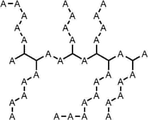
- FIG. 2A is a diagram showing an example of a graft structure that a specific interface improver may have.
- FIG. 2B is a diagram showing an example of a graft structure that a specific interface improver may have.
- FIG. 2C is a diagram showing an example of a graft structure that a specific interface improver may have.
- FIG. 2D is a diagram showing an example of a graft structure that a specific interface improver may have.
- FIG. 2E is a diagram showing an example of a graft structure that a specific interface improver may have.
- FIG. 2F is a diagram showing an example of a graft structure that a specific interface improver may have.
- FIG. 2G is a diagram showing an example of a graft structure that a specific interface improver may have.
- FIG. 3 is a diagram illustrating a method for synthesizing a specific interface improving agent when having a graft structure.
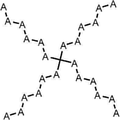
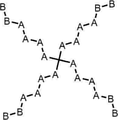
- FIG. 4A is a diagram showing an example of a star structure that a specific interface improver may have.
- FIG. 4B is a diagram showing an example of a star structure that a specific interface improver may have.
- FIG. 4C is a diagram showing an example of a star structure that a specific interface improver may have.
- FIG. 4D is a diagram showing an example of a star structure that a specific interface improver may have.
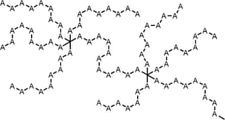
- FIG. 5A is a diagram showing an example of a branch structure that a specific interface improver may have.
- FIG. 5B is a diagram showing an example of a branch structure that a specific interface improver may have.
- FIG. 5A is a diagram showing an example of a branch structure that a specific interface improver may have.
- FIG. 5B is a diagram showing an example of a branch structure that a specific interface improver may
- FIG. 5C is a diagram showing an example of a branch structure that a specific interface improver may have.
- FIG. 5D is a diagram showing an example of a branch structure that a specific interface improver may have.
- FIG. 5E is a diagram showing an example of a branch structure that a specific interface improver may have.
- FIG. 5F is a diagram showing an example of a branch structure that a specific interface improver may have.
- the numerical range represented by using "-" means a range including the numerical values before and after "-" as the lower limit value and the upper limit value.
- parallel, orthogonal, horizontal, and vertical do not mean parallel, orthogonal, horizontal, and vertical in the strict sense, respectively, but in the range of parallel ⁇ 10 °, respectively. It means the range of orthogonal ⁇ 10 °, horizontal ⁇ 10 °, and vertical ⁇ 10 °.
- each component a substance corresponding to each component may be used alone or in combination of two or more.
- the content of the component means the total content of the substances used in combination unless otherwise specified.
- “(meth) acrylate” is a notation representing "acrylate” or “methacrylate”
- (meth) acrylic” is a notation representing "acrylic” or “methacrylic”.
- (Meta) acrylic” is a notation representing "acryloyl” or "methacrylic acid”.
- the substituent W used in the present specification represents the following group.
- the substituent W include a halogen atom, an alkyl group having 1 to 20 carbon atoms, an alkyl halide group having 1 to 20 carbon atoms, a cycloalkyl group having 1 to 20 carbon atoms, and an alkylcarbonyl group having 1 to 10 carbon atoms.
- LW represents a single bond or a divalent linking group
- SPW represents a divalent spacer group
- Q represents Q1 or Q2 in the formula (LC) described later
- * represents a binding position. ..
- the divalent linking groups represented by LW are -O-,-(CH 2 ) g -,-(CF 2 ) g- , -Si (CH 3 ) 2 -,-(Si (CH 3 ) 2 O).
- the LW may be a group in which two or more of these groups are combined (hereinafter, also abbreviated as "LC").
- Examples of the divalent spacer group represented by SPW include a linear, branched or cyclic alkylene group having 1 to 50 carbon atoms, or a heterocyclic group having 1 to 20 carbon atoms.
- the hydrogen atom of the alkylene group and the hydrogen atom of the heterocyclic group are halogen atom, cyano group, -Z H , -OH, -OZ H , -COOH, -C (O) Z H , -C (O).
- Z H, Z H '.2 divalent linking group represents an alkyl group, a halogenated alkyl group, -L-CL (L is a single bond or a divalent linking group having 1 to 10 carbon atoms Is the same as LW and SPW described above.
- CL represents a crosslinkable group, and examples thereof include a group represented by Q1 or Q2 in the formula (LC) described later, which are represented by the formulas (P1) to (P30) described later.
- the crosslinkable group represented is preferable.).
- the liquid crystal composition of the present invention is a liquid crystal composition containing a liquid crystal compound and a specific interface improving agent.
- the specific interface improving agent contained in the liquid crystal composition of the present invention is a fluorine-containing polymer having a repeating structure B1 represented by the formula (B-1) described later and a repeating structure B2 having a fluorine atom. ..
- the specific interface improving agent in the liquid crystal composition forming the optically anisotropic layer, repelling is suppressed when the optically anisotropic layer is formed, and the degree of orientation is excellent.
- An optically anisotropic layer can be formed.
- the specific interface improver has a predetermined spacer (Sp in the formula (B-1) described later) and a linking group having a predetermined ring structure (A in the formula (B-1) described later). It is considered that the viscosity of the liquid crystal composition was improved and the repelling was suppressed.
- the specific interface improver has a predetermined hydrogen-bonding group (D in the formula (B-1) described later), a multimer by hydrogen bonding is formed and the liquid crystal is oriented. It is considered that the degree of orientation of the formed optically anisotropic layer is improved because the air interface layer has an appropriate high flatness.
- Liquid crystal compounds can generally be classified into rod-shaped type and disk-shaped type according to their shape. Further, the liquid crystal compound is preferably a liquid crystal compound that does not exhibit dichroism in the visible region. In the following description, "the degree of orientation of the formed optically anisotropic layer is higher" is also referred to as "the effect of the present invention is more excellent".
- the liquid crystal compound either a low molecular weight liquid crystal compound or a high molecular weight liquid crystal compound can be used.
- the "small molecule liquid crystal compound” means a liquid crystal compound having no repeating unit in the chemical structure.
- the "polymer liquid crystal compound” means a liquid crystal compound having a repeating unit in the chemical structure.
- the small molecule liquid crystal compound include the liquid crystal compound described in Japanese Patent Application Laid-Open No. 2013-228706.
- the polymer liquid crystal compound include thermotropic liquid crystal polymers described in JP-A-2011-237513.
- the polymer liquid crystal compound may have a crosslinkable group (for example, an acryloyl group and a methacryloyl group) at the terminal.
- the liquid crystal compound is preferably a rod-shaped liquid crystal compound, and more preferably a polymer liquid crystal compound, because the effect of the present invention is likely to be manifested.
- the liquid crystal compound may be used alone or in combination of two or more.
- the liquid crystal compound preferably contains a high-molecular-weight liquid crystal compound, and particularly preferably contains both a high-molecular-weight liquid crystal compound and a low-molecular-weight liquid crystal compound, from the viewpoint that the effect of the present invention is more excellent.
- the liquid crystal compound preferably contains a liquid crystal compound represented by the formula (LC) or a polymer thereof.
- the liquid crystalline compound represented by the formula (LC) or a polymer thereof is a compound exhibiting liquid crystallinity.
- the liquid crystallinity may be a nematic phase or a smectic phase, and may exhibit both a nematic phase and a smectic phase, preferably at least a nematic phase.
- the smectic phase may be a higher-order smectic phase.
- the high-order smectic phase referred to here is smectic B phase, smectic D phase, smectic E phase, smectic F phase, smectic G phase, smectic H phase, smectic I phase, smectic J phase, smectic K phase, smectic L phase, Of these, smectic B phase, smectic F phase, and smectic I phase are preferable.
- the smectic liquid crystal phase exhibited by the liquid crystal compound is these higher-order smectic liquid crystal phases, an optically anisotropic layer having a higher degree of orientation order can be produced.
- the optically anisotropic layer prepared from the high-order smectic liquid crystal phase having a high degree of orientation order can obtain a Bragg peak derived from a high-order structure such as a hexatic phase or a crystal phase in X-ray diffraction measurement.
- the Bragg peak is a peak derived from the plane periodic structure of molecular orientation, and according to the liquid crystal composition of the present invention, it is possible to obtain an optically anisotropic layer having a periodic interval of 3.0 to 5.0 ⁇ . can.
- Q1 and Q2 are independently hydrogen atom, halogen atom, linear, branched or cyclic alkyl group having 1 to 20 carbon atoms, alkoxy group having 1 to 20 carbon atoms, and 1 to 20 carbon atoms, respectively.
- RP is a hydrogen atom, a halogen atom, a linear, branched or cyclic alkylene group having 1 to 10 carbon atoms, or an alkyl halide group having 1 to 20 carbon atoms.
- An alkoxy group having 1 to 20 carbon atoms, an alkenyl group having 1 to 20 carbon atoms, an alkynyl group having 1 to 20 carbon atoms, an aryl group having 1 to 20 carbon atoms, and a heterocyclic group may be called a heterocyclic group).
- Cyano group hydroxy group, nitro group, carboxy group, aryloxy group, silyloxy group, heterocyclic oxy group, acyloxy group, carbamoyloxy group, alkoxycarbonyloxy group, aryloxycarbonyloxy group, amino group (including anirino group) ), Ammonio group, acylamino group, aminocarbonylamino group, alkoxycarbonylamino group, aryloxycarbonylamino group, sulfamoylamino group, alkyl or arylsulfonylamino group, mercapto group, alkylthio group, arylthio group, heterocyclic thio group.
- Preferred embodiments of the crosslinkable group include a radically polymerizable group or a cationically polymerizable group.
- the radically polymerizable group include a vinyl group represented by the above formula (P-1), a butadiene group represented by the above formula (P-2), and a (meth) acrylic represented by the above formula (P-4).
- the maleimide group represented by -12) is preferable.
- the cationically polymerizable group includes a vinyl ether group represented by the above formula (P-18), an epoxy group represented by the above formula (P-19), or an oxetanyl group represented by the above formula (P-20). , Are preferred.
- S1 and S2 each independently represent a divalent spacer group, and the preferred embodiment of S1 and S2 has the same structure as SPW in the above formula (W1), and thus the description thereof is omitted. do.
- MG represents a mesogen group described later.
- the mesogen group represented by MG is a group showing the main skeleton of a liquid crystal molecule that contributes to the formation of a liquid crystal.
- the liquid crystal molecule exhibits liquid crystallinity, which is an intermediate state (mesophase) between the crystalline state and the isotropic liquid state.
- the mesogen group represented by MG preferably contains 2 to 10 cyclic structures, and more preferably 3 to 7 cyclic structures. Specific examples of the cyclic structure include aromatic hydrocarbon groups, heterocyclic groups, alicyclic groups and the like.
- the mesogen group represented by MG the following formula (MG-A) or the following formula is used because the expression of liquid crystallinity, adjustment of liquid crystal phase transition temperature, raw material availability and synthetic suitability, and the effect of the present invention are more excellent.
- the group represented by (MG-B) is preferable, and the group represented by the formula (MG-B) is more preferable.
- A1 is a divalent group selected from the group consisting of aromatic hydrocarbon groups, heterocyclic groups and alicyclic groups. These groups may be substituted with a substituent such as the substituent W.
- the divalent group represented by A1 is preferably a 4- to 15-membered ring. Further, the divalent group represented by A1 may be a monocyclic ring or a condensed ring. * Represents the bonding position with S1 or S2.
- Examples of the divalent aromatic hydrocarbon group represented by A1 include a phenylene group, a naphthylene group, a fluorene-diyl group, an anthracene-diyl group and a tetracene-diyl group. From the viewpoint of properties and the like, a phenylene group and a naphthylene group are preferable.
- the divalent heterocyclic group represented by A1 may be either aromatic or non-aromatic, but a divalent aromatic heterocyclic group is preferable from the viewpoint of further improving the degree of orientation. ..
- Examples of the atom other than carbon constituting the divalent aromatic heterocyclic group include a nitrogen atom, a sulfur atom and an oxygen atom.
- the aromatic heterocyclic group has a plurality of atoms constituting a ring other than carbon, they may be the same or different.
- divalent aromatic heterocyclic group examples include pyridylene group (pyridine-diyl group), pyridazine-diyl group, imidazole-diyl group, thienylene (thiophene-diyl group), and quinolylene group (quinolin-diyl group).
- Isoquinolylene group isoquinolin-diyl group
- oxazole-diyl group thiazole-diyl group
- oxadiazol-diyl group benzothiazole-diyl group
- benzothiazol-diyl group benzothiazol-diyl group
- phthalimide-diyl group thienothiazole-diyl group
- Thiazolothiazole-diyl group, thienothiophene-diyl group, thienooxazol-diyl group the following structures (II-1) to (II-4) and the like.
- D 1 is, -S -, - O-, or NR 11 - represents, R 11 represents a hydrogen atom or an alkyl group having 1 to 6 carbon atoms, Y 1 represents an aromatic hydrocarbon group having 6 to 12 carbon atoms or an aromatic heterocyclic group having 3 to 12 carbon atoms, and Z 1 , Z 2 and Z 3 are independent hydrogen atoms or carbon atoms, respectively.
- R 13 or -SR 12 , Z 1 and Z 2 may be combined with each other to form an aromatic ring or an aromatic heterocycle, where R 12 and R 13 are independently hydrogen atoms or 1 carbon atoms, respectively.
- R 21 represents a hydrogen atom or a substituent.
- E represents a hydrogen atom or a non-metal atom of Groups 14 to 16 to which a substituent may be bonded
- Jx consists of an aromatic hydrocarbon ring and an aromatic heterocycle.
- It represents an organic group having 2 to 30 carbon atoms and having at least one aromatic ring selected from the group consisting of a group hydrocarbon ring and an aromatic heterocycle, and the aromatic rings of Jx and Jy have a substituent. Also, Jx and Jy may be bonded to form a ring, and D 2 represents a hydrogen atom or an alkyl group having 1 to 6 carbon atoms which may have a substituent.
- Y 1 when Y 1 is an aromatic hydrocarbon group having 6 to 12 carbon atoms, it may be monocyclic or polycyclic. When Y 1 is an aromatic heterocyclic group having 3 to 12 carbon atoms, it may be monocyclic or polycyclic.
- J 1 and J 2 when J 1 and J 2 represent ⁇ NR 21 ⁇ , the description in paragraphs 0035 to 0045 of JP-A-2008-107767 can be referred to as the substituent of R 21, for example. This content is incorporated herein by reference.
- R' represents a substituent, and as the substituent, for example, the description in paragraphs [0035] to [0045] of JP-A-2008-107767 can be referred to, and -NZ A1 Z A2 (Z A1 and Z A2 are independent of each other).
- a hydrogen atom, an alkyl group or an aryl group.) Is preferable.
- divalent alicyclic group represented by A1 include a cyclopentylene group and a cyclohexylene group, and the carbon atoms are -O-, -Si (CH 3 ) 2- , and -N (. Z)-(Z represents hydrogen, an alkyl group having 1 to 4 carbon atoms, a cycloalkyl group, an aryl group, a cyano group, or a halogen atom), -C (O)-, -S-, -C. (S)-, -S (O)-, and -SO 2- , may be substituted with a group in which two or more of these groups are combined.
- a1 represents an integer of 2 to 10.
- the plurality of A1s may be the same or different.
- A2 and A3 are each independently a divalent group selected from the group consisting of an aromatic hydrocarbon group, a heterocyclic group and an alicyclic group. Since the specific examples and preferred embodiments of A2 and A3 are the same as those of A1 of the formula (MG-A), the description thereof will be omitted.
- a2 represents an integer of 1 to 10, and a plurality of A2s may be the same or different, and a plurality of LA1s may be the same or different. It is more preferable that a2 is 2 or more because the effect of the present invention is more excellent.
- LA1 is a single bond or divalent linking group.
- LA1 is a divalent linking group
- a2 is 2 or more
- at least one of the plurality of LA1s is a divalent linking group.
- the divalent linking group represented by LA1 is the same as LW, and thus the description thereof will be omitted.
- MG include the following structures, and in the following structures, hydrogen atoms on an aromatic hydrocarbon group, a heterocyclic group and an alicyclic group are substituted with the above-mentioned substituent W. May be good.
- the preferred embodiment of the cyclic structure of the mesogen group MG is a cyclohexylene group, a cyclopentylene group, a phenylene group, a naphthylene group, a fluorene-.
- Examples thereof include a diyl group, a pyridine-diyl group, a pyridazine-diyl group, a thiophene-diyl group, an oxazole-diyl group, a thiazole-diyl group, a thienothiophene-diyl group, and the number of cyclic structures is 2 to 10. It is preferable, and 3 to 7 pieces are more preferable.
- Preferred embodiments of the substituent W having a mesogen structure include a halogen atom, an alkyl halide group, a cyano group, a hydroxy group, a nitro group, a carboxy group, an alkoxy group having 1 to 10 carbon atoms, and an alkylcarbonyl group having 1 to 10 carbon atoms.
- Examples thereof include a group having a single bond, SPW being a divalent spacer group, and Q being a crosslinkable group represented by (P1) to (P30) described above, and examples of the crosslinkable group are vinyl groups. , Butadiene group, (meth) acrylic group, (meth) acrylamide group, vinyl acetate group, fumaric acid ester group, styryl group, vinylpyrrolidone group, maleic anhydride, maleimide group, vinyl ether group, epoxy group, oxetanyl group. ..
- the divalent spacer groups S1 and S2 are the same as those of the SPW, the description thereof will be omitted.
- the number of carbon atoms of the spacer group is preferably 6 or more, and further 8 or more. preferable.
- liquid crystal compound represented by the formula (LC) is a small molecule liquid crystal compound
- a plurality of small molecule liquid crystal compounds may be used in combination, preferably 2 to 6 kinds in combination, and 2 to 4 kinds in combination. It is more preferable to use them together.
- the solubility can be improved and the phase transition temperature of the liquid crystal composition can be adjusted.
- the small molecule liquid crystal compound examples include compounds represented by the following formulas (LC-1) to (LC-77), but the small molecule liquid crystal compound is not limited thereto.
- the polymer liquid crystal compound is preferably a homopolymer or a copolymer containing a repeating unit described later, and may be any polymer such as a random polymer, a block polymer, a graft polymer, and a star polymer.
- the polymer liquid crystal compound preferably contains a repeating unit represented by the formula (1) (hereinafter, also referred to as “repeating unit (1)”).
- PC1 represents the main chain of the repeating unit
- L1 represents a single bond or a divalent linking group
- SP1 represents a spacer group
- MG1 represents the mesogen group MG in the above formula (LC).
- T1 represent a terminal group.
- Examples of the main chain of the repeating unit represented by PC1 include groups represented by the formulas (P1-A) to (P1-D), and among them, the variety and handling of the monomers used as raw materials are easy. From this viewpoint, the group represented by the following formula (P1-A) is preferable.
- R 11 , R 12 , R 13 , and R 14 are independently hydrogen atoms, halogen atoms, cyano groups, alkyl groups having 1 to 10 carbon atoms, and carbon atoms. Represents 1 to 10 alkoxy groups.
- the alkyl group may be a linear or branched alkyl group, or may be an alkyl group having a cyclic structure (cycloalkyl group). Further, the number of carbon atoms of the above alkyl group is preferably 1 to 5.
- the group represented by the formula (P1-A) is preferably one unit of the partial structure of the poly (meth) acrylic acid ester obtained by the polymerization of the (meth) acrylic acid ester.
- the group represented by the formula (P1-B) is preferably an ethylene glycol unit formed by ring-opening polymerization of an epoxy group of a compound having an epoxy group.
- the group represented by the formula (P1-C) is preferably a propylene glycol unit formed by ring-opening polymerization of the oxetane group of the compound having an oxetane group.
- the group represented by the formula (P1-D) is preferably a siloxane unit of a polysiloxane obtained by the condensation polymerization of a compound having at least one of an alkoxysilyl group and a silanol group.
- examples of the compound having at least one of the alkoxysilyl group and the silanol group include compounds having a group represented by the formula SiR 14 (OR 15 ) 2-.
- R 14 is synonymous with R 14 in (P1-D), and each of the plurality of R 15 independently represents a hydrogen atom or an alkyl group having 1 to 10 carbon atoms.
- the divalent linking group represented by L1 is a divalent linking group similar to LW in the above formula (W1), and preferred embodiments are ⁇ C (O) O ⁇ , —OC (O) ⁇ , ⁇ . O -, - S -, - C (O) NR 16 -, - NR 16 C (O) -, - S (O) 2 -, and, -NR 16 R 17 -, and the like.
- R 16 and R 17 each independently represent a hydrogen atom and an alkyl group having 1 to 6 carbon atoms which may have a substituent (for example, the above-mentioned substituent W).
- the bond on the left side binds to PC1 and the bond on the right side binds to SP1.
- L1 is preferably a group represented by -C (O) O- or -C (O) NR 16-.
- PC1 is a group represented by the formulas (P1-B) to (P1-D)
- L1 is preferably a single bond.
- the spacer group represented by SP1 represents the same group as S1 and S2 in the above formula (LC), and is selected from the group consisting of an oxyethylene structure, an oxypropylene structure, a polysiloxane structure and a fluorinated alkylene structure from the viewpoint of the degree of orientation.
- a group containing at least one structure thereof, or a linear or branched alkylene group having 2 to 20 carbon atoms is preferable.
- the alkylene group is -O-, -S-, -O-CO-, -CO-O-, -O-CO-O-, -O-CNR- (R has 1 to 10 carbon atoms). It represents an alkyl group) or —S (O) 2- .
- the spacer group represented by SP1 is at least one selected from the group consisting of an oxyethylene structure, an oxypropylene structure, a polysiloxane structure and a fluorinated alkylene structure because of its tendency to exhibit liquid crystallinity and the availability of raw materials. More preferably, it is a group containing the structure of the species.
- oxyethylene structure represented by SP1 is, * - (CH 2 -CH 2 O) n1 - * groups represented by are preferred.
- n1 represents an integer of 1 to 20, and * represents the coupling position with L1 or MG1.
- n1 is preferably an integer of 2 to 10, more preferably an integer of 2 to 6, and most preferably 2 to 4, for the reason that the effect of the present invention is more excellent.
- the oxypropylene structure represented by SP1 is preferably a group represented by *-(CH (CH 3 ) -CH 2 O) n2- *.
- n2 represents an integer of 1 to 3
- * represents the coupling position with L1 or MG1.
- the polysiloxane structure represented by SP1 is preferably a group represented by *-(Si (CH 3 ) 2- O) n3- *.
- n3 represents an integer of 6 to 10, and * represents the coupling position with L1 or MG1.
- the fluorinated alkylene structure represented by SP1 is preferably a group represented by *-(CF 2- CF 2 ) n4- *.
- n4 represents an integer of 6 to 10
- * represents the coupling position with L1 or MG1.
- the terminal groups represented by T1 include hydrogen atom, halogen atom, cyano group, nitro group, hydroxy group, -SH, carboxyl group, boronic acid group, -SO 3 H, -PO 3 H 2 , -NR 11 R 12 ( R 11 and R 12 each independently represent a hydrogen atom or a substituted or unsubstituted alkyl group having 1 to 10 carbon atoms, a cycloalkyl group, or an aryl group), an alkyl group having 1 to 10 carbon atoms, and 1 to 10 carbon atoms.
- alkoxy groups alkylthio groups with 1 to 10 carbon atoms, alkoxycarbonyloxy groups with 1 to 10 carbon atoms, acyloxy groups with 1 to 10 carbon atoms, acylamino groups with 1 to 10 carbon atoms, alkoxys with 1 to 10 carbon atoms.
- ureido group having 1 to 10 carbon atoms a crosslinkable group-containing group, and the like.
- the crosslinkable group-containing group include the above-mentioned —L-CL.
- L represents a single bond or linking group.
- Specific examples of the linking group are the same as those of LW and SPW described above.
- CL represents a crosslinkable group, and examples thereof include a group represented by the above-mentioned Q1 or Q2, and a group represented by the above-mentioned formulas (P1) to (P30) is preferable.
- T1 may be a group in which two or more of these groups are combined.
- an alkoxy group having 1 to 10 carbon atoms is preferable, an alkoxy group having 1 to 5 carbon atoms is more preferable, and a methoxy group is further preferable, because the effect of the present invention is more excellent.
- These terminal groups may be further substituted with these groups or the polymerizable group described in JP-A-2010-244038.
- the number of atoms in the main chain of T1 is preferably 1 to 20, more preferably 1 to 15, further preferably 1 to 10, and particularly preferably 1 to 7 because the effect of the present invention is more excellent. When the number of atoms in the main chain of T1 is 20 or less, the degree of orientation of the optically anisotropic layer is further improved.
- the "main chain” in T1 means the longest molecular chain bonded to M1, and the hydrogen atom is not counted in the number of atoms in the main chain of T1.
- the number of atoms in the main chain is 4, and when T1 is a sec-butyl group, the number of atoms in the main chain is 3.
- the content of the repeating unit (1) is preferably 40 to 100% by mass, more preferably 50 to 95% by mass, based on all the repeating units (100% by mass) contained in the polymer liquid crystal compound.
- the repeating unit (1) may be contained alone or in combination of two or more in the polymer liquid crystal compound.
- the content of the repeating unit (1) means the total content of the repeating unit (1).
- logP value In the formula (1), the difference between the logP value of PC1, L1 and SP1 (hereinafter, also referred to as “logP 1 ”) and the logP value of MG1 (hereinafter, also referred to as “logP 2 ”) (
- the upper limit of the difference is preferably 15 or less, more preferably 12 or less, still more preferably 10 or less, from the viewpoint of adjusting the liquid crystal phase transition temperature and suitability for synthesis.
- the logP value is an index expressing the hydrophilic and hydrophobic properties of the chemical structure, and is sometimes called a prohydrophobic parameter.
- the logP value can be calculated using software such as ChemBioDrow Ultra or HSPiP (Ver. 4.1.07).
- OECD Guidelines for the Testing of Chemicals, Sections 1, Test No. It can also be obtained experimentally by the method of 117 or the like.
- a value calculated by inputting the structural formula of the compound into HSPiP (Ver. 4.1.07) is adopted as the logP value.
- logP 1 means the logP values of PC1, L1 and SP1.
- the "logP value of PC1, L1 and SP1" means the logP value of the structure in which PC1, L1 and SP1 are integrated, and is not the sum of the logP values of PC1, L1 and SP1.
- logP 1 is calculated by inputting a series of structural formulas from PC1 to SP1 in the formula (1) into the software.
- the part of the group represented by PC1 is the structure of the group itself represented by PC1 (for example, the above-mentioned formula (P1-A).
- silanol a compound represented by the formula Si (R 2 ) 3 (OH).
- a plurality of R 2 independently represent a hydrogen atom or an alkyl group, respectively. at least one of the plurality of R 2 is an alkyl group.).
- logP 1 as long the difference between logP 2 described above is four or more, may be lower than the logP 2, may be higher than the logP 2.
- the logP value of a general mesogen group tends to be in the range of 4 to 6.
- the value of logP 1 is preferably 1 or less, more preferably 0 or less.
- the value of logP 1 is preferably 8 or more, and more preferably 9 or more.
- the logP value of SP1 in the above formula (1) is 0.7 or less. Is preferable, and 0.5 or less is more preferable.
- the logP value of SP1 in the above formula (1) is 3. 7 or more is preferable, and 4.2 or more is more preferable.
- the structure having a logP value of 1 or less include an oxyethylene structure and an oxypropylene structure.
- Examples of the structure having a logP value of 6 or more include a polysiloxane structure and a fluorinated alkylene structure.
- the polymer liquid crystal compound preferably contains a repeating unit having electron donating property and / or electron attracting property at the terminal. More specifically, a repeating unit (21) having a mesogen group and an electron-withdrawing group having a ⁇ p value greater than 0 at the end thereof, and a mesogen group having a ⁇ p value present at the end thereof of 0 or less. It is more preferable to include a repeating unit (22) having a group. As described above, when the polymer liquid crystal compound contains the repeating unit (21) and the repeating unit (22), this is compared with the case where only one of the repeating unit (21) or the repeating unit (22) is contained.
- the degree of orientation of the optically anisotropic layer formed by using the above is improved.
- the details of this reason are not clear, but it is estimated as follows. That is, the opposite dipole moments generated in the repeating unit (21) and the repeating unit (22) have an intramolecular interaction, so that the interaction of the mesogen groups in the minor axis direction becomes stronger, and the liquid crystal has a liquid crystal structure. It is presumed that the orientation direction becomes more uniform, and as a result, the order of the liquid crystal is considered to be high. As a result, the orientation of the dichroic substance is also improved, and it is presumed that the degree of orientation of the formed optically anisotropic layer is increased.
- the repeating unit (21) and (22) may be a repeating unit represented by the above formula (1).
- the repeating unit (21) has a mesogen group and an electron-withdrawing group having a ⁇ p value greater than 0 at the end of the mesogen group.
- the electron-withdrawing group is located at the end of the mesogen group and has a ⁇ p value greater than 0.
- Examples of the electron-withdrawing group include a group represented by EWG in the formula (LCP-21) described later, and the same applies to specific examples thereof.
- the ⁇ p value of the electron-withdrawing group is larger than 0, and the degree of orientation of the optically anisotropic layer is higher, so that it is preferably 0.3 or more, and more preferably 0.4 or more.
- the upper limit of the ⁇ p value of the electron-withdrawing group is preferably 1.2 or less, more preferably 1.0 or less, from the viewpoint of excellent orientation uniformity.
- the ⁇ p value is Hammett's substituent constant ⁇ p value (also abbreviated as “ ⁇ p value”), which numerically expresses the effect of the substituent on the acid dissociation equilibrium constant of substituted benzoic acid. It is a parameter indicating the strength of electron attraction and electron donation.
- the Hammett substituent constant ⁇ p value in the present specification means the substituent constant ⁇ when the substituent is located at the para position of benzoic acid.
- substitution group constant ⁇ p value of Hammett of each group in the present specification the value described in the document “Hansch et al., Chemical Reviews, 1991, Vol, 91, No. 2, 165-195” is adopted.
- pKa of benzoic acid is used using the software “ACD / ChemSketch (ACD / Labs 8.00 Release Product Version: 8.08)”.
- the Hammett substituent constant ⁇ p value can be calculated based on the difference between the above and the pKa of the benzoic acid derivative having a substituent at the para position.
- the repeating unit (21) is not particularly limited as long as it has a mesogen group in the side chain and an electron-withdrawing group having a ⁇ p value greater than 0 at the end of the mesogen group, but is not particularly limited. It is preferable to use a repeating unit represented by the following formula (LCP-21) from the viewpoint of increasing the degree of orientation.
- PC21 represents the main chain of the repeating unit, more specifically, represents the same structure as PC1 in the above formula (1), and L21 represents a single bond or a divalent linking group. More specifically, it represents the same structure as L1 in the above formula (1), SP21A and SP21B each independently represent a single bond or a spacer group, and a specific example of the spacer group is SP1 in the above formula (1).
- MG21 represents a mesogen structure, more specifically, a mesogen group MG in the above formula (LC), and EWG represents an electron-withdrawing group having a ⁇ p value greater than 0.
- the spacer group represented by SP21A and SP21B represents a group similar to the above formulas S1 and S2, and has at least one structure selected from the group consisting of an oxyethylene structure, an oxypropylene structure, a polysiloxane structure and a fluorinated alkylene structure.
- a group containing the group or a linear or branched alkylene group having 2 to 20 carbon atoms is preferable.
- the alkylene group may contain —O—, —O—CO—, —CO—O—, or —CO—O—.
- the spacer group represented by SP1 is at least one selected from the group consisting of an oxyethylene structure, an oxypropylene structure, a polysiloxane structure and a fluorinated alkylene structure because of its tendency to exhibit liquid crystallinity and the availability of raw materials. It preferably contains the structure of the species.
- SP21B is preferably a single bond or a linear or branched alkylene group having 2 to 20 carbon atoms.
- the alkylene group may contain —O—, —O—CO—, —CO—O—, or —CO—O—.
- the spacer group represented by SP21B is preferably a single bond because the degree of orientation of the optically anisotropic layer is higher.
- the repeating unit 21 preferably has a structure in which the EWG, which is an electron-withdrawing group in the formula (LCP-21), is directly linked to the MG21, which is a mesogen group in the formula (LCP-21).
- EWG represents an electron-withdrawing group having a ⁇ p value greater than 0.
- R E is a number from 1 to 20 carbon atoms (preferably having a carbon number of 1 to 4, more preferably 2 to 1 carbon atoms) alkyl group.
- R F is independently a hydrogen atom or a C 1-20 (preferably having a carbon number of 1 to 4, more preferably 2 to 1 carbon atoms) alkyl group.
- EWG from the effect of the present invention can be exhibited more, * - C (O) O -R E , a group represented by (meth) acryloyloxy group, or a cyano group, a nitro group , Are preferred.
- the content of the repeating unit (21) is the total of the polymer liquid crystal compound because the polymer liquid crystal compound and the dichroic substance can be uniformly oriented while maintaining the high degree of orientation of the optically anisotropic layer.
- the repeating unit (100% by mass) 60% by mass or less is preferable, 50% by mass or less is more preferable, and 45% by mass or less is particularly preferable.
- the lower limit of the content of the repeating unit (21) is preferably 1% by mass or more with respect to all the repeating units (100% by mass) of the polymer liquid crystal compound from the viewpoint that the effect of the present invention is more exhibited. 3, 3% by mass or more is more preferable.
- each repeating unit contained in the polymer liquid crystal compound is calculated based on the charged amount (mass) of each monomer used to obtain each repeating unit.
- the repeating unit (21) may be contained alone or in combination of two or more in the polymer liquid crystal compound.
- the polymer liquid crystal compound contains two or more kinds of repeating units (21)
- there are advantages such as improvement in solubility of the polymer liquid crystal compound in a solvent and easy adjustment of the liquid crystal phase transition temperature. be.
- the total amount thereof is preferably within the above range.
- a repeating unit (21) containing no crosslinkable group in EWG and a repeating unit (21) containing a polymerizable group in EWG may be used in combination. This further improves the curability of the optically anisotropic layer.
- the crosslinkable groups include vinyl group, butadiene group, (meth) acrylic group, (meth) acrylamide group, vinyl acetate group, fumaric acid ester group, styryl group, vinylpyrrolidone group, maleic anhydride, maleimide group and vinyl ether. Groups, epoxy groups and oxetanyl groups are preferred.
- the content of the repeating unit (21) containing the polymerizable group in the EWG is the total repeating unit (100 mass) of the polymer liquid crystal compound. %), It is preferably 1 to 30% by mass.
- repeating unit (21) is not limited to the following repeating unit.
- the present inventors have obtained the electron attracting property of the repeating unit (21).
- the electron attraction of the group is strong (that is, when the ⁇ p value is large)
- the content ratio of the repeating unit (21) is lowered, the degree of orientation of the optically anisotropic layer becomes higher, and the repeating unit (21)
- the electron attraction of the electron attraction group is weak (that is, when the ⁇ p value is close to 0)
- the degree of orientation of the optically anisotropic layer becomes higher by increasing the content ratio of the repeating unit (21). I found that.
- the degree of orientation of the anisotropic layer is higher.
- the product is preferably 0.020 to 0.150, more preferably 0.050 to 0.130, and particularly preferably 0.055 to 0.125. When the product is within the above range, the degree of orientation of the optically anisotropic layer becomes higher.
- the repeating unit (22) has a mesogen group and a group having a ⁇ p value of 0 or less existing at the end of the mesogen group. Since the polymer liquid crystal compound has the repeating unit (22), the polymer liquid crystal compound and the bicolor substance can be uniformly oriented.
- the mesogen group is a group showing the main skeleton of the liquid crystal molecule that contributes to the formation of the liquid crystal, and the details are as described by MG in the formula (LCP-22) described later, and specific examples thereof are also the same.
- the above group is located at the end of the mesogen group and has a ⁇ p value of 0 or less.
- the group (group having a ⁇ p value of 0 or less) includes a hydrogen atom having a ⁇ p value of 0 and a group (electrons) represented by T22 in the following formula (LCP-22) having a ⁇ p value smaller than 0. Donating group).
- a specific example of a group having a ⁇ p value smaller than 0 (electron donating group) is the same as T22 in the formula (LCP-22) described later.
- the ⁇ p value of the group is 0 or less, and is preferably smaller than 0, more preferably ⁇ 0.1 or less, and particularly preferably ⁇ 0.2 or less, from the viewpoint of better orientation uniformity.
- the lower limit of the ⁇ p value of the above group is preferably ⁇ 0.9 or higher, more preferably ⁇ 0.7 or higher.
- the repeating unit (22) is not particularly limited as long as it has a mesogen group in the side chain and a group having a ⁇ p value at the end of the mesogen group of 0 or less, but the uniformity of the orientation of the liquid crystal is more uniform. It does not correspond to the repeating unit represented by the above formula (LCP-21), but is preferably the repeating unit represented by the following formula (PCP-22).
- PC22 represents the main chain of the repeating unit, more specifically, represents the same structure as PC1 in the above formula (1), and L22 represents a single bond or a divalent linking group.
- SP22 represents the spacer group, more specifically, it represents the same structure as SP1 in the above formula (1)
- MG22 represents.
- It represents a mesogen structure, more specifically a structure similar to the mesogen group MG in the above formula (LC), and T22 represents an electron donating group in which the substituent constant ⁇ p value of Hammet is smaller than 0.
- T22 represents an electron donating group having a ⁇ p value smaller than 0.
- the electron donating group having a ⁇ p value smaller than 0 include a hydroxy group, an alkyl group having 1 to 10 carbon atoms, an alkoxy group having 1 to 10 carbon atoms, and an alkylamino group having 1 to 10 carbon atoms.
- the "main chain" in T22 means the longest molecular chain bonded to MG22, and hydrogen atoms are not counted in the number of atoms in the main chain of T22. For example, when T22 is an n-butyl group, the number of atoms in the main chain is 4, and when T22 is a sec-butyl group, the number of atoms in the main chain is 3.
- repeating unit (22) In the following, an example of the repeating unit (22) will be shown, but the repeating unit (22) is not simply limited to the following repeating units.
- the repeating unit (21) and the repeating unit (22) have a part in common in structure. It is inferred that the more similar the structures of the repeating units are, the more uniformly the liquid crystals are aligned. As a result, the degree of orientation of the optically anisotropic layer becomes higher.
- SP21A of the formula (LCP-21) and SP22 of the formula (LCP-22) have the same structure, and the formula (LCP-21) is that the degree of orientation of the optically anisotropic layer is higher.
- MG22 of the formula (LCP-22) have the same structure, and L21 of the formula (LCP-21) and L22 of the formula (LCP-22) have the same structure. It is preferable to satisfy at least one, more preferably to satisfy two or more, and particularly preferably to satisfy all.
- the content of the repeating unit (22) is preferably 50% by mass or more, and 55% by mass or more, based on all the repeating units (100% by mass) of the polymer liquid crystal compound, from the viewpoint of excellent orientation uniformity. More preferably, 60% by mass or more is particularly preferable.
- the upper limit of the content of the repeating unit (22) is preferably 99% by mass or less, preferably 97% by mass, based on the total repeating unit (100% by mass) of the polymer liquid crystal compound from the viewpoint of improving the degree of orientation. The following are more preferable.
- the repeating unit (22) may be contained alone or in combination of two or more in the polymer liquid crystal compound.
- the polymer liquid crystal compound contains two or more kinds of repeating units (22), there are advantages such as improvement in solubility of the polymer liquid crystal compound in a solvent and easy adjustment of the liquid crystal phase transition temperature. be.
- the total amount thereof is preferably within the above range.
- the polymer liquid crystal compound can contain a repeating unit (3) containing no mesogen from the viewpoint of improving the solubility in a general-purpose solvent.
- the repeating unit (3) containing no mesogen is preferably a repeating unit having a molecular weight of 280 or less.
- the reason why the solubility can be improved while suppressing the decrease in the degree of orientation by containing the repeating unit having a molecular weight of 280 or less containing no mesogen is presumed as follows.
- the solvent can easily enter into the polymer liquid crystal compound, so that the solubility is improved, but the non-mesogen.
- the repeating unit (3) of sex is considered to reduce the degree of orientation.
- the orientation of the repeating unit (1), the repeating unit (21) or the repeating unit (22) containing the mesogen group is less likely to be disturbed, and the decrease in the degree of orientation can be suppressed. Presumed.
- the repeating unit (3) is preferably a repeating unit having a molecular weight of 280 or less.
- the molecular weight of the repeating unit (3) does not mean the molecular weight of the monomer used to obtain the repeating unit (3), but the repeating unit (3) in a state of being incorporated into the polymer liquid crystal compound by the polymerization of the monomer.
- the molecular weight of the repeating unit (3) is 280 or less, preferably 180 or less, and more preferably 100 or less.
- the lower limit of the molecular weight of the repeating unit (3) is usually 40 or more, more preferably 50 or more.
- the molecular weight of the repeating unit (3) is 280 or less, an optically anisotropic layer having excellent solubility of the polymer liquid crystal compound and having a high degree of orientation can be obtained.
- the molecular weight of the repeating unit (3) exceeds 280, the liquid crystal orientation of the repeating unit (1), the repeating unit (21) or the repeating unit (22) is disturbed, and the degree of orientation becomes low. In some cases.
- the solubility of the polymer liquid crystal compound may decrease.
- repeating unit (3) examples include a repeating unit containing no crosslinkable group (for example, an ethylenically unsaturated group) (hereinafter, also referred to as “repeating unit (3-1)”) and a crosslinkable group.
- a repeating unit including hereinafter, also referred to as “repeating unit (3-2)”.
- ⁇ Repeat unit (3-1) Specific examples of the monomer used for the polymerization of the repeating unit (3-1) include acrylic acid [72.1], ⁇ -alkylacrylic acids (for example, methacrylic acid [86.1], and itaconic acid [130.1]. ]), Esters and amides derived from them (eg, Ni-propylacrylamide [113.2], Nn-butylacrylamide [127.2], Nt-butylacrylamide [127.2].
- the numerical value in [] means the molecular weight of the monomer.
- the above-mentioned monomer may be used alone or in combination of two or more.
- acrylic acid, ⁇ -alkylacrylic acid, esters and amides derived from them, acrylonitrile, methacrylonitrile, and aromatic vinyl compounds are preferable.
- monomers other than the above include Research Disclosure No. The compounds described in 1955 (July 1980) can be used.
- repeating unit (3-2) specific examples of the crosslinkable group include the groups represented by P1 to P30, which are a vinyl group, a butadiene group, a (meth) acrylic group, a (meth) acrylamide group, and an acetic acid.
- a vinyl group, a fumaric acid ester group, a styryl group, a vinylpyrrolidone group, a maleic anhydride, a maleimide group, a vinyl ether group, an epoxy group and an oxetanyl group are more preferable.
- the repeating unit (3-2) is preferably a repeating unit represented by the following formula (3) from the viewpoint of easy polymerization.
- PC32 represents the main chain of the repeating unit, more specifically, represents the same structure as PC1 in the above formula (1), and L32 represents a single bond or a divalent linking group. More specifically, it represents the same structure as L1 in the above formula (1), and P32 represents a crosslinkable group represented by the above formulas (P1) to (P30).
- repeating unit (3-2) and its weight average molecular weight (Mw) will be shown, but the present invention is not limited to these specific examples.
- the content of the repeating unit (3) is less than 14% by mass, preferably 7% by mass or less, and more preferably 5% by mass or less, based on all the repeating units (100% by mass) contained in the polymer liquid crystal compound. ..
- the lower limit of the content of the repeating unit (3) is preferably 2% by mass or more, more preferably 3% by mass or more, based on the total repeating unit (100% by mass) of the polymer liquid crystal compound.
- the content of the repeating unit (3) is less than 14% by mass, the degree of orientation of the optically anisotropic layer is further improved.
- the solubility of the polymer liquid crystal compound is further improved.
- the repeating unit (3) may be contained alone or in combination of two or more in the polymer liquid crystal compound. When two or more types of repeating units (3) are included, the total amount thereof is preferably within the above range.
- the polymer liquid crystal compound can include a repeating unit (4) having a flexible structure with a long molecular chain (SP4 of the formula (4) described later) from the viewpoint of improving adhesion and planar uniformity.
- SP4 of the formula (4) described later
- the reason for this is estimated as follows. That is, by including such a flexible structure having a long molecular chain, the molecular chains constituting the polymer liquid crystal compound are likely to be entangled with each other, and the optically anisotropic layer is aggregated and broken (specifically, optical). Destruction of the anisotropic layer itself) is suppressed. As a result, it is presumed that the adhesion between the optically anisotropic layer and the underlying layer (for example, a substrate or an alignment film) is improved.
- the decrease in the planar uniformity is caused by the low compatibility between the dichroic substance and the polymer liquid crystal compound. That is, if the dichroic substance and the polymer liquid crystal compound have insufficient compatibility, it is considered that a surface defect (orientation defect) having the precipitated dichroic substance as a nucleus occurs.
- the polymer liquid crystal compound contains a flexible structure with a long molecular chain, so that the precipitation of the dichroic substance is suppressed, and an optically anisotropic layer having excellent planar uniformity is obtained. Guessed.
- excellent in planar uniformity means that the liquid crystal composition containing the polymer liquid crystal compound has few orientation defects caused by being repelled on the base layer (for example, the substrate or the alignment film).
- the repeating unit (4) is a repeating unit represented by the following formula (4).
- PC4 represents the main chain of the repeating unit, more specifically, represents the same structure as PC1 in the above formula (1)
- L4 represents a single bond or a divalent linking group. More specifically, it represents the same structure as L1 in the above formula (1) (preferably a single bond)
- SP4 represents an alkylene group having 10 or more atoms in the main chain
- T4 represents a terminal group, and more. Specifically, it represents the same structure as T1 in the above formula (1).
- PC4 are the same as those of PC1 of the formula (1), the description thereof will be omitted.
- SP4 represents an alkylene group having 10 or more atoms in the main chain.
- one or more -CH 2- constituting the alkylene group represented by SP4 may be replaced with the above-mentioned "SP-C", and in particular, -O-, -S-, and -N (R 21).
- R 21 to R 28 independently represent a hydrogen atom, a halogen atom, a cyano group, a nitro group, or a linear or branched alkyl group having 1 to 10 carbon atoms.
- the hydrogen atom contained in one or more -CH 2- constituting the alkylene group represented by SP4 may be replaced by the above-mentioned "SP-H".
- the number of atoms in the main chain of SP4 is 10 or more, and 15 or more is preferable, and 19 or more is more preferable, because an optically anisotropic layer having more excellent adhesion and planar uniformity can be obtained.
- the upper limit of the number of atoms in the main chain of SP2 is preferably 70 or less, more preferably 60 or less, and particularly preferably 50 or less, from the viewpoint of obtaining an optically anisotropic layer having a higher degree of orientation.
- the "main chain” in SP4 means a partial structure necessary for directly connecting L4 and T4, and the "number of atoms in the main chain” means the number of atoms constituting the partial structure. means.
- the "main chain" in SP4 is a partial structure in which the number of atoms connecting L4 and T4 is the shortest.
- the number of atoms in the main chain is 10
- SP4 is a 4,6-dimethyldodecanyl group
- the number of atoms in the main chain is 12.
- the inside of the frame represented by the dotted quadrangle corresponds to SP4
- the number of atoms in the main chain of SP4 (corresponding to the total number of atoms circled by the dotted line) is 11. ..
- the alkylene group represented by SP4 may be linear or branched.
- the carbon number of the alkylene group represented by SP4 is preferably 8 to 80, more preferably 15 to 80, more preferably 25 to 70, and particularly preferably 25 to 60, from the viewpoint of obtaining an optically anisotropic layer having an excellent degree of orientation. preferable.
- One or more -CH 2- constituting the alkylene group represented by SP4 are replaced by the above-mentioned "SP-C" in that an optically anisotropic layer having excellent adhesion and planar uniformity can be obtained. It is preferable to have it. Further, when there are a plurality of —CH 2 ⁇ constituting the alkylene group represented by SP4, only a part of the plurality of —CH 2 ⁇ can be obtained because an optically anisotropic layer having excellent adhesion and planar uniformity can be obtained. Is more preferably replaced by the above-mentioned "SP-C".
- SP4 has an oxyalkylene structure in which one or more -CH 2- constituting the alkylene group is replaced by -O-, and one or more -CH 2- CH 2- constituting the alkylene group is -O-.
- the group comprises at least one selected from the group consisting of urethane bonds replaced by.
- the hydrogen atom contained in one or more -CH 2- constituting the alkylene group represented by SP4 may be replaced by the above-mentioned "SP-H".
- -CH 2 - in which one or more hydrogen atoms are contained sufficient if replaced by "SP-H.” That, -CH 2 - only one of the hydrogen atoms contained in the may be replaced by "SP-H", -CH 2 - all of the hydrogen atoms contained in (2) is "SP-H May be replaced by.
- T4 represents a terminal group similar to T1 and represents a hydrogen atom, a methyl group, a hydroxy group, a carboxy group, a sulfonic acid group, a phosphoric acid group, a boronic acid group, an amino group, a cyano group, a nitro group, and the like.
- Vinyl group, butadiene group, (meth) acrylic group, (meth) acrylamide group, vinyl acetate group, fumaric acid ester group, styryl group, vinylpyrrolidone group, maleic anhydride, maleimide group, vinyl ether group, epoxy group, or oxetanyl Group is preferred.
- the epoxy group may be an epoxycycloalkyl group, and the carbon number of the cycloalkyl group portion of the epoxycycloalkyl group is preferably 3 to 15 and more preferably 5 to 12 from the viewpoint that the effect of the present invention is more excellent. , 6 (ie, when the epoxycycloalkyl group is an epoxycyclohexyl group) is particularly preferred.
- the substituent of the oxetanyl group include an alkyl group having 1 to 10 carbon atoms, and an alkyl group having 1 to 5 carbon atoms is preferable because the effect of the present invention is more excellent.
- the alkyl group as a substituent of the oxetanyl group may be linear or branched, but is preferably linear because the effect of the present invention is more excellent.
- the substituent of the phenyl group include a boronic acid group, a sulfonic acid group, a vinyl group and an amino group, and the boronic acid group is preferable from the viewpoint of further excellent effect of the present invention.
- repeating unit (4) include, for example, the following structures, but the present invention is not limited thereto.
- n1 represents an integer of 2 or more
- n2 represents an integer of 1 or more.
- the content of the repeating unit (4) is preferably 2 to 20% by mass, more preferably 3 to 18% by mass, based on all the repeating units (100% by mass) contained in the polymer liquid crystal compound.
- the repeating unit (4) may be contained alone or in combination of two or more in the polymer liquid crystal compound.
- the content of the repeating unit (4) means the total content of the repeating unit (4).
- the polymer liquid crystal compound can include a repeating unit (5) introduced by polymerizing a polyfunctional monomer from the viewpoint of planar uniformity.
- a repeating unit (5) introduced by polymerizing a polyfunctional monomer from the viewpoint of planar uniformity.
- the repeating unit (5) is a unit introduced into a polymer liquid crystal compound by polymerizing a polyfunctional monomer.
- the polymer liquid crystal compound contains a polymer body having a three-dimensional crosslinked structure formed by the repeating unit (5).
- the content of the repeating unit (5) is small, it is considered that the content of the high molecular weight body containing the repeating unit (5) is small. It is presumed that the presence of a small amount of the high molecular weight substance having the three-dimensional crosslinked structure in this way suppressed the repelling of the liquid crystal composition and obtained an optically anisotropic layer having excellent planar uniformity. ..
- the content of the high molecular weight substance is small, it is presumed that the effect of suppressing the decrease in the degree of orientation could be maintained.
- the repeating unit (5) introduced by polymerizing the polyfunctional monomer is preferably a repeating unit represented by the following formula (5).
- PC5A and PC5B represent the main chain of the repeating unit, more specifically, they represent the same structure as PC1 in the above formula (1), and L5A and L5B are single-bonded or divalent linking groups. More specifically, it represents the same structure as L1 in the above formula (1), SP5A and SP5B represent the spacer group, and more specifically, it represents the same structure as SP1 in the above formula (1).
- MG5A and MG5B represent a mesogen structure, more specifically, a structure similar to the mesogen group MG in the above formula (LC), and a and b represent an integer of 0 or 1.
- PC5A and PC5B may be the same group or different groups from each other, but are preferably the same group from the viewpoint of further improving the degree of orientation of the optically anisotropic layer.
- Both L5A and L5B may have a single bond, the same group, or different groups from each other, but the degree of orientation of the optically anisotropic layer is further improved.
- SP5A and SP5B may have a single bond, the same group, or different groups from each other, but the degree of orientation of the optically anisotropic layer is further improved.
- SP5A is * -CH 2 -CH 2 -O- * * (* Represents the bond position with L5A, ** represents the bond position with MG5A)
- SP5B indicates the bond position with * -O-CH 2 -CH 2 -** (* represents the bond position with MG5B.) Representing, ** represents the bonding position with L5B.)
- a and b are independently integers of 0 or 1, and are preferably 1 from the viewpoint of further improving the degree of orientation of the optically anisotropic layer. Although a and b may be the same or different, they are preferably 1 from the viewpoint of further improving the degree of orientation of the optically anisotropic layer.
- the total of a and b is preferably 1 or 2 from the viewpoint of further improving the degree of orientation of the optically anisotropic layer (that is, the repeating unit represented by the formula (5) has a mesogen group). 2, is more preferable.
- the partial structure represented by (MG5A) a- (MG5B) b- preferably has a cyclic structure from the viewpoint of further improving the degree of orientation of the optically anisotropic layer.
- the number of annular structures in the partial structure represented by-(MG5A2) a- (MG5B) b- is preferably two or more. Eight are more preferred, 2 to 6 are even more preferred, and 2 to 4 are particularly preferred.
- the mesogen groups represented by MG5A and MG5B each independently contain one or more cyclic structures, preferably 2 to 4 from the viewpoint of further improving the degree of orientation of the optically anisotropic layer, and 2 to 3 It is more preferable to include two, and it is particularly preferable to include two.
- Specific examples of the cyclic structure include an aromatic hydrocarbon group, a heterocyclic group, and an alicyclic group, and among these, an aromatic hydrocarbon group and an alicyclic group are preferable.
- MG5A and MG5B may be the same group or different groups from each other, but are preferably the same group from the viewpoint of further improving the degree of orientation of the optically anisotropic layer.
- the mesogen groups represented by MG5A and MG5B are the mesogens in the above formula (LC) because they are more excellent in terms of expression of liquid crystallinity, adjustment of liquid crystal phase transition temperature, availability of raw materials and synthetic suitability, and the effect of the present invention. It is preferably a base MG.
- PC5A and PC5B are the same group
- L5A and L5B are both single-bonded or the same group
- SP5A and SP5B are both single-bonded or the same group
- MG5B are preferably the same group.
- the content of the repeating unit (5) is preferably 10% by mass or less, more preferably 0.001 to 5% by mass, based on the content (100% by mass) of all the repeating units of the polymer liquid crystal compound. More preferably, 0.05 to 3% by mass.
- the repeating unit (5) may be contained alone or in combination of two or more in the polymer liquid crystal compound. When two or more types of repeating units (5) are included, the total amount thereof is preferably within the above range.
- the polymer liquid crystal compound may be a star-shaped polymer.
- the star-shaped polymer in the present invention means a polymer having three or more polymer chains extending from a nucleus as a starting point, and is specifically represented by the following formula (6).
- the star-shaped polymer represented by the formula (6) as a polymer liquid crystal compound can form an optically anisotropic layer having a high degree of orientation while having high solubility (excellent solubility in a solvent).
- n A is an integer of 3 or more, 4 or more preferably an integer.
- the upper limit of n A is not limited to this, but is usually 12 or less, preferably 6 or less.
- Each of the plurality of PIs independently represents a polymer chain containing any of the repeating units represented by the above formulas (1), (21), (22), (3), (4) and (5). However, at least one of the plurality of PIs represents a polymer chain containing a repeating unit represented by the above formula (1).
- A represents an atomic group that is the core of a star-shaped polymer.
- A include paragraphs [0052] to [0058] of JP-A-2011-074280, paragraphs [0017] to [0021] of JP-A-2012-189847, and paragraphs [0017] to [0021] of JP-A-2013-031986.
- Examples thereof include a structure in which a hydrogen atom is removed from the thiol group of the polyfunctional thiol compound described in paragraphs [0012] to [0024], paragraphs [0118] to [0142] of JP-A-2014-104631. In this case, A and PI are bound by a sulfide bond.
- the number of thiol groups of the polyfunctional thiol compound from which A is derived is preferably 3 or more, and more preferably 4 or more.
- the upper limit of the number of thiol groups in the polyfunctional thiol compound is usually 12 or less, preferably 6 or less. Specific examples of the polyfunctional thiol compound are shown below.
- the polymer liquid crystal compound may be a thermotropic liquid crystal and a crystalline polymer from the viewpoint of improving the degree of orientation.
- thermotropic liquid crystal is a liquid crystal showing a transition to the liquid crystal phase due to a temperature change.
- the specific compound is a thermotropic liquid crystal and may exhibit either a nematic phase or a smectic phase, but the degree of orientation of the optically anisotropic layer is higher and haze is less likely to be observed (haze is more difficult to observe). It is preferable to show at least the nematic phase for the reason (which is better).
- the temperature range showing the nematic phase is preferably room temperature (23 ° C.) to 450 ° C. because the degree of orientation of the optically anisotropic layer is higher and haze is less likely to be observed. From the viewpoint of suitability, the temperature is more preferably 40 ° C to 400 ° C.
- a crystalline polymer is a polymer that exhibits a transition to a crystalline layer due to a temperature change.
- the crystalline polymer may exhibit a glass transition in addition to the transition to the crystal layer. Since the crystalline polymer has a higher degree of orientation of the optically anisotropic layer and haze is less likely to be observed, it has a transition from the crystalline phase to the liquid crystal phase when heated (glass transition occurs in the middle).
- a polymer liquid crystal compound, or a polymer liquid crystal compound having a transition to the crystalline phase may have a glass transition in the middle) when the temperature is lowered after being in a liquid crystal state by heating. It is preferable to have.
- the presence or absence of crystallinity of the polymer liquid crystal compound is evaluated as follows. Two optically anisotropic layers of an optical microscope (ECLIPSE E600 POL manufactured by Nikon Corporation) are arranged so as to be orthogonal to each other, and a sample table is set between the two optically anisotropic layers. Then, a small amount of the polymer liquid crystal compound is placed on the slide glass, and the slide glass is set on the hot stage placed on the sample table. While observing the state of the sample, the temperature of the hot stage is raised to the temperature at which the polymer liquid crystal compound exhibits liquid crystallinity, and the polymer liquid crystal compound is brought into a liquid crystal state.
- ECLIPSE E600 POL manufactured by Nikon Corporation
- the behavior of the liquid crystal phase transition is observed while gradually lowering the temperature of the hot stage, and the temperature of the liquid crystal phase transition is recorded.
- the polymer liquid crystal compound exhibits a plurality of liquid crystal phases (for example, a nematic phase and a smectic phase)
- all the transition temperatures thereof are also recorded.
- DSC differential scanning calorimeter
- the calorific value is measured while lowering the temperature at a rate of 10 ° C./min. Confirm the exothermic peak from the obtained heat spectrum.
- the exothermic peak is a peak due to crystallization, and it can be said that the high molecular weight liquid crystal compound has crystallization.
- the polymer liquid crystal compound has no crystallinity.
- the method for obtaining the crystalline polymer is not particularly limited, but as a specific example, a method using a polymer liquid crystal compound containing the repeating unit (1) is preferable, and among them, the polymer containing the repeating unit (1) is preferable. A method using a preferred embodiment of the liquid crystal compound is more preferable.
- the crystallization temperature of the polymer liquid crystal compound should be -50 ° C or higher and lower than 150 ° C because the degree of orientation of the optically anisotropic layer is higher and haze is more difficult to observe.
- the temperature is more preferably 120 ° C. or lower, further preferably ⁇ 20 ° C. or higher and lower than 120 ° C., and particularly preferably 95 ° C. or lower.
- the crystallization temperature of the polymer liquid crystal compound is preferably less than 150 ° C. from the viewpoint of reducing haze.
- the crystallization temperature is the temperature of the exothermic peak due to crystallization in the DSC described above.
- the weight average molecular weight (Mw) of the polymer liquid crystal compound is preferably 1000 to 500,000, more preferably 2000 to 300,000 because the effect of the present invention is more excellent. When the Mw of the polymer liquid crystal compound is within the above range, the handling of the polymer liquid crystal compound becomes easy.
- the weight average molecular weight (Mw) of the polymer liquid crystal compound is preferably 10,000 or more, and more preferably 10,000 to 300,000. Further, from the viewpoint of the temperature latitude of the degree of orientation, the weight average molecular weight (Mw) of the polymer liquid crystal compound is preferably less than 10,000, and preferably 2000 or more and less than 10,000.
- the weight average molecular weight and the number average molecular weight in the present invention are values measured by a gel permeation chromatograph (GPC) method.
- the liquid crystal property of the polymer liquid crystal compound may exhibit either nematic property or smectic property, but it is preferable to exhibit at least nematic property.
- the temperature range showing the nematic phase is preferably 0 ° C to 450 ° C, and preferably 30 ° C to 400 ° C from the viewpoint of handling and manufacturing suitability.
- the content of the liquid crystal compound is preferably 10 to 97% by mass, more preferably 40 to 95% by mass, from the viewpoint that the effect of the present invention is more excellent with respect to the total solid content (100% by mass) of the liquid crystal composition. , 60-95% by mass is more preferable.
- the content of the polymer liquid crystal compound is preferably 10 to 99% by mass, preferably 30 to 95% by mass, based on the total mass (100 parts by mass) of the liquid crystal compound. % Is more preferable, and 40 to 90% by mass is further preferable.
- the content of the low molecular weight liquid crystal compound is preferably 1 to 90% by mass, preferably 5 to 70% by mass, based on the total mass (100 parts by mass) of the liquid crystal compound. % Is more preferable, and 10 to 60% by mass is further preferable.
- the mass ratio of the content of the low molecular weight liquid crystal compound to the content of the high molecular weight liquid crystal compound (low molecular weight liquid crystal compound / polymer).
- the liquid crystal compound is preferably 5/95 to 70/30, more preferably 10/90 to 50/50, because the effect of the present invention is more excellent.
- the "solid content in the liquid crystal composition” refers to a component excluding the solvent, and specific examples of the solid content include the above liquid crystal compound, a dichroic substance described later, a polymerization initiator, an interface improver, and the like. Can be mentioned.
- the specific interface improving agent contained in the liquid crystal composition of the present invention is a fluorine-containing polymer having a repeating structure B1 represented by the formula (B-1) described later and a repeating structure B2 having a fluorine atom.
- the repeating unit B1 possessed by the specific interface improving agent is a repeating unit represented by the following formula (B-1).
- R 1 represents a hydrogen atom, an alkyl group having 1 to 5 carbon atoms, or a halogen atom.
- L 1 represents a single bond or -CO-.
- Sp represents a linear or branched divalent hydrocarbon group having 1 to 20 carbon atoms.
- -CH 2- constituting a part of the hydrocarbon group
- one or two or more -CH 2-that are not adjacent to each other are independently -O-, -S-, -NH-, or -NH-, respectively.
- -N (Q)- may be substituted, where Q represents a substituent.
- L 2 and L 3 independently represent a single bond or a divalent linking group, respectively.
- the R 1 in the above formula (B-1) is preferably a hydrogen atom or an alkyl group having 1 to 5 carbon atoms, and more preferably a hydrogen atom or a methyl group.
- the L 1 in the above formula (B-1), is preferably -CO-.
- Examples of the linear or branched divalent hydrocarbon group having 1 to 20 carbon atoms represented by Sp in the above formula (B-1) include linear or branched 2 having 1 to 20 carbon atoms.
- Examples thereof include heterocyclic groups, and among them, linear or branched divalent aliphatic hydrocarbon groups having 1 to 20 carbon atoms are preferable.
- divalent aliphatic hydrocarbon group having 1 to 20 carbon atoms an alkylene group having 1 to 15 carbon atoms is preferable, an alkylene group having 1 to 8 carbon atoms is more preferable, and more specifically, a methylene group.
- Ethylene group, propylene group, butylene group, pentylene group, hexylene group, methylhexylene group, heptylene group and the like are preferably mentioned.
- Sp is one or two or more of -CH 2- constituting a part of a linear or branched divalent hydrocarbon group having 1 to 20 carbon atoms.
- -CH 2- may be independently substituted with -O-, -S-, -NH-, or -N (Q)-.
- substituent represented by Q include the above-mentioned substituent W, and among them, an alkyl group, an alkoxy group, or a halogen atom is preferable.
- Examples of the divalent linking group represented by one aspect of L 2 and L 3 in the above formula (B-1) include -C (O) O-, -OC (O)-, -O-, and -S. -, -C (O) NR L1- , -NR L1 C (O)-, -SO 2- , and -NR L1 R L2- and the like can be mentioned.
- RL1 and RL2 each independently represent a hydrogen atom and an alkyl group having 1 to 6 carbon atoms which may have a substituent.
- Examples of the substituent that the alkyl group having 1 to 6 carbon atoms may have include the above-mentioned substituent W, and among them, an alkyl group, an alkoxy group, or a halogen atom is preferable.
- A represents a divalent linking group represented by any of the following formulas (A-1) to (A-15).
- * in the following formulas (A-1) to (A-15) represents the bonding position with L 2 or L 3
- the ring structure in the following formulas (A-1) to (A-15) is used.
- the constituent carbon atom may be substituted with a heteroatom or may have a substituent. Examples of the substituent that the carbon atom constituting the ring structure may have include the above-mentioned substituent W, and among them, an alkyl group, an alkoxy group, or a halogen atom is preferable.
- divalent linking group represented by any of the above formulas (A-1) to (A-15) include 1,4-phenylene group and 1,4-cyclohexylene group.
- A has a higher degree of orientation of the optically anisotropic layer to be formed, and therefore, the above formulas (A-1), (A-4), (A-7), and A. It is preferably a divalent linking group represented by any of (A-10) and (A-13), and is preferably a divalent group represented by any of (A-7) and (A-13) above. It is more preferable that it is a linking group of.
- D represents a hydrogen-bonding group composed of a hydrogen atom and a non-metal atom of groups 14 to 16.
- the non-metal atom may have a substituent.
- examples of the non-metal atoms of Groups 14 to 16 include oxygen atoms, sulfur atoms, nitrogen atoms, carbon atoms and the like.
- examples of the substituent that the non-metal atom (particularly, a nitrogen atom and a carbon atom) may have include a halogen atom, an alkyl group, an alkoxy group, an alkyl substituted alkoxy group, a cyclic alkyl group and an aryl group (for example). , Phenyl group, naphthyl group, etc.), cyano group, amino group, nitro group, alkylcarbonyl group, sulfo group, hydroxyl group and the like.
- Examples of such a hydrogen-bonding group include a hydrogen-bonding-donating group and a hydrogen-bonding-accepting group.
- Specific examples of the hydrogen bond donating group include an amino group, an amide group, a urea group, a urethane group, a sulfonylamino group, a sulfo group, a phospho group, a hydroxy group, a mercapto group, a carboxyl group, and an electron-attracting group.
- Examples thereof include a methylene group substituted with a group and a methine group substituted with an electron-attracting group, and among them, a carboxyl group and an amide group are preferable.
- the hydrogen bond-accepting group include a hetero atom having an unshared electron pair on a heterocyclic ring, a hydroxy group, an aldehyde, a ketone, a carboxyl group, a carboxylic acid ester, a carboxylic acid amide, a lactone, and a lactam. , Sulfonic acid amide, sulfo group, phospho group, phosphoric acid amide, urethane, urea, ether structure (particularly polymer structure having oxygen atom contained in polyether structure), aliphatic amine, aromatic amine and the like. Of these, carboxyl groups and amide groups are preferable.
- n represents an integer of 1 to 3.
- the plurality of A's may be the same or different from each other, and the plurality of L 2's may be the same or different from each other.
- n in the above formula (B-1) is preferably 1 or 2 because it is difficult to observe the haze of the optically anisotropic layer (the haze becomes good), and it is optically different. It is more preferably 2 because the repellent is more suppressed during the formation of the anisotropic layer.
- the repeating unit B1 represents a single bond
- L 3 in the above formula (B-1) represents a single bond
- D represents ⁇ COOH, because the degree of orientation of the formed optically anisotropic layer is higher.
- It is preferably a repeating unit representing -NHCOR 2 or -CONHR 3.
- R 2 and R 3 each independently represent a linear or branched alkyl group or alkenyl group having 1 to 10 carbon atoms.
- -CH 2 constituting a part of the alkyl and alkenyl groups - of, one or not adjacent two or more -CH 2 - may be replaced by -O-.
- repeating units B1 is, L 3 in the formula (B1) represents a single bond, D is a -NHCOR 4 It is preferably a repeating unit.
- R 4 represents a linear or branched alkyl group or alkenyl group having 1 to 3 carbon atoms.
- -CH 2 constituting a part of the alkyl and alkenyl groups - of, one or not adjacent two or more -CH 2 - may be replaced by -O-.
- Examples of the monomer forming the repeating unit B1 include a monomer represented by the following formula.
- the content of the repeating unit B1 is preferably 10 to 85% by mass, more preferably 15 to 75% by mass, based on the total mass of all the repeating units of the fluorine-containing polymer. , 20-70% by mass is more preferable.
- the repeating unit B2 of the specific interface improving agent has a repeating structure having a fluorine atom.
- the content of the repeating unit B2 is 15 to 90% by mass with respect to the total mass of all the repeating units of the fluorine-containing polymer because the degree of orientation of the formed optically anisotropic layer is higher. It is preferably 20 to 80% by mass, more preferably 30 to 70% by mass, and even more preferably 30 to 70% by mass.
- the repeating unit B2 may be contained alone or in combination of two or more in the specific interface improving agent (fluorine-containing polymer). When two or more kinds of the repeating unit B2 are contained, the content of the repeating unit B2 means the total content of the repeating unit B2.
- the repeating unit B2 is a repeating unit represented by the following formula (F-1) for the reason that the orientation of the liquid crystal compound is good (hereinafter, also abbreviated as “repeating unit F-1"). , Or, it is preferably a repeating unit represented by the following formula (F-2) (hereinafter, also abbreviated as “repeating unit F-2”).
- the repeating unit B2 may include both the repeating unit F-1 and the repeating unit F-2.
- the repeating unit F-1 is a repeating unit represented by the following formula (F-1).
- LF1 represents a single bond or a divalent linking group.
- R1 represents a hydrogen atom, a fluorine atom, a chlorine atom, or an alkyl group having 1 to 20 carbon atoms.
- RF1 represents a group containing at least one group of the following (a) to (e).
- A A group represented by any of the following formulas (1) to (3)
- (d) Group represented by the following formula (1-d)
- e Represented by the following formula (1-e) Basic
- R1 is preferably a hydrogen atom, a fluorine atom, or an alkyl group having 1 to 4 carbon atoms, and more preferably a hydrogen atom or a methyl group.
- LF1 is a single-bonded or divalent linking group, and more specifically, a group represented by -LW-SPW- in the above formula (W1), having 4 to 20 carbon atoms.
- An aromatic hydrocarbon group having a number of 4 to 20 is preferable, and it has -O-, -C (O) -O-, -C (O) -NH-, and -O-C (O)-. Is preferable.
- RF1 of the repeating unit formula (F-1) having a group represented by the formula (a) (1), (2) or (3) is a group represented by the above formula (1), (2) or (3).
- the formula (F-1) is a repeating unit represented by the following formula (4).
- Rfa is a group represented by the above formula (1), (2) or (3).
- R 1B is a divalent group having 2 to 50 carbon atoms.
- the divalent group having 2 to 50 carbon atoms represented by R 1B may contain a hetero atom, and is an aromatic group, a hetero aromatic group, a hetero ring group, an aliphatic group, or an alicyclic group. It may be a group. Specific examples of R 1B include the following groups.
- X is an alkyl group having 1 to 3 carbon atoms (methyl group, ethyl group, propyl group), an alkoxy group having 1 to 4 carbon atoms (methoxy group, ethoxy group, propoxy group, butoxy group, etc.) and a halogen atom.
- Y represents -O-CO-, -CO-O-, -CONH- or -NHCO-.
- X is preferably 1,2-phenylene, 1,3-phenylene, 1,4-phenylene, and more preferably 1,4-phenylene.
- Specific examples of the particularly preferable divalent group having 2 to 50 carbon atoms represented by R 1B include a divalent group having the following structure.
- R 2 is a hydrogen atom or a methyl group.
- RF1 has a perfluoropolyether group.
- the perfluoropolyether group is a divalent group in which a plurality of fluorocarbon groups are bonded by an ether bond.
- the perfluoropolyether group is preferably a divalent group in which a plurality of perfluoroalkylene groups are bonded by an ether bond.
- the perfluoropolyether group may have a linear structure, a branched structure, or a cyclic structure, and is preferably a linear structure or a branched structure, and more preferably a linear structure.
- the formula (F-1) is preferably a structural unit represented by the following formula (Ib).
- LF1 represents the same group as in formula (F-1).
- R 11 represents a hydrogen atom, a fluorine atom, a chlorine atom, or an alkyl group having 1 to 20 carbon atoms.
- Rf 1 and Rf 2 independently represent a fluorine atom or a perfluoroalkyl group. If Rf 1 there are a plurality, it may be identical to or different from each other. When there are a plurality of Rf 2 , they may be the same or different.
- u represents an integer of 1 or more.
- p represents an integer of 1 or more.
- R 12 represents a hydrogen atom or a substituent, and the substituent is not particularly limited, but for example, a fluorine atom, a perfluoroalkyl group (preferably 1 to 10 carbon atoms), an alkyl group (preferably 1 to 1 carbon atoms). 10), hydroxyalkyl groups (preferably 1 to 10 carbon atoms) and the like can be mentioned.
- u represents an integer of 1 or more, preferably 1 to 10, more preferably 1 to 6, and even more preferably 1 to 3.
- p represents an integer of 1 or more, preferably represents 1 to 100, more preferably represents 1 to 80, and further preferably represents 1 to 60.
- the p [CRf 1 Rf 2 ] uOs may be the same or different.
- the repeating unit represented by the formula (I) is the repeating unit represented by the following general formula (I-c1) or the following. It is preferably a repeating unit represented by the general formula (I-c2).
- R 1 has the same meaning as R 1 in the above equation (1) is preferably a hydrogen atom or a methyl group.
- X C1 + represents a group having a proton acceptor functional group. Examples of the proton acceptor functional group include a quaternary ammonium cation and a pyridinium cation. Specific examples of X C1 + include -C (O) -NH-L C1- X C11 + , -C (O) -OL C1- X C11 + , and -X C12 + .
- LC1 represents an alkylene group having 1 to 5 carbon atoms.
- X C11 + represents a quaternary ammonium cation.
- X C12 + represents a pyridinium cation.
- the general formula (I-c1) in, Y C1 - a proton donor functional group, and represents a group having a fluoroalkyl group.
- RC1 is a fluoroalkyl group having 2 to 15 carbon atoms, a group in which one or more carbon atoms of a fluoroalkyl group having 2 to 15 carbon atoms are substituted with at least one of —O— and —C (O) —. Alternatively, it represents a phenyl group having these groups as a substituent.
- R 1 has the same meaning as R 1 in the above equation (1) is preferably a hydrogen atom or a methyl group.
- Y C2 - represents a group having a proton donor functional group. The proton donor functional group, -C (O) O -, -S (O) 2 O - , and the like.
- Y C2 - Examples of, -C (O) -NH-L C2 -Y C21 -, -C (O) -O-L C2 -Y C21 - and the like.
- LC2 represents an alkylene group having 1 to 5 carbon atoms.
- Y C21 - is, -C (O) O - or -S (O) 2 O - represents a.
- X C2 + represents a group having a proton acceptor functional group (for example, a quaternary ammonium cation, a pyridinium cation, etc.) and a fluoroalkyl group.
- RC2 one or more carbon atoms of a fluoroalkyl group having 2 to 15 carbon atoms or a fluoroalkyl group having 2 to 15 carbon atoms was substituted with at least one of —O— and —C (O) —.
- X C21 + represents a quaternary ammonium cation.
- a compound having a proton donor functional group described later is reacted with a repeating unit having a proton acceptor functional group.
- Examples thereof include a method and a method of reacting a repeating unit having a proton donor functional group with a compound having a proton acceptor functional group described later.
- the compound having a proton donor functional group and the compound having a proton acceptor functional group are preferably compounds represented by any of the following formulas (1-1) to (1 to 3).
- n 1 to 1.
- the sum of m and n represents an integer of 2 to 6.
- HB represents the above-mentioned hydrogen-bondable functional group (that is, a proton donor functional group and a proton acceptor functional group), and m is 2.
- the plurality of HBs may be the same or different from each other.
- the proton donor functional group include a carboxy group and a sulfonic acid group.
- proton acceptor functional group include a group containing a nitrogen atom.
- X1 and X2 independently represent a single bond or a divalent linking group, and when m is an integer of 2 to 5, a plurality of them are present. X1 may be the same or different, and when n is an integer of 2 to 5, the plurality of X2s may be the same or different.
- HB and X2 may form a ring with a part of HB and X2, and in the above formula (1-3), RL and X1 are RL and X1.
- a ring may be formed with a part of.
- a linear chain having 1 to 10 carbon atoms which may have a substituent may be used.
- a state, a branched or cyclic alkylene group, an arylene group having 6 to 12 carbon atoms which may have a substituent, an ether group (—O—), a carbonyl group (—C ( O) ⁇ ), and Included are at least one or more groups selected from the group consisting of imino groups (-NH-) which may have substituents.
- examples of the substituent that the alkylene group, arylene group and imino group may have include an alkyl group, an alkoxy group, a halogen atom, a hydroxyl group and the like.
- the alkyl group for example, a linear, branched or cyclic alkyl group having 1 to 18 carbon atoms is preferable, and an alkyl group having 1 to 8 carbon atoms (for example, a methyl group, an ethyl group, a propyl group, an isopropyl group, etc.) is preferable.
- n-butyl group, isobutyl group, sec-butyl group, t-butyl group, cyclohexyl group, etc.) are more preferable, alkyl groups having 1 to 4 carbon atoms are more preferable, and methyl groups or ethyl groups are preferable. Especially preferable.
- alkoxy group for example, an alkoxy group having 1 to 18 carbon atoms is preferable, an alkoxy group having 1 to 8 carbon atoms (for example, a methoxy group, an ethoxy group, an n-butoxy group, a methoxyethoxy group, etc.) is more preferable, and carbon is more preferable.
- halogen atom examples include a fluorine atom, a chlorine atom, a bromine atom, an iodine atom and the like, and among them, a fluorine atom and a chlorine atom are preferable.
- the linear alkylene group specifically includes, for example, a methylene group, an ethylene group, a propylene group, a butylene group and a pentylene group. Examples include a hexylene group and a decylene group. Specific examples of the branched alkylene group include a dimethylmethylene group, a methylethylene group, a 2,2-dimethylpropylene group and a 2-ethyl-2-methylpropylene group.
- cyclic alkylene group examples include a cyclopropylene group, a cyclobutylene group, a cyclopentylene group, a cyclohexylene group, a cyclooctylene group, a cyclodecylene group, an adamantane-diyl group, and a norbornane-diyl group.
- arylene group having 6 to 12 carbon atoms include a phenylene group, a xylylene group, a biphenylene group, a naphthylene group, a 2,2'-methylenebisphenyl group, and the like, among which the phenylene group is used. preferable.
- X3 represents a single bond or a 2- to hexavalent linking group.
- divalent linking group represented by one aspect of X3 those described as the divalent linking group represented by one aspect of X1 and X2 in the above formulas (1-1) to (1-3) are described.
- examples of the 3- to hexavalent linking group shown in one aspect of X3 include cycloalkylene rings such as cyclohexane ring and cyclohexene ring; aromatic hydrocarbons such as benzene ring, naphthalene ring, anthracene ring and phenanthroline ring.
- a ring structure such as a hydrogen ring
- an aromatic heterocycle such as a furan ring, a pyrrole ring, a thiophene ring, a pyridine ring, a thiazole ring, or a benzothiazole ring
- Examples include structures excluding 3 to 6 pieces.
- a benzene ring for example, a benzene-1,2,4-yl group
- a benzene ring is preferable.
- RL represents a substituent containing a fluorine atom or an alkyl group having 6 or more carbon atoms, and when n is an integer of 2 to 5, a plurality of RLs are used.
- the RLs may be the same or different.
- examples of the monovalent substituent containing a fluorine atom include an alkyl group having 1 to 20 carbon atoms or an alkenyl group having 2 to 20 carbon atoms in which at least one carbon atom has a fluorine atom as a substituent. Be done.
- the compound having a proton donor functional group is specifically, for example, a compound represented by the following formula. Can be mentioned.
- the compound having a proton acceptor functional group is specifically represented by, for example, the following formula.
- Compounds are mentioned.
- X represents a hydrogen atom or a substituent (preferably a group represented by the above "SP-H").
- T10 represents a terminal group (preferably the same group as T1 above).
- l represents an integer of 1 to 20
- m represents an integer of 0 to 2
- n represents an integer of 1 to 2
- m + n is 2.
- a plurality of-(CXmFn)- may be the same or different.
- X is a hydrogen atom, a halogen atom, an alkyl group having 1 to 10 carbon atoms, an alkoxy group having 1 to 10 carbon atoms, a cyano group, a nitro group, -OZ H , -C (O) Z H , -C (O).
- OZ H OZ H , -OC (O) Z H , -NZ H Z H ', -NZ H C (O) Z H ', -NZ H C (O) OZ H ', -C (O) NZ H Z H ' , preferably -OC (O) NZ H Z H ', a hydrogen atom, a fluorine atom, -Z H, or, -OZ H, but more preferred.
- T10 is a hydrogen atom, a halogen atom, an alkyl group having 1 to 10 carbon atoms, a cyano group, a nitro group, -OZ H , -C (O) Z H , -C (O) OZ H , -OC (O) Z.
- H or a crosslinkable group represented by the above formulas (P1) to (P30) is preferable, and a hydrogen atom, a fluorine atom, an alkyl group having 1 to 10 carbon atoms, a cyano group, a nitro group, -OZ H , and vinyl are preferable. More preferred are a group, a (meth) acrylic group, a (meth) acrylamide group, a styryl group, a vinyl ether group, an epoxy group, an oxetanyl group.
- Z H is a hydrogen atom, a halogen atom, an alkyl group having 1 to 10 carbon atoms, an alkoxy group having 1 to 10 carbon atoms, a cyano group, a nitro group, it is preferably a carbon number of 1-4.
- R2 represents a hydrogen atom, a fluorine atom, a chlorine atom, or an alkyl group having 1 to 20 carbon atoms.
- LF2 represents a single bond or a divalent linking group.
- RF11 and RF12 each independently represent a perfluoropolyether group. * Represents the bonding position with LF1 in the above formula (F-1).
- R2 and LF2 are the same as those of R1 and LF1 of the formula (F-1), respectively.
- Preferred embodiments of RF11 and RF12 are similar to RF1 of the formula (F-1).
- the content of the repeating unit F-1 is preferably 10 to 98% by mass, more preferably 15 to 90% by mass, still more preferably 20 to 85% by mass, based on the total mass of all the repeating units of the fluorine-containing polymer. .. When the content of the repeating unit F-1 is within the above range, the effect of the present invention is more excellent.
- the repeating unit F-1 may be contained alone or in combination of two or more in the specific interface improving agent. When two or more kinds of repeating units F-1 are contained, the content of the repeating unit F-1 means the total content of the repeating unit F-1.
- the repeating unit F-2 is a repeating unit represented by the following formula (F-2).
- R2 represents a hydrogen atom, a fluorine atom, a chlorine atom, or an alkyl group having 1 to 4 carbon atoms
- LF2 represents the same group as LF1 in the above formula (F-1).
- SP21 and SP22 each independently represent a spacer group.
- DF2 represents a (m2 + 1) valence group T2 represents a terminal group
- RF2 represents a group containing a fluorine atom.
- n2 represents an integer of 2 or more
- m2 represents an integer of 2 or more
- the plurality of -SP22-RF2s may be the same or different. When there are a plurality of T2s, the plurality of T2s may be the same or different.
- R2 represents a hydrogen atom, a fluorine atom, a chlorine atom, and an alkyl group having 1 to 4 carbon atoms, and is preferably a hydrogen atom or a methyl group.
- the carbon atom in the branched alkylene group, the aromatic ring, and the aliphatic ring may be replaced with the above-mentioned "SP-C".
- DF2 is preferably a carbon atom (tertiary carbon atom or quaternary carbon atom), a nitrogen atom, a benzene ring, a cyclohexane ring, or a cyclopentane ring.
- SP21 and SP22 each independently represent a spacer group, and SPW in the above formula (W1) can be mentioned.
- SP21 and SP22 a single bond, a linear, branched or cyclic alkylene group having 1 to 10 carbon atoms is preferable.
- T2 is a hydrogen atom, a halogen atom, -OH, -COOH, an alkyl group having 1 to 10 carbon atoms, a cyano group, a nitro group, -OZ H , -C (O) Z H , -C (O) OZ H , -OC (O) Z H , a crosslinkable group represented by the formulas (P1) to (P30) are preferable, and a hydrogen atom, a fluorine atom, -OH, -COOH, -Z H , -OZ H , a vinyl group, (.
- Z H is a hydrogen atom, a halogen atom, an alkyl group having 1 to 10 carbon atoms, an alkoxy group having 1 to 10 carbon atoms, a cyano group, a nitro group, it is preferably a carbon number of 1-4.
- RF2 represents a group containing a fluorine atom, and among them, a fluorine atom, RF1 in the above formula (F-1), or a group containing a fluorine atom among the above T2 is preferable.
- m2 is preferably 2 to 8, and more preferably 2 to 6.
- n2 is preferably 2 to 4, more preferably 2 or 3.
- the repeating unit represented by the formula (F-2) may be a cleavage type in which RF2 is cleaved by an acid or a base and RF2 is eliminated from the polymer side chain. This improves the coatability of the upper layer.
- repeating unit represented by the formula (F-2) examples include, but are not limited to, the repeating units represented by the following formulas (F2-1) to (F2-39).
- the content of the repeating unit F-2 is preferably 5 to 95% by mass, more preferably 7 to 90% by mass, still more preferably 10 to 85% by mass, based on the total mass of all the repeating units of the fluorine-containing polymer. .. When the content of the repeating unit F-2 is within the above range, the effect of the present invention is more excellent.
- the repeating unit F-2 may be contained alone or in combination of two or more in the specific interface improving agent. When two or more kinds of repeating units F-2 are contained, the content of the repeating unit F-2 means the total content of the repeating unit F-2.
- the specific interface improving agent fluorine-containing polymer
- the specific interface improving agent has a molecular weight of 300 in addition to the repeating units B1 and B2 described above, for the reason that the upper layer coating property on the formed optically anisotropic layer is good. It preferably contains a repeating structure B3 derived from the following monomers.
- the content of the repeating unit B3 is preferably 5% by mass or more, more preferably 10% by mass or more, based on the mass of the fluorine-containing polymer.
- the repeating unit B3 is preferably a repeating unit represented by the following formula (N-1) because the upper layer coating property on the formed optically anisotropic layer becomes better.
- the repeating unit B3 has a structure different from that of the repeating unit B2 described above, and preferably does not contain a fluorine atom.
- RB11 and RB12 each independently represent a hydrogen atom or a substituent. However, when RB11 and RB12 are substituents, RB11 and RB12 may be linked to form a ring.
- the total molecular weight and the molecular weight of R B12 of R B11 is preferably 200 or less, more preferably 100 or less, still more preferably 70 or less.
- the total molecular weight is 100 or less, the interaction between the repeating units B3 can be further improved, and the compatibility between the specific interface improver and the liquid crystal molecule can be further lowered. As a result, an optically anisotropic layer having few orientation defects and an excellent degree of orientation can be obtained.
- Lower limit of the total molecular weight and the molecular weight of R B12 of R B11 is 2 or more.
- the substituents R B11 and R B12 are represented, from the viewpoint of the effect of the present invention more excellent, is preferably an organic group, more preferably an organic group having 1 to 15 carbon atoms, having a carbon number of 1 to 12 It is more preferable that it is an organic group of 1 to 8, and it is particularly preferable that it is an organic group having 1 to 8 carbon atoms.
- the organic group include a linear, branched or cyclic alkyl group, an aromatic hydrocarbon group and a heterocyclic group.
- the number of carbon atoms of the alkyl group is preferably 1 to 15, more preferably 1 to 12, and even more preferably 1 to 8.
- -C ⁇ C-, -N N-, -S-, -C (S)-, -S (O)-, -SO 2 -,-(O) S (O) O-, -O (O) S (O) O-, -SC (O)-, and -C (O) S-, and may be substituted with a group in which two or more of these groups are combined.
- groups in which carbon atoms may be substituted -O-, -C (O)-, -N (Z)-, -OC (O)-, or- C (O) O ⁇ is preferable.
- the hydrogen atom of the alkyl group is a halogen atom, a cyano group, an aryl group, a nitro group, -OZ H , -C (O) Z H , -C (O) OZ H , -OC (O) Z H , -OC ( O) OZ H , -NZ H Z H ', -NZ H C (O) Z H ', -NZ H C (O) OZ H ', -C (O) NZ H Z H ', -OC (O) NZ H Z H ', -NZ H C (O) NZ H' OZ H '', -SZ H, -C (S) Z H, -C (O) SZ H, or, -SC (O) Z H , May be replaced with.
- Z H , Z H'and Z H '' independently represent a hydrogen atom, a halogen atom, an alkyl group having 1 to 10 carbon atoms, a cyano group, and a nitro group, respectively.
- a hydrogen atom of the alkyl group may be substituted, an —OH, —COOH, or an aryl group (preferably a phenyl group) is preferable because the effect of the present invention is more excellent.
- the hydrogen atom of the aromatic hydrocarbon group and the hydrogen atom of the heterocyclic group are a halogen atom, a cyano group, an alkyl group having 1 to 10 carbon atoms, a cyano group, a nitro group, -OZ H , -C (O) Z H , and so on.
- Z H , Z H'and Z H '' independently represent a hydrogen atom, a halogen atom, an alkyl group having 1 to 10 carbon atoms, a cyano group, and a nitro group, respectively.
- a hydrogen atom of the aromatic hydrocarbon group and the hydrogen atom of the heterocyclic group may be substituted, -OH and -B (OH) 2 are preferable because the effect of the present invention is more excellent.
- Each of RB11 and RB12 is preferably a hydrogen atom or an organic group having 1 to 15 carbon atoms independently from the viewpoint of further excellent effect of the present invention.
- the preferred embodiments of the organic group are as described above. From the viewpoint that the effect of the present invention is more excellent , it is preferable that at least one of RB11 and RB12 is a substituent, and it is more preferable that at least one is an organic group having 1 to 15 carbon atoms.
- the ring formed by connecting RB11 and RB12 is a heterocycle containing a nitrogen atom in the formula (N-1), and further contains a heteroatom such as an oxygen atom, a sulfur atom and a nitrogen atom in the ring. You can stay.
- the ring formed by connecting RB11 and RB12 is preferably a 4- to 8-membered ring, more preferably a 5- to 7-membered ring, and 5 to 7-membered rings, because the effect of the present invention is more excellent.
- a 6-membered ring is more preferred.
- the number of carbon atoms constituting R B11 and R B12 are formed by connecting ring, from the viewpoint of the effect of the present invention is more excellent, preferably 3-7, more preferably 3-6.
- Ring R B11 and R B12 are formed by connecting a may have aromatic properties, may not have aromaticity, but from the viewpoint of the effect of the present invention more excellent, It is preferable that it does not have aromaticity.
- Specific examples of the ring R B11 and R B12 are formed by connecting it includes the following groups.
- RB13 represents a hydrogen atom, an alkyl group having 1 to 5 carbon atoms, a halogen atom or a cyano group, and among them, a hydrogen atom or an alkyl group having 1 to 5 carbon atoms is preferable, and a hydrogen atom is more preferable.
- the alkyl group has 1 to 5 carbon atoms, preferably 1 to 3 and more preferably 1.
- the alkyl group may have any linear, branched or cyclic structure.
- repeating unit B3 is shown below, but the repeating unit B3 is not limited to the following structure.
- the content of the repeating unit B3 is preferably 3 to 75% by mass, more preferably 15 to 70% by mass, still more preferably 20 to 65% by mass, based on the total mass of all the repeating units of the fluorine-containing polymer. When the content of the repeating unit B3 is within the above range, the effect of the present invention is more excellent.
- the repeating unit B3 may be contained alone or in combination of two or more in the specific interface improving agent. When two or more kinds of the repeating unit B3 are contained, the content of the repeating unit B3 means the total content of the repeating unit B3.
- the specific interface improver may further have a repeating unit represented by the following general formula (M-3).
- R3 represents a hydrogen atom, a fluorine atom, a chlorine atom, or an alkyl group having 1 to 20 carbon atoms
- L3 represents a single bond or a divalent linking group
- T3 represents an aromatic ring.
- Examples of the linking group of L3 include the same group as SP21 in the above formula (F-2).
- Examples of the aromatic ring group of T3 include aromatic hydrocarbon ring groups such as a benzene ring group, a naphthalene ring group, an anthracene ring group, and a phenanthroline ring group; a furan ring group, a pyrrole ring group, and a thiophene ring group.
- Aromatic heterocyclic groups such as a pyridine ring group, a thiazole ring group, and a benzothiazole ring group; Of these, a benzene ring group (for example, 1,4-phenyl group, etc.) is preferable. By including these groups in the polymer, compatibility can be improved.
- the specific interface improver may further have a repeating unit represented by the following general formula (M-4).
- R4 represents a hydrogen atom, a fluorine atom, a chlorine atom, or an alkyl group having 1 to 20 carbon atoms
- L4 represents a single bond or a divalent linking group
- Q4 represents the above-mentioned.
- Examples of the linking group of L4 include groups similar to SPW in the above formula (W1), such as an aromatic hydrocarbon group having 4 to 20 carbon atoms, a cyclic alkylene group having 4 to 20 carbon atoms, and a cyclic alkylene group having 1 to 1 carbon atoms.
- heterocyclic groups are mentioned, preferably linear, branched or cyclic alkylene groups having 1 to 20 carbon atoms, aromatic hydrocarbon groups having 4 to 20 carbon atoms, —O—, —CO—O—, It is preferable to have -CO-NH- and -O-CO-.
- the cationically polymerizable group is not particularly limited, and for example, an alicyclic ether group, a cyclic acetal group, a cyclic lactone group, a cyclic thioether group, a spiroorthoester group, etc.
- examples include a vinyloxy group.
- an alicyclic ether group or a vinyloxy group is preferable, an epoxy group, an oxetanyl group or a vinyloxy group is more preferable, an epoxy group or an oxetanyl group is further preferable, and an epoxy group is particularly preferable.
- the epoxy group is particularly preferably an alicyclic epoxy group.
- each group mentioned above may have a substituent.
- the radically polymerizable group is not particularly limited, and examples thereof include a group containing a polymerizable carbon-carbon double bond, and specifically, (meth). Examples thereof include an acryloyl group, a (meth) acryloyloxy group, a (meth) acrylamide group, a vinyl group, a styryl group, an allyl group and the like, and a (meth) acryloyloxy group is preferable.
- each group mentioned above may have a substituent. By including these groups, for example, in a liquid crystal film described later, it is possible to improve the adhesion between layers when a plurality of liquid crystal composition layers are laminated.
- the specific interface improver may be a polymer having a block structure, a graft structure, a branch structure or a star structure. Having such a block structure, a graft structure, a branch structure or a star structure is preferable in that fluorine atomic groups are present as agglomerates and the transferability of the polymer to the coating film surface is improved. Further, in the copolymer having a random structure having a fluorine-substituted alkyl chain length of 1 to 4, the lumps of fluorine atomic groups are small and the solubility in a general-purpose solvent is excellent, but the transferability to the coating film surface is low.
- the above polymer has high transferability to the coating film surface even if the fluorine-substituted alkyl chain length is 1 to 4 due to the presence of fluorine atomic groups as a mass, and such a copolymer is used as a composition.
- a copolymer is used as a composition.
- the surface tension of the coating film can be lowered, and the wettability (homogeneous coating property) of the composition to the substrate at the time of coating and the surface condition of the coating film surface can be improved, which is preferable.
- the specific interface improver (fluorine-containing polymer) preferably has a primary structure described later.
- This primary structure is a graft structure, a branched structure or a star structure when the number of repeating units forming the specific surface improver is one, and a block structure, a graft structure or a branched structure when the number of repeating units is two or more. It is a structure or a star structure.
- the specific interface improver may have one kind of the above primary structure or two or more kinds.
- the primary structure that the specific interface improver may have will be described with reference to a schematic diagram, but the present invention is not limited to these primary structures.
- a polymer (copolymer) composed of 1 to 4 types of repeating units A to D will be given as an example, but in the present invention, the repeating units are 1 to 4 as described later. Not limited to species. Further, the repeating units A, B, C and D in the figure can be replaced with different structures (repeating units).
- the "main chain direction” means the bonding direction of the repeating unit forming this partial structure in each partial structure forming the specific interface improving agent (fluorine-containing polymer).
- “consisting of a repeating unit” includes an embodiment consisting of only a specific repeating unit, a specific repeating unit, and one or more other repeating units. ..
- the other repeating unit is not particularly limited, and examples thereof include a repeating unit derived from a compound having a polymerizable group for introducing a graft chain, or a repeating unit composed of two or more kinds of constituents described later. Be done.
- the block structure is a structure in which the main chain direction of the partial structures consisting of a single type of repeating unit is a single linear direction in the polymer chain.
- the block structure consists of two or more types of repeating units.
- the partial structure consisting of a single kind of repeating units includes a partial structure in which repeating units having the same constituents are combined and a constituent component. Includes a partial structure consisting of at least one of the different repeating units.
- the block structure that the specific interface improver can have is not particularly limited as long as it is the above-mentioned one, and examples thereof include the structures shown in FIGS. 1A to 1E (collectively referred to as FIG. 1).
- a to D represent different repeating units (the same applies to FIGS. 2 to 5).
- the block structure shown in FIG. 1A is a block structure (AB type) in which a partial structure composed of a repeating unit A and a partial structure composed of a repeating unit B are bonded in a single linear direction in a polymer chain. ..
- FIG. 1B is a block structure (BAB type) in which the partial structure consisting of the repeating unit B is bonded in a single linear direction in the polymer chain with respect to both ends of the partial structure consisting of the repeating unit A. ).
- a partial structure consisting of a repeating unit B, a partial structure consisting of a repeating unit A, and a partial structure consisting of a repeating unit C as a third component are simply arranged in the polymer chain in this order. It is a block structure connected in one straight line direction.
- FIG. 1D is a block structure shown in FIG.
- FIG. 1C in which a partial structure consisting of the repeating unit C and a partial structure consisting of the repeating unit D as the fourth component are bonded in a single linear direction in the polymer chain. It is a block structure.
- the block structure shown in FIG. 1E is a block structure in which a partial structure consisting of a repeating unit A and a partial structure consisting of a repeating unit B are alternately repeated (bonded) twice in a single linear direction in a polymer chain. Is.
- a polymer having a block structure can be obtained by a conventional polymerization method of block copolymers.
- a living radical polymerization method, a living cationic polymerization method, or a living anion polymerization method can be mentioned.
- a living radical polymerization method, a living cationic polymerization method, or a living anion polymerization method "Precision Radical Polymerization Guidebook (Aldrich)", (URL: http://www.sigmaaldrich.com/japan/materialscience/polymer-science/crp-guide.html), Or, edited by Takeshi Endo, Mitsuo Sawamoto et al., "Polymer Synthesis (Top) -Radical Polymerization / Cationic Polymerization / Anionic Polymerization", Kodansha, 2010, p60, p105-108, p249-259 and p381-386. Can be referred to.
- the polymer having the block structure shown in FIG. 1B uses, for example, as shown below, using the atom transfer radical polymerization (ATRP) method in the living radical polymerization method, starting from the terminal structure (repeating unit B), and each repetition. It is also possible to repeatedly extend the unit and synthesize it by reacting the monomers as the unit in order.
- ATRP atom transfer radical polymerization
- R indicates a terminal group and is synonymous with the terminal group of the terminal structure described later.
- the polymer having the block structure shown in FIG. 1B is synthesized, for example, by using a bromo compound or the like as a chain transfer agent and repeatedly extending units on both sides of the chain transfer agent as a center point, as shown below. Can be done. In this case, as described below, the residue of the chain transfer agent is interposed between the two partial structures consisting of the repeating unit A.
- the graft structure means a structure that satisfies both of the following conditions (G-1) to (G-3).
- G-1 Polymer PA G1 (also referred to as stem polymer) consisting of one or more types of repeating units, while another polymer PB G1 (also referred to as branch polymer) consisting of one or more types of repeating units Is a structure in which one or more are combined.
- G-2 In the polymer chain, the main chain direction of the polymer PB G1 is different from the main chain direction of the polymer PA G1.
- polymer PB G2 having a main chain direction different from the main chain direction of the polymer PB G1 is not bound.
- the polymer PA G1 and the polymer PB G1 may be the same or different, and when a plurality of the polymers PB G1 are present, they may be the same or different from each other.
- the bonding mode (structure) of the repeating unit forming the polymer PA G1 and the polymer PB G1 is not particularly limited as long as it is bonded in a single linear direction in each polymer, and may be a block structure or a random structure. good.
- the number of the polymers PB G1 bonded to the polymer PA G1 may be one or more, and is appropriately determined according to the characteristics of the fluoropolymer and the like. For example, the number may be one or more, and the number may be 200 or less. The number is preferably 100 or less, and more preferably 50 or less.
- the graft structure of the fluorine polymer of the present invention is not particularly limited as long as it is the above-mentioned one, and examples thereof include the structures shown in FIGS. 2A to 2G (collectively referred to as FIG. 2).
- the graft structure shown in FIG. 2A is a graft structure in which three polymers PB G1 (branch polymer) composed of the repeating unit A are bonded to the polymer PA G1 (stem polymer) composed of the repeating unit A.
- the graft structure shown in FIG. 2B is a graft structure in which six polymers PB G1 (branch polymer) composed of the repeating unit A are bonded to the polymer PA G1 (stem polymer) composed of the repeating unit A.
- the graft structure shown in FIG. 2C is a graft structure in which three polymers PB G1 (branch polymer) composed of the repeating unit B are bonded to the polymer PA G1 (stem polymer) composed of the repeating unit A.
- the graft structure shown in FIGS. 2D to 2G is a graft structure further having a repeating unit C as a third component, the repeating unit C as the third component, and the repeating unit D as the fourth component. That is, the graft structure shown in FIG. 2D is a graft in which three polymers PB G1 (branch polymer) consisting of repeating unit B are bonded to a polymer PA G1 (stem polymer) having a random structure consisting of repeating unit A and repeating unit C. It is a structure. In the graft structure shown in FIG.
- the polymer PA G1 (stem polymer) composed of the repeating unit A has two polymers PB G1-B composed of the repeating unit B and the polymer PB G1-C composed of the repeating unit C 1. This is a graft structure that is finally bonded.
- the graft structure shown in FIG. 2F three polymers PB G1-BC having a block structure (including an alternating copolymer structure) composed of repeating units B and C are bonded to a polymer PA G1 (stem polymer) composed of repeating units A. It is a graft structure.
- 2G is a polymer PB having a block structure (including an alternating copolymer structure) composed of repeating units C and D, as opposed to a polymer PA G1-AB (stem polymer) having a random structure consisting of repeating units A and B. It is a graft structure in which three G1-CDs are bonded.
- a polymer having a graft structure can be obtained by a conventional polymerization method of a graft copolymer.
- a macromonomer (YBBBB) having a polymerizable functional group (Y) at the terminal is homopolymerized, or the same monomer (B) as this macromonomer or a heterogeneous monomer (A). )
- the grinding method (synthesis method 1 shown in FIG. 3)), and the reactive group of the terminal functional polymer (ZBBBB) can be used for other polymer chains. Grafting to method (synthesis method 2 shown in FIG.
- X and Y represent polymerization reactive groups
- W and Z represent reactive groups.
- the reactive group represented by Z means a group that forms a partial structure of a polymer by a reaction different from polymerization with respect to the reactive group W.
- the macromonomer used in the grafting method is not particularly limited as long as it is usually used for the synthesis of a graft polymer.
- the macromonomer a commercially available product may be used, or an appropriately synthesized macromonomer may be used.
- Examples of the method for synthesizing the macromonomer include the method described in JP-A-5-295015, a polymer of a chain transfer agent such as 3-mercapto-1-propanol and a monomer, an isocyanate group and a polymerizable group.
- a method of reacting with a compound having a above-mentioned substance in the presence of a tin catalyst can be mentioned.
- the method of synthesizing macromonomers refer to Yuya Yamashita, "Chemistry and Industry of Macromonomers", IPC Publishing Department, 1989.
- star structure means a structure that satisfies both of the following conditions (S-1) to (S-3).
- S-1) It has one nucleus in the polymer.
- S-2) Three or more polymers PA S1 composed of one type or two or more types of repeating units are bonded to the nucleus.
- S-3 The polymer PA S1, having a backbone direction different from the main chain direction of the polymer PA S1, and one or polymer PB S1 composed of two or more kinds of repeating units is not bound ..
- the number of polymers PA S1 bonded to the nucleus may be 3 or more, and is appropriately determined according to the characteristics of the fluorine polymer (specific interface-containing improving agent) and the like.
- the number of polymers PA S1 is usually the same as the number of ends described below.
- the plurality of polymers PA S1 may be the same or different from each other.
- the “nucleus” means a multi-branched structure (group) to which the polymer PA S1 can be bonded, and is a central point where a large number (for example, 2 to 12) polymers grow.
- the bonding mode (structure) of the repeating unit forming the polymer PA S1 is not particularly limited, and may be a block structure or a random structure.
- the star structure that the specific interface-containing improving agent can have is not particularly limited as long as it is the above-mentioned one, and examples thereof include the structures shown in FIGS. 4A to 4D (collectively referred to as FIG. 4).
- the star structure shown in FIG. 4A is a structure in which four polymers PA S1 composed of the repeating unit A are bonded to the nucleus.
- the star structure shown in FIG. 4B is a structure in which four polymers PA S1 having repeating units A and B in a random structure are bonded to the nucleus.
- the star structure shown in FIG. 4A is a structure in which four polymers PA S1 composed of the repeating unit A are bonded to the nucleus.
- the star structure shown in FIG. 4B is a structure in which four polymers PA S1 having repeating units A and B in a random structure are bonded to the nucleus.
- FIG. 4C is a structure in which four polymers PA S1 having a partial structure consisting of a repeating unit A and a partial structure consisting of a repeating unit B are bonded to a nucleus via the repeating unit A. Is.
- the star structure shown in FIG. 4D is a structure in which eight polymers PA S1 composed of the repeating unit A are bonded to the nucleus.
- a polymer having a star structure can be obtained by a conventional polymerization method of a star copolymer.
- examples thereof include a method using a polyfunctional initiator, a method using a polyfunctional terminator, and a method using a linking reaction with a divinyl compound, and a method using a polyfunctional initiator is preferable.
- a polyfunctional initiator for the above-mentioned polymerization method, refer to "Polymer Synthesis (Top) -Radical Polymerization / Cationic Polymerization / Anionic Polymerization", edited by Tsuyoshi Endo, Mitsuo Sawamoto et al., Kodansha, 2010, p110-113.
- anionic polymerization can also be used for the synthesis of polymers with a star structure, edited by Tsuyoshi Endo, Mitsuo Sawamoto et al., "Polymer Synthesis (Top) -Radical Polymerization / Cationic Polymerization / Anionic Polymerization", Kodansha, Inc. 2010, p395-402 can be referred to.
- the core compound may be an organic compound (eg, polysubstituted aromatic ring, sugar, calix allene or dendrimer), an inorganic compound (eg, cyclic siloxane or phosphorus amide), or a polydentate metal complex having a metal in the center.
- an organic compound eg, polysubstituted aromatic ring, sugar, calix allene or dendrimer
- an inorganic compound eg, cyclic siloxane or phosphorus amide
- a polydentate metal complex having a metal in the center can be mentioned.
- examples of the above-mentioned nuclei include the compounds described below.
- the branch structure means a structure that satisfies both of the following conditions (B-1) to (B-3).
- B-1 It has one or more nuclei in the polymer.
- B-2) Two or more polymers PA B1 composed of one type or two or more types of repeating units are bonded to the nucleus.
- the polymer PA B1 has a main chain direction different from the main chain direction of the polymer PA B1, and one or polymer PB B1 consisting of two or more kinds of the repeating units (generation) of ( They are bound (via the nucleus).
- the above condition (B-3) can be satisfied a plurality of times.
- another polymer PB B1 can be bonded to (B-3) in a predetermined direction (repeatedly polymerized by each generation) with respect to the polymer PB B1 bonded as described above (tree-like).
- Multi-branch structure the plurality of times satisfying the condition (B-3) may be two or more times, and is appropriately determined according to the characteristics of the fluoropolymer and the like. For example, it can be 2 to 7 times.
- the polymer PA B1 and the polymer PB B1 may be the same or different.
- the bonding mode (structure) of the repeating unit forming the polymer PA B1 and the polymer PB B1 is not particularly limited, and may be a random structure, a block structure, a graft structure or a star structure. That is, the branch structure includes, for example, a tree-like multi-branched structure in which a polymer growing from a nucleus branches one after another in the terminal direction, and a structure in which a block structure, a graft structure, and / or a star structure are combined. ,included. In the branch structure, the repeating unit can be changed for each branch.
- the number of nuclei contained in the polymer may be one or more, and is appropriately determined according to the characteristics of the fluorine polymer and the like.
- the number may be one or more, and the number may be 150 or less.
- the number of the polymer PA B1 bonded to the nucleus may be two or more, and is appropriately determined according to the characteristics of the fluoropolymer and the like.
- the number may be two or more, and the number may be 20 or less.
- the number of the polymers PB B1 bonded to the polymer PA B1 is appropriately determined according to the characteristics of the fluoropolymer and the like, and may be, for example, 1 or more, and 150 or less. ..
- the number of polymers PB B1 bound to one polymer PA B1 (nucleus) is preferably two or more.
- the branched structure that the specific interface-containing improving agent can have is not particularly limited as long as it is the above-mentioned one, and examples thereof include the structures shown in FIGS. 5A to 5E (which may be collectively referred to as FIG. 5).
- the branched structure shown in FIGS. 5A and 5B has a polymer PB B1 further bound to the polymer PA B1 bound to the nucleus. That is, it is a tree-like multi-branched structure in which the repeating unit A is branched one after another from the nucleus in the terminal direction.
- the branched structure shown in FIG. 5C has the same structure as the tree-shaped multi-branched structure shown in FIG.
- the branched structure shown in FIG. 5D has the same structure as the tree-shaped multi-branched structure shown in FIG. 5B except that the repeating unit A and the repeating unit B are arranged in a random arrangement in a branched manner.
- the branched structure shown in FIG. 5E has a repeating unit B (second generation) in a branched shape from the end of the branched chain, and further has a repeating unit C (third generation) in a branched shape as a third component from the middle of the branch structure. Except for this, it has the same structure as the tree-like multi-branched structure shown in FIG. 5B.
- the branched structure shown in FIG. 5F is a structure in which two star structures in which five polymers PA S1 composed of repeating units A are bonded to the nucleus are bonded to one polymer PA S1 in each star structure.
- a polymer having a branched structure can be obtained by a usual polymerization method.
- the divergent method or the convergent method can be mentioned, and the convergent method is preferable.
- the above-mentioned polymerization method Macromolecules, 2005,38 (21), p8701-8711, Macromolecules, 2006,39 (22), p4361-4365, or Takeshi Endo, Mitsuo Sawamoto et al. Above) -Radical Polymerization / Cationic Polymerization / Anionic Polymerization ”, Kodansha, 2010, p402-414.
- a polymer or macromonomer having at least one structure selected from the group consisting of a block structure, a graft structure and a star structure can be used.
- the above-mentioned nuclei include Macromolecules, 2005,38 (21), p8701-8711, Macromolecules, 2006,39 (22), p4361-4365, or Takeshi Endo, Mitsuo Sawamoto et al., "Synthesis of Macromolecules (above). )-Radical Polymerization / Cationic Polymerization / Anionic Polymerization ”, Kodansha, 2010, p402-414.
- Each of the above-mentioned primary structures can be identified as follows. That is, the graft structure, the star structure, and the branched structure can be confirmed as the shape of the particles by measuring the average squared radius of gyration ⁇ S 2> from the static light scattering measurement. The presence or absence of the block structure can be confirmed by nuclear magnetic resonance (NMR) measurement.
- NMR nuclear magnetic resonance
- the specific interface improver preferably has a block structure, a graft structure, a branched structure or a star structure consisting of two or more repeating units in terms of solubility, orientation and orientation defects, and two or more repeating units. It is preferably composed of a graft structure or a branched structure.
- the repeating unit for forming the specific interface improving agent is not particularly limited as long as it is one kind or two or more kinds. In the case of a block structure, a graft structure, a branched structure or a star structure composed of two or more kinds of repeating units, the repeating unit is preferably 2 to 10 kinds, more preferably 2 to 5 kinds, still more preferably 2 kinds or 3 kinds. .. As the repeating unit, the above-mentioned unit can be used.
- the specific interface improver preferably has 2 to 250 ends per molecule, more preferably 2 to 100 ends, and even more preferably 2 to 80 ends. It is particularly preferred to have 2 to 50 ends.
- the end portion of the specific interface improver means the maximum number of ends that can be taken in the specific interface improver having a certain molecular weight.
- the number of ends of the specific interface improving agent can be obtained by the following calculation method.
- the number of edges can be determined using the number average molecular weight (Mn).
- Mn number average molecular weight
- (Number of ends) (Number average molecular weight of copolymer) / (Number average molecular weight of macromonomer) + (Number of stem ends)
- the number average molecular weights of the copolymer and the macromonomer can be measured by a method described later or the like.
- the number of ends is determined by the nucleus.
- (Number of ends) (Maximum number of branches of compound used for nucleus) Will be.
- (Number of ends) Maximum number of branches of the nucleus ⁇ (Maximum number of branches of the nucleus used for the branch point 1) ⁇ (Maximum number of branches of the nucleus used for the branch point 2) ⁇ ... ⁇ (Used for the branch point n Maximum number of branches in the nucleus) Can be calculated as.
- n represents the number of branch points (synonymous with the number of generations-1).
- the number of ends is 2.
- the number of ends per molecule of the specific interface improver is determined by elemental analysis or X-ray photoelectron spectroscopy (ESCA) analysis results and nuclear magnetic resonance (NMR) measurement. From this, it is also possible to identify and calculate the element that becomes the repeating unit and / or the polymerization initiation point.
- the element serving as the starting point of polymerization include S atom, halogen atom (Cl, Br), Si atom, N atom, O atom and the like.
- examples of the functional group contained in the repeating unit include -SO 2- , -SO- and the like.
- the content of the specific surface improver is preferably 0.01 to 10.0% by mass, preferably 0.05, from the viewpoint that the effect of the present invention is more excellent with respect to the total solid content (100% by mass) of the liquid crystal composition. ⁇ 6.0% by mass is more preferable, and 0.1 to 4.0% by mass is further preferable.
- the weight average molecular weight (Mw) of the specific interface improver is preferably 2000 to 500,000, more preferably 3000 to 300,000, still more preferably 4000 to 100,000 from the viewpoint of further excellent effect of the present invention.
- the weight average molecular weight and the number average molecular weight in the present invention are values measured by a gel permeation chromatograph (GPC) method.
- the liquid crystal composition of the present invention may further contain a dichroic substance.
- the dichroic substance means a dye having different absorbance depending on the direction.
- the dichroic substance may or may not exhibit liquid crystallinity.
- the bicolor substance is not particularly limited, and is a visible light absorbing substance (bicolor dye), a light emitting substance (fluorescent substance, a phosphorescent substance), an ultraviolet absorbing substance, an infrared absorbing substance, a nonlinear optical substance, a carbon nanotube, and an inorganic substance.
- examples thereof include substances (for example, quantum rods), and conventionally known bicolor substances (bicolor dyes) can be used.
- two or more kinds of dichroic substances may be used in combination.
- at least having a maximum absorption wavelength in the wavelength range of 370 to 550 nm it is preferable to use one kind of dichroic substance in combination with at least one kind of dichroic substance having a maximum absorption wavelength in the wavelength range of 500 to 700 nm.
- the content of the dichroic substance is from the viewpoint that the effect of the present invention is more excellent with respect to the total solid content (100% by mass) of the liquid crystal composition. 2 to 60% by mass is preferable, 3 to 50% by mass is more preferable, and 5 to 40% by mass is further preferable.
- the liquid crystal composition of the present invention preferably contains a solvent from the viewpoint of workability and the like.
- the solvent include ketones (eg, acetone, 2-butanone, methylisobutylketone, cyclopentanone, and cyclohexanone), ethers (eg, dioxane, tetrahydrofuran, tetrahydropyran, dioxolane, tetrahydrofurfuryl alcohol, etc.).
- aliphatic hydrocarbons eg, hexane, etc.
- alicyclic hydrocarbons eg, cyclohexane, etc.
- aromatic hydrocarbons eg, benzene, toluene, xylene, and trimethyl.
- Carbon halides eg, dichloromethane, trichloromethane (chloroform), dichloroethane, dichlorobenzene, and chlorotoluene, etc.
- esters eg, methyl acetate, ethyl acetate, and butyl acetate, diethyl carbonate, etc.
- Alcohols eg, ethanol, isopropanol, butanol, and cyclohexanol, etc.
- cellosolves eg, methyl cellosolve, ethyl cellosolve, and 1,2-dimethoxyethane, etc.
- cellosolve acetates sulfoxides (eg, etc.) , Dimethylsulfoxide, etc.), amides (eg, dimethylformamide, and dimethylacetamide, N-methylpyrrolidone, N-ethylpyrrolidone, 1,3-dimethyl-2-imidazolid
- an organic solvent because the degree of orientation of the optically anisotropic layer to be formed becomes higher and the heat resistance is further improved, and carbon halides, ethers or ketones are used. It is more preferable to use it.
- the content of the solvent is the total mass (100 mass) of the liquid crystal composition because the degree of orientation of the optically anisotropic layer to be formed becomes higher and the heat resistance is further improved. %), It is preferably 70 to 99.5% by mass, more preferably 75 to 99% by mass, and particularly preferably 80 to 98% by mass.
- the liquid crystal composition of the present invention may contain an interface improver other than the above-mentioned specific interface improver (hereinafter, also referred to as "another interface improver").
- an interface improver other than the above-mentioned specific interface improver (hereinafter, also referred to as "another interface improver”).
- the other interface improver a liquid crystal compound that is horizontally oriented is preferable, and the compound (horizontal alignment agent) described in paragraphs [0253] to [0293] of JP-A-2011-237513 can be used.
- the fluorine (meth) acrylate-based polymers described in [0018] to [0043] of JP-A-2007-272185 can also be used.
- the liquid crystal composition of the present invention may contain a polymerization initiator.
- the polymerization initiator is not particularly limited, but is preferably a photosensitive compound, that is, a photopolymerization initiator.
- a photopolymerization initiator various compounds can be used without particular limitation. Examples of photopolymerization initiators include ⁇ -carbonyl compounds (US Pat. Nos. 2,376,661 and 236,670), acidoin ethers (US Pat. No. 2,448,828), and ⁇ -hydrogen-substituted aromatic acyloins. Compounds (US Pat. No. 2722512), polynuclear quinone compounds (US Pat. Nos.
- the content of the polymerization initiator is such that the degree of orientation of the optically anisotropic layer to be formed is higher and the heat resistance is further improved. It is preferably 0.01 to 30% by mass, more preferably 0.1 to 15% by mass, based on the solid content (100% by mass).
- the liquid crystal composition of the present invention may contain a boronic acid compound having a polymerizable group (hereinafter, also referred to as “polymerizable boronic acid compound”) from the viewpoint of improving adhesion and the like.
- the polymerizable boronic acid compound is a compound having a polymerizable group and at least one group of a boronic acid group and a boronic acid ester group. These groups (polymerizable group, boronic acid group, boronic acid ester group) of the polymerizable boronic acid compound interact with other members to improve the adhesion between the optically anisotropic layer and the other members. It is presumed.
- the polymerizable boronic acid compound is widely used as a vertical alignment agent for vertically orienting a liquid crystal compound.
- the polymerizable boronic acid compound did not sufficiently function as a vertical alignment agent in the present invention and did not prevent the liquid crystal compound from horizontally orienting. As a result, the effect of improving adhesion is expected while maintaining a high degree of orientation.
- the polymerizable boronic acid compound is a compound having a polymerizable group and at least one group of a boronic acid group and a boronic acid ester group.
- the polymerizable boronic acid compound may be polymerized in the optically anisotropic layer.
- an acryloyl group, a methacryloyl group, an epoxy group, an oxetanyl group, and a styryl group are preferable, and an acryloyl group and a methacryloyl group are more preferable because they have better adhesion.
- the polymerizable boronic acid compound may have one or more polymerizable groups, and may have two or more, but it has one because at least one of the adhesion and the degree of orientation is more excellent. Is preferable.
- the boronic acid group is a group represented by ⁇ B (OH) 2.
- Examples of the boronic acid ester group include a group represented by -B (-OR B12 ) ( -OR B13 ) in the formula (B-1) described later.
- the polymerizable boronic acid compound may have at least one group of a boronic acid group and a boronic acid ester group, and may have two or more groups, but at least one of the adhesion and the degree of orientation. It is preferable to have one from the viewpoint of being more excellent.
- the polymerizable boronic acid compound preferably has an aromatic ring because the degree of orientation is more excellent.
- the aromatic ring include an aromatic hydrocarbon group and an aromatic heterocyclic group. Among them, an aromatic hydrocarbon group is preferable because at least one of the adhesion and the degree of orientation is more excellent.
- the number of carbon atoms of the aromatic hydrocarbon group is not particularly limited, and is preferably 4 to 20, more preferably 6 to 12.
- Examples of the aromatic hydrocarbon group include a benzene ring group.
- the number of carbon atoms of the aromatic complex group is not particularly limited, and is preferably 3 to 10, more preferably 3 to 5.
- Examples of the atom other than the carbon atom constituting the aromatic heterocyclic group include an oxygen atom, a nitrogen atom, and a sulfur atom.
- the aromatic hydrocarbon group and the aromatic heterocyclic group may be substituted with a substituent.
- the number of aromatic rings may be one or two or more, but it should be one from the viewpoint of better orientation. Is preferable.
- the compound represented by the formula (B-1) is preferable because at least one of the adhesion and the degree of orientation is more excellent.
- RB11 represents a hydrogen atom or a methyl group.
- the divalent linking group B1 is preferable because of its excellent orientation and adhesion.
- RB14 represents a hydrogen atom or an alkyl group, and a hydrogen atom is preferable.
- the number of carbon atoms of the alkyl group is not particularly limited, and 1 to 3 is preferable, and 1 is particularly preferable.
- the divalent aliphatic hydrocarbon group may be saturated or unsaturated, but is preferably saturated.
- the divalent aliphatic hydrocarbon group may be linear, branched or cyclic, but is preferably linear or branched.
- the divalent aliphatic hydrocarbon group is preferably an alkylene group from the viewpoint of being more excellent in orientation and adhesion.
- the number of carbon atoms of the divalent aliphatic hydrocarbon group is preferably 1 to 10, and particularly preferably 1 to 5.
- the divalent linking group of B1 is preferably a divalent aliphatic hydrocarbon group constituting one -CH 2 - only be substituted with a specific group B1, 2 or more -CH 2 - is the specific group It may be replaced with B1.
- a B1 represents an arylene group which may have a substituent or a heteroarylene group which may have a substituent.
- an arylene group which may have a substituent is preferable, and an arylene group (that is, an arylene group which does not have a substituent) is particularly preferable, because at least one of the adhesion and the degree of orientation is more excellent.
- the carbon number of the arylene group is not particularly limited, and is preferably 4 to 20, and more preferably 6 to 12.
- Examples of the arylene group include a phenylene group.
- the number of carbon atoms of the heteroarylene group is not particularly limited, and is preferably 3 to 10, more preferably 3 to 5.
- the hetero atom contained in the heteroaryl group include an oxygen atom, a nitrogen atom, and a sulfur atom.
- RB12 and RB13 each independently have a hydrogen atom, an alkyl group which may have a substituent, an aryl group which may have a substituent, or a heteroaryl group which may have a substituent. show.
- an alkyl group which may have a hydrogen atom or a substituent is preferable, and a hydrogen atom is more preferable, because at least one of the adhesion and the degree of orientation is more excellent.
- the number of carbon atoms of the alkyl group is not particularly limited, and is preferably 1 to 10, more preferably 1 to 5.
- Examples of the alkyl group include a methyl group, an ethyl group, and a propyl group.
- the number of carbon atoms of the aryl group is not particularly limited, and is preferably 4 to 20, more preferably 6 to 12.
- Examples of the aryl group include a phenyl group.
- the number of carbon atoms of the heteroaryl group is not particularly limited, and is preferably 3 to 10, more preferably 3 to 5.
- Examples of the hetero atom contained in the heteroaryl group include an oxygen atom, a nitrogen atom, and a sulfur atom.
- RB12 and RB13 may be coupled to each other to form a ring.
- the ring formed include an aliphatic hydrocarbon ring containing a boron atom.
- the compound represented by the formula (B-1) is preferably the compound represented by the formula (B-2) because at least one of the adhesion and the degree of orientation is more excellent.
- RB21 represents a hydrogen atom or a methyl group.
- the divalent linking group B2 is preferable because it has more excellent orientation and adhesion.
- RB25 represents a hydrogen atom or an alkyl group, and a hydrogen atom is preferable.
- the number of carbon atoms of the alkyl group is not particularly limited, and 1 to 3 is preferable, and 1 is particularly preferable.
- RB22 and RB23 each independently have a hydrogen atom, an alkyl group which may have a substituent, an aryl group which may have a substituent, or a heteroaryl group which may have a substituent. show. Among them, an alkyl group which may have a hydrogen atom or a substituent is preferable, and a hydrogen atom is more preferable, because at least one of the adhesion and the degree of orientation is more excellent.
- Each group in R B22 is omitted because it is similar to the respective groups in R B12 of formula (B-1).
- Each group in R B23 is omitted because it is similar to the respective groups in R B13 of formula (B-1).
- RB22 and RB23 may be coupled to each other to form a ring. Examples of the ring formed include an aliphatic hydrocarbon ring containing a boron atom.
- RB24 represents a monovalent substituent. Specific examples of the monovalent substituent will be described later. As the monovalent substituent, an alkyl group, a halogen atom, an alkoxy group, or an aryl group is preferable. nb represents an integer of 0 to 4. Among them, 0 or 1 is preferable, and 0 is more preferable, because at least one of the adhesion and the degree of orientation is more excellent. When nb is 2 or more, the plurality of RB 24s may be the same or different.
- the position of the group represented by ⁇ B (OR B22 ) (OR B23 ) is not particularly limited, but at least one of the adhesion and the degree of orientation is superior. with respect to the binding position of the L B2, it is preferably located in the meta or para position.
- the content of the polymerizable boronic acid compound is preferably 0.1 to 10% by mass, more preferably 0.2 to 8% by mass, and 0.3 to 6% by mass with respect to the total solid content mass of the liquid crystal composition. Is particularly preferable.
- the content of the polymerizable boronic acid compound is at least the lower limit, the adhesion of the optically anisotropic layer is more excellent.
- the content of the polymerizable boronic acid compound is not more than the upper limit, the degree of orientation of the optically anisotropic layer is more excellent.
- the polymerizable boronic acid compound may be used alone or in combination of two or more. When two or more kinds of polymerizable boronic acid compounds are contained, the total amount thereof is preferably within the above range.
- the content of the polymerizable boronic acid compound in the optically anisotropic layer with respect to the total mass of the optically anisotropic layer is the same as the content of the polymerizable boronic acid compound with respect to the total solid content mass of the liquid crystal composition described above. Is preferable.
- the repeating unit B1 is, L 3 in the formula (B1) represents a single bond, D is -COOH, -NHCOR 2, Alternatively , it is a repeating unit representing ⁇ CONHR 3 , and the repeating unit B2 is a repeating unit (repeating unit F-1) represented by the above formula (F-1), or the above formula (F-2). ) Is a repeating unit (repeating unit F-2).
- the optically anisotropic layer of the present invention is an optically anisotropic layer (optical anisotropic film) formed by using the above-mentioned liquid crystal composition of the present invention.
- the method for producing an optically anisotropic layer of the present invention include a step of applying the above liquid crystal composition on a substrate to form a coating film (hereinafter, also referred to as “coating film forming step”) and coating.
- coating film forming step examples thereof include a step of horizontally aligning the liquid crystal compound contained in the film (hereinafter, also referred to as an “orientation step”) and a method of including in this order.
- the coating film forming step is a step of applying the liquid crystal composition on a substrate to form a coating film. It is easy to apply the liquid crystal composition on the substrate by using the liquid crystal composition containing the above-mentioned solvent or by using a liquid crystal composition such as a molten liquid by heating or the like. Become.
- the liquid crystal composition can be applied by roll coating method, gravure printing method, spin coating method, wire bar coating method, extrusion coating method, direct gravure coating method, reverse gravure coating method, die coating method, spray method, and inkjet. Known methods such as a method can be mentioned.
- the liquid crystal composition is applied on the base material, but the present invention is not limited to this, and for example, the liquid crystal composition may be applied on an alignment film provided on the base material. .. Details of the base material and the alignment film will be described later.
- the alignment step is a step of horizontally aligning the liquid crystal compound contained in the coating film. As a result, an optically anisotropic layer is obtained.
- the coating film contains a dichroic substance
- the dichroic substance is also oriented in the same manner as the liquid crystal compound.
- the alignment step may have a drying process. By the drying treatment, components such as a solvent can be removed from the coating film.
- the drying treatment may be carried out by a method of leaving the coating film at room temperature for a predetermined time (for example, natural drying), or by a method of heating and / or blowing air.
- the dichroic substance that can be contained in the liquid crystal composition may be oriented by the above-mentioned coating film forming step or drying treatment.
- the coating film is dried to remove the solvent from the coating film, whereby the coating film having optical anisotropy (that is, optically anisotropic) is obtained. Sex layer) is obtained.
- the orientation step preferably has a heat treatment.
- the liquid crystal compound contained in the coating film can be oriented, so that the coating film after the heat treatment can be suitably used as the optically anisotropic layer.
- the heat treatment is preferably 10 to 250 ° C., more preferably 25 to 190 ° C. from the viewpoint of manufacturing suitability and the like.
- the heating time is preferably 1 to 300 seconds, more preferably 1 to 60 seconds.
- the alignment step may have a cooling treatment performed after the heat treatment.
- the cooling treatment is a treatment for cooling the coated film after heating to about room temperature (20 to 25 ° C.).
- the cooling means is not particularly limited, and can be carried out by a known method.
- an optically anisotropic layer can be obtained.
- a drying treatment, a heat treatment, and the like are mentioned, but the method is not limited to this, and a known orientation treatment can be used.
- the method for producing an optically anisotropic layer may include a step of curing the optically anisotropic layer (hereinafter, also referred to as “curing step”) after the alignment step.
- the curing step is carried out, for example, by heating and / or light irradiation (exposure). Among these, it is preferable that the curing step is carried out by light irradiation.
- the light source used for curing various light sources such as infrared rays, visible light, and ultraviolet rays can be used, but ultraviolet rays are preferable.
- the ultraviolet rays may be irradiated while being heated at the time of curing, or the ultraviolet rays may be irradiated through a filter that transmits only a specific wavelength. Further, the exposure may be performed in a nitrogen atmosphere. When the curing of the optically anisotropic layer proceeds by radical polymerization, the inhibition of polymerization by oxygen is reduced, so that exposure in a nitrogen atmosphere is preferable.
- the film thickness of the optically anisotropic layer is preferably 0.1 to 5.0 ⁇ m, more preferably 0.3 to 1.5 ⁇ m. Although it depends on the concentration of the liquid crystal compound in the liquid crystal composition, when the film thickness is 0.1 ⁇ m or more, an optically anisotropic layer having excellent absorbance can be obtained, and when the film thickness is 5.0 ⁇ m or less, it is excellent. An optically anisotropic layer having a transmittance is obtained.
- the laminate of the present invention has a base material and an optically anisotropic layer of the present invention provided on the base material.
- the liquid crystal compound contained in the optically anisotropic layer is immobilized in a horizontally oriented state.
- the horizontal direction means a direction orthogonal to the thickness direction of the laminated body.
- the laminate of the present invention may have a ⁇ / 4 plate on the optically anisotropic layer, or may have a barrier layer on the optically anisotropic layer.
- the laminate of the present invention may have both a ⁇ / 4 plate and a barrier layer, and in this case, the barrier layer is provided between the optically anisotropic layer and the ⁇ / 4 plate. Is preferable.
- the laminate of the present invention may have an alignment film between the base material and the optically anisotropic layer.
- the base material can be selected according to the use of the optically anisotropic layer, and examples thereof include glass and polymer films.
- the light transmittance of the base material is preferably 80% or more.
- a polymer film is used as the base material, it is preferable to use an optically isotropic polymer film.
- the description in paragraph [0013] of JP-A-2002-22942 can be applied.
- a conventionally known polymer such as polycarbonate or polysulfone that easily expresses birefringence may be used in which the expression is reduced by modifying the molecule described in International Publication No. 2000/26705. You can also do it.
- optically anisotropic layer Since the optically anisotropic layer is as described above, the description thereof will be omitted.
- the " ⁇ / 4 plate” is a plate having a ⁇ / 4 function, and specifically, a plate having a function of converting linearly polarized light having a specific wavelength into circularly polarized light (or converting circularly polarized light into linearly polarized light).
- examples of the embodiment in which the ⁇ / 4 plate has a single-layer structure include a stretched polymer film and a retardation film in which an optically anisotropic layer having a ⁇ / 4 function is provided on a support.
- the ⁇ / 4 plate has a multi-layer structure
- a wide band ⁇ / 4 plate formed by laminating a ⁇ / 4 plate and a ⁇ / 2 plate can be mentioned.
- the ⁇ / 4 plate and the optically anisotropic layer may be provided in contact with each other, or another layer may be provided between the ⁇ / 4 plate and the optically anisotropic layer. Examples of such a layer include an adhesive layer or an adhesive layer for ensuring adhesion, and a barrier layer.
- the barrier layer is provided between the optically anisotropic layer and the ⁇ / 4 plate.
- the barrier layer is, for example, an optically anisotropic layer. Can be provided between the optics and other layers.
- the barrier layer is also called a gas blocking layer (oxygen blocking layer), and has a function of protecting the optically anisotropic layer from gas such as oxygen in the atmosphere, moisture, or a compound contained in an adjacent layer.
- paragraphs [0054] paragraph, paragraphs [0010] to [0061] of JP2012-213938A, and paragraphs [0021]-[0031] of JP2005-169994A can be referred to.
- the laminate of the present invention may have an alignment film between the base material and the optically anisotropic layer.
- the alignment film may be any layer as long as the liquid crystal compound contained in the liquid crystal composition of the present invention can be in a desired orientation state on the alignment film. Rubbing treatment of an organic compound (preferably a polymer) on the film surface, oblique deposition of an inorganic compound, formation of a layer with microgrooves, or an organic compound (eg, ⁇ -tricosic acid, by Langmuir-Blojet method (LB film)). It can be provided by means such as accumulation of dioctadecylmethylammonium chloride, methyl stearylrate).
- an alignment film in which an alignment function is generated by applying an electric field, applying a magnetic field, or irradiating light is also known.
- the alignment film formed by the rubbing treatment is preferable from the viewpoint of easy control of the pretilt angle of the alignment film, and the photo-alignment film formed by light irradiation is also preferable from the viewpoint of the uniformity of orientation.
- the alignment film may function as the barrier layer described above.
- ⁇ Rubbing treatment alignment film> The polymer material used for the alignment film formed by the rubbing treatment has been described in a large number of documents, and a large number of commercially available products can be obtained.
- polyvinyl alcohol or polyimide and its derivatives are preferably used.
- the thickness of the alignment film is preferably 0.01 to 10 ⁇ m, more preferably 0.01 to 1 ⁇ m.
- ⁇ Photo-alignment film> The photo-alignment material used for the alignment film formed by light irradiation is described in many documents and the like.
- Preferred examples thereof include the photobridgeable silane derivative described in No. 2003-520878, JP-A-2004-522220, or the photocrosslinkable polyimide, polyamide or ester described in Japanese Patent No. 4162850. More preferably, it is an azo compound, a photocrosslinkable polyimide, a polyamide, or an ester.
- a photo-alignment film formed from the above material is irradiated with linearly polarized light or non-polarized light to produce a photo-alignment film.
- linearly polarized light irradiation and “non-polarized light irradiation” are operations for causing a photoreaction in a photo-aligned material.
- the wavelength of the light used varies depending on the photoalignment material used, and is not particularly limited as long as it is a wavelength required for the photoreaction.
- the peak wavelength of the light used for light irradiation is preferably 200 nm to 700 nm, and more preferably ultraviolet light having a peak wavelength of 400 nm or less.
- Light sources used for light irradiation include commonly used light sources such as tungsten lamps, halogen lamps, xenon lamps, xenon flash lamps, mercury lamps, mercury xenon lamps and carbon arc lamps, and various lasers [eg, semiconductor lasers, heliums].
- Neon lasers, argon ion lasers, helium cadmium lasers and YAG (ittrium aluminum garnet) lasers] light emitting diodes, cathode wire tubes and the like can be mentioned.
- a method using a polarizing plate for example, an iodine polarizing plate, a dichroic dye polarizing plate, and a wire grid polarizing plate
- a prism element for example, a Gran Thomson prism
- a Brewster angle is used.
- a method using the used reflective polarizing element or a method using light emitted from a polarized laser light source can be adopted. Further, only light having a required wavelength may be selectively irradiated by using a filter, a wavelength conversion element, or the like.
- the alignment film is irradiated with non-polarized light from an angle.
- the incident angle is preferably 10 to 80 °, more preferably 20 to 60 °, still more preferably 30 to 50 °.
- the irradiation time is preferably 1 minute to 60 minutes, more preferably 1 minute to 10 minutes.
- the laminated body of the present invention can be used as a polarizing element (polarizing plate), and can be used, for example, as a linear polarizing plate or a circular polarizing plate.
- polarizing plate polarizing plate
- the laminate of the present invention does not have the above-mentioned ⁇ / 4 plate or the like, the laminate can be used as a linear polarizing plate.
- the laminate of the present invention has the above-mentioned ⁇ / 4 plate, the laminate can be used as a circularly polarizing plate.
- the image display device of the present invention has the above-mentioned optically anisotropic layer or the above-mentioned laminate.
- the display element used in the image display device of the present invention is not particularly limited, and examples thereof include a liquid crystal cell, an organic electroluminescence (hereinafter abbreviated as “EL”) display panel, and a plasma display panel.
- EL organic electroluminescence
- a liquid crystal cell or an organic EL display panel is preferable, and a liquid crystal cell is more preferable.
- the image display device of the present invention is preferably a liquid crystal display device using a liquid crystal cell as a display element and an organic EL display device using an organic EL display panel as a display element, and the liquid crystal display device is preferable. More preferred.
- liquid crystal display device As the liquid crystal display device which is an example of the image display device of the present invention, an embodiment having the above-mentioned optically anisotropic layer and the liquid crystal cell is preferably mentioned. More preferably, it is a liquid crystal display device having the above-mentioned laminated body (however, not including the ⁇ / 4 plate) and a liquid crystal cell.
- the optically anisotropic layers (laminates) provided on both sides of the liquid crystal cell, it is preferable to use the optically anisotropic layers (laminates) of the present invention as the polarizing element on the front side. It is more preferable to use the optically anisotropic layer (laminated body) of the present invention as the front and rear polarizing elements.
- the liquid crystal cells constituting the liquid crystal display device will be described in detail below.
- the liquid crystal cell used in the liquid crystal display device is preferably a VA (Vertical Element) mode, an OCB (Optically Compensated Bend) mode, an IPS (In-Plane-Switching) mode, or a TN (Twisted Nematic) mode. It is not limited to these.
- the rod-shaped liquid crystal molecules are substantially horizontally oriented when no voltage is applied, and are further twisted to 60 to 120 °.
- the TN mode liquid crystal cell is most often used as a color TFT (Thin Film Transistor) liquid crystal display device, and has been described in many documents.
- the rod-shaped liquid crystal molecules are substantially vertically oriented when no voltage is applied.
- VA mode liquid crystal cell (1) a VA mode liquid crystal cell in a narrow sense (1) in which rod-shaped liquid crystal molecules are oriented substantially vertically when no voltage is applied and substantially horizontally when a voltage is applied (Japanese Patent Laid-Open No. 2-). In addition to (described in Japanese Patent Publication No. 176625), (2) a liquid crystal cell (SID97, Digital of technique. Papers (Proceedings) 28 (1997) 845 in which the VA mode is multi-domainized for expanding the viewing angle). ), (3) Liquid crystal cells in a mode (n-ASM mode) in which rod-shaped liquid crystal molecules are substantially vertically oriented when no voltage is applied and twisted and multi-domain oriented when a voltage is applied.
- n-ASM mode Liquid crystal cells in a mode in which rod-shaped liquid crystal molecules are substantially vertically oriented when no voltage is applied and twisted and multi-domain oriented when a voltage is applied.
- SURVIVAL mode liquid crystal cells (announced at LCD International 98) and (4) SURVIVAL mode liquid crystal cells (announced at LCD International 98) are included. Further, it may be any of PVA (Patternized Vertical Alignment) type, optical alignment type (Optical Alignment), and PSA (Polymer-Stained Alignment). Details of these modes are described in Japanese Patent Application Laid-Open No. 2006-215326 and Japanese Patent Application Laid-Open No. 2008-538819.
- the rod-shaped liquid crystal molecules are oriented substantially parallel to the substrate, and the liquid crystal molecules respond in a plane by applying an electric field parallel to the substrate surface.
- Organic EL display device As the organic EL display device which is an example of the image display device of the present invention, for example, it is preferable to have an optically anisotropic layer, a ⁇ / 4 plate, and an organic EL display panel in this order from the viewing side. Listed in. More preferably, from the visual recognition side, the above-mentioned laminate having the ⁇ / 4 plate and the organic EL display panel are provided in this order. In this case, the laminate is arranged in the order of the base material, the alignment film provided as needed, the optically anisotropic layer, the barrier layer provided as needed, and the ⁇ / 4 plate from the visual recognition side. ing.
- the organic EL display panel is a display panel configured by using an organic EL element formed by sandwiching an organic light emitting layer (organic electroluminescence layer) between electrodes (between a cathode and an anode).
- the configuration of the organic EL display panel is not particularly limited, and a known configuration is adopted.
- the reaction solution was added to 250 mL of distilled water for filtration, and the residue was washed with distilled water and hexane. 6.5 g of the fluorine-containing polymer F1 was obtained as a white solid.
- the weight average molecular weight (Mw) of the obtained fluorine-containing polymer F1 was 13000.
- the reaction solution was added to 260 mL of distilled water for filtration, and the residue was washed with distilled water and hexane to form a fluorine-containing polymer F2.
- the weight average molecular weight (Mw) of the obtained fluorine-containing polymer F2 was 13000.
- fluorine-containing polymers F4 to F16 The fluorine polymers F4 to F16 (see the formula described later) used in the examples were synthesized with reference to the method for synthesizing the fluorine-containing polymers F1 to F3.
- the numerical values in parentheses of each repeating unit indicate the content (mass%) of each repeating unit with respect to all the repeating units of each polymer.
- fluorine-containing polymers FC1 to FC5 The fluorine polymers FC1 to FC5 (see the formula described later) used in the comparative example were synthesized with reference to the method for synthesizing the fluorine-containing polymers F1 to F3.
- the numerical values in parentheses of each repeating unit indicate the content (mass%) of each repeating unit with respect to all the repeating units of each polymer.
- Example 1 [Preparation of Cellulose Achillate Film 1] (Preparation of core layer cellulose acylate dope) The following composition was put into a mixing tank and stirred to dissolve each component to prepare a cellulose acetate solution to be used as a core layer cellulose acylate dope.
- Core layer Cellulose acylate dope ⁇ 100 parts by mass of cellulose acetate having an acetyl substitution degree of 2.88 ⁇ 12 parts by mass of the polyester compound B described in Examples of JP-A-2015-227955 ⁇ 2 parts by mass of the following compound F ⁇ Methylene chloride (first solvent) 430 Parts by mass / methanol (second solvent) 64 parts by mass ⁇
- the coating liquid PA1 for forming a photoalignment layer was continuously coated on the cellulose acylate film 1 with a wire bar.
- the support on which the coating film was formed was dried with warm air at 140 ° C. for 120 seconds, and then the coating film was irradiated with polarized ultraviolet rays (10 mJ / cm 2 , using an ultrahigh pressure mercury lamp) to obtain a photoalignment layer.
- PA1 was formed to obtain a TAC film with a photoalignment layer.
- the film thickness of the photoalignment layer PA1 was 0.5 ⁇ m.
- optically anisotropic layer 1 (Preparation of optically anisotropic layer 1) The following liquid crystal composition 1 was continuously coated on the obtained photoalignment layer PA1 with a wire bar of # 5 to form a coating layer. The coating layer was then heated at 140 ° C. for 30 seconds and cooled to room temperature (23 ° C.). It was then heated at 90 ° C. for 60 seconds and cooled again to room temperature. Then, an optically anisotropic layer 1 was produced on the photoalignment layer PA1 by irradiating with an LED (Light Emitting Diode) lamp (center wavelength 365 nm) under irradiation conditions of an illuminance of 200 mW / cm 2 for 2 seconds.
- LED Light Emitting Diode
- the film thickness of the optically anisotropic layer 1 was 0.5 ⁇ m. In this way, the laminated body 1 in which the optically anisotropic layer 1-1 was formed on the photoaligned layer PA1 of the TAC film with the photoaligned layer was obtained.
- liquid crystal composition 1 ⁇ -The above-mentioned fluorine-containing polymer F1 0.043 parts by mass-The following high molecular weight liquid crystal compound P1 2.76 parts by mass-The following low-molecular-weight liquid crystal compound L1 1.69 parts by mass-The following bicolor substance Y1 0.19 parts by mass -The following bicolor substance M1 0.31 part by mass-The following bicolor substance C1 0.50 part by mass-Polymer initiator I1 (IRGACUREOXE-02, manufactured by BASF) 0.17 parts by mass, cyclopentanone 52.70 parts by mass, tetrahydrofuran 22.6 parts by mass ⁇ ⁇
- Az0 represents the absorbance of the optically anisotropic layer with respect to the polarization in the absorption axis direction
- Ay0 represents the absorbance of the optically anisotropic layer with respect to the polarization in the transmission axis direction.
- C Orientation degree is less than 0.90
- composition of composition N1 for forming a hardened layer ⁇
- the following modified trimethylolpropane triacrylate 0.11 parts by mass ⁇
- the following photopolymerization initiator I-1 0.05 parts by mass ⁇
- the optically anisotropic layer arranged on the alignment film is sandwiched between the two polarizing plates arranged on the cross Nicol and observed, and this optically anisotropic layer is observed.
- the layer was rotated in a horizontal plane, and the state of lightness and darkness was confirmed. From the light and dark conditions, it was confirmed that there were unevenness, repelling, and orientation defects when the upper layer was applied.
- the results are shown in Table 1 below. A: No unevenness or cissing is visually observed. B: Partial unevenness or cissing is visually observed. C: Unevenness or cissing is visually observed.
- Examples 2 to 16, Comparative Examples 1 to 5 The laminates of Examples 2 to 16 and Comparative Examples 1 to 5 were obtained in the same manner as in Example 1 except that the composition of the liquid crystal composition 1 was changed to the composition shown in Table 1 below. The same evaluation as in Example 1 was performed using each of the obtained laminated bodies. The results are shown in Table 1 below. In addition, among the components indicated by symbols in Table 1 below, an outline other than the components already shown is shown below. The numerical value in parentheses of each repeating unit indicates the content (mass%) of each repeating unit with respect to all the repeating units of each polymer.
- Example 1 it is formed by using a fluorine-containing polymer in which L 3 in the above formula (B-1) represents a single bond and D represents ⁇ NHCOR 4. It was found that haze is more difficult to observe for the optically anisotropic layer.
Landscapes
- Chemical & Material Sciences (AREA)
- Organic Chemistry (AREA)
- Physics & Mathematics (AREA)
- Crystallography & Structural Chemistry (AREA)
- Materials Engineering (AREA)
- Engineering & Computer Science (AREA)
- Polymers & Plastics (AREA)
- Medicinal Chemistry (AREA)
- Chemical Kinetics & Catalysis (AREA)
- Health & Medical Sciences (AREA)
- Optics & Photonics (AREA)
- General Physics & Mathematics (AREA)
- Nonlinear Science (AREA)
- Mathematical Physics (AREA)
- Polarising Elements (AREA)
- Addition Polymer Or Copolymer, Post-Treatments, Or Chemical Modifications (AREA)
- Laminated Bodies (AREA)
- Devices For Indicating Variable Information By Combining Individual Elements (AREA)
Priority Applications (2)
| Application Number | Priority Date | Filing Date | Title |
|---|---|---|---|
| JP2022536242A JP7492009B2 (ja) | 2020-07-14 | 2021-07-01 | 液晶組成物、フッ素含有重合体、光学異方性層、積層体および画像表示装置 |
| US18/151,908 US20230159827A1 (en) | 2020-07-14 | 2023-01-09 | Liquid crystal composition, fluorine-containing polymer, optically anisotropic layer, laminate, and image display device |
Applications Claiming Priority (2)
| Application Number | Priority Date | Filing Date | Title |
|---|---|---|---|
| JP2020120694 | 2020-07-14 | ||
| JP2020-120694 | 2020-07-14 |
Related Child Applications (1)
| Application Number | Title | Priority Date | Filing Date |
|---|---|---|---|
| US18/151,908 Continuation US20230159827A1 (en) | 2020-07-14 | 2023-01-09 | Liquid crystal composition, fluorine-containing polymer, optically anisotropic layer, laminate, and image display device |
Publications (1)
| Publication Number | Publication Date |
|---|---|
| WO2022014340A1 true WO2022014340A1 (ja) | 2022-01-20 |
Family
ID=79554554
Family Applications (1)
| Application Number | Title | Priority Date | Filing Date |
|---|---|---|---|
| PCT/JP2021/024924 Ceased WO2022014340A1 (ja) | 2020-07-14 | 2021-07-01 | 液晶組成物、フッ素含有重合体、光学異方性層、積層体および画像表示装置 |
Country Status (3)
| Country | Link |
|---|---|
| US (1) | US20230159827A1 (https=) |
| JP (1) | JP7492009B2 (https=) |
| WO (1) | WO2022014340A1 (https=) |
Cited By (1)
| Publication number | Priority date | Publication date | Assignee | Title |
|---|---|---|---|---|
| JP2024003997A (ja) * | 2022-06-28 | 2024-01-16 | 富士フイルム株式会社 | 高分子化合物、組成物、光学フィルムおよび光学積層体 |
Citations (5)
| Publication number | Priority date | Publication date | Assignee | Title |
|---|---|---|---|---|
| KR20050000572A (ko) * | 2003-06-24 | 2005-01-06 | 엘지.필립스 엘시디 주식회사 | 위상차 필름의 제조방법 및 이를 이용한 액정표시장치의제조방법 |
| JP2006091414A (ja) * | 2004-09-24 | 2006-04-06 | Fuji Photo Film Co Ltd | 光学補償シート、楕円偏光板及び液晶表装置 |
| JP2006091745A (ja) * | 2004-09-27 | 2006-04-06 | Fuji Photo Film Co Ltd | 光学補償シート、楕円偏光板および液晶表示装置 |
| WO2018124198A1 (ja) * | 2016-12-28 | 2018-07-05 | 富士フイルム株式会社 | 液晶性組成物、高分子液晶化合物、光吸収異方性膜、積層体および画像表示装置 |
| WO2019132018A1 (ja) * | 2017-12-28 | 2019-07-04 | 富士フイルム株式会社 | 偏光子、及び、画像表示装置 |
Family Cites Families (3)
| Publication number | Priority date | Publication date | Assignee | Title |
|---|---|---|---|---|
| KR100608366B1 (ko) * | 2004-06-29 | 2006-08-08 | 주식회사 하이닉스반도체 | 미세 피치 볼 그리드 어레이 패키지 |
| JP2010083141A (ja) * | 2008-09-04 | 2010-04-15 | Fujifilm Corp | 親水性部材の製造方法及び親水性部材 |
| JP2010070735A (ja) * | 2008-09-22 | 2010-04-02 | Fujifilm Corp | 親水性組成物、親水性部材、フィン材、熱交換器、及びエアコン |
-
2021
- 2021-07-01 WO PCT/JP2021/024924 patent/WO2022014340A1/ja not_active Ceased
- 2021-07-01 JP JP2022536242A patent/JP7492009B2/ja active Active
-
2023
- 2023-01-09 US US18/151,908 patent/US20230159827A1/en not_active Abandoned
Patent Citations (5)
| Publication number | Priority date | Publication date | Assignee | Title |
|---|---|---|---|---|
| KR20050000572A (ko) * | 2003-06-24 | 2005-01-06 | 엘지.필립스 엘시디 주식회사 | 위상차 필름의 제조방법 및 이를 이용한 액정표시장치의제조방법 |
| JP2006091414A (ja) * | 2004-09-24 | 2006-04-06 | Fuji Photo Film Co Ltd | 光学補償シート、楕円偏光板及び液晶表装置 |
| JP2006091745A (ja) * | 2004-09-27 | 2006-04-06 | Fuji Photo Film Co Ltd | 光学補償シート、楕円偏光板および液晶表示装置 |
| WO2018124198A1 (ja) * | 2016-12-28 | 2018-07-05 | 富士フイルム株式会社 | 液晶性組成物、高分子液晶化合物、光吸収異方性膜、積層体および画像表示装置 |
| WO2019132018A1 (ja) * | 2017-12-28 | 2019-07-04 | 富士フイルム株式会社 | 偏光子、及び、画像表示装置 |
Cited By (2)
| Publication number | Priority date | Publication date | Assignee | Title |
|---|---|---|---|---|
| JP2024003997A (ja) * | 2022-06-28 | 2024-01-16 | 富士フイルム株式会社 | 高分子化合物、組成物、光学フィルムおよび光学積層体 |
| JP7850020B2 (ja) | 2022-06-28 | 2026-04-22 | 富士フイルム株式会社 | 高分子化合物、組成物、光学フィルムおよび光学積層体 |
Also Published As
| Publication number | Publication date |
|---|---|
| JP7492009B2 (ja) | 2024-05-28 |
| JPWO2022014340A1 (https=) | 2022-01-20 |
| US20230159827A1 (en) | 2023-05-25 |
Similar Documents
| Publication | Publication Date | Title |
|---|---|---|
| JP7125463B2 (ja) | 液晶性組成物、高分子液晶化合物、光吸収異方性膜、積層体および画像表示装置 | |
| JP6932184B2 (ja) | 液晶組成物、光吸収異方性膜、積層体および画像表示装置 | |
| JP6622902B2 (ja) | 着色組成物、光吸収異方性膜、積層体および画像表示装置 | |
| JP7492062B2 (ja) | 偏光子および画像表示装置 | |
| KR20200090870A (ko) | 광학 적층체의 제조 방법, 광학 적층체 및 화상 표시 장치 | |
| JP7029529B2 (ja) | 偏光子および画像表示装置 | |
| CN107236550B (zh) | 液晶组合物 | |
| JP7367036B2 (ja) | 組成物、偏光子層、積層体、および画像表示装置 | |
| JP6976336B2 (ja) | 液晶組成物、光吸収異方性膜、積層体および画像表示装置 | |
| WO2021153510A1 (ja) | 液晶組成物、光吸収異方性膜、積層体および画像表示装置 | |
| US20230159827A1 (en) | Liquid crystal composition, fluorine-containing polymer, optically anisotropic layer, laminate, and image display device | |
| US11543697B2 (en) | Polarizer and image display device | |
| US12152188B2 (en) | Polarizer and image display device | |
| JP7376721B2 (ja) | 液晶組成物、光学異方性層、積層体及び画像表示装置 | |
| JP2023004859A (ja) | 光学積層体、視野角制御システム及び画像表示装置 | |
| JP2002348330A (ja) | 側鎖型液晶ポリマー、液晶性組成物、ホメオトロピック配向液晶フィルムの製造方法およびホメオトロピック配向液晶フィルム | |
| JP7169352B2 (ja) | 偏光子、および、画像表示装置 | |
| JP6741743B2 (ja) | 液晶組成物、光吸収異方性膜、積層体および画像表示装置 | |
| JPWO2020129729A1 (ja) | 液晶組成物、高分子液晶性化合物の製造方法、光吸収異方性膜、積層体および画像表示装置 | |
| JP7011004B2 (ja) | 液晶組成物、光吸収異方性膜、積層体および画像表示装置 | |
| JP2023032330A (ja) | 長尺フィルム積層体の製造方法、画像表示装置の製造方法、および、長尺フィルム積層体 | |
| WO2025004740A1 (ja) | 液晶組成物、光吸収異方性膜、積層体、画像表示装置及び重合体 | |
| WO2022239685A1 (ja) | 光吸収異方性層、光学フィルム、視野角制御システムおよび画像表示装置 | |
| WO2022138728A1 (ja) | 光吸収異方性膜、積層体、画像表示装置および液晶組成物 | |
| JPWO2019151324A1 (ja) | 液晶性組成物、側鎖型高分子液晶性化合物、光吸収異方性膜、積層体および画像表示装置 |
Legal Events
| Date | Code | Title | Description |
|---|---|---|---|
| 121 | Ep: the epo has been informed by wipo that ep was designated in this application |
Ref document number: 21842583 Country of ref document: EP Kind code of ref document: A1 |
|
| ENP | Entry into the national phase |
Ref document number: 2022536242 Country of ref document: JP Kind code of ref document: A |
|
| NENP | Non-entry into the national phase |
Ref country code: DE |
|
| 122 | Ep: pct application non-entry in european phase |
Ref document number: 21842583 Country of ref document: EP Kind code of ref document: A1 |