WO2021200395A1 - 非水電解質二次電池用正極および非水電解質二次電池 - Google Patents
非水電解質二次電池用正極および非水電解質二次電池 Download PDFInfo
- Publication number
- WO2021200395A1 WO2021200395A1 PCT/JP2021/011952 JP2021011952W WO2021200395A1 WO 2021200395 A1 WO2021200395 A1 WO 2021200395A1 JP 2021011952 W JP2021011952 W JP 2021011952W WO 2021200395 A1 WO2021200395 A1 WO 2021200395A1
- Authority
- WO
- WIPO (PCT)
- Prior art keywords
- positive electrode
- composite oxide
- aqueous electrolyte
- electrolyte secondary
- additive
- Prior art date
- Legal status (The legal status is an assumption and is not a legal conclusion. Google has not performed a legal analysis and makes no representation as to the accuracy of the status listed.)
- Ceased
Links
Images
Classifications
-
- H—ELECTRICITY
- H01—ELECTRIC ELEMENTS
- H01M—PROCESSES OR MEANS, e.g. BATTERIES, FOR THE DIRECT CONVERSION OF CHEMICAL ENERGY INTO ELECTRICAL ENERGY
- H01M4/00—Electrodes
- H01M4/02—Electrodes composed of, or comprising, active material
- H01M4/62—Selection of inactive substances as ingredients for active masses, e.g. binders, fillers
- H01M4/628—Inhibitors, e.g. gassing inhibitors, corrosion inhibitors
-
- H—ELECTRICITY
- H01—ELECTRIC ELEMENTS
- H01M—PROCESSES OR MEANS, e.g. BATTERIES, FOR THE DIRECT CONVERSION OF CHEMICAL ENERGY INTO ELECTRICAL ENERGY
- H01M10/00—Secondary cells; Manufacture thereof
- H01M10/05—Accumulators with non-aqueous electrolyte
- H01M10/052—Li-accumulators
- H01M10/0525—Rocking-chair batteries, i.e. batteries with lithium insertion or intercalation in both electrodes; Lithium-ion batteries
-
- H—ELECTRICITY
- H01—ELECTRIC ELEMENTS
- H01M—PROCESSES OR MEANS, e.g. BATTERIES, FOR THE DIRECT CONVERSION OF CHEMICAL ENERGY INTO ELECTRICAL ENERGY
- H01M4/00—Electrodes
- H01M4/02—Electrodes composed of, or comprising, active material
- H01M4/36—Selection of substances as active materials, active masses, active liquids
- H01M4/48—Selection of substances as active materials, active masses, active liquids of inorganic oxides or hydroxides
- H01M4/485—Selection of substances as active materials, active masses, active liquids of inorganic oxides or hydroxides of mixed oxides or hydroxides for inserting or intercalating light metals, e.g. LiTi2O4 or LiTi2OxFy
-
- H—ELECTRICITY
- H01—ELECTRIC ELEMENTS
- H01M—PROCESSES OR MEANS, e.g. BATTERIES, FOR THE DIRECT CONVERSION OF CHEMICAL ENERGY INTO ELECTRICAL ENERGY
- H01M4/00—Electrodes
- H01M4/02—Electrodes composed of, or comprising, active material
- H01M4/36—Selection of substances as active materials, active masses, active liquids
- H01M4/48—Selection of substances as active materials, active masses, active liquids of inorganic oxides or hydroxides
- H01M4/50—Selection of substances as active materials, active masses, active liquids of inorganic oxides or hydroxides of manganese
- H01M4/505—Selection of substances as active materials, active masses, active liquids of inorganic oxides or hydroxides of manganese of mixed oxides or hydroxides containing manganese for inserting or intercalating light metals, e.g. LiMn2O4 or LiMn2OxFy
-
- H—ELECTRICITY
- H01—ELECTRIC ELEMENTS
- H01M—PROCESSES OR MEANS, e.g. BATTERIES, FOR THE DIRECT CONVERSION OF CHEMICAL ENERGY INTO ELECTRICAL ENERGY
- H01M4/00—Electrodes
- H01M4/02—Electrodes composed of, or comprising, active material
- H01M4/36—Selection of substances as active materials, active masses, active liquids
- H01M4/48—Selection of substances as active materials, active masses, active liquids of inorganic oxides or hydroxides
- H01M4/52—Selection of substances as active materials, active masses, active liquids of inorganic oxides or hydroxides of nickel, cobalt or iron
- H01M4/525—Selection of substances as active materials, active masses, active liquids of inorganic oxides or hydroxides of nickel, cobalt or iron of mixed oxides or hydroxides containing iron, cobalt or nickel for inserting or intercalating light metals, e.g. LiNiO2, LiCoO2 or LiCoOxFy
-
- H—ELECTRICITY
- H01—ELECTRIC ELEMENTS
- H01M—PROCESSES OR MEANS, e.g. BATTERIES, FOR THE DIRECT CONVERSION OF CHEMICAL ENERGY INTO ELECTRICAL ENERGY
- H01M4/00—Electrodes
- H01M4/02—Electrodes composed of, or comprising, active material
- H01M2004/026—Electrodes composed of, or comprising, active material characterised by the polarity
- H01M2004/028—Positive electrodes
-
- H—ELECTRICITY
- H01—ELECTRIC ELEMENTS
- H01M—PROCESSES OR MEANS, e.g. BATTERIES, FOR THE DIRECT CONVERSION OF CHEMICAL ENERGY INTO ELECTRICAL ENERGY
- H01M4/00—Electrodes
- H01M4/02—Electrodes composed of, or comprising, active material
- H01M4/13—Electrodes for accumulators with non-aqueous electrolyte, e.g. for lithium-accumulators; Processes of manufacture thereof
- H01M4/131—Electrodes based on mixed oxides or hydroxides, or on mixtures of oxides or hydroxides, e.g. LiCoOx
-
- H—ELECTRICITY
- H01—ELECTRIC ELEMENTS
- H01M—PROCESSES OR MEANS, e.g. BATTERIES, FOR THE DIRECT CONVERSION OF CHEMICAL ENERGY INTO ELECTRICAL ENERGY
- H01M4/00—Electrodes
- H01M4/02—Electrodes composed of, or comprising, active material
- H01M4/36—Selection of substances as active materials, active masses, active liquids
- H01M4/362—Composites
- H01M4/366—Composites as layered products
-
- Y—GENERAL TAGGING OF NEW TECHNOLOGICAL DEVELOPMENTS; GENERAL TAGGING OF CROSS-SECTIONAL TECHNOLOGIES SPANNING OVER SEVERAL SECTIONS OF THE IPC; TECHNICAL SUBJECTS COVERED BY FORMER USPC CROSS-REFERENCE ART COLLECTIONS [XRACs] AND DIGESTS
- Y02—TECHNOLOGIES OR APPLICATIONS FOR MITIGATION OR ADAPTATION AGAINST CLIMATE CHANGE
- Y02E—REDUCTION OF GREENHOUSE GAS [GHG] EMISSIONS, RELATED TO ENERGY GENERATION, TRANSMISSION OR DISTRIBUTION
- Y02E60/00—Enabling technologies; Technologies with a potential or indirect contribution to GHG emissions mitigation
- Y02E60/10—Energy storage using batteries
Definitions
- the present disclosure relates to a positive electrode for a non-aqueous electrolyte secondary battery and a non-aqueous electrolyte secondary battery.
- Non-aqueous electrolyte secondary batteries represented by lithium ion secondary batteries have high energy density and high output, and have high energy density and high output, power sources for mobile devices such as smartphones, power sources for vehicles such as electric vehicles, and natural energy such as sunlight. It is promising as a storage device for the energy.
- a composite oxide containing lithium and a transition metal is used as the positive electrode active material of the non-aqueous electrolyte secondary battery.
- Patent Document 1 proposes forming a coating layer containing a phosphorus compound on the surface of a composite oxide containing lithium and manganese, which is a positive electrode active material of a non-aqueous electrolyte secondary battery.
- the above phosphorus compounds, Li 3 PO 4, Li 4 P 2 O 7 and LiPO 3 at least one selected from the group consisting of (hereinafter referred to as Li 3 PO 4 and the like.) Is used.
- the coating layer contains a phosphorus compound as well as an oxide or fluoride containing at least one element selected from the group consisting of Mg, Al and Cu.
- Patent Document 2 proposes to attach an organic phosphoric acid compound to the particle surface of a composite oxide having a spinel structure containing lithium, manganese and nickel, which is a positive electrode active material of a non-aqueous electrolyte secondary battery.
- the above-mentioned organic phosphoric acid compound is a phosphoric acid triester represented by PO (OR) 3 (R is an organic group such as an alkyl group and an aryl group).
- Li 3 PO 4, etc. described in Patent Document 1 may aggregate and be distributed in an island shape during coating by the liquid phase method. This is due to the difference in density (baking) between the raw material and the final product when the density of the final product is higher than that of the raw material in the coating process (heat drying process), and the effect of gas generation due to the reaction of the raw material. according to.
- raw material with (NH 4) 2 HPO 4 and Li 2 CO 3, (NH 4 ) When generating a 2 Li 3 PO 4 density greater than HPO 4, (NH 4) 2 HPO 4 and Li Since the density difference of 3 PO 4 is large and NH 3 and CO 2 gas may be generated during the reaction, Li 3 PO 4 is likely to aggregate. Further, the organic phosphoric acid compound described in Patent Document 2 easily flows out into the non-aqueous electrolyte.
- one aspect of the present disclosure comprises a composite oxide containing lithium and a transition metal and an additive that covers at least a portion of the surface of the composite oxide, wherein the additive is cyclic.
- the present invention relates to a positive electrode for a non-aqueous electrolyte secondary battery containing an inorganic phosphoric acid compound.
- Another aspect of the present disclosure relates to a non-aqueous electrolyte secondary battery comprising a positive electrode, a negative electrode, and a non-aqueous electrolyte, wherein the positive electrode is the positive electrode.
- the cycle characteristics of the non-aqueous electrolyte secondary battery can be enhanced.
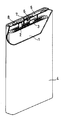
- FIG. 1 is a schematic perspective view in which a part of the non-aqueous electrolyte secondary battery according to the embodiment of the present disclosure is cut out.
- the positive electrode for a non-aqueous electrolyte secondary battery includes a composite oxide (positive electrode active material) containing lithium and a transition metal, and an additive that covers at least a part of the surface of the composite oxide. , And the additive contains a cyclic inorganic phosphate compound (hereinafter, also referred to as compound A).
- the additive contains compound A
- the surface of the composite oxide is easily and stably covered with the additive.
- decomposition of the non-aqueous electrolyte due to contact with the composite oxide is suppressed, and the cycle characteristics are improved.
- Compound A is unlikely to aggregate during the coating process by the liquid phase method.
- a raw material having a small density difference from the final product and less likely to generate gas during the reaction can be used.
- the compound A may have a ring structure containing a plurality of P atoms, and a plurality of oxygen atoms bonded to the plurality of P atoms by anionization may become O ⁇ .
- the anion of compound A easily interacts with and binds to P of other surrounding inorganic phosphoric acid compounds. Therefore, when the additive contains compound A, the surface of the composite oxide can be widely covered with the additive in layers.
- Compound A is easily anionized and bonded to the transition metal of the composite oxide, and is unlikely to flow out into the non-aqueous electrolyte. Therefore, when the additive contains compound A, the surface of the composite oxide can be stably covered with the additive. Further, the compound A has excellent oxidation resistance, is stably present in the positive electrode having a high potential, and is advantageous for increasing the output of the battery. Compound A has excellent lithium ion conductivity, and the transfer of lithium ions between the composite oxide and the non-aqueous electrolyte is smoothly carried out through the coating layer containing compound A.
- Cyclic inorganic phosphoric acid compounds are less likely to become dense, have a lower density, and are less likely to aggregate from the viewpoint of molecular structure, as compared with chain-like inorganic phosphoric acid compounds (for example, chain polyphosphoric acid).
- chain-like inorganic phosphoric acid compounds for example, chain polyphosphoric acid.
- the additive contains at least compound A and may contain an inorganic phosphoric acid compound other than compound A.
- Compound inorganic phosphate compound other than A may include Li 3 PO 4, Li 4 P 2 O 7 and LiPO 3, etc., may contain a chain polyphosphate such tetrapolyphosphate.
- the content of phosphorus (P) derived from compound A is, for example, 0.01% by mass or more, 0.01% by mass or more, and 0.5% by mass or less with respect to the total of the composite oxide and the additive. It may be 0.1 mass% or more and 0.5 mass% or less.
- the additive is substantially free of organophosphate compounds that tend to flow out into the non-aqueous electrolyte.
- the additive does not contain an organic phosphoric acid compound.
- the amount of phosphorus derived from the organic phosphoric acid compound adhering to 100 parts by mass of the composite oxide is, for example, 0.001 part by mass or less. Therefore, it is avoided that the coating of the composite oxide with the additive is insufficient due to the outflow of the organic phosphoric acid compound into the non-aqueous electrolyte.
- the amount of the organic phosphoric acid compound contained in the additive in the battery flowing out into the non-aqueous electrolyte is determined by the organic phosphoric acid in the non-aqueous electrolyte at the time of preparing the non-aqueous electrolyte (before injecting the non-aqueous electrolyte into the battery). When no compound is contained, it can be estimated by determining the content of the organic phosphoric acid compound in the non-aqueous electrolyte. The content of the organic phosphoric acid compound in the non-aqueous electrolyte is determined by gas chromatography-mass spectrometry (GC / MS) or the like.
- GC / MS gas chromatography-mass spectrometry
- Compound A preferably contains at least one selected from the group consisting of cyclic polyphosphoric acid and salts thereof.
- Cyclic polyphosphoric acid salts include, for example, alkali metal salts such as lithium salts.
- the cyclic polyphosphate anion has a plurality of O ⁇ bonded to P, and easily bonds to a transition metal or the like in the composite oxide.
- Cyclic polyphosphoric acid can have, for example, a composition represented by the general formula: (HPO 3 ) n. n is, for example, 3 or more and 6 or less.
- Compound A is anionized to form a transition metal in the composite oxide, Li + or H + in the non-aqueous electrolyte, and P in the surrounding inorganic phosphoric acid compound (hereinafter referred to as transition metal in the composite oxide, etc.). And easily interact with each other and can be combined.
- transition metal in the composite oxide a transition metal in the composite oxide
- the anion of the compound A is bonded to the surrounding inorganic phosphoric acid compound P
- the surface of the composite oxide is easily covered with the additive in a wide layer.
- the anion of compound A By binding the anion of compound A to the transition metal in the composite oxide, the surface of the composite oxide is stably covered with the additive. Since the anion of compound A easily binds to Li + in the non-aqueous electrolyte, the movement of lithium ions between the composite oxide and the non-aqueous electrolyte is smoothly performed.
- the hexametaphosphate anion has a structure represented by the following formula (I).
- O ⁇ bonded to P in the formula (I) can be bonded to a transition metal or the like in the composite oxide.
- O that binds to P - has a lot of easily forming a large number of bonds between the transition metal and the like in the composite oxide.
- the component of the additive (Compound A) covering the surface of the composite oxide can be confirmed by, for example, the following method.
- the positive electrode is washed with a non-aqueous solvent to remove the non-aqueous electrolyte adhering to the positive electrode, and the non-aqueous solvent is removed by drying.
- a positive electrode mixture layer is collected from the positive electrode, appropriately pulverized, and dispersed in water.
- the dispersion liquid of the positive electrode mixture is filtered to obtain a filtrate as a sample solution.
- the dispersion liquid of the positive electrode material may be filtered to obtain a filtrate as a sample solution.
- the components contained in the sample solution obtained above are analyzed by the X-ray diffraction (XRD) method.
- the additive coating the surface of the composite oxide contains compound A
- compound A is dissolved in the sample solution (water), and a peak based on compound A is observed in the XRD pattern.
- the above sample solution may be analyzed by nuclear magnetic resonance (NMR) spectroscopy.
- the coating material on the surface of the composite oxide may be analyzed based on the XRD pattern obtained by the XRD method of the positive electrode material and the electron diffraction pattern obtained by the transmission electron microscope (TEM).
- the content of phosphorus (P) in the positive electrode may be 0.1% by mass or more and 0.75% by mass or less with respect to the total of the composite oxide and the additive. , 0.2% by mass or more and 0.55% by mass or less.
- the content of P is 0.1% by mass or more with respect to the total of the composite oxide and the additive, the composite oxide is sufficiently coated with the additive, and the cycle characteristics are likely to be improved.
- the content of P is 0.75% by mass or less with respect to the total of the composite oxide and the additive, the composite oxide is sufficiently secured in the positive electrode, and the capacity of the battery can be easily increased.
- the content of P in the positive electrode (mass ratio to the total of composite oxides and additives) can be determined by the following method.
- the positive electrode Disassemble the battery and take out the positive electrode.
- the positive electrode is washed with a non-aqueous solvent to remove the non-aqueous electrolyte adhering to the positive electrode, and the non-aqueous solvent is removed by drying.
- the positive electrode mixture is collected from the positive electrode, and the mass W1 of the positive electrode mixture is measured.
- the positive electrode mixture is solubilized with a predetermined acid, and the residue of the carbon material (acetylene black) and the resin material (polyvinylidene fluoride) is filtered off by filtration to obtain a sample solution.
- the mass W2 of the residue after drying is measured. (W1-W2) is determined as the total mass of the composite oxide and the additive.
- the mass W3 of P in the sample solution is determined by inductively coupled plasma (ICP) emission spectroscopy.
- ICP inductively coupled plasma
- the positive electrode material is solubilized with a predetermined acid to obtain a sample solution, which is contained in the sample solution by ICP emission spectroscopic analysis.
- the mass WB of P may be determined, and WB / WA ⁇ 100 may be determined as the content of P described above.
- the positive electrode may include a positive electrode material comprising composite oxide particles and an additive containing compound A while covering the surface of the composite oxide particles.
- the positive electrode includes a positive electrode current collector and a positive electrode mixture layer supported on the positive electrode current collector, and the positive electrode mixture layer may contain the above-mentioned positive electrode material.
- the state of distribution of P in the positive electrode material is determined by element analysis (element mapping) of the positive electrode mixture layer or the cross section of the positive electrode material using an electron probe microanalyzer (EPMA) or an energy dispersive X-ray (EDX) analyzer. It can be confirmed by doing.
- element analysis element mapping
- EPMA electron probe microanalyzer
- EDX energy dispersive X-ray
- the method for producing the positive electrode material includes, for example, a first step of adhering the raw material solution to the surface of the composite oxide particles and a second step of heating and drying the composite oxide particles having the raw material solution adhered to the surface.
- the composite oxide was synthesized by using a coprecipitation method or the like, and was obtained by mixing, for example, a lithium compound and a compound containing a metal Me (transition metal) other than lithium obtained by the coprecipitation method or the like. It is obtained by firing the mixture under predetermined conditions.
- the composite oxide usually forms secondary particles in which a plurality of primary particles are aggregated.
- the average particle size (D50) of the composite oxide particles is, for example, 3 ⁇ m or more and 25 ⁇ m or less.
- the average particle size (D50) of the composite oxide particles means a particle size (volume average particle size) at which the volume integrated value is 50% in the volume-based particle size distribution measured by the laser diffraction scattering method. ..
- the first step may also serve as a step of cleaning the synthesized composite oxide particles. In this case, it is advantageous in terms of improving productivity.
- the composite oxide particles are added to the raw material solution and stirred to disperse the composite oxide particles in the raw material solution.
- the raw material solution is, for example, an aqueous solution containing H 3 PO 4 and LiOH, and can be obtained by adding an appropriate amount of an aqueous solution of LiOH to the aqueous solution of H 3 PO 4.
- the raw material solution contains an acid component such as H 3 PO 4
- a part of the acid component is neutralized by adding an alkaline component such as LiOH, and the influence of the acid component on the composite oxide can be reduced.
- the amount of the composite oxide particles input is, for example, 500 g or more and 2000 g or less per 1 L of the raw material solution.
- z When the raw material composition in the raw material solution (aqueous solution of H 3 PO 4 and LiOH) is represented by Li z H (3-z) PO 4 , z may be 1.0 or more and 1.8 or less. It may be 2 or more and 1.8 or less. In this case, it is easy to adjust the pH of the raw material solution to a range of about 6 or more and less than 8. The influence of the composite oxide due to the acid component is avoided, and the composite oxide can sufficiently play a role as a positive electrode active material. The raw material solution can be easily prepared, and compound A can be efficiently obtained.
- the z value tends to increase slightly due to the influence of the alkaline component. Shift to. For example, when a raw material solution having a z value of 1 in the raw material composition adheres to the composite oxide in which the alkaline component remains, the z value becomes larger than 1.
- the second step is a step of removing the dispersion medium adhering to the surface of the composite oxide particles by heating and drying, and reacting the raw materials adhering to the surface of the composite oxide particles to form compound A. Also serves as a generation process.
- the heating temperature is, for example, 180 ° C. or higher and 450 ° C. or lower. In this case, the surface of the composite oxide particles is dried and the compound A is produced on the surface efficiently.
- the produced compound A can be bonded to the metal Me (transition metal or the like) of the composite oxide particles as an anion.
- the water in the raw material solution (aqueous solution containing H 3 PO 4 and LiOH) adhering to the surface of the composite oxide particles by heating is reduced, and Li 3 PO 4 and Li H 2 PO 4 are released. Generate and precipitate.
- Li 3 PO 4 and Li H 2 PO 4 react to produce hexametaphosphate.
- the water produced during the reaction also evaporates by heating.
- a small amount of cyclic polyphosphoric acid other than hexametaphosphoric acid such as tetrametaphosphoric acid and chain polyphosphoric acid such as tetrapolyphosphoric acid can be produced.
- a small amount of unreacted components such as Li 3 PO 4 may remain.
- Hexametholic acid has a lower density than Li 3 PO 4 and Li H 2 PO 4, so it is less likely to aggregate.
- the positive electrode active material contains a composite oxide containing lithium and a metal Me other than lithium.
- the metal Me contains at least a transition metal. Transition metals are nickel (Ni), cobalt (Co), manganese (Mn), iron (Fe), copper (Cu), chromium (Cr), titanium (Ti), niobium (Nb), zirconium (Zr), vanadium. It may contain at least one element selected from the group consisting of (V), tantalum (Ta) and molybdenum (Mo).
- the metal Me may contain a metal other than the transition metal.
- the metal other than the transition metal may contain at least one selected from the group consisting of aluminum (Al), magnesium (Mg), calcium (Ca), strontium (Sr), zinc (Zn) and silicon (Si). ..
- the composite oxide may further contain boron (B) and the like in addition to the metal.
- the transition metal preferably contains at least Ni.
- the metal Me may contain Ni and at least one selected from the group consisting of Co, Mn, Al, Ti and Fe.
- the metal Me preferably contains Ni and at least one selected from the group consisting of Co, Mn and Al, and Ni, Co and Mn. And / or Al is more preferred.
- the metal Me contains Co, the phase transition of the composite oxide containing Li and Ni is suppressed during charging and discharging, the stability of the crystal structure is improved, and the cycle characteristics are likely to be improved.
- the metal Me contains Mn and / or Al, the thermal stability is improved.
- the atomic ratio of Ni to the metal Me: Ni / Me is preferably 0.3 or more and less than 1, and more preferably 0.5 or more and less than 1. More preferably, it is 0.75 or more and less than 1.
- the positive electrode active material may contain a composite oxide containing Ni and / or Co, which has a layered rock salt type crystal structure, and has a spinel type crystal structure. It may contain a composite oxide containing Mn. Among them, from the viewpoint of increasing the capacity, a composite oxide having a layered rock salt type crystal structure, containing Ni, and having an atomic ratio of Ni to metal Me: Ni / Me of 0.3 or more (hereinafter, nickel-based composite). Also referred to as an oxide) is preferable.
- the additive containing compound A which covers the surface of the composite oxide, has excellent lithium ion conductivity, and the composite oxide smoothly occludes and releases lithium ions. Further, in the coating of the additive containing the compound A, the deterioration of the composite oxide due to the acid component in the raw material solution is suppressed by including the alkaline component in the raw material solution. Therefore, when the surface of the nickel-based composite oxide is coated with an additive containing the compound A, the high capacity of the positive electrode containing the nickel-based composite oxide can be sufficiently drawn out.
- the crystal structure of the nickel-based composite oxide is relatively unstable, and it tends to deteriorate due to the elution of Ni due to the contact with the non-aqueous electrolyte at the high potential positive electrode, and the cycle characteristics tend to deteriorate. Therefore, in the case of the nickel-based composite oxide, the effect of improving the cycle characteristics by coating the surface of the composite oxide with the additive containing the compound A can be remarkably obtained.
- the Ni-based composite oxide may become alkaline due to the residual alkaline component used for its synthesis, and the composite oxide due to the acid component in the raw material solution used when coating the composite oxide surface with an additive. Deterioration is likely to be suppressed.
- the composite oxide has a layered rock salt type crystal structure and satisfies the general formula (1): LiNi ⁇ M 1- ⁇ O 2 (0.3 ⁇ ⁇ ⁇ 1, where M is Co, Mn, Al. , Ti and Fe. It is at least one element selected from the group.).
- ⁇ is in the above range, the effect of Ni and the effect of element M can be obtained in a well-balanced manner.
- the high capacity of the composite oxide can be sufficiently brought out.
- Al is preferable as M in the general formula (2).
- the x value may be in the range of 0.5 ⁇ x ⁇ 1.
- the y value may be in the range of 0 ⁇ y ⁇ 0.35.
- Non-aqueous electrolyte secondary battery includes a positive electrode, a negative electrode, and a non-aqueous electrolyte, and the positive electrode is the above-mentioned positive electrode.
- the positive electrode includes, for example, a positive electrode current collector and a positive electrode mixture layer supported on the surface of the positive electrode current collector.
- the positive electrode mixture layer can be formed by applying a positive electrode slurry in which a positive electrode mixture is dispersed in a dispersion medium to the surface of a positive electrode current collector and drying it. The dried coating film may be rolled if necessary.
- the positive electrode mixture layer may be formed on one surface of the positive electrode current collector, or may be formed on both surfaces.
- the positive electrode mixture contains the above positive electrode material as an essential component.
- the positive electrode mixture may contain a binder, a conductive agent, or the like as an optional component.
- NMP N-methyl-2-pyrrolidone
- binder examples include resin materials such as fluororesin, polyolefin resin, polyamide resin, polyimide resin, acrylic resin, and vinyl resin.
- fluororesin examples include polytetrafluoroethylene (PTFE) and polyvinylidene fluoride (PVDF).
- PTFE polytetrafluoroethylene
- PVDF polyvinylidene fluoride
- the conductive agent examples include carbon blacks such as acetylene black; conductive fibers such as carbon fibers and metal fibers; and carbon fluoride.
- carbon blacks such as acetylene black
- conductive fibers such as carbon fibers and metal fibers
- carbon fluoride examples of the conductive agent.
- one type may be used alone, or two or more types may be used in combination.
- the positive electrode current collector for example, a metal foil can be used.
- the metal constituting the positive electrode current collector include aluminum (Al), titanium (Ti), an alloy containing these metal elements, and stainless steel.
- the thickness of the positive electrode current collector is not particularly limited, but is, for example, 3 to 50 ⁇ m.
- the negative electrode may include a negative electrode current collector and a negative electrode mixture layer supported on the surface of the negative electrode current collector.
- the negative electrode mixture layer can be formed, for example, by applying a negative electrode slurry in which a negative electrode mixture is dispersed in a dispersion medium to the surface of a negative electrode current collector and drying it. The dried coating film may be rolled if necessary.
- the negative electrode mixture layer may be formed on one surface of the negative electrode current collector, or may be formed on both surfaces.
- the dispersion medium for example, water or NMP is used.
- the negative electrode mixture contains a negative electrode active material as an essential component, and may contain a binder, a conductive agent, a thickener, and the like as optional components.
- a binder and the conductive agent those exemplified for the positive electrode can be used.
- a rubber material such as styrene-butadiene copolymer rubber (SBR) may be used as the binder.
- SBR styrene-butadiene copolymer rubber
- the thickener include carboxymethyl cellulose (CMC) and a modified product thereof (Na salt, etc.).
- the negative electrode active material may contain a carbon material that occludes and releases lithium ions.
- Examples of the carbon material that occludes and releases lithium ions include graphite (natural graphite, artificial graphite), easily graphitized carbon (soft carbon), and non-graphitized carbon (hard carbon). Of these, graphite is preferable because it has excellent charge / discharge stability and has a small irreversible capacity.
- the negative electrode active material may contain an alloy-based material.
- the alloy-based material is a material containing at least one kind of metal capable of forming an alloy with lithium, and examples thereof include silicon, tin, silicon alloys, tin alloys, and silicon compounds.
- silicon compound a composite material including a lithium ion conductive phase and silicon particles dispersed in the phase may be used.
- a silicate phase such as a lithium silicate phase, a silicon oxide phase in which 95% by mass or more is silicon dioxide, a carbon phase, or the like may be used.
- An alloy material and a carbon material may be used in combination as the negative electrode active material.
- the ratio of the carbon material to the total of the alloy-based material and the carbon material is, for example, preferably 80% by mass or more, and more preferably 90% by mass or more.
- the shape and thickness of the negative electrode current collector can be selected from the shape and range according to the positive electrode current collector.
- the metal constituting the negative electrode current collector include copper (Cu), nickel (Ni), iron (Fe), and alloys containing these metal elements.
- Non-aqueous electrolyte contains a non-aqueous solvent and a lithium salt dissolved in the non-aqueous solvent.
- concentration of the lithium salt in the non-aqueous electrolyte is preferably, for example, 0.5 mol / L or more and 2 mol / L or less. By controlling the lithium salt concentration within the above range, a non-aqueous electrolyte having excellent ionic conductivity and appropriate viscosity can be obtained.
- the lithium salt concentration is not limited to the above.
- cyclic carbonate ester for example, cyclic carbonate ester, chain carbonate ester, cyclic carboxylic acid ester, chain carboxylic acid ester and the like are used.
- the cyclic carbonate include propylene carbonate (PC) and ethylene carbonate (EC).
- the cyclic carbonate may include a fluorinated cyclic carbonate such as fluoroethylene carbonate (FEC) or a cyclic carbonate having a carbon-carbon unsaturated bond such as vinylene carbonate (VC) or vinylethylene carbonate.
- chain carbonic acid ester include diethyl carbonate (DEC), ethyl methyl carbonate (EMC), dimethyl carbonate (DMC) and the like.
- Examples of the cyclic carboxylic acid ester include ⁇ -butyrolactone (GBL) and ⁇ -valerolactone (GVL).
- Examples of the chain carboxylic acid ester include methyl formate, ethyl formate, propyl formate, methyl acetate, ethyl acetate, propyl acetate, methyl propionate, ethyl propionate, propyl propionate and the like.
- the non-aqueous solvent one type may be used alone, or two or more types may be used in combination.
- lithium salt a known lithium salt can be used.
- Preferred lithium salts include, for example, LiClO 4 , LiBF 4 , LiPF 6 , LiAlCl 4 , LiSbF 6 , LiSCN, LiCF 3 SO 3 , LiCF 3 CO 2 , LiAsF 6 , LiB 10 Cl 10 , lower aliphatic lithium carboxylate, and the like.
- Examples thereof include LiCl, LiBr, LiI, borates and imide salts.
- borates include bis (1,2-benzenediorate (2-) -O, O') lithium borate and bis (2,3-naphthalenedioleate (2-) -O, O') boric acid.
- imide salts include lithium bis (fluorosulfonyl) imide (LiN (FSO 2 ) 2 ), imidelithium bistrifluoromethanesulfonate (LiN (CF 3 SO 2 ) 2 ), and imidelithium nonafluorobutanesulfonate trifluoromethanesulfonate.
- lithium bispentafluoroethanesulfonate LiN (C 2 F 5 SO 2 ) 2
- LiN (C 2 F 5 SO 2 ) 2 imid lithium bispentafluoroethanesulfonate
- One type of lithium salt may be used alone, or two or more types may be used in combination.
- Separator usually, it is desirable to interpose a separator between the positive electrode and the negative electrode.
- the separator has high ion permeability and has appropriate mechanical strength and insulation.
- a microporous thin film, a woven fabric, a non-woven fabric or the like can be used.
- polyolefins such as polypropylene and polyethylene are preferable.
- Non-aqueous electrolyte secondary battery is a structure in which an electrode group in which a positive electrode and a negative electrode are wound via a separator and a non-aqueous electrolyte are housed in an exterior body.
- an electrode group in which a positive electrode and a negative electrode are wound via a separator and a non-aqueous electrolyte are housed in an exterior body.
- another form of electrode group such as a laminated type electrode group in which a positive electrode and a negative electrode are laminated via a separator may be applied.
- the non-aqueous electrolyte secondary battery may be in any form such as a cylindrical type, a square type, a coin type, a button type, and a laminated type.
- FIG. 1 is a schematic perspective view in which a part of the non-aqueous electrolyte secondary battery according to the embodiment of the present disclosure is cut out.
- the battery includes a bottomed square battery case 4, an electrode group 1 housed in the battery case 4, and a non-aqueous electrolyte.
- the electrode group 1 has a long strip-shaped negative electrode, a long strip-shaped positive electrode, and a separator that is interposed between them and prevents direct contact.
- the electrode group 1 is formed by winding a negative electrode, a positive electrode, and a separator around a flat plate-shaped winding core and pulling out the winding core.
- One end of the negative electrode lead 3 is attached to the negative electrode current collector of the negative electrode by welding or the like.
- the other end of the negative electrode lead 3 is electrically connected to the negative electrode terminal 6 provided on the sealing plate 5 via a resin insulating plate.
- the negative electrode terminal 6 is insulated from the sealing plate 5 by a resin gasket 7.
- One end of the positive electrode lead 2 is attached to the positive electrode current collector of the positive electrode by welding or the like.
- the other end of the positive electrode lead 2 is connected to the back surface of the sealing plate 5 via an insulating plate. That is, the positive electrode lead 2 is electrically connected to the battery case 4 that also serves as the positive electrode terminal.
- the insulating plate separates the electrode group 1 and the sealing plate 5, and also separates the negative electrode lead 3 and the battery case 4.
- the peripheral edge of the sealing plate 5 is fitted to the open end portion of the battery case 4, and the fitting portion is laser welded. In this way, the opening of the battery case 4 is sealed with the sealing plate 5.
- the non-aqueous electrolyte injection hole provided in the sealing plate 5 is closed by the sealing 8.
- Examples 1 to 5 [Preparation of positive electrode material]
- a layered rock salt type composite oxide particles having a composition of LiNi 0.9 Co 0.05 Al 0.05 (NCA) (average particle size (D50) 11.1 ⁇ m) are subjected to the liquid phase method.
- the surface was coated with an additive containing compound A.
- a LiOH aqueous solution (concentration 1 mol / L) was added to an H 3 PO 4 aqueous solution (concentration 1 mol / L) to obtain a raw material solution (an aqueous solution containing H 3 PO 4 and LiOH).
- z is such that the values shown in Table 1, was adjusted amount of LiOH aqueous solution to be introduced into the aqueous H 3 PO 4.
- the amount of the LiOH aqueous solution added was such that the pH of the raw material solution was less than 8.
- Composite oxide particles were added to the raw material solution.
- the amount of the composite oxide particles input at this time was 1250 g per 1 L of the raw material solution.
- the raw material solution containing the composite oxide particles was stirred for 15 minutes to disperse the composite oxide particles in the raw material solution.
- the composite oxide particles in the dispersion liquid were filtered off by filtration, and the composite oxide particles having the raw material solution adhered to the surface were heated at 450 ° C. for 3 hours and dried. In this way, a positive electrode material in which the surface of the composite oxide particles was coated with an additive was obtained.
- the content of P in the positive electrode material determined by the method described above was 0.21% by mass.
- NMP N-Methyl-2-pyrrolidone
- AB acetylene black
- PVDF polyvinylidene fluoride
- a positive electrode slurry is applied to the surface of an aluminum foil which is a positive electrode current collector, the coating film is dried, and then rolled, and a positive electrode mixture layer (thickness 40 ⁇ m, density 3.6 g / cm 3 ) is formed on both sides of the aluminum foil.
- a positive electrode mixture layer (thickness 40 ⁇ m, density 3.6 g / cm 3 ) is formed on both sides of the aluminum foil.
- a positive electrode mixture layer (thickness 40 ⁇ m, density 3.6 g / cm 3 ) is formed on both sides of the aluminum foil.
- the positive electrodes of Examples 1 to 5 are a1 to a5, respectively.
- LiPF 6 was dissolved in a mixed solvent (volume ratio 2: 8) of fluoroethylene carbonate (FEC) and dimethyl carbonate (DMC) at a concentration of 1 mol / L to obtain a non-aqueous electrolyte.
- FEC fluoroethylene carbonate
- DMC dimethyl carbonate
- a positive electrode lead made of Al was attached to the positive electrode obtained above.
- a negative electrode lead made of Ni was attached to the negative electrode obtained above.
- the positive electrode and the negative electrode were spirally wound through a polyethylene thin film (separator) to prepare a wound electrode group.
- the electrode group was housed in a bag-shaped exterior body formed of a laminated sheet provided with an Al layer, and after injecting the above-mentioned non-aqueous electrolyte, the exterior body was sealed to prepare a non-aqueous electrolyte secondary battery.
- the electrode group was housed in the exterior body, a part of the positive electrode lead and a part of the negative electrode lead were exposed to the outside from the exterior body, respectively.
- the batteries of Examples 1 to 5 are A1 to A5, respectively.
- Examples 6 to 10 In the preparation of the positive electrode, the positive electrode a1 of Examples 1 to 5 was obtained, except that the concentration of the raw material solution (an aqueous solution containing H 3 PO 4 and LiOH) was changed to set the P content in the positive electrode material to the value shown in Table 1. Positive electrodes a6 to a10 of Examples 6 to 10 were prepared by the same method as in 1 to a5, respectively. The content of P in the positive electrode material determined by the method described above was 0.1% by mass. Batteries A6 to A10 of Examples 6 to 10, respectively, were produced by the same method as the batteries A1 of Example 1 except that the positive electrodes a6 to a10 were used instead of the positive electrodes a1.
- Examples 11 to 13 In the preparation of the positive electrode, the positive electrodes a11 of Examples 11 to 13, respectively, were prepared by the same method as the positive electrodes a3 to a5 of Examples 3 to 5, except that the heating temperature of the composite oxide particles filtered from the dispersion was set to 180 ° C. ⁇ A13 was prepared. The content of P in the positive electrode material determined by the method described above was 0.2% by mass. Batteries A11 to A13 of Examples 11 to 13, respectively, were produced by the same method as the batteries A1 of Example 1 except that the positive electrodes a11 to a13 were used instead of the positive electrodes a1.
- Comparative Example 1 In the preparation of the positive electrode, the positive electrode b1 of Comparative Example 1 was prepared by the same method as that of the positive electrode a1 of Example 1 except that the surface of the composite oxide was not coated with the additive. The battery B1 of Comparative Example 1 was produced by the same method as the battery A1 of Example 1 except that the positive electrode b1 was used instead of the positive electrode a1.
- the batteries A1 to A13 and the batteries B1 obtained above were evaluated as follows.
- the components of the additives covering the surface of the composite oxide particles were examined by the method described above. As a result, in each case, the compound A hexamethaphosphate (Li 6 P 6 O 18 ), lithium orthophosphate (Li 3 PO 4 ), and lithium pyrophosphate (Li 4 P 2 O 7 ) are contained. Was confirmed.
- the initial capacity of the batteries A1 to A13 was high, and a higher capacity retention rate was obtained as compared with the battery B1. Further, the battery A4 was charged and discharged in the same manner as described above in an environment of 45 ° C., and the initial capacity was determined. The initial capacity was 219.7 mAh / g, and the initial capacity was 219.7 mAh / g. It increased above the capacity, confirming that the composite oxide fully exerted its role as an active material. From this, it was confirmed that the influence of the acid component on the composite oxide was sufficiently reduced by adding the alkaline component of LiOH at the time of preparing the raw material solution.
- Examples 14 to 16 In the preparation of positive electrodes, instead of NCA composite oxide particles, layered rock salt type composite oxide particles having a composition of LiNi 0.5 Co 0.2 Mn 0.3 (NCM) (average particle size (D50)).
- NCM LiNi 0.5 Co 0.2 Mn 0.3
- Example 17 In the preparation of the positive electrode, the concentration of the raw material solution ( aqueous solution containing H 3 PO 4 and LiOH) was changed to set the P content in the positive electrode material to the value shown in Table 2, but the same as that of the positive electrode c2 of Example 15.
- the positive electrode c4 of Example 17 was prepared by the method of. The content of P in the positive electrode material determined by the method described above was 0.52% by mass.
- the battery C4 of Example 17 was produced by the same method as the battery A1 of Example 1 except that the positive electrode c4 was used instead of the positive electrode a1.
- Example 18 In the preparation of the positive electrode, the concentration of the raw material solution ( aqueous solution containing H 3 PO 4 and LiOH) was changed to set the P content in the positive electrode material to the value shown in Table 2, but the same as that of the positive electrode c2 of Example 15.
- the positive electrode c5 of Example 18 was prepared by the method of. The content of P in the positive electrode material determined by the method described above was 0.73% by mass.
- the battery C5 of Example 18 was produced by the same method as the battery A1 of Example 1 except that the positive electrode c5 was used instead of the positive electrode a1.
- Comparative Example 2 In the preparation of the positive electrode, the positive electrode d1 of Comparative Example 2 was prepared by the same method as that of the positive electrode c1 of Example 14 except that the surface of the composite oxide particles was not coated with the additive. The battery D1 of Comparative Example 2 was produced by the same method as the battery A1 of Example 1 except that the positive electrode d1 was used instead of the positive electrode a1.
- the positive electrodes c1 to c5 the components of the additives covering the surface of the composite oxide particles were examined by the method described above. As a result, in each case, the compound A hexamethaphosphate (Li 6 P 6 O 18 ), lithium orthophosphate (Li 3 PO 4 ), and lithium pyrophosphate (Li 4 P 2 O 7 ) are contained. Was confirmed.
- the initial capacity of the batteries C1 to C5 was high, and the capacity retention rate was higher than that of the battery D1.
- Examples 19 to 20 In the preparation of the positive electrode, composite oxide particles (average particle size (D50) 9 ⁇ m) having a composition of LiMn 1.5 Ni 0.5 O 4 (MnNi-based spinel structure) were used instead of the composite oxide particles of NCA. Except for the above, e1 to e2 of Examples 19 to 20 were prepared by the same method as that of the positive electrode a2 of Example 2. The content of P in the positive electrode material determined by the method described above was 0.21% by mass. Batteries E1 to E2 of Examples 19 to 20, respectively, were produced by the same method as the batteries A1 of Example 1 except that the positive electrodes e1 to e2 were used instead of the positive electrodes a1.
- Comparative Example 3 In the preparation of the positive electrode, the positive electrode f1 of Comparative Example 3 was prepared by the same method as the positive electrode e1 of Example 19 except that the surface of the composite oxide particles was not coated with the additive. The battery F1 of Comparative Example 3 was produced by the same method as the battery A1 of Example 1 except that the positive electrode f1 was used instead of the positive electrode a1.
- the positive electrodes e1 to e2 the components of the additives covering the surface of the composite oxide particles were examined by the method described above. As a result, in each case, the compound A hexamethaphosphate (Li 6 P 6 O 18 ), lithium orthophosphate (Li 3 PO 4 ), and lithium pyrophosphate (Li 4 P 2 O 7 ) are contained. Was confirmed.
- Batteries E1 to E2 obtained a higher capacity retention rate than batteries F1.
- the non-aqueous electrolyte secondary battery according to the present disclosure is suitably used, for example, as a power source for mobile devices such as smartphones, a power source for vehicles such as electric vehicles, and a storage device for natural energy such as sunlight.
- Electrode group 2 Positive electrode lead 3 Negative electrode lead 4 Battery case 5 Seal plate 6 Negative terminal 7 Gasket 8 Seal
Landscapes
- Chemical & Material Sciences (AREA)
- Chemical Kinetics & Catalysis (AREA)
- Electrochemistry (AREA)
- General Chemical & Material Sciences (AREA)
- Inorganic Chemistry (AREA)
- Engineering & Computer Science (AREA)
- Materials Engineering (AREA)
- Manufacturing & Machinery (AREA)
- Composite Materials (AREA)
- Battery Electrode And Active Subsutance (AREA)
- Secondary Cells (AREA)
Priority Applications (4)
| Application Number | Priority Date | Filing Date | Title |
|---|---|---|---|
| CN202180025940.4A CN115413377A (zh) | 2020-03-31 | 2021-03-23 | 非水电解质二次电池用正极和非水电解质二次电池 |
| EP21780664.5A EP4131496A4 (en) | 2020-03-31 | 2021-03-23 | POSITIVE ELECTRODE FOR SECONDARY BATTERIES WITH ANHYDROUS ELECTROLYTE AND SECONDARY BATTERY WITH ANHYDROUS ELECTROLYTE |
| JP2022511983A JP7769946B2 (ja) | 2020-03-31 | 2021-03-23 | 非水電解質二次電池用正極および非水電解質二次電池 |
| US17/915,268 US20230133143A1 (en) | 2020-03-31 | 2021-03-23 | Positive electrode for nonaqueous electrolyte secondary batteries, and nonaqueous electrolyte secondary battery |
Applications Claiming Priority (2)
| Application Number | Priority Date | Filing Date | Title |
|---|---|---|---|
| JP2020065066 | 2020-03-31 | ||
| JP2020-065066 | 2020-03-31 |
Publications (1)
| Publication Number | Publication Date |
|---|---|
| WO2021200395A1 true WO2021200395A1 (ja) | 2021-10-07 |
Family
ID=77928294
Family Applications (1)
| Application Number | Title | Priority Date | Filing Date |
|---|---|---|---|
| PCT/JP2021/011952 Ceased WO2021200395A1 (ja) | 2020-03-31 | 2021-03-23 | 非水電解質二次電池用正極および非水電解質二次電池 |
Country Status (5)
| Country | Link |
|---|---|
| US (1) | US20230133143A1 (https=) |
| EP (1) | EP4131496A4 (https=) |
| JP (1) | JP7769946B2 (https=) |
| CN (1) | CN115413377A (https=) |
| WO (1) | WO2021200395A1 (https=) |
Cited By (1)
| Publication number | Priority date | Publication date | Assignee | Title |
|---|---|---|---|---|
| JP2023069448A (ja) * | 2021-11-05 | 2023-05-18 | 株式会社Gsユアサ | 正極及び非水電解質蓄電素子 |
Families Citing this family (1)
| Publication number | Priority date | Publication date | Assignee | Title |
|---|---|---|---|---|
| JP7694450B2 (ja) * | 2022-04-26 | 2025-06-18 | トヨタ自動車株式会社 | 複合粒子、正極および全固体電池の製造方法 |
Citations (6)
| Publication number | Priority date | Publication date | Assignee | Title |
|---|---|---|---|---|
| JP2008016235A (ja) * | 2006-07-03 | 2008-01-24 | Sony Corp | 正極活物質およびその製造方法、並びに非水電解質二次電池 |
| JP2011060562A (ja) * | 2009-09-10 | 2011-03-24 | Nec Energy Devices Ltd | リチウムイオン二次電池 |
| JP2011187193A (ja) | 2010-03-05 | 2011-09-22 | Hitachi Ltd | リチウム二次電池用正極材料、リチウム二次電池及びそれを用いた二次電池モジュール |
| JP2012038680A (ja) * | 2010-08-11 | 2012-02-23 | Mitsubishi Chemicals Corp | リチウム二次電池用正極活物質材料及びその製造方法、並びにそれを用いたリチウム二次電池用正極及びリチウム二次電池 |
| JP5526636B2 (ja) * | 2009-07-24 | 2014-06-18 | ソニー株式会社 | 非水電解質二次電池の正極活物質、非水電解質二次電池の正極および非水電解質二次電池 |
| JP6387227B2 (ja) * | 2013-11-18 | 2018-09-05 | 日揮触媒化成株式会社 | 正極活物質、正極、及び非水電解質二次電池 |
Family Cites Families (11)
| Publication number | Priority date | Publication date | Assignee | Title |
|---|---|---|---|---|
| US7524529B2 (en) * | 2005-09-09 | 2009-04-28 | Aquire Energy Co., Ltd. | Method for making a lithium mixed metal compound having an olivine structure |
| US8911903B2 (en) * | 2006-07-03 | 2014-12-16 | Sony Corporation | Cathode active material, its manufacturing method, and non-aqueous electrolyte secondary battery |
| JP2010055777A (ja) * | 2008-08-26 | 2010-03-11 | Sony Corp | 正極活物質の製造方法および正極活物質 |
| JP5623100B2 (ja) * | 2010-03-12 | 2014-11-12 | 三洋電機株式会社 | 非水電解質二次電池及びその製造方法 |
| JP5205424B2 (ja) * | 2010-08-06 | 2013-06-05 | 株式会社日立製作所 | リチウム二次電池用正極材料,リチウム二次電池及びそれを用いた二次電池モジュール |
| EP3226329B1 (en) * | 2014-11-28 | 2020-12-30 | Sumitomo Metal Mining Co., Ltd. | Positive electrode active material for nonaqueous electrolyte secondary cell, method for manufacturing same, and nonaqueous electrolyte secondary cell |
| WO2016088837A1 (ja) * | 2014-12-04 | 2016-06-09 | 日本電気株式会社 | リチウム二次電池 |
| CN107925129B (zh) * | 2015-09-29 | 2020-05-12 | 松下知识产权经营株式会社 | 非水电解质二次电池 |
| US10833369B2 (en) * | 2015-12-02 | 2020-11-10 | Nec Corporation | Positive electrode active substance for lithium secondary battery, positive electrode for lithium secondary battery and lithium secondary battery, and methods for producing these |
| JP2017152275A (ja) * | 2016-02-25 | 2017-08-31 | 住友金属鉱山株式会社 | 非水系電解質二次電池用正極活物質、およびその製造方法 |
| JP7024505B2 (ja) * | 2018-03-02 | 2022-02-24 | トヨタ自動車株式会社 | 正極活物質粒子の製造方法、正極ペーストの製造方法、正極板の製造方法及びリチウムイオン二次電池の製造方法 |
-
2021
- 2021-03-23 EP EP21780664.5A patent/EP4131496A4/en active Pending
- 2021-03-23 WO PCT/JP2021/011952 patent/WO2021200395A1/ja not_active Ceased
- 2021-03-23 US US17/915,268 patent/US20230133143A1/en active Pending
- 2021-03-23 JP JP2022511983A patent/JP7769946B2/ja active Active
- 2021-03-23 CN CN202180025940.4A patent/CN115413377A/zh active Pending
Patent Citations (6)
| Publication number | Priority date | Publication date | Assignee | Title |
|---|---|---|---|---|
| JP2008016235A (ja) * | 2006-07-03 | 2008-01-24 | Sony Corp | 正極活物質およびその製造方法、並びに非水電解質二次電池 |
| JP5526636B2 (ja) * | 2009-07-24 | 2014-06-18 | ソニー株式会社 | 非水電解質二次電池の正極活物質、非水電解質二次電池の正極および非水電解質二次電池 |
| JP2011060562A (ja) * | 2009-09-10 | 2011-03-24 | Nec Energy Devices Ltd | リチウムイオン二次電池 |
| JP2011187193A (ja) | 2010-03-05 | 2011-09-22 | Hitachi Ltd | リチウム二次電池用正極材料、リチウム二次電池及びそれを用いた二次電池モジュール |
| JP2012038680A (ja) * | 2010-08-11 | 2012-02-23 | Mitsubishi Chemicals Corp | リチウム二次電池用正極活物質材料及びその製造方法、並びにそれを用いたリチウム二次電池用正極及びリチウム二次電池 |
| JP6387227B2 (ja) * | 2013-11-18 | 2018-09-05 | 日揮触媒化成株式会社 | 正極活物質、正極、及び非水電解質二次電池 |
Non-Patent Citations (1)
| Title |
|---|
| See also references of EP4131496A4 |
Cited By (2)
| Publication number | Priority date | Publication date | Assignee | Title |
|---|---|---|---|---|
| JP2023069448A (ja) * | 2021-11-05 | 2023-05-18 | 株式会社Gsユアサ | 正極及び非水電解質蓄電素子 |
| JP7803085B2 (ja) | 2021-11-05 | 2026-01-21 | 株式会社Gsユアサ | 正極及び非水電解質蓄電素子 |
Also Published As
| Publication number | Publication date |
|---|---|
| JP7769946B2 (ja) | 2025-11-14 |
| EP4131496A1 (en) | 2023-02-08 |
| US20230133143A1 (en) | 2023-05-04 |
| JPWO2021200395A1 (https=) | 2021-10-07 |
| EP4131496A4 (en) | 2024-12-04 |
| CN115413377A (zh) | 2022-11-29 |
Similar Documents
| Publication | Publication Date | Title |
|---|---|---|
| TWI548589B (zh) | 具橄欖石結構之磷酸鋰鐵及其分析方法 | |
| JP7390597B2 (ja) | 二次電池および電解液 | |
| JP6116138B2 (ja) | 負極活物質及びそれを含む二次電池 | |
| JP6154484B2 (ja) | 高容量の負極活物質及びそれを含むリチウム二次電池 | |
| US12482811B2 (en) | Positive electrode for nonaqueous-electrolyte secondary battery and nonaqueous-electrolyte secondary battery using same | |
| WO2011068255A1 (ja) | ピロリン酸塩化合物およびその製造方法 | |
| JP7499443B2 (ja) | 非水電解質二次電池 | |
| US20230099371A1 (en) | Non-aqueous electrolyte secondary battery | |
| WO2020026486A1 (ja) | 正極材料および二次電池 | |
| CN111226334A (zh) | 正极添加剂、其制备方法以及包含其的正极和锂二次电池 | |
| EP4489131A1 (en) | Secondary battery | |
| WO2020003595A1 (ja) | 非水電解質二次電池 | |
| JP2024520714A (ja) | リチウム二次電池用正極活物質の製造方法およびこれにより製造された正極活物質 | |
| JP7769946B2 (ja) | 非水電解質二次電池用正極および非水電解質二次電池 | |
| JP7024386B2 (ja) | 負極活物質、負極、非水電解質蓄電素子、及び非水電解質蓄電素子の製造方法 | |
| KR20200094783A (ko) | 인산망간 코팅된 리튬 니켈 산화물 재료 | |
| JP7493164B2 (ja) | 非水電解質二次電池 | |
| JP7692154B2 (ja) | 非水電解質二次電池 | |
| JP7814002B2 (ja) | 非水電解質二次電池 | |
| US20230378457A1 (en) | Nonaqueous electrolyte secondary battery | |
| WO2021235131A1 (ja) | 非水電解質二次電池 | |
| JP7194493B2 (ja) | 非水系電解質二次電池用正極活物質 | |
| EP4366014A1 (en) | Nonaqueous electrolyte secondary battery | |
| JP6998176B2 (ja) | 正極活物質、正極及びリチウム二次電池 |
Legal Events
| Date | Code | Title | Description |
|---|---|---|---|
| 121 | Ep: the epo has been informed by wipo that ep was designated in this application |
Ref document number: 21780664 Country of ref document: EP Kind code of ref document: A1 |
|
| ENP | Entry into the national phase |
Ref document number: 2022511983 Country of ref document: JP Kind code of ref document: A |
|
| NENP | Non-entry into the national phase |
Ref country code: DE |
|
| ENP | Entry into the national phase |
Ref document number: 2021780664 Country of ref document: EP Effective date: 20221031 |