WO2021182469A1 - 顆粒及びそれを用いた製剤 - Google Patents
顆粒及びそれを用いた製剤 Download PDFInfo
- Publication number
- WO2021182469A1 WO2021182469A1 PCT/JP2021/009297 JP2021009297W WO2021182469A1 WO 2021182469 A1 WO2021182469 A1 WO 2021182469A1 JP 2021009297 W JP2021009297 W JP 2021009297W WO 2021182469 A1 WO2021182469 A1 WO 2021182469A1
- Authority
- WO
- WIPO (PCT)
- Prior art keywords
- component
- melt
- layer
- melt component
- nuclear material
- Prior art date
- Legal status (The legal status is an assumption and is not a legal conclusion. Google has not performed a legal analysis and makes no representation as to the accuracy of the status listed.)
- Ceased
Links
Images


Classifications
-
- A—HUMAN NECESSITIES
- A61—MEDICAL OR VETERINARY SCIENCE; HYGIENE
- A61K—PREPARATIONS FOR MEDICAL, DENTAL OR TOILETRY PURPOSES
- A61K9/00—Medicinal preparations characterised by special physical form
- A61K9/14—Particulate form, e.g. powders, Processes for size reducing of pure drugs or the resulting products, Pure drug nanoparticles
- A61K9/16—Agglomerates; Granulates; Microbeadlets ; Microspheres; Pellets; Solid products obtained by spray drying, spray freeze drying, spray congealing,(multiple) emulsion solvent evaporation or extraction
- A61K9/167—Agglomerates; Granulates; Microbeadlets ; Microspheres; Pellets; Solid products obtained by spray drying, spray freeze drying, spray congealing,(multiple) emulsion solvent evaporation or extraction with an outer layer or coating comprising drug; with chemically bound drugs or non-active substances on their surface
- A61K9/1676—Agglomerates; Granulates; Microbeadlets ; Microspheres; Pellets; Solid products obtained by spray drying, spray freeze drying, spray congealing,(multiple) emulsion solvent evaporation or extraction with an outer layer or coating comprising drug; with chemically bound drugs or non-active substances on their surface having a drug-free core with discrete complete coating layer containing drug
-
- A—HUMAN NECESSITIES
- A61—MEDICAL OR VETERINARY SCIENCE; HYGIENE
- A61K—PREPARATIONS FOR MEDICAL, DENTAL OR TOILETRY PURPOSES
- A61K9/00—Medicinal preparations characterised by special physical form
- A61K9/14—Particulate form, e.g. powders, Processes for size reducing of pure drugs or the resulting products, Pure drug nanoparticles
- A61K9/16—Agglomerates; Granulates; Microbeadlets ; Microspheres; Pellets; Solid products obtained by spray drying, spray freeze drying, spray congealing,(multiple) emulsion solvent evaporation or extraction
- A61K9/1682—Processes
-
- A—HUMAN NECESSITIES
- A61—MEDICAL OR VETERINARY SCIENCE; HYGIENE
- A61K—PREPARATIONS FOR MEDICAL, DENTAL OR TOILETRY PURPOSES
- A61K31/00—Medicinal preparations containing organic active ingredients
- A61K31/33—Heterocyclic compounds
- A61K31/395—Heterocyclic compounds having nitrogen as a ring hetero atom, e.g. guanethidine or rifamycins
- A61K31/495—Heterocyclic compounds having nitrogen as a ring hetero atom, e.g. guanethidine or rifamycins having six-membered rings with two or more nitrogen atoms as the only ring heteroatoms, e.g. piperazine or tetrazines
- A61K31/4985—Pyrazines or piperazines ortho- or peri-condensed with heterocyclic ring systems
-
- A—HUMAN NECESSITIES
- A61—MEDICAL OR VETERINARY SCIENCE; HYGIENE
- A61K—PREPARATIONS FOR MEDICAL, DENTAL OR TOILETRY PURPOSES
- A61K45/00—Medicinal preparations containing active ingredients not provided for in groups A61K31/00 - A61K41/00
- A61K45/06—Mixtures of active ingredients without chemical characterisation, e.g. antiphlogistics and cardiaca
-
- A—HUMAN NECESSITIES
- A61—MEDICAL OR VETERINARY SCIENCE; HYGIENE
- A61K—PREPARATIONS FOR MEDICAL, DENTAL OR TOILETRY PURPOSES
- A61K9/00—Medicinal preparations characterised by special physical form
- A61K9/14—Particulate form, e.g. powders, Processes for size reducing of pure drugs or the resulting products, Pure drug nanoparticles
- A61K9/16—Agglomerates; Granulates; Microbeadlets ; Microspheres; Pellets; Solid products obtained by spray drying, spray freeze drying, spray congealing,(multiple) emulsion solvent evaporation or extraction
- A61K9/1605—Excipients; Inactive ingredients
- A61K9/1617—Organic compounds, e.g. phospholipids, fats
-
- A—HUMAN NECESSITIES
- A61—MEDICAL OR VETERINARY SCIENCE; HYGIENE
- A61K—PREPARATIONS FOR MEDICAL, DENTAL OR TOILETRY PURPOSES
- A61K9/00—Medicinal preparations characterised by special physical form
- A61K9/14—Particulate form, e.g. powders, Processes for size reducing of pure drugs or the resulting products, Pure drug nanoparticles
- A61K9/16—Agglomerates; Granulates; Microbeadlets ; Microspheres; Pellets; Solid products obtained by spray drying, spray freeze drying, spray congealing,(multiple) emulsion solvent evaporation or extraction
- A61K9/1605—Excipients; Inactive ingredients
- A61K9/1629—Organic macromolecular compounds
- A61K9/1635—Organic macromolecular compounds obtained by reactions only involving carbon-to-carbon unsaturated bonds, e.g. polyvinyl pyrrolidone, poly(meth)acrylates
-
- A—HUMAN NECESSITIES
- A61—MEDICAL OR VETERINARY SCIENCE; HYGIENE
- A61K—PREPARATIONS FOR MEDICAL, DENTAL OR TOILETRY PURPOSES
- A61K9/00—Medicinal preparations characterised by special physical form
- A61K9/14—Particulate form, e.g. powders, Processes for size reducing of pure drugs or the resulting products, Pure drug nanoparticles
- A61K9/16—Agglomerates; Granulates; Microbeadlets ; Microspheres; Pellets; Solid products obtained by spray drying, spray freeze drying, spray congealing,(multiple) emulsion solvent evaporation or extraction
- A61K9/1605—Excipients; Inactive ingredients
- A61K9/1629—Organic macromolecular compounds
- A61K9/1652—Polysaccharides, e.g. alginate, cellulose derivatives; Cyclodextrin
Definitions
- the present invention relates to granules containing a drug substance with a high content and a preparation using the same.
- the drug substance is granulated with various additives.
- the granulation method is divided into wet granulation and dry granulation depending on the presence or absence of a solvent.
- a dry granulation method that does not use a solvent is selected.
- the melt granulation method in which the additive is melted by heat and used as a binder is used.
- Patent Documents 1 to 4 and Non-Patent Document 1 describe nuclear particles in which a layer containing a drug substance is arranged on the surface of a nuclear material by using a melt granulation method.
- melt granulation method is greatly affected by the physical properties of the molten component.
- melt granulation method uses a molten component instead of a solvent, it is difficult to increase the content of the drug substance in the granulated product, and as a result, the formulation inevitably becomes large and the medication adherence decreases. The problem arises.
- the melt component layer comprises a nuclear material, a melt component layer arranged on the surface of the nuclear material, and a drug substance-containing layer arranged on the surface of the melt component layer, and the melt component layer is the first.
- Granules are provided that contain one melt component and the API-containing layer comprises the API and a second melt component or a polymer that is compatible with the melt component of 1.
- the second melt component may have a melting point lower than the melting point of the first melt component and 100 ° C. or lower.
- the second melt component may have a melting point higher than the melting point of the first melt component and 100 ° C. or lower.
- the compatible polymer consists of aminoalkyl methacrylate copolymer, ammonioalkyl methacrylate copolymer, methacrylic acid copolymer, hypromellose acetate succinate and polyvinylpyrrolidone. It may be selected from the group.
- the nuclear material is spherical, and the particle size of the nuclear material may be larger than the particle size of the drug substance, the first molten component, and the second molten component.
- the nuclear material may have pores on the surface, and the molten component layer may have a structure in which the first molten component is also arranged in the pores.
- a pharmaceutical product containing any of the above granules and one or more pharmaceutically acceptable additives is provided.
- the additive may be a disintegrant.
- granules having a high content of a drug substance and a high uniformity of particle size are provided.
- a preparation containing granules having a high content of a drug substance and a high uniformity of particle size is provided.
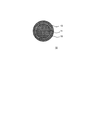
- FIG. 1 is a schematic view (cross-sectional view) showing the granules 10 according to the embodiment of the present invention.
- the granule 10 contains a nuclear material 11, a molten component layer 13 arranged on the surface of the nuclear material 11, and a drug substance-containing layer 15 arranged on the surface of the molten component layer 13.
- the nuclear material 11 is a carrier for arranging the melt component layer 13 and the drug substance-containing layer 15, and serves as a core for arranging the melt component layer 13 and the drug substance-containing layer 15 when producing the granules 10. It is a substance.
- An adsorbent is used as the nuclear material 11 in order to obtain adhesion to the molten component layer 13.
- Examples of the nuclear material 11 include amberlite IRP-64, ion exchange resin, kaolin, carmellose calcium, hydrous silicon dioxide, magnesium silicate, light anhydrous silicic acid, light liquid paraffin, silica soil, synthetic aluminum silicate, and oxidation.
- an adsorbent composed of aluminum, aluminum hydroxide, defatted cotton, magnesium carbonate, precipitated calcium carbonate, dextrin, silicon dioxide, composite aluminum potassium silicate granules, bentonite, polyethylene fiber, magnesium aluminometasilicate, medicated charcoal, etc. Can be done.
- the nuclear material 11 is preferably spherical in order to uniformly arrange the molten component layer 13 and the drug substance-containing layer 15. Further, from the viewpoint of adhering the API, the particle size of the nuclear material 11 needs to be larger than the particle size of the API.
- the particle size of the nuclear material 11 is, for example, twice or more the particle size of the drug substance, but is not limited thereto.
- the melt component layer 13 is a layer arranged between the nuclear material 11 and the drug substance-containing layer 15.
- the melt component layer 13 is a base layer for arranging the API-containing layer 15.
- the molten component and the drug substance are directly arranged on the nuclear material, but when the drug substance itself has weak adhesion to the nuclear material or the nuclear material has a low ability to support the drug substance, , It was inevitably necessary to add a large amount of molten components to the drug substance, and it was not possible to obtain granules containing the drug substance in a high content.
- the present invention by arranging the molten component layer 13 on the surface of the nuclear material 11 in the granule 10, more drug substance can be attached to the melt component layer 13, and the drug substance in the granule 10 can be attached.
- the content can be effectively increased.
- the melt component (first melt component) constituting the melt component layer 13 is selected from oil-based additives. Since the melt component layer 13 is formed by the melt granulation method, the first melt component is selected from additives that are solid at room temperature. Considering the temperature range generally used in the melt granulation method, the first melt component is preferably selected from the additives having a melting point of 100 ° C. or lower, and the drug substance is modified or the related substances are significantly increased. It is preferably selected from additives that have a melting point in the unrecognized temperature range. Examples of additives having such properties include, but are not limited to, glycerin monostearate, macrogol (polyethylene glycol), lauromacrogol, and stearic acid. In addition, the first molten component is preferably selected from additives that do not denature the drug substance or cause a significant increase in related substances due to contact with the drug substance.
- the melt component layer 13 may be arranged on the surface of the nuclear material 11 in an amount in which the drug substance-containing layer 15 can be arranged, and may be arranged on at least a part of the surface of the nuclear material 11.
- the molten component layer 13 preferably covers 90% or more of the surface of the nuclear material 11, and preferably covers the entire surface of the nuclear material 11.
- the thickness of the melt component layer 13 is not particularly limited, but it is preferable that the thickness of the melt component layer 13 is as thin as possible from the viewpoint of increasing the drug substance content per granule 10.
- it is preferable that the first molten component constituting the molten component layer 13 is also arranged in the pores on the surface of the nuclear material 11.
- the molten component constituting the molten component layer 13 may have a structure in which the molten component has entered from the surface of the nuclear material 11.
- the nuclear material 11 and the molten component layer 13 do not have to have a clear interface.
- the API-containing layer is a layer containing the API and a second molten component or polymer, and is arranged on the surface of the melt component layer 13.
- FIG. 1 shows granules 10 in which the API-containing layer 15 contains the API and a second molten component.
- FIG. 2 shows granules 20 in which the API-containing layer 25 contains the API and a polymer that is compatible with the first molten component.
- the drug substance is not particularly limited.
- a water-unstable API can be preferably used.
- the second molten component is an additive for binding the drug substances to each other and binding the drug substance to the surface of the molten component layer 13. Since the API-containing layer 15 is formed by the melt granulation method, the second melt component is selected from additives that are solid at room temperature. Considering the temperature range generally used in the melt granulation method, the second melt component is preferably selected from the additives having a melting point of 100 ° C. or lower, and the drug substance is modified or the related substances are significantly increased. It is preferably selected from additives that have a melting point in the unrecognized temperature range.
- the melt component layer 13 is formed when the API-containing layer 15 is formed by the melt granulation method.
- the API-containing layer 15 can be arranged on the surface of the molten component layer 13 without significantly affecting the surface structure or changing the surface structure of the molten component layer 13.
- the melt component layer 13 is formed when the API-containing layer 15 is formed by the melt granulation method. The surface is slightly melted, and the interface between the melt component layer 13 and the drug substance-containing layer 15 is fused, so that the adhesion of the drug substance-containing layer 15 to the melt component layer 13 can be improved.
- the additive used as the second melting component examples include stearic acid, glycerin monostearate, macrogol (polyethylene glycol), carnauba wax, hydrogenated oil, lauromacrogol, palmitic acid, cetyl alcohol and the like. However, it is not limited to these.
- the second molten component is preferably selected from additives that do not denature the drug substance or show a significant increase in related substances upon contact with the drug substance. From the viewpoint of adhering to the nuclear material 11, the particle size of the molten component needs to be smaller than the particle size of the nuclear material 11.
- the melt component (second melt component) contained in the API-containing layer 15 may be the same additive as the melt component (first melt component) contained in the melt component layer 13, and may be different. May be good.
- a polymer having compatibility with the first molten component can be used instead of the second molten component.
- the polymer is "compatible" with respect to the first molten component, it means that the first molten component and the polymer are not separated from each other. Alternatively, it indicates a state in which the polymer is dispersed in the first molten component, or a state in which the first molten component is dispersed in the polymer. In one embodiment, the state in which the molten component and the polymer are not separated is confirmed by an increase in the viscosity of the mixture (liquid or semi-solid having fluidity) when the molten component and the polymer are mixed and the molten component is melted. can do.
- the viscosity of the surface of the molten component layer 13 is further improved as compared with the case of using the second molten component, and the drug substance-containing layer 25 is adhered more stably.
- the polymer is an aminoalkyl methacrylate copolymer, an ammonioalkyl methacrylate copolymer, a methacrylic acid copolymer, and the like.
- Hypromellose acetate succinate or polyvinylpyrrolidone can be preferably combined.
- an aminoalkyl methacrylate copolymer, an ammonioalkyl methacrylate copolymer or polyvinylpyrrolidone can be combined as the polymer.
- an aminoalkyl methacrylate copolymer, an ammonioalkyl methacrylate copolymer, a methacrylic acid copolymer or a hypromellose acetate succinate ester can be preferably combined.
- the content of the first melt component in the granules 20 is preferably equal to or higher than the content of the polymer.
- the blending ratio of the first molten component and the polymer is preferably 20: 1 to 1: 1 and more preferably 4: 1 to 1: 1.
- the API-containing layer 15 and the API-containing layer 25 contain the API as the main component.
- the API-containing layer 25 preferably contains 50% by mass or more of the API with respect to the total mass of the API and the second molten component or polymer.
- a second molten component or polymer is provided on the surface of the melt component layer 13 to the extent that the drug substance-containing layer 15 or the drug substance-containing layer 25 can be formed. It is preferable to contain a small amount. Thereby, the content of the drug substance in the granules 10 and 20 can be effectively increased.
- FIG. 3 is a flow chart illustrating a method for producing granules containing nuclear particles according to an embodiment of the present invention.
- the nuclear material 11 and the first molten component 131 are mixed (S101), and the first molten component 131 is arranged on the surface of the nuclear material 11. Further, the first molten component 131 is melted by the melt granulation method to form the melt component layer 13 on the surface of the nuclear material 11 (S103). At this time, the nuclear material 11 and the first molten component 131 are heated to a temperature equal to or higher than the melting point of the first molten component 131. Considering the temperature range generally used in the melt granulation method, the heating temperature is 100 ° C. or lower.
- the first molten component 131 is arranged not only on the surface of the nuclear material 11 but also in the pores connected to the surface of the nuclear material 11, thereby imparting an anchor effect to the nuclear material 11 to the molten component layer 13. Therefore, it is preferable to improve the adhesion of the molten component layer 13 to the nuclear material 11.
- the nuclear material 11 on which the melt component layer 13 is arranged is mixed with the drug substance 151 and the second melt component 153 (S105), and the drug substance 151 and the second melt component 153 are arranged on the surface of the melt component layer 13. .. Further, the second molten component 153 is melted by a melt granulation method to form a drug substance-containing layer 15 on the surface of the melt component layer 13 (S107). At this time, the nuclear material 11 on which the melt component layer 13 is arranged, the drug substance 151, and the second melt component 153 are heated to a temperature equal to or higher than the melting point of the second melt component 153. Considering the temperature range generally used in the melt granulation method, the heating temperature is 100 ° C. or lower.
- the API-containing layer 15 when an additive having a melting point lower than the melting point of the first melt component 131 is selected as the second melt component 153, when the API-containing layer 15 is formed by the melt granulation method, the drug substance-containing layer 15 is formed.
- the surface structure of the melt component layer 13 is not significantly affected, or the melt component layer is used.
- the API-containing layer 15 can be formed on the surface of the melt component layer 13 without changing the surface structure of 13.
- the second melt component 15 is formed when the API containing layer 15 is formed by the melt granulation method.
- the surface of the melt component layer 13 is slightly melted, and the interface between the melt component layer 13 and the drug substance-containing layer 15 is fused with respect to the melt component layer 13.
- the adhesiveness of the API-containing layer 15 can be improved. It is preferable to perform melt granulation in a temperature range in which the drug substance 151 is not denatured or a significant increase in related substances is not observed.
- FIG. 4 is a flow chart illustrating a method for producing granules 20 containing nuclear particles according to an embodiment of the present invention. Since the manufacturing method is the same as the manufacturing method of the granules 10 described above until the molten component layer 13 is formed on the surface of the nuclear material 11 (S103), detailed description thereof will be omitted.
- the nuclear material 11 on which the melt component layer 13 is arranged is mixed with the drug substance 151 and the polymer 253 having compatibility with the first melt component (S205), and the drug substance 151 is formed on the surface of the melt component layer 13.
- the polymer 253 is placed.
- the first molten component 131 is melted by a melt granulation method to form a drug substance-containing layer 25 in which the drug substance 151 and the polymer 253 are dispersed in the first melt component 131 on the surface of the melt component layer 13. (S207).
- the nuclear material 11 on which the melt component layer 13 is arranged, the drug substance 151, and the polymer 253 are heated to a temperature equal to or higher than the melting point of the first melt component 131.
- the heating temperature is 100 ° C. or lower.
- the first molten component 131 located on the surface layer of the molten component layer 13 is melted, and the drug substance 151 and the polymer 253 are dispersed on the surface layer of the melt component layer 13, so that the drug substance-containing layer 25 is formed. It is formed.
- the polymer 253 since the polymer 253 is compatible with the first molten component, the API 151 and the polymer 253 do not separate from the first molten component 131 to form the API-containing layer 25. be able to.
- the viscosity of the surface of the molten component layer 13 is further improved as compared with the case of using the second molten component, and the source is more stable.
- the drug-containing layer 25 can be attached.
- a preparation using granules 10 or 20 can be produced.
- granules 10 or 20 may be mixed with one or more known pharmaceutically acceptable additives to form a pharmaceutical composition.
- the pharmaceutical composition may be tableted into tablets.
- the pharmaceutical composition to which the disintegrant is added may be tableted to obtain an orally disintegrating tablet.
- the pharmaceutical composition may be encapsulated to form a capsule.
- Example 1 Hydrous silicon dioxide (Fuji Silysia Chemical Ltd., Syropure (registered trademark) P100) was used as the nuclear material, and glycerin monostearate (RIKEN Vitamin Co., Ltd., Rikemar (registered trademark) S-100P) was used as the first melting component. .. 300 g of hydrous silicon dioxide and 480 g of glycerin monostearate were put into a high-speed stirring granulator (Fukae Kogyo Co., Ltd., High Speed Mixer, FS-GS-5J), and the agitator rotation speed was 300 rpm, the chopper rotation speed was 1,500 rpm, and the water temperature. Granulation was performed at 75.0 ° C to 79.0 ° C for 11 minutes. At this time, the temperature of the additive was 69.5 ° C to 73.0 ° C.
- FIG. 5 (a) A scanning electron microscope (SEM) image of the obtained granules is shown in FIG. 5 (a).
- SEM scanning electron microscope
- the particle size measurement was performed using a laser diffraction / scattering method measuring device (Beckman Coulter Co., Ltd., LS 13 320). The measured particle size is shown in Table 1.
- Example 2 melt granulation was carried out using a rolling granulator using the nuclear material in which the melt component layer of Example 1 was arranged on the surface. 97.5 g of the nuclear material having the melt component layer of Example 1 arranged on the surface, 186.1 g of sitagliptin phosphate as the drug substance, and stearic acid (Nichiyu Co., Ltd., Plant) as the second melt component. 5 g was put into a rolling granulator (Paurek Co., Ltd., MP-01), the rotor rotation speed was 200 rpm to 500 rpm, the air supply air volume was 0.40 L / min to 0.55 L / min, and the air supply temperature was 89.5 ° C. Granulation was carried out at ⁇ 90.9 ° C. for 105 minutes. At this time, the temperature of the additive was 55.4 ° C to 65.7 ° C.
- the SEM image of the obtained granules is shown in FIG. 5 (b).
- the particle size of the granules of Example 2 is shown in Table 1.
- the granules of Example 1 and Example 2 had a drug substance content of about 60%, and it was clarified that a high content can be achieved. Further, from the results of FIGS. 5 (a) and 5 (b), the granules of Examples 1 and 2 are round particles and use a nuclear material, so that the particle size of the granules is highly uniform. It became clear. With reference to FIG. 5A, it was confirmed that the granules of Example 1 had irregularities on the surface. The granules of Example 1 having irregularities on the surface are expected to improve water conductivity. Further, referring to FIG. 5B, since the surface of the granules of Example 2 is smooth, it is possible to consider applying a coating.
- Example 3 [Examination of the first molten component]
- the first molten component was changed to form a molten component layer on the surface of the nuclear material.
- the first molten component Macrogol 6000 (NOF Corporation, Macrogol 6000 (P)), Lauro Macrogol (Nippon Surfant Industry Co., Ltd.) or stearic acid (NOF Corporation, Plant) was used. The examination results are shown in Table 3.
- Example 2 [Examination of the second molten component]
- the second molten component was changed to form a drug substance-containing layer on the surface of the molten component layer.
- stearic acid NOF Corporation, plant
- Macrogol 6000 NOF Corporation, Macrogol 6000 (P)
- carnauba wax Nippon Wax Co., Ltd., Polyethylene Wax 105)
- aminoalkyl methacrylate copolymer E (Evonik, Eudragit (registered trademark) EPO), ammonioalkyl methacrylate copolymer RL (Evonik, Eudragit (registered trademark) RLPO), methacrylate copolymer L (Evonik, Eudragit (registered trademark)) L100-55), hypromellose acetate succinate (Shin-Etsu Chemical Co., Ltd., Shin-Etsu AQOAT® HPMC AS LF), or polyvinylpyrrolidone (BASF, K30) was used.
- Example 3 It was examined whether granules could be produced by using a polymer having compatibility with the first molten component instead of the second molten component.
- 500.0 g of hydrous silicon dioxide (Fuji Silysia Chemical Ltd., Syropure (registered trademark) P100) was used as the nuclear material, and 750.0 g of stearic acid (NOF CORPORATION, Plant) was used as the first melting component.
- Hydrous silicon dioxide and stearic acid were put into a high-speed stirring granulator (Fukae Kogyo Co., Ltd., High Speed Mixer, FS-GS-5J), and the agitator rotation speed was 300 rpm, the chopper rotation speed was 500 rpm, and the water temperature was 78.4 ° C to 82. Granulation was performed at 6 ° C. for 17 minutes.
- 160.0 g of the nuclear material on which the obtained molten component layer is arranged on the surface 496.4 g of sitagliptin phosphate as a drug substance, and aminoalkyl methacrylate copolymer E (evonic) as a polymer having good compatibility with the first molten component.
- 48.0 g of Eudragit EPO was put into a rolling fluidized bed granulator (Paurec Co., Ltd., MP-01), and granulated at a rotor rotation speed of 400 rpm and an air supply temperature of 85 ° C. for 25 minutes. At this time, the temperature of the additive was 62 ° C.
- FIG. 5 (c) A scanning electron microscope (SEM) image of the obtained granules is shown in FIG. 5 (c).
- SEM scanning electron microscope
- the granules of Example 3 had a drug substance content of about 60%, and it was clarified that a high content of the drug substance can be realized.
- Example 4 It was examined whether granules could be produced by changing the drug substance to sitagliptin phosphate and using fexofenadine hydrochloride. 120.0 g of a nuclear material having a molten component layer of Example 3 arranged on the surface, 240.0 g of fexofenadine hydrochloride as a drug substance, and aminoalkyl methacrylate copolymer E as a polymer having good compatibility with the first molten component.
- FIG. 5 (d) A scanning electron microscope (SEM) image of the obtained granules is shown in FIG. 5 (d).
- SEM scanning electron microscope
- Hydrous silicon dioxide and stearic acid were put into a high-speed stirring granulator (Fukae Kogyo Co., Ltd., High Speed Mixer, FS-GS-5J), and the agitator rotation speed was 300 rpm, the chopper rotation speed was 500 rpm, and the water temperature was 75.7 ° C to 78. Granulation was performed at 5.5 ° C. for 15 minutes. At this time, the temperature of the additive was 69.1 ° C to 71.9 ° C.
- FIG. 5 (e) A scanning electron microscope (SEM) image of the obtained granules is shown in FIG. 5 (e). Since the molten component layer is arranged on the surface of the nuclear material, the drug substance adheres slightly on the molten component layer, but since there is no second molten component, high drug content granules cannot be obtained.
- FIG. 5 (f) A scanning electron microscope (SEM) image of the obtained granules is shown in FIG. 5 (f). Due to the absence of the first molten component, the drug substance was not laminated on the nuclear material at all.
Landscapes
- Health & Medical Sciences (AREA)
- Bioinformatics & Cheminformatics (AREA)
- Engineering & Computer Science (AREA)
- Life Sciences & Earth Sciences (AREA)
- Public Health (AREA)
- Chemical & Material Sciences (AREA)
- Animal Behavior & Ethology (AREA)
- General Health & Medical Sciences (AREA)
- Pharmacology & Pharmacy (AREA)
- Veterinary Medicine (AREA)
- Medicinal Chemistry (AREA)
- Epidemiology (AREA)
- Biophysics (AREA)
- Molecular Biology (AREA)
- Medicinal Preparation (AREA)
- Pharmaceuticals Containing Other Organic And Inorganic Compounds (AREA)
- Glanulating (AREA)
- Acyclic And Carbocyclic Compounds In Medicinal Compositions (AREA)
Priority Applications (6)
| Application Number | Priority Date | Filing Date | Title |
|---|---|---|---|
| EP21769015.5A EP4119130A4 (en) | 2020-03-11 | 2021-03-09 | GRANULES AND THEIR USE |
| KR1020227026911A KR20220124747A (ko) | 2020-03-11 | 2021-03-09 | 과립 및 그것을 이용한 제제 |
| CN202180018225.8A CN115209877B (zh) | 2020-03-11 | 2021-03-09 | 颗粒和使用该颗粒的制剂 |
| JP2022507220A JP7467596B2 (ja) | 2020-03-11 | 2021-03-09 | 顆粒及びそれを用いた製剤 |
| US17/942,594 US20230000777A1 (en) | 2020-03-11 | 2022-09-12 | Granules and preparation using same |
| JP2024060090A JP7738697B2 (ja) | 2020-03-11 | 2024-04-03 | 顆粒及びそれを用いた製剤 |
Applications Claiming Priority (2)
| Application Number | Priority Date | Filing Date | Title |
|---|---|---|---|
| US202062988077P | 2020-03-11 | 2020-03-11 | |
| US62/988,077 | 2020-03-11 |
Related Child Applications (1)
| Application Number | Title | Priority Date | Filing Date |
|---|---|---|---|
| US17/942,594 Continuation US20230000777A1 (en) | 2020-03-11 | 2022-09-12 | Granules and preparation using same |
Publications (1)
| Publication Number | Publication Date |
|---|---|
| WO2021182469A1 true WO2021182469A1 (ja) | 2021-09-16 |
Family
ID=77670626
Family Applications (1)
| Application Number | Title | Priority Date | Filing Date |
|---|---|---|---|
| PCT/JP2021/009297 Ceased WO2021182469A1 (ja) | 2020-03-11 | 2021-03-09 | 顆粒及びそれを用いた製剤 |
Country Status (7)
| Country | Link |
|---|---|
| US (1) | US20230000777A1 (https=) |
| EP (1) | EP4119130A4 (https=) |
| JP (2) | JP7467596B2 (https=) |
| KR (1) | KR20220124747A (https=) |
| CN (1) | CN115209877B (https=) |
| TW (1) | TWI859428B (https=) |
| WO (1) | WO2021182469A1 (https=) |
Cited By (1)
| Publication number | Priority date | Publication date | Assignee | Title |
|---|---|---|---|---|
| JP2024115533A (ja) * | 2023-02-14 | 2024-08-26 | 沢井製薬株式会社 | コーティング顆粒、コーティング顆粒を含む製剤及びそれらの製造方法 |
Families Citing this family (1)
| Publication number | Priority date | Publication date | Assignee | Title |
|---|---|---|---|---|
| KR20220124747A (ko) * | 2020-03-11 | 2022-09-14 | 사와이세이야쿠 가부시키가이샤 | 과립 및 그것을 이용한 제제 |
Citations (8)
| Publication number | Priority date | Publication date | Assignee | Title |
|---|---|---|---|---|
| JPH04217913A (ja) * | 1990-04-12 | 1992-08-07 | Shionogi & Co Ltd | 被覆製剤およびその製造法 |
| JPH06256169A (ja) | 1993-02-18 | 1994-09-13 | Amano Pharmaceut Co Ltd | 顆粒の製造法 |
| JP2000084927A (ja) * | 1998-09-09 | 2000-03-28 | Pauretsuku:Kk | 加熱により溶融する物質を用いた粒子加工方法 |
| JP2004323409A (ja) * | 2003-04-24 | 2004-11-18 | Dalton Corp | 造粒物および造粒方法 |
| JP2005075826A (ja) * | 2003-08-29 | 2005-03-24 | Boehringer Ingelheim Internatl Gmbh | 多孔質シリカ担体を含有する徐放性製剤 |
| JP2015071542A (ja) | 2012-09-10 | 2015-04-16 | エーザイ・アール・アンド・ディー・マネジメント株式会社 | 固体分散体の製造方法 |
| JP2015199721A (ja) | 2014-03-31 | 2015-11-12 | 富山化学工業株式会社 | セファロスポリンエステルを含む粒状固形製剤およびその製造方法 |
| JP2017001999A (ja) | 2015-06-12 | 2017-01-05 | 富士フイルム株式会社 | 薬物含有粒子の製造方法、薬物含有粒子、医薬組成物、及び口腔内崩壊錠 |
Family Cites Families (10)
| Publication number | Priority date | Publication date | Assignee | Title |
|---|---|---|---|---|
| US5290569A (en) * | 1990-04-12 | 1994-03-01 | Shionogi & Co., Ltd. | Coated composition and its preparation process |
| JP3981134B2 (ja) * | 2003-10-29 | 2007-09-26 | 塩野義製薬株式会社 | 不快味を改善した被覆製剤の製造方法 |
| AU2007261098A1 (en) * | 2006-06-19 | 2007-12-27 | Mcneil-Ppc, Inc. | Enteric coated particles containing an active ingredient |
| JP2012087073A (ja) * | 2010-10-15 | 2012-05-10 | Pharma Polytech:Kk | コーティング粒子の製造方法、及び該製造方法で製造されたコーティング粒子 |
| FR2999937B1 (fr) * | 2012-12-21 | 2015-01-09 | Sanofi Sa | Unite solide a haute teneur en fexofenadine et son procede de preparation |
| KR101553348B1 (ko) | 2013-12-18 | 2015-09-15 | 김예주 | 주먹밥 포장 시트와 이를 이용한 스틱 주먹밥의 제조 방법 |
| WO2015152190A1 (ja) * | 2014-03-31 | 2015-10-08 | 富山化学工業株式会社 | セファロスポリンエステルを含む粒状固形製剤およびその製造方法 |
| KR20170001999A (ko) | 2015-06-29 | 2017-01-06 | 주식회사 엘지유플러스 | 셋탑 단말, 셋탑 단말을 위한 어플리케이션, 및 서버의 동작 방법 |
| US11135340B2 (en) * | 2016-02-08 | 2021-10-05 | The Johns Hopkins University | Compositions and methods for preparation of composite polymer coatings on medical implants, and their use for co-delivery of multiple antimicrobial agents |
| KR20220124747A (ko) | 2020-03-11 | 2022-09-14 | 사와이세이야쿠 가부시키가이샤 | 과립 및 그것을 이용한 제제 |
-
2021
- 2021-03-09 KR KR1020227026911A patent/KR20220124747A/ko not_active Ceased
- 2021-03-09 WO PCT/JP2021/009297 patent/WO2021182469A1/ja not_active Ceased
- 2021-03-09 JP JP2022507220A patent/JP7467596B2/ja active Active
- 2021-03-09 CN CN202180018225.8A patent/CN115209877B/zh active Active
- 2021-03-09 EP EP21769015.5A patent/EP4119130A4/en active Pending
- 2021-03-10 TW TW110108514A patent/TWI859428B/zh active
-
2022
- 2022-09-12 US US17/942,594 patent/US20230000777A1/en active Pending
-
2024
- 2024-04-03 JP JP2024060090A patent/JP7738697B2/ja active Active
Patent Citations (8)
| Publication number | Priority date | Publication date | Assignee | Title |
|---|---|---|---|---|
| JPH04217913A (ja) * | 1990-04-12 | 1992-08-07 | Shionogi & Co Ltd | 被覆製剤およびその製造法 |
| JPH06256169A (ja) | 1993-02-18 | 1994-09-13 | Amano Pharmaceut Co Ltd | 顆粒の製造法 |
| JP2000084927A (ja) * | 1998-09-09 | 2000-03-28 | Pauretsuku:Kk | 加熱により溶融する物質を用いた粒子加工方法 |
| JP2004323409A (ja) * | 2003-04-24 | 2004-11-18 | Dalton Corp | 造粒物および造粒方法 |
| JP2005075826A (ja) * | 2003-08-29 | 2005-03-24 | Boehringer Ingelheim Internatl Gmbh | 多孔質シリカ担体を含有する徐放性製剤 |
| JP2015071542A (ja) | 2012-09-10 | 2015-04-16 | エーザイ・アール・アンド・ディー・マネジメント株式会社 | 固体分散体の製造方法 |
| JP2015199721A (ja) | 2014-03-31 | 2015-11-12 | 富山化学工業株式会社 | セファロスポリンエステルを含む粒状固形製剤およびその製造方法 |
| JP2017001999A (ja) | 2015-06-12 | 2017-01-05 | 富士フイルム株式会社 | 薬物含有粒子の製造方法、薬物含有粒子、医薬組成物、及び口腔内崩壊錠 |
Non-Patent Citations (2)
| Title |
|---|
| CHEM. PHARM. BULL., vol. 65, 2017, pages 726 - 731 |
| See also references of EP4119130A4 |
Cited By (2)
| Publication number | Priority date | Publication date | Assignee | Title |
|---|---|---|---|---|
| JP2024115533A (ja) * | 2023-02-14 | 2024-08-26 | 沢井製薬株式会社 | コーティング顆粒、コーティング顆粒を含む製剤及びそれらの製造方法 |
| JP7817300B2 (ja) | 2023-02-14 | 2026-02-18 | 沢井製薬株式会社 | コーティング顆粒、コーティング顆粒を含む製剤及びそれらの製造方法 |
Also Published As
| Publication number | Publication date |
|---|---|
| JP2024081778A (ja) | 2024-06-18 |
| JP7467596B2 (ja) | 2024-04-15 |
| US20230000777A1 (en) | 2023-01-05 |
| EP4119130A4 (en) | 2024-01-31 |
| TW202200117A (zh) | 2022-01-01 |
| JP7738697B2 (ja) | 2025-09-12 |
| EP4119130A1 (en) | 2023-01-18 |
| KR20220124747A (ko) | 2022-09-14 |
| JPWO2021182469A1 (https=) | 2021-09-16 |
| CN115209877B (zh) | 2025-02-11 |
| TWI859428B (zh) | 2024-10-21 |
| CN115209877A (zh) | 2022-10-18 |
Similar Documents
| Publication | Publication Date | Title |
|---|---|---|
| JP7738697B2 (ja) | 顆粒及びそれを用いた製剤 | |
| BG106165A (bg) | Лекарствена форма, съдържаща киселинно неустойчиво активно съединение, и метод за получаването и | |
| CN1148171C (zh) | 多单元缓释片剂 | |
| RU2219907C2 (ru) | Пористые частицы гидроксиапатита в качестве носителей для лекарственных веществ | |
| CN102933204A (zh) | 涂覆粒子及涂覆粒子的制造方法 | |
| US10426734B2 (en) | Taste masking drug formulations | |
| ES2266018T3 (es) | Composicion farmaceutica de liberacion controlada, que contiene hidrocloruro de tramadol. | |
| JPWO2021182469A5 (https=) | ||
| JP2024063111A (ja) | 顆粒及びそれを用いた製剤 | |
| HK40081736A (en) | Granules and preparation using same | |
| CN106619646B (zh) | 一种替吉奥组合物的制备方法 | |
| US20230083072A1 (en) | Film-coated granule, pharmaceutical preparation containing the same, and manufacturing methods thereof | |
| KR20260059682A (ko) | 과립 및 그것을 이용한 제제 | |
| JP2006516607A (ja) | コーティングした薬物粒子用の懸濁液ビヒクル | |
| JPWO2021182467A5 (https=) | ||
| HK40082230A (en) | Granules and preparation using same | |
| JP2023041012A (ja) | フィルムコーティング顆粒、それを含む製剤、及びそれらの製造方法 | |
| CN115212173B (zh) | 一种盐酸氨溴索球形缓释微粒、制备方法及用途 | |
| CN106420759B (zh) | 一种替吉奥组合物的制备方法 | |
| Singh et al. | Chitosan-grafted Microspherical Loaded In-situ Gels for Enhanced Transdermal Delivery of Roxithromycin: In-vitro/Ex-vivo Assessment | |
| CN106581001B (zh) | 一种替吉奥组合物的制备方法 | |
| KR20260059683A (ko) | 과립 및 그것을 이용한 제제 | |
| WO2025075087A1 (ja) | 顆粒、顆粒を含む医薬品製剤、及び、顆粒を含む食品 | |
| MX2007005985A (es) | Proceso de fabricacion de nucleos recubiertos por termo-adhesion. |
Legal Events
| Date | Code | Title | Description |
|---|---|---|---|
| 121 | Ep: the epo has been informed by wipo that ep was designated in this application |
Ref document number: 21769015 Country of ref document: EP Kind code of ref document: A1 |
|
| ENP | Entry into the national phase |
Ref document number: 20227026911 Country of ref document: KR Kind code of ref document: A |
|
| ENP | Entry into the national phase |
Ref document number: 2022507220 Country of ref document: JP Kind code of ref document: A |
|
| NENP | Non-entry into the national phase |
Ref country code: DE |
|
| ENP | Entry into the national phase |
Ref document number: 2021769015 Country of ref document: EP Effective date: 20221011 |
|
| WWG | Wipo information: grant in national office |
Ref document number: 202180018225.8 Country of ref document: CN |
|
| WWR | Wipo information: refused in national office |
Ref document number: 1020227026911 Country of ref document: KR |
|
| WWR | Wipo information: refused in national office |
Ref document number: 1020227026911 Country of ref document: KR |