WO2021177135A1 - 自動倉庫システム、及び、自動倉庫システムの制御方法 - Google Patents
自動倉庫システム、及び、自動倉庫システムの制御方法 Download PDFInfo
- Publication number
- WO2021177135A1 WO2021177135A1 PCT/JP2021/007101 JP2021007101W WO2021177135A1 WO 2021177135 A1 WO2021177135 A1 WO 2021177135A1 JP 2021007101 W JP2021007101 W JP 2021007101W WO 2021177135 A1 WO2021177135 A1 WO 2021177135A1
- Authority
- WO
- WIPO (PCT)
- Prior art keywords
- traveling
- automated warehouse
- area
- automated
- automatic guided
- Prior art date
- Legal status (The legal status is an assumption and is not a legal conclusion. Google has not performed a legal analysis and makes no representation as to the accuracy of the status listed.)
- Ceased
Links
Images




Classifications
-
- B—PERFORMING OPERATIONS; TRANSPORTING
- B65—CONVEYING; PACKING; STORING; HANDLING THIN OR FILAMENTARY MATERIAL
- B65G—TRANSPORT OR STORAGE DEVICES, e.g. CONVEYORS FOR LOADING OR TIPPING, SHOP CONVEYOR SYSTEMS OR PNEUMATIC TUBE CONVEYORS
- B65G1/00—Storing articles, individually or in orderly arrangement, in warehouses or magazines
- B65G1/02—Storage devices
- B65G1/04—Storage devices mechanical
- B65G1/0492—Storage devices mechanical with cars adapted to travel in storage aisles
-
- B—PERFORMING OPERATIONS; TRANSPORTING
- B65—CONVEYING; PACKING; STORING; HANDLING THIN OR FILAMENTARY MATERIAL
- B65G—TRANSPORT OR STORAGE DEVICES, e.g. CONVEYORS FOR LOADING OR TIPPING, SHOP CONVEYOR SYSTEMS OR PNEUMATIC TUBE CONVEYORS
- B65G1/00—Storing articles, individually or in orderly arrangement, in warehouses or magazines
- B65G1/02—Storage devices
- B65G1/04—Storage devices mechanical
- B65G1/137—Storage devices mechanical with arrangements or automatic control means for selecting which articles are to be removed
- B65G1/1373—Storage devices mechanical with arrangements or automatic control means for selecting which articles are to be removed for fulfilling orders in warehouses
- B65G1/1378—Storage devices mechanical with arrangements or automatic control means for selecting which articles are to be removed for fulfilling orders in warehouses the orders being assembled on fixed commissioning areas remote from the storage areas
-
- G—PHYSICS
- G05—CONTROLLING; REGULATING
- G05D—SYSTEMS FOR CONTROLLING OR REGULATING NON-ELECTRIC VARIABLES
- G05D1/00—Control of position, course, altitude or attitude of land, water, air or space vehicles, e.g. using automatic pilots
- G05D1/02—Control of position or course in two dimensions
- G05D1/021—Control of position or course in two dimensions specially adapted to land vehicles
- G05D1/0287—Control of position or course in two dimensions specially adapted to land vehicles involving a plurality of land vehicles, e.g. fleet or convoy travelling
- G05D1/0291—Fleet control
-
- G—PHYSICS
- G05—CONTROLLING; REGULATING
- G05D—SYSTEMS FOR CONTROLLING OR REGULATING NON-ELECTRIC VARIABLES
- G05D1/00—Control of position, course, altitude or attitude of land, water, air or space vehicles, e.g. using automatic pilots
- G05D1/02—Control of position or course in two dimensions
- G05D1/021—Control of position or course in two dimensions specially adapted to land vehicles
- G05D1/0287—Control of position or course in two dimensions specially adapted to land vehicles involving a plurality of land vehicles, e.g. fleet or convoy travelling
- G05D1/0291—Fleet control
- G05D1/0297—Fleet control by controlling means in a control room
-
- G—PHYSICS
- G05—CONTROLLING; REGULATING
- G05D—SYSTEMS FOR CONTROLLING OR REGULATING NON-ELECTRIC VARIABLES
- G05D1/00—Control of position, course, altitude or attitude of land, water, air or space vehicles, e.g. using automatic pilots
- G05D1/60—Intended control result
- G05D1/69—Coordinated control of the position or course of two or more vehicles
-
- G—PHYSICS
- G06—COMPUTING OR CALCULATING; COUNTING
- G06Q—INFORMATION AND COMMUNICATION TECHNOLOGY [ICT] SPECIALLY ADAPTED FOR ADMINISTRATIVE, COMMERCIAL, FINANCIAL, MANAGERIAL OR SUPERVISORY PURPOSES; SYSTEMS OR METHODS SPECIALLY ADAPTED FOR ADMINISTRATIVE, COMMERCIAL, FINANCIAL, MANAGERIAL OR SUPERVISORY PURPOSES, NOT OTHERWISE PROVIDED FOR
- G06Q10/00—Administration; Management
- G06Q10/08—Logistics, e.g. warehousing, loading or distribution; Inventory or stock management
-
- G—PHYSICS
- G06—COMPUTING OR CALCULATING; COUNTING
- G06Q—INFORMATION AND COMMUNICATION TECHNOLOGY [ICT] SPECIALLY ADAPTED FOR ADMINISTRATIVE, COMMERCIAL, FINANCIAL, MANAGERIAL OR SUPERVISORY PURPOSES; SYSTEMS OR METHODS SPECIALLY ADAPTED FOR ADMINISTRATIVE, COMMERCIAL, FINANCIAL, MANAGERIAL OR SUPERVISORY PURPOSES, NOT OTHERWISE PROVIDED FOR
- G06Q10/00—Administration; Management
- G06Q10/08—Logistics, e.g. warehousing, loading or distribution; Inventory or stock management
- G06Q10/087—Inventory or stock management, e.g. order filling, procurement or balancing against orders
Definitions
- the present invention relates to an automated warehouse system including an automated warehouse, a station, and a plurality of automatic guided vehicles traveling between the automated warehouse and the station, and a control method of the automated warehouse system.
- an automated warehouse system including an automated warehouse, a station, and an automatic guided vehicle that transports cargo between the automated warehouse and the station is known (see, for example, Patent Document 1). Further, in the above-mentioned automated warehouse system, a large number of automated warehouses and stations are provided, and a large number of automatic guided vehicles are being used to transport cargo between the automated warehouses and the stations.
- the operating status of the automated warehouse and / or the station may change.
- the area where the automatic guided vehicle travels is predetermined and fixed. Therefore, if a transport command exceeding the load transport capacity of an automatic guided vehicle in a certain area is issued in that area, the load transport command requested in that area remains unprocessed. On the contrary, when the number of cargo transport commands in a certain area is small, the number of automatic guided vehicles that are not in operation increases, and the cargo transport capacity of the automated warehouse system cannot be utilized.
- the route is not the shortest.
- the efficiency of transporting luggage between the automated warehouse and the station is reduced because it is necessary to move between the automated warehouse and the station, and it is necessary to wait for the passage of other automatic guided vehicles.
- the automated warehouse system cannot be operated with high efficiency.
- An object of the present invention is an automated warehouse and / or station for the operating status of an automated guided vehicle in an automated warehouse system including an automated warehouse, a station, and an automated guided vehicle that transports luggage between the automated guided vehicle and the station.
- the purpose is to reduce the impact of the operating status of.
- the seemingly automatic warehouse system of the present invention includes a plurality of automated warehouses, a plurality of work stations, a traveling route, a plurality of automatic guided vehicles, and a controller.
- the travel route is provided so as to be accessible to a plurality of automated warehouses and a plurality of work stations.
- the automatic guided vehicle travels on the traveling route.
- the controller determines the area including at least a part of the travel route as the travel area on which the automatic guided vehicle travels, and sets the automated guided vehicle so as to transport the cargo between the automated warehouse and the work station belonging to the travel area. Control.
- the controller determines the size of the traveling area in which the automatic guided vehicle travels based on the operating status of at least one of the automated warehouse or the work station.
- the size of the traveling area is determined based on the operating status of at least one of the automated warehouse or the work station.
- the influence on the operating status of the automated guided vehicle can be reduced depending on the operating status of the automated warehouse and / or the work station of the automated warehouse system.
- the area defined by the controller may have a plurality of reference areas.
- the controller resizes the travel area by consolidating or segmenting adjacent reference areas based on at least one operating status of the automated warehouse or work station. You may. As a result, the size of the traveling area can be changed by a simple process.
- the controller may determine the size of the travel areas so that at least one operating status of the automated warehouse or work station belonging to each travel area is close to each other. By making the operating status of the automated warehouse and / or the work station close to each other in all the traveling areas, the operating status of the automatic guided vehicle can be made uniform in all the traveling areas.
- the controller determines the ratio of the number of automated warehouses to the number of work stations that transport loads to and from automated guided vehicles belonging to the travel area in the larger travel area before and after changing the size of the travel area. It may be set to be large. As a result, when a large traveling area is set due to the low operating rate of the automated warehouse and / or the work station, the number of working stations in the operating state can be reduced according to the low operating rate.
- the traveling area may include an adjacent first traveling area and a second traveling area.
- the controller sets the work station on the second travel area side of the work stations belonging to the first travel area and the work station on the first travel area side of the work stations belonging to the second travel area, respectively.
- the first work station and the second work station may be determined, and the automatic guided vehicle may be controlled to carry the load between the first work station and the second work station and the automated warehouse.
- the work stations belonging to the two traveling areas can be operated by the same worker.
- the number of workers assigned to the automated warehouse system can be reduced.
- Each automated warehouse may have a transport device for transporting luggage in the automated warehouse.
- the controller may reduce the traveling area when the operating rate of the transport device in the plurality of automated warehouses is high, and increase the traveling area when the operating rate of the transport device in the plurality of automated warehouses is low. As a result, the influence of the operating status of the automated warehouse can be reduced, and the efficiency of loading and unloading in the automated warehouse system can be improved.
- the controller may reduce the traveling area when the operating rate of the plurality of automatic guided vehicles is high, and may increase the traveling area when the operating rate of the plurality of automatic guided vehicles is low. As a result, the efficiency of transporting luggage by the automatic guided vehicle can be improved, and the efficiency of loading and unloading in the automated warehouse system can be improved.
- the automated warehouse system includes a plurality of automated warehouses, a plurality of work stations, a travel route provided so as to be accessible to the plurality of automated warehouses and the plurality of work stations, and a plurality of automatic guided vehicles traveling on the travel route. ..
- the control method of the automated warehouse system includes the following steps. ⁇ A step to determine the area including at least a part of the travel route as the travel area on which the automatic guided vehicle travels. ⁇ A step to control an automatic guided vehicle so that cargo is transported between the automated warehouse belonging to the traveling area and the work station.
- the size of the traveling area is determined based on the operating status of at least one of the automated warehouse or the work station.
- the size of the traveling area is determined based on the operating status of at least one of the automated warehouse or the work station. As a result, the influence on the operating status of the automated guided vehicle can be reduced depending on the operating status of the automated warehouse and / or the work station of the automated warehouse system.
- the automated warehouse system can be operated with the same high efficiency even if the operating status of the automated warehouse and / or the station changes.
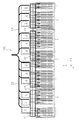
- FIG. 1 is a schematic plan view of the entire automated warehouse system 100 according to the first embodiment.
- FIG. 2 is an enlarged plan view of a part of the automated warehouse system 100.
- the automated warehouse system 100 is a system including a plurality of automated warehouses 1, a plurality of work stations 3, and a plurality of automatic guided vehicles 5.
- the automated warehouse system 100 is arranged in, for example, various factories, distribution bases, and the like.
- the storage of the luggage from the work station 3 to the automatic warehouse 1 and the delivery of the luggage from the automatic warehouse 1 to the work station 3 are performed.
- the cargo is transported between the work station 3 and the automated warehouse 1.
- the transportation of the luggage is carried out by a plurality of automatic guided vehicles 5.
- the X direction (direction of arrow X) is the arrangement direction of the plurality of automatic warehouses 1
- the Y direction direction perpendicular to the X direction in the horizontal plane.
- the Z direction (arrow Z) is the vertical direction.
- the automated warehouse 1 automatically stores the cargo transported by the automatic guided vehicle 5 and automatically carries out the stored cargo.
- the automated warehouse 1 has a rack 11, a stacker crane 13, a warehousing conveyor 15, and a warehousing conveyor 17.
- the racks 11 are arranged in pairs so that the Y direction is the longitudinal direction and the racks 11 face each other with a gap in the X direction.
- the rack 11 has a plurality of loading portions for loading and storing the luggage in the X direction and the Z direction. As a result, the rack 11 can store the cargo in a matrix in the X direction and the Z direction.
- the stacker crane 13 (an example of a transport device) transports cargo in the automated warehouse 1.
- the stacker crane 13 includes a traveling carriage that can travel along the traveling rail 13A, and an elevator that can move up and down along the mast on the traveling carriage and is provided with a transfer device.
- the traveling rail 13A extends along the Y direction between two racks 11 facing each other in the X direction in the automated warehouse 1.
- the stacker crane 13 can convey the load between the loading portion of the rack 11 and the warehousing conveyor 15 and the unloading conveyor 17, which will be described later. Further, the stacker crane 13 can transfer the load to the loading section of the rack 11, the warehousing conveyor 15, and the unloading conveyor 17 by using the transfer device provided on the lift.
- the stacker crane 13 is not particularly limited, and various known stacker cranes can be used.
- a transfer device provided on the elevator platform for transferring luggage for example, a rear hook type that hooks a hook at the rear end of the luggage to take in, a clamp type that holds and transfers both sides of the luggage, and a slide fork.
- a device such as a fork type that scoops up the luggage and transfers it, or a front hook type that hooks a hook on the front end of the luggage and takes it in can be used.
- the warehousing conveyor 15 is a device that conveys the cargo conveyed by the automatic guided vehicle 5 to the vicinity of the rack 11.
- the warehousing conveyor 15 has a main conveyor 15A and a sub-conveyor 15B.
- the main conveyor 15A carries the load conveyed by the sub-conveyor 15B and conveys the load toward the vicinity of the rack 11.
- the load transported in the vicinity of the rack 11 is transported by the stacker crane 13, and is placed in a predetermined loading section and stored.
- the type or configuration of the main conveyor 15A is not particularly limited.
- As the main conveyor 15A various conveyors such as a belt conveyor, a chain conveyor, and a roller conveyor can be used.
- the sub-conveyor 15B is arranged at the Y-direction end of the main conveyor 15A, and conveys the load transferred from the automatic guided vehicle 5 to the main conveyor 15A.
- the automatic guided vehicle 5 sneaks into the lower part of the sub-conveyor 15B, and the conveyor body of the sub-conveyor 15B scoops the luggage from the automatic guided vehicle 5, so that the luggage is between the automatic guided vehicle 5 and the main conveyor 15A. Will be reprinted.
- the sub-conveyor 15B moves up and down to scoop up the load placed on the automatic guided vehicle 5, or the lifter provided on the automatic guided vehicle 5 on which the load is placed descends from the lifter to the sub-conveyor 15B. You can transfer your luggage to.
- the warehousing conveyor 17 is a device that transports the cargo transported for warehousing by the stacker crane 13 to the arrival position of the automatic guided vehicle 5.
- the delivery conveyor 17 has a main conveyor 17A and a sub-conveyor 17B.
- the load carried by the stacker crane 13 is transferred and placed on the main conveyor 17A.
- the main conveyor 17A conveys the loaded load toward the sub-conveyor 17B.
- various conveyors such as a belt conveyor, a chain conveyor, and a roller conveyor can be used.
- the sub-conveyor 17B is arranged at the Y-direction end of the main conveyor 17A, and the load conveyed by the main conveyor 17A is transferred to the automatic guided vehicle 5.
- the automatic guided vehicle 5 slips into the lower part of the sub-conveyor 17B, and the sub-conveyor 17B lowers the conveyor body on which the cargo is placed toward the automatic guided vehicle 5, thereby causing the automatic guided vehicle from the sub-conveyor 17B.
- the luggage will be transferred to 5.
- the plurality of work stations 3 are arranged with respect to the plurality of automated warehouses 1 at predetermined intervals in the Y direction, and are arranged side by side in the X direction.
- the work station 3 is a station for picking luggage to be received or delivered.
- a worker or a picking robot that performs a cargo picking operation is arranged at the work station 3.
- a space is provided in the vicinity of the work station 3 for an automatic guided vehicle 5 waiting to be carried into the work station 3.
- a conveyor 33 is provided on the side of each work station 3.
- the conveyor 33 joins at a position separated from the work station 3 in the Y direction.
- the conveyor 33 conveys the load picked at the work station 3 to the outside.
- a method of transporting the load picked at the work station 3 by the conveyor 33 for example, there is a method of picking the load at each destination at the work station 3 and transporting it to the outside by the conveyor 33.
- the plurality of automatic guided vehicles 5 are trolleys for transporting luggage and can travel unmanned.
- the automatic guided vehicle 5 travels on a predetermined travel route R.
- the automatic guided vehicle 5 transports the luggage by placing the luggage on the luggage storage portion provided on the upper portion of the automatic guided vehicle 5 and moving the luggage.
- the traveling route R is formed in a grid pattern by a plurality of routes extending in the X direction and a plurality of routes extending between the automated warehouse 1 and the work station 3 in the Y direction. ing. Further, the traveling path R extends through the sub-conveyors 15B and 17B. In the traveling route R, at the intersection of the route extending in the X direction and the route extending in the Y direction, a tag or the like displaying an identification code such as a QR code (registered trademark) is arranged.
- QR code registered trademark
- the automatic guided vehicle 5 moves between the automated warehouse 1 and the work station 3 while detecting the above identification code.
- the automatic guided vehicle 5 determines from the detected identification code whether or not the moving direction should be changed at the intersection where the identification code is arranged.
- the travel command of the automatic guided vehicle 5 is associated with, for example, the identification code arranged on the travel path R and information indicating in which direction the vehicle should move from the intersection where the identification code is arranged. .. Further, the determination as to whether or not the moving direction should be changed at the intersection may be executed by the automatic guided vehicle 5, and whether or not the moving direction is changed to the controller 50 described later each time the automatic guided vehicle 5 reaches the intersection. You may inquire.
- the automatic guided vehicle 5 If it is determined that the moving direction is changed at the intersection, the automatic guided vehicle 5 turns at the intersection and starts going straight after changing the moving direction. On the other hand, if it is determined that the moving direction is not changed at the intersection, the vehicle goes straight. In this way, the automatic guided vehicle 5 can move between the automated guided vehicle 1 and the work station 3 in a grid-like traveling path R while going straight and turning as necessary.
- the automatic guided vehicle 5 that transports the warehousing load from the work station 3 enters the sub-conveyor 15B of the warehousing conveyor 15 from the front by moving along the traveling path R in the sub-conveyor 15B. After that, the cargo to be stored is scooped up by the sub-conveyor 15B.
- the automatic guided vehicle 5 from which the luggage has been scooped enters from the sub-conveyor 15B of the warehousing conveyor 15 to the sub-conveyor 17B of the warehousing conveyor 17 from the front or the side along the traveling path R. After that, the cargo to be delivered by the sub-conveyor 17B is placed on the automatic guided vehicle 5.
- the automatic guided vehicle 5 on which the cargo is placed exits from the front of the sub-conveyor 17B and transports the cargo toward the work station 3.
- the transportation of the cargo by the automatic guided vehicle 5 can be efficiently executed.
- Each of the plurality of automatic guided vehicles 5 can move only on the traveling route within a predetermined area (referred to as traveling areas A1 and A2 (FIGS. 5 and 6)) in the entire traveling route R.
- traveling areas A1 and A2 referred to as traveling areas A1 and A2 (FIGS. 5 and 6)
- the determination of the traveling areas A1 and A2 will be described in detail later.
- the automatic guided vehicle 5 is an AGV (Automatic Guided Vehicle) that travels by rotating wheels by a traveling motor 5B (FIG. 3).
- the automatic guided vehicle 5 may be, for example, a ceiling traveling vehicle or a tracked carriage.
- the traveling route R is, for example, a method in which the traveling route R is composed of magnetic tape (magnetic induction type) and a method in which the traveling route R is composed of rails (with track). Equation), etc. may be configured by other methods.
- FIG. 3 is a block diagram showing a control configuration of the automated warehouse system 100.
- the automated warehouse system 100 has a controller 50 as a control configuration of the automated warehouse system 100.
- the controller 50 is a computer having a processor (for example, a CPU), a storage device (for example, ROM, RAM, HDD, SSD, etc.) and various interfaces (for example, an A / D converter, a D / A converter, a communication interface, etc.). It is a system.
- the controller 50 performs various control operations in the automated warehouse system 100 by executing a program stored in the storage unit (corresponding to a part or all of the storage area of the storage device).
- the controller 50 may be composed of a single processor, or may be composed of a plurality of independent processors for each control. Some or all of the functions of the controller 50 may be realized as a program that can be executed by the computer system constituting the controller 50. In addition, a part of the function of each element of the control unit may be configured by a custom IC.
- the controller 50 can wirelessly communicate with the travel control unit 5A of each automatic guided vehicle 5, and transmits a travel command of each automatic guided vehicle 5 to the travel control unit 5A.
- the travel control unit 5A controls the travel motor 5B of the automatic guided vehicle 5 based on the travel command to control the movement of the automatic guided vehicle 5.
- the travel control unit 5A includes a processor (for example, a CPU), a storage device (for example, ROM, RAM, HDD, SSD, etc.), and various interfaces (for example, an A / D converter, a D / A converter, a communication interface, etc.). It is a computer system that has.
- the controller 50 can communicate with each warehousing conveyor 15 (main conveyor 15A, sub-conveyor 15B) and each warehousing conveyor 17 (main conveyor 17A, sub-conveyor 17B) wirelessly or by wire. Controls the transportation of the load by the conveyor 17.
- controller 50 can communicate with the stacker crane 13 wirelessly or by wire, and controls the loading and unloading of the luggage into the rack 11 by the stacker crane 13 and the unloading of the luggage from the rack 11.
- FIG. 4 is a flowchart showing the operation of the automated warehouse system 100.
- the process shown in the flowchart of FIG. 4 is executed by the controller 50. All of the processes shown in the flowchart of FIG. 4 may be executed by the program stored in the storage device of the controller 50, or a part of the processes is executed by the program and the remaining part is the hardware constituting the controller 50. Therefore, it may be executed.
- a part of the processing (and related processing) shown in the flowchart of FIG. 4 may be executed by the controller 50, and the remaining part may be executed by another controller.
- the traveling areas A1 and A2 of the automatic guided vehicle 5 are determined.
- the traveling areas A1 and A2 include at least a part of the traveling route R, and define a range in which the automatic guided vehicle 5 belonging to the traveling areas A1 and A2 can move.
- any one of the plurality of automated warehouses 1 and one of the plurality of work stations 3 belong to the determined traveling areas A1 and A2. That is, in the present embodiment, all the automated warehouses 1 belong to any of the traveling areas A1 and A2, and there is no automated warehouse 1 that does not belong to any of the traveling areas A1 and A2.
- the traveling areas A1 and A2 are defined as follows.
- the controller 50 determines the operating status of the automated warehouse system 100 when determining the traveling areas A1 and A2.
- the operating status of the automated warehouse system 100 is the operating rate of the stacker crane 13 in the automated warehouse 1.
- the operating rate of the stacker crane 13 can be determined, for example, based on schedule data for recording information regarding the loading and unloading of luggage. For example, when a large number of information regarding warehousing / delivery is recorded in the schedule data within a predetermined time range, it is determined that the operating rate of the stacker crane 13 in the automated warehouse 1 is high. On the other hand, if a small number of information regarding warehousing / delivery is recorded within the above-mentioned predetermined time range, it is determined that the operating rate of the stacker crane 13 is low.
- the operating status of the automated warehouse system 100 is not limited to the operating rate of the stacker crane 13 in the automated warehouse 1, and may be, for example, the operating rate of the automatic guided vehicle 5 in the traveling areas A1 and A2.
- the criteria for determining whether the operating rate of the stacker crane 13 or the automatic guided vehicle 5 in the automated warehouse system 100 is high or low is determined by the automated warehouse system 100. It can be appropriately determined according to the scale of the stacker crane 13 or the transport capacity of the automatic guided vehicle 5.
- FIG. 5 is a diagram showing an example of a case where a small traveling area A1 is defined in the automated warehouse system 100. In this case, workers are assigned to all of the plurality of work stations 3.
- the operating rate is high as a whole means that most of the stacker cranes 13 or automatic guided vehicles 5 perform operations for transporting cargo relatively frequently, and perform the operations at all.
- the stacker crane 13 or the automatic guided vehicle 5 which is not used or the frequency of the operation is infrequent is almost absent or does not exist at all.
- the travel path R is divided into four small travel areas A1, and each of the small travel areas A1 has three work stations 3 and 7 or 8 sets of automated warehouses 1.
- the number of automatic guided vehicles 5 belonging to each traveling area A1 is almost the same.
- the automated warehouse 1 belonging to one traveling area A1 is surrounded by a dashed line, and the work station 3 belonging to one traveling area A1 is surrounded by a broken line.
- step S1 when the operating rate of the stacker crane 13 in the plurality of automated warehouses 1 is low as a whole (or when the operating rate of the automatic guided vehicle 5 in the traveling areas A1 and A2 is evenly low) (in step S1, "low operating rate”. ”),
- the controller 50 divides the traveling path R into a large traveling area A2 in step S3 as shown in FIG.
- FIG. 6 is a diagram showing an example of a case where a large traveling area A2 is defined in the automated warehouse system 100.
- “the operating rate is low as a whole” means that most of the stacker cranes 13 or automatic guided vehicles 5 perform operations for transporting cargo infrequently or not at all.
- the stacker crane 13 or the automatic guided vehicle 5 that frequently performs the operation is almost absent or does not exist at all.
- the traveling path R is divided into two large traveling areas A2, and each of the large traveling areas A2 includes 14 or 15 sets of automated warehouses 1.
- the number of automatic guided vehicles 5 belonging to each traveling area A2 is almost the same before and after the change of the traveling area.
- an automated warehouse 1 belonging to one traveling area A2 is surrounded by a dashed line, and a work station belonging to one traveling area A2 and used (that is, luggage is transported by an automatic guided vehicle 5). 3 is surrounded by a broken line.
- the automatic guided vehicle 5 is subjected to a large travel including more automated warehouses 1.
- the controller 50 sets the ratio of the number of automated warehouses 1 to the number of work stations 3 in which cargo is transported to and from the automatic guided vehicles 5 belonging to the traveling areas A1 and A2 in the traveling areas A1 and A2. Before and after changing the size, it is set to be larger in the larger traveling area A2. As a result, when a large traveling area A2 is set because the operating rate of the automated warehouse 1 and / or the working station 3 is low, the number of working stations 3 in the operating state is reduced according to the low operating rate. Can be done.
- the controller 50 integrates two adjacent small traveling areas A1 to generate the large traveling area A2. Specifically, in FIG. 5, two adjacent traveling areas A1 on the left side in the X direction are integrated to generate a traveling area A2, and two adjacent traveling areas A1 on the right side in the X direction are integrated to generate a traveling area A2. doing.
- three or more adjacent small driving areas may be integrated. That is, the number of small travel areas to be integrated when creating a large travel area can be arbitrary.
- the small traveling area A1 is the reference area. Since the reference area is the traveling area A1, when the traveling area to be set is switched from the large traveling area A2 to the small traveling area A2, the controller 50 divides the large traveling area A2 into the reference area and sets the traveling area A1.
- the number of automated warehouses 1 and work stations 3 belonging to the above reference area is determined based on, for example, how many automated warehouses 1 can transport a number of packages that can be processed without delay in one work station 3.
- the controller 50 commands the automated warehouse system 100 to start loading and unloading the luggage in step S4. Specifically, the controller 50 permits the automatic guided vehicle 5 belonging to the set traveling areas A1 and A2 to transport the luggage in the set traveling areas A1 and A2, and the automated warehouse belonging to the set traveling areas A1 and A2. Command the loading and unloading of luggage between 1 and the work station 3.
- the sizes of the traveling areas A1 and A2 are determined based on the operating status of the stacker crane 13 of the automated warehouse 1 in the automated warehouse system 100, and the size of the traveling areas A1 and A2 is determined with respect to the operating status of the automatic guided vehicle 5.
- the influence of the operating status of the automated warehouse 1 can be reduced. As a result, even if the operating status of the automated warehouse 1 changes, the automated warehouse system 100 can be operated with high efficiency in the same manner.
- the sizes of the traveling areas A1 and A2 are determined based on the operating status of the stacker crane 13 of the automated warehouse 1, but as a modification 1, the sub-conveyors 15B and 17B of the automated warehouse 1 are operated. It is also possible to determine the size of the traveling areas A1 and A2 based on the situation. For example, when the cargo is accumulated in the sub-conveyor 17B for delivery, the traveling area to which the automated warehouse 1 including the sub-conveyor 17B belongs is reduced to improve the loading capacity of the cargo in the traveling area. By doing so, it is possible to eliminate the stagnation of the cargo to be delivered.
- the sizes of the traveling areas A1 and A2 are determined based on the operating status of the automated warehouse 1, but as the modified example 2, the traveling area is determined based on the operating status of the work station 3.
- the sizes of A1 and A2 can also be determined.
- the sizes of the traveling areas A1 and A2 can be determined based on the number of operating work stations 3 (the number of work stations 3 in which workers are assigned). For example, when the number of working stations 3 is large, the size of the traveling areas A1 and A2 can be reduced to improve the ability to load and unload luggage.
- the sizes of the traveling areas A1 and A2 can be determined based on the status of processing the luggage at the work station 3. For example, when unprocessed luggage is accumulated in the work station 3, the size of the traveling areas A1 and A2 to which the work station 3 belongs can be increased to eliminate the accumulation of the luggage. Further, for example, when the sizes of the traveling areas A1 and A2 are not changed, or even when the traveling area is enlarged, if there is another work station 3 belonging to the traveling area, the other work is performed. By transferring the processing of the luggage to the station 3, it is possible to prevent the accumulation of the luggage.
- the sizes of the traveling areas A1 and A2 can be determined based on both the operating status of the automated warehouse 1 and the operating status of the work station 3. In this case, depending on whether the operating status of the automated warehouse 1 is emphasized or the operating status of the work station 3 is emphasized, the operating status of the automated warehouse 1 and the operating status of the work station 3 contribute to the sizes of the traveling areas A1 and A2. The rate may be adjusted.
- the traveling areas A1 and A2 may be determined based on the number of workers performing the work in the automated warehouse system 100, that is, based on the number of work stations 3 that can be operated.
- the sizes of the traveling areas A1 and A2 to be set are substantially the same based on the premise that the operating rates of the plurality of automated warehouses 1 are substantially equal as a whole. ..
- the present invention is not limited to this, and when a plurality of traveling areas are set and the operating rates are different for each automated warehouse 1, at least one operating status of the automated warehouse 1 or the work station 3 belonging to each traveling area is close.
- the size of the traveling area may be determined so as to be.
- the above-mentioned "determining the size of the traveling area so that the operating conditions are close to each other” means simply determining the size of one traveling area so that the operating conditions are the same or almost the same. It includes both meanings of making the difference in operating conditions small in each of a plurality of traveling areas generated after integrating the small traveling areas A1.
- the size of the traveling area to which the automated warehouse 1 and / or the work station 3 having a high operating rate belongs can be reduced, while the traveling area to which the automated warehouse 1 and / or the working station 3 having a low operating rate belongs can be increased.
- the controller 50 sets the travel areas adjacent to each other as the first travel area A21 and the second travel area A22, and the first The first work of the work station 3 on the second driving area side of the work stations 3 belonging to the traveling area A21 and the work station 3 on the first traveling area side of the work stations 3 belonging to the second traveling area A22, respectively.
- the stations 31 and the second work station 32 may be determined, and the automatic guided vehicle 5 may be allowed to carry the load between the first work station 31 and the second work station 32 and the automated warehouse 1. .
- FIG. 7 is a diagram showing an example of determination of the work station according to the third embodiment.
- the work stations 3 belonging to the two traveling areas can be operated by, for example, one worker or one picking robot.
- the number of workers or picking robots assigned to the automated warehouse system 100 can be reduced. For example, while working at one work station, the load is retained in the other work station, and when a certain amount of load is accumulated in the other work station, the worker or the picking robot moves to the other work station. By repeating this, one worker or one picking robot can operate work stations belonging to different traveling areas.
- the automated warehouse system 100 (an example of an automated warehouse system) includes a plurality of automated warehouses 1 (an example of a plurality of automated warehouses), a plurality of work stations 3 (an example of a plurality of work stations), and a traveling route R (an example of a traveling route).
- An example a plurality of automatic guided vehicles 5 (an example of a plurality of automatic guided vehicles), and a controller 50 (an example of a controller) are provided.
- the travel route R is provided so as to be accessible to the plurality of automated warehouses 1 and the plurality of work stations 3.
- the automatic guided vehicle 5 travels on the travel path R.
- the controller 50 determines an area including at least a part of the travel path R as travel areas A1 and A2 (an example of the travel area) on which the automatic guided vehicle 5 travels, and works with the automated warehouse 1 belonging to the travel areas A1 and A2.
- the automatic guided vehicle 5 is controlled so as to transport the cargo to and from the station 3. Further, the controller 50 determines the sizes of the traveling areas A1 and A2 in which the automatic guided vehicle 5 travels based on the operating status of at least one of the automated warehouse 1 or the work station 3.
- the sizes of the traveling areas A1 and A2 are determined based on the operating status of at least one of the automated warehouse 1 or the work station 3. As a result, the influence of the operating status of the automated warehouse 1 and / or the work station 3 of the automated warehouse system 100 on the operating status of the automatic guided vehicle 5 can be reduced.
- the present invention is not limited to the above embodiments, and various modifications can be made without departing from the gist of the invention.
- the plurality of embodiments and modifications described herein can be arbitrarily combined as needed.
- the size of the reference area which is the minimum unit of the traveling area, is the same as the size of the small traveling area A1.
- the present invention is not limited to this, and the reference area may be made smaller than the small traveling area A1.
- the size of the traveling area may be changed in real time based on the operation status of the automated warehouse system 100 over time.
- the automated warehouse 1 may be, for example, a shuttle warehouse provided for each stage of the rack 11 and having a shuttle carriage that moves in the length direction of the rack 11 to transport luggage.
- (E) There may be an automated warehouse 1 that does not belong to any of the traveling areas A1 and A2.
- the automated warehouse 1 having an operating rate of almost 0 may not belong to any of the traveling areas A1 and A2.
- the travel path R in the vicinity of the work station 3 that is not used in the automated warehouse system 100 may not be included in any of the travel areas A1 and A2.
- the present invention can be widely applied to an automated warehouse system.
Landscapes
- Engineering & Computer Science (AREA)
- Physics & Mathematics (AREA)
- General Physics & Mathematics (AREA)
- Business, Economics & Management (AREA)
- Mechanical Engineering (AREA)
- Aviation & Aerospace Engineering (AREA)
- Radar, Positioning & Navigation (AREA)
- Remote Sensing (AREA)
- Automation & Control Theory (AREA)
- Economics (AREA)
- Entrepreneurship & Innovation (AREA)
- Human Resources & Organizations (AREA)
- Marketing (AREA)
- Operations Research (AREA)
- Quality & Reliability (AREA)
- Strategic Management (AREA)
- Tourism & Hospitality (AREA)
- General Business, Economics & Management (AREA)
- Theoretical Computer Science (AREA)
- Development Economics (AREA)
- Warehouses Or Storage Devices (AREA)
- Control Of Position, Course, Altitude, Or Attitude Of Moving Bodies (AREA)
Priority Applications (3)
| Application Number | Priority Date | Filing Date | Title |
|---|---|---|---|
| US17/907,999 US12397990B2 (en) | 2020-03-02 | 2021-02-25 | Automated warehouse system, and control method for automated warehouse system |
| JP2022505155A JP7276595B2 (ja) | 2020-03-02 | 2021-02-25 | 自動倉庫システム、及び、自動倉庫システムの制御方法 |
| CN202180016012.1A CN115151494B (zh) | 2020-03-02 | 2021-02-25 | 自动仓库系统以及自动仓库系统的控制方法 |
Applications Claiming Priority (2)
| Application Number | Priority Date | Filing Date | Title |
|---|---|---|---|
| JP2020034896 | 2020-03-02 | ||
| JP2020-034896 | 2020-03-02 |
Publications (1)
| Publication Number | Publication Date |
|---|---|
| WO2021177135A1 true WO2021177135A1 (ja) | 2021-09-10 |
Family
ID=77613068
Family Applications (1)
| Application Number | Title | Priority Date | Filing Date |
|---|---|---|---|
| PCT/JP2021/007101 Ceased WO2021177135A1 (ja) | 2020-03-02 | 2021-02-25 | 自動倉庫システム、及び、自動倉庫システムの制御方法 |
Country Status (4)
| Country | Link |
|---|---|
| US (1) | US12397990B2 (https=) |
| JP (1) | JP7276595B2 (https=) |
| CN (1) | CN115151494B (https=) |
| WO (1) | WO2021177135A1 (https=) |
Cited By (3)
| Publication number | Priority date | Publication date | Assignee | Title |
|---|---|---|---|---|
| GB2598202A (en) * | 2020-07-16 | 2022-02-23 | Ocado Innovation Ltd | A controller and method for transporting devices |
| JP2023047031A (ja) * | 2021-09-24 | 2023-04-05 | トーヨーカネツ株式会社 | 無人移送車によるピッキングシステム |
| JP2023071383A (ja) * | 2021-11-11 | 2023-05-23 | トヨタ自動車株式会社 | 搬送システム |
Families Citing this family (1)
| Publication number | Priority date | Publication date | Assignee | Title |
|---|---|---|---|---|
| FR3155515B1 (fr) * | 2023-11-16 | 2025-10-31 | Exotec | Système de préparation de commande, et procédé mettant en œuvre le système |
Citations (4)
| Publication number | Priority date | Publication date | Assignee | Title |
|---|---|---|---|---|
| JP2007200205A (ja) * | 2006-01-30 | 2007-08-09 | Murata Mach Ltd | 搬送車システム |
| JP2012017188A (ja) * | 2010-07-08 | 2012-01-26 | Murata Machinery Ltd | 自動倉庫 |
| JP2013061736A (ja) * | 2011-09-12 | 2013-04-04 | Daifuku Co Ltd | 物品処理設備 |
| WO2018168060A1 (ja) * | 2017-03-13 | 2018-09-20 | 株式会社日立製作所 | ピッキング管理システム、およびピッキング管理方法 |
Family Cites Families (19)
| Publication number | Priority date | Publication date | Assignee | Title |
|---|---|---|---|---|
| JP2563053B2 (ja) * | 1992-12-03 | 1996-12-11 | 村田機械株式会社 | ピッキングシステム |
| JPH11116005A (ja) * | 1997-10-17 | 1999-04-27 | Murata Mach Ltd | 自動倉庫システム |
| JPH11116006A (ja) | 1997-10-17 | 1999-04-27 | Murata Mach Ltd | 自動倉庫システム |
| AT511141A1 (de) * | 2011-02-03 | 2012-09-15 | Tgw Logistics Group Gmbh | Verfahren und anlage zum kommissionieren von artikeln |
| CN103708226A (zh) * | 2013-12-25 | 2014-04-09 | 上海集成电路研发中心有限公司 | 自动化物料传输系统 |
| DE102014111396B4 (de) * | 2014-08-11 | 2021-08-12 | Ssi Schäfer Automation Gmbh | System zum Entladen von Stückgütern |
| CN110626701A (zh) * | 2014-10-14 | 2019-12-31 | 新生代机器人公司 | 储存材料搬运系统 |
| KR102069778B1 (ko) * | 2015-08-14 | 2020-01-23 | 무라다기카이가부시끼가이샤 | 반송차 시스템 |
| CN107215600B (zh) * | 2016-03-22 | 2019-06-14 | 安徽省一一通信息科技有限公司 | 自动运输拣选系统 |
| JP6495874B2 (ja) * | 2016-09-08 | 2019-04-03 | 株式会社東芝 | 自動走行車の制御システム |
| US11084656B2 (en) * | 2017-07-07 | 2021-08-10 | Murata Machinery, Ltd. | Automated storeroom system |
| CN109596132A (zh) * | 2017-09-30 | 2019-04-09 | 北京京东尚科信息技术有限公司 | 车辆调度方法和装置 |
| JP6928312B2 (ja) * | 2017-12-12 | 2021-09-01 | 村田機械株式会社 | 搬送車システム及び搬送車システムでの搬送車の配備方法 |
| AT520887A1 (de) * | 2018-01-18 | 2019-08-15 | Tgw Logistics Group Gmbh | Verfahren und Kommissioniersystem mit verbessertem Betrieb autonomer Förderfahrzeuge |
| CN108469786B (zh) * | 2018-01-26 | 2020-12-08 | 西安电子科技大学 | 大规模智能仓储分布式拣选系统 |
| CN108455156B (zh) * | 2018-01-26 | 2020-08-14 | 温州大学瓯江学院 | 一种无人仓库智能装卸货物系统及其控制方法 |
| CN108438688A (zh) * | 2018-03-07 | 2018-08-24 | 合肥佳田自动化工程科技有限公司 | 一种自动化存储的智能立体仓库 |
| CN110717699A (zh) * | 2018-07-13 | 2020-01-21 | 阿里巴巴集团控股有限公司 | 仓库作业控制方法、装置及系统 |
| US12033113B2 (en) * | 2021-06-11 | 2024-07-09 | Grey Orange Inc. | System and method for order processing |
-
2021
- 2021-02-25 WO PCT/JP2021/007101 patent/WO2021177135A1/ja not_active Ceased
- 2021-02-25 JP JP2022505155A patent/JP7276595B2/ja active Active
- 2021-02-25 CN CN202180016012.1A patent/CN115151494B/zh active Active
- 2021-02-25 US US17/907,999 patent/US12397990B2/en active Active
Patent Citations (4)
| Publication number | Priority date | Publication date | Assignee | Title |
|---|---|---|---|---|
| JP2007200205A (ja) * | 2006-01-30 | 2007-08-09 | Murata Mach Ltd | 搬送車システム |
| JP2012017188A (ja) * | 2010-07-08 | 2012-01-26 | Murata Machinery Ltd | 自動倉庫 |
| JP2013061736A (ja) * | 2011-09-12 | 2013-04-04 | Daifuku Co Ltd | 物品処理設備 |
| WO2018168060A1 (ja) * | 2017-03-13 | 2018-09-20 | 株式会社日立製作所 | ピッキング管理システム、およびピッキング管理方法 |
Cited By (7)
| Publication number | Priority date | Publication date | Assignee | Title |
|---|---|---|---|---|
| GB2598202A (en) * | 2020-07-16 | 2022-02-23 | Ocado Innovation Ltd | A controller and method for transporting devices |
| GB2598202B (en) * | 2020-07-16 | 2022-12-28 | Ocado Innovation Ltd | A controller and method for transporting devices |
| US12595126B2 (en) | 2020-07-16 | 2026-04-07 | Ocado Innovation Limited | Controller and method for transporting devices |
| JP2023047031A (ja) * | 2021-09-24 | 2023-04-05 | トーヨーカネツ株式会社 | 無人移送車によるピッキングシステム |
| JP7271822B2 (ja) | 2021-09-24 | 2023-05-12 | トーヨーカネツ株式会社 | 無人移送車によるピッキングシステム |
| JP2023071383A (ja) * | 2021-11-11 | 2023-05-23 | トヨタ自動車株式会社 | 搬送システム |
| JP7609758B2 (ja) | 2021-11-11 | 2025-01-07 | トヨタ自動車株式会社 | 搬送システム |
Also Published As
| Publication number | Publication date |
|---|---|
| JPWO2021177135A1 (https=) | 2021-09-10 |
| CN115151494B (zh) | 2024-12-17 |
| US20230089547A1 (en) | 2023-03-23 |
| CN115151494A (zh) | 2022-10-04 |
| JP7276595B2 (ja) | 2023-05-18 |
| US12397990B2 (en) | 2025-08-26 |
Similar Documents
| Publication | Publication Date | Title |
|---|---|---|
| JP7276595B2 (ja) | 自動倉庫システム、及び、自動倉庫システムの制御方法 | |
| KR100855594B1 (ko) | 반송 시스템 | |
| KR101329120B1 (ko) | 자동 창고 | |
| KR20200003847A (ko) | 자동 창고 시스템 | |
| TWI503268B (zh) | Trolley system and pallet truck system control method | |
| CN108698760A (zh) | 搬运系统、搬运方法及管理系统 | |
| JP7371519B2 (ja) | 自動倉庫 | |
| CN114180255A (zh) | 用于立体仓储系统的调度方法及计算机存储介质 | |
| US10948905B2 (en) | High volume autonomous material handling system to improve IC factory throughput and cycle time | |
| JP7111256B2 (ja) | 自動倉庫システム | |
| CN117775582A (zh) | 出入库控制方法、装置、系统和计算机存储介质 | |
| JP5796300B2 (ja) | 自動倉庫 | |
| WO2022153659A1 (ja) | ピッキングシステム及びピッキングシステムの制御方法 | |
| JP7444138B2 (ja) | 物品収容設備 | |
| JP2005206272A (ja) | 物品の搬送方法及び物品の搬送システム | |
| CN216470134U (zh) | 一种立体仓库调度系统 | |
| JP7302536B2 (ja) | 倉庫設備の制御システム及び制御方法 | |
| JP7501300B2 (ja) | 搬送システム、および搬送方法 | |
| JP2006290542A (ja) | 搬送システムおよび搬送制御方法 | |
| JP2751416B2 (ja) | 自動倉庫の出庫コントロール方法 | |
| JP6579492B2 (ja) | 自動倉庫システム | |
| JP2011162329A (ja) | 荷搬送システムの荷搬送方法 | |
| JP3619900B2 (ja) | 搬送制御方法、搬送制御装置および搬送装置 | |
| CN115034721A (zh) | 一种用于提高智能仓储效率的方法和系统 | |
| CN120659750A (zh) | 管理装置、运送系统和控制方法 |
Legal Events
| Date | Code | Title | Description |
|---|---|---|---|
| 121 | Ep: the epo has been informed by wipo that ep was designated in this application |
Ref document number: 21764602 Country of ref document: EP Kind code of ref document: A1 |
|
| ENP | Entry into the national phase |
Ref document number: 2022505155 Country of ref document: JP Kind code of ref document: A |
|
| NENP | Non-entry into the national phase |
Ref country code: DE |
|
| 122 | Ep: pct application non-entry in european phase |
Ref document number: 21764602 Country of ref document: EP Kind code of ref document: A1 |
|
| WWG | Wipo information: grant in national office |
Ref document number: 17907999 Country of ref document: US |