WO2021176832A1 - 全固体電池 - Google Patents
全固体電池 Download PDFInfo
- Publication number
- WO2021176832A1 WO2021176832A1 PCT/JP2021/000072 JP2021000072W WO2021176832A1 WO 2021176832 A1 WO2021176832 A1 WO 2021176832A1 JP 2021000072 W JP2021000072 W JP 2021000072W WO 2021176832 A1 WO2021176832 A1 WO 2021176832A1
- Authority
- WO
- WIPO (PCT)
- Prior art keywords
- active material
- layer
- electrode active
- negative electrode
- positive electrode
- Prior art date
- Legal status (The legal status is an assumption and is not a legal conclusion. Google has not performed a legal analysis and makes no representation as to the accuracy of the status listed.)
- Ceased
Links
Images
Classifications
-
- H—ELECTRICITY
- H01—ELECTRIC ELEMENTS
- H01M—PROCESSES OR MEANS, e.g. BATTERIES, FOR THE DIRECT CONVERSION OF CHEMICAL ENERGY INTO ELECTRICAL ENERGY
- H01M4/00—Electrodes
- H01M4/02—Electrodes composed of, or comprising, active material
- H01M4/36—Selection of substances as active materials, active masses, active liquids
- H01M4/58—Selection of substances as active materials, active masses, active liquids of inorganic compounds other than oxides or hydroxides, e.g. sulfides, selenides, tellurides, halogenides or LiCoFy; of polyanionic structures, e.g. phosphates, silicates or borates
- H01M4/583—Carbonaceous material, e.g. graphite-intercalation compounds or CFx
- H01M4/587—Carbonaceous material, e.g. graphite-intercalation compounds or CFx for inserting or intercalating light metals
-
- C—CHEMISTRY; METALLURGY
- C01—INORGANIC CHEMISTRY
- C01B—NON-METALLIC ELEMENTS; COMPOUNDS THEREOF; METALLOIDS OR COMPOUNDS THEREOF NOT COVERED BY SUBCLASS C01C
- C01B25/00—Phosphorus; Compounds thereof
- C01B25/16—Oxyacids of phosphorus; Salts thereof
- C01B25/26—Phosphates
- C01B25/45—Phosphates containing plural metal, or metal and ammonium
-
- H—ELECTRICITY
- H01—ELECTRIC ELEMENTS
- H01M—PROCESSES OR MEANS, e.g. BATTERIES, FOR THE DIRECT CONVERSION OF CHEMICAL ENERGY INTO ELECTRICAL ENERGY
- H01M10/00—Secondary cells; Manufacture thereof
- H01M10/05—Accumulators with non-aqueous electrolyte
- H01M10/052—Li-accumulators
-
- H—ELECTRICITY
- H01—ELECTRIC ELEMENTS
- H01M—PROCESSES OR MEANS, e.g. BATTERIES, FOR THE DIRECT CONVERSION OF CHEMICAL ENERGY INTO ELECTRICAL ENERGY
- H01M10/00—Secondary cells; Manufacture thereof
- H01M10/05—Accumulators with non-aqueous electrolyte
- H01M10/052—Li-accumulators
- H01M10/0525—Rocking-chair batteries, i.e. batteries with lithium insertion or intercalation in both electrodes; Lithium-ion batteries
-
- H—ELECTRICITY
- H01—ELECTRIC ELEMENTS
- H01M—PROCESSES OR MEANS, e.g. BATTERIES, FOR THE DIRECT CONVERSION OF CHEMICAL ENERGY INTO ELECTRICAL ENERGY
- H01M10/00—Secondary cells; Manufacture thereof
- H01M10/05—Accumulators with non-aqueous electrolyte
- H01M10/056—Accumulators with non-aqueous electrolyte characterised by the materials used as electrolytes, e.g. mixed inorganic/organic electrolytes
- H01M10/0561—Accumulators with non-aqueous electrolyte characterised by the materials used as electrolytes, e.g. mixed inorganic/organic electrolytes the electrolyte being constituted of inorganic materials only
- H01M10/0562—Solid materials
-
- H—ELECTRICITY
- H01—ELECTRIC ELEMENTS
- H01M—PROCESSES OR MEANS, e.g. BATTERIES, FOR THE DIRECT CONVERSION OF CHEMICAL ENERGY INTO ELECTRICAL ENERGY
- H01M10/00—Secondary cells; Manufacture thereof
- H01M10/05—Accumulators with non-aqueous electrolyte
- H01M10/058—Construction or manufacture
- H01M10/0585—Construction or manufacture of accumulators having only flat construction elements, i.e. flat positive electrodes, flat negative electrodes and flat separators
-
- H—ELECTRICITY
- H01—ELECTRIC ELEMENTS
- H01M—PROCESSES OR MEANS, e.g. BATTERIES, FOR THE DIRECT CONVERSION OF CHEMICAL ENERGY INTO ELECTRICAL ENERGY
- H01M4/00—Electrodes
- H01M4/02—Electrodes composed of, or comprising, active material
- H01M4/13—Electrodes for accumulators with non-aqueous electrolyte, e.g. for lithium-accumulators; Processes of manufacture thereof
-
- H—ELECTRICITY
- H01—ELECTRIC ELEMENTS
- H01M—PROCESSES OR MEANS, e.g. BATTERIES, FOR THE DIRECT CONVERSION OF CHEMICAL ENERGY INTO ELECTRICAL ENERGY
- H01M4/00—Electrodes
- H01M4/02—Electrodes composed of, or comprising, active material
- H01M4/13—Electrodes for accumulators with non-aqueous electrolyte, e.g. for lithium-accumulators; Processes of manufacture thereof
- H01M4/133—Electrodes based on carbonaceous material, e.g. graphite-intercalation compounds or CFx
-
- H—ELECTRICITY
- H01—ELECTRIC ELEMENTS
- H01M—PROCESSES OR MEANS, e.g. BATTERIES, FOR THE DIRECT CONVERSION OF CHEMICAL ENERGY INTO ELECTRICAL ENERGY
- H01M4/00—Electrodes
- H01M4/02—Electrodes composed of, or comprising, active material
- H01M4/36—Selection of substances as active materials, active masses, active liquids
-
- H—ELECTRICITY
- H01—ELECTRIC ELEMENTS
- H01M—PROCESSES OR MEANS, e.g. BATTERIES, FOR THE DIRECT CONVERSION OF CHEMICAL ENERGY INTO ELECTRICAL ENERGY
- H01M4/00—Electrodes
- H01M4/02—Electrodes composed of, or comprising, active material
- H01M4/62—Selection of inactive substances as ingredients for active masses, e.g. binders, fillers
-
- H—ELECTRICITY
- H01—ELECTRIC ELEMENTS
- H01M—PROCESSES OR MEANS, e.g. BATTERIES, FOR THE DIRECT CONVERSION OF CHEMICAL ENERGY INTO ELECTRICAL ENERGY
- H01M4/00—Electrodes
- H01M4/02—Electrodes composed of, or comprising, active material
- H01M4/62—Selection of inactive substances as ingredients for active masses, e.g. binders, fillers
- H01M4/624—Electric conductive fillers
- H01M4/625—Carbon or graphite
-
- H—ELECTRICITY
- H01—ELECTRIC ELEMENTS
- H01M—PROCESSES OR MEANS, e.g. BATTERIES, FOR THE DIRECT CONVERSION OF CHEMICAL ENERGY INTO ELECTRICAL ENERGY
- H01M4/00—Electrodes
- H01M4/02—Electrodes composed of, or comprising, active material
- H01M2004/021—Physical characteristics, e.g. porosity, surface area
-
- H—ELECTRICITY
- H01—ELECTRIC ELEMENTS
- H01M—PROCESSES OR MEANS, e.g. BATTERIES, FOR THE DIRECT CONVERSION OF CHEMICAL ENERGY INTO ELECTRICAL ENERGY
- H01M2300/00—Electrolytes
- H01M2300/0017—Non-aqueous electrolytes
- H01M2300/0065—Solid electrolytes
- H01M2300/0068—Solid electrolytes inorganic
-
- Y—GENERAL TAGGING OF NEW TECHNOLOGICAL DEVELOPMENTS; GENERAL TAGGING OF CROSS-SECTIONAL TECHNOLOGIES SPANNING OVER SEVERAL SECTIONS OF THE IPC; TECHNICAL SUBJECTS COVERED BY FORMER USPC CROSS-REFERENCE ART COLLECTIONS [XRACs] AND DIGESTS
- Y02—TECHNOLOGIES OR APPLICATIONS FOR MITIGATION OR ADAPTATION AGAINST CLIMATE CHANGE
- Y02E—REDUCTION OF GREENHOUSE GAS [GHG] EMISSIONS, RELATED TO ENERGY GENERATION, TRANSMISSION OR DISTRIBUTION
- Y02E60/00—Enabling technologies; Technologies with a potential or indirect contribution to GHG emissions mitigation
- Y02E60/10—Energy storage using batteries
Definitions
- the present invention relates to an all-solid-state battery.
- the present application claims priority based on Japanese Patent Application No. 2020-39383 filed in Japan on March 6, 2020, the contents of which are incorporated herein by reference.
- an all-solid-state battery that still uses a solid electrolyte as an electrolyte has a problem that the discharge capacity is generally smaller than that of a battery that uses a liquid electrolyte. Therefore, Li 3 V 2 (PO 4 ) 3 (hereinafter, LVP323), which is a Nashicon-type phosphoric acid-based active material, has a plurality of oxidation-reduction potentials (3.8 V, 1.8 V), which are used for the positive electrode and the negative electrode. In the symmetric electrode battery, a 2V class all-solid-state battery can be obtained.
- the electrode layer or the current collector layer contains a plurality of conductive bodies oriented substantially perpendicular to the stacking direction, so that the electrode layer or the current collector layer is contained.
- the electron conductivity in the plane direction is increased.
- the current collector accompanied by firing contains carbon in consideration of oxidation of metal (Patent Document 1).
- the present invention has been made in view of the problems of the prior art, and an object of the present invention is to provide an all-solid-state battery with further reduced internal resistance.
- the present inventors have found that in an all-solid-state battery having a solid electrolyte layer between a pair of electrodes, a half-value width of the G band of the Raman spectrum between the positive electrode active material layer and the negative electrode active material layer. It has been found that the internal resistance of the battery can be reduced by adding a small amount of carbon particles having (G-FWHM) of 40 (cm -1) or less, and the present invention has been completed.
- the all-solid-state battery shown below is provided.
- the all-solid-state battery includes a positive electrode layer including a positive electrode current collector layer and a positive electrode active material layer, a negative electrode layer including a negative electrode current collector layer and a negative electrode active material layer, and a solid electrolyte. It has a solid electrolyte layer, and the positive electrode active material layer and the negative electrode active material layer contain carbon particles having a half-value width (G-FWHM) of the G band of the Raman spectrum of 40 (cm -1) or less. It is a feature.
- G-FWHM half-value width
- the internal resistance of the all-solid-state battery can be reduced.
- That half width of G band of the Raman spectra (peak near 1580cm -1) (G-FWHM) is 40 (cm -1) or less of the carbon particles may have crystallinity as graphite structure, it periodic disturbance is small Therefore, it has high thermal stability and can be easily left in the electrode even when a process involving after heat treatment such as sintering is used. Therefore, high electron conductivity can be obtained with a small amount of addition, and a high-density electrode can be realized. Furthermore, since these carbon particles have high crystallinity, they have high electron conductivity.
- the electron conductivity of the electrode can be increased by adding a small amount, and the internal resistance of the all-solid-state battery can be reduced. Further, a small amount of voids may be generated in the vicinity of the carbon particles due to the evaporation of carbon by heat treatment or the like.
- the carbon particles have a ratio of 1.0 ⁇ a / b when the long side of the carbon particles is a and the short side is b. good.
- D10 may be 0.1 ⁇ m or more and D90 may be 5.0 ⁇ m or less in the particle size distribution of carbon particles.
- the carbon particles can be brought into contact with the amount of the active material without excess or deficiency, and further, the contact can be made without forming voids with the active material, so that the exchange of electrons can be facilitated. Therefore, the internal resistance of the all-solid-state battery can be reduced. Further, when D10 contains fine particles such as less than 0.1 ⁇ m, the carbon particles are easily evaporated during the process such as heat treatment, and a sufficient effect cannot be obtained.
- the positive electrode active material layer and the negative electrode active material layer may each contain 0.5 (wt%) or more and 15.0 (wt%) or less of carbon particles.
- the contact between the carbon particles is sufficient, the electron conductivity as an electrode can be increased, and a substantial decrease in the amount of active material can be suppressed. , High capacity can be obtained while reducing the internal resistance of the all-solid-state battery.
- the same or corresponding parts are designated by the same reference numerals, and duplicate description will be omitted.
- the dimensional ratio in the drawing is not limited to the ratio shown in the drawing.
- the featured portion may be enlarged for convenience in order to make the feature of the present invention easy to understand. Therefore, the dimensional ratio of each component described in the drawings may differ from the actual one.
- the materials, dimensions, shapes, etc. exemplified in the following description are examples, and the present invention is not limited thereto. Is possible.
- the configurations described in different embodiments and the configurations described in the examples can be appropriately combined and implemented.
- one direction of the stacking direction may be referred to as an upward direction and a downward direction, but the upper and lower directions here do not necessarily coincide with the direction in which gravity is applied.
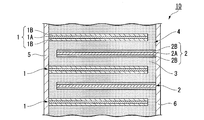
- FIG. 1 is a schematic cross-sectional view showing a structure for explaining the concept of the all-solid-state battery 10 of the present embodiment.
- the all-solid-state battery 10 of the present embodiment is a solid in which at least a part is sandwiched between at least one positive electrode layer 1, at least one negative electrode layer 2, and positive electrode layer 1 and negative electrode layer 2. It has an electrolyte 3 and.
- the positive electrode layer 1 and the negative electrode layer 2 are laminated in order via the solid electrolyte layer 3 to form the laminated body 4.
- the positive electrode layer 1 is connected to a terminal electrode 5 arranged on one end side, and the negative electrode layer 2 is connected to a terminal electrode 6 arranged on the other end side, respectively.
- the positive electrode layer 1 is an example of the first electrode layer
- the negative electrode layer 2 is an example of the second electrode layer.
- One of the first electrode layer and the second electrode layer functions as a positive electrode, and the other functions as a negative electrode.
- the positive and negative of the electrode layer changes depending on which polarity is connected to the terminal electrodes 5 and 6.
- the positive electrode layer 1 has a positive electrode current collector layer 1A and a positive electrode active material layer 1B formed on one or both sides of the positive electrode current collector layer 1A.
- the positive electrode active material layer 1B may not be present on the surface of the positive electrode current collector layer 1A on the side where the opposing negative electrode layer 2 does not exist.
- the negative electrode layer 2 has a negative electrode current collector layer 2A and a negative electrode active material layer 2B formed on one or both sides of the negative electrode current collector layer 2A.
- the negative electrode active material layer 2B may not be present on the surface of the negative electrode current collector layer 2A on the side where the opposing positive electrode layer 1 does not exist.
- the positive electrode layer 1 or the negative electrode layer 2 located at the uppermost layer or the lowermost layer of the laminated body 4 does not have to have the positive electrode active material layer 1B or the negative electrode active material layer 2B on one side.
- the all-solid-state battery 10 is an all-solid-state battery having a solid electrolyte layer 3 between a pair of electrode layers, and the positive electrode active material layer 1B and the negative electrode active material layer 2B contained in the pair of electrode layers have a Raman spectrum. Contains carbon particles having a G-band half-value width (G-FWHM) of 40 (cm -1 ) or less. Further, it is preferable to contain carbon particles having a half width (G-FWHM) of the G band of the Raman spectrum of 24 (cm -1) or less.
- the internal resistance of the all-solid-state battery 10 can be reduced.
- That half width of G band of the Raman spectra (peak near 1580cm -1) (G-FWHM) is 40 (cm -1) or less of the carbon particles may have crystallinity as graphite structure, it periodic disturbance is small Therefore, it has high thermal stability and can be easily left in the electrode even when a process involving after heat treatment such as sintering is used. Therefore, high electron conductivity can be obtained with a small amount of addition, and a high-density electrode can be realized. Furthermore, since these carbon particles have high crystallinity, they have high electron conductivity.
- the electron conductivity of the electrode can be increased by adding a small amount, and the internal resistance of the all-solid-state battery 10 can be reduced. Further, a small amount of voids may be generated in the vicinity of each carbon particle due to the evaporation of carbon by heat treatment or the like.
- the half width of G band of the Raman spectrum of the carbon particles of the present embodiment for example, microscopic laser Raman spectrophotometer (device name: NRS-7100, manufactured by JASCO Corporation) using an excitation wavelength 532 nm, 1580 cm - It can be calculated from the half width of the peak that appears near 1.
- the positive electrode active material layer 1B and the negative electrode active material layer 2B of the all-solid-state battery 10 according to the present embodiment further have a ratio of 1.0 ⁇ a when the long side of the particles is a and the short side is b. It is preferable to contain carbon particles of / b.
- the positive electrode active material layer 1B and the negative electrode active material layer 2B of the all-solid-state battery 10 according to the present embodiment further contain carbon particles having a D10 of 0.1 ⁇ m or more and a D90 of 5.0 ⁇ m or less in terms of particle size distribution. It is preferable to do so.
- D10 is the diameter of the particles having a cumulative volume of 10% by volume in the distribution curve obtained by the particle size distribution measurement of the equivalent circle diameter calculated based on the area data of the carbon particles.
- D90 is the diameter of the particles having a cumulative volume of 90% by volume in the distribution curve obtained by the particle size distribution measurement.
- the carbon particles can be brought into contact with the active material in just proportion, and since the contact can be made without creating voids with the active material, the exchange of electrons can be facilitated and the whole solid state can be obtained.
- the internal resistance of the battery 10 can be reduced. Further, when D10 does not contain fine particles such as less than 0.1 ⁇ m, the carbon particles are suppressed from evaporating during the process such as heat treatment, and a sufficient effect is guaranteed.
- the positive electrode active material layer 1B and the negative electrode active material layer 2B of the all-solid-state battery 10 according to the present embodiment preferably contain 0.5 (wt%) or more and 15.0 (wt%) or less of carbon particles, respectively.
- the contact between the carbon particles is sufficient, the electron conductivity as an electrode can be increased, and a substantial decrease in the amount of active material can be suppressed. Therefore, a high capacity can be obtained while reducing the internal resistance of the all-solid-state battery 10.
- Solid electrolyte At least a part of the solid electrolyte layer 3 is sandwiched between the positive electrode layer 1 and the negative electrode layer 2. As shown in FIG. 1, at least a part of the solid electrolyte layer 3 may be located in the in-plane direction of the positive electrode layer 1 and the negative electrode layer 2.
- a material having ionic conductivity and whose electron conductivity is negligible is used as the solid electrolyte in the solid electrolyte layer 3.
- solid electrolytes include lithium halide, lithium nitride, lithium oxynates, and derivatives thereof.
- Li-PO compounds such as lithium phosphate (Li 3 PO 4 ), LIPON (LiPO 4-x N x ) in which lithium is mixed with nitrogen
- Li-Si-O such as Li 4 SiO 4 Systems compounds, Li-P-Si-O-based compounds, Li-VSi-O-based compounds, La 0.51 Li 0.35 TiO 2.94 with a perovskite structure, La 0.55 Li 0.35 TiO 3
- Li Examples thereof include perovskite-based compounds such as 3x La 2 / 3-x TiO 3 and compounds having a garnet structure having Li, La, and Zr, and it is particularly preferable to contain a compound having a pearcon structure.
- compounds having a pear-con structure include, for example, Li 1.3 Al 0.3 Ti 1.7 (PO 4 ) 3 and Li 1.5 Al 0.5 Ge 1.5 (PO 4 ) 3 .
- the negative electrode active material layer 2B has a negative electrode active material.
- the negative electrode active material is an oxide of at least one element selected from the group consisting of Li 4 Ti 5 O 12 , Ti, Nb, W, Si, Sn, Cr, Fe, and Mo, Li 3 V 2 (PO 4 ) 3 , LiFePO 4 and other phosphorus-containing compounds may be used.
- the positive electrode active material layer 1B has a positive electrode active material.
- the positive electrode active material is a layered compound such as LiCoO 2 , LiCo 1/3 Ni 1/3 Mn 1/3 O 2 , a spinel material such as LiMn 2 O 4 , LiNi 0.5 Mn 1.5 O 4 , Li 3 V. 2 (PO 4 ) 3 , phosphorus-containing compounds such as LiFePO 4 and the like may be used. If the carbon material of the present invention is contained in at least one of the positive electrode active material and the negative electrode active material, the effect of the present invention can be obtained.
- the compounds that make up the positive electrode active material layer 1B or the negative electrode active material layer 2B are compared. Therefore, a compound showing a more noble potential can be used as the positive electrode active material, and a compound showing a lower potential can be used as the negative electrode active material. Further, as long as it is a compound having both a lithium ion release function and a lithium ion storage function, the same material may be used as the active material constituting the positive electrode active material layer 1B and the negative electrode active material layer 2B.
- a non-polar all-solid-state battery can be obtained, and it is not necessary to specify the direction when mounting the battery on the circuit board. The mountability can be facilitated.
- the material constituting the positive electrode current collector layer 1A and the negative electrode current collector layer 2A it is preferable to use a material having a high conductivity, for example, silver, palladium, gold, platinum, aluminum, copper, nickel or the like is used. preferable. In particular, copper is preferable because it does not easily react with titanium-aluminum-lithium phosphate and is effective in reducing the internal resistance of an all-solid-state battery.
- the material constituting the current collector layer may be the same for the positive electrode layer 1 and the negative electrode layer 2, or may be different.
- the positive electrode current collector layer 1A and the negative electrode current collector layer 2A of the all-solid-state battery in the present embodiment contain a positive electrode active material and a negative electrode active material, respectively.
- the positive electrode current collector layer 1A and the negative electrode current collector layer 2A contain the positive electrode active material 1B and the negative electrode active material 2B, respectively, the adhesion between the positive electrode current collector layer 1A and the positive electrode active material layer 1B and the negative electrode current collector layer This is desirable because the adhesion between 2A and the negative electrode active material layer 2B is improved.
- the terminal electrodes 5 and 6 are formed in contact with the side surface of the sintered body.
- the terminal electrodes 5 and 6 are connected to external terminals and are responsible for sending and receiving electrons to the sintered body.
- terminal electrodes 5 and 6 It is preferable to use a material having a high conductivity for the terminal electrodes 5 and 6.
- a material having a high conductivity for example, silver, gold, platinum, aluminum, copper, tin, nickel, gallium, indium, and alloys thereof can be used.
- each material of the positive electrode current collector layer, the positive electrode active material layer, the solid electrolyte layer, the negative electrode active material layer, and the negative electrode current collector layer is made into a paste, coated and dried.
- the green sheets are laminated to prepare a laminated body (second step).
- it is produced by firing the produced laminate (third step).
- a positive electrode active material, a negative electrode active material, and a carbon material are prepared.
- the active material contains compounds of two or more kinds of elements
- a mixed material in which the compounds of each element are mixed may be prepared.
- a solid electrolyte is mixed in the active material, a mixed material may be prepared.
- the method for producing the paste for the positive electrode active material layer and the negative electrode active material layer is not particularly limited, and for example, the positive electrode active material, the negative electrode active material, and the carbon material can be mixed with the vehicle to obtain the paste.
- vehicle is a general term for a medium in a liquid phase.
- the vehicle contains a solvent and a binder.
- the prepared paste is applied onto a base material such as PET in a desired order, dried if necessary, and then the base material is peeled off to prepare a green sheet.
- the method of applying the paste is not particularly limited, and known methods such as screen printing, coating, transfer, and doctor blade can be adopted.
- the prepared green sheets are stacked in a desired order and the number of stacks, and if necessary, alignment, cutting, etc. are performed to prepare a laminate.
- the active material layer unit described below may be prepared to prepare the laminate.
- the method is as follows: First, a paste for a solid electrolyte layer is formed on a PET film in the form of a sheet by the doctor blade method, a solid electrolyte sheet is obtained, and then a paste for a positive electrode active material layer is applied on the solid electrolyte sheet by screen printing. Print and dry. Next, the paste for the positive electrode current collector layer is printed on it by screen printing and dried. Further, the paste for the positive electrode active material layer is printed again by screen printing, dried, and then the PET film is peeled off to obtain a positive electrode active material layer unit.
- a positive electrode active material layer unit in which the positive electrode active material layer paste, the positive electrode current collector layer paste, and the positive electrode active material layer paste are formed in this order on the solid electrolyte sheet is obtained.
- a negative electrode active material layer unit was also produced by the same procedure, and a negative electrode active material layer paste, a negative electrode current collector layer paste, and a negative electrode active material layer paste were formed in this order on a solid electrolyte sheet. Obtain a layer unit.
- One positive electrode active material layer unit and one negative electrode active material layer unit are stacked so as to pass through a solid electrolyte sheet.
- the paste for the positive electrode current collector layer of the first positive electrode active material layer unit extends only to one end surface
- the paste for the negative electrode current collector layer of the second negative electrode active material layer unit extends to the other surface.
- Each unit is staggered and stacked so that it extends only to.
- a solid electrolyte sheet having a predetermined thickness is further stacked on both sides of the stacked units to prepare a laminated body.
- the produced laminates are crimped together.
- the crimping is performed while heating, and the heating temperature is, for example, 40 to 95 ° C.
- the crimped laminate is heated to, for example, 600 ° C. to 1100 ° C. in a nitrogen atmosphere and fired.
- the firing time is, for example, 0.1 to 3 hours. This firing completes the sintered body.
- a terminal electrode can be provided in order to efficiently draw a current from the sintered body.
- the terminal electrodes are connected to one end of the positive electrode layer extending to one side surface of the sintered body and one end of the negative electrode layer extending to one side surface of the sintered body. Therefore, a pair of terminal electrodes are formed so as to sandwich one side surface of the sintered body.
- Examples of the terminal electrode forming method include a sputtering method, a screen printing method, and a dip coating method. In the screen printing method and the dip coating method, a paste for a terminal electrode containing a metal powder, a resin, and a solvent is prepared and formed as a terminal electrode.
- a baking step for removing the solvent and a plating treatment for protection and mounting are performed on the surface of the terminal electrode.
- a protective layer and a mounting layer can be formed on the terminal electrode, a baking step and a plating process are not required.
- Li 3 V 2 (PO 4 ) 3 was used as the active material.
- LiPO 3 and V 2 O 3 were used as starting materials, and after weighing the starting materials, they were mixed and pulverized in ethanol with a ball mill (120 rpm / zirconia balls) for 16 hours.
- the mixed powder of the starting material was separated from the balls and ethanol, dried, and then calcined using a magnesia crucible.
- the calcining was carried out at 950 ° C. for 2 hours in a reducing atmosphere, and then the calcined powder was treated in ethanol in ethanol for 16 hours with a ball mill (120 rpm / zirconia balls).
- the pulverized powder was separated from balls and ethanol and dried to obtain Li 3 V 2 (PO 4 ) 3 powder.
- negative electrode active material As the negative electrode active material, the same powder as the positive electrode active material was used.
- Li 1.3 Al 0.3 Ti 1.7 (PO 4 ) 3 prepared by the following method was used. Using Li 2 CO 3 , Al 2 O 3 , TiO 2 , and NH 4 H 2 PO 4 as starting materials, wet mixing was carried out with a ball mill using ethanol as a solvent for 16 hours. The mixed powder of the starting material was separated from the balls and ethanol, dried, and then calcined in an alumina crucible at 850 ° C. for 2 hours in the air. Then, the calcined powder was treated with a ball mill (120 rpm / zirconia balls) in ethanol for 16 hours for pulverization. The pulverized powder was separated from balls and ethanol and dried to obtain a powder.
- a ball mill 120 rpm / zirconia balls
- paste for positive electrode active material layer and paste for negative electrode active material layer Three pastes for the positive and negative electrode active material layers are prepared by adding 15 parts of ethyl cellulose as a binder and 65 parts of dihydroterpineol as a solvent to 100 parts of a mixed powder of the above carbon material and Li 3 V 2 (PO 4 ) 3.
- a paste for an active material layer serving as a positive electrode and a negative electrode was prepared by kneading and dispersing with a roll.
- This paste for a solid electrolyte layer was sheet-molded using a PET film as a base material by a doctor blade method to obtain a sheet for a solid electrolyte layer having a thickness of 15 ⁇ m.
- a Cu terminal electrode paste was prepared by mixing and dispersing Cu powder, glass powder, an acrylic resin, and tarpineol.
- the paste for the electrode current collector layer was printed on the above-mentioned solid electrolyte layer sheet to a thickness of 5 ⁇ m by screen printing, and dried at 80 ° C. for 10 minutes.
- a paste for the positive electrode active material layer was printed on the paste with a thickness of 5 ⁇ m by screen printing, and dried at 80 ° C. for 10 minutes to prepare a positive electrode layer unit.
- the paste for the negative electrode active material layer was printed on the solid electrolyte layer sheet at a thickness of 5 ⁇ m by screen printing, dried at 80 ° C. for 10 minutes, and then screen-printed on the negative electrode active material layer at a thickness of 5 ⁇ m.
- the paste for the electrode current collector layer was printed and dried at 80 ° C. for 10 minutes to prepare a negative electrode layer unit. Then, the PET film was peeled off.
- the obtained laminate was debindered and then co-fired to obtain a sintered body.
- the debinder is heated to a firing temperature of 700 ° C. in nitrogen at 50 ° C./hour and held at that temperature for 10 hours, and simultaneous firing is performed in nitrogen at a heating rate of 200 ° C./hour to a firing temperature of 850 ° C. Then, it was kept at that temperature for 1 hour, and after firing, it was naturally cooled. Further, it was confirmed that the residual carbon content in the electrode active material layer region of the obtained sintered body was approximately 10 (wt%).
- the Cu terminal electrode paste is applied to the end faces of the sintered body, 600 ° C., 15 minutes, by performing heat treatment in an N 2 atmosphere to form a pair of terminal electrodes. In this way, the all-solid-state battery was completed.
- the electrode active material layer area of the obtained sintered body is exposed by polishing or the like and processed smoothly, and from scanning electron microscope (SEM) observation, the longest axis of each carbon particle for 100 or more carbon particles in the visual field.
- the length in the direction is a
- the length in the shortest axial direction is b
- the ratio can be calculated as a / b.
- SEM magnification select an appropriate value according to the particle size of the carbon particles, select a magnification so that 100 or more and 300 or less particles can be observed in the visual field, and a of all carbon particles in the visual field. Find the / b ratio and calculate the average.
- the electrode active material layer area of the obtained sintered body is exposed by polishing or the like and processed smoothly, and the area of each particle is subjected to image processing for 200 or more particles in the field of view from scanning electron microscope (SEM) observation. To measure.
- SEM scanning electron microscope
- the equivalent circle diameter was calculated from these area data, and the particle size at a cumulative volume of 10% by volume was defined as D10, and the particle size at a cumulative volume of 90% by volume was defined as D90.
- the electrode active material layer area of the obtained sintered body is separated and crushed, and a carbon / sulfur analyzer (manufactured by LECO Japan Co., Ltd., device name: CS-844) is used as an analyzer for combustion in an oxygen stream-infrared absorption. Measured using the method.
- each constituent part of the sintered body is a part of a solid electrolyte layer, a part of a positive electrode active material layer, a part of a positive electrode current collector layer, a part of a negative electrode active material layer, and a part of a negative electrode current collector layer.
- the volume of each component was calculated from the shape and dimensions of each component of the solid electrolyte layer. Then, the specific gravity of each component of the solid electrolyte layer was multiplied by the calculated volume. As the specific gravity of each component, a known specific gravity was used. Then, the weight of the sintered body was calculated by adding them together. For the positive electrode active material and the negative electrode active material having the active material and carbon, the calculation was made in consideration of the abundance ratio. Then, the calculated weight of the sintered body was divided by the volume of the sintered body to obtain the theoretical density. The relative density was obtained by taking the ratio of the sintered body density obtained thereafter to the theoretical density. The relative density is obtained by (sintered body density / theoretical density).
- the obtained laminate was attached to a jig of a type fixed with a spring attachment pin using Impedance / Gain-Phase analyzer (manufactured by Solartron Analytical Co., Ltd., device name: 1260A), and the internal resistance was measured.
- the measurement frequency was 0.005 Hz, and the AC applied voltage was 0.05 V.
- the values of the obtained internal resistance are shown in Table 1. The value of the internal resistance was considered good when 1 ⁇ 10 7 ( ⁇ ) smaller.
- the obtained laminate was attached to a jig of a type fixed with a spring attachment pin using a charge / discharge tester, and the charge / discharge capacity was measured.
- the current during charging and discharging was 2 ⁇ A
- the voltage was 0 V to 1.6 V.
- Table 1 shows the measured discharge capacities. The case where the value of the discharge characteristic was larger than 1.5 ⁇ Ah was regarded as good.
- Example 1 In this comparative example, a carbon material having a D10 of 0.25 ⁇ m, a D90 of 4.5 ⁇ m, an a / b of 3, and a G-FWHM of 43 (cm -1) was used. Moreover, the above-mentioned Li 3 V 2 (PO 4 ) 3 powder was used as an active material. This carbon material was weighed to 16.3 (wt%) with respect to Li 3 V 2 (PO 4 ) 3 and mixed in an organic solvent using a ball mill. The powder was separated from the balls and the organic solvent and dried to obtain a mixed powder of carbon material and Li 3 V 2 (PO 4 ) 3. Further, after preparing a laminated body by the same method as in Example 1, debye and sintering were performed by the same method. The discharge characteristics of the laminate were evaluated in the same manner as in Example 1. Table 1 shows the measured internal resistance value and discharge capacity.
- Example 5 to 12 (Mixing of active material and carbon material)
- D10 is 0.25 ⁇ m
- D90 is 4.5 ⁇ m
- G-FWHM is 18 (cm -1 )
- a / b are 18 (cm -1), respectively.
- Carbon materials such as 1.0, 1.1, 1.5, 5.0, 10.0, 50.0, 100.0, 200.0 were used.
- the active material used was the above-mentioned Li 3 V 2 (PO 4 ) 3 powder. These carbon materials were weighed to 11.3 wt% with respect to Li 3 V 2 (PO 4 ) 3 and mixed in an organic solvent using a ball mill. The powder was separated from the balls and the organic solvent and dried to obtain a mixed powder of the carbon material and Li 3 V 2 (PO 4 ) 3.
- paste for positive electrode active material layer and paste for negative electrode active material layer Three pastes for the positive and negative electrode active material layers are prepared by adding 15 parts of ethyl cellulose as a binder and 65 parts of dihydroterpineol as a solvent to 100 parts of a mixed powder of the above carbon material and Li 3 V 2 (PO 4 ) 3.
- a paste for an active material layer serving as a positive electrode and a negative electrode was prepared by kneading and dispersing with a roll.
- This paste for a solid electrolyte layer was sheet-molded using a PET film as a base material by a doctor blade method to obtain a sheet for a solid electrolyte layer having a thickness of 15 ⁇ m.
- thermosetting terminal electrode paste was prepared by mixing and dispersing silver powder, an epoxy resin, and a solvent.
- a paste for the positive electrode current collector layer having a thickness of 5 ⁇ m was printed on the above-mentioned solid electrolyte layer sheet by screen printing, and dried at 80 ° C. for 10 minutes.
- a paste for the positive electrode active material layer was printed on the paste with a thickness of 5 ⁇ m by screen printing, and dried at 80 ° C. for 10 minutes to prepare a positive electrode layer unit.
- the negative electrode active material layer paste was printed on the solid electrolyte layer sheet by screen printing to a thickness of 5 ⁇ m, dried at 80 ° C. for 10 minutes, and then screen-printed on the negative electrode to a thickness of 5 ⁇ m.
- the paste for the current collector layer was printed and dried at 80 ° C. for 10 minutes to prepare a negative electrode layer unit. Then, the PET film was peeled off.
- the obtained laminate was debindered and then co-fired to obtain a sintered body.
- the debinder is heated to a firing temperature of 700 ° C. in nitrogen at 50 ° C./hour and held at that temperature for 10 hours, and simultaneous firing is performed in nitrogen at a heating rate of 200 ° C./hour to a firing temperature of 850 ° C. Then, it was kept at that temperature for 1 hour, and after firing, it was naturally cooled. Further, it was confirmed that the residual carbon content in the electrode active material layer region of the obtained sintered body was approximately 10 (wt%).
- the terminal electrode paste was applied to the end face of the sintered body and heat-cured at 150 ° C. for 30 minutes to form a pair of terminal electrodes. In this way, the all-solid-state battery was completed.
- the electrode active material layer area of the obtained sintered body is exposed by polishing or the like and processed smoothly, and from the scanning electron microscope (SEM) observation, the length in the longest axial direction is determined for 100 or more particles in the visual field. Then, the length in the shortest axial direction can be set as b, and the ratio can be calculated as a / b.
- SEM magnification an appropriate value is selected according to the particle size of the carbon particles, and a magnification is selected so that 100 or more and 300 or less particles are observed in the visual field.
- the a / b of the carbon particles was calculated as the average of the a / b of all the carbon particles in the visual field.
- the electrode active material layer area of the obtained sintered body is exposed by polishing or the like and processed smoothly, and the area of each particle is subjected to image processing for 200 or more particles in the field of view from scanning electron microscope (SEM) observation. To measure.
- SEM scanning electron microscope
- the equivalent circle diameter was calculated from these area data, and the particle size at a cumulative volume of 10% by volume was defined as D10, and the particle size at a cumulative volume of 90% by volume was defined as D90.
- the electrode active material layer area of the obtained sintered body is separated and crushed, and a carbon / sulfur analyzer (manufactured by LECO Japan Co., Ltd., device name: CS-844) is used as an analyzer for combustion in an oxygen stream-infrared absorption. Measured using the method.
- the obtained laminate was attached to a jig of a type fixed with a spring attachment pin using Impedance / Gain-Phase analyzer, and the internal resistance was measured.
- the measurement frequency was 0.005 Hz, and the AC applied voltage was 0.05 V.
- the values of the obtained internal resistance are shown in Table 2. The value of the internal resistance was considered good when 1 ⁇ 10 7 ( ⁇ ) smaller.
- the obtained laminate was attached to a jig of a type fixed with a spring attachment pin using a charge / discharge tester, and the charge / discharge capacity was measured.
- the current during charging and discharging was 2 ⁇ A, and the voltage was 0 V to 1.6 V.
- Table 2 shows the measured discharge capacity.
- a good discharge capacity is obtained while showing a lower internal resistance in the range of a / b value of 1.1 to 100.0.
- the value of a / b is in the range of 1.5 to 5.0, and the discharge capacity is further improved while showing a lower internal resistance.
- Example 13 to 15 (Mixing of active material and carbon material)
- G-FWHM is 18 (cm -1 )
- a / b is 3
- D10 is 0.1 ⁇ m
- D90 is 5 ⁇ m (implementation).
- carbon materials such as D10 of 0.2 ⁇ m and D90 of 5.5 ⁇ m (Example 14), D10 of 0.08 ⁇ m and D90 of 4.0 ⁇ m (Example 15) were used.
- the active material used was the above-mentioned Li 3 V 2 (PO 4 ) 3 powder.
- paste for positive electrode active material layer and paste for negative electrode active material layer Three pastes for the positive and negative electrode active material layers are prepared by adding 15 parts of ethyl cellulose as a binder and 65 parts of dihydroterpineol as a solvent to 100 parts of a mixed powder of the above carbon material and Li 3 V 2 (PO 4 ) 3.
- a paste for an active material layer serving as a positive electrode and a negative electrode was prepared by kneading and dispersing with a roll.
- This paste for a solid electrolyte layer was sheet-molded using a PET film as a base material by a doctor blade method to obtain a sheet for a solid electrolyte layer having a thickness of 15 ⁇ m.
- thermosetting terminal electrode paste was prepared by mixing and dispersing silver powder, an epoxy resin, and a solvent.
- a paste for the positive electrode current collector layer having a thickness of 5 ⁇ m was printed on the above-mentioned solid electrolyte layer sheet by screen printing, and dried at 80 ° C. for 10 minutes.
- a paste for the positive electrode active material layer was printed on the paste with a thickness of 5 ⁇ m by screen printing, and dried at 80 ° C. for 10 minutes to prepare a positive electrode layer unit.
- the negative electrode active material layer paste was printed on the solid electrolyte layer sheet by screen printing to a thickness of 5 ⁇ m, dried at 80 ° C. for 10 minutes, and then screen-printed on the negative electrode to a thickness of 5 ⁇ m.
- the paste for the current collector layer was printed and dried at 80 ° C. for 10 minutes to prepare a negative electrode layer unit. Then, the PET film was peeled off.
- the obtained laminate was debindered and then co-fired to obtain a sintered body.
- the debinder is heated to a firing temperature of 700 ° C. in nitrogen at 50 ° C./hour and held at that temperature for 10 hours, and simultaneous firing is performed in nitrogen at a heating rate of 200 ° C./hour to a firing temperature of 850 ° C. Then, it was kept at that temperature for 1 hour, and after firing, it was naturally cooled. Further, it was confirmed that the residual carbon content in the electrode active material layer region of the obtained sintered body was approximately 10 (wt%).
- the terminal electrode paste was applied to the end face of the sintered body and heat-cured at 150 ° C. for 30 minutes to form a pair of terminal electrodes. In this way, the all-solid-state battery was completed.
- the electrode active material layer area of the obtained sintered body is exposed by polishing or the like and processed smoothly, and from the scanning electron microscope (SEM) observation, the length in the longest axial direction is determined for 100 or more particles in the visual field. Then, the length in the shortest axial direction can be set as b, and the ratio can be calculated as a / b.
- SEM magnification an appropriate value is selected according to the particle size of the carbon particles, and a magnification is selected so that 100 or more and 300 or less particles are observed in the visual field.
- the a / b of the carbon particles was calculated as the average of the a / b of all the carbon particles in the visual field.
- the electrode active material layer area of the obtained sintered body is exposed by polishing or the like and processed smoothly, and the area of each particle is subjected to image processing for 200 or more particles in the field of view from scanning electron microscope (SEM) observation. To measure.
- SEM scanning electron microscope
- the equivalent circle diameter was calculated from these area data, and the particle size at a cumulative volume of 10% by volume was defined as D10, and the particle size at a cumulative volume of 90% by volume was defined as D90.
- the electrode active material layer area of the obtained sintered body is separated and crushed, and a carbon / sulfur analyzer (manufactured by LECO Japan Co., Ltd., device name: CS-844) is used as an analyzer, and combustion in an oxygen stream-infrared It was measured using the absorption method.
- a carbon / sulfur analyzer manufactured by LECO Japan Co., Ltd., device name: CS-844.
- the obtained laminate was attached to a jig of a type fixed with a spring attachment pin using Impedance / Gain-Phase analyzer, and the internal resistance was measured.
- the measurement frequency was 0.005 Hz, and the AC applied voltage was 0.05 V.
- the values of the obtained internal resistance are shown in Table 3. The value of the internal resistance was considered good when 1 ⁇ 10 7 ( ⁇ ) smaller.
- the obtained laminate was attached to a jig of a type fixed with a spring attachment pin using a charge / discharge tester, and the charge / discharge capacity was measured.
- the current during charging and discharging was 2 ⁇ A
- the voltage was 0 V to 1.6 V.
- Table 3 shows the measured discharge capacities. The case where the value of the discharge characteristic was larger than 1.5 ⁇ Ah was regarded as good.
- Example 16 to 21 (Mixing of active material and carbon material)
- a carbon material having a G-FWHM of 18 (cm -1 ), a / b of 3, D10 of 0.25 ⁇ m and D90 of 4.5 ⁇ m was used.
- the active material used was the above-mentioned Li 3 V 2 (PO 4 ) 3 powder.
- these carbon materials were added to Li 3 V 2 (PO 4 ) 3 in an amount of 0.49 wt%, 0.58 wt%, 1.13 wt%, 7.12 wt%, and 16.95 wt%, respectively. , 18.08 wt%, and mixed in an organic solvent using a ball mill. The powder was separated from the balls and the organic solvent and dried to obtain a mixed powder of the carbon material and Li 3 V 2 (PO 4 ) 3.
- paste for positive electrode active material layer and paste for negative electrode active material layer Three pastes for the positive and negative electrode active material layers are prepared by adding 15 parts of ethyl cellulose as a binder and 65 parts of dihydroterpineol as a solvent to 100 parts of a mixed powder of the above carbon material and Li 3 V 2 (PO 4 ) 3.
- a paste for an active material layer serving as a positive electrode and a negative electrode was prepared by kneading and dispersing with a roll.
- This paste for a solid electrolyte layer was sheet-molded using a PET film as a base material by a doctor blade method to obtain a sheet for a solid electrolyte layer having a thickness of 15 ⁇ m.
- thermosetting terminal electrode paste was prepared by mixing and dispersing silver powder, an epoxy resin, and a solvent.
- a paste for the positive electrode current collector layer having a thickness of 5 ⁇ m was printed on the above-mentioned solid electrolyte layer sheet by screen printing, and dried at 80 ° C. for 10 minutes.
- a paste for the positive electrode active material layer was printed on the paste with a thickness of 5 ⁇ m by screen printing, and dried at 80 ° C. for 10 minutes to prepare a positive electrode layer unit.
- the negative electrode active material layer paste was printed on the solid electrolyte layer sheet by screen printing to a thickness of 5 ⁇ m, dried at 80 ° C. for 10 minutes, and then screen-printed on the negative electrode to a thickness of 5 ⁇ m.
- the paste for the current collector layer was printed and dried at 80 ° C. for 10 minutes to prepare a negative electrode layer unit. Then, the PET film was peeled off.
- the obtained laminate was debindered and then co-fired to obtain a sintered body.
- the debinder is heated to a firing temperature of 700 ° C. in nitrogen at 50 ° C./hour and held at that temperature for 10 hours, and simultaneous firing is performed in nitrogen at a heating rate of 200 ° C./hour to a firing temperature of 850 ° C. Then, it was kept at that temperature for 1 hour, and after firing, it was naturally cooled.
- the residual carbon contents of the obtained sintered body in the electrode active material layer region were 0.43, 0.51, 1.00, 6.30, 15.00 and 16.00 (wt%, respectively). ) Was confirmed.
- the terminal electrode paste was applied to the end face of the sintered body and heat-cured at 150 ° C. for 30 minutes to form a pair of terminal electrodes. In this way, the all-solid-state battery was completed.
- the electrode active material layer area of the obtained sintered body is exposed by polishing or the like and processed smoothly, and from the scanning electron microscope (SEM) observation, the length in the longest axial direction is determined for 100 or more particles in the visual field. Then, the length in the shortest axial direction can be set as b, and the ratio can be calculated as a / b.
- SEM magnification an appropriate value is selected according to the particle size of the carbon particles, and a magnification is selected so that 100 or more and 300 or less particles are observed in the visual field.
- the a / b of the carbon particles was calculated as the average of the a / b of all the carbon particles in the visual field.
- the electrode active material layer area of the obtained sintered body is exposed by polishing or the like and processed smoothly, and the area of each particle is subjected to image processing for more than 200 particles in the field of view from scanning electron microscope (SEM) observation. To measure.
- SEM scanning electron microscope
- the equivalent circle diameter was calculated from these area data, and the particle size at a cumulative volume of 10% by volume was defined as D10, and the particle size at a cumulative volume of 90% by volume was defined as D90.
- the electrode active material layer area of the obtained sintered body is separated and crushed, and a carbon / sulfur analyzer (manufactured by LECO Japan Co., Ltd., device name: CS-844) is used as an analyzer for combustion in oxygen stream-infrared absorption. Measured using the method.
- the obtained laminate was attached to a jig of a type fixed with a spring attachment pin using Impedance / Gain-Phase analyzer, and the internal resistance was measured.
- the measurement frequency was 0.005 Hz, and the AC applied voltage was 0.05 V.
- the values of the obtained internal resistance are shown in Table 4. The value of the internal resistance was considered good when 1 ⁇ 10 7 ( ⁇ ) smaller.
- the obtained laminate was attached to a jig of a type fixed with a spring attachment pin using a charge / discharge tester, and the charge / discharge capacity was measured.
- the current during charging and discharging was 2 ⁇ A
- the voltage was 0 V to 1.6 V.
- Table 4 shows the measured discharge capacities. The case where the value of the discharge characteristic was larger than 1.5 ⁇ Ah was regarded as good.
- the all-solid-state battery in which the carbon materials having a content within the range according to the present invention are used for the positive electrode active material layer and the negative electrode active material layer, respectively, can obtain a clearly compact sintered body and have a low inside. It can be seen that it shows resistance. Further, it can be seen that when the content of carbon particles is 0.5 (wt%) or more and 15.0 (wt%) or less, a good discharge capacity is obtained while showing an even lower internal resistance. Further, it can be seen that when the content of carbon particles is 1.00 (wt%) or more and 15.0 (wt%) or less, a better discharge capacity is obtained while showing a lower internal resistance.
- the all-solid-state battery according to the present invention is effective in reducing the internal resistance.
Landscapes
- Chemical & Material Sciences (AREA)
- General Chemical & Material Sciences (AREA)
- Chemical Kinetics & Catalysis (AREA)
- Electrochemistry (AREA)
- Engineering & Computer Science (AREA)
- Inorganic Chemistry (AREA)
- Manufacturing & Machinery (AREA)
- Materials Engineering (AREA)
- Organic Chemistry (AREA)
- Physics & Mathematics (AREA)
- Condensed Matter Physics & Semiconductors (AREA)
- General Physics & Mathematics (AREA)
- Secondary Cells (AREA)
- Battery Electrode And Active Subsutance (AREA)
Priority Applications (4)
| Application Number | Priority Date | Filing Date | Title |
|---|---|---|---|
| US17/908,698 US20230163301A1 (en) | 2020-03-06 | 2021-01-05 | All-solid-state battery |
| DE112021001463.3T DE112021001463T5 (de) | 2020-03-06 | 2021-01-05 | Festkörperakkumulator |
| JP2022504999A JP7660096B2 (ja) | 2020-03-06 | 2021-01-05 | 全固体電池 |
| CN202180018580.5A CN115210912B (zh) | 2020-03-06 | 2021-01-05 | 全固体电池 |
Applications Claiming Priority (2)
| Application Number | Priority Date | Filing Date | Title |
|---|---|---|---|
| JP2020-039383 | 2020-03-06 | ||
| JP2020039383 | 2020-03-06 |
Publications (1)
| Publication Number | Publication Date |
|---|---|
| WO2021176832A1 true WO2021176832A1 (ja) | 2021-09-10 |
Family
ID=77613465
Family Applications (1)
| Application Number | Title | Priority Date | Filing Date |
|---|---|---|---|
| PCT/JP2021/000072 Ceased WO2021176832A1 (ja) | 2020-03-06 | 2021-01-05 | 全固体電池 |
Country Status (5)
| Country | Link |
|---|---|
| US (1) | US20230163301A1 (https=) |
| JP (1) | JP7660096B2 (https=) |
| CN (1) | CN115210912B (https=) |
| DE (1) | DE112021001463T5 (https=) |
| WO (1) | WO2021176832A1 (https=) |
Families Citing this family (1)
| Publication number | Priority date | Publication date | Assignee | Title |
|---|---|---|---|---|
| SE2450530A1 (en) * | 2024-05-16 | 2025-11-17 | Holyvolt Ab | Screen Printed Energy Storage Modules for Enhanced Efficiencies for Powering a Motor Vehicle, Method of Such Screen Printed Energy Storage Modules |
Citations (9)
| Publication number | Priority date | Publication date | Assignee | Title |
|---|---|---|---|---|
| JPH11312525A (ja) * | 1998-04-27 | 1999-11-09 | Tdk Corp | 非水電解質電池用電極 |
| JP2012243645A (ja) * | 2011-05-20 | 2012-12-10 | Sumitomo Electric Ind Ltd | 電極、および全固体型非水電解質電池 |
| JP2013101825A (ja) * | 2011-11-08 | 2013-05-23 | Toyota Motor Corp | 密閉型リチウム二次電池 |
| JP2015125818A (ja) * | 2013-12-25 | 2015-07-06 | Jsr株式会社 | 電極用粒子、電極及び蓄電デバイス |
| JP2017075091A (ja) * | 2015-10-15 | 2017-04-20 | Jfeケミカル株式会社 | フリーカーボン黒鉛化物粒子およびその製造方法、リチウムイオン二次電池負極ならびにリチウムイオン二次電池 |
| JP2018055999A (ja) * | 2016-09-29 | 2018-04-05 | 新日鉄住金化学株式会社 | リチウムイオン二次電池の負極活物質用低結晶性炭素材料及びその製造方法並びにそれを用いたリチウムイオン二次電池用負極及びリチウムイオン二次電池 |
| JP2018170189A (ja) * | 2017-03-30 | 2018-11-01 | Tdk株式会社 | 全固体型二次電池 |
| JP2018537803A (ja) * | 2015-12-15 | 2018-12-20 | ザ ボード オブ トラスティーズ オブ ザ レランド スタンフォード ジュニア ユニバーシティー | 再充電可能金属イオン電池のための改良された電解質、集電体およびバインダー |
| WO2019026940A1 (ja) * | 2017-08-04 | 2019-02-07 | 積水化学工業株式会社 | 炭素材料、全固体電池用正極、全固体電池用負極、及び全固体電池 |
Family Cites Families (9)
| Publication number | Priority date | Publication date | Assignee | Title |
|---|---|---|---|---|
| GB1423202A (en) | 1973-07-17 | 1976-02-04 | Firth Cleveland Fastenings Ltd | Blanks for nuts and the like |
| EP1220349B1 (en) * | 1996-08-08 | 2008-11-26 | Hitachi Chemical Co., Ltd. | Graphite particles and lithium secondary battery using the same as negative electrode |
| JP2015510666A (ja) | 2012-01-30 | 2015-04-09 | ネクソン リミテッドNexeon Limited | Si/C電気活性材料組成物 |
| RU2672556C2 (ru) * | 2013-09-02 | 2018-11-16 | Мицубиси Газ Кемикал Компани, Инк. | Батарея с твёрдым электролитом и способ получения активного материала электрода |
| JP2016126912A (ja) * | 2014-12-26 | 2016-07-11 | トヨタ自動車株式会社 | 全固体電池の回復方法 |
| JP2016143614A (ja) * | 2015-02-04 | 2016-08-08 | トヨタ自動車株式会社 | 全固体電池 |
| JP2017079126A (ja) * | 2015-10-20 | 2017-04-27 | トヨタ自動車株式会社 | 全固体リチウム電池 |
| US11322773B2 (en) * | 2016-03-10 | 2022-05-03 | Nec Corporation | Lithium secondary battery |
| JP2020039383A (ja) | 2018-09-06 | 2020-03-19 | シャープ株式会社 | ネットワークシステム、サーバおよび情報処理方法 |
-
2021
- 2021-01-05 WO PCT/JP2021/000072 patent/WO2021176832A1/ja not_active Ceased
- 2021-01-05 US US17/908,698 patent/US20230163301A1/en active Pending
- 2021-01-05 CN CN202180018580.5A patent/CN115210912B/zh active Active
- 2021-01-05 DE DE112021001463.3T patent/DE112021001463T5/de active Pending
- 2021-01-05 JP JP2022504999A patent/JP7660096B2/ja active Active
Patent Citations (9)
| Publication number | Priority date | Publication date | Assignee | Title |
|---|---|---|---|---|
| JPH11312525A (ja) * | 1998-04-27 | 1999-11-09 | Tdk Corp | 非水電解質電池用電極 |
| JP2012243645A (ja) * | 2011-05-20 | 2012-12-10 | Sumitomo Electric Ind Ltd | 電極、および全固体型非水電解質電池 |
| JP2013101825A (ja) * | 2011-11-08 | 2013-05-23 | Toyota Motor Corp | 密閉型リチウム二次電池 |
| JP2015125818A (ja) * | 2013-12-25 | 2015-07-06 | Jsr株式会社 | 電極用粒子、電極及び蓄電デバイス |
| JP2017075091A (ja) * | 2015-10-15 | 2017-04-20 | Jfeケミカル株式会社 | フリーカーボン黒鉛化物粒子およびその製造方法、リチウムイオン二次電池負極ならびにリチウムイオン二次電池 |
| JP2018537803A (ja) * | 2015-12-15 | 2018-12-20 | ザ ボード オブ トラスティーズ オブ ザ レランド スタンフォード ジュニア ユニバーシティー | 再充電可能金属イオン電池のための改良された電解質、集電体およびバインダー |
| JP2018055999A (ja) * | 2016-09-29 | 2018-04-05 | 新日鉄住金化学株式会社 | リチウムイオン二次電池の負極活物質用低結晶性炭素材料及びその製造方法並びにそれを用いたリチウムイオン二次電池用負極及びリチウムイオン二次電池 |
| JP2018170189A (ja) * | 2017-03-30 | 2018-11-01 | Tdk株式会社 | 全固体型二次電池 |
| WO2019026940A1 (ja) * | 2017-08-04 | 2019-02-07 | 積水化学工業株式会社 | 炭素材料、全固体電池用正極、全固体電池用負極、及び全固体電池 |
Also Published As
| Publication number | Publication date |
|---|---|
| DE112021001463T5 (de) | 2022-12-22 |
| JP7660096B2 (ja) | 2025-04-10 |
| US20230163301A1 (en) | 2023-05-25 |
| CN115210912A (zh) | 2022-10-18 |
| CN115210912B (zh) | 2025-10-21 |
| JPWO2021176832A1 (https=) | 2021-09-10 |
Similar Documents
| Publication | Publication Date | Title |
|---|---|---|
| CN113056835B (zh) | 全固体电池 | |
| JP7031596B2 (ja) | 全固体リチウムイオン二次電池 | |
| CN109792080B (zh) | 全固体锂离子二次电池 | |
| JP7692357B2 (ja) | 固体電解質層、全固体二次電池、及びそれらの製造方法 | |
| JP6801778B2 (ja) | 全固体電池 | |
| JP7127540B2 (ja) | 全固体リチウムイオン二次電池 | |
| JP2016001598A (ja) | リチウムイオン二次電池 | |
| CN113228375A (zh) | 全固体电池 | |
| JP7777450B2 (ja) | 全固体電池 | |
| CN113169372B (zh) | 全固体二次电池 | |
| WO2018181674A1 (ja) | 全固体二次電池 | |
| JPWO2018062081A1 (ja) | 全固体リチウムイオン二次電池 | |
| JP6897760B2 (ja) | 全固体電池 | |
| CN114830394B (zh) | 固体电解质及全固体电池 | |
| CN113273015A (zh) | 全固体电池 | |
| WO2018181578A1 (ja) | 固体電解質および全固体二次電池 | |
| JP7692364B2 (ja) | 固体電解質及び全固体電池 | |
| JP7660096B2 (ja) | 全固体電池 | |
| JP7660097B2 (ja) | 全固体電池 | |
| CN114982031B (zh) | 层叠型全固体电池 | |
| WO2023188470A1 (ja) | 全固体二次電池 | |
| CN110494931A (zh) | 固体电解质和全固体二次电池 | |
| CN118765453A (zh) | 全固体二次电池 |
Legal Events
| Date | Code | Title | Description |
|---|---|---|---|
| 121 | Ep: the epo has been informed by wipo that ep was designated in this application |
Ref document number: 21764382 Country of ref document: EP Kind code of ref document: A1 |
|
| ENP | Entry into the national phase |
Ref document number: 2022504999 Country of ref document: JP Kind code of ref document: A |
|
| 122 | Ep: pct application non-entry in european phase |
Ref document number: 21764382 Country of ref document: EP Kind code of ref document: A1 |
|
| WWG | Wipo information: grant in national office |
Ref document number: 202180018580.5 Country of ref document: CN |