WO2021172231A1 - 積層体および積層体の製造方法 - Google Patents
積層体および積層体の製造方法 Download PDFInfo
- Publication number
- WO2021172231A1 WO2021172231A1 PCT/JP2021/006489 JP2021006489W WO2021172231A1 WO 2021172231 A1 WO2021172231 A1 WO 2021172231A1 JP 2021006489 W JP2021006489 W JP 2021006489W WO 2021172231 A1 WO2021172231 A1 WO 2021172231A1
- Authority
- WO
- WIPO (PCT)
- Prior art keywords
- group
- compound
- primer layer
- layer
- laminate
- Prior art date
- Legal status (The legal status is an assumption and is not a legal conclusion. Google has not performed a legal analysis and makes no representation as to the accuracy of the status listed.)
- Ceased
Links
- 0 C*CCCN(CCC*(C)=C)C(CCCOCCOCCCCOCCOC(F)(F)F)=O Chemical compound C*CCCN(CCC*(C)=C)C(CCCOCCOCCCCOCCOC(F)(F)F)=O 0.000 description 1
Images


Classifications
-
- C—CHEMISTRY; METALLURGY
- C08—ORGANIC MACROMOLECULAR COMPOUNDS; THEIR PREPARATION OR CHEMICAL WORKING-UP; COMPOSITIONS BASED THEREON
- C08J—WORKING-UP; GENERAL PROCESSES OF COMPOUNDING; AFTER-TREATMENT NOT COVERED BY SUBCLASSES C08B, C08C, C08F, C08G or C08H
- C08J7/00—Chemical treatment or coating of shaped articles made of macromolecular substances
- C08J7/04—Coating
- C08J7/043—Improving the adhesiveness of the coatings per se, e.g. forming primers
-
- B—PERFORMING OPERATIONS; TRANSPORTING
- B05—SPRAYING OR ATOMISING IN GENERAL; APPLYING FLUENT MATERIALS TO SURFACES, IN GENERAL
- B05D—PROCESSES FOR APPLYING FLUENT MATERIALS TO SURFACES, IN GENERAL
- B05D1/00—Processes for applying liquids or other fluent materials
- B05D1/36—Successively applying liquids or other fluent materials, e.g. without intermediate treatment
-
- B—PERFORMING OPERATIONS; TRANSPORTING
- B05—SPRAYING OR ATOMISING IN GENERAL; APPLYING FLUENT MATERIALS TO SURFACES, IN GENERAL
- B05D—PROCESSES FOR APPLYING FLUENT MATERIALS TO SURFACES, IN GENERAL
- B05D7/00—Processes, other than flocking, specially adapted for applying liquids or other fluent materials to particular surfaces or for applying particular liquids or other fluent materials
- B05D7/24—Processes, other than flocking, specially adapted for applying liquids or other fluent materials to particular surfaces or for applying particular liquids or other fluent materials for applying particular liquids or other fluent materials
-
- B—PERFORMING OPERATIONS; TRANSPORTING
- B32—LAYERED PRODUCTS
- B32B—LAYERED PRODUCTS, i.e. PRODUCTS BUILT-UP OF STRATA OF FLAT OR NON-FLAT, e.g. CELLULAR OR HONEYCOMB, FORM
- B32B27/00—Layered products comprising a layer of synthetic resin
-
- B—PERFORMING OPERATIONS; TRANSPORTING
- B32—LAYERED PRODUCTS
- B32B—LAYERED PRODUCTS, i.e. PRODUCTS BUILT-UP OF STRATA OF FLAT OR NON-FLAT, e.g. CELLULAR OR HONEYCOMB, FORM
- B32B27/00—Layered products comprising a layer of synthetic resin
- B32B27/30—Layered products comprising a layer of synthetic resin comprising vinyl (co)polymers; comprising acrylic (co)polymers
-
- C—CHEMISTRY; METALLURGY
- C08—ORGANIC MACROMOLECULAR COMPOUNDS; THEIR PREPARATION OR CHEMICAL WORKING-UP; COMPOSITIONS BASED THEREON
- C08L—COMPOSITIONS OF MACROMOLECULAR COMPOUNDS
- C08L83/00—Compositions of macromolecular compounds obtained by reactions forming in the main chain of the macromolecule a linkage containing silicon with or without sulfur, nitrogen, oxygen or carbon only; Compositions of derivatives of such polymers
- C08L83/10—Block- or graft-copolymers containing polysiloxane sequences
- C08L83/12—Block- or graft-copolymers containing polysiloxane sequences containing polyether sequences
-
- C—CHEMISTRY; METALLURGY
- C09—DYES; PAINTS; POLISHES; NATURAL RESINS; ADHESIVES; COMPOSITIONS NOT OTHERWISE PROVIDED FOR; APPLICATIONS OF MATERIALS NOT OTHERWISE PROVIDED FOR
- C09D—COATING COMPOSITIONS, e.g. PAINTS, VARNISHES OR LACQUERS; FILLING PASTES; CHEMICAL PAINT OR INK REMOVERS; INKS; CORRECTING FLUIDS; WOODSTAINS; PASTES OR SOLIDS FOR COLOURING OR PRINTING; USE OF MATERIALS THEREFOR
- C09D171/00—Coating compositions based on polyethers obtained by reactions forming an ether link in the main chain; Coating compositions based on derivatives of such polymers
- C09D171/02—Polyalkylene oxides
-
- C—CHEMISTRY; METALLURGY
- C09—DYES; PAINTS; POLISHES; NATURAL RESINS; ADHESIVES; COMPOSITIONS NOT OTHERWISE PROVIDED FOR; APPLICATIONS OF MATERIALS NOT OTHERWISE PROVIDED FOR
- C09D—COATING COMPOSITIONS, e.g. PAINTS, VARNISHES OR LACQUERS; FILLING PASTES; CHEMICAL PAINT OR INK REMOVERS; INKS; CORRECTING FLUIDS; WOODSTAINS; PASTES OR SOLIDS FOR COLOURING OR PRINTING; USE OF MATERIALS THEREFOR
- C09D183/00—Coating compositions based on macromolecular compounds obtained by reactions forming in the main chain of the macromolecule a linkage containing silicon, with or without sulfur, nitrogen, oxygen, or carbon only; Coating compositions based on derivatives of such polymers
- C09D183/04—Polysiloxanes
-
- C—CHEMISTRY; METALLURGY
- C09—DYES; PAINTS; POLISHES; NATURAL RESINS; ADHESIVES; COMPOSITIONS NOT OTHERWISE PROVIDED FOR; APPLICATIONS OF MATERIALS NOT OTHERWISE PROVIDED FOR
- C09D—COATING COMPOSITIONS, e.g. PAINTS, VARNISHES OR LACQUERS; FILLING PASTES; CHEMICAL PAINT OR INK REMOVERS; INKS; CORRECTING FLUIDS; WOODSTAINS; PASTES OR SOLIDS FOR COLOURING OR PRINTING; USE OF MATERIALS THEREFOR
- C09D183/00—Coating compositions based on macromolecular compounds obtained by reactions forming in the main chain of the macromolecule a linkage containing silicon, with or without sulfur, nitrogen, oxygen, or carbon only; Coating compositions based on derivatives of such polymers
- C09D183/10—Block or graft copolymers containing polysiloxane sequences
- C09D183/12—Block or graft copolymers containing polysiloxane sequences containing polyether sequences
-
- C—CHEMISTRY; METALLURGY
- C09—DYES; PAINTS; POLISHES; NATURAL RESINS; ADHESIVES; COMPOSITIONS NOT OTHERWISE PROVIDED FOR; APPLICATIONS OF MATERIALS NOT OTHERWISE PROVIDED FOR
- C09D—COATING COMPOSITIONS, e.g. PAINTS, VARNISHES OR LACQUERS; FILLING PASTES; CHEMICAL PAINT OR INK REMOVERS; INKS; CORRECTING FLUIDS; WOODSTAINS; PASTES OR SOLIDS FOR COLOURING OR PRINTING; USE OF MATERIALS THEREFOR
- C09D201/00—Coating compositions based on unspecified macromolecular compounds
- C09D201/02—Coating compositions based on unspecified macromolecular compounds characterised by the presence of specified groups, e.g. terminal or pendant functional groups
- C09D201/10—Coating compositions based on unspecified macromolecular compounds characterised by the presence of specified groups, e.g. terminal or pendant functional groups containing hydrolysable silane groups
-
- C—CHEMISTRY; METALLURGY
- C09—DYES; PAINTS; POLISHES; NATURAL RESINS; ADHESIVES; COMPOSITIONS NOT OTHERWISE PROVIDED FOR; APPLICATIONS OF MATERIALS NOT OTHERWISE PROVIDED FOR
- C09D—COATING COMPOSITIONS, e.g. PAINTS, VARNISHES OR LACQUERS; FILLING PASTES; CHEMICAL PAINT OR INK REMOVERS; INKS; CORRECTING FLUIDS; WOODSTAINS; PASTES OR SOLIDS FOR COLOURING OR PRINTING; USE OF MATERIALS THEREFOR
- C09D5/00—Coating compositions, e.g. paints, varnishes or lacquers, characterised by their physical nature or the effects produced; Filling pastes
-
- C—CHEMISTRY; METALLURGY
- C09—DYES; PAINTS; POLISHES; NATURAL RESINS; ADHESIVES; COMPOSITIONS NOT OTHERWISE PROVIDED FOR; APPLICATIONS OF MATERIALS NOT OTHERWISE PROVIDED FOR
- C09D—COATING COMPOSITIONS, e.g. PAINTS, VARNISHES OR LACQUERS; FILLING PASTES; CHEMICAL PAINT OR INK REMOVERS; INKS; CORRECTING FLUIDS; WOODSTAINS; PASTES OR SOLIDS FOR COLOURING OR PRINTING; USE OF MATERIALS THEREFOR
- C09D5/00—Coating compositions, e.g. paints, varnishes or lacquers, characterised by their physical nature or the effects produced; Filling pastes
- C09D5/002—Priming paints
-
- C—CHEMISTRY; METALLURGY
- C09—DYES; PAINTS; POLISHES; NATURAL RESINS; ADHESIVES; COMPOSITIONS NOT OTHERWISE PROVIDED FOR; APPLICATIONS OF MATERIALS NOT OTHERWISE PROVIDED FOR
- C09D—COATING COMPOSITIONS, e.g. PAINTS, VARNISHES OR LACQUERS; FILLING PASTES; CHEMICAL PAINT OR INK REMOVERS; INKS; CORRECTING FLUIDS; WOODSTAINS; PASTES OR SOLIDS FOR COLOURING OR PRINTING; USE OF MATERIALS THEREFOR
- C09D7/00—Features of coating compositions, not provided for in group C09D5/00; Processes for incorporating ingredients in coating compositions
- C09D7/40—Additives
- C09D7/65—Additives macromolecular
Definitions
- the present invention relates to a laminate having excellent wear resistance and appearance, and a method for producing the laminate.
- Touch panels and display panels used in display devices of smartphones, tablet PCs, car navigation devices, etc. usually have a resin layer such as a hard coat layer on the surface to prevent scratches and the like.
- a resin layer such as a hard coat layer on the surface to prevent scratches and the like.
- stains such as fingerprints, sebum, and sweat are likely to adhere to them. When these stains are attached, they are difficult to remove, and they are conspicuous due to the difference in light scattering and reflection between the portion where the stain is attached and the portion where the stain is not attached, which causes a problem of impairing visibility and aesthetics.
- a surface layer containing a fluorine-containing compound is provided on the surface of the hard coat layer.
- the surface layer is required to have high water repellency and oil repellency in order to suppress the adhesion of dirt, and is also required to have abrasion resistance against repeated wiping of the adhered dirt.
- a primer layer is provided on the hard coat layer in order to enhance the adhesion between the hard coat layer and the surface layer.
- Patent Document 1 and Patent Document 2 describe that a primer layer is formed by using a silane coupling agent.
- the primer layer is usually formed by applying a composition for forming a primer layer.
- a composition for forming a primer layer As the solvent of the composition for forming the primer layer, water may be used from the viewpoint of manufacturing safety.
- the coating composition using water has a high surface tension, and the coating composition is repelled on the hard coat layer which is a resin material, resulting in poor appearance.
- an object of the present invention is to provide a laminate having a surface layer having excellent wear resistance and having a good appearance, and a method for producing the same.
- the present invention relates to the following laminate and a method for producing the laminate.
- a laminate comprising a resin base material, a primer layer laminated on at least one surface of the resin base material, and a surface layer laminated on the primer layer.
- the primer layer contains a condensate of a silane coupling agent and a surface tension modifier
- the surface layer is a laminate composed of a condensate of a compound having a reactive silyl group or a composition containing a condensate of a compound having a reactive silyl group.
- the silane coupling agent is at least one silane compound selected from aminosilane, epoxysilane, vinylsilane, and acrylicsilane.
- a method for producing a laminate wherein a coating agent containing a polyfluoropolyether compound is laminated on the primer layer to form a surface layer.
- a production method wherein the composition for forming a primer layer contains a silane coupling agent, a surface tension adjusting agent and a solvent, and the concentration of the surface tension adjusting agent is 0.003 to 0.5% by mass.
- the solvent in the primer layer forming composition contains at least one of water and alcohol.
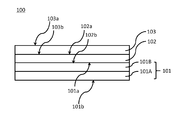
- FIG. 1 is a schematic cross-sectional view of the laminated body of the present invention according to the first embodiment.
- FIG. 2 is a diagram showing the depth profile (1) of Example 4.
- FIG. 3 is a diagram showing the depth profile (2) of Example 4.
- the unit represented by the formula (1) is referred to as "unit (1)”.
- the units expressed by other formulas are also described in the same manner.
- the group represented by the formula (2) is referred to as “group (2)”.
- the groups represented by other formulas are also described in the same manner.
- the compound represented by the formula (3) is referred to as "compound (3)”.
- Compounds represented by other formulas are also described in the same manner.
- the alkylene group may have an A group
- the alkylene group may have an A group between carbon atoms in the alkylene group, or the alkylene group-. It may have an A group at the end, such as A group.
- the meanings of the terms in the present invention are as follows.
- the "divalent organopolysiloxane residue” is a group represented by the following formula.
- R x in the following formula is an alkyl group (preferably 1 to 10 carbon atoms) or a phenyl group.
- g1 is an integer of 1 or more, preferably an integer of 1 to 9, and particularly preferably an integer of 1 to 4.
- the "number average molecular weight" of a compound is calculated by determining the number (average value) of oxyfluoroalkylene groups based on the terminal groups by 1 H-NMR and 19 F-NMR.
- the laminate of the present invention includes a resin base material, a primer layer laminated on at least one surface of the resin base material, and a surface layer laminated on the primer layer.
- the laminated body does not have to have any layer on the other surface side of the resin base material, and may have a configuration in which the primer layer and the surface layer are sequentially laminated on the other surface side of the resin base material.
- the other layer may be provided on the other surface side of the resin base material.
- FIG. 1 is a schematic view of a laminated body according to the first embodiment of the present invention.
- the laminate 100 in the first embodiment has a resin base material 101, a primer layer 102, and a surface layer 103.
- the resin base material 101 has a first main surface 101a and a second main surface 101b that face each other.
- a primer layer 102 is formed on the first main surface 101a.
- the primer layer 102 has a first surface 102a far from the resin base material 101 and a second surface 102b close to the resin base material 101.
- a surface layer 103 is formed on the first surface 102a of the primer layer.
- the surface layer 103 has a first surface 103a far from the resin base material 101 and a second surface 103b close to the resin base material 101.
- the primer layer 102 and the surface layer 103 may be formed on the side of the second main surface 101b, or may be formed on both sides of the resin base material (first main surface 101a, second main surface 101b). good.
- each configuration of the laminated body will be described in detail.
- the shape of the resin base material is not particularly limited, and may be cylindrical, cylindrical, prismatic, lenticular, dome-shaped, flat plate-shaped, or sheet-shaped.
- the thickness of the sheet-shaped resin base material is preferably 5 ⁇ m to 1 cm in order to obtain a laminate that is excellent in durability such as abrasion resistance and slipperiness and can be used in, for example, an information display device that is highly required to be thin. More preferably, it is 10 ⁇ m to 5 mm. Further, for example, from the viewpoint of obtaining a laminate that can be used for an electronic device, the thickness of the sheet-shaped resin base material is preferably 5 ⁇ m to 150 ⁇ m.
- the surface tension of the surface of the resin base material is preferably 25 dyn / cm to 50 dyn / cm, more preferably 35 dyn / cm to 50 dyn / cm.
- Examples of the resin constituting the resin base material include epoxy resin, epoxy-modified resin, acrylic resin, urethane resin, acrylic-urethane resin, alkyd resin, acrylic-modified alkyd resin, unsaturated polyester resin, melamine resin, aminoalkyd resin, and silicone resin. Etc., and one or a combination of two or more of these can be used.
- the resin base material may be composed of only one type of resin or may be a composite in which a plurality of resins are laminated.
- the resin base material is a composite of a plurality of resins
- the primer layer 12 is usually laminated on the hard coat layer 101B.
- a method of laminating the hard coat layer on at least one surface of the resin film a known method can be applied.
- a layer other than the resin such as a conductive layer or a touch sensor film may be laminated between the resin film 101A and the hard coat layer 101B.
- resin film As the resin film constituting the resin base material, a resin film having high transparency and generally used as a base material for an optical hard coat film can be appropriately selected and used.
- the resin film for example, a polyester resin film, a triacetyl cellulose film, an acrylic resin film, an alicyclic structure-containing thermoplastic resin film, a polycarbonate resin film, a polyimide film, a fluorine-containing polyimide film and the like can be used.
- a resin film having an easy-adhesion layer on the surface can also be used for the purpose of improving the adhesion with the hard coat layer.
- a resin film having been surface-treated for the purpose of improving the adhesion to the hard coat layer can be used.
- the surface treatment include unevenness treatment by sandblasting method, solvent treatment method and the like, corona discharge treatment, atmospheric pressure plasma treatment, chromic acid treatment, flame treatment, hot air treatment, ozone treatment, ultraviolet irradiation treatment, oxidation treatment and the like.
- the total light transmittance of the resin film is preferably 88% or more, more preferably 90% or more.
- the transmittance is excellent and good visibility is ensured even when the hard coat layer, the primer layer and the surface layer are provided on one side or both sides of the resin film. A laminated body can be obtained.
- the thickness of the transparent resin film is preferably 50 ⁇ m to 450 ⁇ m, preferably 75 ⁇ m to 300 ⁇ m, from the viewpoint of being able to manufacture a laminate that can be used in an information display device that is highly required to be thin while suppressing the occurrence of curl (warp). More preferred.
- Hard coat layer examples of the hard coat layer constituting the resin base material include those formed by using a hard coat agent containing an active energy ray-curable composition.
- the hard coat agent it is preferable to use a hard coat agent containing (meth) acrylate because it is easy to obtain and handle and it is easy to control the characteristics of the hard coat layer according to the application and the like.
- (meth) acrylate is a general term for acrylate or methacrylate.
- urethane (meth) acrylate is used to suppress curing shrinkage when the hard coat layer is formed, and to form a hard coat layer having high surface hardness and excellent durability. It is more preferable to use (A).
- urethane (meth) acrylate (A) various urethane (meth) acrylates can be used, and among them, urethane (meth) acrylate having four or more (meth) acryloyl groups in the molecule should be used. Is preferable.
- As the urethane (meth) acrylate having four or more (meth) acryloyl groups in the molecule it is preferable to use one obtained by reacting, for example, a polyisocyanate with a (meth) acrylate having a hydroxyl group.
- Urethane (meth) acrylate (A) can be produced by subjecting the polyisocyanate and the (meth) acrylate having a hydroxyl group to a urethanization reaction in the presence of a urethanization catalyst by a conventional method.
- urethane (meth) acrylate (A) it is preferable to use a urethane acrylate obtained by using norbornan diisocyanate as the polyisocyanate and a urethane acrylate obtained by using isophorone diisocyanate as the polyisocyanate in combination. .. With such a combination, it is possible to obtain a laminate having high surface hardness and excellent durability while suppressing warpage of the laminate due to curing shrinkage when cured.
- one containing other (meth) acrylates other than the urethane (meth) acrylate (A) can be used.
- examples of other (meth) acrylates include polyfunctional (meth) acrylates (B) having three or more (meth) acryloyl groups in the molecule.
- mono (meth) acrylate having one (meth) acryloyl group in the molecule and two (meth) in the molecule are used as long as the effects of the present invention are not impaired.
- Those containing other (meth) acrylates such as di (meth) acrylate having an acryloyl group can be used. They are preferably used in an amount of 40 parts by mass or less, preferably 20 parts by mass or less, based on a total of 100 parts by mass of the urethane (meth) acrylate (A) and the polyfunctional (meth) acrylate (B). Is more preferable.
- the hard coating agent one containing a photopolymerization initiator capable of initiating a curing reaction by irradiating with active energy rays can be used.
- the photopolymerization initiator include an intracellular cleavage type photopolymerization initiator and a hydrogen abstraction type photopolymerization initiator.
- the hard coating agent one containing a photosensitizer can be used.
- the hard coat agent one diluted with an appropriate solvent can be used.
- the solvent include acetone, isobutyl alcohol, 2-propanol, isopentyl alcohol, ethyl ether, ethylene glycol monoethyl ether, ethylene glycol monoethyl ether acetate, ethylene glycol mono-normal-butyl ether, ethylene glycol monomethyl ether, ortho-.
- a polymerization inhibitor if necessary, a polymerization inhibitor, a surface conditioner, an antistatic agent, a defoamer, a viscosity modifier, a light-resistant stabilizer, a weather-resistant stabilizer, a heat-resistant stabilizer, an ultraviolet absorber, and an antioxidant.
- a polymerization inhibitor if necessary, a polymerization inhibitor, a surface conditioner, an antistatic agent, a defoamer, a viscosity modifier, a light-resistant stabilizer, a weather-resistant stabilizer, a heat-resistant stabilizer, an ultraviolet absorber, and an antioxidant.
- Leveling agents organic pigments, inorganic pigments, pigment dispersants, silica beads, organic beads and other additives; those containing inorganic fillers such as silicon oxide, aluminum oxide, titanium oxide, zirconia, antimony pentoxide, etc. Can be used.
- the thickness of the hard coat layer is preferably 3 ⁇ m to 25 ⁇ m, preferably 5 ⁇ m to 25 ⁇ m in order to obtain a laminate that is excellent in durability such as scratch resistance and slipperiness and can be used in, for example, an information display device that is highly required to be thin. 15 ⁇ m is more preferable.
- the water contact angle on the surface of the hard coat layer is preferably 90 degrees or less, more preferably 80 degrees or less.
- the pencil hardness of the surface when the hard coat layer is laminated on one side of the resin film is preferably 2H or more from the viewpoint of obtaining a laminated body capable of preventing dents and scratches even when strongly pressed by a touch pen or the like. 3H or more is more preferable.
- the primer layer in the laminate of the present invention is provided for the purpose of improving the adhesion between the resin base material and the surface layer.
- the primer layer can form a bond with both the resin base material and the surface layer in order to form a laminated body having even better adhesion.
- the primer layer contains a condensate of a silane coupling agent and a surface tension modifier.
- the primer layer is formed by using a silane coupling agent and a surface tension adjusting agent. By using the silane coupling agent, the adhesion between the resin base material and the surface layer is enhanced.
- the silane coupling agent is preferably a silane compound having an alkoxysilyl group or a silanol group.
- the surface layer described later is formed of a polyfluoropolyether compound having a reactive silyl group such as an alkoxysilyl group or a silanol group, such group reacts with the alkoxysilyl group or silanol group in the silane coupling agent.
- a bond can be formed at the interface between the primer layer and the surface layer, and the adhesion between the resin base material and the surface layer is enhanced.
- silane coupling agent examples include tetramethoxysilane, tetraethoxysilane, methyltrimethoxysilane, methyltriethoxysilane, 3-aminopropyltrimethoxysilane, 3-aminopropyltriethoxysilane, and 2-hydroxyethyltrimethoxysilane.
- 2-Hydroxyethyl triethoxysilane 2-hydroxypropyltrimethoxysilane, 2-hydroxypropyltriethoxysilane, 3-hydroxypropyltrimethoxysilane, 3-hydroxypropyltriethoxysilane, vinyltrimethoxysilane, vinyltriethoxysilane , Vinyltriacetoxysilane, allyltrimethoxysilane, 3-methacryloxypropylmethyldimethoxysilane, 3-methacryloxytrimethoxysilane, 3-methacryloxypropylmethyldiethoxysilane, 3-methacryloxytriethoxysilane, 3-acryloxy Propyltrimethoxysilane, 3-mercaptopropyltrimethoxysilane, 3-mercaptopropylmethyldimethoxysilane, 3-mercaptopropyltriethoxysilane, 3-isocyanatopropyltrimethoxysilane, 3-isocyanatopropyltri
- organic polymer types containing a trialkoxysilyl group and an organic functional group for example, manufactured by Shin-Etsu Chemical Industry Co., Ltd .: X-12-1048, X-12-1050, X-12-9815, X-12- 9845, X-12-972F, X-12-1159L
- organic functional group-containing siloxane polymer types manufactured by Shin-Etsu Chemical Industry Co., Ltd .: KR-513, KR-517
- alkoxysilyl groups serve as silanol groups.
- VOC-free silane coupling agents for example, manufactured by Shin-Etsu Chemical Industry Co., Ltd .: KBP-90, KBP-64
- functional group-protected silane coupling agents for example, manufactured by Shin-Etsu Chemical Industry Co., Ltd .: KBE-9103P, X- 12-1172ES
- the silane coupling agent has at least one group selected from an amino group, an epoxy group, a vinyl group, and an acrylic group, that is, at least selected from aminosilane, epoxysilane, vinylsilane, and acrylicsilane. It is more preferable that it is one kind of silane compound.
- a known compound can be used as the silane coupling agent.
- the primer layer is formed by using a surface tension adjusting agent together with a silane coupling agent.
- a surface tension adjusting agent By forming the primer layer using the surface tension adjusting agent, the wettability (depositionability) of the composition for forming the primer layer to the resin substrate can be improved, and the primer layer can be uniformly formed.
- an agent capable of lowering the surface tension of the primer layer forming composition can be used, for example, an acrylic surfactant, a silicon surfactant, an ether surfactant, and an alcohol alkoxylate surfactant.
- an acrylic surfactant for example, an acrylic surfactant, a silicon surfactant, an ether surfactant, and an alcohol alkoxylate surfactant.
- a silicon-based surfactant is preferable because it has a high ability to reduce surface tension and has good compatibility with a solvent.
- the silicon-based surfactant include polyether-modified polydimethylsiloxane and polyether-modified siloxane.
- Known compounds can be used as silicon-based surfactants (polyether-modified polydimethylsiloxane and polyether-modified siloxane).
- silicon-based surfactants polyether-modified polydimethylsiloxane and polyether-modified siloxane.
- BYK307, BYK310, BYK330, BYK333, BYK347, BYK348, BYK349, BYK378, BYK3455 manufactured by Big Chemie Co., Ltd. Etc. and may be used alone or in combination of two or more.
- the content of the surface tension adjusting agent in the primer layer is preferably 3 to 70% by mass, more preferably 5 to 35% by mass, from the viewpoint of the ability to reduce the surface tension and the film strength.
- the content of the surface tension adjusting agent in the primer layer is converted from the SiO 2 content calculated from the composition for forming the primer layer.
- the primer layer may further contain various optional components, if necessary.
- Optional components include polymerization initiators, acid catalysts, base catalysts, photosensitizers, polymerization inhibitors, antistatic agents, defoaming agents, viscosity modifiers, light-resistant stabilizers, weather-resistant stabilizers, heat-resistant stabilizers, and UV absorbers.
- Examples of the acid catalyst include blended acids such as nitric acid, hydrochloric acid, sulfuric acid, sulfite, hydrogen sulfide, perchloric acid, hypochlorous acid, hydrogen peroxide, carbonic acid, formic acid, acetic acid and benzoic acid, and Lewis such as aluminum chloride. Acid is mentioned.
- Examples of the base catalyst include sodium hydroxide, potassium hydroxide, sodium carbonate, sodium hydrogencarbonate, ammonia, ethylamine, aniline and the like.
- Examples of the light-resistant stabilizer include ADEKA's Adekastab LA-52, Adekastab LA-57, Adekastab LA-63P, Adekastab LA-68, Adekastab LA-72, Adekastab LA-77Y, Adekastab LA-81, and Adekastab LA-82.
- Adekastab LA-87, Adekastab LA-402AF, Adekastab LA-40MP, BASF's Tinuvin123, Tinuvin144, Tinuvin111 FDL, Tinuvin152, Tinuvin249, Tinuvin292, Tinuvin2702, Tinuvin670 N), Tinuvin 5333-DW (N) and the like can be mentioned.
- antioxidants examples include Adecastab AO-20, Adecastab AO-30, Adecastab AO-40, Adecastab AO-50, Adecastab AO-60, Adecastab AO-80, Adecastab AO-330, Adecastab AO-412S, Adecastab AO- 503, Adekastab A-611, Adekastab A-612RG, Adekastab A-613RG, Adekastab A-512RG, Adekastab AO-18, Adekastab PEP-8, Adekastab PEP-36, Adekastab HP-10, Adekastab 1178, Adekastab 1178, Adekastab 1178 , Adekastab 1178 , Adekastab C, Adekastab 135A, Adekastab 3010, Adekastab TPP, BASF's Irganox 1010, Irganox 1035, Irganox 1076, Irganox 1098, Irganox 1135, Irga
- the dispersion liquid of the inorganic filler examples include silicon oxide fine particle dispersion liquid (for example, Snowtex ST-XS, ST-S, ST-30, ST-50-T, ST-30L, ST-UP manufactured by Nissan Chemical Co., Ltd.).
- the film thickness of the primer layer in the laminate of the present invention is preferably 1 nm or more, more preferably 3 nm or more, further preferably 5 nm or more, and preferably 75 nm or less, more preferably 50 nm or less. , More preferably 40 nm or less.
- the laminate of the present invention has a surface layer on the primer layer. According to the present invention, by laminating the surface layer with the resin base material via the primer layer, the adhesion and wear resistance between the resin base material and the surface layer can be improved.
- the surface layer consists of a condensate of a compound having a reactive silyl group or a composition containing a condensate of a compound having a reactive silyl group.
- a material used when forming the surface layer a compound having a reactive silyl group is used. The material may be partially condensed before forming the surface layer.
- the reactive silyl group means a hydrolyzable silyl group and a silanol group (Si—OH).
- the silyl group contained in the silane coupling agent of the primer layer and the reactive silyl group of the compound used for forming the surface layer are condensed.
- the surface layer is laminated with the resin base material via the primer layer in a state where the reactive silyl groups are condensed. Therefore, the adhesion and wear resistance between the surface layer and the resin base material are improved.
- the surface layer preferably has an antifouling effect, an antifog effect, a UV cut effect, an IR cut effect, or a water skiing effect.
- the antifouling effect means that the contact angle of water droplets with a diameter of 1 mm is measured using DM-701 (manufactured by Kyowa Interface Science Co., Ltd.) at five different surface layers, and the average value is 100 degrees or more. It means that there is.
- the anti-fog effect is an effect of preventing so-called "anti-fog", in which fine water droplets adhere when the surface of the substrate falls below the dew point temperature, and the transmitted light is scattered by the water droplets and the transparency is impaired. After leaving it in an environment of 20 ° C and 50% relative humidity for 1 hour, hold the surface provided with the anti-fog layer on a warm water bath of 35 ° C at a position of 8.5 cm until cloudiness is visually observed. It means the effect that the anti-fog time (seconds) of is 50 seconds or more.
- the surface layer having an antifogging effect includes a water-soluble epoxy resin which is a polyfunctional aliphatic epoxy resin, an aluminum compound, an alkoxysilane compound having a reactive silyl group, and / or an alkoxysilane compound having a reactive silyl group.
- a film containing a partially hydrolyzed condensate of examples thereof include a film containing a partially hydrolyzed condensate of.
- the silanol group in the partially hydrolyzed condensate of the alkoxysilane compound having a reactive silyl group and / or the alkoxysilane compound having a reactive silyl group is dehydrated from the silanol group derived from the silane coupling agent contained in the primer layer.
- a Si—O—Si bond can be formed by a condensation reaction. As a result, a bond is formed at the interface between the primer layer and the surface layer, and the adhesion between the resin base material and the surface layer is enhanced.
- the ultraviolet transmittance measured using a spectrophotometer (Hitachi, Ltd .: U-4100) is 3.0% or less as the ultraviolet transmittance measured according to ISO-9050 (1990).
- the IR cut effect means that the solar transmittance measured according to JIS-R3106 (1998) is 45.0% or less.
- the surface layer When it has a UV blocking effect, the surface layer contains an ultraviolet absorber containing one or more selected from benzophenone-based, triazine-based compounds, and benzotriazole-based compounds. When having an IR-cutting effect, the surface layer contains an infrared absorber containing one or more selected from tin-doped indium oxide, antimony-doped tin oxide, and composite tungsten oxide. In both cases where it has a UV blocking effect and when it has an IR blocking effect, it contains a dispersant and a binder component.
- the binder component is obtained by hydrolyzing (co) condensing hydrolyzable silicon compounds, and the silanol group in the binder component is dehydrated and condensed with a silanol group derived from a silane coupling agent contained in the primer layer. It can react to form a Si—O—Si bond. As a result, a bond is formed at the interface between the primer layer and the surface layer, and the adhesion between the resin base material and the surface layer is enhanced.
- the water-sliding effect means that the contact angle of a water droplet with a diameter of 1 mm is measured using DM-701 (manufactured by Kyowa Interface Science Co., Ltd.) at five different surface layers, and the average value is 100 degrees or more.
- DM-701 manufactured by Kyowa Interface Science Co., Ltd.
- SA-11 manufactured by Kyowa Interface Science Co., Ltd.
- Examples of the surface layer having a water-sliding effect include a film containing a linear silicone compound having a reactive silyl group represented by the following formula (1) and a partially hydrolyzed condensate thereof.
- the silanol group in the linear silicone compound having a reactive silyl group can form a Si—O—Si bond by dehydration condensation reaction with the silanol group derived from the silane coupling agent contained in the primer layer. As a result, a bond is formed at the interface between the primer layer and the surface layer, and the adhesion between the resin base material and the surface layer is enhanced.
- a layer having a reactive silyl group or silanol group at both ends may be provided between the surface layer and the primer layer with a divalent organic group interposed therebetween.
- X 1 3 Si- (CH 2 ) m- SiX 1 3 (1) (However, in formula (1), X 1 independently represents a hydrolyzable group or a hydroxyl group, and m is an integer of 1 to 8.)
- the surface layer preferably contains a condensate of a polyfluoropolyether compound having a reactive silyl group from the viewpoint of further improving abrasion resistance and antifouling property.
- the polyfluoropolyether compound is preferably a polyfluoropolyether compound (A) having a reactive silyl group at at least one end from the viewpoint of enhancing the adhesion between the resin base material and the surface layer.
- the reactive silyl group means a hydrolyzable silyl group and a silanol group (Si—OH) as described above.
- the hydrolyzable silyl group becomes a silanol group (Si-OH) by a hydrolysis reaction.
- the silanol group further undergoes a dehydration condensation reaction between the silanol groups to form a Si—O—Si bond. Therefore, the silanol group in the polyfluoropolyether compound (A) can form a Si—O—Si bond by dehydration condensation reaction with the silanol group derived from the silane coupling agent contained in the primer layer. As a result, a bond is formed at the interface between the primer layer and the surface layer, and the adhesion between the resin base material and the surface layer is enhanced.
- the surface layer contains a condensate in which the reactive silyl group of the polyfluoropolyether compound (A) is hydrolyzed and dehydrated and condensed. ..
- the surface layer contains a condensate of the silanol group of the polyfluoropolyether compound (A) undergoing a dehydration condensation reaction.
- Examples of the polyfluoropolyether compound (A) include a compound represented by the following formula (2), a compound represented by the following formula (3), and a compound represented by the following formula (4).
- R f1 is a fluoroalkyl group.
- R f2 is a fluoroalkylene group.
- m is an integer greater than or equal to 1.
- j is an integer greater than or equal to 2.
- T is a reactive silyl group.
- t is an integer from 1 to 10.
- Y 11 , Y 31 , and Y 32 are independently (t + 1) -valued linking groups.
- Y 21 is a (j + t) -valued linking group.
- Compound (2) and compound (3) are polyfluoropolyether compounds having a reactive silyl group at one end, and compound (4) is a polyfluoropolyether compound having a reactive silyl group at both ends.
- the reactive silyl group means a hydrolyzable silyl group and a silanol group (Si-OH).
- Specific examples of the hydrolyzable silyl group include a group in which L of the group represented by the formula (5) described later is a hydrolyzable group. From the viewpoint that a Si—O—Si bond is easily formed at the interface between the primer layer and the surface layer, it is preferable that at least a part of the reactive silyl group is a hydrolyzable silyl group.
- the group represented by the formula (5) is preferable. -Si (R 1 ) n L (3-n) ... (5)
- R 1 is a monovalent hydrocarbon group, preferably a monovalent saturated hydrocarbon group.
- the carbon number of R 1 is preferably 1 to 6, more preferably 1 to 3, and particularly preferably 1 to 2.
- L is a hydrolyzable group or a hydroxyl group.
- a hydrolyzable group is a group that becomes a hydroxyl group by a hydrolyzing reaction. That is, the hydrolyzable silyl group represented by Si-L becomes a silanol group represented by Si-OH by the hydrolysis reaction.
- the silanol groups further react between the silanol groups to form a Si—O—Si bond. Further, the silanol group can form a Si—O—Si bond by dehydration condensation reaction with the silanol group derived from the silane coupling agent contained in the primer layer.
- the hydrolyzable group examples include an alkoxy group, an aryloxy group, a halogen atom, an acyl group, an acyloxy group, and an isocyanate group (-NCO).
- the alkoxy group an alkoxy group having 1 to 4 carbon atoms is preferable.
- the aryloxy group an aryloxy group having 3 to 10 carbon atoms is preferable.
- the aryl group of the aryloxy group includes a heteroaryl group.
- the halogen atom a chlorine atom is preferable.
- the acyl group an acyl group having 1 to 6 carbon atoms is preferable.
- an acyloxy group having 1 to 6 carbon atoms is preferable.
- an alkoxy group having 1 to 4 carbon atoms and a halogen atom are preferable from the viewpoint that the production of a polyfluoropolyether compound is easier.
- an alkoxy group having 1 to 4 carbon atoms is preferable and a long-term storage stability of the polyfluoropolyether compound is required because there is little outgassing during coating and the storage stability of the polyfluoropolyether compound is more excellent.
- the ethoxy group is particularly preferable, and when the reaction time after coating is short, the methoxy group is particularly preferable.
- n is an integer of 0 to 2. n is preferably 0 or 1, and 0 is particularly preferable.
- the presence of a plurality of L makes the adhesion of the surface layer to the primer layer stronger.
- n is 1 or less, a plurality of Ls existing in one molecule may be the same or different. From the viewpoint of easy availability of raw materials and ease of production of polyfluoropolyether compounds, they are preferably the same.
- n is 2, a plurality of R 1 that are present in one molecule may be different even in the same. From the viewpoint of easy availability of raw materials and ease of production of polyfluoropolyether compounds, they are preferably the same.
- t is the number of reactive silyl groups T.
- t is an integer of 1 to 10, and is preferably 2 or more, preferably 5 or less, and particularly preferably 3 or less, in that the wear resistance of the surface layer is more excellent.
- the plurality of groups T may be the same or different. From the viewpoint of easy availability of raw materials and ease of production of polyfluoropolyether compounds, they are preferably the same.
- R f1 is a fluoroalkyl group. From the viewpoint that the surface layer is more excellent in water and oil repellency, R f1 is preferably a perfluoroalkyl group.
- a fluoroalkyl group is a group in which one or more hydrogen atoms in the group are replaced with fluorine atoms.
- a perfluoroalkyl group is a group in which all hydrogen atoms in the group are replaced with fluorine atoms.
- the carbon number of R f1 is preferably 1 to 20, more preferably 1 to 10, further preferably 1 to 6, and particularly preferably 1 to 3 from the viewpoint of more excellent wear resistance of the surface layer.
- R f1 may be linear, branched-chain, or cyclic, and is preferably linear. Further, from the viewpoint of more excellent wear resistance of the surface layer, it is preferable that the end of R f is CF 3-.
- R f1 includes CF 3- , CF 3 CF 2- , CF 3 CF 2 CF 2- , CF 3 CF 2 CF 2 CF 2- , CF 3 CF 2 CF 2 CF 2- , CF 3 CF 2 CF 2 CF 2 CF 2- , CF 3 CF 2 CF 2 CF 2 CF 2- , CF 3 CF (CF 3 )-etc., CF 3- , CF 3 CF 2- , CF 3 CF 2 CF 2 because the surface layer has better water and oil repellency. -Is preferable.
- R f2 is a fluoroalkylene group. From the viewpoint of water and oil repellency of the surface layer is more excellent, it is preferable R f2 is a perfluoroalkylene group R f21.
- the carbon number of R f2 is preferably 1 to 6, more preferably 2 to 6, and particularly preferably 2 to 4 from the viewpoint of more excellent weather resistance and corrosion resistance of the surface layer.
- R f2 may be linear, branched or cyclic, but is preferably linear because the effect of the present invention is more excellent.
- the number of fluorine atoms in R f2 is preferably 1 to 2 times the number of carbon atoms, and particularly preferably 1.7 to 2 times, from the viewpoint of more excellent corrosion resistance of the surface layer.
- R f2 include -CHF-, -CF 2 CHF-, -CHFCF 2- , -CF 2 CH 2- , -CH 2 CF 2- , -CF 2 CF 2 CHF-, -CHFCF 2 CF 2 -, -CF 2 CF 2 CH 2- , -CH 2 CF 2 CF 2- , -CF 2 CF 2 CH 2- , -CH 2 CF 2 CF 2- , -CF 2 CF 2 CF 2 CH 2- , -CH 2 CF 2 CF 2 CF 2- , -CF 2 CF 2 CF 2 CH 2- , -CH 2 CF 2 CF 2 CF 2- , -CF 2 CF 2 CF 2 CF 2 CH 2- , -CH 2 CF 2 CF 2 CF 2 CF 2- , -CF 2 CF 2 CF 2 CF 2 CH 2- , -CH 2 CF 2 CF 2 CF 2 CF 2- , -CF 2 CF 2 CF 2 CF 2
- m is the number of repetitions of the repeating unit (R f2- O) in the polyfluoropolyether compounds (2) to (4), and is an integer of 1 or more.
- an integer of 2 or more is preferable, an integer of 2 to 200 is more preferable, an integer of 5 to 150 is further preferable, an integer of 5 to 100 is particularly preferable, and an integer of 10 to 50 is most preferable.
- j is an integer of 2 or more, preferably an integer of 2 to 6, and more preferably an integer of 2 to 4.
- the polyfluoropolyether compounds (2) to (4) may contain one type of unit (R f2- O), or may contain two or more types of units (R f2- O).
- the two or more units (R f2 -O) for example, two or more units having different numbers of carbon atoms (R f2 -O), presence or absence or the side chain type of side chain even with the same number of carbon atoms Examples thereof include two or more different units (R f2- O), two or more units having the same number of carbon atoms but different numbers of fluorine atoms (R f2- O), and the like.
- the binding order of two or more units (R f2- O) is not limited, and may be randomly, alternately, or arranged in blocks.
- (R f2- O) m is (CH ma F (2-ma) O) m11 (C 2 H mb F (4-mb) O) m12 (C 3 H mc F (6-mc) O) m13 ( C 4 H md F (8-md) O) m14 (C 5 H me F (10-me) O) m15 (C 6 H mf F (12-mf) O) m16 is preferable.
- ma is 0 or 1
- mb is an integer of 0 to 3
- mc is an integer of 0 to 5
- md is an integer of 0 to 7
- me is an integer of 0 to 9
- mf is an integer of 0 to 9. It is an integer from 0 to 11.
- m11, m12, m13, m14, m15 and m16 are each independently an integer of 0 or more, preferably 100 or less.
- m11 + m12 + m13 + m14 + m15 + m16 are integers of 2 or more, preferably an integer of 2 to 200, more preferably an integer of 5 to 150, further preferably an integer of 5 to 100, and particularly preferably an integer of 10 to 50.
- m12 is preferably an integer of 2 or more, and particularly preferably an integer of 2 to 200.
- C 3 H mc F (6-mc) , C 4 H md F (8-md) , C 5 H me F (10-me) and C 6 H mf F (12-mf) are linear. However, it may be in the form of a branched chain, and is preferably in the form of a linear chain from the viewpoint of having more excellent abrasion resistance of the surface layer.
- the above formula represents the type of unit and its number, and does not represent an array of units. That is, m11 to m16 represent the number of units, for example, (CH ma F (2-ma) O) m11 does not represent a block in which (CH ma F (2-ma) O) units are m11 consecutive. No. Similarly, the description order of (CH ma F (2-ma) O) to (C 6 H mf F (12-mf) O) does not indicate that they are arranged in the description order. In the above formula, when 2 or more of m11 to m16 are not 0 (that is, when (R f2- O) m is composed of two or more units), the sequences of different units are random sequences, alternating sequences, and so on.
- each of the above units may also be different if the unit includes two or more units. For example, when m11 is 2 or more, a plurality of (CH ma F (2-ma) O) may be the same or different.
- the unit (R f2- O) is a unit (R) in which R f2 is a perfluoroalkylene group R f21. It is preferable that f21- O) is the main component. That is, it is preferable that the ratio of the number of units units to the total number m of (R f2 -O) (R f21 -O) is 50-100%, more preferably 80-100%, 90-100 % Is particularly preferable.
- Y 11 , Y 31 , and Y 32 are independently (t + 1) -valent linking groups. As mentioned above, t is an integer from 1 to 10. Therefore, examples of Y 11 , Y 31 , and Y 32 include linking groups having a valence of 2 to 11.
- Y 21 is a (j + t) -valent linking group. As described above, t is an integer of 1 to 10, and j is an integer of 2 or more. Therefore, Y 21 may be a linking group having a valence of 3 or more.
- Y 31 and Y 32 may be the same or different. From the viewpoint of easy availability of raw materials and ease of production of polyfluoropolyether compounds, they are preferably the same.
- the Y 11 , Y 31 , and Y 32 may be any group as long as they do not impair the effects of the present invention.
- they may have an ethereal oxygen atom or a divalent organopolysiloxane residue and have 1 to 20 carbon atoms.
- a group (g3-9) can be mentioned.
- the Y 21 may be any group as long as it does not impair the effects of the present invention.
- an alkylene group having 1 to 20 carbon atoms and a carbon atom which may have an ethereal oxygen atom or a divalent organopolysiloxane residue For example, an alkylene group having 1 to 20 carbon atoms and a carbon atom which may have an ethereal oxygen atom or a divalent organopolysiloxane residue.
- Y 31 and Y 32 in equation (4) are independent of each other.
- a 1 is a single bond, an alkylene group, or an alkylene group having 2 or more carbon atoms having -C (O) NR 6- , -C (O)-, -OC (O) O-,-between carbon atoms.
- the hydrogen atom of the alkylene group may be substituted with a fluorine atom.
- Q 11 represents a single bond, an alkylene group or a carbon of an alkylene group having 2 or more carbon atoms, - a group having an etheric oxygen atom between carbon atoms.
- Q 22 represents an alkylene group, a carbon number of 2 or more alkylene group having a carbon - -C between carbon atoms (O) NR 6 -, - C (O) -, - NR 6 - or a group having -O-, alkylene A group having -C (O) NR 6- , -C (O)-, -NR 6- or -O- at the end of the group not connected to Si, or a carbon-carbon of an alkylene group having 2 or more carbon atoms.
- the two or more Q 22s may be the same or different.
- Q 23 the carbon of the alkylene group or an alkylene group having 2 or more carbon, - -C between carbon atoms (O) NR 6 -, - C (O) -, - NR 6 - or -O- a group having a There, the two of Q 23 may be the same or different.
- Q 24 when atom in Z 1 to Q 24 is attached is a carbon atom, a Q 22, when atoms in Z 1 to Q 24 is attached is a nitrogen atom, a Q 23, in each formula, Q 24 If is present 2 or more, two or more Q 24 may be different even in the same.
- Q 25 the carbon of the alkylene group or an alkylene group having 2 or more carbon, - -C between carbon atoms (O) NR 6 -, - C (O) -, - NR 6 - or -O- a group having a Yes, if there are two or more Q 25s in each equation, the two or more Q 25s may be the same or different.
- Q 26 the carbon of the alkylene group or an alkylene group having 2 or more carbon, - -C between carbon atoms (O) NR 6 -, - C (O) -, - NR 6 - or -O- a group having a be.
- R 6 is a hydrogen atom, an alkyl group having 1 to 6 carbon atoms, or a phenyl group.
- Q 27 is a single bond or an alkylene group.
- Q 28 represents an alkylene group, or a carbon atom of the alkylene group having 2 or more carbon atoms - a group having an organopolysiloxane residue of the ethereal oxygen atom or a divalent between carbon atoms.
- the carbon number of the alkylene group of Q 22 , Q 23 , Q 24 , Q 25 , Q 26 , Q 27 , and Q 28 makes it easy to produce polyfluoropolyether compounds (2) to (4), and is water repellent. From the viewpoint of further excellent friction resistance, light resistance and chemical resistance of the oil repellent layer, 1 to 10 is preferable, 1 to 6 is more preferable, and 1 to 4 is particularly preferable. However, when a specific bond is formed between carbon atoms, the lower limit of the number of carbon atoms of the alkylene group is 2.
- Z 1 is a group having a h1 + h2 valent ring structure having a carbon atom or nitrogen atom to which A 1 is directly bonded and a carbon atom or nitrogen atom to which Q 24 is directly bonded.
- Examples of the ring structure in Z 1 include the above-mentioned ring structure, and the preferred form is also the same. Since A 1 and Q 24 are directly bonded to the ring structure in Z 1 , for example, an alkylene group is linked to the ring structure, and A 1 and Q 24 are not linked to the alkylene group.
- R e1 is a hydrogen atom or an alkyl group, and when two or more Re1s are present in each formula, two or more Re1s may be the same or different.
- Re2 is a hydrogen atom, a hydroxyl group, an alkyl group or an acyloxy group.
- Re3 is an alkyl group.
- Re4 is a hydrogen atom or an alkyl group, and a hydrogen atom is preferable because it is easy to produce a compound.
- the two or more Re 4s may be the same or different.
- Re5 is a hydrogen atom or a halogen atom, and a hydrogen atom is preferable because it is easy to produce a compound.
- d1 is an integer of 0 to 3, preferably 1 or 2.
- d2 is an integer of 0 to 3, preferably 1 or 2.
- d1 + d2 is an integer of 1 to 3.
- d3 is an integer of 0 to 3, preferably 0 or 1.
- d4 is an integer of 0 to 3, preferably 2 or 3.
- d3 + d4 is an integer of 1 to 3.
- d1 + d3 is an integer of 1 to 5 in Y 11 or Y 21 , preferably 1 or 2, and 1 in Y 11 , Y 31 and Y 32 .
- d2 + d4 is an integer of 2 to 5 in Y 11 or Y 21 , preferably 4 or 5, an integer of 3 to 5 in Y 31 and Y 32, preferably 4 or 5.
- e1 + e2 is 3 or 4.
- Y 11 is 1, the Y 21 is an integer from 2 to 3, 1 in the Y 31 and Y 32.
- e2 is 2 or 3 in Y 11 or Y 21 and 2 or 3 in Y 31 and Y 32 .
- h1 in Y 11 is 1, the Y 21 is an integer of 2 or more (2 preferably), it is 1 in Y 31 and Y 32.
- h2 is an integer of 2 or more (preferably 2 or 3) in Y 11 or Y 21 , and an integer of 1 or more ( preferably 2 or 3) in Y 31 and Y 32.
- i1 + i2 in Y 11 is 3 or 4, in Y 12 is 4, the Y 31 and Y 32 is 3 or 4.
- i1 in Y 11 is 1, the Y 21 is 2, and 1 in the Y 31 and Y 32.
- i2 in Y 11 is 2 or 3, in Y 12 is 2, the Y 31 and Y 32 is 2 or 3.
- i3 is 2 or 3.
- i4 is 2 or more (preferably an integer of from 2 to 10, an integer of 2-6 being particularly preferred) in Y 11 are, one or more (preferably an integer of 1 to 10 in Y 31 and Y 32, 1 ⁇ An integer of 6 is particularly preferable).
- i5 is 2 or more, and is preferably an integer of 2 to 7.
- Z a is a (i5 + 1) -valent organopolysiloxane residue, and the following groups are preferable.
- Ra in the following formula is an alkyl group (preferably 1 to 10 carbon atoms) or a phenyl group.
- the number of carbon atoms of the alkyl group of R e1 , Re 2 , Re 3 or Re 4 is preferably 1 to 10 and more preferably 1 to 6 from the viewpoint of easy production of compounds (2) to (4). 3 is more preferable, and 1 to 2 is particularly preferable.
- the number of carbon atoms in the alkyl group moiety of the acyloxy group R e2 may be prepared from compounds (2) to the compound (4) that tends to produce, preferably 1-10, more preferably 1-6, more preferably 1-3, 1-2 is particularly preferable.
- h1 is preferably 1 to 6 and more preferably 1 to 4 because it is easy to produce compounds (2) to (4) and the water and oil repellent layer is more excellent in abrasion resistance and fingerprint stain removing property.
- h2 is preferably 2 to 6 and more preferably 2 to 4 because it is easy to produce compounds (2) to (4) and the water and oil repellent layer is more excellent in abrasion resistance and fingerprint stain removing property.
- 2 or 3 is particularly preferred.
- the A 1 side is connected to (R f2- O) m
- the G 1 side is connected to the reactive silyl group T.
- G 1 is a group represented by the following formula (g3).
- each (G3-1) ⁇ formula (g3-9) if G 1 is present 2 or more, 2 or more G 1 may be be the same or different.
- the codes other than G 1 are the same as the codes in the formulas (g2-1) to (g2-9).
- -Si (R 8 ) 3-r1 (-Q 3- ) r1 ... (g3) However, in the formula (g3), the Si side is connected to Q 22 , Q 23 , Q 24 , Q 25 , Q 26 , Q 27 and Q 28 , and the Q 3 side is [-Si (R) n L 3-n ]. Connect to.
- R 8 is an alkyl group.
- Q 3 are carbon atoms in the alkylene group, having two or more alkylene groups having a carbon - -C between carbon atoms (O) NR 6 -, - C (O) -, - NR 6 - or a group having -O- or, - (OSi (R 9) 2 ) is a p -O-, 2 or more Q 3 are may be the same or different.
- r1 is 2 or 3.
- R 6 is a hydrogen atom, an alkyl group having 1 to 6 carbon atoms, or a phenyl group.
- R 9 is an alkyl group, a phenyl group or an alkoxy group, and the two R 9s may be the same or different.
- p is an integer of 0 to 5, and when p is 2 or more, 2 or more (OSI (R 9 ) 2 ) may be the same or different.
- the alkylene group of Q 3 are Compound (2) to the compound (4) prepared easily point a, as well as abrasion resistance of the surface layer, from the viewpoint of light resistance and chemical resistance are further excellent, 1 to 10
- 1 to 6 are more preferable, and 1 to 4 are particularly preferable.
- the lower limit of the number of carbon atoms of the alkylene group is 2.
- the number of carbon atoms of the alkyl group of R 8 is preferably 1 to 10, more preferably 1 to 6, further preferably 1 to 3, and 1 to 2 from the viewpoint that compounds (2) to (4) can be easily produced. Especially preferable.
- the number of carbon atoms of the alkyl group of R 9 is preferably 1 to 10, more preferably 1 to 6, further preferably 1 to 3, and 1 to 2 from the viewpoint that compounds (2) to (4) can be easily produced. Especially preferable.
- the number of carbon atoms of the alkoxy group of R 9 is preferably 1 to 10, more preferably 1 to 6, further preferably 1 to 3, and 1 to 3 from the viewpoint of excellent storage stability of the compounds (2) to (4). 2 is particularly preferable.
- p is preferably 0 or 1.
- Examples of the compound (2), the compound (3) and the compound (4) include the compounds of the following formulas.
- the compounds of the following formulas are industrially easy to manufacture and handle, and have better water and oil repellency, abrasion resistance, fingerprint stain removal, lubricity, chemical resistance, light resistance and chemical resistance of the surface layer. Of these, it is preferable because it has particularly excellent light resistance.
- the R f in the compound of the following formula is the same as that of R f1- O- (R f2- O) m- in the above-mentioned formula (2) or formula (3), and the preferred embodiment is also the same.
- the Q f in the compound of the following formula is the same as that of —O— (R f2- O) m ⁇ in the formula (4), and the preferred embodiment is also the same.
- Examples of the compound (2) in which Y 11 is a group (g2-1) include the compound of the following formula.
- Examples of the compound (2) in which Y 11 is a group (g2-2) include the compound of the following formula.
- Examples of the compound (3) in which Y 21 is a group (g2-2) include the compound of the following formula.
- Examples of the compound (2) in which Y 11 is a group (g2-3) include the compound of the following formula.
- Examples of the compound (2) in which Y 11 is a group (g2-4) include the compound of the following formula.
- Examples of the compound (2) in which Y 11 is a group (g2-5) include the compound of the following formula.
- Examples of the compound (2) in which Y 11 is a group (g2-7) include the compound of the following formula.
- Examples of the compound (2) in which Y 11 is a group (g3-1) include the compound of the following formula.
- Examples of the compound (2) in which Y 11 is a group (g3-2) include the compound of the following formula.
- Examples of the compound (2) in which Y 11 is a group (g3-3) include the compound of the following formula.
- Examples of the compound (2) in which Y 11 is a group (g3-4) include the compound of the following formula.
- Examples of the compound (2) in which Y 11 is a group (g3-5) include the compound of the following formula.
- Examples of the compound (2) in which Y 11 is a group (g3-6) include the compound of the following formula.
- Examples of the compound (2) in which Y 11 is a group (g3-7) include the compound of the following formula.
- Examples of the compound (3) in which Y 21 is a group (g2-1) include the compound of the following formula.
- Examples of the compound (4) having Y 31 and Y 32 as a group (g2-1) include the compounds of the following formulas.
- Examples of the compound (4) having Y 31 and Y 32 as a group (g2-2) include the compounds of the following formulas.
- Examples of the compound (4) having Y 31 and Y 32 as a group (g2-3) include the compounds of the following formulas.
- Examples of the compound (4) having Y 31 and Y 32 as a group (g2-4) include the compounds of the following formulas.
- Examples of the compound (4) having Y 31 and Y 32 as a group (g2-5) include the compounds of the following formulas.
- Examples of the compound (4) having Y 31 and Y 32 as a group (g2-6) include the compounds of the following formulas.
- Examples of the compound (4) having Y 31 and Y 32 as a group (g2-7) include the compounds of the following formulas.
- Examples of the compound (4) having Y 31 and Y 32 as a group (g3-2) include the compounds of the following formulas.
- polyfluoropolyether compound examples include those described in the following documents.
- Perfluoropolyether-modified aminosilanes described in Japanese Patent Application Laid-Open No. 11-029585 and Japanese Patent Application Laid-Open No. 2000-327772 Silicon-containing organic fluoropolymer described in Japanese Patent No. 2874715, Organosilicon compounds described in Japanese Patent Application Laid-Open No. 2000-144097, Fluorinated siloxane described in Japanese Patent Publication No. 2002-506887, Organic silicone compounds described in Japanese Patent Publication No. 2008-534696, Fluorinated modified hydrogen-containing polymer described in Japanese Patent No. 4138936, Compounds described in U.S. Patent Application Publication No.
- the surface layer can be formed using a coating agent containing a polyfluoropolyether compound.
- the content of the condensate of the polyfluoropolyether compound in the surface layer is preferably 80 parts by mass to 100 parts by mass, more preferably 90 parts by mass to 100 parts by mass, and 95 parts by mass with respect to 100 parts by mass of the non-volatile content of the coating agent. Parts to 100 parts by mass are more preferable.
- the film thickness of the surface layer is preferably 0.001 ⁇ m to 0.1 ⁇ m, preferably 0.001 ⁇ m to 0., in order to suppress white turbidity caused by agglomerates of the coating composition and impart excellent antifouling properties.
- 05 ⁇ m is more preferable.
- the laminated body of the present invention may have an arbitrary layer as appropriate in addition to the above structure.
- the optional layer include a decorative layer and an adhesive layer.
- the arbitrary layer is provided so that the surface layer is exposed at least a part of the surface layer of the laminated body.
- the laminate of the present invention has a step of applying a primer layer forming composition to at least one surface of a resin base material to form a primer layer, and a coating containing a polyfluoropolyether compound on the primer layer. It can be produced by laminating agents to form a surface layer.
- the step of forming the primer layer will be described.
- the primer layer is formed by applying a primer layer forming composition to at least one surface of a resin base material.
- the composition for forming a primer layer contains a silane coupling agent, a surface tension adjusting agent and a solvent.
- the silane coupling agent and the surface tension adjusting agent are as described above.
- Solvents include water, alcohols such as methanol, ethanol and isopropyl alcohol, glycols such as ethylene glycol, ketones such as methyl ethyl ketone, ethers such as diethyl ether and tetrahydrofuran, esters such as ethyl acetate and butyl acetate, hexane, and the like. Hydrocarbons such as heptane and cyclohexane, and the like can be mentioned.
- the composition for forming a primer layer may contain each optional component that may be contained in the above-mentioned primer layer, if necessary.
- the content of the silane coupling agent in the primer layer forming composition is preferably 0.02 to 0.7% by mass, more preferably 0.05 to 0. It is 7% by mass, more preferably 0.05 to 0.4% by mass.
- the concentration of the surface tension adjusting agent in the composition for forming the primer layer is preferably 0.001 to 0.5% by mass, which is preferable. Is 0.001 to 0.2% by mass, more preferably 0.001 to 0.05% by mass.
- the composition for forming a primer layer has a surface tension of preferably 20 dyn / cm to 40 dyn / cm, more preferably 20 dyn / cm to 35 dyn / cm, from the viewpoint of improving the wettability (deposition property) to the resin base material. Particularly preferably, it is 20 dyn / cm to 30 dyn / cm.
- it is 20 dyn / cm to 30 dyn / cm.
- Examples of the method of applying the primer layer forming composition to the surface of the resin base material include die coat, micro gravure coat, gravure coat, roll coat, comma coat, air knife coat, kiss coat, spray coat, flow coat, dip coat, spinner. Examples thereof include a coat, a wheeler coat, a brush coat, a solid coat with a silk screen, a wire bar coat, and a flow coat.
- the surface of the resin base material may be subjected to corona treatment, plasma treatment, etc. before forming the primer layer. As a result, the adhesion between the resin base material and the primer layer can be further improved.
- the coated surface is dried and cured to form a primer layer.
- the curing method include a method in which the composition for forming a primer layer is applied and the dried coated surface is irradiated with active energy rays to be cured.
- the active energy ray include ionizing radiation such as ultraviolet rays, electron beams, ⁇ rays, ⁇ rays, and ⁇ rays.
- Examples of devices that irradiate active energy rays include low-pressure mercury lamps, high-pressure mercury lamps, ultra-high-pressure mercury lamps, metal halide lamps, electrodeless lamps (fusion lamps), chemical lamps, and black light lamps. , Mercury-xenone lamps, short arc lamps, helium / cadmium lasers, argon lasers, sunlight, LEDs and the like.
- the primer layer is left at room temperature or heat-treated in a water vapor atmosphere or an atmosphere in which a small amount of water is present for the purpose of hydrolyzing an alkoxysilyl group that may be contained in the primer layer to form a silanol group. You may. As a result, a bond is likely to be formed between the primer layer and the surface layer.
- the surface of the primer layer may be subjected to corona treatment, plasma treatment, or the like. As a result, the adhesion between the primer layer and the surface layer can be further improved.
- the surface layer is formed by laminating a coating agent containing a polyfluoropolyether compound on a primer layer.
- the above-mentioned compound can be used as the polyfluoropolyether compound.
- the coating agent may further contain a liquid medium.
- the liquid medium include water and an organic solvent.
- Specific examples of the organic solvent include a fluorine-based organic solvent and a non-fluorine-based organic solvent.
- the organic solvent may be used alone or in combination of two or more.
- fluorinated organic solvent examples include fluorinated alkanes, fluorinated aromatic compounds, fluoroalkyl ethers, fluorinated alkylamines, and fluoroalcohols.
- the fluorinated alkane is preferably a compound having 4 to 8 carbon atoms, for example, C 6 F 13 H (AC-2000: product name, manufactured by AGC Inc.), C 6 F 13 C 2 H 5 (AC-6000: product name). , AGC), C 2 F 5 CHFCHFCF 3 (Bertrel: product name, manufactured by DuPont).
- fluorinated aromatic compound examples include hexafluorobenzene, trifluoromethylbenzene, perfluorotoluene, 1,3-bis (trifluoromethyl) benzene, and 1,4-bis (trifluoromethyl) benzene.
- the fluoroalkyl ether is preferably a compound having 4 to 12 carbon atoms, for example, CF 3 CH 2 OCF 2 CF 2 H (AE-3000: product name, manufactured by AGC), C 4 F 9 OCH 3 (Novec-7100:).
- fluorinated alkylamine include perfluorotripropylamine and perfluorotributylamine.
- fluoroalcohol include 2,2,3,3-tetrafluoropropanol, 2,2,2-trifluoroethanol and hexafluoroisopropanol.
- non-fluorine-based organic solvent a compound consisting of only hydrogen atoms and carbon atoms and a compound consisting of only hydrogen atoms, carbon atoms and oxygen atoms are preferable, and specifically, a hydrocarbon-based organic solvent and a ketone-based organic solvent are used.
- a hydrocarbon-based organic solvent and a ketone-based organic solvent are used.
- Ether-based organic solvent, ester-based organic solvent, alcohol-based organic solvent can be mentioned.
- Specific examples of the hydrocarbon-based organic solvent include hexane, heptane, and cyclohexane.
- Specific examples of the ketone-based organic solvent include acetone, methyl ethyl ketone, and methyl isobutyl ketone.
- ether-based organic solvent examples include diethyl ether, tetrahydrofuran, and tetraethylene glycol dimethyl ether.
- ester-based organic solvent examples include ethyl acetate and butyl acetate.
- alcohol-based organic solvent examples include isopropyl alcohol, ethanol, and n-butanol.
- the content of the polyfluoropolyether compound in the coating agent is preferably 0.01 to 50% by mass, preferably 0.01 to 50% by mass, based on the total mass of the coating agent. 1 to 30% by mass is particularly preferable.
- the content of the liquid medium in the coating agent is preferably 50 to 99.99% by mass, particularly preferably 70 to 99% by mass, based on the total mass of the coating agent.
- Examples of the method for laminating the coating agent include the following methods. -A method of forming a surface layer on the surface of a primer layer by a dry coating method using a coating agent. -A method in which a coating agent is applied to the surface of a primer layer by a wet coating method and dried to form a surface layer on the surface of the primer layer.
- the dry coating method include a vacuum deposition method, a CVD method, and a sputtering method.
- the vacuum deposition method is preferable from the viewpoint of suppressing the decomposition of the polyfluoropolyether compound and the simplicity of the apparatus.
- a pellet-like substance obtained by supporting a polyfluoropolyether compound on a metal porous body such as iron or steel or impregnating the composition and drying it may be used.
- wet coating method examples include spin coating method, wipe coating method, spray coating method, squeegee coating method, dip coating method, die coating method, inkjet method, flow coating method, roll coating method, casting method, Langmuir Brodget. Law, gravure coat method can be mentioned.
- the drying temperature after wet coating the coating agent is preferably 20 to 200 ° C, particularly preferably 80 to 160 ° C.
- the polyfluoropolyether compound is a polyfluoropolyether compound (A) having a reactive silyl group
- the polyfluoropolyether compound (A) is required in order to improve the abrasion resistance of the surface layer.
- An operation may be performed to promote the reaction between the compound and the primer layer. Examples of the operation include heating, humidification, and light irradiation. For example, heating a substrate with a primer layer on which a surface layer is formed in a moist atmosphere to hydrolyze a reactive silyl group to a silanol group, generate a siloxane bond by a condensation reaction of a silanol group, and a primer layer. It is possible to promote a reaction such as a condensation reaction between a silanol group on the surface of the above and a silanol group of the polyfluoropolyether compound (A).
- the compounds in the surface layer that are not chemically bonded to other compounds or the silicon oxide layer may be removed if necessary.
- Specific methods include, for example, a method of pouring a solvent over the surface layer, a method of wiping with a cloth impregnated with the solvent, a method of pickling the surface of the surface layer, and the like.
- the laminate of the present invention can be produced by the above method.
- Examples 1 to 8 are examples, and example 9 is a comparative example.
- composition for forming a primer layer 3-Aminopropyltriethoxysilane (Shinetsu Chemical Industry Co., Ltd .: KBE903) (0.33% by mass), polyether-modified polydimethylsiloxane (manufactured by Big Chemie Co., Ltd .: BYK348) (content shown in Table 2), ethylene glycol (0. 33% by weight), isopropyl alcohol (content shown in Table 2), water or ethanol (remaining) to prepare a coating composition.
- a mixture of a polyfluoropolyether compound (67% by mass) represented by the following formula (a) and an oil (manufactured by Solvay: Fomblin M30 (number average molecular weight 11900)) (33% by mass) was prepared.
- Such a mixture (0.1% by mass) and a solvent (manufactured by AGC: AC6000) (remaining portion) were mixed to prepare a coating agent (2).
- the polyfluoropolyether compound represented by the formula (a) was produced with reference to Example 1 described in International Publication No. 2018/0431166.
- Compound (a) had a number average molecular weight of 5000.
- Examples 1 to 5> The surface of the resin substrate was wiped with ethanol three times and subjected to plasma treatment.
- the primer layer forming composition is spray-coated on the hard coat layer of the resin substrate and air-dried. , A primer layer was formed.
- the coating agent (1) was spray-coated on the primer layer and dried at 80 ° C. for 30 minutes to form a surface layer.
- Each laminate was manufactured as described above.
- Example 6 A laminate was produced in the same manner as in Example 3 except that the surface layer was formed by using the coating agent (2) instead of the coating agent (1).
- Example 7 The same as in Example 6 except that the primer layer was formed using KBP-90 manufactured by Shin-Etsu Chemical Co., Ltd. with the content shown in Table 2 instead of 3-aminopropyltriethoxysilane in the composition for forming the primer layer. , Manufactured a laminate.
- Example 8> A laminate was produced in the same manner as in Example 3 except that the composition for forming a primer layer was spray-coated and then dried at 80 ° C. for 5 minutes to form a primer layer.
- Example 9 A laminate was produced in the same manner as in Example 1 except that a primer layer was formed without using a surface tension modifier.
- Abrasion resistance evaluation The wear resistance of the surface layer of each laminate was evaluated under the following conditions.
- Abrasion resistance evaluation method Eraser wear (1 kg load, rotation speed 40 rpm, stroke length 40 mm) Eraser: MIRAE SCIENCE, Minoan Testing machine: Traverse testing machine (manufactured by Daiei Seiki Co., Ltd.) Evaluation criteria: Number of times the contact angle of water is maintained at 100 degrees ⁇ ⁇ ⁇ ⁇ Less than 1000 times ⁇ ⁇ ⁇ 1000 times or more and less than 5000 times ⁇ ⁇ ⁇ ⁇ 5000 times or more The results are shown in Table 2.
- the distribution of the coating agent (1), the silane coupling agent, and the surface tension adjuster in Example 4 in the depth direction was confirmed by time-of-flight secondary ion mass spectrometry (TOF-SIMS analysis) using ion sputtering.
- TOF-SIMS analysis time-of-flight secondary ion mass spectrometry (TOF-SIMS analysis) using ion sputtering.
- the conditions for TOF-SIMS analysis were as follows. Equipment: TOF. Made by IONTOF.
- CF + (mass number: 31) as a fragment ion derived from the coating agent (1)
- Si + (mass number: 28) as a fragment ion derived from the coating agent (1)
- the silane coupling agent and the surface tension adjusting agent.
- C 2 H 3 O + (mass number: 43) was selected as the fragment ion derived from the hard coat layer
- SiC 3 H 9 + (mass number: 73) was selected as the fragment ion derived from the surface tension modifier.
- a depth profile (1) was created with the secondary ion intensities of these fragment ions as the vertical axis with respect to the total intensities of the positive secondary ions in the mass range.
- a fragment ions derived from the end groups of the main chain of the polyether-modified polydimethylsiloxane SiC 3 H 9 + is a surface tension modifier.
- the depth profile (1) is shown in FIG. 2, and the depth profile (2) is shown in FIG. 3, respectively.
- the depth of the analytical crater formed by TOF-SIMS analysis was measured using a stylus type surface shape measuring instrument (Dektake 150 manufactured by Veeco).
- the sputtering rate was calculated from the depth of the analytical crater and the sputtering time, and the horizontal axes of the depth profiles (1) and (2) were converted from the sputtering time to the depth.
- the sputtering rate was 0.603 nm / sec.
- Example 4 in which the primer layer is composed of a silane coupling agent and a surface tension adjusting agent, the intensity ratio of CF + / Total counts decreases monotonically in the depth direction from the depth profile (1), whereas Si + / The intensity ratio of total counts increases once and then decreases. Further, from the depth profile (2), in the depth region of the surface layer of 100 nm or less, there is a depth region in which the intensity ratio of Si + / CF + is 1 or more, and the depth region has a maximum value. When the same analysis was performed on Example 8 in which the primer layer was composed only of the silane coupling agent, the same results as in Example 4 were obtained.
- the depth region of 100 nm or less on the surface layer there was no depth region in which the intensity ratio of Si + / CF + was 1 or more, and the maximum value was not confirmed. Therefore, for example, a depth profile (2) is created, and it is confirmed that there is a depth region in which the intensity ratio of Si + / CF + is 1 or more in the depth region of the surface layer of 100 nm or less, and that the depth region has a maximum value. Then, the existence of the primer layer containing the silane coupling agent as a constituent can be proved.
- primer layer is a silane coupling agent and a surface tension adjusting agent, from depth profile (1), SiC 3 H 9 + was detected in the surface layer 100nm or less deep regions.
- SiC 3 H 9 + was not detected.
- a surface tension adjusting agent having an SiC 3 H 9 in the molecular structure It is possible to prove the existence of a primer layer containing.
- the intensity ratio of SiC 3 H 9 + / Total counts decreases monotonically in the depth direction, and does not match the depth distribution of the intensity ratio of Si + / Total counts. It is considered that this is because the surface tension modifier has migrated to the surface side of the primer layer.
- the laminate of the present invention is excellent in abrasion resistance, water repellency, oil repellency, and stain resistance, and can be used for various purposes. Among them, it can be installed and used on the surface of a liquid crystal display (LCD), an organic EL display, or the like.
- LCD liquid crystal display
- organic EL display or the like.
- the laminate of the present invention can realize suitable wear resistance, water repellency, oil repellency, and stain resistance, it is possible to reduce the size of electronic notebooks, mobile phones, smartphones, mobile audio players, mobile personal computers, tablet terminals, etc. It can be suitably used for protecting the display of a portable electronic terminal, which is highly required to be thin, and for the back cover of an electronic terminal.
- the UV cut effect and IR cut effect can be applied to windows for transportation equipment (automobiles, railroads, ships, airplanes, etc.) and windows attached to buildings such as houses and buildings. It can be applied to windows for equipment (automobiles, railways, ships, airplanes, etc.), refrigerated / frozen showcases, refrigerated / frozen reach indoors, optical equipment, etc.
- the water-sliding effect can be applied to bodies, windows, bumpers, etc. in transportation equipment (automobiles, railroads, ships, airplanes, etc.).
- resin touch panels for in-vehicle instrument panels resin members for in-vehicle interiors
- resin members for housings such as smartphones
- resin members especially resin members for home appliances
Landscapes
- Chemical & Material Sciences (AREA)
- Organic Chemistry (AREA)
- Life Sciences & Earth Sciences (AREA)
- Engineering & Computer Science (AREA)
- Wood Science & Technology (AREA)
- Materials Engineering (AREA)
- Chemical Kinetics & Catalysis (AREA)
- Health & Medical Sciences (AREA)
- Medicinal Chemistry (AREA)
- Polymers & Plastics (AREA)
- Laminated Bodies (AREA)
Priority Applications (3)
| Application Number | Priority Date | Filing Date | Title |
|---|---|---|---|
| KR1020227027910A KR20220147587A (ko) | 2020-02-28 | 2021-02-19 | 적층체 및 적층체의 제조 방법 |
| CN202180017435.5A CN115279587A (zh) | 2020-02-28 | 2021-02-19 | 层叠体及层叠体的制造方法 |
| JP2022503352A JPWO2021172231A1 (https=) | 2020-02-28 | 2021-02-19 |
Applications Claiming Priority (4)
| Application Number | Priority Date | Filing Date | Title |
|---|---|---|---|
| JP2020034259 | 2020-02-28 | ||
| JP2020-034259 | 2020-02-28 | ||
| JP2020-070417 | 2020-04-09 | ||
| JP2020070417 | 2020-04-09 |
Publications (1)
| Publication Number | Publication Date |
|---|---|
| WO2021172231A1 true WO2021172231A1 (ja) | 2021-09-02 |
Family
ID=77491113
Family Applications (1)
| Application Number | Title | Priority Date | Filing Date |
|---|---|---|---|
| PCT/JP2021/006489 Ceased WO2021172231A1 (ja) | 2020-02-28 | 2021-02-19 | 積層体および積層体の製造方法 |
Country Status (5)
| Country | Link |
|---|---|
| JP (1) | JPWO2021172231A1 (https=) |
| KR (1) | KR20220147587A (https=) |
| CN (1) | CN115279587A (https=) |
| TW (1) | TW202136052A (https=) |
| WO (1) | WO2021172231A1 (https=) |
Cited By (3)
| Publication number | Priority date | Publication date | Assignee | Title |
|---|---|---|---|---|
| WO2024122416A1 (ja) * | 2022-12-06 | 2024-06-13 | 東亞合成株式会社 | ハードコート層付き積層体の製造方法 |
| WO2024122417A1 (ja) * | 2022-12-06 | 2024-06-13 | 東亞合成株式会社 | ハードコート層付き積層体の製造方法、及びハードコート層付き積層体 |
| EP4520795A1 (en) * | 2023-09-06 | 2025-03-12 | Canon Kabushiki Kaisha | Antifouling member, member for in-vitro diagnostic apparatus, and method of producing antifouling member |
Citations (3)
| Publication number | Priority date | Publication date | Assignee | Title |
|---|---|---|---|---|
| JP2004359824A (ja) * | 2003-06-04 | 2004-12-24 | Honda Motor Co Ltd | 加飾成型品用ベース塗料組成物、加飾成型品用トップクリヤー塗料組成物及び加飾成型品 |
| JP2010259972A (ja) * | 2009-04-30 | 2010-11-18 | Konica Minolta Holdings Inc | 撥水性物品の製造方法 |
| JP2014080473A (ja) * | 2012-10-15 | 2014-05-08 | Asahi Glass Co Ltd | 含フッ素エーテル組成物、該組成物から形成された表面層を有する基材およびその製造方法 |
Family Cites Families (4)
| Publication number | Priority date | Publication date | Assignee | Title |
|---|---|---|---|---|
| KR20110110240A (ko) * | 2008-12-30 | 2011-10-06 | 쓰리엠 이노베이티브 프로퍼티즈 컴파니 | 반사방지 용품 및 이의 제조 방법 |
| JP2016081004A (ja) | 2014-10-22 | 2016-05-16 | Dic株式会社 | ハードコートフィルム及び情報表示装置 |
| JP2016085451A (ja) | 2014-10-22 | 2016-05-19 | Dic株式会社 | ハードコートフィルム及び情報表示装置 |
| JP2017218372A (ja) * | 2016-06-07 | 2017-12-14 | セントラル硝子株式会社 | 撥水性物品及びその製造方法 |
-
2021
- 2021-02-19 JP JP2022503352A patent/JPWO2021172231A1/ja active Pending
- 2021-02-19 WO PCT/JP2021/006489 patent/WO2021172231A1/ja not_active Ceased
- 2021-02-19 KR KR1020227027910A patent/KR20220147587A/ko not_active Withdrawn
- 2021-02-19 CN CN202180017435.5A patent/CN115279587A/zh active Pending
- 2021-02-26 TW TW110107134A patent/TW202136052A/zh unknown
Patent Citations (3)
| Publication number | Priority date | Publication date | Assignee | Title |
|---|---|---|---|---|
| JP2004359824A (ja) * | 2003-06-04 | 2004-12-24 | Honda Motor Co Ltd | 加飾成型品用ベース塗料組成物、加飾成型品用トップクリヤー塗料組成物及び加飾成型品 |
| JP2010259972A (ja) * | 2009-04-30 | 2010-11-18 | Konica Minolta Holdings Inc | 撥水性物品の製造方法 |
| JP2014080473A (ja) * | 2012-10-15 | 2014-05-08 | Asahi Glass Co Ltd | 含フッ素エーテル組成物、該組成物から形成された表面層を有する基材およびその製造方法 |
Cited By (3)
| Publication number | Priority date | Publication date | Assignee | Title |
|---|---|---|---|---|
| WO2024122416A1 (ja) * | 2022-12-06 | 2024-06-13 | 東亞合成株式会社 | ハードコート層付き積層体の製造方法 |
| WO2024122417A1 (ja) * | 2022-12-06 | 2024-06-13 | 東亞合成株式会社 | ハードコート層付き積層体の製造方法、及びハードコート層付き積層体 |
| EP4520795A1 (en) * | 2023-09-06 | 2025-03-12 | Canon Kabushiki Kaisha | Antifouling member, member for in-vitro diagnostic apparatus, and method of producing antifouling member |
Also Published As
| Publication number | Publication date |
|---|---|
| JPWO2021172231A1 (https=) | 2021-09-02 |
| KR20220147587A (ko) | 2022-11-03 |
| CN115279587A (zh) | 2022-11-01 |
| TW202136052A (zh) | 2021-10-01 |
Similar Documents
| Publication | Publication Date | Title |
|---|---|---|
| JP6715849B2 (ja) | ハードコート層付高分子基板およびその製造方法 | |
| EP3333172B1 (en) | Silane compound containing perfluoro(poly)ether group | |
| EP2435523B1 (en) | Process for preparing articles having an anti-fog layer by layer coating and coated articles having enhanced anti-fog and durability properties | |
| CN104619790B (zh) | 抗反射硬涂层和抗反射制品 | |
| EP3252124B1 (en) | Surface treatment agent | |
| JP5768748B2 (ja) | 有機樹脂積層体 | |
| EP2427521B1 (en) | Antistatic sol/gel compositions and optical articles coated therewith | |
| EP2517878B1 (en) | Resin substrate with hard coat and process for production thereof | |
| WO2021172231A1 (ja) | 積層体および積層体の製造方法 | |
| US20150030832A1 (en) | Transparent layered structure and method for producing the same | |
| WO2016208735A1 (ja) | 塗膜 | |
| JP6702022B2 (ja) | タッチパネル、多層フィルム、及び多層フィルムの製造方法 | |
| JP2002053805A (ja) | 被膜形成用組成物 | |
| WO2012073685A1 (ja) | 防曇性膜被覆物品 | |
| JP2025122016A (ja) | ハードコートフィルム、ハードコートフィルムを備えた物品、及び画像表示装置 | |
| JP5788014B2 (ja) | 組成物及びそれからなる膜 | |
| KR20210031489A (ko) | 하드 코트 도막, 하드 코트 도막 형성 기재, 도료 조성물 및 창재 | |
| EP3345955A1 (en) | Perfluoro(poly)ether group-containing silane compound | |
| WO2020100725A1 (ja) | 含フッ素エーテル組成物、コーティング液、物品およびその製造方法 | |
| CN106574066B (zh) | 有机树脂层压体 | |
| US20220186047A1 (en) | Laminate for frost prevention, heat exchanger including the laminate, and coating agent for frost prevention | |
| KR102651912B1 (ko) | 조성물 | |
| WO2022209489A1 (ja) | 積層体及びその製造方法 | |
| JP5382034B2 (ja) | 反射防止積層体 | |
| JP2008055911A (ja) | 反射防止積層体の製造方法 |
Legal Events
| Date | Code | Title | Description |
|---|---|---|---|
| 121 | Ep: the epo has been informed by wipo that ep was designated in this application |
Ref document number: 21759985 Country of ref document: EP Kind code of ref document: A1 |
|
| ENP | Entry into the national phase |
Ref document number: 2022503352 Country of ref document: JP Kind code of ref document: A |
|
| NENP | Non-entry into the national phase |
Ref country code: DE |
|
| 122 | Ep: pct application non-entry in european phase |
Ref document number: 21759985 Country of ref document: EP Kind code of ref document: A1 |