WO2021145414A1 - 樹脂シート - Google Patents
樹脂シート Download PDFInfo
- Publication number
- WO2021145414A1 WO2021145414A1 PCT/JP2021/001205 JP2021001205W WO2021145414A1 WO 2021145414 A1 WO2021145414 A1 WO 2021145414A1 JP 2021001205 W JP2021001205 W JP 2021001205W WO 2021145414 A1 WO2021145414 A1 WO 2021145414A1
- Authority
- WO
- WIPO (PCT)
- Prior art keywords
- resin
- resin sheet
- maleimide
- component
- mass
- Prior art date
- Legal status (The legal status is an assumption and is not a legal conclusion. Google has not performed a legal analysis and makes no representation as to the accuracy of the status listed.)
- Ceased
Links
- HDFGOPSGAURCEO-UHFFFAOYSA-N CCN(C(C=C1)=O)C1=O Chemical compound CCN(C(C=C1)=O)C1=O HDFGOPSGAURCEO-UHFFFAOYSA-N 0.000 description 1
Images
Classifications
-
- C—CHEMISTRY; METALLURGY
- C08—ORGANIC MACROMOLECULAR COMPOUNDS; THEIR PREPARATION OR CHEMICAL WORKING-UP; COMPOSITIONS BASED THEREON
- C08L—COMPOSITIONS OF MACROMOLECULAR COMPOUNDS
- C08L79/00—Compositions of macromolecular compounds obtained by reactions forming in the main chain of the macromolecule a linkage containing nitrogen with or without oxygen or carbon only, not provided for in groups C08L61/00 - C08L77/00
- C08L79/04—Polycondensates having nitrogen-containing heterocyclic rings in the main chain; Polyhydrazides; Polyamide acids or similar polyimide precursors
- C08L79/08—Polyimides; Polyester-imides; Polyamide-imides; Polyamide acids or similar polyimide precursors
-
- C—CHEMISTRY; METALLURGY
- C08—ORGANIC MACROMOLECULAR COMPOUNDS; THEIR PREPARATION OR CHEMICAL WORKING-UP; COMPOSITIONS BASED THEREON
- C08G—MACROMOLECULAR COMPOUNDS OBTAINED OTHERWISE THAN BY REACTIONS ONLY INVOLVING UNSATURATED CARBON-TO-CARBON BONDS
- C08G73/00—Macromolecular compounds obtained by reactions forming a linkage containing nitrogen with or without oxygen or carbon in the main chain of the macromolecule, not provided for in groups C08G12/00 - C08G71/00
- C08G73/06—Polycondensates having nitrogen-containing heterocyclic rings in the main chain of the macromolecule
- C08G73/10—Polyimides; Polyester-imides; Polyamide-imides; Polyamide acids or similar polyimide precursors
- C08G73/12—Unsaturated polyimide precursors
- C08G73/126—Unsaturated polyimide precursors the unsaturated precursors being wholly aromatic
- C08G73/127—Unsaturated polyimide precursors the unsaturated precursors being wholly aromatic containing oxygen in the form of ether bonds in the main chain
-
- C—CHEMISTRY; METALLURGY
- C08—ORGANIC MACROMOLECULAR COMPOUNDS; THEIR PREPARATION OR CHEMICAL WORKING-UP; COMPOSITIONS BASED THEREON
- C08G—MACROMOLECULAR COMPOUNDS OBTAINED OTHERWISE THAN BY REACTIONS ONLY INVOLVING UNSATURATED CARBON-TO-CARBON BONDS
- C08G8/00—Condensation polymers of aldehydes or ketones with phenols only
- C08G8/04—Condensation polymers of aldehydes or ketones with phenols only of aldehydes
- C08G8/08—Condensation polymers of aldehydes or ketones with phenols only of aldehydes of formaldehyde, e.g. of formaldehyde formed in situ
- C08G8/10—Condensation polymers of aldehydes or ketones with phenols only of aldehydes of formaldehyde, e.g. of formaldehyde formed in situ with phenol
-
- C—CHEMISTRY; METALLURGY
- C08—ORGANIC MACROMOLECULAR COMPOUNDS; THEIR PREPARATION OR CHEMICAL WORKING-UP; COMPOSITIONS BASED THEREON
- C08J—WORKING-UP; GENERAL PROCESSES OF COMPOUNDING; AFTER-TREATMENT NOT COVERED BY SUBCLASSES C08B, C08C, C08F, C08G or C08H
- C08J5/00—Manufacture of articles or shaped materials containing macromolecular substances
- C08J5/18—Manufacture of films or sheets
-
- C—CHEMISTRY; METALLURGY
- C08—ORGANIC MACROMOLECULAR COMPOUNDS; THEIR PREPARATION OR CHEMICAL WORKING-UP; COMPOSITIONS BASED THEREON
- C08K—Use of inorganic or non-macromolecular organic substances as compounding ingredients
- C08K3/00—Use of inorganic substances as compounding ingredients
- C08K3/01—Use of inorganic substances as compounding ingredients characterized by their specific function
- C08K3/013—Fillers, pigments or reinforcing additives
-
- C—CHEMISTRY; METALLURGY
- C08—ORGANIC MACROMOLECULAR COMPOUNDS; THEIR PREPARATION OR CHEMICAL WORKING-UP; COMPOSITIONS BASED THEREON
- C08K—Use of inorganic or non-macromolecular organic substances as compounding ingredients
- C08K3/00—Use of inorganic substances as compounding ingredients
- C08K3/18—Oxygen-containing compounds, e.g. metal carbonyls
- C08K3/20—Oxides; Hydroxides
- C08K3/22—Oxides; Hydroxides of metals
-
- C—CHEMISTRY; METALLURGY
- C08—ORGANIC MACROMOLECULAR COMPOUNDS; THEIR PREPARATION OR CHEMICAL WORKING-UP; COMPOSITIONS BASED THEREON
- C08K—Use of inorganic or non-macromolecular organic substances as compounding ingredients
- C08K3/00—Use of inorganic substances as compounding ingredients
- C08K3/38—Boron-containing compounds
-
- C—CHEMISTRY; METALLURGY
- C08—ORGANIC MACROMOLECULAR COMPOUNDS; THEIR PREPARATION OR CHEMICAL WORKING-UP; COMPOSITIONS BASED THEREON
- C08K—Use of inorganic or non-macromolecular organic substances as compounding ingredients
- C08K5/00—Use of organic ingredients
- C08K5/04—Oxygen-containing compounds
- C08K5/10—Esters; Ether-esters
- C08K5/101—Esters; Ether-esters of monocarboxylic acids
- C08K5/103—Esters; Ether-esters of monocarboxylic acids with polyalcohols
-
- C—CHEMISTRY; METALLURGY
- C08—ORGANIC MACROMOLECULAR COMPOUNDS; THEIR PREPARATION OR CHEMICAL WORKING-UP; COMPOSITIONS BASED THEREON
- C08K—Use of inorganic or non-macromolecular organic substances as compounding ingredients
- C08K5/00—Use of organic ingredients
- C08K5/04—Oxygen-containing compounds
- C08K5/13—Phenols; Phenolates
-
- C—CHEMISTRY; METALLURGY
- C08—ORGANIC MACROMOLECULAR COMPOUNDS; THEIR PREPARATION OR CHEMICAL WORKING-UP; COMPOSITIONS BASED THEREON
- C08K—Use of inorganic or non-macromolecular organic substances as compounding ingredients
- C08K5/00—Use of organic ingredients
- C08K5/16—Nitrogen-containing compounds
- C08K5/34—Heterocyclic compounds having nitrogen in the ring
- C08K5/3467—Heterocyclic compounds having nitrogen in the ring having more than two nitrogen atoms in the ring
- C08K5/3477—Six-membered rings
- C08K5/3492—Triazines
-
- C—CHEMISTRY; METALLURGY
- C08—ORGANIC MACROMOLECULAR COMPOUNDS; THEIR PREPARATION OR CHEMICAL WORKING-UP; COMPOSITIONS BASED THEREON
- C08L—COMPOSITIONS OF MACROMOLECULAR COMPOUNDS
- C08L35/00—Compositions of homopolymers or copolymers of compounds having one or more unsaturated aliphatic radicals, each having only one carbon-to-carbon double bond, and at least one being terminated by a carboxyl radical, and containing at least one other carboxyl radical in the molecule, or of salts, anhydrides, esters, amides, imides or nitriles thereof; Compositions of derivatives of such polymers
-
- C—CHEMISTRY; METALLURGY
- C08—ORGANIC MACROMOLECULAR COMPOUNDS; THEIR PREPARATION OR CHEMICAL WORKING-UP; COMPOSITIONS BASED THEREON
- C08L—COMPOSITIONS OF MACROMOLECULAR COMPOUNDS
- C08L61/00—Compositions of condensation polymers of aldehydes or ketones; Compositions of derivatives of such polymers
- C08L61/04—Condensation polymers of aldehydes or ketones with phenols only
- C08L61/06—Condensation polymers of aldehydes or ketones with phenols only of aldehydes with phenols
-
- C—CHEMISTRY; METALLURGY
- C08—ORGANIC MACROMOLECULAR COMPOUNDS; THEIR PREPARATION OR CHEMICAL WORKING-UP; COMPOSITIONS BASED THEREON
- C08L—COMPOSITIONS OF MACROMOLECULAR COMPOUNDS
- C08L79/00—Compositions of macromolecular compounds obtained by reactions forming in the main chain of the macromolecule a linkage containing nitrogen with or without oxygen or carbon only, not provided for in groups C08L61/00 - C08L77/00
- C08L79/04—Polycondensates having nitrogen-containing heterocyclic rings in the main chain; Polyhydrazides; Polyamide acids or similar polyimide precursors
- C08L79/08—Polyimides; Polyester-imides; Polyamide-imides; Polyamide acids or similar polyimide precursors
- C08L79/085—Unsaturated polyimide precursors
-
- C—CHEMISTRY; METALLURGY
- C09—DYES; PAINTS; POLISHES; NATURAL RESINS; ADHESIVES; COMPOSITIONS NOT OTHERWISE PROVIDED FOR; APPLICATIONS OF MATERIALS NOT OTHERWISE PROVIDED FOR
- C09D—COATING COMPOSITIONS, e.g. PAINTS, VARNISHES OR LACQUERS; FILLING PASTES; CHEMICAL PAINT OR INK REMOVERS; INKS; CORRECTING FLUIDS; WOODSTAINS; PASTES OR SOLIDS FOR COLOURING OR PRINTING; USE OF MATERIALS THEREFOR
- C09D179/00—Coating compositions based on macromolecular compounds obtained by reactions forming in the main chain of the macromolecule a linkage containing nitrogen, with or without oxygen, or carbon only, not provided for in groups C09D161/00 - C09D177/00
- C09D179/04—Polycondensates having nitrogen-containing heterocyclic rings in the main chain; Polyhydrazides; Polyamide acids or similar polyimide precursors
- C09D179/08—Polyimides; Polyester-imides; Polyamide-imides; Polyamide acids or similar polyimide precursors
-
- H—ELECTRICITY
- H05—ELECTRIC TECHNIQUES NOT OTHERWISE PROVIDED FOR
- H05K—PRINTED CIRCUITS; CASINGS OR CONSTRUCTIONAL DETAILS OF ELECTRIC APPARATUS; MANUFACTURE OF ASSEMBLAGES OF ELECTRICAL COMPONENTS
- H05K1/00—Printed circuits
- H05K1/02—Details
- H05K1/03—Use of materials for the substrate
-
- H—ELECTRICITY
- H10—SEMICONDUCTOR DEVICES; ELECTRIC SOLID-STATE DEVICES NOT OTHERWISE PROVIDED FOR
- H10W—GENERIC PACKAGES, INTERCONNECTIONS, CONNECTORS OR OTHER CONSTRUCTIONAL DETAILS OF DEVICES COVERED BY CLASS H10
- H10W74/00—Encapsulations, e.g. protective coatings
- H10W74/10—Encapsulations, e.g. protective coatings characterised by their shape or disposition
-
- H—ELECTRICITY
- H10—SEMICONDUCTOR DEVICES; ELECTRIC SOLID-STATE DEVICES NOT OTHERWISE PROVIDED FOR
- H10W—GENERIC PACKAGES, INTERCONNECTIONS, CONNECTORS OR OTHER CONSTRUCTIONAL DETAILS OF DEVICES COVERED BY CLASS H10
- H10W74/00—Encapsulations, e.g. protective coatings
- H10W74/40—Encapsulations, e.g. protective coatings characterised by their materials
-
- H—ELECTRICITY
- H10—SEMICONDUCTOR DEVICES; ELECTRIC SOLID-STATE DEVICES NOT OTHERWISE PROVIDED FOR
- H10W—GENERIC PACKAGES, INTERCONNECTIONS, CONNECTORS OR OTHER CONSTRUCTIONAL DETAILS OF DEVICES COVERED BY CLASS H10
- H10W74/00—Encapsulations, e.g. protective coatings
- H10W74/40—Encapsulations, e.g. protective coatings characterised by their materials
- H10W74/47—Encapsulations, e.g. protective coatings characterised by their materials comprising organic materials, e.g. plastics or resins
- H10W74/473—Encapsulations, e.g. protective coatings characterised by their materials comprising organic materials, e.g. plastics or resins containing a filler
-
- C—CHEMISTRY; METALLURGY
- C08—ORGANIC MACROMOLECULAR COMPOUNDS; THEIR PREPARATION OR CHEMICAL WORKING-UP; COMPOSITIONS BASED THEREON
- C08J—WORKING-UP; GENERAL PROCESSES OF COMPOUNDING; AFTER-TREATMENT NOT COVERED BY SUBCLASSES C08B, C08C, C08F, C08G or C08H
- C08J2379/00—Characterised by the use of macromolecular compounds obtained by reactions forming in the main chain of the macromolecule a linkage containing nitrogen with or without oxygen, or carbon only, not provided for in groups C08J2361/00 - C08J2377/00
- C08J2379/04—Polycondensates having nitrogen-containing heterocyclic rings in the main chain; Polyhydrazides; Polyamide acids or similar polyimide precursors
- C08J2379/08—Polyimides; Polyester-imides; Polyamide-imides; Polyamide acids or similar polyimide precursors
-
- C—CHEMISTRY; METALLURGY
- C08—ORGANIC MACROMOLECULAR COMPOUNDS; THEIR PREPARATION OR CHEMICAL WORKING-UP; COMPOSITIONS BASED THEREON
- C08K—Use of inorganic or non-macromolecular organic substances as compounding ingredients
- C08K3/00—Use of inorganic substances as compounding ingredients
- C08K3/18—Oxygen-containing compounds, e.g. metal carbonyls
- C08K3/20—Oxides; Hydroxides
- C08K3/22—Oxides; Hydroxides of metals
- C08K2003/2227—Oxides; Hydroxides of metals of aluminium
-
- C—CHEMISTRY; METALLURGY
- C08—ORGANIC MACROMOLECULAR COMPOUNDS; THEIR PREPARATION OR CHEMICAL WORKING-UP; COMPOSITIONS BASED THEREON
- C08K—Use of inorganic or non-macromolecular organic substances as compounding ingredients
- C08K3/00—Use of inorganic substances as compounding ingredients
- C08K3/38—Boron-containing compounds
- C08K2003/382—Boron-containing compounds and nitrogen
- C08K2003/385—Binary compounds of nitrogen with boron
Definitions
- the present invention relates to a resin sheet.
- Patent Document 1 proposes to apply a resin sheet, which is a sheet-like molded product of an epoxy resin composition containing an alumina filler, to a power semiconductor device.
- Patent Document 1 when applied to a power semiconductor device that is expected to operate at a high temperature of 200 ° C. or higher, the resin composition described in Patent Document 1 cannot be said to have sufficient heat resistance. Further, it is also an issue to further improve the thermal conductivity and to firmly adhere the resin sheet to the adherend.
- An object of the present invention is to provide a resin sheet capable of improving heat resistance, thermal conductivity, and adhesiveness after heat curing.
- the resin sheet according to one aspect of the present invention is a resin sheet formed from a resin composition containing (A) a thermosetting component, wherein the (A) thermosetting component contains a maleimide resin.
- the resin sheet is characterized in that the heat diffusivity after thermosetting is 1.25 ⁇ 10 -6 m 2 / s or more, and the peel strength after thermosetting is 2.0 N / 10 mm or more.
- the (A) thermosetting component contains (A1) the first maleimide resin, and the (A1) first maleimide resin is solid at a temperature of 25 ° C.
- a maleimide resin having two or more maleimide groups in one molecule and connecting at least one pair of two maleimide groups is a maleimide resin having four or more methylene groups in the main chain. preferable.
- the thermal diffusivity of the resin sheet after thermosetting is preferably 1.5 ⁇ 10-6 m 2 / s or more.
- the (A) thermosetting component further contains a compound having a (A4) triazine skeleton.
- the compound having the (A4) triazine skeleton is preferably an imidazole compound having a triazine skeleton.
- the (A) thermosetting component further contains (A5) an allyl resin.
- the resin composition further contains (C1) boron nitride particles.
- the resin composition further contains (C2) alumina particles.
- the total content of the (C1) boron nitride particles and (C2) alumina particles is 78.5% by mass or more based on the total solid content of the resin composition. Is preferable.
- the resin sheet according to one aspect of the present invention it is preferable that it is used for sealing a semiconductor element or for interposing it between the semiconductor element and another electronic component.
- the resin sheet according to one aspect of the present invention it is preferable that it is used for sealing a power semiconductor element or for interposing it between the power semiconductor element and another electronic component.
- the resin sheet according to one aspect of the present invention it is used for encapsulating a semiconductor element using a compound semiconductor or for interposing between a semiconductor element using the compound semiconductor and another electronic component. Is preferable.
- the resin sheet is a coating film of the resin composition.
- a resin sheet capable of improving heat resistance, thermal conductivity, and adhesiveness after heat curing, and a method for producing the same.
- the resin composition according to this embodiment contains (A) a thermosetting component.
- the (A) thermosetting component according to the present embodiment contains a maleimide resin. Further, the (A) thermosetting component according to the present embodiment preferably contains (A1) a first maleimide resin.
- thermosetting component (A) (hereinafter, may be simply referred to as “component (A)”) has a property of forming a three-dimensional network when heated and firmly adhering an adherend.
- component (A) preferably contains (A1) a first maleimide resin (hereinafter, may be simply referred to as “(A1) component”).
- the maleimide resin in the present embodiment is not particularly limited as long as it is a maleimide resin containing two or more maleimide groups in one molecule.
- the resin composition according to the present embodiment contains a maleimide resin, the heat resistance of the resin sheet according to the present embodiment after thermosetting is improved.
- the maleimide resin in the present embodiment preferably contains, for example, a benzene ring, and more preferably contains a structure in which a maleimide group is linked to the benzene ring. Further, the maleimide compound preferably includes two or more structures in which a maleimide group is linked to a benzene ring. Examples of the maleimide resin in the present embodiment include (A1) a first maleimide resin, (A2) a second maleimide resin, and (A3) a third maleimide resin.
- the (A1) first maleimide resin in the present embodiment has two or more maleimide groups in one molecule, and has at least one pair of binding groups linking the two maleimide groups.
- the bonding group linking the two maleimide groups preferably has 6 or more methylene groups in the main chain, and has 8 or more methylene groups in the main chain, from the viewpoint of flexibility of the cured product. Is more preferable, and it is particularly preferable to have 10 or more methylene groups in the main chain. Further, it is more preferable that these methylene groups are linked to form an alkylene group having 4 or more carbon atoms.
- the bonding group connecting the two maleimide groups preferably has one or more side chains from the viewpoint of the flexibility of the cured product. Examples of this side chain include an alkyl group and an alkoxy group. Further, when there are two or more side chains, the side chains may be bonded to each other to form an alicyclic structure.
- the (A1) first maleimide resin in the present embodiment needs to be solid at a temperature of 25 ° C. Since the first maleimide resin (A1) is solid at a temperature of 25 ° C., it is presumed that the component (A1) acts not only as a thermosetting component but also as a binder component. Since the component (A1) is easily softened, substituting the binder component with the component (A1) improves the ability of the resin sheet before curing to follow the unevenness of the surface of the adherend, thereby maintaining the adhesiveness. However, the amount of inorganic filler can be increased. Therefore, by using the component (A1), both the thermal conductivity and the adhesiveness of the resin sheet can be improved. In addition, the component (A1) has high compatibility when another maleimide resin is used.
- the first maleimide resin (A1) in the present embodiment is preferably represented by the following general formula (A1) from the viewpoint of flexibility and heat resistance of the cured product.
- n 11 is an integer of 0 or more, preferably an integer of 1 or more and 10 or less, and more preferably an integer of 1 or more and 5 or less.
- the average value of n 11 is preferably 0.5 or more and 5 or less, and more preferably 1 or more and 2 or less.
- L 11 and L 12 are independently substituted or unsubstituted alkylene groups having 4 or more carbon atoms, and in this alkylene group, at least one -CH 2 -is -CH 2- O- or -O-. It may be replaced by CH 2-.
- the carbon number of the alkylene group is preferably 6 or more, more preferably 8 or more, and particularly preferably 10 or more and 30 or less.
- the substituent is an alkyl group having 1 to 14 carbon atoms or an alkoxy group having 1 to 14 carbon atoms. Further, these substituents may be bonded to each other to form an alicyclic structure or a heterocyclic structure.
- X 11 each independently represent the number 4 or more substituted or unsubstituted alkylene group having a carbon (at least one -CH 2 - including those replaced by - is -CH 2 -O- or -O-CH 2 It is preferably a divalent group having a phthalimide group and a group having no.).
- the phthalimide group also includes a group derived from phthalimide.
- Specific examples of X 11 include a group represented by the following structural formula (A1-1).
- maleimide resin represented by the general formula (A1) in the present embodiment include compounds represented by the following general formula (A1-1-1). This compound is solid at a temperature of 25 ° C.
- n 11 is an integer of 1 or more and 5 or less.
- Examples of the maleimide resin product represented by the general formula (A1-1-1) include "SLK-3000” manufactured by Shin-Etsu Chemical Co., Ltd.
- the content of the component (A1) in the maleimide resin is 10 based on the total solid content of the maleimide resin (that is, when the non-volatile content of the maleimide resin excluding the solvent is 100% by mass). It is preferably 17.5% by mass or more, more preferably 17.5% by mass or more, and particularly preferably 42.5% by mass or more.
- the content of the component (A1) in the maleimide resin is preferably 100% by mass or less, more preferably 75% by mass or less, and more preferably 60% by mass or less, based on the total solid content of the maleimide resin. Is even more preferable.
- the content of the component (A1) in the maleimide resin is based on the total amount of the solid content of the resin composition (that is, when the total amount of the non-volatile content of the resin composition excluding the solvent is 100% by mass). ), It is preferably 2.5% by mass or more, more preferably 4% by mass or more, and further preferably 6% by mass or more.
- the content of the component (A1) in the maleimide resin is preferably 15% by mass or less, more preferably 12% by mass or less, based on the total solid content of the resin composition.
- thermosetting component contained in the resin composition in the present embodiment further (A2) from the viewpoint of increasing the storage elastic modulus E'at 250 ° C. of the cured product of the resin sheet.
- a second maleimide resin having a chemical structure different from that of the (A1) first maleimide resin may be contained.
- the (A2) second maleimide resin (hereinafter, may be simply referred to as “(A2) component”) in the present embodiment has a different chemical structure from the (A1) first maleimide resin, and has a different chemical structure.
- the maleimide resin is not particularly limited as long as it contains two or more maleimide groups in one molecule.
- the (A2) second maleimide resin has two or more maleimide groups in one molecule, and the bonding group linking any of the two maleimide groups also has four or more methylene groups in the main chain. It is a maleimide resin that does not.
- the resin sheet contains the component (A2), the cohesiveness of the resin sheet after curing is improved. Therefore, it is possible to prevent a decrease in adhesiveness due to agglomeration failure of the resin sheet after curing.
- the second maleimide resin (A2) in the present embodiment preferably contains, for example, a benzene ring, and more preferably contains a structure in which a maleimide group is linked to the benzene ring.
- the maleimide compound preferably includes two or more structures in which a maleimide group is linked to a benzene ring.
- the (A2) second maleimide resin in the present embodiment is a maleimide resin containing two or more maleimide groups and one or more biphenyl skeletons in one molecule (hereinafter, may be simply referred to as "biphenyl maleimide resin"). Is preferable.
- the second maleimide resin (A2) in the present embodiment is preferably represented by the following general formula (1) from the viewpoint of heat resistance and adhesiveness.
- k is an integer of 1 or more, and the average value of k is preferably 1 or more and 10 or less, more preferably 1 or more and 5 or less, and 1 or more and 3 or less. It is more preferable to have.
- m1 and m2 are independently integers of 1 or more and 2 or less, and more preferably 1. However, the total of m1 and m2 is 3 or less.
- n1 and n2 are independently integers of 0 or more and 4 or less, preferably 0 or more and 2 or less, and more preferably 0.
- R 1 and R 2 are independently alkyl groups having 1 or more and 6 or less carbon atoms, preferably alkyl groups having 1 or more and 3 or less carbon atoms, and more preferably methyl groups.
- a plurality of R 1 may or different are identical to one another.
- a plurality of R 2 is, or different are identical to one another.
- maleimide resin represented by the general formula (1) in the present embodiment include compounds represented by the following general formula (2) or the following general formula (3).
- k is the same as k in the general formula (1).
- n1, n2, R 1 and R 2 are the same as n1, n2, R 1 and R 2 in the general formula (1).
- Examples of the maleimide resin product represented by the general formula (3) include "MIR-3000-70MT” manufactured by Nippon Kayaku Co., Ltd.
- the second maleimide resin (A2) in the present embodiment is preferably a maleimide resin containing two or more maleimide groups and two or more phenylene groups in one molecule. It is preferable to have a substituent on the phenylene group from the viewpoint of increasing the solubility in a solvent and improving the sheet formability. Examples of the substituent include an alkyl group such as a methyl group and an ethyl group, an alkylene group and the like. Further, the second maleimide resin (A2) in the present embodiment is preferably a maleimide resin having an ether bond between the maleimide group and the phenylene group from the viewpoint of sheet formability.
- the maleimide resin containing two or more maleimide groups and two or more phenylene groups in the one molecule is represented by, for example, the following general formula (4).
- R 3 to R 6 are independently hydrogen atoms or alkyl groups having 1 to 6 carbon atoms
- L 1 is an alkylene group having 1 to 3 carbon atoms
- L 2 and L 3 are independently alkylene groups having 1 or more and 2 or less carbon atoms or arylene groups having 6 or more and 10 or less carbon atoms
- p and q are independently 0 or 1, respectively.
- the total number of carbon atoms of those which are alkylene groups is 3 or less.
- the maleimide resin represented by the general formula (4) in the present embodiment is specifically represented by, for example, the following general formula (5) or the following general formula (6).
- L 1 is an alkylene group having 1 or more carbon atoms and 3 or less carbon atoms.
- R 3 to R 6 are independently hydrogen atoms or alkyl groups having 1 or more and 6 or less carbon atoms.
- thermosetting component contained in the resin composition in the present embodiment further (A3) the above (A3) from the viewpoint of facilitating the maintenance of the sheet strength of the resin sheet after thermosetting.
- A1) It may contain a third maleimide resin having properties different from those of the first maleimide resin.
- the (A3) third maleimide resin (hereinafter, may be simply referred to as “(A3) component”) in the present embodiment has the same chemical structure as the (A1) first maleimide resin, but has properties. Unlike, it is liquid at a temperature of 25 ° C.
- the resin sheet contains the component (A3), flexibility can be imparted to the cured resin sheet, embrittlement is suppressed, and strength such as impact resistance is improved.
- the (A3) third maleimide resin in the present embodiment has two or more maleimide groups in one molecule, and has four binding groups in the main chain that link at least one pair of two maleimide groups.
- a spacer group-containing maleimide resin having one or more methylene groups, which is liquid at a temperature of 25 ° C. (A3) By using a spacer group-containing maleimide resin as the third maleimide resin, it becomes easy to maintain the sheet strength of the resin sheet after thermosetting.
- the bonding group connecting the two maleimide groups preferably has 6 or more methylene groups in the main chain, and has 8 or more methylene groups in the main chain, from the viewpoint of the flexibility of the resin sheet.
- the bonding group connecting the two maleimide groups preferably has one or more side chains from the viewpoint of the flexibility of the resin sheet. Examples of this side chain include an alkyl group and an alkoxy group. Further, when there are two or more side chains, the side chains may be bonded to each other to form an alicyclic structure or a heterocyclic structure.
- the spacer group-containing maleimide resin in the present embodiment is preferably represented by the following general formula (7) from the viewpoint of the flexibility and heat resistance of the resin sheet.
- n is an integer of 0 or more, preferably an integer of 1 or more and 10 or less, and more preferably an integer of 1 or more and 5 or less.
- the average value of n is preferably 0.5 or more and 5 or less, and more preferably 1 or more and 2 or less.
- L 4 and L 5 are independently substituted or unsubstituted alkylene groups having 4 or more carbon atoms, and in this alkylene group, at least one -CH 2 -is -CH 2- O- or -O-. It may be replaced by CH 2-.
- the carbon number of the alkylene group is preferably 6 or more, more preferably 8 or more, and particularly preferably 10 or more and 30 or less.
- the substituent is an alkyl group having 1 to 10 carbon atoms or an alkoxy group having 1 to 10 carbon atoms. Further, these substituents may be bonded to each other to form an alicyclic structure.
- X is independently, having 4 or more substituted or unsubstituted alkylene group having a carbon (at least one -CH 2 - including those replaced by - is -CH 2 -O- or -O-CH 2. ), And further preferably a divalent group having a phthalimide group.
- the phthalimide group also includes a group derived from phthalimide. Specific examples of X include a group represented by the following structural formula (7-1) or the following general formula (7-2).
- Y 1 and Y 2 are independently hydrogen, methyl group or ethyl group, and are preferably methyl groups.
- the maleimide resin represented by the general formula (7) in the present embodiment is specifically represented by, for example, the following general formula (7-1-1) or the following general formula (7-2-1).
- Compounds include.
- n is an integer of 1 or more and 5 or less. The average value of n is 1 or more and 2 or less.
- Examples of the maleimide resin product represented by the general formula (7-1-1) include Designer Moleculars Inc. Examples thereof include “BMI-1500” manufactured by Shin-Etsu Chemical Co., Ltd. and “SLK-1500” manufactured by Shin-Etsu Chemical Co., Ltd.
- Examples of the maleimide resin product represented by the general formula (7-2-1) include Designer Molecules Inc. Examples thereof include "BMI-1700" manufactured by the company.
- the ratio of the content of the component (A2) to the component (A3) in the maleimide resin determines the cohesiveness and flexibility of the resin sheet after curing. From the viewpoint of compatibility, it is preferably 25:75 to 75:25, more preferably 30:70 to 70:30, and particularly preferably 40:60 to 60:40 on a mass basis.
- the ratio of the contents of the component (A2) and the component (A3) in the maleimide resin is in such a range, the flexibility of the resin sheet according to the present embodiment can be further improved.
- the content of the maleimide resin (the total of the components (A1) to (A3)) in the component (A) is based on the total solid content of the component (A) (that is, excluding the solvent (A)).
- the amount of the non-volatile component of the component is 100% by mass
- it is preferably 60% by mass or more, more preferably 65% by mass or more, and particularly preferably 70% by mass or more.
- the content of the maleimide resin in the component (A) is preferably 97% by mass or less, more preferably 95% by mass or less, and 92.5% by mass, based on the total solid content of the component (A). It is more preferably less than or equal to%.
- the content of the maleimide resin in the component (A) is in such a range, the heat resistance of the resin sheet according to the present embodiment after curing can be further improved.
- the resin composition according to the present embodiment preferably contains a compound having a (A4) triazine skeleton from the viewpoint of increasing the peel strength of the resin sheet after thermosetting.
- the compound having a (A4) triazine skeleton in the present embodiment (hereinafter, may be simply referred to as “(A4) component”) is not particularly limited as long as it is a compound containing a triazine skeleton.
- the component (A4) is an imidazole compound having a triazine skeleton from the viewpoint of promoting the polymerization reaction of the maleimide resin, lowering the temperature at which the thermosetting reaction of the resin sheet proceeds, and achieving the peel strength after the thermosetting. Is preferable.
- the imidazole compound having the (A4) triazine skeleton in the present embodiment is not particularly limited as long as it is a compound containing a triazine skeleton and an imidazole group and promoting the polymerization reaction of the maleimide resin.
- Examples of the imidazole compound having the (A4) triazine skeleton in the present embodiment include a compound represented by the following general formula (A4') (hereinafter, may be simply referred to as "A4'component").
- R 41 and R 42 are each independently a hydrogen atom, an alkyl group having 1 or more and 20 or less carbon atoms, a hydroxymethyl group, or a phenyl group, and have a hydrogen atom or 1 carbon atom. It is preferably an alkyl group of 10 or more, and more preferably a hydrogen atom or an alkyl group having 1 or more and 3 or less carbon atoms.
- R 43 is a hydrogen atom, an alkyl group having 1 to 20 carbon atoms, a phenyl group, or an allyl group, preferably an alkyl group having 1 to 10 carbon atoms, and an alkyl group having 1 to 3 carbon atoms. Is more preferable.
- L 41 is an alkylene group having 1 or more and 5 or less carbon atoms, preferably an alkylene group having 2 or more and 4 or less carbon atoms, and more preferably an ethylene group.
- imidazole compound having a (A4) triazine skeleton in the present embodiment examples include 2,4-diamino-6- [2- (2-methyl-1-imidazolyl) ethyl] -1,3,5-.
- Triazine, 2,4-diamino-6- [2- (2-ethyl-4-methyl-1-imidazolyl) ethyl] -1,3,5-triazine, and 2,4-diamino-6- [2-( 2-Undecyl-1-imidazolyl) ethyl] -1,3,5-triazine and the like can be mentioned.
- 2,4-diamino-6- [2- (2-methyl-1-imidazolyl) ethyl] -1,3,5-triazine 2,4-diamino-6- [2- (2-methyl-1-imidazolyl) ethyl] -1,3,5-triazine, from the viewpoint of the peel strength of the resin sheet and the reaction temperature.
- 2,4-Diamino-6- [2- (2-ethyl-4-methyl-1-imidazolyl) ethyl] -1,3,5-triazine is preferred.
- the content of the imidazole compound having the (A4) triazine skeleton in the resin composition is based on the total amount of solid content of the resin composition (that is, 100% by mass of the total amount of non-volatile content of the resin composition excluding the solvent). %), It is preferably 0.05% by mass or more and 3% by mass or less, and more preferably 0.1% by mass or more and 2% by mass or less. (A4) When the content of the imidazole compound having a triazine skeleton is within the above range, the peel strength of the resin sheet can be further improved and the reaction temperature can be further lowered.
- the imidazole compound having the (A4) triazine skeleton in the resin composition can be used alone or in combination of two or more.
- thermosetting component contained in the resin composition in the present embodiment preferably further contains (A5) an allyl resin.
- the (A5) allyl resin (hereinafter, may be simply referred to as “component (A5)”) is preferably liquid at room temperature. Since the thermosetting component (A) contains an allyl resin, it becomes easier to improve the peel strength of the resin sheet after curing while lowering the reaction temperature of the resin sheet according to the present embodiment.
- the mass ratio of the maleimide resin to the (A5) allyl resin (maleimide resin / (A5) component) is preferably 1.5 or more, and more preferably 3 or more.
- the mass ratio (maleimide resin / (A5) component) is in the above range, the storage elastic modulus E'at 250 ° C. of the cured product of the resin sheet tends to increase.
- the mass ratio (maleimide resin / (A5) component) is within the above range, the heat resistance of the resin sheet can be improved.
- the mass ratio (maleimide resin / (A5) component) is within the above range, the complex viscosity ⁇ of the resin sheet is appropriately adjusted to ensure the fluidity of the resin sheet at the time of application to the adherend.
- the mass ratio (maleimide resin / (A5) component) is in the above range, bleeding out of the allyl resin from the resin sheet is also suppressed.
- the upper limit of the mass ratio (maleimide resin / (A5) component) is not particularly limited.
- the mass ratio (maleimide resin / (A5) component) may be 50 or less, preferably 25 or less, and more preferably 15 or less.
- the (A5) allyl resin in the present embodiment is not particularly limited as long as it is a resin having an allyl group.
- the (A5) allyl resin in the present embodiment is preferably an allyl resin containing two or more allyl groups in one molecule, for example.
- the allyl resin in the present embodiment is more preferably represented by the following general formula (8), the following general formula (9), or the following general formula (10).
- R 7 and R 8 are independently alkyl groups, preferably alkyl groups having 1 to 10 carbon atoms, and preferably alkyl groups having 1 to 4 carbon atoms. More preferably, it is an alkyl group selected from the group consisting of a methyl group and an ethyl group.
- n3 is 1 or more and 4 or less, preferably 1 or more and 3 or less, and more preferably 1 or more and 2 or less.
- the ratio of the component having n3 of 1 is preferably 90 mol% or more.
- the (A5) allyl resin in the present embodiment is specifically represented by, for example, diallyl bisphenol A (2,2-bis (3-allyl-4-hydroxyphenyl) propane), which is represented by the general formula (9).
- diallyl bisphenol A (2,2-bis (3-allyl-4-hydroxyphenyl) propane
- examples thereof include an allylphenol resin and an allylphenol resin represented by the general formula (10).
- These allyl resins can be used alone or in combination of two or more.
- thermosetting component of the present embodiment is a thermosetting resin other than the components (A1) to (A3), and a curing accelerator other than the component (A4'), as long as the object of the present invention is not impaired. And may contain a cured resin other than the component (A5).
- thermosetting resin other than the components (A1) to (A3) may be any thermosetting resin having high heat resistance, and examples thereof include epoxy resin, benzoxazine resin, cyanate resin, and melamine resin. Be done. These thermosetting resins can be used alone or in combination of two or more.
- Examples of the curing accelerator other than the component (A4') include imidazole compounds having no triazine skeleton (for example, 2-ethyl-4-methylimidazole and the like). These curing accelerators can be used alone or in combination of two or more.
- thermosetting resin other than the components (A1) to (A3), a curing accelerator other than the component (A4), or a cured resin other than the component (A5) is used, the content thereof is the component (A).
- the total amount of solids in that is, when the amount of non-volatile content of the component (A) excluding the solvent is 100% by mass), it is preferably 10% by mass or less, and more preferably 5% by mass or less. preferable.
- the content of the (A) thermosetting component in the resin composition is based on the total amount of the solid content of the resin composition (that is, the total amount of the non-volatile content of the resin composition excluding the solvent is 100% by mass). When), it is preferably 2% by mass or more and 40% by mass or less, and more preferably 5% by mass or more and 30% by mass or less.
- the content of the thermosetting component (A) is within the above range, the handleability of the resin sheet, the sheet shape retention property, and the heat resistance of the resin sheet are improved.
- the content of the thermocurable component (A) in the resin composition is based on the total solid content of the resin composition (that is, the resin excluding the solvent).
- the total amount of the non-volatile content of the composition is 100% by mass
- it is preferably 2% by mass or more and 27% by mass or less, more preferably 5% by mass or more and 25% by mass or less, and 7% by mass or more. It is more preferably 23% by mass or less.
- the content of the thermosetting component (A) is within the above range, the handleability of the resin sheet, the sheet shape retention property, and the heat resistance of the resin sheet are improved.
- the resin composition may contain (B) a binder component (hereinafter, may be simply referred to as “(B) component”) in addition to the component (A).
- a binder component hereinafter, may be simply referred to as “(B) component”
- the binder component may not be contained.
- the binder component (B) of the present embodiment is a resin component other than the component (A), and has a function of joining the component (A) or other components.
- the binder component (B) is an oligomer or polymer containing repeating structures, and is preferably a thermoplastic resin or the like.
- the component (B) may have a functional group as long as it has a function of joining the component (A) or other components.
- the (B) binder component has a functional group as described above, even if the (B) binder component can be involved in the curing of the resin sheet by heat, in the present invention, the (B) binder component is (A) thermosetting. Distinguished from sex components.
- the binder component can be widely selected regardless of whether it is an aliphatic compound or an aromatic compound.
- the binder component (B) is preferably at least one resin selected from the group consisting of, for example, phenoxy resin, acrylic resin, methacrylic resin, polyester resin, urethane resin, and polyamideimide resin, and is preferably from the viewpoint of heat resistance. Therefore, it is more preferable to use a phenoxy resin.
- the polyester resin is preferably a totally aromatic polyester resin.
- the binder component may be used alone or in combination of two or more.
- the phenoxy resin includes a bisphenol A skeleton (hereinafter, bisphenol A may be referred to as "BisA”), a bisphenol F skeleton (hereinafter, bisphenol F may be referred to as "BisF”), a biphenyl skeleton, and a naphthalene skeleton.
- BisA bisphenol A skeleton
- BisF bisphenol F skeleton
- a phenoxy resin having one or more skeletons selected from the above group is preferable, and a phenoxy resin having a bisphenol A skeleton and a bisphenol F skeleton is more preferable.
- the weight average molecular weight (Mw) of the binder component is preferably 100 or more and 1 million or less, and preferably 1000 or more and 800,000 or less, from the viewpoint of facilitating the adjustment of the complex viscosity of the resin sheet to a desired range. More preferably, it is more preferably 10,000 or more and 100,000 or less.
- the weight average molecular weight in the present specification is a standard polystyrene-equivalent value measured by a gel permeation chromatography (GPC) method.
- the content of the (B) binder component in the resin composition is based on the total solid content of the resin composition (that is, the non-volatile content of the resin composition excluding the solvent).
- the total amount of the above is 100% by mass
- it is preferably 1% by mass or more and 10% by mass or less, and more preferably 2% by mass or more and 5% by mass or less.
- the resin composition preferably contains (C) an inorganic filler (hereinafter, may be simply referred to as “(C) component”) in addition to the component (A).
- the component (C) can improve the thermal and / or mechanical properties of the resin sheet.
- the (C) inorganic filler include silica filler, boron nitride particles, and alumina particles.
- (C1) boron nitride particles hereinafter, may be simply referred to as “(C1) component”
- (C2) alumina elementary particles hereinafter, may be simply referred to as “(C2) component”.
- the inorganic filler may be used alone or in combination of two or more. Further, the inorganic filler (C) may be surface-treated.
- the average particle size of the inorganic filler is not particularly limited.
- the average particle size of the boron nitride particles (C1) is preferably 0.1 ⁇ m or more and 30 ⁇ m or less at the value of d50.
- the average particle size of the (C2) alumina particles is preferably 3 ⁇ m or more and 50 ⁇ m or less in terms of the value of d50.
- the average particle size of the (C) inorganic filler is a value measured by a dynamic light scattering method.
- the total content of the (C1) boron nitride particles and (C2) alumina particles in the resin composition is based on the total amount of solids in the resin composition (that is, the total amount of non-volatile components of the resin composition excluding the solvent is 100% by mass. It is preferably 50% by mass or more and 78% by mass or less, and more preferably 60% by mass or more and 76% by mass or less.
- the mass ratio of the (C1) boron nitride particles to the (C2) alumina particles in the resin composition is (C2) alumina particles.
- the mass of the (C1) boron nitride particles is preferably 0.1 or more and 0.75 or less, and more preferably 0.2 or more and 0.6 or less.
- the content of the (C) inorganic filler in the resin composition is 50% by mass based on the total solid content of the resin composition (that is, when the total amount of the non-volatile content of the resin composition excluding the solvent is 100% by mass). % Or more and 78% by mass or less, and more preferably 60% by mass or more and 76% by mass or less.
- the total content of the (C1) boron nitride particles and (C2) alumina particles in the resin composition is based on the total mass of the solid content of the resin composition. (That is, when the total amount of the non-volatile content of the resin composition excluding the solvent is 100% by mass), it is preferably 50% by mass or more and 90% by mass or less, and 65% by mass or more and 88% by mass or less. It is more preferably 78.5% by mass or more and 86% by mass or less, and particularly preferably 81.5% by mass or more and 85% by mass or less.
- the thermal diffusivity of the resin sheet is improved and the peel strength of the resin sheet after thermosetting is increased. Can be done.
- the content of the (C) inorganic filler in the resin composition is based on the total mass of the solid content of the resin composition (that is, the resin composition excluding the solvent).
- the total amount of the non-volatile content is 100% by mass
- it is preferably 50% by mass or more and 90% by mass or less, more preferably 65% by mass or more and 88% by mass or less, and 78.5% by mass or more. It is more preferably 86% by mass or less, and particularly preferably 81.5% by mass or more and 85% by mass or less.
- the coefficient of linear expansion of the resin composition can be lowered, and for example, an object to be sealed such as silicon carbide and the resin composition or the resin sheet can be used. The difference in the coefficient of linear expansion of can be reduced.
- the resin composition preferably further contains (D) a coupling agent in addition to the components (A) and (C).
- the coupling agent preferably has a group that reacts with the functional group of the (A) thermosetting component described above, and more preferably has a group that reacts with the functional group of the (A) thermosetting component.
- the coupling agent a silane-based (silane coupling agent) is preferable because of its versatility and cost merit.
- the coupling agent may be used alone or in combination of two or more. Further, the coupling agent as described above is usually blended in a ratio of 0.1 part by mass or more and 7 parts by mass or less with respect to 100 parts by mass of the (A) thermosetting component, preferably 0.3 parts by mass. It is blended in a proportion of 5 parts by mass or less, more preferably 0.5 parts by mass or more and 3 parts by mass or less.
- Examples of the resin composition according to the present embodiment include a resin composition containing only (A) a thermosetting component, (C) an inorganic filler, and (D) a coupling agent. Further, as another example of the resin composition according to the present embodiment, as described below, (A) a thermosetting component, (C) an inorganic filler, (D) a coupling agent, and the above-mentioned (A) component, ( Examples thereof include a resin composition containing a component C) and a component other than the component (D).
- the resin composition may further contain other components.
- the other component is at least one selected from the group consisting of, for example, a cross-linking agent, a pigment, a dye, a defoaming agent, a leveling agent, an ultraviolet absorber, a foaming agent, an antioxidant, a flame retardant, and an ion scavenger.
- Ingredients include.
- the resin composition may further contain a cross-linking agent in order to adjust the initial adhesiveness before curing and the cohesiveness.
- the cross-linking agent include an organic polyvalent isocyanate compound and an organic polyvalent imine compound.
- the cross-linking agent may be used alone or in combination of two or more.
- organic polyvalent isocyanate compound examples include aromatic polyvalent isocyanate compounds, aliphatic polyvalent isocyanate compounds, alicyclic polyvalent isocyanate compounds, trimerics of these polyvalent isocyanate compounds, and Examples thereof include a terminal isocyanate urethane prepolymer obtained by reacting these polyvalent isocyanate compounds with a polyol compound. More specific examples of the organic polyvalent isocyanate compound include, for example, 2,4-tolylene diisocyanate, 2,6-tolylene diisocyanate, 1,3-xylylene diisocyanate, and 1,4-xylylene.
- Isocyanate, diphenylmethane-4,4'-diisocyanate, diphenylmethane-2,4'-diisocyanate, 3-methyldiphenylmethane diisocyanate, hexamethylene diisocyanate, isophorone diisocyanate, dicyclohexylmethane-4,4 '-Diisocyanate, dicyclohexylmethane-2,4'-diisocyanate, lysocyanate and the like can be mentioned.
- the organic multivalent isocyanate compound may be used alone or in combination of two or more.
- organic polyvalent imine compound examples include N, N'-diphenylmethane-4,4'-bis (1-aziridinecarboxyamide), trimethylpropan-tri- ⁇ -aziridinyl propionate, and tetra. Examples thereof include methylolmethane-tri- ⁇ -aziridinyl propionate, and N, N'-toluene-2,4-bis (1-aziridinecarboxyamide) triethylene melamine.
- the organic multivalent imine compound can be used alone or in combination of two or more.
- the above-mentioned cross-linking agent is usually blended in a proportion of 0.01 parts by mass or more and 12 parts by mass or less, preferably 0.1 parts by mass or more and 10 parts by mass or less with respect to 100 parts by mass of the binder component (B) described above. NS.
- the resin sheet according to the present embodiment is formed from the above-mentioned resin composition according to the present embodiment.
- the present embodiment of the present embodiment from the viewpoint of sealing the semiconductor element and the ability to follow the unevenness of the adherend to be attached when the resin sheet is used for interposing between the semiconductor element and other electronic components. It is preferable that it comprises only the resin composition according to the above. That is, it is preferable that the resin sheet is not a composite material such as a combination of a resin composition and a fiber sheet, such as a prepreg.
- the thermal diffusivity of the resin sheet according to the present embodiment after thermosetting needs to be 1.25 ⁇ 10-6 m 2 / s or more, and 1.3 ⁇ 10-6 m 2 / s or more 5 ⁇ is preferably 10 -6 m 2 / s or less, more preferably at most 1.35 ⁇ 10 -6 m 2 / s or more 4 ⁇ 10 -6 m 2 / s , 1.5 ⁇ 10 - It is more preferably 6 m 2 / s or more and 4 ⁇ 10 -6 m 2 / s or less.
- the thermal diffusivity of the resin sheet after thermosetting is a characteristic value obtained by the method described in Examples described later.
- the thermal conductivity of the resin sheet according to the present embodiment after thermosetting is preferably 2.5 W / m ⁇ K or more and 15 W / m ⁇ K or less, preferably 3 W / m ⁇ K or more and 10 W / m ⁇ K or less. It is more preferably 3.5 W / m ⁇ K or more and 10 W / m ⁇ K or less, and even more preferably 4.2 m ⁇ K or more and 10 W / m ⁇ K or less.
- the thermal conductivity of the resin sheet after thermosetting is a characteristic value obtained by the method described in Examples described later.
- the peel strength of the resin sheet according to the present embodiment after thermosetting needs to be 2.0 N / 10 mm or more, more preferably 3.0 N / 10 mm or more and 50 N / 10 mm or less. It is more preferably 0.0 N / 10 mm or more and 40 N / 10 mm or less.
- the peel strength of the resin sheet according to the present embodiment after thermosetting is adjusted to the above range by, for example, adjusting the type of the component used in the resin composition (particularly, the type of the curing accelerator) and the blending amount. Can be done.
- the peel strength of the resin sheet according to the present embodiment after thermosetting is subjected to a peeling test at a peeling angle of 90 degrees between the thermosetting resin sheet and the adherend by using the measurement method described later. I asked for it. Specifically, a test piece was prepared and a peeling test was conducted as follows. (I) Method for making test pieces ⁇ Adhesion: Copper foil (size 50 mm ⁇ 10 mm, thickness 150 ⁇ m, JIS H 3100 specifications) ⁇ Laminating device: Nikko Materials Co., Ltd.
- V-130 -Crimping conditions: Laminating temperature 130 ° C., ultimate pressure 100 Pa, pressing force 0.2 MPa, time 30 seconds-Thermosetting condition of resin sheet: Thermosetting temperature 200 ° C., heat curing time 4 hours
- the resin sheet according to this embodiment Since the resin composition is made into a sheet, it is easy to apply it to an adherend, and particularly when the adherend has a large area.
- the resin composition is in the form of a sheet, it is formed in advance in a shape suitable for the shape after the sealing step, so that it can be supplied as a sealing material having a certain degree of uniformity just by applying it. Further, if the resin composition is in the form of a sheet, it has no fluidity and is excellent in handleability.
- the method for forming the resin composition into a sheet can be a conventionally known method for forming a sheet, and is not particularly limited. From the viewpoint that a thin resin sheet can be easily obtained, the resin sheet is preferably a coating film of a resin composition.
- the resin sheet which is the coating film of the resin composition can be obtained by a production method including a step of applying the resin composition.
- the coating method is not particularly limited, and a known method can be used. Further, after application, it may be dried if necessary. The drying conditions are also not particularly limited as long as the resin composition does not cure.
- the resin sheet according to the present embodiment may be a strip-shaped sheet or may be provided in a rolled state.
- the resin sheet according to the present embodiment, which is wound into a roll can be used by being unwound from the roll and cut into a desired size.
- the thickness of the resin sheet according to the present embodiment is, for example, preferably 10 ⁇ m or more, and more preferably 20 ⁇ m or more.
- the thickness is preferably 500 ⁇ m or less, more preferably 400 ⁇ m or less, and further preferably 300 ⁇ m or less.
- the thickness of the resin sheet according to the present embodiment is preferably 200 ⁇ m or less, preferably 100 ⁇ m or less. Is more preferable, and more preferably 80 ⁇ m or less.
- the resin sheet according to the present embodiment is preferably used for sealing the semiconductor element or for interposing it between the semiconductor element and other electronic components. Further, it is preferable that the resin sheet according to the present embodiment is collectively applied to a plurality of semiconductor elements. For example, if the resin composition is in the form of a sheet, a resin sheet is applied to a structure in which semiconductor elements are arranged in each gap of a frame provided with a plurality of gaps, and the frame and the semiconductor element are collectively combined. It can be used for sealing, so-called panel level packages. Further, the sealing of the semiconductor element may be a coating for protecting the back surface of the flip chip type element. While a general protective sheet blocks heat generated from an element and heat is trapped in the element, it is efficient to use the resin sheet according to the present embodiment as a back surface protective sheet for a flip-chip type element. The heat generated from the element can be dissipated.
- the semiconductor element is preferably a power semiconductor element. Since the resin sheet according to the present embodiment has excellent heat resistance and thermal conductivity, it can seal a power semiconductor element that is expected to operate at a high temperature of 200 ° C. or higher, or between the power semiconductor element and another electronic component. It can be used to intervene in the power semiconductor element, and has an excellent ability to transfer heat generated from a power semiconductor element to a heat sink or the like.
- the resin sheet according to the present embodiment is preferably used for sealing a semiconductor element using a compound semiconductor.
- the resin sheet according to the present embodiment is preferably used for interposing between a semiconductor element using a compound semiconductor and another electronic component. Examples of other electronic components include a printed wiring board, a lead frame, and the like. Since the upper limit of the operating temperature of the silicon semiconductor element is about 175 ° C., it is preferable to use a semiconductor element using a compound semiconductor capable of high temperature operation as the power semiconductor element.
- the compound semiconductor examples include silicon carbide, gallium nitride, gallium nitride, gallium oxide, gallium arsenide and the like, and it is preferable that any one or more of silicon carbide, gallium nitride, gallium aluminum nitride and gallium oxide is used. Since the resin sheet according to the present embodiment has excellent heat resistance and thermal conductivity, a semiconductor element using a compound semiconductor that is expected to operate at a high temperature of 200 ° C. or higher can be sealed, or a semiconductor element using a compound semiconductor can be sealed. It can be used to intervene between the semiconductor device and other electronic components, and has an excellent ability to transfer heat generated from these semiconductor elements to a heat sink or the like.
- thermosetting conditions Under the thermosetting conditions of the resin sheet according to the present embodiment, the heating temperature is preferably 50 ° C. or higher and 300 ° C. or lower, and preferably 100 ° C. or higher and 250 ° C. or lower. Under the thermosetting conditions of the resin sheet according to the present embodiment, the heating time is preferably 10 minutes or more and 10 hours or less, and more preferably 20 minutes or more and 7 hours or less. When the thermosetting condition of the resin sheet is within the above range, the thermosetting of the resin sheet can be realized at a low temperature and in a short time.
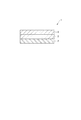
- FIG. 1 shows a schematic cross-sectional view of the laminated body 1 according to the present embodiment.
- the laminate 1 of the present embodiment has a first release material 2, a second release material 4, and a resin sheet 3 provided between the first release material 2 and the second release material 4.
- the resin sheet 3 is a resin sheet according to the present embodiment.
- the first release material 2 and the second release material 4 have a release property, and there is a difference between the release force of the first release material 2 against the resin sheet 3 and the release force of the second release material 4 against the resin sheet 3. Is preferable.
- the materials of the first release material 2 and the second release material 4 are not particularly limited.
- the ratio (P2 / P1) of the peeling force P2 of the second peeling material 4 to the peeling force P1 of the first peeling material 2 is preferably 0.02 ⁇ P2 / P1 ⁇ 1 or 1 ⁇ P2 / P1 ⁇ 50. ..
- the first release material 2 and the second release material 4 may be, for example, a member having a release property in the release material itself, a member having been subjected to a release treatment, a member having a release agent layer laminated, or the like. good.
- examples of the material of the first release material 2 and the second release material 4 include an olefin resin and a fluororesin. Be done.
- the first release material 2 and the second release material 4 can be a release material including a release base material and a release agent layer formed by applying a release agent on the release base material. By using a release material having a release base material and a release agent layer, handling becomes easy. Further, the first release material 2 and the second release material 4 may have a release agent layer on only one side of the release base material, or may have a release agent layer on both sides of the release base material.
- Examples of the peeling base material include a paper base material, a laminated paper obtained by laminating a thermoplastic resin such as polyethylene on the paper base material, a plastic film, and the like.
- Examples of the paper base material include glassine paper, coated paper, cast coated paper and the like.
- Examples of the plastic film include a polyester film (for example, polyethylene terephthalate, polybutylene terephthalate, polyethylene naphthalate, etc.), a polyolefin film (for example, polypropylene, polyethylene, etc.) and the like. Of these, polyester film is preferable.
- the release agent examples include a silicone-based release agent composed of a silicone resin; a long-chain alkyl group-containing compound-based release agent composed of a compound containing a long-chain alkyl group such as polyvinyl carbide and an alkylurea derivative; An alkyd resin-based release agent composed of a resin (for example, a non-convertible alkyd resin, a convertible alkyd resin, etc.); an olefin resin (for example, polyethylene (for example, high-density polyethylene, low-density polyethylene, and linear low-density)).
- a silicone-based release agent composed of a silicone resin
- a long-chain alkyl group-containing compound-based release agent composed of a compound containing a long-chain alkyl group such as polyvinyl carbide and an alkylurea derivative
- An alkyd resin-based release agent composed of a resin (for example, a non-convertible alkyd resin, a convertible alkyd
- Olefin resin-based release agent composed of polyethylene, etc.
- rubber-based release agents composed of rubbers such as synthetic rubbers (eg, butadiene rubbers, isopene rubbers, styrene-butadiene rubbers, methyl methacrylate-butadiene rubbers, and acrylonitrile-butadiene rubbers); and (meth) acrylic acid esters.
- Examples thereof include various release agents such as an acrylic resin-based release agent composed of an acrylic resin such as a system copolymer, and these can be used alone or in combination of two or more.
- alkyd resin-based release agents are preferable.
- a phenoxy resin is used as the binder component (B) of the resin composition contained in the resin sheet 3
- a general silicone-based release agent is used, the release material is unintentionally before the use of the resin sheet 3. It is preferable to use an alkyd resin-based release agent because there is a concern that it may be peeled off.
- the thickness of the first release material 2 and the second release material 4 is not particularly limited. Usually, it is 1 ⁇ m or more and 500 ⁇ m or less, and preferably 3 ⁇ m or more and 100 ⁇ m or less.
- the thickness of the release agent layer is not particularly limited. When a solution containing a release agent is applied to form a release agent layer, the thickness of the release agent layer is preferably 0.01 ⁇ m or more and 3 ⁇ m or less, and more preferably 0.03 ⁇ m or more and 1 ⁇ m or less.
- the manufacturing method of the laminated body 1 is not particularly limited.
- the laminated body 1 is manufactured through the following steps. First, the resin composition is applied onto the first release material 2 to form a coating film. Next, this coating film is dried to form the resin sheet 3. Next, the laminated body 1 is obtained by laminating the resin sheet 3 and the second release material 4 at room temperature. In this case, when the types of the release materials of the first release material 2 and the second release material 4 are the same, the ratio of the release force P2 of the second release material 4 to the release force P1 of the first release material 2 (P2).
- P2 / P1 is likely to have P2 / P1 ⁇ 1, and even if the release materials of the first release material 2 and the second release material 4 are different, it is first to apply the resin composition. Due to the release material 2, the value of P2 / P1 tends to be small.
- the resin sheet according to this embodiment can be suitably used for a power semiconductor element.
- the semiconductor element is preferably a power semiconductor element.
- Power semiconductor devices are also expected to operate at high temperatures of 200 ° C. or higher. Heat resistance is required for materials used in semiconductor devices having power semiconductor devices. Since the resin sheet according to the present embodiment has excellent heat resistance, it is suitably used for covering a power semiconductor element in a semiconductor device or for interposing it between a power semiconductor element and another component. .. Further, since the resin sheet according to the present embodiment has excellent thermal conductivity after heat curing, heat generated from the power semiconductor element can be efficiently transferred to a heat sink or the like.
- the resin sheet according to this embodiment can be suitably used for a semiconductor element using a compound semiconductor.
- the semiconductor element is preferably a semiconductor element using a compound semiconductor. Since semiconductor devices using compound semiconductors have characteristics different from those of silicon semiconductor devices, they are preferably used in applications such as power semiconductor devices, high-power devices for base stations, sensors, detectors, and Schottky barrier diodes. In these applications, attention is also paid to the heat resistance of the semiconductor element using the compound semiconductor, and since the resin sheet of the present embodiment has excellent heat resistance, it is suitably used in combination with the semiconductor element using the compound semiconductor. Be done. Further, since the resin sheet according to the present embodiment has excellent thermal conductivity after heat curing, heat generated from a semiconductor element using a compound semiconductor can be efficiently transferred to a heat sink or the like.
- the laminate having the first release material, the second release material, and the resin sheet provided between the first release material and the second release material has been described, but in addition, the resin sheet has been described. It may be a laminate having a release material on only one surface.
- the resin sheet of the present invention also has other insulating materials for circuit boards (for example, hard printed wiring board materials, flexible wiring board materials, and materials. It can be used as an interlayer insulating material for a build-up substrate, etc.), an adhesive film for build-up, an adhesive, and the like.
- First maleimide resin long-chain alkyl-type maleimide resin (solid at a temperature of 25 ° C., maleimide resin represented by the general formula (A1-1-1), "SLK-3000” manufactured by Shin-Etsu Chemical Co., Ltd.)
- -Second maleimide resin Maleimide resin having a biphenyl group (maleimide resin represented by the general formula (3), "MIR-3000-70MT” manufactured by Nippon Kayaku Co., Ltd.)
- Third Maleimide Resin-1 Long-chain alkyl-type maleimide resin (liquid at a temperature of 25 ° C., maleimide resin represented by the general formula (7-2-1), "BMI-1700” manufactured by Designer Moleculars Inc.
- Third maleimide resin-2 Long-chain alkyl-type maleimide resin (liquid at a temperature of 25 ° C., maleimide resin represented by the general formula (7-1-1), "SLK-1500” manufactured by Shin-Etsu Chemical Co., Ltd.) -Allyl resin: Diallyl bisphenol A ("DABPA” manufactured by Daiwa Kasei Kogyo Co., Ltd.) -Curing accelerator-1 (adhesion imparting agent): 2,4-diamino-6- [2- (2-ethyl-4-methyl-1-imidazolyl) ethyl] -1,3,5-triazine (Shikoku Kasei Kogyo) "2E4MZ-A” manufactured by the company) -Curing accelerator-2: 2-ethyl-4-methylimidazole (“2E4MZ” manufactured by Shikoku Kasei Kogyo Co., Ltd.)
- (Binder component) -Binder resin BisA type phenoxy resin ("YX7200B35" manufactured by Mitsubishi Chemical Corporation)
- Alumina particles-1 Showa Denko “CB-A20S", average particle size (d50): 20 ⁇ m
- -Alumina particles-2 Showa Denko “CB-A30S”, average particle size (d50): 30 ⁇ m
- Boron Nitride Particle-1 Showa Denko "UHP-2", average particle size (d50): 11 ⁇ m
- Boron nitride particles-2 (Showa Denko "UHP-S2", average particle size (d50): 0.7 ⁇ m)
- the first release material polyethylene terephthalate film provided with a release layer formed from an alkyd resin-based release agent, thickness 38 ⁇ m
- a resin varnish a coating solution prepared by dissolving or dispersing each material of the resin composition in cyclohexanone, the solid content concentration was 70% by mass
- the thickness of the resin composition after drying was 50 ⁇ m.
- the dried resin composition and the second release material (polyethylene terephthalate film provided with a release layer formed from a silicone-based release agent, thickness 38 ⁇ m) are bonded together at room temperature.
- a laminate was prepared in which a release material, a resin sheet made of a resin composition, and a second release material were laminated in this order.
- the first release material (polyethylene terephthalate film provided with a release layer formed from an alkyd resin-based release agent, thickness 38 ⁇ m).
- a resin varnish (a coating solution prepared by dissolving or dispersing each material of the resin composition in cyclohexanone, the solid content concentration was 72% by mass) was applied onto the film with a knife coater, and the temperature was 90 ° C. It was dried for 1 minute and at 115 ° C. for 1 minute. The thickness of the resin composition after drying was 50 ⁇ m. Immediately after taking it out of the drying furnace, the dried resin composition and the second release material (polyethylene terephthalate film provided with a release layer formed from a silicone-based release agent, thickness 38 ⁇ m) are bonded together at room temperature.
- a laminate was prepared in which a release material, a resin sheet made of a resin composition, and a second release material were laminated in this order.
- thermosetting of resin sheet The resin sheets were laminated to a thickness of 200 ⁇ m and cured at a temperature of 200 ° C. under the thermosetting conditions for 4 hours to prepare a sample. The first release material and the second release material of the laminated body were appropriately removed in the process of bonding. The thermal diffusivity of this sample was measured by the thermal diffusivity method using a thermal diffusivity measuring device (“ai-Phase Mobile 1” manufactured by iPhase Co., Ltd.). Further, it is assumed that the specific gravity of the components of the resin composition excluding the inorganic filler is 1.2 (unit: g / cm 3 ) and the specific heat is 1 (unit: J / g ⁇ K).
- thermal conductivity (W / m ⁇ K) thermal diffusivity (m 2 / s) x specific heat (J / g ⁇ K) x specific gravity (g / cm 3 ) x 10 6
- the obtained results are shown in Tables 1 and 2.
- the specific densities in Examples and Comparative Examples are shown in Tables 1 and 2.
- the second release material and the first release material of the resin sheet in the laminated body were peeled before being attached to the Si wafer and the copper plate, respectively.
- the resin sheet was cured under the thermosetting condition of 4 hours at a temperature of 200 ° C. to prepare a sample.
- the copper foil was peeled off from the cured resin sheet under the conditions of a peeling speed of 50 mm / min and a peeling angle of 90 degrees using a tensile tester (“Autograph AG-IS” manufactured by Shimadzu Corporation).
- the peel strength (unit: N / 10 mm) between the copper foil and the cured resin sheet was measured. The measurement was performed in an environment of 25 ° C. and a relative humidity of 50%. The obtained results are shown in Tables 1 and 2.
Landscapes
- Chemical & Material Sciences (AREA)
- Organic Chemistry (AREA)
- Chemical Kinetics & Catalysis (AREA)
- Polymers & Plastics (AREA)
- Health & Medical Sciences (AREA)
- Medicinal Chemistry (AREA)
- Engineering & Computer Science (AREA)
- Manufacturing & Machinery (AREA)
- Materials Engineering (AREA)
- Microelectronics & Electronic Packaging (AREA)
- Life Sciences & Earth Sciences (AREA)
- Wood Science & Technology (AREA)
- Compositions Of Macromolecular Compounds (AREA)
- Adhesive Tapes (AREA)
- Laminated Bodies (AREA)
Priority Applications (3)
| Application Number | Priority Date | Filing Date | Title |
|---|---|---|---|
| US17/792,349 US20230097896A1 (en) | 2020-01-16 | 2021-01-15 | Resin sheet |
| JP2021571252A JPWO2021145414A1 (https=) | 2020-01-16 | 2021-01-15 | |
| CN202180009382.2A CN114981352A (zh) | 2020-01-16 | 2021-01-15 | 树脂片 |
Applications Claiming Priority (4)
| Application Number | Priority Date | Filing Date | Title |
|---|---|---|---|
| JP2020005184 | 2020-01-16 | ||
| JP2020-005184 | 2020-01-16 | ||
| JP2020-126347 | 2020-07-27 | ||
| JP2020126347 | 2020-07-27 |
Publications (1)
| Publication Number | Publication Date |
|---|---|
| WO2021145414A1 true WO2021145414A1 (ja) | 2021-07-22 |
Family
ID=76864660
Family Applications (3)
| Application Number | Title | Priority Date | Filing Date |
|---|---|---|---|
| PCT/JP2021/001205 Ceased WO2021145414A1 (ja) | 2020-01-16 | 2021-01-15 | 樹脂シート |
| PCT/JP2021/001206 Ceased WO2021145415A1 (ja) | 2020-01-16 | 2021-01-15 | 樹脂シート |
| PCT/JP2021/001207 Ceased WO2021145416A1 (ja) | 2020-01-16 | 2021-01-15 | 樹脂シート |
Family Applications After (2)
| Application Number | Title | Priority Date | Filing Date |
|---|---|---|---|
| PCT/JP2021/001206 Ceased WO2021145415A1 (ja) | 2020-01-16 | 2021-01-15 | 樹脂シート |
| PCT/JP2021/001207 Ceased WO2021145416A1 (ja) | 2020-01-16 | 2021-01-15 | 樹脂シート |
Country Status (5)
| Country | Link |
|---|---|
| US (3) | US12247124B2 (https=) |
| JP (3) | JP7628965B2 (https=) |
| CN (3) | CN114981343B (https=) |
| TW (2) | TWI885043B (https=) |
| WO (3) | WO2021145414A1 (https=) |
Cited By (3)
| Publication number | Priority date | Publication date | Assignee | Title |
|---|---|---|---|---|
| WO2023002874A1 (ja) * | 2021-07-20 | 2023-01-26 | リンテック株式会社 | 樹脂シート |
| WO2024202840A1 (ja) * | 2023-03-31 | 2024-10-03 | パナソニックIpマネジメント株式会社 | 樹脂組成物、プリプレグ、樹脂付きフィルム、樹脂付き金属箔、金属張積層板、及び配線板 |
| WO2026063096A1 (ja) * | 2024-09-17 | 2026-03-26 | 株式会社巴川コーポレーション | 硬化性接着剤組成物および積層体 |
Families Citing this family (1)
| Publication number | Priority date | Publication date | Assignee | Title |
|---|---|---|---|---|
| JP7467014B2 (ja) * | 2021-03-25 | 2024-04-15 | 信越化学工業株式会社 | フレキシブルプリント配線板(fpc)用接着剤組成物、並びに該組成物を含む熱硬化性樹脂フィルム、プリプレグ、及びfpc基板 |
Citations (3)
| Publication number | Priority date | Publication date | Assignee | Title |
|---|---|---|---|---|
| JP2016088992A (ja) * | 2014-10-31 | 2016-05-23 | 京セラケミカル株式会社 | 半導体接着用樹脂組成物及び半導体装置 |
| JP2019182932A (ja) * | 2018-04-03 | 2019-10-24 | 積水化学工業株式会社 | 硬化性樹脂組成物及び積層体 |
| JP2020173945A (ja) * | 2019-04-10 | 2020-10-22 | 信越化学工業株式会社 | 低誘電放熱フィルム用組成物及び低誘電放熱フィルム |
Family Cites Families (26)
| Publication number | Priority date | Publication date | Assignee | Title |
|---|---|---|---|---|
| JP3888554B2 (ja) * | 2004-08-05 | 2007-03-07 | 日立化成工業株式会社 | 変性ポリアミドエポキシ樹脂を含む組成物及びそれを用いた接着剤、フィルム |
| JP2006086217A (ja) * | 2004-09-14 | 2006-03-30 | Hitachi Chem Co Ltd | フレキシブル回路基板 |
| JP5180440B2 (ja) | 2006-02-21 | 2013-04-10 | 三井化学株式会社 | 放熱材料 |
| KR101353768B1 (ko) | 2006-09-29 | 2014-01-21 | 덴끼 가가꾸 고교 가부시키가이샤 | 아크릴계 고열 전도 점착 시트 |
| JP4893415B2 (ja) | 2006-10-19 | 2012-03-07 | 日立化成工業株式会社 | 放熱性フィルム |
| CN103906785A (zh) | 2011-11-02 | 2014-07-02 | 日立化成株式会社 | 环氧树脂组合物、半固化环氧树脂组合物、固化环氧树脂组合物、树脂片、预浸料坯、层叠板、金属基板、配线板、半固化环氧树脂组合物的制造方法以及固化环氧树脂组合物的制造方法 |
| JP5881540B2 (ja) | 2012-06-13 | 2016-03-09 | 株式会社トクヤマ | 熱伝導性絶縁シートの製造方法 |
| JP2015019051A (ja) * | 2013-06-14 | 2015-01-29 | 株式会社日本触媒 | 放熱シート |
| JPWO2014208694A1 (ja) * | 2013-06-27 | 2017-02-23 | 日立化成株式会社 | 樹脂組成物、樹脂シート、樹脂シート硬化物、樹脂シート構造体、樹脂シート構造体硬化物、樹脂シート構造体硬化物の製造方法、半導体装置、及びled装置 |
| JP6348700B2 (ja) * | 2013-11-01 | 2018-06-27 | 京セラ株式会社 | 半導体接着用熱硬化型樹脂組成物及びそれを用いた半導体装置 |
| KR102244404B1 (ko) * | 2014-02-24 | 2021-04-26 | 헨켈 아이피 앤드 홀딩 게엠베하 | 열전도성 선-적용형 언더필 제제 및 그의 용도 |
| US11161979B2 (en) * | 2014-07-18 | 2021-11-02 | Mitsubishi Gas Chemical Company, Inc. | Resin composition, prepreg, metallic foil-clad laminate, and printed wiring board |
| US10434750B2 (en) * | 2015-01-13 | 2019-10-08 | Hitachi Chemical Company, Ltd. | Resin film for flexible printed circuit board, metal foil provided with resin, coverlay film, bonding sheet, and flexible printed circuit board |
| WO2017006887A1 (ja) * | 2015-07-06 | 2017-01-12 | 三菱瓦斯化学株式会社 | 樹脂組成物、該樹脂組成物を用いたプリプレグ又はレジンシート並びにそれらを用いた積層板及びプリント配線板 |
| JP6789030B2 (ja) * | 2016-08-09 | 2020-11-25 | 京セラ株式会社 | 封止用樹脂組成物及び半導体装置 |
| KR20180022423A (ko) * | 2016-08-24 | 2018-03-06 | 엘지이노텍 주식회사 | 방열 기판 및 이의 제조 방법 |
| TWI899456B (zh) | 2016-09-26 | 2025-10-01 | 日商力森諾科股份有限公司 | 樹脂組成物、半導體用配線層積層體及半導體裝置 |
| JP6748967B2 (ja) * | 2016-11-30 | 2020-09-02 | パナソニックIpマネジメント株式会社 | シート状熱硬化性樹脂組成物、並びにそれを用いた樹脂シート、モジュール部品、パワーデバイス及びコイル部品 |
| US10834854B2 (en) * | 2017-02-28 | 2020-11-10 | Northeastern University | Methods for the manufacture of thermal interfaces, thermal interfaces, and articles comprising the same |
| JP6769912B2 (ja) * | 2017-03-31 | 2020-10-14 | 京セラ株式会社 | 半導体接着用シート及び半導体装置 |
| EP3722368B1 (en) * | 2017-12-05 | 2021-10-13 | Denka Company Limited | Nitride ceramic resin composite body |
| JP2019108516A (ja) * | 2017-12-15 | 2019-07-04 | 住友ベークライト株式会社 | 熱硬化性樹脂組成物、その硬化物、プリプレグ、積層板、金属ベース基板およびパワーモジュール |
| JP7087372B2 (ja) | 2017-12-19 | 2022-06-21 | 日本ゼオン株式会社 | 熱伝導シート及びその製造方法 |
| JP2019132932A (ja) * | 2018-01-30 | 2019-08-08 | 株式会社リコー | 画像形成装置及び消費電力量算出方法 |
| JP6774035B2 (ja) * | 2018-05-23 | 2020-10-21 | 三菱瓦斯化学株式会社 | レジンシート、金属箔張積層板及びプリント配線板 |
| JP7115445B2 (ja) * | 2019-09-03 | 2022-08-09 | 信越化学工業株式会社 | マレイミド樹脂フィルム及びマレイミド樹脂フィルム用組成物 |
-
2021
- 2021-01-15 TW TW110101566A patent/TWI885043B/zh active
- 2021-01-15 US US17/792,615 patent/US12247124B2/en active Active
- 2021-01-15 TW TW110101581A patent/TW202136391A/zh unknown
- 2021-01-15 US US17/792,575 patent/US20230064310A1/en not_active Abandoned
- 2021-01-15 WO PCT/JP2021/001205 patent/WO2021145414A1/ja not_active Ceased
- 2021-01-15 JP JP2021571254A patent/JP7628965B2/ja active Active
- 2021-01-15 JP JP2021571252A patent/JPWO2021145414A1/ja active Pending
- 2021-01-15 US US17/792,349 patent/US20230097896A1/en not_active Abandoned
- 2021-01-15 CN CN202180009389.4A patent/CN114981343B/zh active Active
- 2021-01-15 WO PCT/JP2021/001206 patent/WO2021145415A1/ja not_active Ceased
- 2021-01-15 CN CN202180009382.2A patent/CN114981352A/zh active Pending
- 2021-01-15 WO PCT/JP2021/001207 patent/WO2021145416A1/ja not_active Ceased
- 2021-01-15 CN CN202180009532.XA patent/CN114945625A/zh active Pending
- 2021-01-15 JP JP2021571253A patent/JP7751490B2/ja active Active
Patent Citations (3)
| Publication number | Priority date | Publication date | Assignee | Title |
|---|---|---|---|---|
| JP2016088992A (ja) * | 2014-10-31 | 2016-05-23 | 京セラケミカル株式会社 | 半導体接着用樹脂組成物及び半導体装置 |
| JP2019182932A (ja) * | 2018-04-03 | 2019-10-24 | 積水化学工業株式会社 | 硬化性樹脂組成物及び積層体 |
| JP2020173945A (ja) * | 2019-04-10 | 2020-10-22 | 信越化学工業株式会社 | 低誘電放熱フィルム用組成物及び低誘電放熱フィルム |
Cited By (3)
| Publication number | Priority date | Publication date | Assignee | Title |
|---|---|---|---|---|
| WO2023002874A1 (ja) * | 2021-07-20 | 2023-01-26 | リンテック株式会社 | 樹脂シート |
| WO2024202840A1 (ja) * | 2023-03-31 | 2024-10-03 | パナソニックIpマネジメント株式会社 | 樹脂組成物、プリプレグ、樹脂付きフィルム、樹脂付き金属箔、金属張積層板、及び配線板 |
| WO2026063096A1 (ja) * | 2024-09-17 | 2026-03-26 | 株式会社巴川コーポレーション | 硬化性接着剤組成物および積層体 |
Also Published As
| Publication number | Publication date |
|---|---|
| JPWO2021145416A1 (https=) | 2021-07-22 |
| US12247124B2 (en) | 2025-03-11 |
| WO2021145415A1 (ja) | 2021-07-22 |
| CN114981343A (zh) | 2022-08-30 |
| US20230090587A1 (en) | 2023-03-23 |
| US20230064310A1 (en) | 2023-03-02 |
| TWI885043B (zh) | 2025-06-01 |
| US20230097896A1 (en) | 2023-03-30 |
| WO2021145416A1 (ja) | 2021-07-22 |
| TW202134326A (zh) | 2021-09-16 |
| CN114981343B (zh) | 2025-09-02 |
| TW202136391A (zh) | 2021-10-01 |
| CN114981352A (zh) | 2022-08-30 |
| JPWO2021145414A1 (https=) | 2021-07-22 |
| JPWO2021145415A1 (https=) | 2021-07-22 |
| JP7628965B2 (ja) | 2025-02-12 |
| JP7751490B2 (ja) | 2025-10-08 |
| TW202132496A (zh) | 2021-09-01 |
| CN114945625A (zh) | 2022-08-26 |
Similar Documents
| Publication | Publication Date | Title |
|---|---|---|
| JP7751490B2 (ja) | 樹脂シート | |
| WO2020196070A1 (ja) | 樹脂シート | |
| KR102470719B1 (ko) | 수지 조성물 및 수지 시트 | |
| TWI758489B (zh) | 樹脂組成物及樹脂薄片 | |
| JP7329513B2 (ja) | 積層体 | |
| CN115279836B (zh) | 树脂组合物及树脂片 | |
| JP7660522B2 (ja) | 樹脂組成物及び樹脂シート | |
| TWI918625B (zh) | 樹脂薄片 | |
| WO2023002874A1 (ja) | 樹脂シート | |
| WO2022210187A1 (ja) | 樹脂シート | |
| JP2021113247A (ja) | 樹脂組成物及び樹脂シート |
Legal Events
| Date | Code | Title | Description |
|---|---|---|---|
| 121 | Ep: the epo has been informed by wipo that ep was designated in this application |
Ref document number: 21741786 Country of ref document: EP Kind code of ref document: A1 |
|
| ENP | Entry into the national phase |
Ref document number: 2021571252 Country of ref document: JP Kind code of ref document: A |
|
| NENP | Non-entry into the national phase |
Ref country code: DE |
|
| 122 | Ep: pct application non-entry in european phase |
Ref document number: 21741786 Country of ref document: EP Kind code of ref document: A1 |