WO2021132315A1 - 被覆ジルコニア微粒子及びその製造方法 - Google Patents
被覆ジルコニア微粒子及びその製造方法 Download PDFInfo
- Publication number
- WO2021132315A1 WO2021132315A1 PCT/JP2020/048126 JP2020048126W WO2021132315A1 WO 2021132315 A1 WO2021132315 A1 WO 2021132315A1 JP 2020048126 W JP2020048126 W JP 2020048126W WO 2021132315 A1 WO2021132315 A1 WO 2021132315A1
- Authority
- WO
- WIPO (PCT)
- Prior art keywords
- fine particles
- zirconia fine
- coated
- coated zirconia
- producing
- Prior art date
- Legal status (The legal status is an assumption and is not a legal conclusion. Google has not performed a legal analysis and makes no representation as to the accuracy of the status listed.)
- Ceased
Links
Images

Classifications
-
- C—CHEMISTRY; METALLURGY
- C04—CEMENTS; CONCRETE; ARTIFICIAL STONE; CERAMICS; REFRACTORIES
- C04B—LIME, MAGNESIA; SLAG; CEMENTS; COMPOSITIONS THEREOF, e.g. MORTARS, CONCRETE OR LIKE BUILDING MATERIALS; ARTIFICIAL STONE; CERAMICS; REFRACTORIES; TREATMENT OF NATURAL STONE
- C04B35/00—Shaped ceramic products characterised by their composition; Ceramics compositions; Processing powders of inorganic compounds preparatory to the manufacturing of ceramic products
- C04B35/622—Forming processes; Processing powders of inorganic compounds preparatory to the manufacturing of ceramic products
- C04B35/626—Preparing or treating the powders individually or as batches ; preparing or treating macroscopic reinforcing agents for ceramic products, e.g. fibres; mechanical aspects section B
- C04B35/628—Coating the powders or the macroscopic reinforcing agents
- C04B35/62802—Powder coating materials
- C04B35/62805—Oxide ceramics
- C04B35/62815—Rare earth metal oxides
-
- C—CHEMISTRY; METALLURGY
- C01—INORGANIC CHEMISTRY
- C01G—COMPOUNDS CONTAINING METALS NOT COVERED BY SUBCLASSES C01D OR C01F
- C01G25/00—Compounds of zirconium
- C01G25/02—Oxides
-
- C—CHEMISTRY; METALLURGY
- C01—INORGANIC CHEMISTRY
- C01G—COMPOUNDS CONTAINING METALS NOT COVERED BY SUBCLASSES C01D OR C01F
- C01G25/00—Compounds of zirconium
- C01G25/006—Compounds containing zirconium, with or without oxygen or hydrogen, and containing two or more other elements
-
- C—CHEMISTRY; METALLURGY
- C04—CEMENTS; CONCRETE; ARTIFICIAL STONE; CERAMICS; REFRACTORIES
- C04B—LIME, MAGNESIA; SLAG; CEMENTS; COMPOSITIONS THEREOF, e.g. MORTARS, CONCRETE OR LIKE BUILDING MATERIALS; ARTIFICIAL STONE; CERAMICS; REFRACTORIES; TREATMENT OF NATURAL STONE
- C04B35/00—Shaped ceramic products characterised by their composition; Ceramics compositions; Processing powders of inorganic compounds preparatory to the manufacturing of ceramic products
- C04B35/01—Shaped ceramic products characterised by their composition; Ceramics compositions; Processing powders of inorganic compounds preparatory to the manufacturing of ceramic products based on oxide ceramics
- C04B35/48—Shaped ceramic products characterised by their composition; Ceramics compositions; Processing powders of inorganic compounds preparatory to the manufacturing of ceramic products based on oxide ceramics based on zirconium or hafnium oxides, zirconates, zircon or hafnates
- C04B35/486—Fine ceramics
-
- C—CHEMISTRY; METALLURGY
- C04—CEMENTS; CONCRETE; ARTIFICIAL STONE; CERAMICS; REFRACTORIES
- C04B—LIME, MAGNESIA; SLAG; CEMENTS; COMPOSITIONS THEREOF, e.g. MORTARS, CONCRETE OR LIKE BUILDING MATERIALS; ARTIFICIAL STONE; CERAMICS; REFRACTORIES; TREATMENT OF NATURAL STONE
- C04B35/00—Shaped ceramic products characterised by their composition; Ceramics compositions; Processing powders of inorganic compounds preparatory to the manufacturing of ceramic products
- C04B35/01—Shaped ceramic products characterised by their composition; Ceramics compositions; Processing powders of inorganic compounds preparatory to the manufacturing of ceramic products based on oxide ceramics
- C04B35/48—Shaped ceramic products characterised by their composition; Ceramics compositions; Processing powders of inorganic compounds preparatory to the manufacturing of ceramic products based on oxide ceramics based on zirconium or hafnium oxides, zirconates, zircon or hafnates
- C04B35/486—Fine ceramics
- C04B35/488—Composites
-
- C—CHEMISTRY; METALLURGY
- C04—CEMENTS; CONCRETE; ARTIFICIAL STONE; CERAMICS; REFRACTORIES
- C04B—LIME, MAGNESIA; SLAG; CEMENTS; COMPOSITIONS THEREOF, e.g. MORTARS, CONCRETE OR LIKE BUILDING MATERIALS; ARTIFICIAL STONE; CERAMICS; REFRACTORIES; TREATMENT OF NATURAL STONE
- C04B35/00—Shaped ceramic products characterised by their composition; Ceramics compositions; Processing powders of inorganic compounds preparatory to the manufacturing of ceramic products
- C04B35/01—Shaped ceramic products characterised by their composition; Ceramics compositions; Processing powders of inorganic compounds preparatory to the manufacturing of ceramic products based on oxide ceramics
- C04B35/48—Shaped ceramic products characterised by their composition; Ceramics compositions; Processing powders of inorganic compounds preparatory to the manufacturing of ceramic products based on oxide ceramics based on zirconium or hafnium oxides, zirconates, zircon or hafnates
- C04B35/486—Fine ceramics
- C04B35/488—Composites
- C04B35/4885—Composites with aluminium oxide
-
- C—CHEMISTRY; METALLURGY
- C04—CEMENTS; CONCRETE; ARTIFICIAL STONE; CERAMICS; REFRACTORIES
- C04B—LIME, MAGNESIA; SLAG; CEMENTS; COMPOSITIONS THEREOF, e.g. MORTARS, CONCRETE OR LIKE BUILDING MATERIALS; ARTIFICIAL STONE; CERAMICS; REFRACTORIES; TREATMENT OF NATURAL STONE
- C04B35/00—Shaped ceramic products characterised by their composition; Ceramics compositions; Processing powders of inorganic compounds preparatory to the manufacturing of ceramic products
- C04B35/622—Forming processes; Processing powders of inorganic compounds preparatory to the manufacturing of ceramic products
- C04B35/626—Preparing or treating the powders individually or as batches ; preparing or treating macroscopic reinforcing agents for ceramic products, e.g. fibres; mechanical aspects section B
- C04B35/62605—Treating the starting powders individually or as mixtures
- C04B35/62625—Wet mixtures
- C04B35/6263—Wet mixtures characterised by their solids loadings, i.e. the percentage of solids
-
- C—CHEMISTRY; METALLURGY
- C04—CEMENTS; CONCRETE; ARTIFICIAL STONE; CERAMICS; REFRACTORIES
- C04B—LIME, MAGNESIA; SLAG; CEMENTS; COMPOSITIONS THEREOF, e.g. MORTARS, CONCRETE OR LIKE BUILDING MATERIALS; ARTIFICIAL STONE; CERAMICS; REFRACTORIES; TREATMENT OF NATURAL STONE
- C04B35/00—Shaped ceramic products characterised by their composition; Ceramics compositions; Processing powders of inorganic compounds preparatory to the manufacturing of ceramic products
- C04B35/622—Forming processes; Processing powders of inorganic compounds preparatory to the manufacturing of ceramic products
- C04B35/626—Preparing or treating the powders individually or as batches ; preparing or treating macroscopic reinforcing agents for ceramic products, e.g. fibres; mechanical aspects section B
- C04B35/62605—Treating the starting powders individually or as mixtures
- C04B35/62625—Wet mixtures
- C04B35/6264—Mixing media, e.g. organic solvents
-
- C—CHEMISTRY; METALLURGY
- C04—CEMENTS; CONCRETE; ARTIFICIAL STONE; CERAMICS; REFRACTORIES
- C04B—LIME, MAGNESIA; SLAG; CEMENTS; COMPOSITIONS THEREOF, e.g. MORTARS, CONCRETE OR LIKE BUILDING MATERIALS; ARTIFICIAL STONE; CERAMICS; REFRACTORIES; TREATMENT OF NATURAL STONE
- C04B35/00—Shaped ceramic products characterised by their composition; Ceramics compositions; Processing powders of inorganic compounds preparatory to the manufacturing of ceramic products
- C04B35/622—Forming processes; Processing powders of inorganic compounds preparatory to the manufacturing of ceramic products
- C04B35/626—Preparing or treating the powders individually or as batches ; preparing or treating macroscopic reinforcing agents for ceramic products, e.g. fibres; mechanical aspects section B
- C04B35/62605—Treating the starting powders individually or as mixtures
- C04B35/62645—Thermal treatment of powders or mixtures thereof other than sintering
- C04B35/62655—Drying, e.g. freeze-drying, spray-drying, microwave or supercritical drying
-
- C—CHEMISTRY; METALLURGY
- C04—CEMENTS; CONCRETE; ARTIFICIAL STONE; CERAMICS; REFRACTORIES
- C04B—LIME, MAGNESIA; SLAG; CEMENTS; COMPOSITIONS THEREOF, e.g. MORTARS, CONCRETE OR LIKE BUILDING MATERIALS; ARTIFICIAL STONE; CERAMICS; REFRACTORIES; TREATMENT OF NATURAL STONE
- C04B35/00—Shaped ceramic products characterised by their composition; Ceramics compositions; Processing powders of inorganic compounds preparatory to the manufacturing of ceramic products
- C04B35/622—Forming processes; Processing powders of inorganic compounds preparatory to the manufacturing of ceramic products
- C04B35/626—Preparing or treating the powders individually or as batches ; preparing or treating macroscopic reinforcing agents for ceramic products, e.g. fibres; mechanical aspects section B
- C04B35/628—Coating the powders or the macroscopic reinforcing agents
- C04B35/62802—Powder coating materials
- C04B35/62805—Oxide ceramics
- C04B35/6281—Alkaline earth metal oxides
-
- C—CHEMISTRY; METALLURGY
- C04—CEMENTS; CONCRETE; ARTIFICIAL STONE; CERAMICS; REFRACTORIES
- C04B—LIME, MAGNESIA; SLAG; CEMENTS; COMPOSITIONS THEREOF, e.g. MORTARS, CONCRETE OR LIKE BUILDING MATERIALS; ARTIFICIAL STONE; CERAMICS; REFRACTORIES; TREATMENT OF NATURAL STONE
- C04B35/00—Shaped ceramic products characterised by their composition; Ceramics compositions; Processing powders of inorganic compounds preparatory to the manufacturing of ceramic products
- C04B35/622—Forming processes; Processing powders of inorganic compounds preparatory to the manufacturing of ceramic products
- C04B35/626—Preparing or treating the powders individually or as batches ; preparing or treating macroscopic reinforcing agents for ceramic products, e.g. fibres; mechanical aspects section B
- C04B35/628—Coating the powders or the macroscopic reinforcing agents
- C04B35/62802—Powder coating materials
- C04B35/62805—Oxide ceramics
- C04B35/62813—Alumina or aluminates
-
- C—CHEMISTRY; METALLURGY
- C04—CEMENTS; CONCRETE; ARTIFICIAL STONE; CERAMICS; REFRACTORIES
- C04B—LIME, MAGNESIA; SLAG; CEMENTS; COMPOSITIONS THEREOF, e.g. MORTARS, CONCRETE OR LIKE BUILDING MATERIALS; ARTIFICIAL STONE; CERAMICS; REFRACTORIES; TREATMENT OF NATURAL STONE
- C04B35/00—Shaped ceramic products characterised by their composition; Ceramics compositions; Processing powders of inorganic compounds preparatory to the manufacturing of ceramic products
- C04B35/622—Forming processes; Processing powders of inorganic compounds preparatory to the manufacturing of ceramic products
- C04B35/626—Preparing or treating the powders individually or as batches ; preparing or treating macroscopic reinforcing agents for ceramic products, e.g. fibres; mechanical aspects section B
- C04B35/628—Coating the powders or the macroscopic reinforcing agents
- C04B35/62886—Coating the powders or the macroscopic reinforcing agents by wet chemical techniques
-
- C—CHEMISTRY; METALLURGY
- C01—INORGANIC CHEMISTRY
- C01P—INDEXING SCHEME RELATING TO STRUCTURAL AND PHYSICAL ASPECTS OF SOLID INORGANIC COMPOUNDS
- C01P2004/00—Particle morphology
- C01P2004/60—Particles characterised by their size
- C01P2004/64—Nanometer sized, i.e. from 1-100 nanometer
-
- C—CHEMISTRY; METALLURGY
- C01—INORGANIC CHEMISTRY
- C01P—INDEXING SCHEME RELATING TO STRUCTURAL AND PHYSICAL ASPECTS OF SOLID INORGANIC COMPOUNDS
- C01P2006/00—Physical properties of inorganic compounds
- C01P2006/12—Surface area
-
- C—CHEMISTRY; METALLURGY
- C04—CEMENTS; CONCRETE; ARTIFICIAL STONE; CERAMICS; REFRACTORIES
- C04B—LIME, MAGNESIA; SLAG; CEMENTS; COMPOSITIONS THEREOF, e.g. MORTARS, CONCRETE OR LIKE BUILDING MATERIALS; ARTIFICIAL STONE; CERAMICS; REFRACTORIES; TREATMENT OF NATURAL STONE
- C04B2235/00—Aspects relating to ceramic starting mixtures or sintered ceramic products
- C04B2235/02—Composition of constituents of the starting material or of secondary phases of the final product
- C04B2235/30—Constituents and secondary phases not being of a fibrous nature
- C04B2235/32—Metal oxides, mixed metal oxides, or oxide-forming salts thereof, e.g. carbonates, nitrates, (oxy)hydroxides, chlorides
- C04B2235/3231—Refractory metal oxides, their mixed metal oxides, or oxide-forming salts thereof
- C04B2235/3244—Zirconium oxides, zirconates, hafnium oxides, hafnates, or oxide-forming salts thereof
-
- C—CHEMISTRY; METALLURGY
- C04—CEMENTS; CONCRETE; ARTIFICIAL STONE; CERAMICS; REFRACTORIES
- C04B—LIME, MAGNESIA; SLAG; CEMENTS; COMPOSITIONS THEREOF, e.g. MORTARS, CONCRETE OR LIKE BUILDING MATERIALS; ARTIFICIAL STONE; CERAMICS; REFRACTORIES; TREATMENT OF NATURAL STONE
- C04B2235/00—Aspects relating to ceramic starting mixtures or sintered ceramic products
- C04B2235/02—Composition of constituents of the starting material or of secondary phases of the final product
- C04B2235/50—Constituents or additives of the starting mixture chosen for their shape or used because of their shape or their physical appearance
- C04B2235/52—Constituents or additives characterised by their shapes
- C04B2235/528—Spheres
-
- C—CHEMISTRY; METALLURGY
- C04—CEMENTS; CONCRETE; ARTIFICIAL STONE; CERAMICS; REFRACTORIES
- C04B—LIME, MAGNESIA; SLAG; CEMENTS; COMPOSITIONS THEREOF, e.g. MORTARS, CONCRETE OR LIKE BUILDING MATERIALS; ARTIFICIAL STONE; CERAMICS; REFRACTORIES; TREATMENT OF NATURAL STONE
- C04B2235/00—Aspects relating to ceramic starting mixtures or sintered ceramic products
- C04B2235/02—Composition of constituents of the starting material or of secondary phases of the final product
- C04B2235/50—Constituents or additives of the starting mixture chosen for their shape or used because of their shape or their physical appearance
- C04B2235/54—Particle size related information
- C04B2235/5409—Particle size related information expressed by specific surface values
-
- C—CHEMISTRY; METALLURGY
- C04—CEMENTS; CONCRETE; ARTIFICIAL STONE; CERAMICS; REFRACTORIES
- C04B—LIME, MAGNESIA; SLAG; CEMENTS; COMPOSITIONS THEREOF, e.g. MORTARS, CONCRETE OR LIKE BUILDING MATERIALS; ARTIFICIAL STONE; CERAMICS; REFRACTORIES; TREATMENT OF NATURAL STONE
- C04B2235/00—Aspects relating to ceramic starting mixtures or sintered ceramic products
- C04B2235/02—Composition of constituents of the starting material or of secondary phases of the final product
- C04B2235/50—Constituents or additives of the starting mixture chosen for their shape or used because of their shape or their physical appearance
- C04B2235/54—Particle size related information
- C04B2235/5418—Particle size related information expressed by the size of the particles or aggregates thereof
- C04B2235/5445—Particle size related information expressed by the size of the particles or aggregates thereof submicron sized, i.e. from 0,1 to 1 micron
-
- C—CHEMISTRY; METALLURGY
- C04—CEMENTS; CONCRETE; ARTIFICIAL STONE; CERAMICS; REFRACTORIES
- C04B—LIME, MAGNESIA; SLAG; CEMENTS; COMPOSITIONS THEREOF, e.g. MORTARS, CONCRETE OR LIKE BUILDING MATERIALS; ARTIFICIAL STONE; CERAMICS; REFRACTORIES; TREATMENT OF NATURAL STONE
- C04B2235/00—Aspects relating to ceramic starting mixtures or sintered ceramic products
- C04B2235/02—Composition of constituents of the starting material or of secondary phases of the final product
- C04B2235/50—Constituents or additives of the starting mixture chosen for their shape or used because of their shape or their physical appearance
- C04B2235/54—Particle size related information
- C04B2235/5418—Particle size related information expressed by the size of the particles or aggregates thereof
- C04B2235/5454—Particle size related information expressed by the size of the particles or aggregates thereof nanometer sized, i.e. below 100 nm
-
- C—CHEMISTRY; METALLURGY
- C04—CEMENTS; CONCRETE; ARTIFICIAL STONE; CERAMICS; REFRACTORIES
- C04B—LIME, MAGNESIA; SLAG; CEMENTS; COMPOSITIONS THEREOF, e.g. MORTARS, CONCRETE OR LIKE BUILDING MATERIALS; ARTIFICIAL STONE; CERAMICS; REFRACTORIES; TREATMENT OF NATURAL STONE
- C04B2235/00—Aspects relating to ceramic starting mixtures or sintered ceramic products
- C04B2235/65—Aspects relating to heat treatments of ceramic bodies such as green ceramics or pre-sintered ceramics, e.g. burning, sintering or melting processes
- C04B2235/656—Aspects relating to heat treatments of ceramic bodies such as green ceramics or pre-sintered ceramics, e.g. burning, sintering or melting processes characterised by specific heating conditions during heat treatment
- C04B2235/6562—Heating rate
-
- C—CHEMISTRY; METALLURGY
- C04—CEMENTS; CONCRETE; ARTIFICIAL STONE; CERAMICS; REFRACTORIES
- C04B—LIME, MAGNESIA; SLAG; CEMENTS; COMPOSITIONS THEREOF, e.g. MORTARS, CONCRETE OR LIKE BUILDING MATERIALS; ARTIFICIAL STONE; CERAMICS; REFRACTORIES; TREATMENT OF NATURAL STONE
- C04B2235/00—Aspects relating to ceramic starting mixtures or sintered ceramic products
- C04B2235/65—Aspects relating to heat treatments of ceramic bodies such as green ceramics or pre-sintered ceramics, e.g. burning, sintering or melting processes
- C04B2235/656—Aspects relating to heat treatments of ceramic bodies such as green ceramics or pre-sintered ceramics, e.g. burning, sintering or melting processes characterised by specific heating conditions during heat treatment
- C04B2235/6567—Treatment time
-
- C—CHEMISTRY; METALLURGY
- C04—CEMENTS; CONCRETE; ARTIFICIAL STONE; CERAMICS; REFRACTORIES
- C04B—LIME, MAGNESIA; SLAG; CEMENTS; COMPOSITIONS THEREOF, e.g. MORTARS, CONCRETE OR LIKE BUILDING MATERIALS; ARTIFICIAL STONE; CERAMICS; REFRACTORIES; TREATMENT OF NATURAL STONE
- C04B2235/00—Aspects relating to ceramic starting mixtures or sintered ceramic products
- C04B2235/70—Aspects relating to sintered or melt-casted ceramic products
- C04B2235/74—Physical characteristics
- C04B2235/77—Density
Definitions
- the present invention relates to coated zirconia fine particles and a method for producing the same.
- Zirconia has high refractive index, high strength, toughness, high wear resistance, high lubricity, high corrosion resistance, high oxidation resistance, insulation, low thermal conductivity, and high transparency in the visible light region. Since it has many excellent characteristics such as properties, it is used in various applications such as catalysts for automobile exhaust gas, capacitors, crushed balls, dental materials, glass additives, thermal barriers, solid electrolytes, and optical materials.
- zirconia is used for manufacturing various articles by molding and sintering fine particles, but since it has a tetragonal crystal structure at high temperature and a monoclinic crystal structure at low temperature, volume expansion and contraction due to temperature change. There is a problem that the sintered body is easily cracked and broken due to the above. Therefore, in general, a method of preventing a phase transition by dissolving a stabilizer such as yttria (Y 2 O 3 ), calcia (CaO), magnesia (MgO), and ceria (CeO 2) in zirconia. Has been taken. Zirconia partially stabilized by adding a stabilizer is called partially stabilized zirconia.
- Y 2 O 3 yttria
- CaO calcia
- MgO magnesia
- CeO 2 ceria
- Partially stabilized zirconia is produced by various methods such as a neutralization method, a hydrolysis method, a hydrothermal reaction method, an alkoxide method, a gas phase method, and a spray pyrolysis method according to the zirconia production method.
- JP-A-2008-24555 a compound such as yttrium is added to a hydrated zirconium sol as a stabilizer, dried, and calcined in the range of 1000 to 1200 ° C., and yttria and calcia are used as stabilizers.
- yttrium is added to a hydrated zirconium sol as a stabilizer, dried, and calcined in the range of 1000 to 1200 ° C., and yttria and calcia are used as stabilizers.
- Magnesia and a method for producing a fine powder of zirconia containing one or more of ceria are disclosed.
- Japanese Unexamined Patent Publication No. 2010-137998 is a method for producing partially stabilized zirconia porcelain containing zirconia and yttria in a predetermined range, in which yttria fine particle powder or yttria salts are uniformly mixed with zirconium hydroxide as a starting material containing Zr.
- a method is disclosed in which zirconia is obtained by heat-treating the dispersed composite in a temperature range of 1100 to 1400 ° C., and the ceramic powder obtained by pulverizing the zirconia is formed and fired.
- Japanese Unexamined Patent Publication No. 2015-221727 describes a method for producing a predetermined zirconia sintered body containing 0.05 to 3% by mass of alumina and having an Itria concentration of 2 to 4 mol%, and the average particle size of the secondary particles is 0. .1 to 0.4 ⁇ m, the ratio of the average particle size of the secondary particles to the average particle size of the primary particles measured by an electron microscope is 1 to 8, and the aluminum compound is 0.05 to 0.05 in terms of alumina.
- Zirconia powder containing 3% by mass and having an Itria concentration of 2 to 4 mol% is molded and pre-sintered at 1100-1200 ° C., and the obtained pre-sintered body is hot at a pressure of 50 to 500 MPa and a temperature of 1150 to 1250 ° C.
- a method of hydrostatic pressing is disclosed.
- an alkaline carbonate solution is added to a zirconia acidic dispersion containing rare earth element ions and / or alkaline earth metal ions to form a neutralized precipitate, and then this neutralized precipitate is formed.
- a method for producing zirconia composite fine particles which comprises drying a product, heat-treating the dried neutralized precipitate at a temperature of 400 ° C. or higher and 600 ° C. or lower, and then washing to remove an alkali carbonate component. It is disclosed.
- a solution of a zirconium salt and a solution of one salt selected from a rare earth element, calcium or magnesium are mixed in advance, and the mixed solution is a basic solution or a basic solution.
- a method for producing a system sol is disclosed.
- Japanese Unexamined Patent Publication No. 2017-154927 describes zirconium oxide nanoparticles coated with a carboxylic acid, and the zirconium oxide nanoparticles contain yttrium and at least one of a transition metal other than a rare earth element. Zirconium oxide nanoparticles are disclosed.
- JP-A-2008-24555, JP-A-2010-137998, JP-A-2015-221727 and JP-A-2009-227507 are methods using a neutralization method and / or a hydrolysis method.
- firing at a high temperature is required for solid dissolution, and the particle shape is non-uniform due to particle growth, and the particles tend to have poor dispersibility.
- JP-A-5-170442 and JP-A-2017-154927 are methods using a hydrothermal reaction method and do not require a firing step, so that a fine particle size can be obtained, and several tens of particles can be obtained. It is considered to be advantageous for obtaining zirconia fine particles at the nm level.
- yttrium salt which is often used as a stabilizer, generally has a lower solubility than zirconium salt, so the method using the hydrothermal reaction method makes zirconium and yttrium uniform at the atomic level in industrial scale production. It is difficult to mix and yttria tends to be unevenly distributed. In addition, since the reaction takes a long time, there remains a problem in terms of productivity.
- the present invention provides stable zirconia fine particles and a simple method for producing the same.
- the present invention is a coated zirconia fine particle containing zirconia fine particles and a coating layer that coats the surface of the fine particles.
- the coating layer contains one or more metallic elements selected from Mg, Ca, Al and rare earth elements.
- the average particle size is 3 to 100 nm, Specific surface area is 20-500 m 2 / g, Regarding coated zirconia fine particles.
- the present invention produces a water-insoluble compound by reacting with ions of one or more metal elements selected from Mg, Ca, Al and rare earth elements in an aqueous dispersion containing zirconia fine particles with the ions.
- the present invention relates to a method for producing coated zirconia fine particles, which comprises reacting with an additive to precipitate a compound containing the metal element on the surface of the zirconia fine particles to obtain coated zirconia fine particles.
- the coated zirconia fine particles of the present invention have an advantage that cracks and breakage of the sintered body can be suppressed and the density can be increased when subjected to the firing step. Therefore, various ceramic materials and dental materials. , Suitable for applications such as capacitors and coating materials. Further, since the coated zirconia fine particles of the present invention can be produced by a simple method, the production cost can be reduced, which is useful for industrialized scale production.
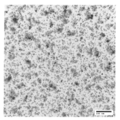
- FIG. 1 is a transmission electron microscope (TEM) image of the coated zirconia fine particles obtained in Example 2.
- FIG. 2 is a scanning electron microscope / energy dispersive X-ray spectroscopy (SEM-EDX) image showing the elemental distribution of zirconium and yttrium of the coated zirconia fine particles obtained in Example 2 and Comparative Example 2.
- TEM transmission electron microscope
- SEM-EDX scanning electron microscope / energy dispersive X-ray spectroscopy
- Embodiment for carrying out the invention [coated zirconia fine particles]
- the present invention is a coated zirconia fine particle containing zirconia fine particles and a coating layer that coats the surface of the fine particles, and the coating layer is one or more metal elements selected from Mg, Ca, Al and rare earth elements. Containing, coated zirconia fine particles having an average particle size of 3 to 100 nm and a specific surface area of 20 to 500 m 2 / g.
- the specific surface area of the zirconia fine particles is preferably 20 ⁇ 500m 2 / g, more preferably 40 ⁇ 200m 2 / g, more preferably 70 ⁇ 150m 2 / g.
- the specific surface area of the zirconia fine particles is 20 m 2 / g or more, the particle size of the obtained coated zirconia fine particles is appropriately suppressed, and a high-density sintered body can be easily obtained. In addition, the stabilizing effect of the metal element of the coating layer tends to be easily exhibited.
- the specific surface area of the zirconia fine particles is 500 m 2 / g or less, the particle size becomes moderately large and the cohesive force does not become excessively large, so that monodisperse becomes easy at the time of surface coating, and molding when the coated zirconia fine particles are used.
- the filling property at the time is also improved.
- the specific surface area of the zirconia fine particles is determined with respect to a sample degassed at 150 ° C. using a BET specific surface area measuring device, for example, a fully automatic BET specific surface area measuring device (Macsorb HM Model-1210) manufactured by Mountex. It can be measured by the BET method from the absorption and desorption of gas.
- the average particle size of the zirconia fine particles is preferably 3 to 100 nm, more preferably 5 to 50 nm, and even more preferably 7 to 20 nm.
- the average particle size of zirconia fine particles is obtained by measuring the particle size of 200 or more arbitrary particles from a TEM image having a magnification of 200,000 times based on observation with a transmission electron microscope and calculating the average value. be able to.
- the coated zirconia fine particles of the present invention have a coating layer containing one or more metal elements selected from Mg, Ca, Al and rare earth elements on the surface of the coated zirconia fine particles.
- One or more metals selected from Mg, Ca, Al and rare earth elements contribute to the stabilization of zirconia fine particles.
- the rare earth element is preferably Y (yttrium).
- the coating layer may contain a compound containing one or more metal elements selected from Mg, Ca, Al and rare earth elements (hereinafter, also referred to as a coating compound).
- the coating layer contains a hydroxide of one or more metal elements selected from Mg, Ca, Al and rare earth elements, a carbonate of the metal element, and one or more selected from the oxide of the metal element. It may be there.
- the coating layer preferably contains a hydroxide of one or more metal elements selected from Mg, Ca, Al and Y, a carbonate of the metal element and one or more selected from the oxide of the metal element. It may be a thing.
- the coating layer preferably contains Y, and more preferably contains an yttrium compound such as yttrium hydroxide and a hydroxide.
- the amount of the metal element can be adjusted.
- the amount of the coating compound in the coating layer is preferably 3 to 45 mol%, more preferably 5 to 40 mol%, still more preferably 6 to 36 mol%, still more, based on the zirconia fine particles of zirconia. It is preferably 12 to 28 mol%.
- the amount of the coating compound in the coating layer is at least the above lower limit value, the tetragonal crystal ratio in the crystal structure after high-temperature sintering becomes moderately large, and the effect of suppressing cracks and breakage of the sintered body is large. It also facilitates the production of molded products. Further, when the amount of the metal element in the coating layer is not more than the upper limit value, bending strength and fracture toughness can be maintained, and in addition, an impurity phase derived from a stabilizer is less likely to be generated after high temperature sintering, and sintering is performed. Properties such as body strength and insulation are also good.
- the amount of the coating compound in the coating layer can be determined by measuring with an XRF analysis method or the like. In addition, the estimated coating compound can be specified and calculated based on the type and amount of the compound used for coating, the type of neutralizing agent when neutralizing the compound, and the like.
- the coated zirconia fine particles of the present invention have an average particle size of 3 to 100 nm, preferably 5 to 50 nm, and more preferably 7 to 20 nm.
- the average particle size of the coated zirconia fine particles is obtained by measuring the particle size of 200 or more arbitrary particles from a TEM image having a magnification of 200,000 times based on observation with a transmission electron microscope and calculating the average value. By controlling the particle size, the transparency of the composition containing the coated zirconia fine particles can be improved. It also has excellent low-temperature sinterability.
- Coated zirconia particles of the present invention is a specific surface area of 20 ⁇ 500m 2 / g, preferably 40 ⁇ 200m 2 / g, more preferably 70 ⁇ 150m 2 / g.
- the specific surface area of the coated zirconia fine particles is 20 m 2 / g or more, the fine particles have an appropriately suppressed particle size, so that a high-density sintered body can be easily obtained.
- the stabilizing effect of the metal element of the coating layer tends to be easily exhibited.
- the specific surface area of the coated zirconia fine particles is 500 m 2 / g or less, the particle size becomes moderately large and the cohesive force does not become excessively large, so that the filling property at the time of molding is improved.
- coated zirconia fine particles of the present invention can be suitably used for various ceramic materials, dental materials, capacitors, coating materials and the like.
- the present invention is an additive that reacts with ions of one or more metal elements selected from Mg, Ca, Al and rare earth elements in an aqueous dispersion containing zirconia fine particles to produce a water-insoluble compound.
- the present invention relates to a method for producing coated zirconia fine particles, which comprises precipitating a compound containing the metal element (coating compound) on the surface of the zirconia fine particles to obtain coated zirconia fine particles.
- the matters described in the coated zirconia fine particles of the present invention can be appropriately applied to the production method of the present invention.
- the coated zirconia fine particles of the present invention can be obtained by the production method of the present invention.
- preferred embodiments of the raw material zirconia fine particles and the metal element are the same as those described for the coated zirconia fine particles of the present invention.
- Examples of the additive include an alkaline agent.
- Examples of the alkaline agent include hydroxides such as NaOH and KOH , carbonates such as Na 2 CO 3 , K 2 CO 3 , ammonium carbonate, NaHCO 3 , and KHCO 3 , and ammonia.
- alkaline agents aqueous solutions, powders, solids and crystals can be used, but aqueous solutions are preferable because they are easy to operate.
- an aqueous ammonia solution can also be used as an alkaline agent.
- the concentration is preferably 5 to 50% by mass, more preferably 10 to 30% by mass.
- the ions of the metal element can be introduced into the aqueous dispersion by mixing, for example, an aqueous solution of a compound containing the metal element with an aqueous dispersion of zirconia fine particles.
- the aqueous dispersion, the aqueous solution of the compound containing the metal element, and the additive can be mixed to react the ions with the additive.
- the amount of the coating compound formed from the compound and the additive is the maximum theoretical value, preferably 3 with respect to the zirconia of the zirconia fine particles. It is used so as to be ⁇ 45 mol%, more preferably 5 to 40 mol%, further preferably 6 to 36 mol%, still more preferably 12 to 28 mol%.
- the additive can be removed from the coated zirconia fine particles.
- the coated zirconia fine particles can be washed with water.
- the obtained coated zirconia particles can be dried, but the temperature at that time can be a temperature at which the coated zirconia fine particles do not sinter, for example, 200 ° C. or lower.
- an alkaline agent is added to an aqueous dispersion containing zirconia fine particles and mixed uniformly, and then an aqueous solution of the compound containing the metal element is added and neutralized to cause a metal on the surface of the zirconia fine particles.
- the compound can be uniformly coated.
- an aqueous solution of the compound containing the metal element is added to the aqueous dispersion containing the zirconia fine particles, and then an alkaline agent is added for a neutralization reaction to make the metal compound uniform on the particle surface of the zirconia fine particles. Can be coated.
- an aqueous solution of the compound containing the metal element and an alkaline agent are simultaneously added to the aqueous dispersion containing the zirconia fine particles and subjected to a neutralization reaction to uniformly coat the surface of the zirconia fine particles with the metal compound.
- a neutralization reaction to uniformly coat the surface of the zirconia fine particles with the metal compound.
- the zirconia fine particles are uniformly dispersed in water.
- a disperser such as an ultrasonic homogenizer, a planetary ball mill, a Henschel mixer, a colloid mill, a wet jet mill, or a wet bead mill.
- a mechanical stirrer or the like can also be used.
- the aqueous dispersion of zirconia fine particles thus obtained is mixed with a composition containing ions and water of one or more metal elements selected from Mg, Ca, Al and rare earth elements.
- the composition is preferably an aqueous solution of a compound of the metal element, for example, a salt.
- the salt containing the metal element include inorganic salts such as sulfates, nitrates and chloride salts.
- an organic compound such as a metal alkoxide can be used. Inorganic salts are preferable because of their solubility and easy availability.
- the concentration of the aqueous solution is preferably 0.001 to 10 mol / L, more preferably 0.01 to 5 mol / L.
- the ion was added to a mixture obtained by mixing an aqueous dispersion of zirconia fine particles with an aqueous solution of a composition containing the ion of the metal element and water, preferably a compound (for example, a salt) containing the metal element. Additives that react to produce water-insoluble compounds are mixed.
- the additive examples include the above-mentioned alkaline agent, for example, an aqueous solution of the alkaline agent.
- the alkaline agent is added in an amount such that the degree of neutralization of the salt is 0.8 or more.
- the temperature at which the alkaline agent is added is not particularly limited, but may be, for example, 100 ° C. or lower.
- the surface of the zirconia fine particles is coated with the compound containing the metal element.
- the aqueous dispersion containing zirconia fine particles uniformly coated with a metal compound is appropriately subjected to treatments such as filtration, washing with water, drying, and crushing to obtain coated zirconia fine particles.
- the coating layer is composed of hydroxides or carbonates of Mg, Ca, Al and rare earth elements and is in an amorphous state. Further, the coating layer may be brought into a crystalline state of an oxide by performing a heat treatment.
- the coated zirconia fine particles of the present invention can be used in the form of powder, dispersion, nanocomposite or the like.
- the dispersion liquid include those using water or an organic compound as a dispersion medium.
- nanocomposites include nanocomposites uniformly dispersed in organic compounds such as monomers, oligomers, and resins.
- a mixture obtained by mixing an aqueous dispersion of zirconia fine particles and an aqueous solution of a water-soluble salt of one or more metal elements selected from Mg, Ca, Al and rare earth elements is added to a mixture.
- An alkaline agent is mixed so that the pH of the mixture is 8 to 13, preferably 12 to 13, and the compound containing the metal element is precipitated on the surface of the zirconia fine particles to obtain coated zirconia fine particles.
- the alkaline agent can be added so that the neutralization degree of the water-soluble salt is 0.8 or more.
- the coated zirconia particles can be washed with water until the detected amount of the alkaline agent is 0.01% by mass or less.
- the water-soluble salt include those having a solubility in water at 20 ° C. of 5.0 g / 100 g or more of water.
- an additive that reacts with ions of one or more metal elements selected from Mg, Ca, Al and rare earth elements in an aqueous dispersion containing zirconia fine particles to form a water-insoluble compound.
- a method for producing zirconia fine particles that reacts with and is provided.
- a mixture obtained by mixing an aqueous dispersion of zirconia fine particles and an aqueous solution of a water-soluble salt of one or more metal elements selected from Mg, Ca, Al and rare earth elements has a pH of the mixture.
- a method for producing zirconia fine particles is provided, in which an alkaline agent is mixed so that the pH is 8 to 13, preferably 12 to 13.
- the aqueous solution may contain the water-soluble salt at a concentration of 0.001 to 10 mol / L.
- the alkaline agent can be added so that the neutralization degree of the water-soluble salt is 0.8 or more.
- the coated zirconia particles can be washed with water until the detected amount of the alkaline agent is 0.01% by mass or less.
- the water-soluble salt include those having a solubility in water at 20 ° C. of 5.0 g / 100 g or more of water.
- the present invention provides a method for producing a zirconia sintered body, which comprises a step of producing coated zirconia fine particles by the method of the present invention and a step of sintering the produced coated zirconia fine particles.
- the matters described in the method for producing coated zirconia fine particles and coated zirconia fine particles of the present invention can be appropriately applied to the method for producing this zirconia sintered body.
- Sintering of the coated zirconia fine particles can be performed according to a known method for sintering zirconia fine particles in consideration of the use of the sintered body and the like.
- One example is a method of sintering at 1300 to 1600 ° C. for 1 to 15 hours.
- the present invention provides a method for producing a coated zirconia fine particle dispersion, which comprises a step of dispersing the coated zirconia fine particles of the present invention in a dispersion medium (hereinafter, also referred to as a dispersion medium for a dispersion).
- a dispersion medium for a dispersion.
- the present invention provides a method for producing a nanocomposite, which comprises a step of dispersing the coated zirconia fine particles of the present invention in a dispersion medium (hereinafter, also referred to as a dispersion medium for nanocomposite).
- a dispersion medium for nanocomposite a dispersion medium for nanocomposite.
- the coated zirconia fine particles of the present invention may be treated with a surface treatment agent.
- the surface treatment agent include, but are not limited to, the following. For example, use (meth) acryloyloxy-based silane coupling agents, vinyl-based silane coupling agents, epoxy-based silane coupling agents, amino-based silane coupling agents, ureido-based silane coupling agents, etc. Can be done.
- Examples of the (meth) acryloyloxy-based silane coupling agent include 3- (meth) acryloyloxypropyltrimethylsilane, 3- (meth) acryloyloxypropylmethyldimethoxysilane, and 3- (meth) acryloyloxypropyltrimethoxysilane, 3 Examples thereof include- (meth) acryloyloxypropylmethyldiethoxysilane and 3- (meth) acryloyloxypropyltriethoxysilane.
- Examples of the acryloxy-based silane coupling agent include 3-acryloxypropyltrimethoxysilane.
- vinyl-based silane coupling agents include allyltrichlorosilane, allyltriethoxysilane, allyltrimethoxysilane, diethoxymethylvinylsilane, trichlorovinylsilane, vinyltrichlorosilane, vinyltrimethoxysilane, vinyltriethoxysilane, and vinyltris (2-). For example, methoxyethoxy) silane.
- epoxy-based silane coupling agents include diethoxy (glycidyloxypropyl) methylsilane, 2- (3,4 epoxycyclohexyl) ethyltrimethoxysilane, 3-glycidoxypropyltrimethoxysilane, and 3-glycidoxypropylmethyl. Examples thereof include diethoxysilane and 3-bricidoxypropyltriethoxysilane. Examples of the styrene-based silane coupling agent include p-styryltrimethoxysilane.
- amino-based silane coupling agent examples include N-2 (aminoethyl) 3-aminopropylmethyldimethoxysilane, N-2 (aminoethyl) 3-aminopropyltrimethoxysilane, and N-2 (aminoethyl) 3-amino.
- An example is methoxysilane.
- ureido-based silane coupling agent examples include 3-ureidopropyltriethoxysilane.
- chloropropyl-based silane coupling agent examples include 3-chloropropyltrimethoxysilane.
- mercapto-based silane coupling agent examples include 3-mercaptopropylmethyldimethoxysilane and 3-mercaptopropyltrimethoxinesilane.
- sulfide-based silane coupling agent examples include bis (triethoxysilylpropyl) tetrasulfide.
- isocyanate-based silane coupling agent examples include 3-isocyanatepropyltriethoxysilane.
- aluminum-based coupling agent examples include acetalkoxyaluminum diisopropyrate.
- the dispersion medium for the dispersion liquid used in the present invention is not particularly limited as long as it can disperse the coated zirconia fine particles.
- As the dispersion medium for the dispersion liquid for example, water or an organic compound can be used.
- the pH is preferably 2 to 5 or the pH is preferably 9 to 13 from the viewpoint of dispersibility of the coated zirconia fine particles.
- the organic compound as the dispersion medium for the dispersion liquid can be selected from the compounds known as the organic solvent. Specifically, preferably, for example, ethanol, isopropanol, butanol, cyclohexanol, methyl ethyl ketone, methyl isobutyl ketone, cyclohexanone, ethyl acetate, propyl acetate, butyl acetate, methyl cellosolve, cellosolve, butyl cellosolve, cellosolve acetate, tetrahydrofuran, 1, Examples thereof include 4-dioxane, n-hexane, cyclopentane, toluene, xylene, N, N-dimethylformamide, N, N-dimethylacetamide, dichloromethane, trichloroethane, trichloroethylene, hydrofluoroether and the like.
- the dispersion medium for nanocomposite is not particularly limited as long as it can disperse coated zirconia fine particles such as an organic compound, for example, a monomer, an oligomer, or a resin (polymer).
- a monomer for example, a monomer, an oligomer, or a resin (polymer).
- a resin polymer
- the monomer, oligomer, resin and the like for example, aromatic ring-containing acrylate, alicyclic skeleton-containing acrylate, monofunctional alkyl (meth) acrylate, polyfunctional alkyl (meth) acrylate and polymers thereof can be used.
- aromatic ring-containing acrylate examples include phenoxyethyl acrylate, phenoxy2-methylethyl acrylate, phenoxyethoxyethyl acrylate, 3-phenoxy-2-hydroxypropyl acrylate, 2-phenylphenoxyethyl acrylate, and benzyl acrylate from the viewpoint of high refractive index.
- aromatic ring-containing acrylate examples include phenoxyethyl acrylate, phenoxy2-methylethyl acrylate, phenoxyethoxyethyl acrylate, 3-phenoxy-2-hydroxypropyl acrylate, 2-phenylphenoxyethyl acrylate, and benzyl acrylate from the viewpoint of high refractive index.
- examples thereof include phenyl acrylate, phenyl benzyl acrylate, and paracumylphenoxyethyl acrylate.
- the alicyclic skeleton-containing acrylate has a high Abbe number, and from the viewpoint of being preferable as an optical material, 2-acryloyloxyethyl hexahydrophthalate, cyclohexyl acrylate, dicyclopentanyl acrylate, tetrahydrofurfuryl acrylate, and dicyclopentanyl. Examples thereof include methacrylate and isobonyl methacrylate.
- the monofunctional alkyl (meth) acrylate includes methyl (meth) acrylate, octyl (meth) acrylate, isostearyl (meth) acrylate, hydroxyethyl (meth) acrylate, and hydroxyethyl (meth) acrylate from the viewpoint of low viscosity.
- Examples thereof include acrylate, ethylene oxide-modified alkyl (meth) acrylate, propylene oxide-modified alkyl (meth) acrylate, hydroxyethyl (meth) acrylate, and hydroxypropyl (meth) acrylate.
- polyfunctional alkyl (meth) acrylate (i) (poly) ethylene glycol di (meth) acrylate, (poly) propylene glycol di (meth) acrylate, from the viewpoint of improving the altitude of the cured product, Bifunctional (meth) acrylates such as neopentyl glycol di (meth) acrylates, 1,6-hexanediol di (meth) acrylates, 1,9-nonanediol di (meth) acrylates, (ii) glycerol tri (meth) acrylates.
- Examples thereof include ethylene oxide and / or propylene oxide-modified products of compounds.
- a dispersant can be used as needed.
- the dispersant is not particularly limited as long as it is a compound containing a group having an affinity for the coated zirconia fine particles, but preferred dispersants include carboxylic acid, sulfuric acid, sulfonic acid or phosphoric acid, or salts thereof. Anionic dispersants having an acid group can be mentioned. Of these, a phosphoric acid ester-based dispersant is preferable.
- the amount of the dispersant used is not particularly limited, but is preferably 0.1 to 30% by mass with respect to the coated zirconia fine particles.
- coated zirconia fine particles of the present invention a method for producing the same, and the like will be described with reference to Examples, but the present invention is not limited to these Examples.
- X-ray diffraction The measurement was performed by an X-ray diffractometer (D8 ADVANCE / V) manufactured by Bruker AXS Co., Ltd., and quantitative analysis was performed by qualitative analysis or Rietveld analysis. (Tetragonal crystal, monoclinic crystal, etc.)
- XRF analysis Measurement of the amount of coated metal compound in coated zirconia fine particles
- S8 TIGER fluorescent X-ray analyzer
- Example 1 [Preparation of coated zirconia fine particles] ⁇ Example 1> Pure water is added to 27.7 g (225 mmol) of zirconia fine particle powder (manufactured by Kanto Denka Kogyo Co., Ltd.) having an average particle diameter of 10 nm so that the powder concentration becomes 20% by mass, and the mixture is stirred with a mechanical stirrer for 1 hour to produce zirconia water. A slurry was prepared. A 1 mol / L yttrium nitrate aqueous solution was added dropwise to the slurry to 13.5 mmol in terms of yttrium nitrate, and the mixture was stirred for 1 hour.
- zirconia fine particle powder manufactured by Kanto Denka Kogyo Co., Ltd.
- Example 2 ⁇ Examples 2 to 13, Comparative Example 1> Various coated zirconia were prepared according to the formulation shown in Table 1 according to Example 1.
- Example 6 commercially available zirconia fine particles mainly composed of monoclinic crystals were used as a raw material.
- Example 7 neutralization was carried out with sodium carbonate.
- Example 8 calcium chloride was used instead of yttrium nitrate.
- the second compound was used.
- the TEM image of the coated zirconia fine particles of Example 2 is shown in FIG.
- the SEM-EDX mapping photograph of the coated zirconia fine particles of Example 2 is shown in FIG. From the TEM photograph, it can be seen that the particles obtained in Example 2 are spherical and have good uniformity from the measured values of the average particle size.
- mol% is mol% with respect to zirconia, and indicates the amount as a coating compound based on the type and amount of raw material charged, the type of neutralizing agent, and the like. * 2 Although a very small amount of Hf is contained, the mass% is shown with the amount including that amount as the Zr amount.
- the zirconia fine particles not coated with the metal compound had a tetragonal crystal ratio of 0% after firing at 1000 ° C., that is, a monoclinic crystal ratio of 100%, whereas Examples 1 to 13 The value of the tetragonal crystal ratio was 20% or more.
- Examples 1 to 3 it can be seen that increasing the content of yttrium hydroxide, which is a coating compound, increases the tetragonal crystal ratio after firing. In particular, under these firing conditions, as shown in Examples 2 and 3, when the content is 12 mol% or more in terms of yttrium hydroxide, the tetragonal crystal ratio after firing is 95% and 93%, and Y is contained in the zirconia crystal lattice.
- Example 11 it was possible to coat the zirconia fine particles even if the amount of yttrium nitrate charged was reduced. As shown in Examples 12 and 13, it was possible to coat the zirconia fine particles even if the amount of yttrium nitrate charged was increased. In Example 12 and Example 13, it was inferred from the XRD pattern observation of Itria that undissolved Itria was also produced.
- Comparative Example 3 The influence of the size of the zirconia fine particles (hereinafter referred to as raw material fine particles) used in the coating process will be described. Since raw material fine particles with a wide particle size distribution are also used, the size of the particles was evaluated here by the specific surface area.
- Example 2 the raw material fine particles having the specific surface areas shown in Table 2 were used to obtain coated zirconia fine particles.
- the size of the specific surface area of the raw material fine particles was adjusted by firing the raw material fine particles (specific surface area: 140 m 2 / g) used in Example 14.
- the coating compound was uniformly set to 12 mol% in terms of yttrium hydroxide.
- the obtained coated zirconia fine particles were calcined at 1000 ° C. in the same manner as in Examples 1 to 13, and the crystal structure was evaluated by XRD measurement. Table 2 shows the tetragonal crystal ratio after firing and the specific surface area of the raw material fine particles.
- the tetragonal crystal ratio increases as the specific surface area of the raw material fine particles increases.
- the tetragonal ratio is about 90% and Y acts more effectively as a tetragonal stabilizing element. I understand. It is considered that this is because the smaller the particle size, the more uniformly the Y is dissolved at the molecular level.
- Table 3 shows the relative density of the sintered body and the like.
- zirconia fine particles not coated with a stabilizer (Comparative Example 1)
- Reference Example 2 coated zirconia fine particles of Example 1
- Reference Example 3 coated zirconia fine particles of Example 4.
- a commercially available partially stabilized zirconia was used.
- the molded product itself could not be produced as the zirconia fine particles not coated with the stabilizer, whereas when the zirconia fine particles coated only with yttria of Reference Example 2 were used, the zirconia fine particles were used.
- a sintered body could be produced without cracking or breaking.
- Reference Example 3 when a sintered body was prepared using zirconia fine particles whose surface was coated not only with yttrium hydroxide but also with aluminum hydroxide, densification progressed more than the commercially available product shown in Reference Example 4. I was able to.
- Example 22 100 g of the powder of the coated zirconia fine particles obtained in Example 4 was mixed in 500 g of pure water, and acetic acid was added dropwise to adjust the pH to 4 to prepare a mixed solution. The obtained mixed solution was stirred with a dispersion stirrer for 30 minutes to roughly disperse. The obtained mixed solution was dispersed by a media type wet disperser. The dispersion liquid of Example 22 was obtained by performing a dispersion treatment while checking the particle size on the way. The dispersed particle size of the coated zirconia fine particles in the obtained dispersion liquid was measured by the following method. Further, as Reference Example 5, the same evaluation was performed on a dispersion liquid similarly produced by using the uncoated raw material zirconia fine particles instead of the coated zirconia fine particles of Example 4. The results are shown in Table 4.
- Example 23 120 g of the powder of the coated zirconia fine particles obtained in Example 4, 30.0 g of 3-methacryloyloxypropyltrimethoxysilane (trade name: KBM-503, manufactured by Shin-Etsu Chemical Co., Ltd.), and 250 g of methyl ethyl ketone (MEK) are mixed. , Stirred with a dispersion stirrer for 30 minutes to perform coarse dispersion. The obtained mixed solution was dispersed by a media type wet disperser. The dispersion liquid of Example 23 was obtained by performing a dispersion treatment while checking the particle size on the way. The dispersed particle size of the coated zirconia fine particles in the obtained dispersion liquid was measured by the following method. Further, as Reference Example 6, the same evaluation was performed on a dispersion liquid similarly produced by using the uncoated raw material zirconia fine particles instead of the coated zirconia fine particles of Example 4. The results are shown in Table 4.
- ⁇ Measurement method of dispersed particle size of coated zirconia fine particles in dispersion liquid The dispersed particle size of the coated or uncoated zirconia fine particles in the dispersion liquid one day after the production (stored at 25 ° C.) was measured at 25 ° C. using a dynamic light scattering type particle size distribution measuring device LB-500 manufactured by Horiba Seisakusho Co., Ltd. Measured in. The results are shown in Table 4. It was found that even when the coated zirconia fine particles of the present invention are used, a dispersion liquid having a good dispersion state can be prepared as in the case of the uncoated zirconia fine particles.
Landscapes
- Chemical & Material Sciences (AREA)
- Engineering & Computer Science (AREA)
- Ceramic Engineering (AREA)
- Manufacturing & Machinery (AREA)
- Organic Chemistry (AREA)
- Structural Engineering (AREA)
- Materials Engineering (AREA)
- Inorganic Chemistry (AREA)
- Composite Materials (AREA)
- Chemical Kinetics & Catalysis (AREA)
- General Chemical & Material Sciences (AREA)
- Physics & Mathematics (AREA)
- Thermal Sciences (AREA)
- Inorganic Compounds Of Heavy Metals (AREA)
Priority Applications (4)
| Application Number | Priority Date | Filing Date | Title |
|---|---|---|---|
| CN202080089911.XA CN114829304B (zh) | 2019-12-24 | 2020-12-23 | 包覆的氧化锆微粒和其制造方法 |
| JP2021567523A JP7579276B2 (ja) | 2019-12-24 | 2020-12-23 | 被覆ジルコニア微粒子及びその製造方法 |
| US17/788,830 US20230038575A1 (en) | 2019-12-24 | 2020-12-23 | Coated zirconia fine particle and method for producing the same |
| KR1020227025019A KR20220119663A (ko) | 2019-12-24 | 2020-12-23 | 피복 지르코니아 미립자 및 그 제조 방법 |
Applications Claiming Priority (2)
| Application Number | Priority Date | Filing Date | Title |
|---|---|---|---|
| JP2019233360 | 2019-12-24 | ||
| JP2019-233360 | 2019-12-24 |
Publications (1)
| Publication Number | Publication Date |
|---|---|
| WO2021132315A1 true WO2021132315A1 (ja) | 2021-07-01 |
Family
ID=76574195
Family Applications (1)
| Application Number | Title | Priority Date | Filing Date |
|---|---|---|---|
| PCT/JP2020/048126 Ceased WO2021132315A1 (ja) | 2019-12-24 | 2020-12-23 | 被覆ジルコニア微粒子及びその製造方法 |
Country Status (5)
| Country | Link |
|---|---|
| US (1) | US20230038575A1 (https=) |
| JP (1) | JP7579276B2 (https=) |
| KR (1) | KR20220119663A (https=) |
| CN (1) | CN114829304B (https=) |
| WO (1) | WO2021132315A1 (https=) |
Cited By (1)
| Publication number | Priority date | Publication date | Assignee | Title |
|---|---|---|---|---|
| CN114524456A (zh) * | 2022-03-29 | 2022-05-24 | 赛科络纳米新材料(苏州)有限公司 | 一种纳米氧化锆材料及其合成方法 |
Families Citing this family (1)
| Publication number | Priority date | Publication date | Assignee | Title |
|---|---|---|---|---|
| CN121295077B (zh) * | 2025-12-10 | 2026-03-20 | 西安稀有金属材料研究院有限公司 | Ysz热障涂层粉末及其制备方法、热障涂层 |
Citations (4)
| Publication number | Priority date | Publication date | Assignee | Title |
|---|---|---|---|---|
| JPH05208819A (ja) * | 1991-10-01 | 1993-08-20 | Tioxide Group Services Ltd | 安定化金属酸化物及びその製造方法 |
| WO2002066155A1 (en) * | 2001-02-19 | 2002-08-29 | Toyota Jidosha Kabushiki Kaisha | Exhaust gas clarification catalyst |
| CN1562879A (zh) * | 2004-03-31 | 2005-01-12 | 南京工业大学 | 高强度高韧性氧化锆基陶瓷及其制备方法 |
| JP2017066021A (ja) * | 2015-09-30 | 2017-04-06 | 株式会社日本触媒 | 酸化ジルコニウムナノ粒子 |
Family Cites Families (9)
| Publication number | Priority date | Publication date | Assignee | Title |
|---|---|---|---|---|
| IT1217414B (it) * | 1988-04-14 | 1990-03-22 | Istituto Guido Donegami S P A | Processo per la preparazione di polveri submicroniche di ossido di zirconio stabilizzato con ossido i ittrio |
| CN1257132C (zh) * | 2004-03-31 | 2006-05-24 | 南京工业大学 | 高四方相氧化锆-氧化铝复合粉料及其制备方法 |
| JP2008511524A (ja) * | 2004-09-01 | 2008-04-17 | アドバンスド ナノテクノロジー リミテッド | ジルコニアセラミック |
| CN100347130C (zh) * | 2006-03-03 | 2007-11-07 | 中国科学院上海硅酸盐研究所 | 氧化镱和氧化钇共稳定的氧化锆陶瓷材料及制备方法 |
| JP5034349B2 (ja) * | 2006-07-21 | 2012-09-26 | 東ソー株式会社 | ジルコニア微粉末及びその製造方法並びにその用途 |
| CN105829264B (zh) * | 2013-12-24 | 2021-04-23 | 东曹株式会社 | 透光性氧化锆烧结体和氧化锆粉末、及其用途 |
| TWI543938B (zh) * | 2014-05-13 | 2016-08-01 | 國立中央大學 | 金屬氧化物奈米顆粒材料 |
| CN108439978A (zh) * | 2018-05-07 | 2018-08-24 | 内蒙古科技大学 | 一种氧化钇稳定氧化锆粉体及其制备方法和陶瓷 |
| CN108546118B (zh) * | 2018-05-07 | 2020-07-24 | 内蒙古科技大学 | 一种氧化钇稳定氧化锆粉体及其制备方法和陶瓷 |
-
2020
- 2020-12-23 CN CN202080089911.XA patent/CN114829304B/zh active Active
- 2020-12-23 US US17/788,830 patent/US20230038575A1/en active Pending
- 2020-12-23 KR KR1020227025019A patent/KR20220119663A/ko active Pending
- 2020-12-23 WO PCT/JP2020/048126 patent/WO2021132315A1/ja not_active Ceased
- 2020-12-23 JP JP2021567523A patent/JP7579276B2/ja active Active
Patent Citations (4)
| Publication number | Priority date | Publication date | Assignee | Title |
|---|---|---|---|---|
| JPH05208819A (ja) * | 1991-10-01 | 1993-08-20 | Tioxide Group Services Ltd | 安定化金属酸化物及びその製造方法 |
| WO2002066155A1 (en) * | 2001-02-19 | 2002-08-29 | Toyota Jidosha Kabushiki Kaisha | Exhaust gas clarification catalyst |
| CN1562879A (zh) * | 2004-03-31 | 2005-01-12 | 南京工业大学 | 高强度高韧性氧化锆基陶瓷及其制备方法 |
| JP2017066021A (ja) * | 2015-09-30 | 2017-04-06 | 株式会社日本触媒 | 酸化ジルコニウムナノ粒子 |
Cited By (1)
| Publication number | Priority date | Publication date | Assignee | Title |
|---|---|---|---|---|
| CN114524456A (zh) * | 2022-03-29 | 2022-05-24 | 赛科络纳米新材料(苏州)有限公司 | 一种纳米氧化锆材料及其合成方法 |
Also Published As
| Publication number | Publication date |
|---|---|
| JPWO2021132315A1 (https=) | 2021-07-01 |
| CN114829304B (zh) | 2025-04-15 |
| US20230038575A1 (en) | 2023-02-09 |
| JP7579276B2 (ja) | 2024-11-07 |
| TW202132222A (zh) | 2021-09-01 |
| KR20220119663A (ko) | 2022-08-30 |
| CN114829304A (zh) | 2022-07-29 |
Similar Documents
| Publication | Publication Date | Title |
|---|---|---|
| US12084386B2 (en) | Lamination-shaped fired body, method for producing lamination-shaped fired body, and kit for producing lamination-shaped fired body | |
| RU2684793C2 (ru) | Способ получения многофазных керамических композитов на основе диоксида циркония | |
| Kocjan | The hydrolysis of AlN powder–a powerful tool in advanced materials engineering | |
| JP2004262694A (ja) | ジルコニア焼結体およびその製造方法 | |
| CN113004035B (zh) | 具有纳米核壳结构的稀土改性锆基氧化物 | |
| WO2020179703A1 (ja) | 改質リン酸タングステン酸ジルコニウム、負熱膨張フィラー及び高分子組成物 | |
| JP2015143297A (ja) | コアシェル型酸化物微粒子の分散液、その製造方法、およびその用途 | |
| EP4488232A1 (en) | Sintered body, method for manufacturing sintered body, powder, and pre-sintered body | |
| JP7579276B2 (ja) | 被覆ジルコニア微粒子及びその製造方法 | |
| JP2005306635A (ja) | 被覆アルミナ粒子、アルミナ成形体、アルミナ焼結体及びこれらの製造方法 | |
| JP2004143031A (ja) | セラミックス及びその製造方法 | |
| JP6907295B2 (ja) | 改質リン酸タングステン酸ジルコニウム、負熱膨張フィラー及び高分子組成物 | |
| JP5034349B2 (ja) | ジルコニア微粉末及びその製造方法並びにその用途 | |
| JP2017066021A (ja) | 酸化ジルコニウムナノ粒子 | |
| JP6825556B2 (ja) | チタン酸バリウム粒子粉末、該粉末を含有する分散体及び塗膜 | |
| JP4254222B2 (ja) | ジルコニア粉末 | |
| JP6028420B2 (ja) | 中空粒子及びその製造方法 | |
| EP4261190A1 (en) | Alumina-based composite sol composition, production method therefor, and production method for alumina-based composite thin film | |
| WO2006090488A1 (ja) | 組成物の製造方法 | |
| JP5626329B2 (ja) | ジルコニア複合微粒子の製造方法 | |
| RU2610483C1 (ru) | Способ получения плотной мелкозернистой керамики из композитного нанопорошка на основе оксидов алюминия, церия и циркония, синтезированного модифицированным золь-гель методом | |
| KR100690349B1 (ko) | 지르코니아-알루미나 나노-복합체 분말 및 그의 제조 방법 | |
| KR20030090936A (ko) | 다성분계 금속산화물 분말의 제조방법 | |
| KR102145997B1 (ko) | 은이 함유된 산화물을 포함하는 유/무기 하이브리드 항균 박막 및 그 제조 방법 | |
| Lomakina et al. | Zirconia powders obtained from zirconyl nitrate by precipitation with the varied concentration of the ammonium hydroxide |
Legal Events
| Date | Code | Title | Description |
|---|---|---|---|
| 121 | Ep: the epo has been informed by wipo that ep was designated in this application |
Ref document number: 20906815 Country of ref document: EP Kind code of ref document: A1 |
|
| ENP | Entry into the national phase |
Ref document number: 2021567523 Country of ref document: JP Kind code of ref document: A |
|
| ENP | Entry into the national phase |
Ref document number: 20227025019 Country of ref document: KR Kind code of ref document: A |
|
| NENP | Non-entry into the national phase |
Ref country code: DE |
|
| 122 | Ep: pct application non-entry in european phase |
Ref document number: 20906815 Country of ref document: EP Kind code of ref document: A1 |
|
| WWG | Wipo information: grant in national office |
Ref document number: 202080089911.X Country of ref document: CN |