WO2021106899A1 - 共重合体、測定装置および測定用担体 - Google Patents
共重合体、測定装置および測定用担体 Download PDFInfo
- Publication number
- WO2021106899A1 WO2021106899A1 PCT/JP2020/043728 JP2020043728W WO2021106899A1 WO 2021106899 A1 WO2021106899 A1 WO 2021106899A1 JP 2020043728 W JP2020043728 W JP 2020043728W WO 2021106899 A1 WO2021106899 A1 WO 2021106899A1
- Authority
- WO
- WIPO (PCT)
- Prior art keywords
- polymer
- substance
- copolymer
- polymer film
- substrate
- Prior art date
- Legal status (The legal status is an assumption and is not a legal conclusion. Google has not performed a legal analysis and makes no representation as to the accuracy of the status listed.)
- Ceased
Links
Images





Classifications
-
- C—CHEMISTRY; METALLURGY
- C08—ORGANIC MACROMOLECULAR COMPOUNDS; THEIR PREPARATION OR CHEMICAL WORKING-UP; COMPOSITIONS BASED THEREON
- C08F—MACROMOLECULAR COMPOUNDS OBTAINED BY REACTIONS ONLY INVOLVING CARBON-TO-CARBON UNSATURATED BONDS
- C08F220/00—Copolymers of compounds having one or more unsaturated aliphatic radicals, each having only one carbon-to-carbon double bond, and only one being terminated by only one carboxyl radical or a salt, anhydride ester, amide, imide or nitrile thereof
- C08F220/02—Monocarboxylic acids having less than ten carbon atoms; Derivatives thereof
- C08F220/10—Esters
- C08F220/34—Esters containing nitrogen, e.g. N,N-dimethylaminoethyl (meth)acrylate
-
- C—CHEMISTRY; METALLURGY
- C08—ORGANIC MACROMOLECULAR COMPOUNDS; THEIR PREPARATION OR CHEMICAL WORKING-UP; COMPOSITIONS BASED THEREON
- C08F—MACROMOLECULAR COMPOUNDS OBTAINED BY REACTIONS ONLY INVOLVING CARBON-TO-CARBON UNSATURATED BONDS
- C08F220/00—Copolymers of compounds having one or more unsaturated aliphatic radicals, each having only one carbon-to-carbon double bond, and only one being terminated by only one carboxyl radical or a salt, anhydride ester, amide, imide or nitrile thereof
- C08F220/02—Monocarboxylic acids having less than ten carbon atoms; Derivatives thereof
- C08F220/10—Esters
- C08F220/34—Esters containing nitrogen, e.g. N,N-dimethylaminoethyl (meth)acrylate
- C08F220/36—Esters containing nitrogen, e.g. N,N-dimethylaminoethyl (meth)acrylate containing oxygen in addition to the carboxy oxygen, e.g. 2-N-morpholinoethyl (meth)acrylate or 2-isocyanatoethyl (meth)acrylate
- C08F220/365—Esters containing nitrogen, e.g. N,N-dimethylaminoethyl (meth)acrylate containing oxygen in addition to the carboxy oxygen, e.g. 2-N-morpholinoethyl (meth)acrylate or 2-isocyanatoethyl (meth)acrylate containing further carboxylic moieties
-
- C—CHEMISTRY; METALLURGY
- C08—ORGANIC MACROMOLECULAR COMPOUNDS; THEIR PREPARATION OR CHEMICAL WORKING-UP; COMPOSITIONS BASED THEREON
- C08F—MACROMOLECULAR COMPOUNDS OBTAINED BY REACTIONS ONLY INVOLVING CARBON-TO-CARBON UNSATURATED BONDS
- C08F222/00—Copolymers of compounds having one or more unsaturated aliphatic radicals, each having only one carbon-to-carbon double bond, and at least one being terminated by a carboxyl radical and containing at least one other carboxyl radical in the molecule; Salts, anhydrides, esters, amides, imides, or nitriles thereof
- C08F222/10—Esters
- C08F222/1006—Esters of polyhydric alcohols or polyhydric phenols
-
- C—CHEMISTRY; METALLURGY
- C08—ORGANIC MACROMOLECULAR COMPOUNDS; THEIR PREPARATION OR CHEMICAL WORKING-UP; COMPOSITIONS BASED THEREON
- C08F—MACROMOLECULAR COMPOUNDS OBTAINED BY REACTIONS ONLY INVOLVING CARBON-TO-CARBON UNSATURATED BONDS
- C08F8/00—Chemical modification by after-treatment
- C08F8/12—Hydrolysis
-
- C—CHEMISTRY; METALLURGY
- C08—ORGANIC MACROMOLECULAR COMPOUNDS; THEIR PREPARATION OR CHEMICAL WORKING-UP; COMPOSITIONS BASED THEREON
- C08J—WORKING-UP; GENERAL PROCESSES OF COMPOUNDING; AFTER-TREATMENT NOT COVERED BY SUBCLASSES C08B, C08C, C08F, C08G or C08H
- C08J5/00—Manufacture of articles or shaped materials containing macromolecular substances
- C08J5/18—Manufacture of films or sheets
-
- C—CHEMISTRY; METALLURGY
- C09—DYES; PAINTS; POLISHES; NATURAL RESINS; ADHESIVES; COMPOSITIONS NOT OTHERWISE PROVIDED FOR; APPLICATIONS OF MATERIALS NOT OTHERWISE PROVIDED FOR
- C09D—COATING COMPOSITIONS, e.g. PAINTS, VARNISHES OR LACQUERS; FILLING PASTES; CHEMICAL PAINT OR INK REMOVERS; INKS; CORRECTING FLUIDS; WOODSTAINS; PASTES OR SOLIDS FOR COLOURING OR PRINTING; USE OF MATERIALS THEREFOR
- C09D133/00—Coating compositions based on homopolymers or copolymers of compounds having one or more unsaturated aliphatic radicals, each having only one carbon-to-carbon double bond, and at least one being terminated by only one carboxyl radical, or of salts, anhydrides, esters, amides, imides, or nitriles thereof; Coating compositions based on derivatives of such polymers
- C09D133/04—Homopolymers or copolymers of esters
- C09D133/14—Homopolymers or copolymers of esters of esters containing halogen, nitrogen, sulfur or oxygen atoms in addition to the carboxy oxygen
-
- G—PHYSICS
- G01—MEASURING; TESTING
- G01N—INVESTIGATING OR ANALYSING MATERIALS BY DETERMINING THEIR CHEMICAL OR PHYSICAL PROPERTIES
- G01N29/00—Investigating or analysing materials by the use of ultrasonic, sonic or infrasonic waves; Visualisation of the interior of objects by transmitting ultrasonic or sonic waves through the object
- G01N29/02—Analysing fluids
- G01N29/022—Fluid sensors based on microsensors, e.g. quartz crystal-microbalance [QCM], surface acoustic wave [SAW] devices, tuning forks, cantilevers, flexural plate wave [FPW] devices
-
- G—PHYSICS
- G01—MEASURING; TESTING
- G01N—INVESTIGATING OR ANALYSING MATERIALS BY DETERMINING THEIR CHEMICAL OR PHYSICAL PROPERTIES
- G01N33/00—Investigating or analysing materials by specific methods not covered by groups G01N1/00 - G01N31/00
- G01N33/48—Biological material, e.g. blood, urine; Haemocytometers
- G01N33/50—Chemical analysis of biological material, e.g. blood, urine; Testing involving biospecific ligand binding methods; Immunological testing
- G01N33/53—Immunoassay; Biospecific binding assay; Materials therefor
- G01N33/543—Immunoassay; Biospecific binding assay; Materials therefor with an insoluble carrier for immobilising immunochemicals
- G01N33/54393—Improving reaction conditions or stability, e.g. by coating or irradiation of surface, by reduction of non-specific binding, by promotion of specific binding
-
- C—CHEMISTRY; METALLURGY
- C08—ORGANIC MACROMOLECULAR COMPOUNDS; THEIR PREPARATION OR CHEMICAL WORKING-UP; COMPOSITIONS BASED THEREON
- C08F—MACROMOLECULAR COMPOUNDS OBTAINED BY REACTIONS ONLY INVOLVING CARBON-TO-CARBON UNSATURATED BONDS
- C08F2438/00—Living radical polymerisation
- C08F2438/01—Atom Transfer Radical Polymerization [ATRP] or reverse ATRP
-
- C—CHEMISTRY; METALLURGY
- C08—ORGANIC MACROMOLECULAR COMPOUNDS; THEIR PREPARATION OR CHEMICAL WORKING-UP; COMPOSITIONS BASED THEREON
- C08J—WORKING-UP; GENERAL PROCESSES OF COMPOUNDING; AFTER-TREATMENT NOT COVERED BY SUBCLASSES C08B, C08C, C08F, C08G or C08H
- C08J2333/00—Characterised by the use of homopolymers or copolymers of compounds having one or more unsaturated aliphatic radicals, each having only one carbon-to-carbon double bond, and only one being terminated by only one carboxyl radical, or of salts, anhydrides, esters, amides, imides, or nitriles thereof; Derivatives of such polymers
- C08J2333/04—Characterised by the use of homopolymers or copolymers of compounds having one or more unsaturated aliphatic radicals, each having only one carbon-to-carbon double bond, and only one being terminated by only one carboxyl radical, or of salts, anhydrides, esters, amides, imides, or nitriles thereof; Derivatives of such polymers esters
- C08J2333/14—Characterised by the use of homopolymers or copolymers of compounds having one or more unsaturated aliphatic radicals, each having only one carbon-to-carbon double bond, and only one being terminated by only one carboxyl radical, or of salts, anhydrides, esters, amides, imides, or nitriles thereof; Derivatives of such polymers esters of esters containing halogen, nitrogen, sulfur, or oxygen atoms in addition to the carboxy oxygen
-
- G—PHYSICS
- G01—MEASURING; TESTING
- G01N—INVESTIGATING OR ANALYSING MATERIALS BY DETERMINING THEIR CHEMICAL OR PHYSICAL PROPERTIES
- G01N2291/00—Indexing codes associated with group G01N29/00
- G01N2291/02—Indexing codes associated with the analysed material
- G01N2291/025—Change of phase or condition
- G01N2291/0255—(Bio)chemical reactions, e.g. on biosensors
-
- G—PHYSICS
- G01—MEASURING; TESTING
- G01N—INVESTIGATING OR ANALYSING MATERIALS BY DETERMINING THEIR CHEMICAL OR PHYSICAL PROPERTIES
- G01N2291/00—Indexing codes associated with group G01N29/00
- G01N2291/02—Indexing codes associated with the analysed material
- G01N2291/025—Change of phase or condition
- G01N2291/0256—Adsorption, desorption, surface mass change, e.g. on biosensors
Definitions
- the present disclosure relates to a copolymer that forms a polymer film used in a measuring device, a measuring device provided with a polymer film, and a measuring carrier.
- a surface acoustic wave sensor is disclosed in Patent Document 1 as an example of a measuring device for measuring the concentration of a substance to be measured (for example, a biomolecule).
- a measuring device for measuring the concentration of a substance to be measured (for example, a biomolecule).
- a measuring device includes a detection unit in which a substance (for example, an antibody) that interacts with a substance to be measured contained in a sample is fixed.
- a polymer film is often formed on the detection unit in order to reduce non-specific adsorption of substances other than the substance to be measured contained in the sample.
- the polymer membrane is required to have non-specific adsorptivity that differs depending on the application of the polymer membrane, such as the type of substance to be measured, measurement accuracy, and measurement method.
- the copolymer according to one embodiment is a copolymer of a compound represented by the following formula (1) and a compound represented by the following formula (2).
- R 1 is a hydrogen atom or a methyl group.
- R 2 and R 3 are independently hydrogen atoms or alkyl groups having 1 to 4 carbon atoms.
- x and y are each independently an integer of 1 to 4.
- R 4 is a hydrogen atom or a methyl group.
- R 5 and R 6 are independently alkyl groups having 1 to 4 carbon atoms.
- z is an integer of 1 to 4.
- polymer films having different non-specific adsorptivity can be produced.
- FIG. 5 is a cross-sectional view taken along the line AA of the sensor of the measuring device shown in FIG.
- FIG. 5 is a cross-sectional view taken along the line AA of the sensor of the measuring device shown in FIG.
- FIG. 5 is a conceptual diagram which shows the polymer included in the detection part 23 shown in FIG.
- It is a top view which shows an example of the measurement carrier which concerns on this disclosure.
- It is a conceptual diagram which shows the polymer film formed in the non-detection region of the said measuring carrier.
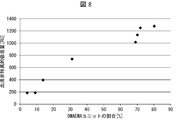
- It is a graph which shows the relationship between the ratio of the DMAEMA unit of the polymer prepared in Example 1 and the polymer film formation amount.
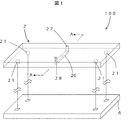
- FIG. 1 shows an outline of the sensor 2 of the measuring device 100 according to the present embodiment.
- the measuring device 100 can detect a specific substance (first substance) as a target from the measurement target (sample).
- measurement targets include biological samples such as blood such as serum and plasma, and body fluids such as sweat, urine, tears, and saliva.
- the first substance 5 is, for example, a substance in the living body. Examples of the above-mentioned substances in the living body include proteins, DNAs, substrates for enzymatic reactions, and the like.
- the measuring device 100 includes a sensor 2 capable of detecting the first substance and a control device 6 capable of controlling the measuring device 100.
- the sensor 2 may be, for example, a sensor that uses elastic waves, QCM (Quartz Crystal Microbalance), SPR (Surface Plasma Resonance), FET (Field Effect Transistor), or the like. That is, it suffices that the sensor 2 can mutually convert an electric signal, an elastic wave, a QCM, an SPR, a FET, and the like.
- the sensor 2 according to one embodiment is a sensor that uses elastic waves. That is, the measuring device 100 according to the embodiment can detect the change of the elastic wave due to the presence of the first substance as the change of the electric signal by using the sensor 2.
- the sensor 2 may be manufactured by a conventionally known method.
- the sensor 2 has an external terminal 21.
- the sensor 2 can be electrically connected to the control device 6 that controls the measuring device 100 via the external terminal 21. That is, the sensor 2 and the control device 6 can input and output electrical signals to and from each other via the external terminal 21. Therefore, the control device 6 can detect, for example, the first substance based on the electric signal input from the sensor 2.
- the control device 6 may calculate, for example, the concentration of the first substance contained in the sample. Alternatively, the control device 6 may identify the first substance, for example.
- the control device 6 and the external terminal 21 may be manufactured by a conventionally known technique. Further, the configuration for electrically connecting the sensor 2 and the control device 6 is not limited to the external terminal 21. For example, if the sensor 2 and the control device 6 can be electrically connected, the sensor 2 and the control device 6 do not have to be physically connected by a terminal or the like. For example, the sensor 2 and the control device 6 may be electrically connected by electromagnetic induction.
- the sensor 2 may be a disposable cartridge. According to this, the step of cleaning the sensor 2 after the measurement becomes unnecessary, and the influence of insufficient cleaning on the measurement result can be eliminated.
- FIG. 2 shows a plan view of the sensor 2.
- the sensor 2 includes a substrate 22, a detection unit 23 located on the substrate 22, and a pair of first IDT (Inter Digital Transducer) electrodes 25a arranged so as to sandwich the detection unit 23 on the substrate 22.
- the substrate 22 can support the first IDT electrode 25a and the like.
- the substrate 22 is a piezoelectric substrate.
- the substrate 22 may be a substrate containing a metal such as gold, silver, copper, platinum and aluminum, and a single crystal having piezoelectricity such as lithium tantalate and quartz.
- the substrate 22 is a piezoelectric substrate containing quartz.
- a substance (second substance) that reacts with the first substance 5 is fixed to the detection unit 23. Therefore, in the detection unit 23, the first substance contained in the sample and the fixed second substance can react with each other.
- the detection unit 23 can change the propagation characteristics of elastic waves of the substrate 22 by reacting the first substance with the second substance. Specifically, the detection unit 23 can change, for example, the weight applied to the substrate 22 or the viscosity of the liquid in contact with the surface of the substrate 22 by reacting the first substance with the second substance. As a result, the phase, amplitude, period, and the like of the elastic wave propagating on the substrate 22 change. Therefore, the sensor 2 can detect a change in the surface acoustic wave according to the concentration of the first substance. The details of the detection unit 23 will be described later.
- the pair of first IDT electrodes 25a can generate elastic waves between the pair of first IDT electrodes 25a.
- the elastic waves propagating on the surface of the substrate 22 are also referred to as surface acoustic waves (SAW: Surface Acoustic Wave).
- SAW Surface Acoustic Wave
- an electric signal is input to one of the pair of first IDT electrodes 25a.
- the input electric signal is converted into an elastic wave propagating toward the detection unit 23 and transmitted from one of the IDT electrodes 25a.
- the transmitted elastic wave passes through the detection unit 23.
- the other IDT electrode 25a can receive elastic waves that have passed through the detection unit 23.
- the received elastic wave is converted into an electric signal.
- the pair of first IDT electrodes 25a may be made of a metal material such as gold, chromium or titanium. Further, the pair of first IDT electrodes 25a may be a single-layer electrode made of a single material or a multi-layer electrode made of a plurality of materials.
- the sensor 2 may have two or more combinations of the detection unit 23 and the pair of IDT electrodes 25a.
- the measuring device 100 may detect different types of target substances for each combination, for example.
- the measuring device 100 may detect, for example, a plurality of combinations of target substances of the same type and compare the detection results of each.
- the sensor 2 may have a reference portion 24 located on the substrate 22. Further, the sensor 2 may have a pair of second IDT electrodes 25b located on the substrate 22 so as to sandwich the reference portion 24.
- an electric signal is input to one of the pair of first IDT electrodes 25b.
- the input electric signal is converted into an elastic wave propagating toward the reference unit 24 and transmitted from one of the IDT electrodes 25b.
- the transmitted elastic wave passes through the reference unit 24.
- the other IDT electrode 25b can receive elastic waves that have passed through the reference unit 24.
- the received elastic wave is converted into an electric signal.
- the reference unit 24 can function as a control of the detection unit 23.
- the second substance is not fixed to the reference unit 24. That is, in the reference unit 24, the reaction between the first substance and the second substance does not occur. Therefore, the measuring device 100 uses the electric signal (reference signal) based on the elastic wave passing through the reference unit 24 as a reference, and the first substance based on the electric signal (detection signal) based on the elastic wave passing through the detection unit 23. Can be detected. Specifically, if the sample contains the first substance, the first substance and the second substance react with each other, so that there is a difference between the detection signal and the reference signal. Therefore, for example, the measuring device 100 can detect the first substance by taking the difference of the reference signal from the detection signal. Further, for example, the measuring device 100 can detect a change in the reaction between the first substance and the second substance by detecting a change in the difference between the detection signal and the reference signal.
- FIG. 3 shows a cross-sectional view of the sensor 2 at the cutting plane line AA of FIG.
- the sensor 2 further includes a flow path member 26.
- the flow path member 26 can function as a path for the sample.
- the flow path member 26 has an opening on the upper surface of the flow path member 26, and has a supply port 27 for supplying a sample and a discharge port 28 for discharging the sample.
- the sensor 2 detects the first substance in the detection unit 23, and then discharges the sample from the discharge port 28.
- FIG. 4 shows a conceptual diagram showing the polymer film 1 included in the detection unit 23.
- the polymer film 1 containing the polymer 3 is fixed on the substrate 22. Further, a substance that reacts with the first substance 5 (second substance 4) is fixed on the polymer film 1.
- the polymer membrane 1 is a membrane adjusted so as to have high specific adsorptivity. That is, the polymer film 1 is a film adjusted to reduce non-specific adsorption.
- the non-specific adsorptivity of the polymer film 1 can be adjusted by changing the ratio of the first structural unit and the second structural unit contained in the polymer film 1. This adjustment method will be described later.
- the reaction between the first substance 5 and the second substance 4 may be any reaction that causes a change in the output of the sensor 2.
- a reaction is a reaction in which the first substance 5 and the second substance 4 are bound by, for example, a redox reaction, an enzyme reaction, an antigen-antibody reaction, a chemisorption, an intermolecular interaction, or an ion-ion interaction. You may.
- the reaction between the first substance 5 and the second substance 4 may be a reaction for producing a new substance (third substance) by an enzymatic reaction or the like.
- the second substance 4 fixed to the detection unit 23 may be appropriately selected according to the first substance 5.
- the second substance 4 may use an antibody, a peptide, an aptamer or the like.
- an antigen may be used as the second substance 4.
- an enzyme may be used as the second substance 4.
- the measuring device 100 may indirectly detect the target first substance 5.
- a substance similar to the first substance 5 may be fixed to the detection unit 23 as the second substance 4. That is, for example, an antibody using the first substance 5 as an antigen and the first substance 5 may be reacted in advance, and the unreacted antibody may be reacted with the fixed second substance 4.
- the measuring device 100 can indirectly calculate the amount of the first substance 5 from the amount of the detected antibody, for example, if the amount of the antibody is known.
- the polymer 3 constitutes the polymer film 1.
- an example of the polymer 3 of the present disclosure hereinafter, abbreviated as “polymer of the present embodiment”.
- the polymer of the present embodiment is a copolymer of a compound represented by the following formula (1) and a compound represented by the following formula (2).
- R 1 is a hydrogen atom or a methyl group.
- R 2 and R 3 are independently hydrogen atoms or alkyl groups having 1 to 4 carbon atoms.
- x and y are each independently an integer of 1 to 4.
- R 4 is a hydrogen atom or a methyl group.
- R 5 and R 6 are independently alkyl groups having 1 to 4 carbon atoms.
- z is an integer of 1 to 4.
- the compound represented by the formula (1) may be a commercially available product or a synthetically obtained compound.
- Examples of the compound represented by the formula (2) include N, N-dimethylaminoethyl (meth) acrylate, N, N-diethylaminoethyl (meth) acrylate, and N, N-diisopropylaminoethyl (meth) acrylate. ..
- the compound represented by the formula (2) may be a commercially available product or a synthetically obtained compound.
- the polymer of the present embodiment can produce polymer films having different non-specific adsorptivity.
- the polymer of the present embodiment can suppress non-specific adsorption due to the zwitterion structure in the structure of the formula (1).
- the polymer of the present embodiment can promote non-specific adsorption by the dimethylamino group in the structure of the formula (2). Therefore, in the polymer of the present embodiment, the non-specific adsorptivity as a polymer film can be adjusted by adjusting the ratio of these two structures.
- the polymer of the present embodiment is used in a measuring device such as a biosensor, it is a structural unit derived from the compound represented by the formula (2) contained in the above-mentioned copolymer in terms of suppressing non-specific adsorption and the like.
- the ratio of may be 5 mol% or less, and may be 2 mol% or less.
- the polymer of the present embodiment When used in the non-detection region of a measurement carrier such as an ELISA plate, it is represented by the formula (2) contained in the above-mentioned copolymer in terms of positively enhancing non-specific adsorptivity.
- the proportion of structural units derived from the compound is 20 mol% or more. Further, it may be 35 mol% or more, or 50 mol% or more.
- the polymer of the present embodiment can also be expressed as containing a first structural unit represented by the following formula (3) and a second structural unit (DMAEMA unit) represented by the following formula (4).
- the first structural unit is a structural unit derived from the compound represented by the above formula (1).
- the second structural unit is a structural unit derived from the compound represented by the above formula (2).
- R 1 , R 2 , R 3 , x and y are the same as in the above equation (1).
- m is 1 or more and 500 or less.
- R 4 , R 5 , R 6 and z are the same as in the above equation (2).
- n is 1 or more and 500 or less.
- the polymer of the present embodiment may have an active ester group at the end of a part of the side chain of the first structural unit represented by the formula (3).
- the active ester group include a succinimide group and the like.
- At least one end of the main chain of the polymer of the present embodiment has a thiol group or a dithioester group in terms of ease of fixation to a polymer membrane fixed to the substrate 22 (measurement substrate 12). You may.
- n / (m + n) ⁇ 100 may be 5 or less, or 2 or less.
- n / (m + n) ⁇ 100 may be 20 or more, or 35 or more.
- the weight average molecular weight of the polymer of the present embodiment may be 3000 or more or 5000 or more in terms of film formation density. Further, it may be 100,000 or less, or 70,000 or less.
- the polymer of the present embodiment may be any of a random copolymer, a block copolymer, and a graft copolymer.
- the weight average molecular weight of the polymer of the present embodiment may be 20000 or more in that it suppresses the amount of non-specific adsorption in serum. Further, the weight average molecular weight may be 30,000 or less. In addition to the weight average molecular weight of the polymer of the present embodiment being in the above range, the proportion of structural units derived from the compound represented by the formula (2) contained in the polymer of the present embodiment is 7 mol% or less (or). When it is 5 mol% or less, or 3 mol% or less), the amount of non-specific adsorption in serum can be further suppressed.
- the weight average molecular weight of the polymer of the present embodiment may be 2000 or more or 5000 or more in terms of suppressing the amount of non-specific adsorption in sweat or urine. Further, the weight average molecular weight may be 20000 or less, or 10000 or less. In addition to the weight average molecular weight of the polymer of the present embodiment being in the above range, the proportion of structural units derived from the compound represented by the formula (2) contained in the polymer of the present embodiment is 7 mol% or less (or). When it is 5 mol% or less, or 3 mol% or less), the amount of non-specific adsorption in sweat or urine can be further suppressed.
- the number average molecular weight or weight average molecular weight of the polymer of the present embodiment can be determined by a known technique such as gel permeation chromatography (GPC).
- the copolymer of the compound represented by the above formula (1) and the compound represented by the above formula (2) can be identified by a conventionally known organic analysis method.
- the copolymer may be identified by NMR (Nuclear Magnetic Resonance).
- it may be identified by, for example, a gas chromatograph.
- it may be identified by a liquid chromatograph.
- it may be identified by laser Raman spectroscopy. That is, when identifying the copolymer, an apparatus capable of carrying out these methods may be used.
- the identification method and device are not limited to these methods and devices as long as the copolymer can be identified.
- the polymer production method of the present embodiment can be produced by a known polymerization method such as radical polymerization.
- a known polymerization method such as radical polymerization.
- the compound represented by the formula (1) and the compound represented by the formula (2) are dissolved in a solvent.
- the polymerization reaction is carried out by adding the polymerization catalyst and the polymerization initiator.
- the polymerization conditions such as the polymerization time, the polymerization temperature and the polymerization solvent can be appropriately selected depending on the type of monomer, the amount used, the ratio used and the like.
- Examples of the method for immobilizing the polymer 3 on the substrate 22 include a method in which a polymer solution obtained by dissolving the polymer 3 in a solvent is applied to the substrate 22 and dried, graft polymerization by radiation or ultraviolet rays, and functional groups of the substrate 22. Chemical reaction and the like. By these methods, a polymer film 1 composed of the polymer 3 is formed on the substrate 22.
- a method of fixing the second substance 4 on the polymer 3 (polymer film 1) for example, a method of covalently bonding the second substance 4 to the carboxyl group of the polymer 3 can be mentioned.
- polymer 3 is reacted with N-hydroxysulfosuccinimide (NHS) and 1-ethyl-3- (3-dimethylaminopropyl) carbodiimide (EDC) (NHS / EDC activation).
- NHS ester group N-hydroxysulfosuccinimide
- EDC 1-ethyl-3- (3-dimethylaminopropyl) carbodiimide
- FIG. 5 shows a schematic configuration of the measurement carrier 11 according to the present embodiment.
- the measurement carrier 11 include a plate for ELISA (enzyme-linked immunosorbent assay).
- the measurement carrier 11 has a detection region 31 for specifically capturing the target substance (first substance 5) contained in the sample and a non-detection region 32 for non-selectively adsorbing a blocking agent or the like on the surface of the measurement substrate 12. Be prepared for.
- the polymer film 1A is fixed in the detection region 31, and the polymer film 1B is fixed in the non-detection region 32.
- the second substance 4 that reacts with the first substance 5 is fixed on the polymer film 1A. Further, the polymer film 1A is adjusted so that the non-specific adsorptivity is low.
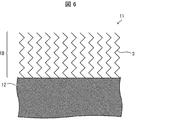
- FIG. 6 conceptually shows the polymer film formed in the non-detection region 32.
- the second substance 4 is not fixed on the polymer film 1B, and only the polymer film 1 containing the polymer 3 is fixed on the surface of the measurement substrate 12.
- the polymer film 1B is a film adjusted so as to enhance non-specific adsorptivity. That is, two types of polymer films 1A and 1B containing the same structural unit (first and second structural units) but having different non-specific adsorptivity are formed on one measurement carrier 11.
- the desired second substance 4 is fixed to the polymer film 1A in the detection region 31. Further, the non-detection region 32 is treated with a blocking agent, and the blocking agent is non-specifically adsorbed on the polymer film 1B of the non-detection region 32.
- the first substance 5 which is the target substance contained in the sample reacts with the second substance 4, and the reaction is detected by the detection reagent.
- detection reagents include redox substances, fluorescent substances, enzymes, dye compounds and the like. Since the polymer film 1B in the non-detection region 32 is treated with a blocking agent, as a result, non-specific adsorption is effectively suppressed.
- the application of the polymer membrane 1B is not limited to the above, and the polymer membrane 1B may be used in order to positively enhance the non-specific adsorptivity.
- the measuring substrate 12 may be, for example, a metal such as gold, silver, copper, platinum and aluminum; a plastic such as polyethylene and polypropylene; an inorganic material such as titanium oxide, silica, glass and ceramic; and the like.
- the measuring substrate 12 is not limited to these examples.
- the shape of the measurement substrate 12 may be, for example, a plate shape, particles, a microstructure, a microtiter plate, or the like.
- the shape of the measuring substrate 12 is not limited to these examples.
- a measurement kit including a measurement substrate 12 on which the polymer films 1A and 1B are fixed, a second substance 4, and a detection reagent is also included in the scope of the present disclosure.
- the second substance 4 may be fixed in advance to the polymer film 1 at the time of manufacturing the product, or may be fixed by the user before the measurement.
- the measurement kit according to this embodiment may include other reagents and instruments.
- it may contain components other than the second substance 4 and the detection reagent described above.
- a buffer or the like may be provided.
- the measurement kit according to the present embodiment may be a mixture of a plurality of different reagents in appropriate volumes and / or embodiments, or may be provided in separate containers.
- the measurement kit according to the present embodiment may include an instruction sheet describing a procedure for obtaining detection of the reaction between the first substance 5 and the second substance 4. It may be written or printed on paper or other media, or attached to magnetic tape, readable discs such as computers, or electronic media such as CD-ROMs.
- Example 1 Preparation of polymer (copolymer)
- the solvent (methanol and water) used for polymerization of the polymer was previously deoxidized.
- As the monomers 3-[[2- (methacryloyloxy) ethyl] dimethylammonio] propionate (CBMA2, manufactured by Tokyo Kasei) and 2- (dimethylamino) ethyl methacrylate (DMAEMA, manufactured by Tokyo Kasei) were used. Each monomer was dissolved in a solvent (mixed solvent of methanol and water) so as to have an arbitrary ratio.
- the polymerization was carried out in a nitrogen atmosphere at room temperature, the polymerization was stopped by opening the polymerization solution to the atmosphere, a part of the polymerization solution was diluted, and the molecular weight was measured by GPC measurement. As a result, the weight average molecular weight (Mw) was 38. , 100. Then, the obtained polymer solution was diluted with an appropriate solvent at an arbitrary ratio, and then applied onto an Au substrate. Then, the Au substrate was washed and dried to form a polymer film (polymer film 1).
- the GPC measurement was performed under the following measurement conditions.
- the sample was diluted by adding a 10 mM LiBr aqueous solution so as to be about 0.1% by mass, and dispersed by an ultrasonic disperser.
- Equipment Shimadzu High Performance Liquid Chromatograph LC-20 Column Performance: Mw20,000,000-Mw100
- Measuring solvent LiBr 10 mM aqueous solution Detector: RID-10A
- the graph which plotted the ratio (%) of the DMAEMA unit (second structural unit) in the polymer prepared in Example 1 on the horizontal axis, and the polymer film formation amount (RU) formed on the Au substrate on the vertical axis is a figure. Shown in 7.
- the ratio (%) of DMAEMA units was calculated from the following formula (A).
- the polymer film formation amount (RU) was measured by an SPR device T-200 (manufactured by GE Healthcare). Addition amount of DMAEMA / (addition amount of CBMA2 + addition amount of DMAEMA) ...
- a polymer film was formed using a sensor chip from SIA kit Au (manufactured by GE Healthcare).
- the sensor chip was washed with a piranha solution or the like and set in the SPR device. Then, any polymer solution was injected at an appropriate flow rate over a desired time. Then, the difference between the signals before and after the injection was taken as the amount of polymer film formed.
- the amount of DMAEMA units in the polymer could be adjusted according to the hydrolysis time of the CBMA2 polymer. That is, by adjusting the hydrolysis time of the CBMA2 polymer, the ratio of the first structural unit and the second structural unit in the polymer 3 constituting the polymer membrane 1 can be adjusted, and the non-specific adsorptivity of the polymer membrane 1 can be adjusted. I found that I could adjust.
- Example 3 Evaluation by NMR Spectroscopy The polymers prepared in Example 1 and Evaluation Example 2 were measured by NMR spectroscopy under the following measurement conditions, and the ratio of CBMA2 to DMAEMA was calculated. Measuring device: Bruker Biospin Co., Ltd.
- the examination results are shown in Table 1 and FIG.
- the vertical axis of FIG. 11 shows the weight average molecular weight of the polymer, and the horizontal axis shows the molar ratio of BiBOEDS to CBMA2.
- the number average molecular weight (Mn) and the weight average molecular weight (Mw) were measured by gel permeation chromatography (GPC) under the same conditions as in Example 1.
- the measurement target human serum or human urine
- the non-specific adsorption amount of the measurement target component was measured.
- the non-specific adsorption amount (RU) was measured by an SPR device T-200 (manufactured by GE Healthcare). After the sensor chip on which the polymer film was formed was set in the SPR device, the measurement target was injected at an appropriate flow velocity over a desired time. Then, only the running buffer was flowed at the same flow velocity as in the case of the measurement target over the same time. The difference between the signals before the injection to be measured and after the running buffer was flowed was defined as the non-specific adsorption amount.
- the measurement results are shown in FIG. The horizontal axis of FIG.
- Mw weight average molecular weight of the polymer in the polymer membrane, which is predicted from the weight average molecular weight of the polymerized polymer. Since the polymerized polymer uses BiBOEDS having a disulfide bond as a polymerization initiator, when a polymer film is formed on an Au substrate, the disulfide bond derived from BiBOEDS reacts with gold and the polymer is decomposed into two. Will be done. Since the molecular weights of the two polymers (polymers in the polymer film) after the decomposition are substantially the same, the value obtained by dividing the weight average molecular weight of the polymerized polymer by 2 is the weight average molecular weight (Mw) of the polymer in the polymer film. And said.
- the nonspecific adsorption amount of urine can be suppressed when the weight average molecular weight of the polymer is about 20000 or less, and the lower the weight average molecular weight, the more nonspecific the urine. The amount of adsorption was suppressed.
- the measurement target was serum
- the non-specific adsorption amount of serum could be suppressed when the weight average molecular weight of the polymer was 20000 or more. From Evaluation Example 5, it was found that the range of the weight average molecular weight of the polymer capable of suppressing the non-specific adsorption amount differs depending on the measurement target.
- the present disclosure can be used for a measuring device and a measuring plate provided with a detection unit on which a polymer film is formed.
Landscapes
- Chemical & Material Sciences (AREA)
- Health & Medical Sciences (AREA)
- Life Sciences & Earth Sciences (AREA)
- Chemical Kinetics & Catalysis (AREA)
- Medicinal Chemistry (AREA)
- Organic Chemistry (AREA)
- Engineering & Computer Science (AREA)
- Immunology (AREA)
- Polymers & Plastics (AREA)
- Physics & Mathematics (AREA)
- General Health & Medical Sciences (AREA)
- Analytical Chemistry (AREA)
- Biochemistry (AREA)
- General Physics & Mathematics (AREA)
- Pathology (AREA)
- Manufacturing & Machinery (AREA)
- Acoustics & Sound (AREA)
- Materials Engineering (AREA)
- Biomedical Technology (AREA)
- Hematology (AREA)
- Molecular Biology (AREA)
- Urology & Nephrology (AREA)
- General Chemical & Material Sciences (AREA)
- Biotechnology (AREA)
- Cell Biology (AREA)
- Microbiology (AREA)
- Food Science & Technology (AREA)
- Wood Science & Technology (AREA)
- Addition Polymer Or Copolymer, Post-Treatments, Or Chemical Modifications (AREA)
Priority Applications (4)
| Application Number | Priority Date | Filing Date | Title |
|---|---|---|---|
| CN202080081997.1A CN114981326B (zh) | 2019-11-28 | 2020-11-25 | 共聚物、测量装置和测量用载体 |
| US17/779,526 US20230030958A1 (en) | 2019-11-28 | 2020-11-25 | Copolymer, measuring device, and carrier for measurement |
| EP20891558.7A EP4067396A4 (en) | 2019-11-28 | 2020-11-25 | COPOLYMER, DETERMINATION DEVICE AND SUPPORT FOR DETERMINATION |
| JP2021561435A JP7443396B2 (ja) | 2019-11-28 | 2020-11-25 | 共重合体、測定装置および測定用担体 |
Applications Claiming Priority (2)
| Application Number | Priority Date | Filing Date | Title |
|---|---|---|---|
| JP2019215690 | 2019-11-28 | ||
| JP2019-215690 | 2019-11-28 |
Publications (1)
| Publication Number | Publication Date |
|---|---|
| WO2021106899A1 true WO2021106899A1 (ja) | 2021-06-03 |
Family
ID=76130546
Family Applications (1)
| Application Number | Title | Priority Date | Filing Date |
|---|---|---|---|
| PCT/JP2020/043728 Ceased WO2021106899A1 (ja) | 2019-11-28 | 2020-11-25 | 共重合体、測定装置および測定用担体 |
Country Status (5)
| Country | Link |
|---|---|
| US (1) | US20230030958A1 (https=) |
| EP (1) | EP4067396A4 (https=) |
| JP (1) | JP7443396B2 (https=) |
| CN (1) | CN114981326B (https=) |
| WO (1) | WO2021106899A1 (https=) |
Cited By (2)
| Publication number | Priority date | Publication date | Assignee | Title |
|---|---|---|---|---|
| WO2023189138A1 (ja) * | 2022-03-30 | 2023-10-05 | 京セラ株式会社 | 光学デバイス及びバイオセンサ |
| CN116948097A (zh) * | 2022-04-13 | 2023-10-27 | 杭州柏医健康科技有限公司 | 一种用于植入式生物传感器的两性离子聚合物及其制备方法和应用 |
Citations (5)
| Publication number | Priority date | Publication date | Assignee | Title |
|---|---|---|---|---|
| US3836537A (en) * | 1970-10-07 | 1974-09-17 | Minnesota Mining & Mfg | Zwitterionic polymer hairsetting compositions and method of using same |
| JP2008286606A (ja) | 2007-05-16 | 2008-11-27 | Japan Radio Co Ltd | 弾性表面波センサ及び弾性表面波センサを備えた生体分子測定装置。 |
| CN108504150A (zh) * | 2018-03-22 | 2018-09-07 | 天津大学 | 一种基于两性离子聚电解质共聚物的防雾涂层及其制备方法 |
| WO2019001875A1 (en) * | 2017-06-29 | 2019-01-03 | Unilever N.V. | COMPOSITION FOR THE PURIFICATION OF TROUBLE WATER |
| JP2020043782A (ja) * | 2018-09-14 | 2020-03-26 | アオイ電子株式会社 | ナノピンセット、ナノピンセット中間体、コーティング剤、ピンセットキット、ナノピンセットの製造方法、およびナノピンセット中間体の製造方法 |
Family Cites Families (8)
| Publication number | Priority date | Publication date | Assignee | Title |
|---|---|---|---|---|
| JP2006321829A (ja) * | 2005-05-17 | 2006-11-30 | Kazuhiko Ishihara | 共重合体およびその製造方法 |
| MX2009007101A (es) * | 2006-12-29 | 2009-12-01 | Univ Washington | Superficies y materiales antibioincrustación bifuncionales. |
| US8232344B2 (en) * | 2007-06-27 | 2012-07-31 | Canon Kabushiki Kaisha | Structure, target substance-detecting element and target substance-detecting kit |
| US7943370B2 (en) * | 2007-08-23 | 2011-05-17 | Canon Kabushiki Kaisha | Structure, target substance detection element and target substance detection kit |
| JP6417818B2 (ja) * | 2014-09-19 | 2018-11-07 | 日産化学株式会社 | 滅菌済コーティング膜 |
| WO2017183733A1 (ja) * | 2016-04-22 | 2017-10-26 | 和光純薬工業株式会社 | ウエスタンブロット法用非特異的吸着防止剤、ウエスタンブロット法用試薬およびブロッキング方法 |
| JP2019038869A (ja) * | 2017-08-22 | 2019-03-14 | 東洋インキScホールディングス株式会社 | 水性導電性分散体、バイオセンサおよびバイオセンサの製造方法 |
| JP2019084519A (ja) * | 2017-11-10 | 2019-06-06 | 東洋インキScホールディングス株式会社 | 水性導電性分散体、水性導電性分散体の製造方法、バイオセンサおよびバイオセンサの製造方法 |
-
2020
- 2020-11-25 JP JP2021561435A patent/JP7443396B2/ja active Active
- 2020-11-25 WO PCT/JP2020/043728 patent/WO2021106899A1/ja not_active Ceased
- 2020-11-25 EP EP20891558.7A patent/EP4067396A4/en not_active Withdrawn
- 2020-11-25 US US17/779,526 patent/US20230030958A1/en not_active Abandoned
- 2020-11-25 CN CN202080081997.1A patent/CN114981326B/zh active Active
Patent Citations (5)
| Publication number | Priority date | Publication date | Assignee | Title |
|---|---|---|---|---|
| US3836537A (en) * | 1970-10-07 | 1974-09-17 | Minnesota Mining & Mfg | Zwitterionic polymer hairsetting compositions and method of using same |
| JP2008286606A (ja) | 2007-05-16 | 2008-11-27 | Japan Radio Co Ltd | 弾性表面波センサ及び弾性表面波センサを備えた生体分子測定装置。 |
| WO2019001875A1 (en) * | 2017-06-29 | 2019-01-03 | Unilever N.V. | COMPOSITION FOR THE PURIFICATION OF TROUBLE WATER |
| CN108504150A (zh) * | 2018-03-22 | 2018-09-07 | 天津大学 | 一种基于两性离子聚电解质共聚物的防雾涂层及其制备方法 |
| JP2020043782A (ja) * | 2018-09-14 | 2020-03-26 | アオイ電子株式会社 | ナノピンセット、ナノピンセット中間体、コーティング剤、ピンセットキット、ナノピンセットの製造方法、およびナノピンセット中間体の製造方法 |
Non-Patent Citations (5)
| Title |
|---|
| JIN QIAO, CAI TONGJIANG, WANG YIN, WANG HAIBO, JI JIAN: "Light-Responsive Polyion Complex Micelles with Switchable Surface Charge for Efficient Protein Delivery", ACS MACRO LETTERS, vol. 3, no. 7, 15 July 2014 (2014-07-15), pages 679 - 683, XP055830057, ISSN: 2161-1653, DOI: 10.1021/mz500290s * |
| See also references of EP4067396A4 |
| SHAOYI JIANG, ZHIQIANG CAO: "Ultralow-Fouling, Functionalizable, and Hydrolyzable Zwitterionic Materials and Their Derivatives for Biological Applications", ADVANCED MATERIALS, VCH PUBLISHERS, vol. 22, no. 9, 5 March 2010 (2010-03-05), pages 920 - 932, XP055485454, ISSN: 0935-9648, DOI: 10.1002/adma.200901407 * |
| ZHENG ZHANG, CHEN SHENGFU, JIANG SHAOYI: "Dual-Functional Biomimetic Materials:� Nonfouling Poly(carboxybetaine) with Active Functional Groups for Protein Immobilization", BIOMACROMOLECULES, AMERICAN CHEMICAL SOCIETY, vol. 7, no. 12, 1 December 2006 (2006-12-01), pages 3311 - 3315, XP055083259, ISSN: 15257797, DOI: 10.1021/bm060750m * |
| ZHENG ZHANG, TIMOTHY CHAO, SHENGFU CHEN, SHAOYI JIANG: "Superlow Fouling Sulfobetaine and Carboxybetaine Polymers on Glass Slides", LANGMUIR, AMERICAN CHEMICAL SOCIETY, vol. 22, no. 24, 1 November 2006 (2006-11-01), pages 10072 - 10077, XP055001604, ISSN: 07437463, DOI: 10.1021/la062175d * |
Cited By (3)
| Publication number | Priority date | Publication date | Assignee | Title |
|---|---|---|---|---|
| WO2023189138A1 (ja) * | 2022-03-30 | 2023-10-05 | 京セラ株式会社 | 光学デバイス及びバイオセンサ |
| CN116948097A (zh) * | 2022-04-13 | 2023-10-27 | 杭州柏医健康科技有限公司 | 一种用于植入式生物传感器的两性离子聚合物及其制备方法和应用 |
| CN116948097B (zh) * | 2022-04-13 | 2026-03-10 | 杭州柏医健康科技有限公司 | 一种用于植入式生物传感器的两性离子聚合物及其制备方法和应用 |
Also Published As
| Publication number | Publication date |
|---|---|
| JP7443396B2 (ja) | 2024-03-05 |
| EP4067396A4 (en) | 2024-01-10 |
| JPWO2021106899A1 (https=) | 2021-06-03 |
| US20230030958A1 (en) | 2023-02-02 |
| EP4067396A1 (en) | 2022-10-05 |
| CN114981326A (zh) | 2022-08-30 |
| CN114981326B (zh) | 2023-12-22 |
Similar Documents
| Publication | Publication Date | Title |
|---|---|---|
| Lin et al. | Determination of albumin concentration by MIP-QCM sensor | |
| JP5383115B2 (ja) | 構造体、標的物質検出素子および標的物質検出キット | |
| Haupt et al. | Imprinted polymer-based enantioselective acoustic sensor using a quartz crystal microbalance | |
| WO2019192125A1 (zh) | 一种基于声表面波模式的生物传感器及其检测方法 | |
| JPH06308127A (ja) | 質量センサー法による試料中の検体測定システム | |
| US7943388B2 (en) | Acoustic sensors and methods | |
| JP7443396B2 (ja) | 共重合体、測定装置および測定用担体 | |
| Hartz et al. | Lateral field excited quartz crystal microbalances for biosensing applications | |
| CN108704676B (zh) | 一种抗非特异性吸附三维芯片及其应用 | |
| Lee et al. | Love wave SAW biosensors for detection of antigen-antibody binding and comparison with SPR biosensor | |
| JP6822957B2 (ja) | 測定方法、および測定装置 | |
| JP7333462B2 (ja) | 共重合体およびその製造方法、測定装置ならびに測定用担体 | |
| WO2005111618A1 (ja) | 物質固定化剤、それを用いた物質固定化方法及びそれを用いた物質固定化基体 | |
| JP7855063B2 (ja) | 共重合体、高分子膜、測定用装置および測定用担体 | |
| WO2023210671A1 (ja) | 共重合体、高分子膜、測定用装置および測定用担体 | |
| WO2008019694A2 (en) | Bio surface acoustic wave (saw) resonator design for detection of a target analyte | |
| JP4435709B2 (ja) | バイオセンサー | |
| JP2006321829A (ja) | 共重合体およびその製造方法 | |
| US20040018532A1 (en) | Electronic sensor device | |
| JP2006275865A (ja) | Qcmセンサーを用いた定量方法 | |
| JP4278469B2 (ja) | 免疫学的活性物質の測定方法 | |
| JP2006266832A (ja) | 固定化方法、バイオセンサー及び試験方法 | |
| JP2024095317A (ja) | 標的物質の検出方法および検出用カートリッジ | |
| EP1369692A2 (en) | Sensor surface | |
| JP2004198261A (ja) | 親水性高分子物質によって被覆されたセンサチップとそれを用いた分析方法 |
Legal Events
| Date | Code | Title | Description |
|---|---|---|---|
| 121 | Ep: the epo has been informed by wipo that ep was designated in this application |
Ref document number: 20891558 Country of ref document: EP Kind code of ref document: A1 |
|
| ENP | Entry into the national phase |
Ref document number: 2021561435 Country of ref document: JP Kind code of ref document: A |
|
| NENP | Non-entry into the national phase |
Ref country code: DE |
|
| ENP | Entry into the national phase |
Ref document number: 2020891558 Country of ref document: EP Effective date: 20220628 |